Art

Flaming Lotus Girls bring SOMA to Pier 14

0

Following in the tradition of Burning Man artworks returning to San Francisco for temporary public installations, my beloved Flaming Lotus Girls have installed their colossal steel and light sculpture SOMA at Pier 14. And this Friday, Aug. 1, they’ll be hosting a dance party reception from 5-9pm to celebrate the occasion.

Longtime Guardian readers may remember the 2005 immersion journalism project when I worked for with the Flaming Lotus Girls for nine months documenting the creation of a large-scale art project and what motivates people to volunteer their time and energy for such an undertaking (The reporting for that article, “Angels of the Apocalypse,” helped form the basis of my 2011 book, The Tribes of Burning Man: How an Experimental City in the Desert is Shaping the New American Counterculture).

Since then, the Flaming Lotus Girls have gone on to create even more impossibly epic creations for Burning Man and other festivals around the world, from Robodoc in Europe to the Electric Daisy Festival in Las Vegas. But this is the first time that one of their massive artistic creations has ended up back in a prominent spot in San Francisco, where they work out of the Box Shop on Hunters Point.

So go check out SOMA and stop by this Friday to mix and mingle with the Flaming Lotus Girls.  

Democracy wow!

0

arts@sfbg.com

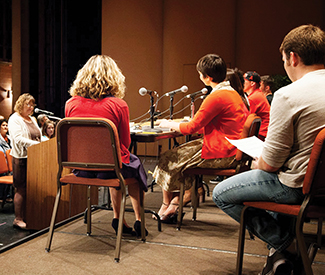
THEATER From a certain angle, democracy is just one big bout of audience participation. So when playwright Aaron Landsman, director Mallory Catlett, and designer Jim Findlay started kicking around the idea of somehow staging a city council meeting, of all things, the notion that the audience itself should enact it must have come as a eureka moment.

It is indeed the charm and challenge of City Council Meeting that, while conceived and instigated by the New York–based artistic trio, the show is ultimately a collaboration with whoever shows up, plus a few semi-rehearsed locals in on the running of the thing. These latter include a group of “staffers” who help guide participants through an actual city council meeting — or more precisely, a seamless composite of public transcripts of such meetings held around the US in the past couple of years, plus an artistic flourish or two. For the San Francisco premiere (running this weekend at local co-presenter Z Space), the staffers include Claudia Anderson, Awele, Dwayne Calizo, Jennifer Chien, Sarah Curran, and me.

Moreover, the piece always concludes with an original ending crafted specifically for the locale in which it plays (that, so far, has been Houston, Texas; Tempe, Ariz.; and New York City). This time, the play’s unique final movement, a creative response to what has preceded it, was built in partnership with Bay Area director-choreographer Erika Chong Shuch.

As a staffer, your job is to help facilitate the encounter between the play and its audience. Since that’s kind of what a critic does anyway, I reasoned, and given that everyone in the audience is already at least minimally involved in the production, I signed on for a more inside track on City Council Meeting‘s three-day San Francisco run. At the first rehearsal, director Catlett introduced us to our binders, which contained things we’d need, including something like the script of the performance.

(There is no definitive script. The play is an un-distillable architecture of discrete dialogue, directions on note cards, live and recorded video feeds, and whispered cues, not to mention the unforeseeable but pretty much guaranteed contingency. And perspectives and experiences will vary pretty widely depending on the physical and dramatic space one chooses to occupy: council member, speaker, bystander.)

It was a little confusing, frankly. But halfway through a swift two weeks of rehearsal, I’m seeing more clearly the shape of the show as well as appreciating the subtleties in its construction. Like much contemporary participatory performance, or what’s sometimes called “social practice” art, City Council Meeting moves the bulk of the action and agency onto its audience as a way to simultaneously investigate and manifest our social circumstances and potentialities. It is therefore purposely unsettled — participants are always themselves and yet tasked with enacting the words of other real people like, or more often not like, themselves.

The sheer awkwardness of it is really the point. Is this a study, a parody, an incitement, an invocation? In enacting the form, does the piece share in some of its power? A strange combination of sincerity and dry humor runs throughout it all, as the double-consciousness built into the piece throws everything gleefully up in the air, suspended somewhere between the rehearsal of dead forms (whether political or aesthetic) and the activation of new ones.

That’s a salubrious position, encouraged by the context at large. Or so I couldn’t help thinking. Was it merely coincidence that after leaving rehearsal one night I walked directly into road blocks, sirens, and hundreds of cops — the wake left by a president and secretary of state on political shopping sprees? Is the power that creates such disruption, traffic, and annoyance wherever it goes, like some heedless B-movie giant, even related to the power invested in local government? Was it just coincidence that after leaving another rehearsal a few days later, the Chronicle building was papered over in posters reading, “the media lies as Gaza dies,” this time the unsanctioned wake of a protest on behalf of the powerless?

For a moment there, Occupy took back government from representative bodies and held it in the bodies of real people, acting on their own behalf. It was wild, unexpected, and startlingly easy. It was also strikingly creative — and art was everywhere in the movement. It’s become clearer since then that the relationship between art and politics is a much more serious question than many of us had realized. We can’t afford a paucity of imagination in either. We need the room and wherewithal to ask questions. If nothing else, City Council Meeting asks questions. Including these:

“Are we working together? Are we capable of it? Is that why this structure is here? Or is that what the structure prevents?” *

CITY COUNCIL MEETING

Fri/1-Sat/2, 7pm; Sun/3, 2pm, $20

Z Space

450 Florida, SF

www.zspace.org


This Week’s Picks: July 30 – August 5, 2014

0

WEDNESDAY 30


The Budos Band

If you ever hear someone say they find instrumental music boring, all you need to do is point them in the direction of the Budos Band, a 10- to 13-member (depending on the year) Afro-soul group that collectively, with its energetic meanderings through jazz and deep-pocket funk with just the right smattering of pop sweetness, commands more attention on stage than many a lead singer I’ve seen. Daptone Records labelmate Sharon Jones is having a banner year — and with the Budos’ first album since 2010, Burnt Offering, due out Oct. 21, we imagine the record company is too. Head to the Independent prepared to get sweaty. (Emma Silvers)

8pm, $25

The Independent

628 Divisadero, SF

www.theindependentsf.com


THURSDAY 31


Matthew Curry

Matthew Curry may only be 19, but the burgeoning blues guitarist has already had a career that many musicians spend their entire lives trying to accumulate. The Normal, Illinois native recently came off of a summer tour with Bay Area legends the Steve Miller Band and has already released an acclaimed album made up entirely of originals. His music isn’t just Stevie Ray Vaughan rehashing either — his first disk, Electric Religion, is made up of tracks that explore dynamics, confessional lyricism, and modern production. “Bad Bad Day,” an almost seven-minute jam with prolonged solos by all members of the band, is exhilarating: When Curry comes in on vocals four minutes in, he sounds like a gruff and aged Southern bluesman of the ’50s; he’s that throwback and that mature. Along with his band, The Fury (which is made up of equally talented players who are, on average, about twice Curry’s age), the group is in the midst of a cross-country odyssey that sees them opening for the Doobie Brothers and Peter Frampton. Yoshi’s will provide a break from larger venues and a chance to see Curry’s intricate guitar work up close. (David Kurlander)

8pm, $12-14

Yoshi’s

1330 Fillmore, SF

(415) 655-5600

www.yoshis.com


Pretty In Ink

Featuring highlights from the personal archives of comics historian Trina Robbins, Pretty In Ink (Fantagraphic Books) looks at the work of some of the top women cartoonists from the early 20th century, including Ethel Hays, Edwina Dumm, Nell Brinkley, and Ramona Fradon. An exhibit of the same name is currently on display at the Cartoon Art Museum, with original artwork, photographs, and other rare items featuring characters such as Miss Fury and Flapper Fanny — don’t miss your chance to head down tonight for a reception and party celebrating both, where Robbins will be on hand to autograph the toon-filled tome. (Sean McCourt)

6-8pm, free

Cartoon Art Museum

655 Mission, SF

(415) CAR-TOON

www.cartoonart.org


FRIDAY 1


Omar Souleyman

Though Syrian singer Omar Souleyman’s been performing for two decades and allegedly has over 500 releases to his name, you may not have heard of him until recently. Formerly a regular performer at weddings in Syria, Souleyman performs dabke music, meant to accompany the traditional line dance of the same name. Wild videos of these dances and performances found their way onto YouTube and attracted the attention of Seattle label Sublime Frequencies, which released several compilations of his work and brought him to the attention of the world’s music cognoscenti. A Four Tet-produced album and a few inexplicable Bjork remixes later, he’s become something of an underground star, performing for audiences across the world — including in San Francisco, where he’s set to most likely fill The Independent tonight. (Daniel Bromfield)

9pm, $20

The Independent

628 Divisadero, SF

(415) 771-1421

www.theindependentsf.com


Xiu Xiu

Twelve albums and 15 years in, Xiu Xiu remains one of the most fearless and uncompromising bands in the American rock underground. Bandleader and songwriter Jamie Stewart speaks to the part of the brain that craves the twisted and taboo, but doesn’t dare make itself known. At best, he’s like that friend you can talk to about just about anything; at worst, he’s like your own fears, screaming in your ears and telling you everything you’re thinking is sick and wrong. Approaching Xiu Xiu’s music takes mental preparation and a certain mindset. But if you think you’re ready, put on one of their records (I’d recommend Knife Play or Fabulous Muscles, but they’re all good) and trek out to see them at Bottom of the Hill. (Daniel Bromfield)

9:30pm, $14

Bottom of the Hill

1233 17th St., SF

(415) 626-4455

www.bottomofthehill.com


Real Estate

As members try to shrug off the stereotype of a “beach band,” there’s something about Real Estate’s mellow guitar pop that resonates with listeners, telling them the band definitely isn’t the modern Jersey equivalent of the Beach Boys. Shaking off a reliance on overdubs, the band recorded almost each take on its newest album, Atlas, live, which bodes well for the Fillmore’s audience tonight. Grab a friend who doesn’t babble about housing prices when you ask if they like Real Estate and prepare for a musical journey of sorts, as the tracks on Atlas are meant to compose a personal road map for the listener. (Amy Char)

With Kevin Morby, Corey Cunningham

9pm, $22.50

The Fillmore

1805 Geary, SF

(415) 346-3000

www.thefillmore.com


Brainwashing The Ride

Seldom has there been a more romantic musical coupling than that of Katie Ann and MC Zill. Ann, an indie singer who recently recorded her debut album, the heart-wrenching The Ride, at Goo Goo Dolls frontman Robbie Takac’s studio in New York, met the socially conscious Zill (his website is mcofpositivity.com) during her recording process, when she hit his car during a stressful day of outtakes. Their friendship morphed into an engagement, and the duo took to the road to spread their music together. The juxtaposition of Ann’s redemptive lyrics and Zill’s existential queries evoke the power pop/hip-hop mashup of later Eminem. The artists have fused the songs from their debuts into alternately sung and rapped tracks that promise an evening of emotional and stylistic fluctuation. (David Kurlander)

8pm, $10

50 Mason Social House

50 Mason, SF

(415) 433-5050

www.50masonsocialhouse.com


SATURDAY 2


Film Night in the park: Clueless

Watch a movie alone on your couch Saturday night? As if! This week’s free film screening, 1995’s Clueless, is timeless. Way timeless. Forget about feeling like a heifer and happily gorge on ice cream from Bi-Rite, a community partner of the outdoor film series, before the movie begins — don’t forget to bring some herbal refreshments. Tonight’s selection is this summer’s third movie in the series, following mid-July’s Frozen, and let’s be real, Coolio’s “Rollin’ With My Homies” totally has more musical merit than that annoying song about a snowman. And sure, this isn’t LA, but the event still offers valet — bicycle valet, that is. So it’s totally okay if you’re a virgin who can’t drive. (Amy Char)

Dusk, free

Dolores Park

19th St. & Dolores, SF

(415) 554-9521

www.sfntf.squarespace.com


Art + Soul Blues & BBQ Blowout

Live blues music all day in the sunshine, paired with barbecue cooked up by 40 top “pitmasters” from all over California. Need I say more? Oakland’s Art + Soul festival has long been a gem in the city’s cultural crown, with visual art, kids’ activities, and killer musical lineups, this year drawing old-school local favorites like Tommy Castro and the Painkillers and “Oakland Blues Divas” Margie Turner, Ella Pennewell, and more for a showcase presented by the Bay Area Blues Society. How good will the barbecue be? Mayor Jean Quan is presenting California “Chef of the Year” Tanya Holland of Oakland’s Brown Sugar Kitchen and B-Side BBQ with a key to the city. So, you know: Officially, city-decreed, smokin.’ (Emma Silvers)

Through Sun/3, noon to 6pm

$10 adults, $7 seniors and youth, kids 12 and under free

14th and Broadway, Oakl.

www.artandsouloakland.com


SUNDAY 3


The Sturgeon Queens

This quick documentary, which celebrates the 100th anniversary of iconic Jewish fishmongers/New York deli nosh-purveyors Russ & Daughters, is a must-see for delicatessen aficionados, or food history buffs, or, you know, anyone who likes to get really hungry while watching movies. At the film’s center are 100-year-old Hattie Russ Gold and 92-year-old Anne Russ Federman, the daughters after which the store was named and the heirs to their family’s culinary Lower East Side legacy; guest appearances by loyal celebrity fans of the store include Maggie Gyllenhaal, Mario Batali, and Supreme Court Justice Ruth Bader Ginsberg. (Emma Silvers)

12:15pm, $14 (as part of SFJFF)

The Castro Theatre

429 Castro, SF

www.sfjff.org


MONDAY 4


Bad Suns

The 2012 release of “Cardiac Arrest” was supposed to be a one-time deal from Bad Suns — the band planned to have only one song to its name. But not surprisingly, the catchy, sleek track caught people’s attention and blew up on the radio. Opening for groups such as Geographer and The 1975 in the past year or so, the LA-based band finally sets out on its own tour to promote its debut LP, Language & Perspective. With a more impressive repertoire than the members might’ve imagined, the album is comprised of sunshine-infused ’80s-tastic New Wave tunes. Fellow Southern California musical compadres Klev and Hunny join Bad Suns tonight. (Amy Char)

With Klev, Hunny

8pm, $15

The Independent

628 Divisadero, SF

(415) 771-1421

www.theindependentsf.com


TUESDAY 5


Clap Your Hands Say Yeah

Even Clap Your Hands Say Yeah couldn’t have predicted the impact the unassuming Philly band’s self-titled debut had on the music world when it dropped in 2005. First blogs hopped on the hype, then Bowie and Byrne, then The Office. Seemingly overnight, the band and its leader Alec Ounsworth became one of the most polarizing entities in the indie world, at once beloved and derided for their off-kilter vocals and bizarro art-pop. Their second album, Some Loud Thunder, helped members shake off some of the buzzband backlash they’d accumulated, but now that they’re practically elder statesmen, their fan reputation is only growing. Catch the band at The Independent — before music critics decide they were the Talking Heads of their time in 10 years. (Daniel Bromfield)

9pm, $20

The Independent

628 Divisadero, SF

(415) 771-1421

www.theindependentsf.com


The Guardian listings deadline is two weeks prior to our Wednesday publication date. To submit an item for consideration, please include the title of the event, a brief description of the event, date and time, venue name, street address (listing cross streets only isn’t sufficient), city, telephone number readers can call for more information, telephone number for media, and admission costs. Send information to Listings, the Guardian, 835 Market Street, Suite 550, SF, CA 94103; or e-mail (paste press release into e-mail body — no attachments, please) to listings@sfbg.com. Digital photos may be submitted in jpeg format; the image must be at least 240 dpi and four inches by six inches in size. We regret we cannot accept listings over the phone.

Events: July 30 – August 5, 2014

0

Listings are compiled by Guardian staff. Submit items for the listings at listings@sfbg.com. For further information on how to submit items for the listings, see Selector.

WEDNESDAY 30

“We are CA: Yosemite Stories with Latino Outdoors” California Historical Society, 678 Mission, SF; www.californiahistoricalsociety.org. 6:15pm, $5. Panel discussion featuring Latino Outdoors founder Jose Gonzalez and others sharing stories about Yosemite and other national parks.

THURSDAY 31

“Pretty in Ink: The Trina Robbins Collection” Cartoon Art Museum, 655 Mission, SF; www.cartoonart.org. 6-8pm, free. Reception for the exhibit with a curator-led tour, featuring highlights from the personal archives of comics “herstorian” Trina Robbins. The focus is on North American woman cartoonists from the early 20th century.

FRIDAY 1

“Jack’s Night Market” Webster Plaza, Jack London Square, Broadway at Embarcadero, Oakl; www.jacklondonsquare.com. 6-10pm, free. Outdoor bazaar with street performers celebrating Oakland artists, music, and food. All beer and wine sales benefit the Sustainable Business Alliance and Oakland Grown.

SATURDAY 2

Art + Soul Oakland Downtown Oakland (adjacent to the 12th St/City Center BART station); www.artandsouloakland.com. Noon-6pm, free. Through Sun/3. Live music is Art + Soul’s main draw, but a new event — the Oaktown Throwdown BBQ competition — will surely be a popular addition.

Bay Area Aloha Festival San Mateo County Event Center, 1346 Saratoga, San Mateo; www.pica-org.org. 10am-5pm, free. Through Sun/3. The Pacific Islanders’ Cultural Association showcases Polynesian dance and island cuisine at its annual event.

“Baycation Day” Classic Cars West, 411 26th St, Oakl; http://oaklandartmurmur.org/events/baycation-day. 1-5pm, free. Oakland Art Murmur and Broke-Ass Stuart present this afternoon of beer garden-ing, with arts and crafts by local artists, photo workshops, a display of classic cars, and food and drink, followed by the Saturday Stroll Art Walk at nearby galleries.

“Carnival of Stars” Richmond Auditorium, 403 Civic Center Plaza, Richmond; www.carnivalofstars.com. 10am-10pm (also Sun/3, 10am-8pm), $6-15. Family-friendly fantasy festival with classic horror films, belly dancing, magicians, live music, comics, and more.

Nihonmachi Street Fair Post between Laguna and Fillmore, SF; www.nihonmachistreetfair.org. 11am, free. Through Sun/3. This long-running community event celebrates Asian-Pacific American life with performances, food, activities for kids, and more. Plus: the crowd-pleasing dog pageant and accompanying parade.

“19th Annual Wienerschnitzel Wiener Nationals — Bay Area Regionals” Santa Clara County Fair, 344 Tully, San Jose; http://wwnraces.com. Noon (check-in); 2:30pm (prelims); 4pm (finals). Free for participants (fair admission, $5-8; parking, $5). Dachshunds waddle their way to the finish in the hopes of being crowned “Bay Area’s Top Dog.” The winning wiener gets a trip to the 2014 Wiener National Finals in San Diego.

SUNDAY 3

“Cupcakes and Muffintops v6.0” Humanist Hall, 390 27th St, Oakl; cupcakesandmuffintops.wordpress.com. Noon-4pm, $10 suggested donation (no one turned away). Dance company Big Moves, “fat queer community” NOLOSE, and the FatFriendlyFunders co-host this benefit sale of gender-inclusive clothing — with an emphasis on “size large and up, up, and up” — and baked goods. Bargains galore!

Jerry Day Jerry Garcia Amphitheater, McLaren Park, 45 John F. Shelley, SF; www.jerryday.org. 11:30am, free (donate for reserved seating). Live music (with Melvin Seals and JGB, Stu Allen and Mars Hotel, Tea Leaf Trio, and more) honors the legacy of the Grateful Dead star, who grew up on nearby Harrington Street in the Excelsior.

“Poetry Unbound #15” Art House Gallery, 2905 Shattuck, Berk; http://berkeleyarthouse.wordpress.com. 5pm, $5 (no one turned away). Poetry reading with Daniel Yaryan, Hollie Hardie, and Gary Turchin, plus open mic.

MONDAY 4

“From Ignorance to Acceptance: How the LGBTQ Movement Has Evolved in a Lifetime” Commonwealth Club, 595 Market St, Second Flr, SF; www.commonwealthclub.com. 6pm, $7-20. Political activist and author James Hormel discusses how LGBTQ Americans have gained visibility since 1945.

TUESDAY 5

“Litquake’s Epicenter” Hotel Rex, 562 Sutter, SF; www.litquake.org. 7pm, $5-15. Literary event hosting the launch of Edan Lepucki’s new novel, California. *


Carletta Sue Kay on strip clubs, literature, and dumpster-diving after art exhibits

6

Not long after I sat down with Randy Walker, the male, non-performing ego of one of San Francisco’s most undefinable musical acts, vocal powerhouse Carletta Sue Kay (who performs at The Chapel this Fri/25), we talked a bit about college. Walker asked me the prerequisite questions about the social scene and my major, perking up at the sound of a humanities-centric discipline. I asked if he’d done the whole college thing. Walker chuckled, a glint in his eye, and said he had. “I went to Redlands College but didn’t graduate. Started out in Theater Arts, ended up switching over to English…but what are you really going to do with an English degree?”

As the conversation continued, however, Walker’s dismissal of the formal literary arts became increasingly incongruous with his mastery of language, the modern canon (from David Foster Wallace to Elizabeth McCracken), and allusion in his performances. The singer, whose music is a deft blend of Joplin-esque blues and far more cerebral and melodic existential examination, is anything but simplistic. As Walker’s mind opened up, we twisted and turned through a deliciously intellectual and sordid discourse about strip clubs, eccentric cousins, and the Swiss conceptual artist Thomas Hirschhorn. By the time we left the coffee shop, me with Carletta Sue Kay’s debut album Incongruent in hand, it was clear that Walker and his alter ego were far more complex (and hilarious) than the average wigged, pastichy, four octave-ranged singer-songwriter.

Carletta is a real person, says Walker. So was Walker’s last singing character, a plastic surgery-obsessed Belgian who Walker often presented with a variety of gauze pads and other bandages preferred by convalescents of cosmetic procedures. Both Carletta and the Belgian are Walker’s cousins (his last project was called Mon Cousin Belge). “While I was doing Mon Cousin Belge, I was writing songs at home that I thought needed to be sung by a girl. I thought, ‘I’m going to find some great female singers to record this stuff.’ But then I thought, ‘Hold on…’”

Carletta Sue Kay, Walker’s eccentric, ex-criminal cousin, was an ideal persona that he could put on to present his new works. “Carletta is a very troubled girl. She was involved with a guy and became very obsessed with him. She found out that this guy was sleeping with another girl and constructed a pipe bomb with the intent of killing him in his apartment.” Walker, clearly embracing the macabre underpinnings of the story, smiled and spoke with a bounce in his tone as he recounted her his cousin’s homicidal urges. “Well, they busted her and she went to prison. So the band became Carletta Sue Kay.” The more sorrowful of the band’s songs, which often focus on lost love and sadness, evoke the woeful tale. Now a free woman, the real Carletta has never agreed to see a performance by the band. “She’s completely chill with it. She’s a funny girl.”

The band’s inaugural performance is just as legendary as its naming. Mon Cousin Belge needed an opening act for a headlining gig at Bottom of the Hill, so Walker decided to unveil his new group. He crafted a Grecian arch, covered it in autumn leaves, sprayed it with glitter, and enlisted his friend, artist Greg Gardner, to create a cartoon rendering of his burgeoning alter ego on a piece of fabric curtain that hung down from the arch. “He drew a big fat naked girl. Her nipples were painted with pink glitter. They do the intro music (strum, strum) and I pull the curtain up to reveal myself standing there. The birth of Carletta!”

Throughout his contextualization of Carletta, Walker dropped hilarious one-liners and unexpected anecdotes about culture. I wasn’t surprised to hear The Magnetic Fields’ frontman Stephin Merritt’s name come up a few times, as Carletta Sue Kay has provided back-up vocals for several songs by the group. More surprising, however, was Walker’s invocation of Stephen Sondheim as a primary influence. And when a shirtless, seemingly inebriated man with an unruly mullet danced by in the front window of the café, Walker looked up and, without missing a beat, said, in questionably PC fashion, “It’s a character out of a James Fenimore Cooper book!”

While Walker sprinkled our conversation with bands, authors, and artists, his charisma was not so much in his prolific knowledge of and interaction with the art world, but rather how he used his experiences as a means of telling remarkably funny and compelling stories. In one such story, Walker told of his love for Thomas Hirschhorn’s installation “Utopia, Utopia = One World, One War, One Army, One Dress.”

The exhibit, which showed at the CCA Wattis Instiute of Art a few years back, included juxtapositions of camouflage wear in fashion and the military alongside globes with small camo-tinged tumors growing on them. “After the exhibition ended, they were tossing 80 percent of the work into the trash. So we’re like…dumpster dive!” After snatching nine of the globes used in the exhibition, Walker began to sell them off. “It’s ephemeral,” Walker retorted when I suggested that he was dealing in the conceptual art black market.

Walker informs his new songs, which he’s collecting for an upcoming record called Monsters (much of which he will sing on Friday), with a similarly diverse range of artistic interests as his stories. “It’s influenced by Hammer classic horror films — Creature from the Black Lagoon — anywhere from comical to kitschy, but always with a dark theme. But then it’s going to mixed with a lot of genuine sadness.” Stylistically, Carletta Sue Kay continues to move towards more piano-heavy, lyrical wandering in comparison to the high-octane blues of its initial incarnation. Walker is seemingly aiming, both in his tales and his music, for the intersection between poking fun at cultural elements and emotionally engaging with their deeper messages.

How we ended up talking about strip clubs I may never know (and I have a complete recording of the conversation). Seemingly, it branched out of a conversation about Walker’s boyhood home, Fontana, Calif., which he cited for its high methamphetamine rates and large Pentacostal population. Before we knew it, however, we were talking about a wide range of California strip clubs, from the sketchier SoCal ones that he saw as a younger man and more upscale ones like Mitchell Brothers. Walker, who is gay and has been with his partner for more than 20 years, goes with his straight friends seemingly as a means of understanding the culture and to have fun. His stories, however, soon entered surreal realms of aggressive strippers, extreme money-spending binges by his friends, and abstract deconstruction of the vibes inside various clubs.

Whatever the reason for the digression, it perfectly captured Walker’s unabashedly entertaining form of communication — simultaneously intellectual, pulpy, and laugh-out-loud funny. For a man with such powerful personae, Randy Walker is wholly himself. 

CARLETTA SUE KAY

With The Dead Ships and Titan Ups

The Chapel

777 Valencia, SF

www.thechapelsf.com

Photo Gallery: Graffiti artists tagging in the sunshine at Precita Park

1

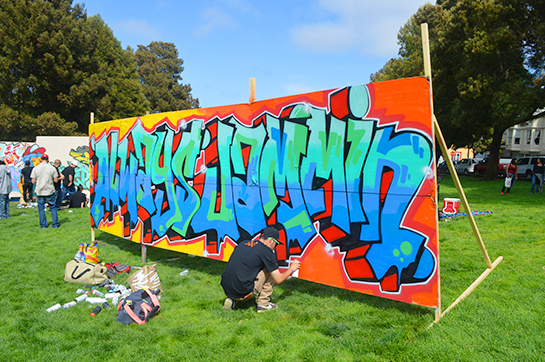
Normally the sound of 20 or so artists rattling and spraying aerosol cans would be quickly followed by the sound of sirens. But Sat/19 the fades went up with gusto. 

Artists tagged free standing art boards at Precita Park for the Urban Youth Arts Festival, an event that brings the ultimate underground art into a safe space. Attendees munched on burgers and listened to some good tunes at the festival, which is now in its 18th year.

Many of the street style murals paid homage to the Bay Area, from SF to Oakland. “We’re showing our love to the aesthetic of the community,” Xavier Schmidt, a 25-year-old organizer of the event and SF native, told us. One muralist hand painted a robot adorned in SF Giants and 49ers gear punching out a Google Glass-wearing Godzilla. 

“We’ve been doing this since 1987,” Schmidt said, speaking to the event’s roots. Even the event’s hosts, the Precita Eyes Muralists Association, have deep SF bonafides: they’ve been around since 1977.

“This is for solidarity, for community,” he said. “It’s a family event.”

Kids sprayed paint and played, adults kicked back and kvetched about youngsters, SF natives complained about tech employees, and many chowed down on burgers, hot dogs, and veggies donated by the local YMCA. Local musicians A-1 and Hazel Rose came out to play too, adding the head-banging element to the day. We’ve embedded one of A-1’s tracks below. Consider it your photo gallery soundtrack.

Names of the artists have been withheld because callin’ them out on the internet would be wack. All photos by Joe Fitzgerald Rodriguez. 

https://www.youtube.com/watch?v=YKpwI4aRAzM

image1

image3

This dude’s head was bangin’ as he sprayed. We’re not sure how he managed to make it look so good.

image2

This kid was super into it, which was hilarious.

image5

image6

A San Francisco robot takes down a Google Glass wearing tech-zilla.

image7

Hazel Rose performed a bombastic set that the crowd, below, felt all sorts of love for. 

image 8

image 9

Oakland got plenty of love too.

image10

image 11

Xavier Schmidt, one of the event’s organizers, said this high schooler is a real up and comer in the graffiti scene.

image12

image13

alienexperience

Some of the art boards were for everyone to paint, leading to some dooby-ous results. (Get it? Ha!)

homer

Mmmm, donuts. 

puppy


Why Brian Wilson’s next album will probably be a masterpiece

45

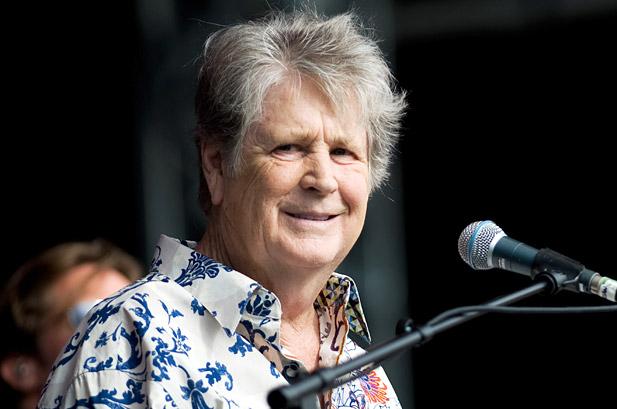
The name “Beach Boys” can refer to either of two bands.  The first is the happy-go-lucky surf rock band that does songs about cars and California, led by the conservative Mike Love; the second is one of the most audacious and avant-garde bands of the psychedelic era, led by the mad Zen master Brian Wilson. Though most of the music-listening world knows them primarily as the former, the latter has proven far more influential, pushing the Beatles’ creativity to breaking point out of rivalry as well as serving as a major touchstone for the last decade or so of indie rock.

This latter influence, coinciding with Wilson’s 2004 solo revival of his aborted 1967 album Smile, has allowed the psychedelic Beach Boys to enjoy a greater cultural standing among a younger, hipper generation. Wilson’s reunion with Smile lyricist Van Dyke Parks on 2008’s That Lucky Old Sun was much-hyped by the music press; their previous collaboration, 1995’s Orange Crate Art, was barely even noticed by critics or audiences. Audiences want another psychedelic masterwork from Brian Wilson. And I would be unsurprised if he made one — in fact, I would be surprised if he didn’t.

There’s no doubt he still has the capacity to make music every bit as beautiful and daring as the pocket symphonies that graced Pet Sounds and Smile. The Wilson-written suite that ends the 2012 Beach Boys album That’s Why God Made The Radio is nearly as good as the one that ended Surf’s Up more than 40 years prior. And the version of “Live Let Live” Wilson recorded for the post-March Of The Penguins cash-in An Arctic Tale contains some of the most gorgeous backing vocals I’ve heard on any song, Wilson-penned or otherwise.

Since the 2004 solo Smile, Brian’s released a Christmas album, two covers albums, and That Lucky Old Sun. The latter is the only true Wilson album among these, and its song-cycle structure and bursts of experimental caprice make it undoubtedly the progeny of Smile. But its flaws are common to many, if not most, latter-day albums by aging rock stars. His vocals haven’t aged well; the production is sterile; he makes a lot of ill-advised tributes to the music and culture of his childhood (sample line: “Every girl’s the next Marilyn/every guy Errol Flynn”). There’s a strong sense he’s pandering to the crowd who grew up on “Surfin’ U.S.A.” (or God help us, “Kokomo”), and he tempers his far-out tendencies accordingly. 

But two events have happened since the release that should encourage Wilson to let his creative energy loose.  The first is the 2011 release of The Smile Sessions, a collection of incomplete Smile takes that’s the closest we’ll likely ever get to hearing the finished album. The second is the release of That’s Why God Made The Radio, purportedly the final Beach Boys album and universally acclaimed for the Wilson songs but nothing else. Without the commitment of The Beach Boys, Wilson never needs to write another song about cars and girls again; if he does, it’s up to choice. His fanbase is shifting from older nostalgics to younger music nerds, and it would be advisable for him to target that audience. 

Wilson’s currently working on his first new album since the release of The Smile Sessions. It appears to be a collaborative effort; Lana Del Rey, Kacey Musgraves, Zooey Deschanel, and Frank Ocean are all slated to appear on it. All of these artists but Musgraves are Los Angelenos, and Del Rey and Ocean explicitly tap into L.A. mythology in their music. The melancholy those latter two artists bring to their portrayal of the City of Angels is very much in line with the wistful nostalgia of Wilson’s best recent work. 

They’re also artists more in line with the indie world — the world that eats up Wilson’s poignant Pet Sounds-era work and disavows anything with even the most casual reference to surfing. They’ve more likely signed on to work with the man who made those great Sixties albums. And if they end up having any influence beyond merely contributing vocals, they’ll likely skew the album in that direction. If not, it’s still promising that Wilson would choose to work with these artists in the first place. It would be his first attempt to market himself to a younger audience since he loaded up Love You with synths back in 1977. And so far, he’s looking in the right place.

The current incarnation of the Beach Boys (sans Wilson, Al Jardine, and David Marks) play the Mountain Winery on August 1. Wilson’s new album does not yet have a release date, but much of it is complete according to Rolling Stone.

Gorgeousness unbound

0

arts@sfbg.com

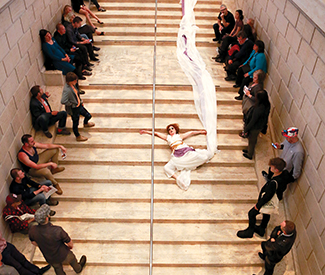
THEATER If you were milling around the Asian Art Museum last Thursday evening, you might have seen a woman tumble — ever so slowly — down the Beaux-Arts building’s elegant flight of central stairs. Ringed by a crowd of onlookers and the second floor’s imposing colonnade, her limber form caressed the marble steps luxuriously as she cascaded beneath the elegant arched ceiling, entirely at her own pace, leaving behind her the unraveling, impossibly long train of her white and lavender gown.

Bystanders ruminated silently or chatted quietly, sipping cocktails, for the duration of Fauxnique’s 20-minute high-art pratfall, Beautility, as house music reverberated from DJ Hoku Mama Swamp’s station in the nearby lobby. Passing through the lobby, you would have seen mercurial artist Dia Dear offering free makeovers, while members of TopCoat Nail Art Studio applied lacquer to willing hands, in designs inspired by pieces in the museum’s current show, Gorgeous, built from the permanent collections of both the Asian Art Museum and the San Francisco Museum of Modern Art.

Having at last landed on the first floor, in front of the shiny red and white speed demon parked there — German designer Hartmut Esslinger’s Prototype for Frog 750 motorcycle (1985), from the SFMOMA collection — Fauxnique (aka Monique Jenkinson) gathered up her enormous train and rushed up the stairs and out of sight.

Back in the lobby, you might also have caught sight of Nude Laughing, a peripatetic work by La Chica Boom (Xandra Ibarra), and followed the nude figure as she went by, dragging behind her a large nylon stocking filled with what appears to be hair and plastic breasts. You’d have ended up in an alcove on the first floor between several incongruent sculptures — including British artist Tracey Emin’s hot pink neon phrase-sculpture, Fantastic to Feel Beautiful Again (1997); a voluptuous, powerful, and headless stone torso of a female deity from southern India (1400–1600); and American Dan Flavin’s horizontal row of fluorescent colored beams, untitled (in honor of Leo at the 50th anniversary of his gallery) (1987).

In the company of these disparate pieces, the performer slips inside the giant nylon pouch — a Marilyn Monroe wig over her dark hair and atop her painted face, fake furs and sundry toy boobs pressed against her brown body — as she stretches the sheer fabric enveloping her, writhing in coquettish spasms, emitting artificial squeals of pleasure. A puissant abstraction, seriously unsettling and completely mesmerizing in her vaguely menacing flirtation with her audience, the figure eventually sheds her gauzy cocoon and, with a confident stride, disappears down a hallway, leaving behind some flotsam of costume pearls, wigs, and fur.

Headlining this promiscuous night of performance making — part of the museum’s seasonal Thursday night programming, which also featured work from queer punk drag artist Phatima Rude and drag duo Mona G. Hawd and VivvyAnne ForeverMORE — was art-band collective Nicole Kidman Is Fucking Gorgeous (John Foster Cartwright, Maryam Rostami, and Mica Sigourney). At about 8pm, NKIFG took over the regal upstairs chamber with its show, Fuck Gorgeous, a 45-minute incantation, exultation, and rumination on the elusive properties of art, celebrity, fashion, and existence — Nicole Kidman, for short — by three Goth punks with microphones and boundless insouciance.

With enormous projections of full moons looming over a small stage, John, Mike, and Mary engaged in welcoming speeches, banter among themselves, victory laps with streamers, occasional howling, extended ferocious lip-synched roaring, and worshipful mouthing of one truly insipid Oscar acceptance speech. Sound rose and fell, a cacophony of noise gave way to mumbled quips, focus blurred and shifted, bodies went slack, writhed on the dance floor, or bounded around the room. At one point, Mike’s address from the podium slipped from a kind of self-actualization seminar into an outright stab at mass hypnosis as he charged us all to “be Nicole!”

Nicole Kidman, their vessel, “both everything and nothing,” was not quite an object and not quite a projection. Like the other performances enlivening the spaces of the museum and the strange harmony of the artworks on display, Fuck Gorgeous was deeply ambivalent but committed to being in-between, both a come-on and a refusal. *

GORGEOUS

Through Sept. 14, $10-$15

Asian Art Museum

200 Larkin, SF

www.asianart.org


This Week’s Picks: July 23 – 29, 2014

0

WEDNESDAY 23


Man or Astro-Man?

Auburn, Ala.’s Man or Astro-Man? has spent decades perfecting their sprawling surf-rock. Incredibly imaginative and extremely prolific, the group has recorded and toured tirelessly since early 1990s. Drawing diverse influences from the likes of Dick Dale and Link Wray, punk and new wave, and science fiction and a fascination with space and extraterrestrial life, Man or Astro-Man? take surf rock in directions and galaxies previously uncharted. Largely instrumental and entirely captivating, the band’s nine-album catalog is a musically-stunning journey through sound and space. Known for their high-energy live sets, often performed in space-suits complete with astronaut helmets with intricate sci-fi set pieces, musicians Star Crunch and Birdstuff will shred their way into your hearts. (Haley Zaremba)

With The Ogres, WRAY

8pm, $20

The Independent

628 Divisadero, SF

(415) 771-1421

www.theindependentsf.com


Cymbals

The cooler-than-thou French monologue on UK band Cymbals’s single “The End” might have you in the dark, but the intro’s melancholy melody should be instantly familiar to anyone who’s spent too many hours in a club. The faint, ringing tone stuck in ear the next day (or week), bringing back memories: “It’s the end of the night, you’ve been dancing too much. They’ve got to turn on the lights.” Smartly placed on a stellar album (The Age of Fracture) of arty synth-pop that’s in line with Metronomy, Passion Pit, and David Byrne, it’s a reminder that, for better or worse, some things don’t last as long as you want. (Ryan Prendiville)

With Astronauts, etc., The Wild Wild

8pm, $10-12

Rickshaw Stop

155 Fell, SF

(415) 861-2011

www.rickshawstop.com


THURSDAY 24


CAM & Co. Productions’ Spring Awakening

Once a high school theater kid, always a high school theater kid. After receiving their hard-earned diplomas from San Francisco’s School of the Arts, some of the city’s most talented teens realized they couldn’t abandon the pool of talent at the school. So instead of embracing the idea of a deadbeat summer before college, the members created their own production company. Their conception of Spring Awakening is financed through an online fundraiser they created, and is completely driven by efforts from School of the Arts family members. Support up-and-coming youth theater while wondering why you couldn’t be as cool as them when you were 18. (Amy Char)

Through Sat/26

7:30pm, $20

Phoenix Theatre

414 Mason, SF

(415) 336-1020

www.phoenixtheatresf.org


FRIDAY 25


RAWdance

With a decade of distinguished work behind the company, RAWdance has every reason to celebrate. Ryan T. Smith and Wendy Rein collaborations draw you in with the integrity of a highly structural approach that yet yields works that resonate emotionally. Their newest piece seems tailor-made to the kind of intelligence that they bring to their work. Turing’s Apple explores both the genius of the British scientist Alan Turing and his tragedy when he came out as a gay man. It will be joined by the final version of Burns that the choreographers describe as Rorschach-test driven, and film-noir inspired. RAWdance will be joined by a guest artists Gretchen Garnett + Dancers in a trio, and a grief-exploring sextet, Nawala (“Lost”) by Tany Bello’s Project B. (Rita Felciano)

July 25-26, 8 pm. July 27, 7 pm. $25-30

Z Space

450 Florida St. SF

866-811-4111

www.zspace.org


This Must Be the Place: The End of the Underground 1991- 2012

Named for an excellent Talking Heads song, This Must Be the Place is an annual summer celebration of rock docs, exploring the birth, life, death, and (depending on whom you ask) near-constant rebirth of punk rock through iconic moments captured on film. This third installment, curator Mike Keegan has announced, will sadly be the Roxie’s last, so get to it. Friday’s ’90s-tastic triple bill sounds too fun to miss, with 1991: The Year Punk Broke (featuring live performances from Sonic Youth and their then-opener, Nirvana), Hated: GG Allin and the Murder Junkies (featuring the never sober, always charming GG Allin, who was dead before the film finished shooting), and What’s Up, Matador? (featuring three-minute bursts of rarely seen excellence from labelmates Guided By Voices, Pavement, Yo La Tengo and more). Don’t forget your flannel. (Emma Silvers)

Through Sun/27, prices and showtimes vary

The Roxie Theater

3117 16th St., SF

www.roxie.com


SATURDAY 26


CoffeeCon 2014

Cursed with the personality of an ogre if you skip your morning coffee? Once you’ve gotten a head start on your caffeine fix Saturday morning, head over to this art gallery — for one day only, it houses an interactive latte art exhibit (arguably just as creatively esteemed as postmodern paintings). The coffee festival features a plethora of other hands-on lessons, including one titled “How to Review Coffee,” and unlimited coffee samples, so you can sound like a pretentious — but educated — coffee snob while you pine over an obscure roast when you’re with your friends at Starbucks. Local bands perform live to simulate a hipster coffeehouse vibe. (Amy Char)

9am – 4pm, $15-$20

Terra Gallery & Event Venue

511 Harrison, SF

(415) 896-1234

www.terrasf.com


Fritz Montana

The spike in blues-rock appreciation that came with The Black Keys and their various contemporaries may be losing its luster — the Keys’ newest LP, Turn Blue, hardly lived up to their previous releases. But Fritz Montana shows that the blues are alive and well in San Francisco. A blistering three-piece band fronted by high-octane vocalist and guitarist David Marshall, won Live 105’s local band contest last October, which led to them opening for Kings of Leon, Queens of the Stone Age, and Vampire Weekend at the station’s Not So Silent Night. Fritz Montana’s first album, Scaredy Cat, is ready to drop, and the group has chosen the Rickshaw Stop as the spot for their release party. The group will play their new release, along with their celebrated 2013 EPs, and sell copies of their debut full-length hot off the presses. Fritz Montana may not be reinventing the wheel, but the band’s songs pulse with an energy and technical grace that bodes very well for their dreams of airwave domination. (David Kurlander)

$10-13, 9pm

Rickshaw Stop

155 Fell, SF

(415) 861-2011

www.rickshawstop.com


Rick Springfield

One of the biggest surprises in Dave Grohl’s 2013 doc Sound City — about the legendary SoCal recording studio where Nirvana’s Nevermind and other iconic works were recorded — was the inclusion of 1980s hunk Rick Springfield, the General Hospital star turned pop singer. Turns out he recorded the 1981 album Working Class Dog there, thus gifting the world with Grammy-winning radio jam “Jessie’s Girl.” Springfield’s kept busy since his teen-dream days; aside from offering up Sound City memories, he wrote a memoir (2010’s Late, Late at Night) and now, a novel: Magnificent Vibration, about a curious man’s unconventional spiritual journey. Book Passage touts his appearance as “featuring a live musical performance,” so get those lighters ready. (Cheryl Eddy)

4pm, free

Book Passage

51 Tamal Vista, Corte Madera

www.bookpassage.com


SUNDAY 27


Waffle Opera

Waffle Opera, founded by a group of young local singers in 2012, has altered the glitzy opera house aesthetic using an unexpected prop: succulent, syrup-covered Belgian waffles. The company, which serves the treats after each of its shows, embraces a remarkably unpretentious approach to legendary works, using minimalistic sets and small houses to bring out the lyrical and musical subtlety of centuries-old classics. The group is presenting a concert version of Cosi fan tutte, the 1789 Mozart opera whose title translates roughly to “Women are like that.” An uproarious comedy about two Neapolitan officers who don disguises and try to woo each others’ fiancées to prove the inconstency of female affection. While still a archaic by the standards of contemporary gender politics, the women (spoiler alert) are presented as smart and capable; they quickly pick up their lovers’ plot, leading to a madcap phantasmagoria of mistaken identities and partially-broken hearts. Waffle’s semi-staged version highlights the soaring arias, clever quips, and intricate plot of Mozart’s funniest work. (Kurlander)

$15-$25, 3pm

Center for New Music

55 Taylor, SF

www.waffleopera.com


MONDAY 28


Andrew Jackson Jihad

In my mind, Phoenix’s Andrew Jackson Jihad is both the quintessential and the essential folk-punk band. With bitingly clever lyrics that toe the line between hilarious and heartbreaking, an unflinching confrontation of social justice issues and a willingness to examine and sing about their own privilege, Sean Bonnette and Ben Gallaty have created some of the most important and tenderly earnest albums in the folk-punk canon. The band’s unsteady, cracking vocals and mediocre musicianship lend a charming naivete, emotional sincerity, and accessibility to their music. The band’s frenetic energy and the fierce dedication of their fan-base make Andrew Jackson Jihad’s live shows a powerful experience. (Zaremba)

With Hard Girls, Dogbreth

8pm, $16

Slim’s

333 11th St, SF

(415) 255-0333

www.slimspresents.com


Wolfmother

Wolfmother came roaring out of Australia in the mid-aughts with its self-titled debut, which went five times platinum in the band’s home country and did well enough abroad to secure them a position as one of the Anglophone world’s most formidable touring acts. Combining a shameless love for ’70s hard rock (Led Zeppelin in particular) with the sharp hooks of stoner rock, the trio struck a chord with both the classic-rock and alt-rock crowds, and just about any guitarist born in the mid-’90s can likely remember learning one of their songs early on. Though the band only records sparsely, Wolfmother has remained a regular on the international touring and festival scene — a position that this year’s New Crown should secure. (Bromfield)

8pm, $28

The Fillmore

1508 Geary, SF

(415) 346-6000

www.thefillmore.com


TUESDAY 29

Hundred Waters

Hundred Waters are signed to Skrillex’s OWSLA label, but don’t expect big bass drops from this Florida crew. Rather, they trade in a “digital folk” style that offers an intriguing rural perspective to the retro-futuristic conversation currently taking place in underground electronic circles. Birds chirp in unison with drum machines; Blade Runner synths support Tolkienesque fantasias. At the front of it all is Nicole Miglis, a one-woman choir whose voice seems as perpetually omnipresent as the sun and the sky. Though this year’s The Moon Rang Like A Bell suggests pop ambitions lurking beneath their idiosyncratic exterior, the band is still one of the most unique and fascinating bands in the electronic universe — as well as one of the few that can truly claim to sound like nothing else. (Bromfield)

8pm, $14

The Independent

628 Divisadero, SF

(415) 771-1421

www.theindependentsf.com

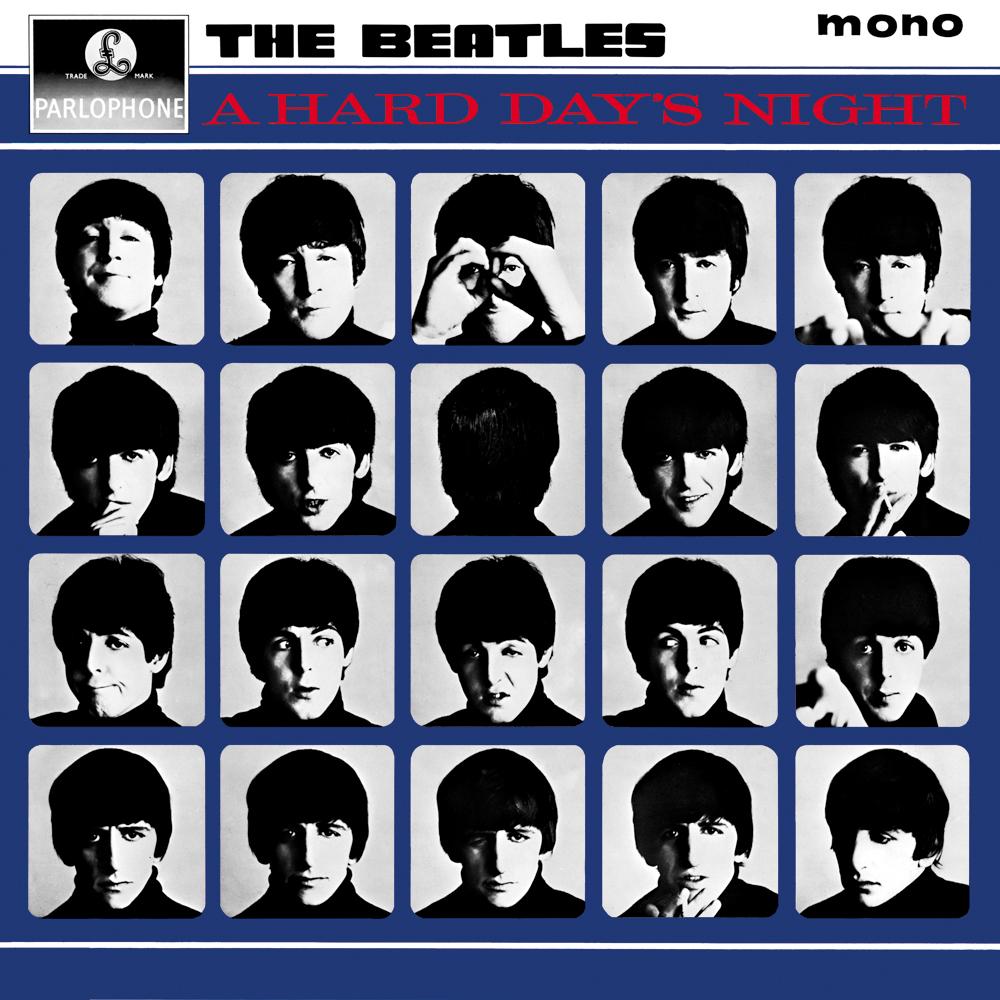
A hard look at ‘A Hard Day’s Night’

0

arts@sfbg.com

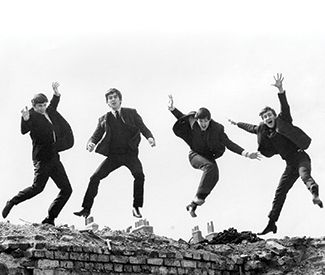
More than any other Beatles album, A Hard Day’s Night — which turned 50 last week — embodies the clichés surrounding the band’s early period. The cheesy harmonies, the “whoa”s and “yeah”s, the sappy love songs: All are there in abundance. It’s also the most obvious manifestation of the John/Paul dichotomy. Though the idea of John as the bad boy and Paul as the balladeer is largely accepted as a myth by Beatles fans, that dynamic is a lot closer to the truth than folks give it credit for, and on no album is it clearer than A Hard Day’s Night.

Paul’s songs are a bit silly, but spectacularly well-crafted. “And I Love Her” repeats the word “love” incessantly, but the twinkling background makes it seem transcendent. You’re more likely to come out of it remembering the four-note guitar riff that frames the song anyway. Better yet is “Can’t Buy Me Love.” The song’s chorus looks absurd on paper (“can’t buy me love/everybody tells me so/can’t buy me love/no no no no”), but it’s so catchy it’s hard not to ignore the lyrics.

John’s love songs are far more bitter and sarcastic. But it’s important to remember that John Lennon was more than just a media-ready “bad boy.” His reputation as a peacenik and a member of the most (supposedly) infallible paragon of pop music in history has sadly clouded his history of alleged neglect and abuse toward his children and various lovers. Knowing the latter gives an unpleasant context to the Lennon songs on this album.

I find “You Can’t Do That” unlistenable for this reason. The song is told from the perspective of a man whose girlfriend has been talking to another boy. He warns her that if he catches her doing it again, he’ll “let her down” and “leave her flat.” It’s hard not to interpret those as a reference to domestic violence, given that Lennon’s first wife, Cynthia, was a victim of such abuse. And the theme of the song evokes Lennon’s own worries concerning his second wife, Yoko Ono, whom he often dragged into the studio out of fears she would abscond with another man if left alone.

Another prominent theme is Lennon’s pride and his fixation on the shame of having had his girl cheat on him. This theme surfaces on “You Can’t Do That” (“if they’d seen you talking that way they’d laugh in my face”). It’s as bad on “If I Fell.” John asks his potential girlfriend if she’d “hurt my pride like her” then bluntly tells her how much he’d enjoy his ex’s misery at seeing the two of them together.

It’s less rational to believe that these songs are told from the perspective of an abuser so much as they illustrate Lennon’s own viewpoint as a real-life abuser. There’s nothing in these songs to suggest he’s playing a role of any sort. On one song, he does. “I’ll Cry Instead” finds Lennon simulating the illogical thoughts that come in the wake of anger and sadness. His girl left him, and he’d like to go out and “break hearts all ’round the world” as revenge, but he can’t, so he’ll cry instead.

The point of this song isn’t that he’d like to hurt her, but that he’s thinking irrationally — he’ll feel better once he’s had a good cry. Thus, I find it easier to separate this song from its creator. Nonetheless, A Hard Day’s Night is one of those albums — at least for me — where art and artist are too firmly entwined for the album not to suffer.

It would be ridiculous to accuse anyone who enjoys this album of being a misogynist. But I would object to anyone denying these issues are present. If these moral questions inhibit you from enjoying the art, so be it. But to dismiss these issues in order to preserve your prior appreciation of the music would be tantamount to ignoring those issues in the first place.

There are two Lennon songs that truly warm my heart on this album. The first, “When I Get Home,” is an ecstatic love song that finds its protagonist rushing home to be with his girl. That he has “a whole lot of things to tell her” suggests he’s actually interested in conversing with the girl, not just having sex. And he’ll love her the next day too, and accordingly make the same voyage. Now that’s love.

Second is the title track. On no other Beatles song is the interplay between John’s voice and Paul’s more effective. It’s difficult to even notice that the vocalist has shifted until the end of the first chorus. But it’s the gradual build in emotion that makes this song so brilliant. By the time the chorus is about to transition back into the verse, Paul is emoting relentlessly — and then in comes the verse again, with John’s dry voice snapping satisfyingly into place and contrasting icily with Paul’s catharsis. This song elevates the album substantially by itself, though A Hard Day’s Night remains my least favorite of the Beatles’ “great albums” (i.e. the ones with only original songs).

Though I generally avoid discussing my own sentimental attachment to albums in reviewing them, I’ll close this review by saying A Hard Day’s Night is by far the most important album in my life. As the first rock album I ever listened to, it ended my 12-year streak of aversion to music due to my sensory processing disorder. But I haven’t gone back to it much — simply because I listened to eight other Beatles albums immediately afterward, and every single one of them puts A Hard Day’s Night to shame.


Events: July 23 – 29, 2014

0

Listings are compiled by Guardian staff. Submit items for the listings at listings@sfbg.com. For further information on how to submit items for the listings, see Selector.

WEDNESDAY 23

Mission Bay Hidden Water Walk Meet at CalTrain station (south side plaza), Fourth St at King, SF; www.laborfest.net. 10am, free. Walking tour of the rapidly-changing Mission Bay area. Part of LaborFest 2014.

James Nestor Mechanics’ Institute, 57 Post, SF; www.milibrary.org. 6pm, $15. The author discusses Deep: Freediving, Renegade Science, and What the Ocean Tells Us About Ourselves.

“Taxi, Tech, and Rideshare” Redstone Building, 2940 16th St, SF; www.laborfest.net. 7pm, donations accepted. Forum and video screening on the subject of Uber and similar companies that are affecting the taxi industry. Part of LaborFest 2014.

THURSDAY 24

Tom Barbash Hattery, 414 Brannan, SF; www.booksinc.net. 7pm, free. The author discusses his work and writing, including Stay Up With Me, his recent short-story collection.

State of the City Forum Modern Times Bookstore Collective, 2919 24th St, SF; www.mtbs.com. 7-9pm, free. Discussion of gentrification issues with SF poet laureate Alejandro Murguia and community guest panelists.

FRIDAY 25

“Bike Design Project Reveal Party SF” PCH Lime Lab, 135 Mississippi, SF; www.oregonmanifest.com. 6-9:30pm, free. Check out next-generation bikes created by top designers and bike craftspeople at this reveal party, featuring custom-brewed, “bike-inspired” beer from Deschutes Brewery.

Gilroy Garlic Festival Christmas Park, Gilroy; www.gilroygarlicfestival.com. 10am-7pm, $10-20. Through Sun/27. Garlic is the pungent star of this annual food fair. Garlic ice cream gets all the press, but don’t sleep on the garlic fries, 2012’s most popular purchase (13,401 servings!)

Squeak Carnwath University Press Books, 2430 Bancroft, Berk; www.universitypressbooks.com. 6pm, free. The Oakland-based painter discusses her new book, Horizon on Fire: Squeak Carnwath Works on Paper, 1977-2013, containing over 90 images of her works from the past 35 years.

SATURDAY 26

Berkeley Kite Festival Cesar E. Chavez Park, Berkeley Marina. www.highlinekites.com. 10am-6pm, free. Through Sun/27. Because where else are you gonna see the world’s largest octopus kite?

Oakland 1946 General Strike Walk Lathan Square (meet at fountain), Telegraph at Broadway, Oakl; www.laborfest.net. Noon, free. Revisit key sites of Oakland’s historic “Work Holiday,” the last general strike ever to occur in the US. Part of LaborFest 2014.

“Off the Wall” Mission Cultural Center for Latino Arts, 2868 Mission, SF; www.missionculturalcenter.org. 7:30pm, free. Mission Grafica hosts this closing reception for its current screenprinting and woodcut exhibition, with a silent auction of pieces from the archives.

Ohtani Summer Bazaar Berkeley Higashi Honganji Buddhist Temple, 1524 Oregon, Berk; www.bombu.org. Today, 4-8pm; Sun/27, noon-5pm. Free. Japanese food is the focus of this two-day fest, with homemade Kushikatsu, sushi, teriyaki chicken, and other tasty treats. The temple is also known for its (American-style) chili.

Pedalfest Jack London Square, Broadway and Embarcadero, Oakl; www.pedalfestjacklondon.com. 11am-7pm, free. Celebrate biking at this festival, with bike-themed entertainment (“daredevils performing in a 30-foot Whiskeydrome”), “pedal-powered food,” a vintage bike show, bike demos, and more.

“Perverts Put Out! Dore Alley Edition” Center for Sex and Culture, 1349 Mission, SF; www.sexandculture.org. 8pm, $10-25. Readings by Jen Cross, Princess Cream Pie, Philip Huang, and others; hosted by Dr. Carol Queen and Simon Sheppard as a benefit for the CSC.

Vintage Paper Fair Hall of Flowers, Golden Gate Park, Ninth Ave at Lincoln, SF; www.vintagepaperfair.com. Today, 10am-6pm; Sun/26, 11am-5pm. Free. Huge vintage paper fair featuring antique postcards, prints, photography, Art Deco items, movie memorabilia, and more.

SUNDAY 27

LaborFest Book Fair Mission Cultural Center for Latino Arts, 2868 Mission, SF; www.laborfest.net. 10:30am, free. Numerous authors share their labor- and union-themed books and this day of readings and discussions. Part of LaborFest 2014.

Up Your Alley Fair Dore between Howard and Folsom, SF; www.folsomstreetfair.com/alley. 11am-6pm, $7 suggested donation. Folsom Street Fair’s naughty little brother fills Dore Alley with leather-clad shenanigans.

TUESDAY 29

Christopher Pollock St. Philip’s Catholic Church, 725 Diamond, SF; www.sanfranciscohistory.org. 7:30pm, $5. San Francisco History Association hosts this talk by the author of Reel San Francisco Stories: An Annotated Filmography of the Bay Area. *


Framing fame

0

arts@sfbg.com

SFJFF Given the seemingly endless one-step-forward, two-steps-back nature of peace negotiations in the Middle East, it seems a fair bet that the San Francisco Jewish Film Festival (July 24-Aug. 10) will never stop being among the most politically charged among umpteen annual Bay Area film festivals. But considerably older than the state of Israel — and all attendant controversies — is an aspect of Jewish history that reliably provides a counterbalance to the inevitable heavyweight documentaries and dramas. That would be the ubiquity of Jewish talent in popular entertainment, as performers, presenters, and in every other necessary role.

An old saw that never exactly went away but nonetheless has come back with a vengeance in our alleged post-racial era is that perpetual complaint of the envious, paranoid, and prejudiced that “the Jews run Hollywood.” While it’s true that the movie biz has always has employed a large number of Jewish people, anti-Semites have only themselves to blame for originating this state of affairs. It was the entertainment industry’s lack of respectability in its fledgling years that created an opening for an industrious and imaginative minority who were frequently discouraged from sullying more prestigious art forms with their participation. For decades (arguably even now) many stars, studio moguls, and others tried to downplay or entirely hide their ethnic identity; the silent era, in particular, was a hotbed of biographical revisionism among Hollywood players. Nonetheless, Jewish business, tech, design, and acting talents established deep roots in moviemaking well before Hollywood as idea or physical entity existed, precisely because flickers were initially viewed as a lowbrow novelty unfit for the higher working castes. A very sad microcosm of that semi-hidden Jewish industry presence’s early heights and depths is offered offered by David Cairns and Paul Duane’s multinational documentary Natan, about a hugely important yet lamentably overlooked figure in French cinema. Romanian-born Bernard Natan went from projectionist to cinematographer, producer, film laboratory owner, and more in the medium’s early days. An innovator in the use of sound, color, wide screen, and other techniques, he helped rebuild French film production whole in the aftermath of World War I (in which he volunteered for military service, despite not yet being a legal French citizen).

His extraordinary, tireless enterprise made him an ideal candidate to take over pioneering and powerful, but financially teetering, Pathé Studios in 1929. He virtually rescued it from ruin, while steering it successfully into the talkie era. But despite his efforts, Pathé went bankrupt at the height of the Depression in 1935. Natan was the designated fall guy because he’d used legally questionable means in an attempt to cover losses created largely by people and institutions outside his control. There was a strong whiff of then-increasingly-fashionable anti-Semitism to his pillory: He was accused not only of fraud, but of hiding his Jewish heritage, and of being a pornographer.

The latter charge was accepted with remarkable gullibility by historians until quite recently. But as this doc suggests, painting Natan as a predatory perv making potentially career-ending stag reels makes as little sense realistically as it makes great sense propagandically. (We also see how vague the resemblance is between him and the dude or dudes in “smokers” he’d said to have performed in.) That taint helped usher him to prison in Nazi-occupied France, then to an unrecorded demise at Auschwitz. Shamefully, as late as 1948 his estate was still being sued by an invigorated Pathé. Natan is a belated reclamation of a forgotten cultural giant’s abused reputation.

Whether or not he ever actually had anything to do with filmed erotica, Natan would have been amazed by the career of another cosmopolitan Jew launched just a few years after his life’s end. Wiktor Ericsson’s A Life in Dirty Movies pays bemused biographical homage to what Annie Sprinkle calls “the Ingmar Bergman of porn.” Joe Sarno’s micro-budgeted features targeting “the raincoat crowd” from 1962 onward were exceptionally moody, complex and tortured psychodramas focused on being “as hot as you could without showing anything.” He met his soul mate in aspiring off-off-Broadway actress Peggy, who “could discuss John Ford and Truffaut and Renoir” while juggling all the logistical and fiscal details he was naturally oblivious to as a genu-wine artist.

It’s hard now to imagine the mixed excitement and bewilderment that must have been experienced by 42nd Street grindhouse patrons as they witnessed the likes of 1962’s horrors-of-swingerdom melodrama Sin in the Suburbs, or 1967’s claustrophobic self-portrait-of-a-neurotic-artist All the Sins of Sodom. Strangely not glimpsed in this documentary is the artistic apex of Sarno’s color softcore career, 1972’s Pirandello-esque Young Playthings.

The marketplace soon muscled him into hardcore. He was unhappy enough chronicling graphic XXX action to seriously risk financial ruin — and Peggy, still very much the histrionic type, is seen here swanning about as protector of his legacy. It’s lovely when his unexpectedly big 2010 New York Times obit affirms at last to her that he’s “famous like everybody else,” just as he’d always hoped, and as her scandalized Establishment parents figured he’d never be.

Other features in this year’s SFJFF area focus less on impresarios than on performers. The festival’s Freedom of Expression Award goes to the subject of Theodore Bikel: In the Shoes of Sholem Aleichem. This is one of those occasional, simultaneously valuable and dubious documentaries that enlarge upon a well-traveled celebrity solo stage showcase (Sholem Aleichem: Laughter Through Tears). The 90-year-old Bikel has done Aleichem’s characters (especially Tevye the Dairyman) so much that the excerpts here feel worn into a groove that congratulates both veteran performer and veteran viewers who recognize bits they’ve already seen. Who can object? He’s like a tabby grooming itself, essential adorability undeniable.

But he never allows himself an unrehearsed moment in what comes off first as an awfully self-congratulatory self-portrait, and secondly as a workmanlike salute to the single greatest shaper of all American Jewish cultural tropes. Shoes is the kind of proud, way-back machine tribute that makes you feel like you’re watching its 12th pledge week replay. Why are the likes of Gilbert Gottfried and Dr. Ruth the principal interviewees here? Because everybody else has moved on, maybe. Aleichem will always be classic, but to what extent do contemporary US Jews recognize themselves in his worldview?

Other entertainers showcased in SFJFF 2014 include The Secret Life of Uri Geller: Psychic Spy?, about the Tel Aviv-born “spoonbender” phenomenon. This UK documentary assumes a campy, skeptical stance re: his paranormal fame, while actually providing evidence that he’s far from a fraud. Go figure. An even more swinging figure of the era is the subject of Quality Balls: The David Steinberg Story. The dapper latter epitomized smart, improv-based standup comedy on a national stage once he’d left Chicago’s Second City for TV — surviving the 1969 cancellation his edgily political material purportedly forced upon the hugely popular The Smothers Brothers Comedy Hour. Those looking for an additional peek behind the comedic curtain might also check out documentary feature Comedy Warriors, about disabled Iraq and Afghanistan veterans taking the standup stage; Little Horribles: An Evening With Amy York Rubin, drawn from the popular online series; and thematic program “Jews in Shorts.”

Then there’s this year’s major excavation from the treasure-trove of forgotten US Yiddish cinema: 1938’s Mamele, in which late pixie queen Molly Picon plays a cheerfully suffering yenta Cinderella awaiting justice for her many sacrifices to a selfish family. She cooks, she cleans, she sings — what more do you want? Of course there’s a happy ending. 2

SAN FRANCISCO JEWISH FILM FESTIVAL

July 24-Aug. 10, most shows $10-$14

Various Bay Area venues

www.sfjff.org

Last chapters?

27

news@sfbg.com

The tale of the threatened independent bookstore, quivering under the might of Amazon, is nothing new.

It’s only been two months since Marcus Books was evicted from its Fillmore District location. Both Adobe and Forest bookstores fled the Mission’s 16thh Street last year. But ebook sales growth is shrinking, and sales for many of San Francisco bookstores are up.

Instead, the tale of the struggling indie bookstore has become less about Amazon and more about a different monster: gentrification. San Francisco’s rising rents, demand for commercial space by deep-pocketed chains, and lack of commercial rent control are putting the squeeze on the city’s remaining bookstores.

Take Bibliohead, for instance. Its owner has recently been forced to relocate in spite of her bookstore’s success. Bibliohead is an easily navigable, highly curated, and tiny book jungle — more like a carefully manicured garden, really. The whole store can be explored in minutes, and there’s a gumball machine that dispenses poetry out in front once the book-happy are satisfied.

Its size has served it well. Sales at Bibliohead — Hayes Valley’s only bookstore — have risen solidly 7 percent each year since the store opened 10 years ago.

“We’re small, but mighty,” Melissa Richmond, Bibliohead’s owner, told the Guardian. “Although recently we haven’t been feeling so mighty. I’m kind of a wreck.”

In May, Richmond learned that she has until January 2015 to leave her store for four months while her building undergoes mandatory earthquake retrofitting. The landlord will double Richmond’s rent after the retrofitting, and has asked Richmond to pay for further renovations to the building when she returns.

“It’s off the table that I can stay here,” Richmond said. “I will not be offered a new lease. I don’t hate landlords, but I want a landlord who will contribute to the spirit and creativity of San Francisco.”

On June 22, Richmond launched an Indiegogo campaign to raise the $60,000 she’ll need to move and attract new customers. So far, with a little less than a month to go, she’s raised almost $3,000.

“What really breaks my heart is when a new customer walks in,” Richmond said. “They ask you how you’re doing after they’ve fallen in love with the place a little bit. Then you have to break their hearts by saying you don’t know what’s in store for your future right now.”


DISPLACEMENT TREND

Richmond is not the only bookseller in San Francisco forced to relocate. Last year, Adobe Books and Forest Books were forced out of 16th Street within three months of each other when their rents increased. Forest Books slipped quietly off to Japantown, and has since experienced an increase in sales. Adobe Books’ anticipated closure was met with an invigorating Kickstarter campaign that raised $60,000. It was enough to keep the store alive, but not on gentrifying 16th Street.

Nowadays, Adobe is re-branded as Adobe Books and Art Cooperative at its 24th Street location. The original Adobe’s charming, lackadaisical, and no- structured structure has been traded for alphabetized and carefully curated books. There are only two staff members, and its used books are selling far faster than in the old location, despite its shrunken size.

“It’s strange. A lot of the times I was not sure if it would work at all, and now here we are in this shop,” Brett Lockspeiser, a member of the Adobe Books and Art Cooperative, told us. “Things are running differently, but it’s still Adobe.”

Adobe will soon be celebrating its first anniversary in the new spot. The store might not be making any profits, according to Lockspeiser, but the cause for celebration is that it’s survived.

There has been discussion among the collective members about whether or not Adobe should try to sell eReading devices, like Green Apple Books has done without much success for almost two years with the Kobo eReader. Adobe’s collective voted against Kobo, preferring not to use the same weapons as its competitor.

“I’m pretty technology positive, but I think some people in the group thought it was an ‘us or them’ kind of thing,” said Lockspeiser. “Like either you’re a book reader or you’re a techie who reads on a Kindle.”

Besides, it seems that ebooks’ incredible growth rate has finally simmered down. According to the Association of American Publishers, ebooks accounted for 27 percent of all adult trade sales in 2013. While that was up from 23 percent in 2012, it marked the first year ebook growth was down to the single digits. In January, a Pew study reported that among adults who read at least one book in the past year, just 5 percent said they read only an ebook.

Hut Landon, executive director of the Northern California Independent Booksellers Association, reports that book sales throughout San Francisco bookstores have increased overall in the past two years. Green Apple Books, an expanding bookstore with an growing collection of books and records, is even poised to open another location in the Sunset below beloved video rental store Le Video on Aug. 1.

Pete Mulvihill, co-owner of Green Apple Books, said he recently got a call from Bibliohead’s owner asking for advice on potential neighborhoods and techniques for negotiating with landlords. But he can’t always explain his own store’s success.

“Some of it is just the economy. All that money floating around South of Market is maybe trickling over here,” he told us. “Or maybe the waiters are getting better tips. I don’t know what it is, but things have been better for us.”

The growth of bookstore sales, Landon said, is mainly because Barnes & Noble has been cast out of San Francisco. Last year, Barnes & Noble, the nation’s largest bookstore chain, reported that its revenue decreased by 8 percent in the final quarter. The company’s Nook division, meanwhile, slid down 32 percent.

Yet Joe Marchione, who owns Mission Street’s Valhalla Books, still places the blame for his diminishing foot traffic on Amazon, which has made his hard-to-find books pretty easy to locate online. In 1998, when his store opened, 90 percent of Valhalla’s business came from people browsing through his odd and unique assortment of rare and used books. Now, 95 percent of his business is online.

“People forgot the joy of browsing,” Marchione told us.

As soon as his landlord makes him commit to a lease, he says he’s going to have to leave the business. “When we first opened, we were smug. We said there was no way trendy was ever going to come to Mission between 17th and 18th [streets]. Get real!” he said. “But trendy creeps in closer by the week. There’s no problem with that, except it’s forcing us out.”


“TRENDY CREEPS IN”

It’s even forcing successful booksellers, like Bibliohead’s owner, to worry. Her faith in the printed word remains strong. “I find that there’s a whole core of people who are relieved to feel something in their hands, to flip the pages of really cool, beautiful books and kind of remember with their bodies what reading is like,” Richmond said.

When Kate Rosenberger opened a fourth bookstore in 2011 — Alleycat Books on 24th Street — many questioned her sanity, the owner said. The store has only recently been able to pay its own bills, having been relying on Rosenberger’s other store, Dog Eared Books, for survival. But the rent at Dog Eared Books is set to increase, and that means trouble.

“You can talk about e-readers, and people being distracted. You can talk about people slipping out since the Gutenberg press was invented, and all that’s true, sure,” Rosenberger told us. “But when you get hit with a huge increase in your rent, how do you deal with that? When the lease is up, you can pretty much figure you’re gone.”

These days, you deal with it by setting up a crowdsourcing campaign, and crossing your fingers that people with money like you. Or maybe you transform into an art cooperative. Or you just go somewhere else. But Richmond doesn’t want to leave San Francisco.

“I would like to preserve the culture of the city,” Richmond said. “I still think there’s something really special here.”

Barnes & Noble might be gone, ebook sales might have stabilized, and the printed word might just still be alive — but for San Francisco’s booksellers, that no longer means anyone in the book business is safe.

Scare and scare alike: zombies, maggots, and more at ‘BAASICS.5: Monsters’

0

“We stopped checking for monsters under our beds when we realized they were inside us,” reads a quote often misattributed to the Joker in 2008’s The Dark Knight. The presenters at July 14’s “BAASICS.5: Monsters” event at ODC Theater capitalized on this concept, examining both modern monsters (though not “cars and corn syrup,” as one emcee mentioned at the beginning of the event) and monsters of yore. 

In past years, the organization has explored provocative topics such as the future (more weighted toward a possible uprising of robots rather than the nagging question “What am I going to do with my life?”) and psychiatric and neurologic disorders by juxtaposing science and art. It’s easy to find the right balance between the two for these past themes, but I wasn’t quite sure what to expect from this year’s event. 

It ended up being a lot less grisly than I’d imagined — with the exception of a video clip depicting maggots violating a honeybee. (I can never unsee that.) I felt as though I were in a college lecture hall, viewing PowerPoints — which were much more aesthetically pleasing than the Papyrus-laden slides my freshman year history professor used — and listening to professors, each with an exceptionally dry sense of humor. 

Presenters, ranging from shark conservationists to artists, shared their definitions of a monster, often turning the tables on common misconceptions. David McGuire revealed that more people die from vending machines than from shark attacks, emphasizing how it’s truly a man-eat-shark world out there today. (Ahem, shark fin soup…) Closing presenter Brynda Glazier tackled societal expectations of beauty and normalness, drawing inspiration from her personal life as her brother is disabled, expressing this through seemingly ugly and monstrous sculptures. 

BAASICS’ associate content producer Georgeann Sack — described in the program as a “neuroscientist by day and science communicator by night” — also performed low-key acoustic songs as a segue between presentations. In fact, her music was so low-key that I often had trouble hearing and understanding her, although I’m sure the lyrics to her song “Vampire Love Song” were clever. Sack’s standout performance was her rendition of the Creepshow’s “Zombies Ate Her Brain,” which sounded a little like a singer-songwriter’s DIY GarageBand-recorded music. 

However, the biggest letdown of the event were the short videos. With topics such as malaria research and glowing plants, the videos had potential but ultimately came off as too sterile. The two video shorts seemed as though they were filmed with a cheap digital camera — that highlighted distracting background noise while researchers spoke — and edited in iMovie. Other audience members were just as unimpressed as my friend and I were — I heard some people in the row behind us begin a slow clap after the second video. 

Art and science weren’t exactly joined in holy matrimony at this event. To me, BAASICS.5 was more like an evening well spent in your friend’s apartment — you know, the friend with a great appreciation for art who’s basically a living, breathing encyclopedia of weird shit — and can talk endlessly about it. Bring up Bigfoot and they’ll mention how the highest number of reported Bigfoot sightings originate from Humboldt County and slyly attribute this to the inhabitants’ altered perceptions. And did they mention how there’s a pseudo-porno titled Bigfoot’s Wild Weekend? (Here’s looking at you, Jill Miller!) Maybe zombies are more up your friend’s alley and they created an amazingly detailed zombie survey for people to fill out. (Your hard work definitely paid off, George Pfau.)

As for me, I checked off “Zombies are Vaudeville performers,” “The apocalypse is ‘the big one,’” and “After death, you take harp lessons” as my answers to Pfau’s zombie survey, which I picked up in the lobby afterwards. The real highlight of the event was being exposed to modern takes on tales as old as time, if the outside of the survey brochure, a Where’s Waldo-inspired scene even featuring Michael Jackson from his “Thriller” days, is anything to go by. 

Alternative Ink discusses the flurry of SF ballot measures moving through City Hall

6

Digging deep during the height of summertime fun and frivolity, we Guardianistas showed up in force last night for another lively and informative edition of our biweekly radio show, Alternative Ink, on BFF.fm. Listen to the podcast here (but don’t be fooled by the first minute from a past show, it’s a false front we used to hide this week’s treasure).

With the fall ballot being filled out inside City Hall in recent weeks, we discussed rival housing measures sponsored by Sup. Jane Kim and Mayor Ed Lee, as well as the anti-speculation tax. We also covered the Restore Transportation Balance (placed on the ballot by citizens) and Let’s Elect Our Elected Officials (which was narrowed denied a spot on the ballot by the Board of Supervisors) measures that have been burning up the SFBG comments section lately.  

We talked tech, prompted by our pair of long and insightful stories in last week’s issue, and we previewed an interesting story in our coming issue about how San Francisco is dealing with a flood of young immigrants who have showed up seeking refuge status. As always, the show was peppered with great music, this time with a decidedly international flair thanks for our award-winning Art Director Brooke Ginnard’s return from a three-week vacation in Europe (welcome back, Brooke).

After doing the show for a few months now, we’re starting to hit our stride — so much so that we’ve decided to do a live version of the show on the evening of Aug. 28 at the LGBT Center. So stay tuned for more information about the lineup for that show, and please tune in to our next radio show on Aug. 3. 

Live Shots: OK Go power through technical difficulties at The Independent

1

Ok Go’s catalog is the sonic equivalent of Fruit Loops. Bright, fun, tasty, and far from satisfying or substantive. They are also one of our generation’s greatest bands. Because what Ok Go lacks in musical imagination and originality, they make up for tenfold with the way they have revolutionized and thoroughly dominated the art of the music video.

Harnessing the power of internet culture and viral videos, Ok Go burst onto the music scene and the blogosphere in 2006 with their now-famous treadmill dance video for “Here it Goes Again.” Now, a century later in internet years, Ok Go continues to churn out pleasant power pop and a steady stream of mind-blowing film pieces (“music videos” almost seems condescending for these painstaking projects—while most bands go on set for six hours to two days, singer Damian Kulash pointed out, Ok Go works on theirs for six weeks to six months).

ok

Somehow, the band has managed to continuously outdo itself with each new video, spending incredible amounts of time and energy on stunningly creative videos featuring stop-motion, Rube Goldberg machines, optical illusions, and the pure power of great choreography.

Perhaps fittingly, playing music seems to be a more of a side effect than a focus of Ok Go’s live show, which more prominently features bright video displays, interactive apps, and truly mind-blowing amounts of confetti (although, unfortunately, no dance routines). And, as with most technology-based things, a certain amount of troubleshooting was required.

ok

However, despite a lot of technical difficulties, stalls, and spotty sound quality at their sold out Wednesday show at The Independent, the audience’s enthusiasm was not dampened in the slightest. A large part of Ok Go’s charm comes from their youthful excitement, curiosity, and energy, all aspects that translate beautifully to a live setting.

During glitches, while guitarist/keyboardist and “genuine, bona-fide nerd” Andy Ross worked on fixing technology failures, frontmen Damian Kulash and Tim Nordwind entertained the audience with Q&A sessions, and even (in what may have been the highlight of the show) a full run-through of Les Miserables’ “Confrontation,” with Kulash as Javert and Nordwind as Jean Valjean.

ok

Ok Go are truly great performers. Their energy is high, their spectacles spectacular, and their banter playful and plentiful. I was taken aback, however, when Kulash casually called San Francisco a city “known for having a lot of faggots.” Even though Kulash is public about his support for gay rights and he followed this statement up with a lame “I say that with love in my heart,” it felt inappropriate and offensive. And all this was even before he called SF “Boston with Disneyland attached.”

But clearly not everyone in the audience took issue with Kulash’s faux pas, and there was an air of excitement and appreciation in the intimate venue from the first song to the last flurries of confetti. When the show had ended, leaving behind deep drifts of the colorful paper, fans didn’t want the fun to end. When I departed, half an hour after the show’s finish, people were still laughing, shrieking, and throwing confetti to the sky.

ok

At 50, turning a critical eye on ‘A Hard Day’s Night’

8

More than any other Beatles album, A Hard Day’s Night — which turns 50 this week — embodies the cliches surrounding the band. The cheesy harmonies, the “whoa”s and “yeah”s, the sappy love songs, the teen-idol cuteness: All are there in abundance. It’s also the most obvious manifestation of the John/Paul dichotomy. Though the idea of John as the bad boy and Paul as the author of silly love songs is largely accepted as a myth by Beatles fans, it’s a lot closer to the truth than folks give it credit for, and on no album is it more clear than A Hard Day’s Night.

Every song on this album is a love song, befitting the Beatles’ stature at the time as teen idols and encouraging the tide of Beatlemania — at that time at its peak. Paul’s are quite silly, but the music is so effective it’s easy to forget the lyrics are a bit ridiculous. “And I Love Her” repeats the word “love” incessantly, but the twinkling background makes it seem transcendent. You’re more likely to come out of it remembering the four-note guitar riff that frames the song anyway.

Better yet is “Can’t Buy Me Love.” The song’s chorus looks absurd on paper (“can’t buy me love/everybody tells me so/can’t buy me love/no no no no”) but is so catchy it’s hard not to ignore the lyrics.  It’s also one of the most brutally short Beatles hits. Befitting a song rejecting materialism, there’s no excess or indulgence — just hooks. It goes by before you know what hit you, but it takes on a new life once it’s stuck in your head.

John’s love songs are far more bitter and sarcastic. But it’s important to remember that John Lennon was more than just a media-ready “bad boy.” His reputation as a peacenik and a member of the most (supposedly) infallible paragon of pop music in history has sadly clouded his history of neglect and abuse toward his children and various lovers. Knowing the latter gives an unpleasant context to the Lennon songs on this album.

I find “You Can’t Do That” unlistenable for this reason. The song is told from the perspective of a man whose girlfriend has been talking to another boy and who warns her that if he catches her doing it again, he’ll “let her down” and “leave her flat.” It’s hard not to interpret those as a reference to domestic violence given that Lennon’s first wife, Cynthia, was a victim of such abuse. And the theme of the song evokes Lennon’s own worries concerning his second wife, Yoko Ono, whom he often dragged into the studio out of fears she would abscond with another man if left alone.

As grievous is Lennon’s focus on his own pride and the shame of having had his girl cheat on him. This theme surfaces on “You Can’t Do That” (“Everybody’s green cuz I’m the one who won your love/But if they’d seen you talking that way they’d laugh in my face”). It’s as bad on “If I Fell.”  John asks his potential girlfriend if she’d “hurt my pride like her,” then bluntly tells her how much he’d enjoy his old girlfriend’s misery at seeing the two of them together.

It’s less rational to believe that these songs are told from the perspective of an abuser so much as illustrating Lennon’s own viewpoint as a real-life abuser. There’s nothing in these songs to suggest he’s playing a role of any sort. On one song, he does. “I’ll Cry Instead” is one of my favorite songs on the album. No song I’ve heard better captures the irrational thoughts that come with anger and sadness. His girl left him, and he’d like to go out and “break hearts all ’round the world” as revenge, but he can’t, so he’ll cry instead.

The point of “I’ll Cry Instead” isn’t that he’d like to hurt her, but that he’s angry and is thinking illogically as such. The sense is he’ll feel better once he’s had a good cry. Thus, it’s a bit easier to separate this song from its creator. Nonetheless, A Hard Day’s Night is one of those albums — at least for me — where art and artist are too firmly entwined for the album not to suffer.

It would be ridiculous to accuse anyone who enjoys this album of being a misogynist. But I would take issue with anyone who approaches this album with a mindset of denial. If these moral questions inhibit you from enjoying the art, so be it. But to dismiss these issues in order to preserve your prior appreciation of the music would be tantamount to ignoring those issues in the first place, and that would be an injustice.

There are, however, two Lennon songs that truly warm my heart on this album. “When I Get Home” is an ecstatic love song that finds its protagonist rushing home to be with his girl. The voyage home becomes an obstacle course — he’s telling people to “get out of my way” as he dreams of the night they’ll spend together. That he has “a whole lot of things to tell her” suggests he’s actually interested in conversing with the girl, not just having sex (though sex is certainly a part of it). And he’ll love her the next day too, and accordingly make the same voyage. Now that’s love.

Second is the title track — and that unplayable opening chord isn’t even half of it. On no other Beatles song is the interplay between John’s voice and Paul’s more effective. It’s difficult to even notice that the vocalist has shifted until the end of the first chorus. But it’s the gradual build in emotion that makes this song so brilliant. By the time the chorus is about to transition back into the verse, Paul is emoting relentlessly — “feeling you holding me TIIIGHT, TIIIIIGHT YEAH” — and then in comes the verse again, with John’s dry voice snapping satisfyingly into place and contrasting icily with Paul’s catharsis.
 
“A Hard Day’s Night” is by far the best song on the album, which would suffer without it. The only Beatles albums that have aged worse than A Hard Day’s Night are the psychedelic albums, and even those contain more moments that still confound than this album. Though it contains some truly transcendent songs and remains a milestone in the Beatles’ musical songwriting, A Hard Day’s Night remains the worst of the Beatles’ “great” albums.

Though I generally avoid discussing my own sentimental attachment to albums in reviewing them, I will close this review by saying A Hard Day’s Night is by far the most important album in my life. As the first rock album I ever listened to, it ended my 12-year streak of aversion to rock due to my sensory processing disorder, which made it nearly impossible for me to listen to music until then. But I haven’t gone back to it much — simply because I listened to eight other Beatles albums immediately afterward, and every single one of them puts A Hard Day’s Night to shame.

Gorgeousness unbound

0

arts@sfbg.com

THEATER If you were milling around the Asian Art Museum last Thursday evening, you might have seen a woman tumble — ever so slowly — down the Beaux-Arts building’s elegant flight of central stairs. Ringed by a crowd of onlookers and the second floor’s imposing colonnade, her limber form caressed the marble steps luxuriously as she cascaded beneath the elegant arched ceiling, entirely at her own pace, leaving behind her the unraveling, impossibly long train of her white and lavender gown.

Bystanders ruminated silently or chatted quietly, sipping cocktails, for the duration of Fauxnique’s 20-minute high-art pratfall, Beautility, as house music reverberated from DJ Hoku Mama Swamp’s station in the nearby lobby. Passing through the lobby, you would have seen mercurial artist Dia Dear offering free makeovers, while members of TopCoat Nail Art Studio applied lacquer to willing hands, in designs inspired by pieces in the museum’s current show, Gorgeous, built from the permanent collections of both the Asian Art Museum and the San Francisco Museum of Modern Art.

Having at last landed on the first floor, in front of the shiny red and white speed demon parked there — German designer Hartmut Esslinger’s Prototype for Frog 750 motorcycle (1985), from the SFMOMA collection — Fauxnique (aka Monique Jenkinson) gathered up her enormous train and rushed up the stairs and out of sight.

Back in the lobby, you might also have caught sight of Nude Laughing, a peripatetic work by La Chica Boom (Xandra Ibarra), and followed the nude figure as she went by, dragging behind her a large nylon stocking filled with what appears to be hair and plastic breasts. You’d have ended up in an alcove on the first floor between several incongruent sculptures — including British artist Tracey Emin’s hot pink neon phrase-sculpture, Fantastic to Feel Beautiful Again (1997); a voluptuous, powerful, and headless stone torso of a female deity from southern India (1400–1600); and American Dan Flavin’s horizontal row of fluorescent colored beams, untitled (in honor of Leo at the 50th anniversary of his gallery) (1987).

In the company of these disparate pieces, the performer slips inside the giant nylon pouch — a Marilyn Monroe wig over her dark hair and atop her painted face, fake furs and sundry toy boobs pressed against her brown body — as she stretches the sheer fabric enveloping her, writhing in coquettish spasms, emitting artificial squeals of pleasure. A puissant abstraction, seriously unsettling and completely mesmerizing in her vaguely menacing flirtation with her audience, the figure eventually sheds her gauzy cocoon and, with a confident stride, disappears down a hallway, leaving behind some flotsam of costume pearls, wigs, and fur.

Headlining this promiscuous night of performance making — part of the museum’s seasonal Thursday night programming, which also featured work from queer punk drag artist Phatima Rude and drag duo Mona G. Hawd and VivvyAnne ForeverMORE — was art-band collective Nicole Kidman Is Fucking Gorgeous (John Foster Cartwright, Maryam Rostami, and Mica Sigourney). At about 8pm, NKIFG took over the regal upstairs chamber with its show, Fuck Gorgeous, a 45-minute incantation, exultation, and rumination on the elusive properties of art, celebrity, fashion, and existence — Nicole Kidman, for short — by three Goth punks with microphones and boundless insouciance.

With enormous projections of full moons looming over a small stage, John, Mike, and Mary engaged in welcoming speeches, banter among themselves, victory laps with streamers, occasional howling, extended ferocious lip-synched roaring, and worshipful mouthing of one truly insipid Oscar acceptance speech. Sound rose and fell, a cacophony of noise gave way to mumbled quips, focus blurred and shifted, bodies went slack, writhed on the dance floor, or bounded around the room. At one point, Mike’s address from the podium slipped from a kind of self-actualization seminar into an outright stab at mass hypnosis as he charged us all to “be Nicole!”

Nicole Kidman, their vessel, “both everything and nothing,” was not quite an object and not quite a projection. Like the other performances enlivening the spaces of the museum and the strange harmony of the artworks on display, Fuck Gorgeous was deeply ambivalent but committed to being in-between, both a come-on and a refusal. *

GORGEOUS

Through Sept. 14, $10-$15

Asian Art Museum

200 Larkin, SF

www.asianart.org


This Week’s Picks: July 16 – 22, 2014

0

Brrrr-illiant!

WEDNESDAY 16


Jessica Hernandez

Since Jessica Hernandez & The Deltas recorded a full set of tunes for an album two years ago, long stints of touring, writing, and other facets of life delayed their complete release. An excellent EP, Demons, came out last year, and gave fans a taste of what is to come when their new full-length album Secret Evil (Instant Records) is finally released next month. The Detroit-born band plays a tasty blend of blues, jazz, soul, rock and more retro-roots goodness, all building a perfect foundation for Hernandez’ gorgeous and powerful vocals. (Sean McCourt)

With Hungry Skinny, The Tropics

9pm, $12

The Chapel

777 Valencia, SF

(415) 551-5157

www.thechapelsf.com


THURSDAY 17


Summer Slaughter

While there are plenty of outdoor music festivals and tours crisscrossing the country this summer, metal fans with an aversion to the sun can rejoice that there is one such touring package that hits indoor venues — so you don’t have to worry about a searing sunburn on top of your ringing ears. The promoters of Summer Slaughter 2014 are billing it as the “Most Extreme Tour of the Year,” and it may well be, with death metal legends Morbid Angel headlining the day-long session of debauchery. Joining them will be Dying Fetus, The Faceless, Thy Art Is Murder, Goatwhore, Origin, Decrepit Birth, Within The Ruins, Fallujah, Unhailoed, and Boreworm. (Sean McCourt)

3pm, $29.50-$32

The Regency Ballroom

1300 Van Ness, SF

www.theregencyballroom.com


San Francisco Symphony: Pixar In Concert

While the films of Pixar Animation Studios may have revolutionized the way movies and cartoons are made with their innovative use of computer animation and their resulting reputation for gorgeous visuals, music also plays an important part in the company’s artistic arsenal. Pixar director Lee Unkrich, CCO John Lasseter and writer-director Brad Bird will act as hosts this weekend as the San Francisco Symphony performs parts of the scores from fan favorite films live, including the Toy Story trilogy, Finding Nemo, Ratatouille, A Bug’s Life, Wall-E, Cars, Up, The Incredibles, Monsters, Inc., Brave, and Monsters University. (Sean McCourt)

Through Sun/20

7:30pm Thu-Sat; 2pm Sun, $35-$150

Davies Symphony Hall

201 Van Ness, SF

(415) 864-6000

www.sfsymphony.org


Dark Entries 5th Anniversary

Labels like Josh Cheon’s Dark Entries exist to remind us that no matter how much (or how little) good music might be coming out presently, there are always gonna be underappreciated gems from the past to discover. With this digger’s mentality and assistance from prolific mastering master George Horn, the San Francisco label has been attentitively re-releasing ’80s dance obscurities. Hi-NRG, Italo disco, minimal, post-punk, etc: If it’s avant, analog, and (obvs) dark, it’s perfect. Starting off on a anniversary tour, Cheon will be joined by some of the label’s contemporary artists including REDREDRED (Michael Wood) and Bézier (the live synth project from Cheon’s Honey Soundsystem collective-mate, Robert Yang.) (Ryan Prendiville)

With Max+Mara

July 17, 9pm-2am, $8

The Eagle

398 12th St, SF

www.sf-eagle.com


July 19 +Flora Palmer

9pm, $7

Terminal

3957 San Leandro St, Oakl.


FRIDAY 18


Brainwash Drive-In/Bike-In/Walk-In Movie Festival

The name says it all: Pretty much any mode of transport — even, probably, roller-skating or Segway-ing, though maybe leave your team of draft horses back on the farm — is acceptable conveyance to the Brainwash Drive-In/Bike-In/Walk-In Movie Festival. Once you arrive, settle in (BYO lawn chair or blanket) for an old-school drive-in experience, with films projected on a big screen and sound provided by FM radio as well as amplified speakers. What’s not old-school is the programming: genre-spanning shorts and the occasional feature (this year: a Bollywood pick!), mostly of the “underground” variety, which means you might not catch ’em anywhere else. (Eddy)

Fri/18-Sat/19 and July 25-26, $12

NIMBY

8410 Amelia, Oakl.

www.brainwashm.com


Erk tha Jerk with Kev Choice

June was a busy month for Erk tha Jerk, the Richmond rapper and producer known for his clever wordplay and catchy, often intensely sexual hooks. On the 12th, he dropped a new video produced by frequent collaborator Fly Commons called “Blast Somebody.” A smooth beat finds Jerk getting existential about his stresses while a near-nude woman gyrates on his bed. The video premiere was bolstered by the announcement that the duo’s upcoming EP, Food and Vegetables comes out on July 15th — the gig doubles as a release party. Fellow East Bay MC Kev Choice opens for Erk. Where Erk often embraces an id-driven and autobiographical style, Kev is far subtler and more socially conscious. A prodigious pianist and bandleader, his set should provide a soulful introduction to Erk’s intensity and bombast. When two of the most idiosyncratic and up-and-coming Bay Area rappers come together, sparks will inevitably fly. (Kurlander)

8pm, $15

Slim’s

333 11th St, SF

(415) 255-0333

www.slimspresents.com


San Francisco Frozen Film Festival

Foggy days, windy nights — yep, it’s summer in San Francisco. No need to the seek air-conditioned comfort of a movie theater in this town, unless the films on offer are as tempting as this year’s San Francisco Frozen Film Festival lineup. The two-day fest offers a stack of shorts by indie, international, and youth filmmakers, grouped into thematic programs: dramatic shorts, animated shorts, LGBT shorts, experimental shorts (including at least one music video), documentary shorts, and the sub-category of short environmental docs, spanning locations as close as Mt. Tam and as far as Antarctica. Brrrr-illiant! (Cheryl Eddy)

Through Sat/19, $12 (fest pass, $20)

Roxie Theater

3117 16th St, SF

www.frozenfilmfestival.com


SATURDAY 19


Sara Lautman at the Cartoon Art Museum

Macrogroan, Sara Lautman’s ongoing booklet series and accompanying blog, is remarkably diverse. Lautman, July’s cartoonist-in-residence at the Cartoon Art Museum, deconstructs tiring pop culture trends (one illustration includes a speech bubble by a young woman sitting a desk with a computer: “If you heard Matthew Sweet in some bar he’d fit right in but you’d be like Holy Fuck!” Near the bottom right corner of the same illustration: “Gross. I sound like Marc Maron.”) and larger societal issues (“Clothes People We Are Afraid of Becoming” is made up of four sketches of archetypes Lautman fears, with corresponding labels that describe their respective outfits). Her self-referentiality and distinctive, often experimental drawing methods — she has created entire comic books using a crude drawing program on a flip phone — has earned her spots in publications as varied as Bitch Magazine and The Hairpin. Lautman will present her work and discuss her process with visitors to the museum. She sums up her vision of the experience on her site: “Come see me yammer for a while, then hang out.” (Kurlander)

1pm, free

Cartoon Art Museum

655 Mission, SF

(415) 227-8666

www.cartoonart.org


Jimmy Cliff

Bob Marley may adorn more stoner dens with his smiling face, but the credit for bringing reggae to a worldwide audience goes first and foremost to Jimmy Cliff. As the star and main soundtrack composer of the 1972 Jamaican film The Harder They Come, Cliff brought the once-obscure Caribbean pop style to national attention and broke open the door for the genre’s success in the 1970s. But he couldn’t have done it without a set of killer songs — the film’s title track included —and a voice that puts nearly every stateside soul singer to shame. At 66, he’s still a respected live performer, appearing frequently at festivals — as well as at the Fillmore, where he’ll play on the 19th. (Bromfield)

9pm, $39.50

The Fillmore

1805 Geary, San Francisco

(415) 346-6000

www.thefillmore.com


SUNDAY 20


The Hole

Sometimes landlords just refuse to openly admit that they’re renting you a dilapidated apartment. On the surface, the similarities between modern life and the 1998 Taiwanese film The Hole end there — unless you think our tenacity for lining up in the rain for day-old bagels imported from New York is a sign we’d prosper in a post-apocalyptic world. The screening is the first in this summer’s Yerba Buena Center for the Arts series comprised of obscure movies selected by local cinema aficionados. There’s just something about the renter’s dilemma (a modern twist on the prisoner’s dilemma) and a fondness for hoarding toilet paper that resonates with viewers. (Amy Char)

2pm, $8-$10

Yerba Buena Center for the Arts

701 Mission, SF (

415) 978-2787

www.ybca.org


TUESDAY 22


Say Anything

Like many pop-punk bands, Say Anything caught their big break with a completely ridiculous, comically sexual earworm. “Wow, I Can Get Sexual Too,” a song about phone sex that includes zombie references and the word “interweb,” is still the band’s most popular track and a mainstay in teenage bedrooms, but Say Anything’s catalog is anything but shallow and kitschy. Through a decade and a half of mental health issues, drug habits, and music crit’s endless ridicule of pop-punk, Max Bemis and company have continued to turn out catchy and lyrically sharp and funny records. It is perhaps their distinctly un-hip and unapologetically self-aware musical style (they released a record called In Defense of the Genre) that makes the band most earnest and entirely loveable. (Haley Zaremba)

With The Front Bottoms, The So So Glos, You Blew It!

7pm, $23

The Regency Ballroom

1300 Van Ness, SF

(415) 673-5716

www.theregencyballroom.com


White Lung

Who said music writers can’t make music? When Mish Way isn’t busy freelancing as one of America’s most passionate and hilarious music writers, she’s rocking harder than any other architecture-dancer since Patti Smith as the leader of punk outfit White Lung. After making a splash in Vancouver’s punk scene with its debut It’s The Evil, the band found its profile substantially increased when Rolling Stone included sophomore effort Sorry in their top 10 albums of the year — no small feat for a punk album, least of all one that barely runs 20 minutes. They’ve added Wax Idols member and Bay Area native Hether Fortune on bass for album number three, Deep Fantasy, whose hearty reception should secure the band’s footing in both the critical and the die-hard punk worlds. (Bromfield)

7pm, $12

The Rickshaw Stop

155 Fell, San Francisco

(415) 861-2011

www.rickshawstop.com


The Guardian listings deadline is two weeks prior to our Wednesday publication date. To submit an item for consideration, please include the title of the event, a brief description of the event, date and time, venue name, street address (listing cross streets only isn’t sufficient), city, telephone number readers can call for more information, telephone number for media, and admission costs. Send information to Listings, the Guardian, 835 Market Street, Suite 550, SF, CA 94103; or e-mail (paste press release into e-mail body — no attachments, please) to listings@sfbg.com. Digital photos may be submitted in jpeg format; the image must be at least 240 dpi and four inches by six inches in size. We regret we cannot accept listings over the phone.