SFBG Blogs

Hot sexy events: Queer calendars, hot bikes, and Dita

0

Orientalism to-do aside (who does she think she is, Gwen Stefani?), making eye contact with Dita Von Teese for an extended period of time is an experience I highly recommend.

Von Teese, after all, is “the siren of our times,” as host Lady Rizo told the crowd last night at Big Daddy’s Antiques, where Cointreau is hosting a few nights of cocktails and burlesque amid the whimsical, weird towers of Big Daddy’s old things-for-sale. Last night, a performance by the Cointreauversial Von Teese headlined the event preview, which also featured a vast swath of cocktails shaken up the brand’s “master mixologist” Kyle Ford. You can check out the show, minus Dita, for free with RSVP today Wed/14 and tomorrow Thu/15.

Ask her if her shit stinks,” whispered my escort for the evening. 

I didn’t. But the soft-spoken Von Teese and I managed to cover a few other topics during our brief chat next to a wall of glowing Cointreau bottles. For example, what the most over-the-top feminine woman today considers to be the most masculine thing about herself (“my ability to paralell park. No, my collection of vintage autos. I drive a 1953 Cadillac on a daily basis.”), how she survived the vitriolic election season (“I have a girlfriend who keeps me informed. I fill out my ballot with her. Everything turned out fine in the end…”), and the sexiest thing she’s seen in 2012 — a question for which the seasoned star, surprisingly, had no pat answer for (“you mean, that I can tell you about?”)

But eventually, she hit upon it. “I’ve seen a lot of sexy moments within my show [her revue, “Strip, Strip Hooray!” which features curvy burlesquer Dirty Martini and Perle Noir]. We have a lot of diverse body shapes.”

Does she ever get blowback from fans for featuring fat girls in her shows? (We are talking about fat girls, amiright?) Not, Von Teese told me, from people who have actually watched “Strip, Strip Hooray!”

“But I have had them go, wow, I’ve never seen anything like that.”

… Which was exactly what I was thinking from my front row spot watch Von Teese do her jaw-dropping thing, first in a sequined South Pacific-style two-piece, then a feathered fan, then nothing much of anything — a string of sparkles, pasties, and a coy smile. 

La Maison Cointreau Big Daddy’s Antiques 1550 17th St., SF. www.lamaisoncointreau.com. Wed/14-Thu/15 6-9:30pm, free. RSVP for time slot

Bawdy Storytelling: Gender Bender

GenderFork founder Sarah Dopp created an online place to celebrate transgender, genderqueer, and androgynous folks, which is pretty much the perfect resume for a reader at tonight’s Bawdy. The XXX storytelling series explores the nooks and crannies of gender variance. Dopp will be joined by sex educator Reid Mihalko, performer Lily Black, and more at this last Oakland Bawdy for the forseeable future. 

Wed/14 7-10:30pm, 

The Uptown

1928 Telegraph, Oakl.

www.bawdystorytelling.com

“Everyday Pervertibles: DIY Kink”

When Sister Eden Asp asks you to find pervy uses for a quotidian object, you do it. Porn stars Leo Forte and Element Eclipse may be particularly suited for the task, which means that tonight’s event, at which they’ll share their sexual imaginations, will be a must-attend for anyone who is looking to learn about kink play that’s safe, sane, sexy. 

Wed/14 7-9pm

Center for Sex and Culture

1349 Mission, SF

www.sexandculture.org

Q-Were calendar release parties

Chicagoan photographer Patience Meeks has pulled together this gorgeous 12-monther of queer women just in time for your early holiday shopping (you’re doing that, right?) To celebrate, her team has organized parties on either side of the Bay at sexy hot spots, where they’ll be selling the calendar and mingling with its fans. 

Oakland: Thu/15 6pm, free

Feelmore510 

1703 Telegraph, Oakl.

www.feelmore510.com

San Francisco: Fri/16 8:45pm, free

Lexington Club

3464 16th St., SF

www.lexingtonclub.com

Progressive International Motorcycle Show

Leather aficionados will vroom vroom for this weekend expo of the burliest, sexiest two- and three-wheeled numbers in the industry. Among the vehicles that will be available for you to cast your voyeuristic eyes all over will be: first person from this country to win the Grand Prix motorcycle racing world championship Kenny Roger’s bikes and Honda’s 2013 bikes, appearing for the first time in public.

Fri/16 3pm-8pm; Sat/17 9:30am-8pm; Sun/18 9:30am-5pm, $15 day pass

San Mateo County Event Center

2495 South Delaware, San Mateo

www.motorcycleshows.com

The Godless Perverts Story Hour

How many times has Jesus poked his meddling beard into your bedroom? We all know that God and his son have no place in your sexual doings. This fact will be celebrated at tonight’s reading, featuring confirmed blasphemers Maggie Mayhem, Greta Christina, David Fitzgerald, Chris Hall, Dana Fredsti, Anthony O’Con, Simon Sheppard, and M.Christian. Earthly lechers, rejoice. 

Sat/17 7pm, $10-20

Center for Sex and Culture

1349 Mission, SF
www.sexandculture.org

Localized Appreesh: Brand New Trash

0

Localized Appreesh is our thank-you column to the musicians that make the Bay. To be considered, contact emilysavage@sfbg.com.

Brand New Trash is a new “trash pop” (more on that in a second) band from Buxter Hoot’n’s SF-via-Indiana brothers Vince and Jimmy Dewald. The group, rounded out by two drummers – Kevin Alan Walters and Ebony Towner, who also doubles on keyboard – is about to release its debut self-titled LP.

It’s a record rooted in raw rock’n’roll Americana, with dreamy roadtrip sing-along melodies, hence the “trash” and the “pop” that make up the band’s sound. The album is mostly original tunes, but one of the more surprising turns would be the group’s solid, harmonica-peppered cover of Tupac’s classic “Brenda’s Got A Baby” – definitely worth a listen; and it’s certainly not done in a kitschy-krappy Karmin way. Instead, it’s a Tom Petty-reminiscent mouthful of a tribute, showcasing the boldness of the original lyrics, wrapped in a noisy roots rock package.

Brand New Trash’s last local live appearance of 2012 – at Bottom of the Hill this week – also happens to be its release party for that brand new album.

http://www.youtube.com/watch?v=QJ12emzwy-I&feature=youtu.be

Year and location of origin: 2011, San Francisco, but the band’s roots go back to the late ’90s in northern Indiana where three of us grew up and played in a band together.
 
Band name origin: Our sound just kind of spawned the name. We are also big Crazy Horse fans and Neil Young saying “Here’s some more trash for ya,” on a live album has always stuck in my mind.
 
Band motto: “Tell the story and keep it trashy.” A lot of the songs on our debut are first takes. This is a big part of “trash pop,” being ready for the moment and delivering something raw and uncensored. There are no put ons with this band, allow for the unexpected and let the music tell a story.
 
Description of sound in 10 words or less: Trash Pop – raw rock with stick-in-your-brain melodies.

Instrumentation: We do a lot of switching instruments and we all sing because we all write songs. Mainly, brothers Vince and Jimmy Dewald share the bass and guitar duties. Kevin Walters and Ebony Towner share the drums and Ebony also plays keys.

Most recent release: Debut album, Brand New Trash out November 20, 2012.

Best part about life as a Bay Area band: The general freedom in the Bay. We did a lot of touring with our first band, Buxter Hoot’n, and you just don’t find that everywhere.

Worst part about life as a Bay Area band: Getting to the rest of the country for tours is a big undertaking

First album ever purchased: Run-D.M.C, Run-D.M.C. “It’s Tricky” still pops up in my head, probably the first song I ever memorized.

Most recent album purchased/downloaded: Kurt Vile, Smoke Ring For My Halo.

Favorite local eatery and dish: Underdog-“The Organic Sausage Joint”, half of the band gets “Let’s Be Frank” half goes for the Vegan Dog.

http://www.youtube.com/watch?v=YFgNZqdm5Gs

Brand New Trash
With Jonny Cat and the Coo Coo Birds, Sufis
Thu/15, 9pm, $10
Bottom of the Hill
1233 17th St., SF
www.bottomofthehill.com

Dick Meister: Labor’s big day

2

By Dick Meister

Dick Meister, former labor editor of the SF Chronicle and KQED/TV Newsroom, has covered labor and politics for more than a half century. Contact him through his website, www.dickmeister.com, which includes more than 350 of his columns.

Now that the election dust has settled, it’s clear that organized labor was a big winner locally, statewide and nationally.

In San Francisco, more than half the winning candidates for local office had labor backing, as did all local candidates for state office and all but two of the winning city propositions.

Labor did as well statewide, with voters soundly rejecting State Prop 32 that would have greatly diminished unions’ political strength.  Defeating the proposition was by far labor’s most important election goal.

Almost as important was Prop 30, which will provide badly needed increases in funding for education and other local services and reduce the state budget deficit.  Funding will come primarily from higher taxes on the wealthy.

Prop 38, which labor successfully opposed, would have provided only increased education funding and that wouldn’t even have included funding for the community colleges that provide vital job training. Funds for Prop 38 would have come from taxes on everyone, including the poor. 

Labor’s campaigning nationally was done largely – and extensively – for President Obama and Democrats who had hoped to substantially increase the party’s narrow margin in the Senate and even regain control of the House.

But though they failed to elect more friendly congressional Democrats who would back labor’s political agenda, unions can correctly assume that Obama will be as friendly to labor in his second term as he was in is first four years in office.  Pro-labor measures that unions might fail to push through Congress could very well be enacted through presidential executive orders, if not through presidential pressures on Congress.

Labor’s election victories included increases in the minimum wage rates in Albuquerque, San Jose and Long Beach, and the defeat of anti-union measures in several states.

Labor Notes’ Samantha Winslow reported, for instance, that unions helped defeat a measure in Illinois that would have changed the state constitution to require a three-fifths majority vote by the legislature to increase public employee pensions, while requiring only a simple majority to make pension cuts. It would have superseded collective bargaining over pension improvements at the state and local levels

Unions also played a major role in helping groups fighting voter suppression in Ohio and elsewhere, and in the successful re-election campaign of Ohio Sen. Sherrod Brown, one of the Senate’s most labor- friendly members.

Labor’s political efforts obviously aren’t going to end with the election over. Unions already are planning drives to protect Social Security, Medicare and Medicaid from benefit cuts.

“Some legislators and their backers on Wall Street are already set on reaching a ‘grand bargain’ in the next eight weeks,” says AFL-CIO President Richard Trumka. He says they’re aiming to raise the retirement age for Social Security and the eligibility requirements for Medicare and Medicaid.

Trumka has a better idea.  He says “Congress must let the Bush tax cuts expire for the wealthiest 2 percent and make no cuts to Social Security, Medicare or Medicaid.”

Those are among the most important of the many tough political issues now facing unions and their supporters in San Francisco, and throughout California and the rest of the country. As the election proved beyond doubt, unions have what’s needed to seriously challenge their opponents and in the process provide important help to us all.

Dick Meister, former labor editor of the SF Chronicle and KQED/TV Newsroom, has covered labor and politics for more than a half century. Contact him through his website, www.dickmeister.com, which includes more than 350 of his columns.

Gascon skips valuable reform panel

58

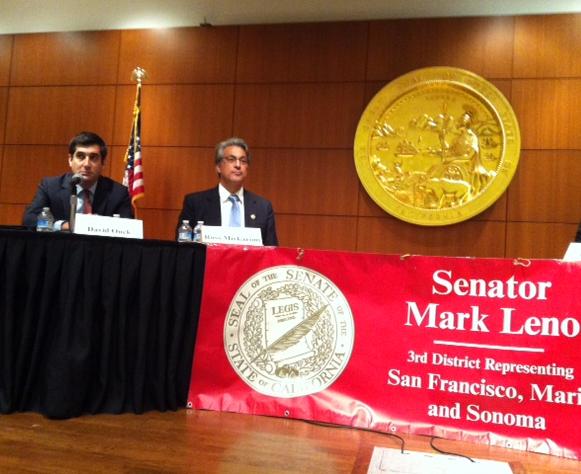
District Attorney George Gascon didn’t show up for the town hall meeting that Sen. Mark Leno held on criminal justice reform last night. Gascon was scheduled to appear on a panel with Sheriff Ross Mirkarimi, Chief Probation Officer Wendy Still, Public Defender Jeff Adachi, and Police Chief Greg Suhr (who also didn’t show, sending Commander John Murphy instead).

Gascon spokesperson Stephanie Ong Stillman minimized the decision to forego appearing on a panel with Mirkarimi, whom Gascon prosecuted for a domestic violence incident and continues to persecute with calls to resign or abdicate some of his official duties, telling us, “There was just a change in his schedule.”

But Gascon, who has only lived and worked in San Francisco for three years, might have benefitted from the discussion, which focused on how San Francisco has for decades pioneered a successful approach to criminal justice emphasizing rehabilitation and redemption rather than the punitive “zero tolerance” approach to crime pushed in Sacramento and other jurisdictions, which has been costly in human and fiscal terms.

“This team of individuals you see in front of you have had the most extraordinary results in leading San Francisco,” Leno said, focusing much of the discussion on how well-prepared San Francisco was for Realignment, the year-old state policy of transferring low-level offenders from the overcrowded state prison system to the local level.

David Onek, the UC Berkeley criminal justice professor who ran against Gascon for DA last year, was added to the panel after Gascon bailed out. He said, “San Francisco by all accounts is way ahead of the curve and can really provide leadership to the rest of the state for how to do Realignment right.”

The main reason for that, as most panelists acknowledged, was because of a variety of programs created by longtime Sheriff Michael Hennessey, who endorsed Mirkarimi to continue his legacy over two traditional law enforcement challengers. Mirkarimi noted that Hennessey didn’t have a law enforcement background when he became sheriff, and that the SFPD and other local agencies long resisted the progressive reforms that he instituted.

“The constellation of what we’re all addressing is unique to San Francisco,” Mirkarimi said, describing the city’s current multi-agency approach as “one that recognizes where redemption comes into the criminal justice system.”

Still, whose department oversees Mirkarimi’s three-year probation for his misdemeanor false imprisonment conviction, emphasized how much her department’s approach has changed in recent years, adopting “evidence-based” approach that respects  probationers, which she now calls “clients,” and addressing their needs.

“We created a plan for success instead of supervising for failure,” Still said. “We changed the culture.”

That cultural change came from the Sheriff’s Department, she said. “Sheriff Hennessey developed a litany of programs over the years, so we were well-positioned for [SB] 678,” the legislation that created Realignment. Despite all the recent talk about having “zero tolerance” for crimes like domestic violence, Hennessey’s controversial approach brought ex-offenders into key leadership positions and refused to dehumanize criminals or see them in black-and-white terms.

“In San Francisco, we kind of live in a bubble. You don’t know how crazy it is outside San Francisco,” Adachi said, noting how politicians in other jurisdictions have aggressively sought to block sentencing reforms and demonize criminals for political reasons.
“In San Francisco, we’ve been so fortunate that we’ve had progressive criminal justice policies,” Adachi said, recognizing that the last three DAs refused to bring the death penalty and Mirkarimi for six years ago creating the Reentry Council to address recidivism.

“It might seem like common sense, but it’s radical to other counties,” Mirkarimi said. “It makes me proud to be part of a criminal justice system that is looking forward.”
  

Live Shots: La Sera at the Chapel

0

It was nice to see that “Kickball” Katy Goodman hasn’t grown up too much since leaving the Vivian Girls. Her big smile, bubbling stage banter, and virginal attire—a lacy white dress to match her white Fender bass guitar — added a saccharine candy coating to the dark, jangly pop of La Sera, her Los Angeles-based solo project.

Swaying and hopping across the Chapel stage last Saturday night in all black Converse All Stars, Goodman whipped her all-male backing band through a surprisingly short set, clocking in at just around 45 minutes.

La Sera was within the first ten bands to grace the stage at the Chapel, San Francisco’s newest music venue at 18th and Valencia in the Mission; the venue celebrated its opening in conjunction with this year’s Hardly Strictly Bluegrass Festival last month. The Chapel is a stripped down, well, chapel — complete with stained glass windows and an arching, pitched ceiling with beautiful dark wood rafters.

As an added bonus, in contrast with everything I know and understand about music venues, the Chapel is astonishingly clean. For now, it smells of wood stain instead of stale beer. The 500 capacity venue also offers a small dinner menu and seating spread around the room at simple, wooden tables that match the hardwood floors.

The audience during La Sera was extremely engaged, if mellow, watching with quiet attentiveness and occasionally chuckling at guitarist Tod Wisenbaker’s bad jokes (“He writes his own material,” quipped Goodman. “It’s pretty impressive.”)

La Sera’s newly released sophomore effort Sees the Light picks right up where the last left off, sounding a bit like a co-ed Dum Dum Girls or, as you might expect, Vivian Girls. The live show, like the new album, offered few surprises. Goodman, despite being a veteran of the stage, was surprisingly tame and uncharismatic for a frontperson. For the last song, however, she jumped off the stage and sang directly to some excited audience members, giving a stronger finish to an otherwise good, but unremarkable show.
 
The real highlight of the night was the opener, San Francisco’s own the She’s, a beach-tinged girl band with a slightly doo-wop vibe and a seriously good groove. So good, apparently, that La Sera’s drummer bought a the She’s shirt between sets to wear for his own performance. If the She’s next album is as good as the material they played Saturday night, they could definitely be a band to watch out for.

Nudists to sue over Wiener law

62

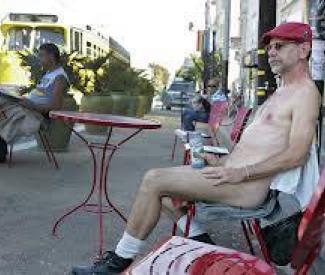
Sup. Scott Wiener’s ban on public nudity hasn’t even come to a vote at the full board, but the nudists who oppose it are already planning to sue. A group of five plaintiffs, including former mayoral candidate George Davis and Gypsy Taub, who disrobed at a hearing on the issue, are arguing that the city lacks the legal authority to enact the ban, which they call a violation of protected free speech.

Christina DeEduoardo, the group’s attorney, told me she plans to file this week in federal court in San Francisco. “We’re going to ask for a temporary restraining order to prevent the supervisors from enacting this law,” she explained.

It’s not easy to get a court to pre-emptively block a law that hasn’t been approved, but DeEduoardo said she’s going to argue that state law pre-empts San Francisco from taking this type of action. “When a municipality does something at odds with state law, there’s a reason to prevent it,” she said.

California law already regulates lewd behavior, and the state courts have consistently held that mere nudity is not a violation of that statute. “Nothing says the city has to power to regulate dress,” she argued. “It’s the equivalent of the Board of Supervisors saying that in October the only colors you can wear are black and orange.”

Even if the state doesn’t pre-empt San Francisco’s right to ban nudity, DeEduoardo said, there’s a First Amendment issue here: “This purports to ban all nude expression. My clients engage in nudity as speech. The law is way over-broad.” There’s even an equal-protection argument: Wiener’s legislation specifically exempts major city events, like Bay to Breakers and the Folsom Street Fair — but those things cost a lot of money. “So the city’s saying if you have the money for a permit, you can engage in nudity, but if you can’t afford that, and you just want to go au naturel, then you are a criminal.”

Matt Dorsey, spokesperson for the City Attorney’s Office, told me he doesn’t expect any sort of injunction. “State law is very clear that injunctions can’t be granted to prevent a legislative act,” he said.

If a federal judge won’t issue a restraining order, the nudists are going to sue to overturn the law the minute it passes. So there’s likely to be a long, expensive legal battle — and it seems so silly. Particularly since it’s getting chilly out and the rainy season is about to start, and Mother Nature will be dealing with the naked guys pretty quickly.

That special Christopher Owens show at the Lodge

0

The show was being filmed for a music video, and the crew told people in the front row that they might get photographed for reaction shots. When I mentioned to the couple next to me that a sure fire way to get on camera was to cry, the apparent director turned around from where he was kneeling near the stage and said, “I’ll pay $500 dollars if you do it,” before adding, “but I think you might cry anyway.” In his first performance since breaking up his former band, Girls, Christopher Owens was set to debut an entire album of new material, and it sounded like a tear-jerker.

Having never been to the room before – the “Lodge” at the Regency Ballroom – I arrived early, expecting a dark basement packed with 300 sweaty bodies jockeying for a spot up near the stage. Instead, what I found on the third floor was an experience similar to the Swedish American: a clean, well-lit room in which to listen to live music.

Seats were set out for the show, and on each one was a dated program for the evening, complete with a setlist and band credits, a special theatrical touch that invoked high-art rather than pop rock. Clearly, along with the taping, Owens meant for it to be a special – or at least different – occasion, and had special requirements of the crowd, which some people did not appreciate.

The stage was set with a large backdrop of a dusty road leading out between a forest. Lysandre is a concept album (which Owens has already explained) based around the first Girls tour in 2008. The backdrop signaled the travelogue aspect, as well as a classical element. It could have been a leftover from a community Shakespeare troupe, and when the show began with a theme that would repeat throughout, complete with Jethro Tull-esque flute from Vince Meghroni, there was a definite old world feel.

This theme alternated with roots rock Americana for the first half of the show, a rising energy that then mellowed out. On one track, Owens detailed the rush of arriving in NYC with the band, singing a chorus of “Here we are in New York City, everybody’s listened to me / Rock and roll in NYC” with a Banana Splits meet “New York, New York” upbeat simplicity.

As it switched over to one of the obviously sad songs, “A Broken Heart,” there was a definite comedown. On the first listen, Lysandre is beset with conflicting emotions, the highs of being on the road and meeting sudden popularity, compete with falling in love, and subsequent breakups occur with both. At times, it seems like personal issue ruined what should have been a great time.

On “Here We Go Again,” the album’s fight song, Owens warns, “Don’t try to get me down, don’t try to harsh my mellow” as the guitar player kicks the theme into its highest pitch, angrily stretching the notes out. But elsewhere, it’s the exact opposite: in closing the album, there are a succession of goodbyes, with the lament that there were always “a couple hundred people in the way.”

In the show’s encore, Owens resisted falling to his back catalogue, and instead played what seemed to be obvious influences on the sound and themes of Lysandre: into the great wide open of Cat Steven’s “Wild World,” the triumphant loneliness of NYC in Simon and Garfunkel’s “The Boxer,” pining for love with “Let It Be Me,” and breaking up on Bob Dylan’s “Don’t Think Twice, It’s All Right.”

Against these songs, Lysandre at times risked seeming overly saccharine. (“Kissing and hugging is the air that I breathe/ I’ll always make time for love,” was pushing it in this regard.) But the sunken-eyed Owens – who spoke with an endearing twinge of nervousness between songs – seemed well aware of the risk.

“What if everyone thinks I’m a phony? What if no one gets it? What if everyone gets sick of love songs?” he asks midway through Lysandre. But with a shrug he continues on to the chorus, “Beauty is in the eye of the beholder, love is in the ear of the listener.”

Critics urge caution on fast-moving Warriors arena deal

28

UPDATED The proposal to let the Golden State Warriors build a new sports arena complex at Piers 30-32 is moving forward quickly, with the Board of Supervisors Budget and Finance Committee considering approving its fiscal feasibility tomorrow (Wed/14), the Land Use Committee hearing its design and transportation aspects on Monday, and the full board scheduled to move it forward on Tuesday, two days before Thanksgiving. After that, it will undergo an environmental study and work on myriad fiscal and administrative details, coming back to the board for final approval, probably in the fall, with the goal of opening by the 2017 basketball season.

[UPDATE 11/14: The Finance Committee today voted 3-0 to approve findings of fiscal feasibility for the project after Sup. Jane Kim made amendments delaying the EIR scoping session until January and ensuring the Citizens Advisory Committee will be given more time to review the project and its term sheet. City officials and the Warriors also signed a deal this morning requiring that at least 25 percent of its construction jobs and half of its apprenticeship positions go to local residents or military veterans. We’ll have more details and analysis of what happened in the coming days.]

Critics of the project say it is being rammed through too quickly, with too little public notice or attention to blocking off views of the bay, and on terms that are too costly to city taxpayers. To some, Lee’s quest for a “legacy project” is reminiscent of the groupthink boosterism that characterized the initial America’s Cup proposal, before it was revealed to really be a lucrative waterfront real estate scheme that was great for developers but costly to the public, and later abandoned.

And just like last time, when the Guardian, then-Sup. Chris Daly, Budget Analyst Harvey Rose, and others forced a major scaling back of the developers’ ambitions, there are some prominent voices of caution now being raised about the Warriors arena deal and its potential to fleece city taxpayers, including concerns raised by someone with decades of experience shepherding some of San Francisco’s biggest public works projects.

Rudy Nothenberg, who served as city administrator and other level fiscal advisory roles to six SF mayors and currently serves as president of the city’s Bond Oversight Committee, yesterday wrote a letter to the Board of Supervisors urging it to reject the deal.

Among other things, he criticized the 13 percent interest that city taxpayers would pay on the $120 million in pier restoration work that the Warriors will do. “Quite simply, I would have been ashamed of such a recommendation,” Nothenberg wrote. “In today’s markets it is incomprehensible to have such a stunning recommendation brought to your honorable Board in such haste.”

Project spokesperson PJ Johnston and its main advocate City Hall, Office of Economic and Workforce Development head Jennifer Matz, each disputed Nothenberg’s characterization, citing a report by the project consultants, the Berkeley-based Economic and Planning Systems Inc. (EPS), that 13 percent is a “reasonable and appropriate market based return.”

Matz told us the rate was based on the risky nature of rebuilding the piers, for which the Warriors are responsible for any cost overruns. And she compared the project to the massive redevelopment projects now underway on Treasure Island and Hunters Point, from which the city is guaranteeing powerful developer Lennar returns on investment of 18.5 percent and 20 percent respectively.

Johnston, who was press secretary to former Mayor Willie Brown and worked with Nothenberg on building AT&T Park and other projects, told us “ I have great respect for Rudy.” But then he went on to criticize him for taking a self-interested stand to defend the views from the condo he owns nearby: “They don’t want anything built in their neighborhood. They would rather leave it a dilapidated parking lot.”

But Nothenberg told us his stand is consistent with the work he did throughout his public service career in trying to keep the waterfront open and accessible to the public, rather than blocking those views with a 14-story stadium and surrounding commercial and hotel complex.

“I have a self-interest as a San Franciscan, and after 20 years of doing the right thing, I don’t want to see this rushed through in an arrogant way that would have been unthinkable even a year ago,” Nothenberg told us. “I spent 20 years of my life trying to deal with waterfront issues.”

Among those also sounding the alarm about how quickly this project is moving is land use attorney Sue Hestor and former Mayor Art Agnos, who told us the supervisors should heed the input of Nothenberg and make sure this is a good deal for the city.

Agnos said, “Rudy Nothenberg stands apart from every other department head and CAO in the modern history of San Francisco for his financial and managerial expertise in bringing major projects with complex finances to completion that worked for our City. That is why the past six mayors…whether conservative or liberal…trusted him to advise them and administer the biggest projects in this city from Moscone Convention Center to the new main library to the Giants baseball park and Mission Bay. “

Legislative Analyst Harvey Rose released his initial analysis of the project on Friday. The $120 million plus interest that the city is paying to the Warriors would be partially offset by the $30 million the team would pay for Seawall Lot 330, a one-time payment of $53.8 million (mostly in development impact fees), annual rent of nearly $2 million on its 66-year lease of Piers 30-32, and annual tax and mitigation payments to the city of between $9.8 million and $19 million.

But the report also notes that many city departments and agencies – including the Department of Public Works, Municipal Transportation Agency, and the Police Department – have yet to estimate their costs. Both Johnston and Matz emphasized Rose’s conclusion that the project is “fiscally feasible” – the determination that supervisors will have to agree with to move the project forward – but the report also noted “the finding of ‘fiscal feasibility’ means only that the project merits further evaluation of environmental review.”

The full text of Nothenberg’s letter follows:

Dear Supervisors:

My experience as a high level financial advisor and city administrator for Mayors Moscone, Feinstein, Agnos, Jordan, Brown, and Newsom, and current President of the City’s Bond Oversight Committee cause me to write in the hope that you will reject the outrageous 13% interest rate that the developers of the waterfront arena are proposing to charge the City for their cost of replacing Piers 30/32. 

In my years as General Manager of Public Utilities, the Municipal Railway System, Water and Hetch Hetchy, and later as the Chief Administrative Officer for the City and County of San Francisco, I took probably more that a billion dollars worth of various debt instruments to the Board. 

Never…even in the worst days of highest modern era interest rates of the 1970’s hovering at 20% …never did I ever bring a 13% City borrowing to the Mayor and the Board of Supervisors for approval.  Quite simply, I would have been ashamed of such a recommendation.

In today’s markets it is incomprehensible to have such a stunning recommendation brought to your honorable Board in such haste. 

Even more remarkable is the fact that just weeks ago, Allentown, Pennsylvania has just procured a 4.78 % interest rate for $224.4 million of taxable bonds to help build with private contributions a hockey arena for 8500 seats. 

Yet, you are being told the best our city can do is 13% for $120 million.

No Board of Supervisors I ever appeared before would tolerate such dramatic discrepancy.

It is with this in mind, I would most respectfully urge you to send this proposed deal back to the developers, instructing the City’s negotiators not to bring it back without a far more favorable interest rate for City tax payers not to exceed a maximum of 7.5%.

And that would still be almost twice what the City would need to pay for City issued debt and more than amply compensate the developers for any risk premium that they allege that they are taking. 

Any such instruction from you to the City negotiators should also make it clear that they are not to make any new concessions to the developers in exchange for achieving a still high, but eminently more reasonable interest rate.

Thank you for your attention.

Rudy Nothenberg

Chief Administrative Officer (Ret.)

Documentation:

1.     The Warriors Arena negotiates 13% interest on $120 million from San Francisco when the City of Allentown in Pennsylvania just issued $224.4 million of taxable bonds for an arena at an average interest rate of 4.78%. 

13% for SF versus 4.78%  for Allentown

 http://www.allentownpa.gov/Home/AllentownCityNews/tabid/142/xmmid/636/xmid/2000/xmview/2/Default.aspx

City of Allentown – PA – Official Site

www.allentownpa.gov

The official website for the City of Allentown, PA. Learn about all the exciting events going on in the city of Allentown, from music, arts, theater, and sports. Allentown is the largest city in the 

2.     Allentown hockey arena bonds cost $4.2 million to issue 

www.lehighvalleylive.com/allentown/…/allentown_hockey_ar

Oct 10, 2012 – About $224.4 million in municipal bonds were sold last week to help finance arena construction. City officials say the issuance costs are about 


outLOUD Radio snags stories from an evolving queer world

0

It’s Saturday afternoon and, two weeks before the gala that will mark its 10th year of existence (coming up Wed/14) outLOUD Radio is talking style. Elders from the queer community are sitting in a circle in a LGBT Community Center third floor conference room, translating their thoughts on the concept of “gay uniform” into the waiting mics of outLOUD Radio youth volunteers.

“Describe what you’re wearing today.”

“Jeans, which could be categorized as old hippie jeans with tight ankles — not flares. That’s what I feel comfortable in, pants.”

“I’m wearing designer jeans. I bought them from Goodwill for $4.” “Nice.” “Very nice, actually.”

“I’m a dyke, and I wear pants. I’m cold a lot of the time because of my peripheral circulation.”

“There’s something about this T-shirt that makes me feel more alive, more vibrant.”

This is outLOUD’s intergenerational storytelling project. 

Phuong Tsing is 20. Tsing is holding the mic for the seniors to talk about their clothes because “I wanted to feel more connected with the LGBT community, to make myself feel more comfortable about myself. [The elders] make me feel like I live in the present, but I’m connected with the past.”

“What does your outfit say about you?”

“I decided at some point in my old age I was not going to dress like a geezer. And I live in San Francisco, so I don’t have to.”

“Not too flashy, except for the rhinestones on the shoes.”

“I’m alive, grateful, a vital human being.”

“I have on what I have on to keep warm.”

The first generation of out LGBT elders are coming of age these days, and they’re providing the community with a heretofore unique resource — the chance for baby gays to sit around and listen to what it was like being queer back in the day. Pre-Stonewall (some of the seniors at this Saturday session were actually present at the infamous raid and insuing protest), pre Glee, pre civil unions. Not only that — one of outLOUD’s major goals is the empowerment of youth through this archiving. Young people assemble pieces on the salient issues of their day, forming their own voice in the process. 

“Is there a gay uniform?”

“No. It just seems to me that there’s so many reasons why people put on one thing any morning. Right now in modern times you can wear anything, be anything.”

“What I really love about his group is that it feels really empowering,” say Tsing. Like outLOUD’s other projects, eventually this footage will be edited, and assembled into a radio show that can be streamed online and heard on radio stations across the country. Past podcast topics have included transbodied athletes, the definition of masculinity, sexual harassment on the Muni, even history like the piece below, that interviews members of the Sisters of Perpetual Indulgence about creating the first safe sex pamphlet. 

The work, led by executive director Noah Miller, has been going on for a decade, and needs more funds to stay on track. This week’s gala, featuring gay NPR White House correspondent and sometimes-Pink Martini vocalist Ari Shapiro, and KQED host and reporter Scott Shafer.

“Did you dress differently before and after coming out?”

“Not really. But I got my ear pierced when only gay men wore earrings.”

Assembling stories is important work — and not just for those that would compile and listen to the recorded product. That afternoon in the LGBT Community Center, the seniors being interviewed were aglow after interacting with the young people, and probably had plenty to think about after being interviewed about what they were wearing, from the guy in rhinestone shoes to the woman who proudly asserted she was wearing the activist dyke uniform. Telling your stories makes you realize that you have stories, to be really simplistic about it. 

Anyway, listen to this podcast — we need 10 more years of this right?

“10 Years of Making Waves”: outLOUD Radio benefit

Wed/14 7pm, $25-5,000

Brava Theater

2781 24th St., SF

gala.outradio.org

Out of the last closet

20

It got pretty well buried in the last-minute election madness, but Sups. David Campos and Christina Olague did a very cool thing Oct. 31 — they helped create some press, and some possible national buzz, for a small San Francisco organization that’s taking on a very big issue.

The Last Closet is trying to get someone — anyone — in the senior hierarchy of male professional sports to talk about homophobia and the fact that there are no out gay men in any of the five major pro sports (football, basketball, baseball, hockey and soccer). When Olague and Campos held a press conference to introduce a resolution endorsing the group’s aims, it got at least passing mention on sfgate. And that’s a start.

Everyone knows there are gay men in the NFL, and in the NBA, and in MLB, and on the ice playing professional hockey. Yet even in 2012, when retired tough-guy athletes can talk about homophobia and the need for equality, not one active player has come out of the closet.

Who cares? Well, if you’re a young LGBT person involved in sports, you care — and you care a lot. Middle-school and high-school locker rooms (male locker rooms, particularly) are still pretty homophobic places and can be scary for gay kids. And there’s nobody for them to see as a role model.

As Campos told me, “What I was with the San Francisco Giants, all the Latino players, was such a source of pride to Latino boys and girls. We can’t feel that in the LGBT community. We know there are gay baseball players, but the LGBT youth don’t have those rold models to look up to.”

Not that sports figures are great role models, but still: One badass NFL player — I envision a linebacker — comes out, and a generation of LGBT youth can say: He’s gay. He’s tougher than any of you assholes who are teasing me.

And it would change lives.

All the Last Closeters want right now is for the commissioners of the five major sports to speak out, to make a statement, to say that out gay players would be welcomed and protected in their leagues and that homophobia would not be tolerated. Doesn’t seem like much to ask.

And yet: Not one will do it.

Maybe Larry Baer can bring it up at the next owner’s meeting.


Get ready for a garbage rate hike

30

Recology, the San Francisco garbage monopoly, usually comes to the city to ask for a rate increase once every five years or so. It’s been almost seven since the last one — and it’s not as if the company’s costs have come down. Anyone who’s running big diesel trucks and paying for fuel has been hammered in the past year or two.

So why did the folks at Recology wait until this fall — Sept. 11 — to let the city know they want to change the way they charge for trash — and most likely rise rates at the same time?

Well, for one thing, there was a ballot measure back in June that would have broken up the lucrative monopoly and opened the waste-removal franchise to competitive bidding. That’s Recology’s worst nightmare. Since 1932, the company (through its predecessors) has had the exclusive right to pick up residential and commercial refuse in San Francisco; unlike virtually every other outfit that does this level of business with the city, the contract never comes up for renewal and nobody else ever gets to bid. There’s virtually no chance that anyone but Recology would ever win a bid for the deal anyway — we’re talking about a unionized, worker-owned local company, and all of the other big garbage outfits are nasty out-of-state operations with bad management and environmental records. But if there were other bidders, Recology might have to sweenten the city’s deal — keep the rates lower or give some more money to City Hall.

Ant any rate, the ballot measure went down under a flood of Recology money, and to nobody’s surprise the rate hike is now on the table.

Your rates won’t actually go up for a while — the process is long and complicated and both Recology and the Department of Public Works agree that the earliest any new pricing would go into effect would be next summer. We won’t actually see a firm proposal until December.

But already, the company’s talking about ending the current practice of charging for the black (garbage-to-the-landfill) cans and picking up recycling and compost free. The city and the company are both trying to reduce the amount of landfill material that gets discarded — and ultimately, everyone would like to eliminate the black cans altogether. But that, Recology spokesperson Eric Potashner told me, doesn’t work with the current business model: “We can’t rocus our financial operations on a black can if we’re trying to get rid of it.”

Which leads to a dilemma: If you want people to recycle and compost more, how do you get away with charging them more to do it? “That’s the challenge,” Potashner said.

Either way, the rates are going to go up. “There hasn’t been a cost-of-living increase since 2010,” Douglas Legg, finance director at DPW, told us. The increase might be fairly steep, too — after all, it’s been seven years since the last one.

All of which comes back to the competitive bidding question. If this weren’t a monopoly, and Recology had to compete for the contract every once in a while, “these rate hikes might be more moderate,” retired Judge Quentin Kopp, a longtime critic of the company, told us.

Simple H2O makes it go (into your head and stay there)

0

We salute Los Angeles’ Mark Bedol, inventor of the battery-free, water-powered clock, for bringing the ditty-centric production values of local cable TV ads to the Internet. The lil’ timekeeper comes in pink, red, blue, green, etc. You can choose to go meta with the water drop-shaped model or be boring and buy yet another round clock.

Also! Happy beginning of holiday (shopping) season. Our SFBG Holiday Guide comes out on November 21st, which you should be excited about if you like drag queens and ways to survive the season for alternative families.

Ladies and gentleman, hip-hop 2012: Kitty Pryde, Main Attrakionz, Hottub

0

Concurrent downlow Rusty Lazer set across the bridge at Ruby Room notwithstanding, Y3K at DNA Lounge was the place to be for hip-hop in the Bay Area on Friday night. This is a disputable claim, given the hordes of Youtube haters that run amok over headliner Kitty Pryde’s channel. But a HottubMain Attrakionz-Pryde 1-2-3 punch will tell you more about where hip-hop is today than any number of shows by more universally-accepted rappers.

I got to the show after DJ sets by FRIENDZONE, Matrixxman, and Marco de la Vega opened it. Hottub, an Oakland group fronted by a triad of heartstoppingly perfect female emcees was the first live act of the night.

This group is one of those things I should have paid more attention to way, way earlier. Hottub is fire. Its music is high-energy stompfest, and I have never seen women fondle their boobs more self-assuredly on a stage. Hottub’s attitude has a lot to do with punk and funk, but there’s no denying that emcees Coco Machete, Ambr33zy, and Lolipop have mad hip-hop swagger and flow and the kind of self-confidence that says if you don’t like it they don’t really care anyway. 

At one point towards the end, Hottub called half of the audience up to party with them, and all of a sudden the stage was filled with a bunch of really hot females, a tall skater guy who assumed centerstage and began to make a “x” with his hands over his crotch. To the beat. Eventually he was tackled by one of the members of Hottub, because apparently he was a friend of theirs. Another guy hopped up there who was probably someone’s dad who really likes Wu Tang. He had a T-shirt with the names of the clan members on it.

Main Attrakionz played it a little more close to the traditional contours of the rap game, albeit with that hazy, promethazine-inflected lean of the cloud rap genre they helped kick off. Emcee MondreM.A.N. has made it clear that the duo’s beats aren’t club-party music, but someone forgot to tell the crowd at DNA, who remassed their cumulus around MondreM.A.N. and Squadda B everytime they swapped the DNA stage for a go-go platform and back again.

In case you were wondering, you can get girls on lean — the two turned a performance of “Take U There” off 2012’s Bossalinis and Foolyiones into a lover’s moment (“Thugs get lonely baby, that’s why I called ya.”) This was also the first concert in which I’ve seen someone drop and break their cellphone, an occurence that was not noticed by the performers until a song or two later. 

I feeling slightly jumbled by the time Kitty Pryde inched on stage after hanging around the edges of it during the Main Attrakionz set.

Pryde’s San Francisco debut was maybe the buzziest portion of the night. If you took a break from the Internet last week/summer, you may have missed that she’s a Daytona Beach teenager currently assuming the “ruining hip-hop” mantle with her geekiness, doodles, weird voices. But unlike say, Ke$ha, Kitty Pryde can rap and like a rapper, she combats haters with considerable grace and counter-aggresiveness.

She spent the first handful of songs breathily self-deprecating, comparing herself unfavorably with the opening acts and squeaking. Her EP is called haha i’m sorry, as befitting a rap parody of a teenage white girl.

At some point, Main Attrakionz came back out onstage, their motivations for doing so unclear. Did they feel the need to save her from a crowd unsure of what to do with all the performance art? Were they feeling the set and wanted to lend their energy? Kitty asked MondreM.A.N. if he could please get everybody bouncing because they weren’t listening to her. Hot Sugar, Kitty’s DJ and Internet boyfriend, looked on heavy-lidded from the back of the stage. 

But then Kitty hit her stride and started performing, and it turns out she can grind (on MondreM.A.N.’s back, in this case) in a way that is not white girl-embarassing. It turns out she’s actually a rapper, even if she wears bigass fake sunflowers in her hair, and flower print leggings with her oversize black tee. She wouldn’t sing her Justin Beiber song even though Hot Sugar started the beat because, she said, she was made at Beiber for getting an Ellen Degeneres haircut. Note to Kitty: all of his haircuts are Ellen Degeneres haircuts. (Kids!)

A lot going on in a single show. Even the flyer was a trippy, four-eyed kitten. It was like some kind of Internet collage where you can post videos, photos, rambling monologues, and hit on people obliquely. Someone should make a web platform like that. 

The Performant: Paris is learning

0

Adventures in ‘pataphysics

Well, pschitt! Although Alfred Jarry — schoolboy playwright, raconteur, and progenitor of ‘pataphysics, “the science of imaginary solutions” — died 105 years ago of decidedly prosaic malady tuberculosis, his outré influence lives on. Adopted and championed by generations of outsider artists, avant-garde writers, and revolutionary thinkers, the self-styled “Pere Ubu” gave artistic anarchy a nexus during his lifetime, an iconic figurehead after.

Last weekend, the four-day Carnivàle Pataphysique, part commemoration and part investigation, gave amateur pataphysicians, situationists, and conceptual artists a free zone to mingle, to expound, and to congeal, over lectures, concerts, puppet shows, and other unique performative opportunities in and around the practically imaginary stronghold of “North Beach,” a land where strip clubs and surrealists collide.

On Saturday, beneath an almost oppressive sun, a small group of eager urban explorers embarked from City Lights Bookstore on a situationist-inspired dérive — a psychogeographical walking tour of North Beach using maps of Paris (ala Jarry’s creation Dr Faustroll) to orient ourselves. Our intrepid guide, City Lights events coordinator Peter Maravelis hurried us along the less familiar side streets of Chinatown, stopping to exclaim over abstract, easily overlooked details. In a psychogeographical foray, murals become prophecies, placid streets become daunting Rubicons, oddball ephemera becomes omen. 

At St Mary’s Square aka “The Amorphous Isle,” beneath the stainless steel monolith of Beniamino Bufano’s sculpture of Sun Yat-sen, Frederick Young and Linus Lancaster demonstrated their latest attempt to make contact with the USS Macon, a military zeppelin which crashed in the ocean at Point Sur in 1935. Involving a slowly inflating weather balloon, soil from France, a stack of Heidegger texts, and a curious mechanical component best filed under “moves in mysterious ways,” (or, rather, doesn’t) Young and Lancaster’s absurdist experiment was conducted with all appropriate gravity until we were hurried off again to another park (“The Great Church of Snout Figs”) to watch actors Leonard Pitt and Kurt Bodden orate from a hodge-podge of cut-up texts beneath a gracious gazebo.

Marching onward, we found ourselves faced with a seemingly insurmountable mountain — the Vallejo Steps — leading straight into the sun. After our climb, more readings followed, courtesy of Mark Gorney and Josh Mohr, and a chance sighting of the Uniqlo blimp, shades of the USS Macon, and a jeering band of North Beach’s famous feral parrots, added local color to our border-blending dérive.

On such a journey, the most mundane minutiae becomes unaccountably fascinating. An abandoned pair of pants on the sidewalk raises the real question, who abandons their pants in the middle of a sidewalk? A cluster of television sets and sandwiches begs for an archeological explanation. Sloppy graffiti reads like a coded message. Empty streets twist unexpectedly, like lines of a labyrinth. 

“I think we’re lost,” Maravelis announced at one point.

“At last!” exclaimed a committed voyager.

Our final destination, Jack Early Park, renamed for our purposes as “The Land of Lace” involved one more sunward climb, and a rare treat worth the exercise—a command performance by dark folk duo Hazy Loper, whose sorrowful San Francisco ballad “The Graywood Hotel” should be required listening for all poet philosophers and vagabond flâneurs no matter which streets they wind up wandering, and for whatever purpose.

(Interested in more things ‘pataphysical? Festival co-curator Andrew Hugill’s ‘Pataphysics, a Useless Guide (MIT Press, 2012) is available at City Lights, as is Jarry’s seminal work, Ubu Roi.)


Scoop: There is no place like Nebraska!

1

And so my grandson, Nicholas Perez, a mechanical engineering freshman at the Umiversity of Nebraska at Lincoln, sent me an email pumping the importance of the Nebraska vs. Penn State game today (Saturday) at Lincoln.  Nebraska, he reported, was now being touted as a potential Rose Bowl candidate and needed to beat Penn State.

This was indeed big news, back where the Cornhusker football team rules the state. I emailed him back and pointed out that the last time Nebraska went to the Rose Bowl was in 1941.

In fact, I noted that that the 1941 game was still big news when the former Jean Dibble and I were students at the university in the 1950s.  It wasn’t until later that we learned  that Nebraska actually lost the game to Stanford and its famous quarterback, Frankie Albert.

The game will be broadcast nationally at l2:30 p.m. Saturday on ABC television  (7).  And it will be shown on the big screen at Final Final, the nifty neighborhood  sports bar near the Presidio in San Francisco.

The bar has been owned for 35 years by Arnie Prien,  a native Nebraskan from Lyons, Nebraska, and a graduate from the university.  He loyally shows the Nebraska games every Saturday. The game attracts a host of NU faithful who come for the Husker camaraderie and the free popcorn, inexpensive beer and friendly  ambience.  Final Final got its name from the days when it was known as the final destination where the soldiers at the Presidio could get  their final  drink after a night on the town. Parking Tip: on street parking is difficult in this area, so park in the Presidio and walk to the bar.

There is no place like Nebraska, as the song says. Even in San Francisco. Go Big Red! B3

P,.S. The Nebraska alumni site lists three other “watch sites” in the Bay Area.  Jack’s Brewing Company in Fremont.  Legends and Heroes in Concord.  And Knuckles Sports Bar in Monterey,

Watch the Huskers on these four Bay Area Watch sites: http://bayareahuskers.org/


Voters affirm progressive leadership at City College

5

San Francisco voters this week reinforced their support for progressive leadership at City College, re-electing incumbents Steve Ngo and Chris Jackson (assuming Jackson’s 549-vote margin over Amy Bacharach holds), and bringing newcomer Rafael Mandelman into the fold during a period where the school will make drastic, transformative changes. 

At the same time, voters rejected a monied, politically connected, fiscally conservative board member, Rodrigo Santos, who was appointed by Mayor Ed Lee in August to fill the vacancy created by Milton Marks’ death. Longtime board member Natalie Berg was also re-elected, likely buoyed by her decades of incumbency, but finishing third behind the more-progressive Ngo and Mandelman.

As the college airs all of its dirty laundry, showing its worst practices to the world, San Francisco voters also showed faith that the college could spend money wisely in the future: they passed Proposition A with more than 72 percent of the vote, delivering $14 million a year in parcel taxes, for the next eight years, to the money-starved institution.

The lack of money means more than just numbers on a page — real classes will be cut, real campuses are already being closed, and the diverse communities the colleges serve will either be given smaller portions, or excused from the dinner table entirely.

Rejecting politicians that represent these kind of austerity measures, Santos was one of the casualties of this voters’ swing away from conservative politicians (despite what Chuck Nevius may think).

Santos, who head the pro-development Coalition for Responsible Growth, had all the odds stacked in his favor: he was an incumbent appointed by the mayor himself, and had a huge  campaign war chest. He raised $192,000 for his college board race, an unheard of for a local college board member.

 It did nothing for him: ultimately, Santos got slightly more than half the votes of candidates with as little as $30,000 in their campaign chests. By voting in mostly progressive candidates, and overwhelmingly reaffirming Prop. A, San Francisco has said loud and clear: they want the college to protect education in their individual communities, and for the college to maintain as many classes as possible, despite cuts urged by lack of state funds.

Steve Ngo and Chris Jackson earned their progressive bona fides in pushing forward the “Placement Plus One” program, a policy giving students taking placement tests the ability to “bump up” a class higher than they placed. Students, mainly from the local nonprofit Coleman Advocates, complained that placement tests were disproportionately unfavorable to minorities.

The consequences for placing low in math or English are huge — a student placing in a rudimentary English class could delay transferring to a four year school by years. Ngo and Jackson fought for a student’s right to decide their own futures, and importantly, fought for minority students who were falling behind.

But don’t think that just because Ngo is progressive, that he isn’t afraid to make the cuts he feels he needs to make. He notably did not support his colleagues on the board as they voted to reject the Student Success Task Force, which advocated for lowering class registration prioirty for students who took too long to get out of community colleges statewide, accruing over 100 credit units.

Mandelman as well is a figure whose professional, calm demeanor lends himself to a new progressive movement. He may have lost his past bid for supervisor of District 8, but as Chris Daly noted, Mandelman is a consensus builder with the backing of many groups and associations in San Francisco. The same was true of his City College bid, and likely why he won.

The college desperately needs someone like him that can build unity right now. The school, highly politicized and villainized in the media, needs allies. With Mandelman and his calm demeanor on the new progressive bloc on the board and a clear strong mandate from the city to back up classes with millions of dollars in taxes, there is now hope that the changes at City College may not only be transformative, but serving its diverse community through solid progressive values.

Dick Meister: We all need a higher minimum wage

5

By Dick Meister

Bay Guardian columnist Dick Meister, former labor editor of the SF Chronicle and KQED/TV Newsroom, has covered labor and politics for more than a half-century. Contact him through his website, www.dickmeister.com.

Election’s over, the good guy won, so what now for working people? Labor’s wish list for our re-elected president and the new Congress is long, but certainly the most basic item is raising the pay of our poorest workers by raising the minimum wage.

 About four million workers have been living in poverty or near-poverty at the current minimum of $7.25 an hour – $15,000 a year at most before taxes and other deductions. And that’s assuming the workers manage to find full time, year-round jobs.

There’s been no lack of congressional bills to raise the minimum since it was last raised in 2007, the latest introduced this year by two Democrats, Sen. Tom Harkin of Iowa and Rep. George Miller of California.  Their bill would increase the rate to $9.80 an hour by 2014, index the rate to rise automatically with any rise in the cost of living after that, and set the rate for tipped workers at 70 percent of the minimum.

 Raising the minimum would help us all. The National Employment Law Project (NELP) estimates that increased consumer spending generated by the proposed raise would create the equivalent of more than 100,000 full time jobs. Other estimates indicate that every dollar increase in wages for workers at the minimum would create more than $3,000 in new spending after a year.

It’s often argued by those opposing a raise that a raise would be mainly a burden on small businesses, but NELP found that more than two-thirds of minimum wage workers are employed by large companies.  There’s no doubt many of the larger employers could easily afford a raise, especially since, as NELP notes, most of them are fully recovered from the Great Recession and are back making strong profits.

It’s not surprising that the opposition to a raise is led by corporate employers, but how does the general public feel about raising the minimum? A poll conducted in February of this year showed that nearly three-fourths of likely voters nationwide would support raising the federal minimum to $10 an hour and indexing it to inflation.

States, counties and cities can set their own minimums, as long as they at least equal the federal rate, and voters in 18 states and several cities have by substantial margins approved minimums greater than the federal rate.

In 2004 and 2006, state wage rates above the federal minimum were approved by voters in Arizona, Colorado, Florida, Missouri, Montana, Nevada and Ohio. As for a federal raise, President Obama pledged during his initial election campaign in 2008 that he’d seek an increase to $9.50 an hour. But he did not do that, and said nothing about a raise during his re-election campaign this year.

Meanwhile, however, voters have recently raised the minimum rates in three cities, Albuquerque, San Jose and Long Beach.  NELP’s executive director, Christine Owens, hails the raises as a “major victory for workers.”

The rate in Albuquerque jumped a whole dollar to $8.50 an hour and will automatically adjust to future increases in the cost of living. NELP calculates that will affect an estimated 40,000 workers, generate $18 million in new consumer spending and support creation of 160 new jobs as businesses expand to meet the increased demand.

The minimum wage in San Jose rose from $8 an hour, the current California rate, to $10. NELP says that should raise the pay of almost one-fifth of the citywide workforce, boost consumer spending by $190 million and support creation of 200 new full-time jobs.

The raise in Long Beach does not apply to all workers there, but does set a higher minimum for hotel workers, who are essential to the success of the city’s booming hospitality industry. Their minimum pay will rise to $13 an hour from an average of only $10.  They will also get five paid sick leave days per year.

City minimums in California and elsewhere in the country range up to San Francisco’s rate that will reach $10.55 an hour next year.

NELP’s Owens notes that “with growing numbers of working people relying on low-wage jobs to make ends meet, the voters recognize that raising the minimum wage fulfills our basic obligation to ensure that work provides a path out of poverty. Higher wages for the lowest-paid workers in our economy will promote upward economic mobility and help accelerate post-recession recovery.”

It’s time for the president and Congress to recognize that vital truth.

Bay Guardian columnist Dick Meister, former labor editor of the SF Chronicle and KQED/TV Newsroom, has covered labor and politics for more than a half-century. Contact him through his website, www.dickmeister.com.

Damn, that’s crazy: Frankie Quinones’ TV debut on Nickelodeon

0

W. Kamau Bell’s recent success notwithstanding, when it comes to Bay comics, we love Frankie Quinones as our stand-up ambassador. His shows — including a packed-to-the-brim gig a few we attended months ago in the cozy basement space of Bossa Nova — are where you want to go to watch the grown-and-sexy of the Bay Area crack. Up.

Anyway, he sent us a video of his old crush from Martin, Tisha Campbell introducing his set for an episode of NickMom Night Out that premiered last month. Moms making butterfly nets out of pantyhose are involved. Onward and upward, Frankie! 

Is the tax revolt over?

46

The most optimistic piece I’ve read on the results of the November election is on Calitics, where Robert Cruikshank argues that the tax revolt that started with Prop. 13 in 1978 is finally over.

And while there is still a lot of work ahead to overturn the legal and constitutional legacies of the tax revolt, it no longer has political power. That in turn means the California Republican Party, and the California conservative movement, are as dead as Monty Python’s parrot.

That’s a pretty sweeping statement for a fairly modest tax package supported by the same governor who called himself a born-again tax-cutter in the wake of Prop. 13. But Cruikshank makes a good point:

This victory over the tax revolt happened because of years of progressive organizing against further tax cuts and for tax increases. Progressive voices and organizations completely rejected the post-1978 Democratic logic that the tax revolt had to be appeased. Instead, we insisted that the tax revolt had to be confronted and defeated. With Prop 30 that’s exactly what happened.

I know the Democrats in the Legislature are going to be nervous about more tax hikes, particularly since the two-thirds majority includes some folks from pretty conservative districts who are going to be scared of “overreaching.” But it’s not just about general tax hikes; we got one this year, and we may not get another. It’s about all of the long list of tax loopholes that art on the books that take a two-thirds majority to undo. It’s about a budget that includes addition as well as subtraction. And it’s about not being afraid to say that investment in the state has economic value.

Maybe the Dems don’t have to be afraid; maybe this two-thirds majority isn’t an anomaly and isn’t going to change. Maybe the state is getting so much more Democratic that supermajorities are the way of the future and people are sick of the GOP no-new-taxes nonsense. Maybe (as I’ve long said with same-sex marriage) it’s part of an inevitable demographic change:

Many of those angry white suburbanites convinced that people of color and their liberal allies were going to destroy their suburban paradise have left California, either by relocation or by the intervention of the Grim Reaper. In their place has grown up a native-born population that is diverse, that isn’t ideologically wedded to car-centric postwar suburbs, and that rejected the “I’ve got mine, screw you” mentality of Howard Jarvis.

In which case we really can start turning this state around.

Celebrate National Toy Store Day at some of our fave local shoppes

0

There’s perhaps nothing in your life that will ever get you as excited as when you a youngster with a toy trip trip on your schedule. Not even the Giants winning the World Series twice in three years or scoring free VIP tickets to Outside Lands can come close to eliciting that brain-paralyzing gush of euphoria and innocent bliss.

But since you can’t quantum leap back to being eight (get on it science!), the Guardian can offer you the next best thing, and that is the upcoming National Toy Store Day on Sat/10. 

In an effort coordinated by the American Specialty Toy Retailing Association — whose members include over 1400 locally-owned toy shops — over 500 independent centers of child-like joy across our glorious nation will be participating in Toy Store Day.

In the Bay, The Ark, which has locations in Presidio Heights, Noe Valley, and Berkeley, is planning to go all out for the occasion. A veritable carnival will be taking place inside the stores — there’s going to be prizes galore, an “I Spy” contest, and a meet-and-greet with several toy inventors (your mission: find out how to become a toy inventor.)

And definitely check out some of our other favorite independent toy stores: eternal Best of the Bay winner Jeffrey’s, West Portal classic Growing Up, the Mission’s rad place for organic, sustainably made gear Aldea Niños, and Clement Street action figure wonderland Heroes Club/Art of Toys. Should you need inspiration in your quest, totally-not-locally-owned Toys ‘R Us has released its “Fabulous 15” list of top toys for 2012 (we suggest finding the off brand equivalents to avoid having your gift recipients’ holiday hijacked by corporate advertising.) 

Saturday! It’s the perfect excuse to get your holiday shopping done early. Trust, you don’t want to get caught up in the December crush: 


Rupa and the April Fishes re-‘BUILD’

0

The ethereal San Francisco global fusion band released this video for the title track of its new album, BUILD, last week. Tonight (Fri/9) it plays an album release show at the Great American Music Hall.

Known for blending different cultural styles of music and languages, Rupa and the April Fishes spent years creating BUILD, a follow-up to 2009’s Este Mundo, traveling the world during the process, and touring via bicycle — and those global influences are felt throughout the record, along with a sociopolitical edge. Earlier this year she told us, “In the wake of where we find ourselves right now, economically, sociopolitically, we can’t wait for someone to hand us the reality we want. We have to build it, we have to create it.”

Rupa and the April Fishes
With Black Nature Band, the Glasses 
Fri/9, 9pm, $17.50
Great American Music Hall
859 O’Farrell, SF
www.slimspresents.com 

School board incumbent victories could undermine UESF

6

San Franciscans this week saw the end result of long-running teacher union attacks on the re-election campaign of three SFUSD school board incumbents — Sandra Fewer, Jill Wynns and Rachel Norton — who were all reelected.

The feud between the San Francisco teacher’s union, United Educators of San Francisco, and the school board was sparked by the board’s vote to protect 14 low-performing schools from teacher layoffs. Every year, the pink slips go out to teachers in San Francisco, but this time around a vote was cast to protect teachers in a “special superintendent’s zone,” established by then-Superintendent Carlos Garcia.

After the board’s vote to protect more vulnerable teachers, the teacher’s union started going on the offensive against the board. “[The union] was very angry with me,” Fewer told us. They told people all over the city not to vote for her, she said, and declined to hold any discussions on the topic. “They told me, you had just better not [pursue this],” she said. 

Ultimately, despite the attacks, the incumbents of the school board were elected with twice the votes of the closest losing candidate. Sandra Fewer netted the most out of any board candidate — 93,971 San Franciscans voted her in, as of the election day count. They’ll be joined by newcomer Matt Haney, who disagreed with the school board’s approach but not its decision.

UESF President Dennis Kelly didn’t see their conflict in quite the same was as Fewer. “When they made a mistake, we decided to point it out to them,” Kelly told us.

But political analysts say UESF will likely lose some influence in the district over its failed campaign strategy. “The school board now has a mandate to do what it wants to on behalf of kids,” political consultant David Latterman told the crowd at SPUR’s post-election wrap-up yesterday.

Ironically, even Kelly admits the fight they picked wasn’t over an issue that really impacted teachers much. He said that the 70 teachers the board decided to spare was a symbolic move. “They’re temporary teachers, their contact essentially ends that year,” he said. “It was a pointless thing to do.”

Fewer, of course, disagreed. When the district sends out their pink slips annually, they hire back most of the teachers, she said. But when you send pink slips to the younger or newer teachers at vulnerable schools, they often don’t come back.

“If you lose 60 percent of your staff every year, how can you do that and run a school?” she said.

Those schools often have the newest and youngest teachers. And that can make it difficult to retain them once they’ve left. Salome Milstead has taught in San Francisco for four years, and knows that feeling of dejection when that annual pink slip comes in. She started out at the Academy of Arts and Sciences, one of the newest schools in the SFUSD.

Like the schools in the special zone that Fewer tried to protect, the Academy serves a diverse socio-economic population: kids from troubled homes, that are usually tougher to teach. In 2008, Milstead and the teachers there had achieved something remarkable: building a new school from scratch. They were a close knit-team.

“That year, the principal got his layoff notice and pretty much most of us got a pink slip,” Milstead said. “We had all worked really hard that year to build up what we had.”

It takes that kind of young, idealistic, not-yet burned out person to go into the more troubled schools and have the energy to teach, she said. After the intense schooling and work training teachers go through, to immediately receive a pink slip was demoralizing.

The decision to protect the teachers of those kinds schools was something Fewer said she had to do, but it was a hard decision.

Kelly said that despite their differences, he looked forward to working with Fewer again. “We’ve worked with them before,” he said. “There were nine candidates in this race, and we were ready to work with any one of them.”