Bay Guardian columnist Dick Meister, former labor editor of the SF Chronicle and KQED-TV Newsroom, has covered labor and politics for more than a half-century. Contact him through his website, dickmeister.com.
While celebrating Martin Luther King Jr. Day today, let’s remember that extending and guaranteeing the rights of working people was one of Dr. King’s major concerns.
You’ll recall that King was in fact assassinated in 1968 while campaigning for striking sanitation workers who were demanding that the city of Memphis, Tennessee, formally recognize their union.
King had been with the 1300 African-American strikers from the very beginning of their 65-day struggle. He had come to Memphis to support them despite threats that he might indeed be killed if he did.
King considered the right to unionization one of the most important civil rights. And virtually his last act was in support of that right. For his assassin’s bullet struck King as he was preparing to lead strikers in another of the many demonstrations he had previously led.
King’s assassination brought tremendous public pressure to bear in behalf of the strikers. President Lyndon Johnson dispatched federal troops to protect strikers and assigned the Under Secretary of Labor to mediate the dispute. Within two weeks, an agreement was reached that granted strikers the union rights they had demanded.
For the first time, the workers’ own representatives could negotiate with their bosses on setting their pay and working conditions. They could air their grievances. And they got overtime pay, their first paid holidays and vacations, first pensions, first health care benefits.
They got a substantial raise in pay that had been so low that forty percent of the workers had qualified for welfare payments.
And they won agreement that promotions would be made strictly on the basis of seniority. Which assured the promotion of African Americans to supervisorial positions for the very first time.
The strikers’ victory led quickly to union recognition drives –– and victories ––bypublic employees throughout the South and elsewhere.
As a strike leader said, the strikers had won dignity, equity and access to power and responsibility.
Those clearly were the lifelong goals of Martin Luther King Jr., whether he was seeking civil rights for African Americans or labor rights for all Americans, black and white alike.
Bay Guardian columnist Dick Meister, former labor editor of the SF Chronicle and KQED-TV Newsroom, has covered labor and politics for more than a half-century. Contact him through his website, dickmeister.com.
I’m not a big supporter of our wars in Iraq and Afghanistan, and I’ve learned not to glorify military service, which often ends very badly, but I have to say: It’s always interested me that when Britain is at war, the kids of the royal family are sent to fight, too. It’s an ancient tradition, I guess, but it still goes on — and it’s very different from the United States. Here, people with names like Bush don’t go to Vietnam; they get a cush job with the National Guard. Or if their name is Cheney they’re just too busy. Any chance at all the the daughters of the president who sent thousands of others to die in the desert would be called to active duty? Nah; they’re out partying.
You think maybe presidents and members of Congress would feel a little differently about these pointless military engagements if their own kids were flying the planes?
On Tuesday, Oakland City Council will consider approving a $250,000 contract for an outside security consulting team, which could include controversial roving police chief and private security contractor William Bratton. With Oakland’s understaffed police department facing a 23 percent rise in violent crime over the past year, the Council’s Public Safety Committee unanimously recommended last week that the full Council approve a new round of funding for Boston-based police consultant Strategic Policy Partnership LLC.The firm intends to bring on Bratton as part of a new team of private policing experts to advise OPD.
At the five-hour Public Safety Committee meeting on Jan. 15, Oakland activists crowded into the chamber to voice concerns that Bratton—a nationally known proponent of “zero tolerance” policing and New York City’s extremely controversial stop-and-frisk policy—would be tapped as a member of the consulting team. Pressure from the community prompted committee members to tack on a provision suggesting that an alternative to Bratton be considered in the final contract.
Oakland Mayor Jean Quan and Police Chief Howard Jordan both voiced enthusiastic support for Bratton’s appointment. In a letter sent last Wednesday urging the Council to approve the contract, Quan wrote: “Bratton is uniquely suited to helping us perfect how that system works here.” She went on to promise that racial profiling would not be tolerated in Oakland.
Oakland attorney Dan Siegel, a former legal advisor to Quan, expressed dismay over Bratton’s possible consultancy to a lively group of protesters outside last Tuesday’s meeting. “Stop-and-frisk does not work,” he said. “Bratton is exactly what we do not need in the city of Oakland.”
Although Bratton did not attend last Tuesday’s meeting, he has publicly expressed interest in working in Oakland, despite the vocal opposition. “I’m still very desirous of working in Oakland … I think the assistance that I can provide will be of value to the city,” Bratton told the Oakland Tribune following Wednesday’s protests.
From Boston, to Los Angeles, to New York, Bratton has implemented and championed a controversial mix of anti-crime measures, making him one of the nation’s most divisive and visible law enforcement officials.
Lauded by supporters as America’s “Top Cop,” he has twice served as president of the influential Police Executive Research Forum (PERF), which was responsible for coordinating a police response to the Occupy Wall Street Movement. He also serves as vice chair of the Homeland Security Advisory Council.
Serving as police chief in New York from 1994 to 1996 and Los Angeles from 2002 to 2009, Bratton built a national reputation as an outspoken proponent of stop-and-frisk, a tactic often linked with racial profiling. According to data compiled by the New York ACLU, the procedure disproportionally targets black and Latino residents. Earlier this month, a U.S. District Court Judge in New York deemed stop-and-frisk to be unconstitutional and issued an injunction limiting the policy in the Bronx. In July, when San Francisco Mayor Ed Lee suggested exploring stop-and-frisk in San Francisco, local civil liberties advocates balked.
Bratton is also an unabashed supporter of zero-tolerance policing, a method that stems from the “broken-windows theory” and encourages police to make arrests for minor infractions such as graffiti, litter, panhandling, prostitution or other petty offenses which are presumed to create an environment that breeds serious crime.
Bratton’s controversial tactics have been credited with reducing crime rates during his tenure in New York and Los Angeles. His work to diversify the LAPD and build closer ties between police and the community also drew praise from the Los Angeles chapter of the ACLU.
But in Oakland, local police reform advocates question the long-term efficacy of Bratton’s methods.
Rachel Herzing, co-director of Oakland-based Critical Resistance, an advocacy group that is part of a coalition of local organizations mobilizing against Bratton, charges that he deals in “quick fixes.” In the long run, she argues, his methods do not reduce crime but rather relocate it.
Bratton’s “all cops, no services approach does not work anywhere, and will not work in Oakland,” Herzing told the Guardian. “The aggressive sweeps Bratton is known for in New York ultimately just displace people, and drive them away from essential services. [These tactics] aren’t appropriate policing responses.”
The public outcry at last Tuesday’s Public Safety Committee meeting drew responses from new Council members Lynette Gibson McElhaney and Dan Kalb. McElhaney, whose District 3 includes some of the city’s lower-income neighborhoods plagued with high crime rates, told colleagues that Bratton may come with “too much baggage.” Ultimately, McElhaney said, his presence in Oakland might prove to be counterproductive.
Speaking to the Guardian on Jan. 21, McElhaney said she was not yet sure if she would vote to approve the contract. “We are wrestling with some very big issues here,” she said. “I am clearly concerned about some of Bratton’s tactics but I am also interested in his results in some of the cities he has worked in. I do know he has lowered homicide rates.”
She added that the overarching goal of addressing crime in Oakland should not be lost in the debate surrounding Bratton. “There’s the totality of the contract I’m considering… in the end, I’m more interested in the outcome as opposed to the individuals.”
In an effort to diffuse controversy at the Jan. 15 meeting, McElhaney and Kalb successfully amended the committee recommendation to urge Strategic Policy Partnership to consider potential alternatives to Bratton.
But given Bratton’s national profile and controversial approach to policing, his inclusion in the consulting contract will likely take center stage at the full Council Meeting on Tuesday. Both Bratton’s opponents and supporters plan to arrive in force at Tuesday’s Council meeting, and as of yet it’s uncertain which side will prevail.
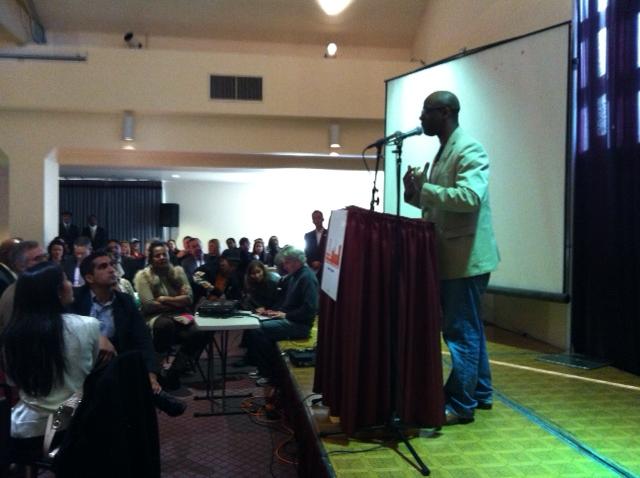
Labor leaders and a plethora of elected officials from San Francisco – including almost the entire Board of Supervisors – began today at the San Francisco Labor Council’s annual Martin Luther King Jr. Breakfast. They heard inspiring words from speakers on hand, but not from President Barack Obama, whose inaugural address wasn’t broadcast at the event as planned due to technical difficulties.
Yet the ideals voiced here at the West Bay Conference Center on Fillmore Street echoed those sounded on Capitol Mall in Washington DC, channeling the spirit of Dr. King in calling for us to take bold collective action to better care for all people and the planet.
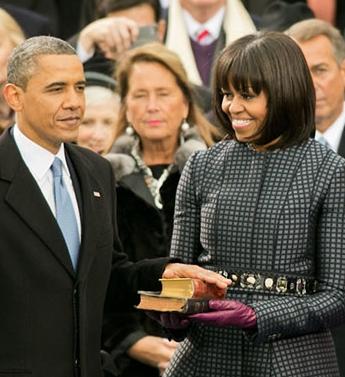
“My fellow Americans, we were made for this moment, and we will seize it as long as we seize it together,” Obama said in his speech. “For we, the people, understand that our country cannot succeed when a shrinking few do very well and a growing many barely make it.”
At his invocation here in San Francisco, Rev. Floyd Trammel, called for a “clarity of thought and unity of purpose” and cast Obama as the inheritor of King’s legacy. “In many ways, you sent one, Dr. Martin Luther King Jr., to pave the way for another, President Barack Hussein Obama,” Trammel said in his prayer.
Sen. Mark Leno – speaking in the place of Mayor Ed Lee, who is in DC for the inauguration – quoted the late Supreme Court Justice Louis Brandeis, who said, “We can have democracy in this country, or we can have great wealth concentrated in the hands of a few, but we can’t have both.” And while Leno praised those present for helping pass Prop. 30 to begin turning around California’s fiscal state with higher taxes on the rich, Leno also said, “The work is just beginning.”
It was a theme echoed by the most dynamic speaker on the program, Thurgood Marshall High School teacher Van Cedric Williams, who said the theme of both MLK Day and Obama’s inaugural address was that there is still much work to do to realize King’s dreams of social and economic justice.
“I believe community and labor are working on the unfinished business that Martin Luther King started,” Williams said, calling it a moral imperative to help create a better world for all. He called on those present to really “embrace your fellow community member,” those of all races and backgrounds, to pursue the solutions the world needs.
“They have to see the passion,” Williams said of young people today, “they have to know we got their backs.”
Obama also appealed to the obligation that we have to future generations. “We will respond to the threat of climate change, knowing the failure to do so would betray our children and future generations.”
It was a call for Americans to move beyond our narrow self-interest. As King once said, in a quote included at the MLK memorial in SF’s Yerba Buena Center, “An individual has not started living until he can rise above the narrow confines of his individualistic concerns to the broader concerns of all humanity.”
Second inaugration speeches are hard; you have to be political without sounding partisan, inspiring without being divisive — and promise change and progress even if you haven’t accomplished what you wanted in the first term. The Obama address surprised me: He went left, making clear that he wants economic and social equality to be his final legacy. It’s getting rave reviews in the lib-blogosphere, where it’s been described as the speech liberals have been begging him to give for years. You can’t argue with the content — he mentions gay rights, global climate change, equal pay, protecting social security, economic inequality, the need for collective effort … he even talks about reforming the tax code.
So now comes the hard part: The struggle for economic justice has to go beyond a compromise plan that limits higher tax rates to people earning more than $400,000 a year.
In fact, the best thing I read this weekend was a NY Times piece by Nobel-Prize-winning economist Joseph Stiglitz, who argues forcefully that continued economic inequality is prolonging the recession. It’s also destroying the nation’s future:
Our skyrocketing inequality — so contrary to our meritocratic ideal of America as a place where anyone with hard work and talent can “make it” — means that those who are born to parents of limited means are likely never to live up to their potential. Children in other rich countries like Canada, France, Germany and Sweden have a better chance of doing better than their parents did than American kids have. More than a fifth of our children live in poverty — the second worst of all the advanced economies, putting us behind countries like Bulgaria, Latvia and Greece. Our society is squandering its most valuable resource: our young.
Stiglitz says what few in Washington want to admit: We can’t get the economy going again without rebuilding the middle class, and we can’t do that without higher taxes on the rich and a lot more public investment in education. Oh, and all this talk of how it’s out of our control is bullshit:
There are all kinds of excuses for inequality. Some say it’s beyond our control, pointing to market forces like globalization, trade liberalization, the technological revolution, the “rise of the rest.” Others assert that doing anything about it would make us all worse off, by stifling our already sputtering economic engine. These are self-serving, ignorant falsehoods. Market forces don’t exist in a vacuum — we shape them. Other countries, like fast-growing Brazil, have shaped them in ways that have lowered inequality while creating more opportunity and higher growth. Countries far poorer than ours have decided that all young people should have access to food, education and health care so they can fulfill their aspirations.
Makes me think about some of what I hear out of San Francisco City Hall. Oh, we can’t do anything about economic inequality; that’s a national issue. Or maybe it’s a state issue. I bet there’s not an elected official in town today who woudn’t proclaim complete agreement with everything Obama just said — and there are very few of them who are trying to bring that message back home.
In San Francisco, we give tax breaks for businesses that create high-end jobs that drive poor people out of town. We happily seek development without considering the impact it will have on existing vulnerable populations. We even struggle over free Muni for low-income youth. We do nothing — nothing — to reclaim wealth from the 1 percent and put it into local housing, public education, and job-training that could make a dent in our local economic inequality.
What a momentous way to kick off the week: Barack Obama’s second inauguration falling on MLK Jr. Day, and with tear-inducing performances by Beyonce and James Taylor, to boot. It doesn’t get much more U-S-A than that. Oh, and there was that whole SF football win on Sunday.
Celebrate your fleeting pride swell with a week-long journey through challenging live music; stop by former local Jhameel’s return concert, the annual SF Tape Music Festival, Luke Sweeney’s Wet Dreams Dry Magic at Mission Creek Oakland, Blond:ish at Monarch, and Gaucho at Cyprian’s, as the group recognizes Django Reinhardt’s birthday.
Also, it’s technically sold out, but “UnderCover presents Joni Mitchell’s Blue” at Freight and Salvage tonight (Mon/21) may have some standing room tickets at the door ($24.50). Plus, there are still some presale available for tomorrow night’s show (Tue/22).
Here are your must-see Bay Area concerts this week/end:
Jhameel Jhameel, our beloved multi-instrumentalist On the Rise star, returns from LA – for the night at least. The formerly Bay Area-based pop songwriter has been hard at work down south in the sun, polishing his futuristic Michael Jackson vibes, writing a new album, and recording more drunk videos for his devoted followers. For this show, he promised those fans he’d sing his damn heart out. With Giraffage, Coast Jumper Wed/23, 8:30pm, $10 Cafe Du Nord 2170 Market, SF www.cafedunord.com http://www.youtube.com/watch?v=HiN8CWzNNPI
The Tambo Rays “If you’re looking for a San Francisco-based band to adore in the new year, keep your eye on the Tambo Rays. The punkish young chillwave foursome released Kaleidoscope, its debut EP, last summer and has speedily garnered an enthusiastic audience. The group — a collaboration between brother and sister Brian and Sara DaMert along with friends Greg Sellin and Bob Jakubs — makes catchy, introspective pop music characterized by B. DaMerts’ crooning vocals and a hazy wall of dissonance.” — Mia Sullivan With Evil Eyes, Moonbell, Jesus Sons Wed/23, 9pm, $6 Brick and Mortar 1710 Mission, SF (415) 371-1631 www.brickandmortarmusic.com http://www.youtube.com/watch?v=1p4WNQaBpAg
Luke Sweeney and Wet Dreams Dry Magic Luke Sweeney recently released his solo debut, Ether Ore, the album name a reference to the singer-guitarist’s spirit animal, Elliot Smith. It’s a sweet, fresh start for Sweeney as an indie solo artist (“recorded on 1/2″ tape in a living room…over the span of a few days in April 2012”), but you likely know his previous work in VOWS and his excellent current band, lo-fi pop dreamers Wet Dreams Dry Magic, headlining tonight as part of the Mission Creek Oakland Music and Arts Festival. With Soft Bombs, French Cassettes Thu/24, 9pm, $10 Uptown 1928 Telegraph, Oak. www.uptownoakland.com http://www.youtube.com/watch?v=VVVhS1xOVc4&feature=plcp
The Walkmen and Father John Misty The sonic gods have blessed us with this lineup. Separately, both acts would be worthy of a Heads Up shout-out, together they’re an emotional goldmine – bringing together the tender post-punk of the Walkmen, and hip-swinging indie-folk of singer-songwriter Father John Misty (a.k.a. J. Tillman of Fleet Foxes). Thu/24, 8pm, $25. Fillmore 1805 Geary, SF www.livenation.com http://www.youtube.com/watch?v=6QaFK_GvO_s
San Francisco Tape Music Festival The Tape Music Festival reminds us of the more idiosyncratic San Francisco of yore, the one we’re all desperately trying to hold on to, despite blooming micro-apartments, bans on nudity, and the like. Go, support this, “America’s only festival devoted to the performance of audio works projected in three-dimensional space.” This year, there will be a retrospective of the works of Bernard Parmegiani – an influential Parisian composer of acousmatic tape music – along with a piece by Japanese sound artist Ryoji Ikeda, classics by Luciano Berio and Hugh Le Caine, local composers Pamela Z and Andrea Williams, and more. Fri/25-Sun/27, 8pm, $15 ($35 festival pass) ODC Theater 3153 17th St., SF sfsound.org/tape http://www.youtube.com/watch?v=cXAevrYhicI
Blond:ish “In a section of the music industry where club promoters and marketers all too frequently rely on glamor headshots layered over photoshopped neon clouds, London based but Montreal bred Anstascia D’elene and Vivie Ann Bakos have smartly chosen a name that immediately undercuts appearances. (Plus the tag-line: “not all dumbs are blonde.”) With that out of the way, this posh, Kompakt-approved duo has spent the last couple of years making a real name for itself, releasing credible 4×4 house sets and EPs with callbacks to ’60s psychedelia and ’80s new wave, while providing remixes for Todd Terje, Pete Tong, and Tomas Barfod.” — Ryan Prendiville With DJ M3, Anthony Mansfield Sat/26, 9pm, $10-20 Monarch 101 Sixth St., SF (415) 284-9774 www.monarchsf.com http://www.youtube.com/watch?v=qtjQTHZ4Wrg
Gaucho: Django Reinhardt’s birthday If you play any form of gypsy jazz, you have Django Reinhardt to thank for that. Popular local band, Gaucho – which recently passed the decade mark as a group together, no small feat in band-land – recognizes this relationship with an evening dedicated to Reinhardt, during the week of what would have been his 102nd birthday (he was born Jan. 23). If you’d like to wish bonne anniversaire to the master, there’s no better spot this weekend for hot gypsy jazz, ragtime, and pre-war blues. With Kally Price and the Old Blues and Jazz Band Sat/26, 8pm, $12 SF Live at Cyprian’s 297 Turk, SF www.noevalleymusicseries.com http://www.youtube.com/watch?v=Mn5WWGnggkw
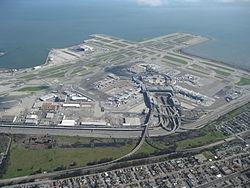
It must have been hard for John Diaz, the Chron’s editorial page editor, to just come out and oppose the idea of renaming San Francisco International Airport for Harvey Milk. So instead he put out a tortured argument that goes like this:
It’s too easy to put things on the ballot in San Francisco. To wit:
San Francisco has a system that is ripe for abuse by politicians who want to call attention to themselves or want to try to acquire at the ballot box what they could not otherwise attain by working with their colleagues.
He actually quotes Lite Guv Gavin Newsom who says, apparently without blushing, that he went to “excrutiating lenghts” to avoid putting things on the ballot that he couldn’t get passed through the Board of Supervisors. Excuse me? Care Not Cash? WiFi?
More Diaz:
The renaming of SFO is an example of an issue that demands a thorough public airing: about its cost, about the implication for the airport’s global brand and about whether other San Franciscans should be considered. The regrettable upshot of the Harvey Milk San Francisco International Airport proposal is that it could devolve into a referendum on the late supervisor’s worthiness for such an honor.
Wait: You don’t think the supervisors will discuss this, that there won’t be public comment, that this proposed city charter amendment won’t go to committee for discussion? You don’t think that’s already happenning, or that a ballot campaign won’t involve all of those issues? That’s just silly.
Yeah, there have been things put on the ballot in the past without adequate hearings, but that’s certainly not the case here. This thing will be discussed and dissected and cost-analyzed and debated at great length. And in the end, it ought to go on the ballot. The Diaz argument is just an excuse to oppose something that’s hard to fight on the merits; if the supes had just gone ahead and done it on their own, we’d be hearing the opposite, that the voters need to weigh in.
And this?
There may be a time when an airport naming makes perfect sense, perhaps because of a San Franciscan’s contribution to the airport itself or aviation generally. Harvey Milk simply does not offer such a natural connection.
Please. John F. Kennedy may have sent a man to the moon, but had nothing substantive to do with New York City aviation. Ronald Reagan didn’t even fly into National Airport; Air Force One lands at Andrews Air Force Base. And his major contribution to civilian aviation was firing all the air traffic controllers and breaking their union.
Naming SFO after Milk would be a political statement on a grand scale. The City and County of San Francisco would be saying that a gay person deserves a monument of international scale, that Milk’s contributions to changing the world are something this city should treat as so special that we should tell the whole world, loudly and forever.
I’m all for it. But if you’re not, let’s at least debate it on the merits
A simple twist of fate has set President Obama’s second Inaugural Address for January 21, the same day as the Martin Luther King Jr. national holiday.
Obama made no mention of King during the Inauguration four years ago — but since then, in word and deed, the president has done much to distinguish himself from the man who said “I have a dream.”
After his speech at the March on Washington for Jobs and Freedom in August 1963, King went on to take great risks as a passionate advocate for peace.
After his Inaugural speech in January 2009, Obama has pursued policies that epitomize King’s grim warning in 1967: “When scientific power outruns moral power, we end up with guided missiles and misguided men.”
But Obama has not ignored King’s anti-war legacy. On the contrary, the president has gone out of his way to distort and belittle it.
In his eleventh month as president — while escalating the U.S. war effort in Afghanistan, a process that tripled the American troop levels there — Obama traveled to Oslo to accept the Nobel Peace Prize. In his speech, he cast aspersions on the peace advocacy of another Nobel Peace laureate: Martin Luther King Jr.
The president struck a respectful tone as he whetted the rhetorical knife before twisting. “I know there’s nothing weak — nothing passive — nothing naive — in the creed and lives of Gandhi and King,” he said, just before swiftly implying that those two advocates of nonviolent direct action were, in fact, passive and naive. “I face the world as it is, and cannot stand idle in the face of threats to the American people,” Obama added.
Moments later, he was straining to justify American warfare: past, present, future. “To say that force may sometimes be necessary is not a call to cynicism — it is a recognition of history; the imperfections of man and the limits of reason,” Obama said. “I raise this point, I begin with this point because in many countries there is a deep ambivalence about military action today, no matter what the cause. And at times, this is joined by a reflexive suspicion of America, the world’s sole military superpower.”
Then came the jingo pitch: “Whatever mistakes we have made, the plain fact is this: The United States of America has helped underwrite global security for more than six decades with the blood of our citizens and the strength of our arms.”
Crowing about the moral virtues of making war while accepting a peace prize might seem a bit odd, but Obama’s rhetoric was in sync with a key dictum from Orwell: “Who controls the past controls the future; who controls the present controls the past.”
Laboring to denigrate King’s anti-war past while boasting about Uncle Sam’s past (albeit acknowledging “mistakes,” a classic retrospective euphemism for carnage from the vantage point of perpetrators), Obama marshaled his oratory to foreshadow and justify the killing yet to come under his authority.
Two weeks before the start of Obama’s second term, the British daily The Guardian noted that “U.S. use of drones has soared during Obama’s time in office, with the White House authorizing attacks in at least four countries: Afghanistan, Pakistan, Yemen and Somalia. It is estimated that the CIA and the U.S. military have undertaken more than 300 drone strikes and killed about 2,500 people.”
The newspaper reported that a former member of Obama’s “counter-terrorism group” during the 2008 campaign, Michael Boyle, says the White House is now understating the number of civilian deaths due to the drone strikes, with loosened standards for when and where to attack: “The consequences can be seen in the targeting of mosques or funeral processions that kill non-combatants and tear at the social fabric of the regions where they occur. No one really knows the number of deaths caused by drones in these distant, sometimes ungoverned, lands.”
Although Obama criticized the Bush-era “war on terror” several years ago, Boyle points out, President Obama “has been just as ruthless and indifferent to the rule of law as his predecessor.”
Boyle’s assessment — consistent with the conclusions of many other policy analysts — found the Obama administration’s use of drones is “encouraging a new arms race that will empower current and future rivals and lay the foundations for an international system that is increasingly violent.”
In recent weeks, more than 50,000 Americans have signed a petition to Ban Weaponized Drones from the World. The petition says that “weaponized drones are no more acceptable than land mines, cluster bombs or chemical weapons.” It calls for President Obama “to abandon the use of weaponized drones, and to abandon his ‘kill list’ program regardless of the technology employed.”
Count on lofty rhetoric from the Inaugural podium. The spirit of Dr. King will be elsewhere.
Norman Solomon writes a weekly column based on his experiences as a journalist, author, and political activist since the late 1960s. He’s the founding director of the Institute for Public Accuracy, co-founder of RootsAction.org and a longtime media critic. After running for Congress in the new district that stretches from the Golden Gate Bridge to to the Oregon border, he finished 174 votes short of getting through the June 2012 primary.
Once again, the San Francisco Democratic Party is considering ousting local Democratic clubs that endorse non-Democrats in nonpartisan races. It’s crazy, and it goes back to the Matt Gonzalez era, and I don’t understand why somebody keeps bringing it up. But there it is.
The local party operation, run by the Democratic County Central Committee, has to rewrite parts of its bylaws this year anyway, thanks to changes in state election law. (For one thing, terms on the DCCC will now run four years, not two, and elections will coincide only with presidential primaries.)
And among the proposed changes is an item to ban chartered Democratic clubs from endorsing, say, a candidate for San Francisco supervisor or school board who isn’t a registered Democrat.
Now: It’s always been pretty clear that if you’re a part of the Democratic Party, and your club has official party sanction, you shouldn’t be endorsing Republicans (or even Greens) over Democrats. So Dem clubs have to support Dems for president, Congress, etc. (Of course, with our top-two primaries it’s possible, if highly unlikely, that a race for state Assembly could now feature a pair of candidates neither of whom is a Democrat, which would make things sticky. And under the proposed bylaws, a Democratic Club could still chose one of them.)
But never mind that — the real issue is local government. Local races, by state law, are nonpartisan, and there ahve been plenty of progressive candidates who weren’t registered Dems. In fact, this all goes back to the anger the establishment ginned up after Matt Gonzalez, a Green, very nearly toppled Gavin Newsom for mayor — with the support of a lot of progressive Democrats. The Harvey Milk Club went with Gonzalez and some Newsomite tried to make an issue of the Club’s charter.
Jane Kim was a Green when she was first elected to the School Board. Ross Mirkarimi was elected supervisor as a Green. And while the Green Party is in something of a state of disarray right now, it could make a comeback. And perhaps more important, the fastest-growing group of voters is decline-to-state — and it’s pretty likely that we’ll see someone who isn’t a member of any party run for office in the next few years.
There’s a reason the state Constitution made local races nonpartisan — and there’s no reason Democrats can’t endorse the candidates they think are the best in those races, without regard to party affiliation. The Milk Club, not surprisingly, is strongly against this, and so am I. It comes up Dec. 23; let’s shoot it back down.
We make it through these early parts, Vivian and I — the embarassing blooper reel is not the best part of a show that does, at times, actually discover talent — and at times tosses it away. But this is where you get the first clips of someone who’s going to be a household word in a few weeks, so we watch carefully.
Here’s what we now know:
Nicki Minaj is a hot mess who has a trumped-up but delicious cat fight going on with Maria Carey, who is a diva princess. Keith Urban is dull. Randy Jackson is still there, pretty much running the auditions now since nobody else seems to have a clue. Now that J-Lo — who was not only talented and well-dressed (mostly) but compassionate and funny — and Steven Tyler, who was rock-star-batshit crazy, have moved on, there’s really not a lot to the panel anymore. So: Nicki curses at Maria. Stay tuned.
Oh, and Nicki also asks all the guys if they’re single. While her tits are popping out of some hideous Hello Kitty thing or a fake motorcycle outfit. And she insults Justin Beiber, who isn’t worth it. Jesus, Simon, what have you created?
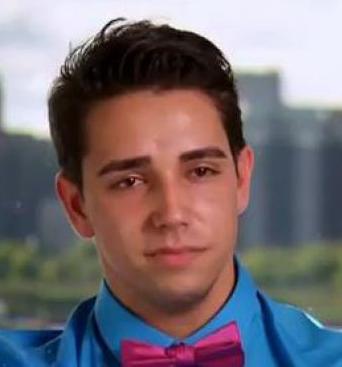
There are, as always, good singers in the group, and we will get to them all in due time. But I already have a fave: Lazaro Arbos, who hails from Cuba, has a bad speech impediment and as a kid stuttered so bad he could hardly talk. But man, he can sing. Bridge Over Troubled Waters. He couldn’t get the title out when he talked, but then the music just flowed. And he’s cute and wore a pink bow tie. Kid’s got a future.
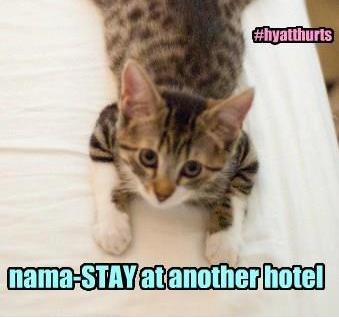
While the Hyatt and Yoga Journal have tried to minimize the long labor dispute between hotel management and workers – which led to a national boycott of the Hyatt chain that the Yoga Journal has repeatedly refused to abide, this weekend holding a conference here at the Hyatt Regency – labor activists have finally made progress in the yoga community in recent days.
The group Yogis Uniting for Workers’ Right held a high-profile yoga session on the sidewalk in front of the Hyatt yesterday “in a show of solidarity with the workers,” the group (led by local yogi Sean Feit) wrote on its Facebook site. “Because a living wage and health care are fundamental aspects of enlightenment, and because we believe that all the yoga in the world isn’t worth a damn if people aren’t taking action to make the world better.”
The hotel workers union Unite-Here Local 2 also met yesterday with one of the conference’s highlighted yoga teachers, Seane Corn, and her group Off the Mat, Into the World. Afterward, Corn issued this statement: “After listening and learning I want to publicly acknowledge my ongoing support to the workers and believe fully in this boycott… I will not teach at the 2014 SF YJ Conference, or any other conference, if they’re held at the Hyatt and the boycott is still in place.”
Other yogis featured at the conference – such as Shiva Rae, who publicly said, “Their mistreatment of their employees is not in alignment with where we all stand” – have also made public statements of support for the workers and pledged to stay at other hotels, even while planning to teach at this year’s conference as scheduled.
Unite-Here organizer Julia Wong told us she’s pleased by the recent progress after years of frustration in trying to win the support of Yoga Journal and its larger community. “I think we’re all incredibly happy with the amount of solidarity and interest we’re seeing. This has been a longtime thorn in our side,” Wong said, noting that Yoga Journal has done conferences at the site throughout a boycott that is now more than three years old. “It’s been amazing how many social justice yogis have gotten in touch with us and come out to show their support.”
Meanwhile, both the Hyatt and Yoga Journal continue to put out misleading information to justify their continuing relationship. One yogi who asked about the standoff received this as a reply from the Yoga Journal, based on information it received from Hyatt management: “I understand that this is a complicated issue but I want you to know a few things: The workers at the Hyatt are not on strike. The Hyatt corporate and Unite Here, the labor organization, have reached agreements on wages and benefits. There are issues remaining around voting rules, and because of this, Unite Here has reached out to organizations to urge them to change their plans and not hold an event at the Hyatt.
“We would not hold the conference here if there was a strike. But there is none. There are issues remaining around these voting rules, and yes, we all hope they get resolved, but this seems more like a bargaining chip than an issue that truly and deeply affects the workers. We all thought long and hard about this, and decided that in the end, we would honor our longstanding contract and commitments we’ve made to our presenters and attendees. The workers are not on strike. There is no picket line.”
While it’s true that workers aren’t on strike, Wong said they have been operating without a contract for three and a half years. And while the union hasn’t maintained a continuous picket line (like the one that was there last night as the conference began), Wong said a boycott is the same thing: “The boycott is 24/7, we call on all customers to not sleep, eat, drink, or spend money there.”
Furthermore, she said there is not a signed agreement on wages and benefits, and to cast the standoff as around “voting rules” is ridiculous. She said there are three demands that the union has to end the national boycott of all Hyatt hotels: establish reasonable health and safety rules related to housekeeping, sign a new contract covering wages and benefits, and establish a fair process by which the union can organize workers and show solidarity with aggrieved workers in other cites.
While sources say it’s true that wages and benefits aren’t the major sticking point to negotiations here in San Francisco, the union has been trying to get on the same contract cycle as cities such as Chicago, Boston, and Honolulu in order to give the union more leverage to resist changes in work rules and health coverage that management has imposed in recent years.
Wong said the union isn’t planning any more pickets of the Hyatt Regency this weekend (they’ll be hitting the Grand Hyatt next week) – emphasizing that its target has always been hotel management and not its customers – and she’s hopeful that they’ve finally made some progress with Yoga Journal’s community this year: “We’re going to see if we can get them to honor the boycott for next year.”
UPDATE: Guardian intern Jessica Wolfron covered yesterday’s yoga protest and offers this report:
Yogis young and old took to their mats at a bustling Embarcadero intersection at rush hour last night, posing in peaceful protest as yoga’s big-name celebrities crossed the picket lines into their plush Hyatt Regency rooms for the Yoga Journal Conference.
“Find your breath amongst the chaos ” said San Francisco yoga teacher Dee Dussault, instructing her posse of pedestrian posers through a megaphone. “Find relaxation even in the noise all around you, find that peace and send it to all beings.”
While a downtown sidewalk may not be the most tranquil yogic sanctuary, Dussault, who teaches free yoga classes at Axis of Love, a community medicinal marijuana dispensary for low-income and marginalized people, was a striking contrast of calm against the storm of embittered protesters.
“Our demonstration was an invitation to the yoga practitioners at the conference this weekend to consider the implications of the practice when one is no longer on one’s mat.” Dussault explains. As a self-proclaimed yogini and an activist, she believes that the two should not be considered separate and competing causes. Dussault wants people to realize that yoga is a living practice, and its social implications far extend the butt-boosting stretchy pants.
Whatever side of the fence we stand on, Dussault remind us that we should slow down, find our center, and just breathe.
Get to the theatah! California’s (thankfully, former) Governor returns to the multiplex to do what he does best: speak in one-liners and carry a big gun. My review of The Last Stand below the jump, along with short takes on the Mark Wahlberg-Russell Crowe crime drama Broken City, and more.
Also this week: Hellbound?, a doc about damnation at the Yerba Buena Center for the Arts (Dennis Harvey’s take here); the Mostly British Film Festival (my round-up here); and the Guillermo del Toro-endorsed horror flick Mama, starring Jessica “Zero Dark Oscar” Chastain. Plus, tonight, the original Django (1966) screens at the Castro! More here.
http://www.youtube.com/watch?v=tCYaWxHJ_BU
Broken City Catherine Zeta-Jones’ measured performance and killer wardrobe run away with this uneven political thriller about a made-up Manhattan with real(-ish) problems. Russell Crowe is only slightly improving his record post-Les Mis, as he plays another harried and morally confused agent “for the people.” Here, he’s Mayor Hostetler, a swaggering politico with fingers in New York’s real estate cookie jar and the sort of “get shit done” directive that results in bodies lying in NYC’s overfilled gutters. Good thing he has Mark Wahlberg in his back pocket, a cop who slipped a murder wrap and now scrapes the bottom for gigs as a private detective. Seven years ago Billy Taggart (Wahlberg) was seeking vigilante justice for the victim of a rape-murder in the city’s biggest ghetto. The victim became a household name but the killer was let off, leading to cries about the validity of NY’s justice system and to allusions to the Central Park Five. Broken City is less about a broken City and more about broken Men, and there are certain elements that seem too subtle for a story built on such bald-faced and predictable strategy. Between a script that’s struggling to demonstrate moral compromise and integrity, and direction (by Allen Hughes) that’s as sensitive to nuance as a border collie, it’s hard to find much beyond Zeta-Jones’ shoe stylings to admire. (1:49) (Sara Maria Vizcarrondo)
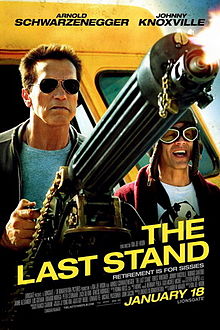
The Last StandWith gun control issues dominating the news, what better time to release a movie that lovingly glorifies the wonders of excessive firepower? Fortunately for star Arnold Schwarzenegger, making his return to leading-man status after that little fling with politics, The Last Stand is stupidly enjoyable enough to make any such PC-minded realizations relatively fleeing ones. When a Mexican drug lord (who also happens to be an expert race-car driver) escapes from federal custody and begins speeding home in a super-Corvette, the lead FBI agent (Forest Whitaker, slumming big-time) realizes his only hope is a teeny Arizona border town that happens to be overseen by Sheriff Schwarzenegger. (Other residents include a couple of hapless deputies; an Iraq war vet; and a gun nut played by a cartoonishly obnoxious Johnny Knoxville.) Can this ragtag crew hold off first the drug lord’s advance team (led by a swaggering Peter Stormare), and then the head baddie himself? Duh. The biggest surprise The Last Stand offers is that it’s actually pretty fun — no doubt thanks to the combo of Korean director Kim Jee-woon (2008’s eccentric The Good, The Bad, and the Weird; 2003’s spooky A Tale of Two Sisters) and the heft of Schwarzenegger’s still-potent charisma. (1:47) (Cheryl Eddy)
http://www.youtube.com/watch?v=a-NeApCGEDE
The Law in These PartsRa’anan Alexandrowicz’s documentary is a rather extraordinary historical record: he interviews numerous retired Israeli judges and lawyers who shaped and enforced the country’s legal positions as occupiers of Palestinian land and “temporary guardians” of a Palestinian populace living under foreign occupation. The key word there is “temporary” — in using here a different (military rather than civil) justice from the one Israeli citizens experience, Israel has been able to exert the extraordinary powers of an invading force in wartime. But what is “temporary” about an occupation that’s now lasted nearly 45 years? How can the state justify (under Geneva Convention rules, for one thing) building permanent Jewish settlements that now house about half a million Israelis on land that is as yet not legally Israel’s? By constantly changing the terms and laws of occupation, they do just that. If many policies have been perhaps necessary to control terrorist attacks, one can argue that they and other policies have created the climate in which oppositional fervor and terroristic acts were bound to flourish. That, of course, is a political-ethical judgement far beyond the public purview of the judges and others here, whose dry legalese admits no personal culpability — and indeed sometimes seems almost absurdly divorced from real-world ethics and consequence, which of course serves an increasingly rigid governmental stance just fine. Without preaching, The Law in These Parts raises a number of discomfiting questions about bending law to suit an agenda that in any other context would seem frankly unlawful. (1:40) Roxie. (Dennis Harvey)
http://www.youtube.com/watch?v=BWleS2KfRY0
Let Fury Have the Hour Though its message — that creative expression is a powerful, meaningful way to fight oppression — is a valuable one, Antonino D’Ambrosio’s Let Fury Have the Hour covers turf well-trod for anyone who has ever seen a documentary about punk rock and social justice. (Especially when it contains usual suspects like Ian MacKaye, Shepard Fairey, and Billy Bragg waxing nostalgic about how nonconformist they were in the 1980s.) In truth, Fury is more collage than doc, pasting together talking-head interviews (also here: Chuck D, John Sayles, Van Jones, Tom Morello, Boots Riley, and Wayne Kramer, plus a few token women, chiefly Eve Ensler) with a mish-mash of sepia-toned stock footage that more or less thematically compliments what’s being discussed at the time. A more focused examination of D’Ambrosio’s thesis might have resulted in a more effective film — like, say, an in-depth look at how Sayles’ politically-themed films (here, he reads from the script for 1987’s Matewan in a frustratingly brief segment) are echoed in works by contemporary artists and citizen journalists, particularly now that the internet has opened up a global platform for protest films. Listen: I admire what the film is trying to do. I am OK with watching yet another doc that contains the phrase “Punk rock politicized me.” But with too much lip service and precious little depth, Fury‘s fury ends up feeling a bit diluted. (1:40) Balboa. (Cheryl Eddy)
http://www.youtube.com/watch?v=uyvfVyV1eq0
LUVBaltimore native Sheldon Candis drew from his own childhood for this coming-of-age tale, which takes place in a single day as 11-year-old “little man” Woody (Michael Rainey Jr.) tags along with his uncle, Vincent (Common), recently out of jail and rapidly heading back down the criminal path. With both parents out of the picture, Woody’s been raised by his grandmother (Lonette McKee), so he idolizes Vincent even though it’s soon clear the short-tempered man is no hero. Of course, things go horribly awry, bloody lessons are learned, tears are shed, etc. Despite the story’s autobiographical origins, the passable LUV suffers greatly by inviting comparisons to The Wire — the definitive docudrama examining drug crime in Baltimore. Most blatantly, sprinkled into an all-star cast (Dennis Haysbert, Danny Glover, Charles S. Dutton) are supporting characters played by Wire icons Michael K. “Omar” Williams (as a cop) and Anwan “Slim Charles” Glover (as a meaner Slim Charles, basically). Perhaps if you’ve never seen the show this wouldn’t be distracting — but if that’s the case, you should really be watching The Wire instead of LUV anyway. (1:34) (Cheryl Eddy)
http://www.youtube.com/watch?v=wk6IB_Kgl4E
The Rabbi’s CatA rabbi, a Muslim musician, two Russians (a Jew and a boozy Christian), and two talking animals hop into an antique Citroën for a road trip across Africa. No, it’s not the set-up for a joke; it’s the premise for this charming animated film, adapted from Joann Sfar’s graphic novel (the author co-directs with Antoine Delesvaux). In 1930s Algiers, a rabbi’s pet cat suddenly develops the ability to talk — and read and write, by the way — and wastes no time in sharing opinions, particularly when it comes to religion (“God is just a comforting invention!”) When a crate full of Russian prayer books — and one handsome artist — arrives at the rabbi’s house, man and cat are drawn into the refugee’s search for an Ethiopian city populated by African Jews. Though it’s not suitable for younger kids (there’s kitty mating, and a few bursts of surprising violence) or diehard Tintin fans (thanks to a randomly cranky spoof of the character), The Rabbi’s Cat is a lushly illustrated, witty tale of cross-cultural clashes and connections. Rockin’ soundtrack, too. (1:29) (Cheryl Eddy)
The stimulating and excellently-eared Icee Hot crew is blasting a two-part third anniversary party at Public Works: this Sat/19 sees dreamy R&B chopper Jacques Greene (yes, the guy with the glasses from the Azaelia Banks video, but also one of my favorite producers ever) and Dutch hyperdubber Martyn on deck. Part two on Sat/26 brings in alien techno soundscapist Space Dimension Controller and astral floor-pounder Basic Soul Unit. You will find me face down on the floor in sonic worship for both. (And you may be able to score a pass to both parties for a mere $15 here.)
Usually I abhor parties that just throw a big name guest up and then give partygoers no other vibe-guidance: no decorations or look or neon Easter eggs of any kind. But the Icee Hot foursome — Shawn Reynaldo, Rollie Fingers, Ghosts on Tape, and Low Limit, all fantastic DJ/musicmakers in their own right — take an expressionist approach to gigs that transcends the bare-boned, and fends off any cynical charges of money-grubbing (the parties are hella cheap). Their excellent curatorial sense brings disparate, original sounds together to create something more stimulating than the sum of sonic parts.
I traded emails with the Icees on the eve of their blowout to talk about the party’s evolution and the SF scene right now.
SFBG Every time you guys throw a party, I trip over myself trying to describe the music with anything more substantial than “awesome” and then I overuse the word “bass.” How would you describe the music you look for when considering guest artists?
GHOSTS ON TAPE We have a hard time describing it too. I think that’s part of the fun. But since you asked, I’d say we go for weirdo house, outsider artists, and underground pioneers. It’s hard to put a finger on what exactly we look for in a guest, they just have to do music that excites us. We also like to book people that are doing things that no one else is really doing, and it’s important for us to bring acts that have never played in SF before. That’s not always possible, but we try. We don’t really wanna bring artists based solely on internet hype, we have to genuinely like their music.
ROLLIE FINGERS I think we just book people we like and people who influence people we like. The overarching theme is house and techno. It’s fine to just call it that. (Ed. Note: Mr. Fingers does not have to write exciting things about nightlife every week.)
SFBGWhat inspired you to start Icee Hot, and what are some of your favorite memories from the past three years?
SHAWN REYNALDO Icee Hot sort of grew out of Tormenta Tropical, another monthly party that I still throw here in San Francisco. That night is based around cumbia and other Latin/tropical styles, but back in 2009, I was mixing in a bunch of UK funky and other new house/bass/grime sounds. Some of those records were vaguely “tropical,” but I gradually realized that they didn’t properly fit the vibe of the party. Still, in November of that year, I booked L-Vis 1990 and Bok Bok at Tormenta Tropical for their first SF show, simply because I was so enthusiastic about the music they were making. This was right around the time that they were launching the Night Slugs label, and they hung out here in San Francisco for several days, during which time Rollie Fingers and I got really inspired, just by talking with them about music and realizing that there was something interesting happening with all these new hybrid sounds coming out of the UK. We also realized that this music melded really well with a lot of great classic house, garage and techno that wasn’t really being celebrated in the SF club scene at the time. Anyways, within a few weeks of that show, we enlisted Ghosts on Tape and Low Limit, booked our first party at 222 Hyde, and began planning ICEE HOT.
In terms of highlights, there are just too many to mention. Hosting Todd Edwards for his first-ever SF show was something special, and it was even better when we brought him back a year later and paired him with MK, one of his musical heroes. Beyond that, there was Robert Hood and Anthony “Shake” Shakir showing us what being a Detroit legend is all about. Ben UFO and Oneman going back-to-back, which was a real landmark for the party. Cedaa literally kicking off his 21st birthday with a midnight set. MikeQ turning the dancefloor out with drag queens doing bicycle kicks on stage. New Years 2011 with Bok Bok and Ramadanman. Girl Unit making his SF debut in the sweaty basement at 222 Hyde. John Talabot, both his DJ set and phenomenal live set a few months later. Our second anniversary last year with Mosca and Altered Natives. I could go on forever. It’s been fun.
ROLLIE FINGERS Hieroglyphic Being is an amazing DJ. He played a delayed vocal sample of “I Feel Love” for like 20 minutes when he played. If anyone else did that, it would be messy, but with him, it was bliss. I also have a very distinct memory of DJ Stingray getting out of the cab at Public Works wearing his ski mask. It was deep.
SFBG It seems like the number of parties has grown exponentially in the past few years. What are some of the challenges and rewards to throwing a party in the current SF nightlife landscape? Has it become more a matter of branding, rather than a distinct music or crowd profile? And do you feel that the party scene is being overdetermined by artist booking agencies?
SHAWN REYNALDO ICEE HOT is the product of a lot of hard work. Between talking to artists, negotiating with booking agents, locking down venues, purchasing flights, picking people up at the airport, fulfilling riders, and doing all the other behind-the-scenes tasks, it can be a little daunting, especially when we’re operating on a zero-profit basis. I don’t know if people always realize this, but ICEE HOT makes a point to keep our door prices as low as possible. Sure, we could charge $20, $25, $30 for a lot of our parties, but we don’t, because charging exorbitant door prices is lame. We’re not doing this to make money. We’re doing this to throw good events, and we don’t want anyone not to come because it’s too expensive.
http://www.youtube.com/watch?v=kwyxmrMSOUM
ROLLIE FINGERS We don’t mind branding our party at all. Every flyer for the past three years has said ICEE HOT really big on top. I think it’s nice for parties to have a distinct look and feel to them. ICEE HOT always feels like ICEE HOT, no matter what artist we are booking. I like that.
SHAWN REYNALDO And sure, dealing with nightlife landscape in San Francisco can be tricky. Even though the city attracts top-level talent, it’s still a relatively small place, so most promoters know one another. Sometimes you wind up competing with other parties to book the same talent, or dealing with booking agents who are trying to pit us against one another. Thankfully, we can usually avoid all of that mess. When booking agents are being unreasonable or don’t understand what we’re about, we usually just bow out of the proceedings. After three years, ICEE HOT has built up a good reputation, so the artists we’re trying to bring out have often already heard of the party and want to come play. Don’t get me wrong, it can all be frustrating sometimes, but we’re proud of what we’re doing and hopefully the parties and the label speak for themselves. Plus, it’s hard to really complain too much. Every month, we’re throwing parties exactly the way we want to throw them with guests we’re personally really excited about. Things are going well, and we want to just keep building on that.
SFBGWhy’d you decide on a two-part blowout? It’s almost too-too good. Although I know you haven’t shot your wad yet — any hints on who might be coming in 2013 (or who your fantasy artists would be).
GHOSTS ON TAPE The kind folks at Public Works were nice enough to let us use their club two weeks in a row, and since our anniversary is something of a milestone, we wanted to book artists that are in line with our vision of what we like to do at ICEE HOT. I think Martyn, Jacques Greene, Space Dimension Controller and Basic Soul Unit are going to help us celebrate our three-year anniversary in fine form. As far as future bookings, I can’t give anything away, but we’re going to continue on the same path and keep on booking freakishly talented individuals. In the past, whenever we thought of a fantasy artist that we’d like to book, it always ended up coming true eventually, so I don’t want to say anything to ruin any future surprises.
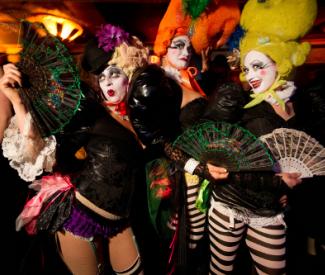
“Is Steampunk the Next Big Fashion Trend?” asked Time today. LOL-choke. Let’s just tune up our corsets and revel all weekend in burner-tinged retro-futurism at the Edwardian Ball (Fri/18 and Sat/19 at the Regency).
Starting the New Year off right with Clown Foolery and Los Rakas
It’s a Friday night and the Booksmith is full of clowns. Seriously, it’s like a clown convention in here. Fully half the oddience are off-duty clowns, and the rest of us just kind of look like we should be. We’ve gathered together for the monthly clown jam/variety show Literary Clown Foolery, the first of the year, appropriately themed New Year’s Resolutions.
True, the free beer and cheese puffs at the door seem to run slightly counter to the kinds of resolutions that get a lot of attention around this time of year. But they are the perfect accompaniment to loosening up any natural inhibitions one might otherwise feel when seated within spitting distance of a whole passel of unpredictable clowns, so no one’s complaining.
“I like your glasses” a poker-faced clown in polka dots announces from the “stage” as she scans our expectant faces with her own unsmiling, bespectacled eyes. This is Gretchen (known outside of clown makeup as Tristan Cunningham), assistant to Dr. Schmidtt (Polina Smith), and she has a list of resolutions that reads in part like this: “get lucky, do the horizontal boogie, ride the bologna pony, have a hot meat injection…” You get the gist. Dr. Schmidtt, an expert in all things, decides to assist Gretchen by putting her on a diet of cookies and inviting an actual life coach (a charming Elaine Margarita Williams) onstage to help her set her goal. As Gretchen embarks on her quest to seduce someone, anyone, appearances by musical guests Mustard (Masha Matin) and Carl and Beatrice and juggling/belly-dancing interludes from Jon Deline of Pi Clowns using a series of silly monikers, punctuate the performance.
Scheduled for every second Friday, Literary Clown Foolery may be set inside a bookstore, but it’s way more lively than your average literary event, kind of a combination of vaudeville, sketch, and conference lecture, with books mainly serving as incidental backdrop. But since it certainly does inspire pre-and-post-show browsing, it appears to be a win for all concerned (except for Gretchen unfortunately, who overdoes the cookies and fails to find the bologna pony, or bookworm, of her dreams).
******
Saturday at Slim’s was bouncing with that special off-the-wall energy that all-ages shows seem to inspire, an excitability that contrasts refreshingly to the too-cool for school vibe you might encounter elsewhere. Squeezing in just in time for the last of Mission-born rapper A-1’s set, I recognize a couple of tracks from his latest mixtape “Thurl” including the Lana Del Rey-sampling “Now You Do” while the intriguingly shrouded Davin Gruesome shambles around the stage in his signature facemask and 49’ers gear like a revenant of home-grown rap.
But it’s Oakland-based Los Rakas that blow the stage up with a full band featuring at least three percussionists, keyboards, and electronic beats, while the two vocalists, Raka Rich and Raka Dun (Ricardo Giliam and Abdull Dominguez) hold forth in spirited tandem. As cold as it is outside, the warm infusion of infectious Afro-Caribbean rhythms, Spanish-language flow, and powerful stage presence of the two Panama-American cousins heat things right up.
Taking their name from a Panamanian phrase “rakataka” (used roughly in the same way “ghetto” might be used here), Los Rakas preach the gospel of self-acceptance and pride, though they’re certainly not shy about including less weighted topics like ladies and weed smoking to their mix. They’ve been fortunate enough to share the stage with some pretty big names in the past, (including DJ Questlove, Ozomatli, Cypress Hill, Erykah Badu, and Manu Chao) and as headliners at Slim’s they appear comfortable with their role, filling the stage easily with their sometimes raunchy humor and energetic rapport. From all appearances, Los Rakas’ New Year looks off to a good start, and judging from the crowd’s enthusiastic response, so is ours.
The Guardian received a phone call from Amy Martin, chief counsel of the California Occupational Safety & Health Administration (Cal/OSHA) this morning in response to our article spotlighting Cal/OSHA’s recent settlement with Hyatt Fisherman’s Wharf. The settlement marked the final resolution of a set of housekeeper complaints filed in 2010 regarding repetitive motion injuries.
Martin commented in response to statements made on behalf of Hyatt by spokesperson Pete Hillan, who told the Guardian that “what was found at Fisherman’s Wharf was the equivalent of lagging paperwork,” and stressed that the charges filed against Hyatt were found to be without merit.
“Cal/OSHA believes it found plenty of evidence both of injuries sustained by housekeepers, as well as violations of Cal/OSHA regulations,” Martin said. “It is technically true that [citations] were withdrawn,” she added, but that was the outcome of an in-depth settlement negotiation in which Hyatt agreed that the findings would be construed as a violation under the Injury Illness and Prevention Standard, a separate area of workplace safety regulations.
“To say that it’s lagging paperwork is simplifying it,” added Erika Monterroza, a Cal/OSHA spokesperson who joined the call.
In other Hyatt-related news, don’t miss Caitlin Donohue’s post about why some members of the yoga community are calling on attendees of the Yoga Journal conference to decide which side of the picket line they’re on. (All of which seems strangely ironic when you consider how yoga is often viewed as a remedy for repetitive motion injuries.)
Rudy Nothenberg, who ran Muni and the city’s water system, was chief administrative officer, negotiated the deal for the Giants ballpark, and served under six San Francisco mayors, stopped by the office last week to talk to us about the Warriors Arena. We’ve had our fights with Nothenberg (as we would with anyone who was that close to Willie Brown and Dianne Feinstein) but the guy knows more about City Hall, public works, private development, and infrastructure finance than almost anyone alive. So we were happy to hear what he had to say.
Let’s be clear, here: Nothenberg lives near where the arena is slated to be built, and, as he was quick to tell us, he doesn’t want it in his backyard. But he also presented a compelling case that San Francisco is getting ripped off. And he had a few pointed things to say about the lack of negotiating skills among the members of Mayor Ed Lee’s administration.
Back when Nothenberg was talking to the Giants about a stadium at Third and King — at that point a district of dilapidated and underused warehouses — always kept a card in his back pocket. “I always knew that if things didn’t work out and we didn’t build the stadium, that would be okay too,” he said. In other words: You can’t get a good deal if you’re not prepared to walk away. And when it comes to the Warriors proposal, the mayor has made it so clear that this is his legacy that the team knows the city will never walk away. So one side of the talks can demand pretty much anything, and the other side has no leverage.
Oh, and it doesn’t hurt that just about every development lawyer, political consultant, and lobbyist in town is already working on the project. “They have co-opted everyone,” Nothenberg — no stranger to the dark side of politics — told us.
The exact terms of the deal are still not public, which is a bit odd since the city has already started its environmental review. (Can you really do an environmental impact report on a project when you don’t know what the project actually is? Two difference state courts have come to opposite conclusions, so for now the answer is: maybe.)
But there’s enough information out there for Nothenberg to give us a basic rundown on the financing — and it doesn’t look good. “The Port is really not getting anything out of the deal,” he said. The city will get some increased sales and business taxes, and the Warriors will have to pay housing and transit fees. But there won’t be a lot of new property tax revenue, since that will all go to pay for the arena.
Here’s how Nothenberg laid out his analysis:
The Warriors have to spend $120 million to replace Piers 30-32. (Costs a lot to build such a huge structure over the water.) To make the team whole, the city will sell the Warriors a seawall lot on the other side of the Embarcadero for $30 million, then give the $30 million right back to the team. Then the city will set up an Infrastructure Finance District — the 2013 equivalent of a redevelopment agency — use the future tax increments to fund a $50 million bond. The Warriors get the bond money; the city pays it back. Oh, and then the city gives the team $30 million worth of rent credits, meaning the Warriors will probably never pay any rent at all for the use of that public property. And to make it sweeter, San Francisco will pay the Warriors 13 percent interest on the rent-credit money.
Meanwhile, the local taxpayers will have to come up with a huge amount of money to increase Muni capacity, since the existing transit can’t possibly handle the load of the new arena. Yes, the Warriors, like any developer, will have to pay a modest transit impact fee — “but it’s laughable to thing that this will ever cover the capital and operating costs,” Nothenberg said.
To summarize: The wealthy owners of a professional sports team will get free waterfront land to build an immensely valuable new arena. The city will pay to bring the fans there and get them home, deal with the traffic impacts — and get almost nothing in return.
Burning Man veterans, volunteers, and insiders are now awaiting word on whether they’ll get on the inside track to buy tickets to this year’s event, avoiding the overwhelming demand that turned last year’s ticket sales into such a clusterfuck. But the lucky 10,000 people chosen for the express line will pay the same $380 as the 40,000 people that follow in a couple weeks.
After scrapping last year’s controversial ticket lottery system, Burning Man organizers Black Rock City LLC announced a new plan a few weeks ago, for the first time forgoing a tiered pricing ticket system (last year ranging from $240-$420) that was originally designed to encourage early participation and cash flow. But with the event selling out the last two years, that’s no longer an issue, so BRC chose to sell all tickets at $380 (except the 4,000 tickets sold at $190 to selected low-income burners, and the 3,000 tickets sold early for $650 each, which was partly a fundraiser for the nonprofit Burning Man Project).
Still, there was the issue of how to ensure those who build the essential infrastructure of this temporary city in Nevada’s Black Rock Desert get tickets, something BRC did on-the-fly after the main sale last year. This year, they’re flipping it to the front end. Established theme camps, volunteer groups, and art collectives were invited to submit names of their core members by yesterday (Wed/16), and most will be invited by email tomorrow to register (filling out their “Burner Profile” on the BM website) for a first come, first served online sales at noon on Jan. 30.
“I do anticipate all 10,000 tickets will be sold and we think that will take some pressure off the main sale,” BRC spokesperson Megan Miller told me. “We’ve gotten a lot of positive feedback about streamlining the process.”
The great unwashed burner masses can register for tickets from Feb. 6-10, with that sale taking place on Feb. 13. There will also be a last chance sale on Aug. 7, one more measure to undermine ticket scalping and allow for some spontaneity.
Sen. Al Franken, who is wonderful, has moved beyond seeking more disclosure (which the Republicans won’t accept) and is now moving toward a Constitutional amendment to overturn Citizens United. He’s moving his petition everywhere, and it will get a lot of traction.
But as I’ve mentioned, overturning Citizens United isn’t that easy. It’s fine to say we want to do it, and an entirely different task to write the legislation and deal with all of the First Amendment ramifications. And it still won’t stop rich people from spending their own money in unlimited ways.
I don’t know; maybe we have to figure out some more creative solutions. Mandate that all candidates for president and US Senate accept only public financing and match all independent expenditure spending with more public money. And then go back to the “original intent” of the US Constitution: In 1800, each member of Congress represented about 12,000 people. That would work fine today — expand the size of the House of Representatives to guarantee that at no point does any member have to seek election from a district with more than, say, 50,000 people. That’s a number you can reach without big money (see: SF district elections). Do the same for every state Legislature. Yes, more money on government — but less money in politics. I’ll take the tradeoff.
You have to love the way the lawyer from TURN (The Utility Reform Network) put PG&E’s Vice President Jane Yura on the spot during hearings on the San Bruno pipeline disaster. There was lots of back and forth about the company’s ad campaign and whether PG&E had “lost its way,” which is what the Chron played up, but here’s the bigger issue, buried deep in the story:
Long also asked Yura about PG&E’s reaction to the findings of a blue-ribbon panel that the utilities commission created to look into the disaster. The panel concluded that PG&E had been more concerned about profits than safety. “I would say I personally don’t know that we disagree or agree,” Yura said. “We have accepted it.”
I could go futher: PG&E was more concerned about executive compensation that safety, being as money that we earmarked for gas-line upgrades instead went to bonuses for the top people.
You wonder how long it’s going to take for people to realize that the needs of consumers, alternative energy, and safety are never going to be the priority for a private utility. Remember what happened when the state Legislature gave PG&E its way and deregulated electricity in CA? I do. I lived through the rolling blackouts, when Enron stole about $40 billion from California and the electricity grid almost collapsed.
That’s what happens when you worry more about profits (and pay) than public service.
Does inner peace include caring about the wellbeing of the workers cleaning up after your yoga conference? Jury’s out in this particular case: this weekend, the Yoga Journal Conference will cross a hotel workers’ union picket line for the third year in a row at the Hyatt Regency.
“Yoga Journal has ignored years of outreach from hotel workers and their union and chooses to hide behind logistical concerns in a matter of right and wrong,” says Julia Wong of UNITE HERE Local 2, whose union called for a worldwide boycott last year in light of unfair treatment of its workers. Supporters of the boycott include the NFL Players Association. (Check out Rebecca Bowe’s post on a recent victory Local 2 scored against the hotel regarding Cal/OSHA violations)
So what’s up with the yogis? “For years I’ve looked into moving the conference,” says conference director Elana Maggal. But, she told the Guardian in an email, the only other hotel that’s large enough to accomodate the 2,000 flexibles forecasted to attend the event — the Marriott — was unable at the times Yoga Journal needed. “So [the choices were] either not have an SF conference or hold it at the Hyatt,” says Maggal. “We’ve chosen the latter, fully aware that it is not a perfect choice, but hopeful that both sides will finalize the remaining issues quickly and fairly.”
The yoga community’s not taking the picket line violation in corpse pose. Sean Feit, an instructor at Yoga Tree and other studios around town, created a Facebook event to alert local yogis to Local 2’s regularly schedule picket (the union isn’t legally allowed to protest clients of the hotel, which Wong says would be a “secondary protest” not protected by labor laws) on Thu/17. Yogis are invited to bring mats for a yoga session in Justin Herman Plaza — on the right side of the picket line.
“We decided to crash the party in a show of solidarity with the workers,” says the Facebook event description. “Because a living wage and health care are fundamental aspects of enlightenment, and because we believe that all the yoga in the world isn’t worth a damn if people aren’t taking action to make the world better.”
The conference will take place at the Hyatt from Thu/17-Sun/21 with classes by celebrity instructors including Deepak Chopra, Seane Corne, and MC Yogi — a local alt-hero who did not respond to Guardian requests for comment on the picket line crossing.
For more ways to help the Local 2 workers, check out this blog post by Montreal yogi Roseanne Harvey
UPDATE: Seane Corne posted the following statement to her website:
Thank you to those of you who have reached out to me about my being at the SF YJ Conference this weekend even though there is a boycott of the Hyatt and a labor dispute. Here is where I stand….I plan to teach at the conference, but I will be staying at a different hotel. In the future there will be a clause added to all my conference contracts that acknowledges labor disputes and gives me an out without being in breach. With this said, if there is an organized union picket line out front I will not cross it. I have been in communication with YJ about this and they have been supportive of my position.
Yay! Thanks to the commenter that pointed it out to us.
Norman Solomon is co-founder of RootsAction.org and founding director of the Institute for Public Accuracy. He co-chairs the Healthcare Not Warfare campaign organized by Progressive Democrats of America. His books include “War Made Easy: How Presidents and Pundits Keep Spinning Us to Death.” He writes the Political Culture 2013 column.
The failure of the Congressional Progressive Caucus to stand up to President Obama on many vital matters of principle is one of the most important – and least mentioned – political dynamics of this era.
As the largest caucus of Democrats on Capitol Hill, the Progressive Caucus has heavyweight size but flyweight punch.
During the last four years, its decisive footwork has been so submissive to the White House that you can almost hear the laughter from the West Wing when the Progressive Caucus vows to stand firm.
A sad pattern of folding in the final round has continued. When historic votes come to the House floor, party functionaries are able to whip the Progressive Caucus into compliance. The endgame ends with the vast majority of the caucus members doing what Obama wants.
That’s what happened on the first day of this year, when the “bipartisan” fiscal deal came down. Widely denounced by progressive analysts, the bill passed on the House floor by a margin of 44 votes – with the Progressive Caucus providing the margin. Out of 75 caucus members, only seven voted against it.
Over the years, we’ve seen that President Obama is willing – even satisfied – to be rolled by Republican leaders on Capitol Hill. But that’s just part of the problem. We should also come to terms with the reality that the Progressive Caucus is routinely rolled by the president.
A two-step prototype hit the ground running in September 2009 when Progressive Caucus co-chairs sent a public letter to Obama on behalf of the caucus – pledging to vote against any healthcare bill “without a robust public option.” Six months later, on the House floor, every member of the Progressive Caucus wilted under pressure and voted for a healthcare bill with no public option at all.
Since then, similar dynamics have persisted, with many Progressive Caucus members making fine statements of vigorous resolve – only to succumb on the House floor under intense pressure from the Obama administration.
We need Progressive Caucus members who are progressives first and loyal Democrats second, not the other way around. When the party hierarchy cracks the whip, they should strive to halt the rightward drift of congressional legislation, not add to it.
In the new session of Congress, the Progressive Caucus – with 72 members – retains major potential. It often puts out solid position papers like the recent Budget for All. And its leadership includes some of the sharpest progressive blades in the House. Congressmen Keith Ellison and Raul Grijalva just won re-election as caucus co-chairs, and Congresswoman Barbara Lee just became the caucus whip.
Still, none of the more than half-dozen Progressive Caucus leaders were among the seven caucus members who voted against the New Year’s Day fiscal deal – and more serious capitulation may soon be on the near horizon.
Early this month, right after the fiscal deal, the Progressive Caucus put its best foot forward by issuing a “Progressive Principles for the Next Deal” statement that vowed to “protect” Medicare, Medicaid and Social Security benefits. But those programs will be in jeopardy before spring in tandem with votes on “sequestration” and raising the debt ceiling.
The results are likely to be very grim unless members of the Progressive Caucus are truly prepared – this time – to stand their progressive ground. Without an attitude adjustment, they’re on track to help the president betray Social Security and other essential parts of the social compact.
On a vast array of profound issues – ranging from climate change and civil liberties to drone strikes, perpetual war and a huge military budget – some individual progressives in Congress introduce outstanding bills and make excellent statements. But when the chips are down and minority leader Nancy Pelosi offloads presidential weight onto House Democrats, the Progressive Caucus rarely shows backbone with cohesive action.
What we have witnessed so far is surrender in stages – a chronic confluence of conformity and undue party loyalty, with brave talk from caucus members habitually followed by contrary votes on the floor of the House of Representatives. From the grassroots, progressives must mobilize to pressure every member of the Congressional Progressive Caucus to let them know we will hold them accountable
Norman Solomon is co-founder of RootsAction.org and founding director of the Institute for Public Accuracy. He co-chairs the Healthcare Not Warfare campaign organized by Progressive Democrats of America. His books include “War Made Easy: How Presidents and Pundits Keep Spinning Us to Death.” He writes the Political Culture 2013 column.
Nenita Ibe, who will turn 71 in February, says she still hasn’t fully recovered from a shoulder injury she sustained in March of 2009 during her housekeeping shift at the Hyatt Santa Clara. As she was lifting up a hefty padded mattress to tuck the sheets underneath, a task she’d completed hundreds of times before and continued to perform hundreds of times after, “I heard a crack in my shoulder,” she recalls.
Ibe says the pain worsened over time as she continued performing her housekeeping duties – tucking sheet corners, pushing heavy carts, standing on the sides of bathtubs or on top of toilet lids to clean overhead bathroom tiles, crouching down to pick up discarded towels or disinfect floors. In June of 2012, she underwent surgery to alleviate the chronic shoulder pain. “It feels better,” she told the Guardian, “but I feel pain when I have to use it too much.” She’s now following doctor’s orders to refrain from working, and relies on disability coverage to help make ends meet. Ibe says her workers’ compensation claim has yet to be resolved.
Repetitive motion injuries have been a flashpoint for UNITE HERE Local 2, a hotel workers’ union that helped kick off a campaign calling for a global boycott against the Hyatt hotel chain last summer. Several weeks ago, the Hyatt Fisherman’s Wharf reached a settlement with California’s Occupational Safety and Health Administration (Cal/OSHA) resolving a set of citations, two of which pertained to repetitive motion injuries.
Local 2 trumpeted the deal as a “landmark” agreement because it will establish an eight-member Housekeeping Committee tasked with identifying best practices to prevent exposure to such injuries. Hyatt Fisherman’s Wharf isn’t unionized, but Local 2 has been trying to facilitate union formation at that facility.
“It’s not an exaggeration to say that this is unprecedented,” Local 2 spokesperson Julia Wong told the Guardian. Half the committee will be made up of non-management housekeepers selected by their coworkers, she added. “It’s an incredible opportunity because it’s a requirement that housekeepers themselves have a voice in how these best practices are developed.”
“I’m happy about the news,” Ibe said. “They should listen to the experienced room cleaners.”
The settlement stemmed from a set of citations issued by Cal/OSHA in November of 2011, following a regulatory investigation launched in response to worker complaints filed one year earlier. Regulators initially pinned Hyatt with two “serious” violations relating to ergonomic issues: A failure to minimize exposure to housekeeper repetitive motion injuries, and a failure to conduct mandatory training to warn workers about ergonomic health problems. Hyatt immediately appealed the citations.
The appeal process ended in December, when Hyatt Fisherman’s Wharf agreed to the settlement with Cal/OSHA, pledging to convene the Housekeepers Committee and perform a job hazard analysis with the guidance of a certified health professional, among other things. The Hyatt Fisherman’s Wharf will pay a $6,460 fine, and Cal/OSHA withdrew the serious ergonomic citations as part of the agreement.
Hyatt spokesperson Pete Hillan emphasized that “there was no evidence found” backing up initial ergonomic charges filed against Hyatt Fisherman’s Wharf, and criticized the hotel workers’ union for wasting taxpayer dollars by calling on state regulators to investigate. “What was found at Fisherman’s Wharf was the equivalent of lagging paperwork,” Hillan said. He insisted, “Hyatt is a very safe place to work.”
Local 2 represents hotel workers at the Grand Hyatt and Hyatt Regency in San Francisco. Both of those remain under boycott, Wong said, “because the workers have been without a contract for three-and-a-half years now.”