SFBG Blogs

Treasure Island: Is this the end?

30

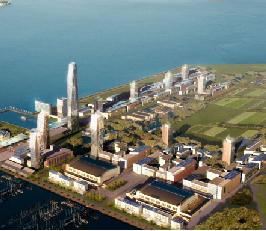
So Mayor Lee goes to China with plans to celebrate the signing of a deal that would bring $1.7 billion in Chinese investment into the lagging Treasure Island redevelopment project, and instead the whole thing falls apart. Not good for the cross-Bay rivalry: Gov. Brown, a former mayor of Oakland, landed $1.8 billion in Chinese money for his city’s big project, while Lee lost out.

But there’s a bigger problem. It’s hard to see how anyone would want to invest in Treasure Island right now, when:

The island is sinking,

The Bay is rising,

There’s only one way on or off the island, and it’s already so crowded that a modest event like the Treasure Island Flea Market ties up traffic in both directions for hours, and

The place is radioactive.

Matt Smith and Katherine Mieszkowski of the Bay Citizen did what the Navy and the city of San Francisco refused to do. They went out with a couple of red buckets, dug up some soil and had it tested for Cesium-137. Bingo: The place suffers from far worse contamination that anyone was letting on. And there might be even more:

Until the early 1990s, the Navy operated atomic warfare training academies on Treasure Island, using instruction materials and devices that included radioactive plutonium, cesium, tritium, cadmium, strontium, krypton and cobalt. These supplies were stored at various locations around the former base, including supply depots, classrooms and vaults, and in and around a mocked-up atomic warfare training ship – the USS Pandemonium. CIR’s samples were taken from under a palm tree 50 feet from a classroom building where cesium-137 was kept, according to military archives. A 1974 radiation safety audit identified cesium samples used and stored there with radioactivity several times the amount necessary to injure or kill someone who mishandled them. In 1993, shipping manifests from the same building showed even greater amounts of cesium-137 taken away from the same site that year.

Now some experts say that development plans need to be put on hold while the entire place is checked out more carefully:

“The fact that there is a level above standards is a clear mandate for further study and assessment of the extent of contamination and its origin,” Beyea wrote in an email, adding that more systematic testing is particularly important given that public play areas are planned nearby. “Building a playfield is not an appropriate plan at this time,” he wrote, “given the tendency for little children to put things in their mouths.”

Would you loan a couple billion dollars for a development project on that site?

In theory, of course, the Navy is responsible for the cleanup. In practice? Good luck with that. The Pentagon is blaming the sequester for forced budget cuts in everything including the Blue Angels; you think anyone’s going to write a very big check any time soon for a very complex environmental clean-up job on an artificial island that will soon be underwater?

I used to think the best thing to do with Treasure Island was to leave as much open space as possible for soccer and baseball fields, then slowly let it sink back into the Bay. Now apparently it’s a bad idea even to have kids playing there.

And what about the people who already have moved into housing at TI? Anyone going to test their soil?

Anyone want to take bets on whether anything much is ever going to be built there?

Jessie Ware eats pizza at Little Star, connects with her fans at the Independent

1

Last Thursday, when the lights came up on the stage at the Independent, they revealed a woman who was relishing the reverential shouts of the sold-out crowd. With a dramatic bun on top of her head, large hoop earrings, and tall heels, Jessie Ware appeared to embody the fully realized pop star that the world is starting to recognize in her.

Throughout the night, though, it became clear that what makes Ware so compelling isn’t the idolizing distance of pop-stardom, but its opposite. Between each song, she charmed the audience with candid and often self-deprecating banter. To a loud response of cheers and clapping, she spoke of her boyfriend who had joined her on tour and enjoyed planting himself in the audience to gauge its mood. “If someone comes up to you being a bit pervy, it’s just ‘cause he’s really proud of me,” she said, then laughed along with the crowd.

It’s tempting to say that the best part of the night was this sort of endearingly comedic chat, but that wouldn’t be doing justice to her performance. On Ware’s album, Devotion, the music has an understated ease, and though that is part of what makes it so good – in a world of over-the-top pop, restraint is refreshing – live music requires more than subtlety. Ware and her band delivered.

The music, already catchy on the album, achieved greater depth on stage. In the ballad-like “Wildest Moments,” added emphasis on the reverberant drums and Ware’s responding rhythmic changes gave the audience more to sink its teeth into, while the simplification of quieter tunes such as “Sweet Talk” emphasized the intimacy of Ware’s largely romantic repertoire.

The strength of Ware’s singing also came through more in a live venue than in the album, where the rule of restraint controls her voice, too. On Thursday, commercial but expressive vocals added the right amount of embellishment and variation to soulful tunes such as “What You Won’t Do For Love” (despite the four slices of Little Star Pizza and strawberry ice cream that she admitted to eating before the concert). She is a more talented singer than her recordings suggest.

Because of this, occasionally I wanted her voice to come through even more. On some songs, including that opener, “Devotion,” a jangly guitar and swirling synth that aspired to match their recorded versions obscured Ware and diminished the force of the singer.

This, however, is one complaint in a performance that was otherwise flawless – though “flawless” suggests a show more sterile, glossy, and lifeless than what happened that night. The best moments felt unpracticed and organic, enjoyable because of their imperfections. Ware reacted to the dance moves of the front row, rambled occasionally, and when she plugged her album, which comes out in the US on Tuesday, she gave a bashful look when caught herself clapping along with the audience. Flawlessness would imply that Ware has completely filled her newfound role as a pop-star, but instead, she seems both amused and humbled by it.

Maybe it isn’t enough to equate the quality of a show with how endearing the performer is, but I think it’s significant that the 500 people at the Indy had fun because Ware was so obviously having fun.
One sign of a successful show is its ability to evoke the sensation of a personal stake in the performer. Last Thursday, Ware’s audience became invested in her future career, which, with all of her talent and charm, will inevitably thrive.

When conservatives love Leno

11

State Sen. Mark Leno is used to facing opposition. His efforts to regulate chemicals, end gender discrimination in insurance, and force cell-phone makers to come clean about radiation levels put him up against some of the most powerful interest groups in the state. He’s fought with Republicans over state spending and taxes.

He’s not used to getting support from right-wing media.

Yet that’s what’s happening now: In an odd political reversal, Leno’s (eminently reasonable) bill to allow cities to explore extending drinking hours is getting flak from progressive groups like Alcohol Justice — and support from the Orange County Register and Fox News.

The Register, which hates all forms of regulation, ran an editorial endorsing Leno’s bill on the grounds that it makes perfect sense for a world where people no longer always work 9-5. (Oh, and it makes sense because there are two many damn laws anyway and we should let people drink when they want.)

Neil Cavuto of Fox News interviewed Leno recently, and his only complaint about the bill was that the procedure for actually getting a late-hours license would be so complicated that even hearing about it was driving him to drink.

That’s the thing: Leno’s bill doesn’t force anyone to do anything. It just sets up a long, complicated process that might, in the end, after extensive public input on the state and local level, allow a couple of bars in a few limited areas (in cities that want to pursue this) to stay open until 4am, as bars in many civilized states already do.

So while Bruce Livingston, who is a decent guy and usually works on good issues, is running around the state trying to get progressives to oppose the Leno bill, the conservatives who usually vote against everything Leno does might wind up on board.

And wouldn’t that be an odd way to get a good bill passed?


Save the San Francisco Mime Troupe’s summer season!

0

All the world may be a stage, but as San Francisco Mime Troupe fans are finding out, it’s not a free one.

Even as we gleefully contemplate a Fleet Week sans Blue Angels, truly the silver lining of sequestration, the news that the San Francisco Mime Troupe is facing an immediate financial crisis reminds us of its downsides as well. After several anticipated grants failed to be awarded to the acclaimed theatrical collective, including one from longtime funders the National Endowment for the Arts, the Mime Troupe announced that it needs to raise $40,000 by the end of April in order to mount its summer tour of a show about natural resources and climate change tentatively entitled Oil and Water.

By no means is the Mime Troupe alone in facing financial difficulties. Securing arts funding has always been a precarious proposition at best for small theater companies, but one thing that sets the Mime Troupe conspicuously apart from most of their peers is their commitment to providing all of their shows for free  — reaching thousands of people with their often tongue-in-cheek, issue-motivated musicals in public parks across the Bay Area each year.

“I don’t think it’s totally sequester-based but I’m sure that hasn’t helped,” Mime Troupe general manager and collective member Ellen Callas says via email. “Money for arts is not a congressional priority, particularly among the GOP.”

In response to its immediate financial crisis, the Mime Troupe has spoken of downsizing the length of its tour this summer as well as cutting back on its overall production costs, shrinking its carbon footprint as it tightens its belt.

It’s not the first time the Mime Troupe has had to scale back dramatically. After broadly-implemented cuts on the NEA and the California Arts Council in the 1990s, support for the cross-country touring the Mime Troupe specialized in was lost for good, and the company confined itself thereafter to the boundaries of the Bay Area, losing the opportunity to reach out to a national audience, once so central to its mission. The upside to this forced localization, though, has manifested itself in the Mime Troupe’s ability to reach out to its more immediate community, particularly in terms of its youth programs and internships, which are also provided free to participants.

With the summer season in jeopardy, so too are the various youth (and working actor) opportunities to be part of the action, something that Callas makes sure to mention in our correspondence. But she remains optimistic in regards to the Troupe’s reinvigorated commitment to grassroots fundraising, having (at the time of this writing) already raised $15,000, money which will be used to reshape the collective into the “leaner and greener” organization that will be better able to withstand the financial crises of the future.

”We’re seeing this as an opportunity to re-tool our business model so that we can sustain ourselves in the new economy,” promises Callas.

Donate to the San Francisco Mime Troupe at www.sfmt.org.

Ron Lanza, queer impressario, dies at 78

24

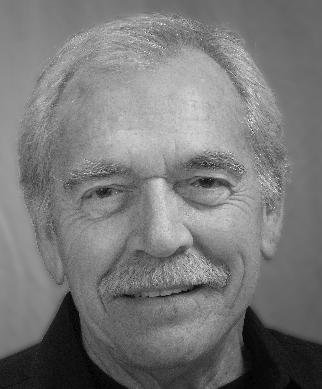
Ron Lanza, a pioneer in San Francisco’s gay rights movement and an impressario who promoted queer arts through the worst of the AIDS crisis, has died after a long battle with colon cancer. He was 78.

Lanza, a Brooklyn native, was one of the leaders of Bay Area Gay Liberation in the 1970s, and, along with Assemblymember Tom Ammiano and the late activists Hank Wilson and Howard Wallace, was instrumental in building the LGBT movement in San Francisco.

He was the owner and operator of the Valencia Rose Café and later Josie’s Cabaret and Juice Joint, two groundbreaking queer performance venues that helpled launch the careers of  Whoopie Goldberg, Marga Gomez, and Margaret Cho.

“His vision came from looking at people and saying, ‘you have talent, you ought to try this,’ ” Ammiano, who performed as a comedian at Valencia Rose, told me.

“He was a giant in this city,” Tommi Avicolli Mecca, a performer and housing activist and the author of a book on the history of gay liberation, noted. “He created the foundation for what we now know as queer arts in San Francisco. He was really one of a kind.”

Lanza with Dennis Peron and Tom Ammiano

Marke B., our managing editor and a longtime follower of queer culture, put it this way:

“He dedicated his life to promoting theater and arts in San Francisco — even if it sometimes meant playing hardball, but always with that super-charming, goofball smile. Every single drag queen, performance artist, comedian, and actor in the city owes Ron a memorial smoothie — the Valencia Rose and Josie’s Cabaret kept performing arts alive in this town through the worst years of AIDS and political artphobia.”

Lanza, a Navy veteran, arrived in San Francisco in the 1970s, and worked for a while as a teacher in Walnut Creek. “When he came out, he risked being fired, so he quite before they could fire him,” Ammiano said.

With Wilson, Lanza took over the Ambassador Hotel, a Tenderloin SRO with a large number of gay and transgender tenants. In the 1980s, the two helped create what would become the Tenderloin AIDS Resource Center.

Lanza never liked the headlines; while his compatriots entered politics, ran for office, and organized on the streets, he stayed in the background, providing the cultural, moral, and financial support.

When Ammiano challenged then-Mayor Willie Brown in a legendary 1999 write-in campaign, Josie’s Cabaret and Juice Joint became the campaign headquarters. “He was so supportive,” Ammiano said. “He was a real San Francisco lefty. He only cared about money if he had to pay the bills.”

Gabriel Haaland, who helped run the Ammiano write-in, told me that “San Francisco is dimished. It’s such a heavy loss. There are people who are just magical, bright lights in the world, and he was one of them.”

Lanza was diagnosed with colon cancer in his 40s, but survived — in part, probably, thanks to adopting a healthy lifestyle. “He didn’t smoke, he was a vegetarian, and back then we teased him about it,” Ammiano said.

But the cancer came back in his later years, and he quietly underwent a series of operations. “He called me a few weeks ago and said he was dying,” Ammiano said. “He wanted to have a good-bye dinner.”

A huge dog-lover, Lanza could often be seen running down Dolores Street with two or three rescue animals. One of his last wishes was for a trip East to leave the dogs with a relative. He’d been driving a limo for income, and one of his wealthy clients paid for the ticket.

“He was always handsome, always loyal,” Ammiano recalled. “There were times you wanted to kill him, but the love was always there.”

A memorial is pending.

Neighborhood sounds: MAPP takes over the Mission

0

Photos by Bowerbird Photography

It’s fun to imagine what it would be like to have lived during the Beatnik era, an era full of art salons and improvised performance. An evening walking around the for the Mission Arts and Performance Project (MAPP) with friends seems like close fit to those artistic days, because you never really know what you’ll see when you roll up to one of the many venues along the MAPP’s guide to the Mission.

This edition seemed especially filled with unique instruments. There was a folk Americana duo (Michael Hamilton) at Cafe La Boheme that included a cello, followed by the wonderful songstress She the Wolf, donning a red beret. After refueling on chai and cookies, the next stop was Artillery AG on Mission street, where a harp was taking center stage, as Maria Jose Montijo belted out melancholy, romantic ballads in Spanish. Our last stop was at Red Poppy Art House, for quirky and wonderfully weird poetry by Arian Arias that incorporated a made-up alien language from the future and also a collaboration with a flamenco dancer.

The final show we watched was a beautiful modern dance piece by SF native Sriba Kwadjovie. Inspired and excited by all the art we had absorbed, we made our way to a friends tiny apartment on Dolores street for a David Byrne-themed dance party, with Stop Making Sense being projected on the wall as we boogied down in over-sized white suits. A perfect Saturday night.


Smell that: Wildflower trains take you away all this month

0

If one-too-many overcrowded Muni rides have left you aching for a more pleasurable mass transit experience, the Western Railway Museum has an option that smells less of body odor and more of spring flowers for you this weekend: the 12th year of its April spring wildflower train rides, which take passengers back to the early 1900s on an hour-long, 10-mile trip around the Montezuma Hills, a mere hour’s drive out of town. 

The trains’ route runs along the original historic main line of the Sacramento Northern Railway fields. Passengers can hop on either the Scenic Limited or the Vintage Comet trains, both of which consist of a 1914 parlor car and Sacramento Northern interurban car. 

THIS. Seriously, leave the city this weekend.

For a mid-day, kid-friendly adventure: Hop aboard the Scenic Limited. First class passengers ride up front in the parlor car and are served cookies and lemonade by attendants dressed in white button downs, vests, and slacks. Coach passengers ride behind in the Sacramento Northern interurban. Docents will be in both cars pointing out botanical views, which are constantly evolving as the season progresses. Expect to spot patches of poppies, goldfields, brass buttons, butter and eggs, clovers, and sheep’s sorrel.

If that options sounds too sober: A late afternoon ride on the Vintage Comet train, its quaint charms augmented by sips via the Suisun Valley Wine Co-Op might be more your speed. Proceeds from your ticket will go towards Solano Midnight Sun Foundation, which provides temporary financial assistance to women with breast cancer.

Whether you’re in it for the wine, the history, or simply as an escape from the particular eau de rush hour of Muni, be sure to bring a camera. Because if you were ever going to make out of state friends jealous of your California digs a shot of wildflower filled fields on a sunny April day aught to do it. 

April Wildflower Train Rides

The Scenic Limited: Saturdays and Sundays through April 28, 11:00am, 12:30pm, and 2:00pm, $10-16

The Vintage Comet: Saturdays through April 28, 5:00pm, $30

Western Railway Museum

5848 State Highway 12, Suisun

www.wrm.org

Words, words, words permeate a couple of unconventional theater options this weekend

0

The scattered letters piled on the floor are alternately a lover, a tormentor, a terrible reminder, a set of mysterious directives, and a bed for restless dreaming for Ophelia — or rather, one of her three incarnations — as French company Carte Blanche presents its roaming, site-specific riff on Shakespeare’s sad heroine, with inspiration drawn from Arthur Rimbaud’s famous elegy.
 
But despite all those missives from a certain gloomy prince, the piece makes much use of silence too, as the audience mills around the Firehouse at Fort Mason Center, watching the agitated actions of three young heroines in various rooms before being led outside for a journey to other environs.

The dramatic tone in Ophelia tends toward the sentimental but the environmental staging has its charms, as do certain aspects of the mise-en-scène, which makes use of a giant warehouse space on the pier and at one point includes an enormous video backdrop enveloping the three dancer-performers. A little bit of Sleep No More, a little bit of Cirque du Soleil, and a little bit its own bilingual, francophone thing, Ophelia is a limited but curious journey of discovery.

Elsewhere around town: the great Sheffield-based English experimental theater company Forced Entertainment has only been to San Francisco once before, back in the 1990s, which (there’s no getting around it) just sucks. But FE is coming to a computer screen near you this weekend, live, starting at 3:59 this afternoon local time, for a 24-hour version of its durational performance Quizoola!, a collectively devised piece that relies on thousands of pre-written questions (you can submit your own too) in free-play between audience and performers across an evolving scenario that will only get weirder over the course of the earth’s slow full turn.

Tune in! Play at home! This may be the closest we get to having Forced Entertainment come back to the Bay Area. Link up here.

Side note: A few months ago in London, I had the chance to interview Tim Etchells, Forced Entertainment’s artistic director (and chief producer of questions for Quizoola!), about the group and its approach to the sometimes-sinister power of narrative—including the ongoing rehabilitation of the awful neoliberal hatchet-woman Margaret Thatcher. That interview can be found here.

OPHELIA

Sat/13-Sun/14, 8:30pm, $22

Fort Mason Center

Marina at Laguna, SF

www.carteblanche-sf.com

Things that make you go hmmm: new movies!

0

Better order your popcorn with a side of open-mindedness this week, what with To the Wonder (meh) and Upstream Color (woo!) launching themselves at audiences. Less experimental types can settle for ensemble drama Disconnect or Scary Movie 5, the latest in the pop-culture parody series.

Read on for the rest of this week’s new films, including the latest from Danny Boyle and Robert Redford, plus a perfectly-timed-to-maximize-on-the-start-of-baseball-season Jackie Robinson biopic.

http://www.youtube.com/watch?v=0JrkewU7FF8

The Company You Keep Robert Redford directs and stars as a fugitive former member of the Weather Underground, who goes on the run when another member (Susan Sarandon) is arrested and a newspaper reporter (Shia LaBeouf) connects him to a murder 30 years earlier during a Michigan bank robbery. Both the incident and the individuals in The Company You Keep are fictive, but a montage of archival footage at the start of the film is used to place them in the company of real-life radicals and events from the latter days of the 1960s-’70s antiwar movement. (The film’s timeline is a little hard to figure, as the action seems to be present day.) Living under an assumed name, Redford’s Nick Sloan is now a recently widowed public interest lawyer with a nine-year-old daughter, still fighting the good fight from the suburbs of Albany, NY — though some of his movement cohorts would probably argue that point. And as Nick heads cross-country on a hunt for one of them who’s still deep underground, and LaBeouf’s pesky reporter tussles with FBI agents (Terrance Howard and Anna Kendrick) and his besieged editor (Stanley Tucci) — mostly there to pass comment on print journalism’s precipitous decline — there’s plenty of contentious talk, none of it particularly trenchant or involving. Redford packs his earnest, well-intentioned film with stars delineating a constellation of attitudes about revolution, justice, and violent radical action — Julie Christie as an unrepentant radical and Nick’s former lover, Nick Nolte and Richard Jenkins as former movement members, Brendan Gleeson as a Michigan police detective involved in the original investigation, Chris Cooper as Nick’s estranged and disapproving younger brother. But their scrutiny, and the film’s, feels blurry and rote, while the plot’s one major twist seems random and is clumsily exposed. (2:05) (Lynn Rapoport)

http://www.youtube.com/watch?v=tkI3RDL5__Y

42 Broad and morally cautious, 42 is nonetheless an honorable addition to the small cannon of films about the late, great baseball player Jackie Robinson. When Dodgers owner Branch Rickey (Harrison Ford) declares that he wants a black player in the white major leagues because “The only real color is green!”, it’s a cynical explanation that most people buy, and hate him for. It also starts the ball curving for a PR shitstorm. But money is an equal-opportunity leveling device: when Robinson (Chadwick Boseman) tries to use the bathroom at a small-town gas station, he’s denied and tells his manager they should “buy their 99 gallons of gas another place.” Naturally the gas attendant concedes, and as 42 progresses, even those who reject Robinson at first turn into men who find out how good they are when they’re tested. Ford, swashbuckling well past his sell-by date, is a fantastic old coot here; his “been there, lived that” prowess makes you proud he once fled the path of a rolling bolder. His power moves here are even greater, but it’s ultimately Robinson’s show, and 42 finds a lot of ways to deliver on facts and still print the legend. (2:08) (Sara Maria Vizcarrondo)

http://www.youtube.com/watch?v=hZjXLaDbU8A

My Brother the Devil Though its script hits some unsurprising beats, Sally El Hosaini’s drama is buoyed by authentic performances and a strong command of its setting: diverse London ‘hood Hackney, where sons of Egyptian immigrants Rashid (James Floyd) and Mo (Fady Elsayed) stumble toward maturity. After his best friend is killed in a gang fight, older “bruv” Rashid turns away from a life of crime, but dropping his tough-guy façade forces him to explore feelings he’s been desperately trying to deny, especially after he meets photographer Sayyid (Saïd Taghmaoui). The only thing he knows for certain is that he doesn’t want his little brother to start running with the drug-dealing crew he’s lately abandoned. The less-worldly Mo, already dealing with a tidal wave of typical teenage emotions, idolizes his brother — until he finds out Rashid’s secret, and reacts … badly, and the various conflicts careen toward a suspenseful, dread-filled, life-lessons-learned conclusion. Added bonus to this well-crafted film: sleek, vibrant lensing, which earned My Brother the Devil a cinematography prize at Sundance 2012. (1:51) (Cheryl Eddy)

http://www.youtube.com/watch?v=q0vuJRFn1q4

No Place on Earth “Every cave I enter has a secret,” muses caver Chris Nicola in his clipped New York accent at the start of No Place on Earth. An interest in his family’s Eastern Orthodox roots brought him to the Ukraine soon after the Soviet Union dissolved; while exploring one of the country’s lengthy gypsum caves, he literally stumbled over what he calls “living history:” artifacts (shoes, buttons) that suggested people had been living in the caves in the not-too-distant past. Naturally curious, Nicola investigated further, eventually learning that two families of Ukrainian Jews (including young children) hid in the caves for 18 months during World War II. Using tasteful re-enactments and interviews with surviving members of the families, as well as narration taken from memoirs, director Janet Tobias reconstructs an incredible tale of human resilience and persistence; there are moments of terror, literally hiding behind rocks to escape roaming German soldiers, and moments of joy, as when a holiday snowfall enables precious outdoor playtime. Incredibly, the film ends with now-elderly survivors — one of whom lived just seven miles from Nicola in NYC — returning to “say thank-you to the cave,” as one woman puts it, with awed and grateful grandchildren in tow. (1:24) (Cheryl Eddy)

http://www.youtube.com/watch?v=rvTW1JecmZo

Trance Where did Danny Boyle drop his noir? Finding the thread he misplaced somewhere along the way from Shallow Grave (1994) to Slumdog Millionaire (2008), Boyle strives to put his own character-centered spin on the genre in this collaboration with Grave and Trainspotting (1996) screenwriter John Hodge, though the final product feels distinctly off, despite its Hitchcockian aspirations toward a sort of modern-day Spellbound (1945). Untrustworthy narrator Simon (James McAvoy) is an auctioneer for a Sotheby’s-like house, tasked with protecting the multimillion-dollar artworks on the block, within reason. Then the splashily elaborate theft of Goya’s Witches’ Flight painting goes down on Simon’s watch, and for his trouble, the complicit staffer is concussed by heist leader Franck (Vincent Cassel). Where did those slippery witches fly to? Simon, mixed up with the thieves due to his gambling debts, cries amnesia — truth appears to be locked in the opaque layers of his jostled brain, and it’s up to hypnotherapist Elizabeth (Rosario Dawson) to uncover the Goya’s resting place. Is she trying to help Simon extricate himself from his impossible situation, seduce Franck, or simply help herself? Boyle tries to transmit the mutable mind games on screen, via the lighting, glass, and watery reflections that are supposed to translate as sleek sophistication. But devices like speedy, back-and-forth edits and off-and-on fourth-wall-battering instances as when Simon locks eyes with the audience, read as dated and cheesy as a banking commercial. The seriously miscast actors also fail to sell Trance on various levels — believability, likeability, etc. — as the very unmesmerized viewer falls into a light coma and the movie twirls, flaming, into the ludicrous. (1:44) (Kimberly Chun)

Dealing with the faux cabs

95

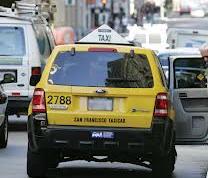
Lots of comments on my article outlining the problems with the fake cabs that are riding around town without medallions or proper screening. The main complaint the trolls have appears to be their dislike of cab drivers and the difficulty of getting a cab in some places and at certain times. I’ve never had a bad experience with an SF cab driver in 30 years of living here and taking cabs, but I’m sure there are others who have; no industry is perfect.

My main concern is that the cab interlopers are lying and cheating — insisting that they don’t have to follow the same rules as everyone else. Somebody in one of the comments said that there’s nothing wrong with “ride shares,” and it’s true that everyone from Craigslist to Caltrans has some verison of a ride board, and it’s not uncommon for casual carpools to share gas costs.

But that’s not what Lyft and Uber etc. are doing. They’re private businesses, set up with venture capital backers, with the aim of making a profit by ferrying passengers around cities. That’s the definition of a taxicab business. If these were just casual shared rides, there would be no business model and they wouldn’t have investors.

I’ll tell you how we can settle the issue quickly. How about all of us who need a ride around town contact Lyft, get a lift, and then voluntarily pay nothing. Or just offer the price of gas — $4.50 a gallon, most of these cars get 25 miles to the gallon, most rides around town are five miles or less, so that would be 90 cents.

Passengers get profiles on the system, just like drivers. Anyone who does that will quickly find it impossible to get rides. Which will demonstrate that this isn’t ride-sharing, it’s commerce. And while I’m all in favor of competition, everyone should play by the same rules.


Checks from mayor’s mysterious breakfast companions mysteriously absent

In less than three months, custom made super yachts will zip around the San Francisco Bay in the ultimate competition for the prized America’s Cup. But San Francisco could wind up spending millions more than originally expected to host this prestigious sailing regatta.

At a March 13 committee hearing at the Board of Supervisors, America’s Cup Organizing Committee CEO Kyri McClellan reported that Mayor Ed Lee was investing an “incredible amount of energy” into helping ACOC with fundraising efforts to avert a city funding shortfall. He was even said to be hosting “breakfasts with CEOs” to solicit funding, McClellan said.

Who are the CEOs? Nobody will say.

How much has each of them pledged to give? Nobody will say.

When the Guardian submitted these questions to Lee, McClellan, and Stefanie Roumeliotes – whose SGR Consulting firm was wheeled in at the last minute to organize fundraising events – none answered directly.

McClellan responded on April 9 with a copy of a letter she sent to Mayor Lee and Board President David Chiu on the day of the hearing, which she indicated was “the most recent update on fundraising.” Roumeliotes, for her part, told the Guardian flat out to stop calling, because her firm was not going to answer any questions.

So far, it appears that none of the mayor’s fundraising meetings, which took place from January 25 to March 4, resulted in his unnamed breakfast companions writing out actual donation checks.

Had they contributed funding, the donation amounts would have been reflected in “behested payment” forms filed with the San Francisco Ethics Commission, required under state law to be submitted 30 days after a contribution is made.

Elected officials are “supposed to file behested payment [forms] for … legislative, governmental or charitable purposes,” Ethics Commission chief John St. Croix told the Guardian, so donations relating to the America’s Cup would fall squarely into this category. Those forms are supposed to filed internally by department, then sent onto Ethics. So far, none have been recorded.

“If there are such forms that the mayor filled out,” St. Croix told the Guardian, “they’re not getting forwarded.”

Meanwhile, McClellan’s March 13 letter suggests that recent fundraising efforts have yielded only $1.4 million – which won’t actually be in hand till next year. That’s a far cry from the estimated $15.6 million funding gap race organizers say is needed to cover San Francisco’s estimated $22.5 million billionaires’ boat race tab. As the fundraising arm of the race organizing committee, ACOC promised in an initial agreement that it would “endeavor to raise” the amount needed to defray city costs. Thus far, it’s paid $6.8 million.

In her letter to Lee and Chiu, McClellan suggested that roughly $13 million of that $15.6 million shortfall would be accounted for in “forecast General Fund revenues.” That translates to additional money harvested from visitors’ pockets via sales and hotel taxes, with some payroll taxes and parking fees sprinkled in, all associated with the America’s Cup events. Little-guy money.

And thanks to the little guys, ACOC’s new fundraising goal is much more attainable. “The SFACOC continues to endeavor to raise the funds,” McClellan wrote. “At a minimum that is $2,670,851 of which we already have $1,400,000 in existing pledges that are to be received by January 2014.”


ABC shows more concern about expanding police video surveillance than Mayor Lee

15

The SFPD has quietly expanded its reach and authority to obtain video surveillance from in and around bars, clubs, and markets through a condition it has begun recommending on new liquor licenses, as I reported in today’s issue, effectively bypassing controls on city-operated surveillance cameras established through extensive public hearings in 2005.

But the Mayor’s Office doesn’t seem concerned about the new trend, echoing SFPD’s point that it is the California Department of Alcoholic Beverage Control that decides whether to heed the SFPD’s request to include the video surveillance condition. “There is no new policy. SFPD makes recommendations as far as I know, not requirements,” Mayoral Press Secretary Christine Falvey wrote to me in an email responses to our questions.

Certainly, everyone from bar owners to the ACLU to Sups. Scott Wiener and David Campos – who have called a hearing on the policy for later this month – consider it a new policy, or at least one that the public has just learned of after it was adopted internally right after the idea was shot down in public hearings in 2011.

ABC spokesperson John Carr had told me the department “routinely denied requests for conditions by SFPD per section 23800(e) of the Californian Business and Professions Code, occasionally these denials include the surveillance condition,” but he wasn’t able to provide me any examples of that happening by press time.

But today, he was able to find one. On Oct. 3, 2012, ABC rejected the SFPD’s request for video surveillance at Bush Market at 820 Bush on a quiet residential block of Nob Hill, noting that state law requires such requests be supported by “substantial evidence” that problems exist at the site that would be mitigated by the condition.

“I regret to inform you that the Department is unable to impose conditions pursuant to your request because no evidence was provided to establish that a problem exists at the premises or in it immediate vicinity,” ABC District Administrator Justin Gebb wrote in what was essentially a form letter.

Carr shared an identical letter that the ABC sent to the SFPD denying some of its requested conditions for another liquor license transfer on Feb. 12, this one for the Space 550 event venue at 550 Barneveld Ave. But in that case, the ABC decided to support the SFPD’s request for video surveillance “that is able to view the inside and outside of the premises” and which must be given to the cops “upon demand.”

As I wrote in this week’s paper, the ACLU considers that kind of extrajudicial expansion of the SFPD’s ability to require and obtain video surveillance to be unconstitutional, and we furnished a copy of the article and the issues it raised to try to get a more substantial comment from the Mayor’s Office, which seems to be less concerned with the civil rights of San Franciscans than the bureaucrats in Sacramento are.

“Balancing public safety with vibrant cultural and nightlife activities is a concern of mayor. He expects the Police Department to work in partnership with the neighborhood and its businesses to lawfully collect evidence that can help keep the public safe and neighborhoods active,” Falvey wrote.

So I had a few follow-up questions, for which I’m still awaiting answers, and I’ll update this post if and when I get them: “The ACLU’s position is that this is not a lawful way to collect evidence, and that it violates the state constitution’s privacy protections and the rules San Francisco established in 2005 regulating when and how the SFPD may request and use video surveillance. Does the mayor reject those concerns and has he sought any legal advice to support his position? In the absence of any judicial review, shouldn’t the city have some guidelines and policies governing this expansion of SFPD’s video surveillance authority? Does the mayor believe the 2005 guidelines should no longer apply? And does the mayor agree with Sups. Wiener and Campos that it would be appropriate to have a public hearing on this issue, particularly given the strong public opposition to requiring expanded video surveillance by bars two years ago?”

San Francisco has a lot of money tied up in fossil fuels

The San Francisco Employees Retirement System has more than $113 million in holdings in Exxon Mobil. It’s a lucrative investment in a dirty business. On March 29, Exxon’s Pegasus Pipeline ruptured, spilling as much as 7,000 barrels of oil in a toxic slick that coated a residential Arkansas neighborhood and prompted the evacuation of 21 homes.

SFERS also has $60 million invested in Chevron, which has its own checkered history. Environmentalists have long shamed the oil giant for its “toxic legacy” in Ecuador, but closer to home it was recently fined nearly $1 million for workplace violations arising from last year’s Richmond Refinery blaze. That incident sent a column of toxic smoke skyward, and resulted in about 200 hospital visits for respiratory problems from the fumes.

Further down the list of SFERS’ public equities holdings in fossil fuels is $28 million in Royal Dutch Shell, a company whose name, in some circles, is synonymous with human rights abuses in Nigeria. (Shell was also tapped to administer San Francisco’s CleanPower SF program, but that’s another story.)

The retirement system also has about $18 million tied up in Occidental Petroleum, a major player in the fracking industry that was responsible for drilling 675 new oil wells in California in 2011 alone, according to industry data. The retirement system portfolio includes about $5.4 million in BP, the company responsible for the infamous Deepwater Horizon explosion and epic oil spill in the Gulf of Mexico three years ago.

And the city’s retirement portfolio includes more than $1.2 million in Arch Coal, one of the largest coal suppliers in the U.S., which has faced millions in fines for Clean Water Act violations and was sued for firing a miner who complained about unsafe working conditions.

SFERS provided the Guardian with details of its energy company holdings in response to a public records request.

Earlier today, the Budget and Finance Subcommittee of the San Francisco Board of Supervisors took up a resolution, introduced by Sup. John Avalos, to urge SFERS to divest from fossil fuel companies.

The resolution is nonbinding; even if it unanimously passes at the full Board in a couple weeks, SFERS is under no legal obligation to tweak its investment portfolio. But support for such a strategy is gaining momentum as major environmental organizations seek to bring the issue of climate change to the forefront.

Avalos’ resolution was inspired in part by 350.org, an organization that has sowed the seeds for divestment campaigns at 260 colleges and universities nationwide. Celebrated 350.org founder and environmental writer Bill McKibben is betting that the kids are going to win. His campaign hinges on the idea that the planet can only sustain combustion of another 565 gigatons of carbon before things really go off the rails climate-wise; the industry has five times as much in reserve.

Despite San Francisco’s green reputation, change is likely to happen slowly, if at all. According to numbers shared by Retirement Board executive director Jay Huish at the April 10 hearing, SFERS has a total of some $500 million tied up in companies that deal in dirty energy. That’s substantial, and there could be more on the private asset side. “We gave them a list of 200 fossil fuel companies” targeted by environmentalists because they hold underground carbon reserves, noted Avalos aide Jeremy Pollock. “They had stock in 81.”

Avalos’ divestment resolution cleared the way to proceed to the full board, but only after Sup. Mark Farrell requested a couple amendments.

Farrell asked to add language making it clear that the retirement board could receive a lower return on investment if went through with divestment, and inserted another clause to underscore the point that the Board resolution shouldn’t infringe upon SFERS’ “fiduciary responsibility.”

The resolution is expected to go to the full Board on April 23.

The Performant: Band(s) of a thousand faces

0

Borts Minorts/Fuxedos/Polkacide fux shit up at Bottom of the Hill

It had been awhile since I’d stood in slightly gape-mouthed awe before the glorious mania of Borts Minorts, who last played the Bay Area some five years ago, the jerk, depriving me of my Dadatastic fun fix for far too long.

For the uninitiated, Borts Minorts is not a band so much as an alien invasion for the senses. Front-creature Borts Minorts (a.k.a. Chris Carlone) appears clad in a shiny white unitard, which makes him look like a giant cartoon spermatozoon, his frenetic dance moves are the stuff of legends and nightmares. He frequently plays a ski, though for this show he played a cabinet door strung with bass strings instead. When last spotted ‘round these parts, his ballsy backup crew had consisted of dancing girls, an unsmiling Norwegian on a flute (a.k.a. Melting Razor), and someone of indeterminate gender blowing endless bubbles—a deliberate hodge-podge of askew confusion.

But Saturday’s lineup at Bottom of the Hill kicked it up to a whole new dimension, thanks mainly to the addition of a horn section, even more dancers, and a glittering diva who sang operatically and took over the poker-face duties from the absent Melting Razor. Plus, somewhere along the way, the Borts Minorts “look” has been tweaked to include a giant blonde rocker-do complete with Richard Simmons sweatband, which somehow managed to dehumanize his freakish facade even more than his previously shiny-smooth Spandexed pate had done.

Shortly after the mighty Minorts crew exited the stage, the Fuxedos took it over, clad in their signature blood-splattered tuxedo shirts, laden with props. The bizarre brainchild of LA’s Danny Shorago, the Fuxedos can be best described as one part metal, one part big band, one part free jazz, and one part carnival sideshow in which Shorago is both the ringmaster and the principle freak.

I get the feeling that Shorago was one of those kids who spent a lot of time alone in the house playing dress-up, what with his penchant for inventive costuming and character-creating. From his eager sales huckster for “Clams and Flan” (the fast food emporium of all our dreams), to his sword-bearing villager with a “real god” (a giant porcupine named Reggie), to his insulation-clad astronaut whose distressed mantra “I feel the air slipping out of my space suit” precedes an epic death metal roar, to his signature sulky sideshow attraction “Mimsy,” to his cane-swinging, Clockwork Orange-channeling crooner singing the song “Leonard Cohen wrote for me” (“The Future”), Shorago’s unique shapeshifting abilities definitely steal the spotlight. But the fact that he’s backed by truly talented musicians and complex composition really elevates the whole Fuxedos experience from mere tomfoolery to actual art, albeit hilarious art.

And speaking of hilarious art, there really is no better way to describe the imitable, unflagging insanity that Hardcore 2/4 crew, Polkacide, bring to the stage. They’ve been raucously rawking it since before half of their oddiences were born, and their punk rock polka is a true San Francisco treat. Each musician in the band has a musical pedigree as long as the string of sausages that clarinetist “Neil Basa” strategically hangs down his lederhosen, and the practiced patter of frontman Ward Abronski guides the faithful Polkacidal around the world in 80 (give or take a few dozen) polkas—from Warsaw, Poland to San Antonio, Texas.

You’ll just have to imagine the mayhem, as by that point I was dancing too much to remember to take many pictures—but better yet, you should probably just go to their next show and experience it for yourself.

British singer Jessie Ware on summer plans, being herself on stage, and flowers in SF

0

I first heard Jessie Ware’s “If You’re Never Gonna Move” on the road from the East Coast. After that, the song averaged about five plays per state. Ware’s understated and soulful dance pop has the rare ability to adapt to any situation. It eases the tension in a car full of two people with almost irreconcilable taste in music; it works equally well as the soundtrack to a lazy afternoon, and a night out. And it feels good.

The formula, which has earned her recognition in her native UK, is gaining a following in the US. Though the breakthrough album Devotion won’t be released stateside until April 16, many of her concerts, including Thursday’s at the Independent, have sold out to audiences that sing along with every word. (Not to worry, she also has an in-store at Amoeba that day.)

Ware has transformed into a full-fledged pop star. But on the phone, she didn’t fit the stereotype. Pop-stardom doesn’t come naturally to the down-to-earth 28-year-old who was going to go to law school if the whole singing career thing didn’t work out. So far it has, though, and she spoke a bit about how delighted she is about it all:

SFBG How has the North America tour been so far?

Jessie Ware Really good. We started in New York, and I was doing lots of promos, doing gigs. The crowds were just amazing. We did the last show in New York and it was quite full on because MTV was live-streaming it. It was only my third proper gig in New York and I’m getting it streamed to whoever wants to watch it online. That was scary but also lovely.

https://www.youtube.com/watch?v=eblGD5yuid8

SFBG Your show at the Independent is sold out, so I take it that it went well the last time you were here a couple months ago.

JW I had the best show ever in San Francisco in that Rickshaw Stop. It was crazy — I got four bunches of flowers at that gig! I I loved it and I love San Francisco. We did a recording for Yours Truly, and we did it in this beautiful flower shop. I can’t wait to wander around again and see San Francisco. I’m told I’m to go to the Mission for good Mexican food.

SFBG Does performing come naturally to you?

JW No, it does not come naturally to me at all. I feel like I’m just starting to really give a performance now. At the beginning I didn’t know what I was doing. I didn’t know whether I was entitled to be a bit over the top. I didn’t feel that comfortable on stage, and I just had to learn. I guess it gets easier when you’re playing to people who have bought tickets to see you. That’s already a bit reassuring, you know?  

I want to kind of tap into the kind of person I play in my videos ever so slightly, but also be myself and really get to know the audience, have a nice conversation whenever I can. Usually, I ask a question and loads of people shout things back at me and I can’t hear what the bloody hell they’re saying. I get myself into trouble because I’ve asked a question and then I have to say, “Whoa!”

SFBG Do you think of genre when you write?

JW I don’t think of genre, I think more of a feel, whether it be upbeat or moody or a bit dramatic. I want the album to feel complete as a whole; all of the songs have to make sense together…I don’t know if the album’s telling a complete story, but I guess it’s quite a lot of romance. Really, it was me experimenting with how to be a songwriter, but thematically they make sense together.

https://www.youtube.com/watch?v=bMJkddvJ4L4

SFBG What is next for you?

JW
I just hope I can keep on playing, really. I’m going to try to be as creative as possible and then play festivals this summer — have a really fun summer and just celebrate that I’m getting to go around the world and perform and play at wonderful festivals that I’ve always wanted to go to anyways.

Jessie Ware
With MS MR, DJ Harry Duncan
Thu/11, 8pm, $18
Independent
628 Divisadero, SF
(415) 771-1421
www.theindependentsf.com

Thu/11, 6:30pm, free
Amoeba Music
1855 Haight, SF
(415) 831-1200
www.amoeba.com

Main Street’s sex club: Eros celebrates 21 years in business

40

A few things that you may not know about Eros, the 21-year old sex club with the unassuming, rainbow-flagged façade that stands across the street from the Castro Safeway strip mall. One: it is hosting an art show on Thu/11 open to all to attend (perfect for female-identified folks interested in checking out the space, or at least the front room). Two, boundary-breaking trans-cis male porn is made there.

“Transmen were not being reached out to with the safe sex message,” says Eros’ owner Ken Rowe, a snuggly looking bear sitting on a leather couch in the club’s comfy front room. T-Wood Pictures, the club’s in-house porn company, now shoots new content once or twice a month with varying combinations of trans and cis men.

New elliptical machine!

Another point of fact: “The original founders wanted this to be a community center sex club,” he says. Co-founder Buzz Bense wanted a “Main Street sex club,” says Rowe. “Not with neon lights going ‘LIVE BOYS.’ They wanted it to look respectable, shame-free. Now we’re much more like a spa — we’re a traditional bathhouse. It’s not dark and dirty, poppers wafting through the air.”

Eros opens at noon seven days a week, and the first few hours of the day management promotes it as more of a “sex-positive day spa,” says Rowe.

>>LEARN MORE ABOUT EROS’ TRANS PROGRAMMING IN KELLY LOVEMONSTER’S SFBG INTERVIEW WITH EROS STAFF MEMBER (AND RECENTLY NAMED TRANS 100 HONOREE) NIKO KOWELL

Today, male-identified customers can take yoga and tai chi classes before hitting the club’s sauna, showers, and steam room. Elliptical machines sit nearby us, the club’s newest attractions. Community groups like Homobiles hold business meetings in the space. Potted plants sit happily on a cute little smoking deck on the other side of glass sliding doors.

A licensed massage therapist provides much-needed muscle work to customers, which was especially important back in the early days of the club, when the Police Department was in charge of licensing massage therapists in sex clubs (that duty has since been transferred to the Department of Public Health, though SFPD still must approve licenses.) Eros is the only sex club with a licensed massage therapist, to the best of Rowe’s knowledge, in Northern California.

“They wanted the club to be about more than just sex, they wanted a space where you could learn about safer sex in a non-threatening manner. You know, without being jumped on,” Rowe tells me.


One of Loren Bruton’s “Bathhouse Men”

Loren Bruton’s drawings line one side of the common room, aggregations of the Eros clientele that he sees every day as the club’s general manager. Eros hosts a yearly staff art show, an event that reflects the overlapping communities of artists and sex workers in the hyper-expensive Bay Area. This week, a reception will be held to celebrate Bruton’s collection that doubles as a birthday party for Eros’ decades of community involvement.

“I like that I can be myself here,” Bruton says. “It’s nice to have a sense of community someplace that is sex-positive. I wanted to represent that this is a diverse group in terms of age, race, sexual identity.” For a club that’s spent years reworking our vision of what a Main Street business can be, the renderings make for perfect poster children.

“Bathhouse Men” Eros birthday celebration

Thu/11, 7-10pm, free

Eros

2051 Market, SF

www.erossf.com

Internet cats, in their own words: Luna the Fashion Kitty

10

While writing this week’s Pets Issue cover story on world domination by Internet-famous cat magnates — or the “Cat Pack,” as they will forever after be dubbed thanks to the quick linguistic thinking of Mike “Owner of Lil Bub” Bridavsky during our interview for the piece — a certain fashion icon was never far from my mind.

Luna the Fashion Kitty is hardly the most famous Internet cat, but her cross-eyed good looks, coupled with owner Rocio Grijalva’s ability to get her to wear tutus and hairbows, is to me emblematic of the American Dream. Let the fact that Luna hails from the city of Hermosillo, in the Mexican state of Sonora allow you to draw your own conclusions about the continued cultural relevancy of that trope.

Read about Grijalva’s motivations behind hyping Luna to the world in the cover story. But right now, take a moment to hear directly from Luna herself about what its like to be “a face fur to be admired,” as she herself put it when we chatted via email about the time commitment necessary to be an Internet cat in this brave new era. She also schooled me on the hautest pet brands today, should I ever be in the company of an animal as glorious as herself. [Sic]: 

And stay tuned, we’ll be dropping our Colonel Meow interview this week…

SFBG: Describe the average day in the life of Luna. 

LTFK: I wake up my daddy fur get my morning massage, then I like to do more beauty sleep. Around 10am my assistant brushes me, does my eye treatment fur tear stains (it’s like the Botox ritual fur the Housewives of Beverly Hills). I get my teeth cleaned, my outfit it’s carefully picked out (I don’t use the same twice in months), my accessories are the last of course. After 2pm, I usually have my photo shot since the lighting it’s good, I superhate bad lighting. If my momma has errands and I can go I usually tag along. Finally at 8 sharp I have dinner and that’s it fur the day.

SFBG: How much time do you spend on photoshoots?

LTFK: Believe it or not I don’t spend too much time in a photoshoot, when you look LIKE THIS and you pose like a PRO, 15 minutes TOPS it’s all I need.

SFBG: Do you do public appearances? 

LTFK: I’m always in public girl this FACE is fur be admired! I also made a public appearance in a event fur support kitty adoptions and recently I strolled around at Rodeo Drive, CaliFURnia with my furriends Amy and Dawn that volunteer in the Purrsian rescue Helping Persian Cats and we handed many business cards of the Rescue. 

SFBG: Have you ever gone on tour?

LTFK: I haven’t, but I would LOVE to do it and visit all my fans around the world! Well I don’t want to go to the countries that have quarantine because is NO WAY I will stay in a cage like a savage!


SFBG: Who are your favorite designers?

LTFK: I like many designers but unFURtunately they don’t make fur-child clothes, it’s sooo frustrating! So I have to say that my FAVE furchilds brands are SimplyShe, Louis Dog, and Martha Stewart fur commercial pieces. Now, talking couture I love Off the Leash custom pet couture and Ada Nieves designs. 

SFBG: Have you ever met another famous cat? What was that like for you?

LTFK: Nahhh and fur be honest I don’t want to! I’m like Mariah Carey, I don’t like to share my limelight. It’s not that we are Divas per say it’s that it’s rude to be MEGAFAB in front of the wannabes!

SFBG: What does success look like for Luna?

LTFK: Success it’s not something I think about because I was born a winner, so stuffs just happen because of my fabulousness. 

SFBG: Why do you think so much attention is being paid these days to Internet cats?

LTFK: That’s an easy answer, we are WAY more interesting and cute than purrsons. Also we provide a stress release fur everyPAWdy. Do you know how many purrsons are stressed just in the USA? TONS girl and every year gets higher. Bottom line we are not going anywhere our cuteness is the healthy PROZAC!… well at least mine megaultracuteness lol 100 purrcent natural and the only side effect is that you might turn into a cat lady 🙂

UPDATE: Luna responds to a quote in original story from Mike “Bub’s owner” Bridavsky:

Happy Wednesday guys! Guess who is being feature in the SF Bay Guardian?? ME! OMG I just love the cartoon! ps: didn’t appreciate that Bub’s owner said “Bub’s always naked, she doesn’t wear stupid outfits”. Don’t hate if your child it’s a nudist, I never hate on nudist furchilds!

SF declares Pay Equity Day as it lowers salaries for women’s jobs

87

The Board of Supervisors today declared April 9 Pay Equity Day in San Francisco, in recognition of the persistent national gap between male and female financial compensation. But with the city locked in a dispute with SEIU Local 1021 over pay cuts to jobs dominated by women and workers of color, the day took on special local significance. Ahead of the declaration, union members, activists, and supervisors rallied in front of City Hall, chanting against San Francisco’s wage inequality and the general climate of fiscal austerity.

Women in San Francisco earn just 84 cents for every dollar paid to their male counterparts. Although this figure is slightly higher than the national average of 77 cents per dollar, the discrepancy represents a yearly wage gap of $9,968 per year, according to the National Partnership for Women and Families. At today’s press conference in front of City Hall, Sup. Malia Cohen called the gap “unconscionable in a country as wealthy as ours.”

Cohen was joined by Sups. David Chiu and David Campos, who both spoke out against gender-based wage gaps. “It is important for men to speak out,” Chui said. “It wasn’t women who made the decision for pay to be unequal.” Campos went a step further, promising to vote against any budget that further entrenches unequal pay. “I will not support any budget that reflect this discrepancy,” he said.

SEIU Local 1021, which represents over half of city employees, is currently locked in a budget dispute with the city over pay cuts that would adversely affect women and workers of color. The city Department of Human Resources has recommended that the city cut the salaries of 16 categories of city workers, including personnel clerks and nursing technicians, which are disproportionately females and workers of color. The dispute was recently sent to an arbitrator.

At today’s event, local SEIU leaders and the San Francisco Women’s Political Committee (SFWPC) continued to pressure the city to reconsider the salary cuts. SFWPC President Laura Hahn called persistent pay inequality “embarrassing.”

“If we can’t achieve it here in San Francisco where are we going to do it?” she asked.

Former Supervisor Chris Daly, who now works as political director for SEIU 1021, echoed Hahn’s concerns and charged that the proposal to cut pay for female-dominated categories calls into question the city’s long term commitment to pay equity.

“If you ask Mayor Lee if he supports wage equality, of course he will say yes,” Daly told us. “But in reality, his Department of Human Resources is rolling back progress.” Daly’s repeated requests for Mayor Lee to intervene in the wage-cut arbitration have not yet been answered.
But for the DHR, the recommended cuts have more to do with fiscal reality than gender equality. At a March 7th budget hearing, DHR director Micki Callahan said, “It would be improper to base any decision on demographics.”

She voiced concern over the “root causes” of pay discrepancy, but indicated that these issues fall outside the purview of her department. Spokespeople for the the DHR department have repeatedly assured us that the proposed budget cuts have nothing to do with gender, but rather reflect an effort to bring city salaries in line with market forces.

TRUST Act clears committee as immigration reform heats up nationally

It was late at night by the time New Latthivongskorn, then 22, finally started to make his way home from the University of California Berkeley campus after a long night of studying for midterm exams.  A third year molecular and cell biology major who was trying to keep up his grades in preparation for med school applications, Latthivongskorn said he noticed a man in a black hooded sweatshirt walking toward him as he approached his home. At first he didn’t think much of it – but just as he was about to unlock the door to his apartment, the young Thai student heard a voice. “Give me everything you’ve got,” the man commanded.

“I looked at him, and I looked down, and I saw a gun pointed straight at me,” Latthivongskorn recounted. Terrified, he tried to stay calm and simply cooperated; handing over his backpack and cell phone, silently feeling relieved that he hadn’t been carrying his laptop. Fortunately, Latthivongskorn was able to proceed into his apartment unscathed after the man who robbed him at gunpoint vanished down the street.

When his concerned housemate asked if he wanted to file a police report, Latthivongskorn faced a dilemma. “Yes, I wanted to report it,” he told the Guardian in a phone interview, “for me, but also for the community. That same man ended up mugging another individual later that night.”

But there was a problem. Latthivongskorn had moved with his family from Bangkok to Sacramento when he was just nine years old – and despite the fact that his entire life was rooted in California, he’d never obtained U.S. citizenship. Any interaction with police, he feared, could place him in jeopardy – even if he was approaching law enforcement as a crime victim.

“In the end, I couldn’t call,” he said. “What was going through my mind was thinking of all the sacrifices that my family had made for me … and I worked so hard to get to this point, and I’m still not there yet.” His decision not to report the armed robbery came down to “the simple fact that it could all end – that I could get deported.”

Fast-forward to today, and Latthivongskorn has graduated and earned a spot on the waitlist at Stanford while he awaits responses from a number of other med schools. He’s also active with ASPIRE, Asian Students Promoting Immigrant Rights through Education.

On April 9, he shared his experience of being mugged with California legislators at a hearing of the Public Safety Committee, and urged lawmakers to approve the TRUST Act.

Authored by Assembly Member Tom Ammiano, the bill seeks to “limit harmful deportations often stemming from trivial or discriminatory arrests,” according to a statement from Ammiano’s office.

As things stand, all arrestees have their fingerprints recorded and submitted to ICE, or U.S. Immigration and Customs Enforcement. Under the federal Secure Communities program, ICE can then direct local law enforcement to hold arrestees without bail, beyond the time they’d be detained under normal circumstances, for the purposes of immigration proceedings.

The idea is to hold and deport dangerous criminals, but in practice it’s proved problematic. “More than 90,000 Californians have been deported, with 70 percent not convicted of anything, or only of lesser crimes,” Ammiano’s office points out. “Some were never charged with crimes, and some were crime victims.”

The TRUST Act would “establish a statewide policy that says if the person has not been convicted of a serious or violent felony, they would no longer be held any longer than authorities would hold them otherwise,” explained Carlos Alcalá, a spokesperson for Ammiano. The idea is to draw a distinction between violent or serious offenders, and anyone else who could be swept up in the system and needlessly held without bail.

Also on hand to testify at the April 9 hearing was Ruth Montaño, a Bakersfield woman who was arrested and nearly deported after someone complained that her dog was barking too loud.

Alcalá recounted other horror stories that had made their way to the Capitol. There was the day laborer whose employer reported him to immigration authorities at the end of his shift when all he was expecting was a day’s wage, and the woman who was arrested outside of Walmart for trespassing – and nearly deported – for selling tamales. Then there were women who reported incidents of domestic violence only to be subjected to immigration proceedings (and their counterparts, who stayed mum about abuse because they feared deportation).

Members of the Public Safety Committee approved the TRUST Act 4-2, clearing the way for the bill to go to the floor of the Assembly as early as next week. An earlier version made its way to the desk of Gov. Jerry Brown last year, but was ultimately vetoed, leading to a revised version. “Because of last session’s history, we’re hoping to have more substantive discussions with the governor beforehand,” Alcalá told the Guardian.

The timing is significant. “Immigration changes are moving quickly at the national level,” Ammiano noted, “and California needs to make changes here to keep pace.”

Advocates expect a national proposal for immigration reform to be introduced in the Senate any day now, according to Jon Rodney of the California Immigrant Policy Center. West Coast activists are planning an event April 10 to mirror a mass rally and march for immigration reform planned in D.C.

In San Francisco, the march will begin outside Sen. Dianne Feinstein’s office on Post Street and then proceed to Civic Center, where a rally is planned for 5 p.m. Latthivongskorn plans to participate along with other organizers from ASPIRE, and a host of local and regional immigration reform advocates are getting involved.

Those joining the march “will carry 1,000 paper flowers,” Rodney said, “to represent 1,000 deportations that happen every day in the U.S. That’s one piece of Wednesday’s rally, is stopping deportations.”

Paying for the mayor’s China trip

20

You’d think the mayor would know better by now. After all the allegations of cronyism and undue influence, you’d think that he’d make sure everyone involved in his trip to China was playing by the rules. You’d think the last thing he would want is this.

Now: So far this is just a complaint, and noting has been proven. But still: It sure looks bad. And it’s entirely unnecessary.

If the mayor really belives that he needs to go to China to do the city’s business, why doesn’t he go on the city’s tab? Seriously: I would much rather that my tax dollars went for this trip than have the mayor inundated and unduly influenced by corrupt actors who want his ear. If he was going for fun and sightseeing, he could pay his own way; if he’s there, as his office says, on official business, then why is he taking private money?

When Dennis Herrera went to Washington DC for the Supreme Court hearing on same-sex marriage, the city paid his way. That’s appropriate: He’s directly involved in the case, as are some of his staffers. They were meeting with co-counsel, doing practice runs … working. He stayed at a midrange hotel at the government rate ($200 a night) and was allowed to spend a set per-diem on meals. That’s the same rules any city employee follows on official travel.

If you think he shouldn’t have gone (as Michael Petrelis clearly thinks), then that’s a political discussion. It’s appropriate to ask about it, to point out how much money was spent on the trip, to analyze his expenses, and to challenge him about it when he’s next running for office. But it’s not a corruption probe — and frankly, I’m happy that some corporate bond-counsel firm that wants the city’s legal business didn’t pay for the trip and send a lobbyist to hang out with Herrera the whole time.

The city sends people on trips. It’s fair to ask if they are an appropriate use of taxpayer money. But if the trip is worth taking, then the mayor should justify the expense — and not take corporate and lobbyist money instead.

Blue Angels grounding is a victory for sanity, safety, and peace

82

Finally, peace in our time. The Blue Angels’ annual Fleet Week assault on San Francisco has finally, blessedly, mercifully been canceled for 2013, the result of $85 billion in federal budget sequestration cuts divided equally between military expenditures and social service spending.

The Guardian has long called for the cancellation of this wasteful show of military might, citing its inherent danger to a dense urban area, wanton waste of resources and fossil fuels, disturbance of the peace and pets, glamourizing of war and its weapons, and its Soviet-style fetishizing of militarism.

But in the end – appropriately and a little ironically – it was conservative fiscal prudence that finally shot down the Blue Angels. The military is already the biggest item in the federal budget, a massive, unjustifiable expenditure caused by imperial over-reach and the bloat of crony capitalism and pork barrel politics. Spending millions more just to show off their toys over scenic San Francisco was the ridiculous cherry on top of that sloppy sundae.

Real people and the real economy are suffering real harm from reckless sequestration cuts to social programs that have been inflicted by the anti-government ideologues sent to DC by the plutocrats and their minions. To keep the Blue Angels flying high against that backdrop would have been simply obscene, and surely a sign of decadent late empire in decay.

This decision by the Navy to nix the Blue Angels is a small but significant sign of sanity in a country gone mad, and the Guardian proudly salutes this decision.

Class divisions in SF (sorta)

38

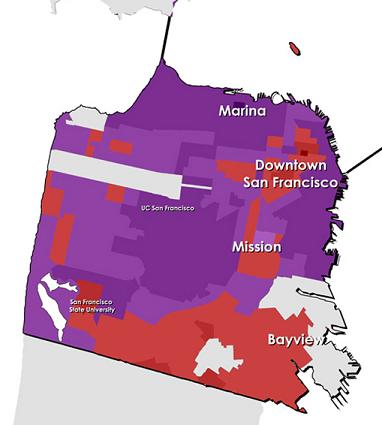
Richard Florida, who got famous creating the “creative class,” has a new series of maps out charting class structure in American cities — not on the basis of income or wealth but on the type of work people do. Sfist has a nice copy of the San Francisco version here. It shows, on the surface, that this city has virtually no “working class,” some “service class” and lots of “creative class.”

Overall, it’s a picture of a city in the late stages of terminal gentrification — but it’s also a bit misleading.

San Francisco long ago lost much of it’s traditional blue-collar work — manufacturing, production, distribution, and repair — although there’s still some left. What we don’t have is a lot of unionized blue-collar jobs (like the Port of Oakland offers). That’s pretty clear.

But unionized jobs that don’t require advanced degrees still exist in San Francisco — they’re just in the public sector. I suppose Muni drivers get defined as “service class” by Florida, but that’s really not accurate.

Nor is the notion that “creative class” people all make a lot of money. I suppose there are artists and musicians who are getting rich in San Francisco, but I don’t know any of them.

If anything, Florida’s approach just underscores the changes in the American economy in the past few decades. It doesn’t do much to help understand how the actual demographics of the city have changed, how wealth has become more concentrated and poverty more dire. So I don’t really get the point.