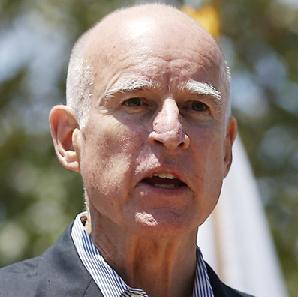
As I reported in this week’s cover story, San Francisco has lost its balance under Mayor Ed Lee, with economic development pushing sustainability – both environmental and economic, as shown by rising rents and costs of living – onto the back burner. And in today’s New York Times, Lee reinforces the idea that corporate titans should dictate what kind of city this becomes.
In profile of venture capitalist Ron Conway, who is heavily invested in tech companies and Lee’s political campaigns, Lee said that Conway – a longtime Republican ideologue with an open grudge against progressives, as we revealed in a December cover story – is someone “whose values benefit the city” and said that “Ten more Ron Conways would be helpful.”
That’s really an astonishing statement given the pro-corporate, self-dealing nastiness that just one rich Conway has injected into San Francisco politics over the last couple years. In the article, Conway himself dismisses all values beyond creating tech jobs, including the displacement and gentrification caused by the monomaniacal focus on promoting technological companies, for which he proudly says, “You need a catalyst, so I’m a catalyst.”
He also does little to disguise the libertarian groupthink that seems to guide his bubble-inflated industry, telling the Times, “The tech community is a closely knit group, which is why it’s so powerful. All of these companies have an affinity for each other, even if they compete with each other.”
Yes, they all want tax breaks, which is what Lee has been giving them, over and over again, by waiving payroll taxes on new hires in the mid-Market area around Twitter, exempting stock options for local taxes (undoing an initiative by his predecessor, Gavin Newsom, who was definitely no foe of corporate America), and doing a business tax reform that cut taxes on tech companies.
How much more do they really want? Are we really going to simply put local government completely into the service of a handful of already wealthy technology investors, who are the real beneficiaries of Lee’s taxpayer-subsidized largesse?
If we had 10 more Conways pushing this right-wing agenda with the billions of dollars they’ve amassed during this modern Gilded Age, I don’t think San Francisco continue to be open to this city’s tenants, small businesses, artists, and the vast majority of its workers, whose per capital income of $46,777 is almost barely enough to survive.
Attention, Mr. Mayor, this is a big city with lots of interests and needs. It’s time to pull your head out of this bubble and pay attention to the vast majority of this city’s residents, whose interests Ron Conway doesn’t share or even acknowledge.
In 2004, Hannah Dobbz climbed up the drainpipe of an abandoned building in Emeryville and disappeared through a broken window. Outside, her friends waited with blankets, pillows, and food. Making her way down to the first floor, she unsecured the plywood door and let them in.
Dobbz had stayed in squats before—in the East Bay, and in Europe. But now she was finally “bottom-lining” her own. The property, an abandoned boat and turbine warehouse they called the Power Machine, was in legal limbo. The city of Emeryville had claimed eminent domain over the building, but settlement proceedings would continue for the next two years.
In the meantime, Dobbz and her friends made the Power Machine their home. They fixed up the building and collected bikes, books, and art supplies. They threw loud parties. Located under a bridge and next to the railroad, no one seemed to care—not even the landlord, who stumbled upon Dobbz during her second week of residency.
Dobbz’s experience, along with those of other East Bay squatters, became the subject of her film, “Shelter: A Squatumentary” (Kill Normal Productions: 2008). In 2007, she left the Bay Area and moved to Buffalo, but continued to advocate for the practice of seizing abandoned spaces, dubbed “property resistance.” Now, she has published a book on squatting.
The book, Nine-Tenths of the Law: Property and Resistance in the United States (AK Press: 2013), is both a guide for squatters and a history of land occupation movements. It delves into the philosophical justifications for squatting, and challenges the assumptions behind the economic forces of the housing market. For Dobbz, squatting is a tactic: it reasserts that shelter is everybody’s basic human right, not just the privilege of those who can afford it.
“One of those things that I’m hoping to do is rethink how we view property, to try and shift the emphasis from housing as a market value, to more of a use value,” said Dobbz.
Nor could the timing be much better, since recent events seem to have rekindled property resistance activism in the Bay Area. In 2011, the Occupy Oakland movement created a dialogue around public space and private ownership. Now, with the tech boom driving the cost of living ever higher, that dialogue has been infused with newfound urgency.
Steve Dicaprio is the CEO and founder of Land Action, an organization that offers support and legal information to land occupiers. As Occupy Oakland unfolded, he began to research property foreclosures. He wanted to know which sites could be most easily occupied and defended from a legal standpoint. According to Dicaprio, organizers of Occupy Oakland soon began to consider the occupation of foreclosed homes as an alternative to demonstrations in Oscar Grant/Frank Ogawa Plaza.
The goal of Dobbz, Dicarprio, and other activists is to foster a discussion around property. The focus needs to be on stewardship, not ownership, said Dobbz.
Both Dobbz and Dicaprio will be speaking at Looking Glass Arts on Friday, April 19th, at 6 p.m. Tickets are $20, with proceeds going to Land Action. A free event will also take place the following night at 7:30 p.m. at the squatter residence Hotmess/RCA Compound (656 West MacArthur Blvd.), with a dance party to follow.
In the meantime, you can read an excerpt of the book here.
The Arsonists at Aurora Theatre crackles and sears
If there was ever a time to revive a play best known for its condemnation of the silent complicity of the comfortable classes in times of civil unrest and encroaching disaster, this might well be one of the best. And Max Frisch’s 60 year-old classic Herr Biedemann und die Brandstifter, newly translated (in 2007) by Alistair Beaton as The Arsonists, might prove to be one of the timeliest of cautionary tales to revive. Currently playing at the Aurora Theatre, two years after its bang-up American premiere at the Odyssey Theatre in LA, this Mark Jackson-directed farce might play on the surface as a cheerfully absurdist comedy of manners, but the pointed cultural critique that underlies it is deadly serious.
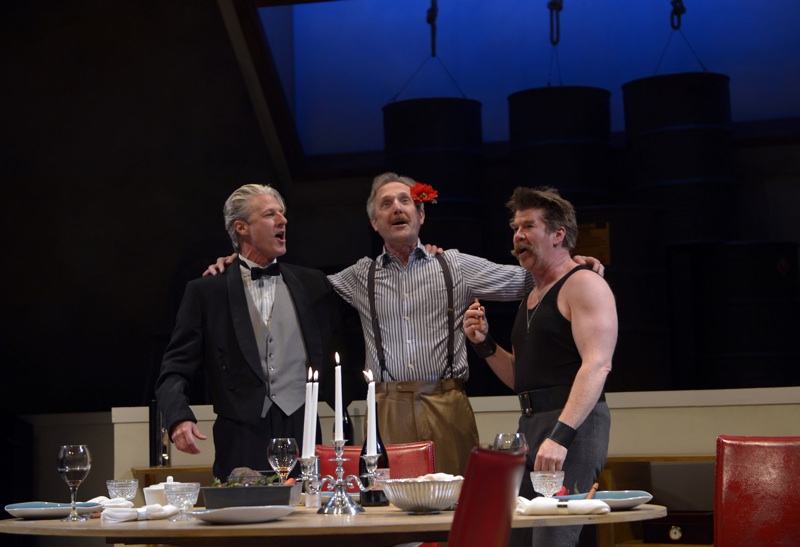
“It’s hard just lighting a cigar,” observes Biedermann (Dan Hiatt) plaintively at the top of the show, as a trio of uninvited firefighters (Kevin Clarke, Tristan Cunningham, Micheal Uy Kelly) menaces him into putting said cigar and lighter away, before introducing themselves as the “guardians of the city,” and its unacknowledged conscience.
The brilliance of Biedermann, whose very name can be alternately defined as “upright,” “honest,” or “conservative,” is how well his character skewers expectations of his supposed role as the play’s protagonist, even when it becomes clear that he is also its biggest dupe. His classist hypocrisies and dogged belief in keeping up appearances paves the road to his undoing, as surely as if he had set a noose around his own neck. Flanked by his appropriately haughty Hausfrau, Babette (Gwen Leob) and his harried serving-girl, Anna (Dina Percia), and bolstered by his inflated sense of personal worth, even as he is gradually revealed to be an amoral bounder, Biedermann manages to encompass the most troubling elements of both the belligerent right and the ineffectual left, defending, above all else, his right to “not think anything at all,” under his own roof.
By far the most fun characters to watch on the stage are the titular Arsonists, played respectively by Michael Ray Wisely and Tim Kniffin. Wisely’s Schmitz, the very picture of a gone-to-seed wrestler with his softening bulk encased in an immodest tank top and a spiky Sonic-the-Hedgehog hairdo, appeals to Biedermann’s vanity by praising his humanity and acting the role of a borderline mentally-incapacitated buffoon, even as he deftly manipulates the hassled homeowner into letting him stay in the drafty attic—and fills it with drums of gasoline. Meanwhile Kniffin’s Eisenring at turns obsequious and shrewdly blunt, subtly flatters Biedermann by pretending more than a passing familiarity with Beidermann’s social ranking, even as he gleefully maneuvers him into physically assisting in his own destruction.
The insistent rumble of Matt Stines’ sound design at times overwhelms the fragile human element onstage, but the action is well-served by the incomparable Nina Ball’s graciously appointed set, and Mia Baxter’s perfectly-detailed props. And while the humor in the script does provoke its share of laughter, much of it is the kind of horrified laughter emitted by an oddience that reluctantly recognizes its own complicity in its perhaps inevitable downfall. But there is hope too, lodged within this “moral play without a moral,” as right from the beginning the firefighters remark that “not every fire is determined by fate,” meaning preventable, so long as inaction and passivity do not carry the day. Think on it. And see the play.
Hippocrates said, “let food be thy medicine and medicine be thy food”. The axiom certainly sounds nice rolling off the tongue, but curative qualities aside, you’ll never stick to healthy if it doesn’t taste good. Luckily here in the Bay Area we have Carley Hauck of Intuitive Wellness, who proves in her “Mindful Eating and Cooking” series at community food hub 18 Reasons that comestibles can indeed be medicinal, and that medicine can taste amazing.
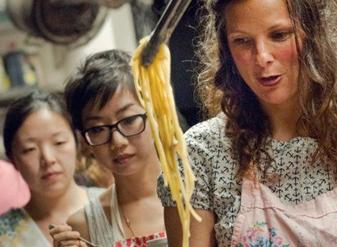
Health nuts and epicureans alike can revel in Hauck’s multi-layered, multi-course classes, in which students learn a comprehensive approach to mindful eating and cooking. This means all hands on deck — as well as all eyes, noses, mouths and minds — everyone in Hauck’s seminars are required to take a participatory role in this adventure for the taste buds.
“In graduate school, I was teaching a weight-loss class and realized there was something missing,” Hauck told the Guardian in an email interview. When not teaching at 18 Reasons, she’s the president of Intuitive Wellness, where she works as a integrative life coach and wellness consultant in San Francisco and Berkeley.
“I added the mindfulness component and saw that it really was the missing link,” she continued. “It’s not so much about looking outside of ourselves — adding up calories and exercising — but really about tuning in and understanding physical hunger but also emotional hunger.” Hauck is part of a research group at UCSF’s Osher Center for Integrative Medicine that is pioneering research, and looking at the long-term benefits of mindful eating in relation to stress reduction and weight loss. She also works with with corporate organizations like Pixar and LinkedIn, teaching mindfulness classes to corporate eaters.
“That’s the type of work that I do,” she wrote. “But the piece of work that I love is teaching classes which integrate these same practices into the broader community.”
You don’t have to be a downward-dog yogi to approach the dinner table with a sense of mindfulness. In the most pragmatic sense, Hauck defines mindful eating as the simple process of slowing the mind to pause the mouth from our oft-unconscious snack-shoveling. It’s about bringing intention to the processes of cooking and consuming, cultivating an appreciation for each ingredient’s unique feel, flavor, and smell. From morsel to mouthful, being mindful is about slowing down and savoring, rather than inhaling.
The first class in Hauck’s 18 Reasons series was held on April 2, but if you missed it not to worry. There are two more on the way, and according to Hauck, each session “is created to be a stand-alone class which builds on techniques in mindfulness.”
Session two, “Food as Medicine”, takes place on Saturday, and is focused on the healing properties of super foods. The antioxidant-charged menu, which Hauk was putting together right before our phone conversation, is geared to re-invigorate the body and stimulate the mind.
The goal is to “create really healing food varieties and also bring an intention into the process of cooking.” said Hauck. “It’s very experiential. We’re doing guided meditations, having great discussion, and we’re saying ‘Hey! Pick your knives and chop!’”
Hauk’s series opener “Intro to India” turned up the heat, focusing on Southern Indian cuisine while tackling the kitchen-borne insecurities of the average chef. “I hear from people that they are very intimidated by cooking” said Hauk, a fact she intends to put on ice. “This is a cooking class where we’re really teaching them about mindful eating and mindful cooking, but were also teaching them to be good cooks. I want to get people comfortable with something that they may think is hard.”
This love has brought her into the community at 18 Reasons and in a sense, full circle. Her lifework is not only corporate, but it is also deeply rooted in community. The common thread here of course is food — mindfully approaching food as a medicine and taking pleasure in all its gastronomical variations — and you shouldn’t need more than 18 reasons to eat amazing food that is good for the body, mind and soul.
The Mindful Eating Cooking Series: Food as Medicine
Ever since the horrible, awful bombing at the Boston Marathon, I’ve been doing what every crazy newshound does and spending far too much time on the Internet trying to get the latest scrap of information. This morning, none of us could drag ourselves away from the developing story.
And I have to say: There are thousands of web sites covering this, mostly be aggregating other people’s content. But the real work of finding and reporting news has been done by the old-fashioned traditional mainstream media that we all so freely dismiss as dinosaurs. The New York Times and The Boston Globe have done an exceptional job, as has the Associated Press. That’s in large part because they still employ significant numbers of staff reporters, with the experience and contacts to accurately cover this kind of story.
The MSM screws up a lot, and allows politicians to avoid accountability, and has all sorts of biases. But nobody else has the ability to cover a tragedy and disaster like this.
Of course, not all is perfect. The New York Daily News and CNN have screwed up badly. The rightwingosphere is so obsessed with Muslim Terrorists that it’s seeing them everywhere, creating them out of paranoid visions if necessary.
But if there weren’t newspapers and broadcast outlets with old-fashioned reporting staff, we’d be far less informed and more reliant on official law-enforcement sources. The old business model is falling apart, but there’s still a need for actual news outlets.
And for my money, the absolute best source of accurate, fair, complete, and insightful coverage has been that very, very old medium — raido — and that old goverment-funded institution, NPR.
Something to think about when a real major news event happens.
This week’s Super Ego clubs column is full of signs and wonders for the coming weekend, but here’s a further quintet of banging joints to top you off just right, Your soundtrack is “Triscuits,” because that’s my theme song right now. (Oh, and just a reminder — that rained-out, positively drenched Hunky Jesus contest has been rescheduled for tonight, too!)
The massive Texan technician, now hailing from Berlin like everybody else pretty much, hits us with a stop on his short, sharp tour. Really good, often wiggy but groovy stuff.
Fri/19, 9:30pm-3am, $10-$15. Monarch, 101 Sixth St., SF. www.monarchsf.com
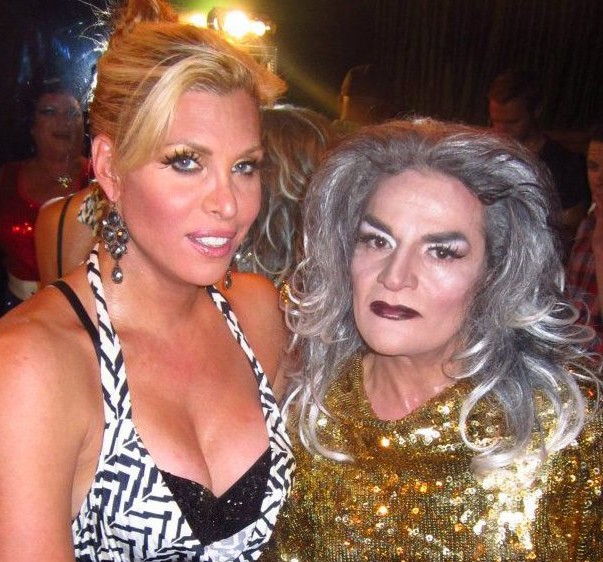
The knockout transgender club legend comes to our favorite kooky-artsy drag weekly Some Thing — it’s gonna be a mix of something wonderful and strange, methinks.
Two of our best DJ crews, No Way Back and Honey Soundsystem, continue their fruitful collaboration, and give kids some space to just dance to killer house and techno.
I’m throwing a little bit of underground in here, as the longtime German duo, which has gotten a lot more sophisticated lately, takes to the waterfront somewhere.
One listen to the masterpiece vinyl mix below by Jayvi Velasco from a previous Throwback party, which pumps up the old-school ’90s house jams, will let you know why I’ll be living on the dancefloor for this. Harlum Muziq label heroes David Harness and Chris Lum will preside. With Julius Papp, Galen, and — yes! — Jayvi Velasco. High kicks.
As someone who was practically bottle-fed on the old Exploratorium space, I was hesitant approaching the science museum’s opening day at its new home on Pier 15 and 17. Like many other SF natives, I was attached to the old world charm and neo-classical elegance of the Palace of Fine Arts location, opened in 1969 by physics professor Frank Oppenheimer.
But consider me a convert. Where the Palace of Fine Arts’ physical layout seemed to dictate the content of the old museum, the new building, extensively rehabbed to house the famously hands-on exhibits, allows them to exist more organically. The new site now houses the largest pod of solar panels in the city, holds a magnificently vista-ed observatory, and harnesses as a heating source the Bay waters it sits above on 1800 wood and concrete pilings built around a century ago.
Paul Doherty the self-proclaimed “physicist, teacher, author, and rock climber,” has worked at the Exploratorium for 26 years, making the senior staff scientist the perfect person to lead me on a tour through the two-story space yesterday.
“We wanted it to be open, so a flood (of people) could come in, but then,” Doherty says pointing towards the Atrium, the first space visible to museum visitors. For long-time Exploratorium fans, the result is a comforting mix of the familiar and new, and as Doherty tells me for new visitors, it’s meant to be a good intro to what lies beyond. “This space here features classic Exploratorium exhibits that will show people who aren’t necessarily San Francisco natives the kinds of things that they will be experience while they’re here,” he tells me. “We wanted to showcase the best of the best.”
The atrium houses well-loved classic exhibits like “The Turn Table”, originally a physics Ph.D. thesis intended to show how a ball rolls across a spinning metal disc. When the ball crosses the “turntable”, it takes a chaotic, almost torturous path before it unexpectedly exits the table parallel to the point at which it entered.
Doherty said museum attendees, not staff, were the first to wheel coin across its surface. He picks up one of the plastic discs now part of “Turn Table” and wheels it across the moving table. “As you can see, the visitors taught us what this exhibit was really about. We watch our visitors, and we learn from them.”
Traversing the museum floor, we pick up new listeners gravitating towards Doherty’s excitement, almost as tactile at the Exploratorium’s most famous “Tactile Dome” (which will be up and running by Summer 2013). It’s enough to make you a little envious that your own workspace doesn’t inspire raptures like those of Doherty in his new digs.
For another atrium exhibit entitled “Moving Objects” (2012), by Exploratorium artist in residence Pe Lang, suspends rubber rings on vibrating rods, giving the illusion that the rings are passing through each other. “Drip Patterns” is a staff-made offering which illuminates the oozing drip of mineral oil. The effect is surprisingly artsy, and demonstrates the existence of caustics, which in differential geometry are “envelopes of rays either reflected or refracted by a manifold.” True to the spirit of the Exploratorium, no PhD is necessary to enjoy the installations — even to the uninformed onlooker, “Drip Patterns” looks cool, dispelling the idea of science-art dichotomy,
The new space’s innovations are enough to make me wish little Jessica could have seen the space. All the old favorites are present: the giant bubble-maker, live tornado capsule, artist in residence Ed Tannenbaum’s “Recollections” (1981), which freezes your image via a large scale projector in oh-so-’80s-music-video manner. These exhibits — all made in-house, as Doherty reminds me — trick you into learning, entice you into participating, and invite you to interact. I’m not eight anymore (dammit) but they made me feel like a kid again.
According to my guide, over the years, Exploratorium staff has made 2,000 exhibits. 600 are in the new space, 450 classics carried over from the Palace of Fine Arts, refurbished. 150 are brand new.
If you’re going to brave the crowds this weekend — or tonight’s continued opening ceremony celebrations — be sure to bring comfortable shoes and an open mind. If you can catch Doherty passionately explaining the mysterious behaviour of dry ice on water or the density of mineral oil suspended in light, all the better.
Hollywood is clearly bowing down to the power of Tom Cruise this week, opening no other contenders (sorry, Rob Zombie, The Lords of Salem doesn’t count) to compete with what’s sure to be an Oblivion-ated weekend box office. (And to be honest, the movie’s big and dumb, but actually pretty entertaining. My review after the jump.)
Elsewhere, the must-see movie-obsessive doc Room 237 opens at the Roxie (check out my interview with director Rodney Ascher here; he’ll be at the Roxie in person this weekend), and Dennis Harvey takes on a pair of imports that actually do fairy-tale adaptations proud: Blancanieves and Let My People Go! Also worth checking out is the latest from Ken Loach, a comedy about crime and whiskey … what’s not to love? My review follows.
The Angels’ Share The latest from British filmmaker Ken Loach (2006’s The Wind that Shakes the Barley) and frequent screenwriter collaborator Paul Leverty contains a fair amount of humor — though it’s still got plenty of their trademark grit and realism. Offered “one last opportunity” by both a legal system he’s frequently disregarded and his exasperated and heavily pregnant girlfriend, ne’er-do-well Glaswegian Robbie (Paul Brannigan) resolves to straighten out his life. But his troubled past proves a formidable roadblock to a brighter future — until he visits a whiskey distillery with the other misfits he’s been performing his court-ordered community service with, and the group hatches an elaborate heist that could bring hope for Robbie and his growing family … if his gang of “scruffs” can pull it off. Granted, there are some familiar elements here, but this 2012 Cannes jury prize winner (the fest’s de facto third-place award) is more enjoyable than predictable — thanks to some whiskey-tasting nerd-out scenes, likable performances by its cast of mostly newcomers, and lines like “Nobody ever bothers anybody wearing a kilt!” (not necessarily true, as it turns out). Thankfully, English subtitles help with the thick Scottish accents. (1:41) (Cheryl Eddy)
Oblivion Spoiler alert: the great alien invasion of 2017 does absolutely zilch to eliminate, or at least ameliorate, the problem of sci-fi movie plot holes. However, puny humans willing to shut down the logic-demanding portions of their brains just might enjoy Oblivion, which is set 60 years after that fateful date and imagines that Earth has been rendered uninhabitable by said invasion. Tom Cruise plays Jack, a repairman who zips down from his sterile housing pod (shared with comely companion Andrea Riseborough) to keep a fleet of drones — dispatched to guard the planet’s remaining resources from alien squatters — in working order. But Something is Not Quite Right; Jack’s been having nostalgia-drenched memories of a bustling, pre-war New York City, and the déjà vu gets worse when a beautiful astronaut (Olga Kurylenko) literally crash-lands into his life. After an inaugural gig helming 2010’s stinky Tron: Legacy, director Joseph Kosinski shows promise, if not perfection, bringing his original tale to the screen. (He does, however, borrow heavily from 1968’s 2001: A Space Odyssey, 1996’s Independence Day, and 2008’s Wall-E, among others.) Still, Oblivion boasts sleek production design, a certain creative flair, and some surprisingly effective plot twists — though also, alas, an overlong running time. (2:05) (Cheryl Eddy)
At their show at Elbo Room on Friday, Young Prisms are going to play new material that they’ve never performed in front of an audience.
“It should be interesting,” bassist and singer Gio Betteo told me last week at Mission Pie.
Vocalist Stefanie Hodapp added with a laugh, “Especially for us.”
That sort of relaxed good humor seems to define their whole attitude toward making music (past characterizations have used the word “slacker,” which doesn’t quite fit). The band, currently comprised of four members, including Jordan Silbert on drums and Matt Allen on guitar, produced albums in 2011 and ’12, and now wants to take its time creating a third.
http://www.youtube.com/watch?v=hxvZ65K2IA4
Young Prisms have been experimenting with a new process that removes the pressure and constraints of their past songwriting. Now, they create when something comes to them. Betteo has been the primary writer of new material recently but only because he has been feeling inspired to write.
The result, they say, sounds more like genuine emotion and less like grasping at genre such as psychedelic rock or dream pop.
Not that they attempted to fit into any specific category in the past. When asked about the many comparisons that have been drawn between the band and noisy shoegazers such as My Bloody Valentine or the fuzzier Mazzy Star, Betteo and Hodapp looked at each other warily.
“I’m not dumb. I definitely hear it,” said Betteo. ”Whether it’s bands like No Joy and Weekend, that are currently doing it, or bands like Chapter House and My Bloody Valentine and stuff from 20 years ago, we like those sounds. It plays its own role in our writing and ideas, but never intentionally.”
Once, a fan came up to them after a show and praised the song that sounded like the Cure. Though they didn’t know which the fan meant (and suspected the fan didn’t know which he meant), the comparison was apt; they had spent the entire tour before they wrote the second album listening to the Cure. Though they don’t strive to mimic the band, they admit that they are drawn to certain musical ideas.
Over their years of playing together, these musical ideas have shifted. In the writing of their first album, Friends For Now, they didn’t care about creating relatable songs. “We just wanted to make fucked up sounds,” Betteo said. “I wanted this guitar to sound like a fucking car accident, and this drum beat to sound like a headache, a pulsing headache.”
In Between, the second album, represented a few steps toward developed structure and audience accessibility. They wanted to allow people to “find the song in it.”
Their new material, they say, will be a few steps further in that direction.
But they don’t want to lose their experimentally hazy sound, their relaxed outlook, or the sense that they’re in this to have fun. That seems unlikely.
With three out of four members of the band living together (they assured me that their home lives are too boring to merit a sitcom or reality TV show), one can imagine either the chemistry or the easygoingness required to sustain the bandmate-roommate relationship. Whatever the formula, it seems to have worked in the past and will seemingly continue to work as Young Prisms release their next album, maybe in early 2014.
Until that time, they have a new video for their song, “Runner,” a side project called Breathr that’s going to come out in the next couple of months on the label Dream, and shows around the Bay Area.
Young Prisms With SISU, Chasms Fri/19, 9:30pm, $12 Elbo Room 647 Valencia, SF (415) 552-7788 www.elbo.com
Olga Miranda, secretary treasurer of the San Francisco Labor Council and president of SEIU Local 87, did not mince words when sharing her initial reaction to the proposed federal immigration reform bill, which was unveiled April 16 by a bipartisan group of senators.
“If it was myself and our members at the bargaining table, we would walk away,” Miranda said. “This proposal is nothing more than an offense to the community.”
Miranda was speaking at an April 17 press conference held by the San Francisco Bay Coalition for Immigrant Justice, staged at the Asian Law Caucus’ San Francisco headquarters. While many speakers said they welcomed the immigration reform bill as an important “starting point,” all were clear that they saw serious flaws in the proposal and planned to spend the next several months pushing for improvements.
“We applaud the inclusion of a path to citizenship in the bipartisan legislation for millions of undocumented people currently living as second class citizens,” said Francisco Ugarte, senior immigration attorney at Dolores Street Community Services. “However, there are problems with the bill, which creates long waiting periods to adjust, excessive fines and unclear language and employment requirements.”
In a statement, coalition members described the bill’s proposed path to citizenship as “long and onerous” due to provisions such as a decade-long wait for a green card, and ineligibility for any undocumented immigrants who arrived in the U.S. after 2011.
Concerns were raised that families would continue to be separated, a frequent consequence of deportation. “The bill, as it is, does not put an end to the deportations,” said Cinthya Muñoz of Causa Justa / Just Cause. “In California, close to 94,000 people were deported” last year, she added. “As Californians, our representatives need to stand strong to call for an end to deportations before negotiations continue.”
Miranda was critical of a proposal to require the use of the federal E-Verify system. “Forcing employers to check all workers’ immigration status against flawed databases like E-Verify reduces the power of all workers,” she said. “And it would threaten the jobs and privacy of many citizens and work-authorized immigrants.”
Anoop Prasad of the Asian Law Caucus criticized proposed changes to the existing process for legal, family-based immigration, saying the elimination of visas for entire groups of family members would particularly impact Asian communities, such as those residing in San Francisco’s Chinatown. The overwhelming majority of Chinatown residents came to the U.S. as sons and daughters or siblings of employment-based immigrants, he explained, but under the proposed rules, meeting the qualifications for a visa would be more difficult due to a the elimination of certain family immigration categories.
Instead of placing emphasis on the presence of a family member in the U.S., a proposed “merit based” visa would be scored on factors like higher education, English proficiency, and employment, Prasad added. But activists also raised concerns that requirements for English language proficiency would inevitably exclude many monolingual immigrants.
Amos Lim, representing Out 4 Immigration, said LGBT couples would face particular challenges too, because no specific language was included to allow same-sex partners the same immigration privileges as heterosexual married couples. “Immigration law in this country has always been about excluding people,” Lim told the Guardian. “We need to make sure that we are included.”
The coalition is planning a May 1 march and rally in San Francisco to call for improvements to the immigration reform bill. It will begin at 24th and Mission at 3pm and proceed to Civic Center for a 5pm rally.
Norman Solomon is co-founder of RootsAction.org and founding director of the Institute for Public Accuracy. His books include “War Made Easy: How Presidents and Pundits Keep Spinning Us to Death.” He writes the Political Culture 2013 column.
After the bombings that killed and maimed so horribly at the Boston Marathon, our country’s politics and mass media are awash in heartfelt compassion — and reflexive “doublethink,” which George Orwell described as willingness “to forget any fact that has become inconvenient.”
In sync with media outlets across the country, the New York Times put a chilling headline on Wednesday’s front page: “Boston Bombs Were Loaded to Maim, Officials Say.” The story reported that nails and ball bearings were stuffed into pressure cookers, “rigged to shoot sharp bits of shrapnel into anyone within reach of their blast.”
Much less crude and weighing in at 1,000 pounds, CBU-87/B warheads were in the category of “combined effects munitions” when put to use 14 years ago by a bomber named Uncle Sam. The U.S. media coverage was brief and fleeting.
One Friday, at noontime, U.S.-led NATO forces dropped cluster bombs on the city of Nis, in the vicinity of a vegetable market. “The bombs struck next to the hospital complex and near the market, bringing death and destruction, peppering the streets of Serbia’s third-largest city with shrapnel,” a dispatch in the San Francisco Chronicle reported on May 8, 1999.
And: “In a street leading from the market, dismembered bodies were strewn among carrots and other vegetables in pools of blood. A dead woman, her body covered with a sheet, was still clutching a shopping bag filled with carrots.”
Pointing out that cluster bombs “explode in the air and hurl shards of shrapnel over a wide radius,” BBC correspondent John Simpson wrote in the Sunday Telegraph: “Used against human beings, cluster bombs are some of the most savage weapons of modern warfare.”
Savage did not preclude usage. As a matter of fact, to Commander in Chief Bill Clinton and the prevailing military minds in Washington, savage was bound up in the positive attributes of cluster bombs. Each one could send up to 60,000 pieces of jagged steel shrapnel into what the weapon’s maker described as “soft targets.”
An unusually diligent reporter, Paul Watson of the Los Angeles Times, reported from Pristina, Yugoslavia: “During five weeks of airstrikes, witnesses here say, NATO warplanes have dropped cluster bombs that scatter smaller munitions over wide areas. In military jargon, the smaller munitions are bomblets. Dr. Rade Grbic, a surgeon and director of Pristina’s main hospital, sees proof every day that the almost benign term bomblet masks a tragic impact. Grbic, who saved the lives of two ethnic Albanian boys wounded while other boys played with a cluster bomb found Saturday, said he had never done so many amputations.”
The LA Times article quoted Dr. Grbic: “I have been an orthopedist for 15 years now, working in a crisis region where we often have injuries, but neither I nor my colleagues have ever seen such horrific wounds as those caused by cluster bombs.” He added: “They are wounds that lead to disabilities to a great extent. The limbs are so crushed that the only remaining option is amputation. It’s awful, awful.”
The newspaper account went on: “Pristina’s hospital alone has treated 300 to 400 people wounded by cluster bombs since NATO’s air war began March 24, Grbic said. Roughly half of those victims were civilians, he said. Because that number doesn’t include those killed by cluster bombs and doesn’t account for those wounded in other regions of Yugoslavia, the casualty toll probably is much higher, he said. ‘Most people are victims of the time-activated cluster bombs that explode some time after they fall,’ he said.”
Later, during invasions and initial periods of occupation, the U.S. military dropped cluster bombs in Afghanistan and fired cluster munitions in Iraq.
Today, the U.S. State Department remains opposed to outlawing those weapons, declaring on its official website: “Cluster munitions have demonstrated military utility. Their elimination from U.S. stockpiles would put the lives of its soldiers and those of its coalition partners at risk.”
The State Department position statement adds: “Moreover, cluster munitions can often result in much less collateral damage than unitary weapons, such as a larger bomb or larger artillery shell would cause, if used for the same mission.” Perhaps the bomber(s) who stuffed nails and ball bearings into pressure cookers for use in Boston had a similarly twisted rationale.
But don’t expect explorations of such matters from the USA’s daily papers or commercial networks — or from the likes of NPR’s “Morning Edition” and “All Things Considered,” or the PBS “NewsHour.” When the subject is killing and maiming, such news outlets take as a given the presumptive moral high ground of the U.S. government.
In his novel 1984, Orwell wrote about the conditioned reflex of “stopping short, as though by instinct, at the threshold of any dangerous thought . . . and of being bored or repelled by any train of thought which is capable of leading in a heretical direction.”
The doublethink — continually reinforced by mass media — remains within an irony-free zone that would amount to mere self-satire if not so damaging to intellectual and moral coherence
Every news report about the children killed and injured at the finish line in Boston, every account of the horrific loss of limbs, makes me think of a little girl named Guljumma. She was seven years old when I met her at an Afghan refugee camp one day in the summer of 2009
At the time, I wrote: “Guljumma talked about what happened one morning last year when she was sleeping at home in southern Afghanistan’s Helmand Valley. At about 5 a.m., bombs exploded. Some people in her family died. She lost an arm.
In the refugee camp on the outskirts of Kabul, where several hundred families were living in squalid conditions, the U.S. government was providing no help. The last time Guljumma and her father had meaningful contact with the U.S. government was when it bombed them.
War thrives on abstractions, but Guljumma was no abstraction. She was no more or less of an abstraction than the children whose lives have been forever wrecked by the bombing at the Boston finish line.
But the same U.S. news media that are conveying the preciousness of children so terribly harmed in Boston are scarcely interested in children like Guljumma.
I thought of her again when seeing news reports and a chilling photo on April 7, soon after 11 children in eastern Afghanistan were even more unlucky than she was. Those children died from a U.S./NATO air strike. For mainline American journalists, it wasn’t much of a story; for American officials, it was no big deal.
“Circus dogs jump when the trainer cracks his whip,” Orwell observed, “but the really well-trained dog is the one that turns his somersault when there is no whip.”
Norman Solomon is co-founder of RootsAction.org and founding director of the Institute for Public Accuracy. His books include “War Made Easy: How Presidents and Pundits Keep Spinning Us to Death.” He writes the Political Culture 2013 column.
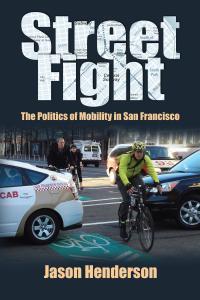
Ideology plays a bigger role in shaping San Francisco than most people realize, as we’ve discussed in this space before. Nowhere is that more true than in the politics of land use and transportation, as my friend Jason Henderson, a San Francisco State University geography professor, discusses in his insightful new book, Street Fight: The Politics of Mobility in San Francisco.
He’ll be discussing his work this Friday, April 19, from 7-9pm during a book launch party hosted by Green Arcade Bookstore across the street at the upstairs loft space of McRoskey Mattress, 1687 Market. Or if you miss that but want to join the discussion, you can catch Henderson’s forum on May 15 at SFSU or what will surely be other local events on this pivotal topic.
Henderson chronicles the seminal events in San Francisco’s history with “automobility” and related transportation issues, from the freeway revolts of the late ’50s through 2000 to today’s continuing political struggles over parking, bicycles, livability, gentrification, and the form, function, and financing of Muni.
Yet the lens that Henderson brings to understanding all of these issues and struggles is ideology, which he breaks down into three major categories: progressive, neoliberal, and conservative. Whether we realize it or not, we can all be fairly easily placed in one of those three categories when it comes to how we think about automobility, or the primacy of cars in modern life.
“A progressive framework conceptualizes mobility as a systemic problem that requires deep social commitment and responsibility. How we get there matters. It posits that there can be too much mobility, as exemplified by high levels of [Vehicle Miles Traveled] in the United States, and that excessive mobility results in both environmental degradation and major social inequality at a local, state, and global scale. The main problem, obviously, is that automobility is part of a wider, systemic moral and social problem of over-consumption and disproportionate materialism,” Henderson writes, sounding themes that I echoed in this week’s cover story.
On the other end of the ideological spectrum are those with conservative views on mobility, who see driving as a basic right, which is the dominant mindset on the west side of supposedly liberal San Francisco. “Unlike progressives, conservatives do not think about responsibility as relating to broader systems such as the economic structure of society. Instead, they think in terms of direct causation and of each individual being responsible for the consequences of his or her actions. For example, poverty is a result of individual shortcomings caused by personal and moral characteristics, not of structural themes like socioeconomic forces beyond an individual’s control. Getting to work on time and providing one’s daily needs are not collective concerns but the responsibility of the individual,” he writes.
Of course, these conservatives still rely on government to build and maintain their transportation infrastructure, which they believe should be centered around cars. “Government should guarantee and accommodate automobility, not seek to discourage it or make it more expensive. Government-sponsored road building and other explicit policies that encourage motoring reflect an optimal use of government to stabilize conservative social relations centered on automobility,” Henderson write of the conservative mindset.
Between those two poles are the neoliberals, who have come to dominate City Hall, particularly in the last few years with the ascendancy of Mayor Ed Lee, Board President David Chiu, and Sup. Scott Wiener, who has taken the lead role on transportation issues. Neoliberals rely on market-based solutions to almost any problem, and they end up partnering with either conservatives or progressives in the politics of mobility depending on the issue.
“Neoliberals, consistent with the broader agenda of the privatization of space and market-based pricing of public access to space, envision a mobility system shaped by pricing and markets rather than by regulation and collective action. Unlike progressives, neoliberals feel the built environment must be allowed to develop with the efficacy of the market. Movement, paid for by the individual user, should be unrestrained. Yet such efficacy can include a commodification of nonmovement or slower movement or the package of quality-of-life goods surrounding the ‘walkability’ and ‘livability’ of the city, a package reserved for those who can afford to enter. To that end, neoliberal mobility includes the aggressive use of government to both enhance mobility and rein it in, but only inasmuch as government policy helps realize the goals of profit and facilitating economic growth and development,” Henderson writes.
It’s fascinating to explore how these three distinct mindsets have shaped San Francisco in recent decades, and how they interact today to create the city that we’ll be moving through in the future.
Nothing cheers up an old tax-and-spend liberal than word that two major new sources of state revenue — enough to begin closing the gap in education funding — are at least on the table in Sacramento.
And now there’s also a campaign gearing up to establish an oil severance tax — something that every other oil-producing state already has. As oil and gas companies try to create a new oil rush in California, fracking their way to billions, the public ought to get a little something. After all, the oil below the ground belongs, in a sense, to all of us, not just to the companies that can stick a pipe into it.
Not all of this is going to happen this year. Even with the overwhelming Democratic majorities in both houses, tax reform is tough; there are armies of lobbyists who will fight it all the way. And any ballot measure would need serious deep-pocket funding, since the California Chamber of Commerce, the real-estate industry and Big Oil would pour tens of millions in to defeating it.
Still: You have to start somewhere, and five years ago, none of this would have even been under discussion. So maybe there’s hope for California after all.
It’s kind of a surprise that the Chron actually likes the (possible) condo conversion deal. That paper typically opposes anything that is good for tenants and supports anything that the landlords like. But it’s annoying that the editorial writers made it sound as if Sups. Scott Wiener and Mark Farrell engineered this whole thing. You need to get beyond the silly paywall to read the full editorial, so I’ll reproduce the key part here:
This week a deal may be struck to end the stalemate. A plan by Supervisors Mark Farrell and Scott Wiener will give owners of tenancies in common the chance to convert under a one-time deal. The yearly lottery will be suspended, the apartment owners will pay from $4,000 to $20,000 each into a subsidized housing fund, and those in the conversion pipeline can go forward. It’s essentially a one-time offer with the lottery system swinging back in place in 10 years.
Actually, Farrell and Wiener weren’t the ones who came up with the proposal that might make this legislation possible. That work was done by tenant and housing advocates — Sarah Shortt of the Housing Rights Committee, Ted Gullkicksen of the Tenants Union, Peter Cohen from the Council of Community Housing Organizations, Gen Fujioka of CCDC — and Sups. Norman Yee, Jane Kim, and David Chiu. The landlord group Plan C didn’t make any effort to negotiate anything in good faith, so the tenant and housing people went and put this together on their own.
It was never included in the Wiener/Farrell bill; if anything, it was prepared as a hostile amendment. Realizing that, with Yee on the side of the tenants, there wouldn’t be six votes for their original plan, Wiener and Farrell had no choice but to accept the tenant alternative.
A lot of hard work, and a lot of give-and-take was involved — but the credit for that goes first and foremost to the activists who fought the original Wiener-Farrell proposal. Let’s be fair here.
There’s an idea in literary theory that co-opts the philosophical notion of the concrete universal. The value of a poem, character, or story, it says, can be determined by the particular balance of how general and specific an entity it represents.
The remarkable thing about the music on the three albums of Bat For Lashes, the moniker of British musician Natasha Khan, is its melding of opposites. The songs simultaneously exist in the realm of the ancient and the new, the weird and the ordinary, and the grand and the intimate. And the even more remarkable thing is that seeing it embodied on the Regency Ballroom stage in front of an audience didn’t compromise these effects; it heightened them.
Entering a smoky stage set with lanterns in a costume of a shiny red dress and matching cape, Khan began to sing the album opener, “Lilies,” in a quiet but reverberating voice. Live as in the album, it was hard to determine how much of the otherworldly quality of her singing was due to added effects, but her magnetism, a consequence of both the force of her voice and her presence on stage, deemed that question beside the point.
As the songs built, with drums, a cello, pulsating bass, and synthesizers entering to create a layers of ethereal noise, Bat For Lashes’ captivating movements and controlled singing provided a strong focal point for the sweeping sound.
She never lost her audience during the journey along a spectrum of styles. In upbeat tunes such as, “Oh Yeah,” in which a surprisingly clubby backbeat motivated hip-heavy movement both onstage and in the crowd, you could picture that with a different singer and less eerie synth sounds, the music could be straight pop.
As is, though, it wouldn’t be the soundtrack to a dance club, but an occult celebration. The performance, then, resembled theater, and a fourth wall existed between the audience and the remote but captivating spectacle on stage (which did not deter the audience’s dancing).
On other songs like the gentle ballad, “Laura,” which Khan dedicated to her father, the wall came down. You could hear each intake of breath in a deeply personal song accompanied only by a piano.
Most songs, though, occupied a space that combined the poles of theatrics and intimacy. “Siren Song,” which began with the singer accompanying herself on the piano and built to an explosive chorus, exemplified the extremes. In the quiet opening, she sang, “Are you my family? / Can I stay with you a while? / Can I stop off in your bed tonight? / I could make you smile.” The prosaic verse spoke from the vulnerability of a single human narrator.
The chorus, though, which started, “Till the siren come calling, calling,” and included lofty words such as “evil,” “wickedness,” and “sin,” expanded the scope of the song to the sphere of mythology. Like many of the others, this one spanned the realms of ancient legend and the ordinary everyday.
In the melding together of such different scales, Bat For Lashes put on a show that was simultaneously entertaining and haunting. In the seven years that Bat For Lashes has been making music, she has developed a richness in her performance that reads like a well-rounded text. In each line of the show, the universality of myth and feeling crystallized into the concrete form of the enchanting performer. That balance is no small achievement.
Michael Klein is an unlikely oil industry executive. He’s also an unlikely environmental activist. For many years, the affluent San Franciscan was a major donor and chair of the board of the Rainforest Action Network, an environmental organization famous for its aggressive agitation targeting timber giants, coal companies, air polluters, and the dirty energy financiers of Wall Street.
But he’s stepped down from that role, and has since helped form a company called Hydrozonix, which might be called a “green” fracking enterprise.
Hydrozonix provides water treatment systems for the oil and gas exploration industry, and seeks to eliminate the use of two particularly nasty fracking-fluid chemicals known as biocides and scale inhibitors. It also gives companies a way to treat and recycle wastewater fluid. The company just completed its first year of operations, Klein told us, with 12 systems reportedly up and running in Texas oil fields.
Does this mean a die-hard environmentalist has crossed over to the dark side? “It was never an easy decision,” Klein told us. “I never thought I would tell anybody that I’m in the oil business.”
He hasn’t exactly turned into a climate change denier.
“I believe we have to stop using carbon based fuels as soon as possible,” Klein says without hesitation, “and find the political will to put a price on carbon.” He also supports a temporary moratorium on fracking. But he claims he’s only trying to make fracking “dramatically safer” in the interim, because “until we stop subsidizing [fossil fuels], the alternatives are at a severe disadvantage.”
Since entering the biz, however, Klein’s no longer convinced by arguments made by proponents of a permanent ban on fracking in California, which revolve around health and safety concerns. “I’ve come to the conclusion that if best practices are used, it’s … considerably safer than deepwater drilling,” he told the Guardian. “I do believe it can be done without concerns about contaminating aquifers or poisoning everyone.”
For a more on fracking in California, pick up a copy of this week’s Green Issue or read it here.
So the Guv says he doesn’t think he’s going to be able to gut CEQA this year. I think he’s right: The party he supposedly leads (but doesn’t tend to follow him) won’t go for it, any more than the party Obama leads will got for cuts to Social Security.
It’s partly that both are hard-fought pieces of progressive history. The late 1960s and early 1970s were a good time for the environmental movement — Congress passed both the National Environmental Policy Act and the Endangered Species Act, and Nixon signed both. The California Legislature passed CEQA in 1970, and Gov. Reagan signed it. Back then, even Republicans thought it was a good thing to be on the side of protecting the planet.
But there’s more — and it’s interesting that the state Leg, typically not known as a bastion of progressive thought, is better on this issue than San Francisco, where some sort of changes to CEQA are almost inevitable.
Some background:
What NEPA and CEQA did, first and foremost, was eliminate the problem of “standing” that had plagued environmental lawyers for years. If I couldn’t prove that a horrible development project on the San Francisco waterfront would personally injure me (which would typically mean I had to own adjacent property), I had no right to go to court to oppose it. CEQA mandates a valid, complete environmental review of any major project, which gives anyone the right to sue; I may not be able to describe specific financial damages from a project, but as a citizen, I have a legal right to an adequate Environmental Impact Report.
Likewise, anyone can appeal a development in San Francisco to the Board of Supervisors on the grounds that the EIR was inadequate.
CEQA review slows down projects and costs money. If you “streamline” the process, you make life easier for developers. But there’s a hefty price to pay — because while Sup. Scott Wiener talks about homeowners fixing rotting handrails, very few CEQA suits or appeals are ever filed over that kind of thing. Yeah, there are exceptions; year, one lone bike-hater slowed down the city’s bicycle plan. Yeah, NIMBYs will sometimes slow down affordable housing projects.
But most major CEQA lawsuits and appeals are over big projects, ones that, in San Francisco, tend to slide through the official approval process no matter how horrible they are. Mayors of this city for most of the past half-century have liked developers; mayors appoint the majority of the Planning Commission, and they appoint commissioners who like developers. There’s big money in San Francisco real-estate development, and the savvy builders spread enough of it around that they typically get their way.
CEQA gives the rest of us a way to fight back. Most of the time, it doesn’t work: A CEQA appeal, for example, didn’t stop the atrocious 8 Washington project. CEQA hasn’t stopped developers from building about 50 million square feet of office space in the city since the 1970s. CEQA didn’t stop that hideous Rincon Hill tower. Oh, and it hasn’t stopped a single affordable housing project.
In a city where developers rule and bad decisions are made all the time, for all the wrong reasons, you have to look at tradeoffs. Is it worth accepting a delay in the bike plan and the Dolores Park plan because lone nuts are using CEQA — if that means we can force big commerical projects to mitigate some of the damage their doing? CEQA isn’t perfect, but “reforming” it to make appeals harder is, on balance, a bad idea.
Have at me, trolls. I am a backward-thinking luddite who hates success and never wants anything in the city to change. I am an old curmudgeon. I am whatever you come up with next.
Or maybe I’ve just lived here long enough to see that much of what passes for “progress” in this town does more damage than good.
Hey stoner stereotypes, see ya at Hippie Hill! I jk — you can do way better on International Stoner Day this year in the Bay. Instead of watching wobbly teenagers inhale from “joints” the size of their lacrosse stick in Golden Gate Park (also avoid Haight Street today like the plague), steer your buzzed bumblings towards these carefully curated events that are sure to be safe, amaaaazing spaces for mature marijuana users.
It’s a great day to hit up your fave dispensary, too — many are offering deals and free joints to patients [e.g., the Castro’s Apothecarium, where the Sisters of Perpetual Indulgence will be holding court all day.] Other year-round best bets for the blazed: the Audium, the brand-new Exploratorium, or your couch.
Goat Fest
Watching (over) you.
You are setting yourself up for glory if you manage to get out of bed, roll a joint, and bring it to the waterfront Saturday morning. Your fuzzy ramblings will bring you face-to-face with the Ferry Plaza Farmers Market’s homage to billygoats. Yuss, you can pet the goats — a petting stable will be set up by the Sur La Table entrance to the Ferry Building that has high nuzzle potential. Achadinha Cheese Company, Andante Dairy, and Yerba Santa Goat Cheese will be teaching about goat industries in the Center for Urban Education about Sustainable Agriculture (CUESA) classroom, and this: 10-11am, “goat gab” from experts about why they like working with billies. 11am and noon, there will be sustainable goat cooking demos by celeb chefs — a sure-fire buzzkill for softy vegetarians who just got done snuggling kids, you’ve been warned.
10am-1pm, free. Ferry Plaza Farmers Market, Embarcadero and Market, SF. www.cuesa.org
Yoga Flow studio opening
Care to commune with your breath in a one-time Masonic lodge? Lookatit:
The new yoga studio, Yoga Flow, opening up off of Ocean Avenue is unrolling the welcome mat for 4/20, and will offer three sessions of different levels of yoga classes for newbs. Have you ever done yoga stoned? It is not for everyone, but for those for whom it is for, it is for them. After the classes conclude, a person named DJ Solar will beat-track a refreshment-mingle session from 7:30-10pm. Like, meet your community man. Find the day’s class schedule on the Eventbrite page.
I don’t know, does social justice stimulate your stoned synapses? Dolores Park is going to be a big, sloppy mess, but it’ll be worth braving to check out all the community groups and amazing people who will be marching in the parade celebrating California’s preminent working class hero. Or conversely, post up closer to 24th Street so you can cruise the street fair celebrating the guy after the procession. Pro tip: swing by Galeria de la Raza and get an army jacket (pillowcase?) printed with a kid-designed image of Chavez for just a $5 donation.
Parade: 11am, free. Route goes from 19th St. and Guerrero to 24th St. and Mission, SF. Street fair: noon-5pm, free. 24th St. between Treat and Bryant, SF. www.cesarchavezday.org
Aryz: “Style is the Limit”
Whoa, dude. Aryz collaboration with Os Gemeos in Lodz, Poland (Aryz did the cig-craving skeleton lady)
Ignore the head-scratching rhetoric behind the title of this exhibition of Barcelona street artist Aryz‘s studio work (ditto the wha-huh? promotional video) and just space out on the work of one of the world’s most original modern-day muralists in a Lower Haight gallery. The world was introduced to Aryz by his album cover for Aesop Rock, and since then, we’ve gotten a chance to peep his work on mega-walls in both hemispheres (I got a chance to see him do the thing in person last fall in Puerto Rico.) Creepy + thought-provoking + epically precise lines = perfect fodder for marijuana-fueled musings. Should you need more to ponder: Aryz is originally from Palo Alto, weirrrrrd.
Open on Sat/20 noon-6pm, free. Opening reception Fri/19, 7pm, free. Fifty24SF gallery, 218 Fillmore, SF. www.fifty24sf.com
Mishap Psychic Fair
Nothing will make sense on 4/20 anyway, but surely the Mishap Psychic Fair is in the running for the least-sense-making honorific this Saturday. The (is it?) satirical set-up will feature tongue-in-cheek booths where you can align your crystals via rock opera, attune to your inner “sexy anger,” and temper it all with cocktails if you’re not too bleary-eyed from the traditional mode of celebration on this international holiday. Buy tix to the fair in advance and you’ll snag a complimentary photo of your aura, a so-called magic elixir, or henna tattoo. Heal thyself, hippie.
Meep! I’ll let film editor Cheryl Eddy explain this one:
And now for something completely magical: Peter S. Beagle, author of beloved 1968 fantasy novel The Last Unicorn (among dozens of other works), turns 74 today, and he’ll journey from his home in Oakland for a pair of birthday- and unicorn-themed San Francisco events. (Hooves up if you ever had a unicorn-themed birthday party! I know I did … maybe more than once.) First is a screening of the 1982 animated film adapted from the book, with voices by Mia Farrow, Jeff Bridges, and Alan Arkin; Beagle will be on hand to answer questions and sign books. Diehards can continue the festivities at the Cartoon Art Museum, which hosts a reading and further signings by the author, plus an auction of some mighty nifty original artwork to benefit the museum and Beagle’s imminent multi-city tour. Costumes are encouraged, obvi.
Screening, noon-3pm, $8.50. Castro Theatre, 429 Castro, SF; VIP reception, 6-8pm, $25. Cartoon Art Museum, 655 Mission, SF. www.cartoonart.org
Maria Minerva
A concert for which I will h/t to music writer Ryan Prendiville for explanating because terms like “hypnagogic pop” addle me (admittedly, not a hard thing to do):
Minerva was the Roman goddess of wisdom. That’s what I’ve found out on Wikipedia. What I’ve found out about Estonian lo-fi electronic chanteuse Maria Minerva is that she’s an art school graduate/critic/glossolalia expert/comedy student. But, all I really know is that her Bless EP on 100% Silk is excellent. “Soulsearchin’,” focuses on the anxiety of options, built around George Carlin’s “Modern Man,” but it’s the laid-back guitar, slightly off-kilter percussion, and circling vocals on “Symbol of My Pleasure” that stay with me.
With Butterclock (live), Marco De La Vega, and more. 9pm, $10 presale. Public Works, 161 Erie, SF. (415) 932-0955, www.publicsf.com, Facebook event
Dark Room
Whoa. The cwazy goth drag that will rule the night at the second installation of this creep show party will be fabulously morose end to a long day of baking in the sun. At 11:30pm the Secret Society of the Sonic Six takes the stage to teleport you to another realm. Featuring the dark and stormy sartorial skills of host Lady Bear and her minions: Phatima, Vain Hein, Mica Sigourney, and more.
9:30pm-2am, $5 before 10pm, $8 after. Cafe Du Nord, 2174 Market, SF. Facebook event
Snoop Lion
Well this is obviously the place to be if you have $75 to spend on becoming a total stoner stereotype. I am on the record as a fan of Snoop Doggy Dogg’s transformation into the reggae-fied, Bunny Wailer-approved, anti-gun Snoop Lion. Like the single says (music video below, featuring Snoop’s recording artist daughter Cori B. and, somehow, Drake): “I need to hear my thoughts/turn the music up LOUD.” Cop tix now because this is obvs the spot for any self-respecting pothead on this day of days. Cross your fingers Cori B. braves the clouds of smoke to attend!
Less buzz-harshing violence available in Snoop Lion’s other goddamn amazing video:
UPDATED Rival teams have formed in the last week to support and oppose the proposed Warriors Arena at Piers 30-32 as the California Legislature considers a new bill to approve the project, a new design is about to be released, and a trio of San Francisco agencies prepares to hold informational hearings.
Fresh off the collapse of two of the city’s biggest development deals, Mayor Ed Lee and his allies are pushing hard to lock in what he hopes will be his “legacy project.” A new group of local business leaders calling itself Warriors on the Waterfront held a rally on the steps of City Hall today, emphasizing the project’s job creation, community partnerships, and revitalization of a dilapidated stretch of waterfront.
That launch event followed last week’s creation of the San Francisco Waterfront Alliance, made up mostly of area residents and environmental organizations that oppose the project, including the Sierra Club and Save the Bay. The group today released a press release and artist’s rendering of how the 13-story arena and two condo towers may block views of the bay.
Last week, SFWA put out a press release criticizing Assembly Bill 1273 by Assembly member Phil Ting, claiming it would allow the project to avoid scrutiny by the Bay Conservation and Development Commission, which oversees and issues permits for waterfront projects. “One of the primary reasons we have regulatory agencies like the BCDC is so that local jurisdictions don’t run roughshod over the Bay and the waterfront,” group President Gayle Cahill said in the release. “The San Francisco Waterfront Alliance strongly believes that BCDC should retain its jurisdiction in this project to ensure independent oversight for the Bay and for all of us.”
Yet Ting and supporters of the project say the legislation doesn’t change BCDC’s oversight of the project, pointing to language that explicitly acknowledges the agency’s authority. While the legislation would remove the need for the three-member State Lands Commission to approve the project, proponents said approval by the full Legislature is a higher bar that ensures more public scrutiny and accountability.
“It does not waive BCDC. It goes through the same BCDC process,” Ting told us. “By going through the Legislature, you do have more hearings and public process. The idea was to make this more thoroughly vetted.”
The Port’s Brad Benson told us that State Lands staff is also still actively scrutinizing the project. “We’ve been working closely with State Land and BCDC staff to incorporate their concerns,” Benson said. For example, the arena configuration has already been moved closer to shore than originally proposed because of BCDC concerns about maritime access to a deep-water berth at the site.
In addition to approval by the Legislature and BCDC, the project must also be approved by the Port Commission and Board of Supervisors. The latest design for the project is scheduled to be released on May 6 and will be discussed by the Board of Supervisors Land Use and Economic Development Committee that day, said Gloria Chan of the Mayor’s Office of Economic and Workforce Development. The Planning Commission will then hold an informational hearing on the new design May 9, following by a May 14 hearing before the Port Commission.
The project is proposed to include a 17,500-seat arena that would host more than 200 Warriors games, concerts, and other events per year, starting in 2017, on 13 acres of rebuilt piers. The adjacent, 2.3-acre Seawall Lot 330 would include up to 130 new condos, a hotel of up to 250 rooms, and 34,000 square feet of restaurants and retail space.
The whole project would include just 830-930 parking spaces, making its still-unfolding transportation plan key to the project’s approval. Opponents of the project also criticize the project’s height and its financing package and say this intensive development isn’t consistent with city plans or state laws that protect waterfront lands for maritime and public uses.
“We told the mayor before it was even announced that it is not a legal use of the pier,” Save the Bay Executive Director David Lewis told the Guardian. “There’s no reason that an arena has to be out on the water on a crumbling pier.”
Yet proponents tout the project’s economic benefits to the city and the need for an arena that size to host concerts and conventions, beyond the prestige of luring the Warriors away from Oakland and back to its original home city. “It will be privately financed and turn a crumbling pier and unsafe parking lot into a state-of-the-art venue that generates new revenue for the region and provides a spectacular new facility for the Bay Area’s NBA team.”Jim Wunderman, CEO of the Bay Area Council and an honorary co-chair of Warriors on the Waterfront, said in the press release.
UPDATE: Rudy Nothenberg, who served five SF mayors financing big civic projects and helped found SF Waterfront Alliance, disputes several assertions made by project proponents. “The first version of [AB 1273] unquestionably moved BCDC out of the way,” he said, claiming that bill language was altered after input from BCDC and the consultant to the Assembly Natural Resources Committee. BCDC has not yet returned a call from the Guardian on the issue. Nothenberg also says AB 1273 turns the deliberate fact-finding process required for the State Lands Commission to make its public trust determination into a political process that is a less thorough vetting of the project.
He also took issue with the statements by Wunderman and others that this is a privately funded project, noting that taxpayers will be paying $120 million to rebuild these piers and will give up future property taxes on the site, which will be diverted by a special tax district to help repay the bonds. Nothenberg told us, “Their continued assertion that there is no public money involved in blatantly untrue.”
It’s hard to know what to say about the Boston Marathon bombings. Except that I don’t believe the guy on the roof did it, and I don’t believe the government did it to get its hand down our pants, and nobody has any idea if some organized domestic or foreign terrorist group was responsible or if it was a lone nut. Whoever it was, the person doesn’t seem to have been overly sophisticated in the making of explosive devices; this one was pretty crude. Or maybe the bombmaker knew exactly what he (could be she, but there aren’t many female mad bombers) was doing, and wanted to look like an amateur.
We do know this wasn’t a suicide bomber. The perp wanted to get away.
I suspect we will find him soon enough. There are so many agencies and people looking for the bomber; unless this was the work of someone who remotely triggered the bombs by cell phone from somewhere far, far away, there’s not going to be anywhere to hide. Also: So many cameras everywhere these days. The bomber — or the person who placed the bombs — is on film in downtown Boston. Almost certainly.
As we did after 9/11, we will probably over-react. New invasive rules on transport systems, more spying, more surveillance …. all things that wouldn’t have prevented a single angry bomber from carrying out the attacks. People who are opposed to gun control will say: See! Gun-control laws won’t stop pressure-cooker bombs!
There will be increased security at public sports events. I don’t know how they’re going to deal with Bay to Breakers, which not only winds through the city, past lots of places where bombs could be hidden, but also involves thousands of trash cans and porta-potties. You can’t get rid of those; the people who live along the course would be livid when their front yards and driveways became trash heaps and pissoirs. Searches will be more serious at AT&T park, which means lines will be longer. We can live with that.
If you want some perspective on what it feels like to be terrorized, check out my old friend Don Ray’s blog on “the sitting duck syndrome.” He notes:
The bombs that exploded at the finish line of the Boston Marathon have created the same response in people across the United States. The repeated blasts (repeated and repeated and repeated on television) have communicated with the primitive, “I have to survive” reptilian brains of millions of people. It has put them on notice that, “It could happen here. Today. Tomorrow. Even right now.” Welcome to the world of terrorism. It’s very effective. People in other parts of the world already know about this. So in the coming weeks and months, some of us will feel the need to carry weapons or to avoid crowds completely. Others of us will look at the violence that’s happening in distant parts of the world and maybe begin to become a little bit empathic. Maybe — just maybe — some of us will equate U.S. drones and missiles and bombs with the sitting duck, unexpected violence that is the intended byproduct of terrorists.
Not to get all foreign-policy preachy here, but that’s something to think about.
Macca, Hall and Oates, Red Hot Chili Peppers, Nine Inch Nails – what is this, 1976, or ’99? I kid; the Outside Lands 2013 lineup is again a meaty mix of nostalgic, revived, and shiny new acts. There’s the initial punch of a former Beatle slotted alongside NIN, RHCP, plus Jurassic 5, and Willie Nelson, then French synth-pop Phoenix, classic indie darlings Grizzly Bear, the National, Vampire Weekend, and up-and-comers King Tuff, Surfer Blood, the Growlers, along with inspired picks like D’Angelo and the Yeah Yeah Yeahs. Tickets are on sale Thu/18 here.
While the release of the lineup is exciting news, that fest isn’t ’till the end of foggy summer (Aug. 9-11); so focus on the sunny days ahead, the bands that are here now: a reunited King Khan and BBQ Show, the Bay Area debut of both Savages and Lady, plus Night Beats, the 2 Bears, and locals Life Coach and Dreamdate’s Anna Hillburg.
Also, a non sequitur reminder that Record Store Day is this Sat/20. Check a list of supporting shops here. And don’t forget to patronize your local brick and mortar vinyl vendors year-round.
Here are your must-see Bay Area concerts this week/end:
Night Beats “Seattle’s Night Beats has all of the fixings of a good psych-garage act; the lo-fi recordings, the raspy vocals with punctuated yelps, and the noisily manipulated guitar. But the band, which takes its name from Sam Cooke’s best record, has a direct link to the more soulful breeds of music the title suggests, such as R&B. “Dial 666” is simple, 12-bar blues, “High Noon Blues” borrows sentiment and structure from that genre, and “Puppet on a String” seems to call for some old-fashioned dance moves.” — Laura Kerry With Cool Ghouls, Primitive Hearts, Big Drag Wed/17, 9pm, $10 Brick and Mortar 1710 Mission, SF (415) 800-8782 www.brickandmortarmusic.com http://www.youtube.com/watch?v=545oNrQqgNY
The 2 Bears “I don’t need caffeine. My computer just starts playing “Work” by the 2 Bears at 7am, complete with rising organ, a pulsing groove, and motivational chorus: “We’ve got to work harder, for the future, my love we got to work.” It might not even be the best song on Be Strong from the 2 Bears (Hot Chips’s Joe Goddard and the Raf Daddy), as it faces stiff competition from hilarious, cuddly club anthem “Bear Hug” and the uplifting, romantic space dub on “Church.” But, it does the job of getting me moving, and by the time the disco queen vocals kick in I’m likely showered and downstairs having breakfast.” — Ryan Prendiville With Sleazemore, Richie Panic (Lights Down Low) Wed/17, 10pm, $15 presale 1015 Folsom, SF www.1015.com http://www.youtube.com/watch?v=NxI8QliBOKs
Savages When all-female British post-punk group Savages hit the East Coast last year for the annual CMJ conference, the word spread quickly to the West: this blistering quartet is one to watch. All these anxious months later, this headlining show will be Savages’ first SF appearance, on the heels of a “spine-tingling” Coachella appearance with “heavy vocals and a fast-paced set that had the crowd cheering in appreciation.” Thu/18, 8pm, $15 Independent 628 Divisadero, SF www.theindependentsf.com http://www.youtube.com/watch?v=6y-cVzbBBQ8
Anna Hillburg You may already know Anna Hillburg’s sonic touch, without knowing you know her. The Bay Area trumpet player has guested on Dodos and Fresh and Onlys records, and she’s one-third of power-pop girl group, Dreamdate. As she puts it, she’s hella local. Get to know her more intimately on her new self-titled solo album — released on vinyl, March 25 on California Clap. Left to her own devices, the songwriter and multi-instrumentalist hops genre barriers and eras over the course of 13 tracks, mixing classic ’60s pop with girl group harmonies, cry-ing-over-you ballads and dreamy whispers to forlorn lovers, with hat tips to fuzzy ’70s folk, Joni Mitchell, and the like. The only constant is Hillburg’s pleasant and confident crooning. Also, can we talk about this album cover? Perfection. With Luke Sweeney, Garrett Pierce. Thu/18, 9pm, $10 Eagle Tavern 398 12th St., SF Facebook: SFEagle
King Khan and BBQ Show And they said it wouldn’t happen. Remember all the way back in ’10, when sloppy doo-wop masters King Khan (Arish Khan) and BBQ Show (Mark Sultan) imploded over a series of on-stage arguments on an ill-fated tour? The Canadian garage punk duo has since mended,and has been patching things up with fresh songs and a few short tours. This is Khan and Sultan’s first time back in SF together since the break. With Sir Lord Von Raven, Wild Eyes SF. Fri/19, 9pm, $16 Slim’s 333 11th St., SF www.slimspresents.com http://www.youtube.com/watch?v=ellItasoK2s Life Coach Phil Manley was a founding member of influential DC post-rock trio Trans Am, and has played with the Fucking Champs and Oneida. He’s produced albums for Wooden Shjips, Grass Widow, Date Palms, and Golden Void. And most recently, he released a textured, guitar-heavy drone rock album called Alphawaves (April 16, Thrill Jockey) with his new band, Life Coach. The release show for which is tonight. Sat/20, 9:30pm, $8 Hemlock Tavern 1131 Polk, SF www.hemlocktavern.com http://vimeo.com/63207718
Lady Yet another SF debut tonight – this one from super-smooth vocalists Terri Walker and Nicole Wrap, a.k.a., the soul duo known as Lady. The London and Atlanta based singers have individually performed alongside the likes of Mos Def, Q-Tip, Missy Elliot, the Black Keys, and Kid Cudi. They paired up over a love vintage soul, recorded an album that’s also called Lady for Truth and Soul Records, and are currently on tour opening for funky R&B-blues headliners Lee Fields and the Expressions. Sun/21, 8pm, $25 Bimbo’s 1025 Columbus , SF www.bimbos365club.com http://www.youtube.com/watch?v=G3IMPYJ7MiY
All sorts of political campaigns and causes raise money by asking artists to donate work that can be auctioned off. It’s not often that the artists themselves get the benefits.
So Matt Gonzalez — former supervisor, longtime criminal defense lawyer, and big fan of local arts — is putting together a different type of fund-raiser. It’s an art auction — to benefit the artists.
“This is a kind of thank you to the artists who have donated works in the past,” Gonzalez told me. “All the sale proceeds, every cent, goes directly to the artists. “As a result most artists are starting the bidding on their pieces at 1/3 or 1/2 of the retail price (since there’s no gallery cut to worry about).”
Gonzalez, along with co-sponsors Peter Kirkeby and Aimee Friberg, have paid to rent out Incline Gallery. Beer and wine will be served, cheap. A long list of artists are participating: Adam Feibelman, Alicia Escott, Andrew Schoultz, Anthony Torres, Ben Venom, Bill McRight, Brian Lucas, Christa Assad, Claire Colette, Clare Judith, David Molesky, Ezra Eismont, Felix Macnee, Gianluca Franzese, Gina Borg, Guy Colwell, Harley Lafarrah Eaves, Hilary Pecis, Jean Oppermann, Jet Martinez, Jeff Petersen, Jenny Sharaf, Jonathan Steinberg, Kara Maria, Kathryn Kain, Kelly Ording, Kevin Taylor, Kim Frohsin, Kottie Paloma, Kristen van Diggelen, Kyle Ranson, Lauren Douglas, Lawrence Ferlinghetti, Mark Battinger, Mark Van Proyen, Megan Gorham, Megan Seiter, Michael Krause, Michael Rauner, Nellie King Solomon, Paz de la Calzada, Ryan Coffey, Ryan Shaffer, Tahiti Pehrson, Tom Schultz, and Yuri Psinakis.
It’s Friday, April 19, from 6pm – 9pm. Incline Gallery, 766 Valencia.
I got a fascinating letter from a person who’s worked in the tourism business in San Francisco for many years, and he’s very worried about the impact of the faux cabs on the city’s biggest industry. Here’s his note:
I’m a concerned representative of the tourism industry who read your article, “The cost of fake cabs,” with great alarm. In fact, I think you should have mentioned more on how it could affect tourism beyond that just “inexperienced drivers aren’t good for the city’s reputation.” I’ve been the Chief Concierge of a major Union Square-area hotel for the last 11 years, and if even half of what you say is true, then I fear there could be even greater damage than what your article portends.
According to the last statistic I read from the SFCVB, San Francisco welcomed 16.5 million visitors to the city in 2012, and although many of them may be “tech savvy,” they often do not bring their smart and cell phones with them because it cost to much to use outside their own countries. Therefore, they are just as dependent on our taxis as those seniors and disabled San Franciscans you wrote would be disenfranchised. if, as your article infers, companies like Lyft and Sidecar (Et Al) continue their dominating trajectory over our traditional taxi industry, I worry how the millions of visitors who come to the city will be affected.
Unlike the aforementioned vulnerable San Franciscans who at least are somewhat familiar with the city, many of these visitors often have never been here before, so they have no knowledge of alternative ways of getting around and know only a taxi as a means of transportation.
Again if, as your article infers, this trend means a “race to the bottom” of qualified drivers, I fear the detrimental affect would greatly damage our city’s number on industry – tourism. I know first had how sites like TripAdvisor can enhance or diminish a hotel’s reputation, imagine what would happen if that were expanded tenfold and millions of visitors who could have negative taxi experiences damage the image of the city on line. It’s not beyond the realm of reason to imagine if one of these under-regulated and under-taxed companies didn’t like tourist A or tourist B for some reason, and then disseminates that information to the other companies; essentially blackballing said tourist completely.
As much concern as I have for those of our most vulnerable citizens who are already suffering the deleterious effects as these companies proliferate, I fear that our city’s greatest industry would be harmed in ways not yet imagined. We really have no idea yet what the future is, and I fear those who can can do something about it are doubling down on an untested concept with possible disastrous effects.
Thank you for this opportunity to share my observations.
San Francisco Supervisors Norman Yee, Jane Kim and Board President David Chiu gathered with a cluster of tenant advocates at City Hall April 15 to unveil a proposal billed as a more equitable alternative to a highly controversial condominium conversion legislation that’s fueled a months-long battle over affordable housing.
Crafted with the input of tenant advocates, the new plan seeks to amend controversial legislation proposed earlier this year by Sups. Scott Wiener and Mark Farrell to allow a backlog of approximately 2,000 housing units to convert immediately from jointly held tenancies-in-common (TICs) to condos.
The proposal would effectively shut down the city’s condo conversion lottery for a minimum of 10 years, a measure aimed toward ending the cycle of real estate speculation that tenant advocates say has given rise to a spike in evictions in San Francisco’s supercharged housing market.
The proposal would still allow a current backlog of TICs to convert to condos without having to wait in a lottery system created to limit the number of units lost from the city’s rental housing stock. The board’s Land Use and Economic Development Committee, which is currently in session, will take up the legislation and proposed amendments later this afternoon.
The 10-year suspension on condo conversions would allow time for permanently affordable units to be built in place of the rental units that would be lost in the one-time conversion, proponents of the alternative legislation said. “If more affordable housing isn’t produced, then units don’t get to convert,” Housing Rights Committee executive director Sara Shortt told the Guardian.
Chiu stressed that the proposal was crafted to “ensure that as we expedite condo conversions … we protect tenants by suspending the lottery for at least 10 years.”
The 10-year minimum suspension is based on current regulations capping condo conversions at 200 per year. It would last a decade because an estimated 2,000 units would be converted, but could last longer than that.
“For example, if 2,200 units are converted,” Chiu explained, “the suspension would last for 11 years.”
Meanwhile, the proposal would require the conversions that would be intially allowed to be staggered over the course of three years.
The plan “puts the Board of Supervisors on record that we strongly believe in preserving our affordable housing stock,” said Sup. Yee, adding that the package of amendments seeks to “address the risk of speculation that will ensue with a large number of TICs being converted to condominiums.”
The Wiener-Farrell proposal spurred a months-long opposition campaign led by tenant advocates, who said it would permanently remove affordable rental units from the city’s housing stock and incentivize evictions of long-term tenants at a time when Ellis Act evictions are already on the rise.
“Condo conversions are the number one reason why people are being evicted from the city,” San Francisco Tenants Union executive director Ted Gullicksen said at the April 15 rally and press conference.
Wiener and Farrell’s proposal was presented as a way to remedy TIC owners’ complaints that onerous shared mortgages had left them financially strapped.
But Sup. David Campos, who also appeared at the rally, commented that the real challenge “is for the renters who are finding it very hard to live in San Francisco.”
Campos seemed dubious that a one-time condo conversion should be allowed to move forward at all. “If anything, I think we should be doing more to protect tenants,” he said. “My hope is … if it’s something we cannot live with as a community, we will make sure it dies,” he added, referring to the original condo conversion proposal.
In an earlier attempt to strike a compromise between TIC owners and tenant advocates, “negotiations broke down quickly,” Shortt said in an interview. At the rally, she said this alternative was “drafted in a way that’s not trying to meet any political agendas.”
For many elderly and low-income tenants who have few options if they are faced with eviction, “there is no price tag that you can put on their units,” said Matt McFarland, a staffattorneyat the Tenderloin Housing Clinic, who spoke at the rally. “Their most valuable possession is the long-term rent control on their property. For these tenants, it’s basically a death sentence when you get these eviction notices.”