It was more than three years ago when I first saw the Limousines on stage. I hadn’t heard a song of theirs and the half-filled Nob Hill Masonic Center was waiting for Weezer to step on stage and take them back in time on their “Memories” tour time machine. In the meantime, we were stuck in the present, listening to an unknown indie electronic duo that danced their asses off as they performed. As lead singer Eric Victorino sang about crusty socks and stacks of pizza boxes, I realized the Limousines had a knack for entertaining a crowd.
Flash forward to Thursday night [Feb. 27] at the DNA Lounge at this year’s Noise Pop festival. Two full-length albums later, including last year’s Hush, and the Limousines’ talent for energizing an audience had only gotten better.
Fronted by the aforementioned singer-songwriter Victorino and jack-of-all-trades instrumentalist and producer Giovanni Giusti, the band successfully weaved together a setlist featuring songs from their entire catalog, including their 2009 EP, Scrapbook.
The band kicked off the show with their 2010 viral hit “Internet Killed the Video Star,” as Victorino tossed a red beach ball into the crowd to keep everyone’s hands in the air. As the song ended and the ball made its way back to the stage, Victorino popped it with childlike amusement before rolling through more songs from their debut album, Get Sharp.
The Bay Area-based pair didn’t take much time to talk to the crowd, but the nearly nonstop-dancing audience didn’t seem to mind a bit. They just wanted more music. The Limousines delivered with the energetic Hush opening track “Love is A Dog From Hell.”
When Victorino did decide to banter with the crowd, he was humble, if not particularly articulate. “This band means an awful fucking lot to us,” he said. And it showed. The Limousines played their smooth blend of electro-pop and synth-rock for nearly 80 minutes, giving the crowd their money’s worth. The mostly twenty-somethings on the ground floor danced and clapped and made out with one another for nearly as long. The balcony was filled with a slightly older and less energetic crowd, but they looked like they were enjoying themselves as well.
As the show went on I realized something: the Limousines are far from unique musicians. Their lyrics pine over heartbreak and wild nights. But it they set themselves apart from other performers with their attitude. Victorino and Giusti (and a third touring member from Texas) clearly wanted to be there. Their energy didn’t let up as they neared the end of their set with a number of tracks from Hush, including “The Last Dance,” and “Bedbugs,” the latter of which dealt with the fallout of sleeping with a friend. “I could lie and tell you we could still be friends,” Victorino shouted, “but you know it ain’t true.”
Before finishing the evening off with “Very Busy People,” an anthem to masturbation and Donnie Darko, Victorino took a moment to look at the crowd and thank them for coming out on a Thursday night. “I’m too told for this shit,” he said. But that was a lie. He was still young enough to care and put forth an effort to entertain a paying audience. The Limousines may not be the next smash-hit electronic band, but they know how to liven up a room — and that still counts for a hell of a lot.
In a recent profile in the New York Times, Ben Schneider, who was Lord Huron until he gathered childhood friends to form a quintet, revealed that the inspiration for the band’s track listing — and really their existence — is the western novelist George Ranger Johnson. Johnson is the author of ten novels, including Ghost on the Shore, Time to Run, and an unfinished eleventh, Setting Sun.
The only catch is that, well, Johnson doesn’t exist. His books, though convincingly documented online, were never written.
Schneider admits to dreaming up the novelist as a way of establishing a mythology for his musical project. It’s a clever move, harkening back to the days when record companies would spring for elaborate record sleeves or CD inserts. It also brings to mind more conceptually minded bands like Pink Floyd — though the comparison between the two ends there.
While this cleverness is admirable and makes for a good story, it becomes meaningless if you put a bunch of people in a room to listen to a band that fails to live up to its premise. Image is important, but sound trumps all. Lord Huron is a solid combination of being both interesting and compelling musically.
With their jangly guitars and locomotive rhythm — their Noise Pop kick-off show [Wed/26] started off with the chugga-chugga of a train, before the band launched into “Ends of the Earth” — Lord Huron give the impression, despite their output being limited to just a couple of EPs and one full-length album, of having been around for ages. Maybe it’s the evocative romanticism of the lyrics: Schneider sings of wandering through lonely, remote places as if such hadn’t vanished decades ago; of disappearing women and melancholy vistas capable of inspiring poets. Or it could be the congruence between the band’s dusty, old West vibe and their timeless blazers. They seem like they’d be as at home in a saloon as they were at The Fillmore.
Yet no matter how they mythologize themselves, they’re not a country and western band. Lord Huron exists in a comfortable place somewhere between Johnny Cash and My Morning Jacket. They sound familiar, friendly. Maybe this accounts for the diversity of concertgoers and helps explains why everyone, young and old, crooned along with Schneider as he opened the show with his crooning “Oooh-oh-oh-oooh” from the “Ends of the Earth.”
And while the band really hit their stride four songs in, and from then on played with chemistry and restrained enthusiasm, there was nevertheless a lack of something — carelessness? — that kept the show from being remarkable. Whether it’s shyness or professionalism, there was some distance between the band and the audience. It never felt like either side entirely engaged. This isn’t to say the show wasn’t solid, only that it was subdued.
But then, with so much distance in their songs — all those wide open, endless desert tracks and remote islands — perhaps this distance is built into the mythology.
At this point I have no idea when this show is going to start, but it’s 9:22 and there’s another loner type rubbing the wood grain pillar in the middle of Mighty. He’s got his hood up as if keeping a low-profile, but blowing it otherwise. It looks like he took the wrong drugs, slowing down when he might want to speed up. Because at this point in the evening, with some crew members apparently still wiring up the massive amount of lights on stage, he might be in for a wait.
Matthew Dear, the headliner for the night under his Audion moniker, is wandering around the club. Seems typically calm and collected, but I wonder if there’s panic behind the scenes. The show — complete with a custom visual installation — was originally scheduled to be at the Regency Ballroom but was moved to this much smaller venue due to poor ticket sales. (You could see the marketing urgency increasing with each email, first listing the show discreetly as “Audion,” and then “Audion Live: Subvertical,” before finally throwing all the names out in a final push with “Matthew Dear Presents Audion Live: Subvertical.”) After changing venues and dropping the ticket price, Noise Pop also announced all previously issued tickets would now come with a +1. Maybe it’s the rainy weather, but there’s hardly anyone on the dancefloor yet.
Except for squeaky-shoes, which is a good sign. A ubiquitous figure around SF clubs, in my experience if squeaky-shoes is at a show, you’ve made a good decision about your evening entertainment. (We call him squeaky-shoes because his shoes are really squeaky, especially when he’s dancing, in an individual style that involves leaping sideways/backwards a solid five feet at a time, pausing just before colliding with someone, and then walking away as if nothing happened.) He also always wears a comparatively silent ballcap. Look for him. He may be your spirit guide.
As far as I’m concerned, Matrixxman can not go on soon enough, as the same track has been playing over the P.A. for nearly 45 minutes. Aside from the dull bass, the music is drowned out, as if coming from the Chinese restaurant next door. Enduring this together, the woman besides me strikes up a conversation. She doesn’t know Matrixxman, Audion, or even Matthew Dear: she’s here for the lights, knowing that the visual setup was designed by the same team who did the mind-bending work on Amon Tobin’s ISAM.
WhenI last saw Matrixxman, it was at the same venue, and he was doing a closing set for Le1f. One track he played — “C.U.N.T.” by Tronco Traxx — is permanently lodged in my brain. Google it. Your expectations will be met. Tonight he’s keeping things a bit more in pocket, setting up the headliner with a less potentially alienating mix dominated by jacked up house, chopped diva vocals, and something that sounded like Prince (and may well have been Prince).
When the main event starts, all I can think of is packaging. Maybe it’s the corrugated plastic material that Matthew Dear is encased in, a neat sphere made up of interlocking LED-lit triangles; if Amon Tobin had a spaceship, Dear has a shipping container. It’s even branded in a way: the press release pointed out the resemblance between the triangles and the A in Audion. To me they look like a swirl of tracking buttons, with larger “reverse” and “play” arrows on each side of the stage. Like the comprehensive 10-year-spanning collection Audion X, this production seems designed to deliver Dear/Audion in an iconic form.
Tobin once impressed on me that not all electronic music is meant for dancing, so having a visual production like ISAM made sense. But while Tobin via ISAM warped around to places feet can’t easily follow, this isn’t really the case with Audion. Dear, particularly in this format, is clearly making dance music, heavily indebted to Detroit. (Not just the techno, but the car industry: his set drives along with little pause, frequently punctuated by a slow pulsing swell, revving and switching gears. See: “Mouth to Mouth” or “Motormouth.”)
A lot of the crowd dancing up front seems capable of following along unfazed, as if it’s just another night at Mighty. I’m more conflicted and end up with the ones in the back, stunned in place, not sure which way to go. From back there, it could be a jaded rock show.
I look for the support beam molester from earlier, but don’t see him at all under the lights.
Mayor Ed Lee, Sup. Jane Kim, and representatives from tech firm Zendesk gathered at St. Anthony’s in the Tenderloin this morning to announce the launch of a new smartphone tool, Link-SF, to help homeless and low-income people access services.
Zendesk is a customer-service software company located near Sixth and Market streets. It was the first tech company to move into mid-Market in 2011 and take advantage of the city’s Central Market Payroll Tax Exclusion Zone (aka the “Twitter tax break”), a controversial bid to attract tech companies to an area that has historically had the city’s highest concentration of poverty.
Zendesk has 350 San Francisco employees, and Public Affairs Director Tiffany Maleshefski told the Bay Guardian that the company has contributed a collective 1,400 hours of volunteer service to uphold the company’s end of a community benefit agreement deal with the city, a requirement for those receiving the local tax breaks.
Sup. Jane Kim praises Zendesk during a press conference at St. Anthony’s.
“Link-SF was part of the community benefit agreement,” Maleshefski confirmed. The smartphone app, designed for use by homeless and low-income people seeking services, provides data on food, shelter, medical, or employment assistance programs. “It’s empowering for the users,” Maleshefski said.
The users of this software, of course, will be people experiencing dire straits in San Francisco at a time when housing prices are sky-high and housing assistance for low-income people is at a minimum. Of all the kinds of services that exist to remedy the problem of being homeless, permanent housing ranks at the top of every list. But the daunting lack of affordable housing is San Francisco’s greatest challenge.
Zendesk software engineer Ken Nakagawa explained that a team of collaborators worked for months to try and understand the needs of poor San Franciscans and build an app to help them connect with services. According to a media advisory, 45 percent of people who utilize St. Anthony’s technology training program own smart phones.
While helping people to connect with services is a good step, tech companies could put more energy toward a long-term solution that would result in fewer people having to rely upon services for basic survival (many of these services, meanwhile, have diminished in recent years due to steep funding shortfalls).
Just after the press conference ended, homeless and low-income clients lined up for lunch outside St. Anthony’s, which serves roughly 2,500 meals every day to people in need. It was raining, and people had to wait outside in line since there were so many. Even though the dining room was packed full, Volunteer Coordinator Barbara Montagnoli said it was a relatively quiet day there since a lot of assistance funds had just been disbursed.
Thirty-three percent of homeless people interviewed for a study reported winding up homeless because they lost a job, and the people who are most likely to wind up homeless are those trying to subsist on less than $16,000 per year in San Francisco. (To illustrate the deep economic divide, a Zendesk software engineer living in the same city earns somewhere between $96,000 and $120,000 per year, a search on Glassdoor shows.)
The fact that tech companies want to be part of the solution is great. These deep-pocketed multinational companies have been criticized for their role in transforming the city in ways that are quite painful for many of its long-term residents, and it’s encouraging to see members of the tech sector find ways to be engaged in the community.
That said, there is a serious problem in San Francisco that’s only getting worse due to a widening wealth gap and simmering affordability crisis – and if it is going to be solved, those who set out to find solutions have to genuinely want to solve it, for the sake of restoring a general sense of health, fairness, and wellbeing to the city’s less fortunate. If helping out only comes from a desire to look good in front of the cameras, the actions will be empty.
Here are two very special opportunities to see (and, in at least one case, join in on) the work of some leading European contemporary dance/performance makers passing through town this weekend…
My Own Bodies – a solo for many
Sweden-based Shake it Collaborations (SiC) is an internationally active company comprised of Tove Sahlin and Dag Andersson. A small crowd of friends and acquaintances was in attendance last Sunday, in the Tenderloin, for the couple’s highly social duet, Roses & Beans, which featured no roses (but a few flowers) and no beans (but one hell of a layer cake). Deploying exuberant as well as exasperated movement, popular song (sung a cappella and sometimes directly into each other’s mouths), and a shrewd sense of humor, the piece sparked and built upon spontaneous interactions with and among the audience — all the while exploring various frames for the conception, reception, transmission, rejection, and abeyance of love as an organizing principle.
It was a memorable encounter, and, fortunately, not the last: This Friday and Saturday at CounterPULSE, Tove Sahlin will perform her everybody-in-the-pool solo, My Own Bodies.
The piece, which premiered in Stockholm’s House of Dance in 2013, is a 40-minute shakeout in which the audience contributes to a “common shake action.” The piece explores shaking as movement, as metaphor, as empathetic medium, as emotional trigger and state, and whatever else ends up on the floor. Come ready to quake. It should be a Richter 9.
Meanwhile, a few blocks away on Market, you can find ACT’s Costume Shop alive this Saturday night with two more contemporary dance pieces.
From Italy, well-known choreographer and dancer Caterina Basso presents Il Volume Com’era, her solo piece, which was selected for the Venice Biennale project Prima Danza in 2013.
“The project arises primarily from the desire to be alone in the room and to work on movement, movement that is not guided by the prompting of others,” reads Basso’s statement from the Biennale premiere. “The work takes shape on the basis of a body that moves invisible objects, in a kind of action composed of displacements and short paths through the spaces. A fragmented but natural pace that is transmitted by the activity of the hands to the entire body. A fragile body because it is blocked by clearly defined limits, it seeks a place but is an obstacle to itself, its parts do not collaborate, as if each of them were engaging in passive resistance. A body that cannot find a suitable place, the comfort of feeling welcomed in a detail of time and space, the relief of a relationship. A halting movement that becomes rhythm, which searches for the way out of paths and rules, without really finding them.”
Sharing the bill with Basso are San Francisco dancer-choreographers Liz Tenuto and Monique Jenkinson, who will reprise the excellent duet they premiered at last year’s West Wave festival: the witty, sensual, vital Am I Square?
Ezelle, aka DJ Josh, was the first DJ many young clubbers heard in the late ’80s, and the list of venues and crews he supported or helped launch is a veritable what’s what of the SF scene, right up to the present. Wicked, the Gathering, Funky Techno Tribe, Sunset …
Ever-roving, he organized the groundbreaking 2000 ACA World Sound Festival in Acapulco. He moved to Thailand in 2001, and had recently located to Phuket, becoming a popular resort DJ there and witnessing the birth of his son.
A true example of bringing the underground SF spirit to the world, he’ll be mightily missed.
“Put in this story that you watched Rebelution next to Dusty Baker,” said Dusty Baker. As I stood against the railing on the upper level of the Independent Tuesday night, I was unknowingly chatting up the former San Francisco Giants’ manager. The baseball legend chuckled at my slight embarrassment at not recognizing him. He leaned over the railing as he talked about supporting live music and coming here with his best friend from 2nd grade. We overlooked a sold-out room, filled to the brim with an eclectic group of high school and middle-aged reggae lovers.
Rebelution opened the show with a tight guitar riff before the rest of the band jumped in with drums, bass, keyboard, and saxophone — a signature Rebelution move. No fog machine needed, dozen of joints lit up within the first minute creating a hazy shadow around the musicians. If you weren’t high before, you certainly would be through second-hand smoke alone — which got me wondering, is Dusty Baker high right now? Within the first song, my thoughts turned to nostalgia for simpler times.
Disclaimer: Rebelution has been a long time favorite band of mine. I remember listening to the sweet reggae songs on road trips down the coast during high school. In college, I drove through the night to see the band play at Lollapalooza. My ringtone still to this day is the first 30 seconds of “Safe and Sound.”
The band’s front man, Eric Rachmany, started the show off with the crowd favorite “Attention Span.” Images of lazy afternoons and thoughts of making the world a better place overtook me. “It’s a pleasure to meet ya,” he sang.
It really was a pleasure for him. The SF native was genuinely pumped to be playing in his hometown. At every bridge, transition, and break between songs, Rachmany called out to the sold-out venue. “How are we doing San Francisco?” The crowd cheered back with matching enthusiasm. This mutual delight in each other’s presence is such a rare occasion in live music nowadays; Rebelution has a riveting stage presence.
Beyond Rachmany, the keyboard player Rory Carey softly caressed the keyboard offering harmonious beats to Wesley Finley on the drums. Carey’s long blonde locks flowed side to side as he swayed back and forth over the keyboard. Standing well over six feet tall, the timid bassist, Marley D. William, occasionally stepped out from the shadows and commanded the stage. And the excellent touring member Khris Royal stole the show by blowing insane saxophone melodies that matched up perfectly with Rachmany’s guitar.
“He used to play guitar in the hallways at Drew,” said Adam Swig, a high school friend of Rachmany’s whom I met at the show. Rachmany grew up in the Sunset and went to the Drew School. “I was like ‘Man, that’s cheating. Girls are here.’” It’s no doubt that Rachmany is a babe magnet. With his soothing vocals and honest energy, the lead singer had girls in tube tops fawning over him. To be fair, dudes in backwards baseball caps, graphic T-shirts, and oversized hoodies partook in the fawning, especially during his epic guitar solos.
While the vocals and instrumentals were perfectly on par, Rebelution’s performance was not only about music — it was about community. The Santa Barbara band opened for Israel Vibration at the Independent back in 2007, after independently releasing its first full-length album “Courage to Grow.” Since then, the band has played all across the California coast and around the country, selling out local venues and opening music festivals. Two years later, Rebelution founded its own record label 87 Music, named after the band members’ address while at UCSB, where they met. With three albums, an independent label and an upcoming fourth album, the reggae band found its way back to its roots at the Independent in celebration of the venue’s 10th anniversary.
With just a few simple strums of the acoustic guitar, Rachmany quieted the room for “Feelin’ Alright,” the band’s most popular single, about releasing hatred and surrendering to the music. The soft strings reverberated around the hall. To no one’s surprise, the entire crowd joined in with vocals. “I’m trying to pick up the soul’s intention to soak in music relaxation,” he sang.
“They are probably the most successful ‘true’ independent touring band,” said Swig about his high school buddy’s band. Bias aside, the band’s success can be measured by the community love. As Emma wrote last week, the Independent is at the heart of the city. Much like the Divisadero venue, Rebelution relies heavily on the community, which was clearly seen at last night’s show, from Dusty Baker showing support to a surprise performance by Zion I. The show wasn’t about Rebelution; it was a celebration of live independent music. Rachmany spit a verse during Thrive’s opening set. The trumpet player of Brass Magic (first opener) played alongside sax player Royal during “Roots Reggae Music,” a new song from Rebelution’s upcoming album.
At the end of the set, Rebelution performed a wonderful two-song encore, including “Green to Black” with complementary green lights. Basking in the green-soaked room, the audience roared with excitement and the fan-made smoke machine started up again. Rarely have I seen such pure happiness and tranquility in this condensed space. It didn’t matter that the show was almost over, it happened. Waves of enlightenment overpowered Rebelution’s fans, including myself.
“We appreciate your energy,” yelled Rachmany through the thick fog. The crowd cheered back. From the light tunes of “Lazy Afternoon” to the socially conscious lyrics of “Good Vibes,” Rebelution’s intention was to bring honest joy to San Francisco, and I couldn’t get enough of the good vibes.
UPDATE: The Port of Oakland Board of Commissioners voted to reject the proposals.
A company that operates a coal mine in Colorado is looking to ship its fossil fuel products to Asia via the Port of Oakland.
A coalition of environmental organizations sounded the alarm that the Board of Port Commissioners could agree to consider a lease proposal from Bowie Resource Partners to operate a coal export facility at Oakland’s Charles P. Howard Terminal. The board will meet this afternoon.
Another proposal submitted for consideration, from California Capital Group/ Kinder Morgan/ MetroPorts, could also lead to coal exports, said Jess Dervin-Ackerman, Conservation Organizer for the Bay Chapter of the Sierra Club.
“We’ve really reduced our use of coal in this country, but that means we’ve just been sending it to Asia,” Dervin-Ackerman noted.
In addition to the global concerns about exacerbating climate change by shipping coal to be burned in power plants in Asia, where there are weaker environmental protections, environmentalists are worried that Oakland neighborhoods could be impacted by pollution from rail operations and fine coal dust that could leave airborne traces behind as it is transported to the marine terminals.
Bowie proposed to ship not only coal, but petroleum coke, a pulverized fossil fuel that is illegal to burn in California. Already 128,000 barrels of this product, called petcoke for short, is shipped daily from throughout the state.
Port of Oakland staff, however, has recommended rejecting the proposals from both entities.
“Staff believes that Bowie’s proposed use and operation of the property raises environmental concerns related to the handling of commodities such as coal. Environmental concerns about handling commodities such as coal stem primarily from issues of fugitive dust and climate change,” a staff report drafted in preparation for today’s meeting noted. “Port staff believes that operations such as those proposed by Bowie conflict with recently adopted Port policies and programs intended to create or support environmental sustainability.”
The report went on to note that there has been controversy and litigation over coal and coal export facilities along the West Coast.
As things stand, there are active coal and petroleum coke terminals at the Ports of Long Beach, Benicia, and Stockton.
Given the shipping routes and recent controversies surrounding coal export terminals in the Pacific Northwest, “The Bay Area is a prime target” for fossil fuel companies, said Devin-Ackmerman. “These kinds of proposals just pop up overnight.”
“Our department is shaken,” Police Chief Greg Suhr told reporters at a morning news conference. “This is as serious a matter as I’ve ever encountered in the Police Department.”
Yet Suhr also distanced himself from scandal, telling reporters, “This conduct occurred before my time as chief.” Shortly after Suhr was sworn in as chief in April 2011, he changed department policies related to the SROs, including preventing officers from using pass keys to enter the buildings without a warrant or the rooms without probable cause.
The pattern of alleged criminal behavior by SFPD officers was exposed in early 2011 by Public Defender Jeff Adachi, whose investigators found video surveillance from the Henry Hotel and other local SROs that supported defendants claims that police were shaking them down and then submitting false police reports.
“The indictments today are a victory for ordinary San Franciscans,” Adachi told reporters today, emphasizing that in addition to personally profiting from the shakedown, these officers were also submitting false testimony in perhaps hundreds of cases, including 100 that his office has gotten dismissed. “These allegations not only involve violations of the constitutional rights of our clients, but also lying on police records that were used to sent individuals to prison based on the testimony of these officers.”
Once the videos were made public, the investigation was referred to federal investigators because District Attorney George Gascon’s office had a conflict of interest, given that he had just come from serving as police chief in the SFPD, where he presided over the officers involved in this scandal.
Gascon issued a public statement saying, “I am relieved to know that the officers have been indicted after I referred the matter to federal authorities. It is extremely disappointing that the officers violated the trust of the community and tarnished the reputation of all the hard working men and women in uniform. As law enforcement, we must all work hard to ensure our agencies operate with the highest integrity and are deserving of the trust the public bestows upon us.”
Raw video of the press conference via KTVU.
His office didn’t respond to Guardian questions about his culpability in the scandal, but Gascon is likely to be asked about it when he holds a press briefing this hour. [UPDATE 5:30PM: During a brief press availability, Gascon said the indictments shouldn’t be considered a reflection of his leadership of the department: “Anytime you have a large organization, you are going to have people who operate outside the boundaries of what is acceptable.” Asked by the Guardian when he became aware of allegations that his officers were being accused of shaking down tenants in the SROs, he said, “We became aware at the same time everyone else did, when the videos came out.” The press availability was cut off after 10 minutes because Gascon was giving a State of Public Safety speech upstairs, showing up 25 minutes later, but spokesperson Alex Bastian said he would try to get answers tomorrow to Guardian questions about Gascon’s record and independence when it comes to prosecuting police abuse cases.]
Those indicted today were Officers Arshad Razzak, Richard Yick, Raul Eric Elias, and Edmond Robles, and Sgt. Ian Furminger. Also indicted was former officer Reynaldo Vargas, who was caught on videotape appearing to steal a laptop computer from a tenants in the Henry Hotel, and who Suhr said was dismissed from the SFPD before the federal investigation began.
Suhr also said that all of those involved have been on administrative duties throughout the investigation, which the SFPD cooperated with, and that some of them (he couldn’t say how many) were also required to turn in their firearms.
These indictments also don’t appear to be the end of this unfolding scandal. “There were other officers involved and they will be dealt with administratively,” Suhr said without providing details. When asked by the Guardian whether anyone in the command staff may face discipline, Suhr said “no.”
But with these six facing possibly lengthy prison terms, it will be interesting to see what they have to say about what others in the SFPD knew about their actions, which also allegedly involved running a drug ring out of Mission Station, where Furminger, Robles, and Vargas are accused of illegally seizing and selling marijuana.
Adachi wants to see this investigation continue: “It would be hard to believe that nobody who was involved in supervising these officers was aware of it.”
Courtney Barnett at the Rickshaw Stop Monday night.
By Sloane Martin
Standing outside the Rickshaw Stop before Courtney Barnett‘s set, I’m watching her chat with her bandmates when one of the girls working merch pops out to let Barnett know that they’ve run out of everything — shirts, albums, posters. “Oh, hang on,” Barnett cries. “I think we have a couple more t-shirts in the car!” And she’s off, grabbing the minivan keys from her drummer so she can dig out something to sell to San Francisco. Despite the shaggy hair and the tomboy-cool outfit of striped t-shirt, jeans, and Chelsea boots, she genuinely has appreciation for the fans who have come out.
That moment set the right tone for a goofy, humble, and electrically entertaining set on Monday night, one of several sold-out shows kicking off Noisepop 2014. Courtney Barnett (and the Courtney Barnetts, a rhythm section comprised of drummer Dave Mundy and bassist Andrew Loane) is a former bartender from Melbourne, Australia. Her debut album The Double EP: A Sea of Split Peas has gained considerable popularity over the past several months, fueled by a lauded performance at CMJ in October 2013. If you weren’t one of the fans lucky enough to grab a copy of the record before it sold out, you’ll have to order one from Barnett herself. The performer started her label, Milk! Records, which she described onstage as “me packing up CDs in my bedroom,” to release her own music as well as that of friends like Jen Cloher and Fraser A. Gorman. New York independent label Mom + Pop Music will release A Sea of Split Peas on CD and vinyl in the US later this year.
Wandering onstage and looking a bit bemused by the crowd’s excitement, Barnett launched into 40 minutes of tight, shredding guitar riffs and droll lyrics. Her eager, energetic drummer and bassist provided a heavy low-end that nearly drowned out some of her funnier moments. Her signature impassive delivery of the drawling line, “Just because you’re older than me / doesn’t mean you have to be so condescending,” on “Out of the Woodwork,” and the opening of “Lance Jr.,” “I masturbated to the songs you wrote / resuscitated all my hopes,” was too enjoyable to be missed. After a slow start, Barnett and her bandmates seemed to loosen up, or maybe wake up, as they’ll finally be headed back to Australia for a much deserved rest after this final US show. All that time on the road made for a tightly rehearsed show, however, as at one point even the headbanging of each band member was perfectly in sync. Once the onstage banter started, it became clear that Barnett comes by her lyrical humor quite naturally, as she assured us that if we missed the chance to buy a t-shirt or a CD, “I’ll hug each and every one of you, and Andy will kiss you, and Dave will sign your chest.”
The crowd of hesitantly spastic dancers seemed not to know quite what to do with the deadpan vocals set against an enthusiastically kinetic rhythm section. Word to the wise: Either bob your head or bounce up and down or choose noodle arms, lest you lose your expensive beer to the floor, as the gentleman next to me did. Hopefully these fans figure out their dance strategies by the time the next record comes out, as the new song Barnett played us midway through her set was a promising sign of consistently fantastic work ahead. As the crowd sang along to “Avant Gardener,” Barnett’s sprawling narrative of an asthma attack suffered in her front garden, it was easy to sympathize with lines like, “Should have stayed in bed today / I much prefer the mundane,” but I, at least, was glad to have gotten out of bed to see her.
…with this sensuous art film about the deepest love of all, the love of donuts. “Dunkin Love,” for your viewing pleasure below, features Bay Area artists Reggie White and Adrian Anchondo, and was shot at our very own, very chilly, Ocean Beach.
The multi-faceted White, it turns out, is also one of the players in Hundred Days, the “folk-rock odyssey” of a musical theater piece that premieres this week at Z Space. All the actors are also musicians, or, you know, amazing parody music video stars — read more about it in this week’s issue.
Anchondo is a Berkeley-based actor and former bartender at Hi Tops in the Castro who will, unfortunately, be departing for his hometown of LA in the coming weeks. The two met while working on a play at the Aurora Theatre, in which Anchondo played White’s abusive boyfriend. Acknowledging that the Bay Area is, yes, damn expensive for a struggling actor, Anchondo wrote us: “The best thing about being a performer is that when you feel stuck, you can just create something on your own. I seriously had only $100 to spend and I was like ‘Do I buy this wig and dress and these donuts? Or do I pay my internet bill?’ I think I made the right decision.”
We also asked to hear where in San Francisco the performers actually do get their donut fix, since Dunkin Donuts is out of the question — at least for now — and will report back as more details come in.
Federal civil rights and corruption charges have been filed against several San Francisco Police Department officers in connection with a series of raids on poor people’s SRO apartments, where the officers allegedly stole property, according to a report by KTVU.
The SFPD will be holding a press conference on the indictments within the hour, following by an afternoon press conference by Public Defender Jeff Adachi, who raised the issue in 2011 after obtained video surveillance footage that appeared to show an officers taking a laptop and other property, a story we covered at the time.
Surveillance video footage from the Julian Hotel, which Adachi’s office posted to YouTube in May 2011.
“We’re pleased to see the federal government appears to be taking these civil rights violations seriously,” Public Defender’s Office spokesperson Tamara Aparton told the Guardian.
Although the officers names haven’t been released, KTVU reports that five current officers and a former officer were indicted. Officers named by Adachi in 2011 as involved in the illegal alleged activites were Ronaldo Vargas and Richard Guerrero, although the SFPD says it won’t comment on the indictments until the press conference.
So check back here later for more on this breaking story.
Surveillance video footage from the Henry Hotel (above) and the Jefferson Hotel (below), which Adachi’s office posted to YouTube in December 2010.
San Francisco has lost one of its own. Gregory Jacobs, KTVU confirmed today, passed away of heart failure last Sunday.
He’s less known by his full name, but better known by his moniker, “The Bush Man.”
No, he’s not the original Bush Man. That would be David Johnson, who’d been there for 36 years, compared to Jacobs’ 30.
Little matter. Jacobs was a San Franciscan through and through. Like many San Franciscans, he came here from somewhere else, in his case the “somewhere else” was Arkansas. But Jacobs was known and loved here in The City.
The man was dedicated to his work: sitting along Jefferson street and spooking tourists by shouting “boo!” from behind two large and bushy tree branches.
From the KTVU story:
Jacobs’ cousin says he was a father and brother and a man who always wanted to be in that spot down on the Wharf. And even in his final days he took every opportunity he could to come back.
“Yeah every time he got out of the hospital he would come straight out and sit down (at the Wharf) with his hospital ban (still on his wrist),” Jacob’s cousin Chris Tolbert told KTVU. “He got in his spot as if nothing was wrong with him.”
His family says they just hope people remember him and that what he loved to do was to make people laugh.
Many will share their favorite “I got spooked so bad!” memory, but I want to share a more personal story about Gregory Jacobs from my time working on the streets of the wharf.
At age 17, I was living with a friend after irreconcilable differences with my mother led to too many shouting matches. The day I turned 18 I tried to go back home, but my father’s death years ago put too many strains on my relationship with my mother. At the time, we couldn’t coexist.
So I set out to live with my friend Morgan, who stayed in an in-law apartment in her family’s home in the Marina. Three kids, two parents, a grandmother living upstairs and a golden retriever named Indy welcomed me with open arms (and paws). The house was in the family for generations but the Blackburns were not Marina wealthy, and this wasn’t charity. I needed to pay rent, and I needed to do it fast.
I went to the Wharf.
Where better to earn rent money in a hurry, in summertime? On my own and a little confused about what life beyond high school should be about, I found the Wharf a somewhat daunting place. Beneath the facade of smiling tourists and the scent of tasty clam chowder lies a cutthroat network of businessmen, fleecers and street traders — all looking to make a buck.
Bush Man was there of course, but also many more: Kenny the Clown, a mute magician with “mystery” rings, the Latino graffiti artists, caricature painters, a homeless man begging from inside a trash can (ala Oscar the Grouch), Mary the juggler, and even a fire-eating local comedian who walked barefoot on glass. They, the weird, the bastard stepchildren of Emperor Norton.
Desperate for money, I joined their noble ranks.
A friend set me up selling tickets for the nearby Blue and Gold fleet. Wear some slacks, he said. Clean yourself up, he said. I did both, and with a Gavin Newsom style hair slick and ferry tickets in my back pocket I stood on the sidewalk across Ripley’s Believe it or Not to ply my trade.
I couldn’t have screwed up more. There are rules to the sidewalks, invisible rules you learn only by pissing off the wrong people. I was a newbie, a fresh fish with no claims.
The Wharf buskers let me know that right away.
A jazz musician with an electric keyboard tore me a new one. “This is my spot, damnit!” is the effect of what he said over the course of five minutes, through the haze of a decade-ago memory. It was akin to a dressing down from Kenny G, and just as surreal. I moved 20 feet East to the front of Boudin’s, only to be slapped back by a homeless man in a cowboy hat named William. “Get your own damn spot!” he said. The look on his face went from genial-change-collector to “I’ll kick your ass, kid” in under a second, his fists cocked for a brawl.
This, if you haven’t guessed, is where Jacobs the Bush Man comes in. Intimidated and confused, I wandered to his spot near the Anchorage Mall. He sat perched on a crate, jumping up and shaking his branches like a madman to scare the folks walking by.
I always preferred his style of showmanship to the “original” Bush Man’s — Jacobs had attitude.
“Bet YOU never made her scream like that sir!” he’d say to the husband of a shrieking blonde. “Welcome to America!” he’d say to an Asian family he made jump (who could easily have been from Arkansas themselves). “If you’re havin’ fun, put a tip in the can!” he’d say to the crowd nearby, who applauded approvingly of his spook and scare routine.
And his laugh, god his laugh. You could hear his cackle halfway down the block, and you knew his salt and pepper eyebrows were arched up as he laughed it up at his own jokes.
Gregory Jacobs asked people to call him “G,” at least when I knew him. G showed me the ropes, told me when I could occupy certain spots, and how to get on the other buskers’ good sides. I even took cues from his showy style.
“YOU sir, you look like you could use a bay cruise,” I’d say to a passing tourist with inflections reminiscent of my favorite Bush Man, and at a vocal volume that was similar too. “Don’t you think you ought to take your gorgeous girlfriend on a cruise around the bay?”
Bush Man’s sales tips helped. I was rakin’ in the cash, at least, for an 18 year old. G made much more, pulling in hundreds of dollars a day during peak time in the summer.
G wasn’t a saint for sure. More than once I saw him fist fight with the “original” Bush Man, David Johnson, who told me once that he taught Jacobs everything he knew. They used to split the proceeds, only Johnson claimed he was double crossed later on when Jacobs went off on his own as “Bush 2.”
I don’t know much about all that. All I know is, G was kind, and I liked him.
The Wharf liked him too (for the most part), and he was considered a local luminary. A year after I was selling cruise tickets, I started selling video games at a shop right by the In and Out Burger. One day walking out of my store I was startled, but not surprised, to see G judging a wet T-shirt contest starring the nearby Hooter’s girls.
He paced up and down, taking a good gander, pondering like a man with grave concerns on his mind. He took his job very, very seriously. Everyone watching smiled wide.
Yeah he was ornery, cranky, and loud. But Jacobs had heart, and he looked out for his fellow Wharf folk. G once protected me from the wackier buskers out there on the sidewalk.
One day as I strode down Jefferson street, Kenny the Clown (who ran for mayor at least once, and somehow obtained Steve Jobs’ stolen iPad) decided he thought I needed a hug (and more). If clowns aren’t frightening enough, Kenny is at least 6’5” — he’s a large man. Maybe he was harmless, but I didn’t want to find out.
As Kenny chased me down the street, G took me by the shoulders and said “Run! I got this, I got this!” Swirling around on one foot he raised his palms up to Kenny’s sky high shoulders. “Kenny Kenny Kenny Kenny,” he said, “slow down man! Let’s talk.”
Sometime shortly after that, I sleepily walked to work to inventory the stock of Nintendo games. The sun was still rising. Keys in hand, my mind drifted to the stillness of the street, how early morning Fisherman’s Wharf belongs to the buskers, fishermen and shop owners getting ready for the day. Most of all, I loved how the scent of sea air is easier to detect when you’re not distracted by hundreds of loud tourists.
I breathed in the air absentmindedly, enjoyably, as I reached out with my keys to unlock the gate to the store.
“BOO!” shouted G from just behind my ear, and I jumped halfway off of my skeleton.
“Holy crap G what’d you do that for?! I work here man, I’ve lived here my whole life, I thought you only did that shit to tourists,” I said, a little startled.
I still remember what he said. “Hey man, everyone’s got their time.”
That they do G. I will miss you, and so will San Francisco.
When Charles Amirkhanian was 5 years old, he received a John Cage record as a gift from his father. It was a mistake — the elder Amirkhanian had taken it to be an album of traditional Armenian music, their cultural heritage. Instead, young Charles was introduced to a sound that was anything but traditional, and in that music for prepared piano, he found a life’s calling. Some 60-odd years later, the director of the Other Minds festival — the West Coast’s premiere experimental music event, now in its 19th incarnation — points to that accident as a fairly fortuitous one.
Music is everywhere. Not just in the headphones mashed in every pocket, but in the sounds and systems of the world around us, from raindrops and birdcalls to trains and electronic circuits. That might, at first, sound overly lofty — but this concept has been a driving force for, among other things, hip-hop, arguably the dominant form of popular music over the last few decades. The impulse to investigate these sounds in unconventional and inventive ways has been equally significant in what’s usually called avant-garde, experimental, or simply “new” music. Other Minds 19 will celebrate this music Feb. 28 and March 1, when the festival takes over the SFJAZZ Center for the first time. Nine composers, all with ties to Northern California, will present works that aim to explore and reveal the world of sound through a variety of mediums, including wildly futuristic synthesizers, saxophones of unusual proportion, and one African grey parrot.
Of course, as more mainstream music has evolved over the course of the past two decades, so has the meaning of “avant-garde,” says Amirkhanian; much of what was once considered radical has become ubiquitous. “Now that everybody has the ability to use GarageBand, and can take a sample of something and turn it into a hi-hat cymbal, I don’t know if [needing to introduce avant-garde] is really a problem anymore,” he says. While some pieces in the festival could be seen as quite challenging, the goal is “to surprise people pleasantly rather than violently” with what Amirkhanian calls “revealationary” as opposed than “revolutionary” new music.
Wendy Reid, with Lulu
Composer Wendy Reid, a lecturer at Mills College in Oakland, has always been fascinated by natural processes and the beauty of bird song. She takes a direct route to revealing these sounds: She writes and performs with Lulu, an African grey parrot.
“I love birds,” says Reid simply. “They’re the greatest musicians that we have.” African grey parrots, in particular, are considered by many to be the most intelligent birds in the world. They can live more than 50 years, and have been known to carry out conversations with humans (not in the wild, presumably). Reid has always had birds as pets, or “family members,” as she likes to think of them. She records the birds’ songs, improvises along to the recordings, and composes bird-like sounds in order to engage Lulu, who responds as she feels fit.
Lulu is, to be sure, not a trained musician. She does not have notated parts or learned responses, and Reid stresses that this is “not a circus act” — to train or direct Lulu would compromise the natural musical responses that Reid finds so fascinating. “I let [the birds] be who they are; they are their best that way. People are their best that way, too.”
The festival is named, in a somewhat tongue-in-cheek manner, after an obituary of John Cage, wherein the author dismissively wrote that Cage “[merely] created music in other people’s minds.” (If you’ve heard of any avant-garde composer, you’ve heard of Cage. Philip Glass might be a close second, and he performed at the first Other Minds in 1993). Cage’s wide-ranging musical interests set a precedent that persists through this program. From Mark Applebaum’s sound sculptures, to Charles Celeste Hutchins’ live-generated digital projections (produced by self-developed software), to Myra Melford’s solo piano performance (seemingly old-fashioned in this context, though it will sound nothing of the sort), the festival’s intentionally non-thematic lineup covers an enormous variety of work. If ours are the “other minds” in question, they will be kept quite busy.
Roscoe Mitchell
Widely referred to as an “American iconoclast,” living saxophone legend and prolific composer Roscoe Mitchell will present his composition Nonaah, arranged for four bass saxophones. If you’ve never heard or seen a bass saxophone, you’re not alone: it’s a rarely used instrument, larger then the more common baritone sax and with a deeper range, a full octave below the tenor. “One of the aspects of music that engages me is the sound, and the desire to know how all music works,” Mitchell says of his penchant for performing on unusual woodwinds. Nonaah itself is a composition that dates back to 1976, when Mitchell performed it on solo alto saxophone for an initially skeptical crowd in Europe. He thoroughly won the room, and has been exploring the piece ever since.
“When I first imagined this work for alto saxophone, I had no idea that this composition would take on a life of its own,” Mitchell says. After arranging the piece for alto sax quartet, he went on to write a completely notated version for four cellos, followed by flute, bassoon and piano, chamber orchestra, orchestra, and now bass saxophone quartet. Multiple doctoral theses have been written on Nonaah, and Mitchell is currently planning on writing a book about it. “For me it’s a kind of musical journey — it starts out a piece for alto saxophone, and now it’s a piece for full orchestra.” [See a video of Mitchell performing at a recent Exploratorium series below.]
Mitchell’s is not the only journey that leads to Other Minds 19. The festival’s line-up includes Donald Buchla, a prolific creator and founding father of sound synthesis who will be presenting the U.S. premiere of his composition Drop by Drop, as well as Joseph Byrd, one of the earliest adopters of synthesizers in rock ‘n’ roll. The entire program, in fact, is filled with either giants of the field or emerging stars.
Don Buchla
Yes, there will also be animals, instruments you’ve never seen before, and electronic controllers that may well remind you more of Star Trek than a concert hall. But, as Wendy Reid says, this is not a circus act: These are composers and improvisers pushing the boundaries of serious music. “There’s a thirst among maybe 2 percent of the population to hear this music,” says Amirkhanian, but the people in this dedicated group hail from every corner of the globe — and, as young Charles personally discovered, from every demographic.
Other Minds 19 Fri/28 – Sat/1, 7pm discussion and 8pm concert both nights $25 – $65 SFJazz Center 201 Franklin, SF www.sfjazz.org www.otherminds.org
A Google Glass “Explorer” and social media consultant from San Mateo made international headlines after visiting San Francisco for being “verbally and physically assaulted … because of some Google Glass haters,” she wrote on Facebook.
But her official account of the incident as reported to police conflicts with an eyewitness account from someone who saw the fight unfold.
On Feb. 22, Sarah Slocum went with some friends to Molotov’s, a punk bar in San Francisco’s Lower Haight neighborhood. It was sometime around last call. The patrons did not take kindly to the idea that she was donning Google Glass, and thus possibly recording them, inside the bar.
Google Glass is a hands-free device that connects users to the Internet via a tiny screen that floats in front of the wearer’s eye. It’s capable of streaming live video. Those testing it out are called “Explorers,” and Google specifically directs its Explorers to “ask permission before taking photos or videos of others.”
According to Albie Esparza, San Francisco Police Department spokesperson, Slocum reported that she was “engaged in a verbal altercation with three suspects,” because they “believed she was videotaping without their consent.”
During that confrontation, “one of the suspects grabbed the Google Glass off her face,” Esparza said, “and she ran out of the bar in pursuit. She retrieved the Google Glass,” Esparza said, but when she returned to the interior of the bar, she discovered that her purse and cell phone had gone missing.
Esparza said there is an open investigation, but no charges have been filed.
In a video Slocum released to KRON 4, a woman can be heard telling Slocum that she, as a techie, is “ruining the city.”
According to a source who did not want to be named, that woman was a bartender at Molotov’s who was not working that night, but has been fired in the days since this incident blew up in the news. When reached by phone, a staff member at Molotov’s said he was not authorized to comment on that.
According to a bar patron who was there that night, the situation didn’t really get out of hand until Slocum’s male companion threw a punch at one of the individuals who had been asking Slocum to stop recording.
Bryan Lester, who was outside the bar with a friend who was unlocking his bike when Slocum emerged from Molotov’s onto the sidewalk, said Slocum was still wearing her Google Glass when she exited the bar.
“I had seen her in the back when I had gotten a drink,” said Lester, who said he was hanging out near the pinball machines in the front of the bar that night.
“She was with a group of friends and … they seemed to be attracting a little bit of attention, but nothing serious, before last call.”
On the sidewalk outside Molotov’s, Lester said, “I believe that some words were exchanged … and then I saw the man protecting her throw a punch at the other gentleman and push him into a car and took a couple swings at him on the hood of the car.”
According to a different source who also saw things unfold from the street, “He did grab it from off her face but he told her to stop recording him and then he handed it back to her.” After that, “her boyfriend came, socked him in the face, then the fight broke out and the bouncer stopped it.”
Lester said the scuffle on the hood of the car lasted “about 30 seconds.” After that, “they were separated and the fight was over.”
Based on all accounts, it seems Slocum did have her purse and cell phone robbed. Which totally sucks.
We sought an interview with Slocum for this story, but were unable to make contact.
Mainstream media outlets have sensationalized this bar fight, because it plays so perfectly into the narrative that techies are somehow unsafe in San Francisco due to widespread anger over tech’s presence in gentrifying neighborhoods.
A tension certainly exists, because long-term residents are getting evicted and displaced at higher rates than ever before in the face of soaring rents. At the same time, it should be obvious to anyone that entering a punk bar at last call wearing Google Glass is going to ruffle some feathers. Combine this with alcohol, and the fact that a fight broke out isn’t terribly surprising.
There’s another issue here that few seem to be questioning. Isn’t there a privacy concern that arises when patrons go into bars wearing devices that can record live video and instantly stream it? I wondered about this the time I tried on Glass. (By the way, Glass can run facial recognition software.)
Instead of having an in-depth discussion about privacy, unfortunately, the controversy around this bar fight remains mired in some nonsense about whether the incident should be considered a “hate crime.”
“What makes this story special,” Slocum wrote on her Facebook page, “is that no one has experienced a hate crime or been targeted for a hate crime, which is what it was, for wearing Google Glass.”
But it’s not. The phrase “hate crime” has a very specific definition, as determined by Congress. Unless a victim has been targeted out of a bias against his or her race, religion, disability, ethnic origin or sexual orientation, it’s factually inaccurate to characterize any incident as a “hate crime.”
This could get even uglier. Already on Twitter, one of Slocum’s supporters has called for Glass wearers to congregate at Molotov’s in support of Slocum. And just wait and see what happens when people start wearing Lambda hats.
Over the course of its 22 years, the Noise Pop Festival has expanded its definition of indie beyond rock and into genres like hip-hop and electronic music. The festival had to evolve with its audience’s eclectic tastes, its general manager Dawson Ludwig explained in a recent interview, without sacrificing the aesthetic that celebrates alternative, DIY culture.
“As the term indie rock has expanded and been redefined, it’s opened itself up to mean a lot of things,” Ludwig said. “Those who buy tickets to Bob Mould are just as likely to buy tickets to DJ Rashad.”
Ludwig said the litmus test is often what music gets played at the Noise Pop offices. One of this year’s headlining electronic acts, the London-based duo Digital Mystikz, has been on heavy rotation. Although they’re considered a pioneer of dubstep, their interpretation of the genre is much more dark and difficult. The remainder of the electronic lineup is as far-flung and experimental. Here are our top five picks:
Matthew Dear Presents Audion Live: Subverticul The New York-based producer Matthew Dear is responsible for some of the most innovative dance music of the past decade — as a solo artist, under multiple aliases, and as the co-founder of an independent record label. When Dear was still in college, he started the Ghostly International label (the home to another artist on the lineup, Com Truise) and began releasing his own albums. As Audion, he produced dance-floor friendly songs inspired by hard-hitting Detroit techno, but took a break in 2009 to focus on his avant-pop solo efforts. Dear revived Audion late last year, dropping the singles “Motormouth” and “Sky” and promising a new album in the spring. Those who attend his Noise Pop show will be among the first to hear the new album in its entirety and witness his ambitious new live show. Collaborating with the design team behind Amon Tobin’s groundbreaking ISAM tour visuals, Dear said on his Facebook page that “it is equal parts kaleidoscopic light and LED show, as it is a moving visual sculpture.” You’ll have to be there to understand exactly what that means. Wed/26, 7pm, $20 Mighty 119 Utah, SF www.mighty119.com
Digital Mystikz At a time when dubstep is a dirty word among music snobs, groups like Digital Mystikz prove that there’s plenty of creativity in the genre. In the early 2000s, when Mala and Coki started making music from classic dub (a subgenre of reggae), their odd rhythms and sinister basslines sounded like nothing else at the time. That’s still true today, even as countless producers have tried to emulate their sparse, almost meditative style. The duo is highly revered in London club circles, where they built a name doing shows that boast massive sound systems, but little spectacle aside from a strobe light. They’ll bring that same underground sensibility to their rare US appearance at Noise Pop. Bring earplugs. Thu/27, 10pm, $17.50 1015 Folsom 1015 Folsom, SF www.1015.com
Com Truise If his name doesn’t give you a hint — a spoonerism of Tom Cruise — Com Truise is obsessed with the ’80s. Brooklyn-based producer Seth Haley (Com’s real name) uses analog synthesizers to achieve a sound that belongs on a sci-fi film soundtrack. Appropriately, in 2011, he was tapped by Daft Punk to remix a song on its TRON: Legacy soundtrack. His recent live sets have featured remixes of Sky Ferreira, Twin Shadow, and Neon Indian and music from his entire catalog, including his latest EP, Wave 1, which strikes a balance between chilled-out atmospherics and funky four-to-the-floor booty shakers. Thu/27, 9pm, $20 Mezzanine 444 Jessie St, SF www.mezzaninesf.com
Scene Unseen III with Majical Cloudz and Mr. Carmack Less is more when it comes to Montreal synth duo Majical Cloudz, which layers delicate synths, loops, and samples to create emotionally resonant music. The mood is further set by Devon Welsh’s baritone vocals and personal lyrics about mortality and loss. Unlike many electronic acts who excel more in the studio, Majical Cloudz’s live sets crackle with intensity and spontaneity. On the lighter side of dance music, Mr. Carmack combines his love of hip-hop, house music, and heavy bass into a versatile sound all his own. Fri/28, 9pm, free with RSVP 1015 Folsom 1015 Folsom, SF www.1015.com
Cold Cave Musician Wesley Eisold has been producing darkwave under the moniker Cold Cave since 2007 — long before it was cool again to be goth. His pop instincts have earned him comparisons to Depeche Mode and New Order, but his influences also span hardcore, industrial, and noise. For his live performances — usually as a duo — Eisold delivers high-energy vocals over live percussion and ’80s-style synths. It’s a deceptively simple set-up that yields a big, brooding sound. Fri/28, 8pm, $16 Slim’s 333 11th St, SF www.slimspresents.com
The Guardian published a story today fact checking a list of local businesses who oppose the Sugary Beverage Tax, a list used by American Beverage Association funded publicists to slam the tax. The story is getting a lot of attention from health advocates and neighborhood businesses, but the Guardian has heard one question over and over: “Where can we see the list?”
Well, here it is, embedded as a PDF below. A few caveats: the list is from Jan. 29, and 12 businesses have been removed from the list since then, according to Affordable City, the ABA funded group that assembled the list.
Still, our story found shops that were listed in error that were not on the list, and many store owners we spoke with said they weren’t aware funding from the tax would go to schools or fitness programs. Sugary Beverage Tax sponsor Sup. Scott Wiener told the Guardian that he expects to see millions of dollars from ABA’s main backers, Coca Cola Co. and Pepsico, spent to discredit the tax.
They have cause for concern, as San Franciscans may cut their sugary beverage spending by $31 million if the tax were to pass.
If you’re a store owner, activist or health official and want to verify the list of businesses opposed to the tax for yourself, the list is above for your perusal.
For more background on the Sugary Beverage Tax and its implications, check out our previous coverage here.
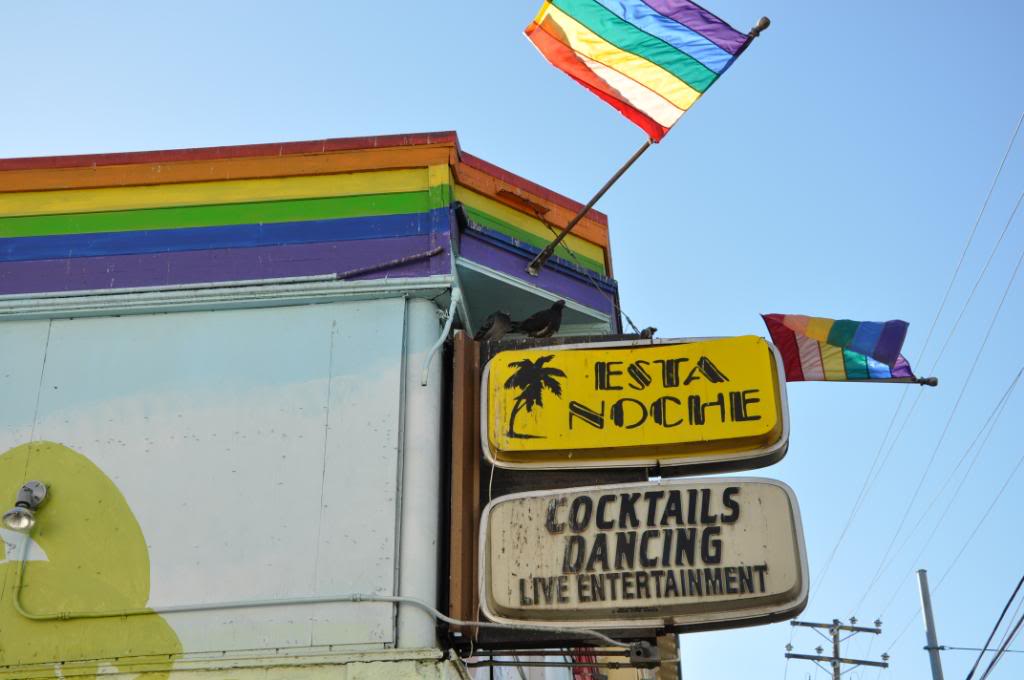
Not even a guest starring role on Lookingcould save beloved Latino-oriented gay dive Esta Noche, alas! According to Eater SF, the Mission favorite is being sold by its owners— reportedly willingly — to the team behind SoMa meat market Wish.
The new owners take over next week, but will keep things the same for a while, in order for everyone to have some time to say goodbye. (New Mission businesses, please take note: this is how you help avoid a PR nightmare.) Then get ready for more craft cocktails and loungey vibes, Missionites! Ugh.
I like the Wish kids, and I know that the Esta Noche tale is more complex than a simple eviction. Still, it’s heartbreaking to see a community mainstay — 40 years! — shutter, especially one that caters to a different crowd than Castro-roaming bachelorettes and tired Britney queens. Legendary comedy nights, hilarious performances, and, of course, the insane Miss Gay Primavera contest all played out on its stage. And where the hell can I hear Norteno music while cruising cute boys now?
With this coming hard on the heels of the 77 Geary building booting out its art galleries for tech companies, it has been suggested that the Guardian should start a column shaped like a tombstone, listing all the things we’re losing. But at least we’ll have craft cocktails!
The program in question is Safe Bikes, a joint venture between the SFPD and SF Safe. Cyclists can log onto their website, register their bike’s make and model, and when victims report a bike theft to police they can be reunited with their two wheeled friend just as easily. There are 75,000 bike riders a day in San Francisco, according to the Budget and Legislative Analyst’s office, a buffet of tantalizing goods for bike thieves.
More than 500 bikes is a small dent in that number, but for only a two week start it isn’t too bad. Safe Bikes Manager Morgan St. Clair said they’ve only just begun their outreach. Next month they plan to host an event at Twitter headquarters, where they’ll give away 50 Kryptonite locks, funded by the San Francisco Police Officers Association.
“We’ve only gone to three bike shops so far,” she said. But in the coming months St. Clair and her team of 15 volunteers have a city full of shops they plan to visit.
“They think the police department isn’t doing anything and say ‘oh, what the heck,’ and don’t think they’ll ever get it back,” she said. “We’re trying to change that mentality.”
In fact, the SFPD has been a strong driver of getting bikes back into the hands of owners, mostly at the behest of officer Matt Friedman. He runs @SFbiketheft, a Twitter handle that tries to recover stolen bicycles and link them to owners.
Plz RT: Sent to me from a Mission Unit, homeless guy had three bicycles attempting to find the rightful owner pic.twitter.com/vgnFL28c17
And if you want to see a sight that’ll make a San Franciscan cry, show them the SFPD’s graveyard of stolen bikes.
There, hundreds of bicycles sit unclaimed, some of which may find their way into a children’s program at the behest of a Board of Supervisors resolution proposed by John Avalos.
But ideally, the bikes would be reunited with their owners.
“We really want people to report more bicycle thefts,” St. Clair said. And to have those reports be effective, people need to register their bikes. You can register yours now by clicking here.
P.S. Guardian Editor Steven T. Jones had been planning to register his three bikes with the program, and then two of those bikes were stolen from outside his third floor apartment yesterday. They were a Trek Fast Track 420 road bike, purple with green tires, and a black Rocky Mountain bike with knobby tires and red handlegrips. Let his loss be a lesson to the rest of us: Don’t procrastinate, register today.
It’s not exactly surprised that this calculating and politically ambitious centrist would cave in to conservatives like this, particularly as Newsom tries to set himself up to succeed Brown in four years. But it’s a sharp contrast to more principled politicians like Brown, and to those trying to create the transportation system future generations will need, as President Barack Obama took a step toward doing today by announcing new federal transportation funding.
US Transportation Secretary Anthony Fox is also taking part in the three-day High Speed Rail Summit, sponsored by the United State High-Speed Rail Association, that began yesterday in Washington DC. Its theme is Full Speed Ahead.
“Secretary Foxx’s experience at the local level as mayor of Charlotte is extremely valuable for shaping national transportation policy. We look forward to working with the Secretary to advance high speed rail in America across party lines,” USHSRA President and CEO Andy Kunz said in a press release.
While Newsom’s new tact may play well with myopic, penny-pinching, car-dependent moderate and conservative voters, many of his allies and constituents were furious with his about-face on a project that promises to get riders from downtown San Francisco to downtown Los Angeles in less than three hours.
Among those unhappy is San Francisco resident Peter Nasatir, who forwarded the Guardian a well-written letter that he has sent to Newsom’s office:
Dear Lt. Gov. Newsom,
I am a long time San Francisco resident, and although I have criticized many of your policies, I’ve always respected your commitment to be at the forefront of controversial issues. Even if the issue could have wrecked your political career, you still had the guts to take the lumps for a righteous cause.
That is why I’m so shocked you would publically decry the High-Speed Rail project. Yes there are cost overruns. Yes the public is sour to it today, but what would you propose as an alternative: more freeways, more runways? Every expert in the field has already signed off that runways and freeways have expanded as far as they can. Are you not a leading voice in demanding technical innovation in all levels of government?
In your book, Citizenville, did you not put forth the clarion call for citizens to embrace technological change? Did you not say that San Francisco was behind the likes of Estonia and South Korea in terms of digital governance? Is it not fair to say that California is behind Europe and Asia when it comes to high speed rail?
Could you have said something along the lines that the trajectory the project is going is troubling, but Californians for generations to come will benefit from it. This project must be saved, because to do otherwise will send California back 60 years.
You are a political maverick who had put his career on the line many times with such controversial positions as same-sex marriage, and walking the picket line with hotel workers on Union Square. High-speed rail is coming. The economy demands it, the environment demands it, and Central Valley population growth demands it. You may get some votes from moderates in the short run, but in the long run, you have positioned yourself as the most prominent person in the state to be on the wrong side of history.
What do you get when two incredibly energetic performers — a guy and a girl who are each accustomed to being at the helm of a band, to commanding attention as the focal point of the room — decide to form a band together?
If the guy and girl in question are Mike Cobra of King Loses Crown and Rebecca Gone Bad (aka Rebecca Bortman), formerly of My First Earthquake, what you get is Happy Fangs — a band known for a ferocious, fiery, determinedly and cathartically fun live show, with music that owes equal debts to anthemic pop and classic ‘70s punk rock, and an aesthetic that’s maybe one part French New Wave, two parts experimental art school final. They also make up a new song, on the spot and with audience participation, once during every performance. Did I mention they seem to be having fun?
Ahead of their Noise Pop show this Friday at Slim’s — at which they’ll be performing for the first time with their third member, brand-new drummer Jess Gowrie — we caught up with the pair to hear about their influences, their onstage dynamic, and the importance of having cute girls dancing in the front row.
San Francisco Bay Guardian:I know Happy Fangs started when another project ended. How did the two of you meet up?
Rebecca Bortman: My old band shared a practice space [with Mike’s]…and when word went out that I was quitting, he sent me an email.
Mike Cobra:I contacted her asking what she was up to next, because if she said she was gonna stop making music, I would tell her that she shouldn’t, because she’s super talented.
RB: He was jumping in front of my talent train.
MC: And she sent back an email saying, “Well, I’m looking to start a band with just one other person and see what happens.” So I said, “OK, let’s do a couple demos.” We shared demos via email back and forth for a couple months before we decided to get together and start writing songs.
SFBG:So much of your energy and dynamic onstage seems to come from the contrast between you. Is it always harmonious, being a band made of front-people?
MC: As far as personas go, it’s true we’re very different: we say she’s the happy and I’m the fangs. But I don’t think we compete onstage, exactly. That’s part of our goal with adding the drummer, as well — she’s a very expressive, animated person, and we like to give people something to look at, even if it is competing. If anything, I think it keeps us on our toes.
SFBG: What did each of you listen to growing up? Do your influences complement each other?
RB: The one tape I listened to when I was young was The Big Chill soundtrack. Wait, also, [Michael Jackson’s] “We Are the World,” which has a B-side that’s Bruce Springsteen doing [Jimmy Cliff’s semi-obscure song] “Trapped,” live. Which is a really powerful song that gets really quiet, and then really loud. That song sculpted my desire to be on stage, Bruce Springsteen on the live “Trapped.”
MC: There’s one very first song that I remember listening to. I had an older brother, and when I was four years I would listen to his 8-tracks, with headphones, and I remember just rewinding and replaying this one song, one guitar riff, over and over again. It wasn’t until I was older that I realized it was Kiss’ first album. So I’ve been kinda stuck to that my whole life. I also got a lot of old-school country music, late ‘60s, early ‘70s music from my mom. And then I started listening to a really weird mixture of things as an adult, lots of punk rock, hardcore, metal. I say I like everything from Johnny Cash to Cannibal Corpse.
SFBG:I read another interview with y’all where you mention drawing inspiration from Kathleen Hanna, whom I also adore a borderline embarrassing amount. What is it about her work that strikes you?
RB: For me, the girl-punk, Riot Grrl stuff was all genuinely transformational for me when I was younger. I always think of that moment when a little girl realizes it’s not all about ballerinas and choo-choo trains…I love the idea of the moment when someone who’s maybe been proper and cute up until that point discovers her power — to me there’s an emotion of a five-year-old screaming [in our music]. This woman actually sent us this video of her daughter running around screaming [our song] “Lion Inside You,” and we were just like, “Yes! Do it!!”
MC: And for me, even being a guy, she was kind of one of the only people in the past 15 years who I feel like was very truly punk rock, in the sense of say, [Minor Threat/Fugazi frontman] Ian MacKaye, or Henry Rollins, in that she stayed very true to what she was, and she’s still doing it, still making music. She broke down a lot of boundaries, which is really inspiring.
SFBG: You both live in the city, yeah? Any thoughts on the current doomsday-ish conversation about how artists are fleeing SF because it’s so expensive?
RB: I want to be respectful and sympathetic to people who are leaving, because that totally sucks. I do have an affordable place to live in SF, in the Castro, and I know a lot of people are not in that situation. I also do think the culture of the city is totally changing. One thing that keeps us here is Mike and I also both work in an industry that’s here — we’re both designers. We kind of never stop working.
MC: I think San Francisco is a tough place to make music right now, and the situations where music venues are closing definitely affect everybody. And bands like Thee Oh Sees and Ty Segall — I definitely understand why they would want to [leave], if you’re a touring band and thats how you’re making your money, you don’t want to spend it all on rent! That has definitely sucked a lot of the arts out of the city. At the same time, I think it’s a city that’s constantly been about change, from the time of the forty-niners. The same thing happened in the ‘60s, and with punk rock in the ‘80s, then metal…it’s a place of constant change, and I do think you kind of have to roll with it.
RB: Also, both of us are from much shittier places. I’ve been here 7 years, he’s been here 14, but we’re still in utter appreciation of the fact that we live in paradise. Yes, paradise is changing, but it’s still way better than Pittsburgh.
SFBG: You guys released a self-titled EP in October. What’s next for the band?
RB: Well, first, with this show, we have to haze our new drummer, Jess. This will probably involve some sort of vegan blood substitute. And we’ll be playing an awesome show with a bill of all female-fronted bands at Bottom of the Hill on April 5. Then later in the year, we’re going to record and release a full-length album, hopefully this fall, and go on tour — we’re going to Canada in the summer for a festival, so alert the officials.
SFBG: What else should people be on the lookout for at this show in particular?
MC: Well, it’s our first time playing without a drum machine, so if people haven’t seen us before, great; if they have, I think it’ll be a pretty big change in a really good way.
RB: The other thing I’ve been thinking about is people dancing at our shows, and how I wish it would happen more. To be totally sexist, I’ve noticed that having a couple of really hot girls dancing up front really helps. So girls, women, ladies, if you will dance, please come out. In fact, you can email us and we’ll put you on the list: happyfangsmusic [at] gmail.com.
Happy Fangs (w/ Cold Cave, Dirty Ghosts, and Painted Palms) Fri/28, 7pm, $16 Slim’s 333 11th St, SF www.slimspresents.com
A memo released today revealed a striking split that could affect media coverage in the Mission district: hyperlocal news site Mission Local is being dropped by its main fiscal sponsor, the University of California Berkeley Graduate School of Journalism.
“It’s now time for Mission Local to take the next step and re-launch itself as an independent, stand-alone media operation,” J-School Dean Edward Wasserman wrote in a department-wide memo. “That means ending its role in the J-School’s curriculum.”
The website is one of a trio of hyperlocal news websites run by the UC Berkeley Graduate School of Journalism, including Oakland North and Richmond Confidential. It is still unclear if the other websites will be affected as well, though the memo says they will be the center of future discussion among faculty.
Mission Local is a journalism lab for the UC Berkeley graduate students, covering everything in the Mission District from the Tamale Lady to the eye-rolling of Google public relations employees. They’re popular in the neighborhood, and even present the website in a Spanish-language format.
The UC Berkeley graduate students serve as the site’s reporters and a little bit of everything else, from advertising and sales to audience-building. That was a problem, Wasserman wrote.
“That’s not really what we do,” he wrote. “Those are specialized areas, and the J-School doesn’t have the instructional capacity to teach them to a Berkeley standard of excellence.”
But the main issue seems to be cost. “It’s an expensive undertaking,” he wrote. The sites were initially funded with grants from the Ford Foundation, but UC Berkeley started picking up the tab when they ran out, among other fundraising avenues. Wasserman was also concerned that working for a hyperlocal newspaper away from campus pulls students away from campus activities.
The PDF above is the memo sent to students and faculty of the UC Berkeley Graduate School of Journalism department concerning Mission Local.
Lydia Chavez, a professor at the J-School and the head of Mission Local told the Guardian she disagreed with Wasserman’s decision.
“To be clear, I would have preferred to have Mission Local and the other hyper locals at the core of the school’s curriculum,” she said.
But tales of Mission Local’s demise would be exaggerated.
Chavez, a reporter who’s written for the New York Times, the Los Angeles Times, op-ed pieces in the San Francisco Examiner and more, isn’t willing to walk away from Mission Local despite the challenges.
The journalism bug, it seems, bit her hard.
“The Mission is now ground zero for so much that is happening in the city and the country that if I walked away from it now, it would be like walking away from a terrific story,” she wrote to the Guardian in an email.
“Mission Local will remain alive and innovative,” she wrote.
We’ll follow up with this story as it develops, and are planning a look into the state of hyperlocal journalism in San Francisco. Look for it in next week’s print edition of the San Francisco Bay Guardian.
The memo in full:
J-School Community:
The Mission Local hyperlocal site has been a vibrant and valuable part of the School of Journalism since it was created five years years ago. It has developed well beyond its initial scope as an incubator for J200 students, and under Prof. Lydia Chavez’s imaginative, impeccably professional and tireless leadership has become the premier place for the community it serves to learn about itself and talk about its future.
It’s now time for Mission Local to take the next step and re-launch itself as an independent, stand-alone media operation. That means ending its role in the J-School’s curriculum. While Prof Chavez would have liked to see the school keep the site, she is ready to assume responsibility for the site, and we expect that it will continue under her ownership.
My reasons for spinning off ML are several.
First, it’s an expensive undertaking, which obliges us to operate a remote site on a year-round basis, even when the curricular value to our students is limited or even, at times, non-existent (as when we pay non-students to keep the site from going dark.)
Second, it draws students away far from North Gate at the very moment we’re bulking up and enriching the curricular and co-curricular offerings here—new required courses, more speakers, town hall meetings, reinvigorated career services, generally pumped-up intellectual life. From the perspective of Mission Local’s needs, renewed activity in North Gate is a distraction, and I think that unintentionally does our students a disservice.
Third, the natural evolution of the site itself is toward being an integrated media operation, and that requires sustained attention to marketing, audience-building, ad sales, miscellaneous revenue-generation, community outreach, special events, partnerships, and 1,001 other publishing activities that are essential to any site’s commercial success.
That’s not really what we do. Those are specialized areas, and the J-School doesn’t have the instructional capacity to teach them to a Berkeley standard of excellence. What’s more, our students wouldn’t have the curricular bandwidth to learn them—not unless we pared back other areas, and redefined our core mission as something other than journalism education.
(Let me add that as part of our larger curricular rethinking, I’m hopeful we will be introducing, and requiring, more business-side instruction than we currently offer, but ML’s needs are still of a different order of magnitude.)
Whether other changes are in the works for J200 is up in the air at the moment. The curriculum committee is in the process of considering alternative approaches to J200, and the roles of Oakland North and Richmond Confidential as teaching labs are among the matters the faculty will discuss.
Mission Local has produced dozens of loyal alums, many of them strong enthusiasts who recall their experience there with affection and gratitude. Let me assure them—and you—that as we weigh the future of J200 it’s with the intention of improving on what we’ve done in the past, and making sure the future offers opportunities here at least as rewarding and memorable as theirs have been.
Let me conclude with a word of profound thanks to Prof. Chavez. While I respect and admire her loyalty to the Mission, I very much look forward to her getting more deeply involved in the exciting work that’s going on in North Gate.
Hilla Medalia and Shosh Shlam’s Web Junkie (Israel-China-US) is an eye-opening investigation into China’s declared number-one threat against youth: internet addiction. The doc observes as kids are sent (often against their will) to video-game rehab — and the takeaway is that many generation-gapped parents are even more clueless about emotions than their sons.
http://www.youtube.com/watch?v=bOR77tWVxKc
On a similar note was Kate Logan’s Kidnapped For Christ(US/Dominican Republic), which screened at Slamdance. As the film shows, thousands of unmonitored rehabilitation schools have popped up over North America that are filled with kids who are sent (again, often against their will) by their parents. Logan, a young evangelical filmmaker, was granted unprecedented access inside one of these controversial “Christian behavior modification programs,” and finds that things are most definitely not what they are suppose to be. Haunting and extrememly upsetting, the film’s similarities to Heidi Ewing and Rachel Grady’s Jesus Camp (2006) are inevitable. But Logan’s own safety being put on the line adds a more urgent note of danger as events unfold.
Back at Sundance, Göran Olsson’s Concerning Violence(Sweden/Finland/Denmark/US) was easily the standout from the World Cinema Documentary category this year. Similarly structured to his 2011 film The Black Power Mixtape 1967–1975, this jawdropping “fly on the wall” archival journey lets the viewer piece together the struggles of African liberation of the 1960s and 1970s. Psychologist-philosopher Frantz Fanon’s seminal anticolonial text, The Wretched of the Earth, is the only narration for this visual narrative (read by Lauryn Hill). Watch this at all costs.
Don’t let Tony Gerber and Maxim Pozdorovkin’s The Notorious Mr. Bout (Russia/US) fall in between the cracks of festival mania this year. Bout follows the man who inspired one of Nicolas Cage’s best dramatic turns in Andrew Niccol’s Lord of War (2005), and it will send tingles down your spine.
But nothing can prepare you for the winner of this year’s US Documentary Grand Jury Prize winner: Tracy Droz Tragos and Andrew Droz Palermo’s Rich Hill (US). Following three struggling youths in a Missouri small town, the filmmakers have created the perfect allegory for our “United” States of America. Broken-down homes and families are housing complex and confused young kids whose futures are terrifyingly bleak. The filmmakers’ unobtrusive, Wiseman-esque camerwork allow the quietest of moments to suddenly turn on a dime. And we the audience are forced to confront a dilemma that does not just get fixed by placing a website at the end of the credits.
Favorite Narratives of 2014 Park City
1. Memphis (US) – Tim Sutton
2. Boyhood (US) – Richard Linklater
3. Ida (Poland) – Paweł Pawlikowski
4. The Guest (US) – Adam Wingard/Simon Barrett
5. The One I Love (US) – Charlie McDowell
6. Nymphomaniac: Part One (Denmark/Germany/France) – Lars Von Trier
7. White Shadow (Italy/Germany/Tanzania) – Noaz Deshe
8. Love Is Strange (US) – Ira Sachs
9. The Better Angels (US) – A.J. Edwards/Terence Malick
10. The Trip to Italy (UK/Italy) – Michael Winterbottom
11. Kumiko, The Treasure Hunter (US/Japan) – The Zellner Brothers
12. Cold In July (US) – Jim Mickle
13. A Girl Walks Home Alone at Night (US) – Ana Lily Amirpour
Developers and activists are once again at odds over San Francisco’s waterfront, arguably the most valuable bit of land in one of America’s most expensive cities. Ahead of a June ballot initiative that would require voter approval for proposed waterfront buildings that exceed current height limits, development groups are already reaching out to politicians to tip the scales in their favor.
E-mail and text exchanges obtained by initiative proponent Jon Golinger via a public records request show that Gabriel Metcalf, executive director of SPUR; and Jack Bair, senior vice president and general counsel for the San Francisco Giants, urged Sup. Scott Wiener to use his authority to direct city agencies to report on the Waterfront initiative. Wiener introduced a resolution calling for this report, which will be considered at tomorrow’s [Tues/25] Board of Supervisors meeting.
City law normally prohibits the use of public resources for political activity that could sway the results of an election.
“There’s a law that once a petition qualifies for the ballot, there’s a very bright line that separates government resources from being used [to defend or oppose it],” explained Golinger, who is managing the campaign for the Waterfront initiative. “These emails demonstrate that there are more political maneuvers than genuine intent to inform the public.”
A representative from the City Attorney’s Office declined to comment, but a memo issued last September by that office clarified that municipal resources can be used to objectively investigate and evaluate the impact of a ballot measure, but not to take a position on it.
Wiener denied that there was anything improper about requesting a report in response to concerns raised by Bair and Metcalf. “[The proponents] have been very reckless in their accusations,” he said. “First they said it was illegal, but we pointed out that there’s a provision that allows this. They backed off, and now they’re making another frivolous accusation that although it is legal for me to introduce the resolution, it’s inappropriate for me to talk with anyone who has an opinion on it.”
But e-mail records show that the study was initially requested by Metcalf, and that the first draft of the resolution was written by SPUR. Wiener later presented that resolution to the Board of Supervisors, asking seven city agencies — including the Port of San Francisco, the Planning Department, and the Mayor’s Office of Housing — to produce reports on the impact the ballot initiative would have if passed.
The purpose of the reports, according to a press release issued by Wiener’s office, is to provide an “impartial analysis” so that the public can make an informed decision at the ballot box.
Activists doubt that impartiality, but Wiener says that their claims are “completely baseless.”
“First of all, the only thing this resolution does is direct city departments to provide an objective analysis on the possible impact of the ballot measure,” Wiener told the Guardian. “I find it bizarre that these folks are fighting so tooth and nail to fight more information for voters.”
Metcalf of SPUR, a research and advocacy group with a pro-development stance, also maintains that there is nothing dishonest about the exchanges. The job of lobbyists is to reach out to politicians, he says.
“Every group in the city that’s trying to influence public policy has to talk to supervisors just like this,” Metcalf said. “I’ve worked with this resolution to make the public debate more sophisticated, so people can think before making a decision.”
Metcalf told the Guardian that while the organization’s ballot analysis committee has already recommended a “no” vote on the measure, SPUR does not have an official position until the board of directors votes at its March meeting.
Bair of the Giants did not respond to a phone call from the Bay Guardian. The Giants have a vested interest in seeing the measure go down at the polls, given the massive development project that the team is proposing at Pier 48.
There are two problems with the resolution, said Golinger. First, he believes the advocacy by opponents means city resources would be used for a political campaign. The seven city departments in question would be taking time away from their normal duties to write a report catering to the campaign opposition, he said.
The second problem is that since the resolution was essentially written by SPUR — which is already leaning toward opposing the measure — it would frame the way that the reports would be written.
The resolution “was crafted by opponents to get a preordained result,” Golinger said. “It asks skewed instead of open-ended questions, and they are designed to push and shape the analyses in a frank way.”
Nevertheless, Wiener maintains that he has done nothing wrong.
“It’s perfectly okay for me as an elected official to work with whoever I choose to work with,” he said. “I work with all sorts of different people on all kinds of different topics. That’s what democracy is about. I don’t sit in a cloistered room, I’m out there getting ideas from people. It’s a sad state of affairs that in 2014 you can be attacked for having the gall to actually talk to people.”