SFBG Blogs

The miraculous and mysterious, disappearing, reappearing Clean Power SF data

38

The fight for clean power in San Francisco just got a whole lot dirtier.

In an update to the City’s Climate Action Strategy report, a prominent section discussing goals to use renewable energy featured CleanPowerSF — and then suddenly it didn’t.

For those not in the know, CleanPowerSF is a renewable energy initiative meant to give San Franciscans 100 percent renewable energy, while making us a hell of a lot less reliant on the local monopoly: PG&E. The initiative, pushed by Supervisors John Avalos, David Campos and other progressive allies, faced long-time blowback from Mayor Ed Lee.

As the Guardian has reported before, it’s a central city policy to reduce emissions by 25 percent below 1990 levels by 2017, and 80 percent below those levels by 2050.

To reach those goals many feel we need CleanPowerSF, but the mayor seems to have scrubbed it out of his environmental report without so much as a how-you-do.

The change was made apparent by a prominent blank white space on page 17 of the Climate Action Strategy report, and was discovered by Supervisor John Avalos’ office. When you highlight the blank space with your cursor, copy the section, then paste it into a document, you can see the goals of CleanPowerSF laid out plain as day.

CleanPowerSF by the Residential

and Commercial Sectors

Sector               2012   2017   2020   2025   2030

Commercial   0%       5%       10%     45%     80%

Residential     0%       16%     19%     60%     100%

The scrubbed information shows CleanPowerSF helping the city reach its renewable energy goals. The numbers are hidden in the Climate Action Strategy report, like a message in a bottle, or a painted egg hidden under a bush on Easter. 

It’s as if someone didn’t want to delete the CleanPowerSF entry entirely, and instead turned the text white in order to signal that the text used to be there. Perhaps the preparer of this report was foiled by the technological wonder known as cut-and-paste. Or more intriguingly, perhaps this was the first-ever case of activist report writing (in which case: Dear subversive report writer, please send us documents through BayLeaks).

Whether the information was left in accidentally or on purpose, it’s now clear that the mayor is dead set on scrubbing CleanPowerSF from city records, even at the expense of the city’s environmental goals. 

Above is the report. Check it out for yourself, page 17 (in the report’s numbering, not the digital numbering).

At the mayor’s Question Time today, where supervisors ask pre-planned and pre-announced questions of the mayor, Supervisor Avalos pinned Mayor Lee down on the document scrub-out.

“In your letter of introduction to the 2013 CAS you wrote the need for action has never been more evident,” Avalos said. “The Climate Action Strategy goes on to state that moving onto 100 percent renewable energy is the biggest single step the city can take to reduce greenhouse gas emissions. And yet there was an attempt to scrub CleanPowerSF… from the Climate Action Strategy.”

The version of the Climate Action Strategy included a whited out table on CleanPower SF… that table was unceremoniously removed in a new version posted two days later,” he said.

The mayor’s answer was filled with some equivocations and some fabrications. 

“We should not move forward with a program that contracts with a fossil fuel company in Texas, it doesn’t produce enough local jobs or environmental benefits,” he said. “Supervisor, I’m glad you mentioned the Climate Action Strategy.” 

Retired San Francisco Public Utilities Commission Executive Director Ed Harrington told  Guardian Editor Steven T. Jones exactly why CleanPowerSF was needed, in a story of his back in 2012: “This program before you has the only chance of reaching those goals. There’s nothing else.” 

Asking Mayor Ed Lee to explain the disappearance of the information from the report.

After question time, this reporter and a few others questioned the mayor as he walked back to his office.

What was behind the scrubbing of the CleanPowerSF data? Why did it suddenly vanish from the report?

“I don’t think I have a real answer for that,” the mayor said.

Housing round-up: LGBT tenants, a singing protest, and a very sad mural

At today’s (Tue/11) Board of Supervisors meeting, Sup. David Campos is introducing legislation to encourage large-scale developers to protect the housing rights of the LGBT community.

Same-sex couples nationwide are more likely to experience discrimination in their search for senior housing, a study by the Washington, D.C. based Equal Rights Center found.

To investigate, testers posed as gay or straight couples with otherwise nearly identical credentials, then submitted inquiries on senior housing in 10 different states. They discovered that in 96 out of 200 tests, those posing as lesbian, gay or bisexual residents experienced at least one type of adverse, differential treatment.

Meanwhile, according to the National Center for Transgender Equality, one in five transgender U.S. residents has been refused a home or apartment, and more than one in ten has been evicted, because of their gender identity.

Federal law does not expressly prohibit discrimination based on sexual orientation or gender identity. California law does, as do laws in 19 other states. Given these gaps in legal protection, real-estate providers can adopt their own policies to prohibit LGBT discrimination.

Campos’ proposal would require large-scale developers who wish to build in San Francisco to prove their commitment to equal housing opportunities.

“We want to know whether a developer hoping to build in San Francisco is protecting LGBT housing rights when they own or manage housing in states where legal protections don’t exist,” Campos explained. “By collecting this information, we can highlight best practices and urge those who do not have these policies to do the right thing.”

Under the legislation, developers would indicate whether they have national policies prohibiting LGBT discrimination. The Human Rights Commission would compile those policies and present it annually to the Board of Supervisors.

Elsewhere on the housing front, POOR Magazine founder Lisa Gray-Garcia (aka “Tiny”) led a group of anti-eviction activists into City Hall this morning, where they broke into song to call attention to the eviction of a family from a public-housing unit in the Fillmore neighborhood. They linked the eviction with a broader trend of African American out-migration from San Francisco, and sang spirituals.

Gray-Garcia reported that the group, which she estimates at roughly 30 people, encountered resistance from the Sheriff’s deputies who provide security in City Hall. “They said we were an unlawful assembly because we were singing,” she said. So the protesters proceeded upstairs, whispering, to stand outside Mayor Ed Lee’s office. Then they broke into song again, she said.

“We’re talking about a family about to be evicted tomorrow, that’s how serious this is,” Gray-Garcia told us. She said she’d spoken to someone from the mayor’s office, Carl Nicita, who “to his credit, he listened to us and he said ‘I’m going to tell the mayor.’” (We’re working on finding out more about the eviction and how the city will respond.) 

As a final housing-related tidbit, head over to the Mission to check out the new Clarion Alley “Wall of Shame” mural, featuring a list of what the artists perceive to be the root forces of gentrification (Both Google buses and corporate giveaways to tech companies made the list).

Inscribed on some tombstones near the bottom: “So long San Francisco, As We Knew It. (Historic Counter-Culture & All.)”

On the flip side, the artists also included a list of solutions.

Bryan Augustus contributed to this report.

Wired measures tech bus trips in a day

34

The vaunted Google Bus pilot program is now in legal limbo as local activists appeal the deal to regulate the shiny behomoths, on environmental grounds. As we wait and see what the next step will be, one technology journalist decided to figure out for himself what the SFMTA says the pilot program aims to do: track the number of tech buses running around San Francisco.

Well, to be fair, Kevin Poulsen, investigations editor at Wired magazine, only tracked the buses flying by his home. But the process doesn’t seem too tough to replicate.

As he writes in his Wired post: 

“Last week, it occurred to me that I might start monitoring the local Wi-Fi environment to determine how often the Apple Bus really comes by. My wife guessed 10 times a day. I’d have said 20.”

So essentially, he used the Apple bus’ Wi-Fi, provided for their employees, to track movements of the bus. He didn’t make any bets on it, but if he had, it seems his wife would’ve lost. 

“After a week of reverse-wardriving, it appears the Apple Bus passes my house an average of 36 times a day, and is uncannily punctual, especially in the a.m., when the first bus reliably pops up on my Wi-Fi radar between 6:23:33 and 6:23:56 every morning.

The second bus passes four or five minutes later, the third 25-minutes after that, another at 6:58, give or take a minute. By 10 a.m. as many as 15 more Apple buses have passed. After that they become infrequent, and die out entirely a few minutes after 2:00 p.m., before they return in force at 5:00 p.m. — presumably taking Apple workers home. The last bus registers at about 10:15 at night.”

macadresses

The wifi trail shows how many times particular tech buses drove by this Wired journalist’s house.

Why care about tracking them in the first place? It’s about the impact of livability in the surrounding area, an idea that so far hasn’t been factored in to the $1 per stop, per day argument made by Mayor Ed Lee and the city.  Poulsen writes:

These buses are huge, intimidating, Greyhound-sized affairs, many of them double-deckers, that feel outsized on a relatively quiet street of single-family homes. I haven’t stockpiled much umbrage over them, but some of my neighbors who’ve lived here longer hate the buses. There’s something disconcerting about having your street turn into a major artery in the transportation infrastructure of a company 45 miles away, without so much as a mailer (“Hi! We’re Apple. We’ll be using your street for a while.”).

When the outrage over the $1 per stop, per day number spiked recently, a Google spokesperson said in a release, “San Francisco residents are rightly frustrated that we don’t pay more to use city bus stops. So we’ll continue to work with The City on these fees, and in the meantime will fund Muni passes for low-income students for the next two years.”

Until the SFMTA figures out ways to mitigate the impact of these buses, let’s hope more tech-inclined people track their impacts on the city. You can see the original Wired story here

Burning the Man? Well, not exactly, at least not yet

30

Last week’s announcement that Burning Man has become a non-profit organization got lots of uncritical coverage from the San Francisco Chronicle and other local news outlets, but the reality is the old owners are still firmly in control, as the Bay Guardian and the scrappy Burners.Me blog have been reporting.

It is true that The Burning Man Project, a nonprofit organization that founder Larry Harvey announced the creation of three years ago, is up and running and ostensibly in charge of “global cultivation of art and community,” as it put it in a March 3 blog announcement, whatever that really means.

But Black Rock City LLC continues to run the Burning Man event and control its vast revenue stream, even though it’s ostensibly been placed under the auspices and ownership of the new nonprofit, whose Board of Directors is still appointed to one-year terms by the old LLC board, which has permanent seats on the nonprofit board.

And any community accountability in that ownership arrangment is further undermined by the creation in 2010 of the ironically named Decommodification LLC, which owns the commodity that is Burning Man — its trademarks, brands, logos, etc. —  that the old LLC and the new nonprofit pays to license each year. It’s a similar setup to the old Paper Man LLC, a controversial arrangement that triggered internal lawsuits and set Burning Man down the path toward nonprofit control.

Kudos to the work of Burners.Me, which has continued critical coverage of an issue that I started covering while working on my book, The Tribes of Burning Man, but which I frankly lost the stomach to continue this watchdog role after concluding that most burners just don’t care who’s in charge or how much they make as long as the party doesn’t stop.  

Although the authority and community control of the new nonprofit may not be exactly as Harvey made it sound three years ago, his timeline is still holding fairly true: three years later, the LLC is now under the umbrella of a nonprofit, and three years from now, the LLC board members will vote on giving up control over the brands.

But Harvey is still voicing skeptisim about giving up control to the nonprofit, responding to critics of the latest move by writing, “The reason for this 3-year interval is that even we do not invest blind faith in the new non-profit’s workings, and we want to be perfectly sure that it can be relied upon, in the face of temptations that arise within any organization when dealing with power or money, to pursue the policies that we have practiced.”

How have Harvey and those around responded to these same temptations in recent years? Well, we don’t know, because they are refusing to say how much money they transferred to themselves in salaries and lump sum payments (which Harvey had frankly said three years ago they would be taking, and well in excess of the $20,000 cap that was created during an earlier controversy to limit their accumulation of equity in an event created by attendees) before placing the LLC under the nonprofit umbrella.

But Harvey did respond to critics by saying that the LLC’s finances will indeed to be opened up for public inspection for the first time later this year when the new nonprofit files its financial paperwork with the state.

“It has been asked if we intend to reveal the financial records of Black Rock City LLC. The answer is yes; that too will happen at about the same time as the Burning Man Project reveals its information—these two entities will then become a clean well-lighted suite of rooms thrown open for inspection,” Harvey wrote. “But I cannot guaranty [sic] that even this amount of disclosure will satisfy everyone. Even then, I suppose that some will look for skeletons in closets, or search for sliding walls that might conceal a dungeon.”

So I suppose that we’ll all just need to wait-and-see. And in the meantime, I’m still waiting for a call back from Marian Goodell, a Burning Man spokesperson and member of the LLC board, to address our questions, and I’ll update this post if I when I hear back.

UPDATE: Goodell confirmed our basic understanding of this transition, confirming that the transparency in the LLC’s finances and thepayouts its six board members received won’t be disclosed to the public. “There’s no need to go back, everything is going forward from January 2014,” she said in response to our question about fiscal transparency after telling us, “At the end of 2014, the financials for the 501(c)3 are revealed, and any attaching subsidiary finances.”

That means BRC LLC, but not Decommodification LLC, which is not a subsidiary to the nonprofit. Goodell said the decision hasn’t yet been made how much to pay in licensing fees, although the nonprofit has an exclusive licensing arrangement “and can set the amounts for others to use it,” such as the network on regional events that Burning Man has spawned.

As for the general concerns about who controls Burning Man, she said, “There’s never been any intention to give full control to the community.” But she said that she and the other five board members have been responsible stewards of the culture and “I’m personally very invested in the success of it. My duty is to see this into its next iteration when the founders aren’t necessary to be making the big decisions.”


All of the fucks that we should be giving: An evening with Ani DiFranco

6

By Kelly McFarling

When I was 13, I was a late-blooming tomboy, watching, confused, as everyone around me grew up and started acting different.

In school, we were writing “conflict stories.” Mine was about losing all my friends to puberty (theirs, not mine). My teacher sat me down on a particularly rough day and said, “Here. This is for you. Don’t tell your parents.” She handed me a copy of Ani Difranco’s Dilate, complete with the parental advisory label shining through the jewel case.

In hindsight, this may have been one of the more amazing gifts I’ve ever received, if not for its origin (what teacher does that?), then for the seismic brain/heart shattering that can only happen to a 13-year-old girl listening to Ani Difranco for the first time. I was floored. My emotions were obviously in desperate need of translation, and DiFranco’s poetry and emotional delivery was something I had never experienced. It’s alright, everything is uncomfortable, everything is changing. It’s cool, this woman is talking about things, and she’s angry and she’s sad, and she’s happy, and she has dreadlocks and boots and says “Fuck you.” Maybe you can be whatever you want/are?! I was a fan from that moment on, and although a lot has changed since then, the feeling that happens when I see her play her songs live is pretty similar to that first listen back in 1996.

Although thus far I’ve discovered that writing a review of an Ani DiFranco show is apparently like writing in your diary, I will attempt to review the things that actually happened on Friday [3/7] at the Fillmore.

Opening the show was Jenny Scheinman, an artist on DiFranco’s own Righteous Babe label. Scheinman, a prolific artist, composer and arranger in her own right, started the night off with a haunting fiddle tune that resulted in a well-deserved hush from the crowd. Plucking her fiddle, she sang a set of lyrically lovely Appalachian-style songs based on reflections of her Northern California hailing grounds. The Fillmore was full and quiet, with only the occasional anxious shoves from folks trying to claim precious real estate.

jenny
Jenny Scheinman

When DiFranco walked out there was wave of both excitement and relief. The power, charisma, and authenticity DiFranco delivers at her live shows has earned her incredibly loyal fans who line up, city after city, to be shaken back into something, or shaken out of something else. They show up to be moved, and Friday night, they sensed that motion was about to occur. Necks craned, squeals of excitement were released, and the beam of light that radiates from DiFranco’s wide grin took the stage. DiFranco was accompanied by Todd Sickafoose, her longtime upright bass player, and New Orleans’s Terence Higgens on drums, who, turns out, can also rip surprise kazoo solos. These two provide a pocket deep enough for DiFranco to roam through each sonic peak and valley. The trio is a well-oiled machine, and Sickafooose and Higgens add a lot to these songs, a testament to their sensitivity and chops. They support and compliment DiFranco’s distinctive guitar playing — which is is wild and lucid, both careful and careening. She rips, righteously, and they are right there with her.  

Now, I know that DiFranco probably cannot actually see into my soul and choose her setlist according to what’s happening in my life, but I can’t be completely sure. She pulled from many different parts of her rich catalog, including five new songs that hit me in all the places that needed hitting. (How does she know? Why so magic?) I know I’m not alone in this, but her confessional lyrics and clever poetry are so personal, it’s difficult not to feel a sense of ownership over these songs, to remember who you were when you first heard them. Somehow her relevance feels both intimate and universal.

ani
Todd Sickafoos, DiFranco, Terence Higgens

She played some newer ecological crisis songs (“Some call it conservation, some call it common sense”), touching on environmental awareness and self-awareness (shouldn’t these be connected?) and the dangerous complacency we have lulled ourselves into. Revelations continued throughout the night as she delved into older songs dealing with love, the problem of monogamy, the trauma of history, the irreversible damage that words can do, and even perspectives from a Caribbean church. Somehow, all things felt covered. Lines stood out that needed to stand out. DiFranco delivered a beautifully open window into a human being who is steadfastly paying attention to the world, her place in it, and calling them both out. It’s good to know that DiFranco is still fighting the good fight, and reminding us to do the same.

I have heard it said that the reason DiFranco is so powerful is because she doesn’t give a fuck. But on Friday night, it occurred to me that it’s not that she doesn’t give a fuck, but that the rest of us sometimes lose touch with all the fucks that we should be giving. For me, DiFranco is a refreshing and necessary voice of realness. Honesty without agenda, from so many different angles. So there you have it. I go forth into the world shaken, stirred, and reminded.

Set List

“Dilate” – Dilate (1996)
“Splinter” – Which Side are You On? (2012)
“Not a Pretty Girl” – Not a Pretty Girl (1995)
“J” – Which Side are you On? (2012)
“Happy All the Time” (New)
“Napoleon” – Dilate (1996)
“School Night” – Educated Guess (2004)
“Welcome To” – Evolve (2003)
“Allergic” (New)
“Careless Words” (New)
“Harder Than It Needs to Be” (New)
“Genie” (New)
“The Whole Night” – Not So Soft (1991)
“Everest “- Up Up Up Up Up Up Up (1999)
“Fuel” – Little Plastic Castle – (1998)
“Joyful Girl” – Dilate (1996)
“Shameless” – Dilate (1996)
(Encore)
“Both Hands” – Ani DiFranco (1990)
“Overlap” – Out of Range (1994)

Uber didn’t have the decency to offer personal condolences to Sofia Liu’s family

40

In the wake of a young girl’s death in a traffic collision New Year’s Eve, allegations of improper insurance coverage and safety practices swirled Uber into the center of controversy — but the company has yet to take a step back to offer personal condolences to the family of the girl who died that night. 

Christopher Dolan, the attorney for the family of Sofia Liu, told the Guardian at a City Hall hearing on rideshare companies that Uber has yet to offer condolences directly to the Liu family. 

The hearing on rideshares (known legally in California as Transportation Network Companies) at the Board of Supervisors Neighborhood Services and Safety Committee yesterday [Thu/6] centered on the insurance and business effects of Uber on taxi services. 

Sups. David Campos, Eric Mar, and Norman Yee grilled San Francisco Municipal Transportation Agency Taxi Director Christiane Hayashi and California Public Utilities Commission Director of Policy and Planning Marzia Zafar on questions sparked by Sofia Liu’s death.

Should Uber have provided insurance coverage for the driver, Syed Muzzafar, when he allegedly killed Sofia Liu and injured her family? Is it just an app, or is Uber a transportation provider like any other cab company? 

These are questions courts and regulatory bodies will decide over the course of the next year or so. But there’s one question that only Uber can answer: Why hasn’t it offered personal condolences to the family yet?

We sent Uber an email with a number of questions, and they answered every single one except for our question about offering condolences to the family. Dolan said that’s the same response they’ve given the Liu family — silence.

A video interview with Christopher Dolan, attorney for the Liu family.

“They said, ‘jeez our hearts go out to them but we’re not responsible,’” he told us. We asked him if Uber made a phone call to the Liu family, met with them in person, or offered condolences personally in any way. “Absolutely not. Basically their message is ‘it’s too bad,’ but its not their problem. They’ve done no outreach to the family.”

The family’s suffering was deep. In an interview with ABC7 news reporter Carolyn Tyler, Liu’s mother, Huan Kuang, said “I feel very sorry for her. I cannot save her life. The driver kill her.” 

Kuang and her son Anthony were injured in the collision as well..

Perhaps there are legal reasons preventing Uber from offering its condolences directly to the family, though this sounds unlikely as Uber did post a blog directly after the incident saying, “Our hearts go out to the family and victims of the tragic accident that occurred in downtown San Francisco on New Year’s Eve. We extend our deepest condolences.”

But were these condolences extended to the family, or just the Internet? After the death of your daughter, would a blog post really cut it? We’re not buying it. Uber CEO Travis Kalanick sat down for a video interview with the Wall Street Journal only six days after Sofia Liu’s death to talk about surge pricing. If he can take the time to sit down with the Wall Street Journal , he can take the time to personally offer his condolences to a family who lost its daughter in an accident that it alleges his company caused. It’s been two months since Liu died.

Legality of the whole business aside, it’s the human thing to do. 

ABC 7 videointerview with Sofia Liu’s mother.

Update: Four hours after Uber’s initial email reply to our inquiry for this story, and an hour after the story was posted, Uber spokesperson Andrew Noyes sent us this statement: “We have privately extended our personal condolences to the Liu family.” When asked how and when they were made, in order to verify his claim, he sent an email in reply declining to provide us that information. We again asked Noyes about how and when condolences were given, hoping to use the information to verify with the Liu family through their attorney. Uber again declined to provide information as to the time, date or method of offering their condolences. 

Listen: Warm Soda’s new LP ‘Young Reckless Hearts’

8

Oakland’s Warm Soda, aka one of our 2013 bands on the rise, is almost too easy to love: That lo-fi fuzz, those jangly, sugar-sweet hooks, that sudden urge to be lightly buzzed at someone’s backyard barbecue the summer before you left for college. The band’s sophomore full-length, Young Reckless Hearts, out March 11 on Castle Face, has a more of a studio sheen and a bit more guitar-based showmanship — British invasion influences, perhaps? — than its debut, but these songs retain the groundedness and no-frills power pop that we’ve come to hold so dear.

They’re on the road to SXSW at the moment, and won’t play at home again until a March 27 show at the Nightlight, but they just decided to stream the whole darn thing the week before the album drops. Here ya go:

Three upcoming events on housing in San Francisco

There are a few upcoming opportunities to have your say in the ongoing dialogue about the San Francisco tenants’ struggle as long-term renters grapple with rising rents and the threat of displacement.

Amid the housing pressure, a thriving tenants’ rights movement has unfolded in the city to spur multiple legislative pushes for reform. These conversations (and the art exhibit to piece these issues together on a deeper level) are timely.

Wed/12: San Francisco Neighborhoods on the Brink: A Panel Discussion on Displacement, Gentrification, Rising Rents & the Loss of Affordable Housing

Hosted by San Francisco Poet Laureate Alejandro Murguia, this panel discussion will feature comments by District 11 Sup. John Avalos, Public Policy Director of the Chinatown Community Development Center Gen Fujioka, and SFUSD teacher and Ellis Act target Sarah Brant.

An announcement description says the discussion will focus on the “dilemma facing long-time residents and renters of modest means — and the gutting and gentrification of San Francisco — as real estate speculation and a quickly widening income gap drive rents to dizzying heights while the rental supply dwindles.”

Details here.

“There’s a difference between a neighborhood changing—which is natural and organic—versus the destruction of a neighborhood, its history and legacy, which is what is happening right now in the Mission District.” Alejandro Murguía

Wed/12: “Sólo Mujeres: HOME / inside out” – An interdisciplinary exhibit at the Mission Cultural Center for Latino Arts

Curated by Susana Aragón and Indira Urrutia, this exhibition features 24 women artists in exploring the symbolic space of home through a variety of mediums, including installation, painting, photography, sculpture, poetry, video and mixed media. Artists include Yolanda Lopez, Xuchi Eggleton, Ximena Sosa, Windsong, Susana Aragón, Sofía Elías, Tina Escaja, Tanya Marie Vlach, Rebeca García Gonzales, Solange Bonilla Leahy, Natalia Anciso, Melanie Lacy Kusters, Marta R, Zabaleta, Mariella Zevallos, Indira Urrutia, Gabriela Luz Sierra, Flor Khan, Fan Warren, Cristina Ibarra, Clara Cheeves, Carmen Lang, Camila Perez-Goddard, Anna Simson, Alejandra Rassvetaieff, Adriana Camarena.

From the announcement: “A home is a place that is close to our heart, it triggers self-reflection, thoughts about who someone is or used to be or who they might become. Each room or space is connected to memories, feelings, ideas, dreams, etc. As part of the exhibit, the gallery will be transformed into a house which rooms will be delimited by see through fabric to show the fragility of housing in The San Francisco’s Mission District.

It opens at 7pm with a live performance by María José Montijo and Diana Gameros. Details here.

Wed/19: Affordable housing from multiple perspectives

The Noe Valley Democratic Club is hosting what it calls “a distinguished and authoritative panel of experts” who will speak about affordable housing in the Bay Area. What’s interesting about this event is that it will bring together folks who are leading a citywide push at the grassroots level to strengthen tenants’ rights, as well as people from more developer-friendly entities such as SPUR (San Francisco Bay Area Planning and   Research Association) and the San Francisco Housing Action Committee.

The panelists will include:

Sarah Karlinsky, (panel moderator), Deputy Director of SPUR (San Francisco Bay Area Planning and   Research Association)

Douglas Shoemaker, President of Mercy Housing California, a non-profit dedicated to affordable      housing development, fundraising and services.

Teresa Yanga, Deputy Director of the Mayor’s Office of Housing

Tim Colen , Executive Director of San Francisco Housing Action Committee

Fernando Martí, Co-Director of the Council of Community Housing Organizations (CCHO)

Sara Shortt, Executive Director of the San Francisco Housing Rights Committee 

Details here.

One final tidbit, tangentially related at best. Salon has a great article, Gentrifying the dharma” How the 1 percent is hijacking mindfulness, which thoughtfully examines a trend that has led Buddhists to fear that their religion is turning into a designer drug for the elite.”

(A few weeks ago activists with Eviction Free San Francisco disrupted a Google panel about mindfulness, triggering a decidedly unenlightened onstage tug-of-war over a banner.)

Best quote is from the Dalai Lama, who sees things this way: “Capitalism only takes the money. Then, exploitation.”

“Are Alt Weeklies Over?” Hell no! We’re needed now more than ever.

31

The New York Times yesterday ran an insightful and widely circulated op-ed from a fellow alt-weekly editor, Baynard Woods of Baltimore City Paper, that emphasized the important role that a staff of full-time alt-weekly journalists play in urban life, a niche that neither big daily papers nor online-only outlets can replicate.

“An alt weekly has a staff of paid reporters and editors whose jobs are not only to know the city, but to love it, to hate it, and to be an integral part of it, cajoling, ridiculing, praising and skewering city officials, artists and entrepreneurs alike, while giving voices to the ‘city folk,’” Woods wrote after ruing the economic forces that have hobbled our profession and given rise to the article’s headline: “Are Alt Weeklies Over?”

As someone who has worked for four alt-weeklies in California after starting my career at daily newspapers, I can attest to the unique and valuable role that they played in each of those cities: San Luis Obispo, Monterey, Sacramento, and San Francisco. Eschewing the tired and unattainable goal of “objective journalism,” the alt-weeklies help provide a bottom-up framing of local issues and serve as a check on the dominant economic and political forces.

When I made the transition from dailies to alt-weeklies in 1995, I felt like a whole new world had been opened up for me, a feeling that I’ve heard expressed by many others in my business. Daily newspaper writers generally hew to the orthodoxy of their local Chamber of Commerce in economic coverage, while political news tends to split the difference between the two major political parties.

But in a dynamic world with major long-term problems that aren’t being addressed in a serious way — from global warming and environmental degradation to extreme wealth disparities and lack of investment in critical public infrastructure — sometimes the Chamber, the Democrats, and the Republicans are all wrong.

Saying so often falls to the alt-weekly writers and editors who can speak with a clear and true voice, and who can back up their perspective with years of diligent reporting to support it. When the Guardian says PG&E corrupts our political system, that’s not a statement of opinion, but a conclusion backed up by dozens of well-reported articles going back decades. In this instantaneous yet forgetful society we’re creating, that kind of institutional knowledge is invaluable.

That’s especially true when it comes to city life and the struggles we cover all day, every day, something that writers who strive for clicks from readers around the world can’t provide. Locally based reporters working local beats with adequate resources is essential to civic accountability.  

For example, it’s easy for us to see how the current displacement crisis will change San Francisco in unacceptable ways, and to see the echoes of previous political moments — the freeway revolts of the ‘60s, the anti-Manhattanization struggles of the ‘70s, resistance to trickle down economics in the ‘80s, warnings about the last dot-com economic cleansing in the ‘90s — in this current political moment. So we amplify the many voices crying out for reform and we’re willing to call our untrustworthy politicians and business leaders on their bullshit. We’re not afraid to call the liars “liars.”

“Alt weeklies can be harsh in their criticism, whether it’s aimed at a blowhard politician or an overrated artist. Some people say we’re too eager to charge people with selling out, with trafficking in an insular cultural elitism. But alt weeklies don’t simply delight in being mean; they are harsh because they care about the city and what goes on in it,” Woods wrote.

We at the Guardian love San Francisco, and we’re going to keep fighting for its soul — and the panopoly of inspired and inspiring people who feed that soul — with everything we’ve got, and neither the people who fund our paychecks nor those who populate our blogs are going to deter us from that mission.   

More than 86,000 say they’d risk arrest over oil pipeline

On Mon/3, nine environmental activists were arrested in San Francisco for marching through the financial district and entering One Spear Tower, the building that houses local offices of the State Department, to express opposition to the proposed Keystone XL pipeline.

A day earlier, a mass protest against the oil pipeline was staged outside the White House in Washington, D.C. Roughly 200 protesters were arrested after using plastic zip ties to lock themselves to the White House fence.

Meanwhile, thousands more have made a vow – at least in the sense of clicking to add their name to a petition – to engage in peaceful civil disobedience if President Barack Obama grants ultimate approval for the oil infrastructure project, which would transport 830,000 barrels of crude oil from Canada to the Gulf Coast.

Nonprofit Credo Action has created an online petition urging people to get ready to respond with peaceful civil disobedience if the pipeline wins final approval.

The Supplemental Environmental Impact Statement on the project was released by the State Department on Jan. 31, setting in motion a process that will likely conclude in early May, when Secretary of State John Kerry is to submit a formal recommendation to Obama regarding whether the pipeline is aligned with our “national interest.”

If Kerry recommends approval, Credo and a host of participating organizations including the San Francisco-based Rainforest Action Network and 350.org will ask everyone who has signed the petition to make good on their “pledge of resistance.” 

At last check, 86,442 had signed the pledge. (It’s unknown how many checked the box stating “I am not comfortable with the risk of being arrested, but would volunteer to support those able to do so.”)

Here’s the statement “signed” by the critical mass of digital activists:

“I pledge, if necessary, to join others in my community, and engage in acts of dignified, peaceful civil disobedience that could result in my arrest in order to send the message to President Obama and his administration that they must reject the Keystone XL pipeline.”

Listen: New M. Lockwood Porter single “Chris Bell” pays tribute to the less-celebrated heart of Big Star

0

This happens very rarely, but every now and then, I’m actually in step with some kind of larger musical zeitgeist. My lifelong affection for Big Star — thanks, Dad — only grew deeper with last year’s documentary Big Star: Nothing Can Hurt Me, which told the tale of a band that, more or less, struggled for its entire existence to be heard, only to achieve what could be considered widespread popularity roughly two decades after they stopped making music.

One story that film also teased out was the tragic narrative of Chris Bell, who maybe wasn’t as charismatic as his co-frontman Alex Chilton, but boy, could he write a song, and boy, did he have some demons. Bell died, like so many of the greats, at the age of 27.

So I was excited, needless to say, when Berkeley’s M. Lockwood Porter released his new single, “Chris Bell,” a tribute to the late songwriter in which Porter’s earnest ’70s power-pop influences are made very clear. Porter’s debut LP Judah’s Gone garnered some critical praise last summer, but we haven’t heard much from him since; now, he’ll be doing a mini-tour of sorts to support the release, starting with an opening spot on Mirah-headlined bill tomorrow night [Thu/6] at Brick and Mortar. Give the track a listen, and below, read some of what Porter wrote me when I asked about his inspirations for the song.

I’ve claimed Big Star as one of my favorite bands for almost 10 years. I got into them around the time that I was about to go to college. I was in this phase where, artistically, I believed that you had to totally reinvent or revolutionize the musical language in order to make valid art (I was 16, okay?). When I discovered Big Star, along with a few other bands, I realized that pop/rock based music could sound fresh without adding too many bells and whistles as long as there was honesty and a unique point of view behind it.

[After watching Big Star: Nothing Can Hurt Me], I learned that he was as important, or even more important, to the creation of #1 Record than Alex Chilton was. Second of all, Big Star’s lack of commercial recognition, along with the fact that critics seemed to focus on Alex Chilton as the genius behind the band, were among his reasons for leaving the band. Third, after he left the band, he went into a depression that he never fully escaped. He got into painkillers, heroin, and some of the interview subjects in the film suggest that the car accident that killed Chris Bell might have been a suicide. I’ve also since read rumors that Chris Bell was a closeted homosexual, and that his shame might have been an additional reason for his depression. I don’t know whether that last part is true or not, but all of these facts together gave me a huge amount of sympathy for him.

It made me very upset that even I — someone who considers #1 Record to be a desert island album — had given Alex Chilton most of the credit for Big Star’s effect on my life (not that he wasn’t important, as well). I started thinking about how much Alex Chilton” by The Replacements (whom I love) had played into the mythos of the band, and that’s where the first line of the song came from.

In the film, someone points out that Chris Bell is a member of the 27 Club. That got me thinking about this whole romance and mythology that exists around people like Janis Joplin, Jimi Hendrix, Kurt Cobain, etc. — rock stars who died young. I did not want to write a song that attempted to create a similar kind of mythology around Chris Bell. I felt like it would have been tacky and disrespectful to do so. In the documentary, Chris Bell’s brother and sister are interviewed. Their pain over Chris’s death still seems very raw. He died nearly 40 years ago, and they still miss him deeply. I wanted to try to write about Chris Bell with that perspective in mind, rather than writing something that could have come from some lazy rock journalist.

Also, I love Neil Young, and there’s that infamous line in “Hey Hey My My” (“Rock and roll is here to stay / It’s better to burn out than to fade away”) that ties into the whole tortured rock star mythology because of the Kurt Cobain connection. It’s also just a happy accident that the line “Rock and roll is here to stay” is also in Big Star’s “Thirteen.” When I realized that coincidence, I knew I had to put that into the song.

And now, because he makes me feel feelings, let’s listen to some Chris Bell, shall we?

M. Lockwood Porter (w/ Mirah, Ages and Ages)
3/6, 9pm, $12
Brick & Mortar Music Hall
1710 Mission, SF
www.brickandmortarmusic.com

Message to techies: Identify with your community, not just your industry

75

I appreciated the opportunity to address a couple hundred Yelp community managers from around the world today at the company’s San Francisco headquarters, and to deliver a message that those in the tech industry need to hear: “Be a part of your community, not just your company and industry.”

That idea obviously has a special resonance here in San Francisco, where the tensions between well-paid techies and activists concerned about increasing evictions, gentrification, and displacement have reached a fevered pitch. But it was a message that several people came up to me after the panel to say they appreciated, one that their industry would do well to heed.

Workers of all kinds have more in common with one another than any of us do with our corporate overlords and richest 1 percent of society. The young people at Yelp and other tech companies should want their cities to remain interesting, affordable, and diverse places. Ultimately, we’re all in this together, and we need to remember that cities are communities first, not simply places from which to extract wealth.

As we report in our latest issue, there have been nascent efforts to bridge the gap between tech workers and the rest of us, and I truly hope that some new leaders rise up in the tech world — workers, not just bosses and investors using manipulative media strategies — to challenge corporate power and the self-interest of venture capitalists and other tech titans. After all, the greatest promise of tech tools have always been their empowering, informing, and democratizing potential, not just their crassly commercial aspects.  

That said, my comments today were a small part of the discussion, in which I was the print representative on a media panel that included television (the hilarious Liam Mayclem, host of KPIX-TV’s “ Eye on the Bay”), radio (Joel Riddell, host of AM910’s “Dining Around with Joe Riddell”), and online (SFist Editor Brock Keeling).

We offered tips and answered questions about how best to pitch story ideas and get media coverage for their company and clients — and I was happy to offer my time and advice to fellow members of my community. 

Hacker pranks San Francisco FBI using Google Maps exploit

11

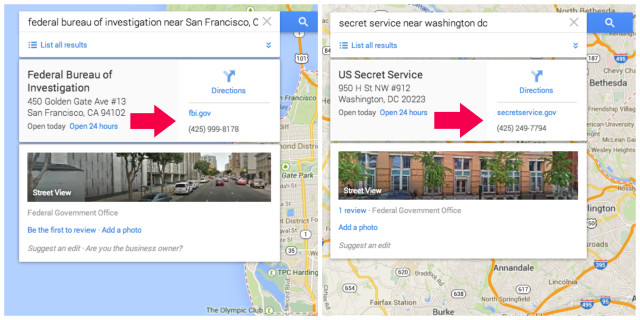
An ex-Marine turned hacker used his powers for good last week, exploiting a flaw in Google Maps to tap into phone calls from the FBI’s San Francisco field office and the Secret Service. 

The news of hacker Bryan Seely’s exploit was broken by local Seattle broadcast news with a more detailed follow up by tech blog Valleywag, which obtained phone calls to the FBI recorded by Seely. The exploit allowed the former Microsoft employee to modify the phone numbers for businesses listed on Google Maps. He changed the listed phone numbers to fake ones, which would intercept and record the call before being rerouted to the FBI, allowing him to record everything said between the two parties.


Seely told Valleywag:

Who is gonna think twice about what Google publishes on their maps? Everyone trusts Google implicitly and it’s completely unwarranted and it’s completely unsafe. I could make a duplicate of the White House and take every inbound phone call from the White House. I could do it for every Senator, every Congressman, every mayor, every governor—every Democratic, every Republican candidate. Every office.

Seely tried time and again to warn Google, he told Valleywag, but when they didn’t listen he decided to show them just how vulnerable this system was. 

Seely’s recording of an FBI phone call posted on SoundCloud airs the automated message system the San Francisco FBI plays. Afterwards, we’re able to listen in to the caller’s every word.

“Yes ma’am, I need to ask a question about an email I received, it’s concerning that y’all, the Federal Bureau of Investigations, claim I won a lottery through my email through another country,” the caller says to the FBI. He’s asking about a common Internet scam, phishing, and the second call Seely recorded from the Secret Service was just as innocent. 

Listen to the FBI call Seely recorded in the player above.

But not every call to the Secret Service or FBI is so innocuous. After the Secret Service took Seely into custody for his actions, they apparently called him a “hero.” 

The San Francisco FBI bureau’s spokesperson, Peter Lee, told the Guardian that he wasn’t aware of the scam, and could neither confirm or deny it. Sounds like super secret spy stuff to us. We directed him to the link, but he couldn’t confirm or deny that we sent him the link, either.

The national FBI spokesperson wasn’t aware of the issue, or at least, said she wasn’t. But the response from Google seems to be more telling — it contacted Seely to find a way around the exploits. But he didn’t appreciate their “attitude,” he told Valleywag.

In the meantime, Google’s map vulnerabilities apparently are lures for “entrepreneurs” who redirect calls from one small businesses to another, garnering millions in profits for the digital scammers in what amount to extortion fees, a tech consultant told Valleywag. 

While Google works on a fix, if you have to call the San Francisco bureau of the FBI, try looking up the number using the Yellow Pages. 

Read more at Valleywag, here

Bleached brings the sunshine at the Rickshaw Stop

3

It’s no question that Bleached has come into success within the past year with the release of its debut album, Ride Your Heart, on record label Dead Oceans. But how does the band gauge its success? By a younger man sneaking into their green room, which apparently didn’t happen the last time Bleached played San Francisco.

This time Bleached brought along power-punks Terry Malts, psych rockers Mystic Braves and dark psych band Tropical Popsicle for a packed Noise Pop show at the Rickshaw Stop.

Initially seeing the name “Tropical Popsicle” on the bill, I tossed the band off as another kitschy garage-rock creation. But I was wrong. Despite it’s name that evokes visions of summer and dessert, Tropical Popsicle veers to the darker side of things.

As the band started its set on a dimly lit stage, a post-punk synth tune reminiscent of New Order played. As the set wore on, Tropical Popsicle picked up the pace slightly with spooky and moody psych tunes.

tropical popsicle
Tropical Popsicle

Then Mystic Braves walked on the stage, some members clad in floppy sun hats that could have graced the heads of many grandmothers in the ‘70s. Going for a contemporary psych-rock vibe, the band is in the same vein as Allah-Las and Froth. Mystic Braves showed great musical prowess, playing intricate and fuzzed-out riffs amongst shallow, subdued vocals.

Next up was Terry Malts, the only band boasting Bay Area “citizenship” on the bill. Playing what they call “chainsaw pop,” the Berkeley based band plays distorted, up-tempo power-punk with deadpan vocals.

Just like the speed of its music, Terry Malts barreled through its set. Vocalist and bassist Phil Benson was reluctant to play “I Do,” off the band’s 2012 effort, Killing Time. He was caught saying, “Well, I guess we’re playing this song” in an exasperated and apathetic-sounding voice. But that could very well be Benson’s normal voice.

terry malts
Terry Malts

As Bleached finally went on stage, the front of the room was packed, leaving very little space for breathing.

Before I delve into the exacts of the show, here’s a little background information on Bleached. The band is well known for having sisters Jennifer and Jessica Clavin in the mix. But before Bleached was even a glint in Clavin sisters eye(s), they were in a Los Angeles post-punk band, Mika Miko. Though Mika Miko may be gone and a thing of the past, the sisters Clavin have regrouped to form Bleached — a band decidedly more wholesome, hook-filled and poppy than its predecessor.

Playing a slew of songs that share common themes of having fun, boys, and causing a ruckus, Bleached whipped the audience into a frenzy in record time. It was only a few songs into the set before people started in with stage dives.

bleached
Bleached, from above

Clear-cut crowd favorites, such as “No Friend of Mine” and “Think of You”, were played. The band also lended it’s way in performing a few sonic treats, such as a cover of the Misfits’ “Hybrid Moments” and previously unreleased song “For the Feel.”

With three-quarters of the bands on the bill based in Los Angeles, sunny Southern California was brought to a dreary and rainy San Francisco, if only for a night. And boy, was it good.

@erindage

SF votes to ban plastic water bottles on city property

26

San Francisco continues to lead the way in the nation’s environmental policy, with the Board of Supervisors today [Tues/4] voting unanimously to bar the city from buying plastic water bottles and to ban distribution of plastic water bottles smaller than 21 ounces on city property starting Oct. 1. The ban excludes city marathons and other sporting events.

“We all know with climate change, and the importance of combating climate change, San Francisco has been leading the way to fight for our environment,” Board President David Chiu, who authored the legislation, said at the hearing. “That’s why I ask you to support this ordinance to reduce and discourage single-use, single-serving plastic water bottles in San Francisco.”

Chiu held up a water bottle at the board meeting, a quarter of the way full with oil, to illustrate how much oil is used in the production and transport of plastic water bottles. He also reminded San Franciscans that the current fad of buying bottled water only started in the 1990s when the bottled water industry mounted a huge ad campaign that got Americans buying bottled water.

Somehow, Chiu noted, “for centuries, everybody managed to stay hydrated.”  

Proponents say they hope the ban will put a dent in the nearly 60 million water bottles Americans use daily and decrease the amount of plastics that take up room in the oceans and landfills.

“We applaud Supervisor Chiu and San Francisco’s leadership in the movement to think outside the bottle,” said Katherine Sawyer, Campaign Organizer of Think Outside the Bottle at Corporate Accountability International, which took part in a taste test event comparing SF tap water to bottled water before the hearing. “By taking this step, San Francisco continues to be a pioneer, paving the way for cities, states, and national parks across the country to follow suit and buck the bottle. Not only does this measure eliminate wasteful spending on such an eco-unfriendly product, but it also opens doors to increased investment in the most essential of municipal services—water.”

The ban will return to the board next week for a final vote, after which it will head to Mayor Ed Lee for his signature. 

Google Glass Explorer opens up on bar fight, privacy

Last week, I interviewed a Google Glass “Explorer” for an article about Glass and privacy. It wasn’t Sarah Slocum.

“Explorer” is a Google term for people enrolled in a program to beta-test Glass, a wearable computer that can surf the Internet, livestream, geo-locate, and record through a computerized prism affixed to a set of eyeglasses.

There are at least 10,000 Explorers currently giving the $1,500 prototypes a test run, and more than 27,000 participating in a Google+ community about it. The Silicon Valley tech giant views its Explorers as inhabiting a “living laboratory,” and is actively seeking feedback on the gadgets’ use and functionality.

The Explorer I spoke with is Matt Hunt, and his recent removal from Oakland bar Telegraph for wearing Glass is chronicled in detail in this Medium story by journalist Susie Cagle. The writer discloses that her partner, Billy Agan, told Hunt to remove the Glass before he was kicked out.

Not yet available for retail, Glass has proven to be a lightning rod – particularly in bars, where people are more apt to feel that it is invasive. Some bar owners are concluding that the best approach is to ban Glass altogether, to avoid headaches. 

Unlike most new technology, this particular device has quickly come to be associated with class tension in the Bay Area, a region that is being radically altered by an economic shift fueled by an influx of tech workers. Glass has also caused people to fear surreptitious surveillance in an era when new revelations about secretive government spying programs are surfacing with every passing week. 

There are conflicting accounts of what unfolded when Hunt was booted from Telegraph after his confrontation with Agan. Hunt says he refused to remove the Glass because he didn’t think Agan had the authority to tell him to stop wearing it; bar owner John Mardikian says Hunt responded by defaming the bar on social media, which Hunt refutes (Hunt had previously been helping Mardikian with social media and IT work). Agan wasn’t available for comment. All told, the conflict appears to have produced two major outcomes: hurt feelings all around, and a ban on Glass at Telegraph.

“I don’t want it here, because it’s anti-community,” said Mardikian, who imposed the ban. “I want people to feel comfortable when they are here.”

Other bars have proactively banned glass too.

Conflict aside, Hunt did share a perspective on wearing Glass that might interest anyone who has wondered about it – whether from a standpoint of curiosity or suspicion. Because while some people are viscerally repelled by the gadget and may assume that it is recording (it might be, but you can tell by checking to see if the user’s eye is lit up), there’s also a low level of understanding about what the thing actually does.

Hunt told us he was excited about Glass before it came out, and saved up the $1,500 required to get it. “I’ve always been a techie,” he said. “I’m always about smart everything.” 

To wear Glass is to be an attention a magnet, he said. “There are some people who approach me about it who are very calm, and they are curious, and they ask me about it.”

But as evidenced by the drama that unfolded at Telegraph, wearing Glass can stir up trouble when people feel that their personal boundaries are being violated. “Something I hear all the time is, there’s a camera on your face, and therefore it’s in my face.” But he said that since he rarely ever uses the camera, that fear is unfounded – at least as it pertains to people who are encountering him wearing Glass.

Constant recording and even live streaming through Glass is technically possible. It’s also problematic with the current model, due to battery drain.

“If you were out and about, it would have to be tethered to your phone’s Internet connection,” he explained. “It uses a lot of data.” When content is captured through Glass, it is automatically backed up to the cloud, meaning it’s copied onto a server somewhere. That means people who are photographed can’t control what happens to their image, but it doesn’t mean it will be viewed publically or by anyone at all.

So, if he’s not constantly recording, what is Hunt doing when he’s looking at that little computerized prism?

As with a smartphone, he’ll read the news, and check email. There are other functions. “You can have things translated,” he said, like a menu or sign in a foreign language. “Based on your location, it will tell you what’s around you,” such as attractions. But a lot of times it just sits on his face, not doing anything in particular. “Just because you’re wearing it, doesn’t mean you’re using it.”

People who wear Glass can also take advantage of some bizarre “Glassware” apps, like this one, which can feed users hints on people they are encountering in real time.

Taking a picture with Glass involves either tapping the side of the device, or speaking “take a picture” out loud, Hunt explained. There is also an optional feature of winking to take a snapshot.

That may sound like a smooth spy maneuver, but Hunt said it’s actually rather awkward. “I don’t like it,” he said, “because you have to wink like ten times to make it work. It’s very dramatic winking.” Wearing a computer on your face and winking dramatically? Talk about socially awkward.

As for the privacy issue, Hunt said he thought bar owners had a right to ban Glass but believed it was short-sighted, because he thinks Glass will catch on. “Wearable technology is the technology of the future,” he told us with confidence. “What will you do when everyone is wearing it?”

And ironically given what happened at Telegraph, Hunt insisted during our phone interview that Glass users should not wear the device in places where it causes others to feel uncomfortable.

“I want privacy as much as you do,” he said. “And I feel terrible sometimes that people think the NSA is watching them through my eyes.”

Jason “Shake” Anderson is Oakland’s ‘Candidate X’

116

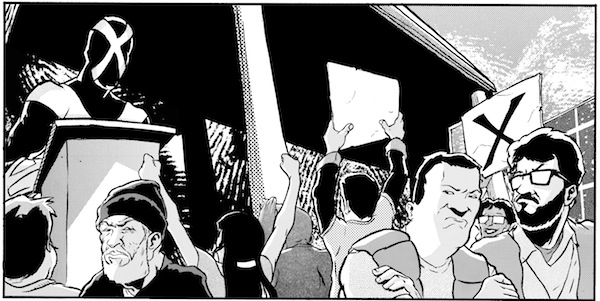
In our Jan. 1 issue, the Bay Guardian spun the tale of Candidate X, a fictional progressive mayoral candidate aiming to save San Francisco’s wonderfully weird soul using people power. The hope? To inspire a candidate to run in the City’s election in 2015 with strong progressive bona fides, and the values that inspired a nation during the rise of the populist Occupy movement.

Now a real life Candidate X has surfaced, but not in San Francisco — this X is challenging Jean Quan for her seat as Oakland’s mayor, using our Candidate X story to define, elevate, and amplify his candidacy. 

Meet Jason “Shake” Anderson, 38, a former Occupy Oakland spokesperson, veteran, and now Green party candidate for the Oakland mayor’s race. He hopes to take the lessons from Occupy to help reinvigorate the city he calls home. 

“It doesn’t get much news, but Occupy Oakland dropped crime in the city in that moment. It’s because people had places to sleep and places to eat. Those things drop crime,” he told the Guardian. “I’m not saying we camp again, but we need to find ways to do things like that. We have empty buildings, how about we give organizations who feed people on a daily basis a building that wasn’t being used to begin with?”

Anderson is an African American man, and although he feels black Oakland needs representation, he’s about bridging divides: “My attitude is we take care of our people first; not just black or brown people, but people.”

Thinking with people power is Anderson’s modus operandi. He noted that the Port of Oakland was severely disrupted by an Occupy takeover, showing the people have teeth. He doesn’t want to just fight people in power, but work hand in hand with them.

“I believe we can work with and not be separate from the power structure, and even the playing field,” he said. “A lot of people are mad at rich people, but I’m angry at disparate wealth. People are poorer and poorer, and they feel likes there’s no change in their course.”

Jason “Shake” Anderson talks music with “The Black Hour.”

That focus on building bridges and novel ideas to tackle everyday problems is what drew Anderson to our Candidate X feature back in January. He co-opted the imagery and message, distributing “Who is Candidate X?” flyers around San Francisco and Oakland. The front side features art from our Candidate X story, by the talented Sean Morgan, and the back features a brief description of Anderson’s candidacy as well as a QR code that links to a donation using Bitcoin. 


You see, Anderson is a bit of a tech head, with a belief that eventually Bitcoin will be one way to free people’s money from banks that don’t look out for the interest of people. And much like our fictional Candidate X, he thinks the tech movement and activist movements have much in common.

“Candidate X comes from the concept of the 99 percent, the leaderless movement of Occupy,” Anderson said. “This is not about me, I’m just a guy. But I’m supposed to represent you.”

candidatex4

Norman Solomon: The problem with Obama denouncing a breach of international law in Ukraine

5

International law is suddenly very popular in Washington. President Obama responded to Russian military intervention in the Crimea by accusing Russia of a “breach of international law.” Secretary of State John Kerry followed up by declaring that Russia is “in direct, overt violation of international law.”

Unfortunately, during the last five years, no world leader has done more to undermine international law than Barack Obama. He treats it with rhetorical adulation and behavioral contempt, helping to further normalize a might-makes-right approach to global affairs that is the antithesis of international law.

Fifty years ago, another former law professor, Senator Wayne Morse, condemned such arrogance of power. “I don’t know why we think, just because we’re mighty, that we have the right to try to substitute might for right,” Morse said on national TV in 1964. “And that’s the American policy in Southeast Asia — just as unsound when we do it as when Russia does it.”

Today, Uncle Sam continues to preen as the globe’s big sheriff on the side of international law even while functioning as the world’s biggest outlaw.

Rather than striving for an evenhanded assessment of how “international law” has become so much coin of the hypocrisy realm, mainline U.S. media are now transfixed with Kremlin villainy.

On Sunday night, the top of the New York Times home page reported: “Russian President Vladimir V. Putin has pursued his strategy with subterfuge, propaganda and brazen military threat, taking aim as much at the United States and Europe as Ukraine itself.” That was news coverage.

Following close behind, a Times editorial appeared in print Monday morning, headlined “Russia’s Aggression,” condemning “Putin’s cynical and outrageous exploitation of the Ukrainian crisis to seize control of Crimea.” The liberal newspaper’s editorial board said that the United States and the European Union “must make clear to him that he has stepped far outside the bounds of civilized behavior.”

Such demands are righteous — but lack integrity and credibility when the same standards are not applied to President Obama, whose continuation of the Bush “war on terror” under revamped rhetoric has bypassed international law as well as “civilized behavior.”

In these circumstances, major U.S. media coverage rarely extends to delving into deviational irony or spotlighting White House hypocrisy. Yet it’s not as if large media outlets have entirely excluded key information and tough criticism.

For instance, last October the McClatchy news service reported that “the Obama administration violated international law with top-secret targeted-killing operations that claimed dozens of civilian lives in Yemen and Pakistan,” according to reports released by Amnesty International and Human Rights Watch.

Last week, just before Obama leapt to high dudgeon with condemnation of Putin for his “breach of international law,” the Los Angeles Times published an op-ed piecethat provided illuminating context for such presidential righteousness.

“Despite the president’s insistence on placing limits on war, and on the defense budget, his brand of warfare has helped lay the basis for a permanent state of global warfare via ‘low footprint’ drone campaigns and special forces operations aimed at an ever-morphing enemy usually identified as some form of Al Qaeda,” wrote Karen J. Greenberg, director of the Center on National Security at Fordham University’s law school.

Greenberg went on to indicate the scope of the U.S. government’s ongoing contempt for international law: “According to Senator Lindsey Graham (R-S.C.), the Obama administration has killed 4,700 individuals in numerous countries, including Pakistan, Yemen and Somalia. Obama has successfully embedded the process of drone killings into the executive branch in such a way that any future president will inherit it, along with the White House ‘kill list’ and its ‘terror Tuesday’ meetings. Unbounded global war is now part of what it means to be president.”

But especially in times of crisis, as with the current Ukraine situation, such inconvenient contradictions go out the mass-media window. What remains is an Orwellian baseline, melding conformist ideology and nationalism into red-white-and-blue doublethink.

Norman Solomon is co-founder of RootsAction.org and founding director of the Institute for Public Accuracy. His books include “War Made Easy: How Presidents and Pundits Keep Spinning Us to Death.” Information about the documentary based on the book is at www.WarMadeEasyTheMovie.org

(The Bruce blog is written and edited by Bruce B. Brugnann, editor at large of the Bay Guardian.  He is the former editor and co-founder and co-publisher of the Bay Guardian with his wife Jean Dibble, 1966-2012. B3) 

I always believed that the right song at the right moment could change history.  Pete Seeger, folksinger, 1919-2014

Real Estate indulges the fans — in a good way — at the Independent

0

So this New Jersey-based band called Real Estate came to San Francisco this weekend to play two sold-out shows for Noise Pop at the Independent. The lighting and stage design was spectacular. The opening bands were superb. The venue was excellent.

Though all of these factors came together for a great experience, the one thing I will take away is that one drunk girl who screamed at Real Estate to play it’s song “All The Same” for the entirety of its set, and how she unintentionally fostered a sense of community.

But that will all be explained later.

Opening was Dominant Legs, a trio  out of San Francisco. The band had three easily defined traits: strong, jazz-like basslines, a pre-recorded, kicky synth beat and a vocalist who sounded strikingly like Andy Bell (of Erasure fame) to match. At times, the drum machine on the recording synced up with the actual drummer’s beat, making for a full sound that bands such as the Melvins and the Feelies (for a spell) have achieved with two drummers.

dominant legs
Dominant Legs

Next were The Shilohs, a Vancouver-based band that draws from influences such as Big Star and Neil Young, maintaining a ‘60s rock spin. Off of New Images, a record label run by Matt Mondanile of Real Estate and Ducktails, the band released its full-length, So Wild, last year.

Though The Shilohs try to maintain an allegiance to the ‘60s, there’s no question that both the band and Real Estate sound incredibly similar. This was probably why the band was booked for the show, and how they landed on Mondanile’s label. And the audience ate it up, as many more people gathered close to the stage to watch the band play.

shilohs
The Shilohs

After The Shilohs finished up, Real Estate appeared on stage in due time. In the interest of promoting new material, the band opened up with “Had to Hear” off of its latest album, Atlas.

Then it started soon after that song. Off in the distance I heard someone yell “PLAY ‘ALL THE SAME!’”

Initially I thought nothing of it — I mean, it’s a good song. It’s the perfect, psych-rock infused closer to the Real Estate’s well-recieved 2011 album, Days. Skip 15 minutes or so ahead to the third song of the set: three others have joined the plight for Real Estate to play “All The Same.” Song after song, (that wasn’t ‘All the Same’) more and more joined in the chorus for that damn song to play.

And you know what? Eventually Real Estate did play “All the Same” during its encore, along with “It’s Real.”

real estate
Real Estate obliges.

But instances such as this, when the demand of one inebriated audience member becomes the demand of many, remind me of how much I enjoy attending shows. Seldom do you enter a room to find that (nearly) each and every person in it all enjoy the same thing. And this was the case for the Real Estate show at the Independent.

And there’s definitely something to say about that.

Mikal Cronin takes the spotlight, has excellent hair at The Chapel

3

Mikal Cronin walks onto the stage this past Saturday night [March 1] for the third time this week, settling into the right corner; a spot he’s apparently comfortable in, given that it’s his usual post when playing in (fellow Laguna Beach native) Ty Segall’s band. Tonight was Cronin’s night, however, and his first Noise Pop appearance this year as Segall was suspiciously absent from the roster — perhaps a result of his recent deflection from San Francisco to LA? Regardless, Cronin was joined by his eponymous band at The Chapel, who wasted no time on introductions as they broke into one of their signature clamorous surf-rock jams.

The crowd eagerly soaked in the band’s offerings throughout the course of the evening, thrashing along to the jangly guitars and getting down with the miry basslines for the nearly hour-long set. Even on songs whose refrains seemed rather redundant (like the underwhelming second of the evening “Situation”) there was no shortage of hair flying, both on and off the stage.  Speaking of hair, though — the band has the game locked. The headbanging displayed by Chad Ubovich, Mike Anderson, and Cronin is the kind of stuff that would make even the most famously coiffed girl bands (ahem, HAIM) jealous, as they did it with such great fervor, intermittently draping their mics with long, stringy manes.  

mikal

College-rock favorite “See It My Way” was the first song officially announced, though if the amount of people singing along was any indication, it was probably the one that least needed an introduction. The room was silent as the tempo slowed down before Cronin concluded, “No I’m alright/I’m coming home/and I will find a way,” before launching into the chorus that sent the crowd into a bouncing frenzy. Feeling the love coming off the last song, Cronin thanked the audience as the band began to play the opening chords of another hair-band anthem, “Back in Black” — thoughis was only a tease, to the dismay of fans who let out a resounding sigh as the band transitioned into one of their own songs.

mikal

The garagey-beach guitar was omnipresent and at times came across as formulaic, which is interesting, because it’s that very quality that takes attention away from the somber lyrics which are noticeably in discord with the upbeat melodies. In a way, the repetitive sound of the music almost acts like a cloaking device, masking the feelings of desolation in certain songs — like “Change,” for example, which goes, “I can’t climb the mountain all alone/I’ve been at the bottom for a long time/I’ve been waiting for the sun to set, the moon to shine/The day to change to night so I can fall.”

mikal

Cronin reappeared on the stage solo for the encore, playing “Don’t Let Me Go,” in one of the more emotionally exposed moments of the evening — even the lights made his sweaty face look like he had been crying — but it was an ephemeral moment, as the rest of the band took up their instruments and played a droney, spiraling, psych-riff laden version of Wreckless Eric’s “(I’d Go The) Whole Wide World” to close out their set. If nothing else, it was a finale that proved that, even though Cronin takes place at the side of the stage, he is indeed a front man.