SFBG Blogs

The sordid saga of Airbnb — a $10 billion “outlaw middleman” — continues

103

SF-based Airbnb is making news again this week, from the San Francisco Chronicle following up our stories about how landlords are sending eviction notices to tenants who are breaking their leases and local laws in using the short-term rental services to national outlets trumpeting Airbnb’s estimated $10 billion in valuation, which is more than some of the biggest hotel chains.

But nobody seems to be calling out how those two things are connected, except perhaps in ValleyWag’s passing but spot-on reference to the SF-based company as an “outlaw middleman.” That’s a good label for a scofflaw company that is making buckets of money by openly flouting tenant and tax laws in San Francisco, New York City, and other cities around the world.

Meanwhile, as the City Attorney’s Office continues preparing to take legal action against Airbnb, new companies are popping up to make it even easier for residents to illegally monetize their rent-controlled apartments, such as AirEnvy.com, which encourage people to “profit from your home or apartment by renting out unused space through a full service management marketplace.”

The company charges people 18 percent to manage their Airbnb rentals, checking guests in and out, cleaning up, and whatnot. And most of its testimonials are from San Franciscans, such as Rob, who writes, “I used to spend hours managing my Airbnb, exchanging keys with guests, and cleaning. Now, Airenvy does all that for me.”

Breaking local laws against short-term rentals has never been easier! All this infuriates Janan New of the San Francisco Apartment Association, who tells the Guardian that more than 1,100 rent-control apartments are listed on Airbnb at any time, and she’s been working with landlords to identify and evict such tenants.

Yet she denies that many landlords are using Airbnb to get around rent-control laws — such short-term rentals are also usually illegal, even for owners — and told us, “If people are breaking the law on our side, I want to know who it is.”

And as this highly lucrative clusterfuck continues, Board of Supervisors President David Chiu is still mired in his year-long efforts to create a legislative remedy for all of this. But Airbnb seems to be taking its local political problems seriously, this week hiring David Owen — a well-connected former legislative aide to Chiu’s predecessor, Aaron Peskin — away from Platinum Advisors to work on public policy for the company.

Stay tuned, folks, there’s lots more to come on an issue that the Guardian started covering years ago when few were paying attention to how an illegal business model was being used to create a multi-billion-dollar company.   

“These stories are ours, too” — South Asian women’s collective celebrates a decade of ‘Yoni Ki Baat’

20

Growing up in San Francisco, I was never sheltered from sexuality. Whether it was the naked runners at Bay to Breakers or the same-sex lovebirds kissing on street corners, there has always been an honest dialogue about love, sex, and gender in my hometown. But that makes it easy to take for granted.

For over a decade, the South Asian Sisters, a Bay Area arts collective, has been cultivating a community of diverse and progressive women of South Asian origin who want to talk openly about sex. While to many outsiders India is the land of Kama Sutra and tantric sex, to those who grew up in South Asian communities, the openness just isn’t there. Talk of sexuality comes in the form of rumors, whispers, and shameful glances, explains Vandana Makker, a member of the South Asian Sisters.

In a grassroots effort to build a candid conversation about these taboo issues, South Asian Sisters has grown into a national movement inviting an open discussion of gender and sexuality — empowering women of South Asian descent across the country. Their efforts come to a head with the yearly rendition of Yoni Ki Baat, a live performance of Vagina Monologues-inspired sketches. The show is comprised of a dozen or so performances by South Asian Sisters, all aimed at bringing light to the silent oppression that’s been going on in South Asian culture for centuries.

This weekend’s shows, on March 22 and 23, will mark Yoni Ki Baat’s 10th Anniversary with three special performances at the iconic and historic Women’s Building in the Mission. Whether painful, funny, disturbing, or powerful, each performance furthers the honesty so vital to these women. I reached out to the diverse women from the South Asian Sisters collective to better understand what this project means to them. 

SF Bay Guardian Why is Yoni Ki Baat important to you?
 

Creatrix Tiara: Born and raised in Malaysia, I found it difficult to find a community of people who were willing to talk about issues like gender, sexuality, and race openly and freely — especially as a Bangladeshi, a much-maligned racial minority in Malaysia. Joining YKB was really refreshing and helpful in finding people who could relate to feeling liminal in those areas — having to navigate cultural norms versus wider societal taboos and stereotypes, never quite fitting in one world or another. People don’t tend to associate South Asians with a lot of issues around gender and sexuality. How can South Asians be kinky? Queer? Into masturbation in strange places? Unthinkable. YKB shows that hey, these stories are ours too, no matter what anyone says.

Micropixie: Growing up in London at the time that I did, and then later moving to Paris, and then back to the UK, I did not have a community of progressive, feminist, radical South Asian women around me. In fact I did not know such a type of woman even existed until I moved to San Francisco 10 years ago. It was wonderful to see my first Yoni Ki Baat 7 years ago and then later join the team of organizers. I love the stories and relate to all of them even those that do not pertain to my personal experience. But I especially love the women in the show, both the performers and the writers…talking about sex, sexuality, and actually so much more. It’s a brave thing we are doing, and for some of the girls it’s the first time they are on stage; personally, my own family was horrified!

ykb

Indira Chakrabarti: The show is especially important to me since I wrote for the first show a decade ago! Then, I wrote and performed for the second one. It is so meaningful to me to be back. I fell out of touch for a variety of reasons but have always believed in the importance of providing this space for women, especially South Asian Women, to have their true voices heard.

Anjali Verma Ruvalcaba: When I first auditioned for YKB I was a 20-year-old college student at UC Berkeley with a newly shaved head. I was already facing stigma and criticisms from both family and friends for wanting to experiment and “discover myself,” so to say that I was nervous going in to it is definitely putting it mildly. Once I got there I was welcomed by such open, kind, genuine, friendly, and loving faces that I knew I had found a very sacred place to call my own, finally, and I haven’t looked back since as this will be my 9th year performing. YKB gave me my first and only set of older sisters to look up to, who understood me, accepted me, inspired me, and kept challenging me to strive for my goals, and whether near or far now, they have all helped mold me into the stronger more honest and more grounded version of my self that I am today, for which I’ll be eternally grateful.

Amruta: There are not many spaces where we, as women, are free to speak within and from our cultural context—where we are best understood, especially if this context involves one or more terribly different cultures. Within this rich diversity, each of us represents an intersection of colors, cultures, places and languages. To have this opportunity, to be yourself amidst this diversity, and at the same time to once a year slip into another’s skin and extend our empathy, is rare. YKB is an invaluable space where we have this opportunity to present, from a woman’s perspective, the multiplicity of the South Asian diaspora.

Barnali Ghosh: The pieces in YKB challenged my assumptions of who South Asian women are as well as assumptions I had about myself and what I was capable of when it came to speaking about these taboo issues. I have met and become friends with so many brave women through being part of the production. Performers are both amateurs and professionals and often women for whom it is the first time doing any kind of performance. There is no director and the cast provides the feedback, support and guidance that allow all of us to find our voice. This kind of non-hierarchical process is not something most of us are used to. But if we trust in it, it works out most of the time and in the case of YKB, in mind-blowing ways.

Neha Shah: I was thrilled to discover YKB about five years ago. I was in Washington, D.C. then, brought my mom to the show where I performed someone else’s piece. Her attending the show was a turning point in our evolving relationship and her realization that I am being an independent young woman. I think it broke the awkward barriers that are typical of Indian parent-child relationships where you just don’t discuss dating and sex.

ykb

SFBG What are you most excited about for the 10th anniversary performance of Yoni Ki Baat?

Creatrix Tiara: The piece I’m performing [The Word of Violence] is one of the earliest pieces in YKB’s history, but the writer has never been able to see it performed live. She’ll be attending this show and will see it performed for the first time. It’s nerve-racking but I hope I am able to give her piece the love and justice it deserves!

Anjali Verma Ruvalcaba: I am excited to simply be celebrating this with everyone who’s written, performed, and witnessed the show. There’s a lot of heart, blood, sweat, and tears that goes into this year after year. It’s all 110 percent volunteer-driven and based, which I can’t even begin to express how thankful I am because without that drive, or passion, we cannot build the emotional space needed to support one another through this process and then convince folks of our stories, be they ours or someone else’s, on stage for the world to see.

Bernali Ghosh: For me personally, I am excited about reprising a funny piece I did 2 years ago. Before I performed it for YKB I didn’t know that I could do humor as a performer. Humor can be really important to healing and way to balance some of our more serious topics, so I am looking forward to sharing laughs with the audience again!

Vandana Makker: Each piece holds a special memory for me, and it’s like looking through an old family photo album and reminiscing about all the things we’ve been through. I’m so proud of the show and what it’s grown to become and can’t wait to give it a proper birthday party.

Amruta: Yoni Ki Baat is the simple message emerging from this dizzying diversity. I am excited to be part of this established tradition that has repeatedly brought to the fore an array of experiences with which we can all empathize

Indira Chakrabarti: I’m anxious and nervous to perform my piece after a decade-long hiatus but am so cozy in a warm hug of support and encouragement from my sisters.

Neha Shah: This an amazing milestone for the movement. Social change via the arts is a necessary and effective way to bridge disparate ideologies—the diversity of voices that YKB has brought together is not a small feat. It reminds me of my favorite quote: “Never doubt that a small group of thoughtful, committed citizens can change the world. Indeed, it is the only thing that ever has.”

Yoni Ki Baat 10th anniversary shows

Sat/22, 6:30pm; Sun/23, 12:30pm (this show open to those who self-identify as female) and 5pm
$15 advance, $20 at the door
Women’s Building
3543 18th St, SF
Yoni Ki Baat online


Seeking technology and economic/social justice columnists

78

The Bay Guardian is looking for a pair of new freelance writers to do separate monthly columns covering the technology industry and economic/social justice issues. The two new columns would go into a rotation we’re tentatively calling Soul of the City, along with Jason Henderson’s Street Fight column and a new environmental column by News Editor Rebecca Bowe that we’ll debut in our Earth Day issue.

For the technology column, we want someone with a deep understanding of this industry, its economic and personality drivers, and the role it could and should play in the civic life of San Francisco and nearby communities. We aren’t looking for gadget reviews or TechCrunch-style evangelizing or fetishizing of the tech sector, but someone with an illuminating, populist perspective that appeals to a broad base of Guardian readers. 

The other column, on economic and social justice issues, would cover everything from housing rights to labor to police accountability issues, with an eye toward how San Francisco can maintain its diversity and cultural vibrancy. We want someone steeped in Bay Area political activism and advocacy, but with an independent streak and fearless desire to speak truth to power.

We envision the columns running on a monthly rotation at around 1,100-1,400 words each, with the potential to sometimes run longer and to even be featured on our cover when circumstances warrant. Columns can focus on a single issue or multiple items. Pay is 10-15-cents per word depending on the depth of reporting required. We strongly encourage candidates of color, young people, and those representing communities that need a stronger voice in the local political discourse to apply.

If you’re interested, please sent your qualifications and concepts, along with one sample column and ideas for future columns, to Editor-in-Chief Steven T. Jones at steve@sfbg.com. Help us escalate this fight for the soul of the city by adding your voice to the Guardian’s mix.    

On the Rise 2014: A mixtape

0

Dear local musicians,

There’s kind of no non-awkward way to say this, but: We like you. A lot.

In honor of this week’s On the Rise issue, which celebrates the diversity and energy and inspirations and favorite sandwiches of some of the Bay Area’s most promising bands, we crafted this mix that’s rife with coded messages about our true feelings for you made up of songs by this year’s OTR artists.

Track Listing
1. “Harlem” — Cathedrals
2. “Change My Ways” — Tony Molina
3. “Leaving Soon” — Meklit
4. “Ode To Russia” — Major Powers & The Lo-Fi Symphony
5. “Betray The Sea” — Annie Girl & The Flight
6. “Wake Up” — Rocky Rivera
7. “Sadie” — Astronauts, etc.
8. “Integrated Circuit” — Useless Eaters
9. “Collapsing Obsidian Sun” — Friction Quartet
10. “Black Friday/Soul On Ice” — Nu Dekades
11. “Church of SoMA [excerpt]” — Avalon Emerson

…so, did you, like, have a date for the prom yet? Just out of curiosity. We have a flask.

Your friend,
The SF Bay Guardian

Youth immigration activists cross the border to protest deportations

Last November, the Guardian profiled Alex Aldana, a queer immigration activist who was born in Mexico but came to Pomona, California with his mother and sister on a visa at the age of 16.

Yesterday [Tue/18], Aldana joined a group of undocumented immigrants in a protest at the U.S. border crossing at Otay Mesa in San Diego.

Chanting together as a group, they marched over the border and presented themselves to U.S. Immigration and Customs and Border protection agents, whom they asked for asylum.

Among the immigrants who surrendered to immigration agents were women, children, and teens. Some are separated from their husbands, children, and families in the US and, like my own mother, wish to be reunited.

The youth protesters were brought to the U.S. earlier in childhood, but deported to Mexico after being taken into custody and detained by U.S. Immigration and Customs Enforcement. Some would have qualified for the Dream Act, but were forced to leave the country before it was signed into law.

The protesters marched toward the turnstiles that separate Mexico and the U.S., chanting “Yes we can,” and “No human is illegal.”

A few feet from the gates, the group paused to listen to a final pep talk from Aldana.

The action was captured and recorded in real time on U-Stream. About 16 minutes into the video, he can be seen addressing the crowd, fist raised. “We have nothing to lose but our chains,” Aldana told the group. Then, in Spanish, he said, “Without papers [documents],” to which his fellow protesters responded, “without fear.”

They made their way to the turnstiles and one by one they walked through, straight into custody of U.S. border protection agents. As they crossed the border, they told a cameraperson where they hoped to go. They named cities, such as Phoenix and Tucson, and states, such as Alabama, Oregon, and North Carolina. But each one said, in English or Spanish, “we’re going home.”

It was part of a series of organized border crossings, organized by the National Immigrant Youth Alliance, to highlight the experiences of young people who lived for years in the United States but were deported due to their immigration status.

In Aldana’s case, he traveled to Mexico voluntarily, due to a family emergency.

“After ten years in California, Alex traveled to Mexico three months ago to care for his ill grandmother,” notes an online petition addressed to President Barack Obama and Secretary of Homeland Security Jeh Johnson, circulated by the Dream Activist network in support of allowing Aldana to return.

The Gay-Straight Alliance network has also voiced support, saying LGBT deportees are in especially precarious situations because they are more likely to be targeted with violence.

“Over these past few months, [Aldana] has been shocked to discover how crime and corruption make life particularly difficult for the LGBTQ community in Mexico,” the Dream Activist petition notes. “In Guadalajara alone, 128 gay and lesbian people have been killed, and none were reported as hate crimes. Now he wants to return to La Quinta because his mother and siblings need him.”

Activist Yordy Cancino Mendez, who also participated in an organized border crossing, become a target of violence in Mexico due to his sexual orientation. “He has been followed from the metro to his house trying to be kidnapped. He fears daily for his life,” according to the petition written in his support.

Here’s a video of him speaking about what life has been like in Mexico, uploaded by the National Immigrant Youth Alliance.

As a teenager in the U.S., Aldana and his family faced severe domestic violence at home at the hands of their father, who harassed him for being gay and tried to stop him from going to school. For a time, he lived in shelters to escape that abusive situation.

Now Aldana wishes to return to the U.S., to continue his education and support his sister, who qualifies for the California Dream Act. As an activist, he’s widely admired as a “courageous and visionary leader in both the LGBT and immigrant rights communities,” said Jon Rodney of the California Immigrant Policy Center.

A birds’ eye view of the Otay Detention Facility, from Google maps.

Media representatives from the U.S. Department of Homeland Security could not be reached for comment. Officials at the Otay Detention Facility, where Aldana was reportedly being held as of Tue/18, declined to comment.  

No charges filed against City College student protesters

19

The two formerly jailed City College student protesters can now breathe a sigh of relief, as this morning they learned that the District Attorney’s Office won’t be filing criminal charges against them.

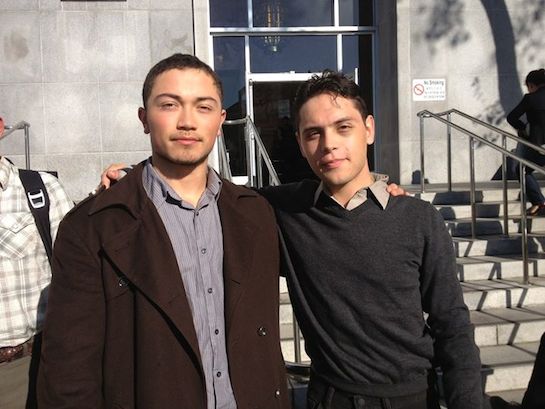
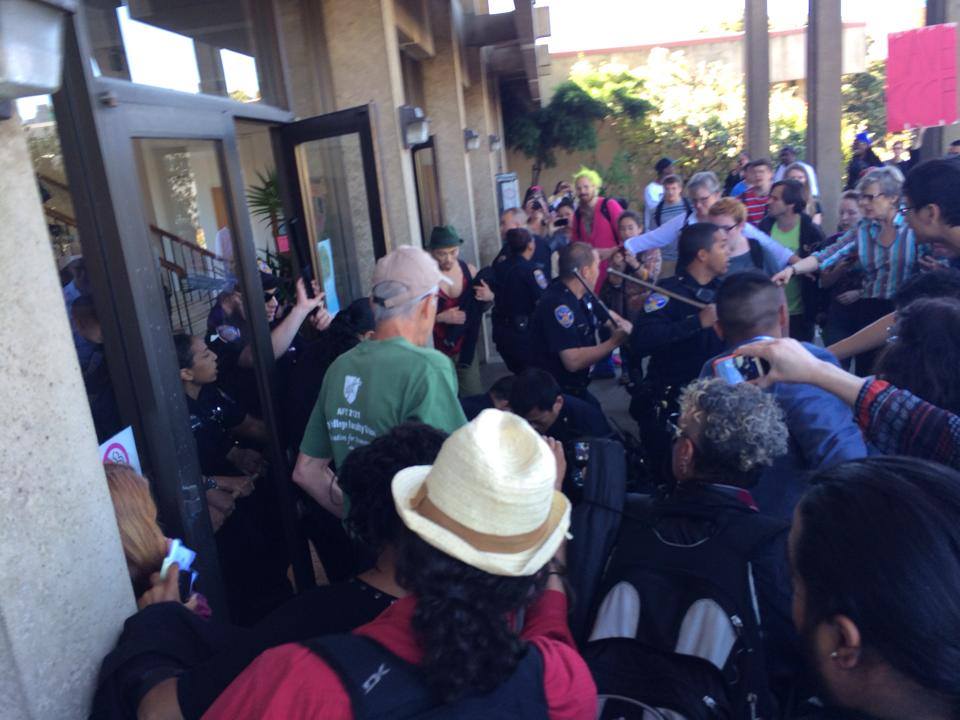
Otto Pippenger, 20, and Dimitrios Philliou, 21, were detained by SFPD following a violent clash during a City College protest last Thursday. Their ideological and physical fight for democracy at their school is also the subject of one of our print articles in this week’s Guardian. Philliou’s attorney confirmed to the Guardian that charges were not pursued by the District Attorney’s Office.

“The charges have been dropped for now, in terms of the criminal case,” said Rachel Lederman, president of the San Francisco chapter of the National Lawyers Guild, which is representing Philliou. 

But, she noted, they’re not out of the fire yet. 

“The fight is not over for them,” she said, “as it’s possible they’ll face school discipline.”

Heidi Alletzhauser, Pippenger’s mother, told the Guardian that Vice Chancellor Faye Naples indicated the two would face some sort of disciplinary hearing, though Naples told Alletzhauser that Pippenger would not be expelled.

We called Napes to confirm, but did not hear back from her, and we’ll update this post if and when we do. 

Alletzhauser was concerned that the Chancellor Arthur Q. Tyler publicly pointed a finger at the two boys, shaming them for their actions in a letter he penned to the community and to the press. “I am saddened to see students engaging in violent outbursts,” he wrote. The letter as a whole seems to cast a shadow of blame on the protesters. 

“It sounded to me like they were sure Otto and Dimitrios were guilty,” Alletzhauser said.

The school hearing has not yet been confirmed. Alletzhauser was happy to see her son and Dimitrios get back to school.

“They both had classes at 10, so they went to school,” she said. “Which is adorable, I think.”

How To Dress Well laughs his way into the sad songs at The Independent

0

By Ryland Walker Knight

Last night at The Independent, How To Dress Well kicked off a short tour (10 shows in this second half of March) with Forest Swords, playing new songs from a forthcoming album. On the heels of the release of “Words I Don’t Remember,” a new single, HTDW has assembled a more or less “real” band for these dates, with Tom Krell expanding his live act from a duet with Aaron Read (electronics, violin, guitar, bass) to quartet with Destroyer’s Larissa Loyva (keys/synths, backing vocals) and Broken Social Scene’s Justin Peroff (drums, laptop).

Krell’s previous visit was a spot supporting Sky Ferreira at the Rickshaw Stop, but he had no trouble selling out The Independent, its floor clogged with iPhone-ready and booze-addled fans eager to bathe Krell in coos, assuaging his anxieties about playing so many new songs. Throughout the night, Krell would banter about how this was the first time people were hearing these new tunes (eight of the 14 songs), but each was greeted with bumping, grinding adoration.

htdw

HTDW has always trafficked in “sad rave” vibes, but Krell made a point to joke that “I only write emo songs now” after introducing a new song called “What You Wanted” as “being really shitty about your desires, and incredibly basic; like being a teenager about your desires and always wanting something more and new.” It’s a fun song, actually, hitting that sweet spot of enough bounce to lift the moping and wailing Krell has become known for. He sings in a high falsetto not unlike everybody in R&B’s idol, Prince, but his music is more indebted to 1990s groups like Dru Hill, and everybody’s fallen star, Aaliyah. Or, that’s the vibe on the pop-ier songs, like the new jam “Very Best Friend.” But there remains a strain of unabashed sadness, too: Krell reminded the crowd that his first visit to San Francisco in 2010 was planned, under “less than ideal circumstances,” in order to record a song called “Suicide Dream 1” that he wrote to mourn a close friend. Nevertheless, he says it’s still his favorite song to sing.

Among the other new songs was one Krell described as “a sort of reggae, emo, early Animal Collective song,” drawing on pop-punk and Rich Homie Quan. Another was inspired by the idea that if you’ll do something once, you’ll probably do it twice (which may not necessarily be a good thing), that Krell hopes becomes a radio single after “Words” has its run. Details on the record are mum, however, as the first thing Krell told the crowd was: “I just got a text message from my manager and he’s like, whatever you do on stage, don’t say the name of your album or the release date of it.” He laughed his way into a terrifically sad opening number, but not before promising to have fun soon.

htdw

The night started with the likely final show of locals EN, the duo of multi-instrumentalists James Devane and Maxwell August Croy, who layered koto and other sine waves, all the sounds (pedaled or pure) processed by Devane over syncopated electronics for a beautiful 20-minute welcome, accented by visuals from another local, the visual artist Paul Clipson. I was told Krell has invited similar experimental audio-visual artists to open each show on each stop of this tour, one imagines to lend necessary contrast against the sad pop he sings and the dub-like moods Forest Swords conjur from a similar duet of live bass and an assortment of electronics. Forest Swords’ newest work was released by Tri Angle Records, but their songs have more traditional rhythms than many of that label’s “witch” music. In fact, I joked with my friend that the Forest Swords set sounded like the saddest sex you’ve ever had, while EN and Clipson made me wish I could walk around inside those tones with my own 16mm eyes ready to chop up the light of the world.

On the other hand, even without Krell’s formerly standard encore cover of “I Wish” by R. Kelly, which he says he can’t sing anymore out of political correctness (divorce the song from the man! keep the song the song!), How To Dress Well’s set made me happy he’s at the forefront of this new genre of white guys making R&B music — at least in part because he just seems so jazzed to play his songs, to be present in his life as an artist on a stage.

Setlist and other notes
“The Power”
“What You Wanted” — being really shitty about your desires, and incredibly basic, and being a teenager about your desires and always wanting something more and new
“Cold Nights” — as a ‘metal’ song, still not very metal
“Very Best Friend” — dancey, sisqo-y, love song
“No More Death” — ‘not fun, lets make it super dark for this one please’
“Facing Up” — i don’t know what’s best for me
“Suicide Dream 1” — first visited SF in 2010, recorded song with orchestra, to commemorate a friend who had just died — his favorite song to sing
“Chop and pick’m up” — reggae emo animal collective song
“” — Radio single — If you’ll do something once, you’ll probably do it twice
“Words I Don’t Remember”
“Set It Right”

@ryknight

The unanswered question: How do we bridge SF’s affordable housing gap?

186

Nobody has a good answer to San Francisco’s most basic housing problem: How do we build the housing that existing city residents need? It was a question the Guardian has been posing for many years, and one that I again asked a panel of journalists and housing advocates on Friday, again getting no good answers.

The question is an important one given Mayor Ed Lee’s so-called “affordability agenda” and pledge to build 30,000 new housing units, a third of them somehow affordable, by 2020. And it’s a question that led to the founding 30 years ago of Bridge Housing, the builder of affordable and supportive housing that assembled Friday’s media roundtable.

“There really isn’t one thing, there needs to be a lot of changes in a lot of areas to make it happen,” was the closest that Bridge CEO Cynthia Parker came to answering the question.

One of those things is a general obligation bond measure this fall to fund affordable housing and transportation projects around the Bay Area, which Bridge and a large coalition of other partners are pushing. That would help channel some of the booming Bay Area’s wealth into its severely underfunded affordable housing and transit needs.

When I brought up other ideas from last week’s Guardian editorial for capturing more of the city’s wealth — such as new taxes on tech companies, a congestion pricing charge, and downtown transit assessment districts — Parker replied, “We’d be in favor of a lot of that.”

Yet it’s going to take far more proactive, aggressive, and creative actions to really bridge the gap between the San Francisco Housing Element’s analysis that 60 percent of new housing should be below-market-rate and affordable to those earning 120 percent or less of the area median income, and the less than 20 percent that San Francisco is actually building and promoting through its policies.

Stated another way, about 80 percent of housing we’re building is for a small minority of city residents, or the wealthy people that these developers hope to attract to the city. And we’re not building housing for the vast majority of city residents. That is a recipe for gentrification, displacement, and destruction of San Francisco as a progressive-minded city.

Parker parroted Lee and other pro-development boosters, including SPUR, in arguing that city needs to make it easier and faster for developers to build new housing of all types. “In San Francisco, we do need to expedite the [housing] entitlement process,” Parker said.

But when asked whether meeting or exceeded Lee’s housing production goals would ever bring the price of market-rate housing down to the level where someone more 120 percent of AMI — which HUD recently set at $81,550 for single San Franciscans, or $116,500 for a family of four — Parker conceded that it wouldn’t.

The bottom line for San Francisco and its overheated real estate market is we can never built our way to affordability. The only way to build housing that most people can afford is with public subsidies, and San Francisco just isn’t asking enough from its wealthy individuals, corporations, and developers to create an Affordable Housign Trust Fund that is anywhere near big enough to meet the real demand.

That kind of assertion seems radical by the standards of today’s skewed political (and online) discourse. But when I raised it to a panel that included Bridge Housing officials, members of SPUR and HOPE SF, and a panel of journalists from such pro-development outlets as San Francisco Business Times, San Francisco Magazine, SocketSite, The Registry SF, KQED, and TechCrunch (as well as the more Guardian-aligned Mother Jones), nobody had any good answers or remedies to that basic question that we’ve raised again and again.

Instead, some of the business journalists offered a more sober assessment of what’s to come than most of this city’s pro-development boosters, noting a few signs of irrational exhuberance in the local economy.

The Registry’s Vladimir Bosanac said he’s observed a recent trend of developers buying up unentitled land, indicating more optimism in the sustainability of this development boom than market conditions might warrant. Adam Koval of SocketSite, an early predicter of the last dom-com crash, also voiced sketicism in the pervasive “this time is different” faith in the tech sector, noting how realms such as gaming and online coupons are losing steam and predicting that commercial rents are plateauing.

“I think there are some real gut checks coming up,” Koval said of the tech sector and the sustainability of its growth and valuations.

Perhaps it’s also time for a gut check by Mayor Lee and others who argue that we can build our way to housing affordability without any major new efforts to capture more of the wealth now being generated in San Francisco, wealth that might not be here later if we continue avoiding the question of how to provide the housing that San Francisco needs. 

Sexual assault survivors seek reform at the University of California

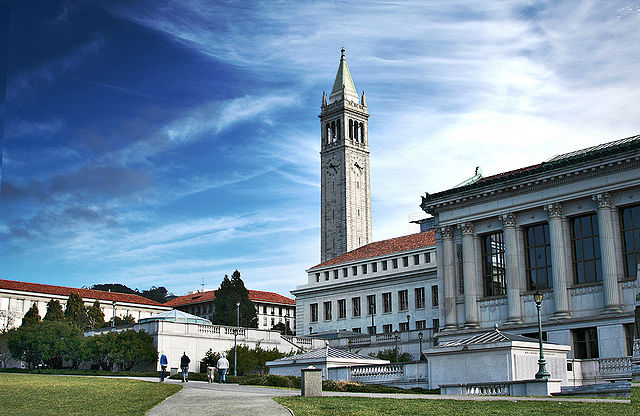
University of California Berkeley graduate Nicoletta Commins was 20 when she was sexually assaulted, in early 2012. She’d been taking a Taekwondo class, and said her teammate assaulted her when they were in her apartment.

He was “just an acquaintance,” she said in a phone interview. “We were sort of flirty, but not close friends.”

Following the incident, she had a pervasive sense of fear. “He was on campus for a month or a little more, after this happened. I was really depressed. They let me take a reduced workload, but it was hard to keep up with school,” she said. “I took windy ways to school to avoid him. I saw him on campus and it was a terrifying experience. There was one time I saw him walking by, and I hid behind a car.”

Adding to that stress was the difficulty Commins says she encountered after formally reporting the assault and awaiting a response from campus officials.

Late last month, 31 women who currently or formerly attended UC Berkeley filed formal complaints with the federal Department of Education, alleging that the university had mishandled sexual assault investigations through repeated failure to adequately address reports of these incidents.

Universities are bound to comply with Title IX, a federal civil rights law that requires postsecondary institutions to take measures to protect sexual assault victims. They must also adhere to the Clery Act, which requires reporting of crime statistics and for security policies to be in accordance with federal guidelines.

In their complaint, sexual assault survivors charged that UC Berkeley had violated their rights under Title IX and the Clery Act by failing to meet the complaints with adequate investigation and response. This was the second formal complaint to be lodged along these lines: Last May, nine women who had attended UC Berkeley came forward with an Office of Civil Rights complaint charging the same. This most recent filing was an updated complaint with accounts from more survivors.

After the sexual violence she experienced, Commons said she immediately sought medical care and reported what had happened. Initially, campus staff was responsive, she said. She met with a representative from the Office of Student Conduct, followed by a meeting with a campus coordinator tasked with Title IX compliance.

“People reached out to me. People told me their burden of evidence is lower at the school than the court,” she recounted. “They said people will see disciplinary action in the school that they won’t see from law enforcement.”

But time went on, and she heard nothing. “No one would tell me anything or respond to emails. All of a sudden everyone left me in the dark. They told me there’d be a hearing to participate in. Then nothing. For months.”

Getting nowhere through campus channels, she decided to go to the police, prompting the Alameda County District Attorney to become involved in her case.

After a year and a half had gone by, a settlement was finally reached. “Part of it included him not coming back to school for a few years before I left the campus,” she explained. “He had to get counseling. He was excluded from school functions, and [was barred] from contacting me.”

But she believes UC’s hand was forced by her decision to involve law enforcement. “If I had not reported to the police and the DA had not come to agreement with the lawyers, [the settlement] would not have happened,” she said. “It was an agreement between the DA’s office and the school.”

Following the initial OCR complaint last May, the California Legislature ordered the State Auditor to conduct an audit of UC Berkeley and three other universities, to assess outcomes of sexual violence complaints on a broad scale and to investigate whether the universities’ policies are in compliance with federal guidelines.

“Sexual violence is the elephant in the room that nobody wants to talk about, particularly in an educational environment,” Assemblymember Anthony Rendon wrote in a letter calling for the audit.

“I am particularly concerned with the recent allegations made by the nine women from UC Berkeley stating that their cases were simply not taken seriously by campus officials and not reported properly. Campus officials discouraged them from reporting their cases to police and did not provide these victims with adequate support services … These women are broken down physically and emotionally. The lack of support they received from the officials on campus is attributable to this.”

Margarita Fernández, spokesperson for the State Auditor, said the audit was a work in progress and that findings could be released in June.

“The U.S. Department of Education’s Office of Civil Rights received a complaint that alleges discrimination on the basis of sex, sexual violence, race and disability at the University of California-Berkeley,” a spokesperson from that agency wrote in a statement to the Bay Guardian. “The Department is evaluating the complaint allegations to determine whether they are appropriate for a civil rights investigation.”

In the interim, the UC system has taken some steps in the wake of the federal complaints. According to a March 7 announcement, the school released a new policy against sexual violence and harassment that provides for expanded training and education, increased reporting requirements, and broader protections for victims, according to a recent announcement from the office of UC President Janet Napolitano.

UC Berkeley has also issued a formal response, with Chancellor Nicholas Dirks issuing a Feb. 25 letter to announce efforts to streamline campus policies around responding to sexual violence.

Addressing the sexual assault victims who came forward, Dirks said, “I have been deeply moved by your courage and conviction, and offer my full support for your efforts.”   

We sought to contact representatives from the campus’ Gender Equity Resource center, which provides assistance to sexual assault victims, but received a statement from campus spokesperson Janet Gilmore instead.

“We are committed to taking a close look at what we can do to better serve students and incorporate their concerns as we seek to address these issues,” Gilmore wrote. “That process remains underway.”

AirBNB apartment advertised for “XXX Freakfest” orgy

8

A Manhattan comedian put his apartment up for rent on SF-based AirBNB, only later to find his renter advertising out his apartment for an orgy, Gawker reported Friday. While hilarious, the incident highlights key points in the New York attorney general’s litigation againts AirBNB. And the San Francisco City Attorney may soon look into them as well.

The problem? Cities have no data on how AirBNB rentals are being used. Usually the concern is over landlords renting through AirBNB at the expense of evicted long-term tenants. In this case, the tenant asked comedian Ari Teman if it was alright to have family over for a wedding. It turns out he meant to use the apartment for much wilder aims.  

Teman walked through the lobby of his building, just before leaving for a trip, only to overhear his new tenant say “they’re shutting us down,” according to Gawker. Suspicious, Teman Googled his tenant’s phone number and found a Tweet advertising a “BBW panty raid” party. 

For the unitiated, BBW stands for Big Beautiful Women. Talk about the wrong time to leave. One wonders if Teman was just bummed he missed out on all the fun. He needn’t have worried, as the next advertisement listed was for a “XXX Freak Fest” — in Teman’s own apartment.

The damage to his apartment may also have gotten him miffed. His furniture was damaged and overturned, and bags of condoms and loads of liquor were strewn about his apartment. 

The tenant, who Gawker identified as “David,” said an agreement between he and Teman specified he could have up to 50 guests, which Teman denies. 

To its credit, AirBNB put up Teman in a hotel while his apartment is cleaned, changed his locks, and ponied up $23,817, all within 24 hours, Gawker reported.

The best part? Afterwards, the now infamous company Taiwanese Animators already has a 3D animated cartoon up about the incident. Though we will say, the video is a bit problematic by primarily featuring black actors in the overweight roles. What’s with that!?

But really, this is another example of the troubles around lax regulation of AirBNB which hopefully will be ironed out soon. The NYPD cleared the apartment, which costs New York City a chunk of change. That’s money that isn’t paid for by AirBNB, because hosts have so far skirted paying hotel taxes. The same is true in San Francisco. 

As we’ve reported previously, New York Attorney General Eric Schneiderman issued a subpoena to Airbnb last October, demanding information on New York City’s 15,000 hosts and 25,000 listings.

So far, San Francisco hasn’t pursued AirBNB with the same zeal. Maybe all we need to do is throw a few AirBNB hosted sex parties. 

Dispatches from SXSW: Day 3 — Lessons, brisket, and fool’s gold

2

The most important thing I learned from being at SXSW is that I should not under any circumstances make any decisions to move to Austin based on my experience at SXSW. Yes, the city is amazing, hip, and fun for 10 days out of the year, but what about the other 355? I’m willing to bet at least 60 percent of attendees thought to themselves “You know what, I could totally see myself living here.” For San Franciscans and New Yorkers, that number is probably 80 percent. Not to mention, summertime in Austin is a devil’s combo of Arizona heat and Deep South humidity. In addition there’s only one light rail line in this huge sprawl of a city; Austin’s population is a little larger than San Francisco’s but has more than five times the square mileage. I feel this is necessary to point out because I have a feeling there are a dozen or so people every year who did this and after a couple months of living here they panic and are like “Oh god! Why did I sign that one-year lease!”

On to day three (Friday).

Part of the reason I was so excited to visit Austin was for the barbeque, specifically brisket. My original plan was to visit the famous Franklin’s BBQ, a place that usually has a three-hour wait. But when I saw that people were camping out in line, I said scratch that. The first two days were brisket free for me, therefore my third day had to be brisket day. I went to some place called Noah’s and had a brisket plate and a brisket sandwich to go. The plate was good at first and then became mediocre half-way through. When I had the sandwich later on in the day, it was dried out and there virtually useless, I still ate it anyway. My determination to find a decent a brisket joint was still undeterred. I found a food truck area and convinced myself to order a $10 brisket sandwich. It too was mediocre. My friend had a brisket from another food stand, I had a bite of it and it didn’t do anything to impress. Here’s another lesson for you, food at big events sucks, it’s the more expensive and mass-produced version of itself; Outside Lands is very guilty of this.

Anyway, back to the music.

migos
Migos

Day three was also my sleep-in and rest day. Walking 14 miles a day with sun in your eyes and loud noise in your ears and staying out to 2 or 3am can really wreck you. At around 4pm, I’m fully recharged and I make my way to the Fader Fort for one last hurrah. Unfortunately, this time around even the badge-people are having a hard time getting. I’m stuck in line for 80 minutes, while my friends are enjoying the hedonism of the Fader Fort. I finally get in, I catch the last three songs of Young Thug’s raucous set. I find my friends and we decide to bounce, I bid adieu to the Fader Fort.

For our last night in Austin, my friends and I decide that we’re going to stick to one showcase and spend the entire night. We finally decided on the Fool’s Gold showcase hosted by A-Trak and Nick Catchdubs. On the bill was A-Trak, Migos, Travis Scott, Black Atlas, Treasure Fingers, Berkeley rapper 100s, and about 234 other rappers and DJs. We get in line two hours before doors open at 8 and of course there are already 30 people in front of us. We pass the time by playing games, eating dinner, and making new friends with our line buddies. Then 8pm rolls around,  the moment we’ve been waiting for. Nothing happens besides someone telling us to form a strict single-file line. Then at 8:40, we make our way in knowing our patience will be greatly rewarded.

The waiting, however, is not over. The first hour and a half of acts are by and large forgettable. They’re all rappers whose gimmicks, fist-pumping, and attempts to “turn up” were doing little to affect the crowd.

Four hours after we got in line, the real fun kicks in when Treasure Fingers hops on the ones and twos. He spins a bombastic set of fast-paced galloping electro and bass-drenched hip hop, a near perfect threading of the border between hip-hop and electronic music. Fool’s Gold co-head Nick Catchdubs takes over the DJ baton after Treasure Fingers and switches to a more hip-hop centric set that’s just as  exciting. Sweet vindication for all that time waiting is settling in, my version of the marshmallow experiment.

100s
100s

However, I was not prepared for the next two and a half hours. I had never experienced such a colossal amount of hip-hop bravado, swagger, and stage presence packed into such a small space (the venue was a car repair garage.) 100s led off this hip-hop marathon with his silky perm and synth-hop beats. When they say SXSW is a platform for artists to take off, they’re talking about artists like 100s.

A-Trak takes the stage after 100s and starts turntabling for a bit and then out of a nowhere Danny Brown pops out as the “surprise” guest of evening. The crowd goes wild even though despite this being one of the least surprising guests SXSW. Danny Brown throws down a rambunctious set mostly because the crowd is so hyped to see him. He yells “Where’s the molly at?!” of course, then does one more song and bows out to Migos.

As soon as they grab the mic, it’s apparent that Migos are natural performers. Not too many acts can have an iron-fisted control over a mob of drunk and high hip-hop fans. During “Versace” and “Hannah Montana,” the energy in the air is so palpable I think the entire place was going to collapse. Then Young Thug bursts out of nowhere, causing an earthquake registering a 7.2 on the richter scale. Tsunami warnings are issued all along the Texas and Gulf coasts.

young thug and migos
Young Thug and Migos

It’s one of the most “Can’t stop, won’t stop” moments I’ve ever witnessed in hip-hop. More and more guests like A$AP Ferg, Travis Scott, and YG. Each guest somehow finding a way to turn up the crowd more. Every time I feel like we’ve reach peak turn-up, the next track manages to turn up even more.

At the end of this hip-hop extravaganza, I am left nearly catatonic and speechless. I literally OD on hip-hop, and plan to go cold turkey for the rest of the month. When I regain consciousness, a pain and numbness takes over my legs, leaving me with the daunting task of walking two miles home.

Ana Tijoux on motherhood, Breaking Bad, and un-learning colonialist history

0

By Rebecca Huval

If you’re tired of mainstream Latin hip-hop — which, right now, is disproportionately made up of reggaeton beats, male MCs, and bitter lyrics — then Ana Tijoux is the lady rapper for you.

The French-Chilean artist upends the genre. Instead of bragging about her millions, she advocates for cultural pride. Instead of barking at her enemies, she weaves a soothing spool of words that remixes the Spanish language into silk. She has evolved from using samples to working with a live band in a textured, colorful sound all its own, incorporating brass, jazz inflections, and a smorgasbord of South American instruments such as Andean charangos and pan-flutes.

You might have heard Tijoux’s origin-story track, “1977,” on Breaking Bad, as Jesse and Mike make deliveries through a desolate Southwestern landscape. The song describes the year she was born in France to parents who were exiled during the military dictatorship in Chile. Her alternating flow and staccato make the mind-numbing road trip seem badass. Following that sophomore record, La Bala, Tijoux is releasing a mature album with lush orchestration March 18: Vengo. The following evening, Wed/19, she’ll hit The Independent.

Calling to mind Erykah Badu, Tijoux is a poet with a low, creamy voice and a call for algre rebelde, or joyful rebellion. Her lyrics will make you feel like the top of your head was taken off, to paraphrase Emily Dickinson. “I come as a child who sought entrance to his/ home, the entrance to his origin, the return to/ his crusade, I come seeking silenced history/ the history of a land pillaged/ I come with the world and I come with the birds,” Tijoux raps in the title track of Vengo. In the shadow of Pinochet’s Chile, Tijoux is rebuilding dignity in her heritage with thoughtful, joyous rap.

Ahead of her show Wednesday night, we caught up with her by phone to talk about why it’s better to protest with beauty, how it felt to move from France to Chile as a teenager, and what it was like to dance with a man in an octopus suit in a music video.

San Francisco Bay Guardian How did you start rapping, and what female rappers influenced you?

Ana Tijoux I think I began when I was 20, very naturally, out of necessity because I needed to communicate. The woman who inspired me first was Bahamadia. And then I began to rhyme and write, and then I began to learn about more female MCs: MC Lyte, and when I was younger, Queen Latifah.

SFBG I’ve read that you consider yourself to be shy. How do you find the strength to perform in front of so many audiences?

AT Because I’m an amazing actress. [Laughs] On stage, I’m singing, I’m communicating, so I forget about the audience. It’s energy, and you begin a dialogue with people. That’s one of the moments when I feel free. It doesn’t matter what happens, I just do it.

SFBG Why did you move to Chile in 1993?

AT Because my parents were exiled in France, and I’m from there, and when refugees could come back I came with my parents. It was hard, very hard. I was a teenager and you’re in the construction of a personality. You’re fighting between a child and an adult in one personality, and then to change continents was hard. It was also one of the most amazing moments in my life. And it was a moment of a lot of lessons, but I understood about them more later, not immediately. I understood about friends, and about how the North robs so many things from the South. It was a political education.

SFBG Your 2007 video for “Eres Para Mi” with Julieta Venegas is goofy and delightful. It looks like you had a lot of fun making it. What was it like dancing with a man in an octopus suit and a nun?

AT The most hilarious moment in my life. When she made the video she didn’t tell me an octopus would be there, so it was a surprise. And I’m shy, like I told you, so I tried to act the best that I could. I didn’t know I would have an octopus near to me.

SFBG How did you write an album with your young children around?

AT It was an amazing moment, but very hard with time. I learned so much, like trying to be a mother with the [artistic] creation and no sleeping. At the same time, it was amazing. I learned time is a precious treasure and so valuable. I can’t lose time anymore in stupidity. The time I have is for creation or friends and family. It was hard to be honest, but really amazing.

SFBG Why did you decide to work with a live band instead of using samples?

AT I work with the best musicians I could have imagined. The songs have different vision with drums because it can be longer, or if the bassist has a solo, each instrument sings and gives a different color. It feels so organic and every instrument can give one texture to a song, and different movement and weather in the songs.

SFBG In “Vengo,” you say “Without fear you and I decolonize/what we were taught.” How have you unlearned what you were taught about Chile’s history?

AT I feel like everything I learned in school was with a colonized vision. You become interested in your roots, you understand that how you learned history is so different than what happened. In Chile, we live in a country with people with brown and black hair, and in publicity they have women with blond hair. All this publicity is about who we should be, and I’m saying we should be proud of who we are as a society and a community.

In America, they say it’s been 500 years since they discovered the continent. They didn’t discover it, people were here before the colonizers arrived. We’re changing the vision and vocabulary.

SFBG I loved Somos Sur, and I think your lyric “alegre rebeldía” captures the spirit of your music. In your calls for social justice, I sense more beauty than anger. What inspires you to call for equality with your gorgeous lyrics instead of just shouting at a protest?

AT Protests in general are protests for life. When you see fights around the world, it’s a fight for life. To have a fair life, it’s about dignity. We’re so used to protests with anger. We want a better future for us our kids and community. So that’s what I’m saying, it’s a fight for happiness.

SFBG How did it feel to hear “1977” on Breaking Bad?

AT Funny. I’m glad. It’s an amazing series, and I’m glad that there is a mainstream series that’s taking a risk. It’s a good series with amazing characters.

SFBG In “1977,” you say “Caminas en crucijadas/ Cada cual es su morada” (“You walk in crossroads/ each one is your home”). Where do you consider your home now?

AT Chile, totally Chile. It’s where my family is, my parents, my kids, my garden, and my refugees.

SFBG What advice would you give to young female rappers out there?

AT Do not listen to advice at all. Everybody wants to give advice about how to make stuff. Don’t listen to advice. Try to make music and be free.

@rhuval

Dispatches from SXSW: Day 2 – Fader Fort, Future Islands, and Waiting in Lines

0

I’m pretty sure the Fader Fort is where I want to spend the rest of my youth and possibly my life. This makeshift village is probably as close to cool heaven as it gets. It’s got free music, free drinks, and people-watching galore. Did I mention it’s also got charging stations, free ice cream, and a first aid tent? You really could spend the rest of your youth and/or life here.

The Fader Fort is that illustrious castle on the hill of peak hipness. You can absorb the coolness into your skin via osmosis. For entrance into this Hearst Castle for the Snapchat crowd, you must either know somebody who knows somebody, have a pass (like I do), or get in line at the ungodly hour of no later than 12:30pm. Seriously, if you don’t get in line by at 1pm, you’re doomed to a fate of sunburns and sobriety. So get in line early, your brand depends on it.

As much I want to conduct an anthropological study on the impossibly hip 20-somethings lounging and fluttering all over the Fort, I have to force myself over to music stage.

fader fort

The first act is British crooner Sam Smith. He’s most known for his feature on Disclosure’s “Latch.” Without the Disclosure brothers at his side, Mr. Smith and his rad pompadour unleash an acoustic rendition of the dance hit, which the crowd and I found equally pleasing. As per SXSW custom, Smith busts out 20 minutes of work, packed up, and bounces to his next gig.

I go re-up on free pineapple juice and rum.

When I get back, Theophilus London is about to come on. I’ve been listening to this guy for a while and I still don’t get his deal. I feel like he’s been stuck on the come up for a while, which contradicts the very idea of being on the come up. He presents his mix of electro funk, pop, and hip-hop, all while wearing torn yellow pants, a yellow tank top, jean jacket, and that Pharrell/Arby’s hat. Towards the end of his set, he brings onstage a woman from the crowd and they do some sort of seductive dance that’s kind of novel and cool, but immediately takes a turn for the worse when London creepily starts grope-dancing with her. He almost sucks all the cool from the air, leaving everyone baffled and awkward. She goes back to the crowd and we all breathe a sigh of relief.

theo

Theophilus London
Pineapple juice and rum time.

Collaborators Shlomo and Jeremih are up next. Shlomo warms up the crowd with a DJ set of percolating electro rhythms. I begin to worry Jeremih might not show up, but he does. The two are collaborating for an upcoming album, but their performance makes me think they should establish this as a permanent arrangement. Jeremih’s suave and soothing nu-R’nB vocals hypnotizes the crowd into a state of mindfulness. But Jeremih knows what the crowd wants to hear, they want to hear “Birthday Sex,” and you do not deny what the good people at Fader Fort want. Jeremih plays “Birthday Sex” and the audience reacts in a way that it makes seem it like they enjoy “Birthday Sex” more than actual birthday sex.

Headlining the Fader Fort is electro-funk impresarios Chromeo, aka the self-proclaimed “most successful Jewish-Muslim collaboration ever.” Even though everyone in the concert tent is shoulder to shoulder and butt to butt, we all erupt in cathartic dance when Chromeo belt out “Night by Night.” There aren’t too many acts worthy of being a headliner at the Fader Fort, but Chromeo rises to the challenge and then some. They decimate the audience with 30 straight minutes of the old hits and some new tracks from their upcoming LP, White Women. Then the clock strikes midnight on the Fort and now we all have to face the daunting reality of not being in the Fort. But wait, Chromeo comes back for an encore! Encore finishes. OK, now the Fader Fort is done.

I grab a quick dinner and speed-walk over to Congress Ave, where the entire Heart Break Kids gang are playing, but unfortunately when I get there, there’s a 100-foot line, and from what I can tell, the entire club is packed to brim. Even badge people like myself aren’t being allowed in. I give up on HBK and speed-walk across town again to the Mad Decent Garage shows. Half an hour  later I arrive, and there’s a short but extremely slow-moving line. I give up and go meet up with friends at some rave tent with no line.

Turns out, there’s a real good reason there was no line. I’m subjected to blaring and soul-killing dubstep. The filthy and warbled bass jackhammers my very-being. Time to get out of there.

I wander around this part of town looking for my next show, while also being in awe of the massive herd of drunk revelers tripping flyers and empty drink cups.

I then happen upon Cheer Up Charlie’s to catch the end of indie-rockers Merchandise and then indie-poppers Future Islands. I didn’t catch enough of Merchandise to formulate an impression. At this point I’m just happy to be away from the dubstep. Future Islands come on and are the saviors I’ve been waiting for in this post-Fader Fort landscape.

future islands
Future Islands

Future Islands’ frontman Samuel T. Herring immediately grabs the crowd with a loud growl, jabbing dance moves, and pointed stares. Every band should have a Samuel T. Herring. His chaotic energy is more infectious than a breakout of pink-eye. He sneers, jumps up and down, and makes disfigured looks on his face for the entire set, and it makes for a surprisingly good complement to Future Islands’ bouncy and sunny pop. I honestly have never seen someone as turned up as this guy. I couldn’t think of a better way to end the day.

‘Budapest,’ ‘Mars,’ and more: CAAMFest + new movies!

1

Last night heralded the opening of the Center for Asian American Media’s CAAMFest; it runs through March 23 at the Castro Theatre, 429 Castro, SF; Great Star Theater, 636 Jackson, SF; New Parkway Theater, 474 24th St, Oakl; New People Cinema, 1746 Post, SF; Pacific Film Archive, 2575 Bancroft, Berk; and Sundance Kabuki Cinemas, 1881 Post, SF. For tickets (most shows $12) and complete schedule, visit www.caamedia.org. For commentary, see “The Art of Martial Arts,” “Telling Tales, ” and “Women With Movie Cameras.”

New movies after the jump.

Better Living Through Chemistry Sam Rockwell, Olivia Wilde, and Michelle Monaghan star in this dark comedy about a mild-mannered pharmacist whose life is upended when he meets a pill-addicted trophy wife. (1:31) 

Elaine Stritch: Shoot Me See “Shooting Straight.” (1:21)

The Face of Love Five years after her husband, Garrett (Ed Harris), drowns while on vacation for their 30th anniversary, Nikki (Annette Bening) chances upon his exact double, Tom (Harris again). She pretends to be a divorcée and hides all photographic evidence that would out her reason for pursing Tom, an easygoing art professor and painter who actually is divorced (he’s buddies with his ex, a low-key Amy Brennemen). To her delight, he reciprocates her interest — but as their relationship grows, it becomes harder to conceal the, uh, doppelgänger situation from Nikki’s adult daughter (Jess Weixler) and neighbor (Robin Williams), a widower who’s jealous of Nikki’s new love. Harris and especially Bening are great — and they’re great together — but The Face of Love, from director and co-writer Arie Posin (2005’s The Chumscrubber), is the romantic melodrama equivalent of a one-joke comedy (with at least one Vertigo-inspired scene, and a drippy score that underlines every emotional story beat). The end to Nikki’s agonizing charade, and the end of the movie, can’t come soon enough. (1:32) (Cheryl Eddy)

Generation War German import Generation War was originally called Our Mothers, Our Fathers, to underline the relevancy of the discussion it’s presumably trying to stir at home — even if for many viewers the war generation would have been their grandparents’. Directed by Philipp Kadelbach and written by Stefan Kolditz, it starts out in dismayingly hackneyed fashion as we’re introduced to our youthful protagonists. Celebrating a birthday in 1941 near the war’s start, when Axis victory seems assured, they pose for a photo you know damn well is going to be the heart-tugging emblem of innocence horribly lost for the next 270 minutes. Fast-paced yet never achieving the psychological depth of similarly scaled historical epics, Generation War grows most interesting in its late going, when for all practical purposes the Allies have already won the war, but Germany continues to self-destruct. Imminent peace provides no relief for protagonists who’ve survived only to find themselves fucked no matter what side they stay on, or surrender to. That moral and situational complexity is too often missing in a narrative that aims for sympathy via simplicity. The underrated recent film version of The Book Thief (2013) was criticized for soft-pedaling the era, but it was about (and from the viewpoint of) somewhat sheltered Aryan children living in a civilian wartime. Generation War’s characters are of exactly the age to be fully indoctrinated young zealots, yet none of them seems touched by National Socialist dogma. Of course such naiveté is designed to maximize their later disillusionment. But War doesn’t even try to approach the serious analysis of national character in something like Ursula Hegi’s great novel Stones from the River, in which we come to understand how time, propaganda, and preyed-upon weaknesses can turn a town of perfectly nice Germans into fascists capable of turning a blind eye toward the Final Solution. Note: longer review here(4:30) (Dennis Harvey)

The Grand Budapest Hotel Is this the first Wes Anderson movie to feature a shootout? It’s definitely the first Anderson flick to include a severed head. That’s not to say The Grand Budapest Hotel, “inspired by” the works of Austrian novelist Stefan Zweig, represents too much of a shift for the director — his intricate approach to art direction is still very much in place, as are the deadpan line deliveries and a cast stuffed with Anderson regulars. But there’s a slightly more serious vibe here, a welcome change from 2012’s tooth-achingly twee Moonrise Kingdom. Thank Ralph Fiennes’ performance as liberally perfumed concierge extraordinare M. Gustave, which mixes a shot of melancholy into the whimsy, and newcomer Tony Revolori as Zero, his loyal lobby boy, who provides gravitas despite only being a teenager. (Being played by F. Murray Abraham as an older adult probably helps in that department.) Hotel‘s early 20th century Europe setting proves an ideal canvas for Anderson’s love of detail — the titular creation rivals Stanley Kubrick’s rendering of the Overlook Hotel — and his supporting cast, as always, looks to be enjoying the hell out of being a part of Anderson’s universe, with Willem Dafoe, Jeff Goldblum, and Adrien Brody having particularly oversized fun. Is this the best Wes Anderson movie since 2001’s The Royal Tenenbaums? Yes. (1:40) (Cheryl Eddy)

Love and Demons A man (Chris Pfleuger) in the midst of a midlife crisis, a woman (Lucia Frangione) starting to realize she’s completely dissatisfied with her life — does this relationship have a chance? Enter each partner’s personal demon, eager to have a hand in shaping events in what turns into a not-so-friendly competition. At first, the intervention seems helpful; the male demon encourages the man, a wannabe screenwriter, to get a better job, clean up the apartment, and blurt out feel-good-isms like “I want to build something together.” But what’s this about murder? Meanwhile, the female demon (Arnica Skulstad Brown) appears to be the ultimate gal pal, stroking the woman’s ego by telling her she could do so much better, going on shopping sprees with her, and sharing her stay-skinny coke stash. Temptations ahoy! Written, directed by, and costarring local filmmaker JP Allen (as the male demon, he’s the cast’s cigarette-smoking, smirking high point) this intriguing look at modern love earns bonus points for its excellent use of SF locations — and creative editing that helps break up the film’s many voice-overs and fourth-wall-breaking moments. (1:24) (Cheryl Eddy)

Need for Speed Breaking Bad‘s Aaron Paul stars in this tale of a breakneck cross-country car race, an adaptation of the popular video game. (2:10)

Particle Fever “We are hearing nature talk to us,” a physicist remarks in awe near the end of Particle Fever, Mark Levinson’s intriguing doc about the 2012 discovery of the Higgs boson particle. Earlier, another scientist says, “I’ve never heard of a moment like this in [science] history, where an entire field is hinging on a single event.” The event, of course, is the launch of the Large Hardon Collider, the enormous machine that enabled the discovery. Though some interest in physics is probably necessary to enjoy Particle Fever, extensive knowledge of quarks and such is not, since the film uses elegant animation to refresh the basics for anyone whose eyes glazed over during high-school science. But though he offers plenty of context, Levinson wisely focuses his film on a handful of genial eggheads who are involved in the project, either hands-on at the European Organization for Nuclear Research (CERN), or watching from afar as the mighty LHC comes to life. Their excitement brings a welcome warmth to the proceedings — and their “fever” becomes contagious. (1:39) (Cheryl Eddy)

Veronica Mars Since the cult fave TV show Veronica Mars went off the air in 2007, fans of the series, about a smart, cynical teenager who solves mysteries and battles her high school’s one percenters — a sort of adolescent noir minus the ex nihilo patois of Rian Johnson’s 2005 Brick — have had their hopes raised and dashed several times regarding the possibility of a big-screen coda. While that sort of scenario usually involves a few of the five stages of grief, this one has a twist happy ending: a full-length film, directed by show creator Rob Thomas and cowritten by Thomas and show producer-writer Diane Ruggiero (with a budget aided by a crowdfunding campaign), that doesn’t suck. It’s been a decade since graduation, and Veronica Mars (Kristen Bell) has put a continent between herself and her creepy, class war–torn hometown of Neptune, Calif. — leaving behind her P.I. vocation and a track record of exposing lies, corruption, and the dark side of the human soul in favor of a Columbia law degree and a career of covering up same. But when Logan Echolls (Jason Dohring), her brooding, troubled ex, gets charged with the murder of his pop star girlfriend and asks Veronica for help, she can’t resist the pull of what she admits is a pathological impulse. Plus, it’s her 10-year reunion. And indeed, pretty much anyone who had a character arc during the show’s three seasons makes an appearance — plus (naturally) James Franco, Dax Shepard (Bell’s husband), and (oddly) Ira Glass. It could have been a cameo fusillade, but the writing here is as smart, tight, funny, and involving as it was on the TV series, and Thomas and Ruggiero for the most part manage to thread everyone in, taking pressure off a murder mystery that falls a little flat, updating the story to reflect current states of web surveillance and pop cultural mayhem, and keeping the focus on the joy of seeing Veronica back where she belongs. (1:43) (Lynn Rapoport)

Dispatches from SXSW: Painted Palms

0

After a long day of waiting in line in the sun, catching various 15-minute sets, and just being downright baffled by the enormity and complexity of SXSW (this is my first time), I lumbered my way to Maggie Mae to catch San Francisco’s psych band du jour, Painted Palms, at the Forcefield PR showcase (disclosure: I interned for Forcefield one summer a long time ago). The venue itself looked like Bottom of the Hill’s cousin but without the absurdly short ceilings and claustrophobia.

San Francisco power-punk act Tony Molina fronted by (you guessed it) Tony Molina packed a raucous and chaotic set into 20 minutes, which of course was too short, but then this is SXSW.

tony molina
Tony Molina

This was Painted Palms’ second show so far at SXSW. They are touring on debut LP Forever, which came out last January on Polyvinyl Records. The band is comprised of two cousins, Chris Prudhomme (vocals, guitar, hails from Bernal Heights), and Reese Donahue (electronics, hails from Western Addition).

Despite some minor technical difficulties, the psych-pop duo jammed out a sunny set full of spirited electronic sounds, a great soundtrack to lounge on for day-long retreat at Alamo Square or Dolores Park. Just minutes after the show, the  cousins joined me for a quick Q&A, where we discussed the origin of the name Painted Palms, whether or not they would ever cover The Talking Heads, and everyone’s favorite topic of conversation: the cost of living in San Francisco.

San Francisco Bay Guardian: Why are you called Painted Palms?
Prudhomme: I don’t know, people guess, and I think the best guess that someone has had so far is that William Randolph Hearst had a mansion and at the end of his life, he didn’t want to see death on his property. So whenever the palm trees died, he would have people paint the bark of the palms to keep it looking like they were still alive.

SFBG: This is your second show at your first-ever SXSW, how’s it going so far?
Prudhomme: We had some technical difficulties, but I think it’s something that with a full band is recoverable.
Donahue: I think [the show] was sketchy in the beginning…but it’s fine.

SFBG: So music journalists like myself often describe bands in a wrong manner. Tell me how do you describe yourselves?
Prudhomme: It’s psychedelic pop music.
Donahue: I think it focuses on pop structure, the structure of ’60s pop music. We have a fascination with ’90s electronic psychedelic stuff.

painted palms
Painted Palms

SFBG: Your influences?
Donahue: I’d say The Zombies, they’re just the coolest motherfuckers.
Prudhomme: Some of our influences also don’t have anything to do with the way our music sounds, a lot of it is just music personalities. I really like David Bowie a lot, but I don’t think our music sounds anything like David Bowie.

Donahue: My favorite band of all time is The Talking Heads, and I think the drummer was at our showcase earlier.

SFBG: The city is extremely expensive right now, which is especially tough on creative types such as musicians like yourselves. Has this impacted you? Is this a big worry for you?
Prudhomme: It hasn’t really impacted us that much because we’ve been doing the same kind of recording process for a really long time. We have a really cheap, raggeddy practice space in the Tenderloin.
Donahue: But we have to share it with five other bands to make the rent. I tried to move out and get my own place at one point but it didn’t work out. If I ever decide to leave San Francisco and live somewhere else, I don’t think I could come back. I do have rent control so it’s not something I’m worried about.
Prudhomme: I worry about it. I live in a big house with lots of tenants, which is the only way I can afford to live in SF. So whenever I have master tenants who are about to move out, I worry about my rent being jacked up.

SFBG: Is the East Bay an option?
Donahue: Oakland is fucking awesome…but I don’t know.

SFBG: Ever thought about covering a Talking Heads song?
Donahue: No, we’d never do that. I don’t think we could make those songs better.

Democratic party rejects bid to make waterfront development more democratic (UPDATED)

Note: This story has been updated (see below).

The governing body of the San Francisco Democratic Party voted Wed/12 to oppose a controversial June ballot measure concerning waterfront height limits, despite voting last year to support a strikingly similar measure on the November ballot.

By a slim 13-to-12 vote, the Democratic County Central Committee voted to oppose Proposition B, which would require city officials to get voter approval before approving new building projects that are taller than what’s legally sanctioned under a comprehensive waterfront plan.

The vote breakdown was surprising to some because until recently, the DCCC was known as a progressive stronghold in San Francisco politics. Its slate cards are distributed to Democrats throughout San Francisco, and Democrats make up the vast majority of city voters.

Now, under the leadership of a chair who is employed as a lobbyist for the San Francisco Association of Realtors, the DCCC has aligned itself with powerful real-estate developers hoping to build along the city’s waterfront. 

District 8 Sup. Scott Wiener came under scrutiny recently because he called for a formal evaluation on the impact of Prop. B after developers who oppose the measure sent emails urging him to do so. Wiener, who emphasized at the time that he merely sought an “impartial analysis” of the measure, voted against Prop. B.

Also opposing Prop. B were Assmeblymember Phil Ting, Attorney General Kamala Harris, and Bevan Dufty, a former District 8 supervisor who now leads the mayor’s initiatives on homelessness. 

Twelve members voted to endorse the measure, including Sups. John Avalos, David Campos, Eric Mar, and Malia Cohen, as well as California Sen. Mark Leno and Assemblymember Tom Ammiano. 

But the threshold for this vote to pass or fail was much lower than usual, because so many DCCC members simply refused to take a stand one way or the other.

Prop. B comes on the heels of voters’ rejection last November of Props. B and C, dueling initiatives which concerned the fate of a controversial luxury high-rise tower, the 8 Washington project. 

Although that project won Board of Supervisors approval, opponents brought a referendum to the ballot to ask voters to decide whether to uphold or reject a building height increase that went above the established limit.

The rejection of 8 Washington at the ballot was interpreted as a politically significant turning point, because voters flushed a luxury condo tower down the tubes at a time when the housing affordability crisis was getting into full swing. Soon after that victory, 8 Washington opponents returned to file paperwork for a new referendum on the ballot, to require voter approval for all waterfront height-limit increases.

San Francisco Board of Supervisors President David Chiu – who not only opposed 8 Washington but helped gather signatures for the referendum to challenge it – did not take a position on the waterfront height limit measure. Chiu’s decision to abstain sets him apart from Campos, his opponent in the upcoming Assembly race. Had Chiu voted to endorse Prop. B, its opponents would not have had the votes to get the upper hand.

UPDATE: Chiu said he still hasn’t formed an opinion on the measure, and that he’s waiting on a pending city analysis and the outcome of a lawsuit challenging it. 

“There’s been very little analysis and it could take money away from affordable housing and cost the city money fighting a lawsuit,” he said, citing the money that developers would be spending on political campaigns as the potential source of affordable housing money. 

“I am open to supporting the measure, as someone who passionate about waterfront development,” he added, citing the lead role he took in opposing the 8 Washington project. (End of update.)

Others who abstained (or did so by proxy) included Alix Rosenthal (who is working as a consultant on the waterfront Warriors arena project), Sen. Dianne Feinstein, Rep. Jackie Speier, and Rep. Nancy Pelosi. California Sen. Leland Yee – whose representative at the meeting, John Rizzo, reportedly did not show up to cast Yee’s vote – was reportedly also planning to abstain.

Jon Golinger, who is leading the Prop. B campaign to require voter approval for waterfront height-limit increases, said he wasn’t terribly concerned about the DCCC vote, since early polling was favorable to his campaign. But he found it telling that the same cast of characters who had opposed 8 Washington were now voting to oppose a measure that would have extended voters’ will on 8 Washington to all waterfront development proposals.

“The key difference,” between Prop. B and last November’s 8 Washington vote, he told the Bay Guardian, “is that there are more big money interests that have something to lose here.”

Clean Up The Plaza run by political consultant with ties to developers

168

Neighborhood and progressive political activists have long been suspicious of the shadowy Clean Up The Plaza campaign and its possible connections to a massive housing development proposed for 16th and Mission streets — and the Guardian has now confirmed that developer-connected political consultant Jack Davis is playing a key role in that campaign.

Asked by the Guardian whether he is being paid by the developers — Maximus Real Estate Partners, which has submitted plans to build a 10-story, 351-unit housing complex overlooking the 16th Street BART plaza — Davis told the Guardian, “That’s between me and the IRS.”

Our exchange with Davis and Gil Chavez, a Davis roommate who runs the Clean Up The Plaza campaign, occurred yesterday outside the LGBT Center where they and three other campaign workers (who refused to speak to us) were promoting their cause and collecting signatures on petitions calling for crackdowns on the plaza before the debate inside between Assembly District 17 candidates David Chiu and David Campos.

Clean Up The Plaza has been refusing to return calls from the Guardian or other local journalists for months, and the group hasn’t filed any paperwork with the San Francisco Ethics Commission in association with its political fundraising or lobbying efforts.

Asked about the group’s relationship with the project developers, Chavez told us, “They’re in communication with us and we’re in communication with them, but they haven’t funded us.” Asked who paid for the group’s website, mailers, window signs, and other expenses, Chavez said it was him and other donors that he wouldn’t identify.

Davis has been the go-to political consultant on big campaigns backed by real estate interests in San Francisco, working on the successful mayoral campaigns of Frank Jordan, Willie Brown, and Gavin Newsom, as well as a number of high-profile development projects, including the 1996 ballot measure approving construction of AT&T Park.

He and Chavez say they live together in the neighborhood and their only motivation in running the group is improving public safety. “I’m happy to to talk about what Clean Up The Plaza is,” Davis told us. “I live at 17th and Mission and I’ve been mugged.”

But housing activist Sara Shortt of the Housing Rights Committee isn’t buying it, calling the group “a fake grassroots campaign that is misleading this community.”

“If you didn’t know Jack Davis’ history in politics in San Francisco, you might be able to take that at face value,” Shortt said of Davis’ claims to be simply a concerned citizen. “Given his ties to big developers, it’s not very believable.”

Willie Brown even heralded Davis’ return to political work two years ago in his San Francisco Chronicle column, entitled “Political consultant Jack Davis back on S.F. scene,” writing that he has returned to local political circles following a hiatus in Wales the previous few years.

“You political types, be warned. Jack Davis is back in town,” the column began, ending with, “I think that after watching from the sidelines for a while, he’s ready to return. Can’t wait to see whom he decides to work for. Stay tuned.”

Is Davis working on fake grassroots campaign designed to smooth the way for a massive gentrifying housing projects in one of the city’s last remaining neighborhoods that still welcomes poor people? Stay tuned.

San Francisco Ethics Commission Director John St. Croix told the Guardian that the group should be registered if it has raised more than $1,000 or if it is lobbying at City Hall — indeed, the group has boasted on its website of efforts to influence Campos and other city officials to increase police patrols and cleansing of the plaza — particularly if it is being paid by a third party to do so.

“If they’re lobbying, obviously we want to know,” St. Croix told us, saying that he planned to personally follow-up with the group on its activities.

Davis denies that the group is in violation of any disclosure laws, claiming it is simply a small neighborhood group, and he referred our inquiries to the group’s attorney, James Perrinello, a partner at the high-powered and politically connected law firm of Nielson Merksamer Parrinello Gross & Leoni, who hasn’t yet returned our calls.

For more on Clean Up The Plaza and other campaigns to “clean up” poor neighborhoods as a precursor to gentrification and market rate housing development — including the ongoing efforts to do so in the Tenderloin and Mid-Market areas — read next week’s Bay Guardian. 

[UPDATE 3/18: Former Guardian Editor/Publisher Tim Redmond’s 48 Hills site just posted a long report by reporter Julia Carrie Wong that includes an admission by Davis that he is indeed a paid consultant for Maximus, as well as interesting conflicting statements from Maximus and Chavez about a meeting they held. Check it out.] 

Momofuku crack for Pi Day? Geometrelicious.

0

Drop that protractor and grab a fork — tomorrow is Pi Day (3/14, heh). And for a mere $3.14, you can get a slice of fantastic, and fantastically named, pie, 3:14pm-7pm at Dear Mom, courtesy of a startup pop-up.

Some of these pies on offer are pretty famous, and no I’m not going to make a Piethagorus joke here. Nerd! (Just Euclidding.)

Full crumbly-crusted release, with mouthwatering pieday rundown, after the jump.


SAN FRANCISCO, CA – Goldbely, the popular gourmet food delivery startup, will celebrate PI Day this Friday, March 14, with a pop-up at Dear Mom (2700 16th St.) featuring a selection of thirteen pies freshly sourced from nine exceptional regional American bakeries, including three offerings from Christina Tosi’s Momofuku Milk Bar in New York and Twedes Cafe’s “Twin Peaks Cherry Pie,” a Washington state favorite made famous by David Lynch’s “Twin Peaks” TV series.

To celebrate the day’s mathematical roots, all slices will be sold for $3.14, and will come with one drink ticket redeemable for a complementary craft cocktail paired specifically to the chosen slice (limited to one drink per person, though multiple pie slices may be purchased). The pop-up begins at 3:14pm and ends at 7pm, or when supply runs out. In addition, Goldbely.com will also be running a day-long promotion: for every whole pie purchased online, customers will have the option to ship a second to a friend for $3.14.

The pies on offer include such highlights as: Momofuku Milk Bar’s “Crack Pie” (New York, NY) A deceptively simple concoction that features common pantry items, like vanilla and cream, in a delicious oat cookie crust for a rich and buttery experience that’s as addictive as its name suggests. Twedes Cafe’s “Twin Peaks Cherry Pie” (North Bend, WA) The pie that ABC’s “Twin Peaks” made famous. Its delicate and flakey crust holds a warm and jammy filling of Washington-sourced sweet cherries. As Special Agent Dale Cooper would say, it’s “one damn good cherry pie.” Mike’s Pies’ “Killer Key Lime Pie” (Tampa, FL) A true key lime pie from the Sunshine State. This four-time National Pie Championship winner has earned its place as one of the best, with a crunchy graham cracker crust and a tart, custard-smooth filling flavored with juice from Florida key limes.

Full menu:
Momofuku Milk Bar “Crack Pie” (New York, NY)
Momofuku Milk Bar “Grasshopper Pie” (New York, NY)
Momofuku Milk Bar “Candy Bar Pie” (New York, NY)
Achatz Handmade Pie Co. “Crumb Michigan 4-Berry Pie” (Chesterfield, MI)
Achatz Handmade Pie Co. “Caramel Nut Apple Pie” (Chesterfield, MI)
Twedes Cafe “Twin Peaks Cherry Pie” (North Bend, WA)
Nick’s Kitchen “Hoosier Sugar Cream Pie” (Huntington, IN)
Goode Co. “Brazos Bottom Pecan Pie” (Houston, TX)
Mike’s Pies “Killer Key Lime Pie” (Tampa, FL)
Mike’s Pies “REESE’S Peanut Butter Pie” (Tampa, FL)
Dutch Haven “ShooFly Pie” (Ronks, PA)
Kern’s Kitchen “Derby Pie” (Louisville, KY)
Nikki J’s “Sweet Potato Thang” (Rowlett, TX)

Goldbely pops up for PI Day

Friday, March 14, 2014

3:14pm-7pm

Dear Mom (2700 16th St, SF)

Cost: $3.14 per slice

Dispatches from SXSW: Day 1

0

[Ed note: George was going to write a recap of the first day’s shows and general SXSW revelry, but with news of last night’s horrendous accident making the rounds, that felt a little inappropriate. Stay tuned for more festival coverage.]

Last night tragedy struck SXSW when a drunk driver rammed into a crowd of people. Two people are confirmed dead, one man from The Netherlands and one local woman. In total, 23 people have been reported injured; eight remain in the hospital. The suspect has been charged and is currently in custody, and his or her identity will be made public later today.

SXSW’s official statement on the matter:

Our thoughts and prayers go out to those affected by the tragic accident that took place last night here in Austin. We appreciate and commend the first responders, as well as the city agencies who so quickly sprung into action. We will be making schedule and venue changes for programming in the surrounding area of last night’s events. All other programming will continue as previously scheduled.

I was fortunate enough to have already been at my friend’s house and asleep when the tragic incident occurred. In fact, I didn’t even find out about it until I woke up this morning to a total of nine emails, texts, and missed calls from my parents. When I reading about the coverage of the incident, one tweet in particular stood out for me: A horrible wake up call for a rapidly growing city with an economy based on alcohol and terrible public transportation, this is awful” — a stark reminder that sometimes horrible things occur not only because of reckless individuals but as a result of our environment.

In that vein, some attendees I talked to expressed how unsurprised they were that this happened, given the continent-sized amount of alcohol drunk by thousands of people here, all stumbling around within a few square miles. From what I’ve seen, the city of Austin, the SXSW organizers, and participating venues have all gone to great lengths to ensure people’s safety. Unfortunately, there are some things you just can’t prepare for.