Print sections as they appeared in the early 2010s

To find articles by keyword or author, you may want to use our Search function.

Print Sections

Burger Boogaloo Breakdown

0

Thee Oh Sees

Hiatus, schmiatus. Less than six months after the prom kings of SF’s garage scene declared they’d be taking an “indefinite” break from playing — inciting local blog warfare, while they were at it, with frontman John Dwyer’s move to LA signalling that the trickle of SF musicians down south had actually become a downpour — Thee Oh Sees dropped Drop, nine tracks of reassuringly heavy, noisy, psyched-out reverb. Fans know their maniacal live show is not to be missed, and BB marks the band’s first public return to our stages (or parks, as the case may be). Can we hug and make up now? Sat/5 (Day 1), 8pm.


The Muffs

Of all the bands riding the current wave of ’90s nostalgia, The Muffs are one we’re a-okay with hearing from again. If you’ve seen Clueless, you probably know their cover of “Kids in America,” but with Kim Shattuck’s rough-hewn, little-girl-gone-bad vocals and charisma at the helm, we’ve always thought they deserved much more. This time last year, Shattuck was playing bass for the Pixies; if getting booted from that band was what it took to produce The Muffs’ first record in 10 years, Whoop De Woo (out July 29 ), we’re fine with that too. Bust out your pink Converse for this one. Sun/6 (Day 2), 6pm.


Nobunny

Aside from maybe hot dog-eating contests and firecracker-related injuries, perhaps nothing says “America” like a barely-clothed adult man throwing himself around on stage in a terrifying bunny mask, a coat made of garbage, and a ball gag. Luckily, we have Nobunny, the endearingly insane alter ego of veteran punk madman Justin Champlin, who promises to make this all-ages affair just a little bit of a darker experience than you’d probably want unaccompanied children to have on their own. Just like our founding fathers would have wanted. Sat/5 (Day 1), 5:15pm.

Events: July 2 – 8, 2014

0

Listings are compiled by Guardian staff. Submit items for the listings at listings@sfbg.com. For further information on how to submit items for the listings, see Selector.

WEDNESDAY 2

Jean Kwok Book Passage, 1 Ferry Bldg, SF; www.bookpassage.com. 6pm, free. The author discusses her new novel, Mambo in Chinatown.

Craven Rock Long Haul Info Shop, 3124 Shattuck, Berk; www.thelonghaul.org. 7pm, free. The author reads from cultural-studies tome Days and Nights in a Dark Carnival. Yes, it’s about Juggalos.

Judy Wells and Dale Jensen Books Inc, 1344 Park, Alameda; (510) 522-2226. 7pm, free. The poets read as part of the Last Word Reading Series, followed by an open mic.

THURSDAY 3

“Target Independence Day Celebration” Craneway Pavilion, 1414 Harbour Way South, Richmond; www.oebs.org. 6:30pm, free. Oakland East Bay Symphony performs patriotic works to celebrate Independence Day, followed by a fireworks display.

FRIDAY 4

Fourth of July at the Berkeley Marina Berkeley Marina, 201 University, Berk; www.anotherbullwinkelshow.com. Noon-10pm, $15. Family-friendly fun with live entertainment, pony rides, arts and crafts, and fireworks (9:30pm).

July 4th Festival of Family Fun Jack London Square, Broadway and Embarcadero, Oakl; www.jacklondonsquare.com. 11am-4pm, free. Fun activities for families including a petting zoo, balloon artists, face paint, bubble wrangling, and more.

Pier 39 Fourth of July Pier 39, SF; www.pier39.com. Noon, free. The family-friendly fun begins at noon with live music from the USAF Band of the Golden West, followed by Tainted Love. At 9:30pm, enjoy the traditional fireworks display over the bay.

SATURDAY 5

Fillmore Jazz Festival Fillmore between Jackson and Eddy, SF. www.fillmorejazzfestival.com. 10am-6pm, free. Also Sun/6. The largest free jazz fest on the West Coast fills 12 blocks with music, arts and crafts, gourmet food, and more.

LaborFest 2014 Redstone Building, 2940 16th St, SF; www.laborfest.net. 11am-5pm, free. Street fair in honor of the 100th anniversary of the San Francisco Labor Temple. Also today: Noon, meet at 518 Valencia, SF. Free. Labor bike tour with Chris Carlsson (ends at Spear and Market). 2pm, meet at Harry Bridges Plaza Tower, Embarcadero at Market, SF. Free. SF General Strike walk led by retired ILWU longshoreman Jack Heyman and others. 7pm, ILWU Local 34 Hall, 801 Second St, SF. Donations accepted. “FilmWorks United” screening of Miners Shot Down (Desai, 2014).

SUNDAY 6

LaborFest 2014 First Unitarian Universalist Church, 1187 Franklin, SF; www.laborfest.net. 9:30am, free. “Working Class Housing, Ethnic Housing: Hunters Point and Bayview” panel discussion. Also today: 9:45am, meet at Coit Tower entrance, One Telegraph Hill, SF. Free. Coit Tower mural walk with Peter O’Driscoll, Gray Brechin, and Harvey Smith. 11am, meet at 18th St and Tennessee, SF. Free. Dogpatch and Potrero Point walk with Nataly Wisniewski of SF City Guides. Noon, meet at One Market St, SF. Free. Labor history and Market St. walk with Chuck Schwartz of SF City Guides. 2pm, Bird and Beckett Bookstore, 653 Chenery, SF. Free. Author Zeese Papanikolas discusses the Ludlow Massacre. 7pm, 518 Valencia, SF. Free. “Labor, Privatization, and How to Defend Public Education” discussion.

Temescal Street Fair Telegraph between 40th and 51st Sts, Oakl; www.temescaldistrict.org. Noon-6pm, free. Three food courts and multiple stages showcasing local performers (including an entire stage just for kids with magicians, jugglers, and more), plus 150 booths with local crafts, artworks, and more.

MONDAY 7

LaborFest 2014 Meet at Portsmouth Square, Washington St, SF; www.laborfest.net. 10am, free. Chinatown walk with Mae Schoeing of SF City Guides. Also today: 7pm, Bird and Beckett Bookstore, 653 Chenery, SF. Free. Poetry reading by Nellie Wong and Alice Rogoff.

TUESDAY 8

LaborFest 2014 Meet at the corner of Stockton and Maiden Lane, SF; www.laborfest.net. 10am, free. “Rising Steel: Two Centuries of San Francisco Architecture” walking tour. Also today: 6-9pm, Pacific Media Workers Guild, 433 Natoma, SF. Free. “Méndez Rising: Spotlight on the Revolutionary Works of an Artist for Social Justice,” tribute to the art of Leopoldo Méndez. *


It’s alive!

2

arts@sfbg.com

FILM There’s a T-shirt that’s achieved must-have status in record time, even though as yet it may just be an idea for a T-shirt: A picture of Al Gore gesticulating at the podium, with the words “If you don’t believe in climate change just look at San Francisco … only a few years ago that city was still cool.” Haha. Sob. The temperature drift from cool to tepid (and expensive) registers in a thousand ways, big and small, with the shuttering of cultural venues now a predictable minor-key prelude to the ka-ching symphony of condo construction.

Not yet axed, but with head positioned above the bucket, is the Vortex Room — that SOMA venue so cool you need to know the address (there’s no sign), as if it were a Prohibition speakeasy or something. Spawn of the late, beloved Werepad, the Vortex was threatened with eviction last fall. After a few months of legal skirmishing the landlord backed down, but then served notice again not long afterward. “We are currently fighting it out in, I guess, a battle of resources. They appear to just want to wear us down. This new real estate marketing is just too tempting, I suppose,” says founder Scott Moffett.

Aptly, July’s Film Cult series at the Vortex takes as its theme “Bad Vibrations.” The bounty of five Thursdays this month allows plenty of room for programmer Joe Niem to mine a collection of largely 16mm exploitation obscurities in which “Summer is spelled with a ‘B’.” As in, you know, bummer! — but more about that film title later.

Things kick off with a double dose of female imperilment from the golden age of TV movies. A Vacation in Hell (1979) has one would-be playa (Michael Brandon) arranging a day trip from a Club Med-type resort with four women so he can hit on the dumb blonde (Priscilla Barnes). The others are Andrea Marcovicci as Embittered Neurotic Man-Hating Possible Lesbian, Get Smart!‘s Barbara Feldon as an insecure divorcee still looking for love, and erstwhile Marcia Brady Maureen McCormick as the teenage daughter she’s dragged along as security blanket.

Upon reaching an isolated beach, their inflatable boat gets a puncture. They attempt to dither their way back to civilization cross-country, and in pure idiot panic incur the wrath of a strapping native hunter (Ed Ka’ahea) whom Marcovicci dubs “you murderous savage.” Under the silly, talky circumstances, this ABC Movie of the Week has some surprisingly good acting. Which cannot be said, perhaps thankfully, for the prior year’s Summer of Fear, aka Stranger in Our House. Fully exorcised then-telepic queen Linda Blair plays a seriously bratty SoCal teen who grows suspicious of the freshly orphaned cousin (Lee Purcell) who comes to live with her family, and who in record time goes from twangy wallflower to usurping seductress. This (eventually) Satanic thriller was the first mainstream Hollywood project for a Wes Craven fresh from Last House on the Left (1972) and The Hills Have Eyes (1977), and remains the tamest thing he ever directed — yes, tamer than Meryl Streep inspiring Harlem youth in 1999’s Music of the Heart.

Fear not, stronger meat is ahead. July 10 brings two theatrical horrors, 1980’s Blood Beach and 1976’s Who Can Kill a Child?, aka Island of the Damned. The first is a late entry in the cycle of Jaws (1975) rip-offs, which it winks at by having one character quip, “Just when you thought it as safe to get back in the water, you can’t get to it” — because something unseen is pulling Santa Monica beachgoers down screaming, right through the sand. It turns out to be an all-too-briefly seen monster in this lethargic chiller by the future director of Flowers in the Attic (1987 version, not the recent made-for-Lifetime version), with the highlight being a surprising political speech by John Saxon’s police chief about how taxpayers want the sun and the moon in city services … they just don’t want to pay for it.

Who Can Kill a Child? is something else: a beautifully atmospheric Spanish nightmare by underrated Uruguayan Narcisco Ibáñez Serrador, in which two English tourists row to a quaint village off the mainland. When they arrive, however, everyone appears to be gone save a few children — with whom something has gone very, very wrong. Quiet and slow-building, it’s a striking parable that really pays off once ominousness turns to terror at the completely irrational crisis these visitors have stumbled into. Equally memorable and shocking is 1978’s US Blue Sunshine, a tale of a government LSD experimentation that the Vortex (and the Werepad before it) has shown so many times it might as well be its filmic mascot.

The rest of the schedule is obscure even by Vortex standards. English-language 1972 Eurotrash hostage drama Summertime Killer stars Christopher Mitchum, one of two (with sibling Jim) Robert Mitchum offspring who experienced moderate movie fame — despite dad’s oddly dismissive public statements about their B-list careers. Aussie One Night Stand (1984) has New Wave youth in Sydney acting like mildly New Wave cut-ups in a John Hughes movie as they await nuclear holocaust. It’s less fun than it sounds. More fun than it sounds is 1990’s direct-to-video Punk Vacation, in which mildly “punk” miscreants slumming in the sticks wage war against local hicks.

Lastly there’s 1973’s Bummer!, a sobering film about the groupie lifestyle — even before the fat misogynist drummer no one will have sex with goes postal. Offering further proof the rock ‘n’ roll lifestyle leads to Hades is Down Beat, a feature so obscure imdb.com doesn’t know it exists. Even the few to note Christian film “pioneer” Ken Anderson’s passing in 2006 made no mention of this 1967 warning against all that was then groovy and ungodly. If and when the Vortex goes away for keeps, who will unearth such treasures for us henceforth? That’s right: Nobody. *

“THURSDAY NIGHT FILM CULT: BAD VIBRATIONS”

Thursdays in July, 9 and 11pm, $10

Vortex Room

1082 Howard

Facebook: The Vortex Room


Key of twee

0

cheryl@sfbg.com

FILM The joke’s been made elsewhere that Begin Again, the latest from writer-director John Carney (2007’s Once), should have been dubbed Twice. There are undeniable similarities. Though Begin Again takes place in New York City, not Dublin, it’s another musical tale of a romantically-challenged artist whose life is changed by a chance encounter. However, unlike Once, Begin Again has an A-list cast, with Mark Ruffalo, Keira Knightley, and Catherine Keener, plus big-name musicians like Adam Levine and CeeLo Green.

Carney eases us into this tale of Big Apple heartbreak and redemption by playing its opening moments multiple times from different perspectives. Jolly busker Steve (scene-stealer James Corden) puts his bummed-out buddy Greta (Knightley) on the spot at an open-mic night, where she croons a song she’s just written about jumping in front of a subway train. (Knightley does her own singing, but careful camerawork ensures we never get a good look at her guitar skills.) Dan (Ruffalo), a down-on-his-luck music-biz professional whose career status is nearly as dismal as his personal life — he’s estranged from his music-journalist wife (Keener) and teenage daughter (Hailee Steinfeld) — happens to stumble into the joint as Greta takes the stage.

He’s enthralled by her performance, and the film does an “earlier that day” rewind to let us know why Dan is so drunk. Truth is, he woke up wasted, to the annoyance of his longtime business partner (Mos Def), who’s laser-focused on keeping their record label profitable (one idea: bands doing “audio commentary” on their own records…ugh). Dan, whose job is in serious danger, dreamily clings to the old-school “fostering talent” model. His ideals may be sky-high, but his dignity’s sloshing at the bottom of the flask he keeps stashed in his aging Jaguar — a status symbol of a lifestyle he hasn’t been able to afford for some time.

After he introduces himself to Greta, certain she’s his ticket to creative rebirth, he’s surprised to learn she’s packing a fully-operational bullshit detector. She also doesn’t take compliments well — “Music is about ears, not eyes,” she insists, when Dan says she has the looks to make it big. But there’s an easy chemistry between them, and once she Googles him and checks his bona fides (Harvard, Grammys), she softens. A little.

We see why Greta is so angry at the world in another rewind. She’s a recent arrival in NYC, tagging along with boyfriend and songwriting partner Dave (Levine). He’s a hotshot rising star who soon morphs into a lying, cheating, trendy facial hair-growing rock ‘n’ roll cliché. (If you have a built-in aversion to the “Moves Like Jagger” singer, this is, needless to say, perfect casting.) These scenes are so overdone — Rob Morrow cameos as a sleazy record-company exec — that Carney’s point of view is abundantly clear: tailoring one’s music to please the basic-bitch demographic and achieving overnight success is bad; while penning personally meaningful tunes and recording them on one’s own terms is good.

Fine. On principle, who doesn’t agree with that? Of course, it’s rad that Greta and Dan decide to take to the streets, NYPD be damned, and record an entire outdoor album with a rag-tag band that signs on thanks to Dan’s fading reputation and, it would seem, Greta’s talent, although for all its emphasis on musical integrity, Begin Again doesn’t bother fleshing out any of the other musician characters. Playing a former client of Dan’s, Green materializes to command a scene or two and undermine the film’s “it shouldn’t be about the money” message, since he sure makes living in a fancy mansion look like a good time.

Another point of contention: Greta never claims to be a great singer, but Knightley’s wispy pipes hardly suggest the glorious potential that perks Dan’s golden ears. Her tunes are forgettable folk-pop, and while some of the same songwriters worked on Begin Again, there’s nothing here that telegraphs the emotional weight of “Falling Slowly,” Once‘s Oscar winner. Begin Again‘s broader themes of music as a healing balm (the film’s original title, as subtle as an anvil to the skull: Can A Song Save Your Life?) are equally generic, illustrated by a scene that has Dan and Greta soothing their sadness by bopping all over the city with a headphone splitter listening to soul jams.

Begin Again strives, with obvious effort, to Make a Statement about an industry struggling to find its identity amid such troubling inventions as revenue-sapping free downloads, YouTube as a career launching pad, and shows like Levine’s own The Voice, which bring instant stardom to artists without the benefit of record-company nurturing. These are worthy issues, but they also make for some heavy-handed dialogue: “We need vision, not gimmicks!”

Fortunately, Begin Again fares better with its explorations of complicated relationships. Nobody does rumpled and wounded better than Ruffalo, and his connections with Keener and Steinfeld feel lived-in and authentic. Knightley has the most obvious character arc, as well as the biggest burden in having to sing — easily the film’s primo curiosity factor, aside from the stunt casting of Levine — but she’s likable as a hipster scorned, determined to figure out her next move even as her world crumbles around her. (Carney does a good job keeping the breakup storyline from getting too maudlin; witness a musical fuck-you drunk dial to Dave’s voice mail, in which an outpouring of emotion is livened up by an impromptu kazoo solo.) It’s also a surprisingly relaxed performance, given her predilection for films like 2012’s overstuffed Anna Karenina. Bonus: despite those wistful song lyrics, she doesn’t end up jumping in front of a train in this one. *


BEGIN AGAIN opens Wed/2 in San Francisco.

Meta-morphosis

1

arts@sfbg.com

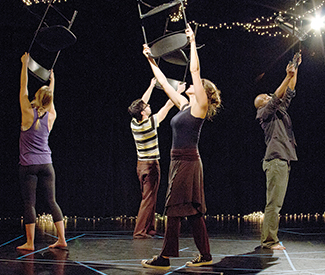
DANCE Visiting from Los Angeles, the Berkeley-born Arianne MacBean introduced the Bay Area to her Big Show Co. via two works. The elaborately titled The People Go Where the Chairs Are dates from 2012; the more condensed present tense was a world premiere. Both pieces intrigued by putting on stage the process the artists go through trying to give life and shape to something inchoate.

For MacBean, for whom language is integral to her dance-making, the challenge was that words both embody but also confine meaning. This intrinsic but probably unsolvable conundrum is at the base of the quirky, often equally funny and poignant People.

Dancers may well recognize themselves in this depiction of the struggle, frustrations, and rewards that the creative process of their practice involves. The rest of us witnessed an amusing, insightful, and lively performance of the process it takes to make an amusing, insightful, and lively performance.

People is more language-based than movement-oriented, and it did suffer from the same disadvantages as many such works. Dancers in general still are not adequately trained to communicate verbally. People’s dancers for the most part did well, but perhaps some unobtrusive body mics might have helped.

As we walked into the theater, performers blocked the stage into a set of overlapping squares. Somewhere off stage, a pianist plinked down isolated notes. One of the dancers wrote down an Alcoholics Anonymous-style 12-step scenario, whose items were erased as accomplished throughout the evening.

As the lights went down, each dancer grabbed a folding chair; rather than being shaped into a “dance,” the chairs were used to bring about collisions, bad feelings, and chaos. So they started over, chattering heatedly about finding an inspiration. Pina Bausch tops the list; however, she is dead. Something like “the dance” will have to do. This brainstorming session about meaning, inspiration, essence, and genuineness was hilarious, and yet almost unbearable to sit through.

Concrete suggestions fall flat. Angelina Attwell demonstrates “a dance I once saw;” it was fierce and left her spent, which scared the rest of them. Later, she had an I-hate-dance moment in which, assisted by her colleagues, the chairs started flying and crashing around her. All joined Max Eugene’s free-for-all, but they could never actually put a “joyous” dance on stage. Eugene’s lack of comprehension and his colleague’s disdain of spontaneous expression spoke volumes about ingrained attitudes in the dance world.

Genevieve Carson’s witty monologue, shadowed by gesticulating males, took on how choreographers use dancers’ contributions to fill transitions. It probably struck a nerve among the dancers in the audience.

Smaller, quieter moments didn’t need language. Challenged to be “genuine,” Eugene simply stood and looked into the audience until his fearful colleagues joined him. There was also a point when the audience was supposed to “participate,” and the dancers leaned on chairs, whispering, inviting us but knowing full well that nobody would step up.

In the serious yet entertaining People we see the dancers both as performers and the people they are, or at least the personas they assumed. Their bravery, their struggle, their anger, and their sense of being in this together despite the odds was something that spoke clearly and effectively.

present tense was a much quieter but also more tightly constructed work in which each moment seemed full of portent. The title, as an intermission discussion between choreographer MacBean and ODC Deputy Director Christy Bolingbroke pointed out, refers to the present moment, but also to the intense presence that is required in a performance.

Verbal language entered here as fragmentary phrases or single words, which acquired meaning in the way they are spoken, screamed, thrown about, casually chained to each other. At one point they simply disappeared into sound that is part of pure physical frustration.

In the opening passage, both Eugene and Carson seemed encased in their own worlds. He stood, and in Butoh-like fashion incrementally opened his arms and shifted his balance ever so slowly. You had to keep looking to see the moves. In contrast, the robotic Carson jerked herself like a mechanical doll onto the ground and up again. Attwell and Brad Culver slowly worked their way across the stage on their backs. The contrast between vertical and horizontal planes suggested a self-contained space that changed very slowly. But then these isolated beings tried to connect, and raced around trying to catch a hand like a lifeline. In twos, they were restrained even as they reached out. That section went on too long. Despite the constant shifting of partners, these parts did not accumulate. More effective was they way they shouted fragments, or single words that would make a sentence, at each other. It all started with Attwell’s silent scream. *

http://thebigshowco.com/


Google Bus sewers

131

STREET FIGHT With most city officials supporting the accommodation of private transit in some form, the San Francisco Municipal Transportation Agency is now vetting where tech workers should board and egress the private corporate commuter buses that ply the 101 and I-280 between San Francisco and Silicon Valley suburbs. A list of proposed bus stops was circulated in June, and the first round of bus stop proposals is set for approval in August.

Short of a proper environmental study, which is the subject of ongoing litigation, the list deserves more scrutiny and deliberation because certain areas of the city — such as Hayes Street in the Western Addition and 18th Street in the Mission — might be effectively made into Google Bus sewers.

I hope SFMTA is open to reconsidering some of these proposed bus stops.

Rather than jamming oversized interstate highway-scale coaches on human-scaled, walkable, and bikeable streets with important Muni routes, SFMTA ought to steer them where they are more appropriate: on the wider, car-oriented streets that bifurcate the city.

For example, the current proposal for private commuter buses in the Western Addition is to have these mammoth and incongruent buses running on Hayes Street using Muni stops at Clayton, Steiner, Laguna, and Buchanan.

This is bad news for passengers on the 21-Hayes, a key neighborhood-serving electric trolley bus that has gotten short shrift in the city planning process. With 12,500 boardings daily, the 21-Hayes is often at capacity every morning before it crosses Van Ness.

Just last week, I was on a packed 21 that was blocked (illegally) by a huge corporate bus on Hayes. With an already dense and slow traffic situation, this added at least 30 seconds to the trip before the 21 could access its stop. Repeat that multiple times in the morning and afternoon and you can see that this will be a mess. It’s not worth the dollar the SFMTA collects for such stops, that’s for sure.

Concentrating the private buses on the 21 line (or the 33 in the Mission) will block Muni where Muni is already slow, unreliable, and overcrowded. It will also diminish walkability and bicycle safety on Hayes and other streets identified in the current list (including the commercial corridors on Divisadero and 18th Street in the Mission.)

Rather than streets such as Hayes, SFTMA should redirect the private buses to the multilane, one-way couplet on Fell and Oak streets, only one block south. Along the corridor, SFMTA could collaborate with the private systems to establish new bus stops (red paint) at Clayton, Masonic, Divisadaro, Fillmore, and near Octavia. This scheme would limit clunky turn movements onto neighborhood streets by oversized buses and contribute to traffic calming.

In the mornings, the buses would pick up passengers on Oak Street, starting along the Panhandle, then travel towards Octavia Boulevard before swinging onto the freeway southbound. In the evenings the buses would exit the freeway at Octavia, and stop at drop-off hubs on Fell, between Octavia and Laguna, and then stop incrementally toward Golden Gate Park.

Additionally, the city needs to consider a space for the underpaid, nonunionized drivers to pull over and rest before and after long segments of freeway driving. We want these buses to be safe.

Similar arrangements should be made to spare 18th Street in the Mission from reverting to a Google bus sewer, with emphasis on private corporate bus stops on South Van Ness or Guerrero-San Jose. Surely there are other examples in other parts of the city.

The urgent affordable housing crisis aside, this could be a win-win from a transportation perspective. Tech workers would no longer get blamed for blocking Muni and they can know that while waiting for their bus, they are contributing to calming erstwhile hazardous streets.

There’s a lot of opportunity to combine these new bus stops with traffic calming at dangerous intersections such as Fell and Masonic or Oak and Octavia, all without mucking up Muni or diminishing the walkable human scale of nearby neighborhood commercial streets. And hey, since this is all a “pilot program,” no pesky and expensive EIR is needed — right?

Thinking long-term, this scheme could be a template to jumpstart making this ridiculous private transit system into a regional public bus system modeled on AC transit or Golden Gate Transit, a service open to all. Our car-centric streets are ripe for express bus service and this would help relieve parallel lines like the N-Judah, while enabling the city to attain its aspiration of 30 percent mode share on transit.

And for Mayor Ed Lee and pro-tech-bus members of the Board of Supervisors, it helps with their “vision zero” rhetoric of increasing pedestrian safety because placing the buses on car-centric one-way couplets can help calm traffic.

With a little cajoling by the mayor, he could get his tech sponsors to underwrite streetscape and beautification at the bus stops along these kinds of streets.

After all, Mayor Lee needs to find the money, because last month he betrayed pedestrian and bicycle safety and Muni when he abandoned support for increasing the Vehicle License Fee locally this fall, all the while misleading the public about the important role of Sunday metering. Perhaps it’s time for a tax or license fee on the ad hoc private transit system?

SLOWING DOWN

Speaking of vision zero, Sup. Eric Mar deserves hearty thanks for proposing to reduce speed limits citywide. This is one of the most effective ideas to come from the progressive wing of the Board of Supervisors in a long time and should be implemented yesterday. Higher speeds maim and kill, and the faster cars go the more voracious the appetite for both fuel and urban space.

With reduced speed, the motorist would still be able to drive, just more slowly, perhaps with less convenience than now. But over time the options of cycling, of walkable shopping, and improved public transit would synchronize more seamlessly as car space is ceded to separated cycletracks and transit lanes.

My suggestion is to make the city navigable by car at no greater than 15 miles per hour, a speed deemed not only to be comfortable on calmed pedestrian streets, but also to minimize injury and fatalities when there are collisions. Ultimately, our efforts to curb global warming, reduce injury and death from automobility, and make the city more livable obliges us to slow down, so looking at speeds is a step forward.

Street Fight is a monthly column by Jason Henderson, a geography professor at San Francisco State University and the author of Street Fight: The Politics of Mobility in San Francisco.

Solving the housing crisis takes all San Franciscans, even big tech

56


By Joseph Tobener


OPINION This week, San Franciscans learned that they will not be able to rely on Sacramento to fix the housing crisis. State lawmakers voted down Senate Bill 1439, which would have stopped speculators from using the Ellis Act to evict and convert buildings to upscale offices and TICs. One Assembly Democrat said that San Franciscans were “exaggerating the problem.” That same day, my office received Ellis Act eviction notices for 21 tenants from an artist building at 16th and Mission streets. The building has a new buyer, and it will soon be a high-end commercial space.

I was a tenant rights attorney during the first dot-com boom, and without question, this new housing crisis is much worse. The gentrification is more widespread and permanent. This time around, the evicted teachers, musicians, and artists are not simply moving down the street to smaller units, they are being priced out of San Francisco altogether.

We need to decide now, as San Franciscans, what we want our city to feel like in a decade. Here are five things I believe we need to do now to address the crisis:

1. Collaborate with tech leaders, rather than vilify them. I have been as guilty as the next person in blaming and berating big tech, ignoring the fact that many of my neighbors, clients, and friends are long-time San Franciscans who work in the tech industry. Enough blaming. We need to somehow bring tech to the table to help create large-scale solutions to the housing crisis. It may not be easy to do.

Earlier this year, Marc Benioff, the CEO of Salesforce, criticized tech companies for being “stingy” in giving to their communities, and I have heard nonprofit fundraisers echo this. If true, we need to find out why. On the other side, our healthy anti-corporate, ‘us and them’ mindset, which is deeply rooted in San Francisco’s political tradition, is not serving us in collaboratively addressing the housing crisis.

While there are a handful of high-profile examples of tech workers wrongfully displacing tenants, tech workers are not the real problem. It is true that tech money drives up prices, but the real villains are the predatory speculators who are profiting from our shared crisis. The bottom line is, like it or not, tech is here to stay, and tech leaders have the resources to fund the arts, help our schools, and yes, help us address the housing crisis.

2. Stop illegal mergers of multi-unit buildings into single-family mansions. It is not enough to have regulations in place to prevent mergers. Real estate speculators are merging units surreptitiously, without permits. The Department of Building Inspection needs to actively police projects. And all San Francisco residents need to share in the responsibility of ensuring that speculators are not doing major construction without permits in our neighborhoods.

3. Support legislation to stop landlords from renting their units as hotel rooms. It is estimated that more than a 1,000 units in San Francisco are being rented out full-time for short-term corporate or tourist use. We need a law to get these units back into the permanent housing stock.  

4. Donate to the Community Land Trust and the Community Arts Stabilization Trust. Community land trusts are buying property to permanently preserve residential housing and art space. We need to do more to support these organizations. Other cities do a much better job than San Francisco in partnering with corporations to preserve culture.  

5. Support an anti-speculation tax. Tenant activists have introduced an anti-speculation tax designed to stop real estate flipping. Our office sees the same LLCs flip properties time and time again.

Ultimately it is up to all San Franciscans to embrace this cause if we hope to preserve the diverse and complex character of our city. One thing is sure: We cannot wait to add our voices, or it will be too late.

Joseph Tobener is a tenant rights attorney.

Guardian Intelligence: July 2 – 8, 2014

0

GUARDIAN ON THE MOVE

There were a couple of big changes for the Bay Guardian this week. We and our sister newspapers within San Francisco Media Company — San Francisco Examiner and SF Weekly — moved into the Westfield Mall. Yes, the mall, but in the fifth floor business offices formerly occupied by the San Francisco State University School of Business extension program. The company, owned by Black Press in Canada and Oahu Publications in Hawaii, also named Glenn Zuehls as the new publisher and Cliff Chandler, who worked for the Examiner for years, as the senior vice president of advertising. Zuehls, who comes from Oahu Publications, replaces Todd Vogt as the head of SFMC. Zuehls and Chandler told the staff of all three papers that their primary goal is to grow the company’s revenues.

QUEER SPIRIT ROILS PRIDE

Even as an awareness of the ever-growing commercialization of SF Pride dawned on younger participants, a spirit of activism also took flight. Community grand marshal Tommi Avicolli Mecca led a fiery parade contingent (above) of housing activists in Sunday’s parade, protesting skyrocketing evictions in San Francisco. The anti-eviction brigade staged a die-in in front of the official parade observation area. Friday’s Trans March was the biggest so far, and Saturday’s Dyke March featured a huge contingent marching under the banner “Dykes Against Landlords.” Meanwhile, hundreds of protestors targeted a Kink.com prison-themed party, saying it glorified a prison-industrial complex, which “destroys the lives of millions of people.” Seven of the protestors were arrested, and charges of police brutality are being investigated.

LESBIANS BASHED AT PRIDE

While there were some disturbing anecdotal reports of homophobic slurs and queer bashing at Pride this year (including one of a Sister of Perpetual Indulgence and her husband being attacked at Pink Saturday), San Francisco Police Department spokesperson Albie Esparza said police are only investigating one incident so far as an actual hate crime. It occurred on June 28 around 5:30pm near the intersection of Mission and Ninth streets when two young lesbians were subjected to homophobic taunts and then severely beaten by five young male suspects, all of whom remain at large. They’re described at 16 to 20 years old, two black, three Hispanic. Esparza said hate crimes are defined as attacks based solely on being a protected classes, so that doesn’t include robbery or assaults in which racism or homophobic slurs are used, if that doesn’t seem to be the motivation for the attacks.

LIFE’S A STAGE

Hark! It must be summer, because all the companies dedicated to outdoor theater are opening new productions in parks across the Bay Area. Aside from the San Francisco Mime Troupe’s Ripple Effect (see feature in this issue; www.sfmt.org), Marin Shakespeare is presenting As You Like It in San Rafael (pictured), with Romeo and Juliet opening later in July (www.marinshakespeare.org); Free Shakespeare in the Park brings The Taming of the Shrew to Pleasanton and beyond (www.sfshakes.org); and Actors Ensemble of Berkeley goes stone-cold Austen with Pride and Prejudice in John Hinkel Park (www.aeofberkeley). AS YOU LIKE IT PHOTO BY STEVEN UNDERWOOD

TEN YEAR GRIND

Kids and pro skaters from One Love boards tore up “the island” — between the Ferry Building and the Embarcadero — with flips, kick tricks and plants June 29, celebrating the tenth anniversary of the much loved skate spot. Local Hunters Point pro skater Larry Redmon sat watching the new generation of skaters and offering pointers. Sure downtown has more grind blockers then it did a decade ago, but as Redmon says, “We out here.” PHOTO BY PAUL INGRAM

THE WILLIE CONNECTION

Muni’s workers and the SFMTA reached a final labor deal over the final weekend of June, but Mayor Ed Lee is telling news outlets the real dealmaker was former mayor Willie Brown. “He’s someone who understands the city, understands labor, the underlying interests,” SFMTA Director Ed Reiskin told various news outlets. Reports say Brown went unpaid by the city for the deed. That’s hard to believe: Anyone who knows Slick Willie knows he seldom does anything for free.

WAXING NOSTALGIC

The new Madame Tussauds wax museum attraction opened June 26 at Fisherman’s wharf — and includes SF-specific figure replicas like Mark Zuckerberg, Harvey Milk, and, of course, our real mayor, Nicolas Cage (pictured). See the Pixel Vision blog at SFBG.com for more creepy-ish pics and a review.

SHARON SELLS OUT (THE INDEPENDENT)

Despite her catalog full of confessional songs about nasty breakups and other dark subject matter, Sharon Van Etten was all smiles during two sold-out shows at the Independent June 29 and June 30. Leaning heavily on songs from her new album, Are We There, Van Etten and her four-piece band even led the adoring crowd in a cheerful sing-along at one point. On her next pass through town, we expect to be seeing her on a much bigger stage.

UNION PROUD

If BBQ and black-market fireworks aren’t your idea of showing civic pride, make your way over to the Mission’s Redstone Building (2940 16th St. at Capp) for a street fair Sat/5 with local musicians, poets, visual artists, and more, to mark the 100th anniversary of the SF Labor Temple and call attention to current labor issues like the fight for a $15 minimum wage. Built by the city’s Labor Council in 1914, the building formerly housed SF’s biggest labor unions and was the planning center for the famous 1934 General Strike. This celebration is part of Labor Fest, now in its 20th year, which runs throughout July around the Bay Area — for more: www.laborfest.net


Pumping up awareness

7

Warning! This is just a friendly reminder that your petroleum habit is hurting us all.

Berkeley’s Community Environmental Advisory Commission recently approved the concept of stickers to be placed on gas pump handles that warn drivers that greenhouse gases such as those emitted from automobile tailpipes contribute to global warming. If it makes sense to warn that cigarette smoking increases the likelihood of developing lung cancer, then hey, why not remind drivers that by using fossil fuels, they’re increasing the planet’s temperature and volatility.

The campaign is led by 350 Bay Area, a grassroots environmental organization affiliated with 350.org, a global climate movement. The name reflects its main goal: follow scientists’ warnings to reduce the amount of C02 in the atmosphere from its current level of 392 parts per million to below 350 ppm, a crucial threshold of climate instability.

While Berkeley has gained the most political traction for 350 Bay Area’s “Beyond the Pump” campaign, 350 Bay Area is also working on getting San Francisco to adopt the gas pump stickers and other planet-saving tactics.

Since last year, advocates with 350 Bay Area worked in collaboration with Sup. John Avalos on a 10-Point Climate Action Work Plan that was officially adopted in April. This plan commits the Bay Area Air Quality Management District to reducing greenhouse gas emissions to 80 percent of 1990 levels by 2050. The group has also been in contact with Avalos and his legislative aide Jeremy Pollack about sponsoring an ordinance to place the warning stickers on gas pumps in San Francisco.

“I think it’s great. We need reminders about the impact of fossil fuels on an individual basis,” Avalos told the Guardian. “We have choices, and this is a great way to build awareness of those choices.”

Avalos said that his office has already started looking into the idea of putting stickers on gas pumps. Right now, he’s still waiting on enough research to ensure the stickers can pass legal muster against any challenges by the petroleum industry.

“Hopefully it will work out. The City Attorney is looking into it, and we’re waiting to see what happens with Berkeley,” Pollack told the Guardian. “We tried something similar with warnings about cell phone radiations, but the court struck it down.”

He’s referring to the nearly three years of legal battles with the mobile phone industry group CTIA over a San Francisco law passed in 2011 that had required every store selling cell phones in the city to display the specific absorption rate of radiation expected from each phone model.

CTIA took San Francisco all the way to the 9th Circuit US Court of Appeals, saying the law interfered with their free speech rights. And, it won. Finally, last May, San Francisco gave in and killed the warning law. Those legal battles are not something San Francisco is likely to forget, no matter what environment-happy warning labels come along.

Yet the San Francisco public might not mind a gentle push. According to a recent poll by the Yale Project on Climate Change Communication, 77 percent of San Franciscans think that residents should be doing more to address climate change. The stickers could serve as a gentle push in that direction, and though Avalos is confident his city will get stickers eventually, it looks like Berkeley residents will get their warnings first.

“We’re not going to stop at Berkeley,” Jack Lucero Fleck, 350 Bay Area Steering Committee member, told us. “Right now, there’s no clues in gas stations that fossil fuels might be a problem. But advertising works. That’s why corporations spend billions on it. The human mind can’t ignore it.”

The campaign — the only one in the country with political fraction — is parallel to a Toronto campaign called Our Horizon. But unlike the stark, graphic warnings in Canada, 350 Bay Area takes heed from failed attempts by the US Food and Drug Administration to pursue graphic cigarette warning labels.

Right now, thanks to tobacco advocates who’ve aggressively protected their free speech rights, warnings on US cigarette packaging are tame. But if you go to Canada for a smoke, you’ll find packaging that reads, “This is what dying of lung cancer looks like,” followed by the image of an emancipated, corpse-like body. The least graphic image is of a gentle crib, but even that’s followed by information about the connection between smoking and Sudden Infant Death Syndrome.

Berkeley could opt for similar, hardcore carbon emission warning graphics (picture it now: baby polar bears balancing on ice, fish washed up on shores, massive dust clouds about to drown villages), but 350 Bay Area is more mindful of the legal fallout that would likely follow.

Instead, the Berkeley warning sticker samplers are downright peppy. In hot pink, the sticker shouts, “Global warming alert!” followed by a pastel blue that informs drivers, with the gentle nudge of a concerned parent, “Burning gasoline emits C02. The City of Berkeley cares about global warming.” Then there’s a picture of a cute little car emitting a cloud of murky C02.

“We wanted the language to be careful and the facts noncontroversial,” 350 Bay Area Campaign Manager Jamie Brooks told us. “We have to be as gentle as possible. It’s tough love.”

One sticker sampler reads, “The State of California has determined that global warming caused by C02 emissions poses a serious threat to the economic well-being, public health, natural resources, and the environment of California.”

You can’t really argue with that, it’s even enshrined in California law. Plus, the stickers aren’t anywhere near the gruesome Canadian samples that show famine in deserts and unhappy kids suffering from smog-induced asthma.

Berkeley City Council member Kriss Worthington, who sponsored the council item in support of the stickers, said, “We made sure we had language that wasn’t questionable and that it wasn’t pre-emptive to state or federal law. The language in the stickers is language already law in the state of California.”

Sure enough, the California Global Warming Solutions Act, adopted in 2006 as Assembly Bill 32, already states that emissions are harmful to humans and the environment.

Yet Western States Petroleum Association’s President Catherine H. Reheis-Boyd isn’t pleased. She issued what Brooks called a “love letter” to the advisory committee. Just as tobacco lobbyists argued that cigarette warnings are forced — and therefore not free — speech, Rheis-Boyd ignores the global warming debate and instead focuses on the US Constitution.

“Far less restrictive means exist to disseminate this information to the general public without imposing onerous restrictions on businesses and forcing unwanted speech in violation of the First Amendment,” she wrote.

Reheis-Boyd goes on to appeal to Berkeley’s history in the Free Speech Movement: “Perhaps no city in our nation has as rich a tradition in the exercise of the First Amendment right to freedom of speech as the City of Berkeley.” She also accuses 350 Bay Area of advancing messages that are not “purely factual” but a “policy determination by the State of California.”

This is true; the stickers do reflect policy determination from AB 32, which mandates the state to reduce greenhouse gas emissions, and that’s why they’re likely to stick.

Besides, the stickers will likely only appeal to global warning believers; they’re meant to remind drivers that there are ways to curb their appetite for gas, such as by choosing public transit or other alternatives modes of transportation. The campaign’s technical advisor, Dr. Kirk R. Smith, said, “The cigarette analogy isn’t perfect, because gas is only one factor in climate change. But individual decisions are important.”

The question is whether or not such peppy stickers can get drivers thinking about the implications of their transportation choices.

The campaign in Berkeley isn’t done yet. After the Energy Commission votes in July, the sticker proposal will head to the Berkeley City Council in September. And from there, 350 Bay Area will see if those in San Francisco might like some friendly warning stickers on their gas pumps.

Don’t weaken protections against chain stores

5

EDITORIAL As we reported two weeks ago (“Breaking the chains,” June 17), the San Francisco Planning Commission will soon consider rival measures to modify the city’s decade-old policies regulating chain stores (aka formula retail businesses) and giving neighborhoods the ability to reject them. This should be viewed as a chance to strengthen protections, not to weaken them at a time when small businesses need all the help they can get.

There are a number of important reforms in both the formula retail proposal by Sup. Eric Mar and the one developed by the Planning Department in coordination with the Mayor’s Office. Both expand on the types of businesses covered by the regulations, they close key loopholes, and they require more detailed economic studies to give the public and policymakers more information on how chain stores impact neighborhood commercial districts.

But in exchange for those protections, the Planning Department measure also makes concessions that are unacceptable and inconsistent with the formula retail standards that voters adopted through Prop. G in 2006. Specifically, planners are making the dubious claim that they have the authority to increase the threshold of what’s considered a chain from 11 stores now up to 20 stores, unilaterally rejecting a compromise number negotiated at the time between progressive leaders and the business community.

The logic offered for that change is equally questionable. The planners and backers of the change in the Mayor’s Office and business community say local businesses that grow beyond 11 outlets — such as Philz Coffee, Lee’s Deli, and San Francisco Soup Company — shouldn’t be “punished for their success” by enduring a lengthy and expensive conditional use permit process.

But gathering information and letting the community have a voice isn’t punishment. Larger businesses have more resources to go through the approval process, and the city rarely rejects formula retail applications anyway. Planners argue that the conditional use process is onerous and can take six months or more — but that’s an argument for reforming the process, not bypassing it. The Mayor’s Office should devote more resources to hiring more Planning Department staff to speed up this process, raising the fees on applicants to do so if necessary.

The Planning Department proposal also makes no effort to determine who owns the business that want to open here, allowing corporations to create endless subsidiaries and spinoffs to bypass the formula retail controls, something the city already has seen with the controversial Jack Spade application in the Mission District and other projects.

Corporations can be wily and predatory as the seek to endlessly expand into new markets, and if San Francisco’s nationally recognized controls are to have any relevance, they’ll need to adapt to changing circumstances. That means we need to strengthen and not weaken them.

It’s a trap

10

joe@sfbg.com

As City College of San Francisco struggles to loosen the noose around its neck, this week its accreditors are slated to offer the college a new way out. But some skeptics are sounding the alarm: it’s a trap.

The Accrediting Commission of Community and Junior Colleges is scheduled to vote on and announce a newly revised version of its “restoration policy,” which some journalists have called City College’s salvation.

Huge CCSF Win: College Won’t Close,” one San Francisco Chronicle headline read. Bay Area TV stations and others echoed the jubilant headline, saying City College was saved. Chancellor Art Tyler told the Chronicle he would “absolutely” apply for restoration status. But many are calling the restoration policy a poor choice for the college’s future.

“Rumors of City College being saved are premature,” Alisa Messer, political director for the American Federation of Teachers Local 2121, told us.

The college’s faculty union isn’t the only one worried. A report released this month by the California State Auditor shows ACCJC has operated against its own bylaws and without full transparency in threatening CCSF’s accreditation.

“To allow community colleges flexibility in choosing an accreditor,” the state auditor’s report wrote, “the chancellor’s office should remove language from its regulations naming the commission as the sole accreditor of California community colleges while maintaining the requirement that community colleges be accredited.”

In the staid and stuffy bureaucratic language, the auditor essentially wrote the accreditor group was so dysfunctional it should be closed. The 75-plus page report scathingly tears down ACCJC staff, board selection, decisions, and policies. There are few areas in which they did not find fault.

“The report draws conclusions about accreditation without the necessary context and facts related to institutional evaluations,” ACCJC President Barbara Beno told the Guardian via email. “ACCJC is reviewed and approved by the United States Department of Education and its recognition was renewed in January 2014. That is the appropriate body to review the ACCJC’s practices.”

The DOE found many faults with the accreditors as well, but the scope of its review was limited to complaints made by the unions. The auditor viewed the accreditors in a fuller context, alleging the ACCJC decided to terminate CCSF’s accreditation “after allowing only one year to come into compliance,” while simultaneously allowing 15 other colleges two years and another six institutions to up to five years to reach compliance.

Such accusations of bias are also alleged in City Attorney Dennis Herrera’s lawsuit against ACCJC, charging CCSF was targeted with harsher penalties due to its political views.

Meanwhile, a closer look at restoration status shows it’s less like a lifeline and more like a tightrope suspended over flames.

The policy would give CCSF two years to come into compliance with all of the so-called “defects” ACCJC identified. If the college addresses these issues in two years, the commission would rescind the notice to terminate the college’s accreditation.

But buried in the legalese is a frightening clause noting that if CCSF isn’t found to comply with everything, “the termination implementation will be reactivated and the effective date will be immediate,” with “no further right to request a review or appeal in this matter.”

Beno said she heard the college community’s concerns around these clauses, during a two-week public comment period regarding the proposed policy that ended June 25.

“The Commission received a good deal of feedback,” she wrote, saying a revised “final version” of the restoration policy has been sent to the commissioners, who will vote remotely over the next week. “If it is approved, the ACCJC will post the final policy on its web page, the policy will be effective immediately.”

But the auditor found Beno hasn’t followed existing bylaws. This has long been an open secret in the community college world that’s referenced to in a 2010 public letter from the former California Community College Chancellor Jack Scott to the Department of Education. His immediate successor, Brice Harris (who also served on the ACCJC as a commissioner for seven years), did not heed this knowledge. He trusted Beno.

He met her for coffee, he talked to her on the phone. These interactions led him to believe replacing the college’s leadership would appease Beno, he said in his declaration (under penalty of perjury) in Herrera’s lawsuit against the ACCJC.

So on July 3, 2013, Harris released a video announcing he stripped the college’s elected Board of Trustees of all of its powers and promoted Special Trustee Bob Agrella to take its place. The college community was in an uproar, but Harris maintained publicly it was the right thing to do.

Privately, he received an email from Beno. “Dear Brice, Beautiful job,” she wrote to him, about his decision to whack the board. “The college may survive, with the right leadership.”

Harris wrote in his declaration: “Based on this email, which was consistent with all my prior interactions with Dr. Beno, I believed that City College could maintain its accreditation… if City College took extraordinary steps to comply with the ACCJC’s recommendations.”

But the accreditors did just the opposite. Just this month, it denied CCSF’s accreditation appeal, telling the college they it not review any evidence of progress it made after they voted to terminate its accreditation. This took Harris by surprise.

“If I had known on July 8, 2013, that the rules of the commission were later going to be interpreted to preclude any progress made by City College after June 2013,” he wrote in his declaration, “I would not have asked the Board of Governors to take the extraordinary step of setting aside the locally elected Board of Trustees.”

Harris was burned by the ACCJC. Now City College faces the choice to trust Beno and the accreditors again.


Above, California Community Colleges Chancellor Brice Harris explains why he pushed state entities to remove the City College’s Board of Trustees and replace them with Special Trustee Bob Agrella. Should City College of San Francisco trust the ACCJC?

Painting with more colors

6

joe@sfbg.com

Not many plays feature an all-Latino cast, let alone all El Salvadoran. But Paul Flores’ Placas placed brown actors and a brown experience center stage. The 2012 production explored a father and ex-gang member’s struggle, leading his son out of a hard life of drugs, violence, and perhaps death.

The play garnered favorable but mixed reviews from critics, but among Salvadorans, it was a huge hit.

“You had older generations coming to see the play right alongside their grandkids,” Flores told the Guardian. The play’s premiere venue packed its 500-seat capacity, and sold out seven out of its eight nights in San Francisco. “We tapped a community thirsty to hear its stories told.”

Placas is the kind of creative work not being funded often enough by the city’s largest arts grant organization, critics are saying. At a contentious San Francisco Board of Supervisors Budget and Finance Committee hearing on June 20, artists told supervisors that programs serving diverse communities were severely underfunded, and alleged the city’s major arts funder, Grants for the Arts, awards money disproportionately to art forms favored by white audiences.

Spurred by public outcry and city studies, Sups. Eric Mar and London Breed recommended the transfer of $400,000 in unused funding from GFTA to another city arts funder, the Cultural Equity Grants (which funded Placas), to direct arts money to people of color.

The transfer won’t be approved until it goes before the full Board of Supervisors next month. But as San Francisco studio and housing rents soar, Mar said this was vital to keeping diverse artists in the city.

“I think the crisis for arts groups now is many of them are being displaced,” he told the Guardian. “How can the city subsidize groups with low rent or free rent, and how could we support small groups [to prevent them from] being displaced?”

"Arts inequity": San Francisco Budget and Legislative Analyst Report by Joe Fitzgerald Rodriguez

Above is a PDF of the Budget Legislative Analyst’s report, as it breaks down lack of funding to diverse programs. The report has relevant sections highlighted.

The Guardian reached out to City Administrator Naomi Kelly for comment (her office ultimately directs arts grants funding). She was unavailable for an interview before we went to press, but her spokesperson Bill Barnes told us, “I don’t think we should be in a position of having governments regulate artistic content.”

But in a way, the government already does. The GFTA funding is made up of city dollars, and for decades its funding priorities have scarcely changed, favoring many of the largest mainstream organizations.

GFTA funds many arts organizations, but a recent report by the Budget and Legislative Analyst’s Office found it awarded about 70 percent of grants to organizations with mostly white artists who mostly cater to white audiences. The San Francisco Symphony, San Francisco Ballet, San Francisco Opera, City Arts, the Exploratorium, the Museum of Modern Art, and the American Conservatory Theater received over one-third of GFTA funding over the past five years, the report found.

“The Bay [Area] will soon be 70 percent people of color,” Andrew Wood, director of the SF International Arts Festival, told the Guardian. “Why invest so heavily in organizations that are such a minority of the population?”

Taken on its face, the findings show a stark divide between funding for smaller, struggling minority arts groups and large, independently funded arts groups with predominantly white patrons. The report divided the diversity of GFTA arts funding into three categories: people of color (Asians, African Americans, and Latinos), ethnic minorities (Arab/Middle Eastern/Jewish), and LGBT organizations. The funding for these categories remained steady at about 20, 2, and 5 percent of arts funding, respectively, since 1989.

The lack of funding is one thing, but critics say the pattern indicates an outright dismissal of the broader community. In a mass email entitled “The State of the Arts in San Francisco” sent to the arts community from a group calling itself Arts Town Hall Organizing Committee said the outcry against critiques of GFTA’s diversity funding was “advanced by fringe members of the arts community.”

Realizing it called Black, Asian, and Latino artists a “fringe community,” the San Francisco Arts Alliance (a signatory to the email comprised of San Francisco’s symphony, opera, and other GFTA funded organizations) quickly backpedaled. It said the email was sent on their behalf by the public relations firm Barnes Mosher Whitehurst Lauter & Partners, a group that often runs astroturf campaigns for mainstream organizations.

One reason for GFTA’s inability to fund diverse arts groups may be a lack of trying: The BLA found the GFTA “does not have a definition or criteria for granting funds to people of color organizations.”

This color blindness is a problem, Wood told us. “[The money] the city invests in the War Memorial Opera House compared to the Bayview Opera House, also city owned, is completely out of whack,” he said. The Bayview Opera House was one among six “cultural institutions” to receive a portion of a $400,000 GFTA award, according to the organization’s 2013/14 annual report. Conversely, GFTA awarded the San Francisco Opera $653,000 the same year.

“They’re two different universes,” Wood said.

Allocating more funding for the Cultural Equity Grants was an oft-mentioned method for better supporting disadvantaged artists, the report found, even though GFTA and CEG share many of the same grantees.

Some say the report’s numbers don’t add up. San Francisco Arts Commission Director of Cultural Affairs Tom DeCaigny, a longtime local artist, disagreed with how the BLA defined which groups were white, ethnic, or otherwise.

“The methodology in the report assigns people an identity, and I know some of our grantees were referred to as white when they’re not,” DeCaigny told the Guardian. “We would want to see organizations self identify.”

Those faults undermine the value of the BLA’s findings, although he said, “I’m hesitant to comment on the value of that report.”

But some in the arts community felt DeCaigny’s opinion aligns suspiciously closely to the mayor’s priorities: funding the preferred arts organizations of his wealthy donors (like the symphony). We reached out to the San Francisco Symphony for comment but its representatives told us it would be unable to respond before our deadline.

DeCaigny defended the symphony, noting its annual Lunar New Year and Day of the Dead concerts serve diverse audiences. For the economically disadvantaged, he said, the symphony offers free concerts open to the public in Dolores Park, and that the symphony’s “artists are very diverse.”

DeCaigny pointed out the San Francisco Symphony Orchestra’s youth programs (shown above) are notably very diverse.

The donors are mostly white, he said, “but that’s true in other sectors as well. It has more to do with how wealth is distributed in our society.”

But Flores, Placas’ director, explained the need for ethnically diverse art was not just about who consumes it, but what message the art is sending to the audience. Nothing revealed this more, he said, then when he took Placas on tour across the United States. While in New York City, he conducted an informal poll.

“I asked ‘when I say San Francisco, what do you think of?’ They said the 49ers, the San Francisco Giants, the Golden Gate Bridge. They didn’t think gangs, pupusa, cumbia,” he said. That’s why Placas, which told the story of gang life among San Francisco Salvadorans, had such impact in the city and even beyond its borders.

“I love telling stories about San Francisco,” Flores told us. “The symphony doesn’t do that, the opera doesn’t do that. What does that? Locally generated art.”

The Board of Supervisors Budget and Finance committee is tentatively slated to hold a hearing on allegations made in the BLA report on July 16.  

Jasper Scherer contributed to this report.

Stamps of approval

0

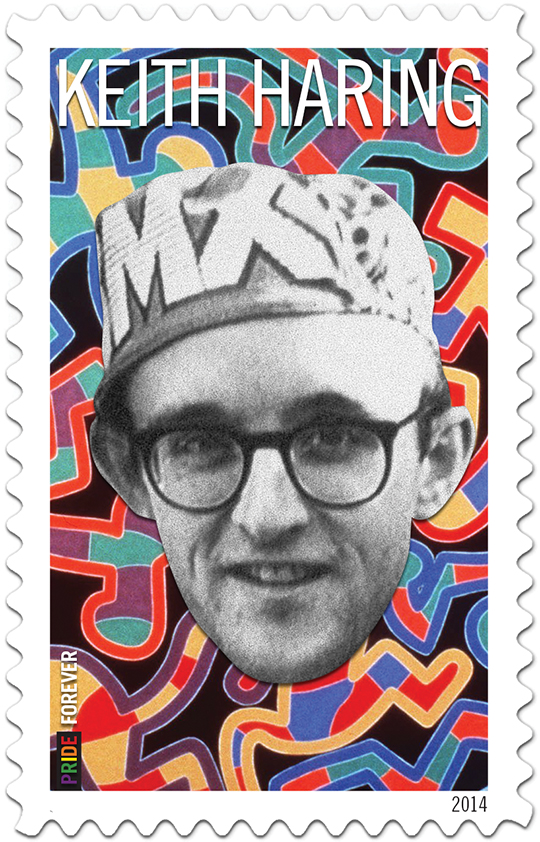
On May 22, the US Postal Service released the groundbreaking Harvey Milk stamp. Earlier this month we asked our readers, “Which US queer icon should next appear on a postage stamp?” We received a flood of answers, and while we have our own dream mail models — Sylvia Rivera, Barbara Gittings, Jose “Empress I” Sarria, Thom Gunn, Vicki Marlane — we chose the most popular readers’ picks for a little “Forever” fantasy fulfillment. (Maybe some of these won’t end up as fantasies after all!)

ID, please

0

QUEER ISSUE “One night my wife and I were having a conversation with our friend from Brazil about the bear community, and she had no idea what we were talking about. She said there are no words for identities like bears, cubs, or otters in Brazil — and I realized that the queer community has all of these amazing identities that don’t fall within the traditional LGBT umbrella. I got the idea to photograph my community and share with the world who they are and how they identify. I want to destroy the traditional understanding of what LGBT looks like. The Bay Area is a kick ass place to do just that.”

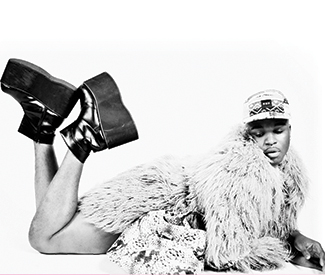
Since Sarah Deragon launched the Identity Project (www.identityprojectsf.com) in January of this year — using funds she raised on IndieGoGo — she’s captured dozens of community members in vibrant, sharply focused black-and-white protraits. Each portrait is labeled with an “identity,” expressed in the the subject’s own terms. It’s a heady mix of the familiar and the unique, containing lovely twists like “Three Spirit,” “Sober Celibate Daddy-Father Punk,” and “Xicanita y Cubanita.”

A portraitist by trade (www.portraitstothepeople.com), Deragon will be taking the Identity Project on the road this summer to Portland, Chicago, Columbus, New York, Austin — prospective participants can apply at the Identity Project site.

“I am totally inspired by the ways in which folks choose to identify and how they engage with and take care of their communities,” Deragon says. “I am out in my photography business and that means the world to me. I can be my full self in the Bay Area and I know how lucky I am to say that. It is pretty amazing that a portrait photography business can support two people in San Francisco with the rents as crazy as they are.”

As a self-identified queer femme, Deragon says her own community plays a crucial role. “Most of all, I want to give a shout out to the femme community because they have everything to do with the person that I am today!”


The Guardian Hot Pink List 2014

0

Every year, we single out members of the LGBT community for special appreciation — activists, performers, artists, or just plain cool peeps who rocked out socks off.

CHECK OUT OUR 2014 HOT PINK LIST HERE.

Pride on fire!

0

 There is way too much to do this year, as always. Don’t be scared! Dive right into the party and performance bounty that is Pride.

CLICK HERE TO SEE OUR FULL PRIDE GUIDE.

On the hoof

0

culture@sfbg.com

THE WEEKNIGHTER Roughly a decade ago a guy named Ken came into the restaurant I was working at in North Beach. He was new to SF so I convinced him to buy my zine Broke-Ass Stuart’s Guide to Living Cheaply in San Francisco. Thinking it was a good idea, he tried to drink at every bar in the zine in a single night. That was, in fact, a terrible idea and he ended up blacking out and getting kicked out of a few of them. But what he woke up with the next day, besides a horrific hangover, was a brilliant idea: the Broke-Ass Stuart Pub Crawl. And it was through this act of genius that Ken and I became good friends.

The idea was simple; get a big vehicle, fill it with lots of rowdy, drunk people, and cruise around SF descending on bars like a Mongol horde. Ken and his peeps worked at the corporate offices of multibillion dollar companies so they could afford one of those boozy trollies that you see around. Considering no one I knew had any money, I rented a big yellow school bus and filled it with my fellow broke folk, then the trolley and the bus caravanned around town causing mayhem.

As you can tell already, Ken is a man of vision and he said to me at one of our drunken stops, “There’s something I need to do. You know The Black Horse London Pub (1514 Union, SF. 415-928-2414)? It’s the smallest bar in San Francisco. I want to break the record for how many people have fit in there at one time. This is important shit, man.” I could tell Ken was serious, but there was no way both the bus people and the trolley people could all fit into the Black Horse. We decided it was best if the trolley people did Ken’s mission from god by themselves. Afterwards they would meet us at the next stop.

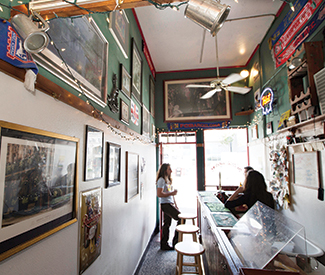
The Black Horse London Pub really is the smallest bar in San Francisco. It’s only 136 square feet, so all it has room for is seven seats, a little bit of standing room, a bar, and a bathtub full of beer. In fact, all it serves is beer. It also has “ten commandments” that include things like women having priority over the seating, kisses being the only thing allowed to be thrown in the bar, and not using your phone. It’s a good place for a party of two — and a terrible place for a party trolley.

“We did it!” Ken told me as he met us at the next bar, “We broke the record!” Honestly, I don’t know if there even was a record before that night, but there certainly was now. Ken was beaming and I was proud of him. He set out to achieve something and he accomplished it with flying colors. Fucking tenacity…or at least, fucking booznacity.

Since then we’ve done the pub crawl six times and Ken has even managed to beat his previous record. Of course nobody is ever sober enough to remember what the record is. Maybe I’ll pop into The Black Horse, ask the owner James if he knows the record, and tell him I’m thinking about planning another pub crawl soon. Hopefully he won’t make an 11th commandment forbidding them.

Stuart Schuffman aka Broke-Ass Stuart is a travel writer, poet, and TV host. You can find his online shenanigans at www.brokeassstuart.com


Rep Clock: June 25 – July 1, 2014

0

Schedules are for Wed/25-Tue/1 except where noted. Director and year are given when available. Double and triple features marked with a •. All times pm unless otherwise specified.

ANSWER COALITION 2969 Mission, SF; www.answersf.org. $5-10 donation. Two Spirits (Nibley, 2009), Wed, 7.

ARTISTS’ TELEVISION ACCESS 992 Valencia, SF; www.atasite.org. $7-10. “Rotterdam VHS Festival,” short videos, Thu, 8. “Mission Eye and Ear #5,” new music/sound and film/video collaborations by Dominique Leone and Brenda Contreras, Kyle Bruckmann and John Slattery, and Gino Robair and Bryan Boyce, Fri, 8.

BERKELEY FELLOWSHIP OF UNITARIAN UNIVERSALISTS 1924 Bonita, Berk; www.bfuu.org. $10 suggested donation. Born This Way (Tullmann and Kadlec, 2012), Sat, 7:30.

CASTRO 429 Castro, SF; (415) 621-6120, www.castrotheatre.com. $8.50-11. Frameline 38: SF International LGBT Film Festival, June 19-29. For tickets and schedule, visit www.frameline.org.

COURTHOUSE SQUARE 2200 Broadway, Redwood City; www.redwoodcity.org. Free. Frozen (Buck and Lee, 2013), Thu, 8:45. Presented sing-along style.

JACK LONDON FERRY LAWN Clay and Water, Oakl; www.jacklondonsquare.com. Free. “Waterfront Flicks:” The Secret Life of Walter Mitty, Thu, sundown.

PACIFIC FILM ARCHIVE 2575 Bancroft, Berk; (510) 642-5249, bampfa.berkeley.edu. $5.50-9.50. “Martin Scorsese Presents Masterpieces of Polish Cinema:” Mother Joan of the Angels (Kawalerowicz, 1961), Wed, 7; Innocent Sorcerers (Wajda, 1960), Fri, 7. “Kenji Mizoguchi: A Cinema of Totality:” The Story of the Last Chrysanthemums (1939), Thu, 7; The 47 Ronin, Parts I and II (1941/42), Sat, 6. “Rude Awakening: American Comedy, 1990-2010:” Waiting for Guffman (Guest, 1996), Fri, 8:50; Groundhog Day (Ramis, 1993), Sun, 6. “Picture This: Classic Children’s Books on Film:” “Take Aways,” short films, Sun, 3:30.

ROXIE 3117 and 3125 16th St, SF; (415) 863-1087, www.roxie.com. $6.50-11. Frameline 38: SF International LGBT Film Festival, Wed-Sun. For tickets and schedule, visit www.frameline.org. Ping Pong Summer (Tully, 2014), Wed-Thu, 6:30, 8:20. Breathing Earth: Susumu Shingu’s Dream (Riedelsheimer, 2013), Fri-Sat, 6, 8; June 29-July 3, 7, 9. “Roxie Kids:” Panda! Go, Panda! (Takahata, 1972), Sun, 2.

SMITH RAFAEL FILM CENTER 1118 Fourth St, San Rafael; (415) 454-1222, www.cafilm.org. $6.50-$10.75. Breathing Earth: Susumu Shingu’s Dream (Riedelsheimer, 2013), June 27-July 3, call for times.

YERBA BUENA CENTER FOR THE ARTS 701 Mission, SF; www.ybca.org. $8-10. Thy Womb (Mendoza, 2012), Thu and Sat, 7:30; Sun, 2. *


Psychic Dream Astrology: June 25 – July 1, 2014

0

June 25-27, 2014

Mercury is Retrograde all week but fear not! It goes direct Aug. 2.

ARIES

March 21-April 19

You are right where you need to be, Aries. This is an excellent time for beginnings and laying the foundation for exactly what you want. The key is not to require it come in any special packaging. Being on the right road does not ensure everything is hunky-dory, only that your pains are worth it.

TAURUS

April 20-May 20

You don’t have to do it all right away. This week it’s important that you ask for support when you need it. This is not only helpful in a material sort of way, but can also aid you in being able to better collaborate with others. The more open you are, the more good can come through this week.

GEMINI

May 21-June 21

It’s all about the people in your life this week, Twin Star. Your relationships need care and attention from you, and that may just translate to some uncomfortable talks that feel a little unsafe. It’s OK to make yourself vulnerable in the hopes of deepening your connections, and this is the time to try.

CANCER

June 22-July 22

You need new tools for coping with your frayed nerves. As you wrestle with your anxieties here’s a simple tip to help you emerge victorious over them: when you feel nervous is not the time to figure things out. Get yourself to a place of calm before you get to problem solving for best results.

LEO

July 23-Aug. 22

This is the time to take chances, Leo. The trick is to use your power and insights to work in conjunction with others instead of around them. If you take the time to assess how things are developing for you and how others are reacting this will slow things down, but it’s worth it. Find a strategy that serves the whole.

VIRGO

Aug. 23-Sept. 22

It’s easy for you to obsess on every detail of what is and isn’t happening, but it’s a total waste of energy. Check in with your gut instincts this week so that you can bypass the doomsday tendencies in your thinking. If you don’t know how things are going to turn out, why not imagine best-case scenarios?

LIBRA

Sept. 23-Oct. 22

Accept how stressful the unknown can be so you don’t get too discouraged by it. Take your time so you can manage the inevitable upsets of change in development in stride. Have hope, dear Libra, but keep that balloon tethered to the earth. You’re on the right path, but that doesn’t mean it’ll be easy.

SCORPIO

Oct. 23-Nov. 21

Love and intimacy are the way. The stars want you to have love, so try to be open to it for reals this week. You’re such an openhearted person who is also totally shut off in self-protection from others, and it can be a confusing combination. Avail yourself to people and situations you believe will support you, pal.

SAGITTARIUS

Nov. 22-Dec. 21

You have got to execute your ambitions in this here material world with finesse. There is no time to waste on sloppiness, so pay attention to three major things this week: your intention, your situation, and your actions. Make sure they are properly aligned to avoid unnecessary problems.

CAPRICORN

Dec. 22-Jan. 19

Be open-minded, Capricorn. You’re in the throws of a deep and intense internal transition, and if you’re not willing to see things differently you’ll be missing out on important opportunities. This is not the time to take on more stuff: Find creative ways of dealing with what you’ve got.

AQUARIUS

Jan. 20-Feb. 18

You’re at a kind of crossroads, so this is not a time for conventional assessments or linear thinking. You can’t know everything, or understand the singular truth out of all situations. There are things that must be felt out with your guts, and your irrational instincts. Trust yourself, Aquarius.

PISCES

Feb. 19-March 20

When you get something truly good that you super-crazy want, it should be all rainbows and puppies, but it’s often not. Now that you have what you fancy you may find yourself obsessing on what you don’t have or could lose. Stay in the present and be grateful as an antidote to your fears this week.

Want more in-depth, intuitive or astrological advice from Jessica? Schedule a one-on-one reading that can be done in person or by phone. Visit www.lovelanyadoo.com


Summer spins

0

BORIS

NOISE

(SARGENT HOUSE)

Boris have been dabbling so much in pop lately it’s tempting to look at the band’s latest album, Noise, as a return to their sludge-metal glory days. There are only eight songs, its title is appropriately hostile, and the dark gray cover looks formidable compared to the white-hued, glamorous art on the last few Boris records. But remember: This album is called Noise. Not Metal, not Amps Up To 11. Not even Heavy Rocks, the name given to two of Boris’s most metallic albums. Noise.

And noise is what it offers. These songs are loud, but not in a metallic way — the guitars don’t confront or cut into the red, preferring to simply churn away in the background. Yet this is the only thing really connecting these songs. Noise veers from J-pop to shoegaze to something fairly close to metal, charting a path that ends up sounding more like overly ambitious hardcore punk. Accordingly, it suffers from an identity crisis. As another chapter in the capricious experimental period the band’s been stuck in for the last half-decade, Noise is an interesting curiosity. But if you choose to view it as a return to form, you’re likely to come out of your listening experience very depressed.


LANA DEL REY

ULTRAVIOLENCE

(INTERSCOPE/POLYDOR)

Lana Del Rey embodies the trashiest, most cartoonish version of American iconography. Her music reeks of Gatsby, guns, Hollywood, star-spangled banners, Marilyn Monroe, and just about every other cartoon of superficial American glamour. It thus makes sense on paper that she should pair up with producer Dan Auerbach for her second album, Ultraviolence; his band the Black Keys excavates a different patch of the same oilfield, dredging up Route 66 rock reveries rather than Pepsi-Cola pop mythology.

But their respective worlds don’t collide as often as they should on this album. When Auerbach’s bluesy licks bubble up from the background, it’s intensely satisfying, putting Del Rey’s mythology in the context of his own and casting her as another great American cliché: a rock star. But for the most part, Auerbach leaves Del Rey to languish in a bath of reverb. There’s no subtlety to this production: It’s as if Auerbach cranked up a crude GarageBand “reverb” setting on all the master tracks and declared them finished. Del Rey’s persona is as monolithic as the Empire State Building — but obscured behind all the production fog, you might as well be looking at Big Ben.


WHITE LUNG

DEEP FANTASY

(DOMINO)

Mish Way has a lot of good things to say. She’s one of America’s most engaging music critics, incorporating her personal experience into her pieces without making them too subjective to interest readers. Much of her writing is filtered through a feminist lens, something far too rare in rock criticism — especially as the misogyny of yesteryear’s rock becomes increasingly stale and obvious. She extends a lot of these sentiments to her gig as the singer of punk band White Lung, whose third album Deep Fantasy addresses sexual assault, body image, and abusive relationships. Apparently. You’d have a hard time doing much more than guessing what these songs were about without the help of a lyric sheet, because most of Way’s lyrics are incomprehensible. I’d be okay with this if not for how pristine everything else sounds. The guitars and drums are punchy and full, but Way’s vocals are so quiet in the mix that her shouting seems less of a deluge of expression as a desperate attempt just to be heard. This music should confront the listener — but ultimately, the listener ends up having to confront the music just to understand what Way is on about.

Dirty, sweet, and far from down low

0

esilvers@sfbg.com

LEFT OF THE DIAL/QUEER ISSUE Take the sexual braggadocio of Lil Kim, the rapid-fire flow of Twista, and a fashion sense that combines Nicki Minaj with, depending on the day, Bjork, Ma$e, or, say, the board game Candyland, and you have a close approximation of Cakes da Killa. The Brooklyn-based, baby-faced musician is both a rising star and, unfortunately, something of an oddity, just by virtue of being a gay man and a rapper.

His participation in one of the most homophobic quadrants of pop culture as an out gay guy aside, however, Cakes — born Rashard Bradshaw — doesn’t see what’s so shocking about some of his lyrics, even when he’s rapping matter-of-factly about how he’s going to fuck your boyfriend (actual song title: “Fuck Ya Boifriend”).

After making a name for himself with two mix tapes in 2011 and 2013 (Easy Bake Oven and The Eulogy, respectively, with the latter receiving a positive mention from Pitchfork), his latest EP, Hunger Pangs, reveals a darker, harder sound. He’s still X-rated and super funny, but he also sounds like he’s ready to fight.

We caught up over the phone ahead of Cakes’ appearance at Public Works Sat/28, as part of the club’s “House of Babes” Dyke March after-party.

SF Bay Guardian You grew up in Jersey. How did you start rapping?

Cakes da Killa I always wrote when I was young, whether it was poetry or something else. But I started rapping as a joke in high school, because I saw a bunch of straight guys doing it and getting lots of attention. And me being an attention whore, it was “I can do that.” In college I started making videos of me rapping over instrumentals on YouTube, and after people saw those videos I started getting asked to record on projects.

SFBG How did the straight guys respond to it when you were younger? Did you get any backlash for being an out gay kid, trying to get into something that’s so associated with straight, heteronormative culture, or did they just notice how good you were? 

CK You know, they noticed. I came out in the third grade, and I’ve always been the gay boy that was so comfortable in myself I didn’t make straight people insecure or uncomfortable. I think I’m still that way.

SFBG The mixtape before this, when you started getting noticed, was called The Eulogy. Why’s that?

CK Honestly, I thought it was going to be my last project. I just didn’t see the longevity in rapping — it’s weird to think of yourself as a rapper, because I’m so not that. Not even just because I’m gay, but also I don’t have a rapper’s ego.

SFBG I think maybe the ego comes after you make a ton of money? 

CK Yeah, but then my friends would all hate me. I just want to do it until it’s not fun anymore. So far, though, it’s still fun.

SFBG You’re so young, though. You’re, what, 22? Didn’t you just graduate from college? 

CK I’m 23. And in gay years. We age like dinosaurs, so I’m basically a fossil. I graduated last May, and I moved out of my mother’s house. I’m living in Bushwick now; I’m a fully realized member of society.

SFBG You have a pretty big fan base in Europe. Where have you toured? How are audiences over there different from stateside? 

CK I’ve been to Europe three times on kind of mini-tours. Mostly Berlin, Paris. I’ve been to Australia twice too. I think I have a bigger fan base overseas because it’s just harder to break [out] in the States; the way the music business works, it’s just harder to get attention here.

When I do a show overseas, I think the main difference is Europeans think, “If we’re gonna pay five euros to see you, you better be on stage for two hours.” In the States we pay way more to see someone for a few minutes, then it’s back to the bar, or a DJ or something…we have ADD here. When I tour overseas, I have to some cardio before the show.

SFBG You’re known for some pretty filthy lyrics. Does that come naturally to you? 

CK You know, I didn’t realize the fact of me being filthy until people started saying that — it’s just that the things I talk about aren’t talked about. I grew up with my mom, and I came out in the third grade; we talked about sex pretty openly in my house. When I make a song about giving blowjobs, I’m not thinking “Let’s make a song about giving blowjobs.” This isn’t breaking news. Everyone likes blowjobs. It’s just not really filthy to me; people have sex. I am conscious now though of, you know, not becoming “the blowjob rapper.”

SFBG Do you see homophobia in the rap world getting better? What is it going to take for the culture to change? 

CK I think it’s going to take an openly gay person who can really sell in the black media, do a world tour. But people that run black media right now clearly don’t see it as a marketable thing. And it’s all about money. That’s the fucked up thing about the situation, it’s not about how talented the person is, it’s ‘How can we sell this situation?’ And if you’re not marketable and a bunch of people can’t make money off you, you’re just gonna be, you know, living in Bushwick.

SFBG Musically, do you see yourself heading in any particular direction with Hunger Pangs?

CK Yeah, if I compare myself to the boy who was rapping in high school in the cafeteria, I’m definitely not the same person. I make music off of touring, experiencing things. I’m having a butch moment right now. And for my next project, I think I’m making more depressing songs.

SFBG Did that come out of anything in particular? 

CK Living life. Dealing with dumb boys. Instead of being all sad about it, I’m like, let’s write an album about it. At least make some money!

CAKES DA KILLA

With Junglepussy and Lisa Delux

The House of Babes Presents the Dyke March After-Party

Public Works

161 Erie, SF

www.publicsf.com