• No categories

Politics Blog

Bringing the heat

9

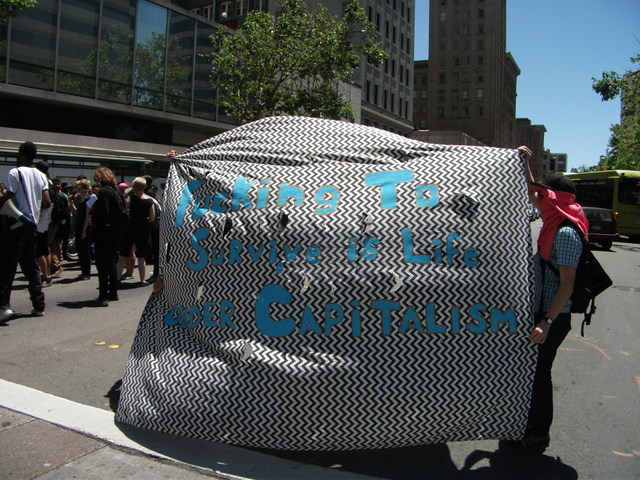
On June 13, more than 400 people, mainly from law enforcement and non-profits, gathered for a conference in downtown Oakland’s Marriott Hotel. Outside, a group of angry protesters gave impassioned speeches before trying to enter the hotel. The complex set of issues involved? The conference was organized to discuss tactics for arresting and charging child sex traffickers, but the protesters said that the conference would do nothing but further the state’s harmful impact on the lives of sex workers.

I wasn’t able to attend the conference itself; the Alameda County District Attorney’s office decided at the last minute that press would not be permitted inside. But from the conference’s description and a talk with Casey Bates, head of DA’s Human Exploitation and Trafficking Unit (HEAT), it seemed that the conference was mostly focused on improving efforts to by law enforcement to find people underage people who are having sex for money and prosecute their “traffickers,” a designation not much different than “pimps.”

According to Bates, the HEAT unit has focused on people selling sex on the street and online, and most are from California or nearby states, although he hopes the efforts can expand to people who are trafficked in from other countries.

Under the law, anyone selling sex under 18 years of age is classified as a CSEC- commercially sexually exploited child.

As DA Nancy O’Malley emphasizes on the HEAT unit website, “We have been fighting to shatter the perception of children as prostitutes and criminals undeserving of protection.  These young people are victims of child abuse.”

The sex workers rights movement, organized by people in the sex industry who see their work as legitimate, has largely called for decriminalization of prostitution and other forms of sex work since the movement off in the 1960s, with new concerns in the 21st century. Many groups have argued that police increase the violence in the lives of prostitutes, harassing and arresting them while not taking violence against sex workers seriously. The much older anti-trafficking movement, (or, as it was called at the beginning of the 20th century, anti- “white slavery,”) has many proponents who disagree, saying all prostitution involves some form of coercion. The two movements have a long history of conflict, and on June 13, this dynamic was thrust into the public eye.

Policing the problem

This conference was described as “comprehensive event designed to enhance the capacity of law enforcement and practitioners to combat commercial sex trafficking of children (CSEC).” 

“Of course we support refuges, housing, and other services for these children,” said Rachel West, an organizer with US Prostitutes Collective. “Why aren’t the police focused on that instead of spending hours on the net looking for women, or going out on the street doing street sweeps?”

But US Prostitutes Collective, part of the International Prostitutes Collective, which has been campaigning for decriminalization of prostitution since 1975, didn’t organize last week’s protest. This time it was Occupy Patriarchy, an Occupy Oakland affiliated group.

Occupy Oakland has not been shy about calling out police behaviors, from infamous incidents like the tear gas-heavy offensive on the Occupy Oakland camp last fall to shootings of local teenagers. The HEAT Conference, which was organized by the DA’s office and played host to law enforcement from across the country, was no exception.

“Whose inside this conference?” said one demonstrator who spoke during a 20-minute speak-out in front of the hotel that afternoon. “61 official speakers are law enforcement agents, DA workers, or politicians with anti-sex worker reputations. 39 speakers are individuals or representatives of non-profits. The vast majority of these work directly with law enforcement or politicians to criminalize sex workers. Where is the voice of the sex workers?” 

“What we find disturbing as anti-capitalists and anti-authoritarians is these police who, to sex workers, are oppressing us,” Clarissa McFaye, one of the demonstrators, told me in an interview. “We know that police are a very violent, fearsome presence in the lives of all sex workers, and we feel the only way that we can abolish child trafficking and exploitative forms of labor, which is all labor in actuality, is to abolish the police state.”

“They think working to enforce criminalization isn’t going to help child victims of sexual slavery. We know they exist, but we don’t feel this is a solution. We don’t think enhancing the ability to arrest people is a solution,” said McFaye.

“We really appreciate a lot of the effort that some of the non profits are doing,” McFaye continued, “We want to talk to them and form a sense of camaraderie with them and tell them that we don’t need the cops. We don’t want them. They’re bad for us.” 

Sex workers rights groups have long spoken out about police treatment of prostitutes. Stories of police harassing sex workers, going through with sexual acts while undercover before making prostitution arrests, and demanding sex in exchange for letting an arrest slide are fairly common. As McFaye told me, “they’re condoning child trafficking because they make deals with pimps.”

“Not to mention that hella cops are tricks,” she added.

Pimps and traffickers, children and minors

The HEAT Unit’s website lists 237 charges and 160 convictions made by the unit between 2006 and 2011. The statistics include trafficking as defined by California Penal Code Section 236.1, California’s Human Trafficking Statute. But they also include charges and convictions for pimping and pandering, sexual assault, kidnapping, and burglary, and the website specifies that “these statistics do not differentiate between child and adult victims, though the majority of HEAT victims are minors.”

The anti-trafficking statute defines a human trafficker as “Any person who deprives or violates the personal liberty of another with the intent to effect or maintain a felony violation of ” one of several anti-pimping, pandering, and solicitation Penal Code violations.

This includes Penal Code section 266 which defines a pimp as someone who, knowing another person has commercial sex, “lives or derives support or maintenance in whole or in part from the earnings or proceeds of the person’s prostitution.” 

But for Bates, “The way a pimp-prostitute relationship works is the pimp takes 100 percent of the cash.”

I brought up the pimp question with Cyd Nova, harm reduction services coordinator at San Francisco’s for sex workers-by sex workers health clinic, the St. James Infirmary.

“I know a lot of street-based sex workers who are totally independent,” said Nova. “Some do split their money with pimps or managers.”

Nova also said pimping’s legal definition can often have questionable consequences. “Legally that would be most peoples partners, children, friends.”

“I have met sex workers who have had their partners charged under pimping codes, which was not their relationship with that person,” Nova told me.

Many “pimping” relationships fall somewhere in between “peoples partners, children, and friends” and “the pimp takes 100 percent of the cash.” Sex workers, a criminalized class, often experience violence from both pimps and clients- but fear for their own consequenes if they report the crimes. I asked Bates his opinion on granting immunity from prostitution charges or a person who comes forward to report all too common violations committed against sex workers like rape, assault and theft.

“We do this all the time in the context of other types of crime that we work with. If it’s a murder, we may be willing to negotiate with our witness to determine whether or not is appropriate to give immunity for the person to testify against this other person, in exchange they won’t be prosecuted for the crime that they committed.”

But Nova said that striking that deal can be a major problem.

“One thing that is an issue for people forced into the industry is they are unable to receive services until they agree to testify against their trafficker. This doesn’t work for the majority of people, and it’s a major issue when you’re talking about services for trafficking victims,” he said.

At the St. James Infirmary, “We have people who have been in situations where they feel that they wanted to leave, but are not willing to bring criminal charges against the person,” he continued.

Nova also described a distinction between the terms “child” and “minor.”

“People have choices in how they use their bodies, and that includes youth. We are living in a world where sometimes people have to choose options that are not ideal,” he said. 

McFaye painted a similar picture, saying that “sex work is a form of work that all genders do sex work can make a lot more money than other options.”

“It allows me to do my political work as well as work a few times a week, instead of working at McDonalds. When I was 17 years old I tried to get a job, couldn’t find anything but shitty house cleaning jobs. Then some sex workers I knew showed me the ropes, and my life’s been a lot better ever since,” she said.

I described a similar situation, in which a minor chooses prostitution to make desperately needed money or escape an abusive situation, to Bates. “There are going to be people that make that claim,” he responded. “There’s no doubt about it. Part of the phenomenon is that a lot of people that are being abused, when they’re being abused, don’t even realize that they’re being abused. That’s a big issue,” said Bates. “People have made the claim, they did what they had to do in a difficult circumstance, and they don’t really see themselves as being a victim of crime. And what I’m suggesting is, that’s not uncommon, it’s part of the victimology actually.” 

He added, “I’m speaking specifically to people that are being trafficked. What you described doesn’t sound as much like a trafficking situation.”

But the law doesn’t allow for that kind of nuance. 

“That is a clear distinction that we want to draw. This is focused on commercial sexual exploitation of children,” Bates said. “When you become 18, you’re given a set of rights and you’re treated differently under the law.”

Solutions

The HEAT Unit’s model is unique, and if the conference has its intended consequences, it may be replicated throughout the country.

For minors that the HEAT unit identifies as CSEC, “The goal is to try to stabilize them, to figure out what services they need, what situation they came from and figure out how we can get that child back on track,” Bates told me.

“Sometimes, that requires that we detain them for a period of time so we can figure out what services are necessary. That’s somewhat controversial, because some people say that’s not appropriate. We believe that it’s in the interest of these girls initially, to figure out what’s necessary. That to turn them back on the street means to turn your back on them, period.”

Many sex workers’ rights groups, however, argue for antoher solution entirely- decriminalization of prostitution. Part of the argument for decriminalization is that sex workers would feel more comfortable coming to police with reports that they are their colleagues had been victims of crimes like rape, assault or theft. 

As Nova said, “California is currently using anti-trafficking federal funds to target all sex workers. They say, if we arrest a bunch of sex workers, some of them are going to be trafficked. This has not proven to be very effective, whereas decriminalization would result in people, who are in coercive work situations, feeling more comfortable coming forward and asking for help.

“They need an evaluation of what kind of practices are going on and what results they’re turning out,” Nova said. “A study where they have conversations with people who have been arrested and detained and talk about what their life was like, what was detrimental and what was beneficial.”

For some of the more anarchist-leaning protesters, however, the police should play no role in the solution.

“What we think would help is if we as sex workers come together is if we come together and combat this exploitation,” McFaye told me.

I asked if there was anything the police could do.

“No,” said McFaye. “They can turn in their badges. That’s what they could do.” 

When the sex workers’ rights movement took off in the ’60s, they joined the debate that had been going on surrounding prostitution and policing for a century. The movement continues- and on Wednesday, a distinctly anti-capitalist side of it made noise. These groups may be piping up more, as the Californians Against Sexual Exploitation (CASE) Act, which would increase funding and resources for policing sex traffickers, goes to the ballot this November.
Free Muni for kids: Tough slog at the MTC

15

There are plenty of reasons I like the David Campos free Muni for youth plan. Anything that gets the next generation used to seeing Muni as the primary form of transportation in town is a good idea. It’s a great benefit for low-income kids (and around SF these days, the only ones who we’re giving any benefits to are businesses that get tax breaks, and those breaks are worth far more than the modest cost of the Campos plan). But it’s particularly important this year, because the school district is in serious financial straights and is probably going to eliminate most school-bus transportation next year. So poor kids and kids whose parents don’t have cars will have a harder time getting to school.

The supervisors approved this, and the mayor signed off on it — but some of the money is supposed to come from the Metropolitan Transportation Commission, made up of regional representatives, and Campos is having a tough battle.

The MTC staff recommended that SF get $4 million in regional transit money for the idea, but not all, or even most, of the 16 members of the panel want to see one city get money for something all of them would love to do.

But: Someone has to try this as a pilot project, and SF, with the highest per-capita transit ridership, is a good place to start.

Sup. Scott Wiener is also on the MTC, representing San Francisco, and he’s totally against the free Muni for youth plan. And when it come up at an MTC committee, he was willing to vote for it — “I realize I lost that battle, and at the MTC I’m representing San Francisco,” he said — but only if MTC stipulated that no additional city money would go to the program.

And that kind of screws the whole thing up, since it will be hard to do with just the $4 million.

Ugh. Such a great idea, for a fraction of the money we’re handing out like hot dogs to everyone who asks for a tax break. Why don’t the poor kids get a break for once?

Bevan Dufty’s all wet and woofy

20

I’ve had issues with Bevan Dufty. Oh, lord, I’ve had issues. He so often voted the wrong way on the Board of Supervisors and was the only major candidate running for mayor who answered No to the affordable housing question at the Guardian mayoral forum.

But I have to say, he’s doing quite the creative job as the mayor’s homeless coordinator. I’ve always liked the idea of the “wet house” — a place where alcoholics can drink in safety. It’s basic harm reduction, something that sometimes conflicts with the prevailing wisdom on sobriety but will almost certainly save lives. He’s taking the right line on panhandling — the other day, he told me, he spoke in front of the Interfaith Council and complained about the notion of refusing to give money to panhandlers because they might use it for drugs and alcohol.

“Well,” he said, “there are people in this room who generate money for drugs and alcohol. What if that principle applied to your paycheck?”

(I always give money to panhandlers. I also spend part of my paycheck on Bud Light and bourbon. Deal with it.)

And now he’s got the puppy plan.

You can laugh at this all you want, and a lot of people will, but I think it’s a fabulous idea. It won’t solve homelessness, and I know that these little side trips can divert attention from the massive social problem that is housing costs and homelessness in this city, but still:

There are dogs that need to be adopted. There are lonely people who are in SROs who can adopt those dogs. It might keep some of them from panhandling. It will certainly make a number of canine and human creatures a lot more happy.

Remember PAWS? (One of my favorite groups.) These folks figured out in the worst days of the AIDS pandemic that having companion animals around made people’s lives better, and they worked to help people with AIDS keep their pets. Now they work with seniors and low-income people, providing support and services.

The dogs don’t care if their owners are living in an SRO; they’re happy to have a home. The people who might be isolated and stressed living alone and with very little money have a bit of light in their lives. Although a lot of SROs don’t take pets (and I get it — pit bulls on crack and fleas and shit), the Community Housing Partnership is working with Dufty on a pilot program, and if it works he cann push it further.

And that’s not the end. Under Sup. Scott Wiener’s recent legislation, dog walkers (thousand of ’em) are supposed to have some basic dog-training skills, and there aren’t that many places that offer those classes — but Dufty tells me he thinks maybe some low-income SRO residents can learn to teach dog training classes and make some money that way.

Again: Little stuff. I still want to tax the rich to provide housing as a human right for all. But things are not good on the streets of San Francisco, and every little bit helps.


Guardian voices: The zombie condo converters

28

What is the shelf life of  a really bad public policy concerning housing in  San Francisco?

When it comes to condo conversions of existing rent controlled apartments, the answer is that there is no limit on how many times this bad idea is taken off the shelf. Like a bad summer zombie movie, this undead keeps  walking, no matter what San Franciscans say.

A little history.  In 1982 Supervisor Willie Kennedy, not a bomb-throwing tenant advocate by any stretch, sponsored legislation that limited the  conversion of existing apartments to condos to no more than 200 a year. The measure did not touch new constriction, allowing unlimited condominium construction. Indeed, from 1983 to 2000, some 12,200 new condos were built, an average of some 680 units a year. Since 2000, nearly 100 percent of all new residential constriction is built as condos; there is no limit on renting a condo, but an annual limit in converting an existing apartment. Clearly, condos are a tenure type of housing that is dramatically expanding.

The reason Kennedy and the at-large elected Board of Supervisors voted for the annual limit was to protect rent-controlled apartments, a type of housingthat can’t be expanded. San Francisco’s 1978  rent control ordinance exempted all new construction from being under rent control. So rent-controlled apartments were a fixed number — all apartments built before 1978 — banned by law from ever being expanded. 

Yet those apartments are the largest number of affordable housing units available to moderate and middle income households. Thus, there’s a rational desire to preserve them by a public policy that limits their conversion to condos because they are declining in numbers.

And San Francisco voters understand and support this very rational policy.

In 1989, realtors and speculators tried to overturn the annual limit, proposing a measure that said if 51 percent of a building’s existing tenants voted for a conversion, then the building could be converted with no annual limit. This proposal laid out a future of a Hobbesian society here in San Francisco with one set of well-to-do tenants fighting another set of less-well-off tenants, building by building. San Francisco voters defeated the measure 63-37.

But in the land of the living dead condo converters, no is never the answer.
 
In 2002, Gavin Newsom, Tony Hall and Leland Yee, Plan C, and the Chamber of Commerce placed another measure on the ballot to repeal the annual limit. It too, was  rejected: 60 percent voted no, and 40 percent yes. The measure was defeated in all of the supervisorial districts except  Newsom’s D2, Tony Hall’s D7, and Leland Yee’s D4.

Tenant and affordable housing advocates were not unmoved by the desire of tenants, especially in privately owner rental housing facing Ellis Act and TIC evictions, to seek the protection of home ownership. In 2008 they supported an amendment to the Subdivision Code carving out from the annual limit conversions of apartments by nonprofit, limited equity housing
co-ops.

Now were are confronted again by a desire to allow more conversions of rent controlled units by private buyers who bought into the TIC dodge around the annual condo conversion limit.

Since TIC’s do not require a sub-division map, creating legally recognized separate units, they became “grey market” condos. With hot mortgage money flowing during the bubble, TIC owners could get financing. Now, banks are actually following some laws and will not lend to buy a legally grey TIC.  Thus the move to get them converted to legal condos.
 
This is, in its most basic form, yet another bailout caused by speculative capitalism. We seem to no longer believe in the market as an economic system, in which bad economic decisions result in economic loss for the folks involved. We now seem to believe in the “market society” — in which those with money get to keep it no matter what bad decisions they make.

What this is all about is not really homeownership but about home sales. After all, if you have a TIC you already have a home. You want to convert it to a condo not to live in, but to sell. To make it easier to sell TICs would make it harder to sell the thousands of already approved but stalled new condos.

Mayor Lee administration want to stimulate these stalled condo developments, claiming they will create constriction jobs. The Farrell and Wiener condo conversion plan undercuts these efforts and, of course, will create no jobs for anyone but realtors and moving companies.

This is called a “contradiction of capitalism,” when one set of capitalists seek, to the disadvantage of another group of capitalists, to get the government to intervene on their behalf.  But it does prove once again that Lenin was right when he said that one could count on one set of capitalists to compete with each other to sell rope to hang another set.

It’s really bad economic policy, and even worse housing policy.

Is the killer cyclist more negligent because of past actions?

106

Today’s announcement by District Attorney George Gascón that he filed felony vehicular manslaughter charges against Chris Bucchere, the bicyclist who hit and killed a pedestrian at the intersection of Market and Castro streets on March 29, won’t be a surprise or source of outrage to many people.

As I reported shortly thereafter, data from the cyclist training website Strava indicated that Bucchere was traveling at around 35 mph as he entered the crowded intersection on a yellow or red light. And the callous comments he made afterward to an online forum, which I also quoted, certainly cast him in an unsympathetic light.

But there is an aspect to the case that Gascon is bringing that I find vaguely unsettling: “’This tragic death caused by a bicyclist illustrates the worst case scenario when traffic laws are not obeyed,’ said District Attorney Gascón. He explained that Bucchere displayed gross negligence in operating his bicycle warranting a felony vehicular manslaughter charge. His office intends to prove that there was a pattern of traffic laws being broken by Bucchere leading up to the accident.”

If he ran a couple red lights without incident before this one, does that make him more criminally liable for the bad decision he made at this intersection? Shouldn’t the question of whether Bucchere was criminally negligent in causing 71-year-old Sutchi Hui’s death be about his decision to plow through this intersection when it wasn’t safe to do so?

Perhaps it’s an issue that helps shore up the case that he was behaving in a reckless way. But this is going to be an emotional case and one likely to be trumpeted by the handful of cyclist-haters out there for whom our tendency to roll stop signs is the source of real anger and condemnation, with many blog commenters in the past wishing me a violent death for doing so, threatening to carry out the deed themselves, and saying they would feel only pride in doing so.

If one of these crazies plows into me when I’m riding legally, will I be blamed because I ran a red light a few intersections ago? Will they cite my admission in the Guardian that I often break traffic laws and say I had it coming? Would the decision that Bucchere made as he was screaming down Castro toward that fateful intersection be less negligent if he had stopped at previous intersections?

With the bitter resentments that some San Franciscans feel toward cyclists so palpable and potentially dangerous, it will be easy to lose perspective on this case and make Bucchere emblematic of all cyclists, as dishonest as that may be. And I think it’s incumbent upon Gascón to try to prevent that from happening.

This is an isolated and unusual case of a young man making a tragic mistake for which he will pay a heavy price, no more and no less.

PG&E’s latest fire problem

6

Sup. David Campos was at the fire on San Bruno Ave — the one that burned for two hours before PG&E crews managed to shut off a gas pipeline, and he told me the situation was a disaster. “PG&E had apparently done some work on the pipe but hadn’t documented it,” he said. “Nobody was there when we needed to shut it off. Two hours — that’s unacceptable.”

You’d think that after what happened in San Bruno, PG&E would have figured out how to respond to gas fires a little more quickly. You’d think someone in charge of that utterly screwed-up company would have made fire safety a priority. But no: Now PG&E has the normally quiet San Francisco fire chief pissed, has Campos calling for hearings on local gas pipeline safety and is on the proverbial hot seat again.

It’s as if nobody over there cares. What’s going to happen? The CPUC will impose a little fine? The city will demand some changes? So what? The monopoly utility can just ignore it all. The senior execs will still get their huge salaries and bonuses, any additional costs will be passed on to the ratepayers — and one of these days, another pipe will blow up and kill a bunch of people, and PG&E will say: Ooh, sorry about that.

And the next time PG&E throws a couple of dollars at some civic project, the mayor will forgive all the past problems and talk about what a great company it is.

Why do we put up with this?

Restore Hetch Hetchy conjures corporate boogiemen

75

The campaign for a ballot measure that seeks to create a plan for tearing down the O’Shaughnessy Dam – San Francisco’s main source of clean water and power – and turning the Hetch Hetchy Valley into a tourist destination must be having a hard time collecting the 9,702 signatures it needs by July 9 because it is resorting to conjuring up unlikely boogiemen to win public sympathy.

Restore Hetch Hetchy just sent out a press release accusing opponents of the measure of preparing a “tobacco industry-style negative ad blitz” funded by venture capitalist Ron Conway and other corporate evildoers.

“Just like the tobacco industry’s big money confused so many people into opposing the Prop. 29 tobacco tax they initially supported, now we’re seeing corporate money flowing like a dirty river right into the coffers of what promises to be yet another nasty negative campaign,” said Mike Marshall, campaign director for the Yosemite Restoration Campaign, which his Restore Hetch Hetchy group is sponsoring.

It cites a statement made by the Bay Area Council – which they helpfully remind us includes “PG&E, Chevron, and Mitt Romney’s former company Bain & Co.” – that Conway has pledged $25,000 to the opposition campaign.

Where do I even begin to unravel this ridiculously hyperbolic and misleading appeal? Let’s start with the fact this has nothing to do with Big Tobacco, Big Oil, Big Capitalists, or Big Utilities. It isn’t corporations that are standing in the way of spending billions of dollars to tear down the dam and replace the lost power and water – it is just about every elected official in the region, from across the political spectrum, and any San Franciscan who has at least as much reason and sentimentality. As for PG&E, I’m sure the utility would just love to see San Francisco’s main source of electricity torn down, which would only expand its monopolistic control of our energy system.

Frankly, the misleading release reeks of desperation, and when I asked campaign consultant Jon Golinger whether the campaign is in trouble, he responded, “We are certainly quite clear this is a David versus Goliath situation, or whatever analogy you want to make.”

Okay, how about a Fantasy versus Reality situation? Or a Past versus Present situation? Or San Franciscans versus Dan Lungren, the right wing member of Congress who has been pushing to remove the dam supposedly because he loves Yosemite Valley so much and wants to create another one (or, more likely, because he wants to tweak the San Francisco liberals and get us fighting among ourselves over something pointless and distracting).

I’m sorry, but I just can’t get my head around the appeal of this idea, which the Sacramento Bee editorial writers actually won a Pulitzer Prize for conjuring up in 2004, certainly another sign of the modern decline in journalism standards. I get that legendary conservationist John Muir was right and this dam probably shouldn’t have been built, and that it might be kinda cool to have another beautiful valley to hike in once the sludge dries up over a few decades.

But when we can’t even find adequate funding for public transit, renewable energy sources, and the multitude of other things that really would help the environment – not to mention while we’re heading into an era when water supplies in the Sierras could be depleted by climate change – do we really want to spend billions of dollars to fetishize one valley and destroy the engineering marvel that is one of the best and most energy-efficient sources of urban water in the country?

Or am I just shilling for Big Tobacco and Mitt Romney because that’s how I see it?

The 8 Washington embarrassment

16

I wasn’t shocked by the vote on 8 Washington. I knew it was happening; I knew we’d lost when the EIR went through. I knew we couldn’t count on a solid progressive bloc any more. I knew that the lobbying was intense.

But I have to say, at the end of the day I was embarrassed. Because the supervisors sold the city cheap.

In the earlier board discussions, Sup. Christina Olague and Sup. Eric Mar mentioned their concerns about the heigh and bulk of the project and said they would work with the developer, Simon Snellgrove, on changes. But the final project was exactly the same size.

Olague and Sup. Jane Kim were concerned about the amount of parking; the developer agreed to cut 50 spaces. But the actual size of the garage won’t be reduced at all; the only promise: There won’t be valet parking, so maybe not so many cars will fit.

Yes, Snellgrove agreed to set aside some scholarships for low-income kids to swim in the pool, which is a great thing and I fully support it. For a project that, according to available figures, will net the developer $200 million in profit — according to Sup. David Chiu’s analysis, a 72 percent rate of return — the scholarship money is peanuts.

There’s an additional 50 cent parking levy to pay for surface improvements in the area.

But as Chiu asked at the June 12 meeting, “Is the city getting an appropriate level of benefits based on Snellgrove’s profits?” Project foe Brad Paul — a veteran of more than 30 years of the city’s development wars — doesn’t think so. “They got nothing,” he told me.

Here’s how it went down:

Chiu started off by introducing the board’s budget analyis, Harvey Rose. Rose said he’d reviewed the finances of the project, and concluded that the city would get $50 million less out of the project than the developer or the Port of San Francisco, which owns some of the land and is a primary proponent, had originally claimed. Chiu also noted that not all the documents were in the file, but nobody else seemed to care.

In fact, through most of the discussion — limited discussion — and final votes, it was pretty clear that nobody was swayed by any of the facts that Chiu put forward. This deal was done long before the board members took their seats.

Chiu offered a series of amendments, none of them terribly radical. He pointed out that the deal requires the city to pay the developer $5 million for open-space improvements. “That’s an anomaly,” Chiu said, and moved that it be removed.

Kim, who throughout the meeting was the strongest supporter of the project, argued that the city often reimburses developers for open space. More, she said, compared to what the city has asked other major residential developers to give, this project is just dandy. “I would not say this is not a fair deal for the city,” she told her colleagues.

The vote on the $5 million giveaway? Developer 6, SF 5. Siding with Snellgrove: Christina Olague, Scott Wiener, Carmen Chu, Sean Elsbernd, Mark Farrell, and Jane Kim. Siding with Chiu and project opponents: John Avalos, David Campos, Malia Cohen, and Eric Mar. It’s an odd lineup — Cohen doesn’t always vote with the progressives, and I have to say it’s strange to see Kim and Olague siding with the four most conservative supervisors.

Chius’s second proposal: Since the city’s benefits were $50 million less than advertised, why not add $14 million to the affordable housing fee?
Developer: 7. Affordable housing: 4. Voting for the developer: Olague, Wiener, Chu, Elsbernd, Farrell, Kim and Mar.

Okay, one last try. Chiu suggested maybe just $2 million more for affordable housing. Wiener, as is he way, went off on his usual complaint that too much of the affordable housing money is for poor people and not enough for the middle class. The final vote:

Developer: 6. Affordable housing: 5. Voting for the developer: Olague, Wiener, Chu, Elsbernd, Farrell, Kim.

Kim, again, took the lead in promoting the deal on the final vote, saying that a parking lot and a private club were not a good use for the space and that “we are achieving here is a higher and better use for the land.” That’s what every developer talks about, by the way — higher and better use.

She also talked about One Rincon, that hideous tower next to the Bay Bridge that was approved after then-Sup. Chris Daly cut a deal with the developer that the San Francisco Chronicle denounced as a “shakedown.

Kim said that, considering the much-smaller size of the Snellgrove project, the benefits were richer than the Rincon deal.

I never liked the Rincon deal — that tower’s a disaster, an ugly scar on the skyline, and there was nowhere near enough affordable housing money. That’s because I think that the city should be building six affordable units for every four market-rate units, that there’s no need for more housing for the very rich and that our current housing policy is a disaster. (The Guardian wrote an editorial at the time that said it was good that Daly had gotten that much money, but was dubious about the whole project. In retrospect, we were too kind.)

I think all my readers at this point know that. So does Daly.

But I asked the former supervisor anyway to comment on the difference between 8 Washington and One Rincon. His thoughts:

1. The Rincon Hill agreement was negotiated by the district Supervisor working together with the communities most impacted by the development. 8 Washington was opposed by the district Supervisor and many nearby residents.
2. Most people in the South of Market were not diametrically opposed to highrise development in that location. The Planning Department had been working on a Rincon Hill neighborhood plan and was recommending upzoning for the area.
3. Rincon Hill had no waterfront trust issues.
4. The Rincon HIll development impact fee was $25 per square foot (over and above the required inclusionary affordable housing fee even though the Mayor’s Office contended that over $20 per square foot would kill the deal.) According to Kim’s release, her 8 Washington deal netted an additional $2 million for affordable housing and a $.50 parking surcharge. This even though development in Rincon Hill is not as valuable as the northern waterfront.

Folks: I think the city got taken to the cleaners here. I’ll stipulate that I’m against this project for much broader reasons. And maybe I’m just an old commie who thinks that the richer you are, the more you should give back, that the affordable housing fees on the most expensive condos in San Francisco should be higher than normal, that if Snellgrove nets $200 million, then the city by definition left too much on the table.

But I don’t think I’m alone in believing that if you’re going to approve something that will make a developer this rich, and let him use public land to do it, on the waterfront, you ought to get your fair share. And that didn’t happen.

Embarrassing.

Guardian Voices: On losing

80

I’m turning 43 today and feeling glad to be alive. I would love to be writing about the joy of raising children and the mysteries of the universe. But instead, today I’m thinking about last week’s elections, about losing and the nature of long-term struggle. I’m thinking about being born black in 1969, and how, in fact, our side has been losing my whole life. And while this sobering reality about the balance of forces in the nation could make a sane person completely despondent, today I’m considering it a challenge to radically rethink the way we progressives try to change the world. 

The truth is that despite historic victories and truly incredible grassroots organizing over the last several decades, we’ve been getting our asses kicked for a long, long time. Since the right and the state got together to crush people’s movements of the 1960s. Since the Republicans built this rightwing coalition, began pushing wedge politics, winning the hearts and minds of white working people, and winning elections all over the country. And since capitalism shifted gears in the 1970s – we call it neoliberalism now — and the war on poverty was pushed aside to make way for the war on poor people specifically and working people generally. Since then, our cities have lost good jobs, union members, safety net services, and in San Francisco, more than half of the entire black population.

Thanks to Fox News, billionaire Republicans, and fragmentation on the left, conservative ideas about government, about individual vs. institutional responsibility, and about the supposed virtues of free markets have taken a powerful hold over the thinking of most Americans. One result: Last week in Wisconsin, despite the truly historic mobilization against the right’s Scott Walker, labor and social justice forces lost a big one. And here in San Francisco, in the heart of the “left coast,” progressives lost control of the Democratic Party to that special brand of “moderate” big-business Democrats who are socially liberal but have been making me embarrassed to be a registered Democrat since – well, since Bill Clinton was in the White House.

Clinton’s “ending welfare as we know it” third-way politics made it ok to talk about ending poverty while at the same time helping people get rich at the expense of poor people all over the world. Gavin Newsom was our local version – more socially liberal, and therefore successfully confusing to a lot of people, but he was nonetheless made of the same cloth.

Are you ready for the good news? Well, not quite yet. I didn’t mention the economic crisis.

If this were a boxing match, I don’t think the referees would have trouble judging this one. The current economic crisis was indeed once a crisis for capitalists — some financial institutions were forced to close shop, other lost billions and Wall Street seemed for a while to be in complete disarray. At one point, one third of Americans supported the Occupy movement and thought socialism was something to consider.

But even taking the ongoing Eurozone crisis into account, the US corporate elites in 2012 are more like a dazed prize fighter momentarily wobbly on his feet than a boxer who’s down for the count. Now, four years after the financial crash, the crisis is primarily a crisis for the rest of us, and our suffering is real. Even the middle class has taken serious punches, and our communities are badly bruised.

Good political spin will not change these real conditions. And the problem is not that organizers and activists, here in the Bay and around the country, aren’t brave and brilliant and working just remarkably hard. And even creating new forms of activism and alliances for the 21st century. But we have to think differently about how we do politics.

Most fundamentally, after so many years of losing in one way or another, too many social justice activists have lost hope of ever winning a truly more just society. Too many of us have settled for short-term gains, defensive fights, and building organizational power.

Don’t get me wrong – I’m deeply committed to local organizing that builds leadership and political power and win’s concrete improvements in people’s lives. But we will certainly never see the society we hold in our dreams without a bold, audacious belief that we can in fact win and govern our city, our state, and the entire country. Like the right – which was, objectively speaking, once weak and playing defense — progressive forces have to share a common belief that we too can build a majority, that we can govern the entire country based on values of racial justice, equity, sustainability and the collective good.  There’s a big difference between losing and feeling, en masse, like losers.

There is so much already in motion to build upon, so much potential to seize the opportunities that this historic moment provides. Inspired by Arab Spring, we too can be bold and audacious in our visions of what’s possible. After we rally against what’s wrong, let’s make plans for how we are really going to solve the crises of the 21st century and make the world a better place. Local political battles are essential opportunities to build new leadership (especially in communities of color), to change everyday people’s consciousness, and defend the ground we’ve already won. Across the nation, more organizations should take lessons from efforts like the National Domestic Workers Alliance, San Francisco Rising, CA Calls, and the national Unity Alliance that are breaking the fragmentation of progressive forces, moving beyond organizational ego, and consolidating people power. But above all, we have to let go of the idea that it’s someone else’s role to run the world or that having power is just for self-serving politicians. Unafraid of power and determined to slug it out, let’s make my next forty years about how we turned it around, had the Right on the run, built a movement and a society that we are proud to leave our children.

We are not down for the count. We are still in the ring swinging. Our opponent is powerful, and we’re already weak from a long fight, but we have the capacity to regroup, take advantage of our opponent’s weaknesses and make the most of our strengths, plot a new offensive strategy, and win — and win decisively. Losing is part of political struggle, it’s part of history, but there are more rounds to go. And what’s even better, unlike boxing, in the real world of building a movement for social justice, we engage in the struggle together. What happens next is up for grabs, and history is ours to make.

N’Tanya Lee was formerly the director of Coleman Advocates and one of the founding members of San Francisco Rising. She’s a veteran organizer with racial justice and LGBT and youth movement struggles in New York City, Michigan and the Bay. She now works on national movement building projects, advises local social justice leaders and is raising a son with her wife in Southeastern San Francisco.

No deal yet on business tax reform as competing measure are introduced

21

Mayor Ed Lee and his business community allies failed to reach an agreement with labor and progressives by today’s deadline for submitting fall ballot measures to the Board of Supervisors, leading progressive Sup. John Avalos to introduce a business tax reform measure that would compete with Lee’s proposal.

The Avalos measure would raise $40 million in new General Fund revenue to restore recent cuts to city services while Lee’s would essentially be revenue-neutral, although Lee did tweak the formulas to raise about $13 million in new revenue that would be dedicated to a new Affordable Housing Trust Fund, which would be created by another ballot measure that Lee was having a hard time funding in the face of business community opposition.

“I don’t believe trickle down economics works, except for the 1 percent,” Avalos told the Guardian, arguing the importance of recovering revenue that the city lost when the biggest downtown corporations sued the city in 2001 to invalidate a gross receipts tax. Both the Lee and Avalos measures would gradually convert the current payroll tax into a new version of the gross receipts tax, which is preferred by most of the business community.

So, will voters in the fall be faced with competing ballot measures? Probably not, according to the same sources from the business and progressive sides of the negotiations who told us last week that it appeared a deal was in the offing, something they still believe.

“This is the beginning of the negotiations,” said the business community source, noting that both measures won’t be approved until next month, with discussions about merging them ongoing. “I’m sure this is part of the process and they will agree on a number.”

Our labor source agreed, predicting the two sides will come to an agreement because neither side wants competing ballot measure, but noting that Lee appears to be trying to create divisions between the progressive revenue coalition and the affordable housing advocates. “That’s just positioning on their part, but it doesn’t feel like good faith bargaining,” the source said.

Mayoral Press Secretary Christine Falvey seemed to leave the door open for compromise, telling the Guardian, “The Mayor believes that to be successful, we should continue building consensus around business tax reform and that it’s important that the business community continue to be key partners in that effort.”

Lee is trying to placate an emboldened business community, which has taken a hard line position on opposing new taxes even while seeking ever more tax breaks and public subsidies. In fact, Sup. Mark Farrell had another business tax cut on today’s board agenda, cutting the payroll tax for small businesses at a cost of more than $2 million to city finances.

“I believe we need to do all we can to incentivize job growth in our small business community,” Farrell said.

Avalos said he agrees with helping small businesses – which is why both his and Lee’s business tax reform measure shifts more of the tax burden to the large corporations that have been so profitable in recent years – but that “we should not be putting a hole in the city’s budget to do so.”

In a sign of just how strong the business community has become at City Hall compared to the progressive movement that had a board majority just two years ago, the tax cuts were approved on a 10-1 vote, with only Avalos opposed.

Burning Man population cap set at 60,900, way more than ever

64

Burning Man is more popular than ever, judging by a demand for tickets that far exceeded supply this year, after selling out last year for the first time in its 26-year history — and now this year’s event will be far bigger than ever.

The Bureau of Land Management, which manages the Nevada desert where burners build Black Rock City every August, has set a population cap for Burning Man at 60,900, an increase of more than 10,000 over previous events.

For Black Rock City LLC, the San Francisco-based company that stages Burning Man, there was mixed news in BLM’s June 12 permit decision. BRC was denied the multi-year event permit it sought, but as it struggles to meet demand for this increasingly popular countercultural institution, BLM honored BRC’s late request for more people than the 58,000 it had sought for this year.

“After further discussions, there were requests for a bit more,” Cory Roegner, who oversees the event from BLM’s district office in Winnemucca, told us. Asked why BRC sought the population bump, he said, “The more people they can have, the better.”

BLM has been processing BRC’s lengthy environment assessment and its request for a five-year permit that would allow the event to grow steadily from 58,000 to 70,000 people in 2016. The cap for this year could have been set as low as 50,000, creating some drama around this announcement, but the agency instead issued a single-year permit with a population cap of 60,900.

BRC was placed on probation last fall after violating its 50,000-person cap by a few thousand people each on Sept. 2 and 3, and BLM rules limit groups on probation to a single-year permit. BRC has appealed the status to the Interior Board of Land Appeals, which has not yet acted on it or answered Guardian inquiries.

“Unless we do hear back from them, Black Rock City would be precluded from a multi-year permit,” Roegner told us.

He also said that if BRC violates the population cap for a second year in a row, it could be barred from holding future events, although the high population cap should mean that won’t be a big problem this year, clearing the way for Burning Man’s steady growth through at least 2016.

“Based on the evaluation [of this year’s event], we will consider a multi-year permit going to 2016,” Roegner told us.

BRC has already sold 57,000 tickets and will give away thousands more to art collectives, staff, and VIPs. But the cap is based on a daily population count and BRC board member Marian Goodell said the event never has all attendees there at once.

She said staying below the cap this year shouldn’t be a problem given that many of those who build the city and work on the major art pieces leave before the final weekend when the eponymous Man burns. “Usually at least 6,000 leave before we hit the peak. Sometimes more on dusty, wet, or cold years,” she told us.

It could have been a lot more difficult. BLM officials had told the Guardian in April that they were considering keeping last year’s population cap of 50,000, which could have presented BRC with a logistical nightmare and/or ticket-holder backlash in trying to stay under the cap.

“The issue between us and the BLM continues to be the population cap,” Burning Man founder Larry Harvey told the Guardian.

Harvey, Goodell, and others with BRC took a lobbying trip to Washington DC in late April trying to shore up political support for the event and its culture, arguing that it has become important for artistic and technical innovation and community building rather than just a big party.

Harvey told us he believes that Burning Man could grow to 100,000 participants, although he conceded that would need further study and creative solutions to key problems such as getting people to and from the isolated location accessed only by one highway lane in each direction.

“We think we could go to 100,000 if it was measured growth, carefully planned,” Harvey said.

On the transportation question, he said, “it’s a question of flow.” Right now, participants arriving or leaving on peak days often wait in lines that can take four hours or more.

“We’ve talked to engineers that have proposed solutions to that,” Harvey said of the transportation issue, although he wouldn’t discuss possible solutions except to say, “You could exit in a more phased fashion.”

Roegner said that was one of the big issues identified in the EA. “We are taking a closer look at a couple items this year, traffic being one,” he said. Another one is the use of decomposed granite, which is placed under flaming artworks to prevent burn scars on the playa, and making sure it is properly cleaned up each year.

BRC was facing a bit of a crisis in confidence after this year’s ticket debacle, when a new lottery-based ticket distribution system and higher than expected demand left up to two-thirds of burner veterans without tickets. The resulting furor caused BRC to abandon plans for a secondary sale and instead sell the final 10,000 tickets through established theme camps, art collectives, and volunteers groups.

“It’s pretty obvious that we’ll do something like that again because we don’t expect demand to go down,” Harvey said of that direct distribution of tickets, which was criticized in some burner circles as promoting favoritism and undermining the event’s stated principle of inclusivity.

Now that BRC has received a high population cap, it could conceivably sell more tickets to this year’s event, something Goodell said the board will consider, weighing that against the imperative of staying under the population cap this year. “The board needs to talk about what the ramifications of that are. There is a lot of demand out there,” Goodell told us.

Harvey emphasized that much of Burning Man’s growth is occurring off the playa — in cities and at regional events around the world. “All of this is by way of dealing with the capacity problem. I don’t know how much we can grow in the Black Rock Desert,” he said.

Another realm full of both possibilities and perils — depending on one’s perspective — is the ongoing development of The Burning Man Project, a nonprofit that BRC created last year to gradually take on new initiatives, followed by taking over staging of the event, and eventually (probably in five years) full control of Burning Man and its brand and trademarks.

“God knows, we have a lot of opportunities before us,” Harvey said, adding that BMP is now focused on fundraising. “It is the objective before we transfer the event to start transferring the regional events, and that will take more money and staff.”

After that, he sees unlimited potential to grow the culture, not just Black Rock City. “We’ve got to focus on the people. We’re becoming less event-centric,” he said. “We think of this as a cultural movement.”

Guardian City Editor Steven T. Jones is the author of The Tribes of Burning Man: How an Experimental City in the Desert is Shaping the New American Counterculture.

Another reason corporate shuttles are a problem

54

They’re huge, and they block Muni stops, and they crowd into narrow streets. And now there’s another reason the city needs to get into the businesses of regulating private corporate shuttles:

The buses can get stuck on the hills.

Uptown Almanac has a great item, with excellent photos and a video, of a Google shuttle getting caught in Noe Valley, beached like a whale at 23rd and Chattanooga. A pickup truck tries in vain to haul the monster away.

Folks: The streets of SF’s neighborhoods weren’t designed for 50-foot luxury coaches. Someone’s got to write some rules about where these private shuttles can go — and where they can’t. 

Why I hope Sup. Farrell is wrong about condos

213

So Sup. Mark Farrell thinks the Board of Supervisors is ready to turn its back on the tenants movement and vote for legislation that would increase evictions, eliminate rental housing and undermine one of the most important pieces of tenant legislation to come out of City Hall in decades?

Gawd, I hope he’s wrong.

From the Examiner:

Similar proposals have gone nowhere at City Hall. Farrell acknowledged it has been a “third rail,” but he suggested the political climate has shifted. “This is a different Board of Supervisors and this is a different time,” Farrell said.

Yeah, it’s a different Board of Supervisors. Five years ago, the 8 Washington project would never have been approved in its current form. Five years ago, Ed Lee wouldn’t have been elected mayor.

But I don’t think this board is ready to abandon the tenant vote.

Making condo conversions easier is a huge deal. When San Francisco put a limit on condo conversions more than 20 years ago, it was a landmark law that put the preservation of affordable, rent-controlled housing over the needs of speculators. Over the past decade, the single greatest threat to tenants in this city is Ellis-Act evictions done to create tenancies in common. And the only check on more of that happening is the disincentive posed by the limits on condo conversions.

If Farrell gets his way, and TIC owners can bypass the conversion lottery, tenant organizations will be furious. There are, at best, five reliable pro-landlord votes on the board, so It’s not going to happen without either David Chiu, Christina Olague or Jane Kim siding with Farrell. A lot of things suprise me in local politics, but that would be a shocker.


Why does the mayor appoint supervisors?

16

The Alameda County Board of Supervisors just found a replacement for Nadia Lockyer, who resigned in April (“amidst a drug and sex scandal,” the Chronicle notes, and you know how much journalists love to use that phrase). The four remaining members of the board deadlocked for a while, then settled on Union City Council member Richard Valle.

All of which makes me wonder, as I often do: Why does the Mayor of San Francisco get to fill vacancies on the Board of Supervisors?

Other county boards fill the vacancies themselves — and if you don’t think the SFBOS can handle that, remember that every two years the 11 contentious folks choose a president, and it doesn’t take more than a few hours, and not that long ago, they chose a mayor.

I don’t know any other situation where the executive gets to choose legislators. The governor doesn’t fill seats in the state Assembly. The president doesn’t fill vacancies in Congress. There’s an important balance of powers issue here, and it has played out to the detriment of democracy in the past. At one point, more than half of the sitting supervisors had been appointed by Mayor Willie Brown. There was no balance; the mayor called all the shots.

Imagine if, instead of the mayor secretly huddling with advisors and choosing a new supe, the Rules Committee took applications and nominations and then the full board, in open session, debated and discussed and voted. The outcome would reflect the much broader perspectives of 10 district supervisors — and the person chosen would owe a debt to all of his or her colleagues, not to the mayor.

You can make a good case that the mayor ought to fill vancancies in other elected offices (sheriff, city attorney, public defender etc.); those are, at least arguably, executive offices. Although I could also make the case that the 11 district-elected supervisors should make those calls.

But that’s a different issue. The clear and obvious anomaly here is that San Francisco’s chief executive gets to choose his own legislators in the event of a vacancy — and that’s just wrong.

Now, in Alameda if they can’t reach a decision, the governor steps in. In San Francisco, with 10 voting supes, it seems highly unlikely that we’d ever see a long-term deadlock, but the mayor could step in the break the tie in that case — or some other city official could, or you could come up with a dozen other solutions. The bottom line is that most of the time, as in Alameda, the board would come to if not a consensus, then a majority vote.

Who’s up for some Charter reform?


The Mirkarimi case: Did the city want to settle?

132

The real news in the Ross Mirkarimi case isn’t the sheriff attempting to get the city to pay his legal fees; that’s just something he had to try but it was a long shot at best. The story that’s come out in bits and pieces since we broke it is far more interesting:

City Attorney Dennis Herrera, with or without the knowledge of his client the mayor, offered to begin discussions with Mirkarimi around settling the case — and the conflicting accounts of what went on show haw harsh this legal proceding has become.

Whatever you think about Mirkarimi’s actions on New Year’s Eve — and I’ve said many times that what he did was unacceptable — the intensity of the prosecution, particularly in the removal proceding, is unprecedented.

Some of the political fallout is clearly Mirkarimi’s fault. He bruised his wife, got bad advice early on, said the wrong things, and didn’t do enough to repair the damage. But now Mirkarimi’s lawyer is charging that the city attorney used a nasty legal gambit to try to convince the embattled sheriff to resign.

David Waggoner, in a TV interview with KGO’s Dan Noyes, and later in discussions with me, said that City Attorney Dennis Herrera offered to look for a way to keep the video of Mirkarimi’s wife out of the public eye — if Mirkarimi would take a financial settlement and resign from his elected position.

Mirkarimi told me the offer he heard from his lawyer put him in a terrible bind: Franky, the video contains nothing that hasn’t already been out, and won’t be the defining issue in the official misconduct case now before the Ethics Commission. But his wife, Eliana Lopez, was adamant that she didn’t want the 45-second clip on the Internet, where she — and more important, their three-year-old son — will have to live with it forever.

“They were using the needs of my family to pressure me,” Mirkarimi said.

Waggoner was pretty specific about his recollection of the settlement discussions. He said that after Herrera contacted him to say that he was willing to discuss settling the case, Waggoner made it clear that keeping the video sealed had to be part of any deal.

“We hung up, and then he called me back five minutes later to say that his government team was working on it, and he thought they could keep the video under seal,” Waggoner said. “The mayor and the city attorney were using the video as leverage.”

Hererra confirmed that he reached out to Waggoner to see if Mirkarimi’s legal team was interested in settlement discussions. But told me that Waggoner’s story was “absolutely, categorically untrue.” He insisted that he had no choice but to release the video, since several media outlets had requested it under the San Francisco Sunshine Ordinance.

In a statement issued June 8, Hererra attacked not only Mirkarimi but his attorneys:

“Everyone involved in this case was well aware of the City’s legal obligations under the Sunshine Ordinance (which Ross Mirkarimi himself had a hand in drafting).  The City invoked the maximum allowable two-week extension after receiving Sunshine requests for the video, to allow other parties to seek a protective order.  But opposing counsel dropped the ball.  They didn’t get a protective order.  They didn’t seek Supreme Court review.  They didn’t raise the issue at the Ethics Commission hearing.  And as far as I know, [Lopez’s counsel Paula] Canny didn’t even bother to show up at the hearing.  So, I think it’s a little absurd now to be playing martyr.  These are lawyers representing a former lawmaker.  They have no excuse for not knowing the law.”

Wow. Sounds like the usually level-headed Herrera is one pissed-off attorney.

Interestingly, Mayor Lee told Noyes that he didn’t know anything about any settlement discussions. Either that’s false (the mayor could have been instructed by Herrera not to say anything) or Herrera was going ahead without the mayor’s knowledge or permission.

So let’s set aside for the moment the back-and-forth about who’s telling the truth and what was really involved in the negotiations. Here’s what’s not in any serious dispute:

Herrera, representing the mayor, was sufficiently motivated to settle the case before it got to the Ethics Commission that he personally called Mirkarimi’s attorney to see if there was any possibility of finding a way out. Again: Attorneys in the most bitter lawsuits are advised to seek settlement. But this isn’t in court, and no judge mandated a settlement conference.

Which suggests that the city attorney and possibly the mayor would be a lot happier if this case just went away. Maybe Lee doesn’t like the drama. Maybe Herrera thinks it would be best for Mirkarimi and the city to put this in the past and move on.

Or maybe they aren’t sure this case is such a slam-dunk winner.

There’s another interesting twist, too: Mirkarimi told me that he asked the Probation Department for permission to fly to Venezuala to see his son. There were no conditions on his guilty plea barring him from travelling outside of the country (what — they think he won’t come back? That he has run through all of his money and put himself heavily in debt to fight a case that he’s now going to run away from?) But when he made a formal request, it was denied.
That’s right — probation officials refused to let him go visit his son. Forget Mirkarimi — that’s not fair to the three-year-old kid who did nothing wrong at all and is suffering for it.

Mayor Lee’s business tax reform will include new revenue

30

Mayor Ed Lee has acquiesced to labor’s demand that the business tax reform measure being negotiated for the November ballot raise tens of millions of dollars in new revenue, rather than being revenue-neutral as Lee and business leaders had previously insisted, according to Guardian sources in both the business and progressive communities who are involved in the ongoing negotiations.

As we previously reported, SEIU Local 1021 had demanded that the measure – which must be submitted to the Board of Supervisors by Tuesday – raise $30-50 million in additional revenue to prevent cuts to city services and to recapture money the city lost when the largest downtown corporations sued the city in 2001 to invalidate its gross receipts tax. If not, the union threatened to qualify a competing ballot measure that would raise the money, something neither side wants.

Sources say the Mayor’s Office has agreed to structure the tax to raise at least $25 million in new revenue, and some believe they will settle on $30 million, which is being supported by the big technology companies and is probably enough for labor to sign onto the deal.

But a complicating factor is the fact that Lee’s representatives are simultaneously negotiating another ballot measure to create an Affordable Housing Trust Fund that will also need to generate revenue, most likely through an increase in the real estate transfer tax, something the commercial landlords are opposing.

The business community has opposed any tax increases, but it is split between the big technology companies who helped elect Lee and more traditional businesses, including the FIRE (Finance, Insurance, and Real Estate) companies that all observers say are likely to get hit with a higher tax burden whatever the outcome of the current negotiations.

There is an urgency to get this deal done now because of the fast-approaching deadline to introduce ballot measures to the board, and the fact that under state law revenue measure can be passed with only a simple majority of voters only in presidential election years.


Big (Robot) Brother is watching you on Muni

20

So I’m not usually the paranoid type (I said usually), but this one is a little creepy: According to Fast Company, Muni is going to deploy a camera system that can detect criminal or potential terrorist behavior — without a human being.

Not clear what happens when the cameras find something suspicious (and anyone who rides Muni knows that “anomalous behavior” is pretty standard fare). But I sense this could cause some trouble when over-anxious cops hyped on terror-watching charge into the tunnel to grab some guy who’s pissing on the wall.

Unless the cameras decide that’s “normal.”


Sutter’s CPMC deal isn’t healthy

28

At 10am on Friday, June 15, at the main chambers of the Board of Supervisors, the first of a series of public hearings will be held on specific aspects of the  development agreement governing the $1.9 billion Sutter Health/California Pacific Medical Center proposal to expand and centralize the giant health-care outfit’s health center by building a new 555 bed hospital at Geary and Van Ness. The deal involves demolishing the existing 220-bed hospital at St. Luke’s at Mission and Cesar Chavez and rebuilding a new 80-bed facility, expanding the Ralph K. Davies hospital at Duboce and Noe and closing down the old Children’s Hospital in Laurel Heights.

The hearing will be the first before the Board of Supervisors. Thus far, the project has been before only the executive branch: the Planning Commission and the mayor. After a brief introduction on the overall project the hearing will focus on the issue of jobs.

This is the largest project to be negotiated by the Lee administration — and although the mayor introduced it to the board in May, not one supervisor has yet joined him to sponsor the legislation. That’s an an odd situation given the importance of the project – and the fact that Mayor Lee can usually count on an automatic four votes from the conservative faction of the board. But not this time.

The hearing was requested by a coalition of more than 60 community, neighborhood, labor, and environmental organizations — San Franciscans for Healthcare, Housing, Jobs and Justice (SFHHJJ) — which has been closely following the project for the last two years.  Members of the coalition have already appealed the project’s environmental impact report, passed last month by the Planning Commission, and SFHHJJ has developed a series of amendments to the agreement that it has been pressing on the Board of Supervisors.  Board President David Chiu agreed to set a series of hearings on the project before it voted on, along with the determination of the appeal of the EIR, in  late July.  SGHHJJ hopes to use the hearings to get across the serious shortcoming of the agreement.  In addition, depending upon the appeal of the EIR,  a law suit may well be filed by some members of the Coalition.

In short, what starts next Friday is a big deal.

Not only is it a big deal in the development war that is at the heart of San Francisco politics, but it also is a big deal given what may well be done by the Supreme Court in deciding the constitutionality of all or part of the Affordable Health Care Act. If Obama’s health reform is struck down by the court, in all or in part, which seems almost certain, Sutter/CPMC’s plan will most definitely take on even more importance for the future of health care and its costs in San Francisco.

Sutter currently controls about a third of the market for health care in San Francisco.  With the construction of this project, it will control about 40 percent — a portion most knowledgable observers feel will give it market dominance  and an ability to actually set health care costs in San Francisco. Sutter’s business model — as shown in Berkeley when it took over Alta Bates and elsewhere in the state – demonstrates that  with a dominate market position, it jacks up prices.

As the San Francisco Chronicle noted in 2010: “…Sutter Health Co. has market power that commands prices 40 to 70 percent higher than its rivals per typical procedure — and pacts with insurers that keep those prices secret”.

A US Supreme Court that weakens or strikes down health care reform will simply re-establish the status-quo ante, a situation in which Sutter will thrive.

And that’s why the board’s conservative members are not supporting Mayor Lee’s deal: it simply does not protect the city — itself a major health care consumer for both its workforce and Healthy San Francisco — from Sutter’s history of turning market power into high health care charges.

SFHHJJ want the development agreement amended to place a cap on the costs charged to the city, allowing Sutter no more than 115 percent of the average charged  by  San Francisco’s other private, nonprofit hospitals.  It also wants Sutter/CPMC low charity care payments pegged at an average of what other nonprofit hospitals contribute, and it is calling for rebuilding St. Luke’s in San Francisco medically underserved south east to 180 beds, not the sure-to-fail size of 80 beds.

But there’s even more to deplore about the proposed deal.

In housing, although the EIR showed that a demand would be created for some 1,500 new two-bedroom homes, Sutter/CPMC agreed to only provide funds to build about 90 such homes. Such a massive shortfall will boost housing prices all other San Franciscans will pay.

The project’s impact on public transit at the Geary / Van Ness intersection will be large and ongoing. More than 20,000 new car trips will be generated at that intersection by the new hospital. Plans for a Bus Rapid Transit raised roadway for the 38 Geary — the most used bus line in the city — will have to be altered at an unknown price since the project calls for all auto traffic to enter the site on the Geary Avenue side.

Again, San Francisco taxpayers will be on the hook to pay for these new costs.

But it is the jobs aspect of the deal that is the most distressing. Sutter/CPMC has a long history of labor disputes with its workforce. Last year it replaced nurses who took a day off to protest their working conditions, and a replacement nurse hired by Sutter accidentally killed a patient. Sutter/CPMC refuses to agree to hire all of its 6,000 current employees for the new facilities. It’s requiring them all to apply as new workers, losing all of their seniority, with a real prospect that many currently employed San Francisco residents will lose their jobs once the new facility opens. All that Sutter/CPMC has agreed to do is hire 50 residents a year for four years – 200 new local jobs, total.

The  June 15 hearing will focus on the jobs issue and public comment is sure to be hot on this laughable “commitment” agreed to by the “jobs” administration.

Calvin Welch is a longtime community organizer living in San Francisco. He currently teachs a course in the development history of San Francisco at San Francisco State University and the University of San Francisco.

Occupy Caravan takes off to the National Gathering

12

This looks familiar!

Jan. 17, we proposed Occupy Nation, an idea that those energized and organized by Occupy come together on July 4, 2012 for a national gathering to get some planning done. We also proposed that the journey across the US be a part of the action, and that people get together in vans for a freedom-ride inspired experience. Well, it’s happening- although, of course, it wasn’t all our idea. But they are using our cover art!

The Occupy Caravan is an ever-expanding crew of people getting together for a two-week journey across the US. There are two starting points, Los Angeles and San Francisco- and the San Francisco caravan is taking off June 11. The caravans will stop at Occupy sites along the way for protests, education and entertainment, before arriving in Philadelphia for the June 30 Occupy National Gathering.

The poster declares, “bring tents!” But according to an Occupy Caravan organizer known as Buddy, sleeping arrangements that won’t risk police meddling are planned at every stop.

“We have a bunch of secure and fun locations- there’s a slumber party at one, a march and then staying at a church at another, a supporter’s camp ground where we can park the RVs,” said Buddy.

“We’re not risking people getting arrested,” he said. “Everything is legal and nonviolent.”

In theory, anyone who wants to can show up, on foot or with a vehicle, and join the caravan. But if you want to secure a spot, according to Buddy, it’s best to sign up online beforehand.

“We’re getting 30 to 50 calls and emails a day about rides,” Buddy told me of the last chaotic week before the trip launches.

The National Gathering isn’t the only nationwide Occupy plan for this summer. It isn’t the only one in Philadelphia either. Or for the July 4 weekend. There’s also the 99 Percent Declaration, billed as a “Continental Congress 2.0”

It looks like these big get-togethers are part of the form Occupy will take this summer. What with a big and chaotic May Day, an even more tumultuous anti-Nato convergence in Chicago, and continuing home defenses, occupations of public spaces, and innumerable local actions across the country, the Occupy movement is in a very different state than it was in the winter when the Gathering and the Caravan were in their beginning planning stages.

“The movement has grown,” Buddy told me. “It’s less than a year old. It was an infant early on, and grew very quickly, but its getting stronger. We’re going back to the simply core message of economic equality and justice.”

After the National Gathering, the caravan will join the Occupy Guitarmy for its “99 Mile March” to New York. The Guitarmy is a travelling group of musicians that bills itself as “the world’s first open source band,” best known for its march on May 1 in New York City, led by Tom Morello of Rage Against the Machine.

As we said in the Occupy America proposal: “The important thing is to let this genie out of the bottle, to move Occupy into the next level of politics, to use a convention, rally, and national event to reassert the power of the people to control our political and economic institutions — and to change or abolish them as we see fit.” One thing is clear: Occupy hasn’t given up yet.

Mecke joins crowded District 5 supervisorial race

26

Progressive activist Quintin Mecke jumped into the District 5 supervisorial race today, echoing gentrification concerns raised this week by the Guardian and The New York Times and promising to be an independent representative of one of the city’s most progressive districts, a subtle dig at Sup. Christina Olague’s appointment by Mayor Ed Lee.

“The City is at an economic crossroads. As a 15 year resident of District 5, I cannot sit idly by while our City’s policies force out our residents and small businesses, recklessly pursuing profits for big business at whatever cost,” he began a letter to supporters announcing his candidacy, going on to cite the NYT article on the new tech boom that I wrote about earlier this week.

“What we do next will define the future of San Francisco; the city is always changing but what is important is how we choose to manage the change. One path leads to exponential rent increases, national corporate chain store proliferation, and conversion of rent-controlled housing. The other path leads to controlled and equitable growth, where the fruits of economic development are shared to promote and preserve what is great about this City and our district,” Mecke wrote.

Mecke came in second to Gavin Newsom in the 2007 mayor’s race and then served as the press secretary to Assembly member Tom Ammiano before leaving that post last week to run for office. Mecke joins Julian Davis and John Rizzo in challenging Olague from her left, while London Breed and Thea Selby are the leading moderates in a race that has 10 candidates so far, the largest field in the fall races.

Although he never mentioned Olague by name, Mecke closed his message by repeatedly noting his integrity and independence, a theme that is likely to be a strong one in this race as Olague balances her progressive history and her alliance with the fiscally conservative mayor who appointed her.

“Politics is nothing without principles; and it’s time now to put my own principles into action in this race,” Mecke wrote. “District 5 needs a strong, independent Supervisor. I am entering this race to fight for the values that I believe in and to fight to preserve what is great about District 5 and the city. I have brought principled independence to every issue I’ve worked on and that’s what I’ll continue to bring to City Hall.”

In an interview with the Guardian, Mecke said he sees the campaign as a “five-month organizing project” to reach both regular voters and residents of the district who haven’t been politically engaged, including those in the tech sector. He’d like to see the perspective of workers represented in discussions about technology, not simply the narrow view of venture capitalist Ron Conway that Mayor Lee has been relying on.

“Local politics needs new blood,” Mecke said, “it needs to hear from these people.”

8 Washington isn’t getting much better

30

When the Board of Supervisors approved the environmental impact report for the most expensive condos in San Francisco history, several members of the board said they weren’t entirely happy with the project. Supervisors Christina Olague and Eric Mar both complained about the height and bulk and Olague said she wanted a parking fee.

So now the project is back, and just won approval at the Budget and Finance Commitee — with only a few minor changes. There’s no adjustment to the height and bulk, although the parking has been cut from 255 spaces to 200 and a 50-cent parking surcharge has been added. Sup. Jane Kim wants to be sure that the pool built in the new facility will be open to low-income youth.

But the city’s not getting a dime more than the $11 million in affordable housing money that developer Simon Snellgrove has already offered — despite the fact that the available financial evidence suggests Snellgrove and his partners will make more than $250 million on the deal. Sup John Avalos made clear that the city’s not getting enough out of this project.

So now it goes to the full board June 12 — and if things go according to the normal San Francisco pattern, the developer will get what he wants and the city will get screwed.

See, when you give developers the opening, they take advantage of it. When you let them over the first hurdle with and 8-3 vote, they get pretty confident that they’re going to win. So why would they compromise on more than few details? Why cut the height and bulk when you know you have the votes?

I respect what Eric Mar, Jane Kim and Christina Olague said about their votes on the EIR — but imagine if it had been a 6-5 vote? Snellgrove might have gotten the message that this wouldn’t be easy. He might be calling Olague and Mar and saying: How much less height? How much less bulk? How much more affordable housing? We might have wound up with a much better deal.

Every time — every single time — a developer presents what is supposed to be the last, best deal it’s a scam. Every time the city has said No, the developer has come back and sweetened the pot. That would have happened here, too.

But no. I predict no height and bulk adjustments, no additional affordable housing money — nothing more than what Budget and Finance already got. Which isn’t enough.

Oh, and by the way: Everyone here already knows that I oppose this project because it’s too much housing for rich people, which we don’t need in this city, and puts the city’s housing balance further out of whack. But if we’re going to sell off the waterfront for all the wrong reasons, we should at least get the best deal we can.

A range of rage at Obama visit

0

Hundreds gathered in the financial district today as President Obama came through San Francisco for a brief visit, consisting of a high-priced fundraising lunch and no public events. A mostly silent crowd waited patiently to watch the president’s motorcade drive by this afternoon, first at 1 Market St and then at 456 California, before he went off to SFO. On the crowd’s sidelines, handfuls of dissenters from various groups held signs and spoke up with a diverse range of reasons for protesting the president.

On Market, the motorcade went past the Occupy SF campsite at 101 Market St, where a dozen protesters had gathered. Their signs and chants focused on the National Defense Authorization Act. Sections 1021 and 1022 of the act, which the president signed Dec. 31 2011, have been interpreted as allowing for indefinite detention of terrorism suspects in the United States without charge or trial.

National groups Code Pink and World Can’t Wait brought attention to what they called Obama’s war crimes. 

“Code Pink is asking Obama to kill the kill list,” said Nancy Mancias, an organizer with the womens’ peace organization, referring to a list of terror suspects targeted for US attacks that Obama personally oversees. “We want more transparency in the CIA drone program, and victim compensation to the families of those who have been killed in drone strikes.”

World Can’t Wait demonstrators emphasized that Guantanamo Bay detention facility is still open and housing almost 200 prisoners, despite President Obama signing an executive order to close it days after taking office.

For demonstrators from the Center for Biological Diversity and Greenpeace, it’s imperative that the president stop oil drilling in the Arctic.

“There are a couple small permits they still need to get, but Shell is ready to drill in the Arctic in July,” said Miyoko Sakashita, an attorney at the Center for Biological Diversity. 

Sakashita said that drilling there could be dangerous for residents of the region, as well as polar bears, walruses and seals. 

“The conditions are terrible for drilling,” said Sakashita, citing low visibility and icy terrain. “If they can’t stop an oil spill in the gulf of Mexico, how will they stop it in the Arctic?” 

If these conditons do indeed lead to a disastrous oil spill, Greenpeace volunteers will be there first hand to witness it, as the group plans to send vessels of their own to monitor the operations.

Tea party protesters and Ron Paul supporters also came out to see the president. 

“It’s an issue of competence,” said Charles Cagnon, a protester who held a sign calling President Obama a “bad hire.”

“A president is our employee, not a king.”

But Cognan wasn’t too pleased with the competition either. 

“I was a Ron Paul kind of guy,” he said, “but I’ll take Romney. He’s level-headed and competent, and he likes arithmetic.”

“Obama doesn’t like arithmetic,” he continued, as evidenced, according to Cagnon, by the senate rejection of Obama’s budget May 16.

“Bush was terrible,” Cagnon added. “Romney is uninspiring.”

Cagnon and his group sported “Nobama” gear, Code Pink protesters came with signature pink clothing and signs, and a Greenpeace volunteer was dressed as “Frostpaw the polar bear.” Focused for the day on a common enemy of sorts, no conflicts arose between the divergent protest groups. For his part, Cagnon added that despite his right leanings, he loves KPFA radio, and that he believes the tea party has a distrust of government in common with Occupy.

“I’m just glad there’s people out there dissenting,” he said. “We need people like that.”

Bike advocates have made real progress, but there’s still a long way to go

51

San Francisco Bicycle Coalition Executive Director Leah Shahum mused on how far this influential advocacy group has come during its 20th Annual Golden Wheels Awards last night, noting that the first such award recognized the commercial landlord at 555 Montgomery Street for installing indoor bike parking.

“Back then, that would get you a Golden Wheel Award,” she said, noting that this year’s award to the Building Owners and Managers Association of San Francisco (BOMA) was for its support of legislation requiring all commercial buildings in San Francisco to provide indoor bike parking. “We’ve come a long way in 20 years, clearly.”

In addition to the majority of the Board of Supervisors who showed up to offer their support, Shahum ticked off a long list of other city and regional officials who ride bikes and understand their potential as an increasingly important transportation option during the era of peak oil, traffic gridlock, and public health problems.

“Regularly, we have these top leaders in the city who are biking because they love it, biking because they’ve always biked,” Shahum said, citing the Sunday Streets road closures and the school district going from discouraging cycling to facilitating it as signs of the pro-bike mindset that has taken hold of San Francisco.

The fact that SFBC recognized BOMA – a powerful downtown player that has progressed from seeing cyclists as enemies to embracing them as allies – was telling of the mainstream embrace of bikes.

“We get it, we’re learning,” Meade Boutwell, president of BOMA’s board, told the crowd as he accepted the award, going on to say that “less cars are good for all of us.”

It was a lovely if ungrammatical sentiment and a sign of just how far the business community has come in accepting the imperative of promoting alternatives to the automobile. But there’s still a bit of a disconnect in San Francisco about the role that bikes play in the world’s great pro-cycling cities, evidenced partly by Boutwell’s opening comment, “Under this polyester suit is lycra.”

Keynote speaker Gil Peñalosa – executive director of 8-80 Cities, a nonprofit that promotes creation of cycling infrastructure that is safe and inviting from those 8-80-years-old – mocked the MAMILs (Middle-Aged Men In Lycra) and the notion that people should be athletic or wear special equipment to be able to cycle in cities.

“We dress normally, we act normal, and so on,” Peñalosa said, later arguing that, “Cycling is for everybody.”

In Boutwell’s defense, much of mainstream San Francisco still has a hard time accepting cycling as a normal, safe option. When the San Francisco Chronicle covered Pealosa’s visit to Sunday Streets last weekend – our version of the car-free ciclovias that Peñalosa pioneered as a city official in Bogota, Columbia more than a decade ago – reporter Sam Whiting was jarred by the guest’s casual approach.

“They had come from overseas and were riding in jeans and without helmets, both rookie mistakes,” he wrote of Peñalosa and his wife (“Sunday Streets welcomes its source of inspiration,” 6/4).

But Peñalosa argues that the real mistake is when cities cater primarily to automobiles at the expense of the safety and livability of their neighborhoods, and treat cycling as a dangerous fringe activity. He argues that cities should be built primarily around pedestrians, “but very close to the pedestrians is the cyclists…I think that cycling is just a more efficient way of walking.”

Public transit is important and should be robust, he said, but it’s just not as efficient, user-friendly, economical, or environmentally beneficial as bikes. “We need to walk and bike as a part of everyday life and then we’ll be much healthier,” he said.

Peñalosa urged the crowd to be politically active and push the city to prioritize bikes over automobiles, noting that even in wealthy neighborhoods, only about a third of residents drive cars. And from a design perspective, he said city officials must choose between “Streets for cars or streets for people.”

Once we make the latter choice, Peñalosa laid out an agenda for achieving that goal, starting with slowing vehicle speeds to no more than 20 mph in residential areas.

He cited statistics showing that only about 5 percent of pedestrians hit by cars driving 20 mph will die, whereas the fatality rate shoots up to 80 percent when the vehicles are traveling 40 mph. And for streets in which cars are traveling faster than 20 mph, he said it’s imperative to have bike lanes that are separated from cars by physical barriers, rather than just lines painted on the street.

He noted that Seville, Spain drastically increased its cycling rate in just a few years by committing to building bike infrastructure, and that Chicago Mayor Rahm Emanuel installed that city’s first physically separated bikeway within his first 30 days in office and has perhaps the US’s most ambitious program for installing new bikeways. “San Francisco should not be any less than Chicago,” he said.

In Cogenhagen, which already boasts some of the world’s highest rates of urban bicycle use, Peñalosa said the city has sought to capture more long-distance riders by building 200 miles of “cycle superhighways” – which includes two lanes in each direction to facilitate both fast and slow riders – all for the price it costs to build about a half-mile of subway.

The goal, he said, is to make cycling as “easy, fast, and convenient” as possible, and to apply the political pressure to make that a priority because “if you aren’t doing those things then someone else is and someone else is setting the agenda.”

It’s the money, stupid

10

If you want to know what American politics looks like in a post-Citizens United world, check out the June 5 elections.

It’s not that this specific court case played a role in all of the key races — the tobacco industry could have spent $47 million to defeat a cigarette tax with or without Citizens United — but around the country, you saw the role that big money played in literally altering the political landscape.

Take Wisconsin. The national news media twist on this will call it a test of Obama’s field campaign and a referendum on labor, but it was really all about money. Walker and his big-biz allies raised $30 million, a lot of it through barely-regulated super PACs, and outspent Tom Barrett by more than 7-1.

In California, Prop. 29, which would have put a $1 tax on each pack of cigarettes to pay for cancer research, was way ahead in the polls, and I was pretty sure it was going to win handily — how can you vote against a tax on a product that kills people to fund a cure for the disease it causes? Prop. 29 had a 30-point lead a couple of months ago.

Then came the blitz — $47 million in TV ads, funded by a couple of big tobacco companies. The ads were classics of the type — misdirection and confusion aimed at getting people to vote No. And it worked: Prop. 29 is going down to a narrow defeat.

In San Francisco, Prop A, with little money and not much of a campaign, never had a serious chance. But the flood of Recology money made sure it never got even 25 percent of the vote (although if you asked people, outside of the campaign, whether the garbage contract should be put out to bid, most of them would say yes).

I think Recology money had an impact on the Democratic County Central Commitee, too; Recology paid for a lot of slate cards that promoted a lot of more moderate candidates. The company also paid for progressive slate cards (the Milk Club etc.), and I haven’t counted them all, but in the end, slate cards matter in the DCCC and they may have made the difference.

The local election was so low-turnout that it’s hard to draw any serious conclusions from it. But overall, money carried the day June 5 — and that’s a scary message.