• No categories

Politics Blog

Wage theft task force approved

24

The Board of Supervisors June 5 voted unanimously to create a wage theft task force. The task force will make recommendations to city departments concerning the prevention and correction of wage theft in the city.

Wage theft refers to employers paying less than their employees are due, and can include not paying extra for overtime, not allowing breaks, confiscating tips, and paying less than minimum wage. A 2010 study of labor conditions in Chinatown restaurants conducted by the Chinese Progressive Association (CPA) found that some 76 percent of employees did not receive overtime pay when they worked more than 40 hours in a week, and roughly half were not being paid San Francisco’s minimum wage.

The industries where wage theft is prominent range from restaurants and retail to domestic work. 

Approval of the task force is a step forward for groups like CPA that have been working to combat wage theft for years. It builds on the wage theft prevention ordiance, passed last July. The ordinance doubled the fine for employers who retaliate against workers that seek recourse for wage theft, and enhanced the power of the cit’s Office of Labor Standards and Enforcement (OLSE).

The Progressive Workers Alliance- a coalition of CPA, Young Workers United, the Filipino Community Center and others- advocated for the task force and helped bring in dozens of supporters to the meeting. 

Workers who suspect that their employers have violated local labor laws often come to these groups for help. Between the OLSA and advocacy groups, the people following up with these claims see a widespread problem. According to Shaw San Liu of the CPA, there are “probably hundreds if not thousands coming forward every year, and there are many more who don’t.” 

“There have been experiments in coordinating with the City Attorney and with the health department to revoke food permits,” said Liu. 

She hopes “the task force will build off these successful examples and see how we can expand them to a more comprehensive strategy.”


Welcome back to SF President Obama! Now, say Supevisors, give us our marijuana

4

Not that it’s ever a good idea, but avoid driving downtown today like the plague — President Obama’s in town! And, (as reported by SFGate), SF supervisors want him to take a stance on pot. Sup. Christina Olague has penned a letter co-signed by Sups. David Campos, and Scott Weiner that is a solid finger-wag at the current federal administrations actions against the medical marijuana industry. Here’s the meat of it:


We believe strongly in addressing medical cannabis as a public health issue, and we will strive to fully implement state law by protecting not only our patients, but our property owners and dispensary operators as well. We want to work with President Obama on a public health solution for medical cannabis at the federal level, once he wins a second term. In the meantime, the Department of Justice must respect our laws and honor the President’s commitment on this issue. Honoring this commitment can start by taking no further action against the nine landlords of City-permitted facilities here in San Francisco.


Those “nine landlords” refer to the property owners of the five SF cannabis dispensaries that have already closed, and the additional four that are set to close this month. The federal government has sent threatening letters to dispensary landlords that posit extensive jail time and civil forfeiture for those landlords that continue to allow federally-illegal drug trafficking on their property. 

Kudos to the new Sup. Olague for taking a stand. Of course, the letter’s premise is that the Sups. are staunch supporters of Obama’s re-election, they’re just asking him to improve on this particular issue. It begs the question: why would he make capitulations to win support that is already in pocket?

Tickets are sold out for his lunch at the Julia Morgan Ballroom (465 California, between Montgomery and Sansome Streets), although his campaign website encourages you to get on the waiting list — be careful, general admission tickets start at $5,000. The President’s only other scheduled stop, says SFGate, is at a “small roundtable” at One Market Plaza. 

Afterwards, the President will head south to Los Angeles to attend the annual fundraising gala for the LGBT Leadership Council, where he will no doubt be greeted affectionately for his “I support gay marriage”isms of last month. 

After an adorable election, free drinks at El Rio

2

The mood was relaxed at El Rio tonight as the League of Young Voters held their post-elections party. There wasn’t much to today’s ballot- as the League put it in the intro to their Pissed Off Voter Guide, “Aw, what a cute little election!”

The League endorsed a yes vote on Propositions 28, 29 and B, and a no vote on Prop A, and it seems the results all went with these endorsements. 

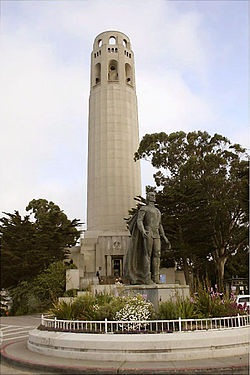
Jeremy Pollock, a member of the steering committee of the League of Pissed Off Voters’ San Francisco chapter, said that he was especially pleased about Prop B’s passing. The measure will prioritize money for upkeep of Coit Tower and the surrounding Pioneer Park and limit private events in the iconic tower.

For Pollock, the fight over Prop B was like “David and Goliath,” especially when tens of thousands of dollars got poured into the anti-Prop B campaign at the last minute.

“It’s a statement against the privatization of Rec and Parks,” said Pollock.

Pollock was also pleased to see Wendy Aragon and Peter Laterbourn doing well in the DCCC assembly District 19 race.

But mostly, the attendants at the party were pleased to get a free drink for showing their “I voted” sticker. If you paid for a drink in San Francisco today, then you’re not a true lover of democracy.


Supervisors dominate DCCC race, but key newbies join them

5

“I just stopped by on my way to finish campaigning,” Sup. David  Campos told me at the Bike Coalition’s 20th Annual Golden Wheel Awards (more on that tomorrow), the first in more than a majority of the Board of Supervisors at the event.

Campos was campaigning for reelection to the Democratic Party County Central Committee (DCCC) and the polls were still going to be open for almost two more hours. Perhaps he could still reach the one in four registered SF voters who bothered to weigh in on this lackluster election.

“There was nothing really on the ballot that excited voters,” Campos said. “Hopefully November will be different.”

Tonight’s returns — for leadership of a local Democratic Party that hopes for more  voter engagement in the fall races — showed that Campos and fellow supervisors David Chiu, John Avalos, and Scott Wiener expectedly topped the pack, with Bevan Dufty, who moved from the board to the Mayor’s Office this year, in fifth place. And longtime former legislator Carole Migden’s sixth place fininish in the 14-seat eastside DCCC race helped show that it was mostly about name recognition.

But there were a couple of first-time candidates in the winning field: Matt Dorsey and Zoe Dunning, who finished 8th and 12th respectively. Both played key roles in recent LGBT politics: Dorsey as the City Attorney’s Office spokesperson during the same-sex marriage saga of the last eight years, Dunning as a poster lesbian in ending the US military’s “don’t ask, don’t tell” policy.

“I think Zoe and Matt are the ones to watch,” DCCC member Alix Rosenthal told me at the Buck Tavern as she celebrated her reelection, after campaigning hard for both the progressive and women’s slates.     

Unprompted, Dorsey returned the recognition when I stopped by his party down the street at Churchill. “Alix and Rafael [Mandelman, who organized the progressive slate and finished 10th, right after Sup. Malia Cohen] ran other things, so it’s apples and oranges,” Dorsey humbly said of the two former Dist. 8 supervisorial candidates he bested, when I asked about his strong finish.

Dorsey ran an aggressive campaign, targeting high-turnout precincts and working hard to get the full spectrum of political endorsements (and posting all his answers to each group online), what he called “Moneyball politics.” And it translated into an impressive finish for a freshman candidate but longtime politico.  

“Right now, I’m looking to get back to the gym after a year and a half of campaigning,” said Dorsey, the spokesperson for the mayoral campaign of City Attorney Dennis Herrera, who was at the party, along with District Attorney George Gascon. 

Dorsey and his fellow Guardian/progressive slate members did better in Eastside Dist. 17 than Westside Dist. 19, taking 10 of 14 seats compared to four of 10, leaving a near-equal balance with the moderate Democrats once the seats of elected officials are factored in.

But if the spirits count for anything, Dorsey told me he ran especially hard to earn the seat that outgoing DCCC Chair Aaron Peskin appointed him to when long progressive activist Michael Goldstein died last year.

“Knowing that it was his seat,” Dorsey said, “motivated me to work harder.”

Tobacco tax: It’s going to be way too close

19

About 25 percent of the vote in. 50.6 Yes, 49.4 No. Trending the wrong way. This is going to be very close.

I didn’t believe that the tobacco companies could beat this thing, and I thought the results from LA would push the Yes vote, but in LA county, Prop. 29 is losing. Odd to see the absentees more liberal than the election-day votes, but let’s remember: As the polls showed this getting closer, Big Tobacco threw more and more money into the strategic areas, and that’s clearly had an impact.

Wow. This could actually go down.

And if Californians aren’t going to tax cigarettes, which only about 12 percent of Californians even smoke, what does that say about the impact a big-money campaign could have against Gov. Brown’s tax measures in the fall?

Reading Ed Lee’s mind

15

Political reporters love to believe we can read politician’s minds; it makes us feel important. (And Lord knows, these days we need something to make us feel important.) So let me go way out on a limb here and tell you what Mayor Lee is thinking right now:

1. Gotta minimize Prop. B. It was an aberration, a bunch of rich Nimbys from Telegraph Hill, nothing more to see here. Certainly not a public referendum on my Rec-Park director, Phil Ginsburg, and his efforts to make money by renting out city parks for private events. No no no, just ignore it and maybe it will go away.

2. We won back the Democratic Party. Good move to take a page from Aaron Peskin’s book and run a bunch of elected officials and former elected officials with high name recognition in a low-turnout election. Bevan Dufty, who happens to work for me, would make an excellent chair; should be easy to make that happen.

3. What if we look at the DCCC race in the 17th District as a first-pass primary for the 2014 Assembly seat when Tom Ammiano — who’s just way too independent and won’t get with my program — is termed out? Hmmm … David Chiu, who I can mostly deal with, is in first place — but John Avalos and David Campos are more popular than my pal Scott Wiener. And if the progressives get behind Campos, he’ll be tough to beat. Hmmm….

4. That oddball Michael Breyer ran for Assembly pretending he was me. He even put out a mailer with my mustache on the front suggesting that he’ll be just like I am (except that he’s white and has no experience and no credible program and isn’t going to win). But he got a lot of votes with the Ed Lee card and I could totally control him. Can’t support him over Phil Ting, of course, but maybe I can get him some help behind the scenes.

5. This was an unusual election with radically low turnout. I know I can’t read too much into it. If the DCCC were on the ballot in November, or if there were a real presidential primary to bring people out to vote, the results would be very different. But still: All that new housing for rich people that my mentor Willie Brown and my friend Gavin Newsom got started seems to be having an impact. The city’s getting more conservative. Let’s just keep that one going and I’m home free.

6. What’s up with Lincecum? Damn those Padres.

Nah — the mayor’s too nice a guy to be thinking like that. Right?


Tobacco money showing its power

1

The tobacco companies spent very, very heavily in Southern California to defeat Prop. 29, and as more results come in, it’s clear that the tens of millions of dollars worth of misleading TV ads had an impact. The numbers are now very, very close. With 15 percent of the vote in, it’s 50.3 Yes, 49.7 No. Still mostly conservative areas; LA and San Francisco aren’t in the mix yet, and only half of Sacramento’s been counted. Still: This is way, way closer than I thought it would be.

80 percent reporting: You can take (most of) this to the bank

6

WIth 80 percent reporting, you can take this much to the bank:

Prop A is dead. Prop. B has won. The left will no longer control the local Democratic Party.

Phil Ting will have an actual race in November (although he won more votes than the conservative Dem and the Republican combined and will almost certainly win the seat).

The Padres beat the Giants, 6-5, with a walk-off home run in the ninth.

Hell of a night.

40 percent reporting: Not a lot of change

0

Witrh 40 percent of the precincts reporting, there’s been very little change in the results, which is surprising: Typically the absentees don’t reflect the election-day turnout. But Prop. A is still going down by huge margins, Prop. B is still winning (and at this point, that one’s probably in the bag, striking a blow against the privatization of public resources and offering a vote of no-confidence in the direction of the city’s Rec-Park department).

It appears likely that there will be an expensive November race for Assembly in D19, with the downtown-funded (but otherwise unknown) Democrat Michael Breyer who ran an almost-Republican campaign heading for a second-place finish against Assessor Phil Ting.

And there’s no change in the results for the DCCC.

I’m a little surprised (and disappointed) that Gabriel Haaland, a longtime incumbent, isn’t making the cut this time, and I’m surprised (and pleased) that newcomer Justin Morgan, a public-health physician, is still in the top 14 on the East Side. Zoe Dunning and Matt Dorsey, two very visible LGBT leaders (she on DADT, he on same-sex marriage) are running strong; Dorsey’s in the progressive camp, and Dunning, a former military officer, is more conservative. School Board member Hyrda Mendoza isn’t making the cut, either, which is odd for a citywide elected official.

At this point, it appears that theSF Democratic Party will be a more conservative organization than we’ve been used to over the past four years. At most, the progressives will have 14 or 15 votes out of 32 (24 elected and eight ex-officio). There are plenty of reasons for that, among them the retirement of some longtime progressive members (Aaron Peskin, Jane Morrison, Milton Marks); the redistricting that created a West Side district very few progressives could compete in — and the move by the more conservative elements of the party to run a slate that included Dufty and Cohen.

Things could still change; I could be wrong. But I don’t think I am.

Tobacco tax tightens up

0

Whoa — with 10 percent of the state reporting, the tobacco tax, Prop. 29, is tightening up. It’s now 51.3 yes, 48.7 no. But I’ve checked the counties that have reported in, and they’re mostly the no-tax conservative areas. Only 5 percent of Los Angeles is in, and San Francisco hasn’t even reported to the state yet. So not time to worry yet.

In CD2, Norman Solomon has pulled to within 2.5 points of the Republican in the race for second place and a slot on the November ballot. I think he’s going to pull it off.

Early SF results: No on A, Yes on B

5

The first results just got posted, and it’s a fairly large number of votes. More than 60,000 people voted by mail, and there’s enough to draw a few conclusions.

Prop. A, the measure that would have required competitive bidding for the city’s garbage contracts, is dead, losing in the early absentees 77-23. No surprise that it’s losing; getting 23 percent of the vote with no campaign to speak of up against the full might of Recology’s money and political connections is actually pretty impressive.

Prop. B, the Coit Tower measure, is winning, 55-45, which is a good place to be at this stage. I’d say it’s time for the Yes on B camp to start celebrating.

The DCCC early returns show a lot of what we expected — the elected officials and incumbents are doing well. David Chiu is in first, beating Scott Wiener, who is beating John Avalos. For what it’s worth.

After that, it’s Bevan Dufty, David Campos, former Sup. Leslie Katz and former state Sen. Carole Migden.

Interestingly, Matt Dorsey, an appointed incumbent facing the electorate for the first time, is ahead of Sup Malia Cohen. Rafael Mandleman, Zoe Dunning, Alix Rosenthal, Petra DeJesus, and Justin Morgan finish out the top 14 on the East Side.

Those are the early absentees, and the difference between Morgan and incumbent Gabriel Haaland, now in 18th place, is just 800 votes. So it will change.

Right now, the progressives have 9 of the 14 seats on the East Side, but only 4 of the 10 on the West Side, which won’t be enough to elect a progressive chair and ensure good endorsements in the fall. But the margins are so thin and it’s so early we can’t call it yet.

On the West Side of town, Assessor Phil Ting is comfortably in the lead for the 19th Assembly District, but newcomer Michael Breyer, a conservative Democrat who spent a ton of money, is edging Republican Matthew Del Carlo by two points, setting up the possibility that Ting will have to raise money and face off against Breyer in November.

Statewide results: Tobacco tax close, term-limits change leading

0

The statewide results are very early, very limited and most likely very conservative, because they represent only absentees that have come from the few counties already reporting. Here’s what I can draw from them: The change in term limits, Prop. 28 — promoted by opponents of the current term-limits law but described as reducing the amount of time a legislator can serve — is going to win handily. It’s ahead 66-34. It doens’t mean voters are turning against term limits (sadly); there wasn’t a huge campaign on either side, so it’s mostly about the actual ballot language, and the sponsors were careful to say it “limits legislators terms in office.” Still, it’s good news for people like San Francisco Assessor Phil Ting, who is likely to head up to Sacramento for the first time and will be eligible to serve in the Assembly for 12 years.

The cigarette tax is also winning, despite about $40 million in spending by the tobacco companies. That one’s closer — 53-47 — but since absentees are usually more conservative than election-day votes, that’s a good sign. If things hold up the way they normally do, the gap will widen and both measures will win handily.

In the Congressional D2 race, Jared Huffman is, as expected, well in the lead with more than 40 percent of the vote. The second-place Dem is Norman Solomon, but he’s trailing the top Republican, Daniel Roberts, by three points. If Solomon does well with today’s voters, he may wind up in the November final.


Two things to watch for in CA

1

There are two things that could be really significant around the state tonight (and no, I’m not talking about which liberal, balding Jewish man wins the primary in the San Fernando Valley, which will almost certainly be replayed in the fall). There’s a real chance that, thanks to redistricting, the Democrats could pick up enough seats to win a super-majority in the state Senate — meaning they could pass new taxes despite GOP recalcitrance. And while it’s unlikely that the Dems will get a two-thirds majority in the Assembly, there are a few Republicans out there who are starting to question the Grover Norquist line.

So what happens if, say, both houses approve an oil-severance tax or a restoration of the vehicle license fee? Will the Guv, who insisted in his campaign that he’d accept “no new taxes without a vote of the people” going to veto it? Seriously — is Jerry Brown going to veto an oil-severance tax?

Then there’s the Second Congressional District, where corporate Dem Jared Huffman is almost certainly going to come in first — but Norman Solomon, who is way closer politically to outgoing Rep. Lynn Woolsey, has a good chance of coming in second and making it to the November election. In which case the North Coast will see a classic fight between the left and the center of the Democratic Party, in one of the most progressive districts in the country — and it will attract national attention.

By the way: I’ve been checking out so many blogs tonight that I can’t remember where I saw this, but: The huge turnout in Wisconsin indicates that sharp political distinctions, clear-cut lines and hard fights, improve voter turnout. These cautious, don’t-take-risks pols shouldn’t be surprised that hardly anyone wants to vote for them.

Walker winning in Wisconsin — the fallout

30

AP is callling the Wisconsin election for Scott Walker, although the results will no doubt tighten up as the night goes on.  But this is a wake-up call — for all of us. It’s one of the first clear tests of what happens when you have unlimited corporate money flowing into an election (Walker outspent his opponent about 8-1) and it’s a sign of how bad things can get under Citizens United.

It’s also going to dampen the enthusiasm of labor activists for the Obama re-election. Already, commenters on DailyKos are calling for progressives not to support the Democratic Party this fall — and while that’s common and people mostly get over it, Obama has to start moving now to shore up labor support. We’re all for gay marraige, and that was a strong and much-needed (if also much-delayed) stand, but it’s not going to be enough.

There’s going to have to be a concerted effort to end the demonization of public-sector workers. This election just shows how it’s gotten out of control.


Turnout light in SF; eyes on Wisconsin

0

My usual limited polling sample — my precinct in Bernal Heights — suggests what everyone pretty much knew: Turnout in San Francisco will be very low. Control of the local Democratic Party, and its endorsements, will be determined by a small fraction of the eligible voters.

On the national front, since the presidential primaries are long over and California has long been irrelevant, everyone’s looking at Wisconsin, where the battle to recall Gov. Scott Walker will have national implications. Walker’s trying to survive by blaming public employees for the state’s economic woes; since he ended collective bargaining, he said today, the state budget is running a surplus and property taxes are down.

If by some chance he’s thrown out of office — and it doesn’t look good right now — labor will have one of its greatest victories in years. If he becomes the first governor in US history to survive a recall, he’ll portray it as a confirmation that the public supports his attack on unions. The right-wing types have poured millions into this race — and if they get their way, a lot of labor folks are going to be asking why President Obama (who will be in San Francisco to raise money at Clint Reilly’s office building June 6) didn’t make an appearance in Wisconsin.

Labor came in big for the president in 2008, and this one is hugely important — and the White House has been entirely missing in action. And he may have to answer for it if Walker survives and GOP governors across the country take up the call and attack public-sector unions as the start of a larger attack on organized labor.

In California, I don’t care how much money the tobacco companies spent — Prop. 29, the cigarette tax, is going to win. And I think the term-limits measure squeaks through, too. Locally, we all know that Prop. A will lose under a barrage of Recology money; I hope Prop. B survives the strange last-minute money blitz.

We may not know for days how the Democratic County Central Committee races are shaking out. If it’s close, and control of the panel hangs on a couple of tight races, the absentee votes that get counted over the next few days will make the difference.

We’ll be posting updates all evening.

Summer of Peace events kick off in Oakland

6

By Natalie Orenstein

Oakland has garnered more attention in the last year for police violence than it has for peace, but a group of activists is hoping to highlight the city’s nonviolence initiatives and traditions later this month during the kickoff for the three-month global Summer of Peace celebration, starting June 22-23 at Oakland’s Scottish Rite Center.

The Summer of Peace was designed as an “effort to create a critical mass of consciousness,” said Jane Elin, the event manager for the Oakland festival.

A few “anchor events” will be sponsored by the Shift Network, a global peace organization based in Petaluma, but international activists and organizations will hold corresponding celebrations throughout the summer, said Production Manager Bill McCarthy. Soon, with hosts able to post events online.

The Voices for Peace festival, about a year in the making, will kick off with a benefit concert on June 22 from 7:30pm to 10:30pm, featuring Maria Muldaur and Friends, Country Joe McDonald, the Vukani Mawethu Choir, and a slew of other performers. At a conference starting at 9am the next day, speakers including peace advocates Marianne Williamson, Barbara Marx Hubbard, and James O’Dea will address peace-building efforts in a variety of spheres. 

More practical components of the conference, such as a seminar on nonviolent communication, “offer tools and awareness – something you can walk away and use,” Elin said. But the general goal of the summer-long effort is to find ways to connect activists, and to keep peace-building in the global consciousness, she said.

“One of the things we’re doing is having people make a pledge during the summer,” McCarthy said. Participants will decide how many “acts of peace” they will commit to on a weekly basis, then share them online.

If all this sounds a bit vague, that actually part of the intention. One goal of the project is to highlight the diverse range of “pathways” one might take to finding personal peace or advocating for peace locally or abroad, said Philip Hellmich, “director of peace” with the Shift Network..

“We’re using ‘peace’ in multiple contexts,” Hellmich said. “We want to acknowledge and celebrate, as well as accelerate, the ways it’s happening.”
Hellmich pointed to a recent study that found more lawyers now do yoga than play golf as an example of people searching for inner peace, an “essential component” of working toward peace on a larger scale, he said.

“There’s been an exponential growth in peace-building. In 1985, only a handful of colleges had peace and conflict resolution programs, and now there are hundreds,” Hellmich said. “This isn’t your parents’ protest movement. It’s about all the different ways emerging to create a culture of peace. We want to move away from the typical polarization that happens: us versus them, Democrats versus Republicans, hawks versus doves. It’s a more sophisticated and nuanced approach.”

Those who want to participate without leaving the house can tune in to a series of interviews on a webcast throughout the summer, and call in with thoughts and questions. Each week of this “telesummit” will focus on a different theme: forgiveness, education, the science of peace, arts and culture, business and economics, and even peace in the military. There are big names on the program for this as well, from Alice Walker to Olympic gold medalists.

All profits from the ticket sales at Voices for Peace will go to Urban Peace Movement, an Oakland organization that aims to combat conditions that lead to violence in the city. The suggestion to hold the opening celebration in Oakland came from one of the Shift Network’s 27 Peace Ambassadors, and the event coordinators quickly warmed to the idea.

“Obviously, the city of Oakland has had its share of having to deal with conflict and violence,” McCarthy said.
“This will highlight peace-building activities and organizations in the city, and let the city shine,” Elin said. “It’s a place that needs more support.”

The morning before the concert, Oakland Mayor Jean Quan, United Nations Association of the East Bay President Jerry Weber, and Shift Network representatives will gather in Willie Wilkins Park to install a Peace Pole. “May Peace Prevail on Earth” will be written in several languages on the handcrafted Peace Pole, a tradition that began in mid-century Japan.

The permanent monument – and the entire weekend’s festivities – will “designate the city as a place of peace,” McCarthy said.

The funny money against Prop. B

19

Credit where it’s due: My competitor and sometimes journalistic adversary Joe Eskenazi has a nice little piece on the weird money behind the campaign against Prop. B, a policy statement about the privatization of Coit Tower. He points out that such varied groups as the California Dental Association and the San Manuel Band of Mission Indians have coughed up money to protect the right of San Francisco officials to close Coit Tower to the public and rent it out for fancy corporate parties.

And how exactly did that happen?

Well, Eskenazi manages to tie Willie Brown into it. (He also calls this “Nimby against the Swells,” which isn’t quite fair — I don’t think the supporters of Prop. B are trying to keep anything out of their back yards. If anything, they want more noisy tourists and fewer quiet, subdued rich-people events. And I don’t think the “swells” are against it as much as the mayor, his Rec-Park director and big businesses that generally back the privatization of public resources.)

But there’s another interesting twist: I’m not sure the folks who gave to the Golden State Leadership Fund Political Action Committee, which is running a No on B independent expenditure, had any clue where their money was going.

Sure, the Chamber of Commerce and BOMA know what’s up, and it’s pretty clear why they like the idea of raising money for the parks by holding exclusive private events instead of by raising taxes. But the Indians? And the dentists? By what possible stretch do they care about a San Francisco ballot measure that has nothing to do with Native American rights or oral health?

Eskenazi may be right — maybe Brown called the Indians and asked, and they threw the money his way to help his buddy the mayor (while keeping the mayor’s fingers out of this particular political pie). But the Golden State Leadership PAC, through which all this money flowed, has been around for years and gives money to candidates all over the state. (It’s definately something of a slush fund for local races — files in the Secretary of State’s office show that in 2008, money from Pacific Gas and Electric Co. flowed in and out of the PAC as it ran a campaign against the San Francisco public-power measure, Prop. H. PAC money went to David Chiu, Phil Ting and Ed Lee for mayor.) It’s based in West Hollywood and the treasurer is a guy named William Molina.

I called the San Manuel Band of Mission Indians and the California Dental Association and asked them why there were helping fund a campaign against Prop. B in San Francisco. The press person at the dental group apparently had no idea what I was talking about and asked for more details about the contribution. I gave her the date and the PAC and I haven’t heard back.

The Indians didn’t seem to clear on Prop. B, either. Kenneth Shoji, a spokesperson for the group, told me by email:

The San Manuel Band of Mission Indians made a contribution of $25,000 to the Golden State Leadership Fund PAC with the expectation of helping to support candidate(s) for public office in the 2012 elections.  We do not control where or how the PAC might extend its support beyond that.

In other words: This Coit tower thing is news to us.

UPDATE: I got essentially the same message from the dentists. Alicia Malaby at the CDA writes:

 When an organization such as CalDPAC contributes to an independent expenditure committee, that committee may spend money on races and issues that CalDPAC supports, but may also spend money on other campaigns. CalDPAC does not control how those committees spend money, and in this case, CalDPAC has no interest in and no position on Proposition B.

UPDATE TWO: Ron Cottingham at PORAC just called me and said his group has no position on or interest in Prop. B. The money that went to the PAC was earmarked to support Rob Bonta for Assembly in the East Bay. Presumably the PAC folks keep track of such things.

Maybe not. Maybe Willie or someone else made a call. It happens all the time.  I mean, somebody clearly was raising money for this PAC, which right now isn’t doing a hell of a lot besides No on B in San Francisco. (Oh, I called Brown, too. He hasn’t called back. He never does. I still always try.)

Either way, it’s a classic San Francisco political story — and it reflects how muddy and corrupt local politics can still be, even in an era of electronic disclosure and ethics laws. Why, if the dentists and Indians don’t like Prop. B, didn’t they (or any of the others in the PAC) create a No on B committee, disclose who was behind it and let the voters know a little more about the real money trail? Why funnel all this cash through a little-known Southern California PAC?

And for that matter, why is there a sudden influx of late money in this race? Has the mayor and the Chamber types suddenly discovered that Prop. B might pass — and might set a precedent against future privatization efforts?

June 5 is Election Day. Vote early and often.


Trolls rejoice! Comments are back

17

We appear to have fixed the comments problem that was bedeviling us and frustrating all the great folks who are part of our blog community (and those trolls who just try to annoy everyone else). So come on back — the comments work, you can start calling me names again, and let the fun being anew!

Why is a NY real estate developer targeting Prop. 28?

5

Why is a New York real estate developer putting up more than half a million dollars to try to crush California’s term-limits reform initiative?

Seriously: Howard Rich and his family and associated companies have poured $654,880 into preventing state legislators from serving 12 years in one house. It’s a relatively modest change in the law, which now allows three terms in the Assembly and two in the Senate. Total amount of time as an elected legislator is actually reduced (since many Assembly members set their sights on the Senate almost as soon as they’re elected).

And 12 years is enough time to learn how the system works, to encourage longer-term thinking on the budget — and to reduce the role that paid lobbyists play in setting the legislative agenda.

Which may be why Mr. Rich, a libertarian and private-property-rights nut  who doesn’t like the “radical agenda of the left” and runs Americans for Limited Government, is willing to put up a relatively huge sum of cash for an election that’s happening on the other side of the country.

But it ought to give Californians pause — a guy like this is trying to dominate a low-turnout election in the interest of keeping Sacramento safe for big business. One more reason to get out and vote June 5.

Election turnout expected to be less than 40 percent

2

If they held an election and nobody noticed, would it still count? Because that’s what this Tuesday’s presidential primary election is starting to feel like: the election that everyone ignored.

Okay, okay, not everyone is ignoring this election. San Francisco Elections Director John Arnst tells us that his department has received about 55,000 mail-in ballots so far out of the nearly 217,000 they sent out, a turnout of about 25 percent. And 1,110 voters have cast their ballots in person during early voting at City Hall as of this afternoon, a level lower than the 2010 or 2008 primaries “by quite a bit,” Arnst said.

That’s not really surprising given that both major political parties have already chosen their presidential candidates, there are no other offices being seriously contested, and the rest of the ballot consists of the Democratic County Central Committee (and its Green and Republican parties counterparts) races and a pair each of ho-hum statewide and local ballot measures. The most interesting one is Proposition A, which seeks to break Recology’s waste collection monopoly in San Francisco by requiring competitive bidding.

“If the garbage issue is the most exciting issue on the ballot, you know it’s the most boring election ever,” says Tony Kelly, who is leading the campaign for Prop. A.

With the exception of a press conference that Kelly and other Prop. A supporters held last week to accuse Recology of being complicit in an alleged recycling kickback scheme by some of its employees, there’s been little to indicate Prop. A has much chance of success given that almost every endorsing group (except the Guardian) opposes the measure.

“Goliath doesn’t lose very often, and we’re being outspent 100 to one,” Kelly said, expressing hopes that the measure can at least garner 35-40 percent of the vote to send a message that Recology should work with the city to allow competitive bidding on some of its contracts.

But with turnout expected to be low, Recology isn’t taking any chances. Its political consultant, Eric Potashner, says the campaign has been assembling up to a couple hundred volunteers and its SoMa headquarters each weekend and “we’re doing the full grassroots outreach.” He expressed confidence that the measure will be defeated: “Folks have been well educated on this issue.”

Arnst estimates that this will be a historically low turnout election: “Top end right now, comparing the last three presidential primaries, I’m looking at 40 percent as the top turnout possible.”

But you know what that means, right? Your vote could be more decisive than ever, particularly for the 24 members of the DCCC, the outcome of which could move the ideological center of that body before its important endorsements in the fall Board of Supervisors races. So click here to take a look at the Guardian’s endorsements and don’t forget to vote.

Chevron meets amid angry shareholders, liability, and environmental disasters

3

About 40 gathered outside Chevron’s San Francisco offices yesterday to mark its annual shareholder meeting. The demonstration was organized by OccupySF’s environmental justice working group, and used art and street theater to criticize Chevron’s involvement in hydraulic fracturing, a natural gas extraction process that may threaten parts of California’s water supply.

The afternoon protest came after a larger group showed up to Chevron’s world headquarters in San Ramon for the shareholder meeting that morning. According to Ginger Cassady of Rainforest Action Network (RAN), who helped organize the protest, it was a “big, colorful demonstration” with “over 100” in attendance.

Groups like the True Cost of Chevron and RAN’s Change Chevron campaign have been pressuring the company for years on a variety of issues. This year, workers and residents in areas where Chevron operates from Ecuador, Brazil, Angola and Nigeria travelled to San Ramon to voice their concerns. These ranged from oil-contaminated land in the Ecuadorian Amazon to an explosion on an oil rig off the shore of Nigeria in January. In that explosion, two workers were killed and more than 100 local people left the city for fear of contamination and other health risks caused by a fire that burned for months before going out on its own, despite Chevron’s efforts to contain the flames.

About 30 activists from around the world entered the meeting with proxy votes, according to Cassady. None interrupted the meeting, instead waiting their turn to speak. There were no arrests.

Some people with proxy votes, however, were not allowed access to the meeting. João Antonio de Moraes, national coordinator of Brazil’s United Federation of Oil Workers (FUP), was not allowed access, along with two representatives from United Steel Workers. Another worker, at the meeting to present in support of a resolution for worker safety, was initially blocked from entering but allowed access after a dispute, but had his presentation notes confiscated.

At the meeting, Chevron CEO John Watson announced “tremendous performance momentum” for the company, with “earnings of $26.9 billion” in the past year, according to a press release.

“Watson reinforced Chevron’s long-standing culture of safety and environmental stewardship, and resulting industry-leading performance,” the press release states. “He also highlighted Chevron’s commitment to partnerships that address health, education and economic development issues in the communities where the company operates, and Chevron’s global social investments of approximately $1 billion over the past six years.”

But Chevron is also suffering financially due to liability following oil spills, explosions, and contamination, a concern protest organizers say Watson failed to address. Representatives from Chevron did not return calls for comment.

The company recently settled with plaintiffs in Ecuador after an appeals court there ordered that they pay $18 billion in fines for spilling and deliberately dumping a total of 345 million gallons of crude oil in the Amazon rainforest of northeastern Ecuador.

Stockholders in attendance voted on eleven proposals, including seven submitted by shareholders, at the meeting. All of the votes went with the recommendation of the Board of Directors- including a proposal to reform the Board of Directors itself. That proposal asked that the Board of Directors find an independent Chair to head it up, as the current Chair is Chevron’s CEO, John Watson. The Board of Directors has the authority to incentivize and, if necessary, fire CEOs.

“We believe this presents a conflict of interest that can result in excessive management influence on the board of weaken the board’s management oversight,” read the proposal.

The proposal, along with several others, mentioned the Ecuador lawsuit, saying “we believe that independent board leadership is key at Chevron, given the questions raised about the oversight by the board of the CEO’s management and disclosure to shareholders of the financial and operational risks to the company from the $18 billion dollar judgment in the Ecuadorian courts in 2011.”

“With all these major legal liabilities that Chevron is facing a lot of people are concerned,” said Cassady.  “Chevron is profitable at the expense of worker safety, the environment, human rights and our economy.”

Other stockholder proposals dealt with safety, transparency, and the environmental impacts of Chevron’s international operations. A proposal asking Chevron to disclose money spent on lobbying received approximately 23 percent of votes, a proposal asking for a report on what the company has done to reduce the risk of accidents like the Niger Delta explosion received only eight percent of the vote, and a proposal that Chevron nominate a new board member with environmental expertise failed as well with 23 percent of votes cast.

Shareholders also voted on a proposal that Chevron release a report on the financial, environmental, and community impacts of hydraulic fracturing, the focus of the afternoon protest in San Francisco. The proposal received about 27 percent of the vote.

Hydraulic fracturing, or fracking, is the process of extracting natural gas by injecting dense underground rock formations with a pressurized mixture of water, sand and chemicals. It has been hailed as an environmentally friendly alternative to oil drilling, as natural gas burns cleaner than oil.

But protest movements have coalesced around fracking practices in the Appalachian mountains region and above the Marcellus Shale, as residents report toxic chemicals in their water supplies, endangering drinking water as well as water used for raising livestock and growing food.

The 2010 documentary Gasland included now notorious footage of residents near a Pennsylvania fracking operations whose tap water bursts into flames.

Fracking operations in California are less well known. The protest outside of Chevron’s San Francisco offices yesterday drew attention to this issue- and the extensive list of chemicals present in fracking solution.

“It’s happening in California, but it’s not really talked about” said Ellen Osuna. Osuna now lives in San Francisco, but moved from New York, where she says she worried about her water supply since it comes from aquifers near the Marcellus Shale.

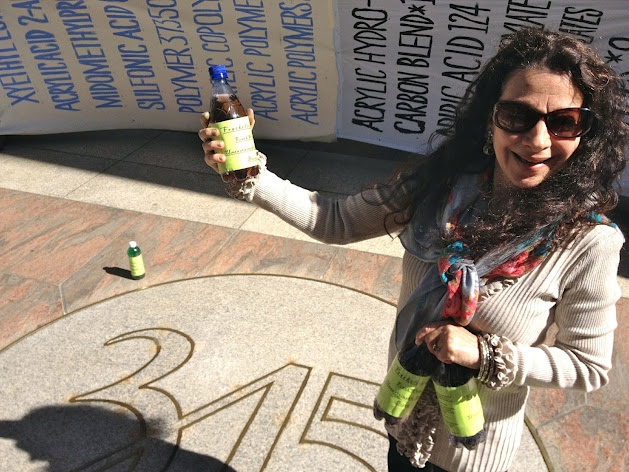
The protest featured an 180-foot banner, painted by artist Ruthie Sakheim. The banner listed more than 70 chemicals found in fracking fluid, in alphabetical order.

“It’s not even halfway through the A’s” said Sakheim.

She also handed out bottles of water oil-colored water labeled “Frackelicious Frackwater Unsustainable Energy Drink.” The label listed some of the more toxic chemicals involved in the process under “ingredients” along with “no preservatives, no artificial flavors, 100 percent poison.”
 
According to a report released by the Congressional Committee on Energy and Commerce, fracking fluid contains 750 chemicals, which “ranged from generally harmless and common substances, such as salt and citric acid, to extremely toxic substances, such as benzene and lead” as well as many carcinogens, according to the report.

These chemicals, along with gas itself, can enter water supplies when the casing on wells cracks or when wastewater containers spill.

The Safe Drinking Water Act of 2005 specifically exempts hydraulic fracturing, a lack of regulation known as the Halliburton Loophole.

Fracking currently takes place in nine California counties, including Sacramento, Los Angeles, Santa Barbara and Monterey.  But the extent of hydraulic fracturing in California isn’t well known, and yesterday, the California Senate rejected SB1054, which would have required energy companies to notify landowners before using hydraulic fracturing on or near their land.

In between chants of  “ban fracking now!” Sakheim told me that she spent several months painting the banner, and plans to continue the project of listing the chemicals involved in fracking in artistic form.

“I have three kids,” said Sakheim. “I really worry about what will happen to them with these corporations having so much control to influence government.”


Comments are coming, because we know you miss them

1

[[UPDATE 6/4 : COMMENTS ARE WORKING AGAIN, SO LET’R RIP, TROLLERATI]] We at the Bay Guardian moved in with the San Francisco Examiner this week and things are going great so far, with the only exception being a few technical difficulties, including the fact that our blog comments aren’t working yet. But we’re aware of the issue, we’re working on it, and we hope to have the problem fixed as soon as tomorrow. Thanks for your patience.