• No categories

Politics Blog

SEIU deal could undermine progressive coalition

1

I stumbled on the oddest deal on a union-gossip website, but I’ve checked it out and it’s really happening — and it could be a total trainwreck for progressive politics in San Francisco.

The deal, still in draft form, is an “agreement on political unity” between SEIU Local 1021, one of the most progressive unions in the state and part of the voice of the left in San Francisco, and SEIU-UHW, a much more moderate union that has been taken over by the international. (One example of the tension between the two: Local 1021 has been and remains a strong supporter of Sup. John Avalos, and UHW leader Leon Chow is challenging him in District 11, something that even Randy Shaw, who increasingly disagrees with my politics, finds distasteful.) UHW has attacked the hotel workers union and split with most of the rest of labor around CPMC.

The way the deal would work is this: Both unions would choose a candidate. If they disagreed, the head of the international, Mary Kay Henry, would appoint a mediator to essentially break the tie. That person could unilaterally “direct the joint endorsment of one candidate.”

It would be a radical change — for the first time, the members of Local 1021 would cede final control of their endorsements to the international.

Ed Kinchley, a co-chair of Local 1021’s political action commitee, told me he finds the proposal troubling. “I’m not at all interested in having the international have a say in who we endorse,” he said. “Decisions about endorsements should be in the hands of our members.”

He said he’s all in favor of trying to find areas of agreement between the two SEIU locals — “but do I want to have something enforced on us if we can’t agree? No.”

The agreement specificially exempts the Avalos-Chow race and it calls for UHW to endorse Eric Mar and David Campos. Campos is basically unbeatable, so that doesn’t matter. The nod from UHW to Mar will be helpful to him.

But overall, this could dilute the progressive force of one of the most important voices in local politics. Local 1021 is more than just a city employee union; it’s a part of the progressive coalition, part of the left in this town. Forcing a joint endorsement with a union that is distinctly not part of the progressive coalition can only undermine Local 1021’s historical role.

And it’s odd; as the Stern Burger with Fries blog puts it:

If you’re Local 1021, why would you sign this deal? Local 1021 is a big political player in San Francisco with lots of members, money and foot soldiers. [UHW leader Dave] Regan has shown again and again that he’s hostile to the priorities of Local 1021’s members. Basically, he’s bedded down with the business community. So, if you’re [Local 1021’s Roxanne] Sanchez, why would you agree to this so-called “unity” deal? It hands over control of Local 1021’s political destiny to Regan and some SEIU bureaucrat in DC. Plus, when push comes to shove, everyone knows that [International head] Mary Kay Henry is going to back Regan over Sanchez. If Local 1021 accepts this deal, they’re basically declaring unilateral disarmament as far as their political future.

I couldn’t reach Sanchez and her phone isn’t taking messages. But I spoke with Chris Daly, the former supervisor and now Local 1021 political director, who told me he wasn’t there when the deal was negotiated. But he said “we’ve had many internal discussions on this” and that “the policy of speaking with one voice makes sense.”

When I told him I thought this was a progressive fumble, he said: “I disagree with your analysis.”

The proposal is scheduled to come before the SEIU 1021 COPE June 7.
Are California taxes fair?

5

Let’s start with an assumption that I think most sane (non-libertarian, non-right-wing-GOP) people agree on: A tax system ought to be based on ability to pay, ought to avoid as much as possible special-interest breaks and should avoid the appearance and the reality of unfairness.

So as Jerry Brown tries to convince voters to approve his fall tax measure that’s part income taxes on the rich and part sales taxes on everyone, how does the state add up? The California Budget Project, which is one of my favorite organizations ever, has a couple of reports out that shed some light on why half of Brown’s plan — taxes on the millionaires — makes sense, and the other half of it doesn’t.

You can read the two reports here. Let’s start with who pays the taxes:

Measured as a share of family income, California’s lowest-income families pay the most in taxes.

Yes, many individual rich people pay more in terms of gross dollars — but when they’re done and the taxes are turned over to the government, the poor have very little left, and the rich have plenty. In fact, even with higher income tax rates, the wealthiest Californians only paid 7.4 percent of their incomes on state and local taxes. They poorest paid 10.2 percent.

Part of that comes from the inherently regressive nature of sales taxes. Part of it comes from the way different types of income are taxed (poor people don’t tend to have a lot of dividend or capital-gains income, which is taxed less than the income you earn from working all day at a job). But overall, the picture suggests that the income taxes on the wealthiest aren’t high enough.

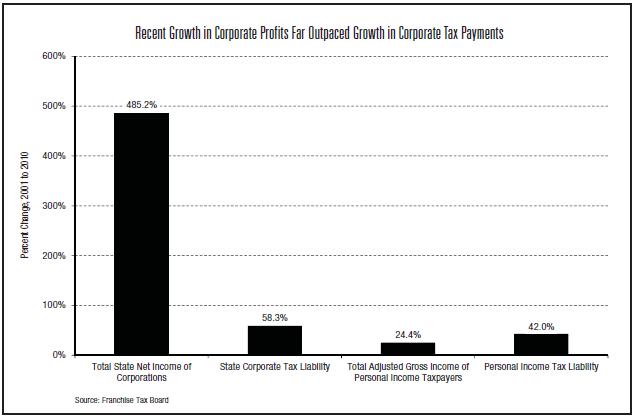
For all those types who complain that high taxes are hurting the state’s business climate, the report shows that California is pretty close to the national median in overall taxes. But it also notes that corporate income has soared relative to personal income: Over the past decade, the total reported taxable income of corporations in the state rose 485 percent. Total personal income rose 24 percent. Meanwhile, corporate tax liability rose only 58 percent, while personal liability rose 42 percent.

The result: Individual working people are paying more of the tax burden and corporations are paying less. (Unless you agree with Mitt Romney that “corporations are people.”)

Now let’s turn to the fairness report. It has some of the same data, but puts it in context:

California’s tax system is modestly regressive … [which] results from the relatively large share of income that lower-income households pay in the form of sales and excise taxes [and] the fact that low- and middle-income households spend all, or nearly all, of their incomes on necessities, including on many goods that are subject to tax.

I’m voting for the tax measure in November because the state desperately needs new revenue. But I say that recognizing that Brown’s proposal won’t do much of anything to address the basic unfairness of the way California raises the money to pay for state services.


Bikes and business, a new and evolving union in SF

3

Building Owners and Managers Association of San Francisco (BOMA) is being honored by the San Francisco Bicycle Coalition at next week’s annual Golden Wheel Awards, recognizing BOMA’s help earlier this year in passing a city law requiring commercial landlords to let workers bring their bikes indoors or another secure bike parking area.

It is a strange and noteworthy honor for BOMA, a downtown force that is usually at odds with SFBC and progressive political entities, including opposing an effort to pass similar bikes-in-buildings legislation a decade ago. But this time, BOMA was an early partner on legislation sponsored by progressive Sup. John Avalos, an indicator of just how much the politics surrounding urban cycling have changed in recent years, particularly in San Francisco.

In the city where Critical Mass was born 20 years ago this fall – since then exported to dozens of cities around the world, globalizing urban cyclists’ demand for the equal right to use roadways often built mainly for automobiles – the bicycle has moved from the preferred mode of rebels, children, and the poor into a mainstream transportation option recognized even by the suits in the corner offices.

“They’re responding to a market demand. They see lots of employees looking for bike access in their buildings,” San Francisco Bicycle Coalition Executive Director Lean Shahum said BOMA.

It was a point echoed by John Bozeman, BOMA’s government and public affairs manager and a regular cyclist. “Ten years ago, our members didn’t see it as something their tenants were asking of them,” Bozeman told us. “With the rise of young workers coming into our buildings, there was a greater demand for better bike access.”

But there are different ways of looking at this switch, which could undermine the progressive movement in San Francisco as SFBC increasingly adopts a more neoliberal approach of reliance on corporate support, rather than relying primarily on the political strength of their 12,000-plus members. For example, the Sunday Streets road closures that SFBC helped initiate are sponsored by a long list of corporations looking to improve their public image, including Bank of America (whose representative recently joined SFBC and city officials at a press conference announcing an expansion of the program), California Pacific Media Center, and Clear Channel, and in the past PG&E and Lennar.

“It reflects that bicycling sells real estate, and that’s a recent trend in hip, tech-focused cities,” says Jason Henderson, a San Francisco State University geography professor now finishing up a book on the politics of transportation, which explores these shifting dynamics.

The relationship with and dependence upon the business community could diminish SFBC’s willingness to champion bold reforms to our transportation system, such as congestion pricing charges for cars entering the city core during peak hours or demanding public transit mitigation fees of downtown corporations.

“On the other hand, it’s helping legitimize the bike as a legitimate form of transportation when the power elite accept it,” Henderson said.

Whatever the case, SFBC decision to honor BOMA with an award – which will be presented on the evening of June 5 during an event at the swank War Memorial Building – represents a new and evolving political dynamic for San Francisco.

“San Francisco has become a very different place in terms of embracing bicycling,” Shahum said. “There is a strong understanding that biking is good for the economy.”

FBI is scared of “black separatists”

0

The FBI is chasing “black separatist” groups and designating them as a potential threat — although there’s no evidence that any of the so-called separatist groups are actually a danger to national security — records obtained by the ACLU, the Asian Law Caucus and the Bay Guardian show.

The documents are the latest information we’ve received as a result of legal action demanding that the federal government reveal the extent of its domestic spying. Records released earlier this spring showed federal agents spying on mosques.

The docs released May 29 show that the FBI has identified two “separatist” groups — the New Black Panther Party and the Nation of Islam. The NBPP is hardly a powerhouse organization, to the extent that it even exists, and while the Southern Poverty Law Center points to its racist and antisemitic rantings, there is zero evidence that it’s part of a serious terrorist plot. As ACLU senior policy counsel Michael German notes:

Internet searches of “Black Separatist terrorism,” “Black Separatist bombing,” and “Black Separatist shooting” fail to bring up any recent incidents that could be fairly described as terrorist violence. No “Black Separatist” terrorist incidents are included in the FBI’s list of “Major Terrorism Cases: Past and Present,” nor on the more comprehensive list of terrorist attacks going back to 1980, which are detailed in an FBI report entitled “Terrorism 2002-2005.” While Black nationalist groups like the Black Panthers and the Black Liberation Army were certainly involved in political violence back in the 1970s, they no longer exist, and the last acts of violence attributed to either group were more than two decades ago.

Among the others of concern to the feds: The Black Hebrew Israelite Movement, whose members are a bit odd and maybe annoying — but terrorists?

Here’s the basic problem, according to the ACLU:

First, for the FBI to produce training programs that portray groups as violent threats based on old and misleading evidence and false associations is improper, and can only misdirect investigative resources. And because the groups highlighted have little in common save their racial identities, these flawed trainings will encourage racial profiling, rather than fact-based investigations. Second, the presentations’ focus on the unconventional ideologies of these modern groups tends to suggest a direct connection between belief and violence, which will again lead to inappropriate investigations based on First Amendment-protected activities rather than evidence of criminal conduct. Finally, even where these inappropriate investigations based on race and ideology fail to find evidence of violence, under its new rules the FBI may continue to pursue these groups under what it calls a “disruption strategy.”

Some of the latest documents show that the FBI is way, way out of touch with political reality. The records include a training memo on anarchists that waxes nostalgic about the anarchists of old, who were “highly dedicates to a specific cause/ideoogy” and “turn[ed] to criminal activity out of frustration.” Oh, but the kids these days? They’re just “criminals seeking an ideology to justify their activities” and “generally unorganized and reactive.”

Damn. They haven’t met the same anarchists I’ve met.

Oh, but there’s more. These crazy folks are “paranoid/security conscious” and “distrustful/resentful of authority figures.”

I wonder how many special agents it took to figure that out.

For some random reason, the section on anarchists includes a photo of a German antinuclear demonstration and apparently notes (much is blacked out) that you can find directions for making bombs on the Internet.

There’s also a training section on “The Chinese” which the ACLU notes is full of racial stereotypes. It includes things like “The Classic fighting over the bill for lunch and dinner” and “too many compliments may imply a romantic liason is desired. Be careful!” Among the sources the FBI cites for this info? “The Idiot’s Guide to Modern China.” Wow.

All I can say is: Your tax dollars, hard at work.

Sheriff’s wife talks to KGO-TV

28

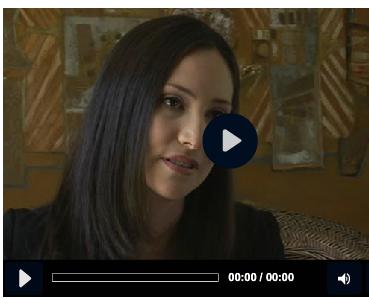
KGO’s Dan Noyes flew to Caracas, Venezuela to interview the wife of embattled San Francisco Sheriff Ross Mirkarimi, and while her comments haven’t made anywhere near the media splash that most scraps of information on this sordid tale create, it’s very much worth watching the video. Check it out here.

Remember as you watch: Mirkarimi hasn’t been able to speak to his wife in months. The stay-away order prevents him from seeing her or phoning her or emailing her or contacting her in any way (except to coordinate his limited visits and skype calls with his son). It’s possible that the two of them came up with a joint story early on in the process, before the restraining order, but unless that happened, they’re both offering independent versions of the events.

And a lot of what Lopez says is consistent with a lot of what Mirkarimi says.

She tells Noyes that she was never afraid of her husband or fearful for their son. She says that she thought her neighbor, Ivory Madison, was an attorney and that the video — designed to be used in a possible future custody battle — would be confidential. (Madison’s lawyer disputes that.) She tells more or less the same tale of that New Year’s Eve that Mirkarimi does.

She also says there was no prior incidence of domestic violence — that her comments on the tape about “the second time” referred only to an earlier verbal argument about her travel to Venezuala.

Not defending Mirkarimi’s actions here (and no, trolls, I never have). Just saying that it’s important to hear his wife’s (presumably) unvarished version of events when we make judgments around whether he should keep his job. (The mayor never bothered to talk to Lopez before he filed official misconduct charges).

I don’t think the embattled sheriff was happy to hear his wife say that the couple may divorce, or that she may not return to San Francisco (the city, she says — justifiably — hasn’t been nice to her).

But I think the voice of Eliana Lopez has been missing too long in this whole political battle, and I’m glad to see she’s speaking out.

$3,000 an hour — is that fair?

51

Does anyone really think it’s ok for the average CEO to make so much more money than the average worker that a person earning the median income in this country would have to work 244 years to earn what the median CEO earns in a year?

I mean, I think $3,072 an hour is pretty excessive pay for anyone, but let’s give the conseratives their due: The person worked hard, and deserves to earn what the maket will pay him or her. If the typical worker in this country earned $500 an hour, that would be fine — the person at the top ought to earn more than his or her employees (at least, that the capitalist way) — but multiples of 244-1 are excessive an unstable.

Why not link CEO pay to the pay of the average worker? Why not say that no CEO can get more than 10 times (or even 20 times) what the lowest-paid person at that company makes? Nice incentive to pay your workers more.

Have at it, trolls.


City weighs artificial turf fields in Golden Gate Park

81

[[UPDATE 5/25: The project was approved]] The San Francisco Planning and Recreation & Park commissions will hold a special joint hearing tomorrow (Thurs/24) afternoon to consider approving the Beach Chalet Athletic Fields Renovation, a controversial city proposal to replace the natural grass fields on the west end of Golden Gate Park with artificial turf.

The $48 million project – years in development by Recreation & Park officials and championed by department head Phil Ginsburg, who has aggressively tried to monetize the city’s parks – has inflamed the passions of both supporters and opponents, who are expected to jam into the 3 pm hearing in City Hall’s Room 400 to deliver hours’ of testimony. [Correction: Patrick Hannan with City Fields Foundation says this is a $14 million project, part of its overall $48 million artificial turf program for the city.]

Supporters say there aren’t enough fields in the city for young soccer players and the existing fields there are in bad shape and without adequate lighting. In addition to the artificial turf, which the City Fields Foundation (created and funded by the Fisher family, founders of The Gap) has been helping to install in parks throughout the city, the project would include 150,000-watt lighting 60 feet in the air to illuminate the fields until 10 pm, year-round.

Opponents of the project, which include primarily environmentalists and park neighbors, cite a litany of problems with the project, saying it violates city plans that call for the park to remain a natural area open to all park users. They say it will disturb wildlife, increase traffic (much of it from out-of-towners who rent the fields), and create potentially toxic runoff in a sensitive habitat.

“Golden Gate Park is a unique, magnificent, and world-famous San Francisco treasure. It was conceived to serve as an open space preserve in the midst of San Francisco – a cultivated pastoral and sylvan landscape. It was designed to afford opportunities for all to experience beauty and tranquility. Plastic fields that are brightly lighted until 10 pm every night of the year are entirely out of place in this setting. The western end of Golden Gate Park should remain a part of the cohesive naturalistic environment envisioned by the Park’s creators,” Katherine Howard of SF Ocean Edge, which organized in opposition to the project, wrote in a May 22 letter to the two commissions.

While it will be a joint hearing, the Planning Commission is charged with approving the project’s environmental impact report and the RPC will consider approval of the project itself. But judging from the long list of angry comments to our last story on the subject by people on both sides of the debate, this divisive project will likely be the subject of appeals and lawsuits for months or years to come.

New JFK bike lanes are bad for everyone

154

Golden Gate Park visitors have had a couple months to get used to the confusing new lane configurations on JFK Drive – with bike lanes along the edges of the road and a row of parked cars in the middle – and I have yet to hear from anyone who likes this design. Nice try, San Francisco Municipal Transportation Agency, but this design isn’t working for any road users and should be scrapped.

The idea of using a row of parked cars to separate cyclists from motorists isn’t inherently bad, and it has worked well in some European cities. But the way this is designed, passengers exiting vehicles must cross the bike lane to get to the sidewalk, creating a conflict that isn’t good for either user. It was intended to create safer bikeways, but they actually feel more dangerous and uncertain now.

There are buffer zones where motorists aren’t supposed to park, but on busy days they do anyway, with little to fear from parking control officers who rarely venture into the park, often crowding into the bike lane. The design also accentuates the visual blight of automobiles in this beautiful park, with more lanes of cars dominating the viewscape in many spots.

And I’m not the only one who feels this way. After my cover story on urban cycling last week, I got a few notes critical of the new design, including an email from longtime local cyclist Thomas Kleinhenz, who wrote, “When the new Golden Gate Park bike lanes went in I scratched my head. Who dreamt this up. It helps no one. Cyclists now ride in a lane between the curb on the right and parked cars on the left. You have cyclists, roller-bladers, rental bikers, and children all stuck in the same lane with pedestrians trying to get to and from their cars.”

Kleinhenz cited state road design manuals discouraging this kind of design, claiming they may even be illegal. He continued, “When I’ve ridden it, I’ve had to dodge a child darting out from between the cars and a family of 5 who strolled across the bike lane confused about where to go. I’ve also been stuck behind Segways and rental bikers, forcing me and another rider to go out into the traffic lane just to top 5 mph. But of course the traffic lanes are now thinner to make room for the new bike lanes. So we’re left with one non-functional, unsafe lane and another mildly functional unsafe lane. Meanwhile cars have less room to maneuver, and people getting out of their parked cars are forced to try to avoid traffic on one side and cyclists on the other. While cyclists who don’t want to deal with the congestion in the bike lane now must be aware of having car doors opened into them in the now narrower traffic lane.”

His comments are typical of others that I’ve heard, including those from transportation engineers who are similarly baffled by the choices made here. The SFMTA deserves credit for trying something new, but I’ll give them even more credit if they just call this one a mistake and start over. And that is a possibility.

“We’re going to continue monitoring the JFK bikes lanes closely and we will consider potential adjustments to make them more intuitive and user-friendly,” SFMTA spokesperson Paul Rose told us, adding that the agency will analyze changes in traffic speed and volumes for both cyclists and motorists and parking volume, as well as surveying people’s perceptions of the project.

Hopefully some changes will be in the offing, but I think the project is an example of a bigger problem that I discussed in last week’s article, and that is political and civic leaders going with the easy bicycle infrastructure projects so they can claim lots of new mileage rather than the more politically difficult projects we actually need.

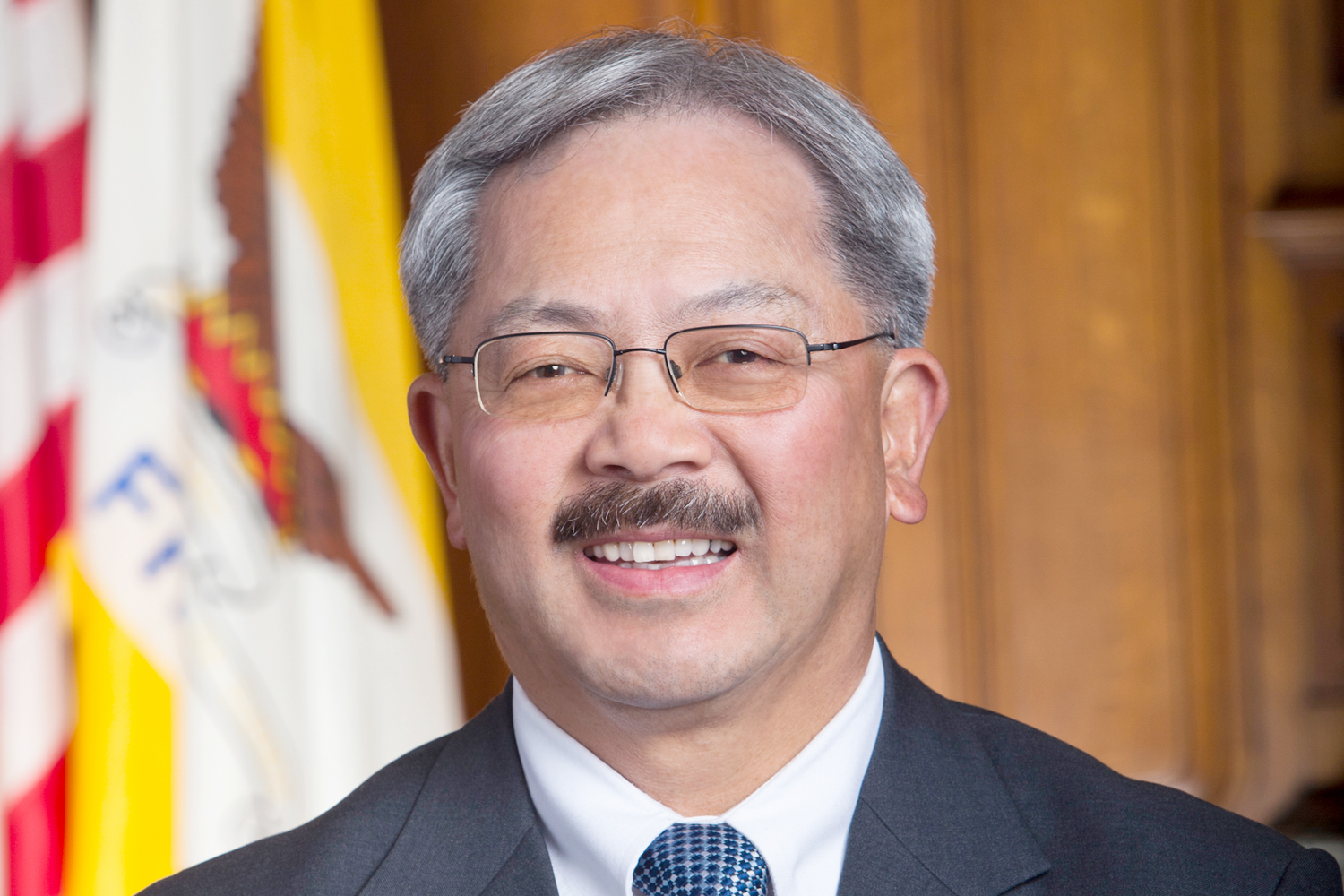
Last year on Bike to Work Day, newly minted Mayor Ed Lee announced two bike projects: the JFK lanes and new cycletracks on the dangerous few blocks on Fell and Oak streets to connect the Panhandle with the Wiggle, which has long been a high priority for cyclists as it completes a popular east-west bike corridor. Well, the former project got done and the latter got delayed when neighbors complained about the lost parking spots.

Now, because the SFMTA tried to accommodate motorists with too many new parking spots in Golden Gate Park – despite previous promises to decrease street parking in the park in exchange for building a massive underground parking lot – we’ve ended up with a messy design that only exacerbates conflicts between motorists, pedestrians, and cyclists. In their effort to please everyone, as is often the case, they have pleased nobody.

June 6 hearing may spell the end of HANC recycling center

12

It’s just a triangle of land on Frederick Street, right next to Kezar Stadium. But the Haight Ashbury Neighborhood Council (HANC) recycling center has been the subject of years of political battles- and depending on the results of a June 6 hearing, they may get shut down for good.

HANC got an eviction notice in December 2010. HANC’s lawyer, Robert DeVries, successfully challenged the eviction. The Recreation & Parks department sued for eviction again in in June 2011, and that matter may finally come to a close June 6. The Guardian is awaiting comment from Rec & Parks.

In December, the Planning Commission approved a plan to turn the site into a community garden. They meant a garden run by Rec & Parks, not HANC. But HANC got to work building one, and Executive Director Ed Dunn is proud to say that they did so “without a cent of taxpayer money.”

Dunn emphasizes that “over the course of the past year or so the operation has been completely transformed.” The new community garden has 50 beds, which resident gardener Greg Gaar says are divided into about 100 plots, are are planted with mostly native plants that are currently in full bloom.

“We could build one community garden like this per month at no cost to the city,” said Dunn, referencing a recent SPUR report that talked about the benefits and challenges of urban agriculture.

Said Dunn, “we can help fill in some of those challenges.”

The center has a history of working on the cutting edge of environmentally friendly trends. The site at 780 Frederick was established as a recycling center in 1974, a decade before San Francisco implemented curbside recycling. The curbside program became fully operational in the early ‘90s. But 18 recycling centers remain in the city- and state Bottle Bill laws require the existence of recycling centers in “convenience zones.” Dunn says the HANC recycling center fulfills the legal requirement to be nearby a recycling center for several supermarkets.

Now, many San Francisco residents rely on curbside recycling, rather than trucking their bottles, cans, and paper products to a recycling center. But a large population uses recycling centers- for excess amounts of recyclables that don’t fit in the bins, other material that doesn’t fit like large cardboard, or to generate income. Those who benefit from money traded for recyclables include housed people looking to supplement income, often immigrants and the elderly, and people living on the streets. But the center’s opponents have painted the population it serves as mostly or all homeless, and the city has argued for its eviction on the grounds that the recycling center attracts homeless people to the area.

“[Gavin Newsom] thought the eviction was one way they could ward off camping in Golden Gate Park,” said Dunn.

Some neighbors have raised concerns about the noisy garbage-picking in the nightime, and questioned the need for recycling centers with curbside in place. If the center is shut down, though, it won’t signal the end of recycling centers or those who benefit from them. It will likeley change where people go to cash in on recyclables; HANC’s recycling center is centrally located, while the majority of  San Francisco’s recycling centers are in neighborhoods on the city’s borders, including several in Bayview-Hunters Point.

Regardless of the centers effects on the community, HANC’s landlord, Rec & Parks, doesn’t legally need a reason to evict them- they just need to give notice. HANC has fought the eviction, but after almost two years of successful stalling, Rec & Parks may finally succeed.

What small business owners care about

14

Since the mayor’s office still insists that any business-tax reform ought to be revenue-neutral, and since he and other continue to talk about the myth that a payroll tax hurts job growth, I found the latest Bank of America survey of local small business owners fascinating.

Here’s what the survey found: Small business owners are concerned about (1) the cost of healthcare (2) access to credit and (3) finding qualified employees. Local taxes aren’t even on the list.

Now, if you ask almost any business operator whether he or she would like to pay lower taxes, most will probably say, sure. And I agree that a gross receipts tax is a better way of spreading the burden around. But the notion that slightly raising business taxes would hinder job growth in any significant way isn’t supported by reality.

In fact, if you used higher taxes to improve the schools (and thus the education of the future workforce) it would do more to keep employers from leaving San Francisco than cutting taxes. If the state of California went to a single-payer health-care system — dramatically reducing the cost to employers — it would do more to attract jobs to this state than all the tax cuts in a Republican’s wet dreams.

And if Bank of America and Wells Fargo would start loaning money to small businesess, you’d see almost immediate job growth.

How’s that for a Small Business Week agenda?

Recology’s slate cards

8

Wow. Every single slate card I’ve seen so far for this election has been paid for at least in part by Recology, which is fighting a measure that would require competitive bidding on its garbage contract.

The Richmond Democratic Club. The Teacher’s Union. The SF Women’s Political Committee. The SF Democratic Party. The Milk Club. The Alice B. Toklas Club. I’m sure there are a few more out there. And every one has a big “No on A” ad on the back.

The good news is that a lot of these mailers list good candidates for the County Central Commitee, and getting their message out to more people helps. And this is nothing new — everyone looks to the people with money to fund slate cards, and Recology’s spending a lot of money this spring. And I’m confident that every one of these groups took a No on A position before they asked for slate-card money.

Still: You look at the pile and it looks like Recology owns San Francisco politics.

Green presidential candidate seeks to energize the disenfranchised

6

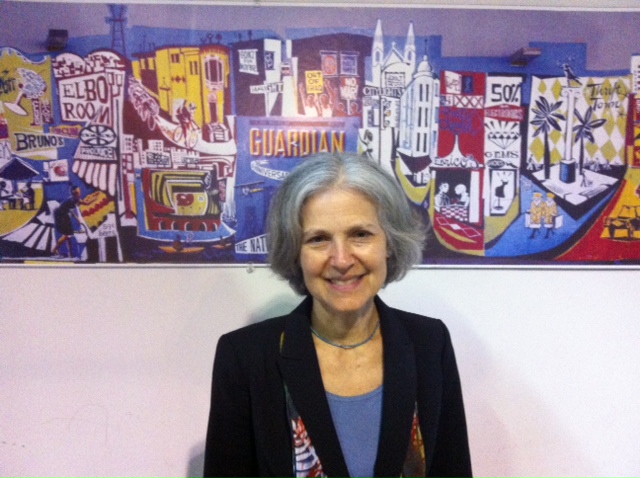
After participating in last weekend’s Green Party presidential debate against Roseanne Barr in San Francisco, which we cover in this week’s paper, frontrunner candidate Jill Stein stopped by the Bay Guardian office to chat about her hopes for progressive change in this tumultuous political year.

“The political-corporate establishment should not be given a pass in the voting booth,” the Massachusetts physician told us. “Four more years of Wall Street rule is what we get if you give them your vote.”

She ticked off a litany of bipartisan failures from the Democratic and Republican parties, from reforming Wall Street and narrowing the wealth gap to seriously addressing climate change and this country’s wasteful wars, and said people are fed up and want fundamental reforms.

“The rebellion is in full swing, you just don’t hear about it from the press,” she said. “With the exception of the Bay Guardian, we don’t have a press. We have an o-press and a re-press.”

This is Stein’s first run for national office, but she already faced off against presumptive Republican nominee Mitt Romney in the 2002 Massachusetts governor’s race, garnering just 3.5 percent of the vote but winning praise in the Boston Globe for her debate performance. She thinks both Romney and Obama are vulnerable this year, although she said, “I’m not holding my breath that we’re going to win, but I’m not running to lose.”

Her plan is to wage an aggressive grassroots and social media campaign to capitalize on the discontent most Americans feel with both major political parties, and to hopefully catch enough fire to reach 15 percent support in national polls, the threshold for getting into the presidential debates. “If we can get into the debates, we can really change things.”

To get there, Stein plans to reach out to a wide variety of groups on the left and across the spectrum, including supporters of the Occupy Wall Street movement, which she toured last year, visiting 25 encampments across the country, most of them populated by people wary of modern electoral politics.

“When I go to Occupy, I go to support them and not ask for their support,” Stein said, saying that she understood their belief that the electoral system is broken, but that it’s important to participate in it as part of a multi-pronged movement for social change that includes presidential politics. “Can we beat back the predator without have an organization? No, we need a party.”

She thinks the Green Party best represents the values of disenfranchised Americans and has the best vision for where this county needs to go, and she said, “We’re finding all kinds of networks are really getting energized and promoting us.”

The GOP has no answer on the state budget

80

The Republican leaders in Sacramento have absolutely no solutions to the state budget problems. They’re against the guv’s tax plan for November, they’re against raising any new revenue, they have their facts completely wrong — and they have no alternatives to offer.

That’s not me ranting, that’s the factual evidence based on a fascinating radio interview featuring Senators Mark Leno, a Democrat who chairs the Budget Committee, and Republican Bill Emmerson, who is the committee vice-chair.

Leno is his usual reasonable self, saying that he knows there will be cuts and that the Democrats are going to try to figure out where and how best to make the reductions. Emmerson says:

1. That there have been “no serious cuts” in the past;

2. That the state budget is too big and growing;

3. That there should be no cuts to education;

4. That there are “places where we can make cuts,” but there are no specific proposals on the table; and

5. That all of this will magically work with no new revenue.

Leno points out that the state’s general fund was over $100 billion in 2008, that pre-recession it was projected that normal revenue growth and growth in cost of living and state needs would bring it to $125 billion by this year — and that the actual state budget is about $85 billion. That’s $40 billion less than it should be. There have already been massive cuts.

Emmerson wants to “fund education at last year’s level,” which is nice, but amounts to a cut since costs go up every year. And last year’s level was way below what it ought to be.

But beyond that, he has no suggestions at all of what programs he wants to cut.

I guess I shouldn’t be surprised.

‘Reclaiming Jewish Activism’: easier said than done

0

This article has been updated

A panel in which three local activists will talk about how their Jewish ancestors inform their present-day work seemed harmless enough. But in the Bay Area’s friction-prone Jewish community, its cancellation has led the organizers to write a letter in protest and accusations that one of the area’s biggest funders of Jewish events, the Jewish Community Federation (JCF), is participating in McCarthy-style censorship.

The panelists- Julie Gilgoff, Elaine Ellinson, and Rae Abileah- are all authors and activists. Bend the Arc (formerly the Progressive Jewish Alliance) and the Workmens Circle organized the event. They planned to hold the panel in the Jewish Library, run by the Bureau of Jewish Education (BJE), which funds most of its grants and programming through the JCF.

In late January, the Library cancelled the panel. It will now be held at Congregation Sha’ar Zahav.In an open letter to the Library, the event organizers write, “six decades after McCarthyism’s assault on progressives and their values, we reassert that censorship by association is dangerous and unconscionable.”

David Waksberg, CEO of the Bureau of Jewish Education, said that the BJE didn’t want to suppress the event all together. “In the end we decided not to do it with the understanding that they would be going forward at another location,” he said.

“I don’t know how it’s censorship when you agree, you guys go have your meeting, just don’t have it at my place. How is that censorship? No one’s telling them they can’t speak,” Waksberg said.

“The program involves two authors who have written about activism domestically,” Waksberg explained, “and another individual who has been involved with BDS related to Israel.”

BDS-  the boycott, divestment and sanctions campaign that activists throughout the world have used as a protest against the Israeli occupation in Palestine- is at the center of the conflict, right beside Rae Abileah.

Abileah will take part in the panel to discuss her great uncle, Joseph Abileah, an influential Israeli peace activist and war resister in the 1940s. 

“I grew up in the Bay Area Jewish community,” Abileah told us. “I was part of the Diller Teen Fellowship,” a program BJE puts on, “where we had Jewish gatherings, trainings and meetings.”

She’s also outspoken in her opposition to Israeli occupation in Palestine.

Abileah works for CODEPINK Women for Peace and Jewish Voice for Peace. She has travelled to Gaza CODEPINK in 2009 for a Gaza Freedom March with participants worldwide. She has also organized BDS campaigns.

“In 2005 the Palestinian civil society called for BDS as tried and true nonviolent tactic to get the Israeli government to uphold international law. We decided to be in solidarity,” said Abileah. She has since organized to spread a boycott of Ahava products, “Dead Sea beauty products made in an illegal settlement in the West Bank.”

According to Abileah, “several stores in the Bay Area have stopped carrying it.”

Abileah says she is proud to support nonviolent forms of protest like BDS and hunger striking, noting the lengthy hunger strike undertaken by Palestinian prisoners that ended just yesterday.

The hunger strike was successful. Israel agreed to prisoners’ demands to end solitary confinement (for 19 prisoners), allow more family visits, and to free some of those held in “administrative detention,” or imprisonment without trial, although the demand to end administrative detention was not met.

BDS has had successes worldwide as well. And it has become a controversial issue in the Bay Area.

Waksberg said, “we were concerned this would be an event that would have a lot of people yelling at each other.” This would not be unprecedented.

The ongoing rift is possibly best exemplified by the controversy surrounding the 2009 screening at the SF Jewish Film Festival of Rachel, a documentary about the life of 24-year-old Rachel Corrie. Corrie was killed in 2003 when, as part of a campaign to stop Israeli settlements, she stood in front of a bulldozer on its way to demolish a Palestinian family’s home.

The showing of the film, as well as the festival board’s decision to invite Corrie’s mother to speak after the film, sparked outrage. A portion of the audience booed and hissed at supportive references to the Israeli government.

Largely in response to that event, the JFC rewrote its funding guidelines in 2010. The guidelines outline a policy of not funding organizations that promote violence, attempt to “proselytize Jews away from Judaism” or work on “undermining the legitimacy of Israel.”

The idea of fighting for or against “Israel’s legitimacy” is invoked often but is vague- what exactly does it mean to oppose Israel’s “legitimacy” or “right to exist”? In In the guidelines, one thing seems to clearly do so: BDS campaigns.

In the guidelines’ section on “potentially controversial Israel-related programming,” the types of programs “not consistent with JCF’s policy” has three bullet points, all singling out support for BDS as unacceptable. The programs that are inconsistent are ones where the “overall experience” “endorse or prominently promote the BDS movement,”  “Individual programs that endorse the BDS movement or positions that undermine the legitimacy of the State of Israel,” and co-sponsoring public programs featuring supporters of BDS.

The open letter states that “The Federation’s 2010 revised funding guidelines, which prohibit grant recipients from associating with organizations and individuals who oppose its strong support for Israel, apparently triggered the cancellation.”

Wakberg says that these guidelines didn’t play a role in the BJE’s decision to drop the Reclaiming Jewish Activism panel.

“The JCF didn’t tell us whether or not to do this. This was our decision about what we thought was right for the library,” he said.

“There was going to be an event,” Waksberg said, “and there is going to be an event.”

Yes, the event will go on. But so, it seems, will tensions in the Bay Area’s Jewish community.

Housing for the super rich approved, 8-3

111

The progressive movement and the battle for housing balance and economic justice in San Francisco got walloped May 15 when eight supervisors sided with a developer who wants to build condos for the massively rich on the waterfront.

I watched it all, minus a few minutes while I was putting the kids to bed, all seven and a half hours of testimony and discussion, winding up with a series of pro-developer voters a little after midnight. It was stunning: Opponents of the project came out in droves, many of them seniors, others tenant activists and neighbors. Former City Attorney Louise Renne, who is by no means an anti-development type or any sort of economic radical, led off the arguments in favor of scrapping the environmental impact report and denying the conditional use permit that are needed for 8 Washington to move forward. They brought up so many points that by the end there was nothing more to say: This meets no housing need in San Francisco, further screws up the city’s own mandates for a mix of affordable and market-rate housing, caters to the top half of the top half of the 1 percent, is too tall and bulky for the site, offers the city too little in community benefits and is one of the great development scams of our time.

Then the other side spoke — the city planners who defended the EIR and, briefly, developer Simon Snellgrove. His supporters lined up — and almost all of them talked about the same thing: Construction jobs. I get it, we need construction jobs — but is that a justification for such a bad project? As Sup. David Chiu pointed out, “apartment construction is booming.  There are 22,000 units under construction and 50,000 more in the pipeline.”

Both sides were organized, but only one paid people to show up: At least five people seated in the front row, wearing pro-8 Washington stickers, confirmed that they’d been paid $100 each — in cash — to show up. They didn’t even speak, leaving once they realized that they were misled about the project. One source heard a construction worker say he knew nothing about the project and had been bused in from Sacramento.

And after hearing all of that, the supervisors did what they clearly had decided to do long before a word of testimony was uttered.

The vote to overturn the EIR went like this: favoring the developer were Supervisors Mark Farrell, Jane Kim, Eric Mar, Christina Olague, Malia Cohen, Carmen Chu, Sean Elsbernd and Scott Wiener. Opposing the project were Chiu, John Avalos and David Campos.

Approving the conditional use went along the same voting lines. Chiu couldn’t even get a continuance after arguing that there was no report from the budget analyst and no financial information about whether this is a good deal for the city.

That’s the lineup: Eight votes for the 1 percent. Three votes for the rest of us. I haven’t seen anything this bad in years.

Some fascinating information came out of the discussion. Chiu made clear that the developer doesn’t need the height-limit increase to make a profit off the deal. He estimated that the total sales revenue from the project would be around $470 million and construction costs about $177 million. That’s a huge profit margin, even if you add in another $25 million for upfront soft costs.

Snellgrove’s lawyer, Mary Murphy, tried to duck the financial issues, talking around in circles. Evenutally Chiu got Snellgrove to respond, and he said the costs would be higher and his profit would only be about $80 million. “The capital markets require a high return on these projects,” he said.
Still: $80 million is a lot of money. And while Snellgrove and his allies love to talk about the $11 million in affordable housing money for the city, that’s about 2.3 percent of his total revenue. Which doesn’t sound quite as juicy.

Chiu raised another good question: “Should a condo that sells for $5 million pay the same affordable housing fees as one that sells for $500,000?”
Mar, who is usually a strong progressive, was the big surprise of the night, not only voting the wrong way but teeing up softball questions for the city planners to make the project sound better. It was as if he was reading from the developer’s talking points.

In the end, he said he saw “a lot of benefits from this project,” but promised to work with the developer to advocate for “less bulk and less height.” Olague said the same thing.

But even if it’s a little smaller, this will still be a completely misalignment of housing priorities, a project entirely for the very rich. That’s not going to change.

If anything, they should push for more affordable housing money — a whole lot more. Because what we’re getting is enough for maybe 25 or 30 units, which means 80 percent of the new housing related to this project will be for multimillionaires and 20 percent for everyone else. Keep that pattern going — and there are few signs that it’s about to change — and imagine what this city will be like in 20 years.

It’s not over, not yet: The actual development agreement and the height-limit changes still have to come to the board early in June. And if the mayor signs off on it, opponents are talking serious about a ballot referendum that would be before the voters in November — just when Olague, Mar, Avalos, Campos, and Chiu will be up for re-election.

Who’s running against Chris Daly?

8

I didn’t know former Sup. Chris Daly was running for state Assembly in the 19th District. Odd — I’ve been told he splits his time between Soma and Fairfield, but I had never heard anything about him moving to the West side of town.

But there he is, right on a flier produced by candidate Michael Breyer, who probably doesn’t deserve all the attention I’m giving him, but his campaign is so strange. First he’s for “old-fashioned San Francisco values” (whatever that means) — and now he’s running against Daly. Who, according to the latest data from the Department of Elections, isn’t in the race.

Breyer has a pic of Daly’s disembodied head surrounded by a happy meal, a goldfish and a Yellow Pages phonebook, three things that (other) supervisors have had issues with, mostly for very good reasons. Daly didn’t introduce the Happy Meal ban or the pet store legislation or the phone books limits; some of that happened after he left the board.

The flier compares Daly’s “Wild Antics” to “The Real San Francisco.” Which I guess is a conservative place “of old-fashioned neighborhood concerns.” (What — the west side of the city hasn’t changed in the past 40 years, since Breyer was a kid?)

Folks, please: Daly’s no longer in any public office. He was a good supervisor while he was there and willing to fight for his constituents. But now he owns a bar and works for a union. Aren’t we all getting tired of this shit?


The really bad news about the state budget

24

There’s no way to put a good spin on the new budget figures released by the Guv. No matter what happens in November, people who need help are going to get screwed in this state. Public schools will lose money. Health-care for the poor will be near collapse. Cities and counties will struggle to preserve the local safety nets. It’s just a disaster, and there’s no other way to look at it.

Of course, if we don’t approve Jerry’s tax plan in November, it will all be much, much worse. And he seems to be doing the right thing to promote the idea, making it clear just how deep the cuts will be and where they will hit.

But the tax plan is nowhere near enough, not even enough to keep the state at its current austerity level, much less to repair some of the damage and replace the funding that’s already been eliminated. And while the notion of cutting state workers back to a four-day week, or of mandatory furloughs, may sound better than cutting specific services, think about what it means:

First, all that money that the state workers give up will instantly disappear from the economy. Most of these folks aren’t wealthy, and they spend what they earn. That’s a hit to already-depressed demand. Then there’s the impact on the rest of us. Try getting an appointment at the DMV. (You think it’s bad now? Take away 20 percent of the employees.) Try getting a court date if you’ve been injured. (Oh, but if you’re a landlord, don’t worry — evictions won’t be slowed down at all.) This is going to be awful.

Here’s what I would say to Jerry: Push not only for your tax measure but to elect enough Democrats to pass taxes without going to the ballot. There’s no reason this current measure needs a vote of the public; the Legislature has every legal ability to pass all of those taxes. And if it weren’t for a handful of Republicans who drink the no-tax Kool Aide, it would be happening.

Closing a few corporate loopholes and instituting an oil-severance tax would solve much of the remaining deficit. Reinstating Schwarzenneger’s cuts to the vehicle license fee would solve the rest. And all of that can be done without a ballot fight.

The moderate Democrats in Sacto annoy me as much as the Republicans sometimes, but if Brown and Legistlative leaders make it clear that they’re helping candidates in swing districts, but that they expect them not to be obstructionist on taxes, there could be much better news in the years ahead.


Community college students convene to unite against cuts, state legislation

7

Students and staff from community colleges throughout California gathered at the City College of San Francisco (CCSF) Mission campus May 12 to discuss legislation, particularly the Student Success Act, that organizers feel threatens community college students.

The conference “was the first time that students from community colleges across California came together like this,” said Everic Dupuy, a student at CCSF. 

Dupuy participated in a panel with fellow students and teachers explaining the Student Success Act. The act would implement six recommendations made by the Student Success Task Force, a body created in January 2011 to investigate policy changes to increase graduation rates at community colleges.

Students have vehemently opposed the recommendations that the task force made. A December issue of the Guardsman, CCSF’s newspaper, was devoted to that opposition. 

The Student Success Act act includes policies that would prioritize class placement for newer students. Students who have been enrolled in community college for more than two years would find it more difficult to get into classes they need. The act would also create a system-wide standardized test to assess student success. 

“The task force’s recommendations will benefit higher-income students more, while students who attend part-time and work while attending school will be hit the hardest,” an editorial written collectively by students across the state claimed.

Members of the task force said that encouraging students to complete their coursework in a streamlined two years is necessary as community colleges have faced budget cuts. “Hundreds of thousands of first-time students, recent graduates of California’s high schools, have been turned away because they could not register for a single course,” said Peter MacDougall, chair of the Student Success Task Force, in an editorial.

But Dupuy says prioritizing new students is unacceptable. “It pits newer students against older students in a race for classes. It basically creates a situation where education is being rationed,” he told the Guardian. 

Teachers, staff and administrators at CCSF have also come out against the Student Success Task Force. At a rally in November, faculty and members of the CCSF board of trustees came out against the recommendations in the report published by the task force, saying they insert the state into local policies and reward students who study full-time and declare majors early at the expense of others.  

“The California Master Plan for Higher Education said education should be free and accessible to everyone,” said Dupuy. The plan, written in 1960, did “reaffirm the long established principle that state colleges and the University of California shall be tuition free to all residents of the state.”

It has since been altered several times, and in 1985, community colleges began charging fees for courses. In recent years those fees have rapidly increased, and will be increased by $10 this summer, when students will begin paying $46 per unit fees. 

Other sessions at the conference included presentations from students who organized with student movements in Chile and Canada.  Students in Quebec are revolting against college tuition hikes in a strike that has now lasted 13 weeks.  

Students from Santa Monica College also presented at an Occupy-style general assembly meeting that ended the conference. They proposed the formation of a statewide student union, and will be hosting another statewide conference to plan the student union May 19. Santa Monica College has been a site of conflict recently, as students protesting the implementation of a program that would have increased fees for more popular summer courses were pepper sprayed at a hearing on the program. Their campaign worked, and the college delayed the program for further examination. 

Organizers say the student union would play a role that existing student government structures can’t. “Our student governments are mostly administrating us instead of fighting for us in our districts” said Mikhail Pronilover, a Santa Monica College student. 

“The Student Success Act is a perfect example of why we need a statewide student union. Organizing in our districts isn’t enough- if we can’t come together, we won’t be able to defeat it,” said Claire Keating, an incoming student at UCLA. Keating is involved with the Southern California Education Organizing Coalition, formed recently to address the SSA and other perceived attacks on students. A similar group, Occupy Education Northern California, has also formed in recent months- students hope to continue the coalition-building trend across the state.

A massive student march on Sacramento has become a tradition in recent years. But students are ramping up efforts to keep year-long pressure on legislators.

Organizers hope Saturday’s conference, with reprsentatives from throughout the nation’s largest public education system, will prove an important step in that direction.

A fair deal for the city’s nurses

12

For San Francisco’s public-sector registered nurses, this year’s Nurse’s Week was a paradox. On May 10, nurses from throughout the city gathered in the cafeteria of San Francisco General Hospital to celebrate Florence Nightingale’s birthday by bestowing gratitude and appreciation on nurses selected by their colleagues. Martha Hawthorne, long-time Castro-Mission Health Center public health nurse, was one of those honored. 

Upon acceptance of the award, Martha said that city nurses would be most appropriately honored by getting a fair contract. The next day a smaller gathering of nurses, including Martha, was back across the bargaining table from city negotiators who have proposed  significant financial and working condition concessions. Decreased compensation threatens the future of nursing in the public sector by impairing recruitment and retention of highly-skilled registered nurses. Working conditions concessions are even more broadly harmful and unacceptable; it is both risky for the nurses and increases the likelihood of adverse outcomes for those we care for.

San Francisco DPH nurses care for the city, quite literally, and with great pride. We are also proud of San Francisco’s historically progressive record on public health. Immigrant pregnant mothers are not interrogated by immigration authorities before giving birth. Public health nurses don’t require insurance company pre-authorized visits before teaching self-care to elderly residents of downtown SROs. The quality of care given by Jail Health nurses is no less than that given to someone living in a nice house by the city’s home health nurses of Health-at-Home. Laguna Honda, one of the last municipal long-term care centers, has a beautiful new campus and San Francisco General Hospital is being noisily rebuilt thanks to voter-approved bond measures. But nice buildings and well-conceived health programs don’t care for the ill and injured, nurses do.

Nurses are professionally pragmatic; we don’t offer false hope. Patient advocacy requires great patience. This is especially true in the public sector, where the population we serve is likely to suffer from intractable extreme poverty and social marginalization. The poor don’t require less health care than wealthy individuals, in fact they require more. It’s not always pretty, but we know that if we are given the human resources to do so we will continue to deliver excellent patient care.

The complexity and intensity of patient care seems to be rising far faster than inflation. Aside from the issues of fairness and quality care, nurses simply don’t have enough hours in the day to do the repair our over-burdened fractured health system requires. Activist nurses are needed to save lives by preserving and expanding health care access. While universal single-payer health-care is elusive nationally, California nurses are optimistic we can do better here. Women’s health is under attack nationally by fanatics who would deny cancer screening and care for rape survivors.

Nurse’s Week is over and we have a lot to do, let’s start with a fair deal for DPH nurses. It’s not to much to ask for and we will all benefit.

Sasha Cuttler, RN, is a San Francisco public health nurse.

What are “old-fashioned” SF values?

12

Michael Breyer, who has never held elective office in San Francisco and is running for state Assembly, is getting a fair amount of press — and although he has nowhere near the visibility of Assessor-Recorder Phil Ting, he has the support of Sen. Dianne Feinstein and may throw a boatload of money into the race. He’s already sent out one flier that features very little about him but a lot about his (more famous) family — his father, Steven Breyer, is a justice of the U.S. Supreme Court and his uncle, Charles Breyer, is a federal judge.

But here’s what intrigued me about the mail piece: It says that

“Sacramento needs a fresh perspective. It needs old-fashioned San Francisco values.”

What, exactly, are “old-fashioned San Francisco values?” One could certainly argue that the message harkens back to a day when the city was less diverse, less progressive, less open to the sometimes-radical ideas (remember this one?) that have changed the nation and the world. Of course, exploiting the workers and destroying the environment in the name of extracting riches was a famous SF value during the Gold Rush era; so was the Chinese Exclusion Act. On the other hand, resisting the Red Scare was a great traditional SF value in the 1950s, as were civil-rights sit-ins. Free love, free drugs and free lunch were vintage SF values a decade or so later. Labor struggles against capital are also a great San Francisco value.

So what, exactly, is Mr. Breyer talking about?

I called his campaign manager, Michael Terris, who wrote the piece, and asked him if Breyer was longing for a more conservative, less diverse era. “Not at all,” he said. “Old-fashioned values mean family, schools, neighborhoods, quality-of-life issues. Those are shared by the many diverse communities in the 19th District.” He added: “The West Side sees things a little differently.”

And while one of Breyer’s main issues is education, the great San Francisco value of taxing the wealthy to provide public services isn’t part of his platform. Although he does support Gov. Brown’s tax plan for November, he does not support amending Prop. 13 to shift the burden of taxation back to commercial property. He has the strong support of the Building Owners and Managers Association, which is all about keeping taxes low on huge commercial properties owned by vastly rich outfits.

So he clearly doesn’t share my old-fashioned San Francisco values. What about yours?

UPDATE: My mistake — Feinstein hasn’t endorsed Breyer. She supported him for D5 supervisor but is staying out of this race.