• No categories

Politics Blog

Lakeview sit-in supporters protest school board meeting

6

Supporters of a sit-in at Lakeview elementary school and others protesting cuts from the Oakland Board of Education protested at the board’s meeting June 27 and held a “People’s Board of Education Meeting” discussing their vision for Oakland schools.

Much of the protest focused on cuts to the district’s budget for special education students. The cuts came as the school board faces statewide cuts to public education, the end of a bout of federal stimulus money, and a last-minute budget shortfall.

After passionate public comment, the board reversed their their previous decision to approve $1.7 million in special ed staffing cuts.

The cuts would have eliminated some Program Specialist positions. $2 million in cuts in transportation for special ed students still stand.

This comes weeks after special ed teachers and parents were surprised to learn of proposed cuts to special ed to make up for a budget an accounting error that the board discovered just weeks before the budget deadline.

“The timing of these proposals, the lack of staff and community input and the ever-changing information about the relevant budget numbers make these proposals especially troubling,” Cintya Molina, chair of the Community Advisory Committee for special education and mother of a special-needs second grader, said as part of the meeting’s public comment period.

Special education funding advocates partnered with organizers at the Lakeview School sit-in to show up in force at the board meeting, demonstrating a coalition of Oakland parents and teachers opposed to the cuts to schools in the 2012/2013 budgets.

Lakeview is one of five elementary schools that the board voted to close last fall.

A sit-in protesting Lakeview’s closure began June 15. Parents and teachers have organized a free summer program, the Peoples School for Public Education, on the school grounds. Some parents and teachers also sleep in a handful of tents each night to assure that the sit-in continues.

The decision to engage in civil disobedience came after months of work on the part of a coalition of concerned parents and teachers under the banner Save Oakland Schools.

“I probably spent 20 hours a week meeting, talking, emailing, researching, sending it, forwarding, board meetings,” recalls Joel Velasquez, one of the main parent organizers of the sit-in. “This is something that has been ongoing.”

But at a town hall meeting towards the end of the school year when parents had grown desperate, Velasquez said, the plan for a sit-in began to materialize.

“There was a moment where we went around and introduced ourselves and talked about what we were going to do. And I got really emotional; it was a tough moment for me.  And I said you know what, I don’t know what everybody else is going to do. And I’m not telling you what to do. But this is what I’m going to do. On the last day of school, I’m not going to leave. And I hope that people join me,” said Velasquez.

The Peoples School for Public Education teaches an average of 20 kids per day.

Julia Fernandez, a high school math teacher who taught at Castlemont High last year, has enrolled her 2- and 4-year-olds in the camp, as well tabling outside the school and helping with organization.

She says her children are too young for elementary school, but she’s worried about providing an education for them when they reach school-age.

“The public schools are working worse and worse,” Fernandez said, “because we’re moving all these resources from them. I think that affects the school where my kids would go. It’s likely that it’s going to probably be closed or turned into a charter school.”

One of the school’s slated for closure, Lazear elementary, will instead be turned into a charter school.

“I really have a passion about teaching students to learn skills that they’re going to be able to use to be productive people for our community. And to see how that’s been taken away, its very upsetting to me. I want to put a lot of energy into fighting against it,” Fernandez said.

Protesters at Lakeview plan to continue the sit-in indefinitely.

CPMC’s new numbers threaten St. Luke’s and the mayor’s deal

9

Can San Franciscans trust California Pacific Medical Center (CPMC) not to shutter St. Luke’s Hospital once the company gets what it wants from the city? And has the Mayor’s Office, in its desire to please the business community and building trades, accepted and promoted a bad deal that doesn’t adequately protect the city’s interests?

Those are some of the questions that arose Monday during a hearing on CPMC’s $2.5 billion, multi-hospital development proposal before the Board of Supervisors Land Use Committee when officials from the Mayor’s Office revealed that the development agreement they negotiated with CPMC might not be good enough to keep St. Luke’s open.

As we’ve reported, CPMC (a subsidiary of Sutter Health, a not-for-profit corporation that nonetheless has a well-earned reputation for profiteering and other bad corporate behavior) is seeking to build a 550-bed regional luxury hospital atop Cathedral Hill. In exchange, the development deal requires CPMC to rebuild St. Luke’s, a seismically unsafe hospital in the Mission District that is relied on by many low-income San Franciscans (as well as the city, which would otherwise have to shoulder more of that burden at General Hospital).

After years of stalled negotiations between CPMC and two consecutive mayors, Mayor Ed Lee announced a deal in March that would have CPMC build a smaller version of St. Luke’s (with just 80 beds) and agree to keep it open for at least 20 years as long as CPMC’s operating margins didn’t dip below 1 percent in two consecutive years.

Activists had criticized the deal as too small, too short, and without enough guarantees, but Mayor’s Office officials have consistently said they were confident it was enough to keep St. Luke’s from being shuttered. But now, based on new revenue projections offered by CPMC, even those officials have lost confidence in the deal and say it needs to be renegotiated.

“These new 2012 projections, while still showing CPMC will not breach the 1 percent margin, do not offer the same comfort level we previously had,” Ken Rich of the Mayor’s Office of Economic and Workforce Development told the committee.

The news hit like a bombshell, shaking the confidence of even supervisors who strongly supported the deal, such as Sup. Scott Wiener, who called it a “surprising, critical piece of information” and said, “It’s very, very important that this issue is quickly resolved.”

For supervisors who were already skeptical of the deal and CPMC – such as Sup. David Campos, whose District 9 includes St. Luke’s – it was further evidence that this was a bad deal that needed more work before being brought to the board. The Planning Commission has already approved the project and the full board was scheduled to consider it in just a few weeks.

“What does that say about the way the negotiation was done?” Campos told us. “How half-baked can something be? What have we done to verify the numbers that CPMC gave us? And what does this say about CPMC?…If the numbers on St. Luke’s aren’t accurate, how can we trust the rest of what they’re telling us?”

Yet during the hearing, when Campos tried to get reassurances from CPMC officials and requested that the board be allowed to review the company’s financial records, he was rebuffed and belittled by CPMC attorney Pam Duffy – who later tersely apologized for her comments after Committee Chair Eric Mar criticized them as “insulting to the board.”

Campos had questioned Rich about why the city was relying on CPMC rather than independently assessing the numbers. “Maybe if you had done an audit, you wouldn’t be in this position of being surprised by the numbers that were given to you,” Campos told Rich.

But Rich said “projections are guesses, we can’t ever guarantee that they are right,” noting that CPMC had revised its revenue estimates downward for the years after St. Luke’s would open (when it would be absorbing the high costs of construction), making its profit margin slimmer. “CPMC took a more conservative approach to forecasting the rate of increase in hospital charges as well as patient volumes in light of the greater uncertainty in health care finance,” Rich said.

So Campos asked whether the supervisors could review CPMC’s data. Rich, who has reviewed it, replied, “The conditions under which we were shown CPMC’s projections is that those are confidential.”

Campos noted that it is the board’s job to review and approval this deal to determine whether it’s in the city’s best interests, which shouldn’t simply involve trusting CPMC. “Why should the executive branch of the government see those numbers but not the legislative branch?” he asked.
“It’s really not our call,” said Rich, noting that he had no objections to the request.

But when Campos asked CPMC’s Duffy, she offered a legalistic refusal, and when Campos tried to explain his reasoning, she said, “I heard your speech a moment ago” and added, “this isn’t really a game of gotcha.”

When Campos said the board was simply exercising its due diligence over an important project. she said “nothing unusual or untoward has occurred here, and the suggestion that might be the case, I think it unfair.”

But Campos wasn’t alone in wanting more reassurance from CPMC, who supervisors, labor leaders, and community activists have criticized for its secrecy and bad faith negotiating tactics with both the city and its employee unions.

“This announcement is shocking, on a number of levels,” Board President David Chiu said at the hearing, noting that he had met with CPMC officials just days earlier and they hadn’t mentioned the new developments, instead assuring him that their operating margins were high and the deal protected St. Luke’s. “It’s not a great way to build the trust we’ll need to move this forward.”

Rich said he had learned of the new numbers 12 days earlier, drawing a rebuke from Campos and others who said the supervisors should have been notified earlier. But Rich said that he was hoping that the problem would be solved through negotiations with CPMC before the hearing, but that talks over the issue have so far been fruitless.

“We would have vastly preferred to have an agreement in hand,” Rich told the committee, reassuring the supervisors that the Mayor’s Office will not support the project until the St. Luke’s issue is resolved to its satisfaction.

But Sup. Malia Cohen criticized CPMC as an untrustworthy negotiating partner. “CPMC has an interesting corporate culture,” she said, noting that the company has repeatedly misled supervisors and community leaders, accusing it of being “disingenuous in its negotiations.”

Chiu emphasized that this is a make-or-break issue: “This is an escape clause that could allow St. Luke’s – and what St. Luke’s means to the city – to not be operational. So this is an incredibly important question.”

Campos said this latest episode only added to his suspicion that CPMC will play games with its finances to shutter St. Luke’s – whose construction must be completed before CPMC can build Cathedral Hill Hospital – once it gets the lucrative regional medical center that it really wants.

“How do we know they aren’t transferring money out of CPMC into Sutter in order to shut down St. Luke’s?” Campos said, adding that he wants to see a clear guarantee that St. Luke’s will remain open as a full-service hospital. “This deal, as far as I’m concerned, is not ready for prime time.”

Resisting the police state: Berkeley activists demand local control

17

Editor’s Note: This article supplements this week’s cover story on FBI surveillance

By Sasha Hippard

As the federal government battles presumed threats to national security in this post-9/11 world, once-important distinctions between local and national police agencies have been blurred. But as local officers get drawn into federal counterterrorism operations and immigration crackdowns, and as their departments beef up with tanks and other military hardware, citizens and civil libertarians are pushing back on the creeping police state.

In the last year, San Francisco, Portland, Ore., and other cities have set limits on the participation by local officers in FBI’s surveillance operations of law-abiding citizens. San Jose has refused to honor federal immigration holds, creating a model for other sanctuary cities. And in Berkeley, citizens and politicians have taken a deliberate approach to limit their police department’s cooperation with the feds on several fronts.

“I don’t think most people understand just how dramatically the balance between government power and individual liberties has shifted in the last 10 years,” says Shahid Buttar, executive director of the Bill of Rights Defense Committee, a Washington DC-based nonprofit that has worked with Berkeley, San Francisco, and other cities on the issue.

Local activist group Coalition for a Safe Berkeley, the city’s Peace and Justice Commission, and the ACLU of Northern California have asked the Berkeley City Council to bring police practices in line with local values and state constitutional standards.

They held a special town hall meeting on June 9 to discuss ways to limit the Berkeley Police Department’s cooperation with the larger police state, the latest step in a methodical political process that began last year (see “Policing the police,” 12/12/11).

Concerned citizens were joined by representatives from the Northern California Regional Intelligence Center (NCRIC), Berkeley Police Department, and the Berkeley Police Review Commission. The workshop highlighted how federal partnerships with local law enforcement take the power from the hands of the city and place it under the control of the federal government.

Activists urged the city to terminate its relationship with the NCRIC, a so-called “fusion center” that culls information gathered by local, state, and federal agencies in ways they believe violates the right to privacy that is enshrined in the California Constitution, at least until limits on the gathering and use of that information can be clearly established.

Like all fusion centers, NICRIC’s primary goal is to promote information-sharing between state and local government and various federal agencies such as the FBI, CIA, and Department of Homeland Security. Of particular concern are reports NICRIC issues about people who have caught the attention of authorities for one reason or another.

Suspicious Activity Reports, or SARs, serve as the primary source of information gathering for fusion centers, which ask law enforcement agents and civilians to report activity based on whether or not it would “rouse suspicion in a reasonable person.” NCRIC’s Mike Sean listed off a number of possible report-worthy actions that ranged from cyber attacks and theft to photographing a building and “questioning personnel beyond a level of curiosity.” SARs rely on the vague “reasonable suspicion standard” to determine whether or not there is criminal intent behind activities.

Buttar said many citizens assume that the federal police state excesses of old — such as the FBI’s notorious COINTELPRO program, which spied on and sabotaged people who were critical of the government — are no longer happening. But with technology making it easier to gather ever-more information about private citizens, “there’s even more reason to be concerned by this government surveillance now.”

State and local privacy protections, as well as court rulings interpreting them, generally require an “articulable criminal predicate” — or reasonable suspicion that the target is doing something illegal — before police agencies can conduct surveillance on people. 

But SARs flood local authorities with potentially false reports of criminal activity, opening the door to racial profiling and unwarranted surveillance and potentially pitting groups of citizens against one another, with implications that can last for years.

“What happens if my neighbor who really doesn’t like me makes a report and it makes it to the level of filing?” Berkeley City Council member Linda Maio asked at the meeting,  “How does that effect my future interactions with law enforcement?”

Civil libertarians say the answers to those questions are as unsettling as they are unclear, deliberately so, despite efforts to seek a fuller understanding on how the police state gathers and processes information.

“[The ACLU] has concerns about the plethora of information gathered by NICRIC” Julia Mass, an ACLU staff attorney, said at the hearing. She said police should be looking at reports of “reasonable suspicion of criminal activity, not reasonable suspicion of suspicious activity.”

The counterterrorism tactics taken on by local police forces are not limited to policy change. In Berkeley, a grant of $200,000 by the Department of Homeland Security’s Urban Areas Security Initiative (UASI) allowed the Berkeley Police Department to purchase a military-grade armored vehicle. This purchase went unnoticed by the City Council.

Berkeley Cop Watch, an all-volunteer organization that monitors police action, only discovered information about the purchase through a public records request. The police department’s request for the grant was a one-time cash request and therefore not presented to the council for approval.

While Police Chief Michael Meehan insisted the vehicle has “only defensive not offensive capabilities,” there is no difference between the tank in Berkeley and the tanks used by the military except that the weapons have been removed. As one audience member proclaimed during the meeting: “If they’ve got it, they’ll use it.”

The police chief went on to say that the decision to buy this vehicle was based on the “need to protect our officers” and an agreement between the city police and UC Berkeley Police Department has been made to store the tank on a campus with a history of clashes between police and peaceful protesters.

The purchase of the tank raises concerns not only about the increasing militarization of local police forces, but the lack of transparency in regards to agreements between federal agencies and local law enforcement. Sharon Adams of the Coalition for a Safe Berkeley said she feels “a level of betrayal that the police were doing this the whole time and we only found out through Cop Watch.”

The coalition seeks to terminate the relationship between Berkeley Police Department and UASI, which also funds NICRIC fusion centers. The increasingly close relationship between local police and federal agencies has had a particularly significant impact on immigration reform.

Through the Secure Communities database the federal government uses to track and hold detainees in local jails across the country, the Immigration and Customs Enforcement (ICE) essentially coopts local police to act as federal immigration agents.   works with local police authorities to target and detain suspected undocumented immigrants. The Department of Homeland Security has recently made ICE a requirement for all jurisdictions in the nation, but the increase in non-crime related deportations that have occurred have caused many communities in the Bay Area to resist the partnership.

In response, Assembly memeber Tom Ammiano has been pushing for the approval of the state-wide TRUST Act, which would allow communities to op-out of Secure Communities, undoing what Mass calls “the lynch pin between local law enforcement and federal immigration officials.”

The city is not reimbursed for the holding fees by the federal government and it unfairly targets individuals who are not be involved in any criminal activity. While the Coalition and ACLU recommend the Berkeley Police Department not enforce civil immigration detainers under any circumstances, the Police Review Commission suggests instead that enforcement would only occur where an arrestee has been charged with a serious or violent felony offense in the last five years.

Although the work session was intended to present Council members with enough information to vote on various motions of revision to the Berkeley Police Department’s mutual aid memoranda of understanding with federal agencies, no decisions were made during the later City Council meeting. All proposals will be revisited in September.


Conservative attitudes cost California, but the kids are on the case

57

I hope you’ll all indulge me a proud papa moment, because it’s one that also has important public policy implications for California as state officials and voters wrestle with serious budget problems and a severely overcrowded prison system against the backdrop of conservative interests wielding more political and fiscal power than their numbers should indicate.

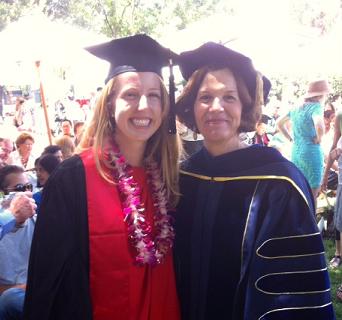
My oldest daughter, Breanna Jones, last week graduated with honors from Stanford University with a degree in public policy. At the ceremony, she received an award for her honors thesis – “California’s Tragedy of the Commons: How a Few Voters Disproportionately Influence County Use of State Prisons” – which I’m attaching as a PDF.

“California’s prison system has overrun maximum capacity, causing a public health conundrum, constitutional violations, and hemorrhaging finances. Even the public – which overwhelmingly endorsed past ‘tough-on-crime’ policies – has expressed its outrage about this waste of tax dollars. Recently, new research revealed that some California counties incarcerate more prisoners than the crime rate should dictate. That ‘surplus incarceration’ disproportionately contributes to the prison problem and thereby poses a significant tax burden on the state,” her report’s abstract begins.

Her research isolated a multitude of variables to show how it is the decisions that district attorneys in conservative counties make in how they charge crimes – with those prosecutors becoming especially aggressive after closely contested district attorneys races – that has the biggest impact on these high incarceration rates.

In other words, conservative attitudes toward crime and criminals are causing these usually small counties to have big impacts on the state’s prison budget – not to mention being unfair to those being sent to prison – something that ought to concern all of us.

Couple this with other studies showing that conservative counties also tend to use a disproportionate share of other state resources – and with the requirement of a two-thirds vote in the Legislature to raise taxes, which Democrats fall just a couple votes short of – and it becomes clear that these right-wing political attitudes aren’t benign. Indeed, we’re all suffering from the outsized influence of a vocal minority of state residents.

Luckily, voters will have some opportunities to correct this imbalance in November when there will be revenue measures that need only a simply minority to be approved, as well as measures that would repeal the death penalty and reform the Three Strikes You’re Out law, approval of which would begin to undo some of the damage done by these tight-fisted hypocrites.

California has lost its way and its balance. Luckily, the younger generation understands the situation and is willing to help us clean up the messes we’ve created for ourselves. It is the only thing that gives me hope for the future.

Artificial turf project appealed as opponents decry use of kids as lobbyists

14

As opponents of a controversial plan to install artificial turf soccer fields in Golden Gate Park appealed the project’s approval to the Board of Supervisors – with a hearing set for July 10 – they criticized how a soccer coach inappropriately used children to lobby for the project and raised hopes that a new alternative plan would be supported by supervisors.

Responding to the recently approved plan threatening to pave over seven acres of natural grass playing fields in Golden Gate Park, the main organizing opposition, SF Ocean’s Edge, and its attorney, Richard Drury, submitted the 300-page appeal to the board on June 12. The appeal challenges the environmental impact report, citing many of its inadequacies, including the renovation’s aesthetic and environmental inconsistencies with that of the Golden Gate Master Plan and its failure to consider other possibly better alternatives.

The Beach Chalet Athletic Fields Renovation was approved by the Planning Commission and Parks and Recreation on May 24 after a joint hearing that lasted more than six hours. During the hearing, opponents criticized many of the project’s features, but an especially outrageous concern came weeks afterward when a letter from an upset parent began circulating. In the letter, an angry father accuses a Vikings League soccer coach of using his unknowing son as a political pawn to support the renovation project.

“I was shocked and angered to learn that our eleven-year-old son was taken by his soccer coach, without our knowledge or consent, to attend the joint committee meeting in support of converting the Beach Chalet soccer fields to artificial turf.  He was one of the dozens of kids in team uniforms,” said the letter.

The parent said his son was picked up from school and was already dressed in uniform ready for practice but instead was taken to City Hall.

“It is really an outrage,” said Katherine Howard, SF Ocean’s Edge organizer, “to use children to further one’s own agenda instead of having an open and honest discussion.”

Renovation supporters argue that replacing the fields with artificial turf and bright lighting will allow children greater access and contribute to a growing need for more athletic fields throughout the City.

The letter accused the Vikings League of appointing itself speaker for San Francisco’s youth when not every parent or child agrees. And in this case, the boy was said to be in tears after the hearing.

“If my children were brought before a hearing for political purposes,” said Drury, “I would be livid.”

Drury and others maintained the park should be kept as a retreat from the pressures of urban life. Contained in the appeal is an alternative hybrid project that opponents are calling a “win-win solution.”

They propose renovating the playing fields at West Sunset Playgrounds with artificial turf and adequate lighting while keeping the Golden Gate Park fields natural with maintenance that includes adequate drainage and gopher control.

“It’s a very simple and very reasonable alternative,” Drury said, adding that the hybrid plan meets all the objectives of the city’s current proposal and wouldn’t increase the costs.

Although Parks and Recreation were uncooperative and refused to consider the hybrid plan, Drury and Howard feel optimistic about the appeal and think they will have better luck dealing with the Board of Supervisors.

The cost of shorter school days

13

Everyone agrees that Jerry Brown is taking a huge gamble, putting big automatic education cuts in his budget in the hope that he’ll convince voters to approve his tax hikes in November. It may be a wise political move: Most voters in California seem to support education spending, even if they still (wrongly) think the state wastes too much money on other services. And they seem to like teachers, even if they think (wrongly) that most other public employees are overpaid and get overly generous pensions. In other words, if you ask voters whether the state needs more money in general, you might get a No — but if you ask whether schools should be cut even further, you might get a better answer.

Still: If this thing goes down, California’s got a disaster on its hands. Already, local school districts are making deep cuts in budgets that were already way too small. And since everything else is already gone, the main thing on the block is the length of the school year.

It used to be 180 days. Now it’s down to 176. And it could go as low as 160. That’s terrible for students — you really can’t eliminate class time and not harm education. It’s also really bad for working parents who have kids too young to be left alone (and some of us have good reason to believe that even high school students shouldn’t be left alone at home all day with nothing to do except get in trouble).

What do parents do when there’s an unexpected furlough day that isn’t a work holiday? How about if there are suddenly 20 (twenty) furlough days, four full weeks of additional time that the kids aren’t in school?

Well, if it’s a day or two they take time off from work if they can — costing both worker and employer money — or they pay someone to watch the kids, costing the worker money. This isn’t trivial for any of us, and it certainly isn’t trivial for low-income families. It means some kids will be home alone, which is fine for the Model Middle Schooler, but really, how many of them do we know?

And Jesus — nobody gets four weeks of paid vacation time. It’s already costing parents a fortune to put kids in summer camp for eight or ten weeks; add four more and I don’t know what people will do.

So basically, furlough days are a tax on working parents (and their employers). Which means it’s a regressive tax that his hardest on those least able to pay. And that’s assuming the tax plan actually passes — if it goes down, expect the furlough days to go up — and the hidden tax burden on working parents to get worse.

Then there’s class size, which is going up now, and could go up a lot more. I’ve volunteered in the SF public schools and I’ve seen the difference between a classroom of 20 kids and a classroom of 30, and it’s huge. At the K-3 level, more than 20 students in the classroom seriously hinders learning. Even in 5th grade, 30 kids is too many for one teacher.

I realize there’s not a lot left to cut in the state budget (although I think I could shift enough money from the prison system to fully fund the schools, but that’s not even on the table). K-12 education is a huge ticket and is going to have to take big hits.

And again: As a political move, threatening to hack the legs out from under the state’s education system will probably bring in some votes in November. But I agree with Calitics — it’s a really scary bet.

Olague is the swing vote on voting system repeal

58

Conservative Sup. Mark Farrell’s effort to repeal San Francisco’s ranked-choice voting system for citywide elected officials is headed to the Board of Supervisors tomorrow, and all eyes are on swing vote Sup. Christina Olague. She surprised her longtime progressive allies with her early co-sponsorship of the measure when it was introduced in March, but she’s now expressing doubts about the measure.

The board rejected an earlier effort by Farrell and Sup. Sean Elsbernd to repeal RCV outright, but then Farrell tried again with a measure that excludes supervisorial elections and has a primary election in September, and if nobody gets 65 percent of the vote then the two two finishers have a runoff in November.

“I’m not going to support something that calls for a runoff in September,” Olague told the Guardian, referring to the primary election, although she did echo the concerns from RCV’s critics who claim that it confuses voters. She also said that it hasn’t helped elect more progressives and that “some progressives I talked to aren’t 100 percent behind it.”

Such talk worries Steven Hill, the activist who helped create the voter-approved system, and who has been battling to shore up support for it in the face of concerted attacks by more conservative politicians, newspaper columnists, and downtown interests, all of whom preferred the old system of low-turnout, big-money December runoff elections.

“I think it’s working well. San Francisco saves a ton of money by not having two elections,” Hill said. He said downtown money will skew the runoffs elections even more in the wake of the Supreme Court’s Citizen United ruling allowing unlimited political spending. “With Citizen’s United,” he said, “they’ll just do a ton of independent expenditures.”

He said Olague had told him she intended to withdraw her co-sponsorship of the measure, but she hadn’t done so yet. Olague told us that she wanted to discuss the matter with Farrell before withdrawing her support, that she hasn’t been able to reach him yet, and that she’s been focused on other issues she considers more important, such as crime prevention.

The measure currently is being co-sponsored by the board’s five most conservative supervisors and Olague, meaning it will go before voters on the November ballot if they all remain supportive. Hill said that the measure may not be voted on tomorrow because of an administrative snafu dealing with noticing requirements, but the hearing would proceed anyway, possibly offering clues as to the measure’s chances of success.

Taxes and pension reform

15

Our friends at CalBuzz, who are almost always right, have a point when they say that the right wing is going to use the lack of comprehensive pension reform against Jerry Brown’s tax measure in the fall. That’s unless the Legislature does something productive in August, which is always a challenge.

But whenever I hear this kind of analysis, I think about some of the political campaigns I’ve seen — the tobacco tax is an excellent example — and I wonder: Will it really make a difference?

No matter what the Leg does, Joel Fox and company are going to raise a ton of money and attack the tax plan — and no matter what happens in August, they’ll use public employees, and public employee pensions, as a flash point.

Brown could propose eliminating every dollar of pension spending tomorrow — and he’d wind up in court, because a lot of this is mandated by contracts. But even if he could get away with it, the righties would still harp about pensions. Because even if we weren’t paying modest pensions today, we used to — and in these campaigns, the facts don’t matter at all. See: Prop. 29. The truth is irrelevant when this much money is involved.

I guarantee the anti-tax groups will find some overpaid public employees and a couple of folks who spiked their pensions and they’ll plaster it all over the airwaves. And the fact that Brown and the Democrats in Sacramento are working 23 hours a day to try to craft a reform plan won’t matter a bit. Even if the reform plan passes, it won’t be enough for these clowns — and if they can outspend Brown’s side by 5-1, well … start holding bake sales for your local public school.

And by the way, who’s going to put up a lot of the money for the Jerry Tax Plan? Public-sector unions.

My point is not that Brown and the Legislature should ignore pension reform (although, as Calbuzz also notes, public-employee pensions aren’t the major cause of the state’s fiscal problems). I know it’s a huge political flashpoint, and the Righties have done an exceptional job at blaming union members for just about everything wrong with the state, and most people now believe that pensions are bankrupting us all and saddling our kids (who will work nonunion jobs with no pensions) with mountains of debt.

(Wait a second. Two wars? More than a trillion dollars wasted? The repeal of the CA vehicle license fee? Prop. 13? But never mind that; the debt’s coming from pensions.)

The missed opportunity here, and the move I wish Brown had been willing to make, was to combine the two in the same package, to wit:

We’re going to ask the public employees, who have already taken tens of millions in pay cuts and furloughs and suffered huge layoffs, to suffer even more and give up part of their pension package. And we’re going to ask everyone who benefits from the Bush tax cuts and all of the corporations who benefit from loopholes in the state code to take a proportional haircut.

Proportional — that is, if a union worker who gets a (typical) $30,000 a year pension has to pay 15 percent more of his or her paycheck a year into the pension fund, then a hedge-fund manager who makes $50 million a year has to pay 15 percent more of that paycheck to help fund for education and public services.

Everyone suffers, equally. Come on, Jerry — put that on the ballot and make Joel Fox fight it.

Thick petition against a big project

45

My old friend Sue Hestor stopped by my house June 24 to ask if any of my neighbors might want to sign the referendum petition on 8 Washington. She was carrying a clipboard with a document the size of a phone book attached to it. Almost 600 pages, neatly bound.

I flipped through it. Lots and lots of background documents on the project, nothing anyone’s ever going to read. But thanks to some slick moves by the developer, Simon Snellgrove, supported by his allies on the Board of Supervisors, the referendum petition has to have all of that material attached.

See, the petition seeks an election to overturn a piece of legislation. Doesn’t happen often in San Francisco, and as far as I know, it’s never been successful. State law, of course, says that you have to show people the bill you want to overturn.

But when activists in Bayview Hunters Point tried to run a referendum campaign on the area’s redevelopment plan, they lost before they even had a chance. The City Attorney’s Office ruled that each petition had to include the entire redevelopment plan, all 62 pages. Since the petitions didn’t include every single page of that plan, the signatures were rejected.

In this case, Snellgrove’s crew made sure that the final legislation approved by the supes included numerous mentions of other documents that were, in legal terms, “included by reference.” Lots of documents. And all of them had to be copied, bound and attached to every set of petitions that every circulator carries.

It’s a bear: You can’t send petitions around by mail, you can’t carry a whole stack to a big event … and it costs $18 to print and bind a set. The foes of 8 Washington will need at least 1,000 sets to get the required 28,000 signatures. That’s $18,000, just to get started.

Which would clearly appear to be a chill on the rights of the people to force a ballot referendum.

Still, they soldier on. Hestor told me she’s “fundraising like crazy” to get enough money not to pay signature-gatherers but just to print the petitions. Jon Golinger, who’s helping run the campaign, says he confident there will be more than enough copies to do the job.

So if you want to get a little exercise for your arms (don’t laugh –one petitioner is already having arm problems lugging this stuff around) and you’re interested in helping out, check out the campaign HQ at 15 Columbus or call 415-894-7008. There’s a rally Saturday/30 at 10am.


Students, parents, teachers march in support of Lakeview sit-in

7

More than 100 gathered outside Oakland City Hall for a rally and march June 23 to celebrate the sit-in at Lakeview Elementary School. The school is one of five that the Oakland School Board voted to close last fall, in a move that would save the city $2 million per year. 

The school’s unofficial reopening was initiated by Lakeview parents, and since has been organized and led by Lakeview parents and teachers. Organizers have also run a People’s School for Public Education, with more than 20 elementary-age children enrolled. Classes ran for the past week from 9am to 3pm and include music, art, gardening, social justice, and PE. A daily picket and rally was held to support the sit-in and the Peoples School at 5pm.

Organizers may extend the people’s school for another week.

The children and students involved in the effort led the march yesterday, which left from City Hall around 1pm. Protesters marched to the school, where they held a community barbecue.

At an Oct. 26 Oakland School Board meeting, the board voted to close Lakeview, along with four other elementary schools, at the end of the school year. The Save Oakland Schools campaign has been working to stop these closures. Lakeview officially shut its doors at the end of this school year, but with the ongoing sit-in, organizers hope to keep it open as long as possible.

The city plans to use the school’s building for administrative offices.

Speakers at the rally included parents and teachers of Oakland elementary school teachers. 

On the march, demonstrators chanted “Whose schools? Our schools!” and “Education is a right! For our children we will fight!” In reaction to police at the kid-led march, some chanted “their kids! They’re cute! Get those guns up off your suit!”

“The Lakeview sit-in demands a stop to all school closure, or the resignation of Tony Smith, superintendent of the Oakland Unified School District. The Sit-In at Lakeview is held in solidarity with all parents and teachers struggling to demand quality public education across the country,” according to a press release.

The now week-long action is the result of collaboration between Occupy Oakland and its various offshoots and the parents and teachers of Lakeview, as parents and teachers lead the efforts.

Photo via Justin Beck

Putting 8 Washington on the ballot

116

The fall ballot’s going to be crowded — and one of the issues that may face a vote is the future of the 8 Washington condo complex, the waterfront multi-zillionaire housing that the city doesn’t need.

Opponents of the project have filed for a referendum on the Board of Supervisors approval, and they’re meeing Satruday June 23 at 15 Columbus at 10am to start the process of gathering signatures. It’s not easy — they need 28,000 signatures in 28 days, and this, I suspect, isn’t going to be one of those money-heavy deals with a lot of paid gatherers.

Former City Attorney Louise Renne will be there to lead off the festivities.

Me, I’d love to see this on the ballot in a high-turnout year when six supervisorial seats are up. Because it’s a great issue to discuss: Who is San Francisco building housing for, and why?

Is it ok that more than 80 percent of the people who work in San Francisco can’t afford to buy or rent a median-priced home? Is it ok that virtually all of the new housing getting constructed is out of reach to virtually all of the people who work here?

Is that in any way sustainable?


Gosh, we need more condos for millionaires

58

I guess it’s really, really important for San Francisco to build more housing for the very rich because there’s just such a profound need for it. In fact, the demand for million-dollar condos is so high, and the supply so tight, that the folks at Rincon Tower (which is hideous) are bringing in celebrities to try to sell the last few units.

You don’t find many mid-range and affordable units sitting on the market; in fact, there’s a long waiting list and a lottery for affordable housing. Because there’s more demand than supply. On a policy level, one would think that the city would seek to match supply and demand (since the free market clearly isn’t doing it). But no: SF continues to approve housing for people who don’t need it and won’t balance that out with the level of affordable housing that IS desperately needed.

Smart.

Dueling pot protests precede rejection of a permit appeal

12

Dueling demonstrations in front of City Hall yesterday afternoon – with one side supporting medical marijuana dispensaries and the other protesting the city’s February approval of three new clubs in the Outer Mission/Excelsior area – preceded the Board of Permit Appeals decision to reject an appeal challenging Mission Organics.

That was the first of the three clubs to pull their building permits to open up shop in a part of the city that currently has no cannabis dispensaries. Yet a group of residents from the region – which includes District 11 supervisorial candidate Leon Chow – has been angrily agitating against the clubs and claiming they expose children to an illegal drug.

Bearing signs that included “Stay away from pot clubs” and “Keep the weeds away from kids” – most in both English and Chinese characters, with a smattering of Spanish translations – the predominantly Asian protesters squared off against a slightly larger crowd of medical marijuana supporters bearing signs that included “Respect Local Law” and “Marijuana is Medicine.” Together, it was a crowd of a couple hundred lining the sidewalk, drawing reactions from passing motorists.

Asked whether he would try to undermine the city’s system of regulating medical marijuana facilities if elected to the Board of Supervisors, Chow told us, “We’re opposing this, but I don’t think it would be my priority.”

Chow said he was “opposing high density,” noting that the Planning Commission approved three dispensaries in the area on Feb. 21, but he also raised concerns that the clubs make it easier for children to get marijuana, that they cater to healthy people just looking to get high, and that city regulations conflict with federal law.

“We don’t want healthy young people to be exposed to people coming out of medical marijuana clubs,” Chow told us. Asked whether he had similar concerns about bars and liquor stores, he said that he did but “there’s nothing I can do” to shut down existing businesses that sell alcohol.

“I don’t want there to be more liquor stores,” he said, although he assured us that, “I’m not a conservative, crazy, church-going Republican.”

Yet supporters of Mission Organics – whose workers will be represented by the United Food and Commercial Workers Union – did call Chow a hypocrite given that he works for SEIU-UHW. “So it’s a union representative opposing a union business,” said Matt Witemyre, an organizer with UFCW who was demonstrating in support of Mission Organics, which he said has agreed to a strict code of conduct that will make them good, responsible members of that community.

“The vast majority of the neighborhood is in support of the project,” Ariel Clark, an attorney representing Mission Organics, told us, characterizing protesters as a small yet vocal part of the neighborhood. The appeal was filed by Steve Currier, president of the Outer Mission Merchants and Residents Association.

Long after most of the protesters on both sides had gone home, the Board of Permit Appeals voted 3-1 to reject the appeal, clearing the way for Mission Organics to open on the 5200 block of Mission Street. But opponents have vowed to continue their fight and appeal the permits for the other two approved clubs – Tree-Med and The Green Cross, a venerable cannabis delivery service – when they apply for building permits.

Corporations are people, but I guess unions aren’t

15

So seven of the Supreme Court Justices, including all of the ones who voted for corporate free speech in Citizens United, have decided that unions aren’t the same as corporations and don’t have the same political rights.

The court ruled 7-2 that unions can’t use their members’ dues for political campaigns unless they ask first. That doesn’t sound so awful; gee, if you’re going to take my money and spend it on a candidate I don’t like, shouldn’t I get a chance to say no? (Of course, that’s already the case, and this ruling is pretty narrow — the union wanted to raise the money and offer refunds to members who asked. The court says you have to ask first.)

But the distinction here is interesting. Corporations don’t have to ask their shareholders in advance before they donate money to political campaigns. In fact, they don’t have to ask shareholders — who, in theory, are the members of the corporation, the owners, the ones whose financial interests are most directly at stake — at all.

Pacific Gas and Electric Co. can use millions of dollars of its shareholders’ money to support candidates and causes — and if you’re one of the poor retired workers who holds PG&E stock as part of your pension, you think you have any say? No, you don’t.

So what this does is further erode the power of the one large established group that can sometimes spend close to what big business does, and that’s organized labor.

Behind the CBI chief’s “resignation”

5

Matier and Ross reported today that Vivian Day, the director of the Building Inspection Commission, was stepping down and taking another city job (at the same pay). But there’s a lot more to the story.

A leader in the Residential Builders Association who serves as the chair of the Building Inspection Commission was behind the move oust Day — and he did it without informing other members of his panel.

Angus McCarthy, the residential builder representative on the commission, hauled Day into a meeting that involved a senior representative of the city’s personnel department to discuss his desire for her to resign, emails obtained by the Bay Guardian show.

Micki Callahan, the city’s Human Resources Director, met with Day and McCarthy May 22, the emails show, and Day was offered an alternative job with the city at equal pay if she would step down.

 “I was asked to ‘resign’ by June 30, 2012 by Angus who stated he was speaking on behalf of the Commission who wanted a change in leadership,” Day wrote in a  May 23 email to McCathy and Callahan. “I understand that I serve at the will of the Commission, but I was surprised by the fact that people were being interviewed for my position without some notice to me as a courtesy.”

She noted that she didn’t want to resign and needed to hear that the entire commission was backing up McCarthy.

The problem: At least two other commissioners I spoke to told me they had no idea the commission chair was calling on the director to resign, and one of them, Debra Walker, said she wasn’t looking for a change.

“They’re trying to get rid of Vivian because she isn’t corrupt,” Walker told me.

In a May 23 email, Callahan wrote that “we wanted to you explore with you your interest in pursuing a voluntary resignation in a way that was respectful of your contributions to the city.”

But Day was having none of it, and complained by email that she was being harassed by the builders. The previous commission chair, Mel Murphy, also tried to drive her out.

“I spent a year being harassed in front of the Commission because I would not bend Civil Service rules to accommodate [Murphy’s] wishes regarding staff,” Day noted.

By law, the BIC must include a residential builder, a residential landlord, a licensed structural engineeer, an architect, a tenant, a nonprofit housing provider and a member of the general public.

I contacted Day, who told me that she couldn’t comment. McCarthy told me by email that “this is a personnel matter between the Director and Human Resouces, [so] I have been advised by the City Attorney’s office to avoid commenting on the matter.”

Myrna Melgar, who holds the public seat, told me that McCarthy had never spoken to her about Day and that the commission had held no meetings to discuss her job or tenure. Melgar told me that she’s not sure Day is strong enough on tenant issues, but never told McCarthy that she wanted a new director.

There doesn’t seem to be widespread concern among tenants about Day’s performance. Tommi Avicolli Mecca, who works at the Housing Rights Committee, told me he and his colleagues have no issues with her.

Walker confirmed there had been no discussions about Day resigning among the commissioners. Any move to oust the director would require a closed-sesion meeting on the topic, and none has been scheduled, Walker said.

But according to a May 24 email from Day to Callahan, “Angus did state that the ‘commission wanted a change in leadership.’”
She added: “The Commission has not been convened to discuss this issue and I do not want to voluntarily resign. … If the Commission wants a change, thyen the Commission should be respectful to me and not back door and try to force a voluntary resignation from me.”

All of which leaves two obvious possibilities: McCarthy went ahead and tried to push Day out, claiming that he had the rest of the commission behind him — or else McCarthy spoke privately with several other commission members to line them up, in which case he violated the Brown Act, which mandates that such discussions be held only at a scheduled meeting with a quorum present.

The residential builders’ anger with Day is a bit puzzling. She hasn’t been exactly a rabid anti-development type. The Chron says the mayor thought she was “an obstructionist blocking the mayor’s efforts to build more housing and boost neighborhood economic development,” but it’s hard to see any evidence of that.

I asked Randy Shaw, director of the Tenderloin Housing Clinic, a big fan of McCarthy and an ally of the mayor, if he had seen any problems with Day. “I’ve never met her,” he emailed tersely.

One person close to DBI had a different take on the situation. “The RBA has been running the department for years,” this person, who asked not to be named, told me. “Vivian wasn’t one of them. So they figured they might as well just put their own person in charge.”

Avalos emerges as the board’s main progressive champion

23

Sup. John Avalos seems to be the only consistent champion of progressive values at the Board of Supervisors these days, as he demonstrated once again yesterday as he tried to present some alternatives to the neoliberal corporatism that has seized City Hall over the last couple years.

Last week, Avalos was the only vote against a pandering proposal by Sup. Mark Farrell to exempt more small businesses from the city’s payroll tax, which is projected to cost the city $1.5 million next fiscal year and $2.5 million the following one, blowing a $4 million hole in the two-year budget that supervisors are now finalizing for approval in two weeks.

Yesterday, as the measure was about to receive final approval on its second reading, Avalos made a motion to delay it until after the fall election when voters may consider a pair of measures to transition from a payroll to gross receipts tax as the means of assessing local businesses. Mayor Ed Lee and Board President David Chiu introduced one measure that is revenue neutral, while an alternative by Avalos would bring in about $40 million per year.

Avalos didn’t have the votes for the long delay, so he got behind a compromise motion by Sup. Jane Kim to delay the measure until July 10 so the Budget Committee can at least factor it into its deliberations. Farrell opposed the move, insisting that “this is about creating jobs now,” despite the fact that businesses couldn’t apply for the exemption until next February.

A spirited debate followed, in which Avalos criticized City Hall’s current penchant for business tax cuts and questioned whether it really creates the jobs its boosters claim. He also noted that it is the multitude fee increases that local politicians have approved in recent years to balance the budget without raising taxes that have become most onerous for small businesses.

“When we were raising fees over the last five years, we were raising taxes on small businesses,” Avalos said, suggesting that rolling back those fees and taxing larger corporations that can afford it is a better strategy for helping small businesses and encouraging them to create jobs.

Eventually, Avalos won the short delay on a 7-4 vote, with Sups. Farrell, Carmen Chu, Sean Elsbernd, and Scott Wiener opposed.

Meanwhile, Avalos managed to place on the fall ballot an increase in the real estate transfer taxes paid on properties worth $2.5 million or more, convincing Sups. Kim, David Campos, and Eric Mar to support the proposal as the 5 pm deadline for at least four supervisors to place measures on the ballot neared. It would raise $16 million and compete with a similar measure by Lee that would raise $13 million through a smaller increase on properties worth more than $1 million.

Avalos also joined Campos and Chiu in opposing final approval for the 8 Washington housing project for the uber-wealthy. On the same 8-3 vote, the board also rejected Chiu’s efforts to allow opponents of the project to circulate referendum petitions without having to lug around a thick stack of all the studies referenced in the project approval.

Chiu appealed to his colleagues to support “citizens of San Francisco exercising the constitutional right to referendum,” but he won few sympathies on a board that these days seems most concerned with the interests of this city’s wealthiest individuals and corporations.

Maybe I should move to France

57

I know that would make some of my happy trolls even happier. But then I’d have to learn French. And I don’t know if the bars in Paris have Bud Light.

But when you look at the agenda of the new French government, it’s pretty much what a lot of us, including a lot of non-Socialists, have been advocating for the United States: Tax the rich, end tax breaks for banks and oil companies, hire a lot of new teachers, invest in youth and the future, don’t get your pants in a wad about short-term deficits, legalize same-sex marriage … damn. They’ve got it all.

Or rather, Fichu. Ils l’ont obtenu tous.

Did I get that right?

Of course, the critics are terrified about the same things they all seem terrified about whenever anyone in San Francisco talks about local taxes on the wealthy: OMG! The rich will all leave town and go live in Fresno! See:

The pledges have prompted fears of an exodus of wealthy footballers and pop stars to lands beyond the French border.

I suppose. But I suspect a lot of wealthy Parisians will stay Parisians even if their taxes go up. They live there for a reason, as do San Franciscans, and Californians. What, you’re going to play football in France and live in Antwerp? That’s not going to go over too well.

So this will be a fine experiment here. If France doesn’t collapse and Paris doesn’t empty out and the world doesn’t end, maybe we’ll all learn a lesson. Oui?


Guardian voices: Outside the Bay Area Bubble

7

This week I’m back in the midwest, where my roots are strong and my mother is approaching her retirement years. I’m thinking about the vast geographic and cultural distance –both real and imagined — between the San Francisco, California where I now live, and the great state of Iowa, which made me so much of who I am.

Here I am, sweating through a ridiculously muggy midwest summer heatwave, thinking about how it is that I am black, a lifelong social justice activist and organizer, and a married, dyke mama who hails from a small, working-class Iowa town where sweet corn and tomatoes once grew in my own backyard.

When I tell people that I’m from Cedar Rapids, Iowa, there is a kind of shocked silence I’ve become accustomed to. I’m used to people’s confusion about how I – given my politics and identities — could possibly be from such a place. And, while I find it extremely problematic, I’ve also gotten used to a dismissive arrogance about Iowa, a comfortable ignorance about the heartland, and a total failure to comprehend why I long for my Nana’s lilac-lined house at 1339 10th Street and why I have so much hope for middle America.

I work, organize and am raising a family in the “Bay Area bubble” but being from Iowa has developed in me core values that are decidedly anti-bubble, and deeply pro-working America. My ancestors built the wealth of this nation, and I consider the whole place mine – to love and rage over, to listen to and understand, to organize and to challenge. I have not committed my life to social change just for a privileged few on the East and West Coasts. This is, fundamentally about all of us, the 99 percent in San Francisco, through the heartland, down South and all the way to upper tip of Maine.

My four-year-old son was born in San Francisco, and he is a proud Frisco kid through and through. We have a multi-racial community that dances and organizes for justice together, he considers Salvadoran pupusas a special treat, and he loves remembering the day the Giants won the World Series and it seemed like everyone in the city was a member of the same big family.

But today, I’m writing from a cramped apartment in a seven-story public housing building in Michigan where my mother now lives with her scores of books, photography equipment and cute dresses from QVC. She and I are from a clan of Gibsons, black folks from working-class Iowa where my great grandparents worked on the railroads, and where my grandfather slaughtered pigs and went on strike with his white coworkers to defend the gains of their union.

We’re from the Iowa, where my mother attended black churches as a child and found Islam as an adult, and where she, as a struggling single mother, read black feminist poetry and first fought battles with Ronald Reagan’s backwards welfare policies.

We’re from the Iowa that is a center of agribusiness and everything that’s bad about corporate food production in this country. We’re from the Iowa that rallied for Jesse Jackson’s run for president, voted for same-sex marriage, and where Obama won the caucuses back in 2008.

But Iowa has also gone from unionized, inter-racial meatpacking plants to non-union poultry factories that exploit undocumented Latino workers from as far away as El Salvador and Guatemela. We’re from the Iowa that is indeed mostly white, where my first best friend grew up – a sweet white working class red head – and our mothers shared survival stories of single, working-poor motherhood. And I’m from the Cedar Rapids, Iowa that, unlike San Francisco, is actually growing its black population and is home to a thriving center of African American community history.

For most of my adult life, as I’ve been marching against war and racism, I’ve also been defending this Iowa, fighting against the tendency toward self-righteous superiority I’ve found among too many activists in the Bay and on the East Coast. It’s the same arrogance that the Right exploits in its scandalous but effective pseudo-populist campaigns against so-called liberal elitism.

It’s my experience that people on the left think they know what it means to be Iowan. Iowans are used as stand-in for a stereotypical idea of backwards, irrationally racist white America that ‘doesn’t vote its class interests’; Iowa is a convenient marker for everything less cool, hip, cosmopolitan and liberal than, well, San Francisco.

This kind of dismissive arrogance leads to a refusal to develop, in any meaningful, long-term way, an organizing agenda for the majority of the country, and has been one of the errors of progressive politics for a long time.

We can change this. When we are thinking about the politics of immigration policy, Occupy Wall Street, gay marriage, the movement against corporate food policy, or the politics of race, poverty and labor unions, we have to think about Iowa. Think about the white working class Republicans. Think about my mom’s friend in Iowa, raised on an old fashioned farm and now leading an organic farming collective there. Think about the proud struggle for small farms, union work, and participatory democracy there.

And think about what it will really take to make the Bay, Iowa and the whole nation a place where we can all develop our full human potential, have true mutual respect for one another, and are able to struggle through our deep divisions without exclusionary moral superiority, top-down “we know what’s best for you” politics and where all of us who want to live out our old age on a quiet lilac-lined porch in Iowa, can do so in peace and dignity.
As we make our plan to build a new progressive majority, let’s stay open-minded and take our organizing to a whole new level.

Ethics Commission undercuts the main witness against Mirkarimi

213

The testimony of the star witness in Mayor Ed Lee’s official misconduct case against suspended Sheriff Ross Mirkarimi came in for harsh criticism by the Ethics Commission last night, with that body striking most of it as prejudicial and unsupported hearsay evidence that should have never been introduced, something that even the city’s attorneys admitted and apologized for.

It was a serious blow to the city’s case that also undercuts the written testimony of the city’s domestic violence expert, attorney Nancy Lemon, who based much of her analysis and judgments on this discredited and disallowed testimony of Ivory Madison, the neighbor and confidante of Mirkarimi’s wife who reported the Dec. 31 domestic violence incident to police.

Meanwhile, Lee was confronted by a large pack of reporters following his monthly appearance before the Board of Supervisors earlier the day, which peppered him with pointed questions about his decision to bring what is evolving into an expensive, complicated, and nasty prosecution of Mirkarimi rather than simply allowing him to be recalled by voters. The exchange made news when Lee characterized Mirkarimi’s arm-grabbing incident as “the beating of his wife.”

Mirkarimi and his attorneys labeled that comment and much of the city’s case as simply a smear campaign that goes well beyond the narrow question of whether Mirkarimi committed official misconduct and should be removed from office, which the commission is still in the process of setting up procedures to answer.

Yesterday’s hearing dealt mostly with deciding whether to exclude or allow the written testimony of nearly two dozen witnesses. The only testimony that was stricken entirely was that of Paul Henderson, Lee’s criminal justice adviser, who testified that Mirkarimi’s guilty plea to misdemeanor false imprisonment for the grabbing incident would hurt his ability to function as the sheriff. The commission found the testimony to be irrelevant and prejudicial, clearly upsetting Deputy City Attorney Sherri Kaiser.

But the big news from last week’s hearing was the dim view that the commission took of Madison’s 22-page declaration, which painted Mirkarimi as domineering and oppressive, a bleak picture that she attributed to his wife, Eliana Lopez, as conveyed during repeated conversations between October and December as the couple was having marital problems. Madison is the main source supporting the city’s most serious allegations: that Mirkarimi abused his wife and then tried to thwart a police investigation

Commissioner Paul Renne – a career litigator appointed to the commission by the District Attorney’s Office – took the lead role in criticizing Madison’s testimony and the city for allowing it, ruing the fact that it was used by the Examiner and other media outlets to paint a defamatory “portrait of verbal abuse and child neglect inside Mirkarimi’s fear-ridden household,” as the Examiner put it on the cover of yesterday’s paper.

“I saw that and I thought maybe this idea of [taking initial testimony through written] declarations is not protective of the interests of everyone,” Renne said.

“I was disappointed by the content of Ivory Madison’s declaration. A first-year lawyer should know that much of it is inadmissible and it should not have been given to us,” Renne told Deputy City Attorney Peter Keith, calling it “clearly hearsay, clearly having the intention of poisoning the well of this hearing.”

Keith didn’t even try to defend most of the declaration, responding to Renne by saying, “We have an independent witness that is represented by [her own legal] counsel and we didn’t have control over everything that was submitted…I think the criticism is well-taken and we didn’t mean to put matters before the commission that are not relevant.”

“But you were the one who submitted the declaration,” Renne responded, telling Keith that the city must avoiding engaging in character assassination that goes beyond the scope of the commission’s inquiry, which will result in a formal recommendation going to the Board of Supervisors near the end of summer.

“My recommendation is we reject the declaration and you bring her in for live testimony,” Renne recommended. The rest of the commission seemed to agree with Renne’s criticism, but it opted to go through the declaration line-by-line, removing most of it from the proceedings. Madison is also expected to testify live and be subjected to a tough cross-examination by Mirkarimi’s attorneys, who say she has blown the incident out-of-proportion and broke the confidence of Lopez, who denies that Mirkarimi was ever abusive.

In arguing unsuccessfully for much of Madison’s written testimony to remain in the record, Keith told the commission that it was the basis for Lemon’s assessment of patterns of behavior by batterers, thus undercutting that testimony as well.

“If they’re untrue, they’re meaningless, right?” Renne asked Keith, referring to the sensational tales Madison told about Mirkarimi’s controlling behavior.

But Keith said that even if the stories Lopez told Madison were untrue or highly embellished – as Lopez’s attorney, Paula Canny, has implied as she characterized her client as building a child custody case in the event the couple divorced – they are still relevant to understanding why Madison reported Mirkarimi to the police.

“Whether or not these actions happened, it’s relevant to her concerns,” Keith said.

But Mirkarimi attorney Shepherd Kopp said that, like much of the city’s case, hearsay testimony based on flawed and prejudicial information should be irrelevant to these proceedings and shouldn’t be allowed as evidence against Mirkarimi.

“Their expert, Ms. Lemon, can believe what she wants, but that doesn’t mean it should come in as evidence,” Kopp said.

The hearing was continued to next week when Mirkarimi, Lee, and other key witnesses are expected to begin giving live testimony before the commission on June 28 and 29. Click here to read the various documents associated with the case.

Why do Lee, Chiu, and others want to stifle economic growth?

16

Why do Mayor Ed Lee, Board of Supervisors President David Chiu, and San Francisco’s two major daily newspapers want to punish success? Because that’s exactly what their proposal to create a new gross receipts tax for businesses – in which corporations would be taxed more as they grow, thus encouraging economic stagnation – would do.

Right now, the city taxes businesses through a payroll tax, levying taxes based on the number of employees the company has. But under a gross receipts tax that would replace the payroll tax, employees have a disincentive to be productive and efficient and increase their companies’ profits because that would expose those companies to more of the city’s onerous tax burden.

Why would investors and employees want to grow a business in San Francisco when that would only submit them to higher taxes. Clearly, this is anti-business measure that is likely to plunge our local economy back into the depths of the recession. Don’t our leaders understand the need to help this fragile economic recovery?

Okay, okay, in case you haven’t guessed it yet, the previous three paragraphs are satire of the ridiculously overblown and misleading political rhetoric used by Lee and other critics of the city’s payroll tax, which they deride as as “job killer” that makes companies not want to hire new employees.

“Mayor Lee and Board President David Chiu proposed a gross receipts tax as an alternative to the City’s current payroll tax, which punishes companies for growing and creating new jobs in San Francisco,” Lee’s office wrote in a press release it distributed last week.

Yet my argument that a gross receipts taxes “punishes companies for growing” is just as logically sound as Lee’s argument that the payroll tax discourages companies from “creating new jobs” – and both arguments are also complete hyperbolic bullshit. But it’s seductively simple and widely parroted bullshit.

“To attract more companies to San Francisco and encourage existing employers to hire more employees, it is past time to do away with this tax,” our new neighbors down the hall, the editors of the Examiner, wrote in their editorial today, a oft-repeatedly refrain from the Chronicle and SF Chamber of Commerce as well. It later added that switching tax methods “wouldn’t penalize companies for employing people or paying them well. And city policy wouldn’t give employers any incentive to shed employees during a downturn.”

But the reality is that the 1.5 percent payroll tax is too small to really be a factor in the decision by corporations to add new employees, something they are already loath to do unless forced to by rising demand. It is simply one imperfect gauge of the size of a company and its ability to pay local taxes, just as the gross receipts tax is.

Health insurance costs, which Lee’s CPMC deal doesn’t adequate contain, is a far bigger factor in a company’s hiring decisions. So is commercial rent, which Lee’s corporate welfare policies are causing to go up downtown and throughout the city.

For decades, conservatives have tried to sell the general public on bogus trickle down economic theories that we all benefit from corporate tax cuts and that people will simply stop working if you tax them, ideas that should have been discarded as they were discredited. But they’re back with a vengeance, in supposedly liberal San Francisco of all places, actively peddled by key Lee supporters like billionaire venture capitalist Ron Conway, who only recently dropped his Republican party affiliation in favor of declined to state.

But it’s time to call out this voodoo economics for what it is: self-serving bullshit that ought to be rejected by citizens of a city that prides itself as being more educated and enlightened than the rubes in the flyover states that have been so thoroughly manipulated by the Republican Party and Blue Dog Democrats, to the detriment of our entire country.

Now, the Examiner’s argument that the business tax reform proposal would broaden and stabilize the tax base is a sound and meaningful argument, which is why the concept enjoys widespread support from across the ideological spectrum and is worth doing (although progressives rightful argue that if the tax base is being broadened then the city should reap some benefits from that, logic that Lee inexplicably resists).

Yet as the City Hall debates that will shape the details of business tax reform begin in a couple of weeks, it’s time to drop this misleading “job killer” label that has been promulgated by Republicans and other fiscal conservatives over the last decade and have an honest debate over what’s best for San Francisco’s private and public sectors.

Landlords and government, or WTF Chuck Part Two

7

If you didn’t get enough from my latest WTF, Chuck, Calitics has a nice addition. In a discussion about the governor’s tax proposal and the likely opposition, Brian Leubitz notes that the Howard Jarvis Taxpayers Association is going to run its usual playbook: Government is fat, government is bad — oh, and here’s a few examples of wasteful spending. Notes Leubitz:

Of course, take any large organization and you can find some dumb stuff going on. And, the California government is such and organization. But, just because there is a small stupid thing going on, doesn’t mean that we should just toss the big, smart things that go on every day. Like, you know, educating our children, maintaining our streets, and so on. California government is simply too big to fail.

Yet, that is where we are headed. With the continued pessimism and me-first attitudes of the anti-tax organizations, we are stuck on a 20th century budget in a 21st century reality.

Yes: In San Francisco city government, there are small stupid things going on. There are overtime issues and (some) pension issues, and somewhere, somebody’s probably getting an extra welfare check. You simply cannot have a $6 billion budget and not have some types of waste. Anyone who has ever run anything larger than a lemonade stand knows that.

And if that’s what the press focuses on, then we’re going to fail as a country, a state and a society.

WTF, Chuck: Those poor exploited landlords

92

In my continuing attempt to make sense of the politics of the Chron’s C.W. Nevius, I present: What The Fuck, Chuck — the saga of the poor landlord.

I’ll try to be fair: There’s nothing inherently wrong with this story. I don’t like rich people taking advantage of anything, particularly rent control. It’s true that there are a few people who are cheating, good for Chuck to expose them (tho he didn’t exactly name names). You can’t make better copy than a family that moves to Hawaii (!) and keeps a rent-controlled house in the Richmond. (Of course, maybe the parents needed to be there for a couple of years for work, and were hoping to return to their family home and the landlord wouldn’t allow sublets, but whatever. Sounds horrible.)

And I’m not excusing it for a minute.

But I’ve never seen Nevius write a story about a family that can remain in this city only because of rent control, or a longterm tenant being forced out by the Ellis Act to create “homeownership” opportunities for a wealthier person who can buy a tenance in common, or a landlord who lies, cheats and abuses tenants to get rid of them so he or she can raise the rent — and those are far, far more common occurences. Those are problems that happen every day in this city.

It’s always about the poor landlords.

Yeah, there are bad tenants. But anyone on the front lines of the renatl-housing struggles in San Francisco can tell you that the abuses by the property-owning class radically exceed the harm caused by the tenant class.

I feel about this the same way I feel about the ongoing stories on bloated city employee pay and pensions. Yes, it’s true: Some city employees game the overtime and pension systems and in effect pluck money from the pockets of the taxpayers. I see no reason why a police chief who retires at 55 should get $250,000 a year for life.

But it’s also true that a lot of city employees earn a basic middle-class salary and get a pension of maybe $30,000 a year, which is hardly excessive — and the fact that the private sector quit giving pensions decades ago doesn’t mean that the public sector is wrong to do it. But all of these stories create a powerful Big Lie mythology of bloated public payrolls, which undermines any effort to raise taxes for desperately needed public services.

You tell people enough tales about the poor landlord and the rich tenants and you start to make rent control look like a bad idea. Which is about the worst thing you can do in San Francisco today, where the existence of any middle class at all is primarily the result of rent control — and if anything, rent control ought to be stronger.

In other words: A little perspective here, please.