News and Politics | San Francisco Bay Guardian

News & Opinion

Alerts

0

FRIDAY 13

Born N Raised in Frisco Eric Quesada Center for Culture and Politics, 518 Valencia, SF, 6:30pm, free www.tinyurl.com/poormagevent. A celebration of the end of the People Skool/Escuela de la Gente Winter 2012 session’s course, entitled Born N Raised in Frisco. This class concerned the “stories, poetry, music and media of people who have undergone the trauma of eviction, removal, gentriFUKation, displacement and/or forced migration out of San Francisco due to poverty, redlining, and/or re-devil-opment” and is part of the Uncle Al Robles Living Library project. People Skool, presented by POOR Magazine, lets the voices of San Francisco be heard, and this graduation party will continue the mission of POOR Magazine- to provide “poor people-led/indigenous people-led, grassroots, arts familia creating media, education and art on poverty, racism, disability, indigenous resistance and im/migraiton locally and globally.” 

SATURDAY 14

Just Cause Direct Action Training Lake Merritt United Methodist Church, 1330 Lakeshore, Oakland, 9am-6pm, free. Register at www.tinyurl.com/99springoakland. Around the country, a huge coalition of organizations moveon.org, Green For All, Code Pink, Jobs With Justice, UNITE HERE, and dozens of others have joined forces to present the 99% Spring action training. Their goal is true train 100,000 people in non-violent direct action and this is the week. In the Bay Area, a community-wide training will be led by Causa Justa / Just Cause, Mujeres Unidas y Activas (MUA), the School of Unity and Liberation (SOUL), and the Ruckus Society. The first part of the day will be a lesson on the current political economy, the second part a training in nonviolent direct action “open to people who are organizing with local organizations, Occupy groups, or who want to get involved in actions this Spring.” Smaller trainings in San Francisco will also take place at Million Fishes gallery and the UNITE HERE Local 2 headquarters.

Occupy Oakland Patriarchy BBQ and Speakout Rainbow Park, 5800 International Blvd, 1-5pm, free, www.tinyurl.com./OOpatriarchy. Occupy Oakland continues its weekly Saturday barbecues, meant to engage those who have been occupying with other Oakland residents, share free food, and build community. Last week, they commemorated the anniversary of the death of Black Panther Party icon Lil Bobby Hutton with a celebration of black power; this week, the theme is a speak-out on issues ranging from cuts to schools and services to low wages to racist policing. As organizers say, “the cycle of violence that currently exists attacks poor people, people of color, and women, and is specifically designed to keep us weak so we will passively accept our place in society.”

SUNDAY 15

Youth Theater Project Mission Cultural Center for Latino Arts, 2868 Mission, SF, 4/14 7pm and 4/15 2pm, free, www.tinyurl.com/youththeaterproject. The San Francisco Mime Troupe presents theater written by and about youth in San Francisco. The play comes after an eight-week workshop, and according to the Mime Troupe “The Project promotes artistic expression, discipline, and cross-cultural understanding as creative alternatives to drugs, gangs, prejudice, hostility and violence.” 

The problem with Laura’s Law

9

OPINION Mental health conditions and mental illness are issues that bring passionate people to the table from all sides of the spectrum. Individuals who have lived with the experience of mental-health conditions, clinicians, family members, researchers, and advocates all have a lot to say.

But as a March 11 San Francisco Chronicle piece, “Laura’s Law likely to save lives,” suggests, people can be fueled by pain and emotion, rather than logic and information. It’s in such a hot zone that AB 1421 emerged, after the tragic death of a young woman at the hands of a violent man who also happened to be dealing with mental health conditions.

The so-called Laura’s Law passed the state Legislature in 2002, and counties have a choice whether to implement it locally. If enacted in San Francisco, AB 1421 would mandate outpatient treatment for some people with mental illness — and those out of compliance would get a 72-hour hold under lock and key at the hospital, and would be at risk of being thrown into the revolving door of the criminal justice system.

The public support for AB 1421 and similar involuntary measures outlines the pervasive misunderstanding that comes when emotion rules the fray over common sense and dignity. And more dangerously, it promotes the long-debunked myth that mental illness is related to violence. In fact, individuals with mental illness are one percent less likely to commit violence than other individuals.

Often, the very people whose voices are left out of the decision making process in legislation such as AB 1421, are the ones who are directly affected personally by mental illness and mental-health conditions. That’s due in large part to the lasting impact of stigma, which deprives people of dignity, individual choice, and the empowerment to seek their own goals and paths in life.

What we know is this: voluntary treatment that is accessible in community settings and centered on individual strength is by far the best option for recovery from mental health conditions and the path for a rewarding, enriched life.

San Francisco typically leads the state in the number of involuntary commitments for people in acute psychiatric crisis. That’s proven to be not only a colossal waste of resources but also the wrong approach. Many of those who are involuntarily detained are accessing the mental health system for the first time—in restraints. This leads to further mistrust and trauma for those dealing with mental health challenges.

When it comes to embracing laws such as AB 1421, California voters know better. After the passage of that measure, California voters passed the landmark Mental Health Services Act in 2004. It is the principles of MHSA—voluntary, community-driven treatment, and full inclusion of individuals with mental health conditions as decision-makers—that should guide our efforts in recovery from mental health conditions and eliminating the pervasive stigma and bias that are the true culprits in causing pain and trauma in our society. MHSA provides funding for innovative, alternative approaches to Treatment As Usual.

Michael Gause is deputy director of the Mental Health Association of San Francisco.


Heading East: The flight from San Francisco

13

EDITORIAL There is no simple free-market solution to gentrification and displacement. There’s no way a crowded city like San Francisco can simply rely on the forces of supply and demand to protect vulnerable populations. And there’s no way the city’s flawed housing policy can prevent the loss of thousands of San Franciscans — particularly young, creative people who help keep a city lively — from fleeing to a town where they can actually afford the rent.

Richard Florida, the famous social and economic theorist who coined the term “creative class” argues that artists and writers and geeks and musicians are the forces that drive modern economies. His pioneering 2002 essay in the Washington Monthly was titled “Why cities without gays and rock bands are losing the economic development race.”

Florida’s something of an elitist and he ignores the contributions that tens of thousands of others (including retired people, union members and nonprofit workers) make a community. He idolizes tech culture and often ignores issues like class and race.

But he’s got a point: Nobody who’s doing anything cool wants to live in a city where everyone is rich and everything is clean and boring. And that’s the danger San Francisco faces.

Just go over to Oakland for a few days and talk to all the people who were once part of this city’s cultural scene. They’ll tell you what anyone with any sense knows: You don’t attract creative people to a city by giving out tax breaks for corporations and building fancy office space. The rock bands that Florida talks about aren’t going to stay in a city because it has high-end jobs for people with advanced degrees. Artists need a place where they can afford the rent.

San Francisco is still a great urban center, by any possible standard, and has all the qualities of diversity, openness, energy, politics and fun that have made generations of immigrants from all over the world want to make it their home. But at a certain point, housing becomes more important than all of the other development issues that local government can address.

Take Andy Duvall, a musician we interviewed who was part of San Francisco for 15 years before he was literally priced out of town. For half of what he was paying in the Mission, Duvall has more than twice the space in Oakland — and the situation is just getting worse. While most of the country is still mired in a deep housing slump (and parts of San Francisco are facing a foreclosure crisis), rents in this town are soaring, beyond the affordability of almost anyone who currently lives here. According to the city’s own statistics, only about 10 percent of San Franciscans can afford the rent on a median market-rate apartment. That means if they’re evicted or lose their homes, they have to leave town.

The supervisors held a hearing April 9 on affordable housing, and the message was profound: “Affordable housing preserves the neighborhood in more ways than one; residents are the foundation on which the economy is built. From any angle, if we can’t afford to live here, there is no city,” observed Val Sinckler, a Western Addition resident.

But while the mayor is working to attract companies that will pay high-end salaries to people who can afford to pay far more rent than the average San Franciscan, he’s a long way from coming up with the money to even begin to mitigate the problem.

An effective policy to preserve San Francisco requires strict regulation (to prevent evictions and displacement), a mandate that commercial developers build housing for their workforce and that residential developers meet the needs of low- and moderate-income residents — and a large investment of public money in affordable housing. If Lee isn’t willing to talk serious about those three crucial elements, then he’s presiding over the decline of one of the world’s coolest cities.

Who bombed Judi Bari?

5

THE GREEN ISSUE Darryl Cherney is determined. “I have a mission in life,” he says. “And that is to find out who bombed Judi Bari.” This week, a judge may have gotten him closer to that goal, ordering evidence in the case be sent to a lab for forensic testing.

Cherney was in the car with Bari, a fellow environmental activist from Earth First, when a pipe bomb wrapped with nails exploded, maiming Bari and leaving Cherney with serious injuries.

It was 1990, and the two were in Oakland on their way to speak about the upcoming Redwood Summer, three months of picketing, tree-sitting, and otherwise blocking the clear-cutting of the California redwoods.

The Redwood Summer went on, but not before Bari and Cherney were arrested: The Oakland Police Department said they had constructed the bomb themselves and were transporting it in the back seat.

Before Bari and Cherney went to trial, it became clear that the bomb had been under the front seat (Exhibit A: Bari’s shattered pelvis and the unscathed backseat), and that there was absolutely no evidence Bari or Cherney had known it was there, and the charges were dropped. But the true culprit was never found.

In 2002, Cherney sued the FBI for attempting to frame him and Bari (who died of breast cancer in 1997), and won. But he’s still set on testing the remaining evidence for DNA.

“We rely on the government to examine physical evidence in a violent criminal case, and when they fail to do that, we have to react,” Ben Rosenfeld, Cherney’s attorney, told the Guardian.

“It should be an open attempted-murder investigation.”

But the authorities not only weren’t investigating, they were seeking to destroy the evidence, something Cherney and his lawyers have been fighting. On April 2, they scored an important victory when U.S. District Court Judge Claudia Wilkens issued an order preserving the material and allowing its transfer to a Hayward forensic lab for testing.

In August 2010, government lawyers had unceremoniously announced that they planned to destroy the case’s remaining evidence, which includes remnants of this bomb and another one that partially exploded in Cloverdale two weeks earlier, as well as a hand-lettered sign that was near the Cloverdale bomb. The Cloverdale bomb and the bomb that exploded in Bari’s car were constructed similarly, and no one has been convicted of either attack. Because they contain unintentionally intact evidence, partially exploded bombs are “considered to be the Holy Grail in bombing investigations. That slightly exploded bomb in Cloverdale is key to solving the case,” said Cherney. Lawyers for Cherney responded with a motion calling instead for testing of the evidence; the government opposed the motion.

But at a Sept. 8, 2010 hearing, Magistrate Judge James Larson ordered the FBI to turn the evidence over to an independent analyst for testing.

Again, the feds opposed the order, and asked for a de novo review of the case, essentially asking that the court go over all previous briefings once again. The motion seemed like a stalling tactic, and it worked; the motion was pending in court for a year.

Recently, it was brought back up again, when the plaintiff’s motioned to move forward with testing the evidence. They suggested a lab in Hayward, Forensic Analytics Laboratories, and Wilkens agreed on April 2.

Bari’s case came out at the start of what became a large-scale FBI crackdown on environmental justice movements in the 1990s and throughout the 2000s. Activists protesting companies that they thought were harmful towards animals and the earth became a special target of the FBI in what became known as the “Green Scare.”

The era was characterized by crackdowns on the Earth Liberation Front and the Animal Liberation Front, although it also affected groups like Food Not Bombs and Earth First.

“The case was an early forerunner of what we call the Green Scare cases, where the government sets out to make examples of people it perceives as leaders to try to chill activism in the environmental movement,” said Rosenfeld. “It was quite a scary season for environmental activists.”

The Green Scare did a lot to quell environmental activism, and some who were arrested at its peak remain in prison. But it didn’t stop many — including Bari and Cherney — from continuing their work.

“Both Judi and I continued right out of jail. Actually, in jail the police wrote in their police report that I was trying to convert them to environmentalism,” laughed Cherney.

“I participated in Redwood Summer and the Headwater Forest Campaign right through 1999 and continued through 2003. And now I’m making a movie about it.”

The movie, Who Bombed Judi Bari? has been doing well since it had its world premiere at the SF Green Film Festival March 2.

The film’s reception is “definitely very gratifying,” says Mary Liz Thomson, the film’s director, who “spent a lot of time editing it living in a cabin on [Cherney’s] land up in the woods, using solar power.”

Now she’s touring California with sold-out screenings, as well as some free screenings, including a well-attended March 26 screening at Occupy Oakland.

Thomson says she has gotten positive feedback from occupiers and others currently working in social movements.

“We’re just at the beginning of our launch and people are saying that it’s really relevant right now. The timing was great”

Indeed, laws that build on the Green Scare have been rapidly passed in recent months, targeting other political groups.

Controversy flared after President Obama signed the National Defense Authorization Act, which allows the U.S. to detain suspects without charge. Attorney General Eric Holder claimed that the government can kill its own citizens abroad without trial. And on Feb. 27, The House of Representatives voted in favor of HR 347, the so-called “Anti-Occupy Bill.”

Who Bombed Judi Bari? is an important history lesson for those faced with these new challenges. And Cherney may finally be on track to finding out the answer to the title’s question.

Guardian exclusive: the health-care scam chart

17

We’ve always found it a bit annoying when restaurants charge an additional fee to pay for Healthy San Francisco, the law that mandates health care for workers. If the cost of eggs goes up, there’s no “special breakfast cost pass-along surcharge.” So it seems to us more like a political statement in opposition to the law than a business expense.

That said, we’re happy to pay an extra 3 percent for a nice meal — if it means the people who cook and serve it get health insurance.

But it’s more than annoying to find that a lot of restaurants charge a special HSF fee — but it never goes for employee healthcare. Attached is an Excel file, based on data from the San Francisco Department of Labor Standards Enforcement, that shows which restaurants charge extra for health care — and how much of that money actually goes to employees.

We’ve also pulled out a list of the top 10 offenders — the restaurants who put the lowest percentage of their Health Savings Account money into actual employee health care. A caveat: Some of these places may just be lucky — maybe none of their employees got sick all year. But still, they’re collecting a surcharge for employee health care, and that’s not where the money’s going.

>>CLICK HERE FOR OUR EXCLUSIVE CHART OF RESTAURANTS WITH SURCHARGES — AND WHERE THE MONEY GOES (xls)

TOP 10 RESTAURANT OFFENDERS
 
Eagle Café

Surcharge: 3%

Reimbursement plan (total allocated): $ 55, 768

Reimbursement plan (total reimbursed): $425.00

 
Tres Agraves

Surcharge: 4%

Reimbursement plan (total allocated): $ 103,503.00

Reimbursement Plan (total reimbursed): $1,497

 
Amici’s

Surcharge: 4.85%

Reimbursement plan (total allocated): $ 125,763.00

Reimbursement plan (total reimbursed): $1,995

 
Blue Plate

Surcharge: 4%

Reimbursement plan (total allocated): $ 41,859.00

Reimbursement plan (total reimbursed): $723

 
Park Chow

Surcharge: 2%

Reimbursement plan (total allocated): $ 93,072.00

Reimbursement plan (total reimbursed): $1,680

 
2223 Restaurant

Surcharge: 4%

Reimbursement plan (total allocated): $79, 817

Reimbursement plan (total reimbursed): $ 1,687

 
Johnny Foleys Irish House

Surcharge: 4%

Reimbursement plan (total allocated): $73, 133

Reimbursement plan (total reimbursed): $ 1,550

 
MarketBar

Surcharge: 3%

Reimbursement plan (total allocated): $ 76,404.00

Reimbursement plan (total reimbursed): $1,673

 
Andalu

Surcharge: 3%

Reimbursement plan (total allocated): $ 122,742.00

Reimbursement plan (total reimbursed): $3,762

 
Wayfare Tavern

Surcharge: 3.5%

Reimbursement plan (total allocated): $ 60,114.00

Reimbursement plan (total reimbursed): $2,403

Alerts

0

yael@sfbg.com


WEDNESDAY 4

Occupy the Dream

The SF Interfaith Allies of Occupy call for a rally to end racism, stop foreclosures, protect jobs, and hold corporations and financial institutions accountable. “At a time when Jews and Christians celebrate the ancient stories of liberation let us name the Caesars and Pharaohs of today,” say organizers of this latest event as part of Occupy the Dream. The event also commemorates the assassination of Martin Luther King, Jr on April 4, 1968.

11:30am, free

City Hall

1 Dr. Carlton B. Goodlett Place, SF


SATURDAY 7

Bill McKibben speaks

Bill McKibben is a leading figure in the fight against global warming. He started in 1989 with his book The End of Nature and went on to found 350.org, which has coordinated 15,000 rallies against climate change since 2009. He will speak about where to go next in the climate change crisis as well as discussing the current struggle against the Keystone XL pipeline.

10am, $15 in advance and $18 at the door

First Unitarian Universalist Church

1187 Franklin, SF

www.postcarbon.org/event/776185-progressive-perspectives-presents-bill-mckibben-in


SUNDAY 8

Birding by bike

The SF Bike Coalition hosts this tour of the birds of Lake Merced and Golden Gate Park. San Francisco could always have more bike routes, but the ones it does have provide an excellent pathway for this birding trip, in which participants don’t need to leave the city to observe both resident and migrating species. David and Annie Armstrong host birding by bike; David is an amateur ornithologist who has been birding and leading bike trips in San Francisco for 12 years. Bring your bike and binoculars.

8:45am, free

Vélo Rouge Café

798 Arguello, SF

www.sfbike.org/?chain#4876


TUESDAY 10

Remembering Bataan

On April 9, 1942, Filipino and American soldiers surrendered to Japanese forces after more than four months of holding their ground in the forest of Bataan, a large Philippine province; 15,000 then died en route to prisoner of war camps in what became known as the Bataan Death March. Students and faculty at Cal State University-East Bay will commemorate its 70th anniversary with a night of voices and perspectives from the battle. The event will feature a screening of the documentary Forgotten Soldiers, as well as speakers from the Philippine Scouts Heritage Society, Battling Bastards of Bataan, Bay Area Civilian Ex-Prisoners of War and the U.S. Armed Forces of the Far East, the the Philipine-American Student Alliance, who will present research on American film depictions of Filipino soldiers at the time and the stories of Bataan Death March survivors.

4pm, free

Cal State University- East Bay Theater

25800 Carlos Bee Blvd, Hayward

(510) 885-3000


“Your Money, and How Wells Fargo Gets Away With It”

To prepare for the April 24 Wells Fargo shareholders’ meeting in San Francisco, the International Forum on Globalization’s plutonomy program is sponsoring this teach-in and training. David Solnit from the Occupy SF direct action work group will be leading a workshop on nonviolent action, and people from across the social spectrum will be speaking on how irresponsible corporate banking has adversely affected their lives — from janitors to students, families to immigrant rights advocates. 

6pm-9pm, free

San Francisco State University

Humanities Building, Room 587

1600 Holloway, SF

www.moveon.org

Reject the CPMC deal

0

EDITORIAL For most of the past year, Mayor Ed Lee had been taking a tough line with California Pacific Medical Center, the health-care giant that wants to build a state-of-the-art 555-bed hospital on Cathedral Hill. The mayor had been telling a stunningly recalcitrant CMPC management that the outfit would have to put upwards of $70 million into affordable housing and spent millions more on transit, neighborhood and charity-care programs to mitigate the impacts of the massive project.

But late in March, something happened. Under immense pressure from the Chamber of Commerce and other big business groups, the mayor buckled and agreed to a deal with woefully inadequate mitigation measures. The supervisors should reject the plan and force CPMC to do better.

The biggest problem with a project this size is the mix of jobs and housing. Lee is properly concerned about creating jobs in a city where unemployment in some neighborhoods is stubbornly high. But the proposed deal only guarantees a tiny fraction of the 1,500 permanent new jobs for San Francisco residents.

That means a city that has almost zero vacancy in affordable housing is going to have to absorb a workforce much of which won’t be able to buy or rent anything at current market rates. That means more competition for scarcer housing and higher rents and home costs for everyone.

By any basic planning logic, CPMC should be on the hook for providing enough affordable housing for at least some reasonable percentage of its workforce. Instead, the hospital chain is offering about $33 million, only $3 million of which will be paid up front. That won’t even address half of the housing impact. Besides, the jobs will be there when construction starts, and more when the hospital opens; the limited affordable housing money will come much later. The highest-paid doctors and administrators may be able to afford the pricey new market-rate condos the city is madly approving — but where, exactly, are the nurses, orderlies, clerks, janitors and other health-care workers going to live?

CPMC has agreed to provide charity care at the same level is currently does — which is abysmally low, among the lowest of all nonprofit hospital chains in California. So that’s not an advantage.

And it has promised to keep open St. Luke’s Hospital in the Mission — the only full-service hospital other than SF General in the southeast part of town. But the proposal calls for cutting the number of beds by nearly two-thirds, from 229 to 80. And it allows for the closure of that hospital if CPMC’s system-wide operating margin falls below 1 percent (something that will be hard for the city to challenge, since CPMC handles the books).

It’s cynical how CPMC is using this critical medical facility in an underserved area as a bargaining chip. Already, hospital lobbyists are warning that St. Luke’s will be shut down if they don’t get what they want on Cathedral Hill.

Meanwhile, CPMC has labor trouble and is refusing to guarantee that existing employees at facilities that will be demolished will be able to keep their jobs and seniority at the new hospital.

We realize that CPMC needs to build a new facility to replace aging and seismically unsafe structures elsewhere in town. But the hospital chain also has a responsibility to address the impacts this project will have on San Francisco. And right now, it’s not a good deal.

End the health-care scam

15

OPINION Last year, after receiving data from San Francisco, the Wall Street Journal reported on an investigation into the use of health reimbursement accounts by several local restaurants. It showed a group of employers evading the city’s health care law while charging their customers a “Healthy San Francisco” surcharge that is never actually spent on employees’ health care.

Rather than providing health coverage to their workers, as customers are led to believe, the restaurants are allocating funds for HRAs — and taking back the funds before they can be used.

The numbers speak for themselves: Of the $62 million that was set aside for health care accounts in 2010, more than $50 million was kept by employers.

>>WHO’S GAMING THE SYSTEM? CLICK HERE FOR OUR COMPLETE GUIDE TO RESTAURANTS WITH SURCHARGES — AND WHERE THE MONEY GOES

Workers spoke about never being notified about the accounts; being forced to jump through numerous, often onerous hoops to receive reimbursements or never receiving reimbursements; facing severe restrictions on use of the funds; and fearing retaliation for seeking to access the funds. It was clear that as long as employers can take back unspent funds they have a large incentive to restrict workers’ access.

In response, Supervisor Campos drafted an amendment to the Health Care Security Ordinance (known as Healthy San Francisco) that would have closed this loophole, which was being exploited by a small number of employers. The Chamber of Commerce, accompanied by the San Francisco Chronicle, made hysterical claims about impending job loss and business closures, and after the Board of Supervisors approved the legislation on a 6-5 vote, Mayor Ed Lee vetoed it.

Supervisors Malia Cohen and David Chiu then authored “compromise” legislation that actually didn’t address the problem. Their version merely allowed employers to take back workers’ health care dollars after two years instead of one. This cosmetic change did, however, provide enough window dressing to please the Chamber, so the supervisors approved it and Mayor Lee signed it into law.

Now, just a few months later, an article in the Public Press showed exactly why we opposed the Cohen/Chiu amendment in the first place: It doesn’t really close the loophole. Employers can still take money back from the HRAs. This creates a clear incentive to choose HRAs over insurance — the worst option for workers. Furthermore, the loophole leaves responsible businesses that provide health coverage to employees through insurance or HSF competing against employers that exploit it by paying less into HRAs.

We find it unconscionable that there are businesses charging customers a health-care surcharge and then keeping the money for profit. What is more unconscionable is that City Hall passed an amendment that continues to let it happen.

The Department of Labor Standards Enforcement compliance data for 2011 will be available next month — and if that continues to show abuse of the HRA provision, then it’s time for the Board of Supervisors to end the charade and truly close the loophole once and for all. Healthy San Francisco is about providing health care for workers — not creating additional profit for businesses.

Assemblymember Tom Ammiano represents the 13th District. Supervisor David Campos represents District 9.

Playing God?

6

steve@sfbg.com

THE GREEN ISSUE When Richmond was selected as the site for Lawrence Berkeley National Laboratory’s huge second campus in January, city officials and community leaders celebrated the “green” jobs it would create, hundreds of them, diversifying an economy dependent on Chevron and its massive oil refinery. But a new coalition called Synbiowatch (www.synbiowatch.org) is questioning how green those jobs really are and raising fears about the new scientific realm on which they rely.

It’s called synthetic biology, which combines engineering and computer science with the biological sciences to design new microbes that don’t exist in nature — living, self-replicating organisms — taking the field of genetic engineering to another level by allowing scientists to actually write new DNA codes and incubate new life forms.

Proponents tout myriad potential benefits from the approach, from medical treatments (such as developing new anti-malarial drugs or creating new viruses that would attack cancer cells in humans) to the creation of renewable energy sources that might eventually replace fossil fuels, a major focus of the new lab and its main partner, the U.S. Department of Energy’s Joint BioEnergy Institute (JBEI).

“JBEI researchers are engineering new types of microbes using the latest tools in biotechnology,” notes a cartoonish video on its website (www.jbei.org) explaining how these engineered organisms will turn grasses and other abundant biomass matter into powerful fuels — a task that is not yet possible — which can run cleaner burning internal combustion engines.

But the environmentalists, labor organizers, scientists, and community activists who make up Synbiowatch say this technology not only doesn’t live up to its speculative hype, but that it is being developed too rapidly and without adequate oversight given its potential to alter natural ecosystems in unpredictable ways.

“We need a precautionary approach to health and safety,” Jim Thomas — program manager for ETC Group (which stands for Erosion, Technology, and Concentration) and lead author of the 2007 report “Extreme Genetic Engineering: An Introduction to Synthetic Biology” — told journalists during a March 28 briefing at Center for Genetics and Society in Berkeley.

He was joined by UC Berkeley microbial ecologist Ignacio Chapela, a researcher who has publicized environmental impacts of the biotechnology industry; Nnimmo Bassey, executive director of Environmental Rights Action in Nigeria and chair of Friends of the Earth International; molecular biologist Becky McClain, who won a $1.4 million civil lawsuit against her old employer, Pfizer, after blowing the whistle on safety violations in its biotech research; Henry Clark of the West County Toxics Coalition; and Richmond activist Gopal Dayaneni of Movement Generation Justice and Ecology Project. All took part in a conference the next day entitled “Unmasking the Bay Area Bio Lab and Synthetic Biology: Health, Justice, and Communities at Risk.”

Thomas said this coalition formed in recent years to counter the rapid development of what he says is now a $1.6 billion industry that has successfully resisted meaningful government regulation and oversight, despite the fact that the microbes it produces “have no analog in nature, and they will grow and reproduce.”

With no natural predators, the new microbes could reproduce unchecked. “We cannot allow these corporations to play God. They are not God,” said Bassey, who has spent a career combating the false claims and environmental degradation of some of the same big energy corporations (such as Chevron, Shell, and BP) sponsoring this new research. “It’s reckless, it’s out of control, it’s all about money.”

The biggest target of these activists’ ire is Jay Keasling, who directs the JBEI program, helped found the Richmond lab, and has pioneered synthetic biology research for LBNL and UC Berkeley, in addition to starting several companies to take advantage of that research. His latest is Lygos, which he formed in February to develop commercial applications for JBEI’s work on developing new fuels.

Keasling tells us that his critics are wrong and that these new microbes are basically just modifications of substances that scientists have worked with for decades and know how to safely handle. “What we’re trying to do is make the engineering of biology more reliable, so it’s safer and more predictable,” Keasling told us.

He dismissed the idea that these new microbes could threaten ecosystems if they escape from the lab, noting that microbes whose genetic sequencing has been altered in experiments over the last 40 years haven’t proven to be resilient in nature. “When they’re exposed to the environment, they generally don’t survive,” he said. “They get eaten by the other microbes completely.”

But the fear raised by Synbiowatch is that these rapid technological advances could produce a more durable new microbe, and that these scientists are essentially playing God with the basic building blocks of life before they really understand the implications of what they’re creating. Does Keasling think it’s possible that one of his new microbes might be more of a survivor than its predecessors?

“There’s always a possibility, but in 40 years of doing research in this area, that has not been found,” Keasling told us.

That’s not good enough for Synbiowatch and other critics, who say that it’s important to practice the Precautionary Principle — which places the burden of proof on innovators to prove that new technologies won’t be harmful to the environment or human health — before this new lab ramps up its research and development.

The new facility is expected to produce more than 800 jobs. Dayaneni said it’s understandable that Richmond officials embraced the new lab and the prospect of green jobs, but he called the promises of synthetic biology “a wolf in sheep’s clothing, or a wolf genetically engineered to look like a sheep.” He called the new lab “a shell institution for a host of corporate interests” seeking to “synthesize fuel in a petri dish” as much to create an economic bubble as a long-term energy solution.

But he and Bassey said the nascent industry isn’t focused on the many potential downsides of its pursuit, including the degradation of vast tracts of land and consumption of natural resources in order to acquire the sugars needed to fuel the process. “They will need a massive amount of land,” Bassey said. “This is what the progenitors of synthetic biology have failed to acknowledge.”

Keasling does acknowledge that to develop large-scale energy production of the new technology — something he said is still decades away from being viable — will indeed require vast tracts of land growing crops such as jatropha that have been developed for their fuel production potential, something Bassey said will displace poor people around the world.

“Farmers are being tricked to grow crops that are only for industrial uses,” he said. “Farmers that would normally grow crops for food will now be growing it for machines.”

Bassey ridiculed claims that such crops would only utilized marginal lands, but Keasling said the idea is to make use of currently nonproductive vegetation such as switchgrass, using the new microbes to extract sugars from their cellulose. “My hope is the plants will be grown on marginal land and the people who own it will make money from growing it,” Keasling said. “In some ways, it’s giving something back to the farmers.”

Dayaneni compared the new facility and industry to the short-sighted hubris of the nuclear industry before Japan’s Fukushima disaster: “You don’t build a nuclear power plant on the edge of the ring of fire and you don’t build a synthetic biology laboratory on the edge of the ring of fire either.”

Yet Keasling said he and his colleagues are far more aware of these issues and the need for safety and security than activists are giving them credit for. “The synthetic biology community is made up of people who are really concerned about the environment,” Keasling told us.

But McClain said her case shows corporations will often disregard worker safety and environmental consequences in pursuit of profits, often with the complicity of scientists enamored by new discoveries. “There is a lack of integrity and leadership in our scientific leadership,” she said, later adding, “The bottom line is we’re giving the scientific community the right to self-regulate, but that comes with responsibility.”

Keasling said he thinks there is a middle ground possible because “we’re not against regulation, we believe in regulation, it’s important, but it has to be sensible.” He also defended the role that large energy and biotechnology corporations have played in funding this research and licensing the patented new technologies it produces.

“We live in a capitalist system, somebody has to fund this research and science,” Keasling said. “The government doesn’t have the money.”

Parks and leaks

0

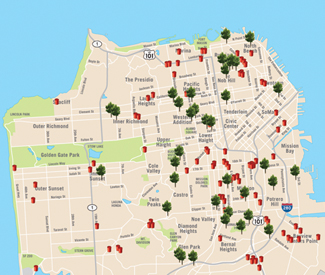
THE GREEN ISSUE It happens suddenly, unexpectedly: you turn a corner or hike up a street and notice, almost out of the blue, a well-kept spot of green, a surreal bit of nature sliced out of all the housing and concrete. According to a list provided to us by San Francisco Recreation and Parks (www.sfrecpark.org), there are 46 designated mini-parks, or pocket parks, nestled in various SF neighborhoods: publicly maintained, accessible areas usually no bigger than the size of a single vacant lot. We set off to discover five perhaps lesser known ones, described in the map below.

Then, in a nod to one of our all-time favorite cartographic-experimental books, Infinite City by Rebecca Solnit (UC Press, 2010, www.rebeccasolnit.com) we decided to overlay a map of locations of leaking underground storage tank (“LUST”) cleanup sites, found at geotracker.waterboards.ca.gov. LUSTs are buried tanks of toxic material, usually containing petroleum but sometimes solvents or other hazardous waste, that threaten groundwater, soil, and air and must be cleaned up — often with the help of state and federal funds — before the land they’re beneath can be built on or repurposed. We’ve plotted 85 LUST sites, many of them former or current gas station locations, whose statuses are under assessment or being monitored or remediated.

There is no direct connection between mini-parks and LUST cleanup sites; we think, though, that there is the suggestion of an environmental tale, a hidden history maybe, in the visual juxtaposition of the two.

>>CLICK HERE TO SEE THE MAP (PDF)

We and Mr. Jones

1

caitlin@sfbg.com

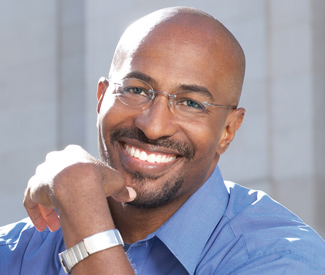
THE GREEN ISSUE No one can accuse Van Jones of being a one trick pony. In the early days of his activist career he monitored police violence in the Bay Area, and from there gradually widened the frame of his activist efforts. Jones formed the Ella Baker Center for Human Rights in Oakland in 1996, then became a green jobs pioneer, promoting environmentally-friendly work in low income communities — a revolutionary tactic that eventually landed him a short-lived adviser position within President Obama’s Council on Environmental Quality.

In his new book Rebuild the Dream (Nation Books, 278pp, $25.99) Jones has expanded his talking points to include the ways in which the financial sector has let us down, how Obama only did what we forced him to do (we gotta yell louder, Jones says), and how we can help fix the economy by focusing on “collaborative consumption.” Call it holistic activism. He’s launched a national junket to talk Rebuild that will bring him to the Commonwealth Club on April 16.

It is perhaps this kind of nuanced approach that scared the bejeezus out of the conservative demagogues whose smear campaign convinced Jones to resign from his White House post in 2009. Leave it to Glenn Beck to shame someone for saying he wanted “a whole new system” (as Jones proclaimed in a speech at a youth climate change conference.) The conservative media accused Jones of a communist past — which was accurate enough — and of signing a 9/11 truther petition that said that George Bush had prior knowledge of the World Trade Center attacks. He was innocent of this last point, the organization in question admitted months later, to a deafening media silence.

But Jones hasn’t retracted his call for a new system. In fact, in the pages of Rebuild the Dream he seems to step into a post-resignation hybrid role, in which he is no longer an outsider activist, but still has no formal role in Washington, D.C. Accordingly, he seems less fired up by the actions of national politicians as the agenda-pushing energy of the Tea Party and Occupy movements, which his new book spends entire chapters analyzing and critiquing. Even certain innovative businesses get a shout-out.

“You have Kiva, Kickstarter, Airbnb, and Zip Car already beginning to point to a future economy where more people are sharing fewer things,” Jones told the Guardian in a phone interview last week. “That’s good for people and the planet. You are also are saving money and you’re relying on people and relationships rather than dollars, you’re refinancing your social capital.”

He calls this economic ethos “collaborative consumption,” and it’s a heady idea for proponents of self-sustaining communities. Building a new economy on this business model, however, will take some tweaking that’s not covered in Rebuild — the city-level debate on whether SF Airbnb users should be subject to the city’s 14 percent hotel tax is one current-day example of how things can get complicated.

Rebuild offers a fairly honest critique of Obama’s successes and failures during the president’s first year in office. Nonetheless, the timing of the book, with it’s underlying message that we need to stay engaged in the political system to achieve real change, seems somewhat cagily timed. Is Rebuild the Dream part of Obama’s re-election campaign?

“The answer is no,” Jones is quick to reply. “We’re a non-partisan organization, we don’t endorse political candidates.”

But the election year publication is no coincidence: he wants all candidates to start talking about fixing the institutional reasons behind inequality.

“The two factors once used to pull people out of poverty were home ownership and education,” he says. “Those have now become the two factors by which people are being pulled into poverty because of the underwater mortgage problem and the fact that kids are coming away from college with massive debt and no ability to get a job. We think that these are issues that the politicians need to be forced to respond to and rethink.”

VAN JONES

April 17, 7pm, $20

Commonwealth Club

595 Market, second floor, SF.

(415) 597-6700

www.commonwealthclub.org


Domestic violence: A Latina, feminist perspective

0

Earlier this week, we posted an Op-Ed piece by Myrna Melgar which has been receiving a lot of attention. The piece was orginially published on the blog of publisher Bruce Brugmann, and then in this week’s paper. Click here to read the original post

End the healthcare scam

7

OPINION Last year, after receiving data from San Francisco, the Wall Street Journal reported on an investigation into the use of health reimbursement accounts by several local restaurants. It showed a group of employers evading the city’s health care law while charging their customers a “Healthy San Francisco” surcharge that is never actually spent on employees’ health care.

Rather than providing health coverage to their workers, as customers are led to believe, the restaurants are allocating funds for HRAs — and taking back the funds before they can be used.

The numbers speak for themselves: Of the $62 million that was set aside for health care accounts in 2010, more than $50 million was kept by employers.

Workers spoke about never being notified about the accounts; being forced to jump through numerous, often onerous hoops to receive reimbursements or never receiving reimbursements; facing severe restrictions on use of the funds; and fearing retaliation for seeking to access the funds. It was clear that as long as employers can take back unspent funds they have a large incentive to restrict workers’ access.

In response, Supervisor Campos drafted an amendment to the Health Care Security Ordinance (known as Healthy San Francisco) that would have closed this loophole, which was being exploited by a small number of employers. The Chamber of Commerce, accompanied by the San Francisco Chronicle, made hysterical claims about impending job loss and business closures, and after the Board of Supervisors approved the legislation on a 6-5 vote, Mayor Ed Lee vetoed it.

Supervisors Malia Cohen and David Chiu then authored “compromise” legislation that actually didn’t address the problem. Their version merely allowed employers to take back workers’ health care dollars after two years instead of one. This cosmetic change did, however, provide enough window dressing to please the Chamber, so the supervisors approved it and Mayor Lee signed it into law.

Now, just a few months later, an article in the Public Press showed exactly why we opposed the Cohen/Chiu amendment in the first place: It doesn’t really close the loophole. Employers can still take money back from the HRAs. This creates a clear incentive to choose HRAs over insurance — the worst option for workers. Furthermore, the loophole leaves responsible businesses that provide health coverage to employees through insurance or HSF competing against employers that exploit it by paying less into HRAs.

When the landmark Healthy San Francisco legislation passed five years ago, it never occurred to us that some businesses would be so obvious in their attempts to game the system. We find it unconscionable that there are businesses charging customers a healthcare surcharge and then keeping the money for profit. What is more unconscionable is that City Hall passed an amendment that continues to let it happen.

The Department of Labor Standards Enforcement compliance data for 2011 will be available next month — and if that continues to show abuse of the HRA provision, then it’s time for the Board of Supervisors to end the charade and truly close the loophole once and for all. Healthy San Francisco is about providing healthcare for workers — not creating additional profit for businesses.

Assemblymember Tom Ammiano represents the 13th District. Supervisor David Campos represents District 9.

Elevating the issue

17

The Mirkarimi saga and the troubling prevalence of domestic violence are disturbing. But if there’s a bright side, it’s that advocacy groups, including La Casa de Las Madres, the San Francisco Domestic Violence Consortium, and SF National Organization of Women (NOW) have been able to use the incident to raise awareness about domestic violence. Now, they may be affecting city policy.

Upset by Mirkarimi’s infamous comment that the incident was a “private matter, a family matter,” La Casa de Las Madres has funded several billboards in English and Spanish declaring that “domestic violence is NEVER a private matter” and directing the public to domestic violence response services.

For some, the next step is to permanently codify a zero-tolerance policy for domestic violence by law enforcement officers.

In 2003, the International Association of Chiefs of Police wrote a model policy on this topic that has been adopted in some California counties. NOW SF Chair Mona Lisa Wallace told us that several feminist and anti-domestic violence nonprofits are currently in talks with the mayor and SFPD about adopting it in San Francisco.

“We want domestic violence victims to trust that the officers in blue are on their side,” said Wallace.

The policy states that “Any officer convicted through criminal proceedings of a domestic violence crime shall be terminated from the department.”

Had the policy been in place already, Mirkarimi likely would not have pled guilty, since it would have automatically cost him his job. It also states: “If the facts of the case indicate that domestic violence has occurred or any department policies have been violated, administrative action shall be taken independent of any criminal proceedings as soon as practicable. “

That clause would involve the discretion of police chiefs, commissioners, and the sheriff. It would be hard to apply it to the sheriff, who is an elected official who reports to nobody.

The policy also makes clear that “Any officer determined through an administrative investigation to have committed domestic violence shall be terminated from the department.”

When police are charged with crimes, they go through administrative hearing investigation. They are first “tried” by the police chief, and then, if need be, the Police Commission. These administrative investigations can lead to dismissal, though they don’t in the majority of cases.

If the policy was in place, and an administrative investigation found that a police officer had engaged in domestic violence, the commission members would have no discretion: they would be obliged to terminate the officer.

In Mirkarimi’s case, an “administration investigation,” as required under the policy, would likely look very much like the procedure he is already undergoing. It’s unlikely that it would have made the process any less drawn-out or consuming of public money, attention, and resources. But, if adopted, the policy would represent a broader city stance on domestic violence beyond terminating Mirkarimi. It includes procedures for screening police candidates with histories of abuse and working with police to prevent them from committing violent crimes.

Sorting through scandal

22

news@sfbg.com

>>Read the Guardian Op-Ed by Eliana Lopez’s friend Myrna Melgar here.

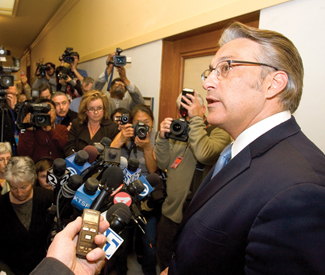
On March 20, Mayor Ed Lee announced his decision to suspend and seek the removal of Sheriff Ross Mirkarimi, taking the city into complex and uncharted legal and political territory. He did so with little explanation in a statement lasting two minutes. Then he went and hid.

Over the past week, the mayor has refused to expound on the reasoning behind his decision, won’t answer questions from reporters, and has held no public events where he might face the news media.

But he’s set off the political equivalent of a nuclear bomb, forcing the supervisors to take on a no-win situation in an election year and leaving the City Attorney’s Office, the Ethics Commission, and Mirkarimi’s lawyers scrambling to figure out how this will all play out.

At issue is whether Mirkarimi’s guilty plea to a misdemeanor false imprisonment charge — and his actions since the New Year’s Eve conflict with his wife, Eliana Lopez, that led to the three domestic violence charges that he originally faced — warrant his immediate removal from office without pay pending hearings that could take months. Mirkarimi, the mayor alleges, violated official misconduct standards written into the City Charter with little discussion in 1995, broad language that has yet to be interpreted by a court.

Mirkarimi and his new attorney, David Waggoner, responded March 27 by filing a court petition challenging that language — “conduct that falls below the standard of decency, good faith and right action impliedly required of all public officers” — as unconstitutionally vague and arguing Lee abused his mayoral discretion in suspending Mirkarimi and violated his due process rights by taking away his livelihood without a hearing. They are asking the court to order Mirkarimi’s reinstatement, or at least the restoration of his salary, until the long city process determines his fate.

“It makes it more difficult for the sheriff to fight these charges when he’s suspended without pay,” Waggoner told us.

To those who have been calling for Mirkarimi’s removal for the last few months, the case seems simple: Mirkarimi grabbed Lopez’s arm with enough force to leave a bruise, police and prosecutors got a video the neighbor made of the wife tearfully telling the story, and Mirkarimi tried to quell the controversy by calling it a “private matter” — infuriating anti-domestic-violence advocates who have spent decades trying to explain that DV is a crime, not a family issue. The sheriff ended up pleading guilty to a related charge.

That, many say, is plenty of reason to remove him from office: How can a top law-enforcement official do his job when he’s been convicted of a crime for which advocates say there should be zero tolerance? How can a man who runs the jails have any credibility when he’s pled guilty to false imprisonment?

“He has chosen not to resign and now I must act,” Lee said at a press conference he held shortly after the 24-hour deadline he gave Mirkarimi to resign or be removed.

But like everything in this politically fractured and passionate city, it’s a lot more complicated.

WHAT REALLY HAPPENED

Lopez and her attorneys have consistently maintained that Mirkarimi was not abusive, that the video was created solely in case their deteriorating marriage devolved into a child custody battle, and that it was not an accurate description of what happened that day, suggesting the former Venezuelan soap opera star was telling a particular kind of story.

The Guardian and the San Francisco Chronicle (“Mirkarimi’s argument with wife detailed,” March 25) have pieced together some of what happened. Sources say the couple argued in the car on the way to lunch at Delfina Pizzeria about whether Lopez would take their nearly three-year-old son, who was sitting in the backseat, with her to Venezuela.

The couple had been having marital problems and Mirkarimi, worried that she might not return or that their son could be kidnapped for ransom, got angry. As the argument escalated, Mirkarimi decided to take the family home. On the way, Mirkarimi told her that he had spoken to a lawyer and learned that she needed written permission from him to take their son out of the country and that he wouldn’t do so.

That made Lopez angry and she got out of the car and tried to unfasten their son to leave when Mirkarimi grabbed her right arm, leaving a bruise that was clear in the videotape but which wasn’t visible a week later when she wore a sleeveless dress to Mirkarimi’s swearing in ceremony for sheriff.

That’s the couple’s version of events, anyway. There are no witnesses who can verify or dispute it.

Lee never called Lopez or her attorney to hear this story before deciding to remove him from office. But in the official charges he filed against Mirkarimi, Lee alleges “acts of verbal and physical abuse against his wife” and that he “restrained Ms. Lopez and violated her personal liberty,” plus unproven allegations that he was never charged with, including encouraging neighbors to destroy evidence, and of hurting morale in the Sheriff’s Department (based on a newspaper quote from a political opponent).

You don’t have to defend Mirkarimi’s conduct or belittle the serious crime of domestic violence — in fact, you don’t have to believe anything the sheriff or his wife have said — to ask a few basic questions. Is this extraordinary executive power warranted in this case? What harm would come from waiting for a recall election, the usual method of removing elected officials after a scandal? Why did Lee give Mirkarimi 24 hours to resign and did he offer anything as incentive (sources tell us he offered another city job)? Will he release the City Attorney’s Office advice memo, and if not, why?

The Guardian submitted those and many other questions to Mayoral Press Secretary Christine Falvey, who said she would answer them by March 23, but then sent us this message at the end of that day before going on vacation: “After looking at your questions, it seems Mayor Lee addressed much of this in his comments on Tuesday. After Sheriff Mirkarimi pleaded guilty to a crime of false imprisonment, Mayor Lee made a thorough review of the facts, reviewed his duties under the Charter and gave the Sheriff an opportunity to resign. When that did not happen, he moved to suspend the Sheriff.”

Very few progressives have stood up publicly and taken Mirkarimi’s side. One of them is Debra Walker, a longtime activist and city commissioner.

“This is about McCarthyism at this point, and not domestic violence,” Walker told us. “Instead of helping [Lopez], they have succeeded in breaking this family apart. It’s just bullying. It was always aimed at Ross stepping down and removing him as sheriff.”

THE LEGAL MESS

So what happens next? It is, to say the least, unclear.

The last time a public official was charged with misconduct was in the 1970s, when Joe Mazzola, an official with the Plumbers Union, was removed from the Airport Commission because he refused to order striking plumbers back to work. The state Court of Appeal later overturned that decision, ruling that “official misconduct” had to be narrowly construed to be conduct directly related to the performance of official duties (a case Waggoner relies on in his petition).

But the City Charter has changed since then, and now allows removal for the vague charge of “conduct that falls below the standard of decency and good faith and right action impliedly required by all public officers.” That phrase gives extraordinary power to the mayor — and, given some of the conduct we’ve seen at City Hall over the years, could have been used to remove a long list of city officials.

The Charter states that Mirkarimi, as the accused, will get a hearing before the Ethics Commission, and that he can be represented by counsel. It’s silent on the question of what form that hearing will take, what the rules of evidence will be, what witnesses will be allowed, and what rights the defendant will have.

Four of the five Ethics Commission members are practicing attorneys, and before they can call a hearing, they’ll have to hold a meeting to discuss the rules.

In the case of former Sup. Ed Jew, who was accused of falsifying his address, Ethics was prepared to take only written testimony (Jew resigned before any hearing, partially to deal with more serious federal charges of shaking down constituents for bribes). But that’s not a hard and fast rule — this time, the panel could decide to allow both sides to present witnesses.

If the commission decides to allow evidence, someone will have to rule on what evidence can be presented and what can’t. Will that be the commission chair, Benjamin Hur, or the commission as a whole?

The answer is: Nobody knows for sure. Hur told us he couldn’t comment on anything related to the case; the City Attorney’s Office won’t comment, either, since the office is representing both the mayor (on the prosecution side) and the supervisors and the Ethics Commission, and the board and the commission haven’t made any decisions on rules yet.

Then it gets even trickier. The Board of Supervisors has to vote on whether to remove the sheriff, and it takes nine votes to do that. So if three supervisors vote no, Mirkarimi is automatically back in office.

There are no rules in the Charter for how the board will proceed; in theory, the supervisors could simply accept the recommendation of the Ethics Commission and vote without any further hearings. They could rely on the record of the Ethics proceedings — or they could hold the equivalent of a second trial, with their own witnesses and procedures.

To add another layer of confusion, Mirkarimi, as sheriff, is classified under state law as a peace officer — and the Peace Officers’ Bill of Rights sets entirely different standards for administrative and disciplinary hearings. Among other things, Mirkarimi could assert the right to have the Ethics Commission hearing closed to the public and the records sealed.

State law also mandates that a peace officer facing suspension without pay has the right to a hearing and adjudication within 90 days. That’s not in the City Charter; under the Charter, the city can wait as long as it wants to decide the issue.

Nobody knows for sure whether the Peace Officers Bill of Rights trumps the City Charter.

It’s clear that Mirkarimi, like anyone accused of a crime or facing an administrative hearing, has the right to due process — but not necessarily the same rights as he would have in a court proceeding. It’s also clear that the supervisors will be sitting in a quasi-judicial role — and thus can’t take into account anything that isn’t part of the official record of the case.

They probably can’t, for example, hold a public hearing on the issue — and judges in a case are theoretically supposed to ignore the hundreds of calls and emails that are now flooding in to the board offices on all sides.

The political implications are equally complex. Lee would have been in a dangerous situation if he declined to file charges — if Mirkarimi ever did anything else this disturbing, some would say it was Lee’s fault for leaving him in office.

It’s a safe bet that none of the supervisors are happy about having to vote on Mirkarimi’s job, but it’s particularly tough for the progressives. Anyone on the left who votes against removal will be subject to a barrage of attack ads — and since the balance of power on the board will be decided in November, when David Chiu, John Avalos, Eric Mar, David Campos, and Christina Olague, all more or less part of the progressive bloc, will all be up for re-election, the pressure on them will be immense.

That, in and of itself, ought to be reason for the sheriff to step down, some progressives say: Is preserving Mirkarimi in the Sheriff’s Office worth potentially destroying the progressive majority on the board? It’s a good question — and one that Lee’s advisors were well aware of, too.


Alerts

0

yael@sfbg.com

THURSDAY 29

End hunger and poverty

Keith McHenry is one of the founders of Food Not Bombs. The group’s simple concept—find some extra food in your area and feed your local people—took off worldwide and has endured for decades, still serving home-cooked meals in public spots and getting in trouble with police for serving food without commercial permits a few times a year. Join McHenry and local artist Carol Denney for a benefit for FNB’s East Bay chapter, and, of course, some delicious food.

6pm, donation suggested

Berkeley Art House

2905 Shattuck, Berk.

berkeleyarthouse.wordpress.com


SATURDAY 31

Anarchist Bookfair

You don’t want to miss this legendary San Francisco event, hosted annually by Bound Together Bookstore. It’s unclear whether another world is possible, but in a room jam-packed with books, pamphlets, zines and art, inspiring people, and 20 educational sessions per day, you may start to feel that it is. Learn about uprising from Haiti to China, surrealism and anarchism, art and anarchism, gender and anarchism, economics and anarchism, and the prospects of electoral politics (hint: hopeless.) Learn about the history of the commons, its relationship to communes, and what it means that so many people have been occupying them lately. Bay Area authors will talk about their work on everything from black power and social movements of the past to radical science fiction visions of the future. There will be free bike valet parking and a kids’ space.

10:30 am, Saturday and Sunday, free

County Fair Building

1199 9th Ave, SF

bayareaanarchistbookfair.wordpress.com


SUNDAY 1

We won’t get fooled again

People in 13 cities will take to the streets to demand an end to the criminalization of homelessness. And San Francisco, from sit-lie bans to “illegal lodging” laws, can’t seem to leave people on the street in peace. Show up for music, street theater, and teach-ins.

2pm, free

Union Square

www.cohsf.org


Sister Spit tour kick-off

Michelle Tea helped to found Sister Spit in 1994, and since then, the female writers tour has graced nationwide audiences with its “fantastically queer, profoundly talented” lineup. They will hit the road again this April, but not before a kick-off event in the city where it all began. Comic book authors, playwrights and poets will unite, and there will be cookies.

2pm, free

Koret Auditorium, San Francisco Public Library main branch

100 Larkin, SF

Facebook: Sister Spit San Francisco

Black Power, then and now

17

“We’re not ever to be caught up in the intellectual masturbation of the question of Black Power. That’s a function of people who are advertisers that call themselves reporters.”

That’s how the radical student and civil rights leader Stokely Carmichael opened a speech about Black Power — a term he helped popularize — at UC Berkeley in 1966. But the ideas and concepts behind Black Power proved to be an enduring ones that are enjoying a resurgence today.

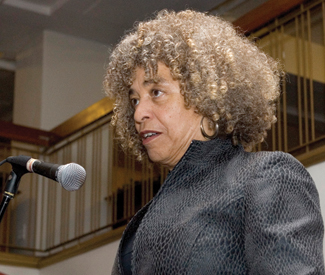
Angela Davis epitomized the Black Power movement to many observers. The author, scholar, and professor was a Black Panther Party member who then joined the Communist Party USA and brought a class analysis to issues of race, building on the movement that began in the ’60s for decades to come.

In recent months, as the Occupy Wall Street movement began to focus the country’s attention on economic and social inequities, Davis has spoken out regularly in support of the movement and drawn connections back to her early activism. She has embraced the “99 percent” paradigm, and the connections between various issues that Occupy activists have sought to highlight.

“Our demands for justice lead us toward demands for prison abolition. And our demands for prison abolition lead us to demands for free, quality education. And our demands for free quality healthcare, and housing, and an end to racism, an end to sexism, an end to homophobia,” Davis said March 1 in Oakland at a benefit for Occupy 4 Prisoners, a coalition of Occupy protesters and prison justice advocates.

Consciousness surrounding those connections can be largely attributed to efforts from Black Power organizers.

“When I listen to the way young people so easily talk about the connectedness of race, gender, and sexual issues, and I remember how we groped our way towards an understanding of those connections, it makes me really proud,” Davis said in a January interview with Independent Lens.

And as Davis said at the March 1 event: “One of the most exciting accomplishments of the Occupy movement has been to force us to engage in conversation, explicit conversation about capitalism, for the first time since the 1930s.”

The movement’s economic message also seemed useful to Kiilu Nyasha, a San Francisco-based journalist and former member of the New Haven Black Panther Party.

“Globalization has already happened. It’s not happening, it’s happened. One percent, internationally, owns and controls 80 percent of the world’s resources. People are dying all over the world of every complexion which you can think of” Nyahsa said March 14 at a panel discussion called Reboot the Rainbow.

The original Rainbow Coalition- the topic of the March 14 panel- included the Black Panther Party, the Puerto Rican Young Lords, and the poor white Young Patriots organization, and was committed to a Black Power concept: organize your own, fight together. Building coalition is more important now than ever.

“It’s not Black Power right now,” says Terry Collins, president of KPOO radio, a black-owned station long focused on community empowerment. “It’s people power. It’s power unto the people who are in need: all the people out there who are out of their homes, students who owe so much that they’re like indentured servants.”

Occupy the Hood is a national effort to encourage participation of people of color in Occupy Wall Street. In its mission statement the group writes, “It is imperative that the voice of people of color is heard at this moment!”

The focus of San Francisco’s Occupy the Hood chapter is “three-fold,” according to organizer Mesha Irizarry: “The cop-watching in neighborhoods that are criminalized, especially poor neighborhood of color. It’s freedom fighters against foreclosures. It’s also bank transfers.”

Occupy the Hood showed up March 16, when a group known as the Foreclosure Fighters- organized and supported Alliance of Californians for Community Empowerment, Homes Not Jails, and related groups—occupied their latest foreclosed home. “We’re liberating this house. We’re taking it out of the hands of the oppressor,” said Archbishop Franzo King of the African Orthodox Church.

“Jesus Christ was an uncompromising revolutionary. He spoke truth to power. Then they killed him for it,” added King in a nod to the radical religious leaders who have influenced liberation movements throughout the years.

Black Power was concerned with self-determination, with organizing within community. That legacy is still strong as San Francisco’s African American communities experience an out-migration and continuing police harassment and violence.

“Black sailors and black army personnel built the shipyard,” said Jameel Patterson, a founder of the Bayview-Hunters Point-based community organization Black Star Liner Incorporated. “Hunters Point, West Point, Harbor Road—they’re all military names. The soldiers stayed there with their families. The area has a rich African American legacy going back to the ’40s. Now it’s fading…we want to make sure that community’s still here 20 years from now.”

Patterson remembers being a child in the ’70s when, on the tail of an era brimming with black liberation efforts. “There were more community events,” he said, but now, “People don’t have connections with each other. That’s what we’re building.”

The group does regular events where they serve free home-cooked meals to residents, reminiscent of the Black Panther Party’s free breakfast program. “With every plate, you get information,” often Know Your Rights reminders for encounters with police, said Tracey Bell-Borden of Black Star Liner.

They have also spent countless hours in City Hall meetings advocating for their community and reporting back on city policies that affect it. “We occupy the Police Commission meeting,” said Bell-Borden.

Police are a central and tricky question for the Black Power movement of the ’60s, as well as organizing efforts today. Black Panther Party members spent years serving free breakfast to children, writing and selling newspapers, and even running election campaigns, but they are often remembered for carrying guns and efforts to “police the police.” So many leaders were arrested that energy that could have gone into feeding or education was often channeled into freeing prisoners.

“I was in the second chapter of the Black Panther Party,” Nyasha said at the March 14 event, “which basically existed to get the first chapter out of jail.”

Recent police crackdowns have fed indignation not just about policing protesters, but about the role police play in poor communities of color. “One thing Occupy has done is address the issue of policing in communities of color, to the extent that some aftermath of what we’re seeing at Occupy is shedding light on how police can sometimes treat people,” said Kimberley Thomas Rapp, executive director of the Lawyers’ Committee for Civil Rights of the Bay Area.

“In black neighborhoods, police should be community partners, not come in and exert more force than necessary. And at protests, they should be there to ensure safety, not just to arrest people unnecessarily or use excessive force,” Rapp said.

Police crackdowns on Occupy are the first exposure many white protesters of the younger generation have had to excessive police force, an issue that was central to the story of the Black Power. Sadly, for many black and other protesters of color, excessive police force is nothing new.

“It’s absolutely the case that police brutality shown towards many Occupy protesters has brought to the forefront the issue of police violence and led to an awakening among many white folks of the day to day reality of police violence that many people of color have lived with now for many years,” Michelle Alexander, author of The New Jim Crow, told the Guardian.

Enraged at police beatings (see “OPD spies on and beats protesters,” Feb. 14) both Occupy Oakland and Occupy San Francisco have held “fuck the police” marches. March 18, after a six-month commemoration celebration brought 3,000 to Zuccotti Park in New York City, followed by 200 arrests and rampant police violence, Occupy Wall Street protesters followed suit, holding their first anti-police brutality march.

Occupy Wall Street has reanimated concepts that burned through the ’60s, such as violence vs. nonviolence, the systemic causes of personal economic woes, and the peoples’ relationship to police. With the consciousness created by Black Power activists, today’s organizers have a foundation on which to build their own answers to these questions, across issues and generations.

National Occupy the Hood has called for action concerning Trayvon Martin, the unarmed black 17-year-old who was shot Feb. 26 and whose confessed killer has yet to be arrested. Taking up high-profile cases of injustice and working more closely with organizers to respond to the needs of local African American communities could bring more power and truth to the rage for justice currently galvanizing a new generation.

“It’s about black re-empowerment,” Archbishop King said. “It’s like the torch, the light of freedom and justice, has actually gone out. And we’re trying to relight that. That’s why I’m so excited about the Occupy movement; it ties into the Black Power struggle. And I think it’s waking up some of us old revolutionaries to stand up.”

Alerts

0

THURSDAY 22

The longest war: Afghanistan beyond the Taliban

Two veteran journalists who have covered Afghanistan talk about the war that has surpassed Vietnam as the longest in US history. Masood Farivar, a former fighter in the Afghan anti-Soviet resistance before becoming a newswire in New York, then returning to Afghanistan in his capacity as journalist, and Tim McGirk a former Time magazine bureau chief in the region who has reported from Afghanistan since 1990, will have a conversation hosted by Jason Motlagh, a freelance journalist/filmmaker and former Time magazine correspondent in Kabul. A short documentary, Million Dollar Militia , will also be screened. What does a continued US presence—or, potentially, troops preparing to leave—mean for the country’s future? What political environment exists there?  Oakland-based production company Blackbeard Films launches a series that will highlight reporting on underreported stories with this event. 

7 p.m., free

Arbor Café

4210 Telegraph, Oakl.

www.blackbeardfilms.com 


SATURDAY 24

Wilderness first aid for the streets

In the saga of Occupy Oakland clashes with police, perhaps none are more unsung than the medics. These volunteers do everything from flushing eyes of tear gas to being first responders to protesters with broken limbs and gushing wounds. The medics team up for a training to others who want to do what they do. “Developed for wilderness situations, this course is adapted for urban uprisings, and will include care for chemical weapons exposure, herbal first aid, and public health considerations for long-term occupations,” according to the Occupy Oakland medics committee. This course is serious, covering two full days- March 24 and 25, 10am to 8pm. Red Cross certification and Continuing Education Units credits are available for $20, and scholarships are available.

10 a.m., donation suggested

The Holdout

2313 San Pablo, Oakl.

www.occupyoakland.org

WFAforthestreets@gmail.com 


St. Patricks Day Ceili

Did you make it through that special day without participating in a ceili, a traditional Irish social dance that is a hallmark of St. Patricks Day? If so, you’re in luck — you will be given a second chance. This dance is easily accessible for newbies and much more fun than cheap plastic green stuff and day-drinking. 

7 p.m., $10 (free for children)

United Irish Cultural Center 

2700 45th Ave., SF

www.irishcentersf.org  


MONDAY 26

Speaking youth to power

When it comes to climate change, young people know what’s up. Specifically such acclaimed young people as project coordinator for the urban farming non-profit Urban Tilth and Green For All Fellow Tania Pulido, Adarsha Shivakumar, founder of Project Jathropa, and Abigail Boroh, the student best known for interrupting the Durban, South Africa Climate Conference in December to bring urgency to the less than promising conference proceedings. Join them for a discussion on civic engagement within the climate justice movement. 

Doors 5:30, program 6pm, $20 (free for members and students)

Commonwealth Club

595 Market, SF

www.commonwealthclub.org


The poetry of poverty

0

Editors note: POOR Magazine‘s 5th Annual Poetry/Music Battle of ALL the Sexes was held on Valentine’s Day. This years battle, POOR’s Lisa Gray-Garcia tells us, “honored ancestors Uncle Al Robles, Mama Dee and all ancestors that have been victims of po’lice terror, racism and poverty.”

I love POOR Mag and all the radical poverty activists there and about do, and as a show of support, I’m happy to run the winners here.

FIRST PLACE

Birth Out Mother Earth

By Trina Brigham a.k.a Realness

I was formed from dust and chillzed out the wound of my mother.

I’m mother’s earth first born…

When her water bag broke …

She baptized me in many bodies of waters…

She washed me in her oceans…

She showered me in crimsomed tides…

We are compatiable genetically incline…

My soil is fertitle i reproduce as well as mulitiply…

Not only did i recieve my mother’s blessings…

I also inherited her earthy treasures…

I birth out diamonds minerals and exotic stones out my wound…

I bleed symphonies of oils and fossil fuel…

Not only do I have evidence I’m living proof…

I help sutain life beyound measure…

I reproduce jewels as well as treasures…

I craddle civilzation man’s roots are as acient as me…

The garden of Eden she lives here with me…

The first tree grown rose up out the dirt from me…

Which is why I question why are my people living in poverty?

I reproduce the highest quality of natural resources from within me…

There are more than enough to feed every part of me…

God gave me the ability to reproduce and do so abundantly…

So why must my peole parish from stavation and poverty?

My people are a choosen generation….

Their generational seeds are implanted through me….

With provision came decision ….

I have always been whole…

A whole continent …

A whole nation…

A whole country….

A whole people…

I’m birth out of Mother Earth

I’m Africa and Africa is me!!!


SECOND PLACE

El Machete

By Muteado Silencio

From sun up to sun down, rain or shine,

365 days with machete in hand,

cutting or chopping the harvest to live another day,

to live for my family,

for my wife for my children, with humanity with

mother earth.

to stay alive,

to survive to see tomorrows sun rise.

365 days with machete in hand to defend the future

of my family, my wife

my children the future of humanity of mother earth.

365 days with machete in hand to stand against the

unjustice against the against

the ones who can not defend themselves

Against the raping of mother earth 365 days

with machete in hand to defend mother

earth.

Lee and the foreclosure crisis

1

EDITORIAL More than 1000 homes in San Francisco are either in foreclosure or at the start of the process. Some 16,000 homeowners are underwater, and as many as 12,000 may face foreclosure in the next 12 months. A report by the Alliance of Californians for Community Empowerment shows that the city could lose $115 million from the reduced property taxes and the costs of carrying out evictions.

That’s a crisis — and while the mayor has no direct control over home foreclosures, he ought to be speaking out and joining the protesters who are fighting this cascade of often-fraudulent bank actions.

The problems are legion: An audit released in February by Assessor Phil Ting shows that more than 80 percent of the foreclosure notices filed in San Francisco contain at least one legal irregularity, and many contain multiple. Banks back-date documents, use faulty information, and in some cases clearly and directly break the law when they move to seize property — often because of bad-faith loans that were more the fault of the banks than the homeowners.

A group from Occupy Bernal, the well-organized, sophisticated operation that’s been intervening in foreclosures and evictions in the Southeast neighborhoods, visited us recently, and the stories we heard were alarming. Some told of bankers who promised to make loan modifications — then went ahead with foreclosure anyway. Some people spend weeks just trying to figure out who actually owns the mortgage — and while the financial institutions are ducking calls and hiding from responsibility, they’re moving forward to toss people out of their homes.

ACCE and Occupy Bernal have had some successes — they slowed down foreclosure actions, forced banks to come to the table and in some cases saved homes. But the activists are up against big corporations and big numbers — too many homes on the block, too many financial institutions, and not enough people and money.

The Ting report showed enough violations of law that we’ve already urged the city attorney and the district attorney to start taking action.

But we’ve heard little beyond silence from the office of Mayor Ed Lee.

Lee’s the city’s chief executive, the person who has to handle the financial fallout of the foreclosure crisis as well as the human impacts — families evicted from their homes have a high chance of winding up on the streets, putting additional pressure on already-stressed social services.

Besides, this is a tragedy — and a lot of the problem is simply unaccountable, unreachable financial institutions. If Occupy Bernal and ACCE, through volunteer organizing and community pressure, can prevent a fair number of evictions, thing what the mayor of San Francisco could do — just by speaking out.

Lee ought to show up at some of the Occupy Bernal actions, but that may be too much to ask. But it’s not too much to suggest that he publicly support the foreclosure fighters and call on the banks to work with local homeowners.

The city keeps its multibillion-dollar short-term cash accounts in institutions like Bank of America, which is responsible for more than 10 percent of all foreclosures in the city. Wells Fargo, with its headquarters right here in town, is responsible for 22 percent of the local foreclosures. Lee ought to let the banks know the city won’t keep doing business with bad actors.

With a little visibility, the mayor could help save hundreds, maybe thousands of families from facing homelessness. This crisis calls for leadership; where’s the mayor?

Black Power and OWS

2

OPINION Since its inception in September of 2011, The Occupy Wall Street movement has come to mean many things to many people. For some it’s a movement to end skyrocketing tuition at State Colleges and Universities. For others its a platform to stop and bring attention to unfair and illegal foreclosures. Still others see the Occupy as a movement that’s going to bring back unions and level the playing field for workers.

But one of the nagging critiques of OWS has been that it’s a movement for white middle-class youth who were late to the social justice arena — where many who are poorer and darker had been struggling for years. While economic disparities on the surface appear to be universal, the challenge has been recognizing how many who are white and part of the 99 percent have been used strategically by those in power as a sort of buffer to keep black and brown folks at an economic disadvantage. Many have brought into the narrative that underachievement by blacks is the result of individuals not applying themselves hard enough.

The economic downturn in the white communities is now viewed as systemic, with a call to arms and a move to confront the system. What’s been missed is that for decades folks in the hood have been challenging the system, trying to survive and barely holding on. Only now are you starting to see deeper discussions between OWS and black and brown community members about how this economic system has uniquely impacted them.

Because we’ve seen former black panthers and leaders within black liberation struggles like Angela Davis, Elaine Brown, Bobby Seal, Mumia and Dave Hilliard work with or show support address OWS, the question of how OWS relates to the Black Power Movement has emerged.

Like OWS, Black Power means many things to many people, from economic empowerment to political empowerment. If we go back to what Student Nonviolent Coordinating Committee leaders Stokley Carmichael (Kwame Toure) and Willie Ricks (Mukasa Dada) meant when they first coined the phrase in 1966, it was a call for solidarity and challenging racism and the systems giving it light..

Black Power leaders back then weren’t about trying to reform the system and its institutions, but dismantle it and rebuild. That approach, and the militancy that came along with it, caused a split in the Civil Rights Movement. It was break from Dr. King and the nonviolent approach by the so-called Big 5 civil rights organizations.

Today, many of the aforementioned leaders, along with others, have evolved in their definition and understanding of what it means when we say Black Power. Not to short change or misspeak for anyone (keep in mind entire courses are devoted to the topic), today we see that Black Power has expanded on its critique of capitalism. That, of course, has been echoed in many sectors of OWS. In fact, that’s what’s attracted many from the old guard to it.

Today we see many in the Black Power movements dealing with issues like the Prison Industrial Complex, the mass incarceration of black folks, and tactics like stop and frisk, gang injunctions, war on drugs etc. Any conversation about economic disparity inevitably leads back to discussions on the prison system in the black community.

While we hear within OWS calls to rebuild the system and harsh critiques of capitalism, we haven’t always seen an emphatic call to arms to deal with the PIC and issues related to police terror — even as OWS members are frequent victims themselves.

In places like Occupy Oakland, we see those bridges being built in meaningful ways. We’ve seen the forming of Occupy the Hood, which frequently addresses those issues — but talk to OTH organizers in various cities and they’ll tell you it’s still a struggle to get folks on board and make this an intuitive part of their day to day outlook.

The good news is we see conversations taking place and folks trying to work it out..

And while OWS deals with building bridges into communities of color, in our own ranks we have the challenge of class divisions. We have folks who are black, and have means, who won’t even give lip service to these issues.

But then again, mass movements even during the hey day of Dr. King always had those who spoke out, got in the way and took up space for real change. With spring coming, there’s a lot of hope that things will pick up.

The legacy of racism

5

steve@sfbg.com

The legacy of brutal racism in this country, particularly against African Americans, shapes the events of today. That’s a notion that much of white America resists accepting, particularly conservatives. But actions create reactions, hatred begets hatred, and those cycles can roll forward endlessly and manifest in unpredictable ways.

That’s one of the most compelling lessons in local journalist Thomas Peele’s gripping and insightful new book, Killing the Messenger: A Story of Radical Faith, Racism’s Backlash, and the Assassination of a Journalist (2012, Crown), which grew out of covering the aftermath of the 2007 murder of Oakland journalist Chauncey Bailey by members of Your Black Muslim Bakery.

Bailey was killed to prevent him from writing a story in the Oakland Post about the violence and financial crimes perpetrated by followers of the late Yusuf Bey and his sons, including Yusuf Bey IV (aka Fourth). Peele and other local journalists and media outlets (including the Bay Guardian) formed the Chauncey Bailey Project to build on the work Bailey began and investigate his murder, which Fourth was convicted last year of ordering.

“The free press on which the public depends to keep it informed had been attacked,” Peele wrote. While such murders are rare in the U.S. — the last was a Mafia hit on a reporter from Arizona in 1976 — Peele and his brethren considered it important to send the message that, “A story could not be killed by killing a journalist.”

But the story that emerges from Peele’s years-long investigation goes well beyond Bailey’s murder, its flawed investigation by the Oakland Police Department, the violence and hypocrisy of the Your Black Muslim Bakery “cult,” or its long and complex relationship with Oakland’s political and community leaders.

Peele delves deeply into the 80-plus-year history of the Nation of Islam and Black Muslim ideology, dissecting its turbulent evolution and belief system that white people are “devils,” created by a mad scientist named Big-Headed Yakub, who use “tricknology” to hide the truth that African Americans are superior beings who will be spared during a coming Armageddon inflicted by a spaceship that has long circled the earth — a belief system that Malcolm X rejected after taking a hajj to Mecca and shortly before his assassination.

Peele dismisses the entire religion — which has very little in common with true Islam — as a deceptive scam from its inception, devised by the “con man” W.D. Fard and promoted by Elijah Muhammad simply to enrich its leaders by manipulating poor African Americans. Similarly, Yusuf Bey spoke the language of black empowerment in founding his own breakaway Black Muslim sect in North Oakland then used it as cover for criminal enterprises and raping the women under his control over a period of decades.

But to understand the appeal of Black Muslims preaching hatred of white devils, you have to look at the African American experience and horrible racism and violence that black people have endured in this country, as Peele does. He starts in Depression-era Detroit, where Fard and Muhammad met amid the virulent racism against Southern blacks who migrated north to work in Henry Ford’s automobile factories.

“This is the question of the psychology of race,” legendary attorney Clarence Darrow said during the Detroit murder trial of blacks defending their home against an attacking white mob, which Peele uses to great effect. “Of how everything known to a race affects its actions. What we learn as children we remember — it gets fastened to the mind. I would not claim that the people outside the Sweet house were bad. But they would do to Negroes something they would not do to whites. It’s their race psychology.”

We see Joseph Stephens (who would later become Yusuf Bey) growing up with tales of brutal lynchings in his hometown of Greenville, Texas, and later as a Santa Barbara hairdresser who discovered the Nation of Islam in 1962 after the Los Angeles Police Department had shot up its mosque and Stephens found his calling in the resolute words of Malcolm X and the Honorable Elijah Muhammad.

African American history made Bailey want to become a journalist focused on covering and empowering his community. And this same legacy — mixed with hopelessness, poverty, and broken homes during an upbringing in San Francisco and Richmond — animated Devaughndre Broussard, who fired three shotgun blasts into Bailey on a sunny morning in downtown Oakland.

“His life was no accident. Neither was his faith,” Peele wrote of Fourth in the last chapter. “The society that now worked through its flawed laws and imperfect courts to put him in prison for life had only itself to blame for the terror that Fourth and his fellow believers had inflicted upon it. The backlash against centuries of enslavement of Africans and the subhuman treatment of their descendants had seen to that. The stick figure hanging from a loose that Elijah Muhammad had ordered displayed in all the Nation of Islam mosques, the symbol of the boyhood lynching of his friend Albert Hamilton, showed that some could never forget, or forgive. Neither could Yusef Bey forget the stories of cotton fields his parents brought west from East Texas along with the story of a Negro burned to death as white people gathered in the square of a horrible place called Greenville and cheered. Some wounds are too deep to heal.”

But Americans have short memories for even our recent history, coupled with a growing sense that society’s have-nots somehow deserve to be that way and a lack of understanding of the many ways that racism and its legacy still affects this country.

“I don’t think white America understands it at all. White America has this attitude of: get over it,” Peele told me when I asked about that “racism’s backlash” theme. “How long can you oppress people and treat them like utter garbage before there is a rebellion?”

Gauged by poverty or incarceration rates, or by the poor quality of many of its schools, much of black America still faces tough struggles. It wrestles with a lack of opportunities and an understandable sense of hopelessness that can easily breed resentment or even violence. One example that Peele includes were the Death Angels (aka the “Zebra murders”), in which a small group of militant black ex-convicts randomly shot dozens of white people in San Francisco and Oakland in the early 1970s.

Peele closes the book with a chilling suggestion that Broussard, who is serving a fixed 25-year prison sentence because of his cooperation in the prosecution of Fourth and co-defendant Antoine Mackey, is studying to become a spiritual leader and may follow familiar patterns. “Look at where he came from? Have things changed that much?” Peele said of the lack of opportunities that Broussard faced growing up, and will face again when he gets out of prison in his mid-40s.

Peele has long been an award-winning investigative reporter rooted in deep research, which he combines with a colorful and dramatic narrative style. Yet he sometimes oversimplifies and harshly judges events and people, even Bailey, who Peele deems a lazy journalist and bad writer.

“The truth speaks for itself,” Peele told me. But the truth is often a matter of perspective, and Peele can’t escape the fact that he’s a white guy who has worked out of Contra Costa and Alameda counties since 2000. Perhaps that’s why he’s so quick to label poor urban areas with substantial African American populations as “ghettos.” Or, sometimes even more dramatically, as a “sagging, blood-splattered ghetto,” a phrase that a Los Angeles Times reviewer singled out as an example of how “Peele’s prose occasionally overreaches.”

I was repeatedly struck by the same thought, almost physically cringing when Peele labeled San Francisco’s Western Addition, my old neighborhood, as a violent ghetto. Or when he wrote, “Richmond is one of the most hopeless and violent cities in America, an oil-refinery town of 103,000 people, littered with shanties where shipyard workers lived during World War II ,” as if it were a cross between an Appalachian coal town and Third World hovel rather than a clean, modern Bay Area city well-served by public transit and a Green Party mayor.

Peele got defensive when I asked him about the labels, telling me, ” I stand by characterizations,” although he admitted that maybe Western Addition isn’t really a ghetto. “I think you’re nitpicking,” he told me.

Perhaps, and I do think that Peele’s flair for the dramatic is one of the things that makes Killing the Messenger such a page-turner, in the tradition of great true-crime novels such as Truman Capote’s In Cold Blood. But in a book that bravely takes on the complexities of racism and its backlash, I think this is more than a trivial “nit.”

It’s tempting for white America to dismiss such details, treat racism is a thing of the past, and malign racial sensitivity as political correctness. But as Peele and his book remind us, the wounds of not-so-distant indignities can run deep. And the collapsing opportunities for social and economic advancement in this country will create a backlash if we try to ignore it.

Interviewing Anonymous

3

yael@sfbg.com, steve@sfbg.com

There have always been journalists and activists devoted to safeguarding the free flow of information, but the age of the Internet has brought a new set of opportunities and challenges — and a new generation of loosely affiliated online enforcers collectively known as Anonymous.

This network of so-called “hacktivists” from around the world organize operations ranging from physical protests to cyber attacks on corporate websites, involving anything from small groups carrying out someone’s idea to large groups using downloaded software to launch sophisticated attacks on high-profile villains or in defense of embattled heroes.

“We are Anonymous. We are Legion. We do not forgive. We do not forget. Expect us,” is a common tagline members of the group use in announcing its campaigns, often through YouTube videos and accompanied by imagery of a suit with a question mark for a head or someone wearing the Guy Fawkes mask popularized by the film V for Vendetta, with its theme of the masses rising up against injustice, driven by the power of basic ideas about justice (see “Remember, remember the 5th of November,” 11/1/11).

The idea of the online community rising up in collective action under the banner of Anonymous first appeared around 2003, but it really caught on and went viral in the last few years, first when Anonymous organized global protests outside Church of Scientology offices in 2008 and again at the end of 2010 when Anonymous defended Wikileaks’ release of secret diplomatic cables, shutting down the websites of Visa, Amazon, PayPal, and other companies that cooperated with the U.S. government in trying to freeze Wikileaks’ assets.

Here in San Francisco, Anonymous helped organize and coordinate the waves of protests directed at BART in August 2011 after the agency shut down cell phone service to try to disrupt a protest of the latest fatal shooting by a BART police officer. It was through those protests that some of the earliest organizers of Occupy San Francisco say they met and began working together, and Anonymous has shown strong support for the Occupy movement.

So, for this year’s FOI Issue, we decided to chat up an Anonymous member who is active in the group’s discussions on its Internet Relay Chat (IRC) channels, which are hard to find and prone to being shut down whenever someone fears security has been breached. The following are excerpts from that interview:

SFBG Is there a philosophy behind the work Anonymous does?

ANON You should really ask the hive mind. We are all Anon, not just a single person. But I will answer you. There are a few things that bind all of Anon together: Justice, freedom, personal joy. We just want to live our lives normally and happily, and we believe there is a power stopping us from doing so, so we decided to band together and do something about it.

SFBG We’ve written a lot about Occupy and it’s the same thing: Everyone can only represent themselves.

ANON Occupy is the next step, I believe. But that’s just me. Occupy is the forum where people gather transferred into the real world. It’s just one manifestation of the hive mind in reality. There may be another one in the future.

SFBG How is organizing with Anonymous different from organizing in the real world?

ANON Safer I suppose. Convenience. We are only at the mercy of what’s out there in cyberspace. We aren’t going to be beat down by a cop who has gotten drunk on power. In the real world, it’s dangerous to gather in numbers. It’s come to a point where even a little dissent under the First Amendment can turn you into an “enemy” of a country you love so much.

Anon, we are people. We come together. We feel like doing something, we do it. We separate; it’s not always the same people. There is very, very, very little organization.

SFBG How does Anonymous tend to organize? Are raids the most common form of political protest?

ANON Raids can be and cannot be, depends on your mood. Sometimes it is, sometimes it’s not. I have personal views on raids as a protest. But all I can say to that effect is, it is simply one means of a protest. There is no damage. Just an online sit-in.

SFBG Can you describe how that process works, in which some ideas turn into action and some just remain ideas?

ANON People just agree on it, or talk about which is a good idea and which is a bad one. You see it every day on the IRC channel, for example. The bad ones we disagree on. We all input into one another’s conversation. Even if our idea is wrong and we see truth in another, there is no judgment for being wrong.

SFBG What about people who aren’t great with computers or would have no idea how to find this chatroom. Would they be helpful? Would you want them to get involved?

ANON There are Anons everywhere. They talk to people and show them how to get here. I’ve showed people and others in this room have showed people. And this is just one congregation. There are many. Yes we want more people involved. We want the average Joe to be involved. You don’t need computer skills to be a part of anonymous. Just ideas, or questions. Just wanting to search for the truth of the world.

SFBG Does Anonymous have ideas and faith everyone in the group believes in?

ANON No. There are some ideas, but no faith. Faith, I believe, is really personal. But ideas, yes, we have many. And everyone ideas are important, whether they are brilliant or stupid, because they are another person. I guess respect and appreciation for other people for who they are is something we all agree on.

SFBG Websites targetted for recent raids have included those of the Vatican, AIPAC. How would you describe the pattern or category that most targets fit into?

ANON I guess I could say, corrupt. And there is proof of corruption. We don’t ever move without proof. But other than that, I am not at liberty to say.

SFBG It’s not based on corporate greed or crimes?

ANON I am really not at liberty to say. Anons come from all walks. We attack what we think is wrong, as a collective. It doesn’t always have to be corporate greed. It has to be crime. Personally I don’t care how greedy a company is. But when they do something wrong, I react. I’m sure there are some like minds in Anon, but I can’t speak for everyone.

A good example is back when PayPal, Mastercard, and Visa refused to release funds to Wikileaks. The money belonged to Wikileaks and the middle men would not release it. The money was donated, and they refused to release it…We saw it as wrong. It also hurt the free flow of information, of revealing what’s going on behind closed government doors. Who are they to decide those things should be kept secret? The people want to know and they should know. I suppose this brings us to another of Anon’s ideas that we mostly believe in, transparency.

SFBG Is there anything that should be kept secret?

ANON When it comes to governments, no. When it comes to personal life, yes.

SFBG What about personal lives of government officials?

ANON Of course that should be kept private. But when it involves the rest of the country, we are at an impasse. If they want certain details kept private, fine by me. But if they want to make back door deals, that is wrong. People should know what the government is doing. The only place where secrecy can be defended that I see at this moment is military defense, but even that can be easily corrupted. So we want to know.

SFBG What about Bradley Manning’s alleged leaks? Those were about the military.

ANON Personally, I think there is a danger. But as a whole, we want to know. Because secrets left in the hands of a few can become corrupt. We should all understand one another.

It sounds like an ideal, but universal brotherhood, why is it so far off a thought? Why can’t we all just understand one another instead of going out and fighting? A lot of wars in the past have had many secrets, many back door dealings, many deaths that could have been avoided. If people just knew everything that happens all the time, if people just knew the truth, wouldn’t we care more?

SFBG Care more about what?

ANON About others. We are human, we laugh, we love, we share joy, we stand by and help people. This type of society is separating us, the Internet unites us. It’s what being a human being is about. We are a whole as a species, not an individual,

SFBG A sense of community is an important part of it?

ANON I don’t know, but I suppose it does hit our need for belonging. It’s just one place we belong. A community is the side effect I think of just coming together and sharing ideas. Not a bad side effect, but a side effect nonetheless

SFBG How does the concept of diversity factor into this? It could be all old white men in Anon and no one would know, but that could still affect what ideas come out.

ANON Well, because personally I am not old or white — as to my gender, I’ll keep that anonymous — and I am a part of it. I share ideas. I couldn’t care less. It’s the ideas that unite me to other Anons. Some ideas do separate me from some, but there is middle ground everywhere. And true news and an open mind, I believe, can help people find middle ground.

Freeing the information

0

news@sfbg.com

The Society of Professional Journalists, Northern California chapter, will honor champions of the First Amendment at the 27th annual James Madison Awards Banquet on Thursday, March 15, at the City Club of San Francisco.

William Bennett Turner, who has spent his career defending the First Amendment and civil rights, as well as 25 years teaching new generations of journalists and attorneys, is to receive this year’s Norwin Yoffie Award for Career Achievement from the Society of Professional Journalists, Northern California Chapter.

Turner heads a list of a dozen recipients of the James Madison Awards that SPJ NorCal presents annually to champions of the First Amendment and freedom of information.

In his legendary career, Turner has argued three cases before the U.S. Supreme Court, two on First Amendment rights, published more than 40 law review articles and taught First Amendment law at the University of California, Berkeley, for 25 years. He was instrumental in overhauling conditions in the Texas prison system and in 2011 he published the critically-acclaimed book, Figures of Speech: First Amendment Heroes and Villains.

The Yoffie award is named for one of the founders of SPJ NorCal’s Freedom of Information Committee, who as an editor and publisher of the then-family-owned Marin Independent-Journal was a vigorous advocate for transparency and accountability in the public-services sector. Other honorees are:

– Roger Woo, a teacher at Tokay High School in Lodi, California, has forged a strong reputation for quality teaching over decades of instruction. He has seen the work of his students recognized hundreds of times for stories, photos and layout. And in the words of a former student, now a newspaper publisher, Woo taught ethics, pride, and professionalism. Woo will be honored with the Beverly Kees Educator Award, named for a late, former SPJ NorCal president who was an educator and nationally recognized journalist.

– Attorney Cindy Cohn, legal director of the Electronic Frontier Foundation, will receive the Legal Counsel award for her litigation and oversight of countless significant First Amendment and open government cases. She is currently challenging the National Security Agency for alleged spying on the communications of Americans.

– Erin Siegal is being honored in the Author category for her investigation of human rights abuses in Guatemala’s adoption industry, as well as the U.S. government’s role, in which children have been stolen, sold, and offered as orphans to well-intentioned Western parents. Her book, Finding Fernanda, has received wide acclaim.

– The Hercules Patch, the local news site operated by America Online, receives the News Media award for its dogged tracking of the questionable financial management practices in the East Bay city of Hercules. Patch produced more than 13 investigative stories and 100 daily stories, and created 20 databases to follow the money.

– The San Francisco Chronicle, also will be honored in the News Media category for keeping a spotlight on the aftermath of the deadly PG&E natural gas line explosion and fire in San Bruno. The Chronicle’s persistence on the story kept readers abreast of the political fallout, the bureaucratic failings, and reform measures meant to prevent another such disaster.

– Tim Redmond, executive editor of The San Francisco Bay Guardian, receives the Professional Journalist award for his investigation of state agencies’ legally questionable acquisitions of a drug used for lethal injections that is no longer produced in the United States.

– Patrick Monette-Shaw, this year’s Advocacy award recipient, spent nearly two years following a crooked money trail to expose mishandling of millions of dollars at San Francisco’s Laguna Honda Hospital. The scandal he reported in the Westside Observer and his examiner.com articles led to an investigation of the city controller’s Whistleblower program.

– Susie Cagle, a cartoonist and journalist, has earned this year’s Cartoonist Award for her dedicated reporting on Occupy Oakland and for portraying the confrontation through her art. Additionally, she stood up for the rights of all journalists after being arrested at an Occupy Oakland rally that turned violent.

– Citireport.com, produced by Larry Bush, gets the accolade in the Community Media category for shining a bright light not only on San Francisco government but also on the city’s Byzantine political world. Bush, as editor and publisher, has spent nearly 30 years fighting to keep city government publicly accountable.

– Allen Grossman is the recipient of this year’s Citizen award for his efforts over the past several years to advance open government at San Francisco City Hall, whether by prodding the city’s Sunshine Ordinance Task Force to hold agencies and public officials accountable or by prying loose disclosable records that Ethics Commission staff aides wanted to withhold.

– The Bay Citizen, which put campaign finance data to good use, is to receive the Computer-Assisted Reporting award for its detailed political database on the San Francisco mayor’s race in 2011. The Bay Citizen made it easy to track contributions of every stripe. In addition, The Bay Citizen’s use of police records and public input has produced a highly interactive chart of bicycle accidents, letting riders pinpoint the most dangerous routes in the city.

The James Madison Freedom of Information Awards is named for the creative force behind the First Amendment and honors local journalists, organizations, public officials, and private citizens who have fought for public access to government meetings and records and promoted the public’s right to know and freedom of expression. Award winners are selected by SPJ NorCal’s Freedom of Information Committee.

JAMES MADISON AWARDS BANQUET

Thu/15 reception at 5:30 p.m., dinner and awards ceremony at 6:30 p.m., $50 SPJ members and students/$70 general admission

City Club of San Francisco

155 Sansome, SF

www.spjnorcal.org