News and Politics | San Francisco Bay Guardian

News & Opinion

Alerts

0

yael@sfbg.com

WEDNESDAY 14

Protest Wells Fargo

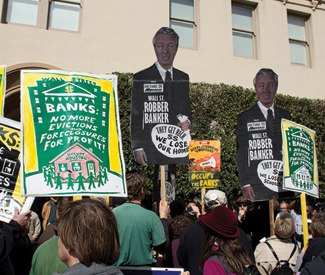
Occupy Bernal is at it again, fighting for neighborhood residents facing foreclosure. Organizers surveyed foreclosures in their neighborhood and found that the bank that owned most of them was none other than Wells Fargo, a bank that happens to have a largely San Francisco-based Board of Trustees. They recently took their indignation to the home of Wells CEO John Stumpf (see “Save Our Homes,” 2/28/12.) Now, they’ll bring it to the offices of Dignity Health, where board member Lloyd H. Dean is CEO. 

Noon, free

185 Berry, SF

www.occupybernal.org


Rebooting the rainbow

Before the 99%, and before Jesse Jackson’s Rainbow PUSH Coalition, there was the original Rainbow Coalition: a 1960s partnership between the Puerto Rican Young Lords, the White Young Patriots Organization, and the Black Panther Party for Self Defense. These visionaries hoped to bring together people fighting to protect their communities towards a united goal of justice for all. In this talk, part of the Shaping San Francisco series, three activists from back in the day– Pam Tau Lee, Joe Navarro, and Kiilu Nyasha—will discuss that history. They’ll also speak to “what it’s going to take to keep the 99 percent together for the long haul.”

7:30 p.m., free

CounterPULSE

1310 Mission, SF

www.shapingsf.org


SATURDAY 17

Homes not jails benefit

This homeless advocacy organization is fiercely dedicated to making sure those who want it have a roof over the heads at night, and many San Franciscans won’t sleep in the cold tonight due to their efforts. Come celebrate their efforts at this benefit. There will be live music from local favorites Little Wolves, Shakes Gown, Molly and the Mad Science and LPD, not to mention new zines and Homes Not Jails t-shirts. 

7 p.m., donation suggested

Redstone Building

2940 16th St., SF

www.indybay.org


SUNDAY 18

Dream Memoirs of a Fabulist

It’s queer, surreal, and will probably blow your mind. This book hints of ghosts, photography, gender, and language. In a review, Janice Lee says the book includes, “the dizzying abyss of self-imposed identity, and the gravitational field of language itself, the pronouns textually speaking to one another, dragging memory from one space into another.” To truly understand it, head to Modern Times for a reading and talk with author Doug Rice and artist Stephanie Sauer. 

7 p.m., free

Modern Times Bookstore

1919 24th St., SF

www.mtbs.com/events

Domestic violence is not a private matter

3

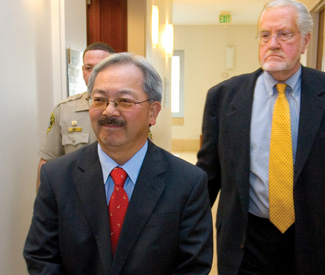
EDITORIAL The legal case against Sheriff Ross Mirkarmi has been essentially settled, with the sheriff pleading guilty to false imprisonment and avoiding a trial on domestic violence charges, but the political case is just beginning.

Already, there are calls for Mirkarimi to step down. And Mayor Ed Lee announced March 12 that he’s Mirkarimi’s plea to “a very serious charge that had introduce a new set of legal issues” merits a thorough review.

That could lead to an explosive scenario where the Board of Supervisors, in an election year, would have to vote on whether to remove a sheriff who many of the supervisors have worked with and supported over allegations that are in effect political poison. Anyone who wasn’t ready to throw the sheriff out of office could be accused of coddling a wife-beater.

Mirkarimi’s friends and allies say the sheriff didn’t want to plead guilty to anything. But the questionnaires that potential jurors had filled out showed that virtually everyone who might sit in judgment had read the sensational media coverage of the case, and Judge Garrett Wong had refused to move the trial elsewhere. The judge also rejected every significant motion Mirkarimi’s attorney, Lidia Stiglich, made, and allowed into evidence material that the sheriff’s team didn’t think should be admissible. So the situation looked bleak, and Mirkarimi took a deal.

Mirkarimi maintains his innocence, and says he has no intention of stepping down. He agreed to plead guilty to a crime that had very little to do with what happened New Year’s Eve, when the District Attorney’s Office said he got into a physical altercation with his wife that left her with a bruise on her arm. False imprisonment was never one of the original charges; as is often the case in criminal cases, both sides accepted a less-serious charge in the name of getting the deal done.

Why Mayor Lee sees that as “a new set of legal issues” is baffling; the issues are exactly the same as they were before the plea bargain. None of this is to say that the original charges, backed up by well-publicized (although never fully examined in court) evidence, aren’t serious. Domestic violence, as we’ve said repeatedly, is not a private matter, is not a minor crime, and has far too often been ignored by the courts, police, and prosecutors, sometimes with deadly consequences.

But the way this could play out will open Lee to charges of political opportunism. The mayor would need to charge Mirkarimi with “official misconduct,” which is defined in the City Charter:

“Official misconduct means any wrongful behavior by a public officer in relation to the duties of his or her office, willful in its character, including any failure, refusal or neglect of an officer to perform any duty enjoined on him or her by law, or conduct that falls below the standard of decency, good faith and right action impliedly required of all public officers and including any violation of a specific conflict of interest or governmental ethics law.”

Other than the “standard of decency” statute, which is pretty vague, there’s not much in there for Lee to go on. Unless you say that because Mirkarimi pleaded guilty to a crime with “imprisonment” in the name he’s somehow a threat to the inmates at the county jail, which is a huge stretch, it’s hard to call this “official misconduct.” (There is, on the other hand, the argument that Mirkarimi will be on probation, and thus part of the criminal justice system he oversees, and that it’s an inherent conflict of interest. That, however, would mean any sheriff who was on probation for anything would be ineligible to serve, which again is a stretch.)

If the mayor files official misconduct charges, and the Ethics Commission, by a supermajority, agrees, then the Board of Supervisors would serve in effect as a trial body, much as the U.S. Senate does in an impeachment case. Nine of the 11 supervisors would have to vote to permanently remove the sheriff from office.

If Lee takes that path, he’ll be setting in motion a political process that was designed in the Charter for highly unusual situations and has only been used once in the past 40 years. (And in that case, involving Airport Commission member Joe Mazzola, a court later ruled that the charges, involving his role in plumbers’ strike, didn’t rise to the standard of official misconduct.) You have to ask: Is this case, and this misdemeanor charge, worthy of the exercise of what is, by any standard, an extraordinary power vested in the city’s chief executive? Is it worth the political circus that would result from a trial by the supervisors (some of whom might well be asked to recuse themselves because of their prior relationships with Mirkarimi, making it almost impossible to reach the magic number of nine anyway)?

If the voters of San Francisco think the sheriff needs to go, there’s the right of recall — and it will be available the first week in July, when Mirkarimi will have served six months. If there’s not enough organized opposition to make that happen, he’ll be facing the electorate again in three years (and trust us, he will be opposed and every details of these charges will be part of the campaign). He’s going to pay for this far beyond his court-ordered probation and fine.

Whatever the plea deal, Mirkarimi was clearly involved in a bad conflict with his wife that turned physical. Unless the evidence we’ve seen so far is completely misleading, it’s clear that he left her with a bruise — and that he was at the very least nasty and more likely emotionally abusive to her. Now that the legal case is over, he needs to come clean and tell the public exactly what happened that day, at which point we can all decide if we believe him, if he’s shown that he’s changed, and if the public is willing to give him a chance at redemption.

But Lee should think very seriously before he escalates this by filing misconduct charges. Since the ones who have the most to lose from that are the progressives on the board who are often Lee’s foes, it will have the stench of political maneuvering — and at this point, nobody needs that. The mayor says he’s a unifier; this would be the most divisive thing he could do.

Occupying the Capitol

5

It’s an unseasonably hot day at UC Davis, and student activists are milling around a tent city, set up especially for 100 people arriving from a four-day March on Education. The school, one of the hubs of the Occupy movement, gained notoriety when public safety Officer John Pike casually pepper sprayed a line students during a sit-in back in November. Now, officers bike through the idyllic scene, smiling and chatting up occupiers.

Everyone is preparing for the next day, March 5, the statewide day to defend education that will bring thousands of students and teachers to Sacramento to demand an end to budget cuts and fee hikes at California’s schools, community colleges, and universities.

Those on the march hope to highlight the importance of this issue, marching 79 miles from the Bay Area. The first night, the march stayed in Richmond, and the next day Richmond’s Mayor Gayle McLaughlin came out to welcome them.

Students march annually on Sacramento, and say they won’t stop until education is affordable (or, as some would demand, free). A climate of worldwide protest over disparities in wealth and opportunity, including Occupy protests in the United States, helped fuel a larger than usual turnout this year.

More than 5,000 people converged in Sacramento March 5 and marched to the Capitol building, occupying the Rotunda all day. Many chanted “no cuts, no fees, education must be free.”

Community college student throughout the state are reeling from the cuts, and resulting fee hikes—course units, once free, were raised from $26 to $36 per unit last year, and will be increased another $10 this summer. These costs go towards closing the state budget deficit, and not toward a bigger course catalogue; classes continue to be slashed.

Frances Gotoh of San Bernardino Valley College is back at school after being laid off from her longtime job at Bank of America. She said she desperately needs the retraining; without it her job prospects look dim. She needs to support her family—her 20-year-old son is also a college student—but says she can’t afford the increasing fees. “Why is education being taken away?” asked Gotoh. “It belongs to the people.”

Josselyn Torres, a psychology major at Sonoma State University, felt similarly. “Every year, the fees are getting higher but the class size is getting bigger,” said Torres, who noted that many of her friends won’t be graduating with her because so many of the classes they needed were cut. “The politicians have all gone to college. If they keep cutting our education, how can we make it as far as them?”

When the march reached the Capitol, student and state government leaders spoke on the importance of education. Students demanded an end to fee hikes and budget cuts. Assembly Speaker John Perez (D-Los Angeles) and Senate President Pro Tem Darrell Steinberg (D-Sacramento) praised student activists and expounded on the necessity of accessibility to education. Almost all speakers decried the two-thirds majority needed to raise taxes, allowing just a few Republicans to block them.

Lt. Gov. Gavin Newsom also spoke, describing the need to support education in staunchly free-market terms: “You can’t have an economic development strategy without a workforce development strategy.”

Periodically, the crowd interrupted Newsom and other politicians in the midst of making promises with chants of “show us.” They also chanted this election year threat: “You’ll hear us out or we’ll vote you out!”

Around 12:30 p.m., the permitted rally ended and thousands dispersed. About 400 stayed to “Occupy the Capitol.” The group streamed into the building and into the rotunda. California Highway Patrol officers, responsible for policing the Capitol, blocked more than 150 from entering the central area. So, communicating via the Peoples Mic with several rounds of crowd repetition for every sentence spoken, the group participated in a statewide general assembly.

Some building employees showed support, but the only politician to sit down with the protesters was Newsom, who sits on the UC Board of Regents and CSU Board of Trustees. He chatted with students, some of whom requested that he ask police to stop blocking students from meeting in the same area; he didn’t do so, but was able to convince them to give protesters in the rotunda access to bathrooms.

The group managed to collectively decide on demands of the state: support the Millionaire’s Tax ballot initiative, repeal Prop. 13, cancel all student debt, fund all education through college, and democratize the Board of Regents. When building closed at 6 p.m., officers declared the assembly unlawful and arrested 70 who refused to disperse.

Meanwhile, another 400 or so attended a permitted rally on the Capitol lawn called by several Sacramento labor unions to support Occupy the Capitol.

Over the past five years, education funding in California has been cut drastically. Spending per K-12 student per year has gone down by almost $2,000 and higher education has seen program cuts and tuition hikes. Gov. Jerry Brown’s latest budget proposal includes still more cuts to California colleges and universities.

Several proposed ballot initiatives are designed to address this. An initiative sponsored by Brown would bring spending per student per year up by $1,000, stabilizing at $7,658 (it was $7,096 in 2011-12) and reversing a five-year slide. But it would still be less than 2007-08, according to a report from the California Budget Project (CBP).

That report shows K-12 education spending is the biggest piece of the state budget, although California ranks dismally low compared to other states for spending on K-12 education: 47th in the country.

The governor’s proposal would raise funds with a combination of a tax increase for those earning $250,000 and over per year and a sales tax increase. But critics say the increase in the sales tax, which is notoriously regressive, would hurt lower and middle income families.

The measure is up against other potential ballot initiatives that would raise revenue strictly from the wealthiest Californians. The so-called Millionaire’s Tax, for example, would raise funds for education by increasing taxes on those making $1 million or more per year. The Millionaire’s Tax also has the advantage of resulting in a permanent change in the law, while Brown’s measure would apply only for the next five years.

“California’s problems have also been exacerbated by tax cuts, one-time ‘solutions,’ overly optimistic assumptions, and the fact that the two-thirds vote requirement for the legislature to approve any tax measure has blocked adoption of a balanced approach towards bridging the budget gap,” according to the CBP report.

Teachers’ unions are divided over the best ballot measure. The California Teachers’ Association has endorsed Brown’s measure, emphasizing that it includes a plan to close the budget deficit.

“The governor’s initiative is the only initiative that provides additional revenues for our classrooms and closes the state budget deficit, and guarantees local communities will receive funds to pay for the realignment of local health and public safety services that the Legislature approved last year,” said Dean Vogel, CTA president, in a press release.

But the Millionaire’s Tax was sponsored by the California Federation of Teachers, and it has now been endorsed by this student general assembly. John Rizzo, president of the City College of San Francisco Board of Trustees, also endorsed the measure.

“We’ve got to tell the state of California that we cannot continue this. We cannot continue the cuts to our community colleges, to UCs, to the California State Universities,” said Rizzo, speaking at a March 1 rally in San Francisco.

According to a recent report, of five polls conducted throughout California, each initiative has majority support, but voter prefer the Millionaire’s Tax, with a recent Field Poll showing 63 percent support.

Legislators are also at work trying to increase education funding. Assembly Speaker Perez has introduced a bill that would slash tuition fees by two-thirds at CSU and UC schools for students of families making less than $150,000 per year. The bill would also allocate funding to city colleges throughout the state, for them to determine how to best use the money.

The cost of the plan, about $1 billion, would be paid by eliminating a corporate tax loophole that the Legislature approved in 2009, which would allow companies to choose the cheaper of two formulas for calculating their taxes. Critics have called the legislation bad for business, saying that removing tax incentives would hurt California companies.

“The California Middle Class Scholarship Act is very simple,” Perez told students at UC Davis when he unveiled the bill on Feb. 3. “Too many families are getting squeezed out of higher education. For students whose families make $150,000 a year or less, too much to qualify for our current financial aid system, but not enough to be able to write a check for the cost of education, without feeling that pinch, the Middle Class Scholarship Act reduces fees at the UC system and at the CSU system by two-thirds, giving tremendous assistance to those families to make college affordable again.”

Education advocates say California needs to do something to reverse the spiraling cost of higher education in California, which could do long-term damage to the state, affecting young people and businesses that need skilled workers and spiraling out from there. And these advocates say this short-sighted strategy is easily preventable if there is the political will to address it.

“There are a lot of sources of revenue that are not being taken advantage of,” Lisa Schiff, a member of Parents for Public Schools of San Francisco, told us.

Even if tuitions were lowered or—as the most ambitious of protesters demand—higher education was made free, most former students would still be saddled with massive debt. As costs have risen, debts of hundreds of thousands of dollars are commonplace. With the job market recovery slow and painful, graduates often feel helpless to pay back their debt.

Robert Meister, a professor of Political and Social Thought at UC Santa Cruz and president of the Council of UC Faculty Associations, has long argued that the state’s higher education systems ought to focus on keeping tuitions low and student debt in check (see “In the red,” 1/11/11).

Yet he told us that growing income inequality makes people even more desperate for a college education and willing to accept levels of student debt that limit their ability to become anything more than corporate cogs after graduation. “Their ability to raise tuition is a function of the growth of income inequality,” he told us.

In his speech at UC Davis, Perez cast the issue as one of a disinvestment in the state’s future: “California’s public colleges and universities has been one of our most prestigious institutions, and, unfortunately, because of the collapse of the economy, we’ve moved away from fully investing in those universities and colleges.”

A month later, the school again served as a backdrop for illustrating the problem and calling for reform. Dani Galietti, a MFA student at UC Davis who was setting up a performance art piece when I arrived, greets everyone cheerfully and is thrilled about the Occupy movement.

“I wanted to share myself and my work with the movement,” Galietti tells me while taping a “paper trail” to the sidewalk; she plans to walk on it with home-made stamps attached to the bottoms of her shoes.

But her mood darkens when I ask about her student debt. “I came out of five years of education $100,000 in debt,” says Galietti, “and I’m not the only one.”

She is a first generation college student, she explains, who helped pay for school with McNair scholarships.

“I grew up one of five, with a single mother,” Galietti explains. “We struggled my whole life, as a lot of people have, financially.”

“So many people are graduating with so much debt. There’s this looming fear, fear and hopelessness. The economy’s bad, the job market sucks. I’m so thankful that they’re out here. People are active, they’re making a difference.”

“We need education,” Galietti says. “I mean, knowledge is power.”


The patient that time forgot

0

caitlin@sfbg.com

HERBWISE I contact a lot of stoners throughout the course of writing Herbwise — activists, businessmen, artists — but none has had a more crisp-sounding receptionist answer the phone than Ft. Lauderdale stockbroker Irvin Rosenfeld, who is one of four citizens of the United States legally allowed to smoke marijuana by the federal government.

No really, he is.

In 1982, Rosenfeld hit upon a winning combination of perseverance, legal precedent, and audacity when he succeeded in suing the US government to prescribe him cannabis for his painful, bone growth-causing condition. After filing a civil suit that claimed weed was the only palliative that helped his intense physical discomfort, Rosenfeld became part of the FDA’s short-lived Investigational New Drug Program. Calling Rosenfeld, original patient Robert Randall, and the subsequent 11 others who qualified for the program participants in a clinical study was the only way the feds could justify supplying the weed.

In 1992, the program was terminated. But the 13 patients — only four survive today — continued to receive tins of pre-rolled joints, the cannabis for which is grown (shoddily) at a government-run farm near the University of Mississippi. Rosenfeld tells me the weed he smokes is “12 years old,” and so dry that he’s compelled to unroll the cigarettes, store with fresh lettuce for six to eight hours to rehydrate the bud, then re-roll before smoking.

He tokes nine ounces a months and, he says, never gets high. He tells all his clients about his prescription because, as he puts it “I don’t want them seeing, for example, this article and thinking ‘oh, he lost us that money because he was high off that marriage-ja-wanna.'”

I ask him if he’s surprised, 20 years since he won his legal battle, that patients like himself are still battling for access to the plant. He reels off a series of crucial court hearings that, to his disbelief, swung time and time again in the direction of continued Schedule I status for cannabis. Rosenfeld says has made it able for him to leave the house on a regular basis.

“As a stockbroker I look at it economically. I think about, if I didn’t have my medicine, where would I be today? I’d be homebound. Is it just me? Or maybe there’s other people sitting at home that could be productive members of society. It irritates me.”

Our conversation is over, but there’s time left for two plugs from Rosenfeld. One for his book, My Medicine: How I Convinced My Government to Provide My Marijuana and Helped Launch a National Movement (www.mymedicinethebook.com). Buy it?

The second is for himself. Anyone need a stockbroker with experience in battling the US government?

“The expertise I used to take on the federal government is the same expertise I use in my business,” Rosenfeld assures me before we hang up. “If you want that expertise, you should hire me as your broker. If you don’t, then have a good life.”

The case against 8 Washington

35

tredmond@sfbg.com

In city planning terms, it’s a fairly modest project: 134 condos, no buildings more than 12 stories tall, on a 27,000-square-foot site. It’s projected to meet the highest environmental building standards and offers new open space and pedestrian walkways. It’s near Muni, BART, and ferry lines. And the city will collect millions of dollars in new taxes from it.

But the 8 Washington project, which will come before the Planning Commission March 8, has become a flashpoint in city politics, one of the defining battles of Mayor Ed Lee’s administration — and a symbol of how the city’s housing policy has failed to keep pace with the needs of the local workforce.

Put simply, it will create the most expensive condos in city history, housing for the richest of the 1 percent on the edge of the waterfront — and will further push San Francisco toward becoming a city that caters almost entirely to the very wealthy.

So in a city where the growing divide between the 1 percent and the rest of us has become a central issue and where the lack of affordable housing is one of the top civic concerns, 8 Washington is an important test. By any rational standard, this sort of development is the last thing San Francisco needs.

But some of the best-connected lobbyists in the city are pushing it. One of the mayor’s closest allies, Chinatown powerbroker Rose Pak, is a leading advocate — and the final outcome will say a lot about city politics in the Lee administration.

There are all sorts of half-truths and misleading statements by supporters of 8 Washington. Here are the five main reasons the project shouldn’t be approved.

1. It fills no housing need. San Francisco has no shortage of housing for the very rich; the dramatic need, outlined in both regional planning documents and the city’s own General Plan, is for low- and moderate-income housing for the people who actually work in this city (see “Dollars or sense?” 9/28/10). While San Francisco is getting richer by the day, the core workforce — public employees, workers in the hotel and restaurant industry, service workers, construction and trade workers, and a majority of the people in the lower levels of the finance and tech sector — are being priced out of the city. That means more people working here and living far out of town, often commuting by car, in what everyone agrees is an unsustainable situation. Meanwhile, more and more high-paid workers from Silicon Valley are living in San Francisco — again, commuting to distant jobs, either by car or by corporate bus.

The city’s General Plan states that some 60 percent of all new housing built in the city should be below market rate. San Francisco desperately needs housing for its workforce. This type of project simply puts the city deeper in the hole and further from its housing goals.

2. It’s a reward for bad actors. The main developer of this project is Simon Snellgrove, but one of his partners is, by necessity, Golden Gateway, which owns a significant part of the land — and which has been flouting at least the spirit if not the letter of city and state law and costing San Francisco tens of millions of dollars.

As project opponent Brad Paul has noted in written testimony, when Timothy Foo, the current owner, bought the complex from Perini Corp. about 20 years ago, he used a loophole in state law that allowed him to avoid a formal transfer of ownership. That means the property wasn’t re-assessed, costing the city about $1.5 million a year. According to the Assessor’s Office, the deal wasn’t illegal (and these tricks to avoid reassessment are relatively common) but still: He’s costing the city millions by using a loophole not available to most people.

Golden Gateway, which was built in a redevelopment area as middle-class housing, is now renting out apartments as short-term tourist or corporate rentals. There are dozens of examples right now on Craigslist. City law bars the owners of rental housing from converting it to hotel rooms, but a loophole in that law makes what Foo’s outfit is doing technically legal. But he’s clearly violating the spirit of the city ordinance that seeks to protect rental housing from hotel conversions.

One of the main aesthetic complaints about the area — something Snellgrove’s lobbyists have tried to use to support the project — is the ugly fence that now surrounds the Golden Gateway Tennis and Swim Club. But who do you suppose put that fence there?

Do we as a city want to be giving special zoning benefits to companies that try to circumvent tax and housing laws?

3. It’s an environmental disaster. Snellgrove and his architects, Skidmore Owning and Merrill, are seeking LEED platinum certification for the project, saying that its energy-efficiency, water use, and green building materials will make it one of the most sustainable structures in San Francisco. It is, the project website notes, close to all types of public transit.

But LEED doesn’t take into account what the building is used for (see “Is LEED really green,” 7/5/11) — and in this case, the use makes a huge amount of difference.

People who buy multi-million-dollar condos don’t tend to take Muni or BART when they go places. That’s not conjecture, it’s a proven fact. A 2008 study by the American Public Transportation Association notes, bluntly, that wealthier people are more likely to drive cars. When you move into the stratospheric regions of the ultra-rich, that’s even more true. A 2011 report on the Charting Transport website notes: “The very rich tend to shun public transport.”

The current zoning in the area allows for one parking space for every four residential units. Snellgrove is asking for one space per unit — in other words, he figures every single buyer will have a car.

Many of the people who buy these condos won’t be working or even living most of the time in San Francisco. These are condos for world travelers, second and third homes for people who want to spend a few weeks a year in San Francisco. “They aren’t going to be living here all year,” Christina Olague, a former Planning Commission member who is now the District 5 supervisor, told us last July.

If five of the 165 residents of 8 Washington fly in a private or corporate jet from, say, New York to their SF pad once a month, the project will cause the use of jet fuel equivalent to what a normal family would use driving a car for 330 years, Paul noted.

“How many solar panels are needed compensate for burning 396,000 gallons of jet fuel a year?” he asked.

Then there’s the construction issue. If the developer’s projections are correct, as many as 20,000 dump truck runs will be trundling along the Embarcadero for several months, one every two minutes — and it could be happening right as the traffic nightmare called the America’s Cup is hitting the waterfront.

It also goes against some 40 years of waterfront planning policy, all of which as focused on downzoning and creating open space. This would be the first upzoning of San Francisco waterfront property in decades.

4. It will wipe out what is mostly a middle-class recreation facility. The Golden Gateway Tennis and Swim Club will be closed for three years, then (possibly) reopened later as a smaller facility. The club — with two outdoor pools and six tennis courts — sounds like something for the elite, and it’s managed by the upscale Bay Club, but a lot of the users are longtime Golden Gateway residents and seniors. “I would say 30 or 35 percent of the users are seniors,” Lee Radner, chair of Friends of Golden Gateway, told me. Most, he said, are middle-class people, and the expense isn’t that high. “My wife and I pay $3 a day to use the pool,” he said. “I swim every day, and it would cost more than that to use the public pools in the city.” He added: “There are some wealthier people, of course, but many of us are retired and on fixed incomes.”

We’re talking about 90,000 total square feet of outdoor recreation space — which dwarfs the 20,000 square feet of open space the developer promised to provide.

5. The city doesn’t get much out of the deal. In exchange for upzoning the waterfront, creating a big all of buildings and screwing up the city’s housing balance, what does the San Francisco general fund get? Not a lot. The estimates for new tax revenue run about $1.5 million a year of the next 60 years — and when you translate that to what economist call “net present value,” the cash equivalent today of that revenue stream, it’s about $30 million. The Port of San Francisco is talking about creating a special infrastructure financing district — sort of the equivalent of a redevelopment area — to pull that money out in advance, which may not even be legal (since part of the land is a former redevelopment area, the state law that allows these special finance districts may not apply). But even so, a Jan. 14 Port memo suggests that the agency has plans to spend all that money on its own infrastructure — setting up a potential battle between the supervisors and the Port Commission over where the money, if it actually can be collected up front, will go.

Like any developer, Snellgrove will pay into the city’s affordable housing fund — in this case, about $9 million to pay for the equivalent of 27 units. No affordable units will be on site, of course; that would detract from the uber-wealthy ambience of the place. And it’s not clear when those units would be built. “Nobody builds 27-unit buildings any more,” Paul, a former deputy mayor for housing, said. “We’ll have to wait until there’s enough money for a bigger project, somewhere, sometime down the road. That’s what we’re getting here.”

Either way, it’s not a huge benefit for allowing this disaster of a project — and it’s a terrible statement for San Francisco to make. At a time when the mayor has cleared the Occupy protesters — who are talking about how little the rich pay in taxes — off the waterfront, the city is preparing to move in the exceptionally rich, who aren’t paying anywhere near their fair share in tax revenue to local government.

(Nobody knows for sure whether the costs of servicing high-end residential exceed the revenue the city gets from property taxes. In 1971, the Guardian put together the first-ever cost-benefit study for highrise office development, which showed that commercial buildings cost the city more than they paid; that’s been confirmed and demonstrated over the years to the point where it’s hardly even an argument any more. The supervisors ought to ask the city economist or the budget analyst to do the same sort of analysis for luxury condos.)

There’s another element here: Mayor Lee made a point during his campaign to say over and over again that he was an independent thinker, that powerful and influential allies like Rose Pak would not be calling the shots at City Hall. This will be his first major test: Pak and lobbyist Marcia Smolens are working hard to promote 8 Washington. And we’re already getting some disturbing signals out of the mayor’s office.

Lee told us that he has “no thoughts” about the project and hasn’t been paying any attention to it. That’s an odd stance, considering that his own Port Commission is pushing it and staffers in his office are working with the developer. This is a big priority for Pak, and the notion that she has never mentioned it to the mayor defies reason. Board President David Chiu, who talks to the mayor regularly, opposes the project, which is in Chiu’s district.

It’s hard to imagine that anyone who pays attention to local politics could be missing what will be one of the landmark votes this spring on the Planning Commission — which will take up the project March 8 — and the Board of Supervisors.

The mayor, may, indeed, be ignoring everything that supporters and opponents of 8 Washington have said and may be waiting until the Planning Commission vote to take a position. But if he’s just ducking questions because he’s planning to support it, he’s making a big mistake.

This is a chance for San Francisco to go beyond the platitudes about building housing, go beyond the hype about “green” buildings, see through the fraud about community benefits and consider what this really is: A special favor for a developer who wants to cater to the top 1 percent of the 1 percent and move San Francisco even closer to being a city of, by, and for the elite. The only reasonable vote on 8 Washington is No.

The war is over. Fun won.

1

steve@sfbg.com

>>Read Sup. Scott Weiner’s op-ed on SF nightlife here

Two years ago, the war on fun that the Bay Guardian had been chronicling and decrying since 2006 — involving overzealous cops, NIMBY neighbors complaining about noise, escalating fees on outdoor events, and politicians scapegoating nightclubs for urban violence –- seemed to be reaching a peak of official intolerance.

The San Francisco Police Department and California Department of Alcoholic Beverage Control were running amok, with an especially troublesome pair of enforcers harassing disfavored club owners and guests, getting rough with patrons at private parties, and seizing laptop computers from DJs and cameras from those who documented the abuses (see “The new War on Fun,” 3/23/10). Then-Mayor Gavin Newsom and then-Police Chief Heather Fong and their underlings only fed the conflict with brash statements and by refusing to support the nightlife industry.

But today, all involved say the situation has turned completely around, with the nightlife industry asserting its importance to San Francisco’s culture and economy and getting key support from a new generation of political leaders. It may be too early to say the war on fun is over, but everyone is certainly enjoying a welcome cease-fire.

Police Chief Greg Suhr has longstanding relationships with many leaders in the nightlife community -– and he’s someone who says that he goes out regularly and has a son who plays drums for a local band.

“I consider many of the people in the entertainment community to be personal friends,” Suhr told us. “And if there’s a problem, I don’t think anyone has been shy about approaching me personally.”

At the same time, the industry has taken on a higher political profile in town since forming the California Music and Culture Association two years ago during the height of the conflicts with the city and the ABC. The group now has monthly meetings with a nightlife liaison that Suhr has assigned to work through issues.

“The lines of communication are open. Despite some differences in opinion, there is a growing sense of trust and respect that is developing in these meetings,” CMAC co-chair Alix Rosenthal told us.

Rather than bashing the nightclubs as a source of trouble, political officials have been openly courting CMAC, which holds regular public events and forums on nightlife issues, including an “Industry Cocktail Hour with Mayor Ed Lee” on the evening Feb. 29 from 5-7 p.m. at The Grand, a club owned by the newest Entertainment Commission member, Steven Lee.

Sup. Scott Wiener has also been a strong advocate for nightlife issues, and has commissioned a city study on the economic benefits of the nightlife industry, which he discusses in this week’s Guardian Op-ed and which will be the subject of March 5 rally and hearing at City Hall.

Preliminary results in the study, with was conducted by City Economist Ted Egan, show that the nightlife industry generates $4.2 billion in annual spending, $55 million in taxes, and employs 48,000 people. And those figures don’t include outdoor events such as street fairs or the Outside Lands Festival, which another recent study by concert organizers found generated $60.6 million in San Francisco and $6.6 million in surrounding communities last year.

“People coming into the city to enjoy themselves is our number one industry,” Suhr said, noting how important it is to balance public safety concerns with support for the city’s cultural and entertainment offerings.

Rosenthal said CMAC was happy that Wiener commissioned the study. “This study is going to be helpful,” she said. “We’ll have hard data to show how much the entertainment economy contributes to San Francisco’s entire economy.”

Nightlife: Fun plus jobs

8

By Supervisor Scott Weiner

OPINION We all know the cultural benefits of nightlife. It’s fun. We get to meet people — friends, lovers, and all the rest. We build community. We hear great music. We dance. We spend time outside on our streets. For LGBT people, we meet other LGBTs and keep our community strong. The list goes on: Without a strong entertainment scene, including bars, clubs, live music venues, arts venues, night-time restaurants, and street fairs, our city would be a less interesting and less diverse place.

But the undisputed cultural importance of nightlife isn’t the whole story. Nightlife is a significant economic contributor to San Francisco. It creates jobs, particularly for working-class and young people. It generates tax revenue that helps fund Muni, health clinics, and parks. It allows creative entrepreneurs to start businesses. It generates tourism. It draws foot traffic into neighborhoods to the benefit of other neighborhood businesses.

This is all pretty intuitive. Yet, as a city, we’ve never actually measured the economic impact of our nightlife scene. One of my first acts a member of the Board of Supervisors was to request the city economist to conduct an economic impact study doing just that.

The study is almost done, and we already have a few preliminary results. Nightlife in San Francisco generates $4.2 billion a year in spending, with $1 billion of that amount coming from bars, clubs, performance venues, and art spaces. Some 48,000 people are employed in nightlife businesses, and these businesses contribute $55 million a year in local taxes. On March 5, we’ll announce the full results of the study at a hearing of the Land Use and Economic Development Committee.

This data will help us make smart public policy around nightlife. In the past, those decisions frequently have been driven by anecdote and over-reaction to isolated events. Trouble near a small number of nightclubs? The city responds by making it difficult for all nightclubs to operate, even those with excellent safety records and despite the dramatic improvement in the Entertainment Commission’s oversight. Or, the city goes even further and proposes requiring all clubs, even small ones, to scan ID cards of everyone who enters. (That proposal, thankfully, was roundly rejected.)

When we make these decisions, we should do so with a full understanding not just of the downsides of nightlife but of the positives, including cultural and economic benefits.

Entertainment is under pressure in San Francisco. There are neighborhoods with significant friction between housing and nightlife. Some of that friction results from a small number of problem venues. Other times, a good venue is jeopardized for simply conducting its business within the limits of San Francisco law — for example, a single neighbor got Slim’s shut down for a few weeks for noise, despite the club’s compliance with our noise ordinance.

We also continue to have bizarre Planning Code restrictions that undermine entertainment, such as the Mission Alcohol Special Use District, which makes it difficult or impossible to start creative new businesses in the Mission if alcohol is involved. This provision almost prevented a new bowling alley from locating at 17th and South Van Ness. Similarly, some are concerned that the Western SoMa Plan, as currently written, will undermine nightlife on 11th Street by surrounding clubs with new housing and by reducing the number of venues.

A thriving nightlife scene is key to our city’s cultural identity and economic future. Now that we have the data on its benefits, we can take a more balanced and thoughtful approach.

Supervisor Scott Wiener represents District 8 on the Board of Supervisors. The March 5 hearing will start with a noon rally on the steps of City Hall followed by the hearing at 1 p.m. in City Hall Room 263.


The mortage crimes

5

EDITORIAL The mortgage crisis in San Francisco isn’t just devastating to homeowners and to the southeast neighborhoods where foreclosures are most common — it’s clear evidence that lenders and their affiliates are and have been acting illegally. This city ought to be taking the lead on pressing civil and criminal charges against the mortgage outfits.

City Assessor Phil Ting commissioned a report in February that showed that nearly every one of 382 foreclosures actions in the city between January 2009 and October 2011 had at least some irregularities. In more than 80 percent of the cases, the report identified direct violations of law.

It’s a stunning revelation: In nearly 100 percent of the cases studied, the mortgage companies did something wrong. Homeowners were not notified that they were in default. Properties were seized and sold by companies that didn’t have the proper title to them. Documents were backdated or signed by an entity that didn’t have the authority to sign. In some cases, it wasn’t clear who actually owned the mortgage, because the corporation that filed for foreclosure had never property taken title to the loan.

The report comes as Occupy protesters in San Francisco are moving aggressively to target banks that are tossing people out of their homes and at a time when county sheriffs in other parts of the country are refusing to execute foreclosure orders.

There may not be much San Francisco Sheriff Ross Mirkarimi can do — mortgage foreclosures in California can be done with almost no oversight and by the time the sheriff is called in there’s nothing left but an eviction. But the report makes clear that there were both violations of business regulations and crimes, in some cases felony crimes — and the San Francisco city attorney and district attorney should be moving as quickly as possible to take legal action.

Both City Attorney Dennis Herrera and District Attorney George Gascon have asked for more material from Ting’s office, although neither has announced a formal investigation. But every day that this goes on, more people lose their homes and more crimes are committed — and both offices should move as quickly as possible to take action.

There’s nothing in the federal settlement over fraudulent mortgage activity that prevents local officials from taking this sort of action. There’s nothing preventing Herrera from seeking an injunction against further foreclosures or preventing Gascon from indicting the lenders and their executives.

Meanwhile, Ting told us that he’s asking Attorney General Kamala Harris to investigate, because the pattern of violations almost certainly goes beyond San Francisco.

State Sen. Mark DeSaulnier has introduced a bill that would mandate transparency in foreclosures, so at least homeowners would know who to contact to seek a modification. That’s a good start. But holding these sleazy operators accountable would send a message that San Francisco isn’t going to let this sort of behavior continue.

The losing bets

26

By Darwin BondGraham

news@sfbg.com

Wall Street’s massive taxpayer funded bailout, initiated by the Bush administration and carried forward under President Obama, never really ended — it just shifted from federal to local sources of funding. Even while local and state governments have been forced to cut back on crucial services, wealthy banks and investment firms are being padded with enormous cash flows sucked directly from the already strained budgets of cities, counties, and public agencies.

That’s the message a growing chorus of activists in the Bay Area are bringing before the boards, councils, and commissions that entered into complex financial deals with Wall Street banks, deals that turned toxic in the crash of 2008. Activists want elected officials and the banks to cancel the contracts and refund the public.

The Bay Area is the epicenter of this renewed movement for financial justice. Last week, teachers from Peralta College, organizers with the Alliance of Californians for Community Empowerment (ACCE), Oakland religious leaders, and Occupy Oakland activists organized four protests contesting what they say is bank predation on local communities.

At issue are arcane financial instruments called interest rate swaps. Sold by banks to virtually every sizable government and local agency in the US through the 2000s, rate swaps promised governments the ability to “swap” their potentially costly variable rate payments on bonds into a synthetic fixed rate. Seeking to protect local taxpayers during the volatile 2000s, when floating interest rates were rising, local leaders eagerly signed on.

But the economic meltdown turned those tools into golden handcuffs for local government agencies. Taxpayers are now forced to regularly pay millions to the banks simply because variable interest rates, at the urging of the Federal Reserve, have fallen far below the synthetic rates. These deals might seem numbingly complex, but the effects on local communities are clear and painful.

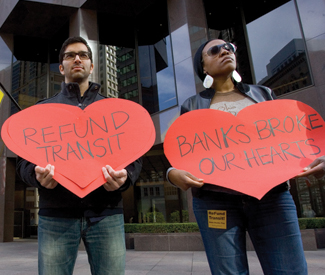
“The Metropolitan Transportation Commission is paying upwards of $53 million a year on rate swaps,” said Alia Phelps of ACCE at a protest on Feb. 21 outside of the former Bank of America building at 555 California Street. “This is money that isn’t going to keep routes in service, that isn’t paying drivers, nor going to repair buses, or to keep fares lower. We need these swaps renegotiated.”

That protest included visits to half a dozen banks. Activists demanded branch managers fax a letter to their corporate headquarters calling on the banks to voluntarily renegotiate swaps signed with the Metropolitan Transportation Commission (MTC), the Bay Area’s regional transportation authority, which has lost over $100 million on toxic swap deals.

In 2002 the Bay Area Toll Authority (BATA), a state-level agency operated by the MTC, issued more than $1 billion in bonds to pay for repairs and seismic upgrades of regional toll bridges. Three financial giants stepped forward promising to lower MTC’s long-term borrowing costs on these bonds by using interest rate swaps. Ambac, Solomon Smith Barney and Morgan Stanley signed deals with the MTC to cover $300 million in debt.

“With this transaction, we are getting the peace of mind of a fixed debt payment at a significant discount from traditional price levels,” MTC’s Chief Financial Officer Brian Mayhew said at the time of the deal.

Basically the swap agreement had the MTC paying a fixed interest rate of 4.1 percent to the banks, while the banks paid 65 percent of the London Interbank Offered Rate (LIBOR), a key benchmark used in global financial markets. Whichever party’s sum happened to be higher when payments came due would pay the difference. The advantage of the deal, in the eyes of the MTC’s managers, was that it would lock-in a low interest rate on MTC’s debt, potentially saving as much as $45 million.

“We think it’s a good time to lock in these low rates,” Mayhew said in 2002.

Fast forward to 2009. A year into the financial crisis, interest rates collapsed. LIBOR, which had been fluctuating around 5 percent and reached a peak of 5.8 percent in September of 2007, plummeted to virtually zero. The flow of payments became entirely one-sided, from MTC to banks that offered this deal. The advantage of the swap evaporated, and it became a toxic asset. While the Federal Treasury would offload similar toxic assets from the “too big to fail banks” using the TARP program, local governments were stuck with them.

As Ambac careened toward bankruptcy in 2010 due to its absurdly over-leveraged portfolio of credit default swaps, the MTC was forced to terminate its swap agreement with the company, paying the exorbitant sum of $104 million, after already having paid out $23 million in interest. All of this was essentially bridge toll money, surrendered by drivers crossing the seven state-owned bridges administered by BATA: the Bay, Antioch, Benicia-Martinez, Carquinez, Dumbarton, Richmond-San Rafael, and San Mateo bridges.

The drain on MTC funds indirectly affects all of its programs, including operational support for AC Transit, Muni, and other regional bus and train services. According to its most recent Comprehensive Annual Financial Report, MTC and its transit agency partners are on the hook for another $235 million in interest rate payments due on swaps with a rogue’s gallery of banks including Wells Fargo, Morgan Stanley, Citigroup, Bank of America, JP Morgan, Bank of New York, and Goldman Sachs. All of this money will be diverted from the MTC’s various transit infrastructure, planning, and operations accounts.

“The big picture is service cuts, pay cuts, work speed ups, fare hikes, route eliminations, and other things that harm working people who ride transit,” said retired Muni worker Ellen Murray.

The MTC’s quarter-billion dollar rate swap nightmare is only the most obvious part of a more systemic problem. Until at least 2030, given current conditions, San Francisco’s Airport Commission must make costly rate swap payments to numerous banks, including JP Morgan Chase, Goldman Sachs, Depfa, Bank of America, and Merrill Lynch, on agreements associated with more than a half-billion in debt. Much of this is linked to commercial paper issued to pay for infrastructure at the Airport (SFO).

Unlike the MTC, SFO’s financial managers were more prudent in entering swap agreements, and therefore secured better terms that have produced a net savings. “The Airport has saved about $92 million to date,” Assistant Deputy Airport Director Kevin Kone told us, referring mostly to gains made between 2005 and late 2007.

But since 2008, SFO’s swaps have been losing money. When Lehman Brothers collapsed, and Bear Stearns imploded and was absorbed into JP Morgan, SFO was forced to terminate swaps with both companies, costing $6.7 million. Last year SFO paid $6.65 million to terminate a rate swap agreement with Ireland’s Depfa Bank. In September, the Airport paid another $4.6 million to end yet another rate swap with JP Morgan. These specific swap agreements, Kone says, “were functioning as they should have early on, providing savings,” but now they’re draining public funds.

SFO’s seven remaining swaps have a negative value of $67 million, according to San Francisco’s 2011 Comprehensive Annual Financial Report. As with the MTC, SFO’s debts will ultimately be paid by passengers and taxpayers. Kone says nobody really knows how much these swaps could ultimately impact the airport, either in terms of cost or savings.

“If interest rates rise, they could have a positive cost savings impact on the airport,” he said.

Joe Keffer of the Service Employees International Union (SEIU) Local 1021 said at the Feb. 21 rally that Oakland has already paid Goldman Sachs $26 million on a swap that dates back to 1997, and that under current market conditions, the city will have to pay roughly another $25 million until the contract expires in 2021.

Oakland’s toxic deal with Goldman Sachs is now the subject of much scrutiny. The newly formed Coalition for Economic and Social Justice —made up of churches, labor unions, neighborhood groups, and Occupy Oakland activists— took up the issue with the City Council on Feb. 21, packing the chamber with one of the more diverse activist coalitions in recent memory.

“We’re here to implore you to get the City of Oakland out of this toxic relationship,” Rev. Daniel Buford of the Allen Temple Baptist Church told the council.

Members of the Oakland City Council are sympathetic to this message. In a letter sent last June, Council member Rebecca Kaplan implored Goldman Sachs CEO Lloyd Blankfein to spare Oakland’s taxpayers: “By bringing the contract to conclusion with no penalty fees, and negotiating a reasonable exit strategy, you would be demonstrating good faith to public taxpayers in the most substantial way.” At the conclusion of public comment Tuesday night, Oakland Council member Libby Schaaf promised the public action on the swap.

In a Valentine’s Day protest the previous week, 50 activists visited the Oakland offices of Morgan Stanley. Faculty and students from the Peralta Community College system went there demanding the bank renegotiate a rate swap that is estimated to have cost the college $1.6 million last year. The same day the college’s board of trustees discussed the need to cut $12 million more from the budget in 2012. Morgan Stanley CEO James Goreman’s pay for 2011 was $14 million, opponents of the swap point out.

Peralta student and Bay Area transit activist Adam Ross attempted to reach the 9th floor offices of Morgan Stanley in a small delegation to deliver a letter demanding the bank renegotiate the swap: “There were signs on the door saying the office was closed. They probably got tipped off and locked the doors.”

Afterward, Caesar Swaby of Riders for Transit Justice addressed the rally, connecting dots for the different constituencies present: “Morgan Stanley is taking money from Peralta College, causing classes to be cut. Morgan Stanley is also taking money from transit riders. Morgan Stanley has a $3 million rate swap with the MTC, causing cuts to bus and train services.”

A Morgan Stanley representative declined to comment for this report. Goldman Sachs did not return calls and emails. A spokesperson for the MTC was unable to be reached by deadline.

Save our homes

9

yael@sfbg.com


This story has been edited


Bay Area activists, fueled in part by the Occupy movement, have recently taken stands against police brutality, for the rights of the homeless, against the corporate power of banks, and much more. But, arguably, nowhere has the movement been more successful than in the fight against foreclosures and evictions.


With the support of Alliance of Californians for Community Empowerment (ACCE) and the Bayview Foreclosure Fighters, several Bayview residents whose homes had already been sold continue to occupy them, and in some cases sales have been rescinded. Occupy Bernal has used civil disobedience to postpone six housing auctions, keeping their neighbors in their homes that much longer. They secured a meeting with Diana Stauffer, Wells Fargo Home Mortgage senior vice president, and David Campos, District 9 supervisor, to delay foreclosure proceedings.


But the activists are pushing for a full moratorium on foreclosures and evictions in San Francisco. Such a moratorium is not without precedent. In recent years, sheriffs have stopped evictions and foreclosures in Wayne Country, Michigan; Cook County, Illinois; Butler County, Ohio; and Philadelphia County, Pennsylvania.


When Cook County Sheriff John Dart imposed his moratorium in 2010, he said, “I can’t possibly be expected to evict people from their homes when the banks themselves can’t say for sure everything was done properly. I need some kind of assurance that we aren’t evicting families based on fraudulent behavior by the banks.”


San Francisco seems ripe for a similar stance, as Assessor-Recorder Phil Ting recently released a report revealing widespread lawbreaking in foreclosure proceedings. The report found that 84 percent of foreclosures in San Francisco over the last three years involved faulty paperwork, some of it amounting to fraud.


Representatives from the District Attorney’s and the City Attorney’s offices told the Guardian that they are concerned about the report. These bodies may be starting the process of further investigating findings. Last week, Sheriff Ross Mirkarimi, whose office carries out the county’s evictions, said he has begun an initiative to collect and analyze the city’s foreclosure data.


But Mirkarimi’s hands may be tied. As he told Ann Garrison of KPFA radio Feb. 25, “I don’t have the latitude or discretion, much as I would like, because there would need to be a change in state law that empowers municipal sheriffs to be able to use that discretion.”


Occupy Bernal formed just a couple months ago, but it has emerged as a powerful advocate for homeowners facing foreclosure. The neighborhood-based branch of the Occupy movement chose to focus specifically on preventing the evictions of Bernal Heights residents, where over 100 homes face foreclosure.


They kept the pressure up Feb. 25, when a group of supporters convened at 1090 Chestnut Street, the residence of John Stumpf, the CEO of Wells Fargo. That bank owns the majority of mortgages on Bernal homes facing foreclosure.


The protest wasn’t meant to block the street and no one tried to enter the building where Stumpf owns three of the 14 floors. But police decided that the group of about 150 warranted blocking off the entire block to traffic, to the annoyance of many neighbors.


“You collected $43.7 billion in taxpayer money and have since made record profits at the expense of low-income communities, while repeatedly breaking your legal and moral obligations as a creditor. You have failed to comply with loan modification requirements under your own lending agreements,” said a blown-up “foreclosure notice” outside Stumpf’s home.


In the spirited street theater scene, activists dressed as an auctioneer and a larger-than-life John Stumpf played out a fake auction of Stumpf’s property.


Dexter Cato, a father of four whose wife was recently killed in a car crash in the midst of months-long loan modification proceedings, faces foreclosure from his Bayview home of 40 years.


“Stumpf, we want a new address for you,” said Archbishop Franzo King of the Western Additions’ John Coltrane church, “850 Bryant Street!”


The crowd then proceeded to chant this address: the San Francisco Hall of Jusice and County Jail.


“We understand that some of our customers are going through difficult times during this economic recovery,” said Jim Foley, president of Wells Fargo’s Greater Bay Area region, in a press release responding to the Feb. 25 protest. The company plans to hold “Home Preservation Workshops” in Richmond March 7 and 8 to help homeowners facing foreclosure.


Public officials may be a long way from locking up CEOs for foreclosure fraud, but some have taken notice of complaints against the banks. On Feb. 2, the Berkeley City Council voted not to extend its contract with Wells Fargo to manage $300 million in city assets, citing its foreclosures on city residents.


On a national level, activists have been successful in persuading people to transfer their money to local banks and credit unions in recent months. Javelin Strategy and Research came out with statistics that 5.6 million Americans have switched bank service providers in the past 90 days, three times the normal transfer rate. Bank Transfer Day in early October was specifically cited as the trigger by 610,000 of those people.


The recent $25 billion settlement between the five largest banks and attorneys general in California and other states over mortgage fraud made big headlines, but activists note that it allocates a measly $2,000 to some people who have lost their homes to foreclosure. Occupy Bernal’s Buck Bagot said people need more protection from powerful banks. “Banks suckered people into this stuff, and they have made billions,” Bagot said. “We’re not saying people shouldn’t have to pay off the money they borrowed, but it took two to tango.”

Alerts

0

yael@sfbg.com

WEDNESDAY 29

Funeral for capitalism

Occupy Oakland declares capitalism dead with a funeral procession with New Orleans style brass band, eulogy, and “dancing on the grave to follow.” Organizers want you to “use your extra day to bid farewell to a system that brings us meaningless jobs, billionaires, shopping malls, structural poverty, and ecological collapse.” After all, this is a leap year, so celebrate it right!

6 p.m., free

Oscar Grant/ Frank H. Ogawa Plaza

Broadway and 14th, Oakl

www.leapdayaction.org/event/funeral-capitalism


THURSDAY 1

Occupy Education Part 1

As part of a national day of action, join Occupy City College of SF, Occupy SF State, and the Occupy SF Action Council for a teach-in and occupation at the California State Office Building. The event will be followed by a rally at Civic Center Plaza, with speeches and discussions about the causes and effects of deep cuts to the higher education system.

3 p.m., free

California State Office Building

455 Golden Gate, SF

www.occupyed.org


Occupy 4 Prisoners benefit

Legendary activist and professor Angela Davis, along with fellow prison-reform activists Elaine Brown and Barbara Becnel, will speak about the prison-industrial complex, followed by a film screening of Broken on all sides: Race, Mass Incarceration, and New Visions for Criminal Justice in the US.

7 p.m., $10 suggested donation

Grand Lake Theater

3200 Grand, Oakl

www.occupyoakland.org


SATURDAY 3

The Future of Palestine

Dr. Mustafa Barghouti, general secretary of the Palestinian National Initiative and president of the Union of Palestinian Medical Relief Committees, comes to Berkeley. His talk will center on the impact of the Arab Spring on Palestinian politics, and how non-violent struggle there has succeeded in recent years. Proceeds from the event will benefit medical relief for children in Palestine.

7:30 p.m., $10

Martin Luther King Middle School

1781 Rose, Berk.

www.mecaforpeace.org


MONDAY 5

Occupy Education Part 2

Every year, students, teachers and supporters march on Sacramento to demand better access to education. This year, fueled by Occupy momentum, promises to be a big one. Hundreds of protesters plan to march from San Francisco to Sacramento—a four-day journey—for this day of rallies, a general assembly, and non-violent action trainings at California’s Capitol building. Join them, sign up for a seat on the bus, or head to Sacramento yourself.

10 a.m., free

Southside Park

2115 Sixth St, Sacra

www.occupyeducationca.org/wordpress

Wicka wicka

3

HERBWISE I absolutely hated the hemp wick the first time I saw one on of my stoner friends’ lighters – and oh yes, at the moment this particular product will only show up in connection with your most stoner of friends. 

“What the hell is that?” They were sparking a joint with this awkwardly long waxed hemp string that they’d wrapped around the torso of their lighter. 

I was an idiot. I apologize, hemp wicks. Now I know you only have my best interests at heart. 

You’ll have to excuse my insta-hate. There are a lot of superfluous weed products out there (I’ve bitched about it before). Generally, I think the system we have going – plant, smoking device, flame, occasionally ingesting bud-inflected edibles – has served fairly well up until this point and anyone who messes with it runs the risk of a gimmicky high. See: the cannabis aphrodisiac shot. Case in point. 

But – as my red-eyed friend mellowly explained – the hemp wick is a different sort of animal. It’s not adding superfluity to one’s toke, it’s taking it away. Namely, it’s taking artificial gases out of your smoking experience. If you’re lighting your spliff, blunt, pipe, bowl, bong with a lighter, you’re channeling butane right at your point of inhalation. That’s a bummer not just because you’re adding chemicals to your high, but also because butane messes with your ability to taste whatever strain you’re smoking. Believe me, your Banana Kush sloughs its peel when it doesn’t have to combat that stream of gas you’re bathing it in with the lighter. Not to mention, with a steady flame you can spot control where your heat winds up, all the better for working that bowl. 

And so: the wick. Though HempWick claims to be the originators of the commercially-produced organic spool, Humboldt Hemp Wicks is experiencing a certain vogue as the choice strand in the Bay Area. The company has been selling wick for four years through the Internet, and its website proudly proclaims that it has every shop in Arcata and Eureka hawking its wares. You can get 10 feet for under two bucks, 200 feet for about $17. 

Not that hemp wick doesn’t come without certain professional hazards. Managing an – albeit waxed – thread with flame on the end does require a certain amount of grace. Does your focus intensify or wane when stoned? Beware the flailing wick. (And distinct possibility that, with the purchase of this product, you will graduate to the next echelon of stoner identity. This can either impress or upset those around you.)

But if my stoniest of baloney friends can wield the wick, I’m confident that my fearless readers will be able to. Just what you needed, right? Another reason to smoke.  

Fighting prejudice, one student at a time

0

By Elijah Jatovsky

I served as a Congressional page for Minority Leader Nancy Pelosi last summer, and witnessed the highly partisan and deadlocked environment that plagued the House of Representatives during the debt-ceiling fiasco.

Among the biggest challenges I faced during my two months as a page was being in an openly homophobic environment. One page laughed at the thought of having a gay president, saying if one were ever elected he would be the first in line with a shotgun.

As the son of gay parents, I was deeply hurt. For the first few weeks, whenever I heard a homophobic remark, I would stomp out, grumbling to myself about how backward these pages were.

Then it dawned on me that these homophobic pages had probably never knowingly met a gay person or someone related to one. I concluded that if I wanted to change their opinions about gay people I would have to appeal to their emotional side through personalization.

One night in a conversation with two of my homophobic page friends, I posed the question, “Should gay people be denied the right to marry?” They responded yes because gay people have the “choice” of being gay. I then asked, “If being gay was a choice, what are the children of gay people like?” They responded that the children probably led similarly immoral lifestyles, and that they were probably gay too. Then I posed my final question, “What if I told you I had gay parents?”

Despite my liberal worldview, these pages had come to perceive me as approachable and respectable. So when I came out as the son of gay parents, it challenged their preconceived notions. On the last day of the program, the pages wrote notes to one another to remember our experiences. One of them wrote in my book, “You changed my views of San Francisco… It’s full of liberals, but they’re OK peeps.”

I believe my fellow pages and I exhibited something that was absent in the House of Representatives this past summer: communication and respect. We were able to put our vast differences aside, and truly listen to one another. We held conversations that were not marred by fiery rhetoric, but rather educated one another about our core beliefs and why we held those opinions.

This type of dialogue is what a society needs to function — and that’s why I started a program called National Connect.

NatCon provides high school students the opportunity to communicate with people who have different upbringings and values. Scools provide background information ranging from student body size to religious affiliation through the NatCon website, and NatCon pairs very different schools. For example, the Jewish Community High School of the Bay in San Francisco is paired with Beulah High School in the rural town of Valley, Alabama.

Students are assigned individual “buddies” from their paired school. They begin online correspondences answering different prompts. The prompts are given in stages, initially asking students to describe their lives in general.

After a connection is established, NatCon provides another set of prompts, more personal and potentially controversial, such as asking students to discuss stereotypes they hold. Finally, participants are asked to discuss their core beliefs about provocative issues such as abortion, gay marriage, and the environment. Students are asked to state their position, and explain the values that inform their beliefs. The purpose is to educate and inform each other, not to convince anyone of a particular point of view.

In the first month since NatCon’s launch, there are more than 50 high school students participating from nine schools and six states. Maybe there’s hope.

Elijah Jatovsky, founder of NatCon, lives in San Francisco and attends Jewish Community High School of the Bay. For more information and to read the NatCon Blog please visit: www.nationalconnect.org or email: nationalconnect2012@gmail.com

Compressing the press

6

Journalism in the Bay Area has been in decline for many years, with corporate consolidations, shrinking newsrooms, declining print readership, and struggles with how to pay full-time reporters when content is offered free-of-charge on the Internet. And with its waning institutional strength, the Fourth Estate has lost some of its ability to watchdog the powerful, creating a dangerous situation in a country founded on the belief that a free press is an essential safeguard of liberty and fairness.

One countervailing trend during this time was the creation of robust nonprofit newsrooms, with the two largest ones in the Bay Area being the Berkeley-based Center for Investigative Reporting (CIR) and the Bay Citizen in San Francisco. But now those two entities have announced that they’re in merger talks — and that the combined newsrooms would be led by Phil Bronstein, who presided over the decline of San Francisco’s two major daily newspapers.

Whether this merger bodes well or ill for a journalistic resurgence remains unclear. Both entities have their strengths and flaws, and both of their boards are in the middle of a 30-day review period to determine whether the merger makes sense and what the combined operations would look like.

As the exclusive Bay Area content provider for The New York Times, Bay Citizen made a big splash when it was launched with $5 million in seed money from billionaire financier Warren Hellman in late 2009. As Hellman (who died in December) told me at the time, he was seeking to create an independent, local, public interest alternative to the San Francisco Chronicle, which was being gutted by its New York-based owners, Hearst Corp., and even threatened with closure if its unions hindered the downsizing.

Many were skeptical that a newsroom funded and overseen by Hellman and other uber-wealthy San Franciscans would deliver the kind of public interest journalism that the city needed, but under the leadership of veteran Editor Jonathan Weber, it produced many strong stories, starting on launch day with an investigation of how the richest home owners in the city avoid paying property taxes the city once relied on. And last year, Bay Citizen broke some important stories and created valuable databases on campaign contributions and danger spots for bicyclists, for which it recently won a Society of Professional Journalists award for computer-assisted reporting.

Acting CEO Brian Kelley told us the Bay Citizen has succeeded in creating a strong “three-legged stool” balancing solid journalism, a sustainable business model, and technological innovation. After raising about $17 million in three years, ranging from small donations to the $6 million Hellman contributed, “we’re in a very healthy state from a financial standpoint.”

But sources say the operation has had some tough internal divisions, some of it propagated by an out-of-touch board and an overpaid CEO, Lisa Frazier, who took a reported $457,000 salary to run an operation that she had served as Hellman’s consultant in launching. They say Frazier clashed with Weber and the reporting staff, particularly after it voted to unionize last year, and then with Weber’s successor, Steve Fainaru. Both Weber and Fainaru resigned in the last month, creating a leadership vacuum that was one of the factors that triggered the merger talks.

Meanwhile, CIR has experienced the most dynamic growth period in its 30-year history since 2008, when veteran editor Robert Rosenthal took over as executive director after leaving the Chronicle, where he served directly under Bronstein, who also later left the Chronicle and now serves as president of CIR’s board.

CIR has traditionally had a small staff working on a shoestring budget to produce a handful of big investigative journalism projects per year, including award-winning broadcast segments for “Frontline” and “60 Minutes.” But Rosenthal focused on securing millions of dollars in foundation funding and creating collaborations with media outlets around the state (such as KQED), launching California Watch to beef up coverage of statewide issues, as he describes in his 24-page essay “Reinventing Journalism: An unexpected journey from journalist to publisher” (www.californiawatch.org/project/reinventing-journalism).

“I was deeply frustrated by a lack of vision, ambition, and passion on the business side that was throttling creativity and undermining the crucial role that journalism, and especially investigative reporting, play in our democracy,” Rosenthal wrote in the report that was requested by the John S. and James L. Knight Foundation, one of three foundations that provided more than $1.2 million each to launch California Watch (the others are Irvine and Hewlett foundations).

The Guardian has long raised questions about the trend of foundations increasingly stepping in to fill journalism’s funding voids, arguing that it can compromise journalistic independence and allow wealthy interests to determine what issues get investigative scrutiny (see “Buying the news: How private foundations are quietly underwriting — and shaping — local news coverage of major issues,” 10/8/97).

But in an era when most California newspapers are clinging to life, Rosenthal had used the funding to augment CIR’s investigative reporting staff and get impactful, award-winning stories to run simultaneously in outlets around the state, challenging old journalistic norms about competition and exclusivity.

Rosenthal admits the model has its shortcomings, including the unreliability and often-narrow focus of foundation funding and how CIR’s successes have done little to backfill the loss of local beat reporting (such as covering City Hall or keeping the cops and local power brokers in check), but he thinks the merger might help in those areas.

“It’s exciting for us to be able to address what has been a vacuum in San Francisco for a long time,” Rosenthal told us about reviving local coverage. And on the funding model, he said, “If we can do this right, it’s about creating a local base of people who believe in accountability journalism to give small donations.”

Bronstein told us that many of the shortcomings at his old newspapers were the result of business decisions Hearst made and general trends in the industry. But he acknowledged people’s concerns about whether someone with such a long local history is the best person to turn things around: “I don’t know that I’m the best person to take it over. That’s something other people should determine, not me.”

Both admit that the Chronicle under their tenure could have better covered the consolidation of wealth and power and other economic justice issues, long a Guardian focus and one that the Occupy movement helped highlight. “The Bay Area media could have been a lot more effective on those issues,” Rosenthal said.

But Bronstein said he’s committed to supporting more accountability journalism in the Bay Area, supporting the work of the Bay Citizen, and supplementing work done at papers like the Guardian: “The weeklies do a fine job of writing some in-depth stories and we need more of that, providing context.”

Both said that even if the merger takes place, Bay Citizen would continue to provide local coverage under the brand and model it’s developed, although the New York Times has not yet determined whether it would continue to run its content if it’s not exclusive. The two newsrooms wouldn’t initially be merged, although Bronstein has said that achieving savings of up to $1.9 million is one of his goals, something he’d try to accomplish without reducing journalistic content or quality.

The two entities have slightly different cultures and areas of focus, so the question now is whether they’re compatible. Bay Citizen’s Kelley said he thinks they are: “I personally feel they are very complimentary.”


Alerts

0

WEDNESDAY, FEB. 22


Police graft

This event, part of the Shaping SF Public Talk series, will focus on the 1937 Atherton Report that blew the lid off San Francisco police corruption in that era. Speakers Hank Chapot and Chris Agee will address their research, on the report and on SF policing and crime in the 1950s, respectively.

7:30pm, free

CounterPULSE

1310 Mission, SF

www.counterpulse.org/?tribe_events=shaping-sf-public-talk-police-graft-in-san-francisco/

THURSDAY, FEB. 23

Eviction community forum

A panel discussion and chance to access resources for those affected by and interested in the epidemic of foreclosures and evictions in our neighborhoods. Hear from community organizers, foreclosure lawyers, and affected homeowners and tenants. This is organized by Occupy Bernal and will feature Spanish translation and childcare.

7pm, free

Bernal Heights Community Center

515 Cortland, SF

415-821-7617


Garden for the environment

Enjoy live music, food from Haight Street Market, a raffle, and a celebration of urban permaculture at the fundraiser. The Haight Ashbury Neighborhood Center celebrates the achievements of Garden for the Environment, a group that maintains a one-acre garden in the Sunset demonstrating the educational, environmental and food-security possibilities of permaculture.

6pm, $5

111 Minna, SF

www.hanc-sf.org/urban-farming-fundraiser-and-party.html

FRIDAY, FEB. 24


History of porn

Join author Sam Benjamin and golden age porn star Richard Pacheco for a lively presentation chronicling how porn emerged in its present form by looking back over past decades. The presentation will use non-explicit clips but promises to be funny and informative. Benjamin is the author of American Gangbang: A Love Story.

8pm, $10-30 suggested donation

Center for Sex and Culture

1349 Mission, SF

www.sexandculture.org/

SATURDAY, FEB. 25

Foreclose on Wells Fargo CEO

A demonstration, complete with street theater and education, as activists attempt to foreclose on and evict Wells Fargo CEO John Stumpf. According to Occupy Bernal, this fun community event will feature “street theater to foreclose, auction home, and evict the CEO, music, Pride at Work dance mob, and special surprise bidders.”

1pm, free

1090 Chestnut, SF

www.occupybernal.org/wordpress


Deep Green Resistance

Have you ever felt that to continue to live on the planet, people must actively dismantle industrial systems which are destroying the earth, perhaps by any means necessary? If so, you should hear author Aric McBay speak about his book Deep Green Resistance: Strategy to Save the Planet. In the book, also by Derrick Jensen and Lierre Keith, the authors discuss the philosophies, tactics and implications of this brand of radical environmental activism.

7:30pm, free

Unite HERE Local 2

209 Golden Gate, SF

www.occupysf.org/calendar-2/

Who gets to live here?

38

yael@sfbg.com

Housing policy — which determines who will be able to live in San Francisco — has been a hot topic at City Hall these days.

At a Board of Supervisors Land Use and Economic Development Committee meeting on Feb. 13, representatives from the Mayors Office of Housing (MOH) reported on the state of middle-income housing in San Francisco, at the request of Sup. Scott Wiener. “Middle class” people make up 28 percent of the city’s population, a 10 percent decrease in the past two decades, and to reverse that decline would cost about $4.3 billion in housing subsidies, or more than half the city’s annual budget.

Wiener, who insists that “middle income and low income housing are not mutually exclusive,” said he’s raising the issue because the needs of the shrinking middle class are not being addressed. But during the public comment period, a long procession of low-income residents say city housing policies have kept them on the brink of homelessness. The takeaway message was: don’t embark on new housing efforts until you can enforce the ones that are already in place.

Also underscoring the desperate state of many San Francisco residents, Assessor-Recorder Phil Ting released a report Feb. 16 that contains shocking statistics about invalid foreclosures and illegal evictions in San Francisco. Ting found that 99 percent of all foreclosure proceedings in San Francisco in the past four years have contained paperwork irregularities, and in 84 percent of cases, banks or lenders have committed fraud or broke other laws.

With the loss of the redevelopment agencies, Mayor Ed Lee’s proposal for a housing trust fund, renewed calls for more condo conversions, and a new focus on middle income housing incentives, the conversation on housing in San Francisco is heating up.


MOVING TOWARDS RENTAL

San Francisco’s housing market is 64 percent rentals and 36 percent ownership, according to MOH. So despite the focus of politicians and developers on homeownership, housing policy in San Francisco mostly involves renters, many of whom face myriad threats.

Rents can be so steep that market-rate rental housing is becoming increasingly accessible only for parts of the middle class and the highest income brackets in the city. People in San Francisco tend to pay a huge chunk of their income towards rent.

The federal Housing and Urban Development Agency considers it reasonable for a households to pay 30 percent of their income towards rent; but for the city’s very low income households, rent is typically nearly 60 percent of income. For middle income households, the average percent paid toward rent has increased since 1990, but remains below 30 percent.

Those people fall mainly into the middle-income bracket, those earning 80-120 percent of Area Median Income (AMI.) Planning Director John Rahaim said that for the very low-income population (0-50 percent AMI) all rental housing is “virtually off-limits.”

So, for the middle class, renting a place in San Francisco is tough. For the low and very-low income, it’s next to impossible. And that reality threatens the city’s diversity.

“The highest rent burden still falls on lower income residents, many of whom pay 70 percent of their income as rent,” Sup. Eric Mar, who also sits on the Land Use Committee, said at the hearing. “In my district, people have whole families living in their living room or extra bedroom.”

But things may be looking up for renters. MOH’ Brian Cheu said developers believe that the market trends are heading towards construction of new rental housing after being almost exclusively owner-occupied units for many years. Cheu said there are 725 rental units in the pipeline for the next five to ten years, more than twice the new housing units meant for ownership slated for that time period.

Most of this will be market rate housing, and thus still unaffordable for a good deal of the population. But for those making around 100 percent of AMI — the middle class that Wiener hopes to serve — there are more rental units on the way.

“Any increase in supply of rental housing would help,” said San Francisco Tenants Rights head Ted Gullickson, “because there’s been virtually no new rental housing built in San Francisco is last 20 years.”

Even as Wiener promised to continue to prioritize the needs low-income residents, the foreclosure crisis was barely acknowledged at the Feb. 13 hearing. Many low-income residents say they are not sure they can trust the city’s claim that “this is not a matter of us vs. them.”

At public comment, many community members spoke of the housing troubles that they were already facing. Yue Hua Yu, who spoke at the Feb. 13 hearing, lives with her family of four in a single residency occupancy hotel room (SRO), units intended for single occupants.

“We would support a policy that protects the city’s affordable housing stock,” said a statement from Wing Hoo Leumg, president of the Chinatown Community Tenants Association.

Renting may be the realistic choice for most San Franciscans, but homeownership remains an important goal and achievement for many families, and the main obsession of many politicians.

Part of the middle class exodus is unmistakably due to better homeownership rates in Oakland, Daly City, Marin, and other surrounding areas. But there are neighborhoods with higher rates of homeownership than others, including Bayview-Hunters Point.

BHP has long been a prime spot for low-income homeowners, but it’s slated for extensive new housing construction in the coming decades that could compromise its affordability. It is also an area hit hard by the foreclosure crisis: there have been 2,000 foreclosures in Bayview in the past four years, according to Ed Donaldson, housing counseling director at the San Francisco Housing Development Corporation.

Rising prices and the foreclosure crisis have played a large part in the large-scale African American out-migration that has devastated San Francisco communities in recent decades.


APARTMENTS OR CONDOS?

One of the biggest points of controversy in the homeownership debate has been the issue of condo conversion, which was brought up again this past week at the Feb. 14 Board of Supervisors meeting, when Sup. Mark Farrell asked Lee if he would support legislation to let 2400 tenancy-in-common (TIC) owners bypass legal limits and fastrack towards condo conversion.

Farrell framed this as “a vehicle to allow residents of our city to realize their goal of homeownership.”

On Jan. 16, the city held its annual condo conversion lottery, in which 200 lucky TIC owners win the chance to convert their units into condos, thereby legally becoming homeowners. TICs and condo conversion have long been fraught with controversy in San Francisco, where there is never enough housing for everyone who wants it.

Condo conversion proponents say that turning a TIC — usually a building that used to be rental housing that has been purchased by a group of people that own it in common — into condos is a cheap way to become a homeowner in a city as expensive as San Francisco.

But tenants rights advocates have long opposed this process on the basis that it depletes the city of its rental housing stock. “When you have more condo conversions, you have more evictions, and it’s harmful to low-income residents” Gullicksen said.

This controversy, and the struggle to maintain a balance between opportunities for homeownership and reasonable rents has raged in San Francisco for years. In 1982, the Board of Supervisors passed a limit of 200 condo conversions per year as a compromise. There are no regulations, however, on converting rental housing to TICs.

“This has come up almost every single year for years and years about this time,” said Peter Cohen, organizer with the Council of Community Housing Organizations.

This year, however, proponents are not simply reiterating a request to bypass the condo conversion lottery. Plan C, a coalition of San Francisco moderates, is pushing for adding a fee to condo conversion, ranging from $10,000 to $25,000, which would go towards an affordable housing fund.

Mayor Lee said that he is open to considering a change in condo conversion policy, “providing it balances our need for revenue for affordable housing, the value that responsible homeownership brings to the city, and the rights of tenants who could be affected by a change in policy.”


WHOSE TRUST FUND?

This comes at a time when the city is facing a loss of millions per year for affordable housing with the dissolution of the redevelopment agency (see “Transfer of power, Jan. 31).

That dissolution led to Mayor Lee’s plan for an affordable housing trust fund, to be voted on as a ballot measure this November. The kick-off for that plan also began recently, with a press conference and big-tent meeting to discuss what it might look like.

On the day after the Land Use Committee meeting, where he started the conversation on “middle class” housing, Wiener posed a question to Lee at a Board of Supervisors meeting, asking how the mayor plans to “ensure that the housing trust fund that comes out of the process you have convened will meaningfully address the need for moderate/middle income housing.”

Some are concerned that too much of the trust fund could be allocated outside low-income demographics. “There’s a limited size pie of resources,” Cohen said. “Just in a matter of the last months, we lost the redevelopment agency. The city is madly scrambling to try to replace that through housing trust fund, and working to get us back to somewhere close to where we were…Is that pie, that has dramatically shrunk, going to be stretched further for another income band?”

That question will be important when the proposal goes to vote in November. According to Donaldson, many low-income homeowners will not vote for the measure unless it addresses their needs. The specifics of the measure calling for the trust fund are still being worked out. But, it will likely be funded by an increase of the transfer tax paid when homes change ownership.

Yet that proposal was the subject of an unusual political broadside from the San Francisco Association of Realtors, which last week sent out election-style mailers attacking the idea. “Brace yourself for an unexpected visit from the city’s tax collector,” the mailer warns, showing the hand of government bursting through the wall of a home, urging people to contact Lee’s office.

The measure may also see opposition from low-income communities, especially if, as Wiener has urged in the past week, it allocates a chunk of funds towards middle-income housing.

“It’s hard to find people who will support it. They’re saying, ‘what’s in it for me? Why would I vote for a transfer tax that I’m going to have to pay to help finance the building of affordable housing or middle-income housing. Why support programs that will support middle income people, who make more money than existing homewoners?” explained Donaldson. To agree on a way forward for housing in San Francisco, policymakers will need to reconcile a range of interests. In the worst-case scenario, the profit interests of realtors and developers will overtake the interests of San Francisco families struggling to continue to live in the city they love. But housing advocates are willing to work together to come to a solution. “Let’s put everything on the table, and let’s figure it out. In the spirit of cooperation, and with the understanding that each respective constituent group is not going to get everything that they want, but let’s put all the cards of the table,” said Donaldson.

Editor’s Notes

1

“San Francisco’s economy is moving in the right direction,” Mayor Ed Lee told the Examiner last week. “My economic development and job creation policies are setting San Francisco on a path toward economic recovery.”

The normally modest mayor is making a rather sweeping statement there — the US economy is improving in general, and I don’t think the mayor can take credit for all of it. But he’s absolutely correct that he’s promoted policies that are aimed at bringing more tech companies in to San Francisco, and over the next few years, they will no doubt create a lot of high-paid jobs for people with specific skills that require a high degree of training and education.

Is that “the right direction” for the city? I lived here the last time that San Francisco was part of a tech boom, and I’m not so sure.

See, bringing all sorts of new wealth into town sounds good on the surface, and for some people — particularly real-estate speculators, landlords and purveyors of high-end services — it is. But in a city that has limited space and nearly unlimited demand for housing, lots of new rich people and lots of high-paid people looking for places to live puts pressure on the existing residents, particularly the poor and the working class. It screws the middle class, too — if you’re a teacher or a nurse and you want to buy a house in San Francisco during a boom, you’re S.O.L. You can barely afford to rent — and if you’re already renting, you’re constantly at risk of losing your home, and your ability to live in this city, because your landlord can make more money kicking you out and selling the place as a tenancy in common to someone with more money.

There’s no way to build enough new affordable rental housing, or housing that middle-class families can buy, to keep up with the demand. It’s impossible. Developers won’t do that — there’s too much money to be made in high-end housing for anyone in the private marketplace to waste time on anything else.

The only way to preserve the middle class in the upcoming boom that Lee is promoting is to aggressively protect existing rental housing stock — which means preventing condo conversions and TICs and the stuff that gets promoted as “middle-class housing.” The only way to prevent massive displacement of people and existing businesses is to regulate space in the city more tightly than anyone has ever done — which will, by its nature, make it harder for the newcomers and new millionaires to find places to live.

That’s the tradeoff. That’s the fact that Lee and his allies don’t seem to want to grasp

Gascon and mayoral corruption

1

EDITORIAL The indictments of two executives of an airport shuttle company on charges of laundering campaign money are, in themselves, a rarity and something to celebrate: the district attorney of San Francisco is actually attempting to enforce the laws against political corruption. That’s unusual in this city, and worthy of note.

But at this point, the entire sum total of prosecutions involving the scandal-ridden campaign of Mayor Ed Lee amounts to a pair of cases against people who made what appear to be illegal contributions. As of today, the message that’s being sent is that nobody in the Lee campaign did anything wrong. And that seems a little bit curious.

Lee’s late entry into the race — after he’d promised for months not to run — and his refusal to abide by the rules of public financing forced his supporters to raise a large amount of money very quickly. There were so-called independent expenditure committees collecting donations and running parallel campaigns that, by law, should have been entirely distinct from Lee and his official effort. We’ve always been dubious about the supposed lack of coordination.

Then there were the well-documented instances of irregularities serious enough that every other candidate in the race asked for state and federal monitors to watch the election. Several eyewitnesses told local reporters that they saw volunteers for one of the supposedly independent groups filling out absentee ballots for voters, using a special template that ensured the votes would go for Lee. Some said they saw ballots being collected at a makeshift voting booth. In a video provided by the campaign of State Sen. Leland Yee, it appears that volunteers were both filling out ballots and placing them in bags — both clear violations of law.

Gascon’s announced investigations of all the allegations — but more than three months later, nothing has come of it. His office won’t confirm or deny whether investigations are ongoing or whether any further indictments may be forthcoming. But at the Chinese New Year Parade, Chinatown powerbroker and Lee ally Rose Pak announced that she had heard Gascon was investigating her.

There’s been plenty of time to collect evidence, and Gascon has a responsibility to let the public know, as quickly as possible, what’s happened to the rest of the allegations. If everyone in the Lee campaign is really innocent, and none of the independent groups supporting the mayor did anything wrong, he should say that, and present the evidence.

It doesn’t help Lee, the city, or the integrity of the voting process to have these cases drag out. Gascon needs to conclude them, expeditiously.

Mayor Lee’s vanishing bike lanes

77

By Morgan Fitzgibbons

OPINION When Mayor Ed Lee announced in February 2011 that he understood both the critical importance and the severe dangers inherent in the current bicycle infrastructure along the dual three-block stretches of Fell and Oak between Scott and Baker, a shot went through the community of people who had worked for so long to bring awareness to this troubled path.

Finally, it seemed, we had a mayor who understood that if San Francisco was serious about living up to its own nearly 40-year-old pledge to be a transit-first city, a narrow bike lane sandwiched between parked cars and fast-moving traffic on Fell Street and a complete absence of any bicycle infrastructure on Oak simply wouldn’t do.

Finally, we had a mayor who wouldn’t be satisfied with mere words on a page, who had the courage to carve out one single safe bike route from the east side of town to the west, to create a viable alternative to automobile transportation, to prepare our city for the inevitable challenges presented by climate change, peak oil, and economic collapse, and to do it in the face of the predictable objections from a few small-picture citizens who couldn’t look at the 60 square feet of a parking spot and imagine anything other than a privately owned two-ton pile of steel taking up precious public space.

The community of people who had waited nearly 40 years for the city to live up to its own word kept on waiting throughout 2011, patiently allowing the Municipal Transportation Agency to perform its due diligence, attending multiple public meetings in the hundreds, and delivering a resounding verdict: bring us our separated bike lanes. Make this neighborhood a better place to live. Begin the long work of preparing our city for a way of living that doesn’t center around the automobile.

With the public process complete and the calendar turning to nearly one year since Lee called for the MTA to “move quickly” to create separated bike lanes on Fell and Oak, the MTA handed down a jarring announcement. The Fell and Oak Bikeways were being delayed because the agency needed to take extra time to do all that could be done to find nearby replacements for the 80 parking spots set to be removed for the bike lanes.

That’s right — in a city that has for 40 years had an explicit policy of giving preference to transit options that weren’t the automobile, in a city that, nevertheless, has over 440,000 public parking spots and zero safe, accessible bike routes from the east side of town to the west, the creation of a separated bikeway that the vast majority of the community wants, and that the mayor’s own newly appointed District Supervisor, Christina Olague, is in support of, was being delayed by nearly a year so that the loss of private automobile parking would be as small as possible.

How does this happen? In a word: fear. The mayor and MTA are afraid of ruffling a few feathers to do what they know is right.

Cities like New York, Portland, and Minneapolis are leapfrogging us in building the cities of tomorrow. Chicago is creating 100 miles of separated bike lanes in the next four years. Don’t call us America’s Greenest City — you’re thinking of the San Francisco of 40 years ago.

Morgan Fitzgibbons is co-founder of the Wigg Party, a Western Addition neighborhood sustainability group

How business was done

8

news@sfbg.com

A complicated civil lawsuit alleging corruption and fraud and involving several prominent current and former city officials — including Mayor Ed Lee, who took the witness stand to discuss actions he took as city purchaser a decade ago — could end up costing city taxpayers as much as $10 million.

City and County of San Francisco vs. Cobra Solutions and Telecon was being deliberated by jurors in Superior Court at press time. It centers on a fraud and kickback scheme engineered by convicted felon Marcus Armstrong, a former Department of Building Inspection information technology manager who bilked the city out of at least $482,000 between 1999 and 2001 (see “Dirty Business,” 2/8/11). His scheme was exposed by an FBI investigation following a whistleblower’s complaints in September 2001 that sub-contractors were not being paid.

The City Attorney’s Office accused Cobra Solutions of participating in Armstrong’s fraud, but Cobra’s owners denied being part of the scheme and they say their business was wrongfully damaged when their contracts were frozen by city officials.

Armstrong created two phony companies, Monarch Enterprises and Mindstorm Technologies, and ordered master contractor Cobra Solutions to use the phony sub-contractor companies to provide technology services to the city’s Computer Store (a list of approved contractors) under an agreement awarded to Cobra by the Committee on Information Technology (COIT). It also partnered with another company alleged by the city to be fraudulent, Government Computer Sales, Inc. (GCSI), whose principals fled and whose whereabouts are unknown.

Cobra Solutions founder and president James Brady had raised questions about Armstrong as early as 2000, questions that triggered an unfruitful investigation by the city. Brady maintained in court testimony that Cobra, unaware of Armstrong’s fraud, relied on him to sign off on work services that Armstrong’s phony companies were supposed to have supplied to the city.

The Computer Store was set up by then-Purchaser Ed Lee under the administration of then-Mayor Willie Brown to centralize technology procurement across departments. Now-Mayor Lee was deposed in the case and called to the witness stand on Feb. 6, where he said he awarded Cobra Solutions the highest-rated ranking among several vendors being evaluated by COIT for master contract award status. Each of the other city evaluators, including Deputy Controller Monique Zmuda, also ranked Cobra the top service provider.

According to Armstrong’s guilty plea agreement, GCSI partnered with Armstrong to defraud the City out of $240,000. Deborah Vincent James — then-director of COIT and now deceased — testified in a pre-trial deposition that GCSI was “fraudulent,” that city staffers recommended against certifying the company, and that it was only awarded master contract status because of its political ties to Brown, who directed Lee to overrule the staff recommendation. In his deposition, Lee claimed he could not remember GCSI.

Vincent-James and former Purchasing Directory Judith Blackwell forwarded whistleblower complaints about GCSI to the City Attorney’s Office in early 2001, but neither that office nor the Controller’s Office acted on the complaints until GCSI had gone bankrupt and GCSI’s owners, two foreign nationals, had disappeared.

Of note, Lee was not questioned about his and Brown’s involvement in awarding GCSI its master contract status in 1998. Time restrictions placed on attorneys by Judge James McBride limited the scope of witness examinations, so the most politically explosive charges went largely unexplored in court.

The city completed a subsequent investigation in January 2003 that resulted in stopped payments to Cobra, contract termination, and the city’s civil lawsuit filed by City Attorney Dennis Herrera against Cobra in April 2003. Following Herrera’s filing against Cobra, Herrera demanded an audit of Cobra which Cobra refused, citing a conflict of interest. Herrera had previously represented Cobra in private practice before he was elected City Attorney in 2001.

A trial court ruled in that Herrera had a conflict of interest, disqualifying Herrera and his office from participating in the Cobra case, a ruling later upheld by the California Supreme Court. Yet the suit alleges Herrera and his office continued to supply work to various City agencies and to effectively prevent Cobra from doing further business with city. By withholding the $2 million Cobra was owed by the City, COIT was able to disbar Cobra from entering into master contract agreements with the city, claiming Cobra was fiscally “non-responsible,” according to court testimony.

Blackwell, in her testimony at trial, said the determination of Cobra’s non-responsibility was used as a “pretext” for Cobra’s disbarment, a procedure that should have triggered a hearing to allow Cobra to defend itself against debarment. That never happened.

An FBI investigation into Armstrong’s kickback scheme resulted in Armstrong pleading guilty to mail fraud, wire fraud, and obstruction of justice in July 2003. No criminal charges were ever brought against Cobra Solutions or Telecon and yet the city’s outside law firm, Cotchett, Pitre & McCarthy LLP, which tried the case on behalf of the city, held on to the city’s allegation of fraud committed by Cobra and Telecon throughout the case and trial until closing arguments on Feb. 9.

In his closing arguments, attorney Ara Jabagchourian made no mention of Telecon, effectively dropping the city’s claims against Telecon, and constricted the city’s damage claims against Cobra. He asked the jury to award the city up to $266,000, money paid to Cobra for work authorized and signed-off by the city, via Armstrong, for breaching a provision in the contract agreement between the city and Cobra that requires the master contractor to “supervise” sub-contractors.

But Cobra’s lawyers — the firm of Gonzalez & Leigh, which includes former Board of Supervisors President Matt Gonzalez, who took a leave from his current job as deputy public defender to consult on the case — says it is the city that should pay for fatally harming a business without just cause.

“The City and City Attorney’s office falsely accused Cobra and Telecon of stealing $2.4 million dollars from the City, destroying these companies and ruining the lives of good, decent people who were the victims of a city tech official who should not have been hired in the first place,” said attorney Whitney Leigh. “Then the City Attorney made it worse, flatly defying an order disqualifying the City Attorney’s Office and instead driving efforts to run Cobra and Telecon out of business just because Cobra raised the issue of the conflict of interest. I’ve been unable to find any case in which an attorney has so flagrantly ignored a disqualification order.”

Herrera can’t comment on the case, but his office previously told the Guardian, “Immediately upon discovery of Cobra’s role, the office screened Herrera off from further involvement in the investigation and all matters related to it in accordance with a stringent ethical screening policy Herrera established when he took office.”

The-City Controller Ed Harrington, who exerted significant influence over contract awards and debarment proceedings as chair of COIT, conceded in court testimony that internal controls failed to detect Armstrong’s scheme.

“In the case of Marcus Armstrong, the control within the city failed and the control within Cobra failed,” Harrington, now head of the San Francisco Public Utilities Commission, told the court. “We had both controls in place. If they had worked, the city would have been protected. Both failed.”

Cobra is seeking damages for breach of contract (the city’s failure to pay monies owed Cobra), and civil rights due process violations in connection with the city’s apparent conspiracy to bar Cobra from doing further business with the city.

A business valuation expert testified Cobra Solutions was valued between $5.2 million and $8.8 million based on future lost profits from the city’s debarment. With attorney fees and court costs, the city could be on the hook for as much as $10 million.

The city has subsequently established more stringent controls as it relates to the authorization of work assigned to master contractors and sub-contractors. The jury was expected to resume deliberations on Feb. 14 and deliver its verdict by week’s end. Check the SFBG.com Politics blog for the latest.

Saving money on sunshine

9

EDITORIAL We hate to pick on Scott Wiener, who is a polite guy who always takes our calls and takes public policy seriously. He’s got an extensive legislative agenda — good for him — and he’s effective at getting bills passed. We’re with him on nightlife, and even on nudity towels in the Castro.

But he’s been taking on some more disturbing causes of late — he’s managed to tighten the rules for the use of Harvey Milk Plaza and now he’s asking for an audit of the Sunshine Ordinance Task Force that looks at how much each city department spends responding to sunshine requests. We’re not against audits or government efficiency, but this could lead to a lot of mischief.

There are plenty of problems with the task force, which hears complaints against city agencies that are denying the public access to documents. The biggest problem is that the task force has no enforcement authority — when the members find an agency or official to have willfully defied the law, the best they can do is turn those findings over to the Ethics Commission, which simply drops the case. Nobody ever gets charged with anything or gets in any trouble for refusing to follow what every public official in town piously insists is an excellent law.

And yeah, the meetings run long, and sometimes city employees have to sit around for hours waiting for their cases to come up. (Activists who testify before city commissions are used to that, but city employees are on the clock, and Wiener’s worried that it’s running up a large bill.)

But nobody’s talking about the money that the city has saved by those annoying government watchdogs keeping an eye on public spending — through the use of the Sunshine Ordinance. Nor is anyone talking about the immense amount of time activists and journalists have to spend fighting over records that should have been public in the first place — or how much money the Task Force has saved the city by creating a forum for resolving these issues out of court.

We can see the outcome here: The audit will show some large number, some cash amount with a bunch of zeros behind it, and the Chronicle will run a big headline about the high cost of this sunshine bureaucracy — and someone will suggest we find ways to streamline the process by clipping the task force’s wings.

That’s the wrong approach — particularly when there’s a much easier answer. Why not do what sunshine activists have suggested for years — make electronic copies of every document created by any city agency and post them in a database on the web? No more secrecy, no more hassle. It’s easy — if anyone at City Hall is serious about saving money on sunshine requests.