News and Politics | San Francisco Bay Guardian

News & Opinion

Alerts

0

yael@sfbg.com

WEDNESDAY 15

Which way forward?

Four panelists will speak on their approach to creating progressive change in the United States. Speakers include Rocky Anderson, former mayor of Salt Lake City and presidential candidate with the Justice Party; Margaret Flowers of Physicians for National Health Program and organizer with Occupy DC; Tom Gallagher, former state legislator in Massachusetts; and Dave Welsh of the San Francisco Labor Council. With moderator Rose Aguilar of KALW’s Your Call radio. A forum organized by the 99% Coalition, a group focused on anti-war and non-violence activism working alongside Occupy San Francisco.

7 p.m., $10 suggested donation

Unitarian Universalist Church

1187 Franklin, SF

(415) 710-7464

www.sf99percent.org


Black history film and discussion

A screening of Freedom Riders, the film detailing the story of 400 groundbreaking Civil Rights Movement activists that rode on integrated buses throughout the South despite violent resistance everywhere they turned.

7pm, $5 suggested donation

2969 Mission, SF

415-821-6545

answer@answersf.org


FRIDAY 17

Join the Un-Conference

Reverend Billy Talen, the performance artist pastor of the anti-consumerist Church of Life After Shopping, will give a sermon Friday evening. That part is $10, and all proceeds go to whistleblower Bradley Manning’s defense. But that’s just the first night of a free, three-day “un-conference.” Participants will set their own agenda, and range from experts and stars like Daniel Ellsberg, Annie Sprinkle, and Colonel Ann Wright to your run-of-the-mill folks interested in justice for whistleblowers.

6 p.m., $10

UC Berkeley International House

2299 Piedmont, Berk

www.freshjuiceparty.com


MONDAY 20

Stand with prisoners

A demonstration to protest racism and economic injustice perpetuated by mass incarceration and the prison-industrial complex and to stand in solidarity with prisoners and their families. This event is called by prisoners and sponsored by Occupy Oakland, reminding us that “there are more African Americans under correctional control today — in prison or jail, on probation or parole — than there were enslaved in 1850.” It will feature speakers and musical performances.

10 a.m., free

1540 Market, SF for bus and carpool

www.occupuy4prisoners.org


Occupying elders

The Gray Panthers present a discussion with participants in Occupy Bernal and the Wild Old Women, Occupy Oakland, and Occupy San Francisco. How can elders contribute to Occupy? Come find out from the people on the ground, including Ginny Jordan of the Wild Old Women, who have shut down more banks than any other Bay Area Occupy group, and Tova Fry of Occupy Oakland.

1 p.m., free

Unitarian Universalist Center

1187 Franklin, SF

graypanther-sf@sbcglobal.net

Meet the new supervisor

10

Christina Olague, the newest member of the Board of Supervisors, faces a difficult balancing act. She was appointed by Mayor Ed Lee, whom she supported as co-chair of the controversial “Run Ed Run” campaign, to fill the vacancy in District 5, an ultra-progressive district whose voters rejected Lee in favor of John Avalos by a 2-1 margin.

So now Olague faces the challenge of keeping her district happy while staying on good terms with the Mayor’s Office, all while running in her first campaign for elected office against what could be a large field of challengers scrutinizing her every vote and statement.

Olague has strong progressive activist credentials, from working with the Mission Anti-Displacement Coalition to protect low-income renters during the last dot-com boom to her more recent community organizing for the Senior Action Network. She co-chaired the 2003 campaign that established the city’s minimum wage and has been actively involved in such progressive organizations as the Milk Club, Transit Riders Union, and the short-lived San Francisco People’s Organization.

“One of the reasons many of us are so supportive of Christina is she is grounded in the issues of low-income San Franciscans,” said Gabriel Haaland, who works with SEIU Local 1021 and accompanied Olague to a recent interview at the Guardian office.

She also served two terms on the Planning Commission — appointed by Board of Supervisors then-President Matt Gonzalez in 2004 and reappointed by then-President Aaron Peskin in 2008 — where she was known for doing her homework on complicated land use issues and usually landing on the progressive side of divided votes.

“Coming from the Planning Commission, she can do a lot of good,” said Tom Radulovich, executive director of Livable City and a supporter who has worked with Olague for 15 years. “We lost a lot of collective memory on land use issues,” he said, citing the expertise of Chris Daly and Aaron Peskin. “We do need that on the board. There is so much at stake in land use.”

Olague disappointed many progressives by co-chairing Progress for All, which was created by Chinatown power broker Rose Pak to push the deceptive “Run Ed Run” campaign that was widely criticized for its secrecy and other ethical violations. At the time, Olague told us she appreciated how Lee was willing to consider community input and she thought it was important for progressives to support him to maintain that open door policy.

In announcing his appointment of Olague, Lee said, “This is not about counting votes, it’s about what’s best for San Francisco and her district.” Olague also sounded that post-partisan theme, telling the crowd at her swearing-in, “I think this is an incredible time for our city and a time when we are coming together and moving past old political pigeonholes.”

With some big projects coming to the board and the working class being rapidly driven out of the city, progressives are hoping Olague will be a committed ally. There’s some concern, though, about her connections to Progress For All campaign’s secretive political consultant, Enrique Pearce.

Pearce has become a bit of a pariah in progressive circles for his shady campaign tactics on behalf of powerful players. In 2010, his Left Coast Communications got caught running an independent expenditure campaign partly funded by Willie Brown out of Pearce’s office, even though Sup. Jane Kim was both its beneficiary and his client — and that level of coordination is illegal. Last year, Pearce was hired by Pak to create the “Run Ed Run” campaign and write the hagiographic book, The Ed Lee Story, which also seemed to have some connections with Lee’s campaign. The Ethics Commission hasn’t fined Pearce for either incident, and he didn’t return a Guardian call for comment.

Olague told us not to worry. “He’s a friend…and I think it’s an exaggerated concern,” she said, confirming but minimizing his role so far. Yet she hired one of Pearce’s former employees, Jen Low, as one of her board aide. Olague’s other aides are Chris Durazo from South of Market Community Action Network (SOMCAN) and Dominica Henderson, formerly of the SF Housing Authority.

Debra Walker, a progressive activist who served on the Building Inspection Commission and has worked with Olague for decades, said she’s a reliable ally: “She’s from the progressive community and I have no equivocation about that.”

Olague makes no apologies for her alliances, saying that she is both independent and progressive and that she should be judged by her actions as a supervisor. “People will have to decide who I am based on how I vote,” she said, later adding, “I support the mayor and I’m not going to apologize for that.”


OLAGUE’S PRIORITIES

Olague was born in Merced in 1961 to a Mexican immigrant father who fixed farming equipment and a stay-at-home mother. She went to high school in Fresno and moved to the Bay Area in 1982. She attended San Francisco State University but had to drop out to help support her family, working at various stock brokerage firms in the Financial District. She later got a degree in liberal studies from California Institute of Integral Studies.

In 1992, Olague’s mother was in serious car accident that left her a quadriplegic, so Olague spent the next seven years caring for her. After her mother died, Olague left the financial services industry and became a community organizer for the Mission Anti-Displacement Coalition, battling the forces of gentrification and then-Mayor Brown and becoming an active player in the ascendant progressive movement.

But Olague never abided progressive orthodoxy. She backed Mark Leno over the more progressive Harry Britt in their 2002 Assembly race and backed Leno again in 2007 when he ran for state Senate against Carole Migden. She also voted for the Home Depot project on Bayshore Boulevard despite a progressive campaign against the project.

Olague worked with then-Sup. Chris Daly to win more community benefits and other concessions from developers of the Trinity Plaza and Rincon Tower projects, but now she is critical of Daly’s confrontational tactics. “Daly’s style isn’t what I agree with anymore,” Olague said, criticizing the deals that were cut on those projects to approve them with larger than required community benefits packages. “I think we romanticized what we got.”

So how does Olague plan to approach big development proposals, and is she willing to practice the brinksmanship that many progressives believe is necessary to win concessions? While she says her approach will be more conciliatory than Daly’s, she says the answer is still yes. “You push back, you make demands, and if you don’t think it’s going to benefit the city holistically, you just fucking say no,” Olague said.

Walker said Olague has proven she can stand up to pressure. “I think she’ll do as well as she did on the Planning Commission. She served as president and there is an enormous amount of pressure that is applied behind the scenes,” Walker said. “She’s already stood up to mayoral pressure on some issues.”

Yet even some of Olague’s strongest supporters say her dual — and perhaps dueling — loyalties to the Mayor’s Office and her progressive district are likely to be tested this year.

“It’ll be challenging for her to navigate,” Radulovich said. “The Mayor’s Office is going to say I want you to do X and Y, and it won’t always be progressive stuff, so it’ll be interesting to see how that plays out.”

But he said Olague’s land use expertise and progressive background will likely count for more than any bitter pills that she’s asked to swallow. “Sometimes, as a policy maker, you have to push the envelope and say we can get more,” he said. “It helps if you’re willing to say no to things and set boundaries.”

When we asked Olague to lay out her philosophy on dealing with land-use issues, she said that her approach will vary: “I have a very gray approach, project by project and neighborhood by neighborhood.”

Only a couple weeks into her new role, Olague said that she’s still getting a lay of the land: “I’m in information gathering mode, meeting with neighborhood groups to try to figure out what their issues are.”

But Olague said she understands that part of her job is making decisions that will disappoint some groups. For example, after Mayor Lee pledged to install bike lanes on Fell and Oak streets to connect the Panhandle to The Wiggle and lessen the danger to bicyclists, he recently stalled the project after motorists opposed the idea.

“I’m a transit-first person, for sure. I don’t even drive,” Olague said of her approach to that issue, which she has now begun to work on. “We’ll try to craft a solution, but then at some point you have to fall on one side or the other.”


THE “JOBS” FOCUS

One issue on which Olague’s core loyalities are likely to be tested is on the so-called “jobs” issue, which both Lee and Olague call their top priority. “Jobs and economic revitalization are very important,” she told us.

Progressives have begun to push back on Lee for valuing private sector job creation over all other priorities, such as workers’ rights, environmental safeguards, and public services. That came to a head on Jan. 26 at the Rules Committee hearing on Lee’s proposed charter amendment to delay legislation that might cost private sector jobs and require extra hearings before the Small Business Commission. Progressives and labor leaders slammed the proposal as unfair, divisive, unnecessary, and reminiscent of right-wing political tactics.

But when we interviewed Olague the next day, she was reluctant to criticize the measure on the record, even though it seemed so dead-on-arrival at the Board of Supervisors that Mayor Lee voluntarily withdrew it the next week.

Olague told us job creation is important, but she said it can’t squeeze out other priorities, such as protecting affordable rental housing.

“We always have to look at how the community will benefit from things. So if we want to incentivize for businesses, how do we also make it work for neighborhoods and for people so that we don’t end up with where we were in the Mission District in the ’90s?” she said.

Olague also said that she didn’t share Lee’s focus on jobs in the technology sector. “There’s a lot of talk of technology, and that’s fine and I’m not against that, and we can see how it works in the city. But at the same time, I’m concerned about folks who aren’t interested necessarily in working in technology. We need other types of jobs, so I think we shouldn’t let go of the small scale manufacturing idea.”

Local control of cops

1

news@sfbg.com

Sup. Jane Kim has introduced legislation to the Board of Supervisors calling for a re-examination of the San Francisco Police Department’s participation in some aspects of the Joint Terrorism Task Force, which was created by the Federal Bureau of Investigations to do domestic surveillance.

The proposed ordinance would prohibit the SFPD from working with the JTTF to collect intelligence on individuals in the absence of criminal wrongdoing, which has been a concern of civil libertarians since last year when a secret memo revealed that local officers were under FBI command and not bound by local and state restrictions on such surveillance (see “Spies in blue,” 4/26/11).

Kim said the ordinance was necessary to ensure the “requirement of reasonable suspicion before we do any type of investigation of criminal activity. And we don’t base it on ethnic identification or religious practice as some of the members of the community have been experiencing the last couple of years.

“Our office is sponsoring this because many members of the Arab, Asian and the Muslim community worship in the district and own many small businesses,” she said.

Critics of the relationship between local and federal law enforcement agencies, facilitated through participation in the JTTF, have long raised concerns about racial profiling and unnecessary spying ordered at the federal level, and carried out by SFPD inspectors assigned full time to the task force.

Federal regulations governing FBI intelligence gathering are weaker than standards set by San Francisco and California’s Constitution. In 1990, the San Francisco Police Commission established rules requiring that intelligence-gathering involving any First Amendment activity be based on reasonable suspicion of significant criminal activity. Those rules reflect the California Constitutional requirement of an “articulable criminal predicate” before law enforcement agencies engage in intelligence-gathering activity.

However, because the SFPD inspectors assigned to the JTTF work under the direction of the FBI, the local regulation and control of law enforcement is effectively limited in JTTF investigations.

“It’s important that a clear prohibition against policing based on race, ethnicity, national origin, or religion applies to all of our officers, all of the time,” said John Crew, police practices expert for the Northern California chapter of the American Civil Liberties Union. The ACLU is one of more than 30 civil rights and community organizations participating in the Coalition for Safe SF, which helped develop the proposed ordinance.

According to the coalition, current rules prevent the SFPD from barring its inspectors assigned to the JTTF from joining FBI agents in collecting intelligence on San Franciscans without any “particular factual predication.”

“The purpose of this legislation is to restore local control, civilian oversight, and transparency over the SFPD’s participation in FBI intelligence-gathering,” stated attorney Nasrina Bargzie of the Asian Law Caucus, which is part of the coalition.

The coalition was a major participant in the San Francisco Human Rights Commission hearing in 2010 on the issue of baseless spying and racial profiling in JTTF investigations. The result was a comprehensive report, endorsed by the Board of Supervisors last spring.

But in 2011, the ACLU and Asian Law Caucus learned that key protections for civil liberties — including civilian oversight of intelligence activity and safeguards to limit intrusive tactics — were thrown out the window and replaced by a secret Memorandum of Understanding with federal law enforcement in 2007.

Under the MOU, SFPD paid officers work out of the local FBI office. The secure nature of their work means they must seek federal permission to even talk to their superiors in the SFPD about their work, effectively removing them from the local chain of command. Despite mandated requirements on local law enforcement, the MOU does not allow for any civilian oversight of the work of officers assigned to the JTTF.

San Francisco Chief of Police Greg Suhr said he believes that the concerns have already been addressed. In his first days in office, Chief Suhr issued a binding Bureau Order #2011-07 setting forth the requirement that officers comply with local standards.

An excerpt of the order reads, “SFPD officers shall work with the JTTF only on investigations of suspected terrorism that have a criminal nexus. In situations where the statutory law of California is more restrictive of law enforcement than comparable federal law, the investigative methods employed by SFPD officers working on JTTF investigations shall conform to the requirements of such California statutes.”

“With this Bureau Order, the language of the 2007 Memorandum of Understanding no longer applies and SFPD personnel are bound by the provisions of the 2011 Order,” SFPD Public Information Officer Albie Esparza told the Guardian.

But Crew said that as long as the MOU between the SFPD and federal law enforcement remains in place, Suhr’s order at best creates contradictory policy. “The Memorandum of Understanding is a binding legal contact with the federal government. Which do you think will take legal precedence when it comes up against a local police chief’s departmental order?” said Crew, who urged the department to clarify the matter by withdrawing from the MOU, a step the SFPD has thus far been unwilling to take.

A letter from Sept. 28 of last year to Coalition for Safe SF from FBI Special Agent Stephanie Douglas regarding the contradiction clarifies the matter. “I do retain the right to assign FBI JTTF cases,” states Douglas, who goes on to assert it is she who makes the confidential judgment of which cases fall afoul of the state and city rules and which do not.

After years of intelligence-gathering authorized under a secret memorandum, public mistrust in the SFPD’s relationship to federal law enforcement persists. Kim says she believes the proposed ordinance will still help make San Francisco safer. “It increases the trust of the community members that are working with public safety in reporting, and in cooperating around many of the actual criminal activities that might be going on in the city,” she said.

The proposed legislative approach of regulating the scope of local participation in federal JTTF work is not unprecedented. The city has the option of terminating the MOU with 30 days notice, a step that the city of Portland, Oregon has taken to prevent its police force from spying on citizens in violation of local and state law.

In December, the city of Berkeley suspended its agreement with the Northern California Regional Intelligence Center (an arm of the Joint Terrorism Task Force) as part of a broad review of that city’s relationship to other local and federal law enforcement agencies (see “Policing the police,” 12/13/11).

“What this is about is maintaining local control of law enforcement and ensuring the civil liberties of the people of San Francisco,” Crew said. “Don’t San Franciscans deserve the same protection of their civil liberties as the people of Portland?”

Kim was joined by Sups. David Compos and John Avalos in sponsoring the ordinance. Supervisors are expected to vote on the whether to adopt the ordinance this spring after the measure is heard by the city’s Public Safety Committee following the normal 30-day hold. The measure seems to have the support it needs to pass the Board of Supervisors, but it remains unclear whether Mayor Ed Lee, who did not answer our inquiries, will sign it.

The sex worker struggle

3

yael@sfbg.com

Google has come under fire in the past year for everything from privacy policies to censorship. But in December, some Bay Area residents were protesting the tech giant for a very different reason. The group that marched in front of the company’s San Francisco office was angry over the company’s donation to organizations fighting human trafficking.

The flyers declared, “Google: Please fund non-judgmental services for sex workers, NOT the morality crusaders that dehumanize us!”

Google had donated a whopping $11.5 million to organizations that “fight slavery” last December, including the anti-sex trafficking groups International Justice Mission, Polaris Project, and Not For Sale.

But the activists said that these are religious organizations that ignored the rights of consensual sex workers.

According to a press release from Sex Worker Activists, Allies, and You (SWAAY), “As frontline sex-worker support services struggle for funding to serve their communities, it is offensive to watch Google shower money upon a wealthy faith-based group like the International Justice Mission, which took in nearly $22 million in 2009 alone.”

“I appreciate what they’re trying to do, but I wish that they had done more research,” Kitty Stryker, a local performer, sex worker and activist, of Google’s choice to fund the organizations.

In a society where the term “sex worker” — coined to describe those who consensually engage in commercial sex and consider it legitimate labor — is still new to most people, this sex workers rights struggle can be an uphill battle. But it rages on, and San Francisco remains one of its most important front lines.


FREE SEX FOR HIRE

The heart of the struggle is, and or years has been, fighting the prohibition of prostitution, and the ultimate goal of the sex workers movement is the repeal of the laws that criminalize sex for hire. Decriminalization would be a vital safety measure for escorts, people working on the street, phone-sex operators, exotic dancers, porn actors, and other occupations that fall under the umbrella category of sex work.

Sex workers held worldwide conferences in the 1980s, meeting in Amsterdam and Brussels. Sex work was legalized and decriminalized in several countries around the world, including New Zealand, the Netherlands and Germany. The Sex Workers Outreach Project (SWOP) became one of the most important organizations fighting for the cause, with chapters around the world.

Here in San Francisco, the city remains a hub for sex-workers rights advocates, who raise awareness about issues ranging from STD prevention to consent in BDSM contexts. The Saint James Infirmary supports and treats sex workers when they need medical assistance, and the Center for Sex and Culture is a resource and community center that embraces all San Franciscan’s with their minds in the gutter, sex industry workers included.

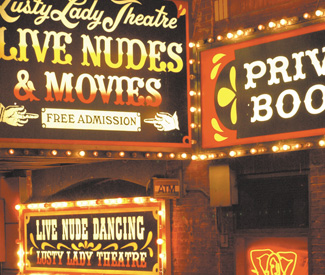
San Francisco’s sex workers rights history includes two unions. Workers at the North Beach strip club the Lusty Lady formed the Exotic Dancers Union in 1997. The union became part of the Service Employees International Union, and the Lusty Lady remains the only collectively run, sex-worker-owned strip club in the United States.

Maxine Doogan founded the Erotic Service Providers Union (ESPU) in 2004 as an umbrella organization for sex workers in various industries. The ESPU has been active in opposing regulations of the massage industry and sponsoring Proposition K, a 2008 ballot measure that would have decriminalized sex work in San Francisco.

I spoke to a handful of Bay Area sex-workers rights activists to get a sense of the major issues and priorities for the next year.

NO VISAS

Activists are currently planning for the July, 2012 International AIDS Conference in Washington, D.C.

Many international sex workers rights advocates have been denied visas to get to the conference. The U.S. typically bars convicted felons — but there’s a special exception for people guilty of misdemeanor prostitution charges.

“SWOP has an idea of getting in touch with some of the people denied entrance and asking them what they were going to present on and to try and present their papers in their place, to make sure these organizers voices are heard,” said SWOP-Bay Area spokesperson Shannon Williams.

But that’s not where the government’s weird exclusion of sex workers from its efforts to fight AIDS ends.

The Presidents Emergency Plan for AIDS Relief (PEPFAR) fund allocates $48 billion to organizations around the world engaged in AIDS treatment and prevention. But thanks to the religious right, the law, approved in 2003, includes a stipulation that all recipient groups must make a pledge decrying prostitution. It’s known as the “anti-prostitution loyalty oath.”

A court ruling July 6, 2011 declared the oath a violation of the free-speech rights of organizations in the United States, but the U.S. still blocks PEPFAR funding for international organizations based on the “loyalty oath.”

“Sex worker activists are going to converge in D.C. for the AIDS conference and talk about the loyalty oath. The US is exporting its ideology through this funding requirement” said Carol Leigh, a longtime activist who curates the annual San Francisco Sex Worker Film and Art Festival.


EMPHASIZING CONSENT

Sex workers rights activists continue to be engaged in their complex, decades-long struggle with anti-sex trafficking organizations.

People who want safer working conditions say that decriminalization would make it easier for police to distinguish between coerced and consensual prostitution and encourage those with knowledge of crimes perpetuated against sex workers to come forward without risking prosecution for their own illegal work.

But many anti-trafficking advocates dismiss the distinction between forced and consensual prostitution in their efforts. According to a document called “Ten reasons for not legalizing prostitution,” on the website of the Coalition Against Trafficking in Women, “There is no doubt that a small number of women say they choose to be in prostitution, especially in public contexts orchestrated by the sex industry… In this situation, it is harm to the person, not the consent of the person that is the governing standard (emphasis theirs).”

It’s this refusal to acknowledge the importance of consent that really pisses off advocates —and has a powerful effect on the policy that governs them.

The federal definition of sex trafficking includes consensual prostitution, and defines coerced prostitution as “severe sex trafficking.” “Law enforcement agencies can use anti-trafficking funds to arrest sex workers in prostitution, on the grounds that the feds define all prostitution as trafficking, even though the government distinguishes between trafficking and severe trafficking,” said one sex workers rights activist.

According to Leigh, anti-trafficking organizations are not all bad; she named the Global Alliance Against Traffic in Women as an organization that “has been allied with sex workers rights movement and takes rights-based approach.”

But organizations that conflate consensual and coerced commercial sex are often big-time recipients of public and private funding.

Doogan is wary of any attempt to further regulate or criminalize sex work. She says that often, laws meant to deter prostitution trap people who may want to change occupations.  “Women have to continue working in the industry because no one else will take them for work when they have those convictions on their record,” said Doogan.

That may be the case with Lola, an occasional Erotic Service Providers Union volunteer who was arrested on prostitution-related charges outside California earlier this year. She moved to the Bay Area and is looking for a job, but after a promising interview last week, she’s nervous that a background check will reveal her arrest.

“I’m waiting to hear whether that’s going to be an issue or not. They could tell my landlord, and then I could lose my house too…all I’m trying to do is get a job,” Lola told the Guardian.


THE WORK GOES ON

For most sex-workers rights activists, the long-term goal remains decriminalization. For now education, creative projects, and protest in service of that goal continue.

Members of SWOP-Bay Area have a program called Whorespeak that does outreach at colleges, and “we’ve also been speaking in classes for therapists about how to work with current and former sex workers and not pathologize them,” said Williams.

According to Stryker, one of the most exciting projects happening now is Karma Pervs. The website, run by local queer porn star Jiz Lee, sells unique sex-positive porn and donates the proceeds to organizations like the Saint James Infirmary.

Then, of course, there’s the International Day to End Violence Against Sex Workers, when sex workers and allies gather to commemorate sex workers who have been assaulted and killed.

Sex workers often can’t go to police to report crimes for fear of being locked up themselves, society retains a huge stigma surrounding sex work, and there is an insidious cultural myth that “you can’t rape a prostitute.” These all add up to put sex workers at high risk for assault and murder; serial killers, such as the Green River Killer in Seattle and a murdered in Long Island-area this past summer, are disproportionately likely to target prostitutes.

That’s why, for Williams, “Our long-term goal is to decriminalize prostitution. But the real goal is to end violence against sex workers.”

Making black herstory, every day

8

news@sfbg.com

Deconstructing the roots of

The black n gray suits

with hands in the Loot

That has buried the truth

About our black, brown and disabled youth

— excerpt from KKKourt by Tiny

OPINION On the first day of Black Herstory Minute (I mean, Month), I practiced black herstory, and walked through activism and breathed organizing and lived resistance by putting my body in the benches belonging to the criminal injustice system (a.k.a. the plantation) at 850 Bryant. I was there to support a struggle against injustice in the case of a young African warrior for truth, Fly Benzo, a.k.a. Debray Carpenter — student, son, media producer, organizer, and hip-hop artist who is facing a felony charge, jail sentence and $95,000 fine for nothing more than exercising his First Amendment right to free speech.

How many among you, overwhelmed with multiple Face-crack postings and a cacophony of tweets, might have missed the story of Fly, who spoke the truth about racism, police brutality and the unjust death of Kenneth Harding Jr. to a cop in a poor-people-of-color neighborhood, Bayview, which is under seize from the occupying army known as the police (or po’lice as we call them at POOR Magazine)?

As a woman criminalized and incarcerated for the sole act of being poor and houseless, the melanin-challenged daughter of a poor black single mother who spent all of her life in poverty and in struggle, I have witnessed first hand unequal justice against people of color and poor people. It’s a fact that remains, in 2012, still a very dire reality.

“They arrested me for exercising my Constitutional right to free speech,” said Benzo, 22.

Benzo’s revolution began when he was born to conscious African-descendant parents who, like many African descendant people in San Francisco, have been under the constant threat of removal, displacement, redlining, and ongoing police harassment for decades. He has been speaking out about injustices since he was a teen, starting with the fact that hardly any Bayview residents were hired to construct the multi-million-dollar T-Train that runs from downtown to Third Street — and the dramatic rise in the violent policing of the T-Train and the Muni bus lines that run through the poor communities of color in S.F.

But the beginning of Benzo’s current battle with the criminal injustice system began when he began to speak up about Harding, murdered by San Francisco police officers for not having a $2 dollar bus transfer. The judge might not admit the video that was taken at the scene of Benzo’s arrest, making his case all the more difficult to fight, and the truth all the more difficult to hear and see, which is where community support comes in.

A lot of people and organizers and politricksters talk about stopping the violence and how to “deal” with the inequities of racism and classism and violence on our youth of color. And yet when this brother spoke out, used his voice for nothing but truth and resistance about injustices he personally experiences everyday, who comes out to support him?

Practicing revolutionaries at POOR Magazine, the Idriss Stelly Foundation, The BayView Newspaper, Education not Incarceration, and United Playaz have been there, as well as his hard-working attorney, Severa Keith, and a few more. But we all need to be there, fighting for a very alive, very revolutionary, young truth-teller who is making black history, every day.

Tiny, a.k.a. Lisa Gray-Garcia, is an editor at POOR Magazine. Opening statements in the trial of Debray Carpenter are expected to begin Feb. 8 in Dept. 27.

Ellison wins, SF loses

6

EDITORIAL San Francisco’s not going to lose the America’s Cup. Oracle CEO and yachting billionaire Larry Ellison is too excited about the prospect of bringing the sport (and his company’s logo on the sail of his boat) to a mass audience for the first time in history that he’s not about to abandon San Francisco Bay. The process is too far along; that much is a done deal.

But the development agreements for the city’s waterfront is not a done deal at all — in fact, the proposal could wind up giving Ellison effective control over five piers and a valuable waterfront lot that he could develop for condos. And the city won’t get anywhere near enough out of the deal.

The development agreement is really just a sideshow in the cup planning; nobody’s disagreeing that Ellison’s America’s Cup Event Authority will need space to stage the race, and that will require the renovation of some waterfront property. And nobody disputes that the event will bring tourism and revenue to the city, which will offset some of the cost of allowing Ellison rights to the waterfront.

The rest of it is purely a real estate deal: Ellison’s offering to put millions of dollars into renovating crumbling and underused piers, and in exchange the Port of San Francisco — which lacks the money to rebuild the waterfront and has no credible plans for a good part of its property — could give Ellison long-term low-cost leases and development rights on Piers 26, 28, 30-32 and possibly 29, as well as Seawall Lot 330 at Embarcadero and Bryant.

The city’s never been terribly good at cutting tough deals with real-estate developers, and the history of San Francisco is littered with examples of the taxpayers losing out to the speculators and builders. And in the furor of excitement over the America’s Cup, this development agreement could become the latest sellout.

The original projections for the economic impact of the event are looking more and more questionable; it’s entirely possible that San Francisco will wind up with far less than the $1.4 billion in spending and the thousands of jobs that cup promoters have promised. It’s still going to be a big deal, and the city (particularly the hospitality industry) will do well — but it’s not the answer to all of San Francisco’s problems. By the end of 2013, the event will be over — and Ellison will have essentially taken title to a huge amount of public land, for as long as 60 years into the future. And he won’t be paying the city the normal development fees, the normal impact fees, or even reasonable annual rent to the Port.

The supervisors need to put aside the hype around a sailing regatta and look at this for what it is: A real-estate development agreement with one of the world’s richest people. And right now, it’s not a good deal for the city.

Alerts

0

yael@sfbg.com

THURSDAY 9

Occupy Oakland Forum on Police Actions

Oakland’s Citizen Police Review Board had been planning a forum on the Oakland Police and Occupy Oakland for months — until they announced at the last minute that it was canceled. In response, the Occupy Oakland Forum Committee is hosting essentially the same forum, and inviting the same speakers, including Jim Chanin, civil rights lawyer from the Oakland Riders case, and Police Chief Howard Jordan. They hope to give the community a chance to respond to the recent controversy surrounding treatment of Occupy Oakland by police.

6:15 p.m., free

Grand Lake Theater

3200 Grand, Oakl.

oakland@occupyreport.org


Reelect David Campos

District 9 Sup. David Campos and his re-election campaign are throwing their first fundraiser event in the Mission. It will include drinks, appetizers, and a chance to talk with the man himself.

6 p.m., free

Blue Macaw

2565 Mission, SF

(415) 920-0577


FRIDAY 10

Kenneth Harding benefit

A star-studded night of music to benefit the Kenneth Harding Jr. Foundation. Support the foundation created after Harding, an unarmed black 19-year-old, was killed by SFPD officers in an incident spurred by an unpaid $2 train fare. The night’s line-up includes Fly Benzo, BVHP neighborhood resistance leader, emcee and City College student, who faces four years in prison on multiple counts including “videotaping the police” for his responses to the shooting.

9 p.m., $12

330 Ritch, SF

www.330ritch.com/calendar


SUNDAY 12

Move to Amend

David Cobb, spokesperson for the Move to Amend campaign, will speak about corporate personhood. Move to Amend is an effort to amend the constitution to abolish corporate personhood, which saw a large turnout on its national day of action on Jan. 20. Cobb is also a former Green Party presidential candidate.

7 p.m., $5-10

Berkeley Fellowship of Unitarian Universalist’s Hall

1924 Cedar, Berk.

(510) 841-4824

www.movetoamend.org


Harlem is Nowhere

Hear author Sharifa Rhodes-Pitts and organizer Alicia Garza talk about the history and meaning of Harlem as a center for black politics and culture, the effects of gentrification, and the geography of building power for people of color. This event is part of an ongoing “authors in conversation” series at the Museum of the African Diaspora. Rhodes-Pitts is the author of Harlem is Nowhere: A Journey to the Mecca of Black America, and Garza is the co-executive director of People Organized to Win Employment Rights (POWER) in San Francsico.

2 p.m., free

Museum of the African Diaspora

685 Mission, SF

www.moadsf.org/visit/calendar.html

District lines: a community alternative

7

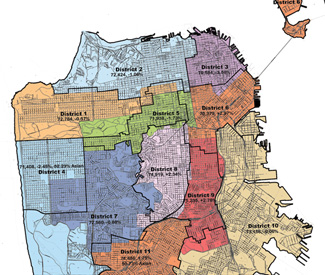
Early in April, a nine-member task force most San Franciscans have never heard of will draw lines that could change local politics for a decade. The Redistricting Task Force is using the 2010 U.S. Census data to adjust supervisorsial districts to reflect changes in the city’s population. Some shifts are dramatic — the area now covered by District 6 has some 25,000 new residents, and will have to shrink. Others will have to grow. And the way the new boundaries are set could affect the representation of ethnic groups, the political leanings of the board members, and the ability of progressives to pass legislation.

The task force has held a series of hearings on individual district lines. The S.F. Board of Realtors and other downtown groups are drawing their own maps. But almost nobody on the left has been looking at the city as a whole and how the different district lines can impact our ability to get six votes.

As campaign consultant David Looman puts it, “what downtown wants is clear — they want to quarantine all the progressives in districts five, six and nine, so they can control the rest.” What do the rest of us want?

The Guardian held a forum on the topic Jan 26, and about 70 people from across the wide rainbow that is the city’s progressive moment attended. The goal: To create a community alternative to what downtown, the Mayor’s Office, and possibly a majority of the task force members is suggesting.

>>VIEW THE MAP HERE

The map above represents a first draft. Fernando Marti, a community architect and housing activist, did the heavy lifting, looking for ways to keep ethnic communities, neighborhoods, and other so-called communities of interest together, while still avoiding the downtown quarantine.

It’s not an easy task, and there was a lot of discussion around some of the lines. Many of the people in the room were unhappy with the border between District 8 and District 6; in the next draft, that will probably be moved back from Valencia to Guerrero.

There was discussion about whether Japantown should be in District 1 or District 5, whether Portola should be in District 9 or split up, how the District 6 lines should be drawn, and much more.

It’s a work in progress — but we’re publishing it to get some feedback, to let people know that the process is going on, and to let progressive and independent neighborhood activists know that the task force decision, which can’t be appealed or overturned, is critical to the city’s future.

Transfer of power

4

yael@sfbg.com

Feb. 1 marks the first day that San Francisco and other California cities no longer have redevelopment as a tool for building affordable housing or dealing with urban blight, but questions remain about how the power and functions of the San Francisco Redevelopment Agency (SFRA) will now be used.

On Dec. 29, the California Supreme Court upheld the validity of Assembly Bill 26, which dissolved all redevelopment agencies throughout the state and redirected the property tax revenue they accumulated to prevent deep cuts to public schools.

Redevelopment agencies, established in California in 1948, were charged with revitalizing “blighted” areas of cities. There were 400 such agencies throughout California, funded by incremental increases in property taxes within a redevelopment zone. Agencies could borrow against that revenue source to subsidize development projects.

AB 26 mandated that all cities dissolve their redevelopment agencies by Feb. 1 and transfer assets to successor agencies meant to “expeditiously wind down the affairs of the dissolved redevelopment agencies,” according the bill’s text.

A resolution passed by the Board of Supervisors on Jan. 24 authorized the transfer of SFRA affordable housing assets to the Mayor’s Office of Housing (MOH) and its non-housing assets to the city’s Department of Administrative Services. It also created a board to oversee the implementation of the SFRA’s ongoing projects.

Now, San Francisco is faced with the task of continuing to fund affordable housing projects and other development without the SFRA, and the board’s resolution laid out some of the terms for how the city will do that, although much remains to be determined.

Mayor Ed Lee appointed all members of the oversight board, which includes Planning Director John Rahaim; MOH Director Olson Lee; Nadia Sesay, director of the Mayor’s Office of Public Finance; and Bob Muscat, director of International Federation of Professional and Technical Engineers, Local 21.

In recent weeks, some groups have raised concerns that these appointees are not representative of the communities impacted by the ongoing redevelopment projects that they will be entrusted with overseeing, and that too much power is concentrated in the Mayor’s Office.

“One of our biggest concerns is that the oversight body could be made much more accountable and democratic,” said Jeron Browne of People Organized to Win Employment Rights (POWER)-Bayview. Much of Bayview-Hunters Point is no longer under the authority of the Planning Commission or any regular zoning laws since it was declared a redevelopment project site in 2000.

Sup. Malia Cohen, who represents the area, added an amendment to the board’s resolution that would impose term limits on oversight board positions. “I understand that there are a number of concerns that have been raised about the composition of the board. However, given the short time frame and the technical nature of the board and its obligations, I’m very comfortable with these appointees that they will be able to make decisions necessary to make the projects move forward. Additionally, with the inclusion of staggering terms we will be able to ensure that there is ample opportunity to include representation from affected communities,” Cohen said at the meeting.

The board also passed an amendment to “clarify that the land use controls granted by the oversight board are consistent with previous land use authority granted by the Board of Supervisors and the redevelopment commission,” as a response to concerns that the oversight board will have too much power over land use in project areas.

Tiffany Bohee, interim director of the SFRA, said that the court’s ruling was the “least desirable possible outcome.” Bohee said the SFRA has spent recent weeks analyzing all enforceable obligations outlined by the ruling to make sure that the transition complies with the law and is as fair as possible to SFRA employees.

The positions that these 101 workers filled at the SFRA will no longer exist as of Feb. 1, and layoffs are underway. However, most will remain employed throughout a transition period that ends March 31, and Bohee said that many will find work in city agencies that will be charged with continuing the work of the SFRA, such as MOH and the Planning Department.

MOH was historically responsible for allocating federal housing grants to city agencies. In past decades, federal budget cuts have severely limited the grants to build affordable housing. Now, although MOH has some power over city housing policy and allocation of funds to build housing, many of those responsibilities had been transferred to the Planning Department — or, until recently, the Redevelopment Agency.

The Planning Department is governed by the Planning Commission with four mayor-appointed members and three members appointed by the Board of Supervisors. The Planning Department implements planning standards and signs off on structural changes to the city, ranging from homeowner requests to alter houses to developer requests to build high-rises.

In many ways, the Redevelopment Agency was redundant, shadowing work done by the Planning Department. When an area was designated an SFRA project area, the planning code and zoning restrictions no longer applied, and developers working in partnership with the city had the power to define new land-use regulations.

Many critics of the SFRA said that private developers were able to use this lack of regulation to take advantage of the significant amount of money reserved for the agency. Deepening this concern was the fact that the Redevelopment Commission, which oversaw the SFRA, was composed entirely of mayoral appointees, which some felt were less accountable to the public interest than the Planning Commission.

Some feel that the oversight board, composed entirely of mayoral appointees, will repeat the same lack of accountability to neighborhoods.

“The city is setting up a planning commission for the 1 percent. And the Planning Commission that we have is the for the 99 percent,” said Tom Radulovich, executive director of Livable City, which works on land use issues. He said that with the dissolution of the SFRA, the city has an opportunity to facilitate the construction of affordable housing in a more democratic fashion. His organization expressed concerns to the Board of Supervisors, cautioning that the Oversight Board should not have undue power over land-use in development project areas and that the new structure in city government for facilitating development projects should be created with the input of communities. The Board of Supervisors made clear Jan. 24 that the Oversight Board and its appointees are a temporary measure to comply with AB26 by the Feb. 1 deadline. As Sup. Christina Olague said, “I just want to assure the public that this isn’t the end-all, be-all of this discussion, that it will be ongoing, and we welcome any of your concerns at any time.”

After the tear gas clears

3

yael@sfbg.com

After a chaotic day of marches and confrontations between police and protesters Jan 28, I was arrested along with about 400 others who were trapped by police in front of the downtown Oakland YMCA. Seven of us were journalists.

The goal of the march was to take over an abandoned building — an the vacant Kaiser Convention Center, a city-owned building that’s been closed since 2005, was a prime target.

I have not yet been able to retrieve my property, including my recorder and notebook, which is being held by the Oakland Police Department. What follows is a pieced-together account and a perspective on what the events of Jan. 28.

I spend 20 hours behind bars, and missed the later parts of the action. But I was able to observe what happened in jail and make some sense of what happened.

Occupy people are constantly debating tactics and goals, and for many, the idea of occupying a vacant building made sense. When Occupy Oakland had a camp in Frank Ogawa Plaza, also known as Oscar Grant Plaza, and commonly shortened to OGP, it created a strong community. That community bridged divides between the homeless and the housed, between students and labor organizers, and between Oakland residents of different races, genders and levels of ability in an unprecedented fashion.

The camp had a kitchen that fed hundreds of people everyday and a network of shared tents and blankets which welcomed in hundreds who otherwise would have slept on the streets, often feeling isolated from other residents of their city and made to feel inferior.

The camp was repeatedly raided, Occupiers were tear gassed and shot with rubber bullets, and when OGP was cleared out, the community no longer had a home. And the police started that violence.

That was the practical reason for wanting to occupy a vacant building: to have a social center for Occupy Oakland.

Of course, there are other reasons. There’s the question that many squatters and homeless advocacy groups have been making for decades: why let buildings lie vacant while people freeze on the street?

Remember: The building that Occupy wanted to occupy is public property, and right now nobody is using if for anything.

In one exchange in jail, a guard asked a protester why the activists thought they had the right to take over a vacant building. “I mean, it’s not yours,” he insisted. The protester replied that many vacant buildings are government-owned and therefore public.

“So it’s the government’s,” the cop said.

“But I pay taxes,” the protester responded.

“Me too!” replied the cop. “It’s mine!”

“It’s both of ours,” smiled the protester. “It’s all of ours.”

That’s what made the convention center action such a clear and easy political decision.

A lot of people in Occupy would go further, saying that at a time of a severe housing crisis, it’s perfectly legitimate to take over privately owned buildings that are sitting there vacant. It’s part of the central argument of Occupy — that corporations and the rich unfairly own and continue to acquire much more wealth than the majority of people. For many people, owning a vacant building and doing nothing with it, while hundreds freeze on the streets, is a crime itself.


UP AGAINST THE COPS

Then there’s the question of the police — and violence.

The word “nonviolent” has a specific meaning in the history of political movements. Martin Luther King Jr. defined it in his essay “The Meaning of Non-Violence”: “If you are hit you must not hit back; you must rise to the heights of being able to accept blows without retaliating … But it also means that you are constantly moving to the point where you refuse to hate your enemy. You are constantly moving to the point where you love your enemy.”

It’s a philosophy but also, in political terms, a tactic.

Many of the people who make up Occupy Oakland get their start as activists organizing against police brutality in a city that has longstanding problems with violent and undisciplined officers.

Police Chief Howard Jordan said in a press release that “It became clear that the objective of this crowd was not to peacefully assemble and march, but to seek opportunity to further criminal acts, confront police, and repeatedly attempt to illegally occupy buildings.”

It was certainly clear that the intent of the crowd was to illegally occupy a building. And any honest assessment of Occupy Oakland would have to acknowledge that some members are not wedded to King-style nonviolent civil disobedience. (Neither, by the way, were a lot of the protest movements of the 1960s.) Many protesters wore masks and bandanas to disguise their identities and protect them from tear gas and pepper spray, and the march was led by protesters with makeshift shields, which suggests that they expected to be attacked. You could certainly argue that what those people were doing wasn’t confrontation; it was self-defense.

Frankly, it made sense to be prepared: In other Occupy Oakland actions, police have attacked with batons, tear gas, pepper spray, flash-bang grenades, and smoke bombs. And for quite a few Oakland residents, the police have always been seen as an outside force that can’t be trusted.

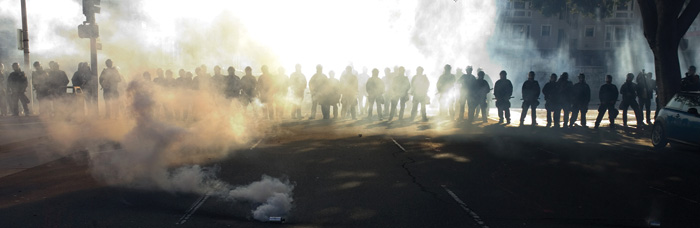
In fact, violence did break out. Many, including myself, have eyes still stinging from tear gas. I saw several wounds caused by rubber bullets shot at protesters. I spoke individually to at least a dozen people — one of them a pregnant woman — who were struck with police batons.

And protesters did not remain peaceful while this violence was being used against them.

Some picked up tear gas canisters and threw them back towards police; that much I saw. I also saw protesters throw empty plastic bottles at police.

According to the police, they also threw metal pipes, rocks and bricks. According to the protesters, they threw mainly empty plastic bottles and fruit at police. But as protesters often say of the police, “They’re the ones who showed up with the guns.” If the cops didn’t want violence, why unleash such an arsenal of weapons?

People got hurt, protesters and police alike. Several bystanders who had nothing to do with the situation were swept up in the mass arrest.

The city of Oakland, already in dire financial straits, likely spent hundreds of thousands of dollars reacting to the protests. Police claim that they were unable to sufficiently respond to violent crimes over the weekend, including five murders, because they were overwhelmed with Occupy troublemakers.

Of course, city officials were the ones who decided to arrest 400 people — with all the expense that involves.

There are, at this point, no reports of serious injuries to any police officers. However, at least a dozen protesters had welts on their faces or bodies from being beaten by clubs or shot with rubber bullets. One woman was shot in both arms with rubber bullet; one man was shot in the face with rubber bullets while holding a video camera to document the events. Several protesters were shoved to the ground and received wounds on their faces while being arrested. Police raised their rubber-bullet rifles to the faces of protesters throughout the day, threatening attacks. A rubber bullet to the face can cause brain damage and blindness.


DID IT HAVE TO HAPPEN?

How could this have been prevented?

Police say that “while peaceful forms of expression and free speech rights will be facilitated, acts of violence, trespassing, property destruction and overnight lodging will not be tolerated.” But 40 people were arrested during an ongoing Occupy Oakland vigil in the first weeks of January for having “illegal property” at OGP in what many saw as clearly a peaceful expression of First Amendment rights.

On KGO radio Jan. 29, Chief Jordan said that he has allowed Occupy Oakland to protest without a permit and would continue to do so, but those early January raids were ostensibly due to permit violations — violations of the terms of a permit that Occupy Oakland did in fact have.

There’s no question: The police response to Occupy Oakland over the past few months has caused some people in the movement to get more radical.

Many Occupy Oakland-affiliated medics condemned those who threw objects at police, saying that they provoked a backlash that caused more injuries. Many Oakland residents who might be in line with the socio-economic critique presented by the Occupy movement feel endangered and confused by marches that result in the massive use of police weapons in broad daylight. A lot of people would rather protest in a lot of ways that less resemble urban warfare.

On the other hand, there are also ways that Oakland officials could have prevented the consequences of weapons deployed and 400 arrested Jan. 28. They could, for example, have allowed protesters to occupy the vacant building.

When protesters seized a building Jan. 20 in San Francisco, police first attempted to prevent them. They lined up in front of the targeted building. They deployed pepper spray and struck several protesters with batons. When they were unsuccessful, and protesters entered the building from the back, they opted to block the surrounding streets and wait until the time seemed right to enter the situation and make arrests. Police spokesperson Carlos Manfredi told me that the cops were not going to rush into the situation and were trying to prevent injury and violence.

The Kaiser Convention Center has been vacant for years. The city of Oakland recently made plans to sell it to its Redevelopment Agency, but that plan fell into legal limbo when Gov. Jerry Brown signed AB26, a bill that dissolved all California redevelopment agencies.

At this point, nobody at Oakland City Hall has any plans whatsoever for the big, empty structure.

Why not allow Occupy to use the convention center? It’s not downtown, where Mayor Quan says businesses have been adversely affected by Occupy Oakland’s presence. It would give the movement a chance to stop focusing on trying to occupy spaces and start focusing on benefiting the community with food, shelter, and community programs that they provided when they had a camp. It would give the building tenants who could be held responsible for maintaining it. It might even help get Occupy Oakland and the Oakland Police Department out of the cycle of violence that they have been spiraling into for months.

Each time arrests occur, each time violence occurs, both sides blame the other. Both sides are correct that they were provoked. Both sides are correct that something that they think is worth defending was violated — for the cops, it’s the law. For the protesters, it’s the right of the people to assemble.

In fact, many Oakland residents have experienced violence at the hands of the Oakland Police Department for years before Occupy began. There was already a mass movement formed around the murder of Oscar Grant, and thousands of people fed up with police murders of unarmed, often black, suspects.

In recent decades, other radical groups, notably the Black Panthers, insisted that their community lacked basic needs because the city of Oakland refused to prioritize them. The Black Panther free breakfast program served food in a strikingly similar way to Occupy Oakland. Black Panthers were also notorious for carrying guns to defend themselves against police violence.

Occupy Oakland protesters (unlike Tea Party members) certainly don’t carry guns. But, more and more, they cry “fuck the pigs” as much as any Panther.

For much of the Occupy movement’s 99 percent, unjust actions by banks, corporations, and the government officials that they have often bought and paid for are the worst problems facing the United States today. For others, particularly the poor and people of color, these problems are magnified and exacerbated by the fact that they feel the threat of police harassment every day. For years, they’ve understood that police disproportionately do not investigate or solve crimes that happen to them and their families.


THE RADICALS AND THE BROADER MOVEMENT

The Oakland General Assembly Jan. 29 was the biggest it’s been in weeks. While there were still over 300 people in jail, 300 more came out to get involved with the meeting. That happened at the same time that many who felt that inexcusable violence and property destruction occurred Jan. 28 and concluded they could no longer have anything to do with Occupy Oakland.

It’s a challenge for the movement nationally, too: How do you accept and encourage the people whose legitimate anger at economic injustice and police abuse turns them toward more radical responses — and at the same time make room for a people who want nothing to do with the black bloc Fs, vandalism, and confrontation with the police?

There are tactical issues with the way the building occupation was planned. Many who were completely in line with the concept felt unsafe and uncomfortable with the secretive nature of the organizers who planned it. The location of the building targeted for occupation was kept secret for practical reasons; police could easily prevent a successful takeover. Supporters must often be led to the locations of planned takeovers without knowing where the action is and how they’ll get there. But how do you reconcile this with the transparency required when organizers are leading more than 1,000 people who want to use tactics they feel comfortable with and make their own choices?

Occupy Oakland is asking the people to imagine a world where property rights wouldn’t prevent them from doing all the good that they could do with a building like the Kaiser Convention Center. They must also ask themselves to imagine a world in which goals like a building occupation can be achieved in a way that everyone involved is able to consent to their involvement.

These debates continue to occur at Occupy Oakland. Some will leave the movement, some will join. Some will take the ideas and try to manifest them in new and different ways. Participants in Occupy Oakland desperately want basic needs of food and shelter met for their community members, and for the system that governs the city to do so in a way that allows people to thrive when it comes to health, education, and opportunities for creativity and growth. They think that they have the beginnings of a community and a process that can achieve those visions, better than the city government ever has, and they care more about achieving it than respecting the property rights of the owners of abandoned buildings.


Two clean energy tracks for SF

1

OPINION CleanPowerSF, San Francisco’s green electricity alternative to Pacific Gas and Electric Co., is set to launch this year. The program is following two parallel paths — one to build renewable energy in San Francisco and create thousands of local jobs, the other to purchase clean power from remote sources from Shell Energy.

While both tracks bring advantages, this bifurcated approach could end up serving only 30 percent of city residents. Fortunately, the city can easily improve the launch of CleanPowerSF by merging the two tracks.

Enacted by the Board of Supervisors and Mayor Gavin Newsom in 2004 and in 2007, CleanPowerSF is not a public-power program like Santa Clara’s Silicon Valley Power or Alameda Municipal Power. CleanPowerSF is a public-private partnership, much like the successful Marin Clean Energy, which can buy power in bulk from outside companies — and also generate its own renewable energy. PG&E still owns the transmission grid and will deliver electricity to customers, who then have the option of choosing between CleanPowerSF and PG&E.

The San Francisco Public Utilities Commission has embarked on a detailed analysis of PG&E electricity data to find out how much electricity is used in different parts of the city at different times of the day and how much it costs. That will pinpoint exactly where in San Francisco renewable energy should be built for the highest efficiency and lowest costs to ratepayers.

While this analysis is being conducted, the SFPUC plans to initiate the second track, offering ratepayers 100% renewable electricity purchased from Shell Energy North America. That will get CleanPowerSF up and running quickly — but would cost ratepayers between $6.70 and $54.50 more a month more than PG&E. As a result, the SFPUC estimates that as many as 70% of ratepayers could leave CleanPowerSF and go back to PG&E.

The SF PUC plans to offer CleanPowerSF to two-thirds of San Francisco customers — 230,000 residences — with as many as 155,000 opting out. Once these people opt out, they won’t be customers of the cheaper, locally produced, job-creating, green energy that will come later.

By comparison, only 20 percent of Marin Clean Energy customers opted out at initial rollout. That’s because Marin Clean Energy offers a 27 percent renewable energy option in addition to a higher-cost 100 percent green option. The “light-green” option is cheaper because it mixes in lower-cost, non-renewable electricity.

The PUC could keep more San Franciscans in CleanPowerSF by integrating the local generation and data analysis and purchasing tracks. First, it could include a cheaper light-green option like Marin’s. To determine what mix of renewable and non-renewable electricity would be cost-competitive with PG&E, the PUC would use the results from the first track, the analysis of electricity usage data, expected this spring. The Board of Supervisors could make these changes when it takes up the Shell contract this month or next.

In the past few months, CleanPowerSF has made much progress thanks to San Francisco Supervisor David Campos and Ed Harrington, general manager of the San Francisco Public Utilities Commission. The addition of a cost-competitive light-green option would enable CleanPowerSF to better compete with PG&E and keep more San Franciscans in the program — for the long term. That would significantly increase the number of new local jobs created and have a greater effect in fighting global climate change. It worked in Marin, and it can work in San Francisco as well..

John Rizzo is former chair of the Sierra Club Bay Area Chapter and current president of the San Francisco Community College Board


The parking war

29

EDITORIAL When you talk about changing parking rules in San Francisco, you’re setting off the political equivalent of shooting war. Nobody wants more parking tickets, nobody wants more expensive parking meters, nobody wants to pay for parking that’s been free for years — and the Municipal Transportation Agency has, by most accounts, done a pretty poor job of selling its new parking management program.

That’s too bad, because the MTA proposals aren’t all bad. In fact, the agency is doing exactly the right thing by looking at a long-term citywide plan for altering the way people pay for and use on-street parking. If the bureaucrats at a city department that isn’t used to San Francisco’s often slow community-oriented planning process can shift their outreach efforts into a different gear, there’s no reason they can’t come up with a plan that most neighborhood residents and small businesses will support.

The MTA’s SFPark program uses high-tech meters that accept credit cards and change prices at different points of the day to maximize turnover on the streets. That’s actually good for local businesses — the less time people spend circling the block looking for a parking space, the more likely they are to stop and shop. Limiting the number of cars cruising for a space improves traffic flow. And parking for an hour or two at a meter is still much cheaper than parking in a garage.

But when the MTA announced that it was expanding SFPark into the Northeast Mission, Dogpatch, Potrero Hill and Mission Bay, the neighborhoods rebelled. Some of that was just anger over the prospect of meters being installed on streets that don’t have them. Some of it comes from the changing land use in areas that are increasingly both residential and commercial. Some of it comes from the intense development pressure in those areas.

But a lot of it was a legitimate response to a perception that the MTA was trying to ram the changes through without making a serious effort to work with the community. It’s not surprising — the MTA has been somewhat isolated from the politics of land use and planning in the city. So the staff isn’t used to the fact that San Francisco is a process-oriented place where a wide range of constituent groups want input before anything happens where they live or work.

The neighborhoods need to understand reality, too: The era of free parking in San Francisco is coming to an end. That’s a good thing — the city as a matter of policy should discourage the use of cars, and charging drivers for parking (and using that money to improve Muni) is an obvious solution. And the proposals aren’t that onerous: Paying 25 cents an hour for all-day parking where you work is hardly a terrible financing burden. (And let’s face it — the neighborhood parking stickers are way, way too cheap.)

But much of the southeast is badly served by transit and there are vehicle-intensive production, distribution and repair uses, and MTA needs to understand that. The agency has wisely delayed the program — and after its shown it can work with the neighborhoods, this sort of bold initiative will be possible.

Editor’s notes

13

tredmond@sfbg.com

I used to go to Grateful Dead shows at the Oakland Auditorium, which is now called the Kaiser Convention Center. One night I saw Bill Graham, the late concert promoter, ride a zip line from up near the ceiling to the stage in a giant paper mache joint called the “S.S. Columbian,” which looked like it was going to fall apart at any minute as he swung back and forth 50 feet over the crowd, trying to smile and wave in a bizarre promotional stunt that confused even the deadheads. I bet he shit his pants.

The place was a pretty good venue for a big concert, but it never worked out as a convention center, and the city shut it down in 2005. It needs seismic work and about $5 million in maintenance. It sits near Lake Merritt, on the edge of downtown Oakland, a giant empty building just waiting for something to happen to it.

It’s a perfect spot for an Occupy Oakland headquarters. I’m surprised it took the Occupy folks this long to figure it out.

Look: Oakland’s a working-class city, and it’s having severe financial problems, and sending hundreds of cops to arrest Occupy protesters is sucking up money that’s desperately needed for other things. Mayor Jean Quan complains that police were unable to respond to emergency calls in other parts of the city because they were all downtown dealing with the demonstration.

Understood — and it’s clear that the Oakland Police, whether the Occupy folks like it or not, are going to arrive in mass numbers to make sure that there’s no damage to local businesses or City Hall (where, oddly, there were no arrests, because the cops were elsewhere).

But the empty Kaiser Center, which isn’t even in the downtown center? Why bother?

Seriously: Why not just give it to Occupy Oakland? Tell the group that the city will strictly enforce fire and health codes, that the Occupy people will have to clean the place up and keep it clean, that they can’t damage the place … and hand over the keys?

It’s public property. Nobody using it now. Occupy might actually bring some excitement to the scene. If it became a center for political meetings and organizing, for education and performances, it could be a be a very positive thing.

Declare at truce in the Occupy wars. Let the cops go after murderers; give Occupy the vacant convention center. Nothing else is working. It’s worth a try.

Alerts

0

yael@sfbg.com

THURSDAY 2

Violence in Mexico

How does the war on drugs perpetuate violence in Mexico, and what can be done? Juan Fraire Escobedo, an activist from Ciudad Juarez, will discuss the human cost of the drug war, militarism, and human trafficking.

7 p.m., $5-$10 donation

Eric Quezada Center

518 Valencia, SF

(510) 282 8983


SATURDAY 4

No war on Iran

The ANSWER coalition leads a march and rally demanding “No war on Iran, no sanctions, no intervention, no assassinations.” Dozens of demonstrations around the country will protest the threat of war on Iran.

Noon, free

Powell and Market, SF

www.answercoalition.org/national/news/no-war-on-iran.html


SUNDAY 5

Situationists and the Occupy Movement

Author of “The Joy of Revolution” and celebrated translator Ken Knabb discusses links between the Occupy movement and the Situationists, the revolutionary group that influenced the Paris uprisings of May 1968.

10:30 a.m., free

Niebyl-Proctor Library

6501 Telegraph, Oakl

www.marxistlibr.org


MONDAY 6

LGBTQ Singing Class

The first day of a series of singing workshops, taught in a supportive space for LGBTQ individuals and their allies. The class will focus on solo singing with one group song. Glitter optional but highly encouraged.

6:30 p.m., $25

Women’s Building

3584 18th St., SF

www.eliconley.com/singing-classes.html

What are people?

4

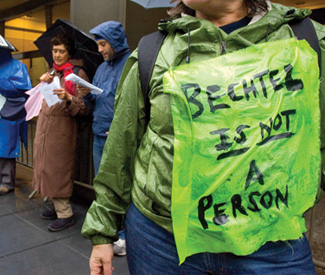
Protesters from the Occupy movement and beyond gathered in front of the Ninth Circuit Court of Appeals in San Francisco on Jan. 20, calling for the adoption of a 28th amendment to the U.S. Constitution aimed at refuting the idea that corporations should have the same rights as people, a legal doctrine know as corporate personhood.

The event was part of a day of action at courthouses around the country, seeking to raise public awareness about the unfettered influence of corporate money in U.S. elections and draw attention to the second anniversary of the landmark corporate personhood decision by U.S. Supreme Court, Citizens United vs the Federal Elections Commission.

“We are here not to protest, not to petition, and not to plead, but to proclaim a truth that should be self evident, even to the Supreme Court: Corporations are not people; money is not speech,” said Abraham Entin, of North Bay Move To Amend, addressing a crowd gathered at the courthouse. “Corporations work very hard to convince us that we cannot do without them and the products they produce. They tell us they are too big to fail, and that our survival is dependent on their survival … Occupy has changed all that.”

In a contentious 5-4 ruling handed down on Jan. 21, 2010, the Citizens United case solidified the legal framework that bequeaths corporations the same rights under the Constitution as real, living, breathing, U.S. citizens, and by merit of their First Amendment rights as citizens bars any restrictions placed on a corporation’s ability to spend money to influence elections.

When Republican presidential candidate Mitt Romney famously said on the campaign trail that “corporations are people, my friend, because corporations have people inside them,” he is reflecting the logic of the majority opinion in the Citizens United case. The court’s majority asserted that corporations are essentially an association of people and thus enjoy the same rights as individuals.

The court also claimed that it is impossible to distinguish between the corporate media outlets and other corporate speech, so all corporations should enjoy the free speech rights saved for the press. Furthermore, because journalists often have to spend money to achieve speech, money spent on messaging by all corporations represents protected speech.

Corporations, a relatively modern invention, aren’t actually discussed in the Constitution. But the notion of corporation personhood began around 1886 in the case of Santa Clara County v. Southern Pacific Railroad. What Citizens United did was equate corporate money spent to influence elections with protected political speech, upending attempts at election reforms and gutting the McCain-Feingold Act of 2002 that regulated federal election campaigns.

That corporations act to corrupt our democratic systems for their own profit is not conspiracy, it’s simply a byproduct of what they are. Corporations are legally obligated to act to maximize their profits for the benefit of their shareholders, otherwise their board and corporate officers are considered negligent of their obligations to their shareholders’ financial interests. Unlike journalists, whose professional credo calls for fairness and acting in the public interest, corporations are designed to act in their own interests.

As Justice John Paul Stevens wrote for the dissenting judges in Citizens United, “Corporations have no consciences, no beliefs, no feelings, no thoughts, no desires. Corporations help structure and facilitate the activities of human beings, to be sure, and their ‘personhood’ often serves as a useful legal fiction. But they are not themselves members of ‘We the People’ by whom and for whom our Constitution was established.”

The resulting flood of corporate money into election campaigns since the court’s ruling is delivered through an aqueduct known as the Super PAC (political action committee). In the wake of Citizens United, election spending by Super PACs in the 2010 midterm elections exceeded $300 million dollars, more spending than the overall spending in the previous five midterm elections combined.

Unlike donations to campaigns, which so far remain regulated, Super PAC money is spent directly by the Super PAC, and can be spent attacking as well as supporting candidates, leading to fears that corporations can exert influence on incumbents before a re-election campaigns by threatening to spend money attacking them in the upcoming election cycle.

“Corporations are human creations, state creations, legal entities … There is no reason we cannot limit their spending,” said Carlos Villarreal, executive director of the National Lawyers Guild’s Bay Area chapter. “Nonprofit organizations are limited in their political spending. Churches and charitable organizations are also limited in their spending. So why not for-profit corporations?”

Perhaps no group knows more about government limits to free speech than participants of the Occupy movement. Elastic restrictions on individual free speech and freedom of association rights spelled out in the First Amendment, resting on alleged risks to health and public safety, have led to Occupy encampments across the nation being restricted and evicted, at times enforced by brutal police crackdowns.

The right of the government to restrict individual and group speech that officials believe represents a clear and present danger was established by the Supreme Court in the 1919 Schenck v United States case — the famous “don’t yell fire in a crowded theater” case. What is not widely known is that this case was a re-examination of the famous 1917 Espionage Act. The “crowded theater” was our nation’s entry into World War I, and those being jailed for “yelling fire” were labor organizers and pacifists expressing their opposition to our entry into the war.

Relying on Schenck, courts have consistently defended restrictions on individual free speech when there is a compelling interest to public safety, the so-called “clear and present danger” standard. Villarreal and the crowd gathered before the Ninth Circuit asserted that corporate influence in our democratic processes represents a clear and present danger to society. “There is no more compelling interest than protecting democracy,” said Villarreal.

Despite the apparent double standard, legal experts say the courts action in the Citizens United case leaves a constitutional amendment as the only avenue left for regulating corporate money in elections and ending corporate personhood, but the movement to take on that Herculean task has already begun.

U.S. Sen. Bernie Sanders (I-VT) and Rep. Ted Deutch (D-FL) have introduced legislation proposing a 28th Amendment to the Constitution. While the language differs from another amendment presented by the group Move to Amend, it also takes aim at ending corporate personhood.

“Two years ago, the United States Supreme Court betrayed our Constitution and those who fought to ensure that its protections are enjoyed equally by all persons regardless of religion, race or gender, by engaging in an unabashed power-grab on behalf of corporate America,” Sanders wrote in a Jan. 20 Guardian(UK) column.

In Sanders’ home state of Vermont, the state Senate is also considering a resolution calling for a constitutional amendment against corporate personhood. A similar resolution, authored by Alix Rosenthal, was adopted by the San Francisco Democratic County Central Committee during a special meeting on Jan. 21. There was just one dissenting vote, and DCCC members say they plan to push for the state party organization to also adopt the stance.

The hurdles set forth to amend the U.S. Constitution, outlined in Article V, are substantial. In order for an amendment to even be considered, a super majority of both houses of Congress must initiate the process, or two-thirds of states must call for the amendment. Proposed amendments passing this threshold are then adopted only after three-quarters of state legislatures ratify the proposed amendment. But that difficult road is one the protesters said they are ready to travel. “We are here on a rainy day with warm hearts and wet feet. We are the 100 percent, the humans. No corporation has every experienced the thrill of wet feet,” said Gangs of America author Ted Nace. “We are the fools who go out on a wet day to fix a broken world. Eighty percent of the public want to fix this. That means we are halfway to our goal. What remains is organization, mobilization.”

Pay to park

62

The San Francisco Municipal Transportation Agency has hailed the success of its SFpark program — which uses high-tech meters and demand-variable pricing to manage on-street parking — noting that expired meter citations are down and meter revenue is up. The resulting 11 percent net increase in revenue  is all going to improve Muni. So transit improves, drivers get more spots and fewer tickets — everybody wins.

[CLARIFICATION (2/1): The new meters had an 11 percent net revenue increase compared to the old meters, but overall net revenues from citations and meters was still down by 3 percent.]

But the SFMTA has run into a hornet’s nest of opposition with its latest proposal to expand SFpark into the Northeast Mission District, Potrero Hill, Dogpatch, and Mission Bay, largely because the plan involves placing meters on streets where parking is now free. And even those who don’t object to paying for parking say the SFMTA has bungled this process.

The problem isn’t just what critics say are arrogance and dubious outreach efforts by agency officials. It may be that the SFMTA pursued too many goals at once, mixing them in ways that muddled the message. Or it may just be that charging for parking will always anger drivers, no matter how it’s proposed.

The agency wants to discourage driving — particularly cruising for parking, hence SFpark’s “Circle Less, Live More” slogan — to speed up Muni and reduce traffic congestion. But that also means charging for street parking so cars won’t just sit in those spaces, and that involves a complicated balancing act in mixed use neighborhoods.

Residents, many employers, and commuters want all-day street parking, preferably free and easy. But most business owners want enough parking turnover so their customers can find a spot. City policies call for prioritizing residents’ needs, and the SFMTA needs money to fund and expand Muni service.

Meeting all of those needs isn’t easy. But over the last couple of months, the SFMTA’s effort to expand its successful and popular SFpark program have managed to turn thousands of residents angrily against that program, the agency, and the proposition that people shouldn’t expect free parking.


COMMUNITY OUTRAGE

Architect John Lum and artist-designer Miranda Caroligne didn’t know each other a couple months ago, but now they’re helping to lead a movement that is uniting neighborhood groups in the Mission, Dogpatch, and Potrero Hill against the parking meter proposals.

“You have an agency that is not listening at all to the community. That’s fascism!” declares Lum. He’s actually an amiable and soft-spoken young guy who employs 10 people at his architecture firm near 17th and Capp streets, but this issue really gets his blood boiling.

And Lum isn’t alone, as the Jan. 13 public meeting before an SFMTA hearing officer showed. Not only did everyone who streamed to the microphone voice opposition to the proposals, but they usually did so in angry and accusatory ways, saying it would destroy businesses, punish the poor, and result in conditions that are simply unworkable and intolerable. And they said the SFMTA simply doesn’t care.

“If you’re a PDR business,” Caroligne said, referring to the Production, Distribution, and Repair businesses whose last bastion is some of the targeted areas, “you’re never going to get people to work at a place that doesn’t have parking…This proposal will push them out.”

There are myriad ways that the plans are flawed, say their critics: Meters were proposed on some residential streets in initial plans, despite SFMTA policies to the contrary; traffic surveys had too small a sampling and weren’t realistic; residential permit districts would be replaced by meters, or meters would be placed where districts might work better; transit service on Potrero Hill is too bad to expect people to use it; live-work spaces were inappropriately treated like retail outlets; and meters near the 22nd Street Caltrain station could actually discourage the use of public transit.

“There’s not that much disagreement, but where there is, it’s really important,” said Tony Kelly, president of the Potrero Boosters Neighborhood Association. “I’m someone who supports parking management, and I’m frustrated that the MTA is so tone deaf with this. We’ve been through a lot of fake public outreach efforts and this is looking like one of those.”

Janet Carpinelli, president of the Dogpatch Neighborhood Association, said her members feel like the SFMTA is ramming this through without regard for the needs or input of that neighborhood.

“The real issue is it’s a very big inconvenience to the businesses and residents in this neighborhood and it’s not really helping anything. It’s just a revenue grab by the MTA,” she said.

Potrero Hill resident Jim Wilkins was so outraged by the proposal to install meters along Pennsylvania Street outside his home that he started an online petition against the proposals that has so far garnered about 1,300 signatures. “We’re forming an organization to resist these proposals,” he told us.

Lum was already a member of the 17th Street Coalition, which formed in 2010 to oppose the renewal of a liquor license at the local Gas’n’Shop, but more recently organized opposition to the meter proposal. It attracted Caroligne, and now they’ve formed a new group, Northeast Mission Neighbors, which held a joint organizing meeting with the Dogpatch and Potrero groups on Jan. 23. They’re all determined to delay and modify the SFMTA’s proposal, which had been scheduled for adoption by the SFMTA Board of Directors Feb. 7.

Lum said the proposed changes are tough to accept: “I don’t think this is about free parking, it’s about living and working in a community with certain things and now those things are changing.”


CHANGE IS HARD

The biggest target of critics’ ire is Jay Primus, who runs the SFpark program for the SFMTA. He maintains that he’s done extensive outreach and gathered community input that has shaped the plans. “These are still proposals and nothing has been approved yet,” he told us.

For example, Wilkins told us his campaign continued even after the meters in front of his house were eliminated from the proposal last month. Primus also noted the proposed meters allow for all-day parking at just 25 cents an hour in most places, so it isn’t really such an inconvenience or financial hardship. And Primus just announced that the Feb. 7 hearing is being pushed back by at least two weeks to heed more community input.

But most of the opposition to the proposals isn’t surprising, and Primus thinks it comes more from the idea of charging for street parking than with the specifics of the proposal.

“Parking is always an emotional and delicate issue in San Francisco, as it is in most cities,” Primus said, citing protests against charging for parking going back to when the first meters were installed in 1947. “This has happened at every block that has gotten meters.”

But now, there are even more benefits and ease of use with modern meters, which motorists can pay with a credit card or even remotely. Variable pricing is also used to ensure more parking based on demand, although it’s being kept at a very low rate in areas where businesses or residents still need all-day parking.

“If people are opposed to paying 25 cents per hour, the lowest rate in the city, then they are opposed to paying for parking,” Primus said. He said it’s a matter of equity among citizens: “There’s nothing equitable about providing parking for free and asking people to pay $4 for a round trip Muni ride.”

That’s a notion that is echoed by others who say it’s time for motorists to start paying their fair share.

“Everybody wants something for nothing. We all want that. Nobody wants to pay for parking, not even me,” Don Shoup, the UCLA professor who wrote the influential book The High Cost of Free Parking, told us. He later added, “That whining you hear is the sound of change.”

At a time when governments are hurting for revenue to provide basic services — among them, maintaining extensive roadway systems for motorists whose taxes don’t come anywhere near covering their societal impacts — he said it just doesn’t make sense to continue subsidizing the storage of automobiles.

“San Francisco has some of the most valuable land on earth. You have expensive housing for people and free parking for cars. It’s not surprising that San Francisco has homeless people and traffic congestion,” Shoup said. “There was never a city that is so liberal about other people’s affairs and so conservative about its own affairs.”

But Shoup did agree with critics that the real goal of managing parking isn’t to discourage driving, although he applauds the SFpark program for using its increased revenue on public transit, which he thinks makes sense from a social justice perspective.

Jason Henderson, a professor of geography at San Francisco State and author of an upcoming book on the politics of parking and mobility, goes even further than Shoup in saying that San Francisco should use its parking policies to discourage driving. But at the very least, Henderson said it is counterproductive to offer free parking.

“The city is giving away valuable real estate with all of this free and underpriced curbside parking at a time when the city’s transportation infrastructure is crumbling and essential city services for parks, after school programs, and libraries are constantly being cut. And here we have thousands of acres of real estate just being given away,” Henderson told us.

“If anything, it needs to be done citywide so that it’s judicious and level, so that merchants won’t say that people won’t come to their neighborhood because they can go to a different neighborhood where there’s free parking.”

Primus said there is a particularly strong need to manage parking around Mission Bay and the North Mission, where much of the city’s growth is occurring.

“In a way, the SFMTA is catching up with the growth of the city. These are some of the last remaining areas that are residential-commercial mixed use areas with no parking management,” Primus said.

Kelly agrees that time has come, but he doesn’t think the SFMTA has helped its case, particularly given the emotions surrounding the issue and the need to maintain public support for improved transit service.

“They’ve been spending all their waking hours in the last couple years pissing people off over parking meters, do you really think people will then support their revenue proposals?” Kelly questioned.

Lum and Caroligne both said the SFMTA should have been willing to make the fundamental argument to people that the days of free parking are coming to an end.

“That’s where a lot of the anger is coming from, you’re doing this for all these reasons that don’t make sense and treating us like children,” Caroligne said, although she also added, “I agree with you that there would still be some outrage, even if the outreach had been better.”

Occupy is back — with horns and glitter

8

yael@sfbg.com

On Jan. 20, hundreds of activists converged on the Financial District in a day that showed a reinvigorated and energized Occupy movement.

The day of action was deemed “Occupy Wall Street West.” Despite pouring rain, the numbers swelled to 1,200 by early evening.

Critics have said that the Occupy movement is disorganized and lacks a clear message. Some have decried its supposed lack of unity. Others have even declared it dead.

But the broad coalition of community organizations that came together to send a message focused on the abuses of housing rights by corporations and the 1 percent sent a clear message:

The movement is very much alive.


A FULL SCHEDULE

Protesters packed the day with an impressive line-up of marches, pickets, flash mobs, blockades, and everything in between.

The action began at 6:30 a.m., when dozens chained and locked themselves together, blocking every entrance to Wells Fargo’s West Coast headquarters at 420 Montgomery Street. The bank didn’t open for business that morning.

Another group of protesters did the same thing at the Bank of America Building around the corner. A dozen blockaded one of the bank’s entrances from 8:30 a.m. to 6 p.m., preventing its opening. A group organized by Act Now to Stop War and End Racism (ANSWER) closed down the Bank of America branch at Powell and Market for several hours.

The Bank of America branch at Market and Main was also closed when activists turned it into “the Food Bank of America.” Several chained themselves for the door, while others set up a table serving donated food to hundreds of people.

Meanwhile, activists with the SF Housing Rights Coalition and Tenants Union occupied the offices of Fortress Investments, a hedge fund that has overseen the destruction of thousands of rent controlled apartments at Parkmerced. Direct actions also took place at the offices of Bechtel, Goldman Sachs, and Citicorp.

Hundreds picketed the Grand Hyatt at Union Square in solidarity with UNITE HERE Local 2 hotel workers.

A group of about 600 left from Justin Herman Plaza at noon and marched to offices of Fannie Mae, Wells Fargo, and the Immigration and Customs Enforcement Agency (ICE) in a protest meant to draw attention to housing and immigrant-rights issues.

“It’s not just a corporate problem. The government has been complicit in these abuses as well,” said Diana Masaca, one of the protest’s organizers.

More than 100 activists from People Organized to Win Employment Rights (POWER) and the Progressive Workers Alliance “occupied Muni,” riding Muni buses on Market Street with signs and chants demanding free transit for youth in San Francisco.

Another 200 participated in an “Occupy the Courts” action at the Ninth Circuit Court of Appeals, in protest of the Citizens United Supreme Court decision and corporate personhood.


GLITTER AND BRASS

Exhausted, soaked protesters managed to keep a festive spirit throughout the day, with colorful costumes, loud music, and glitter — lots of glitter.

The Horizontal Alliance of Very Organized Queers (HAVOQ) and Pride at Work brought the sparkly stuff, along with streamers and brightly colored umbrellas, to several different actions. Many painted protest slogans onto their umbrellas, proclaiming such sentiments as “I’ll show you trickle down” and “Not gay as in happy, queer as in fuck capitalism.”

According to protester Beja Alisheva, “HAVOQ is about bringing fabulosity to the movement with glitter, queerness, and pride. All day we’ve been showing solidarity between a lot of different types of oppression.”

There was also the Occupy Oakland party bus — a decked-out former AC transit bus — and carnival, a roving party that shut down intersections and bank entrances in its path while providing passengers a temporary respite from rain.

The Brass Liberation Orchestra, a radical marching band that has been energizing Bay Area protests for a decade, showed up in full force with trumpets, drums, trombones, and a weathered sousaphone.

The Interfaith Allies of Occupy also used horns to declare their message. About 30 participated in a mobile service, sounding traditional rams’ horns and declaring the need to “lift up human need and bring down corporate greed.”

Said Rabbi David J. Cooper of Kehela Community Synagogue in Oakland: “Leviticus 19 says, do not stand idly by in the face of your neighbor’s suffering. Well, we’re all neighbors here. Ninety-nine percent of us are suffering in some way, economically or spiritually. And maybe that number is 100 percent.”


FOCUS ON HOUSING

A coalition called Occupy SF Housing called for and organized the day of action, but the messages ranged from environmental to anti-war to immigrant rights.

Many groups did focus in on housing-related issues — and a takeover of a vacant hotel building stressed the urgency and need to house homeless San Francisco residents.

Housing protests included an anti wage-theft occupation led by the Filipino Community Center and the National Alliance for Filipino Concerns at the offices of CitiApartments, an action at the offices of Fortress Investments to demand a halt to predatory equity, and an “Occupy the Auction” demonstration in which protesters with Occupy Bernal stopped the day’s housing auction (at which foreclosed homes are sold) at City Hall.

“A lot of the displacement in this city is happening because of banks and because of things that are out of peoples’ control,” said Amitai Heller, a counselor with the San Francisco Tenants Union. “People will live in a rent controlled apartment for 20 years thinking that they have their retirement planned. A lot of the critiques of the movement are, if you couldn’t afford it you should move. But these people moved here knowing they could afford it because of our rent controls.”


LIBERATE THE COMMONS

Most of the early protests drew a few hundred people. But when the 5 p.m. convergence time rolled around, many people got off work and joined the march. A rally at Justin Herman Plaza brought about 600; by the time the march joined up with others at Bank of America on Montgomery and California, the numbers had doubled.

The evening’s demonstration, deemed “liberate the commons,” was also more radical than other tactics throughout the day; organizers hoped to break into and hold a vacant building, the 600-unit former Cathedral Hill Hotel at 1101 Van Ness.

When protesters arrived at the site, police were waiting for them. Wearing riot gear and reinforced by barricades, the cops successfully blocked the Geary entrance to the former hotel.

The darkness, rain, and uncertainty created a chaotic environment as protesters decided how to proceed. Some attempted to remove barricades; others chanted anti-police slogans.

Soon, cries of “Medic! We need a medic!” pierced the air. A dozen or so protesters had been pepper sprayed.

Police Information Officer Carlos Manfredi later claimed that the pepper spray was in response to “rocks, bottles and bricks” thrown by protesters. He also claimed that one officer was struck in the chest by a brick, and another “may have broken his hand.”

But I witnessed the entire incident, and I can say that no rocks, bottles or bricks were thrown at police.

When protesters opted to march down Van Ness, apparently towards City hall, several broke windows at a Bentley dealership at 999 Van Ness.

The march then turned around and headed back up Franklin, ending at the former hotel’s back entrance. There, it became clear that some protesters had successfully entered the building; they unfurled a banner from the roof reading “liberate the commons.”

Soon, many other protesters streamed into the building. They held it, with no police interference, for several hours.

Around 9:30, police entered the building and arrested three protesters for trespassing. About 15 others remained in the building, but left voluntarily by midnight.

This building has been a target of protest campaigns in San Francisco since it was purchased by California Pacific Medical Center, which closed the hotel in 2009. There are plans underway for a hospital to open at the site in 2015.

The project has been met with opposition from unions such as SEIU United Healthcare Workers West and UNITE HERE Local 2. The California Nurses Association (CNA) has also come out against the hospital proposal. In fact, it was the target of a CNA protest earlier in the day Jan. 20, when protesters created a “human billboard” reading “CPMC for the 1 percent.”

At a Jan.18 press conference, CNA member Pilar Schiavo said that at the former Cathedral Hill Hotel site, “A huge hospital is being planned with is being likened by Sutter to a five-star hotel. At the same time, Sutter is gutting St. Lukes Hospital, which is essential to providing healthcare for residents in the Mission, the Excelsior and Bayview- Hunter’s Point.”

Homes Not Jails, a group that finds housing for the homeless, often without regard to property rights, was crucial to planning the “Liberate the Commons’ protest. The group insists that the 30,000 vacant housing units in San Francisco should be used to shelter the city’s homeless, which they estimate at 10,000.


RAINY REBIRTH

Wet and cold conditions were not what Occupy SF Housing Coalition organizers had in mind they spent weeks planning Occupy Wall Street West, which was billed as the reemergence of the Occupy Movement in San Francisco for 2012.

Yet for many, the day was still a success.

“The rain’s a downer. But I think it speaks to the power of the movement, the fact that all these people are still out getting soaked,” said Heller on Jan. 20.

Perhaps hundreds of “fair-whether activists” did forgo the day’s events to stay out of the cold. If that’s the case, then occupy protesters with big plans for the spring should be pleased.

At this rate, it seems that Occupy will survive the winter- and emerge with renewed energy in 2012.


This article has been to corrected. We originally reported that a demonstration at the offices of Citi Apartments was led by the Chinese Progressive Association (CPA). In fact, it was led by the Filipino Community Center and the National Alliance for Filipino Concerns, and supported by a number of organizations including the Progressive Workers Alliance, of which CPA is a member organization. We regret the error.

Public TV, for sale

2

OPINION The San Mateo Community College District Board of Trustees has announced the upcoming sale of its independent public television station, KCSM-TV. Some potential new owners are cause for alarm.

A January 10th walk-though for potential bidders was attended by the Christian broadcasting giant Daystar Television. The fastest-growing faith-based network in the country, Daystar’s mission is to reach souls with the good news of Jesus Christ as one of a “new breed of televangelists.”

While the prospect of San Mateo Community College bringing Daystar to the Peninsula is the most dramatic possible outcome of the district’s decision to sell, some of the other bidders present challenges as well.

Public Media Company, controlled by radio brokers Public Radio Capital and much in the news for its role in the still-contested sale of KUSF’s radio license to the formerly commercial station KDFC, also toured the station on Jan. 10.

Public Media Company/Public Radio Capital is based in Boulder, Colorado. The intertwined family of limited liability companies has been buying up college radio stations at fire-sale prices all over the country and folding them into tight National Public Radio classical or jazz-only formats. Independent musicians have expressed alarm at the loss of accessible college radio outlets, and the San Francisco Board of Supervisors denounced the loss of KUSF to San Francisco’s cultural fabric in a 2011 resolution.

Other possible bidders included the mysterious Locust Point Networks, a website without a definition beyond “an early stage telecommunications company,” and Cheifet Productions, which produced programming on Silicon Valley for the PBS Nightly Business Report. Also in the potential market are Independent Public Media, a satellite TV service created by one of the founders of Free Speech TV, and KAXT, a South-Bay based family of foreign-language stations founded by a former KGO reporter.

In the Bay Area, public broadcasting is dominated by the vast KQED, which owns television and radio stations from Sacramento to Salinas to San Jose. KQED has long been criticized for a paucity of local programming and news, and a fondness for cooking shows.

The absorption of independent outlets into the KQED structure promises more standardization and less variety for peninsula residents.

The district claims the sale of the educational, noncommercial TV license is a necessity because operating an independent public television station is not compatible with the core mission of educating students. But the district will continue to operate the radio station Jazz 91 radio station.

District officials also said that the TV station was losing money. But a financial statement posted with bid materials seemed to include many shared radio/TV expenses.

The district trustees meet Jan. 25 at 6:00 p.m. at the College of San Mateo, 3401 College of San Mateo Drive. They should be told in no uncertain terms that a sale to a Christian broadcaster is unacceptable — and that that any sale must protect the public interest in localism, independence, and a diversity of points of view. 

Tracy Rosenberg is the executive director of Media Alliance, a Bay Area nonprofit that advocates for democratic communications. www.media-alliance.org


Plazas are public spaces

3

EDITORIAL The attack on public space has been underway for years now in San Francisco. Parks and recreation centers have been turned into pay-to-enter facilities rented out to private organizations. The sit-lie law restricts the use of public sidewalks. Occupy protesters have been evicted from a public plaza. And now, Supervisor Scott Wiener wants to put new restrictions on the mini-parks and plazas that have been a rare bright spot in the battle to reclaim the streets.

Wiener has introduced legislation that would ban camping, cooking, four-wheeled shopping carts, and the sale of merchandise in Harvey Milk Plaza and Jane Warner Plaza, near Market and Castro. He argues that the two parklets — one reclaimed from what had been roadway — are in legal limbo: They aren’t parks, so the city’s park codes don’t apply, and they aren’t sidewalks, so rules like the sit-lie law don’t apply, either.

But there are serious problems with the Wiener legislation. For one thing, it’s clearly directed at homeless people — the ban on shopping carts makes no sense at all except for the fact that a lot of homeless people carry their possessions in those carts. And the ban on camping (which isn’t a problem right now in the two plazas) could be used to prevent an Occupy-style action in the Castro.

The ACLU says there are serious constitutional issues with the bill. In a Jan. 21 letter, ACLU staff attorney Linda Lye notes that the ban on the sale of merchandise without a permit could “burden expressive activity.” And she explains that the shopping cart rules have exceptions for bicycles, strollers, and two-wheeled carts, but “it is wholly unclear why some but not other wheeled conveyances are singled out for prohibition, other than to restrict the activities of an unpopular group.”

A letter signed by 21 members of the Harvey Milk Club, including co-founders Harry Britt and Cleve Jones, Assemblymember Tom Ammiano, and eight past club presidents, points out that “the interests of the LGBT community have always been united with the interests of public space. As a community that is forced—far too often and for far too long—to spend much of our collective lives ‘in the closet,’ the ability to be free in public spaces has been tremendously liberating. Harvey Milk knew that liberation was only possible if we escaped the shadows of anonymity and invisibility. When we restrict these spaces—even when those restrictions are meant, initially, to be applied to another group of people—we damage ourselves.”

The issue goes far beyond the Castro. There are a growing number of small plazas in the city, part of the popular and successful Pavement to Parks Program — and the last thing the city should be doing is putting undue restrictions on their use.

Wiener, to his credit, has been in touch with the ACLU, and amended his original proposal to exempt the sale of newspapers and other printed material. But that doesn’t solve the First Amendment issues — for example, would the sale of t-shirts with political slogans be banned? Could the city decide which political candidates or causes could get a permit and which couldn’t?

The whole thing seems like a solution in search of a problem. The plazas, like most of the city’s parklets, are for the most part clean and well-maintained community gathering spots that don’t need new rules or restrictions. The supervisors should reject the Wiener legislation.

Alerts

0

yael@sfbg.com

WEDNESDAY 25

Pity the Billionaire

Best-selling author Thomas Frank will discuss his new book Pity the Billionaire: The Hard Times Swindle and the Unlikely Resurgence of the American Right. Frank set out in 2009 to research expressions of American discontent after the financial collapse — and he found the Tea Party. A frank discussion on why this recession led to “loud demands that the economic system be made even harsher on the recession’s victims and that society’s traditional winners be given even grander shares.”

7:30 p.m., $12

Berkeley Hillside Club

2286 Cedar, Berk

www.kpfa.org/events


FRIDAY 27

Occupy the UN

A rally, march, and educational forum on the rights of indigenous people. Meet at the Human Rights Commission office and march to UN Plaza to “demand repatriations for the theft of tribal lands, gold, and other natural resources and address issues of civil rights violations, hate crimes, broken treaties, and the human rights inherent to all indigenous people.”

10:30 a.m., free

Human Rights Commission

25 Van Ness, SF

(510) 672-7187


SATURDAY 28

Community response to homelessness

A panel discussion featuring homeless advocates with the Homeless Outreach Team, Project Homeless Connect, and Veterans Connect.

2 p.m., free

Koret Auditorium

San Francisco Public Library main branch

100 Larkin, SF

www.sfpl.org


Love Balm for My Spirit Child

A four-part “healing performance workshop” celebrating the importance of mothers’ memory in resistance and justice movements. An innovative mix of testimony, spirituality, rally, and theater that will end in a candlelight vigil.

3 p.m., $5-$20

Eastside Cultural Center

2277 International Blvd, Oakl.