News and Politics | San Francisco Bay Guardian

News & Opinion

Staying on track

0

steve@sfbg.com

After weeks of attacks from critics of the high-speed rail system now being built in California — a campaign that even came home to San Francisco City Hall last week, when Sup. Sean Elsbernd challenged Mayor Ed Lee on the issue and called for a hearing — Gov. Jerry Brown and other supporters have stepped up efforts to keep the train from being derailed.

With seed money from a $10 billion bond measure that California voters approved in 2008 and an initial federal grant of $3.3 billion to help build the Central Valley section of the track, the California High Speed Rail Authority is working on construction of a bullet train that would carry riders from San Francisco to downtown Los Angeles in about 2.5 hours, traveling at speeds of up to 220 mph. That project is slated to cost nearly $100 billion, and the next phase would extend service to Sacramento and San Diego.

But Republicans in Congress and the California Legislature began to balk at funding the project last year. Earlier this month, a report by the California High-Speed Peer Review Group recommended that the Legislature indefinitely delay issuing $2.7 billion in rail bonds, citing the uncertainty of future funding sources and problems with the project’s business plan.

“It does not take a rocket scientist to see the future of high-speed rail is in serious doubt,” Elsbernd said at the Jan. 10 Board of Supervisors meeting, where he used the monthly mayoral question time to ask Lee, “What is Plan B with Transbay Terminal if the high-speed rail money does indeed go away? What do we do?”

The Transbay Terminal is now being rebuilt downtown. The first phase includes a $400 million “train box” being built with high-speed rail funds, and the next phase will require billions of dollars more to build train tunnels into the station from the current Caltrain terminus at 4th and King streets.

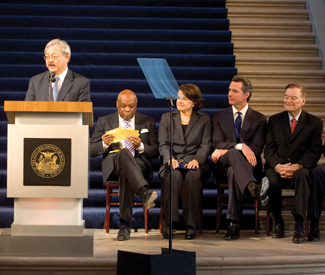
“I’m committed to seeing the full implementation of high speed rail, which includes having a northern terminus at the Transbay center,” Lee replied, refusing to entertain the idea that the bullet trains won’t be coming into San Francisco, a stand he communicated to state officials in a recent letter. “I want to state my unwavering support for the notion of high-speed rail. It is the future of transportation in this state.”

Lee acknowledged that cost estimates for the project have gone up and there are uncertainties over future funding, but he said the state will need to make the investment either way. “California is growing and those people need to move up and down the state. The question is do we make transportation investments on bigger, wider highways and airport runways? I’d say no, that this perpetuates a car-dependent culture.”

Instead, Lee says the state must find a way to build high-speed rail, whatever the obstacles. But Elsbernd called for a hearing on the issue before the Board of Supervisors, telling the Guardian that he supports the project, “but high-speed rail is in trouble and we need to acknowledge that.”

Meanwhile Gov. Brown — who has rejected calls to delay issuing the rail bonds — was working behind-the-scenes to get the project back on track. Sources say he asked for CHSRA Executive Director Roelof van Ark and CHSRA Board Chair Tom Umberg to resign, which they did at the Jan. 12 meeting, with Brown appointee Dan Richard becoming the new chair.

Richard and fellow new Brown appointee Mike Rossi spearheaded the creation of a proposed new business plan for the project that was unveiled in November. While it addresses some of the criticisms of the project, it raises fresh concerns about whether the bullet trains will arrive in Transbay Terminal.

In fact, it calls for high-speed rail service to end in San Jose, where S.F.-bound riders would have to transfer to Caltrain, largely to placate citizens and politicians on the peninsula who have objected to trains rocketing through their communities and filed lawsuits challenging the project.

“That business plan is unrealistic and unreasonable,” said Quentin Kopp, the former state senator from San Francisco who authored of the original legislation to create high-speed rail and has helped shepherd the project. He said having to transfer twice from S.F. to L.A. would discourage riders and hurt the project.

Kopp isn’t a fan of the Transbay Terminal rebuild, which he derides as “a real estate project” because its funding plan relies on significant private residential and commercial development; he’s called for the trains to stop at the current Caltrain station for financial reasons. But Elsbernd — who also chairs the Peninsula Corridor Joint Powers Authority, which operates Caltrain — wants to ensure the Transbay project is completed and worth the investment.

“I’m terrified that we continue moving along and then we end up with that being just a big, beautiful bus terminal,” he told us.

Adam Alberti, a spokesperson for the TJPA, said California needs to have improved rail service to handle a growing population and the Transbay Terminal is being build to accommodate that, whether it be Amtrak, Caltrain, or high-speed rail trains coming into the station.

“We are steadfast in our belief that it makes sense to have high-speed rail in California,” he said. “When it does happen, we will have the infrastructure already in place to receive it.”

Furthermore, he expects that the CHSRA business plan, which is the subject of a public comment period that ends Jan. 17, will extend the service beyond San Jose. “They’ll lose significant ridership and revenues if they don’t bring it into San Francisco,” Alberti said.

Sen. Mark Leno, who chairs the Senate Budget Committee, also expressed confidence that current efforts to derail high-speed rail won’t be successful.

“What is the alternative if we don’t do this? California will grow by 10-20 million people in the next decade. There’s no way we could build enough freeways and airport expansions to handle that,” Leno told us. “I don’t think we have the option not to make this work.” Leno also said he was pleased to see top political leaders stepping up to defend the project: “I’m impressed by the governor’s steadfastness, as well as President Obama’s stand. Leadership from the top is important, particularly during difficult times like this.”

Exporting our brains

0

By Gary Brechin

The chancellor was absent as University of California police, kitted out in battle gear, vigorously beat and arrested students and professors at on the Berkeley campus. Called to account by the academic senate two weeks later, Robert Birgeneau explained that he had been on a trip through Asia at the time. The trip, he said, concluded with a “phenomenally successful,” though unspecified, mission to Shanghai, so he did not hear how badly things went at home until the following day.

What Chancellor Birgeneau and the dean of Berkeley’s College of Engineering did on the trip was sign an agreement to open a 50,000-square-foot building in Shanghai’s Zhangjiang High-Tech Park two days after clubs fell on Cal students agitated by what they perceive as the progressive privatization and commercialization of their university. According to The New York Times, the new branch will give U.C. an Asian beachhead by opening “a large research and teaching facility as part of a broader plan to bolster its presence in China.” Other premier American universities such as Duke, NYU, and Stanford are, for a price, establishing similar “partnerships” that China “hope[s] will form the base of a modern high-tech economy.”

As U.S. funding dries up, college administrators hope that such collaborations will “support fundraising efforts that target wealthy Chinese alumni” — not to mention attracting their children, who are more able to pay ever-rising tuition than American students.

California’s business elite until recently oversaw the establishment and growth of a prestigious 12-campus system that was meant to do for the Golden State what the university now will do for China.

The promise of a virtually free and high quality education for Californians worked well to that end until 1978 when voters overwhelmingly passed Proposition 13 to cut their taxes.

Starved of funding, California’s public schools plummeted from the best to near worst — but many believed that the University of California’s crucial role in the state’s and the nation’s economy would immunize it from the rot consuming the rest of the Golden State’s educational apparatus. But as California piled up multi-billion dollar deficits, U.C inevitably joined the rest of the public sector on the dream factory’s cutting room floor.

As with any organism fighting for its life, available money has moved like blood from regions the university administration considers expendable to those regarded as vital profit centers — like business, biotechnology, sports, and online learning initiatives — as well as lavish executive pay packages.

Last year, for example, the university’s flagship campus at Berkeley quietly divested itself of its outstanding Water Resource Center Archives to save the cost of four clerical positions and thus free space for the expanding College of Engineering. At UC San Diego, three specialty libraries closed altogether while a fourth — the largest oceanographic library in the world — will close in 2012.

Advanced communications and information technology will be among the first areas of research undertaken by the College of Engineering’s new partnership with Chinese industries seeking to overtake California’s fabled Silicon Valley.

For centuries, city states and nations jealously guarded their home industries to the point of sending assassins to dispatch those trading secrets with rivals. Decades of neoliberalism have encouraged today’s elites to do the opposite. Availing themselves of the deregulation and lowered trade barriers for which they paid and the communications technology they developed, they exported their industries and jobs to wherever labor costs are lowest and environmental constraints absent. Derelict factories, ruined towns, failing infrastructure, and prisons now pock those countries still imagining themselves members of the First World.

The screams of students belabored for asking where their university is going and for whom raises the question whether intelligence will be our last export, or whether it was among our first.

Gray Brechin is a three-time U.C. Berkeley alumnus and visiting scholar in the UBC Department of Geography. He is the author of Imperial San Francisco: Urban Power, Earthly Ruin. A version of this piece ran first in the Anderson Valley Advertiser.

Editor’s notes

0

tredmond@sfbg.com

When I was working on my college paper, the vice-president for academic affairs, a rather serious man named William Brennan, delivered a lecture on some obscure topic to a group of, I think, economic majors, and somehow, a Wesleyan Argus reporter was there to cover it. The young journalist gave a fair rendition of the event, and the headline an editor wrote was about the most accurate thing I’ve ever seen in a newspaper. It read:

“Brennan bores small crowd.”

The New York Times, which never runs headlines like that, is having an internal debate over — seriously — whether its reporters should be free to tell the truth.

That’s right: The Public Editor, Arthur S. Brisbane, asked in his Jan. 12 column whether “reporters should challenge ‘facts’ that are asserted by newsmakers they write about.”

In other words, if the president tells an obvious, outright lie, should the Times point that out — or just repeat his inaccurate statement as fact, since in fact the president said it?

Should newspaper reporters be reporters, or stenographers?

It’s so silly, but it reminds me of what’s always annoyed me about the skilled, highly trained and often brilliant staff people at the Times: They’re not allowed to tell the truth.

After just about every press conference on the War in Iraq, for example, I would have written:

“President Bush lied to the public again today, noting — in direct contrast to the evidence on the ground — that the war is going well and that the invasion had nothing to do with oil.”

I know the Times would never go that far, but Brisbane actually had to ask:

“On the campaign trail, Mitt Romney often says President Obama has made speeches ‘apologizing for America,’ a phrase to which Paul Krugman objected in a Dec. 23 column, arguing that politics has advanced to the ‘post-truth’ stage.

“As an Op-Ed columnist, Mr. Krugman clearly has the freedom to call out what he thinks is a lie. My question for readers is: should news reporters do the same?”

Huh? Should reporters be able to report that the likely Republican candidate for president is making stuff up that he knows or ought to know has no basis in factual reality? Is that something the voters need to know?

And the big papers wonder why they’re losing readers.

Alerts

0

yael@sfbg.com


FRIDAY, JAN 20

Occupy Wall Street West

OccupySF revs back up for a day of nonviolent mass action to connect their protest against Wall Street banks and corporations to foreclosures, evictions, and homelessness here in San Francisco. The day will include teach-ins, marches, rallies, and “many ways to participate without risking arrest!”

Mobilizations at 6 a.m., noon, and 5 p.m., free

101 Market, SF

www.occupywallstwest.org/wordpress


SATURDAY 21

Chalk screening

A screening of the landmark Bay Area grassroots/indie film Chalk, which tells the story of competition, family, justice, and a game of pool. The film is a product of the Tenderloin Action Group, which creates “responsive cinema, generated out of the streets from pain and sacrifice, made from sweat, tears, and anguish.” Join producers Ethan Sing and Rand Crook for this screening.

2 p.m., free

Koret Auditorium, San Francisco Public Library main branch

100 Larkin, SF

www.sfpl.org

ggood@sfpl.org


Rally for Reproductive Justice

This annual rally for a woman’s right to choose started to counter-protest the pro-life Walk for Life march. This year, a rally will be held with speakers Sen. Mark Leno, Sup. David Chiu, and representatives from Slutwalk, Radical Women, and CA NOW. Also featuring a DIY art/activist tent and balloon artists and face paint for kids. Organized by Bay Area Coalition for our Reproductive Rights (BACORR.)

11 a.m., free

Justin Herman Plaza

Embarcadero and Market, SF

www.bacorr.org


SUNDAY 22

Remember Harding

The Kenneth Harding Jr. Foundation, in commemoration of the 19-year-old who was killed by San Francisco Police officers on July 16, calls for a protest to demand justice. Harding was unarmed when he exited the T train and was asked by police to show his transfer.

Instead, he ran away and police shot and killed him. Organizers plan to surround Candlestick Park during the NFC championship game to “raise awareness that police in the Bay View/Hunters Point community are killing our kids, violating our rights, and trying to silence us.”

Noon, free

Candlestick Park

602 Jamestown Ave, SF

www.poormagazine.org/node/4238 

Occupy Nation

15

news@sfbg.com

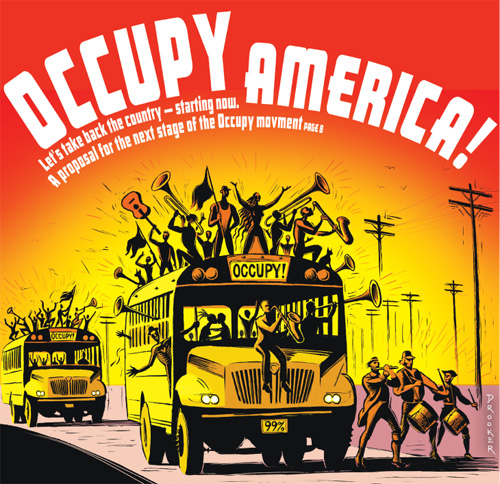
The Occupy movement that spread across the country last fall has already changed the national discussion: It’s brought attention to the serious, systemic problem of gross inequities of wealth and power and the mass hardships that have resulted from that imbalance.

Occupy put a new paradigm in the political debate — the 1 percent is exploiting the 99 percent — and it’s tapping the energy and imagination of a new generation of activists.

When Adbusters magazine first proposed the idea of occupying Wall Street last summer, kicking off on Sept. 17, it called for a focus on how money was corrupting the political system. “Democracy not Corporatocracy,” the magazine declared — but that focus quickly broadened to encompass related issues ranging from foreclosures and the housing crisis to self-dealing financiers and industrialists who take ever more profits but provide fewer jobs to the ways that poor and disenfranchised people suffer disproportionately in this economic system.

It was a primal scream, sounded most strongly by young people who decided it was time to fight for their future. The participants have used the prompt to create a movement that drew from all walks of life: recent college graduates and the homeless, labor leaders and anarchists, communities of colors and old hippies, returning soldiers and business people. They’re voicing a wide variety of concerns and issues, but they share a common interest in empowering the average person, challenging the status quo, and demanding economic justice.

We chronicled and actively supported the Occupy movement from its early days through its repeated expulsions from public plazas by police, particularly in San Francisco, Oakland, and Berkeley. We supported the right of the protesters to remain — even as we understood they couldn’t and shouldn’t simply stay forever. Occupy needed to evolve if it was to hold the public’s interest. The movement would ultimately morph into something else.

That time has come. This spring, Occupy is poised to return as a mass movement — and there’s no shortage of energy or ideas about what comes next. Countless activists have proposed occupying foreclosed homes, shutting down ports and blocking business in bank lobbies. Those all have merit. But if the movement is going to challenge the hegemony of the 1 percent, it will involve moving onto a larger stage and coming together around bold ideas — like a national convention in Washington, D.C. to write new rules for the nation’s political and economic systems.

Imagine thousands of Occupy activists spending the spring drafting Constitutional amendments — for example, to end corporate personhood and repeal the Citizens United decision that gave corporations unlimited ability to influence elections — and a broader platform for deep and lasting change in the United States.

Imagine a broad-based discussion — in meetings and on the web — to develop a platform for economic justice, a set of ideas that could range from self-sustaining community economics to profound changes in the way America is governed.

Imagine thousands of activists crossing the country in caravans, occupying public space in cities along the way, and winding up with a convention in Washington, D.C.

Imagine organizing a week of activities — not just political meetings but parties and cultural events — to make Occupy the center of the nation’s attention and an inspiring example for an international audience.

Imagine ending with a massive mobilization that brings hundreds of thousands of people to the nation’s capitol — and into the movement.

Occupy activists are already having discussions about some of these concepts (see sidebar). Thousands of activists are already converging on D.C. right now for the Occupy Congress, one of many projects that the movement can build on.


DEFINING MOMENTS

Mass social movements of the 20th Century often had defining moments — the S.F. General Strike of 1934; the Bonus Army’s occupation of Washington D.C.; the Freedom Rides, bus boycotts and Rev. Martin Luther King Jr.’s March on Washington; Earth Day 1970; the Vietnam War teach-ins and moratoriums. None of those movements were politically monolithic; all of them had internal conflicts over tactics and strategies.

But they came together in ways that made a political statement, created long-term organizing efforts, and led to significant reforms. Occupy can do the same — and more. At a time of historic inequities in wealth and power, when the rich and the right wing are stealing the future of generations of Americans, the potential for real change is enormous.

If something’s going to happen this spring and summer, the planning should get under way now.

A convention could begin in late June, in Washington D.C. — with the goal of ratifying on the Fourth of July a platform document that presents the movement’s positions, principles, and demands. Occupy groups from around the country would endorse the idea in their General Assemblies, according to procedures that they have already established and refined through the fall, and make it their own.

This winter and spring, activists would develop and hone the various proposals that would be considered at the convention and the procedures for adopting them. They could develop regional working groups or use online tools to broadly crowd-source solutions, like the people of Iceland did last year when they wrote a new constitution for that country. They would build support for ideas to meet the convention’s high-bar for its platform, probably the 90 percent threshold that many Occupy groups have adopted for taking action.

Whatever form that document takes, the exercise would unite the movement around a specific, achievable goal and give it something that it has lacked so far: an agenda and set of demands on the existing system — and a set of alternative approaches to politics.

While it might contain a multitude of issues and solutions to the complicated problems we face, it would represent the simple premise our nation was founded on: the people’s right to create a government of their choosing.

There’s already an Occupy group planning a convention in Philadelphia that weekend, and there’s a lot of symbolic value to the day. After all, on another July 4th long ago, a group of people met in Philly to draft a document called the Declaration of Independence that said, among other things, that “governments … deriv[e] their just powers from the consent of the governed … [and] whenever any Form of Government becomes destructive of these ends, it is the Right of the People to alter or to abolish it, and to institute new Government, laying its foundation on such principles and organizing its powers in such form, as to them shall seem most likely to effect their Safety and Happiness.”


ON THE ROAD

If the date is right and the organizing effort is effective, there’s no reason that Occupy couldn’t get close to a million people into the nation’s capital for an economic justice march and rally.

That, combined with teach-ins, events and days of action across the country, could kick off a new stage of a movement that has the greatest potential in a generation or more to change the direction of American politics.

Creating a platform for constitutional and political reform is perhaps even more important than the final product. In other words, the journey is even more important than the destination — and when we say journey, we mean that literally.

Occupy groups from around the country could travel together in zig-zagging paths to the Capitol, stopping and rallying in — indeed, Occupying! — every major city in the country along the way.

It could begin a week or more before the conference, along the coasts and the northern and southern borders: San Francisco and Savannah, Los Angeles and New York City, Seattle and Miami, Chicago and El Paso, Billings and New Orleans — Portland, Oregon and Portland, Maine.

At each stop, participants would gather in that city’s central plaza or another significant area with their tents and supplies, stage a rally and general assembly, and peacefully occupy for a night. Then they would break camp in the morning, travel to the next city, and do it all over again.

Along the way, the movement would attract international media attention and new participants. The caravans could also begin the work of writing the convention platform, dividing the many tasks up into regional working groups that could work on solutions and new structures in the encampments or on the road.

At each stop, the caravan would assert the right to assemble for the night at the place of its choosing, without seeking permits or submitting to any higher authorities. And at the end of that journey, the various caravans could converge on the National Mall in Washington D.C., set up a massive tent city with infrastructure needed to maintain it for a week or so, and assert the right to stay there until the job was done.

The final document would probably need to be hammered out in a convention hall with delegates from each of the participating cities, and those delegates could confer with their constituencies according to whatever procedures they prescribe. This and many of the details — from how to respond to police crackdowns to consulting of experts to the specific scope and procedures of this democratic exercise — would need to be developed over the spring.

But the Occupy movement has already started this conversation and developed the mechanisms for self-governance. It may be messy and contentious and probably even seem doomed at times, but that’s always the case with grassroots organizations that lack top-down structures.

Proposals will range from the eminently reasonable (asking Congress to end corporate personhood) to the seemingly crazy (rewriting the entire U.S. Constitution). But an Occupy platform will have value no matter what it says. We’re not fond of quoting Milton Friedman, the late right-wing economist, but he had a remarkable statement about the value of bold ideas:

“It is worth discussing radical changes, not in the expectation that they will be adopted promptly, but for two other reasons. One is to construct an ideal goal, so that incremental changes can be judged by whether they move the institutional structure toward or away from that ideal. The other reason is very different. It is so that if a crisis requiring or facilitating radical change does arrive, alternatives will be available that have been carefully developed and fully explored.”

After the delegates in the convention hall have approved the document, they could present it to the larger encampment — and use it as the basis for a massive rally on the final day. Then the occupiers can go back home — where the real work will begin.

Because Occupy will wind up spawning dozens, hundreds of local and national organizations — small and large, working on urban issues and state issues and national and international issues.


WASHINGTON’S BEEN OCCUPIED BEFORE

The history of social movements in this country offers some important lessons for Occupy.

The notion of direct action — of in-your-face demonstrations designed to force injustice onto the national stage, sometimes involving occupying public space — has long been a part of protest politics in this country. In fact, in the depth of the Great Depression, more than 40,000 former soldiers occupied a marsh on the edge of Washington D.C., created a self-sustaining campground, and demanded that bonus money promised at the end of World War I be paid out immediately.

The so-called Bonus Army attracted tremendous national attention before General Douglas Macarthur, assisted by Major George Patton and Major Dwight Eisenhower, used active-duty troops to roust the occupiers.

The Freedom Rides of the early 1960s showed the spirit of independence and democratic direct action. Raymond Arsenault, a professor at the University of South Florida, brilliantly outlines the story of the early civil rights actions in a 2007 Oxford University Press book (Freedom Rides: 1961 and the Struggle for Racial Justice) that became a national phenomenon when Oprah Winfrey devoted a show and a substantial online exhibition to it.

Arsenault notes that the rides were not popular with what was then the mainstream of the civil rights movement — no less a leader than Thurgood Marshall thought the idea of a mixed group of black and white people riding buses together through the deep south was dangerous and could lead to a political backlash. The riders were denounced as “agitators” and initially were isolated.

The first freedom ride, in May, 1961, left Washington D.C. but never reached its destination of New Orleans; the bus was surrounded by angry mobs in Birmingham, Alabama, and the drivers refused to continue.

But soon other rides rose up spontaneously, and in the end there were more than 60, with 430 riders. Writes Arsenault:

“Deliberately provoking a crisis of authority, the Riders challenged Federal officials to enforce the law and uphold the constitutional right to travel without being subjected to degrading and humiliating racial restrictions … None of the obstacles placed in their path—not widespread censure, not political and financial pressure, not arrest and imprisonment, not even the threat of death—seemed to weaken their commitment to nonviolent struggle. On the contrary, the hardships and suffering imposed upon them appeared to stiffen their resolve.”

The Occupy movement has already shown similar resolve — and the police batons, tear gas, pepper spray, and rubber bullets have only given the movement more energy and determination.

David S. Meyer, a professor at U.C. Irvine and an expert on the history of political movements, notes that the civil rights movement went in different directions after the freedom rides and the March on Washington. Some wanted to continue direct action; some wanted to continue the fight in the court system and push Congress to adopt civil rights laws; some thought the best tactic was to work to elect African Americans to local, state and federal office.

Actually, all of those things were necessary — and Occupy will need to work on a multitude of levels, too, and with a diversity of tactics.

Single-day events have had an impact, too. Earth Day, 1970, was probably the largest single demonstration of the era — in part because it was so decentralized. A national organization designed events in some cities — but hundreds of other environmentalists took the opportunity to do their own actions, some involving disrupting the operations of polluters. The outcome wasn’t a national platform but the birth of dozens of new organizations, some of which are still around today.

There’s an unavoidable dilemma here for this wonderfully anarchic movement: The larger it gets, the more it develops the ability to demand and win reforms, the more it will need structure and organization. And the more that happens, the further Occupy will move from its original leaderless experiment in true grassroots democracy.

But these are the problems a movement wants to have — dealing with growth and expanding influence is a lot more pleasant than realizing (as a lot of traditional progressive political groups have) that you aren’t getting anywhere.

All of the discussions around the next step for Occupy are taking place in the context of a presidential election that will also likely change the makeup of Congress. That’s an opportunity — and a challenge. As Meyer notes, “social movements often dissipate in election years, when money and energy goes into electoral campaigns.” At the same time, Occupy has already influenced the national debate — and that can continue through the election season, even if (as is likely) neither of the major party candidates is talking seriously about economic justice.

That’s why a formal platform could be so useful — candidates from President Obama to members or Congress can be presented with the proposals, and judged on their response.

Some of the Occupy groups are talking about creating a third political party — a daunting task, but certainly worth discussion.

But the important thing is to let this genie out of the bottle, to move Occupy into the next level of politics, to use a convention, rally, and national event to reassert the power of the people to control our political and economic institutions — and to change or abolish them as we see fit.

OCCUPY AMERICA IS ALREADY UNDERWAY

All across the country, Occupy organizers are developing and implementing creative ways to connect and come together, many of which we drew from for our proposal. We hope all of these people will build on each other’s ideas, work together, and harness their power.

From invading the halls of Congress to “occutripping” road trips to ballot initiatives, here is a list of groups already working on ways to Occupy America:


OCCUPY CONGRESS

Occupy Congress is an effort to bring people from around the country — and, in many cases, from around the world — to Washington DC on Jan. 17. The idea is to “bring the message of Occupy to the doorstep of the capital.” The day’s planned events include a “multi-occupation general assembly,” as well as teach-ins, idea sharing, open mics, and a protest in front of the Capitol building.

A huge network of transportation sharing was formed around Occupy Congress, with a busy Ridebuzz ridesharing online bulletin board, and several Occupy camps organizing buses all around the country, as well as in Montreal and Quebec.

There are still two Occupy tent cities in DC, the Occupy DC encampment at McPherson Square and an occupation called Freedom Plaza, just blocks from the White House. Both will be accepting hundreds of new occupiers for the event, although a poster on the Occupy Congress website warns that “the McPherson Square Park Service will be enforcing a 500 person limit.”

www.occupyyourcongress.info


OCCUPY BUS

The Occupy Bus service was set up for Occupy Congress, but organizers say if the idea works out, it can grow and repeat for other national Occupy calls to action. They have set up buses leaving from 60 cities in 28 U.S. states as well as Canada’s Quebec province. The buses are free to those who can’t afford to pay, and for those who pay, all profits will be donated to Occupy DC camps.

If all goes to plan, buses will be packed with passengers, their gear, and bigger donations for the event, as the “undercarriages of a bus are voluminous.” What gear do they expect each occupier to bring? “One large bag, one small bag, and a tent.”

congress.occupybus.com


DENVER OCCUTRIP

Many occupations have put together car and busloads of people to road trip to other occupations, hoping to learn, teach, network, and connect the movement across geographic barriers. One example is the Denver Occutrip, in which a handful of protesters toured West Coast occupations. The tenacious Occupy Denver recently made headlines when, rather than allow police to easily dismantle their encampment, a couple of occupiers set the camp on fire. It sent delegates to Occupations in Las Vegas, Los Angeles, Long Beach, Oakland, San Francisco, Berkeley, and Sacramento.

Sean Valdez, one of the participants, said the trip was important to “get the full story. What I’d been told by the media was that Occupy Oakland was pretty much dead, but we got there and saw there are still tons of dedicated, organized people working on it. It was important to see it with our own eyes, and gave a lot of hope for Occupy.”

Like lots of road-tripping Occupiers, they made it to Oakland for the Dec. 12 West Coast Port Shutdown action there. In fact, “occutrippers” from all around the country have flocked to Bay Area occupations in general, and especially the uniquely radical Occupy Oakland.

www.occupydenver.org/denver-occutrip-road-trip/


OCCUPY THE CONSTITUTION

An Occupy Wall Street offshoot — Constitution Working Group, Occupy the Constitution — argues that many of the Occupy movements concerns stem from violations of the constitution. They hope to address this with several petitions on issues such as corporate bailouts, war powers, public education, and the Federal Reserve bank. The group hopes to get signatures from 3-5 percent of the United States population before the list of petitions is “formally served to the appropriate elected officials.”

www.givemeliberty.org/occupy


THE 99% DECLARATION

This is a super-patriotic take on the Occupy movement, described on its website as an “effort run solely by the energy of volunteers who care about our great country and want to bring it back to its GLORY.” The group’s detailed plan includes holding nationwide elections on the weekend of March 30 to choose two delegates from “each of the 435 congressional districts plus Washington, D.C. and the U.S. Territories.”

These delegates would write up lists of grievances with the help of their Occupy constituents, then convene on July 4, 2012 in Philadelphia for a National General Assembly. They plan to present a unified list of grievances to Congress, the President, and the Supreme Court. If the grievances are not addressed, they would “reconvene to organize a new grassroots campaign for political candidates who publicly pledge to redress the grievances. These candidates will seek election for all open Congressional seats in the mid-term election of 2014 and in the elections of 2016 and 2018.”

www.the-99-declaration.org/


MOVE TO AMEND/OCCUPY THE COURTS

Move to Amend is a coalition focusing on one of the Occupy movement’s main concerns: corporate personhood. The group hopes to overturn the Citizens United vs. Federal Elections Commission ruling and “amend our Constitution to firmly establish that money is not speech, and that human beings, not corporations, are persons entitled to constitutional rights.”

The group has drafted a petition, signed so far by more than 150,000 people, and established chapters across the country. Its next big step is a national day of action called Occupy the Courts on Jan. 20. On the anniversary of the Citizens United ruling, the group plans to “Occupy the US Supreme Court” and hold solidarity occupations in federal courts around the country.

www.movetoamend.org/


THE OCCUPY CARAVAN

The Occupy Caravan idea originated at Occupy Wall Street, but the group has been coordinating with occupations across the country. If all goes according to plan, a caravan of RVs, cars, and buses will leave Los Angeles in April and take a trip through the South to 16 different Occupations before ending up in Washington DC.

Buddy, one of the organizers, tells us that the group already has “a commitment right now of 10 to 11 RVs, scores of vehicles, and a bio-diesel green machine bus. This caravan will visit cities, encircle city halls, and visit the local Occupy groups to assert their presence, and move on to the next, not stopping for long in each destination.”

This caravan is all about the journey, calling itself a “civil rights vacation with friends and family” and planning to gather “more RVs, more cars, more supporters…and more LOVE” along the way.

occupycaravan.webs.com

OCCUPY WALL STREET WEST

The Occupy movement in San Francisco has been relatively quiet for the past few weeks, but it’s planning to reemerge with a bang on Jan. 20, with an all-day, multi-event rally and march that aims to shut down the Financial District.

The protest is an effort to bring attention to banks’ complicity in the housing crisis plaguing the United States, and how that process manifests itself here in San Francisco.

At least 20 events are planned, centered in the Financial District. The plans range from teach-ins at banks to “occupy the Civic Center playground” for kids to a planned building takeover where hundreds are expected to risk arrest. A list of planned events can be found at www.occupywallstwest.org/wordpress/?page_id=74.

The day is presented by the Occupy SF Housing Coalition, which includes 10 housing rights and homeless advocacy groups. Dozens of other organizations will be involved in demonstrations throughout the day. “We’re asking the banks to start doing the right thing,” said Gene Doherty, a media spokesperson for the Occupy SF Housing Coalition. “No more foreclosures and evictions for profits. On the 20th, we will bring this message to the headquarters of those banks.”




Obstructions of justice

4

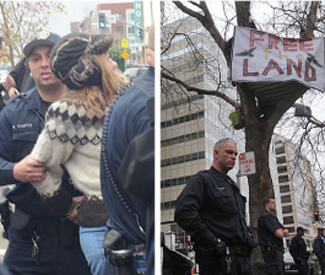
The uneasy relationship between OccupyOakland and the Oakland Police Department has resulted in a troubling spate of controversial arrests recently.

At a press conference last month, Police Chief Howard Jordan stated, “The plaza area outside of City Hall is a public area. We do not have any legal right to remove you if you’re standing there, at any time during the day, if you’re exercising you’re First Amendment rights. If you’re not breaking the laws, we’re not concerned about your presence.”

But now, Oakland police have arrested dozens of people who were doing little more than “standing there, exercising their First Amendment rights” — and one man even faces life in prison for it.

There have been 40 arrests in the last couple weeks, including two incidents at Frank Ogawa/Oscar Grant Plaza. In each episode, police say they were just doing their job, enforcing laws surrounding permit violations. But many supporters and lawyers associated with OccupyOakland say that police have created a targeted and discriminatory campaign to wipe out the movement.


VIGIL TURNS VIOLENT

About 100 protesters were present at a permitted vigil on Dec. 30. An OccupyOakland participant had been issued a permit for a teepee and one table, but police showed up at noon to explain that they were in violation of that permit, claiming people were sleeping, eating, bringing in trash cans, and storing belongings in the teepee

Protesters say they were cleaning up the plaza when police started making arrests; police say they refused to comply. But both parties say that the scene turned violent.

“Who instigates the violence? I don’t know,” Matt Perry, a movement supporter, told us. “A cop tells you to back up and you don’t back up, he’s gonna use his baton on you.”

But many of the arrests and citations had nothing to do with assault. Carly says she was arrested for “having a yoga mat under her arm.” She was later charged with obstruction of justice. In an even more puzzling case, 23-year-old Tiffany Tran was arrested and charged with “lynching.”

“The taking by means of a riot of any person from the lawful custody of any peace officer is a lynching,” reads California Penal Code 405a, a felony charge punishable by two to four years in prison.

The law attempts to prevent white mobs from forcibly taking African Americans from police custody to kill them, but police have a history of using it against protesters, stating that anyone trying to stop an arrest is guilty of lynching.

Tran says she was held in a pitch-dark police van for seven hours before she was booked at Santa Rita Jail, where she was held in 22-hour daily lockdown due to overcrowding. She was held for four days without being told why.

On the fourth day, she was finally arraigned, but prosecutors opted not to file charges and she was released. But Tran said the tactic left her uneasy because prosecutors said charges could still be filed until the statute of limitations expires in a year. As she told us, “Now I feel I can’t go out and express myself as I should be able to.”


ON THE GROUND

When I arrived at 10pm on Jan. 4 to investigate the situation at the vigil, the scene was calm. About 40 people sat and talked, a few worked on computers.

“Some of the people here were arrested mainly for contempt of cop, or being against the government. And then charges of lynching or obstruction of justice were brought after the fact to substantiate an unlawful arrest, to allow the wheels of so-called justice to turn a few more times,” Svend La Rose, an ordained minister and member of OccupyOakland’s tactical action committee, said of the Dec. 30 arrests.

Suddenly, the cry of “riot police!” rang out.

Police cars had pulled up on 14th street, and a line of police exited. In unison, they started advancing, brandishing batons. Many who were at the scene grabbed their possessions and fled. Most just backed away as the cops advanced. A handful stood in front of the teepee, and were arrested on the spot.

Twelve were arrested, including La Rose. Also arrested was Adam Katz, a photographer from the media committee who was documenting events. Katz said that police told him to back up, and when he complied and backed up “probably 50-60 feet,” he was still arrested.

“I took one picture and I was told to back up,” he said. “I repeatedly asked ‘Back up to where?’ as an army of police pushed me out of the plaza. They said, ‘Back up behind the line.’ I kept saying, ‘What line? I don’t see a line.'”

Then there’s Chris, another occupier arrested Jan. 4. According to Katz and other witnesses, Chris had already left the plaza and gone across the street when he was arrested for somehow delaying the police who were trying to clear the plaza.


DISCRETION

On Jan. 7, OccupyOakland held an “anti-repression march,” claiming that recent arrests are an overt attempt to repress the movement. The National Lawyers Guild issued a statement demanding an end to the “ongoing violence, harassment, and unconstitutional arrests of Occupy Oakland protesters.”

“There is evidence that would go to show that they were targeting people based on First Amendment activity, and not for illegal activity,” said attorney Mike Flynn, president of the NLG-SF. “Police charged into the plaza and grabbed whoever they could, and also targeted selective people who withdrew and didn’t even linger there.”

But OPD spokesperson Johnna Watson told us these arrests were perfectly legal. “The law allows us to use our discretion,” she said.

A person’s history with the movement is factored into this discretion. Many of those Perry deems “regulars” are, according to the police, “repeat offenders.” As Watson said, “There may be knowledge of a past history, like a repeat offender. If an officer has knowledge that a crime is occurring, has occurred, or is about to occur, we have the right to issue a citation or arrest. If we have someone constantly continuing to break the law, we may not issue a citation.”

In other words, involvement with this political movement can get people arrested who might otherwise not be.

“That police have escalated their attacks on people is pretty disturbing. It looks like they really think they can drive this movement out of Oakland with violence and repression,” said Dan Siegel, a former legal advisor to Mayor Jean Quan who resigned over her handling of OccupyOakland.

Siegel is now representing Marcel Johnson, aka Khali, one of the several protesters arrested Dec. 30, who faces life in prison. A homeless man who became an OccupyOakland regular, Khali was arrested when he tried to hold on to his blanket, which police wanted to throw away, saying that it was unpermitted property.

While in jail, he was charged with felony assault on a police officer, his third strike. A protester called Black Angel who knows Khali said he was transformed by the movement. “He came here and found a family,” he said. “He was like, I’m going to protect this. It gave me some sense of myself.”

But now, Siegel said, “He faces life in prison because of his status of being poor, homeless, and with mental health issues.”

Juries may decide whether OccupyOakland defendants are guilty, but Siegel said the arrests aren’t just: “You still have to ask yourself, why are the police doing this when we have 100 unsolved murders in Oakland?”

Capitalizing on the Auld Mug

0

news@sfbg.com

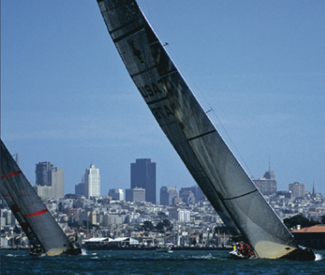
The latest America’s Cup controversy arose with a complaint filed in state court in New York City on Dec. 12, alleging that the Golden Gate Yacht Club (GGYC), defender of the coveted sailing trophy and orchestrator of the prestigious international regatta in San Francisco, unfairly rejected an African American sailing team’s bid to compete as a defender candidate.

In a move that piqued the interest of close observers in the sailing world, the suit also takes things a step farther by challenging the legitimacy of including lucrative waterfront development deals into GGYC’s December 2010 agreement to host the 34th America’s Cup in San Francisco.

The suit invokes a 159-year-old document, the America’s Cup Deed of Gift, drafted after the schooner America won the treasured Cup — affectionately known as the Auld Mug — in a match off the coast of England in 1851. Executed under the laws of New York since the schooner sailed under the New York Yacht Club, the deed establishes the America’s Cup trust, and sets out guidelines that every recipient of the cup must abide by. The suit holds that accepting the cup made GGYC a trustee under the deed, and “each club holds the Cup as ‘trustee for the benefit of all potential challengers.'”

Because GGYC set up its own America’s Cup Event Authority, which stands to profit from San Francisco real-estate development deals without sharing surplus revenue among competitors, the lawsuit charges that the yacht club violated its fiduciary duties as trustee.

“It is clear that GGYC is strictly forbidden from using its possession of the Cup and its attendant duties as trustee … in a manner that directly benefits itself, any of its members, or any third party,” asserts the complaint, filed by Madison Avenue law firm McDermott Will & Emery LLP. “The law strictly prohibits self-dealing by a trustee.”


BLACK SAILING CREW

The lawsuit was filed on behalf of African Dispora Maritime (ADM), a North Carolina nonprofit organization founded by sea captain Charles Kithcart, who developed his skills as a mariner under former America’s Cup sailors and continues to pursue an ambitious dream.

Kithcart says he’s convened a sailing team to compete in the America’s Cup that includes African American Olympian sailors, and held discussions with a prominent Rhode Island yacht designer, David Pedrick, about constructing a qualifying vessel for his team. Pedrick, who’s designed America’s Cup racing yachts before, confirmed to the Guardian that he was willing to work with ADM.

GGYC accepted and later refunded ADM’s $25,000 application fee, but rejected the nonprofit’s proposal to enter the race, saying it wasn’t satisfied Kithcart’s team would have the necessary resources to compete. Kithcart claims to have a fundraising strategy for his America’s Cup bid ready to go, but his anticipated support appears to hinge upon being accepted as an America’s Cup competitor.

“You create a groundswell with the public,” he said. “This is the essence of our organization: It’s going to excite people’s imagination. Money can be generated, and there are people who will fund things.”

Kithcart’s vision extends beyond just racing in the elitist tournament, since that alone “doesn’t fulfill any of the social needs that are not only apparent, but glaring.”

ADM’s mission, he explained, is to train African American youth as competitive sailors, cultivate youth interest in math and science as it applies to nautical skills, and make a splash on the world stage by breaking into a predominantly white sport with a black-led team, á la the Jamaican bobsledders from the film Cool Runnings.

“We can really create inspired minds,” Kithcart said, enthusiastically describing field trips through church youth groups or Boys & Girls Clubs that would educate kids about the history of black mariners and offer the empowering experience of learning to helm a ship. “Our future is the youth.” Moreover, a yacht-building team would be a job-creation engine in tough economic times, he asserted.

The once-debt-plagued GGYC — which rocketed to sailing stardom after billionaire Oracle CEO Larry Ellison joined up, installed his crew members on the board, and clinched the 33rd America’s Cup with his Team Oracle Racing off the coast of Valencia, Spain in 2010 — has approved competitors from France, Spain, Italy, New Zealand, Sweden, China, and Korea for the 34th America’s Cup. The main event, a one-on-one match following all preliminary rounds, is to be held in San Francisco in the summer of 2013.

The foreign teams are known as challengers, but ADM applied to sail as a defender candidate — a U.S. team that would race against Team Oracle in a Defender Series in a bid to represent the U.S. in the 34th America’s Cup.

Under the race protocol drafted by the winners of the 33rd America’s Cup and an Italian team that has since withdrawn as the challenger of record, GGYC stated that it would consider applications from defender candidates. However, it would only accept “those it is satisfied have the necessary resources … and experience to have a reasonable chance of winning the America’s Cup Defender Series.”

Had GGYC accepted ADM’s application to compete, Kithcart’s African American led team would have sailed against Ellison’s Team Oracle crew — a spectacle Kithcart imagines would make fine fodder for national television broadcasts. He remains optimistic that it can happen. “We’re definitely going to get into the America’s Cup,” he told the Guardian in a recent telephone conversation.

That same confidence is conveyed in ADM’s lawsuit. “Indeed, ADM’s application showed that its proposed team quite obviously could beat Team Oracle Racing,” the complaint claims, “and certainly stood a ‘reasonable chance’ of doing so.”

The lawsuit alleges that GGYC ignored Kithcart’s repeated requests to be considered for entry into the competition almost until the deadline last spring, then rejected ADM on an arbitrary and unequal basis compared with its treatment of other competitors.

Three other teams that were accepted as competitors — including Club Nautico di Roma, the challenger of record — have since withdrawn, citing financial problems. The suit suggests these economically troubled teams were accepted as competitors without question even while ADM was rejected, and charges that GGYC made no attempt to determine the status of ADM’s team or fundraising plan.

What it all adds up to, according to ADM’s claim, is breach of contract and a failure to deal in good faith as a trustee. Nor is ADM shy about making demands. The lawsuit asks the court to compel GGYC to accept ADM’s application, reschedule all the planned races in order to hold a Defender Series, cancel the development rights afforded to the Event Authority, and pay ADM in excess of $1 million to compensate for the delay in building its yacht.


SO MUCH MONEY

John Rousmaniere, an America’s Cup historian who has authored several books about the sailing competition, regarded ADM’s case with skepticism. He seemed doubtful that GGYC could be forced to accept an application from a U.S. team.

“Golden Gate could invite other U.S. yacht clubs to compete for the right to defend, but it has chosen not to do that. Instead, it’s developing its own boat and crew. This is their right under the Deed of Gift,” he said. “The Deed of Gift is very clear — there is no obligation for another American boat to sail.”

He’s also dubious of the charge that GGYC breached its fiduciary duties as trustee by engaging in self-dealing, an argument that could have far greater consequences for Ellison in the long run. A similar dispute arose when the sailing tournament was held in New Zealand about a decade ago, he said, and the exact meaning of “trust” in the Deed of Gift has been debated before in similar arguments. “I don’t think it’s ever been resolved,” he added.

The lawsuit argues that the cup is held in trust for the benefit of all competitors, and that GGYC violated its duties as a trustee when it set up a real-estate deal benefiting its own interests without sharing the wealth. Under the terms of the Host City Agreement, the America’s Cup Event Authority (ACEA) has the potential to lock in leases and long-term development rights for up to nine piers along the city’s waterfront for 66 years, with properties ranging from as far south as Pier 80 at Islais Creek to as far north as Pier 29, home of the popular dinner theater Teatro ZinZanni.

The Event Authority is a California LLC, whose agent for service of process is listed as ACEA board chairman Richard Worth of Lawrence Investments LLC — a technology and biotechnology private equity investment firm controlled by Ellison.

Under the protocol and in keeping with America’s Cup tradition, competitors will share in any “net surplus revenue” earned by the America’s Cup trust. However, this excludes the commercial and real estate rights granted to ACEA, the private entity controlled by Ellison, which is separate from the America’s Cup trust.

“For the first time in America’s Cup history, it appears that valuable rights generated by a trustee as a result of holding the America’s Cup are being explicitly excluded from the Cup’s net surplus revenue and … being held elsewhere, to the detriment of the competitors,” ADM’s suit alleges.

Rousmaniere says this isn’t the first time a legal argument invoking the Deed of Gift has found its way into court amid an America’s Cup power struggle, and that the issue remains a point of debate. Part from the problem, he believes, stems from the fact that a 21st Century event is governed by a rather vague 18th century document.

“The defender really runs the thing,” he said, referring to GGYC and by extension, the powerful Ellison. The question is, “How much authority is he going to give the challengers?”

“These people have a lot of lawyers working for them,” Rousmaniere observed, referring to GGYC and Ellison’s Team Oracle Racing, which are closely related. “People are taking a big risk here, and they want to be protected. The stakes are so high because there’s so much money involved.”

America’s Cup spokesperson Stephanie Martin referred Guardian inquiries to Tom Ehman, Vice Commodore of GGYC, who communicated with Kithcart about ADM’s application to compete. Ehman, who was taking a holiday in Spain, did not return an email request for comment and could not be reached by phone. However, a statement attributed to GGYC appeared on the blog Sailing Anarchy, which published a report about ADM’s suit.

“GGYC was served today with a complaint filed in the Supreme Court, County of New York, alleging breach of fiduciary duty, among other baseless claims,” the statement noted. “We believe the lawsuit is utterly without merit and that GGYC will prevail.”

Kithcart, meanwhile, is keeping his eye on the prize. “We need to excite our youth and then stand back and get out of the way and see what they create,” he said. “I’m betting they’ll make a movie about this. I’m betting there’ll be books about this. I’m betting this is history. We’re going to be a story.”

Redrawing the map

43

tredmond@sfbg.com, steve@sfbg.com

The most important political change of 2012 may not be the appointment of a new District 5 supervisor or the inauguration of a new mayor and sheriff. A process moving slowly through a little-known city task force could wind up profoundly shifting the makeup, and balance of power, on the Board of Supervisors — and hardly anyone is paying attention, yet.

The Redistricting Task Force is in the process of drawing new lines for the supervisorial districts, as mandated every 10 years when new census data is available. The nine-member body is made up of three appointees each by the board, the mayor and the Elections Commission. While mandated to draw equal-sized districts that maintain “communities of interest,” the board has almost unchecked authority to decide which voters are in which districts.

While it’s difficult to draw 11 bad districts in San Francisco, it’s entirely possible to shift the lines to make it more difficult to elect progressives — something many groups out there are anxious to do.

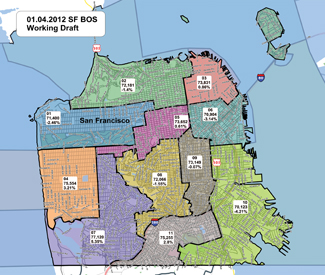
VIEW THE CURRENT WORKING DRAFT MAP HERE


CONSOLIDATING THE LEFT

Downtown and pro-landlord groups are circulating their own draft maps, attempting to influence the outcome. Their goal is hardly a secret: If progressive voters can be concentrated in a small number of districts — say, districts 5, 6, and 9 — it’s more likely that a majority of the board will be moderates and conservatives.

The task force has looked at 10 “visualizations” prepared by a consultant, and each of them had some alarming aspects. For example, the visualizations mostly pushed such conservative areas as Seacliff and Presidio Heights into District 1, which is represented by progressive Sup. Eric Mar.

On Jan. 4, those drafts were replaced by a single working draft map, which is now on the task force’s hard-to-find website (www.sfgov2.org/index.aspx?page=2622) — and it’s not as bad as the earlier versions. The working draft keeps Seacliff and Presidio Terrace in District 2 — which share similar demographics.

“The working families in the Richmond don’t belong in the same community of interest as the millionaires with homes overlooking the ocean,” Mar told us.

But there are other changes that some may find alarming. The more conservative Portola neighborhood, which is now in District 9, would be included in District 11, while D9 would pick up the more liberal north Mission. That would make D9 an even safer progressive district — but make D11 harder for a progressive like the incumbent, John Avalos, to win.

The task force has been holding hearings on each of the districts — but there’s been little discussion about how the new lines will affect the makeup of the board, and the politics and policy of the city, as a whole.


POPULATION CHANGES

The driving force behind the changes in the districts is the rather dramatic population shift on the east side of the city. Most of the districts, census data show, have been relatively stable. But since 2000, 24,591 more people have moved into D6 — a nearly 30 percent increase — while 5,465 have moved into D10 (a 7.5 percent increase) and 5,414 into D11 (8.7 percent). D9 saw the biggest population decrease, losing 7,530 voters or 10.3 percent.

The huge growth in D6 has been the result of a boom in new high-end condos in the Rincon Hill and SoMa neighborhoods, and it’s changed the demographics of that district and forced the city to rethink how all of the surrounding districts are drawn.

No matter what scenario you look at, D6 has to become geographically smaller. Most of the maps circulating around suggest that the north Mission be shifted into D9 and parts of the Tenderloin move into districts 3 and 5. But those moves will make D6 less progressive, and create a challenge: The residents of the Tenderloin don’t have a lot in common with the millionaires in their high-rise condos.

As progressive political consultant David Looman noted, “The question is, how do you accommodate both the interests and concerns of San Francisco’s oldest and poorest population and San Francisco’s youngest, hippest, and very prosperous population?”

The working map is far from final. By law, the population of every district has to be within 1 percent of the median district population, or up to 5 percent if needed to prevent dividing or diluting the voting power of minority groups and/or keeping established neighborhoods together.

Under the current draft, eight of the 11 districts are out of compliance with the 1 percent standard, and District 7 has 5.35 percent more residents than the mean, so it will need to change. But task force Chair Eric McDonnell told the Guardian that he expects the current map to be adopted with only slight modifications following a series of public meetings over the next couple months.

“The tweaks will be about how we satisfy the population equalization, while trying to satisfy communities of interest,” McDonnell said, noting that this balancing act won’t be easy. “I anticipate everyone will be disappointed at some level.”


OUTSIDE INFLUENCES?

Some progressives have been concerned that downtown groups have been trying to influence the final map, noting that the San Francisco Board of Realtors, downtown-oriented political consultants David Latterman and Chris Bowman, and others have all created and submitted their own maps to the task force.

McDonnell said the task force considered solutions proposed by the various maps, but he said, “We won’t adopt wholesale anyone’s maps, but we think about what problem they were trying to solve.”

For example, some progressive analysts told us that many of the proposals from downtown make D9 more progressive, even though it is already a solidly progressive seat, while making D8 more conservative, whereas now it is still a contestable district even though moderates have held it for the last decade.

“It would be nice to see the Mission in one district, but it makes D8 considerably more conservative, so it’s a balancing act,” said Tom Radulovich, a progressive activist who ran for D8 supervisor in 2002.

Latterman told us he has a hard time believing the final map will be substantially similar to the current draft. “Once that gets circulated to the neighborhoods, I find that hard to believe it won’t change,” he said. “A lot of the deviations are big and they will have to change.”

He said that he approached the process of making a map as a statistician trying to solve a puzzle, and that begins with figuring out what to do with D6. “I fall back on my technician skills more than the political,” Latterman, who teaches political science at the University of San Francisco, said. “It’s a big puzzle.”

Latterman also disputed concerns that he or others have tried to diminish progressive voting power, saying that’s difficult to do without a drastic remaking of the map, something that few people are advocating.

“It’s hard to make major political changes with the other constraints we have to meet,” he said. “Unless you’re willing to scrap everything we have, it’ll be hard to make major political changes.”

Once the task force approves a final map in April, there’s little that can be done to change it. The map will go to both the Elections Commission and the Board of Supervisors, but neither can alter the boundaries.

“We are the final say,” McDonnell said. That is, unless it is challenged with a lawsuit, which is entirely possible given the stakes.

Bikes and sailboats

8

OPINION I’m not much of a sailor. In fact, I’ve been known to turn more than a little green when venturing out on the bay under sail. So it may seem a little odd that I am excited about the America’s Cup regatta coming to San Francisco. This high-profile international yacht race has the potential to accomplish even more impressive feats on land than on water, ultimately leaving a legacy of safer streets and more accessible neighborhoods.

An anticipated five million spectators will put the city’s transportation infrastructure to the test. It starts this summer with the qualifying races, then ramps up in summer, 2013, when upward of a half million people are expected to travel to the waterfront on peak race days.

There’s no possible way to move all of these people around this tightly packed city in cars. For proof, talk to anyone who’s been near the waterfront during Fleet Week, a traffic nightmare at a fraction of the size of the America’s Cup.

The Mayor’s Office plan for the America’s Cup wisely puts bicycle transportation front and center. Event planners and politicians know that traffic and parking constraints will preclude many from driving, and transit capacity can be stretched only so far so fast.

Event organizers propose investing in a robust bike share program, park-and-ride lots where visitors can ditch their cars on the edge of the city and pedal the last few miles, and plenty of secure valet bike parking lots.

The most important component is ensuring that the city also invests in safe, comfortable routes welcoming the wide diversity of people who will be trying out two wheels — people who are likely to continue biking long after the events if they have a good experience.

A top priority must be the Embarcadero. Already an enormously popular — and overcrowded — bike route for locals and visitors, the Embarcadero should be made more welcoming to the huge numbers of people who will be drawn there on bikes and by foot.

On big event days, the plan calls for temporarily designating an existing travel lane as bicycle-only space and freeing up the pathway for walking — a more comfortable set-up for everyone.

I urge city leaders to take advantage of this opportunity to pilot a permanent, dedicated bikeway on the waterside of the roadway — the EmBIKEadero. It’s a low-cost, easy way to reconnect people with the waterfront and offer an unparalleled biking experience.

Imagine riding on a mini-version of Sunday Streets on the Embarcadero any day of the week. Imagine a New York City-style high line for S.F.’s waterfront, from Mission Bay to the Golden Gate Bridge. Imagine a way to connect diverse neighborhoods and draw people to local businesses…long after the yachts have left the bay.

The city should also use the momentum behind the America’s Cup to test other opportunities for safe, more welcoming streets, including Polk Street, a major connector to the northern waterfront and already an important route for the growing number of people biking in San Francisco.

Market Street should continue to be a site for innovation. Recent pilot programs prioritizing biking, walking, and transit are already proving to save bus riders time and the Muni system big dollars.

The America’s Cup is our opportunity not only to stage a world-class event, but to build toward a world-class bicycling city.

Leah Shahum is executive director of the San Francisco Bicycle Coalition. To learn more about the San Francisco Bicycle Coalition’s vision for the EmBIKEadero, see connectingthecity.org

Editor’s notes

0

tredmond@sfbg.com

It’s hard for California cities to raise taxes. Almost anything that amounts to a tax hike has to go before the voters, and most of the time, it requires a two-thirds vote.

But in a year when the local legislators are also up for election — and six of the supervisorial districts are up this fall — the voters can pass taxes with a simple majority.

That’s one reason that 2012 is a perfect year for tax reform in San Francisco. The other is the spirit of Occupy.

The tent-city protests changed the political dynamics all over the country, putting the message of economic injustice on the agenda and on the front pages. That’s even more true in this city, which was one of the epicenters of the national movement.

Mayor Ed Lee announced in his inauguration speech that he’s going to be the mayor “of the 100 percent,” an effort to preach the message that we’re all good pals and we all love each other here in this great city of ours, but the truth is we aren’t, and we don’t. The very rich in San Francisco not only have little in common with the rest of us; for the most part, they like it that way. The biggest corporations and wealthiest individuals have an interest in preserving economic injustice, and they’ve shown repeatedly that they will go to great lengths to prevent progressive change.

San Francisco needs to change the way it raises revenue, and one of the key elements of that is the local business tax. Right now it’s a flat tax on payroll, and a lot of people (including me) don’t like it. So there’s movement for a new type of tax, maybe on gross receipts.

That’s fine — but it has to be more than a shift in how taxes are determined. San Francisco desperately needs more money — probably at least $250 million a year — to balance the budget without further cuts and to make up for what the state and federal government have taken away. And a new business tax needs to be progressive — to hit the biggest and the richest harder than the small and struggling.

I fear the mayor is not going to be pushing that kind of agenda, so someone on the board has to do it. This is the year that a “tax the one percent” measure can win. But we need to get started now.

Alerts

0

yael@sfbg.com

THURSDAY 12

Dinner for the 99 percent

Rebecca Solnit, author of A Paradise Built in Hell, will speak with her brother, long-time activist and OccupySF organizer David Solnit, about “hope, strategy and actions to build a better world.” A dinner featuring gluten-free spaghetti and real or tofu meatballs will be served. Following dinner, hosts will screen a documentary of the life and work of Martin Luther King Jr.. This event will raise money for the San Francisco 99% Coalition.

6 p.m., $10-20

Unitarian Universalist Center

1187 Franklin, SF

(415) 608-1585

www.occupysf.org/2012/01/09/spaghetti-dinner-for-the-99


FRIDAY 13

The shame of Guantanamo

Historian, journalist, and author of The Guantanamo Files, Andy Worthington, will join investigative reporter Jason Leopold for a “freewheeling interview” discussing the history of torture and illegal detention without accountability spanning the George W. Bush and Barack Obama presidencies. This event marks the 10-year anniversary of the opening of the Guantanamo Bay Prison.

Noon-2 p.m., free

Louis B. Mayer Lounge, UC Hastings College of the Law

198 McAllister, SF

www.andyworthington.co.uk


SATURDAY 14

Run on the banks

The Occupy Housing Coalition will demonstrate to protest evictions of renters for condo conversions in the Mission District. Join them to demand that Wells Fargo stop all pending evictions for profit.

Noon, free

16th and Mission, SF

www.occupysf.org/2012/01/07/run-on-the-banks-mission-district-january-14


SUNDAY 15

Mission community forum

For the first time, Occupy SF will hold its weekly community forum, a space to air general concerns and foster discussion, outside the Financial District. Come speak about topics specific to the Mission community, and discuss how to build a broad movement that “mirrors the diversity of San Francisco.”

6-8 p.m., free

Location TBA

Email Lisa Guide: lgru3221@gmail.com


MONDAY 16

MLK Day gathering

Celebrate the life of Martin Luther King Jr. and “call for a ceasefire in the streets” after a tragic year of 110 homicides in Oakland. A community gathering will include gospel, spoken word, drama, and time to talk with your neighbors.

10 a.m.-noon, free

Regeneration Church

238 E. 15th, Oakl

(510) 508-4888

www.regenerationweb.com/node/86

An open letter to Ed Lee

76

OPINION Dear Mr. Mayor,

During the next week you will be appointing the a supervisor for District 5, an area of the city that has been historically considered the most progressive part of one of the most progressive cities in the country. It will be a signature decision for you in the next year, and will reveal the tone of your administration. Will you be a consensus mayor — or will you carry on your predecessor’s fight with progressives?

You have many qualified choices, but there is probably only one on your list that a majority of progressives would consider a clear progressive choice: Christina Olague, president of the Planning Commission. There are some who have hesitations about her, but ironically those hesitations are based on her relationship to you and her support for your candidacy for mayor. I have to admit, as a supporter of progressive Supervisor John Avalos for mayor, I shared some disappointment that she didn’t support John.

I’m sure there’s intense pressure on you to choose a more moderate choice, and I’m sure there are from your perspective some valid points to that argument. That said, District 5 deserves progressive representation.

I am a Haight resident, and I ran for Supervisor in District 5 in 2004. Supervisor Ross Mirkarimi came in first, I came in second, and Lisa Feldstein came in third. Both Lisa and I have spoken repeatedly about whether we would run next year, and we have even discussed running as a slate. Most political analysts think one of us would have a decent shot at winning — but I think both of us would support Christina, assuming that her votes continue to reflect her commitment to the progressive values of the district.

Christina not only supported you, she also supported Mirkarimi in 2004, and Matt Gonzalez when he ran for supervisor in 2000. She was appointed to the Planning Commission by Gonzalez and has been reappointed repeatedly by progressive supervisors to that commission. While her votes have not been perfect, by and large, her record is excellent; she has never succumbed to pressure, has listened well to all sides, and has ultimately done what she thought was right.

For example, she stood up for tenants’ rights when the landlord from Park Merced came to the Planning Commission to ask that 1,500 apartments be demolished, all of which were subject to the city’s rent control ordinance. She recognized the flaws in the landlord’s argument that a side agreement (negotiated without the local tenant groups involved) would prevent rent hikes and evictions. Olague was on the right side of history on the Park Merced deal, and has a long record of building tenant and senior tenant power. That’s the kind of leadership we need for District 5, an area comprised of primarily renters. I believe Olague will be a supervisor tenants can trust.

I can’t guarantee that all progressives will stand down if Olague gets the seat. The ego game is what it is. You have learned that from politics, I’m sure. But I think most progressive institutions and progressive activists will see her appointment as a victory and will support her candidacy for Supervisor next fall, as they should if she shows that her votes reflect the trends and values of District 5.

With Christina Olague, you have a win-win. You appoint a supervisor who reflects the progressive values of the district and who is also electable in November. 

Gabriel Haaland is an elected member of the San Francisco Democratic County Central Committee and an LGBT labor and tenant activist.

OFFIES 2011

0

It was the year of the Rapture (oh, wait, maybe not), the year of the great Republican resurgence (oh wait, maybe not), the year of Anthony Weiner’s penis and Gerard Depardeiu’s piss, the year of the Kardashians and Charlie Sheen … and the Offies in-basket overflows. Here are our favorite choice moments of 2011.


ACTUALLY, HIS THUMBS ON THE PHONE WERE THE ONES DOING DAMAGE

Anthony Weiner, in a sexting conversation with a middle-aged Nevada Democratic volunteer, described his penis as “ready to do some damage.”


AT LEAST SOMEBODY’S DOING SOMETHING ABOUT THE UNEMPLOYMENT RATE

Hustler publisher Larry Flynt offered Weiner a job


GOOD THING EXPERTISE IN THE ENGLISH LANGUAGE HAS NEVER BEEN A PREREQUISITE OF THE JOB

Presidential candidate Herman Cain, in an interview, said he didn’t know the name of the president of Uzbekistan, which he called UBEKE BEKI KEIE BAH BAH STAND O BAN STAN SO WHAT WHAT?


CERTAINLY NOT THE KIND OF FOOD FOR A MIGHTY MAN WHO SEXUALLY HARASSES HIS SUBORDINATES

Cain said that too many vegetable toppings make a “sissy pizza.”


BECAUSE AN ELECTRIFIED CARTOON MOUSE IS AN INSPIRATION TO US ALL

Cain blamed “elites” for derailing his campaign, then quoted from the Pokemon theme song.


NICE TO SEE HERMAN CAIN HAS COMPANY IN THE DEPARTMENT OF QUALITY POLITICAL CANDIDATES

Joe the Plumber announced he would run for Congress


COULD IT BE — THE STUPIDEST REPUBLICAN CANDIDATE EVER?

Rick Perry couldn’t remember which federal agencies he wanted to shut down.


EXCEPT THAT THE ALMIGHTY HASN’T BEEN ABLE TO TELL US WHICH DEPARTMENTS HE WOULD CUT, EITHER

Michelle Bachman said that the East Coast earthquake and hurricane were signs that God thought the country was spending too much money on government services.


IT APPEARS THE CHRISTIAN RIGHT CAN’T GET ITS STORIES STRAIGHT

Rush Limbaugh said that the power of Hurricane Irene, which caused 53 deaths and $15 billion in property damage, was blown out of proportion to promote “the leftist agenda.”


HMMM… SINCE HERS MAKES A BUSINESS OF “CONVERTING” GAY PEOPLE, WE HAVE TO WONDER WHAT HE TELLS HER TO DO

Bachman said wives should be obedient to their husbands


BUT HEY — THOSE GUYS ALL LOOK ALIKE

Bachman praised Waterloo, Iowa as the home of John Wayne, when it’s actually the home of serial killer John Wayne Gacy


AN EXCEPTIONAL NEW INTERPRETATION OF THE INTELLECTUAL ROOTS OF THE SECOND AMENDMENT

Sarah Palin insisted that Paul Revere “warned the British that they weren’t going to be taking away our arms, by ringing those bells.”


UM, RICK, THE SCHOOLS ARE CLOSED ON CHRISTMAS

A Rick Perry campaign ad said that “something’s wrong with America” because “gays can serve openly in the military but our kids can’t openly celebrate Christmas or pray in school.”


DAMN — THAT MEANS HE REALLY IS A DUMB AS HE LOOKS

Perry insisted he wasn’t drunk when he delivered a rambling speech in New Hampshire


OR MAYBE A LITTLE LIKE FINDING OUT THAT SHE WAS JUST USING YOU ALL ALONG

Sup. David Chiu said meeting Mayor Lee — who he helped put in office — after he broke his promise not to run was “a little like meeting an ex-girlfriend after a breakup.”


AND TALK ABOUT BEING USED

Ed Lee said he didn’t want to run for mayor, but he had trouble saying no to Rose Pak and Willie Brown


IT DOESN’T MATTER — AS THE GREAT RONALD REAGAN ONCE SAID, “FACTS ARE STUPID THINGS.”

Sen. John Kyle announced that 90 percent of Planned Parenthood’s business was abortions, and when it turned out he was wrong by a factor of 30, he said his allegation “wasn’t meant to be factual.”


THE U.S. HAS DEPOSED PEOPLE FOR LESS THAN THAT. OH, WAIT …

Moammar Gadafi said his political opponents were on LSD and kept a stash of photos of Condoleeza Rice.


OH WELL, YOU KNOW HOW GOD IS; HE FLAKES OUT ON DATES ALL THE TIME

Oakland radio minister Harold Camping announced that the end of the world would come Oct. 21.


TOO BAD THAT WILL ONLY COVER THE FIRST SESSION OF THE POOR KID’S THERAPY

A woman who created a media frenzy when she said that she had given her young daughter botox admitted she made the story up so a tabloid would pay her $200.


WHEREAS, OBAMA HAS NEVER DEMANDED THAT TRUMP SHOW HIS REAL HAIR

Donald Trump demanded that Barack Obama show his birth certificate.


IF THE JAPANESE WOULD ONLY CUT GOVERNMENT SPENDING SOME MORE, THIS SORT OF THING WOULDN’T HAPPEN

Rush Limbaugh made fun of Japanese people after the earthquake and tsunami, saying “where Gaia blew up is right where they make all these electric cars.”


THE SCHOOL’S ESTEEMED NAMESAKE, ON THE OTHER HAND, HAD 27 WIVES, SOME AS YOUNG AS 15, AND AT LEAST 64 CHILDREN, SO HE WOULD NEVER HAVE APPROVED OF SUCH A THING

Brigham Young University suspended basketball star Brandon Davies because he sex with his girlfriend.


IT’S AWFUL, THE SACRIFICES OUR POLITICAL LEADERS HAVE TO MAKE IN THE NAME OF THE COUNTRY

Newt Gingrich told the Christian Broadcasting Network that he’d cheated on his wife because he loved America so much.


ON THE OTHER HAND, IF YOU WEREN’T SO FULL OF SHIT THE PLUMBING MIGHT FUNCTION A BIT BETTER

Sen. Rand Paul complained to an energy department official that he didn’t like appliance efficiency standards because “we have to flush the toilet 10 times before it works.”


NATURALLY — CLEANLINESS IS NEXT TO GODLINESS. SORT OF LIKE MARITAL FIDELITY

Gingrich told Occupy protesters to take a bath.


WHAT — HE DOESN’T CONSIDER HIMSELF A “FROTHY MIX OF FECAL MATTER AND LUBE THAT IS SOMETIMES THE BYPRODUCT OF ANAL SEX?”

Former Senator and presidential candidate Rick Santorum complained about what turns up when you put his name in a Google search.


AND NEXT, WE’LL REDEFINE “POOR” AND ELIMINATE FOOD STAMPS

House Republicans tried to redefine “rape” to eliminate funding for abortions


OH WELL, THERE GOES THE SEASON

Stanford University stopped giving student athletes special lists of easy classes


DONALD — YOU’RE FIRED

Donald Trump tried to host a presidential debate but gave up when nobody wanted to be there.


THIS FROM A MAN WITH “INVENTED” INTEGRITY

Gingrich called the Palestinians an “invented” people.


GOOD THING ABOUT THE CRACK — THAT SHIT FUCKS UP YOUR BRAIN

Charlie Sheen opened his Violent Torpedo of Truth Tour in Detroit, where he burned a Two and A Half Men T-shirt, told the crowd that he was “finally here to identify and train the Vatican assassin locked inside each and every one of you,” demanded “freedom from monkey-eyed&ldots;sweat-eating whores,” and said he doesn’t do crack anymore.


AT LEAST HE’S GOT ONE THING GOING FOR HIM: HE JOGS WITH A GUN AND SO FAR HASN’T SHOT HIS OWN BALLS OFF

Rick Perry told the Associated Press that he shot a coyote that had threatened him on his morning jog.


KILL ‘EM ALL AND LET GOD SORT ‘EM OUT

The crowd at a Republican debate cheered after moderator Brian Williams noted that Rick Perry had overseen 234 executions.


ANOTHER GREAT MOMENT IN THE ANNALS OF LAW ENFORCEMENT

A Davis police officer pepper sprayed a group of peaceful protesters who were sitting on the ground.


SINCE THERE’S NO NEWS IN THE WORLD OF THE 1 PERCENT

The New York Post investigated sex at Occupy Wall Street


GOOD THING IT DIDN’T WORK — THE WATER FROM HEAVEN WOULD HAVE MADE THE BUNS ALL SOGGY

Perry held a religious rally to pray for rain at Reliant Stadium in Houston, and urged people to fast, although the concession stands sold hot dogs.


BUT WAIT — IF WE SHUT DOWN THE GOVERNMENT, AREN’T WE … OH, NEVER MIND

Michelle Bachman said she opposes same-sex marriage because “the family is the fundamental unit of the government.”


THE FACT THAT WE’RE EVEN WRITING ABOUT A TEENAGER WHO CALLS HER TITS “SNOWBALLS” IS A SIGN OF THE END OF CIVILIZATION

Child bride Courtney Stodden was kicked out of a pumpkin patch for dressing in daisy dukes and making out with her 53-year old husband, Doug Hutchinson, and she madly tweets things like “Squeezing my snowballs inside of a seasonal sexy little lingerie as I begin to swing around the Christmas tree to hot rock ‘n roll hits!”


IT SELLS, BABY, IT’S SELLS

Kim Kardashian made $12 million for doing essentially nothing.


A NEW DEFINITION OF TERROR: WATCHING A 63-YEAR-OLD MAN WHIP OUT HIS DICK

Gerard Depardieu pissed on the floor of an Air France jet after flight attendants told him he’d have to wait to use the bathroom.


WE’RE GOING TO TAKE A BUNCH OF STEROIDS AND THEN LIE ABOUT IT AND MAYBE WE CAN SPEND A MONTH THERE, TOO

The U.S. Justice Department spent millions of dollars and eight years to convince a judge to sentence Barry Bonds to spend a month at his Beverly Hills estate.

Editor’s notes

0

tredmond@sfbg.com

My gut response to the America’s Cup was always like this: I love a party. I love a big party, and a party that brings lots of visitors and money into San Francisco is a great thing. But you have to remember that at some point the party will be over, and somebody’s got to clean up the mess and pay for the damage.

And right now, in San Francisco, when the party’s over, the big winner will be a multibillionaire named Larry Ellison, and the rest of us will be paying for it.

That said, the party’s going to happen. There may be a little bluster about the Environmental Impact Report, but the 34th America’s Cup race will take place in the waters of the San Francisco Bay, and a whole lot of people will be coming into town to see it.

So we better be ready, and I’m not sure we are.

I read the draft EIR section dealing with transportation and traffic, and it’s kind of crazy. The planners are projecting about 25,000 new vehicle trips a day — and that’s just into San Francisco. Sausalito and the East Bay cities will have their own issues. There are pictures of projected parking areas along the waterfront, including Crissy Field. There are plans to close the Embarcadero, but only the northbound lanes.

Additional Muni service will be able to handle about 1,200 riders a day. That’s way less than five percent of the number of people who are projected to be getting around by car.

So maybe San Francisco should try something radical that would last way beyond the sailing event. Why don’t we see what it would look like if we banned cars from the entire waterfront, closed all the streets and created a real transit-first city — at a time when the whole world will be watching?

No cars at all. Buses for seniors and people with disabilities. Everyone else walks, bikes, or takes a pedicab (that’s a whole lot of jobs, by the way, particularly for young people who can pedal). Could one of the most environmentally conscious cities in the world pull that off? It’s worth a try.

City Hall’s 2012 agenda

16

EDITORIAL There’s so much on the to-do list for San Francisco in 2012 that it’s hard to know where to start. This is a city in serious trouble, with unstable finances, a severe housing crisis, increased poverty and extreme wealth, a shrinking middle class, crumbling and unreliable infrastructure, a transportation system that’s a mess, no coherent energy policy — and a history of political stalemate from mayors who have refused to work with progressives on the Board of Supervisors.

Now that Ed Lee has won a four-year term, he and the supervisors need to start taking on some of the major issues — and if the mayor wants to be successful, he needs to realize that he can’t be another Gavin Newsom, someone who is an obstacle to real reform.

Here are just a few of the things the mayor and the board should put on the agenda for 2012:

• Fill Sup. Ross Mirkarimi’s seat with an economic progressive. This will be one of the first and most telling moves of the new Lee administration — and it’s critical that the mayor appoint a District 5 supervisor who is a credible progressive, someone who supports higher taxes on the rich and better city services for the needy and is independent of Lee’s more dubious political allies.

• Make the local tax code more fair — and bring in some new revenue. Everybody’s talking about changing the payroll tax, which makes sense: Only a small fraction of city businesses even pay the tax (which is not a “job killer” but is far too limited). Sup. David Chiu had a good proposal last year that he abandoned; it called for a gross receipts tax combined with a commercial rent tax — a way to get big landlords and companies (like law firms) that pay no business tax at all to contribute their fair share. That’s a good starting point — but in the end, the city needs more money, and the new system should be set up to bring in at least $100 million more a year.

• Create a linkage between affordable and market-rate housing. This has to be one of the key priorities for the next year: San Francisco’s housing stock is way out of balance, and it’s getting worse. The city’s own General Plan mandates that 60 percent of all new housing should be available at below-market-rate prices; the best San Francisco ever gets from the developers of condos for the rich is 20 percent. The supervisors need to enact legislation tying the construction of new market-rate housing to an acceptable minimum level of affordable housing to keep the city from becoming a place where only the very rich can live.

• Demand a good community-benefits agreement from CPMC. The California Pacific Medical Center has a massive new hospital project planned for Van Ness Avenue — and so far, CPMC officials are refusing to provide the housing, transportation and public health mitigations that the city is asking for. This will be a key test of the new Lee administration — the mayor has to demonstrate that he’s willing to play hardball, and refuse to allow the project to move forward unless hospital officials reach agreement with community activists on an acceptable benefits agreement.

• Make CleanEnergySF work. A recent study by the website Energy Self-Reliant States shows that by 2017 — in just five years — the cost of solar energy in San Francisco will drop below the cost of Pacific Gas and Electric Company’s fossil-fuel and nuclear mix. So the city’s new electricity program, CleanEnergySF, needs to be planning now to build out both a large-scale solar infrastructure system and small-scale distributed generation facilities on residential and commercial roofs and set the agenda of offering clean, cheaper energy to everyone in the city. The money from the city’s generation can be used to purchase distribution facilities to phase out PG&E altogether.

• Don’t let Oracle Corp. take over even more of the waterfront. The America’s Cup continues to move forward — but at every step of the way, multibillionaire Oracle CEO Larry Ellison is trying to squeeze the city for more. Mayor Lee has to make it clear: We’ve given one of the richest people in the world vast amounts of valuable real estate already. He doesn’t need a giant TV screen in the Bay or more land swaps or more city benefits. Enough is enough.

There’s plenty more, but even completing part of this list would put the city on the right road forward. Happy new year.

Alerts

0

news@sfbg.com

FRIDAY 6

Pathology of wealth

Progressive author and speaker Michael Parenti discusses this country’s dysfunctional political and economic systems during a lecture entitled “Democracy and the Pathology of Wealth,” describing how corporate capitalism has corrupted key institutions. In his books and talks, Parenti has covered a wide array of political topics, always with great passion and insights, and his perspective has never been more relevant than in the current political moment.

7:30, $12–$10

La Peña Cultural Center

3105 Shattuck, Berk.

(510) 849-2568

www.michaelparenti.org

lapena.org/event/1952


End torture now

A screening of the film Ending U.S.-Sponsored Torture Forever will be followed by a discussion led by members of the Bay Area Religious Campaign Against Torture. Berkeley Peace and Justice Commission member Rita Maran will also be honored for her efforts to get the Berkeley City Council to pass a resolution calling for President Barack Obama to honor commitments he made during his presidential campaign to close the prison at Guantanamo Bay, which became notorious for employing torture and other human rights violations.

7 p.m., $5–$10

Berkeley Fellowship of Unitarian Universalists’ Hall

1924 Cedar, Berk.

www.bfuu.org

(510) 841-4824


SATURDAY 7

Occupy and divest

Omar Barghouti, author of Boycott, Divestment, Sanctions: The Global Struggle for Palestinian Rights, gives a lecture entitled “Occupy Wall Street, Not Palestine!: BDS and the Global Struggle for Justice & Freedom.” Proceeds from the event, where Barghouti will be signing his book, benefit the Middle East Children’s Alliance and its Maia Project, which supplies clean drinking water to the children living in Gaza.

7:30, $10 (but no one turned away)

First Presbyterian Church of Oakland

2619 Broadway, Oakl.

events@mecaforpeace.org

(510) 548-0542

www.mecaforpeace.org


SUNDAY 8

Vigil for gun victims

Candlelight vigils remembers the victims of gun violence are being held around the country to mark the first anniversary for the shootings in Tuscon, Arizona that left six people dead and 13 injured, including U.S. Rep. Gabrielle Giffords. So come and light a candle to honor those affected by this senseless violence. Sponsored by Legal Community Against Violence.

6:30 p.m., free

Yerba Buena Gardens

Mission and Third St., SF

(415) 433-2062

ecartwright@lcav.org

www.bradycampaign.org/toomanyvictims


Mail items for Alerts to the Guardian Building, 135 Mississippi St., SF, CA 94107; fax to (415) 437-3658; or e-mail alert@sfbg.com. Please include a contact telephone number. Items must be received at least one week prior to the publication date.

Battling big box

1

news@sfbg.com   

In neighborhood commercial districts, national chains and other formula retail stores such as PETCO, Target, Subway, Walmart, and Starbucks are hot button issues for residents who don’t want to see San Francisco turn into a strip mall or have local money pulled from the community.

Sup. Eric Mar and other city officials want to make sure local small businesses aren’t being unnecessarily hurt by competition from national chains, which is why he called a hearing on Dec. 5 to discuss big box retailers and their impacts on San Francisco’s small businesses, neighborhoods, workers, and economy.

“There is no vehicle to see the impacts of big business on the city,” Mar told us, saying he is contemplating legislation to do just that.

Mar was part of city efforts to keep formula pet stores from locating in the Richmond area, working with a coalition of pet food small businesses concerned about PETCO and Pet Food Express trying to move into the area. But it isn’t just pet stores.

“There is a perception that Walmart might make a move into the city since we already have stores like Fresh n’ Easy,” Mar’s Legislative Aide Nick Pagoulatos told us.

The city doesn’t have a comprehensive analysis on how these companies impact San Francisco. Mar says he wants to “have a clear scale of their influence and see what we need to do to protect small business in San Francisco.”

History of wariness

In 2004, the Board of Supervisors adopted the first Formula Retail Use Control legislation, an ordinance that “prohibited Formula Retail in one district; required Conditional Use Authorization in another; and established notification requirements in all neighborhood commercial districts.”

The Planning Code changed again after a voter ballot initiative in 2007, Proposition G, required any formula retail use in neighborhood commercial districts to obtain a conditional use permit, which gave neighboring businesses a chance to weigh in during a public hearing.

Mar said the intent wasn’t to bar big box retail from entering the city, but to simply give neighborhoods a voice. But now, he said the city needs to take a more comprehensive look at what’s coming and how they will impact the city.

Small Business Commissioner Kathleen Dooley echoed the concern, which extends even beyond city limits. “I’ve heard through the rumor mill that Lowe’s in South San Francisco is going to close and

Walmart is looking to take that space since they know they’d never get into the city,” she told us. “It’s bad enough that Target is opening stores [in San Francisco]. They are the quintessential big box because they sell everything.”

Target is in the process of opening a massive store inside the Metreon in SoMa, and another store at Geary and Masonic. Mar isn’t diametrically opposed to the big box industry, but he thinks those companies should be appropriately situated.

“I’ve seen that people in Richmond are positive toward big box like Target coming into the district, but some are nervous that it will take down business,” he told us. “There are some property spaces that are supposed to be for big box, like the property at Geary and Masonic where the old Sears and Toys”R”Us used to be.”

But it’s not easy to figure out what other big box stores have their sights set on the city. The Planning Department’s list of projects in the pipeline aren’t always filed under the name of the business, making it difficult to stay vigilant.

For example, while application #3710017 at 350 Mission Street describes the project as a “95,000 sq. ft. building of office, retail and accessory uses,” it isn’t clear what businesses are actually setting up shop. And these days, some big box stores are coming in smaller boxes.

Prototype stores such as Unleashed by PETCO are specifically designed to squeeze into smaller property spaces so they can get into neighbor corridors that are typically reserved for small businesses.

More help needed

During the Dec. 5 hearing before the Land Use and Economic Development Committee, Sup. Scott Wiener echoed Mar concerns, commenting that he wants to see how the Planning Commission could “improve the Conditional Use process since we see a pushback of strong neighborhood activity.”

Dooley recalled an issue from 2009 when the Small Business Commission formally asked the Planning Commission not to authorize a PETCO in the Richmond because “the surrounding area was already well served by pet stores.” The board ultimately stopped PETCO, but Pet Food Express did locate a store nearby, which Dooley said has already taken a toll on the locally owned pet food suppliers.

“Big box stores carry a huge number of products that impact other stores,” she said. “Big box is a category killer in the neighborhood…the Planning Commission needs new criteria for formula retail because there are several different types.”

Some superstores require parking lots, taking up additional land, and increasing traffic in certain neighborhoods. Yet one trait that most chain stores have in common is that they extract more money from San Francisco than locally owned businesses, whose revenues tend to circulate locally.

“With every dollar spent at local stores, 65 cents will go back into the community, while only a quarter will be returned from a big box.” Rick Karp, owner of the 50-year-old Cole Hardware, said at the hearing, citing various studies on the issue.

Small business owners are asking for economic impact reports to be included in project applications from chain stores to see just how they measure up to their locally owned counterparts.

When Lowe’s entered his district, Karp says he lost 18 percent of his business and was forced to eliminate six full-time jobs. He appealed to city officials to “keep big box out of San Francisco because it impacts the efficacy of neighborhood shopping.”

Once chain stores puts the locals out of business, the consumer is stuck with set prices and reduced variety. But critics say it isn’t just consumers and small business owners who suffer, but workers as well. They singled out Walmart as notorious for union-busting and poor labor standards.

“We can use our land use ordinances and powers to set a basic minimum labor standard. Big box must abide by that and also include health care if implemented in local government [legislation],” Mar said.

But Steven Pitts, a labor policy specialist at UC Berkeley, told us there is a connection between low prices and low wages.

“People who work at Walmart are poorer than those who shop there,” he told us. “Therefore, if prices were raised to increase wages for employees, the burden wouldn’t be on people of lower income.”
Opposing Walmart

To illustrate how Walmart would adversely affect San Francisco’s workforce, the hearing included two employees of Walmart, Barbara Collins and Ronald Phillips from Placerville, who helped create Organization United for Respect at Walmart (OURWalmart) to push for better benefits and labor standards.

“We want to hold Walmart accountable,” said Collins, whose last annual income from Walmart was $15,000 annually, a salary she realized couldn’t support her four children. “Walmart says they pay living wages. No, they don’t.”

Phillips said that Walmart has “a tendency to fire people for any reason and then does not have to pay for the benefits… I was one of these people, but I was rehired.”

For the past three months, Phillips says she has worked at least six days and 40 hours per week, but that she still qualified for welfare assistance.

Also at the hearing, SF Locally Owned Merchants Alliance unveiled a study showing that formula retail costs nearly as many jobs as it creates. A domino effect occurs when stores close because fewer customers circulate to other nearby stores.

But the group noted that consumer habits are probably even more important than city regulations. The SFLOMA study found that if 10 percent of San Franciscans shifted their spending to locally owned small businesses, consumers would create 1,300 jobs and $190 million in the city.

And that would be good for everyone: owners, consumers, and workers. Steven Cornell, owner of Brownie’s Hardware, said that small business pays good wages, typically above the minimum wage, as well as sick leave, health coverage, and other benefits. As he told the hearing, “Local businesses have been doing this for 20 to 30 years since we are already invested in the community.”

All backed up

0

news@sfbg.com

In February 2004, San Francisco saw an usually strong winter storm. More than an inch and a half of rain fell within 30 minutes, too much to handle for the wastewater system, which in parts of the city is more than 100 years old. In the Mission and Bayview, some homes were flooded with rainwater and raw sewage.

Before adjourning for the year, the Board of Supervisors on Dec. 13 approved payments settling a lawsuit filed in January 2005 by some of the residents affected by the storm. The main plaintiffs in the case were Jane Martin and David Baker, whose home in the Mission district were flooded.

More than 40 individuals and businesses joined the lawsuit as plaintiffs, with San Francisco and its San Francisco Public Utilities Commission (PUC) as the sole defendant in the case. The plaintiffs sued for dangerous conditions of public property, failure to maintain public property, negligence, nuisance, and the trespass of water and sewage onto the plaintiff’s properties.

The settlement totaled $624,930 in compensation for property damage, including $50,000 for Martin and Baker, and many of the other plaintiffs getting around $25,000 each.

“Simply put, the city wasn’t doing proactive maintenance,” Baker told us.

Representatives of the SFPUC are trying to change that. There are currently several projects in the works to address issues with the city’s sewers, including flooding. These include Model Block improvement programs, such as green streetscaping meant to soak up rainfall, and a Sewer System Improvement Program that is in its early stages.

According to SFPUC spokesperson Jean Walsh, the SSIP is meant to tackle a number of issues with the sewer system, including flooding. She listed “seismic reliability issues” and a projected increase in major storms due to climate change as pressing reasons for the plan.

Besides the ancient pipes, the city’s network of storage transport boxes is routinely overloaded. These boxes are underground containers that catch water and hold it until it can be processed through the system and through to water treatment plants. Walsh says that they “surround the city like a moat… When those boxes fill up and all our capacity is full, the system overflows.”

This can cause flooding, especially in low-lying areas of the city and natural creek beds. Precita Creek, which once flowed freely along what is now Cesar Chavez Street, has been a site of overflows and flooding since it was first incorporated into the city’s sewer system in 1878. Nearby Islais Creek has also been diverted into sewers in the flooding-prone area.

The SSIP will have a particular focus on green technology. “One way that we’re going to address the flooding issue is by using low-impact design,” Walsh said. “We’re looking at permeable paving, bio-retention swales, and rainwater harvesting as ways to reuse the rainwater.”

Walsh says that the Model Block program has been a pilot for the SSIP. In May, the city and the Environmental Protective Agency unveiled a new green “streetscape,” part of the Model Block program, on the 1700 block of Newcomb Avenue. Areas of the sidewalk were replaced with permeable pavement, trees and gardens, meant to improve beauty and calm traffic as well as soak up rainwater so that it does not flow directly into the sewer system. In 2010, a similar project was completed on Leland Avenue between Bayshore Boulevard and Cora Street.

Neighborhoods in San Francisco’s southeast, particularly the Mission and Bayview, have been disproportionately affected by problems with the sewer system. Olin Webb, a lifelong Bayview resident and member of the group Bayview Hunters Point Community Advocates, says that sewer improvements are long overdue.

“Whenever it storms, there’s an overflow here,” Webb said. “Every time it rains, you can smell the raw sewage.”

Bayview community organizations have been campaigning for improvement to the sewer system for decades. Webb said some progress has been made in the past few years, including the installation of a pathway at Yosemite Slough Park, part of an effort to restore the wetlands in the area and turn it into a pleasant community space.

Webb was ambivalent about recent improvements. Bayview Hunters Point, like most of San Francisco, has lost much of its African American population during a recent surge in out-migration. According to a 2010 census, San Francisco’s black population has declined by 22.6 percent in the last decade.

“This took too long,” Webb said of the sewer improvement. “I’ve been here 60-something years, my mother worked on this before me. It’s like a joke to me that now everything’s getting fixed up and most of the people can’t enjoy it.”

Residents may still have a to wait for SSIP projects to begin construction. The program will likely span 15-20 years, and is currently in its early stages. “The project is still in design and planning stages,” Walsh said. “It needs to be validated and budgeted. We know it’s going to cost multiple billions of dollars”

Yet Walsh is optimistic that the project will make real change in a sewer system that’s been inadequate for decades. “It’s going to be an impactful project,” she said. “People are going to notice it happening.”

Occupy and the hostile media

8

OPINION Every progressive movement in U.S. history was portrayed negatively by mainstream media at the time it was happening. It’s no surprise that the media portray the Occupy Wall Street movement in the same light.

During the Montgomery bus boycott, mainstream media outlets interviewed black folks who were against it and talked about how the boycott was misguided and hurt the local economy. The day after the boycott started, the Montgomery Advertiser ran a story featuring the manager of the bus lines saying that bus drivers were being shot at and rocks were being thrown at them.

During the rest of the civil rights movement, protesters who were fire-hosed and otherwise brutalized were called “violent protesters” in the mainstream media, which again featured interviews with people saying that the protests were wrongheaded.

During the Anti-Vietnam War movement, the mainstream media portrayed protesters as out of touch, violent, and dirty. There was a picture in the San Francisco Chronicle of a guy who was throwing back a tear gas canister that had been shot at the peaceful crowd. This was shown as proof of protesters being wild, out of touch, and violent. The Black Panther Party had free breakfast programs and was beloved worldwide — but every mainstream media outlet that covered it, covered it negatively.

There has never been any strike, work stoppage, or union action that was supported by the mainstream media at the time that it was happening.

The mainstream press didn’t support the Anti-Apartheid movement and doesn’t support the boycott, disinvestment and sanctions movement for Palestine.

The mainstream press is always on the wrong side of history because it’s always on the side of the status quo, which is capitalist exploitation and oppression.

Here’s an example: Every article about the port shutdown featured a trucker speaking against the shutdown. However, the Occupy movement received and circulated a letter from an organization representing hundreds of port truckers which thanked us all for this action in support of their struggle. None of those folks were interviewed by media.

Another example: In any movement we will make in the U.S. that is multi-racial, there will be real problems to fix around race. These are good problems, because they come from the fact that a lot of different groups of people who normally wouldn’t work together are doing so now.

But the article in the Chronicle that supposedly showed that Occupy Oakland doesn’t connect with black folks was poor and unethical journalism. The paper quoted only two black folks; one said the answer is to tell other Black folks to “Stop The Violence.” Okay. But the Chron didn’t interview any of the folks in the neighborhood around Gayla Newsome who was put back into her foreclosed home. They didn’t interview anyone from the neighborhood around 10th and Mandela, where the Tactical Action Committee has made a foreclosed Fannie Mae home into a community center with workshops for the community. They didn’t interview anyone involved with Occupy Oakland’s November 19th march, which was 2,000 strong and focused on school closures. They didn’t interview any of the many black union members who have worked with us. They didn’t interview anyone in the People Of Color Caucus, or anyone else who is black and works with Occupy Oakland.

Don’t be surprised at the media’s negative portrayal of our movement. It’s happening because we are growing, we are effective, and we are right. *

Boots Riley is a musician and activist.

Money and values

0

steve@sfbg.com

Warren Hellman left a hole in the heart of San Francisco when he died on Dec. 18 at the age of 77. That’s where he existed, right in the city’s heart, keeping the lifeblood of money and values flowing when nobody else seemed up to that task. But as the outpouring of affection and appreciation that followed his death attests, he set an example for others to follow…and maybe they will.

Hellman was born into one of San Francisco’s premier wealthy families, a status he maintained by becoming a rich and famous investment banker. His great-grandfather founded Well Fargo, as well as the Congregation Emanu-El, the spectacular temple where Hellman’s memorial service was held Dec. 21, attended by a huge crowd ranging from Gov. Jerry Brown to young country music fans.

Hellman was more than just a philanthropist who funded key institutions such as the San Francisco Free Clinic, the Bay Citizen newsroom, and a variety of programs and bond measures benefiting local public schools. He was more than the go-to guy for mediating sticky political problems such as this year’s pension reform struggle.

Hellman was the conscience of San Francisco, reminding his rich friends of their obligations to fair play and the common good. And he was the rhythm of the city, single-handedly creating and funding the Hardly Strictly Bluegrass Festival, perhaps the greatest free music festival in the country. And he was so much more.

“What do banjos, garages, Levis, 50- and 100-mile runs, ride and tie, investment banking, public policy, ballot measures, free medical clinics, and a zest for women,” U.S. Sen. Dianne Feinstein said at his service, causing the room to erupt in laughter at the misstated last item, “for winning — correction, a zest for winning — have in common? The answer, of course, is simple: Warren Hellman.”

It was a gaffe that Hellman probably would have appreciated as much as anyone. Speaker after speaker attested to his marvelous, and often risqué, sense of humor. It was a theme that ran through the testimonials almost as strongly as two of his other key qualities: his competitiveness and his compassion.

For a charter member the 1 percent, Hellman had a deep appreciation for the average person of goodwill, and he found those people as often on the bottom of the socioeconomic ladder as he did on the top. While most of his contemporaries in San Francisco’s uber-wealthy class, such as Don Fisher and Walter Shorenstein, often used their money to wage class warfare on the 99 percent, Hellman used his wealth and influence to bridge the divide.

He generously gave to good causes and advocated for higher taxes on the wealthy to lessen the need for such charity. Hellman understood that we all help make San Francisco great, and that perspective animated his love of bluegrass music, which he called “the conscience of our country.”

As he told me in 2007, “A big passion of mine is to try to help — and people have defined it too narrowly — the kinds of music that I think have a hell of a lot to do with the good parts of our society.”

Hellman may have started the Hardly Strictly Bluegrass Festival because it was music he loved and played, but he turned it into such a major spectacle — booking some of the biggest acts from around the country, going as big as the city and space would allow — because he thought it was important to the soul of his city.

“I’m glad that we have first-rate opera, but it’s equally important that we foster the kind of music, lyrics, etc., that support all this,” Hellman told me. And by “all this,” he was talking about the grand social bargain, the fact that we’re all sharing this planet and we’ve got to understand and nurture one another.

At the memorial service, that attitude came through most strongly in the words — spoken with a country twang — of musician Ron Thomason, who became good friends with Hellman through their shared loves of bluegrass music and horseback riding, including the endurance rides in which they each competed.

“I know I’m amongst all good folks,” Thomason told the packed synagogue. “The plain truth is Warren didn’t tolerate the other kind.”

That was true. No matter your perspective or station in life, Hellman wanted to know and appreciate you if had a good heart and curious mind. And if not, he would let you know — or cut you off, as he did with the political group he helped start, SFSOS, after its director Wade Randlett launched nasty attacks on progressive politicians and advocates.

Thomason joked about how ridiculous much of this country has become. “It’s hard to believe that only half the people are dumber than average,” he said. “But I don’t think anyone ever saw Warren Hellman talk down to anybody.”

He told the story of meeting Hellman backstage at Hardly Strictly. Thomason knew Hellman from equestrian events and didn’t know that he was a wealthy banker or that he created and funded the festival. And Hellman didn’t immediately offer that information, telling his friend that he was just backstage because he knew someone in management.

“He knew everyone in management, and he expected them to do right,” Thomason said, later adding, “In his mind, there should not be any disenfranchised.”

It was a perspective that was echoed by people from all parts of Hellman’s life, from his family members to his business partners.

“He taught us to respect people from all walks of life,” said Philip Hammarskjold, the CEO of Hellman & Friedman and Hellman’s business partner of 17 years, describing how Hellman was as engaged with and curious about the firm’s low-level support staff as he was its top executives, an attitude that infected those around him. “His culture is now our culture. His values are now our values.”

“Money meant noting to Warren,” said his sister, Nancy Bechtle. “But in business, money was the marker that you won and Warren always wanted to win.”

He was a competitive athlete and an investment banker who wanted to give companies the resources they needed to succeed, rather than slicing and dicing them for personal gain. And he used the wealth he accrued in the process to make San Francisco a better place.

“He treated San Francisco as if it were part of his family, nurturing its health and education,” said his granddaughter, Laurel Hellman.

Personally, he was an iconoclast with a lively sense of play.

“He never worried about the things that most parents worried about,” said Frances Hellman, the eldest of Warren’s four children. Rather than getting good grades and staying out of trouble, Hellman wanted his children to be happy, hard-working, respectful of people, and always curious about the world.

She told stories about taking Hellman to his first Burning Man in 2006 (along with Rabbi Sydney Mintz, who led the service), an event he loved and returned to the next two years, and watching his childlike pleasure at leaving his painted footprints on a sail that was headed around the world, or with just sitting on the playa, picking his banjo, watching all the colorful people go by.

“I love him and I miss him more than I can express,” she said.

As Hellman told me in 2007, he just loved people and was genuinely curious about their perspectives.

“I’m so grateful for the friendship of Warren, to know this incredible man,” singer Emmylou Harris — one of Hellman’s favorite musicians — said before singing for a crowd of others who felt just the same way.

PG&E’s system fails — again

2

EDITORIAL There’s no question that officials from Santa Clara — thrilled to have finalized financing for a new 49ers stadium — were taking full political advantage of the Dec. 19 blackouts at Candlestick Park. There’s no question that the event Mayor Ed Lee called a “national embarrassment” helped guarantee that the team will leave San Francisco after one more season.

But this is about more than football — and the mayor and the supervisors ought to using this latest PG&E screw-up to take a serious look at the company’s reliability and its impact on the city.

This is hardly the first embarrassing PG&E blackout in San Francisco. For the past few years, the private utility’s aging infrastructure has been failing, leaving businesses and residents in the dark. And while PG&E officials are trying to blame the city for the latest snafu, everyone admits that the problem started when a PG&E power line snapped.

Snapping power lines are a dangerous prospect — in this case, nobody was hurt and the arcing electricity didn’t start any fires. But that was largely a matter of luck — the jolt from the broken line lit up TV screens all over the country and if it had happened close to some flammable object (or, worse, some live person), the damage could have been serious.

As it was, millions of people watched San Francisco’s football stadium go dark — twice. The electricians at Candlestick patched things together and the game went on, but the message was clear: PG&E can’t be trusted to keep its equipment in safe, operating condition.

The city of San Bruno is still trying to recover from the natural gas explosion that killed eight people and leveled a neighborhood. And while local and state officials are giving increased scrutiny to PG&E’s underground gas pipes, the electricity system isn’t in much better shape.

Blackouts are more than an embarrassment — they cost the city and its businesses money. And, as the almost certain loss of the 49ers shows, unreliable infrastructure doesn’t help the local business climate. As Santa Clara Mayor Jamie Matthews told the Bay Citizen: “The reason they moved to Santa Clara is the reliability of our services. We have reliability in our electricity system that is unparalleled.”

One reason: Santa Clara has its own municipal power system. Rates are lower, blackouts are unheard of and the equipment is well maintained. Compare that to PG&E, where company executives diverted gas line maintenance money to pay themselves bonuses, and you see why San Francisco, which relies on the private monopoly, has a problem.

The supervisors ought to take this opportunity to hold hearings on the reliability of PG&E’s electric and gas system in the city — looking not just at the Candlestick problem but at the maintenance records, the age of crucial equipment, the company’s replacement plans and the economic impact of a shoddy electrical system. That should be part of Mayor Lee’s investigation, too.

At some point, San Francisco residents are going to have to pay to rebuild this system. They can pay through higher PG&E rates when the utility finally gets around to it — or they can begin the process of creating a municipal utility, which can do the job right, bring down rates and improve the business climate that the mayor so loves to discuss.

Editor’s notes

4

Tredmond@sfbg.com

I’m not good at holidays. When your world is made of deadlines, the holidays are just one more — gotta get the kids presents, gotta get the tree, gotta make plans, gotta do dinner … one more set of hassles. Bah humbug.

And I’ve never been a big fan of New Year’s Eve. Too many people acting like they’ve never been drunk before and will never be drunk again, and everything costs too much. I drink every day; I can miss New Year’s Eve. Party pooper.

So I don’t do my own new year’s resolutions; I do them for other people. This is what I would like everyone else to do in 2012:

I would like the Occupy organizers to put together a massive day of teach-ins and a march on Washington in the spring, to keep the movement alive and bring in a lot more people.

I would like my fellow dog owners to pick up the shit off the sidewalks.

I would like the Department of Parking and Traffic to put up No Left Turn signs on 16th Street at Potrero and Bryant.

I would like Visconti to lower the price on that really cool lava fountain pen.

I would like the transportation whizzes at City Hall to figure out how to put bike lanes on Oak Street so I can ride back from Golden Gate Park as safely as I can ride to the park.

I would like the supervisors to change the rules for Question Time so the mayor doesn’t get all the questions in advance and there’s a chance for real discussion that isn’t stupid and boring.

I would like middle school English teachers in San Francisco to explain to their students that homeless people are not “hobos.”

I would like the Obama Administration to quit hassling pot dispensaries.

I would like the airlines to start serving cocktails before takeoff.

I would like the thriller writers of America to learn how to write decent sex scenes.

I would like Jerry Brown to endorse the initiative to outlaw the death penalty.

I would like everyone in politics to stop saying the words “together” and “shared” since we aren’t together and I don’t want to share with the rich.

Anything else? Happy New Year.