News and Politics | San Francisco Bay Guardian

News & Opinion

Alerts: March 5 – 11, 2014

0

WEDNESDAY 5

Debate: Supervisors Campos and Chiu Run for Assembly Potrero Hill Neighborhood House, 953 De Haro, SF. www.phdemclub.org. 7:30pm, free. Potrero Hill Democratic Club presents what promises to be a lively debate between two members of the Board of Supervisors running to succeed Tom Ammiano in the State Assembly, District 17: David Campos and David Chiu. The two Davids, both Harvard-educated attorneys, agree on a lot — but the debates are a forum where their differences can be brought into sharp focus. Which David do you want to represent you in Sacramento?


THURSDAY 6


Trans in the Tenderloin since the 1960s The GLBT Historical Society, 4127 18th St., SF. www.glbthistory.org. 7-9pm, $5 general admission, $3 for students. Hear about San Francisco’s transgender Tenderloin history, from the era when “screaming queens” acted up at the 1966 Compton’s Cafeteria Riot to today. Stories will be shared by four individuals with decades of firsthand experience in the neighborhood: a former sex worker, an ex-hair fairy and veteran transwoman activists. Moderated by GLBT History Museum curator Don Romesburg, this roundtable will feature Tamara Ching, Felicia Elizondo, Ronnie Lynn and Veronika Fimbres.


Where has all the water gone? Berkeley Fellowship of Unitarian Universalists’ Hall, 1924 Bonita, Berk. www.transitionberkeley.com. 7pm, $5-$10 suggested donation. Join Transition Berkeley will host this evening of film and conversation about water. Watch part of “Last Call at the Oasis,” and join in on a discussion about solutions. Speakers will include Matt Freiberg of the Berkeley Climate Action Coalition as well as experienced gardeners and homeowners who have mastered water conservation techniques.


SATURDAY 8

Protest Against The Nudity Ban Jane Warner Plaza, Market and Castro, SF. www.mynakedtruth.tv. 12pm, free. Please join us for another protest against the nudity ban on International Women’s Day. We will be focusing on women’s rights to body freedom and lack thereof. Please join us naked, dressed, or top-free. It is legal for women to be top-free in San Francisco.


TUESDAY 11

Day of Action: Third Anniversary of Fukushima Meltdowns Japanese Consulate, 50 Fremont, SF. nonukesaction.wordpress.com. 3-4:30pm, free. Three years ago, an earthquake and tsunami ravaged Japan. The after effects are still felt today, as radiation from the Fukushima nuclear plant continues to threaten lives. We are taking to the streets to demand action against the Tokyo Electric Power Company, which has been bungling the remediation efforts. Join for an assembly of short speeches and delivery of a letter to the Consul, then march to Union Square to rally in support of Japan.

Staying alive

3

By all accounts, Tez Anderson shouldn’t be alive today. When he contracted HIV in 1981, doctors gave him only two years to live. Somehow, he managed to outlast that prognosis by three decades.

“People ask me how I’m still here, and honestly, I don’t know,” he told the Guardian during an interview in his small office above Harvey’s Restaurant in the Castro. “I would get these little reprieves — two more years here and there — and I just got used to living like that.”

Muscular and energetic, Anderson has a surprisingly light-hearted demeanor for someone who has lived with death for his entire adult life, but there’s no denying that he has been through a severe and sustained trauma.

By 1992, AIDS had killed more residents of San Francisco than all four major wars of the 20th century combined. As a result, Anderson watched an entire generation of his friends — people whom he cared for and loved — succumb to the virus.

The loss has taken its toll. For years, Anderson suffered from severe anxiety, deep depression, and rage. At times he even considered suicide. While driving the windy hills of San Francisco, Anderson would occasionally imagine letting go of his steering wheel, sending his car careening down the hill.

“I was planning it out so that it would look like an accident,” he said. “I didn’t want people to be hurt by the fact that I killed myself.”

Like Anderson, many AIDS survivors suffer emotional ailments akin to post-traumatic stress disorder or survivor’s guilt. Walt Odets, a Berkeley-based psychologist who has worked with hundreds of gay men who lived through the AIDS epidemic, is convinced that a mental health crisis is unfolding among long-term HIV survivors.

“There’s an inability to live with vitality, to live with richness, to get up in the morning and feel like you have a future, if only for the day,” he told us. “We’re losing a lot of vital lives over this.”

Anderson believes that many AIDS survivors have a definable psychological syndrome. Last January he decided to give it a name: AIDS Survivor Syndrome, or ASS for short (the acronym was intentional). He and two friends, Michael Siever and Matt Sharp, have since formed the group Let’s Kick ASS.

Every Tuesday, they host a meditation class, and on Saturdays they convene at the Church Street Café for coffee and conversation. On the third Wednesday of each month, the group puts on large workshops and forums.

Just like during the 1980s and 1990s, when HIV-positive people built a social movement around AIDS, Let’s Kick ASS is trying to unite the community in the face of hardship.

“There’s nothing that will take away or fully heal this wound,” said Gregg Cassin, who has had HIV since the 1980s and works closely with Let’s Kick ASS. “But as we learned from the early days of the epidemic, coming together as a community is where the healing takes place.”


COMING TOGETHER

On a warm evening last September, Anderson hustled to set up tables and chairs in a large event space at the LGBT center on the outskirts of the Castro. It was the first town hall meeting for Let’s Kick ASS, and he had no idea what to expect. At most, he thought that 50 people would show up.

At around 6:30pm the first guests started to arrive. Then a few more people trickled into the room. By 7pm, every seat in the house was taken, and people were wedging into any available nook and cranny. Some of the attendees hadn’t seen each other in years and were hugging each other.

“I was blown away by how many people wanted to hear about the group,” Anderson recalled. “It felt like a class reunion.”

In the end about 200 people — almost all HIV-positive men over the age of 50 — came to the town hall. People shared stories from the past and discussed how to support each other in the future. Siever noted that many of those who came to the meeting had lost touch with the broader gay community.

“We opened up a space for them to come together that needed to be opened up, but wasn’t there anymore,” he said. “It was, and still is, amazing.”

It may seem odd that only now, more than 30 years after the Center for Disease Control first reported HIV in the United States, survivors are showing symptoms of severe emotional trauma. But such a delay isn’t uncommon; it wasn’t, for example, until the mid-1960s that psychologists first noticed “survivor guilt” among those who lived through the Holocaust.

“Many people believe that after a huge disaster, whether it’s AIDS or something else, it takes about two decades for people to finally get to a place where they’re ready to process and heal,” said Robert Grant, who has studied AIDS since 1982 and is now a researcher at UCSF’s Gladstone Institute. “People are just now starting to figure out what happened to them.”

Processing such a massive loss can cause a host of psychological ailments. Last year the San Francisco AIDS Foundation started a group for aging gay men called the 50-Plus Network. When asked what their “biggest issue” was, an overwhelming majority of the participants said social isolation.

“If you have strong connections with people and they keep dying, pretty soon you pull back,” said Jeff Liephart, senior director of programs and services at the SF AIDS Foundation. “The unconscious sense is, ‘if I create a new relationship, they’re just going to die too’.”

Along with feelings of isolation, Liephart said many AIDS survivors are bewildered by the fact that they survived the epidemic. Being HIV-positive during the crisis years was like knowing you had a time bomb inside of you that could go off at any moment.

“If you’re in a life-threatening situation like that you can’t process stuff,” he explained. “Your brain just won’t let you do it.”


STILL HERE

Anderson has spent over three decades fighting HIV. In 1993 — just prior to being diagnosed with AIDS — he had his first opportunistic infection and came down with pneumocystis pneumonia. Several years later his T-cell count dropped to 12, a dangerously low level. Today, Anderson suffers from severe neuropathy in his hands and feet and is technically disabled.

Still, he has the virus more-or-less under control, and in 2005 he decided that AIDS wasn’t going to kill him in the immediate future. This seemingly positive insight triggered a full-blown psychological crisis.

While working on a movie production with an ex-boyfriend (Anderson co-wrote the screenplay for the 2006 movie The Night Listener starring Robin Williams) he became noticeably agitated and was quick to get into verbal altercations. Within a year he had pushed away most of his friends.

Anderson partially attributes his self-destructive behavior to the realization that he might live into old age, a thought he never considered during his entire adult life.

“I spent so many years planning my own funeral, preparing everyone around me for my death, and I never planned for my future,” he explained. Being so intimate with death does something to your head. It makes you unable to make long term plans.”

Only now, at age 53, is Anderson getting ready to live a full life. When asked about retirement, he let out a chuckle. He has no 401(K), Roth IRA, or contingency plan. Many of his HIV-positive friends over 50 are in a similar predicament, but he’s optimistic that if they come together, they’ll be able to figure out a solution.

Over half of the people with AIDS in San Francisco are older than 50. As a result, AIDS service providers in the city have started paying much more attention to the mental and physical health ailments unique to long-term survivors. In 2012 UCSF started the Silver Project, which offers medical and social services to older people with HIV. The AIDS Foundation runs the 50-Plus Network, and the Alliance Health Project has been running a support group for gay men over 50 for the past five years.

These organizations all do similar work to Let’s Kick ASS, but Anderson believes his group is different in one fundamental way: It’s a nonhierarchical grassroots effort focused on peer-to-peer support. This philosophy was apparent at a recent Let’s Kick ASS town hall meeting, where a group of about two dozen men — mostly older, gay, and white — sat in a circle and shared why they had come to the event.

“I’ve put all of my experiences into a box, and I’m here to open up that box,” one man said. “I’m here to find my community again,” another added. Anderson was quiet throughout most of the meeting, but he chimed in a few times. At one point, he reminded everyone in the room that the space belonged to them.

“We have 20 years until the real curtains fall,” he said, “and we have a chance to make those next 20 years amazing.”

After Anderson made his comments, he sat down, crossed his arms, and listened closely as the group continued sharing its stories. The man, who had recently contemplated suicide, now has a new appetite for life.

“I read Joseph Campbell a while ago, and I remember him saying, ‘follow your bliss’, find that thing that you’re passionate about and do it whatever it takes,” he said. “I’ve found my passion, and now I’m not angry, I’m not depressed, I’m not anxious, I have a happy home life. I’ve found my passion, and I have a community again.”  

On March 15, Lets Kick ASS is hosting a benefit at the Castro Theatre, where actress Rita Moreno will be interviewed on stage after the screening of her film, Putting on the Ritz. The group is also planning the first National HIV/AIDS Long-Term Survivors Awareness Day on June 5.

Alerts: February 26 – March 4, 2014

0

WEDNESDAY 26

Hoodies Up! A Day of Remembrance for Trayvon Martin Fruitvale BART Plaza, Oakl. www.stopmassincarceration.net. 4pm, free. On the two-year anniversary of Trayvon Martin’s death, join others in sending a message that we will not stand by in silence while youth of color are brutalized, locked up, and murdered. Now is the time for youth, professors and students, artists and writers, athletes, musicians and prominent voices of conscience to rise up in spirited resistance with the clear objective of stopping mass incarceration, criminalization, and the murder of our youth. Wear your hoodie and join the rally to commemorate Trayvon and the many others like him.


Protest the NSA Four Seasons Hotel, 757 Market, SF. codepink.nancy@gmail.com. 6:30-7:30pm, free. National Security Agency Deputy Director Chris Inglis stepped down from his post last month, but he continues to defend the work of the NSA and criticizes the important documents leaked by Edward Snowden. Documents leaked by Snowden show that the NSA created a formula for generating random numbers to create a “back door” in encryption products. RSA became a distributor of that formula by putting it into a software tool called Bsafe that is used on personal computers and other products. Inglis will be in San Francisco to attend the RSA Conference.


THURSDAY 27


Keep the Warriors off the Waterfront Unitarian Universalist Center, 1187 Franklin, SF. sanfranpda@aol.com. 7pm, free. Former San Francisco Mayor Art Agnos will be speaking against the proposed building by the Golden State Warriors which will include a 12-story basketball and entertainment complex, a 175 feet high residential tower, a hotel, a 500 space private parking garage, and a 90,000 feet shopping mall on the waterfront and on the Bay itself. Is this what we want for San Francisco’s future? Come hear Agnos challenge the corporate vision of our city.


FRIDAY 28

The Congo in Crisis 2969 Mission, SF. www.answercoalition.org/sf. 7pm, $5-10 suggested donation (no one turned away for lack of funds).More than 5 million people have been killed in the Democratic Republic of Congo (formerly Zaire) over the past 15 years. Why is this history rarely reported in the corporate media here? What is the role of the U.S. government and its allies in this ongoing crisis in the Congo and the region? Come listen to speakers Maurice Carney and Akbar Muhammad discuss this little known tragedy.


SATURDAY 1

March Against Corruption: San Francisco Justin Herman Plaza, Market and The Embarcadero, SF. tinyurl.com/marchcorruption. 12pm, free. The March Against Corruption is an international campaign to raise awareness about the corrupting influence of money in politics, to organize the public to speak out against and resist the power of special interests, and to work toward abolishing the corrupt relationship between private wealth and public policy. We welcome all individuals and groups to participate in this nonviolent struggle to create the mass movement we need to end the corruption of our corporate plutocratic state.

Climate fight is a street fight

41

STREET FIGHT

Prolonged warm-weather droughts seem a normal part of California life, but the intensity of drought impacts — shrinking snowpack, intense wildfires, crop failures, and the devastation of wildlife habitat and fisheries — is likely accentuated by global warming.

So it’s not enough to simply save water. In this drought, our sense of urgency about global warming should be ramped up. The science from the Intergovernmental Panel on Climate Change, respected scientists like James Hansen, and even the World Bank (historically no friend to radical ecologists) all stress that droughts will get worse unless greenhouse gas emissions peak in the next decade.

The science is clear. If we are to avoid a disastrous future of ecological upheaval, violence, and forced mass migrations of hundreds of millions of people (many of whom produce the least amount of carbon emissions) then we must dramatically reduce emissions now, and we must do it in a globally fair and equitable way. And to be fair and equitable, we must reduce driving. Here’s why.

Globally, transportation is the fastest growing sector of greenhouse emissions, owing in large measure to the expansion of global automobility. Presently 500 million passenger cars are in use (approximately one-third of them in the United States), but by 2030, this figure is expected to reach 1 billion worldwide.

This increase in automobility will contribute substantially to the “trillionth ton” of cumulative carbon emissions, which is an emissions threshold signaling global climate catastrophe. Today we are more than halfway there (556 billion tons). At current rates of consumption, including America’s ownership of 800 cars and trucks per 1,000 persons, we hit the trillionth ton in 28 years.

To avoid this, we must keep as much fossil fuel as possible in the ground. Because the United States is disproportionately responsible for at least 27 percent of the cumulative carbon emissions since industrialization, and has a disproportionate number of cars compared to the rest of the world, we in the United States have a particular responsibility to keep carbon in the ground.

If China, which has produced 10 percent of global emissions so far, had the same per capita car ownership rate as the United States, there would be over 500 million more cars, doubling the current worldwide rate. This would be madness. It would be worse than building the Keystone pipeline, which is what Hansen called “game over” for the global climate because it’s a spigot into the sticky, tarlike oils in Alberta which, if fully tapped, would be a carbon time bomb.

Ask yourself this: If China (and possibly India) successfully copy American-style driving, how much tar sands would that require? What kind of world would that look like? And if Americans (and especially environmentalists) expect the global middle class in China and India to stand aside while we keep on driving, that is stark, crass, and inequitable.

Many well-meaning environmentalists and progressives think that driving a Prius or buying an electric car will be adequate in mitigating this conundrum. They must reconsider. There is no “green” car when a global middle class replicates American driving patterns.

If the world’s fleet of gasoline-powered automobiles magically shifts to electric, hydrogen fuel cells, or biofuels, the change will draw resources away from industrial, residential, and food systems, or it will have to involve an entirely new layer of energy production (more tar sands). Massive quantities of coal and petroleum will be needed to scale-up to wind turbines, solar panels, nuclear, and other arrays of energy, as well as for all the new “clean cars.”

Are environmentalists still planning to drive around the Bay Area while waiting for this magic? I sure hope not.

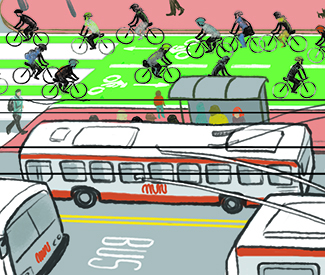
In these global warming days, with drought on everyone’s mind, we must avoid wasting precious water washing cars, and we must reallocate street space with fewer cars in mind. A critical piece of the puzzle is to prioritize public transit and bicycles over automobiles by building exclusive transit and bicycle lanes, remove the lanes and curbside parking available to cars, install signal prioritization for transit and bicycles at intersections, queue-jumping so that transit can bypasses traffic stalled at intersections, restrictions on turns for automobiles, and transit stop improvements including bus stop bulb-outs and amenities.

Reconfigured streets must furthermore exclude car-oriented land uses like more off-street parking in the 92,000 new housing units projected for San Francisco by Plan Bay Area. These units, whatever size or income, should be completely car-free. And this must include removal of existing parking beneath homes, replacing garages with housing and returning the privatized curb cut to the public.


VISIONS FOR HAIGHT

In many respects, the Haight Street corridor is a model for the kind of global warming mitigation strategy the rest of America should follow. The corridor has high density, transit dependent, and car-free households (over 30 percent in the Upper Haight and almost 50 percent in the Lower Haight/Hayes Valley) It has several walkable neighborhood commercial districts, as well as several hundred units of new housing (some of which are below market rate) under construction in Hayes Valley. Almost 25,000 passengers take the Haight buses (6-Parnassus and 71-Haight Noriega) daily, making it one of the busiest combined transit corridors in the city.

But the buses are crowded and often stuck in traffic, so the SFMTA has plans to improve service by increasing frequency, converting more of the existing route into faster “limited” service whereby some buses stop only at key points and removing the “jog” at Laguna and Page which adds delay to the inbound buses.

As I’ve written before, the Muni staff has a good plan known as the Transit Effectiveness Project, with a modest reallocation of street space for higher transit reliability, attracting more ridership, and potentially enabling San Franciscans to conveniently reduce driving to half of all trips by 2018 (it was at 62 percent in 2012). But on both ends of Haight Street, the city has fumbled. While not a disaster, hopefully Muni can learn some lessons and tweak the plans.

On the eastern end, Muni will shift buses off Page Street, converting a short segment of Haight back to two-way. The new two-way Haight includes a transit-only lane between Laguna and Gough/Market streets, which will dramatically improve travel times and reliability. Part of it will enable buses to bypass queues of cars making the right turn from Haight onto Octavia.

Where this scheme falls short is in the plans to simply give former bus stops on Page to private cars for parking. A more progressive plan would instead use the space to help make room for needed bicycle improvements on Page between Laguna and Market. Nearby are multiple housing construction sites where curbside parking has been temporarily removed — such as at the 55 Laguna site. The city has a great opportunity to innovate with transit-first policies at all of these construction sites.

Instead of turning space over to private cars when construction concludes, the city could instead build more bus lanes, pedestrian space, curbside car sharing, and bicycle space. The city could also return some of the space to parking, but only in exchange for parking removal upstream, such as at Haight and Fillmore, where bus stop improvements are sorely needed.

Throughout the city, there are block-by-block opportunities like these, where the city can help the climate instead of giving away parking. As the city discontinues bus stops and sees more housing construction, the policy should be to use curbside space for bicycles, pedestrians, or curbside car share — not simply giving it away to private car parking.

Meanwhile, at the other end of Haight, the city has also fumbled in proposing to reroute the 6-Parnassus, an important electric trolley bus line, off the Frederick-Cole-Parnassus segment. Bus riders in the Upper Haight are incensed. At a recent public meeting, a crowd of 90 people balked at the cut. Muni planners defended the proposal, arguing that ridership is low in the hilly segment above, and that a less productive segment would be shifted to the more crowded Haight Street.

This might seem logical but it may also be shortsighted, especially since the existing segment has overhead trolley wires. Drought notwithstanding, the electric trolley buses are the greenest motorized mobility in San Francisco, propelled by hydroelectricity from Hetch Hetchy.

Taking a longer and more progressive view, it might be useful to think of the debate over the 6-Parnassus this way: If the city is hoping to wean motorists from their cars by achieving the laudable goal of having 30 percent of all trips in the city by transit (up from 17 percent today), cutting service, even in relatively low ridership routes, is counterproductive. It raises the question: Is the ridership level low because the service was poor to begin with, including such irritating factors as less frequency, less reliability, or fewer hours of service? What would ridership levels look like if these less-crowded routes had high frequency, all-day and late-night service with high reliability?

Moreover, what would demand for these routes look like if parking were substantially reduced throughout the city while car-travel lanes were removed, creating space for bicycle lanes and transit lanes? Or what if there were a regional gasoline tax, a congestion charge, or other measures that priced automobility closer to its real social cost, thus producing higher demand for transit?

Surely, reducing the footprint of transit service, however inefficient that service might seem now, is not creating a template necessary for carrying 1.4 million daily passengers in the future, which is what it would take to reach significant emissions reduction goals and 30 percent mode share. Removing segments like the 6-Parnassus on Frederick will only make it harder to rebuild and accomplish that goal. And for political expediency it will also make it harder for Mayor Ed Lee to sell his transportation funding ballot proposals to progressive voters in November.

Muni planners ought to ditch the proposal to reroute the 6-Parnassus, and instead focus on maximizing improved reliability and transit efficiency on the other end of Haight Street by removing parking and prioritizing transit and bicycling on Haight and Page respectively.

Thinking globally about climate change means acting locally, on the streets of San Francisco.

Street Fight is a monthly column by Jason Henderson, a professor at San Francisco State University’s Department of Geography and Environment.


Kick the can

27

joe@sfbg.com

At least 720 San Francisco businesses oppose the controversial Sugary Beverage Tax proposed for the November ballot, according to the proposed ballot measure’s opponents. But a Guardian investigation shows that claim is overstated.

Some businesses were listed with the consent of employees who couldn’t speak for the business, not their owners, and some businesses listed aren’t even open anymore.

The measure is opposed by Unfair Beverage Taxes: Coalition for an Affordable City, which is funded by the American Beverage Association and fronted by public relations firm BMWL and Partners. They have been trying to enlist allies from local restaurants and liquor stores, trying to show the community is against the Sugary Beverage Tax.

The ABA is funded primarily by Coca-Cola Company and PepsiCo, and they certainly have cause to worry about a measure that aims to reduce consumption of sodas and other sugary drinks to help curb obesity, using a 2 cent per ounce tax on sugary beverages sold in San Francisco.

The resolution to place the measure on the fall ballot is sponsored by Sups. Scott Wiener, Eric Mar, Malia Cohen, John Avalos, and David Chiu.

The estimated $31 million in taxes collected would go to the SFUSD to fund physical education for kids and active and healthy living programs in the San Francisco Recreation and Park Department and the Department of Public Health.

We called over 70 of the businesses on the list of opposition to the tax in San Francisco. Not all of the businesses responded to our calls, nor were owners easily available, and some of the businesses listed did not have English-speaking staff available to talk.

Update 2/26: Want to see the list for yourself? Click here for the PDF of the opposition list to the Sugary Beverage Tax sent to us by Affordable City. 

But about 20 of the businesses did respond, and what they told us calls into question the veracity of the opposition list.

Mohammed Iqbal, owner of All Nite Pizza on Third Street, said he only learned about the Sugary Beverage Tax only after we called. Following up later, he said he found that one of his employees signed onto the list.

records“We’re not really sure about the tax, we’d rather stay out of it,” Iqbal told us.

Swanky coffee and wine bar Ma’Velous, a spot popular with City Hall politicos, was also on the list. The owner’s wife, Lean Chow, told us opposition canvassers presented the tax in a one-sided way, and she wasn’t told her signature would place the business onto an opposition list.

“We didn’t get the full details,” she told us in a phone interview. “We also didn’t know the taxes would go towards education.” Her husband owns the coffee bar, and she said they are both fully in support of the beverage tax.

Noe’s Bar and the formerly co-owned Basso’s restaurant are also on the opposition list, but both businesses are permanently closed, according to their Yelp listings and county business data, which we confirmed with phone calls.

Most of the store owners we talked to who did confirm they were on the opposition list said they were not told the funding would go to schools, activities in parks, or public health. Some said they were actively misinformed.

Aijez Ghani, the owner of the restaurant Alhamra, told us, “The one gentleman come, and he say in favor or against? I said in favor.”

When we asked him if he knew he was on the opposition list, Ghani said, “I think it was a mistake. But I am totally in favor of the tax, 100 percent. They’re going to spend money on the schools, the health of kids, and health is more important than business.”

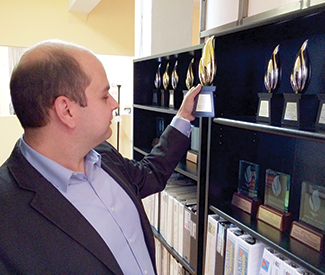
Chuck Finnie, who runs the opposition group for BMWL, invited us up to his firm to inspect the signatures for the opposition list. Along the office walls were dozens of silver and gold award statues from the American Association of Political Consultants “Pollies” awards. One was a 2013 Overall Campaign win for No on N, when the firm trounced the Sugary Beverage Tax in Richmond.

Finnie suspected that the Guardian was sniffing around the list at the behest of Wiener, who Finnie said had raised concerns about the list’s credibility at various meetings in the business community.

“I was a journalist for 20 years, and this is bullshit,” the ex-San Francisco Chronicle investigative reporter and city editor told us. “The gloves are off.”

On the table was a large bin of records. Each business had a sheet with, supposedly, an owner’s name and contact information. We found one listing Mohammed Iqbal, of All Night Pizza, but Iqbal told us the signature was from an employee whose English was not good. Chow was also in there representing Ma’Velous, even though her husband, Philip Ma, is the only registered owner in county records.

As for the closed businesses, Noe’s Bar only closed three weeks ago, but Finnie and his associate Nick Panagopoulos (a former City Hall staffer) said they comb through the opposition list for mistakes every week, showing the Guardian a list of 12 businesses that were removed due to errors in the outreach process.

“I’m responsible for this coalition we’re building, and I’m serious about our political organizing,” Panagopoulos told us, saying he’s rigorous about the standards his organizers use, but that “they’re human beings, so there may be mistakes.”

But Wiener isn’t buying it.

“When I first saw this list, it looked fishy to me,” he wrote to the Guardian in an email, saying his office found irregularities similar to what we found, but from different businesses. “I’m concerned that, given this start to the campaign, the beverage industry is going to flood San Francisco with enormous amounts of money spreading misinformation. This kind of tactic isn’t acceptable.”

Francisco Alvarado, Bryan Augustus, and Brian McMahon contributed to this story.

Spooked

0

rebecca@sfbg.com

The world’s largest computer security conference, RSA, got underway in the Moscone Convention Center on Feb. 24. It’s a huge deal: Speakers will include former Secretary of State Condoleezza Rice, and closing remarks will be given by comedian Stephen Colbert.

Started in 1991, the RSA Conference has grown exponentially. But this year, 13 digital security experts have canceled their scheduled talks in protest of recent revelations that RSA cooperated with the National Security Agency to use a flawed tool for safeguarding sensitive information.

Speakers who are boycotting include technology experts from Google and various security firms. They’re concerned about allegations that RSA, a pioneer in the security software industry, agreed to incorporate a flawed encryption formula into a widely used security product in accordance with a secret $10 million NSA contract.

“In my opinion, RSA has a serious trust issue,” said Jeffrey Carr, CEO of a security firm called Taia Global Inc. and one of the speakers who has decided to cancel his talk and boycott the conference. “I think they’ll just let it die down. There’s been little uproar, even among the security people,” he added.

Carr authored a blog post explaining his decision. He also organized a “town hall” debate, part of an event series called Suits and Spooks, to be held at the Ritz Carlton in San Francisco on Feb. 27, featuring commentary from security industry representatives as well as insiders from the national intelligence community.

RSA used the encryption algorithm as a default for its security products, meaning users would have had to actively switch to a different formula to avoid exposure to the security threat.

According to a Reuters article published in December, the NSA arranged the contract as part of a campaign to embed breakable encryption software into security products that are widely used to safeguard personal devices.

Previous reporting by The New York Times, based on documents leaked by former NSA contractor Edward Snowden, showed that the NSA had generated the weak encryption formula to create a “backdoor.”

EMC, the parent company that owns RSA, issued a response in December that didn’t specifically address the allegations. The company stated that in 2004, when it agreed to use the algorithm, “the NSA had a trusted role in the community-wide effort to strengthen, not weaken, encryption.”

But Carr said researchers within the security industry had suggested the algorithm might be flawed as early as 2006, and RSA did not abandon its use until after the Snowden leaks were publicized.

Other speakers who are boycotting have issued statements publicly condemning RSA. “Your company has issued a statement on the topic, but you have not denied this particular claim. Eventually, NSA’s random number generator was found to be flawed on purpose, in effect creating a back door. You had kept on using the generator for years despite widespread speculation that NSA had backdoored it,” wrote chief researcher Mikko Hypponen of the Finnish company F-Secure.

“As my reaction to this, I’m canceling my talk at the RSA Conference USA 2014 in San Francisco in February 2014,” Hypponen went on. “Aptly enough, the talk I won’t be delivering at RSA 2014 was titled ‘Governments as Malware Authors.'”

Meanwhile, Colbert is also taking some heat for agreeing to speak at the RSA conference.

“We know you, Stephen, and we know you love a good ‘backdoor’ joke as much as we do — but this kind of backdoor is no laughing matter,” activists from Fight for the Future wrote in a petition urging him to join the other speakers who are boycotting the RSA conference. “Companies need to know that they can’t betray our trust without repercussions. We want to hear your speech, but give it somewhere else!”

Muni fare shakedown

43

Update: Just a day after the release of this article, advocacy group POWER announced that Google pledged to pay for Free Muni For Youth for two years. “This validates both the success and necessity of the Free Muni for Youth program,”said Bob Allen, leader in the FreeMuni for Youth coalition, in a press release. “We need tech companies in San Francisco and throughout the region to work with the community to support more community-driven solutions to the displacement crisis.” 

The funding though is promised only for two years, and when that timeframe is up the question will still remain — will Muni’s operating budget pay for something Mayor Ed Lee could find funding for elsewhere? Additionally, Google hasn’t announced funding for free Muni for seniors or the disabled, another program up for consideration in the San Francisco Municipal Transportation Agency’s new budget. That may change if and when it is approved by the SFMTA for the next budget year. 

“I think it’s a positive step in the right direction,” Superivsor David Campos, the sponsor of Free Muni For Youth, told us. “But there are still questions about what it means in terms of the long term future of the program. It’s only a two year gift.” 

“We have asked for a meeting with Google and the mayor’s office and the coalition to talk about long term plans, to find out more information about what this means.” 

There’s a tie that binds all Muni riders. From the well-heeled Marina dwellers who ride the 45 Union to Bayview denizens who board the T-Third Sunnydale line, we’ve all heard the same words broadcast during sleepy morning commutes.

“Please pay your fare share.”

The play on words (also seen on Muni enforcement signage) would be cute if it didn’t perfectly represent how Muni riders may now be stiffed. A slew of new budget ideas hit the San Francisco Municipal Transportation Agency Board of Directors last week (Feb. 18), and who will pay for it all is an open question.

The first blow to riders is a proposed single-ride fare hike from the current $2 to $2.25.

Other proposals include expanding the Free Muni for Youth program, rolling out a new program offering free Muni for seniors and the disabled, and a fare hike to $6 for the historic F streetcar.

The odorous price jumps (and costly but promising giveaways) are moving forward against a backdrop of a Muni surplus of $22 million, which the board has until April to decide how to use, and a controversial decision by Mayor Ed Lee to make a U-turn on charging for parking on Sundays.

The meter decision would deprive Muni of millions of dollars.

“We’re not proposing anything here, just presenting what we can do,” SFMTA Director Ed Reiskin told the SFMTA board at City Hall last week.

There’s still time to change the SFMTA board’s mind on the proposals between now and final approval of the budget in April. But who will end up paying for a better Muni?


FARE HIKES NOT FOUGHT

In 2010, the SFMTA instituted a policy to raise Muni fares along with inflation and a number of other economic factors, essentially putting them on autopilot. The SFMTA board still has to approve the fee hikes, which may rise across the board.

fares One-time fares may jump to $2.25. Muni’s monthly passes would see an increase by $2 next year and more the following year. The “M” monthly pass will be $70 and the “A” pass (which allows Muni riders to ride BART inside San Francisco) will be $81.

Muni needs the money, Reiskin said.

“To not have (fares) escalate as fuel and health care costs increase, you can’t just leave one chunk of your revenues flat,” he told the Guardian. Muni’s operating budget will expand from $864 million this year to $958 million in 2016. “Salary and benefit growth is the biggest driver of that,” Reiskin said.

Mario Tanev, spokesperson for the San Francisco Transit Riders Union, said the hike was expected.

“We’re not necessarily against the inflation increase,” he said. “But though the parking fines SFMTA levies are inflation adjusted, other rates (against drivers) are not. There are many things in our society that disincentivize transit and incentivize driving.”

Drivers enjoy heavy subsidies to their lifestyle on the federal, state, and local levels, from parking lot construction, the cost of gasoline, and now it seems, renewed free Sunday parking meters. The new fare increases are hitting transit riders just as the mayor is poised to yank funding from Muni to put in the pockets of drivers.


PLAYING POLITICS

When the paid Sunday meter pilot began in early 2013, it was a rare flip in a city that often treats Muni like a piggy bank: money was floated from drivers and dropped onto the laps of transit.

A report from SFMTA issued December 2013 hailed it as a success for drivers as well: Finding parking spaces in commercial areas on Sundays became 15 percent easier, the study found, and the time an average driver spent circling for a space decreased by minutes.

Even some in the business community call it a success, since a higher parking turnover translates to more customers shopping.

Jim Lazarus, senior vice president of public policy at the Chamber of Commerce, is a supporter of the paid Sunday meters. “You can drive into merchant areas now where you couldn’t before,” he told us.

Eliminating Sunday meter fees would punch a $9.6 million hole in Muni’s budget next year, by SFMTA’s account.

The timing couldn’t be worse. On the flip side the Free Muni for Youth program, which targets low-income youth in San Francisco, may expand next year at an estimated cost of about $3.6 million, and a program to offer free Muni for the elderly and disabled would cost between $4 and $6 million — close to the same the same amount that would be lost by the meter giveback.


BOOSTING SAN FRANCISCO FAMILIES

“As an 18-year-old in high school it was a struggle to get to school, it was a struggle to find 75 cents or two dollars to get home,” Tina Sataraka, 19, told the SFMTA board last week. As a Balboa High School student, Sataraka had a 30-minute commute from the Bayview. She’s not alone.

A study by the San Francisco Budget & Legislative Analyst’s office found that 31,000 youth who faced similar financial hurdles had signed up for the Free Muni for Youth pilot program, a resounding success in a city where the youth population is dwindling. Authored by Sup. David Campos, the program may redefine “youth” to include 18-year-olds, who are often still in high school.

But initial grant funding for the program has dried up, so now Muni will foot the bill.

Not one to say “I told you so,” Sup. Scott Wiener said there were reasons for objecting to the program a year ago.

“My biggest, fundamental objection to the program was less that they were giving free fares to kids, and more that they were taking it out of Muni’s operating budget,” Wiener told us. “They need to find a way to pay for it, perhaps from the General Fund, and not just taking the easy and lazy way out.”

The Budget & Legislative Analyst recommended several options for alternative funding: special taxes on private shuttle buses (Google buses), or an increased vehicle license fee specially earmarked for the youth bus program. So far, Mayor Ed Lee hasn’t shown an interest.

“There haven’t been discussions of having the Board of Supervisors fund free Muni for youth,” Reiskin told us. The same goes for the mayor. And though Reiskin was cautious and political about the possibility of Sunday meters becoming free again, he didn’t sound happy about it.

“As for what’s behind [the mayor’s] call for free Sunday parking, that didn’t come from us,” Reiskin told us. “That came from him.”


NOVEMBER RISKS

Mayor Lee’s office didn’t answer our emails, but politicos, including Wiener and Chronicle bromance Matier and Ross, indicated the mayor may be reversing on Sunday parking meters to appease the driving voter electorate.

There are two measures up on the November ballot, and one is aimed right at drivers’ wallets.

The two measures, a $1 billion vehicle license fee hike, and a $500 million transportation bond, are both aimed at shoring up the SFMTA’s capital budget. An October poll paid for by the mayor showed 44 percent of San Franciscans in favor of a vehicle fee hike, and 50 percent against, according to the San Francisco Chronicle.

Reiskin said the loss of those two ballot measures would be crippling to Muni’s future.

“The improvements we’re trying to make to make Muni more reliable, more attractive, those won’t happen. This is our funding source for that,” he said.

The mayor is busy smoothing the potholes towards the bonds’ success in the November election, but it seems he’s willing to pile costs onto Muni and its riders to do it.

Correction 2/26: An editing error led to the erroneous calculation of Free Muni For Youth at near $9 million. Free Muni For Youth is only estimated to cost the SFMTA $3.6 million. It is the combination of Free Muni For Youth and free Muni for the disabled and elderly that equal about $9 million. 


Guardian investigation honored

0

Bay Guardian News Editor Rebecca Bowe and Staff Writer Joe Fitzgerald Rodriguez are being honored by the Society of Professional Journalists of Northern California with a James Madison Freedom of Information Award for “Friends in the Shadows,” our investigation of the shady ways that developers and other powerful players buy influence at City Hall.

The package of articles, prepared for the Guardian’s 47th anniversary issue of Oct. 6, used extensive public records to show how contributions to the city’s various “Friends Of…” organizations create cozy relationships between regulators and the regulated, donations that are often designed to skirt public disclosure requirements.

“Their detailed and thorough account explored a trail of money through myriad city agencies and departments,” the awards committee wrote, noting how the paper “used public records, interviews and independent research to probe how developers, corporations and city contractors use indirect gifts to city agencies to buy influence.”

The Guardian will profile the other winners in our annual Freedom of Information Issue on March 12, and all the winners will be honored at SPJ’s James Madison Awards banquet on March 20.

Who influenced the Google-bus policy?

7

On SFBG.com last week, we published a list of the attendees (and corporate affiliations) who were recorded as having attended stakeholder meetings with the San Francisco Municipal Transportation Agency to discuss that private shuttle pilot program that caused such a dustup last month. The list is a matter of public record and was submitted to the Bay Guardian by a source who wished to remain anonymous.

Google was in the room, of course, but not all attendees were affiliated with corporate shuttle providers who bus employees to their workplaces. One company, called Leap Transit, has started a private luxury bus in San Francisco that is not affiliated with any particular employer.

“Our buses are clean and our staff is friendly,” according to Leap’s website. “Sip your morning coffee in peace.” (Leap did not respond to our request for an interview about its future plans.)

Another participant who seemed a bit far afield from the transportation sector was a representative from TMG Partners, a real-estate developer. Also included in the meeting was a representative from a law firm called Morrison Foerster which has represented major tech investors such as Kleiner Perkins, according to its website, which can be found at mofo.com.

How did these individuals manage to get invites? We emailed SFMTA spokesperson Paul Rose to ask that question. He told us, “When we started the work, we received a set of shuttle sector contacts from the [San Francisco County Transportation Authority], who started looking at this issue. One of the first things we did was reach out to these companies and confirm the right contact people. We also reached out to companies who we’d heard had shuttles.”

He added, “Over time, additional shuttle service providers and companies that offer shuttles for their employees contacted the agency to let us know that they were either providing service or considering to provide shuttle service and wanted to know about our policy development process. This also grew our list. And, as we heard about new shuttle programs, we reached out the companies to make contact. Also, at meetings with shuttle providers, we also asked if there were other providers we should include. Some members of the shuttle sector brought their legal or PR reps with them to the meetings — they were not on our list.”

Two views of sex work

20

news@sfbg.com

There are two starkly different ways to look at prostitution in the Bay Area. One view sees sex workers as victims, not just those exploited by the horrible practices of human trafficking and child prostitution, but all sex workers. The other view accepts that sex work can be a legitimate choice made by consenting adults, a job less demeaning and more empowering than many low-wage service jobs.

Those divergent perspectives clashed on the streets of San Francisco on Feb. 11 when the San Francisco Commission on the Status of Women hosted a panel discussion in the Main Public Library on "discouraging demand" for prostitution, a goal that prostitutes trying to cover their rising rents don’t share, as they said outside while protesting the event.

In the spotlight at the forum was San Francisco’s First Offender Prostitution Program, also known as "John School," which was first implemented in 1995 to curb the commercial sex trade and provide an alternative to criminal charges for those caught soliciting prostitution, much like traffic school for bad drivers.

A March 2008 study, "Final Report on the Evaluation of the First Offender Program," by researcher Michael Shively, hailed the program as a success, with claims of vastly reduced rearrest rates and high attendance numbers. In 1999, 822 people qualified to enter the program, and that had dropped to 333 participants in 2007.

Fees generated by the program totaled $3.1 million from 1999 through 2007, which was split among the District Attorney’s Office, San Francisco Police Department, and the anti-prostitution group Standing Against Global Exploitation (SAGE).

But human trafficking and sex work have shown few signs of abating in the Bay Area, where law enforcement sources say Alameda County is one of the state’s biggest prostitution hot spots. And groups like SAGE say all sex work abuses women, whereas rival groups like the Sex Workers Outreach Project (SWOP) say it is the criminalization of prostitution that drives it underground and allows heinous practices like child prostitution to flourish.

Christina Deangelo says she’s been a sex worker since the late 1970s, and she showed up at the event to criticize its judgmental and one-sided program. "Without having even one of us on the panel, who can actually tell you [what is going on], you are killing us," she said.

The sex workers who showed up were particularly critical of panelist Melissa Farley, a controversial psychologist and researcher who spent years studying prostitution and sex trafficking. As an advocate of abolishing prostitution and a proponent of the "Discouraging Demand" strategy, Farley has been met with much criticism in the past.

Ontario Superior Court Justice Susan Himel disqualified Farley as a witness in 2010, ruling that "Dr. Farley’s unqualified assertion in her affidavit that prostitution is inherently violent appears to contradict her own findings that prostitutes who work from indoor locations generally experience less violence."

Sex worker advocates have also slammed Farley, such as blogger and activist Jessica Nicole, who says Farley "makes further manipulative and disturbing language decisions in her research of clients of sex workers," saying that Farley doesn’t "understand the complexities of the industries she is researching."

Farley has argued that prostitution is "inherently violent," and harmful both physically and mentally to the women involved. She says that her research shows that "89% [of sex workers] I spoke to want to get out of prostitution. Most see it as a last ditch effort for survival."

But many sex workers disagree, and they have grown more vocal about their stance on the business. Rather than a profession dominated by victims of forced trafficking and exploitation, they say that a large number of women and men actually like the job. But public and legal condemnation of the profession often prevents sex workers from getting help when they need it.

Workers acknowledge the dangers that go along with their profession, which they see as a major reason to at least decriminalize it and improve methods to protect workers from abusive pimps and clients.

Various studies on the subject have concluded how much more likely sex workers are to be victims of sexual and physical abuse, and have a high chance of drug addiction, more than any group of women in the world.

Sex workers spoke of the need to differentiate between indoor workers (high class call girls) and street walkers, different worlds entirely. They’re critical of Dr. Farley for writing, "while the women in street prostitution work the fields, call girls, escorts and massage parlor workers are the house niggers of this system."

The panel event showed the deep division between law enforcement and sex workers. The government’s ideal method of prosecuting what it deems indecent has not cured most vice businesses, even Casey Bates for the Alameda County District Attorney’s Office’s human trafficking division admitted at the event.

"We cannot arrest our way out of this problem," he said.

Though hardly an advocate of decriminalization or legalization of sex work, Bates does acknowledge that the issue can’t be tackled in the one-dimensional fashion as it is now. And sex workers say they need to be included in discussions about problems in their industry.

Suspension reform isn’t so simple

6

OPINION I wish I could get behind the current campaign to limit public school suspensions (“Suspending judgment, 12/3/13).

The intent is honorable. Any additional attention to the plight of black kids within our schools is laudable. But I’ve always suspected that some would think they’d accomplished something if suspension rates were evened across races, although this would have no more impact on any underlying problems than mandating racially equal grade ratios would eliminate an educational achievement gap.

I’ve also never been confident that all involved understood that removing a disruptive student from a classroom is not done primarily for that student’s benefit, but to allow the rest of the class to carry on without disruption. Unfortunately, I’m now certain that this basic understanding is not shared on the highest levels of the San Francisco Unified School District.   Nationally, the Department of Education finds black students three times more likely to be suspended than whites. Why? An influential 2010 Southern Poverty Law Center publication, Suspended Education: Urban Middle Schools in Crisis, suggested “the possibility of conscious or unconscious racial and gender biases at the school level.”

That’s hardly surprising, given the long history of racial prejudice in this country. But is this what’s actually going on?   San Francisco, with a suspension rate mirroring the national, gave an African American 84 and 83 percent of its vote in the last two presidential elections. Comparable statistics are not available for the city’s teachers, but it seems likely they’re at least as liberal as the electorate as a whole. This, and years of experience as a substitute teacher in virtually every subject on every grade level, tells me it’s not teachers’ racial prejudice that’s the issue here, but something much larger — and harder to tackle.   Last December, the San Francisco Chronicle reported the city’s black infant mortality rate was six times that of whites (a figure not totally reliable due to the shrinkage of the city’s black population). Other markers of well-being show similar numbers. In short, the black community in San Francisco — and the nation — lives under considerable stress and, as anyone familiar with schools knows, kids don’t leave their problems at home.  But causes aside, I’ve hoped that the anti-suspension efforts might at least promote useful alternatives. After all, no one sends disruptive kids home because they think it makes them better students; they do it because few schools have the resources to do anything else. An “in-school suspension” would likely be a far better alternative in most cases, but it requires people and space available to deal with those students.  Unfortunately, while focusing on the vagueness of causes for suspensions such as “disrespect, excessive noise, threat, and loitering,” which the SPLC study called “behaviors that would seem to require more subjective judgment on the part of the referring agent,” the current effort seemingly ignores the need for a classroom free of things like “excessive noise” and “threat.” And it ignores the right of other students to learn in one — students likely from similar circumstances as the kids teachers feel they have to remove.  San Francisco School Board President Sandra Lee Fewer is amending a proposal to ban “willful defiance” suspensions with a mandate to reduce the use of referrals — removing a student from class, but not sending them home — calling them “invisible suspensions.” And SFUSD Superintendent Richard Carranza says, “We’re talking about culture change. A culture where it’s not okay for an adult to say ‘get out.'”

I think the people at the top might benefit from a little more real life classroom face time.

There is great hesitancy around this issue, probably because of fear that protesting too loudly might mark you as part of the problem — perhaps as a racist. But if we allow an ill-considered effort to become a juggernaut, in the end it will be the most vulnerable students who will suffer.

Tom Gallagher is a substitute teacher who has served on the executive board of the United Educators of San Francisco.

The price of growth

20

joe@sfbg.com

San Francisco is booming, but will its infrastructure be able to keep up with its population growth?

The problem is acutely illustrated in the southeast part of San Francisco, where long-stalled development plans were finally greenlit by the adoption of the Eastern Neighborhoods Community Plan a few years ago.

The Mission, Potrero Hill, Dogpatch, and Mission Bay districts have attracted more attention from developers than any other sector of San Francisco, according to the Planning Department. Bayview and Hunters Point are also now attracting lots of investment and building by developers.

But when development projects don’t pay the full cost of the infrastructure needed to serve those new residents — which is often the case in San Francisco and throughout California, with its Prop. 13 cap on property tax increases — then that burden gets passed on the rest of us.

Mayor Ed Lee’s recent call to build 30,000 new housing units by 2020 and the dollar sign lures of waterfront development have pressed the gas pedal on construction, while giving short shrift to corresponding questions about how the serve that growth.

growthimage

Infrastructure needs — such as roads, public transit, parks, and the water and sewer systems — aren’t as sexy as other issues. But infrastructure is vital to creating a functional city.

That kind of planning (or lack thereof) impacts traffic congestion, public safety, and the overall livability of the city. And right now, the eastern neighborhoods alone face a funding gap as high as $274 million, according to city estimates highlighted by area Sup. Malia Cohen.

That’s why Cohen went looking for help, though that’s not exactly what she found.


MEETING DEMAND

Cohen has asked Mayor Lee about the lack of adequate investment in critical infrastructure again and again. She asked his staffers, she asked his aides. At the Feb. 11 Board of Supervisors meeting, during the mayor’s question time, she was determined to ask one more time.

Cohen asked the mayor about how to fund infrastructure needs in the eastern neighborhoods and whether the city should use a new, rarely used fundraising option called an Infrastructure Financing District, or IFD.

“When the city adopted the Eastern Neighborhoods Plan, we were aware of a significant funding gap that existed for infrastructure improvement,” she said to the mayor. She asked if he would slow down development while the city caught up with infrastructure improvements, or commit more funding.

Cohen asked pointedly, “Would you support an IFD for the eastern neighborhoods?”

The mayor’s answer was in the foreign language known as bureaucratese, offering a firm “only if we have to.”

“Strategically planning for growth means making long-term investments in infrastructure,” he said. “And the most important thing that we can do right now is to work together to place and pass two new revenue generating bonds measures on the November 2014 ballot.”

But his proposed $500 million general obligation bond and $1 billion local vehicle license fee increase would just go to citywide transportation projects, where the city faces $6 billion in capital needs over the next 15 years, according to a task force formed by the mayor.

That’s small comfort for the people of the eastern neighborhoods, who are already ill-served by Muni and will have other needs as well. It’s a situation likely to get worse as the population there increases, unless the city finds a way to make serious new investments.


CITY VS. NEIGHBORHOOD

Development impact fees go to the city’s General Fund, paying for the planning work, building inspections, and a share of citywide infrastructure improvements. The problem with that strategy, opponents say, is that there are then no promises that the money will make its way back to the neighborhood that generated the funding in the first place.

Neighborhood advocates see a need to address the problems created by new development by capturing fees before they get to the General Fund. IFDs do just that. Though the nuts and bolts of how an IFD works are complex, the gist is this: Once implemented, an IFD sets up a special area in a neighborhood where a portion of developer impact fees are captured to exclusively fund infrastructure where the development is.

“So the idea that growth should pay for growth was the notion,” Tom Radulovich, executive director of the nonprofit group Livable City, told us. But with money flowing into the General Fund rather than being earmarked for specific neighborhoods, Radulovich said,the infrastructure is going to come much later than the development. (The city) delivers projects slowly, if at all.”

IFDs are largely untested in California, and have only one recent use in San Francisco, on Rincon Hill, where a deal with developers cut by then-Sup. Chris Daly has morphed into an IFD created by his successor, Sup. Jane Kim. The neighborhood will now see new funding, and a new park, as a result of development there.

“This is a HUGE step towards getting the public infrastructure improvements needed to correct livability deficiencies in Rincon Hill,” read a newsletter from the Rincon Hill Neighborhood Association in 2011. “What does this mean for those of us living (here)? It means the Caltrans property at 333 Harrison Street has a short future as a commuter parking lot, because the front portion will become our first neighborhood park.”

The benefits are tangible, but putting an IFD into action is onerous. California Senate documents describe the hurdles involved: The county (or city) needs an infrastructure plan, it must hold public hearings, every local agency that will contribute property tax revenue must approve the plan, and the IFD needs to go to ballot and obtain two-thirds voter approval, a high mountain to climb.

Gov. Jerry Brown has called for lowering the voter threshold for IFDs to 55 percent in his newest budget. The mayor used the governor’s rationale as reason to avoid an IFD for the eastern neighborhoods when speaking on the topic last week. But that may not be his only reason.

“Even if we get the changes that we seek, it’s important to point out that IFDs don’t create more money for our city, they fund specific capital improvements by earmarking money in the General Fund for a particular purpose,” Lee said.

In other words, IFDs take money from a city that is already wrestling with underfunded citywide infrastructure needs. “Earmarking general funds isn’t something that we do lightly,” Lee told Cohen.

But Peter Cohen, co-director of the Council of Community Housing Organizations, put it this way to us: “Should the eastern neighborhoods be the cash cow for the General Fund?”


BOOMTOWN

With more than 10,000 housing entitlements, the eastern neighborhoods are where San Francisco will experience its biggest growing pangs.

“The eastern neighborhoods are ground zero for development in San Francisco,” Keith Goldstein, a long time member of the Eastern Neighborhoods Citizens Advisory Committee, told a Nov. 14 Board of Supervisors Government Oversight Committee hearing on the issue.

Sups. Cohen and David Campos spent the majority of the meeting trying to find solutions, but none were forthcoming. Instead they were met with presentations on the neighborhood’s myriad needs, but few on how they would be funded.

Muni is also starved for resources in the area, where the T-line is notorious for its “switchbacks” that leave riders stranded before completing its run.

“This is a topic I’ve advocated a lot,” Sup. Scott Wiener told us. “When you have a growing population, these folks absolutely have to have service.”

At the meeting, Planning Director John Rahaim put the problem simply: “There’s a lack of development fee funding.” The officials that day from the SFMTA, Planning Department, and the Department of Public Works presented plans that relied heavily on state and federal funding to meet the new construction and infrastructure needs, a funding gap of $274 million.

“We’re really struggling to maintain the infrastructure the city has,” Brian Strong, director of capital planning, said at the meeting. “For the General Fund itself, we’re deferring $3.9 billion in capital projects the city deemed high priority. We just don’t have the funds.”

The Mayor’s Office didn’t respond to our questions about how to solve the problem, but Sup. Cohen said she’s hopeful he’ll support an IFD in her district.

“When we introduced the plan five years ago, we knew there was a gap in terms of what we expected to collect. In terms of development impact fees, we’re still in that place,” she told us. “I just want to get shit done.”

One report seems to agree with Cohen on the importance of IFDs. In 2009, a major report on development in the eastern neighborhoods was filed to then-Mayor Gavin Newsom. It recommended the city “commission a consultant study to inform the formation of an IFD,” saying it was the best tool available to fund infrastructure in the eastern districts.

The top signature on the report belonged to then-City Administrator Ed Lee. Now that he’s mayor, a mayor calling for rapid growth, can he find a way to pay for the infrastructure to serve those new residents?

Introducing BayLeaks

3

rebecca@sfbg.com

From time to time, sources have told us at the Bay Guardian that they would love to share sensitive information for news articles, but fear they would be retaliated against or even terminated from employment if they were to do so.

We have found a way around that.

Sources who wish to retain their anonymity while sharing information they believe the public has a right to know now have the option of using an encrypted submission system to anonymously send documents to our news team.

Created by Bay Area technologists in partnership with the San Francisco Bay Guardian, BayLeaks uses the latest cryptography software to protect the identities of our sources. This is a secure, anonymous way for concerned citizens to communicate with journalists to release information.

“Politically, economically, and socially, it is becoming increasingly clear that the Bay Area is at a crossroads. We see BayLeaks as a critical first step in securing radical transparency in public discourse as the region charts its future,” said T.R. Hwang, a BayLeaks partner and deputy director of the San Francisco Committee of Vigilance, a citizens’ alliance dedicated to enhancing the public sphere through technology.

Our system uses SecureDrop, a whistleblowing platform managed by the Freedom of the Press Foundation, and Tor, an online anonymity network that has gained the trust of Internet users around the world.

The SecureDrop program originated with the late Aaron Swartz, who developed it in collaboration with Wired Editor Kevin Poulson. Swartz was an Internet activist and programmer known for hashing out inventive ways to fight corruption and promote transparency. He’s remembered, among other things, for cofounding Reddit, the online news site; and for founding Demand Progress, an online activism group known for its 2012 campaign against the Stop Online Piracy Act.

To access BayLeaks once you have logged onto Tor, type this URL into the browser: l7rt5kabupal7eo7.onion.

Now SecureDrop is managed by the Freedom of the Press Foundation, a nonprofit organization founded in 2012 that is “dedicated to helping support and defend public-interest journalism focused on exposing mismanagement, corruption, and law-breaking in government.”

To provide maximum security, BayLeaks is only accessible over the Tor anonymity network.

When connecting to Tor in order to submit documents through SecureDrop, the Freedom of the Press Foundation recommends first going to a public location, such as a library or a café, rather than using one’s home or work station where it would be easier for a third party to detect you as a Tor user.

The Tor Browser is as easy to use as other browsers. But once you have downloaded it, it masks the IP address of the computer you are working on by sending your requests through a set of computer relays to keep anyone from tracing communications back to you.

Using the Tor Browser allows you to access Tor Hidden Services like BayLeaks, which are only available over Tor and can be much more secure than ordinary websites. These hidden services have .onion Web addresses (the .com of the digital anonymity world). After you’ve submitted something to BayLeaks, journalists can use the SecureDrop system to communicate securely and anonymously with you. Once you’ve sent all documents to BayLeaks, the Freedom of the Press Foundation recommends deleting the Tor Browser Bundle, destroying any recorded copies of your codename (see “A Low Tech How-To”), and erasing or destroying any media (CD-ROMs, USB sticks) used to copy the leaked documents.

“As the old adage goes, ‘Sunlight is the best disinfectant,'” said J.D. Shutt, a BayLeaks partner and Special Initiatives director of the SF Committee of Vigilance. “We’re excited to provide a technologically robust means of bringing this basic rule of civics into the 21st century.”

Staying power

68

rebecca@sfbg.com

Despite the rain on Feb. 8, organizers of a citywide tenants’ convention at San Francisco’s Tenderloin Elementary School wound up having to turn people away at the door. The meeting was filled to capacity, even though it had been moved at the last minute to accommodate a larger crowd than initially anticipated.

“Oh. My. God. Look at how many of you there are!” organizer Sara Shortt, executive director of the Housing Rights Committee, called out as she greeted the hundreds in attendance. “Tenants in San Francisco, presente!”

The multiracial crowd was representative of neighborhoods from across the city, from elderly folks with canes to parents with small children in tow. Translators had been brought in to accommodate Chinese and Spanish-speaking participants.

Six members of the San Francisco Board of Supervisors also made an appearance: Sups. John Avalos, David Campos, Eric Mar, Malia Cohen, Jane Kim, and Board President David Chiu.

In recent weeks, the convention organizers had convened a series of smaller neighborhood gatherings to solicit ideas for new policy measures to stem the tide of evictions and displacement, a problem that has steadily risen to the level of the defining issue of our times in San Francisco.

tenants1

Ana Godina, an organizer with the SEIU, went to the convention with her daughter Ella, 5. Godina drove from Sacramento to support her colleagues. Three of her fellow union members have been evicted recently, all of them Tenderloin and Mission residents. Guardian photo by Amanda Rhoades

While several legislative proposals are on track to move forward at the Board of Supervisors, the meetings were called to directly involve impacted communities and give them an opportunity to shape the legislative agenda on their own terms, according to various organizers.

Addressing the crowd, Shortt recalled what she termed “some amazing jiu jitsu” during last year’s tenant campaigns, which resulted in a 10-year moratorium on condo conversions rather than simply allowing a mass bypass of the condo lottery, as originally proposed.

That measure, which won approval at the Board of Supervisors last June, was designed to discourage real estate speculators from evicting tenants to convert buildings to tenancies-in-common, a shared housing arrangement that’s often a precursor to converting rent-controlled apartments into condos.

That effort brought together the founding members of the Anti Displacement Coalition, and momentum has been building ever since. “This is the beginning of a movement today,” Gen Fujioka of the Chinatown Community Development Center, one of the key organizations involved, told the gathering. “We are shaking things up in our city.”


MAINTAINING DIVERSITY

Around 160 participants attended the first in a series of neighborhood tenant conventions in the Castro on Jan. 10. The one in the Richmond a week later drew so many participants that organizers had to turn people away to appease the fire marshal.

“The idea of the neighborhood conventions was to solicit ideas,” explained Ted Gullicksen, head of the San Francisco Tenants Union. “The idea of this event is to review existing ideas and ultimately rank them.” From there, the campaign will pursue a ballot initiative or legislative approval at the Board of Supervisors.

tenants2

Ted Gullicksen, director of the San Francisco Tenants Union, and his dog Falcor. Guardian photo by Amanda Rhoades

But first, a few speakers shared their stories. Gum Gee Lee spoke about being evicted from her Chinatown apartment last year along with her husband and disabled adult daughter, an event that touched off a media frenzy about the affordable housing crisis taking root in San Francisco.

“There were times that were very stressful for me. I would call places only for the owner to say, ‘I’ll get back to you,’ but they never did,” she said of that ordeal.

“To see everyone here, all kinds of people, it makes me really happy,” she later told the Bay Guardian through a translator. “I just hope they don’t get evicted.”

Mike Casey, president of UNITE-HERE Local 2 and an executive committee member of the San Francisco Labor Council, also made a few comments at the forum.

“Having the ability to live and vote in this city makes a difference,” he pointed out, saying workers who have to commute long distances for political actions because they’ve been displaced from San Francisco are less likely to get involved.

“The struggle of our time is the widening gap between the rich and the poor,” Casey added. “That is exactly what this struggle is about: to maintain that diversity. What we need to move forward on is bold, effective, measurable change that makes sure we are able to protect the fabric of this community.”

Maria Zamudio, an organizer with Causa Justa/Just Cause, emphasized the idea that the problem of evictions in San Francisco is less of a market-based problem and more of a threat to the city’s existing, interwoven communities.

“Those are our neighborhoods and our communities,” Zamudio said. “We’re fighting for the heart of San Francisco. Fighting for strong tenant protections is a necessary struggle if we are going to keep working class San Franciscans in their homes.”


ELLIS ACT UNDER FIRE

As Gullicksen noted at the start of the convention, San Francisco rents have ballooned in recent years, rising 72 percent since 2011.

“We are seeing the most evictions we have seen in a long, long, long, long time,” Gullicksen said. “Most Ellis evictions are being done by one of 12 real estate speculators — evicting us and selling our apartments, mostly to the tech workers.”

Even though median market-rate rents now hover at around $3,400 per month in San Francisco, low-income tenants can avoid being frozen out by sudden rental spikes because rent-control laws limit the amount rents may be increased annually.

But that protection only applies to a finite number of rental units, those built before 1979. That’s why tenant advocates speak of the city’s “rent-controlled housing stock” as a precious resource in decline. Long-term tenants with rent control — in the worst cases, elderly or disabled residents who might be homeless if not for the low rent — are often the ones on the receiving end of eviction notices.

From 2012 to 2013, according to data compiled by the Anti Eviction Mapping Project, the use of the Ellis Act increased 175 percent in comparison with the previous year. That law allows landlords to evict tenants even if they’ve never violated lease terms. Advocates say real estate speculators frequently abuse Ellis by buying up properties and immediately clearing all tenants.

Concurrently with local efforts agitating for new renter protections, organizers from throughout California are pushing to reform the Ellis Act in Sacramento.

Assemblymember Tom Ammiano has promised to introduce a proposal by the Feb. 21 deadline for submitting new legislation, and Sen. Mark Leno is working in tandem with San Francisco Mayor Ed Lee on a parallel track to pursue some legislative tweaks aimed at softening the blow from the Ellis Act.

“Our goal is to change the conversation in Sacramento, where tenants’ concerns are routinely ignored,” said Dean Preston, director of Tenants Together, a statewide organization based in San Francisco.

tenants3

Those who didn’t speak English were given head sets so they could listen to each of the speakers comments, which were translated into either Spanish or Chinese. Guardian photo by Amanda Rhoades

On Feb. 18, busloads of protesters will caravan to Sacramento from San Francisco, Oakland, and Fresno for a rally. Preston said they’ve got three demands: reform the Ellis Act, restore a $191 million fund that provides financial assistance for low-income and senior renters, and pass Senate Bill 391, which would provide new funding for the construction of affordable housing.

Even though the law is technically intended to allow property owners to “go out of the business” of being a landlord, Ellis Act evictions in San Francisco are most often carried out by speculators who purchase real estate already occupied by tenants, Gullicksen said.

“Our focus is on the most immediate problem, which is the misuse of the Ellis Act by real estate speculators,” Preston said. “It’s urgent to address that specific use. That’s what Ammiano and Leno are looking at, is ‘what’s the best way to stop speculative use?'”


LOCAL POLICY CHANGES SOUGHT

Tyler McMillan of the Eviction Defense Collaborative said his group is often the last resort for tenants threatened with the loss of their rental units. “Too often, we face a losing fight at court,” he said. “We need to write better laws that work better to keep people in their homes.”

The legislative proposals moving forward at the local level seek to attack the problem of evictions and displacement from several angles. On Feb. 3, Sup. David Campos introduced legislation to require landlords who invoke the Ellis Act to pay a higher relocation fee to displaced tenants, equaling two years’ worth of the difference between the tenants’ rent and what would have been considered market rate for that same unit.

“It is time that we recognize that tenants must receive assistance that is commensurate with market increases in rent if we are to truly address our affordability crisis and check the rampant growth of Ellis Act evictions,” Campos said.

As things stand, relocation assistance payments are around $5,261 per tenant, and are capped at $15,783 per unit, with higher payments required for elderly or disabled tenants. But at current market rates, a tenant would not last more than a few months in the city relying solely on the relocation fee to cover rental payments.

Surveying the strong turnout at the tenant convention, Campos said, “There is a movement that’s happening in San Francisco to take our city back, and to make it affordable for all of us.” Yet he noted that he is concerned there will be major pushback from the San Francisco Apartment Association and the real estate industry, formidable interests that oppose the relocation fee increase.

Meanwhile, Sup. Mar has proposed an ordinance that would require the city to track the conversion of rental units to tenancies-in-common, a housing arrangement where multiple parties own shares of a building through a common mortgage. Speculators who buy up properties and immediately evict under the Ellis Act often angle for windfall profits by immediately converting those units to TICs.

Campos is also working on legislation that would regulate landlords’ practice of offering tenants a buyout in lieu of an eviction, a trend advocates say has resulted in far greater displacement than Ellis Act evictions without the same kind of public transparency.

Peter Cohen of the Council on Community Housing Organizations said there’s “no silver bullet” to remedy San Francisco’s affordable housing crisis. “This process is going to come up with another bundle of things,” he said. “All of that is also complimentary to the state campaign. You could have five, six, or seven policy measures going forward — and all of them winnable.”

An idea Cohen said has received traction is the idea of imposing an anti-speculation tax to discourage real estate brokers who abuse the Ellis Act by buying up properties and evicting all tenants soon thereafter (see “Seeking solutions,” for details).

During a breakout session at the tenant convention, longtime LGBT activist Cleve Jones piped up to say, “Harvey Milk proposed the anti-speculation tax back in 1979.”

It wasn’t successful at that time, but Cohen said that given the current level of concern about housing in San Francisco, it’s being talked about in some circles as the most winnable ballot initiative idea.


TENANTS FIGHTING BACK

At the Feb. 8 convention, tenants shared stories of challenging orders to vacate their rental properties. “The most important thing that has brought us to the victories we’ve had so far is that tenants have stayed in their homes,” Shortt said. “Tenants have fought, tenants have sought help, tenants have organized.”

Tenants from a North Beach building owned by real estate broker Urban Green shared their story of banding together and successfully challenging an Ellis Act eviction. Chandra Redack, a nine-year resident of 1049 Market St., where tenants continue battling with owners who submitted eviction notices last fall, described to the Bay Guardian how her small group of tenants has continued to organize in the face of ongoing pressure, including the owners’ recent refusal to accept rent checks.

“Our organizations only can support tenants when they stand up and fight,” said Fujioka. “The tenants’ resistance themselves is part of the strategy. If we don’t have rights, we are going to create them.”

Paula Tejeda, a longtime resident of the Mission District originally from Chile, told the Bay Guardian that she’d been threatened with an eviction from her home of 17 years, a Victorian flat on San Carlos Street.

“I thought I was dealing with an Ellis Act, now he’s trying his best for a buyout,” she explained.

Living in that rent-controlled unit made it financially feasible for her to contribute to the Mission community as a small business owner, as well as a poet, author, and active member of the arts community, she said. Tejeda is the proprietor of Chile Lindo, an empanada shop at 16th and Van Ness streets.

“Having the rent control made it possible for me to build Chile Lindo, go back to college and get my MBA,” she said. That in turn gave her the resources to employ one full-time and three part-time staff members, she said.

When she was initially faced with the prospect of moving out, “I wanted to shut down and leave, and go back to Chile,” she said. “We are suffocated, as a society that cares only about the bottom line.”

But surveying the hordes of tenants milling about at the convention, she seemed a bit more optimistic. “The fact that this is happening to everyone at the same time,” she reflected, “is kind of like a mixed blessing.”

tenants4

Free lunch, had some vegan options. Guardian photo by Amanda Rhoades

Seeking solutions

A number of policy ideas emerged from the neighborhood tenant conventions, which were held by the San Francisco Anti Displacement Coalition in the Mission, Chinatown, Haight/Richmond, Castro, SoMa, and the Tenderloin.

Here’s a list of what tenants came up with at those forums, which attendees ranked in ballots collected at the event. The ideas will most likely result in a November ballot initiative and one or more legislative proposals, which organizers plan to announce in the near future.

Anti-speculation tax: One idea is to impose a tax on windfall profits garnered by speculators who buy up housing and then sell it off without maintaining ownership for at least six years. The tax would be structured in such a way that the quicker the “flip,” the higher the tax. This would require voter approval.

Eviction moratorium: This proposal is to put a yearlong freeze on certain kinds of “no-fault evictions,” instances where a tenant is ousted regardless of compliance with lease terms. State law would prohibit it from applying to Ellis Act evictions. It might potentially require voter approval.

Department of Rent Control Enforcement and Compliance: This new department, which could be done by local legislation, would create a new city department with the mission and mandate to enforce existing tenant-protection laws and conduct research on eviction trends.

Relocation assistance: While Sup. David Campos is working on legislation to upgrade relocation assistance payments to displaced tenants who face eviction under the Ellis Act, this proposal would do the same for all other forms of “no-fault” evictions. This would require voter approval.

“Excessive rents” tax: While the Costa-Hawkins state law does not allow for cities to control rents in vacant units, this proposal would create a tax on new rental agreements where rents exceed an affordability threshold.

Housing balance requirement: This proposal would make it so that approval of new market-rate housing would be restricted based on whether affordable housing goals were being met. It would create new incentives to build affordable.

Legalize illegal units: This would provide a way to legalize the city’s “illegal” housing units that nevertheless provide a safe and decent source of affordable housing. (Board President David Chiu has already introduced a version of this proposal.)


Sugar fix

0

A resolution to place a sugary beverage tax on the November ballot was introduced at the Feb. 4 Board of Supervisors meeting.

The two-cents-per-ounce tax would be levied at the point of distribution, with the ultimate goal of reducing the consumption of sodas and other sugary drinks to combat obesity in San Francisco. The tax, sponsored by Supervisors Scott Wiener, Eric Mar, Malia Cohen, John Avalos, and David Chiu, is similar to a resolution made two years ago in Richmond.

But Richmond voters ultimately voted it down by 66 percent, so how’s San Francisco any different?

In 2012, the American Beverage Association hired Chuck Finnie of San Francisco public relations group BMWL and Partners. The association funded the Community Coalition Against Beverage Taxes, which reached out to Latino communities and others, saying it was a tax on the poor.

Now Finnie is back as spokesperson for Stop Unfair Beverage Taxes — Coalition for an Affordable City, here in San Francisco.

“It’s a shallow argument, that it’s a regressive tax on poor people,” said Cohen, a sponsor of the ordinance. “What is it costing poor people? Literally it’s costing them their lives.”

Jeff Ritterman, a cardiologist and former Richmond City Council member, was a lead proponent of the Measure N campaign in 2012. He’s another actor from that campaign who’s back now too, helping the supervisors craft their new strategy.

Last time around they were outspent, Ritterman admits. But campaign money is only one way San Francisco is taking a different tack in the upcoming sugar battle.

The supervisors are also proposing to dedicate the estimated $30 million in revenue that the tax will generate to a specific purpose. The funding would be divided between the SFUSD, the Department of Public Health, and the Recreation and Park Department for a mix of outdoor activities and nutrition education. In contrast, Measure N left allocation of new funding open-ended.

In Richmond, “they told people on the telephone I’d use it for trips around the world. It got as crazy as that,” Ritterman said. “You get more support when you show you’ll use it for children’s health and physical activity.”

Since the use of tax funds collected was a major concern for Finnie’s group last time around, now that it’s been addressed he should be happy, right?

“No,” Finnie told the Guardian, flatly. “We disagree that singling out sugar sweetened beverages for special taxation has any merit whatsoever.” 

Students suffer from ‘invisible suspensions’

4

At the Board of Education meeting on Feb. 4, students rallied against suspensions they see as unfair. Advocates negotiated rule changes. San Francisco Unified School District Board of Education commissioners shook their fists at injustice.

The uproar concerned “willful defiance” suspensions, cited nationwide as problematic because of their subjective nature. Wearing a backwards cap, having a bad day, talking back, all fall under the umbrella of willful defiance.

The suspension ban is monumental, SFUSD Superintendent Richard Carranza told the board.

But new data shows that a different form of punishment, which was previously unrecorded, may cause almost as much harm.

Ever been sent to the principal’s office? That’s known as a referral, and in California it’s enshrined in state education code. Students can be sent to a counselor, principal, or even another classroom. But President Sandra Lee Fewer said the numbers of referrals are getting out of hand, and must be addressed.

Fewer amended the controversial resolution to ban suspensions, calling for it to also require a reduction of in-school referrals.

The punishment, she said, deprives students of needed classroom time — and is ineffective.

“We can’t pass a resolution like this without including referrals,” Fewer said. “These are in the thousands. Some schools have three times the amount of black children with referrals.”

She called them “invisible suspensions,” because this school year is the first time they’ve been thoroughly tracked, thanks to a new system called the Counselor Online Referral Form.

The new data shows thousands of middle school students (high school data is still being collected), mostly black and Latino, were sent out of the classroom for “non-compliance” referrals since the last school semester alone. “Non-compliance” referrals are nebulous, advocates allege, a subjective catch-all category for bad behavior. 

Fight for higher minimum wage resumes

0

An event at the San Francisco Women’s Building on Feb. 6 marked the 10-year anniversary of San Francisco’s minimum wage ordinance, passed by voters in 2003 with Proposition L. The landmark initiative not only raised the minimum wage in San Francisco to $8.50 per hour, but stipulated that the amount would rise every year to reflect inflation. Thanks to Prop. L, San Francisco now boasts the highest minimum wage in the nation, at $10.74.

But in pricey San Francisco, it still isn’t enough.

“Who thinks living in San Francisco is really expensive?” asked one of the event organizers and staff member of the Chinese Progressive Association, Shaw San Liu. All hands in the room shot up before the Spanish and Mandarin translators even had a chance to repeat the question.

Raising the minimum wage in San Francisco has been a hot topic recently, and Mayor Ed Lee even endorsed a significant increase back in December. While a wage of $15 per hour has been floated, nothing has been set in stone.

In addition to celebrating the 10-year anniversary of the minimum wage ordinance, Thursday’s event was also the official launch of the Campaign for a Fair Economy, a push to support the city’s lowest-paid workers and close the ever-growing wealth gap.

Raising the minimum wage is only part of the campaign, and advocates are also fighting for accountability from large chain businesses, stricter enforcement of existing labor standards, and expanding access to jobs for disadvantaged workers.

“San Francisco has led the way for employment policies in the past,” said Kung Feng, lead organizer for Jobs With Justice, which is helping to lead the campaign. “We need to continue that.”

Despite San Francisco’s long legacy of championing workers’ rights, there is still a tough battle ahead. Currently, the minimum wage in the city automatically goes up every year to match inflation (on Jan. 1, 2014, it rose from $10.55 to $10.74). Any further increase requires voter approval.

While it seems a higher minimum wage does have strong support and has already been endorsed by major political figures, there’s still a powerful lobby against it from some businesses and restaurant associations.