News and Politics | San Francisco Bay Guardian

News & Opinion

Granny slap

0

Lisa Gray-Garcia, aka “Tiny,” led a press conference outside the San Francisco Hall of Justice on Feb. 5 to announce that she and fellow activists were filing elder abuse charges against San Francisco landlords.

Flanked by activists and senior citizens who were facing eviction or had lost housing in San Francisco, the Poor News Network founder condemned landlords who’ve invoked the Ellis Act as “dangerous criminals.”

Gray-Garcia said criminal charges were being filed against the landlords in accordance with California Penal Code 368, which creates a special category for crimes — such as infliction of pain, injury, or endangerment — committed against elders and dependent adults.

The theory is that carrying out an Ellis Act eviction against a senior citizen qualifies as a criminal act under that law, since an elder can suffer physical harm as a result of being turned out of his or her home.

“Seniors who live in houses that they’ve lived in for a really long time are being evicted,” said Erin McElroy, who joined the rally. “That could mean homelessness, that could mean poverty, that could mean death, that could mean losing your access to health care.”

“The real criminals are the ones who use paper, and money, and lawyers to evict us,” Gray-Garcia said. “We at POOR Magazine get five to 10 calls a week from elders — 70, 80, 90 years old — at the point where they’re actually going to be evicted,” she added. “In the elder abuse law, if you willfully or unwillfully cause harm or inflict harm on a body of an elder, you actually can do one year jail time or pay a $6,000 fine.”

The targeted landlords were taken from a list compiled by the San Francisco Anti Eviction Mapping Project, a volunteer-led group that published names, property ownership, and identifying information of 12 landlords who had repeatedly invoked the Ellis Act in San Francisco. Garcia read out their names as part of the press event.

Beyond that, however, the announcement was short on specifics. Gray-Garcia told the Bay Guardian she did not want to share the names of the affected seniors because she did not feel comfortable exposing the elderly tenants to potential backlash.

Joining the group of activists was an 82-year-old woman who used a walker and declined to share her name. She told the Bay Guardian she had lived in her Richmond District flat for more than 30 years, and had recently received a verbal warning from her landlord that if she did not move out, he would invoke the Ellis Act.

When Gray-Garcia and others filed into the San Francisco District Attorney George Gascon’s office inside the Hall of Justice, however, Chief Assistant of Operations Sharon Woo discouraged them from filing the charges.

“We don’t actually initiate investigations,” Woo told the activists, but when attorney Anthony Prince, who had accompanied the activists, pushed back on that point, she responded, “We could, potentially.”

However, she urged them to first “go to the normal channels, which is a law enforcement investigation,” then scheduled a follow-up meeting at a later date to discuss the issue further. She discouraged the activists from bringing a large group to the meeting. “There’s a 98-year-old woman being forced out of her home in April and she has nowhere to go,” McElroy told Woo during that interaction. “And we’re filing criminal charges against the people who are forcing her out.”

Farewell to an ally and union brother

1

Pete Seeger played a critical role for labor and all working people. As a labor troubadour, he traveled the world singing out for labor. That is why he came to ILWU [International Longshore and Warehouse Union] Local 10 in the Bay Area in 1941. The US government had tried four times to deport Harry Bridges, the Australian-born leader of the ILWU, in an effort to destroy the union. Together, Seeger and Woody Guthrie sang out to the union’s rank and file strike committee a song called a “Ballad To Harry Bridges.”

The government was unsuccessful in its efforts to deport Bridges, but unfortunately most of the left unions like the Marine Cooks and Stewards were eventually destroyed by the hysterical witch-hunts launched by the government — some with the active support of not only bosses but some union officials. Regardless, affiliations and actions like Seeger’s 1941 appearance in San Francisco were the reason Seeger was brought before the House UnAmerican Activities Committee in 1955, and eventually sentenced to two years in prison. From the HUAC transcript:

Mr. Tavenner: The Committee has information obtained in part from the Daily Worker indicating that, over a period of time, especially since December of 1945, you took part in numerous entertainment features. I have before me a photo static copy of the June 20, 1947, issue of the Daily Worker. In a column entitled “What’s On” appears this advertisement: “Tonight — Bronx, hear Peter Seeger and his guitar, at Allerton Section housewarming.” May I ask you whether or not the Allerton Section was a section of the Communist Party?

Mr. Seeger: Sir, I refuse to answer that question, whether it was a quote from the New York Times or the Vegetarian Journal.

Seeger was accused of singing for functions of the Communist party, and for McCarthy and company, this was a deadly crime. Seeger also fought for integration, and against the segregated workplace, in conjunction with the left-wing unions — like the Marine Cooks and Stewards and even the Painter’s Local 4 in San Francisco, led by Dow Wilson — that were fighting segregation. Ships in the port of San Francisco were prevented by the members of the Marine Cooks and Stewards from sailing until their crews were integrated. This direct action of workers on the waterfront was a very real threat to big business, which wanted to destroy labor power and continue segregation as a tool of the bosses.

ILWU longshore leader Bridges also won the support of the black community by promising them that if they supported the strike, they would get union jobs on the waterfront, and he kept his word; today, ILWU 10 still has a large percentage of African Americans. Racism, as Seeger knew, played a virulent role in US history, and his songs were a powerful cultural counterpoint to the reigning ideology and racism of the time.

This is why he was prevented from going on national television during the blacklist period after the Communist witch-hunts. The corporate-controlled media in the United States had an ax to grind, and keeping Seeger, Paul Robeson, and other singers and intellectuals like Noam Chomsky off the airwaves is something that continues today. It is not surprising that in many network TV depictions of Seeger’s life, they conspicuously fail to point out that these same networks banned his voice from the airwaves for decades. Of course the power of Pete Seeger, his songs, music, and personal magnetism could not be banned, and they broke through despite the government and corporate efforts.

Working people of San Francisco, the Bay Area, and the world have lost a great ally and union brother, but his words will ring out for eons.

This coming year’s LaborFest will commemorate the 80th anniversary of the San Francisco General Strike, bringing this history and culture back for the working people today who face similar attacks on their rights to a union, decent health and safety conditions, and a future for themselves and their families.

Steve Zeltzer is the host of KPFA WorkWeek Radio and a member of the LaborFest organizing committee.

Higher wages and tenants’ rights, for the win

10

As we document in this week’s cover story, a citywide coalition has sprung up to fight for tenants’ rights in the face of mounting evictions and soaring rents, and momentum on this issue is steadily growing.

But that isn’t the only sign of a newly invigorated movement that’s beginning to count its victories and advance forward on behalf of tenants, workers, and thousands of San Franciscans who are less focused on turning a quick profit and more concerned with bringing about positive change. Last week brought several high notes on this front.

Citywide legislation that will limit discriminatory practices by employers and housing providers by reforming background check policies won initial approval at the Feb. 4 San Francisco Board of Supervisors meeting.

Introduced by Sup. Jane Kim, the Fair Chance Act is part of a “ban the box” movement, backed by local grassroots organizations that came together to champion the rights of individuals who’ve encountered barriers to improving their lives due to past convictions that have left them with a permanent stigma.

At the meeting, Kim mentioned a woman who’d been told she “need not apply” for a job working as a cook — because of a simple shoplifting conviction from when she was in high school. The ordinance will require certain employers and housing providers to refrain from criminal history checks until after an initial job interview, and would make certain kinds of information off-limits, such as arrests that never resulted in a conviction.

Meanwhile, an initiative to curb height limits on waterfront development amassed enough signatures last week to qualify for the June ballot. That effort grew out of a successful referendum last November against the 8 Washington project, a key pushback where San Francisco voters rejected luxury condominiums at the ballot.

The Chinese Progressive Association and Jobs With Justice held a celebration last week to commemorate the 10-year anniversary of the passage of the city’s minimum wage ordinance.

While it remains the highest in the nation, San Francisco’s 2014 minimum wage of $10.74 an hour still isn’t enough to make ends meet, so allies of low-wage workers are launching the Campaign for a Fair Economy to push for a higher minimum wage at the ballot and to implement a higher wage standard for major retailers and chain stores.

There remains much to rail against, to be sure. A Craigslist ad for a $10,500-per-month two-bedroom apartment in the Mission generated a barrage of angry commentary from those who read it as doomsday for the historically Latino area, especially since the tone-deaf author used the word caliente to describe the neighborhood.

But the start of 2014 has already delivered some promising victories for progressives, and many have their sights set on even greater horizons.


Alerts: February 12 – 18, 2014

0

WEDNESDAY 12


10th Anniversary: Winter of Love City Hall Rotunda, Civic Center Plaza, SF. (415) 554-5977. 5-6pm, free. Celebrate 10 years since the historic day when then-Mayor Gavin Newsom took a courageous stand against marriage discrimination in San Francisco, and married thousands of same-sex couples in San Francisco’s City Hall. A decade later, loving same-sex couples can legally marry in San Francisco and throughout California. It’s time to celebrate with family and friends. Lt. Gov. Gavin Newsom and San Francisco Mayor Ed Lee will attend.


Winning Divestment: Student Struggles for Peace and Justice Mission Cultural Center for Latino Arts, 2868 Mission, SF. MEPeaceSF@AFSC.org. 6-8:30pm, free. A panel discussion will bring activists together to address the power, controversy and effectiveness of divestment as a tool for economic activism in different movements: the movement against apartheid in South Africa, the struggle for Palestinian rights, the global movement to avert the climate crisis. Film clips will accompany the panel, followed by an open conversation moderated by journalist, activist, and author Nora Barrows-Friedman.


THURSDAY 13


Kamala Harris: Do Your Job, Prosecute Killer Cops! State Building, 1515 Clay, Oak. www.justice4alanblueford.org. 3-5pm, free. The Justice for Alan Blueford Coalition (JAB) submitted a letter to CA Attorney General Kamala D. Harris at the State March Against Police Brutality on October 22, demanding that she prosecute Miguel Masso for the murder of Alan Blueford. Since then, she has responded by refusing to reopen the investigation. Join in a statewide campaign to demand that Attorney General Harris do her job and investigate citizen deaths.

FRIDAY 14

Dance Across the Golden Gate Bridge Southeast End of Golden Gate Bridge, SF. www.onebillionrising.org/events. 8am, free. One Billion Rising for Justice is a global call to women survivors of violence and those who love them to gather safely in community outside places. This year, they are escalating their efforts, calling on women and men everywhere to rise, release, dance, and demand justice. Join them for an early morning dance across the Golden Gate Bridge.

SUNDAY 16

Radical Women & Freedom Socialist Party Meeting New Valencia Hall, 747 Polk, SF. www.radicalwomen.org. 1pm, free. Obamacare: not as universal as you may think. The focus of this month’s meeting of the Radical Women & Freedom Socialist Party is a leftist critique of the Affordable Care Act, plus cost-effective alternatives that would provide humane treatment to all. Come and discover the criticism you aren’t used to hearing about in the news.

The trouble with compromise

44

“It takes no compromise to give people their rights… It takes no money to respect the individual. It takes no political deal to give people freedom. It takes no survey to remove repression.” — Harvey Milk

OPINION As I sat in the audience at the Jan. 23 San Francisco Young Democrats meeting and watched the first debate between David Campos and David Chiu in their race to represent San Francisco’s 17th Assembly District, I was disturbed to hear the words “compromise” and “consensus” come out of David Chiu’s mouth more often than the words “eviction” and “displacement.”

During the debate, a line in the sand was drawn by the two candidates: Campos was on the side of the underdog, a voice to the voiceless; and Chiu, by his own admission, was all about compromise and “getting things done.”

Don’t get me wrong. True compromise can be a good thing. Unfortunately, what has been coming out of City Hall, from both President Chiu’s Board of Supervisors chamber and the Mayor’s Office, hasn’t been real compromise. It’s been a wholesale selling of our city to the highest bidder. The only thing that our leadership’s compromises have yielded is a compromised San Francisco.

Compromise gave corporations millions of dollars in tax breaks and it has forced nonprofits and small businesses out of our neighborhoods. Compromise has not resulted in any substantive action to curb Ellis Act evictions, instead serving to green light the building of luxury condo towers throughout the city. Compromise has allowed queer youth shelters and our parks to be closed to the people who need them as a last resort, as our bus stops have been opened up to billionaires for little more than pennies.

Chiu’s compromises have cost this city dearly. His compromise with developers on Parkmerced will lead to the demolition of 1,500 units of rent-controlled housing. His compromise on Healthy San Francisco allowed restaurant owners to continue to defraud consumers and to pocket money that should have gone to health care for their employees. His compromise on Muni killed a much-needed ballot initiative that would have resulted in an additional $40 million for the agency — a ballot initiative that he originally co-authored.

Please forgive me if I am fed up with compromise and am demanding actual leadership from my representatives.

Now is the time to stand with people of color, with members of the LGBTQ community, with our youth and elders, with artists and with small businesses, all of whom are being forced out of our city.

Thankfully, we have another choice. Sup. David Campos has shown that real change comes not from compromising your values but standing up for your principles. His legislative accomplishments include providing free Muni for low-income youth, protecting women’s right to choose at the Planned Parenthood Clinic, and preventing teacher layoffs at our public schools.

Campos has demonstrated that he, not Chiu, is the right choice to follow Tom Ammiano’s footsteps to Sacramento. Ammiano, who had 13 of his 13 bills signed into law this past year, is the perfect example of the success that can come from leading with your principles and not compromising your integrity.

San Francisco needs a leader representing us in the capital. Successful victories in reforming the Ellis Act and closing the Prop. 13 tax loophole will take a leader who can stand up to landlords and corporations, not a compromiser who will sit down at the table in a backroom with them.

That is why I will give my all to make sure that David Campos is our next representative in Sacramento. Pardon me if I refuse to compromise.

Tom Temprano is president of the Harvey Milk LGBT Democratic Club.

Fresh out

21

Rebecca@sfbg.com

Food stirs strong passions in San Francisco. Protests have been mounted against foie gras and live chicken sales, and epic battles have been fought over chain grocery stores’ proposals to open up shop in certain neighborhoods.

When Whole Foods opened in the Upper Haight in 2011 amid no shortage of neighborhood controversy, Rachel Levin wrote in The Bold Italic that her glee at beholding offerings such as Kombucha on tap belied her nagging conscience about patronizing a chain retailer in an area dotted with local businesses. Internal conflict ensued; the writer confessed feeling “totally conflicted.”

But a very different food-related dilemma is currently plaguing residents in Bayview Hunters Point, a racially diverse, low-income area in the city’s southeast sector.

Six months after the Upper Haight Whole Foods flung open its doors to guilt-ridden and guilt-free patrons alike, a different grocery store was welcomed with much fanfare.

Five years had passed from the time when Fresh & Easy Market had agreed to do business in the Bayview to the day it finally opened for business. The store launch, held in late August of 2011, was treated as a celebratory affair — after much involvement by city officials, it marked the first time in 20 years that the low-income community would have a grocery store.

“The opening of Fresh & Easy on Third Street creates jobs for the community and will help make the neighborhood a place where families will want to stay and thrive,” Mayor Ed Lee said at the time.

But just over two years later, Fresh & Easy was closed. Tesco, the British parent company that owned the grocery chain, fell into financial trouble and unloaded its West Coast stores onto an affiliate of Yucaipa companies, headed by Los Angeles billionaire Ronald Burkle. Other San Francisco Fresh & Easy locations survived the transition, but the Bayview store didn’t make the cut.

Now it’s back to square one, and the neighborhood is once again without a grocery store where one can purchase fresh food. That’s especially problematic considering that Bayview residents suffer from diet-related illnesses such as heart disease and diabetes at much higher rates than other city residents.

And ever since Fresh & Easy closed, Sup. Malia Cohen, who represents District 10 where Bayview is located, has discovered that attracting a new grocery retailer to that neighborhood is like pulling teeth.

“Safeway was absolutely closed to the idea,” Cohen reports. “They cited safety concerns.”

When she first contacted Safeway representatives to pitch the idea of having the grocery retailer move into the vacant Fresh & Easy location, their response was to ask her office to track down emergency service call data in the surrounding neighborhood. “They said they couldn’t get the information,” Cohen said. “I said, that’s interesting, it’s public information.”

Safeway also cited concerns about the configuration of the vacant space and the size of the parking lot, Cohen said. She noted that the grocer has shown generosity in the past by making Safeway gift card donations to needy Bayview residents, but “that also presents a challenge. It’s a hike to get to the grocery store.”

Safeway spokesperson Wendy Gutshall did not answer questions about why the retailer was unwilling to consider moving to the area, and wrote in an email to Bay Guardian, “There are no plans at this time with respect to a new location in the Bayview.”

Cohen was frustrated, but undeterred. “I think there’s a certain level of racism and classism that blinds retailers from even exploring these communities,” she said. “I really want the community to be able to have healthy food options — not discounted toss-aways.”

Next on Cohen’s list was Trader Joe’s. “The conversation went well,” she noted, adding that she’s targeting the chain because numerous residents have told her they would shop there. “I’m optimistic — although they did express a desire to be in Noe Valley. Or the Castro.”

Asked whether the company would consider opening a store in the Bayview, Trader Joe’s spokesperson Alison Mochizuki would only say, “At this time, it’s not in our two-year plan to open a location in that area.”

Cohen said she’d also reached out to Kroger, Sterling Farms, and 99 Ranch Market to gauge interest. Meanwhile, nearby Visitation Valley will be getting its own grocery store, with an anticipated opening in June: discount retailer Grocery Outlet.

The closure of Fresh & Easy left some Bayview residents without jobs. Gloria Chan, spokesperson of the Office of Economic and Workforce Development, a city agency that works closely with Mayor Ed Lee, noted that OEWD had “deployed its rapid response team to assist [displaced Fresh & Easy] employees during the transition, and provided information on workforce services including unemployment assistance.”

Investment firm Fortress Investment Group acquired the vacant Fresh & Easy site in December, Chan added. “OEWD reached out to the Fortress Investment Group and expressed interest and the need for ensuring a grocery retail outlet continues to remain in the now vacant location,” she wrote. “OEWD remains diligent in pursuing a grocery retail outlet in the Bayview and have also spoken to various food operators.”

But so far, nothing has fallen into place, and Cohen says the mayor’s office could be offering more support. “We have the density needed to support a store — households, age range, all the qualifying data points,” Cohen said. “I do have my fingers crossed.”


Guns, gods, and government

20

EDITORIAL Humans tend to believe that we’re smarter than we really are. It’s a problem that can be exacerbated by concentrations of wealth and technological expertise, which can cause some people to believe they have an almost God-like power to manifest solutions to any challenge they confront, particularly when they have lots of money to throw at the problem.

But that’s really just hubris. It’s the story of Icarus striving for the sun and falling back to Earth when his technology failed him. Knowing our limits and feeling a sense of humility and social responsibility are the first steps toward dealing honestly with problems we face. And last week, we were reminded again of this reality by venture capitalist Ron Conway, the libertarian-leaning power broker who has taken a paternalistic hold on the city (see “The Plutocrat,” 11/27/12).

Being a newspaper that has always believed in gun control, we share Conway’s newfound desire to reduce gun violence, a cause he suddenly adopted after the massacre at Sandy Hook Elementary school in December 2012. Conway and his Smart Tech Foundation last week unveiled some early designs for high-tech guns that only work in the hands of their owners, and which will notify those owners when someone has moved them.

“Let’s use innovation to bring about gun safety. Let’s not rely on Washington,” Conway told the San Francisco Examiner, which put the story on its Jan. 29 cover.

There are many levels of ridiculousness to Conway’s belief that his gizmos can do more to reduce gun violence than even modest federal regulation of the more than 300 million guns in this country. After all, guns are designed to inflict violence, and just 3 percent of gun deaths are accidental shootings (62 percent are suicides and 35 percent are homicides). Sandy Hook shooter Adam Lanza used guns from his home that he’d been taught to use by his mother, who ended up being his first victim, so it seems unlikely Conway’s guns would have changed that outcome.

When reporter Jonah Owen Lamb asked Conway how his technology differed from widely available trigger locks, he compared them to the iPhone, which invented a new market for its product. So the answer to gun violence is creating a new market for a new generation of guns that only their wealthy owners can fire?

While we’re not huge fans of the Second Amendment — the one that conservatives like Conway consider sacrosanct — we do understand that it was written to give the masses tools to resist wealthy and powerful oppressors. That includes people like Conway, fellow venture capitalist Thomas Perkins (whose comparison of progressive activists to Nazis has been lighting the Internet), and the Establishment politicians whom they sponsor.

Guys, society doesn’t need your gizmos, libertarian ideals, or hubris to address the most vexing challenges we face, from gun violence to global warming to creating a modern transportation infrastructure. We just need some of the obscene wealth you’ve been hoarding.


Did Feinstein see a drone?

6

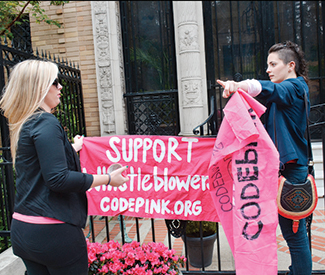
For years now, Bay Area organizers with the antiwar group Code Pink have been staging protests outside the Pacific Heights residence of Sen. Dianne Feinstein, who chairs the Senate Intelligence Committee.

Code Pink director Medea Benjamin has led delegations to Pakistan and Yemen in the past to protest US drone strikes, and San Francisco activists have frequently appeared outside the senator’s home to sound off against the US military’s use of drones.

But more recently, Code Pink activists have paid visits to Feinstein to let her know what they think of her comments condemning the actions of whistleblower Edward Snowden.

“We at Code Pink think Edward Snowden did a great service to this country,” by leaking secret National Security Agency documents detailing the intelligence agency’s dragnet surveillance program, said organizer Nancy Mancias.

So on June 15, 2013, “We flew a couple toy helicopters outside her home” as part of an anti-surveillance protest. It was an “Austin Powers” themed protest, she added, “playing spy-type music.”

But a couple months ago, Feinstein mentioned during a hearing about drones that she’d actually seen a drone peeking outside her window at her San Francisco home. She said it crashed shortly after she detected it.

But that left activists and others wondering about Feinstein’s account, since Mancias says the remote controlled device they sent up to fly around Feinstein’s mansion was not a drone, but rather a pink helicopter, “like a toy you pick up at Toys-R-Us.”

The Code Pink activists captured video of the event, she added, and sent it to the television program 60 Minutes. “Hopefully, they’ll air it when they interview Dianne Feinstein.”

Another wrinkle in Feinstein’s story is that “she said she was home when this demonstration was happening,” Mancias said. “But we were knocking on the door, ringing the doorbell.”

Believe it or not, Feinstein has actually responded to this sort of activity in the past by coming to the door and engaging with the concerned, pink-clad citizens.

“She’s a very old school politician,” Mancias said by way of explanation. “She’s very approachable. On that day she didn’t come outside, and if she was home, we would have loved to have a discussion with her about Edward Snowden.”

So was Feinstein’s account of spotting a surveillance drone rooted in nothing more than noticing a pink kid’s toy zip past her window during a routine Code Pink protest?

Nobody knows for sure but nevertheless, Code Pink activists feel vindicated. “I can say that we actually achieved our goal,” Mancias said. That’s because more recently, Feinstein has softened her stance somewhat and admitted that “we need to look into” the domestic surveillance program.

But that perception of a small victory doesn’t mean they aren’t going back. On Tuesday, Feb. 11, Code Pink plans to return to Feinstein’s Pac Heights mansion for yet another protest, this time to coincide with a national day of action being planned in opposition to NSA spying.

Called “The Day We Fight Back,” the Feb. 11 action day will consist of website owners installing banners to encourage their visitors to challenge online spying, and employees of tech companies calling on their organizations to do the same.

“We’re asking people to bring surveillance equipment, drones, and magnifying glasses,” to Feinstein’s house, Mancias said, presumably talking about props and not real surveillance equipment (does Google Glass count?). “We’ll just play some music,” she added, “and have a fabulous time.”

In the dark

5

A battle for transparency that has dragged on for years is nearing a milestone, as Bay Area civil liberties advocates await a judge’s ruling on whether the federal government will be forced to hand over memos outlining its legal justification for overseas drone strikes targeting US citizens.

The First Amendment Coalition, an Oakland-based civil liberties organization, submitted a Freedom of Information Act request in October 2011 seeking a legal memo prepared by the Office of Legal Counsel to the US Department of Justice.

Initially referenced in the New York Times and the Washington Post, the memo reportedly justifies the legal arguments underpinning the DOJ’s decision to track down and execute Anwar al-Awlaki, an American-born Al Qaeda operative who was killed by a US drone strike in Yemen in September 2011.

In its request, FAC noted that it was not interested in factual information about intelligence sources, but rather “discussion of the legal issues posed by prospective military action against a dangerous terrorist who also happens to be a US citizen.”

It’s hard to see how releasing a legal memo would constitute a threat to national security, an exemption that allows government to classify much of its information about military operations, but nevertheless federal authorities refused to honor FAC’s request.

In fact, the DOJ took its denial a step further, stating that it “neither confirms nor denies the existence of the document described in your request … because the very existence or nonexistence of such a document is in fact classified.”

After filing an appeal and getting nowhere, the civil liberties organization filed suit in Feb. 2012, demanding the release of the memo. Attorney Tom Burke, of Davis Wright Tremaine LLP, is representing FAC.

“We are not interested in how the US government found Al-Awlaki,” he explained. “Our suit is to release that memo with all intelligence information redacted.”

In Oakland on Jan. 23, US District Judge Claudia Wilken heard arguments from Burke and DOJ lawyers in motions for summary judgment, seeking a pretrial decision to settle the matter. By press time, Wilken still had not issued her ruling.

“It’s hard to know the ruling,” Burke said in a phone interview a week after the hearing. “The judge was being very short and blunt.” He added, “We’ve been fighting for this for years. If the ruling doesn’t go our way, I look forward to taking this to the Ninth Circuit [Court of Appeals].”

Meanwhile, the US District Court for the Southern District of New York heard two similar cases, brought against the DOJ by the New York Times and a New York chapter of the American Civil Liberties Union. In January of 2013, that court decided in favor of the DOJ, albeit with grave reservations.

“I find myself stuck in a paradoxical situation in which I cannot solve a problem because of contradictory restraints and rules — a veritable Catch-22,” Judge Colleen McMahon wrote in her opinion. “I can find no way around the thicket of laws and precedents that effectively allow the Executive Branch of our Government to proclaim as perfectly lawful certain actions that seem on their face incompatible with our Constitution and laws, while keeping the reasons for their conclusion a secret.”

The New York Times and ACLU appealed the decision, and are currently awaiting further ruling from the Court of Appeals for the Second Circuit.

The American citizens at the heart of these convoluted proceedings are al-Awlaki, his teenage son, Abdulrahman al-Awlaki, and Samir Khan. Al-Awlaki and his son — who was 16 at the time of his death — were both born in the United States, while Khan was a naturalized citizen of Pakistani origin.

Although all three were killed in strikes associated with counter terrorism operations, the elder al-Awlaki was the only one specifically targeted, according to a letter Attorney General Eric Holder wrote to members of Congress last May.

While the US government’s use of drone strikes has always been politically contentious because of stray civilian deaths, the use of this tactic to target American citizens has been particularly controversial. How is it that the US government — a global beacon for democracy and due process — can find guilty and execute its own citizens without a modicum of a trial?

“Judge McMahon expressed serious concerns that what the government was doing was unconstitutional,” said Brett Kaufman, an ACLU attorney who is handling the cases concerning drone strikes. “But on the merits of [the Freedom of Information Act], which was the issue before her, she had to agree with the DOJ.”

Francisco Alvarado contributed to this report.

Conservative star in ‘Monologos de la Vagina’ replaced

5

Following national controversy over the resignation of a politically conservative actress from the local Spanish-language production of The Vagina Monologues, producer Eliana Lopez announced last week that the production had found a replacement.

Actress Alba Roversi, a veteran of the Spanish language Monologos de la Vagina, will take the place of Maria Conchita Alonso, whose departure from the play had Fox News crying foul over her being “forced out” for her conservative political views.

Any chance to needle San Francisco, right?

Roversi starred in over 20 Spanish language soap operas, though she may not have the same name recognition in the US as Alonso, whose filmography includes Predator 2 and The Running Man (with our former Governator). Roversi is in, and Alonso is out.

Alonso stirred the pot for backing Tea Party gubernatorial candidate Tim Donnelly in a YouTube ad that garnered just over 100,000 hits. Donnelly, a Republican Assemblymember representing the 33rd District along the Arizona border, is running a long-shot campaign to unseat the ever-popular Jerry Brown this November on a core right-wing platform.

“We’re Californians, I want a gun in every Californian’s gun safe, I want the government out of our businesses and our bedrooms,” he says in the controversial ad, standing in a cowboy hat next to Alonso.

“He has ‘big ones,’ and he is angry,” Alonso says in Spanish, by way of translation.

The ad had San Franciscans fired up, diverting attention from a performance celebrating women and devolving into a political shouting match, Lopez told the Guardian. Threats of boycotts put Monologos de la Vagina in the crosshairs. Alonso told media outlets she’d stepped down from the play to protect her fellow performers.

“The other actors don’t have to go through this,” she said to Fox News & Friends host Clayton Morris. “They don’t deserve this. It’s on me only, they can do whatever they want with me.”

Residents of the historically Latino Mission District have good reason to be pissed at Donnelly: The Tea Party wunderkind rose to fame as a former member of the gun toting border-patrollers, the Minutemen.

“Of course she [Alonso] has a right to say whatever she wants. But we’re in the middle of the Mission. Doing what she is doing is against what we believe,” Lopez, who is also starring in the play, said in her most oft-mentioned quote in national media outlets.

In particular, Alonso’s endorsement didn’t jibe with the intention behind bringing the Spanish-language Monologos de la Vagina to the Mission’s Brava Theater, which was to celebrate the rapidly disappearing Latino/a culture of the area.

“I’ve been working on this show for almost a year trying to raise the money, find the venue, the sponsors,” she said. “My feeling was, as Latinas we have such beautiful things to offer. We have great actors and actresses who can bring things to the Mission and feel proud of. Inside me I felt, I want to bring that here, I want to do it. We can bring attention to our culture in a beautiful way, a high quality way.”

With a new actress in place, she’s ready to move beyond the controversy, Lopez said. “How do you say in English? The show must go on.” 

Cities face legal obstacle to safer biking

7

San Francisco has been blazing the trail toward safer cycling with innovative designs such as cycletracks, or bike lanes that are physically separated from cars, which have been installed on Market Street and JFK Drive. But cycletracks aren’t legal under state law, something that a San Francisco lawmaker and activist are trying to solve so that other California cities can more easily adopt them.

“Right now, many cities are not putting in cycletracks for fear they don’t conform to the Caltrans manual,” says Assemblymember Phil Ting, whose Assembly Bill 1193 — which would legalize and set design standards for cycletracks — cleared the Assembly on Jan. 29 and is awaiting action by the Senate.

Ting is working on the issue with the California Bicycle Coalition, whose executive director, Dave Snyder, is a longtime San Francisco bike activist. Snyder says Caltrans doesn’t allow bike lanes that include physical barriers against traffic, even though they are widely used in other countries and states and considered to be safest design for cyclists.

“San Francisco is technically breaking the law because they have the best traffic engineers in the state and a good City Attorney’s Office and they know they can defend it in court if they have to,” Snyder said. “Most places in the state won’t do that.”

In addition to the direct benefits of the legislation in San Francisco and other cities, Snyder said the legislation seems to be triggering a long-overdue discussion at Caltrans and other agencies about how to encourage more people to see cycling as an attractive transportation option, with all the environmental, public health, and traffic alleviation benefits that it brings.

“It’s opened up a conversation about bike lane design and Caltrans’ role in encouraging safe cycling,” Snyder told the Guardian, praising Ting for championing the legislation. “It’s having an impact beyond its immediate impact.”

In response to a request for comment, a Caltrans spokesperson said, “It’s our policy not to comment on pending legislation.”

Surveys conducted by the San Francisco Bicycle Coalition have shown safety is the top concern of those considering riding to work or school more often. Ting said he hopes this legislation will address that concern: “By building more cycletracks in California, there will be increased ridership.”

Alerts: February 5 – 11, 2014

0

THURSDAY 6


Speaking event: After the Arab Spring 312 Sutter, 2nd Floor Auditorium, SF. www.globalexchange.org/events. 7-8pm, $15 or $5 for students. Three years ago, the Arab Spring started with a single protest in Tunisia and quickly spread across the rest of the region, bringing with it promise of a brighter future. As part of the national Engage America Series, internationally renowned blogger and professor Marc Lynch will discuss the current state of affairs in the Middle East, what’s gone wrong across the region, and what it means for the United States.


FRIDAY 7


Speaking Event: Islamaphobia Holy Spirit Parish, 2700 Dwight Way, Berk. (510) 499-0537. 7pm, free. Newman Nonviolent Peacemakers and the Fr. Bill O’Donnell Social Justice Committee are honored to present Attorney Zahre Billoo, who will examine the roots of anti-Muslim hate (or Islamaphobia), the funding which makes it possible, how it overlaps with other forms of bigotry, and how best to challenge it.


SATURDAY 8  

LGBTQ Rally for Winter Olympics UN Plaza, 7th St and Market, SF. maketheworldbetterSF@gmail.com. 11-1pm, free. Show your support for the victims of escalating fascism in Russia on the opening day of the Winter Olympic Games in Sochi. Recent legislation from the Kremlin unfairly persecutes the LGBTQ community in Russia, with sweeping laws that repress virtually any expression of queerness. Join the rally — and stand up for people who are prohibited for standing up for themselves.  

Citywide Tenant Convention Tenderloin Community School, 627 Turk, SF. www.sftu.org. 12pm, free. The San Francisco Anti-Displacement Coalition was formed by tenant organizations and their allies, who banded together and led the successful fight to curb condo conversions. Its mission is to organize against soaring evictions and rent increases which have resulted in the displacement of thousands of residents. Help build tenant power in SF, and participate in crafting a ballot measure to protect tenant concerns.  

Stop privatization of public goods Mission Cultural Center for Latino Arts, 2868 Mission, SF. (415) 282-1908. 1-6pm, $10 donation (no one turned away for lack of funds). Veolia is a multinational corporation that works to privatize water supply, waste management, transport services, and energy. They are currently pushing for water privatization in Richmond, CA, working against unions and environmental groups. A Veolia VP was also hired to represent BART management during the recent negotiations. Educate yourself and learn more by attending this conference.

Residents vs. tourists

64

steve@sfbg.com

Evictions and displacement have become San Francisco’s top political issues, amplified by protests against tech companies that are helping gentrify the city. Yet Airbnb, which facilitates the conversion of hundreds of San Francisco apartments into de facto hotel rooms, has so far avoided that populist wrath.

Tenants use the online, short-term rentals to help make rent in this increasingly expensive city, a point that the company often emphasizes.

“For thousands of families, Airbnb makes San Francisco more affordable,” Airbnb spokesperson Nick Papas wrote to the Guardian by email, citing a company survey finding that “56 percent of hosts use their Airbnb income to help pay their mortgage or rent.”

But it’s also true that Airbnb allows hundreds of rent-controlled apartments to be removed from the permanent housing market — in violation of local tenant, zoning, tax, and other laws — something that has united tenant, landlord, hotel, and labor groups against it (see “Into thin air,” 8/6/13).

“The problem is Airbnb is so easy and attractive that you can take a unit out from under rent control forever,” San Francisco tenant attorney Joseph Tobener told the Guardian.

“We’re getting 15 calls a week on Airbnb,” he said, describing four categories of complaints: landlords evicting tenants to increase rents through Airbnb, tenants complaining about neighbors using Airbnb, tenants being evicted for getting caught illegally subletting through Airbnb, and Airbnb hosts who can’t get guests to leave (city law gives even short-term residents full tenant rights, except in hotels).

There isn’t good public data on how many units are being taken off the market, but Airbnb generally lists well over 1,000 housing units in San Francisco at any given time, with its smaller competitors (such as Roomorama and VRBO) adding hundreds more.

The San Francisco Rent Board listed 326 no-fault evictions (Ellis Act, owner move-in, capital improvement) in its 2012-13 annual report. That number is almost certain to rise in the 2013-14 report due out in March, and it is compounded by an unknown number of buyouts that pressure tenants to voluntarily leave, all of it creating a displacement crisis that has galvanized the city.

“Isn’t it far more likely that more units are being lost [from the rental market] through Airbnb?” San Francisco Magazine recently quoted a UC Berkeley professor as saying in an article questioning whether Ellis Act evictions are really a “crisis.”

So Airbnb is clearly having a big impact on the city’s affordable housing crisis. Yet Airbnb is largely flying under the political radar in its hometown and ducking questions about its impacts.

“Airbnb has all the statistics we need to assess its impacts on the city’s housing market,” Tobener said. The company refuses to disclose such data. Airbnb’s customers need to consider their impacts to the city’s affordable housing crisis, Tobener added, because “there are social consequences to the decisions we make.”


STALLED IN LIMBO

Last year I discovered Airbnb was flouting a ruling that it should be paying the city’s 15 percent transient occupancy tax (“Airbnb isn’t sharing,” 3/19/13), a nearly $2 million per year tax dodge.

Yet Airbnb, which has quickly grown from a small start-up into a company worth nearly $3 billion, has some powerful friends in Mayor Ed Lee and venture capitalist Ron Conway, who invests in both Airbnb and Mayor Lee’s political campaigns and committees.

So the company has stonewalled Guardian inquiries for the last year as it has worked with Board of Supervisors President David Chiu on legislation that tries to bring the company’s business model into compliance with local laws. That hasn’t been easy, as Chiu told us.

“It has been difficult to corral the different stakeholders to get on the same page,” Chiu said. “Airbnb has been like unraveling an onion. The more progress we make, the more issues come up.”

Janan New, executive director of the San Francisco Apartment Association, says it shouldn’t be so hard. “They need to enforce the law. They need to collect the hotel tax. They don’t need new laws,” she told us.

While the city is unlikely to simply follow New’s advice, the displacement issue adds another layer to Airbnb’s onion, one that sources say has become an issue of growing concern within the company, which has finally begun to respond to Guardian inquiries.

Those concerns have also been compounded as Airbnb is now being sued by one of Tobener’s clients, Chris Butler, who says he was evicted from his rent-controlled Russian Hill apartment so the landlord could make more money through Airbnb (see “Airbnb profits prompted SF eviction, ex-tenant says,” SF Chronicle, 1/22/14).

“We strongly support rules that keep people in their homes, and the vast majority of Airbnb hosts are regular people just trying to make ends meet,” Airbnb told the Guardian. “Whatever happened in this case, we certainly do not support unscrupulous landlords who evict long term tenants solely to turn their apartments into short-term rentals, but it is important to note that experts have found such cases to be extremely rare.”

Airbnb didn’t respond to our follow-up questions, but those “expert” findings appear to be a reference to a study the company commissioned late last year from Berkeley-based Rosen Consulting Group entitled “Short-Term Rentals and Impact on Apartment Market.”

But that study of Airbnb’s impact to rental housing in San Francisco doesn’t really draw the conclusions that company seems to think and hope it does.


MISLEADING NUMBERS

One number that the study and Airbnb have repeatedly sought to highlight is the claim that “90 percent of Airbnb hosts in San Francisco use Airbnb to occasionally rent out only the home in which they live,” as the company put it to us.

“Airbnb users generally do not identify themselves as utilizing short-term rentals as a business. In fact, 90 percent of Airbnb hosts [in San Francisco] indicated that they live in the home listed on Airbnb,” was how the study put it.

“It’s trash. They pick and choose the data they want to share,” Tobener said of the study and the 90 percent figure, which he says was derived from a 2011 user survey before the local housing market exploded. Rosner Consulting told us it stands by the study but won’t discuss it.

The figure also lumped in those with multiple rooms in their homes that have traditionally been rented by local residents and covered by rent-control laws. It also discloses that 10 percent of Airbnb hosts are renting out outside units simply as a business, a figure that has likely risen over the last three years.

The study does disclose that there were 1,576 properties booked through the company in August 2012, which the study notes was just 0.4 percent of the 378,000 homes in San Francisco, which Airbnb uses to dismiss its impacts on the market.

But the study includes only macroeconomic data, rather than looking at the company’s impact on certain socioeconomic groups — such as those making 120 percent or less of median area income, the people being evicted from and priced out of the city — or the supply of rent-controlled housing.

“The average gross income per Airbnb property in the previous 12 months was $6,722, or an average of $564 per month,” the study discloses, choosing to use average rather than median figures even though they’re considered less accurate gauges of income and housing data.

Customers who only use Airbnb once or twice will skew those averages way down. Yet the study then compares that number to the “average market-rate apartment rent in San Francisco, which was $2,498 per month in mid-2013. The average income generated is insufficient to cover monthly rental expenses in full.”

Which tells us nothing about how Airbnb is impacting either rent-controlled housing or the median income San Franciscans who rely on it. According to the US Census Bureau, the median rent in San Francisco was $1,463 in 2012 and 64 percent of San Franciscans rent their homes.

“The study is bullshit,” Tobener said. “They could pull data and tell us how many people are renting full units on Airbnb, but they don’t.”

Yet the company claims that it is concerned about these issues and working with the city.

“We believe our community of hosts should pay applicable taxes and we are eager to discuss how this might be made possible. We’ve reached out to officials in San Francisco and we continue to have productive discussions with city leaders,” Airbnb told the Guardian. “These issues aren’t always easy, but if we work together, we can craft fair, responsible, clear rules that ensure San Francisco continues to benefit from home-sharing.”

Yet neither Airbnb nor its political supporters seem to want to have this public discussion. The company has stopped responding to our inquiries, again, and when we asked the Mayor’s Office about Airbnb’s impacts to the affordable housing market, we got this response and a refusal to directly answer either the original or follow-up questions: “The Mayor has prioritized preserving, stabilizing and growing the City’s housing stock. His policy priorities include protecting residents from eviction and displacement, including Ellis Act reform and stabilizing and protecting at-risk rent-controlled units, through rehabilitation loans and a new program to permanently stabilize rent conditions in at-risk units.”

Yet Airbnb continues to have an impact on those “at-risk rent-controlled units” that few people seem to want to discuss.

Broken bodies, broken lives

42

Motorists driving for rideshare companies have struck and also killed pedestrians in San Francisco, even since state regulations were adopted to make these new transportation businesses safer and more accountable to the public.

Four months after the new rules were created, lawsuits from these incidents reveal that the new regulations contain gaping holes that continue to place passengers, pedestrians, and even drivers at risk.

One recent local story actually started in 2004 in Florida’s Monroe County. A vehicle sped down the Overseas highway at over 100mph. Ever seen the movie The Fast and the Furious? It was like that.

In the Florida heat, the car blazed by palm trees and an ocean view, hell bent for Miami. It accelerated as it took a curve, swerving around two vehicles going half its speed. Brazenly passing a traffic control device, the car cut off one more vehicle, then another, and another. Still barreling over 100mph, the driver swerved across the double yellow lines, forcing an oncoming vehicle to veer off the highway.

A traffic snarl put an end to the thrill ride. According to the Monroe County Sheriff’s Office incident report, which the Guardian obtained through a records request, driver Syed Muzzafar was accompanied by his wife and three children during his death-defying drive. He told the police officer, “This was just a dumb thing to do. I know I’m wrong.”

Muzzafar was booked for reckless driving. Nine years later, he would be booked again in San Francisco for hitting a family as they crossed the street in the Tenderloin.

On New Year’s Eve 2013, picking up fares for the tech company Uber, Muzzafar’s car struck young Sofia Liu, her mother, Huan Kuang, and brother, Anthony Liu. Six-year-old Sofia did not survive. Her family filed a wrongful death suit against Uber on Jan. 27, and will be represented by attorney Christopher Dolan.

Uber is part of an emerging cast of companies commonly known as rideshares, now legally called Transportation Network Companies (TNCs). The gist of how they operate is this: the company’s mobile app connects a driver with a customer, much like a taxi dispatch. Only a few years old, the TNCs initially operated in a wild west, devoid of regulation. But the California Public Utilities Commission passed rules for TNCs in September with the aim of protecting pedestrians, passengers, and drivers in collisions.

Uber, formed in 2009, has drivers in over 50 cities worldwide and an estimated worth of just over $3 billion, according to leaked evaluations. But Uber may still be in need of a version 2.0.

The death of the young Sofia Liu, killed by a driver already arrested for reckless driving, shows the state still has a long way to go on the road to regulating rideshares.


NOT MY PROBLEM

The night Muzzafar struck the Liu family, he was ferrying customers using the Uber app — but the company disavowed responsibility for the incident.

“We thank law enforcement for the quick release of information,” Uber wrote in a blog post the day after Sofia Liu died. “We can confirm that the driver in question was a partner of Uber and that we have deactivated his Uber account. The driver was not providing services on the Uber system during the time of the accident.”

But that’s a half-truth: Muzzafar was picking up passengers for Uber all night, but because he’d just dropped off a customer, he allegedly ceased being an Uber driver. With no passengers in the vehicle, Uber did not consider him “on the Uber system.”

If that sounds like a giant loophole, you’d be right — but it’s a legal one, for now.

The new CPUC regulations specify that TNCs must only provide liability insurance when drivers are “in service.” The Taxicab Paratransit Association of California is suing to modify those rules, saying the meaning of “in service” was never defined — and they allege this wording allows companies to disavow responsibility for a driver not carrying passengers at the moment of an accident.

This gaping loophole can also lead to insurance and liability consequences.

“I would guess that’s on the order of a $20 million liability case,” Christiane Hayashi, director of Taxi services at the San Francisco Municipal Transit Agency, said of Liu’s death. “The question is, who is going to pay for it?”

Muzzafar, and not Uber, may be on the fiscal hook, even though it’s unlikely he could cover the family’s medical and legal fees on his own.

Though much reporting has focused on TNC drivers’ lack of insurance, the collision that killed Sofia Liu on New Year’s Eve raises other questions as well. Just how did a driver with a reckless driving record manage to become a partner with Uber in the first place?

Checking out drivers

The recently drafted CPUC regulations require the TNCs to carry out background checks, a key element for safety. As it turns out, not all background checks are made equal.

Uber hired a private company called Hirease to conduct its checks, the Guardian learned in emails obtained from drivers. While Hirease requires Uber drivers to fill out a form with their personal information, taxi drivers who must register with the city’s transportation agency are screened with fingerprinting, Hayashi from the SFMTA told us.

The fingerprint checks make use of the FBI’s national criminal database, something a company like Hirease lacks access to (since it isn’t a government agency). We called the FBI’s background check department, based in West Virginia, to better understand the two methods.

We spoke to a rank and file employee, not a spokesperson, so he declined to give his name. The FBI employee spoke with a twang, and clearly laid out the problems.

The first snag with private background checks are false positives from common names (like John Smith) or stolen identities, he said.

Self-identification is also a problem. “If you’re a criminal, you’re not going to use your information,” the FBI employee said. “What if you were a lady and you were married six times, which name will you use for a background check? Bottom line, fingerprints are exclusive. Names are not.”

Another flaw is that while background checks performed for entities like the SFMTA make use of a federal database that dates back 100 years, California law doesn’t allow private background checks to go beyond seven years — and Muzzafar’s reckless driving arrest was nine years ago.

“Uber works with Hirease to conduct stringent background checks,” Uber spokesperson Andrew Noyes wrote to us via email. “This driver (Muzzafar) had a clean background check when he became an Uber partner.”

Hirease and Uber did what they legally could, but the summation of laws and regulations blinded Uber to Muzzafar’s background — and nothing in the new CPUC regulations would have prevented this. That may go a long way toward explaining how a man caught recklessly driving with his own family in the car in Florida was driving for Uber the night he allegedly struck and killed a child.

Importantly, California law does allow for a taxi driver to have one reckless driving incident, or one count of driving under the influence, on his or her record. But as Hayashi told us, stricter background checks make it easier for taxi companies to spot a red flag before making hiring decisions.

The relative insecurity of private background checks raises an unsettling question: How many others with reckless driving records or DUIs drive for TNC companies like Uber, Sidecar, and Lyft without the companies’ knowledge?

The results of a collision can be severe, as San Francisco’s tragic New Year’s eve incident demonstrates. But even those who survive are left with bills that Uber, allegedly, isn’t paying.


PAYING NO ONE

Last September, Jason Herrera and Nikolas Kolintzas summoned an Uber driver via smartphone, intending to hop from Valencia Street to the Marina district. Driver Bassim Elbatniji responded, and drove the pair down Octavia, where his Prius collided with a Camry.

Herrera suffered a concussion and was knocked unconscious. Kolintzas also suffered a concussion, and they both sustained injuries to their necks and backs, according to court documents.

But when the two sought financial assistance from Uber to cover their medical costs, Uber said it was the driver’s responsibility.

“As far as Uber’s concerned, their insurance isn’t providing any of this,” attorney Colleen Li told the Guardian. Li is representing Kolintzas and Herrera in their suit against Uber, which seeks damages to cover their medical bills, which reached “tens of thousands” of dollars, Li told us.

According to a policy published on Uber’s website, the company maintains a $1 million “per incident insurance policy applicable to ridesharing trips,” which is in keeping with requirements under the new CPUC regulations.

Nevertheless, Uber has not stepped up to cover damages in response to a lawsuit arising from a similar incident. Months ago, the Guardian reported on the case of an Uber driver who hit a fire hydrant, which flew through the air and struck Claire Fahrbach, a barista living in San Francisco (“Lawsuit over injury from airborne fire hydrant tests Uber’s insurance practices,” 8/8/13). She sustained lacerations to her body, a fracture in her lower leg, and multiple herniated discs, according to her lawsuit against Uber.

Her medical bills and injuries destroyed her dreams of living in San Francisco, and she moved home with her parents in North Carolina to recover. Her lawyer, Doug Atkinson, told us Uber still hasn’t paid for his client’s medical services.

“They’re still denying they have any liability for the driver,” he said. “They said they wouldn’t fight the CPUC ruling, but in our case they obviously are.”

But the hydrant also sprouted a geyser that flooded a nearby business, Rare Device, and the apartment building above it. “It was horrible. Our store flooded, we lost a bunch of inventory,” Rare Device’s owner, Giselle Gyalzen, told us.

Her insurance covered the damage, but she’s still trying to recover the deductible from Uber.

Uber directed the lawyers to its terms of service, which tell people up front that they won’t cover anything: “Uber under no circumstance accepts liability in connection with and/or arising from the transportation services provided by the Transportation Provider or any acts, action, behavior, conduct, and/or negligence on the part of the Transportation Provider.”

Meanwhile, the drivers also find themselves in a bind when it comes to obtaining insurance. Given the lack of clarity, state agencies have opted to alert TNC drivers that they’re going without a safety net.

On its website, the California Department of Insurance posted a notice warning, “TNCs are not required to have medical payments coverage, comprehensive, collision, uninsured/underinsured motorist coverage or other optional coverages.” It goes on to explain that TNCs’ liability policies aren’t required to cover bodily injury to the drivers, damages to the drivers’ cars, or damage and injuries caused by an uninsured or underinsured motorist.

And as the Guardian previously reported (“Driven to Take Risks,” 8/6/13), rideshare drivers don’t qualify for commercial insurance since their vehicles are registered as private automobiles, yet insurance companies won’t grant complete insurance coverage to TNC drivers since it’s considered an insufficient safeguard against risk.

Notably, limo drivers who also work for Uber (and get commercial insurance through those companies) don’t have this problem — just those using Uber or other rideshare apps as independent contractors. Taxi drivers are also eligible for commercial coverage.

Is there any way for an independent TNC driver to legally insure him/herself on the road? “Not that I’m aware of,” said Patrick Storm, a spokesperson for the Department of Insurance.


FIXING SAFETY

Paul Marron is an attorney for the Taxicab Paratransit Association of California, the group suing the CPUC to tighten up its regulations. In his view, a key test of the new CPUC regulations is whether they’re enforced — and with a bare bones staff, enforcement is likely to be anemic.

“The CPUC does not have the adequate resources to regulate (transportation) safety statewide,” he told us.

As a lawyer for taxi interests competing against rideshares, Marron obviously has skin in the game, so we looked at the numbers.

We compared the staff counts of the SFMTA, the CPUC, and for some perspective, the New York City Taxi Commission.

The SFMTA has 15 employees who oversee San Francisco’s 1,850 taxi cabs. That’s one staff person for every 123 cabs in the city. The NYC Taxi Commission’s staff of 569 oversees 94,500 taxis, town cars and similar liveries, according to their posted annual report. Though the numbers are greater than San Francisco, the ratio is similar: One staff person for every 166 vehicles.

Now for the CPUC. Though it is now tasked with overseeing “rideshare” TNC vehicles, the agency is also responsible for regulating limos and town cars statewide. Public documents obtained by the Guardian show it oversees 1,900 liveries in the Bay Area, and though there are no official numbers, there are an estimated 3,000 rideshare drivers in the city, according to data compiled by the San Francisco Cab Driver’s Association.

The CPUC has a staff of six based in San Francisco, responsible for overseeing an estimated 4,900 vehicles. That leaves the CPUC with one staffer for every 700 vehicles, a ratio wildly out of sync with other vehicle safety regulators.

Hayashi pleaded with the CPUC to allow cities to regulate rideshares on the local level, saying, “You don’t even have the resources to monitor this stuff.”

Sup. Eric Mar met repeatedly with the SFMTA over these concerns, and will hold a February hearing to get to the heart of the safety culture around San Francisco’s TNC rideshares.

CPUC spokesperson Christopher Chow defended its safety regulations and enforcement. “We can clarify or modify our TNC requirements, if needed, particularly the insurance requirements, as we see how the TNCs attempt to comply with the decision’s directives,” Chow wrote in an email. “If we believe there are any issues that should be addressed, we will take action.”

But as things stand, Claire Fahrbach, Giselle Gyalzen, Jason Herrera, Nikolas Kolintas and the family of Sofia Liu are all waiting for that action.

Reed Nelson contributed to this report.

 

H. Brown: Goodbye to all that, we hope

137

OPINION While we mourn the tamping down of the fiery progressive idealism that characterized City Hall in the early 2000s, we celebrate the departure of that era’s dated man-warrior posturing. Last week proved a good occasion to pop a bottle: Misogynist blogger and progressive scene queen H. Brown announced he would soon be leaving San Francisco for destinations unknown.

Brown, a proud bigot famed for hurling invective from behind a double shot of whiskey at ex-Supervisor Chris Daly’s since-closed progressive hangout Buck Tavern, took the occasion to hang out for posterity with an SF Weekly reporter. Joe Eskenazi wrote a lyrical, subtly satiric ode to the aging troll’s legacy, “Last Call for Know-It-Alls: The Departure of a Classic Specimen of Old-San Francisco Bon Vivantery.”

But nuanced pokes at the longtime “character” proved too subtle to the victims of his bullying throughout the years. And since the piece failed to include the voice of a single woman, we thought we’d remedy with a retrospective of our own. Behold, the legacy of a real jerk:

“At a benefit at the Buck Tavern I walked in and there were all these progressive journalists sitting around a table with him. [Brown] said ‘you’re the one with the great ass!’ He started asking me if I had family members he could date. I was standing there horrified. I’m a mouthy lady, and even I couldn’t think of anything to come back with — not just to him, but to every other progressive journalist who was sitting there listening to him who laughed! I said hi to a few people, and then I left the event.”

– Laura Hahn, president of the San Francisco Women’s Political Committee

“H. is a bully and a sexist. If you want to look at why the progressive movement is failing it’s because it alienates youth, women, and people of color. Deifying somebody like him is shutting women out, the message is they aren’t welcome. It’s not separated from the fact that progressives are really faltering right now with no leadership and very little inspiration.”

– Debra Walker, artist and longtime activist

“As a purveyor of alcohol, I found that the man was a lawbreaking mooch and a pain to deal with. As a woman, I found him pathetic, insulting, gross, or all three, depending on his mood. The first time I met him he cussed me out for an imagined slight in a way that was actually shocking — and it takes a lot for cuss words to flummox me. For a time, I simply refused to serve him.”

– Siobhann Bellinger, Buck Tavern bartender

“His behavior symbolized the running joke amongst some progressive men that women were there for their own entertainment to be mocked and harassed with no one blinking an eye. FUCK. THAT.”

– Anonymous ex-City Hall aide

Ah, old San Francisco bon vivantery. Of course, the real reason we’re cheering on whatever Greyhound that will ferry this foul-mouthed sprite from our burg has nothing to do with Brown. Rather, we’re hoping no one will step into his shoes as your supervisor’s personal Bobby Riggs, to invoke the publicity-pig chauvinist who famously challenged tennis legend Billie Jean King to a match, the infamous Battle of the Sexes in which King mopped the floor with her opponent.

We hope that our purported progressive leaders will no longer invite woman-haters and homophobes to their household Sunday salons, or take Speedo-clad dips with them in the bay. That they will no longer think it’s OK to enable the presence of their own yapping id in polite company.

In the middle of City Hall’s current and unfortunate drift toward elite-serving “moderation,” one must wonder about what hangers-on like Brown did to the strength of our political movement. He and his ilk were allowed to establish through constant bullying, both online and off, that only straight men have the right to feel comfortable in our city’s high-powered progressive circles. What heroes did we lose in the process?

Caitlin Donohue is a staff writer at Rookie magazine and editor of AHDM4U.com.


Drought

41

steve@sfbg.com

I remember the dead lawns, 90-second timed showers, empty fountains and pools, and water cops issuing tickets for washing one’s dirty car. “If it’s yellow let it mellow, if it’s brown flush it down,” went the toilet edict they taught us in school. Water was too precious to just wantonly flush away.

I was 8 years old in 1976-77 during California’s last severe drought, but I retain vivid, visceral memories of that time. Water was an ever-present concern. I learned how dependent we are on the natural world and the role that individual responsibility plays in collective action, particularly in times of turmoil.

Everyone’s yards were brown; nobody’s cars were clean. We were in it together.

But even deeply implanted memories and learned behaviors fade. I may still feel subtle emotional pangs when I watch the water running down the drain when I shave or wash the dishes, yet I’d content myself with the knowledge that water is a renewable resource and we were no longer in a severe drought.

Or at least I was able to do that until this season. California experienced its driest year in recorded history in 2013, and it’s still not raining as we go to press. Yes, there are welcome predictions of finally getting some rain this week, but not the sustained precipitation we need to make a difference.

If current long-range weather forecasts hold true, this winter could be even drier than last winter, causing by far the most severe drought in state history, worse than ’76-’77, even worse than 1923-24, the driest winter ever and the beginning of a seven-year drought.

“We’re facing the worst drought California has ever seen,” Gov. Jerry Brown told reporters on Jan. 17 as he proclaimed a state of emergency, invoking powers to redirect water resources and asking Californians to reduce their consumption by 20 percent.

Yet as dire as this situation may be — and we’ll have a better idea by the end of March, when more stringent water restrictions will be enacted if we don’t get some serious rainfall by then — one of the scariest aspects to this drought is that it may be just a preview of things to come.

This could be the new normal by the end the century. Most reputable climate change models predict California’s average temperature will increase 3-8 degrees by 2100. That’s enough to radically change our climate, causing shorter winters with less precipitation, and more of it coming in the form of rain than snow, undermining the elegant system of storing water within the Sierra snowpack.

That also translates into more extreme conditions, from more flooding in the winter and spring to more dangerous heat waves and wildfires in the summer and fall — and more frequent and severe droughts.

“People should reflect on how dependent we are on rain, nature, and other another,” Brown said at the end of his news conference. “This is Mother Nature. At some point we have to decide to live with nature and get on nature’s side and not abuse the resources we have.”

That theme of interdependence was one he returned to several times during that 14-minute event. Brown was governor during that last big drought in ’76-’77, and when a reporter asked what lessons he took from that experience, he said, “We’re dependent on rain, we’re dependent on one another.”

He expressed confidence that Californians will find their way through even the most severe drought, although he acknowledged it will exacerbate existing conflicts between cities and rural areas, farmers and environmentalists, and Northern and Southern California as each fights for its interests.

“This takes a coming together of all the people of California to deal with this serious and prolonged event of nature,” Brown said. “This is going to take a lot of support and a lot of collaboration on the part of everybody.”


STATE OF DENIAL

California is on a collision course with reality. Whether or not it’s this drought that wakes us up, at some point we’ll awaken to the fact that a growing population can’t survive on dwindling water resources without a major shift in how we operate.

“California does not today live within its means. We want more water than nature is naturally providing, even in normal years,” said Dr. Peter Gleick, president of the Oakland-based Pacific Institute and a world-renowned expert on water issues whose research has fueled United Nations studies as well as his own books. “Some of the most serious impacts of climate change are going to be on water.”

That’s particularly true for California, whose large population and huge agricultural and other water-dependent industries belie a Mediterranean climate that is actually quite fragile and susceptible to droughts and the impacts of climate change.

“You’ve got 30 million people perched on the edge of a physical impossibility, unless we act with huge speed,” said Bill McKibben, an author and researcher who founded 350.org, one of the leading advocacy organizations for addressing climate change.

Gleick and McKibben are leading voices on the related issues of water policy and climate change, respectively, and they both told the Guardian that this drought should finally get people serious about conservation, efficiency, reducing our carbon output, and generally living in greater harmony with the natural world.

“The current drought ought to be a wake-up call to tell us we have to start thinking about our water resources differently,” Gleick told us, calling for far greater efficiency in how we use water, particularly in cities and the agriculture industry. “California has made great progress over the last several decades, but we’re nowhere near where we could be or should be.”

From low-flow toilets and shower heads to smarter irrigation techniques and recycled wastewater, California has made tremendous advances in its water efficiency since the last big drought. But Gleick and McKibben both say California needs a seismic shift in its thinking to grapple how a growing population can function within a changing climate.

“The assumption has always been that as we get larger populations, we’ll figure out their resource needs,” Gleick said, pointing out that climate change challenges that assumption and calls for more proactive thinking. “We need to do a better job at planning for future resource needs.”

Times of crisis can trigger that kind of shift in thinking. Gleick said Australia’s “Millennium drought” from 1995 to 2009 began with basic conservation measures and eventually led to a complete overhaul of water rights, “policies that we haven’t even contemplated” in California.

But Californians may soon be forced into such contemplations.

“It’s physics in action. This is what happens when you start to change the way the world has worked throughout human history,” McKibben told us. “Some people will be empowered to act, and some will have to go into denial. A truly interesting test will be Jerry Brown — he ‘gets it’ on climate, but he’d love to frack as well apparently. He’s like a Rorschach for the state.”

Brown’s call to work with nature and one another is encouraging, but neither Gleick nor McKibben were willing to wager that Brown is ready to lead the big discussion Californians need to have about our long-term needs.

Yet Gleick says something will have to start that conversation before too long: “It’s either going to take a more severe drought or better political leadership.”


FIRES IN JANUARY

California is a tinderbox right now, with a high risk of wildfires that could get unimaginably worse by this summer.

“We’re experiencing conditions in California that we typically see in August,” CalFire spokesperson Daniel Berlant told us. “We never really moved out of fire season in Southern California.”

And that will only get worse as global warming changes California’s climate.

“As summers get longer, it extends the window for fires,” Berlant said. “It’s a clear sign that this generation is seeing more and bigger fires.”

Farmers are also worried, facing the prospect of fields going fallow.

“There is considerable anxiety on farms and ranches throughout California,” Dave Kranz, spokesperson for the California Farm Bureau, told the Guardian. “We know it’s going to be bad, we just don’t know how bad.”

He described ranchers selling their animals before they reach market weight and farmers considering whether to plant field crops and how to keep trees and vines alive if things get bad.

“You have people irrigating crops in January, which is a very unusual occurrence,” Kranz said. And if the rains don’t come this winter, “hundreds of thousands of acres of land would be left unplanted.”

Kranz said that “farmers have become significantly more efficient in their water use,” citing stats that crop production doubled in California between 1967 and 2005 while the water used by the industry dropped 13 percent. “We talk about more crop per drop.”

But Gleick also said the fact that agriculture accounts for 80 percent of water use in California must be addressed, something that Kranz acknowledges. For example, he said Central Valley fields that once grew cotton, which takes a lot of water, have mostly switched to almonds. Pistachios are also big now, partially because they can be grown with saltier water.

“Farmers adapt, that’s what they’ve done historically in response to weather trends and market demands,” he said.

“There’s only so much water and much of it is spoken for for the environment,” Kranz said, acknowledging species needs but also complaining about much of the last big rains, in November and December of 2012, were released to protect the Delta smelt. “We should have saved some of that water.”

While the 1927-28 winter was the driest on record in the state, dropping just 17.1 inches of rain, this winter already looks worse, with just 3.5 inches falling so far as of Jan. 27. That could change quickly — indeed, a chance of rain was finally in the forecast for Jan. 30 and Feb. 2 — but it doesn’t seem likely that we’ll get enough to end this drought.

“Right now, we are saying the odds do not indicate a Miracle March, which is not good,” a meteorologist with the National Weather Service’s Climate Prediction Center told the San Jose Mercury News on Jan. 16 following release of its three-month forecast.

The worse it gets, the more heated the political battles will become over how to address it.

“You’re going to hear a lot of talk about additional water storage,” Kranz said. “We’re paying now for not creating more storage 10-15 years ago. Droughts happen in California.”

But even Kranz and his generally conservative constituency is talking about tweaks to existing reservoirs — such as increasing Shasta Lake’s capacity and expanding the Sykes Reservoir in Colusa County — rather than big new dam projects.

Gleick agrees that the era of building big dams in California is over. “You can’t build a new dam in California, with their enormous political, economic, and environmental costs.”

And that makes the challenges this state faces all the more vexing.


PAST AND FUTURE

California has dealt with drought many times before, including several that lasted for a few years. The last sustained drought was in 1987-1992, but it wasn’t nearly as dry as earlier droughts, such the 1928-1934 drought, the worst one on record.

Officials try to learn from each drought, studying what happened and trying to develop long-term solutions, such as the water banking and distribution systems established during the 1976-77 drought. Yet a study by the Department of Water Resources in 1978 also concluded that we’re essentially at the mercy of nature.

“The 1976-77 drought has again shown that finite nature of our resources and our limited ability to control nature,” read the introduction to the report “The 1976-77 California Drought: A Review.”

DWR’s then-Director Ronald Robie warned at the time that there was no way to predict when or how severe the next drought might be. “We can be assured, however, that drought will return,” he wrote, “and, considering the greater needs of that future time, its impact, unless prepared for, will be much greater.”

Those words could carry a special resonance now, but it’s even scarier given long-range climate change forecasts that Robie wasn’t taking into account when he wrote those words. California estimates it will add more than 15 million people between 2010 and 2060, crossing the 50 million people mark in 2049.

“California could lead the nation into renewable energy. You’ve got the sun. But it would take a 21st century statesman. I guess we’ll find out whether Brown’s that guy — he could be, freed from the need for political popularity after this next election,” McKibben said, calling Brown “a true visionary in many ways, but also a politician. What a fascinating gut check!”

Gleick said that he sometimes gets asked whether climate change is causing the current California drought or other specific weather incidents, and he said that question misses the crucial point: “All of our weather today is influenced by climate change.”

As the climate changes and the world warms, that becomes the new normal for California and other regions, affecting all of its weather patterns. “As goes our climate,” Gleick said, “so goes our water, and we’re not ready.”

SFMTA approves tech shuttle plan

8

The San Francisco Municipal Transportation Agency Board of Directors approved a pilot program Jan. 21 that allows operators of private commuter shuttles to use public bus stops, something they’ve been doing illegally for years on a very predictable basis.

The program will establish an “approved network” of 200 designated San Francisco stops where private shuttles may pick up and drop off passengers. It will issue permits and identifying placards to the private buses and require them to adhere to certain set of rules, like yielding to Muni buses if they approach the stop at the same time. (There’s already a Curb Priority Law stating that any vehicles not operated by Muni will be fined $271 for blocking a bus zone. But the city has chosen to ignore that law when it comes to private commuter shuttles.)

Finally, the program will charge shuttle operators $1 per stop per day, which seeks to cover the costs of the program implementation and no more. The meeting drew a very high turnout that included the protesters who have been blockading the buses, Google employees, private commuter shuttle drivers, and residents of various San Francisco neighborhoods.

Sup. Scott Wiener said at the meeting he was fully supportive of the pilot program, which was developed over the course of many months in collaboration with tech companies who operate the shuttles.

“These shuttles are providing a valuable service,” Wiener said. He said he was sensitive to widespread “frustration and anxiety” around the high cost of housing and rising evictions, but thought it was unfair to blame tech workers: “We need to stop demonizing these shuttles and these tech workers.”

Then Sup. David Campos addressed the board. “I think it’s really important for us to have a dialogue to find common ground,” Campos said, adding that pushing shuttle riders into private automobiles was not a good outcome. But he also urged the SFMTA board to send the proposal back to the drawing board: “It’s a proposal that simply does not go far enough.”

Campos was also critical of the SFMTA’s process of studying the growing private shuttle problem for years and drafting a proposal in collaboration with members of the tech community, with Campos pointing out, “Public input is being sought after the fact.”

Bus plan ignores real cost

Many community members have criticized the new $1 per stop tech shuttle fee as being too low, but city officials say their hands are tied by a state law prohibiting them from charging any more than that.

Yet under Proposition 218 — the state law that limits local governments’ ability to impose new fees — the city has more discretion about how to calculate “cost recovery” than officials have let on.

“Prop. 218 is part of a legal scheme that doesn’t so much limit how we calculate cost recovery,” San Francisco City Attorney’s Office spokesperson Gabriel Zitrin told us, “but limits the city to cost recovery.”

At the Jan. 21 SFMTA meeting, Project Manager Carli Paine explained how her team had arrived at the $1 per stop, per day fee amount.

“We identified everything it would take to implement this program,” Paine said. After identifying all the program components, the agency “took the number of stop events and came up with a ‘per stop event’ cost…The kinds of costs we included are upfront costs, ongoing program costs.”

Under Prop. 218, however, the SFMTA could determine whether there are other costs associated with allowing private commuter shuttles to use public transportation infrastructure, beyond just the cost of issuing and enforcing permits and placards.

Zitrin said the city can identify any costs not already being recovered elsewhere. If shuttles’ use of public bus stops cause transit delays, for instance, what are the costs associated with those delays? More overtime pay for bus drivers?

Low-income kids getting to school late and missing breakfast? What’s the cost of that?

If rents rise in neighborhoods located along the shuttle routes (and studies show they do), what are the associated costs of that phenomenon? What’s the cost of displacement resulting from those higher rents?

Alerts: January 29 – February 4, 2014

0

WEDNESDAY 29


“Flying Paper” film screening and discussion Mission Cultural Center, 2868 Mission, SF. www.missionculturalcenter.org. 7pm, $5–$20 sliding scale. “Flying Paper” is the uplifting story of Palestinian children in Gaza on a quest to shatter the Guinness World Record for the most kites ever flown. It showcases the creative resilience of these children despite the difficult realities in their daily lives. The film was co-produced with young Palestinians in Gaza, trained by the filmmakers through a youth media program called Voices Beyond Walls. Featuring a discussion with co-director Roger Hill.

“We are Palestine” film screening ANSWER Coalition Office, 2969 Mission, SF. www.ANSWERsf.org. 7-8:30pm, $5–$10 donation (no one turned away for lack of funds.) “We are Palestinian” was filmed in 1973 and includes an excellent chronology of events leading to the establishment of Israel by using rare historical footage. The film also explains the role of Britain and the US in establishing and supporting the Israeli state, and documents the resistance by the Palestinian people against settlement and expulsion. A discussion will follow the film led by Richard Becker, author of “Palestine, Israel and the US Empire.”


FRIDAY 31

International Day of Action Against Corporate Globalization San Francisco Federal Building, 90 Seventh St, SF. www.tradejustice.ca/tpp/jan31. 4:30pm, free. Join a broad coalition of community, environmental and social justice groups in protest against Fast Track and the Trans-Pacific Partnership, a trade deal that has been described as “NAFTA on steroids.” Protesters will meet at Congresswomen Pelosi’s office, then peacefully march to Senator Feinstein’s office at One Post, SF.


SATURDAY 1

Una Plaza Para la Comunidad/A Plaza for the Community Sixteenth and Mission BART Plaza. 1-3pm, free. This gathering, hosted by The Plaza 16 Coalition/La Plaza 16 Coalición, is being called to advocate for the use of the 1979 Mission SF site to supply much-needed affordable housing for the neighborhood, as well as more public spaces and a local ecosystem of mom and pop business that can meet the needs of the neighborhood. The coalition feels that the proposed $82 million development with 351 housing units does not meet the need for affordable housing.

SUNDAY 2

What’s happening to City College of San Francisco? Niebyl-Proctor Marxist Library, 6501 Telegraph, Oakl. Gene Ruyle (510) 428-1578. 10:30am-12:30pm, free but donations are welcomed. CCSF has been under extreme pressure from a private accrediting agency that is threatening to close the college. Rick Baum, a part-time instructor of Political Science at CCSF for over 15 years, will give an overview of the current situation that CCSF is facing, and answer questions.

Tenant battle brewing

44

rebecca@sfbg.com

Benito Santiago, 63, was born and raised in San Francisco. But now that he’s received an eviction notice from the apartment he’s lived in since 1977, he isn’t sure what the future holds.

“This is roots for me,” Santiago told us. “I have more affinity for San Francisco than the Philippines,” his family’s place of origin.

He works part-time with disabled youth enrolled in San Francisco public schools. “The idea that I built a rapport with these students here … to be put in a position where I wouldn’t be able to work with them, I’m a little saddened and depressed by it,” he said. “If I’m homeless, I can’t be taking care of these kids. I mean — it’s a worst-case scenario.”

He’s been exploring alternative housing options, and trying to stay positive. He says he’s even trying to “change the rate of vibration” of the real estate speculators seeking to oust him as part of his pre-dawn meditation and ritualistic movement practice, a routine he developed to mitigate the chronic pain he dealt with after being hit by an automobile when he was crossing the street in 1980.

“Hopefully, they can have some compassion,” he said.

Santiago is hoping to get a temporary extension to stave off his eviction, and he’s been looking into publicly subsidized below-market rate apartments. But rent for even the most affordable of those places would eat up 75 percent of his monthly income, he said. Unless he can find an affordable arrangement somewhere, he might end up having to leave the city.


GROWING MOVEMENT

Santiago has been a part of a growing movement underway in San Francisco to reform the Ellis Act and introduce meaningful legislation at the local level to protect the city’s renters.

In recent weeks, the San Francisco Anti Displacement Coalition, made up of a wide range of organizations including the San Francisco Tenants Union, has hosted a series of neighborhood tenant conventions to solicit ideas that will be boiled down at a citywide tenants’ gathering scheduled for Feb. 8. At that meeting, organizers plan to hash out a strategy and possibly solicit ideas for a ballot initiative.

The tenant conventions are happening on a parallel track with efforts to reform the Ellis Act, which allows landlords to remove apartments from the rental market and evict tenants.

“Our goal is to ban the use of the Ellis Act in certain circumstances,” explained Dean Preston of Tenants Together, a nonprofit focused on strengthening the rights of renters.

“More than half of Ellis Acts are performed by people who bought the properties within the past six months,” he told us. “Their whole purpose is to buy it and kick everyone out. It was supposed to be for long-term landlords to get out of the business” of being landlords, he added. Instead, “it’s being completely abused.”

Sen. Mark Leno is working with Mayor Ed Lee on a response that would seek to lessen the impact the Ellis Act has had in San Francisco. Meanwhile, Assemblymember Tom Ammiano is spearheading a separate effort.

“At this time, he’s not really ready to say which avenue he’s taking” in terms of a legislative strategy, said Carlos Alcalá, Ammiano’s communications director. “Because that can rule out that avenue.”

Preston said he’s been through waves of evictions before, but the organizing now taking place has been especially effective at drawing attention to the issue. Oftentimes, “the speculators are not from within the city or even within the state,” he pointed out. “That has fueled a lot of activism and courage.”

For Santiago, the organizing has given him heart during a difficult time. “I’m hearing a lot of sad stories,” he said, “and I am not alone.”

Positive starts

1

marke@sfbg.com

GOOD TECH Like Tabasco sauce, Lady Gaga, and the color teal, technology in itself is neither good nor bad — it’s all in how you use it. (Indeed, you could argue that those first three examples are technological feats in their own right: Just don’t use too much, please!) And while battles rightly rage about how the Bay Area’s tech industry is reweaving our social fabric, creating and applying technology is an art in itself, albeit one that can have huge economic and political impact.

It can be difficult to see past the whizbang gizmos, marketing dazzle, and glowing dollar signs of how technology is normally presented to us. But in this issue we wanted to take a deeper look at some of the ways technology is impacting or enhancing Bay Area life, and highlight some of its possibilities in addressing some of the city’s real problems (no, not parking or hailing a cab). For all the talk about sharing economies and communal interaction, there’s still a huge gulf between what’s considered “innovation” and what actually offers a path toward civic solutions.

Important questions still hang in the air (beyond the environmental and labor impacts of manufacturing such technologies): How can innovation be better applied to help city infrastructure and social services? How can we integrate startup energy into city policy-making and government transparency? Can the effects of “disruption” be assessed using other indicators beyond market value? In what ways can we ameliorate the knee-jerk resistance to innovation from all sides when it comes to addressing the explosion of homelessness, hunger, and child poverty in the Bay Area? Can we develop new “inputs” or ways of including all Bay Area voices in the conversation about how technology is transforming the way we live?

And why can’t we Kickstart Muni, anyway?

Lately, there’s been some movement toward addressing some of these concerns, especially when it comes to art and culture. The huge, forthcoming 5M project on Mission plans to not only house Yahoo, but also Intersection for the Arts and SF Made, explicitly integrating local arts and businesses into the start-up incubator template. A recent forum hosted by music app WillCall on how tech can better support the local music and nightlife industry packed the Public Works nightclub. Proposals to help teach more coding in schools and make government more transparent are gaining steam.

Of course, it’s always wise to maintain a healthy skepticism about the latest shiny thing, and to realize the limits of technology — often it can’t even clean up its own mess — and especially the people behind it. But it’s also important to keep pushing the conversation about technology’s role in civic engagement forward in positive, thought-provoking, even spicy new directions.