News and Politics | San Francisco Bay Guardian

News & Opinion

Judging hackers

9

joe@sfbg.com

The Bay Guardian is happy to announce a partnership with BeMyApp, CloudCamp, Hewlett Packard, and Intel in launching a hackathon for societal benefit. I will be one of the judges of their CloudCamp Social Good Hackathon the weekend of Jan. 24.

The hackathon is a contest tasking programmers and designers with creating apps that could change their city, state, country, or the world. Teams will craft those changes around health, fitness, the environment, and education. The Guardian has always been solutions based, and we hope to work with tech to help solve the problems of San Francisco’s rising displacement and inequality together.

Entrance in the hackathon is free, though space is limited. The first and second prizes are $5,000 and $4,000, respectively. Hackers will strut their ones and zeroes at Impact Hub San Francisco, which is housed in the bottom floor of the San Francisco Chronicle Building on Fifth and Mission.

Kalina Machlis, community manager at BeMyApp, said the Guardian was a natural choice to partner with them due to our often critical stance on the tech community: We’d keep them honest. She also hoped it would help build ties with a media community that can be critical of the tech industry.

“It’s a good way for you to see there are positive things happening in the tech world,” she told us. And though no one app can solve all of San Francisco’s social ills, we hope this can be a first step toward harnessing tech for the good of all the city’s residents.

Be advised, you don’t necessarily need to be a tech head to join in. Just bring your ideas, Machlis told us. “Our initial idea for beginning the company was to bring together people who don’t have technical skills with people who design and code,” she said.

We’re looking forward to bringing a bit of Guardian fire to a hub of techies who want to change the world. For every Greg Gopman spewing hatred, no doubt there are tech-savvy folk who care about the less fortunate around them. We want to meet those socially conscious hackers.

By the people

3

rebecca@sfbg.com

A growing number of people seem to be convinced that “civic innovation” is sexy.

Tech-oriented events at San Francisco City Hall, like hackathons for improving government services, have become increasingly common. App developers are gaga over the idea of revolutionizing government through software, and the concept is gaining momentum.

To borrow an analogy referenced in an essay by tech publisher Tim O’Reilly, some software purveyors are moving away from the idea of government as a vending machine: “When we don’t get what we expect, our ‘participation’ is limited to protest—essentially, shaking the vending machine.”

Instead, they’re latching onto the idea of government as an open platform that citizens can tinker with.

That’s exciting. Can it lead to a government that is more responsive to the people, as enthusiasts predict? Can we really hack away the ineffective and irresponsive parts of the public sector?

Or is some of this just hype and libertarian idealism from a cash-drenched tech sector seeking business opportunities and greater political influence?


HACK THE LAW

Sup. Mark Farrell recently proposed doing away with an outmoded and widely disregarded law disallowing bicycle storage in garages. The legislative tweak matters because it was spurred by feedback submitted through a new website, SanFranciscoCode.org.

Operated by a private nonprofit organization called the OpenGov Foundation, the website presents an interactive, online version of the city’s municipal code with an open platform where anyone can easily comb through the thicket of city laws and leave comments on specific sections, using the software as a magnifying glass.

Farrell touted the website — launched in partnership with Mayor Ed Lee’s Office of Civic Innovation last September — as a tool that could spur “a more transparent and accountable city government.”

“I see this leading to better engagement,” said Jess Montejano, Farrell’s legislative aide. Seamus Kraft, executive director of the OpenGov Foundation, has been compiling all the comments submitted via SanFranciscoCode.org, and recently sent a memo with all user feedback to each member of the Board of Supervisors.

“Our mission is to put as much public information into the public’s hands as possible,” Kraft said, “so that people can access their laws the way they deserve in 2013.”

The idea that a law would be changed instantly based on public comments is a new take on an old concept, with shades of being enamored by that shiny new thing. After all, many supervisors have a habit of turning their backs, or very obviously zoning out, during public comment sessions at weekly board meetings.

Yet anyone with an Internet connection can run with this new portal for citizen engagement. How about a reinvigorated response to San Francisco’s Sit/Lie Ordinance? A torrent of online commentary about the public nudity ban? Not everyone has the same idea about what it means to fix a broken law.

In some respects, City Hall appears to be lending itself out as a laboratory in which to test the wide-ranging theories of civic innovators. Mayor Lee has greeted the technology sector with arms wide open, and empowered the Office of Civic Innovation to foster tech-fueled government fine-tuning.

With the rise of amply funded organizations such as Code for America, droves of programmers stand at the ready, eager to chip in and do their part to help transport the public sector out of the analog ages.

A recent brigade of Code for America fellows partnered with the city’s Department Health and Human Services to create an app that automatically notifies food stamp recipients via text when they are about to be automatically dis-enrolled. The idea is to give recipients advance notice so they can take steps to renew their enrollment.

Other initiatives, such as the Department of Public Health’s release of an open data set to reveal housing inspection records, can arm citizens with useful knowledge — like empowering apartment hunters to spot a slumlord from a mile away.

The use of tech for transparency holds potential: What if each and every public record — down to every last email, calendar appointment, or police report — were instantly uploaded to a publicly accessible database, easy to locate, and fully searchable? Would that be a check against corruption?

Ron Bouganim, a San Francisco-based venture capitalist and mentor to the very Code for America teams industriously improving city government through technology, recently filed paperwork with the Securities and Exchange Commission to create GovTech. It’s a new kind of venture capital fund, specifically devoted to fostering companies looking to find their way in the “civic innovation” sector.

Bouganim laid out the dynamics driving the civic innovation trend: First, “2008-2009 was like a nuclear bomb,” he explained. “The financial crisis was a cataclysmic event. The money is not coming back, ever.”


THE NEW NORMAL?

This new normal, characterized by dramatically depleted public-sector finances, has helped make government more open to working with startups instead of trusted brands like IBM, Bouganim said, since startups can help government “do more with less.”

Bouganim also said adoption of cloud computing has changed the game. Whereas governments were initially hesitant to move their data to the cloud, the recent migration has made it possible for companies seeking government contracts to price below the “procurement threshold,” a price point that triggers a long public approval process before a purchase can go through. Now that technology has helped software developers slice through red tape, startups are flooding in, eager to land public sector contracts.

The city’s Entrepreneurship in Residence webpage (entrepreneur.sfgov.org), which markets a program rolled out by the Office of Civic Innovation, says it all. Sporting a gleaming picture of San Francisco City Hall, it bears the caption: “Develop products & services for the $142 billion public sector market.”

Bouganim wasn’t willing to say much in the way of GovTech’s plans, but he mentioned that his accelerator provides mentorship for startups that are paired with government agencies, and hinted that his initial investments would lead to “a dramatic impact on government savings.”

An underlying goal of the whole civic innovation movement, Bouganim added, “is to fundamentally change this concept that government is over there, and I am over here. We the people are the government, we’ve just lost touch with it.”

Bouganim responded to the Guardian’s call within 15 minutes, mentioning he was in London. “I wanted to get back to you so you didn’t think I was ignoring you,” he said, “because that would be awful.”

But the well-compensated public servants at the Mayor’s Office of Civic Innovation evidently had no such compunction. The Bay Guardian placed multiple calls to that office for this story, only to be met with radio silence.

And that’s a quandary. One cannot trumpet lofty goals of citizen engagement while habitually walling off government critics, and still expect to be taken seriously. And therein lies the rub with civic innovation: Even if technology is neutral, politics will never be so.

Hey whistleblowers

6

rebecca@sfbg.com

The San Francisco Bay Guardian newsroom is tapping some high-tech tools to continue its journalistic mission.

Working in partnership with a group of technologists who dislike government corruption just as much as we do, we’re launching a new web-based system to enable sources to anonymously submit documents directly to our news staff.

The system offers better safeguards for protecting sources’ identities than conventional email can offer.

Powered by a software system called SecureDrop, the system is designed to protect the identities of whistleblowers if they wish to share information without fear of retaliation.

If the documents we receive contain newsworthy information that can be independently verified, we’ll use it as the basis for our reporting.

Since this is an experiment, we have no idea what will land in our SecureDrop folder — but it creates the potential for us to partner with sources in breaking significant news items.

The SecureDrop program originated with the late Aaron Swartz, who developed it in collaboration with Wired Editor Kevin Poulson. Swartz was an Internet activist and programmer known for hashing out inventive ways to fight corruption and promote transparency. He’s remembered, among other things, for cofounding Reddit, the online news site; and for founding Demand Progress, an online activism group known for its 2012 campaign against the Stop Online Piracy Act.

Now, SecureDrop is managed by the Freedom of the Press Foundation, a nonprofit organization founded in 2012 that is “dedicated to helping support and defend public-interest journalism focused on exposing mismanagement, corruption, and law-breaking in government.”

Files submitted to the Guardian through the SecureDrop system will remain encrypted until they are securely downloaded. This means there’s no way for a third party to view their contents and trace them back to the sender.

Sources’ actual identities will never be revealed, and they’ll be identified to our news staff only through randomly generated code names.

Of course, whistleblowers desiring to keep their identities unknown always have the option of putting some documents into an unmarked envelope and dropping it in the mail.

But by submitting documents through SecureDrop, sources will have the ability to send high volumes of information that would be logistically difficult to print out or send. The program also enables sources to communicate with journalists in real time without revealing their actual identities.

Stay tuned. In coming weeks, the Guardian will publish a clip-out guide with instructions on how to submit documents to our news staff using SecureDrop. Sending encrypted files to journalists begins with downloading the Tor Browser Bundle, a system that makes online activity invisible to third parties.

Nickels and dimes… or transit for our times?

14

STREET FIGHT Much has been written about the so-called “Google buses” and San Francisco’s latest round of gentrification. It’s a horrible mess and the city’s trifling $1 charge per bus stop will do little to address the broader structural problem that these buses lay bare.

Ordinary people cannot ride them, nor do the people who clean and cook for the tech world. Like tour buses, they are clunky and inappropriate for many neighborhood streets. While they do substitute for some car trips, an ad hoc private transit system does not reflect the kind of thoughtful regional planning needed to truly reduce car use in the Bay Area.

But the controversy over the private commuter buses does show that there is great potential for a public regional express bus system. Consider that in 1980, 9 percent of commuters in San Francisco left the city every day to go to work. In 2010, outbound commuters approached 25 percent. Owing to regional political fragmentation, Muni cannot provide intercounty service and thus is not the travel mode of choice for many of these commuters. And although Caltrain and BART offer some regional service, the sprawling locations of suburban firms often make regional rail impractical or at the very least time-consuming owing to unavoidable multiple transfers to local buses.

So in noteworthy ways, the rise of private transit is an immediate reaction to poor regional transit connections. Yet rather than sidestepping failed regional planning by encouraging an inequitable, two-tiered, private system, we need to expand and regionalize the existing public bus systems. San Francisco’s mayor and Board of Supervisors have seats at the table of regional planning and ought to use the controversy over private buses as an opportunity to kickstart the implementation of a regional public bus system accessible to all.

For example, something like AC Transit’s Transbay routes should be extended through San Mateo and Santa Clara counties, perhaps operated by BART or Caltrain as part of the next iteration of Plan Bay Area. This network would use reallocated express lanes on 101 and I-280 and use transit priority lanes on arterials like 19th Avenue in San Francisco and El Camino Real in San Mateo. Regional property assessments on the corporations and developers, in part already possible within the existing BART district (one should be created for Caltrain), could be used to fund such a system. Congestion charging on 101 and I-280 should also be deployed and those funds used for electrifying Caltrain and developing the parallel and complementary regional bus system.

Of course there will be opposition to a regional public bus system as there already is to progressive regional planning. Transit-connected, walkable communities in the South Bay, for example, have been made all but illegal by decades of conservative middle and upper class, anti-density, anti-tax homeowners in suburban localities. As recently as last year, this Tea Party-style conservative politics dampened Plan Bay Area, resulting in a weak regional housing plan with an underfunded and lackluster transit vision. This conservative approach stifles our collective sense of what is possible and the fear-mongering has rendered regional planners virtually impotent. Yet it can and must be overcome.

Some progressives may find it convenient (and in some cases justifiable) to target tech workers right now, but they could also direct energy into shaping the next round of Plan Bay Area. Remember that Plan Bay Area is a living document, a work in progress. The current version of the plan, weak on transit funding, has been subdued by a loud, irrational mob of Tea Party cranks bent on sabotaging anything that hints of progressive ideas. Plan Bay Area is also stifled by a regional business class that wants to keep the status quo and that is comfortable with the neoliberal model of private transit.

So while a smattering of dedicated and hard-working progressive transit activists showed up and attempted to shape Plan Bay Area last year, in the coming years the plan needs a broader progressive movement — including transit, housing, social justice, and environmental activists — to demand a more visionary regional transportation plan that connects all of the Bay Area. I am hopeful that this would not only steer regional planning in a progressive direction, but many of the tech workers who are now on the private buses would gladly join in the cause.


THE POLITICS OF SUNDAY PARKING

Speaking of hopeful, last month the SFMTA reported that Sunday metering, implemented last January, is a resounding success. Switching-on the meters doubled parking availability on Sundays, which is invariably what small businesses, most of which are open on Sunday, want to see.

Sunday meters increased the number of cars using city-owned garages and decreased the time cars circled in search of parking from an average of four minutes to two — de-cluttering streets in commercial districts. While this might seem like a boon to drivers, it also means less pollution, safer conditions for pedestrians and cyclists, less delay for Muni, and a much needed enhancement of revenue for operating public transit.

So it is mystifying that such success would be ignored by Mayor Ed Lee, who instead has proposed to discontinue Sunday metering. This is doubly confusing because, based on existing travel behavior to many commercial districts, 25 percent of people arrived by driving, while 31 percent took transit and 25 percent walked. So what the mayor is effectively saying to the pedestrian and transit-using majority is you matter little. What does matter is the few whining motorists who called him to complain about being “nickel and dimed.”

The mayor talks a good game when saying he is truly concerned about pedestrian and cyclist safety, and insisting that he wants to fix Muni. But gutting a reliable source of operating funds and pandering to car drivers who will dangerously circle for parking is inconsistent.

Lee says money isn’t an issue because his proposed General Obligation bond (which must be approved by voters) will patch the lost revenue from Sunday metering. But the GO bond will incur further debt and only fund existing capital needs, while parking meters provide a debt-free steady revenue stream for Muni. It’s also slightly misleading because the bond would not cover Muni operations, while revenue from Sunday metering does pay for operations.

The mayor’s pandering also put the SFMTA Board of Directors, which has been working out parking management and Muni finance, on the spot. Ultimately, it has to vote to preserve or scrap Sunday metering in the coming months. Now the directors have to decide if they support transit-first or the mayor’s pandering.

Unfortunately, when it comes to parking policy, the way that the Board of Supervisors has behaved lately suggests it will either jump on the mayor’s bandwagon and pander to motorists or cower in silence as good public policy is trashed. Not a good situation at City Hall, where transit riders seem to be routinely thrown under the bus by the political establishment.

Street Fight is a monthly column by Jason Henderson, an urban geography professor at San Francisco State University.

Protect pedestrians

0

More than 50 public commenters spoke at the Jan. 16 joint Police Commission and Board of Supervisors Neighborhood Services and Safety Committee meeting, and all sounded one message loud and clear: Drivers can maim and kill pedestrians with near impunity in San Francisco, and that must end.

"I’m here very simply to urge you to end the carnage on our streets," said Natalie Burdick of the nonprofit Walk SF. "These crimes cost the city millions annually, and untold value in terms of squandered human capital."

Pedestrian deaths reached a high last year, with 21 killed in traffic collisions. Sup. Eric Mar highlighted the lack of funding in Mayor Ed Lee’s Pedestrian Strategy, which has a funding gap of $5-18 million. But SFPD’s failure to cite motorists was the main criticism.

"The fact is these statistics have been consistent that two-thirds of pedestrian accidents are the fault of the driver," Sup. Scott Wiener said at the outset of the meeting. "It’s the fact of the situation."

State of the City: spin over substance

5

It was maddening to watch Mayor Ed Lee deliver his annual State of the City address on Jan. 17. This was pure politics, from the staged backdrop of housing construction at Hunters Point Shipyard to the use of “regular people” props to the slate of vague and contradictory promises he made.

“This place, the shipyard, links our proud past to an even more promising future,” was how Lee began his hour-plus, invite-only address.

Later, he touted the housing construction being done there by Lennar Urban as emblematic of both his promise to bring 30,000 new housing units online by 2020 — the cornerstone to what he called his “affordability agenda” — and the opposition to unfettered development that he is pledging to overcome.

“A great example is the place we’re standing right now. This took us too long,” Lee said after decrying the “easy slogans and scapegoating” by progressive activists who place demands on developers.

But that implication was bullshit. As we’ve reported, progressive and community activists have long encouraged Lennar Urban (which has a close relationship to Lee) to speed up development on this public land that it was given almost a decade ago, particularly the long-promised affordable housing, rather than waiting for the real estate market to heat up.

That was just one of many examples of misleading and unsupported claims in a speech that might have sounded good to the uninformed listener, but which greatly misrepresented the current realities and challenges in San Francisco.

For example, Lee called for greater investments in the public transit system while acknowledging that his proposal to ask voters this November to increase the vehicle license fee isn’t polling well. And yet even before that vote takes place, Lee wants to extend free Muni for youth and repeal the policy of charging for parking meters on Sundays without explaining how he’ll pay for that $10 million per year proposal.

Lee also glossed over the fact that he hasn’t provided funding for the SFMTA’s severely underfunded bicycle or pedestrian safety programs, yet he still said, “I support the goals of Vision Zero to eliminate traffic deaths in our city.”

Again, nice sentiment, but one disconnected from how he’s choosing to spend taxpayer money and use city resources. And if Lee can somehow achieve his huge new housing development push, Muni and other critical infrastructure will only be pushed to the breaking point faster.

Even with his call to increase the city’s minimum wage — something that “will lift thousands of people out of poverty” — he shied away from his previous suggestion that $15 per hour would be appropriate and said that he needed to consult with the business community first: “We’ll seek consensus around a significant minimum wage increase.”

But Mayor Lee wants you to focus on his words more than his actions, including his identification with renters who “worry that speculators looking to make a buck in a hot market will force them out.”

Yet there’s little in his agenda to protect those vulnerable renters, except for his vague promise to try to do so, and to go lobby in Sacramento for reforms to the Ellis Act.

Lee also noted the “bone dry winter” we’re having and how, “It reminds us that the threat of climate change is real.” Yet none of the programs he mentions for addressing that challenge would be as effective at reducing greenhouse gas emissions as the CleanPowerSF program that Lee and his appointees are blocking, while offering no other plan for building renewable energy capacity.

Far from trying to beef up local public sector resources that vulnerable populations increasingly need, Lee said, “Affordability is also about having a city government taxpayers can afford.”

Manhattanization revisited

116

joe@sfbg.com

The housing crisis is spurring pro-development arguments that threaten to hasten the “Manhattanization of San Francisco,” a buzzphrase from another era that led to local controls on high-rise development.

The city is getting richer and less diverse, and the unaddressed displacement of longtime residents has fueled populist outrage. Now, politicians are finally getting the message, but some are offering solutions that may reopen old civic wounds.

They say that the answer to the housing affordability crisis is to build massive amounts of new housing, and to build it higher and more densely than city codes and processes currently allow.

Sup. Scott Wiener wrote a scathing indictment of the city’s alleged aversion to housing production in the San Francisco Chronicle on Jan. 13, slamming a planning process that he says slows necessary construction.

“This disconnect — saying that we need more housing while arbitrarily finding reasons to kill or water down projects that provide that housing — is having profound effects on our city and its beautiful diversity, economic and otherwise,” Wiener wrote.

Though he mentioned affordable housing, the need to build all kinds of housing was the crux of his argument. It’s the same kind of developer-friendly rhetoric that whips people into a frenzy with faux common sense: build more, and the market will take care of everyone.

But there are flaws to that simplistic argument. Housing advocates (and Guardian editorials) have long argued that market rate units — the median price of which just surpassed $1 million — don’t trickle down to maintain the city’s economic diversity. More supply may help, but with insatiable demand for housing here, it won’t help much with affordability for the working class.

The next day, Wiener introduced legislation to loosen density requirements when developers build below-market-rate housing units on site, creating an incentive to build more of the units that affordable housing advocates say are most valuable.

“Long term, I’m concerned about young persons that can come here,” he told the Guardian. “It’s not just about building more housing.”

Pushing a pro-development agenda while playing lip service to an affordable housing push is all the rage in San Francisco nowadays, with Mayor Ed Lee calling for building 30,000 new housing units by 2020, supporting the rapid growth calls by SPUR, Housing Action Coalition, and other pro-growth groups.

But Peter Cohen, co-director of the Council of Community Housing Organizations, says supply and demand logic doesn’t apply to the San Francisco housing market for a number of reasons.

He pointed to a paper by CCHO cohort Calvin Welch, who teaches a class on the politics of housing development at USF and SFSU. Welch cites data from the City Controller’s Office showing that when San Francisco increases supply, the market responds by raising the average housing price. Contrary to all the supply and demand claims, when we produce more, things get more expensive.

Why?

“In classic economic theory prices are set by supply and demand only when the market is ‘competitive’ when neither consumers nor suppliers have the ‘market power’ to set the price by themselves,” Welch wrote. “Clearly, that is not the case in San Francisco…of the City’s 47 square miles, only 13 square miles is available for housing uses.”

“There is no ‘free land’ in San Francisco,” he wrote. “The owners have total ‘market power’ over its price.”

But that’s the kind of complex argument that has a tough time penetrating the public consciousness. The idea isn’t as catchy as “supply and demand.”

“I think frankly this whole thing about build, build, build — it’s an easy answer to something that’s complex,” Cohen told us. “It resonates. It sounds like the easy path to sound like you know what you’re talking about.”

That simplistic thinking is dangerous, though, because San Francisco is quickly becoming Manhattanized. Since 2002, New York City Mayor Michael Bloomberg rezoned over 37 percent of New York City, according to The New York Times, causing the construction frenzy many are seeking for San Francisco.

Bloomberg added 40,000 buildings in his time as mayor, but that boom had mixed results. It arguably hastened the Big Apple’s gentrification, especially in Manhattan, one of the few US locales denser than San Francisco.

From 2000 to 2010, Manhattan’s ranks of white people swelled by 58,000. During the same period, the wealthy home of Wall Street lost 29,000 African Americans and 14,000 Latinos. More alarming is the income disparity there.

From 1990 to 2010, the city that never sleeps, and its neighborhoods, increasingly became a land of have and have-nots. Census maps showed that while 1990 Manhattan had economic diversity, now the median income hovers over $75,000 for most blocks of that famous borough.

Articles from the Times and NYC-based housing advocacy organizations frequently describe Manhattan as a haven of wealthy white yuppies. Sound familiar?

San Francisco is quickly following suit. The same census maps that show the swell of wealth in Manhattan show a swell of wealthy folk in San Francisco.

BMR housing set-asides help, and Mayor Lee has promised to ramp up BMR production, calling for about 10,000 units by the year 2020. But any serious increase in housing production carries its own cost in a city where public transit and other vital infrastructure are already underfunded and would need serious new investments.

In his Jan. 17 State of the City speech, Mayor Lee warned against demonizing the tech industry or with pitting one group against another. “San Francisco changes us more than any group of newcomers will change San Francisco,” he said to the invite-only crowd.

The difference now is the wealth that threatens to gentrify San Francisco’s weird soul, the one we’ve hung onto since a man named Joshua Norton declared himself Emperor of the United States and was hailed as a San Franciscan icon.

“Manhattanization” is not just a buzz term or a scare tactic: It’s representative of a specific set of zoning and construction policies that many San Franciscans are now advocating for, which will change the demographics and politics of this city, whether we like it or not.

San Francisco’s chief economist addresses supply and demand in terms of housing — it’d take over 100,000 new housing units to make a dent in housing prices in San Francisco.

Alerts: January 22 – 28, 2014

0

WEDNESDAY 22

Housing forum at an historic location I-Hotel Manilatown Center, 868 Kearny, SF. 630pm, free. Join Sup. David Campos and others for a community forum on the housing affordability crisis in San Francisco at the Manilatown Center, the site of the historic International Hotel housing battle. Other panelists will include Gen Fujioka of the Chinatown Community Development Center; Lisa Gray Garcia aka Tiny, POOR Magazine and Angelica Cabande of the South of Market Community Action Network. The evening will also mark the debut of the “I-Hotel Anti-eviction, anti-gentrification Hit Squad” spoken word group.

Community forum on surveillance in Oakland Oakland Metropolitan Chamber of Commerce boardroom, 475 14th St., Oakl. www.lwvoakland.org. 6pm-7:30pm, free. The League of Women Voters of Oakland plans to host this discussion about Oakland surveillance. How does a city like Oakland respond to residents’ demands for more effective crime prevention and reduction while protecting everyone’s civil liberties? How will the Domain Awareness Center impact Oakland? How much surveillance is enough — or too much — to enhance our law enforcement capabilities? Bring your ideas and a friend to discuss these important issues with knowledgeable resource people and fellow Oaklanders.


TUESDAY 28


Economic Strategies for Japantown’s Cultural Preservation SPUR Urban Center, 654 Mission, SF. www.spur.org/events.12:30pm, $10 non-member fee. This meeting is intended to help promote new strategies in improving and preserving the economic and cultural heritage of Japantown. The event will include speakers Bob Hamaguchi and Karen Kai of the Organizing Committee, Diana Ponce de Leon of the Office of Economic and Workforce Development, as well as Shelley Caltagirone and Steve Werthelm from the San Francisco Planning Department. Show your support and help guide the future of this historic neighborhood, while remembering its past.


WEDNESDAY 29

Spaghetti Dinner and a Fight for Global Justice and Anti Capitalism Unitarian Universalist Center, 1187 Franklin, SF. www.sf99percent.org. 6-9pm, $20 requested donation. The San Francisco 99% dinner will feature a hearty meal plus a program featuring Jerry Mander, author of The Capitalist Papers: Fatal Flaws of an Obsolete System, political satirist Will Durst, poetry from Revolutionary Poets Brigade, and recognition of local activists. No one turned away for lack of funds. Sponsored by the Unitarian Universalists for Peace-San Francisco.

The good foot

0

arts@sfbg.com

DANCE The fourth FRESH Festival sounds like something that might attract foodies. In fact you do need an appetite — for thinking way outside of the box. The participating dancers, musicians, designers, and writers feed on each other’s disciplines to stretch their own thinking about who they are and what they want to do. If sometimes the “how” intrigues more than the “what,” so be it. Watching new modes emerging can be such an upper.

The opening weekend (Jan. 3-4 at Kunst-Stoff Arts) presented three dancer-choreographers who took the audience into what was, for me, terra incognita. The trip was more than worth it. What impressed in Christine Bonansea’s Floaters #1, Sara Shelton Mann’s Hybrid 3, and ALTERNATIVA’s apparition was the clarity of purpose, and how — though by no means “choreographed” — these experiments were steeped in a dancer’s awareness of the body.

Bonansea structured her site-specific film noir Floaters #1 into four loosely connected sections that opened with a murky image of herself that fused with the dancer slithering down a fire escape. Thrown into pitch-black darkness, she trotted around the audience seated center stage. The dancer could have been a speed skater except that her feet hammered out percussive patterns (perhaps done in point shoes). Here Bonansea was present as sound — just like those ominous steps in the night we know from crime flicks. In the most dancerly part of the piece, she put her exceptionally lithe and pliable body into black tights, aviator glasses, and a sequined helmet to metamorphosize into scintillating, indefinable creatures — animals, plants, humans, and robots. And then she simply slipped away.

Mann, with her calm demeanor and smoky voice, sat herself center stage and read a manuscript — a script for a show she is planning — that roamed around a universe of autobiography, natural history, and feelings personal and social. All you could do was follow her along on the ride. And what a pleasure it was, to enter a mind like hers.

For apparition, ALTERNATIVA — Kathleen Hermesdorf, a brilliant performer, and longtime collaborator Albert Mathias — used video technology to play with concepts of reality. Almost like a shaman, Hermesdorf both fought and collaborated with those fragile images. Effects “sliced” her torso into layers, so that her shadow looked more reflective of her humanity than her bodily presence. With a flick of her wrist, she also turned a sewing machine, that ultimate tool of domestication, into a sputtering machine gun. If that was not turning reality inside out, and upside down, I don’t know what is.


LIGHTS UP

Across the city at Z Space, scenic and lighting designer Matthew Antaky once more worked his magic with Liss Fain Dance for Fain’s new, intensely private After the Light, inspired by fragments of Virginia Woolf’s writing. Antaky surrounded a square stage space with a series of arbors through which the audience watched the dancers — who, in contrast to the elegant set, wore undershirts, pants, and suspenders (by Mary Domenico). Again we were invited to walk around with the promise of multiple perspectives. Most of us stayed stationary and become visual elements within the set’s graceful arches. The coexistence of an easy formality with casualness, however, set a welcoming tone for another of Fain’s intelligent rethinkings of literary sources.

Excerpts from The Waves (read by Marty Pistone and Val Sinckler) interwove with Dan Wool’s original score; together they generated and commented on the choreography. A few tiny narratives emerged. The heat rose momentarily to party level to the strains of Mendelssohn as the dancers (in their suspenders) remembered ballet phrases. It was a charmingly telling moment, because in the back of Fain’s mind ballet is ever present, though she rarely uses its vocabulary. Hers is a deep but not literal kinship to the tradition.

Once, all six dancers broke into a series of side hops as if engaged in a game. At another spot two people “died” and were mourned with an encircling dance by sister team Shannon Kurashige and Megan Kurashige. But these moments evaporated, leaving no traces — perhaps like memories, perhaps like passing thoughts. My sense, however, is that better familiarity on my part with the text might have yielded more insights on just how Fain used her literary sources.

Her dancers are individualists — wonderful to watch in unisons when circling the stage or hanging on to each other in a chain or a follow-the-leader section. In repeated duets the lanky Jeremiah Crank partnered a short and fierce Carson Stein, while tall Katharine Hawthorne paired with compact Alec Lytton (who promptly flipped her). One of After’s particularly intriguing traits was a plethora of unexpected stops and broken connections, with dancers waiting and watching from the sidelines much like we did. At times you felt that these people knew each other, but their encounters also seemed controlled by serendipity, as if they just happened to bump into each other. *

FRESH FESTIVAL 2014

Through Sun/19

CounterPULSE UnderGround

80 Turk, SF

Kunst-Stoff Arts

1 Grove, SF

www.artsbuildingconsortium.org


On the waterfront

6

steve@sfbg.com

Who should decide what gets built on San Francisco’s waterfront: the people or the Mayor’s Office and its political appointees? That’s the question that has been raised by a series of high-profile development proposals that exceed current zoning restrictions, as well as by a new initiative campaign that has just begun gathering signatures.

Officially known as the Voter Approval to Waterfront Development Height Increases initiative, the proposal grew out of the No Wall on the Waterfront campaign that defeated Propositions B and C in November, stopping the controversial 8 Washington luxury condo tower in the process.

“The idea was to have a public process around what we’re going to do with the waterfront,” campaign consultant Jim Stearns told the Guardian.

San Franciscans have been here before. When developers and the Mayor’s Office proposed big hotel projects on the city’s waterfront, voters in 1990 reacted by approving Proposition H. It created a temporary moratorium on new hotels and required the city to create a Waterfront Land Use Plan to regulate new development, which was approved in 1997 and hasn’t been updated since.

It was an important transition point for the city’s iconic waterfront, which was still dominated by industrial and maritime uses when the Loma Prieta Earthquake of 1989 led to the removal of the Embarcadero Freeway and opening up of shoreline property controlled by the Port of San Francisco.

Ironically, then-Mayor Art Agnos supported a luxury hotel project at Seawall Lot 330 (which is now part of the proposed Warriors Arena project at Piers 30-32) that helped trigger Prop. H. Agnos stayed neutral on that measure and says he was supportive of setting clear development standards for the waterfront.

Today, Agnos is one of the more vocal critics of the Warriors Arena and how the city is managing its waterfront.

“What’s happened in the last three to four years is all those height limits have been abrogated,” Agnos said of the standards set by the WLUP. “With the sudden availability of big money for investment purposes, there is now funding for these mega-developments projects.”

The trio of high-profile projects that would be most directly affected by the initiative are the proposed Warriors Arena, hotel, and condos at Piers 30-32/Seawall Lot 330; a large housing and retail project proposed by the San Francisco Giants at Pier 48/Seawall Lot 337; and a sprawling office, residential, and retail project that Forest City wants to build at Pier 70. Each project violates parts of the WLUP.

“We need to let the people protect the waterfront and current height limits,” Agnos said, “because clearly there is no protection at City Hall.”


CAMPAIGN LAUNCH

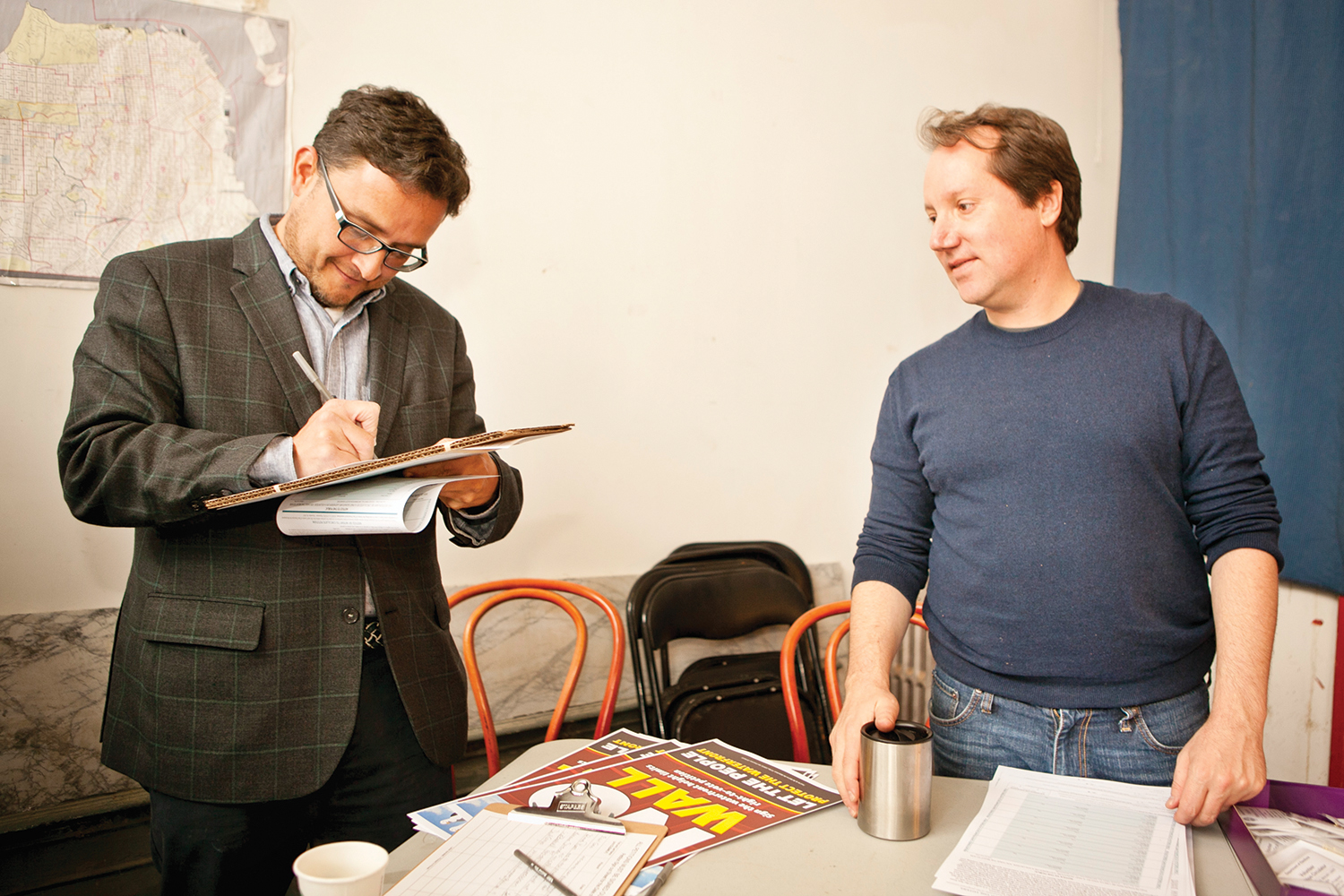
On a drizzly Saturday, Jan. 11, a few dozen activists crowded into the office at 15 Columbus Avenue, preparing to go collect signatures for the new waterfront initiative. It was a space that was already familiar to many of them from their fall campaign against height increases on the 8 Washington project.

“What we’re doing today is launching the next phase of that campaign,” campaign manager Jon Golinger told the assembled volunteers, calling this space “the center of the fight for San Francisco’s future.”

The campaign must collect at least 9,702 valid signatures by Feb. 3 to qualify for the June election, but Golinger said those involved in the campaign actually have six months to gather signatures if they want to wait for the November election.

Golinger said they would prefer June in order to build off of the momentum of the fall campaign and not get caught up in the more crowded November ballot. “There’s a lot of enthusiasm from the last election to ensure the waterfront gets the protection it needs,” he told us.

As for getting the necessary signatures, Golinger said he isn’t worried, noting that almost two years ago, he and other activists collected twice that many signatures — referendums require 10 percent of those voting in the last mayor’s race, but initiatives need only 5 percent — to challenge just the 8 Washington project.

Here, the stakes are much higher, spanning the entire seven-mile waterfront.

“We want the voters to have a say when a project goes beyond the rules that are in place,” said Sup. David Campos, the first elected official to endorse the measure and the first person to sign Golinger’s petition.

Campos also connected the campaign to the eviction crises and tenant organizing now underway, including the first in a series of Neighborhood Tenants Conventions taking place that day, culminating in a Feb. 8 event adopting a platform. “That struggle is part of this struggle,” Campos said. “We have to make sure we’re working collectively.”

The official proponent of the initiative is Becky Evans, who has been working on issues related to San Francisco’s waterfront for more than 40 years. “I remember walking along the waterfront with Herb Caen back in the ’70s,” she said of the late San Francisco Chronicle columnist for whom the promenade on the Embarcadero is now named.

Evans is a longtime Sierra Club member who also served on the city’s first Commission on the Environment, and she believes the shoreline is a critical intersection between the city’s natural and built environments, one where the citizens have an active interest.

“I think the 8 Washington process — including the petition gathering and the vote — awoke a bunch of people to making a difference in what happens to the city,” Evans told us, calling the waterfront a defining feature of San Francisco. “For many people, our skyline is the bay, not the buildings.”


BEYOND THE PLAN

The initiative has few overt critics at this point. Both city and Port officials refused to comment on the measure, citing a City Attorney’s Office memo advising against such electioneering. “I’m incredibly limited as to what I can say,” the Port’s Brad Benson told us.

And none of the spokespeople for the affected development projects wanted to say much. “We’re taking a wait and see attitude,” PJ Johnston, a spokesperson for the Warriors Arena, said when he finally responded to several Guardian inquiries.

“Right now, we’re trying to understand it,” said Staci Slaughter, the senior vice president of communications for the San Francisco Giants, whose proposal for Pier 48 and Seawall Lot 337 includes 3.7 million square feet of residential, commercial, parking, and retail, including the new Anchor Steam Brewery.

That project is just launching its environmental studies, which was the subject of a public scoping meeting on Jan. 13. Slaughter did tell us that “right now, the majority of the site doesn’t have an established height limit,” a reference to the fact that most of the site is zoned for open space with no buildings allowed.

Diane Oshima, associate director of waterfront planning at the Port, told us that during the adoption of the WLUP, “We did not broach the subject of changing any height limits.” But the plan itself says that was because tall buildings weren’t appropriate for the waterfront.

“Maintain existing building height and bulk limitations and encourage building designs that step down to the shoreline,” is the plan’s first design objective. Others include “Improve views of the working waterfront from all perspectives” and “Remove certain piers between Pier 35 and China Basin to create Open Water Basins and to improve Bay views.”

The plan also specifies acceptable uses for its various waterfront properties. Residential isn’t listed as an acceptable use for either Pier 48 or Seawall Lot 337, both of which are slated mostly for open space and maritime uses. Office space and entertainment venues are also not deemed allowable uses on either property, although it does list retail as an allowable use on Pier 48.

By contrast, Piers 30-32 and the adjacent Seawall Lot 330 were envisioned by the plan to allow all the uses proposed for it: “Assembly and Entertainment” and retail on the piers and residential, hotels, and retail on the property across the street — but not at the heights that are being proposed.

The plan calls Pier 70 a “mixed use opportunity area” that allows most uses, but not hotels or residential, despite current plans that call for construction of about 1,000 homes at the site to help fund historic preservation efforts.

Slaughter answered questions about her project’s lack of compliance with the WLUP by saying, “The whole project is going through a community planning process.”

Yet Agnos said that neither that process nor the current makeup of the Port or Mayor’s Office can get the best deal for the public against rich, sophisticated teams of developers, investors, and professional sports franchises.

“They don’t have the expertise for the multi-billion-dollar deals that are in front of them,” Agnos said of the Port of San Francisco. “The new identity for San Francisco’s Port is it has the most valuable land in the country, and maybe the most valuable land in the world.”

Left turn?

27

rebecca@sfbg.com

Dan Siegel, an Oakland civil rights attorney and activist with a long history of working with radical leftist political movements, joined a group of more than 150 supporters in front of Oakland City Hall on Jan. 9 to announce his candidacy for mayor.

With this development, the mayor’s race in Oakland is sure to be closely watched by Bay Area progressives. Siegel’s bid represents a fresh challenge from the left against Mayor Jean Quan at a time when concerns about policing, intensifying gentrification, and economic inequality are on the rise.

Siegel is the latest in a growing list of challengers that includes Joe Tuman, a political science professor who finished fourth in the 2010 mayor’s race; Oakland City Councilmember Libby Schaaf; and Port Commissioner Bryan Parker.

In a campaign kickoff speech emphasizing the ideals of social and economic justice, Siegel laid out a platform designed “to make Oakland a safe city.” But he brought an unusual spin to this oft-touted goal, saying, “We need people to be safe from the despair and hopelessness that comes from poverty and long-term unemployment. We need safety for our tenants from unjust evictions and … gentrification.”

Siegel voiced support for raising the city’s minimum wage to $15 an hour. He also called for shuttering Oakland’s recently approved Domain Awareness Center, a controversial surveillance hub that integrates closed circuit cameras, license plate recognition software, and other technological law enforcement tools funded by a $10.9 million grant from the federal Department of Homeland Security.

He spoke about pushing for improvements in public education “to level the playing field between children from affluent backgrounds and children from poor backgrounds,” and described his vision for reorganizing the Oakland Police Department to foster deeper community engagement.

Among Siegel’s supporters are East Bay organizers with a deep history of involvement in social justice campaigns. His campaign co-chair is Walter Reilly, a prominent Oakland National Lawyers Guild attorney who said he’s been involved with civil rights movements for years. “This is a continuation of that struggle,” Reilly told the Bay Guardian, adding that leadership affiliated with “a progressive and class-conscious movement” is sorely needed in Oakland.

Left Coast Communications was tapped as Siegel’s campaign consultant. Siegel’s communications director is Cat Brooks, an instrumental figure in Occupy Oakland and the grassroots movement that arose in response to the fatal BART police shooting of Oscar Grant, whose Onyx Organizing Committee is focused on racial justice issues.

Olga Miranda, an organizer with San Francisco janitors union, SEIU Local 87, also spoke on Siegel’s behalf during the kickoff event. “San Francisco has become for the rich, and we understand that,” she said. “But at the same time, Oakland isn’t even taking care of its own.”

Referencing a recent surge in Oakland housing prices due in part to an influx of renters priced out of San Francisco, she added, “Dan understands that if you live in Oakland, you should be able to stay in Oakland.”

Siegel’s decision to challenge Quan for the Mayor’s Office has attracted particular interest since he previously served as her legal advisor, but their relationship soured after a public disagreement.

In the fall of 2011, when the Occupy Oakland encampment materialized overnight in front of Oakland City Hall, Siegel resigned from his post as Quan’s adviser over a difference in opinion about her handling of the protest movement. Police crackdowns on Occupy, which resulted in violence and the serious injury of veteran Scott Olsen and others, made national headlines that year.

“I thought that the Occupy movement was a great opportunity for this country to really start to understand the issues of inequality in terms of wealth and power,” Siegel told the Bay Guardian when queried about that. “And I thought the mayor should embrace that movement, and become part of it and even become a leader of it. And obviously, that’s not what happened.”

Since then, his relationship with Quan has been “Cool. As in temperature, not like in hip,” he said during an interview. “I don’t want to make this personal. But we have a difference about policy and leadership.”

With Oakland’s second mayoral election under ranked-choice voting, the race could prove fascinating for Bay Area politicos. Also called instant runoff voting, the system allows voters to select their first, second, and third choice candidates. If nobody wins more than 50 percent of the vote, the last-place candidates are eliminated in subsequent rounds and their vote redistributed until one candidate crosses the majority threshold.

Quan, who ran on a progressive platform in 2010, was elected despite winning fewer first-place votes than her centrist opponent, former State Senate President Don Perata. She managed to eke out an electoral victory with a slim margin (51 percent versus Perata’s 49), after voting tallies buoyed her to the top with the momentum of second- and third-place votes, many gleaned from ballots naming Councilmember Rebecca Kaplan as first choice.

Early polling conducted by David Binder Research showed Quan to be in the lead with the ability to garner 32 percent of the vote, as compared with 22 percent for Tuman, who placed second. That’s despite Quan’s incredibly low approval ratings — 54 percent of respondents said they disapproved of her performance in office.

When Schaaf announced her candidacy in November, Robert Gammon of the East Bay Express opined, “Schaaf’s candidacy … likely will make it much more difficult for Quan to win, particularly if no true progressive candidate emerges in the months ahead.” But Siegel’s entry into the race means there is now a clear progressive challenger.

The Guardian endorsed Kaplan as first choice in 2010, and gave Quan a second-place endorsement. While there has been some speculation as to whether Kaplan would run this time around — the David Binder Research poll suggested she would be a formidable opponent to Quan — Kaplan, who is Oakland’s councilmember-at-large, hasn’t filed.

Siegel, meanwhile, cast his decision to run as part of a broader trend. “I feel that not only in Oakland, but across the country, things are really ripe for change,” he told the Guardian.

Indeed, one of the biggest recent national political stories has been the election of Kshama Sawana, a socialist who rose to prominence during the Occupy Wall Street movement, to the Seattle City Council.

“When you have a city like Oakland where so many people are in poverty or on the edge of poverty, or don’t have jobs or face evictions,” Siegel told us, “it’s no wonder that the social contract falls apart. It seems to me that what government should do is elevate the circumstances of all people, and particularly people who are poor and disadvantaged.”

FCC chair gets an earful in Oakland

0

On Jan. 9, the newly appointed chair of the Federal Communications Commission, Tom Wheeler, visited Oakland’s Preservation Park for a town hall meeting.

It was the first time in more than five years that the head of the FCC engaged in this kind of face-to-face community dialogue in Oakland, Chancellar Williams of Free Press said at the start of the meeting. The event was hosted by the Free Press, the Center for Media Justice, the National Hispanic Media Coalition, and the Voices for Internet Freedom Coalition.

Social justice advocates from Oakland and San Francisco greeted Wheeler with a wide variety of concerns, asking him to help close the digital divide and improve access to basic phone and Internet service for low-income people.

Some spoke out about media consolidation, which Williams said has given rise to cost barriers resulting in abysmally low representation of broadcast station ownership by people of color. Others asked Wheeler to address the high cost of telephone calls in immigration detention.

Before people started lining up to share their thoughts with Wheeler, Malkia Cyril, founder and executive director of the Center for Media Justice, captured everyone’s attention by delivering an impassioned speech on issues of media ownership, democracy, and racial inequality.

“Just as our physical bodies serve to preserve our nervous systems,” she began, “the people right here stand beautifully strong in defense of an affordable, accountable, and accessible media.”

New arts high school would cost $240 million

0

Art advocates have tried to move the Ruth Asawa School of the Arts high school to its new home on Van Ness street since 1987. On Jan. 7, the dream moved one step closer, the only barrier is cost.

At a packed San Francisco Board of Education meeting, planners revealed the move’s sticker price, and it’s a big one: $240 million. Board of Education President Rachel Norton’s face sunk into one hand as she heard the news.

“There’s a big challenge going forward,” said David Goldin, chief facilities officer of the San Francisco Unified School District. “I don’t want to minimize that challenge for one minute. But for the first time in a long time, we’re close to having an architectural reality.”

The school is named for one of its founders, artist Ruth Asawa, with deep roots in San Francisco history as an arts and education activist. It has a unique education model: students attend academic classes in the morning, but spend two hours every afternoon learning a specific art discipline.

SotA is currently housed at the old McAteer campus on Twin Peaks, with its sister school, the Academy of Arts and Sciences (disclosure: I taught students video editing at SotA as a contractor until last summer). Collectively they have 1,000 students enrolled.

The cost of moving the school to the site on Van Ness is steep for a number of reasons, SFUSD spokesperson Gentle Blythe told us. SotA’s new home was formerly the High School of Commerce, and was granted historic landmark status — meaning the facade, at the very least, must be preserved. The building needs a seismic retrofit as well.

Most importantly, though, the cost is so high because the new site would be crafted with the arts in mind.

“It’s a high school for the performing arts with non-standard design considerations, including height of ceiling, and sophisticated electronics,” Blythe said. The building will be crafted for dance studios, orchestra rooms, multimedia facilities and more. It’s also not just a school: the district would also build an on-site auditorium that could seat 47,000 attendees.

By comparison, the new Willie Brown Middle School comes is budgeted at $55 million, Blythe told us. But the chief facilities officer said the price to move SotA was comparable to the cost of newer public arts schools in the US.

San Francisco artists came out in force to advocate for the move. First up to the podium to speak was the music director of the San Francisco Orchestra, Michael Tilson Thomas.

“I’m 10,000 percent behind this idea,” he told the board. “My dream is to do a Big Brothers Big Sisters program with all the grades, to share that vision with younger people.”

Lies, damned lies, and statistics

0

When is a public opinion poll a valid representation of how people feel? That turns out to be a tricky and ever-evolving question, particularly in San Francisco — thanks to its prevalence of tenants and technology — and even more particularly when it concerns the approval rating of Mayor Ed Lee.

Traditionally, the central requirements for public opinion polls to be considered valid is that respondents need to be representative of the larger population and they need to be selected at random. Polls are often skewed when people need to opt-in, as is the case in most online polls.

So the Guardian took issue with claims that 73 percent of voters approve of the job that Mayor Lee is doing, a figure derived from an opt-in online poll focused on “Affordability and Tech” that was conducted by University of San Francisco Professors Corey Cook and David Latterman and released to the San Francisco Chronicle on Dec. 9. That figure quickly wallpapered the comment section of the Guardian’s website as the answer to any criticism of Mayor Lee, his policies, or the city’s eviction and gentrification crises.

“Any survey that relies on the ability and/or availability of respondents to access the Web and choose whether to participate is not representative and therefore not reliable,” is how The New York Times Style Guide explains that newspaper’s refusal to run such polls, a quote we used in our Jan. 10 Politics blog post on the subject, and we quoted an academic making a similar point.

We also interviewed and quoted Latterman discussing the challenges of doing accurate and economical polling in a city with so many renters (64 percent of city residents) and so few telephone landlines. “San Francisco is a more difficult model,” Latterman told us. “So Internet polling has to get better, because phone polling has gotten really expensive.”

So we ran our story dubbing the poll “bogus” — and the next day got angry messages from Cook and Latterman defending the poll and educating us on efforts within academia to craft opt-in online polls that are as credible as traditional telephone polls.

“The author is so quick to dismiss the findings of the study, which is based upon accepted methodology, and which had nothing to do with mayoral approval scores, that he actually misses the entire thrust of the study — that voters in San Francisco are deeply ambivalent about the current environment, concerned about the affordability crisis, and not trusting of local government to come up with a solution,” Cook wrote in a rebuttal we published Jan. 13 on the Politics blog.

Cook told us the survey’s methods are endorsed by the National Science Foundation and peer-reviewed academic papers, including a Harvard University study called “Does Survey Mode Still Matter?” that concludes “a carefully executed opt-in Internet panel produces estimates that are as accurate as a telephone survey.”

That study went to great lengths to create a sample group that was representative of the larger population, while Cook and Latterman both admit that their survey’s respondents had a disproportionate number of homeowners. But they say the results were then weighted to compensate for that and they stand by the accuracy of their work.

Yet Cook also notes that the mayoral approval rating number wasn’t even part of the package they developed from this survey, it was just a finding that they decided to give the Chronicle. “I don’t think the 73 percent means anything,” Cook told us, noting that snapshot in time doesn’t reflect Lee’s actual popularity going forward, despite how Lee supporters focused on it. “The number they use politically is not a meaningful number.”

What Cook found more significant is the “tepid support” for Lee indicated by the poll, including the 86 percent that expressed concern about affordability in the city, a concern that cuts across all demographic groups. Most respondents had little faith in City Hall to address the problem and many felt the tech industry should be doing more to help, particularly companies that have received tax breaks.

Safety Scramble

1

joe@sfbg.com

On New Year’s Eve, six-year-old Sofia Liu was struck and killed when a driver using the Uber rideshare app allegedly failed to yield to her and her family as they progressed through a crosswalk. The girl’s mother and brother survived, but their tear-stained faces were soon all over news networks in heartbreaking reports of their loss. No less sad, 86-year-old Zhen Guang Ng was struck and killed that same night by a driver who allegedly failed to stop at a stop sign in the Crocker-Amazon district. These incidents aren’t isolated.

In 2012, 16 pedestrians were killed in vehicle collisions in San Francisco. That number jumped to 21 in 2013, according to the SFPD, and the new year has brought new collisions and more pedestrian deaths.

Already, the SFPD and other city agencies are scrambling for political cover, and advocacy groups are rushing in to call for changes they say will save lives. On Jan. 16, myriad groups will try to sell their version of safer city streets at a joint meeting between the Board of Supervisors’ Neighborhood Services & Safety Committee and the city’s Police Commission.

As the debate continues to unfold, the road to pedestrian safety looks to be bumpy, and the first pitfall may be the Police Department itself.

Enforcement

At the Jan. 8 Police Commission hearing, the SFPD played defense.

A host of groups were calling out the cops: Cabbies wanted more enforcement against rideshare drivers, the San Francisco Bicycle Coalition wanted more incident tracking. Nobody seemed happy with the current state of affairs around pedestrian safety.

Cmdr. Mikail Ali, tall and broad shouldered, approached the podium to give what amounted to the SFPD’s rebuttal. His presentation boiled down to this: Fewer cops equals fewer traffic citations, and fewer citations are dangerous.

“We did see a decrease in traffic citations issued last year,” Ali said. On the screens around the room, he displayed a chart showing two sloping red lines, one representing police staffing levels and another representing total citations. The charts showed a drop of 127 officers, and 20,000 fewer traffic citations, 2012-2013.

All told, the SFPD had 1,644 officers and issued 87,629 traffic citations last year.

But the idea that bringing on more cops is the only effective strategy for pedestrian safety seemed out of sync with a different aspect of Ali’s presentation, in which he conveyed a plan to “Focus on Five.”

Under that plan, police station captains are urged to boost traffic enforcement around the five intersections in their districts that have been identified as most dangerous. Though Ali said the approach was showing progress, the SFPD has yet to release data on how this enforcement approach has played out.

“Right now we don’t have full transparency into their reporting,” said Natalie Burdick of Walk SF, a pedestrian advocacy nonprofit. “We do have data showing they are issuing citations. What we don’t know yet … is has there been an increase in citations from Focus on Five?”

To be fair, it’s a new program, but data is key to many efforts geared toward improving pedestrian safety. The SFPD’s data shows that Focus on Five represents 22 percent of their citations, but it’s still unknown where they occurred and what incidents spurred the citations.

The Bike Coalition also wants more enforcement data from the SFPD.

“We’re hearing a lot of incidents go unreported,” said Leah Shahum, executive director of the Bicycle Coalition. Incidents that normally don’t get written up, like an accident that only results in a bruise or a scrape, are just as important to record, she said, because thorough reports can help identify problem intersections. “Without solid, good accounting to show where things are happening, we’re not going to necessarily see change,” she said.

But that would require a cultural shift in the SFPD, Shahum said. For now, the police seem as interested in blaming the pedestrians as they do the drivers.

Victim blaming

The first shots fired by the SFPD on pedestrian safety amounted to a public relations gaffe.

“YOU’VE BEEN HIT BY A CAR! … It’s little comfort to know you had the right of way, while you recover from serious injury in the hospital,” reads an SFPD flyer, the message typed next to a picture of a chalk outline on pavement. “Distracted walking is one BIG reason pedestrians get hit by vehicles,” it continues. To emphasize the point, the chalk outline is wearing headphones connected to an iPhone.

Streetsblog San Francisco reporter Aaron Bialick, in his article about the flyers, responded to them thusly: “The SFPD has gone off the deep end with this one, folks.”

His response is understandable. With a choice of two perpetrators, one walking across the street, and another behind the wheel of a two-ton steel killing machine, one would think the latter would be the obvious target. Shahum thinks the problem goes deeper than bad messaging, saying the SFPD’s enforcement is skewed.

“We’ve seen some officers not knowing people’s rights when walking or biking. We’ve seen ‘blame the pedestrians’ from police, in the media,” she said. “We’re hearing things like ‘you should’ve been riding on the sidewalk,’ [showing] a really basic lack of understanding” about regulations cyclists must adhere to.

This issue came to a head when Sgt. Richard Ernst pulled up to a streetside memorial for cyclist Amelie Le Moullac, who died in a fatal collision last August, to lecture those gathered on bicycle safety.

As Guardian Editor Steven T. Jones noted in his article at the time, “apparently Ernst didn’t stop at denouncing Le Moullac for causing her own death, in front of people who are still mourning that death. Shahum said Ernst also blamed the other two bicyclist deaths in SF this year on the cyclists, and on ‘you people’ in the SFBC for not teaching cyclists how to avoid cars.”

Still, Shahum sees potential for change. “This is the area where I think we’re seeing the most promises from them,” she said.

At the Police Commission meeting, Ali noted the challenges police face when assessing traffic collisions. Training officers in the methods to deduce how a collision occurred is no easy task.

“It requires a high degree of science,” Ali said. “Geometry, physics, basic mathematics. Its not just about getting facts from people, but making conclusions from physical evidence.”

Chief Greg Suhr expressed confidence that the new recruits to come out of the academy were abreast of the latest techniques, and commissioners said they may use the need for traffic enforcement as a call to the mayor to help bring more officers into the SFPD’s ranks.

Enforcement and police culture are just some ways pedestrian safety needs to be addressed. Walk SF, the San Francisco Bicycle Coalition and the SFPD all will present their cases at the joint meeting on Thu/16. But as many of them would note, many of these promises have been made before.

Slow momentum

“We’re going to re-engineer streets around at least five schools and two areas that have the highest levels of concentration of senior injuries every year,” Mayor Ed Lee said at a press conference, responding to pedestrian deaths that rocked San Francisco.

No, this wasn’t after the New Year’s Eve fatalities. It was last April, when the mayor trumpeted an ambitious program to make the strets of San Francisco safer.

The San Francisco Pedestrian Strategy identifies 44 miles of the city’s most dangerous streets and intersections in need of upgrades. The goal was to improve five miles of city streets a year, with bulb outs (for better pedestrian visibility), raised crosswalks, new crossing signals, new traffic lights, and narrowing lanes.

One of the high priority intersections identified for improvements was Polk and Ellis — where Sofia Liu was killed on New Year’s Eve.

safetymap

A map of high priority corridors — the most dangerous streets for pedestrians in San Francisco.

That intersection hasn’t yet seen upgrades under the Pedestrian Strategy, Burdick of Walk SF told us.

“Any one or combination of the safety benefits of bulb-outs (or other improvements) could definitely have been the difference between life and death for Sofia,” she said. Walk SF works with city agencies to try to make sure these changes are happening, but she says the city hasn’t been transparent about the effort.

“We know there’s been some progress, but we don’t yet know if we’re doing enough each year to account for getting something done,” she said.

To get a sense of the city’s progress on this front, the Guardian contacted the Planning Department, which referred us to the Municipal Transportation Agency. The MTA did not respond before press time.

“That’s another thing at the hearing with the board (and Police Commission) we’ll be pushing,” Burdick said. “For engineering enforcement work to happen, it’s got to be paid for.”

According to public records outlining the city’s Pedestrian Strategy, the plan needs $65 million a year to hit proposed targets. The lion’s share, more than half, would go toward infrastructure improvements.

Burdick called that amount into question, saying the city had only allocated $17 million. A Pedestrian Strategy report confirmed that the program faces a $5-18 million a year funding gap.

Enforcement, a culture of victim blaming and inadequate funding all pose major challenges to pedestrian safety in San Francisco. Hopefully the joint Board of Supervisors and Police Commission meeting will finally result in some answers.

The joint Board of Supervisors’ Neighborhood Services & Safety Committee and Police Commission meeting will be held Thursday, Jan. 16, at 5pm, Room 250.


 

End poverty and create wealth with public banks

3


By Ken Walden

OPINION How would you like to increase your spending power by 10 times (or more), relieve student debt by more than 90 percent, increase Social Security benefits, lower taxes, increase pay for teachers, and lower loan amounts for homes and small business to 1-2 percent?

I’ll bet I have your attention. I’m sure you think this is crazy talk, but this is based on a movement that is already happening. It’s the public banking movement.

In 1950s, the buying power of the dollar was over 10 times what it is today. That means you were able to buy 10 times the amount of goods and services with a dollar compared to what you can now.

What happened? Why is it so hard for most people to just barely get by these days? And why are so many are not getting by at all?

First, let’s review how money is created. Did you know the money we have in circulation today is created out of thin air? Most of it is just an entry in a computer system. A small percent is printed dollar bills like you have in your wallet or purse, and a very small percentage is metal coins.

Money is simply trusted as being worth what it says on the bill, coin, or computer screen. Did you also know that money for loans is created this way as well?

When you take out a loan from a bank (for a home loan, a student loan, a business loan, a car loan, etc.), the money that the bank loans you (with interest charges) is not taken from other people’s deposits. It is made (mostly) out of thin air. It is simply an entry in their computer system … that’s it.

Most people think they are borrowing money that is deposited into the bank by other people, but this is not true.

Here is quote from Robert Anderson, the secretary of the US Treasury in 1959, on this topic: “When a bank makes a loan, it simply adds to the borrower’s deposit account in the bank by the amount of the loan. The money is not taken from anyone else’s deposits: it was not previously paid in to the bank by anyone. It’s new money, created by the bank for the use of the borrower.”

Why is this a problem? Let’s look at how much interest we’re paying on a variety of loans. If you buy a house for $500,000 in 30 years at an average interest rate, you will pay an additional $580,000 in interest on money the bank made from thin air. With a public bank you, would pay less than half this amount.

On public projects like bridges, roads and schools, 30-50 percent of the cost is interest. The new span of the Bay Bridge that was just opened at a cost of $7 billion, the interest on this project is estimated to be an additional $7 billion. It’s estimated that the cost of almost everything you buy is increased by 35-40 percent because of interest.

This is just the tip of the iceberg.

The solution to the problem is a public bank. With public banks, these billions of dollars of profit (via interest) are recycled back into the public treasury instead of funneled off to private banks.

If you think this is some theoretical fantasy you should know that San Francisco is currently looking at creating a public bank, 20 states are also considering them, and North Dakota has had a public bank for over 90 years. This is not a new idea.

It’s impossible to give you an in-depth overview in a short article so please go to our website (www.whattheworldcouldbe.com) and on the ‘Solutions’ page click on the box titled ‘Creating Jobs, Student Debt Relief, & the New Green Economy’.

Public banks have the possibility to dramatically change our lives for the better and you can help.

Ken Walden is director of What the World Could Be.

Confronting the speculators

34

rebecca@sfbg.com

A group of tenant advocates has upped the ante in the ongoing protest movement against San Francisco evictions, publicizing the names, photographs, property ownership, and corporate affiliations of a dozen landlords and speculators they’ve deemed “serial evictors.”

The Anti Eviction Mapping Project, a volunteer-led effort that snagged headlines last fall when it released data visualizations charting long-term displacement in San Francisco, released its Dirty Dozen list Jan. 10.

The project spotlights property owners who’ve moved to evict tenants under the Ellis Act, a controversial state law that allows landlords to oust tenants even if they aren’t in violation of lease terms. In practice, the Ellis Act tends to be waged against longtime residents with low monthly rental payments, frequently impacting elderly or low-income tenants who benefit from rent control.

The Anti Eviction Mapping Project’s list gets up close and personal, publishing details such as landlord’s cell phone numbers, home addresses, and histories of legal entanglement.

It’s an edgy use of public records that seems to raise a slew of questions about free speech, privacy, and the use of information sharing and public shaming as a protest tactic in the digital age.

Erin McElroy, a volunteer and lead organizer of the project, said the goal was to spotlight landlords “who are disproportionately impacting senior and disabled tenants,” and to raise public awareness about “people who are making millions at the expense of tenants.”

She added that there is a budding effort to push for Ellis Act reform in Sacramento, and noted that a goal of this project was to fuel that statewide effort by providing easily accessible information.

Among those individuals named on the Dirty Dozen list was David McCloskey of Urban Green Investments, a company that owns more than 15 San Francisco properties. Urban Green has been a frequent target of San Francisco housing activists, in part due to the company’s ongoing attempt to evict Mary Elizabeth Phillips, a Dolores Street tenant who will turn 98 in April.

Another landlord who made the list, Elba Borgen, has also attracted past attention from tenant activists due to her history of pursuing Ellis Act evictions at six different San Francisco properties. A tenant currently residing in a 10th Avenue property, where Borgen’s LLC has filed for eviction, is 90 years old and suffering from Alzheimer’s, according to an interview with her daughter Vivian Montesdeoca posted to the mapping project website.

The Bay Guardian‘s efforts to reach landlords who were spotlighted on the Dirty Dozen list were largely unsuccessful. We did manage to contact Tom Iveli, president of Norcal Ventures, who spoke briefly before excusing himself, saying he had to take another call. Iveli clearly wasn’t aware that he and his business partner Bob Sigmund had been singled out.

McElroy said the Dirty Dozen list was the product of an in-depth research project which entailed filtering through property records, San Francisco Rent Board data, and information gleaned from the website Corporation Wiki.

The Anti Eviction Mapping Project initiative has attracted around 15 volunteers and will be partnering with Stanford University students to produce an oral history project showcasing the narratives of San Francisco tenants facing eviction, McElroy said.

Some of the same activists involved in recent high-profile blockades of tech buses were also part of the Anti Eviction Mapping Project effort.

“We’re not, you know, anti-tech by any means,” said McElroy. “We’re anti- speculative real estate,” and wary of policies like the Ellis Act and city government’s tendency to give deep-pocketed corporations a free pass, regardless of the consequences.

“It’s that linkage that is kind of the crux of the issue,” she added.

What “Google bus” really means

79

EDITORIAL In recent years, “Google bus” has become a term that encompasses more than just the shuttles that one corporation uses to transport its workers from San Francisco down to the Silicon Valley. It has taken on a symbolic meaning representing the technology sector’s desire to shield itself from the infrastructure, values, and responsibilities that most citizens choose to share.

These are the very things that motivate many of us to live here, finding that community spirit in such a beautiful, world-class city. More than just the great restaurants and bars, its vistas and artistic offerings, San Francisco represents an experiment in modern urbanism and cultural development.

It is this collision and collusion of disparate yet public-spirited cultures that gave birth to the region’s great economic and social movements, from gay rights and environmentalism to groundbreaking academic research and the creation of the Internet economy.

The antithesis of this idea of creative collaboration is to consider San Francisco just 49 square miles of valuable real estate, to be used and developed as the highest bidder sees fit, as some tech titans seem to believe. It’s ironic that an industry based on creating online communities would place so little value on engaging with its physical community.

The proposed $1 per bus stop use, and $50 per docking that new exclusive Google ferry is paying, is a privatization of public space that barely covers the city’s costs. The tech industry should be doing much more just to counteract its negative impacts on the city’s economy, let alone actually being good corporate citizens of this region.

A new report called for by the Mayor’s Office says Muni needs a $10 billion investment over the next 15 years just to maintain current service levels. A big chunk of that should come from the wealthy corporations in our community through a downtown transit assessment district and higher fees on Silicon Valley companies that are using us as a bedroom community.

San Francisco writer Rebecca Solnit has been developing a critique of the Google bus since her initial shot last February in the London Review of Books, answering a subsequent techie/enviro criticism published in Grist with a Jan. 7 article in Guernica called “Resisting Monoculture.”

“And thus come the well-paid engineers to San Francisco, and thus go the longtime activists, idealists, artists, teachers, plumbers, all the less-well-paid people,” she writes, citing surveys that the buses allow Silicon Valley workers to live in San Francisco when they otherwise wouldn’t.

That’s the issue. The only thing green about Google buses are the piles of money their riders and their bosses are keeping from the city we all share. Segregated buses have never been a good idea, but if these companies insist on them, that should come with a higher price tag.


Alerts: January 15 – 21, 2014

0

WEDNESDAY 15

“Economic Crisis and System Decline: What We Can Do” First Congregational Church of Berkeley, 2345 Channing, Berk. Kpfa.org/events. 7:30pm, $12 advance, $15 door. KPFA Radio presents an evening with Richard Wolff, hosted by Mitch Jeserich. Wolff, a radical economist, recently published Capitalism Hits the Fan, offering an alarming analysis on global economic events that differs sharply from explanations offered by politicians, media commentators, and other academics. Professor of Economics Emeritus from the University of Massachusetts, Amherst, Wolff is currently a Visiting Professor in the Graduate Program in International Affairs at the New School University in New York. According to KPFA, he’s got a reputation for “blunt speaking, clarity, refreshing scorn, and an enjoyable wit.”


FRIDAY 17


Gather round the fire for eviction ghost stories Silver Stone Cafe, 3278 24th St, SF. 6-9pm, free. Join Erin McElroy, of the Anti-Eviction Mapping Project, and Adriana Camarena, of the Shaping San Francisco “Unsettlers: Migrants, Homies, and Mammas” project, for an evening of community stories about eviction and other housing horrors. Gather around a campfire to listen to and support San Francisco evictees in a family-friendly event. (No alcohol, yes s’mores.) Storytelling will be videotaped.

SATURDAY 18

Richmond/Haight Tenants Convention San Francisco Public Library Park Branch, 1833 Page, SF. 1-4pm, free. This gathering of tenants from District 1 and District 5 is being held to hash out strategies for fighting the evictions in our neighborhoods, educate tenants about their rights, and defend evictees. Participants will also make suggestions for a ballot initiative next November, which will be presented to a citywide tenants convention Feb. 8. Other neighborhoods, including the Mission, Chinatown and Tenderloin/SOMA are also holding or have held conventions and will be making recommendations to the citywide convention. Free and open to tenants. Sponsored by the San Francisco Tenants Union.

SUNDAY 19 Homeless Youth Alliance benefit El Rio, 3158 Mission, SF. 3-8pm, $3-to-infinity sliding scale donation. Evicted from their building on Christmas Day, the Homeless Youth Alliance continues to provide services out of the back of a van. The organization’s mission is to help these marginalized youth build healthier lives through harm reduction, one-on-one counseling, and medical and mental health care, as well as creative and educational workshops, needle exchange, and accurate up-to-date referrals and information. This El Rio birthday bash for a generous HYA supporter will feature performances by Kat Marie Yoas, The Whoa Nellies and No Bone.

Beathoven

0

marke@sfbg.com

SUPER EGO A couple of years ago, Muni put out a public safety campaign that showed this gorgeous woman in giant silver headphones texting ferociously right before she stepped into the path of an oncoming train. Tagline: “Do you want Beethoven to be the last thing you hear?

Which was a bit unintentionally hilarious because, yes, I do want Beethoven to be the last thing I hear, specifically the insanely great, otherworldly “late string quartets,” which would be a fine soundtrack with which to finally divest myself from this gorgeous, all-natural, all-me, not-silicone-at-all, nope-definitely-not, personal body.

But I’ll take any Beethoven at all, really — and local contemporary “laptop classical” composer Mason Bates is teaming up with the SF Symphony for a special treat: two nights of great Beethoven works paired with Bates’ electronica-obsessed orchestral pieces (Symphony No. 7 and The B-Sides Jan. 8-11, and Mass in C Major and Liquid Interface Jan. 15-18, www.sfsymphony.org).

If you’re unfamiliar with Bates, he uses digital and electronic instruments to bring lush, eerie dancefloor atmospherics and a leftfield backbeat to a full symphony and chorus setting. Adding Beethoven’s existential and ecstatic works to the mix might start some kind of weird fire.


AMBIVALENT

The Berlin-via-NYC favorite, a.k.a. Kevin McHugh, takes a heady, design-oriented approach to techno, reaching back into minimal to tease skeins of pulsing sonic ideas into a more visceral present. And you can dance to it. With Mossmoss, Brian Knarfield, Bob Five, and more.

Fri/10, 9pm-4am, $15. Monarch, 101 Sixth St., SF. www.monarchsf.com


HOT SINCE ’82

And he is hot! Out of the current crop of tech house pretty boys, Daley Padley of Leeds is also one of the sharpest, with a thoughtful sound that isn’t afraid to recall your champagne hangovers and long-lost puppy love dreams.

Fri/10, 9:30pm, $15-20. Audio Discotech, 316 11th St., SF. www.audiosf.com


MR. TIES

Have you heard this Berlin bearded queer techno wonder’s killer, slow-burn three-hour Boiler Room DJ set? Kind of all you need to hear. He’s coming in from his beloved Homopatik club to play Honey Soundsystem’s “Midi Slave” party, and it will get steamy.

Fri/10, 9pm-4am, $10–$15. F8, 1192 Folsom, SF. mrtieshoneysoundsystem.eventbrite.com


CIRCUIT SLAVE

Experimental psychedelic electronic music brings all the kids to the yard for a mini-festival of sorts. Headliners Circuit Slave slice punk angst through the wiring; duo Cry gets emotive with some 4AD-influenced eeriness, Bezier’s loops and arpeggios drive us back to analog days. With Redredred, PSSNGRS, and PowWow.

Sat/11, 9pm, $5, The Holdout, 2313 San Pablo Ave., Oakl. www.tinyurl.com/circuitslaveOAK


DJ DEEON

“Let me bang!” The legend of booty bass comes to the jackin’ Two Men Will Move You party for a night of low-low-low.

https://www.youtube.com/watch?v=hMtBpGqA1mU

Sat/11, 9pm, $8. Amnesia, 853 Valencia, SF.


KIM ANN FOXMAN

The NYC superfox of house grooves somes to the monthly Isis party, bringing with her a dose of classics with a devilishly danceable helping of transcendent 1980s and early ’90s sound-a-likes. Nice and funky, with a slow-motion vogue-ready twist. With Avalon Emerson, Hi Today, and Brittany B.

Sat/11, 9:30pm-3:30am, $10 advance. Public Works, 161 Erie, SF. www.publicsf.com


LESLIE AND THE LYS

Rickshaw Stop celebrates 10 years of rolling us out — wow, remember the insanely fun hipster-glitzy hardcore electro scene there? — with this appearance by the Iowan queen of hyper-ironic dance rap (she made it into art). Grab your gem sweater and let’s reach for the gold!

Sun/12, 8pm, $16, all ages. Rickshaw Stop, 155 Fell, SF. www.rickshawstop.com


Rise of the machines

3

joe@sfbg.com

CAREERS AND ED As digital gizmos invade our pockets and our lives, the fear of machines replacing human work is as pervasive as ever. But of course that fear isn’t unique to the computer age.

As far back as the 1800s folk legend John Henry competed against a great railroad-building machine, hammering holes for railroad tracks in dirt and rock with the power of his arms.

In that tall tale of flesh versus steel, man won against automaton, and time marched on. The industrial revolution’s tech advances put farmers out of jobs, industrial robots put American factory workers out of jobs, calculators put abacuses out of jobs. So what’s new this time around?

Apparently, it’s a matter of speed.

MIT professors Andrew McAfee and Erik Brynjolfsson, authors of Race Against The Machine: How the Digital Revolution is Accelerating Innovation, Driving Productivity, and Irreversibly Transforming Employment and the Economy (Digital Frontier Press) say our modern robots are becoming so advanced, so quickly, that we can’t retrain our workers fast enough to keep up.

“Now the pace is accelerating, it’s faster than ever before in history, as a consequence we’re not creating jobs at the pace we need to,” Brynjolfsson told 60 Minutes anchor Steve Kroft in a segment on robots in November.

The nation’s unemployment rate was 7 percent last November, the most recent number available from the Bureau of Labor Statistics. That’s not counting the millions of underemployed people in the United States, working low or minimum wage jobs that don’t pay the bills.

Those workers are slowly being replaced by machines, from bank tellers (ATMs) to the Golden Gate Bridge toll takers (“pay-by-plate” systems). San Francisco weathered the job loss well, at least on paper. As Mayor Ed Lee is quick to tout, the city’s unemployment rate was at a low of 5.3 percent in September last year.

Maybe that’s because we’re in the eye of the storm. The Bay Area tech boom is a robotics boom too, and even small startups could innovate, upending entire industries.

San Francisco-based Momentum Machines calls its upcoming burger maker the “next generation” of fast food. They don’t mean Captain Picard serving up beef patties; they do mean burger disruption.

Momentum Machines’ burger machine can do everything a human can do, faster. It makes 360 hamburgers per hour, medium rare, or well done (if you please). It slices tomatoes, doles out pickles, and throws everything on a bun. The company promises this will “democratize” fast food — because everything in tech must be itemized, democratized, and then evangelized.

The company said this will, in the words of its website, “free up” all the hamburger line cooks in the restaurant.

Perhaps more telling is this section of its website, tucked well down at the bottom of its page.

“We want to help the people who may transition to a new job as a result of our technology the best way we know how — education. Our goal is to offer discounted technical training to any former line cook of a restaurant that uses our device,” they wrote.

Momentum Machines declined to be interviewed, citing a busy upcoming project. (Double-cheeseburgers?)

We also reached out to Super Duper Burger, and a spokesperson straight-out laughed at the idea of a robot burger cook. But that doesn’t mean economic forces won’t push the machines to eventually take over.

If thousands of fast food workers were replaced by machines, what would their next jobs be?

If the MIT professors are right, the robot revolution will not be stopped. Like the Terminators, they keep coming, and John Connor won’t save us. But maybe we can find peace and coexist.

That’s what they do at Kink.com.

Deep inside the Mission District brick fortress known as the Armory, over 35 robotic porn stars sit on shelves, waiting. They’re the talent of the website Fucking Machines, started by the Bay Area’s fine purveyors of pornographical pleasure, Kink.com.

John Henry has nothing on a fucking machine named Fuckzilla, a “Johnny 5” (from the movie Short Circuit) look-alike whose arms operate as high-power vibrators. While two women mount his appendages and scream for their lives, a webcam mounted in his face gives viewers an up-close view of the action.

The actresses who use them were not available for interview. But the filmmakers say they go gaga over it.

“The directors ask the girls ‘why do you like machines more?’ They always say it’s because (the machines) don’t get tired,” Sam, a videographer at Kink.com told us.

The machines are powerful too. The Intruder MK II has a fucking speed up to 500 RPM and exerts a torque (twist strength) of 3 foot-pounds. “One of our highest counts was a woman who went through 58 orgasms in a four hour period,” Kink.com videographer Aaron Farmer said.

I asked the pornographers if they lost any porn star employees since gaining the high-stamina bots. Turns out it was a noob question: most talent are freelancers and contractors in the industry, unless they run their own website.

So the machines aren’t displacing any jobs there. But they did create some.

“I was hired for Fucking Machines,” Aaron Farmer, the five-year videographer and sometimes director at Kink.com told us. They even have a machine shop in the armory, which while used for other purposes, also helps maintain the nearly 40 Fucking Machines on site, and even builds new ones.

Somewhere along the way, Kink.com outsmarted us all, riding the wave of tech disruption that one day may affect us all. Let’s hope we’re ready.


Google’s androids

0

rebecca@sfbg.com

CAREERS AND ED Robotics, a field that largely exists in the realm of research and development, is poised to grow leaps and bounds right here in the Bay Area now that Google has decided to dump mountains of cash into it.

So far, the search giant with the “don’t be evil” slogan has acquired eight robotics firms, and is pursuing a robotics initiative that nobody seems willing to describe in detail when speaking on record to the press.

Its December acquisition of Boston Dynamics, a leading robotics firm famous for developing robots like Cheetah — which can move at 29 miles per hour on a treadmill — has generated rampant speculation about the Silicon Valley giant’s ultimate intentions.

Since Boston Robotics receives funding from military sources, including the Defense Advanced Research Projects Agency (DARPA), the high-profile purchase has raised a few eyebrows to be sure — like, they keep all of our email data forever and they just went out and bought some military-funded robots?

“None of these companies have products — they have prototypes,” points out Berkeley robotics professor Dr. Homayoon Kazerooni, who founded Ekso Bionics, a company that aids paraplegics in overcoming mobility limitations with robotic aids.

“Not all scientists or engineers are fully considering commercial applications yet. I don’t know why Google’s buying that stuff, except to push those applications.” From there, the question becomes “what can you do with that, to create jobs that are helpful to people?”

Kazerooni says the research being generated by robot scientists and engineers could yield many possibilities, whether in the form of new robots or something else. While he specializes in robotic machines for paraplegics, he says robots can sometimes be helpful replacements for humans in dangerous situations, like when a repair is needed at a nuclear power plant.

Several of the other firms purchased by Google are based in San Francisco. A recent, um, Google search revealed that while the companies’ website URLs remained intact, their pages had mostly been scrubbed of any information, save a single line of text announcing the acquisitions and that they were joining “the robotics revolution.”

So much for transparency from a company that knows all your secrets.

But thanks to a handy tool created by the San Francisco-based Internet Archive, called the Wayback Machine, we at the Bay Guardian were able to unearth a few nuggets to shed some light on what the hell Google just bought.

Meka Robotics, founded in 2007 by roboticists from the Massachusetts Institute of Technology, is one of the Google robotics acquisitions that lists a San Francisco address. A Wayback search revealed that it has developed something called “the Meka S2 Humanoid Head,” which is a “robotic active vision head” featuring high resolution cameras in each eye. “Designed for a wide range of expressive postures, it is the ideal platform for researchers interested in human-robot interaction and social robotics,” according to a description that no longer exists on Meka’s current website.

Another local firm Google gobbled up is Industrial Perception, a Palo Alto company that the Wayback search revealed is “a leader in 3D vision-guided robot technology” that “enables industrial robots to assume challenging logistical tasks,” mainly related to shipping.

Julia Gottlieb is the executive producer at Bot & Dolly, a San Francisco outfit that operates dinosaur-sized robotic arms equipped with high-end cameras that capture footage while the machines glide through space. “You may have heard the news that we were recently acquired by Google,” she wrote in response to a Bay Guardian inquiry. “Unfortunately, this means I am not able to speak to or make any decisions about press or PR related matters.”

Build a bot

0

culture@sfbg.com

CAREERS AND ED For most of the working world, cardboard represents little more than a recyclable material, something to hold your pizza. But to Jutiki Gunter, cardboard is a construction material with near-limitless potential.

Gunter, founder of Robotics for Fun (www.roboticsforfun.com), an Oakland-based robotics retailer and workshop, can seemingly build anything out of it. He can then take that anything and program it to move on its own. After that, in an exhibition of what is arguably his most impressive talent, he can teach you to do the same.

All it requires is some digestible training, an easy-to-assemble kit, and a bit of imagination. And while Robotics for Fun offers popular adult workshops, it’s the youth program that stands out. “My goal has always been to teach kids what I learned at a professional level,” said Gunter, who holds degrees from Cornell and Harvard in architecture. “If we can introduce them to those concepts early, they’ll be able to move things much further along.”

Dominating the entryway inside Robotics for Fun are dozens of colorful home-cut creations hanging on the walls. A scorpion is proudly displayed next to a penguin perched near an owl. An alligator sits beside a pterodactyl, flanked by a frog, shark, and rhino. The taxidermy-like display might seem morbid if these animal-like cardboard creations didn’t also come to life robotically. But nearly all of them do — and their little Dr. Frankensteins are usually fresh out of kindergarten.

“We’ve found that the kids can understand it conceptually as young as six, but they can’t really retain the information younger than that,” said Gunter. “By six, seven, eight, they can do the projects.”

Those projects start off simple: Most of the beginning classes center on preconstructed “kits” that are made in-house, composed of either Lego pieces or cardboard. The students conceptualize the project, construct the model, then do the requisite programming and circuitry to mobilize their robot, if the model they’re working on is capable of handling motorization.

But in the advanced classes, things get more intricate. And far more creative. “We used to work with Legos, but once the kids started wanting to make their own designs, we started showing them how to make robots out of cardboard, so they could learn to prototype and create any piece that they want.”

Results: awesome. Students have built climbing “rescue robots,” artificially intelligent vacuum cleaners, rovers that run on auto-pilot, even a car-like vehicle that can travel within a 30 mile radius at 15 miles an hour.

Gunter manufactures the parts onsite. His supply room is one part artist’s studio, one part Silicon Valley. Prototype robots lie about half-realized; sketchbooks lie open atop a workbench revealing dreams in the process of actualization, computer code sharing the same page as hastily drawn lines.

Behind the workbench is his most important piece of equipment: an Epilog Legend EXT laser system. The laser-etcher is necessary to create parts with the precision robotics require, and the process itself looks like a microscopic manifestation of the laser-obsessed Archimedes.

The fewer limitations Gunter has when it comes to what he can do, the fewer limitations the kids have when it comes to creation. And for Gunter, fewer limitations is what this is all about. “We’re teaching kids skills here that they’re not even learning in first year college, and why not? They love it, they have the ability to do it, they have the capacity to understand it. Of course, we want to give kids a fun experience. But my real, ideal goal is to give them advanced skills at a young age and see what they can do with it.””