News and Politics | San Francisco Bay Guardian

News & Opinion

Draining the tank

0

rebecca@sfbg.com

When University of California Berkeley students Ophir Bruck and Victoria Fernandez first made contact with the University of California Board of Regents, it was a far cry from the genial hobnobbing they engaged in over lunch at the March 19 Regents meeting in San Francisco, as special guests called Student Advocates to the Regents.

About a year ago, they were outside a Regents meeting in Sacramento and, joined by about 60 other students, symbolically locked to a pair of handmade, 10-foot-tall models of oil rigs they’d set up outside the conference center.

“The idea was the symbolism of us being chained to an extractive economy that’s not sustainable,” Bruck explained to us. The message they hoped to impart to the Regents was: “They have the keys to our fossil freedom.”

Taking advantage of the public comment session to get their point across, the students were there to call on the Regents to withdraw UC investment holdings in companies such as Exxon, Chevron, BP, and other leading fossil fuel companies. The campaign, Fossil Free Cal, is just one of dozens of student-led efforts nationwide seeking to convince campus administrations to withdraw funds from oil and gas companies as a way of curbing greenhouse gas emissions and fighting climate change.

Some local institutions of higher education have already committed to divestment from fossil fuels. Oakland’s Peralta Community College District, the Foothill-DeAnza Community College Foundation, and the San Francisco State University Foundation have made commitments to divest.

But other prominent schools have declined. Last October, Harvard University announced that it would not honor students’ request to withdraw investment holdings from the fossil fuel sector, saying such a move would “position the university as a political actor rather than an academic institution,” and could “come at a substantial economic cost.” A student effort to have Brown University divest from fossil fuels also went down the tubes.

Divestment by California’s flagship public university system would have a significant impact. UC Berkeley’s endowment is $3 billion, while the total UC system endowment is $11 billion. Fossil Free Cal organizers estimate that about 5 percent of that money is tied up in the fossil fuel sector.

Beginning with the kickoff to their divestment campaign at that first Regents’ meeting in Sacramento, the students’ message seems to have resonated. In the time since, they’ve attended every Regents meeting, met individually with certain board members, submitted reports in support of divestment, and earned an official endorsement from the UC Students’ Association, a student government that spans all UC campuses. Some individual regents have been receptive — but so far, the powerful UC governing board has not seriously taken up the question of divestment.

“We’re worried about what our future looks like, and what they are doing with our money,” Fernandez said. “We’re saying, if we’re invested in fossil fuels, we’re inherently invested in the destruction of students’ future.”

Nationwide, the campaign to divest from fossil fuels is a proactive, youth-led movement hinged on a moral argument: Since climate scientists have said it is dangerous to continue burning fossil fuels at current rates, universities have an ethical obligation to withdraw support from those corporations sticking to existing business models for extracting and burning fossil fuels.

To argue their case, the students are highlighting a quandary. There’s global scientific consensus that burning fossil fuels is the reason climate change is occurring, and this has led the international community to take action. In 2010, members of the United Nations agreed to take steps to prevent an average global temperature increase above 2 degrees Celsius.

But according to a 2012 report issued by the Carbon Tracker Institute, a London-based think tank, the amount of carbon stored in reserves by the world’s leading 200 leading fossil fuel companies is enough to trigger that temperature increase five times over, if all the reserves were extracted and burned. That would severely alter the global climate with dangerous and irreversible impacts, according to climate modeling scenarios.

To lessen that damage, students are advising their campus administrators to withdraw from fossil fuels, arguing that it makes good business sense. Internationally, some economists have begun referring to a “carbon bubble,” with Green Party members of the European Parliament releasing a study last month to warn of the effect it could have on the pension funds, banks, and insurance companies in the European Union.

Even with the dawning realization that fossil fuel companies’ holdings can’t be burned if the international community is to meet its goals to fight climate change, the UC Regents have yet to make any clear indication on whether they will continue to keep millions of dollars tied up in that sector.

“All successful student movements took sit-ins and mass mobilizations,” Bruck said during an interview at UC Berkeley’s Free Speech Café, named for the historic campus movement.

It may well go there, but at this stage, organizers are still hoping the Regents will take leadership in response to their campaign. Specifically, they’re pushing for UC to drop all existing investments in fossil fuel companies over the next five years, and roll out a climate change investment strategy.

On April 4, organizers behind this effort will host 300 students representing 100 schools from across the United States and Canada, for a conference on the fossil fuel divestment movement. The two-day strategy session, which will be held at San Francisco State University, aims to strengthen the youth-led movement to fight climate change by getting at the economic root of the problem, through divestment.

“Our goal is divesting in the next two semesters,” Fernandez said. But since students cycle out of the universities over four years, and Regents are appointed for terms lasting 12 years, she realizes accomplishing this goal might mean relying on newly engaged students: “Maybe our freshmen right now will have to bring it home.”

Bicycling and equity: Heed the call, expand the movement

87

STREET FIGHT In the face of increased gasoline prices and congestion, more public awareness of the relationship between greenhouse gas emissions and driving, and interest in physical activity, bicycling has experienced a mini-boom throughout the US. Chicago, Minneapolis, New York, Pittsburgh, Portland, Seattle, Washington, DC, and many smaller university cities, such as Boulder and Madison, have seen impressive increases in utilitarian bicycling.

In San Francisco, 3.5 to 6 percent of all trips are made by bicycle, amounting to roughly 150,000 bicycle trips in the city each day, a jump from around 1 percent of trips in the 1990s. The majority of these trips are for utilitarian purposes such as shopping and commuting, not recreation. Stand on Market and 10th streets on any weekday and you’ll see that bicycling has surged in San Francisco. In parts of Hayes Valley, the Mission, and Upper Market, over 10 percent of commuting is by bicycle. The city’s official goal — 9 percent of all citywide trips by 2018 and 20 percent in the next decade — is important for making San Francisco more livable.

But it’s also fundamental for making San Francisco more equitable. That’s right, equitable.

In many respects, bicycling is among the most equitable forms of urban transportation because it is affordable and accessible to almost everyone. Bicycling is far cheaper, safer, healthier, and cleaner than driving, and when considering global equity, far saner for a national climate policy. And for many low income workers, bicycling is also an affordable conveyance that enables not just physical mobility but also financial stability.

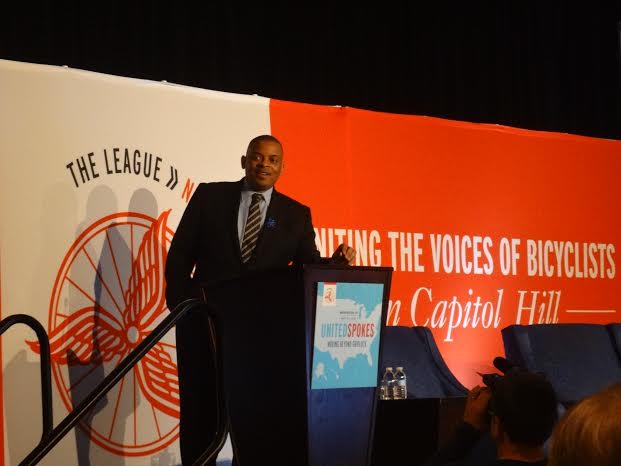
Indeed, US Transportation Secretary Anthony Foxx points out that nationally, a third of all bike trips are made by adults making under $30,000 and that the bicycle can have a substantial role in reducing the overall cost of living for the working class. But unfortunately lower class, non-white cyclists are also more likely to be in fatal collisions.

Speaking at the annual National Bicycle Summit in Washington, DC, earlier this month, Foxx, an African American former mayor of Charlotte, N.C., said that the federal government needs to devote more attention to making bicycling part of everyday life for the working class. Emphasizing the need for safety and convenience, Foxx was especially enthused about cycletracks — bikeways that are fully separated from automobiles and offer space for women, children, and older Americans to safely navigate cities by bike.

Foxx’s address followed a day of equity-themed panels and plenaries attended by more than 700 people. The League of American Bicyclists, focused on lobbying Congress and the White House, announced a new equity agenda to reach out to women, people of color, and to focus on reinvigorating a more progressive and egalitarian tone for bicycle advocacy.

Social justice advocates and community organizers had a strong presence at the summit, which has historically reflected a whiter, upper-middle-class male constituency. One presenter discussed bicycling and women’s prison rehabilitation, sharing how women who suffered from abuse, drug addiction, and imprisonment found bicycle riding to be normalizing and helpful for personal growth and for managing depression and anxiety.

A panel session titled “Learning from Los Angeles” showed how advocacy for bicycling can also come from community-based organizations, not just bicycle groups. Social justice issues are fundamental to LA’s inner city bicycle movement; over a third of South Central Los Angeles households are car free, and community organizers there have made a clearer connection between economic inequity and environmental problems.

Advocates from New York City chimed in that it was time for a “minority bicycle coalition” to advocate for women, minorities, and immigrant bicycle delivery workers. They pointed out that New York’s new and much-vaunted bike infrastructure has mainly spread in more affluent, white parts of Manhattan and Brooklyn, while Queens is overlooked. A speaker from the NAACP put obesity and public health at the center of the civil rights agenda and remarked on how the bike lifestyle should be brought to African American neighborhoods.

A discussion of emerging bike share systems asked how to expand to minority populations, and provided examples of how Boston subsidizes bike share membership for low income members. Boston also relaxes the charges for exceeding 30-minute rides and is figuring out ways to enable those without credit cards to participate.

Once a cynic about bike share, I experienced firsthand the benefits of a truly extensive, practical bike share system in Washington, DC (note to San Francisco — it was NOT covered in Wells Fargo or Google corporate logos). If bike share is extended to the Excelsior, Bayview, Balboa Park, Daly City, and SF State, it will work for the working class and students.

One of the most inspiring personas at the Bike Summit was Terry O’Neill, director of the National Organization for Women, who asked that bicycle advocates get beyond simply advocating for bikes. O’Neill prodded cyclists to ask: What do we need to do to make bicycling useful to women? And then she laid it out eloquently. Build affordable housing — lots of it — in areas where it is most needed, such as affluent Montgomery County, a suburb of DC, or in places like Hayes Valley and Silicon Valley. By creating the spatial proximity that makes cycling practical, women (and men) can incorporate cycling while balancing jobs, household chores, and children. This would do more to increase bicycling (and equity) than simply striping new bike lanes.

Her point is that for cycling to be logical for women, especially in complex metropolitan areas like DC or the Bay Area, well-planned and centrally located affordable housing is key. Perhaps it is time for the San Francisco Bike Coalition and Silicon Valley Bike Coalition, with their wealth of talent and donors, to create staff positions focusing on the bicycle-housing nexus and build strong partnerships with those who are fighting to build and preserve affordable housing in job- and amenity-rich areas.

Dovetailing from that, the newly elected mayor of Pittsburgh, Bill Peduto, himself a convert to bicycling, urged bicycle advocates to be an active partner in local progressive political coalitions and to work with non-bike groups such as labor unions and housing advocates. Peduto was among a handful of prominent politicians, mostly mayors and members of Congress, espousing the wisdom of linking bicycling and equity as part of the urban agenda.

The overall message is clear. Cities need to move beyond the neoliberal creative class storyline about bicycling, which says that a successful city is one that has a youthful, fit, but affluent stratum for bicycles. We need to be careful about praising the bicycle as a profitable economic development strategy for Realtors who up the rent as part of a commodified package of livability.

Sure, it’s great to see a bike lane on mid-Market, and there should definitely be more. But a successful city is not one where developers and Realtors see bike lanes and gentrify the neighborhood. A successful city is one where working class women feel safe to bike, where teachers, construction workers, and nurses can use the bicycle for many local trips, where African Americans and Latinos feel included in the bicycling movement, and where service workers and immigrants can safely maneuver the city and region by bicycle without fear of being hit by a car or truck. And the true mark of success is when all of these people can afford to live in the city and travel by bicycle.

On the Rise: Major Powers & the Lo-Fi Symphony

4

Surefire way to stand out in the musical landscape right now: Have an obviously playful, self-aware, lyrical sense of humor about your music, and also be exceedingly good musicians, songwriters and entertaining live performers — i.e., take it seriously without taking it too seriously. It’s not easy to do, but man, do Major Powers & the Lo-Fi Symphony make it look fun.

Pianist Nick Powers and brothers Kevin and Dylan Gautschi, on guitar and drums respectively (they all sing), are from the North-East Bay towns of Crockett and Port Costa, where they all grew up playing in bands from a young age. But it wasn’t until the trio formed in 2011 that the Major Powers sound emerged, fully formed, ready to conquer the world — or, at least, the eardrums of anyone who assumed there’d never be an heir to Queen’s glam-rock throne. When pressed, Powers says the band’s genre could be described as “Adventure Rock™” or “Mary Poppins meets Weezer” or “Freddie Mercury and Tom Waits in a cliff-diving competition” or “Danny Elfman making out with Indiana Jones while they play Dungeons & Dragons.”

Throw in an educated series of jokes about Russian history, sweeping musical theater-style choruses, They Might Be Giants-esque verbal gymnastics, and serious piano chops, and you get a grin-inducing live show, to say the least. The band gained traction with a few singles and a 7-inch last year, but they’re currently in the studio, hammering away on a full-length that they hope to tour with by the end of 2014 (working title: Now This Is Happening). In the meantime, you should catch them on March 26 at Slim’s and/or at BottleRock Napa at the end of May.

Where does the name come from?

Nick: I woke up from sleeping on the couch one night after my wife kicked me out of bed for snoring too loud. And I sat up and said, “the Lo-Fi Symphony.” The band was tossing that one around along with some other options. Then a week or two later Dylan (the drummer’s) girlfriend Alana says, “name it Major Powers & The Lo-Fi Symphony.” I like to make it clear to people that I didn’t name the band after myself. I think I’m awesome, but not that awesome. But what am I supposed to do, turn down a band name with my last name in it?

Weirdest thing that’s happened at a show?

I have a half-sister who likes to come to shows sometimes and yell at me that I’m fatter than Zach Galifianakis in between songs. I love her dearly. Also when we did a release at Slim’s last year, and another one at Bottom of the Hill before that, the front 10 or 15 rows were singing along with every lyric. That’s fucking awesome as fuck, and super-duper surreal.

Everyone loves Queen. Why aren’t there more Queen-inspired bands right now?

I think every music epoch has a zeitgeist. Musicians see some A-wave band hitting it big, so it behooves them to emulate that band. It makes financial sense. Nirvana starts blowing up, and then bands all around the world start getting their grunge on…the Lumineers play the Grammys with a two-minute hey-ho bridgeless Nu-folk anthem, and then like 600,000 Nu-folk urban prairie bands start storming the scene. There’s certainly a ’70s-blues-rock-swamp revival going pretty strong right now that was spurred on by some popular A-wavers. Right?

I think it’s great. It’d be easy to lament some ostensible groupthink mentality, but I don’t…also, whatever kind of music a band is playing is just basically the kind of music they like the most. It moves them.

Part 2 of the answer: Theatrical-style stuff is a little more dorky than your average whatever. It’s not as sexy or cool as a lot of genres, and the road to Cleveland is littered with the bones of sexy, dangerous band corpses. Singing about dorky shit for five minutes with intricate Disney melodies isn’t really a recipe for getting laid (a lot).

www.lofisymphony.com

Uber adjusts insurance policy in wake of fatal collision

0

Transportation Network Companies, more commonly known as “rideshares,” have operated in legal limbo regarding their insurance since their creation. This came to a head on New Year’s Eve with the death of six-year-old Sofia Liu, who was killed in a collision with an Uber car driven by a man named Syed Muzzafar. Uber claimed in a blog post that because Muzzafar was not ferrying a passenger at the time, and only using the app to search for fares, that he was not officially covered by their insurance.

That insurance gap left Muzzafar on the hook for the little girl’s death and the injuries of her family, the subject of a lawsuit that could end up seeking some $20 million in damages.

So far, Uber has not provided any compensation to Liu’s family. But it has revised its insurance policy, suggesting future collisions may be covered.

In a blog post, Uber announced that “in order to fully address any ambiguity or uncertainty around insurance coverage for ridesharing services,” it would expand drivers’ insurance “to cover any potential ‘insurance gap’ for accidents that occur while drivers are not providing transportation service for hire but are logged onto the Uber network and available to accept a ride.”

Uber’s new policy will cover up to $100,000 per incident for bodily injuries and $25,000 per incident for property damage. But the blog specifies that the money will not kick in if a driver’s personal insurance covers a collision, as appears to be the case with the New Year’s Eve incident.

In an interview with the San Francisco Chronicle, Uber CEO and co-founder Travis Kalanick said that the Syed Muzzafar’s personal insurance policy had offered to pay the claim, but had not yet followed through.

Uber’s spokesperson Andrew Noyes declined to comment when we asked him about this.

Notably, a coalition of rideshares including Lyft and Sidecar and a handful of insurance companies banded together to develop new insurance policies. The group’s work is ongoing, though the intent looks positive — new insurance policies specific to Transportation Network Companies developed by a coalition of industries would be a great step for driver, passenger and pedestrians alike.

But for now, commercial and personal insurance policies rarely, if ever, cover TNC drivers. And Uber’s new insurance? It’s great, as long as Uber follows through. (Joe Fitzgerald Rodriguez)

Indecisive Democrats let real-estate developers win

By a slim margin, the governing body of the San Francisco Democratic Party voted Wed/12 to oppose a controversial June ballot measure, Proposition B, concerning waterfront height limits.

The initiative would require city officials to get voter approval before approving new building projects that are taller than what’s legally sanctioned under a comprehensive waterfront land-use plan. Prop. B stems from an effort last November, authored by the same proponents, to reverse approval for a luxury waterfront development project called 8 Washington, which exceeded building height limits. In the run-up to that election, the DCCC sided against the 8 Washington developers, and aligned itself with those seeking to strike down the 8 Washington height-limit increase in order to kill the project.

But this time, under the leadership of chair Mary Jung — who is employed as a lobbyist for the San Francisco Association of Realtors — the DCCC came down on the side of powerful real-estate developers.

The vote was surprising to some longtime political observers, given that until recently the DCCC was known as a progressive stronghold in San Francisco politics. Its slate cards are distributed to Democrats throughout San Francisco, and Democrats make up the vast majority of city voters.

In a politically significant outcome, the DCCC’s opposition to Prop. B was decided by a slim 13 to 12 vote. The threshold for it to pass or fail was much lower than usual, because so many DCCC members simply refused to take a stand.

San Francisco Board of Supervisors President David Chiu — who not only opposed 8 Washington but helped gather signatures for the referendum to challenge it — was among those who abstained. Chiu’s decision to abstain sets him apart from Campos, his opponent in the upcoming Assembly race, who voted to endorse Prop. B. Had Chiu voted, Prop. B’s opponents would not have had the votes to get the upper hand.

When reached for comment, Chiu told the Bay Guardian he still hasn’t formed an opinion on the measure, and that he’s waiting on a pending city analysis and the outcome of a lawsuit challenging it.

“There’s been very little analysis and I could take money away from affordable housing and cost the city money fighting a lawsuit,” he said, citing the money that developers would be spending on political campaigns as the potential source of affordable housing money.

“I am open to supporting the measure, as someone who passionate about waterfront development,” he added, citing the lead role he took in opposing the 8 Washington project. (Rebecca Bowe)


Local support for national LGBT housing rights

At the Tue/11 Board of Supervisors meeting, Sup. David Campos introduced legislation to encourage large-scale developers to protect the housing rights of the LGBT community.

Same-sex couples nationwide are more likely to experience discrimination in their search for senior housing, a study by the Washington, D.C. based Equal Rights Center found.

To investigate, testers posed as gay or straight couples with otherwise nearly identical credentials, then submitted inquiries on senior housing in 10 different states. They discovered that in 96 out of 200 tests, those posing as lesbian, gay or bisexual residents experienced at least one type of adverse, differential treatment.

Meanwhile, according to the National Center for Transgender Equality, one in five transgender U.S. residents has been refused a home or apartment, and more than one in ten has been evicted, because of their gender identity.

Federal law does not expressly prohibit discrimination based on sexual orientation or gender identity. California law does, as do laws in 19 other states. Given these gaps in legal protection, real-estate providers can adopt their own policies to prohibit LGBT discrimination.

Campos’ proposal would require large-scale developers who wish to build in San Francisco to prove their commitment to equal housing opportunities.

“We want to know whether a developer hoping to build in San Francisco is protecting LGBT housing rights when they own or manage housing in states where legal protections don’t exist,” Campos explained. “By collecting this information, we can highlight best practices and urge those who do not have these policies to do the right thing.”

Cops on campus

0

Historic new protections are now in place for children facing police action in the San Francisco Unified School District.

Reforms include having a parent present when police question a child, tracking police presence in schools, and using a more lenient approach than simply dragging kids off to the police station or juvenile hall. All of these may be strengthened by a new memorandum of understanding (MOU) between the SFUSD and SFPD.

The MOU, passed by the Board of Education at its Feb. 25 meeting, places new restraints on police officers when they come into schools, with specific outlines for when schools should call police, board President Sandra Lee Fewer told the Guardian.

“It’s about changing student behavior, versus punishment,” she said. The agreement dovetails with the district’s new restorative practices initiative aimed to decrease reliance on suspensions to correct behavioral problems (see “Suspending judgment,” 12/3/13).

All sides say the MOU is strong, but one section was weakened shortly before it was voted on. In the final hour before the MOU was brought before the Board of Education, the police revised the language of the agreement.

One important word was changed in a section describing how police are to respond to student crime on school grounds: a “shall” became a “should.” Critics say that change transforms the contract from a legally binding agreement signed in goodwill to a mere suggestion of cooperation from the police.

“To a civilian, those are everyday words. To a police officer, they’re the difference between always and never,” Police Chief Greg Suhr told the Guardian.

At a Jan. 14 Board of Education meeting, members of Coleman Advocates for Children and Youth told the board that this contract was no mere suggestion: It is vital to the safety of children.

Kevine Boggess of Coleman Advocates worked on the agreement for over two years, explaining to the board why “shall” was so important: “We feel like this is something that’s necessary for this document to really stand true, to make sure students are treated with respect and not introduced to the criminal justice system.”

Boggess said cops need stringent rules. But to see why those rules are necessary, we need to revisit a dark day in San Francisco history, when police discretion turned a school brawl into a riot.


MELEE PROMPTS REFORMS

To those who remember, that day in 2002 is known as 10/11. Board of Education member Kim-Shree Maufus remembers that day well.

Maufus was sitting at work when her friend, a teacher, emailed her alarming news: Maufus’ daughter was in danger. She was a sophomore at Thurgood Marshall High School, and the entire school was under attack.

Barriers blockaded the streets around Thurgood Marshall and helicopters swarmed the skies. At least 100 armored officers stormed the school, weapons at the ready.

“They were beating them. When my daughter got on the phone, I couldn’t understand her. It wasn’t English. Later, I understood it was a nervous breakdown,” Maufus told the Guardian.

The book Lockdown High recounted the incident in which Maufus’ daughter and dozens of other students, as well as teacher Anthony Peebles, were batoned by police and injured.

The San Francisco Bay View’s article on the incident quoted a student who saw the violence escalate: “‘We were coming out of the office as the fight was going on, and an officer took his gun out at one of the students and told him, ‘Don’t make me use this,’ said Ely Guolio, a student. ‘I was shocked.'”

The police allege they responded to a riot, and although four students and a teacher were arrested, all charges were later dropped, according to a San Francisco Chronicle report from 2003.

In the incident’s wake, Coleman Advocates and other groups called for change. Proposition H was passed by San Francisco voters in 2003, reforming the Police Commission to provide better civilian oversight of the SFPD.

But negotiations around an MOU between the police and the school district stalled for years. The tensions between the two bodies were high.

“Police would come to schools and arrest students, saying the students were re-igniting incidents from Thurgood Marshall,” Maufus told us. “The Thurgood Marshall melee was absolutely the catalyst to get the conversation started on how to structure police on school property.”

In 2005, an MOU was crafted, but many viewed it as ineffectual. Although this new agreement between the SFPD and SFUSD has many strong new rules, one rule was weakened that pertains to the violence of 10/11.

The section in question reads: “Subject to the exception described below, when SFPD officers make a school based arrest they should (emphasis ours) use the graduated response system outlined below.”

The graduated response system sets rules for police officers when they enter a school to make arrests for low-level offenses. It’s a “three strikes” rule: the first offense warrants admonishment or counseling, the second offense asks for the same or a diversionary program, and the third recommends a juvenile be placed in probation or a community counseling program.

“It’s definitely less binding,” Fewer told the Guardian. “But the police chief would not sign it with more binding language.”

Suhr said he doesn’t want his officers restricted in an emergency. “You can’t take all discretion away from a police officer, and expect that officer to assume liability (for the situation),” Suhr said.

Some said the SFPD of today is easier on students than 12 years ago. Juvenile arrests are down, with just over 600 felony juvenile arrests in 2012 compared to 1,100 in 2003, according to SFUSD data.


COOPERATIVE APPROACH

Implementing a restorative justice model and new standards for police in the schools isn’t just a matter for the SFPD, but for individual school administrators as well, with Fewer noting that the SFUSD sometimes calls the police for routine disciplinary matters.

The Guardian profiled one such student in “Suspending Judgment,” telling the story of a school official who called on the police to discipline a kindergartner throwing a tantrum. Suhr agreed, “You can’t have police officers enforcing school discipline.”

The MOU now seeks to address that problem in a section directing school administrators to only call the police for public safety concerns and crimes. And though the MOU is not as ironclad as advocates may have wished, there are still many wins for reformers.

One of the authors of the agreement, Public Counsel’s Statewide Education Rights Director Laura Faer, said the new mandate for data collection is one of the key sections of this MOU. Now, the SFPD will report how many times officers have entered school grounds to arrest students.

“There will be a regular dialogue with the community about arrests,” she said. “It’s extraordinary.”

The agreement also has mandates for training with the SFPD on school policies. And, as Fewer reminded the Guardian, this is a living document. All parties now have new promises to live up to.

“This is the beginning,” Faer said, “this is not the end.”

Alerts: March 19 – 25, 2014

0

WEDNESDAY 19

Get educated with affordable housing experts St. Philip’s Church, 725 Diamond, SF. 7pm, free. Hosted by the Noe Valley Democratic Club, this public forum on (the lack of) affordable housing in the Bay Area will bring together a host of experts coming to the table from a variety of perspectives. Panelists will include Doug Shoemaker of Mercy Housing, Teresa Yanga of the San Francisco Mayor’s Office of Housing, Tim Colen of the San Francisco Housing Action Committee, Fernando Marti of the Council on Community Housing Organizations and Sara Shortt of the Housing Rights Committee of San Francisco. It’s a tight squeeze out there, but knowledge is power — and this is an opportunity to get educated, ask questions and join forces with longtime community members who are searching for answers. For more info, contact molly@ffrsf.com.


Meeting on the future of the Tenderloin Tenderloin Police Station, 301 Eddy, SF. 11am-noon, free. San Francisco’s Tenderloin neighborhood has been at the center of many community dialogues recently as rising rents have placed tremendous pressure on nonprofits and arts organizations in the surrounding area. Neighborhood residents, social service providers, arts groups, and local businesses may wish to attend this meeting, which will include presentations on the arts center at 950 Market Street, current projects associated with the Civic Center Community Benefit District, and other updates. For more information, call (415) 820-1412.


THURSDAY 20

How to deal with your debt once and for all The Green Arcade, 1680 Market, SF. www.thegreenarcade.com. 7-9pm, free. George Caffentzis — a contributor the newly released The Debt Resisters’ Operations Manual, and author of In Letters of Blood and Fire: Work, Machines, and the Crisis of Capitalism — will speak at the Green Arcade on providing tools for debtors everywhere who want to understand how the system really works. In the past 30 years, wages have stagnated nationwide and average household debt has more than doubled. This new book offers detailed strategies, resources, and insider tips for dealing with some of the most common kinds of debt, including credit card debt, medical debt, student debt, and housing debt.


SATURDAY 22

Bay Area Anarchist Book Fair The Crucible, 1260 7th Street, Oakl. 10am-6pm, free. www.bayareaanarchistbookfair.net. Now hosted in new East Bay digs, the 19th annual Bay Area Anarchist Book Fair is free and open to the public. It’s a gathering for folks who are interested and engaged in radical movements and organizing around social and economic justice. The book fair provides a space to connect, learn and discuss, through book and information tables, workshops, panel discussions, skill-shares, films, and more.

MONDAY 24

East Bay forum on raising the minimum wage Ed Roberts Campus, 3075 Adeline St. Berk. www.tonythurmond.com/march_24. 6-8pm, free. Join District 15 Assembly Candidate Tony Thurmond for an open panel on raising the minimum wage. With the state minimum wage to reach $10 in early 2016, this discussion will take into account that, as big of step that may be, it still won’t amount to a living wage for many Bay Area residents. Join in to have your say, share a personal story, and connect with community members who are pushing for higher wages across the board.

Last chance for Marcus Books, part of SF’s black history

36

OPINION

It’s taken decades, but the Mahattanization of San Francisco is nearly complete: The immigrants, artists, and natives who built the City and gave it its unique flavor can no longer afford to live here.

With San Francisco’s African American population largely banished to across the bay, along with the working and artists classes, the freethinking lifestyle that attracted so many people to the Bay Area in the first place has largely been and gone.

“What is crucial, is whether or not the country, the people of the country, the citizenry, is able to recognize that there is no moral distance between the facts of life in San Francisco, and the facts of life in Birmingham,” James Baldwin said on a fact-finding trip to San Francisco in 1963, at the height of the Civil Rights Movement, a time at which he would have also visited Marcus Books.

If buildings could talk, the Marcus Books property on Fillmore Street, the onetime “Harlem of the West,” would tell a tale of two cities for over 50 years. Once the jazz club Bop City (where John Coltrane, Charles Mingus, and Billie Holiday performed), the purple Victorian is central to a neighborhood that survived the internment and return of its Japanese American residents, a botched “redevelopment” project that resulted in the permanent displacement of African Americans, and a blueprint for a “Jazz District” that failed to launch.

Now the neighborhood faces a final act as the oldest seller of books “by and about black people” attempts to uphold a part of the history and culture it had a hand in creating, while the City looks away and toward tech as its future.

Every black writer and intellectual in the US knows the store; celebrities, activists, athletes, and literary giants — including Malcolm X, Rosa Parks, Muhammad Ali, Walter Mosely, Alice Walker, Oprah Winfrey, and Toni Morrison — have all passed through the doors of the San Francisco or Oakland stores.

Founded by Julian and Raye Richardson in 1960, their store served as a sanctuary for thinkers, authors, and community members during watershed moments, from the Voting Rights Act through the Black Power Movement and historic SFSU student strike in 1968 (resulting in the establishment of multicultural study programs which flourish at universities today).

Many of San Francisco’s African American faith, civic, arts, and culture leaders were educated through the program at State, either by the Richardsons or the books they stocked at Marcus. The Richardson family continues that tradition today at the bookstore, engaging visitors in discussions on the journey from Jim Crow to the first black president .

Yet for the past year, Marcus Books has struggled to survive. Community activists, elected supervisors, and appointed commissioners helped attain landmark status for the historic building, while attorneys brokered a buyback after the property was sold at auction and a fundraising effort was launched in December (see “Marcus Books can stay if it can raise $1 million,” SFBG Politics blog, Dec. 5). To contribute, visit www.gofundme.com/6bvqlk.

Marcus is not the only community-serving bookseller forced into crowdfunding and community organizing, diverted from its core mission to enlighten and educate. If a city’s bookstores are any indication of its cultural diversity and intellectual health, San Francisco is on the critical list.

The City’s last gay bookstore, A Different Light, was laid to rest three years ago; while our most progressive political book outlet in the Mission District, Modern Times, is on the brink (see “A Modern tragedy,” Jan. 7). A similar fate for Marcus Books would mean the end to a longstanding black-owned business in the Fillmore.

It seems “The City That Knows How” has forgotten where it came from. Baldwin’s 1963 quote may’ve been specifically about racist ways and laws, but a blow to Marcus Books could mean his message remains the same: San Francisco’s reputation as a kindly city of love, tolerance, and diversity will be forever tarnished; in fact, it may have been false advertising all along.

Denise Sullivan is the author of Keep on Pushing: Black Power Music From Blues to Hip Hop.

Feinstein, Pelosi, and NSA/CIA spying

1

EDITORIAL

Two of the most powerful members of Congress — Sen. Dianne Feinstein and Rep. Nancy Pelosi — are from San Francisco. They’ve each spent much of their long tenures in Congress serving on the Intelligence Committees in their respective houses, overseeing the increasingly overreaching surveillance state. And they’re now in positions to do something significant to rein in the National Security Agency and Central Intelligence Agency, if they can move from statements of outrage to actions of courage.

Feinstein is at the center of the latest national security controversy, criticizing the CIA for spying on her Senate Intelligence Committee staffers as they researched legislation to expose and rein in the CIA’s interrogation and torture policies. Apparently, Feinstein doesn’t like being subjected to the same kind of blanket NSA surveillance that she’s been defending, so perhaps this is a welcome lesson for her.

Pelosi was also in a key oversight position when this illegal wiretapping by the federal government began under then-President George W. Bush, something we and others called her out for at the time (see “Pelosi knew about warrantless spying,” 1/25/06).

Pelosi’s defense then was “I objected in writing” when she was briefed on the federal government’s overreaching surveillance operation, something that falls far short of what we would expect from someone who regularly get vilified by conservatives as epitomizing San Francisco’s liberal values.

Now is the time for San Francisco’s most powerful congressional representatives to represent our values, and those of the rest of civilized world that has condemned US surveillance programs that violate international law and cultivate backdoors and other weaknesses in this country’s critical cybersecurity infrastructure.

Feinstein should introduce bipartisan legislation, possibly co-sponsored with Sen. Rand Paul, a libertarian Republican who also has expressed concerns about the security state, to repeal the USA Patriot Act, the post-9/11 bill that gave vague license to many of the current excesses.

Pelosi and Feinstein should also pressure President Barack Obama to accept all or most of the 46 important reforms recommended by his commission on government surveillance, even if starts a fight that costs party unity in the short term.

“In our view, the current storage by the government of bulk metadata creates potential risks to public trust, personal privacy, and civil liberty,” the commission wrote in its report to Obama, which was released in mid-December.

Obama has already expressed concerns about the Democratic Party losing ground in this year’s mid-term election because of apathy among Democratic voters, but a bold break from the imperial presidency of the Bush era could be exactly what the party needs to fire up the base.

Yet more important than such political considerations, it’s simply the right thing to do, and something that Feinstein, Pelosi, and the Bay Area’s other congressional representatives should be vigorously pushing.

Democracy for none

0

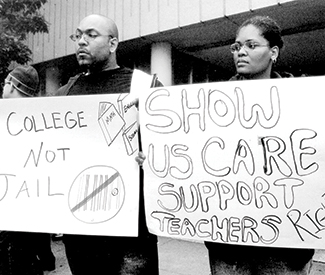
Democracy is dead at City College of San Francisco. At least, that’s what student protesters allege.

At a rally on March 13, over 200 student and faculty protesters marched at City College’s main campus to call for the resignation of state-appointed Special Trustee Robert Agrella. When City College was told it would soon close, the city-elected Board of Trustees was removed from power, and the state gave Agrella the power to make decisions unilaterally.

Agrella is not beholden to board rules, and now makes policy decisions behind closed doors: No public meetings are held and no public comments are solicited.

His decisions have proved controversial. Students are concerned that fast-tracked decision-making and new billing policies will create new barriers for students with few other educational options. But with no public forum to express their outrage, students took to the pavement.

The protesting students were met by police aggression, and in the aftermath of the clash two students were arrested — one was pepper sprayed, and the other suffered a concussion, allegedly at the hands of a San Francisco Police Department officer.

Both SFPD and CCSF police were on hand for the protest.

Controversy is now swirling around Agrella, school administrators, and the students involved. But lost among questions about police violence are larger policy concerns. When will democracy, that critical right to have a say in significant decision-making on campus, return to City College?

Critics say City College is compromising its core mission in its fight to remain open and accredited, slashing access for students and curtailing democracy in the name of reform.

“To be excluded and ignored and disenfranchised is simply unacceptable,” said faculty union president Alisa Messer.

bgad

BEFORE YOU READ ON: Check out our beta multimedia version of this story.

(Or you can read the plain text version below)

PEPPER SPRAYED AND INJURED

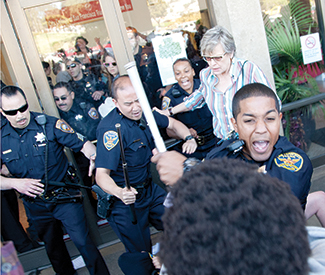
The protest began as students marched across City College’s main campus in an open space designated by college officials as a “free speech zone.” They headed toward an administrative office building, Conlan Hall, where students freely conduct business every day. However, the administration locked the doors on the protesters.

In response, the students inside unlocked them. When the protesters tried to enter this public building, they were met with resistance from campus police and the SFPD.

Otto Pippenger, 20, who was at the front of the protest, was dragged to the ground by multiple officers and allegedly punched in the head by an SFPD officer, an incident caught on video and recalled in eyewitness accounts.

His mother, Heidi Alletzhauser, told the Bay Guardian that Pippenger had since received medical attention. She said he’d suffered a concussion, contusions from where his head hit the concrete, injuries to both wrists, and broken blood vessels in his right eye.

Dimitrios Philliou, 21, was tackled to the ground and pepper sprayed in the face. In a video interview shortly after the incident, he recalled what happened.

“I asked [officers] what law I broke and neither could give me an explanation. They proceeded to tackle me to the ground,” he said.

In the end, Philliou was charged with misdemeanor “returning to school,” described as trespassing by the Sheriff’s Department. Pippenger was charged with two misdemeanors: resisting arrest and battery on emergency personnel.

The students were released the following morning (March 14), before sunrise. Philliou was issued a citation and released, and Pippenger made bail and was released, according to the San Francisco Sheriff’s Department.

The City College faculty union raised over $1,000 towards Pippenger’s $23,000 bail. He will face arraignment March 19, two days after the Bay Guardian goes to press.

In an emailed statement, City College Chancellor Arthur Q. Tyler described the clash between protesters and police as the fault of the protesters who tried to enter the building.

“I am saddened to see students engaging in violent outbursts,” he wrote.

City College spokesperson Peter Anning said the school regretted the actions of the most violent officers. “There was one police officer with the SFPD, not [City College Police], whose behavior was more forceful than need be,” he said.

Philliou said he just wanted to be heard.

“We just want to have a conversation with Bob Agrella,” he said in a video interview with the college’s newspaper, The Guardsman. “It’d be nice if he would talk to us, like a real human.”

But so far, the students have been met with silence.


DEMOCRACY NOW

Agrella does not hold public meetings or take public comment on his decisions, but he posts public agendas in accordance with the California Brown Act. In the past, he’s called these posted agendas “meetings,” and dubbed email feedback as “public comment.”

Messer was critical of the practice. “Apparently these meetings are happening in the special trustee’s head,” she said, “and an email counts as public comment. No one agrees that [email] comment is public.”

In the past, public comment has meant speaking aloud at a meeting in a room where not only could everyone hear you, but every word was broadcast on television and on the web.

City College Board of Trustee public meetings used to be archived online for the world to see. Now only Agrella’s eyes see the concerns of the college community.

Pressed on whether these agendas and emails could count as public meetings, City College spokesperson Larry Kamer said, “I can’t answer that question because you’re getting into matters of legal interpretation. I’m not a lawyer.”

The Board of Trustee’s meetings were not always the most shining examples of democracy, he said.

“When Dr. Agrella was appointed as special trustee with extraordinary powers, it was precisely for the purpose of expediting decision making,” Kamer said. “The idea of expedited decision making and board meetings that go until one or two in the morning are usually incompatible.”

But City College Trustee Rafael Mandelman said some of the tension around the changes at City College could be diffused by letting the public vent, well, in public.

“I’d much rather have people jumping up and down in public comment than having an assault at Conlan Hall,” he said.

At a City Hall hearing held by Sup. David Campos the day after the protest, many students decried a loss of democracy at the school. Campos will soon introduce a resolution to the Board of Supervisors calling for the reinstatement of the City College Board of Trustees.

Students’ concerns about the college, voiced at rallies instead of public forums, have proven as diverse as the students themselves.


THE COLLEGE TRANSFORMS

The same day protesters clashed with police at the main campus, Chinese Progressive Association lead activist Emily Ja Ming Lee led a student protest at the college’s Chinatown Campus.

The population there is traditionally older, with fewer English speakers than the general student body.

“We’re worried about the impact on the immigrant communities, the free English as Second Language classes, and vocational training,” Lee told the Guardian. “We partner with City College to run a hospitality training program so immigrant workers can get good jobs. We’re concerned about how City College will serve its immigrant workers.”

That concern has been intensified by a new restrictive billing policy that’s impacting lower income students.

The school has started to require up-front payment for classes, rather than billing students later. The change may shore up the college’s bank account in the short term, but many financially strapped students dropped their classes due to an inability to pay.

Itzel Calvo, a student who is an undocumented citizen, said at the City Hall hearing, “I was not able to enroll in classes this semester unless I paid thousands of dollars in tuition up front, even before the classes started. I can’t afford that.”

The Chinese Progressive Association has also raised concerns about changes to the college’s educational plan.

Over the course of four months, City College will formulate an educational plan to determine which classes deserve funding, and which don’t. This process usually takes a year. But with the accelerated process and lack of outreach, Lee’s worried that English language learners and vocational students will be sidelined.

“Our students don’t fit into a traditional model of what community colleges look like,” she said. “They’re not looking to transfer to a four-year university, necessarily.”

Focusing on transfer students moving from community colleges to four-year universities is part of a state policy known as the Student Success Initiative. In a lawsuit against the Accrediting Commission for Community and Junior Colleges, City Attorney Dennis Herrera alleges that the ACCJC’s agenda of pushing this initiative was the driving force behind trying to close City College.

The college’s students rallied against those changes for years. Yet Agrella is enforcing the Student Success Initiative. “My job is to play within the rules and regulations of the ACCJC,” he told the Guardian in an interview a few months back.

On campus, concern is growing that changes made to appease the ACCJC may disenfranchise City College students in greater numbers. But worst of all, without public meetings or public comment, the college’s students may not get a chance to advocate against those changes before it’s too late.

SF bans water bottles

27

San Francisco continues to lead the way in the nation’s environmental policy, with the Board of Supervisors on March 4 voting unanimously to bar the city from buying plastic water bottles and to ban distribution of plastic water bottles smaller than 21 ounces on city property starting Oct. 1. The ban excludes city marathons and other sporting events.

"We all know with climate change, and the importance of combating climate change, San Francisco has been leading the way to fight for our environment," Board President David Chiu, who authored the legislation, said at the hearing. "That’s why I ask you to support this ordinance to reduce and discourage single-use, single-serving plastic water bottles in San Francisco."

Chiu held up a water bottle at the board meeting, a quarter of the way full with oil, to illustrate how much oil is used in the production and transport of plastic water bottles. He also reminded San Franciscans that the current fad of buying bottled water only started in the 1990s when the bottled water industry mounted a huge ad campaign that got Americans buying bottled water.

Somehow, Chiu noted, "for centuries, everybody managed to stay hydrated." (Francisco Alvarado)

Mass action against Keystone XL

Nine environmental activists were arrested in San Francisco for marching through the financial district and entering One Spear Tower on March 3, the building that houses local offices of the State Department, to express opposition to the proposed Keystone XL pipeline.

A day earlier, a mass protest against the oil pipeline was staged outside the White House in Washington, D.C. Roughly 200 protesters were arrested after using plastic zip ties to lock themselves to the White House fence.

Meanwhile, thousands more have made a vow — at least in the sense of clicking to add their name to a petition — to engage in peaceful civil disobedience if President Barack Obama grants ultimate approval for the oil infrastructure project, which would transport 830,000 barrels of crude oil from Canada to the Gulf Coast.

Nonprofit Credo Action has created an online petition urging people to get ready to respond with peaceful civil disobedience if the pipeline wins final approval. (Rebecca Bowe)

City weighs lawsuit over Airbnb

The San Francisco City Attorney’s Office is finally preparing to take action against the illegal short-term housing rentals facilitated by Airbnb, something we’ve been hearing that the Examiner also reported on March 6 ("SF landlords could face legal fight over rentals on Airbnb, other services"), an action that would address the company’s apparent stall tactics.

Despite a business model that violates a variety of San Francisco laws — most notably zoning, planning, and tenant regulations — and Airbnb’s flagrant flouting of a two-year-old city ruling that it should be collecting and paying the city’s transient occupancy tax (see "Into thin air," Aug. 6), the City has appeared unwilling or unable to enforce its laws or address these issues.

"We’re aware of multiple housing allegations, including some that community leaders have brought to us," City Attorney’s Office spokesperson Matt Dorsey told the Guardian, confirming that the office is considering taking legal action to enforce local laws governing short-term housing rentals but refusing to provide details.

Board of Supervisors President David Chiu took on the problem over a year ago, working with the company and its critics to develop compromise legislation that would legalize and tax the activities of Airbnb and its hosts, but the multi-layered legal and logistical challenges in doing so have so far proven too much for the otherwise effective legislator.

"My staff has held meetings with Planning staff and its enforcement team to discuss enforcement and related challenges. We’ve also been in touch with the City Attorney’s Office on these issues," Chiu told the Guardian, saying he and his staff have recently been focused on other tenants and secondary unit legislation, but they "plan to refocus on our shareable housing efforts soon." (Steven T. Jones)

Blaming pedestrians

ABC7 News Investigative Team’s new "investigative report" on pedestrian safety stirred controversy last week as street safety advocates called out the video for its insensitivity towards pedestrian deaths and lax attitude towards unsafe drivers.

Streetsblog SF and others in San Francisco said the report engaged in "victim blaming."

ABC7’s pedestrian safety coverage comes on the heels of a number of high-profile traffic collision deaths, including that of 6-year-old Sofia Liu, killed on New Year’s Eve. Since then, the Walk First program to create safer streets has garnered more attention, culminating in Mayor Ed Lee’s announcement today to partially fund safety improvements to the city’s most dangerous intersections, to the tune of $17 million — improvements that languished due to funding gaps since the program was announced in April.

But making all the needed improvements though would cost $240 million, according to city estimates, and that funding has yet to be identified. Suffice to say, the traffic enforcement debate still rages in San Francisco, with emphasis on the word ‘rage.’

"We’ve seen ‘blame the pedestrians’ from police and in the media," Leah Shahum, executive director of the San Francisco Bike Coalition, said at a pedestrian safety hearing in January. Police Chief Greg Suhr that night apologized for his officers’ lax enforcement of drivers, and focus on pedestrians, and pledged to change policies to focus on drivers going forward.

It’s too bad ABC 7’s I-Team didn’t get that memo.

"In San Francisco, simply stepping off the curb can be deadly," ABC reporter Dan Noyes narrates in their video report. The word ‘deadly’ is capped off with a Hollywood-style musical flourish, like a horror movie moments before the big scare.

"Pedestrians are making mistakes over and over again," Noyes narrates. The video cuts to pedestrian after pedestrian looking at cell phones, jaywalking, or otherwise engaging in unsafe behavior. It’s fair to say the piece, headlined "I-Team investigates what’s causing pedestrian deaths," places responsibility of pedestrian safety squarely on the shoulders of pedestrians. (Joe Fitzgerald Rodriguez)

High-speed challenges

The California High Speed rail project has been facing resistance that threatens to derail the project. Not only has public support for the $68 billion project wavered in recent years, now the project faces a legal battle that could delay the project before the first rail is laid.

On March 4, Sacramento County Superior Court Judge Michael Kenny ruled that a lawsuit brought on by King County can go to trial. The lawsuit raises questions about the legality of using 2008’s voter-approved Prop 1A funding, $9.95 billion worth of bonds, to upgrade and electrify Caltrain’s tracks and incorporate them into the high speed system.
Another concern was that the proposed high-speed system would not be able to pull through with its promise of a 2 hour 40 minute nonstop ride from downtown San Francisco to Los Angeles’ Union Station if the high speed system had to share tracks with Caltrain.

The lawsuit also threatens to leave San Francisco’s new $4.5 billion Transbay Terminal without its planned underground high speed rail station, which could be disastrous for that project as well.

None of this seems to faze Rod Diridon, executive director of the Mineta Transportation Institute based out of San Jose State University and former founding board member of the California High-Speed Rail Authority Board. He told the Guardian: "I think that [the project] will happen now. I think that our wonderful governor and our legislative leaders are going make it happen now…. If it was delayed it would only be a matter of time before it came back." (Francisco Alvarado)

Alerts: March 12 – 18, 2014

0

WEDNESDAY 12

San Francisco Neighborhoods on the Brink Bird and Beckett Books and Records, 653 Chenery, SF. www.birdbeckett.com. 7pm, free. A panel discussion on displacement, gentrification, rising rents, and the loss of affordable housing. Join us to discuss the dilemma facing longtime residents and renters of modest means — and the gutting and gentrification of San Francisco — as real-estate speculation and a quickly widening income gap drive rents to dizzying heights while the rental supply dwindles. Ellis Act evictions are buffeting many of our neighbors, and the lack of affordable housing affects us all.


THURSDAY 13


Screening: Terms and Conditions May Apply Unitarian Universalists Hall, 1924 Cedar, Berk. www.bfuu.org. 7pm, $5-10 donation, no one turned away for lack of funds. Have you ever read the “Terms and Conditions and Privacy Policies” connected to every website you visit, phone call you make, or app you use? Of course you haven’t. But those agreements allow corporations to do things with your personal information you could never even imagine. What are you really agreeing to when you click “I accept”? Find out in this disquieting exposé.


FRIDAY 14


Visual Activism Symposium Brava Theater Center, 2781 24th St., SF. www.sfmoma.com/events. 9am-7pm, free with pre-registration. Join us for a symposium exploring the relationship between visual culture and activist practices. Art can take the form of political and social activism, and activism often takes on specific, and sometimes surprising, visual forms. How is our broader visual culture shaped by activist practices that circulate in public space? Scholars, artists, and activists address these and related questions in a series of presentations, performances, workshops, and interactive projects.

SATURDAY 15  

International Day Against Police Brutality Arroyo Park, 7701 Krause, Oak. www.march15oak.noblogs.org. 12pm, free. March 15th has been designated as International Day Against Police Brutality since 1997, as an initiative by radical groups in Montréal and Sweden. Police brutality is nothing new to Oakland, and for the second year in a row we will observe the International Day Against Police Brutality with a demonstration beginning at Arroyo Park in east Oakland. A rally will start at noon, followed by a march starting at 1pm.

SUNDAY 16

Anonymous Internet Communication Niebyl Proctor Marxist Library, 6501 Telegraph, Oak. cuyleruyle@mac.com. 10:30am-12:30pm, free. It’s no secret that the NSA was and is secretly spying on people here at home and around the globe. The justification given for this activity is that it can prevent terrorism and crime. While we wait for Congress or the courts to do something, we can right now actively protect our individual privacy, using freely available technical tools and best practices. Keith Davis will discuss the motivations for Internet Anonymity and the different levels of privacy that can be obtained. He also will provide caveats and warnings associated with the use of privacy tools and practices.

Soda tax is social justice issue

129

Eric.L.Mar@sfgov.org, John.Avalos@sfgov.orgtom@tomammiano.com

OPINION

We are fighting for a soda tax because public health leaders have sounded the alarm that sugary drinks are a serious threat to our public health. Now is the time to get the word out about the latest facts that tell the story.

Our work on the issue began when community leaders and medical experts started educating us on the impact of sugary drinks. The resulting legislation that we crafted along with four other members of the Board of Supervisors will not only slow soda consumption, but it will fund the anti-hunger and physical activity programs we dearly need.

Most folks know soda is bad for you, but not how bad. Many are also unaware that Big Soda is specifically targeting communities of color and children. Our task is to spread the word about the health disparities this creates.

The lack of healthy food choices is an injustice that is hitting communities of color the hardest. Fully three-fourths of adult Latinos and African Americans in San Francisco are obese or overweight and one in three Americans will soon be diabetic, including one in two Latinos and African Americans.

The disparities are geographic as well. The highest rates of diabetes hospitalizations and emergency room visits are among residents of the Bayview, Tenderloin, SoMa, and Treasure Island. Close behind are the Excelsior and Visitacion Valley. These are also the neighborhoods that lack access to healthy food and are among those consuming the most soda.

We are already paying the high price of soda consumption. San Franciscans spend at the very least $50-60 million a year in health care costs and sick days due to obesity and diabetes attributable to sugary drinks. The fact that sugary drinks are the biggest single source of added sugar in our diets sets it apart from other unhealthy foods.

The revenue generated has tight controls and must be used to mitigate the harm Big Soda causes. Steered by an independent committee and targeted to communities suffering the most from health inequities, the tax will bolster funding for everything from school meals, healthy food retailer incentives, physical education, and other deserving programs.

Big Soda has hired high-priced lobbying firms and public relations folks who are employing a small army of young people, deploying them into the Bayview, the Mission, and Chinatown — those communities most impacted by diabetes and soda consumption. They’ve set up a front group — San Franciscans for an Affordable City — to capitalize on the anger in SF about the cost of housing and living.

But think about it: Have Big Soda companies helped us in our fight for affordable housing? Are they fighting for a living wage for communities of color in San Francisco? They have never cared about an affordable city. They care about protecting their profits, period.

We need affordable housing, healthy foods, and physical activity — issues we are working on every single day. On the other hand, our communities need affordable soda as much as we need cheap cigarettes and booze. It only makes us sick.

There are things our communities are doing to promote good health, like transforming corner stores into healthy retailers, building community gardens, and expanding physical and nutrition education. The soda tax as it is written now can provide these programs and dramatically improve our communities’ health.

This isn’t a ban but a reasonable first step to decrease soda consumption. This is a research-proven way of getting people to use less of an unhealthy product — it worked with cigarettes and it worked with alcohol. Finally, the tax will fund a range of great programs that will actually provide healthy choices for everyone.

It’s time we make the healthy choice the easy choice for low-income communities and all San Franciscans.

John Avalos represents District 11 (Outer Mission, Excelsior) and Eric Mar represents District 1 (the Richmond District) on the San Francisco Board of Supervisors, Tom Ammiano represents Assembly Dist. 17 (eastern San Francisco) in the California legislature.


Glimmers of sunshine

3

rebecca@sfbg.com

For 29 years, San Francisco Bay Area journalists have gathered in mid-March — around the birthday of founding father and free-press advocate James Madison — to recognize reporters, attorneys, citizens, and others who fight to shake or keep information free.

The act of standing up to defend the principle of freedom of information can be rather unglamorous, sometimes leading to grueling lawsuits. It’s grown even more complicated with the rise of the Internet, the decline of traditional newspapers, and the dawn of an Information Age that delivers instantaneous material that is at once more slippery and abundant than ever.

And yet, the digital realm has opened up a whole new battlefield in the fight for open access to relevant information the public needs to know. This year, the Northern California chapter of the Society of Professional Journalists’ Freedom of Information Committee took the rare step of granting a posthumous Public Service James Madison Award to Internet activist Aaron Swartz.

As a leader in the digital rights movement, Swartz, who died at the age of 26 by taking his own life, was on the forefront of a movement that fought to uphold open access to information in the face of a corporate power grab that threatened to result in online censorship.

The fight against SOPA (the Stop Online Piracy Act) and PIPA (the Protect Intellectual Property Act) in early 2012 marked just one of Swartz’s accomplishments as he fought for free and open access to information. Among his other contributions was RECAP, an online listing of court materials that allowed free access to documents held in the federal, paywall-protected court filing system called PACER.

To commemorate Swartz’s work, the Bay Guardian presents in this issue an illustrated history of his activism. While recipients of James Madison Awards have typically been individuals who took on government bureaucracies to wrest information out of the shadows and into the public eye, Swartz’s battle revolved around freeing information that is locked up by private interests, or protected by copyright.

“We need to take information, wherever it is stored, make our copies and share them with the world,” he wrote in a 2008 essay titled “Guerilla Open Access Manifesto.” “We need to take stuff that’s out of copyright and add it to the archive. We need to buy secret databases and put them on the Web. We need to download scientific journals and upload them to file sharing networks.”

But first, here are a few updates on the fight for open access to information in San Francisco and beyond.


NO SHINING EXAMPLE

In 1999, San Francisco voters enacted a law to strengthen citizens’ access to government records and public meetings. To ensure that the open-access law was properly upheld, it also created a local body called the Sunshine Ordinance Task Force.

At each meeting, San Franciscans frustrated by their inability to get the information they sought from city bureaucracies appear before the board to air their grievances, in the hopes that the decisions to withhold documents will be reversed. Typically, citizens lodge around 100 complaints per year, according to task force clerk Victor Young.

But the Sunshine Ordinance Task Force has not been going at full speed for some time now. There’s a backlog of 62 cases, in part because the body could not legally meet for five months in 2012 because it did not have a member who was physically disabled, in accordance with the law establishing criteria for who can serve. (The previous member to meet the criteria, Bruce Wolfe, was denied reappointment. In an op-ed published in political blog Fog City Journal, task force member Rick Knee links this and the Board of Supervisors’ general foot-dragging on Sunshine with a political skirmish dating back to 2011, when the task force found the Board of Supervisors to be in violation of the Sunshine Ordinance.)

There have been two vacant seats on the task force for around two years, as well as two holdover members whose terms have technically expired. Applicants have sought out those seats, but the Board of Supervisors Rules Committee hasn’t gotten around to appointing new members; the most recent appointment was made in October of 2012, according to Alisa Miller, Rules Committee clerk.

Come April 27, meanwhile, all of the current task force members’ terms will expire. Miller said she expects the Board of Supervisors to revisit nominations before the end of April. There are a grand total of 10 applications for all 11 seats. Given all of this, plus a lawsuit revolving around the city’s refusal disclose how the City Attorney’s Office advises agencies on Sunshine Ordinance interpretations, San Francisco is going through some dark days for open government.


NAVIGATING FOIA

Anyone who’s ever tried to request public documents from government officials under the Freedom of Information Act knows that it feels more like a bureaucratic nightmare than a federal right. But a new project from the Center for Investigative Reporting is hoping to streamline the entire process into a (relatively) painless procedure.

FOIA Machine (foiamachine.org) is a website to request public documents at the federal, state, or local level, and is described by its creators as the “TurboTax for government records.”

“We wanted to make the FOIA experience better for journalists,” said Shane Shifflett, a data reporter at The Huffington Post who helped build the tool. “We built up a prototype and applied for grants. Then we put it on Kickstarter and it went crazy. That gave us a lot of confidence to see it through to the end.”

On Kickstarter, FOIA Machine raised over $53,000 from more than 2,000 backers, more than triple its goal.

FOIA Machine allows registered users to prepare requests, search a database of contacts, track the status of a request, and work with a community of fellow users.

Shifflett considers the community aspect to be the site’s strongest feature. “It’s crowdsourcing, so as people create requests, they can add contacts into the database. Now there will be a history of who worked with who, and it makes the process of figuring out where to send requests so much simpler.”

The site is still in development, and users who try to register promptly receive an email asking them to “stay tuned” for information in the coming weeks and months. Shifflett said that the group hopes for FOIA Machine to be up and running by June.


LEAK US YOUR DOCUMENTS

From time to time, sources have told us at the Bay Guardian that they would love to share sensitive information for news articles, but fear they would be retaliated against or even terminated from employment if they were to do so.

We have found a way around that.

Sources who wish to retain their anonymity while sharing information they believe the public has a right to know now have the option of using an encrypted submission system to anonymously send documents to our news team.

Created by Bay Area technologists in partnership with the San Francisco Bay Guardian, BayLeaks uses the latest cryptography software to protect the identities of our sources. This is a secure, anonymous way for concerned citizens to communicate with journalists to release information.

Our system uses SecureDrop, a whistleblowing platform managed by the Freedom of the Press Foundation, and Tor, an online anonymity network that has gained the trust of Internet users around the world.

To learn more, visit sfbg.com/bayleaks-intro


MONEY IN POLITICS

It’s not really a secret that big money has a colossal influence on politics, but the groups and individuals that write those hefty checks to lawmakers often prefer to stay secret themselves. And while political donations aren’t illegal, most voters would like to know exactly who is funding a piece of legislation or a political campaign, and where that money is coming from.

Fortunately for us in California, we already have a resource to easily find that information.

“There’s a collective influence of money in our political system,” said Pamela Behrsin, spokesperson for MapLight, a nonpartisan research organization based in Berkeley that tracks the influence of money in politics. “Our founders said, ‘Look at all this money, and how this legislator voted on this bill. Do you think the money had any influence on how the legislator voted?'”

Through the website, users can also search by bill or proposition to find, for example, that big companies such as Philip Morris spent nearly $48 million to defeat Prop. 29, a proposed cigarette tax in California, on the June 2012 ballot. Supporters of the tax, such as the American Cancer Society and Lance Armstrong Foundation, could only muster a quarter of that amount.

“There’s a whole breadth of people wanting to understand the problem of money and politics,” Behrsin said. “This is one of the largest issues in our democracy right now. People are starting to stand up and say unless we get money out of our system, it’s going to be that much more difficult to fix.”

Lee must pay for his promises

19

EDITORIAL

Mayor Ed Lee has made a lot of promises to San Franciscans, but he has been unwilling to pay for them with money from the city or his wealthy backers, transforming these statements in hollow political platitudes — or, less charitably, calculated lies meant to mask the true state of the city.

Lee pledged to build 30,000 units of new housing — a third of it affordable to those with moderate incomes and below — by 2020. By that same year, Lee set the goal of increasing bicycling to 20 percent of all vehicle trips in the City. Lee also directed city departments to develop strategies for reducing pedestrian deaths by 50 percent by 2021. And so Muni’s aging fleet can keep up with population growth, Lee’s SF2030 Transportation Task Force said the transportation system needs a $10 billion capital investment over the next 15 years, a target Lee endorsed.

These were all admirable goals, and in each case, city agencies studied the problems and developed detailed strategies for getting there. And in each case, Mayor Lee chose to fund just small fractions of what the city would need to make his promises come true.

Actually, the housing problem is still being studied, but nobody thinks this goal will be met — as even the pro-development San Francisco Business Times said in a recent editorial — particularly given how the Mayor’s Office structured the business tax reform and Affordable Housing Fund ballot measures in 2012, with giveaways to developers and favored economic sectors, such as tech.

Lee’s WalkFirst program would need $240 million to meet his modest goals — far more to actually realize the VisionZero goal of eliminating all pedestrian deaths, which Lee said he supports — and the Mayor’s Office has only pledged $17 million in funding. The cycling goals would take more than $500 million, not the $30 million currently pledged. Even with approval of the two transportation ballot measure proposed for this fall, and those planned for future years, that only gets the city about a third of the way to meeting San Francisco’s future transportation needs.

Meanwhile, a downtown SF congestion pricing charge that has been studied using federal funds — which would reduce traffic and pedestrian deaths while raising $80 million annually — is being ignored by Lee, as is the once-promising idea of downtown transit assessment districts. Lee is refusing to seek the city’s share of the tremendous wealth now be generated in this city.

As a result, Lee is making promises that he knows he won’t deliver on. And last week, in the five-year budget projection his office is required to issue, we all saw the results of Lee’s economic policies: growing budget deficits for this booming city. Next year’s $67 million deficit is projected to balloon to $340 million by 2017-18. Mr. Mayor, “getting things done” requires more than just words, it requires the political courage to make your promises comes true.

They deported my mom

8

Eight months ago, I kissed my mother goodnight and walked down the hall to my bedroom. Eight months ago, I was a few weeks away from attending Seattle University. Eight months ago was the last time I saw my mom.

In the early morning, my sister barged into my room. Phone in hand and tears in her eyes, she said, “They got her again.” Sitting up in my bed, still half-asleep, it took me awhile to process what was going on. “Huh?” I replied. “Mom, she’s getting deported,” my sister sobbed. US Immigration and Customs Enforcement arrested her on the way to work. They had watched us until they knew my mom’s routine.

My sister left and I had a minute to think. From then on, I knew everything had changed. I wasn’t going to Seattle. How was I supposed to pay for it now? And my mom was getting deported. Again.

My mother came to the US in 1992. Her plan was to work for a few years and send money back to Mexico to support her parents. She also wanted to save money so she could return to Mexico and finish nursing school. But she met my father, a law school dropout who came to the US to work and save money for law school. Long story short, I was born and they decided to settle down here in the States. They knew that we had better opportunities in the US.


VULNERABLE TO SCAMS

Later, my parents decided that it was time to “become legal.” They sought the legal services of attorney Walter Pineda. He told my parents, and countless others, that if they had been in the country for longer than 10 years, had no criminal record, and had kids that were born in the US, he’d get them a green card in 12 months. Oh, and he wanted $10,000 per person. My parents couldn’t pay $20,000 at once for the both of them so they decided that my mom should be the first one to get a green card.

The thing is, Pineda wasn’t telling the truth. There was no such law that stated, “If you have been in the country for 10 years or longer, have no criminal record, and have kids who are US born, Uncle Sam will mail you a green card.” But Pineda took the money and filed an asylum claim for my mother. Since my mom wasn’t seeking asylum, the claim was denied. (It also didn’t help that Pineda never actually went to court, leaving that to his assistants). My mother was handed an order of deportation instead of a green card.

Pineda, a native San Franciscan and a graduate from San Francisco State University and the University of San Francisco, was later investigated by the State Bar of California and was accused by the bar of a “despicable and far-reaching pattern of misconduct.” He later resigned from the State Bar when he faced charges of legal malpractice in 41 cases he handled. Records indicate Pineda left the area, and our efforts to reach him for comment were unsuccessful.

After those legal avenues were shut down, our family ran. We moved from house to house. My parents lived in the shadows, like escaped felons. They got nervous each time they signed any paperwork for fear that it would alert ICE. We would gather around the TV every night and watch the news, hoping to hear that immigration reform was on its way. But all we ever saw was members of Congress shaking their heads and saying, “Not this year,” year after year.

I remember learning about what the plaque at the foot of the Statue of Liberty says, “Give me your tired, your huddled masses yearning to be free.” I thought about what a lie that was. My parents, and everyone like them, aren’t welcomed here. They’re “illegal aliens.” Me, and those like me, we’re “anchor babies.”

We moved some more. Years passed. We all forgot about the order of deportation. We bought a car, a dog, and a few years after that, we were thinking about buying a house. The American dream, my mom’s dream, was almost within her reach.


KNOCK ON THE DOOR

I was in the seventh grade; my sister was in third. I kissed my mom goodnight and went to sleep. At 3am, I heard a knock on the door and “police.” I opened it and there were two immigration agents. They were there to inform me that they were taking my mom and then left. 

As it turns out, they had been watching us for at least a few days because they knew that my mother leaves the house at 4:30am to go to her job as a sous-chef at a catering company. They knew my name.

A few months later, my mom was back. Yes, she returned illegally. But when your options are paying a guide $2,000 and walking a few hours or paying a lot more than $2,000 for a lawyer to file papers and then wait years with no guarantee that you’ll be let into the US, the choice for my mom was easy. Cross the border and come back to her kids.

More years passed, we moved some more. We forgot. Once again, ICE had been watching us. It knew where she worked. Her route. The license plate number on her car. Everything. Then, my mom was picked up on her way to her job at a fast food restaurant.

We called lawyers. “There’s nothing I can do,” was all they said. There was no hearing; no judge; no day in court; 24-hours later, my mom called me from a phone booth in Tijuana. That was eight months ago. My mother is still in Tijuana, unable to enter the US, legally or otherwise.

mom1

ILLEGAL PEOPLE

I will not deny that my mother has broken laws. I won’t deny the fact that the 11 million undocumented residents who are currently in the US have also broken laws.

But my mother, and others like her, were victims of predatory system. They were lured by a country that offers opportunities here and pursues policies that shut them down elsewhere. They turn to attorneys who, out of greed or spite, waste the time and money of many immigrants whose only intentions are to become “legal.” They live amid a citizenry that values the products of their cheap labor but denies their basic humanity.

Many others are victims of predatory employers, who have no second thoughts about forcing immigrants to work long hours in hazardous conditions, and even rape some employees, because they know that their worst nightmare is being deported, and separated from their loved one, rather than enduring the indignities of individual predators.

All of them are victims of a broken immigration system.

Many who face deportation, and who have been deported, were and are upstanding members of society. They have families, hopes, and dreams. Many, like my mother, have no criminal record, not even a speeding ticket to their names.

They pay taxes and support the Social Security system, knowing they will never be able to collect those retirement benefits or anything of the sort. Their only crime, my mother’s only crime, was that they, like so many millions before them, crossed an imaginary line to seek a better life.

Watchdogs in action

1

news@sfbg.com

The Society of Professional Journalists, Northern California, will honor the following James Madison Freedom of Information Award winners during a March 20 banquet. Details on their work and the dinner are available at www.spjnorcal.org.


VOICE FOR PRISONERS

Throughout his 29-year journalism career, Peter Sussman, a retired San Francisco Chronicle editor, advocated for greater media access to prisoners and fought to uphold the rights of inmate journalists. In the 1980s, federal prison officials cracked down on inmate Dannie “Red Hog” Martin for writing to Sussman to share what life was like behind bars.

The retaliation spurred an epic battle over free speech within prison walls, and Sussman responded by publishing Martin’s regular writings about prison life, and later co-authoring a book with him titled Committing Journalism: The Prison Writings of Red Hog.

In the mid-’90s, Sussman fought state prison officials’ restrictions on media interviews with prisoners. He also helped write and sponsor statewide legislation to overturn limits restricting media access to prisons. Sussman will receive the Norwin S. Yoffie Award for Career Achievement.


GUIDING ASPIRING JOURNALISTS

Beverly Kees Educator Award winner Rob Gunnison is a former instructor and administrator at UC Berkeley’s Graduate School of Journalism, where he arrived after spending 15 years covering government and politics in Sacramento for the San Francisco Chronicle.

As a longtime instructor of a course called “Reporting and Writing the News,” Gunnison has continued to educate hungry young journalists on how to seek public records and carry out investigative reporting projects.


EXPOSING ATROCITIES

Peter Buxton will be honored with the FOI Whistleblower/Source Award. In 1972, Buxton played a key role in alerting the press to the ongoing operation of the Tuskegee syphilis experiments, where African American sharecroppers were intentionally exposed to the disease, without treatment or their knowledge, so researchers could study its progression.

By the time the story was related to the press, 28 men had died of syphilis, and 100 others had died of related complications. That leak helped spur Congressional hearings on the practice beginning in 1973, ultimately spurring a complete overhaul of federal regulations. A class-action lawsuit was filed, resulting in a $10 million settlement.


EXPOSING BART’S SCHEME

Reporter Tom Vacar of KTVU pushed for records determining whether replacement drivers that BART was training to help break last year’s labor strike were qualified to safely operate the trains, eventually finding that they had been simply rubber-stamped by the California Public Utilities Commission.

Those findings proved gravely significant on Oct. 21 when two workers on the tracks were killed by a BART train operated at the time by an uncertified trainee, an accident still being investigated by the National Transportation Safety Board.


STANDING FOR SUNSHINE

California Sen. Leland Yee is once again being honored by SPJ Norcal for his work on sunshine issues, including last year criticizing Gov. Jerry Brown and other fellow Democrats who had sought to weaken the California Public Records Act, instead seeking to strengthen the ability of the courts to enforce the law.


FIGHTING THE CITY

Freelance journalist Richard Knee’s Distinguished Service Award caps a 12-year fight for open government in a city eager to stash its skeletons securely in closets.

Knee is a longtime member of the San Francisco’s Sunshine Ordinance Task Force, created in 1994 to safeguard the city’s Sunshine Ordinance, and he has fought to maintain its power and relevance.

Over the years, many city agencies have fought against the task force, from the City Attorney’s Office to a group of four supervisors who claimed the task force was wasting public money, a struggle that is still ongoing.


BADGES AND ACCOUNTABILITY

The Lake County News and its co-founders Elizabeth Larson and John Jensen will received a News Media Award for a protracted legal battle with local law enforcement for a simple journalistic right: interview access.

The scrappy local paper detailed allegations that Lake County Sheriff Frank Rivero and his deputies wrongfully detained suspects on trumped up charges, made threats, conducted warrantless home searches, and violated suspects’ civil rights.

Rivero’s office responded by blacklisting the paper from interviews, a fundamental building block of news coverage. The paper sued the Lake County Sheriff’s Department, eventually winning its battle to obtain the right to keep asking the sheriff the tough questions.


PROTECTING THEIR SOURCES

When Saratoga High School student Audrie Potts committed suicide in September 2012, her parents alleged she was pushed over the edge by cyber bullying over photos of Potts at a party. High school journalists Samuel Liu, Sabrina Chen, and Cristina Curcelli of The Saratoga Falcon scooped the sensational national media outlets that descended on the story, but they were subpoenaed by the Potts family to reveal their sources.

They refused, citing California’s shield law in a successful legal defense that strengthened the rights of student journalists. As Liu said, “We are not willing to destroy our journalistic integrity by giving up our confidential sources, we got this information on the condition of anonymity, from people that trusted us.”


BUYING FRIENDS AT CITY HALL

Bay Guardian News Editor Rebecca Bowe and Reporter Joe Fitzgerald Rodriguez are being honored with a Journalist Award for “Friends in the Shadows,” (10/8/13) our investigation of the shady ways that developers and other powerful players buy influence at City Hall.

“Their detailed and thorough account explored a trail of money through myriad city agencies and departments,” the awards committee wrote, noting how the paper “used public records, interviews and independent research to probe how developers, corporations and city contractors use indirect gifts to city agencies to buy influence.”


NEWS FROM INSIDE

For accomplishing “extraordinary journalism under extraordinary circumstances,” The San Quentin News is being honored with a News Media Award. It is California’s only inmate-produced newspaper, and one of the few in existence worldwide.

The San Quentin News publishes about 20 pages monthly, and has a press run of 11,500 for inmates, correctional officers, staff, and community members. It’s distributed to 17 other prisons throughout California.

Under the scrutiny of prison authorities, the inmate journalists and volunteers wound up covering a historic prison hunger strike, the overcrowding of the prison population, and the denial of compassionate release for a dying inmate, an octogenarian with a terminal illness.


EXPOSING TORTURERS

The Western Hemisphere Institute for Security Cooperation (WHINSEC), better known as the name it held prior to 2001, the School of the Americas, is a combat training school for Latin American soldiers and commanders, with many graduates going on to commit human rights atrocities.

School of the Americas Watch founder Judith Litesky, a former nun, and Theresa Cameranesi, filed a lawsuit in federal court in San Francisco seeking the list of those who had gone though courses that include counter insurgency techniques, sniper training, psychological warfare, military intelligence and interrogation tactics.

Last year, the pair won a significant victory when a federal judge in Oakland ruled that the government could not cite national security reasons in withholding the names. Although the case is ongoing, they are being honored with a Citizen Award.


FIGHTING CORPORATE SNOOPS

In 2008, journalists from The New York Times and BusinessWeek looked to Terry Gross of Gross Belsky Alonso for legal counsel in a case against Hewlett-Packard. In a staggering display of corporate snooping, the tech giant had illegally obtained private telephone records of the journalists, in an attempt to gain access to the identities of their sources.

Gross has also defended journalists against police in cases regarding media access for breaking-news events, and he’s helped to expand the rights of online journalists. This year, Gross will receive the FOI Legal Counsel Award.


BAD BRIDGE, GOOD JOURNALIST

Sacramento Bee Senior Investigative Reporter Charles Piller will be honored with a Journalist Award for exposing corrosion problems in the long delayed, cost-plagued eastern span of the San Francisco-Oakland Bay Bridge. His breaking story and subsequent follow-ups revealed Caltrans’ inadequate corrosion testing, as well as inadequate responses to bridge inspectors who for more than two years warned Caltrans of water leaks and corrosion — only to go unheeded.


SUNSHINE COLUMNIST

Editorial and Commentary Award winner Daniel Borenstein, who writes for the Bay Area News Group, issued a strong response to a legislative attack on California’s Public Records Act last year, ultimately helping to defeat proposed changes that would have gutted the law.

“Without the state Public Records Act, we would never know about the Oakley City Manager’s $366,500 taxpayer-funded mortgage scheme, the Washington Township hospital CEO’s $800,000-plus annual compensation or the retired San Ramon Valley fire chief’s $310,000 yearly pension,” Borenstein wrote in one of his columns. “We would be ignorant of broken bolts on the Bay Bridge, the cover-up of Moraga teachers sexually abusing students, a BART train operator who collected salary and benefits totaling $193,407, the former BART general manager who received $420,000 the year after she was fired or the Port of Oakland executives who spent $4,500 one night at a Texas strip club.”

Crooked cops

2

steve@sfbg.com

It’s a bombshell police scandal befitting San Francisco’s restive mood, dropping at a time when simmering class tensions have been making national news, and one more example of how the poor are getting trammeled by those with power.

As politicians and tech titans were trying to make the gritty central city more welcoming to corporations and their workers three years ago, a half-dozen plain-clothed police officers were allegedly abusing poor people, illegally busting into their rooms, stealing anything that had value, forcing criminals to sell stolen drugs for them, and repeatedly telling lies in police reports.

When the targets of these abuses complained to the authorities, they were dismissed or ignored. Only when Public Defender Jeff Adachi and his investigators found and publicly revealed damning video surveillance from the targeted single-room occupancy hotels did federal authorities launch an investigation.

Adachi held press conferences in March and May of 2011 showing officers brutalizing SRO residents and leaving their rooms with laptops and other valuables that were never booked as evidence. When Greg Suhr was sworn in as police chief in April 2011, he put the officers on administrative duties, forced some to give up their weapons, changed department policies to deter cops from barging into people’s rooms without warrants or probable cause, and cooperated with the Federal Bureau of Investigation on the case.

That investigation resulted in federal grand jury indictments that were unsealed on Feb. 27, charging six SFPD cops with a variety of serious charges, including civil rights violations and conspiracies, theft, extortion, drug conspiracies, and falsification of records.

They are Officers Arshad Razzak, Richard Yick, and Raul Eric Elias, who worked in Southern Station, dealing with residents of SoMa SROs; and Sgt. Ian Furminger, Officer Edmond Robles, and Reynaldo Vargas (who Suhr says was dismissed from SFPD for unrelated reasons as the investigation got underway), who worked in Mission Station, where the drug conspiracy allegedly took place, on top of shakedowns in Mission District SROs.

All defendants are facing more than 20 years in prison (except Elias, who faces 10 years for civil rights conspiracy and one year for deprivation of rights under color of law). The Southern Station defendants are also facing $250,000 in fines. The Mission Station defendants face $1 million in fines on the drug conspiracy charges, which allegedly involved having informants sell a few pounds worth of marijuana seized by police.

Attorney Michael Rains, who represents Razzak and has been designated by the San Francisco Police Officers Association as a spokesperson for the others, told the Guardian that all the defendants had difficult undercover jobs in the murky world of informants and drug dealers.

“There was sloppiness in the reporting [in officials police reports], but sloppiness doesn’t rise to the level of criminal activity,” Rains told us, questioning the credibility of witnesses who have criminal records and the reliability and context of the video evidence.

But Suhr strongly condemned the behavior outlined in the criminal complaints, telling reporters that other SFPD officers connected to the case may still face disciplinary action and that, “My officers know I will not have dishonest cops among us.”

He called the indictments a serious blow to the SFPD, appearing to choke up with emotion.

“Our department is shaken,” Suhr, who has been with the SFPD more than 30 years, told reporters. “This is as serious a matter as I’ve ever encountered in the Police Department.”

Yet Suhr also distanced himself from scandal, telling reporters, “This conduct occurred before my time as chief.”

Most of the alleged crimes happened under former Police Chief and current District Attorney George Gascón shortly before he made that transition, one in which critics at the time raised concerns about whether he could be an effective watchdog of SFPD misconduct. That conflict of interest was what sent this case to the feds.

“It is extremely disappointing that the officers violated the trust of the community and tarnished the reputation of all the hard working men and women in uniform,” Gascón said in a press release.

During a brief press conference that afternoon, Gascón denied responsibility for the misconduct: “Anytime you have a large organization, you are going to have people who operate outside the boundaries of what is acceptable.”

Asked by the Guardian when he became aware of allegations that his officers were abusing SRO residents, he said, “We became aware at the same time everyone else did, when the videos came out.”

Gascón’s Press Secretary Alex Bastian cut the press availability off after 10 minutes so Gascón could prepare for his State of Public Safety speech that afternoon, but Bastian told the Guardian he would get answers to our questions about the office’s police accountability record.

“When appropriate, we ensure the integrity of the system is not compromised by referring cases to other prosecuting agencies. In the abundance of caution, when this case was brought to my attention, I referred the case to the federal authorities to safeguard a thorough investigation and guarantee maximum consequences,” Gascón said in a prepared response, while Bastian ignored our requests for more responsive answers to our questions.

But Adachi says these indictments are just the tip of the police misconduct iceberg, charging that police officers routinely lie in police reports and in court to justify illegal searches and other abuses of defendants who are poor or have drug problems, knowing that judges and juries tend to believe cops over criminals.

“The indictments today are a victory for ordinary San Franciscans,” Adachi told reporters, emphasizing that in addition to personally profiting from the shakedowns, these officers were also submitting false testimony in perhaps hundreds of cases, including about 100 that his office has gotten dismissed. “These allegations not only involve violations of the constitutional rights of our clients, but also lying on police records that were used to send individuals to prison based on the testimony of these officers.”

Residents and employees of the Henry Hotel, one of four SROs involved in this case, told the Guardian that the indictments are a rare repudiation of police mistreatment of SRO residents, which they say continues to the day.

“A lot of these people need help. They need guidance. They need a program. They need somebody to motivate them to go to their programs, not a fucking cop who keeps harassing them,” Jessie Demmings, a manager at the 132-room Henry Hotel on Sixth Street, told the Guardian. “They try to take that one step to go forward and then when you come outside you get greeted by a fucking cop having a bad day.”

Even though new SFPD policies prohibit officers from using passkeys to enter people’s rooms without a warrant, Demmings said it still happens. “The reason why we give the passkey is because they always threaten we’re gonna kick in the door, we gonna have a batting ram come and bust the door in,” he said.

Adachi cited his office’s long history of cases in which “officers were barging into rooms without warrants and they were lying about it in police reports.”

Cases of police abuse are handled by the city’s Office of Citizen Complaints, but its work is shrouded in secrecy, thanks to the California Peace Officers Bill of Rights, and officers rarely face serious consequences for their actions.

“We do have complaints with regard to the conduct within the SROs and we have made policy recommendations to the chief,” OCC Director Joyce Hicks told reporters at the SFPD press conference. She called the indictments “extra serious because it implicates the Fourth Amendment and people’s rights.”

Adachi said that after revealing the videos in 2011, he persuaded Mayor Ed Lee to fund two positions in his office investigating police misconduct, but the Mayor’s Office defunded those positions after a year and ignored Adachi’s calls to restore them (as well as Bay Guardian calls for comment on the issue).

“We felt like the public needs to know about this,” Adachi said of the behavior revealed by the federal investigation. “What happened today is significant, and I think it will have deterrent effect.”

Sabrina Rubakovic and Brian McMahon contributed to this report.

Bogus chain store study ignores small biz benefits

10

OPINION

Earlier this month, San Francisco’s Office of Economic Analysis waded into the debate over whether the city should beef up its policy restricting the spread of chain stores. In a new study, the OEA concludes that the city’s regulations are harming the local economy and that adding additional restrictions would only do more damage. But this sweeping conclusion, hailed by proponents of formula retail, rests on a deeply flawed analysis. The study is riddled with data problems so significant as to nullify its conclusions.

San Francisco is the only city of any significant size where “formula” businesses, defined as retail stores or restaurants that have 10 or more outlets, must obtain a special permit to locate in a neighborhood business district. The law’s impact, in one sense at least, is readily apparent: Independent businesses account for about two-thirds of the retail square footage and market share in San Francisco, compared to only about one-quarter nationally. Although chains have been gaining ground in San Francisco, the city far outstrips New York, Chicago, and other major cities in the sheer numbers of homegrown grocers, bookstores, hardware stores, and other unique businesses that line its streets.

San Francisco’s policy has gaps, however, which have prompted a slew of recent proposals to amend the law. Members of the Board of Supervisors have proposed a variety of changes, such as extending the policy to cover more commercial districts (it only applies in neighborhood business districts) and broadening the definition of what counts as a formula business.

The OEA presents its study as an injection of hard economic data into this policy debate. There are three pieces to its analysis. Let’s take each in turn.

First, the OEA reports that chains provide more jobs than independent retailers do. It presents U.S. Census data showing that retailers with fewer than 10 outlets employ 3.2 workers per $1 million in sales, while chains (10 or more outlets) employ 4.3 people.

One major problem with this statistic is that the OEA includes car dealerships. Retail studies generally exclude the auto sector, because car dealers differ in fundamental ways from other retailers and car sales account for such a large chunk of consumer spending that they can skew one’s results. The OEA’s analysis is a classic example of this. Because the vast majority of car dealerships are independently owned and employ relatively few people per $1 million in sales, by including them, the OEA drags down the employment figure for local retailers overall.

If you take out car dealers, which are not subject to San Francisco’s formula business policy anyway, and also remove “non-store” retailers, a category that includes enterprises like heating oil dealers and mail order houses, a different picture emerges. Retailers with fewer than 10 outlets employ 5.3 people per $1 million in sales, compared to only 4.5 for those with 10 or more locations.

The actual difference is even a bit more than this, because chains handle their own distribution, employing people to work in warehouses, while independents typically rely on other businesses for this. And, of course, a portion of the jobs chain stores create are not local jobs; they are housed back at corporate headquarters. The OEA fails to mention either of these fairly obvious caveats.

The superior ability of non-formula businesses to create jobs is notably evident across many of the categories that generate most of the city’s formula business applications, including clothing, grocery, and casual dining. The only exception is drugstores, a category in which chains appear to be supporting more jobs. But even this may not be a true exception, since most independent pharmacies focus almost exclusively on medicine, while chain drugstores are hybrid convenience stores, employing people to ring up sales of cigarettes and greeting cards.

The second and third pieces of the OEA’s analysis are linked together. The study concedes that, compared to chains, independents circulate more of their revenue in the local area, creating additional economic activity and jobs. But, it contends, prices at chains are 17 percent lower; enough, according to the OEA’s math, to outweigh the economic benefits of this recirculation.

On the lighter side of this seesaw calculation sits the OEA’s estimate of how much money local retailers circulate in the city’s economy. This estimate is notably smaller than what other studies have found. When I asked Dan Houston, a principal with Civic Economics, why his firm’s studies show that independent businesses have a bigger impact, he pointed to two areas where his firm’s figures differ from the OEA’s. One is labor.

“We’re finding that local wages and operating income [at independent businesses] are much bigger, closer to 25 percent [of expenses] rather than the 15 percent the OEA finds,” said Houston.

The other is spending on inventory. Civic Economics has found that independent retailers and restaurants source some of their goods locally, whereas the OEA assumes that all of this spending leaves the area.

Sitting on the heavier side of the OEA’s seesaw is its conclusion that chains charge lower prices. As definitive as its 17 percent figure sounds and as pivotal as it is to the study’s math, it is a highly questionable number. It’s based on a limited sampling of prices in which large swaths of the retail sector, including apparel stores and restaurants, were excluded.

“I just hate to see a statistic like that being used when it is so limited in what was being measured,” said Matt Cunningham, another principal at Civic Economics.

It only takes a slight adjustment of these wobbly figures to produce the opposite conclusion: that formula businesses do more economic harm than good. All one has to do to tip the OEA’s seesaw in the other direction is to assume a slightly larger recirculation of revenue on the part of independents and a slightly lower price advantage on the part of chains. (Just dropping the price difference to 14 percent will do it.)

Perhaps the worst aspect of the OEA’s study is that it seems to float in space, untethered to what’s actually happening on the ground. Many of the chains that are clamoring to open in the city’s neighborhoods are high-end retailers whose products carry a price premium. Their arrival typically drives up commercial rents, making it harder for businesses that sell basic low-margin goods to survive.

Nor does the OEA attempt to situate its analysis in the context of several peer-reviewed studies that don’t just model the potential impacts of corporate consolidation, but actually track them. In a study published in Economic Development Quarterly, for example, economists Stephan Goetz and David Fleming report that counties that have a larger share of their economy in the hands of locally owned businesses have experienced higher median household income growth than places dominated by large corporations.

The OEA’s study will not be the city’s only analytical look at its formula business policy. The Planning Department has commissioned its own study, preliminary findings of which were released this week. Among other useful statistics, the draft notes that most formula business applications are approved and fully one-quarter of the retail space in the city’s neighborhoods is now occupied by chains, which suggests the permitting process is not as unfriendly to formula businesses as the law’s opponents contend.

Still, this figure is much smaller than in San Francisco’s more centralized commercial districts, which are not covered by the policy. Here, the chains’ share of the available square footage stands at 53 percent and growing.

___

Stacy Mitchell is a senior researcher at the Institute for Local Self-Reliance and author of Big-Box Swindle: The True Cost of Mega-Retailers and the Fight for America’s Independent Businesses.