News and Politics | San Francisco Bay Guardian

News & Opinion

Stop the eviction of Benito Santiago

47

OPINION

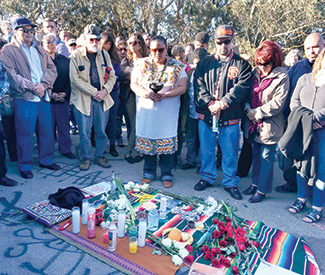
I attended a rally in support of eviction fighter Benito Santiago as he battles to keep his home of more than 30 years from the clutches of real estate investment company Vanguard Properties. Vanguard and its co-owner Michael Harrison, who also goes by the alias “Pineapple Boy LLC,” notified Benito of their intention of evicting him and two other tenants by invoking the state’s Ellis Act. We know the scenario — building gets sold, tenants get evicted, and the speculator/investor pimps ride off into the sunset, latte in hand, behind the wheel of a sports car (or utility vehicle).

But what about Benito?

Benito is a teacher with the San Francisco Unified School District. He is a senior with a disability resulting from a car accident more than a decade ago. Benito is a musician — a percussionist — and he teaches music to developmentally disabled children. Despite the effects of the car accident on his mobility, he has dedicated his life to sharing music with children who have benefitted greatly from his love and patience. He is an excellent teacher with a love for life and music is contagious.

Benito lives in his rent-controlled Duboce Triangle unit, but to investors and speculators, there is no room for him. To them, rent control is a cancer, a disease, a rape of the holy mother. Yet it is the evictions that have spread across the city — a 178 percent increase in Ellis Act evictions alone in the last three years — that are the true cancer.

It is not without irony that Benito moved into his unit in 1977, the same year of the eviction of elders of the I-Hotel on Kearny Street. As a Filipino, Benito remembers that event vividly, an event that garnered worldwide attention and support from wide segments of the community in San Francisco for the elder tenants who refused to leave the I-Hotel, the last building standing that was part of a Filipino neighborhood called Manilatown.

There was no room for Manilatown, no room for those brown elders walking around on property that had so much value. Manilatown was systematically removed by speculation and real estate interests. The I-Hotel eventually fell in 1977 with the forcible eviction of its elderly tenants, with baton-wielding police ramming though a human barricade of more than 3,000 supporters who chanted “We Won’t Move!”

The year Benito moved into his unit, 1977, was the year that the fight to rebuild the I-hotel began. After a 30-year struggle, it was finally rebuilt — 102 units of affordable senior housing. Many tenant protections arose from the ashes of the I-Hotel struggle. Another irony is that Mayor Ed Lee began his career defending the tenants of the I-Hotel.

Now, 37 years later, we see the desecration of the I-Hotel struggle by the same greedy speculators who do not care for the city. They have been the stewards — not of community, or sharing, or culture — but of eviction, misery, and even death to elders. They disrespect the I-hotel struggle and the elders of the community and the legacy of the I-Hotel. They are a blight to San Francisco.

Benito is fighting his eviction. He is refusing the buyout. The sound of resistance is the sound of Benito’s drum, which calls for all of us to rise in defense of our homes. Benito is a part of the Manilatown/I-Hotel Family, and we support his fight, along with Eviction Free SF, his lawyers at the Tenderloin Housing Clinic, and others in the community. The Manilatown Heritage Foundation/I-Hotel calls for an end to out of control evictions and reparations for elders who have been displaced through eviction via the Ellis Act.

What speculators have done is criminal, nothing less than elder abuse. Their presence is the true blight. Tony Robles works for Senior and Disability Action and is president of Manilatown Heritage Foundation, which will hold an event honoring eviction struggles April 25 in the I-Hotel Manilatown Center, 868 Kearny St.

Time for a carbon tax

5

EDITORIAL

For this week’s Green Issue, our cover story (“Save the world, work less”) looks at how our economic system is accelerating climate change, proposing that we slow down and work less. It’s a fun little thought experiment that revives an important goal that has somehow been forgotten in modern political discourse.

But there’s another solution that attacks the global warming problem more directly and immediately, one that is compatible with our modern capitalist framework and which could and should be adopted now. It’s time to institute a carbon tax, which would place a price on greenhouse gas emissions and help to curb them.

California Senate President Darrell Steinberg made waves in February when he proposed replacing key parts of California’s cap-and-trade program with a carbon tax and using two-thirds of that money for tax rebates to Californians making $75,000 per year and less to offset the higher cost of gasoline, utility bills, and other areas affected by the tax, and one-third to improve public transit.

The logic behind the proposal is unassailable: If we want to control greenhouse gases, tax the burning of the molecule that creates them. A carbon tax is a far better and more direct means of addressing climate change than California’s new cap-and-trade system, an overly complex half-measure that can be gamed or used to excuse unacceptable forms of pollution.

Of course, a range of capital interests and other powerful players lined up to oppose Steinberg’s proposal, leading the pundits to declare it dead. So his Senate Bill 1156 was modified this week to allocate revenues from the cap-and-trade auction, which could total $5 billion annually, to specific needs: 30 percent to public transit, 40 percent to affordable housing and sustainable communities, 10 percent to complete streets programs (bike lanes), and 20 percent to the California High-Speed Rail Project.

Those are good priorities and we support them all, but we’re disappointed to see Steinberg shrink from a fight that was worth having. The country needs a carbon tax if we’re going to meet our obligation to help mitigate a problem that Americans have created more than anyone else in the world on a per-capita basis. This is our mess and we need to play a big role in cleaning it up, rather than passing that obligation onto poor countries and future generations.

Taxes are a time-honored tool to regulating behaviors and providing for the common good. A carbon tax would finally make users pay the full cost of their choices, such as driving a car or traveling by airplane, thus encouraging less carbon-intensive lifestyles. If this state can’t implement a carbon tax. the federal government should.


Covered San Francisco unveiled

2

At the tail end of a long Board of Supervisors meeting last week, Sup. David Campos introduced legislation to create Covered San Francisco, a city healthcare option designed to remedy a coverage gap that will be created under the Affordable Care Act.

Lately, we’ve gotten reports of San Franciscans hoping to enroll in Covered California — the state-run health insurance marketplace created under the ACA — leaving meetings with enrollment counselors in tears of frustration. Even though these would-be enrollees are technically eligible for Covered California — which makes them ineligible to stay in Healthy San Francisco — the insurance cost is nevertheless too high to be a realistic option.

“In high cost-of-living cities like San Francisco, many will simply not be able to afford it,” Campos said when he introduced the legislation. “The most authoritative study says 40 percent of San Franciscans who are eligible for Covered California still will not be able to afford it.”

Co-sponsored by Sups. John Avalos, Eric Mar, and Jane Kim, the legislation seeks to address the problem by creating a new option for employees to receive subsidies to purchase health insurance under Covered California through the Department of Public Health. The funding would be derived from an employer spending requirement already in place under the city’s Health Care Security Ordinance, the law that created Healthy San Francisco.

The proposal also seeks to close a loophole that Campos said incentivizes employers to set up health reimbursement accounts for employees that cannot be used to purchase Covered California insurance plans. To discourage the use of these accounts, the proposal would make spending irrevocable, meaning employers would be unable to claw back funding they’ve contributed. (Rebecca Bowe)


PG&E INDICTMENT DOESN’T GO FAR ENOUGH

A federal grand jury in San Francisco issued a criminal indictment against Pacific Gas & Electric for negligence in the 2010 gas pipeline explosion in San Bruno that killed eight people and destroyed an entire neighborhood. But that falls far short of what this rapacious company and its conniving executives — none of whom face personal criminal charges — should be facing.

The indictment omits key details of what happened leading up this tragic and entirely preventable explosion, buying into the fiction that there is a meaningful difference between PG&E Co., the regulated utility, and PG&E Corp., the wealthy and powerful Wall Street corporation. This is a stark example of how corporations are given all the rights of individuals, but accept few of the responsibilities, with the complicity of the political and economic systems.

The 12-count indictment focused on violation of the Pipeline Safety Act, which requires companies to maintain their potentially dangerous pipelines, including keeping detailed records and doing safety inspections that would detect flaws like the faulty weld that caused the San Bruno explosion on Sept. 9, 2010 — work the company negligently failed to perform.

But PG&E’s wanton disregard for public safety, combined with the greed and shameless self-interest of then-CEO Peter Darbee and other executives, goes far deeper than that. A report by the California Public Utilities Commission released in January 2012 found that $100 million in ratepayer funds that had been earmarked for pipeline maintenance and replacement, including this section in San Bruno, was instead diverted to executive bonuses and shareholder profits.

“PG&E chose to use the surplus revenues for general corporate purposes,” the audit said, noting that the company was flush with cash at the time and there was no good reason to neglect this required maintenance. (Steven T. Jones)


911 DISPATCHERS STRESSED

The controversial tax breaks given to tech companies in San Francisco in 2011 came under fire again last week, as emergency dispatchers protested crippling budget shortages on April 2 in front of the Department of Emergency Management.

“When you call 911, there should be enough people working to pick up the phone,” said Ron Davis, an emergency dispatcher in San Francisco for 13 years. “It’s upsetting when you or someone you love is in a life-threatening emergency and you’re put on hold for 30 seconds, 45 seconds, or even a minute and longer.”

The department receives, on average, nearly 3,000 phone calls per day, and the workers who spoke at the rally described long hours and inadequate coverage for the volume of calls that they receive. California law mandates that 90 percent of 911 calls be answered in 10 seconds or less, but in San Francisco that number often drops to 60 percent or lower. Davis said that on particularly busy nights, such as New Year’s Eve, there can be up to 20 calls in the queue waiting for an available dispatcher.

The rally was organized by SEIU Local 1021 and was part of the union’s contract negotiations with the city. Larry Bradshaw, vice president for the San Francisco region of the union, said workers were willing to make sacrifices during the recession but now, “we just want to recoup our losses and make up for lost ground.” (Brian McMahon)


WILL AIRBNB PAY UP?

Airbnb has agreed to start collecting and paying the transient occupancy tax in San Francisco sometime this summer — finally acknowledging that’s the only workable way to meet the tax obligation it shares with its hosts. But that leaves open the question of whether this $10 billion corporation intends to pay the tax debt it has accumulated for years while trying to duck its responsibility to the city.

That’s at least several million dollars that the city could really use right now. As we’ve previously reported, Airbnb commissioned and publicized a study in late 2012 claiming its San Francisco hosts collected $12.7 million from Airbnb guest in fiscal year 2011-12, meaning they should have collected and remitted to the city $1.9 million.

In early 2012, the San Francisco Tax Collector’s Office held public hearings to clarify whether the TOT applies to the short-term rentals facilitated by Airbnb and similar companies, ruling in April 2012 that the TOT does apply to those stays and that it is a “joint and several liability” shared by the hosts and Airbnb, which conducts the transaction and takes a cut.

As we also reported, despite heavily lobbying during the hearing and being acutely aware of the outcome and its resulting tax obligation, Airbnb simply refused to comply and tack the 15 percent surcharge onto its transactions, as similar companies such as Roomorama were doing.

So if Airbnb was really being the good corporate citizen that it’s now claiming to be, it would not only start charging the 15 percent fee and sharing that money with the city, it would also cut San Francisco a check for around $4 million, or whatever the tax would be on what this growing business has collected from its guests since April 2012. (Steven T. Jones)


BURSTING THE MONTEREY SHALE BUBBLE

“We’ve been told that there’s a great oil boom on the immediate horizon,” billionaire investor Tom Steyer noted at the start of a March 27 talk in Sacramento.

But Steyer (who has pledged to spend $100 million on ad campaigns for the 2014 election to promote action on climate change) wasn’t there to trumpet the oil industry’s high expectations. Instead, he introduced panelists who dismissed the buzz on drilling the 1,750-square-mile Monterey Shale as pie-in-the-sky hype.

Dr. David Hughes, a geoscientist with the Post Carbon Institute, and researcher Robert Collier had been invited to speak by Next Generation, a policy group focused on climate change that was co-founded by Steyer.

Both experts questioned the findings of a University of Southern California study that wound up being cited time and again as the basis for the oil industry’s arguments, in the context of a statewide debate on fracking.

Partially funded by the Western States Petroleum Association, the USC report outlined a rosy economic outlook stemming from oil extraction in the Monterey Shale, estimating that it would create 2.8 million jobs and $24 billion in tax revenues, findings that were “echoed by politicians of both parties,” Collier noted.

Yet prominent economists could find no basis for certain claims. “They said: ‘We cannot see any justification for these incredible numbers,” Collier reported. “They seem too big to be believable.” The Post Carbon Institute and Physicians, Scientists and Engineers for Healthy Energy published their own report challenging the findings, titled Drilling California: A Reality Check on the Monterey Shale. (Rebecca Bowe)

Brains, robots, and their evolution

1

rebecca@sfbg.com

The Bay Area is fully engaged with the technology industry, triggering political flare-ups over Google Glass, tech buses, and larger debates over how the tech industry is morphing the Bay Area’s social and economic landscape. Meanwhile, university researchers are busily putting technology to use in service of their studies, or carefully examining how technology is shaping people’s lives.

A pair of recent events in San Francisco and Berkeley illuminate how web-based technology has become deeply embedded in everyday life, helping to shape human realms as personal and unique as emotions, brain health, and behavior.

Medical researchers at the University of California San Francisco have devised a tool they hope will advance our understanding of neuroscience and brain disease. On April 8, UCSF researchers launched a new project called the Brain Health Registry, which uses the Internet to recruit volunteer research subjects who play online brain games as part of the enrollment.

Across the bay at UC Berkeley’s Center for New Media, a recent symposium explored the implications of living in a world increasingly populated with robots and “smart” technologies that are designed to anticipate and respond to human behavior and dynamic environments. The April 4 event, called Robots and New Media, highlighted some thorny and intriguing questions about how robots “play a critical new role as extensions of ourselves,” according to the event description.

With discussion from cognitive neuroscientists about what happens to the human brain during interactions with robots, the talk also dived into questions about how much trust people should be willing to lend to emerging technologies.


BRAIN TRUST

Michael Weiner often wonders whether swimming in the San Francisco Bay can be credited with sharpening the mind. “I can tell you this: It sure makes you feel good,” said Weiner, who frequently plunges into the frigid bay waters as a member of the Dolphin Club.

For Weiner, a professor of radiology at the University of San Francisco who specializes in Alzheimer’s research, the curiosity goes beyond idle speculation. He’d like to conduct a clinical study to explore the impact that swimming in cold water has on mental functioning. But at the moment, he and a team of UCSF researchers are focused on a much bigger project.

Weiner is the founder of UCSF’s Brain Health Registry, designed to answer these brain impact questions by making it easier to do clinical studies. Realizing that the high cost of recruiting volunteers can slow down cognitive research, he’s turned to the Internet to build a database of volunteer subjects.

“The idea is to collect tens of thousands of people into a registry and then use it to select subjects for clinical trial,” he explained. To enroll, participants provide their names and other personal information, and answer questions about their patterns around sleep, mood, exercise, medications, use of alcohol, and other behaviors. They also take online cognitive tests provided by Lumosity, a brain-game company.

Their test results and personal information are then entered into the registry, which can be used to aid research in several ways. It can be analyzed to detect trends — for example, are there patterns suggesting a linkage between sleep disorders and poor cognitive functioning? It could be used to help researchers detect people with very early Alzheimer’s, Weiner noted. And UCSF researchers can contact registry volunteers to invite them in for clinical studies.

“I want 50,000 people of all ages within the San Francisco Bay Area,” Weiner said of his initial goal. By the end of 2017, the recruitment goal is 100,000. So far, 2,000 have signed up as volunteer subjects.

The Brain Health Registry could turn out to be a tool for facilitating long-term goals like finding a cure for Alzheimer’s. But having this giant database filled with sensitive personal information brings up at least one important question: What if there’s a data breach?

“I’ve been doing research for a long time, and never has there been a loss of data,” Weiner responded, vouching for the system’s ability to keep data safe. “I’m in there, my two children are in there.”


LIKABLE ROBOTS

Carla Diana spoke at Berkeley’s Center for New Media symposium on April 4. A designer whose work involves playing around with the expressive elements of technology, she helped create a robot called Simon with a team of researchers at the Georgia Institute of Technology.

She said the purpose of designing Simon was “to study how we can interact with the machine in the most natural way possible.”

Simon is cute and looks like a doll. With an all-white head and torso designed by Meka Robotics, a San Francisco-based robotics company that was recently acquired by Google, Simon has expressive droopy eyes outfitted with cameras, light-up ears that flop up and down, and mechanical hands that grip things.

He (it?) is programmed to track people as they interact with him, understand spoken sentences, and respond with expressive sound and movement that mimics human social behavior. Diana said the robot was designed with diminutive features on purpose, as a way of conveying that he has a lot to learn.

Diana is a fellow at Smart Design, where she oversees the Smart Interaction Lab. Her work isn’t just about making machines — it’s also about studying how people interact with smart technologies, and thinking carefully about things like how the “personality” of a machine can excite people, motivate them, or push their buttons, so to speak, by designing for a sensory experience.

Asked during the question-and-answer period about the ethical implications of designing machines meant to reach people on an emotional level, Diana acknowledged that this is precisely what smart technology designers are up to.

“It’s the responsibility of the designer to realize that we are doing that,” she replied. “We are creating entities that have the ability to manipulate humans’ emotions. And that’s that.”


WELCOME TO THE MACHINE

Mireille Hildebrandt, a lawyer, researcher, philosopher, and professor who flew in from the Netherlands to speak at the symposium, offered a big-picture view of what it means for people to interact with “smart” technologies or robotic machines, and she threw out questions about the overarching implications.

“We’re moving toward something called ubiquitous computing,” she explained. “The environment starts to adapt to your assumed, preferred preferences.”

Common examples of this adaptable technology abound on the Internet: Targeted advertising is based on individuals’ unique preferences. Google search tries to guess what you’re looking for before you finish typing.

What happens when this kind of “smart,” predictive tech goes beyond the computer screen? In some cases, that’s already happening: Think facial recognition technology that can scan an environment to detect a specific person. A less creepy example is smart appliances such as thermostats or robotic vacuum cleaners.

Bringing it up a notch, Hildebrant asked the audience to imagine that everyone had a personal robot. “What if your robot does some A/B design, testing your moods, susceptibility to spending, voting, and other behaviors?” she asked. “What if your robot is online with its peers, sharing your behaviors to improve the user experience? … However smart they are, they aren’t human. They have no consciousness, let alone self-consciousness.”

In a robotic environment, she said, “You can be calculated. When I, as a robot, act like this, then [a person’s] behavior will likely be like that. … We would have to realize that they are continuously anticipating us.”

To live in this kind of souped-up environment brings up big questions, Hildebrant said: “Who’s in control? What’s the business model? And how will it affect our privacy?”

Alerts: April 9 – 15, 2014

0

WEDNESDAY 9


Town Hall Meeting for Pedestrian Safety

Muslim Community Center, 4760 Mission, SF. gmackellen@eagsf.org. 6-8pm, free. Responding to the recent trend of pedestrian collisions in San Francisco, a coalition of neighborhood leaders has called for a Pedestrian Safety Town Hall. Supervisors Campos, Avalos, and Chiu will be in attendance, along with leaders from SFMTA and the SFPD, to discuss and propose ways to protect pedestrians against automobile accidents in San Francisco.


THURSDAY 10


Community Forum: Activism Against Displacement

LGBT Community Center, 1800 Market, SF. www.urbanidea.org. 5:30-7:30pm, free registration online. Responding to the ’80s office high-rise boom, Proposition M has defined development and infrastructure in the City’s downtown to this day. Now, in the midst of another boom of development and evictions, Central City activists are proposing a Housing Balance Act, to link the rate of market development to a balanced affordable and middle-income housing. Join in the discussion to be part of the effort and find out more.


Panel Discussion: What the frack?!

1011 Market, 2nd Floor, SF. www.sfcamerawork.org. 6-8pm, free. Featured photographer Sarah Christianson will be present along with participants from Earthjustice and The Sierra Club to discuss fracking, a harmful oil and and natural gas extraction technique. The talk will examine how the scars from previous oil booms are healing, what new wounds are being inflicted, and who is on the forefront of the movement to safeguard California against environmentally harmful oil development.


SATURDAY 12


Cesar Chavez Holiday Parade and Festival

Dolores Park, Guerrero and 19th, SF. www.cesarchavezday.org. 10am-5pm, free. Celebrate the life of labor activist and civil rights leader, Cesar Chavez. The parade will begin assembling at 10am at Dolores Park, and there will be a street fair featuring food, music, entertainment, and arts and crafts booths from noon until 5pm on 24th St. between Treat and Bryant.


An evening with Matt Taibbi

First Congregational Church, 2345 Channing, Berk. www.kpfa.org. 7:30pm, $12 in advance, $15 at door. From the award-winning investigative journalist and bestselling author of The Great Derangement and Griftopia comes THE DIVIDE: American Injustice in the Age of the Wealth Gap. Matt Taibbi, one of the most widely read journalists in America who is best known for his work at Rolling Stone, will speak about his new book, which offers a galvanizing exploration of how our growing wealth gap isn’t just warping our economy, but transforming the meaning of rights, justice, and basic citizenship. Taibbi will be joined by Donald Goldmacher, Producer and Director of Heist: Who Stole the American Dream?

Privatization of public housing

14

news@sfbg.com

Like so many San Franciscans, Sabrina Carter is getting evicted.

The mother of three says that if she loses her home in the Western Addition, she’ll have nowhere to go. It’s been a tough, four-year battle against her landlord — a St. Louis-based development company called McCormack Baron — and its law firm, Bornstein & Bornstein. That’s the same law firm that gained notoriety for holding an “eviction boot camp” last November to teach landlords how to do Ellis Act evictions and sweep tenants out of rent-controlled housing.

But Carter’s story isn’t your typical Ellis eviction. Plaza East, where she lives, is a public housing project. Public housing residents throughout the country are subject to the “one-strike and you’re out” rule. If residents get one strike — any misdemeanor or felony arrest — they get an eviction notice. In Carter’s case, her 16-year-old was arrested. He was cleared of all charges — but Carter says McCormack Baron still wouldn’t accept her rent payment and wouldn’t respond to her questions.

“I was never informed of my status,” she said.

That is, until her son was arrested again, and Carter found herself going up against Bornstein & Bornstein. She agreed to sign a document stipulating that her eviction would be called off unless her son entered Plaza East property (he did). It was that or homelessness, said Carter, who also has two younger sons.

“They criminalized my son so they could evict my family,” Carter said.

McCormack Baron and Bornstein & Bornstein both declined to comment.

On March 12, Carter and a band of supporters were singing as they ascended City Hall’s grand staircase to Mayor Ed Lee’s office.

“We’re asking the mayor to call this eviction off. Another black family cannot be forced out of this city,” Lisa “Tiny” Gray-Garcia, co-founder of Poor Magazine, said at the protest.

Nearly half of San Francisco’s public housing residents are African American, according to a 2009 census from the city’s African American Out-Migration Task Force. These public housing residents represent a significant portion of San Francisco’s remaining African American population, roughly 65 percent.

Carter’s eviction was postponed, but it raises an important question: Why is a public housing resident facing off with private real estate developers and lawyers in the first place?


PUBLIC HOUSING, PRIVATE INTERESTS

Plaza East is one of five San Francisco public housing properties that was privatized under HOPE VI, a federal program that administers grants to demolish and rebuild physically distressed public housing.

The modernized buildings often have fewer public housing units than the ones they replaced, with private developers becoming their managers. San Francisco’s take on HOPE VI, called HOPE SF, is demolishing, rebuilding, and privatizing eight public housing sites with a similar process.

US Department Housing and Urban Development is rolling out a new program to privatize public housing. The San Francisco Housing Authority is one of 340 housing projects in the nation to be chosen for the competitive program. The city is now starting to implement the Rental Assistance Demonstration program. When it’s done, 75 percent of the city’s public housing properties will be privatized.

Under RAD, developers will team up with nonprofits and architectural firms to take over managing public housing from the Housing Authority. RAD is a federal program meant to address a nationwide crisis in public housing funding. Locally, the effort to implement the program has been spurred by the Mayor’s Office of Housing and Community Development.

MOHCD Director Olson Lee has described RAD in a report as “a game-changer for San Francisco’s public-housing residents and for [Mayor] Lee’s re-envisioning plan for public housing.” Later, Lee told us, “We have 10,000 residents in these buildings and they deserve better housing. It’s putting nearly $200 million in repairs into these buildings, which the housing authority doesn’t have. They have $5 million a year to make repairs.”

Funding is sorely needed, and this won’t be enough to address problems like the perpetually broken elevators at the 13-story Clementina Towers senior housing high-rises or SFHA’s $270 million backlog in deferred maintenance costs.

But RAD is more than a new source of cash. It will “transform public housing properties into financially sustainable real estate assets,” as SFHA literature puts it.

RAD changes the type of funding that supports public housing. Nationally, federal dollars for public housing have been drying up since the late ’70s. But a different federal subsidy, the housing choice voucher program that includes Section 8 rent subsidies, has been better funded by Congress.

Under RAD, the majority of the city’s public housing will be sustained through these voucher funds. In the process, the Housing Authority will also hand over responsibility for managing, maintaining, and effectively owning public housing to teams of developers and nonprofits. Technically, the Housing Authority will still own the public housing. But it will transfer the property through 99-year ground leases to limited partnerships established by the developers.

The RAD plan comes on the heels of an era marked by turmoil and mismanagement at the Housing Authority. The agency’s last director, Henry Alvarez, was at the center of a scandal involving alleged racial discrimination. He was fired in April 2013.

In December 2012, HUD declared SFHA “troubled,” the lowest possible classification before being placed under federal receivership. A performance audit of the agency, first submitted in April 2013 by the city’s Budget and Legislative Analyst, determined that “SFHA is expecting to have no remaining cash to pay its bills sometime between May and July of 2013.”

Six of the seven members of the Housing Authority Commission were asked to resign in February 2013, and were replaced with mayoral appointees.

Joyce Armstrong is not a member of this commission, but she sits on the dais with them at meetings, and gives official statements and comments alongside the commissioners. Armstrong is the president of the citywide Public Housing Tenants Association, and she talked about RAD at a March 27 meeting, conveying tenants’ apprehension toward the expansion of private managers in public housing.

“Staff in HOPE VI developments are very condescending,” Armstrong said. “We’re not pleased. We’re being demeaned, beat up on, and talked to in a way I don’t feel is appropriate.”


NONPROFITIZATION

When RAD is implemented, it won’t just be development companies interacting with public housing residents. San Francisco’s approach to RAD is unique in that it will rely heavily on nonprofit involvement. Each “development team” that is taking over at public housing projects includes a nonprofit organization. Contracts haven’t been signed yet, but the Housing Authority has announced the teams they’re negotiating with.

“We call it the nonprofitization of public housing,” said Sara Shortt, executive director of the Housing Rights Committee.

The developers are a list of the usual players in San Francisco’s affordable housing market, including the John Stewart Company, Bridge Housing Corporation, and Tenderloin Neighborhood Development Corporation.

Community-based organizations that are involved include the Mission Economic Development Agency, the Japanese American Religious Federation, Ridgepoint Nonprofit Corporation, Glide Community Housing, Bernal Heights Housing Corporation, and the Chinatown Community Development Center.

On March 13, when the Housing Authority Commission announced who would be on these teams, the meeting was packed with concerned members of the public. Two overflow rooms were set up. One group with a strong turnout was SEIU Local 1021, which represents public housing staff.

Alysabeth Alexander, vice president of politics for SEIU 1021, said that 120 workers represented by the union could be laid off as management transfers to development teams, and 80 other unionized jobs are also on the line.

“They’re talking about eliminating 200 middle-class jobs,” Alexander said.

She also noted that SEIU 1021 wasn’t made aware of the possible layoffs — it only found out because of public records requests. (Another downside of privatization is that certain information may no longer be publicly accessible.)

“We’re concerned about these jobs,” Alexander said. “But we’re also concerned about the residents.”


RESIDENTS’ RIGHTS

HUD protects some residents’ rights in its 200-page RAD notice. These include the right to return for residents displaced by renovations and other key protections, but rights not covered in the document — some of which were secured under the current system only after lengthy campaigns — are less clear. In particular, rights relating to house rules or screening criteria for new tenants aren’t included.

Negotiations with development teams are just beginning. Lee said tenants’ rights not included in the RAD language would be discussed as part of that process.

“It will be a function of what is best practice,” Lee said.

But developers have already expressed some ideas about public housing policies they want to tweak when they take over. At one point, the city was considering developers’ requests to divide the citywide public housing wait-list into a series of site-specific lists. Lee says that this option is no longer on the table.

But as developers’ interests interact with local, state, and federal tenant regulations, things could get messy. James Grow, deputy director of the National Housing Law Project, says that whatever standard is the most protective of residents’ rights should apply.

Still, Grow said, “There’s going to be inconsistencies and gray areas.”

Grow said that inevitably some residents’ rights will be decided “on a case-by-case basis, in litigations between the tenant and the landlord…They’ll be duking it out in court.”

This will be true nationwide, as each RAD rollout will be different. But at least in San Francisco, “Most of the tenant protections in public housing will remain,” said Shortt. “We are trying to tie up any holes locally to make sure that there is no weakening of rights.”

Grow’s and Shortt’s organizations are also involved in San Francisco’s RAD plan. The National Housing Law Project, along with the Housing Rights Committee and Enterprise Community Partners, have contracts to perform education and outreach to public housing residents and development teams.


UNCERTAIN FUTURE

Just how much money will go to RAD is still under negotiation. The RAD funding itself, derived from the voucher program, will surpass the $32 million the city collected last year in HUD operating subsidies. But its big bucks promise is the $180 million in tax credit equity that the privatization model is expected to bring in.

The city will also be contributing money to the program, but how much is unclear.

“The only budget I have right now is the $8 million,” Lee said, money that is going to the development teams for “pre-development.”

Lee added that funding requests would also be considered; those requests could total $30-50 million per year from the city’s housing trust fund, according to Shortt.

To access that $180 million in low-income housing tax credits, development teams will need to create limited partnerships and work with private investors. The city wants to set up an “investor pool,” a central source which would loan to every development team.

It’s a complicated patchwork of money involving many private interests, some of whom don’t have the best reputations.

Jackson Consultancy was named as a potential partner in the application for the development team that will take over management at Westbrook Apartments and Hunters Point East-West. That firm is headed by Keith Jackson, the consultant arrested in a FBI string in late March on charges of murder-for-hire in connection with the scandal that ensnared Sen. Leland Yee and Chinatown crime figure Raymond “Shrimp Boy” Chow.

Presumably, Jackson is no longer in the running, although the entire transformation is rife with uncertainties.

Residents often feel blindsided when management or rules change at public housing properties. And RAD will be one of the biggest changes in San Francisco’s public housing in at least a decade.

“People are concerned about their homes. When they take over the Housing Authority property, what’s going to happen? They keep telling us that it’s going to stay the same, nothing is going to change,” said Martha Hollins, president of the Plaza East Tenants Association.

Hollins has been part of Carter’s support network in her eviction case.

“They’re always talking about self-sufficient, be self-sufficient,” Hollins said. “How can we be self-sufficient when our children are growing up and being criminalized?”

Public housing has many complex problems that need radical solutions. But some say RAD isn’t the right one. After seeing developers gain from public housing while generational poverty persists within them, Gray-Garcia says that her organization is working with public housing residents to look into ways to give people power over their homes. They are considering suing for equity for public housing residents.

“‘These people can’t manage their own stuff and we need to do it for them.’ It’s that lie, that narrative, that is the excuse to eradicate communities of color,” Gray-Garcia said. “We want to change the conversation.”

Rising tide of plutocracy

21

EDITORIAL The pace of life under late capitalism seems to be speeding up these days, and so too have the bad news developments and warnings of impending doom come at a more rapid clip, at least according to the headlines over the last couple weeks.

First it was a report from the US Commerce Department showing that corporate profits are at the highest level in 85 years while employee compensation is at its lower level in 65 years. After-tax corporate profits are now 10 percent of gross domestic product (a record high) as a result of the effective corporate tax rate (figuring in loopholes) of 20.5 percent, the lowest tax rates since 1929, not coincidentally when the Great Depression began.

Then came the latest report from the Intergovernmental Panel on Climate Change, striking a more urgent tone than the four preceding reports as it documents the threats already unfolding and the major social upheaval to come. And then we were hit with the US Supreme Court’s 5-4 McCutcheon vs FEC decision, which “eviscerates our nation’s campaign finance laws,” as Justice Stephen Breyer wrote in his dissent, striking down aggregate contribution caps and giving even more political power to those with the most economic power.

So wealthy individuals and corporations are hoarding more of the nation’s resources than ever before, and now they’ll be able to spend even more of it to influence and corrupt our already broken political system, weakening its ability to take on big challenges such as addressing global warming because the solutions — including slowing down economic activity (we’ll have more on that in next week’s issue) and helping poor countries deal with rising seas and social instability — require resources from the greedy rich. Call it self-perpetuating plutocracy, with life as we know it on planet Earth at stake.

Meanwhile, on the local front, a Tenants Together study of the economic displacement now underway in San Francisco found it is mostly real estate speculators who are evicting renters using the Ellis Act, a state law ostensibly designed for letting property owners eventually get out of the rental business. Instead, the report’s analysis of eviction data since the Ellis Act was adopted in 1985 showed that 51 percent of Ellis evictions occurred within a year of the property changing hands, 68 percent within five years of new ownership, and 30 percent of Ellis evictions came from serial evictors — all told, displacing 10,000 San Francisco tenants, mostly from rent-controlled housing.

Prohibiting Ellis evictions for the first five years — which is part of Sen. Mark Leno’s SB 1439, which had its first hearing this week — is a good idea that will help. But it also feels a bit like sticking a finger in the hole of a crumbling dike, when what we really need is a strong, new, progressive seawall to protect us against the rising tide of plutocracy, or rule by the rich, and its myriad ravages.

SF’s culture of corruption

12

EDITORIAL The extent of the charges in the criminal complaint against Sen. Leland Yee, political consultant Keith Jackson, and others are shocking and sensational: international arms trafficking, drug dealing, money laundering, cavorting with organized crime figures, murder for hire. But the basic allegation that Yee and Jackson practiced a corrupt, transactional kind of politics wasn’t surprising to anyone who knew how they operated.

What’s worse, they were simply a more extreme — and now, thanks to FBI wiretaps and undercover agents, a better documented — example of the political corruption that is endemic to San Francisco and some other high-stakes American cities. The city of St. Francis gets sold out to the highest bidders everyday, by politicians who value wealthy constituents over the vast majority of us who are just trying to get by — and over the interests of city finances and governance.

Part of the problem is inherent in our money-driven political system, in which politicians are constantly hustling for cash from people who want things from them. Politicians deny they take actions with political contributions in mind, but well-heeled capital and labor interests don’t spend millions of dollars on contributions out of the goodness of their hearts. These are business transactions.

We wholeheartedly support the call Senate President Darrell Steinberg made for fundamental political reform during the March 28 vote to suspend Yee and two of his allegedly corrupt colleagues. These cases aren’t aberrations, they are indicative of how power get wielded when it’s based on wealth. That’s the reality that has gotten even uglier since the Citizens United decision equated money with political speech and upped the ante for would-be public servants.

But much of the problem is particular to San Francisco, where cozy relationships between politicians and corporate interests are often feted in plain view. Former Mayor Willie Brown — a lawyer and unregistered lobbyist who won’t reveal his huge corporate client list despite having an influential weekly column in the San Francisco Chronicle — helped install his longtime City Hall functionary Ed Lee into Room 200 to guard against anyone asking too much of the rich and powerful. Yee and Lee represented rival Chinatown economic factions, both wanting to use the power of the Mayor’s Office for their interests.

In his March 22 column, Brown once again repeated a joke he’s used before, that the “e” in email stands for “evidence,” which is really only funny in a sick political culture that celebrates slick rule-breakers. And it was from Brown that Lee learned it was acceptable to brazenly give tax breaks and regulatory passes to the tech companies that his top fundraiser, venture capitalist Ron Conway, are invested in.

Megadeveloper Lennar Urban used its wealth and political connections to take control of San Francisco’s biggest tracts of undeveloped and underdeveloped land, including Hunters and Candlestick points and Treasure Island, paying off community groups and hiring Jackson and other political henchmen to get the job done.

In fact, the FBI complaint says Jackson was working on behalf of that project when he approached accused Chinatown gangster Raymond “Shrimp Boy” Chow for support, leading to their alleged involvement in a string of wild criminal conspiracies. Meanwhile, Chow was getting public commendations from San Francisco-based politicians including Lee, Yee, Gavin Newsom, Dianne Feinstein, Fiona Ma, and even Tom Ammiano. Chow courted political legitimacy the same way politicians seek cash, and mainstream media outlets were happy to play along.

Throughout his political career, Yee has carried water for Pacific Gas & Electric, perhaps the most corrupting contributor to political campaigns in the city’s history. PG&E’s influence at City Hall had thankfully waned in recent years as a result of overreach and deadly criminal negligence, until Lee and his appointees last year killed CleanPowerSF (see “Challenge Mayor Lee and his lies,” 9/17/13) on a pretext so thin it could only be gift to PG&E.

In many ways, San Francisco hasn’t changed. It’s still the old Barbary Coast, ruled by capitalist thugs and corrupt politicians, only with glossy modern spin created by armies of well-paid political consultants. But we all deserve better.

Yee and Jackson should go to prison if there’s even a slice of truth to the allegations against them. And maybe they’ll cut deals and take other political figures down with them, giving us more of a peek behind the curtain of political power. But it’s up to all of us to break the close ties between economic and political power and begin to restore the democratic power of everyday people.

Crime and politics

10

steve@sfbg.com

San Franciscans awoke March 26 to the surprising news that state Sen. Leland Yee (D-SF) had been arrested on federal corruption charges as part of early morning police raids targeting an organized crime syndicate based in Chinatown, along with reputed gangster Raymond “Shrimp Boy” Chow and two dozen others.

Yee had a reputation for sometimes trading votes for campaign contributions, a perception that had only gained strength in recent months as he launched his first statewide campaign, running to lead the Secretary of State’s Office, casting key votes for landlords and big industries that he refused to explain to local activists.

So in a year when two other Democratic Senators have also been stung by federal corruption and bribery probes, the televised image of Yee in handcuffs wasn’t beyond the realm of possibilities. It was surprising, but not shocking.

Yet by the mid-afternoon when the 137-page federal criminal complaint was unsealed and journalists started reading through what undercover FBI agents had discovered during their five-year criminal investigation, it read more like a sensational organized crime and espionage novel than a court document, a real page-turner that just got more wild and incredible as it went on.

timelineYeeWhat began with the FBI investigating a murder and leadership transition in the San Francisco branch of the ancient Chinese organized crime syndicate known as the Triad, led by an undercover FBI agent who had infiltrated the group, evolved into a widening investigation accusing Yee of arranging an illegal arms trafficking deal with a Muslim rebel group in the Philippines in exchange for $100,000 funneled into his campaign, on top of smaller favors that Yee allegedly did in exchange for envelopes with $10,000 in cash.

It was even worse for local political consultant Keith Jackson, a key Yee fundraiser who was also on contract with Lennar Urban for its Bayview-Hunters Point development projects, with the undercover FBI agents allegedly drawing Jackson into big cocaine deals, money laundering, bribery, and even a murder-for-hire plot. If the complaint is to be believed, Jackson seemed willing to do just about anything to enrich himself and raise money for Yee.

Meanwhile, the public image that Chow has been cultivating for himself since his 2003 release from federal prison — that of a reformed career gangster turned Chinatown civic leader, someone praised by local politicians for inspiring fellow ex-convicts to turn their lives around — was replaced the complaint’s description of a powerful “Dragonhead” overseeing a vast criminal enterprise involved in drugs, guns, prostitution, protection rackets, moving stolen booze and cigarettes, and money laundering.

“I think the whole city is in shock at the moment,” Board of Supervisors President David Chiu, who represents Chinatown and ran against Yee in the 2011 mayor’s race, told the Guardian that afternoon. “Today’s widespread law enforcement actions are incredibly disturbing. The detail and scale of the criminal activities are shocking.”

In the days that followed, Yee withdrew his candidacy for Secretary of State and was suspended by his colleagues in the California Senate. But where this wild tale of crime and corruption goes next — and who else gets implicated as these powerful and well-connected defendants look to cut deals to avoid the lengthy prison sentences they all face — is anyone’s guess.


THE CRIMINAL

Chow, 54, was raised a criminal, telling the History Channel’s “Gangland” that he stabbed someone in Hong Kong at the age of nine before moving to San Francisco in 1977 and getting involved in the Hop Sing Boys gang and Chinatown’s criminal underworld.

He survived the Golden Dragon Massacre, a shooting between rival Chinatown gangs that left five dead, but he was arrested in 1978 for a robbery and sent to prison for the first time, released in 1985. The next year, he was sent back to prison for attempted murder and more gang mayhem, released in 1989.

“I did time with Charles Manson, a good friend of mine. Kimball, a serial killer. I did time with a bunch of amazing people. Each person you talk to you learn something from. Ain’t no stupid people inside the prison, you can say that,” Chow told Gangland.

In 1991, a gangster named Peter Chong was sent from Hong Kong to San Francisco to extend the reach of the Wo Hop To Triad. He enlisted Chow as his right-hand man, and together they extended the reach of the Wo Hop To across the Western United States, trying to create an all encompassing gang named the Tien HaWui, “The Whole Earth Association.”

Chow was arrested again in 1995 on a variety of racketeering and other criminal charges and sentenced to 25 years in prison. But he later testified against Chong and got his sentence reduced, and he was released from federal prison in 2003.

After his release, Chow publicly claimed to go legit, working on book and movie deals about his life, as well as building connections in the political world. Chow posed for photos with then-Mayor Gavin Newsom and other local political figures.

But the latest criminal complaint said that even as Chow pretended to be moving on, he continued to make incriminating statements to the undercover agents “confirming his knowledge of and involvement in criminal activity.”


THE COMPLAINT

The criminal complaint alleges that “Chow is currently the Dragonhead, or leader, of the San Francisco-based Chee Kung Tong organization,” which it described as a criminal syndicate connected to Hung Mun, a criminal dynasty that began in 17th century China, “also referred to as a Chinese secret society and the Chinese Freemasons.”

It says Chow was sworn in as CKT head in August 2006, soon after the still-unsolved murder of CKT head Allen Leung. Chow’s swearing-in was reported in local Chinese media sources, so SFPD and FBI conducted surveillance there and launched an investigation.

The FBI says it began infiltrating CKT five years ago, including an undercover FBI agent dubbed UCE 4599, who in May 2010 was introduced to Chow, who “then introduced UCE 4599 to many of the target subjects.” UCE 4599 told Chow he was a member of La Cosa Nostra, the Italian mob.

In March 2012 he was inducted into CKT as a “Consultant,” the complaint alleges. It says that Jackson — a former San Francisco school board member and political consultant — had also be inducted into CKT as a “Consultant,” participating in various criminal conspiracies.

The gang members are accused of laundering money made from “illegal activities, specifically illegal gambling, bookmaking, sports betting, drugs, and outdoor marijuana grows.” They allegedly laundered $2.3 million between March 2011 and December 2013 for UCE 4599, with members collecting a 10 percent fee for doing so.

The complaint says Jackson “has a long-time relationship with Senator Yee,” and “has been involved in raising funds for” Yee’s run for mayor “and for Senator Yee’s current campaign in the California Secretary of State election.” And much of the complaint details deeds allegedly committed by Jackson and Yee.

In fact, the second person named in the complaint, right after Chow, is Yee, “aka California State Senator Leland Yee, aka Uncle Leland.”

As the complaint alleges, “Senator Yee and Keith Jackson were involved in a scheme to defraud the citizens of California of their rights to honest services, and Senator Yee, [Daly City resident Dr. Wilson] Lim, and Keith Jackson were involved in a conspiracy to traffic firearms.”


THE POLITICIAN

Yee and Jackson met UCE 4599 through Chow, and then Jackson allegedly solicited him to make donations to Yee’s 2011 San Francisco mayoral campaign “in excess of the $500 individual donation limit. UCE 4599 declined to make any donations to Senator Yee, but introduced Keith Jackson and Senator Yee to a purported business associate, UCE 4773, another undercover FBI agent,” who made a $5,000 donation to Yee’s mayoral campaign.

Yee had $70,000 in debt after that mayor’s race and worked with Jackson on ways to pay off that debt. “This included soliciting UCE 4773 for additional donations and in the course of doing so, Senator Yee and Keith Jackson agreed that Senator Yee would perform certain official acts in exchange for donations from UCE 4773.”

Yee allegedly agreed to “make a telephone call to a manager with the California Department of Public Health in support of a contract under consideration with UCE 4773’s purported client, and would provide an official letter of support for the client, in exchange for a $10,000 donation.”

Meanwhile, it says Jackson and Yee continued raising money for his Secretary of State race by soliciting donations from UCE 4599 and UCE 4180, another undercover agent. “They agreed that in exchange for donations from UCE 4599 and UCE 4180, Senator Yee would perform certain officials acts requested by UCE 4599 and UCE 4180.”

That included Yee issuing an “official state Senate proclamation honoring the CKT in exchange for a $6,800 campaign donation, the maximum individual donation allowed by law.” Yee allegedly did so, and it was presented by one of his staff members at the CKT anniversary celebration on March 29, 2013.

Yee and Jackson are also accused of introducing a donor to unidentified state legislators working on pending medical marijuana legislation, the donor being another undercover agent who claimed to be a medical marijuana businessman from Arizona looking to expand into California, “and in payment for that introduction, UCE 4180 delivered $11,000 cash to Senator Yee and Keith Jackson on June 22, 2013.”

In September, after making another introduction, Yee and Jackson allegedly received another $10,000 cash donation for their services. Then Jackson allegedly had an idea for getting even more money.

“Jackson told UCE 4599 that Senator Yee, had a contact who deals in arms trafficking.” Jackson then allegedly requested UCE 4599 make another donation “to facilitate a meeting with the arms dealer with the intent of UCE 4599 to purportedly purchase a large number of weapons to be imported through the Port of Newark, New Jersey.”

That deal for up to $2.5 million in weapons involved automatic weapon and shoulder-fired missiles, the complaint said, and “Senator Yee discussed certain details of the specific types of weapons UCE 4599 was interested in buying and importing.”

The complaint says that Yee expressed discomfort with how openly UCE 4180 discussed overt “pay to play” links between cash donations and official actions. “I’m just trying to run for Secretary of State. I hope I don’t get indicted,” Yee allegedly told two undercover FBI agents during a walk on June 20, 2013, urging them to be less explicit about connecting official favor with campaign donations.

“Despite complaining about UCE 4180’s tendency to speak frankly and tie payment to performance, and threatening to cut off contact with UCE 4180, Senator Yee and Keith Jackson continued to deal with UCE 4180 and never walked away from quid pro quo requests make by UCE 4180,” the complaint said. “In fact, Senator Yee provided the introductions sought by UCE 4180 and accepted cash payments which UCE 4180 expressly tied to the making of the introductions.”

Yee’s attorney, Paul DeMeester, told reporters they will contest the charges: “We will always in every case enter not guilty pleas, then the case takes on a life of its own.”


Joe Fitzgerald Rodriguez contributed to this report.


Bloodshed in Bernal Heights

34

rebecca@sfbg.com

On Friday morning, March 21, the day that Alejandro Nieto was shot and killed by San Francisco Police Department officers, he went to the gym with his friend Byron Pedroza. It was something they did often, Pedroza said; the two of them had signed up for gym memberships together. “He’d be like, ‘B, get up. Let’s go work out.'”

Nieto and Pedroza had met at El Toro nightclub, where Nieto worked as a security guard for nearly two years. The club, which attracts Latino clientele and hosts live performances on Mondays, has tight security: There are several guards equipped with Tasers.

“He was the type of person who’d help me a lot,” Pedroza said. “Thanks to him, I went to college,” enrolling at City College of San Francisco.

Nieto was a semester away from completing his degree in administration of justice. He was studying on scholarship, in pursuit of his goal to become a youth probation officer. Nieto drove a ’95 Chevy Caprice — an old police car, Pedroza said — and they fixed it up together.

Ramiro Del Rio, Nieto’s co-worker at El Toro, described him as punctual and considerate. He’d seen Nieto in stressful situations before, when dealing with drunk and rowdy bar patrons. “He was very calm,” Del Rio said of Nieto. “He would always want to talk to the person without using aggressive force.”

Nieto favored juice and soda instead of alcohol, he said, but after he started working out, “it was straight water.” Also, “He was Buddhist.”


HIS WORK TASER

Nieto had been scheduled to work that night, March 21. Instead, he was killed in Bernal Heights Park from multiple gunshot wounds inflicted by rounds fired by at least four officers. It’s unknown exactly how many bullet wounds Nieto sustained; friends said they believed at least 14 rounds had been fired.

As of March 31, the San Francisco Medical Examiner still had not released autopsy results. The officers involved had been placed on paid leave. Nieto’s community remained stunned by his sudden death, staging a march through the Mission the following weekend to protest what they viewed as an unjust use of deadly force.

According to a transcript from a 911 call placed minutes before the shooting, which Police Chief Greg Suhr read aloud during a March 25 public meeting at Leonard Flynn Elementary School held to discuss the incident, officers opened fire within three and a half minutes of arriving at Bernal Heights Park.

Police were responding to calls reporting a man “with a gun on his hip. A black handgun,” according to the call record, which Suhr read aloud. Police did not reveal the identity of the caller, but noted that the caller was not a police officer.

A neighbor who declined to be named told the Bay Guardian that shortly before the shooting, two men walking down the pedestrian pathway on the park’s north slope alerted a jogger of a man ahead with a gun on his hip. The jogger, who came within 50 feet of the man, reported noticing that he was “pacing back and forth” and “air boxing.”

The person who phoned 911 also initially reported seeing a man pacing back and forth. But minutes later, the anonymous caller reported to 911 dispatchers, “He is eating chips … but resting his hand on the gun.”

In reality, there was no gun — it was Nieto’s Taser, carried in a holster. Friends who spoke at a March 24 vigil said they believed Nieto had headed up there to eat a burrito while looking out at the city from the top of the hill, a place he often went to clear his head.

A sergeant from the Ingleside station and other police officers arrived at the scene minutes after receiving reports of a man with a gun, Suhr said at the public meeting. Police faced Nieto from a distance of about 75 feet, up a hill.

“When the officers asked him to show his hands, he drew the Taser from the holster,” Suhr said. Nieto then told police to show their hands, and pointed the Taser at the officers, Suhr told a large crowd in attendance. Due to the distance, the chief said, the officers did not see the yellow markings that would have alerted them that it was a Taser and not a gun.

“These particular Tasers, as soon as they’re drawn, they emit a dot, a red dot,” Suhr said. “When the officers saw the laser sight on them, tracking, they believed it to be a firearm, and they fired at Mr. Nieto.” Believing he had a gun, Suhr said, police “fired in defense of their own lives.” In a later interview, he confirmed that officers would not have used lethal force had they known Nieto possessed a Taser instead of a firearm.

Both Pedroza and Del Rio said Nieto had shown them his new Taser, and said it emits a red dot only when one pushes a button to turn it on. According to a Taser operating manual, the stun gun has a range of 15 feet.

Asked how many 911 calls were placed, Suhr said he did not have that information. When the Bay Guardian contacted the Department of Emergency Management to request audio from 911 calls, it was denied on the grounds that “it is part of an ongoing criminal investigation.”


COMMUNITY OUTRAGE

For several hours following Suhr’s explanation, friends and community members took turns at the microphone to vent outrage, frustration, and sadness over Nieto’s death. Many referenced an overarching trend of police violence directed against black and Latino youth.

Some voiced skepticism of the police account. Benjamin Bac Sierra — an English instructor at City College and friend of Nieto’s, who had once driven down Mission Street with him during a low rider parade, shouting “si se puede!” to cheering onlookers — told the Guardian, “In my heart, I do not believe that he pointed his Taser at the officers.”

At the gym, on the morning of the day Nieto died, Pedroza said, “I could tell he had a lot on his mind.” Nieto had told him it had to do with a woman he’d been seeing, a mother of three. “He was in love with her,” Pedroza said.

Yet Nieto’s relationship with Yajaira Barrera Estrada had created a conflict between him and Arthur Vega, Barrera Estrada’s three children’s father, whom Nieto had once been friends with. Public records list Vega as Barrera Estrada’s husband, and show the two living at separate addresses. It had culminated in a physical confrontation outside Barrera’s home several weeks earlier, during which Nieto allegedly stunned Vega with his Taser. Vega’s account, as described in a court filing requesting a temporary restraining order, suggests this was unprovoked; Pedroza said Nieto had believed Vega was going to harm him and might have a gun. Vega could not be reached for comment.

After that incident, Pedroza described Nieto as seeming worried and easily distracted. Pedroza believed that in the weeks leading up to the shooting, the conflict had caused Nieto to fear for his life.

Court records show that Barrera Estrada had also filed a request for a temporary restraining order against Nieto stemming from that incident, which was partially granted pending an April 11 hearing. When we reached Barrera Estrada by phone, she declined to discuss it, saying only: “Alex was an excellent person. I don’t know why the media is writing bad things about him. I don’t know why the police shot him. He was an excellent person with me.”

At the meeting, Suhr noted that Nieto was prohibited from owning a firearm due to a history of mental illness. Del Rio said he hadn’t seen evidence of this in Nieto’s behavior at the nightclub, where he spent five or six nights a week. “He never seemed crazy or mentally ill when he was working.” According to state records, Nieto obtained registration to work as a guard/patrolperson in June of 2007, which required completion of a 40-hour course.

As the crowd listened at the town hall meeting, Nieto’s father, Refugio, told Sup. David Campos that police had arrived at his home in the afternoon the day after the shooting, then questioned him about his son prior to revealing that he had been killed. Then police confiscated his car, Refugio Nieto told Campos, saying it was needed for an investigation. Then, according to Pedroza, police also went to Barrera Estrada’s residence, notified her of his death, and searched the premises.

Just before sunset on March 24, about 150 friends and community supporters gathered for a vigil in memory of Nieto. They lit candles, sang, burned incense, and conducted Buddhist chants in honor of his spiritual practice.

Sup. John Avalos said he’d known Nieto through Coleman Advocates for Children & Youth. “What we saw in Alejandro was that he had a really big heart,” Avalos said. He added, “Blood’s been shed, in this case, by people we’re supposed to trust. But … we have a lot of difficulty trusting our police, because from time to time, these things happen.”

Massage therapists hope for a happy ending

3

The California Massage Therapy Council, a statewide body that licenses massage practitioners, may expire at the end of this year unless extended by the California Legislature. Some anti-prostitution crusaders say reverting to local control will make it easier to shut down covert brothels, but the practitioners fear a return to the bad old days, when stigmas and stereotypes overcomplicated their lives.

On one side of the debate are the massage therapists, who say that the council protects them from unfair discrimination, replaces a patchwork of local ordinances, and provides a greater level of respectability to their profession. However, an array of city officials, police departments, and powerful groups such as the League of California Cities argue that the CAMTC makes it easier for illicit massage parlors to get away with prostitution and human trafficking.

“I receive complaints from neighbors all the time about certain establishments,” said Sup. Katy Tang about her supervisorial district in San Francisco’s Sunset District. “We can inspect, but we have no ability to enforce any of our regulations. If there are any penalties, we can’t enforce them.”

Tang’s frustration stems from Senate Bill 731, legislation that was signed into law in 2008. That bill created the CAMTC, a nonprofit organization that has the authority to certify massage practitioners and therapists in California. Prior to the creation of this body, each city and county enacted its own certification procedures, leading to a messy patchwork of rules all over the state.

Before the CAMTC, “there were 550 different kinds of regulations from city to city,” said Ahmos Netanel, CEO of the organization. “Within a radius of one mile, you can have a situation where different cities have their own standards. One city may require no training, and another right next door may require 1,000 hours.”

A massage provider working in California pre-2009 not only had to be savvy with the medley of laws, but also needed to purchase expensive licenses for each city he or she planned to practice in. The CAMTC creates a universal—though voluntary—system, where licensed practitioners can travel and work freely around the state.

The contentious part of the law comes from the protection that it offers to licensed practitioners. Any establishment that employs all CAMTC-certified massage providers is exempt from city ordinances that target massage businesses. Law enforcement agencies claim that these restrictions impede their ability to crack down on illegal parlors, but the massage therapists say that they are necessary to fight off discriminatory laws.

Some of these unfair regulations targeted entire establishments, such as zoning rules that forced all massage businesses into run-down or dangerous parts of town, with the assumption that they were brothels. Massage providers argued that this was neither fair nor safe for, say, a 75-year-old woman seeking out massage for arthritis, or a soon-to-be mom trying to obtain a pre-natal massage.

Other laws targeted the therapists themselves. Stacey DeGooyer, a certified massage therapist in the Bay Area, remembers times when practicing massage meant mandatory STD testing and reminders from police to not wear undergarments as exterior clothing.

“I remember thinking, ‘Wow, this is for my profession?'” DeGooyer said, decrying being subjected to “archaic prostitution laws.” Most massage providers aren’t looking to be on par with physicians, but they also don’t want to be on par with prostitutes.

Currently, San Francisco has its own certification program that is regulated by the Department of Public Health. To practice massage in the city, the provider must have a license from either the city or the CAMTC. However, only those who have the state CAMTC license can legally call themselves a “licensed massage” therapist or practitioner.

Tang has been one of the most outspoken critics of the CAMTC in San Francisco, urging the Legislature to let the body sunset at the end of the year.

“I wouldn’t say that I’m against [the CAMTC], but there are structural flaws in how it was designed,” Tang said. “It was created for good reasons, since there were so many jurisdictions and they wanted to standardize it and create a cohesive process. But there are jurisdictions like San Francisco where we have our own robust process.”

The number of massage establishments have surged since the adoption of the CAMTC, which critics use as evidence for a growing number of illicit parlors. But Netanel said his group’s worked to prevent prostitutes from getting licensed in the first place. Out of over 63,000 applicants, Netanel said, the group has never certified a single person who has been convicted of illicit activities. It also utilizes an online complaint form to report questionable behavior, and respond to all complaints within 24 hours.

“Even with those who criticize [the CAMTC], we share the same goals,” Netanel said. “We want a safe, healthy, and reliable certification process, so consumers can trust their therapists. Even more, we want to put an end to illegal massage parlors so they are no longer categorized with honest providers.” (Brian McMahon)

HOT MAIL

Last week’s Bay Guardian featured a cover story on homelessness in San Francisco (“San Francisco’s untouchables”), including communications between local residents and the city’s Homeless Outreach Team, which we obtained in a public records request. So we thought we’d share a few message from the more than 100 we received.

“I don’t know where to begin,” one resident wrote. “I feel between mad, disgusted, and frustrated. This homeless encampment keeps growing. … The city has put up wire fencing only to be cut through by the homeless. … It is within 100 yards of my $1.2M condo.”

Another said: “Something is deeply wrong with San Francisco policy. Cultivating the Bohemian San Francisco style is nice but … it is as if we were in a deteriorated undeveloped country. We live in downtown San Francisco, not in the favelas, which is what it feels like.”

Still another complainant wrote: “Bags distributors are installed in the parks in order to help dog lovers clean up after their dogs, which is completely normal, but nothing is done for all the human beings who stroll, do drugs, eat, sleep, urinate, defecate and so on, on the sidewalks.”

Sometimes these complaints result in HOT visits to homeless encampments. But the emails suggest that while the HOT does approach homeless folks to try and persuade them to access services or go to a shelter, the service workers don’t always have full services to direct them to if the homeless individuals agree to do so.

Psychiatric social worker Jason Albertson, who is part of the HOT, explained this dilemma in an email sent in mid-January. His email noted that the HOT had encountered some homeless people in the vicinity of Harriet Alley and Manolo Draves Park, in response to a neighbor’s urging.

They’re “primarily in transit, meaning that they camp in different places each night and are not regulars,” he explained. “So far, nobody has wanted to enter into shelter or discuss other access to treatment or services.” But even if they had, he said, there wouldn’t be too many options for moving forward with recovery.

“At this time, our case management support is limited with identified clients waiting,” he wrote. “So capacity for full service is limited.” (Rebecca Bowe)

WHITHER GOOGLE BUSES

As the Board of Supervisors prepared for an April 1 hearing to consider an environmental appeal of the San Francisco Municipal Transportation Agency’s program for regulating Google buses and other private shuttles to the Silicon Valley, which charges them one dollar per stop, both sides marshaled their troops.

The pro-business Bay Area Council released a poll of San Franciscans claiming that most of us love tech, we’re totally cool with the Google buses, and we care more about job creation than the cost of living. The group wrote: “Despite what it may look like from recent media coverage, a majority of voters have a positive opinion of the shuttle buses and support allowing buses to use Muni stops.”

SF.citi, an alliance of San Francisco tech companies, touted the poll as it sent out an email blast that reads like a call to arms: “Divisive shuttle opponents are now suing the City to challenge this pilot program before it has the chance to get off the ground. We need YOU to tell the Board of Supervisors in person that you want them reject this lawsuit and let the pilot program go forward.”

Progressive activists countered in a similar tone: “Please join us to support the appeal and to tell the city to hold Big Tech accountable for the actual impact they have on our communities and neighborhoods.”

The hearing was scheduled after Guardian press time, so check www.sfbg.com/politics to find out what happened. (Joe Fitzgerald Rodriguez)

Alerts: April 2 – 8, 2014

0

WEDNESDAY 2


Anti-eviction march

24th and Mission BART Station, SF. evictionfreesf.org. 11:30am, free. Eviction Free San Francisco will lead “a spirited lunchtime march and picket” to the Mission offices of Vanguard Properties, in response to an Ellis Act eviction that has been filed against longtime tenant Benito Santiago, a Duboce Triangle resident who was born and raised in San Francisco.

THURSDAY 3


Public meeting on tech shuttle plan

City Hall, 1 Dr Carlton B Goodlett, SF. 3pm, free. The San Francisco Board of Supervisors will vote on a controversial pilot program that will allow private shuttles, such as Google buses, to use Muni bus stops for a fee of $1 per stop per day. The program, approved by the San Francisco Metropolitan Transportation Agency in January, has been appealed on the grounds that it should undergo a full environmental review under the California Environmental Quality Act. The Board will vote on whether the appeal should move forward.


FRIDAY 4


IMPACT

Laney College, 900 Fallon, Oakl. www.destinyarts.org. 7:30pm, $20. This is the opening night of IMPACT, a full-length work featuring a cast of 42 talented youth ages 9 to 18 performing a combination of hip-hop, modern and aerial dance, theater, spoken word, rap and song. This group has chosen to take a stand around issues that have powerful impact on themselves, their communities and their world: Environmental destruction, unhealthy food and water, negative attitudes about their bodies, and violence of all kinds.


Talk: Robots and new media

Banatao Auditorium, Sutardja Dai Hall, UC Berkeley. 2594 Hearst, Berk. robotsandnewmedia.com. 9am-5pm, free. The Center for New Media at UC Berkeley will host this daylong symposium to explore “a new range of more social, personal, expressive, nurturing, and emotional robotic platforms and applications.” Featuring talks by philosopher Hubert Dreyfus of UC Berkeley, Mark Pauline of Survival Research Labs, UC Berkeley robotics professor Ken Goldberg and more.


SATURDAY 5


SF LGBT Center’s Annual Soiree

City View at Metreon, 135 4th St, SF. tinyurl.com/lgbtsoiree. 6:30-8pm VIP reception; party admission 8pm-midnight; $150 or $95 respectively. Come out in support of San Francisco’s Lesbian Gay Bisexual Transgender (LGBT) Community Center, which offers free services like career counseling, job fairs, social activities, mentorships, youth meals, daycare and a space for LGBT people to organize and secure equal rights. With a hosted bar, gourmet morsels, silent auction, music, dancing and live entertainment it promises to be a fancy affair.

SUNDAY 6

Ending Solitary Confinement Berkeley Fellowship of Unitarian Universalists’ Hall, 1924 Bonita, Berk. www.bfuu.org. 2pm, $5-10 suggested donation, no one turned away for lack of funds. Laura Magnani of the American Friends Service Committee will be speaking on Solitary Confinement in California prisons, and what we can do to work to abolish it or promote its more limited use. She will be joined by Marie Levin, sister of a prisoner who has organized and participated in prisoner hunger strikes in the past few years.

Appeal to the Giants

0


By John Farrell

OPINION We all love our 2010 and 2012 World Champion Giants and wish them all the best in 2014. But I also want to see the team do right by San Franciscans.

The Giants organization built its ballpark for over $350 million in 2000 and leased land from the Port. The 2012 property assessment was approximately $196.8 million, at least $200 million under value in my opinion, resulting in a property tax loss to the city of over $2.3 million annually.

Yet the Giants are appealing even this $196.8 million assessment, seeking to reduce the value to $140 million, an additional revenue loss to the city of over $650,000 annually.

When I worked in the San Francisco Assessor’s Office years ago, one of my assignments was to value the Giants ballpark. After construction was completed in 2000, a principle appraiser, a senior manager, and I met with Giants management in 2003 to finalize the ballpark value. I have worked with the Giants management numerous times in the past and they have always been professional, courteous, and fair.

Both parties agreed that a cost approach would be the preferred method of valuation and agreed on costs of around $350 million up to that point. The only difference in the final valuation being challenged was a marketing cost of $7 million in assessed value, reflecting $80,000 in tax revenue.

The Giants agreed to a middle ground to increase the assessment by $4 million. I advised the senior manager to accept this middle ground since it was reasonable and since the Giants already agreed to the approximate $350 million construction cost. It was a win-win for both the Giants and the city.

But this senior manager refused and would not budge on the $7 million assessed figure, reflecting a difference of only $35,000 in revenue. Giant’s management left the office very upset. I looked at the principle appraiser and he also couldn’t get over that we wouldn’t work with the Giants.

I had worked closely with this principal appraiser over the years and we always got the best and fairest value for the city. I left the office a year later and the Giants subsequently appealed and received a reduction of $200 million in assessed value and have been receiving a reduced assessment ever since.

When a taxpayer files an appeal for a reduction in property value under Proposition 8, it is generally due to a decrease in value as the result of a stagnant economy. I can understand the Giants asking for a reduction if their revenues were going down and justify it.

Without the ballpark, the Giants would not receive its revenues from the tickets, vendors, restaurants, advertising, cable TV, etc. Its revenues continue to grow, which is wonderful. But in my opinion and experience, the Giants should have never received such a reduction in assessment.

The proposed reduction to $140 million makes no sense. The land assessment alone is at least $40 million, from the capitalization of lease payments to the Port leaving the balance of $100 million for the improvements.

Naming rights were never assessed. Pacific Bell paid $45 million for naming rights in 2000, which was subsequently transferred to AT&T. What are these naming rights worth today? Keep in mind that the 49ers/York and Levi Strauss & Co recently entered into a naming rights agreement for a 20-year, $220 million deal at $11 million annually. Are you telling me the Giants naming rights are not worth at least half this amount when its contract with AT&T expires?

I appeal to the Giants owners and management to withdraw all their assessment appeals, which are insulting to the taxpayers of San Francisco, and continue to be the class act that they are. This appeal is from a fifth generation San Franciscan who has been a Giants fan since I can remember and had the privilege to see the two Willies, Juan, the Clarks, the Bonds and other Giants greats along the way.

John Farrell, MBA, Broker/Realtor®, former Assistant Assessor, Budget and Special Projects


Cap and frown

1

joe@sfbg.com

Just in time for baseball season, Giants hats may be allowed back into San Francisco public schools. A new Board of Education resolution may change the school district dress code to allow hats to be worn indoors in classrooms, a resolution that is also sparking conversations about cultural sensitivity.

The resolution, which the board will likely vote on April 8, would eliminate a San Francisco Unified School District no-hats policy, allowing schools to set their own dress codes individually as long as they’ve considered community input.

Some schools currently allow hats in schools in violation of district policy, but others have no-hat rules due to long standing conflation of hats with gang clothing, Board of Education Commissioner Matt Haney, who authored the resolution, told us.

“Our students should not be treated as a threat or a gang member because they wear hats,” Haney said. “If the message we send to them is that the way they dress in their communities is somehow a threat, we should not be sending that message as a school system.”

Hats seem like an unlikely starting point for a discussion about race and social justice, but Haney connects freedom of dress to the story of Trayvon Martin, whose tragic slaying many connected to negative assumptions due to wearing a hoodie, sparking a national “Million Hoodie Movement for Justice.”

Haney said allowing hats in classrooms is one step of many ensuring students know they’re accepted, and not viewed as a threat.

“When I went to a middle school to visit, they asked ‘why we can’t wear hats?’ I said it’s because people may think they’re in gangs,” Haney told the Guardian. “They looked at me like they had never heard anything so crazy or disrespectful in their lives.”

In a world where some people view those dressed in a simple hoodie as a reason to fear a teenager, the change in dress code rules could be seen as rebellious. But not everyone is a fan.

“I’m both ways on it,” Jackie Cohen, co-founder of the student tutoring program 100 Percent College Prep Institute, told the Guardian. “They should be able to express themselves as young people, but I don’t think they’re ready for the consequences that come with it.”

The institute offers many workshops to youth in the Bayview, but one offered last October taught kids to be what Cohen calls a “social chameleon.” The class taught code switching, when Cohen as how people change behavior based on social surroundings.

It’s a concept that youth of color in her neighborhood grapple with every day. Do they wear a hoodie to a job interview? A hat in the classroom? How much slang should be used in any given conversation? How does the media portray them?

boysmeet

Teenage (and younger) members of 100 Percent College Prep Institute learn about code switching from adult peers in a workshop held in October. Photo courtesy of Jackie Cohen.

San Franciscans were treated to a glaring moment of code-switching violation at last year’s NFC championship, when the 49ers were defeated by the Seattle Seahawks, whose cornerback Richard Sherman dissed 49ers player Michael Crabtree loudly in a TV interview, shouting, “Well, I’m the best corner in the game! When you try me with a sorry receiver like Crabtree, that’s the result you gonna get! Don’t you ever talk about me.”

The moment drew fire from football fans and commentators nationally; many called Sherman a thug due to his aggressive speech. In interviews later, Sherman equated the “thug” label with a racial epithet.

The message? Men of color have to act and dress within certain boundaries, and young persons especially can have trouble navigating those social boundaries, just or not. Young people of color’s clothing and speech styles can often be an impediment to breaching white-dominated power structures, Cohen said.

“If you put that resolution on the table, [Haney] should expand that to teach the other side,” she told us. “The code switching class should be part of that resolution.”

Haney, for his part, agrees that families should have a say in how their children dress at school.

“I think it’s a fair point,” he said. “The resolution doesn’t say schools must allow hats, it says it should be up to the school community and can be up to the school staff.”

But in a way, the resolution is pushing back against the need for code switching, and even mentions that the school district should recognize different forms of dress as a part of a community’s culture.

The resolution states: “A District-wide, positive, relationship-based culture is best supported by contemporary, culturally relevant Dress and Appearance standards with consistent application.”

And in San Francisco, as other big cities with pride in their sports team, saying hats are “culturally relevant dress” is an understatement.

Len Kori is a 26-year-old design major at California State University East Bay. But first and foremost, he is a San Francisco native, born and raised — he went to Thurgood Marshall High School, one of the schools affected by the resolution on hats.

He remembers the ban on hats well, which makes sense since Kori owns more than 200 of them, most bearing that unbeatable abbreviation: SF.

lenhat

Kori stands amidst some of his hat collection. Photo courtesy of Len Kori.

“You’d be surprised how deep the philosophy of collecting caps goes, as far as why people collect what they collect,” he told us. “My collection is solely based on who I am, and how important for me it is to acknowledge my roots,” Kori told the Guardian.

Hats defined his identity as a San Franciscan since he was a youngster, and as an adult he channeled his passions into designing hats himself.

One has the peninsula of the city dead center on the front of the cap, half the city aqua blue and the other half a gold dusky land mass. It reads “Bay Era,” a play off of the name of the popular New Era hats. Reflecting a love of city sports, some of his designs hearken back to San Francisco’s original baseball team, the Seals, sporting the original 1903 team colors of blue and white.

He’s happy to see the hat ban lifted because he feels “it’s important for kids to be able to express themselves.” Hats expressing city pride have long been a part of urban San Francisco culture, he said, but they are especially important now.

With so many displaced in the city’s housing crisis, there are too few of his former schoolmates around anymore. It makes the need to declare his love of San Francisco through hats especially poignant.

“It’s just really sad to see so many of my friends who have gone and left elsewhere,” Kori said. “I take pride in my city.”

Unanswered question on SF housing

3

Nobody has a good answer to San Francisco’s most basic housing problem: How do we build the housing that existing city residents need? It was a question the Guardian has been posing for many years, and one that I again asked a panel of journalists and housing advocates on March 14, again getting no good answers.

The question is an important one given Mayor Ed Lee’s so-called "affordability agenda" and pledge to build 30,000 new housing units, a third of them somehow affordable, by 2020. And it’s a question that led to the founding 30 years ago of Bridge Housing, the builder of affordable and supportive housing that assembled this media roundtable.

"There really isn’t one thing, there needs to be a lot of changes in a lot of areas to make it happen," was the closest that Bridge CEO Cynthia Parker came to answering the question.

One of those things is a general obligation bond measure this fall to fund affordable housing and transportation projects around the Bay Area, which Bridge and a large coalition of other partners are pushing. That would help channel some of the booming Bay Area’s wealth into its severely underfunded affordable housing and transit needs.

When I brought up other ideas from our March 12 Guardian editorial ("Lee must pay for his promises") for capturing more of the city’s wealth — such as new taxes on tech companies, a congestion pricing charge, and downtown transit assessment districts — Parker replied, "We’d be in favor of a lot of that."

Yet it’s going to take far more proactive, aggressive, and creative actions to really bridge the gap between the San Francisco Housing Element’s analysis that 60 percent of new housing should be below-market-rate and affordable to those earning 120 percent or less of the area median income, and the less than 20 percent that San Francisco is actually building and promoting through its policies. (Steven T. Jones)


No charges in CCSF protest

The two formerly jailed City College student protesters can now breathe a sigh of relief, as they learned March 19 that the District Attorney’s Office won’t be filing criminal charges against them.

Otto Pippenger, 20, and Dimitrios Philliou, 21, were detained by SFPD following a violent clash during a City College protest on March 13. Their ideological and physical fight for democracy at their school is also the subject of one of our print articles in this week’s Guardian ("Democracy for none," March 18). Philliou’s attorney confirmed to the Guardian that charges were not pursued by the District Attorney’s Office.

"The charges have been dropped for now, in terms of the criminal case," said Rachel Lederman, president of the San Francisco chapter of the National Lawyers Guild, which is representing Philliou.

But, she noted, they’re not out of the fire yet.

"The fight is not over for them," she said, "as it’s possible they’ll face school discipline."

Heidi Alletzhauser, Pippenger’s mother, told the Guardian that Vice Chancellor Faye Naples indicated the two would face some sort of disciplinary hearing, though Naples told Alletzhauser that Pippenger would not be expelled. (Joe Fitzgerald Rodriguez)


Activists cross the border

Last November, the Guardian profiled Alex Aldana, a queer immigration activist who was born in Mexico but came to Pomona, California with his mother and sister on a visa at the age of 16 ("Undocumented and unafraid," 11/12/14).

On March 18, Aldana joined a group of undocumented immigrants in a protest at the US border crossing at Otay Mesa in San Diego. Chanting together as a group, they marched over the border and presented themselves to U.S. Immigration and Customs and Border protection agents, whom they asked for asylum.

Among the immigrants who surrendered to immigration agents were women, children, and teens. Some are separated from their husbands, children, and families in the US and, like my own mother (see "They deported my mom," March 11), wish to be reunited.

The youth protesters were brought to the US earlier in childhood, but deported to Mexico after being taken into custody and detained by US Immigration and Customs Enforcement. Some would have qualified to remain under the Dream Act, but were forced to leave the country before it was signed into law.

The protesters marched toward the turnstiles that separate Mexico and the US, chanting "Yes we can," and "No human is illegal."

A few feet from the gates, the group paused to listen to a final pep talk from Aldana.

The action was captured and recorded in real time on U-Stream. About 16 minutes into the video, he can be seen addressing the crowd, fist raised. "We have nothing to lose but our chains," Aldana told the group. Then, in Spanish, he said, "Without papers," to which his fellow protesters responded, "without fear."

They made their way to the turnstiles and one by one they walked through, straight into custody of US border guards. As they crossed the border, they told a cameraperson where they hoped to go. They named cities, such as Phoenix and Tucson, and states, such as Alabama, Oregon, and North Carolina. But each one said, in English or Spanish, "we’re going home."

It was part of a series of organized border crossings by the National Immigrant Youth Alliance, to highlight the experiences of young people who lived for years in the United States but were deported due to their immigration status. In Aldana’s case, he traveled to Mexico voluntarily, due to a family emergency. (Francisco Alvarado)


Oakland settles with injured Occupier

Iraq War veteran and injured Occupy Oakland protester Scott Olsen, 26, won a settlement of $4.5 million from the city of Oakland in a federal lawsuit, his attorneys announced March 21.

At the tail end of a thousands-strong 2011 Occupy Oakland protest, an Oakland Police Department officer fired a beanbag directly into Olsen’s head, causing serious and lasting brain injury. His attorney, Rachel Lederman, said that was why the payout was so high.

"His bones were shattered, part of his brain was destroyed," she told the Guardian. "He’d been working as a computer system network administrator. He’s not going back to that kind of work, and it compensates him for his wage loss for his lifetime."

But in the end, she said, "No amount of money can put his head back together." (Joe Fitzgerald Rodriguez)


Guardian seeks columnists

The Bay Guardian is looking for a pair of new freelance writers to do separate monthly columns covering the technology industry and economic/social justice issues. The two new columns would go into a rotation we’re tentatively calling Soul of the City, along with Jason Henderson’s Street Fight column and a new environmental column by News Editor Rebecca Bowe that we’ll debut in our Earth Day issue.

For the technology column, we want someone with a deep understanding of this industry, its economic and personality drivers, and the role it could and should play in the civic life of San Francisco and nearby communities. We aren’t looking for gadget reviews or TechCrunch-style evangelizing or fetishizing of the tech sector, but someone with an illuminating, populist perspective that appeals to a broad base of Guardian readers.

The other column, on economic and social justice issues, would cover everything from housing rights to labor to police accountability issues, with an eye toward how San Francisco can maintain its diversity and cultural vibrancy. We want someone steeped in Bay Area political activism and advocacy, but with an independent streak and fearless desire to speak truth to power.

We strongly encourage candidates of color, young people, and those representing communities that need a stronger voice in the local political discourse to apply.

If you’re interested, please sent your qualifications and concepts, along with one sample column and ideas for future columns, to Editor-in-Chief Steven T. Jones at steve@sfbg.com. Help us escalate this fight for the soul of the city by adding your voice to the Guardian’s mix.

Alerts: March 26 – April 1, 2014

0

THURSDAY 27

The Road To Single-Payer: Truly Universal Healthcare Unitarian Universalists Center, 1187 Franklin, SF. sanfranpda@aol.com. 7pm, free. As the basic flaws of the Affordable Care Act become increasingly obvious, more people are demanding a truly universal healthcare program based on single-payer financing. Bills have been introduced in Congress and several states are moving toward implementing their own single-payer system. Single-payer will not happen by itself. At our March 27 Forum, leading single-payer activists will describe how their organizations are working to bring about real healthcare reform in the US and how we can support their efforts.


FRIDAY 28

A Sliver of Light: Three Americans Imprisoned in Iran Los Altos High School, 201 Almond, Los Altos. www.commonwealthclub.org. 7pm, $20 or $8 for students. In summer 2009, Shane Bauer, Josh Fattal, and Sarah Shourd made international headlines when they were hiking and unknowingly crossed into Iran. The three Americans were captured by border patrol, accused of espionage, and ultimately imprisoned for two years in Tehran’s infamous Evin Prison. Together they share their harrowing story of hope and survival.


MONDAY 31


Cesar E. Chavez Holiday Breakfast Mission Language and Vocational School, 2929 19th, SF. www.cesarchavezday.org. 8-10am, $60. There will be a breakfast concocted by the Latino Culinary Academy to commemorate and celebrate the life and work of civil rights leader Cesar Chavez. The event will include the presentation of the Cesar E. Chavez Legacy Awards and special guest speaker Juanita Chavez, daughter of civil rights leader Dolores Huerta and niece of Cesar Chavez. All proceeds benefit the Cesar E. Chavez Holiday Parade and Festival.


TUESDAY 1


Other Voices: Build Democracy, End Corporate Rule Community Media Center, 900 San Antonio, Palo Alto. www.peaceandjustice.org. 7pm, free. Right now, there’s a true grassroots effort in the works to end corruption by putting an initiative on the November ballot called Build Democracy, End Corporate Rule. The goal of this effort is to reverse the U.S. Supreme Court’s ruling in Citizens United v. Federal Election Commission. Join us for this live TV broadcast and take part right in the studio with us. We devote a substantial portion of every forum to dialogue with our audience members. So come with your questions, comments and ideas and be a part of it!

Reduce sex trafficking by addressing demand

2


By Ellyn Bell and Minouche Kandel

OPINION

Many people know that the Bay Area is one of the most popular tourist destinations in the US. What most people do not know is that the FBI ranks the Bay Area as one of the worst 13 areas in the country for child sex trafficking.

Many of these children have been abused or neglected, and the majority have involvement with the child welfare or juvenile justice systems. Lesbian, gay, and transgender youth are more likely to have engaged in commercial sexual activity, in part due to homophobic home lives that pushed them onto the street.

Some youth may not have a pimp, and engage in “survival sex” to meet their basic needs. Sex work can be a dangerous occupation, often resulting in serious trauma. This is particularly true for persons who enter into sex work before the age of 18.

Both federal and state law specifically define youth involved in commercial sex work as victims of human trafficking, even if no force or coercion is present. The “Two views of sex work” described in the Feb. 18 article in the Bay Guardian oversimplifies the issue.

San Francisco is undergoing a systemic change in our response to commercially, sexually exploited youth, as we recognize that they have experienced abuse, homelessness, and/or homophobia, and should not be treated as criminals.

For the past year, through the Mayor’s Task Force on Human Trafficking, city departments, and nonprofit organizations that work with trafficking survivors of all ages have been meeting to develop policies and better coordinate the response to human trafficking in San Francisco, with a particular focus on child sex trafficking. It is a holistic effort, staffed by the Department on the Status of Women, with participation from law enforcement, public health, child welfare, the school district, and community-based organizations.

Intervening with these youth can be challenging. They may not recognize themselves as “victims,” or identify as exploited. The person exploiting them may combine affection with tactics of power and control, which can confuse a youth into perceiving their exploiter as the only person who cares about them. Yet everyone agrees we need to find other options for minors who engage in commercial sexual activity, whether by “choice” or by being trafficked by an exploiter.

The conversation becomes more complicated when it implicates adults who have entered into the sex industry. These adults may have been sexually abused minors or trafficked youth, but simply by being over the age of 18, they are considered willing sex workers. This may be true for some sex workers, and not true for others.

The SAGE Project, which has a 20-year history as a peer-led, peer model program, has a unique perspective from working with the continuum of issues that affect youth and adults whose lives have intertwined with the sex industry. SAGE does not believe “that all sex work abuses women” as stated in the Bay Guardian’s Feb. 18 article. In fact, SAGE works with all people to define for themselves their needs and choices, and utilizes a harm reduction philosophy throughout its programs.

Intervening with trafficking survivors is not enough. We cannot ignore the role of demand in creating a market for human trafficking. Without demand for sex work, there would not be a sex industry that creates a venue for those who exploit people for profit. However, we do need to be mindful about efforts to curb demand that inadvertently put sex workers at risk of more harm.

The SAGE Project and the Department on the Status of Women welcome the participation of sex worker rights groups in anti-trafficking and demand efforts. Sex worker voices are needed to give important input on the risks posed by certain strategies. We can only effectively address the complexities of human trafficking if we engage all the communities affected.  

Minouche Kandel, Director of Women’s Policy San Francisco Department on the Status of Women; Ellyn Bell, Executive Director, the SAGE Project, (Standing Against Global Exploitation) 

A fine dilemma

3

Police have heavily increased sweeps of homeless campers in Golden Gate and Buena Vista parks since January as city officials discuss the next 10-year homeless plan, targeting a specific population of the city’s homeless: youth 25 years old and under, kids who often make those parks their homes.

Officials estimate there are as many as 1,902 homeless unaccompanied children and transitional age youth (ages 18-24) in San Francisco. The Haight’s young homeless often identify themselves colloquially as “street kids.” Although not all street kids desire to stop roaming, those striving to stabilize their lives find camping citations a major barrier in escaping homelessness.

“There’s been a big step up in police force in the Haight,” Jefferson Fellows, a manager of outreach at Larkin Street Youth Services, told us. On the early morning of Jan. 24, Park Station police officers cited over 30 campers in Buena Vista and Golden Gate parks, according to police records. The numbers are higher than usual, but month-by-month comparisons are difficult due to the seasonal changes in homeless populations.

At its satellite office, Fellows works with Haight street youth to reduce their citations and maintain court dates. “There’s a real struggle our youth are facing, and a lack of options,” he said.

The youth and police both verify that enforcement has increased lately.

Capt. Greg Corrales of Park Station told the Guardian he’s increased sweeps of campers in the two parks in response to increased community complaints. When we asked him to produce email copies of those complaints, he said many of them were made in person at community meetings.

A recently formed petition, “Restore and Improve Buena Vista Park,” specifically calls on local police to step up patrols, increase enforcement of no camping laws, and to place police at key points around Buena Vista Park at 5pm to prevent campers from setting up in the evening. It has 748 signatures.

The neighbors view increased police action as the solution to dissolving campsites, but the citations issued to those campers can be a barrier for these youth to find permanent housing.

Walking into Larkin Street Youth’s satellite office on Haight Street is akin to stumbling into a Thanksgiving dinner. Teenagers and 20-somethings gather around a table brimming with food: strawberries, pastries, cheese, and more. Many know each other, and rejoice in their reunions after spending months apart on the road. As we walked in, a girl named Stormy shouted “Ace!” happily and wrapped her arms around a dreadlocked friend.

They may or may not have homes, but it’s clear many consider each other family. Among their many common bonds (a love of dogs is a popular one), they all have one thing in common they don’t celebrate: an abundance of citations for sleeping or camping in parks.

One of them is Skye David Chase, 23, a tan and bearded native San Franciscan. He has “blood family” out in the Presidio. “My mom was a black sheep, she hung out with the hippies and the Deadheads down here (in the Haight),” he said. “My soul is here.”

Chase pulled out a stack of citations an inch thick. They’re mostly from camping in Golden Gate Park, but other citations are peppered in as well, he said. Altogether they tally about $2,000.

“Now I have a lot of fines built up, I might have jail time, I don’t know. That’s just for four months of sleeping here,” he said. “In that time, I was coming [to Larkin] for services, I was going to counseling, getting my medical stuff. The cops would show me respect, shake my hand sometimes, but they’d still give me the ticket.”

Not all street kids want out, but Chase is tired of roaming. He says he kicked his heroin habit, and now spends his time educating himself in libraries and looking for a steady job. He dreams of becoming a librarian.

Most importantly, he’s seeking a permanent place to call home. But he’s in a hole he can’t dig out of: if he doesn’t find housing he’ll keep accruing camping citations, and finding housing is difficult as long as the citations burden him financially. Applying for certain types of housing can be difficult with the specter of criminal history hovering over you.

“Many programs turn people away who have warrants,” Jennifer Friedenbach, the executive director of the Coalition on Homelessness said. As citations go unpaid, youth are issued arrest warrants. And although some programs work to clear records of offenders, like the Public Defender’s Office’s Clean Slate program, camping violations are often infractions — Clean Slate advertises helping offenders reduce felonies to misdemeanors.

A San Francisco Civil Grand Jury report last year put the problem succinctly: “The current system of issuing citations for nighttime sleeping and camping in the Park has not been effective in reducing the number of park dwellers.”

Bevan Dufty, the director of the mayor’s homeless program, HOPE, said he understands the need to enforce the law, but that perhaps that enforcement is detrimental to permanent housing solutions.

“Citations more often than not result in a barrier to housing people,” he said. But camping citations are just one of many types of citations harrying the homeless, he said. Dufty told us of a young woman who is now 23, but has been homeless since she was 15. He went with her to court to try to minimize her many citations, which made her ineligible for some services.

“The fundamental goal,” he said, “should be trying to get people housed.”

Dufty said he would try to help Chase personally, and we’re now in efforts to connect them.

Chase may have many fines built up, but a pro bono attorney he met through Project Homeless Connect is helping him navigate the legal system. Recently, his effort to find housing and get a job have taken on a dangerous edge of necessity. Chase recently learned he is HIV-positive.

“I just found out six months ago,” he said. It’s forced him to make decisions about where to camp, based on his energy levels and proximity to services. “If I walk too much I’m not utilizing my food and energy properly.”

Many of the street kids are roamers, but for those like Chase who want to find permanency and stability, it can almost seem like the city is giving them a help up with one hand and pushing them back out onto the street with another.

But Chase maintains positivity about life.

“I was here a few months ago and someone had a telescope out here, we could see the nine moons of Jupiter lined up. It was powerful,” Chase said. “I have an empathetic viewpoint now that I’ve been through all this. I don’t have a choice.”

San Francisco’s untouchables

64

Rebecca@sfbg.com

In one sense, San Francisco’s homeless residents have never been more visible than they are in this moment in the city’s history, marked by rapid construction, accelerated gentrification, and rising income inequality. But being seen doesn’t mean they’re getting the help they need.

Not long ago, Lydia Bransten, who heads security at the St. Anthony’s Foundation on 150 Golden Gate, happened upon a group of teenagers clustered on the street near the entrance of her soup kitchen. They had video cameras, and were filming a homeless man lying on the sidewalk.

“They were putting themselves in the shot,” she said.

Giggling, the kids had decided to cast this unconscious man as a prop in a film, starring them. She told them it was time to leave. Bransten read it as yet another example of widespread dehumanization of the homeless.

“I feel like we’re creating a society of untouchables,” she said. “People are lying on the street, and nobody cares whether they’re dead or breathing.”

Condominium dwellers and other District 6 residents of SoMa and the Tenderloin are constantly bombarding Sup. Jane Kim about homelessness via email — not to express concern about the health or condition of street dwellers, but to vent their deep disgust.

“This encampment has been here almost every night for several weeks running. Each night the structure is more elaborate. Why is it allowed to remain up?” one resident wrote in an email addressed to Kim. “Another man can be found mid block, sprawled across the sidewalk … He should be removed ASAP.”

In a different email, a resident wrote: “The police non-emergency number is on my quick dial because we have to call so often to have homeless camps removed.”

It’s within this fractious context that the city is embarking on the most comprehensive policy discussions to take place on homelessness in a decade.

In 2004, city officials and community advocates released a 10-Year Plan to Abolish Chronic Homelessness. One only needs to walk down the street to understand that this lofty objective ultimately failed; people suffering from mental illness, addiction, and poverty continue to live on the streets.

Most everyone agrees that something should be done. But while some want to see homelessness tackled because they wish undesirable people would vanish from view, others perceive a tragic byproduct of economic inequality and a dismantled social safety net, and believe the main goal should be helping homeless people recover.

“The people living in poverty are a byproduct of the system,” said Karl Robillard, a spokesperson for St. Anthony’s. “We will always have to help the less fortunate. That’s not going to go away. But we’re now blaming those very same people for being in that situation.”

sabrina

Sabrina: “The streets can be mean.”

Guardian photo by Rebecca Bowe


HOMELESS MAGNET?

A common framing of San Francisco’s “homeless problem” might be called the magnet theory.

The city has allocated $165 million to homeless services. Over time, it has succeeded in offering 6,355 permanent supportive housing units to the formerly homeless. Nevertheless, the number of homeless people accounted for on the streets has remained stubbornly flat. The city estimates there are about 7,350 homeless people now living in San Francisco.

Since the city has invested so much with such disappointing results, the story goes, there can only be one explanation: Offering robust services has drawn homeless people from elsewhere, like a magnet. By demonstrating kindness, the city has unwittingly converted itself into a Mecca for the homeless, spoiling an otherwise lovely place for all the hardworking, law-abiding citizens who contribute and pay taxes.

That theory was thoroughly debunked in a Board of Supervisors committee hearing on Feb. 5.

“The idea of services as a magnet, … we haven’t seen any empirical data to support that,” noted Peter Connery of Applied Survey Research, a consultant that conducted the city’s most recent homeless count. “The numbers in San Francisco are very consistent with the other communities.”

He went on to address the question on everyone’s mind: Why haven’t the numbers decreased? “Even in this environment where there have obviously been a tremendous number of successes in various departments and programs,” Connery said, “this has been a very tough economic period. Just to stay flat represents a huge success in this environment.”

As former President Bill Clinton’s campaign team used to say: It’s the economy, stupid.


LIFE OUTSIDE

For Sabrina, it started with mental health problems and drug addiction. She grew up in Oakland, the daughter of a single mom who worked as a housecleaner.

“Drugs led me the wrong way, and eventually caught up with me,” she explained at the soup kitchen while cradling Lily, her Chihuahua-terrier mix.

“I had nothing, at first. You have to learn to pick things up. Eventually, I got some blankets,” she said. But she was vulnerable. “It can get kind of mean. The streets can be mean — especially to the ladies.”

She found her way to A Woman’s Place, a shelter. Then she completed a five-month drug rehab program and now she has housing at a single room occupancy hotel on Sixth Street.

“You don’t realize how important those places are,” she said, crediting entry into the shelter and the drug-rehab program with her recovery.

Since the 10-year plan went into effect, Coalition on Homelessness Director Jennifer Friedenbach told us, emergency services for homeless people have been dramatically scaled back. Since 2004, “We lost about a third of our shelter beds,” she explained. About half of the city’s drop-in center capacity was also slashed.

“Between 2007 to 2011, we had about $40 million in direct cuts to behavioral health,” she said at the Feb. 5 hearing, seizing on the lack of mental health care, one of the key challenges to reducing homelessness.

“The result of all three of these things, I can’t really put into words. It’s been very dramatically negative. The increase in acuity, impact on health,” she said, “those cannot be overstated.”

The need for shelters is pressing. The city has provided funding for a new shelter for LGBT homeless people and a second one in the Bayview, but it hasn’t kept up with demand. And for those who lack shelter, life is about navigating one dilemma after another, trying to prevent little problems from snowballing into something heinous.

Consider recent skirmishes that have arisen around the criminalization of homelessness. Department of Public Works street cleaning crews have sprayed homeless people trying to rest on Market Street. Sitting or lying on the sidewalk can result in a ticket. There are few public restrooms, but urinating on the street can result in a ticket. There are no showers, but anyone caught washing up in the library bathroom could be banned from the premises. Sleeping in a park overnight is illegal.

“The bad things that happen are when people don’t see homeless people as people,” said Bevan Dufty, the mayor’s point person on homelessness. “That’s the core of it — to be moved away, to be pushed away, citing people, arresting people.”

Friedenbach said the tickets and criminalization can ultimately amount to a barrier to ending homelessness: “You’re homeless, so you get a ticket, so they won’t give you housing, because you wouldn’t pay the ticket. And so, you’re stuck on the streets.”


ORDINARY EMERGENCIES

A man slumped over his lunch tray and fell to the floor. Within minutes, a medical crew had arrived on the scene, set up a powder-blue privacy screen, and cleared away a table and chairs to administer emergency care.

Throughout the dining hall, most continued lifting forkfuls of mashed potatoes, broccoli, and shredded meat to their mouths, unfazed. Volunteers clad in aprons continued to set down heaping lunch trays in front of diners who held up laminated food tickets. At St. Anthony’s, where between 2,500 and 3,000 hot meals are served daily to needy San Franciscans, this sort of thing happens all the time.

“A lot of our guests are subject to seizures, for one reason or another,” Robillard told me by way of explanation. Behind him, a pair of medics hovered over the man’s outstretched body, his face invisible behind the screen. “In almost all cases, they’re fine.”

Seizures are just one common ailment plaguing the St. Anthony’s clientele, a mix of homeless people, folks living on the economic margins, and tenants housed in nearby single room occupancy hotels.

Jack, an elderly gentleman with a gray beard and stubs on one hand where fingers used to be, told me he’d spent years in prison, battled a heroin addiction, and sustained his hand injury while serving in the military. He previously held jobs as a rigger and a train operator, and said he became homeless after his mother passed away.

St. Anthony’s staff members mentioned that Jack had recently awoken to being beaten in the head by a random attacker after he’d fallen asleep on the sidewalk near a transit station.

A petite woman with a warm demeanor, who introduced herself as Kookie, said she’d been homeless last August when she faced her own medical emergency. “I was in the street,” she said. “I didn’t know I was having a stroke.”

She’d been spending nights on the sidewalk on Turk Street, curled up in a sleeping bag. When she had the stroke, someone called an ambulance. Her emergency had brought her unwittingly into the system. At first, “They couldn’t find out who I was.”

She said she’d stayed in the hospital for six months. Once she’d regained some strength, care providers connected her with homeless services. Now Kookie stays at a shelter on a night-by-night basis, crossing her fingers she’ll get a 90-day bed. She’s on a wait-list to be placed in supportive housing.

Kookie unzipped a tiny pouch and withdrew her late husband’s driver’s license as she talked about him. Originally from Buffalo, NY, she lived in Richmond while in her early 20s and took the train to San Francisco, where she worked as a bartender. She’s now 60.

“When I was not homeless, I used to see people on the ground, and I never knew I would live like that,” she said. “Now I know how it is.”

kookie

Kookie: “I used to see people on the ground, and I never know I would live like that.”

Guardian photo by Rebecca Bowe

HOUSING, HOUSING, HOUSING

Way back in 2003, DPH issued an in-depth report, firing off a list of policy recommendations to end homelessness in San Francisco once and for all. The product of extensive research, the agency identified the most important policy fix: “Expand housing options.”

“Ultimately, people will continue to be threatened with instability until the supply of affordable housing is adequate, incomes of the poor are sufficient to pay for basic necessities, and disadvantaged people can receive the services they need,” DPH wrote. “Attempts to change the homeless assistance system must take place within the context of larger efforts to help the very poor.”

Fast forward more than a decade, and many who work within the city’s homeless services system echo this refrain. The pervasive lack of access to permanent, affordable housing is the city’s toughest nut to crack, but it doesn’t need to be this way.

At the committee hearing, Friedenbach, who has been working as a homeless advocate for 19 years, spelled out the myriad funding losses that have eviscerated affordable housing programs over time.

“We’ve had really huge losses over the last 10 years in housing,” she said. “We’ve lost construction for senior and disability housing. Section 8 [federal housing vouchers] has been seriously cut away at. We’ve lost federal funding for public housing. There were funding losses in redevelopment.”

A comprehensive analysis by Budget and Legislative Analyst Harvey Rose found the city — with some outside funding help — has spent $81.5 million on permanent supportive housing for the formerly homeless.

That money has placed thousands of people in housing. Nevertheless, a massive unmet need persists.


WAITING GAME

Following the hard-hitting economic downturn of 2008 and 2009, San Francisco saw a spike in families becoming homeless for the first time. Although a new Bayview development is expected to bring 70 homeless families indoors, Dufty said 175 homeless families remain on a wait-list for housing.

Yet the wait-list for Housing Authority units has long since been closed. And many public housing units continue to sit vacant, boarded up. Sup. London Breed said at a March 19 committee hearing that fixing those units and opening them to homeless residents should be a priority.

DPH’s Direct Access to Housing program, which provides subsidized housing in SROs and apartments, was also too overwhelmed to accept new enrollees until just recently. Since the applicant pool opened up again in January, 342 homeless people have already signed up in search of units, according to DPH. But only about a third of them will be placed, the results of our public records request showed.

Meanwhile, the city lacks a pathway for moving those initially placed in SROs into more permanent digs, which would free up space for new waves of homeless people brought in off the street.

City officials have conceptualized the need for a “housing ladder” — but if one applies that analogy to San Francisco’s current housing market, it’s a ladder with rungs missing from the very bottom all the way to the very top.

In the last fiscal year, HSA allocated $25 million toward subsidized housing for people enrolled in the SRO master-lease program. “It’s often talked about as supportive housing,” Friedenbach notes. “But supportive housing under a federal definition is affordable, permanent, and supportive.”

In SROs, which are notoriously rundown — sometimes with busted elevators in buildings where residents use canes and wheelchairs to get around — people can fork over 80 percent of their fixed incomes on rent.

“An individual entering our housing system should have an opportunity to move into other different types of housing,” Dufty told the supervisors. “It’s really important that people not feel that they’re stuck.”

Amanda Fried, who works in Dufty’s office, echoed this idea. “Our focus has to be on this ladder,” she told us. “If people move in, then they have options to move on. What happens now is, we build the housing, people move in, and they stay.”


START OF THE CYCLE

Homelessness does begin somewhere. For Joseph, a third-generation San Franciscan who grew up in the Mission and once lived in an apartment a block from the Pacific Ocean, the downward spiral began with an Ellis Act eviction.

After losing his place, he stayed with friends and family members, sometimes on the streets, and occasionally using the shelter system (he hated that, telling us, “I felt safer in Vietnam”). He now receives Social Security benefits and lives in an SRO.

Homelessness is often a direct consequence of eviction. Last year, the city allocated an additional $1 million for eviction defense services. Advocates hope to increase this support in the current round of budget talks. The boost in funding yielded measurable results, Friedenbach pointed out, doubling the number of tenants who managed to stave off eviction once they sought legal defense.

There’s also a trend of formerly homeless residents getting evicted from publicly subsidized housing. Since 2009, the Eviction Defense Collaborative has counted 1,128 evictions from housing provided through HSA programs. Since most came from being homeless, they are likely returning to homelessness.

Dufty said more could be done to help people stay housed. “Yes, we’re housing incredibly challenged individuals. And we have to recognize that allowing those individuals to be evicted, without the city using all of our resources to intervene to help that person, that’s not productive,” he said. “It’s debilitating to the person. It’s just not good.”

Fried said the city could do more to provide financial services to people who were newly housed. “You were homeless on the street — you know you didn’t pay some bill for a long time. Really that’s the time, once you’re housed and stable, to say, ‘let’s go back and pull your credit.’ Once we have people in housing, how are we increasing their income?”

Gary

Gary: “If I knew how to fix it, I would.”

Guardian photo by Mike Koozmin

SEARCH FOR SOLUTIONS

The reopening of [freespace], a community space at Sixth and Market temporarily funded by a city-administered grant, attracted a young, hip crowd, including many tech workers. A girl in a short white dress played DJ on her laptop, against a backdrop where people had scrawled their visions for positive improvements in the city. Some of the same organizers are helping to organize HACKtivation for the Homeless, an event that will be held at the tech headquarters of Yammer on March 28. The event will bring together software developers and homeless service providers to talk about how to more effectively address homelessness.

“The approach we’re talking about is working with organizations and helping them build capacity,” organizer Ilana Lipsett told us. The idea is to help providers boost their tech capacity to become more effective. And according to Kyle Stewart of ReAllocate, an organization that is partnering on the initiative, “The hope is that it’s an opportunity to bridge these communities.”

Other out-of-the box ideas have come from City Hall. Sup. Kim, who stayed at a homeless shelter in 2012 during a brief stint as acting mayor, said she was partially struck by how boring that experience was — once a person is locked into a shelter, there is nothing to do, for 12 hours.

She wondered: Why aren’t there services in the shelters? Why isn’t there access to job training, counseling, or medical care in those facilities? Why are the staffers all paid minimum wage, ill-equipped to deal with the stressful scenarios they are routinely placed in? Her office has allocated some discretionary funding to facilitate a yoga program at Next Door shelter, in hopes of providing a restorative activity for clients and staff.

More recently, Sup. Mark Farrell has focused on expanding the Homeless Outreach Team as an attempt to address homelessness. Farrell recently initiated a citywide dialogue on addressing homelessness with a series of intensive hearings on the issue. He proposed a budgetary supplemental of $1.3 million to double the staff of the HOT team, and to add more staff members with medical and psychiatric certification to the mix.

But the debate at the March 19 Budget and Finance Committee hearing grew heated, because Sup. John Avalos wanted to see a more comprehensive plan for addressing homelessness. “I’m interested in people exiting homelessness,” he said. “I’d like there to be a plan that’s more baked that has a sense of where we’re going.”

Farrell was adamant that the vote was not about addressing homelessness in the broader sense, but expanding outreach. “We have to vote on: do we believe, as supervisors, that we need more outreach on our streets to the homeless population or do we not?” he said.

Sup. Scott Wiener defined it as an issue affecting neighborhoods. “When we’re actually looking at what is happening on our streets, it is an emergency right now,” he said. “It’s not enough just to rely on police officers.”

When other members of the board said homeless advocates should be integrated into the solution, Wiener said, “The stakeholders here are not just the organizations that are doing work around homelessness, they are the 830,000 residents of San Francisco … It impacts their neighborhoods every day.”

Asked what she thought about it, Kim told us she believed sending more nurses and mental-health service providers into the city’s streets was a good plan — but she emphasized that it had to be part of a larger effort.

“If you’re just going to increase the HOT team, but not services,” she said, “then you’re just sending people out to harass homeless people.”


STILL OUT THERE

Mike is 53, and he’s lived on the streets of San Francisco for five years. He was born in Massachusetts, and his brothers and sisters live in Napa. We encountered him sitting on the sidewalk in the Tenderloin. “I don’t like shelters,” he explained. “I got beat up a couple times, there were arguments.” So he sleeps under a blanket outside. “It’s rough,” he said. “I do it how I can.”

A few blocks away we encountered Gary, who said he’s been homeless in San Francisco for 17 years. He was homeless when he arrived from Los Angeles. He said he’d overdosed “a bunch of times,” he’s gone through detox five times, and he’s been hospitalized time and again. “Call 911, and they’ll take care of you pretty good.”

Gary is an addict. “If I knew how to fix it, I would,” he said. “Do yourself a favor, and lose everything. It’s like acting like you’re blind.”

Gary and Mike, chronically homeless people who have been on the streets for years, are HOT’s target clientele. “My slice of the pie is the sickest, the high-mortality, they’re often the ones that are laid out in the street,” said Maria Martinez, a senior staff member at DPH who started the HOT program.

“I went through years of the 10-Year plan,” she added. “Do I feel like I could take this money [the HOT team supplemental] and do something effective with it? Yes. Do I think there’s a lot of other things that we could address? Yes.”

Pressed on what broader solutions would look like, she said, “There has to be an exit into permanent housing. I’ve seen that we’ve been creative around that. We can make lives better. I say that vehemently. And permanent housing is critical to exiting out of homelessness.”

Mike

Guardian photo by Mike Koozmin