Bay Guardian Archives

Hot and cool

0

arts@sfbg.com

FILM The stars say the director was brutal. The director says he wishes the film had never been released (but he might make a sequel). The graphic novelist is uncomfortable with the explicit 10-minute sex scene. And most of the state of Idaho will have to wait to see the film on Netflix.

The noise of recrimination, the lesser murmur of backpedaling, and a difficult-to-argue NC-17 rating could make it harder, as French director Abdellatif Kechiche has predicted, to find a calm, neutral zone in which to watch Blue is the Warmest Color, his Palme d’Or–winning adaptation (with co-writer Ghalya Lacroix) of Julie Maroh’s 2010 graphic novel Le Blue Est une Couleur Chaude.

And yet … this is not Gigli (2003), despite the slimmest of Venn diagram overlays (lesbians). In the states, at least, Blue stars Adèle Exarchopoulos and Léa Seydoux (2011’s Midnight in Paris, 2012’s Farewell, My Queen) don’t yet haunt the tabloids of the nation’s checkout lines. Once you’ve committed to the three-hour runtime, it’s not too difficult to tune out the static, the Daily Beast interview, the tearful press conferences, the threats of litigation, and focus on a film that trains its own mesmerized gaze on a young woman’s transforming experience of first love.

In the early scenes of Blue, which spans perhaps 10 years, Adèle (Exarchopoulos) is a quiet, reserved, slightly dreamy teenager living with her family in the suburbs of Lille, a city in northern France near the Belgian border. We see her making the long commute to the city center for school, reading and musing and writing in her journal, in class, with peers, silently turning over the mysterious events of her life. Pursued by a boy at school and goaded by her friends, she attempts to form an attachment to him and, when the experiment fails, is appalled, identifying something lacking inside herself.

We know what it is — and so does she, on some level. Earlier, in a French class, poring over a text by Marivaux, a teacher proposes the idea of a coup de foudre, love at first sight, a bolt from the blue, and we gather that one is coming for Adèle, something to jar her out of her silence and noncommittal posture, out of listening and reading and into life.

When the thunderclap comes, it’s a chance encounter in a crosswalk, the kind where time behaves oddly, and the rest of the world flattens out and goes achromatic. We hear Adèle’s breathing before we see Emma (Seydoux), a sexy, butch, blue-haired girl who comes strolling into focus with an arm slung over her girlfriend’s shoulder. The moment has a sensual weight to it, carried in Emma’s eyes as they lock with Adèle’s, as she manages to signal something vital to the younger girl, filling in a kind of outline of desire where before there was a dull, confusing nothingness — until time reasserts itself, leaving Adèle disoriented and caught in moving traffic.

When, months later, they meet again by chance; or predestination, as Emma flirtingly suggests; or because Adèle has wandered alone into a dyke bar in search of something she’s not ready to cop to, their conversation isn’t earth-shattering (except, because it’s even happening, to Adèle), but their connection, here and during successive encounters, is unsettling and electric.

Most of this comes across in the small, guarded expressions that flicker onto Adèle’s face, her eyes communicating, at different times, wonder, unease, submersive desire, or panic as she silently digests and wrestles with what is unfamiliar, exhilarating, and, eventually, heartbreaking and terrible.

Through all of this, the camera stays close, sometimes unnervingly so. In an early domestic scene, as the voracious Adèle wolfs down spaghetti Bolognese, we are treated to a detail-rich shot of her chewing, open mouth; at night we watch her sleeping and feel slightly creepy about it. And this is before her fantasies about the blue-haired girl begin, and before they manifest, in a series of lengthy, literal sex scenes that have inspired nervous laughter in darkened movie theaters, accusations of voyeurism, and that Idaho blackout, among other responses. Yet the camera’s relentless, intrusive intimacy brings us as close to the inside of Adèle’s head as she will allow anyone, including Emma, to get.

As for those scenes of grappling, slapping, tangled physicality — they’re uncomfortable, and insistent, and they feel very real. Also, like we shouldn’t be standing there watching for quite so long, though it’s certain to be an edifying experience for many in the room. And it may be that Kechiche is intent on an exercise of compare and contrast, offering up these extended interludes, in which two female lovers try their best, for hours, to crawl inside each other’s skin, as a sort of response to an early, abridged scene between Adèle and her boyfriend that ends unsatisfyingly for at least one of them.

There’s a certain heavy, explanatory neatness to that, of a piece with other devices that sometimes drag at the film. Must there be two separate conversations about the delights of oyster eating, to trace Adèle’s trajectory and palatal shift? Yes, Kechiche seems to feel, as if he’d just made a surprising discovery at a queer spoken word night in 1992. Gravely delivered classroom lectures, early in the film, likewise coincide miraculously, pointing always in the direction of Adèle’s life — the coup de foudre, a discussion of predestination, another on the perversions of the natural world, another still on ineluctable tragedy.

One or two of these moments would suffice. But little of the time spent in Adèle’s quiet company feels wasted. We sit with her for hours, quietly marking milestones in a relationship that blooms and deteriorates; standing nearby as Adèle falls apart, too; watching a heart expanding and breaking apart and reassembling, changed. *

BLUE IS THE WARMEST COLOR opens Fri/1 in Bay Area theaters.

To hell and back

0

cheryl@sfbg.com

FILM Pop culture’s engagement with slavery has always been uneasy. Landmark 1977 miniseries Roots set ratings records, but the prestigious production capped off a decade that had seen more questionable endeavors, including 1971’s Goodbye Uncle Tom (from the Italian filmmakers who invented “mondo” films) and 1975 exploitation flick Mandingo (“the first true epic of the Old South,” according to its trailer). The latter is often cited by Quentin Tarantino as one of his favorite films; it was a clear influence on his 2012 revenge fantasy Django Unchained.

It’s fitting that Steve McQueen’s 12 Years a Slave is being released almost exactly one year post-Django, though the two films share little beyond the slavery theme. Django (which won Oscars for Tarantino’s screenplay and Christoph Waltz’s dentist-cum-bounty hunter) is loud, lurid, and gleefully anachronistic, with proto-KKK members arguing about the placement of eyeholes on their hoods, and hip-hop on the soundtrack. It approached its subject matter in a manner that paid homage to the Westerns it riffed on: with guns blazing.

By contrast, 12 Years a Slave is nuanced and steeped in realism. Though it does contain scenes of violence (deliberately captured in long takes by regular McQueen collaborator Sean Bobbitt, whose cinematography is one of the film’s many stylistic achievements), the film emphasizes the horrors of “the peculiar institution” by repeatedly showing how accepted and ingrained it was. Early on, a woman is sold and separated from her young son and daughter. Her new owner, played by Benedict Cumberbatch, urges her not to be upset, even as she screams in anguish, because “your children will soon be forgotten.” He has no awareness of the pain he’s inflicting — and he’s one of the more sympathetic white characters in the film.

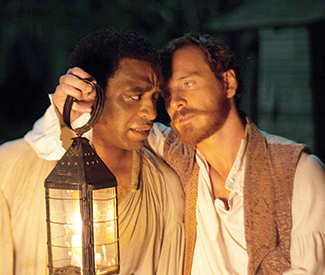
12 Years a Slave is based on the true story of Solomon Northup, an African American man who was sold into slavery in 1841 and survived to pen a wrenching account of his experiences. An acclaimed violinist, Northup had a unique perspective on the South’s surreal status quo; he was born free and had lived a happy, cultured life until he was kidnapped and subjected to over a decade of mental and physical torture. As Northup, Chiwetel Ejiofor (best-known for supporting roles in films like 2005’s Serenity and 2006’s Children of Men) delivers a powerful, star making performance.

As for McQueen, the director’s familiar moniker may still confuse mainstream filmgoers, but once 12 Years a Slave opens, the Brit should finally enjoy some stand-alone name recognition. A large ensemble cast (Paul Giamatti, Paul Dano, Sarah Paulson, Michael K. Williams) populates a film that balances technical virtuosity with brutal subject matter, scripted from Northup’s book by John Ridley (in a huge step up from 2012’s overly sentimental Red Tails).

Increasingly ubiquitous actor Michael Fassbender has seen his biggest critical triumphs come when he’s worked with McQueen. The director, who started his career making art films, made his first feature, Hunger, in 2008; it starred a then-unknown Fassbender as IRA hunger striker Bobby Sands. McQueen’s daring 2011 follow-up, NC-17 sex-addict tale Shame, earned Fassbender a raft of accolades. In 12 Years a Slave, he’s his best yet playing the film’s troubled villain, a plantation owner who exacerbates what’s clearly an unwell mind with copious amounts of booze. He’s tauntingly cruel to Northrup, but slave Patsey — played by talented newcomer Lupita Nyong’o — receives the bulk of his unwanted attentions, affectionate and otherwise.

There’s one false note in 12 Years a Slave, so glaring it deserves a mention. The film is full of recognizable faces; parts played by big stars like Giamatti and Alfre Woodard amount to little more than cameos. But the last-act appearance of Brad Pitt (as an enlightened, worldly builder) proves a jarring intrusion. Pragmatically, perhaps it was worth it; Ejiofor has said in interviews that the megastar’s involvement helped the film get made. But that doesn’t mean it’s not completely distracting. *


12 YEARS A SLAVE opens Fri/1 in Bay Area theaters.

Lit up

0

arts@sfbg.com

DANCE This past weekend, two dance companies showed premieres inspired by fiction writers. Alonzo King’s imagination was stirred by Irish author Colum McCann (Let the Great World Spin) for Writing Ground, commissioned in 2010 by the Monte Carlo Ballet. For Jenny McAllister, it was mystery novelist and screenwriter Raymond Chandler, whom she has read and loved since she was a little girl.

In the work’s San Francisco premiere, King’s LINES Ballet dancers dived into Writing’s complexities with their accustomed passion and competence. It was gratifying to see new company member Robb Beresford, and apprentices Babatunji Johnson and Jeffrey Van Sciver, already comfortable with the stylistic demands of King’s intricate choreography.

Fierce presence is what King asks of his dancers. For Writing, he placed them into an environment of spiritual music from around the globe, which has moved beyond its historical sources into a quasi-mythic arena. Rarely has a King work — divided into small scenes, as is his habit — conveyed such a fluid sense of unity.

Of course, Writing was full of struggles, disrupted connections, broken lines, and extensions that curled in on themselves. Van Sciver, in a long brown skirt, periodically whipped across the stage like some preternatural force, perhaps generating, or perhaps destructive to, the duet between Kara Wilkes and Beresford. A trio for women in pointe shoes — which suggest defiance of gravity — had them groveling in a crouch. Yet Yujin Kim serenely stretched, apparently indifferent to the violent physical struggle between Meredith Webster and David Harvey. For all their volatility, Kim and similarly tall partner Courtney Henry created visual anchors on the stage.

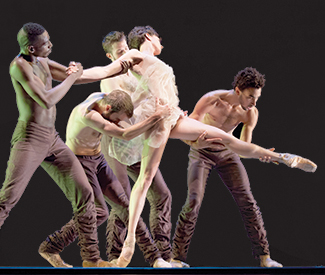
Writing moved toward its climactic final scene with a clear trajectory, perhaps starting with Harvey and Johnson’s contentious duet that ended with them walking upstage like brothers. They were followed by Kim’s solo to the spiritual “Over my Head.” For the finale, a door opened upstage, and an anguished Wilkes squeezed in, manipulated and supported by four men. She struggled, collapsed, and resurged again and again. Perhaps something was trying to be born out of incredible pain. And yet what compassion these men brought to whatever needed to be done.

LINES also presented the world premiere of King’s Concerto for Two Violins in D-minor, set to Bach’s much-acclaimed score. It just might be this eminent dance maker’s most musically astute choreography to Western classical music. The work opened with Johnson stretching his limbs as if trying to expand space beyond the horizon. The choreography emphasized variations within symmetry, such as the trios that chased each other or peeling stacks of double lines. Webster, Wilkes, Harvey, and Michael Montgomery danced the middle section as a double duet in a beautiful synthesis of edginess and lyricism.

McAllister’s nicely timed and entertaining Being Raymond Chandler, a one-hour dance theater piece for her 13th Floor Dance Theater, looks at the mystery icon (David Silpa) struggling with writer’s block, ambition, a messy almost-marriage, and a love for the bottle. But he was also portrayed as a serious writer, separate from the hack image that sticks to him.

The choreography, mostly social dances from the 1940s, was not particularly original, but these sequences set up a relaxed counterpoint to the staccato dialogs that keep racing from one fictional disaster to the next. There were moments when Being dragged — perhaps drowning in language — but it picked up speed and closed with a flourish.

Ever heard of a novel’s characters coming to life? In this piece, Chandler’s did, fighting with the muddle-headed writer for a different identity and desperately trying to stay in the story (hopefully, in a major part). Yet they also pitched in, with disastrous results, rewriting what was clearly a mess. The whole thing might as well be a backstage look at a soap opera.

Patric Cashman wanted to die — again and again; Erin Mei-Ling Stuart was hilarious as both Chandler’s almost-wife and the seductress who, she insists, needs to be a brunette. The versatile Blane Ashby had so many roles — a noisy neighbor, a crook, a former husband — that I couldn’t keep them apart. The weakest character in this entertainment was Eric Garcia’s sleepy Philip Marlowe, who only came to life halfway through.

Good comedy has an ability to draw you in even as you stay at arm’s length. McAllister at her best — and she is good here — has that gift of playing with perspectives and focus, while keeping the audience off balance McAllister has also learned from Chandler: Out of all those misfiring plot twists, she pulled together a lickety-split mystery that took off like a rocket. *


ALONZO KING LINES BALLET

Wed/30-Thu/31, 7:30pm; Fri/1-Sat/2, 8pm; Sun/3, 5pm, $30-$65

Yerba Buena Center for the Arts

700 Howard, SF

www.linesballet.org

13TH FLOOR DANCE THEATER

Sat/2-Sun/3, 8pm, $18-$23

ODC Dance Commons

351 Shotwell, SF

www.13thfloordance.org

Cover me bad

0

MUSIC Halloween’s like Christmastime for crafty weirdoes. But for me, crudely sewn, elaborate costumes are only half the fun. Around these parts, creativity seems to peak during what is arguably the most wonderful time of the year. The Bay Area particularly steps it up by honoring the punk band tradition of the Halloween cover show (where legendary bands are paid tribute through song and dress).

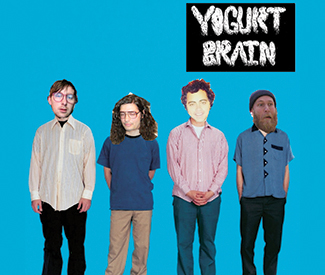
This year’s Total Trash Halloween Bash (www.totaltrashproductions.com) offers some of the usual suspects when it comes to rockers delivering camouflaged covers. However, with Nobunny channeling Bo Diddley as “Nodiddley” and Russell Quan joining Shannon and the Clams as Los Saicos, we step out of the box that usually brings us Cramps and Misfits covers. While those shows are completely appropriate (along with the typical homage to bands like the Ramones, the Damned, and Alice Cooper) and have proven popular, Oakland’s sentimental-grunge act, Yogurt Brain, has opted to take on Weezer this year. Rest assured — fans of the Blue Album and Pinkerton won’t be disappointed.

“I can’t wait to hear them do ‘Buddy Holly’ live,” Nobunny emails back in anticipation. Figuring it’s not the masked-man’s first time at the rodeo, I asked him and a few others about the origins of this tradition. No one seemed to be able to pinpoint exactly when and where it started, but Mark Ribak from Total Trash Productions quipped Thee Oh Sees’ John Dwyer “probably invented it” as an alternative to seeing the Cramps on Halloween (Bill Graham Presents booked an annual Cramps Halloween show in SF starting in the mid-1980s).

Ironically, Nobunny’s first, full-cover set would be the Cramps back in 2009; the same year front man Lux Interior died. I asked far and wide and got scattered remnants of Halloween parties past (like the time a member of Chicago’s Functional Blackouts recalled his previous band dressing in drag, billing themselves as Pretty Pretty Pretty Princess, and doing Bikini Kill songs in 1999).

“Here it definitely seems like more of an event than other cities I’ve lived in, but cover shows seem to happen everywhere in every city,” says Stephen Oriolo, Yogurt Brain’s guitarist and songwriter. He’s gotten into the theatrical spirit so much that by press time he’ll already have done a couple of shows as TRAWGGZ (a Troggs cover band) with members of the now defunct Uzi Rash. “Halloween is a time to be something you’re not. Merging that idea with parties or shows naturally makes sense to do a cover set.”

LA Burger bands like Pangea and Audacity have covered Nirvana and Adolescents respectively. Closer to home, the Clams, who are repeat offenders, have done Devo and Creedence Clearwater Revival (which by all accounts was something you had to see to believe), and Uzi Rash made minds melt with a searing interpretation of Monks songs, shaved heads included (Thee Parkside’s Hallorager II, another Halloween show, will have a different Monks cover band this year. www.theeparkside.com).

As for some of Nobunny’s favorite Halloween tricks: “I like the pranksters, like Ty Segall doing the Spits when they were scheduled to be the Gories. Or my absolute favorite was when Uzi Rash, who were scheduled to play as the Fall, soundchecked as the Fall, and then came out at showtime and performed as the Doors. Great swindle!”

So put on your costume (you might even win a contest if it’s good) and have an old fashioned sing-along with a room full of equally pumped people at one of these shows. I just pray my chances of hearing “The Good Life” live doesn’t end up being a prank. The room is sure to erupt as the tradition thrives in the Bay.


Perma-teens

1

arts@sfbg.com

MUSIC It’s entirely debatable what year this current wave of the garage rock revival broke out.

But for all intents and purposes, let’s just say the genre came back into vogue yet again around 2009: the year Total Trash Productions came into existence. For the past five years, the booking company has served up dozens of garage rock shows and fests in the Bay Area.

And this year, on their fifth anniversary, the folks behind Total Trash are bringing a relic from the first wave: The seminal Washington-based 1960s garage rock band, the Sonics, will play a string of shows for the annual Total Trash Halloween Bash.

The Sonics were there in the very beginning. They got their start in a time when the British Invasion was in full swing. Rejecting sugary-sweet mop-topped bands, the Sonics idolized Jerry Lee Lewis and Little Richard.

“We thought, to heck with wearing suits and neckties," keyboardist-vocalist Gerry Roslie says. "Playing love songs felt wrong — we could only play music with power. We played loud and we played how we felt: like animals.”

The band released a string of albums in the ’60s, with a mixture of rock n’ roll covers such as "Have Love Will Travel," "Louie, Louie," and "Roll Over Beethoven" and edgier, screaching original numbers like “Strychnine” and “Psycho.”

Many credit the Sonics as a proto-punk band of sorts, but Roslie says he saw the band as an outlet to live out his rock ‘n’ roll fantasy until the grips of adulthood came.

“I didn’t know we were garage rock or proto-punk, because those terms didn’t exist at the time we were playing,” Roslie says. “I just knew that we liked being crazy and wanted to play something different than what was out there at the time.”

Roslie left the band in 1967 and started an asphalt-paving business. For decades he had no idea of the influence that his band had left, with future acts such as the Cramps, the Mummies, and the Fall all performing Sonics covers at one point or another.

During that time, Roslie lived a quiet life. That is, until the band was approached in 2007 to play Cavestomp!, a garage rock festival in Brooklyn. That was the first time the band played in well over 30 years.

“We were so nervous — we decided that we would only start playing shows again if people still liked us,” Roslie says.

And sure enough, the Sonics were received with great fanfare, and continued on to play shows in Europe. The one thing that still amazes Roslie is the enthusiasm of new and old Sonics fans alike.

“We’re still scratching our heads going ‘wow’ — I feel that we’re finally getting the attention we deserved,” Roslie says. “We played for teenagers and 20-somethings back in the day, and we’re still playing for that kind of audience. A lot of the kids look the same as they did back then.”

Like many bands that reunite, the Sonics are playing songs made when they were quite young themselves, for the most part covering issues surrounding teenage culture. But as it stands today, all of the members of the band are old enough to be card-carrying AARP (American Association of Retired Persons) members.

“I’m a teenager inside of some wrinkled old body,” says Roslie. “The songs that we made back then are still relatable because we’ve maintained our attitude. We’ve still got that.”

And the Sonics mojo is still intact. So much so that the band is creating a new album. According to Roslie, fans can expect it around late December or early 2014. The release isn’t titled yet, and the label is yet to be determined.

“We didn’t want to go off in a different direction like many bands that have been around for a while do,” Roslie says. “We’re keeping to what we know and do best — loud, crazy rock n’ roll.”

Perma-teenagers or not, the Sonics still have attitude and candor aplenty, spreading the underground rock ‘n’ roll gospel (actively or not) since before you were born.

TOTAL TRASH HALLOWEEN BASH WITH THE SONICS
With Phantom Surfers, Legendary Stardust Cowboy
Fri/1, 7:30pm, $35
New Parish
579 18th St, Oakl.

With Roy Loney, Dukes of Hamburg, Wounded Lion, Chad & the Meatbodies
Sat/2, 7pm, $35
Rickshaw Stop
155 Fell, SF
(415) 861-2011
www.totaltrashfest.com

In the year of worms

4

emilysavage@sfbg.com

TOFU AND WHISKEY That voice. Those eerie, singular vocals that are somehow both alien and intimately familiar. They sound like electric Tesla coils wrapped in whipped silk. San Francisco’s Hannah Lew is most often heard harmonizing by three with her striking post-punk trio Grass Widow. With newer project Cold Beat, it’s her vocals alone above the needling guitars and anxious synths of a different band.

Lew has been writing songs as Cold Beat for some time, in between Grass Widow releases and tours, but this week she releases her first EP under the moniker: Worms/Year 5772, with songs inspired by the trauma of Lew’s father passing away a few years back. While Cold Beat is mainly a Lew production, she enlisted many local rock ‘n’ roll luminaries to both play on the album and back her up at shows.

The record’s sound is rounded out by guitarist Kyle King, drummer Lillian Maring, and Shannon and the Clams’ Cody Blanchard on guitar and synths. The live band features King, the Mallard’s Greer Mcgettrick on guitar, and Erase Errata’s Bianca Sparta on drums. That live version will celebrate the release of the EP with a show at the Night Light in Oakland Tue/5.(Cold Beat also plays Great American Music Hall on Nov. 14.) But before that, Lew spoke with the Bay Guardian about the origins of Worms/Year 5772, her DIY record label and music video projects, and the songs she played at her wedding last week:

SF Bay Guardian What inspired you to write new music as Cold Beat, outside of Grass Widow?

Hannah Lew I always write songs and sometimes they just didn’t totally feel like Grass Widow songs. I just kept collecting them and not really knowing if I should release them. As the tunes started accumulating I decided I should get a band together and figure out a way to share the songs. When Kyle King and I started playing — his energy really enabled the songs to come to fruition.

SFBG Can you tell me a bit about the songwriting process with Worms/Year 5772 and how the themes of “death, Internet surveillance, paranoia and science fiction” translated into the music?

HL “Worms” was written as a response to my grief about my father’s death in 2009. I couldn’t help but imagine worms eating his corpse — which was a very visceral image I couldn’t get out of my head…I think the horror of this was something I couldn’t really share with anyone, and in taking time to write more songs on my own I started realizing that it was good for me to have an outlet for some other concepts that were a bit more personal.

I always turn to science fiction when I am trying to understand or relate my feelings. It gives me a change to explore depths of doom and hope that I can more easily imagine not on this earth. In writing all the lyrics alone for Cold Beat there is a little more of me just in my own head which can be great and sometimes paranoid or depressed. I get really bad insomnia and many Cold Beat songs were demoed at 5 or 6am.

Grass Widow lyrics are always more of a conversation where as Cold Beat lyrics are more like an interior dialogue. It’s kind of like describing a dream to someone.

SFBG Does “Year 5772” refer to the Jewish calendar? Why did you make this connection?

HL My late father was a rabbi and I was raised very religious. I was writing Year 5772 about a dystopian post-apocalyptic dream I had that seemed to take place in some distant future and I started thinking about how the Jewish calendar is already in Year 5772 — actually a couple years later now since the song was written a few years ago — and how our concept of the future is based in what point in time we imagine ourselves in — but the concept of linear time is very relative.

I guess being Jewish is kind of futuristic and ancient simultaneously. I like the idea of collapsing time and writing a song that takes place in a landscape outside of time. I also like thinking about existing in many times simultaneously.

SFBG Did you find the solo songwriting process freeing or more complicated without the group’s input?

HL Some of the Cold Beat songs were written during the time Grass Widow was writing our last record — Internal Logic. Somehow they just seemed more personal and better spoken from one voice instead of related by three people. I think the complicated part for me was deciphering which songs were Cold Beat songs and which ones to give to Grass Widow.

Grass Widow is a great space where the three of us would relate and abstract our feelings and dreams together. But there were some things I was going through that I couldn’t synthesize with anyone else and just had to express on my own. I like having conversations about concepts with bandmates, but I also like working alone.

Luckily I can do both! I think it is important to be able to do things on your own so you know who you are and have something to offer a collaborative project. Just like in love.

SFBG You got married last weekend — what key songs were on your playlist? Are you willing to give up any other details?

HL It’s all kind of a blur. but it was so much fun! Some friends of ours put together a wedding band with Kyle King as the band leader. My husband (whoa!) and I put together a set list for the band to play of all our favorite dancing songs. I think the party really went crazy during the Dick Dale version of “Hava Nagila” and we got lifted up in chairs and everything, but also [the Flamin’ Groovies song] “Shake Some Action” was pretty epic too.

My friend Henson Flye made giant clamshells and Raven Mahon made a moon photo backdrop. We had a choir of friends sing “I’ll Be Your Mirror” while I walked down the aisle. It was really beautiful and a beautiful way for all our friends to express their love and friendship and show us support and for us to throw a fun party for everyone. We’re lucky to have a lot of love. Still buzzing from it!

SFBG As with Grass Widow (HLR), you’re putting Cold Beat out on your own label, Crime On The Moon. Can you tell me about the label, and why you’re sticking with DIY?

HL I really enjoy doing everything myself. HLR has been a great experience and we really took the time to make critical decisions about how we wanted to do business. I figured I could easily do it myself with Crime On The Moon since I had the experience of putting out the last few Grass Widow releases. One drawback is that when you put music out on a label you have an instant fan, publicist, and advocate — so when you’re on your own you have to manufacture your own confidence for what you are doing. But having good bandmates and support from your friends goes a long way!

SFBG You also make music videos — will you make any for Cold Beat? Are you working on any others currently?

HL Mike Stoltz, who made the Grass Widow “11 of Diamonds” video and collaborated with me on “Give Me Shapes,” is in the process of editing a Cold Beat video for “Worms.” So that will be out in the next couple of weeks! I am always updating my site (www.hannahlew.com) with new finished videos I make for other bands.

SFBG Anything else you want people to know about Cold Beat or about other upcoming projects?

HL Well I’m excited for our EP to be released November 5. We’ll have copies at our record release show at the Night Light in Oakland with Screature and Pure Bliss. Then we’ll be touring the West Coast to follow that.

I’m also releasing a seven-inch [that] Raven and I recorded with Jon Shade on drums under the name Bridge Collapse. We recorded with Kelley Stoltz and I’m looking forward to releasing those songs along with a compilation of SF bands writing songs as a response to the tech boom. So a lot of exciting Crime On The Moon projects ahead!

COLD BEAT

Tue/5, 9pm, $6

Night Light

311 Broadway, Oakl.

www.thenightlightoakland.com

Meister: A Halloween invasion from Mars

0

Guardian columnist Dick Meister is a longtime Bay Area journalist.

“2X2L calling CQ … 2X2L calling CQ, New York … Isn’t there anyone on the
air? Isn’t there anyone on the air? Isn’t there anyone?”

Millions of Americans — panic-stricken, many of them — waited anxiously
for a response to the message, delivered over the CBS radio network in slow,
flat, mournful tones on the crisp Halloween eve of Oct. 30, 1938.

“Isn’t … there … anyone?”

There wasn’t. Listeners heard only the slapping sounds of the Hudson River.

Many of New York’s residents were dead. The others had fled in panic from
“five great machines,” as tall as the tallest of the city’s skyscrapers,
that the radio announcer at CQ, New York, had described in the last words he
would ever utter. The metallic monsters had crossed the Hudson “like a man
wading a brook,” destroying all who stood in their way.

“Our army is wiped out, artillery, air force — everything wiped out,”
gasped the radio announcer.

It was the War of the Worlds, Mars versus Earth, and the Martians were
winning with horrifying ease. Their giant machines had landed in the New
Jersey village of Grovers Mill, and soon they would be coming to your town,
too … and yours … and yours. Nothing could stop them.

The War of the Worlds had sprung with frightening clarity from the extremely
fertile imagination of Orson Welles and the other young members of the
Mercury Theater of the Air who adopted Wells’ novel and dramatized it so
brilliantly — and believably — from the CBS radio studios on that long ago
Halloween eve.

Their use of realistic sounding bulletins and other tools of radio news
departments made it sound as if Martian machines truly were everywhere, and
everywhere invincible.

Studies done at the time show that at least one million of the program’s
estimated six million listeners panicked.

“People all over the United States were praying, crying, fleeing frantically
to escape death from the Martians,” noted Hadley Cantril, an actual
Princeton professor who directed the most detailed study of the panic that
was caused in part by the pronouncements of “Richard Pierson,” a bogus
Princeton professor played by Welles.

“Some ran to rescue loved ones. Others telephoned farewells or warnings,
hurried to inform neighbors … summoned ambulances and police cars … For
weeks after the broadcast, newspapers carried human interest stories
relating the shock and terror of local citizens.”

“When the Martians started coming north from Trenton we really got scared,”
a New Jerseyian told one of Professor Cantril’s interviewers. “They would
soon be in our town. I drove right through Newberg and never even knew I
went through it … I was going eighty miles an hour most of the way. I
remember not giving a damn, as what difference did it make which way I’d get
killed.”

Those who didn’t join the streams of cars that clogged the highways clogged
the phone lines or huddled in cellars and living rooms to await the end,
some with pitchfork, shotgun or Bible in hand.

“I knew it was something terrible and I was frightened,” a woman recalled.
“When they told us what road to take, and to get up over the hills, and the
children began to cry, the family decided to go. We took blankets and my
granddaughter wanted to take the cat and the canary.”

It was an extremely rare occurrence., as Cantril noted: “Probably never
before have so many people in all walks of life and in all parts of the
country become so suddenly and so intensely disturbed …”

And never since then has the country experienced such deep and widespread
fear and anxiety. Not even after Japan’s surprise attack on Pearl Harbor
three years later. Not even in the wake of the terrorist attacks of Sept.
11, 2001.

It was a unique display of widespread panic. Many people actually believed
their very world was coming to an end and there was nothing anyone could do
to stop it.

Welles had made clear at the start that the presentation was fictional. But
radio listeners generally paid little attention to opening announcements,
and many Sunday night listeners commonly turned first to the very popular
Edgar Bergen-Charley McCarthy show that was broadcast over another network
in the same 8 p.m. time slot, turning to the Mercury Theater out of
curiosity only later.

What they heard that Sunday were primarily news reports and commentaries
ingeniously patterned on the real reports and commentaries that were
constantly interrupting programs to report the aggressive actions of Nazi
Germany and other events that would shortly lead to the outbreak of World
War II.

People expected to hear the worst. Most also expected that what they heard
would be accurate, radio having supplanted newspapers as the most trusted
and relied upon of the mass media.

It helped, too, that much of the information was presented by “experts” …
Welles and other make-believe professors from universities around the world,
supposed astronomers, army officers and Red Cross officials, even the
otherwise unidentified “secretary of the interior.”

“I believed the broadcast as soon as I heard the professor from Princeton
and the officials in Washington,” as one listener recalled.

Even relatively sophisticated and well-informed listeners were fooled by
what Cantril cited as the program’s “sheer dramatic excellence.”

Events developed slowly, starting with the relatively credible — brief news
bulletins calmly reporting some “atmospheric disturbances,” later some
“explosions of incandescent gas,” and finally the discovery of what appeared
to be a large meteorite. Only then came the incredible — the discovery that
the “meteorite” was a Martian spaceship, reported in a halting, incredulous
manner by the “reporter” supposedly broadcasting live from Grovers Mill.

The police, the New Jersey State Guard, the army — none could subdue the
invaders. Finally, the “secretary of the interior” announced that man could
do no more, that the only hope for deliverance from the Martians was to
“place our faith in God.”

Few listeners were in a position to make independent judgements about
matters Martian. Few knew astronomy, and what standards does one use to
judge an invasion from Mars anyway?

Listeners could easily have turned to other radio networks for the truth, of
course, but many were too caught up in the masterful drama of the CBS
program to think of that.

Even some people who lived near the alleged invasion site were fooled. “I
looked out the window and everything was the same as usual,” said one, “so I
thought it hadn’t reached our section yet.”

The second half of the hour-long broadcast, with “Professor Pierson”
wandering dazedly through the deserted and ravaged streets of New York,
should have made it obvious to even the most gullible that they had been
listening to drama rather than news. Welles, shocked and shaken by the
listener response, followed that quickly with an ad-libbed assurance that it
had all been make-believe.

But by then, many people had left their radios. They had other ways in which
to spend their last hours on earth.

Copyright © 2013 Dick Meister
Guardian columnist Dick Meister is a longtime Bay Area journalist
.

The Selector: October 30-Nov. 5, 2013

0

WEDNESDAY 30

The Nightmare Before Christmas

“Boys and girls of every age, wouldn’t you like to see something strange?” If so, (and especially if you recognize these lyrics), then come with us and you will see Tim Burton’s The Nightmare Before Christmas (1993) at SoMa StrEat Food Park, where this week’s StrEat Flicks features everyone’s favorite stop-motion musical fantasy. Trick or treat, grown-up style, between the food trucks with a cup of beer or sangria. Next, grab a bag of popcorn and plop down under the heat lamps and get ready to sing along, because “this is Halloween.”(Kaylen Baker).

7pm, free

SoMa StrEat Food Park

428 11th St, SF

www.somastreetfoodpark.com


Psycho with the San Francisco Symphony

Alfred Hitchcock is still rightfully considered the master of suspense in film, and he often used music to help achieve his desired results, frequently with composer Bernard Herrmann. Fans are in for a special treat this Halloween season as the San Francisco Symphony will perform the scores to several movies live while the films are projected on a large screen behind the musicians — from the shrieking strings of Psycho (Wed/30, 8pm) and the sweeping score of Vertigo (Fri/1, 8pm), to an organ accompaniment for the silent classic The Lodger (Thu/31, 7:30pm) and a “Greatest Hits” medley (Sat/2, 8pm) featuring guest host actress Eva Marie Saint, who starred in North by Northwest (1959).

(Sean McCourt)

Through Sat/2, $20–$156

Davies Symphony Hall

201 Van Ness, SF

(415) 864-6000

www.sfsymphony.org


THURSDAY 31

Halloween ComicFest

Fill your little jack-o’-lantern buckets with candy and free comics at Mission: Comics & Art, which will be participating in this year’s Halloween ComicFest. But free goodies are just the tip of the iceberg. The comic shop will also be hosting Ben Catmull for a signing of his new, eerie book Ghosts and Ruins. In this coffee table art book from Fantagraphics, Catmull has illustrated an array of haunted houses and written stories about the origins of each of their hauntings. Don’t say Shelley’s name 13 times while looking into the pond by the house where she was drowned, or you may suffer the same fate in your sleep. Don’t miss this chance to pick the author’s brain about Shelley’s story and more! (Kirstie Haruta)

5pm, free

Mission: Comics & Art

3520 20th St, Suite B SF

(415) 695-1545

www.missioncomicsandart.com


The Flaming Lips’ Halloween Blood Bath

Oklahoma City psych rockers the Flaming Lips’ mold-breaking performances are as varied as the band’s back catalog. Motorcycle exhaust filled punk orgies, dazzling Christmas light powered spectacles, car stereo orchestras, and for at least the last decade, the technicolor, eyeball melting, heart swelling celebrations of pure weirdo pop, accented by confetti cannons and costumed menagerie. Now it’s switching up again, retiring elements that came close to being trademarks. (No space bubble, kids. Go see Diplo, who ripped it off, as he does every gimmick.) With their latest, The Terror, the Lips seem to be on their own private dark side of the moon, and the current tour promises to be a different kind of spectacle. (Ryan Prendiville)

With Tame Impala, White Denim

7pm, $47.50

Bill Graham Civic Auditorium

99 Grove, SF

www.apeconcerts.com


The Shondes

If you love to dance, can whip up a mean zombie costume, and have a feminist fire in your heart, Café du Nord is the place to be this Halloween. Touring on their powerful fourth release, The Garden, Brooklyn-based the Shondes make a San Francisco stop just in time for some spooky, queer-friendly festivities, bringing their bright klezmer-pop-rock and hopeful, anthemic lyrics — chants that will likely be bouncing around in your head for the rest of the weekend. The Shondes are joined by Bay Area rockers Naïve Americans and the Galloping Sea for a dance-worthy show and a ’90s zombie-themed costume contest. That interpretation is up to you, just make it good and scary, because there will be judges and prizes. (Haruta)

8:30pm, $7

Café du Nord

2170 Market, SF

(415) 861-5016

www.cafedunord.com


FRIDAY 1


American Indian Film Festival

Now in its 38th year, the American Indian Film Festival continues its tradition of spotlighting films by and about Native Americans, with an emphasis on unique and independent works. Opening night unspools Chasing Shakespeare, a magical-realism family drama starring Danny Glover and two of the most prolific First Nation acting legends: Tantoo Cardinal and Graham Greene (both of whom also appear in closing-night film Maina). The rest of the fest brings a screening of Star Wars (1977) with Navajo subtitles; The Lesser Blessed, with SF-born Benjamin Bratt; and, at the SFJazz Center, the star-studded American Indian Motion Picture Awards Show. (Cheryl Eddy)

Through Nov. 9, $7–$20

Delancey Street Theatre

600 Embarcadero, SF

www.aifisf.com


“Bad Dads: Wes Anderson Tribute”

Bask in the cloying quirkiness of the worlds created by filmmaker Wes Anderson at Spoke Art’s fourth annual art show tribute to Anderson’s films. “Bad Dads” will feature works by artists like Joshua Budich and Rich Pellegrino, celebrating everything from The Royal Tenenbaums (2001) to Moonrise Kingdom (2012). Of the newest film, there’ll be Budich’s pulpy screenprint of Moonrise Kingdom‘s main cast divided by a jag of lightning and Michael Ramstead’s lifelike oil painting of “Suzy” as a raven. The exhibit’s opening weekend kicks off with an all-ages Halloween costume party on Fri/1, and continue on through Sunday, when the celebrations move to the Castro Theatre for a triple feature showing of Bottle Rocket (1996), The Royal Tenenbaums, and Moonrise Kingdom. Dress up to channel your inner Gwyneth Paltrow or Bill Murray and immerse yourself in tribute art and film for the weekend. (Haruta)

Through Nov. 23

Exhibition, 6pm, free; Sunday movie screening, 1pm, $12

Spoke Art

816 Sutter, SF

(415) 796-3774

www.spoke-art.com


AYLI Presents Freaky Friday with Maya Jane Coles

During previous appearances in the city, London artist Maya Jane Coles has come dangerously close to being outpaced by her popularity. Pressed to the sides of Monarch during her set last year, my extensive catalog of deep struts and funky steps was reduced to a little heady bobbing for lack of space. It’s a relief that AYLI is bringing her to the more spacious venue of Public Works, particularly now that Coles released her Comfort LP, a vocally-oriented bit of silky house, featuring guest appearances by Kim Ann Foxman and Karin Park. (The track with Park, “Everything,” is the album’s standout.) Still, given how packed this party is on the lineup side, including co-headlining Romanian-born techno producer Cosmin TRG, it may be wise to stake prime floor space early. (Prendiville)

With Bells & Whistles, Brian Knarfield, Cubik & Origami LIVE, more

9pm-4am, $20 presale

Public Works

161 Erie, SF

(415) 932-0955

www.publicsf.com


SUNDAY 3

“Zombie Love”

The signs are all there: After dates you feel a dull numbness where your heart should be, you move in slow motion while life around you runs away, and late at night you’re knocking on your ex’s door. Face it: You’ve contracted Zombie Love. Since there’s no cure, you may as shuffle down to the Make-Out Room with other reanimated life forms for a night of flesh-decaying stories from the Portuguese Artists Colony. Guest readers include Camille T. Dungy, Joe Loya, Sylvie Simmons, and Christopher Worrall, while Three Times Bad regenerates the mood with alternative bluegrass wailings. Additionally, four live writers (friends, not food) scratch out and read aloud stories on some romantically undead prompt for a chance to perform at the next PAC event. (Baker)

5pm, $5-10

Make-Out Room

3225 22nd St, SF

(415) 647-2888

www.portugueseartistscolony.com


MONDAY 4

“Words On Dance with Ashley Wheater & Joanna Berman”

Joanna Berman was born in San Rafael; Ashley Wheater in Bigger, Scotland. Berman spent her entire career with the San Francisco Ballet. Wheater joined after his stints with the London Festival Ballet, Australian Ballet, and the Joffrey Ballet. At SFB they excelled in classical as well as contemporary roles. He retired from dancing in 1996; she in 2002. Both were 36. He did so because of a neck injury; she because she wanted to start a family. Following a format “Words On Dance” has successfully developed over the last 20 years — their conversation together offers an intriguing insider perspective on the world of ballet. The evening includes archival footage of Wheater’s performance career and a film showing him in his new role as artistic director with the Joffrey Ballet which he rejoined in 2007. (Rita Felciano)

7pm, $30

ODC Theatre

3153 17th St., SF

www.odctheater.org


TUESDAY 5

Blitzen Trapper

Blitzen Trapper exists in a parallel universe. The world frontperson Eric Earley has created though Blitzen Trapper’s 13 years and seven albums is filled with magical realism and a detached, fantastical worldview (in which life is a Western and classic rock is still king). Earley’s close relationship with the unreal extends further than his lyrics — the first sentence of the band’s bio reads, in complete earnest, “When I was 23, I had a waking vision of a creature trying to get inside my apartment,” an experience that pushed Earley to quit school and form a band. Blitzen Trapper’s history is an incredible one — its first two albums were self-released during a period of homelessness — and its success as an alt-country band in an indie rock world is even more incredible. (Haley Zaremba)

With Alialujah Choir

8pm, $23

Regency Ballroom

1300 Van Ness, SF

www.theregencyballroom.com


Stage Listings Oct. 30-Nov. 5, 2013

0

Stage listings are compiled by Guardian staff. Performance times may change; call venues to confirm. Reviewers are Robert Avila, Rita Felciano, and Nicole Gluckstern. Submit items for the listings at listings@sfbg.com.

THEATER

OPENING

Driving Miss Daisy Buriel Clay Theater at the African American Art and Culture Complex, 762 Fulton, SF; www.african-americanshakes.org. $12.50-37.50. Opens Sat/2, 8pm. Runs Fri-Sat, 8pm; Sun, 3pm. Through Nov 17. African-American Shakespeare Company performs Alfred Uhry’s Pulitzer-winning drama.

I Married an Angel Eureka Theatre, 215 Jackson, SF; www.42ndstmoon.org. $25-75. Previews Wed/30-Thu/31, 7pm; Fri/1, 8pm. Opens Sat/2, 6pm. Runs Wed-Thu, 7pm; Fri, 8pm; Sat, 6pm (also Nov 9, 1pm), Sun, 3pm. Through Nov 17. 42nd Street Moon performs the Rodgers and Hart classic.

The Jewelry Box: A Genuine Christmas Story The Marsh San Francisco, 1062 Valencia, SF; www.themarsh.org. $15-40. Opens Fri/1, 8pm. Runs Fri, 8pm; Sat, 5pm. Brian Copeland performs the world premiere of his new, holiday-themed work, an Oakland-set autobiographical tale that’s a prequel to his popular Not a Genuine Black Man.

Peter and the Starcatcher Curran Theatre, 445 Geary, SF; www.shnsf.com. $40-160. Opens Tue/5, 8pm. Runs Tue-Sat, 8pm (also Wed and Sat, 2pm; no show Nov 28); Sun, 2pm. Through Dec 1. Fanciful, Tony-winning prequel to Peter Pan.

BAY AREA

A King’s Legacy Pear Avenue Theatre, 1220 Pear, Mtn View; www.thepear.org. $10-35. Previews Thu/31, 8pm. Opens Fri/1, 8pm. Runs Thu-Sat, 8pm; Sun, 2pm. Through Nov 24. Pear Avenue Theatre performs Elyce Melmon’s world premiere, a drama about King James VI of Scotland.

A Little Princess Julia Morgan Theater, 2640 College, Berk; www.berkeleyplayhouse.org. $17-60. Previews Thu/30, 7pm and Sat/2, 1pm. Opens Sat/2, 6pm. Runs Thu-Fri, 7pm (Nov 28, shows at 1 and 6pm); Sat, 1 and 6pm; Sun, noon and 5pm (no 5pm show Dec 1). Through Dec 8. Berkeley Playhouse opens its sixth season with Brian Crawley and Andrew Lippa’s musical adaptation of the Frances Hodgson Burnett story.

Social Security Muriel Watkin Gallery, 1050 Crespi Drive, Pacifica; (650) 359-8002. $10-25. Opens Fri/1, 8pm. Runs Fri-Sat, 8pm; Sun, 2pm. Through Nov 24. Pacifica Spindrift Players performs Andrew Bergman’s classic comedy.

ONGOING

The Barbary Coast Revue Stud Bar, 399 Ninth St, SF; eventbrite.com/org/4730361353. $10-40. Wed, 9pm (no show Nov 27). Through Dec 18. Blake Wiers’ new “live history musical experience” features Mark Twain as a tour guide through San Francisco’s wild past.

Bengal Tiger at the Bagdad Zoo SF Playhouse, 450 Post, SF; www.sfplayhouse.org. $30-100. Tue-Thu, 7pm; Fri-Sat, 8pm (also Sat, 3pm). Through Nov 16. In Rajiv Joseph’s Pulitzer-nominated Bengal Tiger at the Bagdad Zoo, the dead quickly outnumber the living, and soon the stage is littered with monologist ghosts lost in transition. In Joseph’s world, at least, death is but another phase of consciousness, a plane of existence where a man-eating tiger might experience a crisis of conscience, and a brash young soldier with a learning disability might suddenly find himself contemplating algebraic equations and speaking Arabic —knowledge that had eluded his comprehension in life. Will Marchetti’s portrayal of the titular tiger is on the static side, though his wry intelligence and philosophical awakening comes as a welcome contrast to the willfully obtuse world view of the American soldiers (Gabriel Marin and Craig Marker) guarding him. But it’s Musa (Kuros Charney), a translator for the Americans and a former gardener and topiary “artist,” who eventually emerges as the play’s most fully realized character and also the most tragic, becoming that which he dreads the most, a beast in a lawless land, egged on by the ghost of his former employer, the notoriously sadistic Uday Hussein (Pomme Koch). At times, director Bill English’s staging feels too understated and contained for a play that’s so muscular and expansive (an understatement not carried over into Steven Klems’ appropriately jarring sound design) focused less on its metaphysical implications than on its mundane surface, but however imperfect the production and daunting the script, it remains a fascinating response to an unwinnable war — the war against our own animal natures. (Gluckstern)

BoomerAging: From LSD to OMG Marsh San Francisco, 1062 Valencia, SF; www.themarsh.org. $15-50. Tue, 8pm. Extended through Dec 17. Will Durst’s hit solo show looks at baby boomers grappling with life in the 21st century.

Carrie: The Musical Victoria Theatre, 2961 16th St, SF; www.rayoflighttheatre.com. $25-36. Wed/30-Sat/2, 8pm (also Sat/2, 2pm). Teen bullying is très topical at the moment, making Stephen King’s terrifying tale of a telekinetic girl pushed to the breaking point by her unsympathetic classmates ripe for revival. Although it flopped on Broadway in 1988, Carrie: The Musical has aged more gracefully than you might expect, thanks to the timeliness of its overarching theme and a judicious 2012 facelift of its script and score. In Ray of Light Theatre’s slam-dunk production, Carrie unfolds a bit like an after-school special on scapegoating, except with show tunes and, of course, the stratospheric consequences of the final, tragic revenge sequence. The songs themselves are mainly forgettable in terms of hooks and lyrics, but the vibrant young cast makes the most of them, with excellent harmonizing and powerful range. Amanda Folena’s tight choreography borrows the sinuous hip rolls and stomp of a Janet Jackson routine and just a touch of twerk, while Joe D’Emilio’s lighting and Erik Scanlon’s video design work in unholy symbiosis to create the supernaturally charged ambience of Carrie’s world. As Carrie, Cristina Ann Oeschger really shines, embodying the heartbreaking fragility of a lonely outcast whose optimism has not yet been entirely crushed, while Heather Orth as her frighteningly pious mother, Margaret White, reveals the vulnerability of her equally lonely character that many portrayals miss altogether. Standouts among the solid supporting cast include Jessica Coker as a compassionate gym teacher and Riley Krull as the ultimate mean girl. (Gluckstern)

Dirty Little Showtunes New Conservatory Theatre Center, 25 Van Ness, SF; www.nctcsf.org. $25-45. Wed-Sat, 8pm; Sun, 2pm. Through Nov 10. Lyricist-performer Tom Orr and director F. Allen Sawyer’s sassy but loving remix of iconic Broadway songs returns in another iteration, this one at the New Conservatory Theatre Center, complete with a willing and able cast of five (Rotimi Agbabiaka, David Bicha, Jesse Cortez, Randy Noak, Orr), piano accompaniment by musical director Scrumbly Koldewyn, and some rudimentary if evocative choreography by Jayne Zaban. Truly silly, sometimes inspired, the show mixes favorite parodies from past productions with some new ones. Orr’s wit shines throughout, even if it does not necessarily outshine every borrowed theme. Gilbert and Sullivan, for example, are hardly upstaged as much as celebrated with Bicha belting out, “I Am the Very Model of a Modern Homosexual.” More sentimental numbers about T cell counts or gay marriage, while an understandable part of the landscape of gay life explored here, can feel a little strained in the context of the generally ribald. But the high-spirited nature of this whimsical show makes pardonable even the less-dirty parts. (Avila)

Drowning Ophelia Mojo Theatre Space, 2940 16th St, #217, SF; www.repurposedtheatre.com. $20. Thu/31-Sat/2, 8pm. Jane (Katharine Otis) is a young woman teetering on the verge of a breakdown who plays period dress-up with would-be suitor Edmund (Will Trichon) but can’t avoid the character at her back: Hamlet‘s Ophelia (Kirsten Dwyer), chiding and chilling from her bathtub in the middle of the room. As Jane’s attention gets drawn back to her alter ego, scenes from the past with recently deceased brother Adam (Ryan Hayes) replay themselves with Ophelia as her stand-in. These go from innocent to menacing, as meanwhile Jane’s almost endlessly patient boyfriend finally seems to have had enough of the clash between their playful pretending and the unforeseen visitors in Jane’s head. While a promising gambit from newcomer Repurposed Theatre, the world premiere of Pennsylvania-based playwright Rachel Luann Strayer’s slightly unwieldy play makes less of this intriguing situation than one might hope. The literary and theatrical bent to Jane’s split personhood is apt on more than one level — she’s not only desperate to secure a sense of order for her disordered mind, but a scripted basis for a romantic ideal forever tarnished by her relationship with her brother (vaguely creepy in his boyish confidence in Hayes’s alert performance). But there’s little sense of a larger psychosocial reality — whether of patriarchal misogyny, or violence more generally — and, as a result, little to be gained from the too-obvious and too emphatic incest-madness theme, outside of an impressive performance from Otis, whose somewhat hampered character is nevertheless a powerful presence throughout. Capable supporting turns, including Dwyer’s intense and vital Ophelia, and director Ellery Schaar’s generally sharp staging (under Julien Elstob’s moody lighting) contribute to making a nicely atmospheric production. (Avila)

First Stage Werx, 446 Valencia, SF; www.firsttheplay.com. $25-35. Thu/31-Sat/2, 8pm; Sun/3, 2pm. Altair Productions, the Aluminous Collective, and PlayGround present the world premiere of Evelyn Jean Pine’s play, which imagines a 20-year-old Bill Gates’ experiences at a 1976 personal computer conference.

Foodies! The Musical Shelton Theater, 533 Sutter, SF; www.foodiesthemusical.com. $32-34. Fri-Sat, 8pm. Open-ended. AWAT Productions presents Morris Bobrow’s musical comedy revue all about food.

444 Days Z Below, 470 Florida, SF; www.goldenthread.org. $10-45. Thu/31-Sat/2, 8pm (also Sat/2, 3pm); Sun/3, 3pm. Golden Thread Productions presents the world premiere of founding artistic director Torange Yeghiazarian’s drama about the reunion between a former Iranian revolutionary, Laleh (Jeri Lynn Cohen), and a former American diplomat from the American embassy in Tehran, Harry (Michael Shipley) — her captive in more ways than one during the 444 days of the 1979-81 Iran hostage crisis. Some 25 years after this international “affair,” Laleh and Harry meet again at the bedside of their critically ill and comatose daughter, Hadyeh (Olivia Rosaldo-Pratt), whose non-biological father Amin (an offstage character) is Laleh’s longtime comrade and another of the onetime hostage takers. If it sounds like a politically loaded situation, it is, which is as much a problem as a virtue in director Bella Warda’s production. Yeghiazarian laces her dialogue with light humor, irony, and romance throughout, but the play allows little room for its characters to really breathe — indeed, Laleh’s first words to Harry after 25 years are, unlikely enough, a well-rehearsed screed. In the contortions its characters must speak (to which a friendly nurse, played by Sheila Collins, adds something like the average American’s perspective), the play remains too intent on delivering a political message about the intractable relationship, then and now, between the US and Iran — and the unnatural sacrifice of the generation that has come up since the severing of US-Iranian diplomatic ties after the revolution of 1979. (Avila)

Gruesome Playground Injuries Tides Theatre, 533 Sutter, SF; www.tidestheatre.org. $20-40. Wed-Sat, 8pm. Through Nov 9. Tides Theatre performs Rajiv Joseph’s drama about two people who first meet as eight-year-olds in the school nurse’s office.

Hedwig and the Angry Inch Boxcar Theatre, 505 Natoma, SF; www.boxcartheatre.org. $27-43. Thu-Sat, 8pm. Open-ended. John Cameron Mitchell’s cult musical comes to life with director Nick A. Olivero’s ever-rotating cast.

Lovebirds Marsh San Francisco, 1062 Valencia, SF; www.themarsh.org. $15-100. Thu-Fri, 8pm; Sat, 8:30pm. Through Nov 9. Workshop performances of Marga Gomez’s 10th solo show, about different characters seeking romance in the 1970s.

Randy Roberts Live! Alcove Theatre, 414 Mason, SF; www.randyroberts.net. $40. Thu/31-Sat/2, 9pm. The famed female impersonator performs.

Shakespeare Night at the Blackfriars (London Idol 1610) Phoenix Arts Association Annex Theatre, 414 Mason, SF; www.subshakes.com. $20-25. Fri-Sat, 8pm; Sun, 7pm. Through Nov 17. Subterranean Shakespeare performs George Crowe’s comedy about a playwriting contest between Ben Jonson, Thomas Middleton, Francis Beaumont, and the ghost of Christopher Marlowe.

“Shocktoberfest 14: Jack the Ripper” Hypnodrome, 575 10th St, SF; www.thrillpeddlers.com. $25-35. Thu-Sat and Wed/30, 8pm. Through Nov 23. It’s lucky 14 for the Thrillpeddlers’ annual Halloween-tide Shocktoberfest, and while there are few surprises in this year’s lineup, there’s plenty of reliable material to chew on. Opening with A Visit to Mrs. Birch and the Young Ladies of the Academy, a ribald Victorian-era “spanking drama,” the fare soon turns towards darker appetites with a joint Andre De Lorde-Pierre Chaine work, Jack the Ripper. Works by De Lorde — sometimes referred to as the “Prince of Fear” — have graced the Hypnodrome stage over the years, and this tense Victorian drama, though penned in the 30s, is suitably atmospheric. Although it becomes pretty evident early on who dunnit, it’s the why that lies at the heart of this grim drama, and in the course of that discovery, the play’s beleaguered lawmen reveal themselves to be no less ruthless than the titular Ripper (John Flaw) in pursuit of their quarry. Norman Macleod as Inspector Smithson particularly embodies this unwholesome dichotomy, and Bruna Palmeiro excels as his spirited yet doomed bait. Inspired by Oscar Wilde’s Salome, the Thrillpeddlers’ piece by the same name is perhaps the weak link in the program, despite being penned by the ever-clever Scrumbly Koldewyn, and danced with wanton abandon by Noah Haydon. Longtime Thrillpeddlers’ collaborator Rob Keefe ties together the evening’s disparate threads under one sprawling big top media circus of murder, sex, ghosts, and sensationalism with his somewhat tongue-in-cheek, San Francisco-centric The Wrong Ripper. (Gluckstern)

Sidewinders Exit on Taylor, 277 Taylor, SF; www.cuttingball.com. $10-50. Thu, 7:30pm; Fri-Sat, 8pm (also Sat, 2pm); Sun, 5pm. Through Nov 17. Cutting Ball opens its 15th season with the world premiere of Basil Kreimendahl’s absurdist romp through gender queerness. In a cartoonish, desolate wasteland (designed by Michael Locher), Dakota (Sara Moore), a bleached-blonde gunslinger in buckskin fringes, and Bailey (DavEnd), a possibly AWOL soldier rocking high-heeled boots and a single drop earring, wrestle with the conundrum of what to call their respective genitals. And more to the point, what to do with them after they figure it out. Or as Bailey bluntly puts it, “Who am I supposed to fuck?” But there’s more to being stranded in the uncharted wilderness at stake than “organ confusion,” and soon they must channel their uncommon alliance into finding a way back out. What they find instead include a regal figure of indeterminate gender possessed of extra limbs (Donald Currie), a suicidal servant with surgical skills (Norman Muñoz), and a growing realization that wilderness, like identity, is relative. Moore and DavEnd make a good comedic team, their endless banter, circular logic and exaggerated facial gymnastics giving them the philosophical gravitas of a Looney Tunes episode, while Currie’s turn as mutated muse is unexpectedly moving. Recent winner of the prestigious Rella Lossy award, this intriguing world premiere marks playwright Basil Kreimendahl’s first professional production, though it seems safe to say that it won’t be the last. (Gluckstern)

BAY AREA

Can You Dig It? Back Down East 14th — the 60s and Beyond Marsh Berkeley, 2120 Allston, Berk; www.themarsh.org. $15-50. Sat, 8:30pm; Sun, 7pm. Extended through Dec 15. Don Reed’s new show offers more stories from his colorful upbringing in East Oakland in the 1960s and ’70s. More hilarious and heartfelt depictions of his exceptional parents, independent siblings, and his mostly African American but ethnically mixed working-class community — punctuated with period pop, Motown, and funk classics, to which Reed shimmies and spins with effortless grace. And of course there’s more too of the expert physical comedy and charm that made long-running hits of Reed’s last two solo shows, East 14th and The Kipling Hotel (both launched, like this newest, at the Marsh). Can You Dig It? reaches, for the most part, into the “early” early years, Reed’s grammar-school days, before the events depicted in East 14th or Kipling Hotel came to pass. But in nearly two hours of material, not all of it of equal value or impact, there’s inevitably some overlap and indeed some recycling. Reed, who also directs the show, may start whittling it down as the run continues. But, as is, there are at least 20 unnecessary minutes diluting the overall impact of the piece, which is thin on plot already — much more a series of often very enjoyable vignettes and some painful but largely unexplored observations, wrapped up at the end in a sentimental moral that, while sincere, feels rushed and inadequate. (Avila)

Don’t Dress For Dinner Center REPertory Company, 1601 Civic, Walnut Creek; www.centerrep.org. $33-52. Wed, 7:30pm; Thu-Sat, 8pm (also Nov 23, 2:30pm); Sun, 2:30pm. Through Nov 23. Center REP performs Marc Camoletti’s sequel to his classic farce Boeing-Boeing.

I and You Marin Theatre Company, 397 Miller, Mill Valley; www.marintheatre.org. $37-58. Wed/30, 7:30pm; Thu/31-Sat/2, 8pm (also Sat/2, 2pm); Sun/3, 2 and 7pm. Lauren Gunderson’s world premiere explores how Walt Whitman’s words affect the lives of two teenagers.

Lettice and Lovage Hillbarn Theatre, 1285 East Hillsdale, Foster City; www.hillbarntheatre.org. $23-38. Thu/31-Sat/2, 8pm; Sun/3, 2pm. Hillbarn Theatre, now in its 73rd season, performs Peter Shaffer’s raucous comedy.

Metamorphoses South Berkeley Community Church, 1802 Fairview, Berk; www.infernotheatre.org. $10-25. Thu and Sat-Sun, 8pm; Fri, 9pm (no show Nov 9). Through Nov 23. Additional performance Nov 9, 8pm, $5-20, Laney College, 900 Fallon, Oakl. Inferno Theatre performs a multimedia, contemporary adaptation of Ovid’s classic.

The Pianist of Willesden Lane Berkeley Repertory Theatre, Thrust Theatre, 2015 Addison, Berk; www.berkeleyrep.org. $29-89. Opens Wed/30, 8pm. Runs Tue and Thu-Sat, 8pm (also Nov 7, Dec 5, and Sat, 2pm; no matinee Nov 9; no show Nov 28); Wed and Sun, 7pm (also Sun, 2pm). Through Dec 8. Mona Golabek stars in this solo performance inspired by her mother, a Jewish pianist whose dreams and life were threatened by the Nazi regime.

Red Virgin, Louise Michel and the Paris Commune of 1871 Berkeley City Club, 2315 Durant, Berk; www.centralworks.org. $15-28. Thu-Sat, 8pm; Sun, 5pm. Through Nov 24. Central Works presents a new play (with live music) by Gary Graves about the Paris Commune uprising.

Rich and Famous Dragon Theatre, 2120 Broadway, Redwood City; www.dragonproductions.net. $15-35. Thu/31-Sat/2, 8pm; Sun/3, 2pm. Dragon Theatre performs John Guare’s surreal musical comedy.

strangers, babies Ashby Stage, 1901 Ashby, Berk; www.shotgunplayers.org. $20-35. Wed-Thu, 7pm; Fri-Sat, 8pm; Sun, 5pm. Through Nov 17. Shotgun Players present Linda McLean’s drama about a woman confronting her past.

Swing Shift Onboard the SS Red Oak Victory, 1337 Canal, Berth 6A, Richmond; www.galateanplayers.com. $18-20. Fri-Sat, 8pm; Sun, 3pm. Through Nov 10. Galatean Players Ensemble Theatre perform Kathryn G. McCarty’s adaptation of Joseph Fabry’s novel, performed aboard a ship in the yards where Fabry once worked.

Warrior Class Mountain View Center for the Performing Arts, 500 Castro, Mtn View; www.theatreworks.org. $19-73. Wed/30, 7:30pm; Thu/31-Sat/2, 8pm (also Sat/2, 2pm); Sun/3, 2 and 7pm. TheatreWorks performs Kenneth Lin’s incisive political drama.

PERFORMANCE/DANCE

Alonzo King LINES Ballet Fall Home Season 2013 Yerba Buena Center for the Arts, Lam Research Theater, 700 Howard, SF; www.linesballet.org. Wed/30-Thu/31, 7:30pm; Fri/1-Sat/2, 8pm; Sun/3, 5pm. $30-65. Featuring the SF premiere of Writing Ground, a collaboration with writer Colum McCann, and a world-premiere new work set to Bach.

“Best of the 2013 San Francisco Fringe Festival” Exit Studio, 156 Eddy, SF; www.theexit.org. Fri/1-Sat/2, 8pm. $15-25. This week: Genie and Audrey’s Dream Show! (“Best of” series continues through Nov. 23)

“Broadway Bingo” Feinstein’s at the Nikko, Hotel Nikko, 222 Mason, SF; www.feinsteinssf.com. Wed, 7-9pm. Ongoing. Free. Countess Katya Smirnoff-Skyy and Joe Wicht host this Broadway-flavored night of games and performance.

CounterPULSE 1310 Mission, SF; www.counterpulse.org. This week: “After the Tone,” performed by Cara Rose DeFabio, Sat/2-Sun/3, 8pm, $20. “Beware the Band of Lions (They’re Dandy Lions),” with Bandelion, Sun/3, Nov 10, and 17, 3pm, free (reservations required as space is extremely limited; to request an invitation, email info@dandeliondancetheater.org).

“Crones Meet Bride of Lesbostein” Garage, 715 Bryant, SF; www.crackpotcrones.com. Wed/30-Thu/31, 8pm. $18. Crackpot Crones perform.

“An Evening with Hal Holbrook” Jewish Community Center of SF, 3200 California, SF; www.jccsf.org. Thu/31, 7pm. $25-35. The veteran actor discusses his memoir, Harold: The Boy Who Became Mark Twain.

Feinstein’s at the Nikko Hotel Nikko, 222 Mason, SF; www.feinsteinssf.com. This week: “An Evening with Rita Wilson,” Thu/31-Fri/1, 8pm; Sat/2, 7pm, $40-60.

“Grand Guignol” Z Space, 450 Florida, SF; www.grandguignolsf.com. Wed/30-Sat/2, 7 and 10pm; Sun/3, 2pm. $15-195. Horror play inspired by Paris’ legendary splatterhouse Theatre du Grand Guignol.

“The Handsomest Drowned Man in the World” Dance Mission Theater, 3316 24th St, SF; www.dancemission.com. Fri/1, 9pm; Sat/2, 9:30pm; Sun/3, 7pm. Free. SF State’s Rainbow Theatre performs a stage adaptation of Gabriel Garcia Marquez’s short story.

“Layla Means Night” ODC Theater, 3153 17th St, SF; www.odctheater.org. Wed/30-Sun/3, 7 and 9pm. $35-50. Rosanna Gamson/World Wide’s dance theater work transforms the ODC building into a 1,001 Arabian Nights-inspired fantasyland.

“Mission Position Live” Cinecave, 1034 Valencia, SF; www.missionpositionlive.com. Thu, 8pm. Ongoing. $10. Stand-up comedy with rotating performers.

“Okeanos Intimate” Aquarium of the Bay, Pier 39, SF; www.capacitor.org. Sat, 4:30 and 7pm. $20-30 (free aquarium ticket with show ticket). Extended through Dec 28. Choreographer Jodi Lomask and her company, Capacitor, revive 2012’s Okeanos — a cirque-dance piece exploring the wonder and fragility of our innate connection to the world’s oceans — in a special “intimate” version designed for the mid-size theater at Pier 39’s Aquarium of the Bay. The show, developed in collaboration with scientists and engineers, comes preceded by a short talk by a guest expert — for a recent Saturday performance it was a down-to-earth and truly fascinating local ecological history lesson by the Bay Institute’s Marc Holmes. In addition to its Cirque du Soleil-like blend of quasi-representational modern dance and circus acrobatics — powered by a synth-heavy blend of atmospheric pop music — Okeanos makes use of some stunning underwater photography and an intermittent narrative that includes testimonials from the likes of marine biologist and filmmaker Dr. Tierney Thys. The performers, including contortionists, also interact with some original physical properties hanging from the flies — a swirling vortex and a spherical shell — as they wrap and warp their bodies in a kind of metamorphic homage to the capacity and resiliency of evolution, the varied ingenuity of all life forms. If the movement vocabulary can seem limited at times, and too derivative, the show also feels a little cramped on the Aquarium Theater stage, whose proscenium arrangement does the piece few favors aesthetically. Nevertheless, the family-oriented Okeanos Intimate spurs a conversation with the ocean that is nothing if not urgent. (Avila)

Point Break Live!” DNA Lounge, 373 11th St, SF; www.dnalounge.com. Fri/1, Dec 6, and Jan 3, 7:30 and 11pm. $25-50. Interactive interpretation of Kathryn Bigelow’s 1991 classic. (Some tickets include meatball sandwiches!)

“Project Nunway V: Dissident Futures” Yerba Buena Center for the Arts, 701 Mission, SF; www.ybca.org. Sat/2, 8pm. $15-99.99. The Sisters of Perpetual Indulgence’s annual gala benefits local nonprofits and features high-fashion looks crafted from recycled materials. Related events (check website for details) include an altar project, “Angel of the Future Dead;” an after-party; and a screening of 1983’s Yentl.

“The Romane Event Comedy Show” Make-Out Room, 3225 22nd St, SF; www.pacoromane.com. Wed/30, 7:30pm. $10. Special Halloween edition of Paco Romane’s popular monthly stand-up showcase.

“San Francisco Magic Parlor” Chancellor Hotel Union Square, 433 Powell, SF; www.sfmagicparlor.com. Thu-Sat, 8pm. Ongoing. $40. Magic vignettes with conjurer and storyteller Walt Anthony. Seasonal alert: the show takes on a “spook-tacular” bent this week, with special shows Thu/31-Sat/2, 8pm.

13th Floor Dance Theater Studio B at ODC Dance Commons, 351 Shotwell, SF; www.13thfloordance.org. Sat/2, 8pm. $18-23. Jenny McAllister’s company performs the world premiere of Being Raymond Chandler.

Zaccho Dance Theatre Zaccho Studio, 1777 Yosemite, Studio 330, SF; www.zaccho.org. Fri/1-Sun/3, 1-5pm. Free. The company performs Joanna Haigood’s Between Me and the Other World, a performance installation exploring W.E.B. Dubois’ concept of double consciousness.

Zhukov Dance Theatre SFJazz Center, 201 Franklin, SF; www.zhukovdance.org. Wed/30, 8pm. $25-55. The company marks its sixth annual season, “Product 06,” with world premieres by Yuri Zhukov and guest choreographer Idan Sharabi.

“What Stays” Turquoise Yantra Grotto, 32 Turquoise Way, SF; www.performancelab.org. Fri/1-Sat/2, 8pm. $20-50. Home-theater performance by Right Brain Performancelab. Visit website for information on Nov 8-9 shows at a private home in Oakland.

BAY AREA

Mariachi Vargas de Tecalitlán Zellerbach Hall, Bancroft at Telegraph, UC Berkeley, Berk; www.calperfs.berkeley.edu. Sun/3, 7pm. $18-48. Celebrate Day of the Dead with the veteran Mexican folk ensemble’s traditional and popular tunes. Show up early (5-7pm) for free face painting and folkloric dance performances outside the venue, in Lower Sproul Plaza.

“Rapunzel” Marin Theatre Company, 397 Miller, Mill Valley; www.marintheatre.org. Sat-Sun, 10am and 12:30pm. $15-20. Through Nov 10. Marin Theatre Company performs a fairy-tale play for all ages.

Shanghai Ballet Zellerbach Hall, Bancroft at Telegraph, UC Berkeley, Berk; www.calperfs.berkeley.edu. Fri/1-Sat/2, 8pm. $30-92. The company performs The Butterfly Lovers, choreographed by Xin Lili. *


 

Film listings and reviews Oct. 30-Nov.5, 2013

0

Film listings are edited by Cheryl Eddy. Reviewers are Kimberly Chun, Dennis Harvey, Lynn Rapoport, Sam Stander, and Sara Maria Vizcarrondo. For rep house showtimes, see Rep Clock.

OPENING

About Time Richard Curtis, the man behind 2003’s Love Actually, must be enjoying his days in England, rolling in large piles of money. Coinciding with the 10-year anniversary of that twee cinematic love fest comes Curtis’ latest ode to joy, About Time. The film begins in Cornwall at an idyllic stone beach house, as Tim (Domhnall Gleeson) describes his family members (Bill Nighy is dad; Richard Cordery is the crazy uncle) and their pleasures (rituals (tea on the beach, ping pong). Despite beachside bliss, Tim is lovelorn and ready to begin a career as a barrister (which feels as out of the blue as the coming first act break). Oh! And as it happens, the men in Tim’s family can travel back in time. There are no clear rules, though births and deaths are like no-trespass signs on the imaginary timeline. When he meets Mary (Rachel McAdams), he falls in love, but if he paves over his own evening by bouncing back and spending that night elsewhere, he loses the path he’s worn into the map and has to fix it. Again and again. Despite potential repetition, About Time moves smoothly, sweetly, slowly along, giving its audience time enough to feel for the characters, and then feel for the characters again, and then keep crying just because the ball’s already in motion. It’s the most nest-like catharsis any British film ever built. (2:03) (Vizcarrondo)

A.K.A. Doc Pomus “All greatness comes from pain.” The simple statement comes from Raoul Felder, brother of legendary R&B songwriter Doc Pomus, in the beautiful, crushing mediation on his brother’s life, A.K.A. Doc Pomus, opening theatrically this week after serving as the closing-night film of the 2012 San Francisco Jewish Film Festival. Doc wrote some of the greatest music of a generation: R&B and early rock’n’roll standards such as “This Magic Moment,” “A Teenager in Love,” “Save the Last Dance For Me,” and “Viva Las Vegas” — songs made famous by the likes of Dion, the Drifters, and Elvis Presley. Jewish, debilitated by polio, and vastly overweight, Doc defied expectations while struggling with a lifetime of outsider status and physical pain. William Hechter and Peter Miller’s doc offers a revealing look at his remarkable life. (1:38) Vogue. (Emily Savage)

Blue is the Warmest Color See “Hot and Cool.” (2:59) Embarcadero.

Diana Naomi Watts stars in this exploration of the last two years in the life of Princess Diana. (1:52) Shattuck.

Ender’s Game Asa Butterfield (star of 2011’s Hugo), Harrison Ford, and Ben Kingsley appear in this adaptation of Orson Scott Card’s sci-fi novel. (1:54) Presidio.

Free Birds Owen Wilson and Woody Harrelson lend their voices to this animated turkey tale. (1:31)

God Loves Uganda Most contemporary Americans don’t know much about Uganda — that is, beyond Forest Whitaker’s Oscar-winning performance as Idi Amin in 2006’s The Last King of Scotland. Though that film took some liberties with the truth, it did effectively convey the grotesque terrors of the dictator’s 1970s reign. But even decades post-Amin, the East African nation has somehow retained its horrific human-rights record. For example: what extremist force was behind the country’s Anti-Homosexuality Bill, which proposed the death penalty as punishment for gayness? The answer might surprise you, or not. As the gripping, fury-fomenting doc God Loves Uganda reveals, America’s own Christian Right has been exporting hate under the guise of missionary work for some time. Taking advantage of Uganda’s social fragility — by building schools and medical clinics, passing out food, etc. — evangelical mega churches, particularly the Kansas City, Mo.-based, breakfast-invoking International House of Prayer, have converted large swaths of the population to their ultra-conservative beliefs. Filmmaker Roger Ross Williams, an Oscar winner for 2010 short Music by Prudence, follows naive “prayer warriors” as they journey to Uganda for the first time; his apparent all-access relationship with the group shows that they aren’t outwardly evil people — but neither do they comprehend the very real consequences of their actions. His other sources, including two Ugandan clergymen who’ve seen their country change for the worse and an LGBT activist who lives every day in peril, offer a more harrowing perspective. Evocative and disturbing, God Loves Uganda seems likely to earn Williams more Oscar attention. (1:23) Roxie. (Eddy)

Kill Your Darlings Relieved to escape his Jersey home, dominated by the miseries of an oft-institutionalized mother (Jennifer Jason Leigh) and long-suffering father (David Cross), Allen Ginsberg (Daniel Radcliffe) enters Columbia University in 1944 as a freshman already interested in the new and avant-garde. He’s thus immediately enchanted by bad-boy fellow student Lucien Carr (Dane DeHaan), a veteran of numerous prestigious schools and well on the road to getting kicked out of this one. Charismatic and reckless, Carr has a circle of fellow eccentrics buzzing around him, including dyspeptic William S. Burroughs (Ben Foster) and merchant marine wild child Jack Kerouac (Jack Huston). Variably included in or ostracized from this training ground for future Beat luminaries is the older David Kammerer (Michael C. Hall), a disgraced former academic who’d known Carr since the latter was 14, and followed him around with pathetic, enamored devotion. It’s this last figure’s apparent murder by Carr that provides the bookending crux of John Krokidas’ impressive first feature, a tragedy whose motivations and means remain disputed. Partly blessed by being about a (comparatively) lesser-known chapter in an overexposed, much-mythologized history, Kill Your Darlings is easily one of the best dramatizations yet of Beat lore, with excellent performances all around. (Yes, Harry Potter actually does pass quite well as a somewhat cuter junior Ginsberg.) It’s sad if somewhat inevitable that the most intriguing figure here — Hall’s hapless, lovelorn stalker-slash-victim — is the one that remains least knowable to both the film and to the ages. (1:40) Shattuck. (Harvey)

Last Vegas This buddy film may look like a Bucket List-Hangover hybrid, but it’s got a lot more Spring Breakers in it than you expect — who beats Vegas for most bikinis per capita? Four old friends reunite for a wedding in Vegas, where they drink, gamble, and are confused for legendary men. Morgan Freeman sneaks out of his son’s house to go. Kevin Kline’s wife gave him a hall pass to regain his lost sense of fun. Kline and Freeman trick Robert De Niro into going — he’s got a grudge against Michael Douglas, so why celebrate that jerk’s nuptials to a 30-year-old? The conflicts are mostly safe and insubstantial, but the in-joke here is that all of these acting legends are confused for legends by their accidentally obtained VIP host (Romany Malco). These guys have earned their stature, so what gives? When De Niro flings fists you shudder inside remembering Jake LaMotta. Kline’s velvety comic delivery is just as swaggery as it was during his 80s era collaborations with Lawrence Kasdan. Douglas is “not as charming as he thinks he is,” yet again, and voice-of-God Freeman faces a conflict specific to paternal protective urges. Yes, Last Vegas jokes about the ravages of age and prescribes tenacity for all that ails us, but I want a cast this great celebrated at least as obviously as The Expendables films. Confuse these guys for better? Show me who. (1:44) Presidio. (Vizcarrondo)

Let the Fire Burn In 1985 a long-simmering conflict between Philadelphia police and the local black liberation group MOVE came to a catastrophic conclusion. Ordered to leave their West Philly building after numerous neighborhood complaints about unsanitary conditions, incessant noise, child endangerment and more, the commune refused. An armed standoff came to a halt when a helicopter dropped two FBI-supplied water gel bombs on the roof, killing 11 MOVE members (including five kids) and creating an uncontrollable fire that destroyed some 60 nearby homes. It’s hard to deny after watching Jason Osder’s powerful documentary that MOVE then looked like one crazy cult — its representatives spouting extreme, paranoid rhetoric in and out of court; its child residents (their malnutrition-bloated stomachs nonsensically explained as being due to “eating so much”) in visibly poor health; its charismatic leader John Africa questionably stable. But whatever hazards they posed to themselves and the surrounding community, it’s also almost undeniable here that city law enforcement drastically overreacted, possibly in deliberate retaliation for an officer’s shootout death seven years earlier. The filmed and amply media-reported trials that ensued raised strong suspicions that the police even shot unarmed MOVE members trying to escape the blaze. This outrageous saga, with numerous key questions and injustices still dangling, is an American history chapter that should not be forgotten. Let the Fire Burn is an invaluable reminder. (1:35) Opera Plaza, Shattuck. (Harvey)

Man of Tai Chi Keanu Reeves directs and plays a supporting role in this contemporary Beijing-set martial-arts drama. (1:45) Metreon.

The Pin Canadian film about a romance between two Eastern European youths, in hiding during World War II. (1:23) Opera Plaza.

12 Years a Slave See “To Hell and Back.” (2:14) California, Embarcadero.

The Visitor Barbara (Joanne Nail) Directed by “Michael J. Paradise” (aka Giulio Paradisi), this 1979 Italian-US. co-production is belatedly starting to acquire a cult following. Joanne Nail is Barbara, mother of Katy (Paige Conner), a seemingly normal little girl with a disconcerting tendency to swear like a longshoreman when out of ma’s earshot. Also unbeknownst to mom is that her boyfriend (Lance Henriksen, no less), as well as characters played by Mel Ferrer, Glenn Ford, John Huston, Sam Peckinpah, and the inimitable Shelley Winters are all very interested — on the good and the evil side — in Katy, a “miracle of nature” with “immense powers.” Those powers apparently include making Kareem Abdul-Jabbar’s basketball explode at the hoop, and sending teenage boys through plate glass at an ice rink. Some of the adults nosing around Katy really, really want Barbara to give her a similarly gifted baby brother, others do not. It all involves some kind of interplanetary conspiracy to … well, beats me, frankly. Its utter senselessness part of the charm, The Visitor includes any number of bizarre moments, including Winters’ evident enjoyment of slapping some sense into Katy (the child thesp later confirmed that the Oscar winner went a little too Method in that scene), and crusty old Huston intoning the line “I’m, uh, the babysitter.” This glossy sci-fi horror mess. which is the Roxie is showing in a new digital transfer, borrows elements freely from 1977’s Exorcist II: The Heretic (a fiasco that inspired very little imitation), 1976’s The Omen (or rather 1978’s Damien: Omen II) and, strangely, Orson Welles’ 1947 The Lady from Shanghai (directly ripping off its famous hall of mirrors scene). Yet there’s a certain undeniable originality to its incoherence. (1:48) Roxie. (Harvey)

ONGOING

All Is Lost As other reviewers have pointed out, All Is Lost‘s nearly dialogue-free script (OK, there is one really, really well-placed “Fuuuuuck!”) is about as far from J.C. Chandor’s Oscar-nominated script for 2011’s Margin Call as possible. Props to the filmmaker, then, for crafting as much pulse-pounding magic out of austerity as he did with that multi-character gabfest. Here, Robert Redford plays “Our Man,” a solo sailor whose race to survive begins along with the film, as his boat collides with a hunk of Indian Ocean detritus. Before long, he’s completely adrift, yet determined to outwit the forces of nature that seem intent on bringing him down. The 77-year-old Redford turns in a surprisingly physical performance that’s sure to be remembered as a late-career highlight. (1:46) Albany, SF Center, Sundance Kabuki. (Eddy)

Blue Jasmine The good news about Blue Jasmine isn’t that it’s set in San Francisco, but that it’s Woody Allen’s best movie in years. Although some familiar characteristics are duly present, it’s not quite like anything he’s done before, and carries its essentially dramatic weight more effectively than he’s managed in at least a couple decades. Not long ago Jasmine (a fearless Cate Blanchett) was the quintessential Manhattan hostess, but that glittering bubble has burst — exactly how revealed in flashbacks that spring surprises up to the script’s end. She crawls to the West Coast to “start over” in the sole place available where she won’t be mortified by the pity of erstwhile society friends. That would be the SF apartment of Ginger (Sally Hawkins), a fellow adoptive sister who was always looked down on by comparison to pretty, clever Jasmine. Theirs is an uneasy alliance — but Ginger’s too big-hearted to say no. It’s somewhat disappointing that Blue Jasmine doesn’t really do much with San Francisco. Really, the film could take place anywhere — although setting it in a non-picture-postcard SF does bolster the film’s unsettled, unpredictable air. Without being an outright villain, Jasmine is one of the least likable characters to carry a major US film since Noah Baumbach’s underrated Margot at the Wedding (2007); the general plot shell, moreover, is strongly redolent of A Streetcar Named Desire. But whatever inspiration Allen took from prior works, Blue Jasmine is still distinctively his own invention. It’s frequently funny in throwaway performance bits, yet disturbing, even devastating in cumulative impact. (1:38) Clay, Metreon. (Harvey)

Captain Phillips In 2009, Captain Richard Phillips was taken hostage by Somali pirates who’d hijacked the Kenya-bound Maersk Alabama. His subsequent rescue by Navy SEALs came after a standoff that ended in the death of three pirates; a fourth, Abduwali Abdukhadir Muse, surrendered and is serving a hefty term in federal prison. A year later, Phillips penned a book about his ordeal, and Hollywood pounced. Tom Hanks is perfectly cast as Phillips, an everyman who runs a tight ship but displays an admirable ability to improvise under pressure — and, once rescued, finally allows that pressure to diffuse in a scene of memorably raw catharsis. Newcomer Barkhad Abdi, cast from an open call among Minneapolis’ large Somali community, plays Muse; his character development goes deep enough to emphasize that piracy is one of few grim career options for Somali youths. But the real star here is probably director Paul Greengrass, who adds this suspenseful high-seas tale to his slate of intelligent, doc-inspired thrillers (2006’s United 93, 2007’s The Bourne Ultimatum). Suffice to say fans of the reigning king of fast-paced, handheld-camera action will not be disappointed. (2:14) Four Star, Marina, 1000 Van Ness, SF Center, Sundance Kabuki. (Eddy)

Carrie Is the world ready for a candy-covered Carrie? It’s a sad state of affairs when the best thing about a movie, particularly a wholly superfluous remake like this, is its creepy poster. That’s the closest thing this Carrie has to offer next to that retina-scorching, iconic 1976 image of blood-saturated Sissy Spacek that continues to lend inspiration to baby Billiths everywhere. Nonetheless, like a shy violet cowering in the gym showers, this Carrie comes loaded with potential, with Boys Don’t Cry (1999) director Kimberly Peirce at the helm, the casting of Julianne Moore and Chloe Grace Moretz in the critical mother-daughter roles, and the unfortunately topical bullying theme. Peirce makes a half-hearted attempt to update the, um, franchise when the tormented Carrie (a miscast Moretz) is virally videoed by spoiled rival Chris (Portia Doubleday), but the filmmaker’s heart — and guts — aren’t in this pointless exercise. We speed through the buildup — which unconvincingly sets up Carrie’s torments at home, instigated by obviously mentally ill, Christian fundamentalist mom Margaret (Moore), and at school, where the PE teacher (Judy Greer) pep-talks Carrie and Sue Snell (Gabriella White) is mysteriously hellbent on paying penance for her bullying misdeeds — to the far-from-scary denouement. Let’s say mean-spirited reflexive revenge-taking is no real substitute for true horror and shock. Supposedly drawn to Carrie for its female-empowerment message, Peirce nevertheless isn’t cut out to wade into horror’s crimson waters — especially when one compares this weak rendition with Brian De Palma’s double-screen brio and high-camp Freudian passion play. (1:32) Metreon, 1000 Van Ness. (Chun)

Cloudy With a Chance of Meatballs 2 (1:35) Metreon, 1000 Van Ness.

The Counselor The reviews are in, and it’s clear Ridley Scott has made the most polarizing film of the season. Most of The Counselor‘s detractors blame Cormac McCarthy’s screenplay, the acclaimed author’s first that isn’t drawn from a prexisting novel. To date, the best film made from a McCarthy tale is 2007’s No Country for Old Men, and The Counselor trawls in similar border-noir genre trappings in its tale of a sleek, greedy lawyer (Michael Fassbender) who gets in way over his head after a drug deal (entered into with slippery compadres played by Brad Pitt and Javier Bardem) goes wrong. Yes, there are some problems here, with very few unexpected twists in a downbeat story that’s laden with overlong monologues, most of them delivered by random characters that appear, talk, and are never seen again. But some of those speeches are doozies — and haters are overlooking The Counselor‘s sleazy pleasures (many of which are supplied by Cameron Diaz’s fierce, feline femme fatale) and attention to grimy detail. One suspects cult appreciation awaits. (1:57) Four Star, Marina, Metreon, 1000 Van Ness, Sundance Kabuki. (Eddy)

Don Jon Shouldering the duties of writer, director, and star for the comedy Don Jon, Joseph Gordon-Levitt has also picked up a broad Jersey accent, the physique of a gym rat, and a grammar of meathead posturing — verbal, physical, and at times metaphysical. His character, Jon, is the reigning kingpin in a triad of nightclubbing douchebags who pass their evenings assessing their cocktail-sipping opposite numbers via a well-worn one-to-10 rating system. Sadly for pretty much everyone involved, Jon’s rote attempts to bed the high-scorers are spectacularly successful — the title refers to his prowess in the art of the random hookup — that is, until he meets an alluring “dime” named Barbara (Scarlett Johansson), who institutes a waiting period so foreign to Jon that it comes to feel a bit like that thing called love. Amid the well-earned laughs, there are several repulsive-looking flies in the ointment, but the most conspicuous is Jon’s stealthy addiction to Internet porn, which he watches at all hours of the day, but with a particularly ritualistic regularity after each night’s IRL conquest has fallen asleep. These circumstances entail a fair amount of screen time with Jon’s O face and, eventually, after a season of growth — during which he befriends an older woman named Esther (Julianne Moore) and learns about the existence of arty retro Swedish porn — his “Ohhh&ldots;” face. Driven by deft, tight editing, Don Jon comically and capably sketches a web of bad habits, and Gordon-Levitt steers us through a transformation without straining our capacity to recognize the character we met at the outset — which makes the clumsy over-enunciations that mar the ending all the more jarring. (1:30) 1000 Van Ness, SF Center, Sundance Kabuki. (Rapoport)

Enough Said Eva (Julia Louis-Dreyfus) is a divorced LA masseuse who sees naked bodies all day but has become pretty wary of wanting any in her bed at night. She reluctantly changes her mind upon meeting the also-divorced Albert (James Gandolfini), a television archivist who, also like her, is about to see his only child off to college. He’s no Adonis, but their relationship develops rapidly — the only speed bumps being provided by the many nit-picking advisors Eva has in her orbit, which exacerbate her natural tendency toward glass-half-empty neurosis. This latest and least feature from writer-director Nicole Holofcener is a sitcom-y thing of the type that expects us to find characters all the more adorable the more abrasive and self-centered they are. That goes for Louis-Dreyfus’ annoying heroine as well as such wasted talents as Toni Colette as her kvetching best friend and Catherine Keener as a new client turned new pal so bitchy it makes no sense Eva would desire her company. The only nice person here is Albert, whom the late Gandolfini makes a charming, low-key teddy bear in an atypical turn. The revelation of an unexpected past tie between his figure and Keener’s puts Eva in an ethically disastrous position she handles dismally. In fact, while it’s certainly not Holofcener’s intention, Eva’s behavior becomes so indefensible that Enough Said commits rom-com suicide: The longer it goes on, the more fervently you hope its leads will not end up together. (1:33) Balboa, SF Center, Sundance Kabuki. (Harvey)

Escape From Tomorrow Escape From Tomorrow acquired cachet at Sundance this year as a movie you ought to see because it probably wouldn’t surface again. The reason was its setting, which composites two of the most photographed (and “happiest”) places on Earth. They’re also among the most heavily guarded from any commercial usage not of their own choosing. That would be Disney World and Disneyland, where Escape was surreptitiously shot — ingeniously so, since you would hardly expect any movie filmed on the sly like this to be so highly polished, or for its actors to get so little apparent attention from the unwitting background players around them. That nobody has pulled the fire alarm, however, suggests Disney realized this movie isn’t going to do it any real harm. While its setting remains near-indispensable, what writer-director Randy Moore has pulled off goes beyond great gimmickry, commingling satire, nightmare Americana, cartooniness, pathos, and surrealism in its tale of 40-ish Jim (Roy Abramsohn), which starts on the last day of his family vacation — when his boss calls to fire him. What follows might either be hallucinated by shell-shocked Jim, or really be a grand, bizarre conspiracy, with occurrences appearing to be either imaginary or apocalyptic (or both). Lucas Lee Graham’s crisp B&W photography finds the grotesquerie lurking in the shadows of parkland imagery. Abel Korzeniowski’s amazing score apes and parodies vintage orchestral Muzak, cloying kiddie themes, and briefly even John Williams at his most Spielbergian. All the actors do fine work, slipping fluidly if not always explicably from grounded real-world behavior to strangeness. But the real achievement of Escape From Tomorrow is that while this paranoid fantasy really makes no immediate sense, Moore’s cockeyed vision is so assured that we assume it must, on some level. He’s created a movie some people will hate but others will watch over and over again, trying to connect its almost subliminal dots. (1:43) Roxie. (Harvey)

Escape Plan It’s fascinating how ruined faces and silvered goatees can lend an air of, uh, gravitas to even the most muscle-bound action-movie veterans. The logic: Sylvester Stallone and Arnold Schwarzenegger have been around so long that they must possess more than a few brain cells to rub together. And rub they do — to surprisingly pleasing effect in this cut-above-the-next-Expendables-sequel meeting of blockbuster behemoths. Stallone’s Ray Breslin is a prison security specialist so nerdily devoted to his work that he gets himself locked up to test his clients’ jails. He gets in over his head when he’s thrown into the most secure private prison in the world, which happens to be run by former Blackwater mercenaries. It’s essentially the next, rather permanent-looking step after your not-so-friendly rendition flight. Breslin befriends security man Rottmayer (Schwarzenegger), who’s in the clink on behalf of his “digital Robin Hood” boss. Menaced by warden Hobbs (Jim Caviezel) and brawny Drake (Vinnie Jones), the two prisoners kick off a changeable game, Muslim prisoner Javed (Faran Tahir) in tow. Director Mikael Håfström lays out the plans with geeky enthusiasm by way of zippy point-of-view shots that are supposed to let you into Breslin’s noggin. Shockingly, after Stallone’s recent brain-dead exercises (2012’s Bullet to the Head), it’s not an unhappy experience in this smarter-than-it-looks post-9/11 prison-break drama that wears its complicated feelings about War on Terror-era crime and punishment — and torture — on its sleeve. Still, matters never get too bleeding-heart liberal here, at the risk of alienating the stars’ audiences. Sly obviously embraces this opportunity to play smarter than usual, while the ex-Governator sinks his choppers into his role with glee, trotting out a Commando-style slo-mo gun-swinging move that will have his geek brigade cheering. (1:56) 1000 Van Ness, SF Center. (Chun)

The Fifth Estate After being our guide through the world of 1970s Formula One racing in Rush, Daniel Brühl is back serving that same role — and again grumbling in the shadows cast by a flashier character’s magnetism — for a more recent real life story’s dramatization. Here he’s German “technology activist” Daniel Domscheit-Berg, who in 2007 began collaborating with the enigmatic, elusive Julian Assange (Benedict Cumberbatch) on WikiLeaks’ airing of numerous anonymous whistleblowers’ explosive revelations: US military mayhem in Afghanistan; Kenyan ruling-regime corruption; a Swiss bank’s providing a “massive tax dodge” for wealthy clients worldwide; ugly truths behind Iceland’s economic collapse; and climactically, the leaking of a huge number of classified U.S. government documents. It was this last, almost exactly three years ago, that made Assange a wanted man here and in Sweden (the latter for alleged sexual assaults), as well as putting US Army leaker Chelsea (née Bradley) Manning in prison. The heat was most certainly on — although WikiLeaks was already suffering internal woes as Domscheit-Berg and a few other close associates grew disillusioned with Assange’s megalomania, instability, and questionable judgment. It’s a fascinating, many-sided saga that was told very well in Alex Gibney’s recent documentary We Steal Secrets: The Story of WikiLeaks, and this narrative feature from director Bill Condon (2004’s Kinsey, 2006’s Dreamgirls, the last two Twilights) and scenarist Josh Singer feels disappointingly superficial by contrast. It tries to cram too information in without enough ballasting psychological insight, and the hyperkinetic editing and visual style intended to ape the sheer info-overload of our digital age simply makes the whole film seem like it’s trying way too hard. There are good moments, some sharp supporting turns, and Estate certainly doesn’t lack for ambition. But it’s at best a noble failure that in the end leaves you feeling fatigued and unenlightened. (2:04) 1000 Van Ness, SF Center, Sundance Kabuki. (Harvey)

Gravity “Life in space is impossible,” begins Gravity, the latest from Alfonso Cuarón (2006’s Children of Men). Egghead Dr. Ryan Stone (Sandra Bullock) is well aware of her precarious situation after a mangled satellite slams into her ship, then proceeds to demolition-derby everything (including the International Space Station) in its path. It’s not long before she’s utterly, terrifyingly alone, and forced to unearth near-superhuman reserves of physical and mental strength to survive. Bullock’s performance would be enough to recommend Gravity, but there’s more to praise, like the film’s tense pacing, spare-yet-layered script (Cuarón co-wrote with his son, Jonás), and spectacular 3D photography — not to mention George Clooney’s warm supporting turn as a career astronaut who loves country music almost as much as he loves telling stories about his misadventures. (1:31) Balboa, Metreon, 1000 Van Ness, Presidio, Sundance Kabuki, Vogue. (Eddy)

Informant Local filmmaker Jamie Meltzer’s complex, compelling Informant makes its theatrical bow at the Roxie a year and a half after it premiered at the 2012 San Francisco International Film Festival (it’s been playing festivals nearly nonstop since). The doc explores the strange life of Brandon Darby, a lefty activist turned FBI informant turned Tea Party operator who helped send two 2008 Republican National Convention protestors to jail. He’s a polarizing guy, but the film, which is anchored by an extensive interview with Darby, invites the audience to draw their own conclusions. (Side note: if you conclude that you want to yell at the screen and give Darby a piece of your mind, chances are you won’t be alone.) (1:21) Roxie. (Eddy)

Insidious: Chapter 2 The bloodshot, terribly inflamed font of the opening title gives away director James Wan and co-writer and Saw series cohort Leigh Whannell’s intentions: welcome to their little love letter to Italian horror. The way an actor, carefully lit with ruby-red gels, is foregrounded amid jade greens and cobalt blues, the ghastly clown makeup, the silent movie glory of a gorgeous face frozen in terror, the fixation with 1981’s The Beyond — lovers of spaghetti shock will appreciate even a light application of these aspects, even if many others will be disappointed by this sequel riding a wee bit too closely on its financially successful predecessor’s coattails. Attempting to pick up exactly where 2011’s Insidious left off, Chapter 2 opens with a flashback to the childhood of demonically possessed Josh Lambert (Patrick Wilson), put into a trance by the young paranormal investigator Elise. Flash-forward to Elise’s corpse and the first of many terrified looks from Josh’s spouse Renai (Rose Byrne). She knows Josh killed Elise, but she can’t face reality — so instead she gets to face the forces of supernatural fantasy. Meanwhile Josh is busy forcing a fairy tale of normalcy down the rest of his family’s throats — all the while evoking a smooth-browed, unhinged caretaker of the Overlook Hotel. Subverting that fiction are son Dalton (Ty Simpkins), who’s fielding messages from the dead, and Josh’s mother Lorraine (Barbara Hershey), who sees apparitions in her creepy Victorian and looks for help in Elise’s old cohort Carl (Steve Coulter) and comic-relief ghost busters Specs (Whannell) and Tucker (Angus Sampson). Sure, there are a host of scares to be had, particularly those of the don’t-look-over-your-shoulder variety, but tribute or no, the derivativeness of the devices is dissatisfying. Those seeking wickedly imaginative death-dealing machinations, or even major shivers, will curse the feel-good PG-13 denouement. (1:30) Metreon. (Chun)

Jackass Presents: Bad Grandpa (1:32) Metreon, 1000 Van Ness, Presidio.

Machete Kills Herewith we have the first sequel to a film (2010’s Machete) spawned from a fake trailer (that appeared in 2007’s Grindhouse). Danny Trejo’s titular killer has been tasked by the POTUS (Charlie Sheen, cheekily billed by his birth name, Carlos Estevez) to take down a Mexican madman (Demian Bechir) who’s an enemy of both his country’s drug cartels and the good ol’ USA. But it’s soon revealed (can you have plot spoilers in a virtually plotless film?) that the real villain is weapons designer Voz (Mel Gibson), a space-obsessed nutcase who’d fit right into an Austin Powers movie. The rest of Machete Kills, which aims only to entertain (with less social commentary than the first film), plays like James Bond lite, albeit with a higher, bloodier body count, and with famous-face cameos and jokey soft-core innuendos coming as fast and furious as the bullets do. As always, Trejo keeps a straight face, but he’s clearly in on the joke with director Robert Rodriguez, who’d be a fool not to continue to have his exploitation cake and eat it too, so long as these films — easy on the eyes, knowingly dumb, and purely fun-seeking — remain successful. (1:47) Metreon, 1000 Van Ness. (Eddy)

Metallica: Through the Never The 3D IMAX concert film is lurching toward cliché status, but at least Metallica: Through the Never has more bite to it than, say, this summer’s One Direction: This is Us. Director Nimród Antal (2010’s Predators) weaves live footage of the Bay Area thrash veterans ripping through hits (“Enter Sandman,” “For Whom the Bell Tolls,” etc.) into a narrative (kinda) about one of the band’s roadies (The Place Beyond the Pines‘ Dane DeHaan). Sent on a simple errand, the hoodie-wearing hesher finds himself caught in a nightmarish urban landscape of fire, hanging bodies, masked horsemen, and crumbling buildings — more or less, the dude’s trapped in a heavy metal video, and not one blessed with particularly original imagery. The end result is aimed more at diehards than casual fans — and, R-rated violence aside, there’s nothing here that tops the darkest moments of highly personal 2004 documentary Metallica: Some Kind of Monster. (1:32) Metreon. (Eddy)

Muscle Shoals Hard on the heels of Dave Grohl’s Sound City comes another documentary about a legendary American recording studio. Located in the titular podunk Northern Alabama burg, Fame Studio drew an extraordinary lineup of musicians and producers to make fabled hits from the early 1960s through the early ’80s. Among them: Percy Sledge’s “When a Man Loves a Woman,” a slew of peak era Aretha Franklin smashes, the Rolling Stones’ “Brown Sugar,” and those cornerstones of Southern rock, Lynyrd Skynyrd’s “Freebird” and “Sweet Home Alabama.” Tales of how particular tracks came about are entertaining, especially when related by the still-lively likes of Etta James, Wilson Pickett, and Keith Richards. (Richards is a hoot, while surprisingly Mick Jagger doesn’t have much to say.) Director Greg Camalier’s feature can be too worshipful and digressive at times, and he’s skittish about probing fallouts between Fame’s founder Rick Hall and some long-term collaborators (notably the local in-house session musicians known as the Swampers who were themselves a big lure for many artists, and who left Fame to start their own successful studio). Still, there’s enough fascinating material here — also including a lot of archival footage — that any music fan whose memory or interest stretches back a few decades will find much to enjoy. (1:51) Opera Plaza. (Harvey)

Runner Runner Launching his tale with a ripped-from-the-headlines montage of news reports and concerned-anchor sound bites, director Brad Furman (2011’s The Lincoln Lawyer) attempts to argue his online-gambling action thriller’s topicality, but not even Anderson Cooper can make a persuasive case for Runner Runner‘s cultural relevance. Justin Timberlake plays Richie Furst, a post-2008 Wall Street casualty turned Princeton master’s candidate, who is putting himself through his finance program via the morally threadbare freelance gig of introducing his fellow students to Internet gambling. Perhaps in the service of supplying our unsympathetic protagonist with a psychological root, we are given a knocked-together scene reuniting Richie with his estranged gambling addict dad (John Heard). By the time we’ve digested this, plus the image of Justin Timberlake in the guise of a grad student with a TAship, Richie has blown through all his savings and, in a bewildering turn of events, made his way into the orbit of Ben Affleck’s Ivan Block, a shady online-gambling mogul taking shelter from an FBI investigation in Costa Rica, along with his lovely adjutant, Rebecca (Gemma Arterton). Richie’s rise through the ranks of Ivan’s dodgy empire is somewhat mysterious, partly a function of the plot and partly a function of the plot being piecemeal and incoherent. The dialogue and the deliveries are also unconvincing, possibly because we’re dealing with a pack of con artists and possibly because the players were dumbfounded by the script, which is clotted with lines we’ve heard before, from other brash FBI agents, other sketchily drawn temptresses, other derelict, regretful fathers, and other unscrupulous kingpins. (1:31) Metreon. (Rapoport)

Rush Ron Howard’s Formula One thriller Rush is a gripping bit of car porn, decked out with 1970s period details and goofily liberated camera moves to make sure you never forget how much happens under (and around, and on top of) the hood of these beastly vehicles. Real life drivers James Hunt and Niki Lauda (played by Chris Hemsworth and Daniel Brühl, respectively) had a wicked rivalry through the ’70s; these characters are so oppositional you’d think Shane Black wrote them. Lauda’s an impersonal, methodical pro, while Hunt’s an aggressive, undisciplined playboy — but he’s so popular he can sway a group of racers to risk their lives on a rainy track, even as Lauda objects. It’s a lovely sight: all the testosterone in the world packed into a room bound by windows, egos threatening to bust the glass with the rumble of their voices. I’m no fan of Ron Howard, but maybe the thrill of Grand Theft Auto is in Rush like a spirit animal. (The moments of rush are the greatest; when Lauda’s lady friend asks him to drive fast, he does, and it’s glorious.) Hunt says that “being a pro kills the sport” — but Howard, an overly schmaltzy director with no gift for logic and too much reliance on suspension of disbelief, doesn’t heed that warning. The laughable voiceovers that bookend the film threaten to sink some great stuff, but the magic of the track is vibrant, dangerous, and teeming with greatness. (2:03) SF Center, Sundance Kabuki. (Vizcarrondo)

Torn An explosion at a mall throws two families into turmoil in this locally-shot drama from director Jeremiah Birnbaum and scenarist Michael Richter. Maryam (Mahnoor Baloch) and Ali (Faran Tahir) are Pakistani-émigré professionals, Lea (Dendrie Taylor) a working-class single mother. Their paths cross in the wake of tragedy as both their teenage sons are killed in a shopping center blast that at first appears to have been caused by a gas-main accident. But then authorities begin to suspect a bombing, and worse, the principals’ dead offspring — one as a possible Islamic terrorist, another for perhaps plotting retaliation against school bullies. As the parents suffer stressful media scrutiny in addition to grief and doubt, they begin to take their frustrations out on each other. An earnest small-scale treatment of some large, timely issues, the well-acted Torn holds interest as far as it goes. But it proves less than fully satisfying, ending on a note that’s somewhat admirable, but also renders much of the preceding narrative one big red herring. (1:20) Opera Plaza, Shattuck. (Harvey)

The Trials of Muhammad Ali If you’ve seen an Ali doc before (or even the 2001 biopic), a lot of the material in The Trials of Muhammad Ali will feel familiar. But Bill Siegel’s lively investigation, which offers interviews with Louis Farrakhan and Ali’s former wife Khalilah, among others, does well to narrow its focus onto one specific — albeit complicated and controversial — aspect of Ali’s life: the boxing champ’s Nation of Islam conversion, name change, and refusal to fight in Vietnam. And as always, the young, firebrand Ali is so charismatic that even well-known footage makes for entertaining viewing. (1:26) Opera Plaza, Shattuck. (Eddy)

Wadjda Hijabs, headmistresses, and errant fathers fall away before the will and wherewithal of the 11-year-old title character of Wadjda, the first feature by a female Saudi Arabian filmmaker. Director Haifaa al-Mansour’s own story — which included filming on the streets of Riyadh from the isolation of a van because she couldn’t work publicly with the men in the crew — is the stuff of drama, and it follows that her movie lays out, in the neorealist style of 1948’s The Bicycle Thief, the obstacles to freedom set in the path of women and girls in Saudi Arabia, in terms that cross cultural, geographic, and religious boundaries. The fresh star setting the course is Wadjda (first-time actor Waad Mohammed), a smart, irrepressibly feisty girl practically bursting out of her purple high-tops and intent on racing her young neighborhood friend Abudullah (Abdullrahman Algohani) on a bike. So many things stand in her way: the high price of bicycles and the belief that girls will jeopardize their virginity if they ride them; her distracted mother (Reem Abdullah) who’s worried that Wadjda’s father will take a new wife who can bear him a son; and a harsh, elegant headmistress (Ahd) intent on knuckling down on girlish rebellion. So Wadjda embarks on studying for a Qu’ran recital competition to win money for her bike and in the process learns a matter or two about discipline — and the bigger picture. Director al-Mansour teaches us a few things about her world as well — and reminds us of the indomitable spirit of girls — with this inspiring peek behind an ordinarily veiled world. (1:37) Opera Plaza. (Chun)

Zaytoun It’s 1982 in war-torn Beirut, and on the semi-rare occasion that streetwise 12-year-old Palestinian refugee Fahed (Abdallah El Akal) attends school, he’s faced with an increasing number of empty desks, marked by photos of the dead classmates who used to sit there. His own father is killed in an air strike as Zaytoun begins. When an Israeli pilot (Stephen Dorff — a surprising casting choice, but not a bad one) is shot down and becomes a PLO prisoner, Fahed’s feelings of hatred give way to curiosity, and he agrees to help the man escape back to Israel, so long as he brings Fahed, who’s intent on planting his father’s olive sapling in his family’s former village, along. It’s not an easy journey, and a bond inevitably forms — just as problems inevitably ensue when they reach the border. Israeli director Eran Riklis (2008’s Lemon Tree) avoids sentimentality in this tale that nonetheless travels a pretty predictable path. (1:50) Smith Rafael. (Eddy)


Alerts Oct. 30-Nov. 5, 2013

0

THURSDAY 31

March to protect City College CCSF Civic Center Campus, 750 Eddy, SF. 3:30pm, free. Join supporters of the embattled City College of San Francisco for a major mobilization to protect this critical educational resource. A week of action will culminate with this march to deliver several thousand postcards to Mayor Ed Lee, urging him to protect City College. Advocates say City College is crucial and must be preserved to protect educational access for low-income and immigrant communities, veterans, older adults, displaced workers, and so many others.


FRIDAY 1


Conference on media and democracy University of San Francisco, 2130 Fulton, SF. www.udcconference.org. 9am with sessions through Sun/3, $125 registration. More than 200 radical media activists, scholars and students will convene for “The Point is to Change It: Media Democracy and Democratic Media in Action,” a three-day conference sponsored by The Union for Democratic Communications, Project Censored and the Department of Media Studies at the University of San Francisco. Researchers, activists and media-makers will present their investigations of the most pressing problems with top-down corporate- and government-controlled media; showcase exemplars of independent, alternative media; and share some of the latest methods in media education. This conference represents a unique partnership, bringing together academic and independent researchers, educators, students, and media justice activists from across the U.S. and Canada, the Middle East, China, Africa and Latin America.

SATURDAY 2


What is Social Justice? Art Internationale Gallery, 963 Pacific Ave., SF. www.socialjusticemonth.org. 7pm, free. November is social justice month, and the Revolutionary Poets Brigade is hosting this event to explore some key questions. What is Social Justice? What is Social Injustice? Speakers include Jack Hirschman, former SF poet laureate, Ethel Long-Scott of the Women’s Economic Agenda Project, John Curl, author of For all the People, and poets Sarah Page, Sarah Menefee, Ayat Jalal-Bryant and Aja Couchois Duncan. SUNDAY 3 Hottest bike party of the year City View at the Metreon, 135 Fourth St., SF. www.sfbike.org. 6-10:30pm, $20–$60. The San Francisco Bicycle Coalition’s Winterfest celebration will bring thousands of bike-loving people together for a bash in celebration of cycling. Festivities will include an art auction, a bike auction and a community silent auction.

Fight back to save your home

36

By Tommi Avicolli Mecca and Fred Sherburn-Zimmer

OPINION The good news from San Francisco these days is that tenants are fighting back in a big way to save their homes. Speculators and investors intent on making a killing in a sizzling real estate market are not always having an easy time getting rid of those who stand between them and obscene profits.

While tenant resistance has become a hot ticket item in the local mainstream media, legislators are introducing a slew of new laws aimed at curbing speculation and the housing crisis. Even the Mayor’s Office has gotten into the act, intervening in at least two recent high-profile evictions: the Lee family and 1049 Market.

A low-income elderly Chinese couple and their disabled daughter, the Lee family chose to stay and fight when the Sheriff’s Department gave them notice that it was coming to lock them out after an Ellis Act eviction. Hundreds showed up in support, with a large number of people willing to block the door and risk arrest. TV went live from the protest. Within no time at all, the Mayor’s Office stepped in to negotiate with the landlord for more time so that the Lees could find an affordable place to live. While the Lee family didn’t ultimately get to stay, their struggle brought public attention to what is happening here in San Francisco.

When the tenants in the artist live/work lofts at 1049 Market received letters from their new landlord saying that the city was forcing him to evict them because of an outstanding code violation from 2007 that he inherited when he bought the building, they didn’t take it lying down. It wasn’t true that the city was making him evict anyone. He had the option to bring the building up to code, something he found “economically infeasible.”

Tenants from 1049 Market contacted Housing Rights Committee where we work, and we helped them organize. We were afraid the landlord’s other two buildings on the same block might meet the same fate. The story made the cover of the San Francisco Examiner about a week later.

Suddenly, the Department of Building Inspection announced that it had discretion in terms of the code violations, especially the costliest of them. DBI’s deputy director sent the notice of violation back to its staff for review. The city began meeting with the landlord to try and prevent the tenants from being evicted.

Negotiations are still in progress, but the fact that the City has stepped in so aggressively on the side of the tenants is a major victory. Of course, it’s due to tenants fighting back when so many people told them they couldn’t win.

Jeremy Mykaels, a gay disabled man who’s lived in the Castro for the past 40 years and in his current apartment for almost 18, decided not to move when new owners (investors from Atherton and Union City) threatened him with an Ellis eviction. They went through with it after he turned down a buyout.

Eviction Free San Francisco, a direct action group, organized protests in SF, Atherton, and Union City. Attorney Steve Collier of Tenderloin Housing Clinic challenged the eviction in court. A judge just threw out the eviction on a technicality. The jury is out on whether the investors will start the process all over again. Fight back. It could save your home. 

Tommi Avicolli Mecca and Fred Sherburn-Zimmer work at the Housing Rights Committee.

Shit happened (Oct. 23-29)

6

Tenant proposals and Guardian forum address eviction crisis

Tenant advocates have proposed a sweeping set of legislative proposals to address what they’re calling the “eviction epidemic” that has hit San Francisco, seeking to slow the rapid displacement of tenants by real estate speculators with changes to land use, building, rent control, and other city codes.

“In essence, it’s a comprehensive agenda to restrict the speculation on rental units,” Chinatown Community Development Center Policy Director Gen Fujioka told the Guardian. “We can’t directly regulate the Ellis Act [the state law allowing property owners to evict tenants and take their apartments off the rental market], but we’re asking the city to do everything but that.”

The package was announced Oct. 24 on the steps of City Hall by representatives of CCDC, San Francisco Tenants Union, Housing Rights Committee of SF, Causa Justa-Just Cause, Tenderloin Housing Clinic, UNITE HERE Local 2, Community Tenants Association, and Asian Americans Advancing Justice.

“San Francisco is falling into one of the deepest and most severe eviction crises in 40 years,” SFTU Director Ted Gullicksen said. “It is bad now and is going to get worse unless the city acts.”

The announcement came a day after the Lee family — an elderly couple on Social Security who care for their disabled daughter — was finally Ellis Act evicted from its longtime Chinatown home after headline-grabbing activism by CCDC and other groups had twice turned away deputies and persuaded the Mayor’s Office to intervene with the landlord.

But Mayor Ed Lee has been mum — his office ignored our repeated requests for comment — on the worsening eviction crisis, the tenant groups’ proposals, and the still-unresolved fate of the Lees, who are temporarily holed up in a hotel and still hoping to find permanent housing they can afford.

The package proposed by tenant advocates includes: require those converting rental units into tenancies-in-common to get a conditional use permit and bring the building into compliance with current codes (to discourage speculation and flipping buildings); regulate TIC agreements to discourage Ellis Act abuse; increase required payments to evicted tenants and improve city assistance to those displaced by eviction; require more reporting on the status of units cleared with the Ellis Act by their owners; investigate and prosecute Ellis Act fraud (units are often secretly re-rented at market rates after supposedly being removed from the market); increase inspections of construction on buildings with tenants (to prevent landlords from pressuring them to move); prohibit the demolition, mergers, or conversions of rental units that have been cleared of tenants using no-fault evictions in the last 10 years (Sup. John Avalos has already introduced this legislation).

“The evidence is clear. We are facing not only an eviction crisis but also a crisis associated with the loss of affordable rental housing across the city. Speculative investments in housing has resulted in the loss of thousands affordable apartments through conversions and demolitions. And the trend points to the situation becoming much worse,” the coalition wrote in a public statement proposing the reforms.

Evictions have reached their highest level since the height of the last dot-com boom in 1999-2000, with 1,934 evictions filed in San Francisco in fiscal year 2012-13, and the rate has picked up since then. The Sheriff’s Department sometimes does three evictions per day, last year carrying out 998 court-ordered evictions, Sheriff Ross Mirkarimi told us, arguing for an expansion of city services to the displaced.

At “Housing for Whom?” a community forum the Guardian hosted Oct. 23 in the LGBT Center, panelists and audience members talked about the urgent need to protect and expand affordable housing in the city. They say the current eviction epidemic is being compounded by buyouts, demolitions, and the failure of developers to build below-market-rate units.

“We’re bleeding affordable housing units now,” Fred Sherburn-Zimmer of Housing Right Committee said last night, noting the steadily declining percentage of housing in the city that is affordable to current city residents since rent control was approved by voters in 1979. “We took out more housing than we’ve built since then.”

Peter Cohen of the Council of Community Housing Organizations actually quantified the problem, citing studies showing that only 15 percent of San Franciscans can afford the rents and home prices of new housing units coming online. He said the housing isn’t being built for current city residents: “It’s a demand derived from a market calculation.”

Cohen said the city’s inclusionary housing laws that he helped write more than a decade ago were intended to encourage developers to actually build below-market-rate units in their projects, but almost all of them choose to pay the in-lieu fee instead, letting the city find ways to build the affordable housing and thereby delaying construction by years.

“It was not about writing checks,” Cohen said. “It was about building affordable units.”

Discussion at the forum began with a debate about the waterfront luxury condo project proposed for 8 Washington St., which either Props. B or C would allow the developer to build. Project opponent Jon Golinger squared off against proponent Tim Colen, who argued that the $11 million that the developer is contributing to the city’s affordable housing fund is an acceptable tradeoff.

But Sherburn-Zimmer said the developer should be held to a far higher standard given the obscene profits that he’ll be making from waterfront property that includes a city-owned seawall lot. “Public land needs to be used for the public good.”

Longtime progressive activist Ernestine Weiss sat in the front row during the forum, blasting Colen and his Prop. B as a deceptive land grab and arguing that San Francisco’s much ballyhooed rent control law was a loophole-ridden compromise that should be strengthened to prevent rents from jumping to market rate when a master tenant moves out, and to limit rent increases that exceed wage increases (rent can now rise 1.9 percent annually on rent controlled apartment).

“That’s baloney that it’s rent control!” she told the crowd. (Steven T. Jones)

Students fight suspensions targeting young people of color

Sagging pants, hats worn indoors, or having a really bad day — the list of infractions that can get a student suspended from a San Francisco Unified School District school sounds like the daily life of a teenager. The technical term for it is “willful defiance,” and there are so many suspensions made in its name that a student movement has risen up against it.

The punishment is the first step to derailing a child’s education, opponents said.

Student activists recognize the familiar path from suspensions to the streets to prisons, and they took to the streets Oct. 22 to push the SFUSD to change its ways. Around 20 or so students and their mentors marched up to City Hall and into the Board of Education to demand a stop of suspensions over willful defiance.

A quarter of all suspensions in SFUSD for the 2011-12 school year were made for “disruption or defiance,” according to the California Department of Education. Half of all suspensions in the state were for defiance.

When a student is willfully defiant and suspended, it’s seen as a downward spiral as students are pushed out of school and onto the streets, edging that much closer to a life of crime.

“What do we want? COLLEGE! What are we gonna do? WORK HARD!” the students shouted as they marched to the Board of Education’s meeting room, on Franklin Street.

They were dressed in graduation gowns of many colors, signs raised high. They smiled and danced and the mood was infectious. One driver drove by, honked and said “Yes, alright!” Assorted passersby of all ethnicities cheered on the group. The students were from 100% College Prep Institute, a Bayview tutoring and mentoring group founded in 1999 aiming to educate students of color in San Francisco. Their battle is a tough one. Though African American students make up only 10 percent of SFUSD students, they accounted for 46 percent of suspensions in 2012, according to SFUSD data. Latinos made up the next largest group, at 30 percent. (Joe Fitzgerald Rodriguez)

Techies to NSA: Stop spying on us!

Thousands of privacy and civil liberties activists, including many from the Bay Area, headed to Washington DC for an Oct. 26 rally calling for surveillance legislation reform, in response to National Security Agency spying programs. It was organized by more than 100 groups that have joined together as part of the Stop Watching Us coalition. The group has launched an online petition opposing NSA spying, and planned to deliver about 500,000 signatures to Congress. Many of the key drivers behind Stop Watching Us, from the Electronic Frontier Foundation to Mozilla, are based in San Francisco. (Rebecca Bowe)

What jobs?

16

For all its shiny gadgets and gleaming new luxury condo towers, San Francisco nevertheless houses a huge demographic that lives at or below poverty.

Officially, it affects about 12 percent of the city’s population, according to the most recent US Census data. Experts from the Stanford Center on Poverty and Inequality calculated an adjusted poverty figure to capture a more accurate portrait of economic disadvantage. According to that alternative yardstick, which factors in location-based costs such as the price of housing, a full 23.4 percent of San Franciscans live in poverty.

City agencies have documented ethnic identities, languages, neighborhoods of residence, and other data concerning poor people who seek assistance through city-administered services. But even though millions of dollars have flowed through city coffers to boost prospects for those who lack steady work, there’s scant documentation showing what this has actually achieved.

Despite budgeted expenditures totaling nearly $70 million for workforce development in 2013-14, not a single San Francisco city official can say how many individuals managed to rise above poverty as a result.


FIVE YEARS, NO IMPROVEMENT

At the behest of Board of Supervisors President David Chiu, the city’s Budget & Legislative Analyst recently analyzed the city’s myriad workforce development programs. It found that there is no standard measure to track the results of the programs, which are administered across 14 city departments.

The analysts recommended convening a committee to get a handle on it, “so there would be somebody accountable for compiling that information,” noted Severin Campbell, a principal at city budget analyst Harvey Rose Associates.

The analysis was a follow-up to a similar audit performed in 2007. The previous study concluded that the system to help struggling people obtain job skills and get hired “was fragmented, with inconsistent planning and coordination of resources and inadequate monitoring of programs to ensure that the programs’ goals and outcomes were achieved.”

Analysts who examined the workforce development system in 2007 discovered a lack of evidence that “individuals receiving services were eventually placed into jobs leading to economic self-sufficiency.”

To cure this dysfunction, the Board of Supervisors formulated a plan. In November 2007, it created Administrative Code Section 30, a new policy centralizing oversight of all workforce development initiatives under the Office of Economic and Workforce Development, overseen by the Mayor’s Office.

In 2007, OEWD’s annual budget for its workforce division was $547,841. By 2012-13, that amount had swelled to $19.3 million. The federal government contributes a lot, but citywide, about 65 percent of workforce development spending comes from local funds.

“Since 2007, the city has worked hard to incorporate the recommendations that came from the audit,” OEWD spokesperson Gloria Chan told the Bay Guardian earlier this year. She said the workforce division of OEWD “has made significant strides and progress to improve the city’s workforce system.”

But the latest Budget & Legislative Analyst report tells a different story. “The city continues to lack citywide policy and oversight of its workforce development system,” it notes. “Many of the key provisions of Administrative Code Section 30 have not been implemented.”

Five years have passed, and little seems to have changed. “We didn’t find a broken system,” Campbell said, “but it wasn’t what the city had envisioned.”

The report noted that the shortcomings could be partially attributed to constraints on funding provided by outside entities like the federal government, making collaboration among departments difficult.

Nevertheless, the lack of a cohesive citywide workforce development strategy coincided with one of the worst economic downturns in US history. While certain sectors have experienced recovery by now, many low-income San Franciscans are still grappling with losses sustained during the Great Recession.

A recent survey of panhandlers, commissioned by Union Square business owners, found that the majority were homeless individuals who said they didn’t have jobs, and thus couldn’t afford rent. Some apparently interpreted these findings as a revelation; the survey results were recently spotlighted on the front page of the San Francisco Chronicle.


LOOKING FORWARD TO WHAT?

Tiffany Green is one of the 10,883 clients served by San Francisco’s workforce development system in 2012-13. She’d previously worked at the security desk of a Tenderloin services provider, but left that job because she couldn’t find anyone to look after her young son during her shifts — and the job didn’t pay enough to cover child care costs.

So she enrolled in CalWORKS, a state program administered by the city’s Human Services Agency, which offers subsidized child care, food stamps, and cash aid for low-income parents while they complete six-month job training gigs with employers who have partnerships with the city.

She was less than optimistic when asked if she thought it would lead to a steady job. “The outcome is going to be everybody else’s outcome, which is nothing to look forward to,” she said, adding that for all her friends and family members who’d completed similar six-month job training programs, she didn’t know of any who’d landed full-time jobs as a direct result.

Karl Kramer, director of the San Francisco Living Wage Coalition, said his organization has been working with city agencies to build pathways to help participants in the programs connect with opportunities for full-time employment in civil service positions.

His organization is pushing for legislation to reform one of those initiatives, the Community Jobs Program, “to make it a real job training program that fast tracks participants into available entry-level city jobs. The reports that we get is, for people who have been through the programs, it leads to very few full-time jobs,” Kramer said. So far, his group hasn’t gotten much traction with city officials.

Steve Arcelona, deputy director in charge of Economic Support and Self-Sufficiency at the Human Services Agency, didn’t respond to multiple voicemails seeking comment.


UNEVEN RECOVERY

The report comes at an odd time — in San Francisco’s current economic climate, new jobs are being created all the time, and the unemployment rate has declined. But experts note that recovery has been uneven, and only certain sectors have reason to be optimistic about the future.

“The San Francisco region is doing better than most,” Chris Haney, executive director of the California Budget Project, told us.

The city boasts a rise in “high-scale, high-production, better paying jobs” in the flourishing tech sector, accompanied by a rise in “lower-paying service jobs,” he said. “But we’re not seeing a tremendous amount of growth in the middle class, middle paying categories.”

The dilemma follows a broader trend of wage inequality that’s persisted over the last couple decades, he added, giving rise to what economists have dubbed the “missing middle.” A decline in the unemployment rate can mask this dysfunction, he said, because “you may have folks who are employed, but they’re employed at lower wages than before … What’s coming back isn’t as solid as it was previously.”

It’s against this precarious backdrop that, despite $70 million dedicated to connecting the low-income or disadvantaged with decent jobs over the past year, the city’s workforce development system appears to be plagued by dysfunction. Chiu recently introduced legislation to implement the Budget Analyst’s recommendations of undertaking yet another system overhaul.

But for many still struggling to get by, few short-term solutions are in sight. Ever-increasing housing costs make the “missing middle” phenomenon especially thorny in the Bay Area, Haney noted. “It’s harder and harder for low and middle income folks to live in the region,” he said. “They are being given clear signals that they need to move.”

The Performant: Alley up!

1

Clarion Alley Block Party still standing strong

It’s an age-old paradox of urban living that no matter how much there is to do and see it’s a) impossible to experience it all and b) so easy to take it all for granted. And it’s really not such a stretch to figure out that the more we take for granted the more chance there is that one day those things we love will disappear.

Of course a certain amount of flux is healthy, and part of what makes a city vibrant is that it’s a place where new ideas and new energies take root and flourish far more readily than in more insular, more homogenous spaces. And for every street corner band that’s moved indoors, every homey café long gone, every poetry brawl, punk rock peepshow, robot sex symposium, marching band parade, and nomadic dance party that have dropped off the radar, there’s bound to be a new crew of upstart art-agonists rising up to fill the empty spaces, it’s just finding the will or time to seek them out that can be daunting. They’re worth the effort. But sometimes we don’t want to have to put in so much effort.

Like comfort food for the underground, some perennial events are still staking out the remnants of, if not the long-distant past, at least the 90s, where the foundations for much of what is now taken for granted were formed. The Clarion Alley Block Party is one such remnant, and still going strong, as Saturday’s event proved.

Blessed by mild weather and a musically diverse lineup of beloved local bands, attending the annual celebration and fundraiser for CAMP (Clarion Alley Mural Project) was a bit like attending the reunion party that more reunion parties should aspire to be like, full of familiar faces and a distinct lack of hubris.

 A couple of new murals glowed from the colorful walls which have been evolving since 1992, a who’s-who of notable works including Chuy Campusano’s homage to Picasso’s Guernica; Jet Martinez’ fantastical, Tomi De Paola-esque landscape Lo Llevas por Dentro; and a venerable, twitchy elephant by Andrew Schoultz, crowded into a much too confined space. Of the newer works, a comic strip detailing the adventures of modern-day, anti-overdose superheroine, Narcania, by Erin Amelia Ruch and Mike Reger (of Mission Mini-Comix infame); an image of busy cartoon ants working over the pale blue corpse of a gadget-toting, tech-type by Mats Stromberg; and Megan Wilson’s playfully anti-capitalist Tax the Rich (with its bed of smiling flowers that carpet the sidewalk) are perhaps the most eye-catching, and provocatively relevant to some of the abiding concerns of the neighborhood.
 
Of course it wouldn’t be a proper block party without bands, and Clarion Alley always manages to put together a creative and raucous all-day show on its twin stages. Highlights for me this year included a bombastically sludgy set from three-piece doom metal outfit HORNSS; a noisy, drone-y, industrial meets hardcore set from masked musical marauders Death Cheetah; and a sweaty, climactic apotheosis of sound from the last band of the evening, old school rabble-rousers, Apogee Sound Club.

The smell of cigarettes, dope, cheap beer, and tamales mingled in the still evening air, revelers in their Halloween costumes bobbed their heads in time to the tunes, and the only real sign of the times was the occasional ipad lifted aloft for photo-taking, which, given the casual nature of the event, didn’t even seem that intrusive. Proving, at least in the moment, that art and innovation can coexist if we let them.