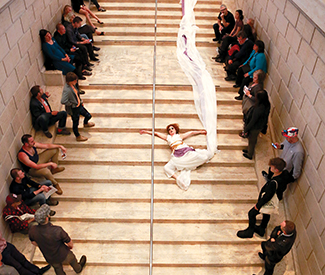
“We stopped checking for monsters under our beds when we realized they were inside us,” reads a quote often misattributed to the Joker in 2008’s The Dark Knight. The presenters at July 14’s “BAASICS.5: Monsters” event at ODC Theater capitalized on this concept, examining both modern monsters (though not “cars and corn syrup,” as one emcee mentioned at the beginning of the event) and monsters of yore.
In past years, the organization has explored provocative topics such as the future (more weighted toward a possible uprising of robots rather than the nagging question “What am I going to do with my life?”) and psychiatric and neurologic disorders by juxtaposing science and art. It’s easy to find the right balance between the two for these past themes, but I wasn’t quite sure what to expect from this year’s event.
It ended up being a lot less grisly than I’d imagined — with the exception of a video clip depicting maggots violating a honeybee. (I can never unsee that.) I felt as though I were in a college lecture hall, viewing PowerPoints — which were much more aesthetically pleasing than the Papyrus-laden slides my freshman year history professor used — and listening to professors, each with an exceptionally dry sense of humor.
Presenters, ranging from shark conservationists to artists, shared their definitions of a monster, often turning the tables on common misconceptions. David McGuire revealed that more people die from vending machines than from shark attacks, emphasizing how it’s truly a man-eat-shark world out there today. (Ahem, shark fin soup…) Closing presenter Brynda Glazier tackled societal expectations of beauty and normalness, drawing inspiration from her personal life as her brother is disabled, expressing this through seemingly ugly and monstrous sculptures.
BAASICS’ associate content producer Georgeann Sack — described in the program as a “neuroscientist by day and science communicator by night” — also performed low-key acoustic songs as a segue between presentations. In fact, her music was so low-key that I often had trouble hearing and understanding her, although I’m sure the lyrics to her song “Vampire Love Song” were clever. Sack’s standout performance was her rendition of the Creepshow’s “Zombies Ate Her Brain,” which sounded a little like a singer-songwriter’s DIY GarageBand-recorded music.
However, the biggest letdown of the event were the short videos. With topics such as malaria research and glowing plants, the videos had potential but ultimately came off as too sterile. The two video shorts seemed as though they were filmed with a cheap digital camera — that highlighted distracting background noise while researchers spoke — and edited in iMovie. Other audience members were just as unimpressed as my friend and I were — I heard some people in the row behind us begin a slow clap after the second video.
Art and science weren’t exactly joined in holy matrimony at this event. To me, BAASICS.5 was more like an evening well spent in your friend’s apartment — you know, the friend with a great appreciation for art who’s basically a living, breathing encyclopedia of weird shit — and can talk endlessly about it. Bring up Bigfoot and they’ll mention how the highest number of reported Bigfoot sightings originate from Humboldt County and slyly attribute this to the inhabitants’ altered perceptions. And did they mention how there’s a pseudo-porno titled Bigfoot’s Wild Weekend? (Here’s looking at you, Jill Miller!) Maybe zombies are more up your friend’s alley and they created an amazingly detailed zombie survey for people to fill out. (Your hard work definitely paid off, George Pfau.)
As for me, I checked off “Zombies are Vaudeville performers,” “The apocalypse is ‘the big one,’” and “After death, you take harp lessons” as my answers to Pfau’s zombie survey, which I picked up in the lobby afterwards. The real highlight of the event was being exposed to modern takes on tales as old as time, if the outside of the survey brochure, a Where’s Waldo-inspired scene even featuring Michael Jackson from his “Thriller” days, is anything to go by.
Digging deep during the height of summertime fun and frivolity, we Guardianistas showed up in force last night for another lively and informative edition of our biweekly radio show, Alternative Ink, on BFF.fm. Listen to the podcast here (but don’t be fooled by the first minute from a past show, it’s a false front we used to hide this week’s treasure).
With the fall ballot being filled out inside City Hall in recent weeks, we discussed rival housing measures sponsored by Sup. Jane Kim and Mayor Ed Lee, as well as the anti-speculation tax. We also covered the Restore Transportation Balance (placed on the ballot by citizens) and Let’s Elect Our Elected Officials (which was narrowed denied a spot on the ballot by the Board of Supervisors) measures that have been burning up the SFBG comments section lately.
We talked tech, prompted by our pair of long and insightful stories in last week’s issue, and we previewed an interesting story in our coming issue about how San Francisco is dealing with a flood of young immigrants who have showed up seeking refuge status. As always, the show was peppered with great music, this time with a decidedly international flair thanks for our award-winning Art Director Brooke Ginnard’s return from a three-week vacation in Europe (welcome back, Brooke).
After doing the show for a few months now, we’re starting to hit our stride — so much so that we’ve decided to do a live version of the show on the evening of Aug. 28 at the LGBT Center. So stay tuned for more information about the lineup for that show, and please tune in to our next radio show on Aug. 3.
Ok Go’s catalog is the sonic equivalent of Fruit Loops. Bright, fun, tasty, and far from satisfying or substantive. They are also one of our generation’s greatest bands. Because what Ok Go lacks in musical imagination and originality, they make up for tenfold with the way they have revolutionized and thoroughly dominated the art of the music video.
Harnessing the power of internet culture and viral videos, Ok Go burst onto the music scene and the blogosphere in 2006 with their now-famous treadmill dance video for “Here it Goes Again.” Now, a century later in internet years, Ok Go continues to churn out pleasant power pop and a steady stream of mind-blowing film pieces (“music videos” almost seems condescending for these painstaking projects—while most bands go on set for six hours to two days, singer Damian Kulash pointed out, Ok Go works on theirs for six weeks to six months).
Somehow, the band has managed to continuously outdo itself with each new video, spending incredible amounts of time and energy on stunningly creative videos featuring stop-motion, Rube Goldberg machines, optical illusions, and the pure power of great choreography.
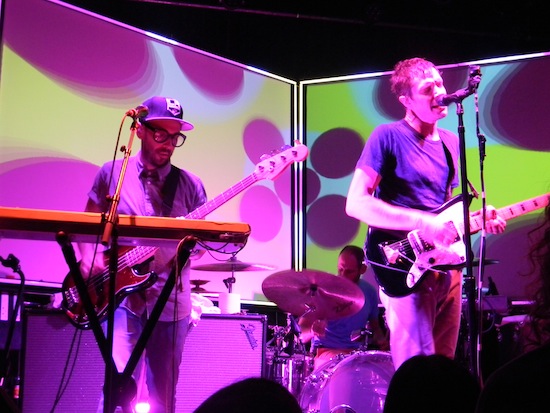
Perhaps fittingly, playing music seems to be a more of a side effect than a focus of Ok Go’s live show, which more prominently features bright video displays, interactive apps, and truly mind-blowing amounts of confetti (although, unfortunately, no dance routines). And, as with most technology-based things, a certain amount of troubleshooting was required.
However, despite a lot of technical difficulties, stalls, and spotty sound quality at their sold out Wednesday show at The Independent, the audience’s enthusiasm was not dampened in the slightest. A large part of Ok Go’s charm comes from their youthful excitement, curiosity, and energy, all aspects that translate beautifully to a live setting.
During glitches, while guitarist/keyboardist and “genuine, bona-fide nerd” Andy Ross worked on fixing technology failures, frontmen Damian Kulash and Tim Nordwind entertained the audience with Q&A sessions, and even (in what may have been the highlight of the show) a full run-through of Les Miserables’ “Confrontation,” with Kulash as Javert and Nordwind as Jean Valjean.
Ok Go are truly great performers. Their energy is high, their spectacles spectacular, and their banter playful and plentiful. I was taken aback, however, when Kulash casually called San Francisco a city “known for having a lot of faggots.” Even though Kulash is public about his support for gay rights and he followed this statement up with a lame “I say that with love in my heart,” it felt inappropriate and offensive. And all this was even before he called SF “Boston with Disneyland attached.”
But clearly not everyone in the audience took issue with Kulash’s faux pas, and there was an air of excitement and appreciation in the intimate venue from the first song to the last flurries of confetti. When the show had ended, leaving behind deep drifts of the colorful paper, fans didn’t want the fun to end. When I departed, half an hour after the show’s finish, people were still laughing, shrieking, and throwing confetti to the sky.
California Controller candidate Betty Yee, a San Francisco Democrat, will officially square off against Fresno Mayor Ashley Swearengin, a Republican, in the November runoff election after rival Democrat John Perez today called off a recount request. Perez finished in third place, just 481 votes behind Yee.
Perez, formerly the first openly gay speaker of the California Assembly, had asked for recounts in Kern, Imperial, and San Bernardino counties on July 6. But as those counts dragged on and the deadlines for printing fall ballots neared, the California Democratic Party was pressuring Perez to withdraw, last week contributing $50,000 to her campaign.
The Perez campaign released the following statement just before 5pm today:
“Today I have made the decision to bring the recount process to an end, and pledge my full support to Betty Yee to be California’s next Controller.
While I strongly believe that completing this process would result in me advancing to the General Election, it is clear that there are significant deficiencies in the process itself which make continuing the recount problematic. Even in the effort so far, we have found uncounted ballots, but there is simply not enough time to see this process through to the end, given the fact that counties must begin printing ballots in the next few weeks in order to ensure that overseas and military voters can receive their ballots in a timely manner.
I began this process because every vote deserves to be counted fairly and accurately, and as the recount has made clear, California needs to rethink our approach and incorporate best practices from across the nation. This effort was not about the outcome of a particular election, but the integrity of every election, and the issues brought to the light over the last two weeks need to be addressed in a comprehensive and thoughtful manner.
It has been an honor and a privilege to serve in the Assembly these last six years, and to have led the Assembly at a time when we’ve turned multi-billion dollar deficits into multi-billion dollar reserves, expanded healthcare for more than three million Californians and made college affordable again by enacting the Middle Class Scholarship Act. I am grateful for the support my campaign has received from everyday Californians who have seen the work my colleagues and I have done in the Legislature, and embraced our vision of fiscally responsible and progressive government which expands opportunity for all Californians. We built a tremendous record of accomplishment together, and I look forward to making contributions to build on that record of progress in the future.
In the immediate term, I will be continuing my service in the Assembly, and working hard to help elect Democrats up and down California.”
There’s a commonality to a large segment of New Zealand music, much of it with a dubbed-out vibe that one would expect from an island nation. But there’s also an underlying fierceness to it. Karoline Tamati, aka Ladi6, represents this dichotomy well, and her blend of hip-hop and modern soul will be in the Bay Area for the first time this weekend, with shows at Brick and Mortar in the city on Saturday and at the New Parish in Oakland on Sunday.
The lifelong musician started playing music at a young age and was smitten with hip-hop as a teenager when she formed Sheelahroc with her cousin and a friend at 16 years old. She found her singing voice shortly afterward and hasn’t stopped singing. Last year, she released her third album, Automatic, a collaboration with Slum Villager and beatmaker Wajeed, written and recorded in part at Studio A in Detroit and completed at Revolver Studios in Waiku, New Zealand.
Ladi6 has gathered a host of Kiwi music awards, including Best Urban Album and Best Female Artist at the 2011 New Zealand Music awards. Previously, she has collaborated with drum and bass outfit Shapeshifter and the dub-soul band Fat Freddy’s Drop. SFBG spoke with her shortly after arriving in Portland from New Zealand to find out what she’s got planned for her first American tour.
San Francisco Bay Guardian Welcome to the U.S. and congrats on moving up to The New Parish, a bigger venue, at your Oakland gig.
Ladi6 I know! Thank you! I found out on Facebook, too. Nobody tells me anything (laughs). Even thinking about coming here makes me so nervous I feel like I might break out in hives. Coming from New Zealand, my perspective is just that America is the place for music with such a bigger scale. In mind my, strategy is, “Go to America. Do the tour. Don’t think about it. Then go home and think about it.” You know? I’m trying to play it down so I don’t hyperventilate on stage.
SFBG I’m sure you’ll be fine. I caught your performance at the A.R.E.A. 9 festival in Ohau, New Zealand in 2009 and you owned the stage.
Ladi6 Oh That’s crazy! So few people went to that gig but it was such a gorgeous location.
SFBGIt was impressive because I feel like it’s easy for hip-hop performances to fall flat when it’s just an emcee and DJ on stage, but yours was really engaging. How do you approach your shows?
Ladi6 I don’t have any tricks or dances. I have played with bands before and it can be easier to get the crowd involved but in some ways, it’s harder as a performer. You have all these personalities up there, but when it’s my show, I’m commanding the stage and it’s just me strutting my stuff. The idea is to make people feel something, some kind of emotion. And when people ask me how I do it, I can’t help but think, “I don’t know the fucking answer to that!”
SFBGBy now, you’ve been at it for a long time. And you sing, rap, write…
Ladi6 That’s right, and before I realized I could sing, I rapped. And before I rapped, I played guitar ,so when I jump from one to other it feels very natural. It comes down to trying to put on a more exciting show. I come from a very music family and started playing guitar because everyone plays guitar. I focused on that until I was about 13 or 14 when I discovered hip-hop and I wanted all of it. I wanted to be a B-girl, I wanted to learn how to scratch, the whole nine yards. So I joined this hip-hop crew and we began doing gigs. When one girl in our crew who sang got pregnant and couldn’t perform with us I thought maybe I could sing and I found my voice along the way. Then I joined a band afterward and struck out on my own later and all of a sudden, I’ve never had a real job.
SFBGHow did “Automatic” come together?
Ladi6 That was a collaboration with my Parks, who I’ve worked with a lot in the past, and ‘Jeed over four weeks. We went over there and I had never experienced a Detroit winter before. Just…whoa. But we made every song fresh in the studio.
And then we came home to a New Zealand summer and it was just a complete contrast. One was like, the dead of winter, it was snowing and freezing and we’re in this hi-tech studio. The other studio in New Zealand was kind of a high-tech studio, but a lot of the equipment was second hand. And it’s located on a farm. It’s down the road from a waterfall where we’d take breaks and go swimming. The whole family came out to cook for us and stuff. So those experiences really impacted what we came up with. We’ll change it next time, and approach the next one in a totally different way.
Dear readers! In case none of your coworkers has made any kind of Dilbert-ready joke by the water cooler yet today, let us fill you in: It’s Friday.
And woof, did this week feel a little long to anyone else? Perhaps because the news is filled with horrendous, tragic, apparently senseless events? I’m not one for the “waah, why do news outlets report on so much bad stuff when there’s good stuff in the world” mentality — you should be spurred to anger/sadness/feeling by reading about the state of the world, that’s how change happens.
However. After you do a comb-through of the New York Times and the BBC etc. this morning, do not forget to look at some kittens and puppies. And in between having impassioned all-caps shouting matches on Facebook and in various comments sections this weekend (discuss: is this really how change happens?) try leaving your house to go sweat on a dancefloor with some strangers. Age-old remedy for the post-modern blues. Here are our picks.
FRIDAY/18
Erk tha Jerk with Kev Choice
June was a busy month for Erk tha Jerk, the Richmond rapper and producer known for his clever wordplay and catchy, often intensely sexual hooks. On the 12th, he dropped a new video produced by frequent collaborator Fly Commons called Blast Somebody. A smooth beat finds Jerk getting existential about his stresses while a near-nude woman gyrates on his bed. The video premiere was bolstered by the announcement that the duo’s upcoming EP, Food and Vegetables comes out on July 15th — the gig doubles as a release party. Fellow East Bay MC Kev Choice (and Bay Guardian cover dude back in March) opens for Erk. Where Erk often embraces an id-driven and autobiographical style, Kev is far subtler and more socially conscious. A prodigious pianist and bandleader, his set should provide a soulful introduction to Erk’s intensity and bombast. — David Kurlander) 8pm, $15 Slim’s 333 11th St, SF (415) 255-0333 www.slimspresents.com
A panel of heavy-hitters discussing vinyl’s return to public favor at the Oakland Museum of California tonight includes Nick Harmer, bassist for Death Cab for Cutie; Winston Smith, visual artist for Dead Kennedys, Green Day, and legendary Bay Area punk label Alternative Tentacles; and Lawrence Azerrad, designer of iconic albums by Wilco, Miles Davis, and the Beach Boys. Plus drinks! 5pm – 9pm, free- $7.50 Oakland Museum of California 1000 Oak, Oakl. (510) 318-8400 www.musuemca.org
SATURDAY/19
Jimmy Cliff
Bob Marley may adorn more stoner dens with his smiling face, but the credit for bringing reggae to a worldwide audience goes first and foremost to Jimmy Cliff. As the star and main soundtrack composer of the 1972 Jamaican film The Harder They Come, Cliff brought the once-obscure Caribbean pop style to national attention and broke open the door for the genre’s success in the 1970s. But he couldn’t have done it without a set of killer songs — the film’s title track included — and, at 66, a voice that puts nearly every stateside soul singer to shame. — Daniel Bromfield. 9pm, $39.50 The Fillmore 1805 Geary, San Francisco (415) 346-6000 www.thefillmore.com
SUNDAY/20
Salsa powerhouse Roberto Roena and the LA-based Latin ensemble Boogaloo Assassins celebrate the 50th anniversary of Fania Records, which helped move salsa into the mainstream in New York in the ’60s and ’70s. Guitarist Vieux Farka Touré, son of the late Malian guitarist Ali Farka Touré, performs African blues rock to open. There will likely be some dancing here. 2pm, free Stern Grove 19th Ave. and Sloat Blvd., SF www.sterngrove.org
MONDAY/21
The Hold Steady
Does this band have a new record out? Don’t know, don’t care. Unless they radically changed their sound (Thin Lizzy guitars, blue collar/after hours rock, slightly snarled Springsteen storytelling) it doesn’t matter. Because Brooklyn’s Hold Steady epitomize rock’s most underrated quality: dependability. Beyond reviews and records, it’s their live show that consistently seems to awaken converts, the way an exceptionally good bar band can shock drunks out of stupors. (What are these guys doing here?) If the boys are back in town, count me in, at the center of the pit, shouting along with Craig Finn. Well…maybe I should give Teeth Dreams a listen. —Ryan Prendiville With Cheap Girls 8pm, $30 Great American Music Hall 859 O’Farrell St, SF (415) 885-0750 www.slimspresents.com
TUESDAY/22
White Lung
Who said music writers can’t make music? When Mish Way isn’t busy freelancing as one of America’s most passionate and hilarious music writers, she’s rocking harder than any other architecture-dancer since Patti Smith as the leader of punk outfit White Lung. After making a splash in Vancouver’s punk scene with its debut It’s The Evil, the band found its profile substantially increased when Rolling Stone included sophomore effort Sorry in their top 10 albums of the year — no small feat for a punk album, least of all one that barely runs 20 minutes. They’ve added Wax Idols member and Bay Area native Hether Fortune on bass for album number three, Deep Fantasy, whose hearty reception should secure the band’s footing in both the critical and the die-hard punk worlds. — Bromfield With Wax Idols, Red Red Red 7pm, $12 The Rickshaw Stop 155 Fell, San Francisco (415) 861-2011 www.rickshawstop.com
The November ballot is shaping into a housing supply theory showdown, and yesterday’s [Thu/17] Board of Supervisors Rules Committee hearing was the first round.
The committee hosted two hearings on rival housing proposals for the November ballot: Sup. Jane Kim’s City Housing Balance Requirement and Mayor Ed Lee’s Build Housing Now initiative. The two purport to set similar goals for building affordable housing, but Lee’s proposal contains a poison pill that would invalidate Kim’s measure.
The mayor’s philosophy on housing, a strict supply and demand argument, was on full display.
“[Housing] is a competition based on who has the most dollars in their pocket, and the ones with the most dollars win,” Olson Lee, director of the Mayor’s Office of Housing said at the hearing. “If we limit the supply, the people with the most dollars will win.”
The arguments are a little complicated, but let’s try to break them down: Kim’s initiative lays out a requirement for new construction to build 30 percent affordable housing and 70 percent market-rate housing. Currently, new construction projects can build on-site affordable or pay a fee into a pot, known as the Affordable Housing Trust Fund. If new construction needs to be exempt from the balance requirement, under Kim’s measure, that can be decided by the Planning Commission.
But the mayor and his deep-pocketed development allies are shrinking away from this like the Wicked Witch of the West from water. Affordable housing doesn’t make a dime for developers, and the mayor fears Kim’s policy will slam the breaks on market-rate housing construction.
Activist and San Francisco historian Calvin Welch argues supply and demand housing theories won’t solve the San Francisco housing crisis, via 48hills.
Yet Kim’s measure is based on what many progressives in San Francisco believe: San Francisco’s housing market is hot, profits are high, demand is insatiable, and building lots of market rate housing that will never be affordable to most San Francisco won’t solve the city’s affordable housing crisis. The construction pipeline won’t slow down with a few dings to profit margins, she argued.
“I just have to say if building 30 percent affordable housing will halt development, we’re in a whole lot of trouble,” Kim said to her critics. “We have to build. Even people that make money leave San Francisco every day.”
No one is saying Kim doesn’t believe more housing needs to be built. But Lee’s staffers emphasized a belief that more housing construction alone is the solution to the city’s ills, a strategy that hasn’t exactly netted stellar results recently. They also defended the Affordable Housing Trust Fund, as the Mayor’s Office of Housing is funded about “40 percent” from developer’s fees, Olson Lee said. Sarah Dennis Phillips, from the Mayor’s Office of Economic and Workforce Development, argued sharply that any hit to developer’s fees, even marginal ones, would result in a loss of dollars for the city’s General Fund, the funding pot feeds most city services.
Meanwhile, people are losing their homes and fleeing the city. Some who are holding on by a thread came out to speak at the dueling hearings.
“I have health challenges including cerebral palsy,” Justin Bennet said during public comment. He spoke with a difficulty in his jaw, haltingly and with much effort. He said the housing market made it difficult to move from the dangerous areas of the city he calls home. “I’ve been robbed outside several residences I’ve lived in, so I’m hoping for a change in my housing situation in the future. Thanks for letting me speak.”
A family came up to the podium to speak, with two young housing activists, a brother and sister, 9 and 6, saying they didn’t want to see so many lose their homes.
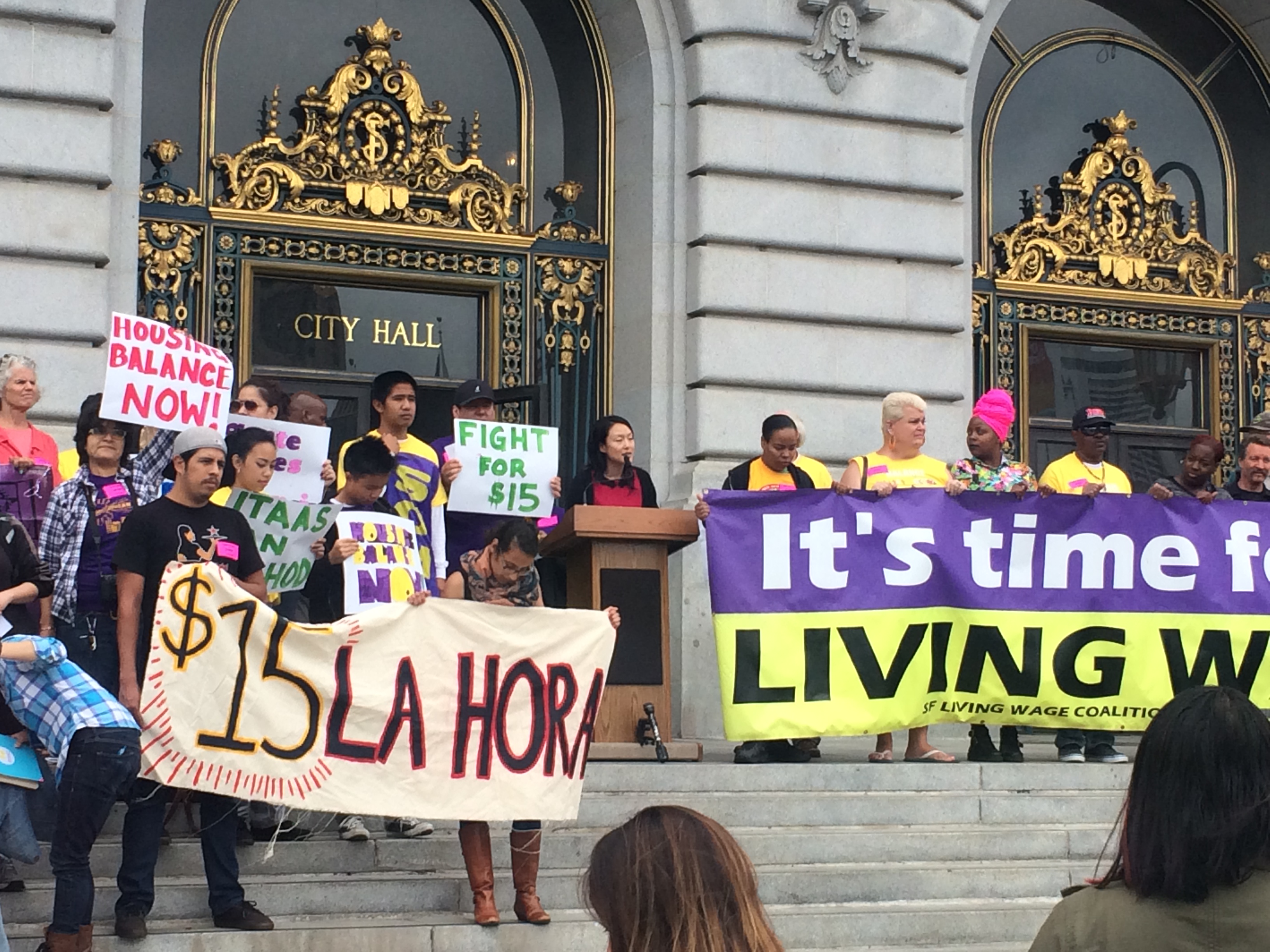
Advocates from the SEIU 1021, South of Market Community Action Network, Alliance of Californians for Community Empowerment, and the Chinese Progressive Association, to name a few, were on hand at the hearing. They were also on hand for a press conference on the steps of City Hall shortly before the hearing. Ed Donaldson from ACCE called out the mayor’s housing measure, saying its only intent was to torpedo Kim’s.
“I say we should play chicken with the mayor,” Donaldson said at the podium. Metal bands have sung with less volume than the baritone he used while booming, “Let’s see if he has the gall.”
Inside the hearing, Patrick Valentino (who championed luxury development on the waterfront) and Tim Colen of the Housing Action Coalition spoke, defending the mayor’s measure.
“As San Francisco, as a city in affordability, we’re failing. Our rate of failure is accelerating,” he said flatly. He criticized Kim’s plan and asked, “Where’s the money? No one disagrees we need it. The shortcoming I see in the housing balance measure is its premise that if we increase restrictions on market rate housing, it helps subsidize housing.”
He argued instead to gather more stakeholders together (i.e. deep pocketed developers) to negotiate more private funding, a strategy he said that worked in the past.
As others came to the podium to argue against developer greed, Colen watched on, shaking his head, seemingly in disagreement. When someone in public comment argued that developers so far have shirked their responsibilities to build affordable housing, he shook his head again and left the hearing room.
There’s a stark divide in housing philosophy, and supply and demand’s ability to save San Francisco will soon see a trial by voter if Kim’s charter amendment can win six vote at the full Board of Supervisors.
The mayor’s policies seem to be more of the same, Kim said, and now the city seems to be fighting over the crumbs of developers’ fees. Despite opposition from the mayor, Kim told the Guardian she’s open to new ideas from the mayor.
But she also said she won’t back down.
“We’re on a two-fold path right now. If there’s a compromise to get [the city] to 30 percent affordable housing, like new revenue, we’re open to that compromise,” she said. “But we always intended this to go to the ballot.”
In the wake of yesterday’s [Wed/16] judicial ruling that California’s death penalty system is unconstitutional — with federal District Judge Cormac Carney calling it arbitrary and so subject to endless delay that it “serves no penological purpose” — San Franciscans could play a key role in converting the ruling into an abolition of capital punishment.
Right now, the ruling applies only to the execution of Ernest Dewayne Jones, who was sentenced to death in 1995 for a rape and murder, and not all 748 inmates now on Death Row in California. But yesterday’s ruling would end the death penalty in California if appealed to and upheld by the SF-based Ninth Circuit Court of Appeals.
The decision about whether to file that appeal and possibly a subsequent appeal to the US Supreme Court falls to Attorney General Kamala Harris, who has maintained her opposition to capital punishment since her days as San Francisco’s district attorney, where she bravely endured lots of political heat for refusing to file capital murder charges in the death of San Francisco Police Officer Isaac Espinoza.
San Francisco Public Defender Jeff Adachi today issued a public statement praising yesterday’s ruling and calling for Harris not to appeal it: “Today’s ruling, which found California’s death penalty unconstitutional, is a monumental victory for justice. I commend U.S. District Judge Cormac Carney for his courage and wisdom. Not only is the death penalty arbitrarily imposed, as the judge noted, its history is fraught with racial bias and haunted by the hundreds of death row inmates who were later exonerated. I am hopeful that California Attorney General Kamala Harris will choose not to appeal this decision.”
Harris spokesperson David Beltran told the Guardian that she hasn’t yet made a decision whether to appeal the case: “We are reviewing the ruling.”
Yet former Los Angeles District Attorney Gil Garcetti, who worked with SF-based Death Penalty Focus on the 2012 initiative campaign to repeal the death penalty (losing by less than 4 percentage points), told the Guardian that Harris has a tough choice to make.
“It’s an interesting decision. If the Attorney General doesn’t appeal it, then it applies just to this case, period,” Garcetti told us.
Although appeals in other cases could cite the logic of yesterday’s ruling, it has no precedent value unless affirmed by the Ninth Circuit. And Garcetti called Carney’s ruling “a pretty persuasive decision” that could be easily be affirmed, depending on which judges are assigned to the case. If so, that ruling would end the death penalty in California, just as 17 other states have already done.
“The more interesting question is whether she would then appeal that ruling [to the US Supreme Court],” Garcetti said.
California voters have affirmed their support for the death penalty three times at the ballot, but those results and public opinion polling show that support for executions has been steadily eroding, in much the same way that generational change has led to overturning bans on same-sex marriage across the country.
Garcetti said he regularly speaks publicly about capital punishment, often to very conservative groups, and he said that the arguments against it have become so strong — including its high cost, racial and class bias, and lack of deterrent effect — that “over 95 percent of [death penalty supporters] change their opinions by the end of my talks.”
As for why the 2012 initiative fell about 250,000 votes short of success, Garcetti said, “We simply ran out of money to get the facts out. Once people hear the facts, it wins them over.”
Carney’s ruling reinforced many of the arguments that opponents have been made against the death penalty, noting that federal guarantees of due process create such long delays that a death sentence has become something “no rational jury or legislature could ever impose: life in prison, with the remote possibility of death.”
Aside from this ruling, California is also currently under a federal moratorium on executing prisoners until it can reform its lethal injection procedures, which a federal judge has said now amounts to cruel and unusual punishment.
“Justice requires that we end this charade once and for all,” Death Penalty Focus Executive Director Matt Cherry said in a prepared statement. “It’s time to replace California’s broken death penalty with life in prison without the possibility of parole. That’s the best way to ensure that convicted killers remain behind bars until they die, without wasting tens of millions of tax dollars every year on needless appeals. That’s justice that works, for everyone.”
Fractional mortgage loans used to convert apartments into owner-occupied tenancies-in-common have fed the eviction and displacement crisis in San Francisco, where the median home price just surpassed $1 million for the first time. Now, some of the same San Francisco banks that pioneered fractional loans here have started offered them in the East Bay and on the Peninsula.
TIC housing is an ownership model for multi-unit buildings, where each unit is independently owned. This option appeals to would-be homeowners because it’s cheaper than a condominium, but less fraught than a traditional loan shared by various owners in a TIC building, which does not allow for independent ownership of each unit.
TICs local have grown in popularity in San Francisco as housing prices continue to skyrocket, since they help homeowners find something affordable, although that benefit usually comes at the cost of evicting all the tenants in the building, often including seniors, those with disabilities, and low-income people in rent-controlled units.
Previously, fractional TIC loans were only accessible in SF. Now, as people seek affordable housing outside of expensive San Francisco, the demand for fractional TIC loans has grown. And San Francisco bankers have stepped up to meet that demand, according to a recent article in the San Francisco Business Times (“High-priced SF housing market exports fractional tenants-in-common loans,” June 28).
Sterling Bank & Trust has become well-known for providing fractional TIC loans (more than $480 million worth so far, according to the Business Times), and is the first company to offer the loans outside of San Francisco. “We’re helping the firefighter and school teacher, or what I like to call the ‘non-tech’ buyer, purchase a home,” Stephen Adams, senior vice president of Sterling Bank & Trust, told the Business Times.
Adams is also president of the San Francisco Small Business Commission, presiding over what critics say is a shift in that commission toward rubber-stamping initiatives from the Mayor’s Office rather than defending small business interests. When we contacted Adams to ask about the evictions and displacement caused by fractional loans, he told he had “no comment to make at this time.”
Tommi Avicolli Mecca, the director of counseling programs at the Housing Rights Committee of San Francisco, said that he doesn’t know how the TIC loans might affect those in the East Bay. But he does know they’re bad news for San Francisco, where there’s now a 10-year moratorium on new condo conversions but few controls on the creation of new TICs.
“They’re scary,” Avicolli Mecca told us. “It’s a disaster for San Francisco. Basically, if you’re buying a tenancy in common, you don’t need to condo convert. It used to be that you wanted a condo conversion so you could have a separate mortgage on what you own. With a fractional loan, you have your own mortgage from the start.”
He added that the loans make it easier for sellers to convert buildings into any size that they can market to home buyers. With the loans, combined with the state Ellis Act allowing owners to remove apartments from the rental market, evicting tenants becomes even more profitable.
The Bank of San Francisco confirmed that it also offers TIC loans in the East Bay. The bank will be making them more attractive with interest-only payments, fractional financing for buildings with more than 12 units, and loans up to $2 million.
Dylan Desai, a spokesman for the Bank of San Francisco, told us that the bankers “do not extend financing to buildings where there has been an eviction” and, to their knowledge, they never have. “We’re sensitive to tenant rights.”
Hopefully the other banks offering these loans will be just as sensitive as they branch out into communities in the region that have already been absorbing an influx of working class former San Franciscans.
So another scheme — in a long and rich history of such schemes — is attempting to break California into more digestible parts, and gaining national attention. Venture capitalist Tim Draper’s Six Californias is all but on the ballot, attempting to rechristen the Bay Area as Silicon Valley. Good luck with that! (Although we have to say, it might create the first openly weed-driven state economy — Northern California — which would be fun to see.)
In 2009, we, too, put forth a proposal to split California up — building on an idea from conservative Central California, and echoed in Daily Kos. It was a doozy, but a logical one, with some actual Six Californias affinity.
Our May 27 cover story, written by Rebecca Bowe and Tim Redmond, proposed to split Cali up for better management, representation, and economic/social justice, creating the playfully named states of Greenland, Sierrastan, Pinkostan, Coastland, Palm Sprawl, North Mexico, and Disney. (The accompanying cover, designed by Ben Hopfer and shown above, aped the New Yorker’s famous “New Yorkistan” cover.)
The cover story itself grew from a Politics Blog post Tim Redmond had written in March of 2009, asking “Should California be split up?” — read the post below. As for creating states, we’ll be dreaming of Puerto Rico …
SHOULD CALIFORNIA BE SPLIT UP?
By Tim Redmond
It’s an interesting question. Nothing new, really — folks up in the northern part of the state have been talking about secession since the 1940s.
But these days, the talk has shifted from North-South to Central Valley-Coast.
There’s plenty of discussion going on — the New York Times reports on a move by farmers in Visalia, who say those of us in the more liberal western regions don’t understand what it’s like in the center of the state:
Frustrated by what they call uninformed urban voters dictating faulty farm policy, Mr. Rogers and the other members of the movement have proposed splitting off 13 counties on the state’s coast, leaving the remaining 45, mostly inland, counties as the “real” California.
The reason, they say, is that people in those coastal counties, which include San Francisco and Los Angeles, simply do not understand what life is like in areas where the sea breezes do not reach. “They think fish are more important than people, that pigs are treated mean and chickens should run loose,” said Mr. Rogers, who said he hitched a ride in 1940 to Visalia from Oklahoma to escape the Dust Bowl, with his wife and baby son in tow. “City people just don’t know what it takes to get food on their table.”
“Citizens of our once Golden State are frustrated and desperately concerned about the imposition of burdensome regulations, taxation, fees, fees and more fees, and bureaucratic intrusion into our daily lives and businesses,” declares downsizeca.org, the movement’s website.
And all of this comes as reformers form both the left and the right are talking about a new Constitutional Convention.
The United States is almost certainly too big to be a meaningful democracy. What does “participatory democracy” mean in a continent? Sooner or later, a profound, probably regional, decentralization of the federal system may be all but inevitable.
He was talking about California becoming its own nation, but I’d argue that the same problem applies here. The budget crisis, the gridlock in Sacramento … all of it suggests that maybe California itself is too big to govern. There’s also clear evidence of dramatic regional differences. If you take the Central Valley from about Redding on down, and wrap in Orange County, you have a red state within a blue state where most of the residents say they want lower taxes and smaller government. Along the coast from about Sonoma County down to the southern part of Los Angeles County, you have people who generally would like to see taxes pay for public services. If the coast were a state, we could repeal Prop. 13 and build world-class schools. We’d have same-sex marriage and single-payer health insurance. And we’d still be one of the biggest states in America.
Now, I’m not sure the people in the central valley quite realize the problem with their plans, which is illustrated in this wonderful chart that comes from the office of Assemblywoman Noreen Evans of Santa Rosa (PDF).
The chart shows that the people who dislike and distrust government and don’t want to pay taxes are in fact the beneficiaries of the tax dollars that the rest of us pay. In California, tax money from the coast winds up paying for services in the central valley.
But that’s okay — if they don’t want our money any more, maybe we should tell them we’re fine with that. Maybe we should split the state not just in two but into three: Let the northern counties become the state of Jefferson, where pot will be legal and the residents will be so wealthy from taxes and exports of that cash crop that they’ll make oil-richAlaskans seem like paupers. Pot will be legal in the coastal communities, too, and will generate tax revenue.
We’ll have a Democratic governor, and overwhelmingly Democratic legislature, fewer prisons, better schools, cleaner air, no Ellis Act, rent controls on vacant apartments, more money for transit, strict gun control, support for immigrant rights … and no more of these ugly battles over budgets held hostage by right-wing Republicans.
And in the central valley, they can have their low taxes and conservative values, and watch their roads, schools, and public services go to hell. Maybe eventually they’ll figure it out.
Of course, we’d have to figure out the water rights. The folks in Jefferson would have control over much of the water that now goes South, and there would have to be some long-term water contracts between the states, but that shouldn’t be an insurmountable roadblock.
And the solution would create its own problems; The GOP would control the central state, and would move to abolish the Agricultural Labor Relations Act and make life even more miserable for farmworkers. But then, maybe Jefferson would turn off the water and big agribusiness would be SOL anyway.
As part of the break-up, all parties would have to agree to create a special relocation fund to help lonely, sad liberals from Modesto come west and to help lonely, sad Republicans in San Francisco to move east. I wonder which way the net migration would go.
Meanwhile, Evans has introduced my favorite tax bill of the year, AB 1342, and it’s related to this entire discussion. She wants to allow counties to levy their own income taxes and vehicle license fees. “We went through this difficult process of trying to arrive at a budget,” her spokesperson, Anthony Matthews, told me. “For those communities that have a different view of government [than the Republicans], this bill would let them raise their own taxes to fund their priorities.”
Last year, the SF SPCA assisted with 5,084 cat and dog adoptions. With its new adoption center near Bryant and 16th Streets, which opened June 13, it aims to increase capacity by 20 percent — saving 1,000 more furry lives in the process.
“When our old adoption center opened in 1998, it was the first shelter in the country to house animals in condominium-style rooms instead of cages,” SF SPCA co-president Jason Walthall said in a June press release. The upgraded shelter continues this tradition — and continues to offer dog training classes, volunteer programs for youth, and other community-service activities — but with even more enhancements for the animals. Each glassed-in enclosure features a touch screen pad that provides more information about the pet inside, with an emphasis on personality type (“social butterfly,” “busy bee,” “delicate flower”) over breed — a more efficient way of linking animals with potential new families.
For dogs, there’s a small indoor park that’s used to make introductions (especially important if the potential new owner already owns a dog — gotta make sure the new pooch gets along with the pack), while the cats, housed in a separate section of the building, get to scamper across SF-themed cat condos. (So far, there’s a Golden Gate Bridge, a Transamerica Pyramid, a cable car, the Sutro Tower, and the SF Giants logo; a Castro Theatre design is in the works.) These improvements make the shelter life more comfortable for the animals — though most dogs only stay two weeks; cats, just slightly longer — but they also help entice visitors.
“We want to make it a fun, happy experience,” says SF SPCA media relations associate Krista Maloney, pointing out that the shelter — which was founded in 1868, has an attached vet hospital (providing free and sliding-scale spay-neuter procedures, among other services), and is a nonprofit funded by donations — competes with pet stores and breeders to place animals in homes. Earlier this year, it joined forces with fellow nonprofit Pets Unlimited, which is located in Pacific Heights, to further its mission: “to save and protect animals, provide care and treatment, advocate for their welfare and enhance the human-animal bond.”
But wait! You’re a San Francisco renter! The words “NO PETS ALLOWED” haunt your nightmares! How can visiting an animal shelter be anything but depressing? SF SPCA’s website has an entire section offering advice for landlords and tenants (one tip: create a “pet resume” to include with your rental application) on the subject of pet-friendly housing. And if the landlord won’t consent to a dog, the SF SPCA just might be able to help out anyway. Coming soon to the new facility: adoptable small mammals, including rabbits, hamsters, and guinea pigs.
Next time you head to your neighborhood Apple store to get that smooth and harmonious feel that can only comes with the gentle touch of an iPad air, you might be greeted by an unhappy security officer picketing outside. The officer might share some choice words about the working conditions at Apple’s security guard contractor, Security Industry Specialists.
Over the next few weeks, the SEIU United Service Workers West has organized a series of actions with security guards to demand Apple choose a more responsible security contractor.
Currently, Apple, Google, and Ebay all have contracts with SIS, a firm the SEIU claims has unfairly terminated employees and surveiled union meetings. The SIS denies these allegations, devoting an entire page on its website to confronting what it’s termed “SEIU lies and distortion.”
“The contrast between Apple’s boom times and worker’s decrease in wages is incredibly startling,” said Alfredo Fletes, communications specialist for SEIU. “You would think that a company that has benefited so much from what Silicon Valley has to offer would support the jobs for workers – not just in their engineering department, but at all levels.”
Since the launch of the iPod in 2007 to 2012, Apple saw a 600 percent growth in its stock. Meanwhile, from 2008 to 2012, average worker wages in Santa Clara County dropped by 3 percent. On average, Silicon Valley’s security officers make $15 an hour through SIS.
But the actions SEIU has organized aren’t just about wages, nor are they just about Apple. Walter Redding, for instance, was one security officer working for SIS through Google. He’ll be attending some of the actions, because he’s angry. He was fired for taking a phone call from his girlfriend while she was in labor.
“I thought I was doing great,” Redding said. “But I got screwed. I only got two checks since I got fired. It’s been almost a year. My friends got fired for things, too. Everybody gets treated unfairly. I love the products. I’d buy them everyday. But when it comes to working for Google or Apple, I don’t know about that.”
Bryce Miller-Williams, an organizer for SEIU’s Stand for Security campaign, says that the SIS is harsh everywhere, but Apple is where security officers really don’t want to work.
“There’s a very militaristic atmosphere there,” he said. “One gentleman sat down to tie his shoe. Guards are supposed to be standing at all times, and so he was let go because of that.”
Although Apple doesn’t employ the security guards directly, Fletes said the tech company still has the power to select a better security guard contractor. To him, changes at Foxconn, one of Apple’s largest suppliers, offers proof. When labor activists launched an outcry following a series of suicides at Foxconn, Apple stepped in. According to a report from the Fair Labor Association last December, working conditions at Foxconn have since steadily improved.
“I don’t think it’s too much of a stretch to ask Apple to look into workplace issues for security officers in the Bay Area,” Fletes said. “Or, at the very least for them to meet with security officers who, despite working for one of the most valuable companies in the world, are still struggling to survive.”
Apple does at least give the appearance of wanting to do good. The Cupertino company requires its suppliers meet a “code of conduct” and issues a Supplier Responsibility report to document its progress each year. This past December, Apple CEO Tim Cook spoke about his company’s code of conduct in a video message sent in a company-wide email urging employees to behave like good, righteous Apple employees.
“As Dr. Martin Luther King once said, the time is always right to do what’s right,” Cook proclaimed. “At Apple, we do the right thing. Even when it’s not easy. If you see something that doesn’t meet our standards, speak up. Whether it’s a quality issue or a business practice, if it affects Apple’s integrity, we need to know about it.”
Fletes said that when SEIU members protested outside an Apple shareholder meeting last February, Cook said he would look into job quality issues. The allegations of unfair treatment by SIS’ security officers have since continued. Apple did not respond to the Guardian’s requests for comment.
The actions will continue throughout the Bay Area throughout the summer, ending in San Francisco on August 28th.
Thousands of Central American children fleeing drug wars and poverty are overwhelming the San Francisco nonprofits who care for them, but new information from the mayor shows this may just be the beginning.
Yesterday, just hours before Supervisor David Campos’ resolution to bolster funding to aid the incoming refugees passed, Mayor Ed Lee warned the Guardian and other journalists that San Francisco is bracing for another influx of even more children in need.
“I met with the federal Health Service System to prepare our city for the possibility of a higher influx [of refugees],” he said. “The numbers seem to be coming in, though they haven’t reached us yet.”
Campos’ measure to focus funding on the needs of Central American child refugees passed by unanimous vote, likely because its sorely needed. Nonprofits in San Francisco like the Central American Resource Center (CARECEN) and other sounded the alarm: there are too many refugees, and not enough caregivers and legal aid to help them. More than 36,000 Central American children (often unaccompanied) entered the US illegally between Oct. 2013 and May this year, according to widely reported federal data. The number of Mexican children entering the US dropped to about 17,000.
But why are they coming here? Many reasons, but mostly they’re fleeing violence. Honduras, for instance, was the murder capital of the world, with 79 people murdered in every 100,000, according to Reuters. Neighboring El Salvador didn’t do much better, with the second highest murder rate per capita in the world.
“I am from Honduras and I just turned 16-years-old,” a teenager named Juan said, in a statement from CARECEN, “I came after my father was murdered and I feared for my life that I was next. If I go back I’m not sure that I can go back and live a good life. I want to go to school and live so I can grow up to do something good.”
False rumors in Central America that the US is offering permisos, meaning, permanent status, also spurred an influx of refugees.
CARECEN’s Washington D.C., Los Angeles and San Francisco locations are advocating for President Barack Obama to declare a state of emergency and aid these refugees. But as the federal government grasps at possible solutions, local government is stepping in to help those reaching the city.
“There’s a long history on this board on calling out against injustices we’ve seen in different parts of the world,” Campos said at the board yesterday as he introduced his measure, adding “They’re escaping not just political turmoil but violence in their lives.”
“These are children,” he said.
Lee said one of the biggest challenges in helping these children may be a cultural one.
“I’m trying to wrap my arms around the fact that many of these kids don’t speak Spanish,” Lee told the Guardian yesterday. “They speak Mayan and different languages. This will test our cultural competency.”
Campos is planning a hearing on how best to focus funding to aid the child refugees, but hasn’t yet settled on a date for said hearing.
Everyone knows that true artists do their best work right before deadline. [Ed note: I may or may not be writing this an hour or so before mine.]
Now in its third year, the Music Video Race is an annual San Francisco tradition that takes this dictum to heart, pairing 16 different musical acts with 16 filmmakers for a challenge that makes that “find a flag in the middle of this big fake nose filled with green goop” thing on Double Dare seem like a cakewalk: Conceive, film, and edit an entire music video in 48 hours.
After accepting applications from both filmmakers and musicians for roughly two months, MVR organizers matched up pairs by random drawing at 7:30pm on Friday, July 11, turning the teams loose around the Bay Area, with a final deadline of 8pm on Sunday, July 13. This year’s bands include SF’s Rin Tin Tiger (which will cap their participation with a headlining spot at the video release party, held at The Independent Sun/20), Oakland’s Bill Baird (fresh from rocking Phono del Sol), Rich Girls, Lemme Adams, and bed. [Another ed note: Yours truly is in the middle of judging said videos, and they’re really freakin’ good.]
“We try to pick a diverse group of bands — we don’t want 20 garage bands or folk acts, etc. There’s so much variety in the Bay, and we really ant to respect that,” says Tim Lillis, an MVR founder, of how they select the participants. “But beyond that, we’re mostly just looking for flexibility, a willingness to roll with the punches, a sense of adventure.”
New this year: We Bay Area-dwellers aren’t so special anymore. The MVR is expanding to Austin and LA, over the weekends of Sept. 5-7 and Nov. 7-9, respectively.
“We’ve had a few really expansive years here, and I think this will help people understand that this isn’t just a San Francisco thing — we’re stoked to help local scenes build themselves,” says Lillis.
The Music Video Race got its start in 2011, when Lillis and a few friends were out having a beer at Lucky 13 before a Mister Heavenly show — featuring Michael Cera on bass.
“I don’t know if subconsciously the worlds of music and film intertwined because of that, but that’s what happened,” says Lillis, who has a background in video production as well as having played in a few bands in the Bay Area. “I’d done a 48-hour film project before, which is fun, but a lot of times the results of those things are not the best, and I think it usually has to do with audio quality. With music videos, there’s pre-reocrded music, so you’re able to cut the film to the beat; there’s already a rhythm for the editing.”
The sped-up nature of the event isn’t just for fun, Lillis explains. “I’m a pretty firm believer in constraints,” he says. “Even in my work as an illustrator and graphic designer, I know that when you only have so much to work with, you have to just trust your gut and make decisions and go with them. Often your first instinct is valid, and there just isn’t time to waffle on stuff.”
And if he had any doubts about the race being good for the city’s music scene, last year’s event should have sealed the deal: A couple of musicians who met as MVR participants in 2013 — Alex Haager, then of the band Magic Fight, and Sierra Frost, then of Clintongore — fell in love, and are now married, and living in Portland, as co-owners of the Oakland/Portland-based Breakup Records. They’re also in this year’s Music Video Race, competing in their new band Bed.
So, you know. Even if you don’t have a musical or filmmaking bone in your body, there just might be something at the finish-line party for ya. As “how we met” stories go, speed-music-video-making sounds way more punk rock than speed-dating.
MUSIC VIDEO RACE PREMIERE PARTY W/ RIN TIN TIGER, BED.
This morning (Wed/16), outside the San Francisco Community Recycler’s Center in the parking lot of the Safeway at Church and Market streets, a group of protesters stood in a cluster, chanting: “Cans not condos!”
As the Guardian previously reported, Safeway is in the process of evicting the recycling center, which continued to operate up until yesterday. The San Francisco Sheriff’s Department, which carries out evictions on Wednesdays, had signaled to the center’s operators that they could be forced out anytime after July 16.
That led supporters and volunteers with the San Francisco Coalition on Homelessness to show up at 5:30am in a bid to beat the sheriff there. They stood on the sidewalk outside the recycling center’s locked gate, waving signs.
“We’ll be holding space as long as we can,” Lisa-Marie Altorre, of the Coalition on Homelessness, told the Guardian a little after 7am. Calls to the Sheriff’s Department were not returned, but Altorre said around 12:15 that supporters had received “official word” that the eviction would be going forward, “likely later in the day.”
[UPDATE: Sheriff’s Department deputies showed up at 7am the next morning to enforce the eviction, and the center is now closed.]
Sup. Scott Wiener told the Guardian in an earlier interview that his District 8 constituents had complained about the recycling center’s presence, saying the facility draws too many unruly patrons, who are often homeless. A new condominium development looms over the recycling center from one direction, while a mixed-use condo development with a Whole Foods on the ground floor lies just across the street.
But recycling center operators argue that the eviction will be harmful to patrons, who need the extra money to get by, and that it will erode the city’s environmental goals. There’s also an issue of impacts on surrounding small businesses, which could be required under state law to accept recycling in-store, a burdensome task for smaller retailers, or to pay fees.
“Eliminating community-based recycling has grave impacts on San Francisco, from public safety to huge environmental fails, including moving us away from goals of being Zero Waste in 2020,” said Ed Dunn of the San Francisco Community Recyclers Center. Dunn was previously affiliated with the Haight Ashbury Neighborhood Council Recycling Center, which was evicted from a parking lot in Golden Gate Park. “It is sad to think any elected leader would support a move like this,” Dunn said, “and a corporation like Safeway would get away with turning their back on their corporate civic responsibility to something as vital as recycling.”
As a part of a citywide effort to eliminate all pedestrian deaths by 2024, San Francisco will study the impact of reducing speed limits to 20 mph.
“This is a reasonable issue to look into making San Francisco streets safer,” Sup. Eric Mar said, in a public statement. “There is too much excellent work and research going into it nationally and internationally to ignore.”
The study was proposed by Mar as part of Vision Zero – a Swedish concept adopted by San Francisco at the behest of Sup. Jane Kim earlier this year. The initiative aims to reduce pedestrian deaths to zero within 10 years, with a focus on educating drivers, engineering roads for safety, and enforcing traffic laws (which the SFPD agreed to reform ealrier this year). Data from the study should be available in early fall.
Where the speed changes would occur is the subject of the study. “We’re going to the experts,” Peter Lauterborn, Mar’s aide, told the Guardian. That’s the whole point of the study, he said, to figure out where and by how much speed could be reduced in the city to save lives.
Modest adjustment to speed limits lowered pedestrian mortality rates in cities across the world.
Paris, London, cities in Sweden, and New York all implemented speed limit reductions to save pedestrian lives. According to the British Medical Journal, serious traffic-related fatalities or injuries decreased by 46 percent in 20 mph zones in London.
The San Francisco Municipal Transportation Agency and the San Francisco Police Department got on board with the Vision Zero pedestrian safety plan, proposed by Sup. Jane Kim, earlier this year.
“The overall frequency of traffic fatalities in the City of San Francisco constitutes a public health crisis,” the SFMTA warned in its Vision Zero web post.
The statistics the SFMTA presented may seem dry, but tell the tale of preventable pain pedestrians suffered at the mercy of autos: Over the ten years from 2002 to 2011 the City lost a total of 310 lives to traffic fatalities. Each year alone on average 800 people are injured and 100 severely injured or killed while walking in San Francisco.
Walk SF has repeatedly advocated to fix intersections that are known to be especially dangerous, as only six percent of SF intersections are responsible for 60 percent of pedestrian crashes. Most of these areas are located in SoMa and the Tenderloin districts, the latter is where 6-year-old Sofia Liu was killed on New Year’ Eve.
Walk SF’s Executive Director Nicole Schneider told us 20 mph zones would make it easier for cars to stop, expand drivers’ view of streets, and decrease the force of impact.
In 2011 the city instituted 15 mph school zones after strong advocacy from Walk SF and other groups. While Schneider didn’t have any statistics about the impact of the speed limit on hand, she did say that there is a “perception of change” in these zones.
But there are environmental benefits of slower speeds as well, Lauterborn told us: driving slower uses less gas.
The U.S. Department of Energy says that speeding, rapidly accelerating, and frequently braking can decrease gas mileage by 33 percent. A lower speed limit would decrease driving costs as well as protect pedestrians.
Lauterborn said even if the study shows a 20 mph speed limit would be beneficial, there are state laws that might prevent SF from lowering the speed limit. Local governments can only set the speed limit lower than 25mph on streets smaller than 25 feet wide or in business, residential, or school zones. To lower the speed limit to 20mph on a street like Sunset, the city would likely need state permission.
At a fiery Board of Supervisors hearing on Vision Zero in January, a pedestrian who was hit by a car in 2013 named Jikaiah Stevens offered a scathing critique of current vehicle collision policies. “What is their incentive to drive safely when there are no consequences?” Stevens asked the board that night. A 20 mph limit may go a long way towards preventing pedestrian injuries like Stevens’.
At today’s (Tue/15) Board of Supervisors’ meeting, members of the board voted 6-5 against placing a proposal on the November ballot that would create special elections when vacancies arise on the Board or in the Mayor’s Office.
If approved by voters, the measure would have immediate impacts on San Francisco’s political landscape. Board President David Chiu is vying for a seat in the California Assembly against Sup. David Campos, which will leave a vacancy on the board one way or another.
But Sup. John Avalos, who authored the charter amendment proposal, noted that “this measure is not about any existing mayor or any existing supervisor.” Instead, Avalos described the measure as a bid to make city policy more democratic.
“It will allow voters to decide who fills vacancies in special elections,” Avalos said.
As things stand, when a supervisor’s seat is vacated, it’s up to the mayor to appoint that official’s replacement. When a mayor’s seat is vacated, a much more rare occurrence, it’s up to “a small minority of people – us,” to appoint the city’s top elected official, Avalos said. “This shapes how decisions are made, often behind closed doors.”
Taking this question to voters via special election would ultimately be more democratic, he added. “If you are on the fence on this measure, I hope you can still send this ballot measure over to the voters,” Avalos told his colleagues.
Sups. London Breed, Katy Tang, and Scott Wiener each spoke in opposition to the idea.
“It’s not a perfect system, but no system ever is,” Breed said. “I’m not sure what problem we’re trying to solve with changing the charter.”
Wiener sounded a similar note. “There are various ways you can do it, and no way is necessarily better or worse,” he said of the current system for appointing vacancies. “I don’t see how the system that we have is in any way broken.”
But Sup. David Campos chimed in to challenge that framing. “The question before this board is not, what is the best system? … The question is a lot simpler than that,” Campos said, “Since we are talking about democracy. The question is: Will we give voters in SF the opportunity to decide for themselves what the best system is? Let’s not you and I pre-judge what the voters are going to say.”
In the end the measure failed six to five, with Sups. Mar, Avalos, Campos, Chiu, and Jane Kim voting in favor.
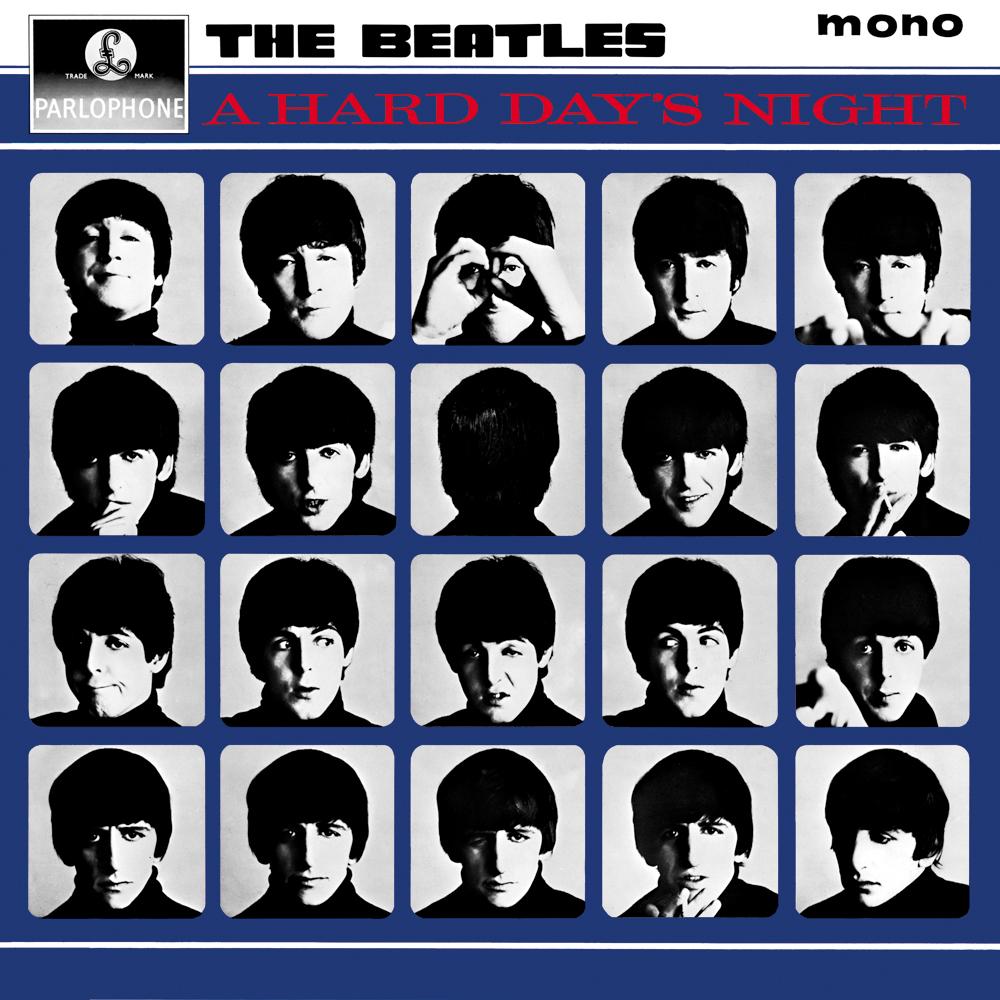
More than any other Beatles album, A Hard Day’s Night — which turns 50 this week — embodies the cliches surrounding the band. The cheesy harmonies, the “whoa”s and “yeah”s, the sappy love songs, the teen-idol cuteness: All are there in abundance. It’s also the most obvious manifestation of the John/Paul dichotomy. Though the idea of John as the bad boy and Paul as the author of silly love songs is largely accepted as a myth by Beatles fans, it’s a lot closer to the truth than folks give it credit for, and on no album is it more clear than A Hard Day’s Night.
Every song on this album is a love song, befitting the Beatles’ stature at the time as teen idols and encouraging the tide of Beatlemania — at that time at its peak. Paul’s are quite silly, but the music is so effective it’s easy to forget the lyrics are a bit ridiculous. “And I Love Her” repeats the word “love” incessantly, but the twinkling background makes it seem transcendent. You’re more likely to come out of it remembering the four-note guitar riff that frames the song anyway.
Better yet is “Can’t Buy Me Love.” The song’s chorus looks absurd on paper (“can’t buy me love/everybody tells me so/can’t buy me love/no no no no”) but is so catchy it’s hard not to ignore the lyrics. It’s also one of the most brutally short Beatles hits. Befitting a song rejecting materialism, there’s no excess or indulgence — just hooks. It goes by before you know what hit you, but it takes on a new life once it’s stuck in your head.
John’s love songs are far more bitter and sarcastic. But it’s important to remember that John Lennon was more than just a media-ready “bad boy.” His reputation as a peacenik and a member of the most (supposedly) infallible paragon of pop music in history has sadly clouded his history of neglect and abuse toward his children and various lovers. Knowing the latter gives an unpleasant context to the Lennon songs on this album.
I find “You Can’t Do That” unlistenable for this reason. The song is told from the perspective of a man whose girlfriend has been talking to another boy and who warns her that if he catches her doing it again, he’ll “let her down” and “leave her flat.” It’s hard not to interpret those as a reference to domestic violence given that Lennon’s first wife, Cynthia, was a victim of such abuse. And the theme of the song evokes Lennon’s own worries concerning his second wife, Yoko Ono, whom he often dragged into the studio out of fears she would abscond with another man if left alone.
As grievous is Lennon’s focus on his own pride and the shame of having had his girl cheat on him. This theme surfaces on “You Can’t Do That” (“Everybody’s green cuz I’m the one who won your love/But if they’d seen you talking that way they’d laugh in my face”). It’s as bad on “If I Fell.” John asks his potential girlfriend if she’d “hurt my pride like her,” then bluntly tells her how much he’d enjoy his old girlfriend’s misery at seeing the two of them together.
It’s less rational to believe that these songs are told from the perspective of an abuser so much as illustrating Lennon’s own viewpoint as a real-life abuser. There’s nothing in these songs to suggest he’s playing a role of any sort. On one song, he does. “I’ll Cry Instead” is one of my favorite songs on the album. No song I’ve heard better captures the irrational thoughts that come with anger and sadness. His girl left him, and he’d like to go out and “break hearts all ’round the world” as revenge, but he can’t, so he’ll cry instead.
The point of “I’ll Cry Instead” isn’t that he’d like to hurt her, but that he’s angry and is thinking illogically as such. The sense is he’ll feel better once he’s had a good cry. Thus, it’s a bit easier to separate this song from its creator. Nonetheless, A Hard Day’s Night is one of those albums — at least for me — where art and artist are too firmly entwined for the album not to suffer.
It would be ridiculous to accuse anyone who enjoys this album of being a misogynist. But I would take issue with anyone who approaches this album with a mindset of denial. If these moral questions inhibit you from enjoying the art, so be it. But to dismiss these issues in order to preserve your prior appreciation of the music would be tantamount to ignoring those issues in the first place, and that would be an injustice.
There are, however, two Lennon songs that truly warm my heart on this album. “When I Get Home” is an ecstatic love song that finds its protagonist rushing home to be with his girl. The voyage home becomes an obstacle course — he’s telling people to “get out of my way” as he dreams of the night they’ll spend together. That he has “a whole lot of things to tell her” suggests he’s actually interested in conversing with the girl, not just having sex (though sex is certainly a part of it). And he’ll love her the next day too, and accordingly make the same voyage. Now that’s love.
Second is the title track — and that unplayable opening chord isn’t even half of it. On no other Beatles song is the interplay between John’s voice and Paul’s more effective. It’s difficult to even notice that the vocalist has shifted until the end of the first chorus. But it’s the gradual build in emotion that makes this song so brilliant. By the time the chorus is about to transition back into the verse, Paul is emoting relentlessly — “feeling you holding me TIIIGHT, TIIIIIGHT YEAH” — and then in comes the verse again, with John’s dry voice snapping satisfyingly into place and contrasting icily with Paul’s catharsis.
“A Hard Day’s Night” is by far the best song on the album, which would suffer without it. The only Beatles albums that have aged worse than A Hard Day’s Night are the psychedelic albums, and even those contain more moments that still confound than this album. Though it contains some truly transcendent songs and remains a milestone in the Beatles’ musical songwriting, A Hard Day’s Night remains the worst of the Beatles’ “great” albums.
Though I generally avoid discussing my own sentimental attachment to albums in reviewing them, I will close this review by saying A Hard Day’s Night is by far the most important album in my life. As the first rock album I ever listened to, it ended my 12-year streak of aversion to rock due to my sensory processing disorder, which made it nearly impossible for me to listen to music until then. But I haven’t gone back to it much — simply because I listened to eight other Beatles albums immediately afterward, and every single one of them puts A Hard Day’s Night to shame.
“Die techie scum.” Those words are sprayed ominously on sidewalks throughout San Francisco. They’re plastered on stickers stamped on lampposts. They’re even scrawled in the bathrooms of punk bars, the very establishments now populated by Google-Glass-wearing tech aficionados.
Journalists from San Francisco to New York have opined on the source of the hate: Is it the housing crisis? Tech-fueled gentrification? Rising inequality? Those same journalists later parachute into the tech industry to periodically peer at its soul: Is tech diverse enough? Is it sexist? Is it a true meritocracy?
Those issues are often looked at in a vacuum, but perhaps they shouldn’t be. Perhaps those problems are all interconnected, and solving tech’s diversity problem is also part of solving income inequality in San Francisco, giving longtime San Franciscans a chance to join the industry many now view as composed of outsiders and interlopers.
The average Silicon Valley tech worker makes about $100,000, according to Dice Holdings Inc., which conducts annual tech salary surveys. Opportunity in the tech sector may bolster San Francisco’s middle-income earners, vanishing like wayward sea lions from the city’s landscape. Statistics from the US Census Bureau show that 66 percent of the city is either very poor or very rich, showing a hollowing out of the middle class.
Some tech CEOs are addressing their employment needs with a foreign workforce. Mark Zuckerberg and a cadre of tech CEOs have lobbied Senate and House Republicans to reform immigration in their favor, hoping to lure out-of-country workers to fill tech’s employment vacancies. Politico reported Sean Parker gave upwards of $500,000 to Republicans in 2014, all for the cause of immigration reform.
Conversely, a movement is already underway to bring San Franciscans into tech’s fold, based on the idea of a win-win scenario: San Francisco’s public school students are overwhelmingly diverse and lower income, while the tech industry is not.
Google, Facebook, LinkedIn, and Yahoo recently released their diversity numbers, showing the companies are mostly white and male. This accusation has long haunted Silicon Valley.
Two years ago, Businessweek heralded the “Rise of the Brogrammer.” The stereotype is as follows: He preens as he programs in his popped collar, his startup funds fuel the city as he hunts “the ladies,” and he is insensitive toward women in the workplace in the most fratboy-like way imaginable.
Biz dev VP of @path just cracked lame jokes re: “nudie calendars,” frat guys + “hottest girls,” “gangbang” at #swsx talk. Cue early exit.
But while outlier brogrammer douche-bros certainly exist, whose classist opinions ignite widespread ire (think Greg Gopman’s statement comparing homeless people to “hyenas”), the real brogrammer threat is more insidious, more systemic.
“The brogrammer is always someone else,” wrote Kate Losse, a freelance journalist, in an April blog post. “He is THOSE Facebook guys who yell too loudly at parties and wave bottles in the air, he is not the nice, shy guy who gets paid 30 percent more because of his race, gender and appeal to the boy-genius fetishes of [venture capitalists].”
The overarching point of Losse’s article was this: There is a subtle sexism, and also racism, in the tech sector, which shuts out women and people of color. The looming stereotype of a douchey brogrammer can obscure the smaller, more indirect ways in which minorities and women are shut out of the industry.
Tech’s disturbing (but unsurprising) lack of diversity is being highlighted amid an economic backdrop that has resulted in widespread displacement of San Francisco’s working class and minorities.
Some are seeking to create opportunities for Bay Area communities of color within tech, as a way to even the scales. A swell of new applicants with programming skills — including people of color and women — may soon come knocking. But in the time it will take school-age coders to cycle through the first generation of new computer science classes, Silicon Valley is going to have to take a hard look in the mirror.
Some of the Bay Area’s hate toward tech may be rooted in a perceived lack of access. Longtime residents see a sea of newcomers, often white, often male, who aren’t pulling up a seat for minorities to join the new gold rush.
The age of the brogrammer is now, and it’s as socially progressive as the paleolithic era, meaning: not at all.
FAKE IT TIL YOU MAKE IT
Talk to anyone in the realm of new technology companies and startups, and they’ll surely tell you this: Tech is an inspiring, creative field, where pure skill is the key to unlocking any job you’d like. The dress style is casual (hoodies, of course) and the perks flow like wine (or energy drinks).
When the Guardian visited the CloudCamp social good hackathon, we saw video game arcade machines in the ground floor and beer flowing throughout. Another company, Hack Reactor, had desks attached to treadmills and a life coach on hand to mind employee health. These are accoutrements de rigeuer, stunningly standard. But tales of true Silicon Valley excess abound: One CEO offers employees free helicopter rides, many offer in-house chefs and extravagant travel.
Interns in Silicon Valley are enjoying huge perks like free meals, massages, swimming pools, nap pods: http://t.co/BdaaOdC95P
Skill and ability alone are the keys to unlocking this lifestyle, the tech industry says. Workers’ fervor can take on an almost cult-like zeal.
“I think the sharing economy is addictive,” said Rafael Martinez-Corina, a panelist at the Share2014 sharing economy conference in May, touting tech’s biggest stars like AirBNB, Lyft, and Uber. “Once you get it, you want more and more. You get into car sharing, you want to get into food sharing, time sharing.”
He asked the audience, “Who else is addicted to sharing?”
Almost every hand went in the room shot right up. Cheers immediately followed. Hallelujah!
Mars Jullian, an engineer at AdRoll, told the Guardian that employees of tech companies with name-brand apps tend to exhibit more ego. AdRoll is a big player, but more behind the scenes, she said, giving her perspective on the attitudes of her fellow tech workers.
“Sometimes it seems tech people feel like they own the city,” she said. “I don’t know if that’s the right attitude to have. Sometimes it’s more important to be humble.”
One might forgive the tech workers for their enthusiasm. The industry, after all, has ushered in widespread transformation in business and communications, resulting in dramatic economic shifts. But with such a high concentration of wealth and influence in the Bay Area, the question of who gets to participate is key.
Google’s diversity numbers rocked the world outside Silicon Valley, but surprised few in the Bay Area. The behemoth is 70 percent male and 60 percent white, with Asians making up 30 percent of the company’s ethnic representation.
Soon after Google’s numbers were revealed, Facebook, Yahoo, and LinkedIn followed suit with their own diversity reports. Their numbers differ a bit from Google, showing more Asian employees, and slightly more women. The numbers look worse, however, when only technology jobs are factored in. The tech worker population among these companies is about 15 percent female.
Hadi Partovi, an early Facebook investor, now adviser, and ex-chief of Microsoft’s MSN, told the Guardian that despite the industry’s challenges, tech’s doors are open to people with skills, regardless of background.
“The computer doesn’t know if it’s being programmed by someone rich or poor, black or brown,” he told us in a phone interview. “A lawyer, for instance, is looked at more explicitly. Tech has the opportunity to be more meritocratic.”
But the tech sector’s pious belief that it functions as a world-changing meritocracy ignores a host of factors that serve to hinder inclusion.
Many have touted the education pipeline as the root cause of tech’s lack of diversity. The number of women pursuing science, technology, engineering, and math (STEM) fields is stunningly low, 24 percent, according to the US Department of Commerce. African Americans and Latinos also lag far behind their white and Asian counterparts in completing their computer science degrees, according to studies by the East Bay nonprofit Level Playing Field Institute.
Considering Asian groups is important: the Level Playing Field Institute draws a distinction between represented and underrepresented minority groups, acknowledging that ethnicity, income and class intermingle in complex ways. It’s those underrepresented groups like women, Latinos and African Americans LPFI identifies as groups lacking in tech.
But the pipeline is only one part of the problem. Subtle (and not-so-subtle) misogyny and racism, often labeled micro-aggressions, pervade hiring.
Level Playing Field is focused on creating opportunity for people of color and women in STEM fields. In an extensive tech-industry study conducted in 2011, called “Hidden Bias in Information Technology Workplaces,” researchers concluded: “Despite widespread underrepresentation of women and people of color within the sector, diversity is not regarded as a priority.”
Surveying more than 645 engineers, the study’s authors found that white men were the most likely to believe that diversity was not a problem that needed addressing in the tech sector. The study also found that underrepresented people of color (Latinos and African Americans), and women were more likely to encounter exclusionary cliques, unwanted sexual teasing, bullying, and homophobic jokes.
Sometimes, these instances blow up for the world to see.
THE MIRROR-TOCRACY
The workday text messages between Tinder’s co-founder Justin Marteen and former VP Whitney Wolfe went public after Wolfe sued Tinder, revealing the ugly waters women must sometimes navigate in tech. Marteen was allegedly harassing Wolfe over her new love interest, and Wolfe asked him to stop.
“Stop justin [sic]. Were at work,” Wolfe asked of Marteen, to which he replied, “Ur heartless… go talk to ur 26 year old fucking accomplished nobody. I’ll shit on him in life.”
He should have ended there. But he continued his rage at his ex-girlfriend.
“Hagsgagahaha so pathetic I even imagined a life w u. I actually thought u would be a good mother and wife. I have horrible judgement. He can enjoy my left overs,” he allegedly wrote. “You’re effecting my work environment,” she replied, “and this is very out of control. Please don’t do this during work hours.”
Besides an awful command of rudimentary spelling, the squabble showed the very real harassment women in tech are exposed to every day. When Wolfe went to Tinder CEO Sean Rad for help, she found herself out of a job.
Tinder is not an outlier, according to studies by Level Playing Field. Nor is it the only company to see its harassment go public. Earlier this year, GitHub’s CEO Tom Preston-Werner resigned after a former employee, Julie Ann Horvath, alleged she was harassed by him, his wife, and engineers.
While Github denied the allegations, Horvath was defiant: “A company can never own you. They can’t tell you who to fuck and who not to fuck. And they can’t take away your voice.”
But for every example of outright sexism or racism, there are multitudes of more subtle biases in the workplace. Level Playing Field’s studies found these biases are pervasive. They start as early as the hiring process.
Carlos Bueno is a former Facebook engineer, now tinkering behind the scenes at memSQL. He is of mixed ethnicity, Irish and Mexican, among others. “My father called us ‘Leprechan-os’,” he told us.
Bueno trained interviewers at Facebook, and like many there, he also conducted interviews. He said Facebook’s interview process was probably one of the best in the industry for screening out biases of the interviewer, but other companies were not as aware of bias as a problem.
“Every startup wants to be a big dog,” he said, describing the process. “But the point of a startup is to grow very large, very quickly. They don’t have time to learn. Some people take rules of thumb or investor advice and run with it.”
Paypal co-founder Max Levchin is looked to as a thought leader in the startup world. He touts the idea that diversity of perspective in a startup’s early phases can actually hurt its chances of success, hindering its speed in “endless debates.”
Paypal co-founder Peter Thiel once famously put it this way: “Don’t fuck up the culture.”
Bueno pointed to a real estate startup, 42Floors, as an example of a company adopting Levchin’s philosophy. It looks for potential hires who are a “cultural fit,” i.e., making sure the candidate and employer think alike.
One 42Floors interviewer explained this on the company blog: “I asked her how she was doing in the interview process and she said, ‘I’m actually still trying to get an interview. Well, I grabbed coffee with the founder, and I had dinner with the team last night, and then we went to a bar together.’ I chuckled. She was clearly confused with the whole matter. I told her, ‘Look, you just made it to the third round.'”
So the interview process for tech may involve coffee dates or “beer with the guys,” and the onus is on the interviewee to figure all of this out. Similar blog posts from 42Floors go on to call out interviewees who wear suits, or act too stodgy for their liking.
We spoke to Bueno extensively over burgers, but he put it best in his blog.
“You are expected to conform to the rules of The Culture before you are allowed to demonstrate your actual worth,” he wrote. “What wearing a suit really indicates is — I am not making this up — non-conformity, one of the gravest of sins. For extra excitement, the rules are unwritten and ever-changing, and you will never be told how you screwed up.”
Founders back up their faulty hiring practices with faulty logic. “It’s so hard to get in, if you get in you must be good,” Bueno said. “But those two statements don’t support each other.”
Some students of color training to code have already caught a glimpse of how the mirror-tocracy functions.
OPENING THE DOOR
Eight years ago, Kimberly Bryant moved to San Francisco to work in biotech. She moved to the city because she believed it to be more racially and economically diverse. She worked adjacent to Bayview Hunters Point, and has since revised her view of the city as a welcoming multicultural environment.
Instead, she found a city with an African American population dwindling below six percent in a city of over 800,000, and a gutted middle class. Latinos are moving out in greater numbers too. Over the last decade, 1,400 Latinos left the Mission District, according to a recent report on displacement by Causa Justa / Just Cause. In the same time, 2,900 white residents flooded in.
The displacement data reveals a significant parallel: The diverse ethnic groups Silicon Valley lacks in its employed ranks are the very same ethnic groups being priced out of San Francisco.
Seeking to mitigate the ethnic and gender disparity in tech, Bryant formed Black Girls Code, a student mentor and workshop program. It first opened up shop in the Bayview, but has sinced moved on.
“I really saw and experienced the true diversity of the community in Oakland,” Bryant told the Guardian, of the nonprofit’s new home. “It’s just an amazingly incredibly diverse community in terms of race and economy. What San Francisco used to be,” she added, “but is no longer.”
Black Girls Code teaches K-12 students rudimentary coding skills, providing instruction in Ruby and Python. Although companies like Google and others have opened their doors with welcoming arms, she said, convincing her students that the tech world is ready for them has been challenging.
When she brought her young students to an industry event, TechCrunch Disrupt, she dodged a minefield of fratboy-like behavior that made her students feel unwelcome, she said. This is the same event that heralded a prank app called “titstare,” which invited users (presumably male) to upload photos of themselves staring at women’s breasts.
The app was displayed on a stage before some of the most influential players in the tech industry, but Bryant’s students were in the audience too.
“They were shocked, like everyone there. It was disconcerting for the parents and the girls,” she said. Though she’s careful not to overplay the damage done (the girls “laughed awkwardly,” she said), the takeaway of the conference was that women and girls were not the intended participants. “It’s like a frathouse. I thought, ‘oh my god, this is like college all over again. This sucks.'”
At Mission and 19th streets sits MEDA, a nonprofit that has long worked to help Mission residents gain a foothold in San Francisco workplaces. This begins even in the lobby, where a small kitchenette in the corner plays host to a chef who mixes up a mean ceviche, with spices admittedly leaving this reporter in tears. He aspires to open his own restaurant, and MEDA is helping him get there.
The upstairs houses a group of students called the Mission Techies. They seek support in their aspirations to enter the tech industry, but for them the dream may be further off than the chef’s.
Gabriel Medina, policy manager at MEDA, doesn’t mince words. These are the “challenge” kids, he said, but they’ve done him and program manager Leo Sosa proud.
The Mission Techies pull apart computers to learn about their innards.
Sosa described a visit from Google and Facebook engineers who taught his students rudimentary coding skills. One student, Jamar, was so engrossed in programming that one engineer asked: “Is he okay?!”
“Jamar is on the coding program, [and he’s] on fire,” Sosa told the Guardian, while sitting in a MEDA office.
But students like Jamar, an African American San Franciscan, face an uphill battle before they ever get to the step of applying for a job like one at Google.
After visiting some tech offices, the students felt less sure of themselves.
“They were like ‘I don’t see no black guys, I don’t see no Latinos. Leo, do you really think I can get a job here?'” Sosa told us. For them, the mirror-tocracy did not reflect an image they recognized.
By many measures, MEDA’s Mission Techies program is a success, taking kids of modest means and equipping them with digital skills that can aid their employment prospects. Mission Techies, Black Girls Code, and other programs such as Hack Reactor and Mission Bit all nip at the heels of the education pipeline leading to tech industry employment. They also share a common focus: They’re educating largely minority populations, often low-income, and located in the Bay Area.
The solution to tech’s diversity problem and to San Francisco’s displacement may spring from the same well: educate the people who live here to work in the local industry. But in order to do that effectively, afterschool and summer programs alone won’t do the trick.
The schools themselves need disruption.
WORKING TOGETHER
In the midst of the tech hub, the San Francisco Unified School District finds itself surrounded by tech allies. Still, change comes slowly.
Only five of SFUSD’s 17 high schools have computer science courses. Ben Chun, an MIT graduate and former computer science teacher at Galileo High School, told us the outlook is bleak without digital training in schools. Though kids sometimes teach themselves programming at home, most low-income students don’t have that opportunity.
“It’s a privilege thing,” he told us. If you have access to computers at home, you’re more likely to tinker and teach yourself. Those kids are more likely to be the Bill Gates of the future, he said, the self-starters and early computer prodigies.
“If you don’t have those things in place,” he said, “there’s a zero chance it will be you.”
When he first got to Galileo, his computer teacher predecessor taught word processing. But a lot has changed since 2006.
Partovi took his successes at Facebook and Microsoft and parlayed his money into a nonprofit called Code.org. The organization created its own coding classes for kids as young as 6, and compelled 30 school districts nationwide to create computer science courses based on its work.
Code.org’s tutorials have been played by millions of students.
Now it has its sights set on SFUSD’s 52,000 students, potentially solving tech and the school’s problems at once.
“It would for sure level that diversity gap,” Partovi told the Guardian. “All of the data released from Google, Yahoo, and others show a male-dominated industry. The pipeline of educated kids is actually much more diverse.”
But integrating tech in the district is slow, and likely years away. The district needs state standards to require computer science, something SFUSD Superintendent Richard Carranza has already lobbied Gov. Jerry Brown to change.
“The demand [for computer science classes] is coming from everywhere,” Carranza told us, including parents, students, the tech industry, and city leaders.
“What makes it a game changer is the partnership with our tech partners,” he said. “It gives our students the opportunity to interact elbow to elbow with people doing computer science out in the real world.”
But the tech workers those students are interacting with, though well meaning, remain the domain of the brogrammers. Will they hire SFUSD graduates with computer science skills when and if they’re ready? Will they be the right “culture fit?”
“There’s definitely a libertarian thread, a free market, red-toothed nature of things [in tech],” Bueno told us. “Talking to people in unguarded moments, that definitely leaks out. You’re not going to convince anyone by singing kumbaya and holding hands.”
But logical tech workers need look no further than the current numbers facing Silicon Valley to see the need to reach beyond their in-groups: 1.2 million new tech jobs will be created by 2020, studies from the US Department of Labor show. At the same time, 40 percent of the United States will be Latino and black by 2040.
When the minority is the majority, the brogrammers may become a dying species.
THE WEEKNIGHTER I don’t know, man. Would I believe what, that cocktails exist? Yes absolutely, I have four in my belly right now. Is this an X-Files themed bar? I hope so! Why is the grammar so totally screwed up in the name of this bar? What is the goddamn question anyways?
These are all things I was thinking as Ashley and I walked into Would You Believe? Cocktails (4652 Geary Blvd., SF. 415-752-7444). We’d wandered down from Trad’r Sam on our little weeknight adventure in the Richmond and here we were. Walking in I surveyed the scene: sitting around the bar was a crowd of Asian folks of various ages. Some were drinking and talking, others flirting with each other, while still others were at the short end of the bar slamming down dice. One girl kept squealing very loudly every time the dice went down. I don’t think she quite understood the game.
“I know what the question is,” I told Ashley. “It’s ‘Would You Believe how cheap the drinks are here?!'” Well drinks were $4, a shot and a beer combo was $5, and Hennessey was also $5. I don’t drink Henny, but I spend enough time in bars to know that’s insanely cheap.
“Hey, wanna have an orgy?” Ashley smiled as she asked me. I’d been trying to get her to warm up to the idea of a threesome for a while, so I was surprised that, of all places, Would You Believe? was what finally got her in the mood. Then I looked where she was pointing and saw that I’d been had. An “Orgy” was just the name of one of the spot’s signature cocktails. Other drinks had names like “Wet Pussy” and “One Night Stand.” I wouldn’t have been surprised if there was a drink called a “Long Slow Fisting Against a Wall.”
I stuck with my usual vodka soda, and we picked a place on a banquette to soak in the atmosphere. In this case the “atmosphere” was fake flowers, lots of mirrors, low lighting accented with some blues and purples, and songs by 2 Chainz. I fucking hate 2 Chainz.
My favorite part of Would You Believe was the sign outside that said “Forecast for Tonight: Alcohol. Low Standards and Bad Decisions.” I’m always a sucker for clever sidewalk signs. I was telling Ashley this when a group of five guys rolled in, none of which could’ve have been more than 22 years old. Considering they were all so clean cut and of pretty much every ethnicity but Asian, I said, “Those guys have to be hostel kids. There’s no way they are local.” I strained to hear what their accents were but dice kept banging on the bar and the damn woman kept squealing about it. Nobody likes dice that much. The whole scene was pretty weird.
The new boys flirted with the pretty bartenders and then played some pool and Ashley and I lost interest in figuring out what their accents were. The night was misty and cold and the thought of my warm bed was enough to draw us out of there and send us on our way. But we still never got the answer to the question “Would You Believe?”
Stuart Schuffman aka Broke-Ass Stuart is a travel writer, poet, and TV host. You can find his online shenanigans at www.brokeassstuart.com
THEATER If you were milling around the Asian Art Museum last Thursday evening, you might have seen a woman tumble — ever so slowly — down the Beaux-Arts building’s elegant flight of central stairs. Ringed by a crowd of onlookers and the second floor’s imposing colonnade, her limber form caressed the marble steps luxuriously as she cascaded beneath the elegant arched ceiling, entirely at her own pace, leaving behind her the unraveling, impossibly long train of her white and lavender gown.
Bystanders ruminated silently or chatted quietly, sipping cocktails, for the duration of Fauxnique’s 20-minute high-art pratfall, Beautility, as house music reverberated from DJ Hoku Mama Swamp’s station in the nearby lobby. Passing through the lobby, you would have seen mercurial artist Dia Dear offering free makeovers, while members of TopCoat Nail Art Studio applied lacquer to willing hands, in designs inspired by pieces in the museum’s current show, Gorgeous, built from the permanent collections of both the Asian Art Museum and the San Francisco Museum of Modern Art.
Having at last landed on the first floor, in front of the shiny red and white speed demon parked there — German designer Hartmut Esslinger’s Prototype for Frog 750motorcycle (1985), from the SFMOMA collection — Fauxnique (aka Monique Jenkinson) gathered up her enormous train and rushed up the stairs and out of sight.
Back in the lobby, you might also have caught sight of Nude Laughing, a peripatetic work by La Chica Boom (Xandra Ibarra), and followed the nude figure as she went by, dragging behind her a large nylon stocking filled with what appears to be hair and plastic breasts. You’d have ended up in an alcove on the first floor between several incongruent sculptures — including British artist Tracey Emin’s hot pink neon phrase-sculpture, Fantastic to Feel Beautiful Again (1997); a voluptuous, powerful, and headless stone torso of a female deity from southern India (1400–1600); and American Dan Flavin’s horizontal row of fluorescent colored beams, untitled (in honor of Leo at the 50th anniversary of his gallery) (1987).
In the company of these disparate pieces, the performer slips inside the giant nylon pouch — a Marilyn Monroe wig over her dark hair and atop her painted face, fake furs and sundry toy boobs pressed against her brown body — as she stretches the sheer fabric enveloping her, writhing in coquettish spasms, emitting artificial squeals of pleasure. A puissant abstraction, seriously unsettling and completely mesmerizing in her vaguely menacing flirtation with her audience, the figure eventually sheds her gauzy cocoon and, with a confident stride, disappears down a hallway, leaving behind some flotsam of costume pearls, wigs, and fur.
Headlining this promiscuous night of performance making — part of the museum’s seasonal Thursday night programming, which also featured work from queer punk drag artist Phatima Rude and drag duo Mona G. Hawd and VivvyAnne ForeverMORE — was art-band collective Nicole Kidman Is Fucking Gorgeous (John Foster Cartwright, Maryam Rostami, and Mica Sigourney). At about 8pm, NKIFG took over the regal upstairs chamber with its show, Fuck Gorgeous, a 45-minute incantation, exultation, and rumination on the elusive properties of art, celebrity, fashion, and existence — Nicole Kidman, for short — by three Goth punks with microphones and boundless insouciance.
With enormous projections of full moons looming over a small stage, John, Mike, and Mary engaged in welcoming speeches, banter among themselves, victory laps with streamers, occasional howling, extended ferocious lip-synched roaring, and worshipful mouthing of one truly insipid Oscar acceptance speech. Sound rose and fell, a cacophony of noise gave way to mumbled quips, focus blurred and shifted, bodies went slack, writhed on the dance floor, or bounded around the room. At one point, Mike’s address from the podium slipped from a kind of self-actualization seminar into an outright stab at mass hypnosis as he charged us all to “be Nicole!”
Nicole Kidman, their vessel, “both everything and nothing,” was not quite an object and not quite a projection. Like the other performances enlivening the spaces of the museum and the strange harmony of the artworks on display, Fuck Gorgeous was deeply ambivalent but committed to being in-between, both a come-on and a refusal. *
One of the more exciting places to hit the scene in a summer full of tons of new openings is Monsieur Benjamin (451 Gough, SF. www.monsieurbenjamin.com), a project from Corey Lee (Benu), with chef Jason Berthold (previously RN74, and French Laundry and Per Se, where he worked with Lee) and Thomas Palauqui.
Lee has wanted to open a late-night bistro in San Francisco for some time, something he thought was missing from our local scene. He’s right. So now we have a hot spot open until 1am nightly in Hayes Valley, serving a modernized and technique-driven take on classic French dishes like escargots and sweetbreads Grenobloise, plus steak frites, roast chicken, and blanquette de veau. The list of entrées is significant, with 13 in all.
You can come by for a cocktail and oysters at the intimate marble bar before the opera, or find a spot at a communal table for small plates and appetizers to pair with wines from smaller family-owned producers from France after the symphony (or when you get out of work). You’ll definitely be entertained with peeks into the gleaming open kitchen — the joint is staffed up. The vibe is lively, and the room is chic yet understated, kind of like Isabelle Huppert. Coming soon: weekend brunch and a prix-fixe theater menu. Hours are nightly 5pm–1am for now.
BALLIN’ ON A BUDGET
The original location of Loló in the Mission has been tweaked by the owners and reopened as Loló Cevichería (3230 22nd St, SF. www.lolosf.com/lolo-cevicheria), serving a casual and affordable menu of ceviches — five in all — and some Loló classics, like the taco tropical and tuna tacon. It’s a fun place to hang out for an impromptu meal, and there will be plenty of beverages to get you feeling good, from a couple different sangrias to agave wine margarita slushies (which include one made with tamarind).
If you’re over waiting for a table at the recently opened Loló on Valencia — that place is caliente! — or if you’re a larger party than that funky little spot can handle, this one’s for you. Designer and business partner Lorena Zertuche has updated the space, featuring lots of tropical birds (caw caw!) and of course a riot of bright colors. The grand opening is Wed/16; hours are Mon–Thu 6pm–10pm, Fri–Sat 6pm–12am, closed Sun.
While fans of the hefty hoagies from 1058 Hoagie in SoMa will be sorry to hear that joint is closed, here’s your silver lining: Owner Adam Mesnick has turned the space into Rye Project (180 Seventh St, SF www.ryeproject.com), his take on a Jewish-style deli. He’s calling it “Newish Deli.” This is the place for overstuffed corned beef and pastrami sandwiches on rye bread from a special source in Detroit ($14). Other choices: roast beef, tuna salad, kosher or hard-beef salami, and turkey. You want double meat/double bread? Go for it for $6 extra.
Also coming in from back East: par-baked bagels from New York that are finished here (top those bad boys with lox, smoked trout, or Mesnick’s smoked whitefish salad). A whole other category to explore is his creative salads, including the Rye House ($13), with romaine, corned beef, Muenster cheese, hard-boiled egg, cucumber, cherry tomato, and chickpeas. Bonus: All salads come with a bagel, because hey, more is more. Additional options are soup of the day (expect some matzoh ball soup in rotation), chopped liver, mac and potato salad, and other classic deli faves. Eat, eat! Open Mon–Fri 11am–4pm.
Marcia Gagliardi is the founder of the weekly tablehopper e-column; subscribe for more at www.tablehopper.com. Get her app: Tablehopper’s Top Late-Night Eats. On Twitter: @tablehopper.
Since Jessica Hernandez & The Deltas recorded a full set of tunes for an album two years ago, long stints of touring, writing, and other facets of life delayed their complete release. An excellent EP, Demons, came out last year, and gave fans a taste of what is to come when their new full-length album Secret Evil (Instant Records) is finally released next month. The Detroit-born band plays a tasty blend of blues, jazz, soul, rock and more retro-roots goodness, all building a perfect foundation for Hernandez’ gorgeous and powerful vocals. (Sean McCourt)
While there are plenty of outdoor music festivals and tours crisscrossing the country this summer, metal fans with an aversion to the sun can rejoice that there is one such touring package that hits indoor venues — so you don’t have to worry about a searing sunburn on top of your ringing ears. The promoters of Summer Slaughter 2014 are billing it as the “Most Extreme Tour of the Year,” and it may well be, with death metal legends Morbid Angel headlining the day-long session of debauchery. Joining them will be Dying Fetus, The Faceless, Thy Art Is Murder, Goatwhore, Origin, Decrepit Birth, Within The Ruins, Fallujah, Unhailoed, and Boreworm. (Sean McCourt)
While the films of Pixar Animation Studios may have revolutionized the way movies and cartoons are made with their innovative use of computer animation and their resulting reputation for gorgeous visuals, music also plays an important part in the company’s artistic arsenal. Pixar director Lee Unkrich, CCO John Lasseter and writer-director Brad Bird will act as hosts this weekend as the San Francisco Symphony performs parts of the scores from fan favorite films live, including the Toy Story trilogy, Finding Nemo, Ratatouille, A Bug’s Life, Wall-E, Cars, Up, The Incredibles, Monsters, Inc., Brave, and Monsters University. (Sean McCourt)
Labels like Josh Cheon’s Dark Entries exist to remind us that no matter how much (or how little) good music might be coming out presently, there are always gonna be underappreciated gems from the past to discover. With this digger’s mentality and assistance from prolific mastering master George Horn, the San Francisco label has been attentitively re-releasing ’80s dance obscurities. Hi-NRG, Italo disco, minimal, post-punk, etc: If it’s avant, analog, and (obvs) dark, it’s perfect. Starting off on a anniversary tour, Cheon will be joined by some of the label’s contemporary artists including REDREDRED (Michael Wood) and Bézier (the live synth project from Cheon’s Honey Soundsystem collective-mate, Robert Yang.) (Ryan Prendiville)
The name says it all: Pretty much any mode of transport — even, probably, roller-skating or Segway-ing, though maybe leave your team of draft horses back on the farm — is acceptable conveyance to the Brainwash Drive-In/Bike-In/Walk-In Movie Festival. Once you arrive, settle in (BYO lawn chair or blanket) for an old-school drive-in experience, with films projected on a big screen and sound provided by FM radio as well as amplified speakers. What’s not old-school is the programming: genre-spanning shorts and the occasional feature (this year: a Bollywood pick!), mostly of the “underground” variety, which means you might not catch ’em anywhere else. (Eddy)
June was a busy month for Erk tha Jerk, the Richmond rapper and producer known for his clever wordplay and catchy, often intensely sexual hooks. On the 12th, he dropped a new video produced by frequent collaborator Fly Commons called “Blast Somebody.” A smooth beat finds Jerk getting existential about his stresses while a near-nude woman gyrates on his bed. The video premiere was bolstered by the announcement that the duo’s upcoming EP, Food and Vegetables comes out on July 15th — the gig doubles as a release party. Fellow East Bay MC Kev Choice opens for Erk. Where Erk often embraces an id-driven and autobiographical style, Kev is far subtler and more socially conscious. A prodigious pianist and bandleader, his set should provide a soulful introduction to Erk’s intensity and bombast. When two of the most idiosyncratic and up-and-coming Bay Area rappers come together, sparks will inevitably fly. (Kurlander)
Foggy days, windy nights — yep, it’s summer in San Francisco. No need to the seek air-conditioned comfort of a movie theater in this town, unless the films on offer are as tempting as this year’s San Francisco Frozen Film Festival lineup. The two-day fest offers a stack of shorts by indie, international, and youth filmmakers, grouped into thematic programs: dramatic shorts, animated shorts, LGBT shorts, experimental shorts (including at least one music video), documentary shorts, and the sub-category of short environmental docs, spanning locations as close as Mt. Tam and as far as Antarctica. Brrrr-illiant! (Cheryl Eddy)
Macrogroan, Sara Lautman’s ongoing booklet series and accompanying blog, is remarkably diverse. Lautman, July’s cartoonist-in-residence at the Cartoon Art Museum, deconstructs tiring pop culture trends (one illustration includes a speech bubble by a young woman sitting a desk with a computer: “If you heard Matthew Sweet in some bar he’d fit right in but you’d be like Holy Fuck!” Near the bottom right corner of the same illustration: “Gross. I sound like Marc Maron.”) and larger societal issues (“Clothes People We Are Afraid of Becoming” is made up of four sketches of archetypes Lautman fears, with corresponding labels that describe their respective outfits). Her self-referentiality and distinctive, often experimental drawing methods — she has created entire comic books using a crude drawing program on a flip phone — has earned her spots in publications as varied as Bitch Magazine and The Hairpin. Lautman will present her work and discuss her process with visitors to the museum. She sums up her vision of the experience on her site: “Come see me yammer for a while, then hang out.” (Kurlander)
Bob Marley may adorn more stoner dens with his smiling face, but the credit for bringing reggae to a worldwide audience goes first and foremost to Jimmy Cliff. As the star and main soundtrack composer of the 1972 Jamaican film The Harder They Come, Cliff brought the once-obscure Caribbean pop style to national attention and broke open the door for the genre’s success in the 1970s. But he couldn’t have done it without a set of killer songs — the film’s title track included —and a voice that puts nearly every stateside soul singer to shame. At 66, he’s still a respected live performer, appearing frequently at festivals — as well as at the Fillmore, where he’ll play on the 19th. (Bromfield)
Sometimes landlords just refuse to openly admit that they’re renting you a dilapidated apartment. On the surface, the similarities between modern life and the 1998 Taiwanese film The Hole end there — unless you think our tenacity for lining up in the rain for day-old bagels imported from New York is a sign we’d prosper in a post-apocalyptic world. The screening is the first in this summer’s Yerba Buena Center for the Arts series comprised of obscure movies selected by local cinema aficionados. There’s just something about the renter’s dilemma (a modern twist on the prisoner’s dilemma) and a fondness for hoarding toilet paper that resonates with viewers. (Amy Char)
Like many pop-punk bands, Say Anything caught their big break with a completely ridiculous, comically sexual earworm. “Wow, I Can Get Sexual Too,” a song about phone sex that includes zombie references and the word “interweb,” is still the band’s most popular track and a mainstay in teenage bedrooms, but Say Anything’s catalog is anything but shallow and kitschy. Through a decade and a half of mental health issues, drug habits, and music crit’s endless ridicule of pop-punk, Max Bemis and company have continued to turn out catchy and lyrically sharp and funny records. It is perhaps their distinctly un-hip and unapologetically self-aware musical style (they released a record called In Defense of the Genre) that makes the band most earnest and entirely loveable. (Haley Zaremba)
With The Front Bottoms, The So So Glos, You Blew It!
Who said music writers can’t make music? When Mish Way isn’t busy freelancing as one of America’s most passionate and hilarious music writers, she’s rocking harder than any other architecture-dancer since Patti Smith as the leader of punk outfit White Lung. After making a splash in Vancouver’s punk scene with its debut It’s The Evil, the band found its profile substantially increased when Rolling Stone included sophomore effort Sorry in their top 10 albums of the year — no small feat for a punk album, least of all one that barely runs 20 minutes. They’ve added Wax Idols member and Bay Area native Hether Fortune on bass for album number three, Deep Fantasy, whose hearty reception should secure the band’s footing in both the critical and the die-hard punk worlds. (Bromfield)
The Guardian listings deadline is two weeks prior to our Wednesday publication date. To submit an item for consideration, please include the title of the event, a brief description of the event, date and time, venue name, street address (listing cross streets only isn’t sufficient), city, telephone number readers can call for more information, telephone number for media, and admission costs. Send information to Listings, the Guardian, 835 Market Street, Suite 550, SF, CA 94103; or e-mail (paste press release into e-mail body — no attachments, please) to listings@sfbg.com. Digital photos may be submitted in jpeg format; the image must be at least 240 dpi and four inches by six inches in size. We regret we cannot accept listings over the phone.
Schedules are for Wed/16-Tue/22 except where noted. Director and year are given when available. Double and triple features marked with a •. All times pm unless otherwise specified.
ARTISTS’ TELEVISION ACCESS 992 Valencia, SF; www.atasite.org. Free-$10. “Periwinkle Cinema:” “Dip Me in Honey’s Video Show #1,” multimedia works, Wed, 8. “Works by Marya Krogstad,” art opening and screening, Fri, 7:30. “Starvelab,” multimedia screening with Michael Triglio’s SUGAR, plus guests Patrice Scanlon and Raja the Resident Alien, Sat, 8.
BALBOA 3630 Balboa, SF; cinemasf.com/balboa. $10. “Thursday Night Rock Docs:” The Swell Season (August-Perna, Dapkins, and Mirabella-Davis, 2011), Thu, 7:30.
CASTRO 429 Castro, SF; (415) 621-6120, www.castrotheatre.com. $8.50-11. The Godfather (Coppola, 1972), Wed, 5, 8:30. •Young & Beautiful (Ozon, 2013), Thu, 7, and Swimming Pool (Ozon, 2003), Thu, 8:50. •The Girl Can’t Help It (Tashlin, 1956), Fri, 7, and The Blues Brothers (Landis, 1980), Fri, 8:55. Frozen (Buck and Lee, 2013), Sat-Sun, 1. Presented sing-along style; advance tickets ($11-16) at www.ticketweb.com. •The Dance of Reality (Jodorowsky, 2013), Sat, 7, and Jodorowsky’s Dune (Pavich, 2013), Sat, 5:10, 9:30. •The Wild Bunch (Peckinpah, 1969), Sun, 7, and The Long Riders (Hill, 1980), Sun, 5, 9:30. “The Prince of Darkness: Gordon Willis (1931-2014):” •Pennies from Heaven (Ross, 1981), Tue, 7, and The Landlord (Ashby, 1970), Tue, 9:05.
EXPLORATORIUM Pier 15, SF; www.exploratorium.edu. Free with museum admission ($19-25). “Off the Screen: Madison Brookshire, Selected Works,” Thu, 7. “Saturday Cinema: Seeing Sounds,” Sat, 1, 2, 3.
FLIGHT DECK 1540 Broadway, Oakl; www.matatufestival.org. $12. “Matatu Film Festival,” international docs and narratives, Wed-Sat.
HUMANIST HALL 390 27th St, Oakl; www.humanisthall.net. Free. “Science Film Night:” Thin Ice: The Inside Story of Climate Science (Sington and Lamb, 2013), Wed, 6:30. Also Thu, 7pm, free, Belvedere-Tiburon Library, 1501 Tiburon, Tiburon; http://bel-tib-lib.org. Both screenings followed by discussions with executive producer Peter Barrett, a geologist.
KALA ART INSTITUTE 2990 San Pablo, Berk; www.sfcinematheque.org. $5-20 suggested donation. “Gravity Spells: Bay Area New Music and Expanded Cinema Art, Program 3,” performances by Zach Iannazzi, Thad Povey and Mark Taylor, Steve Dye and Anthony Iamurri, and Paul Clipson and Tashi Wada, Sat, 7.
NEW PEOPLE 1746 Post, SF; www.jffsf.org. $13. “Japan Film Festival of San Francisco,” presented in conjunction with the 2014 J-Pop Summit, July 19-27.
NIMBY 8410 Amelia, Oakl; www.brainwashm.com. $12. “Brainwash Drive-In/Bike-In/Walk-In Movie Festival,” “weird, unusual and just plain great movies for audience enjoyment and edification,” Fri-Sat and July 25-26.
PACIFIC FILM ARCHIVE 2575 Bancroft, Berk; (510) 642-5249, bampfa.berkeley.edu. $5.50-9.50. “Rude Awakening: American Comedy, 1990–2010:” The Big Lebowski (Coen and Coen, 1998), Wed, 7; Galaxy Quest (Parisot, 1999), Sun, 6. “Martin Scorsese Presents Masterpieces of Polish Cinema:” The Promised Land (Wajda, 1975), Thu, 7. “Kenji Mizoguchi: A Cinema of Totality:” Miss Oyu (1951), Fri, 7. “A Theater Near You:” Godzilla (Honda, 1954), Fri, 8:55. “The Brilliance of Satyajit Ray:” The World of Apu (1958), Sat, 6:15. “Derek Jarman, Visionary:” Caravaggio (1986), Sat, 8:30. “Picture This: Classic Children’s Books on Film:” “Sustainable Stories,” Sun, 3:30. “Alternative Visions: Animation:” “Films by John and Faith Hubley” (1956-2012), Tue, 7.
ROXIE 3117 and 3125 16th St, SF; (415) 863-1087, www.roxie.com. $6.50-11. Cold Lands (Gilroy, 2014), Wed, 7. “Nippon Nights:” “Short Peace,” animated shorts from Japan, Wed, 7. Love Child (Veatch, 2014), Thu, 7. History of Future Folk (Mitchell and Walker, 2012), Thu, 7:15. Llyn Foulkes One Man Band (Halpern and Quilty, 2014), July 18-24, 7 (check website for weekend matinee times). Video Games: The Movie (Snead, 2014), July 18-24, 8, 10 (also Sat-Sun, 2:30, 4:30). SF Frozen Film Festival, docs, animation, and shorts, Fri-Sat. Complete schedule at www.frozenfilmfestival.com. “John Hubley at 100,” animated shorts by John and Faith Hubley, Sun, 2, 4, 6, 8. “Portrait of the Living Sky,” short films, Mon, 7. Inland Empire (Lynch, 2006), July 22-23, 7:15.
SMITH RAFAEL FILM CENTER 1118 Fourth St, San Rafael; (415) 454-1222, www.cafilm.org. $6.50-$10.75. “John Hubley Animation: A Centennial Tribute,” animated shorts by John and Faith Hubley, Wed, 7. The Last Sentence (Troell, 2012), Wed-Thu, call for times. Siddharth (Mehta, 2013), July 18-24, call for times. Video Games: The Movie (Snead, 2014), Sun, 7.
SOMARTS CULTURAL CENTER 934 Brannan, SF; www.sfcinematheque.org. $12-35. “Night Light: Multimedia Garden Party,” luminous art installations, digital and cinematic projections, and more, Sat, 9.
TANNERY 708 Gilman, Berk; http://lostandoutofprintfilms.blogspot.com. Donations accepted. “Berkeley Underground Film Society:” Godzilla vs. Gigan (Fukuda, 1972), Fri, 7:30; “Cartoon Carnival #5: Kids and Pets,” short films, Sat, 7:30; The Kid (Chaplin, 1921), Sun, 7:30.
VORTEX ROOM 1082 Howard, SF; Facebook: The Vortex Room. $10. “Thursday Night Film Cult: Bad Vibrations”: •Blue Sunshine (Lieberman, 1976), Thu, 9, and One Night Stand (Duigan, 1984), Thu, 11.
YERBA BUENA CENTER FOR THE ARTS 701 Mission, SF; www.ybca.org. $8-10. “Invasion of the Cinemaniacs:” The Hole (Tsai, 1998), Sun, 2. *