Bay Guardian Archives

Taking a cue from SF, California Legislature bans plastic bags and offers paid sick leave

0

California lawmakers took two big steps forward last week, passing a statewide plastic bag ban and a measure providing workers with three sick days a year, both issues borrowed from San Francisco. California is the second state to pass each bill, with Hawaii banning plastic bags in January of this year and Connecticut enacting a similar sick leave measure in 2012.

Gov. Jerry Brown pushed hard for the paid sick leave measure, which barely made it through both houses after losing steam following an amendment that excluded in-home health care workers. Passing the plastic bag ban was also uncertain near the end, but it passed the Assembly with a 44-29 vote and then made it through the Senate by a 22-15 count.

“It took six years of advocacy and the building of a grassroots movement to make this happen,” California Director of Clean Water Action Miriam Gordon said in a statement about the plastic bag ban. “But with 121 local ordinances already on the books across California, our Legislature finally followed the will of the people.”

Brown was similarly thrilled about the passing of the sick leave bill, calling the legislation a “historic action to help hardworking Californians…This bill guarantees that millions of workers – from Eureka to San Diego – won’t lose their jobs or pay just because they get sick.”

San Francisco voters passed a similar measure in 2006 called the Paid Sick Leave Ordinance. The law, which made it through with 61 percent of the vote in the November election, requires all employers to provide paid sick leave to employees (including part-timers) working in the city.

The state sick leave bill that passed on Saturday was a notable achievement for labor advocates, but some Democrats weren’t thrilled about the amendments that gave in-home health workers the short end of the stick. Sen. Holly Mitchell (D-Los Angeles) called it “BS” and told The Sacramento Bee, “I resent the fact that we are picking between two sets of workers.”

Lawmakers passed a few other notable measures last week, including a bill regulating groundwater and a gun-restraining measure that would give judges the power to temporarily remove firearms from those deemed dangerous or mentally unstable. The shooting incident in Isla Vista at UC Santa Barbara in May prompted the bill, while California’s extreme drought pushed the groundwater measure forward. Many believe the state is long overdue in making progress on gun control.

The firearm measure is key in preventing many of the mass shootings that have plagued the country in recent years. Assemblywoman Nancy Skinner (D-Berkeley) noted, via the Los Angeles Times, that “none of those individuals had a criminal record or a criminal background. So we need tools such as this.”

Though it also took an extreme event to stimulate the groundwater regulation bill, the new legislation figures to make serious inroads in the effort to stop a drought that is affecting more than 80 percent of the state. If Brown signs off on the bill, making California the last western state with such regulation, the state would have the ability to enforce restrictions, and local governments would be required to develop groundwater regulations.

“A critical element of addressing the water challenges facing California involves ensuring a sustainable supply of groundwater,” said Assemblyman Roger Dickinson (D-Sacramento) in a statement. “Overdrafting our groundwater leads to subsidence and contamination — consequences we cannot afford.”


He hates these cans! How helping Muni becomes hating nonprofits

0

While I’m reluctant to give this self-serving poverty pimp any more attention or web traffic, it’s hard to ignore the latest misleading hit piece that Randy Shaw has written on behalf of Mayor Ed Lee, going after Sup. Scott Wiener and his Muni funding measure Prop. B.

As many local media outlets have reported, the Mayor’s Office has been fuming that Wiener dared to put the measure on the ballot in response to Lee reneging on his promise to put a local vehicle license fee increase on the fall ballot to help Muni serve a growing population of residents and workers — and threatening political retaliation.

So Shaw has been using his BeyondChron website to defend the financial interests of his city-supported Tenderloin Housing Clinic and other pet projects that this nascent Tenderloin power broker has been working on, in the process providing propaganda pieces for the Mayor’s Office, which supports Shaw with money from city taxpayers.

This cozy and symbiotic relationship is never disclosed by Shaw when he writes stories that he promotes as actual journalism, a practice that we’ve repeatedly taken issue with. We also contacted Shaw for comment, something he doesn’t do when attacking the Guardian, but we got no response.  

Wiener isn’t always the most progressive supervisor, but he’s been a solid and consistent supporter of Muni and modernizing the city’s transportation infrastructure, arguing correctly that San Francisco needs good public transit to function well, a point that civic groups ranging from SPUR to Livable City also regularly make.  

But the only reason Shaw can see for Prop. B is that Wiener hates nonprofits: “I understand why Wiener backs Prop B. Wiener is the Board member most opposed to nonprofits. He fought to eliminate the nonprofit exemption on Transit Impact Development Fees.  Wiener pushed for the proposed Vehicle License Fee to go 100 percent to transit, though it had originally been intended to be partially available for human services.”

The argument, of course, is ludicrous. In fact, it reminds me of the scene in The Jerk where a sniper aiming for Steve Martin misses and hits oil cans, causing Martin’s dim-witted character to conclude, “He hates these cans!.

No, Randy, Wiener doesn’t hate nonprofits. He supports Muni, which is also the common denominator in that list you cited. And no, Randy, the salaries of nonprofit workers aren’t the only place to find $20 million in the General Fund, as the Guardian showed during our city budget overview earlier this year.   

Shaw also claims Muni funding has kept pace with population growth — which, if true, would mean it wouldn’t get any more money under Prop. B — but Shaw uses misleading data that ignores the SFMTA reorganization measure Prop. A from 2007, the raid of SFMTA funding that followed using “work orders” from city departments, Muni’s deferred maintenance backlog of more than $2 billion, and the fact that SFMTA’s budget increases lag behind other major departments (such as the Department of Public Health and the Police Department) even with this week’s 25-cent Muni fare increase.

As former Guardian Editor/Publisher Tim Redmond used to say regularly: not everything gets better when you throw more money at it, but schools and public transit do. Money translates directly into more capacity to serve students or riders, including the growing number of local workers Muni is serving on top of the increasing local population.

This makes sense to most people, whether or not they support Prop. B and giving more General Fund money to Muni, a legitimate question about which well-meaning people can have good-faith differences of opinion over. But Shaw isn’t one of those people, and to him, Wiener just hates those cans. 

Kiesza storms the pop scene at the Rickshaw Stop

0

By Rob Goszkowski

It’s entirely possible that Kiesza outgrew her gig at the Rickshaw Stop a few minutes after it was booked. Those in attendance at the Pop Scene-presented show were fortunate to see the singer, songwriter, and dancer from Calgary in such an intimate club venue on Thursday, Aug. 28, given the staggering rise that she’s in the midst of.

“Of all the places we’ve played — including Wembly Stadium — this has the biggest energy,” she said midway through her set. “Everybody told me this is probably where I belong.” The 25-year-old has already had a #1 single in the UK, among other European countries. Her video for “Hideway,” a single-shot dance routine made on a shoestring budget, has around 97 million views — and lately, it has been tacking on an additional one or two million per day.

If she’s scrambling to get her performance chops up to the level she’s reaching, it did not show on Thursday night. She and her backup dancers only slowed down when Kiesza sat down at a piano for a couple ballads. While she expressed concern about the condition of her voice prior to the show, it proved to be strong throughout the night, particularly when she sang Leonard Cohen’s “Hallelujah.” Halfway through it, she got up and finished the song over Mobb Deep’s “Shook Ones (Pt II)” beat, another prime example of the 90s aesthetic that has taken over popular culture. In this case, the odd juxtaposition worked. And so did her unironic cover of Haddaway’s “What Is Love?,” the first of the two ballads she played.

Before the show, we caught up with Kiesza to find out how she’s adapting to her newfound success and how she got to where she is.

San Francisco Bay Guardian Welcome to San Francisco. How’s your tour going so far?

Kiesza It’s sort of a tour mixed with promo-touring that has been mixed with finishing up the album. We’ve set an Oct. 21 release date, so it’s nice to have that finished. I’m going to NYC soon, [then] back to the UK for press…there’s a lot of back and forth between continents going on right now.

SFBG Dancing is an important part of your performance. How involved are you with choreography?

K I usually go searching for styles or dance moves that I like and bring them to my choreographer (Ljuba Castot) and say, “I really like this style, can we infuse it into what we’re doing?” Locking is one, there’s a few Bollywood moves that I’ve gotten into recently that I might try to sneak in. I like fusing different styles together and throwing them over different music that they’re not usually associated with. I work really, closely with my choreographer, though. We’ve known each other for three years now.

SFBG It sounds like you keep a close circle. Your brother shot the video for “Hideaway.

K Well…if it ain’t broke, don’t fix it, you know? We’re a good team, very creative, we’ve all started from the bottom and now we’re rising together. It’s not like we’re closed to other people. There’s a lot of collaboration that goes on when we bring people into the nucleus.

k

SFBG You’ve got a real 1990s aesthetic to what you’re doing.

K I’m into that era right now. It was a great time for music, some of the best ballads were written around that time, some of the best dance music. It was all about the divas! And soul, R&B. Then there was David Foster, I think he wrote the most epic 90s ballads and he just called me up the other day! I went to his house for dinner and he was just the coolest person ever. We talked about writing together and I think it’s going to happen.

SFBG Do you have a grasp of what’s happening right now with your career?

K It’s strange. It’s been happening so quickly. In January, I was completely anonymous. Now, it seems like wherever I go, people recognize me. I’ve been working in the music industry for years but to have it blow up so quickly? I started as a writer so I haven’t even had a chance to develop the way that a lot of other artists have. Usually, it takes a bit longer to launch a career. So this one just exploded on me, but I’m very grateful for it. I feel like we’re almost catching up to the song. It’s just been let loose!

SFBG You tacked on an additional two million views between Tuesday and Wednesday.

K It’s going up so fast! I think we’ll hit 100 million soon and that’s mind-blowing.

SFBG Where are people into your music?

K It started in the UK. Then Germany. Finally Canada — which is a little funny. Someone wrote an article where they said that it’s hilarious that I went No. 1 in the UK and my country doesn’t even know about it. The next thing I know, Canada was all over it. So they’ve been really supportive, too and it’s amazing.

SFBG It sounds you struggled to find success as a writer in the music business. And then one day “Hideaway” came together almost as an afterthought.

K It kind of channeled itself, really. I was going to catch a plane to LA. from the studio. We were finished with the session we were working on and my producer was playing around with the synth (sings the first few chords of the song) and I loved it! That’s such a mysterious sound and the melody just popped into my head as I was about to leave. I turned around and asked him if I could lay something down, just really quickly. It wasn’t even a produced track, just a chord progression. And then I laid down pretty much the whole “Hideaway” melody. It just came out.

We were like, “Oh my gosh. . . this is really good! Let me write some lyrics!” I was rushing right through it because I was late for the plane. So I wrote them out and demo’d the lyrics and said to send it to me when I arrive. It was done by the time I got to the airport but I was so late that I couldn’t listen to it before I left. When I arrived in LA, I opened it up and the demo vocals sounded so good that we just kept it. We didn’t send it off to be mixed and mastered, he did it himself. That’s it. The whole thing, everything was done in 90 minutes from start to finish, even the production.

k

SFBG The video came together pretty organically as well, with you bringing together your network.

K The single shot was my producer Rami Samir Afuni’s idea. I knew that I wanted to do some street dancing and I went to Ljuba who said that she always wanted to try something like this. Rami’s sister Lianna and I went location scouting and we ended up finding this street we liked that captured graffiti art and the New York skyline. And then I called my brother and said, “Can you please film this for us?” He lives in Toronto, so the biggest expense was flying him from Toronto to New York. The rest of it involved rounding up friends to perform in it. My brother was the most professional person there!

SFBG And he paid the bills by working at weddings.

K Yeah, he’s a very proffesional cinemetographer, but that’s exactly it. Weddings paid the bills. But he’s so phenomenal at these wedding videos!

SFBG All he had to do was apply that skill to this project and he’s getting recognized for it.

K Right! Now he’s a go-to guy for music videos, or at least it definitely helped him.

SFBG What’s driving you? Do you have a dream gig?

K I’ve never thought about that. I just want to keep getting bigger and bigger, but the drive is to keep topping myself, to keep getting better. It’s a challenging show that we do. Singing live, dancing live. There’s no backing tracks and it seems like a lot of people sing over top of vocals to help with touring. Maybe I’m a purist, but I’m just like, “I won’t do it! I can’t do it!” I’d rather be out of tune than do that.

I work really hard, too. I’m always studying other artists. I’m kind of doing it all in the spotlight because it blew up so quickly. A lot of people develop off the stage or off the camera and then when it goes off, you’re seasoned. But with “Hideaway,” that was basically the first time I did the street dance. Ever. And now I’m really learning about that style of dance. I did ballet for years, so I was coordinated. I could pick up dance moves. But now I’m learning the movement, the style, the swag of all these other dances. It’s very different, but it’s fun. With all this creativity behind us, there really is no limit to how far we can go and what we can do.  

No place like home

0

arts@sfbg.com

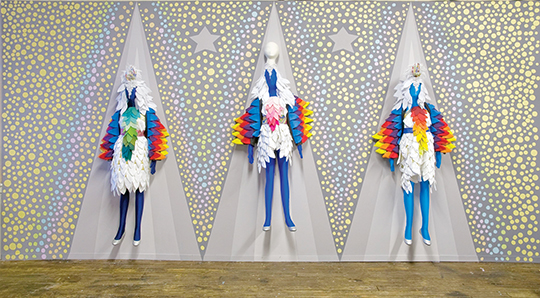
THEATER Out at the Headlands Center for the Arts in Marin, just after sunset, the darkness and the silence are real presences in themselves, not just a context for something else. They’re right now pressing their respective noses against the windowpanes of the large, beautifully-worn army barrack–turned–artist studio in which Saya Woolfalk is pouring some dark red concoction from a squat glass jug.

She begs her guests not to try to translate the hokey Portuguese label on the bottle, brought back from Brazil by her husband, an anthropologist, as she hands each of us a crimson thimbleful in a plastic dentist cup. Looking like NyQuil but tasting more like some berry-based moonshine, it gives me an almost instantaneous headache but is otherwise kind of nice. Anyway, it does the trick. We’re now prepped to enter the mandala.

Standing there with me are Marc Mayer and Annie Tsang, both of the Asian Art Museum, as well as Brian Karl, the Headlands’ program director. The mandala corresponds, for now, to a tape mockup on the floor next to us. It’s a circular shape about four feet in diameter, with concentric and crisscrossing lines. At four equidistant corners outside the circle are small freestanding pieces of heavy paper representing alcoves, on the outside of which a slide projector illuminates a colorful figure in exotic garb. Behind each alcove, Woolfalk explains, a dancer will be tucked away.

Also standing around are two department store mannequins, each draped in a careful clash of fabrics and traditions: a skirt of pink-and-gold-striped glitter cloth from the Mission, a tourist version of a Chinese vest from Grant Street, a batik shoulder wrap brought back from Africa.

It’s all just the smallest hint of the Brooklyn-based artist’s elaborately extensive portfolio and practice, which blends visual design, sculpture, textiles, film, live performance, original musical soundscapes, ethnographical narratives, and invented ritual into playful, extraordinarily vivid and enveloping explorations of the limits and promise of hybrid identity.

Woolfalk’s dance-performance installation — the scale model of which was still being toyed with and adjusted when I visited her temporary studio — has been developed during a residency at Headlands under a commission from the Asian Art Museum, where it will run Thu/4 in the AAM’s capacious upper chamber in conjunction with the exhibition Enter the Mandala: Cosmic Centers and Mental Maps of Himalayan Buddhism (ongoing through Oct. 26). The piece, called ChimaTEK: Hybridity Visualization Mandala, culminates a seven-year project by Woolfalk that has received exhibitions and rapt attention around the country.

It began in No Place, which Woolfalk describes as “a utopian paradise in which hybrid identities flourish in tolerant communities with elaborate cultural rituals.” Its alternative narratives and reconfigured systems of representation took multiple forms across an integrated set of media, an environment unto itself, including a six-chapter ethnographic film documenting No Place made in collaboration with anthropologist Rachel Lears.

In the second iteration of the project, the narrative of No Place advances in time. Now its inhabitants have evolved into beings called the Empathics, who have developed a way of sharing their hybrid consciousness with others, while conducting research through their own nonprofit, the Institute of Empathy.

In this third and final stage, the Empathics have redirected their technology into a for-profit model, namely a corporation called ChimaTEK, a virtual world enterprise in which customers buy access to different Chimeric identities and consciousness through their own personalized virtual avatars. The chimera (which here refers simultaneously to the mythological she-monster made up of different body parts and to an organism with two or more genetically distinct tissues) ends up the repository and agent of corrupted utopian impulses.

As a tool for spiritual guidance, the mandala represents the universe, while helping to train the mind on essential insights and untapped potentialities. Made in collaboration with four local dancer-choreographers working in disparate ethnic traditions — with essential input from DJ Dr. Sleep (Melissa Maristuen) and a “virtual” DJ (none other than Paul D. Miller, or DJ Spooky that Subliminal Kid, who composed the original score) — ChimaTEK will be a kind of contemporary mandala, manifesting a chimeric state of being in which participants remix identities through virtual avatars in a virtual space. Fact and fiction blend so freely here that the distinctions between them might be called into question. So might the degree to which this virtual space is coextensive with the universe itself, or at least our tangled and conflicted corner of it. *

CHIMATEK: HYBRIDITY VISUALIZATION MANDALA

Thu/4, 6-9pm, free with museum admission ($5 after 5pm)

Asian Art Museum

200 Larkin, SF

www.asianart.org


The sound of America

0

arts@sfbg.com

THEATER As recently as last month, Berry Gordy Jr., the 84-year-old music mogul, founder, and creator of Motown Records, was hailed as an American icon and an African American hero. Those were Congresswoman Barbara Lee’s words Aug. 18 when it was declared “Berry Gordy Day in the East Bay.”

Impeccably dressed, Gordy made a rare public appearance to speak and receive his accolades on the steps of Oakland’s City Hall. He briefly reminisced about his life’s achievements, particularly building Detroit’s Hitsville USA, not only in a physical sense, but also creating “The Sound of Young America,” as his label would come to be known to the world. Live cast performances from Motown the Musical, the theatrical show based on his autobiography from nearly 20 years ago — To Be Loved: The Music, The Magic, The Memories Of Motown — were interspersed throughout the event.

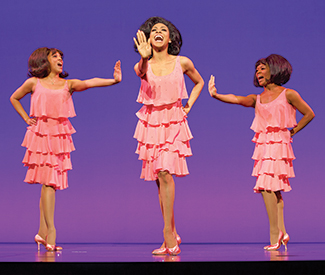
The Kevin McCollum production (Avenue Q), directed by Charles Randolph-Wright, is running through Sept. 28 at San Francisco’s Orpheum Theatre. But how does one fit all that the Motown-Gordy life story encompasses in a matter of just a few hours?

One sure way to please the audience is through music, which the production certainly does. Here we get a condensed version of a story that deals with America’s recent racist history, with scenes set at the Motortown Revue (which allowed segregated audiences in the South), to the full-on love story where Gordy’s muse, Diana Ross (convincingly played by Allison Semmes), serves as the impetus for his own business savvy and crossover to success with white audiences.

In the early ’60s, the industry still referred to Gordy’s output as “Negro” or “colored” music, or worse. African Americans weren’t seen as entrepreneurs — and owning an independent, predominantly black label was a revolutionary statement to say the least. Gordy’s personal history of being a boxer who idolized Joe Louis in the 1940s, and later borrowing $800 from his family to launch a recording studio, is chaotically interwoven with glazed-over details of complex business deals and lawsuits.

It’s not surprising, considering this is a musical, that an overreliance on a hefty catalog of sentimental songs that resonate throughout generations is a recurring theme. A combination of well-executed choreography and the hits we’ve come to know by the Supremes, Smokey Robinson, the Temptations, the Four Tops, Marvin Gaye, Stevie Wonder, and the rest of the roster probably make for a more entertaining evening than going into detail, say, about top songwriters Holland-Dozier-Holland defecting to create their own label, Invictus. Or the way top artists like the Jackson 5 and Ross would jump ship to other labels like RCA and Epic for more creative control or financial reasons. And any tales of Gaye’s in-studio drug use (documented in writings as being annoying to Ross while they recorded together during her solo years) are excluded, because this story is told from Gordy’s perspective.

And there are other exclusions. While it’s great to see the early acts from Gordy’s early Motown-Tamla Records days — such as Jackie Wilson, the Contours, Barrett Strong, and Mary Wells — getting recognition, Gaye’s frequent duet partner, Tammi Terrell, gets the shaft with nary a mention. It could be seen as added insult, but is more likely a gross oversight, when cast members depicting Gordy and Ross sing the Ashford and Simpson-penned soul ballad, “You’re All I Need to Get By,” one of Terrell’s signature hits with Gaye.

After the intermission, the latter half of Act Two seems especially rushed, though the costumes, sets, and décor during the Black Panther-Vietnam protest-Detroit riot eras, and the company’s relocation to Los Angeles in the early ’70s, are particularly vibrant.

As soon as we emerge from the tumult of the ’60s and the somewhat understated effects of Martin Luther King, Jr.’s assassination, the Jackson 5 are introduced (Reed Shannon plays the young versions of Gordy and Wonder, as well as Michael Jackson), and Ross’ solo career advances when she leaves the Supremes. Gordy’s master plan to have her sing standards in order to assimilate has often been a point of criticism, not only in this case, but also for his other acts, who have been accused of not being “black enough.” Eventually, though, it pays off when she plays grandiose venues that allow for elaborate stage productions. Her subsequent entrance into movie stardom seemed to be something he was grooming her for all along.

Motown revolutionized the world’s perceptions of music. Gordy’s story is one of success through persistence. Most (if not all) of his label’s artists share the same narrative of overcoming obstacles and having to struggle. After all, these were performers who literally had to dodge bullets on stage when they toured the South.

Audience members would be out of touch or ignorant if they couldn’t see the modern-day parallels in racial divisions — unrest and outrage over Mike Brown’s shooting death by police in Ferguson, Mo., had been going on for about a week at the time of Motown‘s press night. Viewers may have to ask themselves how much has changed in the last 50 years. That alone could merit this production’s cultural relevance, if not some harsh realizations. But I have a feeling most people crave those feel-good hit-factory songs, which do make seeing Motown the Musical worthwhile. *

MOTOWN THE MUSICAL

Through Sept. 28

Tue-Sat, 8pm (also Wed and Sat, 2pm); Sun, 2pm, $45-$210

Orpheum Theatre

1192 Market, SF

www.shnsf.com


This Week’s Picks: September 3 – 9, 2014

0


WEDNESDAY 3


WestWave Dance Festival

In its 23rd year, the WestWave Dance Festival, now under the auspices of SAFEhouse for the Performing Arts, has come up with a simple but ingenious idea: Let the dance communities outside San Francisco step up to the plate on their own terms. While the opening and closing programs of this “Dance Around the Bay” festival throw the spotlight on young artists working in the city, the other three invited dancers from the North, East and South Bay to join in. A choreographer familiar with his or her home turf curated each of those programs. You can expect a mix of new voices — familiar ones, but also rarely heard ones such as those of Jose Limon and Donald McKayle, courtesy of the visitors from San Jose. (Rita Felciano)

Through Sun/7, 8pm, $10-20

Z Space

450 Florida, SF

(415) 626-0453

www.zspace.org


Bear In Heaven

It’s a band from Brooklyn, it’s named after a physically powerful woodland mammal, and it broke through in the late ’00s — around the same time as every other band that fits the former two descriptors. But Bear In Heaven is further out than nearly any of its indie-rock peers, incorporating influences from the gnarliest outskirts of psychedelia and prog rock. Upon listening to the band’s debut Red Bloom Of The Boom, you’ll more likely picture naked hippies running around in terror than well-dressed hipsters walking to the cronut stand. Though band members have taken a more pop approach following their magnum opus, 2010’s excellent Beast Rest Forth Mouth, this is still one of the best bands you can smoke a joint or an American Spirit to and still feel okay. (Daniel Bromfield)

8pm, $15

Independent

628 Divisadero, SF

(415) 771-1421

www.theindependentsf.com


THURSDAY 4


“ATA Lives!”

Gallery and screening venue Artists’ Television Access marks its 30th anniversary with “ATA Lives!”, a month of events honoring a long track record of unique, boundary-pushing, subversive programming. Tonight, the ball gets rolling with a program of works by current and past ATA staffers; tomorrow afternoon, buckle up for a 30-hour marathon curated by Other Cinema programmer and ATA co-founder Craig Baldwin, among others. The weekend closes out with a special edition of Mission Eye & Ear, a live-cinema series that facilitates collaborations between experimental filmmakers and composers. Check the website for a complete “ATA Lives!” schedule, including a Sept. 19 Baldwin double-feature. (Cheryl Eddy)

8pm, $7-10

Artists’ Television Access

992 Valencia, SF

www.atasite.org, www.othercinema.com


Eyes Wide: The Films of Stanley Kubrick

Thirteen films. That’s the total number of features Stanley Kubrick made — but though that number seems small for a career that spanned 1953 to 1999, the legendary perfectionist’s towering, astonishingly diverse filmography may be the ultimate example of “quality over quantity.” The Pacific Film Archive screens each film in chronological order, so it’s a great chance to check out lesser-screened early works (the series opens with a double-feature of 1953’s Fear and Desire and 1955’s Killer’s Kiss) as well as revisit favorites, if you can even choose one: 2001: A Space Odyssey (1968)? Dr. Strangelove (1964)? A Clockwork Orange (1971)? The Shining (1980)? All of the above? (Cheryl Eddy)

Through Oct. 31, $6.50-$9.50

Pacific Film Archive

2575 Bancroft, Berk.

www.bampfa.berkeley.edu


FRIDAY 5


The Sam Chase

Folk isn’t a genre usually associated with making audiences want to start a riot, but The Sam Chase isn’t your average folk outfit — if the first line of the band’s bio, “The Sam Chase has a voice like a nun on the lam with a mouthful of cigarettes and curse words,” didn’t tip you off already. Singer Sam Chase and his cast of five to seven backup players (on vocals, guitars, strings, horns, percussion, you name it) have been starting dance parties all over the Bay Area for the past half-decade, alternating whiskey-drinkin’ party songs with rough-around-the-edges lullabies. Equal parts sweet and salty (and just as addictive as that sounds), with fellow local fave Rin Tin Tiger as an opener, this lineup was a solid choice for the Mission Creek Oakland Music & Arts Festival’s opening night. (Emma Silvers)

With Rin Tin Tiger, TV Mike & the Scarecrowes, The Heather Jovanelli Band

8pm, free

Uptown Nightclub

1928 Telegraph, Oakl.

www.mcofest.org


SATURDAY 6


The Bruce Lee Band

Mike Park has been one of the most important figures in the Bay Area music scene since founding the legendary ska band Skankin’ Pickle in 1989. Since then, he’s been in countless bands, organized the Ska Against Racism tour, and started one of America’s most respected DIY labels in Asian Man Records. The Bruce Lee Band is an all-star outlet for Park’s musical ambitions, featuring members of several of his former bands in addition to members of MU330 and Bomb the Music Industry! They’ve only been active sporadically, releasing their self-titled debut in 1997 and following up with an EP in 2005 and this year’s EP, Community Support. The band’s upcoming Bottom of the Hill show is a can’t-miss chance to see one of the Bay Area rock scene’s true legends in action. (Bromfield)

9pm, $12

Bottom Of The Hill

1233 17th St, San Francisco

(415) 626-4455

www.bottomofthehill.com


Sugar Pie DeSanto at Hard French

What’s better than the Hard French DJs’ usual daytime soul party on the patio at El Rio? A Hard French soul party featuring a bona fide ’60s soul legend — namely, Sugar Pie DeSanto. Known for duets with Etta James and making a huge impression on audiences when she toured with Johnny Otis and James Brown in the ’50s, the 78-year-old diva is known as “Little Miss Dynamite” for her small stature and oversized charisma. She’s also the subject of a documentary that’s currently in progress, Bittersweet, which chronicles her life as one of the most successful Filipina-Americans in entertainment. Now’s your chance to see her — and boogie to her — before her name is on everyone’s lips. (Silvers)

5:30pm, $10-12

El Rio

3158 Mission, SF

(415) 622-5301

www.hardfrench.com


Drunk Dad

Portland may be known throughout the country as a place where the dream of the ’90s is alive and adorable, but Drunk Dad aims to change that perspective. Describing its style as “fuck-you-all-wave,” Drunk Dad is angry, wasted, and loud, representing Portland’s tradition of what guitarist Jose Dee calls “heavy fucking gnarly music.” Think of this band as John Belushi thundering down the frathouse stairs, smashing the well-worn acoustic guitars of anyone who dares to hang around and look sensitive in his presence. There are precedents to the band’s sound (Nirvana, The Melvins, Flipper) — but don’t make such comparisons to band members’ faces. Drunk Dad is a band that eschews nearly every hipster trend but (whether they like it or not) might find a few fans among the Portlandia crowd as well. (Bromfield)

7pm, $8

Oakland Metro

630 Third St., Oakl.

(510) 763-1146

www.oaklandmetro.org


SUNDAY 7


Dita Von Teese

Bringing back the sense of classic style and glamour of the golden days of Hollywood and meshing it with the tantalizing teasing of the old-time burlesque circuit, Dita Von Teese has been at the forefront of reviving a once nearly lost art form for two decades now. With a seductive and sexy nod to the past, modern pin-up and burlesque queen Von Teese returns to the city this week with the final local tour dates of her Burlesque: Strip, Strip, Hooray! show, a live revue featuring not only her own titillating talents, but a host of other performers as well. (Sean McCourt)

Through Mon/8

7:30pm, $45

The Fillmore

1805 Geary, SF

(415) 346-3000

www.thefillmore.com


Autumn Moon Festival

The Moon Festival, a holiday celebrated for more than 1,000 years in some Asian countries, is a time for reflection about the mythology of the Moon Goddess, Chang O, who is thought to regulate fertility, water supply, and other necessities for a successful autumn harvest. This two-day festival, now in its 24th year, is organized annually by the SF Chinatown Merchants Association, and features Taiko drumming, lion dancing, martial arts, an open-air street bazaar, traditional and contemporary Chinese music, and more. New this year: A dog costume contest, at 2:30pm today. We’re there. (Silvers) Begins Sat/6

11am – 5pm both days, free

Chinatown, SF

www.moonfestival.org


MONDAY 8


The Rentals

Despite being best known as a Weezer side project (singer Matt Sharp was the early-era bassist for indie titans), The Rentals have a quietly devoted — and large — fan base of their own, who’ve been eating up sweet melodies and goofy Moog-heavy tendencies since the band re-formed in 2005. After a slew of well-received EPs, this year’s Lost in Alphaville marks the band’s first full-length since 1999, and it basically overflows with guest stars — among them, Black Keys’ drummer Patrick Carney and Lucius’ Jess Wolfe and Holly Laessig. One should expect to see a slew of diehards at this show, for good reason. (Silvers)

With Ozma

8pm, $20

Slim’s 333 11th St., SF

www.slimspresents.com


The Guardian listings deadline is two weeks prior to our Wednesday publication date. To submit an item for consideration, please include the title of the event, a brief description of the event, date and time, venue name, street address (listing cross streets only isn’t sufficient), city, telephone number readers can call for more information, telephone number for media, and admission costs. Send information to Listings, the Guardian, 835 Market Street, Suite 550, SF, CA 94103; or e-mail (paste press release into e-mail body — no attachments, please) to listings@sfbg.com. Digital photos may be submitted in jpeg format; the image must be at least 240 dpi and four inches by six inches in size. We regret we cannot accept listings over the phone.

Rep Clock: September 3 – 9, 2014

0

Schedules are for Wed/3-Tue/9 except where noted. Director and year are given when available. Double features marked with a •. All times pm unless otherwise specified.

ARTISTS’ TELEVISION ACCESS 992 Valencia, SF; www.atasite.org. $7-10. “OpenScreening,” work by ATA members past and present, Thu, 8. “ATA’s 30-Hour 30th Anniversary Marathon Screening,” works from ATA’s history of screening independent, underground, and experimental film and video, Fri, 1 through Sat, 7. Flatlands (Webber, 1985), with ATA co-founder Marshall Weber in person, Fri, 8.

BALBOA 3630 Balboa, SF; cinemasf.com/balboa. $10. “Thursday Night Rock Docs:” The Zen of Bennett (Moon, 2012), Thu, 7:30.

BAY MODEL 2100 Bridgeway, Sausalito; www.tiburonfilmfestival.com. Free. The Tinaja Trail (Newell, 2014), Tue, 6.

“BERNAL HEIGHTS OUTDOOR CINEMA” Various venues, SF; www.bhoutdoorcine.org. Free. Screenings of works by local filmmakers at unconventional Bernal Heights venues (including outdoors in Precita Park), Thu-Sat.

CASTRO 429 Castro, SF; (415) 621-6120, www.castrotheatre.com. $8.50-11. •Life Itself (James, 2014), Wed, 7, and Harry Dean Stanton: Partly Fiction (Huber, 2012), Wed, 9:15. •Starman (Carpenter, 1984), Fri, 7, and Under the Skin (Glazer, 2013), Fri, 9:10. Frozen (Buck and Lee, 2013), presented sing-along style, Sat-Sun, 1. •Sweet Charity (Fosse, 1969), Sat, 6:20, and All That Jazz (Fosse, 1979), Sat, 4, 9:15. “Remembering Robin Williams:” •Good Will Hunting (Van Sant, 1997), Sun, 7, and Dead Poets Society (Weir, 1989), Sun, 4:40, 9:20.

CLAY 2261 Fillmore, SF; www.landmarktheatres.com. $10. “Midnight Movies:” Pulp Fiction (Tarantino, 1994), Fri-Sat, midnight.

COURTHOUSE SQUARE 2200 Broadway, Redwood City; www.redwoodcity.org. Free. Mr. Peabody and Sherman (Minkoff, 2014), Thu, 8:45.

DELANCEY STREET SCREENING ROOM 600 Embarcadero, SF; www.onlifesterms.org. $10. On Life’s Terms: Mothers in Recovery (Ganz, 2014), Thu, 6:30. Screening followed by a panel discussion with film subjects.

EXPLORATORIUM Pier 15, SF; www.exploratorium.edu. Free with museum admission ($19-25). “Saturday Cinema:” The Mascot (Starewicz, 1934), Sat, 1, 2, 3.

GOETHE-INSTITUT SF 530 Bush, SF; www.goethe.de/ins/us/saf/enindex.htm. $5 suggested donation. “100 Years After WWI:” The Woman and the Stranger (Simon, 1985), Wed, 6:30.

JACK LONDON FERRY LAWN Clay and Water, Oakl; www.jacklondonsquare.com. Free. “Sing-along Cinema:” Chicago (Marshall, 2002), Thu, sundown.

MECHANICS’ INSTITUTE 57 Post, SF; milibrary.org/events. $10. “CinemaLit Film Series: Critics’ Choice, Classic and Quirky Americana:” Melvin and Howard (Demme, 1980), Fri, 6.

MISSION CULTURAL CENTER FOR LATINO ARTS 2868 Mission, SF; www.connectedbycoffee.com. $10 suggested donation. Connected by Coffee (Dennis and Dennis, 2014), Sat, 4, 7. With music, food, art, and coffee samplings between screenings. Proceeds benefit Cooperative Las Marias 93 in El Salvador.

NEW PARKWAY 474 24th St, Oakl; www.thenewparkway.com. Free. “First Friday Shorts,” works by the Bay Area Video Coalition, Fri, 6.

PACIFIC FILM ARCHIVE 2575 Bancroft, Berk; (510) 642-5249, bampfa.berkeley.edu. $5.50-9.50. “Alternative Visions:” “Animation: Laura Heit” (1997-2011), Wed, 7. “Eyes Wide: The Films of Stanley Kubrick:” •Fear and Desire (1953) and Killer’s Kiss (1955), Thu, 7; Paths of Glory (1957), Sat, 6:30; The Killing (1956), Sat, 8:20. Ai Weiwei: The Fake Case (Johnsen, 2013), Fri, 7. “James Dean, Restored Classics from Warner Bros.:” East of Eden (Kazan, 1955), Fri, 8:50.

RED POPPY ART HOUSE 2698 Folsom, SF; www.redpoppyarthouse.org. $10-20. La Salsa Cubana (Johnson and Streng, 2011), Thu, 4. With director Eric Joseph Johnson in person, and a salsa-dance lesson and party to follow.

REVOLUTION BOOKS 2425 Channing, Berk; www.revolutionbooks.org. $5-25 suggested donation. Freedom Summer (Nelson, 2014), Thu, 7. With Freedom Summer volunteer and film subject Linda Wetmore Halpern in person.

ROXIE 3117 and 3125 16th St, SF; (415) 863-1087, www.roxie.com. $6.50-11. Jamie Marks is Dead (Smith, 2014), Wed-Thu, 7, 9. Snowpiercer (Bong, 2013), Wed, 9:15. “Synesthesia Film Festival: Screening #6,” short films, Wed, 7. Canyon Cinema Foundation and SF Cinematheque present: Big Joy: The Adventures of James Broughton (Silha, Slade, and Logsdon, 2011), Thu, 7. With an introduction by performance artist Jason Jenn. Rich Hill (Tragos and Palermo, 2014), Thu, 9:30. No No: A Dockumentary (Radice, 2014), Sept 5-11, 7, 9:15. Trailer Park Boys: Don’t Legalize It (Clattenburg, 2014), Fri-Sat, 11:20.

SMITH RAFAEL FILM CENTER 1118 Fourth St, San Rafael; (415) 454-1222, www.cafilm.org. $6.50-$10.75. The Trip to Italy (Winterbottom, 2014), Wed-Thu, call for times. The Notebook (Szász, 2013), Sept 5-11, call for times. “Alec Guinness at 100:” The Bridge on the River Kwai (Lean, 1957), Sun, 3, 7. *


Psychic Dream Astrology: September 3 – 9, 2014

0

September 3-9, 2014

ARIES

March 21-April 19

You can make your vision happen, but if you don’t want your success to be a flash in the pan then you need to get methodological, and fast. The stronger your plan, the better your outcome this week, so get to the drawing board and stay there till you’re satisfied. You’ve got this, so make it work, Aries..

TAURUS

April 20-May 20

Make peace with your existential existence, and even go so far as to embrace your relationship with yourself this week. You can’t control your circumstances or other people, but you can commit to shaping your relationship to those things in the way that’s right for you. Introspect with respect for what you are, Taurus.

GEMINI

May 21-June 21

Holy smokes, Gemini, you are well on your way! For an exciting change of pace your biggest problem this week is in pacing; you want to go fast, and your life wants you to slow down, or visa versa. Trust in the momentous changes that you’re building towards, and stay open to good things happening.

CANCER

June 22-July 22

You’ve taken on too much and it’s finally catching up with you, Cancer. Until you clean up your insides your life won’t feel tidy, no matter how ordered you make it. Now is the time to prioritize inner calm. It may seem like a distraction from what needs to get done, but it’ll speed things up in the long run, I promise.

LEO

July 23-Aug. 22

Ignoring the very real stresses that are hounding you is a weak strategy, Leo; everywhere you go, there you are. Confront the things that are making you unhappy, because they won’t go away on their own. It’ll create more room for you focus on what makes you happy, and multiply to your good fortunes.

VIRGO

Aug. 23-Sept. 22

You need to cultivate greater discretion, Virgo, because the way you’re handling things is stressing you out more than it’s helping. No matter what you choose, you’re going to have to let go of something. Refer to yourself (instead of everyone else) in order to figure out what a cost effective choice looks like.

LIBRA

Sept. 23-Oct. 22

This week you’re invited to make eye contact with your fears and be brave enough to stare them down. Don’t let other people’s opinions stop you from creating the life you want to be living. If you’re gonna do you, be fierce about it, Libra. Free yourself from the tyranny of ‘what-if’s’.

SCORPIO

Oct. 23-Nov. 21

You are so talented, Scorpio, that you can imagine consequences and drive yourself crazy. With only your imagination! This week you need to trust yourself. When you make decisions you incur consequences, and there’s no way around it. Make a call and follow through, putting your worries to the side for another day.

SAGITTARIUS

Nov. 22-Dec. 21

Things need to move slower than you’re comfortable with, Sag, but that doesn’t mean that they’re going in the wrong direction. Investigate your relationship to anxiety and impatience this week, so you don’t create drama where there need only be nervous excitement. Take the time to do things right.

CAPRICORN

Dec. 22-Jan. 19

It’s all about the people in your life, and how you choose to be with them, Capricorn. Your relationships are changing and before you decide whether that’s a “bad” or “good” thing, you need to take a step back. Evaluate your perspective based on how you feel instead of how you think you should feel this week.

AQUARIUS

Jan. 20-Feb. 18

There are some things that you can’t think your way out of, Aquarius. You got yourself into this mess and the way out is to get up and move. Stop prospecting and processing and try something new, my friend. Be willing to make some mistakes if that’s what it takes to get to a whole new vista in your life.

PISCES

Feb. 19-March 20

It’s important that you keep making strides towards change, Pisces, but you need to check back in with yourself as you do. Inspiration without methodology limits how far you’ll get. Take a timeout this week and check in with your progress, making whatever changes you figure out that you need.

Want more in-depth, intuitive or astrological advice from Jessica? Schedule a one-on-one reading that can be done in person or by phone. Visit www.lovelanyadoo.com


Don’t call it retro

0

esilvers@sfbg.com

LEFT OF THE DIAL Musician Bart Davenport, Oakland native, LA resident, has one caveat for discussing his move two years ago. He might’ve broken a few hearts, but he wants to make it clear that he did not head for the southlands for the same reasons many fed-up, underfed Bay Area musicians are making the same trek these days.

“My story doesn’t have anything to do with the changes that have been happening in the Bay Area the past few years. And it really wasn’t a career move. It has to do with changes I needed to make happen within myself,” says the singer-songwriter-guitarist. “Besides, I don’t even stay away long enough to miss it — I’m up there at least once a month.”

Lucky for us, one of those trips will take place next weekend, when he helps kick off the Mission Creek Oakland Music & Arts Festival with a daylong block party Sept. 6. Davenport headlines an eclectic lineup of acts that also includes the psych-rock-folky sounds of The Blank Tapes, B. Hamilton, Foxtails Brigade, and more at this opener to the fifth incarnation of Oakland’s 10-day, 14-venue music fest, which began as an offshoot to San Francisco’s in 2009. (If there are any lingering questions about the East Bay’s music scene holding its own at this point, this is the kind of lineup that answers ’em.)

Davenport has had a pretty hectic touring schedule since his most recent LP, Physical World, dropped on Burger Records in March of this year. There were the adventures in Madrid, the opening slots for Echo & the Bunnymen at LA’s Orpheum Theatre. Last week, playing guitar in Marc & the Casuals, he co-hosted a special one-off soul music-comedy-storytelling night at The Chapel. The day after he plays the MCO Festival, he’ll be driving “like a madman” back to LA to catch a Burt Bacharach show (as an audience member). He’s gotten used to life on the road.

As a kid, though, he mostly moved back and forth between Berkeley and Oakland, where he grew up near Lake Merritt — across the street from the humble, Disneyland-inspiring wonder that is Children’s Fairyland, with its old-school talk boxes that have been narrating fairytales at the turn of a key since 1950. (He’s still enchanted by it, but — as this reporter has also discovered during some routine research — adults wanting to visit the park are required to bring a kid along.)

Nostalgia might seem to be an easy catch-all theme for someone prone to memories of kids’ amusement parks, especially someone whose most recent record conjures the synthy New Wave anthems of ’80s with almost eerie authenticity one moment, then veers backward toward Buddy Holly the next — with each song seemingly narrated by a different character named Bart Davenport, and all of it so shiny that you can never quite tell when he’s being tongue-in-cheek. Davenport’s known for clear changes in genre and sound from record to record, but the shift from 2008’s Palaces (a Harry Nilsson-esque affair with Kelley Stoltz’s fingerprints all over it) to the distinctly palm tree- and pink pollution sunset-scented Physical World (which is full of soul and jazz chord progressions, and where Davenport seems to be channeling, by turn, Hall & Oates, The Cars, New Order, and Morrisey) is probably his biggest departure yet.

The singer takes issue with critics who would simply call him “retro,” however — though it’s not because he finds the term offensive.

“I actually think it’s insulting to purist retroists, people like Nick Waterhouse, maybe, who’ve gone to great lengths to recreate certain sounds really exactingly,” says Davenport, who credits longtime collaborator Sam Flax with sending him in a New Wavey direction after producing his power-poppy 2012 single Someone2Dance.

“And I don’t even think of myself as a very nostalgic person. I think of [my influences] more like shopping at the thrift store, and finding gems that you want to repurpose to say something new,” he adds. “It’s also that I guess many people try to avoid arrangements that sound like the way things were being done 20 or 30 years ago, and I tend to not really think about anything but what I like, what I think sounds good. It’s not about taking you to 1984 or taking you to right now, it’s about taking you into your own little world. The little world of that particular song, for just three minutes.”

Reticence to talk up LA in the Bay Area press aside, Davenport will allow that one of his major influences was his newly adopted city.

“It’s definitely an LA album,” he says, noting that about two-thirds of the record was written there, and it was recorded in Alhambra, near East LA. “I think the constant sunlight breeds a kind of optimism in people. Then there’s the scenery, the palm trees, the long crazy streets. The taco trucks. Where I live, the majority of people are Latino. It’s just a different mix.” Angeleno bassist Jessica Espeleto telling him she’d play in his band if he moved down south was one thing he had in mind, as well, before making the leap.

And yet: There’s no place like home? “The entire Bay Area has great venues,” says Davenport, as we discuss the new crop of venues that have sprung up in the East Bay over the last few years. “And yeah, especially with the musicians getting priced out of San Francisco, I think it’s great that there’s the whole East Bay for them to go to. Really, thank God for Oakland.”

Amen.

BART DAVENPORT

With The Blank Tapes, B. Hamilton, many others

Mission Creek Oakland Music & Arts Festival Block Party

Sat/6, noon-8pm, free (fest runs through Sept. 13)

25th Street at Telegraph, Oakl.

www.mcofest.org

Events: September 3 – 9, 2014

0

Listings are compiled by Guardian staff. Submit items for the listings at listings@sfbg.com. For further information on how to submit items for the listings, see Selector.

WEDNESDAY 3

“99 Poems for the 99 Percent” Booksmith, 1644 Haight, SF; www.booksmith.com. 7:30pm, free. Contributors read from a new collection that represents “the real America.” Poets include Dean Rader, Gillian Conoley, Barbara Berman, Keith Ekiss, Julie Bruck, and Hiya Swanhuyser.

THURSDAY 4

Rose Caraway Good Vibrations, 1620 Polk, SF; (415) 345-0400. 6:30pm, free. “Everyone’s favorite lusty librarian” reads from The Sexy Librarian’s Big Book of Erotica, with help from Lily K. Cho, Malin James, and Jade A. Waters.

Vikram Chandra City Lights Bookstore, 261 Columbus, SF; www.citylights.com. 7pm, free. The author discusses Geek Sublime: The Beauty of Code. The Code of Beauty.

Hollye Jacobs Book Passage, 1 Ferry Bldg, SF; www.bookpassage.com. 6pm, free. The author, a nurse and social worker turned patient, discusses The Silver Lining: A Supportive and Insightful Guide to Breast Cancer.

“Night of the Livermore Dead: A Zombie Pub Crawl” Bothwell Arts Center’s Downtown Art Studios, 62 South L St, Livermore; http://tickets.livermoreperformingarts.org. 6-10:30pm, $20. First, get transformed into a shuffling member of the undead, then enjoy drink specials and deals as you lurch through downtown Livermore. The crawl ends at the Bankhead Theater with a “Thriller” flashmob, followed by a screening of Night of the Living Dead (1968).

FRIDAY 5

“Art Break Day” Justin Herman Plaza, 1 Market, SF; www.artbreakday.com. 9am-5pm, free. Check website for locations in Berkeley, Novato, Oakland, San Rafael, and other locations. Art supplies are provided at this free community art-making event.

SATURDAY 6

Autumn Moon Festival Chinatown, SF; www.moonfestival.org. Grand opening ceremony and parade, today, 11am. Festival, 11am-5pm, through Sun/7 (dog costume contest Sun/7, 2:30pm). Free. Cultural performances, an open-air street bazaar, lion dancing, and (new this year!) a dog costume contest highlight this 24th annual celebration of the Asian holiday.

Friends of Duboce Park Tag Sale Duboce between Steiner and Scott, SF; http://friendsofdubocepark.org. 9am-2pm. Community tag sale, with proceeds going toward making improvements to Duboce Park. Check out the website for donation information.

Mountain View Art and Wine Festival Castro between El Camino Real and Evelyn, Mtn View; www.miramarevents.com. 10am-6pm, free. Through Sun/7. With works by over 600 professional craftspeople and artists, plus live music, home and garden exhibits, a young-performers stage, a climbing wall, food and wine, and more.

“Projecting SOMA: Youth and Elders’ VOICES” Sixth St and Market, SF; www.ybca.org. 7pm, free. Also Sept 13, 20, and 27. YBCA in Community, South of Market Community Action Network, and Veterans Equity Center present large-scale, text-based video projections sharing messages and stories from the Filipino community.

SF Mountain Bike Festival McLaren Park, Jerry Garcia Amphitheater, 20 John F. Shelley, SF; sfurbanriders.org/wordpress/sf-mtb-festival. 9am-5pm, free. Register in advance to compete — or just show up to spectate or test your skills in any of the non-competitive categories. Events include a short-track challenge, a 10-mile urban adventure ride, a cargo bike hill climb, a bike skills challenge for youth and families, and more, plus a box jump demo and a bike raffle.

“Yoga for Change” Grace Cathedral, 1100 California, SF; www.yogaforchangesf.org. 9:30am-noon, $15 and up. Help raise funds for the Community Preschool at this yoga event with live music. All levels and abilities welcome.

SUNDAY 7

Haight Street Music and Merchants Street Festival Haight between Masonic and Stanyan, SF; hsmmsf@gmail.com. Noon-6pm, free. Yep, it’s another street fair on Haight — but this brand-new event has a highly local focus, since it’s sponsored by local merchants. Expect three stages of music, kids’ activities, a skate ramp, and more.

“Home [away from] Home” Eastshore Park, Lake Merritt, MacArthur at Grand, Oakl; www.ybca.org. 10am-8pm, free. Through Sept 11. Experimental art installation highlighting artists in the Ethiopian and Eritrean communities of the Bay Area.

“Seventeen Generations Why” Modern Times Bookstore Collective, 2919 24th St, SF; www.mtbs.com. 5pm, $20 and up. Rebecca Solnit brings together nine decades of San Franciscans (from a woman in her 80s to a seven-year-old) for this “variety show in celebration of Modern Times Bookstore’s last four decades and in support of its next four or so.”

MONDAY 8

Rowen Jacobsen Jewish Community Center of San Francisco, 3200 California, SF; www.jccsf.org/ 7pm, $15. The James Beard award winner discusses Apples of Uncommon Character. Author event held in conjunction with the JCCSF’s “Apple-Palooza” (5pm), a celebration of all things apple and harvest.

TUESDAY 9

Daisy Hernández Booksmith, 1644 Haight, SF; www.booksmith.com. 7:30pm, free. The author reads from her coming-of-age memoir, A Cup of Water Under My Bed. *


Flynn and out

0

arts@sfbg.com

FILM For years Errol Flynn was considered the definition of a born movie star — as opposed to being a born actor. The definitive Robin Hood, he was athletic, debonair, good-humored, and terribly good-looking in a two-decade career of mostly formulaic action and adventure films. Few were under the illusion that he deserved better material. Indeed, he became something of a joke, first for the limitations of his acting, then for movies where he seemed to be winning World War II single-handedly, and at last for being an alcoholic has-been who chased every skirt in town.

When he died of a heart attack in 1959 at age 50, the floodgates of scandal opened wide. It was revealed that his lover of recent years had been underage, and the press suggested she’d been pimped to him by a monster “stage mother.” The posthumous publication of Flynn’s autobiography My Wicked, Wicked Ways — shockingly frank by the standards of the time — only heightened an overly-well-lived life’s lurid afterglow.

That somewhat pathetic final chapter is dramatized in the latest by Richard Glatzer and Wash Westmoreland, the directorial team who made the nearly perfect indie Quinceañera (2006). But The Last of Robin Hood turns out to be one of those movies that should be great, given the material and talent on tap, but instead falls flat for nearly intangible reasons. Bad movies are easy to dissect; it’s harder to suss why an almost-good one just misses the mark.

The restless son of a respectable family in Hobart, Tasmania, Flynn globe-trotted doing odd jobs until his looks and vivacity inevitably drew him into acting. He landed at Warner Brothers in 1935, and last-minute replacement casting as swashbuckling Captain Blood that year got him abruptly promoted to stardom. He was pretty terrible — but also a sexy beast who clicked onscreen with subsequently-recurrent co-star Olivia de Havilland. Less of a fan was Bette Davis, with whom he acted twice in period romances. But even that tough broad considered him “utterly enchanting” despite mutual antipathy. Flynn flourished in a series of Westerns, war movies, and exotic adventures, until audiences tired of his ever-more routine exploits — and the highly public roué reputation that ballasted them offscreen. In 1941 he was acquitted of statutory rape, but public opinion judged differently.

At the end of his drug- and drink-addled tether some 15 years later, Flynn met aspiring dancer-singer-actor Beverly Aadland. According to this film’s version of events, he’d already seduced her before realizing that she was actually just a very precocious 15-year-old — carefully groomed to look older (and given a fake birth certificate) by Florence Aadland, a onetime dancer who projected her own ambitions on her daughter. Instead of backing away, however, he carried on their affair, providing a cover for his “protégée’s” constant companionship by making sure Mom was along as public chaperone.

When Susan Sarandon’s Mrs. Aadland realizes that in private their relationship is hardly innocent, she’s furious. But she’s vain and flattered enough to fall for the star’s charm offensive — no matter that no one aside from these two think Beverly has any real talent. The only role of note she ever played was in 1959’s Cuban Rebel Girls, the almost unwatchably bad cheapie that constituted Flynn’s final screen appearance and was released just after his death. It’s a ludicrous film, but she doesn’t exactly rise above the material.

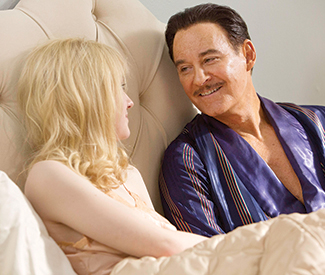
Nonetheless, Flynn (Kevin Kline) and the junior Aadland (Dakota Fanning) are, as portrayed here, tied together by something more than mutual exploitation. It may not be true love, but it’s as close as a relationship between a rapidly aging sex maniac and a teen eager to get out from under mom’s thumb can be.

Kline is a resourceful actor whose characterization is ingenious and layered. But it still falls into that category of celebrity impersonation, which always feels a bit like a clever stunt. He’s somewhat upstaged by Sarandon, who gobbles up the spotlight here as if this were The Florence Aadland Story. Given one of her more substantial roles of late, Sarandon revels in being a bit frumpy, grasping, and middlebrow; she’s a classic Hollywood type, the perpetual margin-dweller still capable of being dazzled by proximity to a star. To the extent that it works, The Last of Robin Hood does so largely because Sarandon nails the comedy and pathos of terminal celebrity aspiration.

The extent that it doesn’t can at least partly be blamed on Fanning, a limited child actor turned limited young-adult one. Though she just turned in an solid performance in Kelly Reichardt’s Night Moves, here she’s back in her usual mode of dully earnest empathy for a character that (like her Cherie Currie in 2010’s The Runaways) could/should have had considerably more depth. The precocious poise the real Aadland exhibits singing “All Shook Up” for Groucho Marx on TV’s You Bet Your Life (a clip preserved on YouTube) is more than sallow Fanning’s victimized take can manage. Despite all canny costuming here, she never suggests an allure that might have lastingly turned the head of a man who could have any starlet or fangirl he chose.

The Last of Robin Hood also feels constrained budget-wise — perhaps financing woes explain why it took the co-directors so long to follow up the well-received Quinceañera — and while you can get the heady mixture of glamour, melancholy, barbed humor, and romance that the writer-directors were going for, it always falls a little short. As with so many Hollywood biopics, a great real-life story feels diminished onscreen, the legend still more potent than the dramatized re-creation. *


THE LAST OF ROBIN HOOD opens Fri/5 in Bay Area theaters.

High fly

0

cheryl@sfbg.com

FILM Nothing has elevated the sports documentary more than ESPN’s “30 for 30” series, which engages filmmakers (including the A-list likes of Steve James, Barbara Kopple, and Alex Gibney) to bring moments of sports history into tight focus. Subjects include single incidents that had great cultural impact (Magic Johnson’s HIV announcement); lesser-known stories worthy of attention (the decades-old murder of a high-school basketball star); rivalries that have only gotten more fascinating in the intervening years (Nancy vs. Tonya); and character portraits (George Steinbrenner, Bo Jackson, Marion Jones).

No matter the filmmaking approach, the “30 by 30” films all engage, thanks to their human-interest elements. The wide world of sports stardom and infamy is populated with oversized, theatrical, glorious, or tragic characters, be they Olympians, comeback kids, or grabby fans who interfere with World Series games. No No: A Dockumentary isn’t part of the ESPN film stable, but it fits right in with the “30 for 30” aesthetic, with a subject whose charisma is undeniable even in 40-year-old game footage.

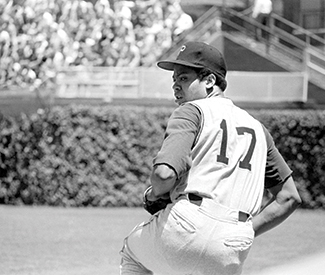
First things first: Was Pittsburgh Pirates pitcher Dock Ellis high on LSD when he threw his no-hitter June 12, 1970? We may never know for sure. And we may openly debate it, while secretly hoping it’s true. But as No No aims to make clear, that exploit — flabbergastingly insane though it was — hardly sums up Ellis’ entire life and career.

Jeff Radice’s film, bolstered by a funky score from Beastie Boy Adam Horovitz, strives to be a well-rounded portrait beyond Ellis’ rep as “the acid guy.” Ellis proves an unguarded, honest subject in audio and video interviews recorded prior to his 2008 death. Also eager to reminisce are scores of friends, family members, and former teammates, who trade Ellis anecdotes with affection (“He always started shit,” chuckles a childhood friend). Later, recalling a game in which Ellis deliberately tried to hit members of the Cincinnati Reds when they stepped up to bat, a member of the Pirates organization shrugs, “That was Dock bein’ Dock.”

His contentious behavior on the field — which, especially later in his career, spilled over into dustups with managers and owners — rarely extended to his teammates, with whom he shared deep bonds, particularly the 1971 Pirates team that won the World Series. That same year, the organization started Major League Baseball’s first all-minority lineup, with Ellis as pitcher. His antics were usually motivated in the service of a greater cause — “He took stands,” a teammate remembers — even if the execution was a tad flamboyant. Famously, he once wore curlers on the field to draw attention to racism in the league. He was also a master of media manipulation, and cultivated an aura of danger that made him a favorite of sportswriters, evidenced by the dozens of Ellis-centric headlines shown throughout the film.

In the 1970s, his rise to pop-culture prominence, a new concept in sports at the time, coincided with the mainstreaming of African American culture, which Ellis easily embraced. (His fashion-plate tendencies were legendary.) Footage of Black Panther rallies also contextualizes the mood of Ellis’ generation, which he exemplified by refusing to put up with the institutional bullshit that earlier African American players had suffered through. Jackie Robinson took note, and wrote a letter to Ellis praising the younger man’s “courage and honesty.” In one of No No‘s most moving moments, Ellis pauses while reading the words aloud, too choked up to continue.

Of course, the film also delves into Ellis’ rampant drug and alcohol abuse. It’s frankly incredible that he was able to function as a professional ballplayer for so long, since he operated under the directive “Anything that got me high, I would do it.” But No No points out that practically everyone in baseball was, at the very least, using stimulants, or “greenies,” in those days. (The Pirates’ trainer during the Ellis’ era remembers wearily telling the guys, “If you use ’em, don’t do it in front of me.”) Who needs steroids when you can pop dozens of uppers, or snort a few lines, before every game?

The Pirates’ clubhouse parties were notorious, though that World Series win suggests athletic performance didn’t suffer. But as every “30 for 30” (or Behind the Music, for that matter) devotee knows, every tale of addiction eventually turns dark. Ellis physically attacked at least two of his wives, who recall him mostly fondly even as they share their firsthand accounts of his cruel temper (his other two wives don’t appear in the film). Eventually, his game began to falter, and after one last stint at the Pirates after years playing for the Yankees and other teams, he retired.

No No‘s last act focuses on Ellis’ wholehearted acceptance of sobriety; with characteristic enthusiasm, he channeled his rock-star magnetism into working as a drug counselor for both MLB players as well as juvenile offenders. It’s a happy ending of sorts, though his vices — he died of cirrhosis — certainly hastened the end of his life.

But back to the LSD tale, so rich it continues to spread 44 years after the fact (and 30 years since he admitted to it). It inspired a lengthy recent Deadspin article, which hinted at an in-the-works feature film titled Ellis, D. (get it?); there’s also an imaginative YouTube short that animates Ellis’ narration of the story (“I was high as a Georgia pine”). He was an ace athlete, an addict, and a crusader for civil rights — and now he’s remembered as a folk hero. What a trip. *


NO NO: A DOCKUMENTARY opens Fri/5 at the Roxie.

Alerts: September 3 – 9, 2014

0

WEDNESDAY 3


Panel: Agriculture and Journalism

SF Commonwealth Club, 595 Market, SF. tinyurl.com/agriculturebeat. 6pm, $20 nonmembers, $8 members, $7 students. Cutbacks in reporting staff have decreased the amount of agriculture related journalism, yet in today’s foodie world, there is a growing demand for new information about where consumer’s food is coming from. Join Tara Duggan of the SF Chronicle, Naomi Starkman of Civil Eats, Andy Wright of Modern Farmer, and Sasha Khokha of KQED to discuss journalism’s changed and changing relationship with agriculture. Bi-Rite Catering will provide food for the event.

THURSDAY 4


Public Forum: Police Tasers in Berkeley

1939 Addison, Berk. coalitionfortaserfreeberkeley.org. 7-10pm, free. Is the militarization of the police force unnecessary? The Berkeley police force is asking for Tasers, but the City Council is hesitant. Discuss the issue with panelists such as Aram James, activist and former Palo Alto Public Defender; Barbara Ann White, Berkeley NAACP vice president and community mental health professional; James Chanin, founding member of the Police Review Commission and civil rights lawyer; and Jeremy Miller, program director of the Idriss Stelley Foundation and co-organizer of the successful campaign to stop San Francisco from getting Tasers. The Coalition for a Taser Free Berkeley is sponsoring the forum.

SATURDAY 6


Police Violence Teach-In

Starry Plough Pub, 3101 Shattuck, Berk. 510-465-9414. 2-4:30pm, free. In light of the recent Ferguson and St. Louis events, join speakers Anita Wills, Chris Kinder, and Carol Denney to learn about police violence and political protest in America, and how Ferguson relates to the Bay Area. The event is put on by the Alameda Peace and Freedom Party.


Film & Fundraiser: Connected By Coffee

2868 Mission, SF. tinyurl.com/connectedbycoffee. 4pm, $10 suggested donation. Coffee is important to a large percentage of the SF population. However, many coffee farms are threatened by leaf rust fungus. All donations will go to Cooperative Las Marias 93 in El Salvador — a cooperative farm that lost 80 percent of its crop to the fungus, and has been unable to export coffee since. There will be a Q&A with local coffee roasters from the Ubuntu Coffee Cooperative, and coffee samples at intermission. The documentary — Connected By Coffee — looks into the multibillion dollar industry of coffee.

Guardian Intelligence: September 3 – 9, 2014

0

CASTRO CURTAIN CALL

If your favorite thing about seeing movies at the historic Castro Theatre is hearing the score for that Charlie Chaplin short played on the instrument that would’ve been used when the film actually came out — well, get thee to the movies, and fast. The Castro Theatre’s famous Wurlitzer organ is being sold by its current owner, and will be replaced early next year with an elaborate, one-of-a-kind digital console, with seven keyboards and more than 800 stops, designed by acclaimed organ creator Allen Harrah — pro bono. One trade-off: We’re guessing this will be better for scoring alien movies than its analog counterpart?

THEFT TIMES TWO

It’s a drag to have your car stolen. But if the vehicle is recovered, the high fees you may fork over to get it back only add insult to injury. In San Francisco, police give the owner of a recovered stolen vehicle 20 minutes to retrieve it before sending the car to impound. That’s where the costs add up. Worst-case scenario? The fees rise above the value of the car, and it gets auctioned off. Sup. Scott Wiener has called for a hearing to review the city’s towing policies with respect to stolen cars. The company that operates the city’s impound lot, AutoReturn, is due for contract renewal next year.

TAG, YOU’RE IT!

The neighborhood some call “upper Safeway” has gotten some negative attention lately, but the Friends of Duboce Park Tag Sale — back for its 17th year — is perfectly timed to recharge the area’s community spirit. Last year’s event was hit with an unexpected deluge, so hope for sunny skies Sat/6 and head to the ‘hood’s collective backyard from 9am-2pm for shopping (bargains galore on household items, clothes, sports equipment, books, and more!) and hob-nobbing, with all proceeds going toward improvements to Duboce Park, including its playground. www.friendsofdubocepark.org

SWEET TRIBUTE

Former SF clubkid (now renowned LA artist) Jason Mecier is famed for his celebrity portraits done with junk food and trash — and his tribute to Robin Williams is gaining attention. “It’s Robin Williams as Mrs. Doubtfire, with a Patch Adams nose and a Flubber green background,” Mecier says. “This portrait took over 30 hours to make and is comprised of thousands of candy pieces including Red Vines, Black Licorice, gum balls, Jelly Bellies, Jelly Beans, Tic-Tacs,Gum Drops, Gummy Bears, Sixlets, Mike and Ike’s, Hot Tamales and others. I’ve always wanted to do a portrait of him combining all of his most popular roles. Unfortunately, now was the time to do it.” www.jasonmecier.com

CYCLE UP

San Francisco-style cycletracks — bike lanes physically separated from automobile traffic — could proliferate in cities throughout California under a bill approved today [Fri/29] by the Legislature, provided Gov. Jerry Brown decides to sign it. Assembly Bill 1193, the Protected Bikeways Act, by San Francisco Democrat Phil Ting, was approved today by the Assembly on a 53-15 vote after clearing the Senate on Monday, 29-5. The bill incorporates cycletrack design standards into state transportation regulations, which had previously stated that such designs weren’t allowed. In other bike news, the SF Bicycle Coalition announced that a plan was approved to bring a raised bikeway to Valencia between Cesar Chaves and Duncan Streets next year, creating a buffer between drivers and cyclists.

VOTERS IN THE DARK

Proposed legislation to shed light on who’s bankrolling political campaign ads has been stalled for now. The DISCLOSE Act — which stands for “Democracy is Strengthened by Casting Light on Spending in Elections” — needed a two-thirds vote to pass both houses of the California Legislature, but lacked support. It would have required funders of TV, print, and radio ads, and robocalls, to be clearly identified by closing a loophole that allows them to be disguised by ambiguous committee names. Sen. Mark Leno and other cosponsors vowed to continue the fight next year.

ZOOBORN

On Aug. 26, the SF Zoo welcomed rare newborn twin male giraffes — unfortunately one was too weak to survive, but the other little fellow is doing fine at 100 pounds and 5’6″ tall. The calf’s mother is 11-year-old Bititi, who was born at the Oakland Zoo and made the journey across the bay to live at the San Francisco Zoo in 2005. The father is 12-year-old Floyd, who was born in Albuquerque at the Rio Grande Zoo. We’re looking forward to the naming contest. www.sfzoo.org

PARK ARIAS

One of our favorite picnic singalongs (and “try-to-singalongs”) is coming, as SF Opera’s Opera in the Park hits Sharon Meadow in Golden Gate Park, Sun/7 at 1:30pm. On the menu? Mozart’s Don Giovanni Overture, Puccini’s “Nessun dorma” from Turandot, and Leoncavallo “Vesti la giubba” from Pagliacci. (You may not know the titles but you’ll recognize the tunes.) Pack a flask of wine and pray for sunshine. www.sfopera.org.

GORGE YOURSELF

The Asian Arts Museum’s “Gorgeous” show (through Sept. 14) is a sugar rush of centuries’ worth of crowd-pleasing art hits, including everything from Jeff Koons’ infamous porcelain portrait of Michael Jackson and pet monkey Bubbles to breathtaking ancient Chinese paintings. The show, produced in partnership with SFMOMA, provides a great introduction to art history for our ADD age; more experienced types will appreciate the chance to linger before Mark Rothko’s “No. 14, 1960” alongside works from artisans of other eras. www.asianart.org


Get to work

0

EDITORIAL The San Francisco Board of Supervisors returned to work this week after a month-long summer recess. While it may be too much to expect the supervisors to seriously tackle the many pressing issues facing this city during the fall election season, that’s exactly what needs to happen.

The city has been cruising along on auto-pilot, propelled by inertia more than any coherent political leadership, its elected leaders content to throw political platitudes and miniscule policy remedies at huge problems that are fundamentally changing the city.

While the eastside of the city is being rapidly transformed by rampant development, with no real plan for the displacement and gentrification that it’s causing, the westside still has suburban levels of density and no plan for shouldering its share of this city’s growth pressures. It’s good to see Sup. Katy Tang take a small step toward addressing the problem with her recently introduced Sunset District Blueprint, which seeks to build up to 1,000 new homes there over the next 10 years, that conceptual framework will require political will and more concrete goals to become reality.

To serve the density that westside residents are going to have to accept, the city and its Transportation Authority also must fast-track the Geary Bus Rapid Transit program that has languished for far too long. And the city’s “Complete Streets” and “Vision Zero” transportation reforms need to become more than just slogans, instead backed by the funding and commitment they need to become reality.

Similarly, there’s no reason why the Mayor’s Office, Planning Department, and pro-growth supervisors should be waiting for voters to act on Proposition K, the watered-down housing advisory measure, before they create a plan for implementing Mayor Ed Lee’s long-stated goal of building 30,000 new housing units, more than 30 percent of them affordable. That should have already happened before the promise was made.

This week, while the Board of Supervisors was slated to approve master lease agreements with the US Navy to develop Treasure Island, the city still isn’t seriously addressing concerns about radioactive contamination on the island or the project’s half-baked transportation plan.

Another important issue facing this compassionate city is how to provide legal representation for the waves of child refugees from Central America facing deportation in immigrations courts here in San Francisco. Board President David Chiu proposed a $100,000 allocation for such legal representation, which is a joke, and the board should instead approve the something closer to the $1.2 million commitment that Sup. David Campos has proposed.

We could go on and on (for example, when will Airbnb make good on its past-due promise to pay city hotel taxes?), but the point is: Get to work!


Nuclear shakeup

0

It was more than six years ago that Jeanne Hardebeck, a seismologist at the US Geological Survey’s Menlo Park Earthquake Science Center, started to zero in on a pattern. “I was looking at small earthquakes,” she explained. “I noticed them lining up.”


She and other earthquake scientists also detected an anomaly in the alignment of the earth’s magnetic field off the California coastline, near San Luis Obispo. It all added up to the discovery of an offshore fault line.

What made Hardebeck’s discovery truly startling was that the sea floor fracture, now known as the Shoreline Fault, lies just about 300 meters from Diablo Canyon Nuclear Power Plant, California’s last operational nuclear power plant. In the general vicinity of the facility, which is owned and operated by Pacific Gas & Electric Co., there are also three other fault lines.

These discoveries have raised safety concerns and fed arguments by activists who want the Diablo Canyon reactors shut down, at least until the danger can be properly assessed.

When the final construction permits for Diablo Canyon were issued more than 45 years ago, engineers assumed a lower seismic risk. PG&E’s federal operating license to run Diablo Canyon is based on those assumptions. But the new information suggests that the ground is capable of shaking a great deal more in the event of a major earthquake than previously understood — leaving open the possibility that a temblor could spark sudden and disastrous equipment failure at Diablo Canyon.

The Nuclear Regulatory Commission, the federal agency charged with overseeing the safety of nuclear facilities, has determined that the plant’s continued operation is safe. But Michael Peck, a senior NRC staff member, recommended that the reactors be shut down until a safety analysis could prove that the plant would successfully withstand a major earthquake. In the time since Peck began to sound the alarm about the potential seismic hazard, he’s been transferred from Diablo Canyon to a NRC training facility in Chattanooga, Tenn.

As The Associated Press reported on Aug. 25, Peck, who served as a resident on-site safety inspector at Diablo Canyon for half a decade as part of his 33-year career with the NRC, called for the plant to be temporarily shut down in a Differing Professional Opinion (DPO) filed in June 2013. Such a filing signifies a formal challenge to an agency position, and the NRC standard is to rule on these findings within 120 days.

More than a year later, however, Peck’s findings still haven’t been addressed. Since the DPO is technically classified — someone leaked it, and Peck says he wasn’t the source —the NRC hasn’t even publicly acknowledged its existence. The NRC did not return calls seeking comment.

Meanwhile, the Bay Guardian has learned that the NRC’s actions go beyond just foot-dragging on addressing Peck’s findings. Following a series of exchanges in the years since the discovery of the Shoreline Fault, PG&E filed a request to the NRC for its license to be amended so that it could continue operating Diablo Canyon in spite of the outmoded design specifications. As part of its request, the company performed its own studies concluding that the continued operation of the plant was safe in light of the new seismic information.

Yet the NRC technical staff rejected PG&E’s proposed methodology for analyzing the earthquake safety risk. Rather than amend the license, the NRC asked PG&E to withdraw its request. Despite this formal response, in a letter dated Oct. 12, 2012, an NRC project manager quietly gave PG&E the green light to update its own safety analysis report to incorporate the new seismic information, effectively allowing for the amendment without jumping through the hoops of the formal license amendment process.

“It appears that the licensing manager basically worked around the process,” Peck told us. Asked why he thought something like that might happen, he said, “I think there’s a prevailing viewpoint that … the plant is robust, and that even though it doesn’t meet its license requirements, it’s safe.” Nevertheless, “when our technical reviewers did a detailed review of the actual methodology, they said, we can’t approve it. It’s beyond what we can approve. I think that surprised a lot of people.”

Peck explained that the safety evaluations assess whether power plant equipment can be expected to remain “operable” in the event of an earthquake, in accordance with the agency’s technical standards. “In my opinion, their evaluation didn’t meet the standard,” he said.

That’s what prompted him to file two objections to the NRC’s decision to continue operating the facility despite the looming safety concerns. Peck stressed that he could not discuss the DPO, since it’s not a public document, but did speak about the concerns he raised in his first objection, which is publically available.

Peck emphasized that while he wasn’t saying outright that Diablo Canyon is unsafe, having the safety concerns out there as an unresolved question is unacceptable.

“How much will the plant shake? There’s not a clear consensus,” he told us.

When he performed his own analysis, concluding that PG&E’s evaluation wasn’t adequate, he based his assumptions on PG&E’s seismic calculations. Even by those numbers, which aren’t universally accepted, the peak ground acceleration in the event of an earthquake is “almost double” what PG&E’s operability standard is based on. PG&E did not return calls seeking comment.

Hardebeck, the seismologist, said that while the engineering questions are a point of contention, there’s little dispute about the earthquake science. “An earthquake on any one of these faults is very rare,” Hardebeck noted. The Shoreline Fault, for example, has an expected probability of rupturing in a major earthquake — of magnitude 6.5 or 6.7 — once every 10,000 years.

However, the existence of numerous fault lines in proximity means that if one ruptured, more earthquakes could be triggered along the other fault lines.

“It was only in the 1970s that some geologist found the Hosgri Fault — which turns out to be the biggest fault in the region,” Hardebeck said. “The Shoreline is sort of a little strand of the Hosgri Fault,” she added.

Seismologists predict that the Hosgri Fault could trigger a large earthquake, up to magnitude 7.5, once every 1,000 years. Also near Diablo Canyon are the Los Osos and San LuisBay faults, which Hardebeck said aren’t as well-understood by seismologists but could potentially rupture and cause earthquakes of a 6.5 magnitude.

Dave Lochbaum, who worked at the NRC prior to his current position at the Union of Concerned Scientists, provided some perspective by pointing out that nobody had expected the natural disaster that triggered the Fukushima nuclear meltdown in Japan in March 2011.

“For context, the odds of a tsunami wave exceeding the protecting sea wall was one in 3,480 years,” he noted. “You’re in the same ballpark.”

Lochbaum said the Union of Concerned Scientists agreed with Peck’s analysis on Diablo Canyon. “He believes in nuclear power,” Lochbaum pointed out. “He’s not trying to say this plant can never split another atom. This plant is outside those rules and it needs to be fixed. … Technically, the plant has no legal basis for operating.”

The day after the AP article was published, the environmental nonprofit organization Friends of the Earth filed a 92-page petition with the NRC, calling for the Diablo Canyon to be shut down.

“Since Diablo is not operating within its licensing basis, as Peck asserted, the plant must suspend operations while the NRC considers a license amendment,” its petition states.

Yet by subverting the formal license amendment, as NRC public records show, the regulatory agency effectively skipped over a public process with an adjudicatory hearing that would have allowed concerned citizens to weigh in.

In the days following the AP report, US Sen. Barbara Boxer said she would submit a hearing request at the Senate Environment and Public Works Committee to ask the NRC about the matter. But aside from the checks and balances provided by the Senate and congressional oversight committees, the NRC is “the only game in town” when it comes to determining whether Diablo Canyon should continue operating or be shut down, said Lochbaum, who worked as a nuclear engineer for 17 years.

In a blog posted on the Union of Concerned Scientists website, Lochbaum said he had researched the history of how the NRC had treated similar situations.

“In all prior cases, I found that the NRC did not allow nuclear facilities to operate with similar unresolved earthquake protection issues,” he wrote. “For example, in March 1979 —two weeks prior to the Three Mile Island accident — the NRC ordered a handful of nuclear power reactors to shut down and remain shut down until earthquake analysis and protection concerns were corrected. Thus, Dr. Peck’s findings are irrefutable and his conclusion consistent with nearly four decades of precedents. What is not clear is why DiabloCanyon continues to operate with inadequately evaluated protection against known earthquake hazards.”


Tom’s legacy

0

steve@sfbg.com

At a moment when San Francisco politics has slid toward the slippery center — when one-time progressives align with business elites, the political rhetoric seems hollow, and the vaunted value of “civility” in City Hall increasingly looks more like a deceptive power grab by the Mayor’s Office — it feels so refreshing to talk with Tom Ammiano.

For one thing, he’s hilarious, always quick with quips that are not only funny, but often funny in insightful ways that distill complex issues down to their essence, delivered with his distinctive nasally honk and lightning timing. Ammiano developed as a stand-up comedian and political leader simultaneously, and the two professional sides feed off each other, alternatively manifesting in disarming mirth or penetrating bite.

But his humor isn’t the main reason why Ammiano — a 72-year-old state legislator, two-time mayoral candidate, and former supervisor and school board member — has become such a beloved figure on the left of state and local politics, or why so many progressives are sad to see him leaving the California Assembly and elected office this year for the first time since 1990.

No, perhaps the biggest reason why public esteem for Ammiano has been strong and rising — particularly among progressives, but also among those of all ideological stripes who decry the closed-door dealmaking that dominates City Hall and the State Capitol these days — is his political integrity and courage. Everyone knows where Tom Ammiano will stand on almost any issue: with the powerless over the powerful.

“Don’t make it about yourself, make it about what you believe in,” Ammiano told us, describing his approach to politics and his advice to up-and-coming politicians.

Ammiano’s positions derive from his progressive political values, which were informed by his working class upbringing, first-hand observations of the limits of American militarism, publicly coming out as a gay teacher at time when that was a risky decision, standing with immigrants and women at important political moments, and steadily enduring well-funded attacks as he created some of San Francisco’s most defining and enduring political reforms, from domestic partner benefits and key political reforms to universal health care.

“He has been able to remain true to his values and principles of the progressive movement while making significant legislative accomplishments happen on a number of fronts,” Sup. David Campos, who replaced Ammiano on the Board of Supervisors and is now his chosen successor in the California Assembly, told the Guardian. “I don’t know that we’ve fully understood the scope of his influence. He has influenced the city more than most San Francisco mayors have.”

So, as we enter the traditional start of fall election season — with its strangely uncontested supervisorial races and only a few significant ballot measures, thanks to insider political manipulations — the Guardian spent some time with Ammiano in San Francisco and in Sacramento, talking about his life and legacy and what can be done to revive the city’s progressive spirit.


LIFE OF THE CAPITOL

Aug. 20 was a pretty typical day in the State Capitol, perhaps a bit more relaxed than usual given that most of the agenda was concurrence votes by the full Senate and Assembly on bills they had already approved once before being amended by the other house.

Still, lobbyists packed the hall outside the Assembly Chambers, hoping to exert some last minute influence before the legislative session ended (most don’t bother with Ammiano, whose name is on a short list, posted in the hall by the Assembly Sergeant-at-Arms, of legislators who don’t accept business cards from lobbyists).

One of the bills up for approval that day was Ammiano’s Assembly Bill 2344, the Modern Family Act, which in many ways signals how far California has come since the mid-’70s, when Ammiano was an openly gay schoolteacher and progressive political activist working with then-Sup. Harvey Milk to defeat the homophobic Briggs Initiative.

The Modern Family Act updates and clarifies the laws governing same-sex married couples and domestic partners who adopt children or use surrogates, standardizing the rights and responsibilities of all parties involved. “With a few simple changes, we can help families thrive without needless legal battles or expensive court actions,” Ammiano said in a press statement publicizing the bill.

Ammiano arrived in his office around 10am, an hour before the session began, carrying a large plaque commending him for his legislative service, given to outgoing legislators during a breakfast program. “Something else I don’t need,” Ammiano said, setting the plaque down on a table in his wood-paneled office. “I wonder if there’s a black market for this shit.”

Before going over the day’s legislative agenda, Ammiano chatted with his Press Secretary Carlos Alcala about an editorial in that morning’s San Francisco Chronicle, “Abuse of disabled-parking program demands legislators act,” which criticized Ammiano for seeking minor changes in a city plan to start charging for disabled placards before he would sponsor legislation to implement it. The editorial even snidely linked Ammiano to disgraced Sen. Leland Yee, who is suspended and has nothing to do with the issue.

“I’ve had these tussles with the Chronicle from day one. They just want people to be angry with me,” Ammiano told us. “You stand up for anything progressive and they treat you like a piñata.”

He thought the criticism was ridiculous — telling Alcala, “If we do a response letter, using the words puerile and immature would be good” — and that it has as much to do with denigrating Ammiano, and thus Campos and other progressives, as the issue at hand.

“Anything that gets people mad at me hurts him,” Ammiano told us.

But it’s awfully hard to be mad at Tom Ammiano. Even those on the opposite side of the political fence from him and who clash with him on the issues or who have been subjected to his caustic barbs grudgingly admit a respect and admiration for Ammiano, even Lt. Gov. Gavin Newsom, who told the Guardian as much when we ran into him on the streets of Sacramento later that day.

Ammiano says he rarely gets rattled by his critics, or even the handful of death threats that he’s received over the years, including the one that led the San Francisco Police Department to place a protective detail on him during the 1999 mayor’s race.

“You are buoyed by what you do, and that compensates for other feelings you have,” Ammiano said of safety concerns.

Finally ready to prepare for the day’s business, he shouts for his aides in the other room (“the New York intercom,” he quips). The first question is whether he’s going to support a bill sponsored by PG&E’s union to increase incentives for geothermal projects in the state, a jobs bill that most environmental groups opposed.

“That is a terrible bill, it’s total shit, and I’m not going to support it,” Ammiano tells his aide. “It’s a scam.”

As Ammiano continued to prepare for the day’s session, we headed down to the Assembly floor to get ready to cover the action, escorted by Alcala. We asked what he planned to do after Ammiano leaves Sacramento, and Alcala told us that he’ll look at working for another legislator, “but there would probably be a lot more compromises.”


SPARKING CHANGE

Compromises are part of politics, but Ammiano has shown that the best legislative deals come without compromising one’s political principles. Indeed, some of his most significant accomplishments have involved sticking to his guns and quietly waiting out his critics.

For all the brassy charm of this big personality — who else could publicly confront then-Gov. Arnold Schwarzenegger at a Democratic Party fundraiser in 2009 and tell him to “kiss my gay ass!” — Ammiano has usually done the work in a way that wasn’t showy or self-centered.

By championing the reinstatement of district supervisorial elections and waging an improbable but electrifying write-in campaign for mayor in 1999 (finishing second before losing to incumbent Willie Brown in the runoff election), Ammiano set the stage for progressives to finally win control of the Board of Supervisors in 2000 and keep it for the next eight years, forming an effective counterbalance to Gavin Newsom’s pro-business mayoralty.

“I just did it through intuition,” Ammiano said of his 1999 mayoral run, when he jumped into the race just two weeks before election day. “There was a lot of electricity.”

After he made the runoff, Brown and his allies worked aggressively to keep power, leaning on potential Ammiano supporters, calling on then-President Bill Clinton to campaign for Brown, and even having Jesse Jackson call Ammiano late one night asking him to drop out.

“That’s when we realized Willie really felt threatened by us,” Ammiano said, a fear that was well-founded given that Ammiano’s loss in the runoff election led directly into a slate of progressives elected to the Board of Supervisors the next year. “It was a pyrrhic victory for him because then the board changed.”

But Ammiano didn’t seize the spotlight in those heady years that followed, which often shone on the younger political upstarts in the progressive movement — particularly Chris Daly, Matt Gonzalez, and Aaron Peskin — who were more willing to aggressively wage rhetorical war against Newsom and his downtown constituents.

By the time the 2003 mayor’s race came, Ammiano’s mayoral campaign became eclipsed by Gonzalez jumping into the race at the last minute, a Green Party candidate whose outsider credentials contrasted sharply with Newsom’s insider inevitability, coming within 5 percentage points of winning.

“I just bounced back and we did a lot of good shit after that,” Ammiano said, noting how district elections were conducive to his approach to politics. “It helped the way I wanted to govern, with the focus on the neighborhoods instead of the boys downtown.”

Perhaps Ammiano’s greatest legislative victory as a supervisor was his Health Care Security Ordinance, which required employers in San Francisco to provide health coverage for their employees and created the Healthy San Francisco program to help deliver affordable care to all San Franciscans.

The business community went ballistic when Ammiano proposed the measure in 2006, waging an aggressive lobbying and legal campaign to thwart the ordinance. But Ammiano just quietly took the heat, refused to compromise, and steadily lined up support from labor, public health officials, and other groups that were key to its passage.

“Maybe the early days of being a pinata inured me,” Ammiano said of his ability to withstand the onslaught from the business community for so long, recalling that in his 1999 school board race, “I really became a pinata. I got it in the morning from the Chronicle and in the afternoon from the Examiner.”

Ammiano kept Newsom apprised of his intentions and resolve, resisting entreaties to water down the legislation. “I kept talking to him and I told him I was going to do it,” Ammiano said. “Eventually, we got a 11 to zip vote and Newsom couldn’t do anything about it. That was a great journey.”

In the end, Newsom not only supported the measure, but he tried to claim Ammiano’s victory as his own, citing the vague promise he had made in his 2007 State of the City speech to try to provide universal health care in the city and his willingness to fund the program in his 2007-08 budget.

But Ammiano was happy with the policy victory and didn’t quibble publicly with Newsom about credit. “I picked my battles,” Ammiano said, contrasting his approach to Newsom with that of his more fiery progressive colleagues. “I tried to go after him on policy, not personality.”

Ammiano isn’t happy with the political turn that San Francisco has taken since he headed to Sacramento, with the pro-business, fiscally conservative faction of the city controlling the Mayor’s Office and exerting a big influence on the Board of Supervisors. But San Francisco’s elder statesman takes the long view. “Today, the board has a moderate trajectory that can be annoying, but I think it’s temporary,” Ammiano said. “These things are cyclical.”

He acknowledges that things can seem to a little bleak to progressives right now: “They’re feeling somewhat marginalized, but I don’t think it’s going to stay that way.”


FLOOR SHOW

Back on the Assembly floor, Ammiano was working the room, hamming it up with legislative colleagues and being the first of many legislators to rub elbows and get photos taken with visiting celebrities Carl Weathers, Daniel Stern, and Ron Perlman, who were there to support film-credit legislation

“Ron Perlman, wow, Sons of Anarchy,” Ammiano told us afterward, relating his conversation with Perlman. “I said, ‘They killed you, but you live on Netflix.’ I told him I was big fan. Even the progressives come here for the tax breaks.”

When Little Hoover Commission Chair Pedro Nava, who used to represent Santa Barbara in the Assembly, stopped to pose with Ammiano for the Guardian’s photographer, the famously liberal Ammiano quipped, “You’ll get him in trouble in Santa Barbara. Drill, baby, drill!”

Ammiano chairs the Assembly Public Safety Committee, where he has successfully pushed prison reform legislation and helped derail the worst tough-on-crime bills pushed by conservatives. “We have a lot of fun, and we get a chance to talk about all these bills that come before us,” Bob Wieckowski (D-Fremont), who chairs the Judiciary Committee, told the Guardian when asked about Ammiano. “You can see how these bad bills get less bad.”

Ammiano gave a short speech when his Modern Family Act came up for a vote, noting that it “simplifies the law around these procedures,” before the Assembly voted 57-2 to send it to the governor’s desk, where he has until Sept. 30 to act on it. “I think he’ll sign it,” Ammiano told the Guardian, “even though it’s about reproduction and naughty bits.”

“He’s a hoot,” Assemblymember Reggie Jones-Sawyer (D-Los Angeles) said of Ammiano, whose desk is right behind his own. Jones-Sawyer said that he’d love to see Ammiano run for mayor of San Francisco, “but he’s waiting for a groundswell of support. Hopefully the progressives come together.”

Jones-Sawyer said Ammiano plays an important role as the conscience of a Legislature that too often caters to established interests.

“There’s liberal, progressive, socialist, communist, and then there’s Tom,” Jones said. “As far left as you can go, there’s Tom, and that’s what we’re going to miss.”

Yet despite that strong progressive reputation, Ammiano has also been an amazingly effective legislator (something that might surprise those supporting the campaign of David Chiu, which has repeatedly claimed that ideological progressives like Ammiano and Campos can’t “get things done” in Sacramento).

Last year, Ammiano got 13 bills through the Legislature — including three hugely controversial ones: the TRUST Act, which curbs local cooperation with federal immigration holds; the Domestic Workers Bill of Rights; and a bill protecting transgender student rights in schools, which was savaged by conservative religious groups — all of which were signed into law by Gov. Jerry Brown.

“A lot of it is personal relationships, some is timing, and some is just sticking to it,” Ammiano said of effectiveness.

Some of his legislative accomplishments have required multiyear efforts, such as the Domestic Workers Bill of Rights, which was vetoed in 2012 before being signed into law last year with only a few significant changes (see “Do we care?” 3/26/13).

“Tom Ammiano was so incredible to work with,” Katie Joaquin, campaign coordinator for the California Domestic Workers Coalition, for whom the bill had long been a top priority, told the Guardian.

The large grassroots coalition backing the bill insisted on being a part of the decision-making as it evolved, which is not always easy to do in the fast-paced Capitol. But Joaquin said Ammiano’s history of working with grassroots activists made him the perfect fit for the consensus-based coalition.

“That’s difficult to do in the legislative process, and working with Tom and his office made that possible,” Joaquin told us. “He wanted to make sure we had active participation in the field from a variety of people who were affected by this.”

When the bill was vetoed by Gov. Brown, who cited paternalistic concerns that better pay and working conditions could translate into fewer jobs for immigrant women who serve as domestic workers, Joaquin said Ammiano was as disappointed as the activists, but he didn’t give up.

“It was really hard. I genuinely felt Tom’s frustration. He was going through the same emotions we were, and it was great that he wanted to go through that with us again,” Joaquin told us. “Sometimes, your allies can get fatigued with the long struggles, but Tom maintained his resolve and kept us going.”

And after it was over, Ammiano even organized the victory party for the coalition and celebrated the key role that activists and their organizing played in making California only the second state in the nation (after New York) to extend basic wage, hour, and working condition protections to nannies, maids, and other domestic workers excluded under federal law.

“He has a great sense of style,” Joaquin said of Ammiano, “and that emanates in how he carries himself.”


COMING OUT

Ammiano came to San Francisco in 1964, obtaining a master’s degree in special education from San Francisco State University and then going on to teach at Hawthorne Elementary (now known as Cesar Chavez Elementary). He quickly gained an appreciation for the complex array of issues facing the city, which would inform the evolution of his progressive worldview.

“In teaching itself, there were a lot of social justice issues,” Ammiano said. For example, most native Spanish-speakers at the time were simply dumped into special education classes because there wasn’t yet bilingual education in San Francisco schools. “So I turned to the community for help.”

The relationships that he developed in the immigrant community would later help as he worked on declaring San Francisco a sanctuary city as waves of Central American immigrants fled to California to escape US-sponsored proxy wars.

Growing up a Catholic working class kid in New Jersey, Ammiano was no hippie. But he was struck by the brewing war in Vietnam strongly enough that he volunteered to teach there through a Quaker program, International Volunteer Service, working in Saigon from 1966-68 and coming back with a strong aversion to US militarism.

“I came back from Vietnam a whole new person,” he told us. “I had a lot of political awakenings.”

He then worked with veterans injured during the war and began to gravitate toward leftist political groups in San Francisco, but he found that many still weren’t comfortable with his open homosexuality, an identity that he never sought to cover up or apologize for.

“I knew I was gay in utero,” Ammiano said. “I said you have to be comfortable with me being a gay, and it wasn’t easy for some. The left wasn’t that accepting.”

But that began to change in the early ’70s as labor and progressives started to find common cause with the LGBT community, mostly through organizations such as Bay Area Gay Liberation and the Gay Teachers Coalition, a group that Ammiano formed with Hank Wilson and Ron Lanza after Ammiano publicly came out as a gay teacher in 1975.

“He was the first public school teacher to acknowledge that he was a gay man, which was not as easy as it sounds in those days,” former Mayor Art Agnos told us, crediting Ammiano with helping make support for gay rights the default political position that it became in San Francisco.

San Francisco Unified School District still wasn’t supportive of gay teachers, Ammiano said, “So I ran for school board right after the assassinations [of Mayor George Moscone and Sup. Harvey Milk in 1978] and got my ass kicked.”

Shortly thereafter, Ammiano decided to get into stand-up comedy, encouraged by friends and allies who loved his sense of humor. Meanwhile, Ammiano was pushing for SFUSD to name a school after Milk, as it immediately did for Moscone, a quest that dragged on for seven years and which was a central plank in his unsuccessful 1988 run for the school board.

But Ammiano was developing as a public figure, buoyed by his stand-up performances (which he said Chronicle reporters would sometimes attend to gather off-color quotes to use against him in elections) and increased support from the maturing progressive and queer communities.

So when he ran again for school board in 1990, he finished in first place as part of the so-called “lavender sweep,” with LGBT candidates elected to judgeships and lesbians Carole Migden and Roberta Achtenberg elected to the Board of Supervisors.

On the school board, Ammiano helped bring SFUSD into the modern age, including spearheading programs dealing with AIDS education, support for gay students, distribution of condoms in the schools, and limiting recruiting in schools by the homophobic Boy Scouts of America.

“I found out we were paying them to recruit in the schools, but I can’t recruit?” Ammiano said, referencing the oft-raised concern at the time that gay teachers would recruit impressionable young people into homosexuality.

As his first term on the school board ended, a growing community of supporters urged Ammiano to run for the Board of Supervisors, then still a citywide election, and he was elected despite dealing with a devastating personal loss at the time.

“My partner died five days before the election,” Ammiano said as we talked at the bar in Soluna, tearing up at the memory and raising a toast with his gin-and-tonic to his late partner, Tim Curbo, who succumbed to a long struggle with AIDS.

Ammiano poured himself into his work as a supervisor, allied on the left at various points in the mid-late ’90s with Sups. Sue Bierman, Terrence Hallinan, Leland Yee, Mabel Teng, Angelo Alioto, and Carole Migden against the wily and all-powerful then-Mayor Brown, who Ammiano said “manipulated everything.”

But Ammiano gradually began to chip away at that power, often by turning directly to the people and using ballot measures to accomplish reforms such as laws regulating political consultants and campaign contributions and the reinstatement of district supervisorial elections, which decentralized power in the city.

“People frequently say about politicians, when they want to say something favorable, that they never forgot where they came from,” Agnos told us. “With Tom, he never forgot where he came from, and more importantly, he never forgot who he was…He was an authentic and a proud gay man, as proud as Harvey Milk ever was.”

And from that strong foundation of knowing himself, where he came from, and what he believed, Ammiano maintained the courage to stand on his convictions.

“It’s not just political integrity, it’s a reflection of the man himself,” Agnos said, praising Ammiano’s ability to always remain true to himself and let his politics flow from that. “A lot of politicians don’t have the courage, personal or political, to do that.”


WHAT’S NEXT

Ammiano’s legacy has been clearly established, even if it’s not always appreciated in a city enamored of the shiny and new, from recent arrivals who seem incurious about the city’s political history to the wave of neoliberal politicians who now hold sway in City Hall.

“Tom has carried on the legacy of Harvey Milk of being the movement progressive standard bearer. He has, more than anyone else, moved forward progressive politics in San Francisco in a way that goes beyond him as an individual,” Campos said, citing the return of district elections and his mentoring of young activists as examples. “He brought a number of people into politics that have been impactful in their own right.”

Campos is one of those individuals, endorsed by Ammiano to fill his District 9 seat on the Board of Supervisors from among a competitive field of established progressive candidates. Ammiano says he made the right choice.

“I have been supportive of him as a legislator and I think he’s doing the right things,” Ammiano said of Campos, adding an appreciation for the facts that he’s gay, an immigrant, and a solid progressive. “He’s a three-fer.”

Ammiano said that Campos has been a standout on the Board of Supervisors in recent years, diligently working to protect workers, tenants, and immigrants with successful efforts to increase tenant relocation fees after an eviction and an attempt to close the loophole that allows restaurants to pocket money they’re required to spend on employee health care, which was sabotaged by Chiu and Mayor Lee.

“I like his work ethic. He comes across as mild-mannered, but he’s a tiger,” Ammiano said of Campos. “If you like me, vote for David.”

But what about Ammiano’s own political future?

Ammiano said he’s been too busy lately to really think about what’s next for him (except romantically: Ammiano recently announced his wedding engagement to Carolis Deal, a longtime friend and lover). Ammiano is talking with universities and speakers bureaus about future gigs and he’s thinking about writing a book or doing a one-man show.

“Once I get that settled, I’ll look at the mayor’s race and [Sen. Mark] Leno’s seat,” Ammiano said, holding out hope that his political career will continue.

Ammiano said the city is desperately in need of some strong political leadership right now, something that he isn’t seeing from Mayor Lee, who has mostly been carrying out the agenda of the business leaders, developers, and power brokers who engineered his mayoral appointment in 2011.

“Basically, he’s an administrator and I don’t think he’ll ever be anything but that,” Ammiano said. “We are so fucking ready for a progressive mayor.”

If Ammiano were to become mayor — which seems like a longshot at this point — he says that he would use that position to decentralize power in San Francisco, letting the people and their representatives on the Board of Supervisors have a greater say in the direction of the city and making governance decisions more transparent.

“I don’t believe in a strong mayor [form of government],” Ammiano said. “If I was mayor, all the commission appointments would be shared.”

But before he would decide to run for mayor, Ammiano says that he would need to see a strong groundswell of public support for the values and ideals that he’s represented over nearly a half-century of public life in San Francisco.

“I don’t want to run to be a challenger,” Ammiano said. “I’d want to run to be mayor.”



SF-style cycletracks may spread throughout California under approved legislation

0

San Francisco-style cycletracks — bike lanes physically separated from automobile traffic — could proliferate in cities throughout California under a bill approved today [Fri/29] by the Legislature, provided Gov. Jerry Brown decides to sign it.

Assembly Bill 1193, the Protected Bikeways Act, by San Francisco Democrat Phil Ting, was approved today by the Assembly on a 53-15 vote after clearing the Senate on Monday, 29-5. The bill incorporates cycletrack design standards into state transportation regulations, which had previously stated that such designs weren’t allowed.

San Francisco pioneered the use of cycletracks anyway, borrowing the safety design for Europe, where they are common, and backing up that strategy with a willingness to defend the designs in court if need be. Since initially being placed on Market Street by then-Mayor Gavin Newsom’s administration, cycletracks have proliferated around the city.

“It’s huge, to be honest, even if it’s a little wonky,” California Bicycle Coalition David Snyder said of the legislation, which his group strongly backed. “The legal obstacles to putting in a cycletracks effectively prevented that type of bike lane from being installed in cities throughout California.”

Few cities were willing to buck the state on the issue, but Snyder believes there is a pent-up demand for cycletracks now that so many California cities have committed to improving their cycling infrastructure.

“The book said you couldn’t do it, and now the book will say you can do it, so all these cities will have another tool in their toolbelt,” Snyder said.

That is, if Gov. Brown signs it, something that cycling advocates are urging supporters to weigh in on before the Sept. 30 deadline to sign or reject legislation.