Tim Redmond

The Phil Ting for Assembly campaign is under way

11

Just a few days after the race for mayor of San Francisco ended, Assessor-Recorder (and mayoral candidate) Phil Ting began his next campaign — for state Assembly.

The Westside district now represented by Fiona Ma opens up in 2012, when Ma will be termed out. And Ting was moving to set himself up as the frontrunner almost as soon as the ink had dried on on the final results from the mayoral election (where he finished a disappointing 11th, behind even Green Party candidate Terry Baum). Philting.com, which had been the official website for Phil Ting for Mayor, has been switched over to Phil Ting for state Assembly. I got an email Dec. 7 inviting me to a reception for his Assembly campaign; several prominent local politicians told me Ting had called even earlier than that to ask for support.

And he’s getting it — both state Sen. Mark Leno and Assemblymember Tom Ammiano are on his already-impressive list of endorsments.

Which is no surprise: The 12th District (which will become the 19th under the new redistricting) is the more conservative side of San Francisco, and by the standards of the state Assembly, Ting would be a pretty solid progressive. He actually understands tax policy, and he’s made a huge issue of removing the commercial property loophole from Prop. 13.

So now comes the interesting part: Who’s going to run against him?

Ting has a relatively cordial relationship with Mayor Ed Lee, and didn’t spend much time in the campaign attacking the appointed incumbent. He’s a former executive director of the Asian Law Caucus, where Lee worked in his early days as a tenant and civil-rights lawyer. There shouldn’t be any reason for the mayor or his pals to try to drum up a candidate to take on Ting … or should there?

Ting is not an enemy of the Willie Brown-Rose Pak folks. But he’s not a loyal ally, either. The most obvious conservative/pro-downtown candidate, one the mayor and his big-business pals could count on, would be Sup. Carmen Chu. I couldn’t get her on the phone, but in the past she’s been only lukewarm about running. The other strong potential candidate would be Sup Sean Elsbernd, but he told me he’s absolutely not running. “I was very interested during my first few years on the Board, but since my son was born, there’s no way I would consider it,” he said. “I am not a candidate and shouldn’t be talked about as a candidate.”

So will we see a “Run, Carmen, Run” campaign? Or will Brown and Pak think about it and realize that giving the mayor an appointment to Ting’s office might be a real advantage? Would they rather control a state Assemblymember — of the county assessor?

Stayed tuned to this one.


Cult wonder

0

tredmond@sfbg.com

LIT If you’re shopping for that special thriller fan on your list, you might want to pop an I.O.U. into his or her stocking: the best thriller of the year doesn’t hit bookstores until Dec. 27.

That would be The Innocent (Crown, 336 pp., hardcover $24) by Taylor Stevens, who came out of nowhere to hit the New York Times bestseller list with her first novel, The Informationist. Stephens back with the same series character (Vanessa Michael Munroe), the same edgy but brilliant prose, and a plot that takes us into the real — and chillingly autobiographical — world of an abusive apocalyptic cult.

That’s where Stevens grew up: she was born into the Children of God, where nobody was allowed more than a fifth-grade education, adults took sexual advantage of teenagers, young women were forced into prostitution (all in the name of recruiting new members), and adults were almost as frightened to leave as to stay.

There’s a bit of a J.K. Rowling story here: Stevens started writing The Informationist when she arrived in Houston with her then-husband and two kids. With no job skills, just out of the cult, her family was living on minimum-wage jobs, barely scraping by — and after buying a Robert Ludlum book at a garage sale, she decided to write a thriller. “I was really, really just scraping by, it was horrible,” she told me in a recent phone interview.

“Selling The Informationist changed everything.” Although the money from the bestseller hasn’t fully trickled down to her, “if I want to buy something for the kids, It’s actually possible now.”

The Informationist introduced the world to Monroe, who is slight, sexy, and moves back and forth easily between male and female appearance. She kicks serious ass, speaks 22 languages and peddles black market information. Her childhood was harsh; she spent her teens living with a violent gunrunner in Africa, but the wildness and the pain were the only elements of Stevens that made it into the first book.

Yet Stevens told me she had to write about the cult world at some point. “People keep asking me what my life was like,” she said. “So I can tell them — if you want to know what it was like growing up, read this book, that’s what it was like.”

The characters, she said, are fictional, “but everything that happens in the book happened to someone.”

The Innocent is set in Buenos Aires. A five-year-old girl named Hannah is snatched and brought into the world of The Chosen, led by a charismatic figure known as The Prophet who refers to the world outside the cult at The Void.

Hannah’s father has been searching the world for her, and discovers that the cult is hiding her in Argentina. He convinces Munroe to go in and get her. That involves slipping into the world of the cult herself — and in the process, Stevens shows us a life that very few people have ever experienced. Among the most painful elements: Once Hannah is rescued, she isn’t sure she whether she wants to go back.

Along the way, of course, is vintage Michael Monroe action, including an escape from four armed men in a locked warehouse. (Munroe is better with a knife than most mob thugs.)

The Innocent, for whatever reason, isn’t as raw as The Informationist. There’s less blood and less intense violence. And Monroe is developing as a character — the cold face that she showed us last time is mellowing a bit, and in The Innocent, she even kinda, sorta falls in love. Maybe.

There’s always a challenge in continuing-series characters, and writers have struggled with it since the advent of the modern pop-culture novel. Ian Fleming got bored of James Bond after a few books, and you could tell. John D. MacDonald let Travis McGee get old before his time. Robert. B. Parker never let Spenser change much, but he was Spencer, and that was always enough. Lee Child is struggling to keep Jack Reacher from becoming a caricature of himself.

Stevens is still in the early stages; she told me she’s not even sure where Monroe is going next. Which is why, I think, The Innocent works, and the next one will work, too — you really sense that the writer is growing with her protagonist in this, the best thriller series in a long time.

Editor’s notes

0

tredmond@sfbg.com

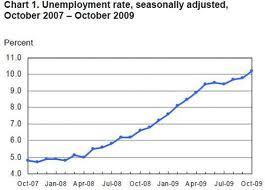
The private sector that Republicans see as our economic savior has been creating jobs. Not a lot, a few hundred thousand a month, but some. And yet the unemployment rate remains stubbornly high.

There’s a reason for that, one politicians from San Francisco to Washington D.C. don’t want to talk about. But the New York Times put it nicely in a Dec. 5 editorial:

“While the private sector has been adding jobs since the end of 2009, more than half a million government positions have been lost since the recession…”

“The cutbacks hurt more than just services. As Timothy Williams of the Times reported last week, they hit black workers particularly hard. Millions of African Americans — one in five who are employed — have entered the middle class through government employment, and they tend to make 25 percent more than other black workers. Now tens of thousands are leaving both their jobs and the middle class.”

Remember: Most of the biggest employers in this city are not corporations; they’re government agencies. The City and County of San Francisco, the University of California, the State of California, the United States Postal Service, City College and the San Francisco Unified School District drive the local economy more than any one private company. Between them, those public-sector operations employ more than 60,000 people. The largest single private employer, Wells Fargo, has fewer than one sixth of that number.

Most of the those public-sector jobs are unionized and offer decent benefits. They are such an important part of the city’s economic development future that it’s impossible to talk about jobs in San Francisco unless you start the conversation with the public sector.

Mayor Ed Lee is about to enter negotiations with unions representing 24,000 city employees. His office is already indicating that cost savings will be a big part of the discussion. I know there are cost savings out there — you can’t spend $2 billion on payroll and not have some waste somewhere in the package.

But if he’s serious about his campaign mantra — jobs, jobs, jobs — I hope he remembers what the Republicans don’t: Government jobs count, too.

A new name in District 5

73

There’s a new name popping up in the cattle call that is the District Five supervisorial appointment. He’s not terribly well known in city political circles (his chief claim to local fame is serving on the Library Commission), but he’s got a powerful patron: U.S. Senator Dianne Feinstein.

His name is Michael Breyer. Yes, from that Breyer family.

In a Nov 30 letter to Mayor Ed Lee, Feinstein lauds Breyer and says he has her endorsement for the job. You can read the letter here (pdf).

Feinstein notes that Breyer’s grandfather, Irving, was chief counsel for the San Francisco Unified School District and that his aunt was a president of SEIU. She doesn’t mention his closer, and better-known, political connections. Nor does she mention that his uncle was a partner in a law firm that was once among the most politically connected in the city, run by William Coblentz, who when Feinstein was mayor was routinely considered one of the two or three most powerful people in San Francisco.

Among the great qualities the senator sees in Michael Breyer? He can raise money. “He can count on financial support from the high tech community and others,” Feinstein notes.

Would Ed Lee seriously consider someone who has this little local political experience and no real history of activism in the district — but really, really strong family political ties? I can’t imagine it. But Senator Feinstein isn’t doing this just for fun.

The always amazing John Burton

1

John Burton, former member of Congress, the state Assembly and the state Senate and now the chair of the state Democratic Party, has represented PG&E and real-estate developers and helped build a political machine that stifled local politics for years. But I have to say: The guy is a great interview. Deep down, he really thinks like the 99 percent and every other word out of his mouth is “fuck.”

Oh, and he’s always an example of sartorial splendor. Everyone in Sacramento politics wears fancy suits; John dresses like he just came from the Occupy campground. On a good day.

Check out this outstanding interview on The Daily Show (thanks, Calitics).

My favorite line:

“My daughter bought me a Kindle for my birthday and I won’t use it because of those goddam people at Amazon. I go to the book store and buy a goddam book and I read it. I can read it while I’m taking a crap.”

Oh, and when the Daily Show interviewer tells Burton “you cuss more than a West Coast rapper,” he says:

“I who?”

There’s nobody else like him in politics.

Government jobs are jobs, too

81

The New York Times weighed in Dec. 4 on an economic fact of life that I’ve been harping about for years now: Jobs in the public sector are … jobs. In many cases, they’re good jobs. And when conservatives and business leaders talk about reducing the size of government — and then complain about the unemployment rate — they’re stuck in doublespeak.

I know the Times has a paywall now, so if you can’t get in from that link I’ll give you the main points of the editorial:

While the private sector has been adding jobs since the end of 2009, more than half a million government positions have been lost since the recession. … The cutbacks hurt more than just services. As Timothy Williams of The Times reported last week, they hit black workers particularly hard. Millions of African-Americans — one in five who are employed — have entered the middle class through government employment, and they tend to make 25 percent more than other black workers. Now tens of thousands are leaving both their jobs and the middle class. Chicago, for example, is laying off 212 employees in the upcoming fiscal year, two-thirds of whom are black.

That’s one reason the black unemployment rate went up last month, to 15.5 percent from 15.1. The effect is severe, destabilizing black neighborhoods and making it harder for young people to replicate their parents’ climb up the economic ladder. …

Many Republicans, however, don’t regard government jobs as actual jobs, and are eager to see them disappear. Republican governors around the Midwest have aggressively tried to break the power of public unions while slashing their work forces, and Congressional Republicans have proposed paying for a payroll tax cut by reducing federal employment rolls by 10 percent through attrition. That’s 200,000 jobs, many of which would be filled by blacks and Hispanics and others who tend to vote Democratic, and thus are considered politically superfluous.

But every layoff, whether public or private, is a life, and a livelihood, and a family. And too many of them are getting battered by the economic storm.

Something to think about as city officials try to eliminate the latest defict and negotiate new union contracts. Because Repbulicans aren’t the only ones who don’t regard government jobs as actual jobs; a lot of Democratic officials and business leaders in liberal San Francisco seem to feel the same way.J


The women who love Herman Cain

4

Sexual harassment is serious, and Herman Cain ought to be held to account for the sizable number of allegations against him. (Really, whatever Cain says, most women don’t make this stuff up; going public is painful enough). The charges that he had an affair? Whatever — that’s none of my business or anyone else’s. But in the GOP world, being “unfaithful” is a pretty serious sin (unless, of course, your name is Newt Gingrich).

Still, it’s pretty creepy that he’s set up a “women for Cain” website, with some truly bizarre testimonials:

**Sir, I firmly believe that you were sent to our nation through Divine Providence and I believe that you are the man to preserve our Republic for our children.

**”I first saw Mr Cain on the day he announced his presidency! I absolutely loved his upbeat attitude about my country! Then he smiled … how long has it been since we have seen a sincere smile from a political candidate!

**I am with you all the way Sir!!!!!!!! We need someone that believes in GOD, life and liberty

**Mrs. Cain, Joshua 1:6 says, “”Be strong and courageous, because you will lead these people to inherit the land I swore to their forefathers to give them.” I am praying for you and Mr. Cain…that God would protect you and give you courage to be obedient to Him…whatever He asks.

**Dear Mr Cain many years ago I find this not so unique for christians I knew a man Charles in died at 54 i knew him and and his wife and they were beautiful from the heart christians. at one point in my live i was going to lose my home and well he heard about it, so me at Maass and told me Adrinne I want you to go down to the bank Monday and there wil be a check for 40.000 dollars. I told him I dont know how in the world i would pay it back and he just said don.t worry you are young and you have your whole live to pass a blessing on to someone else, At any rate he died at 54 of a heart attack and when I went to the funeral I was not surprised to see at least 500 or more people at his funeral and I went up to his wife and she told me has helped so many people his whole life and I looked in those green eyes with flowing tears and I said I was one of those people!

Whoa. These are the supporters of Herman Cain. I wonder what Women for Gingrich would look like.

More evidence that Occupy is working

19

The Occupy movement has already had an impact on poltics in Washington, DC, and it’s having an impact in California, too. The Chron’s front-page banner headline today reads “Tax measures target wealthy.” By time time the story made it to sfgate, it was buried and carried the downer of a head “Tax-the-rich measures may cancel each other out.” Still, the lead sentence says it all:

The tax-the-rich sentiment behind the Occupy Wall Street movement – and the cash-starved state budget – are reshaping California politics.

I still think at some point Occupy will need to move into the electoral arena (I’d love to see the tent city residents register to vote at Justin Herman Plaza — perfectly legal — and show up to weigh in on the city budget in the spring). But all this talk of the lack of a “clear message” continues to miss the point: Occupy has brought economic injustice back into the mainstream of the political dialogue, and that’s changing the level of discussions from City Hall to Congress.

I’m not saying that Obama and the GOP will suddenly agree to start taxing big corporations and wealthy individuals at the sort of rate they should; it’s not that easy. It won’t be easy to pass a tax measure on the November ballot, either. But just think about the progress we’ve made in a few short months.


Lt. Gov. Press Release

2

We used to call Gavin Newsom Mayor Press Release because he was always ready to go before the cameras and announce some bold plan that never amounted to anything. And now he’s at it again.

Newsom — to his credit, I must admit — was the only member of the Board of Regents who didn’t flee when the protesters arrived. Instead, he sat down with some of them and announced that “you have my support.”

In fact, he’s happy to denounce the cuts to higher education:

In an interview Thursday, Newsom said he was deeply alarmed by what he called the dismantling of the UC and CSU systems and gently criticized the budget deal struck by Gov. Jerry Brown last year that included steep cuts to financing for both institutions.

“You can’t cut $650 million from both systems and tell me you value the system,” he said. “I believe we could’ve avoided a substantial portion of these cuts.”

Yes: you could have avoided those cuts by raising taxes. But that’s something Newsom refused to do as mayor. He mentions nothing on his website about tax increases on the rich. He said nothing in his campaign about taxes. And unless I’ve missed something, he hasn’t endorsed any of the possible tax measures that might be headed for the November ballot.

So he’s going to go after the student vote in his next campaign — but without alienating big corporate supporters who don’t want to pay more taxes. And with that approach, nothing will happen to improve higher education in the state.

California, meet Lt. Gov. Press Release.

PS: I called and emailed Newsom’s media person, Francisco Castillo, to see if the Lite Gov was going to support any of the November tax measures. If they get back to me, I’ll let you know.

The impact of Occupy

8

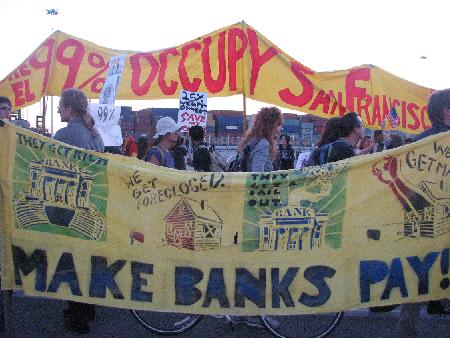
With the city getting ready to crack down on OccupySF, and Occupy encampments around the country under attack, it’s easy to get discouraged. And I know that a lot of the Occupiers aren’t thinking about specific legislation or how the movement translates into action in Washington.

But it does — it does:

In the world where Occupy had never happened, Republicans would’ve held these tax cuts hostage without suffering any ill repercussions. Why would they? The chattering class and Beltway media would be droning on endlessly about deficits and other things that didn’t matter.

In this world, Occupy has thrust income inequality to the forefront of the political debate — so much so that typically immovable Republicans are afraid to feed that narrative.

In other words, a ragtag bunch of hippies with supposedly no demands have done what Democrats have never been able to do — get Republicans to cry “uncle”

And this is just the beginning.

SFBG Radio: Censoring the Internet

0

Some observers are saying that new Congressional legislation could destroy the Internet as we know it. Johnny and Tim discuss the threats to free speech, what can be done — and why it will never work — after the jump.

SOPASucks by endorsements2011

Editor’s Notes

2

tredmond@sfbg.com

I want to take a few Republicans on a road trip.

A few days after the GOP-led Congress cut off funding for high-speed rail in California, I drove to Los Angeles for Thanksgiving. I wish the critics of the project were with me in the car, with two kids fighting in the back seat, constant traffic delays, and about as unpleasant an automobile excursion as you can imagine.

I hate driving. When I was 16, in the New York suburbs, all I wanted to do was drive; now I can’t stand it. But when you’re invited to a friend’s house 380 miles away and flying is too expensive and the one rail line that lumbers along the north-south corridor takes 14 hours and is always three or four hours late, there’s not much of an option.

And even by my standards, I-5 is a miserable experience. It’s crowded, it stinks like the piss of 5,000 doomed cows, and it goes on forever. On and on and on, through fields where big agricultural corporations using heavily subsidized water grow cotton in the desert, up the grapevine, down the grapevine, fighting trucks and too many cars, no place to stop and stretch your legs … I-5 isn’t a working road like 101, where people commute to work and go shopping and get on and off after a few miles. Most of the way from Sacramento to L.A., there’s nowhere to go — 40 miles or more between exits. Everybody on the road — all 10,000 or 20,000 or 50,000 or however many gasoline-powered steel boxes were crammed onto the concrete ribbon Thanksgiving week — were in it for the long haul. People drive I-5 to get from one end of the state to the other; that’s why the thing exists.

And that’s why it’s about the best place in the country to run a high-speed rail line.

Seriously: I bet 90 percent of the people on that wretched roadway Thanksgiving week would have been thrilled to take a train directly from downtown San Francisco (or Sacramento) to Union Station in L.A. — particularly if the ride took half the time of the drive and cost about the same.

I can talk forever about fossil fuels and climate change and air pollution and all the reasons people should get out of their cars. But all you have to do to convince any reasonable person that driving from S.F. to L.A. is a bad idea is to do it.

Millionaires eyeing Potrero Hill

60

I hate to harp on this (well, no I don’t) but when people tell me that we don’t have to worry so much about gentrification these days, that we’re living in a different world than the days of the dot-com boom, I have to wonder: Am I the only one reading the business pages?

Because in the real world of San Francisco business, the real-estate boom is on and housing prices — particularly in the southeast part of the city — are about to start soaring again.

In fact, according to the Chron, the market is already flying high — and dealing with the influx of new wealth and the continuing change in the demographics of the city will be very much a serious issue for Mayor Lee over the next year:

ZipRealty just completed a study on the millennial home buyer, pointing out that this generation, born after 1982,  is the largest in American history, larger even than the Baby Boomer generation. To these buyers, walkability and a vibrant urban community are huge draws in a home purchase. The ZipRealty study seems confirmed by this recent mini-boom in neighborhoods close to SoMa’s flourishing tech industry: newly minted millionaires in their 20s and 30s have the buying power to drive prices up.

Want proof? We’ve got it. The median price of a single-family home in San Francisco County was $745,000 in October, up $10K from October of 2010. In the neighborhoods in question though, the increase is more striking. In Noe Valley this October, the average price-per-square-foot was up 5% from last year for the third month in a row; in SoMa, up 11%; in eastern Potrero Hill, up 16%.

So: When Zynga goes public in a few months, a whole lot of young millionaires will want to buy houses in Potrero Hill. Dogpatch, and the southern end of SOMA. Oh, and the Mission. Rents will go way up. Housing prices will go even further beyond the level that ordinary, non-millionaire working people can afford.

I’m happy for all the Zyngites, and I’m glad the company is here in SF and generating economic activity. But one of the lessons of the dot-com boom is that the city, as a matter of policy, has to protect existing neighborhoods and residents (and existing industrial blue-collar businesses and jobs) from displacement. Otherwise the horrors of the late 1990s will start creeping back.


What’s Jerry Brown afraid of?

5

I have to wonder — as I often do, I’m afraid — just what exactly Gov. Jerry Brown is thinking. He was out of town — at an undisclosed location — when the UC Davis pepper spray incident happened, and he issued no statement. Now he’s back, presumably in his office, and he still hasn’t said anything.

The folks at CalBuzz have a good suggestion for the statement he could have made:

The use of pepper spray and night sticks against peacefully protesting students at UC Davis represents exactly the wrong message our great universities should be sending to our young people.

Instead of supporting and encouraging students who have become productively and non-violently engaged in the important issues of the day, university authorities unleashed overwhelming military force against them.

It is not enough for University of California officials to call for a review of policies and procedures. Those responsible for this outrageous assault on human rights must be held fully accountable, Students and parents must be reassured that the University of California and all higher education institutions in this state respect and applaud young people who reject apathy and embrace personal involvement in what ails society.

I could go further: There’s video of a police officer breaking the law, and he should have been arrested and charged with assault. Not saying he should go to jail or anything, but when there’s clear evidence of a crime, typically the perp is arrested and the courts sort it out later.

But what is going through Jerry’s mind? Does he condone this shit? (I’ve known him a long time, and I can’t imagine he does.) Is he so far out in space that he doesn’t realize how bad it looks for him to stay silent?

Is he worried that the cops won’t like him if he says something critical? Because a lot of other people are mad that he’s said nothing at all.

This isn’t an isolated local incident that he can kick down to the city or county authorities. The University of California is a state agency, and its cops are state employees, who more or less indirectly work for the governor.

Jerry: Silence is consent. Quit ducking.

Alameda County sheriff is shocked

115

Sarah Jane Holcombe, a graduate student in public health at UC Berkeley (and a neighbor of mine), was disturbed to see Alameda County deputy sheriffs using unnecessary force against peaceful student demonstrators. She’s not alone — a lot of people on campus have been upset about police conduct during the demonstrations. But Holcombe did more than grumble — she wrote to Alameda County Sheriff Gregory Ahern to complain. And she got back a remarkable message that says a lot about what the elected sheriff thinks about the protesters.

Here’s Holcombe’s letter:

Dear Mr Gregory Ahern,

I find myself just stunned and appalled at the behavior of your police in Sproul Plaza, and as a Berkeley student, have lost respect and confidence in the Alameda County Police Force.

Who are these Officers?  Where were they trained?

Perhaps more to the point is, why are you authorizing such blatantly violent and anti-democratic behavior?  This shows such bad judgement that I wonder why you are the head of the Alameda County Police Force.

Finally, what are you doing to address the gross problems and violations evident in Alameda County Police Officers’ behavior?

My confidence and trust in you and your force is now very low.

I look forward to your response.

Ahern’s letter back, sent within two hours:

I am shocked too.  I am shocked educated individuals who violate laws do not expect to be arrested. I am shocked that people who speak of peace in our society attempt to do harm to law enforcement personnel. I am shocked that some protesters throw rocks, cement, bottles and paint at law enforcement. I am shocked that protesters throw urine and feces at police officers.

I am shocked at the vulgar language used at my staff.

I am shocked that people like you make judgements about law enforcement without knowing all the facts and without asking questions prior to making judgements and assigning guilt on those prior to any investigation.

When the protesters follow the laws of our society and our lawful commands we have no issues.  Many of the protesters speak to us and provide us with their legal intentions to march and we assist them.

Let me tell you something…..my staff has done nothing wrong. They have assisted this community in allowing their free speech and right to assemble. We have provided protection to thousands of individuals and allowed them to practice their rights while some of those same individuals insult us. We have provided traffic blocks so people could march safely. We have protected buildings and provided escorts to frightened citizens in the area of the protest. We have escorted special need individuals and eldery from areas of the protest. We have assisted handicapped people to safety.

In each use of force that my staff has used has been in direct response to direct actions of individuals. We have not and do not and will not just use indiscriminate force. Each use of force is documented, reviewed and subject to further review of command staff. Indiscriminate force is not tolerated. Do not judge my people from news reports or YouTube videos.

I beg you to come to our training.  I will provide you full access, I will answer any of your questions.  I will prove we do our job correctly and according to national standards.  Let me know when you can show up at our training.

It was signed Gregory Ahern. I called his press spokesman and he confirmed that this was Ahern’s message and represents his position.

Actually, Sheriff, I didn’t see many reports of protesters at Cal doing anything to harm police officers. And to simply say “my staff has done nothing wrong” without listing to an evaluating any complaints that might be filed seems, well, a rush to judgment.

And honestly, were there “frightened citizens” at Berkeley who needed to be escorted from buildings? Was beating up a poet appropriate use of force?

Sheriff Ahern has made his decision. Already.


The Chron pushes 8 Washington

36

The Chron’s urban design writer, John King, thinks that the 8 Washington project would be a dandy addition to the San Francisco waterfront:

The project’s allure is what happens on the ground. Jackson Street would extend east as a 47-foot-wide pedestrian path; Pacific would conclude at the new triangular park. A narrow greenway north from Drumm would be widened to 37 feet.

The open spaces are the work of Peter Walker, who also designed nearby Sidney Walton Park, the green heart of otherwise drab Golden Gateway. What’s envisioned at 8 Washington extends the artful simplicity of that popular space. But it takes cues from the transitional location, offering pathways and nooks rather than trying to upstage the waterside drama.

So the landscape is going to look nice.

But there’s a lot more to a project than the way it looks. I’m not going to go all Form Follows Function here, but before you evaluate how much green space the development will have and what pedestrians will encounter, you have to ask another question: Why are we building this thing in the first place?

And to that, there is no good answer.

Labor ready to fight Occupy eviction

5

Tim Paulson, director of the San Francisco Labor Council, just told me that he’s got as many as 500 union members on alert to stand with the OccupySF encampment if the city attempts to evict the protesters. The Labor Council has put together a communications system to let members who have volunteered to help know when a showdown with the police is coming, and the volunteers are ready to spend as much as 24 hours at Justin Herman Plaza, and if necessary, in jail.

“We mobilized for last night, but nothing happened,” he said. “We’re in a state of constant vigilance.”

Paulson noted that the San Francisco encampment “is the symbol of the Occupy Movement.”

The solidarity of San Francisco labor will make it considerably more difficult for Mayor Ed Lee to send in the police and break up the camp. The idea that he would be ordering the arrests not only of several hundred Occupy protesters but a large contingent of local labor leaders and union members has to be giving him second (and third, and fourth) thoughts.

And whatever the outcome, the connenctions between labor and Occupy are critical to building and sustaining a national movement to demand economic justice. It’s great to see the SF Labor Council in the heart of the fight.

OccupySF is worth the investment

30

Thirteen labor and community leaders wrote to Mayor Ed Lee Nov. 17 asking him not to evict the OccupySF protesters. The message of the hand-delivered letter: It’s worth the time and effort the city will have to make to allow the encampment to remain. It was signed by Conny Ford, OPEIU Local 3, Bob Offer-Westord, Coalition on Homelessness, Pilar Sciavo, California Nurses Association, Elizabeth Alexander, SEIU 1021, Rev. Carol Been, Clergy and Laity United for Economic Justice, Steve Williams, POWER, Gabriel Haaland, SEIU 1021, Tim Paulson, San Francisco Labor Council, Kate Huge, La Raza Centro Legal, Gordon Mar, Jobs with Justice, Forrest Schmidt, ANSWER, Shaw-San Liu, Chinese Progressive Association, and Mike Casey, UNITED-HERE Local 2.

Here’s the full letter:

Dear Mr. Mayor:

Occasionally a movement takes hold of the imagination of a people, resulting in major social and economic shifts in public policy. Thirty to forty years ago, such a movement driven by a coalition of the religious right and corporate America and spearheaded by the National Chamber of Commerce and the National Association of Manufacturers, changed the course of our nation for the worse.

With the election of Ronald Reagan and scores of corporate-backed politicians since then, our nation has seen a reversal of the progressive gains made in the decades immediately preceding 1980, from the New Deal to the War on Poverty.

In yesterday’s meeting, you and several city department heads questioned whether it is “worth the investment” to meet and work with the SF Occupy movement to address certain health and safety issues. We think it is.

The national Occupy Wall Street movement has brought dramatic focus to the disproportionate concentration of wealth and power held by the top 1% of America.  They have drawn broad attention to the devastation wrought by Wall Street upon communities throughout the country:  home foreclosures, record unemployment, attacks on immigrants, union busting, school closures, social service cutbacks, etc.

Over the years, in our own city, a number of legendary movements and causes have led to meaningful and lasting progressive change. The 1934 General Strike and the I-Hotel are but two examples. These and other struggles such as the Civil Rights movement are iconic not based on whether they resulted in victory or defeat, but because these struggles inspired and trained a new generation of organizers and activists committed to economic and social change.

Whether the Occupy movement is helping usher in yet another shift remains to be seen. But of this we are certain: the City of San Francisco working with Occupy SF to support their vision and work is “worth the investment.”

Provocative police actions in Oakland resulted in unnecessary injuries and threatened the very safety of the community they’ve sworn to protect.

We appeal that you not shut down the occupation of Justin Herman Plaza and continue to meet, daily if necessary, in order to work through the issues connected with Occupy SF.

SFBG Radio: Occupy, now and in the future

3

The authorities keep cracking down on the Occupy encampments, but the movement isn’t going away — and by Spring, it could be even bigger. Tim and  Johnny discuss after the jump.

WillOccupySurvive by endorsements2011

Will Occupy message reach Sacramento?

26

One of the early tests of the political impact of the Occupy movement will come in the next two months, as California prepares to make drastic further cuts in education and social services for the poor and the Democratic governor begins — cautiously and hesitantly — to talk about new revenues.

The numbers from the Legislative Analysts Office are fairly bleak — the state budget relied on $4 billion in revenue that hasn’t been collected. That’s because Gov. Brown and the Democrats in the Legislature assumed that the economy would pick up more than it has. We don’t know what the final shortfall will be — but because the budget deal included automatic trigger cuts, it’s clear that K-12 education, CSU and UC are going to get hit again, as will, for example, medical assistance for the disabled.

So just as students and faculty all over the state are protesting existing cuts and tuition hikes, more are on the way. I expect this will go over extremely well on the campuses.

The cops may be poised to shut down OccupySF, but this is a movement that isn’t about to go away. And if the governor and the Democrats in the Legislature (who are going to be running from new districts next fall) start to feel the heat and realize that the Occupy movement is already influencing the political debate and will, directly or indirectly, be playing a major role in state and national politics, they’re going to have to respond.

How? Well, the Legislature can always decide to scrap the cuts and raise taxes now. Unlikely, since that would require a two-thrids vote and the Republicans still care more about their no-taxes pledge than they do about the tens of thousands of people (including in their own districts) who are taking to the streets to protest economic inequality.

More likely the talk will be about November, 2012, and what sort of revenue measures Jerry Brown wants to put on the ballot. And that’s where the politics of Occupy can have a significant impact.

There are so many ways to go with tax measures; the easiest, in some ways, is to talk about the state sales tax, which bothers the GOP hardliners (like any tax) but bothers the big-business world a lot less. Most of any sales tax hike would be paid by consumers and the poor would pay more than the rich; typically, big business groups are willing to accept a sales tax hike before they’ll go for anything more progressive.

Obviously, the best option is to do exactly what Occupy is talking about, and raise the income tax on the top brackets (and cut corporate loopholes, and pass an oil severance tax). And that’s what will drive the California Chamber of Commerce types absolutely mad.

But I think a there’s a way to make this a winner at the polls, and a winner for the legislators who push it — and maybe even a winner for a Dem or a moderate Republican in some of the potential swing districts. Just call it a One Percent Tax — that is, a tax on the One Percent. Could be a combination of income taxes and corporate taxes, as long as it’s a package carefully written to target largely the wealthiest in the state.

Hard for anyone these days to oppose something that is totally defined and promoted that way. Gives the Occupy movement something to vote for. Could save jobs, keep classrooms open, keep sick people alive … I see no downside at all.


Occupy SF: Chron, Ex set the eviction stage

29

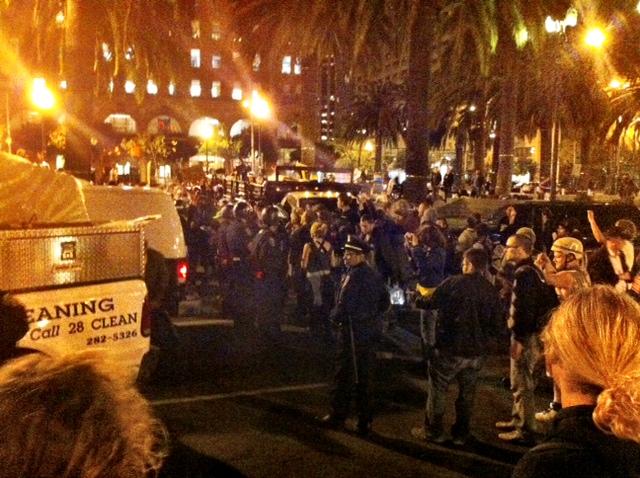
The OccupySF camp is filthy. There’s violence, drugs and disease. Half the protesters are just drunken thugs who are there to party and make a mess. It’s a public-health hazard. Jeez, it looks like the message is lost and the place has to go.

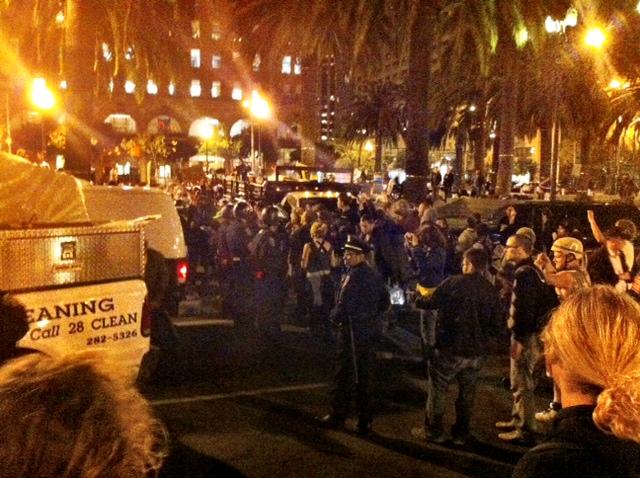
That’s what the Chron and the Ex are saying — and it’s a perfect setup, a ready-made public excuse for Mayor Ed Lee to send the cops in with riot gear and an eviction notice. It could happen tonight, or tomorrow night.

Frankly, Lee needs the bad (for Occupy) press. The movement’s goals are popular in this city, and when he came very close to evicting the campers, with cops running around the city in buses, his popularity dropped. He saw what happened to Jean Quan in Oakland; her tear-gas assault on Occupy Oakland may have been the end of her political career.

But hey, it’s different now: The daily papers are proclaiming that the encampment isn’t about economic inequality any more. It’s devolved into an unruly mob that can’t be tolerated. Who can blame Lee for cleaning it up?

That also happens to be an utterly unfair characterization of what’s going on. Sure, there are homeless people in the camp, and yes, some of them have mental health issues. But OccupySF is talking about the 99 percent, some of whom have suffered greatly in this economy — and it’s no surprise that some of them part of the occupation. Yes, it’s a challenge, but it something that OccupySF is taking on. Oh, and by the way — the homeless people and people with mental health issues (that sometimes lead to violence) will still be on the streets of San Francisco is they evict the Occupy encampment. But they’ll be worse off than they are today.

Yael Chanoff just filed her report on what’s really going on at OccupySF:

At last night’s General Assembly, OccupySF organizer Philip Oje debriefed on that days meeting with Mayor Ed Lee, and participants in the 150-person meeting debated the best next steps. Several different viewpoints were discussed. Many were indignant about reorganizing camp to appease the city, saying that “I didn’t come her to comply with city ordinances that change every day. I came here to do what I think is right.”
Others believed believed that the camp should do everything possible to comply with the city in order to hopefully avoid a raid (and maintain credibility if one does occur.) It was generally acknowledged that the situation was a Catch-22: The camp could not comply with requirements such as maintaining four feet of space between tents without expanding past Justin Herman Plaza, but the city refused to allow any expansion to stand until their requirements were met. In general, those assembled agreed that regardless of the city’s difficult to follow guidelines, a clean-up would benefit the health and well-being of campers, and got to work.

This comes after a hard week of dealing with the frustrating realities of human interaction in a cramped space. The encampment has grown steadily since its start, and in recent weeks has been home to upwards of 300 people on a regular basis. Many campers would agree that in the past two weeks that tensions have built as high as they did. When Examiner Reporter Mike Aldax spent 24 hours at camp, it was during the peak of conflict.

Indeed, many at OccupySF are frustrated. There is a general feeling that there is not enough time in the day to maintain a safe and caring community that does not exclude anyone as well as progress with the political agenda that the movement stands for. However, there is also a basic agreement that those with addiction, mental illness, and other causes of suffering are affected directly by an unjust society in which a small percentage hoards vast majority of wealth while the masses struggle to afford food, shelter, health care and education; to attempt to exclude those who are in desperate situations, the most in need of emergency action to change our system and our lives, would be morally intolerable hypocrisy.

As famed radical environmentalist Derrick Jensen put it when he came to speak at the encampment November 12, “At the same time you’re building a resistance movement, you’re being put in the position of dealing with the needs of those who have been dispossessed and damaged by the system.”

It’s true: according to Connie Ford, a member of OPEIU Local 3 which represents many on the city’s Homeless Outreach Team, “The homeless come there because it’s safer than the shelters.”

This has caused difficulties in the past few weeks that the camp has been struggling to deal with. The solution is starting to come together. After physical fights began to become a major problem last week, the camp stepped up the process of enacting a culture of community policing. The night of November 15, when “Instigator Jimmy” was involved in an altercation during a general assembly, about 50 formed a mass between him and camp and slowly pushed him off the site, chanting “Whose park? Our park.” As one camper put it, “Jimmy’s individual will was extinguished by our collective will.” This is an experiment in radically non-violent coercion.

Since then, this tactic has been employed to greater and greater success. Last night, when one camper began to instigate conflict, it only took 10 or so others to cause him to leave in the same way, and hardly disrupted the peaceful mood at the site.

In addition, despite starting out completely unequipped to provide medical and mental health to the masses for free, OccupySF has set up a medical tent run by nurses from the National Nurses Association and several “emotional assistance” spaces, one of which has been facilitated by the Icarus Project and other groups with alternative approaches to mental health. According to an OccupySF press release today:
“Forty clergy, including bishops, have recently formed as ‘San Francisco Interfaith Allies of Occupy’ because we share the concerns of the ninety-nine percent,” said Rev. Carol Been of CLUE California, “and they have asked us for help because they were not prepared to handle homelessness, mental illness, people attracted for unseemly reasons not associated with the occupation. Resources have recently begun to be put into place.”

It seems that all of this grappling with difficult issues and hard work on the part of OccupySF has begun to pay off. Last night after General Assembly, campers worked to clear off the Bacci Ball courts as per the city’s request, take down tarps, and space out tents to the extent that they could without expanding past Justin Herman Plaza (renamed by some Bradley Manning Plaza.) Camp was clean and vastly quieter than it had been in previous days.

Around midnight, there were about 30 people awake, talking and playing mellow drums on the outskirts of camp while hundreds more slept in the approximately 180 tents. One man who had been sleeping there three weeks said, “There’s a new energy. After we cleaned, a lot of the riff-raff left.” With a grin he added “It looks like there’s still some, but they’ve been over there having some kind of profound conversation all night,” gesturing to the camp east side.

I pitched my tent about 10 feet from the “profound conversation” and drifted off easily, though I admittedly prefer a nice buzz of humanity while I sleep. I was, however, woken up around 6:00, when others began waking up and excitedly discussing the fact that the camp had made it through the night without a police raid.

It remains to be seen if the same will be said for tonight.



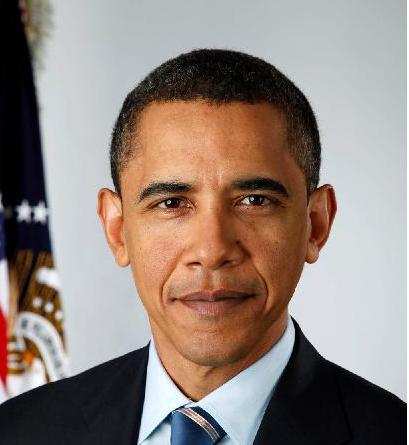
Will Obama win in 2012?

43

Right now, all the signs say no — the economy isn’t improving, he’s pissing off his base, the GOP kicked his ass in the 2010 midterms, and a vast majority of Americans think the country is headed in the wrong direction. But then, at this time in 1991, all the signs said that George Bush I was unbeatable.

And then, of course, you have the Republican candidates.

That’s why the political consultant brain trust at CalBuzz predicts by a 2-1 margin that Obama will be relected. We’re talking Democrats and Republicans, from across the ideological spectrum (although mostly centrist; there aren’t many radical political consultants, since they have to make a living working with all sorts of candidates).

I always get these things wrong — a good way to win an election-day bet is to listen to my predictions then go the other way — and I’m not the Obama supporter I once was. But I think these folks have a point — is there a single Republican now in the field who won’t self-destruct by the end of next year, in the heat of battle? You can say all you want about his namby-pamby positions and the bimbo eruptions, but Bill Clinton was a hell of a campaigner — and it takes a hell of a campaigner to unseat an incumbent president, no matter how bad he looks in the polls.

Some of their comments:

As much as history points to no president being re-elected with unemployment numbers this high, there is no sign that the GOP can get its act together and nominate anyone capable of defeating Obama. As amazing as it may be the GOP is poised to grasp defeat from the jaws of victory — what a party!

Romney, the probable GOP nominee, combines most of the worst features of Walter Mondale, Michael Dukakis, Al Gore and John Kerry. That’s some feat — and it won’t get him to the White House.

Obama will win . . . more because the Republican field is pathetic.  “Mittens” is the likely winner, but has flip-flopped more than a tuna on the deck of a boat.

Harsh — but possibly true. Thoughts?