Caitlin Donohue

Meanwhile, in Uruguay

1

caitlin@sfbg.com

HERBWISE Happy Independence Day hangover (yes, still)! I’ll leave aside all discussion regarding the wisdom of the mid-week holiday and head straight into the fact that I spent the evening of the Third of July very, very sadly.

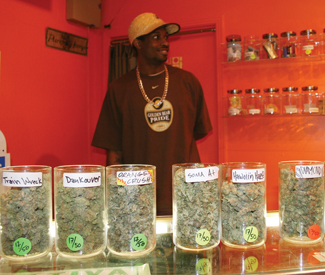
It was for this reason: after work I tore over to my beloved neighborhood dispensary Shambhala Healing Center (www.shambhalasf.com), arriving ten minutes before closing time. It was closed. Peeved, I called in to lightly berate them for shuttering early.

But this was no early start to the staff’s holiday. Just hours after I posted last week’s Herbwise about the Vapor Room going kaput, I found out Shambhala’s brick and mortar location had shut its doors for the last time on June 30.

Now this should not have come as a surprise. I spent time with an indignant Shambhala founder Al Shawa in his dank-smelling dispensary backroom this spring, discussing the letter that US Attorney Melinda Haag sent to his landlord, proclaiming that his storefront was inappropriately close to a playground, and that this landlord faced decades of jail time if he wasn’t evicted (“Shambhala Healing Center next on the federal chopping block,” 3/5/12).

I should have been paying closer attention to Shawa’s predicament, especially since I buy my sativa from him. At least Shambhala will continue to deliver, a move that the last place I used to buy weed from in the Mission, Medithrive, also resorted to when it was forced to close in November. (For the Herbwise column on that mess see “For the kids?” 12/13/11)

For me, the Third of July was a moment when this to-do between the federal government and these local businesses (and more importantly, the patients that depend on cannabis to function) punched me in the gut. My plans for THC consumption over Independence Day had been foiled by the feds, and all at once the sheer idiocy of this whole cannabis crackdown was almost too much to bear. Work on real problems! Go!

(By the way, SF Chronicle columnists Philip Matier and Andrew Ross have it on good authority that Obama is coming back to town on July 23 for his seventh Bay Area fundraising trip this year, who is down for a protest?)

So this week, I’m giving it up for South America. Big ups to Uruguayan president Jose Mujica for proposing a plan to legalize marijuana so that adults could walk into government-run stores and buy weed. He presented it as an anti-crime measure, suggesting that the hundreds of millions of dollars spent on pot by consumers could be better funneled in the government’s pocket than those of illegal drug dealers.

President Mujica is blessed with one of his continent’s most stable countries — plus it’s tiny, at 3.3 million inhabitants — so his plan could prove more manageable to implement than elsewhere in South America. But he’s not the only leader south of Panama to call bullshit on this War on Drugs. This spring at the Summit of the Americas in Cartagena, Colombia, that country’s President Juan Manuel Santos called for an “in-depth discussion” on the War on Drugs’ utility, preferably one “without any biases or dogmas.” He suggested, as many have, that Prohibition has never worked before, and might not be working now.

Our president was there too. “Legalization is not the answer,” said Barack Obama to a conference full of Latin American leaders. Of those who remain focused on this issue, President Obama counseled perspective. He said that this kind of debate seemed “caught in a time warp, going back to the 1950s and gunboat diplomacy, and Yanquis, and the Cold War, and this, and that, and the other. That’s not the world we live in today.”

Anyways, I’m sure that when he gets here — July 23! — he’ll be looking for our opinion on the ways of the world. ¡Hasta pronto!


Bachata morning, courtesy of Joan Soriano

1

Surely when Joan Soriano left his Dominican fishing town for the bright lights of bachata central Villa Mella — at 13! — he couldn’t have anticipated that a San Francisco culture writer’s fireworks hangover would be alleviated by his NPR concert. There you have it, however. Let Soriano take away that Fifth of July (red, white, and) blues on the coattails of his jingling, mellow notes. For more Soriano, check out his gigs at Cafe Cocomo on Fri/6 and Impala for “Hot Bachata Nights” on Sun/8.  

Faces of feminism

7

Is San Francisco still on the cutting edge of women’s issues? I recently spent a sunny Saturday morning buried in the radical archives of Bolerium Books (www.bolerium.com) — which is by the way, an amazing resource for anyone researching labor, African American, First Peoples, and queer history, among other things. Me, I was looking into our city’s rich history of feminist activism, inspiration for our upcoming Guardian “Bay Area Feminism Today” panel discussion. The event will unite amazing females from across the city who have but one thing in common: they’re pushing the envelope when it comes to the definition of what a “women’s issue” is, in a time when very few people claim feminism as their primary crusade. We’ll be talking more about their exciting projects –- but also touching on more universal issues. What is San Francisco’s role in fighting the nationwide attack on reproductive rights? How is our progressive community doing in terms of supporting women and maintaining a feminist perspective on issues?

Women’s work: it’s alive and kicking, and it deserves its moment in the spotlight. Meet our panelists here, in preparation for the real deal. 

THE GUARDIAN PRESENTS: “BAY AREA FEMINISM TODAY”

Wed/11 6-8pm, free

City College of San Francisco Mission campus

1125 Valencia, SF

www.sfbg.com/bayareafeminismtoday


STEPHANY ASHLEY

St. James Infirmary programs director, ex-president of Harvey Milk LGBT Democratic Club


For me, sex worker rights are a feminist issue because they are about body autonomy. As much as reproductive choice is a feminist issue, so too is the right to determine the ways in which we use our bodies, change our bodies, and take care of our bodies. When people are criminalized for their HIV status, denied access to hormones and safe gender transitions, or are afraid to carry condoms because it might lead to police harassment or arrest — these are all feminist issues. At St. James Infirmary (www.stjamesinfirmary.org), we provide healthcare and social services from a peer-based model, so community is really the central aspect of the project. I was excited to chair the Harvey Milk LGBT Democratic Club (www.milkclub.org) last year, because I wanted to keep raising sex workers rights issues as part of the LGBT agenda. At St. James, nearly 70 percent of our community members are LGBTQ, so it’s really critical that sex workers rights are treated as a queer issue, a feminist issue, and a labor issue.

CELESTE CHAN

Artist and founder of Queer Rebels

My partner KB Boyce and I started our production company Queer Rebels (www.queerrebels.com) to honor the feminist and queer of color artists and elders who paved the way. Our main project is “Queer Rebels of the Harlem Renaissance,” a performance extravaganza which took place June 28-30. Such an exciting time! The Harlem Renaissance legacy remains with us to this day. It was an explosion of art, intellect, and sexual liberation led by queer Black artists. I’m also a board member at Community United Against Violence (www.cuav.org). CUAV was formed in the wake of Harvey Milk’s assassination and the White Night riots, and does incredible work to address violence within and against the LGBTQ community. Another way I’m involved with women’s issues is through Femme Conference (www.femme2012.com). In a culture where femininity is both de-valued and the expected norm, Femme Con creates a vital feminist space — this year it takes place in Baltimore, Maryland.

EDAJ

DJ and promoter of queer nightlife

I work in nightlife to provide space for communities that often don’t have spaces to come together. For 15 years, I have been providing music for women as the resident DJ at Mango (every fourth Sunday at El Rio, www.elriosf.com). I also work to support my fellow LGBT veterans by promoting their visibility through my nightlife projects. Ex-Filipino Marine and two-spirit drag king Morningstar Vancil’s story has inspired me to work on creating a space that raises awareness about LGBT veterans, especially women living with disabilities. I also think it’s important to do outreach in the Black LGBT community to help strengthen support for organizations such as the Bayard Rustin LGBT Coalition (www.bayardrustincoalition.com), a group that is not only fighting for Black LGBT equality, but is focused on social change for all oppressed people. After 10 years of executive producing the Women’s Stage at SF Pride, I was honored as a grand marshal this year at an event hosted by the BRC and Soul of Pride. It was beautiful to see so many Black LGBT people dedicated to moving global equality forward. Although there is a need to reach out to everyone in the Black LGBT community, naturally my goal is to first focus on connecting more women, a group that has always been less visible.

JUANA FLORES

Co-director of Mujeres Unidas y Activas

My organization Mujeres Unidas y Activas (www.mujeresunidas.net) is based on a double mission: personal transformation and community power for social justice. MUA is a place where women arrive through different challenges in their lives. We try to provide emotional support and references so that they don’t feel like they’re alone, so that they have strength to begin the process of healing and making changes. Those can include issues of domestic violence, problems with teenage children, labor or housing issues — when they arrive at MUA they begin the process of developing their self esteem and becoming stronger. They also begin to participate in trainings and making changes in their community and to the system through civic and political participation. At MUA, women find a home. They feel comfortable because they’re always welcome. We’re developing strong leadership, leadership that is at the table when it comes to making decisions about our campaigns, like our letter of labor rights and the help we give to victims of domestic violence through our crisis line. Every day our members are developing their ability to be involved in the organization and community, and making changes in their personal and familial lives.

ALIX ROSENTHAL

Attorney and elected member of the SF Democratic County Central Committee

As an elected member of the SF DCCC (www.sfdemocrats.org), the governing body of the SF Democratic Party, I am working to involve the party in recruiting more women to run for political office locally. In the June 2012 election, I assembled a slate of the female candidates for DCCC — we called ourselves “Elect Women 2012.” It was a controversial effort, because it included both progressives and moderates. In the wake of a highly contentious and factional term on the DCCC, we hoped to prove that moderates and progressives can work together to re-energize Democrats in this important presidential election cycle. Running for office in San Francisco is a high stakes game; it is costly and requires an extensive political network. And so the DCCC is where many future candidates get their start — it is where they build the connections necessary to run for higher office, and where they hone their fundraising abilities. By recruiting and supporting women candidates for the DCCC, I am hoping to build a “farm team” of female candidates within the party. This year, I am proud that the seven women incumbents on the DCCC retained our seats in the June election, and that we achieved parity by electing four new women to the party’s governing board. I look forward to seeing what these women can accomplish together.

LAURA THOMAS

Deputy state director of Drug Policy Alliance

Ending the failed war on drugs is a women’s issue because women are far too often bearing the brunt of that failure, losing their freedom, children, economic independence, safety, health, and sometimes their lives as victims of the war on drugs. Women in prison in California can be shackled during childbirth, lose custody of their children because they use legal medical marijuana. They’re vulnerable to HIV and hepatitis C because they or their partners don’t have access to sterile syringes for injecting drugs. My major project for the Drug Policy Alliance (www.drugpolicy.org) is mobilizing San Francisco to show the rest of the world how effective progressive drug policy can be. I want to see San Francisco open the first supervised injection facility in the United States, to end new HIV and hepatitis C infections among people who use drugs. I want us to truly have effective, culturally appropriate substance use treatment for everyone who requests it. I want San Francisco to end the cycle of undercover drug buys-incarceration-recidivism. I want us to address the appalling racial disparities in who gets arrested, convicted, and incarcerated for drug offenses here. I want us to aggressively defend our ground-breaking, well-regulated medical cannabis dispensary system against all federal intervention. San Francisco is leading the way in the United States in addressing the harms of drug use and drug prohibition but we have a lot more we can do.

MIA TU MUTCH

Transgender activist and SF Youth Commission officer

I’ve worked for a plethora of LGBTQ organizations and have been on several national speaking tours. I currently serve as media and public relations officer of the San Francisco Youth Commission, and use my position to promote LGBTQ safety and overall health. I’ve partnered with several city departments in order to create a cultural competency video that will train all service providers on best practices for working with LGBTQ youth. As a vocal advocate against hate crimes and sexual assaults, I’m working with local groups to create a community patrol in the Mission to prevent violence against women and transgender people. I’m also the founder of Fundraising Everywhere for All Transitions: a Health Empowerment Revolution! (FEATHER), a collective aimed at making gender-affirming transitions more affordable for low income transgender people. I work to create avenues of equality for those who benefit the least from patriarchy by creating a culture of safety and support for people of all genders.

Cash your bowl

0

caitlin@sfbg.com

HERBWISE It’s time to get a Discover card. As of July 1, you can no longer use your Visa or Mastercard credit or debit card to buy medical marijuana. And of course, American Express cards have been out of the question since spring 2011. Electronic Merchant Systems, which handles card processing for most of the nation, sent out an announcement last month to its vendors, raising the stakes for dispensaries across the country that seem to be coming under a coordinated federal attack. Cash-only cannabis? That’s pretty bad, maybe just as bad as the next thing I have to tell you about…

MORE BAD NEWS

The Vapor Room is closing. Yes, the perennial Best of the Bay-winning, nine-year old Lower Haight dispensary-lounge (607 Haight, SF. www.vaporroom.com) will be closing its doors as of July 31, according to the nonprofit’s executive director Martin Olive. Olive told the Guardian in a phone interview that the dispensary learned an undisclosed amount of time ago that its landlord had received one of the doom-bearing letters now so familiar to San Francisco dispensaries from US Attorney Melinda Haag declaring that the dispensary was within 1,000 feet of Duboce Park. The city’s permitting laws, Olive told us, are concerned with how far cannabis clubs are from playgrounds, not park grounds. Vapor Room has a long-standing relationship with the Harvey Milk Rec Center that anchors the park — the nonprofit actually sponsors free yoga classes and health counseling that take place in the center itself. Olive wouldn’t confirm rumors that Vapor Room’s stock will continue to be available for delivery, but that’s the word on the street.

PLEASE NO MUNCHIES JOKES

The “bath salts” face-eater didn’t have any bath salts in his system. In fact, the only drug authorities uncovered through post-humous tests was cannabis.

UNDISCLOSED THING

As an events editor, organizations that don’t send us the vital information we need to cover their event are the bane of my existence. It is another thing entirely, however, when an organization requests that vital information be kept out of the newspaper. A sign of the times when it comes to cannabis journalism, I’m afraid. And as such: check out a happy hour benefit at El Rio for “an organization supporting low-income, AIDS-HIV, and cancer patients with free medicine.” Sigh. It’ll be running semi-concurrently with pop-up Mugsy Wine Bar’s hat-tip to Bastille Day (5:30pm-8:30pm). Drown your frustrations with some nice sparkling Blanc de Noir Cremant de Bourgnone, why don’t you.

Fri/13 4pm-6pm, free. El Rio, 3158 Mission, SF. www.elriosf.com

AND FINALLY

Search YouTube for “Conan O’Brien and Martha Stewart Get Crafty with Pot.” Discussion question: for all the weirdness that you just read, is marijuana becoming more or less accepted in mainstream culture?

How they do it in New York: ‘Brooklyn Boheme’ premieres, SFNY goes out with a bang

0

Do people within a “scene” ever recognize it at the time? Does that self-awareness kill the vibe, or is it essential in forming a group identity? Perhaps the answers can be gleaned at the Thu/12 Bay Area premiere of hip-hop writer Nelson George’s latest flick Brooklyn Boheme — a documentary filled with glimpses of baby Rosie Perez, Erykah Badu, and Talib Kweli in the thick of their Fort Greene, Brooklyn heyday. The show’s being thrown down by SFNY,  the three-year event series concluding this week that has connected SF and NYC with promises of slick DJs in fancy hotels and bicoastal culture swap. 

Hip-hop historian Jeff Chang interviewed George about the period he explores in Boheme. In that exchange, George’s top five moments from Fort Greene circa mid-’80s to ’90s make it sound like a dream: 

“1. I had a book party for The Death of Rhythm & Blues at my place at 19 Willoughby Avenue in 1988 that attracted a very eclectic group of folks, from Russell Simmons to Melba Moore to supermodels. It was a very fun, memorable party.

2. Chris Rock coming over to that same apartment to pitch me the film that eventually became CB4.

3. Sneaking around one night to the apartments of two women who lived around the corner from each other for booty calls. A very risky, but exciting night.”

Judging from the trailer, Brooklyn Boheme is an insider’s look at the kids everyone wanted to be like in the ’90s. Yeah, that’s Michael Jordan hanging with Spike Lee, what? Mos Def — sorry, Yasiin Bey — pre-Hitchhiker’s Guide to the Galaxy, visual artist Lorna Simpson reminiscing on the productivity that came from hanging out around densely-packed, extravagantly brilliant people (Lorna, I’m down for tips on how to do this if you’re offering.) The snapshot of the temporary community is made even more poignant with the knowledge of what came about in the neighborhood later on. The trailer acknowledges that Fort Greene has become synonymous with gentrification. Blame it on the artists… 

After the flick, head to the Clift Hotel for sets by KM/FM (King Most, FA, and Marky), Wonway Posibul (Latin Soul Brothers-Thinkbeat Radio), Haylow (Roy Ayers Project-70/30), and Jerry Nice (Groove Merchant Records). 

Brooklyn Boheme premiere

Thu/12 8pm; $5 movie only, $15-$45 movie and afterparty

Clay Theater 

2261 Fillmore, SF


SFNY wrap party-Brooklyn Boheme afterparty

Thu/12 10pm-2am

Clift Hotel 

495 Geary, SF

sfny6.eventbrite.com

Generations confer over La Peña’s second skin

3

I’m sitting in on a meeting between two generations of muralists. In name, our encounter was designed as an interview about La Peña Cultural Center’s plans to redo its decades-old facade, a historic piece that right now is a 3-D tableau named “Song of Unity” and meant to represent the people of North and South America coming together in art.

But it has become clear to me the interviewer that’s it’s way more momentous to let these groups talk largely unimpeded by my questions. Two people who created the mural in 1978 are speaking with two people who will design its rebirth in 2012 about changes in the world of street art over the last 34 years. It’s the first time the four have met together. Assasinated Chilean artist-activist Victor Jara‘s detached hands strum a guitar in silent soundtrack over us as we sit on folding chairs in front of the mural in question. 

In contrast to his “Song of Unity’s” figurative style, “graffiti is an abstract art,” says Osha Neumann.

Neumann was able to pay his original mural crew largely with funds from government-sponsored community arts program meant to train and employ creative types. La Peña’s wasn’t the only piece the group worked on — they also masterminded the piece on Berkeley’s Amoeba Music and a large wall at People’s Park. Their work was inspired, he says, by the school of Mexican muralists that included Diego Rivera, José Orozco — the masters that gave birth to the last mural renaissance in the United States. 

Osha Neumann, Cece Carpio, and O’Brien Thiele — two generations of La Peña artists. All Guardian photos by Caitlin Donohue

“Song of Unity” was meant to illustrate the coming-together of two continents through activist culture, at a time with US interventionism in Latin America was reaching a fevered pitch of corruption and when Bay Areans and Latin American refugees were coming together to form La Peña. It was a heavy moment. Jara’s hands, by way of illustration, are portrayed severed from his body for a reason. After the 1973 Chilean coup, they were said to have been cut from his body by military junta.

“Graffiti has no connection at all to the work of the Mexican muralists,” Neumann continues in response to my question about how street art has changed since his time.

“Graffiti artists don’t usually work collectively,” adds O’Brien Thiele, Neumann’s co-artist.

But here, Robert Trujillo must step in. Trujillo is a member of the Trust Your Struggle collective, the team of California-bred young people that have been elected to take up this historic mantle.

“But there are graffiti crews that are really well-established,” he interjects gently. “CPS from Los Angeles. TKO and MSK have crews worldwide. These are the groups that pioneered graffiti art on the West Coast.”

Trujillo should know — in a time in which street art has come into vogue and become a big-money game, TYS is a sterling example of what is still great about the genre. TYS travels the world connecting with communities in parts of the developing world like Latin America and the Phillipines. It uses graffiti-inspired murals to illustrate social problems, solutions. The center already bears the group’s mark — its superlative Cafe Valparaiso, which serves Chilean food at lunch and dinner, is adorned with a striking mural done by TYS members.


“When you’re in school, writing on the walls — that’s the thing they tell you not to do,” Trujillo tells us, by way of explaining the power of graffiti. “You don’t have a voice. With graffiti, suddenly you have a voice. People have to realize that it exists because of society.” He pauses, then hits upon an eloquent sum-up. “Graffiti is the perfect answer to society.”

“This is a really huge project for us,” says TYS member Cece Carpio. Carpio is La Peña’s program manager, one of many ties the local group has to the center. “This is a place of gathering. [With the new mural] we want to honor the history of Latin American activism here, but also the diversity that the place has now.”

This comes to the heart of why La Peña wants a new mural. Certainly, “Song of Unity” is in bad shape. It is crumbling at the junctures of its panels. Water is seeping in through the cracks, a death sentence for its three-dimensional figures. 

“Song of Unity” today

But perhaps even more importantly, the re-envisioning of the center’s facade will represent something rather extraordinary — that a radical institution that has been relevant in this community for decades has found itself in the hands of a new, dedicated generation.

La Peña’s programming has continued to diversify. Upcoming events include July 13’s Asian Rock Fest and this year has seen the fifth year of Queendom, DJ Zita’s all-female celebration of the five elements of hip-hop — not to mention the Immigrant Voices Festival that brought openly undocumented journalist Jose Antonio Vargas to the center last week. The Immigrant Voices Festival is a project explicitly sponsored by this “second generation” group — referred to as LP2G by the center. 

“I was sorry when they said they wanted to take [“Song of Unity”] down,” Neumann admits to the group that is assembled that sunny Sunday afternoon. “But they said they wanted new blood. What could I say to that?”

What indeed? Because if there is one good reason to donate to La Peña’s campaign to step, facade-first, into the new generation of activism — and you can! The last day to contribute to its Indie Gogo campaign is today, Mon/2 — it is to celebrate that a radical institution started in the fire of the ’70s has successfully found relevance today among the Internet generation. 

So what is TYS going to paint on this wall? Will it be three-dimensional, like Jara’s memorialized fingers and guitar? The final design won’t be determined until the collective’s done more meetings like this with the community members of La Peña. But you can rest easy on one point. Says Trujillo: “We all know it’s going to be fresh though.”

Lady in red: What this year’s Pride leather marshal wore

0

Typically, the afterparty is the thing for Sunday Pride fashion. But if you weren’t at the big parade this year, you might have missed out on one of the more striking ensembles of the weekend. Leather co-marshal Leland Carina sent us photos of her eye-popping latex gown — not to mention what it was like to wear the thing on one of the more hectic days in San Francisco.

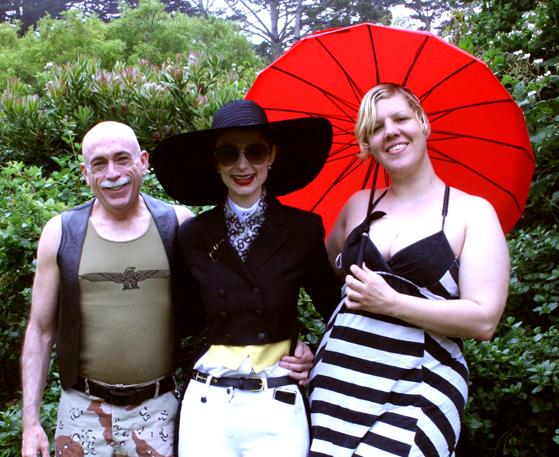
Carina — one-time president of SF girls of Leather and correspondent for Leatherati, among about a thousand other roles she plays in the kink community — was sporting a floor-length red-and-black number by Lust Designs. Lust is a San Francisco company run by local kinksters Penny and Blaine McClish that does ready-to-wear and custom design pieces, which are apparently surprisingly wearable (except for the hobbling effect, but that has more to do with it being a bondage garment.) Says Carina: 

Wearing latex is, for me, a fetish in and of itself. It feels nothing like more common fabrics, but rather like a sensation-enhancing apparatus that completely encases my entire body. For optimal presentation, it requires that I am rubbed down multiple times a day with silicone lube. This enhances not only the shine, but also the color. When people come into contact with the dress, it amplifies their touch for my skin. This particular dress also included an element of bondage, as I was only able to wiggle forward, taking very small steps throughout the entire afternoon.

Highlights of wearing it among so many people (beyond the staggering amount of flattering comments) include the variety of questions I was asked. Contrary to what many think, I was actually quite comfortable in the sun. The parasol helped for sure, but I also find latex to be a lot less hot than leather, for instance. Every time a breeze went by my entire body was chilled. 

Did she mention she was being pulled along the route by human ponies? She was. Check out Carina’s back story in last week’s Guardian interview with her and co-marshal and leather community lynchpin Race Bannon. And if you just can’t get enough latex fashion, you could do a lot worse than check out Kelly Lovemonster’s talk with Mr. S’s Seven Mitchell, also from last week.  

After the raid

1

caitlin@sfbg.com

HERBWISE It is exceedingly difficult to get Oaksterdam University founder Richard Lee to talk about himself. I have him — the person who drove the Proposition 19 legalization campaign, whose house and cannabis trade school were raided by federal agents in April, who through his businesses’ success has helped revitalize and make safe a previously gloomy stretch of downtown Oakland — on the phone to talk about the lifetime achievement award he will be receiving from High Times at this week’s Cannabis Cup (Sat/23-Sun/24).

I want him to share his emotional journey since government agents poured into his home, what’s it’s like to be the public face of the flashpoint between California and national government over marijuana. High Times editorial director Malcolm MacKinnon calls Lee a “fearless trailblazer,” perhaps he’d like to make grand predictions about the future of pot? At least describe exactly what’s happening with Oaksterdam, post-raid. But Lee prefers to stress the latest poll numbers on legalization.

“All the national polls and the Colorado polls are going our way,” he says. “If you could get the word out about that, that’d be great.” FYI, on June 6 Rasmussen Reports found that 61 percent of Coloradoans support regulating cannabis like alcohol and cigarettes.

Lee has retired from university administration — he’s referred to as a professor emeritus, although he is still teaching classes in cannabis policy, history, and advocacy. In his “big Converse All-Stars” (as she calls them) now stands Dale Sky Jones. She once developed Oaksterdam’s curriculum and now joins a short list of female leaders in the marijuana industry as the university’s president.

“When the federal government came in, they took the curriculum, the computers — everything else that was the blood and breathe, heart and soul of the school short of the tables and chairs and teachers,” Jones says in a phone interview. Under her watch, the finances of “top-heavy” Oaksterdam’s gift shop, dispensary, and university have split and are now under separate ownership. Staff is attempting to rebuild curriculum from email records. 45 employees have lost their job because of the disruption in business affairs. “This was a violation on so many levels for the staff of Oaksterdam,” Jones says, sadly.

But life goes on. Lee says his “students are great, they have lots of energy and enthusiasm.” And the cultural contributions that the school and its founder have hardly been negated by federal intervention. “[Lee] brought the debate about marijuana policy reform to the kitchen table,” says Jones. “Before Prop. 19, the only time parents and kids had conversations around marijuana it was ‘where the hell did you find it? who are your jackass friends?’ It was always a negative discussion. This was the first time that families were able to discuss marijuana as a policy issue.”

This weekend’s Cannabis Cup will bring the pot world’s focus back here, as some of NorCal’s [author’s note: and hence, the world’s] best strains compete for the title of best indica, sativa, edibles, etc. Lee’s lifetime achievement award (presented at 7pm on Sun/24) will just confirm what we all already knew: even when it comes to activists, we grow things better out here.

HIGH TIMES CANNABIS CUP

Sat/23 noon-10pm, Sun/24 noon-9:30pm; one-day pass $40, two-day pass $65 advance, $80 at door

Craneway Pavilion

1414 Harbour Way, Richmond

www.medcancup.com

Pride leather marshalls hail a “kinky renaissance”

2

It was almost Pride Week, I’ve had two leather luminaries hanging out at kink coffeeshop Wicked Grounds – it just seemed like an opportune time to start waxing philosophical about the possibility of a kink renaissance in San Francisco. 

“There just seems to be this general coming-out,” said Leland Carina, who as a member of the SF girls of Leather has done her part to increase the inclusiveness and malleability of her kink community. She likened this expansion to the capital-R Renaissance, which happened after the threat of bubonic plague had been mitigated. Likewise, she said, the kink community in San Francisco is finally hitting a point where the fear of AIDS no longer rules people’s sexual encounters. 

Race Bannon, Carina’s co-leather marshall in this Sunday’s Pride parade, hadn’t thought of it that way – but Carina’s theory resonated with him. “We’ve figured out how to deal with [AIDS], and we’ve moved past it. I call what’s happening a kinky renaissance.”

The two of them should know. Bannon and Carina are connectors in the leather community. In our chat at Wicked Grounds, the two surmise that they were chosen to be Pride’s leather marshalls based on their approachability and connection with their playmates and community members. They are both very good at creating community on the Internet through social media — but are both rather accomplished perverts off the web as well. 

Brief descriptions, for those of us that thrive on bullet points:

Leland Carina

  • Founding member of SF girls of Leather
  • Now retired from SF girls, but works to promote and brand the movement in other cities. To date, there are girls chapters in Arizona (the original group, SF was the second), Seattle, Dallas, Houston, Austin, Tulsa, New York, among other regional chapters
  • Until recently, Carina was a graphic designer at Kink
  • Correspondent for leather news blog Leatherati
  • Leader in the SF Bay Leather Alliance

Race Bannon

They are the Miss Universes of the leather community, if that’s not too distasteful to say. “It’s mainly a wave and smile sort of thing,” says Carina – who will be wearing a red latex dress for her pageant moment made by an ex “roller derby sister” who runs Lust Designs. But be that as it may, Bannon and Carina are determined to make what they can of it. The two have pledged to do what they can to raise attendance numbers in their contingent so that the Pride hoards can see for themselves the growing scope of the leather community. They’ll be towed in the parade by human ponies, expertly trained by human pony mistress Liliane Hunt. 

In the spirit of a true pageant host (I was channeling Sinbad in 2000, which I chose because Montell Jordan was the musical guest that year. My second pick would have been Jerry Springer in 2008 because Lady Gaga was his musical guest. You really need to read this list), I end our meeting with a truly corny question. What is the biggest challenge facing the leather community today?

“Right now we have a very kumbaya status,” Bannon smiles, as Carina grimaces a little from across the table (surely, a girl of Leather has a bit different view on schisms in the community than an established older gentleman). Bannon also said that finding space for playtime is always a challenge in a city as dense and expensive as San Francisco. 

For Carina, the challenges have more to do with the forces outside the community. In an era when Rihanna boldly displays her kink proclivities in her music videos on MTV and 50 Shades of Grey is thrilling the harnesses onto Middle America, she says, “I’m interested in how that’s going to affect the community. After queerness becomes accepted, BDSM and polyamory becomes the next big thing.”

Pride parade 

Sun/24 10:30am, free

Begins at Market and Beale, ends at Market and 8th St., SF

www.sfpride.org

The perfect pre-Pride toast: Bayview vino at El Rio

3

It’s best (they say) to treat Pride as the proverbial marathon in place of sprint — despite the fact that there is about one thousand openings-parties-dog walks happening this year that you’ll no doubt be careening between. May we recommend a darling divey wine happy hour as your own personal kick-off for this year of queer festivities? El Rio‘s semi-weekly Mugsy Wine Bar on Fri/15 would fit the bill nicely — and will give you the chance to try local pours made by local queers, people of color, and families that will be perfect for your larder as you traipse ever-closer to Gay Christmas.

“El Rio is a lot more gay-friendly than cabernet-friendly,” Granate Sosnoff, Mugsy’s organizer, told me over the phone yesterday. Sosnoff, whose girlfriend works behind the bar at the Outer Mission dive, was sick of El Rio’s wine selection being somewhat of an afterthought (let’s be real, order the margarita.) But the space had potential — you’d be hard-pressed to find a better spot for a casual glass. Picture the scene: El Rio’s standard Friday afternoon batch of free oysters (deployed on the tranquil patio at 5:30pm, swoop them while they last), La Piada Randagia serving Italian piadina, or flatbread sandwiches, and of course, the well-curated wines. 

This Friday, Mugsy will feature pours from Gratta Wines, Barbara Gratta’s mini-winery that the queer vintner started in her Bayview basement. Gratta’s 2010 Dry Creek cabernet — of which only a barrel was made — will be on offer, as will the entrepreneur herself, for queries and comments on the fruits of her fermentation.  

Looking for something from farther afield? Mugsy will also be offering a pinot noir from Stomping Girl Wines, a multi-generational endeavor out of Russian River and Sonoma that first started pressing in a Berkeley basement. Not to mention wine from African American family-owned Brown Estate

“High and low is the best, right?” said Sosnoff. “Especially in these troubling times.” D’accord. Cheers! 

Mugsy Wine Bar pop-up happy hour

Fri/15 5-8pm, $5-$10 per glass of wine

El Rio

3158 Mission, SF

(415) 282-3325

mugsywinebar.tumblr.com

www.elriosf.com

Sure cure for election burnout? Watch this video of activist kids summer camp

12

So what if the most popular adjective to describe this week’s election was “adorable”? By all accounts, we have a generation on the up with the vigor and verve to right all the atrocities ours has committed in regards to social justice, sustainable food systems, fossil fuel dependence, etc. At least, such is the impression given by the promo video sent to us by Youth Empowered Action Camps, a project started by activist Nora Kramer in the hopes of providing a safe, fun place for kids to find their cause. Wanna see hope, encapsulated? Keep going for the video and more info on raddest summer camp ever.

Last year, we interviewed Kramer about her motivation for starting the YEA camps, which will take place this summer in Portland, Northern California and — new for 2012! — New Jersey. Said Kramer:

Sometimes kids who care or speak up about environmental or other issues are made fun of or criticized and get discouraged. I feel like our world is facing so many challenges, and we need to bring youth together with like-minded peers and adults to support them in taking action so they can bring about the world they want to see. If there can be successful summer camps for kids who like volleyball or theater or play the violin, why not for youth who want to make the world a better place?

YEA kids get to hang out with other conscientious young ones (ages 12 to 17), snack on delicious vegan foods, and develop action plans to take into the school year. What kind of action plans, you ask? Past campers have created anti-bullying and recycling programs in their schools, held birthday fundraisers for Planned Parenthood — even started a bakery that sells animal product-free wedding cakes

Scholarships are available for low-income youth. Spaces are still open for summer 2012, so grab the nearest rad teenager and sign them up.

Youth Empowered Action Camp (Northern California)

July 21-28, $950

Venture Retreat Center

Pescadero, Calif.

www.yeacamp.org

Lusty for the Ladies? Worker-owned strip club still open, but needs your help

18

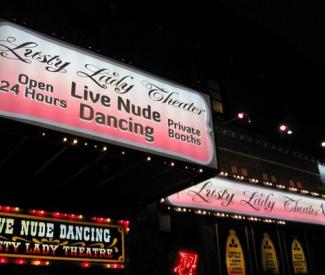
I have to apologize for not frothing up the waters with my own account of everyone’s favorite (and only) worker-owned strip club the Lusty Lady being in peril of having to shut its doors. I was gallivanting about on a world tour — find my list of illegal places in Berlin to trespass on here — and re-emerged on this side of the bridge to hysterical accounts that the classic, unionized titty joint was going under.

It’s no secret that the Guardian has a tawdry, longstanding affair with the Lusty — so I made a quick call to long-time Lusty Lorelei. Upshot: the club is kind-of safe for the moment, but it’s ready to grind it out for your singles.

“We would like to keep going, we would like to improve the business,” Lorelei told me. “We are looking for investors, but if that doesn’t work we’ll have to look for buyers.” Anyone willing to support their local, female-empowering, size-positive, all-inclusive adult club?

Here’s what happened: the Lusty has been struggling with finances for awhile. “It’s been funky and we just weren’t doing that great,” said Lorelei. The club has struggled, she continued, with perceptions that the private peep show booths were unclean, staff was unfriendly, and that dancers just weren’t working it out enough. “You can’t just go up there in your Payless heels and no makeup. Customers would come in and it would be like, sad trombone.” 

So when a company called Millenium Group offered $25,000 for the beleagured club, some staffers thought their ship had come in. Not Lorelei. “$25,000? That’s insulting. Really? We could come up with that!”

Nonetheless, a hasty employee vote was convened over email one weekend, side-stepping (Lorelei says) the informal co-op protocol that such matters necessitate a couple weeks for employee-owners to think them over. The Lusties decided against selling, and in the decisive moment many of the staff members who had been in favor of the sale split. 

Previous press accounts that reported that the employee-owners would be held financially liable if the club went bankrupt are erroneous, says Lorelei, who actually sees this moment of high drama as an opportunity. The mediocre service and hygiene reflected a complacency that a passel of new hires, she hopes the club has left behind. “The girls are hot, the theater is clean,” she laughs. 

The club is looking into starting up webcam shows, and has already started offering lapdances at specified times. Some of the dancers have started up a radio show Wednesdays from 9pm to midnight on 107.7 The Bone called Ask a Hot Chick, a great customer interaction tactic. Check out the Lusty Lady’s Indie Go Go page (side note: Kickstarter is not down with “adult” causes) to donate towards the club’s continued existence — the campaign will be active for the next day or so.

Or here’s a better plan: head down to the club this weekend for the club’s brand-new lapdance parties. You know the drill — see you a sex-positive, well-proportioned hottie and let her take you for a spin in a booth. 

Lusty Lady lapdance parties

Fridays and Saturdays, 9pm-2am

The Lusty Lady

1033 Kearny, SF

(415) 391-3991

www.lustyladysf.com


Free Berlin: 3 city summer destinations for when you’re broke and German

0

It was 2pm by the time I stumbled out of Berghain and rode my bike home along the Spree-side still-standing section of the Berlin Wall, veering between the tourists snapping away at its murals. Hopefully they got a good shot of the bleary-eyed girl in the see-through dress. (Tag me!) Luckily, once you’ve steered clear of the hordes there is plenty of fun to be had in Berlin that had nothing to do with techno church and tawdry dark rooms. Here’s four of my favorite free spots in the city to check out when the clubs close, from naked lakes to repurposed airport tarmacs and abandoned Ferris wheels.

TARMAC TIME

Close by Berlin’s Schöneberg neighborhood (where one can stride amidst blocks of leather stores and spendy gay bars — it’s the Castro’s sister swisher), a venerable European airport wades into a new era. Tempelhof Airport is one forboding arc of concrete, so feel free to lose yourself in its defunct fascist embrace and bizarro history. But then turn around, because the tarmac now serves as park land. It’s vast grassy fields are perfect for getting lost, its runways are currently being used by bicyclists and breakneck windsurfers, and over a dozen public art projects are being developed in various corners. These include an incredible DIY community garden where one can sit placidly atop a hammered-together lifeguard’s chair, surrounded by sprouting greens. The sun can get a little intense at times, but to the side under a few leafy trees stands a perfectly German beer garden where you can take a load off. 

NAKED LAKES

“This is where all the Grimm Brothers fairytales took place.” Quite an introduction to the forest that will soon see your naked ass — it’s lake time! Lake Teufelsee, that is, which you can easily reach with a nice walk from the metro stop. Teufelsee is one of the shady dells in which Berliners take advantage of Freikörperkultur, or the area’s longstanding tradition of free body culture. On our recent visit to Teufelsee, we posted up next to a multi-generational family of nakeds — grandpa, kids, parents, tossing a ball around and generally feeling good about not having tanlines. No one wears clothes. Bonus: looming over the Grunewald Forest surrounding the lake are the Epcot Center-like remains of an abandoned Soviet spy tower. Follow your nose up the hill to them for good old-fashioned Berlin pastime of exploring falling-down beautiful structures. 

CRIME SPREE

… Speaking of, how about an abandoned amusement park? Amid whirling rumors of cocaine trafficking and out-of-control debt, Spreepark closed in 2001, leaving such tantalizing treasurs as a brackish moat-encircled Ferris wheel, Viking ships, and tunnels shaped like roaring rainbow lion’s mouths. It is easy as pie to hop over the fence (walk to Spreepark from the Treptower Park metro stop), and when we visited any fears of being apprehended by the guard that is supposed to be patrolling the area were quickly alleviated by the shrieking Germans attempting to sway the rickety Ferris wheel. If beheaded dinosaur statues and belligerant graffiti (“Who cares? Be poor”) is your thing, you need to come check out this ruin-kitsch wonder. Americans recently bought the property to start up a multidisciplinary community art project — so go quickly while it’s still deviant. If you’re on your way out there, you might want to swing by the revisionist history explosion that is the stately Soviet War Memorial. A 39-foot tall statue of a blonde Soviet soldier cradling a lost German child and crushing a swatiska beneath his feet presides over the complex. 

Welcome back to SF President Obama! Now, say Supevisors, give us our marijuana

4

Not that it’s ever a good idea, but avoid driving downtown today like the plague — President Obama’s in town! And, (as reported by SFGate), SF supervisors want him to take a stance on pot. Sup. Christina Olague has penned a letter co-signed by Sups. David Campos, and Scott Weiner that is a solid finger-wag at the current federal administrations actions against the medical marijuana industry. Here’s the meat of it:


We believe strongly in addressing medical cannabis as a public health issue, and we will strive to fully implement state law by protecting not only our patients, but our property owners and dispensary operators as well. We want to work with President Obama on a public health solution for medical cannabis at the federal level, once he wins a second term. In the meantime, the Department of Justice must respect our laws and honor the President’s commitment on this issue. Honoring this commitment can start by taking no further action against the nine landlords of City-permitted facilities here in San Francisco.


Those “nine landlords” refer to the property owners of the five SF cannabis dispensaries that have already closed, and the additional four that are set to close this month. The federal government has sent threatening letters to dispensary landlords that posit extensive jail time and civil forfeiture for those landlords that continue to allow federally-illegal drug trafficking on their property. 

Kudos to the new Sup. Olague for taking a stand. Of course, the letter’s premise is that the Sups. are staunch supporters of Obama’s re-election, they’re just asking him to improve on this particular issue. It begs the question: why would he make capitulations to win support that is already in pocket?

Tickets are sold out for his lunch at the Julia Morgan Ballroom (465 California, between Montgomery and Sansome Streets), although his campaign website encourages you to get on the waiting list — be careful, general admission tickets start at $5,000. The President’s only other scheduled stop, says SFGate, is at a “small roundtable” at One Market Plaza. 

Afterwards, the President will head south to Los Angeles to attend the annual fundraising gala for the LGBT Leadership Council, where he will no doubt be greeted affectionately for his “I support gay marriage”isms of last month. 

In the air

3

caitlin@sfbg.com

HERBWISE It’s Sunday afternoon and the hosts of Mutiny Radio’s Cannabis Cuts: The Next Generation have effectively commandeered the smoking lounge at SoMa’s Igzactly 420. They are deep into solving the world’s problems.

The crusade may just involve a pictorial calendar featuring sexy men smoking marijuana — a project which hosts Vaperonica Dee and Merry Toppins staunchly resist any attempts to qualify as frivolous. It’s about achieving parity in cannabis imagery, they say — much like their weekly podcast of marijuana news, product reviews, music, and banter.

“If you look at all the ads [for cannabis businesses and products], it’s sexy nurses or girls holding cannabis leaves over their tits,” Dee says between Volcano puffs. The young radio vet didn’t find that image particularly representative of her experience with the medicine (both she and Toppins are medical marijuana patients), so she jumped at the chance to work with DJ Wiid on his marijuana variety show at Pirate Cat Radio.

Merry Toppins and Vaperonica Dee plot their takeover of cannabis media (that’s not their car.) Guardian photo by Caitlin Donohue

Dee stuck with the project through Pirate Cat’s transformation into Mutiny Radio, the shuttering of its cafe and demise of its infamous maple bacon lattes — “I was excited!” she says. “I wanted to be in radio, I didn’t give a shit about the cafe” — and the exodus of her male co-host.

And when DJ Wiid moved onto new projects, it left the door open for an idea that seems nearly revolutionary in an industry filled with men: a platform for women’s perspectives on the cannabis movement.

Toppins was a natural choice as on-air co-host for Dee. The two had met when chef Toppins appeared on Cuts to hype her marijuana-infused olive oil that she had entered into the High Times Cannabis Cup. Toppins’ ebullience is the perfect compliment to Dee’s well-informed on-air tone. They both have natural radio voices, impeccable banter rhythm. “It was so cool to see a chick doing the news on a weed show,” says Toppins of their initial meeting. “I knew right away I’d either be their intern or host my own radio show.”

Listeners are responding. Toppins volunteers the following stats: 5,000 Cannabis Cuts podcast downloads each week, each one yielding an average of an hour spent with the two-hour long show. And though the women express views that aren’t always in lockstep with the cannabis establishment (a February 14 edition of the show highlighted a disempowering experience with Americans for Safe Access activists at a City Hall hearing and the two are candid about the fact that not all their tokes are strictly medicinal), many of the community’s luminaries have lent their support. They count Proposition 215 co-author Dennis Peron and Cannabis Action Network co-founder Debby Goldsberry as personal friends, and have interviewed Peron on the show.

The enthusiasm that has come their way makes sense — the continued strength of activists to improve cannabis access depends on developing and raising awareness about diverse viewpoints within the movement.

“We’re changing the idea that there could be a profile of a standard cannabis activist,” says Dee, who wants the world to know that it’s not just the grey-ponytailed Deadheads who care about access to pot. “Plus, radio doesn’t have that many women involved in it, cannabis doesn’t have that many women involved in it — the two go together.” 

Cannabis Cuts: The Next Generation Live podcast every Tuesday, 4pm-6pm. www.mutinyradio.org. Also available on www.stitcher.com and www.medicinalmarijuananetwork.org


Save Adobe Books?

2

Adobe Books owner Andrew McKinley didn’t have to think long when I asked him the corniest question of our interview, occasioned by the announcement that his store was in serious danger of having to close. Question: if you had to choose one book to describe your situation, what would it be? “It reminds me of The Last Picture Show by Larry McMurty,” McKinley gamely responded. “It’s about a movie theater in a small Texas town that’s dying out.”

But! ask Mission District bibliophiles. Can Adobe Books be saved? The answer, according to McKinley, lies in whether you have a buddy with $60,000 to save the future of SF books — or better yet, $3 million.

McKinley has owned the store for the past 24 years, originally with a business partner. “I always dreamed of having a store filled with artists, poets, and writers,” he told me. “Meeting people who want to be artists has been the best part.” For decades, that’s what he did — he even opened a gallery space in the back that hosted near-monthly art openings. But times, they are a’changin’ — and rising real estate costs in the area have made it impossible for the bookstore to continue to exist in its prime location astride Valencia and 16th Streets. Granted, this isn’t the first time the alarm has been sounded, but McKinley forsees having to close his doors for good at some point over the next few months. 

Unless… and on this point he’s almost reluctant to give us hope. Unless some “angel” descends from heaven (or the hills south of Dolores Park perhaps) to pluck Adobe from its doom. With $60,000, McKinley reckons he could keep the shop open for three more years — that amount is approximately a year’s rent on the space. With $3 million, said “golden angel” could buy the building and ensure that the inner Mission continues to have a place to buy dog-eared paperbacks and browse well-curated banks of sweet, sweet literature. 

But. “I don’t want to be a charity,” says McKinley. “I feel that closure might be the best solution if no one can step into save it.” The bookshopkeep allows that he hasn’t exactly bent over backwards to adjust our times of Amazon.com and 140-character attention spans. He could have added a cafe to augment the business, he posits. Maybe started selling new and remaindered volumes. 

But. There it is, he didn’t, and now we’re faced with losing yet another Mission bookstore to the march of time. (Granted, it’s not all bad news for bookworms — Modern Times Bookstore Collective was able to relocate to a gorgeous new location on 24th Street and the Dog-Eared Books family recently had a new baby not too far away in the form of Phoenix Books.) 

Unless. McKinley says the notion of re-starting Adobe as a member-based collective has been thrown around by some of the shop’s super fans. But that could be just the well-wishing of the community members he’s held so dear over the years. 

Just remember. “The knowledge in books is not as important to get by in this modern world,” says McKinley. “People don’t put together large collections of books as much. It is funny, more books have been created in the last few decades and more people can read than ever before.” We read you, sir.

P.S., massive sale going on right now at Adobe Books. 

Adobe Books

3166 16th St., SF

(415) 864-3936

adobebooksbackroomgallery.blogspot.com

Oaxacan surrealism hits the SF Mexican consulate

2

Approximately 500 people pass through SoMa’s Mexican consulate building each day, processing visas and civil registration, generally making it possible for themselves to live in the United States legally. The consulate’s cultural affairs attache Marimar Suárez Peñalva sees these moments of bureaucracy as an opportunity. She wants expats to connect to their nationality not only through signatures and stamps, but by reacquainting themselves with its brushstrokes and creative underpinnings.

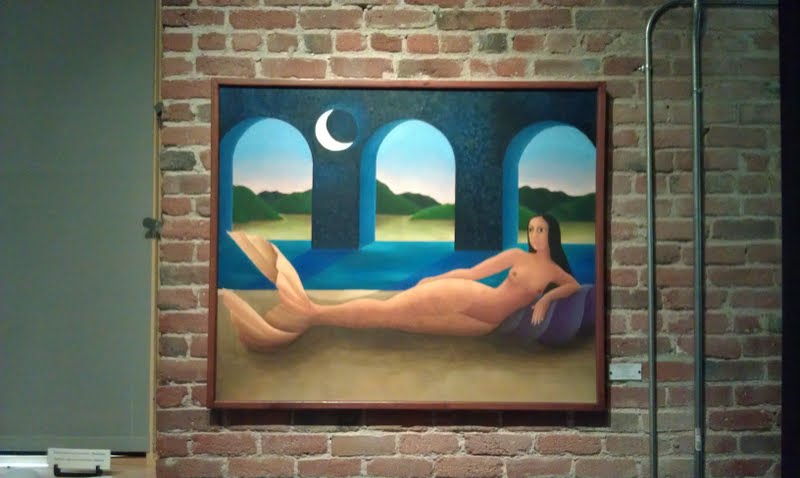
Hence, this art lesson. “The Zapotec origin is really relevant in surrealism,” Peñalva tells me on the Friday afternoon that I visit her carefully-curated gallery, located on the second floor of the Folsom Street consulate.We’re surrounded by canvases of floating watermelon, a reclining woman with a fish tail, vividly colored fish, and a bright red woman’s skirt. Peñalva explains that the current exhibit is based around two seminal artists from the Mexican state of Oaxaca: Rufino Tamayo and Francisco Toledo.

Francisco Toledo’s aquatint etching “Self Portrait” 

The two pioneered the art of mixography, a style of painting that uses molded paper and mixed media to create a textural appearance. Peñalva points to the artists’ ceremonial use of animals as one sign of their pre-Colombian heritage. The Zapotec identity, she says, is one of the unifiers of the exhibit, which contains the works of not only Tamayo and Toledo but also artists who were inspired by their work like Justina Fuentes Zárate, she of the reclining mermaid and arresting red dress. Perhaps the works don’t look similar, but they represent the diversity and breadth of the work to come out of the surrealist Zapotec tradition in Oaxaca.
Last year Peñalva filled this space with the work of contemporary Latina artists. Though “Numina Feminina” was critically acclaimed — a gallery patron who perused while we chatted interrupted us to tell Peñalva how compelling he’d found the show — she says that the Oaxacan surrealism exhibit has done a better job of enthralling the Mexicans who come to process paperwork one floor down. Since the show’s opening on Thursday, she says there’s been a constant stream of visitors coming upstairs to check out the gallery.

“Birth of Spring” by Jorge Lopez Garan

Maybe this work is more immediately identifiable as Mexican than that of the modern female show. But whatever the reason, she’s glad that it resonates. That’s the reason why the gallery is up here, after all.

“We want to make art available and show people what’s happening in Mexico. Art people, they always come to shows like this, but our daily public is harder to get upstairs.” The surrealist works were donated by Bay Area collecters Gina Bray and Russell Herrman.

Do you feel the magic? The consulate is screening El Informe Toledo July 26, a documentary made by Diego Luna and Gael Garcia Bernal’s production companay based on the life of the mixography master. 

 “The Magic Surrealists of Oaxaca”

Through Aug. 9, free

Gallery open Mon.-Fri. 10am-6pm; Sat.-Sun., 10am-3pm


El Informe Toledo screening 

July 26 6pm-8pm, free

Consulate General of Mexico

532 Folsom, SF

www.mexicoinsf.com

Wall down, joints up

0

The tallest structure in Germany is a sky needle with a majestic ball sitting well up its length. Due to some vagaries of the physics of light and the shiny, Epcot-like nature of this ball, Berlin's Fernsehturm (a.k.a., television tower) casts the shadow of a cross over the city, much to the consternation of its East German builders.

One wonders what they would think of the head shop nestled into the base of their show of socialist triumph. For the past 11 years Udopea has been here, currently occupying a space next to a bike rental shop and mere feet from a line where a million visitors cue every year to ascend into the Fernsehturm's observation decks and fancy restaurant.

But maybe this isn't such a weird thing. A cursory look at Udopea's window offerings reveal the standard wacky tourist fare: rainbow hair dyes, black-light bongs, bongs spotted with hippie daisies. I was in the market for cotton candy hair, so we stopped in — only to see my beloved California-made Magic Flight vaporizer (see Herbwise, "Hippies do it better," 2/8/12) vaporizer. It appears Udopea actually knows its cannabis.

Berlin is not the least tolerant place for marijuana in Europe. Head over to Görlitzer Park in the trendy Kreuzberg neighborhood and you can score baggies of dry cannabis in a flash. Marijuana is openly smoked in many of the town's world-famous, dirty-as-hell techno churches. But it's no cannabis culture capital. After all, this is a place where entering "marijuana" as a search term on the website of Berlin's reigning English-language culture magazine turns up only one result: an interview with Evidence, of LA underground hip-hoppers Dilated People. (He's making a pun off of "bagpipes.")
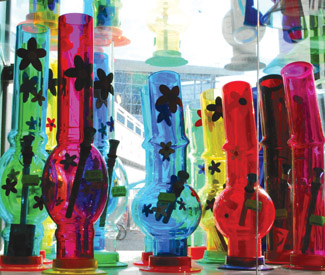
So those looking for a conversation about weed that goes deeper than "you want" and "how much" should drop through Udopea. In addition to klassy US products, you can find Germany's finest glass company Roor (www.roor.de). Glassblower Martin Birzle's brand inspires fierce adherents — you should have heard the Udopea sales assistant's roar of disbelief when I told him I was unfamiliar with the product. (Nationalists.)

Plus, stuff for growing so that you don't have to keep heading out to Görlitzer. The quantity of lights, fertilizers, and various other accoutrements that Udopea deals will actually sound the death knell for their most idiosyncratic of its five Germany-wide locations. More space is needed to properly stock the grow section, so the Berlin store is moving to a more spacious location in another neighborhood. Later, tourists.

Sweden’s best banger: Zhala is “Slippin’ Around”

0

So I walked into this Swedish party with cotton snowdrifts and round, mosquito-netted white beds with some pink lipstick… it’s a long story, but the scenario (the monthly Donna Scam party, it’s a something) was partly the brainchild of Zhala, Sweden’s reigning single-maker. The club promoter-singer’s single, you ask? Here it is — with visuals to make you squirm courtesy of director Makode Linde, baker of the “racist cake,” as his recent piece of performance art will now go down in Interpop history. Thanks Sweden! Check out more of my Scandinavian finds here