War

Stage listings

0

Stage listings are compiled by Guardian staff. Performance times may change; call venues to confirm. Reviewers are Robert Avila, Rita Felciano, and Nicole Gluckstern. Submit items for the listings at listings@sfbg.com.

THEATER

OPENING

Acid Test: The Many Incarnations of Ram Dass Marsh San Francisco, 1062 Valencia, SF; www.themarsh.org. $15-50. Opens Fri/12, 8pm. Runs Fri, 8pm; Sat, 5pm (May 11, show at 8pm). Through May 18. Lynne Kaufman’s play (starring Warren Keith David as the spiritual seeker) moves from Berkeley to San Francisco.

Boomeraging: From LSD to OMG Marsh San Francisco, 1062 Valencia, SF; www.themarsh.org. $15-50. Opens Tue/16, 8pm. Runs Tue, 8pm. Through May 28. Comedian Will Durst performs his brand-new solo show.

The Expulsion of Malcolm X Southside Theatre, Fort Mason Center, Marina at Laguna, SF; www.fortmason.org. $30-42.50. Opens Fri/12, 8pm. Runs Fri-Sat, 8pm; Sun, 3pm. Through May 5. Colors of Vision Entertainment and GO Productions present Larry Americ Allen’s drama about the relationship between Malcolm X and Elijah Muhammad.

Ghostbusters: Live On Stage Dark Room Theater, 2263 Mission, SF; www.darkroomsf.com. $20. Opens Thu/11, 8pm. Runs Thu-Sat, 8pm. Through April 27. Rhiannastan Productions brings the beloved 1984 comedy to the stage.

How To Make Your Bitterness Work For You Stage Werx Theatre, 446 Valencia, SF; www.bitternesstobetterness.com. $15-25. Opens Sun/14, 2pm. Runs Sun, 2pm. Through May 5. Fred Raker performs his comedy about the self-help industry.

I’m Not OK, Cupid 🙁 Shelton Theatre, 533 Sutter, SF; www.leftcoasttheatreco.org. $15-35. Opens Thu/12, 8pm. Runs Thu-Sat, 8pm. Through May 4. Left Coast Theatre Co. presents a new collection of one-act, LGBT-themed comedies about dating and relationships.

The Lost Folio: Shakespeare’s Musicals Un-Scripted Theater, 533 Sutter, Second Flr, SF; www.un-scripted.com. $10-20. Previews Thu/11, 8pm. Opens Fri/12, 8pm. Runs Thu-Sat, 8pm. Through May 18. Un-Scripted Theater Company performs a fully-improvised, full-length musical inspired by Shakespeare.

Sheherezade 13 Exit Theatre, 156 Eddy, SF; www.wilywestproductions.com. $25. Opens Fri/12, 8pm. Runs Thu-Sat, 8pm. Through April 27. Wily West Productions presents a short play showcase.

Stuck Elevator American Conservatory Theater, 415 Geary, SF; www.act-sf.org. $20-85. Previews Wed/10-Sat/13, 8pm; Sun/14, 2 and 7pm. Opens Tue/16, 8pm. Runs Tue-Sat, 8pm (also Wed and Sat, 2pm); Sun, 2 and 7pm (no evening performances April 21 or 28). Through April 28. American Conservatory Theater presents the world premiere of Byron Au Yong and Aaron Jafferis’ musical (sung in English with Chinese supertitles) about a Chinese immigrant trapped in a Bronx elevator for 81 hours.

BAY AREA

A Killer Story Marsh Berkeley, 2120 Allston, Berk; www.themarsh.org. $20-50. Opens Fri/12, 8pm. Runs Thu-Sat, 8pm (pre-show cabaret at 7:15pm). Through May 18. Dan Harder’s film noir-inspired detective tale premieres at the Marsh Berkeley.

Pericles, Prince of Tyre Berkeley Repertory Theatre, 2025 Addison, Berk; www.berkeleyrep.org. $29-77. Previews Fri/12-Sat/13 and Tue/16, 8pm; Sun/14, 7pm. Opens April 17, 8pm. Runs Tue, Thu-Sat, 8pm (also Sat and April 25 and May 23, 2pm; no matinee April 27; no show May 24); Wed and Sun, 7pm (also Sun, 2). Through May 26. Mark Wing-Davey directs Berkeley Rep’s take on the Bard.

ONGOING

The Bereaved Thick House, 1695 18th St, SF; www.crowdedfire.org. $10-35. Wed-Sat, 8pm. Through April 27. Crowded Fire Theater launches its Mainstage season with Thomas Bradshaw’s wicked comedy about "sex, drugs, and the American dream."

The Bus New Conservatory Theatre Center, 25 Van Ness, SF; www.nctcsf.org. $32-45. Wed-Sat, 8pm; Sun, 2pm. Through April 28. NCTC performs James Lantz’s tale of two young men whose meeting place for their secret relationship is a church bus.

Carnival! Eureka Theatre, 215 Jackson, SF; www.42ndstreetmoon.org. $25-75. Wed, 7pm; Thu-Fri, 8pm; Sat, 6pm (also Sat/13, 1pm); Sun, 3pm. Through April 21. 42nd Street Moon performs the Tony Award-winning musical.

Eurydice Gough Street Playhouse, 1622 Gough, SF; www.custommade.org. $25-30. Thu/11-Sat/13, 8pm; Sun/14, 7pm. Custom Made Theatre Co. performs Sarah Ruhl’s inventive take on the Orpheus and Eurydice myth, exploring the story through the heroine’s eyes.

Foodies! The Musical Shelton Theater, 533 Sutter, SF; www.foodiesthemusical.com. $30-34. Fri-Sat, 8pm. Open-ended. AWAT Productions presents Morris Bobrow’s musical comedy revue all about food.

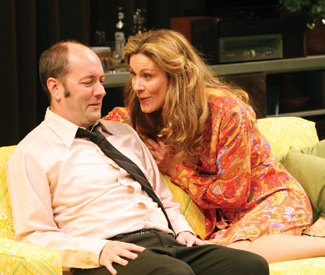
The Happy Ones Magic Theatre, Fort Mason Center, Bldg D, Third Flr, SF; www.magictheatre.org. $22-62. Wed-Sat, 8pm (also Sat, 2:30pm; no matinee April 20); Sun, 2:30pm; Tue, 7pm. Through April 21. An Orange County appliance store owner finds his life turned upside down in Julie Marie Myatt’s drama at Magic Theatre.

reasons to be pretty San Francisco Playhouse, 450 Post, Second Flr, SF; www.sfplayhouse.org. $30-100. Tue-Thu, 7pm; Fri-Sat, 8pm (also Sat, 3pm). Through May 11. San Francisco Playhouse’s tenth season continues with Neil LaBute’s romantic drama.

Sex and the City: LIVE! Rebel, 1760 Market, SF; trannyshack.com/sexandthecity. $25. Wed, 7 and 9pm. Open-ended. It seems a no-brainer. Not just the HBO series itself — that’s definitely missing some gray matter — but putting it onstage as a drag show. Mais naturellement! Why was Sex and the City not conceived of as a drag show in the first place? Making the sordid not exactly palatable but somehow, I don’t know, friendlier (and the canned a little cannier), Velvet Rage Productions mounts two verbatim episodes from the widely adored cable show, with Trannyshack’s Heklina in a smashing portrayal of SJP’s Carrie; D’Arcy Drollinger stealing much of the show as ever-randy Samantha (already more or less a gay man trapped in a woman’s body); Lady Bear as an endearingly out-to-lunch Miranda; and ever assured, quick-witted Trixxie Carr as pent-up Charlotte. There’s also a solid and enjoyable supporting cast courtesy of Cookie Dough, Jordan Wheeler, and Leigh Crow (as Mr. Big). That’s some heavyweight talent trodding the straining boards of bar Rebel’s tiny stage. The show’s still two-dimensional, even in 3D, but noticeably bigger than your 50" plasma flat panel. (Avila)

Show Me Yours: Songs of Innocence and Experience Alcove Theater, 414 Mason, Ste 502, SF; www.thealcovetheater.com. $27. Thu-Sat, 8pm; Sun, 5pm. Through April 27. New Musical Theater of San Francisco performs a new musical revue written by Pen and Piano, the company’s resident group of writers and composers.

Steve Seabrook: Better Than You Marsh San Francisco, 1062 Valencia, SF; www.themarsh.org. $15-50. Thu, 8pm; Sat, 8:30pm. Extended through May 18. Self-awareness, self-actualization, self-aggrandizement — for these things we turn to the professionals: the self-empowerment coaches, the self-help authors and motivational speakers. What’s the good of having a "self" unless someone shows you how to use it? Writer-performer Kurt Bodden’s Steve Seabrook wants to sell you on a better you, but his "Better Than You" weekend seminar (and tie-in book series, assorted CDs, and other paraphernalia) belies a certain divided loyalty in its own self-flattering title. The bitter fruit of the personal growth industry may sound overly ripe for the picking, but Bodden’s deftly executed "seminar" and its behind-the-scenes reveals, directed by Mark Kenward, explore the terrain with panache, cool wit, and shrewd characterization. As both writer and performer, Bodden keeps his Steve Seabrook just this side of overly sensational or maudlin, a believable figure, finally, whose all-too-ordinary life ends up something of a modest model of its own. (Avila)

Tinsel Tarts in a Hot Coma: The Next Cockettes Musical Hypnodrome, 575 10th St, SF; www.thrillpeddlers.com. $30-35. Thu-Sat, 8pm. Through June 1. Thrillpeddlers’ sixth annual Theatre of the Ridiculous Revival presents a restored version of the Cockettes’ 1971 Art Deco-inspired musical extravaganza.

BAY AREA

The Arsonists Aurora Theatre, 2081 Addison, Berk; www.auroratheatre.org. $35-60. Previews Wed/10, 8pm. Opens Thu/11, 8pm. Runs Tue and Sun, 7pm (also Sun, 2pm); Wed-Sat, 8pm. Through May 12. Aurora Theatre Company performs Max Frisch’s classic comic parable, translated by Alistair Beaton.

Being Earnest Mountain View Center for the Performing Arts, 500 Castro, Mtn View; www.theatreworks.org. $23-73. Tue-Wed, 7:30pm; Thu-Sat, 8pm (also Sat, 2pm); Sun, 2 and 7pm. Through April 28. TheatreWorks performs the world premiere of Paul Gordon’s musical take on Oscar Wilde’s comedy.

The Coast of Utopia: Voyage & Shipwreck Ashby Stage, 1901 Ashby, Berk; www.shotgunplayers.org. $20-35. Shipwreck runs Wed-Thu, 7pm; Fri-Sat, 8pm; Sun, 5pm. Through May 5. Voyage runs Sat/13, April 20, 27, and May 4, 3pm. Last year in the Shotgun Players’ production of Voyage, the first part of Tom Stoppard’s The Coast of Utopia trilogy (also playing in repertory through May 4), we were introduced to a tight circle of Russian thinkers and dreamers, chafing against the oppressive regime of Nicholas I. In the second part, Shipwrecked, we find them older, perhaps wiser, struggling to keep their revolutionary ideals alive while also juggling familial concerns and personal passions. Focused mainly on Alexander Herzen (Patrick Kelley Jones) and family, Shipwrecked travels from Russia to Germany, France, Italy, and the English Channel, buffeted from all directions by the forces of the uprisings and burgeoning political consciousness of the European proletariat. It’s an unwieldy, sprawling world that Stoppard, and history, have built (made somewhat more so by the Shotgun production’s strangely languid pace during even the most dramatic sequences) but it’s worth making the effort to spend time absorbing the singular world views of Russian émigré Herzen, his impulsively passionate wife Natalie (Caitlyn Louchard), the cantankerous, influential critic Vissarion Belinsky (Nick Medina), professional rabble-rouser Michael Bakunin (Joseph Salazar) and up-and-coming writer Ivan Turgenev (Richard Reinholdt) as they desperately seek to carve out both their personal identities and a greater, cohesive Russian one from the imperfect turmoil of Western philosophy. (Gluckstern)

Fallaci Berkeley Repertory Theatre, 2015 Addison, Berk; www.berkeleyrep.org. $29-89. Tue, Thu-Sat, 8pm (also Sat, 2pm); Wed and Sun, 7pm (also Sun, 2pm). Through April 21. Berkeley Rep performs Pulitzer-winning journalist Lawrence Wright’s new play about Italian journalist Oriana Fallaci.

Love Letters Various Marin County venues; www.porchlight.net. $15-30. Through April 28. Porch Light Theater performs A.R. Gurney’s romantic play at four different Marin venues; check website for addresses and showtimes.

"Pear Slices" Pear Avenue Theatre, 1220 Pear, Mtn View; www.thepear.org. $10-30. Thu-Sat, 8pm; Sun, 2pm. Through April 28. Nine original short plays by members of the Pear Playwrights Guild.

The Whipping Man Marin Theatre Center, 397 Miller, Mill Valley; www.marintheatre.org. $36-57. Tue-Sat, 8pm (also Thu/11, 1pm; April 20, 2pm); Wed, 7:30pm; Sun, 2 and 7pm. Through April 21. Marin Theatre Company performs the Bay Area premiere of Matthew Lopez’s Civil War drama.

PERFORMANCE/DANCE

Caroline Lugo and Carolé Acuña’s Ballet Flamenco Peña Pachamama, 1630 Powell, SF; www.carolinalugo.com. Sat/13, 6:15pm. $15-19. Flamenco performance by the mother-daughter dance company, featuring live musicians.

CubaCaribe Festival This week: Dance Mission Theater, 3316 24th St, SF; www.cubacaribe.org. Fri/12-Sat/13, 8pm; Sun/14, 3 and 7pm. $10-35. Master artists performing music and dance from the Caribbean Diaspora.

Jamel Debbouze Nob Hill Masonic Auditorium, 1111 California, SF; www.masonicauditorium.com. Fri/12, 8pm. $35.50-125. If you understand French: check out this comedian. If you don’t: probably not the show for you.

"Ecstatic Dance" Regency Ballroom, Sutter Room, 1290 Sutter, SF; www.ecstaticdance.org. Tue/16, 7pm. $15-20. Free-form conscious dance for all.

"Feria with Mision Flamenca" Bissip Baobab, 3388 19th St, SF; www.misionflamenca.com. Sat/13, 7:30pm. $15. Flamenco music and dance.

"KALW presents Heard Here" Victoria Theatre, 2961 16th St, SF; www.victoriatheatre.org. Fri/12, 8pm. Free. Storytelling inspired by real people in the Bay Area.

"Mission Position Live" Cinecave, 1034 Valencia, SF; www.missionpositionlive.com. Thu, 8pm. Ongoing. $10. Stand-up comedy with rotating performers.

"Mortified" DNA Lounge, 375 11th St, SF; www.getmortified.com. Fri/12, 7:30pm. $21. Also Sat/13, 7:30pm, $20, Uptown, 1928 Telegraph, Oakl. Embarrassing tales with an April Fools’ Day theme.

"The Naked Stage" Bayfront Theater, Fort Mason Center, Marina at Laguna, SF; www.improv.org. Sat, 8pm. Through April 27. $20. BATS Improv performs an improvised stage play.

Ophelia Fort Mason Center (starting at the Firehouse), Marina at Laguna, SF; www.carteblanche-sf.com. Thu/11 and Sat/13-Sun/14, 8:30pm. $22. Carte Blanche performs a walk-through performance featuring dance, theater, and interactive video.

Red Hots Burlesque El Rio, 3158 Mission, SF; www.redhotsburlesque.com. Wed, 7:30-9pm. Ongoing. $5-10. Come for the burlesque show, stay for OMG! Karaoke starting at 8pm (no cover for karaoke).

"San Francisco Magic Parlor" Chancellor Hotel Union Square, 433 Powell, SF; www.sfmagicparlor.com. Thu-Sat, 8pm. Ongoing. $40. Magic vignettes with conjurer and storyteller Walt Anthony.

"Take 5" ODC Theater, 3153 17th St, SF; www.odctheater.org. Fri/12, 5pm. $5. Works-in-progress by dance artists Andrea Mock, Nicole Klaymoon, and Rachael Lincoln, with discussion to follow.

BAY AREA

"Axis Dance Company Celebrates 25 Years of Inspired Dance" Malonga Casquelourd Center for the Arts, 1428 Alice, Oakl; www.brownpapertickets.com. Fri/12-Sat/13, 8pm; Sun/14, 2pm. $22. The veteran company celebrates 25 years with three works by Victoria Marks, Amy Seiwert, and Sonya Delwaide.

"The Divine Game" Ashby Stage, 1901 Ashby, Berk; www.shotgunplayers.org. Mon/15 and April 29, 8pm. $20. A spur to thought, to reading, to listening, to sparring over the meaning and magnitude of art — they’re all there in the brilliantly expansive, acute, and sometimes barbed observations of professor Vladimir Nabokov (a delighting, animated John Mercer), as he expounds on the subject of Russian literature in this simply staged but witty, well-honed dramatic reading from First Person Singular and adapter-director Joe Christiano. Presented as part of Shotgun’s Monday night Cabaret series, The Divine Game, drawing verbatim on Nabokov’s Cornell lectures of the 1950s, is an invitation to a heady walk down several byways in the land of great literary art, and there are few more discerning or inspiring guides whether or not you share in every conclusion about the relative merits and demerits of Chekhov (Joshua Han) or Dostoyevsky (Brian Quackenbush) — both of whom appear onstage alongside their idiosyncratic peers Gogol (Colin Johnson) and Tolstoy (Jess Thomas). There’s a frisson of mental joy in a distillation like, "Chekhov’s books are sad books for humorous people," or the sweet-talking yet penetrating pronouncement that, "Of all the great characters that a great artist creates, his readers are the best," and their cumulative impact over the course of 90 minutes offers enough inspiration for several reckless bookstore sprees. (Avila)

"Marin Ballet’s 50th Anniversary Reunion Performance" College of Marin, 835 College, Kentfield; www.marinballet.org. Sat/13, 8pm. $50. Featuring Marin Ballet alumni performing works by Ronn Guidi, Julia Adam, Robert Moses, and more.

"Rhythm of Life" 142 Throckmorton Theatre, 142 Throckmorton, Mill Valley; www.142throckmortontheatre.com. Fri/12, 8pm. $20-30. The cabaret and theater star performs songs from throughout his extensive career.

"Sagala 2013" Brentwood Community Center, 35 Oak, Brentwood; www.philippinearts.org. Sat/13, 3pm. $50. Support the American Center of Philippine Arts’ youth dance and music programs by attending this Sagala parade celebrating springtime, with music by jazz vocalist Mitch Franco.

"UniverSoul Circus" Under the Big Top, 633 Hegenberger, Oakl; www.ticketmaster.com. Wed/10-Fri/12, 10:30am and 7:30pm; Sat/13, noon, 4pm, 7:30pm; Sun/14, 1pm, 4pm, 7pm. $16-40. Circus arts acts from Vietnam, Ethiopia, and the US.

Film listings

0

Film listings are edited by Cheryl Eddy. Reviewers are Kimberly Chun, Dennis Harvey, Lynn Rapoport, and Sara Maria Vizcarrondo. For rep house showtimes, see Rep Clock.

OPENING

The Company You Keep In this political thriller, a young journalist (Shia LaBeouf) pursues a scoop that uncovers the secret identity of a Weather Underground activist (Robert Redford, who also directs). (2:05) Albany.

Disconnect Ensemble drama about the darker effects of technology starring Jason Bateman, Hope Davis, Andrea Riseborough, and Alexander Skarsgard. (1:55)

42 Biopic about baseball great and civil rights hero Jackie Robinson (played by TV actor Chadwick Boseman); also stars Harrison Ford and John C. McGinley. (2:08) Marina, Vogue.

The Mafu Cage and The Witch Who Came from the Sea Don’t miss this Roxie double-bill of two neglected but fascinating 1970s psychological horrors about craaaaaazy women. Karen Arthur’s 1978 The Mafu Cage has Lee Grant and Carol Kane are sisters who were raised by an eccentric anthropologist father in Africa. Grant, the older, "normal" one, is now a professional astronomer who resists romantic overtures from her nice coworker (James Olson) because she has a "secret" life — care taking the wildly unstable Kane, who never leaves their house and appears to have been warped beyond salvage by their bizarre childhood. She keeps pet apes, acts like them, and in occasional rages kills them. When Grant goes away for a few days, all hell breaks loose as Kane goes "savage" — and unfortunately, she finds a human quarry to put in the ape cage. The performances are terrific (Kane is electrifying here), the situation farfetched yet very credibly drawn, and the whole atmosphere both suspenseful and strangely poignant. Italian director Matt Cimber’s 1976 Witch — a bizarre, disorienting psycho chiller-cum-suspense-drama — was little-seen when it first came out, and has been very hard to find since. Millie Perkins (of 1959’s The Diary of Anne Frank and Monte Hellman’s cult classics) plays Molly, a cocktail waitress in a Santa Monica dive bar who lives with her two young nephews and sad-sack welfare-mother sister. No one seems to be paying attention, but Molly is going quite insane, apparently the result of childhood molestation by the father she claims was "lost at sea" (the truth, we discover, is a lot more sordid). Prone to irrational rages, blackouts, drinking binges, and indiscriminate pill-popping, plus the occasional homicide, Molly has increasing trouble separating fantasy from reality … and so do we, since the movie deploys distortive sound/visuals and unclear time progression to convey her slippery sanity. With its very thorny protagonist and depressing view of LA’s "fringe" life, Witch is moody, creepy, and unique. Roxie. (Harvey)

My Brother the Devil Though its script hits some unsurprising beats, Sally El Hosaini’s drama is buoyed by authentic performances and a strong command of its setting: diverse London ‘hood Hackney, where sons of Egyptian immigrants Rashid (James Floyd) and Mo (Fady Elsayed) stumble toward maturity. After his best friend is killed in a gang fight, older "bruv" Rashid turns away from a life of crime, but dropping his tough-guy façade forces him to explore feelings he’s been desperately trying to deny, especially after he meets photographer Sayyid (Saïd Taghmaoui). The only thing he knows for certain is that he doesn’t want his little brother to start running with the drug-dealing crew he’s lately abandoned. The less-worldly Mo, already dealing with a tidal wave of typical teenage emotions, idolizes his brother — until he finds out Rashid’s secret, and reacts … badly, and the various conflicts careen toward a suspenseful, dread-filled, life-lessons-learned conclusion. Added bonus to this well-crafted film: sleek, vibrant lensing, which earned My Brother the Devil a cinematography prize at Sundance 2012. (1:51) Opera Plaza, Shattuck. (Eddy)

No Place on Earth "Every cave I enter has a secret," muses caver Chris Nicola in his clipped New York accent at the start of No Place on Earth. An interest in his family’s Eastern Orthodox roots brought him to the Ukraine soon after the Soviet Union dissolved; while exploring one of the country’s lengthy gypsum caves, he literally stumbled over what he calls "living history:" artifacts (shoes, buttons) that suggested people had been living in the caves in the not-too-distant past. Naturally curious, Nicola investigated further, eventually learning that two families of Ukrainian Jews (including young children) hid in the caves for 18 months during World War II. Using tasteful re-enactments and interviews with surviving members of the families, as well as narration taken from memoirs, director Janet Tobias reconstructs an incredible tale of human resilience and persistence; there are moments of terror, literally hiding behind rocks to escape roaming German soldiers, and moments of joy, as when a holiday snowfall enables precious outdoor playtime. Incredibly, the film ends with now-elderly survivors — one of whom lived just seven miles from Nicola in NYC — returning to "say thank-you to the cave," as one woman puts it, with awed and grateful grandchildren in tow. (1:24) Elmwood, Embarcadero. (Eddy)

Scary Movie 5 Not to be confused with A Haunted House, which came out earlier this year and also spoofed the Paranormal Activity series — but did not feature cameos by Charlie Sheen and Lindsay Lohan. (1:35)

To the Wonder See "Rambling Man." (1:53) California, Embarcadero.

Trance Where did Danny Boyle drop his noir? Somewhere along the way from Shallow Grave (1994) to Slumdog Millionaire (2008)? Finding the thread he misplaced among the obfuscating reflections of London’s corporate-contempo architecture, Boyle strives to put his own character-centered spin on the genre in this collaboration with Grave and Trainspotting (1996) screenwriter John Hodge, though the final product feels distinctly off, despite its Hitchcockian aspirations toward a sort of modern-day Spellbound (1945). Untrustworthy narrator Simon (James McAvoy) is an auctioneer for a Sotheby’s-like house, tasked with protecting the multimillion-dollar artworks on the block, within reason. Then the splashily elaborate theft of Goya’s Witches’ Flight painting goes down on Simon’s watch, and for his trouble, the complicit staffer is concussed by heist leader Franck (Vincent Cassel). Where did those slippery witches fly to? Simon, mixed up with the thieves due to his gambling debts, cries amnesia — the truth appears to be locked in the opaque layers of his jostled brain, and it’s up to hypnotherapist Elizabeth (Rosario Dawson) to uncover the Goya’s resting place. Is she trying to help Simon extricate himself from his impossible situation, seduce Franck, or simply help herself? Boyle tries to transmit the mutable mind games on screen, via the lighting, glass, and watery reflections that are supposed to translate as sleek sophistication. But devices like speedy, back-and-forth edits and off-and-on fourth-wall-battering instances as when Simon locks eyes with the audience, read as dated and cheesy as a banking commercial. The seriously miscast actors also fail to sell Trance on various levels — believability, likeability, etc. — as the very unmesmerized viewer falls into a light coma and the movie twirls, flaming, into the ludicrous. (1:44) Piedmont, Shattuck. (Chun)

Upstream Color See "Stop Making Sense." (1:35) Elmwood, Roxie.

ONGOING

Admission Tina Fey exposes the irritating underbelly of the Ivy League application process as Princeton admissions officer Portia Nathan. When her school falls to number two in U.S. News and World Report‘s annual ranking, Portia and her colleagues are tasked by their boss (Wallace Shawn) with boosting application numbers to bring the university back into the lead. Alterna-school headmaster John Pressman (Paul Rudd) has one more applicant to add to the pile: a charmingly gawky autodidact named Jeremiah (Nat Wolff), who John is convinced is the child Portia gave up for adoption back when they were both students at Dartmouth. Stuck in a dreary 10-year relationship with an English professor (Michael Sheen) whose bedtime endearments consist of absentmindedly patting her on the head while reading aloud from The Canterbury Tales, and seeming less than thrilled with the prospect of another season of sifting through the files of legacies and overachievers, Portia is clearly ripe for some sort of purgative crisis. When it arrives, the results are fairly innocuous, if ethically questionable. Directed by Paul Weitz, the man responsible for bringing Little Fockers (2010) into the world, but About a Boy (2002) as well, Admission is sweet and sometimes funny but unmemorable, even with Lily Tomlin playing Portia’s surly, iconoclast mother. (1:50) Presidio, SF Center, Sundance Kabuki. (Rapoport)

The Call (1:34) SF Center.

The Croods (1:38) Metreon, 1000 Van Ness, Presidio.

Evil Dead "Sacrilege!" you surely thought when hearing that Sam Raimi’s immortal 1983 classic was being remade. But as far as remakes go, this one from Uruguayan writer-director Fede Alvarez (who’d previously only made some acclaimed genre shorts) is pretty decent. Four youths gather at a former family cabin destination because a fifth (Jane Levy) has staged her own intervention — after a near-fatal OD, she needs her friends to help her go cold turkey. But as a prologue has already informed us, there is a history of witchcraft and demonic possession in this place. The discovery of something very nasty (and smelly) in the cellar, along with a book of demonic incantations that Lou Taylor Pucci is stupid enough to read aloud from, leads to … well, you know. The all-hell that breaks loose here is more sadistically squirm-inducing than the humorously over-the-top gore in Raimi’s original duo (elements of the sublime ’87 Evil Dead II are also deployed here), and the characters are taken much more seriously — without, however, becoming more interesting. Despite a number of déjà vu kamikaze tracking shots through the Michigan forest (though most of the film was actually shot in New Zealand), Raimi’s giddy high energy and black comedy are replaced here by a more earnest if admittedly mostly effective approach, with plenty of decent shocks. No one could replace Bruce Campbell, and perhaps it was wise not to even try. So: pretty good, gory, expertly crafted, very R-rated horror fun, even with too many "It’s not over yet!" false endings. But no one will be playing this version over and over and over again as they (and I) still do the ’80s films. (1:31) Balboa, Metreon, 1000 Van Ness. (Harvey)

From Up on Poppy Hill Hayao (dad, who co-wrote) and Goro (son, who directed) Miyazaki collaborate on this tale of two high-school kids — Umi, who does all the cooking at her grandmother’s boarding house, and Shun, a rabble-rouser who runs the school newspaper — in idyllic seaside Yokohama. Plans for the 1964 Olympics earmark a beloved historic clubhouse for demolition, and the budding couple unites behind the cause. The building offers a symbolic nod to Japanese history, while rehabbing it speaks to hopes for a brighter post-war future. But the past keeps interfering: conflict arises when Shun’s memories are triggered by a photo of Umi’s father, presumed lost at sea in the Korean War. There are no whimsical talking animals in this Studio Ghibli release, which investigates some darker-than-usual themes, though the animation is vivid and sparkling per usual. Hollywood types lending their voices to the English-language version include Jamie Lee Curtis, Christina Hendricks, Ron Howard, and Gilllian Anderson. (1:31) Embarcadero, Shattuck, Sundance Kabuki. (Eddy)

GI Joe: Retaliation The plot exists to justify the action, but any fan of badass-ness will forgive the skimpy storyline for the outlandish badassery in GI Joe: Retaliation. Inspired by action figures and tying loosely to the first flick, Retaliation starts with a game of "secure the defector," followed by "raise the flag," but as soon as the stakes aren’t real, the Joes outright suck. They don’t have "neutral," which is maybe why a mission to rescue and revive the Joes as a force is the most ferocious fight that ever pit metal against plastic. The set pieces are stunning: a mostly silent sequence with Snake Eyes (Ray Park) and Jinx (Elodie Yung) on a mountainside will leave the audience gaping in its high speed wake, and a prison break featuring covert explosives is nonstop amazing. You’ll notice an emphasis on chain link fences and puddles (terra nostra for action figures) and set pieces conceived as if by kids who don’t have a concept of basic irrefutable truths like gravity. It’s just that kind of imagination and ardor and limitlessness that makes this Joe incredible, memorable, and a reason to crack out your toys again. (1:50) Metreon, 1000 Van Ness. (Vizcarrondo)

Ginger and Rosa It’s the 1960s, nuclear war is a real possibility, and nuclear-family war is an absolute certainty, at least in the London house occupied by Ginger (Elle Fanning), her emotionally wounded mother (Mad Men‘s Christina Hendricks), and her narcissistic-intellectual father (Alessandro Nivola). In this downbeat coming-of-age tale from Sally Potter (1992’s Orlando), Ginger’s teenage rebellion quickly morphs into angst when her BFF Rosa (Beautiful Creatures‘ Alice Englert) wedges her sexed-up neediness between Ginger’s parents. Hendricks (playing the accordion — just like Joan!) and Annette Bening (as an American activist who encourages Ginger’s political-protest leanings) are strong, but Fanning’s powerhouse performance is the main focus — though even she’s occasionally overshadowed by her artificially scarlet hair. For an interview with writer-director Potter, visit www.sfbg.com/pixel_vision. (1:30) Smith Rafael. (Eddy)

The Host (2:01) Metreon, 1000 Van Ness.

The Incredible Burt Wonderstone Steve Carell dips into the men-at-work comic genre so associated with Will Ferrell: he’s Burt Wonderstone, who starts out as a picked-on kid discovering his powers via a kit by Las Vegas magician Rance Holloway (Alan Arkin). The ensuing years have not been kind to Burt, a relatively decent guy struggling to shed the douchey buildup of ego, corn, and dated moves à la David Copperfield (ta-da, who magically appears), while working for benevolently threatening casino boss Doug Munny (James Gandolfini) with his childhood best friend Anton (Steve Buscemi, reviving the naifitude of The Big Lebowski‘s Donny) and side fox Jane (Olivia Wilde). The shot of adrenalin to the moribund heart of Burt and Anton’s act: Jim Carrey’s "Brain Rapist," who aims to ream his colleagues by cutting playing cards from his flesh and going to bed on fiery coals. How can the old-schoolers remain relevant? Hard work is key for Carell, who rolls out the straight-man sweetness that seem to make him a fit for romantic comedies — though his earnestness and need to be liked, as usual, err on the side of convention, while taking for granted the not-quite-there chemistry with, in this instance, Wilde. Fortunately whatever edge is lacking materializes whenever Carrey’s ridiculously ombré-tressed daredevil is on screen. Using his now-battered, still-malleable features to full effect, he’s a whole different ball of cheese, lampooning those who will go to any lengths — gouging, searing, and maiming — to entertain. (1:40) Metreon. (Chun)

Jack the Giant Slayer (1:55) Metreon.

Jurassic Park 3D "Life finds a way," Jeff Goldblum’s leather-clad mathematician remarks, crystallizing the theme of this 1993 Spielberg classic, which at its core is more about human relationships than genetically manufactured terrors. Of course, it’s got plenty of those, and Jurassic Park doesn’t really need its (admittedly spiffy) 3D upgrade to remain a thoroughly entertaining thriller. The dinosaur effects — particularly the creepy Velociraptors and fan-fave T. rex — still dazzle. Only some early-90s computer references and Laura Dern’s mom jeans mark the film as dated. But a big-screen viewing of what’s become a cable TV staple allows for fresh appreciation of its less-iconic (but no less enjoyable) moments and performances: a pre-megafame Samuel L. Jackson as a weary systems tech; Bob Peck as the park’s skeptical, prodigiously thigh-muscled game warden. Try and forget the tepid sequels — including, dear gawd, 2014’s in-the-works fourth installment. This is all the Jurassic you will ever need. (2:07) 1000 Van Ness, Presidio, SF Center, Shattuck. (Eddy)

No Long before the Arab Spring, a people’s revolution went down in Chile when a 1988 referendum toppled the country’s dictator, Augusto Pinochet, thanks in part to an ad exec who dared to sell the dream to his countrymen and women — using the relentlessly upbeat, cheesy language of a Pepsi Generation. In No‘s dramatization of this true story, ad man Rene Saavedra (Gael Garcia Bernal) is approached by the opposition to Pinochet’s regime to help them on their campaign to encourage Chile’s people to vote "no" to eight more years under the brutal strongman. Rene’s well-aware of the horrors of the dictatorship; not only are the disappeared common knowledge, his activist ex (Antonia Zegers) has been beaten and jailed with seeming regularity. Going up against his boss (Alfredo Castro), who’s overseeing the Pinochet campaign, Rene takes the brilliant tact in the opposition’s TV programs of selling hope — sound familiar? — promising "Chile, happiness is coming!" amid corny mimes, dancers, and the like. Director-producer Pablo Larrain turns out to be just as genius, shooting with a grainy U-matic ’80s video camera to match his footage with 1988 archival imagery, including the original TV spots, in this invigorating spiritual kin of both 2012’s Argo and 1997’s Wag the Dog. (1:50) Opera Plaza, Shattuck. (Chun)

Olympus Has Fallen Overstuffed with slo-mo shots of the flag rippling (in breezes likely caused by all the hot air puffing up from the script), this gleefully ham-fisted tribute to America Fuck Yeah estimates the intelligence of its target audience thusly: an establishing shot clearly depicting both the Washington Monument and the US Capitol is tagged "Washington, DC." Wait, how can you tell? This wannabe Die Hard: The White House follows the one-man-army crusade of secret service agent Mike Banning (Gerard Butler), the last friendly left standing when the President (Aaron Eckhart) and assorted cabinet members are taken hostage by North Korean terrorists. The plot is to ridiculous to recap beyond that, though I will note that Morgan Freeman (as the Speaker of the House) gets to deliver the line "They’ve just opened the gates of hell!" — the high point in a performance that otherwise requires him to sit at a table and look concerned for two hours. With a few more over-the-top scenes or slightly more adventurous casting, Olympus Has Fallen could’ve ascended to action-camp heights. Alas, it’s mostly just mildly amusing, though all that caked-on patriotism is good for a smattering of heartier guffaws. (2:00) Four Star, 1000 Van Ness, SF Center, Sundance Kabuki. (Eddy)

On the Road Walter Salles (2004’s The Motorcycle Diaries) engages Diaries screenwriter Jose Rivera to adapt Jack Kerouac’s Beat classic; it’s translated to the screen in a streamlined version, albeit one rife with parties, drugs, jazz, danger, reckless driving, sex, philosophical conversations, soul-searching, and "kicks" galore. Brit Sam Riley (2007’s Control) plays Kerouac stand-in Sal Paradise, observing (and scribbling down) his gritty adventures as they unfold. Most of those adventures come courtesy of charismatic, freewheeling Dean Moriarty (Garrett Hedlund of 2010’s Tron: Legacy), who blows in and out of Sal’s life (and a lot of other people’s lives, too, including wives played by Kristen Stewart and Kirsten Dunst). Beautifully shot, with careful attention to period detail and reverential treatment of the Beat ethos, the film is an admirable effort but a little too shapeless, maybe simply due to the peripatetic nature of its iconic source material, to be completely satisfying. Among the performances, erstwhile teen dream Stewart is an uninhibited standout. (2:03) Shattuck, Smith Rafael. (Eddy)

Oz: The Great and Powerful Providing a backstory for the man behind the curtain, director Sam Raimi gives us a prequel of sorts to 1939’s The Wizard of Oz. Herein we follow the adventures of a Depression-era Kansas circus magician named Oscar (James Franco) — Oz to his friends — as he cons, philanders, bickers with his behind-the-scenes assistant Frank (Zach Braff), and eventually sails away in a twister, bound for a Technicolor land of massively proportioned flora, talking fauna, and witches ranging from dazzlingly good to treacherously wicked. From one of them, Theodora (Mila Kunis), he learns that his arrival — in Oz, just to clarify — has set in motion the fulfillment of a prophecy: that a great wizard, also named Oz, will bring about the downfall of a malevolent witch (Rachel Weisz), saving the kingdom and its cheery, goodhearted inhabitants. Unfortunately for this deserving populace, Oz spent his last pre-twister moments with the Baum Bros. Circus (the name a tribute to L. Frank Baum, writer of the Oz children’s books) demonstrating a banged-up moral compass and an undependable streak and proclaiming that he would rather be a great man than a good man. Unfortunately for the rest of us, this theme is revisited ad nauseam as Oz and the oppressively beneficent witch Glinda (Michelle Williams) — whose magic appears to consist mainly of nice soft things like bubbles and fog — stand around debating whether he’s the right man for the task. When the fog clears, though, the view is undeniably pretty. While en route to and from the Emerald City, Oz and his companions — among them a non-evil flying monkey (voiced by Braff) and a rather adorable china doll (Joey King) — wander through a deliriously arresting, Fantasia-esque landscape whose intricate, inventive construction helps distract from the plodding, saccharine rhetoric and unappealing story line. (2:07) 1000 Van Ness, SF Center, Shattuck, Sundance Kabuki. (Rapoport)

The Place Beyond the Pines Powerful indie drama Blue Valentine (2010) marked director Derek Cianfrance as one worthy of attention, so it’s with no small amount of fanfare that this follow-up arrives. The Place Beyond the Pines‘ high profile is further enhanced by the presence of Bradley Cooper (currently enjoying a career ascension from Sexiest Man Alive to Oscar-nominated Serious Actor), cast opposite Valentine star Ryan Gosling, though they share just one scene. An overlong, occasionally contrived tale of three generations of fathers, father figures, and sons, Pines‘ initial focus is Gosling’s stunt-motorcycle rider, a character that would feel more exciting if it wasn’t so reminiscent of Gosling’s turn in Drive (2011), albeit with a blonde dye job and tattoos that look like they were applied by the same guy who inked James Franco in Spring Breakers. Robbing banks seems a reasonable way to raise cash for his infant son, as well as a way for Pines to draw in another whole set of characters, in the form of a cop (Cooper) who’s also a new father, and who — as the story shifts ahead 15 years — builds a political career off the case. Of course, fate and the convenience of movie scripts dictate that the mens’ sons will meet, the past will haunt the present and fuck up the future, etc. etc. Ultimately, Pines is an ambitious film that suffers from both its sprawl and some predictable choices (did Ray Liotta really need to play yet another dirty cop?) Halfway through the movie I couldn’t help thinking what might’ve happened if Cianfrance had dared to swap the casting of the main roles; Gosling could’ve been a great ambitious cop-turned-powerful prick, and Cooper could’ve done interesting things with the Evel Knievel-goes-Point Break part. Just sayin’. (2:20) California, Embarcadero, Piedmont, Sundance Kabuki. (Eddy)

Quartet Every year there’s at least one: the adorable-old-cootfest, usually British, that proves harmless and reassuring and lightly tear/laughter producing enough to convince a certain demographic that it’s safe to go to the movies again. The last months have seen two, both starring Maggie Smith (who’s also queen of that audience’s home viewing via Downton Abbey). Last year’s The Best Exotic Marigold Hotel, in which Smith played a bitchy old spinster appalled to find herself in India, has already filled the slot. It was formulaic, cute, and sentimental, yes, but it also practiced more restraint than one expected. Now here’s Quartet, which is basically the same flower arrangement with quite a bit more dust on it. Smith plays a bitchy old spinster appalled to find herself forced into spending her twilight years at a home for the elderly. It’s not just any such home, however, but Beecham House, whose residents are retired professional musicians. Gingerly peeking out from her room after a few days’ retreat from public gaze, Smith’s Jean Horton — a famed English soprano — spies a roomful of codgers rolling their hips to Afropop in a dance class. "This is not a retirement home — this is a madhouse!" she pronounces. Oh, the shitty lines that lazy writers have long depended on Smith to make sparkle. Quartet is full of such bunk, adapted with loving fidelity, no doubt, from his own 1999 play by Ronald Harwood, who as a scenarist has done some good adaptations of other people’s work (2002’s The Pianist). But as a generator of original material for about a half-century, he’s mostly proven that it is possible to prosper that long while being in entirely the wrong half-century. Making his directorial debut: 75-year-old Dustin Hoffman, which ought to have yielded a more interesting final product. But with its workmanlike gloss and head-on take on the script’s very predictable beats, Quartet could as well have been directed by any BBC veteran of no particular distinction. (1:38) Opera Plaza, Shattuck, Smith Rafael. (Harvey)

Reality Director Matteo Garrone’s Cannes Grand Prix winner couldn’t be more different from his 2008 Gomorrah, save one similarity: that film was about organized crime, and dark comedy Reality stars Aniello Arena, a former gangster who was allowed out of prison to shoot his scenes. All things considered, he’s rather winning as Neapolitan everyman Luciano, whose daily life slinging fish can’t compete with his big dreams of appearing on the Italian version of Big Brother. He makes it through the second round of auditions — and soon starts believing he’s being watched by casting agents considering whether to put him on the show. His level-headed wife (Loredane Simioli) suspects he’s being paranoid (as does the audience, before long), though he’s told "never give up!" by cheesy-sleazy Big Brother vet Enzo (Raffaele Ferrante), a character clearly designed to comment on reality TV’s own peculiar brand of insta-fame. Nobody who’s ever watched reality TV will be surprised at the film’s ultimate messages about the hollow rewards of that fame, but Arena’s powerful performance makes the journey worthwhile. (1:55) Sundance Kabuki. (Eddy)

Renoir The gorgeous, sun-dappled French Riviera setting is the high point of this otherwise low-key drama about the temperamental women (Christa Theret) who was the final muse to elderly painter Auguste Renoir (Michel Bouquet), and who encouraged the filmmaking urges in his son, future cinema great Jean (Vincent Rottiers). Cinematographer Mark Ping Bin Lee (who’s worked with Hou Hsiao-hsein and Wong Kar Wai) lenses Renoir’s leafy, ramshackle estate to maximize its resemblance to the paintings it helped inspire; though her character, Dédée, could kindly be described as "conniving," Theret could not have been better physically cast, with tumbling red curls and pale skin she’s none too shy about showing off. Though the specter of World War I looms in the background, the biggest conflicts in Gilles Bourdos’ film are contained within the household, as Jean frets about his future, Dédée faces the reality of her precarious position in the household (which is staffed by aging models-turned-maids), and Auguste battles ill health by continuing to paint, though he’s in a wheelchair and must have his brushes taped to his hands. Though not much really happens, Renoir is a pleasant, easy-on-the-eyes experience. (1:51) Clay, Shattuck, Smith Rafael. (Eddy)

The Revolutionary Optimists If the children, as someone once sang, are our future, the inspiring work done by youth activists living in the slums of Kolkata, India hints that there might be brighter days ahead for some of the poorest communities in the world. Under the guidance of Amlan Ganguly and his non-profit, Prayasam, kids whose daily struggles include lacking easy access to drinking water, having to work backbreaking long hours at the local brick field, and worrying that their parents will marry them off as soon as they turn 13, find hope via education and artistic expression. Sensitively directed over the span of several years by Nicole Newnham (who made the excellent 2006 doc The Rape of Europa) and Maren Grainger-Monsen, The Revolutionary Optimists shows stories of both success (12-year-old sparkplug Salim speaks before Parliament about bringing water to his neighborhood) and failure (16-year-old Priyanka is forced into an abusive marriage, ending her dreams of becoming a dance teacher). With harsh reality keeping its stories firmly grounded, the film — which is, of course, ultimately optimistic — offers a look at how the youngest members of a community can help effect real change. (1:23) Marina. (Eddy)

The Sapphires The civil rights injustices suffered by these dream girls may be unique to Aboriginal Australians, but they’ll strike a chord with viewers throughout the world — at right about the same spot stoked by the sweet soul music of Motown. Co-written by Tony Briggs, the son of a singer in a real-life Aboriginal girl group, this unrepentant feel-gooder aims to make the lessons of history go down with the good humor and up-from-the-underdog triumph of films like The Full Monty (1997) — the crucial difference in this fun if flawed comedy-romance is that it tells the story of women of color, finding their voices and discovering, yes, their groove. It’s all in the family for these would-be soul sisters, or rather country cousins, bred on Merle Haggard and folk tunes: there’s the charmless and tough Gail (Deborah Mailman), the soulful single mom Julie (Jessica Mauboy, an Australian Idol runner-up), the flirty Cynthia (Miranda Tapsell), and the pale-skinned Kay (Shari Sebbens), the latter passing as white after being forcibly "assimilated" by the government. Their dream is to get off the farm, even if that means entertaining the troops in Vietnam, and the person to help them realize that checkered goal is dissolute piano player Dave (Chris O’Dowd). And O’Dowd is the breakout star to watch here — he adds an loose, erratic energy to an otherwise heavily worked story arc. So when romance sparks for all Sapphires — and the racial tension simmering beneath the sequins rumbles to the surface — the easy pleasures generated by O’Dowd and the music (despite head-scratching inclusions like 1970’s "Run Through the Jungle" in this 1968-set yarn), along with the gently handled lessons in identity politics learned, obliterate any lingering questions left sucking Saigon dust as the narrative plunges forward. They keep you hanging on. (1:38) Albany, Piedmont, SF Center. (Chun)

Side Effects Though on the surface Channing Tatum appears to be his current muse, Steven Soderbergh seems to have gotten his smart, topical groove back, the one that spurred him to kick off his feature filmmaking career with the on-point Sex, Lies, and Videotape (1989) and went missing with the fun, featherweight Ocean’s franchise. (Alas, he’s been making claims that Side Effects will be his last feature film.) Here, trendy designer antidepressants are the draw — mixed with the heady intoxicants of a murder mystery with a nice hard twist that would have intrigued either Hitchcock or Chabrol. As Side Effects opens, the waifish Emily Taylor (Rooney Mara), whose inside-trading hubby (Tatum) has just been released from prison, looks like a big-eyed little basket of nerves ready to combust — internally, it seems, when she drives her car into a wall. Therapist Jonathan Banks (Jude Law), who begins to treat her after her hospital stay, seems to care about her, but nevertheless reflexively prescribes the latest anti-anxiety med of the day, on the advice of her former doctor (Catherine Zeta-Jones). Where does his responsibility for Emily’s subsequent actions begin and end? Soderbergh and his very able cast fill out the issues admirably, with the urgency that was missing from the more clinical Contagion (2011) and the, ahem, meaty intelligence that was lacking in all but the more ingenious strip scenes of last year’s Magic Mike. (1:30) 1000 Van Ness. (Chun)

The Silence Maybe "fun" is a tasteless way to describe The Silence, which hinges on pederasty and child murder — though in the end this is more an intelligent pulp thriller than serious address of those issues, uneasily as it straddles both at times. In 1986 two men abduct an 11-year-old girl — one the initially excited, then horrified observer to the second’s murderous sexual assault. Twenty-three years later, another young girl disappears in the same place under disturbingly identical circumstances. This event gradually pulls together a large cast of characters, many initial strangers — including the original victim’s mother (Katrin Sass) and the just-retired detective (Burghart Klaubner) who failed to solve that crime; parents (Karoline Eichhorn, Roeland Wiesnekker) of the newly disappeared teen, who experience full-on mental meltdown; a solidly bourgeoise husband and father of two girls (Wotan Wilke Möhring), inordinately distressed by this repeat of history; and the erstwhile friend he hasn’t contacted in decades, an apartment-complex handyman with a secret life (Ulrich Thomsen). Part procedural, part psychological thriller, part small-town-community portrait, director-scenarist (from Jan Costin Wagner’s novel) Baran bo Odar’s The Silence is just juicy and artful enough to get away with occasional stylistic hyperbole. It’s a conflicted movie, albeit handled with such engrossing confidence that you might not notice the credibility gaps. At least until thinking it over later. Which, don’t. (1:59) Opera Plaza. (Harvey)

Silver Linings Playbook After guiding two actors to Best Supporting Oscars in 2010’s The Fighter, director David O. Russell returns (adapting his script from Matthew Quick’s novel) with another darkly comedic film about a complicated family that will probably earn some gold of its own. Though he’s obviously not ready to face the outside world, Pat (Bradley Cooper) checks out of the state institution he’s been court-ordered to spend eight months in after displaying some serious anger-management issues. He moves home with his football-obsessed father (Robert De Niro) and worrywart mother (Jacki Weaver of 2010’s Animal Kingdom), where he plunges into a plan to win back his estranged wife. Cooper plays Pat as a man vibrating with troubled energy — always in danger of flying into a rage, even as he pursues his forced-upbeat "silver linings" philosophy. But the movie belongs to Jennifer Lawrence, who proves the chops she showcased (pre-Hunger Games megafame) in 2010’s Winter’s Bone were no fluke. As the damaged-but-determined Tiffany, she’s the left-field element that jolts Pat out of his crazytown funk; she’s also the only reason Playbook‘s dance-competition subplot doesn’t feel eye-rollingly clichéd. The film’s not perfect, but Lawrence’s layered performance — emotional, demanding, bitchy, tough-yet-secretly-tender — damn near is. (2:01) Metreon, Presidio, Sundance Kabuki. (Eddy)

Spring Breakers The idea of enfant terrible emeritus Harmony Korine — 1997’s Gummo, 2007’s Mister Lonely, 2009’s Trash Humpers — directing something so utterly common as a spring break movie is head-scratching enough, even moreso compounded by the casting of teen dreams Vanessa Hudgens, Selena Gomez, and Ashley Benson as bikini-clad girls gone wild. James Franco co-stars as drug dealer Alien, all platinum teeth and cornrows and shitty tattoos, who befriends the lasses after they’re busted by the fun police. "Are you being serious?" Gomez’s character asks Alien, soon after meeting him. "What do you think?" he grins back. Unschooled filmgoers who stumble into the theater to see their favorite starlets might be shocked by Breakers‘ hard-R hijinks. But Korine fans will understand that this neon-lit, Skrillex-scored tale of debauchery and dirty menace is not to be taken at face value. The subject matter, the cast, the Britney Spears songs, the deliberately lurid camerawork — all carefully-constructed elements in a film that takes not-taking-itself-seriously, very seriously indeed. Korine has said he prefers his films to make "perfect nonsense" instead of perfect sense. The sublime Spring Breakers makes perfect nonsense, and it also makes nonsense perfect. (1:34) 1000 Van Ness, SF Center, Shattuck, Sundance Kabuki. (Eddy)

Starbuck Starbuck has a great (if not entirely original) comedic concept it chooses to play seriocomedically — i.e., less for the laughs it seldom earns than for the heart-tugging it eventually pretty much does. An ingratiatingly rumpled Patrick Huard (a major Quebec star best known for the mega-hit Les Boys series and 2006’s Good Cop, Bad Cop) plays David, erstwhile stellar contributor to a Montreal sperm bank in his salad days. Now older but no wiser, he finds himself confronted by the reality of 533 biologically fathered, now-grown offspring who’ve filed a class action lawsuit to discover his identity even as he deals with mob debt and an exasperated, pregnant semi-ex-girlfriend (Julie LeBreton). This is one of those "loser manboy must semi-grow up fast amid crisis, finding family values en route" scenarios tailor-fit for Adam Sandler. That said, the overlong, stubbornly endearing Starbuck is so much less insufferable than anything Sandler has made since … um, ever? Halfway through, this agreeable movie gets clever — as David stumbles into a meeting of his prodigious anonymous progeny — and remains reasonably so to the satisfyingly hard-won happy ending. It’s still got moments of contrivance, editorial fat (too many montages, for one thing), and more climactic hugs than any self-respecting dramedy needs to get the redemptive point across. Yet it’s also got something few comedies of any national origin have today: a lovely, distinctive, bright yet non-cartoonish widescreen look. (1:48) Opera Plaza. (Harvey)

Tyler Perry’s Temptation: Confessions of a Marriage Counselor (2:06) 1000 Van Ness, Shattuck.

Warm Bodies A decade and a half of torrid, tormented vampire-human entanglements has left us accustomed to rooting for romances involving the undead and the still-alive. Some might argue, however, that no amount of pop-cultural prepping could be sufficient to get us behind a human-zombie love story for the ages. Is guzzling human blood really measurably less gross than making a meal of someone’s brains and other body parts? Somehow, yes. Recognizing this perceptual hurdle, writer-director Jonathan Levine (2011’s 50/50, 2008’s The Wackness) secures our sympathies at the outset of Warm Bodies by situating us inside the surprisingly active brain of the film’s zombie protagonist. Zombies, it turns out, have internal monologues. R (Nicholas Hoult) can only remember the first letter of his former name, but as he shambles and shuffles and slumps his way through the terminals of a postapocalyptic airport overrun by his fellow corpses (as they’re called by the film’s human population), he fills us in as best he can on the global catastrophe that’s occurred and his own ensuing existential crisis. By the time he meets not-so-cute with Julie (Teresa Palmer), a young woman whose father (John Malkovich) is commander-in-chief of the human survivors living in a walled-off city center, we’ve learned that he collects vinyl, that he has a zombie best friend, and that he doesn’t want to be like this. We may still be flinching at the thought of his and Julie’s first kiss, but we’re also kind of rooting for him. The plot gapes in places, where a tenuous logic gets trampled and gives way, but Levine’s script, adapted from a novel by Isaac Marion, is full of funny riffs on the zombie condition, which Hoult invests with a comic sweetness as his character staggers toward the land of the living. (1:37) Metreon. (Rapoport)

Good grief

1

arts@sfbg.com

THEATER “Oh, this stupid war. I don’t know who to blame anymore, do you?”

So asks aging American divorcée Mary-Ellen (Marcia Pizzo), in 1975 Southern California, of Vietnamese war refugee Bao (Jomar Tagatac), who has lost his entire family back home. It’s a fraught question that, maybe fittingly, receives no answer. But it’s made all the more complicated and troubling in the Magic Theatre production of Julie Marie Myatt’s 2009 comedy-drama, The Happy Ones.

That’s because Bao and Mary-Ellen’s precarious perches, at the edges of the so-called American Dream, do not get pride of place. The narrative center goes to Walter Wells (a sure Liam Craig), cheerful business owner and middle-class patriarch who suffers an irreparable loss after his adored wife and two children die in a head-on collision with a car — driven by Bao.

Of course, the causes of suffering, and the consequences of violence, are very different when comparing a road accident with a war of genocidal proportions. But in The Happy Ones the emphasis on grief as universal, the overweening urge to see everybody just get along, obscures reality, substituting easy humor and sentimentality for a serious look at either systemic violence or, for that matter, the nature of happiness. No wonder Mary-Ellen doesn’t know who to blame.

Helmed by California Shakespeare Theater’s Jonathan Moscone, the production stresses the play’s emotional comedy about sorrow, forgiveness, shared pain, and the power of friendship, offering able performances and well-shaped scenes that smoothly unfold a palatable nostalgia trip whose sentiments are rooted in a claim to a certain class-based suburban memory.

Erik Flatmo’s set is a shabby period living room in a white Orange County suburb, complete with a blown-up studio portrait-photo of the happy family hanging over the fireplace with its untouched Duraflame logs. Martinis, audible splashing from a backyard pool, Sundays at the Unitarian Church, hickeys, tuna casseroles with crumpled potato chips on top — it’s the Kodachrome image of the American 1970s as advertising agencies would have us remember it.

Myatt has worked the terrain of war, home front trauma, uneasy solidarity, and vague spiritualism before to more profound effect. Her earlier play, Welcome Home, Jenny Sutter (produced locally by TheatreFIRST in 2011) dealt head-on with the Iraq War and the plight of its American veterans with its titular character, a black female soldier deeply traumatized by her experience on the front lines who finds some respite among a community of misfits on the desert-edge outside Los Angeles. It’s a perhaps looser but also more acute investigation that wrestles with class, gender, and race in a more vigorous way. The distance offered by the nostalgic period setting in The Happy Ones, by contrast, seems to have made it too easy to hold all of that at arm’s length.

“Things change,” the grief-stricken Walter propounds to his concerned friend Gary (Gabriel Marin), a hapless and commitment-phobic Unitarian minister now dating Mary-Ellen who seems to have been in love with pal Walter’s wife and life. Yes and no, the play suggests — somewhat unwittingly — as we’re left at the launch of a buddy movie instead of on the brink of the world we’ve in fact inherited.

Bao turns out to be the only one who can help Walter navigate his grief. As Gary and Mary-Ellen make awkward attempts to cheer up their friend, it’s Bao who actually helps — taking the place of Walter’s late wife as the person who cleans, cooks, buys groceries, keeps house. Having tried to kill himself just after the accident, Bao now literally begs to serve Walter, in terms that imply a kind of living erasure that has a very gendered dimension to it in the patriarchal culture of the ’70s.

“I’m invisible! I promise!” shouts Bao. “Please! I have to help you.”

“You can’t repay me for killing my family,” objects Walter. “It doesn’t work like that.” Reparations, of whatever kind, seem to be running in the wrong direction here. Would this relationship remain as conceivable as it supposedly is here if Bao were an Iraqi refugee in 2013? If the playwright means for the lines to appall us, as they should, the production seems indifferent to this subtext.

So Mary-Ellen’s rhetorical question about the responsibility for the war lingers between two relative outsiders who, with a combination of pity and desire, orbit around a central character whose social position is the normative one — with real-world power and privilege that neither Bao nor Mary-Ellen can match, and the one most directly associated by reason of class, gender, and race with the interests promulgating war abroad.

This should be the basis of a painful awakening in the audience, a scathing critique of the solipsism of power. But it ends up seeming more like the re-inscribing of the same order. The racism, imperialism, and sexism shaping the lives of Bao and Mary-Ellen are gently broached at best, trivialized at worst. Walter’s grief and personal transformation remain paramount. And if Bao and Mary-Ellen seem to have gained some hopeful ground by the end too, it is only because each has, desperately but also willingly, hitched his or her future to a white man. *

THE HAPPY ONES

Through April 21, $22-$62

Magic Theatre

Fort Mason Center, Bldg. D, Third Flr., SF

www.magictheatre.org


Blue Angels grounding is a victory for sanity, safety, and peace

82

Finally, peace in our time. The Blue Angels’ annual Fleet Week assault on San Francisco has finally, blessedly, mercifully been canceled for 2013, the result of $85 billion in federal budget sequestration cuts divided equally between military expenditures and social service spending.

The Guardian has long called for the cancellation of this wasteful show of military might, citing its inherent danger to a dense urban area, wanton waste of resources and fossil fuels, disturbance of the peace and pets, glamourizing of war and its weapons, and its Soviet-style fetishizing of militarism.

But in the end – appropriately and a little ironically – it was conservative fiscal prudence that finally shot down the Blue Angels. The military is already the biggest item in the federal budget, a massive, unjustifiable expenditure caused by imperial over-reach and the bloat of crony capitalism and pork barrel politics. Spending millions more just to show off their toys over scenic San Francisco was the ridiculous cherry on top of that sloppy sundae.

Real people and the real economy are suffering real harm from reckless sequestration cuts to social programs that have been inflicted by the anti-government ideologues sent to DC by the plutocrats and their minions. To keep the Blue Angels flying high against that backdrop would have been simply obscene, and surely a sign of decadent late empire in decay.

This decision by the Navy to nix the Blue Angels is a small but significant sign of sanity in a country gone mad, and the Guardian proudly salutes this decision.

Norman Solomon: Nominate Bradley Manning for the Nobel Peace prize!

1

Norman Solomon is co-founder of RootsAction.org and founding director of the Institute for Public Accuracy. His books include “War Made Easy: How Presidents and Pundits Keep Spinning Us to Death.” He writes the Political Culture 2013 column.

The Nobel Peace Prize that President Obama received 40 months ago has emerged as the most appalling Orwellian award of this century. No, war is not peace.

George Carlin used to riff about oxymorons like “jumbo shrimp,” “genuine imitation,” “political science” and “military intelligence.” But humor is of the gallows sort when we consider the absurdity and tragedy of the world’s most important peace prize honoring the world’s top war maker.

This week, a challenge has begun with the launch of a petition urging the Norwegian Nobel Committee to revoke Obama’s Peace Prize. By midnight of the first day, nearly 10,000 people had signed. The online petition simply tells the Nobel committee: “I urge you to rescind the Nobel Peace Prize that was awarded to Barack Obama.”

Many signers have added their own comments. Here are some samples:

“It is with very great regret that I sign this petition, but I feel it is morally the right thing to do. I had phenomenally high hopes that our President would be a torch bearer for the true message of Peace. Instead he has brought death, destruction and devastation to vast areas of the world, and made us less safe by creating more enemies.”  Sushila C., Punta Gorda, FL

“War is nothing to be given a peace prize for.”  Brent L., San Diego, CA

“President Obama has clearly demonstrated that he is undeserving of the Nobel Peace Prize. Revoke his prize and give it to Bradley Manning!”  Henry B., Portland, OR

“Perhaps a better president than Bush or Romney, but not a Nobel laureate for peace.”  Arun N., Woodinville, WA

“I honestly cannot understand how they could bestow that honor on President Obama to begin with; I’m still puzzled!”  Cindy A., Phoenix, AR

“Giving the prize to President Obama has degraded the esteem the Nobel Prize once had as a means of recognizing the best of us. It now represents a pat on the back for the thugs that roam freely amongst our governments. That decision has made me question the integrity of all previous nominations, and wonder if the entire Nobel Prize program is nothing but a sham.”  Juan F., Arcata, CA

“Continued occupation of Afghanistan and drone strikes across national borders are NOT the actions of a peacemaker. Mr. Obama has defiled the good will of the Nobel prize.”  Dudley D., Chicago, IL

“His actions are speaking louder than his words. He has continued Bush’s torture policy and both wars. He has sent armed drones in to remote places and only questionably killed terrorists, but definitely killed civilians. He does not deserve it.”  Katherine M., San Diego, CA

“Les espoirs envers Obama étaient élevés, les résultats décevants.”  André T., Quebec City, Canada

“A President for Peace? Tell that to the thousands of innocent men, women and hundreds of children that have been killed in drone strikes during the Obama administration. It was laughable that this coveted prize was given to him in the first place but now it is just obscene!”  Barlee R., Antioch, CA

“Allowing the Nobel Peace Prize to remain in Obama’s name forsakes the very creed the prize is meant to represent. Please don’t (continue to) be a hypocrite — no way in Hell does that man deserve to be credited in any way for being a peacemaker. I said the same for Bush by the way — so don’t think I’m just some partisan nutcase obsessed with bashing Obama. I simply speak the Truth as often as possible and let the chips fall where they may. Many of us peaceful, compassionate folks would like to have this message droned into your collective heads. Obama is just another puppet doing the bidding of the greedy, mass-murdering global elite.”  Greg C., Manhattan, KS

“The peace prize should be awarded to Pfc. Bradley Manning instead.”  Robert F., Santa Clara, CA

“This would be an extraordinarily bold move, but it certainly would send a message to the world that peace means peace, not war.”  David G., Portland, OR

“I so wish President Obama had lived up to the award he was given. Instead he has chosen to continue and expand the horrors being perpetrated by our country. War is not ever the answer.”  Carol G., Goshen, IN

“Droning people to death is not peace.”  William S., New York, NY

“Not being George W. Bush was never sufficient ground for this award, and Mr. Obama’s enthusiastic support for the extension of empire, fossil fuels, raw military power, and other violence against the earth and its people is further evidence of its unwisdom.”  Scott W., Durham, NC

“One must walk the walk of peace, not just talk the talk of peace in order to earn the Peace Prize.”  Paul M., Los Angeles, CA

“Drone Bombs create more terrorists than they kill.”  Jay J., Roachdale, IN

“A war criminal is not worthy of the Nobel Peace Prize.”  Lars P., Afton, WI

“Our President had an unprecedented opportunity to effect a turn-around in foreign policy after the illegal and failed wars of his predecessor. He was hired to do so; but he has squandered the opportunity and has in fact increased U.S. aggression. He does not deserve to be known as a Nobel Peace Prize recipient.”  Lynn J., Roslyn, PA

“The PEACE prize should be given to those that work toward PEACE, not the ones that only talk about it.”  Karen W., Weirsdale, FL

“Take it from Obama and give it to its rightful owner, Bradley Manning.”  Rand K., Hotchkiss, CO

 “I urge you to rescind the Nobel from this coward who kills children with drones. Are you intentionally making the peace prize a joke or are you just not too bright?”  Janet M., Charlottetown, CA

“He’s not as big a war criminal as Kissinger, so you should revoke both.”  Earl F., Santa Maria, CA

“This man is a disgrace in the cause of peace. What were you thinking?”  Sherrill F., Davis, CA

“Given his actions and policies, Obama is more a Man of Pieces — as in, ‘Blow them to pieces!’ — than he is a Man of peace.”  Marcus M., San Rafael, CA

“He’s done nothing to deserve it; and he’s done many things to destroy peace in this world.”  Danny D., Shoreline, WA

“This human has killed more after he got the prize.”  Thomas P., Lewiston, CA

“He obtained the award on promises he didn’t keep.”  Ron B., Bend, OR

“President Obama’s actions have shown that his words were meaningless. The Nobel Peace Prize means little if it’s so easily given away.”  Debra J., Pasadena, MD

“As an Obama voter I am deeply disappointed. It was bad judgment to give it to him in the first place.”  Tim K., Long Prairie, MN

“Drones are offensive weapons, in every sense of the word.”  Richard F., Portland, OR

“As much of an Obama supporter I am, perhaps stripping him of this award would get his attention, nothing else seems to be getting the message across that the American People have had enough of multiple trillion dollar unnecessary wars.”  Vern M., Albuquerque, NM

“Obama is a smiling war monger.”  Jon M., Wellington, New Zealand

“Under Obama’s leadership our assassination-by-drone foreign policy has increased dramatically, which makes him a war criminal.”  Frank S., Bellingham, WA

“As a constituent and two-time voter for Barack Obama, I am dismayed and frightened at the warmongering ways he has displayed as our leader. I urge the revocation of his undeserved Nobel prize.”  Samuel P., Colton, CA

“What a good idea! Yes, he has the blood of many innocents on his hands.”  Gene A., Athens, OH

“He should have never got it in the first place!”  David S., Everett, WA

“I voted for the president in both elections but I do not feel he ever deserved the Nobel Peace Prize! Please rescind it!”  Carol H., Michigan City, IN

“Please start with Henry Kissinger before Obama, whose hands are tied.”  Bob S., Gibsons, BC, Canada

“Giving him a Nobel Peace Prize is an affront to the deep heritage of true peacemakers who well deserved it. Obama has waged continuous war, torture and other violence since being President. Please revoke it now.”  Barry S., Macdoel, CA

“Bush gave us 2 unfunded wars. Will Obama add a few more? Stop wars, drones and killing with other people’s children.”  Burt S., Pompton Plains, NJ

“I voted for Obama — twice. I am very sad to sign this petition, but I believe in my heart, what he has done with drones is totally wrong!”  Gloria H., Santa Rosa, CA

“Obama’s deeds do not match his words.”  Evalyn S., Walnut Creek, CA

“You lost any credibility giving Obama the peace prize. Fix it.”  Camilo B., Long Beach, CA

“Obama’s harsh treatment of whistleblowers who are trying to expose the outlandish abuses of the military/corporate state disqualify him from any awards given to peacemakers.”  David L., Alamosa, CO

“It’s real sad that the promises that were made by Barack Obama concerning nearly everything have been lost with his sellout to corporate greed. We need a real leader for Peace.”  Al B., Ignacio, CO

“I had high hopes for this President when I voted for him. I believed him to be a peace maker, unlike the hawk who was his predecessor. However, there seems to be no effort at peacemaking, at reconciliation, at hope, and killing-by-drone simply leads to more fear and hatred. I fear the day that the government will try to control US with them, too.”  Louise A., Greenfield, MA

“You gave him the Nobel Peace Prize too soon. His use of drones and killing of innocent civilians attests to his being anything but a peace-maker.”  Rev. Sandy G., San Francisco, CA

“It is not a good example of what peace means when the Nobel Prize is awarded to the leader of a nation engaging in war as a business strategy. Make a statement, please.”  Chandra P., Walsenburg, CO

“I, like so many others, gave this man the benefit of the doubt. It has been thrown back in our faces.”  Chris C., Harrogate, Great Britain

“He never deserved it and he hasn’t earned it. Yes, please, take it back.”  Jackie F., Oakland, CA

 “The Nobel Peace Prize should not be awarded to war mongers and war criminals. Therefore, please revoke the Peace Prize you awarded to President Obama in 2009.”  Fred N., Pleasanton, CA

“It is with deepest regret we ask for this but our President’s actions have not lived up to the high honor of promoting peace.”  GlendaRae H., South Bend, IN

“I don’t think anyone ever understood what Obama was supposed to have done to have deserved the Peace Prize in the first place. And I’m a lifelong Democrat, so my feeling that the Nobel Committee made a mistake is not based in political partisanship.”  Steve J., Hermosa Beach, CA

“It appears that preemptive peace prizes work about as well as preemptive wars.”  Jaan C., Alameda, C

To read more comments, or to sign the RootsAction.org petition urging the Norwegian Nobel Committee to revoke President Obama’s Peace Prize, click here.

Norman Solomon is co-founder of RootsAction.org and founding director of the Institute for Public Accuracy. His books include “War Made Easy: How Presidents and Pundits Keep Spinning Us to Death.” He writes the Political Culture 2013 column.


All killer, no filler: new movies!

0

Deadites, dino-junkies, indie supporters, doc watchers, foreign-film fans, “Hey Girl” lovers … there’s a little something for all y’all this week. (If you’d prefer to avoid the multiplex, check out the Yerba Buena Center for the Arts’ Pen-ek Ratanaruang series and/or the San Francisco Cinematheque’s Crossroads fest.)

http://www.youtube.com/watch?v=pvDLWlxxcak

Evil Dead “Sacrilege!” you surely thought when hearing that Sam Raimi’s immortal 1983 classic was being remade. But as far as remakes go, this one from Uruguayan writer-director Fede Alvarez (who’d previously only made some acclaimed genre shorts) is pretty decent. Four youths gather at a former family cabin destination because a fifth (Jane Levy) has staged her own intervention — after a near-fatal OD, she needs her friends to help her go cold turkey. But as a prologue has already informed us, there is a history of witchcraft and demonic possession in this place. The discovery of something very nasty (and smelly) in the cellar, along with a book of demonic incantations that Lou Taylor Pucci is stupid enough to read aloud from, leads to … well, you know. The all-hell that breaks loose here is more sadistically squirm-inducing than the humorously over-the-top gore in Raimi’s original duo (elements of the sublime ’87 Evil Dead II are also deployed here), and the characters are taken much more seriously — without, however, becoming more interesting. Despite a number of déjà vu kamikaze tracking shots through the Michigan forest (though most of the film was actually shot in New Zealand), Raimi’s giddy high energy and black comedy are replaced here by a more earnest if admittedly mostly effective approach, with plenty of decent shocks. No one could replace Bruce Campbell, and perhaps it was wise not to even try. So: pretty good, gory, expertly crafted, very R-rated horror fun, even with too many “It’s not over yet!” false endings. But no one will be playing this version over and over and over again as they (and I) still do the ’80s films. (1:31) (Dennis Harvey)

http://www.youtube.com/watch?v=C5RhdCBvwic

Gimme the Loot Biggie Smalls’ track is just a smart starting point for this streetwise, hilarious debut feature by Adam Leon. Young graf artists Malcolm (Ty Hickson) and Sofia (Tashiana Washington) are hustling hard to get paid and fund a valiant effort to tag the Mets’ Home Run Apple to show up rival gang-bangers. The problem lies in raising the exorbitant fee their source demands, either by hook (selling pot to seductive, rich white girls) or crook (offloading cell phone contraband). The absurdity of the pair’s situation isn’t lost on anyone, especially Leon. But their passion to rise above (sorta) and yearning for expression gives the tale an emotional heft, and Gimme the Loot stays with you long after the taggers have moved onto fresh walls. (1:21) (Kimberly Chun)

Jurassic Park 3D “Life finds a way,” Jeff Goldblum’s leather-clad mathematician remarks, crystallizing the theme of this 1993 Spielberg classic, which at its core is more about human relationships than genetically manufactured terrors. Of course, it’s got plenty of those, and Jurassic Park doesn’t really need its (admittedly spiffy) 3D upgrade to remain a thoroughly entertaining thriller. The dinosaur effects — particularly the creepy Velociraptors and fan-fave T. rex — still dazzle. Only some early-90s computer references and Laura Dern’s mom jeans mark the film as dated. But a big-screen viewing of what’s become a cable TV staple allows for fresh appreciation of its less-iconic (but no less enjoyable) moments and performances: a pre-megafame Samuel L. Jackson as a weary systems tech; Bob Peck as the park’s skeptical, prodigiously thigh-muscled game warden. Try and forget the tepid sequels — including, dear gawd, 2014’s in-the-works fourth installment. This is all the Jurassic you will ever need. (2:07) (Cheryl Eddy)

The Place Beyond the Pines Powerful indie drama Blue Valentine (2010) marked director Derek Cianfrance as one worthy of attention, so it’s with no small amount of fanfare that this follow-up arrives. The Place Beyond the Pines‘ high profile is further enhanced by the presence of Bradley Cooper (currently enjoying a career ascension from Sexiest Man Alive to Oscar-nominated Serious Actor), cast opposite Valentine star Ryan Gosling, though they share just one scene. An overlong, occasionally contrived tale of three generations of fathers, father figures, and sons, Pines’ initial focus is Gosling’s stunt-motorcycle rider, a character that would feel more exciting if it wasn’t so reminiscent of Gosling’s turn in Drive (2011), albeit with a blonde dye job and tattoos that look like they were applied by the same guy who inked James Franco in Spring Breakers. Robbing banks seems a reasonable way to raise cash for his infant son, as well as a way for Pines to draw in another whole set of characters, in the form of a cop (Cooper) who’s also a new father, and who — as the story shifts ahead 15 years — builds a political career off the case. Of course, fate and the convenience of movie scripts dictate that the mens’ sons will meet, the past will haunt the present and fuck up the future, etc. etc. Ultimately, Pines is an ambitious film that suffers from both its sprawl and some predictable choices (did Ray Liotta really need to play yet another dirty cop?) Halfway through the movie I couldn’t help thinking what might’ve happened if Cianfrance had dared to swap the casting of the main roles; Gosling could’ve been a great ambitious cop-turned-powerful prick, and Cooper could’ve done interesting things with the Evel Knievel-goes-Point Break part. Just sayin’. (2:20) (Cheryl Eddy)

Reality Director Matteo Garrone’s Cannes Grand Prix winner couldn’t be more different from his 2008 Gomorrah, save one similarity: that film was about organized crime, and dark comedy Reality stars Aniello Arena, a former gangster who was allowed out of prison to shoot his scenes. All things considered, he’s rather winning as Neapolitan everyman Luciano, whose daily life slinging fish can’t compete with his big dreams of appearing on the Italian version of Big Brother. He makes it through the second round of auditions — and soon starts believing he’s being watched by casting agents considering whether to put him on the show. His level-headed wife (Loredane Simioli) suspects he’s being paranoid (as does the audience, before long), though he’s told “never give up!” by cheesy-sleazy Big Brother vet Enzo (Raffaele Ferrante), a character clearly designed to comment on reality TV’s own peculiar brand of insta-fame. Nobody who’s ever watched reality TV will be surprised at the film’s ultimate messages about the hollow rewards of that fame, but Arena’s powerful performance makes the journey worthwhile. (1:55) (Cheryl Eddy)

Renoir The gorgeous, sun-dappled French Riviera setting is the high point of this otherwise low-key drama about the temperamental women (Christa Theret) who was the final muse to elderly painter Auguste Renoir (Michel Bouquet), and who encouraged the filmmaking urges in his son, future cinema great Jean (Vincent Rottiers). Cinematographer Mark Ping Bin Lee (who’s worked with Hou Hsiao-hsein and Wong Kar Wai) lenses Renoir‘s leafy, ramshackle estate to maximize its resemblance to the paintings it helped inspire; though her character, Dédée, could kindly be described as “conniving,” Theret could not have been better physically cast, with tumbling red curls and pale skin she’s none too shy about showing off. Though the specter of World War I looms in the background, the biggest conflicts in Gilles Bourdos’ film are contained within the household, as Jean frets about his future, Dédée faces the reality of her precarious position in the household (which is staffed by aging models-turned-maids), and Auguste battles ill health by continuing to paint, though he’s in a wheelchair and must have his brushes taped to his hands. Though not much really happens, Renoir is a pleasant, easy-on-the-eyes experience. (1:51) (Cheryl Eddy)

The Revolutionary Optimists If the children, as someone once sang, are our future, the inspiring work done by youth activists living in the slums of Kolkata, India hints that there might be brighter days ahead for some of the poorest communities in the world. Under the guidance of Amlan Ganguly and his non-profit, Prayasam, kids whose daily struggles include lacking easy access to drinking water, having to work backbreaking long hours at the local brick field, and worrying that their parents will marry them off as soon as they turn 13, find hope via education and artistic expression. Sensitively directed over the span of several years by Nicole Newnham (who made the excellent 2006 doc The Rape of Europa) and Maren Grainger-Monsen, The Revolutionary Optimists shows stories of both success (12-year-old sparkplug Salim speaks before Parliament about bringing water to his neighborhood) and failure (16-year-old Priyanka is forced into an abusive marriage, ending her dreams of becoming a dance teacher). With harsh reality keeping its stories firmly grounded, the film — which is, of course, ultimately optimistic — offers a look at how the youngest members of a community can help effect real change. (1:23) (Cheryl Eddy)

Norquist exposes tax avoiders

12

I’m not a big fan of Grover Norquist, who will be in town April 4 and who is so against taxes that he apparently would have refused to pay his share of the cost of World War II (back when the government actually asked taxpayers to pay for wars as they were being fought, instead of pretending they were free and borrowing money that future generations will have to repay). Michael Krasny, the host of Forum, had Norquist on April 2 and didn’t ask the guy if he would have cut the taxes used to fight the Axis Powers (there was even an “excess profits tax” on corporations during the war years).

But they did have some interesting back and forth about taxes, and Norquist made an interesting observation, one that I actually agree with. (Yes, trolls — I have found myself agreeing with Grover Norquist.)

Krasny asked him about the pledge that Bill Gates and Warren Buffett made to give away half of their wealth before they did. Krasny seemed to think this was a great thing. Norquist was fine with it, too, but he put it in context:

What the great philanthropists are actually doing is avoiding the estate tax.

By giving away their money to causes they choose, Gates and Buffett will prevent the US government from collecting taxes on that money when they die — meaning, in effect, that the very rich who go along with this plan are saying they would rather they choose the beneficiaries of their largesse than allow the elected officials who represent the public to have a hand in redistributing the wealth.

That’s the thing about philanthrophy — it’s a fine, of course, but it’s also a way for the very rich to decide what they want to fund — and in many cases we’re talking about museums and universities, not homeless shelters and indigent mental-health programs.

If we taxed Gates and Buffett at a reasonable level (and even Buffett says his taxes are way too low), then we might not be looking at cuts to in-home support services and other life-saving programs that the government “just can’t afford” these days. (Of course, if we hadn’t spent $2 trillion and counting on wars in Iraq and Afghanistan — or if we’d raised taxes to the level needed to pay for those wars, which would have meant an end to them, we wouldn’t be in such a deep fix anyway.)


Stage listings

0

Stage listings are compiled by Guardian staff. Performance times may change; call venues to confirm. Reviewers are Robert Avila, Rita Felciano, and Nicole Gluckstern. Submit items for the listings at listings@sfbg.com.

THEATER

OPENING

The Bereaved Thick House, 1695 18th St, SF; www.crowdedfire.org. $10-35. Previews Thu/4-Sat/6, 8pm. Opens Mon/8, 8pm. Runs Wed-Sat, 8pm. Through April 27. Crowded Fire Theater launches its Mainstage season with Thomas Bradshaw’s wicked comedy about “sex, drugs, and the American dream.”

Carnival! Eureka Theatre, 215 Jackson, SF; www.42ndstreetmoon.org. $25-75. Previews Wed/3, 7pm; Thu/4-Fri/5, 8pm. Opens Sat/6, 6pm. Runs Wed, 7pm; Thu-Fri, 8pm; Sat, 6pm (also April 13, 1pm); Sun, 3pm. Through April 21. 42nd Street Moon performs the Tony Award-winning musical.

Show Me Yours: Songs of Innocence and Experience Alcove Theater, 414 Mason, Ste 502, SF; www.thealcovetheater.com. $27. Opens Thu/5, 8pm. Runs Thu-Sat, 8pm; Sun, 5pm. Through April 27. New Musical Theater of San Francisco performs a new musical revue written by Pen and Piano, the company’s resident group of writers and composers.

BAY AREA

The Arsonists Aurora Theatre, 2081 Addison, Berk; www.auroratheatre.org. $35-60. Previews Fri/5-Sat/6 and April 10, 8pm; Sun/7, 2pm; Tue/9, 7pm. Opens April 11, 8pm. Runs Tue and Sun, 7pm (also Sun, 2pm); Wed-Sat, 8pm. Through May 12. Aurora Theatre Company performs Max Frisch’s classic comic parable, translated by Alistair Beaton.

Being Earnest Mountain View Center for the Performing Arts, 500 Castro, Mtn View; www.theatreworks.org. $23-73. Previews Wed/3-Fri/5, 8pm. Opens Sat/6. Runs Tue-Wed, 7:30pm; Thu-Sat, 8pm (also Sat, 2pm); Sun, 2 and 7pm. Through April 28. TheatreWorks performs the world premiere of Paul Gordon’s musical take on Oscar Wilde’s comedy.

Love Letters Various Marin County venues; www.porchlight.net. $15-30. April 5-28. Porch Light Theater performs A.R. Gurney’s romantic play at four different Marin venues; check website for addresses and showtimes.

“Pear Slices” Pear Avenue Theatre, 1220 Pear, Mtn View; www.thepear.org. $10-30. Previews Thu/4, 8pm. Opens Fri/5, 8pm. Runs Thu-Sat, 8pm; Sun, 2pm. Through April 28. Nine original short plays by members of the Pear Playwrights Guild.

ONGOING

The Bus New Conservatory Theatre Center, 25 Van Ness, SF; www.nctcsf.org. $32-45. Wed-Sat, 8pm; Sun, 2pm. Through April 28. NCTC performs James Lantz’s tale of two young men whose meeting place for their secret relationship is a church bus.

The Chairs Exit on Taylor, 277 Taylor, SF; www.cuttingball.com. $20-45. Thu/4, 7:30pm; Fri/5-Sat/6, 8pm (also Sat/6, 2pm); Sun/7, 5pm. In Rob Melrose’s new translation of Eugene Ionesco’s The Chairs, an elderly couple sit in the austere parlor of their lonely lighthouse, chortling over a spate of private wordplay and reminiscing of sprightlier times, until their initially frantic and disjointed dialogue settles into a smooth flow, well-polished by decades of endearments and gentle bickering. Possibly the last two survivors of a not entirely explained apocalypse, the isolated nonagenarians (magnificently played by David Sinaiko and Tamar Cohn) nevertheless make it known that important guests are expected to arrive at any moment in order to hear a hired orator (Derek Fischer) deliver the Old Man’s “message,” which he has spent a lifetime honing. As the doorbell begins to ring, a jarring squall, and invisible guests and dozens of mismatched chairs begin to crowd their peaceable empire in claustrophobia-inducing numbers, their companionable seclusion is shattered for good. Director Annie Elias manages to coax both gravitas and decorum out of this little-produced, yet influential absurdist relic, imbuing her protagonists with a depth of character that belies their farcical circumstances, while Theodore J.H. Hulsker’s murmuring sound design of crashing waves, angry winds, and the strident doorbell could almost be another character in the play, so thoroughly does it set the tone in ways that Ionesco might not have approved of, but is all the better for. (Gluckstern)

The Couch Tides Theatre, 533 Sutter, Second Flr, SF; www.3girlstheatre.org. $30. Thu/4-Sat/6, 8pm; Sun/7, 2pm. As the centerpiece of its second annual festival of plays in honor of Women’s History Month, 3Girls Theatre, devoted to Bay Area women playwrights, revives Lynne Kaufman’s fitful but enjoyable 1985 dramatic comedy about the inception of the famous sexual and psychiatric triangle between Carl Jung (Peter Ruocco), wife Emma Jung (Courtney Walsh), and his mistress and analysand Toni Wolff (Maggie Mason). In this, her first play, Kaufman (whose most recent play, Acid Test, explores the life of Ram Dass) folds in Carl’s critical 1912 break with mentor Sigmund Freud (Louis Parnell) for an action-packed day Chez Jung. (Also on the scene is the Jung’s precocious daughter Katherine, played by a sure and animated Hattie Rose Allen Bellino). Amy Glazer directs a solid cast who convincingly blends the farcical aspects of the dialogue with its meatier and more dramatic ones, as new ties and power dynamics are sometimes roughly, other times genteelly negotiated. The former is usually the stuff of high comedy, as when Freud goes apoplectic upon learning Jung is not necessarily the disciple and “son” he had thought him to be. And Jung’s (proto-) New Agey leanings only add fuel to the fire: When Carl turns to the I Ching to decide on the best course of action for his career going forward, Freud erupts, “You idiot! You’re playing tiddlywinks with the human race!” But it is ultimately the politics of love and the household that take center stage, with Walsh’s vulnerable yet ever dignified Emma emerging as, if not the greatest psychiatrist, perhaps the greatest strategist of them all. (Avila)

Eurydice Gough Street Playhouse, 1622 Gough, SF; www.custommade.org. $25-30. Thu-Sat, 8pm; Sun, 7pm. Through April 14. Custom Made Theatre Co. performs Sarah Ruhl’s inventive take on the Orpheus and Eurydice myth, exploring the story through the heroine’s eyes.

Foodies! The Musical Shelton Theater, 533 Sutter, SF; www.foodiesthemusical.com. $30-34. Fri-Sat, 8pm. Open-ended. AWAT Productions presents Morris Bobrow’s musical comedy revue all about food.

The Happy Ones Magic Theatre, Fort Mason Center, Bldg D, Third Flr, SF; www.magictheatre.org. $22-62. Opens Wed/3, 8pm. Runs Wed-Sat, 8pm (also Sat, 2:30pm; no matinee April 20); Sun, 2:30pm; Tue, 7pm. Through April 21. An Orange County appliance store owner finds his life turned upside down in Julie Marie Myatt’s drama at Magic Theatre.

reasons to be pretty San Francisco Playhouse, 450 Post, Second Flr, SF; www.sfplayhouse.org. $30-100. Tue-Thu, 7pm; Fri-Sat, 8pm (also Sat, 3pm). Through May 11. San Francisco Playhouse’s tenth season continues with Neil LaBute’s romantic drama.

The Resurrection of SHE Brava Theater Center, 2781 24th St, SF; www.brava.org. $20-30. Thu/4-Sat/6, 8pm; Sun/7, 3pm. San Francisco’s inimitable Rhodessa Jones is the beguiling heart of this musically transcendent and visually evocative performance-memoir, co-produced by Brava Theater and Cultural Odyssey. It’s a surefooted meander through a great swath of personal and historical experience led by an African American woman whose decades-long theater career has been the expression and instigation of many female “resurrections.” Backed by a multimedia collage designed by Stephanie Johnson and Pam Peniston, and accompanied onstage by excellent multi-instrumentalists and composers Idris Ackamoor (who also directed the show) and David Molina, Jones begins with a fraught poetical invocation of an African girl child roaming free on the deck of a slave ship. From there she delves into a by turns humorous, harrowing, and inspiring narrative rooted in her own Southern family history and the origins of what she calls her life-saving encounter with theater — one manifestation of which has been her powerful work with incarcerated women in the Medea Project. A recent iteration of the Project, in South Africa’s Naturena prison, forms the narrative anchor of the second act. A formidable performer and expert storyteller, Jones commands attention whether channeling specific characters, speaking impromptu to her audience, or erupting into song (in one a several canny musical numbers). In the process, she makes trivial the show’s few hiccups or loose ends with a sense of communion as impressive as her remarkable life. (Avila)

Sex and the City: LIVE! Rebel, 1760 Market, SF; trannyshack.com/sexandthecity. $25. Wed, 7 and 9pm. Open-ended. It seems a no-brainer. Not just the HBO series itself — that’s definitely missing some gray matter — but putting it onstage as a drag show. Mais naturellement! Why was Sex and the City not conceived of as a drag show in the first place? Making the sordid not exactly palatable but somehow, I don’t know, friendlier (and the canned a little cannier), Velvet Rage Productions mounts two verbatim episodes from the widely adored cable show, with Trannyshack’s Heklina in a smashing portrayal of SJP’s Carrie; D’Arcy Drollinger stealing much of the show as ever-randy Samantha (already more or less a gay man trapped in a woman’s body); Lady Bear as an endearingly out-to-lunch Miranda; and ever assured, quick-witted Trixxie Carr as pent-up Charlotte. There’s also a solid and enjoyable supporting cast courtesy of Cookie Dough, Jordan Wheeler, and Leigh Crow (as Mr. Big). That’s some heavyweight talent trodding the straining boards of bar Rebel’s tiny stage. The show’s still two-dimensional, even in 3D, but noticeably bigger than your 50″ plasma flat panel. (Avila)

Steve Seabrook: Better Than You Marsh San Francisco, 1062 Valencia, SF; www.themarsh.org. $15-50. Thu, 8pm; Sat, 8:30pm. Extended through May 18. Self-awareness, self-actualization, self-aggrandizement — for these things we turn to the professionals: the self-empowerment coaches, the self-help authors and motivational speakers. What’s the good of having a “self” unless someone shows you how to use it? Writer-performer Kurt Bodden’s Steve Seabrook wants to sell you on a better you, but his “Better Than You” weekend seminar (and tie-in book series, assorted CDs, and other paraphernalia) belies a certain divided loyalty in its own self-flattering title. The bitter fruit of the personal growth industry may sound overly ripe for the picking, but Bodden’s deftly executed “seminar” and its behind-the-scenes reveals, directed by Mark Kenward, explore the terrain with panache, cool wit, and shrewd characterization. As both writer and performer, Bodden keeps his Steve Seabrook just this side of overly sensational or maudlin, a believable figure, finally, whose all-too-ordinary life ends up something of a modest model of its own. (Avila)

Tinsel Tarts in a Hot Coma: The Next Cockettes Musical Hypnodrome, 575 10th St, SF; www.thrillpeddlers.com. $30-35. Opens Thu/4, 8pm. Runs Thu-Sat, 8pm. Through June 1. Thrillpeddlers’ sixth annual Theatre of the Ridiculous Revival presents a restored version of the Cockettes’ 1971 Art Deco-inspired musical extravaganza.

The Voice: One Man’s Journey Into Sex Addition and Recovery Stage Werx Theater, 446 Valencia, SF; thevoice.brownpapertickets.com. $10-18. Fri/5-Sat/6, 8pm. Ticket sales for David Kleinberg’s autobiographical solo show benefit 12-step sex addiction recovery programs and other non-profits.

BAY AREA

The Coast of Utopia: Voyage & Shipwreck Ashby Stage, 1901 Ashby, Berk; www.shotgunplayers.org. $20-35. Shipwreck runs Wed-Thu, 7pm; Fri-Sat, 8pm; Sun, 5pm. Through May 5. Voyage opens Wed/3, 3pm. Runs April 13, 20, 27, and May 4, 3pm. Last year in the Shotgun Players’ production of Voyage, the first part of Tom Stoppard’s The Coast of Utopia trilogy (also playing in repertory through May 4), we were introduced to a tight circle of Russian thinkers and dreamers, chafing against the oppressive regime of Nicholas I. In the second part, Shipwrecked, we find them older, perhaps wiser, struggling to keep their revolutionary ideals alive while also juggling familial concerns and personal passions. Focused mainly on Alexander Herzen (Patrick Kelley Jones) and family, Shipwrecked travels from Russia to Germany, France, Italy, and the English Channel, buffeted from all directions by the forces of the uprisings and burgeoning political consciousness of the European proletariat. It’s an unwieldy, sprawling world that Stoppard, and history, have built (made somewhat more so by the Shotgun production’s strangely languid pace during even the most dramatic sequences) but it’s worth making the effort to spend time absorbing the singular world views of Russian émigré Herzen, his impulsively passionate wife Natalie (Caitlyn Louchard), the cantankerous, influential critic Vissarion Belinsky (Nick Medina), professional rabble-rouser Michael Bakunin (Joseph Salazar) and up-and-coming writer Ivan Turgenev (Richard Reinholdt) as they desperately seek to carve out both their personal identities and a greater, cohesive Russian one from the imperfect turmoil of Western philosophy. (Gluckstern)

Fallaci Berkeley Repertory Theatre, 2015 Addison, Berk; www.berkeleyrep.org. $29-89. Tue, Thu-Sat, 8pm (also Sat, 2pm); Wed and Sun, 7pm (also Sun, 2pm). Through April 21. Berkeley Rep performs Pulitzer-winning journalist Lawrence Wright’s new play about Italian journalist Oriana Fallaci.

The Mountaintop Lucie Stern Theatre, 1305 Middlefield, Palo Alto; www.theatreworks.org. $23-75. Wed/3-Thu/4, 11am (also Thu/4, 8pm); Sat/6, 8pm; Sun/7, 2pm. TheatreWorks performs Katori Hall’s play that re-imagines the events on the night before Dr. Martin Luther King, Jr.’s assassination.

The Real Americans Marsh Berkeley, 2120 Allston, Berk; www.themarsh.org. $25-50. Fri/5, 8pm; Sat/6, 5pm. Dan Hoyle shifts his popular show about small-town America to the Marsh’s Berkeley outpost.

The Whipping Man Marin Theatre Center, 397 Miller, Mill Valley; www.marintheatre.org. $36-57. Tue-Sat, 8pm (also April 20, 2pm; April 11, 1pm); Wed, 7:30pm; Sun, 2 and 7pm. Through April 21. Marin Theatre Company performs the Bay Area premiere of Matthew Lopez’s Civil War drama.

PERFORMANCE/DANCE

“The Buddy Club Children’s Shows” Randall Museum, 199 Museum Wy, SF; www.thebuddyclub.com. Sun/7, 11am. $8. The Bubble Lady performs.

“Cabaret Showcase Showdown: Best Pop Cabaret Singer” Martuni’s, 4 Valencia, SF; (415) 241-0205. Sun/7, 7pm. $7. With guest judge Dylan Germick and musical arranger Lynden Bair.

Caroline Lugo and Carolé Acuña’s Ballet Flamenco Peña Pachamama, 1630 Powell, SF; www.carolinalugo.com. Sun/7 and April 13, 6:15pm. $15-19. Flamenco performance by the mother-daughter dance company, featuring live musicians.

“Fifth Annual Flow Show/San Francisco” Dance Mission Theater, 3316 24th St, SF; www.dancemission.com. Fri/5-Sat/6, 8pm; Sun/7, 7pm. $20 (no one turned away for lack of funds). Contemporary dance and flow arts showcase, incorporating props like hoops and yo-yos.

“A Kind of Sad Love Song” Bindlestiff Studio, 185 Sixth St, SF; www.bindlestiffstudio.org. Thu-Sat, 8pm (also Sat, 3:30pm); Sun/7, 3:30pm. Through April 14. $10-20. Bindlestiff Studio presents the world premiere of Jeffrey Lo’s relationship drama, performed in repertory by two separate casts of Pilipino American actors.

“The Madness of the Elephant” Jewish Community Center of San Francisco, Kanbar Hall, 3200 California, SF; www.jccsf.org/arts. Fri/5-Sat/6, 8pm. $15-30. West African dance, music, and theater group Duniya Dance and Drum Company perform an exploration of the reign of Guinea’s first president, Sekou Touré.

“Miss Coco Peru: She’s Got Balls!” Castro Theatre, 429 Castro, SF; www.ticketfly.com. Sat/6, 8pm. $28-45. Miss Coco Peru (a.k.a. Clinton Leupp) reminisces about her life in this solo musical comedy.

“Mission Position Live” Cinecave, 1034 Valencia, SF; www.missionpositionlive.com. Thu, 8pm. Ongoing. $10. Stand-up comedy with rotating performers.

“The Moth StorySLAM” Rickshaw Stop, 155 Fell, SF; www.rickshawstop.com. Mon/8, 7pm. $8-16. Open mic storytelling competition affiliated with KQED’s “The Moth Radio Hour.”

“OCB: Obsessive Compulsive Broadway” Martuni’s, 4 Valencia, SF; www.brownpapertickets.com. Wed/3, 7pm. $7. Steven Slatten performs a comedy about the highs and lows of working on Broadway, with songs from Rent, Hair, and other shows.

Ophelia Fort Mason Center (starting at the Firehouse), Marina at Laguna, SF; www.carteblanche-sf.com. Thu and Sat-Sun, 8:30pm. Through April 14. $22. Carte Blanche performs a walk-through performance featuring dance, theater, and interactive video.

“Pamtastic’s Comedy Clubhouse Presents: The Mutiny Radio Comedy Showcase” Mutiny Radio, 2781 21st St, SF; www.mutinyradio.org. Fri/5, 8:30pm. $5-20. With Jamie Bell, Vince Mancini, Dustin Hempstead, and more.

Red Hots Burlesque El Rio, 3158 Mission, SF; www.redhotsburlesque.com. Wed, 7:30-9pm. Ongoing. $5-10. Come for the burlesque show, stay for OMG! Karaoke starting at 8pm (no cover for karaoke).

“Rotunda Dance Series: San Francisco Ballet School Trainee Program” San Francisco City Hall, Van Ness and Grove, SF; www.dancersgroup.org. Fri/5, noon. Free. The most advanced students at SF Ballet’s school present a free, public performance under City Hall’s rotunda.

“San Francisco Magic Parlor” Chancellor Hotel Union Square, 433 Powell, SF; www.sfmagicparlor.com. Thu-Sat, 8pm. Ongoing. $40. Magic vignettes with conjurer and storyteller Walt Anthony.

“Up in the Air” Garage, 715 Bryant, SF; www.milissapayne.com. Wed/3-Thu/4, 8pm. New dance work inspired by hot air ballooning by the Milissa Payne Project.

BAY AREA

“The Divine Game” Ashby Stage, 1901 Ashby, Berk; www.shotgunplayers.org. April 15 and 29, 8pm. $20. First Person Singular and Shotgun Cabaret present this dramatic re-enactment of Nabokov teaching at Cornell in the 1950s.

“I Look Like An Egg, But I Identify as a Cookie” Ashby Stage, 1901 Ashby, Berk; www.shotgunplayers.org. Mon/8-Tue/9, 8pm. $20. Heather Gold brings her hit solo comedy (with cookies!) to the East Bay.

Film listings

0

Film listings are edited by Cheryl Eddy. Reviewers are Kimberly Chun, Dennis Harvey, Lynn Rapoport, and Sara Maria Vizcarrondo. For rep house showtimes, see Rep Clock.

OPENING

Evil Dead Yep, they remade it. But before you grab your chainsaw in anger, know this: early buzz is actually pretty positive. (1:31)

Gimme the Loot Biggie Smalls’ track is just a smart starting point for this streetwise, hilarious debut feature by Adam Leon. Young graf artists Malcolm (Ty Hickson) and Sofia (Tashiana Washington) are hustling hard to get paid and fund a valiant effort to tag the Mets’ Home Run Apple to show up rival gang-bangers. The problem lies in raising the exorbitant fee their source demands, either by hook (selling pot to seductive, rich white girls) or crook (offloading cell phone contraband). The absurdity of the pair’s situation isn’t lost on anyone, especially Leon. But their passion to rise above (sorta) and yearning for expression gives the tale an emotional heft, and Gimme the Loot stays with you long after the taggers have moved onto fresh walls. (1:21) (Chun)

Jurassic Park 3D Because Velociraptors and Jeff Goldblum are even more awesome in 3D. (2:07)

The Place Beyond the Pines Powerful indie drama Blue Valentine (2010) marked director Derek Cianfrance as one worthy of attention, so it’s with no small amount of fanfare that this follow-up arrives. The Place Beyond the Pines‘ high profile is further enhanced by the presence of Bradley Cooper (currently enjoying a career ascension from Sexiest Man Alive to Oscar-nominated Serious Actor), cast opposite Valentine star Ryan Gosling, though they share just one scene. An overlong, occasionally contrived tale of three generations of fathers, father figures, and sons, Pines‘ initial focus is Gosling’s stunt-motorcycle rider, a character that would feel more exciting if it wasn’t so reminiscent of Gosling’s turn in Drive (2011), albeit with a blonde dye job and tattoos that look like they were applied by the same guy who inked James Franco in Spring Breakers. Robbing banks seems a reasonable way to raise cash for his infant son, as well as a way for Pines to draw in another whole set of characters, in the form of a cop (Cooper) who’s also a new father, and who — as the story shifts ahead 15 years — builds a political career off the case. Of course, fate and the convenience of movie scripts dictate that the mens’ sons will meet, the past will haunt the present and fuck up the future, etc. etc. Ultimately, Pines is an ambitious film that suffers from both its sprawl and some predictable choices (did Ray Liotta really need to play yet another dirty cop?) Halfway through the movie I couldn’t help thinking what might’ve happened if Cianfrance had dared to swap the casting of the main roles; Gosling could’ve been a great ambitious cop-turned-powerful prick, and Cooper could’ve done interesting things with the Evel Knievel-goes-Point Break part. Just sayin’. (2:20) (Eddy)

Reality Director Matteo Garrone’s Cannes Grand Prix winner couldn’t be more different from his 2008 Gomorrah, save one similarity: that film was about organized crime, and dark comedy Reality stars Aniello Arena, a former gangster who was allowed out of prison to shoot his scenes. All things considered, he’s rather winning as Neapolitan everyman Luciano, whose daily life slinging fish can’t compete with his big dreams of appearing on the Italian version of Big Brother. He makes it through the second round of auditions — and soon starts believing he’s being watched by casting agents considering whether to put him on the show. His level-headed wife (Loredane Simioli) suspects he’s being paranoid (as does the audience, before long), though he’s told "never give up!" by cheesy-sleazy Big Brother vet Enzo (Raffaele Ferrante), a character clearly designed to comment on reality TV’s own peculiar brand of insta-fame. Nobody who’s ever watched reality TV will be surprised at the film’s ultimate messages about the hollow rewards of that fame, but Arena’s powerful performance makes the journey worthwhile. (1:55) (Eddy)

Renoir The gorgeous, sun-dappled French Riviera setting is the high point of this otherwise low-key drama about the temperamental women (Christa Theret) who was the final muse to elderly painter Auguste Renoir (Michel Bouquet), and who encouraged the filmmaking urges in his son, future cinema great Jean (Vincent Rottiers). Cinematographer Mark Ping Bin Lee (who’s worked with Hou Hsiao-hsein and Wong Kar Wai) lenses Renoir’s leafy, ramshackle estate to maximize its resemblance to the paintings it helped inspire; though her character, Dédée, could kindly be described as "conniving," Theret could not have been better physically cast, with tumbling red curls and pale skin she’s none too shy about showing off. Though the specter of World War I looms in the background, the biggest conflicts in Gilles Bourdos’ film are contained within the household, as Jean frets about his future, Dédée faces the reality of her precarious position in the household (which is staffed by aging models-turned-maids), and Auguste battles ill health by continuing to paint, though he’s in a wheelchair and must have his brushes taped to his hands. Though not much really happens, Renoir is a pleasant, easy-on-the-eyes experience. (1:51) Clay. (Eddy)

The Revolutionary Optimists If the children, as someone once sang, are our future, the inspiring work done by youth activists living in the slums of Kolkata, India hints that there might be brighter days ahead for some of the poorest communities in the world. Under the guidance of Amlan Ganguly and his non-profit, Prayasam, kids whose daily struggles include lacking easy access to drinking water, having to work backbreaking long hours at the local brick field, and worrying that their parents will marry them off as soon as they turn 13, find hope via education and artistic expression. Sensitively directed over the span of several years by Nicole Newnham (who made the excellent 2006 doc The Rape of Europa) and Maren Grainger-Monsen, The Revolutionary Optimists shows stories of both success (12-year-old sparkplug Salim speaks before Parliament about bringing water to his neighborhood) and failure (16-year-old Priyanka is forced into an abusive marriage, ending her dreams of becoming a dance teacher). With harsh reality keeping its stories firmly grounded, the film — which is, of course, ultimately optimistic — offers a look at how the youngest members of a community can help effect real change. (1:23) (Eddy)

ONGOING

Admission Tina Fey exposes the irritating underbelly of the Ivy League application process as Princeton admissions officer Portia Nathan. When her school falls to number two in U.S. News and World Report‘s annual ranking, Portia and her colleagues are tasked by their boss (Wallace Shawn) with boosting application numbers to bring the university back into the lead. Alterna-school headmaster John Pressman (Paul Rudd) has one more applicant to add to the pile: a charmingly gawky autodidact named Jeremiah (Nat Wolff), who John is convinced is the child Portia gave up for adoption back when they were both students at Dartmouth. Stuck in a dreary 10-year relationship with an English professor (Michael Sheen) whose bedtime endearments consist of absentmindedly patting her on the head while reading aloud from The Canterbury Tales, and seeming less than thrilled with the prospect of another season of sifting through the files of legacies and overachievers, Portia is clearly ripe for some sort of purgative crisis. When it arrives, the results are fairly innocuous, if ethically questionable. Directed by Paul Weitz, the man responsible for bringing Little Fockers (2010) into the world, but About a Boy (2002) as well, Admission is sweet and sometimes funny but unmemorable, even with Lily Tomlin playing Portia’s surly, iconoclast mother. (1:50) 1000 Van Ness, SF Center, Sundance Kabuki. (Rapoport)

Amour Arriving in local theaters atop a tidal wave of critical hosannas, Amour now seeks to tempt popular acclaim — though actually liking this perfectly crafted, intensely depressing film (from Austrian director Michael Haneke) may be nigh impossible for most audience members. Eightysomething former music teachers Georges and Anne (the flawless Jean-Louis Trintignant and Emmanuelle Riva) are living out their days in their spacious Paris apartment, going to classical concerts and enjoying the comfort of their relationship. Early in the film, someone tries to break into their flat — and the rest of Amour unfolds with a series of invasions, with Anne’s declining health the most distressing, though there are also unwanted visits from the couple’s only daughter (an appropriately self-involved Isabelle Huppert), an inept nurse who disrespects Anne and curses out Georges, and even a rogue pigeon that wanders in more than once. As Anne fades into a hollow, twisted, babbling version of her former self, Georges also becomes hollow and twisted, taking care of her while grimly awaiting the inevitable. Of course, the movie’s called Amour, so there’s some tenderness involved. But if you seek heartwarming hope and last-act uplift, look anywhere but here. (2:07) New Parkway. (Eddy)

The Call (1:34) 1000 Van Ness, Shattuck, SF Center.

The Croods (1:38) Balboa, Metreon, 1000 Van Ness.

Emperor This ponderously old-fashioned historical drama focuses on the negotiations around Japan’s surrender after the bombings of Hiroshima and Nagasaki. While many on the Allied side want the nation’s "Supreme Commander" Emperor Hirohito to pay for war crimes with his life, experts like bilingual Gen. Bonners Fellers (Matthew Fox) argue that the transition to peace can be achieved not by punishing but using this "living god" to wean the population off its ideological fanaticism. Fellers must ultimately sway gruff General MacArthur (Tommy Lee Jones) to the wisdom of this approach, while personally preoccupied with finding the onetime exchange-student love (Kaori Momoi) denied him by cultural divisions and escalating war rhetoric. Covering (albeit from the U.S. side) more or less the same events as Aleksandr Sokurov’s 2005 The Sun, Peter Webber’s movie is very different from that flawed effort, but also a lot worse. The corny Romeo and Juliet romance, the simplistic approach to explaining Japan’s "ancient warrior tradition" and anything else (via dialogue routinely as flat as "Things in Japan are not black and white!"), plus Alex Heffes’ bombastic old-school orchestral score, are all as banal as can be. Even the reliable Jones offers little more than conventional crustiness — as opposed to the inspired kind he does in Lincoln. (1:46) Vogue. (Harvey)

From Up on Poppy Hill Hayao (dad, who co-wrote) and Goro (son, who directed) Miyazaki collaborate on this tale of two high-school kids — Umi, who does all the cooking at her grandmother’s boarding house, and Shun, a rabble-rouser who runs the school newspaper — in idyllic seaside Yokohama. Plans for the 1964 Olympics earmark a beloved historic clubhouse for demolition, and the budding couple unites behind the cause. The building offers a symbolic nod to Japanese history, while rehabbing it speaks to hopes for a brighter post-war future. But the past keeps interfering: conflict arises when Shun’s memories are triggered by a photo of Umi’s father, presumed lost at sea in the Korean War. There are no whimsical talking animals in this Studio Ghibli release, which investigates some darker-than-usual themes, though the animation is vivid and sparkling per usual. Hollywood types lending their voices to the English-language version include Jamie Lee Curtis, Christina Hendricks, Ron Howard, and Gilllian Anderson. (1:31) Sundance Kabuki. (Eddy)

GI Joe: Retaliation The plot exists to justify the action, but any fan of badass-ness will forgive the skimpy storyline for the outlandish badassery in GI Joe: Retaliation. Inspired by action figures and tying loosely to the first flick, Retaliation starts with a game of "secure the defector," followed by "raise the flag," but as soon as the stakes aren’t real, the Joes outright suck. They don’t have "neutral," which is maybe why a mission to rescue and revive the Joes as a force is the most ferocious fight that ever pit metal against plastic. The set pieces are stunning: a mostly silent sequence with Snake Eyes (Ray Park) and Jinx (Elodie Yung) on a mountainside will leave the audience gaping in its high speed wake, and a prison break featuring covert explosives is nonstop amazing. You’ll notice an emphasis on chain link fences and puddles (terra nostra for action figures) and set pieces conceived as if by kids who don’t have a concept of basic irrefutable truths like gravity. It’s just that kind of imagination and ardor and limitlessness that makes this Joe incredible, memorable, and a reason to crack out your toys again. (1:50) Metreon, 1000 Van Ness. (Vizcarrondo)

Ginger and Rosa It’s the 1960s, nuclear war is a real possibility, and nuclear-family war is an absolute certainty, at least in the London house occupied by Ginger (Elle Fanning), her emotionally wounded mother (Mad Men‘s Christina Hendricks), and her narcissistic-intellectual father (Alessandro Nivola). In this downbeat coming-of-age tale from Sally Potter (1992’s Orlando), Ginger’s teenage rebellion quickly morphs into angst when her BFF Rosa (Beautiful Creatures‘ Alice Englert) wedges her sexed-up neediness between Ginger’s parents. Hendricks (playing the accordion — just like Joan!) and Annette Bening (as an American activist who encourages Ginger’s political-protest leanings) are strong, but Fanning’s powerhouse performance is the main focus — though even she’s occasionally overshadowed by her artificially scarlet hair. For an interview with writer-director Potter, visit www.sfbg.com/pixel_vision. (1:30) Smith Rafael. (Eddy)

The Host (2:01) Metreon, 1000 Van Ness.

Identity Thief America is made up of asshole winners and nice guy losers — or at least that’s the thesis of Identity Thief, a comedy about a crying-clown credit card bandit (Melissa McCarthy) and the sweet sucker (Jason Bateman) she lures into her web of chaos. Bateman plays Sandy, a typical middle-class dude with a wife, two kids, and a third on the way. He’s always struggling to break even and just when it seems like his ship’s come in, Diana (McCarthy) jacks his identity — a crime that requires just five minutes in a dark room with Sandy’s social security number. Suddenly, his good name is contaminated with her prior arrests, drug-dealer entanglements, and mounting debt; it’s like the capitalist version of VD. But as the "kind of person who has no friends," Diana is as tragic as she is comic, providing McCarthy an acting opportunity no one saw coming when she was dispensing romantic advice on The Gilmore Girls. Director Seth Gordon (2011’s Horrible Bosses) treats this comedy like an action movie — as breakneck as slapstick gets — and he relies so heavily on discomfort humor that the film doesn’t just prompt laughs, it pokes you in the ribs until you laugh, man, LAUGH! While Identity Thief has a few complex moments about how defeating "sticking it to the man" can be (mostly because only middle men get hurt), it’s mostly as subtle as a pratfall and just as (un-)rewarding. (1:25) Metreon. (Vizcarrondo)

The Incredible Burt Wonderstone Steve Carell dips into the men-at-work comic genre so associated with Will Ferrell: he’s Burt Wonderstone, who starts out as a picked-on kid discovering his powers via a kit by Las Vegas magician Rance Holloway (Alan Arkin). The ensuing years have not been kind to Burt, a relatively decent guy struggling to shed the douchey buildup of ego, corn, and dated moves à la David Copperfield (ta-da, who magically appears), while working for benevolently threatening casino boss Doug Munny (James Gandolfini) with his childhood best friend Anton (Steve Buscemi, reviving the naifitude of The Big Lebowski‘s Donny) and side fox Jane (Olivia Wilde). The shot of adrenalin to the moribund heart of Burt and Anton’s act: Jim Carrey’s "Brain Rapist," who aims to ream his colleagues by cutting playing cards from his flesh and going to bed on fiery coals. How can the old-schoolers remain relevant? Hard work is key for Carell, who rolls out the straight-man sweetness that seem to make him a fit for romantic comedies — though his earnestness and need to be liked, as usual, err on the side of convention, while taking for granted the not-quite-there chemistry with, in this instance, Wilde. Fortunately whatever edge is lacking materializes whenever Carrey’s ridiculously ombré-tressed daredevil is on screen. Using his now-battered, still-malleable features to full effect, he’s a whole different ball of cheese, lampooning those who will go to any lengths — gouging, searing, and maiming — to entertain. (1:40) Metreon, Vogue. (Chun)

Jack the Giant Slayer (1:55) Metreon.

Mental Toni Collette is a batshit Mary Poppins in this side-splitting comedy about one family and Australia’s identity as the world’s Island of Misfit Toys. According to Shaz (Collette), she and her pit bull Ripper (pronounced "Reippah") came to the town of Dolphin Head to fulfill their destiny. It’s there philandering Mayor Moochmore (a brilliant Anthony LaPaglia) employs her informally as a "babysitter" (the film’s biggest plot hole). Moochmore’s a pathetic excuse for a dad but he needs someone to take care of his five daughters, since he’s finally pushed his wife into nervous-breakdown mode. Everything in Dolphin Head exists on a fulcrum: when Shaz takes the girls to climb a mountain one asks, "What’s the point of climbing to the top?", and Shaz answers, "Not being at the bottom." Mental is not a far cry from the director’s last big import, Muriel’s Wedding, the 1994 film that made Collette a star. Everyone’s nuts here, the message goes, but if we’re confident enough in ourselves, we can sway the rest into seeing how our insanity is better than theirs — or at least strong enough to withstand sharks, knife fights, and pit bulls. Good times, mate, good times. (1:56) Sundance Kabuki. (Vizcarrondo)

Olympus Has Fallen Overstuffed with slo-mo shots of the flag rippling (in breezes likely caused by all the hot air puffing up from the script), this gleefully ham-fisted tribute to America Fuck Yeah estimates the intelligence of its target audience thusly: an establishing shot clearly depicting both the Washington Monument and the US Capitol is tagged "Washington, DC." Wait, how can you tell? This wannabe Die Hard: The White House follows the one-man-army crusade of secret service agent Mike Banning (Gerard Butler), the last friendly left standing when the President (Aaron Eckhart) and assorted cabinet members are taken hostage by North Korean terrorists. The plot is to ridiculous to recap beyond that, though I will note that Morgan Freeman (as the Speaker of the House) gets to deliver the line "They’ve just opened the gates of hell!" — the high point in a performance that otherwise requires him to sit at a table and look concerned for two hours. With a few more over-the-top scenes or slightly more adventurous casting, Olympus Has Fallen could’ve ascended to action-camp heights. Alas, it’s mostly just mildly amusing, though all that caked-on patriotism is good for a smattering of heartier guffaws. (2:00) 1000 Van Ness, SF Center, Sundance Kabuki. (Eddy)

On the Road Walter Salles (2004’s The Motorcycle Diaries) engages Diaries screenwriter Jose Rivera to adapt Jack Kerouac’s Beat classic; it’s translated to the screen in a streamlined version, albeit one rife with parties, drugs, jazz, danger, reckless driving, sex, philosophical conversations, soul-searching, and "kicks" galore. Brit Sam Riley (2007’s Control) plays Kerouac stand-in Sal Paradise, observing (and scribbling down) his gritty adventures as they unfold. Most of those adventures come courtesy of charismatic, freewheeling Dean Moriarty (Garrett Hedlund of 2010’s Tron: Legacy), who blows in and out of Sal’s life (and a lot of other people’s lives, too, including wives played by Kristen Stewart and Kirsten Dunst). Beautifully shot, with careful attention to period detail and reverential treatment of the Beat ethos, the film is an admirable effort but a little too shapeless, maybe simply due to the peripatetic nature of its iconic source material, to be completely satisfying. Among the performances, erstwhile teen dream Stewart is an uninhibited standout. (2:03) Smith Rafael, Sundance Kabuki. (Eddy)

Oz: The Great and Powerful Providing a backstory for the man behind the curtain, director Sam Raimi gives us a prequel of sorts to 1939’s The Wizard of Oz. Herein we follow the adventures of a Depression-era Kansas circus magician named Oscar (James Franco) — Oz to his friends — as he cons, philanders, bickers with his behind-the-scenes assistant Frank (Zach Braff), and eventually sails away in a twister, bound for a Technicolor land of massively proportioned flora, talking fauna, and witches ranging from dazzlingly good to treacherously wicked. From one of them, Theodora (Mila Kunis), he learns that his arrival — in Oz, just to clarify — has set in motion the fulfillment of a prophecy: that a great wizard, also named Oz, will bring about the downfall of a malevolent witch (Rachel Weisz), saving the kingdom and its cheery, goodhearted inhabitants. Unfortunately for this deserving populace, Oz spent his last pre-twister moments with the Baum Bros. Circus (the name a tribute to L. Frank Baum, writer of the Oz children’s books) demonstrating a banged-up moral compass and an undependable streak and proclaiming that he would rather be a great man than a good man. Unfortunately for the rest of us, this theme is revisited ad nauseam as Oz and the oppressively beneficent witch Glinda (Michelle Williams) — whose magic appears to consist mainly of nice soft things like bubbles and fog — stand around debating whether he’s the right man for the task. When the fog clears, though, the view is undeniably pretty. While en route to and from the Emerald City, Oz and his companions — among them a non-evil flying monkey (voiced by Braff) and a rather adorable china doll (Joey King) — wander through a deliriously arresting, Fantasia-esque landscape whose intricate, inventive construction helps distract from the plodding, saccharine rhetoric and unappealing story line. (2:07) Balboa, 1000 Van Ness, SF Center, Sundance Kabuki. (Rapoport)

Quartet Every year there’s at least one: the adorable-old-cootfest, usually British, that proves harmless and reassuring and lightly tear/laughter producing enough to convince a certain demographic that it’s safe to go to the movies again. The last months have seen two, both starring Maggie Smith (who’s also queen of that audience’s home viewing via Downton Abbey). Last year’s The Best Exotic Marigold Hotel, in which Smith played a bitchy old spinster appalled to find herself in India, has already filled the slot. It was formulaic, cute, and sentimental, yes, but it also practiced more restraint than one expected. Now here’s Quartet, which is basically the same flower arrangement with quite a bit more dust on it. Smith plays a bitchy old spinster appalled to find herself forced into spending her twilight years at a home for the elderly. It’s not just any such home, however, but Beecham House, whose residents are retired professional musicians. Gingerly peeking out from her room after a few days’ retreat from public gaze, Smith’s Jean Horton — a famed English soprano — spies a roomful of codgers rolling their hips to Afropop in a dance class. "This is not a retirement home — this is a madhouse!" she pronounces. Oh, the shitty lines that lazy writers have long depended on Smith to make sparkle. Quartet is full of such bunk, adapted with loving fidelity, no doubt, from his own 1999 play by Ronald Harwood, who as a scenarist has done some good adaptations of other people’s work (2002’s The Pianist). But as a generator of original material for about a half-century, he’s mostly proven that it is possible to prosper that long while being in entirely the wrong half-century. Making his directorial debut: 75-year-old Dustin Hoffman, which ought to have yielded a more interesting final product. But with its workmanlike gloss and head-on take on the script’s very predictable beats, Quartet could as well have been directed by any BBC veteran of no particular distinction. (1:38) Smith Rafael. (Harvey)

The Sapphires The civil rights injustices suffered by these dream girls may be unique to Aboriginal Australians, but they’ll strike a chord with viewers throughout the world — at right about the same spot stoked by the sweet soul music of Motown. Co-written by Tony Briggs, the son of a singer in a real-life Aboriginal girl group, this unrepentant feel-gooder aims to make the lessons of history go down with the good humor and up-from-the-underdog triumph of films like The Full Monty (1997) — the crucial difference in this fun if flawed comedy-romance is that it tells the story of women of color, finding their voices and discovering, yes, their groove. It’s all in the family for these would-be soul sisters, or rather country cousins, bred on Merle Haggard and folk tunes: there’s the charmless and tough Gail (Deborah Mailman), the soulful single mom Julie (Jessica Mauboy, an Australian Idol runner-up), the flirty Cynthia (Miranda Tapsell), and the pale-skinned Kay (Shari Sebbens), the latter passing as white after being forcibly "assimilated" by the government. Their dream is to get off the farm, even if that means entertaining the troops in Vietnam, and the person to help them realize that checkered goal is dissolute piano player Dave (Chris O’Dowd). And O’Dowd is the breakout star to watch here — he adds an loose, erratic energy to an otherwise heavily worked story arc. So when romance sparks for all Sapphires — and the racial tension simmering beneath the sequins rumbles to the surface — the easy pleasures generated by O’Dowd and the music (despite head-scratching inclusions like 1970’s "Run Through the Jungle" in this 1968-set yarn), along with the gently handled lessons in identity politics learned, obliterate any lingering questions left sucking Saigon dust as the narrative plunges forward. They keep you hanging on. (1:38) SF Center. (Chun)

Side Effects Though on the surface Channing Tatum appears to be his current muse, Steven Soderbergh seems to have gotten his smart, topical groove back, the one that spurred him to kick off his feature filmmaking career with the on-point Sex, Lies, and Videotape (1989) and went missing with the fun, featherweight Ocean’s franchise. (Alas, he’s been making claims that Side Effects will be his last feature film.) Here, trendy designer antidepressants are the draw — mixed with the heady intoxicants of a murder mystery with a nice hard twist that would have intrigued either Hitchcock or Chabrol. As Side Effects opens, the waifish Emily Taylor (Rooney Mara), whose inside-trading hubby (Tatum) has just been released from prison, looks like a big-eyed little basket of nerves ready to combust — internally, it seems, when she drives her car into a wall. Therapist Jonathan Banks (Jude Law), who begins to treat her after her hospital stay, seems to care about her, but nevertheless reflexively prescribes the latest anti-anxiety med of the day, on the advice of her former doctor (Catherine Zeta-Jones). Where does his responsibility for Emily’s subsequent actions begin and end? Soderbergh and his very able cast fill out the issues admirably, with the urgency that was missing from the more clinical Contagion (2011) and the, ahem, meaty intelligence that was lacking in all but the more ingenious strip scenes of last year’s Magic Mike. (1:30) New Parkway, 1000 Van Ness, Shattuck. (Chun)

The Silence Maybe "fun" is a tasteless way to describe The Silence, which hinges on pederasty and child murder — though in the end this is more an intelligent pulp thriller than serious address of those issues, uneasily as it straddles both at times. In 1986 two men abduct an 11-year-old girl — one the initially excited, then horrified observer to the second’s murderous sexual assault. Twenty-three years later, another young girl disappears in the same place under disturbingly identical circumstances. This event gradually pulls together a large cast of characters, many initial strangers — including the original victim’s mother (Katrin Sass) and the just-retired detective (Burghart Klaubner) who failed to solve that crime; parents (Karoline Eichhorn, Roeland Wiesnekker) of the newly disappeared teen, who experience full-on mental meltdown; a solidly bourgeoise husband and father of two girls (Wotan Wilke Möhring), inordinately distressed by this repeat of history; and the erstwhile friend he hasn’t contacted in decades, an apartment-complex handyman with a secret life (Ulrich Thomsen). Part procedural, part psychological thriller, part small-town-community portrait, director-scenarist (from Jan Costin Wagner’s novel) Baran bo Odar’s The Silence is just juicy and artful enough to get away with occasional stylistic hyperbole. It’s a conflicted movie, albeit handled with such engrossing confidence that you might not notice the credibility gaps. At least until thinking it over later. Which, don’t. (1:59) (Harvey)

Silver Linings Playbook After guiding two actors to Best Supporting Oscars in 2010’s The Fighter, director David O. Russell returns (adapting his script from Matthew Quick’s novel) with another darkly comedic film about a complicated family that will probably earn some gold of its own. Though he’s obviously not ready to face the outside world, Pat (Bradley Cooper) checks out of the state institution he’s been court-ordered to spend eight months in after displaying some serious anger-management issues. He moves home with his football-obsessed father (Robert De Niro) and worrywart mother (Jacki Weaver of 2010’s Animal Kingdom), where he plunges into a plan to win back his estranged wife. Cooper plays Pat as a man vibrating with troubled energy — always in danger of flying into a rage, even as he pursues his forced-upbeat "silver linings" philosophy. But the movie belongs to Jennifer Lawrence, who proves the chops she showcased (pre-Hunger Games megafame) in 2010’s Winter’s Bone were no fluke. As the damaged-but-determined Tiffany, she’s the left-field element that jolts Pat out of his crazytown funk; she’s also the only reason Playbook‘s dance-competition subplot doesn’t feel eye-rollingly clichéd. The film’s not perfect, but Lawrence’s layered performance — emotional, demanding, bitchy, tough-yet-secretly-tender — damn near is. (2:01) Metreon, Sundance Kabuki. (Eddy)

Somebody Up There Likes Me A textbook illustration of what’s so frequently right and wrong with Amerindie comedies today, Bob Byington’s feature starts out near-brilliantly in a familiar, heightened Napoleon Dynamite-type milieu of ostensibly normal people as self-absorbed, socially hapless satellites revolving around an existential hole at the center in the universe. The three main ones meet working at a suburban steakhouse: Emotionally nerve-deadened youth Max (Keith Poulson), the even more crassly insensitive Sal (Nick Offerman), and contrastly nice but still weird Lyla (Teeth‘s estimable Jess Weixler). All is well until the film starts skipping ahead five years at a time, growing more smugly misanthropic and pointless as time and some drastic shifts in fortune do nothing to change (or deepen) the characters. Still, the performers are intermittently hilarious throughout. (1:24) Roxie. (Harvey)

Spring Breakers The idea of enfant terrible emeritus Harmony Korine — 1997’s Gummo, 2007’s Mister Lonely, 2009’s Trash Humpers — directing something so utterly common as a spring break movie is head-scratching enough, even moreso compounded by the casting of teen dreams Vanessa Hudgens, Selena Gomez, and Ashley Benson as bikini-clad girls gone wild. James Franco co-stars as drug dealer Alien, all platinum teeth and cornrows and shitty tattoos, who befriends the lasses after they’re busted by the fun police. "Are you being serious?" Gomez’s character asks Alien, soon after meeting him. "What do you think?" he grins back. Unschooled filmgoers who stumble into the theater to see their favorite starlets might be shocked by Breakers‘ hard-R hijinks. But Korine fans will understand that this neon-lit, Skrillex-scored tale of debauchery and dirty menace is not to be taken at face value. The subject matter, the cast, the Britney Spears songs, the deliberately lurid camerawork — all carefully-constructed elements in a film that takes not-taking-itself-seriously, very seriously indeed. Korine has said he prefers his films to make "perfect nonsense" instead of perfect sense. The sublime Spring Breakers makes perfect nonsense, and it also makes nonsense perfect. (1:34) 1000 Van Ness, SF Center, Sundance Kabuki. (Eddy)

Starbuck Starbuck has a great (if not entirely original) comedic concept it chooses to play seriocomedically — i.e., less for the laughs it seldom earns than for the heart-tugging it eventually pretty much does. An ingratiatingly rumpled Patrick Huard (a major Quebec star best known for the mega-hit Les Boys series and 2006’s Good Cop, Bad Cop) plays David, erstwhile stellar contributor to a Montreal sperm bank in his salad days. Now older but no wiser, he finds himself confronted by the reality of 533 biologically fathered, now-grown offspring who’ve filed a class action lawsuit to discover his identity even as he deals with mob debt and an exasperated, pregnant semi-ex-girlfriend (Julie LeBreton). This is one of those "loser manboy must semi-grow up fast amid crisis, finding family values en route" scenarios tailor-fit for Adam Sandler. That said, the overlong, stubbornly endearing Starbuck is so much less insufferable than anything Sandler has made since … um, ever? Halfway through, this agreeable movie gets clever — as David stumbles into a meeting of his prodigious anonymous progeny — and remains reasonably so to the satisfyingly hard-won happy ending. It’s still got moments of contrivance, editorial fat (too many montages, for one thing), and more climactic hugs than any self-respecting dramedy needs to get the redemptive point across. Yet it’s also got something few comedies of any national origin have today: a lovely, distinctive, bright yet non-cartoonish widescreen look. (1:48) Embarcadero. (Harvey)

Tyler Perry’s Temptation: Confessions of a Marriage Counselor (2:06) Metreon, 1000 Van Ness, Shattuck.

Warm Bodies A decade and a half of torrid, tormented vampire-human entanglements has left us accustomed to rooting for romances involving the undead and the still-alive. Some might argue, however, that no amount of pop-cultural prepping could be sufficient to get us behind a human-zombie love story for the ages. Is guzzling human blood really measurably less gross than making a meal of someone’s brains and other body parts? Somehow, yes. Recognizing this perceptual hurdle, writer-director Jonathan Levine (2011’s 50/50, 2008’s The Wackness) secures our sympathies at the outset of Warm Bodies by situating us inside the surprisingly active brain of the film’s zombie protagonist. Zombies, it turns out, have internal monologues. R (Nicholas Hoult) can only remember the first letter of his former name, but as he shambles and shuffles and slumps his way through the terminals of a postapocalyptic airport overrun by his fellow corpses (as they’re called by the film’s human population), he fills us in as best he can on the global catastrophe that’s occurred and his own ensuing existential crisis. By the time he meets not-so-cute with Julie (Teresa Palmer), a young woman whose father (John Malkovich) is commander-in-chief of the human survivors living in a walled-off city center, we’ve learned that he collects vinyl, that he has a zombie best friend, and that he doesn’t want to be like this. We may still be flinching at the thought of his and Julie’s first kiss, but we’re also kind of rooting for him. The plot gapes in places, where a tenuous logic gets trampled and gives way, but Levine’s script, adapted from a novel by Isaac Marion, is full of funny riffs on the zombie condition, which Hoult invests with a comic sweetness as his character staggers toward the land of the living. (1:37) Metreon. (Rapoport)

Wrong Poor Dolph Springer. His life’s already oozing downhill — he’s been unemployed for months and yet continues to show up at his old job, to the white-hot annoyance of his former co-workers — when his beloved dog, Paul, goes missing. His favorite backyard palm tree is suddenly a pine tree. His alarm clock flips from 7:59 to 7:60 every morning. Pretty much everyone he meets, from a pretty pizza-restaurant cashier to a traffic cop to the "top-level detective" who gets drawn into the search for Paul, behaves precisely the opposite of whatever normal would seem to be. What’s a lonely man living in a permanent state of mindfuck to do? Wrong is the latest surreal-absurdist-subversive comedy from writer-director-cinematographer-editor Quentin Dupieux, who rightly earned a cult following for 2010’s wickedly funny Rubber (about a tire that goes rogue after summoning Carrie-like powers of destruction). The French filmmaker — also known by his musical pseudonym, Mr. Oizo — attempts a slightly more conventional tale with Wrong; Rubber‘s Jack Plotnick stars as the hapless Dolph. Unfortunately, for all its deadpan weirdness, Wrong contains nothing so genius as that diabolical tire. (1:34) Roxie. (Eddy)

Dirty war over clean power

10

tredmond@sfbg.com

It was supposed to be part of Ed Harrington’s legacy, and the chief of the city’s Public Utilities Commission delayed his retirement to make sure it happened.

But six months after the Board of Supervisors voted 8-3 to move forward with CleanPowerSF, the plan is under attack from all sides. Pacific Gas & Electric Company’s house union is spending big chunks of money to shoot it down. The press is loaded with accounts of how expensive it’s going to be for customers. Advocates on the left are blasting it as too limited.

Critics say Harrington’s replacement, Harlan Kelly, is far less interested in making a program work that clearly lacks the support of a PG&E-friendly mayor.

That’s left Sup. David Campos, City Hall’s chief proponent for CleanPowerSF, trying to move forward with a program that, for all its flaws, is the city’s best chance to put a crack in PG&E’s monopoly.

CleanPowerSF will offer San Franciscans a greener alternative to PG&E power, most of which comes from nonrenewable sources. The city will buy renewable power in bulk, through Shell Energy, and distribute it to customers along PG&E’s lines.

A similar system is working well in Marin County, and communities all over the state are looking to see if a city the size of San Francisco — where PG&E has kept out any hint of competition for a century — can pull it off.

Clean power is more expensive right now, and that’s one sticking point: City officials recognize that not all San Franciscans will be willing to pay a premium (of perhaps $10 to $20 a month) for the option. An SFPUC survey released March 25 showed that about 45 percent of the city’s customers would pay extra for clean power and stick with the new program. Earlier studies suggested that 90,000 customers will remain with CleanPowerSF — enough to make the system financially viable.

(Interestingly, the areas most likely to pay extra to avoid fossil fuels are not the wealthiest parts of town. Most of the customers would be on the Eastside, in communities like the Mission, Potrero Hill, the Haight, and Noe Valley.)

The bigger problem with the current debate is that advocates and city officials can’t agree how much money the city ought to spend, on what schedule, to build its own renewable generation system, which would eventually replace much of the power purchased by Shell.

“In the past we would have figures and claims from all sides, and Ed Harrington would look at the numbers and figure it all out, and everybody trusted him,” Campos said. “But we don’t have Ed any more, and Kelly doesn’t seem to be as strongly behind this.”

Building a green-power infrastructure was always a critical part of the CleanPowerSF plan. And once the city has a system up and running, it can use the revenue stream to float bonds to pay for building solar, wind, and cogeneration facilities.

Over time, the locally generated power would be far cheaper than what anyone can offer today, meaning rates would come down.

“We agreed to move the sales agreement forward to get the system started, then keep working on the build-out,” Campos explained.

But a campaign by International Brotherhood of Electrical Workers Local 1245, which represents PG&E employees and is historically allied with the company’s political goals, is trying to scare customers away with claims of high rates. And in fact, the first rate proposals were above what Campos and others were hoping for.

So the Local Agency Formation Commission, which oversees CleanPowerSF for the supervisors, and the SFPUC, have send staff back to try to find ways to cut rates.

Meanwhile, Kelly wants to de-couple the public build-out from the Shell agreement, in essence launching the program with the most expensive elements in place — and potentially undermining the future of a publicly owned energy infrastructure.

That has some clean-energy advocates furious — and they’ve threatened to withdraw their support for the program.

“Ever since Harlan Kelly took over, the PUC staff has been less supportive of a robust build-out,” Eric Brooks, who works with Our City has been a longtime supporter of CleanPowerSF, told us. “We’re not saying the city should stop moving forward with the Shell deal, but the city has to continue the planning work for the build-out. It can’t be a piecemeal thing.”

The SFPUC hired a Marin-based outfit called Local Power, led by longtime clean-energy advocate Paul Fenn, to do some preliminary work on how a build-out could proceed. Fenn’s conclusion: The city could create 1,500 to 3,000 jobs and build enough renewable energy to power much of the city, over a seven-year period — at a cost of about $1 billion.

That’s a huge tab — and almost certainly more ambitious than this SFPUC and Board of Supervisors could accept.

Fenn told us that his economic analysis, presented to the SFPUC’s Rate Fairness Board Feb. 18, indicates that the city’s cash flow from CleanPowerSF with a renewable build-out would more than cover the payments on the bonds. But he also agreed that he’s suggesting the best possible alternative — and he expects the city would go for a much smaller piece.

“The Board of Supervisors hasn’t made the decision to spend that kind of money,” he said.

Fenn’s contract expired April 1, and the SFPUC hasn’t renewed it. Instead, another consultant will review Local Power’s work, Campos said.

Part of the political challenge is that Local Power has proposed that much of the build-out include what’s known as “distributed generation” — small-scale solar, wind, and cogen projects on private houses and buildings.

Those installations would be “behind the meter” — that is, they would allow households and businesses to generate their own power without buying it through PG&E’s distribution system.

The build-out proposals that the SFPUC staff have discussed are primarily larger solar arrays, some on land the city owns in the East Bay.

“That’s the most expensive way to do this, and it allows PG&E to still control the transmission and distribution,” Brooks said.

[TK-SFPUC comment Monday.]

Meanwhile, PG&E is preparing to roll out its own competing “green energy” plan — while IBEW ramps up it assault on CleanPowerSF.

The IBEW campaign includes robo-calls, mailers, and advertising, all aimed at convincing customers to opt out of the city program.

And now, with advocates from the Sierra Club to Our City criticizing the program on the left, and IBEW trying to undermine it before it gets going, there’s a real chance that a plan more than 10 years in the making could be in trouble.

That concerns Campos. “All I’m hearing from the advocates is negative,” he said. “I want more build-out, too, but unless we move forward with the program, we won’t be able to do that.”

In fact, he said, “you could wind up killing it and have nothing to show for it at all.”

That, of course, would be PG&E’s preferred alternative.

Two men, one spark

0

emilysavage@sfbg.com

TOFU AND WHISKEY It’s the B-story scene that rules 1983’s Valley Girl. Popped collar-sporting Skip is nervously riding his bike to the suburban home of his preppy high school girlfriend, Suzi — but we the audience know he’s more interested in her young step-mom. (He met the feisty Valley mom when she served him sushi at a house party. Gross me out.) It’s a palpable moment of orgasmic anticipation — with a surprise twist — that bops along perfectly to the soundtrack: “Eaten By the Monster of Love,” by experimental pop duo, Sparks (www.allsparks.com).

“Well, it’s worse than war, it’s worse than death/There ain’t too many left who ain’t been/Eaten by the monster of love(Don’t let it get me),” Sparks vocalist Russell Mael opines with a wide-ranging, Broadway-ready bravado, as his brother Ron Mael tickles a bouncy new wave blast out of his keyboards and synthesizers.

This is just one iteration of Sparks — the flashy new wave version, proudly on display in ’82’s Angst in My Pants LP, two tracks of which were used in that early Nicolas Cage vehicle, Valley Girl. But that’s only a small snippet of the band’s robust timeline, which got a running start in ’71 at UCLA, and continues to this day, with 22 albums and counting.

Sparks has had countless rebirths since the first record was released in ’71, the band then known as Halfnelson. There have been landmark albums like ’74’s electric Kimono My House, with that iconic cover of two powdered and kimono-swathed ladies, along with ’83’s synth-heavy In Outer Space, ’02’s chamber pop Lil’ Beethoven, and most recently, ’09’s The Seduction of Ingmar Bergman, a radio musical commissioned by Sveriges Radio Radioteatern, the radio drama department of Sweden’s national radio broadcaster. (More on that later.)

“It seems like the people that stick with Sparks appreciate that the band doesn’t rest on its laurels,” says Russell, a lifelong Angeleno, speaking to me from his home “in the hills above Beverly Hills.”

“I think that’s why we’re really proud of what we’re doing now; it doesn’t sound like a band that’s necessary had 22 albums,” he says. “Someone can come in fresh — a person that’s maybe never heard of Sparks — and if they hear the latest thing, we would be just as happy as we would be for them to have heard the first album.”

Sparks will perform much of its extensive back catalog during its Two Hands, One Mouth (the hands on the keyboard, mouth at the mic) tour’s rare stop in San Francisco next week, April 9 and 10 at the Chapel, 777 Valencia, SF. www.thechapelsf.com. As of press time, only April 10 is sold out.

The brothers Mael have recorded with dozens of other musicians over the decades, and nearly always toured with a live backing band, so the Two Hands, One Mouth trip has been a unique challenge. “It’s kind of the ultimate expression of self-containment for the band,” Russell says. “We just thought that at this point, it might be an interesting challenge to see what would happen if we just played as the two of us, and without computers or backing tracks.”

He adds, as if reading my mind, “It sounds simple, but we also didn’t want it to read as oh, singer-songwriter, that kind of thing where it lulls you to sleep with an acoustic guitar. We wanted it to keep the power that Sparks has had with the recordings and live band.”

The process has been about choosing the appropriate songs from the duo’s rich recording history, and distilling it with just one keyboard, and vocals. So far, the tour’s been well-received in Europe and Japan, with fans commenting on how this format has brought the strong vocals and songwriting to the forefront.

And the Maels work hard to layer those lyrics with humor, depth, and a drop of speculation. “It’s important to us to have something that’s provocative, but in ways that maybe aren’t like, being a punk band with a stance that you know what it is in five minutes. The Sparks stance is a little bit hard to articulate and place. We kind of like that too, that there is an ambiguity to what we’re doing.”

Their most recent project is that The Seduction of Ingmar Bergman piece. The plot of the radio drama is a farcical situation imagining that Ingmar Bergman had been lured to Hollywood and got trapped in the LA film industry in his worst nightmare — a big-budget action film he can’t figure out how to escape. The Swedish radio spot went so well that Sparks was asked to perform it live at the LA Film Festival last year, where they did so with a cast of 14.

The brothers are currently working on turning it into an ongoing theatrical performance — and also a motion picture. They have the Canadian director Guy Madden on board to direct, but still need the financial backing, so they’ll be flying out to the Cannes Film Festival in May to look for funders.

But before Cannes, Sparks will first play the massive sweaty shitshow that is Coachella for the first time. And yes, they will do it as a stripped-down duo — still just Two Hands, One Mouth.

“We know the show works in our own context, so we thought we should be faithful to ourselves and do it there as well, even if it seems incongruous with what you might expect at a big festival,” Russell says. Do I detect a tiny smirk through the phone? Perhaps wishful thinking on my end.

“It’ll be received however it will be received — [but] it will be different from other things there,” he says. “You tend to get blinded by an assault of 160 indie bands doing their indie thing. We’ll be doing whatever we do, whatever you want to call it.”


ESBEN AND THE WITCH

With swelling crescendos, emotional lyrics, gothy undertones, and shimmering vocals in tow, UK post-rock trio Esben and the Witch comes across the pond for the first time in two years, on tour with newest record, Wash The Sins Not Only The Face (Matador). Should be a witchy one. With Heliotropes.

Thu/4, 9pm, $13. Brick and Mortar Music Hall, 1710 Mission, SF. www.brickandmortarmusic.com.


GLAM.I.ROCK

Lyrically gifted young Oakland rapper Glam.I.Rock — the first half an acronym for “Good Lyrics And Music” — will perform a free in-store during Art Murmur this Friday. If you want to be in on an artist at the tipping point, this would be your chance. The MC has that classic ’90s female-empowerment hip-hop vibe but with some different interests (check the “Who is Glam.I.Rock?” video of her tapping out the Rugrats theme), and a more modern style.

Though like her predecessors, she still very much reps her home-base, performing “Inspire Oakland” at Oakland Digital’s Inspiration Awards last December. Makes sense, she’s the daughter of Nic Nac — the only female member of the Mobb crew — and Dangerous Dame, a member of Too $hort’s Dangerous Crew. Glam.I.Rock’s debut EP, The Feel, recently dropped on Savvie1ent/The Olive Street Agency.

Fri/5, 8pm, free. Oaklandish, 1444 Broadway, Oakl. www.oaklandish.com.


Archbishop announces nuptials

1

San Francisco Archbishop Salvatore Cordileone announced today that he would wed his longtime lover, Lupe, a tennis pro at the Bay Club.

“It will be a simple ceremony, as befits two humble servants in the eyes of our Lord,” George Wesolek, spokesman for the Archdiocese of  San Francisco, told us.

The marriage will take place in Connecticut, because same-sex nuptials are not at this point legal in California, Wesolek said. “Jesus casts a wide net, and we are happy to be able to include the Nutmeg State as part of our sister congregation — not that we are really sisters, which might suggest some sort of incest, which would be a sin,” he noted.

Cordileone has been an outspoken foe of same-sex marriage and has repeatedly argued that sex should only occur as part of  a procreative plan.  But Wesolek said the Catholic Church, which once sold tickets to free souls from purgatory and collaborated with the Nazis in World War II, has a history of moral flexibility.

“Plus, Lupe has a really cute ass,” he said.

 The couple plans to honeymoon in Argentina.

Foreign imports and American heroics: new movies!

1

Hollywood unfurls the latest adaptation of Stephenie Meyer’s ever-popular YA fiction (the mercifully vampire-less The Host), as well as Tyler Perry’s Temptation: Confessions of a Marriage Counselor, the multi-hyphenate mogul’s 5628th film. (One statement in the previous sentence is false.)

Plus: check out Dennis Harvey’s dual review of a pair of refreshingly low-key foreign imports, The Silence (from Germany) and Starbuck (from Canada, set in Quebec). There’s also an American-set movie from singular French director Quentin Dupieux, Wrong, opening at the Roxie; check out my review here.

More reviews, including a surprisingly positive take on toys-gone-wild sequel GI Joe: Retaliation, after the jump.

From Up on Poppy Hill Hayao (dad, who co-wrote) and Goro (son, who directed) Miyazaki collaborate on this tale of two high-school kids — Umi, who does all the cooking at her grandmother’s boarding house, and Shun, a rabble-rouser who runs the school newspaper — in idyllic seaside Yokohama. Plans for the 1964 Olympics earmark a beloved historic clubhouse for demolition, and the budding couple unites behind the cause. The building offers a symbolic nod to Japanese history, while rehabbing it speaks to hopes for a brighter post-war future. But the past keeps interfering: conflict arises when Shun’s memories are triggered by a photo of Umi’s father, presumed lost at sea in the Korean War. There are no whimsical talking animals in this Studio Ghibli release, which investigates some darker-than-usual themes, though the animation is vivid and sparkling per usual. Hollywood types lending their voices to the English-language version include Jamie Lee Curtis, Christina Hendricks, Ron Howard, and Gilllian Anderson. (1:31) (Cheryl Eddy)

http://www.youtube.com/watch?v=bedn8NjyirY

GI Joe: Retaliation The plot exists to justify the action, but any fan of badass-ness will forgive the skimpy storyline for the outlandish badassery in GI Joe: Retaliation. Inspired by action figures and tying loosely to the first flick, Retaliation starts with a game of “secure the defector,” followed by “raise the flag,” but as soon as the stakes aren’t real, the Joes outright suck. They don’t have “neutral,” which is maybe why a mission to rescue and revive the Joes as a force is the most ferocious fight that ever pit metal against plastic. The set pieces are stunning: a mostly silent sequence with Snake Eyes (Ray Park) and Jinx (Elodie Yung) on a mountainside will leave the audience gaping in its high speed wake, and a prison break featuring covert explosives is nonstop amazing. You’ll notice an emphasis on chain link fences and puddles (terra nostra for action figures) and set pieces conceived as if by kids who don’t have a concept of basic irrefutable truths like gravity. It’s just that kind of imagination and ardor and limitlessness that makes this Joe incredible, memorable, and a reason to crack out your toys again. (1:50) (Sara Maria Vizcarrondo)

http://www.youtube.com/watch?v=VnQPnXbj-RY

Mental Toni Collette is a batshit Mary Poppins in this side-splitting comedy about one family and Australia’s identity as the world’s Island of Misfit Toys. According to Shaz (Collette), she and her pit bull Ripper (pronounced “Reippah”) came to the town of Dolphin Head to fulfill their destiny. It’s there philandering Mayor Moochmore (a brilliant Anthony LaPaglia) employs her informally as a “babysitter” (the film’s biggest plot hole). Moochmore’s a pathetic excuse for a dad but he needs someone to take care of his five daughters, since he’s finally pushed his wife into nervous-breakdown mode. Everything in Dolphin Head exists on a fulcrum: when Shaz takes the girls to climb a mountain one asks, “What’s the point of climbing to the top?”, and Shaz answers, “Not being at the bottom.” Mental is not a far cry from the director’s last big import, Muriel’s Wedding, the 1994 film that made Collette a star. Everyone’s nuts here, the message goes, but if we’re confident enough in ourselves, we can sway the rest into seeing how our insanity is better than theirs — or at least strong enough to withstand sharks, knife fights, and pit bulls. Good times, mate, good times. (1:56) (Sara Maria Vizcarrondo)

The Sapphires The civil rights injustices suffered by these dream girls may be unique to Aboriginal Australians, but they’ll strike a chord with viewers throughout the world — at right about the same spot stoked by the sweet soul music of Motown. Co-written by Tony Briggs, the son of a singer in a real-life Aboriginal girl group, this unrepentant feel-gooder aims to make the lessons of history go down with the good humor and up-from-the-underdog triumph of films like The Full Monty (1997) — the crucial difference in this fun if flawed comedy-romance is that it tells the story of women of color, finding their voices and discovering, yes, their groove. It’s all in the family for these would-be soul sisters, or rather country cousins, bred on Merle Haggard and folk tunes: there’s the charmless and tough Gail (Deborah Mailman), the soulful single mom Julie (Jessica Mauboy, an Australian Idol runner-up), the flirty Cynthia (Miranda Tapsell), and the pale-skinned Kay (Shari Sebbens), the latter passing as white after being forcibly “assimilated” by the government. Their dream is to get off the farm, even if that means entertaining the troops in Vietnam, and the person to help them realize that checkered goal is dissolute piano player Dave (Chris O’Dowd). And O’Dowd is the breakout star to watch here — he adds an loose, erratic energy to an otherwise heavily worked story arc. So when romance sparks for all Sapphires — and the racial tension simmering beneath the sequins rumbles to the surface — the easy pleasures generated by O’Dowd and the music (despite head-scratching inclusions like 1970’s “Run Through the Jungle” in this 1968-set yarn), along with the gently handled lessons in identity politics learned, obliterate any lingering questions left sucking Saigon dust as the narrative plunges forward. They keep you hanging on. (1:38) (Kimberly Chun)

http://www.youtube.com/watch?v=F1l-88FcUVU

The Spanish Mirth: The Comedic Films of Luis Garcia Berlanga Noted for his dexterity in outwitting the vigilant censors of Franco’s regime while getting away with subversive themes, Berlanga’s long career outlasted the despot’s by several decades. His social satires are showcased in this Pacific Film Archive retrospective of seven features that run a gamut from parodies of Spanish cultural stereotypes (as when villagers hungry for postwar economic-incentive dough try to look like the essence of tourist-friendly quaintness in 1953’s Bienvenido, Mr. Marshall!) to literal gallows humor (1964’s The Executioner) and kinky black comedy (Michel Piccoli as a mild-mannered dentist carrying on an “affair” with a realistic sex doll in Tamano Natural, a.k.a. Life Size). Once Franco finally kicked the bucket, the frequently prize-winning filmmaker let loose with 1978’s anarchic La Escopeta Nacional, a.k.a. The National Shotgun, leaving no formerly sacred cow unmilked. He remained active until a few years before his 2010 death at age 89. The PFA series (running March 29-April 17) offers archival 35mm prints of these movies that remain esteemed at home but are relatively little-known today abroad. Pacific Film Archive. (Dennis Harvey)

Sutter/CPMC agrees to a contract with its nurses in SF, clearing the path for its hospital deal

10

Ending a long and contentious labor impasse and setting the stage for the city to approve the pair of new hospitals that Sutter Health and its California Pacific Medical Center affiliate want to build in San Francisco, the California Nurses Association today announced that it has reached a tentative contract agreement with the hospital corporations.

As we’ve reported, reaching a deal with its nurses seemed to be the last major hurdle for Sutter/CPMC to overcome before the community-labor coalition would fully support the compromise hospital deal that a city-CPMC negotiating team announced on March 5. The nurses helped force that hard-won deal in part by aggressively advocating for St. Luke’s Hospital to remain financially viable and open to the low-income community it serves.

“We are delighted to finally reach a contract deal. It’s been six years of a very contentious relationship,” Eileen Prendiville, a registered nurse who works at CPMC’s California Campus, told the Guardian. She said that the nurses are thrilled to have attained good job security and patient advocacy standards while ensuring St. Luke’s stays open. “Working with a coalition of labor and community, we were successful at changing the face of healthcare in San Francisco.”

Under a previous agreement reached last year between CPMC and the Mayor’s Office, St. Luke’s would have had just 80 beds and could have been closed if the corporations revenues sagged. But activists and the Board of Supervisors were able to kill it and force the corporations back to the bargaining table.

In today’s print edition of the Guardian, I cover the movement to value caregiving in our uncaring economic system and the key role that CNA has played has in that growing movement. In San Francisco, CNA has faced down lawsuits, lock-outs, and harsh union-busting tactics as it pushed for contracts with strong patient advocacy protections.

Sup. David Campos, who help negotiate the latest hospital deal, said he was “thrilled” to hear Sutter/CPMC reached a deal with CNA. “We’ve always said it’s really important as we finalize the agreement that there is protection for the workers,” Campos told us.

Board President David Chiu, another key negotiator in the recent deal, told us, “I’m tremendously excited that there’s finally an agreement between oru nurses and CPMC, and thank the parties for their hard work in reaching this point. Along with the agreement we recently arrived at for the new Cathedral Hill and St. Luke’s campuses, this is an important moment for our city’s health care futue.”

CPMC spokespersons didn’t immediately respond to our calls for comment, but we’ll update this post if and when we hear back. The CNA press release announcing the deal and its details follows:


Nurses Reach Agreement with Sutter California Pacific

RNs Hail Community Support, Decision to Keep St. Luke’s Open 


Registered nurses at two San Francisco Sutter hospitals, California Pacific Medical Center and St. Luke’s Hospital, have, at long last, reached agreement with hospital officials on a new collective bargaining contract for the 800 RNs who work at the two facilities, the California Nurses Association said today.

The agreement expands patient protections, strengthens the nurses’ bargaining and job security rights, and provides for economic gains. It must still be ratified by CPMC and St. Luke’s nurses who will vote on the pact in membership meetings soon.

The RNs emphasized that they are especially pleased with the overall political and community framework, announced earlier this month, that preserves St. Luke’s after years of uncertainly and threats of closure for the historic hospital that serves a medically underserved community in San Francisco.

CNA Executive Director RoseAnn DeMoro praised the unity of the nurses over the long contract fight and the broad public support for nurses as critical to protecting St. Luke’s and winning a new agreement for the nurses.

“San Francisco nurses have worked extremely hard, with the widespread support of a very broad community coalition and the support of a number of community leaders, including members of the Board of Supervisors, to protect this vital community resource. We are proud of the efforts of everyone who has held the line for maintaining St. Luke’s,” DeMoro said.

For the first time, the RNs at both hospitals will be under one contract with equal job security and seniority rights. The pact includes safe patient handling provisions to stem patient falls and injuries to patients and nurses. Additionally it obligates the employer to provide for meal and rest breaks and stipulates that new technology not supplant RN professional judgment.

On economics, all the RNs will receive across the board pay increases of 6 percent over the next 34 months, as well as additional pay based on years of service in the San Francisco hospitals, at other Sutter facilities, and foreign nursing experience.

“We are delighted to finally reach a contract settlement with Sutter/CPMC,” said California Pacific campus RN Susan Blaschak RN.  “Our contract provides for continued patient advocacy and will keep our professional nursing standards high for years to come.”

“The process has been tumultuous but in the end we had a vision and we were successful in performing the ultimate in patient advocacy – saving St Luke’s,” said Jane Sandoval, a St. Luke’s RN and CNA board member. “In addition, with our collective bargaining agreement we have preserved patient care standards, having a voice in that and in our professional integrity.”

“Working with a coalition of labor and community groups, we have been successful in changing the face of healthcare for San Francisco’s future. St Luke’s will not only remain open it will offer more healthcare services to residents in the community south of Market,” said Eileen Prendiville RN at the California Pacific campus of CPMC.

“Our contract settlement was also made possible by the strong support for the nurses by San Franciscans for Healthcare, Housing, Jobs and Justice as well as elected leaders who knew San Franciscans overall would be best served by a fair collective bargaining agreement,” said Sandoval.

CNA also calls on Sutter officials in its headquarters in Sacramento, and other Sutter regions to view the San Francisco agreement as a new opportunity to resolve outstanding contract fights with RNs in the East Bay and North Bay.

Nurses have now reached agreement with CNA-represented Sutter hospitals in the past nine months at Mills-Peninsula in Burlingame and San Mateo, Sutter Santa Rosa, Sutter Lakeside in Lakeport, and Sutter VNA in Santa Cruz.

Contracts remain unresolved at Alta Bates Summit in Berkeley and Oakland, Eden in Castro Valley and San Leandro, Sutter Delta in Antioch, Sutter Solano in Vallejo, and Sutter Novato.

“Every one of those disputes could also be resolved if those hospital’s officials would approach negotiations with a desire to stop the war on their nurses, remove unwarranted and punitive concessions demands, and show the community served by their hospitals that they desire a cooperative relationship with nurses based on therapeutic healing for their patients,” said Sandoval.

Fallacis and fallacies

0

arts@sfbg.com

THEATER Speaking of oneself in the third person is a thing few figures outside of fiction can really pull off. Tarzan and Yoda, fine. Oriana Fallaci — well, in journalist-playwright Lawrence Wright’s new two-hander, Fallaci, you could be forgiven for thinking the title character is not that real either.

But she was. And in a way the cartoonish aspects of this clunky bio-play do some unintentional justice to the sillier and more reckless and reprehensible qualities of the influential Italian journalist and war correspondent known for her confrontational interviews with powerful men like Henry Kissinger and the Ayatollah Khomeini, as well as for her post-9/11 book-length screeds against Islam.

Berkeley Rep’s production, directed by Oskar Eustis of New York’s Public Theater, opens on a sixtysomething Oriana Fallaci (Broadway veteran Concetta Tomei donning Italianate gestures) at home in her book-cluttered New York brownstone as a young New York Times reporter comes calling. Maryam (a somewhat anemic Marjan Neshat), a fictional creation of the playwright’s, is an Iranian American journalist tasked with preparing the obituary on the famous Italian now battling cancer (such an assignment being a standard practice at the paper for subjects of hefty historical stature). We soon learn that Maryam, who has idolized the older woman since the latter famously threw off her chador during her interview with Iran’s Khomeini, “fought like a tiger” for the assignment.

She gets past Fallaci’s initial brush-off a bit too easily to be believed, but secures a 25-minute interview with her cagey and self-aggrandizing heroine. Early on, Fallaci lets drop several casual racist dismissals of Iranians, Mexicans, and others as she recounts the highlights from her storied career and slowly opens up (or seems to) about her personal life, especially her father and the child she lost. Maryam, who seems to have all of Fallaci’s published writings memorized, is quick to recognize inconsistencies, however, and to call her out on them. “This is a lesson for you, huh?” prods Fallaci. “Find the lie.”

Fallaci’s master class in the art of the interview is baldly spelled out a little further on: the interviewer is out to violently expose her subjects, insists Fallaci, to lay them bare, but ultimately as an “act of love.” This, indeed, is the dynamic set up, in both directions, between Fallaci and her protégé-antagonist who defends a moderate version of Islam against the older woman’s insistence that “moderate Islam does not exist,” and so on. Several years pass and Maryam returns to confront Fallaci again. By now Maryam is a best-selling author herself (she seems to have written a book reminiscent of Azar Nafisi’s Reading Lolita in Tehran). She has also become a more devout Muslim and, moreover, has returned from an Iranian prison where nothing less than the intervention of Fallaci seems to have saved her from execution. However, now it’s Fallaci’s turn to dig into Maryam’s father complex —producing in no time a revelation as crassly dramatic as it is impossible to take seriously in so heavy-handed a form.

As if the mishmash of citation, exposition, and motivation that makes up the dialogue were not wearying enough, each time the dramatic tables turn in this play they creak so loudly you want to hide under your seat. Equally strained and unconvincing are the roughly managed philosophic debate about the relation between truth and drama and the half-hearted infusion of operatic overtones — naturally, and far too predictably, Fallaci’s story lends itself to the comparison, and it asserts itself like an afterthought in a dry-ice moment at the end.

But more disconcerting than the clichéd premise and the poor staging (which includes uneven, often leaden performances) is the way the relationship at the center of the play has a way of sweeping fundamental issues, and serious charges, under the carpet in the name of a shared admiration and soul-bearing. Those interested in a more serious investigation of such subject matter would be better off at Yerba Buena Center for the Arts, where the current gallery exhibition, “Without Reality There Is No Utopia” (through June 9; www.ybca.org), provides a lively critical engagement with the vast false narratives of the age, including the role of media and journalism in the ideologically laden construction of historical truth.

FALLACI

Through April 21

Tue, Thu-Sat, 8pm (also Sat, 2pm); Wed and Sun, 7pm (also Sun, 2pm), $29-89

Berkeley Repertory Theatre

2015 Addison, Berk.

www.berkeleyrep.org

Stage listings

0

Stage listings are compiled by Guardian staff. Performance times may change; call venues to confirm. Reviewers are Robert Avila, Rita Felciano, and Nicole Gluckstern. Submit items for the listings at listings@sfbg.com. For further information on how to submit items for the listings, see Picks.

THEATER

OPENING

The Bus New Conservatory Theatre Center, 25 Van Ness, SF; www.nctcsf.org. $32-45. Previews Wed/27-Fri/29, 8pm. Opens Sat/30, 8pm. Runs Wed-Sat, 8pm; Sun, 2pm. Through April 28. NCTC performs James Lantz’s tale of two young men whose meeting place for their secret relationship is a church bus.

The Happy Ones Magic Theatre, Fort Mason Center, Bldg D, Third Flr, SF; www.magictheatre.org. $22-62. Previews Wed/27-Sat/30, 8pm; Sun/31, 2:30pm; Tue/2, 7pm. Opens April 3, 8pm. Runs Wed-Sat, 8pm (also Sat, 2:30pm; no matinee April 20); Sun, 2:30pm; Tue, 7pm. Through April 21. An Orange County appliance store owner finds his life turned upside down in Julie Marie Myatt’s drama at Magic Theatre.

reasons to be pretty San Francisco Playhouse, 450 Post, Second Flr, SF; www.sfplayhouse.org. $30-100. Previews Wed/27-Fri/29, 8pm. Opens Sat/30, 8pm. Runs Tue-Thu, 7pm; Fri-Sat, 8pm (also Sat, 3pm). Through May 11. San Francisco Playhouse’s tenth season continues with Neil LaBute’s romantic drama.

Tinsel Tarts in a Hot Coma: The Next Cockettes Musical Hypnodrome, 575 10th St, SF; www.thrillpeddlers.com. $30-35. Previews Thu/28-Sat/30, 8pm. Opens April 4, 8pm. Runs Thu-Sat, 8pm. Through June 1. Thrillpeddlers’ sixth annual Theatre of the Ridiculous Revival presents a restored version of the Cockettes’ 1971 Art Deco-inspired musical extravaganza.

BAY AREA

The Whipping Man Marin Theatre Center, 397 Miller, Mill Valley; www.marintheatre.org. $36-57. Previews Thu/28-Sat/30, 8pm; Sun/31, 7pm. Opens Tue/2, 8pm. Runs Tue-Sat, 8pm (also April 6 and 20, 2pm; April 11, 1pm); Wed, 7:30pm; Sun, 2 and 7pm. Through April 21. Marin Theatre Company performs the Bay Area premiere of Matthew Lopez’s Civil War drama.

ONGOING

Assistance NOHspace, 2840 Mariposa, SF; www.opentabproductions.com. $20. Thu/28-Sat/30, 8pm. Over the past three years, things we’ve come to expect from plucky OpenTab Productions — whose annual offerings deal in aggressively contemporary themes such as media spin, business fraud, and job (in)security — include tight ensemble acting, minimal tech, and snappy direction, and in all these regards, Assistance does not disappoint. A crew of desperate office drones whose lives basically revolve around the abuse dished out by their unseen employer, Daniel Weisinger (who may or may not resemble playwright Leslye Headland’s old boss, Harvey Weinstein), hold down their airless fort, fielding calls at 11 p.m. and shirking responsibility whenever possible. Though Headland doesn’t do much to make her emotionally and professionally stunted characters palatable, the capable cast and director Ben Euphrat do manage to wring something resembling humanity out of them. From Nick (Tristan Rholl,) the frustrated slacker supervisor, to Nora (Melissa Keith), the-new-girl-turned-cynical-old-hand, to Justin (Nathan Tucker), the unctuous winner of the title of "last man standing," to Jenny (Michelle Drexler) a pragmatic yet annoyingly bubbly Brit, what stands out in each performance are the perfectly captured quirky nuances and barely-concealed neuroses of people caught in the process of losing their souls. Nothing about Assistance is likely to change your view of the business world, but if you’ve yet to experience the frenetic fun of an OpenTab show, it’s a perfect primer to the madness behind their method. (Gluckstern)

The Chairs Exit on Taylor, 277 Taylor, SF; www.cuttingball.com. $20-45. Thu, 7:30pm; Fri-Sat, 8pm (also Sat, 2pm); Sun, 5pm. Extended through April 7. In Rob Melrose’s new translation of Eugene Ionesco’s The Chairs, an elderly couple sit in the austere parlor of their lonely lighthouse, chortling over a spate of private wordplay and reminiscing of sprightlier times, until their initially frantic and disjointed dialogue settles into a smooth flow, well-polished by decades of endearments and gentle bickering. Possibly the last two survivors of a not entirely explained apocalypse, the isolated nonagenarians (magnificently played by David Sinaiko and Tamar Cohn) nevertheless make it known that important guests are expected to arrive at any moment in order to hear a hired orator (Derek Fischer) deliver the Old Man’s "message," which he has spent a lifetime honing. As the doorbell begins to ring, a jarring squall, and invisible guests and dozens of mismatched chairs begin to crowd their peaceable empire in claustrophobia-inducing numbers, their companionable seclusion is shattered for good. Director Annie Elias manages to coax both gravitas and decorum out of this little-produced, yet influential absurdist relic, imbuing her protagonists with a depth of character that belies their farcical circumstances, while Theodore J.H. Hulsker’s murmuring sound design of crashing waves, angry winds, and the strident doorbell could almost be another character in the play, so thoroughly does it set the tone in ways that Ionesco might not have approved of, but is all the better for. (Gluckstern)

The Couch Tides Theatre, 533 Sutter, Second Flr, SF; www.3girlstheatre.org. $30. Thu-Sat, 8pm; Sun/31, 4pm; April 7, 2pm. Extended through April 7. As the centerpiece of its second annual festival of plays in honor of Women’s History Month, 3Girls Theatre, devoted to Bay Area women playwrights, revives Lynne Kaufman’s fitful but enjoyable 1985 dramatic comedy about the inception of the famous sexual and psychiatric triangle between Carl Jung (Peter Ruocco), wife Emma Jung (Courtney Walsh), and his mistress and analysand Toni Wolff (Maggie Mason). In this, her first play, Kaufman (whose most recent play, Acid Test, explores the life of Ram Dass) folds in Carl’s critical 1912 break with mentor Sigmund Freud (Louis Parnell) for an action-packed day Chez Jung. (Also on the scene is the Jung’s precocious daughter Katherine, played by a sure and animated Hattie Rose Allen Bellino). Amy Glazer directs a solid cast who convincingly blends the farcical aspects of the dialogue with its meatier and more dramatic ones, as new ties and power dynamics are sometimes roughly, other times genteelly negotiated. The former is usually the stuff of high comedy, as when Freud goes apoplectic upon learning Jung is not necessarily the disciple and "son" he had thought him to be. And Jung’s (proto-) New Agey leanings only add fuel to the fire: When Carl turns to the I Ching to decide on the best course of action for his career going forward, Freud erupts, "You idiot! You’re playing tiddlywinks with the human race!" But it is ultimately the politics of love and the household that take center stage, with Walsh’s vulnerable yet ever dignified Emma emerging as, if not the greatest psychiatrist, perhaps the greatest strategist of them all. (Avila)

Eurydice Gough Street Playhouse, 1622 Gough, SF; www.custommade.org. $25-30. Thu-Sat, 8pm (no shows Thu/28-Fri/29); Sun, 7pm. Through April 14. Custom Made Theatre Co. performs Sarah Ruhl’s inventive take on the Orpheus and Eurydice myth, exploring the story through the heroine’s eyes.

Foodies! The Musical Shelton Theater, 533 Sutter, SF; www.foodiesthemusical.com. $30-34. Fri-Sat, 8pm. Open-ended. AWAT Productions presents Morris Bobrow’s musical comedy revue all about food.

God of Carnage Shelton Theater, 533 Sutter, SF; www.sheltontheater.org. $38. Thu/28-Sat/30, 8pm. Shelton Theater presents Yasmina Reza’s Tony-winning comedy about upper-middle-class parents clashing over an act of playground violence between their children.

Just One More Game Exit Theatre, 156 Eddy, SF; www.tripleshotprodutions.org. $25. Thu/28-Sat/30, 8pm. With the rise of the programmer as pop culture hero, it was probably inevitable that we’d start writing plays about them too. In local playwright Dan Wilson’s Just One More Game our programmer protagonist is Kent (Christopher DeJong) whose mission is to find love, and his co-player is Marjorie (Linda-Ruth Cardozo), who wields her own geek credentials like a Mortal Kombat wrath hammer. Where Wilson’s comedy excels is in the witty gamer banter that defines much of their attraction and commonality — references to Zork, Oregon Trail, Dungeons and Dragons, and The Secret of Monkey Island abound, while a series of meticulous video game animations (also Wilson’s) lend colorful counterpoint to the action on the stage. DeJong plays his role of emotionally-inhibited loner with a degree of laconic detachment that unfortunately eliminates all traces of chemistry between him and Cardozo, who is especially good at capturing the cheerfully aggressive awkward of a woman accustomed to being "one of the boys" because there was nothing about "the girls" she could relate to. Both the comedy and pace flag by the time the first NPCs (non-player characters) enter the room, broadly clichéd parents yammering for grandchildren and obnoxious college buddies armed with too many baby photos, who conspire to stunt the growth of Kent and Marjorie’s relationship and wind up stunting the growth of the play. If the quest for love is a game, as the title suggests, it’s one that could use a little more back-end development, and a much greater degree of playfulness. (Gluckstern)

Sex and the City: LIVE! Rebel, 1760 Market, SF; trannyshack.com/sexandthecity. $25. Wed, 7 and 9pm. Open-ended. It seems a no-brainer. Not just the HBO series itself — that’s definitely missing some gray matter — but putting it onstage as a drag show. Mais naturellement! Why was Sex and the City not conceived of as a drag show in the first place? Making the sordid not exactly palatable but somehow, I don’t know, friendlier (and the canned a little cannier), Velvet Rage Productions mounts two verbatim episodes from the widely adored cable show, with Trannyshack’s Heklina in a smashing portrayal of SJP’s Carrie; D’Arcy Drollinger stealing much of the show as ever-randy Samantha (already more or less a gay man trapped in a woman’s body); Lady Bear as an endearingly out-to-lunch Miranda; and ever assured, quick-witted Trixxie Carr as pent-up Charlotte. There’s also a solid and enjoyable supporting cast courtesy of Cookie Dough, Jordan Wheeler, and Leigh Crow (as Mr. Big). That’s some heavyweight talent trodding the straining boards of bar Rebel’s tiny stage. The show’s still two-dimensional, even in 3D, but noticeably bigger than your 50" plasma flat panel. (Avila)

Steve Seabrook: Better Than You Marsh San Francisco, 1062 Valencia, SF; www.themarsh.org. $15-50. Fri/29, 8pm; Sat/30, 8:30pm. Starting April 4, runs Thu, 8pm; Sat, 8:30pm. Extended through May 18.

Self-awareness, self-actualization, self-aggrandizement — for these things we turn to the professionals: the self-empowerment coaches, the self-help authors and motivational speakers. What’s the good of having a "self" unless someone shows you how to use it? Writer-performer Kurt Bodden’s Steve Seabrook wants to sell you on a better you, but his "Better Than You" weekend seminar (and tie-in book series, assorted CDs, and other paraphernalia) belies a certain divided loyalty in its own self-flattering title. The bitter fruit of the personal growth industry may sound overly ripe for the picking, but Bodden’s deftly executed "seminar" and its behind-the-scenes reveals, directed by Mark Kenward, explore the terrain with panache, cool wit, and shrewd characterization. As both writer and performer, Bodden keeps his Steve Seabrook just this side of overly sensational or maudlin, a believable figure, finally, whose all-too-ordinary life ends up something of a modest model of its own. (Avila)

The Voice: One Man’s Journey Into Sex Addition and Recovery Stage Werx Theater, 446 Valencia, SF; thevoice.brownpapertickets.com. $10-18. Fri-Sat, 8pm. Through April 6. Ticket sales for David Kleinberg’s autobiographical solo show benefit 12-step sex addiction recovery programs and other non-profits.

The Waiting Period Marsh San Francisco, 1062 Valencia, SF; www.themarsh.org. $25-50. Fri/29, 8pm; Sat/30, 5pm. Brian Copeland (comedian, TV and radio personality, and creator-performer of the long-running solo play Not a Genuine Black Man) returns to the Marsh with a new solo, this one based on more recent and messier events` in Copeland’s life. The play concerns an episode of severe depression in which he considered suicide, going so far as to purchase a handgun — the title coming from the legally mandatory 10-day period between purchasing and picking up the weapon, which leaves time for reflections and circumstances that ultimately prevent Copeland from pulling the trigger. A grim subject, but Copeland (with co-developer and director David Ford) ensures there’s plenty of humor as well as frank sentiment along the way. The actor peoples the opening scene in the gun store with a comically if somewhat stereotypically rugged representative of the Second Amendment, for instance, as well as an equally familiar "doood" dude at the service counter. Afterward, we follow Copeland, a just barely coping dad, home to the house recently abandoned by his wife, and through the ordinary routines that become unbearable to the clinically depressed. Copeland also recreates interviews he’s made with other survivors of suicidal depression. Telling someone about such things is vital to preventing their worst outcomes, says Copeland, and telling his own story is meant to encourage others. It’s a worthy aim but only a fitfully engaging piece, since as drama it remains thin, standing at perhaps too respectful a distance from the convoluted torment and alienation at its center. Note: review from an earlier run of the same production. (Avila)

BAY AREA

The Coast of Utopia: Voyage & Shipwreck Ashby Stage, 1901 Ashby, Berk; www.shotgunplayers.org. $20-35. Shipwreck previews Wed/27-Thu/28, 7pm; Fri/29, 8pm. Opens Sat/30, 8pm. Runs Wed-Thu, 7pm; Fri-Sat, 8pm; Sun, 5pm. Through May 5. Voyage previews Wed/27, 7pm. Opens April 3, 3pm. Runs April 13, 20, 27, and May 4, 3pm. Shotgun Players perform the first two parts of Tom Stoppard’s revolutionary trilogy.

Dostoevsky’s The Grand Inquisitor Berkeley City Club, 2315 Durant, Berk; www.centralworks.org. $15-28. Thu/28-Sat/30, 8pm; Sun/31, 5pm. Central Works performs Gary Graves’ adaptation of the story-within-a-story from The Brothers Karamazov.

Fallaci Berkeley Repertory Theatre, 2015 Addison, Berk; www.berkeleyrep.org. $29-89. Tue, Thu-Sat, 8pm (also Sat, 2pm); Wed and Sun, 7pm (also Sun, 2pm). Through April 21. Berkeley Rep performs Pulitzer-winning journalist Lawrence Wright’s new play about Italian journalist Oriana Fallaci.

The Mountaintop Lucie Stern Theatre, 1305 Middlefield, Palo Alto; www.theatreworks.org. $23-75. Wed/27, 7:30pm; Thu/28-Sat/30, 8pm (also Sat/30, 2pm); Sun/31, 2pm. Starting April 3, runs Wed-Thu, 11am (also Thu, 8pm); Sat, 8pm; Sun, 2pm. Through April 7. TheatreWorks performs Katori Hall’s play that re-imagines the events on the night before Dr. Martin Luther King, Jr.’s assassination.

The Real Americans Marsh Berkeley, 2120 Allston, Berk; www.themarsh.org. $25-50. Fri, 8pm; Sat, 5pm. Through April 6. Dan Hoyle shifts his popular show about small-town America to the Marsh’s Berkeley outpost.

PERFORMANCE/DANCE

BATS Improv Bayfront Theater, Fort Mason Center, Marina at Laguna, SF; www.improv.org. $20. "Theatresports," Fri/29, 8pm. "Double Feature," Sat/30, 8pm.

"Dream Queens Revue" Aunt Charlie’s Lounge, 133 Turk, SF; www.dreamqueensrevue.com. Wed/27, 9:30pm. Free (reservations suggested: dreamqueensrevue@gmail.com). Fab drag with Colette LeGrande, Diva LaFever, and more.

"Madame Ho" Commonwealth Club of San Francisco, 595 Market, Second Flr, SF; www.commonwealthclub.org. Mon/1, 6pm. Free. Magic Theatre’s 2013 Martha Heasley Cox Virgin Play Series concludes with this staged reading of Eugenie Chan’s Barbary Coast drama.

"Mission Position Live" Cinecave, 1034 Valencia, SF; www.missionpositionlive.com. Thu, 8pm. Ongoing. $10. Stand-up comedy with rotating performers.

"New Works by Artists in Residence" CounterPULSE, 1310 Mission, SF; www.counterpulse.org. Thu/28-Sun/31, 8pm. $20-30. With richien (Rowena Richie and Jennifer Chien) performing Twindependent, and Sense Object (Miriam Wolodarksi) performing Of Limb and Language.

"The News: Out of the Box with Bernadette Bohan of the Box Factory" SOMArts Cultural Center, 934 Brannan, SF; www.thenewsperformance.eventbrite.com. Tue/2, 7:30pm. $5. SOMArts wraps up its experimental performance series.

"A Night of Utopian Gestures" Yerba Buena Center for the Arts, 701 Mission, SF; www.ybca.org. Sat/30, 7-10pm. Free. Interactive celebration of exhibit "Without Reality There Is No Utopia," featuring Israeli artist Dana Yahalomi, Futurefarmers’ Michael Swaine, live music, and more.

"Picklewater Clown Cabaret Benefit for Judy Finelli" Stage Werx, 446 Valencia, SF; www.brownpapertickets.com. Mon/1, 8pm. $15. Clowning for a good cause: SF School for Circus Arts co-founder Finelli, who has multiple sclerosis.

"The Romaine Event Comedy Show: Eight Year Anniversary Show" Make-Out Room, 3225 22nd St, SF; www.pacoromane.com. Wed/27, 8-10pm. $10. Celebrate with Ngaio Bealum, Paco Romane, Kaseem Bentley, David Gborie, and Anna Serengina, plus music by DJ Specific.

"San Francisco Magic Parlor" Chancellor Hotel Union Square, 433 Powell, SF; www.sfmagicparlor.com. Thu-Sat, 8pm. Ongoing. $40. Magic vignettes with conjurer and storyteller Walt Anthony.

"The Secret History of Love" Dance Mission Theater, 3316 16th St, SF; www.seandorseydance.com. Thu/28-Sun/31, 8pm (also Sat/30-Sun/31, 4pm). $10-25. Sean Dorsey Dance makes a local stop on the company’s 20-city national tour with this performance inspired by Dorsey’s work on the National LGBT Elders Oral History Project.

"Sing-Along Jesus Christ Superstar" Victoria Theatre, 2961 16th St, SF; www.brownpapertickets.com. Fri/29, 7pm. $15-35. The Sisters of Perpetual Indulgence ring in the Sisters’ Annual Easter Weekend with this festive sing-along, plus the debut of the Chunky Jesus Contest.

BAY AREA

"The Divine Game" Ashby Stage, 1901 Ashby, Berk; www.shotgunplayers.org. Mon/1, April 15, and 29, 8pm. $20. First Person Singular and Shotgun Cabaret present this dramatic re-enactment of Nabokov teaching at Cornell in the 1950s.

Film listings

0

Film listings are edited by Cheryl Eddy. Reviewers are Kimberly Chun, Dennis Harvey, Lynn Rapoport, and Sara Maria Vizcarrondo. For rep house showtimes, see Rep Clock.

OPENING

From Up on Poppy Hill Hayao (dad, who co-wrote) and Goro (son, who directed) Miyazaki collaborate on this tale of two high-school kids — Umi, who does all the cooking at her grandmother’s boarding house, and Shun, a rabble-rouser who runs the school newspaper — in idyllic seaside Yokohama. Plans for the 1964 Olympics earmark a beloved historic clubhouse for demolition, and the budding couple unites behind the cause. The building offers a symbolic nod to Japanese history, while rehabbing it speaks to hopes for a brighter post-war future. But the past keeps interfering: conflict arises when Shun’s memories are triggered by a photo of Umi’s father, presumed lost at sea in the Korean War. There are no whimsical talking animals in this Studio Ghibli release, which investigates some darker-than-usual themes, though the animation is vivid and sparkling per usual. Hollywood types lending their voices to the English-language version include Jamie Lee Curtis, Christina Hendricks, Ron Howard, and Gilllian Anderson. (1:31) California, Embarcadero. (Eddy)

GI Joe: Retaliation Bruce Willis, Dwayne Johnson, and Channing Tatum star in this sequel to the 2009 toy-spawned action hit. (1:50) Marina.

The Host Twilight author Stephenie Meyer’s sci-fi novel gets the big-screen treatment, with a cast headed up by Saoirse Ronan (2011’s Hanna). (2:01) Presidio.

Mental Toni Collette is a batshit Mary Poppins in this side-splitting comedy about one family and Australia’s identity as the world’s Island of Misfit Toys. According to Shaz (Collette), she and her pit bull Ripper (pronounced “Reippah”) came to the town of Dolphin Head to fulfill their destiny. It’s there philandering Mayor Moochmore (a brilliant Anthony LaPaglia) employs her informally as a “babysitter” (the film’s biggest plot hole). Moochmore’s a pathetic excuse for a dad but he needs someone to take care of his five daughters, since he’s finally pushed his wife into nervous-breakdown mode. Everything in Dolphin Head exists on a fulcrum: when Shaz takes the girls to climb a mountain one asks, “What’s the point of climbing to the top?”, and Shaz answers, “Not being at the bottom.” Mental is not a far cry from the director’s last big import, Muriel’s Wedding, the 1994 film that made Collette a star. Everyone’s nuts here, the message goes, but if we’re confident enough in ourselves, we can sway the rest into seeing how our insanity is better than theirs — or at least strong enough to withstand sharks, knife fights, and pit bulls. Good times, mate, good times. (1:56) Sundance Kabuki. (Vizcarrondo)

The Sapphires The civil rights injustices suffered by these dream girls may be unique to Aboriginal Australians, but they’ll strike a chord with viewers throughout the world — at right about the same spot stoked by the sweet soul music of Motown. Co-written by Tony Briggs, the son of a singer in a real-life Aboriginal girl group, this unrepentant feel-gooder aims to make the lessons of history go down with the good humor and up-from-the-underdog triumph of films like The Full Monty (1997) — the crucial difference in this fun if flawed comedy-romance is that it tells the story of women of color, finding their voices and discovering, yes, their groove. It’s all in the family for these would-be soul sisters, or rather country cousins, bred on Merle Haggard and folk tunes: there’s the charmless and tough Gail (Deborah Mailman), the soulful single mom Julie (Jessica Mauboy, an Australian Idol runner-up), the flirty Cynthia (Miranda Tapsell), and the pale-skinned Kay (Shari Sebbens), the latter passing as white after being forcibly “assimilated” by the government. Their dream is to get off the farm, even if that means entertaining the troops in Vietnam, and the person to help them realize that checkered goal is dissolute piano player Dave (Chris O’Dowd). And O’Dowd is the breakout star to watch here — he adds an loose, erratic energy to an otherwise heavily worked story arc. So when romance sparks for all Sapphires — and the racial tension simmering beneath the sequins rumbles to the surface — the easy pleasures generated by O’Dowd and the music (despite head-scratching inclusions like 1970’s “Run Through the Jungle” in this 1968-set yarn), along with the gently handled lessons in identity politics learned, obliterate any lingering questions left sucking Saigon dust as the narrative plunges forward. They keep you hanging on. (1:38) (Chun)

The Silence See “Alternative Medicine.” (1:59) Opera Plaza, Shattuck.

The Spanish Mirth: The Comedic Films of Luis Garcia Berlanga Noted for his dexterity in outwitting the vigilant censors of Franco’s regime while getting away with subversive themes, Berlanga’s long career outlasted the despot’s by several decades. His social satires are showcased in this Pacific Film Archive retrospective of seven features that run a gamut from parodies of Spanish cultural stereotypes (as when villagers hungry for postwar economic-incentive dough try to look like the essence of tourist-friendly quaintness in 1953’s Bienvenido, Mr. Marshall!) to literal gallows humor (1964’s The Executioner) and kinky black comedy (Michel Piccoli as a mild-mannered dentist carrying on an “affair” with a realistic sex doll in Tamano Natural, a.k.a. Life Size). Once Franco finally kicked the bucket, the frequently prize-winning filmmaker let loose with 1978’s anarchic La Escopeta Nacional, a.k.a. The National Shotgun, leaving no formerly sacred cow unmilked. He remained active until a few years before his 2010 death at age 89. The PFA series (running March 29-April 17) offers archival 35mm prints of these movies that remain esteemed at home but are relatively little-known today abroad. Pacific Film Archive. (Harvey)

Starbuck See “Alternative Medicine.” (1:48) Embarcadero.

Tyler Perry’s Temptation: Confessions of a Marriage Counselor This is a PG-13 movie with the tag line “Seduction is the devil’s playground.” (2:06) Shattuck.

Wrong See “Mind-Doggling.” (1:34) Roxie.

ONGOING

Admission Tina Fey exposes the irritating underbelly of the Ivy League application process as Princeton admissions officer Portia Nathan. When her school falls to number two in U.S. News and World Report‘s annual ranking, Portia and her colleagues are tasked by their boss (Wallace Shawn) with boosting application numbers to bring the university back into the lead. Alterna-school headmaster John Pressman (Paul Rudd) has one more applicant to add to the pile: a charmingly gawky autodidact named Jeremiah (Nat Wolff), who John is convinced is the child Portia gave up for adoption back when they were both students at Dartmouth. Stuck in a dreary 10-year relationship with an English professor (Michael Sheen) whose bedtime endearments consist of absentmindedly patting her on the head while reading aloud from The Canterbury Tales, and seeming less than thrilled with the prospect of another season of sifting through the files of legacies and overachievers, Portia is clearly ripe for some sort of purgative crisis. When it arrives, the results are fairly innocuous, if ethically questionable. Directed by Paul Weitz, the man responsible for bringing Little Fockers (2010) into the world, but About a Boy (2002) as well, Admission is sweet and sometimes funny but unmemorable, even with Lily Tomlin playing Portia’s surly, iconoclast mother. (1:50) Marina, 1000 Van Ness, SF Center, Sundance Kabuki. (Rapoport)

Amour Arriving in local theaters atop a tidal wave of critical hosannas, Amour now seeks to tempt popular acclaim — though actually liking this perfectly crafted, intensely depressing film (from Austrian director Michael Haneke) may be nigh impossible for most audience members. Eightysomething former music teachers Georges and Anne (the flawless Jean-Louis Trintignant and Emmanuelle Riva) are living out their days in their spacious Paris apartment, going to classical concerts and enjoying the comfort of their relationship. Early in the film, someone tries to break into their flat — and the rest of Amour unfolds with a series of invasions, with Anne’s declining health the most distressing, though there are also unwanted visits from the couple’s only daughter (an appropriately self-involved Isabelle Huppert), an inept nurse who disrespects Anne and curses out Georges, and even a rogue pigeon that wanders in more than once. As Anne fades into a hollow, twisted, babbling version of her former self, Georges also becomes hollow and twisted, taking care of her while grimly awaiting the inevitable. Of course, the movie’s called Amour, so there’s some tenderness involved. But if you seek heartwarming hope and last-act uplift, look anywhere but here. (2:07) Four Star. (Eddy)

Barbara The titular figure (Nina Hoss) looks the very picture of blonde Teutonic ice princess when she arrives — exiled from better prospects by some unspecified, politically ill-advised conduct — in at a rural 1980 East German hospital far from East Berlin’s relative glamour. She’s a pill, too, stiffly formal in dealings with curious locals and fellow staff including the disarmingly rumpled, gently amorous chief physician Andre (Ronald Zehrfeld). Yet her stern prowess as a pediatric doctor is softened by atypically protective behavior toward teen Stella (Jasna Fritzi Bauer), a frequent escapee from prison-like juvenile care facilities. Barbara has secrets, however, and her juggling personal, ethical, and Stasi-fearing priorities will force some uncomfortable choices. It is evidently the moment for German writer-director Christian Petzold to get international recognition after nearly 20 years of equally fine, terse, revealing work in both big-screen and broadcast media (much with Hoss as his prime on-screen collaborator). This intelligent, dispassionate, eventually moving character study isn’t necessarily his best. But it is a compelling introduction. (1:45) Opera Plaza, Shattuck. (Harvey)

Birth Story: Ina May Gaskin and the Farm Midwives When Ina May Gaskin had her first child, the hospital doctor used forceps (against her wishes) and her baby was sequestered for 24 hours immediately after birth. “When they brought her to me, I thought she was someone else’s,” Gaskin recalls in Sara Lamm and Mary Wigmore’s documentary. Gaskin was understandably flummoxed that her first experience with the most natural act a female body can endure was as inhuman as the subject of an Eric Schlosser exposé. A few years later, she met Stephen Gaskin, a professor who became her second husband, and the man who’d go on to co-found the Farm, America’s largest intentional community, in 1971. On the Farm, women had children, and in those confines, far from the iron fist of insurance companies, Gaskin discovered midwifery as her calling. She recruited others, and dedicated herself to preserving an art that dwindles as the medical industry strives to treat women’s bodies like profit machines. Her message is intended for a larger audience than granola-eating moms-to-be: we’re losing touch with our bodies. Lamm and Wigmore bravely cram a handful of live births into the film; footage of a breech birth implies this doc could go on to be a useful teaching tool for others interested in midwifery. (1:33) New Parkway, Roxie. (Vizcarrondo)

The Call (1:34) 1000 Van Ness, Shattuck, SF Center.

The Croods (1:38) Balboa, Metreon, 1000 Van Ness, Presidio.

Dead Man Down Pee. Yew. This Dead Man reeks, though surveying the cast list and judging from the big honking success of director Niels Arden Oplev’s previous film, 2009’s The Girl With the Dragon Tattoo, one would hope the stench wouldn’t be quite so crippling. Crime boss (Terrence Howard) is running panic-stricken after a series of spooky mail-art threats — and it isn’t long before we realize why: his most handy henchman Victor (Colin Farrell) is the one out to destroy him after the death of his wife and daughter. The wrinkle in the plot is the moody, beautiful, and scarred French girl Beatrice (Noomi Rapace) who lives across the way from Victor’s apartment with her deaf mom (Isabelle Huppert) and has plans to extract her own kind of vengeance. Despite Rapace’s brooding performance (Oplev obviously hopes she’ll pull a Lisbeth Salander and miraculously hack this mess — unsure about whether it’s a shoot-’em-up revenge exercise or a Rear Window-ish misfit love story — into something worthwhile) and cameos by actors like Dominic Cooper and F. Murray Abraham, they can’t compensate for the weak writing and muddled direction, the fact that Victor conveniently dithers instead of putting an end to his victim’s (and our) agony, and that the entire mis-en-scene with its Czechs, Albanians, et al, which reads like a Central European blood feud played out in Grand Central Station — just a few components as to why Dead Man stinks. (1:50) Metreon, 1000 Van Ness. (Chun)

Emperor This ponderously old-fashioned historical drama focuses on the negotiations around Japan’s surrender after the bombings of Hiroshima and Nagasaki. While many on the Allied side want the nation’s “Supreme Commander” Emperor Hirohito to pay for war crimes with his life, experts like bilingual Gen. Bonners Fellers (Matthew Fox) argue that the transition to peace can be achieved not by punishing but using this “living god” to wean the population off its ideological fanaticism. Fellers must ultimately sway gruff General MacArthur (Tommy Lee Jones) to the wisdom of this approach, while personally preoccupied with finding the onetime exchange-student love (Kaori Momoi) denied him by cultural divisions and escalating war rhetoric. Covering (albeit from the U.S. side) more or less the same events as Aleksandr Sokurov’s 2005 The Sun, Peter Webber’s movie is very different from that flawed effort, but also a lot worse. The corny Romeo and Juliet romance, the simplistic approach to explaining Japan’s “ancient warrior tradition” and anything else (via dialogue routinely as flat as “Things in Japan are not black and white!”), plus Alex Heffes’ bombastic old-school orchestral score, are all as banal as can be. Even the reliable Jones offers little more than conventional crustiness — as opposed to the inspired kind he does in Lincoln. (1:46) Opera Plaza. (Harvey)

A Fierce Green Fire: The Battle for a Living Planet San Franciscan Mark Kitchell (1990’s Berkeley in the Sixties) directs this thorough, gracefully-edited history of the environmental movement, beginning with the earliest stirrings of the Audubon Society and Aldo Leopold. Pretty much every major cause and group gets the vintage-footage, contemporary-interview treatment: the Sierra Club, Earth Day, Silent Spring, Love Canal, the pursuit of alternative energy, Greenpeace, Chico Mendes and the Amazon rainforests, the greenhouse effect and climate change, the pursuit of sustainable living, and so on. But if its scope is perhaps overly broad, A Fierce Green Fire still offers a valuable overview of a movement that’s remained determined for decades, even as governments and corporations do their best to stomp it out. Celebrity narrators Robert Redford, Ashley Judd, and Meryl Streep add additional heft to the message, though the raw material condensed here would be powerful enough without them. (1:50) Smith Rafael. (Eddy)

The Gatekeepers Coming hard on the heels of The Law in These Parts, which gave a dispassionate forum to the lawmakers who’ve shaped — some might say in pretzel form — the military legal system that’s been applied by Israelis to Palestinians for decades, Dror Moreh’s documentary provides another key insiders’ viewpoint on that endless occupation. His interviewees are six former heads of the Shin Bet, Israel’s secret service. Their top-secret decisions shaped the nation’s attempts to control terrorist sects and attacks, as seen in a nearly half-century parade of news clips showing violence and negotiation on both sides. Unlike the subjects of Law, who spoke a cool, often evasive legalese to avoid any awkward ethical issues, these men are at times frankly — and surprisingly — doubtful about the wisdom of some individual decisions, let alone about the seemingly ever-receding prospect of a diplomatic peace. They even advocate for a two-state solution, an idea the government they served no longer seems seriously interested in advancing. The Gatekeepers is an important document that offers recent history examined head-on by the hitherto generally close-mouthed people who were in a prime position to direct its course. (1:37) Opera Plaza, Shattuck. (Harvey)

Ginger and Rosa It’s the 1960s, nuclear war is a real possibility, and nuclear-family war is an absolute certainty, at least in the London house occupied by Ginger (Elle Fanning), her emotionally wounded mother (Mad Men‘s Christina Hendricks), and her narcissistic-intellectual father (Alessandro Nivola). In this downbeat coming-of-age tale from Sally Potter (1992’s Orlando), Ginger’s teenage rebellion quickly morphs into angst when her BFF Rosa (Beautiful Creatures‘ Alice Englert) wedges her sexed-up neediness between Ginger’s parents. Hendricks (playing the accordion — just like Joan!) and Annette Bening (as an American activist who encourages Ginger’s political-protest leanings) are strong, but Fanning’s powerhouse performance is the main focus — though even she’s occasionally overshadowed by her artificially scarlet hair. For an interview with writer-director Potter, visit www.sfbg.com/pixel_vision. (1:30) Albany, Embarcadero, Smith Rafael. (Eddy)

A Good Day to Die Hard A Good Day to Die Hard did me wrong. How did I miss the signs? Badass daddy rescues son. Perps cover up ’80s era misdeeds. They’re in Russia&ldots;Die Hard has become Taken. All it needs is someone to kidnap Bonnie Bedelia or deflower Jai Courtney and the transformation will be complete. What’s more, A Good Day is so obviously made for export it’s almost not trying to court the American audience for which the franchise is a staple. In a desperate reach for brand loyalty director John Moore (2001’s Behind Enemy Lines) has loaded the film with slight allusions to McClane’s past adventures. The McClanes shoot the ceiling and litter the floor with glass. John escapes a helicopter by leaping into a skyscraper window from the outside. John’s ringtone plays “Ode to Joy.” The glib rejoinders are all there but they’re smeared by crap direction and odd pacing that gives ample time to military vehicles tumbling down the highway but absolutely no time for Bruce’s declarations of “I’m on VACATION!” Which may be just as well — it’s no “Yipee kay yay, motherfucker.” When Willis says that in A Good Day, all the love’s gone out of it. I guess every romance has to end. (1:37) Metreon. (Vizcarrondo)

Happy People: A Year in the Taiga The ever-intrepid Werner Herzog, with co-director Dmitry Vasyukov, pursues his fascination with extreme landscapes by chronicling a year deep within the Siberian Taiga. True to form, he doesn’t spend much time in the 300-inhabitant town nestled amid “endless wilderness,” accessible only by helicopter or boat (and only during the warmer seasons); instead, he seeks the most isolated environment possible, venturing into the frozen forest with fur trappers who augment their passed-down-over-generations job skills with the occasional modern assist (chainsaws and snowmobiles are key). Gorgeous cinematography and a curious, respectful tone elevate Happy People from mere ethnographic-film status, though that’s essentially what it is, as it records the men carving canoes, bear-proofing their cabins, interacting with their dogs, and generally being incredibly self-reliant amid some of the most rugged conditions imaginable. And since it’s Herzog, you know there’ll be a few gently bizarre moments, as when a politician’s summer campaign cruise brings a musical revue to town, or the director himself refers to “vodka — vicious as jet fuel” in his trademark droll voice over. (1:34) Roxie, Smith Rafael. (Eddy)

Identity Thief America is made up of asshole winners and nice guy losers — or at least that’s the thesis of Identity Thief, a comedy about a crying-clown credit card bandit (Melissa McCarthy) and the sweet sucker (Jason Bateman) she lures into her web of chaos. Bateman plays Sandy, a typical middle-class dude with a wife, two kids, and a third on the way. He’s always struggling to break even and just when it seems like his ship’s come in, Diana (McCarthy) jacks his identity — a crime that requires just five minutes in a dark room with Sandy’s social security number. Suddenly, his good name is contaminated with her prior arrests, drug-dealer entanglements, and mounting debt; it’s like the capitalist version of VD. But as the “kind of person who has no friends,” Diana is as tragic as she is comic, providing McCarthy an acting opportunity no one saw coming when she was dispensing romantic advice on The Gilmore Girls. Director Seth Gordon (2011’s Horrible Bosses) treats this comedy like an action movie — as breakneck as slapstick gets — and he relies so heavily on discomfort humor that the film doesn’t just prompt laughs, it pokes you in the ribs until you laugh, man, LAUGH! While Identity Thief has a few complex moments about how defeating “sticking it to the man” can be (mostly because only middle men get hurt), it’s mostly as subtle as a pratfall and just as (un-)rewarding. (1:25) Metreon. (Vizcarrondo)

The Incredible Burt Wonderstone Steve Carell dips into the men-at-work comic genre so associated with Will Ferrell: he’s Burt Wonderstone, who starts out as a picked-on kid discovering his powers via a kit by Las Vegas magician Rance Holloway (Alan Arkin). The ensuing years have not been kind to Burt, a relatively decent guy struggling to shed the douchey buildup of ego, corn, and dated moves à la David Copperfield (ta-da, who magically appears), while working for benevolently threatening casino boss Doug Munny (James Gandolfini) with his childhood best friend Anton (Steve Buscemi, reviving the naifitude of The Big Lebowski‘s Donny) and side fox Jane (Olivia Wilde). The shot of adrenalin to the moribund heart of Burt and Anton’s act: Jim Carrey’s “Brain Rapist,” who aims to ream his colleagues by cutting playing cards from his flesh and going to bed on fiery coals. How can the old-schoolers remain relevant? Hard work is key for Carell, who rolls out the straight-man sweetness that seem to make him a fit for romantic comedies — though his earnestness and need to be liked, as usual, err on the side of convention, while taking for granted the not-quite-there chemistry with, in this instance, Wilde. Fortunately whatever edge is lacking materializes whenever Carrey’s ridiculously ombré-tressed daredevil is on screen. Using his now-battered, still-malleable features to full effect, he’s a whole different ball of cheese, lampooning those who will go to any lengths — gouging, searing, and maiming — to entertain. (1:40) 1000 Van Ness, SF Center, Vogue. (Chun)

Jack the Giant Slayer (1:55) Metreon.

K-11 As her daughter’s middling On the Road adaptation cruises into theaters (see review, below), Jules Stewart’s directorial debut rolls out at the Roxie; it’s a high-camp-but-with-horrifying-rape-scenes drama set in a Los Angeles jail unit reserved for gay and transgender prisoners. The top bitch in the joint is Mousey (Kate del Castillo, one of several women-playing-men-playing-women), who struts around with Divine-style eyebrows, hurling threats (“You play with me, you get uglier“) through her heavily-lined lips. There’s also a sadistic guard with a Hitler haircut (D.B. Sweeney) who controls the prisoners’ much-needed drug supply; a massive bully (Tommy “What Bike?” Lister); a sinewy hustler (Kevin Smith pal Jason Mewes); and a baby-voiced innocent who calls herself Butterfly (Portia Doubleday). Into this lurid set-up stumbles Raymond (Goran Visnijc), who is straight, but is also coked-out and maybe a murderer, so perhaps that’s why he lands there — it’s never really clear. Nothing’s really clear here, not least how a movie that’s so unpleasant most of the time manages also to be puzzlingly entertaining some of the time. Props go to del Castillo, I suppose, for attacking her role with nothing less than Nomi Malone levels of commitment. (1:30) Roxie. (Eddy)

Life of Pi Several filmmakers including Alfonso Cuarón, Jean-Pierre Jeunet, and M. Night Shyamalan had a crack at Yann Martel’s “unfilmable” novel over the last decade, without success. That turns out to have been a very good thing, since Ang Lee and scenarist David Magee have made probably the best movie possible from the material — arguably even an improvement on it. Framed as the adult protagonist’s (Irrfan Khan) lengthy reminiscence to an interested writer (Rafe Spall) it chronicles his youthful experience accompanying his family and animals from their just shuttered zoo on a cargo ship voyage from India to Canada. But a storm capsizes the vessel, stranding teenaged Pi (Suraj Sharma) on a lifeboat with a mini menagerie — albeit one swiftly reduced by the food chain in action to one Richard Parker, a whimsically named Bengal tiger. This uneasy forced cohabitation between Hindu vegetarian and instinctual carnivore is an object lesson in survival as well as a fable about the existence of God, among other things. Shot in 3D, the movie has plenty of enchanted, original imagery, though its outstanding technical accomplishment may lie more in the application of CGI (rather than stereoscopic photography) to something reasonably intelligent for a change. First-time actor Sharma is a natural, while his costar gives the most remarkable performance by a wild animal this side of Joaquin Phoenix in The Master. It’s not a perfect film, but it’s a charmed, lovely experience. (2:00) Sundance Kabuki. (Harvey)

Lincoln Distinguished subject matter and an A+ production team (Steven Spielberg directing, Daniel Day-Lewis starring, Tony Kushner adapting Doris Kearns Goodwin, John Williams scoring every emotion juuust so) mean Lincoln delivers about what you’d expect: a compelling (if verbose), emotionally resonant (and somehow suspenseful) dramatization of President Lincoln’s push to get the 13th amendment passed before the start of his second term. America’s neck-deep in the Civil War, and Congress, though now without Southern representation, is profoundly divided on the issue of abolition. Spielberg recreates 1865 Washington as a vibrant, exciting place, albeit one filled with so many recognizable stars it’s almost distracting wondering who’ll pop up in the next scene: Jared Harris as Ulysses S. Grant! Joseph Gordon-Levitt as Robert Lincoln! Lena Dunham’s shirtless boyfriend on Girls (Adam Driver) as a soldier! Most notable among the huge cast are John Hawkes, Tim Blake Nelson, and a daffy James Spader as a trio of lobbyists; Sally Field as the troubled First Lady; and likely Oscar contenders Tommy Lee Jones (as winningly cranky Rep. Thaddeus Stevens) and Day-Lewis, who does a reliably great job of disappearing into his iconic role. (2:30) New Parkway. (Eddy)

No Long before the Arab Spring, a people’s revolution went down in Chile when a 1988 referendum toppled the country’s dictator, Augusto Pinochet, thanks in part to an ad exec who dared to sell the dream to his countrymen and women — using the relentlessly upbeat, cheesy language of a Pepsi Generation. In No‘s dramatization of this true story, ad man Rene Saavedra (Gael Garcia Bernal) is approached by the opposition to Pinochet’s regime to help them on their campaign to encourage Chile’s people to vote “no” to eight more years under the brutal strongman. Rene’s well-aware of the horrors of the dictatorship; not only are the disappeared common knowledge, his activist ex (Antonia Zegers) has been beaten and jailed with seeming regularity. Going up against his boss (Alfredo Castro), who’s overseeing the Pinochet campaign, Rene takes the brilliant tact in the opposition’s TV programs of selling hope — sound familiar? — promising “Chile, happiness is coming!” amid corny mimes, dancers, and the like. Director-producer Pablo Larrain turns out to be just as genius, shooting with a grainy U-matic ’80s video camera to match his footage with 1988 archival imagery, including the original TV spots, in this invigorating spiritual kin of both 2012’s Argo and 1997’s Wag the Dog. (1:50) Embarcadero, Piedmont, Shattuck. (Chun)

Olympus Has Fallen Overstuffed with slo-mo shots of the flag rippling (in breezes likely caused by all the hot air puffing up from the script), this gleefully ham-fisted tribute to America Fuck Yeah estimates the intelligence of its target audience thusly: an establishing shot clearly depicting both the Washington Monument and the US Capitol is tagged “Washington, DC.” Wait, how can you tell? This wannabe Die Hard: The White House follows the one-man-army crusade of secret service agent Mike Banning (Gerard Butler), the last friendly left standing when the President (Aaron Eckhart) and assorted cabinet members are taken hostage by North Korean terrorists. The plot is to ridiculous to recap beyond that, though I will note that Morgan Freeman (as the Speaker of the House) gets to deliver the line “They’ve just opened the gates of hell!” — the high point in a performance that otherwise requires him to sit at a table and look concerned for two hours. With a few more over-the-top scenes or slightly more adventurous casting, Olympus Has Fallen could’ve ascended to action-camp heights. Alas, it’s mostly just mildly amusing, though all that caked-on patriotism is good for a smattering of heartier guffaws. (2:00) 1000 Van Ness, Presidio, SF Center, Sundance Kabuki. (Eddy)

On the Road Walter Salles (2004’s The Motorcycle Diaries) engages Diaries screenwriter Jose Rivera to adapt Jack Kerouac’s Beat classic; it’s translated to the screen in a streamlined version, albeit one rife with parties, drugs, jazz, danger, reckless driving, sex, philosophical conversations, soul-searching, and “kicks” galore. Brit Sam Riley (2007’s Control) plays Kerouac stand-in Sal Paradise, observing (and scribbling down) his gritty adventures as they unfold. Most of those adventures come courtesy of charismatic, freewheeling Dean Moriarty (Garrett Hedlund of 2010’s Tron: Legacy), who blows in and out of Sal’s life (and a lot of other people’s lives, too, including wives played by Kristen Stewart and Kirsten Dunst). Beautifully shot, with careful attention to period detail and reverential treatment of the Beat ethos, the film is an admirable effort but a little too shapeless, maybe simply due to the peripatetic nature of its iconic source material, to be completely satisfying. Among the performances, erstwhile teen dream Stewart is an uninhibited standout. (2:03) Embarcadero, Shattuck, Smith Rafael, Sundance Kabuki. (Eddy)

Oz: The Great and Powerful Providing a backstory for the man behind the curtain, director Sam Raimi gives us a prequel of sorts to 1939’s The Wizard of Oz. Herein we follow the adventures of a Depression-era Kansas circus magician named Oscar (James Franco) — Oz to his friends — as he cons, philanders, bickers with his behind-the-scenes assistant Frank (Zach Braff), and eventually sails away in a twister, bound for a Technicolor land of massively proportioned flora, talking fauna, and witches ranging from dazzlingly good to treacherously wicked. From one of them, Theodora (Mila Kunis), he learns that his arrival — in Oz, just to clarify — has set in motion the fulfillment of a prophecy: that a great wizard, also named Oz, will bring about the downfall of a malevolent witch (Rachel Weisz), saving the kingdom and its cheery, goodhearted inhabitants. Unfortunately for this deserving populace, Oz spent his last pre-twister moments with the Baum Bros. Circus (the name a tribute to L. Frank Baum, writer of the Oz children’s books) demonstrating a banged-up moral compass and an undependable streak and proclaiming that he would rather be a great man than a good man. Unfortunately for the rest of us, this theme is revisited ad nauseam as Oz and the oppressively beneficent witch Glinda (Michelle Williams) — whose magic appears to consist mainly of nice soft things like bubbles and fog — stand around debating whether he’s the right man for the task. When the fog clears, though, the view is undeniably pretty. While en route to and from the Emerald City, Oz and his companions — among them a non-evil flying monkey (voiced by Braff) and a rather adorable china doll (Joey King) — wander through a deliriously arresting, Fantasia-esque landscape whose intricate, inventive construction helps distract from the plodding, saccharine rhetoric and unappealing story line. (2:07) Balboa, California, 1000 Van Ness, SF Center, Sundance Kabuki. (Rapoport)

Quartet Every year there’s at least one: the adorable-old-cootfest, usually British, that proves harmless and reassuring and lightly tear/laughter producing enough to convince a certain demographic that it’s safe to go to the movies again. The last months have seen two, both starring Maggie Smith (who’s also queen of that audience’s home viewing via Downton Abbey). Last year’s The Best Exotic Marigold Hotel, in which Smith played a bitchy old spinster appalled to find herself in India, has already filled the slot. It was formulaic, cute, and sentimental, yes, but it also practiced more restraint than one expected. Now here’s Quartet, which is basically the same flower arrangement with quite a bit more dust on it. Smith plays a bitchy old spinster appalled to find herself forced into spending her twilight years at a home for the elderly. It’s not just any such home, however, but Beecham House, whose residents are retired professional musicians. Gingerly peeking out from her room after a few days’ retreat from public gaze, Smith’s Jean Horton — a famed English soprano — spies a roomful of codgers rolling their hips to Afropop in a dance class. “This is not a retirement home — this is a madhouse!” she pronounces. Oh, the shitty lines that lazy writers have long depended on Smith to make sparkle. Quartet is full of such bunk, adapted with loving fidelity, no doubt, from his own 1999 play by Ronald Harwood, who as a scenarist has done some good adaptations of other people’s work (2002’s The Pianist). But as a generator of original material for about a half-century, he’s mostly proven that it is possible to prosper that long while being in entirely the wrong half-century. Making his directorial debut: 75-year-old Dustin Hoffman, which ought to have yielded a more interesting final product. But with its workmanlike gloss and head-on take on the script’s very predictable beats, Quartet could as well have been directed by any BBC veteran of no particular distinction. (1:38) Albany, Four Star, Clay, Smith Rafael. (Harvey)

Side Effects Though on the surface Channing Tatum appears to be his current muse, Steven Soderbergh seems to have gotten his smart, topical groove back, the one that spurred him to kick off his feature filmmaking career with the on-point Sex, Lies, and Videotape (1989) and went missing with the fun, featherweight Ocean’s franchise. (Alas, he’s been making claims that Side Effects will be his last feature film.) Here, trendy designer antidepressants are the draw — mixed with the heady intoxicants of a murder mystery with a nice hard twist that would have intrigued either Hitchcock or Chabrol. As Side Effects opens, the waifish Emily Taylor (Rooney Mara), whose inside-trading hubby (Tatum) has just been released from prison, looks like a big-eyed little basket of nerves ready to combust — internally, it seems, when she drives her car into a wall. Therapist Jonathan Banks (Jude Law), who begins to treat her after her hospital stay, seems to care about her, but nevertheless reflexively prescribes the latest anti-anxiety med of the day, on the advice of her former doctor (Catherine Zeta-Jones). Where does his responsibility for Emily’s subsequent actions begin and end? Soderbergh and his very able cast fill out the issues admirably, with the urgency that was missing from the more clinical Contagion (2011) and the, ahem, meaty intelligence that was lacking in all but the more ingenious strip scenes of last year’s Magic Mike. (1:30) Metreon, 1000 Van Ness, Shattuck. (Chun)

Silver Linings Playbook After guiding two actors to Best Supporting Oscars in 2010’s The Fighter, director David O. Russell returns (adapting his script from Matthew Quick’s novel) with another darkly comedic film about a complicated family that will probably earn some gold of its own. Though he’s obviously not ready to face the outside world, Pat (Bradley Cooper) checks out of the state institution he’s been court-ordered to spend eight months in after displaying some serious anger-management issues. He moves home with his football-obsessed father (Robert De Niro) and worrywart mother (Jacki Weaver of 2010’s Animal Kingdom), where he plunges into a plan to win back his estranged wife. Cooper plays Pat as a man vibrating with troubled energy — always in danger of flying into a rage, even as he pursues his forced-upbeat “silver linings” philosophy. But the movie belongs to Jennifer Lawrence, who proves the chops she showcased (pre-Hunger Games megafame) in 2010’s Winter’s Bone were no fluke. As the damaged-but-determined Tiffany, she’s the left-field element that jolts Pat out of his crazytown funk; she’s also the only reason Playbook‘s dance-competition subplot doesn’t feel eye-rollingly clichéd. The film’s not perfect, but Lawrence’s layered performance — emotional, demanding, bitchy, tough-yet-secretly-tender — damn near is. (2:01) Metreon, 1000 Van Ness, Piedmont, Presidio, Shattuck, Sundance Kabuki. (Eddy)

Somebody Up There Likes Me A textbook illustration of what’s so frequently right and wrong with Amerindie comedies today, Bob Byington’s feature starts out near-brilliantly in a familiar, heightened Napoleon Dynamite-type milieu of ostensibly normal people as self-absorbed, socially hapless satellites revolving around an existential hole at the center in the universe. The three main ones meet working at a suburban steakhouse: Emotionally nerve-deadened youth Max (Keith Poulson), the even more crassly insensitive Sal (Nick Offerman), and contrastly nice but still weird Lyla (Teeth‘s estimable Jess Weixler). All is well until the film starts skipping ahead five years at a time, growing more smugly misanthropic and pointless as time and some drastic shifts in fortune do nothing to change (or deepen) the characters. Still, the performers are intermittently hilarious throughout. (1:24) Roxie. (Harvey)

Spring Breakers The idea of enfant terrible emeritus Harmony Korine — 1997’s Gummo, 2007’s Mister Lonely, 2009’s Trash Humpers — directing something so utterly common as a spring break movie is head-scratching enough, even moreso compounded by the casting of teen dreams Vanessa Hudgens, Selena Gomez, and Ashley Benson as bikini-clad girls gone wild. James Franco co-stars as drug dealer Alien, all platinum teeth and cornrows and shitty tattoos, who befriends the lasses after they’re busted by the fun police. “Are you being serious?” Gomez’s character asks Alien, soon after meeting him. “What do you think?” he grins back. Unschooled filmgoers who stumble into the theater to see their favorite starlets might be shocked by Breakers‘ hard-R hijinks. But Korine fans will understand that this neon-lit, Skrillex-scored tale of debauchery and dirty menace is not to be taken at face value. The subject matter, the cast, the Britney Spears songs, the deliberately lurid camerawork — all carefully-constructed elements in a film that takes not-taking-itself-seriously, very seriously indeed. Korine has said he prefers his films to make “perfect nonsense” instead of perfect sense. The sublime Spring Breakers makes perfect nonsense, and it also makes nonsense perfect. (1:34) 1000 Van Ness, SF Center, Shattuck, Sundance Kabuki. (Eddy)

Stoker None of the characters in Park Chan-wook’s English-language debut, Stoker, devour a full plate of still-squirming octopus. (For that, see Park’s international breakthrough, 2003’s Oldboy; chances are the meal won’t be duplicated in the Spike Lee remake due later this year.) But that’s not to say Stoker — with its Hitchcockian script by Wentworth Miller — isn’t full of unsettling, cringe-inducing moments, as the titular family (Nicole Kidman as Evelyn, the dotty mom; Mia Wasikowska as India, the moody high-schooler) faces the sudden death of husband-father Richard (Dermot Mulroney, glimpsed in flashbacks) and the equally suddenly arrival of sleek, sinister Uncle Charles (Matthew Goode). Lensed with an eerie elegance and an exquisite attention to creepy details, this tale of dysfunctional ties that bind leads to a rather insane conclusion; whether that bugs you or not depends on how willing you are to surrender to its madness. (1:38) California, Metreon, Piedmont, Sundance Kabuki. (Eddy)

21 and Over (1:33) Metreon.

Warm Bodies A decade and a half of torrid, tormented vampire-human entanglements has left us accustomed to rooting for romances involving the undead and the still-alive. Some might argue, however, that no amount of pop-cultural prepping could be sufficient to get us behind a human-zombie love story for the ages. Is guzzling human blood really measurably less gross than making a meal of someone’s brains and other body parts? Somehow, yes. Recognizing this perceptual hurdle, writer-director Jonathan Levine (2011’s 50/50, 2008’s The Wackness) secures our sympathies at the outset of Warm Bodies by situating us inside the surprisingly active brain of the film’s zombie protagonist. Zombies, it turns out, have internal monologues. R (Nicholas Hoult) can only remember the first letter of his former name, but as he shambles and shuffles and slumps his way through the terminals of a postapocalyptic airport overrun by his fellow corpses (as they’re called by the film’s human population), he fills us in as best he can on the global catastrophe that’s occurred and his own ensuing existential crisis. By the time he meets not-so-cute with Julie (Teresa Palmer), a young woman whose father (John Malkovich) is commander-in-chief of the human survivors living in a walled-off city center, we’ve learned that he collects vinyl, that he has a zombie best friend, and that he doesn’t want to be like this. We may still be flinching at the thought of his and Julie’s first kiss, but we’re also kind of rooting for him. The plot gapes in places, where a tenuous logic gets trampled and gives way, but Levine’s script, adapted from a novel by Isaac Marion, is full of funny riffs on the zombie condition, which Hoult invests with a comic sweetness as his character staggers toward the land of the living. (1:37) Metreon, New Parkway. (Rapoport)

Zero Dark Thirty The extent to which torture was actually used in the hunt for Osama Bin Ladin may never be known, though popular opinion will surely be shaped by this film, as it’s produced with the same kind of “realness” that made Kathryn Bigelow’s previous film, the Oscar-winning The Hurt Locker (2008), so potent. Zero Dark Thirty incorporates torture early in its chronology — which begins in 2003, after a brief opening that captures the terror of September 11, 2001 using only 911 phone calls — but the practice is discarded after 2008, a sea-change year marked by the sight of Obama on TV insisting that “America does not torture.” (The “any more” goes unspoken.) Most of Zero Dark Thirty is set in Pakistan and/or “CIA black sites” in undisclosed locations; it’s a suspenseful procedural that manages to make well-documented events (the July 2005 London bombings; the September 2008 Islamabad Marriott Hotel bombing) seem shocking and unexpected. Even the raid on Bin Ladin’s HQ is nail-bitingly intense. The film immerses the viewer in the clandestine world, tossing out abbreviations (“KSM” for al-Qaeda bigwig Khalid Sheikh Mohammed) and jargon (“tradecraft”) without pausing for a breath. It is thrilling, emotional, engrossing — the smartest, most tightly-constructed action film of the year. At the center of it all: a character allegedly based on a real person whose actual identity is kept top-secret by necessity. She’s interpreted here in the form of a steely CIA operative named Maya, played to likely Oscar-winning perfection by Jessica Chastain. No matter the film’s divisive subject matter, there’s no denying that this is a powerful performance. “Washington says she’s a killer,” a character remarks after meeting this seemingly delicate creature, and he’s proven right long before Bin Ladin goes down. Some critics have argued that character is underdeveloped, but anyone who says that isn’t watching closely enough. Maya may not be given a traditional backstory, but there’s plenty of interior life there, and it comes through in quick, vulnerable flashes — leading up to the payoff of the film’s devastating final shot. (2:39) New Parkway. (Eddy)

Do we care?

77

steve@sfbg.com

Teresa Molina faced abusive, belittling treatment on the job.

The 52-year-old immigrant from Sinaloa, Mexico, says she was paid $500 a month to provide 24-hour, live-in care to a girl in a wheelchair and her family. She wasn’t allowed regular breaks. She couldn’t eat what she wanted. Even her sleep was disrupted.

“I spoke up a couple times, but when I did, my employer told me I was dumb and good for nothing,” Molina, speaking Spanish through a translator, told us. “She would ask my immigration status, and I said that was not important, but she used that as a threat.”

Molina is a domestic worker — one of the only two professions (the other being farm work) exempt from federal labor standards.

Her experience, a common one among immigrant women in California, prompted Molina to get involved in last year’s California Domestic Worker Bill of Rights campaign, part of national effort that resulted in the first-ever protections being signed into law in New York in 2010.

Gov. Jerry Brown vetoed the California version of the bill late on the night of Sept. 30, 2012, the deadline for signing legislation, citing the paternalistic concern that better pay and working conditions might translate into fewer jobs or fewer hours for domestic workers.

“I was offended by how he did it, in the middle of the night on the last day, and he basically trivialized it,” Assembly member Tom Ammiano (D-SF), who sponsored the measure, told us. “Here in California, it’s a major workforce, but there’s no rules and there’s a documented history of abuses.”

But if anything, Brown’s veto has energized local activists, who say the battle for domestic worker rights is part of a much larger issue that women, children, immigrants, and their supporters are struggling against as they try to get society to value one of the most basic of social and economic functions: caring and caregiving.

Those in the caregiving professions are used to such defeats, but this one seems to be galvanizing and uniting several parallel movements — most of which have a strong presence here in the Bay Area — that want to apply human values and needs to an economic system that has never counted them.

It is, economists and policy experts say, a profoundly different way to measure economic output — and if the domestic workers and their allies succeed, it could have long-term implications for national, state, and local policy.


CARING DOESN’T COUNT

There are endless examples of how society undervalues caring and caregiving and other labor that has long been deemed “women’s work.” They range from nurses fighting for fair contracts to in-home support service workers fighting for their jobs. Many are jobs that have traditionally been done in the home — and in some cases, not counted at all as part of the Gross Domestic Product.

Social work, teaching, administrative support, caring for children or seniors, community organizing, and other jobs held predominantly by women and people of color are consistently among the lowest paid professions.

But the demand for those jobs is increasing — and the price of under-investing in education, caregiving, and child development is decreased productivity and increased crime and other costs for decades to come — so activists say they are critical to the nation’s future.

“It’s a different perspective. Caregiving isn’t transactional the way we think about other jobs,” said Alicia Garza, executive director of People Organized to Win Employment Rights (POWER), which has joined with other organizations nationwide for a Caring Across Generations campaign. “We’re a nation that has a growing aging population with no plan for how we’re going to take care of these people.”

In California today, caregivers find themselves under attack. Despite playing an important role in electing Brown as governor and in keeping Kaiser Hospital in Oakland and CPMC’s St. Luke’s Hospital in San Francisco open to the low-income residents they serve, the California Nurses Association is still stuck in a years-long contract impasse with those huge hospital corporations.

“We don’t think of ourselves first, we think of others first,” says Zenei Cortez, a CNA co-president who has been a registered nurse for 33 years, noting that patient care and advocacy standards have been key sticking points in their negotiations.

During each year with a budget shortfall, in-home support services for the sick, elderly, and disabled have been placed on the budgetary chopping block in California and many of its counties — including San Francisco, which has about 21,000 such workers — saved only by political organizing efforts and a longstanding lawsuit against the state (which was just settled on March 20 and will result in an 8 percent across-the-board cut in services).

“This program has been under assault for a full decade,” says Paul Kumar, a public policy and political consultant for the National Union of Healthcare Workers, calling that attack short-sighted, in both fiscal and human terms. “People get better care in a home setting.”


UNDERVALUED, ACROSS THE BOARD

If people generally act in their financial self interest, as economic theory holds, Oakland resident Lil Milagro Martinez would oppose the Domestic Workers Bill of Rights and its requirement that she pay her nanny at least minimum wage and allow for breaks and sick days.

After all, Milagro and her family are barely scraping by, with her husband working four jobs as she balances care for their infant son with coursework as a theology graduate student. Instead, Milagro said, she offers their nanny a living wage, benefits, and good working conditions.

“I wanted to feel that we were affirming her rights, so she would pass on that level of respect to my son,” Milagro told us. “If I can do this, and there are companies out there saying they can’t afford to do the right thing, that angers me.”

She was also angry when Brown vetoed the Domestic Workers Bill of Rights. She’s been working with a domestic worker employer group called Hand in Hand, a part of the larger National Domestic Worker Coalition.

“Our goal is to bring people together to create the kinds of worker relationships they want with people in their homes,” Danielle Feris, the national director of Hand in Hand, told us. “There will just be more and more people that need care in the home, so this touches all families.”

Milagro and other domestic worker employers say their stand is about much more than enlightened self-interest. They say this is an important step toward recognizing the important contributions that women and minority groups make to society and creating an economy focused on addressing human needs.

“Care, we can say, is undervalued across the board,” Feris said.

In addition to reintroducing the bill in Sacramento this year, the coalition is pushing similar legislation in Massachusetts and Illinois.

“I think the domestic workers have done a fantastic job at organizing across the country,” Ammiano said. “Making a movement of something isn’t easy, but once it gets traction then it’s tough to ignore.”

Like Milagro and Ammiano, Molina said she was bitterly disappointed by Brown’s veto, although all say it only strengthened their resolve to win the fight this year. “I felt very sad, depressed, and betrayed,” Molina said. “But we will win this…And I think the movement for women, workers, and immigrants will only grow from us winning.”

Domestic Workers Coalition campaign coordinator Katie Joaquin noted that the campaign is about triggering a cultural shift as much as it’s about winning legal protections, as important as they may be. “Once this bill passes and we have basic protections doesn’t mean the abuses will stop,” she said, noting that this is really about valuing care work.

“It’s bringing people together around the care we need,” Joaquin said. “These are conversations that are breaking new ground. The bill is really something that gets the ball rolling.”

Once some household work gets recognized, it’s not a big step toward a conversation about valuing all kinds of caring work and including that in our measures of economic progress.

“We definitely support the idea of valuing all care work, both paid and unpaid,” Feris said. “We all have something to gain by valuing each other.”


THE REAL WEALTH OF NATIONS

Author and researcher Riane Eisler has been a leading thinker and advocate for creating a more caring economy for decades, work that resulted in her seminal 1988 book The Chalice and the Blade, which sold half a million copies and was lauded as a groundbreaking analysis of the gender roles in ancient and modern history. She followed that with The Real Wealth of Nations in 2007, and the creation of the Center for Partnership Studies (CPS) and the Caring Economy Campaign.

Eisler takes issue with what most people call “the economy,” a wasteful and incomplete system that doesn’t actually economize in connecting what we have to what we need. She persuasively argues that it makes sense in both human and fiscal terms to value caring and caregiving, for one another and the natural world, providing myriad examples of countries, cultures, and companies that have benefited from that approach.

“In a way, the concepts are very simple. What could be more simple than saying the real wealth of nations isn’t financial? It consists of the contributions of people and nature,” Eisler told us by phone from her home in Monterey.

On March 20, Eisler gave a Congressional Briefing (attended by members and staffers in the Rayburn House Office Building) entitled “The Economic Return From Investing in Care Work & Early Childhood Education,” presenting a report on the issue that CPS and the Urban Institute released in December: “National Indicators and Social Wealth.”

“I think this is extremely timely,” Eisler told us, noting that the Republican Party’s currently aggressive fiscal conservatism must be countered with evidence that meeting people’s real needs is better economic policy than simply catering to Wall Street’s interests.

Her address to Congress followed ones that Eisler has given to the United Nations General Assembly and other important civic organizations around the world, and it was followed the next day by an address she gave to the State Department entitled: “What’s Good for Women is Good for World: Foundations of a Caring Economy.”

While Eisler said “there are people who are very excited about it,” she admits that her ideas have made little progress with the public even as the global economy increasingly displays many of the shortcomings she’s long warned against. “This is still very much on the margins.”

But that could be changing, particularly given the political organizing work that has been done in recent years around the rights of domestic workers and immigrants and on behalf of the interests of children and the poor, some of it drawing on the work of liberal economists such as Paul Krugman and Joseph Stiglitz.

“The Gross Domestic Product is a very poor measure of economic health,” she told us, noting that it perversely counts excessive healthcare spending, rapid resource depletion, and the cleanups of major oil spills as positive economic activity.

Erwin de Leon, a Washington DC policy researcher, opens “National Indicators and Social Wealth” with a quote from a speech that Robert F. Kennedy gave in 1968 criticizing GDP as a bad measure of progress: “It measures neither our wit nor our courage, neither our wisdom nor our learning, neither our compassion nor devotion to our country, it measures everything, in short, except that which makes life worthwhile.”

De Leon then writes: “An urgent need met by measuring a nation’s social wealth is identifying the attributes of a society that make it possible to create and support the development of the full capacities of every individual through the human life span. Social wealth indicators identify these drivers, with special focus on the economic value of caring for and educating children and the contributions of women and communities of color.”

The carefully documented report makes an economic argument that investment in caregiving and early childhood development more than pays for itself over the long run in terms of increased productivity and decreased costs from crime and other social ills, creating a happier and more egalitarian society in the process.

“Nobody talks about the work that immigrant women do and how it contributes to productivity. They free us up to do other things, but we don’t count it,” De Leon told us in a phone interview. “We put lots of value on numbers and the views of economists. The problem with the numbers is it’s an economic number that just values production.”

Eisler’s approach is neither liberal nor conservative, and she takes equal issue with capitalism and socialism as they’ve been practiced, labeling them both “domination-based” systems (as opposed to the “partnership-based” systems she advocates) that devalue caregiving and real human needs.

In fact, she seems to be even harder on progressives than those on the other end of the ideological spectrum, given the Left’s stated concern for women and communities of color. It was a point that Ammiano echoed: “There’s a lot of liberal guilt, but the follow-through has yet to happen.”

“What this entails is re-examining everything,” Eisler told us. “It starts with examining the underlying beliefs and values.”


INSTITUTIONAL SEXISM

Even in supposedly enlightened San Francisco, things are getting worse. On March 26, following a battle with SEIU Local 1021 that began last fall, the city’s Department of Human Resources submitted to a labor mediator its proposal to lower the salaries for new hires in 43 job categories, including vocational nurses, social workers, and secretaries.

The rationale: Those workers were paid more than market rates based on a survey of other counties. But it’s also true that those positions are disproportionately held by women and minorities. In the 1980s, San Francisco made a policy decision to raise the pay of what were traditionally female-dominated professions, part of a nationwide campaign to erase decades of pay inequity.

“The city is rolling back decades of historic work on pay equity in this city,” SEIU Political Director Chris Daly told us. “We were concerned about equal treatment of workers who were disproportionately women and people of color.”

DHS spokesperson Susan Gard told us, “The city is committed to that principal, equal pay for equal work, and we don’t think our proposal erodes that.” But she couldn’t explain why that was true. In reality, the move will lower the salaries for women that come to work for the city.

Those involved in the Domestic Workers Bill of Rights campaign mince no words when it comes to seeing the long history of sexism in political and economic institutions as one of the main obstacles they face.

“In so many ways, domestic work is women’s work, and women’s work has always been undervalued and underpaid,” Milagro said.

She even saw it growing up as child when she accompanied her father when he did housekeeping work, when he was treated “as nonentity, not human,” abuse and mistreatment that was exacerbated by the twin facts that he was an immigrant doing women’s work.

“Sexism has undervalued care work,” Feris said.

Ammiano likened the current struggle to the gay rights movement, and he said that when he started as a teacher back in the 1970s and wanted to teach in the early primary grades, he was told that was for women.

“It’s the feminization of labor,” Ammiano said. “When you have institutional sexism, you have to peel it back layer by layer.”

Eisler is equally direct: “We’ve all been taught to marginalize anything connected to the feminine,” she said.

She noted the vastly disproportionate global poverty rates of women compared to men and said “it’s because most are full or part-time caregivers,” work that isn’t often compensated.

Eisler said the current economic system “marginalizes and dehumanizes half the population,” asking how that could ever be considered ethical or equitable. She dismisses arguments that we can’t afford to value caregiving or work done in the home, noting that “there’s always money for the masculine values” of war and economic expansion.

Ammiano said the cultural blinders that prevent people from seeing how society discriminates against women and the work they do makes the problem more insidious and tougher to solve.

“If they’re doing it deliberately, it’s almost better because you can sink you teeth into it, but if it’s not deliberate then it’s tougher to corral,” he said.

Yet there could be subtle but important changes underway in how people value the roles of men and women in society.

There are indications that substantial majorities of people increasingly see men and masculine values as a big part of the problems the people of the world are facing. Author John Gerzema, whose forthcoming book is entitled Athena Doctrine: How Women (And the Men Who Think Like Them) Will Rule the Future, revealed some of the extensive polling research behind his book in a recent TED Talk.

Much of it points to what he called a “global referendum on men,” with strong majorities in countries around the world — with Canada the only exception — agreeing with the statements “I’m dissatisfied with the conduct of men in my country” and “The world could be better if men thought more like women.”

He and his research partners also had the tens of thousands of people they surveyed rate a list of traits as either masculine or feminine, and then later he had respondents state the traits they most wanted to see in their political leaders, finding that people around the world have begun to strongly prefer feminine traits to male ones in their leaders.

His conclusion: “Femininity is the operating system of 21st Century progress.”


THE SILVER TSUNAMI

The “silver tsunami” — Baby Boomers reaching old age and about to need more care — is about to break.

POWER, Senior Action Network, and many other San Francisco-based organizations in the Caring Across Generations campaign are part of a national push to increase access to and investment in caregiving, from early childhood development through care for those with disabilities to elder care.

“The caregiver industry is something we should invest in,” said POWER’s Garza. “We believe in a society that values care and we want to value that work.”

Yet with short-term, bottom-line thinking guiding the decisions, that requires a bold paradigm shift. Instead, the popular state In-Home Support Services program — which provides some compensation for caregivers of those with disabilities — is now facing an 8 percent cut as part of the recent settlement to lawsuits filed to prevent the 20 percent cut that then-Gov. Arnold Schwarzenegger had proposed.

The SF-based lawyer who filed the lawsuit, Stacey Leyton, told us this was the best settlement possible given the current political climate and the risk of deeper cuts if the Ninth Circuit Court of Appeals ruled in the state’s favor. But she thinks any IHHS cuts are short-sighted: “Any cuts to home care may balance the budget ledger now, but they can cause more costs later in the form of nursing home care and emergency room visits.”

James Chionsini, a community organizer with the Senior and Disability Action (SDA, formerly Senior Action Network), tells us that in addition to the sheer size of the “silver tsunami” coming through — which will require a huge influx of caregivers — efforts by the federal and state governments to contain medical costs could hurt the “upper-poor,” who are required to somehow pay a share of their MediCal health care costs.

That’s one reason why SDA, POWER, and other groups are supporting several campaigns aimed at creating a more caring society, from the Domestic Workers Bill of Rights to Caring Across Generations to basic, bread-and-butter political organizing efforts.

“Organizing is so important,” Garza said, while Chionsini said, “It’s about raising the profile of people who are providing care.”

Milagro said that if the immigrant women who do domestic work score a major victory, that could empower other marginalized groups. “It’s about a change in consciousness,” she said. “This can show a path for other movements to build, strengthen, and work together.”

Garza agrees that important, foundational changes are already underway, even though they will require lots of hard organizing work to bring them to fruition.

“There is a groundswell. This is happening,” she said, noting that it revolves around asking important questions. “How do you look at an economy not rooted in patriarchy? What would it look like if we had to compensate mothers?”

Next week: Part II, Do we care about the natural world?

The Pope’s political sins

1

news@sfbg.com

OPINION I still remember when I was removed from solitary confinement into the general inmate population of Tres Alamos — one of the infamous concentration camps of Chilean dictator Augusto Pinochet -– and the special welcome given to us 30 or so freshly arrived detainees by the commander of the camp, Conrado Pacheco.

He was dressed in his best military attire. I will never forget the clattering of his black shiny boots, his watery eyes, his mouth salivating like a predator before a feast.

The bloody military rule was in full swing. It was the end of 1975, a time when one of the fiercest repressions was unleashed against the left, the supporters of the ousted Salvador Allende’s government — and the progressive wing of the Catholic church, lead mostly by Jesuit priests.

Next to me was a tall dirty man with a somber yet authoritative look behind his glasses. A bold lawyer who later became president of Amnesty International, Jose Zalaquett’s unclenched look made Conrado Pacheco uneasy. The curas buenos — the good priests Patricio Gajardo and US citizen Daniel Panchot — were also standing in the line.

The roughed up lawyer and priests were from the Comité Pro Paz. Created a few months after the military coup of 1973 the Committee for Peace was the only organization that, under the protection of a sector of the Catholic Church, was defending and giving sanctuary to the thousands of victims of human rights violations.

The welcoming speech of the commander waxed Nazi-like verbose about nationalism, order, communist evil, Che Guevara, and sarcastic references about God. “Mister lawyer here,” I remember him saying while looking at Zalaquett, “since he should be outside and not inside … I’m not sure what he can do to defend you all.” And pointing at the priests, the scoundrel said, “since we have two distinguished representatives of God, you all now know where to go in case you have some pending debts with the Lord, you all fucking sinners!”

All these memories flooded back to me when I learned about the ascent of Jorge Mario Bergoglio as Pope Francis I, and the stories dripping out of Argentina about his collusion with the military during the guerra sucia, dirty war.

Horacio Verbinsky, an Argentinean investigative journalist who has written extensively about the church and the military, wrote in his 1995 book, The Silence, that Bergoglio gave information to the Argentinean secret police about the activities of the Jesuit priests Francisco Jalics and Orlando Yorio, after they refused to stop working with the poor in Buenos Aires’ shanty towns. Bergoglio dropped their protection, a sort of immunity offered to the Jesuit society by the military, which eventually lead to their arrest. Both were brutally tortured and dumped drugged and naked on a wasteland.

Bergoglio also befriended General Emilio Massera, a member of the Argentinean military junta, who was later accused of crimes against humanity and of stealing the babies of disappeared political prisoners to be raised by military families.

Jalics, Yorio, and those two fathers I came to know in prison, Gajardo and Panchot, were among those priests who followed to the letter the teachings of Christ to protect the helpless, to feed and be with the needy and did not capitulate in silence.

The Vatican has recognized that Bergoglio asked “a request for forgiveness of the Church in Argentina for not having done enough at the time of the dictatorship …” But the statement, read by Vatican spokesman Father Federico Lombardi March 15, falls short.

The Sumo Pontífice, the Pope Francis l, the one who will lead more than 1.1 billion people, must come clean and respond to all the testimony that is fogging his character. He must side with truth and justice; the only door that can lead us to reconciliation. After all, forgiveness, after the truth comes out, has always been an option in the Catholic Church.

Fernando Andrés Torres is a San Francisco writer

“It just gets different”: Ali Liebegott on her third book ‘Cha-Ching!’

1

When you’ve spent long, smelly months in a bus traveling the world sharing words with pockets of alternative community, the issue of place takes the fore. As she releases her third book Cha-Ching!, and as her decades-old Sister Spit collective embarks upon yet another tour of spoken word, queer revelry, and cramped living conditions, author Ali Liebegott is getting academic about it.

“I’m kind of obsessed with how artists can live,” she tells me in a SoMa coffeehouse. She had texted me for clarification the night before on whether it was okay to look “scummy” at our interview, but she looks pretty neat in her white tee, motorcycle helmet sitting next to her on a bench. “And how queer people can live. I always think, where would I live if I couldn’t live in San Francisco or New York?”

Liebegott teaches Sarah Schulman’s Gentrification of the Mind — a book that looks at how economic displacement changes our brain’s wiring — in her fiction class at Mills College. And in Cha-Ching!, the economy is an ever-present force, guiding protagonist Theo into shitty apartments in both NY and SF neighborhoods where there are few out gay people. (Not to mention a ludicrously depressing janitor job at a junk mail factory.) The book is Liebegott’s third after The Beautifully Worthless and The IHOP Papers

When I ask whether they’re getting easier to write as time goes on she just laughs. “If I had been a plumber, I’d be able to fix things in my sleep. It doesn’t get easier, it just gets different.”

Liebegott reads from Cha-Ching! at City Lights in October

In an ever-more-caffeinated manner, she and I discuss how those higher rents are coinciding with an era in which publishing houses are more hesitant about what they throw their weight behind. “[Queer literature] is the first to go,” Liebegott says. “All the queer books at Barnes and Noble are behind a potted plant, there’s like four of them, and one of those is Best Lesbian Erotica 1994.”

So it’s good that, as poor queers and creatives and poor creatives and queers get kicked out of their urban homes and prime shelf space, Sister Spit is on the rise. Once restricted to queer female writers, the tour now includes a variety of genders, and different kinds of artists.  

Liebegott’s book is one of the first to come out on the imprint that the group’s founder Michelle Tea was able to start through City Lights Books in the fall of 2012 — The Beautifully Worthless was also released through the imprint, as well as the amazing Sister Spit anthology from earlier this year. Tea’s fantastical young adult novel Mermaid in Chelsea Creek, set to drop this summer, is delicious. The collective’s gig at the main library on Sun/31 is in advance of yet another of its fabled tours. This time the path lies up and down the coasts, up to Canada, and into the Mid-West. 

>>LISTEN TO CITY LIGHTS BOOKS’ RECENT PODCAST INTERVIEW WITH ALI LIEBEGOTT 

Along the way, the Sister Spit artists will meet audience members in places where there is no queer community, places where people fundraised to get them there. 

“I don’t want to say we’re a beacon of hope, but it is nice to give people this connection that they might not have,” Liebegott says. 

And that connection, more and more, may not be associated with any specific urban area. San Francisco, for example, would be beyond Liebegott’s reach as a home if it weren’t for her and her girlfriend’s rent control. “I kind of feel like we’re headed towards hell,” Liebegott muses, taking in our swank, caffeinated surroundings. “I feel like we’re already there.”

Regardless, art. Cha-Ching! deals in gambling addiction, drug addiction, poverty, ennui, animal abuse, powerlessness — but nonetheless, can be laugh out loud funny even, especially, when characters hit their low points.

She’s already planning her next book, about a war vet obsessed with feeding ducks. “I feel like I’m so mired in depressing things!” Liebegott says. “My threshold for that is much higher than most people.”

Cha-Ching!‘s ending, though, leaves room to hope that queers can triumph over today’s adversities. Or does it? At any rate, you have ample chances to buy the book at this week’s readings (Liebegott is one of the featured artists at the Sister Spit reading on Sun/31 as well.)

In other news, Liebegott’s big into Sizzler. She told me to write that.

Ali Liebegott’s Cha-Ching! release party

Wed/27, 7pm, free

City Lights Bookstore

261 Columbus, SF

www.citylights.com


Sister Spit tour kick-off reading

Sun/31, 2-5pm, free

San Francisco Main Library

100 Larkin, SF

www.sfpl.org

Guest opinion: Pinochet, the Pope and good priests

9

By Fernando Andrés Torres

I still remember when I was removed from solitary confinement into the general inmate population of Tres Alamos — one of the infamous concentration camps of Chilean dictator Augusto Pinochet -– and the special welcome given to us 30 or so freshly arrived detainees by the commander of the camp, Conrado Pacheco.

He was dressed in his best military attire. I will never forget the clattering of his black shiny boots, his watery eyes, his mouth salivating like a predator before a feast. The bloody military rule was in full swing. It was the end of 1975, a time when one of the fiercest repressions was unleashed against the left, the supporters of the ousted Salvador Allende’s government — and the progressive wing of the Catholic church, lead mostly by Jesuit priests.

There were workers, teachers, artists and students. Like my father, I was an agnostic just finishing high school and very much involved with the underground resistance movement when I was taken at gunpoint from the school.

Next to me was a tall dirty man with a somber yet authoritative look behind his glasses. A bold lawyer who later became president of Amnesty International, Jose Zalaquett’s unclenched look made Conrado Pacheco uneasy. The curas buenos — the good priests Patricio Gajardo and US citizen Daniel Panchot —  were also standing in the line in a cold sweat.

The welcoming was special because among the prisoners, these roughed up lawyers and priests from the Comité Pro Paz, stood out.
Created a few months after the military coup of 1973 the Comité Pro Paz, Committee for Peace, was the only organization that under the protection of a sector of the Catholic Church was defending and giving sanctuary to the thousands of victims of human rights violations. It was closed down by Pinochet himself in November of 1975. But three months later Cardinal Silva Henríquez created a similar organization named Vicarship of the Solidarity.

Beside the insults, the welcoming speech of the commander waxed Nazi-like verbose about nationalism, order, communist evil, Che Guevara, and sarcastic references about God. “Mister lawyer here,” I remember him saying while looking at Zalaquett, “since he should be outside and not inside … I’m not sure what he can do to defend you all.” And pointing at the priests, the scoundrel said, “since we have two distinguished representatives of God, you all now know where to go in case you have some pending debts with the Lord, you all fucking sinners!”

All these memories flooded back to me when I learned about the ascent of Jorge Mario Bergoglio as Pope Francis I, and the stories dripping out of Argentina about his collusion with the military during the guerra sucia, dirty war, his pending trials and his alleged complicit silence.

There is nothing new here: During those harsh years, the church was divided amongst those priests who stood up to defend Christ’s children and those who retreated to silence. Every military garrison had its chaplain, every piece of military equipment was baptized, and there were priests who were victims of torture and even killed (Miguel Woodward in Chile) as well as priests who were in concomitance with the torturers (Christian Federico von Wernich, now serving a life sentence in Argentina).

Horacio Verbinsky, an Argentinean investigative journalist who has written extensively about the church and the military, wrote in his 1995 book, The Silence, that Bergoglio gave information to the Argentinean secret police, known as the death squads, about the activities of the Jesuits priests Francisco Jalics and Orlando Yorio, after they refused to stop working with the poor in Buenos Aires’ shanty towns. Bergoglio dropped their protection, a sort of immunity offered to the Jesuit society by the military, which eventually lead to their arrest. Both were brutally tortured and dumped drugged and naked on a wasteland. A lawsuit filed in 2005 accused Bergoglio in the abductions.

Bergoglio also befriended General Emilio Massera, a member of the Argentinean military junta, who was later accused of crimes against humanity and of stealing the babies of disappeared political prisoners to be raised by military families.

As columnist Cristian Joel Sánchez recently wrote from Chile, Bergoglio is “morally accused for his complicit silence in the abduction of babies … as in the case of the founder of the Grandmothers of Plaza de Mayo, Alice de la Cuadra’s granddaughter … But in the end, many of the leaders of the Latin American     churches have their history and the responsibility of which, according to their beliefs, must be answered to their God.”

Jalics, Yorio, and those two fathers I befriended in prison, Gajardo and Panchot, were among those priests who followed to the letter the teachings of Christ to protect the helpless, to feed and be with the needy and did not capitulate in silence.

The Vatican has recognized that Bergoglio was indeed “questioned by an Argentinian court as someone aware of the situation but never as a defendant,” and that he promoted “a request for forgiveness of the Church in Argentina for not having done enough at the time of the dictatorship …” But the statement, read by Vatican spokesman Father Federico Lombardi March 15, falls short in answering the abundant details of Bergoglio’s behavior and actions during the dirty war.

The Sumo Pontífice, the Pope Francis l, the one who will lead more than 1.1 billion people, must come clean and respond to all the testimony that is fogging his character. He must side with truth and justice; the only door that can lead us to reconciliation. After all, forgiveness, after the truth comes out, has always been an option in the Catholic Church.