Stage

SXSW Music Day 4: Nneka, Balkan Beat Box, Jimmy Cliff

0

During my last day in Austin SXSW reached critical mass. This year St. Patrick’s Day happened to coincide with the big Saturday blowout, and as I made my way downtown the revelry was in full effect. Partiers who looked to be in high school swirled about dressed in t-shirts with slogans like “Hello, My Name is Beer” and “Let’s Get Wasted!!!” In the midst of this I came across a couple contentedly sitting in the middle of the street in complete stillness while staring into one another’s eyes.


I had to forgo a set by British soul singer Michael Kiwanuka in order to catch CHLLNGR at Karma Lounge. CHLLNGR is the moniker of electronic musician Steven Borth, a native-Californian who lives in Denmark full-time and is one of Spoek Mathambo‘s main collaborators. Backed by drummer Gunnar Olsen, Borth is a talented multi-instrumentalist who liberally played his saxophone throughout a set that was deeply steeped in sexy R&B.


After that it was off to the Nat Geo showcase at Stage on Sixth. British singer Alice Russell and Quantic were in full swing. Russell’s larger-than-life voice and the band’s rolling soul had everyone putting their hands together. “Pushin’ on” was a crowd favorite. 


I stopped by the Montreal musician showcase and caught a few songs by Haligonian garage band Each Other. From there it was a several block climb to Empire Auto Garage where I thought I was going to catch some French bands. But I must have read the schedule wrong because MC Kosha Dillz was holding court on the small patio. After he finished his last song he mentioned that his performance was part of the Oy Vey showcase, “The coolest Jewish rap party without many Jewish rappers.”


As I crossed the threshold into the venue’s main warehouse space I was enveloped by a complete sensory overload. The room was bathed in light that was directed in such a way that it felt like the crowd was hanging in suspension, and Philadelphia-based dubstep producer Starkey had the crowd feeling his beats. Literally. The bass was so pounding that it rattled my organs. As I approached the stage the speakers’ vibrations became too intense so I hung in the back of the room to survey the scene. A few minutes later the bass cut out completely, leaving the crowd adrift as Starkey protested over the PA “Yo, I wasn’t even in the red! Is anyone out there even working?” 


I asked the production manager what had happened. He said that the bass was so heavy that it knocked the Starkey’s laptop off the table, and that they were trying to get him to take it down a notch. Yet the thing he was even more worried about was that Daedelus was returning to the venue later that eve. Apparently two nights ago his bass was so relentless that it had blown two woofers, cracked two windows, and fried the hard drive of the computer delivering the club’s visuals. Hopefully the night didn’t go out with too much of a bang. Meanwhile the woofers came back online and the crowd commenced thrashing to Starkey’s beats.


Back at Stage on Sixth Israeli culture-clashers Balkan Beat Box were setting up after having spent 24 hours en route from California to Austin. While playing though complete exhaustion they rocked several songs from their newly released album Give. One track that had particular traction was “Enemy in Economy,” which details frontman Tomer Yosef’s experience being mistaken for a terrorist on an Alaska Airlines flight. The crowd couldn’t get enough of the song’s hook “Welcome to the USA, we hope you have a wonderful day.”

http://www.youtube.com/watch?v=xPDxJIW0Xzo


Nigerian-German singer Nneka was inside playing her beautiful blend of politically conscious music. Her set took place under the watchful eyes of Willie Nelson, Janis Joplin, and Johnny Cash… all featured on the venue’s huge wall mural.


My SXSW experience closed out with Jimmy Cliff‘s set on the patio stage. By kicking things off with “You Can Get It If You Really Want” he wasted no time in giving the capacity crowd what they really wanted. As the patio tent got progressively hazy it seemed the perfect moment to bid adieu to the festival and make my way home. 


Zola Jesus, Shabazz Palaces, and more at Creators Project

0

Along with all the epic-sized Lite-Brites and wing-flapping guardian angels at Creators Project this weekend in soggy Fort Mason, there also was plenty of super bass-heavy, heart-pumping, mind-expanding live music. Again, all free.

In the airport-hanger openness of midday in the Festival Pavilion — after a brief, freak hale storm outside — a loud, high-pitched electro-clatter came ringing down the forever long row of speakers. The culprit being Bejing indie rock act, New Pants.

With rapid energy the band bounced through hyperactive synth pop “punk disco,” while video projections by new media artist Feng Mengbo flashed on the screen behind. I most recall one song nearly matched up lyrically with clips from Spongebob Squarepants — the lyrics inexplicably being “I am not gay. Gay gay gay gay gay” and later, New Pants singer Peng Lei in a white button-up smashing a computer on stage, much to the small gathering crowd’s amusement.

After a quick trip back through the “Origin” cube and a saucy vegan tofu burger with pineapple from an Off the Grid truck (Koja Kitchen), I crawled back through the slightly more filled up hanger for always-entertaining LA noise band, HEALTH.  As far as I’m concerned, the best parts of HEALTH were the drumming and the headbanging, which went hand in hand.

The experimental sounds, the mixed vocals, the frantic live show, it was great — but the drummer just killed it, and when another band member picked up the sticks to drum along in pummeling unison, it was near blistering perfection. And to my other point, I just like seeing bands headbang on stage, especially in this odd setting (still bright and light outside, still relatively empty in the enormous space). 

There was one true fan in the crowd — though I’m sure more were there, just possibly bodily contained — that couldn’t help but headbang along with dark flowing hair flying, jump methodically in place, and throw a near-empty cup of beer, much to the chagrin of the nerds around him.

The Antlers followed, and were rather unexciting. It was just that mild, lovely indie rock from a former blog buzz band, suitable for impassioned scenes on nighttime soaps. Though they played it well, not a whole lot of heat.

Seattle’s Shabazz Palaces brought the fun back. While the music off last year’s Black Up is sometimes playful, there’s a refined dynamic in the act, laid out by the casual-close interplay and synchronized dancing between smooth lyricist-808 controller Ishmael “’Palaceer Lazaro” Butler (once of ‘90s jazz-rap group Digable Planets) and bongo slapping multi-instrumentalist Tendai “Baba” Maraire. Lots of grooving followed, and some memorably awkward white boy shoulder jerks of free-form dance in the crowd.

After a round of sweet potato tator tots from Brass Knuckle, it was Zola Jesus mind-melting time.  And just in time to catch that powerfully operatic voice soaring through moving single “Avalanche” off Conatus.

The diminutive vocalist, wrapped in her usual flowing, cape-y white frock, spread her winged-arms out wide during high notes, giving the illusion of a bird about to take flight, or an eerily angelic force, like the inverse of the black angel in Chris Milk’s interactive installation in the nearby Herbst Pavillion.

She was the first act of the day able to truly transcend the challenges of the wide-open space fighting the elements (outdoor rain, shots of wind through open doors, free concert-itus causing general disinterest).  Though that also could have been because the sun was finally officially down, and the true crowds were finally there, more efficiently using the room to huddle. 

And this is when a balding elder with a badge around his neck began holding up his camera and filming Zola Jesus’ set. And it was right in front of me. And then I was watching the floating eerie angel through his tiny screen.

With general media personnel, bloggers, reporters, Intel people, and VICE people all there with a barrage of fancy cameras with huge lenses, or iPads, or iPhones snapping away all day, it felt like nearly everyone was there to document the event. If not for a specific outlet, most definitely for some form of social networking.

It left me wondering, who was there to simply absorb the magic in real-time?  Who came for fun? Are we all part of some scary dystopia in which nothing happens but documentation? But also, perhaps paradoxically, who cares? This was a great event, tying together master creators in the worlds of technology, art, music, and food. Who am I to shit on that?

Left pondering this, I realized: my cheeks were frozen stiff, my belly ached from fried foods, and my ugly sniffling cold was rearing its ugly sniffling head. It was time to go home. Luckily, my photographer stayed behind to document Squarepusher and Yeah Yeah Yeahs for those who missed it real-time.


Nite Trax: American Mavericks fest brings big organ, Bach phantasm, fruit smoothie

0

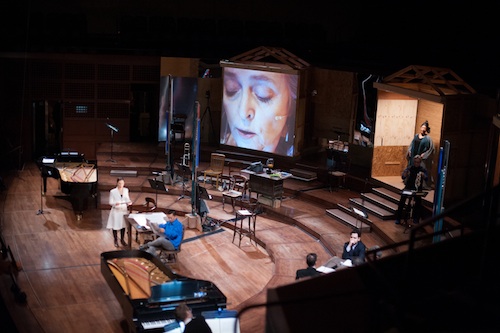
“The best form of government … is no government at all!” announced singer Meredith Monk in the second program of the SF Symphony’s rollicking American Mavericks festival at Davies Hall on Sat., March 10, her trademark braided pigtails and Shuffling Elf gait in full effect. And while I could hear the pleated pants of several libertarians around me surely being wetted (and a few liberal feathers ruffling in the back), this was no mere Ron Paul back-pat, though it was delivered with all the empty bluster we’ve come to expect from the current campaign season. 

We were in the midst of an astonishing presentation of John Cage’s epic, random Song Books from 1970, after all — revered experimental vocalist Joan La Barbara had delivered a beribboned gift of apples or cranberries to an arbitrary audience member, magnificent diva Jessye Norman (in a stunning Issey Miyake gown) had joined in a boisterous card game and typed a letter on a mic’d typewriter, and conductor Michael Tilson Thomas had chopped up various fruits and veggies and Cuisinarted them into an orange-y beverage for the pianist. Cage, our 20th Century channeler of chance, would never allow such an inflexible utterance to stand unchallenged.

Meredith Monk, Jessye Norman, and MTT with Symphony members performing John Cage.

Sure enough, the phrase began to dissolve in Monk’s mouth as she repeated it, leaning from the stage like a satiric demagogue: “The b-best f-f-f-form of-f-f-f g-g-g …. ,” and adding “And we shall have it, when we are ready for it!” All the while, three large black flags were being hoisted on neon polls, unfurling into the wind from three fans, ghastly pennants at a flourescent funeral. No, we were not just in the land (our land) of anti-government sloganeering, mouthed by Tea Partiers, Occupiers, and hedge fund profiteers alike. With Monk as our guide, we were slipping through the black flags of anarchy into a gaudier lawlessness, that of death. And like pure music death, of course, shall have no dominion

Jessye Norman and MTT

We’ll probably not see such a lavish, loving tribute to Cage’s aleatory masterwork for a long time. The randomness-conjuring Song Books are governed, in a somewhat oxymoronic twist, by a large set of instructions — “Leave the stage by going up (flying) or by going down through a trap door. Return in the same way wearing an animal’s head,” for example — and forego traditional musical notation and expression for doodlings, drawings, charts, projections, lighting effects, electronic improvisation, bird calls, horn squonks, chess games, and a plethora of intersecting stage actions. (That’s not to say there weren’t gorgeous passages of melody — one especially near the end, a meandering duet with electronics in which Norman sang in a wistful voice about, I think, purple finches.)

That all this potential chaos not only didn’t come off as pretentious avant-gardism but actually formed something deeply touching, hilarious, human, and even quaint was a triumph for director Yuval Sharon and his cast and crew. Only one dude stormed out — perhaps to towel his pleats.  

Joan La Barbara, Meredith Monk, Jessye Norman, and MTT 

Bracingly, the American Mavericks festival — MTT’s tribute to the barbaric yawp of the American musical spirit — has retained most of the wonder, if not all of the risk, of its first installment a dozen years ago. 

Things had kicked off in splendid form on Thu., March 8, with program one — I saw the repeat performance that Friday — including an exciting and lush presentation of quintessential American composer Aaron Copland’s “Orchestral Variations” from 1967, which delivered both ethereal, avant-garde jaggedness (the piece is composed of 20 variations on a four-note “cell,” in an atonal manner) and occasional glimpses of Copland’s generous, down-home spirit (this was the composer of “Appalachian Spring” and “Rodeo,” after all).

It also gave us a bit of dish. 

In researching “Orchestral Variations,” I’d run into some trouble — I kept finding more evidence of Copland’s “Piano Variations” from 1930, a work deemed so stark and forbidding that no professional pianist would debut it. (So Copland, in a nifty show of self-confidence, played the premiere himself, to many critics’ disdain.) Here’s a version by pianist Marc-Andre Hamelin:

But what of the piano work’s expansive, full-bodied and spirited transcription for orchestra? It turns out that MTT himself had, in a visit to Copland’s home decades ago, suggested the piece be transformed from a single piano piece to an orchestral work, in order to reach more people on a different scale. “He turned to me, raised an eyebrow, and said, ‘Yes, yes, that all sounds nice — but who’s going to do all that work?'” MTT told the audience during the introduction. Then the big reveal: “And I said, ‘Well, with your permission …’ So — here’s a little thing that we do.”

Insider-y! It was a rare treat of a rare performance of a rare masterwork, from one of the major players involved.

It was also the perfect lead-in to the next piece on the program, Lou Harrison’s “Concerto for Organ with Percussion Orchestra” from 1972, in an absolutely transcendent rendition from Paul Jacobs on the enormous Davies Hall organ, with an ensemble of super-agile Symphony percussionists playing everything from Chinese crash cymbals and huge muted prayer gongs to celesta, rasp, and glockenspiel. 

Organist Paul Jacobs and the SF Symphony’s percussion orchestra performing Lou Harrison.

Previously I had a slight aversion to Harrison — while I appreciate him as an out-and-proud gay man in the 1960s (he has a kind of Burl Ives meets Harry Hay aura in queer iconography), I sometimes felt his musical project suffered from the same knee-jerk Orientalism that turns me off of a lot of famous Bay Area poets, mystics, artists, and composers who attempt “East meets West.” Hairy legs jutting from a silk kimono, shudder.   

My prejudices were quickly dispatched when the sprightly Jacobs immediately began coaxing the most amazingly powerful sounds from the organ, using a block-muffle tool to play whole ranges of keys at once in various rapid-fire combinations and agglomerations, accompanied by the percussionists’ clanging, hypnotically abstract tattoos. Movements ranged from crepuscular tootling to sci-fi bombast as Harrison ushered us into a kind of hallucinatory meditation full of bright oranges and shooting blues, neither East nor West but a cosmic recombinant being of both. I want to rediscover this formidable magician. Here’s a taste from another recording, although I found Jacobs’ playing to be even more spirited:

Harrisons counterpart on program two was Henry Cowell, the great popularizer of tone clusters (think of playing a whole bunch of clashing yet somehow wondrous-sounding notes at once) — Cowell’s “Piano Concerto of 1928, performed by Jeremy Denk with the orchestra, was a sensation to almost equal the Cage before it. You would never have thought odd cacophany could achieve such nuance. It sounded like a foray into negative beauty. Denk was using his entire forearms on the piano most of the time, with the symphony meeting him at a level of intense energy and empathy, and yet there were moments of quiet, complex reflection and runs of exhilirating virtuosity that matched the height of the redwoods in Henry Cowell state park (no relation, except metaphorically). Am I gushing? I am gushing. More Cowell everywhere, please. And as for the multi-talented Denk, check out his recent, revealing, and witty essay and podcast from the New Yorker.

Jeremy Denk performing Henry Cowell. 

Preceding Cowell on program two was Lukas Foss’ fantastic 1967 Phorion, given a perfectly out-there rendition by the Symphony, which feeds ragtag bits of the famed solo violin prelude to Bach’s “Partita in E” (phorion is Greek for borrow or steal) through a phtasmagorical wood-chipper of various twists and inversions that spews forth everything from droopy jazz-surrealism to hard-driving, proto-techno minimalism. It’s a monument of sampling avant la lettre, sure to prick up any iPod-shufflers ears. 

There were two slight fizzles on both nights, to my ear. Program one concluded with Charles Ives’ “A Conchord Symphony reconfigured, perhaps more accurately “massaged,” from other Ives works, (including his brilliant “Concord Sonata,” from around 1916) by comtemporary Canadian composer Henry Brandt. The piece — craggy, magniloquent, full of profound philosophical and unfettered musical ideas — is partly meant to invoke New England and its literary heroes, and in recordings is an excellent rush of jigging melody lines and bracing moods. Goatish, devoted, unabashedly intellectual, Ives is the spiritual godfather of American musical mavericks (and Mavericks), and MTT is one of his great champions. So I expected much. Here’s the Symphony’s recorded version:

But after the first two luminous movements the orchestra sounded a bit ragged (understandable in the face of the huge Mavericks project), the work lost some shape, and we ended up getting more a series of declarative statements than a metaphysical journey through the East Coast of the mind. (The great game of “Concord” is to see how many times Ives references those famous mortal knocks that open Beethoven’s Fifth Symphony, which is kinda fun.) At the end we’re supposed to be soul-hiking under the wheeling stars with Thoreau, but it felt more like soaking in a hot tub with the Sidewalk Guru from “Doonesbury” and a glass of good champagne.             

Carl Ruggles’ “Sun-treader of 1926-31 concluded program two, and tapped into a strident strain of deliberative machismo and sci-fi nerdiness that brought to mind none other than Newt Gingrich, of all people. Cosmic bombast is the aim of this 13-minute brass-churning blast, a fanfare to Big Idea perserverance. It came off as dude music in the extreme, which may have perked up some of the unwilling husbands in the house, but after all that came before seemed a wee bit threadbare in its unrelenting bravado. Still, it cut a bold, bronze shape in the quivering air. 


SXSW Music Day 3: Santigold, Hindi Zahra, Debo Band

0

My third day at South by Southwest kicked off with the big SPIN Magazine party at Stubb’s. Best Coast was wrapping up their set and everyone was eagerly anticipating headliner Santigold.

Santigold’s rhythm section entered the stage wearing Max Headroom-esque caps, then her backup singers came on in outfits that were a spin on matador chic, and finally she came on donning a crown. She’s been busy working on a new album for the past few years, so her high profile gigs at SXSW seem to be serving as a homecoming of sorts.

Jason Newman of Fuse went as far as to dub her the festival’s “prom queen”… hence the crown. While her big hits like L.E.S. Artistes sent the crowd into frenzied sing-a-longs, her new material was received almost as enthusiastically… boding well for her album release come April. 


Later that eve I got to chat with Venezuelan rockers La Vida Boheme before heading to the globalFEST showcase at Speakeasy. Each year globalFEST brings acts from all over the world to New York’s Webster Hall, and this year they’ve taken their act on the road for the first time. As I arrived Janka Nabay and the Bubu Gang were on stage leading the crowd through their high-BPM take on Sierra Leone’s bubu music. 


After the Bubu Gang’s set the globalFEST crowd awaited the Colombian sounds of Queens-based M.A.K.U SoundSystem, but technical issues plagued the venue. Nearly an hour later the band was finally able to get going. Most of the crowd stayed on and it seemed like delaying the gratification heightened their excitement.


I stopped in to see Glen Hansard who’s devoted fans were singing along with every word. Then walked back across to the Nacional Records showcase just in time to catch the beginning of Ritmo Machine‘s set. A collaboration between Chilean beatmaker Latin Bitman and Cypress Hill percussionist Eric Bobo, their set was a mix of impressive turntablism and percussion set to music that ranged from blaxploitation-era soundtracks to Tito Puente. 


After that it was back to globalFEST at Speakeasy where Chicha Libre were playing a psychedelic rendition of Guns of Brixton. From there it was off to see French-Moroccan chanteuse Hindi Zahra who had the crowd in the palm of her hand. 


My night ended with globalFEST’s final set by Boston’s Debo Band. Their take on Ethiopian pop music has garnered notice in the past year and they recently signed on with legendary indie rock label Sub Pop. I first caught the band a little over a year ago and since then their live act has grown by leaps and bounds. They’ve been working with producer Thomas “Tommy T” Gobena of Gogol Bordello and it seems they’ve learned a few things from the Gogol playbook… in terms of the energy and the ecstatic vibe they’re bringing to their performances. Keep an eye out for their release later this summer.


SXSW Music Day 2: Spoek Mathambo, Sauti Sol, Kali Mutsa

0

After an early afternoon chat with Portuguese electro-kuduro group Buraka Som Sistema, I wandered downtown only to run into Andy and Christian of San Franpsycho. They’ve got a rack of clothes, a mobile screenprinting setup, and are representing SF style deep in the heart of Texas. As we commiserated about the craziness that is SXSW, SF local Danny Lannon of The Frail happened by.

Then it was off to catch a few songs by The White Eyes at the Taiwan music showcase. Frontwoman Gau Xiao-gao was festooned in a nude leotard with fabric streamers while she led her band through the punk and straight-ahead rock paces.


Later that eve it was off to Buca Lounge to see  Kali Mutsa, the alter-ego of Chilean actress Celine Reymond. As lazer lights danced around the room, it was hard to resist the hip-shaking gypsy sounds she and her band were pumping out. 


After that it was off to Spinlet All Africa party at Copa to check out South African electro-rapper Spoek Mathambo. The room was already crowded and people were grooving to the beats being played by Sierra Leonean dj Chief Boima. For some reason Spoek’s show was being delayed and it was 45 minutes before there was any action on the stage. The crowd was antsy but finally a group took the stage and it was Kenya’s Sauti Sol


The first thing to notice about Sauti Sol was their incredible clothing. They were wearing these beautifully tailored kanga-print jackets, some even had beaded epaulettes. En masse they kind of resembled an East African Sgt. Pepper’s Lonely Hearts Club Band. The second thing to notice was their great music. From the get go they navigated effortlessly from rocking out to singing soaring harmonies… all the while spontaneously breaking into lockstep dancing. The crowd ate it up.


From there I went to the Colombian showcase over at Speakeasy. Up by the stage I found myself next to one of the bandmates from M.A.K.U. Sound System who was eager to show me some dance moves. Also got the chance to chat with Kike, the drummer from Bomba Estereo. I first met Kike when he was playing with Sidestepper years ago and he mentioned that Richard Blair has recently gotten the group back together… so I made a note to check out what they’re up to. 


Back at Copa, Kenya’s Just a Band was in full swing. Playing music that seemed to range from hybridized watusi to 80s synth… the emphasis was on dancing. It was impossible not to.


And as my night wound down I caught South Africa’s Spoek Mathambo. His brand of avant-garde electro-rap seems to be striking a note here at the festival. The common theme of my night was African bands willing to break boundaries. 

New Penthouse Club opens, gets everybody drunk

0

Last night’s opening of North Beach’s brand spanking new Penthouse Club and Steakhouse (formerly Show Girls, before that Boy Toys) was glittery enough and did have a two-story pole for the women to play on, but – and I will only say this once – ladies, when you are being introduced onstage in the first moments of a strip club officially being open and you are next to a two-story stripper’s pole, and you are a stripper, you better get up there and show the crowd what they’re going to be getting for its rumpled, sweaty single bills.

Like, wrap your calf around its and spin. Blow it air kisses. Something. 

Other than that, North Beach has another, very serviceable strip club. Gone is the cramped upper floor of Showgirls, annihilated in favor of a clear view to the main (there are four total) stage below and a round Lucite dais on which platform stilettos can twinkle about, their owners’ rear ends winking attractively for the up-gazers in the nightclub’s round tables on the first floor. 

The club is touting its seasonal, locally-sourced menu hard. Last night at the press preview (thanks to the open bar during this segment of the evening, my hangover from the stripper/porn star-themed cocktails made me want to stab myself with a seven inch glitter shoe this morning) there were roast beef sliders, spoonfuls of tuna tartare topped with “mango jelly,” and salmon on toast from executive chef Michael Ellis’ menu. Ellis has a Michelin star earned from his time at Dry Creek Kitchen in Healdsburg.

I hope to god the Michelin people come to dine at the Penthouse Club. Might I suggest the all-white circular booths, or perhaps the seats separated by shimmery silver fringe on the second floor? For more casual dining, take your slider over to the lap dance station, a circular seat providentially perched within swiping distance of the ATM. I’d be interested to see what the service was like for sit-down diners – the waitstaff was hotter than the strippers onstage. 

Dancers Samira and Ivy had found a quiet moment during the press preview portion of the evening to snack a slider and a martini at a table marked ‘reserved’ when I started harassing them about their thoughts on the big opening. 

“It looks a lot better than it did,” said Samira. Samira was wearing an ass crack-displaying tight blue dress. This is a style, I’ve noticed, that’s been spreading like wildfire among the more trend-forward sex workers (as evidenced by my onsite reporting from this year’s AVN Awards in Vegas). Other vivid entries on the sartorial stage included one young lady’s forest green velvet, off-shoulder frock, and a be-fringed number whose owner told me people were insulting for not being stripper-y enough. Some people have no taste. 

But I digress. Ivy, who has been working at the club for three years, told me that business continued as usual throughout the entire renovation process. “It used to be real crazy,” she reflected. Surely the tips will improve now that the dust has settled, I ventured. “I hope so!” said Samira. “But tonight it’s more about getting our name out.” Anything I can do to help ladies! The women were all carrying Clueless-style glitter cube purses available in pink, purple, and green. They use them to carry their cash and, I made up in my head, their lipstick for quick touch ups. One of them in a tight, translucent floor-length dress told me that I could purchase one for myself at Target. Also, that she used to work at an underground Asian coffeeshop in San Jose

And then the gladiator music started and it was time to stop pole dancing on the structurally unsound glitter tubes lining one of the strip platforms and sit pretty for the introduction of the club’s full lineup, who vamped one by one across the stage. Here we come to the disappointing part of the evening, wherein roughly two of the 1,000 strippers on stage worked the pole in a satisfactory manner.

When the actual performances began, the first few ladies to take their solo turns on the fresh new stage were a little lethargic, but then that thrilling moment came when the first one scaled the full height of the pole, and spun down to the floor with an accompanying shower of dollars and the full, back-breaking explosion that comes mid-break in “We Found Love.” Rihanna, you must make your songs for ladies to take their clothing off to them. 

And so: go to the Penthouse Club for Lucite, slutwear fashion, and if you like your lap dance with a side of $3 ATM fees. Also, the top floor bar has ice on it, so your drinks will stay cold if you are the kind of person who takes a long time to pick up your stripper-themed cocktail after you bartender makes it. 

Penthouse Club and Steakhouse

412 Broadway, SF

(415) 391-2800

www.penthousesf.com

The Performant: The mourning after

0

Explorations in the language of the living at SFAI and NOHspace

Long before I moved to San Francisco, there were already certain things I’d learned to associate as being quintessentially San Franciscan via some kind of cross-cultural osmosis: the Castro, the cable-cars, Critical Mass, and George Kuchar.

True, the prolific filmmaker was himself a transplant, but his influence was indelibly stamped on San Francisco’s filmic underground. And unlike some heroes, who live impossibly removed from their admirers, George was accessible to his as a teacher, a neighbor, a legend, and a friend. Six months after his passing, a thoughtfully-curated tribute to his legacy opened at the San Francisco Art Institute — where he  taught absurdly-monikered classes in filmmaking such as “Electro-graphic Sinema” for 40 years. 

Since the hallmark of a successful memorial is to celebrate in the company of the living, a string of heartfelt eulogies and screenings of clips took place in the SFAI lecture hall, presented by friends and family, elders and youth. United thusly in our pleasant memories of the man, we entered the Walter and McBean Galleries, which had been transformed into a monument to the myth — a gleeful hodgepodge of photographs, set dressing, racks of cheap costume pieces, sketchbooks, choose-your-own screenings of the over 200 films in George’s oeuvre, and playful, personal ephemera.

Down the hall, an interactive studio installation encouraged visitors to get dressed up in a costume and “star” in their own straight-to-video blockbuster. A veritable Rosetta Stone on the language and legacy of Kuchar’s no-budget filmmaking, the exhibit runs through April 21, and is free to the public: adoring fans and the unconverted alike.

Part memorial for the dead, and part fundraiser for the living, the nationwide, one-night only performance series Shinsai found San Francisco stage time at both NOHspace and ACT. Directed by Theatre of Yugen apprentice Nick Ishimaru, the NOHspace edition opened with a trilogy of monologues penned by Suzan-Lori Parks that begged the question “where were you on 3/11”? Similarly themed play-lettes followed, including an introspective monologue on grieving by Phillip Kan Gotanda. Mixing dance, classic noh, and a quixotic bit of performance art (Jose Navarrete’s “Found and Lost”) into the evening put a distinctive stamp on the event. 

What most tied the disparate disciplines together were the expressive nuances of the hands, mimicking in certain ways the purported intricacies of the language of fans, secretive yet overt. In the dances of Las Japonesas Flamencas, each finger held its own position, extending the arch of an elbow or the turn of a wrist, a gestural eloquence. In contrast, the extremities of Nick Ishimaru and Meg Theil in a comical excerpt from kabuki drama Vengeful Sword, remained actively poised yet perfectly still as they each portrayed Manno, a wily Madame. The event ended with Heather Law’s graceful Hula ’Auana, hands fluttering like startled birds and 1960’s Go-Go girls, hearkening to an era of popular dance “moves” like the hand jive with the subtle grace of her more refined art: an expressive, whole-body sign language which spoke of life. 

SXSW Music Day 1: Mirel Wagner, Lila Downs, ZZ Ward

0


I’m in Austin to blog the SXSW Music festival for the second year. With evening slates that usually have around 50 official showcases happening at any given moment (and many more unofficial shows), one person’s perspective can feel dreadfully unrepresentative.


To be at SXSW is to know you’re missing out on a lot of good music. Fortunately the music you do see makes up for the difference, and very often it’s the unexpected showcases, the things that weren’t on your radar until that very moment, that end up being the highlights of your experience.  That said here are some of my impressions from Wednesday’s evening slate:

Ethiopian/Finnish singer Mirel Wagner played the first set of the night at Red 7. I spoke with her earlier in the day about her haunting songs that tend toward the darker side of existence. While in person Wagner doesn’t come across as terribly morbid, she does have a healthy dose of scandinavian deadpan. When introducing her third song she said “This is a song called Joe… and it’s about a guy named Joe.”


After that it was off to the Mohawk Patio for an outdoor show with French band Anoraak. They delighted the crowd with their gleeful, synth-pop. 


On the way to the ZZ Ward show I stumbled across Grupo Canalon playing on a street corner. A friend from SF who’s not  here had earlier recommended them as an act that couldn’t be missed at the festival. They hail from the town of Timbiqui in Cauca and play traditional Afro-Colombian roots music, with lots of percussion, a marimba, and acapella vocals. Even the hipsters on 6th Street couldn’t resist dancing. 


Amidst an extended sound check plagued with feedback and technical issues, a frustrated ZZ Ward assured the Parish audience that her performance would be worth the wait. The words seemed cocky in the moment but she and her band delivered. Based in LA, the chanteuse’s “dirty blues with beats” sound has gathered its fair share of buzz and she seems to have the poise and the chops to become a star.


As I walked through the heart of 6th Street not only was every venue overflowing with showcases but it was hard to walk 10 feet without stumbling across an impromptu “unofficial” street showcase. I snapped photos of two guys furiously strumming acoustic guitars in front of the Ritz Theater. When asked what their band’s name was the taller one replied “Well I’m Mike and he’s Gabe… that’s as far as we’ve gotten.”


Continuing down 6th Street I ran into a pedicab driver who had rigged a big, boxy speaker to his ride. As I ambled past he was dancing to his latest selection while waiting for a fare. I asked him what he usually likes to blast from his system and he replied “Most of the time I play dubstep, but just now I needed to hear some Jay Z.”


After that it was on to Andres Levin and Cucu Diamantes’ showcase at Speakeasy. As I walked in Mexican singer Lila Downs was just setting foot on stage… resplendent in a flower-covered dress. The word on the street is that she’s working on the score for a Broadway adaptation of Like Water for Chocolate. After breaking out a bottle of mezcal (making sure to point out the worm) and making an offering to “the spirits that have come before us,” Downs broke into a rendition of the ballad Maldito Cariño that brought down the house.


Last stop of the night was the Casa do Brasil showcase at Maggie Mae’s where carioca Tita Lima’s band was playing forro. A lone couple on the dance floor tried to adjust their ingrained salsa moves to forro’s more folky steps, with middling success. As Tita began her last song of the night she told the audience to check out the music of fellow brasileiro Junio Barreto, saying that “his music is comparable to Chico Buarque’s.” Buarque’s music is so revered that it would be hard to give higher praise, so I’ll take Tita’s advice and see what Barreto is up to.


Film Listings

0

Film listings are edited by Cheryl Eddy. Reviewers are Kimberly Chun, Max Goldberg, Dennis Harvey, Lynn Rapoport, and Matt Sussman. For rep house showtimes, see Rep Clock. For complete

SAN FRANCISCO INTERNATIONAL ASIAN AMERICAN FILM FESTIVAL

The 30th San Francisco International Asian American Film Festival runs through Sun/18 at the Castro, 429 Castro, SF; Sundance Kabuki, 1881 Post, SF; SF Film Society Cinema, 1746 Post, SF; Pacific Film Archive, 2575 Bancroft, Berk; and Camera 3 Cinemas, 288 S. Second St, San Jose. For tickets (most shows $12) and complete schedule, visit www.caamedia.org.

OPENING

Apart You’re almost waiting for the chorus to kick in: “With a taste of your lips, I’m on a ride/You’re toxic, I’m slipping under&ldots;” In another world, that might be the theme song for this somber and straight-laced indie horror fantasy-slash-romance by first-time director and writer Aaron Rottinghaus. Josh (Josh Danziger) is trying to piece together a shattered memory — he knows he has a rare form of schizophrenia and must get in touch with Emily (Olesya Rulin), a girl he once shared a scary intense intimacy with. The two are of one delusional, or perhaps oracular, mind: what they picture somehow comes to pass — a state of folie à deux triggered by a childhood school-bus accident. While evoking ’70s psychological horror flicks such as 1978’s The Fury, Apart, said to be based on real case history, takes a much more delicate tact, casting its lot with the fatalistic young romantics who must be together, come what may, and the power of youth scorned and outcast. Frustrating as unconsummated, all-consuming true love: the murkiness at the denouement of this star-crossed romance. (1:25) Opera Plaza. (Chun)

*Boy Apparent in his 2007 film Eagle vs. Shark and his brief turns writing and directing The Flight of the Conchords, filmmaker Taika Waititi seems to embody a uniquely Polynesian sensibility, positioned at a crossroads that’s informed by his Te-Whanau-a-Apanui heritage and his background in the Raukokore area of New Zealand, as well as an affection of global pop culture and a kind of keeping-it-real, keeping-it-local, down-home indie sensibility. All of which has fed into Boy, which became the highest-grossing New Zealand film of all time when it was released in its homeland in 2010. Its popularity is completely understandable. From the lush green inlands and stunning beaches of Waihau Bay to its intimate, gritty and humorous sketch of its natives, this affectionate, big-hearted bildungsroman is a lot like its 11-year-old eponymous hero — eminently lovable and completely one of a kind. Despite the tragedies and confines of his small-town rural life, Boy has a handle on his world: it’s 1984, and his pals spend their time hanging out at the snack shop and harvesting weed for one deadbeat biker parent. Boy’s brother Rocky (Te Aho Aho Eketone-Whitu) believes he has superpowers and is scarred by the fact that his birth was responsible for their mother’s death, and Michael Jackson has just been crowned the king of pop. Then, while his grandma’s away, Boy’s own deadbeat dad, Alamein (Waititi) appears on the scene, turning an extended family of small children on its head — and inspiring many a Thriller dance-slash-dream sequence. Waititi finds his way inside Boy’s head with Crayola-colorful animated children’s drawings, flashbacks, and the kind of dreamy fluidity that comes so naturally during long, hot Polynesian days, all while wonderfully depicting a world that far too few people have glimpsed on screen. (1:30) Bridge, Shattuck, Smith Rafael. (Chun)

Casa de mi Padre See “Where There’s a Will.” (1:25) Shattuck.

Delicacy Without visible effort, Nathalie (Audrey Tautou) charms the hearts of the susceptible males in her vicinity, including François (Pio Marmaï), a young man in a café who is soon proposing marriage, and Charles (Bruno Todeschini), a company director who hires her on the spot, transfixed by her very photograph on a résumé. When François, now her husband, is killed in a car accident, grief overwhelms her and she pours her energies into her professional life — until the day she finds herself unexpectedly making advances toward a frumpy, socially awkward colleague, a Swedish expat named Markus (Belgian comedian François Damiens). Her choice confounds the expectations of coworkers (Charles calls him an “ugly, insignificant guy”) and friends (one tells Nathalie, upon meeting Markus, that she could do better), but while the pairing is rather precipitous, it’s no more difficult to swallow than anything else in a film that feels like a pencil sketch on tracing paper. Events in Delicacy are lightly threaded together, so that a relationship turns into marriage and a three-year emotional tailspin goes by without our sensing the passage of time. We hear Nathalie described as “one of those women who cancels out all others,” but — while Tautou is as lovely as ever — we don’t see this in her. We hear people tell Markus how funny he is, but — though comedy is Damiens’s stock-in-trade — he doesn’t make us laugh. The problem lies largely in the script, even clumsier than Markus; it tells us we’re watching two unlikely people fall in love but doesn’t give us much reason to care. (1:48) Embarcadero, Shattuck. (Rapoport)

*Fake It So Real It would have been very easy for someone to make a film about an uber-low-budget posse of indie wrestlers and make fun of the entire enterprise. Robert Greene, whose cousin is among Fake It So Real‘s subjects, chooses a different path: his film is almost earnest in its appraisal of these Lincolnton, North Carolina good ol’ boys, who live for their Saturday-night matches under the fluorescent lights of the local Vietnam Veteran’s Center. For these men, wrestling offers an escape from otherwise glamourless lives (filled with boring jobs, heartbreak, health problems, and the like), and they take it very seriously, plotting out character arcs and sweating through training sessions. Comparisons to Mickey Rourke’s turn in The Wrestler (2008) are inevitable, but remember, Rourke’s character had once been famous. These guys’ definition of success is being approached by a group of kids in Wal-Mart for an autograph. Note for the easily offended: Fake It So Real‘s fly-on-the-wall filming style doesn’t filter out its subjects’ affection for gay jokes, clearly a deeply-enmeshed part of the small-town culture depicted here. (1:31) Roxie. (Eddy)

*The FP The town is real: east-of-Santa-Barbara, south-of-Bakersfield mountain burg Frazier Park, Calif. But this is no bucolic village; nay, the world portrayed in The FP is a dark one, a place without jobs or fashion sense that evolved beyond the 1980s. It’s a world where disputes between warring gangs are settled via Beat Beat Revelation, a video game that bears absolute resemblance to Dance Dance Revolution. A family affair (brothers Jason and Brandon Trost co-directed; Jason wrote and stars; Brandon was the cinematographer; sister Sarah — from Project Runway, season eight! — designed the costumes; and dad Ron did the special effects) and an obvious labor of love, The FP pays adoring homage to John Carpenter and Walter Hill’s classics of the dystopian-future B-movie genre. Angry loner Jtro (Jason Trost), rocking a Snake Plissken-esque eye patch, leaves the FP after the Beat Beat-related death of his older brother; with the help of friend KC/DC (Art Hsu) and mystical guru BLT (Nick Principe), he trains (via ’80s-style montages, natch) for a match with town bully L Dubba E (Lee Valmassy), all the while wooing troubled girl next door Stacey (Caitlyn Folley). Of particular note is The FP‘s riotous dialogue; this is maybe the first (and let’s hope last) film to be written entirely in what sounds like the language of the juggalos. (1:23) Roxie. (Eddy)

Jeff, Who Lives at Home The latest comedy from mumblecore man-child champions Jay and Mark Duplass stars Jason Segal as a 30-year-old still living in his parents’ basement. (1:22) California.

*Kill List “Oh jeebus,” you say. “Another movie about a hit man lured out of retirement for one last score?” Well, yes — and no. British director and co-writer Ben Wheatley (2009’s Down Terrace) manages to reinvent one of cinema’s most tired clichés by injecting a healthy amount of what-the-fuck-just-happened?-ness, as well as a palpable sense of absolute dread. Without spoiling anything, here’s how the story begins: married with a young son, surly Jay (Neil Maskell) and shrill Shel (MyAnna Buring) are struggling to maintain their wine-drinking, middle-class, Jacuzzi-in-the-backyard lifestyle. Their financial troubles are due to the fact that Jay hasn’t worked in eight months, which is to say he hasn’t offed anyone since his last job, a mysterious assignment in Kiev, went awry. When best friend and partner Gal (Michael Smiley) hears about a new, well-paying gig that involves a “kill list” of U.K.-based victims, Jay figures he might as well sign on, if only to get Shel off his back. But as the pill-popping Jay soon learns, his sinister new employer is no ordinary client, and the murders have a special significance — revealed in a twist I guarantee even seen-it-all horror buffs will neither anticipate nor fully comprehend on first viewing. Ergo: what the fuck just happened? (1:36) SF Film Society Cinema. (Eddy)

*21 Jump Street One of the more pleasant surprises on the mainstream comedy landscape has to be this, ugh, “reboot” of the late-’80s TV franchise. I wasn’t a fan of the show — or its dark-eyed, bad-boy star, Johnny Depp — back in the day, but I am of this unexpectedly funny rework overseen by apparent enthusiast, star, co-writer, and co-executive producer Jonah Hill, with a screenplay by Scott Pilgrim vs. the World (2010) co-writer Michael Bacall. There’s more than a smidge of Bacall’s other high school fantasy, Project X, in the buddy comedy premise of nerd (Hill’s Schmidt) meets blowhard (Channing Tatum’s Jenko), but 21 Jump Street thankfully leapfrogs the former with its meta-savvy, irreverent script and har-dee-har cameo turns by actors like Ice Cube as Captain Dickson (as well as a few key uncredited players who shall remain under deep cover). High school continues to haunt former classmates Schmidt and Jenko, who have just graduated from the lowly police bike corps to a high school undercover operation — don’t get it twisted, though, Dickson hollers at them; they got this gig solely because they look young. Still, the whole drug-bust enchilada is put in jeopardy when the once-socially toxic Schmidt finds his brand of geekiness in favor with the cool kids and so-called dumb-jock Jenko discovers the pleasures of the mind with the chem lab set. Fortunately for everyone, this crew doesn’t take themselves, or the source material, too seriously. (1:49) Marina, Shattuck. (Chun)

ONGOING

Act of Valor (1:45) 1000 Van Ness.

*The Artist With the charisma-oozing agility of Douglas Fairbanks swashbuckling his way past opponents and the supreme confidence of Rudolph Valentino leaning, mid-swoon, into a maiden, French director-writer Michel Hazanavicius hits a sweet spot, or beauty mark of sorts, with his radiant new film The Artist. In a feat worthy of Fairbanks or Errol Flynn, Hazanavicius juggles a marvelously layered love story between a man and a woman, tensions between the silents and the talkies, and a movie buff’s appreciation of the power of film — embodied in particular by early Hollywood’s union of European artistry and American commerce. Dashing silent film star George Valentin (Jean Dujardin, who channels Fairbanks, Flynn, and William Powell — and won this year’s Cannes best actor prize) is at the height of his career, adorable Jack Russell by his side, until the talkies threaten to relegate him to yesterday’s news. The talent nurtured in the thick of the studio system yearns for real power, telling the newspapers, “I’m not a puppet anymore — I’m an artist,” and finances and directs his own melodrama, while his youthful protégé Peppy Miller (Bérénice Béjo) becomes a yakky flapper age’s new It Girl. Both a crowd-pleasing entertainment and a loving précis on early film history, The Artist never checks its brains at the door, remaining self-aware of its own conceit and its forebears, yet unashamed to touch the audience, without an ounce of cynicism. (1:40) California, Embarcadero, 1000 Van Ness, Piedmont, Presidio, Sundance Kabuki. (Chun)

*The Ballad of Genesis and Lady Jaye Once dubbed “the wickedest man in the world”, shock artist and cofounder of seminal industrial music pioneers Throbbing Gristle Genesis Breyer P-Orridge has softened somewhat with time. Her plunge into pandrogyny, an ongoing artistic and personal process embarked upon with the late Jacqueline “Lady Jaye” Breyer P-Orridge, is an attempt to create a perfectly balanced body, incorporating the characteristics of both. As artists, the two were committed to documenting their process, but as marriage partners, much of their footage is sweetly innocuous home video footage: Genesis cooking in the kitchen decked out in a little black dress, Lady Jaye setting out napkins at a backyard bar-b-que or helping to dig through Genesis’ archives of COUM Transmissions and Throbbing Gristle “ephemera,” the two wrapped in bandages after getting matching nose jobs. “I just want to be remembered as one of the great love affairs of all time,” Jaye tells Genesis. This whimsical documentary by Marie Losier will go a long way toward making that wish a reality. (1:12) Embarcadero. (Nicole Gluckstern)

Being Flynn There’s an undeniable frisson in seeing Robert De Niro acting paranoid and abusive behind the wheel of an NYC cab again, but Paul Weitz’s drama isn’t exactly Taxi Driver 2. The actor plays Jonathan Flynn, a bellicose loner who abandoned his wife (Julianne Moore in flashbacks) and son to pursue his destiny as a great writer. Years later, the wife is deceased, the son estranged, but Jonathan remains secure in his delusions of genius — despite the publishing industry’s failure to agree. When an assault on noisy neighbors gets him thrown out of his apartment, his gradual descent into homelessness forces a paths-crossing with now-grown only child Nick (Paul Dano), who has taken a job at a shelter in an attempt to do something useful with his own unsettled life. Adapting the real Nick Flynn’s memoir, Weitz resists the temptation to make Pops a lovable old coot — he’s racist, homophobic, ill-tempered and pathetically arrogant — or to overly sentimentalize a father-son relationship that’s never going to have a happy ending. Nonetheless, this competent exercise too often feels like formulaic fiction, the material perhaps demanding a less slick, starry treatment to ring as true as it ought; the fuzzy warm blanket of a song score by Badly Drawn Boy doesn’t help. Still, intentions are good and the performances strong enough, including those by support players Lili Taylor, Wes Studi, and Olivia Thirlby. (1:42) Lumiere, Shattuck. (Harvey)

*Chico and Rita This Spain-U.K. production is at heart a very old-fashioned musical romance lent novelty by its packaging as a feature cartoon. Chico (voiced by Eman Xor Oña) is a struggling pianist-composer in pre-Castro Havana who’s instantly smitten by the sight and sound of Rita (Limara Meneses, with Idania Valdés providing vocals), a chanteuse similarly ripe for a big break. Their stormy relationship eventually sprawls, along with their careers, to Manhattan, Hollywood, Paris, Las Vegas, and Havana again, spanning decades as well as a few large bodies of water. This perpetually hot, cold, hot, cold love story isn’t very complicated or interesting — it’s pretty much “Boy meets girl, generic complications ensue” — nor is the film’s simple graphics style (reminiscent of 1970s Ralph Bakshi, minus the sleaze) all that arresting, despite the established visual expertise of Fernando Trueba’s two co directors Javier Mariscal and Tono Errando. When a dream sequence briefly pays specific homage to the modernist animation of the ’50s-early ’60s, Chico and Rita delights the eye as it should throughout. Still, it’s pleasant enough to the eye, and considerably more than that to the ear — there’s new music in a retro mode from Bebo Valdes, and plenty of the genuine period article from Monk, Mingus, Dizzy Gillespie, Chano Pozo and more. If you’ve ever jones’d for a jazzbo’s adult Hanna Barbera feature (complete with full-frontal cartoon nudity — female only, of course), your dream has come true. (1:34) Smith Rafael. (Harvey)

*Chronicle A misfit (Dane DeHaan) with an abusive father and an ever-present video camera, his affable cousin (Matt Garretty), and a popular jock (Michael B. Jordan) discover a strange, glowing object in the woods; before long, the boys realize they are newly telekinetic. At first, it’s all a lark, pulling pranks and — in the movie’s most exhilarating scene — learning to fly, but the fun ends when the one with the anger problem (guess which) starts abusing the ol’ with-great-power-comes-great-responsibilities creed. Chronicle is a pleasant surprise in a time when it’s better not to expect much from films aimed at teens; it grounds the superhero story in a (mostly) believable high-school setting, gently intellectualizes the boys’ dilemma (“hubris” is discussed), and also understands how satisfying it is to see superpowers used in the service of pure silliness — like, say, pretending you just happen to be really, really, really, good at magic tricks. First-time feature director Josh Trank and screenwriter Max “son of John” Landis also find creative ways, some more successful than others, to work with the film’s “self-shot” structure. The technique (curse you, Blair Witch) is long past feeling innovative, but Chronicle amply justifies its use in telling its story. (1:23) 1000 Van Ness. (Eddy)

*Coriolanus For his film directing debut, Ralph Fiennes has chosen some pretty strong material: a military drama that is among Shakespeare’s least popular works, not that adapting the Bard to the screen has ever been easy. (Look how many times Kenneth Branagh, an even more fabled Shakespearean Brit on stage than Ralph, has managed to fumble that task.) The titular war hero, raised to glory in battle and little else, is undone by political backstabbers and his own contempt for the “common people” when appointed to a governmental role requiring some diplomatic finesse. This turn of events puts him right back in the role he was born for: that of ruthless, furious avenger, no matter that now he aims to conquer the Rome he’d hitherto pledged to defend. The setting of a modern city in crisis (threadbare protesting masses vs. oppressive police state) works just fine, Elizabethan language and all, as does Fiennes’ choice of a gritty contemporary action feel (using cinematographer Barry Ackroyd of 2006’s United 93 and 2008’s The Hurt Locker). He’s got a strong supporting cast — particularly Vanessa Redgrave as Coriolanus’ hawkish mother Volumnia — and an excellent lead in one Ralph Fiennes, who here becomes so warped by bloodthirst he seems to mutate into Lord Voldemort before our eyes, without need of any prosthetics. His crazy eyes under a razored bald pate are a special effect quite alarmingly inhuman enough. (2:03) Opera Plaza. (Harvey)

*Crazy Horse Does the documentary genre need an injection of sex appeal? Leave it to ground-breaking documentarian Frederick Wiseman to do just that, with this hilarious, keenly-observed look into Paris’s rightfully legendary Crazy Horse Paris cabaret. For 10 weeks, the filmmaker immersed himself in all aspects of preparation going into a new show, Désirs, by choreographer Philippe Decouflé, and uncovers the guts, discipline, organizational entanglements, and genuine artistry that ensues backstage to produce the at-times laugh-out-loud OTT (e.g., the many routines in which the perky, planet-like posterior is highlighted), at-times truly remarkable numbers (the girl-on-girl spaceship fantasia; the subtle, surreal number that bounces peek-a-boo body parts off a mirrored surface) onstage — moments that should inspire burlesque performers and dance aficionados alike with the sheer imaginative possibilities of dancing in the buff, with a side of brain-teasing titillation, of course. Always silently commenting on the action, Wiseman pokes quiet fun (at the dancer vigorously brushing the horse-hair tail attached to her rear, the obsessed art director, and the sound guy who’s a ringer for Philip Seymour Hoffman’s Boogie Nights nebbish) while patiently paying respect to the mechanics behind the magic (Decouflé, among others, arguing with management for more time to improve the show, despite the beyond-rigorous seven-days-a-week, twice- to thrice-daily schedule). Crazy Horse provides marvelous proof that the battle of seduction begins with the brain. (2:08) Smith Rafael. (Chun)

*The Descendants Like all of Alexander Payne’s films save 1996 debut Citizen Ruth, The Descendants is an adaptation, this time from Kaui Hart Hemmings’ excellent 2007 novel. Matt King (George Clooney) is a Honolulu lawyer burdened by various things, mostly a) being a haole (i.e. white) person nonetheless descended from Hawaiian royalty, rich in real estate most natives figure his kind stole from them; and b) being father to two children by a wife who’s been in a coma since a boating accident three weeks ago. Already having a hard time transitioning from workaholic to hands-on dad, Matt soon finds out this new role is permanent, like it or not — spouse Elizabeth (Patricia Hastie, just briefly seen animate) will not wake up. The Descendants covers the few days in which Matt has to share this news with Elizabeth’s loved ones, mostly notably Shailene Woodley and Amara Miller as disparately rebellious teen and 10-year-old daughters. Plus there’s the unpleasant discovery that the glam, sporty, demanding wife he’d increasingly seemed “not enough” for had indeed been looking elsewhere. When has George Clooney suggested insecurity enough to play a man afraid he’s too small in character for a larger-than-life spouse? But dressed here in oversized shorts and Hawaiian shirts, the usually suave performer looks shrunken and paunchy; his hooded eyes convey the stung joke’s-on-me viewpoint of someone who figures acknowledging depression would be an undeserved indulgence. Payne’s film can’t translate all the book’s rueful hilarity, fit in much marital backstory, or quite get across the evolving weirdness of Miller’s Scottie — though the young actors are all fine — but the film’s reined-in observations of odd yet relatable adult and family lives are all the more satisfying for lack of grandiose ambition. (1:55) Castro, SF Center, Sundance Kabuki. (Harvey)

Dr. Seuss’ The Lorax (1:26) 1000 Van Ness, Presidio, Shattuck.

*Friends With Kids Jennifer Westfeldt scans Hollywood’s romantic comedy landscape for signs of intelligent life and, finding it to be a barren place possibly recovering from a nuclear holocaust, writes, directs, and stars in this follow-up to 2001’s Kissing Jessica Stein, which she co-wrote and starred in. Julie (Westfeldt) and Jason (Adam Scott) are upper-thirtysomething New Yorkers with two decades of friendship behind them. He calls her “doll.” They have whispered phone conversations at four in the morning while their insignificant others lie slumbering beside them on the verge of getting dumped. And after a night spent witnessing the tragic toll that procreation has taken on the marriages of their four closest friends — Bridesmaids (2011) reunion party Leslie (Maya Rudolph), Alex (Chris O’Dowd), Missy (Kristen Wiig), and Ben (Jon Hamm), the latter two, surprisingly and less surprisingly, providing some of the film’s darkest moments — Jason proposes that they raise a child together platonically, thereby giving any external romantic relationships a fighting chance of survival. In no time, they’ve worked out the kinks to their satisfaction, insulted and horrified their friends, and awkwardly made a bouncing baby boy. The arrival of significant others (Edward Burns and Megan Fox) signals the second phase of the experiment. Some viewers will be invested in latent sparks of romance between the central pair, others in the success of an alternative family arrangement; one of these demographics is destined for disappointment. Until then, however, both groups and any viewers unwilling to submit to this reductive binary will be treated to a funny, witty, well crafted depiction of two people’s attempts to preserve life as they know it while redrawing the parameters of parenthood. (1:40) California, Piedmont, SF Center, Sundance Kabuki. (Rapoport)

Ghost Rider: Spirit of Vengeance (1:36) SF Center.

Hugo Hugo turns on an obviously genius conceit: Martin Scorsese, working with 3D, CGI, and a host of other gimmicky effects, creates a children’s fable that ultimately concerns one of early film’s pioneering special-effects fantasists. That enthusiasm for moviemaking magic, transferred across more than a century of film history, was catching, judging from Scorsese’s fizzy, exhilarating, almost-nauseating vault through an oh-so-faux Parisian train station and his carefully layered vortex of picture planes as Hugo Cabret (Asa Butterfield), an intrepid engineering genius of an urchin, scrambles across catwalk above a buzzing station and a hotheaded station inspector (Sacha Baron Cohen). Despite the special effects fireworks going off all around him, Hugo has it rough: after the passing of his beloved father (Jude Law), he has been stuck with an nasty drunk of a caretaker uncle (Ray Winstone), who leaves his duties of clock upkeep at a Paris train station to his charge. Hugo must steal croissants to survive and mechanical toy parts to work on the elaborate, enigmatic automaton he was repairing with his father, until he’s caught by the fierce toy seller (Ben Kingsley) with a mysterious lousy mood and a cute, bright ward, Isabelle (Chloe Grace Moretz). Although the surprisingly dark-ish Hugo gives Scorsese a chance to dabble a new technological toolbox — and the chance to wax pedantically, if passionately, about the importance of film archival studies — the effort never quite despite transcends its self-conscious dazzle, lagging pacing, diffuse narrative, and simplistic screenplay by John Logan, based on Brian Selznick’s book. Even the actorly heavy lifting provided by assets like Kingsley and Moretz and the backloaded love for the fantastic proponents at the dawn of filmmaking fail to help matters. Scorsese attempts to steal a little of the latters’ zeal, but one can only imagine what those wizards would do with motion-capture animation or a blockbuster-sized server farm. (2:07) Sundance Kabuki. (Chun)

*In Darkness Agnieszka Holland is that kind of filmmaker who can become a well known, respectable veteran without anyone being quite sure what those decades have added up to. Her mentor was Andrzej Wadja, the last half-century’s leading Polish director (among those who never left). He helped shape a penchant for heavy historical drama and a sometimes clunky style not far from his own. She commenced her international career with 1985’s Angry Harvest, about the amorous relationship between a Polish man and the Austrian, a Jewish woman, he hides during Nazi occupation. Her one indispensable feature is 1990’s Europa, Europa, an ideal vehicle for her favored mix of the grotesque, sober, and factual — following a Jewish boy who passed as Aryan German. The new In Darkness is her best since then, and it can’t be chance that this too dramatizes a notably bizarre case of real-life peril and survival under the Nazis. Its protagonist is Leopold Socha (Robert Wieckiewicz), an ordinary family man in Lvov (Poland then, Ukraine now) who’s not above exploiting the disarray of occupation and war to make ends meet. A sewer inspector, he uses his knowledge of underground tunnels to hide Jews who can pay enough when even the fenced-off ghetto is no longer safe. For such a long, oppressive, and literally dark film, this one passes quickly, maintaining tension as well as a palpable physical discomfort that doubtlessly suggests just a fraction what the refugees actually suffered. In Darkness isn’t quite a great movie, but it’s a powerful experience. At the end it’s impossible to be unmoved, not least because the director’s resistance toward Spielbergian exaltation insists on the banal and everyday, even in human triumph. (2:25) Clay. (Harvey)

The Iron Lady Curiously like Clint Eastwood’s 2011 J. Edgar, this biopic from director Phyllida Lloyd and scenarist Abi Morgan takes on a political life of length, breadth and controversy — yet it mostly skims over the politics in favor of a generally admiring take on a famous narrow-minded megalomaniac’s “gumption” as an underdog who drove herself to the top. Looking back on her career from a senile old age spent in the illusory company of dead spouse Denis (Jim Broadbent), Meryl Streep’s ex-British Prime Minister Margaret Thatcher steamrolls past hurdles of class and gender while ironically re-enforcing the fustiest Tory values. She’s essentially a spluttering Lord in skirts, absolutist in her belief that money and power rule because they ought to, and any protesting rabble don’t represent the “real England.” That’s a mindset that might well have been explored more fruitfully via less flatly literal-minded portraiture, though Lloyd does make a few late, lame efforts at sub-Ken Russell hallucinatory style. Likely to satisfy no one — anywhere on the ideological scale — seriously interested in the motivations and consequences of a major political life, this skin-deep Lady will mostly appeal to those who just want to see another bravura impersonation added to La Streep’s gallery. Yes, it’s a technically impressive performance, but unlikely to be remembered as one of her more depthed ones, let alone among her better vehicles. (1:45) Opera Plaza, Shattuck. (Harvey)

John Carter More or less an adaptation of Tarzan author Edgar Rice Burroughs’ 1917 sci-fi classic A Princess of Mars, John Carter is yet another film that lavishes special effects (festooned with CG and 3D) on a rote story filled with characters the viewer couldn’t give two craps about. Angry Civil War veteran John Carter (Taylor Kitsch, more muscleman than thespian) mysteriously zips to Mars, a planet not only populated by multiple members of the cast of HBO’s Rome (Ciarán Hinds, James Purefoy, and the voice of Polly Walker), but also quite a bit of Red Planet unrest. Against his better judgment, and with the encouragement of a comely princess (tragic spray-tan victim Lynn Collins), Carter joins the fight, as red people battle blue people, green four-armed creatures pitch in when needed, and sinister silver people (led by Mark Strong) use zap-tastic powers to manipulate the action for their amusement. If you’re expecting John Carter to be a step up from Conan the Barbarian (2011), Prince of Persia (2010), etc., because it’s directed by Andrew Stanton (the Pixar superstar who helmed 2008’s Finding Nemo and 2010’s WALL*E), eh, think again. There’s nothing memorable or fun about this would-be adventure; despite its extravagant 3D, it’s flatter than a pancake. (2:17) Four Star, Marina, 1000 Van Ness. (Eddy)

Let the Bullets Fly A huge blockbuster in China, the latest from director Jiang Wan (1998’s Devils on the Doorstep) has received high praise for the zippy wordplay in its script — not such great news for us non-Mandarin speakers stuck reading the not-especially-zippy English subtitles. What’s left is an overlong tale of a notorious bandit (Jiang) who stumbles upon an opportunity to fake his way into a governorship after a train robbery goes awry. He and his henchmen (who wear masks styled after mahjong tiles) have no sooner arrived in town when it’s made clear that wealth and power will not come easy, since the entire burg is controlled by a gold-toothed gangster (a braying, over-the-top Chow Yun-Fat) who doesn’t like to share. Let the bullets fly, indeed, and let the games begin, with occasionally thrilling but often cartoonish results. Tip: if it’s a red-hot, nerve-jangling, balls-to-the-wall Asian action import you seek, wait a few weeks for Indonesia’s The Raid: Redemption. Yowza. (2:12) Four Star. (Eddy)

*Lou Harrison: A World of Music Doing the late Aptos, Calif. composer justice with its depth and breadth, Lou Harrison: A World of Music is the fortunate product of filmmaker Eva Soltes’s relationship with the underappreciated musical genius. Over the course of two decades, she gathered footage of the visionary experimentalist who freely roved the realms of contemporary music and dance, Asian musical traditions, and instrument-making. Her work has borne fruit — here, you get the full, rich scope of Harrison’s achievements — from his time in the woods with partner and instrument-making cohort William Colvig to his toils alongside choreographer Mark Morris to his struggles to stage Young Caesar, his opera on a Roman ruler’s same-sex revels. What Soltes doesn’t get on camera, she manages to trace through still images and interviews with contemporaries and cohorts such as Merce Cunningham, Judith Malina, and Michael Tilson Thomas, filling out Harrison’s beginnings at Mills College, mentored by Henry Cowell and collaborating with John Cage; encapsulating his success as a composer, critic, and arranger in NYC; and touching on his breakdown and retreat to his mountain cabin where he sought to write music in peace, yet nevertheless continued to lend his teeming creativity to points close to home, à la the Cabrillo Music Festival, and abroad. (1:30) Roxie. (Chun)

My Week With Marilyn Statuette-clutching odds are high for Michelle Williams, as her impersonation of a famous dead celebrity is “well-rounded” in the sense that we get to see her drunk, disorderly, depressed, and so forth. Her Marilyn Monroe is a conscientious performance. But when the movie isn’t rolling in the expected pathos, it’s having other characters point out how instinctive and “magical” Monroe is onscreen — and Williams doesn’t have that in her. Who could? Williams is remarkable playing figures so ordinary you might look right through them on the street, in Wendy and Lucy (2008), Blue Valentine (2010), etc. But as Monroe, all she can do is play the little-lost girl behind the sizzle. Without the sizzle. Which is, admittedly, exactly what My Week — based on a dubious true story — asks of her. It is true that in 1956 the Hollywood icon traveled to England to co-star with director Sir Laurence Olivier (Kenneth Branagh) in a fluff romance, The Prince and the Showgirl; and that she drove him crazy with her tardiness, mood swings, and crises. It’s debatable whether she really got so chummy with young production gofer Colin Clark, our wistful guide down memory lane. He’s played with simpering wide-eyed adoration by Eddie Redmayne, and his suitably same-aged secondary romantic interest (Emma Watson) is even duller. This conceit could have made for a sly semi-factual comedy of egos, neurosis, and miscommunication. But in a rare big-screen foray, U.K. TV staples director Simon Curtis and scenarist Adrian Hodges play it all with formulaic earnestness — Marilyn is the wounded angel who turns a starstruck boy into a brokenhearted but wiser man as the inevitable atrocious score orders our eyes to mist over. (1:36) Lumiere. (Harvey)

*Pina Watching Pina Bausch’s choreography on film should not have been as absorbing and deeply affecting of an experience as it was. Dance on film tends to disappoint — the camera flattens the body and distorts perspective, and you either see too many or not enough details. However, improved 3D technology gave Wim Wenders (1999’s Buena Vista Social Club; 1987’s Wings of Desire) the additional tools he needed to accomplish what he and fellow German Bausch had talked about for 20 years: collaborating on a documentary about her work. Instead of making a film about the rebel dance maker, Wenders made it for Bausch, who died in June 2009, two days before the start of filming. Pina is an eloquent tribute to a tiny, soft-spoken, mousy-looking artist who turned the conventions of theatrical dance upside down. She was a great artist and true innovator. Wenders’ biggest accomplishment in this beautifully paced and edited document is its ability to elucidate Bausch’s work in a way that words probably cannot. While it’s good to see dance’s physicality and its multi dimensionality on screen, it’s even better that the camera goes inside the dances to touch tiny details and essential qualities in the performers’ every gesture. No proscenium theater can offer that kind of intimacy. Appropriately, intimacy (the eternal desire for it) and loneliness (an existential state of being) were the two contradictory forces that Bausch kept exploring over and over. And by taking fragments of the dances into the environment — both natural and artificial — of Wuppertal, Germany, Wenders places them inside the emotional lives of ordinary people, subjects of all of Bausch’s work. (1:43) Shattuck, Sundance Kabuki. (Rita Felciano)

Project X Frat boys nostalgic for Girls Gone Wild — and those who continue to have the sneaking suspicion that much better parties are going on wherever they’re not —appear to be the target audiences for Project X (not be confused with the 1987 film starring Matthew Broderick, star of this movie’s tamer ’80s variant, Ferris Bueller’s Day Off). It’s tough to figure out who else would enjoy this otherwise-standard teen party-movie exercise, given a small shot of energy from its handheld/DIY video conceit. Here, mild-mannered teen Thomas (Thomas Mann) is celebrating his 17th birthday: his parents have left town, and his obnoxious pal Costa (Oliver Cooper) is itching to throw a memorable rager for him and even-geekier chum J.B. (Jonathan Daniel Brown). Multiple text and email blasts, a Craigslist ad, and one viral gossip scene reminiscent of Easy A (2010) later, several thousand party animals are at Thomas’s Pasadena house going nuts, getting nekkid in the pool, gobbling E, doing ollies off the roof, swinging from chandeliers, ad nauseam. The problem is — who cares? The lack of smart writing or even the marginal efforts toward character development makes Ferris Bueller look like outright genius — and this movie about as compelling as your standard-issue party jam clip. Unfortunately it also goes on about 85 minutes longer than the average music video. The blowback the kids experience when they go too far almost inspires you to root for the cops — not the effect first-time feature filmmaker Nima Nourizadeh was going for, I suspect. (1:28) 1000 Van Ness, Shattuck. (Chun)

Rampart Fans of Dexter and a certain dark knight will empathize with this final holdout for rogue law enforcement, LAPD-style, in the waning days of the last century. And Woody Harrelson makes it easy for everyone else to summon a little sympathy for this devil in a blue uniform: he slips so completely behind the sun- and booze-burnt face of David “Date Rape” Brown, an LAPD cop who ridicules young female cops with the same scary, bullying certainty that he applies to interrogations with bad guys. The picture is complicated, however, by the constellation of women that Date Rape has sheltered himself with. Always cruising for other lonely hearts like lawyer Linda (Robin Wright), he still lives with the two sisters he once married (Cynthia Nixon, Anne Heche) and their daughters, including the rebellious Helen (Brie Larson), who seems to see her father for who he is — a flawed, flailing anti-hero suffering from severe testosterone poisoning and given to acting out. Harrelson does an Oscar-worthy job of humanizing that everyday monster, as director Oren Moverman (2009’s The Messenger), who cowrote the screenplay with James Ellroy, takes his time to blur out any residual judgement with bokeh-ish points of light while Brown — a flip, legit side of Travis Bickle — just keeps driving, unable to see his way out of the darkness. (1:48) Lumiere. (Chun)

Safe House Frankly, Denzel Washington watchers are starved for another movie in which he’s playing the smartest guy in the room. Despite being hampered by a determinedly murky opening, Safe House should mostly satisfy. Washington’s Tobin Frost is well-used to dwelling into a grayed-out borderland of black ops and flipped alliances — a onetime CIA star, he now trades secrets while perpetually on the run. Fleeing from killers of indeterminate origin, Tobin collides headlong with eager young agent Matt (Ryan Reynolds), who’s stuck maintaining a safe house in Cape Town, South Africa. Tasked with holding onto Tobin’s high-level player by his boss (Brendan Gleeson) and his boss’s boss (Sam Shepard), Matt is determined to prove himself, retain and by extension protect Tobin (even when the ex-superspy is throttling him from behind amid a full-speed car chase), and resist the magnetic pull of those many hazardous gray zones. Surrounded by an array of actorly heavies, including Vera Farmiga, who collectively ratchet up and invest this possibly not-very-interesting narrative — “Bourne” there; done that — with heart-pumping intensity, Washington is magnetic and utterly convincing as the jaded mouse-then-cat-then-mouse toying with and playing off Reynolds go-getter innocent. Safe House‘s narrative doesn’t quite fill in the gaps in Tobin Frost’s whys and wherefores, and the occasional ludicrous breakthroughs aren’t always convincing, but the film’s overall, familiar effect should fly, even when it’s playing it safe (or overly upstanding, especially when it comes to one crucial, climactic scrap of dialogue from “bad guy” Washington, which rings extremely politically incorrect and tone-deaf). (2:00) 1000 Van Ness, SF Center. (Chun)

*Salmon Fishing in the Yemen In Lasse Hallström’s latest film, a sheikh named Muhammed (Amr Waked) with a large castle in Scotland, an ardent love of fly-fishing, and unlimited funds envisions turning a dry riverbed in the Yemeni desert into an aquifer-fed salmon-run site and the surrounding lands into an agricultural cornucopia. Tasked with realizing this dream are London marketing consultant Harriet Chetwode-Talbot (Emily Blunt) and government fisheries scientist Alfred Jones (Ewan McGregor), a reluctant participant who refers to the project as “doolally” and signs on under professional duress. Despite numerous feasibility issues (habitat discrepancies, the necessity for a mass exodus of British salmon, two million irate British anglers), Muhammed’s vision is borne forward on a rising swell of cynicism generated within the office of the British prime minister’s press secretary (Kristin Scott Thomas), whose lackeys have been scouring the wires for a shred of U.K.-related good news out of the Middle East. Ecology-minded killjoys may question whether this qualifies. But putting aside, if one can, the possible inadvisability of relocating 10,000 nonnative salmon to a wadi in Yemen — which is to say, putting aside the basic premise — it’s easy and pleasant enough to go with the flow of the film, infected by Jones’s growing enthusiasm for both the project and Ms. Chetwode-Talbot. Adapted from Paul Torday’s novel by Simon Beaufoy (2009’s Slumdog Millionaire), Salmon Fishing is a sweet and funny movie, and while it suffers from the familiar flurried third-act knotting together of loose ends, its storytelling stratagems are entertaining and its characters compellingly textured, and the cast makes the most of the well-polished material. (1:52) Albany, Embarcadero, Piedmont, Sundance Kabuki. (Rapoport)

*A Separation Iran’s first movie to win Berlin’s Golden Bear (as well as all its acting awards), this domestic drama reflecting a larger socio-political backdrop is subtly well-crafted on all levels, but most of all demonstrates the unbeatable virtue of having an intricately balanced, reality-grounded screenplay — director Asghar Farhadi’s own — as bedrock. A sort of confrontational impartiality is introduced immediately, as our protagonists Nader (Peyman Moadi) and Simin (Leila Hatami) face the camera — or rather the court magistrate — to plead their separate cases in her filing for divorce, which he opposes. We gradually learn that their 14-year wedlock isn’t really irreparable, the feelings between them not entirely hostile. The roadblock is that Simin has finally gotten permission to move abroad, a chance she thinks she must seize for the sake of their daughter, Termeh (Sarina Farhadi). But Nader doesn’t want to leave the country, and is not about to let his only child go without him. Farhadi worked in theater before moving into films a decade ago. His close attention to character and performance (developed over several weeks’ pre-production rehearsal) has the acuity sported by contemporary playwrights like Kenneth Lonergan and Theresa Rebeck, fitted to a distinctly cinematic urgency of pace and image. There are moments that risk pushing plot mechanizations too far, by A Separation pulls off something very intricate with deceptive simplicity, offering a sort of integrated Rashomon (1950) in which every participant’s viewpoint as the wronged party is right — yet in conflict with every other. (2:03) Albany, Embarcadero. (Harvey)

*The Secret World of Arrietty It’s been far too long between 2008’s Ponyo, the last offering from Studio Ghibli, and this feature-length adaptation of Mary Norton’s children’s classic, The Borrowers, but the sheer beauty of the studio’s hand-drawn animation and the effortless wonder of its tale more than make up for the wait. This U.S. release, under the very apropos auspices of Walt Disney Pictures, comes with an American voice cast (in contrast with the U.K. version), and the transition appears to be seamless — though, of course, the background is subtly emblazoned with kanji, there are details like the dinnertime chopsticks, and the characters’ speech rhythms, down to the “sou ka” affirmative that peppers all Japanese dialogue. Here in this down-low, hybridized realm, the fearless, four-inches-tall Arrietty (voiced by Bridgit Mendler) has grown up imaginative yet lonely, believing her petite family is the last of their kind: they’re Borrowers, a race of tiny people who live beneath the floorboards of full-sized human’s dwellings and take what they need to survive. Despite the worries of her mother Homily (Amy Poehler), Arrietty begins to embark on borrowing expeditions with her father Pod (Will Arnett) — there are crimps in her plans, however: their house’s new resident, a sickly boy named Shawn (David Henrie), catches a glimpse of Arrietty in the garden, and caretaker Hara (Carol Burnett) has a bit of an ulterior motive when it comes to rooting out the wee folk. Arrietty might not be for everyone — some kids might churn in their seats with ADD-style impatience at this graceful, gentle throwback to a pre-digital animation age — but in the care of first-time director Hiromasa Yonebayashi and Ghibli mastermind Hayao Miyazaki, who wrote co-wrote the screenplay, Arrietty will transfix other youngsters (and animation fans of all ages) with the glorious detail of its natural world, all beautifully amplified and suffused with everyday magic when viewed through the eyes of a pocket-sized adventurer. (1:35) Shattuck. (Chun)

*Shame It’s been a big 2011 for Michael Fassbender, with Jane Eyre, X-Men: First Class, Shame, and A Dangerous Method raising his profile from art-house standout to legit movie star (of the “movie stars who can also act” variety). Shame may only reach one-zillionth of X-Men‘s audience due to its NC-17 rating, but this re-teaming with Hunger (2008) director Steve McQueen is Fassbender’s highest achievement to date. He plays Brandon, a New Yorker whose life is tightly calibrated to enable a raging sex addiction within an otherwise sterile existence, including an undefined corporate job and a spartan (yet expensive-looking) apartment. When brash, needy, messy younger sister Cissy (Carey Mulligan, speaking of actors having banner years) shows up, yakking her life all over his, chaos results. Shame is a movie that unfolds in subtle details and oversized actions, with artful direction despite its oft-salacious content. If scattered moments seem forced (loopy Cissy’s sudden transformation, for one scene, into a classy jazz singer), the emotions — particularly the titular one — never feel less than real and raw. (1:39) Opera Plaza. (Eddy)

*Silent House Yep, it’s another remake of a foreign horror movie — but Uruguay’s La casa muda is obscure enough that Silent House, which recycles its plot and filming style, feels like a brand-new experience. Co-directors Chris Kentis and Laura Lau, last seen bobbing in shark-infested waves for 2003’s similarly bare-bones Open Water, apply another technical gimmick here: Silent House appears to be shot in one continuous take. Though it’s not actually made this way, each shot is extraordinarily long — way longer than you’d expect in a horror film, since the genre often relies on quick edits to build tension. Instead, the film’s aim is “real fear captured in real time” (per its tag line), and there’s no denying this is one shriek-filled experience. The dwelling in question is an isolated, rambling lake house being fixed up to sell by Sarah (Elizabeth Olsen), her father (Adam Trese), and uncle (Eric Sheffer Stevens). The lights don’t work, the windows are boarded up, most doors are padlocked shut, and there are strange noises coming from rooms that should be empty. Much of the film follows Sarah as she descends into deeper and deeper terror, scrabbling from floor to floor trying to hide from whoever (or whatever) is lurking, while at the same time trying to bust her way out. Though the last-act exposition explosion is a little hard to take, the film’s slow-burn beginning and frantic middle section offer bona fide chills. For an interview with Silent House co-director and writer Lau, visit www.sfbg.com/pixel_vision. (1:28) 1000 Van Ness. (Eddy)

*Straight Outta Hunters Point 2 In 2001, filmmaker Kevin Epps turned a camera on his own neighborhood: Bayview-Hunters Point, the southeastern San Francisco community best-known by outsiders for Candlestick Park, toxic pollution, and gang violence. Straight Outta Hunters Point was an eye-opener not just locally but internationally, as its runaway success opened doors for Epps to travel with the film and establish his career. These days, Epps is no longer an emerging talent — he’s a full-time independent filmmaker with multiple credits (including The Black Rock, a documentary about Alcatraz’s African American inmates, and hip-hop film Rap Dreams), collaborations (with Current TV and others), and an artist fellowship at the de Young Museum under his belt. For his newest project, he returns to the scene of his first work. He no longer resides in Bayview-Hunters Point, but he still lives close by, and he’s never lost touch with the community that inspired the first film and encouraged him to make its follow-up. Described by Epps as a “continuation of the conversation” launched by the first film, SOHP 2 investigates the community as it stands today, with both external (redevelopment) and internal (violence) pressures shaping the lives of those who live there. It’s a raw, real story that unspools with urgency and the unvarnished perspective of an embedded eyewitness. (1:20) Roxie. (Eddy)

This Means War McG (both Charlie’s Angels movies, 2009’s Terminator Salvation) stretches our understanding of the term “romantic comedy” in this tale of two grounded CIA agents (Chris Pine and Tom Hardy) who use their downtime to compete for the love of a perky, workaholic consumer-products tester (Reese Witherspoon). Broadening the usage of “comedy” are scenes in which best bros and partners FDR (Pine) and Tuck (Hardy) spend large portions of their agency’s budget on covert surveillance ops targeting the joint object of their affection, Lauren (Witherspoon). Expanding our notions of the romantic impulse, This Means War jettisons chocolate, roses, final-act sprints through airports, and other such trite gestures in favor of B&E, micro-camera installations, and wiretapping — the PATRIOT Act–style violation of privacy as feverish expression of amour. Without letting slip any spoilers about the eventual lucky winner of the competition, let it simply be said that at no point is the prize afforded the opportunity to comment on the two men’s überstalkery style of courtship, though the movie has to end rather abruptly to accomplish that feat. But hey, in the afterglow of Valentine’s Day, who’s feeling nitpicky? And besides, the real relationship at stake in this unabashedly bromantic film is the love that dare not speak its name, existing as it does between two secret agents. Chelsea Handler supplies the raunch and, as Lauren’s closest (only?) friend, manages to drag her through the dirt a few times. Being played by Witherspoon, however, she climbs out looking like she’s been sprayed down and scrubbed with one of her focus-grouped all-purpose cleansers. (2:00) 1000 Van Ness. (Rapoport)

A Thousand Words (1:31) 1000 Van Ness, Shattuck.

*Tinker Tailor Soldier Spy Tomas Alfredson (2008’s Let the Right One In) directs from Bridget O’Connor and Peter Straughan’s sterling adaptation of John le Carré’s classic spy vs. spy tale, with Gary Oldman making the role of George Smiley (famously embodied by Alec Guinness in the 1979 miniseries) completely his own. Your complete attention is demanded, and deserved, by this tale of a Cold War-era, recently retired MI6 agent (Oldman) pressed back into service at “the Circus” to ferret out a Soviet mole. Building off Oldman’s masterful, understated performance, Alfredson layers intrigue and an attention to weird details (a fly buzzing around a car, the sound of toast being scraped with butter) that heighten the film’s deceptively beige 1970s palette. With espionage-movie trappings galore (safe houses, code machines), a returned-to flashback to a surreal office Christmas party, and bang-on supporting performances by John Hurt, Mark Strong, Colin Firth, Toby Jones, and the suddenly ubiquitous Benedict Cumberbatch, Tinker Tailor epitomizes rule one of filmmaking: show me, don’t tell me. A movie that assumes its audience isn’t completely brain-dead is cause for celebration and multiple viewings — not to mention a place among the year’s best. (2:07) Castro, Sundance Kabuki. (Eddy)

“2011 Oscar-Nominated Short Films, Live Action and Animated” Smith Rafael.

Undefeated Daniel Lindsay and T.J. Martin, who previously teamed up on a 2008 doc about beer pong, have a more serious subject for their latest tale: the unlikely heroics of an inner-city Memphis, Tenn. high school football team. The title refers more to the collective spirit rather than the (still pretty damn good) record of the Manassas Tigers, a team comprised of youths challenged by less-than-ideal home lives and anti-authority attitude problems that stem from troubles running deeper than typical teenage rebellion. Into an environment seemingly tailored to assure the kids’ failure steps coach Bill Courtney. He’s white, they’re all African American; he’s fairly well-off, while most of them live below the poverty line. Still, he’s able to instill confidence in them, both on and off the field, with focus on three players in particular: the athletically-gifted, academically-challenged O.C., who gets a Blind Side-style boost from one of Courtney’s assistant coaches; sensitive brain Money, sidelined by a devastating injury; and hot-tempered wild card Chavis, who eventually learns the importance of teamwork. With the heavy-hitting endorsement of celebrity exec producer Sean Combs, Undefeated is a high-quality entry into the “inspiring sports doc” genre: it offers an undeniably uplifting story and sleek production values. But it’s a little too familiar to be called the best documentary of the year, despite its recent anointing at the Oscars. If it was gonna be a sports flick, why not the superior, far more complex (yet not even nominated) Senna? (1:53) SF Center. (Eddy)

The Vow A rear-ender on a snowy Chicago night tests the nuptial declarations of a recently and blissfully married couple, recording studio owner Leo (Channing Tatum) and accomplished sculptor Paige (Rachel McAdams). When the latter wakes up from a medically induced coma, she has no memory of her husband, their friends, their life together, or anything else from the important developmental stage in which she dropped out of law school, became estranged from her regressively WASP-y family, stopped frosting her hair and wearing sweater sets, and broke off her engagement to preppy power-douchebag Jeremy (Scott Speedman). Watching Paige malign her own wardrobe and “weird” hair and rediscover the healing powers of a high-end shopping spree is disturbing; she reenters her old life nearly seamlessly, and the warm spark of her attraction to Leo, which we witness in a series of gooey flashbacks, feels utterly extinguished. And, despite the slurry monotone of Tatum’s line delivery, one can empathize with a sense of loss that’s not mortal but feels like a kind of death — as when Paige gazes at Leo with an expression blending perplexity, anxiety, irritation, and noninvestment. But The Vow wants to pluck on our heartstrings and inspire a glowing, love-story-for-the-ages sort of mood, and the film struggles to make good on the latter promise. Its vague evocations of romantic destiny mostly spark a sense of inevitability, and Leo’s endeavors to walk his wife through retakes of scenes from their courtship are a little more creepy and a little less Notebook-y than you might imagine. (1:44) SF Center. (Rapoport)

*Wanderlust When committed Manhattanites George (Paul Rudd) and Linda (Jennifer Aniston) find themselves in over their heads after George loses his job, the two set off to regroup in Atlanta, with the reluctantly accepted help of George’s repellent brother Rick (Ken Marino). Along the way, they stumble upon Elysium, a patchouli-clouded commune out in the Georgia backcountry whose members include original communard Carvin (Alan Alda), a nudist novelist-winemaker named Wayne (Joe Lo Truglio), a glowingly pregnant hippie chick named Almond (Lauren Ambrose), and smarmy, sanctimonious, charismatic leader Seth (Justin Theroux). After a short, violent struggle to adapt to life under Rick’s roof, the couple find themselves returning to Elysium to give life in an intentional community a shot, a decision that George starts rethinking when Seth makes a play for his wife. Blissed-out alfresco yoga practice, revelatory ayahuasca tea-induced hallucinations, and lectures about the liberating effects of polyamory notwithstanding, the road to enlightenment proves to be paved with sexual jealousy, alienation, placenta-soup-eating rituals, and group bowel movements. Writer-director David Wain (2001’s Wet Hot American Summer, 2008’s Role Models) — who shares writing credits with Marino — embraces the hybrid genre of horror comedy in which audience laughter is laced with agonized embarrassment, and his cast gamely partake in the group hug, particularly Theroux and Rudd, who tackles a terrifyingly lengthy scene of personal debasement with admirable gusto. (1:38) 1000 Van Ness, Presidio, SF Center. (Rapoport)

*We Need to Talk About Kevin It’s inevitable — whenever a seemingly preventable tragedy occurs, there’s public outcry to the tune of “How could this happen?” But after the school shooting in We Need to Talk About Kevin, the more apt question is “How could this not happen?” Lynne Ramsay (2002’s Morvern Callar) — directing from the script she co-adapted from Lionel Shriver’s novel — uses near-subliminal techniques to stir up atmospheric unease from the very start, with layered sound design and a significant, symbolic use of the color red. While other Columbine-inspired films, including Elephant and Zero Day (both 2003), have focused on their adolescent characters, Kevin revolves almost entirely around Eva Khatchadourian (a potent Tilda Swinton) — grief-stricken, guilt-riddled mother of a very bad seed. The film slides back and forth in time, allowing the tension to build even though we know how the story will end, since it’s where the movie starts: with Eva, alone in a crappy little house, working a crappy little job, moving through life with the knowledge that just about everyone in the world hates her guts. Kevin is very nearly a full-blown horror movie, and the demon-seed stuff does get a bit excessive. But it’s hard to determine if those scenes are “real life” or simply the way Eva remembers them, since Kevin is so tightly aligned with Eva’s point of view. Though she’s miserable in the flashbacks, the post-tragedy scenes are even thicker with terror; the film’s most unsettling sequence unfolds on Halloween, horror’s favorite holiday; Eva drives past a mob of costumed trick-or-treaters as Buddy Holly’s “Everyday” (one of several inspired music choices) chimes on the soundtrack. Masked faces are turn to stare — accusingly? Coincidentally? Do they even know she’s Kevin’s mother? — with nightmarish intensity heightened by slow motion. And indeed, “Everyday” Eva deals with accepting her fate; the film is sympathetic to her even while suggesting that she may actually be responsible. For a longer review of this film, and an interview with director Ramsay, visit www.sfbg.com/pixel_vision. (1:52) SF Center, Sundance Kabuki. (Eddy)


Our Weekly Picks: March 14-20

0

WEDNESDAY 14

“History of the Irish Coffee at the Buena Vista Cafe”

Those hurting from lurid leprechaun depictions could do worse than attend San Francisco’s Crossroads Irish American Festival (going on now through April 7) for legitimate, culturally relevant Éire-inspired happenings. Lectures, live music, dance — and don’t worry, this is no stodgy teetotaler lineup, either. Visitors to the California Historical Society today can check out the group’s collection of artifacts of (and a presentation regarding) that very San Francisco of beverages, the Irish coffee. Ephemera from the drink’s progenitors at Buena Vista Cafe in Fisherman’s Wharf, correspondence with the Irish Consul, drink propaganda going back decades. A trip to your favorite cozy bar to sample a cup is required post-exhibit. (Caitlin Donohue)

5:30-7:30 p.m., free with RSVP (rsvp@calhist.org or 415-357-1848, ext. 229)

California Historical Society

678 Mission, SF

www.irishamericancrossroads.org


The Knux

Hailing from “the real New Orleans” where “every day was hell,” the Knux isn’t fucking around. Brothers Kentrell “Krispy” Lindsey and Alvin “Joey” Lindsey wear skinny jeans and Converse, but if you call them hipster rappers, they will crush you. The Knux released its second full-length album, Eraser, last September and seem to play shows as frequently as humanly possible. Their heady brand of hip hop integrates elements of punk and garage rock, and most of their songs are at least a little bit (if not entirely) about sex; drugs figure in prominently, too. Joey has called their performances “a musical orgasm on stage.” Tempting. (Mia Sullivan)

With Vibrant Sound, the Cuss

9:30 p.m., $12

Café Du Nord

2170 Market, SF

(415) 861-5016

www.cafedunord.com


THURSDAY 15

Willie Nelson

“Outlaw” is a term that tends to be thrown around a little bit too liberally these days, particularly when it comes to discussing musicians — but one man that undoubtedly deserves that title is Willie Nelson, whose five-decade and counting career as a singer, songwriter, poet, author, and social activist has been forged entirely on his own terms. Known for his own recording hits, his partnerships with people such as Johnny Cash, his slew of songwriting successes (notably the classic tune “Crazy,” as made famous by Patsy Cline), the 78-year-old icon continues to prove that he is a musical and social force to be reckoned with. (Sean McCourt)

With Pegi Young and the Survivors

8 p.m., $55

Fox Theater

1807 Telegraph, Oakl.

www.thefoxoakland.com


San Francisco Dance Film Festival

Now San Francisco really has reason to brag about its Dance Film Festival. The first two editions of the fest packed ’em in, not because of big names but because the selections, mostly shorts, were so varied and, for the most part, mesmerizing. This year the festival boasts three different programs in three different locations, with 23 films (including four feature-length documentaries) from ten countries. A particularly fine doc is Joffrey: Mavericks on American Dance, which has an additional post-fest screening at the Balboa Theater on Mon/19 (www.balboamovies.com). As the film demonstrates, Robert Joffrey was one of America’s most adventurous artistic directors, both in terms of commissioning new work and restaging historical ones. (Rita Felciano)

Through Sun/18, $10–$100

Various locations, SF

www.sfdancefilmfest.org


“Life and Death in Black and White: AIDS Direct Action in San Francisco, 1985-1990”

Last month’s splendid display of well-selected AIDS quilt panels in the Castro (which commemorated dozens of passed community members), excellent local HIV oral history doc We Were Here (which should have won the Oscar), and recent fetishization of early 1990s gay party music in the clubs (which … don’t ask) have opened a fascinating wormhole into the recent — and recently unspeakable — past. The invaluable unearthing of contemporary gay history continues: we’ve moved from the Milkeolithic into the HIVoscene. The GLBT History Museum’s new exhibition “Life and Death in Black and White” will help dig even deeper, bringing important and inspiring ACT-UP and other protest photographs by Jane Philomen Cleland, Patrick Clifton, Marc Geller, Rick Gerharter, and Daniel Nicoletta to light. (Marke B.)

Through July 1

Reception tonight, 7-9 p.m., $3-5

GLBT History Museum

4127 18th St., SF

(415) 621-1107

www.glbthistory.org


FRIDAY 16

Lindstrøm (cancelled)

We should all hold off final judgment at least until Mungolian Jet Set makes its way over here, but otherwise, Hans-Peter Lindstrøm is currently Norway’s funkiest export — if for no other reason than that the electronic musician has been anointed by having prog-rock legend Todd Rundgren remix his latest single, “Quiet Place to Live.” It’s an inspired move, particularly since the album it comes from — Six Cups of Rebel — has the same anything-goes eclecticism that marked Rundgren’s work. The result, which feature Lindstrøm’s vocals for the first time, plays like a post-disco version of cuts from Rundgren’s 1973 prog classic A Wizard, a True Star. (Ryan Prendiville)

With Magic Touch, Conar, Solar, and more

9 p.m., $18

Mezzanine

444 Jessie, SF

(415) 625-8880

www.mezzaninesf.com


Hot Buttered Rum

This friendly San Francisco-based quintet delivers twangy bluegrass bliss with its signature woodwind accents. Heavily influenced by jam giants like the Grateful Dead, Phish, and Béla Fleck, Hot Buttered Rum’s music is light, fun, and compositionally lush. Although HBR has developed a jammy, improvisational style and reputation over the years, the group focused more on songwriting while making its latest album, Limbs Akimbo. Band member Erik Yates (banjos, guitars, woodwinds, and vocals) has described the album as “deeper” and more reflective of struggle than its previous work, which explored utopian themes like backpacking, first love, and materialism. Did I mention most of these men were reared in Northern California? (Sullivan)

With Cornmeal

9 p.m., $21

Great American Music Hall

859 O’Farrell, SF

(415) 885-0750

www.gamh.com


Layo & Bushwacka

Matthew Benjamin and Layo Puskin first joined forces in the 1990s during the hustle and bustle of London’s acid house scene. Since then, the affectionately dubbed DJ-producer duo Layo & Bushwacka continue to pump out tracks that straddle the fence between pounding techno and groovy house music on their own Olmeto Records. “Love Story,” from their 2002 release Night Works, remains the seminal example of their classic, no-frills tech house, with vintage-sounding vocals and catchy melodies layered over driving beats. (Kevin Lee)

With !K7, Ripperton, Eduardo Castillo, VOODOO, and Brandt Brauer Frick

9:30 p.m., $20

Public Works

161 Erie, SF

(415) 932-0955

www.publicsf.com


SATURDAY 17

Sonoma Marin Cheese Trail

Wine country tours are all well and good — until it’s your turn to be the designated driver. Enter the cheesemaker tour, brought to you courtesy of the California Artisan Cheese Guild. The association’s nifty new map has directions to 27 producers of blue, washed rind, semi-soft, and surface-ripened wonders in Sonoma and Marin Counties, from Tomales’ Ramini mozzarella (made from the milk of water buffalos) to the Italian-style snacks of Sebastopol’s Bohemian Creamery. Samples and tours are available at many of the cheeseries, consult your handy (available online) map for which ones are which. Two different 50-mile driving routes await you, as does — perhaps less explicitly — a picnic in the high grasses, or perhaps sunny sand dunes with a wheel or three. (Donohue)

Ongoing

Various cheesemakers, Sonoma and Marin Counties

www.cheesetrail.org


Robert Glasper Experiment

Following his singular and hilarious performance with Reggie Watts at Yoshi’s last month, pianist Robert Glasper returns, this time with his full band. The Robert Glasper Experiment has just released Black Radio, in which Glasper seems to be taking a shot at infusing some life back into jazz as well as raising the bar back up on popular music. Prominently blending jazz, R&B, and hip-hop, the album feature collaborations with Erykah Badu, Lupe Fiasco, Mos Def (a.k.a. Yasiin Bey), and many others, as well as an unexpected cover of Nirvana’s “Smells Like Teen Spirit.” The assuredly tight band will features guest vocalist Bilal at these dates. (Prendiville)

Tonight, 8 p.m., $20–$25

New Parish

579 18th St., Oakl.

www.thenewparish.com

Also Sun/18, 9 p.m., $20-25

Brick and Mortar Music Hall

1710 Mission, SF

(415) 800-8782

www.brickandmortarmusic.com


Kafana Balkan

A few short years ago, it seemed like wild Balkan dance parties were everywhere. Not so left-field a concept! (And not just because we have a sizeable population of hard-partying Eastern European immigrants.) The whirling Romany, a.k.a. gypsy, tunes and wanderlust ethos served as perfect redux for post-playa burners, California dreamers, nomadic spirits, and techno-fatigued clubgoers. The music’s woozy brass oompahs, astonishing accordion flights, and multiple time-signatures tapped into familiar, ecstatic Norteño, Irish jig, and polka veins while appealing to musicological intellects and enthusiastic dancers. Some great gypsy parties remain, especially at Amnesia Bar in the Mission. But hoist your glass of rakija for the return of one of the largest and best: Kafana Balkan swings back into action with fantastic DJ Zeljko and a live blast from the Brass Menazeri ensemble. It’ll be rather good-insane. (Marke B.)

9 p.m., $10

Rickshaw Stop

155 Fell, SF

www.rickshawstop.com


SUNDAY 18

Barbary Coast Burlesque

Consider the bunny. Scotty the Blue Bunny that is, a azure spandex-clad gent whose providence could only be, and sure enough is, San Francisco. Scotty stalks the stage in transparent plastic stripper heels and towering blue wabbit ears, a walking, talking, anthropomorphic vaudeville game. Would you believe he’s not the main attraction in his own troupe? No, no, that honor must be bestowed upon the betasseled lovelies of the Barbary Coast Burlesque, formed in 2006 by the elegantly-monikered Bunny Pistol. This, friends, is retro-sex — sleek and classy Burly Q in a city that does it very well. Check out this month’s Barbary Coast showcase at the equally impressive Yoshi’s, and resist the urge to hop-hop-hop onstage to join in the fun. (Donohue)

8 p.m., $20

Yoshi’s San Francisco

1330 Fillmore, SF

(415) 655-5600

www.yoshis.com


TUESDAY 20

Deicide

Led by singer-bassist Glen Benton, Deicide has been storming stages and terrorizing the music world for nearly 25 years with their Florida-bred brand of death metal, stirring up controversy with their anti-religion lyrics, offstage antics, and (of course) their extreme sound. Returning to San Francisco on the “March of Death 2012” tour in support of their latest album, last year’s To Hell With God, fans can expect nothing less than a night of brutal blast beats, demonic vocals, and thrashing guitars. (McCourt)

With Jungle Rot, Abigail Williams, and Lecherous Nocturne

8 p.m., $25–$28

Regency Ballroom

1290 Sutter, SF

www.theregencyballroom.com 


The Guardian listings deadline is two weeks prior to our Wednesday publication date. To submit an item for consideration, please include the title of the event, a brief description of the event, date and time, venue name, street address (listing cross streets only isn’t sufficient), city, telephone number readers can call for more information, telephone number for media, and admission costs. Send information to Listings, the Guardian Building, 135 Mississippi St., SF, CA 94107; or e-mail (paste press release into e-mail body — no text attachments, please) to listings@sfbg.com. Digital photos may be submitted in jpeg format; the image must be at least 240 dpi and four inches by six inches in size. We regret we cannot accept listings over the phone.

Stage Listings

0

Stage listings are compiled by Guardian staff. Performance times may change; call venues to confirm. Reviewers are Robert Avila, Rita Felciano, and Nicole Gluckstern. Submit items for the listings at listings@sfbg.com. For further information on how to submit items for the listings, see Picks.

THEATER

OPENING

Sam Marlowe and the Mean Streets of San Francisco Stage Werx, 446 Valencia, SF; (415) 412-3989, www.catchynametheatre.org. $20. Opens Thurs/15, 8pm. Runs Thurs-Sat, 8pm. Through April 7. Catchy Name Theatre presents a world premiere noir play by Jim Strope.

BAY AREA

The Coast of Utopia: Voyage Ashby Stage, 1901 Ashby, Berk; www.shotgunplayers.org. $20-30. Previews Wed/14-Thurs/15, 7pm; Fri/16-Sat/17, 8pm; Sun/18, 5pm. Opens March 23, 8pm. Runs Wed-Thurs, 7pm; Fri-Sat, 8pm; Sun, 5pm. Through April 29. Shotgun Players present Tom Stoppard’s riff on pre-revolutionary Russia.

Red Berkeley Repertory Theatre, Thrust Stage, 2025 Addison, Berk; (510) 647-2949, www.berkeleyrep.org. $14.50-83. Previews Fri/16-Sat/17 and Tues/20, 8pm; Sun/18, 7pm. Opens March 22, 8pm. Runs Tues and Thurs-Fri, 8pm (also March 29 and April 26, 2pm; no show April 27); Wed, 7pm; Sat-Sun, 2pm (also Sat, 8pm; Sun, 7pm; no matinees Sat/17-Sun/18 or March 31). Through April 29. Berkeley Rep performs John Logan’s Tony Award-winning play about artist Mark Rothko.

ONGOING

*Blue/Orange Lorraine Hansberry Theatre, 450 Post, SF; (415) 474-8800, www.lhtsf.org. $43-53. Wed/14-Sat/17, 8pm (also Sat/17, 2pm); Sun/18, 2pm. Lorraine Hansberry Theater offers an uneven but worthwhile production of British playwright Joe Penhall’s sardonic comedy of ideas and institutional racism, an intriguingly frustrating three-hander about a young doctor (a bright Dan Clegg) at a psychiatric teaching hospital who begins a battle royal with his suave and pompous supervising physician (a comically nimble Julian Lopez-Morillas) over the release of a questionably-sane black patient. Originally brought in by police for creating a disturbance, Christopher (the excellent Carl Lumbly) still exhibits signs of psychosis and his ability to care for himself seems doubtful to the young doctor treating him. The older physician appeals to the patient’s general competence, hospital procedures, the shortage of beds, and the exigencies of career advancement in countering the younger doctor’s insistence on keeping the patient beyond the mandatory 28-day period required by law. For his part, Christopher, nervous and rather manic, is at first desperately eager to be released back to his poor London neighborhood. Competing interviews with the two doctors complicate his perspective and ours repeatedly, however, as a heated debate about medicine, institutionalization, cultural antecedents to mental "illness," career arcs, and a "cure for black psychosis," leave everyone’s sanity in doubt. Although our attention can be distracted by a too-pervading sound design and less than perfect British accents, Edris Cooper-Anifowoshe directs a strong and engaging cast in a politically resonant not to say increasingly maddening play. (Avila)

"Celebration of Women’s History Month:" The Right Thing Thick House, 1695 18th St, SF; www.3girlstheatre.org. $30. Dates and showtimes vary. Through April 1. Over one long day of legal mediation, aggrieved former CEO Zell Gardner (a brash but vulnerable Catherine Castellanos) and attorney Manny Diamond (a sharp, loquacious Louis Parnell) square off against Zell’s former Big Pharma pals headed up by vindictive interim CEO David Heller (a coolly cutting Lol Levy) flanked by Zell’s longtime colleague Chris McKnight (a nicely down-to-earth John Flanagan). Zell’s lawyer becomes increasingly ambivalent, however, as Manny discovers his tough, brassy mess of a pill-popping client has been less than forthcoming about the charge of sexual harassment the other side is using to justify her dismissal and the company’s pocketing of the three million Zell expected as compensation — a charge involving Zell’s 19-year-old goddaughter, Sam (Karina Wolfe). Attempting to reconcile the parties and broker a deal is retired judge Leigh Mansfield (Helen Shumaker), but she has her work cut out for her with this crowd. AJ Baker’s new drama — the inaugural production of newcomers 3Girls Theatre — take issues of sexual politics and power in its high-powered setting and cracks them against the everyday familial and social dynamics that are perhaps a casualty of the corporate ethos, but without opening them up to a satisfactory degree. Director Suze M. Allen assembles a generally strong cast (Castellanos is riveting throughout), and some scenes smolder with just the right teeth-baring tension, but pacing is inconsistent and the script’s own wayward drift — together with an odd, unnecessary video backdrop—distract from the concentrated treatment the story demands. (Avila)

*Fool For Love Boxcar Studios, 125A Hyde, SF; www.boxcartheatre.org. $25. Showtimes vary. Through April 14. Another installment of Boxcar Theatre’s epic Sam Shepard repertory project, Fool for Love inaugurates their newest performance space within their Hyde Street Studios location. A depressingly realistic reproduction of a claustrophobic motel room, the tiny jewel-box theatre provides no refuge for the actors, and certainly not for the audience, each trapped beneath the pitiless gaze of the other. And if that too-close-for-comfort intimacy doesn’t get to you, the intentionally difficult subject matter — a "typical" Shepardian foray into alcohol-fueled ranting, violence, incest, and casual cruelty — probably will. Shepard’s strength in monologue shows itself off to meaty effect from May’s (Lauren Doucette) melancholy description of her mother’s love affair with the Old Man (Jeff Garrett) to Eddie’s (Brian Trybom) candid admittance to May’s timid suitor Martin (Geoffrey Nolan) that he and May are not cousins at all but half-siblings who have "fooled around" with each other. In addition to the reliably strong performances from each of the actors, Fool features a notably clever bit of staging involving the Old Man who appears not as a specter wandering the periphery of the stage, but as a recurring figure on the black-and-white television, interrupting the flow of cheesy Westerns with his garrulous trailer park wisdom and an omnipresent Styrofoam cup filled, one suspects, with something stronger than just coffee. (Gluckstern)

Geezer Marsh San Francisco, MainStage, 1062 Valencia, SF; (415) 282-3055, www.themarsh.org. $25-100. Thurs/15 and Sat/17, 8pm; Sun/18, 5pm. Geoff Hoyle’s hit solo show returns.

Glengarry Glen Ross Actors Theatre of San Francisco, 855 Bush, SF; (415) 345-1287, www.brownpapertickets.com. $26-40. Fri-Sat, 8pm. Through March 24. David Mamet’s cutthroat comedy, courtesy of the Actors Theatre of San Francisco.

It’s All the Rage Studio Theater, Marsh San Francisco, 1062 Valencia, SF; (415) 282-3055, www.themarsh.org. $15-50. Thurs, 8pm; Sat, 8:30pm, Sun, 7pm. Through April 15. Longtime comedian and radio host Marilyn Pittman’s solo play wrestles with the legacy of her parents’ violent deaths in a 1997 murder-suicide initiated by her father. It’s disturbing material that Pittman, a stout middle-aged woman with a gregarious and bounding personality, approaches indirectly via a good deal of humor — including recounting the first time she did her growing-up-lesbian bit before her mother in a DC comedy club. But the pain and confusion trailing her for 13 years is never far behind, whether in accounts of her own battle with anger (and the broken relationships it has left in its wake) or in ominous memories of her too complacent mother or her charming but domineering father, whose controlling behavior extended to casually announcing murderous dreams while policing the boundaries of his marriage against family interference. A fine mimic, Pittman deploys a Southern lilt in playing each parent, on a stage decorated with a hint of their Southwestern furnishings and a framed set of parental photographs. In not exactly knowing where to lay blame for, or find meaning in, such a horrifying act, the play itself mimics in subtler form the emotional tumult left behind. There’s a too brief but eerie scene in which her veteran father makes reference to a murder among fellow soldiers en route to war, but while PTSD is mentioned (including as an unwanted patrimony), the 60-minute narrative crafted by Pittman and director David Ford wisely eschews any pat explanation. If transitions are occasionally awkward and the pace a bit loose, the play leaves one with an uncomfortable sense of the darker aspects of love, mingled with vague concentric histories of trauma and dislocation in a weird, sad tale of destruction and staying power. Note: review from the show’s 2009 run at the Marsh. (Avila)

Julius Caesar Buriel Clay Theater, African American Art and Culture Complex, 762 Fulton, SF; 1-800-838-3006, www.african-americanshakes.org. $10-30. Sat, 8pm; Sun, 4pm. Through April 1. African-American Shakespeare Company performs a version of the Bard’s classic set during the ongoing civil wars of West Africa.

*Maurice New Conservatory Theatre Center, 25 Van Ness, SF; (415) 861-8972, www.nctcsf.org. $25-45. Wed-Sat, 8pm; Sun, 2pm. Through March 25. The eponymous hero of E.M. Forster’s late novel (written early but published only posthumously) wrestles with his love for another man in Edwardian England — oscillating between defiant assertion of feeling and an anguished recoil into desperate treatments like hypnotism — but manages to find happiness as a homosexual by the end of the story. No doubt that would have most appalled the guardians of those extremely homophobic, repressive times. Today there’s still much to recognize in the confused feelings and social censure faced by such a figure, though what helps make the 1998 stage adaptation (by Brits Andy Graham and Roger Parsley) so compelling a story is the not always flattering complexity and honesty with which Forster portrays the (at least partly autobiographical) Maurice Hall — played winningly by an intelligent, agile Soren Santos in New Conservatory Theatre Center’s persuasive U.S. premiere. Maurice’s outré sexuality is one thing; his class position and status as a man are another, affording him certain limited protection and also contributing to certain weaknesses of character, which become most apparent vis-à-vis his mother (a quietly potent Lindsey Murray) and sister (an effervescent Hilary Hyatt) as well as his second love, ambitious young laborer Alec Scudder (a nicely restrained Andrew Nolan). Director George Maguire rightly concentrates on the reciprocal influences between these vital characters and gets fine performances from his entire cast in an uncluttered, sure and measured production, with capable John Hurst in several supporting roles and Alex Kirschner doing excellent work as Clive Durham, Maurice’s Cambridge classmate and mercurial first love. (Avila)

Merchants Exit Stage Left, 156 Eddy, SF; www.brownpapertickets.com. $10-25. Thurs-Sat, 8pm. Through March 24. According to playwright Susan Sobeloff, the vision for Merchants, premiering this month at the EXIT Theatre, came to her after watching Shakespeare’s The Merchant of Venice, a play at least partially responsible for cementing the caricature of the money-hungry Jew in Western literary tradition for centuries to come. Her intention to write a play featuring a family of more "rounded" Jews doesn’t entirely coalesce once it becomes clear that the bulk of the dramatic tension actually revolves very closely around monetary concerns. As one family business folds, and other members get squeezed out of their jobs by the new economy, a new family business of sorts begins to grow around the quirky, confessional performance art of youngest daughter, Mercedes (Maura Halloran). Emotional blackmail and sheer desperation kickstart their efforts to turn Mercedes into a financially-sustainable "brand," while the all too human costs of burnout, fatigue, and simmering resentments are roundly disregarded, until a crisis point is reached. It’s difficult to connect with this particular set of almost comically self-absorbed characters, despite the desire to root for the underdog, and the play would have benefited from a staging that allowed either more humor or more humanity to creep into the relentless tirades that characterize much of the dialogue. (Gluckstern)

The Real Americans Marsh Studio Theater, 1062 Valencia, SF; (415) 282-3055, www.themarsh.org. $25-50. Fri, 8pm; Sat, 5pm; Sun/18, 2pm. Extended through April 14. Dan Hoyle revives his hit solo show about small-town America.

*True West Boxcar Studios, 125A Hyde, SF; (415) 967-2227, www.boxcartheatre.org. $25. Thurs-Sat, 8pm. Through April 7. The first installment of Boxcar Theatre’s four-play Sam Shepard repertory project, True West ushers in the ambitious run with a bang. This tale of two brothers who gradually assume the role of the other is one of Shepard’s most enduring plays, rich with humorous interludes, veering sharply into dangerous terrain at the drop of a toaster. In time-honored, True West tradition, the lead roles of Austin, the unassuming younger brother, and Lee, his violent older sibling, are being alternated between Nick A. Olivero and Brian Trybom, and in a new twist, the role of the mother is being played by two different actresses as well (Adrienne Krug and Katya Rivera). The evening I saw it, Olivero was playing Austin, a writer banging away at his first screenplay, and Trybom was Lee, a troubled, alcoholic drifter who usurps his brother’s Hollywood shot, and trashes their mother’s home while trying to honor his as yet unwritten "contract". The chemistry between the two actors was a perfect blend of menace and fraternity, and the extreme wreckage they make of both the set (designed by both actors), and their ever-tenuous relationship, was truly inspired. (Gluckstern)

Waiting for Godot New venue: SF Playhouse Stage Two, 533 Sutter, SF; (415) 336-3522, www.tidestheatre.org. $20-32. Thurs, 7pm; Fri-Sat, 8pm. Extended through April 14. The fuchsia papier-mâché tree and swirling grey-on-white floor pattern (courtesy of scenic designer Richard Colman) lend a psychedelic accent to the famously barren landscape inhabited by Vladimir (Keith Burkland) and Estragon (Jack Halton) in this production of the Samuel Beckett play by newcomers Tides Theatre. The best moments here broadcast the brooding beauty of the avant-garde classic, with its purposely vague but readily familiar world of viciousness, servility, trauma, want, fear, grudging compassion, and the daring, fragile humor that can look it all squarely in the eye. (Avila)

The Waiting Period MainStage, Marsh San Francisco, 1062 Valencia, SF; (415) 282-3055, www.themarsh.org. $15-50. Fri, 8pm; Sat, 5pm. Extended through April 27. Brian Copeland (comedian, TV and radio personality, and creator-performer of the long-running solo play Not a Genuine Black Man) returns to the Marsh with a new solo, this one based on more recent and messier events in Copeland’s life. The play concerns an episode of severe depression in which he considered suicide, going so far as to purchase a handgun — the title coming from the legally mandatory 10-day period between purchasing and picking up the weapon, which leaves time for reflections and circumstances that ultimately prevent Copeland from pulling the trigger. A grim subject, but Copeland (with co-developer and director David Ford) ensures there’s plenty of humor as well as frank sentiment along the way. The actor peoples the opening scene in the gun store with a comically if somewhat stereotypically rugged representative of the Second Amendment, for instance, as well as an equally familiar "doood" dude at the service counter. Afterward, we follow Copeland, a just barely coping dad, home to the house recently abandoned by his wife, and through the ordinary routines that become unbearable to the clinically depressed. Copeland also recreates interviews he’s made with other survivors of suicidal depression. Telling someone about such things is vital to preventing their worst outcomes, says Copeland, and telling his own story is meant to encourage others. It’s a worthy aim but only a fitfully engaging piece, since as drama it remains thin, standing at perhaps too respectful a distance from the convoluted torment and alienation at its center. (Avila)

BAY AREA

Cabaret Larkspur Café Theater (American Legion Hall Post 313), 500 Magnolia, Larkspur; www.brownpapertickets.com. $25-45. Fri-Sat, 8pm; Sun, 7pm (no show April 8). Through April 15. Independent Cabaret Productions and Shakespeare at Stinson move their production of the Kander and Ebb classic from Fort Mason to the North Bay.

A Doctor in Spite of Himself Berkeley Repertory Theatre, Roda Theatre, 2015 Addison, Berk; (510) 647-2949, www.berkeleyrep.org. $14.50-73. Tues and Thurs-Sat, 8pm (no show March 23); Wed and Sun, 7pm (also Sun, 2pm). Through March 25. Berkeley Rep performs a contemporary update of the Molière comedy.

*The Kipling Hotel: True Misadventures of the Electric Pink ’80s New venue: Marsh Berkeley, 2120 Allston, Berk; (415) 282-3055, www.themarsh.org. $20-50. Sat, 8:30pm; Sun, 7pm. Extended through May 6. This new autobiographical solo show by Don Reed, writer-performer of the fine and long-running East 14th, is another slice of the artist’s journey from 1970s Oakland ghetto to comedy-circuit respectability — here via a partial debate-scholarship to UCLA. The titular Los Angeles residency hotel was where Reed lived and worked for a time in the 1980s while attending university. It’s also a rich mine of memory and material for this physically protean and charismatic comic actor, who sails through two acts of often hilarious, sometimes touching vignettes loosely structured around his time on the hotel’s young wait staff, which catered to the needs of elderly patrons who might need conversation as much as breakfast. On opening night, the episodic narrative seemed to pass through several endings before settling on one whose tidy moral was delivered with too heavy a hand, but if the piece runs a little long, it’s only the last 20 minutes that noticeably meanders. And even with some awkward bumps along the way, it’s never a dull thing watching Reed work. (Avila)

Mesmeric Revelation Berkeley City Club, 2315 Durant, Berk; (510) 558-1381, www.centralworks.org. Thurs/15-Sat/17, 8pm; Sun/18, 5pm. Central Works opens its season of world premieres with Aaron Henne’s Edgar Allen Poe-inspired drama.

Now Circa Then Lucie Stern Theatre, 1305 Middlefield, Palo Alto; (650) 463-1960, www.theatreworks.org. $19-69. Tues-Wed, 7:30pm; Thurs-Sat, 8pm (also Sat, 2pm); Sun, 2 and 7pm. Through April 1. TheatreWorks performs Carly Mensch’s comedy about a romance that blooms between two historical re-enactors.

The Pirates of Penzance Julia Morgan Center for the Arts, 2640 College, Berk; (510) 845-8542, www.juliamorgan.org. $17-35. Fri-Sat, 7pm (also Sat, 2pm); Sun, noon and 5pm. Through April 1. Berkeley Playhouse performs the Gilbert and Sullivan classic, with the setting shifted to a futuristic city.

Titus Andronicus La Val’s Subterranean, 1834 Euclid, Berk; www.impacttheatre.com. $10-20. Thurs-Sat, 8pm. Through March 31. Impact Theatre takes on the Bard’s bloodiest tragedy.

The World’s Funniest Bubble Show Marsh Berkeley, TheaterStage, 2120 Allston, Berk; (415) 826-5750, www.themarsh.org. $8-50. Extended run: Sun/18, March 25, and April 1, 11am. Also May 5-27 (Sat-Sun, 11am); June 3-July 15 (Sun, 11am). Louis "The Amazing Bubble Man" Pearl returns with this kid-friendly, bubble-tastic comedy.

PERFORMANCE/DANCE

"Arthur in Underland" CounterPULSE, 1310 Mission, SF; www.counterpulse.org. Fri-Sun, 8pm. Through March 24. $15-24. Dandelion Dancetheater performs a new work about a young man whose life is changed when he becomes part of a rock group’s entourage.

"The Big Blow" Ebenezer/Herchurch Lutheran, 678 Portola, SF; www.sflgfb.org. Fri/16, 8pm. Free. In honor of the blustery month of March, the San Francisco Lesbian/Gay Freedom Band performs powerful songs arranged for wind ensembles.

Chitresh Das Dance Company Samsun Hall, Asian Art Museum, 200 Larkin, SF; www.kathak.org. Thurs/15-Fri/16, 7pm; Sun/18, 2pm. $35-55. Chitresh Das Dance Company and the Asian Art Museum present Darbar, a new work in conjunction with the exhibition "Maharaja: The Splendor of India’s Royal Courts."

Dance Repertory Fort Mason Center, Cowell Theater, Marina at Buchanan, SF; (415) 225-0934. "Dance Repertory Review," Fri/16, 8pm; "Vision Series Dance Festival," Sat/17, 4pm and Sun/18, 6pm; "Dance Repertory Extravaganza," Sat/17, 8pm. $15-20. A series of showcases highlights emerging artists and college ensembles.

"Elect to Laugh" Studio Theater, Marsh San Francisco, 1062 Valencia, SF; (415) 282-3055, www.themarsh.org. Tues, 8pm. Ongoing through Nov 6. $15-50. Will Durst and friends perform in this weekly political humor show that focuses on the upcoming presidential election.

"Enchantingly Wicked" Davies Symphony Hall, 201 Van Ness, SF; www.sfgmc.org. March 20-21, 8pm. $15-75. San Francisco Gay Men’s Chorus and Stephen Schwartz perform musical theater hits.

"Exit Cuckoo" Women’s Building, 3543 18th St, SF; www.exitcuckoo.com. Sat/17, 8pm. $15. Lisa Ramirez performs her play about working as a nanny in New York City.

"Improvised Shakespeare" Bayfront Theater, Fort Mason Center, Marina at Laguna, SF; www.improv.org. Sat/17 and March 24, 8pm. $20. Bay Area Theatre Sports (BATS) presents Improvised Shakespeare, a fine troupe (and a slightly different lineup each night, but on March 10 including Kasey Klemm, Rebecca Stockley, Tim Orr, William Hall, Zoe Galvez, and Regina Saisi) with no idea what full length Shakespeare-ish play they will lay on their eager audience until the latter gift them with a title and a key word or two. The rest is remarkably well-tethered mayhem, as cast spontaneously riffs on the audience cue, the conventions of Elizabethan drama, and its own inventions —including the unintentional slip of the tongue, which in this context can prove as productive as anything. March 10 saw the premiere — and simultaneous closing — of an ephemeral little comedy called Two Crows. The players strutted and fretted (or frolicked, really) an hour or so upon the stage.’Twas an idiotic tale, told by some of the sharpest improvisers around, and signifying nothing, save good times. (Avila)

"ODC Dance/Downtown" Yerba Buena Center for the Arts, Novellus Theater, 700 Howard, SF; www.odcdance.org. March 15-25, programs and showtimes vary. $15-750. ODC/Dance kicks off its 41st annual home season with two programs of new works, plus an opening-night gala.

"Rhythm and Roots" Dance Mission Theater, 3316 24th St, SF; www.brownpapertickets.com. Fri/16-Sat/17, 8pm; Sun/18, 6pm. $25-35. San Francisco World Percussion Arts Festival presents this performance of taiko drumming, tabla, dulcimer, Shakuhachi, and dance traditions from Japan, West Africa, and India.

Where there’s a Will

0

arts@sfbg.com

FILM You gotta love a guy who is willing to poke fun at his man handles. But the consistency with which Will Ferrell is willing to drop trou has had even Terry Gross wondering, what’s with the vast expanses of exposed carne asada, dude?

Ferrell’s new Casa de mi Padre — a Spanish-language jab at telenovelas, spaghetti-burrito westerns, and just plain low-budget moviemaking, circa the early 1970s — is no exception. It, er, climaxes with a sweet, sweet love scene, complete with close-ups on rumps.

“Well, that was always in the script — that was literally written in the stage direction: lots of butts. Way too many butts. And that made me laugh, if that was going to be our big crescendo lovemaking scene,” Ferrell says gamely. “Of course, lit beautifully with soft lenses and elegant tracking shots and dissolves.”

Tanned, gold-tressed, and outfitted in a gingham shirt and khakis, the actor resembles the tall, well-groomed human incarnation of a Steiff teddy bear. He also comes off as one of the nicest every-guy movie stars around — the kind that justifies the response you get when you tell someone you’re interviewing Will Ferrell (inevitably: “Omigod, I love him!”)

Maybe that appeal has to do with a willingness to embrace the painfully awkward. Anything to heighten the comedy of the moment, he explains, but also, “I think we’re so body- and image-conscious in this culture, and there’s so much emphasis on staying in shape, looking good, plastic surgery, this, that, and the other, that it’s just kind of my protest against all of that. It’s just, that’s what real bodies look like, and if mine happens to look funny, then that’s good, too.”

The latest challenge in a long line of actorly exercises and comic gestures — from his legendary stint on Saturday Night Live and his Funny or Die videos, to his long list of comedies probing the last gasps of American masculinity, and such serious forays as Stranger Than Fiction (2006) — is Casa de mi Padre. Here Ferrell tackles an almost entirely Spanish script (with only meager high school and college language courses under his belt) alongside Mexican superstars Gael García Bernal and Diego Luna and telenovela veteran Genesis Rodriguez.

The entire project, directed by Matt Piedmont and written by Andrew Steele, sprang from Farrell’s noggin. “I had this idea for the longest time, just from watching telenovelas,” he recounts. “It’s one of those things where you’re cruising around the dial, and you stop, and you watch it for four or five minutes, and it’s like, my god. It’s way over the top, but it was so funny to put myself in that world. I’ve never seen that before and I thought, wow, it would be a unique opportunity to take someone from American comedy and have them commit to speaking Spanish. That could be a cool movie.”

So Ferrell worked with Patrick Pérez, who translated the script from English to Spanish, before the shoot and then during the production, driving to and from the set every day, going over lines and working on pronunciation. “It was a little bit crazy — a lot crazy,” Ferrell confesses. “But it was so much fun. I don’t know if I’ve ever had a more fun yet stressful experience.”

All of which led to almost zero improvisation on the actor’s part; plenty of meta, Machete-like spoofs; and a new twist in the world of Ferrell’s films, which seem to all share a glee at poking holes in American masculinity. Yes, Casa punctures padre-informed transmissions of Latin machismo, but it equally ridicules the idea of a gringo actor riding in and superimposing himself, badly or otherwise, over another country’s culture.

“That theme of the macho Americans, ‘USA! We’re number one!’ has been so fascinating and such a great thing to make fun of. That we think we’re the best,” Ferrell observes. “I’ve always been fascinated with that level of ego.” 

CASA DE MI PADRE opens Fri/16 in Bay Area theaters.

Live Shots: Women’s History Month office intrigue with 3 Girls Theatre

0

In celebration of Women’s History Month, 3 Girls Theatre is staging a lunar cycle chockful of girl power greatness. Part of its month of XX chromosoned-fueled creativity opened Friday, March 9: The Right Thing. The production provides a strikingly realistic window into the life of a female CEO via a long day spent in ruthless mediation on her recent expulsion from her high-power job amid allegations of sexual harassment. The play tells the truth about being a woman in a male-dominated workplace, while dissecting the inner workings of what feels like a real life legal dispute. All the actors held their ground while playing either a super-smart judge or a super-slimy ex-boss, but the real fireball of the show was spunky-punk Sam — the sexual harassment victim — played by Karina Wolfe. With a red head of hair and serious Madonna lace gloves, Wolfe’s character brought something colorful and quirky to the world of “executive Barbies.” The show runs until April 1 and opening night sold out, get your tickets soon!

The Right Thing

Through April 1, various times, $20-$38

Thick House

(415) 801-8081

1695 18th St., SF

www.thickhouse.org

www.3girlstheatre.org


Cruising for a bruising

0

MUSIC On my first foray to Florida, I’d be checking into a hotel in Miami’s South Beach for a night then immediately embarking on the Carnival Imagination for the second annual Bruise Cruise to Nassau, Bahamas.

Over the next three days I’d witness a pole-dancing waiter, seasick garage rockers, and a bachelorette party that could easily be recognized by excitable shouts of “woooo!” Indeed, some of this was expected as part of the cruise culture that had mockingly seeped its way into both my reality and that of about 500 others. Together we’d bear witness to what at heart was a music festival where bands, usually in the cruise-ship lounges, gave their all. Apprehensive at first, I was ready to submit to a bizarre and unlikely voyage.

“I’d hug you, but I just barfed all over myself,” was the first thing Shannon Shaw said to me from the point of take off. Slightly worse for wear from a late night and pre-party performance where she joined Ty Segall in a cover band called the Togas, she and Segall’s drummer Emily Rose Epstein rolled in with instruments and prepared to check in. Later I’d join them for a cafeteria-style lunch and listen rapt during their stories of touring Europe: apparently German prostitutes have turf wars and badass outfits.

The Bay Area presence on the Bruise Cruise was heavy and I was genuinely thrilled to take it all in. Before I could see Thee Oh Sees, but not before a double rainbow mystically appeared during our safety briefing out on deck, the Dirtbombs had the first crack on the Xanadu Lounge’s stage. That’s when it hit me.

The first rough waves became apparent. I joined seemingly unlimited punk-rock paparazzi near the front. The entire audience was swaying, but not necessarily to the music. It was every bit as disorienting as a drug experience. The band ripped through its recognizable hybrid of Detroit rock and soul while a pina colada quelled my nerves.

Thee Oh Sees charged through a 45-minute set in typical electrifying fashion and I caught up with band member Brigid Dawson afterward. She said the camaraderie amongst our local music scene was one of her favorite things about it. “We’re just lucky. We have a lot of great bands right now. There are a lot of us here,” she said.

After confiding to her that I nearly had a panic attack from the vertigo, she recommended fresh ginger or Dramamine. Nonetheless, I was feeling better and it was time to experience what Carnival calls “fine dining.”

This was a more overt example of the Bruisers — if not easily identifiable by their tattoos, then by the fluorescent green wrist bands — co-existing with the normals, aka common cruise ship goers, for a unique mealtime experience. Once you managed to get the meal down (I didn’t hear too much praise for the fare and my fish was rubbery) before you knew it, T-Pain’s “Apple Bottom Jeans” was blaring while the mostly male waitstaff danced suggestively. Right before this, a call and response announcement was made that, “Whatever happens on the ship, stays on the ship!”

Other highlights included the Bruise Cruise Dating Game, followed by Vockah Redu’s request not to label him “sissy bounce” as he got a blow-up doll in a memorable display of athleticism before snagging one of his hair extensions on a stage fixture in a whirlwind of choreography.

Day two left Bruisers to their own vices for relaxation and an opportunity to explore Nassau. Strange Boys’ Philip Sambol, who wears a toga well, and Reigning Sounds’ Lance Wille rounded out the aforementioned cover band performing searing renditions of ’60s psych nuggets. Fanaticism trumps criticism as I thought their set blew Soft Pack’s and Fucked Up’s away. I thoroughly enjoyed listening to the Toga’s versions of “Helter Skelter,” “Teenage Kicks,” “96 Tears, and even a Pleasure Seekers cover, of course sung by Shaw.

By Sunday morning we were back on international waters and the waves were noticeable. Quintron hand delivered non-drowsy anti-nausea medication to a fellow rocker. Meanwhile, Miss Pussycat’s “Puppets and Pancakes Breakfast” was a hit.

I somehow missed Kyp Malone from TV On the Radio’s performance in which he announced Whitney Houston’s death. Shortly after, San Francisco’s Mikal Cronin took the stage and delivered a solid performance with Segall doing double duty on guitar.

Things reached a fever pitch when an open bar was called during Quintron and Miss Pussycat’s energetic set. Then a feather-adorned King Khan & the Shrines followed as the final live act.

In one of the last dance opportunities aboard the ship, Quintron DJ’d a Swamp Stack Dance Party mixing Archie Bell and the Drells’ “Tighten Up” with the infectious Bohannon beat.

Three days on a cruise ship is ridiculous enough, but adding the Bruise Cruise to the mix is insane. You meet people, you make friends, but you’ll be happy to see your next show back on land.

Earthquake relief, one year later: “Shinsai: Theaters for Japan”

0

On March 11, 2011, hot on the heels (so to speak) of a devastating 9.0 earthquake and resultant tsunami, the world’s largest nuclear disaster since Chernobyl made Fukushima, Japan a household name. And just like previous mega-disasters such as the Sumatran tsunami of 2004, and the 2010 quake in Haiti, Japan’s unexpected and devastating crisis drew attention and support from across the globe.

One year later, with an estimated 300,000 people still homeless from the combined natural and unnatural disasters that shook the Fukushima prefecture, it appears that the crisis is far from being over. Inspired by an impromptu fundraising effort spearheaded by New York-based, Japanese-born actor James Yaegashi, a unique memorial will take place Sun/11 in theaters across the United States.

Entitled “Shinsai,” which means “great earthquake,” the structure of the performances is up to the individual participating theatres — a tactic utilized by the roving world premiere of Suzan-Lori Parks’ 365 Plays — the common material a series of exclusive ten-minute shorts penned by some of the greats of both the American and Japanese Theatre Scene: Toshiro Suzue, David Mamet, Edward Albee, Oriza Hirata, Philip Kan Gotanda and Parks, to name but a few.

Two San Francisco playhouses will host their own versions of Shinsai. Theatre of Yugen will present works by Gotanda, Parks, Naomi Iizuka, and others as well as special dance performances by Heather Law and Las Japonesas Flamencas. American Conservatory Theater will host readings of several of the works with a lineup of eight Bay Area actors and seven directors, including Anna Ishida and Evren Odcikin. All proceeds will go to the Japan Playwrights Association, to fund the rebuilding of infrastructure supportive of theatre artists in the affected regions. Developed by Theatre Communications Group, this event has the potential to remind us both of the importance of the arts within any given society, and that of any given society upon the global stage.

Sun/11, 5:30 p.m., $15

Theatre of Yugen, NOHspace
2840 Mariposa Street, SF
(415) 621-0507
www.theatreofyugen.org

Sun/11, 7 p.m., $5

American Conservatory Theater
415 Geary, SF
(415) 749-2228
www.act-sf.org

The Performant: In the Flash

0

Bodies and words collide in ‘this.placed’

It’s easy to overlook them, two dancers, still as mannequins, positioned near the entrance to the performance space, a silent video of a wet fleshy mouth, open wide as if ready for a filling, projected onto their motionless bodies. Just before the lights go down, they disappear, as does the fleshy mouth. Onstage a much larger projection of mouth, nose, cheek, fills the back wall, as the sounds of kissing, mumbling, chewing, and lip popping create a fanfare for the two dancers (Jill Randall and Amanda Whitehead), who enter while stretching their own faces into humorously exaggerated positions. Finally, Whitehead opens her mouth normally, to recite the jumbled text of Britta Austin’s Flash Fiction “Bite Marks,” which substitutes for music in their energetic duet.

“Her mouth was broken, there was a broken insistence to it….the insistence in her broken mouth was in her tongue, constantly poking out… to taste: citric acid honey pencil shavings the pages of her books the undersides of her fingernails…”

Choreographed by Nina Haft, five Flash Fiction-driven dances premiered last weekend at ODC in a collaborative venture with Sue Li Jue, who directed four additional pieces. (Read Guardian dance critic Rita Felciano’s take on the performances here.) Haft has choreographed work from Austin’s quirkily unsettling short-shorts before. In 2008, Austin’s publisher Watchword with Intersection for the Arts presented a radical interpretation of her works, in a multi-faceted showcase which included visual, theatre, and dance artists entitled “Notecards, a Living Museum”. In this.placed simultaneously earthy and beguiling lines such as “what can be written that doesn’t carry the stench of concepts digested before?” and “in a world where we are trained to be embarrassed by other peoples’ sex lives…I am faulty,” propel each action on a stage almost too wide to closely embrace the painful intimacy of the language.

Like dance, the art of Flash Fiction can be described as a series of fleeting yet powerful moments, caught as if in a headlight or camera-shutter, a brief transcendence. In “Flesh, Taste, Friction,” a mesmerizing Frances Sedayao stands in the foreground in a shaft of light with the appearance of a half-open window blind, while fellow dancers Rebecca Johnson and Edmer Lazaro, each in their own shaft of light, imitate the postures of her unsuspecting neighbors. “What She Asked,” an intense duet between Lisa Bush and Carol Kueffer veers into territories of suffocation and uncontrolled rage as Kueffer, breaking free from Bush’s persistent, over-bearing embrace, angrily demands that her body be “inside the room, my head outside the room, and the door shut…” before shuddering in a fit of whole-body emotion.

Sue Li Ju’s four pieces, each based on a particular degree of body awareness or circumstance, provide a balanced counterpoint to Haft’s snapshots of the vagaries of the human mind. “Half the Sky,” focuses on identity from the pov of adopted Chinese children while “Not What She Seams,” explores the conditions of textile factory workers, and includes some particularly colorful sequences involving billowing waves of fabric mirroring the movements of the dancers, adding startled beauty to the grimness of their toil. A flash of bright fiction requiring no words.  

From bhangra to Brazilian horns: Celebrate International Women’s Day at Yoshi’s

0

International Women’s Day has been around to raise consciousness and support women’s rights since the early 1900s, and this year the party happens Thu/8. Tomorrow morning, people across the Bay Area will be rising up to join women-led demonstrations like Women Occupy and Rally Against Sex Discrimination and Sex Harassment to show our support for the XX-chromosoned all around the world. But after the daytime marches and the protests, Yoshi’s San Francisco Jazz Club invites us all to end the night at International Women’s Day’s official after party — an evening of notable speakers and intimate performances benefiting two upcoming events, Earth Day and Peace Day.

March 8 has become established as the annual date to globally recognize gender issues and celebrate feminism. The United Nations’ official 2012 theme for the day is “Empower Rural Women — End Hunger and Poverty,” and tomorrow night’s celebration at Yoshi’s should evoke that message — seasoned in local context and jazzy flavor. 

Patricia Maginnis, a long-loved activist and cartoonist, is one of the most esteemed feminist pioneers whose work helped the fight for safe, accessible abortions. She helped establish the Association to Repeal Abortion Law in California in 1966, and helped 12,000 women find abortions outside the country by 1969. Maginnis continues to make active contributions to spreading awareness of women’s rights, and will be speaking at Yoshi’s about the latest feminist issues concerning contraception and cosmetic safety. 

Big Brother and the Holding Company headlines tomorrow night’s stunning bill of SF-based musicians. It was Janis Joplin’s original band, and its experimental and raw sounds played a significant role in establishing San Francisco’s psychedelic music scene. 

Non Stop Bhangra, a monthly bhangra dance night in San Francisco that blends traditional Punjab folk and dance music — will also be bringing the party to Yoshi’s. The diverse line up will also feature Brazilian horn-driven funk band, Mondo Loko, sexy and soulful genre-bender Valerie Orth, soul-rock musician and former classical opera singer Pamela Parker, the soulful melodies of the harmonic powerhouse Lesley Grant, and the versatile, exotic vocals of Ziva.  

International Women’s Day Celebration

Thu/8 8 p.m., free for lounge-only; $35 for main stage access 

Yoshi’s San Francisco Jazz Club

1330 Fillmore, SF 

(415) 655-5600

www.yoshis.com


Hits and misses

0

arts@sfbg.com

DANCE When choreographers Sue Li Jue and Nina Haft found that they shared a common interest in exploring the body’s memory — of personal experience, history, origins — they decided to make a work in which their individual choreographies would take turns on the stage. Thus the problematic this.placed was born.

In the past Li Jue has created beautifully designed dance theater pieces that explored her Chinese American heritage from a decidedly contemporary perspective. She did it poignantly, and often with a sense of humor. Haft’s interest in Jewish American history has led her to create theatrically pungent works about writers (Gertrude Stein) as well as gangsters (unnamed, though their stories are well known). Additionally, she has quite successfully examined the theatrical potential of specific locations, cemeteries and docks among them.

this.placed is an intriguing, perhaps even fun idea in terms of rethinking presentational formats. It certainly is something that theater artists, dancers, among them, increasingly examine. Yet I don’t think this one flew.

For one thing, the 75-minute evening consisted primarily of duets and trios. Though some of them were finely chiseled, more rhythmic variety was needed. Also lacking, I felt, was a sturdier thread that held the individual dances together beyond their place in the lineup. After all, the perspectives by these choreographers are different.

Why, for instance, would a sardonic duet about the wreckage life has inflicted on a woman’s face be followed by a trio about happy Chinese adoptees? Misfortune vs. happiness? Or an encounter between two men be preceded by a woman’s observations about her mother? Because both vignettes involved memory?

I would like to see this.placed again as two halves of the same program, with perhaps a rethinking of some the dances and some additional material. Conventional as that might be, it might strengthen the focus on the commonality and difference between the two choreographers.

Haft’s dynamic interpretations of Britta Austin’s gutsy prose certainly warrant additions. The mostly gestural language (for the mouth) of Bite Marks — performed by Jill Randall and Amanda Whitehead — infused a macabre sense of humor on the process of rotting while alive. In Trouble, the mysterious and ever so elegant dancing by Pailing Kao provided a foil to her sturdier “daughter” Sarah Keeney. Flesh, Taste, Fiction started on a note of voyeurism but quickly grew into an obsessively meaty mating à trois. Let You Go‘s desperate fierce struggle between Carol Kueffer and Lisa Bush left one of them “dead,” the other one just about.

Haft’s misjudgment was in entrusting one of Austin’s texts to a student group. Some of these performers may eventually become dancers. At this point, they belong in a studio setting.

Li Jue’s Half the Sky, a pastoral tribute to unwanted Chinese girls who have been adopted abroad, was cloying. It’s almost impossible for adult women to suggest the happiness and frolicking quality of childhood. If the choreography was supposed to recall some of the more naïve perspectives of Chinese folk dancing for women, it didn’t work.

The Lost and Found looked as murky as Ian Winter’s accompanying video. It featured a quartet of women arriving from different directions, coalescing into a pile of bodies and splitting into double duets. Linnea Snyderman was carried aloft, and Frances Sedayao rolled over everybody (side note: Sedayao danced in four of the nine selections — what a treat she was). More eminently legible was the nightmarishly dramatic and excellently danced duet Remember Me? for Masataka Aita and Nhan Ho. Aita at first seemed like a pesky intruder into Ho’s life. But he became the leech, or perhaps the incubus to the increasingly desperate Ho. At the end both seemed destroyed.

Not What She Seams started as a fine solo at last year’s WestWave Dance Festival. It now has expanded into an equally fine quintet which also sings. Huge bolts of fabric became the means by which these “seamstresses” expressed their anger and desperation, but also their resilience and hope.

Stage Listings

0

Performance times may change; call venues to confirm. Reviewers are Robert Avila, Rita Felciano, and Nicole Gluckstern. Submit items for the listings at listings@sfbg.com. For further information on how to submit items for the listings, see Picks.

THEATER

OPENING

“Celebration of Women’s History Month” Thick House, 1695 18th St, SF; www.3girlstheatre.org. $30. Opens Thurs/8, 7:30pm. Dates and showtimes vary. Through April 1. 3Girls Theatre Company launches its inaugural season with a celebration of new works (in both full-production and staged-reading form) by female Bay Area playwrights.

It’s All the Rage Studio Theater, Marsh San Francisco, 1062 Valencia, SF; (415) 282-3055, www.themarsh.org. $15-50. Opens Thurs/8, 8pm. Runs Thurs, 8pm; Sat, 8:30pm, Sun, 7pm. Through April 15. Longtime comedian and radio host Marilyn Pittman’s solo play wrestles with the legacy of her parents’ violent deaths in a 1997 murder-suicide initiated by her father. It’s disturbing material that Pittman, a stout middle-aged woman with a gregarious and bounding personality, approaches indirectly via a good deal of humor — including recounting the first time she did her growing-up-lesbian bit before her mother in a DC comedy club. But the pain and confusion trailing her for 13 years is never far behind, whether in accounts of her own battle with anger (and the broken relationships it has left in its wake) or in ominous memories of her too complaisant mother or her charming but domineering father, whose controlling behavior extended to casually announcing murderous dreams while policing the boundaries of his marriage against family interference. A fine mimic, Pittman deploys a Southern lilt in playing each parent, on a stage decorated with a hint of their Southwestern furnishings and a framed set of parental photographs. In not exactly knowing where to lay blame for, or find meaning in, such a horrifying act, the play itself mimics in subtler form the emotional tumult left behind. There’s a too brief but eerie scene in which her veteran father makes reference to a murder among fellow soldiers en route to war, but while PTSD is mentioned (including as an unwanted patrimony), the 60-minute narrative crafted by Pittman and director David Ford wisely eschews any pat explanation. If transitions are occasionally awkward and the pace a bit loose, the play leaves one with an uncomfortable sense of the darker aspects of love, mingled with vague concentric histories of trauma and dislocation in a weird, sad tale of destruction and staying power. Note: review from the show’s 2009 run at the Marsh. (Avila)

Julius Caesar Buriel Clay Theater, African American Art and Culture Complex, 762 Fulton, SF; 1-800-838-3006, www.african-americanshakes.org. $10-30. Opens Sat/10, 8pm. Runs Sat, 8pm; Sun, 4pm. Through April 1. African-American Shakespeare Company performs a version of the Bard’s classic set during the ongoing civil wars of West Africa.

BAY AREA

Now Circa Then Lucie Stern Theatre, 1305 Middlefield, Palo Alto; (650) 463-1960, www.theatreworks.org. $19-69. Previews Wed/7-Fri/9, 8pm. Opens Sat/10, 8pm. Runs Tues-Wed, 7:30pm; Thurs-Sat, 8pm (also Sat, 2pm); Sun, 2 and 7pm. Through April 1. TheatreWorks performs Carly Mensch’s comedy about a romance that blooms between two historical re-enactors.

ONGOING

*Blue/Orange Lorraine Hansberry Theatre, 450 Post, SF; (415) 474-8800, www.lhtsf.org. $43-53. Thurs-Sat, 8pm (also Sat, 2pm). Through March 18. Lorraine Hansberry Theater offers an uneven but worthwhile production of British playwright Joe Penhall’s sardonic comedy of ideas and institutional racism, an intriguingly frustrating three-hander about a young doctor (a bright Dan Clegg) at a psychiatric teaching hospital who begins a battle royal with his suave and pompous supervising physician (a comically nimble Julian Lopez-Morillas) over the release of a questionably-sane black patient. Originally brought in by police for creating a disturbance, Christopher (the excellent Carl Lumbly) still exhibits signs of psychosis and his ability to care for himself seems doubtful to the young doctor treating him. The older physician appeals to the patient’s general competence, hospital procedures, the shortage of beds, and the exigencies of career advancement in countering the younger doctor’s insistence on keeping the patient beyond the mandatory 28-day period required by law. For his part, Christopher, nervous and rather manic, is at first desperately eager to be released back to his poor London neighborhood. Competing interviews with the two doctors complicate his perspective and ours repeatedly, however, as a heated debate about medicine, institutionalization, cultural antecedents to mental “illness,” career arcs, and a “cure for black psychosis,” leave everyone’s sanity in doubt. Although our attention can be distracted by a too-pervading sound design and less than perfect British accents, Edris Cooper-Anifowoshe directs a strong and engaging cast in a politically resonant not to say increasingly maddening play. (Avila)

*Fool For Love Boxcar Studios, 125A Hyde, SF; www.boxcartheatre.org. $25. Showtimes vary. Through April 14. Another installment of Boxcar Theatre’s epic Sam Shepard repertory project, Fool for Love inaugurates their newest performance space within their Hyde Street Studios location. A depressingly realistic reproduction of a claustrophobic motel room, the tiny jewel-box theatre provides no refuge for the actors, and certainly not for the audience, each trapped beneath the pitiless gaze of the other. And if that too-close-for-comfort intimacy doesn’t get to you, the intentionally difficult subject matter — a “typical” Shepardian foray into alcohol-fueled ranting, violence, incest, and casual cruelty — probably will. Shepard’s strength in monologue shows itself off to meaty effect from May’s (Lauren Doucette) melancholy description of her mother’s love affair with the Old Man (Jeff Garrett) to Eddie’s (Brian Trybom) candid admittance to May’s timid suitor Martin (Geoffrey Nolan) that he and May are not cousins at all but half-siblings who have “fooled around” with each other. In addition to the reliably strong performances from each of the actors, Fool features a notably clever bit of staging involving the Old Man who appears not as a specter wandering the periphery of the stage, but as a recurring figure on the black-and-white television, interrupting the flow of cheesy Westerns with his garrulous trailer park wisdom and an omnipresent Styrofoam cup filled, one suspects, with something stronger than just coffee. (Gluckstern)

Geezer Marsh San Francisco, MainStage, 1062 Valencia, SF; (415) 282-3055, www.themarsh.org. $25-100. Thurs and Sat, 8pm; Sun, 5pm. Through March 18. Geoff Hoyle’s hit solo show returns.

Glengarry Glen Ross Actors Theatre of San Francisco, 855 Bush, SF; (415) 345-1287, www.brownpapertickets.com. $26-40. Fri-Sat, 8pm. Through March 24. David Mamet’s cutthroat comedy, courtesy of the Actors Theatre of San Francisco.

Maurice New Conservatory Theatre Center, 25 Van Ness, SF; (415) 861-8972, www.nctcsf.org. $25-45. Wed-Sat, 8pm; Sun, 2pm. Through March 25. New Conservatory Theatre Center presents a play about two young men who fall in love in pre-World War I England, adapted from E.M. Forster’s novel.

Merchants Exit Stage Left, 156 Eddy, SF; www.brownpapertickets.com. $10-25. Thurs-Sat, 8pm. Through March 24. No Nude Men Productions performs Susan Sobeloff’s tale of two sisters trying to balance financial stability and career satisfaction.

The Real Americans Marsh Studio Theater, 1062 Valencia, SF; (415) 282-3055, www.themarsh.org. $25-50. Fri, 8pm; Sat, 5pm; Sun, 2pm. Through March 18. Dan Hoyle revives his hit solo show about small-town America.

Scorched American Conservatory Theater, 415 Geary, SF; (415) 749-2228, www.act-sf.org. $10-85. Wed/7-Sat/10, 8pm; Wed/7, Sat/10-Sun/11, 2pm. Lebanese-Canadian playwright Wajdi Mouawad bites off a little more than he can chew, and ACT thus offers a less than satisfying three-hour feast with its stilted production of Mouawad’s 2008 epic about a brother and sister (Babak Tafti and Annie Purcell) sent by their estranged, recently deceased mother’s executor (David Strathairn) on a hunt for her past in her unnamed civil war-torn Middle Eastern homeland. At that point, the story of their mother, Nawal (Marjan Neshat), comes center stage — or rather crisscrosses it with that of her children in a mash-up that only undercuts the potential tension or interest in either plot strand. Director Carey Perloff’s cast also proves unevenly compelling. Strathairn’s Alphonse is a compassionate, slyly wise man who nervously rambles to make up for the extremely laconic and resentful mood of Nawal’s children. But he is of peripheral importance, and his malapropisms are laid on a little thicker than his endearing Quebecois accent, as if betraying the limits of his function onstage. The other characters meanwhile feel too thinly sketched to occupy the middle. As the sad and horrifying details of this Sophocles-inspired tale unfold, there is surprisingly little sense of authentic experience, and much more the feeling of over-indulgence it certain dramatic devices. Between the sententious and ponderous dialogue, strained characterization, and unwieldy storyline is a play flailing away at something beyond its ken or capacity. (Avila)

*Three’s Company Finn’s Funhouse, 814 Grove, SF; www.brownpapertickets.com. $20. Fri/9-Sat/10, 9pm (also Sat/10, 7pm). Some flashbacks are better than the original high. And more real. This time, you can literally “knock on their door” — a beautiful old Victorian in the Western Addition, whose dining room is made up to look like the Santa Monica apartment shared by Jack, Crissy, and Janet, the happy-go-lucky trio at the center of the iconic late ’70s, early ’80s sitcom. Giggly, ribald, and pleasingly stupid, to be sure, the evening also delivers first-class showmanship: Mike Finn (as good-natured goof Jack), D’Arcy Drollinger (as a buxom not to say brawny Chrissy), and former Go-Go’s guitarist Jane Wiedlin (in a spritely turn as Janet) couldn’t be more reminiscent or delightfully arch in their respective roles. Meanwhile, incarnating the Ropers with pitch-perfect inflections, timing, kaftans and sweater vests are the superb duo of Matthew Martin (channeling the frustrated deadpan wit of Mrs. Roper) and Sara Moore (excelling as subdued but occasionally very wacky Mr. Roper). A ticket gets you pilot episode “Man About the House” and “Roper’s Niece” (a suitably randy Laurie Bushman) — plus commercials. Cat Fight and Shoulder Pads’ homey hit, briskly directed by Cindy Goldfield and extended for one more weekend, is must-see reality TV. (Avila)

Tontlawald Exit on Taylor, 277 Taylor, SF; (415) 525-1205, www.cuttingball.com. $10-50. Thurs/8, 7:30pm; Fri/9-Sat/10, 8pm (also Sat/10, 2pm); Sun/11, 5pm. Entering the theater space thought the back door, squeezing alongside a giant fishing net motif, which wraps the entire stage in a fabric grid, almost imperceptibly skews one’s perspective in advance of the show, just a brief twist that sets the tone for this abbreviated epic of abuse, friendship, and revenge. The heroine, an earthy yet somehow fragile maid (Marilet Martinez), inadvertently manages to rile her evil stepmother (Madeline H. D. Brown) for what seems to be the umpteenth time before fleeing into the mysterious wooded Tontlawald, inhabited by joyously frolicking beasts (or boys) and a preternaturally beautiful princess (Rebecca Frank) who immediately adopts her as a friend. Told through snatches of repetitive text, solemnly-intoned and ecstatically sung, and moments of engagingly acrobatic, hyper-stylized movement, Cutting Ball’s Tontlawald meanders through an Estonian fairy tale-hero’s quest, as if told from the perspective of the child protagonist — light on detail, heavy on drama. Inspired by TeatrZAR, the resident company of Poland’s Grotowski Centre, co-directors Paige Rogers and Annie Paladino and choreographer Laura Arrington worked to emulate certain characteristics of its style, notably the emphasis on song. But while there are some gorgeously transcendent moments of musical direction courtesy of Rogers, and of choreography courtesy of Arrington, the work plays out mostly as a disjointed series of striking tableaux, which intrigue the intellect, but somehow fail to inflame the soul. (Gluckstern)

*True West Boxcar Studios, 125A Hyde, SF; (415) 967-2227, www.boxcartheatre.org. $25. Thurs-Sat, 8pm. Through April 7. The first installment of Boxcar Theatre’s four-play Sam Shepard repertory project, True West ushers in the ambitious run with a bang. This tale of two brothers who gradually assume the role of the other is one of Shepard’s most enduring plays, rich with humorous interludes, veering sharply into dangerous terrain at the drop of a toaster. In time-honored, True West tradition, the lead roles of Austin, the unassuming younger brother, and Lee, his violent older sibling, are being alternated between Nick A. Olivero and Brian Trybom, and in a new twist, the role of the mother is being played by two different actresses as well (Adrienne Krug and Katya Rivera). The evening I saw it, Olivero was playing Austin, a writer banging away at his first screenplay, and Trybom was Lee, a troubled, alcoholic drifter who usurps his brother’s Hollywood shot, and trashes their mother’s home while trying to honor his as yet unwritten “contract”. The chemistry between the two actors was a perfect blend of menace and fraternity, and the extreme wreckage they make of both the set (designed by both actors), and their ever-tenuous relationship, was truly inspired. (Gluckstern)

The Waiting Period MainStage, Marsh San Francisco, 1062 Valencia, SF; (415) 282-3055, www.themarsh.org. $15-50. Fri, 8pm; Sat, 5pm. Through March 24. Brian Copeland (comedian, TV and radio personality, and creator-performer of the long-running solo play Not a Genuine Black Man) returns to the Marsh with a new solo, this one based on more recent and messier events in Copeland’s life. The play concerns an episode of severe depression in which he considered suicide, going so far as to purchase a handgun — the title coming from the legally mandatory 10-day period between purchasing and picking up the weapon, which leaves time for reflections and circumstances that ultimately prevent Copeland from pulling the trigger. A grim subject, but Copeland (with co-developer and director David Ford) ensures there’s plenty of humor as well as frank sentiment along the way. The actor peoples the opening scene in the gun store with a comically if somewhat stereotypically rugged representative of the Second Amendment, for instance, as well as an equally familiar “doood” dude at the service counter. Afterward, we follow Copeland, a just barely coping dad, home to the house recently abandoned by his wife, and through the ordinary routines that become unbearable to the clinically depressed. Copeland also recreates interviews he’s made with other survivors of suicidal depression. Telling someone about such things is vital to preventing their worst outcomes, says Copeland, and telling his own story is meant to encourage others. It’s a worthy aim but only a fitfully engaging piece, since as drama it remains thin, standing at perhaps too respectful a distance from the convoluted torment and alienation at its center. (Avila)

BAY AREA

*Body Awareness Aurora Theatre, 2081 Addison, Berk; (510) 843-4822, www.auroratheatre.org. $30-48. Wed/7-Sat/10, 8pm; Sun/11, 2 and 7pm. In Annie Baker’s new comedy, receiving a top-notch Bay Area premiere at Aurora Theatre, peppy psychology prof Phyllis (Amy Resnick) hosts “Body Awareness Week” at her small Vermont college, while back home partner Joyce (Jeri Lynn Cohen) talks to her 21-year-old son Jared (Patrick Russell) about the porn pay-per-view bill he’s racked up. Phyllis contends that Joyce’s introverted, somewhat explosive virgin son (who in addition to bouts of violent anger soothes himself compulsively with an electric security toothbrush) has Asperger’s Syndrome — a diagnosis that Jared, a budding not too say obsessive lexicographer, hotly contests. That same week, the couple hosts a guest artist, Frank (Howard Swain), a breezy man’s man whose career stands squarely on a series of photographs of nude women and girls. The young man seeks sexual advice from the older one, much to Phyllis’s disgust and Joyce’s relief, while also tempting Joyce with the notion of posing for a nude portrait and “reclaiming her body image,” in a well-used phrase. An already delicate balance thus goes right off kilter as, between the poles of Phyllis and Frank, Joyce and Jared chase competing notions and definitions of themselves and the world. In the volatile tension between perspectives, power trips, and extreme personalities, playwright Baker initially pushes a comic form toward an unsettling edge, only to retreat in the end for safer ground and a family-friendly resolution. While that feels like a lost opportunity, Body Awareness is still a stimulating and solidly entertaining evening, brought to life by a warm and dexterous ensemble under fine, lively direction by Joy Carlin. (Avila)

Cabaret Larkspur Café Theater (American Legion Hall Post 313), 500 Magnolia, Larkspur; www.brownpapertickets.com. $25-45. Fri-Sat, 8pm; Sun, 7pm (no show April 8). Through April 15. Independent Cabaret Productions and Shakespeare at Stinson move their production of the Kander and Ebb classic from Fort Mason to the North Bay.

A Doctor in Spite of Himself Berkeley Repertory Theatre, Roda Theatre, 2015 Addison, Berk; (510) 647-2949, www.berkeleyrep.org. $14.50-73. Tues and Thurs-Sat, 8pm (no show March 23); Wed and Sun, 7pm (also Sun, 2pm). Through March 25. Berkeley Rep performs a contemporary update of the Molière comedy.

*The Kipling Hotel: True Misadventures of the Electric Pink ’80s New venue: Marsh Berkeley, 2120 Allston, Berk; (415) 282-3055, www.themarsh.org. $20-50. Sat, 8:30pm; Sun, 7pm. Extended through March 25. This new autobiographical solo show by Don Reed, writer-performer of the fine and long-running East 14th, is another slice of the artist’s journey from 1970s Oakland ghetto to comedy-circuit respectability — here via a partial debate-scholarship to UCLA. The titular Los Angeles residency hotel was where Reed lived and worked for a time in the 1980s while attending university. It’s also a rich mine of memory and material for this physically protean and charismatic comic actor, who sails through two acts of often hilarious, sometimes touching vignettes loosely structured around his time on the hotel’s young wait staff, which catered to the needs of elderly patrons who might need conversation as much as breakfast. On opening night, the episodic narrative seemed to pass through several endings before settling on one whose tidy moral was delivered with too heavy a hand, but if the piece runs a little long, it’s only the last 20 minutes that noticeably meanders. And even with some awkward bumps along the way, it’s never a dull thing watching Reed work. (Avila)

Mesmeric Revelation Berkeley City Club, 2315 Durant, Berk; (510) 558-1381, www.centralworks.org. Thurs-Sat, 8pm; Sun, 5pm. Through March 18. Central Works opens its season of world premieres with Aaron Henne’s Edgar Allen Poe-inspired drama.

The Pirates of Penzance Julia Morgan Center for the Arts, 2640 College, Berk; (510) 845-8542, www.juliamorgan.org. $17-35. Fri-Sat, 7pm (also Sat, 2pm); Sun, noon and 5pm. Through April 1. Berkeley Playhouse performs the Gilbert and Sullivan classic, with the setting shifted to a futuristic city.

Titus Andronicus La Val’s Subterranean, 1834 Euclid, Berk; www.impacttheatre.com. $10-20. Thurs-Sat, 8pm. Through March 31. Impact Theatre takes on the Bard’s bloodiest tragedy.

The World’s Funniest Bubble Show Marsh Berkeley, TheaterStage, 2120 Allston, Berk; (415) 826-5750, www.themarsh.org. $8-50. Extended run: Sun/11 and March 18, 11am. Louis “The Amazing Bubble Man” Pearl returns with this kid-friendly, bubble-tastic comedy.

PERFORMANCE/DANCE

“The Abduction from the Seraglio (Yanked from the Harem)” Marines Memorial Theater, 609 Sutter, SF; www.pocketopera.org. Sun/11, 2pm. Also March 18, 2pm, Berkeley Hillside Club, 2286 Cedar, Berk. $15-39. Pocket Opera performs artistic director Donald Pippin’s witty translation of Mozart’s classic work.

“Arthur in Underland” CounterPULSE, 1310 Mission, SF; www.counterpulse.org. Fri-Sun, 8pm. Through March 24. $15-24. Dandelion Dancetheater performs a new work about a young man whose life is changed when he becomes part of a rock group’s entourage.

“A Circus Celebration Honoring Peggy Ford” Z Space, 450 Florida, SF; www.brownpapertickets.com. Tues/13, 7pm. $20-100. Clowns and other circus performers honor the life and legacy of the late Peggy Ford, a 40-year veteran of the Bay Area and national circus communities.

“Elect to Laugh” Studio Theater, Marsh San Francisco, 1062 Valencia, SF; (415) 282-3055, www.themarsh.org. Tues, 8pm. Ongoing through Nov 6. $15-50. Will Durst and friends perform in this weekly political humor show that focuses on the upcoming presidential election.

“The Eric Show” Milk Bar, 1840 Haight, SF; www.milksf.com. Tues, 8pm (ongoing). $5. Local comedians perform with host Eric Barry.

“Finding the Michaels” Shotwell Studios, 3252-A 19th St, SF; www.brownpapertickets.com. Fri/9-Sat/10, 8pm. Footloose presents Cassie Angley’s solo play about her experiences in post-9/11 New York City.

“Funsch Solos: One on One” Z Space, 450 Florida, SF; www.zspace.org. Thurs/8-Sat/10, 8:30pm; Sun/11, 7:30pm. $15-20. Christy Funsch presents up-close glimpses of her solo dance works, featuring a variety of performers.

“Waters Rising” Dance Mission Theater, 3316 24th St, SF; (415) 273-4633, www.brownpapertickets.com. Fri/9-Sat/10, 8pm; Sun/11, 5pm. $15-18. Locals Zell Dance and dance ceres team up with Boston-based Weber Dance for a weekend showcasing new works.

“The Whole Megillah 2: Uncut” Kanbar Hall, Jewish Community Center of San Francisco, 3200 California, SF. Wed/7, 8pm. Also: Thurs/8-Fri/9, 8pm; Sat/10, 7 and 10pm. Jewish Theatre, 470 Florida, SF; www.jccsf.org. $15-20. The Hub and Killing My Lobster present this Purim-themed sketch comedy show.

BAY AREA

Alvin Ailey Dance Theater Zellerbach Hall, Bancroft at Telegraph, UC Berkeley, Berk; (510) 642-9988, www.calperformances.org. Program A: Tues/13 and March 16, 8pm; Program B: March 14, 8pm, March 17, 2pm, and March 18, 3pm; Program C: March 15 and 17, 8pm. $30-80. The veteran company makes its annual visit with three programs incorporating eight separate works, including the Bay Area premiere of Rennie Harris’ Home (2011).

“The Fortune Project Ch. 2: Atomic Intuition” Envision Academy, 1515 Webster, SF; www.raggedwing.org. Fri/9-Sat/10, 8pm; Sun/11, 5pm. $15-30. Ragged Wing Ensemble performs the second installment in its multidisciplinary, interactive performance series.

Film Listings

0

Film listings are edited by Cheryl Eddy. Reviewers are Kimberly Chun, Max Goldberg, Dennis Harvey, Lynn Rapoport, and Matt Sussman. For rep house showtimes, see Rep Clock. For complete

SAN FRANCISCO INTERNATIONAL ASIAN AMERICAN FILM FESTIVAL

The 30th San Francisco International Asian American Film Festival runs March 8-18 at the Castro, 429 Castro, SF; Sundance Kabuki, 1881 Post, SF; SF Film Society Cinema, 1746 Post, SF; Pacific Film Archive, 2575 Bancroft, Berk; and Camera 3 Cinemas, 288 S. Second St, San Jose. For tickets (most shows $12) and complete schedule, visit www.caamedia.org. For commentary, see “Here’s Looking at You, Kids” and “Docs and Shocks.”

OPENING

*The Ballad of Genesis and Lady Jaye See “Together Forever.” (1:12) Embarcadero, Shattuck.

Being Flynn There’s an undeniable frisson in seeing Robert De Niro acting paranoid and abusive behind the wheel of an NYC cab again, but Paul Weitz’s drama isn’t exactly Taxi Driver 2. The actor plays Jonathan Flynn, a bellicose loner who abandoned his wife (Julianne Moore in flashbacks) and son to pursue his destiny as a great writer. Years later, the wife is deceased, the son estranged, but Jonathan remains secure in his delusions of genius — despite the publishing industry’s failure to agree. When an assault on noisy neighbors gets him thrown out of his apartment, his gradual descent into homelessness forces a paths-crossing with now-grown only child Nick (Paul Dano), who has taken a job at a shelter in an attempt to do something useful with his own unsettled life. Adapting the real Nick Flynn’s memoir, Weitz resists the temptation to make Pops a lovable old coot — he’s racist, homophobic, ill-tempered and pathetically arrogant — or to overly sentimentalize a father-son relationship that’s never going to have a happy ending. Nonetheless, this competent exercise too often feels like formulaic fiction, the material perhaps demanding a less slick, starry treatment to ring as true as it ought; the fuzzy warm blanket of a song score by Badly Drawn Boy doesn’t help. Still, intentions are good and the performances strong enough, including those by support players Lili Taylor, Wes Studi, and Olivia Thirlby. (1:42) Embarcadero. (Harvey)

*The Forgiveness of Blood Joshua Marston’s follow-up to his 2004 indie hit Maria Full of Grace is a similarly sensitive, heartbreaking look at a culture not often illuminated by the silver screen. Co-written by Marston and Albanian filmmaker Andamion Murataj, The Forgiveness of Blood takes place in an Albanian town caught between traditions of the past — fiercely upheld by the older generation — and youths whose main areas of interest are texting, scooters, and the internet. When a turf war involving whose horse-cart can pass through whose land boils over, the father of teenage siblings Nik (Tristan Halilaj) and Rudina (Sindi Lacej) goes into hiding, intent on evading both the police and the family of the man he’s helped murder. Unfortunately for Nik, the laws of blood feud mean it’s now open season on his head, should he venture from his home; this puts an extreme damper on his wooing of the pretty classmate he’s just exchanged phone numbers with, not to mention his dreams of opening an internet café in the village. Unfortunately for Rudina, her father’s absence means the bright girl must drop out of school and take over his bread-delivery route — a job she excels at, despite her initial reluctance. It’s a no-win situation for everyone (mom’s working double-time at her factory gig; younger siblings are sullen and frightened), and dad’s crime starts to feel more and more like a macho, selfish act as the frustration builds. Though The Forgiveness of Blood was inexplicably passed over for a Best Foreign Language Film nomination (especially considering Marston’s success with Maria), it arrives in local theaters having won the Best Screenplay award at the 2011 Berlin International Film Festival. Don’t miss it. (1:49) Bridge, Shattuck. (Eddy)

*Friends With Kids Jennifer Westfeldt scans Hollywood’s romantic comedy landscape for signs of intelligent life and, finding it to be a barren place possibly recovering from a nuclear holocaust, writes, directs, and stars in this follow-up to 2001’s Kissing Jessica Stein, which she co-wrote and starred in. Julie (Westfeldt) and Jason (Adam Scott) are upper-thirtysomething New Yorkers with two decades of friendship behind them. He calls her “doll.” They have whispered phone conversations at four in the morning while their insignificant others lie slumbering beside them on the verge of getting dumped. And after a night spent witnessing the tragic toll that procreation has taken on the marriages of their four closest friends — Bridesmaids (2011) reunion party Leslie (Maya Rudolph), Alex (Chris O’Dowd), Missy (Kristen Wiig), and Ben (Jon Hamm), the latter two, surprisingly and less surprisingly, providing some of the film’s darkest moments — Jason proposes that they raise a child together platonically, thereby giving any external romantic relationships a fighting chance of survival. In no time, they’ve worked out the kinks to their satisfaction, insulted and horrified their friends, and awkwardly made a bouncing baby boy. The arrival of significant others (Edward Burns and Megan Fox) signals the second phase of the experiment. Some viewers will be invested in latent sparks of romance between the central pair, others in the success of an alternative family arrangement; one of these demographics is destined for disappointment. Until then, however, both groups and any viewers unwilling to submit to this reductive binary will be treated to a funny, witty, well crafted depiction of two people’s attempts to preserve life as they know it while redrawing the parameters of parenthood. (1:40) California, Piedmont. (Rapoport)

John Carter More or less an adaptation of Tarzan author Edgar Rice Burroughs’ 1917 sci-fi classic A Princess of Mars, John Carter is yet another film that lavishes special effects (festooned with CG and 3D) on a rote story filled with characters the viewer couldn’t give two craps about. Angry Civil War veteran John Carter (Taylor Kitsch, more muscleman than thespian) mysteriously zips to Mars, a planet not only populated by multiple members of the cast of HBO’s Rome (Ciarán Hinds, James Purefoy, and the voice of Polly Walker), but also quite a bit of Red Planet unrest. Against his better judgment, and with the encouragement of a comely princess (tragic spray-tan victim Lynn Collins), Carter joins the fight, as red people battle blue people, green four-armed creatures pitch in when needed, and sinister silver people (led by Mark Strong) use zap-tastic powers to manipulate the action for their amusement. If you’re expecting John Carter to be a step up from Conan the Barbarian (2011), Prince of Persia (2010), etc., because it’s directed by Andrew Stanton (the Pixar superstar who helmed 2008’s Finding Nemo and 2010’s WALL*E), eh, think again. There’s nothing memorable or fun about this would-be adventure; despite its extravagant 3D, it’s flatter than a pancake. (2:17) Four Star, Marina. (Eddy)

Let the Bullets Fly A huge blockbuster in China, the latest from director Jiang Wan (1998’s Devils on the Doorstep) has received high praise for the zippy wordplay in its script — not such great news for us non-Mandarin speakers stuck reading the not-especially-zippy English subtitles. What’s left is an overlong tale of a notorious bandit (Jiang) who stumbles upon an opportunity to fake his way into a governorship after a train robbery goes awry. He and his henchmen (who wear masks styled after mahjong tiles) have no sooner arrived in town when it’s made clear that wealth and power will not come easy, since the entire burg is controlled by a gold-toothed gangster (a braying, over-the-top Chow Yun-Fat) who doesn’t like to share. Let the bullets fly, indeed, and let the games begin, with occasionally thrilling but often cartoonish results. Tip: if it’s a red-hot, nerve-jangling, balls-to-the-wall Asian action import you seek, wait a few weeks for Indonesia’s The Raid: Redemption. Yowza. (2:12) Four Star. (Eddy)

*Lou Harrison: A World of Music Doing the late Aptos, Calif. composer justice with its depth and breadth, Lou Harrison: A World of Music is the fortunate product of filmmaker Eva Soltes’s relationship with the underappreciated musical genius. Over the course of two decades, she gathered footage of the visionary experimentalist who freely roved the realms of contemporary music and dance, Asian musical traditions, and instrument-making. Her work has borne fruit — here, you get the full, rich scope of Harrison’s achievements — from his time in the woods with partner and instrument-making cohort William Colvig to his toils alongside choreographer Mark Morris to his struggles to stage Young Caesar, his opera on a Roman ruler’s same-sex revels. What Soltes doesn’t get on camera, she manages to trace through still images and interviews with contemporaries and cohorts such as Merce Cunningham, Judith Malina, and Michael Tilson Thomas, filling out Harrison’s beginnings at Mills College, mentored by Henry Cowell and collaborating with John Cage; encapsulating his success as a composer, critic, and arranger in NYC; and touching on his breakdown and retreat to his mountain cabin where he sought to write music in peace, yet nevertheless continued to lend his teeming creativity to points close to home, à la the Cabrillo Music Festival, and abroad. (1:30) Roxie. (Chun)

Salmon Fishing in the Yemen A fisheries expert (Ewan McGregor) is tasked by a sheik with bringing fly fishing to the desert in this adaptation of Paul Torday’s acclaimed comic novel. (1:52) Embarcadero.

*Silent House Yep, it’s another remake of a foreign horror movie — but Uruguay’s La casa muda is obscure enough that Silent House, which recycles its plot and filming style, feels like a brand-new experience. Co-directors Chris Kentis and Laura Lau, last seen bobbing in shark-infested waves for 2003’s similarly bare-bones Open Water, apply another technical gimmick here: Silent House appears to be shot in one continuous take. Though it’s not actually made this way, each shot is extraordinarily long — way longer than you’d expect in a horror film, since the genre often relies on quick edits to build tension. Instead, the film’s aim is “real fear captured in real time” (per its tag line), and there’s no denying this is one shriek-filled experience. The dwelling in question is an isolated, rambling lake house being fixed up to sell by Sarah (Elizabeth Olsen), her father (Adam Trese), and uncle (Eric Sheffer Stevens). The lights don’t work, the windows are boarded up, most doors are padlocked shut, and there are strange noises coming from rooms that should be empty. Much of the film follows Sarah as she descends into deeper and deeper terror, scrabbling from floor to floor trying to hide from whoever (or whatever) is lurking, while at the same time trying to bust her way out. Though the last-act exposition explosion is a little hard to take, the film’s slow-burn beginning and frantic middle section offer bona fide chills. For an interview with Silent House co-director and writer Lau, visit www.sfbg.com/pixel_vision. (1:28) (Eddy)

A Thousand Words Karma proves to be quite the bitch when a literary agent (Eddie Murphy) screws over a spiritual guru. (1:31) Shattuck.

ONGOING

Act of Valor (1:45) 1000 Van Ness, Sundance Kabuki.

*The Artist With the charisma-oozing agility of Douglas Fairbanks swashbuckling his way past opponents and the supreme confidence of Rudolph Valentino leaning, mid-swoon, into a maiden, French director-writer Michel Hazanavicius hits a sweet spot, or beauty mark of sorts, with his radiant new film The Artist. In a feat worthy of Fairbanks or Errol Flynn, Hazanavicius juggles a marvelously layered love story between a man and a woman, tensions between the silents and the talkies, and a movie buff’s appreciation of the power of film — embodied in particular by early Hollywood’s union of European artistry and American commerce. Dashing silent film star George Valentin (Jean Dujardin, who channels Fairbanks, Flynn, and William Powell — and won this year’s Cannes best actor prize) is at the height of his career, adorable Jack Russell by his side, until the talkies threaten to relegate him to yesterday’s news. The talent nurtured in the thick of the studio system yearns for real power, telling the newspapers, “I’m not a puppet anymore — I’m an artist,” and finances and directs his own melodrama, while his youthful protégé Peppy Miller (Bérénice Béjo) becomes a yakky flapper age’s new It Girl. Both a crowd-pleasing entertainment and a loving précis on early film history, The Artist never checks its brains at the door, remaining self-aware of its own conceit and its forebears, yet unashamed to touch the audience, without an ounce of cynicism. (1:40) Balboa, California, Embarcadero, Marina, 1000 Van Ness, Piedmont, Sundance Kabuki. (Chun)

*Chico and Rita This Spain-U.K. production is at heart a very old-fashioned musical romance lent novelty by its packaging as a feature cartoon. Chico (voiced by Eman Xor Oña) is a struggling pianist-composer in pre-Castro Havana who’s instantly smitten by the sight and sound of Rita (Limara Meneses, with Idania Valdés providing vocals), a chanteuse similarly ripe for a big break. Their stormy relationship eventually sprawls, along with their careers, to Manhattan, Hollywood, Paris, Las Vegas, and Havana again, spanning decades as well as a few large bodies of water. This perpetually hot, cold, hot, cold love story isn’t very complicated or interesting — it’s pretty much “Boy meets girl, generic complications ensue” — nor is the film’s simple graphics style (reminiscent of 1970s Ralph Bakshi, minus the sleaze) all that arresting, despite the established visual expertise of Fernando Trueba’s two co directors Javier Mariscal and Tono Errando. When a dream sequence briefly pays specific homage to the modernist animation of the ’50s-early ’60s, Chico and Rita delights the eye as it should throughout. Still, it’s pleasant enough to the eye, and considerably more than that to the ear — there’s new music in a retro mode from Bebo Valdes, and plenty of the genuine period article from Monk, Mingus, Dizzy Gillespie, Chano Pozo and more. If you’ve ever jones’d for a jazzbo’s adult Hanna Barbera feature (complete with full-frontal cartoon nudity — female only, of course), your dream has come true. (1:34) Opera Plaza, Smith Rafael. (Harvey)

*Chronicle A misfit (Dane DeHaan) with an abusive father and an ever-present video camera, his affable cousin (Matt Garretty), and a popular jock (Michael B. Jordan) discover a strange, glowing object in the woods; before long, the boys realize they are newly telekinetic. At first, it’s all a lark, pulling pranks and — in the movie’s most exhilarating scene — learning to fly, but the fun ends when the one with the anger problem (guess which) starts abusing the ol’ with-great-power-comes-great-responsibilities creed. Chronicle is a pleasant surprise in a time when it’s better not to expect much from films aimed at teens; it grounds the superhero story in a (mostly) believable high-school setting, gently intellectualizes the boys’ dilemma (“hubris” is discussed), and also understands how satisfying it is to see superpowers used in the service of pure silliness — like, say, pretending you just happen to be really, really, really, good at magic tricks. First-time feature director Josh Trank and screenwriter Max “son of John” Landis also find creative ways, some more successful than others, to work with the film’s “self-shot” structure. The technique (curse you, Blair Witch) is long past feeling innovative, but Chronicle amply justifies its use in telling its story. (1:23) 1000 Van Ness. (Eddy)

*Coriolanus For his film directing debut, Ralph Fiennes has chosen some pretty strong material: a military drama that is among Shakespeare’s least popular works, not that adapting the Bard to the screen has ever been easy. (Look how many times Kenneth Branagh, an even more fabled Shakespearean Brit on stage than Ralph, has managed to fumble that task.) The titular war hero, raised to glory in battle and little else, is undone by political backstabbers and his own contempt for the “common people” when appointed to a governmental role requiring some diplomatic finesse. This turn of events puts him right back in the role he was born for: that of ruthless, furious avenger, no matter that now he aims to conquer the Rome he’d hitherto pledged to defend. The setting of a modern city in crisis (threadbare protesting masses vs. oppressive police state) works just fine, Elizabethan language and all, as does Fiennes’ choice of a gritty contemporary action feel (using cinematographer Barry Ackroyd of 2006’s United 93 and 2008’s The Hurt Locker). He’s got a strong supporting cast — particularly Vanessa Redgrave as Coriolanus’ hawkish mother Volumnia — and an excellent lead in one Ralph Fiennes, who here becomes so warped by bloodthirst he seems to mutate into Lord Voldemort before our eyes, without need of any prosthetics. His crazy eyes under a razored bald pate are a special effect quite alarmingly inhuman enough. (2:03) Opera Plaza. (Harvey)

*Crazy Horse Does the documentary genre need an injection of sex appeal? Leave it to ground-breaking documentarian Frederick Wiseman to do just that, with this hilarious, keenly-observed look into Paris’s rightfully legendary Crazy Horse Paris cabaret. For 10 weeks, the filmmaker immersed himself in all aspects of preparation going into a new show, Désirs, by choreographer Philippe Decouflé, and uncovers the guts, discipline, organizational entanglements, and genuine artistry that ensues backstage to produce the at-times laugh-out-loud OTT (e.g., the many routines in which the perky, planet-like posterior is highlighted), at-times truly remarkable numbers (the girl-on-girl spaceship fantasia; the subtle, surreal number that bounces peek-a-boo body parts off a mirrored surface) onstage — moments that should inspire burlesque performers and dance aficionados alike with the sheer imaginative possibilities of dancing in the buff, with a side of brain-teasing titillation, of course. Always silently commenting on the action, Wiseman pokes quiet fun (at the dancer vigorously brushing the horse-hair tail attached to her rear, the obsessed art director, and the sound guy who’s a ringer for Philip Seymour Hoffman’s Boogie Nights nebbish) while patiently paying respect to the mechanics behind the magic (Decouflé, among others, arguing with management for more time to improve the show, despite the beyond-rigorous seven-days-a-week, twice- to thrice-daily schedule). Crazy Horse provides marvelous proof that the battle of seduction begins with the brain. (2:08) Opera Plaza, Smith Rafael. (Chun)

*The Descendants Like all of Alexander Payne’s films save 1996 debut Citizen Ruth, The Descendants is an adaptation, this time from Kaui Hart Hemmings’ excellent 2007 novel. Matt King (George Clooney) is a Honolulu lawyer burdened by various things, mostly a) being a haole (i.e. white) person nonetheless descended from Hawaiian royalty, rich in real estate most natives figure his kind stole from them; and b) being father to two children by a wife who’s been in a coma since a boating accident three weeks ago. Already having a hard time transitioning from workaholic to hands-on dad, Matt soon finds out this new role is permanent, like it or not — spouse Elizabeth (Patricia Hastie, just briefly seen animate) will not wake up. The Descendants covers the few days in which Matt has to share this news with Elizabeth’s loved ones, mostly notably Shailene Woodley and Amara Miller as disparately rebellious teen and 10-year-old daughters. Plus there’s the unpleasant discovery that the glam, sporty, demanding wife he’d increasingly seemed “not enough” for had indeed been looking elsewhere. When has George Clooney suggested insecurity enough to play a man afraid he’s too small in character for a larger-than-life spouse? But dressed here in oversized shorts and Hawaiian shirts, the usually suave performer looks shrunken and paunchy; his hooded eyes convey the stung joke’s-on-me viewpoint of someone who figures acknowledging depression would be an undeserved indulgence. Payne’s film can’t translate all the book’s rueful hilarity, fit in much marital backstory, or quite get across the evolving weirdness of Miller’s Scottie — though the young actors are all fine — but the film’s reined-in observations of odd yet relatable adult and family lives are all the more satisfying for lack of grandiose ambition. (1:55) Piedmont, SF Center, Sundance Kabuki. (Harvey)

Dr. Seuss’ The Lorax (1:26) Balboa, 1000 Van Ness, Presidio, Shattuck.

Ghost Rider: Spirit of Vengeance (1:36) SF Center.

Gone Still-shaky if now highly self-defensive Jill (Amanda Seyfried) was abducted from her bed a year ago, thrown into a deep hole in a forest outside Portland, Ore., and escaped death only by overcoming her barely-glimpsed captor. Or so she insists — the police never found any corroborating evidence, and given Jill’s history of mental instability, wrote off her whole purported adventure as delusional. When sister Molly (Emily Wickersham) goes inexplicably missing the morning of an important exam, however, Jill is convinced the serial kidnapper-killer has struck again, going off on a frantic manhunt of her own with no help from the authorities. There is nothing spectacularly wrong with Gone, but nothing right, either — to justify the ponying up of cash money at a theater these days you have to offer something a little more than the routine execution of a derivative, uninspired script with little suspense but plenty of plot holes. That sort of thing is best experienced at a sleepless 2 a.m. on cable, for free. (1:34) 1000 Van Ness, SF Center. (Harvey)

Hugo Hugo turns on an obviously genius conceit: Martin Scorsese, working with 3D, CGI, and a host of other gimmicky effects, creates a children’s fable that ultimately concerns one of early film’s pioneering special-effects fantasists. That enthusiasm for moviemaking magic, transferred across more than a century of film history, was catching, judging from Scorsese’s fizzy, exhilarating, almost-nauseating vault through an oh-so-faux Parisian train station and his carefully layered vortex of picture planes as Hugo Cabret (Asa Butterfield), an intrepid engineering genius of an urchin, scrambles across catwalk above a buzzing station and a hotheaded station inspector (Sacha Baron Cohen). Despite the special effects fireworks going off all around him, Hugo has it rough: after the passing of his beloved father (Jude Law), he has been stuck with an nasty drunk of a caretaker uncle (Ray Winstone), who leaves his duties of clock upkeep at a Paris train station to his charge. Hugo must steal croissants to survive and mechanical toy parts to work on the elaborate, enigmatic automaton he was repairing with his father, until he’s caught by the fierce toy seller (Ben Kingsley) with a mysterious lousy mood and a cute, bright ward, Isabelle (Chloe Grace Moretz). Although the surprisingly dark-ish Hugo gives Scorsese a chance to dabble a new technological toolbox — and the chance to wax pedantically, if passionately, about the importance of film archival studies — the effort never quite despite transcends its self-conscious dazzle, lagging pacing, diffuse narrative, and simplistic screenplay by John Logan, based on Brian Selznick’s book. Even the actorly heavy lifting provided by assets like Kingsley and Moretz and the backloaded love for the fantastic proponents at the dawn of filmmaking fail to help matters. Scorsese attempts to steal a little of the latters’ zeal, but one can only imagine what those wizards would do with motion-capture animation or a blockbuster-sized server farm. (2:07) Presidio, Sundance Kabuki. (Chun)

*In Darkness Agnieszka Holland is that kind of filmmaker who can become a well known, respectable veteran without anyone being quite sure what those decades have added up to. Her mentor was Andrzej Wadja, the last half-century’s leading Polish director (among those who never left). He helped shape a penchant for heavy historical drama and a sometimes clunky style not far from his own. She commenced her international career with 1985’s Angry Harvest, about the amorous relationship between a Polish man and the Austrian, a Jewish woman, he hides during Nazi occupation. Her one indispensable feature is 1990’s Europa, Europa, an ideal vehicle for her favored mix of the grotesque, sober, and factual — following a Jewish boy who passed as Aryan German. The new In Darkness is her best since then, and it can’t be chance that this too dramatizes a notably bizarre case of real-life peril and survival under the Nazis. Its protagonist is Leopold Socha (Robert Wieckiewicz), an ordinary family man in Lvov (Poland then, Ukraine now) who’s not above exploiting the disarray of occupation and war to make ends meet. A sewer inspector, he uses his knowledge of underground tunnels to hide Jews who can pay enough when even the fenced-off ghetto is no longer safe. For such a long, oppressive, and literally dark film, this one passes quickly, maintaining tension as well as a palpable physical discomfort that doubtlessly suggests just a fraction what the refugees actually suffered. In Darkness isn’t quite a great movie, but it’s a powerful experience. At the end it’s impossible to be unmoved, not least because the director’s resistance toward Spielbergian exaltation insists on the banal and everyday, even in human triumph. (2:25) Clay, Shattuck. (Harvey)

The Iron Lady Curiously like Clint Eastwood’s 2011 J. Edgar, this biopic from director Phyllida Lloyd and scenarist Abi Morgan takes on a political life of length, breadth and controversy — yet it mostly skims over the politics in favor of a generally admiring take on a famous narrow-minded megalomaniac’s “gumption” as an underdog who drove herself to the top. Looking back on her career from a senile old age spent in the illusory company of dead spouse Denis (Jim Broadbent), Meryl Streep’s ex-British Prime Minister Margaret Thatcher steamrolls past hurdles of class and gender while ironically re-enforcing the fustiest Tory values. She’s essentially a spluttering Lord in skirts, absolutist in her belief that money and power rule because they ought to, and any protesting rabble don’t represent the “real England.” That’s a mindset that might well have been explored more fruitfully via less flatly literal-minded portraiture, though Lloyd does make a few late, lame efforts at sub-Ken Russell hallucinatory style. Likely to satisfy no one — anywhere on the ideological scale — seriously interested in the motivations and consequences of a major political life, this skin-deep Lady will mostly appeal to those who just want to see another bravura impersonation added to La Streep’s gallery. Yes, it’s a technically impressive performance, but unlikely to be remembered as one of her more depthed ones, let alone among her better vehicles. (1:45) Albany, Opera Plaza, Presidio. (Harvey)

My Week With Marilyn Statuette-clutching odds are high for Michelle Williams, as her impersonation of a famous dead celebrity is “well-rounded” in the sense that we get to see her drunk, disorderly, depressed, and so forth. Her Marilyn Monroe is a conscientious performance. But when the movie isn’t rolling in the expected pathos, it’s having other characters point out how instinctive and “magical” Monroe is onscreen — and Williams doesn’t have that in her. Who could? Williams is remarkable playing figures so ordinary you might look right through them on the street, in Wendy and Lucy (2008), Blue Valentine (2010), etc. But as Monroe, all she can do is play the little-lost girl behind the sizzle. Without the sizzle. Which is, admittedly, exactly what My Week — based on a dubious true story — asks of her. It is true that in 1956 the Hollywood icon traveled to England to co-star with director Sir Laurence Olivier (Kenneth Branagh) in a fluff romance, The Prince and the Showgirl; and that she drove him crazy with her tardiness, mood swings, and crises. It’s debatable whether she really got so chummy with young production gofer Colin Clark, our wistful guide down memory lane. He’s played with simpering wide-eyed adoration by Eddie Redmayne, and his suitably same-aged secondary romantic interest (Emma Watson) is even duller. This conceit could have made for a sly semi-factual comedy of egos, neurosis, and miscommunication. But in a rare big-screen foray, U.K. TV staples director Simon Curtis and scenarist Adrian Hodges play it all with formulaic earnestness — Marilyn is the wounded angel who turns a starstruck boy into a brokenhearted but wiser man as the inevitable atrocious score orders our eyes to mist over. (1:36) Castro, Lumiere, Shattuck. (Harvey)

Norwegian Wood Haruki Murakami’s global best-seller — a melancholic, late-1960s love story — hits the big screen thanks to Tran Anh Hung (1993’s The Scent of the Green Papaya). Kenichi Matsuyama (2011’s Gantz, 2005’s Linda Linda Linda) and Rinko Kikuchi (2006’s Babel) play Watanabe and Naoko, a young couple who reconnect in Tokyo after the suicide of his best friend, who was also her childhood sweetheart. There’s love between them, but Naoko is mentally fragile; she flees town suddenly after they sleep together for the first time. Meanwhile, Watanabe meets the vivacious Midori (Kiko Mizuhara) — who is also already involved, though not quite so deeply as he — and they spark, though he’s devoted to Naoko, and visits her at the rural hospital where she’s (sort of) working through her emotional issues. Tran is an elegant filmmaker, and Radiohead’s Jonny Greenwood contributes an appropriately moody score. But amid all the breathless encounters, the uber-emo Norwegian Wood drags a bit at over two hours, and the film never quite crystallizes what it was about Murakami’s book that inspired such international rapture. (2:13) Four Star. (Eddy)

*Pina Watching Pina Bausch’s choreography on film should not have been as absorbing and deeply affecting of an experience as it was. Dance on film tends to disappoint — the camera flattens the body and distorts perspective, and you either see too many or not enough details. However, improved 3D technology gave Wim Wenders (1999’s Buena Vista Social Club; 1987’s Wings of Desire) the additional tools he needed to accomplish what he and fellow German Bausch had talked about for 20 years: collaborating on a documentary about her work. Instead of making a film about the rebel dance maker, Wenders made it for Bausch, who died in June 2009, two days before the start of filming. Pina is an eloquent tribute to a tiny, soft-spoken, mousy-looking artist who turned the conventions of theatrical dance upside down. She was a great artist and true innovator. Wenders’ biggest accomplishment in this beautifully paced and edited document is its ability to elucidate Bausch’s work in a way that words probably cannot. While it’s good to see dance’s physicality and its multi dimensionality on screen, it’s even better that the camera goes inside the dances to touch tiny details and essential qualities in the performers’ every gesture. No proscenium theater can offer that kind of intimacy. Appropriately, intimacy (the eternal desire for it) and loneliness (an existential state of being) were the two contradictory forces that Bausch kept exploring over and over. And by taking fragments of the dances into the environment — both natural and artificial — of Wuppertal, Germany, Wenders places them inside the emotional lives of ordinary people, subjects of all of Bausch’s work. (1:43) Shattuck, Sundance Kabuki. (Rita Felciano)

Project X Frat boys nostalgic for Girls Gone Wild — and those who continue to have the sneaking suspicion that much better parties are going on wherever they’re not —appear to be the target audiences for Project X (not be confused with the 1987 film starring Matthew Broderick, star of this movie’s tamer ’80s variant, Ferris Bueller’s Day Off). It’s tough to figure out who else would enjoy this otherwise-standard teen party-movie exercise, given a small shot of energy from its handheld/DIY video conceit. Here, mild-mannered teen Thomas (Thomas Mann) is celebrating his 17th birthday: his parents have left town, and his obnoxious pal Costa (Oliver Cooper) is itching to throw a memorable rager for him and even-geekier chum J.B. (Jonathan Daniel Brown). Multiple text and email blasts, a Craigslist ad, and one viral gossip scene reminiscent of Easy A (2010) later, several thousand party animals are at Thomas’s Pasadena house going nuts, getting nekkid in the pool, gobbling E, doing ollies off the roof, swinging from chandeliers, ad nauseam. The problem is — who cares? The lack of smart writing or even the marginal efforts toward character development makes Ferris Bueller look like outright genius — and this movie about as compelling as your standard-issue party jam clip. Unfortunately it also goes on about 85 minutes longer than the average music video. The blowback the kids experience when they go too far almost inspires you to root for the cops — not the effect first-time feature filmmaker Nima Nourizadeh was going for, I suspect. (1:28) California, 1000 Van Ness. (Chun)

Rampart Fans of Dexter and a certain dark knight will empathize with this final holdout for rogue law enforcement, LAPD-style, in the waning days of the last century. And Woody Harrelson makes it easy for everyone else to summon a little sympathy for this devil in a blue uniform: he slips so completely behind the sun- and booze-burnt face of David “Date Rape” Brown, an LAPD cop who ridicules young female cops with the same scary, bullying certainty that he applies to interrogations with bad guys. The picture is complicated, however, by the constellation of women that Date Rape has sheltered himself with. Always cruising for other lonely hearts like lawyer Linda (Robin Wright), he still lives with the two sisters he once married (Cynthia Nixon, Anne Heche) and their daughters, including the rebellious Helen (Brie Larson), who seems to see her father for who he is — a flawed, flailing anti-hero suffering from severe testosterone poisoning and given to acting out. Harrelson does an Oscar-worthy job of humanizing that everyday monster, as director Oren Moverman (2009’s The Messenger), who cowrote the screenplay with James Ellroy, takes his time to blur out any residual judgement with bokeh-ish points of light while Brown — a flip, legit side of Travis Bickle — just keeps driving, unable to see his way out of the darkness. (1:48) Lumiere. (Chun)

Safe House Frankly, Denzel Washington watchers are starved for another movie in which he’s playing the smartest guy in the room. Despite being hampered by a determinedly murky opening, Safe House should mostly satisfy. Washington’s Tobin Frost is well-used to dwelling into a grayed-out borderland of black ops and flipped alliances — a onetime CIA star, he now trades secrets while perpetually on the run. Fleeing from killers of indeterminate origin, Tobin collides headlong with eager young agent Matt (Ryan Reynolds), who’s stuck maintaining a safe house in Cape Town, South Africa. Tasked with holding onto Tobin’s high-level player by his boss (Brendan Gleeson) and his boss’s boss (Sam Shepard), Matt is determined to prove himself, retain and by extension protect Tobin (even when the ex-superspy is throttling him from behind amid a full-speed car chase), and resist the magnetic pull of those many hazardous gray zones. Surrounded by an array of actorly heavies, including Vera Farmiga, who collectively ratchet up and invest this possibly not-very-interesting narrative — “Bourne” there; done that — with heart-pumping intensity, Washington is magnetic and utterly convincing as the jaded mouse-then-cat-then-mouse toying with and playing off Reynolds go-getter innocent. Safe House‘s narrative doesn’t quite fill in the gaps in Tobin Frost’s whys and wherefores, and the occasional ludicrous breakthroughs aren’t always convincing, but the film’s overall, familiar effect should fly, even when it’s playing it safe (or overly upstanding, especially when it comes to one crucial, climactic scrap of dialogue from “bad guy” Washington, which rings extremely politically incorrect and tone-deaf). (2:00) 1000 Van Ness, SF Center, Sundance Kabuki. (Chun)

*A Separation Iran’s first movie to win Berlin’s Golden Bear (as well as all its acting awards), this domestic drama reflecting a larger socio-political backdrop is subtly well-crafted on all levels, but most of all demonstrates the unbeatable virtue of having an intricately balanced, reality-grounded screenplay — director Asghar Farhadi’s own — as bedrock. A sort of confrontational impartiality is introduced immediately, as our protagonists Nader (Peyman Moadi) and Simin (Leila Hatami) face the camera — or rather the court magistrate — to plead their separate cases in her filing for divorce, which he opposes. We gradually learn that their 14-year wedlock isn’t really irreparable, the feelings between them not entirely hostile. The roadblock is that Simin has finally gotten permission to move abroad, a chance she thinks she must seize for the sake of their daughter, Termeh (Sarina Farhadi). But Nader doesn’t want to leave the country, and is not about to let his only child go without him. Farhadi worked in theater before moving into films a decade ago. His close attention to character and performance (developed over several weeks’ pre-production rehearsal) has the acuity sported by contemporary playwrights like Kenneth Lonergan and Theresa Rebeck, fitted to a distinctly cinematic urgency of pace and image. There are moments that risk pushing plot mechanizations too far, by A Separation pulls off something very intricate with deceptive simplicity, offering a sort of integrated Rashomon (1950) in which every participant’s viewpoint as the wronged party is right — yet in conflict with every other. (2:03) Albany, Embarcadero. (Harvey)

*The Secret World of Arrietty It’s been far too long between 2008’s Ponyo, the last offering from Studio Ghibli, and this feature-length adaptation of Mary Norton’s children’s classic, The Borrowers, but the sheer beauty of the studio’s hand-drawn animation and the effortless wonder of its tale more than make up for the wait. This U.S. release, under the very apropos auspices of Walt Disney Pictures, comes with an American voice cast (in contrast with the U.K. version), and the transition appears to be seamless — though, of course, the background is subtly emblazoned with kanji, there are details like the dinnertime chopsticks, and the characters’ speech rhythms, down to the “sou ka” affirmative that peppers all Japanese dialogue. Here in this down-low, hybridized realm, the fearless, four-inches-tall Arrietty (voiced by Bridgit Mendler) has grown up imaginative yet lonely, believing her petite family is the last of their kind: they’re Borrowers, a race of tiny people who live beneath the floorboards of full-sized human’s dwellings and take what they need to survive. Despite the worries of her mother Homily (Amy Poehler), Arrietty begins to embark on borrowing expeditions with her father Pod (Will Arnett) — there are crimps in her plans, however: their house’s new resident, a sickly boy named Shawn (David Henrie), catches a glimpse of Arrietty in the garden, and caretaker Hara (Carol Burnett) has a bit of an ulterior motive when it comes to rooting out the wee folk. Arrietty might not be for everyone — some kids might churn in their seats with ADD-style impatience at this graceful, gentle throwback to a pre-digital animation age — but in the care of first-time director Hiromasa Yonebayashi and Ghibli mastermind Hayao Miyazaki, who wrote co-wrote the screenplay, Arrietty will transfix other youngsters (and animation fans of all ages) with the glorious detail of its natural world, all beautifully amplified and suffused with everyday magic when viewed through the eyes of a pocket-sized adventurer. (1:35) 1000 Van Ness, Shattuck, Sundance Kabuki. (Chun)

*Shame It’s been a big 2011 for Michael Fassbender, with Jane Eyre, X-Men: First Class, Shame, and A Dangerous Method raising his profile from art-house standout to legit movie star (of the “movie stars who can also act” variety). Shame may only reach one-zillionth of X-Men‘s audience due to its NC-17 rating, but this re-teaming with Hunger (2008) director Steve McQueen is Fassbender’s highest achievement to date. He plays Brandon, a New Yorker whose life is tightly calibrated to enable a raging sex addiction within an otherwise sterile existence, including an undefined corporate job and a spartan (yet expensive-looking) apartment. When brash, needy, messy younger sister Cissy (Carey Mulligan, speaking of actors having banner years) shows up, yakking her life all over his, chaos results. Shame is a movie that unfolds in subtle details and oversized actions, with artful direction despite its oft-salacious content. If scattered moments seem forced (loopy Cissy’s sudden transformation, for one scene, into a classy jazz singer), the emotions — particularly the titular one — never feel less than real and raw. (1:39) Opera Plaza. (Eddy)

Star Wars: Episode 1: The Phantom Menace 3D (2:16) SF Center.

*Straight Outta Hunters Point 2 In 2001, filmmaker Kevin Epps turned a camera on his own neighborhood: Bayview-Hunters Point, the southeastern San Francisco community best-known by outsiders for Candlestick Park, toxic pollution, and gang violence. Straight Outta Hunters Point was an eye-opener not just locally but internationally, as its runaway success opened doors for Epps to travel with the film and establish his career. These days, Epps is no longer an emerging talent — he’s a full-time independent filmmaker with multiple credits (including The Black Rock, a documentary about Alcatraz’s African American inmates, and hip-hop film Rap Dreams), collaborations (with Current TV and others), and an artist fellowship at the de Young Museum under his belt. For his newest project, he returns to the scene of his first work. He no longer resides in Bayview-Hunters Point, but he still lives close by, and he’s never lost touch with the community that inspired the first film and encouraged him to make its follow-up. Described by Epps as a “continuation of the conversation” launched by the first film, SOHP 2 investigates the community as it stands today, with both external (redevelopment) and internal (violence) pressures shaping the lives of those who live there. It’s a raw, real story that unspools with urgency and the unvarnished perspective of an embedded eyewitness. (1:20) Roxie. (Eddy)

This Means War McG (both Charlie’s Angels movies, 2009’s Terminator Salvation) stretches our understanding of the term “romantic comedy” in this tale of two grounded CIA agents (Chris Pine and Tom Hardy) who use their downtime to compete for the love of a perky, workaholic consumer-products tester (Reese Witherspoon). Broadening the usage of “comedy” are scenes in which best bros and partners FDR (Pine) and Tuck (Hardy) spend large portions of their agency’s budget on covert surveillance ops targeting the joint object of their affection, Lauren (Witherspoon). Expanding our notions of the romantic impulse, This Means War jettisons chocolate, roses, final-act sprints through airports, and other such trite gestures in favor of B&E, micro-camera installations, and wiretapping — the PATRIOT Act–style violation of privacy as feverish expression of amour. Without letting slip any spoilers about the eventual lucky winner of the competition, let it simply be said that at no point is the prize afforded the opportunity to comment on the two men’s überstalkery style of courtship, though the movie has to end rather abruptly to accomplish that feat. But hey, in the afterglow of Valentine’s Day, who’s feeling nitpicky? And besides, the real relationship at stake in this unabashedly bromantic film is the love that dare not speak its name, existing as it does between two secret agents. Chelsea Handler supplies the raunch and, as Lauren’s closest (only?) friend, manages to drag her through the dirt a few times. Being played by Witherspoon, however, she climbs out looking like she’s been sprayed down and scrubbed with one of her focus-grouped all-purpose cleansers. (2:00) 1000 Van Ness. (Rapoport)

*Tim and Eric’s Billion Dollar Movie It’s almost impossible to describe Adult Swim hit Tim and Eric Awesome Show, Great Job!, but “cable access on acid” comes pretty close. It’s awkward, gross, repetitive, and quotable; it features unsettling characters portrayed by famous comedians and unknowns who may not actually be actors. It all springs from the twisted brains of Tim Heidecker and Eric Wareheim, now on the big screen with Tim and Eric’s Billion Dollar Movie. The premise: Tim and Eric (amplified-to-the-extreme versions of Heidecker and Wareheim) get a billion to make a movie, and the end result is a very short film involving a lot of diamonds and a Johnny Depp impersonator. On the run from their angry investors (including a hilariously spitting-mad Robert Loggia), the pair decides to earn back the money managing a run-down mall filled with deserted stores (and weird ones that sell things like used toilet paper) and haunted by a man-eating wolf. Or something. Anyway, the plot is just an excuse to unfurl the Tim and Eric brand of bizarre across the length of a feature film; if you’re already in the cult, you’ve probably already seen the film (it’s been On Demand for weeks). Adventurous newcomers, take note: Tim and Eric’s comedy is the ultimate love-it-or-hate-it experience. There is no middle ground. There are, however, some righteously juicy poop jokes. (1:32) Lumiere, Shattuck. (Eddy)

*Tinker Tailor Soldier Spy Tomas Alfredson (2008’s Let the Right One In) directs from Bridget O’Connor and Peter Straughan’s sterling adaptation of John le Carré’s classic spy vs. spy tale, with Gary Oldman making the role of George Smiley (famously embodied by Alec Guinness in the 1979 miniseries) completely his own. Your complete attention is demanded, and deserved, by this tale of a Cold War-era, recently retired MI6 agent (Oldman) pressed back into service at “the Circus” to ferret out a Soviet mole. Building off Oldman’s masterful, understated performance, Alfredson layers intrigue and an attention to weird details (a fly buzzing around a car, the sound of toast being scraped with butter) that heighten the film’s deceptively beige 1970s palette. With espionage-movie trappings galore (safe houses, code machines), a returned-to flashback to a surreal office Christmas party, and bang-on supporting performances by John Hurt, Mark Strong, Colin Firth, Toby Jones, and the suddenly ubiquitous Benedict Cumberbatch, Tinker Tailor epitomizes rule one of filmmaking: show me, don’t tell me. A movie that assumes its audience isn’t completely brain-dead is cause for celebration and multiple viewings — not to mention a place among the year’s best. (2:07) Piedmont, Sundance Kabuki. (Eddy)
Tyler Perry’s Good Deeds (1:51) 1000 Van Ness.

“2011 Oscar-Nominated Short Films, Live Action and Animated” Opera Plaza, Smith Rafael.

Undefeated Daniel Lindsay and T.J. Martin, who previously teamed up on a 2008 doc about beer pong, have a more serious subject for their latest tale: the unlikely heroics of an inner-city Memphis, Tenn. high school football team. The title refers more to the collective spirit rather than the (still pretty damn good) record of the Manassas Tigers, a team comprised of youths challenged by less-than-ideal home lives and anti-authority attitude problems that stem from troubles running deeper than typical teenage rebellion. Into an environment seemingly tailored to assure the kids’ failure steps coach Bill Courtney. He’s white, they’re all African American; he’s fairly well-off, while most of them live below the poverty line. Still, he’s able to instill confidence in them, both on and off the field, with focus on three players in particular: the athletically-gifted, academically-challenged O.C., who gets a Blind Side-style boost from one of Courtney’s assistant coaches; sensitive brain Money, sidelined by a devastating injury; and hot-tempered wild card Chavis, who eventually learns the importance of teamwork. With the heavy-hitting endorsement of celebrity exec producer Sean Combs, Undefeated is a high-quality entry into the “inspiring sports doc” genre: it offers an undeniably uplifting story and sleek production values. But it’s a little too familiar to be called the best documentary of the year, despite its recent anointing at the Oscars. If it was gonna be a sports flick, why not the superior, far more complex (yet not even nominated) Senna? (1:53) SF Center. (Eddy)

The Vow A rear-ender on a snowy Chicago night tests the nuptial declarations of a recently and blissfully married couple, recording studio owner Leo (Channing Tatum) and accomplished sculptor Paige (Rachel McAdams). When the latter wakes up from a medically induced coma, she has no memory of her husband, their friends, their life together, or anything else from the important developmental stage in which she dropped out of law school, became estranged from her regressively WASP-y family, stopped frosting her hair and wearing sweater sets, and broke off her engagement to preppy power-douchebag Jeremy (Scott Speedman). Watching Paige malign her own wardrobe and “weird” hair and rediscover the healing powers of a high-end shopping spree is disturbing; she reenters her old life nearly seamlessly, and the warm spark of her attraction to Leo, which we witness in a series of gooey flashbacks, feels utterly extinguished. And, despite the slurry monotone of Tatum’s line delivery, one can empathize with a sense of loss that’s not mortal but feels like a kind of death — as when Paige gazes at Leo with an expression blending perplexity, anxiety, irritation, and noninvestment. But The Vow wants to pluck on our heartstrings and inspire a glowing, love-story-for-the-ages sort of mood, and the film struggles to make good on the latter promise. Its vague evocations of romantic destiny mostly spark a sense of inevitability, and Leo’s endeavors to walk his wife through retakes of scenes from their courtship are a little more creepy and a little less Notebook-y than you might imagine. (1:44) 1000 Van Ness, SF Center. (Rapoport)

*Wanderlust When committed Manhattanites George (Paul Rudd) and Linda (Jennifer Aniston) find themselves in over their heads after George loses his job, the two set off to regroup in Atlanta, with the reluctantly accepted help of George’s repellent brother Rick (Ken Marino). Along the way, they stumble upon Elysium, a patchouli-clouded commune out in the Georgia backcountry whose members include original communard Carvin (Alan Alda), a nudist novelist-winemaker named Wayne (Joe Lo Truglio), a glowingly pregnant hippie chick named Almond (Lauren Ambrose), and smarmy, sanctimonious, charismatic leader Seth (Justin Theroux). After a short, violent struggle to adapt to life under Rick’s roof, the couple find themselves returning to Elysium to give life in an intentional community a shot, a decision that George starts rethinking when Seth makes a play for his wife. Blissed-out alfresco yoga practice, revelatory ayahuasca tea-induced hallucinations, and lectures about the liberating effects of polyamory notwithstanding, the road to enlightenment proves to be paved with sexual jealousy, alienation, placenta-soup-eating rituals, and group bowel movements. Writer-director David Wain (2001’s Wet Hot American Summer, 2008’s Role Models) — who shares writing credits with Marino — embraces the hybrid genre of horror comedy in which audience laughter is laced with agonized embarrassment, and his cast gamely partake in the group hug, particularly Theroux and Rudd, who tackles a terrifyingly lengthy scene of personal debasement with admirable gusto. (1:38) 1000 Van Ness, Presidio, SF Center, Shattuck. (Rapoport)

*We Need to Talk About Kevin It’s inevitable — whenever a seemingly preventable tragedy occurs, there’s public outcry to the tune of “How could this happen?” But after the school shooting in We Need to Talk About Kevin, the more apt question is “How could this not happen?” Lynne Ramsay (2002’s Morvern Callar) — directing from the script she co-adapted from Lionel Shriver’s novel — uses near-subliminal techniques to stir up atmospheric unease from the very start, with layered sound design and a significant, symbolic use of the color red. While other Columbine-inspired films, including Elephant and Zero Day (both 2003), have focused on their adolescent characters, Kevin revolves almost entirely around Eva Khatchadourian (a potent Tilda Swinton) — grief-stricken, guilt-riddled mother of a very bad seed. The film slides back and forth in time, allowing the tension to build even though we know how the story will end, since it’s where the movie starts: with Eva, alone in a crappy little house, working a crappy little job, moving through life with the knowledge that just about everyone in the world hates her guts. Kevin is very nearly a full-blown horror movie, and the demon-seed stuff does get a bit excessive. But it’s hard to determine if those scenes are “real life” or simply the way Eva remembers them, since Kevin is so tightly aligned with Eva’s point of view. Though she’s miserable in the flashbacks, the post-tragedy scenes are even thicker with terror; the film’s most unsettling sequence unfolds on Halloween, horror’s favorite holiday; Eva drives past a mob of costumed trick-or-treaters as Buddy Holly’s “Everyday” (one of several inspired music choices) chimes on the soundtrack. Masked faces are turn to stare — accusingly? Coincidentally? Do they even know she’s Kevin’s mother? — with nightmarish intensity heightened by slow motion. And indeed, “Everyday” Eva deals with accepting her fate; the film is sympathetic to her even while suggesting that she may actually be responsible. For a longer review of this film, and an interview with director Ramsay, visit www.sfbg.com/pixel_vision. (1:52) SF Center, Shattuck, Sundance Kabuki. (Eddy)

C’mon inside “Silent House” with co-director Laura Lau

0

Yep, it’s another remake of a foreign horror movie — but Uruguay’s La casa muda is obscure enough that Silent House, which recycles its plot and filming style, feels like a brand-new experience. Co-directors Chris Kentis and Laura Lau, last seen bobbing in shark-infested waves for 2003’s similarly bare-bones Open Water, apply another technical gimmick here: Silent House appears to be shot in one continuous take.

Though it’s not actually made this way, each shot is extraordinarily long — way longer than you’d expect in a horror film, since the genre often relies on quick edits to build tension. Instead, the film’s aim is “real fear captured in real time” (per its tag line), and there’s no denying this is one shriek-filled experience.


The dwelling in question is an isolated, rambling lake house being fixed up to sell by Sarah (Elizabeth Olsen), her father (Adam Trese), and uncle (Eric Sheffer Stevens). The lights don’t work, the windows are boarded up, most doors are padlocked shut, and there are strange noises coming from rooms that should be empty. Much of the film follows Sarah as she descends into deeper and deeper terror, scrabbling from floor to floor trying to hide from whoever (or whatever) is lurking, while at the same time trying to bust her way out. Though the last-act exposition explosion is a little hard to take, the film’s slow-burn beginning and frantic middle section offer bona fide chills.

I caught up with the Tiburon, Calif.-born, New York-based co-director and writer Laura Lau just prior to Silent House‘s release.

SFBG: Like Open Water, which used a minimal crew and took place, for the most part, in the middle of the ocean, Silent House combines a streamlined story with a complicated technical set-up — the illusion of one long take. What do you think attracts you and co-director Chris Kentis to these types of films?

Laura Lau: I think it’s true that we want to challenge ourselves as filmmakers. We don’t want to repeat what’s already been done. We want to try and do things that are different — that makes it interesting for us. I think that’s absolutely true about both of these projects. Each one of them had its own really unique challenges. But of course it’s all about telling a story, and what it is that, emotionally, creates a reaction in us. Both of these films were really about certain kinds of horrors, true horrors that really spoke to us and we wanted to make films about.

http://www.youtube.com/watch?v=Wc7-biVJlJQ

SFBG: And just to clarify, Silent House is not really one continuous shot. You did cut sometimes.

LL: Yes. It is a seamless, continuous shot, and the experience for the viewer is that it is one continuous take. However, to achieve that we did that in very long takes, but they were different shots that we stitched together.

SFBG: But the takes are, as you say, a lot longer that what you would see in an average film.

LL: Absolutely. And not only that, but all of the sort of usual filmmaking tools that you have were taken away from us. We didn’t shoot any coverage at all. Usually, you go on a film shoot and you shoot a lot of coverage, and then you go and make your movie in the editing room. In our situation here, we had to make all those decisions ahead of time; what we shot was what we had. And all of the usual ways that you would control pacing, revealing information, even sculpting performances were taken away from us.

SFBG: The lighting appears to come only from on-set sources, mostly flashlights. Was this really what happened?

LL: Well, the whole house was pre-lit from above, and it was all on a dimmer board. We had a dimmer board operator who had to ride those lights. That was one of the elements that made it tricky, because not only was there performance and camera choreography, but there were elements like the lights, like the [assistant director] department hitting cues, like props. All of those things that were critical to actually getting the shot the way we wanted it — if any one of those elements went awry, we would have to start over again.

SFBG: Did you do a lot of rehearsing?

LL: We did. After I had written the script, and then, once we had gotten the location, I re-wrote the script. And then Chris and I just started to run the movie from top to bottom. I would actually just act out Sarah’s part, and we could run it over and over again. Especially since the script was like, 60 pages, so it was short for a feature, and there was a lot of trepidation about whether it was feature-length. Which it was, but nobody knew, because nobody in our crew had made a movie in this way, and of course [neither had any of the] producers. So, there was that process of Chris and I basically running it through, and our [director of photography], Igor Martinovic, came on, and we ran it with him. And then we went into rehearsal. We had two weeks of rehearsal with the actors, and then we had three weeks to shoot the movie. We had 15 days.

SFBG: Martinovic has a lot of documentary experience (2010’s The Tillman Story; 2008’s Man on Wire). Did that play into your decision to work with him on Silent House?

LL: Absolutely.

SFBG: Silent House isn’t part of the “we’re filming ourselves!” trend in films right now, but it has some similarities to those types of movies.

LL: I can see why you would say that, and I think it’s because the continuous shot is entirely coming from one person’s experience. Since there’s no cutting, you really are trapped with this character, who is trapped in a nightmare, in a terrifying situation. We hope that the experience is that you really feel like you are there with her as she’s going through this.

SFBG: How did you approach building tension and suspense within the continuous shots?

LL: I think that actually the continuous take is what really builds the tension. If you can’t release yourself, and there’s no cutting, I think it just builds the intensity. You can’t get away from this character and you can’t get away from her experience. I think that the story I wanted to tell with this technique of the continuous take was really about one woman’s experience. It’s about her experience and what it is that she’s going through.

SFBG: How did you cast Elizabeth Olsen as Sarah?

LL: We had been working with casting directors Kerry Barden and Paul Schnee on previous projects that we’d been trying to get off the ground, and as soon as they read the script, they said, “Oh, we know who Sarah has to be.” They had cast Jennifer Lawrence in Winter’s Bone the year before. So [Olsen] came in as the girl our casting directors had already cast, and they were right! She had the charisma and the luminosity and the depth, because again, this is a film where we knew that we were going to be watching one character, and she had to be somebody that we wanted to watch, and somebody that we would care about.

SFBG: A lot of what’s scary about Silent House are the unseen elements, including mysterious noises throughout the house. Did you choreograph the sounds as carefully as the lighting and performances?

LL: Yes, of course, the sound and the score were all part of the design of conveying Sarah’s experience. What she was going through, throughout the film. So everything was working together through the entire film.

SFBG: You mentioned earlier that you’re interested in making movies that don’t repeat what’s already been done. Silent House is a remake, but the source film hasn’t been seen in the U.S., has it?

LL: No, it has not. And I think the last time a film that was a continuous take has been seen by American audiences was Hitchcock’s Rope, in 1948. It’s been a long time. It really is a very different cinema experience, we think. And Rope is not a horror movie. It’s a very different genre. It feels very theater-like; all of the action takes place in two rooms, it could really almost be like a theater stage. It’s quite different from our film. We were just thrilled when we were offered to do the remake, because it was really an opportunity to do something different. And how often do you get to actually do something different?

Silent House opens Fri/9 in Bay Area theaters.

EMA deals with a tough crowd at Rickshaw Stop

0

No one likes to be shushed. The most intense shushing I ever endured was at the Independent, during an Owen Pallett show. I was talking to a friend as the lights went down, when the woman standing in front of me turned around, stuck her finger closer to my mouth than hers, and said “shush.” Maybe it was because Pallett is associated with Arcade Fire and plays violin – two things that demand musical respect, right? – but considering that the dude hadn’t even picked up his instrument yet, and we were standing back under the balcony, I thought the least this stranger could do was let a guy finish his thought. That said, I would have preferred all the preempting, anal shushers in the world to the shitheads at the EMA show last night.

The girl to my right, perched on a speaker with her feet on the stage, who kept hitting on guys under the guise of insisting on telling them that what they were about to see, seeing, saw, was “the most amazing thing ever.” Adoration and high praise that did not stop her from constantly asking to borrow camera phones to record videos, until the point that they demanded them back. (“Can I just email myself the video?” ”Uh, sure.” “OK. How do I do that?”).

Nor did it stop this super-fan, who works in advertising (of course) from shouting nonstop requests for “Hearts on Fire,” which EMA’s Erika M. Anderson found as perplexing as I did. “Do you mean ‘Soul on Fire’?” Anderson asked. “No, Hearts on Fire!” “Uh, I don’t know that one.” This, combined with a bro calling out “Reptar! Reptar!*” nonstop, caused Anderson to reply, “I think you guys have the wrong night.” When the brave Popscene cameraman tried to shush (in this case deservedly, right near the front of stage and throughout the whole performance) said bro’s nonstop yammer, his response was, “I’m sorry, man.” [Pause for a beat]. “Except that I’m not.”

Now EMA doesn’t exactly demand respect, and isn’t dainty.** (Quote: “I’m a lady on stage, so I want to spit and burp.”) She does have a violin player, who did open the set with that relatively austere instrument, although here less a classical influence than an experiment in electric noise, like ringing feedback. But considering that so much of her album from last year, Past Life Martyred Saints – an experiment in lo-fi versus hi-fi – involves contrasting quiet, soft moments with loud, harsh ones (particularly on songs “The Grey Ship” and “Marked”) EMA does occasionally seem to suggest that you might want to shut the fuck up. Anderson is originally from South Dakota, and I don’t usually interpret the line “fuck California” in a straightforward, hostile manner, but when she got to it at the end of her set, it was a sentiment I was ready to get behind. No one likes to be shushed, but some people deserve it.

Setlist:
-Stand
-The Grey Ship
-Anteroom
-Marked
-Butterfly
-Angelo
-Milkman
-Soul on Fire
-Red Star
-California

*Reptar was the band that was supposed to open the night, but whose van broke down en route from L.A., leaving the crowd at Popscene stranded with the DJ and likely drinking extra while waiting for something to entertain them on stage.

**I wish you could see her red, “hipster haircut” (compliments of Portland, where “the dream of 2003 is alive”) or her extra large Looney Tunes Taz t-shirt, but camera fail.

The unidentifiable dance grooves of ESG

1

MUSIC Even the strangest sounds tend to lose their unfamiliar aura after a few listens. But no matter how many times I spin ESG’s “UFO,” I find myself utterly incapable of identifying that synthetic warbling that meanders through the minimal groove. Is it water gurgling in old gas pipes, a whirling police siren, the ferocious grumbling of a subway train? Or something more disturbing: Clanging echoes of gunfire, successive bursts of city noise filtered through apartment hallways?

It’s as if the song prompts a flux of associations that never find a place to rest. But as much as the song prompts a heavy dose of uneasiness, it works a curative spell on the body. That mysterious noise, whose relentless growth heightens the pulse of the rhythm, ultimately triggers an urge to break out in rhythm, and to put it quite simply: dance.

“Coming up in the South Bronx, in the 1970s, we watched Star Wars and Close Encounters of the Third Kind,” says lead vocalist and writer, Renee Scroggins, who together with her sisters — Valerie on drums, Deborah on bass guitar, and Marie on congas — originally composed ESG with a couple friends. “At the end of Close Encounters, they have that do do do do in the background when they communicate with the aliens,” she continues. “So I was sitting at home one day, and I thought: What would it be like if a UFO just landed in the middle of the projects? And that’s how I wrote the song. It begins with chaos and craziness, because I know what would happen,” she laughs.

http://www.youtube.com/watch?v=1o5vuMYQyhE

Over 30 years have passed since ESG (Emerald, Sapphire and Gold) pressed “UFO” to wax on its debut seven-inch for Factory Records in 1981. Today, the unlikely story of the vinyl’s origins seems to be the stuff of lore. While still teenagers, the Scroggins sisters had been performing in New York’s downtown scene for a couple of years. “We were opening for A Certain Ratio at a club called Hurrah in New York when Tony Wilson [of Factory Records] heard us,” Renee recalls, “and he said, ‘how would you like to make a record? I was like, yeah sure, because I didn’t think he was serious. But this was on a Wednesday night, and by Saturday, we were in the studio recording with Martin Hannett.”

Hannett, Factory’s eccentric in-house producer who is likely best known for his work on Joy Division, lent his uncanny touch to ESG’s sound. Bookmarked by the diss song “You’re No Good” and the other end of the love spectrum, “Moody,” with its emotional highs and lows, the EP consists in a stripped down polypercussive funk that would mark ESG’s style for the rest of its output: loosely structured drum patterns weave around pockets of emptiness and stark bass lines, letting Renee’s vocals flutter and hypnotize. It caught the attention of Ed Bahlman at NY’s 99 Records, who was already unofficially managing the outfit but hadn’t realized its full potential in the studio. The Scroggins followed with another EP and recorded their debut full-length for 99, Come Away with ESG, at Radio City Music Hall in ’83.

Come Away solidified its magnetic role during a fertile period of New York’s musical history, in which at least three strands of musical forms encountered each other to unexpected effect. The angular edge of post-punk deconstructed the blues guitar, no wave bands challenged rock purism by stressing the danceable groove, and block parties exploded in the South Bronx, establishing the conditions for what would eventually come to be known as hip-hop. ESG — which shared the stage with the Clash, Gang of Four, and Grandmaster Flash, and performed at Paradise Garage, Danceteria and the Mudd Club — was at the threshold of all this momentum.

What might single ESG out from its peers, though, is its rooted lineage in soul. “James Brown is definitely one of the biggest influences on my writing style,” says Renee. “He would always take it to the bridge, and cut loose, and I’d be like — ‘I didn’t want that part to ever end!’ But, I thought, if I could write a song, and just keep that bridge part going, then people could dance all night.” It’s not all that surprising that ESG’s talent for elaborating, intensifying, and prolonging the aesthetics of the bridge, in frenetic jams off its debut like “Dance,” “The Beat,” and “Christelle,” would correspond with the birth of the DJ, who would attempt a similar effect by looping breaks found in dusty bins of soul, funk, and rock. Soon enough, “UFO” became one of those sampled records.

Listening to “UFO” is all the more disorienting because of the overwhelming dispersion of offspring it calls to mind. That synthetic siren has been sped up, modulated, faded behind layers of reverb, or even spliced in its pure form onto a new backbeat. There are too many to name: Big Daddy Kane’s “Ain’t No Half Steppin’,” Notorious B.I.G.’s “Party and Bullshit,” and countless more from J Dilla, Beastie Boys, Q-Bert, among hundreds, if not thousands of others. You’d think that such an influential legacy would neutralize “UFO,” finally render it to that sterile status of the familiar, but the effect is much the opposite, as if its staggered mutations have only increased the alien, yet maddeningly ecstatic element, within the song.

ESG returned to the recording studio in the 2000s, introducing both Renee’s daughter as well as Valerie’s to the family venture. It dropped two albums of solid new material for Soul Jazz, which also released compilations of its classic singles and rarities. But after more than 30 years of performing and making raw grooves as well as some pop oriented songs in the mix, ESG plans to self-release its final record, Closure, this month (esgclosure.com), to coincide with a farewell world tour. So this might just be the last time its unidentified funk touches down live in San Francisco. 


ESG

Presented by No Way Back, With DJ sets from Solar, Conor, and Junior

Sat/March 3, 9 p.m., $20

Mezzanine

444 Jessie St., SF

www.mezzaninesf.com