SF

Dickens and drag queens and dreidels (oh my!)

0

culture@sfbg.com

HOLIDAY GUIDE 2011 You know what would be a good present to yourself this holiday season? Some ankle weights. Imagine all the almond cake and vegan eggnog you’ll have shoved into your belly by this time next month, you soon-to-be-less-svelte snowy sexpot. Not into approximating a house arrest prisoner? How about pledging to run about to as many as the Bay’s holiday hotspots as possible this year — you’ll be a Kwanzaa cutie in no time a’tall. And with such jingling gems — from costume fairs to drag queens in Union Square and free chamber orchestra performances — you’ll come out on the other side (2012) cut and cultured. 


Union Square iceskating rink Good news for nervous wall-grabbers and double axel spinners alike: the holiday ice rink is back at Union Square. Cue icicle lights, grand romantic gestures, and seizing onto strangers for suddenly-needed support.

Through Jan. 16. 10 a.m.-11:30 p.m. except for when closed for private parties, $10 for 90-minute session. Union Square, SF. www.unionsquareicerink.com


Great Dickens Fair Before Harry Potter and Kate Middleton transformed young Americans into full-blown Anglophiles, a whole different conception of Britain flourished stateside: the Dickensian version, replete with scones and hot toddies. Walk off your burgeoning middle with a jaunt through the Cow Palace’s temporary lamp-lit alleys.

Saturdays and Sundays through Dec. 18, 11 a.m.-7 p.m., $25. Cow Palace, 2600 Geneva, SF. www.dickensfair.com


“The Best Time of Year” SF Symphony Christmas special concert The San Francisco Symphony and Chorus exhale classical Christmas picks and carols to a fully-bedecked Davies Symphony Hall.

Nov.30-Dec.1, 8 p.m., $25–$68. Davies Symphony Hall, 201 Van Ness, SF. (451) 864-6000, www.sfsymphony.org


Working Solutions holiday gift fair Showcasing San Francisco businesses assisted by Working Solutions’ micro loan programs, this fair lets shoppers pick up everything from Bernal Heights-wrought knives to chunks of Mission-crafted chocolate.

Dec. 1, 5-8 p.m., free. 101 Second St., SF. (415) 655-5433, www.tmcworkingsolutions.org


The Golden Girls: The Christmas Episodes Trannyshack takes on the blue-haired wonder that was The Golden Girls in a glitzy, raucous yearly San Francisco tradition.

Thursdays, Fridays, and Saturdays Dec. 1-23, 8 p.m., $25–$30. Victoria Theater, 2961 16th St., SF. www.trannyshack.com


A Christmas Carol There’s no better way to get in the mistletoe mood than to watch old Ebenezer slowly thaw out his icy, pinched heart in the Deco glory of the ACT Theatre.

Dec. 1-24, 7 p.m., $20–$75. American Conservatory Theatre, 415 Geary, SF. (415) 749-2228, www.act-sf.org


Holiday tree-lighting ceremony Jack London Square becomes a Bay-side holiday crèche two hours with live reindeer, snow, wintry tunes, and a tree-lighting to launch the flurry of the holidays.

Dec. 2, 5-7 p.m., free. Jack London Square, Oakl. www.jacklondonsquare.com


Oakland-Alameda Estuary lighted yacht parade How can yachts parade, you ask? With style, we answer — East Bay boat owners trick out their vessels with festive lights visible from the shore.

Dec. 3, 5:30 p.m., free. Visible from Jack London Square, Oakl. www.lightedyachtparade.com


Fantasy of Lights celebration ‘Tis the season for brilliant night-time lights, and Union Street will not be an exception. Stately Victorians provide the glowing background for a holiday gathering featuring everything from a monkey to Santa and his elves.

Dec. 3, 3-7 p.m., free. Union between Van Ness and Steiner, Fillmore between Union and Lombard, SF. www.sresproductions.com


San Francisco Forest Choir Imagine yourself in a snowy Narnia glen, the Forbidden Forest, or roaming through the woods with Hansel and Gretel to the music of the San Francisco Forest Choir, an all-female group who sing in Japanese and English at the Western Addition library.

Dec. 3, 3-4 p.m., free. Western Addition branch library, 1550 Scott, SF. (415) 355-5727, www.sfpl.org.


Sharon Art Studio winter pottery and craft sale Thousands of gleaming pieces are up for sale by this staple of the Bay Area craft scene; lug your loot home and get your bicep curls out of the way for a week.

Dec. 4, 11 a.m., free. Sharon Art Studio, Children’s Playground, Golden Gate Park, SF. (415) 753-7005, www.sharonartstudio.org


SF Chamber Orchestra holiday family concert Circus Bella and the SF Chamber Orchestra team up for a strangely compelling holiday pairing: clownish acrobatics set to the strains of classical music.

Dec. 4, 3-4 p.m., free with RSVP. Bayview Opera House, 4705 Third St., SF. (415) 824-0386, www.bayviewoperahouse.org


Gourmet Ghetto’s snow day For those Bay citizens unfamiliar with the bliss of a true snow day, the Gourmet Ghetto’s version provides a superior version to the rest of the country’s admittedly frigid ones: real snow, yes, but also crafting, hot cocoa and cookies, a Snow Queen, and the warmth of community.

Dec. 5 10 a.m.-3 p.m., free. Andronico’s parking lot, 1550 Shattuck, Berk.; 1-4 p.m., free. M. Lowe and Co., 1519 Shattuck, Berk.; Noon-4 p.m., free. Twig and Fig, 2110 Vine, Berk. www.gourmetghetto.org


“Winter in the Wineries” Sixteen wineries will stamp your passport for a two-month period starting December 2, enabling you to enjoy unlimited tastings, tours, and meet-and-greets throughout Napa Valley.

Various locations and times, Calistoga. www.calistogavisitors.com. $50 for one passport ticket


Palestinian Craft Fair Straight from the hands of Palestinian artists and craftspeople: olive oil-based soap, embroidery, glassware, ceramics, books, honey, and Dead Sea products sold to benefit their makers an ocean away.

Dec. 4, 10 a.m.-4 p.m., free. Live Oak Park, 1301 Shattuck, Berk. (510) 548-0542, www.mecaforpeace.org


“Songs and Harps to Celebrate the Holiday Season” Harpists of the Bay, unite! The young pluckers of the Bay Area Youth Harp Ensemble join the Triskela Celtic Harp Trio to perform holiday pieces from around the world. Singing along is not only encouraged but expected.

Dec. 6, 6 p.m., free. Main Library, 100 Larkin, SF. (415) 557-4400, www.sfpl.org


“Drag Queens on Ice” Break out your very best glitz for a night spent skating next to legions of SF’s drag personalities. A 9:30 p.m. performance by the queens in question ends the evening.

Dec. 8, 8 p.m., $10 for 90-minute session. Union Square, SF. www.unionsquareicerink.com


“A Very Shut-Ins Xmas” The vanguard leaders of the “hulabilly” sound, the Shut-Ins return with a Christmas show to benefit San Francisco’s Legal Assistance to the Elderly.

Dec. 8, 5:30-8 p.m., $20. 50 Mason Social House, 50 Mason, SF. (415) 538-3333, www.laesf.org


Golden Gate Park tree lighting Golden Gate Park’s hundred-foot Monterey cypress (shouldn’t it have a name by now?) transforms into a light-bedecked behemoth for the 82 year.

Dec. 8, 5 p.m., free. McLaren Lodge, 501 Stanyan, SF.


La Cocina gift fair Its cryptic but tasty-sounding “tamale alley” should provide enough of a draw, but La Cocina’s gift fair also promises local vendors selling organic olive oils, handmade pasta, and mushrooms nourished by recycled coffee grounds. Pretty easy to stomach.

Dec. 9, 5-9 p.m., free. Mission Cultural Center for Latino Arts, 2868 Mission, SF. www.lacocinasf.org


Winter Wunderkammer holiday art sale The most you can spend here on one item is 50 bucks, the least a dollar. Accompanied by spiced wine and tunes, small-format works from local artists are on sale. Proceeds from this walk-in curio cabinet benefit The Lab and participating artists.

Opening party Dec. 9, 6-11 p.m., free. Also Dec. 10, 11 a.m.-4 p.m., free. The Lab, 2948 16th St., SF. (415) 864-885, www.thelab.org


California Revels Ah, the revels. This year, the interactive period presentation will sit you smack down at the Round Table. Dance and sing, young knight — no one’s mocking you at this costume-heavy conclave.

Dec. 9-11, 16-18; Fri. 8 p.m., Sat. and Sun. 1 p.m. and 5 p.m., $19-52. Scottish Rite Theater, 2850 19th Ave., SF. (510) 452-8800, www.californiarevels.org


SF Ballet’s Nutcracker Even with its lampoonable name, the Nutcracker remains a incomparable date choice for its lush costumes, fantastical storyline, and ability to trigger childhood flashbacks.

Dec. 9-25, various times, $25–$285. War Memorial Opera House, 301 Van Ness, SF. (415) 865-2000, www.sfballet.org


Misfit Toy Factory For one evening, artists cobble together sculptures, toys, and gifts under one roof to the beat of DJ Yukon Cornelius. Items are sold at the end of the evening for a fixed price of forty dollars.

Dec. 10, 7-10 p.m., free. Root Division, 3175 17th St., SF. (415) 863-7668, www.rootdivision.org


The Revolutionary Nutcracker Sweetie A radical alternative to the holiday classic, Dance Brigade’s version features Clara, an undocumented worker, a homeless Sugar Plum Fairy, and an angel of resistance.

Dec. 10, 2 p.m. and 6 p.m.; Dec. 11, 1 p.m. and 5 p.m., $15–$17. Brava Theater, 2781 24th St., SF. www.dancemission.com


Hanukah festival of light Geared towards the younger set and their handlers, the JCC East Bay’s festival of light features storytelling, menorah making, dreidel games, and a concert by Isaac Zones, a mainstay in the Bay’s Jewish music scene.

Dec. 11, 10 a.m-2 p.m., $5. JCC East Bay, 1414 Walnut, Berk. www.jcceastbay.org.


“Holidays: Christmas, Chanukah, and Other Festive Celebrations” lecture Library docents present an examination of paintings from around the world dealing with everyone’s favorite subject: the giving, feasting, and receiving endemic to the holiday season.

Dec. 14, 6:30-7:30 p.m., free. Glen Park branch library, 2825 Diamond, SF. (415) 355-2858, www.sfpl.org


Mechanics’ Institute holiday gift and poster sale The staggeringly lovely Mechanics’ Institute hosts a large sale of hard-cover and paperback books, gifts, and posters straight from its library.

Dec. 15, 4:30-6:30 p.m., free. Mechanics’ Institute, 57 Post, SF. (415) 393-0100, www.milibrary.org


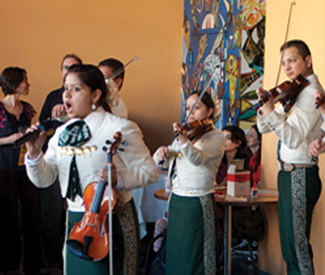
Holiday youth mariachi concert Three zestful youth mariachi bands perform traditional Mexican holiday music, providing an energizing segue into a sometimes exhausting season.

Dec. 16, 7:30 p.m., $10. Mission Cultural Center for Latino Arts, 2868 Mission, SF. (415) 643-2785, www.missionculturalcenter.org


Holiday Memories double feature Head back to the times of toboggans and candle-lit windows with two short films recounting rural winters of yesteryear. A Child’s Christmas in Wales visualizes Dylan Thomas’ Welsh childhood; The Sweater animatedly recounts Roch Carrier’s Quebecois, hockey-centered upbringing.

Dec. 17, 2 p.m., free with $15 museum admission. The Exploratorium, 3601 Lyon, SF. (415) 561-0360, www.exploratorium.edu


Renegade Craft Fair holiday market For the third year and showcasing more than 250 makers and craftspeople, the Renegade Craft Fair’s holiday happening can be a bit overwhelming. But it’s an undeniably great answer to gifting woes: pick up jewelry, body products, paper goods, clothing, and way, way more, all DIY enough to satisfy your most loca-ttired friend.

Dec. 17-18, 11 a.m.-6 p.m., free. Concourse Exhibition Center, 635 Eighth St., SF. www.renegadecraft.com


Reclaiming Yule ritual It may be chilly outside, but Sebastapol’s midwinter celebration (led by Starhawk, a leader in Bay Area earth-based spirituality) is indoors and full of warmth-inducing activities, namely dancing in honor of the Earth and Sun.

Dec. 18, 6:30 p.m., $7. Sebastopol Community Center, 390 Morris, Sebastapol. www.reclaiming.org


Solstice Eve celebration With a bonfire and roles doled out to participants (rocks, trees and mists), celebrating the longest night of the year on Ocean Beach is actually rather toasty. Bring items to release into the transformative fire — love letters are just the starting point.

Dec. 20, 3:30 p.m., free. Ocean Beach at Taraval, SF. www.reclaiming.org


Bill Graham menorah lighting The lighting itself takes place at 5 p.m., but the hours-long run-up is by no means lacking: traditional Jewish music, arts and crafts, and menorahs for every child fill Union Square starting at 3 p.m.

Dec. 20, 5 p.m., free. Union Square, SF. www.chabadsf.org


Kujichagulia celebration Kwanzaa’s day of personal definition and expression comes to City Hall, followed by a candle-lighting ceremony and dinner at Gussie’s, known for its fried tasties, red velvet cake, and Southern sweet tea.

Dec. 27, noon, City Hall, SF., 6 p.m., Gussies Chicken and Waffles, 1521 Eddy, SF. www.kwanzaasanfrancisco.com


Ujima celebration On Ujima, the third day of the week-long Kwanzaa holiday, community members gather to celebrate a collective spirit of responsibility and work.

Dec. 28, 3-6 p.m., free. Bayview Hunters Point YMCA, 1601 Lane, SF. www.sfpl.org


Keeping Score: Ives Holiday Symphony screening Unrecognized at the time of his death, experimentalist composer Charles Ives labored over his Holiday Symphony, which now gets fitting recognition by the San Francisco Symphony in a library concert that follows an hour-long documentary on the man.

Dec. 29, noon, free. Main Library, 100 Larkin, SF. (415) 557-4400, www.sfpl.org


Kuumba celebration Fittingly, the main San Francisco celebration of Kwanzaa’s Kuumba (day of creativity) occurs in the Jazz Heritage Center, a space shared by musical hotspot Yoshi’s. Celebrate the Fillmore’s manifold musical virtuosos on the last day of the year.

Dec. 31, 1-5 p.m., free. Jazz Heritage Center, 1330 Fillmore, SF. www.jazzheritagecenter.org
Rare and juicy

1

FILM Longtime San Francisco resident George Kuchar’s death this September was a reminder of how many had been influenced by his loveably eccentric movies, from famous early fans like Andy Warhol and John Waters to the hundreds of students who passed through his San Francisco Art Institute courses over the decades. Among the latter, for a long time his most famous protégé — at least locally — was Curt McDowell, who started out as a teacher’s pet, moved on to heavy petting with teacher, and remained close to Kuchar as both friend and collaborator until his own AIDS-related demise in 1987.

George Kuchar’s half-century-plus output was always joyfully accessible “avant-garde” cinema, its mixture of the personal and the purple drawing on the conventions of those Hollywood melodramas he and brother Mike (who’s taking over George’s teaching responsibilities at SFAI) grew up watching in the 1950s Bronx. His films’ popularity was perhaps most hindered by the simple fact that he only felt moved to direct something in the more marketable feature length form once — 1973’s The Devil’s Cleavage.

McDowell’s films, often heavily influenced by George Kuchar’s (even when the latter wasn’t operating as scenarist and actor on them), also had a wide streak of camp parody, a Warholian mini-constellation of “stars,” a vivid aesthetic, and impulse toward autobiography. They were much more aggressively sexual, and ambitious — during his much-too-short career he made no less than four features, two of which were porn in the graphic-content if not commercial sense. The hour-long Peed in the Wind (1972), the same year’s Lunch, and 1985’s very-long-in-the-making Sparkle’s Tavern are basically forgotten now, the last not screened in the Bay Area for at least a decade, the others possibly unseen since the 1970s.

Thundercrack! (1975) — an even more daft shot at “adult” cinema than the experimental-minded Lunch — is better known, having had at least the beginnings of a midnight movie cult following. But with all its baroque, still-singular The Old Dark House (1932) meets Tennessee Williams charms (there is surely no other porn flick remotely like it), why isn’t it now as well known as, say, Pink Flamingos (1972) or Eraserhead (1977)? Part of that doubtless has to do with the disarray McDowell’s body of work has been in, access-wise, for nearly 25 years now. Some of his films are distributed by (but seldom rented from) Canyon Cinema. Others are in storage, or presumed lost. Nothing is available on DVD, and any videotapes have long gone out of print. Whether this is due to strife, disorganization, or financial limitations among the guardians of his trust remains as murky as it was in the 1990s, when the last, brief issue of Thundercrack! and some shorts on VHS occurred.

Thus, it’s sadly rare to get a McDowell program even here in SF, where his memory should flourish rather than be slowly slipping from public awareness. Just such an occasion arrives this week at the Roxie — co-founded by his longtime creative and domestic partner, Robert Evans — as two shows spread over three days reprise some (relatively) familiar as well as barely-seen material.

The main attraction, as well as the scarcest, is 1980’s 55-minute Taboo (The Single and the LP), which will be shown on projected VHS due to a typical bad-luck hurdle: its original materials, plus those for other films, were sent to New York’s Museum of Modern Art years ago, only to go missing in transit.

While McDowell often echoed George Kuchar’s use of narrative more as an erratic reference point than a rule to follow, Taboo has an unusually abstract relation to story even by his standards, at least those of his longer works. Purportedly crafted over four years — his output slowed considerably after Evans had replaced the incredibly prolific Kuchar as boyfriend — it has buxom, blonde-bewigged sis Melinda McDowell, recently departed Thundercrack! mad diva Marion Eaton, and a glowering Kuchar as three parts of a tempestuous two-couple marital equation variously simmering with unmet desire and boiling over with orgiastic excess.

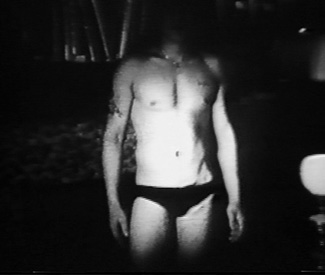
But it’s the fourth player who dominates the filmmaker’s attention. One of his numerous onscreen Joe Dallesandros, but evidently a source of particular longtime obsession, Fahed (a.k.a. David) Martha hailed from a Palestinian family that owned the grocery store next to the Roxie; his petite yet muscle-bound Sal Mineo-like appeal piqued McDowell, who didn’t mind the frequent presence of an equally young girlfriend. (In fact, he freely admitted “really getting turned on by straight men.”) Throughout Taboo‘s mix of the poetical and camp, the black and white camera salivates over this nearly-naked Adonis’ body and cocky attitude; in turn, he displays an exhibitionist zeal he probably didn’t know he had in him. A producer here and close friend, former Castro Theatre programmer and current San Francisco Silent Film Festival artistic director Anita Monga says McDowell “just saw the deep sexual beauty in everyone,” turning them on with the sheer voracity of his admiring gaze.

In one of the shorts the Roxie is showing in a separate program, 1972’s Confessions, McDowell interviews friends and lovers, asking them to describe his best and worst qualities. Perhaps straddling both, one confides “You’ve always had this energy, it’s like an explosion. I think when people see your films they have to understand, like, sex. It seems like you need so much more sex than other people.” A satyr-like omnivorous seduction and insatiability still sweats off many of his films as if through pores, most notoriously 1985’s Loads (a Dionysian compilation of guys he’d lured up to masturbate and service in his Mission studio).

McDowell was a happily self-corrupted transplant from the Heartland (with typical alliterative flair, Kuchar called him “curt, cute, controversial, and not celibate … poet of the plebeian and perverse”); he enjoyed shocking the staid society left behind — 1970’s A Visit to Indiana is his amusingly sulky chronicle of a most reluctant trip home.

Also on the Roxie bill are such examples of pure, impish silliness as 1972’s Siamese Twin Pin Heads, a short perhaps dated by a “look ma, we’re naked!” glee that looked a lot more rebellious back then. But 1973’s Boggy Depot is a homemade musical anticipating Thundercrack!‘s puppet theater-Gothic look. Its variously scheming and schemed-against protagonists trill their ridiculous operetta-style lyrics to found orchestral tracks. This is one McDowell film in which people keep their pants on, but these 17 sublime minutes are orgasmically pleasurable nonetheless.

“LOADS OF CURT MCDOWELL”

Sat/26-Sun/17, 1 p.m.; Mon/28, 10 p.m., $5-9.75

Roxie

3117 16th St., SF

(415) 863-1087

www.roxie.com


Small-screen hero

0

arts@sfbg.com

FILM While he’s always kept a fairly low profile doing it, probably no director who calls the Bay Area home has balanced our penchant for documentary work and independence with a successful commercial (meaning Hollywood) career as gracefully, or as long, as John Korty. Now 75, the Marin resident is in the midst of a major retrospective — incredibly, his first — at the Christopher B. Smith Rafael Film Center, which runs through December 4.

You’ve already missed his first feature (whimsical 1966 indie The Crazy-Quilt), his latest (veteran rock ‘n’ roller portrait John Allair Digs In!), and one of the most popular broadcast documentaries ever: 1977’s Who Are The DeBolts (And Where Did They Get 19 Kids?), about a Piedmont, Calif. couple and their huge clan of mostly adopted children, many disabled war orphans. But there’s still plenty left that conveys the diversity of Korty’s output, even if it just scratches the surface of his nearly 50-year career — which began auspiciously enough with an Oscar nomination for 1964’s short anti-smoking satire Breaking the Habit.

That same year the native Hoosier moved with his Bolex to Stinson Beach. Filled with the era’s infinite youthful ambition, he made three features in fast succession, though despite all awards and admiring reviews, they took much longer actually getting released at a time when art house meant foreign films. The Crazy-Quilt mixed Chaplin-esque pathos with the antic and existential in its charting a dedicated cynic and a “girl who believed in everything” from meet-cute to shared grumpy old age. Likewise shot all over SF and Marin, 1967’s Funnyman had influential improv group the Committee member (and future sitcom staple) Peter Bonerz as a gifted comedian who’s a petulant boy-man offstage. Barely theatrically released in 1971, four years after its festival debut, its Rafael showing was probably its first local appearance in decades.

Korty had resisted Hollywood overtures since Crazy-Quilt, though he did work for Francis Ford Coppola’s then-fledgling American Zoetrope for a couple of years. In 1972, however, he commenced a prolific 26-year run of major-network TV movies, starting on a high note with odd utopian sci-fi fantasy The People (in which William Shatner restrains himself) and permanently-scarring teen cautionary tale Go Ask Alice.

Sometimes the material was a little schlocky (like 1991’s Suzanne Somers autobiographical dramatization Keeping Secrets, not to mention a little thing from 1984 called The Ewok Adventure), but more often his sights were set unusually high, with results sometimes among the very finest in the much disparaged telepic genre. Certainly considered such were two landmark films the Rafael shows for free over the next couple weeks: 1974’s The Autobiography of Miss Jane Pittman, with Cicely Tyson as the ex-slave whose 100 years take her all the way to a 1960s civil rights march; and 1976’s Farewell to Manzanar, depicting America’s internment camps for Japanese-heritage citizens during World War II.

Once he’d crossed into broadcast, Korty had relatively few big-screen opportunities; the drippy 1978 Love Story sequel Oliver’s Story probably made him wish for even fewer. Getting a very rare revival at the Rafael is the more indie-sensibility ’76 Alex and the Gypsy, an offbeat if uneven comic romance between delightful Geneviève Bujold’s Roma woman and Jack Lemmon (basically playing Jack Lemmon) as her bail bondsman.

Korty’s longtime animation jones has rarely won much attention, despite its scattered presence in his filmography (like Funnyman‘s brief cartoon interludes). But it found full expression in 1983’s feature Twice Upon a Time, which closes the Rafael series. Regrettably underseen even by professed animation fanatics, a theatrical nonstarter, and DVD (let alone Blu-ray) holdout, it utilizes cut-out techniques Korty devised himself to follow “all purpose animal” Lorenzo, his sidekick Mum (who “speaks” in foley effects), and their fight to prevent evil Synonamess Botch from dropping “nightmare bombs” into the subconscious minds of sleepers worldwide. It’s a charming odyssey that recalls 1968’s Yellow Submarine in applying adult wit and design imagination to child-friendly ‘toonery.

As if all this weren’t rangy enough, a November 27 shorts program traverses ground from a 1961 documentary (The Language of Faces, chronicling a Quaker peace vigil at the Pentagon) to brief Sesame Street animations and 1974’s The Music School, a half-hour John Updike miniature from PBS’ American Short Stories series. *

“THE FILMS OF JOHN KORTY”

Through Dec. 4, $6.75–<\d>$10.25

Christopher B. Smith Rafael Film Center

1118 Fourth St., San Rafael

(415) 454-1222

www.cafilm.org


The faces and voices of Occupy

33

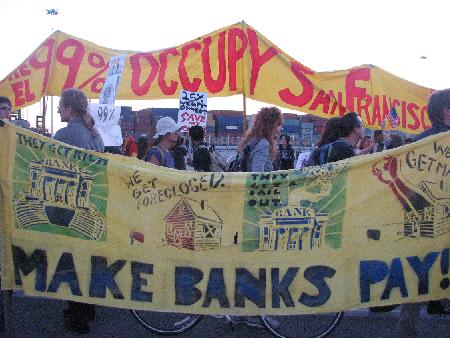
Who are the 99 percent — and what are they saying? It’s not what you read in the daily papers

To read some of the accounts in the daily papers in San Francisco, and hear some of the national critics, you’d think the people in the local Occupy movement were mostly filthy, drunk, violent social outcasts just looking for a place to party. Or that they’re mad-eyed anarchists who can’t wait to break windows and throw bottles at the police. Or that they’re a confused and leaderless band that can’t figure out what it wants.

When you actually go and spend time at Occupy SF and Occupy Cal and Occupy Oakland, as our reporters have done, you get a very different picture.

The Occupy movement is diverse, complex and powerful. It’s full of people with different backgrounds and perspectives. And they all agree that economic injustice and inequality are at the root of the major problems facing the United States today.

Here are some of those people, the faces and the voices of Occupy — and a celebration of the lives they’re living and the work they’re doing.


The student

Jessica Martin reflects on the First Amendment

Guardian photo by Rebecca Bowe

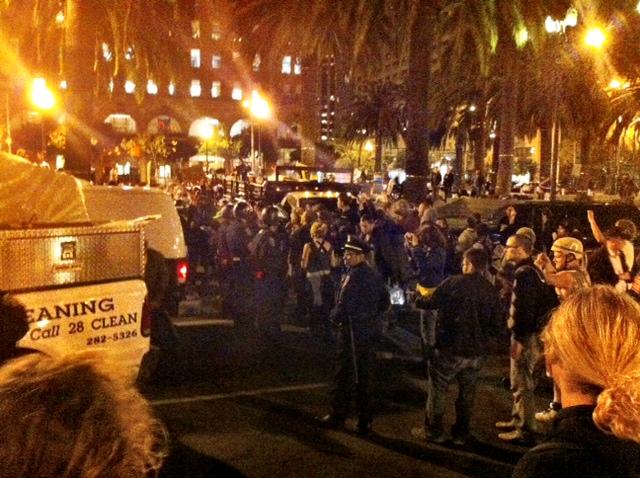
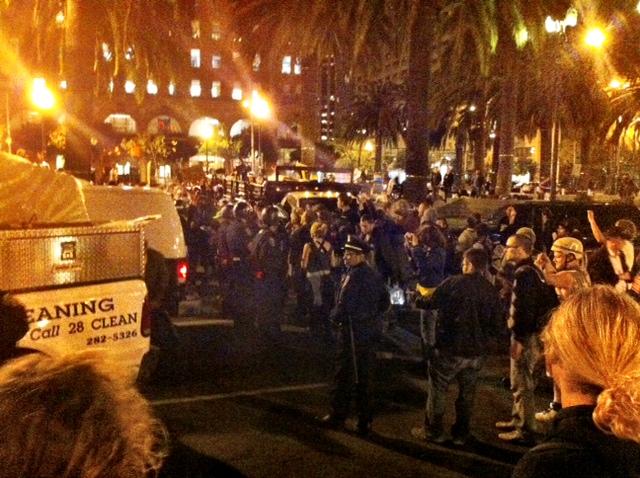
Jessica Martin stood and held her sign high on the steps of Sproul Hall, at the University of California at Berkeley, while a jubilant crowd of students jammed to classic dance party tunes and set up tents. They were invigorated by a general assembly that had attracted thousands following a Nov. 15 student strike and Day of Action called as part of the Occupy movement. (Their tents were cleared in a police raid two days later, yet students responded with flair, suspending tents high in the air with balloons.)

Martin’s sign proclaimed, “Remember the First Amendment,” and she’d written the text of the Constitutional right to free speech on the other side.

“My mother stood on the steps [of the Lincoln Memorial] in D.C. with Martin Luther King as part of the ‘I Have a Dream’ speech,” said the graduating senior, who’s majoring in Japanese and Linguistics. “And now I stand on the steps of Sproul Hall,” — the birthplace of Berkeley’s Free Speech Movement — “in front of the Martin Luther King Student Union, to defend my First Amendment rights.”

She expressed solidarity with students who were brutalized by police Nov. 9 following their first attempt to establish an occupation.

“Part of what [police] are here to serve and protect is the First Amendment,” Martin said. But on that day, “They met the First Amendment with violence.” (Rebecca Bowe)


The artist

Ernest Doty responds to police brutality

Guardian photo by Rebecca Bowe

In Oakland, a young veteran named Scott Olsen suffered a fractured skull and brain injuries after being hit with a police projectile at an Oct. 25 Occupy Oakland protest. Ernest Doty was one of several who ran to Olsen’s aid and carried him to safety.

“Immediately after I saw Scott go down … I knew I had to get him, and get him out of there,” Doty recounted. “I whistled at another guy, and we both ran in. The cops were shooting at us with rubber bullets.” As they ran up, he said, a flash grenade blew up next to Olsen’s face, just inches from his head injury.

Doty, 32, recently moved to the Bay Area from Albuquerque, New Mexico. An artist who also does spoken word performances, he’s camped overnight at Occupy Oakland and has incorporated words and images from the Occupy movement into his artwork and poetry.

He’s also been personally impacted by tragedies arising from police interactions: Both his stepbrother and his cousin — a veteran who suffered from post-traumatic stress disorder — were shot and killed by police in New Mexico.

Occupy Oakland “has managed to create a community out of chaos,” Doty said. “I think that this movement is going to continue to grow. It’s the 1960s all over again, but it’s broader. It’s going to be a long road. I think encampments, marches, and protests are going to continue into the next year.”(Bowe)

Ernest Doty’s next art show is Dec. 2 from 7 to 11 p.m. at Sticks + Stones Gallery, 815 Broadway, in Oakland.


The peacekeeper

Nate Paluga deals with camp conflict

Guardian photo by Mirissa Neff

Does this man look like he’s an occupier? Depends on your perception of the movement. He’s not homeless — he’s a bike mechanic who lives in Nob Hill and whose girlfriend only tentatively accepts that he’s camping in Justin Herman Plaza. He is young, blunt, and possesses the intense gaze of an activist, belied by a snug red-white-and-blue biker’s cap with “USA” emblazoned on the underbelly of its brim.

Paluga, a self-proclaimed philosopher, has grabbed upon the concepts of “fairness and equality” as the core values of Occupy. “This movement means something different to different people, but I haven’t found anyone that disagrees with those being some core values,” he said as he showed off the bike he uses to move as much as 100 pounds of food and equipment for the camp.

His core values are his guidelines in his other role at Occupy SF: peacekeeper. Paluga said he and others often intervene in the disagreements that can arise in a group-run housing situation populated by diverse socioeconomic and cultural backgrounds.

He said that with aggressive individuals it’s important to reinforce why they’re all there. “They’re coming from places where there wasn’t a lot of equality and justice and they’re bringing that with them. You gotta step in and tell them it’s gonna be okay.” (Caitlin Donohue)


The nester

Two Horses’ permanent protest

Guardian photo by Mirissa Neff

Two Horses might have the most welcoming tent at Occupy SF. Brightly stocked flowerboxes and a welcome mat are outside; inside, the one-time property manager and current homeless man has arranged an air mattress, carpet, and princess accommodations for his 12-year-old blind white cat Luna. There’s even a four-foot tall kitty tower.

The agile feline moves toward the sound of his hand tapping on the floor. “I like the idea of a 24-hour protest,” said Two Horses. He came to the camp a few weeks ago and was impressed by the quality and availability of food available in the encampment’s kitchen, where he said donations come from all over (“it comes from the 99 percent”) at all hours of the day and night.

“I knew I had to do something, so I started volunteering.” He now works the late shift, a core kitchen staffer.

When Michael Moore came by the plaza, Two Horses was impressed. “It wasn’t so much what he said but how he came shuffling up with no entourage, no security, no assistant with a clipboard.” He would, however, like to see more communication between Occupy camps, maybe a livestream video screen to see other cities.

He seems quite at home in his surroundings. “My goal is to look as permanent as I can,” he said, the corners of his mouth turning up crookedly, happily. (Donohue)


The healers

Med tent volunteers from the nurses’ union do it for the patients

Guardian photo by Mirissa Neff

Melissa Thompson has a kid who’s looking at college options; she hopes her family can figure out a way to afford education in a state where public university tuition continues to rise.

But that’s not the only reason she’s at Occupy SF. On a cloudy Friday morning, Thompson sat outside the encampment’s med tent, where she tended to cuts, changed the dressing on wounds, and provided socks, blankets, and tools for basic hygiene. It’s her trade — she’s a nurse, one of the many California Nurses Association members sick of cuts to the country’s public and private health options who were eager to lend their services to the movement.

She’s also one of the determined crew that enlivens Occupy Walnut Creek. What’s it like out there? “It’s been good,” she assured us, brightly. “We’re on the corner, by the Bank of America? We’ve had great reactions at Walnut Creek.”

Thompson said she got involved because “I love being a nurse, number one.” Corporate greed, she said, has led to cuts in her patients’ insurance, leaving them to make tough decisions between feeding their family and filling the prescription for their post-dialysis medications.

She said he hopes the politicians are listening to Occupy. “I don’t understand what the problem is. They need to open up their eyes and see how they’ve damaged us.” (Donohue)


The fabulous

Li Morales and Molly Goldberg talk about Queer Occupy

Queers have long been resisting the ravages of the one percent on the 99 percent. Resistance has looked like coming together on our own, on our own terms, with our own names, genders, and chosen families. Like the (decolonize) occupations in San Francisco, Oakland, around the country and world, our resistance is made out of a stubborn imagination, and can be messy. We are a menagerie of magnificent beasts, with all of our struggles and limitations firmly at the center of the fabulous and fucked-up world we make for ourselves.

In HAVOQ/ SF Pride at Work, we imagine queerness not as a What, an identity whose boundaries we seek to police, a platform from which to put forth our One Demand. Rather, we imagine it as a How: a way of being with one another. We call it Fabulosity. And Fabulosity means drawing on queer histories of re-imagining family as a way of expanding circles of care and responsibility. Fabulosity is to affirm the self-determination of every queer to do queer just exactly how they do. It affirms that under the banner of the 99 percent, we are all uniquely impacted by the ravages of the 1 percent and we come with a diversity of strategies and tactics to resist and survive.

In the gray areas lives our emerging autonomy and interdependence — an autonomy not contingent on capitalism’s insistence on utility. We are not useful. We are not legible. And in that lack of utility and that illegibility, we are not controllable. Because we do not have one demand, but rather a cornucopia of desire. We’re making our fabulous fucked-up world for ourselves, with each other. We always have. (Morales and Goldberg)

Li Morales and Molly Goldberg are members of SF Pride at Work/HAVOQ, a San Francisco-based collective of queers organizing for social and economic justice.


The mechanic

reZz keeps Occupy’s tires filled

Photo by David Martinez

On a Sunday afternoon at Occupy SF, Bike Kitchen volunteer reZz exported the education-oriented bike shop’s mission — and its tools — to Justin Herman Plaza. There he stood, fixing alignment on the wheels of passers-by and occupiers — for free. “Occupy Bike Shop,” as he and other volunteers have come to call the service, has been tinkering out in the plaza two to three times a week.

“It’s been lovely,” he said later in a phone interview with the Guardian. “I’ve purposefully been in a place where it’s open to people in the encampment and people who are passing by. People who stop want to see the occupation in it’s most positive light.” reZz wouldn’t consider camping out at Occupy, but that’s not to say that he doesn’t truck with the movement’s message that public space can — and should — be repurposed.

An avid biker himself, he thinks public bike repair is a great re-envisioning tactic. And fixing poor people’s bikes sends its own message. “This year’s junk is an invented need,” he said. “We’re falling into debt because we think we need a new car every year. Part of the idea of fixing people’s bikes and showing them how to do it brings us away from the artificial scarcity whereby the robber barons and capitalists insist we have to struggle against each other instead of working with each other.” (Donohue)


The medic

Miran Istina has cancer — and helps others

Guardian photo by Yael Chanoff

It had grown dark, and the OccupySF camp was restless as many signs pointed to a raid that night at 101 Market Street. But 18-year-old Miran Istina sat calmly on the sidewalk, medical supplies spread over her lap. “As a medic for OccupySF,” said Istina, “It’s my job to have a well-supplied, well-organized medical kit.”

The tall, wide-eyed teenager, who spends some of the time in a wheelchair, is not just a medic at camp. She has done police liaison and media work as well. And she has a remarkable story.

When she was 14, Istina was diagnosed with chronic myelogenous leukemia. Her family had purchased her health insurance only three months before, and the cancer was in stage two, indicating that she had been sick for at least one year. So the company denied her treatment, which would include a bone-marrow transplant, radiation therapy and chemotherapy, on the basis of a pre-existing condition.

Her family bought a van, left Sisters, Oregon, and started searching for somebody who would treat her. They traveled around the country three years, desperate for the life-saving treatment but unable to pay for it.

Just after her 17th birthday, Istina left her parents in New York and began hitchhiking back to Oregon. “That was my way of saying, I’m done looking for treatment. I’m going to do what makes my heart happy.”

After a little over a year of traveling and exploring her interests, Istina made her way to San Francisco. She was sleeping in Buena Vista Park when she “heard some protesters walking by, going ‘occupy San Francisco! Occupy San Francisco. I figured they were a bunch of radicals and that a street kid like me really wouldn’t be welcome.'”

A few nights later, she did go check it out, looking for a safe place to sleep. “They explained to me what it’s about, and why we’re here, and my story directly sat inside of that.”

She has been living and organizing with OccupySF ever since. She got involved with the medic team after spending a night in the hospital for kidney failure, then being treated for nine days, free, in the camp’s medical tent. “They realized I had a lot of skill as a medic, and gave me a kit.”

In the midst of recent media attacks on the OccupySF community, Istina is defensive: “Every community has its assholes. Every community has that pit that no one goes into because it’s just yucky. For some people in San Francisco it’s the Haight, for the the Haightians- you know, the Haight people- it’s the financial district. For other people it’ll be somewhere else. But I love the community here. “I’ve been hurt by a lot of people in my life,” said Istina. “But I think I can make that right by holding to this pure-hearted motto of universal and unconditional love, for everyone. No exceptions.” (Yael Chanoff)

A pitch and a swing

1

le.chicken.farmer@gmail.com

CHEAP EATS We went to see Moneyball. You know: We have soft spots in our hearts for baseball. Additionally, Hedgehog has a wet spot in her panties for Brad Pitt; and I in mine, truth be told, for Jonah Hill.

Before he lost the weight, mind you — although he’s pretty funny after, too.

Anyway, it was a good movie, and Jonah Hill was fat, and the popcorn was quite good, but still I had a nervous breakdown afterwards. No idea why. I think it had something to do with a shot near the end of the movie. Brad Pitt, as Billy Beane, driving on I-880 I believe, and through his window the stacks and stacks of cargo containers down the harbor. Maybe the familiarity was too familiar for comfort (I once had a panic attack on that exact stretch of freeway) or the bounce of the frame or the camera angle. Something. Something took the fight right out of me.

I tried to compose myself in the ladies room after. “I exist, therefore I am,” I wrote, on toilet paper. “Now,” I continued, plagiarizing shamelessly: “Whether I shall turn out to be the hero of my own life …”

No. I composed and composed. I stole, I borrowed, I begged, I vandalized, I unraveled and unraveled, but could not find the little bouncy rubber ball at the center of things. Not even for the life of me. So, after a fairly normal amount of time had passed, I flushed and washed and walked back out into the lobby, all dry-eyed and dignified-like. Hedgehog smiled. We rode down the escalator together.

Nervous breakdowns are hard to explain.

“Sushi, or ramen?” she said. (We were after all in Japantown.)

I would have jumped at either, normally. I love the sushi. I love the ramen. But to give me a choice, at a time like this, was cruel and unusual. Or would have been, if she only knew what I was going through.

Nevertheless, I thought I would have something by the time we reached the bottom. If not an answer, a word. A question. A rubber ball. A look. Anything. But I could not, would not, Sam-I-Am. I was nothing but fear . . . of absolutely nothing. So paralyzed, so empty, that I could not lift my feet and was sucked like a stick-figured cutout into the machinery of it all, the gear and grind, sending me back up, undersided and undecided, crinkle, fold, and rip.

Hedgehog does not have patience for indecision, let alone cartoonery. “Ramen?” she said. “Or sushi.” As if changing the order of things would fix it for me.

I managed to say something. We were standing at the foot of the escalator, by the door. “I’m having a panic attack,” I said.

And — for those of you who can relate, so you know, there is something about calling your panic attack a panic attack, out loud and in the middle of it, that kind of diffuses the situation. Try it.

I was still scared and empty, but I could step again, at least, and think, and imagine food.

“Ramen,” I said. And say.

And we walked very slowly to Suzu. Probably for the best, we had to sit outside, which doesn’t mean outside outside. It means out in Japantown Center, instead of in the small, cozy, bustling restaurant. But at least we could sit right away and have a glass of water.

I had of course warned Hedgehog that anxiety and panic were possible parts of the package, although neither had really attacked me, as such, in a year or two. Now, while we waited on our spicy ramen (me) and Tokyo ramen (her), I tried to gauge whether she still loved me or not, or the same. And all the while I still wasn’t totally convinced that I wasn’t about to drop dead, either.

Love and life notwithstanding, what we learned that day was that, yo, we kinda needed each other. My ramen was so insanely spicy, and hers so ridiculously bland, that the only way either one of us could be quite satisfactorily nourished was to mix the two together.

And as we did, spoon by spoon, we relished the weirdness of eating outside of an indoor restaurant, in a mall, and gradually my heart beat, breathing, and dimensionality came back to me.

New favorite restaurant:

SUZU NOODLE HOUSE

Daily: 11:30 a.m.- 9 p.m

1825 Post St., SF.

(415) 346-5083

MC/V

Beer & wine


Tradition!

3

emilysavage@sfbg.com

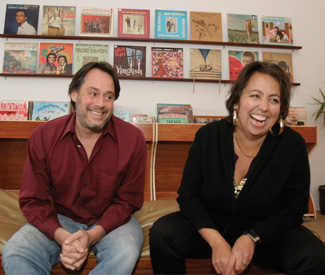
MUSIC Row after row of sentimental — sometimes kitschy, sometimes renowned — vinyl albums are lining pristine white walls in a small storefront, waiting for the opening of a record store that will exist for just one month.

Quite possibly the world’s first Jewish pop-up record shop, it’s in San Francisco on the edge of Mission and Bernal, in rotating art-music space, Queens Nails.

Like flashes of nostalgic dreams, each cardboard cover at the shop is its own piece of art: there’s the colorful impressionist style square enclosing Fred Katz’s trippy 1958 klezmer-meets-folk record Folk Songs for Far Out Folk, the shelf above holds Johnny Mathis’ breathtaking Kol Nidre, along with the campy Mickey Katz album, Mish Mosh — the cover of which depicts the artist as a (hopefully kosher) butcher posing with both meat-links and brass instruments.

There also are brand new copies of the recently released Songs for the Jewish American Jet Set, a compilation of wildly varying tracks (surf rock from the Sabras, deep soul Morrocan-born singer Jo Amar doing “Ani Ladodi”) culled from the archives of now-defunct Tikva Records, a Jewish label that was around from 1950 through 1973.

The Idelsohn Society for Musical Preservation released Songs for the Jewish American Jet Set, and is hosting the pop-up store, also dubbed Tikva Records. The group, whose mission focuses on preserving the 20th century Jewish experience through recorded sound, also has put out a number of reissues and hosted live music events in the past — this store will encompass both.

“When we initially did the reissues, we went out and found a lot of the artists on these records and we realized we really wanted to tell the stories of the music,” explains David Katznelson, the music biz veteran behind Birdman Records, president of the San Francisco Appreciation Society, and one of four Idelsohn Society co-founders.

So, in addition to selling vintage records and reissues, the store also will play host to a series of Jewish and Hebraic-themed live acts. Beginning Dec. 1 with the official opening party, artists will drop by for free, by donation performances: on Dec. 2, founding Los Lobos member Steve Berlin will original score a silent film, Los Angeles band Fool’s Gold will celebrate the release of its second LP with an in-store performance Dec. 7, classic duo the Burton Sisters will perform live for only the second time in the past five decades on Dec. 8, members of Dengue Fever will play live Dec. 10. And plenty more follow.

The Chanukah candle lighting ceremonies will begin with a performance by Zach Rogue — the leader of Oakland’s Rogue Wave who recently released Come Back To Us under the name Release the Sunbird. While some of the others acts were a natural fit in the Tikva lineup, Rogue was one that surprised me — his music has always seemed rather secular to me, so I asked him about it. Turns out, it will be his first time playing a Chanukah event. So will he play Rogue Waves songs, Release the Sunbird jams, or traditional Chanukah melodies? “I’m trying to figure that out now. I wouldn’t say that Chanukah songs are necessarily the top my repertoire.”

He explained his reasoning for participating in the event, “When I think back in terms of what got me into wanting to play the guitar, my parents raised me on psychedelic, ’60s British invasion stuff, but in terms of the actual acoustic guitar, a lot of it was Jewish summer camp — Camp Swig in Saratoga,” adding, “I was fascinated with the song leaders and the cadence of Jewish folk songs and Eastern European sound.”

Weaving around the ’50s epoch furniture (solid hand carved shelves and credenzas that look like wet bars, record players) of the newly constructed pop-up shop with “Tikva Records” in red lettering on the window front, I got a sense of a cozy, hangout for record lovers, Jewish or not, which lead me to again question: what exactly makes music Jewish?

Vibrant, and clearly enamored with these albums, Katznelson was on hand with some helpful thoughts. “I think, like all music, it’s open to interpretation. What we do is use this music to look at Jewish history — it’s beyond Jewish music, it’s music that has affected the Jewish experience.”

Jewlia Eisenberg, leader of SF group Charming Hostess, was also previewing the store — it was her first time taking a peek around too, and she seemed ecstatic, slipping records out of the shelves and commenting, “oh my god, look at this one!” Along with the help of a few volunteers, Eisenberg will be running the shop during the month of December.

Katznelson and Eisenberg pulled out records to examine, including the classic Fiddler on the Roof, but more so albums that recently came back to light, like the Latin-tinged Bagels and Bongos — another album the Idelsohn Society reissued. Says Katznelson, “Hybrids happened, and it created new sounds — so what are those new sounds called?”

An example of the modern Jewish hybrid: Jeremiah Lockwood, New York-based bandleader of the Sway Machinery and grandson of legendary cantor Jacob Konigsberg, who will light the final two nights of Chanukah candles at the store, and perform live.

During his second appearance, Ethan Miller of Howling Rain and Luther Dickinson of the North Mississippi All Stars will join Lockwood in performance. He met Dickinson back in 1998 when they worked on a friend’s album together. Says Lockwood. “It was my first trip to the South after spending my adolescence obsessed with country blues and it made a big impression on me.”

The rest of his performances will be a mixed bag, reflecting decades of the Jewish — and American — music experience. “I’m most comfortable playing blues-oriented material when I play solo, but I definitely plan to hit some tunes from the new Sway Machinery album,” he says, “I will certainly dig out some of my family’s Chanukah standards…very beautiful bits of Jewish folklore I grew up on and that were a part of the family Chanukah lighting ceremony.”

And just like that, after a month of record-selling and live performances culminating with holiday revelry, the pop-up will end, and it’ll be on to the next great idea for the Idelsohn Society. Like it was all some nostalgic, far-out folk dream. 

TIKVA JEWISH POP-UP RECORD STORE

Dec. 1-Dec. 28, times vary, free (donations suggested)

3191 Mission, SF

www.idelsohnsociety.com/tikvastore

www.tikvarecords.eventbrite.com


Lessons of the Avalos campaign

157

By N’Tanya Lee

It’s the middle of the night. His two kids and wife are home in bed. Supervisor John Avalos, candidate for mayor, heads downtown in his beat-up family car. He parks and walks over to 101 Market Street, and casually starts talking to members of OccupySF. He’s a city official, but folks camped out are appreciative when they see he’s there to stand with them, to try to stop the cops from harassing them, even though its 1 a.m. and he should be in bed.

John Avalos was the first elected official to personally visit Occupy SF. It wasn’t a publicity stunt — his campaign staff didn’t even know he was going until it was over. He arrived and left without an entourage or TV cameras. This kind of moment — defined by John’s personal integrity and the strength of his personal convictions — was repeated week after week, and provides a much-needed model of progressive political leadership in the city.

John Avalos is more than “a progressive standard bearer,” as the Chronicle likes to call him. He’s also a Spanish-speaking progressive Latino, rooted in community and labor organizing, with a racial justice analysis and real relationships with hundreds of organizers and everyday people outside of City Hall. He’s demonstrated an authentic accountability to the disenfranchised of the city, to communities of color and working people, and he knows that ultimately the future of the city is in our hands.

Some accomplishments of John’s campaign for mayor are already clear: He consolidated the progressive-left with 19%, or nearly 40,000, first-place votes, despite the confusion of a crowded field; he came in a strong second to incumbent Ed Lee despite being considered a long shot even weeks before the election; after RCV tallies, he finished with an incredible 40% of the vote, demonstrating a much wider base of support across the city than he began with, and much broader than former frontrunners Leland Yee and David Chiu, who outspent him 3-1. He won the Castro, placed third in Chinatown (ahead of Yee), and actually won the election-day citywide vote. Not bad. In fact, remarkable, for a progressive Latino from a working class district in the southern part of town, running in his first citywide race.

I believe John Avalos demonstrated what can be accomplished with a new kind of progressive leadership — and suggests the elements of a new progressive coalition that can be created to win races in 2012, and again, in 2015.

It’s Monday afternoon, 1:35pm, time for our weekly Campaign Board meeting. John rushes in, after a dozen appointments already that day. The rest of us file into the ‘cave’ — the one private room in Campaign headquarters, with no windows, a makeshift wall and furniture that looks to be third-hand. The board makes the key strategy, message, and financial decisions. There are no high paid political consultants here. Most of us are, or have been, organizers. Today, we need to approve the campaign platform. Finally. We’ve decided to get people excited about our ideas, an agenda for change. We leave the meeting excited and nervous, wondering if anyone will get excited about the city creating its own Municipal Bank.

We were an unlikely crew to lead a candidate campaign — even a progressive one in San Francisco. We come from membership based community and labor organizations, and share a critique of white progressive political players and electeds who spend too few resources on building power through organizing and operate without accountability to any base. We are policy and politics nerds, but we hate traditional politics. Seventy percent of us are people of color — Black, Filipina, Latino, and Chinese. We are all women except John, the candidate, and nearly half of us are balancing politics with parenting.

The campaign board — including John himself—shared a vision for building progressive power. The campaign plan was explicit and specific about achieving outcomes that included winning room 200 but went beyond that central goal. We set out to strengthen progressive forces, to build towards the 2012 Supervisor races, and increase the capacity of the community-based progressive electoral infrastructure so we can keep building our collective power year-round, for the long-term.

We hope these victories will shape progressive strategy moving forward:

1. In just a few months, Team Avalos consolidated a new and unique progressive bloc. We brought together people and organizations who’d never worked together before — white bike riders and Latino anti-gentrification organizers, queer activists and African American advocates for Local Hire. The Avalos coalition was largely community forces: SF Rising’s base in working class Black, Latino, Filipino and Chinese communities; the Bike Coalition’s growing base of mostly white bike riders; affinity groups like Filipinos, Queers, Latinos and Arabs for Avalos; progressive Democrats; social networks of creative, young progressive activists affiliated with the League of Young Voters; and loyal families and neighborhood leaders from John’s own District 11. The campaign prioritized communicating to voters in four languages, and according to the Chinese press, John Avalos was the only non-Chinese candidate with a significant Chinese outreach program. There were stalwarts from progressive labor unions (most notably SEIU 1021 and USWW) who threw down — but overall, labor played it safe and invested resources in other guys. And then, in the great surprise development of the race, supporters of the new national occupy movement came to be a strong part of the Team Avalos base because the campaign was so well positioned to resonate with the call to take on the one percent.

2) Team Avalos built popular support for key progressive ideas. We used the campaign to build popular support for a citywide progressive agenda. Instead of leading with our candidate we led with bold, distinctive issues that provided a positive alternative vision to the economic crisis: Progressive taxation, municipal banking, and corporate accountability for living wage jobs instead of corporate tax breaks. By the end of the campaign, at least three other candidates came to support the creation of a city-owned bank, and the idea had enough traction that even the San Francisco Business Times was forced to take a position against it.

3) Team Avalos built the electoral capacity of grassroots organizations whose members have the most at stake if progressives gain or lose power in SF: poor and working-class communities of color. We developed the electoral organizing skills of a large new cohort of grassroots leaders and organizers of color with no previous leadership experience in a candidate campaign. They are ready for the next election.

For the last few months, I had the privilege of working with an unusual but extraordinary Avalos campaign team, who were exactly the right people for the right moment in history, to lead a long shot campaign to an unlikely, remarkable and inspiring outcome. Let’s build on these gains. In the coming weeks and months, we must be thorough in our analysis of this election, engage and expand the Avalos coalition base, and build unity around one or more collective demands of Mayor Lee from the left. And in time, we will have a progressive voting majority and a governing bloc in City Hall. We will win, with the mass base necessary to defend gains, hold our own electeds accountable, and truly take on the city’s one percent.

NTanya Lee was the Executive Director of Coleman Advocates for Children & Youth, and served as a volunteer chair of the Avalos for Mayor campaign board. You can find her now at USF or working on her new project about a long-term vision for left governance called Project 2040.


Alerts

0

alerts@sfbg.com


THURSDAY 24

“Indigenous Peoples Sunrise Ceremony”

Honor indigenous peoples for a sunrise ceremony on Alcatraz Island on Un-Thanksgiving Day. Held annually since 1975, the Alcatraz ceremony honors the Alcatraz-Red Power Movement’s occupation of the island in 1969. The ceremony will feature Aztec Dancers, Pomo Dancers, live performances, and speakers. Hosted by the International Indian Treaty Council and American Indian Contemporary Arts. Ferry tickets go on sale at 4:15 a.m. Boats leave Pier 33 from 4:45 a.m. until 6 a.m.

6 a.m., free (plus $14 ferry ticket)

Alcatraz Island, SF

www.treatycouncil.org


SATURDAY 26

“Guardianas de la Vida (Guardians of Life)”

Observe the United Nation’s annual International Day for the Elimination of Violence Against Women with music, poetry, and art. The event opens with an interactive sewing piece, followed by a show at 7:30 featuring poetry by Judy Grahn, Genny Lim and Nina Serrano; Latin music by Bay Area singer-songwriters Maria Loreto, MamaKoatl and Marta Sevilla; theater by Circulo Cultural; and dance by Maria Luna, Maica Folch and Paloma Parra.

6 p.m., $10 donation

Dance Mission Theater

3316 24th St., SF

dancemission.com


TUESDAY 29

“David Barsamian on Journalism, Academia, and Censorship”

David Barsamian is founder and director of Alternative Radio. He has co-authored books with Noam Chomsky, Howard Zinn, Arundhati Roy, Edward Said, and other leading intellectuals. He was deported from India this past September, and his talk is titled Stories from Kashmir and California. Sponsored by the San Francisco Public Library and the San Jose Peace and Justice Center.

6 – 8 p.m., free

San Francisco Public Library

Koret Auditorium 100 Larkin St., SF

alternativeradio.org


WEDNESDAY 30

“The History of the Future”

Ponder utopias and dystopias, imagination and revolution, and the power of social movements and propaganda to shape the future with Starhawk, Megan Prelinger, and Chris Carlsson. Prelinger is the author of “Another Science Fiction,” offering a whimsical look at corporate representations of the Space Race. Starhawk’s “The Fifth Sacred Thing” and Chris Carlsson’s “After The Deluge” both present alternative utopian futures for San Francisco a century or more in the future. Join the conversation with these three authors.

7:30 p.m., free

CounterPULSE

1310 Mission, SF

www.shapingsf.org


Mail items for Alerts to the Guardian Building, 135 Mississippi St., SF, CA 94107; fax to (415) 437-3658; or e-mail alert@sfbg.com. Please include a contact telephone number. Items must be received at least one week prior to the publication date.

Live Shots: Pilot 59 at ODC Dance Commons, 11/19/11

0

After eleven weeks of creating, fine-tuning, and probably lots of serious sweating, six emerging choreographers presented their work this weekend at ODC for Pilot 59 that showed an eager, sold-out audience what they’ve got. It turns out, that entails quite a bit — the diversity in dancers and themes was striking. Two pieces especially caught my eye.

I loved the sex-bot, robo-girl piece choreographed by Bianca Cabrera, titled “Feral.” It gave a peculiar vision of the future, with a hint of zombie take-over and a pinch of nasty. The glittery costumes were fantastic. Major props to her dancers on capturing pixilated pulsations perfectly. Very impressive.

I also enjoyed “Allegretto,” choreographed by Charles Slender. I’m a bit of a FACT/SF groupie and find their work incredibly innovative and perfectly quirky. Set to Beethoven’s familiar Symphony No. 7 in A Major (if you heard it, you’d recognize it), the dancer’s movements struck me as innovative and beautifully strange. The beginning of the piece made me think a bit of traffic guards, while my husband said that it reminded him of Russian kittens (the fuzzy hats probably had something to do with that). Slender’s ability to make people dream of the bizarre (i.e. flag signals and cute pets, all in the same dance) for me, is the genius of his choreography.


Dick Meister: The lessons of Ohio

0

By Dick Meister

Dick Meister, former labor editor of the SF Chronicle and KQED-TV Newsroom, has covered labor and politics for more than a half-century. Contact him through his website, www.dickmeister.com, which includes more than 350 of his columns.

AFL-CIO President Richard Trumka has drawn some important lessons from last week’s election in Ohio that repealed a state law severely limiting the collective bargaining rights of public employees. Worse, it threatened to inspire passage of similar anti-bargaining laws elsewhere.

Listen to Trumka, a man who obviously knows what he’s talking about. In an article he wrote for Reader Supported News, he cites post-election polls showing that more than half of Ohio’s voters correctly “perceived the law as a political maneuver by Gov. John Kasich and state Republicans to weaken labor unions, rather than a genuine effort to make state government more efficient.”

Another poll, done for the AFL-CIO, showed that more than half the voters also found that Kasich and his allies “are putting the interests of big corporations ahead of average working people.”<–break->

Voters everywhere in the mid-term elections clearly wanted change. But, as Trumpka says, they did not want “political maneuvers and overreach” like those of Kasich and Republican legislators. They want effective action to curb unemployment, create jobs and deal with the other severe economic problems facing the country.

As Trumka notes, public employees, union members, Democrats and liberals voted overwhelmingly to repeal the Ohio law, but so did a majority of voters “from households with no public employee, workers without union representation and independents – as well as 30 percent of Republicans and 36 percent of conservatives.”

One of the key lessons Trumka draws from Ohio’s election is that “the myth of the pampered public employee has been busted. Public employees didn’t cause the economic crisis and they’re not the enemy. Demonization of public employees is neither a strategy nor a solution and the heartland Americans who voted to restore rights for public employees understood that.”

The election also reinforced the continued need for working people, public and private employees alike, to join closely together. That’s what happened in Ohio. There, as Trumka notes, “firefighters, teachers and other public employees were joined by plumbers, pilots and all kinds of private sector employees to win. Worker to worker, neighbor to neighbor, the message spread, and what began as an attempt to divide workers flopped famously. In the end, working people’s solidarity was the message.”

Politicians could also learn important lessons – if they will. For the Ohio voters “showed that when fundamental rights and livelihoods are targeted, working people will not only defend themselves, but come back stronger.”

The outcome of the Ohio vote should show politicians seeking office that it would be wise for them to pay much more attention to the wishes of working and middle class voters than to those of the wealthy and privileged. Says Trumka:

“Cutting taxes for millionaires and billionaires, scapegoating working Americans and their unions and downsizing Social Security and Medicare may get you a standing ovation from the 1%, but the voters who decide elections will not be fooled – and you may just get more than you bargained for.”

Trumka’s correct. But despite the results in Ohio and the lessons they hold for the anti-labor political right, many undoubtedly will continue what the AFL-CIO sees as “part of Wall Street’s strategy to chip away at collective bargaining rights, piece by piece, law by law, until unions and collective bargaining rights are destroyed.”

Working people and their unions can be reasonably certain, at least, that they’ll have strong support in trying to withstand the attack – including support from the Occupy Wall Street movement, which Trumka credits with “redefining the political narrative.”

The next major test will come in the presidential and congressional elections in 2012. They’re especially looking for support from the swing voters who supported President Obama in the 2008 election and generally have the same political views as the majority of Ohio voters.

Trumka describes the swing voters as “working Americans with modest incomes, moderate views and little patience for polices that aren’t fair and don’t work.”

He says politicians seeking election or re-election next year must heed them and “support public policies for the 99 percent – policies that create jobs, invest in America’s future, safeguard Social Security, Medicare and Medicaid, and promote fiscal sanity by requiring millionaires and billionaires to pay their fair share.”

OK, that’s asking for much more than we’ve been getting. But the Ohio vote demonstrated that it is possible to garner the votes necessary to overcome the forces that would deny us vital economic and political rights.

Dick Meister, former labor editor of the SF Chronicle and KQED-TV Newsroom, has covered labor and politics for more than a half-century. Contact him through his website, www.dickmeister.com, which includes more than 350 of his columns.

Labor ready to fight Occupy eviction

5

Tim Paulson, director of the San Francisco Labor Council, just told me that he’s got as many as 500 union members on alert to stand with the OccupySF encampment if the city attempts to evict the protesters. The Labor Council has put together a communications system to let members who have volunteered to help know when a showdown with the police is coming, and the volunteers are ready to spend as much as 24 hours at Justin Herman Plaza, and if necessary, in jail.

“We mobilized for last night, but nothing happened,” he said. “We’re in a state of constant vigilance.”

Paulson noted that the San Francisco encampment “is the symbol of the Occupy Movement.”

The solidarity of San Francisco labor will make it considerably more difficult for Mayor Ed Lee to send in the police and break up the camp. The idea that he would be ordering the arrests not only of several hundred Occupy protesters but a large contingent of local labor leaders and union members has to be giving him second (and third, and fourth) thoughts.

And whatever the outcome, the connenctions between labor and Occupy are critical to building and sustaining a national movement to demand economic justice. It’s great to see the SF Labor Council in the heart of the fight.

OccupySF is worth the investment

30

Thirteen labor and community leaders wrote to Mayor Ed Lee Nov. 17 asking him not to evict the OccupySF protesters. The message of the hand-delivered letter: It’s worth the time and effort the city will have to make to allow the encampment to remain. It was signed by Conny Ford, OPEIU Local 3, Bob Offer-Westord, Coalition on Homelessness, Pilar Sciavo, California Nurses Association, Elizabeth Alexander, SEIU 1021, Rev. Carol Been, Clergy and Laity United for Economic Justice, Steve Williams, POWER, Gabriel Haaland, SEIU 1021, Tim Paulson, San Francisco Labor Council, Kate Huge, La Raza Centro Legal, Gordon Mar, Jobs with Justice, Forrest Schmidt, ANSWER, Shaw-San Liu, Chinese Progressive Association, and Mike Casey, UNITED-HERE Local 2.

Here’s the full letter:

Dear Mr. Mayor:

Occasionally a movement takes hold of the imagination of a people, resulting in major social and economic shifts in public policy. Thirty to forty years ago, such a movement driven by a coalition of the religious right and corporate America and spearheaded by the National Chamber of Commerce and the National Association of Manufacturers, changed the course of our nation for the worse.

With the election of Ronald Reagan and scores of corporate-backed politicians since then, our nation has seen a reversal of the progressive gains made in the decades immediately preceding 1980, from the New Deal to the War on Poverty.

In yesterday’s meeting, you and several city department heads questioned whether it is “worth the investment” to meet and work with the SF Occupy movement to address certain health and safety issues. We think it is.

The national Occupy Wall Street movement has brought dramatic focus to the disproportionate concentration of wealth and power held by the top 1% of America.  They have drawn broad attention to the devastation wrought by Wall Street upon communities throughout the country:  home foreclosures, record unemployment, attacks on immigrants, union busting, school closures, social service cutbacks, etc.

Over the years, in our own city, a number of legendary movements and causes have led to meaningful and lasting progressive change. The 1934 General Strike and the I-Hotel are but two examples. These and other struggles such as the Civil Rights movement are iconic not based on whether they resulted in victory or defeat, but because these struggles inspired and trained a new generation of organizers and activists committed to economic and social change.

Whether the Occupy movement is helping usher in yet another shift remains to be seen. But of this we are certain: the City of San Francisco working with Occupy SF to support their vision and work is “worth the investment.”

Provocative police actions in Oakland resulted in unnecessary injuries and threatened the very safety of the community they’ve sworn to protect.

We appeal that you not shut down the occupation of Justin Herman Plaza and continue to meet, daily if necessary, in order to work through the issues connected with Occupy SF.

Live Shots: They Might Be Giants at the Fillmore

0

They Might Be Giants wrapped up a busy weekend in the Bay Area last Sunday night, playing a second night at the Fillmore on top of a free show at the SF Amoeba Music earlier that day. Starting the show, Johns Flansburgh announced that the band would be playing Flood –which he later called the band’s “1990 near-breakthrough album”– in its entirety. And, since the album was only about 43 minutes long, it would be padded first by some old and new hits.

Getting ready to play the title track from Join Us, Flansburgh debated with John Linnell whether they should call it the “new album,” having also released both it and a “new, new album,” the appropriately named compilation Album Raises New and Troubling Questions, in 2011.

The show would be as much about music as it would be about showcasing the oddball humor that’s endeared the two Johns to fans for 25 years (some in attendance were noticeably younger than that, but most seemed to have been with the band for a good while.) Before “Battle for the Planet of the Apes” Flansburgh used a handheld spotlight to divide the audience on the floor into competing camps of chanting “apes” and “people,” adding that “the one-percenters in the balcony don’t get to play.” (Apes won.)

Flood was performed in reverse order, building up to a crescendo that included both “Istanbul (Not Constantinople)” and “Birdhouse in Your Soul,” ending with the now ironic “Theme From Flood” (“It’s a brand new record for 1990!”) Highlights included an in the dark version of “Whistling in the Dark” by Linnell* with bass drum gong support from Flansburgh and a Flood half-time show with the sock puppet “Avatars of They” singing “Singing Spoiler” alert with Meg Ryan (not really Meg Ryan.)

Opening Set
-Older

-Subliminal

-Doctor Worm

-Drink!
-Join Us
-Damn Good Times
-We’re the Replacements
-XTC Vs. Adam Ant

-Battle for the Planet of the Apes

Flood (in reverse order):
-Road Movie to Berlin
-They Might Be Giants

-Sapphire Bullets of Pure Love

-Women and Men

-Hot Cha
-Whistling in the Dark
-Letterbox

-Minimum Wage
-Hearing Aid

-Someone Keeps Moving My Chair

Halftime Show: Spoiler Alert (Avatars of They)

Second (First) Half of Flood:
-We Want a Rock
-Twisting
-Particle Man
-Your Racist Friend

-Dead

-Istanbul (Not Constantinople) (Four Lads cover)

-Lucky Ball and Chain
-Birdhouse in Your Soul

-Theme From Flood

Encore:
-Can’t Keep Johnny Down
-Fingertips

Second Encore:
-How Can I Sing Like a Girl?

-When Will You Die

*Definitely the quieter on stage of the two Johns, I was reminded elsewhere during the show that Linnell is worth keeping an eye on, if only because he makes fairly inscrutable faces the entire time. Kind of like someone is playing slightly off key and he’s trying to figure out who it is, if only because he likes it.

Telegenic Band Check: Timmy Mezzy

1

After picking up some bulk food items at Rainbow Grocery, SFBG videographer Ariel Soto-Suver crossed Folsom to join local SF band Timmy Mezzy in its studio to check out the band’s sugar-soaked sound.

Mark Sultan (BBQ) on vitamins, ‘Seinfeld,’ and the death of rock’n’roll

0

Mark Sultan is an embattled crusader for true rock’n’roll. Though in prose, he’ll have you believe that it must be destroyed – to save it from itself.

The former Spaceshit, once known as the one-man band, BBQ, later paired up for trashy garage doo-wap duo King Khan & BBQ Show, has gone back to solo. After the disbandment of KK&BQ, he last year put out $ and more recently released the free stripped-down live album The War on Rock’n’Roll, which showcases his raw vocal talent, along with two new vinyl records (Whatever I Want and Whenever I Want) on In the Red Records and a CD version (Whatever I Want, Whenever I Want) that grabs a handful of songs from each of those two records. He also is touring, and hits SF this weekend to play Hemlock Tavern.

On the phone, the Montreal-born, Toronto-based musician is all over the place, with grand statements, mumbly asides, and clever observations; he’s shaking large bottles of homeopathic pills into the receiver and claiming he’s on the toilet during half the conversation. His words are captivating, he’s the silver-tongued mad hatter of his domain – that of music that means something. He’s a rambler, so this interview is long, but it’s all golden:

San Francisco Bay Guardian: Do you have any backup on this tour?
Mark Sultan:
No, just me. It’s something I started doing years ago, before I even got involved with King Khan. I put out some records and then I kind of stopped doing it on myown and started using the same set-up with Khan. Listen [shakes the bottle of vitamins into the phone]. But at that point, I had to put my own personality aside and adopt a different role in that project, [it was] kind of similar to an actual personality I have, but I magnified it and made it more curmudgeonly. So [now] my personality, I have a sense of humor, it comes through, it’s more schizophrenic. I try to play songs I wrote in a lot of bands, including stuff with Khan.
SFBG: What instruments are you playing on stage?

MS:
The main instrument is tuba, then I have a glockenspiel and then I have a ’69 synth that takes up the whole room, and also a bunch of iPods, like 40 of them at once and Iactually grew a beard and shaved half of it off, so I can be really hip with my 40 iPods. All I do is take a photo of that set-up, then I project it on a screen and then I just strut around with a megaphone and narrate Seinfeld episodes. The “Elaine” role is my favorite to enact, it’s very cathartic.
SFBG: So what do you really play?

MS:
Ah, drums and guitar and I sing. Not as exciting as the other answer, but it’s true.
SFBG: How did these new releases grow so big? Two records, the albums…

MS:
Hold on, I’m swallowing pills. Oh god, that’s awful. It’s make my pee electric yellow. So, the albums – I basically was just recording for fun, and I ended up with 30 songs. I’m not a fan of self-censorship, I wanted to release a lot of them because even if the listener doesn’t enjoy all of the songs – or any of the songs – even the worst songs that were recorded during this time meant something because it was a time in my life.
   Then Larry [Hardy] at in In the Red [and I] were talking about the idea of a double album, but I don’t like those, I think they’re annoying. I know how it is, you don’t want to buy a double album and not know what it is. So I thought, you can buy one of these albums and if you like one, buy the other. And then the CD, I didn’t even really want to put out the CD to be honest, but I think it was created so it could be sent to college radio or for review, I don’t know how this shit works.
   Also, I was in Brazil on tour and I had access to a studio built into my friend’s bar there, called Berlin. Oh god, everybody’s coming upstairs and I’m the bathroom, this is uncomfortable – okay, so I did this thing in Brazil. I wanted to record with these guys who do really awesome psychedelic stuff, but because of the time limitation I couldn’t really do it. I just said, ‘I’ll record live and I’ll do an improv set.’ So that became a free album [The War on Rock’n’Roll] I put out myself, downloadable. It has nothing to do with the other two albums, I just wanted to put that out there to document how I actually sound live when I’m playing by myself.
SFBG: Could you tell me more about your blog post on the current state of rock’n’roll?

MS:
I’m very facetious and I like to speak in allegory, I also like to upset people, and say things hoping to get a response. I didn’t need to write that. I do believe honestly, deep in my heart, that rock’n’roll music – and I mean the stuff in my personal timeline, stuff from early ’50s – is important and holy music. And I know it has a history of being tampered with and fucked with but I think now, more than ever.
   And I know everyone knows this, but we’re in an age of illumination, universally. I think someone can take one minute of their time to realize that if they’re in to this kind of music and they love it, it does need to be protected or destroyed. By destroying it, I mean we just call it quits right now then [outside] predators can’t get at it, the meat’s been tainted. Somebody will dig up the bones in 20 years and extract the DNA, and make it work again.
   And that’s a grandiose, annoying thing to say. This music means a lot to me, and I owe my life to it – I think it really is being raped and people are allowing this to happen because they see money or the smallest modicum of fame or notoriety. People should do things for the love of things. Love your life and love everything. Or hate it. Don’t go in the middle ground, that’s boring and fucking pointless. I think we should always do something that means something. The moment I do something that doesn’t mean something – that isn’t outside of a purposeful need for nonsense and abstraction and surrealism – then I think it’s a waste of life. Maybe that’s just too crazy.

Mark Sultan
With King Lollipop, Lovely Bad Things
Sat/19, 9:30 p.m., $10
Hemlock Tavern
1131 Polk, SF
www.hemlocktavern.com

“I Am The End” (and he is):
http://www.youtube.com/watch?v=IedOHwrzPEQ


Occupy SF: Chron, Ex set the eviction stage

29

The OccupySF camp is filthy. There’s violence, drugs and disease. Half the protesters are just drunken thugs who are there to party and make a mess. It’s a public-health hazard. Jeez, it looks like the message is lost and the place has to go.

That’s what the Chron and the Ex are saying — and it’s a perfect setup, a ready-made public excuse for Mayor Ed Lee to send the cops in with riot gear and an eviction notice. It could happen tonight, or tomorrow night.

Frankly, Lee needs the bad (for Occupy) press. The movement’s goals are popular in this city, and when he came very close to evicting the campers, with cops running around the city in buses, his popularity dropped. He saw what happened to Jean Quan in Oakland; her tear-gas assault on Occupy Oakland may have been the end of her political career.

But hey, it’s different now: The daily papers are proclaiming that the encampment isn’t about economic inequality any more. It’s devolved into an unruly mob that can’t be tolerated. Who can blame Lee for cleaning it up?

That also happens to be an utterly unfair characterization of what’s going on. Sure, there are homeless people in the camp, and yes, some of them have mental health issues. But OccupySF is talking about the 99 percent, some of whom have suffered greatly in this economy — and it’s no surprise that some of them part of the occupation. Yes, it’s a challenge, but it something that OccupySF is taking on. Oh, and by the way — the homeless people and people with mental health issues (that sometimes lead to violence) will still be on the streets of San Francisco is they evict the Occupy encampment. But they’ll be worse off than they are today.

Yael Chanoff just filed her report on what’s really going on at OccupySF:

At last night’s General Assembly, OccupySF organizer Philip Oje debriefed on that days meeting with Mayor Ed Lee, and participants in the 150-person meeting debated the best next steps. Several different viewpoints were discussed. Many were indignant about reorganizing camp to appease the city, saying that “I didn’t come her to comply with city ordinances that change every day. I came here to do what I think is right.”
Others believed believed that the camp should do everything possible to comply with the city in order to hopefully avoid a raid (and maintain credibility if one does occur.) It was generally acknowledged that the situation was a Catch-22: The camp could not comply with requirements such as maintaining four feet of space between tents without expanding past Justin Herman Plaza, but the city refused to allow any expansion to stand until their requirements were met. In general, those assembled agreed that regardless of the city’s difficult to follow guidelines, a clean-up would benefit the health and well-being of campers, and got to work.

This comes after a hard week of dealing with the frustrating realities of human interaction in a cramped space. The encampment has grown steadily since its start, and in recent weeks has been home to upwards of 300 people on a regular basis. Many campers would agree that in the past two weeks that tensions have built as high as they did. When Examiner Reporter Mike Aldax spent 24 hours at camp, it was during the peak of conflict.

Indeed, many at OccupySF are frustrated. There is a general feeling that there is not enough time in the day to maintain a safe and caring community that does not exclude anyone as well as progress with the political agenda that the movement stands for. However, there is also a basic agreement that those with addiction, mental illness, and other causes of suffering are affected directly by an unjust society in which a small percentage hoards vast majority of wealth while the masses struggle to afford food, shelter, health care and education; to attempt to exclude those who are in desperate situations, the most in need of emergency action to change our system and our lives, would be morally intolerable hypocrisy.

As famed radical environmentalist Derrick Jensen put it when he came to speak at the encampment November 12, “At the same time you’re building a resistance movement, you’re being put in the position of dealing with the needs of those who have been dispossessed and damaged by the system.”

It’s true: according to Connie Ford, a member of OPEIU Local 3 which represents many on the city’s Homeless Outreach Team, “The homeless come there because it’s safer than the shelters.”

This has caused difficulties in the past few weeks that the camp has been struggling to deal with. The solution is starting to come together. After physical fights began to become a major problem last week, the camp stepped up the process of enacting a culture of community policing. The night of November 15, when “Instigator Jimmy” was involved in an altercation during a general assembly, about 50 formed a mass between him and camp and slowly pushed him off the site, chanting “Whose park? Our park.” As one camper put it, “Jimmy’s individual will was extinguished by our collective will.” This is an experiment in radically non-violent coercion.

Since then, this tactic has been employed to greater and greater success. Last night, when one camper began to instigate conflict, it only took 10 or so others to cause him to leave in the same way, and hardly disrupted the peaceful mood at the site.

In addition, despite starting out completely unequipped to provide medical and mental health to the masses for free, OccupySF has set up a medical tent run by nurses from the National Nurses Association and several “emotional assistance” spaces, one of which has been facilitated by the Icarus Project and other groups with alternative approaches to mental health. According to an OccupySF press release today:
“Forty clergy, including bishops, have recently formed as ‘San Francisco Interfaith Allies of Occupy’ because we share the concerns of the ninety-nine percent,” said Rev. Carol Been of CLUE California, “and they have asked us for help because they were not prepared to handle homelessness, mental illness, people attracted for unseemly reasons not associated with the occupation. Resources have recently begun to be put into place.”

It seems that all of this grappling with difficult issues and hard work on the part of OccupySF has begun to pay off. Last night after General Assembly, campers worked to clear off the Bacci Ball courts as per the city’s request, take down tarps, and space out tents to the extent that they could without expanding past Justin Herman Plaza (renamed by some Bradley Manning Plaza.) Camp was clean and vastly quieter than it had been in previous days.

Around midnight, there were about 30 people awake, talking and playing mellow drums on the outskirts of camp while hundreds more slept in the approximately 180 tents. One man who had been sleeping there three weeks said, “There’s a new energy. After we cleaned, a lot of the riff-raff left.” With a grin he added “It looks like there’s still some, but they’ve been over there having some kind of profound conversation all night,” gesturing to the camp east side.

I pitched my tent about 10 feet from the “profound conversation” and drifted off easily, though I admittedly prefer a nice buzz of humanity while I sleep. I was, however, woken up around 6:00, when others began waking up and excitedly discussing the fact that the camp had made it through the night without a police raid.

It remains to be seen if the same will be said for tonight.


There are homeless people and mental problems at Occupy encampments? No duh, that’s the point.

23

The SF Examiner reporter that embedded at the Occupy SF camp just brought back a titillating story of pants-off rowdies, pot smoking, and screaming. This is how it starts (I swear):

The third major fight at the Occupy SF encampment was supposed to be the last of it Monday night after about 100 protesters banished “Jimmy the Instigator.”

Most protesters believed he was responsible for about half the brawls that broke out there in recent days. Once he was gone, tensions eased, and a heartwarming singalong forecast a peaceful night.

Then Nick took off his pants, the drugs and alcohol took their toll and the violence returned.

Examiner staff writer Mike Aldax spent 24 hours at the encampment undercover. He didn’t tell anyone he was a reporter or his real name, which I can tell you is A) arguably unethical as a journalist in a situation that doesn’t explicitly call for it and B) a great way to ensure that you don’t have any honest conversations with any of the people you’re reporting on. 

It’s fine if you’re just there to find ways to belittle protesters though! Like this gem: 

The east side now resembles a scene from “Pirates of the Caribbean.” Drunk people are fighting and yelling incessantly as someone sings a folk song in a low, bluesy voice.

I mean, that verbal imagery is hilarious but then, making fun of addicts is kind of like shooting fish in the bucket. Ahem, homeless fish that have run into all the injustices and inequities in life that the Occupy movement has sprung up in reaction to. 

Aldax differentiates the troublemakers from “responsible protesters” and tells tales of people with mental illness, not to mention someone who asks him for money, hugs him, and asks him for more, and of course, an incident in which he is told to turn his camera off. Of course, he’s undercover so the person that asks him to do so calls him by his psuedonym, which is Mickey (which I consider a fake name with flair, btw, begrudging props). 

I was also at the encampment the other day interviewing occupiers to get a deeper understanding of the society that’s sprung up in Justin Herman Plaza. Only I told the occupiers my real name. Even though I am a member of the media, I am of the belief that even if you are homeless you still merit the basic standards of human interaction. 

A photographer and I were at the Occupy SF info table when Nate Paluga (by the way Examiner, the occupiers have last names), came up and pointed to a cardboard sign that read “equality and justice” amid the brochures and fliers. “I did that,” he told me. “I’m kind of the camp philosopher. This movement means something different to different people, but I haven’t found anyone that disagrees with those being some core values.”

It turned out he was a bike mechanic who left his apartment in Nob Hill to come live at the camp. He also was one of the camp peacekeepers, and knew a fair amount about the “addicts, opportunists, and people suffering from mental illness” profiled in the Examiner post. 

Here’s the thing, Paluga told me – there’s a reason why people are like that. 

“They’re coming from places where there wasn’t a lot of equality and justice and they’re bringing that with them. You gotta step in and tell them ‘you’re gonna be okay.’”

That’s the role he fills on camp, but he says that kind of intervention also serves to reinforce the camp’s core values.

At Occupy SF, there’s a 70-year-old woman who is nuts. She screams a lot, occupiers told me. But she’s also a barometer for them: when people freak out on her, the craziest one there, others know that that person needs to be spoken with, and reminded of why OccupySF is there in the first place. Because we’re all crazy in our own way. There’s homeless people with mental problems at Occupy because there are homeless people with mental problems everywhere — it’s just that at the Occupy encampments they’re not precluded from being heard because of it. 

Paluga wasn’t denying that disruptions or evictions happen at Occupy – but also he was acknowledging that the movement has the responsibility to deal with trodden-upon people in a different way than the castigation techniques of our legal and social system. “You’ll see it,” Paluga told me. “People will step in.”

This line kills me in the Examiner article. In it, Aldax considers the failure of Occupy if the “good” and “bad” protesters are forced to co-exist:

As long as these two communities live side by side, it’s hard to see how the movement’s message will ever transcend the storyline being scripted by the troublemakers. 

But what about the storyline being scripted by the mass media?

Madlib’s Medicine Show returns to SF

0

The final album to Madlib’s 13-part Medicine Show is scheduled to be released this month, capping a series that may prove to be the producer’s magnum opus. Through 12 albums, already he has journeyed through genres – hip-hop, dub, soundtrack music, free jazz, soul, psychedelic rock. He sampled music from around the world – Brazil, Africa,
Jamaica. He culled work from different eras – records from the 1970s, his own unreleased tracks from the ’90s, new productions from today.

When not delving into his massive record collection and producing mixtapes as the Beat Konducta, Madlib goes by a variety of different production aliases, ranging from the
warped-voice lyricism of Lord Quasimoto to the jazz-themed stylings of Yesterday’s New Quintet. He gained new fans in 2004 when he collaborated with rapper MF Doom to form Madvillain and combined blunted beats with heavy, slurred rhymes on album Madvillainy (Stones Throw). Rumors are circulating that the duo is working on an eagerly awaited sequel. Meanwhile, Madlib still remains tapped into the hip-hop scene, recently teaming with Black Star (emcees Talib Kweli and Yassim Bey, formerly known as Mos Def) to produce new track “Fix Up.”

So what does Madlib have in mind for the Mighty crowd on Fri/19? The flyer for Mighty says it’s Madlib’s Medicine Show with Stone Throw mate J-Rocc. Maybe we’ll get to hear
snippets of Medicine Show 13. Maybe Lord Quas launches into a helium-noted harangue on the police. Maybe Madlib spins Krautrock. Really, it could be anything.

http://www.youtube.com/watch?v=tf_YoG9M6Mk&feature=list_related&playnext=1&list=SPA1483AB92DEEA9EE

Madlib
With J-Rocc
Fri/19, 9 p.m., $25
Mighty
119 Utah, SF
(415) 762-0151
www.mighty119.com

Rep Clock

0

Schedules are for Wed/16-Tues/22 except where noted. Director and year are given when available. Double and triple features are marked with a •. All times p.m. unless otherwise specified.

ARTISTS’ TELEVISION ACCESS 992 Valencia, SF; www.atasite.org. $5-10. “Periwinkle Queer Cinema: Food!,” adults-only shorts program, Wed, 8. “Beautiful Moving Images,” shorts program, Thurs, 8. SF Cinematheque presents: “Once It Started It Could Not End: Cut-Ups and Collage by Sears, Cox, Kennedy, and Rosentrater,” Fri, 7:30. “Other Cinema:” works about place and the sensibility it informs by Angela Reginato, Greg Berger, and others, Sat, 8:30.

BALBOA 3630 Balboa, SF; www.brownpapertickets.com. $17.50-20. “Opera and Ballet at the Balboa Theatre:” Adriana Lecouvreur, performed by the Royal Opera House, London, Wed, 7:30; Esmeralda, performed by the Bolshoi Ballet, Sat-Sun, 10am; Tues, 7:30.

CALIFORNIA COLLEGE OF THE ARTS Timken Lecture Hall, 1111 Eighth St, SF; www.cca.edu. Free. “Cinema Visionaries: An Evening with Barry Jenkins,” short film screening and discussion, Tues, 7.

CASTRO 429 Castro, SF; (415) 621-6120, www.castrotheatre.com. $7.50-10. “Woody Wednesdays:” •Crimes and Misdemeanors (Allen, 1989), Wed, 3, 7, and Deconstructing Harry (Allen, 1997), Wed, 5, 9. “Greta Garbo Double Feature:” •Ninotchka (Lubitsch, 1939), Thurs, 2:45, 7, and Grand Hotel (Goulding, 1932), Thurs, 4:45, 9:05. Dark Country in 3D (Jane, 2009), Fri, 7:30. With director-star Thomas Jane in person. “Harry Potter Marathon:” Harry Potter and the Sorcerer’s Stone (Columbus, 2001), Sat, noon; Harry Potter and the Chamber of Secrets (Columbus, 2002), Sat, 2:50; Harry Potter and the Prisoner of Azkaban (Cuarón, 2004), Sat, 6; Harry Potter and the Goblet of Fire (Newell, 2005), Sat, 8:35; Harry Potter and the Order of the Phoenix (Yates, 2007), Sun, noon; Harry Potter and the Half-Blood Prince (Yates, 2009), Sun, 2:30; Harry Potter and the Deathly Hallows — Part 1 (Yates, 2010), Sun, 5:30; Part 2 (2011), Sun, 8:10. Thirty-minute break between Secrets and Prisoner on Sat and Prince and Hallows — Part 1 on Sun; $12 each day for all four films.

CHRISTOPHER B. SMITH RAFAEL FILM CENTER 1118 Fourth St, San Rafael; (415) 454-1222, www.cafilm.org. $6.75-10.25. Le Havre (Kaurismäki, 2011), Wed-Thurs, call for times. The Help (Taylor, 2011), Thurs, 6:30. With filmmakers and stars Viola Davis and Octavia Spencer in person; tickets, $20. Melancholia (von Trier, 2011), Nov 18-24, call for times. M*A*S*H* (Altman, 1970), Sun, 2. With Elliot Gould in conversation with Norman Solomon. “The Films of John Korty:” Funnyman (Korty, 1967), Sun, 7. “A Century Ago: The Films of 1911,” hosted by Randy Haberkamp with piano accompaniment by Michael Mortilla, Mon, 7.

EMBARCADERO CENTER CINEMA One Embarcadero Center, SF; www.sffs.org. $12-20. “New Italian Cinema:” The Jewel (Molaioli, 2011), Wed, 6:30 and Fri, 1; This World Is for You (Falaschi, 2011), Wed, 9:15 and Sun, 3:30; The Father and the Foreigner (Tognazzi, 2010), Thurs, 6:30 and Sun, 12:30; Some Say No (Avellino, 2011), Thurs, 9:15 and Sat, 9:30; A Quiet Life (Cupellini, 2010), Fri, 6:30; 20 Cigarettes (Amadei, 2010), Fri, 9:30; One Life, Maybe Two (Aronadio, 2010), Sat, 4; The First Assignment (Cecere, 2010), Sat, 6:30; Habemus Papam (Moretti, 2011), Sun, 6:30, 9:15.

FOUR STAR 2200 Clement, SF; lntsf.com/chinese_american_film_festival_2011. $5. “Chinese American Film Festival,” new films from China and Hong Kong, Nov 16-22.

PACIFIC FILM ARCHIVE 2575 Bancroft, Berk; (510) 642-5249, bampfa.berkeley.edu. $5.50-9.50. “Alternative Visions:” “Space is the Place: Recent Avant-Garde Shorts,” Wed, 7:30. “Behind the Scenes: The Art and Craft of Cinema: Phil Tippett, Special Effects Master:” Starship Troopers (Verhoeven, 1997), Thurs, 7; The Seventh Voyage of Sinbad (Jurad, 1958), Fri, 7. With Tippett in person. “Southern (Dis)Comfort: The American South in Film:” The Story of Temple Drake (Roberts, 1933), Fri, 9:10; Suddenly, Last Summer (Mankiewicz, 1960), Sat, 8:15. “Abbas Kiarostami: The Fragility of Life:” Through the Olive Trees (1994), Sat, 6; A Taste of Cherry (1997), Sun, 4:30. “Kino-Eye: The Revolutionary Cinema of Dziga Vertov:” Three Songs of Lenin (1935/38), Sun, 2.

ROXIE 3117 and 3125 16th St, SF; (415) 863-1087, www.roxie.com. $5-9.75. N.A.S.A.: The Spirit of Apollo (Garon and Spiegel, 2011), Wed, 7:30, 9:30. X: The Unheard Music (Morgan, 1986), Thurs, 7, 9:30. Gainsbourg: A Heroic Life (Star, 2010), Wed-Thurs, 6:45. Gainsbourg: The Man Who Loved Women (Forneri, 2011), Wed-Thurs, 9:15. Dragonslayer (Patterson, 2011), Nov 18-24, call for times. The Woodmans (Willis, 2010), Nov 18-24, 7, 9 (also Sat-Sun, 3, 5).

SFFS | NEW PEOPLE CINEMA 1746 Post, SF. Pipe Dreams (Iwerks, 2011), Wed, 7. Benefit for the San Francisco Green Film Festival. Contact info for this event www.sfgreenfilmfest.org; tickets $15-25. California State of Mind: The Legacy of Pat Brown (Rice and Armstrong, 2011), Thurs, 2, 4:30, 7, 9:30. Contact info for this event www.sffs.org; tickets $10-11.

VICTORIA 2961 16th St, SF. Yogawoman (Clere, 2011), Thurs, 7. Contact info for this event yogawoman.eventbrite.com; tickets $15. “Fall 2011 San Francisco Underground Short Film Festival:” “Act One,” Sat, 7:30; “Act Two: After Dark,” Sat, 10:30. Contact info for this event www.peacheschrist.com; tickets $15-20.

YERBA BUENA CENTER FOR THE ARTS 701 Mission, SF; (415) 978-2787, www.ybca.org. $6-8. Love Streams (Cassavetes, 1984), Thurs, 7:30; Sun, 2.

Our Weekly Picks: November 16-22

0

WEDNESDAY 16

Kiran Ahluwalia

Tuareg rock band Tinariwen continues to hit it out of the park this year, releasing a hypnotically raw new album, collaborating with TV on the Radio’s Kyp Malone and Tunde Adebimpe — and now working with Indo-Canadian singer Kiran Awluwali on her engrossing new disc Aam Zameen: Common Ground. Not that Awluwali needed the help, exactly: her enticing voice holds its own in both her own Punjabi-inflected compositions and the throaty tribal blues of the Sahara. She has also seamlessly incorporated Celtic fiddling, Persian gazals, Portuguese fado, Sufi qawwali, and Afghan rhubab into her previous releases — her eclecticism comes without preciousness. Emblematic is her version, with Tinariwen, of Nusrat Fateh Ali Khan’s “Mustt Mustt”: “a song from the South Asian Islamic tradition performed with Muslims from Mali, Tinariwen.” And a gorgeous Canadian! (Marke B.)

8 p.m., $20

Yoshi’s Oakland

510 Embarcadero West, Oakl.

www.yoshis.com


ChameleonsVox

Unlike some other bands that emerged out of Manchester, England in the 1980s (Joy Division, The Fall), The Chameleons have remained relatively obscure. Formed in 1981, the band’s exotic strain of post-punk was perfected on its breathtaking debut, Script of the Bridge (1983). Script was an atmospheric album that featured some of the most interesting guitar work of the post-punk era thanks to Reg Smithies and Dave Fielding. “Second Skin” and “View from a Hill” were two swirling, heavily delayed tracks that remain astonishing feats. Since the band separated in 2003, lead singer and bass player Mark Burgess has started ChamelonsVox, a run off band (and a blessing) that stays true to the original. (James H. Miller)

With Black Swan Lane, James Oakes

9 p.m., $20

Cafe Du Nord

2170 Market, SF

(415)861 5016

www.cafedunord.com


“Block by Block”

Forget hushed indoor voices and audio tours. At the de Young Museum this weekend, Campo Santo and Sean San José will activate the space with the work of artists including hip-hop theater collective Felonious, and writer Junot Díaz. The roving performance adventure composed of dance, mixed-media, live music-mixing, beatboxing, spoken word movement, and projected visuals by Favianna Rodriguez and Evan Bissell brings a San Francisco block party inside the museum. Drawing from recent short stories and other original writings rooted in the New Jersey Dominican family life of Junot Díaz, Block by Block: The Pura Principle is the third Camp Santo work created with the writer. (Julie Potter)

Through Sat/19, 8 p.m., $15–$30

de Young Museum

50 Hagiwara Tea Garden, SF

(415) 750-3600

www.deyoung.famsf.org


“Love Streams”

Yerba Buena screened John Cassavetes’s smoldering swan song four years ago, but it’s not likely you’ve seen it since. Love Streams remains unavailable on DVD, though it inspires strong allegiances: French impresario agnès b. named her production company after it, while Yerba Buena curator Joel Shepard simply calls it his favorite film. Cassavetes and his wife Gena Rowlands play brother and sister experiencing crises in different emotional registers. Their moment-by-moment performances earn every bit of wisdom and tenderness the hard way. (Max Goldberg)

7:30 p.m., $8

Yerba Buena Center for the Arts

701 Mission, SF

(415) 978-2787

www.ybca.org


FRIDAY 18

International Motorcycle Show

Have you a loved one who insists on riding their motorcycle in ill-advised conditions? Through light rain showers, perhaps, or after a solid Whiskey Wednesday at Bender’s? Make light of their foolhardy shenanigans with a trip to the International Motorcycle Show, where the two of you will drool over custom choppers — built-in gaping maws, anyone? — but also the tally-ho swaggadacio of “Around the World Doug” Wothke, who has ridden a 1948 Indian Chief around the world, and a Harley Sportster for completely unrecommended distances (the width of continents). Clutch post-ride Wothke quote: “I’m wore out like a two dollar whore on nickel night!”(Caitlin Donohue)

Fri/18, 4-9 p.m.; Sat/19, 9:30 a.m.-8 p.m.; Sun/20, 9:30 a.m.- 5 p.m., $10 one day/$24 three day pass San Mateo County Event Center 2495 South Delaware, San Mateo (650) 638-0745 www.motorcycleshows.com


Trey McIntyre Project

In the ballet world, Trey McIntyre is something of a phenomenon: a popularizer of an art that in some people’s eyes is weighted down by the cobwebs of history. But for this choreographer of over 80 works, ballet is just a language that can be augmented with anything from hip-hop to salsa, gymnastics to modern dance. Out of this twenty-first century lingo McIntyre very skillfully fashions dances that communicate with an easy physicality; quite simply, it’s lots of fun to watch, even when they tackle serious subjects. TMP is bringing three works: the ebulliently theatrical “Gravity Heroes,” “The Sweeter End,” which is dedicated to the people of New Orleans, and “Dreams” — set to the music of and as a tribute to Roy Orbison. (Rita Felciano)

8 p.m. $30-$68

Cal Performances

Zellerbach Hall, Berk.

510-642-9988

www.calperformances.org


DJ Harvey and Mike Simonetti

Have you heard DJ Harvey before? He’s been around for more than two decades now, and released the LP Locussolus earlier this year, but his sound does have special requirements: “You can’t understand the blues until you’ve had your heart broken by a woman or whatever, and you can’t understand my music until you’ve had group sex on Ecstasy.” At least that’s what he told his 19-year-old son (and later a CMJ interviewer.) Well, a quasi-Luddite (spinning vinyl and sometimes analog tape edits) with tastes at the crossroads of disco, house, and punk, Harvey’s music is almost as provocative (and unsubtly sexual) as his bold statements. He’ll be joined by Mike Simonetti, the tastemaker behind Italians Do It Better, home of Glass Candy and Chromatics. (Ryan Prendiville)

With Eug (Face)

9:30 p.m., $10-15

Public Works

161 Erie, SF

(415) 932-0955

www.publicsf.com


SATURDAY 19

Lucinda Williams

Proving that some things only get better with time, Lucinda Williams’ intoxicating blend of introspective songwriting and impassioned performing skills makes her one of the best musical acts out there. The 50-something singer continues to weave her twangy, soulful voice with a background of country, rock, folk and blues on her latest album, this year’s Blessed (Lost Highway), featuring standout tracks “Copenhagen,” “Convince Me,” and “Seeing Black.” While her records are excellent, live on stage is really the place to hear Williams—her shows are pure musical marathons; somehow raucous, soothing, cathartic, and celebratory all at the same time. (Sean McCourt)

With Blake Mills (Sat.) and Buick 6 (Sun.)

Through Sun/20, 8 p.m., $40

Fillmore

1805 Geary, SF

(415) 346-6000

www.thefillmore.com


“Fall 2011 San Francisco Underground Short Film Festival”

Sometimes, a killer title is your best weapon. Peaches Christ’s alter ego, Joshua Grannell, knows this (see: 2010’s All About Evil). Together with partner-in-crime and fellow local weird-movie champion Sam Sharkey (he’s pals with Tommy Wiseau!), Peaches returns to the scene of Evil (the Victoria) to roll out the Fall 2011 San Francisco Underground Film Festival. The fest features 33 films from every genre imaginable crammed into two programs, including the later “After Dark” segment featuring my personal favorite killer title of the group: Wizard Heist, from filmmaker Max Sylvester. And Peaches wouldn’t steer you wrong: the nine-minute film, about a quartet of sorcerers reuniting for one last score, is all that and a 12-sided die. “I need to know: are you going to get back on that unicorn with us, or are you going to let your beard fall off?” (Cheryl Eddy)

7:30 and 10:30 p.m., $15 ($20 for both programs)

Victoria Theatre

2961 16th St., SF

store.peacheschrist.com


Kyuss

Back in its early 1990s heyday, Kyuss found success without the help of traditional venues. Instead, the band would rock the arid wilderness near its Palm Desert, Calif. home, turning on a gas-powered generator and playing its distinctive brand of swirling, down-tuned stoner rock until the juice ran out. Founding guitarist Josh Homme eventually departed to form Queens of the Stone Age, rubbishing talk of a reunion, but Kyuss has recently been resurrected without him. Rounded out by new guitarist Bruno Fevery, the four-piece embarked on a worldwide headlining tour, playing (mostly) indoor venues and delighting fans who thought their opportunity to see the influential band had gone for good. After languishing in stasis for more than a decade, Kyuss Lives! (Ben Richardson)

With the Sword, Black Cobra, Papa Wheelie

8 p.m., $30

Regency Ballroom

1300 Van Ness, SF

(415) 673-5716

www.theregencyballroom.com


Dirty Ghosts

Dirty Ghosts is a grimy quartet rising up from the gutters of San Francisco. Allyson Baker provides vocals, gnarly guitar riffs, and a bad attitude. Erin McDermott handles the bass, Jason Slota’s on drums and Nick Andre tackles the keyboard and sampler. Originally an in-apartment recording project, the band formerly included Carson Binks (who’s now in the Saviours) and Baker’s husband Aesop Rock, but when the Dirty Ghosts decided to get serious in 2010 and start playing live shows, Baker enlisted McDermott and Andre — Slota joined this year. A link to the band’s website recently popped up in my inbox with a direct warning — “They’re gonna be huge.” After listening to Dirty Ghosts’ single, “Shout It In,” I believe it. Heed the warning. Don’t sleep on this act. (Frances Capell)

With Dante Vs. Zombies and Phil Manley’s Life Coach

9 p.m., $8

El Rio

3158 Mission, SF

(415) 282-3325

www.elriosf.com


SUNDAY 20

Kimya Dawson

Kimya Dawson is much too candid of a songwriter to even think of separating her life as a new mother from her music. In 2008, the ex-Moldy Peach released an album of children’s songs, called Alphabutt. On her latest album, Thunder Thighs (released on her label, Great Crap Factory), Dawson returns in anti-folk mode to sing about the humbling experience of having a baby daughter, and looks back on her muddled past. “I walked with the sweats/I walked with the chills,” she sings on the 10 minute epic about recovering from addiction, “Walk Like Thunder.” Thunder Thighs even has some children’s songs, too. (Miller)

With Your Heart Breaks, Dave End

8 p.m., $15

Rickshaw Stop

155 Fell, SF

(415) 861-2011

www.rickshawstop.com


TUESDAY 22

Laura Johnston Kohl

In her self-published book Jonestown Survivor: An Insider’s Look, Laura Johnston Kohl documents how, in 1970, she became a follower of Jim Jones, leader of the religious cult the Peoples Temple split between San Francisco and the South American country of Guyana. Jones became infamous in ’78 when he ordered more than 900 of his Peoples Temple followers to commit suicide by ingesting cyanide-laced Kool Aid. Kohl was away from Jonestown when the suicide order came. She spent the next 20 years recovering from the deaths of her family and friends and her so-called survivors’ guilt. Now, Kohl is an avid public speaker willing to share her tragic, life-altering experience with the world. (Kevin Lee)

7 p.m., free

Books Inc.

601 Van Ness

(415)776-1111

www.jonestownsurvivor.com

Thoughtful hooligans

0

arts@sfbg.com

MUSIC A somber organ chord rings out on the opening track of WU LYF’s Go Tell Fire To The Mountain, “L Y F.” As the distant clash of cymbals grows louder, a wailing guitar lures you in like a siren song. Then Ellery Roberts unleashes a desperate, hellish growl, and you realize that WU LYF is unlike any band you’ve ever heard.

Characterized by Roberts’ guttural snarl and a rich, grandiose sound the band refers to as heavy pop, Go Tell Fire To The Mountain is a cathartic masterpiece born from the restless adolescence of four young Mancunians. WU LYF (an acronym for World Unite! Lucifer Youth Foundation) came together through a firm resistance to a conventional transition into adulthood.

“I didn’t want to go to university,” says Roberts. “I felt like it was kind of the only option I had.” On the phone, Roberts is a far cry from the gravel-throated animal on WU LYF’s debut. The 20-year-old is thoughtful, reserved, and exudes a remarkable intelligence.

Roberts and bandmates Tom McClung, Joe Manning, and Evans Kati were in their mid teens when they began playing together in their native Manchester, England. “When we wrote [the single] ‘Heavy Pop,’ that was the moment,” Roberts says. “It didn’t feel like we were trying to sound like anyone else.”

Sure, Roberts’ vocals easily draw comparisons to Tom Waits, and the band’s epic sound is reminiscent of Godspeed You! Black Emperor or Explosions In The Sky. In an era of rampant imitation and recycling, however, WU LYF has stumbled upon a sound that’s refreshingly unusual.

Expecting “Heavy Pop” to reach only a handful of friends, the group posted the track online. Media outlets caught hold of the song and began speculating wildly about the mystery band from Manchester. Rather than sign a record deal, WU LYF set up a website with vague, anti-authoritarian musings where fans could join the Lucifer Youth Foundation. For a small entry fee, members received the band’s single and a white “bandit flag of allegiance.” This worldwide alignment of hoodlums funded WU LYF’s full length debut.

If “Heavy Pop” marked the genesis of WU LYF, the abandoned church where Go Tell Fire To The Mountain was recorded is the mother that nurtured the beast. The group abstained from working in a studio, which Roberts says “seemed like a mathematic way of making music.” Instead, the foursome went out in search of big, empty spaces.

“We were walking around this old, industrial part and we just came across this church in the middle of a maze of factories,” he says. “It added so much to the record. None of us were really controlling the sound.”

Though Roberts’ impassioned vocals render his words nearly incomprehensible, a quick look at his lyrics reveals a literary astuteness. Go Tell Fire To The Mountain‘s narrative structure was inspired by a screenplay Roberts wrote at the age of 17, and the cinematic album explores themes of camaraderie, mortality, and ambiguous religion.

“We put a lot of ourselves into it,” says Roberts. Although the record’s only been out for a few months, WU LYF has achieved a cult like following that Roberts calls “pretty amazing, but strange.” In the wake of the monstrous reaction to Go Tell Fire To The Mountain, WU LYF is embarking on its most extensive tour thus far.

The band’s been in the US for a few days when we speak so I ask Roberts if he’s spotted any LYF members in the audience. “We’ve seen a couple,” he responds. “It’s always nice to see when you come on stage, [the] fans that have their white flags. You know you’ve got your friends out there.”

WU LYF With Crystal Antlers

Mon/21, 8 p.m., $15

Independent

628 Divisadero, SF

(415) 771-1421

www.theindependentsf.com