SF

On the Cheap Listings

0

On the Cheap listings are compiled by Lucy Schiller and Caitlin Donohue. Submit items for the listings at listings@sfbg.com. For further information on how to submit items for the listings, see Picks.

WEDNESDAY 18

Pinball tournament Vitus, 201 Broadway, Oakl. www.vitusoakland.com. 6:50 p.m., $5. Those adept at flipping the bird may discover an easy crossover into the dexterous world of pinball. Vitus hosts a tournament chock-full of raffle prizes.

A Negotiated Landscape discussion University Press Books, 2430 Bancroft, Berk. www.universitypressbooks.com. 6-7:30 p.m., free. Urban studies professor Jasper Rubin follows and examines the political wranglings over the San Francisco waterfront in his latest book, detailing grassroots activism against major development projects.

Stand-up comedy showcase Bazaar Cafe, 5927 California, SF. (415) 831-5620, www.dannydechi.com. 7 p.m., free. Bizarro winter germs got you feeling a little under-the-fog-cover? Head out to this yuckfest, featuring Danny Dechi and a passel of his funny buddies: Jill Bourque, Dhaya Lakshminarayanan, Mike Capozzola, and Rebecca Arthur, to name a few.

THURSDAY 19

Inside Story Time Café Royale, 800 Post, SF. www.caferoyale-sf.com. 6:30-8:30 p.m., $3-5. Local authors doing readings that match tonight’s theme, “aspirations.” Hopeful readings, at that.

Eric Shanower’s Road to Oz Cartoon Art Museum, 655 Mission, SF. www.cartoonart.org. 7-9 p.m., $5 suggested donation. Accomplished cartoonist Eric Shanower has made it his life’s work to convert L. Frank Baum’s Oz books into Marvel Comics graphic novels. He details his journey down his own yellow brick road as a struggling artist.

FRIDAY 20

Fullmetal Alchemist: the Sacred Star of Milos screening Film Society Cinema, 1746 Post, SF. www.sffs.org. 2, 4:30, 7, 9:15 p.m. $9-11. The latest installment in an anime series which explores Europe’s industrial revolution, alchemy, and popular resistance comes to the SF Film Society.

SF Dump artist-in-residency art opening Environmental Learning Center Gallery, 503 Tunnel, SF. www.recologysf.com. 5-9 p.m., free; Also Sat/21 1-5 p.m., free. There can be no cooler artist-in-residency program than that of Recology, which sets up its creative types to craft art from the detritus found in the dump itself. Great works have sprung from this collaboration, and this weekend Ethan Estess, Donna Anderson, and Terry Berlier will surely add to that canon.

SATURDAY 21

Gina Osterloh lecture Yerba Buena Center for the Arts, 701 Mission, SF. www.ybca.org. 2-4 p.m., $7. Osterloh’s latest work Anonymous Front, created in conjunction with a massage therapy school for the blind in the Philippines, explores blindness and identity with eye-deceiving photographs.

Ikebana demonstration Ortega Branch Library, 3223 Ortega, SF. www.sfpl.org. 2 p.m., free. Chizuko Nakamura gently coaxes flowers into sophisticated submission in a demonstration of the traditional Japanese arranging art.

Kulinarya: A Filipino culinary showdown Carnelian by the Bay, 1 Ferry Plaza, SF. www.kulinarya2.eventbrite.com. 4 p.m., free. Featuring a cornucopia of Filipino edibles and goods, this second annual event showcases the pili nut, which according to one expert is pretty much the next macadamia.

SUNDAY 22

Seasonal plant sale Hayes Valley Farm, 450 Laguna, SF. www.hayesvalleyfarm.com. Noon-5 p.m., free. Windowbox chard beats out the six-dollar variety any day. Hayes Valley Farm provides sturdy seedlings, hardy fruit trees (including pluots!), and those ever-prolific seedbombs, perfect for those whose personal green space is constrained to a crack in the sidewalk.

MONDAY 23

Ben Ehrenreich and Robert Arellano reading The Booksmith, 1644 Haight, SF. www.booksmith.com. 7:30 p.m., free. Ehrenreich’s dystopian novel Ether has been likened to “Bambi directed by Quentin Tarantino,” while Arellano’s Curse the Names is the story of an apocalypse-to-be deep in the Sangre de Cristo Mountains.

TUESDAY 24

“The Language of Flowers” lecture San Francisco Library, 100 Larkin, SF. www.sfpl.org. 6 p.m., free. Never send an ill-timed chrysanthemum again! Author Vanessa Diffenbaugh is doing a reading from her new book about the Victorian art of figuring out what severed dead blooms can say about you and the object of your affection.

Chem Dawg to the rescue

17

caitlin@sfbg.com

HERBWISE The Kings of Destruction, more popularly known as KOD, were an hour and a half late for our interview. Being that the hip-hop-graff-clothing-medical-marijuana-advocacy collective is from the East Bay and we had arranged to meet at the Guardian Potrero Hill office, I figured I’d better look for them.

I didn’t have to go far: all five of the group’s members who had stopped by were sitting amid SF political activists in the Guardian conference room, mistakenly ensconced in a discussion of the new supervisoral district lines. They’d introduced themselves along with everyone else, but then faltered when the meeting’s facilitator asked to what he owed the pleasure of having Oakland residents at the table.

All good. Soon enough I have Dogz One, Lil’ Zane, Josh, Tase 1, and Don Juan assembled on the roof standing around a picnic table and talking about marijuana. They’ve brought some of their products for show ‘n’ tell; t-shirts emblazoned with characters culled from local marijuana strains. They’ve brought Grape Ape, a gorilla pulling on a joint with a purple berry-emblazoned baseball hat. Another shirt features Chem Dawg, a husky that figures in an upcoming KOD comic book in which the character (Dogz One is his alter-ego) will fight the government’s attempts to keep marijuana from the people. Pending designs include Girl Scouts Cookies, which will feature a woman wearing a midriff-bearing scout uniform in honor of the SF-specific strain rumored to smell of pastries (those buds available locally at the Green Door dispensary).

Kings of Destruction started out as a graffiti crew, and though members still throw up pieces on walls occasionally (“go down around the train tracks, you’ll see some things,” counsels Don Juan) now its focus is on — state — legal activities: music, clothing, and the catalyst for this interview, advocating for medical marijuana. Though I’m unable to hear samples of the tracks before press time, the group tells me members have been in the studio laying down tracks about their medicine, and they hope to join this spring’s Prohibition Tour (www.prohibitiontour.com), a California college event series that plans to raise awareness among students this spring with lectures and musical performances.

“Oakland has been on the forefront of the medical marijuana movement, so we’re trying to keep everything alive so that everyone can keep their medicine,” says Don Juan. Many in the group are patients and growers themselves who naturally find themselves in the activist role around friends and family who don’t use weed.

KOD sees marijuana as a healthy alternative to pharmaceuticals — many of which have adversely affected friends’ lives in their East Bay community. A prime example is bo, as the promethazine-codeine cough syrup that figures prominently in Bay Area hip-hop these days is popularly called. Compared to the dangers of that kind of drug, KOD members say, the federal government’s resistance to legalizing marijuana seems foolish. Not that there aren’t side effects of marijuana: “You might get a little hungry, might go to sleep,” says Don Juan. “You might just lay back instead of getting mad when somebody cusses you out,” adds Tase 1.

In closing, I ask KOD to tell me a story about the group and marijuana. They give each other looks and chuckle. Finally Tase 1 steps up to the plate. “One time, we were going to do something bad. And then we smoked some weed.” 

Find KOD clothing at www.kronicoverdose.com


Alerts

0

yael@sfbg.com


FRIDAY, JAN 20

Occupy Wall Street West

OccupySF revs back up for a day of nonviolent mass action to connect their protest against Wall Street banks and corporations to foreclosures, evictions, and homelessness here in San Francisco. The day will include teach-ins, marches, rallies, and “many ways to participate without risking arrest!”

Mobilizations at 6 a.m., noon, and 5 p.m., free

101 Market, SF

www.occupywallstwest.org/wordpress


SATURDAY 21

Chalk screening

A screening of the landmark Bay Area grassroots/indie film Chalk, which tells the story of competition, family, justice, and a game of pool. The film is a product of the Tenderloin Action Group, which creates “responsive cinema, generated out of the streets from pain and sacrifice, made from sweat, tears, and anguish.” Join producers Ethan Sing and Rand Crook for this screening.

2 p.m., free

Koret Auditorium, San Francisco Public Library main branch

100 Larkin, SF

www.sfpl.org

ggood@sfpl.org


Rally for Reproductive Justice

This annual rally for a woman’s right to choose started to counter-protest the pro-life Walk for Life march. This year, a rally will be held with speakers Sen. Mark Leno, Sup. David Chiu, and representatives from Slutwalk, Radical Women, and CA NOW. Also featuring a DIY art/activist tent and balloon artists and face paint for kids. Organized by Bay Area Coalition for our Reproductive Rights (BACORR.)

11 a.m., free

Justin Herman Plaza

Embarcadero and Market, SF

www.bacorr.org


SUNDAY 22

Remember Harding

The Kenneth Harding Jr. Foundation, in commemoration of the 19-year-old who was killed by San Francisco Police officers on July 16, calls for a protest to demand justice. Harding was unarmed when he exited the T train and was asked by police to show his transfer.

Instead, he ran away and police shot and killed him. Organizers plan to surround Candlestick Park during the NFC championship game to “raise awareness that police in the Bay View/Hunters Point community are killing our kids, violating our rights, and trying to silence us.”

Noon, free

Candlestick Park

602 Jamestown Ave, SF

www.poormagazine.org/node/4238 

Localized Appreesh: The Fucking Buckaroos

2

Localized Appreesh is our weekly thank-you column to the musicians that make the Bay. Each week a band/music-maker with a show, album release, or general good news is highlighted and spotlit. To be considered, contact emilysavage@sfbg.com.

It takes some serious chutzpah to name your band the Fucking Buckaroos. But then, the Fucking Buckaroos is a seriously ballsy act. Eschewing glamour and easy labeling, the playful San Francisco band blazes dusty trails, boasting a noisy, boozy, punkish bluegrass clatter.

The punkabilly act’s newest release (suitably titled The Fucking Buckaroos: II) is said to “make the angriest metalhead a Christian and the soberest dad chug a bottle of Night Train,” whatever that means. See for yourself, the Fucking Buckaroos are offering their new album by donation. Be a gentleperson and pony up for the record, then ride that bucking bronco (49 Van Ness-Mission) down to the Knockout for the riotous album release party this weekend.  How many more cowboy references can I fit here? A horse walks into a bar:

Year and location of origin: San Francisco, 2004
Band name origin: Buck Owens had his Buckaroos, so why couldn’t Fuck Owens have his Fucking Buckaroos?
Band motto: Shiniest coat, best of show!
Description of sound in 10 words or less: New-Rage Punkabilly Psychograss
Instrumentation: Mandolin, Banjo, Guitar, Bass, Drums, (in studio: Accordion, Piano, Lapsteel, Tuned 40oz Bottles)
Most recent release: The Fucking Buckaroos: II.
Best part about life as a Bay Area band:  Having so many cities to play right at your fingertips.
Worst part about life as a Bay Area band: Not having a combined place to both practice and hang out.
First record/cassette tape/or CD ever purchased: Weird Al Even Worse.
Most recent record/cassette tape/CD/or Mp3 purchased/borrowed from the Web: Ovens “Now It’s Over” 7″
Favorite local eatery and dish: Mission’s Kitchen – Breakfast Burrito.

The Fucking Buckaroos
With Filthy Thieving Bastards, Deadly Gallows
Sat/21, 4-8 p.m., $8
Knockout
3223 Mission, SF
(415) 550-6994
www.theknockoutsf.com

There are no words for this:
http://www.youtube.com/watch?v=vZBY-a4Eqqg&feature=related

Occupy Nation

15

news@sfbg.com

The Occupy movement that spread across the country last fall has already changed the national discussion: It’s brought attention to the serious, systemic problem of gross inequities of wealth and power and the mass hardships that have resulted from that imbalance.

Occupy put a new paradigm in the political debate — the 1 percent is exploiting the 99 percent — and it’s tapping the energy and imagination of a new generation of activists.

When Adbusters magazine first proposed the idea of occupying Wall Street last summer, kicking off on Sept. 17, it called for a focus on how money was corrupting the political system. “Democracy not Corporatocracy,” the magazine declared — but that focus quickly broadened to encompass related issues ranging from foreclosures and the housing crisis to self-dealing financiers and industrialists who take ever more profits but provide fewer jobs to the ways that poor and disenfranchised people suffer disproportionately in this economic system.

It was a primal scream, sounded most strongly by young people who decided it was time to fight for their future. The participants have used the prompt to create a movement that drew from all walks of life: recent college graduates and the homeless, labor leaders and anarchists, communities of colors and old hippies, returning soldiers and business people. They’re voicing a wide variety of concerns and issues, but they share a common interest in empowering the average person, challenging the status quo, and demanding economic justice.

We chronicled and actively supported the Occupy movement from its early days through its repeated expulsions from public plazas by police, particularly in San Francisco, Oakland, and Berkeley. We supported the right of the protesters to remain — even as we understood they couldn’t and shouldn’t simply stay forever. Occupy needed to evolve if it was to hold the public’s interest. The movement would ultimately morph into something else.

That time has come. This spring, Occupy is poised to return as a mass movement — and there’s no shortage of energy or ideas about what comes next. Countless activists have proposed occupying foreclosed homes, shutting down ports and blocking business in bank lobbies. Those all have merit. But if the movement is going to challenge the hegemony of the 1 percent, it will involve moving onto a larger stage and coming together around bold ideas — like a national convention in Washington, D.C. to write new rules for the nation’s political and economic systems.

Imagine thousands of Occupy activists spending the spring drafting Constitutional amendments — for example, to end corporate personhood and repeal the Citizens United decision that gave corporations unlimited ability to influence elections — and a broader platform for deep and lasting change in the United States.

Imagine a broad-based discussion — in meetings and on the web — to develop a platform for economic justice, a set of ideas that could range from self-sustaining community economics to profound changes in the way America is governed.

Imagine thousands of activists crossing the country in caravans, occupying public space in cities along the way, and winding up with a convention in Washington, D.C.

Imagine organizing a week of activities — not just political meetings but parties and cultural events — to make Occupy the center of the nation’s attention and an inspiring example for an international audience.

Imagine ending with a massive mobilization that brings hundreds of thousands of people to the nation’s capitol — and into the movement.

Occupy activists are already having discussions about some of these concepts (see sidebar). Thousands of activists are already converging on D.C. right now for the Occupy Congress, one of many projects that the movement can build on.


DEFINING MOMENTS

Mass social movements of the 20th Century often had defining moments — the S.F. General Strike of 1934; the Bonus Army’s occupation of Washington D.C.; the Freedom Rides, bus boycotts and Rev. Martin Luther King Jr.’s March on Washington; Earth Day 1970; the Vietnam War teach-ins and moratoriums. None of those movements were politically monolithic; all of them had internal conflicts over tactics and strategies.

But they came together in ways that made a political statement, created long-term organizing efforts, and led to significant reforms. Occupy can do the same — and more. At a time of historic inequities in wealth and power, when the rich and the right wing are stealing the future of generations of Americans, the potential for real change is enormous.

If something’s going to happen this spring and summer, the planning should get under way now.

A convention could begin in late June, in Washington D.C. — with the goal of ratifying on the Fourth of July a platform document that presents the movement’s positions, principles, and demands. Occupy groups from around the country would endorse the idea in their General Assemblies, according to procedures that they have already established and refined through the fall, and make it their own.

This winter and spring, activists would develop and hone the various proposals that would be considered at the convention and the procedures for adopting them. They could develop regional working groups or use online tools to broadly crowd-source solutions, like the people of Iceland did last year when they wrote a new constitution for that country. They would build support for ideas to meet the convention’s high-bar for its platform, probably the 90 percent threshold that many Occupy groups have adopted for taking action.

Whatever form that document takes, the exercise would unite the movement around a specific, achievable goal and give it something that it has lacked so far: an agenda and set of demands on the existing system — and a set of alternative approaches to politics.

While it might contain a multitude of issues and solutions to the complicated problems we face, it would represent the simple premise our nation was founded on: the people’s right to create a government of their choosing.

There’s already an Occupy group planning a convention in Philadelphia that weekend, and there’s a lot of symbolic value to the day. After all, on another July 4th long ago, a group of people met in Philly to draft a document called the Declaration of Independence that said, among other things, that “governments … deriv[e] their just powers from the consent of the governed … [and] whenever any Form of Government becomes destructive of these ends, it is the Right of the People to alter or to abolish it, and to institute new Government, laying its foundation on such principles and organizing its powers in such form, as to them shall seem most likely to effect their Safety and Happiness.”


ON THE ROAD

If the date is right and the organizing effort is effective, there’s no reason that Occupy couldn’t get close to a million people into the nation’s capital for an economic justice march and rally.

That, combined with teach-ins, events and days of action across the country, could kick off a new stage of a movement that has the greatest potential in a generation or more to change the direction of American politics.

Creating a platform for constitutional and political reform is perhaps even more important than the final product. In other words, the journey is even more important than the destination — and when we say journey, we mean that literally.

Occupy groups from around the country could travel together in zig-zagging paths to the Capitol, stopping and rallying in — indeed, Occupying! — every major city in the country along the way.

It could begin a week or more before the conference, along the coasts and the northern and southern borders: San Francisco and Savannah, Los Angeles and New York City, Seattle and Miami, Chicago and El Paso, Billings and New Orleans — Portland, Oregon and Portland, Maine.

At each stop, participants would gather in that city’s central plaza or another significant area with their tents and supplies, stage a rally and general assembly, and peacefully occupy for a night. Then they would break camp in the morning, travel to the next city, and do it all over again.

Along the way, the movement would attract international media attention and new participants. The caravans could also begin the work of writing the convention platform, dividing the many tasks up into regional working groups that could work on solutions and new structures in the encampments or on the road.

At each stop, the caravan would assert the right to assemble for the night at the place of its choosing, without seeking permits or submitting to any higher authorities. And at the end of that journey, the various caravans could converge on the National Mall in Washington D.C., set up a massive tent city with infrastructure needed to maintain it for a week or so, and assert the right to stay there until the job was done.

The final document would probably need to be hammered out in a convention hall with delegates from each of the participating cities, and those delegates could confer with their constituencies according to whatever procedures they prescribe. This and many of the details — from how to respond to police crackdowns to consulting of experts to the specific scope and procedures of this democratic exercise — would need to be developed over the spring.

But the Occupy movement has already started this conversation and developed the mechanisms for self-governance. It may be messy and contentious and probably even seem doomed at times, but that’s always the case with grassroots organizations that lack top-down structures.

Proposals will range from the eminently reasonable (asking Congress to end corporate personhood) to the seemingly crazy (rewriting the entire U.S. Constitution). But an Occupy platform will have value no matter what it says. We’re not fond of quoting Milton Friedman, the late right-wing economist, but he had a remarkable statement about the value of bold ideas:

“It is worth discussing radical changes, not in the expectation that they will be adopted promptly, but for two other reasons. One is to construct an ideal goal, so that incremental changes can be judged by whether they move the institutional structure toward or away from that ideal. The other reason is very different. It is so that if a crisis requiring or facilitating radical change does arrive, alternatives will be available that have been carefully developed and fully explored.”

After the delegates in the convention hall have approved the document, they could present it to the larger encampment — and use it as the basis for a massive rally on the final day. Then the occupiers can go back home — where the real work will begin.

Because Occupy will wind up spawning dozens, hundreds of local and national organizations — small and large, working on urban issues and state issues and national and international issues.


WASHINGTON’S BEEN OCCUPIED BEFORE

The history of social movements in this country offers some important lessons for Occupy.

The notion of direct action — of in-your-face demonstrations designed to force injustice onto the national stage, sometimes involving occupying public space — has long been a part of protest politics in this country. In fact, in the depth of the Great Depression, more than 40,000 former soldiers occupied a marsh on the edge of Washington D.C., created a self-sustaining campground, and demanded that bonus money promised at the end of World War I be paid out immediately.

The so-called Bonus Army attracted tremendous national attention before General Douglas Macarthur, assisted by Major George Patton and Major Dwight Eisenhower, used active-duty troops to roust the occupiers.

The Freedom Rides of the early 1960s showed the spirit of independence and democratic direct action. Raymond Arsenault, a professor at the University of South Florida, brilliantly outlines the story of the early civil rights actions in a 2007 Oxford University Press book (Freedom Rides: 1961 and the Struggle for Racial Justice) that became a national phenomenon when Oprah Winfrey devoted a show and a substantial online exhibition to it.

Arsenault notes that the rides were not popular with what was then the mainstream of the civil rights movement — no less a leader than Thurgood Marshall thought the idea of a mixed group of black and white people riding buses together through the deep south was dangerous and could lead to a political backlash. The riders were denounced as “agitators” and initially were isolated.

The first freedom ride, in May, 1961, left Washington D.C. but never reached its destination of New Orleans; the bus was surrounded by angry mobs in Birmingham, Alabama, and the drivers refused to continue.

But soon other rides rose up spontaneously, and in the end there were more than 60, with 430 riders. Writes Arsenault:

“Deliberately provoking a crisis of authority, the Riders challenged Federal officials to enforce the law and uphold the constitutional right to travel without being subjected to degrading and humiliating racial restrictions … None of the obstacles placed in their path—not widespread censure, not political and financial pressure, not arrest and imprisonment, not even the threat of death—seemed to weaken their commitment to nonviolent struggle. On the contrary, the hardships and suffering imposed upon them appeared to stiffen their resolve.”

The Occupy movement has already shown similar resolve — and the police batons, tear gas, pepper spray, and rubber bullets have only given the movement more energy and determination.

David S. Meyer, a professor at U.C. Irvine and an expert on the history of political movements, notes that the civil rights movement went in different directions after the freedom rides and the March on Washington. Some wanted to continue direct action; some wanted to continue the fight in the court system and push Congress to adopt civil rights laws; some thought the best tactic was to work to elect African Americans to local, state and federal office.

Actually, all of those things were necessary — and Occupy will need to work on a multitude of levels, too, and with a diversity of tactics.

Single-day events have had an impact, too. Earth Day, 1970, was probably the largest single demonstration of the era — in part because it was so decentralized. A national organization designed events in some cities — but hundreds of other environmentalists took the opportunity to do their own actions, some involving disrupting the operations of polluters. The outcome wasn’t a national platform but the birth of dozens of new organizations, some of which are still around today.

There’s an unavoidable dilemma here for this wonderfully anarchic movement: The larger it gets, the more it develops the ability to demand and win reforms, the more it will need structure and organization. And the more that happens, the further Occupy will move from its original leaderless experiment in true grassroots democracy.

But these are the problems a movement wants to have — dealing with growth and expanding influence is a lot more pleasant than realizing (as a lot of traditional progressive political groups have) that you aren’t getting anywhere.

All of the discussions around the next step for Occupy are taking place in the context of a presidential election that will also likely change the makeup of Congress. That’s an opportunity — and a challenge. As Meyer notes, “social movements often dissipate in election years, when money and energy goes into electoral campaigns.” At the same time, Occupy has already influenced the national debate — and that can continue through the election season, even if (as is likely) neither of the major party candidates is talking seriously about economic justice.

That’s why a formal platform could be so useful — candidates from President Obama to members or Congress can be presented with the proposals, and judged on their response.

Some of the Occupy groups are talking about creating a third political party — a daunting task, but certainly worth discussion.

But the important thing is to let this genie out of the bottle, to move Occupy into the next level of politics, to use a convention, rally, and national event to reassert the power of the people to control our political and economic institutions — and to change or abolish them as we see fit.

OCCUPY AMERICA IS ALREADY UNDERWAY

All across the country, Occupy organizers are developing and implementing creative ways to connect and come together, many of which we drew from for our proposal. We hope all of these people will build on each other’s ideas, work together, and harness their power.

From invading the halls of Congress to “occutripping” road trips to ballot initiatives, here is a list of groups already working on ways to Occupy America:


OCCUPY CONGRESS

Occupy Congress is an effort to bring people from around the country — and, in many cases, from around the world — to Washington DC on Jan. 17. The idea is to “bring the message of Occupy to the doorstep of the capital.” The day’s planned events include a “multi-occupation general assembly,” as well as teach-ins, idea sharing, open mics, and a protest in front of the Capitol building.

A huge network of transportation sharing was formed around Occupy Congress, with a busy Ridebuzz ridesharing online bulletin board, and several Occupy camps organizing buses all around the country, as well as in Montreal and Quebec.

There are still two Occupy tent cities in DC, the Occupy DC encampment at McPherson Square and an occupation called Freedom Plaza, just blocks from the White House. Both will be accepting hundreds of new occupiers for the event, although a poster on the Occupy Congress website warns that “the McPherson Square Park Service will be enforcing a 500 person limit.”

www.occupyyourcongress.info


OCCUPY BUS

The Occupy Bus service was set up for Occupy Congress, but organizers say if the idea works out, it can grow and repeat for other national Occupy calls to action. They have set up buses leaving from 60 cities in 28 U.S. states as well as Canada’s Quebec province. The buses are free to those who can’t afford to pay, and for those who pay, all profits will be donated to Occupy DC camps.

If all goes to plan, buses will be packed with passengers, their gear, and bigger donations for the event, as the “undercarriages of a bus are voluminous.” What gear do they expect each occupier to bring? “One large bag, one small bag, and a tent.”

congress.occupybus.com


DENVER OCCUTRIP

Many occupations have put together car and busloads of people to road trip to other occupations, hoping to learn, teach, network, and connect the movement across geographic barriers. One example is the Denver Occutrip, in which a handful of protesters toured West Coast occupations. The tenacious Occupy Denver recently made headlines when, rather than allow police to easily dismantle their encampment, a couple of occupiers set the camp on fire. It sent delegates to Occupations in Las Vegas, Los Angeles, Long Beach, Oakland, San Francisco, Berkeley, and Sacramento.

Sean Valdez, one of the participants, said the trip was important to “get the full story. What I’d been told by the media was that Occupy Oakland was pretty much dead, but we got there and saw there are still tons of dedicated, organized people working on it. It was important to see it with our own eyes, and gave a lot of hope for Occupy.”

Like lots of road-tripping Occupiers, they made it to Oakland for the Dec. 12 West Coast Port Shutdown action there. In fact, “occutrippers” from all around the country have flocked to Bay Area occupations in general, and especially the uniquely radical Occupy Oakland.

www.occupydenver.org/denver-occutrip-road-trip/


OCCUPY THE CONSTITUTION

An Occupy Wall Street offshoot — Constitution Working Group, Occupy the Constitution — argues that many of the Occupy movements concerns stem from violations of the constitution. They hope to address this with several petitions on issues such as corporate bailouts, war powers, public education, and the Federal Reserve bank. The group hopes to get signatures from 3-5 percent of the United States population before the list of petitions is “formally served to the appropriate elected officials.”

www.givemeliberty.org/occupy


THE 99% DECLARATION

This is a super-patriotic take on the Occupy movement, described on its website as an “effort run solely by the energy of volunteers who care about our great country and want to bring it back to its GLORY.” The group’s detailed plan includes holding nationwide elections on the weekend of March 30 to choose two delegates from “each of the 435 congressional districts plus Washington, D.C. and the U.S. Territories.”

These delegates would write up lists of grievances with the help of their Occupy constituents, then convene on July 4, 2012 in Philadelphia for a National General Assembly. They plan to present a unified list of grievances to Congress, the President, and the Supreme Court. If the grievances are not addressed, they would “reconvene to organize a new grassroots campaign for political candidates who publicly pledge to redress the grievances. These candidates will seek election for all open Congressional seats in the mid-term election of 2014 and in the elections of 2016 and 2018.”

www.the-99-declaration.org/


MOVE TO AMEND/OCCUPY THE COURTS

Move to Amend is a coalition focusing on one of the Occupy movement’s main concerns: corporate personhood. The group hopes to overturn the Citizens United vs. Federal Elections Commission ruling and “amend our Constitution to firmly establish that money is not speech, and that human beings, not corporations, are persons entitled to constitutional rights.”

The group has drafted a petition, signed so far by more than 150,000 people, and established chapters across the country. Its next big step is a national day of action called Occupy the Courts on Jan. 20. On the anniversary of the Citizens United ruling, the group plans to “Occupy the US Supreme Court” and hold solidarity occupations in federal courts around the country.

www.movetoamend.org/


THE OCCUPY CARAVAN

The Occupy Caravan idea originated at Occupy Wall Street, but the group has been coordinating with occupations across the country. If all goes according to plan, a caravan of RVs, cars, and buses will leave Los Angeles in April and take a trip through the South to 16 different Occupations before ending up in Washington DC.

Buddy, one of the organizers, tells us that the group already has “a commitment right now of 10 to 11 RVs, scores of vehicles, and a bio-diesel green machine bus. This caravan will visit cities, encircle city halls, and visit the local Occupy groups to assert their presence, and move on to the next, not stopping for long in each destination.”

This caravan is all about the journey, calling itself a “civil rights vacation with friends and family” and planning to gather “more RVs, more cars, more supporters…and more LOVE” along the way.

occupycaravan.webs.com

OCCUPY WALL STREET WEST

The Occupy movement in San Francisco has been relatively quiet for the past few weeks, but it’s planning to reemerge with a bang on Jan. 20, with an all-day, multi-event rally and march that aims to shut down the Financial District.

The protest is an effort to bring attention to banks’ complicity in the housing crisis plaguing the United States, and how that process manifests itself here in San Francisco.

At least 20 events are planned, centered in the Financial District. The plans range from teach-ins at banks to “occupy the Civic Center playground” for kids to a planned building takeover where hundreds are expected to risk arrest. A list of planned events can be found at www.occupywallstwest.org/wordpress/?page_id=74.

The day is presented by the Occupy SF Housing Coalition, which includes 10 housing rights and homeless advocacy groups. Dozens of other organizations will be involved in demonstrations throughout the day. “We’re asking the banks to start doing the right thing,” said Gene Doherty, a media spokesperson for the Occupy SF Housing Coalition. “No more foreclosures and evictions for profits. On the 20th, we will bring this message to the headquarters of those banks.”




Protesters climb on Wells Fargo roof to protest evictions

9

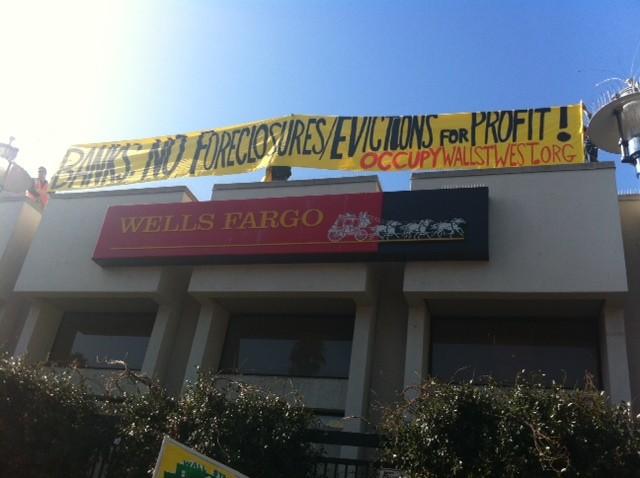
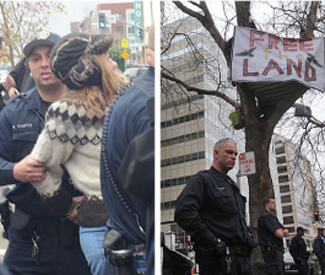
Activists held a massive banner and pitched a tent on the roof of the Wells Fargo branch at 16th and Mission Jan 14, while 150 supporters watched from the parking lot. Seven were arrested.

Organizers say the demonstration was meant to draw attention to the bank’s complicity in unfair foreclosures and evictions.

The protest was planned by a coalition of Bay Area housing rights and homelessness advocacy groups, along with organizers from Occupy San Francisco.

Sarah Shortt, Executive Director of the San Francisco Housing Rights Committee, says that abuses by corporate banks are inextricably linked to issues that her group has been working on for years; “evictions, displacement, affordable housing, and tenants rights.”

After rallying at 16th and Mission, protesters looked up to see that six had climbed to the roof. They unfurled a banner reading “Banks: No Foreclosures/Evictions for Profit!”

A fire truck arrived ten minutes later, and put up a ladder to give the police and firefighters access to the roof.

The Police Department cooperated with protesters, assisting a negotiation with the bank branch’s manager. A letter detailing their demands, including a moratorium on foreclosures and an end to predatory and speculative loans, was apparently faxed to Wells Fargo spokeswoman Holly Rockwood.

Protesters said that they would not leave the roof until they had a meeting scheduled with Wells Fargo CEO John Stumpf. Six were arrested.
According to an SFPD statement, “A bank employee signed a private person’s arrest (citizens arrest) for trespassing.”

After those arrested were painstakingly shuttled down the ladder and into a police van, protesters blocked the van from leaving Hoff street between 16th and 17th for about ten minutes until it sped out through the parking lot. Protesters then marched to the nearby Mission Police Station, where a drummer from the Brass Liberation Orchestra, which often accompanies protest events in the city, was arrested for allegedly assaulting a police officer with her drum.

Those arrested on the roof were cited for trespassing and released within hours. Supporters have put up money to release the drummer, known as Montana; bail was set at $8,100.

While the drama on the roof unfolded, Shortt, along with organizers from Causa Justa: Just Cause and the San Francisco Tenants Union, spoke about abuses committed against tenants and homeowners. They also spoke about Wells Fargo’s investment in private prisons. 

In a press release, organizers said that the protest was meant to call attention to “predatory equity scams, Ellis Act evictions, and immoral home loans.”

The Ellis Act allows landlords to evict tenants for any reason, if they don’t re-rent the units at a higher price in the next five years. The act hasno restrictions on selling the units as tenancies in common — a backdoor way to create condos — and that’s a lucrative and common practice in the Mission.

Ellis Act evictions increased by 8% in 2011, According to the San Francisco Rent Board Annual Report.

Jose Morales, a tenant who was evicted based on the Ellis Act and activist with the San Francisco Tenants Union, spoke to the crowd Saturday. Said Morales, “I have osteoporosis, I’m 82 and a half years old, but you still see me walking around with my sign.”

He displayed protest signs declaring that housing is a human right and urging single-payer health care.

Mesha Irizarry also told her story to the protesters. Her Bayview home was sold to Bank of New York, then transferred to Bank of America on September 1, but says that she refuses to leave and is fighting the foreclosure.

“We do not play the blame-the-victim game. We are not alone. We are not ashamed to sat ay what has happened to us. We are fighting back, and we are going to win” said Irizarry, who named several other women who are resisting foreclosures in Bayview. 

Irizarry began a San Francisco chapter of Occupy the Hood, a group dedicated to confronting problems that disproportionately affect the poor and people of color within the Occupy Movement. In San Francisco, the branch has focused mainly on defending homes from foreclosure and eviction. Saturday’s protest was part of that effort.

This demonstration was also a part of a series targeting banks, that protesters plan to top off with a day-long “occupation of the financial district” January 20th.

Said Occupy SF Housing Coalition media spokesman Gene Doherty, “The banks and the development companies that have gotten us all into (the foreclosure crisis) are a major part of the problem…it is their ethical duty, moral duty right now to be fixing this. And if that means it’s going to eat into their profit, that means it eats into their profit.”


Event marks the one-year anniversary of the KUSF shutdown

0

Tomorrow marks the one-year anniversary of the secret three-way deal between media conglomerate Entercom and the University of Southern California, whereby the University of San Francisco entered into a contract to sell the KUSF 90.3 FM license to the detriment of the local community.

The sale was announced on Tuesday, January 18, 2011, when the station was abruptly shut down.

Join the protest in front of Entercom in the morning, and then attend the evening event with speakers, DJs, and who knows what else? Just be there.

Listen to KUSF in Exile for up to date info about the event here.

Wednesday, January 18 | Protest from 10-11am @ Entercom, 201 Third St., SF | WIX Lounge event from 7-10pm @ 3169 22nd St., SF


Dick Meister: Walter Johnson did what needed to be done

4

BY Dick Meister

Dick Meister, former labor editor of the SF Chronicle and KQED-TV, has covered labor and politics for more than a half-century, Contact him through his website, www.dickmeister.com, which includes more than 350 of his columns,

Walter Johnson was everything a labor leader should be – a dedicated, unflinching, champion of working people and their unions. But more than that, Walter was also an unyielding advocate of all those  inside and outside the labor movement who wanted – and badly needed – a decent living , or who were in any way oppressed.

Johnson, who died in San Francisco of a heart attack on Jan. 12 at age 87, devoted his life to that noble – yes, noble – task as head of the Department Store and Retail Clerks unions in San Francisco. He also later headed the SF Labor Council for nearly 20 years, from 1985 until his retirement in 2004.

 Walter was a genuine humanitarian, a kind, thoughtful man who very much liked and sincerely wanted to help people, who freely acknowledged the contributions of others who joined him in his efforts for social, political and economic justice, who seemed always ready and eager to do what needed to be done.

He was a man of great good humor, an outgoing man who seemed to get along with just about everybody, even some of his toughest adversaries. I know, I know. That surely does sound like pure hyperbole. But, believe me, it’s not, as many others who knew Walter Johnson could tell you.

Listen to Art Pulaski, who heads the California State AFL-CIO. He declared that Johnson “was a big and fearless advocate for everyone and anyone who was wronged, mistreated, put down, left out, pushed aside or just down on their luck.  He was fearless because he always followed his faith, his values and his heart.”

Despite the seriousness of his undertakings and his militancy, Johnson was no grim advocate. Whatever the situation, there was always lots of good-natured teasing, and jibes to be traded with friends. And jokes, always jokes – always! Corny, make-you-groan jokes usually, but effective at lessening the tensions that invariably came with the struggles he helped lead.

One look at Johnson’s face made clear his Scandinavian background, a mixture of Norwegian and Swedish. But you wouldn’t necessarily recognize him as a labor leader. He didn’t fit the stereotype. He almost invariably dressed in coat and tie and otherwise looked more like the public image of a business leader, more like management than labor.

Many union leaders spend most of their time in their offices, but Walter was out on the picket lines, or marching or otherwise demonstrating in support of the demands of his union and others, as well as those of other organizations also demanding justice. He was arrested several times for joining in sit-ins and other demonstrations that the authorities wanted to halt. And Johnson kept that up, despite his retirement.

I met Walter thanks to my job as the Chronicle’s labor editor. That was in the early 1960s, a few years after he had arrived in San Francisco from his native North Dakota to work as a Sears appliance salesman.

Dave Selvin, the labor historian and former public information officer for the Labor Council, had told me I should be sure to check out “a young guy” who’d just been elected president of the Department Store Employees. Walter Johnson, of course.

Selvin predicted good things for Johnson, and he was right.

Under Johnson’s leadership, San Francisco store clerks, department store employees and others won labor contacts at least as rewarding as the contracts as those who held similar jobs elsewhere.

Johnson was a key leader in winning strong, virtually unprecedented support for labor from City Hall and the Board of Supervisors – especially from Mayor Joseph Alioto.

Union representatives were appointed to many city commissions, major job creating construction projects were approved, and Alioto stepped in to mediate settlements of major strikes. Picketing strikers could be pretty certain police wouldn’t interfere. New businesses unfriendly to labor found it difficult to get the necessary city permits. Thanks to Johnson and other leaders, labor had gained considerable political clout to go with its considerable economic clout.

Johnson didn’t fear clashing with the AFL-CIO and its other affiliated unions as long as he felt he was right. He was one of the few labor leaders to speak out against the Vietnam War, which was wholeheartedly supported by the AFL-CIO’s national leadership and most of its affiliates.

Johnson was a leader in the growing global union movement that aims to create a powerful international labor federation that would bring the world’s unions close together to deal with “global capitalism” and thus improve the often deplorable conditions of many workers in many countries.

Closer to home, Johnson was one of the first labor leaders to give unconditional support to the LGBT movement. He was an important supporter of proposals to create a gay organization within the labor movement, despite the homophobic nature of most unions at that time. Johnson played a key role in the founding of the LGBT group that became Pride at Work in 2004.

Nancy Wohlforth, the current president of Pride at Work and now an AFL-CIO Executive Council member, had approached Johnson with the idea of such a group in 1979 and was shocked when he readily agreed it was a great idea. Wohlforth was so thankful for his help she dubbed him “an honorary lesbian.”

“Walter was thrilled,” Wohlforth said.

She later was the new business manager of a San Francisco secretarial union that was on strike against a union group that employed its members. Wohlforth noted that Johnson could very easily have avoided being involved, but “he dove right in.”

“He walked the picket line on rainy days and led a toy drive for the strikers during the Christmas holiday. He was, as always, so concerned that workers would know that they were supported at that difficult time.

“Working people’s struggles were always on his mind. I’m sure he dreamed of them every night – and he constantly was coming up with ways to make people’s lives better. He truly was my hero and he will be missed so much by all who were fortunate enough to know him.”

Amen to that.

Dick Meister, former labor editor of the SF Chronicle and KQED-TV, has covered labor and politics for more than a half-century, Contact him through his website, www.dickmeister.com, which includes more than 350 of his columns,

How to celebrate MLK Jr. Day in the Bay

0

Use your national day of service wisely —  jump in one of of the day’s volunteering fairs, take in a black history flick, catch some awe-inspiring youth spoken word, learn about colleges 

“In the Name of Love” MLK musical tribute

Mavis Staples, the Oakland Interfaith Gospel Choir, Youth Speaks (that group’s going to be busy! See below), and Oakland’s Children’s Community Choir occupy the deco wonderland of the Paramount for this stirring tribute to the great man’s work. Hyped as the only non-denominational musical tribute to MLK Jr. in Oakland, the program also features the presentation of humanitarian awards. 

Sun/15 7 p.m., $18 

Paramount Theatre

2025 Broadway, Oakl.

www.livingjazz.org


Freedom Trains

Planning on spending your MLK Day in the city? Every year, the Martin Luther King Jr. Association of Santa Clara sponsors the Freedom Trains so that everyone can afford to make it to the celebrations. Instead of paying $17.50 for a round-trip ticket on Caltrain, today it’s just $10 – and you’ll be treated to in-route presentations on the importance of the civil rights movement in our lives. 

Mon/16, $10

Departs San Jose 9:30 a.m., arrives in San Francisco 10:55 a.m. (see website for stops in-between)

Rod Diridon train station

65 Cahill, San Jose

www.scvmlk.org


“Renewing the Dream” MLK Jr. birthday celebration

A health fair, a civil rights film festival, children’s reading celebration, interfaith commemoration, special presentations, and free entry to the Contemporary Jewish Museum, Museum of the African Diaspora, and Children’s Creativity Museum give you and yours plenty to do if you feel like spending your Monday in San Francisco’s (greener, sorry Union Square) living room. Down to attend? Check your local transportation agency for possible discounts to the event.

Mon/16 11 a.m.-5 p.m., free

Yerba Buena Gardens

Mission between Third and Fourth Sts., SF

www.norcalmlk.com


“What is Your Dream?” MLK Jr. day of service

Soak in the spirit of the day by spending it at MoAD. The regular museum offerings (currently featuring “Collected: Stories of Acquisition and Reclamation,” about the contributions of people of African descent to the American zeitgeist) will be free to the public, there will be screenings of MLK films and a documentary on a barber who turned into a civil rights leader during the 2008 elections, chalk drawings outside on the sidewalk, and vision boarding galore. But the day’s not just for remembering and dreaming – the Historically Black Colleges and Universities Fair will be providing concrete information on education for tomorrow’s march-leaders and soul-freers. 

Mon/16 11 a.m.-5 p.m., free

Museum of the African Diaspora

685 Mission, SF

(415) 358-7200

www.moadsf.org


Parks Conservancy’s MLK Jr. day of service

Let the Parks Conservancy plug you into a wildlife restoration project – you’re too late to sign up for restoring the gardens on Alcatraz, but there’s still time to help out at Crissy Field, Fort Baker, Muir Woods, Ocean Beach, and the Presidio. Contact volunteer@parksconservancy.org to reserve your spot. 

Mon/16 various times, free

Various locations, SF

(415) 561-3077

www.parksconservancy.org


MLK Jr. Day service fair

Spend your day off work (if you have it off work) with your family making a difference in the Bay Area. Organizers of this event have made it easy for you: choose from over 25 different projects from serving food at shelters, planting trees – even making toys and biscuits for homeless puppies and kitties. All ages welcome. 

Mon/16 7:30 a.m.-4 p.m., free

Oshman Family Jewish Community Center

3921 Fabian Way, Palo Alto

www.paloaltojcc.org


Piedmont’s annual MLK Jr. Day celebration

First: eating. All comers are invited to bring a dish that reflects their own cultural heritage to this lunchtime potluck at the Piedmont Community Center. Once those pressing matters have been tended: music. Oaktown Jazz will provide some lilting melodies, and Piedmont students will make presentations on the significance of the day. Capping off the festivities, the 1993 movie At the River I Stand, which revolves around the 1968 Memphis sanitation workers’ strike and concurrent assasination of King. 

Mon/16 noon-3 p.m.

Piedmont Community Center

777 Highland, Piedmont

(510) 420-1534

loiscorrin@gmail.com


“Bringing the Noise for Dr. Martin Luther King, Jr.” 

If you haven’t been to a Youth Speaks spoken word event, pack tissues and your future-seeing 3-D goggles – the young people that the organization gives an opportunity to perform are the truth. On no other day of the year should this be more evident, because these kids are all about having a dream. Today’s event brings performers to the stage who have worked up pieces on what they’d like the future to bring, imbued as ever with the fire of Youth Speaks performances. Could there be a more relevant forum to attend on today’s holiday?

Mon/16 7 p.m., $16

Herbst Theatre

401 Van Ness, SF

(415) 621-6600

www.youthspeaks.org


“Martin Luther King Jr. Day Double Feature”

“All of us have something to say, but some are never heard” — Richard Pryor, Wattstax (1973). MLK Jr. Day calls into question how we remember the past. The Wattstax concert is sometimes recalled derivatively as “the black Woodstock.” But while soul music may have been the response, the event was put on by Stax Records to commemorate and come to terms with the seventh anniversary of the Watts Riots in LA, which challenged the limits of MLK Jr.’s nonviolent philosophy. As a double feature the Wattstax documentary will be shown with The Black Power Mixtape 1967-1975 (2011), a revelatory look at a movement’s era that sadly took the distance of continent and a few decades to make. 

Wattstax 3, 7p.m.; The Black Power Mixtape 4:55, 8:55 p.m., $7.50–$10

Castro Theatre

429 Castro, SF

(415) 621-6120

www.castrotheatre.com


Martin Luther

It’s the second coming! Not really, no relation actually. But this R&B-funk crooner spins out tunes appropriately uplifting for this day of rememberance and looking forward. Bliss out, eyes closed, mind on the change you want to make, at this smoothed-out groovefest. 

Mon/16 8-9:30 p.m., $15

Yoshi’s

510 Embarcadero, Oakl.

(510) 238-9200

www.yoshis.com

Dick Meister: It’s do or die for the United Auto Workers

3

By Dick Meister

Dick Meister, former labor editor of the SF Chronicle and KQED-TV Newsroom, has covered labor and politics for more than a half-century. Contact him through his website, www.dickmeister.com, which includes more than 350 of his columns.

Historians invariably cite the sit-down strikes at the country’s auto plants in the 1930s as a key to the spread of unionization throughout the automobile industry and throughout American industry generally.

The strikes helped establish the United Auto Workers Union – the UAW – as one of the country’s most economically and politically powerful, progressive and influential organizations, and its president, Walter Reuther, as one of the country’s important leaders.

But that was then, when the American automobile industry was virtually unchallenged by foreign automakers. Now U.S. automakers face heavy competition from Asian and German firms, especially from the firms that have opened plants in the United States. The steady growth of the non-union plants has been accompanied by a steady weakening of the UAW. The union’s membership, once in the millions, has declined to 350,000.

There are 14 foreign-owned assembly plants and several dozen parts factories now operating in the American South and Midwest – “transplants,” as the UAW calls the foreign-owned facilities. The transplants have become a major part of the U.S. auto industry, accounting for the industry’s only growth in the past 30 years. They employ about 50,000 workers, and as Jane Slaughter of Labor Notes reports, the workers produced more than 40 percent of all vehicles made in the United States last year.

If the UAW is to regain its power and influence and standing as a cornerstone of the labor movement, it will have to organize the transplants, whose owners are generally as hostile to unions as their American predecessors were in the thirties.

Organizing the transplants could very well be as tough – or tougher – as organizing U.S. plants was eight decades ago. In the thirties, many auto workers were already organized and able to act as a strong unified body to demand union contracts – and get them. But today, the UAW is faced with having to first convince workers to join the union and then make a unified demand for contracts from their staunchly anti-union employers, most of them based in the heavily anti-union South.

As a recent report from Reuters News Service noted, workers in the transplants “have rebuffed the union repeatedly,” in large part because of heavy employer pressures on them, including not-so-veiled threats of moving their plants elsewhere.

The UAW is initially seeking union rights for workers at the facilities owned and operated by the German companies Volkswagen and Daimler. The union sees the German companies as relatively easier targets than the Japanese and South Korean manufacturers who also operate U.S. plants.

Reuters found that the UAW’s failure to organize workers at the foreign-owned facilities has put the union in a financial bind. It has forced the UAW to sell some of its assets and shift money from its fund for financing strikes in order to pay for its operations. That includes trying to organize workers in the foreign-owned plants at the same time that the decline in the union’s membership has greatly lessened its dues income.

Despite its financial problems, the union is planning a worldwide $60 million campaign aimed at pressuring the transplants into agreeing to elections in which their workers could freely vote for or against unionization. The UAW is hoping to get strong support for elections from other unions and its Democratic political allies.

The UAW will also need broad public support, and that may not be easy to get, given the widespread popular opinion that the automobile industry’s problems stem at least in part from the relatively high pay and benefits the union has won from auto makers. The union is trying to overcome that by promising that contracts resulting from the voting would commit the UAW to sharing responsibility with employers for “quality, innovation, flexibility and value.” But if the union concedes what workers perceive as too much, it may lose many potential new members.

The situation facing the United Auto Workers, long one of America’s most important institutions, is indeed drastic – so drastic, says UAW President Bob King, that if the union fails to effectively organize the foreign-owned plants, the union will have no future.

 King insists he is not exaggerating. “I have said that repeatedly,” he declared, “and I believe it.”

Dick Meister, former labor editor of the SF Chronicle and KQED-TV Newsroom, has covered labor and politics for more than a half-century. Contact him through his website, www.dickmeister.com, which includes more than 350 of his columns.

Maximum Consumption: Vegan cookbook release party with live jazz at MOAD

1

In a rather appetizing blend of vegan culinary skill and music, The Museum of the African Diaspora will soon play host to cookbook author Bryant Terry and a smattering of local musicians.

The event goes down Jan. 24 at the museum. It’s to commemorate and celebrate the release of Terry’s newest book, The Inspired Vegan: Seasonal Ingredients, Creative Recipes, Mouthwatering Menus, and, it’s Terry’s birthday party. He’s an Oakland-based eco-chef and food justice activist who was a Food and Society Policy Fellow with the W.K. Kellogg and Fair Food Foundations.

http://www.youtube.com/watch?v=dAH1dawfw70&feature=results_video&playnext=1&list=PL61B876749C0F605E

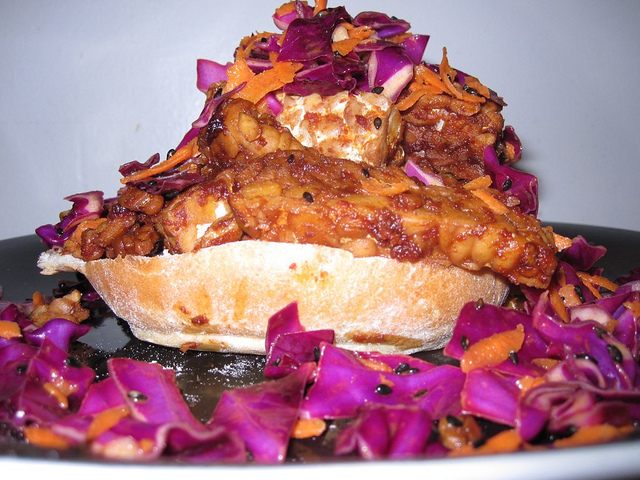
I know from first-hand experience the joy of Terry’s teaching, having devoured his 2009 book, Vegan Soul Kitchen. That book came with a soundtrack to each dish, a feature I dig in any cookbook but especially Vegan Soul Kitchen. My favorite meal was the open-faced barbecue tempeh sandwich with cayenne-carrot coleslaw. The crunchy-spice of the coleslaw on that rich barbecue protein is heavenly. It’s making me hungry just thinking about it.

And yes, I know what you’re thinking; there will indeed be seasonal, creative, and mouthwatering food at the party itself. The event features food by Roger Feely and Soul Cucina food truck with recipes from The Inspired Vegan and drink from Slow Down Wines.

http://www.youtube.com/watch?v=7OM2rmOdZzQ

Also worth the price of admission ($15-$30 by the way): an appearance by the finger-snapping jazz group the Marcus Shelby Trio, lead by award-winning composer and bassist Marcus Shelby, along with performances by Renee Wilson, and DJs Max Champ and Ellen Choy. 

Book Release and Birthday Party with Bryant Terry
Jan. 24, 7:30 p.m., $15-$30  (with signed book)
Museum of the African Diaspora
685 Mission, SF
(415) 358-7200
www.moadsf.org

The Performant: Power to the people

0

Mugwumpin’s deconstructive history of Tesla electrifies

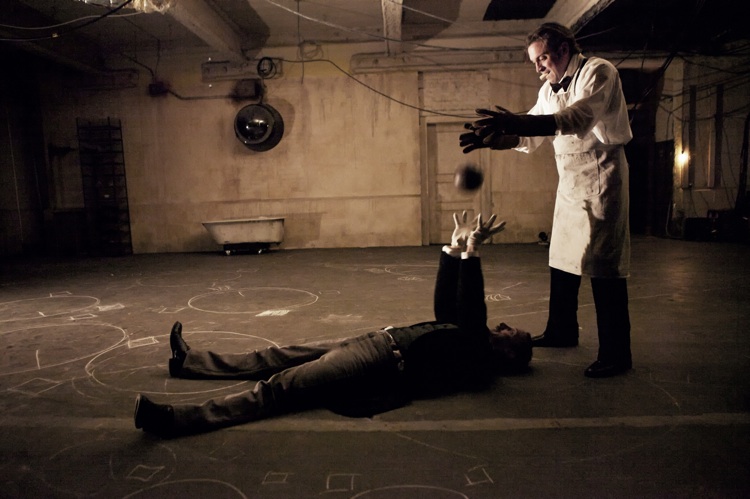
It is one day and 69 years after prolific inventor and notable oddball Nikola Tesla died of a heart attack, yet in the raw, unfurnished basement of the Old Mint, he stands quite alive before a contingent of captive theatre-goers, explaining his views on solitude.

“Be alone. That is the secret of invention,” he assures us, smiling in the manner of a man who knows he is about to be disagreed with. He has a lot of opportunities to display that same tight-lipped countenance throughout Mugwumpin’s “Future Motive Power,” as being disagreed with is one of the most recurring themes of Tesla’s biography. A man of compulsive and erratic habits and stubbornly-held views on the future impact of his own inventions, Tesla’s indomitable personality could be as hard to fathom as his scientific contributions were impossible to discredit. Channeled by Mugwumpin artistic director Christopher W. White, he alternates — in a manner akin to his most famous electrical system — between comedic mania and tragic inflexibility, as the patterns of his life entwine literally and figuratively with those of his dearest-held principles and hard-won triumphs.

As kinetic as White’s performance is, the attention is grabbed initially by a trio of players: Misti Boettiger, Natalie Greene, and Rami Margron, who personify, among other things, electrical forces, rotating magnetic fields, flocks of pigeons, and Greek choruses of skeptics and admirers, buzzing and zapping across the stage or encircling Tesla with a web of cables or a Kabbalistic variety of diagrams chalked out on the bare concrete floor. Founding company member Joseph Estlack plays a rough-necked, cigar-chomping Thomas Edison — one of Tesla’s main rivals — with gusto, parroting banal platitudes while swaggering around the stage. (Read Guardian writer Robert Avila’s review here.)

“Genius is one percent inspiration and 99 percent perspiration,” he boasts to Tesla with a wink, to which Tesla responds dryly that he certainly does seem to sweat a lot. A disagreement over money and methods is further exacerbated by an aggressive game of catch with a leather ball, and a charged scene involving the first execution by electric chair gives Edison the opportunity to assert that death by “electricide” should bear Tesla’s name, just as the unfortunate guillotine bears the name of its own well-meaning champion.

Like many site-specific performances, part of the pleasure of the production lies within its use of space, especially a space as intriguing as the Old Mint, and about three-quarters of the way through the piece, we are split into two groups and given brief reign to explore the warren of small brick rooms and an oppressively weighted corridor that take up the rest of the lower level. Eventually reunited, we are led to the end of the hall by a frail, geriatric Tesla, who lies on a single bed, surrounded only by his beloved pigeons. “Never mind my absence in body,” he assures before his dying, “it is no consequence. I am with you in spirit.” And when the lights come back on for the curtain call, in a blaze of AC glory, you see exactly what he means.


“Future Motive Power”

Through Jan. 29

8 p.m., $15-$30

Old Mint

Mission and Fifth St., SF

(415) 967-1574

www.mugwumpin.org


Obstructions of justice

4

The uneasy relationship between OccupyOakland and the Oakland Police Department has resulted in a troubling spate of controversial arrests recently.

At a press conference last month, Police Chief Howard Jordan stated, “The plaza area outside of City Hall is a public area. We do not have any legal right to remove you if you’re standing there, at any time during the day, if you’re exercising you’re First Amendment rights. If you’re not breaking the laws, we’re not concerned about your presence.”

But now, Oakland police have arrested dozens of people who were doing little more than “standing there, exercising their First Amendment rights” — and one man even faces life in prison for it.

There have been 40 arrests in the last couple weeks, including two incidents at Frank Ogawa/Oscar Grant Plaza. In each episode, police say they were just doing their job, enforcing laws surrounding permit violations. But many supporters and lawyers associated with OccupyOakland say that police have created a targeted and discriminatory campaign to wipe out the movement.


VIGIL TURNS VIOLENT

About 100 protesters were present at a permitted vigil on Dec. 30. An OccupyOakland participant had been issued a permit for a teepee and one table, but police showed up at noon to explain that they were in violation of that permit, claiming people were sleeping, eating, bringing in trash cans, and storing belongings in the teepee

Protesters say they were cleaning up the plaza when police started making arrests; police say they refused to comply. But both parties say that the scene turned violent.

“Who instigates the violence? I don’t know,” Matt Perry, a movement supporter, told us. “A cop tells you to back up and you don’t back up, he’s gonna use his baton on you.”

But many of the arrests and citations had nothing to do with assault. Carly says she was arrested for “having a yoga mat under her arm.” She was later charged with obstruction of justice. In an even more puzzling case, 23-year-old Tiffany Tran was arrested and charged with “lynching.”

“The taking by means of a riot of any person from the lawful custody of any peace officer is a lynching,” reads California Penal Code 405a, a felony charge punishable by two to four years in prison.

The law attempts to prevent white mobs from forcibly taking African Americans from police custody to kill them, but police have a history of using it against protesters, stating that anyone trying to stop an arrest is guilty of lynching.

Tran says she was held in a pitch-dark police van for seven hours before she was booked at Santa Rita Jail, where she was held in 22-hour daily lockdown due to overcrowding. She was held for four days without being told why.

On the fourth day, she was finally arraigned, but prosecutors opted not to file charges and she was released. But Tran said the tactic left her uneasy because prosecutors said charges could still be filed until the statute of limitations expires in a year. As she told us, “Now I feel I can’t go out and express myself as I should be able to.”


ON THE GROUND

When I arrived at 10pm on Jan. 4 to investigate the situation at the vigil, the scene was calm. About 40 people sat and talked, a few worked on computers.

“Some of the people here were arrested mainly for contempt of cop, or being against the government. And then charges of lynching or obstruction of justice were brought after the fact to substantiate an unlawful arrest, to allow the wheels of so-called justice to turn a few more times,” Svend La Rose, an ordained minister and member of OccupyOakland’s tactical action committee, said of the Dec. 30 arrests.

Suddenly, the cry of “riot police!” rang out.

Police cars had pulled up on 14th street, and a line of police exited. In unison, they started advancing, brandishing batons. Many who were at the scene grabbed their possessions and fled. Most just backed away as the cops advanced. A handful stood in front of the teepee, and were arrested on the spot.

Twelve were arrested, including La Rose. Also arrested was Adam Katz, a photographer from the media committee who was documenting events. Katz said that police told him to back up, and when he complied and backed up “probably 50-60 feet,” he was still arrested.

“I took one picture and I was told to back up,” he said. “I repeatedly asked ‘Back up to where?’ as an army of police pushed me out of the plaza. They said, ‘Back up behind the line.’ I kept saying, ‘What line? I don’t see a line.'”

Then there’s Chris, another occupier arrested Jan. 4. According to Katz and other witnesses, Chris had already left the plaza and gone across the street when he was arrested for somehow delaying the police who were trying to clear the plaza.


DISCRETION

On Jan. 7, OccupyOakland held an “anti-repression march,” claiming that recent arrests are an overt attempt to repress the movement. The National Lawyers Guild issued a statement demanding an end to the “ongoing violence, harassment, and unconstitutional arrests of Occupy Oakland protesters.”

“There is evidence that would go to show that they were targeting people based on First Amendment activity, and not for illegal activity,” said attorney Mike Flynn, president of the NLG-SF. “Police charged into the plaza and grabbed whoever they could, and also targeted selective people who withdrew and didn’t even linger there.”

But OPD spokesperson Johnna Watson told us these arrests were perfectly legal. “The law allows us to use our discretion,” she said.

A person’s history with the movement is factored into this discretion. Many of those Perry deems “regulars” are, according to the police, “repeat offenders.” As Watson said, “There may be knowledge of a past history, like a repeat offender. If an officer has knowledge that a crime is occurring, has occurred, or is about to occur, we have the right to issue a citation or arrest. If we have someone constantly continuing to break the law, we may not issue a citation.”

In other words, involvement with this political movement can get people arrested who might otherwise not be.

“That police have escalated their attacks on people is pretty disturbing. It looks like they really think they can drive this movement out of Oakland with violence and repression,” said Dan Siegel, a former legal advisor to Mayor Jean Quan who resigned over her handling of OccupyOakland.

Siegel is now representing Marcel Johnson, aka Khali, one of the several protesters arrested Dec. 30, who faces life in prison. A homeless man who became an OccupyOakland regular, Khali was arrested when he tried to hold on to his blanket, which police wanted to throw away, saying that it was unpermitted property.

While in jail, he was charged with felony assault on a police officer, his third strike. A protester called Black Angel who knows Khali said he was transformed by the movement. “He came here and found a family,” he said. “He was like, I’m going to protect this. It gave me some sense of myself.”

But now, Siegel said, “He faces life in prison because of his status of being poor, homeless, and with mental health issues.”

Juries may decide whether OccupyOakland defendants are guilty, but Siegel said the arrests aren’t just: “You still have to ask yourself, why are the police doing this when we have 100 unsolved murders in Oakland?”

Live Shots: New Fire at Brava Theatre

1

Stirring together a mix of contemporary theater and actual traditional ceremonies, New Fire (which opened last night and runs through Jan. 29) is a play that gives its audience insight into the beautiful world of Indigenous American culture. 

The performance attempts to show how ancient ceremonies are relevant in today’s modern society, especially in a world with so much suffering. There is wonderful live music, video montages, dancing, and a trouble-making Coyote, that is always getting herself into mischief. The Brava Theater is celebrating 25 years of women’s theater and this play, by Cherríe Moraga, is a perfect way to commemorate two-and-a-half decades of female-fueled creativity on stage.

NEW FIRE

Jan. 11-29, $10-$30

Brava Theater

2781 24th St., SF. 

www.brava.org

A weekend of new German Cinema

0

Ringing in the New Year, German Gems returns to the Castro, San Francisco’s citadel of cinema, for a final celebration of new German films. The jam-packed day will start with a documentary about nuclear power plants in Germany, followed by a panel discussion with international speakers.

Several of the films on the program are by young, promising filmmakers: No Way Home, about two lost souls in their sixties who find each other and a new beginning; Above Us Only Sky is probing deep into the heart and mind of a young woman who is desperately trying to hold on to a broken life; and Westwind, last summer’s best German love story. The festival will close on a provocative note with Taboo – The Soul is a Stranger in Earth, a film about the forbidden love between poet Georg Trakl and his sister.

For festival passes and happy hour tickets, as well as a complete schedule of screenings, visit this link.

Saturday, January 14th @ Castro Theater, 419 Castro, SF | Sunday, January 15 @ Arena Theater, 214 Main, Point Arena | $7-$50

Global mashup: Nine-piece world music act Califa hits the Bay

0

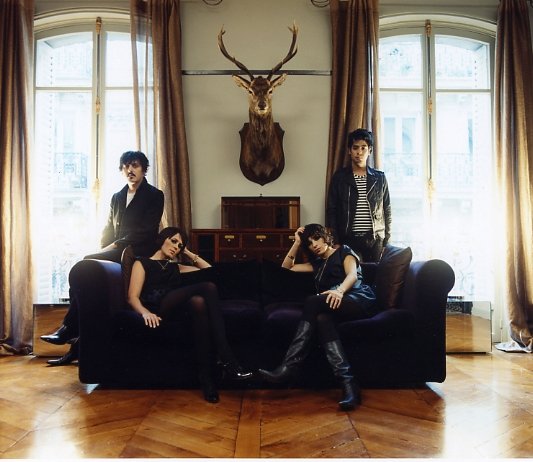
With nine members currently blending Afro Balkan and Middle Eastern sounds and dance moves, Califa certainly refrains from limiting itself. The new Los Angeles-based ensemble – which features members of Fishtank Ensemble, Plotz, and Ballet Asaneh – is something of a world music supergroup. It’s a blend of other acts, and of live music, live dancing, and obscure instruments.

Still in its infancy (it formed in May 2011) Califa takes its first tour up the northern coast this week, with show stops in the Bay Area at Red Poppy Art House and Ashkenaz Music & Dance Center. I spoke with band member Ursula Knudson, who sings and plays theremin along with the occasional hand-held percussion instrument, on the eve of the tour and got the lowdown on Califa’s origins, its interest in global music, and the group’s desire to draw out movement in crowds.

San Francisco Bay Guardian: How did Califa form, and where does the group write its music?
Ursula Knudson: Originally the idea was to have a group of all women superstars who could sing, dance, and play instruments. We decided to have a mixed group because we knew we didn’t want to limit the quality of the musician by sex – meaning if there was a kickass bass player that was female we’d take her but if there was an even better one who was a man, we wanted that choice as well.

Basically, we wanted our dream group. Different members of the group offer either arrangements or original compositions, and with nine people, there is a lot of choice! The original concept was [created by] our singer Rosa Rojas, and my husband Fabrice Martinez, also with Fishtank Ensemble, they were the two who dreamed up the group.

SFBG: Why did Califa decide to focus on the music of North and East Africa, the Balkans, and the Middle East?
UK: Like I mentioned, this is intended to be our dream band, so even though those [sounds] are what we are focusing on now because it is our new interest, whatever else strikes anyone’s fancy could be pursued later.

We wanted beautiful singers, rock players, traditional players, experimental plays, and it seems we are getting all of it! Right now we chose those regions because most of us have experience already with Balkan music or Middle Eastern music, we have a Morrocan in the band, and ever since I visited Senegal last year I have been in love with the music of West Africa.

SFBG: And are there personal connections with those regions within the band?
UK: Momo Loudiyi is from Morroco and plays sintir and got our violinist is playing bendir, and he brings an awesome North African love power vibe to the group. Four members of the group are in a band called the Plotz, which is like crazy Balkan time signature rock, and of course Fabrice and I are both in Fishtank Ensemble which is known to play a lot of Eastern European/Balkan music, so that is our connection as well. And Rosa Rojas, our other singer, has spent years studying the dances of the Silk Road and performed for a while with Ballet Afsaneh in Bay Area.

SFBG: How do you incorporate those styles into your music?
UK: We play some original songs composed by various members in certain ethnic styles (rhumba, a Ukrainian song that sounds slightly African, Momo’s music) and also the Balkan and Middle Eastern songs, already in our repertoire, that we have arranged for this particular ensemble.

SFBG: Was it intentional to create a sound that encourages dance?
UK: Of course! The show should extend beyond the stage; it should encompass the whole room!

Califa
Thurs/12, 7 p.m., $15
Red Poppy
2698 Folsom, SF
(415) 826-2402
www.redpoppyarthouse.com

With Inspector Gadje
Sat/14, 8:30pm
Ashkenaz
1317 San Pablo, Berkl.
(510) 525-5054
www.ashkenaz.com

Bonus related show: Fishtank Ensemble
With George Cole Quintet
Jan. 27, 8 p.m., $22.50
Freight & Salvage
2020 Addison, Berkl.
(510) 644-2020
www.thefreight.org

Check out what our friends over at the SF Symphony are up to this week

0

Here is a 30-second time-lapse clip of the Davies Symphony Hall stage as it’s gussied up for the SF Symphony’s production of Debussy’s Le Martyre de Saint Sèbastien this Thursday, Friday, and Saturday, January 12-14 at 8pm. Director-designer Anne Patterson’s newly created multi-media treatment, with projected visuals and staged elements, accompanies each  performance of Debussy’s sweeping score to bring the pageant-like, gothic, nature of the work to life.  Don’t miss your chance to see it live!

Buy tickets and get more info here or call (415) 864-6000.


Appetite: Cocktailing the East Bay

0

In this week’s paper we poured out our thoughts on two delicious new additions to the East Bay bar scene, Honor Bar and the New Easy. Below, we glass up some other exciting East Bay drink destinations we think are worth your swizzle:

Oakland boasts the biggest concentration and range for East Bay cocktails, some of its consistent best at Adesso, casual drinks with bocce ball at Make Westing, elegant classic-style at Flora, pizza with cocktails at Marzano and Boot & Shoe ServiceMiel for tequila/mezcal drinks, Conga Lounge and divey Kona Club for tiki kitsch. Berkeley keeps it real with organic drinks at Gather, and artisanal cocktails at Revival Bar & Kitchen. The little island of Alameda hosts the beloved tiki gem, Forbidden Island, launched in part by tiki/rum expert Martin Cate who went on to open SF’s Smuggler’s Cove. Here, cheesy B-movie tribute nights and stmulating live music flow along with Banana Mamacows. As mentioned above, Emeryville now has two destination-worthy bars for cocktail lovers: Prizefighter and Honor Bar.


Albany is blessed with three old school classics merely blocks from each other along San Pablo Ave.: the musty, tiki vibe of Club Mallard, the mid-century, retro swank of Kingman’s Ivy Room, and the edgy comfortability of Hotsy Totsy Club. Though none of these three are exactly craft cocktail bars, Hotsy Totsy comes closest, with house cocktail sodas, gracious bar manager Jessica Maria, and stellar guest bartenders like Scott Baird of The Bon Vivants, who bartends here weekly. They’ve kept on longtime bartender Chet, in his 70’s, who has been tending there the better part of a couple decades. Their gorgeous, restored Wurlitzer jukebox is a treasure of rare and popular 45s, which you can play for free to your hearts content. Hotsy Totsy encourages lingering with friends under pressed tin ceilings, rocking out to excellent tunes hand-selected by staff. Funky ’70’s garage sale paintings line the walls and hilariously creepy movies (like For Your Height Only starring Weng Weng) play silently on the flat screen, add to the edgy, blissfully divey, convivial spirit.

Bike lane runway

2

WINTER LOOKS I spend a lot of time convincing my friends that we should ride our bikes places, and the main pushback I get is due to the fact that they don’t want to look like they just got off a bike.

It’s faulty reasoning. Leaving aside how attractive environmental awareness is, anyone who has ever checked out the Vélo Vogue style blog or the global family of Copenhagen Chic websites knows that a bike can make an already-stylish outfit look sexy in a precarious, fly-by-night way. Think about watching someone run gracefully in heels.

Honestly, I don’t think you need a special wardrobe to be bangin’ on a bike. A tip that I do tend to pay mind to: high-waisted pants are your friends. A man once stopped me when my thong had risen above my denim horizon to ask me if I had no modesty. A cretin, yes — but his brand of stick-up-assery is easily mitigated by a kicky pair of retro mom jeans. Also, fear not the high heel, but rather the boot or flat with little heel-arch delineation — unless you have toe cages, in which case you can wear nearly any footwear you like as long as the cages are tight enough, even flip-flops.

Of course, if you are wearing flip-flops in San Francisco you have larger style issues, ones that may not be resolved by reading about bike brands that are crafting clothes that are at once sturdy enough to brave the biting winds and occasional damp of winter months, yet are still exciting and stylish. For the rest of us, such is the list that follows. 

RAPHA CYCLE COMPANY

This Italian bike brand’s Marina café-store could be the perfect spot to begin your quest for cold weather gear. First of all: coffee. Four Barrel percolates in a cafe tucked away in the corner of the sales floor — which is mainly occupied by a long communal table where riders mingle on their way out to the foggy Marin hills or the grocery store. Clothing-wise, the selection isn’t huge, but Rapha’s urban wear is well-made and classy. Straight-leg men’s jeans are made with a blend of nylon, cotton, and elastane yarn, with a waist cut higher in the back, and shiny stuff inside for when you roll up them cuffs.

2198 Filbert, SF. (415) 896-4671, www.rapha.cc

IVA JEAN

I’ve yet to see a more versatile option for biking in the rain than this Seattle brand’s silver-gray cape. There’s a front pouch to keep your keys in, and ample ruching options to allow onlookers a glimpse at what you’ve got going on underneath. It’s like a blanket, a sexy, functional, water-repellant blanket.

www.ivajean.com

MASH TRANSIT

Perhaps you’ll stop by this bike shop nook in Duboce Triangle for a special edition Unicanitor-Barry McGee saddle — just don’t forget to check out what’s on offer that’ll make your morning commute drier. Histogram arm warmers promise extra sleeve coverage, there’s henleys and rain trenches for the taking, and Bay Area-made Inside Line Equipment water-proof backpacks will set you apart from the omnipresent Chrome crowd.

733 14th St., SF. (415) 448-6611, www.mashsf.com

OUTLIER

This label from Brooklyn makes subdued designs functional enough that “they” won’t blink an eye if you have to follow that polished dismount with a day at work, and then with a night tramping around town. I’m a particular fan of the women’s daily riding pant, made of doubleweave twill. The fabric is smooth enough to shred the city streets, and comes in fetching blues and gray that’ll last you through spring.

www.outlier.cc

B.SPOKE TAILOR

But perhaps none of these items are quite what you are looking for. Sweets, if that’s the case — and if you’re the type to buy signature pieces that last you for years, cuz these pricetags are no joke — you should go to Oakland’s Nan Eastep. Her B.Spoke Tailor line births custom-made biking raincoats with extra-long sleeves that don’t make coat-backs pull across shoulderblades. Or try her capes. Why not, you now qualify as a fashion superhero.

(510) 435-3890, www.bspoketailor.com


Create and destroy

0

WINTER LOOKS You might have spotted Collin Weber running through the Mission on the way to the Knockout, frantic, with a bag full of satin bows to complete a trio of Sailor Moon costumes. Or perhaps you’ve seen his handy-work elsewhere, in the colorful capes and pointed hats Shannon and the Clams wear in their video for “Sleep Talk” or the sixties striped shifts the Dirty Cupcakes sport in “I Want It (Your Love).”

Weber, a library aid by day and seamster by night, has been creating costumed frocks for an incestuous batch of Bay Area garage rockers for the past two years — Dirty Cupcakes, Shannon and the Clams, Hunx and His Punx, Human Waste — and is open to taking on more acts. ” I think there’s a lot more payoff when you do something and it’s up on stage and out on tour and tons of people see it, and it’s in a music video,” he says leaning against an rack of cloth at Fabric Outlet, “not that I wouldn’t just want to make thing for people to wear. But the costumes are the fun project for me.”

Some of those projects include dinosaur hats, American flag bell-bottoms, gold fake snakeskin skirt and vest combos, and once, for Human Waste, he created full face-masking bodysuits. “The theme they gave me was prisoners on the moon in the future,” Weber laughs. “There’s a whole story behind it, but that’s what I had to go on.”

He created flesh-covering suits, with shiny knee pads and strips of mesh across the mouth and eyes. (Mesh so the band could still see its instruments.) “It’s pretty creepy. The first time I tried it on I was a little scared of my own reflection in the mirror. I think that was a sign that it was going in the right direction.”

I ask if he has his own signature design fixture, something that’s uniquely Weber, and he explains that it can be difficult because he’s often catering to bands’ specific visions, keeping with their imagined themes. Though he says, “one thing that shows up though — and I’ve always been kind of obsessed with — is futuristic, but circa 1960. Special effects, when people tried to guess what people would be wearing in 2012. Shiny, still really mod, but futuristic.” He smiles sheepishly, Queen’s “We Are The Champions” comes pumping through Fabric Outlet’s speakers.

Weber’s style is also influenced by David Bowie circa Ziggy Stardust era, and the designer of those costumes, Kansai Yamamoto. He drops references to the broader glam and loud statement pieces, along with interesting menswear, specifically Comme des Garçons which he describes as “crazy stuff for men that’s just barely wearable.”

His interest in sewing came from a bout of post-college, pre-work boredom while living in Milwaukee. While roommates with Dirty Cupcakes drummer Laura Gravander in the Midwest he learned how to use her sewing machine and begin deconstructing thrifted clothes, doing alterations, and eventually creating his own pieces. He’s all self-taught, and learned through both trial-and-error and diligent YouTube viewing.

Now living in San Francisco (though he moved first with Gravander from Milwaukee to the East Bay), he works shelving books at two library jobs, an aid at the Central Library in Berkeley and a page at the Main Library at Civic Center in SF. He awaits an open librarian position and has kept up the sewing and costume-making as a creative outlet.

Weber mentions that he likes making costumes for bands specifically because there’s a definite deadline: the night of the show. Do or die. He may have been known to run down the street trailing thread, or sew up a piece as the band is about to step on stage, but he also understands the great responsibility of outfitting hard rocking musicians — certain areas must be reinforced, seams must be sturdy because of fierce movement.

And with that comes the punk fate of it all, in sewing costumes for bands, he’s essentially creating what will likely be destroyed. “When you put a lot of work into something, it’s sad to see it get trashed, or blood on it,” says Weber, “but it’s just something you have to take into consideration, whether something just looks nice or whether it’s going to last through rock ‘n’ roll.”

Easy honors

0

virginia@sfbg.com

APPETITE It’s true: the East Bay cocktail scene is growing by leaps and bounds lately, with a slew of new bars (many opened by San Francisco bar stars) popping up from Albany to Alameda. Two comfortable new hangouts just debuted Jan. 3, serving cocktails for the geek and casual imbiber alike. Both claim noteworthy bartenders covering various shifts. I spent an evening tasting through their menus. Here’s an early peek at cocktail stand-outs at these two. For more exciting drink destinations in the East Bay, click here


HONOR BAR

Situated in its own building — with parking lot — not far from Emeryville’s shopping center madness (and E-ville’s other shining bar beacon, Prizefighter, www.prizefighterbar.com, which opened at the end of 2011), Honor Bar serves gourmet pub food in a room glowing with vintage signs, a Creature from the Black Lagoon pinball machine, and granite red bar at the center of it all. After passing through an entrance lined with cigar signs, records, even a stuffed owl, grab a beer from a tub of ice. It’s all on the honor system, so ask a bartender to add it to your tab. (No surprise: this is already garnering early buzz).

Cocktail menu quality was pretty much guaranteed under bar manager Alex Smith who came from SF’s Gitane. I’ve written about his exquisite drinks at Gitane few times, and was unsurprised to find his offerings at Honor Bar more casual but nonetheless sophisticated, easily exhibiting promise at this early date to be among the best cocktails in the East Bay.

While slurping oysters with St. Germain herb mignonette or dipping Kennebec fries ($3.50) in salt and vinegar aioli or Serrano ham jelly, select from cocktails (all $10) grouped under “stirred” (spirituous) or “shaken” (mixed with other ingredients). I was immediately won over by gently smoky, spicy, bright layers of the Porfiriato. Tequila, guajillo pepper-infused mezcal, Cocchi di Torino, Licor 43, and cinnamon bitters meld in a complex yet drinkable whole.

The spirit of tiki hovers over but does not overwhelm the bourbon-based Bleeding Monarch. Passion fruit lends a tropical air, orgeat adds texture, balsamico amaro and Campari finish with deliciously bitter undertones. Black Sabbath is as badass as it sounds: Laphroiag Scotch dominates with a rough and tumble, smoky presence, given nuance by Averna, absinthe, and orange bitters.

Smith’s established skill with sherry shows in Jenkins’ Ear, highlighting oloroso sherry with aged rum, Angostura bitters and cardamom-spice properties of Hum liqueur — no element out of balance. Dessert with a savory essence can be had in a Winter Flip. Whole egg softens brandy and tawny port, while Smith’s housemade Indian pudding is a cream base (rather than a thick pudding) for layers of spice.

1411 Powell, Emeryville, (510) 653-8667, www.honorbar.com


THE NEW EASY

In Oakland’s Grand Lake district, Easy Lounge closed, transforming into the New Easy. Big Easy inspiration is evident in upcoming Nola Sundays with BBQ, punch bowls (proceeds go to charities), and New Orleans tunes. The space is funky, eclectic, charming, with boozy quotes etched into one wall, stars painted on another, white lights draped over individual picnic tables. The small back patio is warmed by heat lamps and a skeleton gazing over cactus plants.

The welcoming neighborhood joint focuses on farmers market ingredients. Each Saturday a new menu of cocktails is created using ingredients from the big Grand Lake Farmers Market a block away.

Summer-Jane Bell not only created the menu but was hands-on with space design elements, painting stars as she crafted the menu. Her winning bartender team includes Yael Amyra (Circolo, Burritt Room), Ian Adams (15 Romolo, Orson), David Ruiz (Mr. Smith), and Morgan Schick (Nopa, Michael Mina).

Bell’s menu is decidedly playful, reminiscent of American childhood… but with booze. The festive theme starts as you receive Chinese take-out boxes of fresh-popped popcorn, while bites of mini sliders and grilled cheese sandwiches are passed around. I had the most fun with Mad Hatter ($10). Sailor Jerry rum and a spicy ginger soda are obvious mates, but the bright orange, creamy drink surprises with golden raisin puree and carrot juice. Bright and healthy, spice and sweetness (but not too much) make it a delightful alternative to an orange creamsicle.

Gift Horse ($9) was probably the most balanced, making fine use of Hayman’s Old Tom gin, which I haven’t seen much on cocktail menus in awhile. Dolin Blanc vermouth and Bell’s winter bitters made with a tequila base, unfold in floral, dry layers with notes of cranberry and fennel from the bitters.

Winter Sideshow ($11) offers the most spectacle, even if I prefer the former two drinks. The drink will change with the seasons, a base of Beefeater gin and Pür Spiced Blood Orange liqueur the backdrop for Angostura-flambeed kumquats, lit before you.

3255 Lakeshore Ave., Oakl., 510-338-4911, www.easy510.com 

Subscribe to Virgina’s twice-monthly newsletter, The Perfect Spot, www.theperfectspotsf.com