San Francisco

Airbnb makes small admission on tax issue, saying its hosts should pay

105

Under pressure in San Francisco and New York City for violating local tenant and land use laws and refusing to pay local taxes, Airbnb has finally acknowledged that transient occupany taxes apply to the room rentals it facilitates. But the company still hasn’t taken any public steps to collect the tax, nor has it admitted that it shares this tax debt with its hosts.

“Our hosts are not hotels, but we believe that it makes sense for our community to pay occupancy tax, with limited exemptions for those who earn under certain thresholds,” CEO Brian Chesky wrote on the Airbnb blog yesterday, addressing the post to New York City and not San Francisco, where it is headquartered and where we have shown the company is shirking an annual tax debt of nearly $2 million.

Contacted by the Guardian, a company spokesperson extended the pledge to San Francisco, writing, “Yesterday, our CEO Brian Chesky announced that we believe it makes sense for our community of hosts to pay occupancy tax to the cities in which they live, with exceptions under certain thresholds, and we are eager to discuss how this might be made possible. We have been in substantive discussions with Board President David Chiu on these issues for some time, and we’d like to thank him for the open dialogue that helped lead to today’s announcement. We look forward to continuing our work with him and others in San Francisco to set forth clear, fair laws that allow regular people to rent out their own homes, while giving back to the city that makes it possible.”

As the Guardian has repeatedly reported, most recently in our Aug. 6 cover story “Into Thin Air,” the San Francisco Treasurer/Tax Collectors Office has ruled that the city’s TOT of about 15 percent applies to Airbnb guests, and that Airbnb shares that joint tax liability with its hosts.

The ability of individual hosts to receive business licenses for renting out rooms and to collect and remit the TOT is complicated by the fact that such rentals violate land use, tenant, and other city laws — and Chiu has been developing legislation that would legalize and regulate the stays.

Airbnb could easily collect the TOT on each San Francisco transaction, as some of its online competitors have already been doing, but it has so far refused to do so. And when the Guardian asked Airbnb whether it now plans to do so, the company ignored the question.

In fact, Airbnb’s public statements and private communications indicate its intention to pass the buck to its hosts rather than collect and pay the taxes itself, and several hosts who commented on Chesky’s blog post expressed hopes they would get more support from the company on the myriad issues that complicate its simplistic business model.

Nonetheless, Chiu took the Airbnb’s statement yesterday as a positive sign, telling us, “I am pleased to hear that Airbnb has acknowledged the need for their users to pay the occupancy tax. This policy was developed as a result of discussions that I’ve led in the past year to regulate and tax shareable housing activity in San Francisco. While we continue to negotiate with shareable housing companies, housing advocates, and the Mayor’s Office to find sensible solutions, I am confident that we will be able to move forward on a regulatory framework that provides flexibility to residents, protects our affordable housing stock and collects the fair share of taxes for the City. I look forward to introducing legislation in the coming months.”


‘Gravity,’ Mill Valley, and everything else: new movies

1

The 36th Mill Valley Film Festival opened last night and runs through Oct. 13, filling the North Bay’s travel-worthy venues (the Christopher B. Smith Rafael Film Center is the main one) with must-see films. Check out our recs here, and read on for short takes on Hollywood’s offerings, including the season’s must-see sci-fi film.

http://www.youtube.com/watch?v=m8Gi-ow4hr0

Blind Detective Johnnie To’s latest makes its local debut as part of the San Francisco Film Society’s “Hong Kong Cinema” series, hot on the heels of his Drug War, which had a theatrical run earlier this year. Blind Detective shares Drug War’s crime theme and moody palette, but it also has — whimsy alert! — an accordion-inflected score. The cute quotient is further upped by Andy Lau and Sammi Cheng, who’ve been frequently paired in To’s lighter fare (perhaps most memorably in 2001’s Love on a Diet, which attired its attractive stars in fat suits). Lau plays a former cop who left the force after losing his vision, yet continues to solve crimes (in pursuit of reward money) using, among other unorthodox methods, his superior sense of smell. Cheng plays a scrappy policewoman who admires his investigative skills and asks him to track down a long-lost childhood friend. He agrees, but not before slyly tricking her into helping him pursue lucrative paydays on unrelated cases. Lau’s wannabe-Sherlock antics and Cheng’s lovelorn flailings wear thin after two-plus hours, but Blind Detective still manages to entertain despite its odd blend of broad comedy and serial-killer thrills. (2:10) Vogue. (Cheryl Eddy)

http://www.youtube.com/watch?v=OiTiKOy59o4

Gravity “Life in space is impossible,” begins Gravity, the latest from Alfonso Cuarón (2006’s Children of Men). Egghead Dr. Ryan Stone (Sandra Bullock) is well aware of her precarious situation after a mangled satellite slams into her ship, then proceeds to demolition-derby everything (including the International Space Station) in its path. It’s not long before she’s utterly, terrifyingly alone, and forced to unearth near-superhuman reserves of physical and mental strength to survive. Bullock’s performance would be enough to recommend Gravity, but there’s more to praise, like the film’s tense pacing, spare-yet-layered script (Cuarón co-wrote with his son, Jonás), and spectacular 3D photography — not to mention George Clooney’s warm supporting turn as a career astronaut who loves country music almost as much as he loves telling stories about his misadventures. (1:31) (Cheryl Eddy)

http://www.youtube.com/watch?v=ZnJIA7oqqcM

The Institute In 2008, mysterious flyers began popping up around San Francisco that touted esoteric inventions such as “Poliwater” and the “Vital-Orbit Human Force Field” and included a phone number for the curiously-monikered Jejuene Institute. On the other side of the phone line, a recording would direct callers to a Financial District office building where they would undergo a mysterious induction process, embarking on an epic, multi-stage, years-long alternate reality game, designed primarily to reveal the magic in the mundane. In Spencer McCall’s documentary The Institute, viewers are introduced to the game in much the same way as prospective inductees, with few clues as to what lies in store ahead. A handful of seemingly random interviewees offer a play-by-play recap of their own experiences exploring rival game entities the Jejune Institute and Elsewhere Public Works Agency — while video footage of them dancing in the streets, warding off ninjas, befriending Sasquatches, spelunking sewers, and haunting iconic Bay Area edifices gives the viewer a taste of the wonders that lay in store for the intrepid few (out of 10,000 inductees) who made it all the way to the end of the storyline. Frustratingly, however, at least for this former inductee, McCall’s documentary focuses on fleshing out the fictions of the game, barely scratching the surface of what must surely be an even more intriguing set of facts. How did a group of scrappy East Bay artists manage to commandeer an office in the Financial District for so long in the first place? Who were the artists behind the art?  And where am I supposed to cash in these wooden “hobo coins” now? (1:32) New Parkway, Roxie. (Nicole Gluckstern)

http://www.youtube.com/watch?v=SgPjt_BRLvY

Parkland Timed to tie in with the 50th anniversary of the JFK assassination, writer-director Peter Landesman’s sprawling ensemble drama takes that tragedy as its starting point and spirals outward, highlighting ordinary folks who were caught up in the drama’s aftermath by virtue of their jobs or circumstance. There’s a lot going on here, with a huge cast of mostly-recognizable faces (Billy Bob Thornton as Secret Service Agent Forest Sorrells; Paul Giamatti as amateur filmmaker Abraham Zapruder; Ron Livingston as an FBI agent; hey, there’s Oscar winner Marcia Gay Harden in two scenes as a stern nurse!), but the events depicted are so familiar that the plot never becomes confusing. Landesman — who favors scenes of breakneck-paced action punctuated by solemn moments of emotion — might’ve done better to narrow his focus a bit, perhaps keeping just to the law-enforcement characters or to Lee Harvey Oswald’s family (James Badge Dale plays his shell-shocked brother, while Jackie Weaver hams it up as his eccentric mother). But paired with 2006’s Bobby, Parkland — named for the hospital where both JFK and Oswald died — named for the hospital where both JFK and Oswald died — could make for an interesting, speculative-history double-feature for Camelot buffs. That said, Oliver Stone fans take note: Parkland is strictly Team Lone Gunman. (1:33) (Cheryl Eddy)

http://www.youtube.com/watch?v=L2INdFpHPpQ

Runner Runner Launching his tale with a ripped-from-the-headlines montage of news reports and concerned-anchor sound bites, director Brad Furman (2011’s The Lincoln Lawyer) attempts to argue his online-gambling action thriller’s topicality, but not even Anderson Cooper can make a persuasive case for Runner Runner’s cultural relevance. Justin Timberlake plays Richie Furst, a post-2008 Wall Street casualty turned Princeton master’s candidate, who is putting himself through his finance program via the morally threadbare freelance gig of introducing his fellow students to Internet gambling. Perhaps in the service of supplying our unsympathetic protagonist with a psychological root, we are given a knocked-together scene reuniting Richie with his estranged gambling addict dad (John Heard). By the time we’ve digested this, plus the image of Justin Timberlake in the guise of a grad student with a TAship, Richie has blown through all his savings and, in a bewildering turn of events, made his way into the orbit of Ben Affleck’s Ivan Block, a shady online-gambling mogul taking shelter from an FBI investigation in Costa Rica, along with his lovely adjutant, Rebecca (Gemma Arterton). Richie’s rise through the ranks of Ivan’s dodgy empire is somewhat mysterious, partly a function of the plot and partly a function of the plot being piecemeal and incoherent. The dialogue and the deliveries are also unconvincing, possibly because we’re dealing with a pack of con artists and possibly because the players were dumbfounded by the script, which is clotted with lines we’ve heard before, from other brash FBI agents, other sketchily drawn temptresses, other derelict, regretful fathers, and other unscrupulous kingpins. (1:31) (Lynn Rapoport)

http://www.youtube.com/watch?v=KXKogr0O-Zc

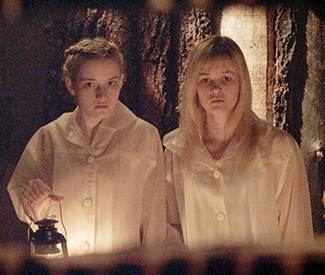
We Are What We Are The title of Jim Mickle’s latest film sums up the attitude of the Parker family: We Are What We Are. We eat people. Our human-flesh cravings go back generations. Over the years, our dietary habits have become our religion. And that’s just the way it is — until teen sisters Iris (Ambyr Childers) and Rose (Julia Garner) start to have some doubts. As We Are (a remake of Mexican director Jorge Michel Grau’s 2010 film) begins, the girls’ mother has suddenly died amid a punishing rainstorm — and their grief-stricken Dad (Bill Sage) has become awfully twitchy. As the local police, a suspicious doctor (Michael Parks), and a curious neighbor (Kelly McGillis) begin to poke into their business, the Parkers prep for “Lambs Day,” a feast that most definitely involves whoever is chained up in the basement. Though not all of the dots connect in the Parkers’ elaborate backstory (how do Mom and Dad have an obscure variation on mad-cow disease if they’re only eating man-meat once a year?), We Are still offers a refreshing change from indie horror’s most recent common denominators — no found-footage tricks here. The last-act dinner scene is required viewing for any self-respecting cannibal-flick connoisseur. Check out my interview with director Mickle here. (1:45) (Cheryl Eddy)

http://www.youtube.com/watch?v=Rwr-U1z1F60

When Comedy Went to School This scattershot documentary by Ron Frank and Mevlut Akkaya is about two big subjects — the Catskill Mountains resorts that launched a couple generations of beloved Jewish entertainers, and mid-to-late 20th century Jewish comedians in general. There’s a lot of overlap between them, but the directors (and writer Lawrence Richards) can’t seem to find any organizing focus, so their film wanders all over the place, from the roles of resort social directors and busboys to clips from History of the World Part I (1981) and Fiddler on the Roof (1971) to the entirely irrelevant likes of Larry King. That said, there’s entertaining vintage performance footage (of Totie Fields, Woody Allen, etc.) and interview input from the still-kicking likes of Sid Ceasar, Jackie Mason, Mort Sahl, Jerry Stiller, and Jerry Lewis. For some this will be a welcome if not particularly well crafted nostalgic wallow. For others, though, the pandering tone set by one Lisa Dawn Miller’s (wife of Sandy Hackett, who’s son of Buddy) cringe-worthy opening rendition of “Make ‘Em Laugh” — to say nothing of her “Send in the Clowns” at the close — will sum up the pedestrian mindset that makes this doc a missed opportunity. (1:23) (Dennis Harvey)

Chain store ban and affordable groceries at issue in 555 Fulton debate UPDATED

77

UPDATED San Francisco’s resistance to formula retail stores will be put to the test tomorrow (Thu/3), when the San Francisco Planning Commission will vote on the 555 Fulton St. project.

The project — a five-story, 136-unit residential building with a ground-floor supermarket, complete with up to 275 total parking spaces— has been bobbing in purgatory since 2010, when developers were stalled by the withering economy.

But dried-up finances aren’t what’s now holding up the development of this project in an area governed by the Market and Octavia Better Neighborhood Plan and the Formula Retail Use Ordinance, both of which discourage national chains in favor of locally owned businesses.

Debate is centering on the question of whether the formula retail ban prevents an affordable grocery store from going in at the site, as the developer contends. The politics surrounding the project have gotten heated, with Hayes Valley Neighborhood Association supporting the ban on chain stores; the Mayor’s Office, Chinatown power broker Rose Pak, and Planning Director John Rahaim supporting the developer and project contractor Walter Wong; and Dist. 5 Sup. London Breed caught in the middle.

Last week, her legislative aide Vallie Brown told HVNA that Breed would support their request for a continuance at tomorrow’s meeting while they explore ways to attract an affordable local grocer, but Breed seems torn between what she told the New Yorker recently were desires to make affordable groceries available and prevent the boutiqueing of Hayes Valley, and her support for the formula retail ban.

“Breed said that despite the ban, she’s willing to allow a chain grocery store into the area to make it more affordable for residents,” reporter Lauren Smiley wrote in the article. The Guardian has been unable to reach Breed or Brown this week.

[UPDATE: Breed told the Guardian that her biggest concern is that the grocery store is affordable to the three low-income housing projects located right across the street, and she has yet to be convinced that can happen without breaking the formula retail ban at the site, despite working on the issue with both activists and the developer.

“It’s a challenge, I get that,” Breed told us. “I want the developer to operate with me in good faith and make a serious long-term commitment to me that this will be an affordable grocery store.”

But she doesn’t yet have that full commitment, and she says that she’s planning to honor her commitment to activists and ask that the formula retail waiver be delayed today even if the rest of the project goes through. “Ultimately, I asked them to be a good community partner,” she told us.]

For Hayes Valley, this has been a near decade-long process. In 2004, the Board of Supervisors first outlawed these generic retailers from opening up shop within the Hayes-Gough Neighborhood Commercial Transit (NCT) District when it passed Ordinance No. 62-04, classifying “formula retailers” and limiting their impact within unique neighborhoods. The ordinance keeps local businesses viable, keeping deep-pocketed corporations out.

The 555 Fulton project falls somewhere between the Hayes-Gough NCT and the Residential Transit Oriented District (RTO), and currently, a two-story, 19,620-square-foot office and industrial building with about 70 surface parking spots inhabits the address.

Both the neighborhood residents and the developers have historically felt that the property would make for an excellent grocery store. “What” has never been an issue with the property. “Who” on the other hand, has been the biggest issue.

In order for 555 Fulton to be developed by a “formula retail” outlet — which have been the only types of occupants the current developers believe to be able to pay the exorbitant established rent costs  — the property technically located in the Hayes-Gough NTC needs to be designated as a “Special Use District” (SUD).

An SUD adjusts the land use controls and height restrictions for a specific piece of property, in this case allowing for a “grocery store larger than 15,000 square feet of gross occupied floor area, as well as residential uses meeting a minimum density of one dwelling unit per 600 feet of lot area.” And up until April, the property was an SUD.

Back in 2008, 555 Fulton was granted its SUD by Section 249.35A of the Planning Code Section, which established the “Fulton Street Grocery Store Special Use District.” In 2010, the Planning Commission approved both a Conditional Use Authorization and a Planned Unit Development, allowing the developer of the subject property to build their mixed-use grocery store-residential building. Neither of these exceptions allowed for a “formula retail” outlet at the time, but interest still seemed solid.

Then everything stalled. And stalled. And stalled some more. Things have remained idle for so long that the five-year window given to the Fulton Street Grocery Store SUD expired this past April. Now, the developers are asking for five more years on the same Fulton Street Grocery Store SUD that was allowed to a different development group in 2008.

But it isn’t exactly the same request this time: Now the developers are trying to get an SUD without a provision on “formula retail” outlets, and both sides are expected to turn out big numbers on each side of the question at tomorrow’s hearing, which starts at noon in City Hall Room 400.

Alleged Silk Road owner busted in San Francisco

The government may have shut down, but that didn’t stop the feds from arresting Ross William Ulbricht, allegedly the owner of the Silk Road, an underground website that allows users to buy and sell drugs and other illicit items anonymously. The FBI also seized the equivalent of more than $3 million in Bitcoin, the cryptographic alternate currency used to make Silk Road transactions.

According to the Chronicle, Ulbrecht, who is 29 and lives in Hayes Valley, was arrested yesterday afternoon (Tue/1) at the Glen Park Library. He faces charges of narcotics trafficking conspiracy, computer hacking conspiracy and money laundering conspiracy. The FBI also alleges that he tried to hire a hit man to go after a Silk Road user who was threatening to release the identities of Silk Road users.

According to the complaint, Ulbricht operated under the alias “Dread Pirate Roberts.”

The complaint said the Silk Road had generated sales revenue totaling 9.5 million Bitcoins and collected commissions totaling 600,000 Bitcoins. “These figures are roughly equivalent today to approximately $1.2 billion in sales and approximately $80 million in commissions.”

Finally, this profile of the Dread Pirate Roberts published in Forbes provides some insight about the person behind the Silk Road. Apparently, he’s a rebel with a cause:

“Roberts also has a political agenda: He sees himself not just as an enabler of street-corner pushers but also as a radical libertarian revolutionary carving out an anarchic digital space beyond the reach of the taxation and regulatory powers of the state – Julian Assange with a hypodermic needle. ‘We can’t stay silent forever. We have an important message, and the time is ripe for the world to hear it,’ says Roberts. ‘What we’re doing isn’t about scoring drugs or ‘sticking it to the man.’ It’s about standing up for our rights as human beings and refusing to submit when we’ve done no wrong. Silk Road is a vehicle for that message,’ he writes to me from somewhere in the Internet’s encrypted void. ‘All else is secondary.’”

SFPD targets bikes before hearing on its anti-cyclist bias

210

As it prepares for this Thursday’s Board of Supervisors hearing examining allegations that its officers are biased against bicyclists, the San Francisco Police Department has quietly started enforcement stings focused on cyclists riding the Wiggle, one of the city’s most popular and heavily traveled bike routes.

I was among a series of cyclists stopped by one of two motorcycle cops on Saturday night as they stood on Waller Street waiting for cyclists to make that left turn off of Steiner, the first in a series of five turns known as the Wiggle, a key bike route connecting the east and west sides of town.

The sting operation — a term that Officer R. Scott, who stopped me, denied, although that’s clearly what it was — was like shooting fish in a barrel for these guys, given that thousands of cyclists a day roll through the stop signs on the Wiggle on their way to work, school, or errands.

Since being pulled over, I’ve heard this was part of several recent enforcement actions targeting cyclists on the Wiggle, supposedly driven by neighborhood complaints. Although Scott took down my driver’s license information, entered my information into the system, and issued me a citation — lecturing me along the way, and getting an earful from me in response — he waited to the end to tell me it was only a warning (actually, it was his partner who said that he should give me a ticket rather than a warning because of how I was expressing myself, but Scott said it was too late).

I’ve asked the SFPD a series of questions about the reasons for and goals of this stepped-up enforcement against cyclists, as well as about the timing, stats, and other information. I’ll update this post if and when I get a response.

For conservative law-and-order types, it probably doesn’t seem like there’s much to discuss here. Cyclists run stop signs, that’s against the law, end of story. But if San Francisco is going to continue to encourage people to ride bikes — with all the societal benefits that brings — it needs to take a more realistic and progressive approach to this issue.   

The California Vehicle Code Section 22450(a), which I was accused of violating, doesn’t distinguish between cars and bikes when it states, “The driver of any vehicle approaching a stop sign at the entrance to, or within, an intersection shall stop at a limit line, if marked, otherwise before entering the crosswalk on the near side of the intersection.”

Unlike the traffic laws in Idaho, which do have different standards for bikes and cars and where my approach of yielding but not stopping would have been legal, California has traffic laws that are hopelessly mired in another age, before global warming, air pollution, traffic gridlock, skyrocketing automobile fatalities, and other factors caused society to rediscover and embrace bikes as a beneficial mode of everyday transportation.

And when state or federal laws have lagged behind public opinion and behaviors, San Francisco has often been at the forefront of radical reform, as we have done on immigration, marijuana, civil liberties, rent control, marriage equality, and other issues where we have refused to go along with an unjust or unrealistic status quo.

How we get around, and the right to be treated with dignity and respect for the reasonable choices that we make, belongs on that list. The number of cyclists on the streets of San Francisco has surged in recent years, and it’s the official policy of the city to favor that mode over the automobile and to work toward the goal of having 20 percent of all trips be by bicycle by the year 2020.

That probably won’t happen without many more bike lanes — and it definitely won’t happen if bicyclists are expected to stop at every stop sign. Momentum matters on bikes and they become a far less appealing mode of transportation if we’re forced to come to a complete stop at every intersection, an unrealistic approach that impedes the smooth flow of not just cyclists, but motorists, Muni, and pedestrians as well.

Sup. Jane Kim called the hearing on how the SFPD handles cyclists — which is scheduled for this Thurday at 10am before the board’s Neighborhood Services and Safety Committee — after the Guardian helped expose some truly appalling anti-cyclist bias by the SFPD.

San Francisco Bicycle Coalition Executive Director Leah Shahum said that cyclists will call for better training and investigations of traffic collisions involving bikes, as well as a shift in how the SFPD polices the streets. She said her message will be, “Focus limited traffic enforcement resources on known dangerous intersections and known dangerous behaviors.”

And she said the bicyclists on the Wiggle just don’t meet those criteria. “When you look at the data on the Wiggle, it’s not a high collision area,” Shahum said, confirming reports that the SFPD has done bicycle stings on the Wiggle on at least two days in the last week.

Shahum acknowledges that there are sometimes conflicts and that bicyclists aren’t angels, noting that the SFBC has recently done events on the Wiggle encouraging bicyclists to ride carefully and yield to pedestrians and motorists when they have the right-of-way.

But she that Police Chief Greg Suhr has repeatedly called for each police district to “focus on five,” using traffic data to target the five most dangerous intersections in each district. As she said, “We’re asking the police to live up to have they’ve said, over and over.”

As for changing state law to adopt Idaho’s bike standards, Shahum said that the difficult, multi-year effort just to get a weak bike buffer law recently signed into law shows that’s probably not realistic. But here in San Francisco, there’s much more we can do to encourage safer cycling and road sharing.

Hearts on fire

0

arts@sfbg.com

THEATER An actor rakes a thick piece of chalk across the floor with a few swift, violent strokes, transforming a bare stage into the layout of an apartment or the plan of a Polish street. Three more actors join him in filling out the scenes, uprooted from time and rearranged in a deliberate design of their own — scenes erased and redrawn with practically every shift in a fluid, snaking narrative that joins the present day with World War II, the Warsaw Ghetto, and the career of a young Jewish woman named Izolda, who passes herself off as an Aryan in a heroic attempt to save herself and her husband from an apocalyptic night.

If the ghostly chalk outlines of the set morph with a brusqueness that suggests the ferocity of both war and time to remake the world, Izolda’s story of love and determination offers an agency of its own. Wrenched from the daunting numbers and general darkness of the Holocaust, they come into mesmerizing focus in The King of Hearts is Off Again, a barebones yet highly evocative piece of physical theater by Warsaw’s Studium Teatralne, which adapts Polish journalist-turned-author Hanna Krall’s internationally acclaimed 2006 novel, Chasing the King of Hearts (now available in an English translation from Peirene Press).

This week, in Studium Teatralne’s Bay Area debut, the San Francisco International Arts Festival presents The King of Hearts is Off Again in both San Francisco and the East Bay. Performed in Polish with English supertitles, the piece showcases the work of a company grounded in the influential career of Polish director Jerzy Grotowski (1933–1999), world-renowned innovator and practical theoretician of “poor theater.”

Piotr Borowski, who directed the production, was an actor and musician with Poland’s famed experimental company Teatr Gardzienice in the 1970s and ’80s. After that he joined the Workcenter of Jerzy Grotowski in Pantedera, Italy, where he stayed until 1994, when he became artistic director of Studium Teatralne.

“Mainly what I’ve acquired from working with Grotowski is a constant, systematic work on the harmony of three things: body, feelings, and intellect,” relates Borowski in a recent email exchange. “Incidentally, this idea is few thousand years old. On the other hand, the topics for my dramatic work flow directly from the circumstances of our contemporary times.”

The details and lacunae of Izolda’s dramatized but true story emerge from the ghostly outlines of a past now barely visible in Poland, suspended somewhere between blissful ignorance and perturbing rumination.

“In Poland, before World War II, Jews were about 10 percent of the population,” continues Borowski, “about three million people. The ones that were left numbered 20,000. We have struggled to convey this emptiness through the empty stage, minimal props, a small number of actors, in order to focus on the main idea. One of the most important things in the set is the floor. It is an old Synagogue’s polychrome. We are stepping on it, symbolically ruining it. The world’s culture of sacral paintings is being destroyed. There are hardly any Jews in Poland anymore. Most of all, there are hardly any traces of their culture left. Our viewers in Poland can feel that, and we talk about it a lot, especially with the younger generation.”

Grotowski and the refined aesthetics of poor theater grew in the 1960s in part as a response to the lavish spectacle offered by cinema, but also in a politically repressive period in which metaphor was key to discussing the lived reality shared by artists and their audience. Today’s Polish stage has evolved in strikingly different directions since 1989 and the fall of communism. The avant-garde today — in the work of Krystian Lupa or Krzysztof Warlikowski, for example — tends toward work of monumental proportions, as Borowski readily admits.

“When it comes to the direction of the Polish theater today I am not the go-to expert. I am still representing the off-center of theater whose significance is marginal today. It used to have a clear role in times of a system where censorship existed. But now, when we have freedom and a fierce market economy, the big productions and money become more important to people.”

Borowski adds that it is not a question of one approach or another, but rather of making work that confronts contemporary reality.

“It is essential that we create performances that are relevant for today. That has always been hard to do, as far as I can remember. The main goal that I had set out for myself is the goal towards human development, and what I’m trying to show on stage is the [way] beyond simple acceptance and habitual perception of so many things. Not a rebellion but an alternate perception.” *

THE KING OF HEARTS IS OFF AGAIN

Wed/2-Fri/4, 8pm, $18-25

Joe Goode Performance Annex

401 Alabama, SF

Sat/5, 8pm

University Theatre

CSU East Bay, 25800 Carlos Bee, Hayward

www.sfiaf.org


Weekly Picks: October 2 – 8, 2013

0

Among the undead.

WEDNESDAY 10/2


“How to Survive the Zombie Apocalypse”

Who hasn’t thought about who they would want on their zombie apocalypse team, how they would escape the city, or where they would go if they got out? But that’s just the first 24 hours. What about some oh, 28 days later? What about 28 weeks? What about doing more than just surviving? The collection of workshops offered by Curiosity Atlas this fall could be the key to your happy post-apocalypse. Join Curiosity Atlas on opening night to preview such workshops as “Defending Against Multiple Attackers,” “MacGyver Night,” “DIY Herbal Apothecary,” “Aging and Collecting Beer,” “Apocalypse Baking,” and other essential skills for living the good life among the undead. The night will feature hands-on demonstrations, live performances, and human-friendly refreshments. (Nina Glasov)

7-10pm, $10

Verdi Club

2424 Mariposa, SF

www.curiosityatlas.com

THURDAY 10/3


The Drunken Botanist

For most drinkers, the word “booze” ignites cerebral images of fluorescently-lit bars and the night, however wild or relaxing, to follow. But for Amy Stewart, author of 2013 New York Times bestseller The Drunken Botanist (Algonquin Books), the sloppy story begins much earlier, as the plants involved evolve, grow, reproduce, ferment, and distill in the days, weeks, and even millennia leading up to liquor’s transformation. Amid overhanging vines and tropic air in the Conservatory of Flowers, Stewart will discuss these diverse herbs, flowers, fungi, and fruit that end up our cups, as well as global drinking practices, comical anecdotes, gardening tips, and some of her favorite razzed recipes. After grabbing cocktails mixed by Amanda Victoria of Lillet and Mark Stoddard of Hendrick’s Gin, don’t leave the event wasted — get your own signed copy of The Drunken Bontanist. (Kaylen Baker)

7pm, $35–$40

Conservatory of Flowers

100 John F Kennedy, SF

(415) 831-2090

www.conservatoryofflowers.org

THURDAY 10/3


Father John Misty

It’s easy for musicians to hide behind personas, but when Joshua Tillman (formerly of Fleet Foxes) stopped recording under his real name and released an album — last year’s Fear Fun — as Father John Misty, it was a moment of revelation. Contrary to the faux-sincerity that has made the revivalist strain of folk rock damn near unlistenable in the last few years, Misty embraces a vivid self-awareness that avoids the usual mix of solemn preciousness and vain humility, humorously detailing his own mushroom tripping genesis (“I’m Writing a Novel”) and possible legacy (“Now I’m Learning to Love the War”). This solo show, with support from comedian Kate Berlant, should showcase the real Father John Misty. (Ryan Prendiville)

9pm, $25–$30

Slim’s

333 11th St, SF

(415) 255-0333

www.slimspresents.com

FRIDAY 10/4


The Wicker Man

Just to get it out of the way: Yeah, the 40th anniversary “definitive new restoration” of British cult-horror classic The Wicker Man (1973) — we shall not speak of the 2006 bee-laden remake — owes its crisp clarity to digital projection. But if the not-on-actual-film tradeoff means seeing the movie uncut, as director Robin Hardy intended, perhaps it’s worth it. A stodgy, Jesus-loving Scottish cop (Edward Woodward) is in for the shock of his life when he travels to pagan stronghold Summerisle, with residents including Christopher Lee (as flamboyant Lord Summerisle) and sexy-dancin’ Britt Ekland. The eerie folk-song soundtrack, which will presumably sound better than ever, is reason enough to catch this DCP event. (Cheryl Eddy)

Through Sat/5, 7 and 9:30pm (also Sat/5, 4:30pm), $8.50–$11

Castro Theatre

429 Castro, SF

www.castrotheatre.com

SATURDAY 10/5


WestWave Festival

Balancing ingredients and flavors is a good way to plan a menu. It seems to work in dance as well. At least that’s what the five-member panel, which chose the artists to be commissioned for the second of this year’s West Wave programs, seems to have had in mind. All the choreographers are women but they bring a huge range of tastes to their practice. Moving here after 20 years in the other dance capital, modern dancer Anne-René Petrarca is creating a quartet about the power of female energy. Anandha Ray calls her fusion piece “tribal belly dance,” remembering its birthplace in India. Gorgeous Flamenco artist Holly Shaw is translating her passion into choreography that considers the figure of the outsider. And finally, ballet dancer Casey Lee Thorne is using the kinetic power of light in her contemporary vision of an old language. Bon appétit everyone. (Rita Felciano)

8pm, $15–$20

West Wave Dance Festival

ODC Dance Commons, Studio B

351 Shotwell, SF

www.westwavedance.org

SATURDAY 10/5


It’s a Bird… It’s a Plane… It’s Superman

42nd Street Moon kicks off its 2013-2014 season in celebration of 75 years of the Man of Steel. From the songwriters of Bye Bye Birdie and Annie comes the 1966 musical It’s a Bird… It’s a Plane… It’s Superman, opening this month at the Eureka Theatre. Starring Lucas Coleman as the man himself, Jen Brooks as Lois Lane, and Darlene Popovic as Dr. Agnes Sedgwick, the show follows Clark Kent/Superman as he juggles heroics and romance. With such lively tunes as “You’ve Got Possibilities” and “Pow! Bam! Zonk!” audiences are in for some riotous fun featuring one of the most prolific superheroes of all time. (Kirstie Haruta)

Through Oct. 20 (Wed-Thu, 7pm; Fri, 8pm; Sat, 6pm; Sun, 3pm), $21–$75

Eureka Theatre

215 Jackson, SF

(415) 255-8207

www.42ndstmoon.org

SATURDAY 10/5


Billy Bragg

British folk-punk rocker Billy Bragg’s debut album, Life’s A Riot With Spy Vs. Spy, came out 30 years ago. If anything, time has only strengthened his writing and resolve, as well as his social activism bent, as evidenced on the troubadour’s latest release, Tooth and Nail, on Essential Music. Fans have two chances to see Bragg this weekend in the city, one at the annual Hardly Strictly Bluegrass festival in Golden Gate Park — and for others who prefer to skip the crowds and dust, you can see him up close and personal tonight, appearing with his friend Jon Langford. (Sean McCourt)

9pm, $35

Great American Music Hall

859 O’Farrell, SF

(415) 885-0750

www.slimspresents.com

SUNDAY 10/6


“Bikes to Books”

You admired the artful, informative “Bikes to Books” map, created by Bay Guardian contributor Nicole Gluckstern and local-history buff Burrito Justice, in our Sept. 11 issue. Now comes the map’s official release party. Begin with a group bike tour that visits all 12 San Francisco streets named for notable artists and authors (Jacks London and Kerouac, Isadora Duncan, etc.) with local ties. And since City Lights founder Lawrence Ferlinghetti helped mastermind the street-naming project back in 1988, it’s fitting that the party portion of the day (complete with literary reading hosted by Evan Karp) takes place in Jack Kerouac Alley, just outside the famed bookstore. (Eddy)

Bike tour: 10:30am-2pm, free

Meet at Jack London (north side) and South Park, SF

Reading: 2-4pm, free

Jack Kerouac Alley (near Broadway and Columbus), SF

www.burritojustice.com

MONDAY 10/7


Iconic Hair Movie Night

When you think of memorable ‘dos in classic horror films, who else but Elsa Lanchester comes to mind? To honor her famous style, Morphic Salon is screening Bride of Frankenstein for free as part of its Iconic Hair Movie Nights series. Watch as Dr. Frankenstein, revealed to be alive by Mary Shelley, builds a bride for his first monstrous creation. And while you’re at it, perhaps you’ll be inspired to get a shock of white in your own hair to match the leading lady! RSVP for this event at info@morphicbeauty.com. (Haruta)

Free, 7 p.m.

Morphic Salon

660 Market, SF

(415) 789-6682

www.morphicbeauty.com

MONDAY 10/7


Tom Odell

Singer-songwriter Tom Odell tends to capture powerful if fleeting feelings of young love and wistfulness, yet with a cheerful energy. Perhaps thanks to bouncy piano chords and Odell’s robust vocals, the British singer’s performances manage to escape the deep, tormented-soul identity adapted by many young acoustic soloists. His 2013 debut album A Long Way Down reached No. 1 on the UK Official Chart earlier this year. And the musician hit an even higher note last month when he reimagined Elton John’s “Tiny Dancer” at the annual BRITs awards program to honor John as the first ever recipient of the BRITs’ Icon Award. This charming singer makes his way to the Chapel tonight, where he’ll share the stage with Australian Vance Joy. (Hillary Smith)

9pm, $15

Chapel

777 Valencia, SF

www.thechapelsf.com

TUESDAY 10/8


Fucked Up

Toronto-based hardcore punk outfit Fucked Up has made a career of being unapologetically over-the-top. Look no further than its borderline-corny name (how can it be the first punk band to come up with that one?), its insanely ambitious concept albums, and the unparalleled insanity of its live shows. Always on the verge of taking things too far, Fucked Up flirts with that fine line between insanity and brilliance, and occupies the space between with authority. No other band can create high-minded, multi-instrumental rock operas of this magnitude and get away with it (although Titus Andronicus is sure trying). As if its fervent, fearless creativity wasn’t cause enough to go see this band (co-headlining with Terror) also know that frontperson Damian Abraham is seriously the nicest dude in the entire world. (Haley Zaremba)

With Power Trip, Code Orange Kids

7pm, $16

Oakland Metro Operahouse

630 Third St, Oakl.

(510) 763-1146

www.oaklandmetro.org

TUESDAY 10/8


La Tigre e la Neve

Somehow, Italian screenwriter Vincenzo Cerami always succeeded in capturing beauty in his films, through the highs as well as the lowest lows of life. The third and final screening of the IIC’s series “A tribute to Vincenzo Cerami,” features actor Roberto Benigni in Cerami’s La Tigre e la Neve (2005) as Attilio de Giovanni, a besotted Italian poetry teacher. Though Giovanni’s children and students adore him, the woman of his heart, Vittoria, spurns him, leaving Italy with another poet for Iraq. When the second Gulf War erupts and Giovanni hears that Vittoria has been injured, he chases after in an attempt to bring Vittoria to safety. Expect hope, despair, laughs, and underlining it all, a sense of utter, expanding beauty. (Baker)

6:30pm, free

Italian Cultural Institute

814 Montgomery, SF

(415) 788-7142

iicsanfrancisco.esteri.it

TUESDAY 10/8


The Babies

The Babies have been pegged as a super-band of sorts from the start, with Cassie Ramone from Vivian Girls on guitar and Kevin Morby from Woods on bass. In their latest release, 2012’s Our House on the Hill, the Babies strive to break free from their lo-fi attachments in previous bands and experiment more with country, blues, and folk elements. The Babies aren’t a side project, as much as an entirely new entity with something different to offer. San Francisco’s Tony Molina, hardcore frontperson turned “punky” indie act also plays this show. His newest record, Dissed and Dismissed, released by Melters this year, is impressive. Loaded with undeniably catchy, fuzzy tunes, the album at times harkens back to an era when bands like Guided by Voices and Pavement were king. Get some drinks and get fuzzed out in more ways than one at the Hemlock Tavern tonight. (Erin Dage)

With Alex Bleeker and the Freaks

8:30pm, $8

Hemlock Tavern

1131 Polk, SF

(415) 923-0923

www.hemlocktavern.com

Theater Listings: October 2 – 8, 2013

0

Stage listings are compiled by Guardian staff. Performance times may change; call venues to confirm. Reviewers are Robert Avila, Rita Felciano, and Nicole Gluckstern. Submit items for the listings at listings@sfbg.com.

THEATER

OPENING

Carrie: The Musical Victoria Theatre, 2961 16th St, SF; www.rayoflighttheatre.com. $25-36. Opens Fri/4, 8pm. Runs Wed-Sat, 8pm (also Oct 26, 11:30pm; Nov 2, 2pm). Through Nov 2. Just in time to complement the Carrie film remake, Ray of Light Theatre performs the musical adaptation (initially a Broadway flop, then a re-tooled off-Broadway hit) of the Stephen King horror novel.

The Disappearance of Mary Rosemary Phoenix Theatre, 414 Mason, SF; secondwind.8m.com. $15-25. Opens Fri/4, 8pm. Runs Thu-Sat, 8pm; Sun, 2pm. Through Oct 26. Writer-director Ian Walker’s ghost story is adapted from J.M. Barrie’s Mary Rose.

Forbidden Fruit Garage, 715 Bryant, SF; www.brownpapertickets.com. $25. Previews Thu/3, 8pm. Opens Fri/4, 8pm. Runs Fri-Sat and Mon, 8pm. Through Oct 28. Back Alley Theater and Footloose present the West Coast premiere of Jeff Bedillion’s stylized love story that takes on social and religious conformity.

An Indian Summer Exit Theatre, 156 Eddy, SF; www.wehavemet.org. $20-40. Opens Fri/4, 8pm. Runs Thu-Sat, 8pm. Through Oct 19. Multi Ethnic Theater performs Charles Johnson’s drama set in the 1980s Deep South.

It’s a Bird … It’s a Plane … It’s Superman Eureka Theatre, 215 Jackson, SF; www.42ndstmoon.org. $25-75. Previews Wed/2-Thu/3, 7pm; Fri/4, 8pm. Opens Sat/5, 8pm. Runs Wed-Thu, 7pm; Fri, 8pm; Sat, 6pm (also Oct 12, 1pm); Sun, 3pm. Through Oct 20. 42nd Street Moon kicks off its 21st season with this 1966 musical homage to the Man of Steel.

The Scion Marsh San Francisco, 1062 Valencia, SF; www.themarsh.org. $15-100. Opens Fri/4, 8pm. Runs Fri, 8pm; Sat, 8:30pm. Through Oct 26. Popular solo performer Brian Copeland (Not a Genuine Black Man, The Waiting Period) performs a workshop production of his latest, “a tale of privilege, murder, and sausage.” The show has its official world premiere Jan. 9, 2014.

The Taming Thick House, 1695 18th St, SF; www.crowdedfire.org. $10-35. Previews Thu/3-Sat/5, 8pm. Opens Mon/7, 8pm. Runs Wed-Sat, 8pm (no show Oct 9). Through Oct 26. Crowded Fire Theater presents the world premiere of Lauren Gunderson’s modern farce.

The Voice: One Man’s Journey into Sex Addiction and Recovery EXIT Theatre, 156 Eddy, SF; www.theexit.org. $15-25. Opens Fri/4, 8pm. Runs Fri-Sat, 8pm. Through Oct 26. David Kleinberg performs his autobiographical solo show.

ONGOING

Acid Test: The Many Incarnations of Ram Dass Marsh San Francisco, 1062 Valencia, SF; www.themarsh.org. $15-50. Fri, 8pm; Sat, 8:30pm. Through Oct 12. Playwright Lynne Kaufman invites you to take a trip with Richard Alpert, aka Ram Dass (Warren David Keith) — one of the bigwigs of the psychedelic revolution and (with his classic book, Be Here Now) contemporary Eastern-looking spirituality — as he recounts times high and low in this thoughtful, funny, and sometimes unexpected biographical rumination on the quest for truth and meaning in a seemingly random life. Directed by Joel Mullennix, the narrative begins with Ram Dass today, in his Hawaiian home and partly paralyzed from a stroke, but Keith (one of the Bay Area’s best stage actors, who is predictably sure and engagingly multilayered in the role) soon shakes off the stiff arm and strained speech and springs to his feet to continue the narrative as the ideal self perhaps only transcendental consciousness and theater allow. Nevertheless, Kaufman’s fun-loving and extroverted Alpert is no saint and no model of perfection, which is the refreshing truth explored in the play. He’s a seeker still, ever imperfect and trying for perfection, or at least the wisdom of acceptance. As the privileged queer child of a wealthy Jewish lawyer and industrialist, Alpert was both insider and outsider from the get-go, and that tension and ambiguity make for an interesting angle on his life, including the complexities of his relationships with a homophobic Leary, for instance, and his conservative but ultimately loving father. Perfection aside, the beauty in the subject and the play is the subtle, shrewd cherishing of what remains unfinished. Note: review from an earlier run of this show. (Avila)

Beautiful: The Carole King Musical Curran Theatre, 445 Geary, SF; www.shnsf.com. $55-210. Tue-Sat, 8pm (also Sat and Oct 9 and 16, 2pm); Sun, 2 and 7:30pm (no evening show Oct 13 or 20). Through Oct 20. Pre-Broadway premiere of the musical about the legendary songwriter.

Band Fags! New Conservatory Theatre Center, 25 Van Ness, SF; www.nctcsf.org. $25-45. Wed-Sat, 8pm; Sun, 2pm. Through Oct 13. New Conservatory Theatre Center performs the West Coast premiere of Frank Anthony Polito’s coming-of-age tale, set in 1980s Detroit.

“Bay One Acts Festival” Tides Theatre, 533 Sutter, SF; www.bayoneacts.org. $20-40. Programs One and Two run in repertory Wed/2-Sat/5, 8pm. The 2013 BOA fest presents the world premieres of 13 short plays in partnership with 13 Bay Area theater companies.

BoomerAging: From LSD to OMG Marsh San Francisco, 1062 Valencia, SF; www.themarsh.org. $15-50. Tue, 8pm. Extended through Oct 29. Will Durst’s hit solo show looks at baby boomers grappling with life in the 21st century.

Buried Child Magic Theatre, Fort Mason Center, Bldg D, Third Flr, SF; www.magictheatre.org. $20-60. Tue, 7pm; Wed-Sat, 8pm (also Wed/2, 2:30pm); Sun, 2:30. Extended through Oct 13. A rural family in slow free-fall finally sees the ground rushing up to meet it in Sam Shepard’s raucous, solemn, and spooky American gothic. The 1978 Pulitzer Prize-winner not only secured a place for Shepard in the upper echelons of American playwrights but helped remake the theatrical landscape when it first premiered, 35 years ago, at the Magic Theatre. The Magic’s current revival tends to show the ways in which the play has aged, however, rather than the ways in which it endures. Loretta Greco’s perfunctory direction inadvertently underscores what has since become formula in the resolutely surreal undercurrent beneath its surface naturalism. Meanwhile her cast —though it includes some normally dependable actors like Patrick Alparone, Rod Gnapp and James Wagner — never comes together as a cohesive ensemble, further distancing us from the still vital dynamism in the text (more of that was captured last year in Boxcar Theatre’s admittedly rocky but overall more persuasive production). Alparone (as long-lost son Vince) and Patrick Kelly Jones (as his belligerent one-legged brother Bradley) manage to infuse some momentary energy, but from the opening lines, delivered offstage by chattering matriarch Halie (Denise Balthrop Cassidy), the tension remains mostly slack, the acting haphazard, and the themes muted. (Avila)

Foodies! The Musical Shelton Theater, 533 Sutter, SF; www.foodiesthemusical.com. $32-34. Fri-Sat, 8pm. Open-ended. AWAT Productions presents Morris Bobrow’s musical comedy revue all about food.

Geezer Marsh San Francisco, 1062 Valencia, SF; www.themarsh.org. $25-50. Wed-Thu, 8pm; Sat, 5pm. Through Oct 26. Geoff Hoyle’s hit solo show, a comedic meditation on aging, returns to the Marsh.

Hedwig and the Angry Inch Boxcar Theatre, 505 Natoma, SF; www.boxcartheatre.org. $27-43. Thu-Sat, 8pm. Open-ended. John Cameron Mitchell’s cult musical comes to life with director Nick A. Olivero’s ever-rotating cast.

Macbeth Fort Point, end of Marine Dr, Presidio of San Francisco, SF; www.weplayers.org. $30-60. Thu/3-Sun/6, 6pm. We Players perform the Shakespeare classic amid Fort Point’s Civil War-era fortress.

1776 ACT’s Geary Theater, 415 Geary, SF; www.act-sf.org. $20-160. Wed/2-Sat/5, 8pm (also Wed/2 and Sat/5, 2pm); Sun/6, 2pm. American Conservatory Theater performs the West Coast premiere of Frank Galati’s new staging of the patriotic musical.

Sex and the City: LIVE! Rebel, 1760 Market, SF; trannyshack.com/sexandthecity. $25. Wed, 7 and 9pm. Open-ended. It seems a no-brainer. Not just the HBO series itself — that’s definitely missing some gray matter — but putting it onstage as a drag show. Mais naturellement! Why was Sex and the City not conceived of as a drag show in the first place? Making the sordid not exactly palatable but somehow, I don’t know, friendlier (and the canned a little cannier), Velvet Rage Productions mounts two verbatim episodes from the widely adored cable show, with Trannyshack’s Heklina in a smashing portrayal of SJP’s Carrie; D’Arcy Drollinger stealing much of the show as ever-randy Samantha (already more or less a gay man trapped in a woman’s body); Lady Bear as an endearingly out-to-lunch Miranda; and ever assured, quick-witted Trixxie Carr as pent-up Charlotte. There’s also a solid and enjoyable supporting cast courtesy of Cookie Dough, Jordan Wheeler, and Leigh Crow (as Mr. Big). That’s some heavyweight talent trodding the straining boards of bar Rebel’s tiny stage. The show’s still two-dimensional, even in 3D, but noticeably bigger than your 50″ plasma flat panel. (Avila)

“Shocktoberfest 14: Jack the Ripper” Hypnodrome, 575 10th St, SF; www.thrillpeddlers.com. $25-35. Opens Thu/3, 8pm. Runs Thu-Sat and Oct 29-30, 8pm. Through Nov 23. Thrillpeddlers presents their 14th annual Grand Guignol show, “a evening of horror, madness, spanking, and song.”

To Sleep and Dream Z Below, 470 Florida, SF; www.therhino.org. $15-30. Wed/2-Sat/5, 8pm; Sun/6, 3pm. Theatre Rhinoceros performs writer-director John Fisher’s North Bay-set drama about the challenges of love.

The World’s Funniest Bubble Show Marsh San Francisco, 1062 Valencia, SF; www.themarsh.org. $8-11. Sun, 11am. Through Oct 27. Soapy, kid-friendly antics with Louis Pearl, aka “The Amazing Bubble Man.”

BAY AREA

After the Revolution Aurora Theatre, 2081 Addison, Berk; www.auroratheatre.org. $32-60. Wed/2-Sat/5, 8pm; Sun/6, 2 and 7pm. Emma (Jessica Bates) is a left-wing lawyer from a lefty Jewish family of Communist Party members and fellow travelers who heads an important defense fund for incarcerated Black Panther Mumia Abu-Jamal. When Emma learns that a book is coming out that pins her revered late grandfather (a CP martyr to McCarthyism for whom the fund is named) as a spy for Stalin, she collapses into an incapacitating personal crisis exacerbated by the revelation that her adored father (an expansive Rolf Saxon) already knew and kept the secret from her. The crisis leads to Emma’s severing ties with her father and, eventually, alienating her boyfriend (Adrian Anchondo) as the rest of the family do their best to negotiate the new dynamic, including her uncle Leo (Victor Talmadge), her rehab habitué of a sister (Sarah Mitchell), and her mother (Pamela Gaye Walker). Meanwhile, Emma faces the fraught temptation of a large donation to the fund by a wealthy old lefty (a fine Peter Kybart). Almost above the fray, by virtue of her unwavering devotion to the political legacy she shared with her husband, is Emma’s unreconstructed Stalinist of a grandmother, Vera (a jarringly affected Ellen Ratner in fakey-fakey old-lady makeup). Aurora Theater’s production of Amy Herzog’s After the Revolution offers another look at the celebrated American playwright whose Obie Award-winning 4000 Miles recently premiered at ACT. But just as the ACT production left one wondering what all the fuss was about, After the Revolution disappoints in its promise of exploring political commitment through the complexities of modern history and familial bonds. Instead, director Joy Carlin marshals a mostly strong cast to little effect against an unconvincing and strained dramatic narrative that seems oddly out of touch with today’s political currents. (Avila)

Can You Dig It? Back Down East 14th — the 60s and Beyond Marsh Berkeley, 2120 Allston, Berk; www.themarsh.org. $15-50. Sat, 8:30pm; Sun, 7pm. Through Oct 27. Don Reed’s new show offers more stories from his colorful upbringing in East Oakland in the 1960s and ’70s. More hilarious and heartfelt depictions of his exceptional parents, independent siblings, and his mostly African American but ethnically mixed working-class community — punctuated with period pop, Motown, and funk classics, to which Reed shimmies and spins with effortless grace. And of course there’s more too of the expert physical comedy and charm that made long-running hits of Reed’s last two solo shows, East 14th and The Kipling Hotel (both launched, like this newest, at the Marsh). Can You Dig It? reaches, for the most part, into the “early” early years, Reed’s grammar-school days, before the events depicted in East 14th or Kipling Hotel came to pass. But in nearly two hours of material, not all of it of equal value or impact, there’s inevitably some overlap and indeed some recycling. Reed, who also directs the show, may start whittling it down as the run continues. But, as is, there are at least 20 unnecessary minutes diluting the overall impact of the piece, which is thin on plot already — much more a series of often very enjoyable vignettes and some painful but largely unexplored observations, wrapped up at the end in a sentimental moral that, while sincere, feels rushed and inadequate. (Avila)

Ella, the Musical Center REPertory Company, 1601 Civic, Walnut Creek; (925) 943-SHOW. $37-64. Wed, 7:30pm; Thu-Sat, 8pm (also Oct 12, 2:30pm); Sun, 2:30pm. Through Oct 12. Yvette Cason portrays the legendary Ella Fitzgerald in this Center REP presentation.

The Tempest Pear Avenue Theatre, 1220 Pear, Mtn View; www.thepear.org. $10-35. Thu/3-Sat/5, 8pm; Sun/6, 2pm. Pear Avenue Theatre performs Shakespeare’s play in a new staging by director Jeanie K. Smith.

A Winter’s Tale Bruns Amphitheater, 100 California Shakespeare Theater Way, Orinda; www.calshakes.org. $35-72. Tue-Thu, 7:30pm; Fri-Sat, 8pm (also Oct 19, 2pm); Sun, 4pm. Through Oct 20. Cal Shakes concludes its 2013 season with the Bard’s fairy tale, directed and choreographed by sister team Patricia and Paloma McGregor.

PERFORMANCE/DANCE

“Bay Area Flamenco Festival” Brava Theater, 2781 24th St, SF; www.bayareaflamencofestival.com. Fri/4, 8pm. $25-65. Also Sat/5, 8pm, $30-75, Thrust Stage, Berkeley Repertory Theatre, 2025 Addison, Berk. Spain’s Gema Moneo performs gypsy flamenco dance.

Bill T. Jones/Arnie Zane Dance Company CounterPULSE, 1310 Mission, SF; www.ybca.org. Oct 8-9, 8pm. $50. The company performs the world premiere of /Time: Study I.

“Broadway Bingo” Feinstein’s at the Nikko, Hotel Nikko, 222 Mason, SF; www.feinsteinssf.com. Wed, 7-9pm. Ongoing. Free. Countess Katya Smirnoff-Skyy and Joe Wicht host this Broadway-flavored night of games and performance.

“Brutal Sound Effects Festival #76” Lab, 2948 16th St, SF; www.thelab.org. Fri/4, 7:30-10pm. $7-40. Performances by Blue Sabbath, Black Cheer, Magnetic Stripper, Dental Work, and more.

Caroline Lugo and Carolé Acuña’s Ballet Flamenco Peña Pachamama, 1630 Powell, SF; www.carolinalugo.com. Sun/6, Oct 12, 20, and 26, 6:15pm. $15-19. Flamenco performance by the mother-daughter dance company, featuring live musicians.

Dimensions Dance Theater Yerba Buena Center for the Arts, 701 Mission, SF; www.ybca.org. Sat/5, 8pm. $25-30. The company celebrates its 40th anniversary with highlights from past years, as well as the world premiere of Rhythms of Life: Down the Congo Line.

“First Annual @endHIV SF Drag Ball” BeatBox SF, 314 11th St, SF; www.endhiv.com. Sat/5, 7-10pm. $50. Drag competitions (including an “animal fashion” category, in keeping with the event theme: “The Animal Inside”) to raise money for testing a new AIDS vaccine.

“HeART of Market: Dance, Create, Connect” Mint Plaza, 2 Mint Plaza, SF; www.mintplazasf.org. Sat/5, noon-3pm. Free. Alonzo King LINES Dance Center presents a free, participatory, family-friendly performance.

“The Kepler Story” Morrison Planetarium, California Academy of Sciences, 55 Music Concourse Dr, SF; www.calacademy.org. Sun, 6:30pm. Through Oct 27. $15. Cal Academy and Motion Institute team up to produce this “immersive performance work” about astronomer Johannes Kepler.

“The King of Hearts is Off Again” Joe Goode Performance Annex, 401 Alabama, SF; www.sfiaf.org. Wed/2-Fri/4, 8pm. $18-25. Also Sat/5, 8pm, $18-25, University Theatre, CSU East Bay, 25800 Carlos Bee, Hayward. Poland’s Studium Teatralne performs the stage adaptation of Hannah Krall’s novel Chasing the King of Hearts, set in the Warsaw ghetto during World War II.

“Mission Position Live” Cinecave, 1034 Valencia, SF; www.missionpositionlive.com. Thu, 8pm. Ongoing. $10. Stand-up comedy with rotating performers.

“Rotunda Dance Series: Ballet Folklórico Costa de Oro” San Francisco City Hall, 1 Dr Carlton B Goodlett Pl, SF; www.dancersgroup.org. Fri/4, noon. Free. Traditional Mexican dances.

“San Francisco Magic Parlor” Chancellor Hotel Union Square, 433 Powell, SF; www.sfmagicparlor.com. Thu-Sat, 8pm. Ongoing. $40. Magic vignettes with conjurer and storyteller Walt Anthony.

Smuin Ballet Palace of Fine Arts Theatre, 3301 Lyon, SF; www.smuinballet.org. Fri/4-Sat/5 (also Sat/5, 2pm); Sun/6, 2pm; Oct 10-12, 8pm. $25-72. Smuin Ballet kicks off its 20th anniversary season with its “Xxtremes” fall program, including Jiri Kylian’s Return to a Strange Land and Amy Seiwert’s Dear Miss Cline.

“Union Square Live” Union Square, between Post, Geary, Powell, and Stockton, SF; www.unionsquarelive.org. Through Oct 9. Free. Music, dance, circus arts, film, and more; dates and times vary, so check website for the latest.

BAY AREA

“Angel Heart” Hertz Hall, UC Berkeley, Berk; calperfs.berkeley.edu. Sun/6, 5pm. $36. This family-friendly Cal Performances “musical storybook” is written by best-selling children’s author Cornelia Funke, with a score by Luna Pearl Woolf and narration by Malcolm McDowell.

Paufve Dance Hillside Swedenborgian Community Church, 1422 Navallier, El Cerrito; www.brownpapertickets.com. Fri-Sat and Oct 6, 6pm. Through Oct 12. $15-20. Randee Paufve and company present Soil, a quintet of new and revised solo works. *


Film Listings: October 2 – 8, 2013

0

Film listings are edited by Cheryl Eddy. Reviewers are Kimberly Chun, Dennis Harvey, Lynn Rapoport, Sam Stander, and Sara Maria Vizcarrondo. For rep house showtimes, see Rep Clock.

MILL VALLEY FILM FESTIVAL

The 36th Mill Valley Film Festival runs Oct. 3-13 (most shows $12.50-$14). Major venues are the Christopher B. Smith Rafael Film Center, 1118 Fourth St, San Rafael; Cinéarts@Sequoia, 25 Throckmorton, Mill Valley; Lark Theater, 549 Magnolia, Larkspur; and 142 Throckmorton Theater, 142 Throckmorton, Mill Valley. Complete schedule at www.mvff.com; for commentary, see “Go North, Film Fan.”

OPENING

Blind Detective Johnnie To’s latest makes its local debut as part of the San Francisco Film Society’s “Hong Kong Cinema” series, hot on the heels of his Drug War, which had a theatrical run earlier this year. Blind Detective shares Drug War‘s crime theme and moody palette, but it also has — whimsy alert! — an accordion-inflected score. The cute quotient is further upped by Andy Lau and Sammi Cheng, who’ve been frequently paired in To’s lighter fare (perhaps most memorably in 2001’s Love on a Diet, which attired its attractive stars in fat suits). Lau plays a former cop who left the force after losing his vision, yet continues to solve crimes (in pursuit of reward money) using, among other unorthodox methods, his superior sense of smell. Cheng plays a scrappy policewoman who admires his investigative skills and asks him to track down a long-lost childhood friend. He agrees, but not before slyly tricking her into helping him pursue lucrative paydays on unrelated cases. Lau’s wannabe-Sherlock antics and Cheng’s lovelorn flailings wear thin after two-plus hours, but Blind Detective still manages to entertain despite its odd blend of broad comedy and serial-killer thrills. (2:10) Vogue. (Eddy)

Gravity “Life in space is impossible,” begins Gravity, the latest from Alfonso Cuarón (2006’s Children of Men). Egghead Dr. Ryan Stone (Sandra Bullock) is well aware of her precarious situation after a mangled satellite slams into her ship, then proceeds to demolition-derby everything (including the International Space Station) in its path. It’s not long before she’s utterly, terrifyingly alone, and forced to unearth near-superhuman reserves of physical and mental strength to survive. Bullock’s performance would be enough to recommend Gravity, but there’s more to praise, like the film’s tense pacing, spare-yet-layered script (Cuarón co-wrote with his son, Jonás), and spectacular 3D photography — not to mention George Clooney’s warm supporting turn as a career astronaut who loves country music almost as much as he loves telling stories about his misadventures. (1:31) Balboa, Cerrito, Presidio. (Eddy)

The Institute In 2008, mysterious flyers began popping up around San Francisco that touted esoteric inventions such as “Poliwater” and the “Vital-Orbit Human Force Field” and included a phone number for the curiously-monikered Jejuene Institute. On the other side of the phone line, a recording would direct callers to a Financial District office building where they would undergo a mysterious induction process, embarking on an epic, multi-stage, years-long alternate reality game, designed primarily to reveal the magic in the mundane. In Spencer McCall’s documentary The Institute, viewers are introduced to the game in much the same way as prospective inductees, with few clues as to what lies in store ahead. A handful of seemingly random interviewees offer a play-by-play recap of their own experiences exploring rival game entities the Jejune Institute and Elsewhere Public Works Agency — while video footage of them dancing in the streets, warding off ninjas, befriending Sasquatches, spelunking sewers, and haunting iconic Bay Area edifices gives the viewer a taste of the wonders that lay in store for the intrepid few (out of 10,000 inductees) who made it all the way to the end of the storyline. Frustratingly, however, at least for this former inductee, McCall’s documentary focuses on fleshing out the fictions of the game, barely scratching the surface of what must surely be an even more intriguing set of facts. How did a group of scrappy East Bay artists manage to commandeer an office in the Financial District for so long in the first place? Who were the artists behind the art? And where am I supposed to cash in these wooden “hobo coins” now? (1:32) New Parkway, Roxie. (Gluckstern)

Parkland Timed to tie in with the 50th anniversary of the JFK assassination, writer-director Peter Landesman’s sprawling ensemble drama takes that tragedy as its starting point and spirals outward, highlighting ordinary folks who were caught up in the drama’s aftermath by virtue of their jobs or circumstance. There’s a lot going on here, with a huge cast of mostly-recognizable faces (Billy Bob Thornton as Secret Service Agent Forest Sorrells; Paul Giamatti as amateur filmmaker Abraham Zapruder; Ron Livingston as an FBI agent; hey, there’s Oscar winner Marcia Gay Harden in two scenes as a stern nurse!), but the events depicted are so familiar that the plot never becomes confusing. Landesman — who favors scenes of breakneck-paced action punctuated by solemn moments of emotion — might’ve done better to narrow his focus a bit, perhaps keeping just to the law-enforcement characters or to Lee Harvey Oswald’s family (James Badge Dale plays his shell-shocked brother, while Jackie Weaver hams it up as his eccentric mother). But paired with 2006’s Bobby, Parkland — named for the hospital where both JFK and Oswald died — named for the hospital where both JFK and Oswald died — could make for an interesting, speculative-history double-feature for Camelot buffs. That said, Oliver Stone fans take note: Parkland is strictly Team Lone Gunman. (1:33) Elmwood, 1000 Van Ness. (Eddy)

Runner Runner Justin Timberlake is a gambler who runs afoul of con man Ben Affleck in this action drama from Brad Furman (2011’s The Lincoln Lawyer). (1:31) Elmwood, Presidio.

We Are What We Are See “Eat Your Meat.” (1:45) California.

When Comedy Went to School This scattershot documentary by Ron Frank and Mevlut Akkaya is about two big subjects — the Catskill Mountains resorts that launched a couple generations of beloved Jewish entertainers, and mid-to-late 20th century Jewish comedians in general. There’s a lot of overlap between them, but the directors (and writer Lawrence Richards) can’t seem to find any organizing focus, so their film wanders all over the place, from the roles of resort social directors and busboys to clips from History of the World Part I (1981) and Fiddler on the Roof (1971) to the entirely irrelevant likes of Larry King. That said, there’s entertaining vintage performance footage (of Totie Fields, Woody Allen, etc.) and interview input from the still-kicking likes of Sid Ceasar, Jackie Mason, Mort Sahl, Jerry Stiller, and Jerry Lewis. For some this will be a welcome if not particularly well crafted nostalgic wallow. For others, though, the pandering tone set by one Lisa Dawn Miller’s (wife of Sandy Hackett, who’s son of Buddy) cringe-worthy opening rendition of “Make ‘Em Laugh” — to say nothing of her “Send in the Clowns” at the close — will sum up the pedestrian mindset that makes this doc a missed opportunity. (1:23) Opera Plaza, Shattuck. (Harvey)

ONGOING

Baggage Claim Robin Thicke may be having the year of a lifetime, but spouse Paula Patton is clearly making a bid to leap those “Blurred Lines” between second banana-dom and Jennifer Aniston-esque leading lady fame with this buppie chick flick. How competitive is the game? Patton has a sporting chance: she’s certainly easy on the eyes and ordinarily a welcome warm and sensual presence as arm candy or best girlfriend — too bad her bid to beat the crowd with Baggage Claim feels way too blurry and busy to study for very long. The camera turns to Patton only to find a hot, slightly charming mess of mussed hair, frenetic movement, and much earnest emoting. I know the mode is single-lady desperation, but you’re trying too hard, Paula. At least the earnestness kind of works — semi-translating in Baggage Claim as a bumbling ineptitude that offsets Patton’s too-polished-and-perfect-to-be-real beauty. After all, we’re asked to believe that Patton’s flight attendant Montana can’t find a good man, no matter how hard she tries. That’s the first stretch of imagination, made more implausible by pals Sam (Adam Brody) and Janine (singer-songwriter Jill Scott), who decide to try to fix her up with her old high-flying frequent-flier beaus in the quest to find a mate in time for her — humiliation incoming — younger sister’s wedding. Among the suitors are suave hotelier Quinton (Djimon Hounsou), Republican candidate Langston (Taye Diggs), and hip-hop mogul Damon (Trey Songz), though everyone realizes early on that she just can’t notice the old bestie (Derek Luke) lodged right beneath her well-tilted nose. Coming to the conclusion that any sane single gal would at the end of this exercise, Patton does her darnedest to pour on the quirk and charm — and that in itself is as endearing as watching any beautiful woman bend over backwards, tumbling as she goes, to win an audience over. The strenuous effort, however, seems wasted when one considers the flimsy material, played for little more than feather-light amusement by director-writer David E. Talbert. (1:33) Metreon, 1000 Van Ness. (Chun)

Battle of the Year Nothing burns Americans more than getting beat at their own culture game. Hence the premise of this 3D dance movie named after the international b-boy competition that regularly shuts out US teams. Diddy-like hip-hop kingpin Dante (Laz Alonso) is feeling the softness of the market, never mind that the trend cycles have spun the other way — we gotta win the b-boy crown back from the Koreans and Russians! So he enlists his old friend and now-down-and-out coach Jason (Lost‘s Josh Holloway) to assemble a winning crew from ragtag talents pulled from across the country, among them the strutting Rooster (Chris Brown). How does one put together a real team from this loose gathering of testosterone-saturated, ever-battling egos? Korean American director Benson Lee twirls off his own documentary Planet B Boy with this fictitious exercise that begs this question: why aren’t there more 3D dance movies? Probably because, much like porn, everything surrounding the money shots usually feels like filler. Leave aside the forced drama of bad news unbearables like Brown and his frenemies — the moments when Battle really lives up to the hype are when the movie’s many hyperathletic, gravity-defying b-boys like Ivan “Flipz” Velez, Jon “Do Knock” Cruz, and David “Kid” Shreibman show off their moves. (1:49) 1000 Van Ness, SF Center. (Chun)

Blue Jasmine The good news about Blue Jasmine isn’t that it’s set in San Francisco, but that it’s Woody Allen’s best movie in years. Although some familiar characteristics are duly present, it’s not quite like anything he’s done before, and carries its essentially dramatic weight more effectively than he’s managed in at least a couple decades. Not long ago Jasmine (a fearless Cate Blanchett) was the quintessential Manhattan hostess, but that glittering bubble has burst — exactly how revealed in flashbacks that spring surprises up to the script’s end. She crawls to the West Coast to “start over” in the sole place available where she won’t be mortified by the pity of erstwhile society friends. That would be the SF apartment of Ginger (Sally Hawkins), a fellow adoptive sister who was always looked down on by comparison to pretty, clever Jasmine. Theirs is an uneasy alliance — but Ginger’s too big-hearted to say no. It’s somewhat disappointing that Blue Jasmine doesn’t really do much with San Francisco. Really, the film could take place anywhere — although setting it in a non-picture-postcard SF does bolster the film’s unsettled, unpredictable air. Without being an outright villain, Jasmine is one of the least likable characters to carry a major US film since Noah Baumbach’s underrated Margot at the Wedding (2007); the general plot shell, moreover, is strongly redolent of A Streetcar Named Desire. But whatever inspiration Allen took from prior works, Blue Jasmine is still distinctively his own invention. It’s frequently funny in throwaway performance bits, yet disturbing, even devastating in cumulative impact. (1:38) Clay, Metreon, 1000 Van Ness. (Harvey)

Cloudy With a Chance of Meatballs 2 (1:35) Balboa, Cerrito, Elmwood, Metreon, 1000 Van Ness, Presidio.

Don Jon Shouldering the duties of writer, director, and star for the comedy Don Jon, Joseph Gordon-Levitt has also picked up a broad Jersey accent, the physique of a gym rat, and a grammar of meathead posturing — verbal, physical, and at times metaphysical. His character, Jon, is the reigning kingpin in a triad of nightclubbing douchebags who pass their evenings assessing their cocktail-sipping opposite numbers via a well-worn one-to-10 rating system. Sadly for pretty much everyone involved, Jon’s rote attempts to bed the high-scorers are spectacularly successful — the title refers to his prowess in the art of the random hookup — that is, until he meets an alluring “dime” named Barbara (Scarlett Johansson), who institutes a waiting period so foreign to Jon that it comes to feel a bit like that thing called love. Amid the well-earned laughs, there are several repulsive-looking flies in the ointment, but the most conspicuous is Jon’s stealthy addiction to Internet porn, which he watches at all hours of the day, but with a particularly ritualistic regularity after each night’s IRL conquest has fallen asleep. These circumstances entail a fair amount of screen time with Jon’s O face and, eventually, after a season of growth — during which he befriends an older woman named Esther (Julianne Moore) and learns about the existence of arty retro Swedish porn — his “Ohhh&ldots;” face. Driven by deft, tight editing, Don Jon comically and capably sketches a web of bad habits, and Gordon-Levitt steers us through a transformation without straining our capacity to recognize the character we met at the outset — which makes the clumsy over-enunciations that mar the ending all the more jarring. (1:30) Four Star, Marina, 1000 Van Ness, SF Center, Sundance Kabuki. (Rapoport)

Elysium By the year 2154, the one percent will all have left Earth’s polluted surface for Elysium, a luxurious space station where everyone has access to high-tech machines that can heal any wound or illness in a matter of seconds. Among the grimy masses in burned-out Los Angeles, where everyone speaks a mixture of Spanish and English, factory worker Max (Matt Damon) is trying to put his car-thief past behind him — and maybe pursue something with the childhood sweetheart (Alice Braga) he’s recently reconnected with. Meanwhile, up on Elysium, icy Secretary of Defense Delacourt (Jodie Foster, speaking in French and Old Hollywood-accented English) rages against immigration, even planning a government takeover to prevent any more “illegals” from slipping aboard. Naturally, the fates of Max and Delacourt will soon intertwine, with “brain to brain data transfers,” bionic exo-skeletons, futuristic guns, life-or-death needs for Elysium’s medical miracles, and some colorful interference by a sword-wielding creeper of a sleeper agent (Sharlto Copley) along the way. In his first feature since 2009’s apartheid-themed District 9, South African writer-director Neill Blomkamp once again turns to obvious allegory to guide his plot. If Elysium‘s message is a bit heavy-handed, it’s well-intentioned, and doesn’t take away from impressive visuals (mercifully rendered in 2D) or Damon’s committed performance. (2:00) Metreon, 1000 Van Ness. (Eddy)

Enough Said Eva (Julia Louis-Dreyfus) is a divorced LA masseuse who sees naked bodies all day but has become pretty wary of wanting any in her bed at night. She reluctantly changes her mind upon meeting the also-divorced Albert (James Gandolfini), a television archivist who, also like her, is about to see his only child off to college. He’s no Adonis, but their relationship develops rapidly — the only speed bumps being provided by the many nit-picking advisors Eva has in her orbit, which exacerbate her natural tendency toward glass-half-empty neurosis. This latest and least feature from writer-director Nicole Holofcener is a sitcom-y thing of the type that expects us to find characters all the more adorable the more abrasive and self-centered they are. That goes for Louis-Dreyfus’ annoying heroine as well as such wasted talents as Toni Colette as her kvetching best friend and Catherine Keener as a new client turned new pal so bitchy it makes no sense Eva would desire her company. The only nice person here is Albert, whom the late Gandolfini makes a charming, low-key teddy bear in an atypical turn. The revelation of an unexpected past tie between his figure and Keener’s puts Eva in an ethically disastrous position she handles dismally. In fact, while it’s certainly not Holofcener’s intention, Eva’s behavior becomes so indefensible that Enough Said commits rom-com suicide: The longer it goes on, the more fervently you hope its leads will not end up together. (1:33) 1000 Van Ness, SF Center. (Harvey)

The Family It’s hard to begrudge an acting monolith like Robert De Niro from cashing out in his golden years and essentially going gently into that good night amid a volley of mild yuks. And when his mobster-in-witness-protection Giovanni Manzoni takes a film-club stage in his Normandy hideout to hold forth on the veracity of Goodfellas (1990), you yearn to be right there in the fictional audience, watching De Niro’s Brooklyn gangster take on his cinematic past. That’s the most memorable moment of this comedy about an organized criminal on the lam with his violent, conniving family unit. Director-cowriter Luc Besson aims to lightly demonstrate that you can extract a family from the mob but you can’t expunge the mob from the family. There’s a $20 million bounty on Giovanni’s head, and it’s up to his keeper Stansfield (Tommy Lee Jones) to keep him and his kin quiet and undercover. But the latter has his hands full with Gio penning his memoirs, wife Maggie (Michelle Pfeiffer) blowing up the local supermarket, daughter Belle (Dianna Agron, wrapped in bows like a soft-focus fantasy nymphet) given to punishing schoolyard transgressors with severe beatings, and son Warren (John D’Leo) working all the angles in class. Besson plays the Manzoni family’s violence for chuckles, while painting the mob family’s mayhem with more ominous colors, making for a tonal clash that’s as jarring as some of his edits. The pleasure here comes with watching the actors at play: much like his character, De Niro is on the run from his career-making albeit punishing past, though if he keeps finding refuge in subpar fare, one wonders if his “meh” fellas will eventually outweigh the Goodfellas. (1:51) Metreon, 1000 Van Ness, Sundance Kabuki. (Chun)

In a World… (1:33) Presidio, Sundance Kabuki.

Inequality for All Jacob Kornbluth’s Inequality for All is the latest and certainly not the last documentary to explore why the American Dream is increasingly out of touch with everyday reality, and how the definition of “middle class” somehow morphed from “comfortable” to “struggling, endangered, and hanging by a thread.” This lively overview has an ace up its sleeve in the form of the director’s friend, collaborator, and principal interviewee Robert Reich — the former Clinton-era Secretary of Labor, prolific author, political pundit, and UC Berkeley Professor of Public Policy. Whether he’s holding forth on TV, going one-on-one with Kornbluth’s camera, talking to disgruntled working class laborers, or engaging students in his Wealth and Poverty class, Inequality is basically a resourcefully illustrated Reich lecture — as the press notes put it, “an Inconvenient Truth for the economy.” Fortunately, the diminutive Reich is a natural comedian as well as a superbly cogent communicator, turning yet another summary of how the system has fucked almost everybody (excluding the one percent) into the one you might most want to recommend to the bewildered folks back home. He’s sugar on the pill, making it easier to swallow so much horrible news. (1:25) California, Metreon. (Harvey)

Insidious: Chapter 2 The bloodshot, terribly inflamed font of the opening title gives away director James Wan and co-writer and Saw series cohort Leigh Whannell’s intentions: welcome to their little love letter to Italian horror. The way an actor, carefully lit with ruby-red gels, is foregrounded amid jade greens and cobalt blues, the ghastly clown makeup, the silent movie glory of a gorgeous face frozen in terror, the fixation with 1981’s The Beyond — lovers of spaghetti shock will appreciate even a light application of these aspects, even if many others will be disappointed by this sequel riding a wee bit too closely on its financially successful predecessor’s coattails. Attempting to pick up exactly where 2011’s Insidious left off, Chapter 2 opens with a flashback to the childhood of demonically possessed Josh Lambert (Patrick Wilson), put into a trance by the young paranormal investigator Elise. Flash-forward to Elise’s corpse and the first of many terrified looks from Josh’s spouse Renai (Rose Byrne). She knows Josh killed Elise, but she can’t face reality — so instead she gets to face the forces of supernatural fantasy. Meanwhile Josh is busy forcing a fairy tale of normalcy down the rest of his family’s throats — all the while evoking a smooth-browed, unhinged caretaker of the Overlook Hotel. Subverting that fiction are son Dalton (Ty Simpkins), who’s fielding messages from the dead, and Josh’s mother Lorraine (Barbara Hershey), who sees apparitions in her creepy Victorian and looks for help in Elise’s old cohort Carl (Steve Coulter) and comic-relief ghost busters Specs (Whannell) and Tucker (Angus Sampson). Sure, there are a host of scares to be had, particularly those of the don’t-look-over-your-shoulder variety, but tribute or no, the derivativeness of the devices is dissatisfying. Those seeking wickedly imaginative death-dealing machinations, or even major shivers, will curse the feel-good PG-13 denouement. (1:30) Metreon, 1000 Van Ness. (Chun)

Instructions Not Included (1:55) Metreon.

Inuk Though the Greenlandic-language Inuk takes its name from its troubled Inuit protagonist, ice is arguably its central character. And the lyrical sweep and striking beauty of the icy expanses in Uummannaq Bay and Nuuk, Greenland, threaten to upstage the adventure story at Inuk‘s heart. Seeking refuge from his alcoholic mother and her abusive friends and escaping into hip-hop, the teenage Inuk (Gaaba Petersen) has been found battered and sleeping his car far too often, so he’s taken to a in the north by teacher and foster care worker Aviaaja (Rebekka Jorgensen) to learn about the old ways of hunters and an ancient wisdom that is melting away with the polar icecap. A journey by dogsled with local hunters turns into a rite of passage when bear hunter Ikuma (Ole Jørgen Hammeken) takes Inuk under his damaged wing and attempts to reconnect him to his heritage. “The ice is no place for attitude,” he declares, as Inuk makes foolish choices, kills his first seal, and learns the hard way about survival north of the Arctic Circle. You can practically feel the freezing cold seeping off the frames of this gorgeous-looking film — a tribute to director Mike Magidson and his crew’s skills, even when the overt snow-blinding symbolism blots out clarity and threatens to swallow up Inuk. (1:30) Roxie. (Chun)

Lee Daniels’ The Butler (1:53) 1000 Van Ness, SF Center, Sundance Kabuki, Vogue.

Metallica: Through the Never The 3D IMAX concert film is lurching toward cliché status, but at least Metallica: Through the Never has more bite to it than, say, this summer’s One Direction: This is Us. Director Nimród Antal (2010’s Predators) weaves live footage of the Bay Area thrash veterans ripping through hits (“Enter Sandman,” “For Whom the Bell Tolls,” etc.) into a narrative (kinda) about one of the band’s roadies (The Place Beyond the Pines‘ Dane DeHaan). Sent on a simple errand, the hoodie-wearing hesher finds himself caught in a nightmarish urban landscape of fire, hanging bodies, masked horsemen, and crumbling buildings — more or less, the dude’s trapped in a heavy metal video, and not one blessed with particularly original imagery. The end result is aimed more at diehards than casual fans — and, R-rated violence aside, there’s nothing here that tops the darkest moments of highly personal 2004 documentary Metallica: Some Kind of Monster. (1:32) Metreon, 1000 Van Ness. (Eddy)

Morning (1:30) Metreon.

Museum Hours Feature documentaries Benjamin Smoke (2000) and Instrument (2003) are probably Jem Cohen’s best-known works, but this prolific filmmaker — an inspired choice for SFIFF’s Golden Gate Persistence of Vision Award, honoring “a filmmaker whose main body of work is outside the realm of narrative feature filmmaking” — has a remarkably diverse resumé of shorts, music videos, and at least one previous narrative film (albeit one with experimental elements), 2004’s Chain. Cohen appears in person to discuss his work and present his latest film, Museum Hours, about a guard at Vienna’s Kunsthistorisches Museum (“the big old one,” the man calls it) who befriends a Montreal woman visiting her comatose cousin. It’s a deceptively simple story that expands into a deeply felt, gorgeously shot rumination on friendship, loneliness, travel, art history and appreciation, and finding the beauty in the details of everyday life. (1:46) Opera Plaza. (Eddy)

On the Job Filipino director Erik Matti’s gritty crime thriller has such a clever hook that Hollywood is already circling it for a remake. No shock there. It is surprising, however, that On the Job is based on true events, in which prisoners were temporarily sprung to work as hired guns for well-connected politicos. (Kinda genius, if you think about it.) The big-screen version has veteran inmate Tang (Joel Torre) dreading his imminent parole; he’d rather have the steady income from his grisly gig than be unable to provide for his wife and daughter. As he counts down to his release, he trains volatile Daniel (Gerald Anderson) to take his place. Poking around on the other side of the law are world-weary local cop Acosta (Joey Marquez) and hotshot federal agent Francis (Piolo Pascual), who reluctantly team up when a hit cuts close to home for both of them. The case is particularly stressful for Francis, whose well-connected father-in-law turns out to be wallowing in corruption. Taut, thrilling, atmospheric, and graphic, On the Job makes up for an occasionally confusing storyline by offering bang-up (literally) entertainment from start to finish. Groovy score, too. (2:00) Metreon. (Eddy)

Planes Dane Cook voices a crop duster determined to prove he can do more than he was built for in Planes, the first Disney spin-off from a Pixar property. (Prior to the film’s title we see “From The World of Cars,” an indicator the film is an extension of a known universe — but also not quite from it.) And indeed, Planes resembles one of Pixar’s straight-to-DVD releases as it struggles for liftoff. Dreaming of speed, Dusty Crophopper (Cook) trains for the Wings Around the World race with his fuel-truck friend, Chug (Brad Garrett). A legacy playing Brewster McCloud and Wilbur Wright makes Stacy Keach a pitchy choice for Skipper, Dusty’s reluctant ex-military mentor. Charming cast choices buoy Planes somewhat, but those actors are feathers in a cap that hardly supports them — you watch the film fully aware of its toy potential: the race is a geography game; the planes are hobby sets; the cars will wind up. The story, about overcoming limitations, is in step with high-value parables Pixar proffers, though it feels shallower than usual. Perhaps toys are all Disney wants — although when Ishani (a sultry Priyanka Chopra) regrets an integrity-compromising choice she made in the race, and her pink cockpit lowers its eyes, you can feel Pixar leaning in. (1:32) 1000 Van Ness. (Vizcarrondo)

Populaire Perhaps if it weren’t set in the 1950s, this would be the fluorescent-lit story of a soul-sucking data entry job and the office drone who supplements it with a moonlighting gig. But it is the ’50s — a cheery, upbeat version of the era — and director Régis Roinsard’s Populaire reflects its shiny glamour onto the transformation of small-town girl Rose Pamphyle (Déborah François) from an incompetent but feisty secretary with mad hunting-and-pecking skills into a celebrated and adored speed-typing champion. Her daffy boss, Louis Échard (Romain Duris), is a handsome young insurance salesman who bullies her (very charmingly) into competing against a vast secretarial pool in a series of hectic, nail-biting tourneys, which treat typing as a sporting event for perhaps the first time in cinematic history. (See also: scenes of Rose cranking up her physical endurance with daily jogs and cross-training at the piano.) The glamour slips a touch when Populaire starts to delve into psychological motivations to rationalize some of Louis’s more caddish maneuvers. But meanwhile, back in the arena, bets are made, words-per-minute stats are quoted by screaming, tearful fans in the bleachers, hearts are won and bruised, a jazz band performs that classic tune “Les Secrétaires Cha Cha Cha,” and we find ourselves rooting passionately for Rose to best the reigning champ’s 512(!)-wpm record. (1:51) Smith Rafael. (Rapoport)

Prisoners It’s a telling sign of this TV-besotted times that the so-called best-reviewed film of the season so far resembles a cable mystery in line with The Killing and its ilk — in the way that it takes its time while keeping it taut, attempts to stretch out beyond the perimeters of the police procedural, and throws in the types of envelope-pushing twists that keep easily distractible viewers coming back. At two and a half hours plus, Prisoners feels like a hybrid, more often seen on a small screen that has borrowed liberally from cinema since David Lynch made the Twin Peaks crossing, than the large, as it brings together an art-house attention to detail with the sprawl and topicality of a serial. Incendies director Denis Villeneuve carefully loads the deck with symbolism from the start, opening with a shot of a deer guilelessly approaching a clearing and picking at scrubby growth in the cold ground, as the camera pulls back on two hunters: the Catholic, gun-toting Keller (Hugh Jackman) and his son (Dylan Minnette), intent on gathering a Thanksgiving offering. Keller and his fragile wife Grace (Maria Bello) are coming together with another family — headed up by the slightly more yuppified Franklin (Terence Howard) and his wife Nancy (Viola Davis) — for Thanksgiving in what seems like a middle-class East Coast suburb. The peace is shattered when the families’ young daughters suddenly disappear; the only clues are the mysterious RV that rumbles slowly through the quiet neighborhood and ominous closeups from a predator’s perspective. Police detective Loki (Jake Gyllenhaal) is drawn into the mystery when the RV is tracked down, along with its confused driver Alex (Paul Dano). That’s no consolation to the families, each grieving in their own way, with Keller perpetually enraged and Franklin seemingly on the brink of tears. When Alex’s aunt (an unrecognizable Melissa Leo) comes forward with information about her nephew, Keller decides to take matters into his own hands in ways that question the use of force during interrogation and the very definition of imprisonment. Noteworthy performances by Jackman, Gyllenhaal, and Dano highlight this elegant, wrenching thriller — while Villeneuve’s generally simple, smart choices might make the audience question not only certain characters’ morality but perhaps their own. (2:33) Four Star, Marina, 1000 Van Ness, SF Center, Sundance Kabuki. (Chun)

Riddick This is David Twohy’s third flick starring Vin Diesel as the titular misunderstood supercriminal. Aesthetically, it’s probably the most interesting of the lot, with a stylistic weirdness that evokes ’70s Eurocomix in the best way — a pleasing backdrop to what is essentially Diesel playing out the latest in a series of Dungeons & Dragons scenarios where he offers his wisecracking sci-fi take on Conan. Gone are the scares and stakes of Pitch Black (2000) or the cheeseball epic scale of The Chronicles of Riddick (2004); this is a no-nonsense action movie built on the premise that Riddick just can’t catch a break. He’s on the run again, targeted by two bands of ruthless mercenaries, on a planet threatened by an oncoming storm rather than Pitch Black‘s planet-wide night. One unfortunate element leaves a bitter taste: the lone female character in the movie, Dahl (Katee Sackhoff), is an underdeveloped cliché “Strong Female Character,” a violent, macho lesbian caricature who is the object of vile sexual aggression (sometimes played for laughs) from several other characters, including Riddick. (1:59) Metreon. (Stander)

Rush Ron Howard’s Formula One thriller Rush is a gripping bit of car porn, decked out with 1970s period details and goofily liberated camera moves to make sure you never forget how much happens under (and around, and on top of) the hood of these beastly vehicles. Real life drivers James Hunt and Niki Lauda (played by Chris Hemsworth and Daniel Brühl, respectively) had a wicked rivalry through the ’70s; these characters are so oppositional you’d think Shane Black wrote them. Lauda’s an impersonal, methodical pro, while Hunt’s an aggressive, undisciplined playboy — but he’s so popular he can sway a group of racers to risk their lives on a rainy track, even as Lauda objects. It’s a lovely sight: all the testosterone in the world packed into a room bound by windows, egos threatening to bust the glass with the rumble of their voices. I’m no fan of Ron Howard, but maybe the thrill of Grand Theft Auto is in Rush like a spirit animal. (The moments of rush are the greatest; when Lauda’s lady friend asks him to drive fast, he does, and it’s glorious.) Hunt says that “being a pro kills the sport” — but Howard, an overly schmaltzy director with no gift for logic and too much reliance on suspension of disbelief, doesn’t heed that warning. The laughable voiceovers that bookend the film threaten to sink some great stuff, but the magic of the track is vibrant, dangerous, and teeming with greatness. (2:03) 1000 Van Ness, SF Center, Sundance Kabuki. (Vizcarrondo)

Short Term 12 A favorite at multiple 2013 festivals (particularly SXSW, where it won multiple awards), Short Term 12 proves worthy of the hype, offering a gripping look at twentysomethings (led by Brie Larson, in a moving yet unshowy performance) who work with at-risk teens housed in a foster-care facility, where they’re cared for by a system that doesn’t always act with their best interests in mind. Though she’s a master of conflict resolution and tough love when it comes to her young chargers, Grace (Larson) hasn’t overcome her deeply troubled past, to the frustration of her devoted boyfriend and co-worker (John Gallagher, Jr.). The crazy everyday drama — kids mouthing off, attempting escape, etc. — is manageable enough, but two cases cut deep: Marcus (Keith Stanfield), an aspiring musician who grows increasingly anxious as his 18th birthday, when he’ll age out of foster care, approaches; and 16-year-old Jayden (Kaitlyn Dever), whose sullen attitude masks a dark home life that echoes Grace’s own experiences. Expanding his acclaimed 2008 short of the same name, writer-director Destin Daniel Cretton’s wrenchingly realistic tale achieves levels of emotional honesty not often captured by narrative cinema. He joins Fruitvale Station director Ryan Coogler as one of the year’s most exciting indie discoveries. (1:36) Opera Plaza, Roxie. (Eddy)

Thanks for Sharing (1:52) Metreon, Sundance Kabuki.

20 Feet From Stardom Singing the praises of those otherwise neglected backup vocalists who put the soul into that Wall of Sound, brought heft to “Young Americans,” and lent real fury to “Gimme Shelter,” 20 Feet From Stardom is doing the rock ‘n’ roll true believer’s good work. Director Morgan Neville follows a handful of mainly female, mostly African American backing vocal legends, charts their skewed career trajectories as they rake in major credits and keep working long after one-hit wonders are forgotten (the Waters family) but fail to make their name known to the public (Merry Clayton), grasp Grammy approval yet somehow fail to follow through (Lisa Fischer), and keep narrowly missing the prize (Judith Hill) as label recording budgets shrivel and the tastes, technology, and the industry shift. Neville gives these industry pros and soulful survivors in a rocked-out, sample-heavy, DIY world their due on many levels, covering the low-coverage minis, Concert for Bangladesh high points, gossipy rumors, and sheer love for the blend that those intertwined voices achieve. One wishes the director had done more than simply touch in the backup successes out there, like Luther Vandross, and dug deeper to break down the reasons Fischer succumbed to the sophomore slump. But one can’t deny the passion in the voices he’s chosen to follow — and the righteous belief the Neville clearly has in his subjects, especially when, like Hill, they are ready to pick themselves up and carry on after being told they’re not “the Voice.” (1:30) Smith Rafael. (Chun)

Wadjda Hijabs, headmistresses, and errant fathers fall away before the will and wherewithal of the 11-year-old title character of Wadjda, the first feature by a female Saudi Arabian filmmaker. Director Haifaa al-Mansour’s own story — which included filming on the streets of Riyadh from the isolation of a van because she couldn’t work publicly with the men in the crew — is the stuff of drama, and it follows that her movie lays out, in the neorealist style of 1948’s The Bicycle Thief, the obstacles to freedom set in the path of women and girls in Saudi Arabia, in terms that cross cultural, geographic, and religious boundaries. The fresh star setting the course is Wadjda (first-time actor Waad Mohammed), a smart, irrepressibly feisty girl practically bursting out of her purple high-tops and intent on racing her young neighborhood friend Abudullah (Abdullrahman Algohani) on a bike. So many things stand in her way: the high price of bicycles and the belief that girls will jeopardize their virginity if they ride them; her distracted mother (Reem Abdullah) who’s worried that Wadjda’s father will take a new wife who can bear him a son; and a harsh, elegant headmistress (Ahd) intent on knuckling down on girlish rebellion. So Wadjda embarks on studying for a Qu’ran recital competition to win money for her bike and in the process learns a matter or two about discipline — and the bigger picture. Director al-Mansour teaches us a few things about her world as well — and reminds us of the indomitable spirit of girls — with this inspiring peek behind an ordinarily veiled world. (1:37) Opera Plaza. (Chun)

We’re the Millers After weekly doses on the flat-screen of Family Guy, Modern Family, and the like, it’s about time movieland’s family comedies got a little shot of subversion — the aim, it seems, of We’re the Millers. Scruffy dealer David (Jason Sudeikis) is shambling along — just a little wistful that he didn’t grow up and climb into the Suburban with the wife, two kids, and the steady 9-to-5 because he’s a bit lonely, much like the latchkey nerd Kenny (Will Poulter) who lives in his apartment building, and neighboring stripper Rose (Jennifer Aniston), who bites his head off at the mailbox. When David tries to be upstanding and help out crust punk runaway Casey (Emma Roberts), who’s getting roughed up for her iPhone, he instead falls prey to the robbers and sinks into a world of deep doo-doo with former college bud, and supplier of bud, Brad (Ed Helms). The only solution: play drug mule and transport a “smidge and a half” of weed across the Mexican-US border. David’s supposed cover: do the smuggling in an RV with a hired crew of randoms: Kenny, Casey, and Rose&sdquo; all posing as an ordinary family unit, the Millers. Yes, it’s that much of a stretch, but the smart-ass script is good for a few chortles, and the cast is game to go there with the incest, blow job, and wife-swapping jokes. Of course, no one ever states the obvious fact, all too apparent for Bay Area denizens, undermining the premise of We’re the Millers: who says dealers and strippers can’t be parents, decent or otherwise? We may not be the Millers, but we all know families aren’t what they used to be, if they ever really managed to hit those Leave It to Beaver standards. Fingers crossed for the cineplex — maybe movies are finally catching on. (1:49) Metreon. (Chun)

The World’s End The final film in Edgar Wright’s “Blood and Ice Cream Trilogy” finally arrives, and the TL:DR version is that while it’s not as good as 2004’s sublime zombie rom-com Shaun of the Dead, it’s better than 2007’s cops vs. serial killers yarn Hot Fuzz. That said, it’s still funnier than anything else in theaters lately. Simon Pegg returns to star and co-write (with Wright); this time, the script’s sinister bugaboo is an invasion of body snatchers — though (as usual) the conflict is really about the perils of refusing to actually become an adult, the even-greater perils of becoming a boring adult, and the importance of male friendships. Pegg plays rumpled fuck-up Gary, determined to reunite with the best friends he’s long since alienated for one more crack at their hometown’s “alcoholic mile,” a pub crawl that ends at the titular beer joint. The easy chemistry between Pegg and the rest of the cast (Nick Frost, Paddy Considine, Martin Freeman, and Eddie Marsan) elevates what’s essentially a predictable “one crazy night” tale, with a killer soundtrack of 1990s tunes, slang you’ll adopt for your own posse (“Let’s Boo-Boo!”), and enough hilarious fight scenes to challenge This is the End to a bro-down of apocalyptic proportions. (1:49) Metreon, 1000 Van Ness. (Eddy) *


 

On the Cheap: October 2 – 8, 2013

0

On the Cheap listings are compiled by Guardian staff. Submit items for the listings at listings@sfbg.com. For further information on how to submit items for the listings, see Selector.

WEDNESDAY 2

Nicholson Baker Booksmith, 1644 Haight, SF; www.booksmith.com. 7:30pm, free. The author reads from his new novel Traveling Sprinkler, featuring the same protagonist as his previous best-seller, The Anthologist.

Marty Brounstein Northbrae Community Church, 941 the Alameda, Berk; (510) 526-3805. 7:30pm, $5 suggested donation. The author speaks about his book Two Among the Righteous Few: A Story of Courage in the Holocaust.

Cory Doctorow SF Main Library, 100 Larkin, SF; www.sfpl.org. 6pm, free. The noted author appears in conjunction with “One City One Book: San Francisco Reads,” discussing his novel Little Brother.

LGBT Career Fair SF LGBT Center, 1800 Market, SF; register at lgbtcareerfair30.eventbrite.com. Noon-3pm, free. The nation’s largest LGBT career fair unites job seekers with leading Bay Area employers.

THURSDAY 3

Bob Shacochis Booksmith, 1644 Haight, SF; www.booksmith.com. 7:30pm, free. The author reads from his new thriller The Woman Who Lost Her Soul.

FRIDAY 4

St. Vartan Armenian Church Bazaar and Food Festival St. Vartan Armenian Church, 650 Spruce, Oakl; www.stvartanoakland.org. 5:30pm-midnight (also Sat/5, noon-midnight), $1-3. Calling all Armenian food fans: this fest is your jam for authentic cuisine, with full meals available until 8pm. Also on tap are cultural displays, dancing, games for kids, and more.

SATURDAY 5

Arab Cultural Festival Union Square, Powell at Geary, SF; www.arabculturalcenter.org. Noon-6pm, free. This year’s theme is “Celebrating the Golden Era of Arabic Music,” so expect to see an array of traditional music (including Algerian singer Fella Oudane and Palestine hip-hop crew DAM), theater, and folkloric dance performances taking the stage. Between acts, browse a bazaar featuring jewelry, crafts, and other artwork — plus spices, teas, traditional foods, and more.

Berkeley Indigenous Peoples Day Pow Wow and Indian Market Civic Center Park, Allston at MLK, Berk; www.ipdpowwow.org. 10am-6pm, free. A full day of indigenous culture, with Native California and Aztec dancers, drumming, dance contests, Native American food and crafts, and more.

SF SPCA’s 145th Anniversary Carnival SF SPCA, 201 Alabama, SF; www.sfspca.org. 11am-6pm, free. Adoption fees are waived all weekend in honor of the organization’s landmark anniversary, which will be celebrated with a carnival-themed street fair. Food trucks, a Steve Silver’s Beach Blanket Babylon cast performance, and a doggie costume contest (registration begins at 11am; contest at 1:15pm) are sure to be among the highlights.

“Star Wars Reads Day!” Books Inc., 601 Van Ness, SF; (415) 776-1111. 7pm, free. With authors Pablo Hidalgo (of starwars.com) and Steven Sansweet (“head of fan relations” at Lucasfilm), plus movie trivia, giveaways, and “members of the Golden Gate Garrison of the 501st Legion,” which means you’re pretty likely to see at least one fantastically realistic R2-D2 rolling around.

SUNDAY 6

“Bikes to Books” tour and reading For bike tour, meet at Jack London (north side) and South Park, SFl www.burritojustice.com. 10:30am-2pm, free. Reading, Jack Kerouac Alley (near Broadway and Columbus), SF; www.burritojustice.com. 2-4pm, free. Follow the “Bikes to Books” literary street map (created by Guardian contributor Nicole Gluckstern and local-history buff Burrito Justice) from Jack London to Jack Kerouac, then settle in for a City Lights Bookstore-adjacent reading hosted by Evan Karp.

“A Day on the Water” Cesar Chavez Park, Berkeley Marina, Berk; tennrlw.wix.com/a-day-on-the-water. 11am-6pm, free. Free waterfront music festival heavy on the reggae and classic-rock genres, with Zulu Spear, Rock Candy, Caesar Myles and the Dreaded Truth, and more.

Coit Tower 80th Birthday Celebration News conference at Coit Tower, 1 Telegraph Hill, SF; www.protectcoittower.org. 10am, free. Party and art show, Live Worms Gallery, 1345 Grant, SF; www.sflivewormsgallery.com. 6-9pm, free. Celebrate the SF landmark and its benefactor, Lillie Hitchcock Coit, with a Coit Tower birthday cake in the morning. In the evening, head to Live Worms to check out artwork by muralists who worked on the original project, plus new works by San Francisco artists inspired by Coit Tower.

MONDAY 7

Lily Brett Booksmith, 1644 Haight, SF; www.booksmith.com. 7:30pm, free. The NY-based author reads from her new book, Lola Bensky, about a teenage rock journalist covering London’s late-1960s scene.

TUESDAY 8

Colin Winnette Booksmith, 1644 Haight, SF; www.booksmith.com. 7:30pm, free. The author reads from Fondly, a tale of a Texas family comprising two linked novellas. *


Eat your meat

0

cheryl@sfbg.com

FILM The title of Jim Mickle’s latest film sums up the attitude of the Parker family: We Are What We Are. We eat people. Our human-flesh cravings go back generations. Our dietary habits have become our religion. And that’s just the way it is — until teen sisters Iris (Ambyr Childers) and Rose (Julia Garner) start to have some doubts.

As We Are (a remake of Mexican director Jorge Michel Grau’s 2010 film) begins, the girls’ mother has suddenly died amid a punishing rainstorm — and their grief-stricken Dad (Bill Sage) has become awfully twitchy. As the local police, a suspicious doctor (Michael Parks), and a curious neighbor (Kelly McGillis) begin to poke into their business, the Parkers prep for “Lambs Day,” a feast that most definitely involves whoever is chained up in the basement.

Next up for Mickle and his co-writer Nick Damici — they’re best-known for 2010’s Stake Land, which starred Damici — is Cold in July, an actual non-horror film (though it is based on a novel by Bubba Ho-Tep author Joe R. Lansdale). But first: who’s hungry?

http://www.youtube.com/watch?v=KXKogr0O-Zc

SF Bay Guardian How did the success of Stake Land affect your career?

Jim Mickle We Are What We Are is really more non-horror than it is horror, and I think Stake Land gave us the confidence to do that — to explore within the genre and try new things.

SFBG Can you expand on why you think We Are is more “non-horror”?

JM To me, it’s more of a dark story about faith and religion, even though the word “cannibal” is a horror idea, and there are obviously scenes that hit that. Stake Land is a vampire-apocalypse story with action scenes, but the heart of it was the orphaned [lead character] coming of age in a destroyed world. The horror elements are just kind of the sprinkles on the ice cream.

It was the same thing here. I was much more interested in the girls’ story, and the story of a family trying to hold together after a tragic event.

SFBG This film is a remake, but it seems you were pretty intent on putting your own stamp on the story.

JM Yeah, definitely. I’m one of the biggest haters of remakes. It’s funny, because I’ll see people online going, “Why did they redo this?” And usually, that’s me complaining. I’m a fan of so many of the horror movies that then get butchered by Hollywood. So when I was first [asked to do] an American version of this, I kind of rolled my eyes a little bit. And when [Damici] and I first watched the movie, we were like, “Why redo this? It’s a good movie!”

But then, over a couple of days, we started to sort of brainstorm ideas. The first thing was taking it out of a Mexican city and putting it into rural upstate New York. Instantly it’s very different, but it’s also something that I know very well and can talk about personally and uniquely.

Still, we wanted to hang onto [certain things] about the original. I loved what [Grau] did with the tone, and its restraint and simplicity.

SFBG Kelly McGillis was so memorable in Stake Land, and it’s great to see her back for We Are. What’s your relationship with her like?

JM I think she had a great time on Stake Land — she hadn’t done a movie in years before that. I like shoots that are fun, and I try to remember that getting to make movies is a privilege and that we should enjoy it as we go, and I think she has the same sense. We clicked instantly.

[Damici] wrote this character specifically for her. She’s very goofy in real life, and we wanted to play that up. It’s the perfect role for her, the wise-but-also-nosy neighbor. We called her about it, and before we had even said anything she said “I’ll do it! I can’t wait!” *


WE ARE WHAT WE ARE opens Fri/4 in San Francisco.

Go north, film fan

0

If you’re gonna make the journey across the Golden Gate Bridge, the movie better be worth it, right? Fortunately, the 2013 Mill Valley Film Festival boasts a stellar schedule. Read on for our top picks.

Run & Jump (Steph Green, Ireland/Germany) San Francisco-born director Steph Green’s first feature is a likable seriocomedy about an Irish family trying to adjust to some drastic, unforeseen changes. After suffering a stroke and coming out of a coma, Conor Casey (Edward MacLiam) is a changed man — uncommunicative, sometimes volatile, seldom at all like the beloved husband and father he was. As wife Venetia (Maxine Peake) and their two kids tiptoe around him, they get a houseguest in the form of American neurologist Ted (Will Forte), who’s here to study Conor’s recovery (or lack thereof) with clinical detachment. The reserved, emotionally withdrawn Yank finds himself drawn into the Caseys’ shared warmth, particularly in its current need for a fill-in adult male — opening up to the children and, more riskily, striking romantic sparks with the Mrs. A bit formulaic but a crowd-pleaser nonetheless, the film is perhaps most notable for its winning dramatic turn by Saturday Night Live alum Forte, also at MVFF in Alexander Payne’s Nebraska. Fri/4, 9:15pm, and Sun/6, 1pm, Sequoia. (Dennis Harvey)

Imagine (Andrzej Jakimowski, Poland) Andrzej Jakimowski’s quiet yet sometimes exhilaratingly original film manages to make blindness relatable as perhaps never before in a primarily visual medium. Ian (Edward Hogg) is an enigmatic Englishman who shakes up a Lisbon facility for his fellow sightless with radical ideas and an insistence that residents push their limits — throwing away their canes, moving about more boldly in the world via developing almost superhuman attentiveness to sound reverberation as their guide. There are a couple astounding (and hair-raising) sequences where the viewer’s own sensory intake is focused in unfamiliar ways. Mysterious, peculiar, and wistful, Imagine is uneven but often arrestingly memorable, its biggest minus being a musical score that mistakenly thinks this is an antic comedy. Sat/5, 6:15pm, and Sun/6, 6:30pm, Smith Rafael. (Harvey)

Desert Runners (Jennifer Steinman, US) It’s appropriate that Mill Valley, starting point of the legendary Dipsea Race, hosts the US premiere of this doc about a group of runners who attempt to complete the 4 Deserts Race Series, which stages ultramarathons across unforgiving terrain in Chile, China, Egypt, and Antarctica. Each athlete has his or her own stirring backstory, and each shows incredible grit in the face of injuries and intense dehydration. Darker moments come courtesy of petite Aussie Samantha’s mid-race encounter with a would-be rapist, and the news that a competitor (not featured in the film) has died along the trail. But Desert Runners is ultimately an admiring portrait of its charismatic subjects (all white, all presumably able to afford the $20,000-plus total cost of entering all four races) who willingly subject themselves to extreme bodily harm. It’s up to the viewer to decide if they’re inspirational, or kinda nuts. Or both. Sun/6, 2:15pm, Sequoia; Oct 12, 5:45pm, 142 Throckmorton. (Cheryl Eddy)

Le Week-End (Roger Michell, UK) Director Roger Michell and writer Hanif Kureishi first collaborated two decades ago on The Buddha of Suburbia, when the latter was still in the business of being Britain’s brashest multiculti hipster voice. But in the last 10 years they’ve made a habit of slowing down to sketching portraits of older lives — and providing great roles for the nation’s bottomless well of remarkable veteran actors. Here Lindsay Duncan and Jim Broadbent play a pair of English academics trying to re-create their long-ago honeymoon’s magic on an anniversary weekend in Paris. They love each other, but their relationship is thorny and complicated in ways that time has done nothing to smooth over. This beautifully observed duet goes way beyond the usual adorable-old-coot terrain of such stories on screen; it has charm and humor, but these are unpredictable, fully rounded characters, not comforting caricatures. Briefly turning this into a seriocomedy three-way is Most Valuable Berserker Jeff Goldblum as an old friend encountered by chance. It’s not his story, but damned if he doesn’t just about steal the movie anyway. Mon/7, 6:30pm, and Oct 11, 5:15pm, Sequoia. (Harvey)

Like Father, Like Son (Hirokazu Kore-eda, Japan) A yuppie Tokyo couple are raising their only child in workaholic dad’s image, applying the pressure to excel at an early age. Imagine their distress when the hospital phones with some unpleasant news: It has only just been learned that a nurse mixed up their baby with another baby, with the result that both families have been raising the “wrong” children these six years. Polite, forced interaction with the other clan — a larger nuclear unit as warm, disorganized, and financially hapless as the first is formal, regimented, and upwardly mobile — reveals that both sides have something to learn about parenting. This latest from Japanese master Hirokazu Kore-eda (1998’s After Life, 2004’s Nobody Knows, 2008’s Still Walking) is, as usual, low-key, beautifully observed, and in the end deeply moving. Oct 9, 2:30pm, Smith Rafael; Oct 12, 8pm, Lark. (Harvey)

Dallas Buyers Club (Jean-Marc Vallée, US) Jared Leto appears in person for this screening of Jean-Marc Vallée’s well-crafted, based-on-true events drama about the early days of the AIDS epidemic, specifically focusing on the struggles patients faced in getting safe, effective medication. Leto, who has lately been focusing on his music career, has a standout supporting turn as Rayon, a transgender woman who loves Marc Bolan, gowns, and sparring with business partner Ron Woodroof (Matthew McConaughey). Look for Leto and McConaughey — the best he’s ever been, as a good ol’ boy and confirmed homophobe who becomes an activist and agitator after contracting HIV — to earn plenty of notice come awards season. Oct 10, 6:30pm, Smith Rafael. (Eddy)

At Middleton (Adam Rodgers, US) Star and co-producer Andy Garcia will be on hand for the local premiere of this romantic comedy co-starring Vera Farmiga. They play strangers paying introductory visits to the titular (fictive) college with offspring on the brink of leaving home and starting independent adult lives. Everyone is temperamentally ill-matched — jokester mom with humorless daughter, persnickety dad with laid-back son — but during the course of the day strolling around campus, frissons of romance and new self knowledge occur on both sides of the generation gap. Adam Rodgers’ feature is pleasant but a little too pat, relying overmuch on the appeal of lead actors who’ve been better served elsewhere. Oct 12, 5pm, and Oct 13, 11:15am, Sequoia. (Harvey)

All is Lost (J.C. Chandor, US) As other reviewers have pointed out, All is Lost‘s nearly dialogue-free script (OK, there is one really, really well-placed “Fuuuuuck!”) is about as far from J.C. Chandor’s Oscar-nominated script for 2011’s Margin Call as possible. Props to the filmmaker, then, for crafting as much pulse-pounding magic out of austerity as he did with that multi-character gabfest. Here, Robert Redford plays “Our Man,” a solo sailor whose race to survive begins along with the film, as his boat collides with a hunk of Indian Ocean detritus. Before long, he’s completely adrift, yet determined to outwit the forces of nature that seem intent on bringing him down. The 77-year-old Redford turns in a surprisingly physical performance that’s sure to be remembered as a late-career highlight. Oct 12, 3:30pm, Smith Rafael; Oct 13, 8:15pm, Sequoia. (Eddy)

The Missing Picture (Rithy Panh, Cambodia/France) Rithy Panh’s latest film about the homeland he fled as a teenager is atypically, directly autobiographical, and most unusually crafted. He re-creates his once comfortable Phnom Penh family’s grim fate after Pol Pot and company seized control of Cambodia in 1975 — as all fell prey to the starvation, forced labor, and other privations suffered by perceived “enemies” of the new regime — not by any conventional means but via elaborate dioramas of handmade clay figures depicted in prison camp life (and death). There’s also ample surviving propagandic footage of the Khmer Rouge trumpeting its “model society” that was in reality little more than an experiment in mass execution and torture. The result is a unique and powerful take on one of the 20th century’s worst crimes against humanity. Oct 12, 4:45pm, Lark; Oct 13, 5:30pm, Smith Rafael. (Harvey) *

The 36th Mill Valley Film Festival runs Oct. 3-13 (most shows $12.50-$14). Major venues are the Christopher B. Smith Rafael Film Center, 1118 Fourth St, San Rafael; Cinéarts@Sequoia, 25 Throckmorton, Mill Valley; Lark Theater, 549 Magnolia, Larkspur; and 142 Throckmorton Theater, 142 Throckmorton, Mill Valley. Complete schedule at www.mvff.com.

Whales protected from ships in SF Bay

0

Whales and marine mammals in the San Francisco Bay and along the California coast are being protected by new policies that will help prevent them from being struck by ships, including new shipping policies and a whale tracker application.

An increasing number of deadly interactions between whales and ships drew attention in 2010 when at least five whales that had been struck by ships beached themselves and died. But that is thought to be only a small indicator of a much larger problem.

“According to experts, only about 10 percent of whales killed by strikes show up on beaches,” lead researcher Dr. Jamie Jahncke of Point Blue Conservation Society, which has been working with the Coast Guard on ways to make the bay safer for whales, told us.

The Coast Guard implemented narrower and longer shipping lanes beginning June 1 in San Francisco Bay, as well as in Los Angeles and Long Beach, in an attempt to reduce the number of whale strikes in these regions. The Coast Guard has also begun directing ships to reduce their speed when entering and exiting the bay to no more than 10 knots.

The purpose of the change in the shipping lanes is to keep ships out of primary whale habitats and other areas where they are typically found. Jahncke believes these changes will reduce the interaction between whales and ships by 70 percent.

Both Jahncke and Melissa Pitkin, also of Point Blue, see these new policies as a good thing.

Jahncke called the changes “very positive” and added they are good “for human safety and benefit wildlife as well.”

Pitkin says the Coast Guard “has been a great participant” and part of a “great collaborative effort” to make waters like San Francisco Bay safer for the whales.

While the new shipping lanes keep ships out of areas in which whales are most commonly found, the animals do not confine themselves to only those parts of the bay. Researchers go out on the bay to collect information on where the whales go and congregate, but they are only out there three to five weeks out of the year.

This is why, Jahncke says, they “need additional help… [and] eyes out on the water.”

Researchers have been seeking ways to further reduce the chances of ships striking whales in San Francisco Bay. They have recently decided to enlist the public’s help with the implementation of the new Whale Spotter app, which will allow anyone out on the water to report where they see whales.

The hope is that whale watchers, recreational fishers, and others will use the app to report any whale sightings. Point Blue will then be able to use the information provided via the app to “make maps and represent the data in a way NOAA can use it,” says Jahncke.

Pitkin said, “The goal is to get information available in real-time to mariners about where whale concentrations are so they know” how to alter their course or speed.

The app is not the only way members of the public can join in the efforts to protect local whales. Point Blue is seeking financial contributions to aid its effort to raise funds for the app and ongoing marine research. People can visit www.prbo.org to make a donation.

Meanwhile, on Sept. 25, a federal judge ruled the National Marine Fisheries Service failed to protect thousands of whales, dolphins, sea lions, seals, and porpoises from US Navy training exercises along the Pacific coast. It requires the agency to reconsider permits and whether exercises violated the Endangered Species Act. The case was filed by Earthjustice, whose attorney Steve Mashuda said, “This is a victory for dozens of protected species of marine mammals, including critically endangered Southern Resident orcas, blue whales, humpback whales, dolphins, and porpoises.”

Community not criminalization

8


By María Poblet

OPINION San Francisco is poised to break ground in defense of immigrants, an important step towards turning the tide against the criminalization of communities of color.

In a unanimous vote on September 24, the Board of Supervisors supported a due process ordinance that, after final approval, will reduce deportations by setting strict limits on collaboration between federal immigration enforcement and local authorities. Our city will make history by refusing to implement the federal Secure Communities program, which allows US Immigration and Customs Enforcement (ICE) to request an immigration hold detention without cause, regardless of immigration status, at local expense.

This victory didn’t trickle down like fog from the “progressive Bay Area bubble.” It was hard fought, from the bottom up. Immigrant and undocumented people most impacted by the problems led the fight, and they built a movement too strong to ignore. Causa Justa::Just Cause helped organize the groundswell, as part of the San Francisco Immigrant Rights Defense Committee, a broad grassroots collaboration. We had support from progressive champions John Avalos, Eric Mar, David Campos, and five additional co-sponsors on the board.

This movement builds on the fights in the 1980s to make San Francisco a Sanctuary City, welcoming survivors of the wars in Central America. We build on the fights in the ’90s to re-commit to those values in the face of a new wave of migration, when economic refugees arrived, fleeing the hunger caused by US-imposed Free Trade Agreements. We build on the very personal fights of everyday people, like a woman we’ll call Silvia, a domestic violence survivor who met with the District Attorney repeatedly, demanded that he lead those meetings in Spanish so she could participate fully, advocated for herself and her community, and ultimately won his commitment of support for this ordinance. This victory belongs to the hundreds of community leaders who, like Silvia, overcame intimidation, organized their families and neighbors, and showed our elected officials the way forward.

In a national context, where states like Georgia, Alabama and Arizona hunt down immigrants, we in California, a majority immigrant, majority people of color state, have the opportunity, and the responsibility, to follow Silvia’s leadership. It’s time to reject criminalization, and build community.

Every time there’s a new way to label someone a “criminal,” more families and communities are torn apart. Millions of black and Latino people are behind bars already, thanks to criminalization policies like the war on drugs, structural unemployment, decades of divestment from working class communities, and racial discrimination. Creating new immigration violations only makes that problem worse, trapping whole new sectors of our society in the prison dragnet. This advance in San Francisco should inspire our state as a whole not only to reject S-Comm, but also to take bold action to address the profoundly problematic prison system, and challenge the racism and poverty it depends on.

But, for our state to stand up like that is going to take a serious transformation. Gov. Jerry Brown recently announced plans to expand the prison system with revenues from Prop. 30 — the grassroots progressive tax passed last year to support public schools and social services. Causa Justa::Just Cause, as part of California Calls, through SF Rising and Oakland Rising, was one of hundreds of community groups that helped pass this progressive tax. We are outraged to see the governor literally betting on the criminalization of the next generation, with money that was supposed to support their success.

Policies like S-Comm manufacture the need for more detention facilities, ultimately benefitting corporate interests like the GEO private prison group. Its lucrative business depends on criminalization, and a culture of fear. If politicians aren’t brave enough to survive the accusation that they are “soft on crime” in order to champion real change, then we the people will have to take it into our own hands. Immigrant communities, black communities, communities of color, and poor communities need to keep building the solidarity and the movement that will allow us to win, from San Francisco to Sacramento to DC. There is much more to be done, and we can only do it together.  

María Poblet is executive director of Causa Justa::Just Cause.

Rights and wrongs

11

news@sfbg.com

On a February evening in 2011, Derrick Walls ran into a friend at a bus stop near Third Street and Palou Avenue in the Bayview. Walls was headed to view a used car he thought he might be interested in buying. The men chatted briefly and, as the 44 bus rolled into sight, Walls shook his friend’s hand to say goodbye.

Seconds after they parted ways, a police cruiser passing on the other side of the street pulled a U-turn, screeched to a halt, and discharged police officers who quickly apprehended both men.

“I guess they thought they saw something,” recalled 43-year-old Walls. “I was just talking to my friend. I was going to leave because the bus was coming and I shook his hand to say ‘see you later’ and I guess the cops saw that and thought it was a transaction.”

The officers searched both men at the site. Their discovery of cash on Walls and drugs on the other man seemed to confirm that they had just witnessed a drug deal. The $1,680 Walls had saved up for a new car was alleged to be the sale’s proceeds and confiscated on the spot as evidence.

Later on at the station, a strip search of Walls yielded no evidence of drug possession or intent to sell. His friend copped to the drug charge but confessed that he’d purchased his stash elsewhere — not from Walls.

Three days later, Walls was released from custody and all charges against him were dropped. Two and a half years later, however, the city still has his money.

“I never went to court or anything,” recalled Walls. “You would think they would just give my money back right then. But they told me to go to [the civil courthouse on] McAllister Street to some other people.”


TWICE WRONGED

How assets seized in a criminal investigation migrate from the jailhouse to the civil courthouse — and how those wrongfully accused of crimes can get their money back — is not always clear.

“The state has such incredible power to wield and people have very little recourse,” says attorney Nick Gregoratos with Prisoner Legal Services, a division of the San Francisco Sheriff’s Department that helps the accused assert their rights.

San Francisco Police Department spokesperson Gordon Shyy would say only that the police follow the Department of Justice’s Asset Forfeiture Policy Manual and that they “don’t seize assets on the street, they take things as evidence.”

But that “evidence” often stays in the bank accounts of police or prosecutors, subsidizing their operations. DOJ guidelines say that when assets from a criminal investigation cease to have evidentiary value, they can be returned through an administrative or civil process.

“Approximately half the time, people contest the amount or contest it in its entirety,” said Assistant District Attorney Alex Bastian, who estimates that the San Francisco District Attorney’s Office handles 200 to 250 asset forfeiture cases per year.

“There are certain situations where if a charge is dropped, there is still, in fact, a forfeiture proceeding that goes forward,” Bastian explained. “There’s a criminal proceeding beyond a reasonable doubt and the civil [case] is a preponderance of evidence and the burden of proof is on the party contesting the forfeiture.”

Contesting an asset seizure can be difficult if the claimant is incarcerated or poor. Regulations seem designed to induce fatigue and resignation in those without a lawyer and the costs associated with retaining a lawyer often exceed the amount of money seized in the first place. In some cases, claimants have a right to court-appointed counsel, but they aren’t made aware of that fact.

Gregoratos represented Walls and has, over the years, worked with many others like him who have been deprived of their property without due process.

Gregoratos described another client who had cash seized by police as she was on her way to purchase a money order in SoMa to pay her rent. She was arrested on suspicion of drug sales, but there wasn’t enough evidence to support any charges against her.

The woman was instructed to file a claim within a month to get her money back. But she filed at the criminal rather than the civil court and administrators there waited until just before 30 days were up to notify the woman of her error.

The following morning, her $1,500 was considered officially forfeited because she had statutorily defaulted on her right to file claim.

“There would have been no way that they could have taken her money other than that she couldn’t figure out how to navigate the system and didn’t know her rights,” said Gregoratos, who later filed a motion opposing the default. “Essentially, she’s being precluded from having any judicial review.”


STACKED DECK

Many forfeiture cases unfold similarly, with the government capturing assets through a series of bureaucratic mechanisms stacked against individuals. Claimants are faced unexpectedly with the burden of proof that assets were lawfully obtained, even when law enforcement wasn’t able to meet that burden against them.

Often “the case is handled completely by the [prosecutorial] agency. There’s no judge, no hearing, no evidence, no appeal. So many people still lose by default,” commented Brenda Grantland, a Marin attorney who has fought government seizures for more than 30 years.

Civil asset forfeiture has a long and controversial history in the United States. In the Revolutionary War era, the British were known to impound the property of colonists who had fallen out of favor with the crown, without proof of guilt.

In the War on Drugs, forfeiture gained popularity as a way to strangle the financial channels underlying trafficking operations while providing a funding source for the law enforcement agencies that waged that war.

“The law is so complicated and the agencies are motivated to win these cases because it brings in money to their bank accounts. And they’re hooked on the money now. And the more money they get, the more corrupt they get,” said Grantland, who is president of the Forfeiture Endangers American Rights (FEAR) Foundation.

In 2010, the most recent year for which the California Department of Justice reported asset forfeiture statistics, San Francisco seized $391,643 in 115 separate actions completed in the city. Between 2002 and 2010, it seized nearly $6.5 million.

In most states, asset forfeitures follow federal regulations. In California, the Health and Safety Code dictates that 65 percent of assets forfeited are distributed to the local law enforcement agency responsible for the seizure, while 10 percent go to the prosecuting agency that processed the action and 1 percent go to train those who profit from forfeitures in the ethical application of related laws.

But Grantland says that training has done little to deter a “grab first, ask questions later,” approach. Critics have argued that the practice presents challenges to both the Fourth and 14th Amendments.


SCAMMING THE POOR

Police “don’t have to find any evidence of crime,” Grantland told us. “They have dogs that pretend to be clairvoyant. It’s all a hoax. I don’t care how much they’ve tested and trained those dogs, they can’t possibly know that’s drug money.”

Contrary to its original purpose, civil forfeitures at the local level tend to disproportionately target small-time offenders. Of the seizures completed in San Francisco in 2010, nearly half yielded under $1,000 and one as little as $242. More than three-quarters of forfeitures involved less than $2,000.

“They’re getting money from the weakest, poorest class of people,” Grantland said. “When you seize $500 or $600 every few minutes, it adds up pretty quickly.”

Though the San Francisco Police Department was the beneficiary of $254,568 in 2010 alone, SFPD’s Shyy denied that revenue from forfeitures — which funds equipment purchases, education, and training — influences its policies or tactics.

“If someone has a large amount of cash, we can’t just take it from them. That’s considered robbery,” Shyy said. But that’s pretty much what happened to Walls. “If I did that to somebody on street like that, I’d be in jail,” he said. “But they can just do it to me.”

In the last two years, Walls has complied with all the court’s discovery requests to prove the cash taken from him was lawfully obtained. He has provided paystubs from a longshoreman’s job he has held for eight years at the Port of Oakland.

Gregoratos said that the court “has people over a barrel” and will likely hold Walls’ cash for a full three years. The District Attorney has the option of re-filing a notice of forfeiture until the statute of limitations on the original criminal action is up.

“How are you going to re-file on something that was thrown out? That’s just an excuse to keep my money for a whole ‘nother year,” Walls argued. “I did everything I was supposed to do and they still haven’t given back my money.”

Endorsements 2013

125

We’re heading into a lackluster election on Nov. 5. The four incumbents on the ballot have no serious challengers and voter turnout could hit an all-time low. That’s all the more reason to read up on the issues, show up at the polls, and exert an outsized influence on important questions concerning development standards and the fate of the city’s waterfront, the cost of prescription drugs, and the long-term fiscal health of the city.


PROP. A — RETIREE HEALTH CARE TRUST FUND

YES

Note: This article has been corrected from an earlier version, which incorrectly stated that Prop A increases employee contributions to health benefits.

Throughout the United States, the long-term employee pension and health care obligations of government agencies have been used as wedge issues for anti-government activists to attack public employee unions, even in San Francisco. The fiscal concerns are real, but they’re often exaggerated or manipulated for political reasons.

That’s one reason why the consensus-based approach to the issue that San Francisco has undertaken in recent years has been so important, and why we endorse Prop. A, which safeguards the city’s Retiree Health Care Trust Fund and helps solve this vexing problem.

Following up on the consensus pension reform measure Prop. B, which increased how much new city employees paid for lifetime health benefits, this year’s Prop. A puts the fund into a lock-box to ensure it is there to fund the city’s long-term retiree health care obligations, which are projected at $4.4 billion over the next 30 years.

“The core of it says you can’t touch the assets until it’s fully funded,” Sup. Mark Farrell, who has taken a lead role on addressing the issue, told us. “The notion of playing political football with employee health care will be gone.”

The measure has the support of the entire Board of Supervisors and the San Francisco Labor Council. Progressive Sup. David Campos strongly supports the measure and he told us, “I think it makes sense and is something that goes beyond political divides.”

There are provisions that would allow the city to tap the fund in emergencies, but only after it is fully funded or if the mayor, controller, the Trust Board, and two-thirds of the Board of Supervisors signs off, a very high bar. So vote yes and let’s put this distracting issue behind us.


PROP. B — 8 WASHINGTON SPECIAL USE DISTRICT

NO, NO, NO!

Well-meaning people can arrive at different conclusions on the 8 Washington project, the waterfront luxury condo development that was approved by the Board of Supervisors last year and challenged with a referendum that became Prop. C. But Prop. B is simply the developer writing his own rules and exempting them from normal city review.

We oppose the 8 Washington project, as we explain in our next endorsement, but we can understand how even some progressive-minded people might think the developers’ $11 million affordable housing and $4.8 million transit impact payments to the city are worth letting this project slide through.

But Prop. B is a different story, and it’s something that those who believe in honesty, accountability, and good planning should oppose on principle, even if they support the underlying project. Contrary to the well-funded deceptions its backers are circulating, claiming this measure is about parks, Prop. B is nothing more than a developer and his attorneys preventing meaningful review and enforcement by the city of their vague and deceptive promises.

It’s hard to know where to begin to refute the wall of mendacity its backers have erected to fool voters into supporting this measure, but we can start with their claim that it will “open the way for new public parks, increased access to the Embarcadero Waterfront, hundreds of construction jobs, new sustainable residential housing and funding for new affordable housing.”

There’s nothing the public will get from Prop. B that it won’t get from Prop. C or the already approved 8 Washington project. Nothing. Same parks, same jobs, same housing, same funding formulas. But the developer would get an unprecedented free pass, with the measure barring discretionary review by the Planning Department — which involves planners using their professional judgment to decide if the developer is really delivering what he’s promising — forcing them to rubber-stamp the myriad details still being developed rather than acting as advocates for the general public.

“This measure would also create a new ‘administrative clearance’ process that would limit the Planning Director’s time and discretion to review a proposed plan for the Site,” is how the official ballot summary describes that provision to voters.

Proponents of the measure also claim “it empowers voters with the decision on how to best utilize our waterfront,” which is another deception. Will you be able to tweak details of the project to make it better, as the Board of Supervisors was able to do, making a long list of changes to the deal’s terms? No. You’re simply being given the opportunity to approve a 34-page initiative, written by crafty attorneys for a developer who stands to make millions of dollars in profits, the fine details of which most people will never read nor fully understand.

Ballot box budgeting is bad, but ballot box regulation of complex development deals is even worse. And if it works here, we can all expect to see more ballot measures by developers who want to write their own “special use district” rules to tie the hands of planning professionals.

When we ask proponents of this measure why they needed Prop. B, they claimed that Prop. C limited them to just talking about the project’s building height increases, a ridiculous claim for a well-funded campaign now filling mailers and broadcast ads with all kinds of misleading propaganda.

With more than $1 million and counting being funneled into this measure by the developer and his allies, this measure amounts to an outrageous, shameless lie being told to voters, which Mayors Ed Lee and Gavin Newsom have shamefully chosen to align themselves with over the city they were elected to serve.

As we said, people can differ on how they see certain development deals. But we should all agree that it’s recipe for disaster when developers can write every last detail of their own deals and limit the ability of professional planners to act in the public interest. Don’t just vote no, vote hell no, or NO, No, no!


PROPOSITION C — 8 WASHINGTON REFERENDUM

NO

San Francisco’s northeastern waterfront is a special place, particularly since the old Embarcadero Freeway was removed, opening up views and public access to the Ferry Building and other recently renovated buildings, piers, and walkways along the Embarcadero.

The postcard-perfect stretch is a major draw for visiting tourists, and the waterfront is protected by state law as a public trust and overseen by multiple government agencies, all of whom have prevented development of residential or hotel high-rises along the Embarcadero.

Then along came developer Simon Snellgrove, who took advantage of the Port of San Francisco’s desperate financial situation, offered to buy its Seawall Lot 351 and adjacent property from the Bay Club at 8 Washington St., and won approval to build 134 luxury condos up to 12 stories high, exceeding the city’s height limit at the site by 62 percent.

So opponents challenged the project with a referendum, a rarely used but important tool for standing up to deep-pocketed developers who can exert an outsized influence on politicians. San Franciscans now have the chance to demand a project more in scale with its surroundings.

The waterfront is supposed to be for everyone, not just those who can afford the most expensive condominiums in the city, costing an average of $5 million each. The high-end project also violates city standards by creating a parking space for every unit and an additional 200 spots for the Port, on a property with the best public transit access and options in the city.

This would set a terrible precedent, encouraging other developers of properties on or near the waterfront to also seek taller high-rises and parking for more cars, changes that defy decades of good planning work done for the sensitive, high-stakes waterfront.

The developers would have you believe this is a battle between rival groups of rich people (noting that many opponents come from the million-dollar condos adjacent to the site), or that it’s a choice between parks and the surface parking lot and ugly green fence that now surrounds the Bay Club (the owner of which, who will profit from this project, has resisted petitions to open up the site).

But there’s a reason why the 8 Washington project has stirred more emotion and widespread opposition that any development project in recent years, which former City Attorney Louise Renne summed up when she told us, “I personally feel rich people shouldn’t monopolize the waterfront.”

A poll commissioned by project opponents recently found that 63 percent of respondents think the city is building too much luxury housing, which it certainly is. But it’s even more outrageous when that luxury housing uses valuable public land along our precious waterfront, and it can’t even play by the rules in doing so.

Vote no and send the 8 Washington project back to the drawing board.


PROP. D — PRESCRIPTION DRUG PURCHASING

YES

San Francisco is looking to rectify a problem consumers face every day in their local pharmacy: How can we save money on our prescription drugs?

Prop. D doesn’t solve that problem outright, but it mandates our politicians start the conversation on reducing the $23 million a year the city spends on pharmaceuticals, and to urge state and federal governments to negotiate for better drug prices as well.

San Francisco spends $3.5 million annually on HIV treatment alone, so it makes sense that the AIDS Healthcare Foundation is the main proponent of Prop. D, and funder of the Committee on Fair Drug Pricing. Being diagnosed as HIV positive can be life changing, not only for the health effects, but for the $2,000-5,000 monthly drug cost.

Drug prices have gotten so out-of-control that many consumers take the less than legal route of buying their drugs from Canada, because our neighbors up north put limits on what pharmaceutical companies can charge, resulting in prices at least half those of the United States.

The high price of pharmaceuticals affects our most vulnerable, the elderly and the infirm. Proponents of Prop. D are hopeful that a push from San Francisco could be the beginning of a social justice movement in cities to hold pharmaceutical companies to task, a place where the federal government has abundantly failed.

Even though Obamacare would aid some consumers, notably paying 100 percent of prescription drug purchases for some Medicare patients, the cost to government is still astronomically high. Turning that around could start here in San Francisco. Vote yes on D.


ASSESSOR-RECORDER

CARMEN CHU

With residential and commercial property in San Francisco assessed at around $177 billion, property taxes bring in enough revenue to make up roughly 40 percent of the city’s General Fund. That money can be allocated for anything from after-school programs and homeless services to maintaining vital civic infrastructure.

Former District 4 Sup. Carmen Chu was appointed by Mayor Ed Lee to serve as Assessor-Recorder when her predecessor, Phil Ting, was elected to the California Assembly. Six months later, she’s running an office responsible for property valuation and the recording of official documents like property deeds and marriage licenses (about 55 percent of marriage licenses since the Supreme Court decision on Prop. 8 have been issued to same-sex couples).

San Francisco property values rose nearly 5 percent in the past year, reflecting a $7.8 billion increase. Meanwhile, appeals have tripled from taxpayers disputing their assessments, challenging Chu’s staff and her resolve. As a district supervisor, Chu was a staunch fiscal conservative whose votes aligned with downtown and the mayor, so our endorsement isn’t without some serious reservations.

That said, she struck a few notes that resonated with the Guardian during our endorsement interview. She wants to create a system to automatically notify homeowners when banks begin the foreclosure process, to warn them and connect them with helpful resources before it’s too late. Why hasn’t this happened before?

She’s also interested in improving system to capture lost revenue in cases where property transfers are never officially recorded, continuing work that Ting began. We support the idea of giving this office the tools it needs to go out there and haul in the millions of potentially lost revenue that property owners may owe the city, and Chu has our support for that effort.


CITY ATTORNEY

DENNIS HERRERA

Dennis Herrera doesn’t claim to be a progressive, describing himself as a good liberal Democrat, but he’s been doing some of the most progressive deeds in City Hall these days: Challenging landlords, bad employers, rogue restaurants, PG&E, the healthcare industry, opponents of City College of San Francisco, and those who fought to keep same-sex marriage illegal.

The legal realm can be more decisive than the political, and it’s especially effective when they work together. Herrera has recently used his office to compel restaurants to meet their health care obligations to employees, enforcing an earlier legislative gain. And his long court battle to defend marriage equality in California validated an act by the executive branch.

But Herrera has also shown a willingness and skill to blaze new ground and carry on important regulation of corporate players that the political world seemed powerless to touch, from his near-constant legal battles with PG&E over various issues to defending tenants from illegal harassment and evictions to his recent lawsuit challenging the Accreditation Commission of Community and Junior Colleges over its threats to CCSF.

We have issues with some of the tactics his office used in its aggressive and unsuccessful effort to remove Sheriff Ross Mirkarimi from office. But we understand that is was his obligation to act on behalf of Mayor Ed Lee, and we admire Herrera’s professionalism, which he also exhibited by opposing the Central Subway as a mayoral candidate yet defending it as city attorney.

“How do you use the power of the law to make a difference in people’s lives every single day?” was the question that Herrera posed to us during his endorsement interview, one that he says is always on his mind.

We at the Guardian have been happy to watch how he’s answered that question for nearly 11 years, and we offer him our strong endorsement.


TREASURER/TAX COLLECTOR

JOSE CISNEROS

It’s hard not to like Treasurer/Tax Collector Jose Cisneros. He’s charming, smart, compassionate, and has run this important office well for nine years, just the person that we need there to implement the complicated, voter-approved transition to a new form of business tax, a truly gargantuan undertaking.

Even our recent conflicts with Cisneros — stemming from frustrations that he won’t assure the public that he’s doing something about hotel tax scofflaw Airbnb (see “Into thin air,” Aug. 6) — are dwarfed by our understanding of taxpayer privacy laws and admiration that Cisneros ruled against Airbnb and its ilk in the first place, defying political pressure to drop the rare tax interpretation.

So Cisneros has the Guardian’s enthusiastic endorsement. He also has our sympathies for having to create a new system for taxing local businesses based on their gross receipts rather than their payroll costs, more than doubling the number of affected businesses, placing them into one of eight different categories, and applying complex formulas assessing how much of their revenues comes from in the city.

“This is going to be the biggest change to taxes in a generation,” Cisneros told us of the system that he will start to implement next year, calling the new regime “a million times more complicated than the payroll tax.”

Yet Cisneros has still found time to delve into the controversial realm of short-term apartment sublets. Although he’s barred from saying precisely what he’s doing to make Airbnb pay the $1.8 million in Transient Occupancy Taxes that we have shown the company is dodging, he told us, “We are here to enforce the law and collect the taxes.”

And Cisneros has continued to expand his department’s financial empowerment programs such as Bank on San Francisco, which help low-income city residents establish bank accounts and avoid being gouged by the high interest rates of check cashing outlets. That and similar programs are now spreading to other cities, and we’re encouraged to see Cisneros enthusiastically exporting San Francisco values, which will be helped by his recent election as president of the League of California Cities.


SUPERVISOR, DIST. 4

KATY TANG

With just six months on the job after being appointed by Mayor Ed Lee, Sup. Katy Tang faces only token opposition in this race. She’s got a single opponent, accountant Ivan Seredni, who’s lived in San Francisco for three years and decided to run for office because his wife told him to “stop complaining and do something,” according to his ballot statement.

Tang worked in City Hall as a legislative aide to her predecessor, Carmen Chu, for six years. She told us she works well with Sups. Mark Farrell and Scott Wiener, who help make up the board’s conservative flank. In a predominantly Chinese district, where voters tend to be more conservative, Tang is a consistently moderate vote who grew up in the district and speaks Mandarin.

Representing the Sunset District, Tang, who is not yet 30 years old, faces some new challenges. Illegal “in-law” units are sprouting up in basements and backyards throughout the area. This presents the thorny dilemma of whether to crack down on unpermitted construction — thus hindering a source of housing stock that is at least within reach for lower-income residents — look the other way, or “legalize” the units in an effort to mitigate potential fire hazards or health risks. Tang told us one of the greatest concerns named by Sunset residents is the increasing cost of living in San Francisco; she’s even open to accepting a little more housing density in her district to deal with the issue.

Needless to say, the Guardian hasn’t exactly seen eye-to-eye with the board’s fiscally conservative supervisors, including Tang and her predecessor, Chu. We’re granting Tang an endorsement nevertheless, because she strikes us as dedicated to serving the Sunset over the long haul, and in touch with the concerns of young people who are finding it increasingly difficult to gain a foothold in San Francisco.

Alerts: October 2 – 8, 2013

0

THURSDAY 3

Storytelling tools for change The Eric Quezeda Center for Culture and Politics, 518 Valencia, SF. www.518valencia.org. 7-8:30pm, free. Come join Immigrant Nation for a workshop and community event focusing on the power of storytelling within the immigrant community, and the ways in which those stories are shared. There will be an open discussion forum, with refreshments served. Featuring two short films: The Caretaker, a seven minute film on the life of an undocumented immigrant from Fiji providing home support for a 95-year old woman who has lost the ability to speak; and The Mayor, a 10-minute film on Paul Bridges, bilingual mayor of Uvalda, Georgia.


FRIDAY 4

March for Elephants 733 Kearny, SF. www.marchforelephants.org. 11am-2pm, free. There will be a march from Portsmouth Square at 733 Kearny to Union Square to peacefully protest the poaching of elephants and the illegal ivory trade. This will be one of several marches held globally in conjunction with World Animal Day. Participants are asked to arrive at 10am, and can register in advance on the website. Questions should be directed to march4elephants@gmail.com.


SATURDAY 5

San Francisco Veterans Film Festival 2013 Mission Cultural Center for Latino Arts, 2868 Mission St., SF. at eduardo.ramirez@att.net. tinyurl.com/sfvetsfilm. Noon-6pm screenings, 6-9 p.m. fundraiser, donations requested. Join the MCCLA for the 2nd Annual San Francisco Veterans Film Festival and Fundraiser and experience more than just great filmmaking. The SFVFF is a wonderful opportunity to learn about the issues facing our returning vets, especially here in San Francisco. Films and discussion will touch on the “Salute to Women,” women in combat, same sex marriage in the military and the Don’t Ask, Don’t Tell policy.

A Night for the Last Wild Buffalo Ecology Center, 2350 San Pablo, Berk. tinyurl.com/buffalonight. 7-10pm, $5-25 on sliding scale; no one will be denied entry for lack of funds. Come for a night of storytelling, poetry, music and videos in honor of wild buffalo. This event is meant to raise awareness about the relationship between the buffalo and native peoples, threats buffalo face and how people can do their part for this cause. The night’s special guest will be John Trudell, a Santee Sioux poet, actor and activist. Goodshield Aguilar and Mignon Geli, Native American musicians/activists, will perform. This event is one stop of a West Coast tour by the Buffalo Field Campaign.

Problems arise from Due Process for All amendments

At today’s (Tue/1) meeting, the San Francisco Board of Supervisors is expected to grant final approval to Sup. John Avalos’ historic legislation, Due Process for All, which limits cooperation between local law enforcement and federal immigration authorities under the Secure Communities program (S-Comm). But now that amendments have been incorporated in an effort to fend off a mayoral veto, the San Francisco Sheriff’s Department has raised questions about whether the law can actually be implemented as written.

With the aim of reducing deportations and extending the Constitutional right to due process to all San Francisco residents, the legislation prohibits local law enforcement from complying with requests by Immigration and Customs Enforcement officials to detain individuals who are otherwise eligible for release from custody. The requests are made under S-Comm, an information-sharing program between ICE, the California Department of Justice and the FBI that allows authorities to check fingerprints against immigration databases.

ICE issues civil detainer requests, which aren’t mandatory, asking local agencies to hold individuals for up to 48 hours to make time for the detainee to be taken into immigration custody. While warrants must be supported by probable cause, there is no such requirement for a detainer request.

An earlier draft of Avalos’ legislation barred the Sheriff’s department from ever honoring such requests. But now that the legislation has been amended with “carve-outs” directing the sheriff to comply with the ICE requests in certain cases, Sheriff Assistant Legal Counsel Mark Nicco is uncertain about whether his staff will actually be able to do the things the law requires of them.

“I ask that there be a consult about operational concerns. It’s the unintended consequences which brings me here before you today,” Sheriff Ross Mirkarimi told supervisors at the Sept. 24 meeting.

“The sheriff does want to comply with the intent and details of this legislation,” Nicco told us. But as things stood late last week, there were “concerns about whether we’d be able to implement certain aspects.” Nicco said his office has been meeting with the City Attorney and Avalos since the Sept. 24 meeting, in an effort to iron out some of those problems. “We want guidance on what their intent is, and for them to understand our physical roadblocks and operational issues,” he said.

The amended legislation directs the sheriff’s department to detain someone in response to an ICE request in cases where that person has been “convicted of a violent felony in the seven years immediately prior.” But the definition states, oddly, “the date an individual is convicted starts from the date of release.”

That’s confusing, Nicco told us. For one thing, there’s a big difference between the date someone is convicted of a crime, and the date they’re released after having served time as punishment for that crime. Unless the person was arrested and held in San Francisco, Nicco said, “The date of release from a prior conviction is not something … we can easily determine.”

The second criteria for when a person can be detained for ICE presents another obstacle, Nicco said. According to the amended law, someone can be held if “a magistrate has determined that there is probable cause to believe the person is guilty of a violent felony and has ordered the individual to answer to the same.”

But Nicco said the Sheriff’s department has no ready access to this information. “We do not have access to whether a person has been held to answer a certain charge,” he explained. “We would have to go to Superior Court and request information.”

The carve-outs were added, in part, to garner enough votes for a veto-proof majority approval. Mayor Ed Lee had threatened to veto the law as it was previously written, and police chief Greg Suhr had expressed concerns that it would shield violent felons from deportation.

But those exceptions to the rule have resulted in a lack of clarity and obstacles to implementation, Nicco said. “If it were flat-out, no ICE detainers, it wouldn’t be an issue,” he noted.

A coalition of advocates from immigrant communities plans to attend the Tue/1 meeting to celebrate the final approval of the law, even though it is a compromised version.

“The amendments, unfortunately, do allow potentially unconstitutional immigration ‘holds’ under very limited circumstances,” advocates with the California Immigrant Policy Centered noted in a media advisory. “But the ordinance will protect most San Franciscans from the abusive requests.” 

Mayor Lee responds to political furor with more funding to fight evictions

136

We’re not sure whether it was the high-profile recent protests against the eviction of the Lee family, our well-read “City Hall must address rising rents” editorial or eviction and gentrification coverage last week, our earlier focus on record eviction rates, or just the growing view that City Hall is too friendly to landlords and neglectful of tenants, but the Mayor’s Office has finally awoken to the biggest issue facing this city.

With skyrocketing rents — and with increasingly common efforts by the landlords of rent-controlled apartments to take advantage of that market by forcing out their tenants — Mayor Lee this afternoon announced that he’s tripling funding to fight illegal Ellis Act evictions, making populist statements along the way.

Now, spending an additional $700,000 to fight greedy, deep-pocketed landlords is not exactly going to change the playing field, but it’s a nice gesture and an indicator that Mayor Lee is starting to notice the problem. Hopefully, with pressure by progressive politicians and activists, this will be just the first of many such actions.

His press releases follows in it entirety:

*** PRESS RELEASE ***

MAYOR LEE ANNOUNCES ADDITIONAL RESOURCES FOR EVICTION PREVENTION IN SAN FRANCISCO

San Francisco to increase resources to support residents and families affected by illegal Ellis Act evictions and releases Eviction Prevention Funding from Housing Trust Fund

San Francisco, CA—Mayor Edwin M. Lee announced San Francisco will triple the amount of funding to prevent illegal Ellis Act evictions and that the City will release $700,000 in funding for other eviction prevention services from the Housing Trust Fund.

“San Francisco must remain a viable place to live and work for people at all levels of the economic spectrum,” said Mayor Lee. “That’s why I am providing additional resources to stop unlawful evictions and provide tenant counseling for our residents, so that San Francisco remains a City for the 100 percent.”

The Human Services Agency (HSA) currently provides nearly $8 million in homeless prevention and eviction defense services, an increase of $1.3 million from last year’s budget. In this year’s budget, the City was providing nearly $125,000 to fund free legal advice and represent 55 San Francisco families who have been affected by illegal Ellis Act eviction threats. Today, Mayor Lee tripled the amount of funding with an additional $250,000, which will immediately be available to eligible organizations that provide Ellis Act prevention legal work and will help more families and people at all levels of the economic spectrum remain in San Francisco.

“Providing resources to stop unlawful evictions has proven to be one of the most effective strategies to prevent displacement and homelessness in our City,” said Trent Rhorer, Director of the San Francisco Human Services Agency. “This additional $250,000 will help keep San Francisco families in their homes.”

The Mayor’s Office of Housing will also provide $700,000, from the Affordable Housing Trust Fund, to fund tenant counseling services. This is a 63 percent increase in funding and brings the total amount to more than $2.3 million in eviction prevention services from the Mayor’s Office of Housing. These additional resources will be distributed to community based organizations specifically expanding legal representation for individuals facing eviction; rental assistance to individuals and families who are currently homeless or are struggling to keep their current rental housing; and to provide outreach to San Franciscans to better inform them about their legal rights.

The Mayor’s Office of Housing has prioritized eviction prevention services and funds activities including legal services, tenant counseling, rental assistance, move-in assistance, know your rights trainings, and other types of tenant support.  Services are offered through a diverse group of community based organizations that reach San Francisco’s many communities including seniors, people with disabilities, immigrants, the homeless and families.

The HSA will issue an ‘Invitation to Bid’ this week so eligible organizations can apply and use the HSA funding to expand their legal services in order for them to be available to vulnerable tenants within 30 days. It is anticipated that the additional HSA funds will help at least 150 households receive legal advice and representation.


Live Shots: Superhero Street Fair

9

Batman, super dog Rowdi, Supergirl, and Green Man were among the costumed characters photographer Amanda Rhoades caught at the Fourth Annual Superhero Street Fair last weekend in San Francisco.

All photos by Amanda Rhoades

NSFW shots from Folsom Street Fair 2013

3

On a bright and sweaty Sunday afternoon in San Francisco, photographer Amanda Rhoades caught all the seasoned practioners and curious amateurs, the live whippings and leather-wrapped beauties of this year’s Folsom Street Fair.

All photos by Amanda Rhoades.