San Francisco

Uncomfortable truths

3

arts@sfbg.com

HAIRY EYEBALL Sometimes it seems like Americans would rather undergo a root canal than honestly talk about race in this country. Witness the rounds of recrimination and defensive posturing on all sides that followed the Washington Post’s recent front page story that the hunting camp Texas governor Rick Perry has long frequented was formerly known as “Niggerhead.”

Perry acknowledged that the camp’s original name was “offensive,” and in a move akin to the white paint that Perry’s own father brushed onto the rock on which it is carved, tellingly declared, “[it] has no place in the modern world.” This is a story a lot of people, not just Republican Texans, like to tell themselves about racism — it’s all in the past, or, if racism manifests itself presently, it is a crime committed by only the most egregious and malicious perpetrators. It’s this kind of magical thinking that makes a narrative like The Help, with its privileged-but-sympathetic heroine giving her cartoonishly racist sisters their comeuppance, a guaranteed best-seller and a box-office draw.

How refreshing then is SHIFT, a series of solo projects by Bay Area artists David Huffman, Elizabeth Axtman, and Travis Somerville newly commissioned by the San Francisco Arts Commission. Employing different mediums and narrative strategies—crowd-sourced community intervention (Axtman), historical reconstruction (Somerville), science fiction-tinged Afro Futurism (Huffman) — each artist works through the messy business of how race is lived in America today in ways that are deeply personal, and at times, politically oblique.

Huffman’s contribution, “Out of Bounds,” which takes over most of the SFAC’s Van Ness gallery space (401 Van Ness, SF), packs the most visual impact of SHIFT’s three propositions and also leaves the most dots to connect. At its center is a towering pyramid of 650 basketballs, held in place solely by gravity and a simple wood frame at the pile’s base. The smell of rubber hits your nostrils before you have a chance to take in the piece visually.

Huffman, whose background is in painting, has materialized this formation before in a 2006 series of mixed media canvases which depict similar heaps of balls next to barren trees, as if they were piles of raked autumn leaves. Its current sculptural incarnation is far more monumental, like some arrangement of mythological fruit. But unlike Jeff Koons’ 1985 hermetically-sealed, readymade “Three Ball 50/50 Tank (Two Dr. J. Silver Series, One Wilson Supershot),” Huffman’s pyramid is in fact temporary: the balls will be donated to local charities after the piece is deconstructed.

Spheres and pyramids abound throughout “Out of Bounds,” as Huffman — who is African American — uses basketball as a kind of metaphoric lingua franca across his videos (his first pieces in the medium) and abstract paintings of astronomic clusters of balls to convey other forms of travel, whether across racial or temporal lines. Not everything translates, but maybe that’s the point. The sight of a spacesuit-clad Huffman comically embracing his way through a grove of redwoods in the video “Traumanaut Tree Hugger” is both silly and discomfiting, a humorous send-up of the supposed color-blindness of progressive politics and an unintended portrait of total isolation from other humans.

Less ambiguous but certainly more ambitious is Axtman’s ongoing video project “The Love Renegade #308: I Love You Keith Bardwell (Phase 1),” on view at the Van Ness gallery and which the artist is also showing in a series of community screenings. “The Love Renegade” responds to a 2009 incident in which Bardwell, a former Louisiana Justice of the Peace, refused to marry a mixed race couple fearing the rejection they would face by society. In response, Axtman interviewed mixed race couples and the children of mixed race couples who talk about their lives and assure Bardwell that it’s gotten better for them, ending their testimonials with a pledge of unconditional love to Bardwell.

Somerville’s moveable mural “Places I Have Never Been,” on display at SFAC’s Grove Street (155 Grove, SF) window space, is perhaps SHIFT’s most conventional component in terms of its chosen medium. Focusing on six pivotal moments in Bay Area history that affected various minority populations, Somerville has rendered iconic imagery from each event onto the six sides of large cubes that stack on top of one another to create a 10×14 foot wall that when placed together forms a large-scale painting across all its faces. Some of the events, such as the internment of Japanese citizens during WWII or the White Night riots, are more familiar than others (the 1966 Hunters Point uprising that saw residents facing off against 1200 National Guard troops).

Even though I started out this review discussing current events, I’d feel like I was underselling SHIFT if I simply called it timely. The point is that Huffman, Axtman and Somerville have taken the time in the first place to think through one of the most fraught, at times ugly, and always ever-present categories that we must continue to live with. The pieces in SHIFT are discussion prompts not diagnoses. And although they’re articulated with varying degrees of direction and clarity, at least they’re encouraging the conversation about race America never seems to be having to be broached in a way that’s not about blame or personal wrongdoing but accountability to each other.

SHIFT

Through December 10, free

San Francisco Arts Commission Gallery

Various locations, SF

(415) 554-6080

www.sfartscommission.org


‘Tis better to dip

0

le.chicken.farmer@gmail.com

CHEAP One of the first things I did when I got back was I got on the football field.

“Welcome back,” said the referee.

“Welcome back,” said the other team’s captain. And she called “red” and it was red so we’d lost the toss.

“Good luck,” their captain said to me.

“Good luck,” I said.

The ref said good luck to both of us and just like that — after three months in cars, planes, small dark hotel rooms and foreign countries, but mostly cars — I was back where I belong: on defense.

I love defense because it’s got more dirty work than glory. You have to do things like “dig in,” “cover,” and “bend-don’t-break” while the offense is basically sticking it to you.

And, as if that weren’t sexy sounding enough, on my particular San Francisco Women’s Flag Football League team, the defense scores more often than the offense. This season, for example, to date, our defense has outscored our offense 2-0. That’s after four games, mind you. We have scored a grand total, in four games, of exactly one safety!

My first game back ended in a 0-0 tie.

“Good game,” we all said to the other team, and they said to us, and you know what? It was! Except from a fan’s perspective, probably, it was a great game. I love 0-0 ties.

Out of habit, I went to Benders. Coach couldn’t make it because she was helping people, so it was just me and Hedgehog and Earl Butter. The big idea being to drink the beer, eat tater tots, and just generally watch baseball; but Benders was only cooperating on one of those fronts. Something goofy was on TV. The kitchen wasn’t open.

We started walking toward the Phoenix, and at roughly Mission Street I remembered about Giordano Brothers taking over Ti Couz’s spot on 16th and Valencia. Remember? I even told you about it from the road and promised to check it out for myself as soon as I was back.

Which I forgot. Then remembered. So, OK … so, Giordano’s. Yeah yeah yeah, the all-in-one sandwiches with French fries and cole slaw in them, a la Primanti Bros. in Pittsburgh. But mostly we were interested in the pierogi. Because there aren’t a lot of places in San Francisco, let alone the Mission, to get a plate of pierogi.

We got a large combo: two regular old potato ones, two sweet potato ones, and two with serrano peppers and cheese — and potatoes. And those two were of course the best. But we had to advocate for them because at first there were only potato and sweet potato ones.

Hedgehog was already all a-bristle over they didn’t have Yuengling beer. Although, technically, the problem was that they did have a neon sign saying Yuengling, but didn’t have the beer. The sign was just for atmosphere.

So when she realized there were only two kinds of pierogi in our three-kind-of-pierogi combo plate, she had a little talk with the waiterguyperson, who had a little talk with the kitchen, who had a little talk with the butter and onions, then brought us two more pierogi. With serrano peppers and cheese, and they were delicious.

Earl Butter was beside himself with comfort and joy. He kept talking about how happy he was just to be out of his apartment. And I’ve been in his apartment. The TVs are not as big.

We had Sunday night football in one eyeball, and baseball playoffs in the other. I’m not so sure about the sandwiches though. I had promised Hedgehog, based on a visit to North Beach five years ago, that Giordano’s was better than its inspiration, Primanti’s, on a strictly sandwich-y level. My argument was that their French fries were better and the cole slaw was fresher, and while those facts may be true, in themselves, the problem is that putting French fries and cole slaw inside a sandwich with the meat and the cheese is just a flawed idea to begin with. Beyond the good ol’ goofy sportiness of it, I mean, you are left with a mouth full of pretty much starch.

The kielbasa was good, but lost in the rest of it all. And I like to dip my fries into things.

Ketchup. Hot sauce.

GIORDANO BROTHERS

Mon.-Tue.: 11:30 a.m.-10:30 p.m.; Wed.-Thu.: 11:30 a.m.-midnight; Fri.-Sat. 11:30 a.m.-1:30 a.m.; Sun. depends on football schedule

3108 16th St., SF

(415) 437-2767

MC/V

Beer & wine


A decade of DocFest

2

cheryl@sfbg.com

>>Read even more Docfest reviews here!

FILM The San Francisco Documentary Film Festival (Oct. 14-27), now in its 10th year, is probably my most-anticipated local film event. One of my favorite docs of all time, Cropsey, first crossed my path at the 2009 fest. This year, I didn’t even try to come up with a coherent theme or find one film to focus on — I just started grabbing titles and watching as many of them as possible. It’s been a gluttonous feast of true stories, friends. Short takes follow, with more online at Guardian blog Pixel Vision.

Ecstasy of Order: The Tetris Masters (Adam Cornelius, U.S., 2011) I can’t think of anything more boring than watching someone else play a video game. Especially Tetris. The goofy, good-natured Ecstasy of Order skirts that basic dilemma by focusing on its subjects, all contenders at the 2010 Classic Tetris World Championship. Most everyone involved was a full-on teenage geek back in gaming’s early days; now, with years of experience under their belts, they’re far more skilled and (for the most part) way less dorky. Trouble is, there’s no villain — unlike 2007’s mighty The King of Kong (an obvious inspiration here), a film elevated by its epic good-vs.-blowdried-evil central conflict. By contrast, Ecstasy‘s crew is comprised of friendly misfits who seem to genuinely enjoy playing against each other; without much drama, the stakes don’t seem as high. Oct. 23, 12:30 p.m., and Oct. 25-26, 9:30 p.m., Roxie.

The Furious Force of Rhymes (Joshua Atesh Litle, France/Germany/U.S., 2010) San Francisco native Joshua Atesh Litle’s vivid, cross-cultural study of contemporary hip-hop offers ample examples of how and why, as one German rapper says, music has become “an international language for those without voices.” After a brief recap of hip-hop’s Bronx, NY origins, the film jets to Paris and Berlin, the West Bank and Israel, and Dakar, Senegal, highlighting performers who rhyme about social injustice, political unrest, racism, immigrant struggles, and other issues affecting their daily lives. Kinda makes you sorry that mainstream American hip-hop has become so superficial and swag-obsessed. Fri/14 and Oct. 20, 9:30 p.m., Roxie; Mon/17, 9:30 p.m., Shattuck.

Holy Rollers (Brian Storkel, U.S., 2010) For a time, one of the most successful card-counting outfits in America was “the Churchteam,” a group of 20-somethings who mapped out a businesslike way of relieving casinos of millions of dollars. Two managers trained a pack of players, who would then travel to Las Vegas and other places, armed with stacks of bills (contributed by investors) and the cojones to cheat until they were “backed off” from the blackjack table. (As 2009’s The Hangover, excerpted here, points out, counting cards isn’t illegal — it’s merely “frowned upon.”) Neat story, but the real hook here is that the Churchteam was comprised almost entirely of practicing Christians; their shared faith insured that nobody would steal from the team’s profits. (Of course, when the team started losing, and theft was suspected, all eyes fastened upon the single non-Christian in the pack.) The fast-paced Holy Rollers tends toward the highly enjoyable, but the Churchteam members are so self-satisfied that they prove difficult to root for at times. Holy smugness, bro! Sun/16 and Oct. 20, 7:15 p.m., Roxie; Tues/18, 9:30 p.m., Shattuck.

Scenes of a Crime (Grover Babcock and Blue Hadaegh, U.S., 2011) Scenes of a Crime proves that “good cop/bad cop” interrogation techniques are used in the real world, not just crime films. It also affirms, distressingly, that the American justice system often travels through murky waters. When a baby dies under mysterious circumstances, his father is taken into custody; after an epic interrogation, he confesses to causing his child’s death, complete with a harrowing demonstration. At his trial, experts argue over the medical evidence, but the police-station videotape remains the case’s most pivotal factor. Was the father guilty, or did he deliver a false confession, egged on by the cops’ manipulative questions? The verdict says one thing; after watching Crime, you may believe another. Oct. 22, 12:30 p.m., and Oct. 24, 9:30 p.m., Roxie; Fri/14, 2:45 p.m., Shattuck.

With Great Power: The Stan Lee Story (Will Hess and Nikki Frakes, U.S., 2011) DocFest’s closing-night film defines “hagiography,” but if you don’t love Marvel Comics maestro Stan Lee, you might not have a pulse. Basically everyone ever associated with a Lee-based project (movie stars, directors, artists) pops up to fawn over the 88-year-old dynamo, but most delightful is the man himself, a hilarious, heartfelt character who has clearly spent his entire adult life working at a job he loves, influencing and entertaining millions along the way. With Great Power doesn’t quite come out and say it, but I will: he’s a real-life superhero. Oct. 23, 9:30 p.m., and Oct. 27, 7:15 p.m., Roxie; Oct. 20, 9:30 p.m., Shattuck.

The Woodmans (Scott Willis, U.S., 2010) Francesca Woodman jumped off a building in 1981 when she was 22, despondent over the fact that her photographs hadn’t found a niche in New York’s competitive art world. She was no stranger to competition — she’d grown up with a parents who placed art-making above all other obligations. Fast-forward to the 21st century, and Francesca remains the most-acclaimed Woodman; her haunting black-and-white photos, often featuring the artist’s nude figure, have proven hugely influential in the realms of both fine art and fashion. She was, as the San Francisco Museum of Modern Art website says (an exhibit of her work opens Nov. 5), “ahead of her time.” Scott Willis’ documentary features extensive interviews with her parents, George and Betty, and to a lesser extent Francesca’s brother, Charles (also an artist); the film is both Woodman bio and incisive exploration of the family’s complex dynamics. Most fascinating is Charles, who remarks of his daughter’s posthumous success, “It’s frustrating when tragedy overshadows work.” But after her death, he took up photography, making images that resemble those Francesca left behind. Sat/15, 7:15 p.m., and Oct. 22, 12:30 p.m., Roxie; Sun/16, 12:30 p.m., Shattuck.

SAN FRANCISCO DOCUMENTARY FILM FESTIVAL

Oct 14-27, $11

Roxie Theater

3117 16th St, SF

Shattuck Theatre

2230 Shattuck, Berk

www.sfindie.com


Crackdown came from the top

8

steve@sfbg.com

The decision to raid the OccupySF protest camp in the middle of the night Oct. 5 was approved by Mayor Ed Lee and Police Chief Greg Suhr — and involved a more aggressive approach to limiting protest activities than authorities in any other major city have undertaken.

Both Lee and Suhr insist that they support the protesters right to free speech. But the raid was more than a modest effort to get a propane stove turned off or to bring food preparation up to health codes.

The move only served to galvanize the movement and increase its numbers. And both police and protesters say they expect this occupation to continue for a long time.

Suhr told the Guardian that the decision to move into the encampment and seize its supplies was made after consultation with the Fire Department, Department of Public Health, and the Mayor’s Office. While DPH expressed concerns about food preparation on the site, Suhr said health officials never asked the police to shut the kitchen down. The Fire Department was another story.

“There was open flame, propane, and tons of fuel, near plywood. The Fire Department told us there as a fire danger,” Suhr told us. “Deputy Chief Cashman made the call that we would go move the people away from the fuel.”

Suhr said Mayor Ed Lee gave the okay to remove public safety hazards, but said the protest itself shouldn’t be interfered with. “In San Francisco, protesters are acting within their First Amendment right to free speech and freedom to assemble. While allowing for peaceful protests, we also must ensure that our streets and sidewalks remain safe and accessible for everyone,” Lee said in a public statement, although his office has not responded to a list of questions about the decision and its implications.

After all, the tents and other shelters were hardly a hazard to anyone; leaving the activists out in the rain with no tents was, strictly speaking, more of a health issue.

A movement that calls for the indefinite occupation of public spaces to protest corporate greed is bound to continue to cause conflicts with local ordinances and property interests, something that Suhr acknowledged. “We will surgically and as best as possible and with as much restraint as possible try to deal with the hazards while protecting people’s First Amendment rights, Suhr said.

He objected to the notion that there was a police crackdown on the protest. “They’re occupying it now, and they’re probably going to be there was a long time,” Suhr said. “We haven’t arrested one demonstrator. The only person arrested punched a cop and then threatened to kill him afterward.”

But Sup. John Avalos, the one major mayoral candidate to show up during the raid and try to mediate the conflict, said he’s disappointed with the city’s stance. “This is not the San Francisco that I know. This is not the San Francisco I love. This City has served as a sanctuary for free speech and assembly for generations, and we must protect that legacy,” Avalos said in prepared statement that he closed with, “This should be a city for the rest of us — for the 99 percent. I stand with Occupy SF.”

Even Suhr said that the SFPD has no intention of removing the protesters from their perch in front of the Federal Reserve, and will continue safeguarding regular OccupySF marches, telling us, “We will continue to facilitate this.”

“They got everything out of there so we could start over,” Suhr said the encampment’s kitchen and other hazards. “This demonstration isn’t going away. I think people are justifiably upset by this issue nationally.”

SF’s foreclosure crisis

0

OPINION Foreclosures are still ravaging San Francisco neighborhoods.

As steward of the city’s property roll and head of the department that appraises every home in San Francisco, I see every day the toll the mortgage crisis is having on real estate values and the city budget.

Thousands of Notices of Default have been filed with my office in the last few years, and every Monday there’s a vivid reminder San Francisco is far from out of the woods on foreclosures as homes are auctioned off on the steps of City Hall.

Two Mondays ago, lifelong Bayview-Hunter’s Point resident Curtis Warren’s home — which my office assessed to be worth $165,000 — was scheduled to be auctioned because he had fallen behind on a $15,000 debt.

Imagine having your home foreclosed upon over a loan less than 10 percent of the value of the property. Imagine a family in your neighborhood being put on the street and a home in your community sitting vacant under such circumstances.

Fortunately, the foreclosure sale of Curtis’s home was canceled. Curtis is a member of the Alliance of Californians for Community Empowerment (ACCE) — a grassroots organization working to help victims of the mortgage meltdown.

Unfortunately, cases like Curtis’s are all too common. That is why I am fighting foreclosure as your Assessor-Recorder and working to get Sacramento to act, too.

ACCE recently published startling findings in their “The Wall Street Wrecking Ball” report.

San Francisco homeowners are estimated to lose $6.9 billion in property values as a result of foreclosures.

Foreclosure costs San Francisco government an estimated $42 million in lost revenue.

Local government spends an additional $19,229 on increased safety inspections, police and fire calls, and trash removal and maintenance for every foreclosure. This costs San Francisco $73 million.

San Francisco LITERALLY cannot afford this foreclosure crisis, which is why I have joined with Supervisors John Avalos, Malia Cohen and Ross Mirkarimi in support of the following plan of action:

A foreclosure fee to ensure banks pay their fair share: The city should charge a $10,000 to $20,000 fee per foreclosure to defray loss of home values and costs to taxpayers. This fee would raise roughly $2 billion to $4 billion over the next year to partially reimburse local governments.

A strong AG settlement. Any agreement between banks and the 50 attorneys general must include 1) a monetary settlement commensurate with the harm caused by banks; 2) limited release of bank liability; 3) principal reductions fairly distributed to communities hardest hit by predatory lending and foreclosure; and 4) homeowner restitution for irresponsible and illegal foreclosure practices.

Stop preventable foreclosures: The city should require court-based mediation programs to help homeowners modify loans and end the “dual track” process, whereby banks continue foreclosure proceedings while simultaneously negotiating loan modifications.

Wall Street must pay for foreclosure-related blight: Banks must maintain and pay for the cleanup of blighted, vacant homes in neighborhoods.

As long as our economy and housing market is being hampered by foreclosures caused by banks and Wall Street, we must continue to fight for common-sense solutions that protect our neighborhoods and the city.

Phil Ting is assessor-recorder of San Francisco.

On Guard!

1

news@sfbg.com

ORACLE’S DIRTY SECRET

If wealth trickled down from Oracle’s OpenWorld conference in San Francisco last week, very little of it reached a small group of low-wage laborers hired from out of state to set up for a concert hosted as an event highlight on Treasure Island.

Oracle is a prominent Bay Area tech company helmed by Larry Ellison, the billionaire CEO who worked closely with top city officials to bring the America’s Cup sailing regatta to San Francisco.

The Oct. 5 Oracle OpenWorld concert on Treasure Island featured Sting and Tom Petty as headliners. Registration packages for the weeklong tech conference, which drew some 45,000 attendees to San Francisco, ranged from $1,395 to $2,595.

A member of the carpenters union contacted the San Francisco Office of Labor Standards & Enforcement (OLSE) Sept. 16 to formally complain that a construction crew assembling a large seating structure for the event was being paid less than the city-mandated minimum wage of $9.92 per hour, city documents show.

Josh Pastreich, an OLSE official, went to the worksite to interview crew members. Their names were redacted from public records, but Pastreich described them as monolingual Spanish speakers who travel from city to city building seating arrangements for major events.

“Everyone is being paid $8 an hour (except for the supervisors),” he reported in a city document. “Workers generally started at 6:30 am but there was a little confusion about quitting times.” At least one work day lasted 11 and a half hours, according to a timesheet. The workers were hired by subcontractors brought in by Hartmann Studios, an events management outfit working directly for Oracle.

“We made a phone call, and sent them some emails,” OLSE director Donna Levitt explained. “Nobody said, ‘we intended to pay them the [legal] rate,'” but the subcontractors increased workers’ hourly wages to comply with San Francisco minimum wage ordinance requirements, Levitt said. Since the company adjusted the rate immediately, no fines were issued. There were fewer than 20 workers on the project.

OLSE did not correspond with Oracle directly, but spoke to the subcontractors. One was T & B Equipment, a Virginia-based company. “We were not aware of the minimum wage there, but we fixed it before the payroll was done,” a T & B representative identified only as Mr. Waller told the Guardian. Lewmar, a Florida-based subcontractor, assisted with staffing for the job. Oracle, Hartmann Studios, and Lewmar did not respond to Guardian requests for comment.

Since the enforcement agency intervened, the laborers earned $9.92 per hour instead of $8 — still well below the average Bay Area payscale for similar work. Building bleachers is comparable to raising scaffolding for major construction projects, and the prevailing wage for unionized scaffolding erectors in California is $37.65 per hour, or $62.63 when benefits are factored in.

None of the workers were from San Francisco, which likely spurred the carpenters union complaint — Carpenters Local 22 has faced significant losses in membership since the economic downturn due to high levels of unemployment disproportionately impacting the construction sector. Represenatives from Local 22 did not return calls seeking comment.

Boosters of the America’s Cup have hailed the upcoming sailing event as an engine for local job creation, but Oracle’s use of low-wage, out-of-state laborers at its pricey, high-profile OpenWorld event raises questions. While the tech company is a separate outfit from the America’s Cup organizing team, Ellison holds leadership positions at both.

Ellison was named the world’s sixth wealthiest individual in a Forbes profile in 2010, with a net worth of $28 billion. His total compensation last year was listed as $70,143,075. That’s 3,399 times the amount a person earning $9.92 an hour would make in a year working 40 hours every week — before taxes, of course. (Rebecca Bowe)


LEE’S TELLING VETO

The Board of Supervisors approved legislation to close a gaping loophole in the city’s landmark Health Security Ordinance on Oct. 4, in the process forcing Mayor Ed Lee to promise his first veto and reveal his allegiance to business interests over labor and consumer groups.

Sup. David Campos sponsored legislation that would prevent SF businesses from pocketing money they are required to set aside for employee health care, seizures that totaled about $50 million last year. These health savings accounts are often used by restaurants who charge their customers a 3-5 percent surcharge, ostensibly for employee health care, instead simply keeping most of the money.

Despite aggressive lobbying against the measure by the San Francisco Chamber of Commerce — which went so far as to threaten to withdraw support for Prop. C, the pension reform measure it helped craft with Lee and labor unions — the Board of Supervisors approved the measure on a 6-5 vote on first reading (final approval was expected Oct. 11 after press time).

But then Lee announced that he would veto the measure, claiming it was about “protecting jobs,” a stand that was criticized in an Oct. 5 rally on the steps of City Hall featuring labor unions, consumer advocates, and mayoral candidates John Avalos, Leland Yee, Dennis Herrera, and Phil Ting.

Lee and Board President David Chiu — who voted against the Campos legislation, along with Sups. Sean Elsbernd, Mark Farrell, Carmen Chu, and Scott Wiener — have each offered alternative legislation that lets businesses keep the money but make some minor reforms, such as requiring businesses to notify employees that these funds exist.

Both Lee and Chiu talk about seeking “compromise” and “consensus” on the issue, but Campos and his allies say it’s simply wrong for businesses to take money that belongs to the employees, to gain a competitive advantage over rivals who actually offer health insurance or pay into the city’s Healthy San Francisco program, and to essentially commit fraud against restaurant customers.

“This money belongs to the workers and it’s something that consumers are paying for,” Campos said. “We have a fundamental disagreement.” (Steven T. Jones)


ET TU, DAVID CHIU?

In a press release on Oct. 6, mayoral candidate David Chiu stated his concerns over Mayor Ed Lee’s potentially illegal campaign contributions from employees of the GO Lorrie airport shuttle service. That company benefited from a decision by airport officials in September and then offered to reimburse employees for making $500 contributions to Lee, according to a Bay Citizen report.

“These revelations raise deeply troubling questions that merit a full investigation by state authorities. City Hall cannot be for sale. Pay-to-play politics has no place in San Francisco, and will have no place in a Chiu administration — you can count on that,” he said in the release.

But has Chiu — one of the top fundraisers in the mayoral field — been engaging in a little pay-to-play of his own? That was the question we had after we saw that he had received lots of donations from restaurant owners, whose side he took last week in opposing Sup. David Campos’ legislation to keep them from raiding their employee health care funds.

The Golden Gate Restaurant Association (GGRA) waged unsuccessful legal battles against the Health Care Security Ordinance and lobbied against Campos’ recent reforms of its loophole. And in the latest donation cycle, the GGRA donated the maximum $500 to the Chiu campaign. Other Bay Area food services contributed up to $5,950.

So the question remains, despite Chiu’s posturing against “pay-to play politics”— are these food service companies contributing to Chiu’s campaign because he’s doing their bidding in opposing the Campos measure and sponsoring an alternative that lets them keep most of the money?

When Liane Quan, co-owner of SF’s Lee’s Deli, was asked if the health care legislation was a reason she donated, she said, “Yes, that’s one reason.” She then hesitated to elaborate why. Members of the Quan family associated with Lee’s Deli contributed a total of $1,000 to the campaign.

Maurizio Florese, an Italian-speaking co-owner of Mona Lisa’s Restaurant who contributed $100, didn’t want to talk about his contribution or employee health care. Neither did his wife and co-owner, Filomena Florese, who is also President of Mona Lisa Inc., which manufactures chocolate and pastry products.

In fact, despite leaving messages at seven local restaurants who donated to Chiu, none wanted to talk. But we did finally get ahold of Chiu campaign manager Nicole Derse, who said Chiu has a broad array of supporters and his donations from restaurants had nothing to do with his stance on the Campos legislation.

“There definitely is no correlation at all,” she told us. “Any suggestion to the contrary is ludicrous.” (Christine Deakers)

Chronicle taps Chiu, opening up the mayoral field

112

David Chiu has snagged the mayoral endorsement of the San Francisco Chronicle, beefing up his fairly paltry list of endorsers and giving his campaign something to trumpet with its hefty cash reserves in the final weeks. Most importantly, the endorsement opens up the race and probably hurts perceived frontrunner Ed Lee.

After the Examiner endorsed Lee as its top pick, it would have solidified the appointed incumbent mayor’s standing as the consensus pick of pro-business centrists – who always have a strong influence in the mayor’s race – if the Chron had also gone that way. But now, both that vote and the Chinese-American vote will be divided, with some of the latter also picked up by Leland Yee, who got the top endorsements of the Labor Council, Sierra Club, and other influential groups.

The Chronicle endorsement probably gives the biggest advantage to Dennis Herrera, who has placed second in most public opinion polls as well as many endorsements, including getting the second place nod in the Guardian, Examiner, Labor Council, Milk Club, San Francisco Democratic Party, and others – an impressive array that covers the full spectrum of San Francisco politics.

Lee, Herrera, and Jeff Adachi also got praised by the Chronicle in a companion editorial entitled “Three other candidates to consider,” and that will also help Adachi with his left-right punch and outsider appeal, making him another candidate who can’t be counted out just yet.

By opening up the mayor’s race and creating a more complicated calculus in the city’s ranked choice voting system, the varied list of endorsements and the dethroning of Lee as a done-deal could also be a boon to John Avalos, the consensus pick of the city’s left who has a long list of first place endorsements (including those of the Guardian, Milk Club, SF Democratic Party, and many others). Avalos could capitalize on the rising frustration with corporate America that is embodied to the Occupy movement, which he has been nearly alone among the mayoral field in actively supporting.

(You can read an Excel file of the endorsements of various San Francisco organizations, which we’ll periodically update, here.)

While the Lee campaign and the many independent expenditure groups that back him are expected to vastly outspend the rest of the field, obscene displays of corporate cash could end up backfiring this year, particularly against the backdrop of OccupySF and the business community’s raid on employee health care funds and deceptive surcharges on restaurant bills, which Chiu and Lee have been supporting.

Bottom line: with four weeks left until Election Day, the mayor’s race is still up for grabs.

Inside the occupation

20

Follow the Guardian’s complete Occupy SF coverage here.

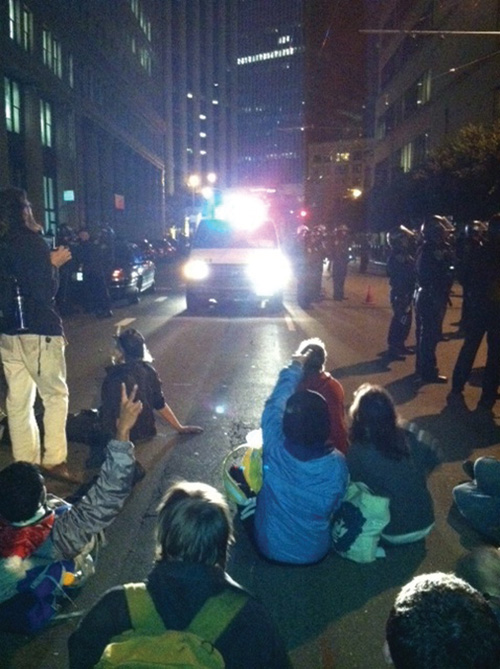
Thursday morning, in gray seven o’clock fog, about 100 people asleep in front of the Federal Reserve building began to blink their eyes open. The bustling camp that had been there the day before — a small village of tents, tarps and easy-ups, shelves brimming with books, art supplies, and a display of hundreds of signs — was gone. The kitchen and all their food were missing, too.

“Wake up, everyone’s gotta wake up. Remember, sit/lie kicks in at seven,” urged a few protesters gently, winding their way through the maze of sleeping bags and blankets. No one was in the mood for legal trouble. All the people there, and a few hundred more who had gone home at two and three in the morning, had been a part of OccupySF’s first clash with the police. Someone pushed a cart full of fruit and granola bars. Breakfast. It was the camp’s first food donation since the incident, which had ended only four hours before. In the calm morning air, it was clear: the police could confiscate gear, but they could not stop the protest. It was only the beginning.

To say that OccupySF has grown in the past three weeks does not begin to describe it.

On Wednesday, Oct. 5, the camp was busy, clean, and what organizer Amy O proudly described as “jubilant.” Hundreds exchanged ideas, played music, and made signs and art. Two abundant snack tables providing free food to any and all were only the tip of the iceberg; the kitchen was piled so high that organizers had begun turning away food donations.

This scene contrasted starkly to the demonstration’s first night. Occupy SF started on Sept. 17, the same day as Occupy Wall Street, as one of the solidarity actions now reportedly numbering over 1,000. About 150 people gathered for the protest that first day and only a handful stayed the night. A week later, there was a devoted group of 10 campers. By Oct. 1, a good 40 people were camping and the kitchen and communications sections were set up. When the police showed up late Wednesday night, camp was 200 strong.


AS LONG AS IT TAKES

Spending time at the camp is addictive. Since my first night, I feel something constantly pulling me back. That night, Oct. 1, the camp was lively and half a block long. A big, hot pot of soup sat on the kitchen stove. Next door, the communications area was populated with organizers busily typing on laptops. The medical tent was next, kept pristine but as of yet untouched—its necessity, nonetheless, was evident after that week’s incident in New York when police pepper sprayed a group of young women.

At that point, the San Francisco Police Department had been courteous with OccupySF. They provided escorts on marches and didn’t bother the camp. Soon after arriving, Russell, a friendly 23-year-old from San Diego who has been camping since the first day, greeted me. He told me that there was a Gardening Committee meeting in a few minutes, and I planned to check it out. Next I saw Lesley Moore, 48, an Oakland resident with unrelenting energy and a knack for mediating misunderstandings at meetings.

She carried a clipboard and was compiling a massive list of food, supplies, and every imaginable resource the group might want. I learned that a flood of supporters, eager to donate, had requested info about what the camp needed. She planned to post the list on occupysf.com later that night.

Fifteen people climbed into a tent for the Gardening Committee meeting, keen to begin growing food for the camp. The donations were rolling in, and if there was a project we wanted to do, well, we probably could. We discussed what could grow in the winter and planting more in the spring. The mood was giddy with possibility but a bit uneasy— could we imagine we’d still be here then?

Many participants are determined to stay put. Jreds, a protester who had come from Chico, looked me in the eye and promised, “I’m staying as long as it takes.”

When asked his occupation, Jreds replied, “This is our occupation.”

After years of foreclosures and unemployment, no wonder so many people are motivated and available to work and sleep at a place like this. Wall Street’s unmitigated power has failed to trickle down into economic opportunities for the rest of us, and in this economy, “why don’t you just get a job” is starting to sound like “let them eat cake.”

As John Reimann, 65, a retired carpenter from Oakland, put it, “I’ve been waiting 10 years for something like this.” He helped start Occupy Oakland last week.

Protester Chris L, who says the community at the camp is the best part about it, also plans to stay indefinitely. Billy Gene Hobbs, a promoter from LA who can often be seen jumping and shouting to keep protest crowds pumped, came to visit San Francisco two weeks ago, found the camp, and hasn’t left. Since the police came through, almost 100 more people have joined.

The camp’s population is a source of ongoing discussion. Complaints of “too many hippies” usually die quickly when someone actually comes to camp, where the people they’re referring to are not the only ones and, moreover, are active and responsible organizers.

Others object that the protest is populated mostly with young people, especially white and male. There is active discussion on how to accommodate people with children as well as people with disabilities.

It seems everyone — including the many people of color, folks of all ages, and disabled people who have been organizers and participants in the movement — shares the view that oppressive institutions work hand in hand with the corporate corruption and power that the movement strives to end.


THE PEOPLE’S MIC

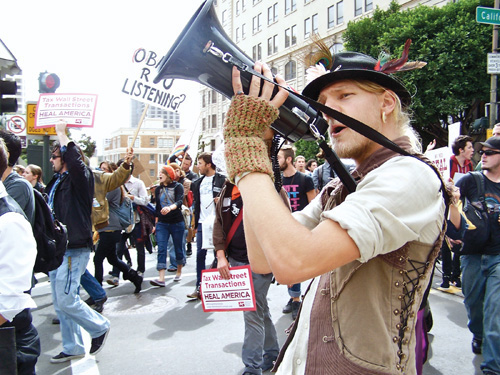
Camp life is dotted with calls for the People’s Mic, a tool developed at Occupy Wall Street, where using bullhorn or speakers is illegal. When someone yells “Mic check!” the crowd echoes in response. The person speaks his piece, sentence by sentence, as the crowd repeats. If a few people nearby can hear him, everyone can. For better or for worse, it tends not to amplify ideas people don’t have much taste for; at a recent meeting, when someone insisted that people who had been foreclosed on were greedy and foolish, the People’s Mic’s volume faded fast.

The People’s Mic requires no electricity, discourages rambling, a brilliant improvisation. But the central feature of Occupations throughout the country is the General Assembly. OccupySF has been holding General Assemblies every day at camp at 6 p.m. and on Saturdays at noon in Union Square. In the past week they have consistently boasted a couple hundred participants daily, but continue to practice consensus-based decision-making and participatory democracy. They’re long and often frustrating, but for many, as a standard rallying cry insists, “This is what democracy looks like!”

Many have stepped up at meetings to say that too many men, too many white people, or simply too many of the same voices are being heard. Solidarity efforts like Occupy the Hood, which declares the vital need that people of color make decisions and organize in and along with the occupations, have surfaced nationally.

On Oct. 5, after about 700 people marched on the Financial District with OccupySF, the General Assembly was particularly well attended. It was peppered with invitations and expressions of solidarity, conveyed by representatives of groups from throughout the Bay Area.

The week’s schedule slowly filled: Thursday’s anti-war march, the next day’s teach-in with activist Miguel Robles, a 7 am “Wake Up Action” with Unite-HERE Local 2 on Oct. 10, and plans to coordinate with the LGBT rights group Get Equal for a National Coming Out Day action the next day.

Carolyn DeRoo, a brightly charismatic BART station agent, reveled in the whoops and cheers when she announced that Amalgamated Transit Union Local 1555, the union that represents BART workers, had just voted to endorse Occupy SF. “I got an hour off work today so I could be in the march,” said DeRoo.

She expressed concern over the lack of coherent messaging, hoping it wouldn’t hurt the movement. “I was about to get on a plane to New York because of how badly I wanted to be a part of it,” she said. “I’m so glad it has started in SF.”


THE COPS ARRIVE

But on that fateful night, Oct. 5, meeting ideals were strained. High-tension and often angry debate filled the hours between being warned of police action and its onset, making consensus difficult. Some wanted to take down the camp, unable to risk arrest. There were campers from all walks of life present, including some homeless folks and travelers who would risk losing all or most of their possessions if the police confiscated them. Others didn’t want to see the camp’s growth stunted due to police intimidation.

Dierdre Anglin, 40, an Oakland resident who works in the nonprofit sector, was particularly calm amongst the chaos. “I think the energy got a little high,” she said, as protesters ran around taking down tents and preparing for the imminent police confrontation. “But we have decided to take the stance and to stay here.”

She added, “I personally feel that they are not going to do anything because it would make the police look quite bad. There’s a lot of support for us.” Anglin’s prediction about the cops’ actions, if not their public relations consequences, was mistaken. Police marched in around 1 am, and Department of Public Works employees began to fill their trucks with camp materials.

Billy Gene, ever energetic, raced to lie down on the street in front of trucks and was dragged away, yelling “Don’t be mean!” at police. Many sat and stood in front of trucks. Others could be seen shaking their heads at colleagues’ verbal attacks and murmuring, “that isn’t nonviolent.”

There was no property damage or physical violence on the part of the protesters, although one man was arrested for allegedly punching an officer in the face, which both sides cast as an aberration that didn’t reflect the tenor of the standoff.

At 3 am, protesters surveyed the damage. An organizer addressed the group: “We’re still here, and it’s time to rebuild.” The camp received a donation of blankets and sleeping bags at four o’clock that morning. At five, a small jam session and dance party broke out.

Police have since provided information on how to retrieve confiscated materials, and Police Chief Greg Suhr told us they’ve been actively trying to facilitate getting people their stuff back and allowing the occupation to continue (see accompanying article for more from Suhr).

In the days since, the mood has again turned jubilant. On Thursday afternoon, Oct. 6, about 120 people were gathered at the camp. Signs ranged from “student loan debt is slavery” to “grannies against war.” The next night, the mass of people had increased, and with it the group’s creativity. Protesters could be seen pedaling a stationary bike connected to a battery, powering laptops.

As the sun set Friday, 300 people at camp looked west. They erupted in cheers as a 500-person anti-war demonstration marched onto the site. Market between Main and Embarcadero was shut down as protesters rallied and then held General Assembly. A dozen police lined up near the sidewalk; one told me they were separating OccupySF from the march. The next second, the “march” erupted in chants of “We are the 99 percent,” the Occupy movement’s signature rallying cry. Attempts to divide were futile.

That the movement has no “one message” has in many ways worked to their advantage. It seems hundreds of thousands of people with varying issues and concerns can all agree that an elite class, embodied by Wall Street, has far too much power and money, and that the people must unite against the sorry state of this system. As I looked in the officers’ eyes, I wondered how long even their disconnect from the protesters will last. Most are, after all, the 99 percent too.

After the General Assembly held the street for an hour, police requested that they please move to the sidewalk. A consensus vote decided to oblige. An assembly member proclaimed, words booming with the roar of the People’s Mic, “Let us remember that we took this street, and we could have held it if we wanted to.”

This is the kind of power many haven’t felt in a long time. And I get the feeling that no one intends to relinquish it any time soon.


Feds crack down

8

steve@sfbg.com

HERBWISE Reversing its previous pledge to abide people’s rights to legally obtain medical marijuana in California and the 14 other states that have legalized it, the Obama Administration has launched a crackdown on the industry using several different federal agencies.

During an Oct. 7 press conference in Sacramento, California’s four U.S. attorneys announced their intention to go after the industry with raids on large-scale growing operations and big dispensaries and civil lawsuits targeting the assets of people involved in the cannabis business.

“We want to put to rest the notion that large marijuana businesses can shelter themselves under state law,” Melinda Haag, the U.S. attorney for Northern California, based here in San Francisco, said at the press conference.

That pronouncement is just the latest in a series of federal actions against those involved with the production and distribution of California’s top cash crop, an industry that the California Board of Equalization estimates to be worth about $1.3 billion in tax revenue annually. Sources in the medical marijuana business say the crackdown began quietly this summer.

Hundreds of dispensaries and other medical marijuana operations had their bank accounts shut down after the Treasury Department contacted their banks and warned them of sanctions for doing business with an industry that remains illegal under federal law. The Internal Revenue Service last month also notified many large dispensaries — including Harborside Health Center in Oakland, the largest in Northern California — that they cannot write off normal business expenses and must pay a 35 percent levy on those claims going back for three years.

Harborside’s Steve DeAngelo told us that would put Harborside — or any company with high overhead costs — out of business. “This is not an effort to tax us, it’s an effort to tax us out of existence,” he said, noting that Harborside paid the city of Oakland $1.1 million in taxes this year. In addition, the Department of Justice recently began sending 45-day cease-and-desist letters to hundreds of dispensaries around the state, including at least two in San Francisco, warning the clubs and their landlords that the operations violate federal law and could be subject to federal laws on the seizure of assets from the drug trade.

“It’s a multi-agency federal attack on patients’ access to this medication,” DeAngelo said. “It’s going to drive sick and dying patients back out onto the street to get their medicine.”

Haag claimed the state’s medical marijuana laws, which California voters approved back in 1996, have been “hijacked by profiteers.” Yet both local officials and people in the industry say that characterization is ridiculous, and that the federal government’s new stance will destroy an important industry — one that is very professional and well-regulated in San Francisco — and send legitimate patients back into the black market.

“I think it’s a step in the wrong direction and counter-intuitive to the Obama Administration’s contention that he would respect state’s rights,” said Sup. Ross Mirkarimi, who authored groundbreaking legislation regulating San Francisco’s two dozen dispensaries, a system that he said “is working well…But now the federal government is pulling the rug out from under us.”

Shortly after taking office in 2009, the Obama Administration released the “Ogden memo,” written by Deputy Attorney General David Ogden, stating the federal government would respect the rights of states to legalize and regulate medical marijuana. It was seen by cannabis activists as a sign that Obama was de-escalating the war on drugs, at least as it applied to marijuana.

But in June of this year, the DOJ release the “Cole memo,” by Deputy Attorney General James Cole, which it said “clarifies” the Ogden memo. In fact, it reversed the position, stating unequivocally that federal marijuana prohibition prevails and “state laws or local ordinances are not a defense to civil or criminal enforcement of federal law with respect to such conduct.”

“They’re bringing the hammer down,” said David Goldman, who works for Americans for Safe Access and sits on San Francisco’s medical marijuana task force. “This is not U.S. attorneys doing this on their own, this is coming from the top levels of the DOJ.”

Actually, Goldman and others suspect it goes even higher than that, right to Obama and his political team, who appear to be making a calculation that cracking down on medical marijuana is a good move before an uncertain reelection campaign.

“It’s political. It’s all about Obama appealing to the middle to win reelection,” Goldman said.

“I don’t think there’s any rational basis for what’s going on. It was clearly a political calculation,” DeAngelo said. “Why do they think it’s better for patients to buy their medicine from the black market?”

He said the crackdown will bolster the Mexican drug cartels, destroy a thriving industry that provides jobs and pays taxes, hinder efforts at better quality control and growing conditions (see “Green buds,” Aug. 16), and waste law enforcement resources to seize and destroy a valuable commodity.

“It’s a policy with all downsides and no upsides,” DeAngelo said.

Mirkarimi said that this crackdown could finally force cannabis activists to take on the federal prohibition of marijuana directly: “Bottom line, marijuana is the United States needs to be reformed so it’s not a Schedule 1 drug,” referring the federal government’s conclusion that marijuana is a dangerous drug with no medical applications.

But for now, DeAngelo said the industry will fight back: “We will fight it in the legal system, we will fight it in the court of public opinion, and we will appeal to Congress.”

The Occupy Wall Street platform

6

EDITORIAL In New York City, the protesters who started the Occupy Wall Street movement remain camped out in Zuccotti Park. In Washington, DC, President Obama said at an Oct. 6 press conference that he understands the sentiment driving the activists. Yet in San Francisco, Mayor Ed Lee has approved a police crackdown and the confiscation of camping supplies in an effort to debilitate the occupation in front of the Federal Reserve Bank.

The move comes at a time when Lee is doing nothing to crack down on foreclosures that cost the city money, nothing to force the big banks that have the city’s deposits to lend more in the community, and nothing to promote local taxes on the wealthy.

While Lee says he supports the First Amendment rights of the protesters, he sent the cops in at 10:30 at night to confiscate their belongings — using, in part, the sit-lie law (which is only in effect until 11 p.m.)

His approach is just wrong. This city ought to be embracing and supporting the demonstrations. San Francisco makes room for all kinds of public events; this one should be no different. The people at City Hall should be working with the people in the streets to make San Francisco a central part of this growing national movement.

Make no mistake about it: What started as a small-scale, leaderless, somewhat ragtag group in lower Manhattan now has the potential to become a potent political force in this country. Occupy Wall Street has tapped into a deep feeling of frustration that’s shared by people in blue states and red states, in cities and towns and rural communities. The feeble economy impacts almost everyone — and this movement has managed to point the finger at the people who caused the problem, who are preventing solutions and who are making big money off the suffering of others.

We realize that at this point, there’s no specific focus for Occupy Wall Street. The civil rights movement and the anti-war movements of the 1960s and the antinuclear movement of the 1970s, the demonstrations against free trade agreements in the 1990s and the marches against the Iraq War in the past decade included people with hundreds of ideological agendas, but they had a pretty clear message — and, generally speaking, specific actions that government officials could take to address the issues.

Occupy Wall Street hasn’t called for any bills, regulations or policies. It’s still a group that is simply calling attention to a basic truth — the very wealthy in general, and the financial sector in particular, are enjoying economic gains at the expense of the rest of us. But that alone is a profound and potent message — if the demonstrators don’t have all the solutions, at least they’ve identified the problem. And that’s more than Obama, Congress, or the mainstream news media have done.

There’s been plenty of talk of a formal platform — one Occupy Wall Street activist posted a proposed list of 13 demands on the group’s website. It’s not a bad list (a guaranteed living wage, single-payer health care, free college education, debt forgiveness, a racial and gender equal rights amendment) with a few somewhat random elements (outlaw all credit agencies). Fox News has picked up the list, although the organization, such as it is, has made it clear that there is no consensus on any platform and agenda. And the labor unions that are joining the protests — with the proper respect for the folks who started things — have legislation in mind (a financial transaction tax, for example).

There’s a danger that the message becomes so diffuse, and imbued with every possible issue that anyone on the left cares about, that it loses the potential to have an impact on the 2012 elections. Occupy Wall Street could go a long way to providing a populist progressive message to counter the Tea Party (which is funded by and largely organized by billionaires but tries to claim grassroots legitimacy).

And there’s no need for a laundry list of agenda items. The focus is right where it ought to be: The richest Americans — and the big financial institutions — have been sucking all the money and energy out of the economy. The remaining 99 percent are suffering. Tax the top 1 percent and create a robust jobs program to put the rest of the country back to work; that’s a winning platform for 2012

Editorial: The Occupy Wall Street platform

6

In New York City, the protesters who started the Occupy Wall Street movement remain camped out in Zuccotti Park. In Washington, DC, President Obama said at an Oct. 6 press conference that he understands the sentiment driving the activists. Yet in San Francisco, Mayor Ed Lee has approved a police crackdown and the confiscation of camping supplies in an effort to debilitate the occupation in front of the Federal Reserve Bank.

The move comes at a time when Lee is doing nothing to crack down on foreclosures that cost the city money, nothing to force the big banks that have the city’s deposits to lend more in the community, and nothing to promote local taxes on the wealthy.

While Lee says he supports the First Amendment rights of the protesters, he sent the cops in at 10:30 at night to confiscate their belongings — using, in part, the sit-lie law (which is only in effect until 11 p.m.)

His approach is just wrong. This city ought to be embracing and supporting the demonstrations. San Francisco makes room for all kinds of public events; this one should be no different. The people at City Hall should be working with the people in the streets to make San Francisco a central part of this growing national movement.

Make no mistake about it: What started as a small-scale, leaderless, somewhat ragtag group in lower Manhattan now has the potential to become a potent political force in this country. Occupy Wall Street has tapped into a deep feeling of frustration that’s shared by people in blue states and red states, in cities and towns and rural communities. The feeble economy impacts almost everyone — and this movement has managed to point the finger at the people who caused the problem, who are preventing solutions and who are making big money off the suffering of others.

We realize that at this point, there’s no specific focus for Occupy Wall Street. The civil rights movement and the anti-war movements of the 1960s and the antinuclear movement of the 1970s, the demonstrations against free trade agreements in the 1990s and the marches against the Iraq War in the past decade included people with hundreds of ideological agendas, but they had a pretty clear message — and, generally speaking, specific actions that government officials could take to address the issues.

Occupy Wall Street hasn’t called for any bills, regulations or policies. It’s still a group that is simply calling attention to a basic truth — the very wealthy in general, and the financial sector in particular, are enjoying economic gains at the expense of the rest of us. But that alone is a profound and potent message — if the demonstrators don’t have all the solutions, at least they’ve identified the problem. And that’s more than Obama, Congress, or the mainstream news media have done.

There’s been plenty of talk of a formal platform — one Occupy Wall Street activist posted a proposed list of 13 demands on the group’s website. It’s not a bad list (a guaranteed living wage, single-payer health care, free college education, debt forgiveness, a racial and gender equal rights amendment) with a few somewhat random elements (outlaw all credit agencies). Fox news has picked up the list, although the organization, such as it is, has made it clear that there is no consensus on any platform and agenda. And the labor unions that are joining the protests — with the proper respect for the folks who started things — have legislation in mind (a financial transaction tax, for example).

There’s a danger that the message becomes so diffuse, and imbued with every possible issue that anyone on the left cares about, that it loses the potential to have an impact on the 2012 elections. Occupy Wall Street could go a long way to providing a populist progressive message to counter the Tea Party (which is funded by and largely organized by billionaires but tries to claim grassroots legitimacy).

And there’s no need for a laundry list of agenda items. The focus is right where it ought to be: The richest Americans — and the big financial institutions — have been sucking all the money and energy out of the economy. The remaining 99 percent are suffering. Tax the top 1 percent and create a robust jobs program to put the rest of the country back to work; that’s a winning platform for 2012.

Brown vetoes bicycle buffer zone

92

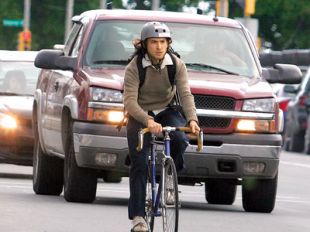
Anyone who has ever ridden a bicycle knows how scary and dangerous it is when cars pass too closely at high speed. So the California Bicycle Coalition made its top legislative priority for the year a bill, SB 910, to require drivers to give bicyclists a three-foot buffer or slow down to 15 mph. And even though the Legislature overwhelmingly approved this reasonable traffic safety measure, Gov. Jerry Brown vetoed it on Friday.

“His veto made no sense. We honestly can’t figure out why he vetoed the bill,” said CBC executive director Dave Snyder, a San Francisco resident who used to run the San Francisco Bicycle Coalition and who founded Transportation for a Livable City (now known as Livable City). “It’s not based on logic or public policy, but just based on politics.”

The California Highway Patrol and California Department of Transportation opposed the measure on the grounds that it could impede the flow of automobile traffic, and Brown cited their stand in his veto message. Indeed, keeping cars moving at high speed has long been the central goal of these agencies, even when it has high economic, environmental, or public safety costs.

But Snyder is right that Brown’s veto message is confusing and contradictory. He expresses support for the three-foot buffer, but expresses concern about slowing traffic to 15 mph, seemingly confused about the meaning of the word “or,” meaning drivers can provide the buffer or slow down to a safe passing speed if they’re unable to give bicyclists that much room.

People who don’t ride bikes tend to forget that automobiles are deadly weapons, and that a bicyclist’s brief swerve to avoid a pothole, broken glass, or other hazard can have disastrous consequences if a car is passing too closely. This veto follows another illogical one – Brown’s rejection of Sen. Mark Leno’s local vehicle license fee bill, which would have pumped $75 million into SF’s coffers and was almost universally supported by this year’s mayoral field – that gave undue deference to automobile owners.

Meanwhile, the San Francisco Police Department recently launched a crackdown on bicyclists in the city, issuing dozens of tickets on Market Street for running stop lights and on Townsend for briefly riding on the sidewalk en route to the Caltrain station – and ignoring the nearby cars parked in bike lanes and running those same red lights.

Now, before we get to the commenters’ tirade about scofflaws on bicycles – which come every time we write about bikes – let me note that people break the law on every form of transportation, everyday. Motorists speed, run stop signs and lights, and illegally edge past pedestrians (who themselves jaywalk with great regularity). And every Muni bus has several riders who haven’t paid. None of us are angels, so try not to get too worked up into a sanctimonious rage.

But if you want to truly understand why bicyclists can often be so flagrant in our disregard for the law, consider that we’re using a transportation system and abiding traffic laws that weren’t designed for us. Seriously, just ride a bike and you’ll quickly understand. We don’t need to stop at every stop sign or signal light to have a safe, smooth-flowing transportation system that doesn’t steal the right-of-way from drivers, who we can usually see and hear coming with plenty of time to stop. Idaho and other jurisdictions actually treat bikes differently than cars in this realm, with laws that don’t require cyclists to lose momentum by repeatedly coming to complete stops, and it works well.

The fact is, the bike buffer bill is the very minimum that we need to encourage cycling as a safe and appealing transportation option to more people, which would only help our environment, public health, and dependence on fossil fuels. And the fact that it was vetoed for petty, illogical reasons is incredibly frustrating.

Yet there may be a silver lining to this. Snyder said the CBC, which is just beginning to increase its reach and influence and to prepare a more ambitious agenda on behalf of California cyclists, will use this defeat as a launching pad for future efforts.

“The main benefit of the three-foot bill was the community organizing that we did to get is passed. So now we can leverage that for our next steps,” Snyder said. “California needs a lot more than a three-foot buffer to give people more safe transportation choices.”

The Performant: They Might be Giants

0

Stagewerx and SF Olympians Festival go big

It’s been a turbulent year for independent theatre and its venues. In truth, every year is. But there have been some notable successes too. Boxcar Theatre’s addition of a new studio space on Hyde Street. Bindlestiff Theatre’s move into a new permanent space. Pianofight’s acquisition of the old Original Joe’s in order to create a hybrid performance space-kitchen-bar right on the cutting edge of the downtown theatre district. 

And just in case you’d missed it, this is the month that Stagewerx, which has been occupying the literal theatrical underground in the basement of 533 Sutter since 2007, has opened the doors of its community-supported digs at 446 Valencia — the old Intersection for the Arts space. 

Following a big-ticket Kickstarter campaign* and months of hard labor, rebuilding one venue from scratch while running another, the Stagewerx crew’s labor of love has finally put down its expansive roots in the Mission District.

It was a low-key but convivial christening, a bevy of Stagewerx supporters and performers (and supporter-performers) poking around the nooks and crannies of the strangely familiar, yet revitalized space. The evening’s emcee, Mikl-em, presided over a variety show of musicians and comedians (and musician-comedians), including a special guest appearance from Carol Channing, as well as one by Sean Owens, who mysteriously often appears on the same bill as Channing. (It’s rumored they share a booking agent.) 

Other acts included Circus Finelli, Tom Sway from Undergroud Sound, Joe Klocek from Previously Secret Information, Tom Jonesing, Don Seaver, and Gerri Lawlor. No sooner was the party over, Stagewerx hit the ground running with a Monday performance of the Picklewater Clown Cabaret and a four-weekend whirlwind of sketch comedy dubbed PanderFest 2011, co-starring Pianofight’s Mission CTRL and Crisis Hopkins. 

Meanwhile downtown, another theatre festival of quietly epic proportions. The SF Olympians Festival, opened with staged readings of new full-length plays by Thunderbird Theatre Company and Megan Cohen and a veritable constellation of shorts, kicking off a four-weekend run of its own on the EXIT Theatre mainstage. 

In its second year, the SF Olympians Festival uniquely fuses ancient Greek mythology with modern-day theatre-making, with each play featuring a different mythological figure—from Andromeda to Zephyrus—and a different local playwright (there are 29 represented in this festival of 32 plays). 

On Friday, a three-play bill of two shorts and one full-length work debuted, thematically clustered around Orion, one of the most recognizable of all constellations. Claire Rice’s very short, “Dog Day”, starred Benji Cooper as Canis, who morphed into the narrator of stage directions for Megan Cohen’s full-length “Hunter and Hunted,” which turned the Orion myth into an updated crime noir. 

Starring Matt Gunnison as the beleaguered “Joe Ryan,” an old-school detective on the trail of the Scorpio gang, Cohen’s often humorous play turned the otherwise familiar streets of San Francisco, from North Beach to the Panhandle, into a giant playground for the infamous Scorpio gang. 

Rounding out the evening with a case of constellation envy was “Scorpio,” a short penned by Seanan Palermo, starring an exasperated John Lennon Harrison as the titular character, fruitlessly pursuing Orion across the deserts of Arizona. There’re still three weekends left of the festival, each night more ambitious than the last, and at just ten bucks a pop, repeat visits are not only possible, but recommended.   

*Full disclosure, the author of this piece made a kickstarter donation to the Stagewerx campaign.


PanderFest 2011

Through Oct. 29

Various times, $20

Stagewerx

446 Valencia, SF

www.stagewerx.org/446.html

www.panderexpress.com


SF Olympians Festival

Through Oct. 29

 Various times, $10

Exit Theatre

156 Eddy, SF

www.sffringe.org

www.sfolympians.com


Lee’s talking points sound familiar

Interim Mayor Ed Lee released a 17-point jobs plan last week as part of his bid for mayor, prompting City Attorney Dennis Herrera to accuse the interim mayor of “plagiarism” since Herrera, also a contender for mayor, issued a 17-point jobs plan himself earlier this year.

Herrera’s campaign also criticized Lee for ending his plan with Herrera’s signature slogan, “a city that works.”

But Herrera isn’t the only mayoral candidate for whom Lee’s campaign rhetoric rings a bell. Board President David Chiu, who attracted a great deal of attention earlier this year for his statement that supervisors are elected not to take positions but to “get things done,” seems to have served as a muse to the campaign consultants who thought up Lee’s campaign slogan: “Ed Lee Gets it Done.”

(Which — is it just me? — or does having that phrase plastered everywhere bring to mind something more like this?):

http://www.youtube.com/watch?v=OnDO5VTge6w

Lee’s “new era of civility in City Hall,” meanwhile, closely echoes language Chiu has used on the campaign trail. At a campaign stop in June, Chiu told a room of supporters that before civility was restored this year, “City government was frankly pretty dysfunctional.” Politicians from different political factions bickered with one another, he said, and “they literally couldn’t even sit in the same room.”

At an Aug. 11 rally, Lee told supporters, “We have changed the tone in which we run government,” and added, “I still have in my mind the screaming and the yelling” that the city family used to engage in. 

A few more striking similarities, taken from the candidates’ respective campaign websites:

*  David Chiu says he’ll “Prioritize hiring of local residents.”
*  Ed Lee says he’ll “Hire San Franciscans.”

*  David Chiu says he’ll “Invest in community institutions and infrastructure.”
*  Ed Lee says he’ll “Invest in infrastructure jobs.”

*  David Chiu says he’ll “Support the continued growth of the technology sector.”
*  Ed Lee says he’ll “Attract & grow the jobs of the future.”

*  David Chiu says he’ll “[Expand] the impact of SFMade.”
*  Ed Lee says he’ll “Revive local manufacturing – ‘Made in San Francisco.’”

*  David Chiu says he’ll “Fill vacant storefronts.”
*  Ed Lee says he’ll “Improve blighted areas.”

*  David Chiu says he’ll “Reform our broken business tax. San Francisco is the only city in California that levies a tax on businesses exclusively on payroll.”
*  Ed Lee says he’ll “Reform the Payroll tax  … Mayor Lee knows that San Francisco’s current business tax structure punishes job creation when it should reward it.”

Asked to comment on the remarkable similarities in campaign materials, Lee spokesperson Tony Winnicker told the Guardian, “It’s just another baseless attack from Dennis Herrera’s campaign, only this one sounds like he’s in the third grade.

“Mayor Lee has been giving small business loans and recruiting new jobs to San Francisco from his first days as Mayor,” Winnicker continued. “His economic plan builds on the good work and projects underway and includes many genuinely new ideas to create even more jobs for the future.”

Winnicker added, “As for President Chiu, it’s no surprise that he and Mayor Lee would share many views on how to create jobs for our City as they’ve worked together closely on many issues throughout the year. He thinks President Chiu has many good ideas in addition to Mayor Lee’s own new proposals in our 17-point economic plan. Mayor Lee looks forward to continuing to work with Board President Chiu to create jobs for every neighborhood of our City.”

Jeb Bush, Rupert Murdoch bound for S.F.

The Foundation for Excellence in Education, a Florida-based nonprofit led by Jeb Bush, will host its National Summit on Education Reform at the Palace Hotel in San Francisco Oct. 13 and 14.

Bush, former Florida governor and the brother of former President George W. Bush, will deliver a welcome address Thursday. Rupert Murdoch, the billionaire head of News Corporation who came under pressure in recent months as the News of the World phone-hacking scandal erupted, will deliver a keynote address Friday.

Washington Post columnist Valerie Strauss sums up the irony of having Murdoch as the guest of honor at the conference here:

“Yes indeed, the Rupert Murdoch set to speak on technology’s power to transform education is the same Rupert Murdoch recently hauled before a British parliamentary committee to explain why a newspaper he owned had used technology to hack the phones of thousands of British citizens for years — including the phone of a murdered 13-year-old girl, thus interfering with the police investigation. (Murdoch closed the newspaper.)”

Panelists at the event will include News Corporation executives, CEOs of for-profit schools, state senators from Florida, Arizona, and Oklahoma, and the author of a book titled School Boards in America: A Flawed Exercise in Democracy.

The conference will feature a number of “strategy sessions,” and one is actually called, “Don’t Let a Financial Crisis Go To Waste.” The session will focus on education funding formulas and purports to explain “just what lawmakers and policymakers can do to get a better return-on-investment for their education dollars,” according the conference agenda. It will be moderated by a director of education policy at the George W. Bush Institute, which “champions change” based on the educational policies of No Child Left Behind.

The first strategy session is called “The Teaching Profession 2.0,” and hints of an anti-union agenda: “During the last two years, states across the country have ushered in the most sweeping reforms of the teaching profession in our nation’s history,” according to the workshop description. “More meaningful evaluations. An end to tenure and destructive last-in, first-out policies. Salaries that reflect student learning rather than seniority. Learn how lawmakers and policymakers from states around the nation are changing the paradigm of the teaching profession.”

Another segment will focus on digital learning, or teaching through technology, which the Foundation for Excellence in Education seems dedicated to advancing. A video on a newly launched website touted by the foundation features Tom Vander Ark, CEO of Open Education Solutions, explaining, “Our mission is to advance digital learning in every classroom, in every school, in every state in America.” But Vander Ark’s recent vision for opening charter schools in New York City did not go so well, according to this New York Times story. Murdoch delivered an address at the e-G8 in Paris last year titled, “Digital’s Next Frontier: Education.”

In any case, San Francisco — famed for its left-leaning politics — seems an odd choice for Bush and Murdoch, especially during a week when the streets are likely to be filled with protesters marching in solidarity with the Occupy Wall Street movement. 

Low-income tenants face possible eviction at Parkmerced

At least nine eviction proceedings have started at the Parkmerced housing complex, the site of a controversial new housing development, in response to an effort by the property management company to collect back payments on rent and utility bills, the Guardian has learned.

In recent months, nearly 200 residents received official notices warning that they would face eviction if they did not take steps to bring their accounts current within three days, according to Sara Shortt, executive director of the Housing Rights Committee of San Francisco. About 80 three-day notices were issued to tenants who are on Section 8, a federal low-income housing assistance program that subsidizes rental payments using public funds provided by the local housing authority.

“They’re extremely low-income renters, and they’re suddenly being asked to pay large balances,” Shortt explained. “It’s blood from a turnip.” Most of the amounts owed ranged between $600 and $800, she added.

Shortt said that while some tenants were being allowed to set up payment plans, this measure wasn’t guaranteed for every tenant attempting to address the problem within the three-day timeframe. And she was skeptical that the payment-plan arrangements being presented by management were realistic in every case.

“I don’t know if Parkmerced is doing anything illegal,” Shortt said, acknowledging that she was receiving conflicting accounts of the situation. “But they’re executing something about legitimate recovery of money in an unfair manner. To allow people to slide for years and suddenly come at them for back bills is a one-way ticket for eviction.”

The Guardian was unable to reach Stellar Management, the real-estate management company at Parkmerced, but Shortt said she had spoken with Stellar representatives on behalf of tenants who were contacting the Housing Rights Committee in a panic.

Stellar representative Bryce Boddie explained the situation to her by saying a previous property management company had left billing records in disarray, and the company was finally getting around to straightening out its books by demanding payments that had long since been owed. “Their contention was that they basically decided it was time to clean house and recoup payments,” she said. Shortt said she’d also been told that Stellar had come under pressure from Fortress Investment Group, a firm that took ownership of the property last year, to get payments in order.

But P.J. Johnston, a public relations representative for Parkmerced, rejected that account, saying, “We absolutely follow up with residents who are not paying their bills.” Johnston said the number of three-day notices served this year were in keeping with last year, indicating that there had been no drastic changes in policy since the approval of the new housing project. He did not know how many Section 8 tenants received the warning notices in 2010. “Whether someone is a Section 8 certificate holder or just a regular resident, everybody’s got to pay their rent,” he said.

Johnston bristled at the criticism that renters were being asked to fork over unrealistically high sums on the spot for payments that had lapsed for long periods, saying, “If we had moved swiftly to evict residents sooner, we’d be hearing that we didn’t give them a chance.”

The issue comes on the heels of Board of Supervisors approval for a controversial housing development project at Parkmerced that tenant groups opposed because they felt it didn’t go far enough to protect renters. A development agreement negotiated between Parkmerced Investors and the city guarantees that rent-controlled tenants will be able to move into brand-new units at the same rent-controlled rate once the old units are demolished. Some residents are suspicious that management’s decision to issue three-day notices and take steps to evict tenants who cannot pay is a strategy for skirting these requirements.

Shortt said she couldn’t be sure that this was the case, but worried nevertheless that low-income tenants could wind up being tossed out of Parkmerced, which is just the scenario that tenant advocates had feared. “The end result really is in clear conflict with the spirit of negotiations and tenant protections,” she said.

Protesters blast Wall Street and war; support OccupySF

93

Story by Nena Farrell, photos by Ariel Soto-Suver

“We’re mad as hell, and we’re not taking it anymore!” was Tanya Dennis’s cry yesterday (Thurs/6) afternoon at a march and rally that drew from the Occupy San Francisco/Occupy Wall Street and the anti-war movements. It began at the Federal Building at Mission and 7th streets, where protesters will return today at 4:30 pm for a march marking the 10th anniversary of the war against Afghanistan.

Dennis got the crowd to scream the words with her, chanting it. Because it’s true—they’re not taking it anymore. She was one of the many featured speakers at the protest, along with representatives from OccupySF, the California Democratic Party, the American Indian Movement, and so many more. There were also sections of open microphones, where people could stand up to make a proposal, or usually just to make a point.

One of the open speakers proposed we free people. She had the entire gathering call it out with her: “Free people, free people.”

That’s one of the four demands that the 99 percent – the people that the occupiers say they represent – is making. One, to protect the environment. Two, to care for the people. Three, to tax the rich. And four, to end the wars. These are the four demands of the movement. At the protest, these four demands were posted on multiple signs.

The protest was in solidarity with the anti-war action in Washington DC. And from DC, the event had Dick Cheney – or rather, an impersonator of the former vice president – here to open the event. Upon his arrival, he was booed, but Cheney himself seemed fairly pleased with the entire situation. He joked that he brought three virgin hearts with him in case he was shot.

After the speakers, the protest moved to march down to 101 Market Street, where Occupy San Francisco has its movement encampment. The group moved down the blocks, chanting “Banks got bailed out, we got sold out!” Each time they came to a bank along Market Street, the entire group would stop and cry together “Make banks pay” and “Tax the rich.”

It was the speakers, overall, that brought the real power to the event. They described the madness the working class was facing, the entire country and our state, and even the outside countries that we have both declared and undeclared wars on. And not just by the selected featured speakers, but also the ones like Sheila Gun Cushman, a blind woman who spoke up during the open speakers, saying “We have wanted this for years, it’s about bleepin’ time!”

Janet Weil, a Code Pink activist, was moved by the speakers as well: “[The] testimony of people at open mike was very powerful and important.”

Ed Lee’s funny money

33

The break on the big campaign news of the week goes to the Bay Citizen’s Gerry Shih, who tracked down a couple of employees of GO Lorrie’s and got them to admit that they had no idea who Ed Lee was and had given him $500 because their boss had agreed to reimburse them in cash. Now the other candidates are making an issue of it — Dennis Herrera has called for a criminal investigation, David Chiu has issued a somewhat weaker statement and Jeff Adachi’s campaign is calling the whole thing sleazy.

What makes this so interesting is not just that someone at GO Lorrie’s may have been laundering contributions — the airport shuttle company has been lobbying the city to try to change the rules around where the shuttle vans get to park. So it’s not just a funky operation to push money to the mayor — it’s money from a company that has a big financial stake in a decision made by city officials (and by the way, the airport commissioners are appointed by the mayor).

Matt Dorsey, a spokesperon for Herrera’s campaign, told us that “there’s a point where campaign activities stop being cute and questionable and become illegal.” He noted that Mayor Lee, while vowing to return the tainted money, hasn’t called for a further inquiry.

“If laundered campaign contributions came to the attention of the Herrera campaign, the first person to call for an investigation would be Dennis Herrera,” Dorsey said.

Chiu’s statement: “These revelations raise deeply troubling questions that merit a full investigation by state authorities.  City Hall cannot be for sale.  Pay-to-play politics has no place in San Francisco, and will have no place in a Chiu administration – you can count on that.”

More: “Incidents like these are a reminder of the backroom deals and crony politics that San Franciscans are sick of,” said Colin Dyer, field director for Jeff Adachi. “This is just another in a long line of questionable activities surrounding Ed Lee and his powerful special interest backers. He promised to be a different sort of mayor, Ed Lee is just more of the same.

The big question, of course, is whether this will finally start to take the edge off the Ed Lee Teflon. And that depends in part on the San Francisco Chronicle — which put a far less relevant story about Dennis Herrera (one that didn’t involve illegal money laundering) right on the front page in the lead space above the fold.

The Chron, weakened as it is, still helps define the daily news cycle in this town. But guess what? The Chron didn’t break this story. The Bay Citizen did. And it there’s one thing I’ve found to be consistent about the ol’ Chron over the years is that the paper tends to ignore stories broken by the competition.

But this ought to be front-page news everywhere, not just because it’s a potential felony but because it represents the side of Ed Lee that we’re all worried about. In the Bad Old Days, Willie Brown’s operation did stuff like this all the time. Money went in and out of shadow committees and independent expenditure groups and it was almost impossible to keep track of who was giving how much to Brown — except that anyone who wanted to do business with the city had to pay up.

If Ed Lee’s folks are starting to play those same games, then it’s a very bad sign.

Lovefoxxx makes SF love her at the Fillmore

1

By the end of last night at the Fillmore, CSS’s dynamic lead vocalist-party rioter Lovefoxxx was stripped down to a black tank top and ripped up jean shorts over fishnets, her raccoon eye makeup smeared across her face, fluffed pink hair electrified out of its sockets.

She had cartwheeled, stage-dove, danced through the crowd trailing the mic, spit liquids like a fizzing fountain across the stage/herself/the audience, and told us all  “I love you” a half dozen times, requesting that we should shout “I love you” back in manly intonations. For what started out as a calmer evening, with rumored low ticket sales, the show grew into a massive all-out punk rock dance party by evening’s close. My cheeks hurt from smiling.

Even openers MEN, who unfortunately had to work with a far smaller and less worked up audience in the early stages of the show, were working it it overtime, lead vocalist-electronics-shifter JD Samson hopped from mic to synth to laptop, and raised her tattooed arms, sporadically jumping into high-kicks to get the crowd going.

10 great bits about CSS and MEN at the Fillmore:
1. Lovefoxxx screaming “Fuck Everything” in a faux-growl before kicking off the jam, aptly titled “Fuck Everything” off the Brazilian rave-punk band’s new release, La Liberación, an album that takes one tiny baby step away from electro and one towards reggae-beat.
2. Before jumping in to (arguably, its biggest hit) “Music Is My Hot Hot Sex” off its self-titled debut, Lovefoxxx telling the crowd she’s single, and introducing her slightly-embarrassed guitarist-cowbellist Luiza Sá as also single.
3. The revelation that “Let’s Reggae All Night” is CSS’s least requested song. The band then ripping it open and tearing it apart, cementing its place as a future live request.
4. Before MEN’s song “Make Him Pay,” JD explaining “It’s about feminism and the economy.”
5. JD asking,  “Who here has eaten a burrito today?” Then seeing a show of hands. We do love our burritos, San Francisco.
6. Lovefoxxx grabbing the glasses of a toe-headed stranger (?) and trying them on for show.
7. The audience and artist call and response during MEN’s “Who Am I?” — “Who am I to feel so free?” “Who am I?”
8. The life-sized cartoon cut-outs of cute-dressed people (presumably odes to other collective members, including Johanna Fateman) on stage with MEN.
9. The kindergarten pink construction paper hearts attached to CSS’s amps, keyboards, and affixed to guitarist Ana Rezende’s shirted boobs.
10. Lovefoxxx. All of her. The glittered fox mask, stripping to fishnets and ripped shorts, constant mic swinging, drink-swilling, cartwheeling, butterfly-dancing, crowd-surfing punk princess goodness. She’s the electro-Brazilian Wendy O. Williams.

Few surprises in Examiner endorsements

15

The San Francisco Examiner – a paper with a generally conservative editorial stance, and one that endorsed John McCain for president in 2008 – has endorsed a slate of Establishment candidates for citywide office: Ed Lee for mayor, George Gascon for DA, and Chris Cunnie for sheriff.
That’s not really surprising, but its second and third choices for mayor were: Dennis Herrera second and Bevan Dufty third. Herrera was also the Guardian’s second choice and Dufty was someone we considered for third, choosing instead to go with Leland Yee. As the Examiner wrote, there are lots of qualified candidates in this race, and there were a lot more worrisome ones the paper could have picked.
For a newspaper that often takes ridiculous right-wing stances, such as its editorial last year denying global warming, the mayoral endorsement actually reads fairly reasonably. I don’t agree with its conclusion that Lee’s aversion to politics and business-friendly focus are good things, but I was happy to see the Examiner call out Lee’s cronyism and uncritical praise for bad corporate actors like PG&E.
“We do have some concerns about his ties to former power-brokers and off-the-cuff comments that are now being blasted in negative campaign ads. We implore Lee to work harder to separate himself from those who claim responsibility for his success, for they are just as likely to be responsible for any downfall. We ask that Lee, as we would any mayor to be open and honest about his relationships,” the paper wrote.
And its comments about the other candidates it liked were also pretty much on target. The only real criticism I would offer – and it is a significant one – is that progressive favorite John Avalos didn’t even get mentioned among the eight it discussed. WTF?
Now I’m sure they wouldn’t have had great things to say, given their conservative leanings. But to simply leave Avalos out shows the paper has a disregard and disdain for the left that is a big part of what’s wrong in San Francisco. It’s why our mayor and police chief can make this the first city in the country to launch an aggressive midnight raid on the Occupy Wall Street movement. It’s why the Chamber of Commerce can so shamelessly demand that businesses be allowed to drain the employee health funds that a hard-won city law requires them to provide.
San Francisco is not a progressive city, although a large number of San Franciscans are progressive and they have helped usher in a number of important progressive reforms, from worker and tenants protections to environmental initiatives, often through battles that Avalos helped wage on the people’s behalf.
So to ignore Avalos is to ignore progressives in this city. And they can steal our money or our tents, but we aren’t going away.

“Victorian Visions” at Vesuvio Cafe

0

Somewhere between a dollhouse and a photo portrait are the works of Brent Johnson and Jo Cyrus. Now on display (through Oct. 15) at North Beach’s Vesuvio Café, the artists create 3-D renderings of the facades of San Francisco’s trademark Victorian homes.


With meticulous attention to detail (as anyone who lives around here knows, no two Victorians are alike, with unique paint jobs, doorways, windows, ornamental additions, and architectural florishes), the pieces are made using reclaimed wood sourced from remodeling and restoration projects on actual, life-sized local Victorians. Swing by legendary beat haunt Vesuvio to check out the exhibit for a latte bowl-sized dose of San Francisco history, in miniature.


“Victorian Visions of San Francisco by Brent Johnson and Jo Cyrus”
Through Oct. 15
Vesuvio Café
255 Columbus, SF
www.vesuvio.com

Lee backs crackdown; Avalos: “I stand with Occupy SF”

136

Mayor Ed Lee has just released a statement on last night’s police raid of the Occupy San Francisco encampment – claiming to basically support the movement but also support the harsh police crackdown and seizure of tents, food, and other personal property – that offers a sharp contrast to the position of his mayoral rival, John Avalos, who is condemning the SFPD’s actions.

Once again, as Lee also did this week in defending businesses that seize money set aside for employee health care costs, our “consensus and civility” mayor is showing that if you try to stand for everything, you end up standing for nothing. Yet Avalos understands that there are times when one side is simply wrong and that supporting the people means being willing to fight for them.

On both issues, Lee mouthed the meaningless “jobs” defense, claiming that he was trying to help working people by letting their employers raid their health care funds, allowing restaurants to fraudulently jack up their bills, or directing the police to seize their tents and food. That’s not just pandering, it’s insulting.

I’ve tried unsuccessfully to get Lee’s office to offer more detailed explanations of his positions, but they’re so far sticking to prepared statements that are riddled with contradictions. So we’re just going to run the full statements by Lee and Avalos and let you decide who makes more sense and best reflects San Francisco values.

Lee wrote:

“I understand and sympathize with the anxiety and frustration felt by so many in our country caused by a lingering recession and joblessness. That’s why I am doing everything I can to create jobs, get people back to work and make our families stronger here in San Francisco. I support the spirit of the Occupy Wall Street movement that calls for peacefully assembling to protest and bring national attention to disparity issues in our country.
“In San Francisco, protesters are acting within their First Amendment right to free speech and freedom to assemble. While allowing for peaceful protests, we also must ensure that our streets and sidewalks remain safe and accessible for everyone. I will continue to work closely with our Police Chief to ensure San Francisco responds appropriately to these demonstrations.  
“San Francisco is a city that embraces free speech and freedom to assemble like no other city.”

Indeed, no other city among the 60 or so that have followed the Occupy Wall Street example of occupying public spaces has sent police and trucks in to raid encampments in the middle of night, so San Francisco is indeed alone in its treatment of the movement that Lee shamelessly claims to support.

And now Avalos:

“Last night I gathered in solidarity with the protesters Occupying San Francisco. Like many people all over the country, I have been watching this protest gather strength and grow as more and more of us, more of the 99 percent, demand accountability from the corporations and people who are responsible for the destruction of our economy and devastation of our families.

“I came to down to observe the protest last night in response to summons from protesters and a notice from the police accusing their encampment of a number of minor infractions, ranging from open flames on a city street or sidewalk to serving food without a permit. I observed and negotiated with police in good faith to keep the peace and allow the encampment to remain, only to hear of a crackdown shortly after I left.

“This is not the San Francisco that I know. This is not the San Francisco I love. This City has served as a sanctuary for free speech and assembly for generations, and we must protect that legacy. With our unemployment rate nearing 10 percent, we have a responsibility to be a sanctuary for the 99 percent.

“Instead, last night we witnessed that 99 percent being detained, arrested, and intimidated with force.

“My vision is of a true sanctuary city – one that protects our right to free speech and assembly, and one that holds real criminals accountable. This should be a city for the rest of us – for the 99 percent. I stand with Occupy SF.”

Alioto-Pier plays the school card

8

Former Supervisor Michela Alioto-Pier is barely registering in the mayoral polls and at this point has about zero chance of getting elected. So she’s thrown out a desperation pitch, trying to get votes from people who think kids should all go to neighborhood schools.

A mailer that I got yesterday shows two sad looking children in front of a Muni bus with the line: “Our ride to school is longer than our parents’ ride to work. Who will stand up and fight for us?”

There are shades of the old (sometimes racist) anti-busing stuff here — why should kids have to ride buses – buses — to go to a school that isn’t right in the neighborhood? There’s also very much a class issue — the public schools in rich neighborhoods have resources (that is, rich parents) that schools in poor neighborhoods don’t. So kids who grow up in (still segregated) poor neighborhoods won’t get a chance to have the same quality education as kids who had the skill and drive that it took to be born to wealthy parents.

Sure, we could “make every school a great school,” as the neighborhood schools crew likes to say — but that would take money. Tax money. Lots more tax money.  And I don’t hear Alioto-Pier talking about repealing Prop. 13.

Here’s the reality: In most public schools, parents have to raise money to supplement what the district can offer. You want smaller classes, or language options? Fine — come up with $50,000. Hold fundraisers, write grants, beg and plead — and some school communities are very good at it. Clarendon routinely raises $200,000 or more a year. My daughter’s school, McKinley, holds a car was and Dog Fest, and we got a corporate grant to rebuild the playground. Those things take (a) parents who have time and (b) parents with the skills to write grants and (c) parents who have money to contribute on their own.

You segregate school attendance by neighborhood and you’ll get some schools that have a lot of a, b, and c — and some that have almost none. Now, you could “tax” the good fundraisers — force, say, the Clarendon and McKinley parents to give 25 percent of everything they raise to other schools that don’t have the same parent resources. I’m not actually against that. But it’s almost impossible to administer and unlikely to happen.

Or you could say that parents all over town have the right to choose a school anywhere, including one of the ones in the wealthier parts of town. Then the parents who have resources wind up helping out kids who come from poorer families, because the schools are more socio-economically diverse.

There’s also the fact that San Francisco is a pretty small city; taking a bus from my neighborhood, Bernal Heights, to my son’s middle school, Aptos — in a different neighborhood in another part of town — isn’t that big a deal.

And there’s the indisputable fact that most parents don’t want to be limited to their neighborhood schools. They want choice. There are different types of programs for different kids — and you can’t have Mandarin, Spanish and Japanese immersion all offered at every single elementary school. 

And by the way: Most parents who want to send their kids to the nearby schools get their way already. The new assignment policy gives priorioty to neighborhood residents. And 80 percent of the parents who enter the lottery get one of their seven choices. (Enter the lottery and chose your neighborhood school and the odds are pretty good that you’ll get it. But a lot of people don’t do that — they want a different program or opportunity somewhere else. San Francisco very rarely forces kids to take long bus rides; those kids mostly go to schools that their parents chose for them.) It’s not a perfect system, but as a parent who’s been through it (twice), I can tell you it’s really not that bad.

Then there’s the fact that the mayor doesn’t actually get to decide any of this. The school assigment policy is set by the School Board. So even if Alioto-Pier got elected, there’s no way she could implement the “neighborhood school plan” that she’s talking about.

This is just outright pandering to a West Side crowd. And it’s probably a waste of paper and ink — Alioto-Pier’s not going back to City Hall.