Submit items for the listings at listings@sfbg.com. For further information on how to submit items for the listings, see Picks.
WEDNESDAY 29
Martin Lee: Smoke Signals The Booksmith, 1644 Haight, SF. www.booksmith.com. 7:30pm, free. Given the current tumult gripping the cannabis world, it behooves us to learn a little about the history of marijuana in the United States. Enter author Lee, whose new book promises a panoramic look about where the leafy green plant has been, a boon to pot activists everywhere.
Twin Peaks Tunnel screening and discussion California Historical Society, 678 Mission, SF. twinpeakstunnel.eventbrite.com. 6-8pm, free. Learn all about the 1914-’16 dig through the mountains from this rare 28mm print of a 1917 film about the project. Historians Rob Byrne and Woody LaBounty will be on hand to describe the utter coolness of the original Big Dig.
THURSDAY 30
Paws For Consideration book release The Women’s Building, 3543 18th St., SF. www.womensbuilding.org; www.amybutcher.com. 7-8:30pm, free. Celebrate the release of Women’s Building board member Amy Butcher’s new mystery novel, which features a wheelchair-bound protagonist bound to investigate a mysterious death by the appearance of a nervous Boston terrier named Skittles.
FRIDAY 31
Lunchtime artmaking in Nomadic Grove Jessie Square, 736 Mission, SF. www.thecjm.org. 12:30-1:30pm, free. Learn pencil drawing techniques from artist Jen Ewing at this midday drop-in tutorial, designed by the Contemporary Jewish Museum to foster public engagement with the museum itself.
SATURDAY 1
Millbrae Art and Wine Festival Broadway between Victoria and Meadow Glen, Millbrae. www.miramarevents.com. 10am-5pm, free. Small town fair fun abounds in Millbrae this weekend – head over for live tunes, silly spuds potato spirals, giant sausages, shady bar seating, kid’s activities, and a classic car show.
Belmont Greek Festival Greek Orthodox Church of the Holy Cross, 900 Alameda de las Pulgas, Belmont. www.goholycross.org/festival. Through Mon/3. Sun.-Sat., noon-10pm; Mon., noon-8pm, $5/day. A few words, and you should be good to go. Souvlaki. Dolmades. Baklava. Kourambiedes. Galactobouriko. Whether those words ring a bell for you or not, head out to this cultural fest, and dance off the calories of your new vocabulary with traditional kalamatiano, tsamiko, and zeimbekiko numbers, performed by the intrepid Sons of Ulysses.
Mark Benson: “Get the Flu” Ever Gold Gallery, 441 O’Farrell, SF. (415) 796-3676, www.evergoldgallery.com. Through Sept. 27. Opening reception 6-10pm, free. Artist Benson subjects participants to varying temperatures in this exhibition of space heaters and air conditioners, evoking ever-growing feelings of discomfort. Couple that with a nurse administering actual flu shots and you have a uniquely participatory look at human control and the modern definition of comfort.
Beasts and Beats: Nursery Rhymes and Fairy Tales Public Works, 161 Erie, SF. www.publicsf.com. 9pm-2am, $5-8. Celebrate the half-empty city vibe during Burning Man at this art buffet. Peruse works from over 50 San Francisco artists while moombahton, global bass, and house pump from the DJs’ sets.
Rawdance: Concept Series 12 66 Sanchez Studio, SF. www.rawdance.org. Also Sun/2. Sat., 1 and 8pm; Sun. 3 and 8pm, sliding scale admission. Five guest artists join Rawdance in this diverse lineup, from Palanza Dance’s excerpt from an interpretation of Hans Christian Andersen’s Thumbelina and detour dance’s “Imitations of Intimacy.”
SUNDAY 2
Oakland Pride 19th St. and Franklin, Oakl. www.oaklandpride.org. 11am-7pm, $10. Maybe it’s not as large as the SF Pride throwdown, but Oakland’s celebration of LGBT gettin’ does a much better job of representing the diversity of the Bay. Headliners CeCe Peniston (remember her ’90s dance hit “Finally”?), Flip Mode Squad’s Rah Digga, and Duranguense band K-Paz will provide beats, and the kids garden will have temporary tats, ballet performances, bubbles, and bouncy castles for the whole fam.
Gay Men Draw Vaginas art party Dolores Park (Gay Beach), Church and 20th St., SF. Facebook: Gay Men Drawing. 1-5pm, free. Sure, the book that editors Shannon O’Malley and Keith Wilson are putting together is pretty well explained by this party’s moniker, but if you’re not a male homo you’re still welcome – put your idea of the female genitalia to paper, on a fine Dolo Sunday.
The Blue Angel Berkeley Underground Film Society screening The Tannery, 708 Gillman, Berk. berkeleyundergroundfilms.blogspot.com. Doors 7pm, film 7:30pm, donations accepted. BUFS brings little-seen films to the masses with this pay-what-you-can screening of a 1930 tale of scolding professor who falls in love with a speakeasy dancer, directed by Josef von Sternberg.
TUESDAY 4
The News queer performance series SOMArts Cultural Center, 934 Brannan, SF. www.somarts.org. 7:30-9pm, $5. A monthly display of the wisest and wackiest of queer stage art, a typical edition of the News can include trash fashion, passionate odes to black beauty, and improvisational dance. Tonight, check out Philip Huang, Alexander Alvina Chamberland, Ryan Crowder, and more.
Keith McHenry was in Tampa, feeding fed-up (and hungry) Republican National Convention protesters, when we spoke by phone. Next he’ll head to Charlotte to do the same for those protesting the Democrats, and then to New York for Occupy Wall Street’s anniversary on Sept. 17.
Everywhere he goes, he’ll feed the masses home-cooked vegetarian meals. But unlike the other protesters, McHenry helped invent the system that gets them fed. He helped to found Food Not Bombs, the organization that salvages food that would otherwise be thrown out, cooks it up, and serves free, tasty meals in public squares throughout the world.
McHenry served the first meal in Boston Common in 1980, then moved to San Francisco a few years later, bringing the movement with him. Now, there are 500 chapters in the United States and hundreds more throughout the world.
“We provided food for 100 days at the Orange Revolution in the Ukraine,” McHenry recalls. “We fed a two-year occupation in Sarajevo. We provided food at Camp Casey,” Cindy Sheehan’s anti-war stakeout at then-President George W. Bush’s ranch.
The FNB approach to hunger is pretty simple: There’s enough food to go around, it’s just not distributed right. So activists find ways to distribute food that would otherwise be thrown out. San Francisco FNB gets donations of extra, unsold food from places like Rainbow Grocery and Other Avenues food co-op.
It was started by anti-nuclear activists, thus the “Not Bombs” part. But there’s more to their analysis than a cry for peace. As the group states, “For over 30 years the movement has worked to end hunger and has supported actions to stop the globalization of the economy, restrictions to the movements of people, end exploitation and the destruction of the earth and its beings.”
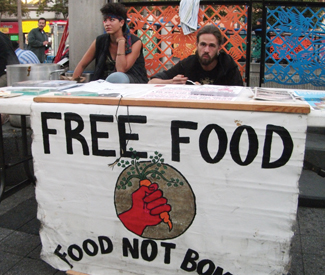
A typical Food Not Bombs operation features a table with a vegetarian or vegan meal, maybe some produce, and anti-war and other leftist literature and banners. In 1988, this is what was on the table when the San Francisco Police Department cracked down on Food Not Bombs, arresting dozens for serving food at the entrance to Golden Gate Park at Haight and Stanyan.
“We had our sign such that when you walked in at the corner of Haight you would see the words Food Not Bombs for a block and a half,” McHenry recalls. “What was good about that was you had tourists, and local business people, and local workers, and you had the people in the Golden Gate Park, all coming together to eat at that place. It was really perfect.”
FNB still serves there on Saturdays, but that perfection was disrupted by a high profile series of arrests in 1988, then again a few weeks ago, when Parkwide, the Recreation and Parks Department’s new bike rental program, set up in their old spot.
Food Not Bombs still runs into conflicts with police and courts. Last year, McHenry was one of 24 arrested in Orlando, Florida, spending 19 days in jail after protesting an ordinance making it a crime to feed the homeless in the city’s downtown.
Last week, FNB held its world gathering at Occupy Tampa’s tent city, serving daily breakfast and dinner while planning the future of the movement. Occupy Tampa has only grown in recent weeks as it hosts people in town to protest the RNC. Sharing food and shelter, making art, and protesting politicians doing the bidding of greedy corporations is McHenry’s vision made reality — and one he got to see bloom last fall with the birth of Occupy.
As McHenry tells it, he and others from Food Not Bombs have been part of a decade-long buildup to the “occupy” tactics that erupted into the world in 2011. “I was promoting the idea of occupation ever since a meeting that was held in 2003 after Cancun,” he said. Protests at the World Trade Organization meeting in Cancun were part of a growing trend of disrupting international conventions in which political and business leaders make agreements that further exploitation and neo-liberalism. But McHenry says that more was needed.
“There was a group of us that got together and said these one-off events, like summits, were just becoming more disempowering rather than successful,” he said.
After years of calling for occupations, the notion clicked last fall. “We had seen the Arab Spring, so that made it that much easier to imagine the occupation concept. And the Spanish occupations were just then happening.”
“That’s a common thing,” McHenry said. “People try all these different ways of organizing and then all at the same time, the same thing will start to click. And there’s no real way to say, ‘oh, it started here, it started there, this person started it.'”
When Occupy encampments sprang up, Food Not Bombs was behind many of the kitchens and food sharing efforts — it even had a guide to building a tent city kitchen at foodnotbombs.net/occupy_supplies.
“In the beginning of some of the first occupations like Chicago, DC, Wall Street, we made peanut butter and jelly sandwiches, because we didn’t know if we would get busted,” McHenry said. “We ended up behind the scenes helping provide free meals to the occupations.”
McHenry said he hopes the spirit of occupying grows again. “It’s so important,” he said. “It would be great if we could regroup and retake public space.”
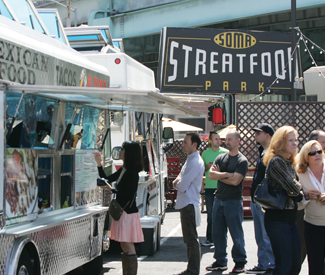
With its decidedly hip aesthetic and clientele, San Francisco’s food truck trend may be naturally assumed to be environmentally sound and health conscious. But the rapidly expanding craze may actually be creating air pollution and endangering the health of their employees in ways that aren’t yet being regulated.
Although the mobile eateries are held to a few of the same standards as their brick and mortar counterparts, such as food hygiene and sanitation, the gas-powered portable generators that provide needed energy to the trucks are a tricky beast to tame. The exhaust-heavy portable generators do not fall under the San Francisco Department of Public Health’s radar of regulation, according to its Food Safety Program Director Richard Lee.
“There are combustion products from the generators being generated while the truck is parked and operating,” he told the Guardian. “The generators are needed to power lights, fans, refrigerators, etcetera. SFDPH does not monitor or regulate the generators.”
The lack of monitoring on the generators may not be due to a lack of need for regulation, but rather the difficulty in doing so. Given that most of the generators are used to power relatively small vehicles, their small size inhibits them from meriting the attention of the California Air Resources Board (CARB) after their initial manufacture.
A CARB-compliant generator has met with the organization’s restrictions on various organic gases, nitrogen oxides, sulfuric oxides, carbon monoxide, carbon dioxide, and particulate matter. However, the generators are only monitored at the point of manufacture, with their in-use emissions going unregulated.
Furthermore, Bay Area Air Quality Management District spokesperson Aaron Richardson tells us that despite the BAAQMD’s 28 air monitor stations, the localization of the fad and the trucks themselves would make it difficult to see the effects of the generators as a regional issue.
“The concern would be they may not all operate in the same ways,” he said. “I think that if the trucks…are running back up generators, it’s going to emit some pollution. It’s something I think we will be doing more research on, but at this point it’s not looking like it’s a dramatic impact on air quality. CARB regulates all mobile sources, and lot of these trucks use individual generators. At this point, we only regulate back up diesel generators…of 50 horse power or above.”
So BAAQMD doesn’t regulate the generators because they’re gas-powered, and they don’t trigger CARB’s post-production attention, despite that agency’s current efforts to reduce the state’s carbon footprint.
CARB spokesperson John Swanton explained that given the small size and localization of the generators, it’s up to the individual communities to decide how to approach the situation.
“It’s up to the community to decide if they can bear the expense of a highly regulated community. In the terms of restaurants — which is what food trucks are — what are the community’s standards and regulations?” he said. “When we sell, say, a Honda generator, we have ideas of how that’s going to be used…We try to make it as clean as practically possible, but the idea is that it’s not gonna run 24/7 at the same location. If it’s going into a food truck and the food truck is going into a particular district, then it becomes the decision of the city and the air quality management [district].”
It seems, then, that no one is really regulating the exhaust emissions coming from the hordes of trucks that travel up Haight, down Market, into Fort Mason, and sit in clusters downtown, in SoMa, around City Hall, and other spots around town.
But at least they aren’t dirty diesel fuel, right? Perhaps the BAAQMD and the city of San Francisco have no need to regulate the teensy-eensy bit of gasoline generator exhaust.
Yet according to SFDPH spokesperson Imelda Rayes, there are now approximately 300 (registered) mobile food facilities in San Francisco. That means the number has nearly tripled since the mere 120 registered MFFs that were scouring the streets in 2009. What they lack in horse power, the generators may make up for in sheer multitude.
“In a period of three years, the number has increased almost 250 percent and [we’re] still getting more applications,” she said.
In addition to cumulative impacts, there are also questions about the health impacts on food truck employees.
Studies like such as the 2009 “Modeling the Effects of Outdoor Gasoline Powered Generator Use on Indoor Carbon Monoxide Exposures” by academics Liangzhu Wang and Steven Emmerich brings up a different concern: gasoline generators create emissions of poisonous carbon monoxide.
“The generators are always positioned outside of the vehicle. The workers are inside,” Lee said. “We would not expect that there is significant employee exposure to the generator exhaust to the employees.”
Yet the U.S. Centers for Disease Control and Prevention (CDC) reported that half of non-fatal carbon monoxide poisoning incidents in the 2004 and 2005 hurricane seasons were due to the gas-powered generators used to heat homes, even when placed outside the homes themselves.
Food truck generators, given their smaller size, are often placed much closer to the trucks and their workers than in the case of houses and their inhabitants. Furthermore, the trucks often idle for long periods to keep the food warm and utilities working.
“At this point, it’s enough of a new thing…We’re interested in finding out more about them, but at this point we are not receiving many complaints,” Richardson said. “A lot of variables are involved. It’s something I think we will be doing more research on.”
After the game of verbal hot potato that was research for this article — it seems every agency deferred to another in terms of exactly who is monitoring these things — Swanton assured us that the danger doesn’t seem imminent.
“In general, small engines [portable generators] are dirtier than an engine providing motor power to a vehicle,” he said. “But the sheer number of these cleaner engines dwarfs everything.”
True, but the food trucks that run for more than a few hours at one location are increasing in numbers at a rapid pace. With the high number of mobile food trucks in operation, most of which utilize some form of generator or another, it may be time to nail down those pesky variables involved and draw some conclusive evidence on the potential environmental and health effects of our city’s seemingly innocent snack time.
“For I was hungry and you gave me food, I was thirsty and you gave me drink, I was a stranger and you welcomed me,” Jesus supposedly said way back when. In San Francisco, there are a multitude of churches that offer free food to the hungry (find a handy list at www.freeprintshop.org).
But what follows is a list of secular organizations that share food — for the planet, for self-determination and providing for community outside of the system, for healthy food untainted by hormones, pesticides and GMOs, for food not grown by exploited workers, and for many other reasons, these groups bring food straight to the people.
FREE FARM STAND
Where: Parque Niños Unidos, 23rd St. and Treat. When: Sundays, 1-3pm. Numbers given out at around noon. The Free Farm Stand gives out food and flowers grown at the Free Farm on Eddy and Gough, where local volunteers grow and harvest produce. They also share local organic surplus produce left over from several farmer’s markets and produce brought in from neighbors and from locally gleaned fruit trees.
The philosophy of the Free Farm is food sovereignty. Why should anyone go hungry, or go broke, feeding themselves and their kids? Instead, they figure, they should get for free what the earth gives. They facilitate this by offering the farm’s harvest — as well free sprouts and plants, that people can use to grow food themselves.
“The solution to the problem of hunger is to share the abundance that’s out there and to encourage people to grow food and share some with those in need.” said a Free Farm Stand organizer. “We can set up neighborhood networks of people growing food and sharing their surplus.” The Free Farm Stand is a step towards that vision.
BETTER DAYS TO COME
Where: Tuesday, 16th and Mission, Thursday, Turk and Taylor. When: 6pm. Some of the folks at Better Days to Come have God in mind, but the organization’s founder, Leonard Fulgham, came from not the churches but the prisons. As its mission statement says, “Mr. Fulgham began mentoring many of the younger inmates, while having the unique opportunity to hear their stories. Many of their stories outlined how they landed in the prison community and why they continued to return. Being homeless upon release back into society is a commonly known contributing factor to these ex-offenders being hungry while being starved by the lack of job training and vocational skills.” Fulgham passed away March 24, 2012, and in his memory, the organization began serving two hot meals a week.
CURRY WITHOUT WORRY
Where: Civic Center Plaza at Hyde and Market. When: Tuesdays 5:45-7pm. Curry Without Worry serves vegetarian food, mostly Nepali and mostly with five courses, in San Francisco every week. It does the same at its other branch in Kathmandu. Shrawan Nepali once owned a restaurant, Taste of the Himalayas, but used the proceeds to start Curry Without Worry and eventually sold it when “I realized I was not a businessmen.” Instead, he’s a man who feeds people a vegan five-course meal, which includes a sauce made from timur, herbs that grow in his Himalayan hometown but are rare in the US. “Our mantra is healthy food for hungry souls,” says Nepali.
FOOD NOT BOMBS
Where and when: Monday, UN Plaza at 6:30pm and 16th and Mission at 7pm. Wednesday, UN Plaza at 6pm. Thursday: 16th and Mission at 7pm. Saturday: Haight and Stanyan at 5pm. After 30 years, Food Not Bombs still serves almost daily in San Francisco at a few locations throughout the city. Volunteers cook meals then bring them out to the people, bringing home the message that there’s enough to go around and you shouldn’t need money to feed yourself. The Saturday team still shares food at Haight and Stanyan, where Food Not Bombs first parked three decades ago.
FOOD BANK OF AMERICA
Where: In front of the Bank of America at 2701 Mission. When: Thursday, 5pm until food runs out. Occupy-related people, carrying on from the giant Food Bank of America action on Jan. 20, when the Bank of America at the Embarcadero locked its doors after activists set up a food table and hung two interactive banners where passers-by could write what fit under the category “person” and what fit under the category “corporation.” They hung a third banner saying Food Bank of America, hundreds ate a hot meal, and the concept caught on. Now, people who have been gathering food donations for Occupy and otherwise give away fresh produce and hand out information about credit unions weekly in front of the bank.
COMMUNITY FEED
Where: Mendell Plaza, at Third and Oakdale. When: Every third Sunday, 10-2. A few organizations, including the Black Star Riders Coalition and the Kenneth Harding Jr. Foundation, work together to put on this food giveaway every other week. It takes place in Mendell Plaza, the square that some have renamed Kenny’s Plaza after Harding, who was killed in the plaza at 19 years old after a dispute with SFPD officers over bus fare. “First, we definitely want to honor Kenny, that’s why we got there,” said Tracey Bell-Borden, one of the organizers of the Community Feed. “But there’s been a lot of activity in that area for a long time. So it’s really about healing the community,” she said. “We have to take care of our community.”
EDITORIAL California Pacific Medical Center wants to build a fancy new hospital in San Francisco without meeting the city’s demands for housing, transportation, and health-care mitigations. And the arrogant leadership at the private nonprofit thinks it can hold the city hostage: If the mayor and the supervisors don’t approve the new medical complex on Van Ness Avenue, CPMC has threatened to close St. Luke’s — threatening a critical part of the local health infrastructure.
It’s a dangerous game: CPMC must rebuild its aging California Street facility to meet state seismic safety codes, and, given the importance of the San Francisco market, clearly isn’t going to do a Twitter and threaten to move out of town. The city can’t afford to lose St. Luke’s — other than the overburdened SF General, it’s the only hospital on the south side of town and a critical, life-saving facility for residents of the low-income southeast neighborhoods.
But CPMC keeps leaving itself ways to abandon the Mission District facility. And even the offer to save the hospital is weak: The facility would be cut almost in half, to only 80 beds.
So it’s time to come up with other options, ways to take that CPMC gun away from San Francisco’s head and ensure the future of health care in the southeast. And city officials ought to be willing to try unusual ideas. Here’s one:
Why not seize St. Luke’s under eminent domain and ask the University of California, San Francisco to help run it?
It’s not as crazy as it sounds. CPMC insists the facility is old, needs its own seismic rebuild and loses money. So it’s not as if the health-care giant could demand some huge compensation. The city could probably get it for next to nothing.
St. Luke’s isn’t profitable — but that’s in part because CPMC has shifted some of the more lucrative services to its other campuses.
UCSF already provides the medical residents for SF General, which operates in part as the medical school’s teaching hospital. UCSF is also expanding rapidly, investing huge amounts of money into its new Mission Bay campus. The idea of integrating St. Luke’s into the school’s training and research programs makes a certain amount of sense.
The city — and perhaps UCSF — would need to pay for the seismic upgrade, no small deal, and in the short term, cover operating losses. But the city’s going to have to pay those costs one way or another: The way CPMC is talking, most of the costs of rebuilding St. Luke’s will be passed on to the taxpayers and to local health plans (including the taxpayer-funded city health plan) anyway. If nothing else, CPMC wants the city to absorb the massive costs of mitigating the housing and transit impacts of the Van Ness hospital in exchange for keeping a (diminished and inadequate) St. Luke’s alive. The closure of St. Luke’s would put fiscally unbearable demands on SF General.
And guess what? The minute city and state officials start talking about an alternative future for St. Luke’s, CPMC and its parent, Sutter Health, lose the only real leverage they have to demand a bad deal for the Van Ness project.
Retirement is knocking at Ed Harrington’s door. But the San Francisco Public Utilities Commission general manager is hesitating, not quite able to muster the will needed to walk out the door. He has something that he wants to finish first.
The sage city veteran has labored for years to launch an historic program so transformative that it would finally allow city residents and businesses to reject a homicidal utility monopoly and the dirty electricity that it sells. Success could be mere weeks away; failure would be a bitter blow.
Twice in the past 27 months, Harrington and his staff have fumbled efforts to launch the city’s long-promised community choice aggregation (CCA) program. The program, CleanPowerSF, would give Pacific Gas & Electric (PG&E) customers the option of switching over to a publicly backed electricity provider selling green, climate-friendly power.
The energy would continue to be ferried into homes and other buildings over PG&E’s electrical grid, and customers who switch would continue to receive their bills from PG&E. Those gas and electricity bills could initially swell by an average of one quarter, but the mix of power that they pay for would jump from 20 percent renewable up to 100 percent renewable.
Harrington’s previous CleanPowerSF launch schemes collapsed in mid-2010 and again early last year without getting off of the ground, largely because nobody — neither the city nor private industry — would shoulder the large financial risks. Unlike those failed efforts, which would have offered a private company virtual carte blanche to sell power to as many PG&E customers as possible, the latest CCA proposal resembles a successful program operating in Marin County. The Marin program started small in early 2010 and is already growing at a rapid clip as it pursues true energy independence.
For the next few weeks, despite having previously planned to retire in August, Harrington will oversee a last-ditch effort to drive approval of his latest iteration of CleanPowerSF by the Board of Supervisors. “I’ve offered to stay into September so that we can have the CCA discussions at the board,” Harrington told the Bay Guardian.
Harrington declined to discuss the latest version of CleanPowerSF, the real and perceived financial risks of which will be hashed out by the Budget and Finance Committee, referring questions to a spokesperson.
But environmentalists and local “green jobs” advocates who just 12 months ago were panning CleanPowerSF, ready to block its passage through the board, are now lauding it. They say the change came about after Harrington met directly with them and seemingly changed his own mind about how the program should be run.
The program would initially see Shell Corp. sell 20 to 30 megawatts of renewable electricity generated in far-flung places to fewer than 100,000 residential customers. Instead of fostering new supplies of renewable energy, San Francisco residents may initially buy power at premium prices from existing wind, solar, and other green facilities. That might make San Franciscans feel warm and fuzzy, but it wouldn’t necessarily reduce the nation’s overall carbon footprint.
The activists agree that it’s a crying shame to get into bed with an evil multinational oil company. But they say it’s an acceptable start, as long as the program evolves into something far more meaningful — into something resembling the Marin Clean Energy model. Like in Marin, the activists want San Francisco to use CleanPowerSF revenues to help build its own solar, wind, and other renewable energy and energy efficiency projects, many of them right here in city limits. They want the city to sell those power and the energy efficiency gains directly to CleanPowerSF customers.
Over the coming years, the SFPUC could gradually add enough clean electricity at competitive rates into the CleanPowerSF mix, generated by its own facilities and purchased off the open energy market, to meet the needs of all the city’s residents and businesses.
The build-out of solar power plants and other renewable energy facilities has always been imagined as an integral element of CleanPowerSF. But until last October, critics say SFPUC officials were treating the build-out as an afterthought, making little effort to lock in plans to move forward with the construction as a structured part of a CCA program.
“The SFPUC staff decided they wanted to do this the easy way and just buy energy,” said Eric Brooks, a regular at City Hall hearings who chairs the San Francisco Green Party’s sustainability committee and has spent years working with the SFPUC on CleanPowerSF. “They wanted to do that because it was easy — you can just declare victory.”
Once the general manager started to meet directly with local activists, Brooks says, “Harrington started hearing what we had been saying to the staff for all these years about how important the build-out is.” Harrington began to understand the importance of a renewable energy build-out that begins as soon as the new program launches. In turn, the activists threw their support behind Harrington and the program.
Brooks said that the build-out of city-owned renewable energy facilities could create thousands of jobs. It could also lead to energy independence in a city where environmentalism is a badge of honor, but where PG&E continues to sell nuclear and polluting fossil fuel energy without facing any competition.
“This is the perfect solution to the climate crisis and the economic crisis,” Brooks said. “We need to create a green New Deal. That’s the depth of crisis that we’re in, economically and environmentally.”
Such a build-out is also expected to build support for the program at the Board of Supervisors. Without it, the City Controller’s Office calculated that the city’s economy could take a hit to the tune of $8 million over five years after CleanPowerSF launches in the spring in additional electricity expenses, potentially jeopardizing about 100 jobs. But that analysis failed to consider the thousands of jobs that could be created laying panels, installing turbines, and performing other tasks if the city develops its own renewable energy supplies as a part of the program.
It’s impossible right now to say precisely what type of renewable energy facilities would be built by San Francisco: A $2 million study that would paint that picture is planned. But Paul Fenn, president of Local Power Inc., which is helping the SFPUC prepare to call for bids from companies interested in building the facilities, said they could include everything from solar panel arrays to customers’ energy efficiency gains to a wave energy plant.
The first CleanPowerSF committee hearing is scheduled Sept. 12, followed at some point thereafter by an historic board vote that will almost certainly prove contentious, likely pitting the board’s progressive members who have long supported public power against some of its fiscal conservatives.
Much of the debate will focus on an initial $19.5 million investment by the city. Of that money, about one-third would be used as collateral — a pool of cash held in escrow and available to reimburse Shell if the program flops. SFPUC spokesperson Charles Sheehan said the $7 million in collateral would gradually be recouped by San Francisco if the program moves forward successfully.
Another $2 million would fund CleanPowerSF customers’ energy efficiency programs; $2 million would help customers install solar panels; and $2 million would be spent on the study to determine how best to build out the portfolio of renewable energy plants owned by San Francisco. The rest of the money would cover operating and startup expenses, and it could be recouped later through power sales.
In a town where PG&E wields tremendous political and financial influence, proposing to gamble public funds establishing a competitor to the company is always sure to be thoroughly scrutinized, if not outright opposed and criticized. Supporters of the program, however, say that the gamble is a safe and necessary one that could have sweeping workforce and economic benefits.
“I don’t think that we can afford not to do CCA,” said Sup. David Campos, the program’s most active supporter on the Board of Supervisors. “So long as something like CCA is not in place, PG&E will continue to be the only game in town. I think it’s important for us to give consumers in San Francisco an alternative to PG&E.”
CleanPowerSF has long suffered an identity crisis that has harmed its prospects of legislative approval. Opponents deride it as a public power scheme and they work on behalf of PG&E to quash it. But ardent public power supporters do not see it that way: They consider CleanPowerSF to be little more than a minor stepping stone toward public power, and they have not rallied around it nearly as much as they have rallied around some of the storied yet unsuccessful public power campaigns of years past.
If Harrington can clinch lawmaker approval for CleanPowerSF before he retires, he will have provided city residents with a lasting choice in what kind of electricity they buy.
“I think that any effort to compete with PG&E is seen as public power,” Campos said. “But this is really about providing a choice.”
Bernal Heights outdoor cinema Roccapulco Supper Club, 3140 Mission, SF; www.bhoutdoorcine.org. 7pm, $10 suggested donation. The first of five nights of film screenings in Bernal Heights. At this kickoff party, enjoy drinks, food and music from the Bernal Jazz Quintet before a lineup of short films celebrating community and organizing in the Bay Area. Films include Berkeley High School students on heritage and identity, “Occupy the Auctions Dance Party!” in which Occupy Bernal and ACCE stop evictions on the steps of City Hall, and a tour of Alemany Farm (also the beneficiary of the event’s ticket price), among others. The event also includes the announcement of winners of the Best of Bernal and Spirit of Bernal Awards and the first-year recipients of the Mauricio Vela Youth Film Scholarship.
Occupy, the state of the movement Mediterranean Café, 2475 Telegraph, Berk; www.occupyoakland.org. 7-10pm, free. Einar Stensson, a sociologist at Stockholm University and activist at Occupy Stockholm during the fall of 2011, studied Occupy Oakland for two months. Why did the movement start and spread so quickly around the globe? How is Occupy organized? Who matters in the movement and why? What is the future of Occupy? Come hear his perspectives on where Occupy is, locally and internationally.
Friday 31
Occupy the Bay The 25th Street Collective, 477 25th St., Oakl; www.occupyoakland.org. 6pm, $25. “This week in Oakland, California will go down as a watershed moment. People across America were disgusted by what they saw here. Average Americans trying to stand up and peacefully assemble, to be brutally savaged and attacked by the police department that they pay for.” So said Michael Moore to a fired up crowd in the wake of the Oct. 26 Occupy Oakland eviction that rained tear gas and rubber bullets on demonstrators. This is just one of the many historic events caught on tape by filmmakers Jonathan Riley and Kevin Pina, whose documentary Occupy the Bay is screening around the Bay Area before it starts showing in film festivals. On Friday, stick around for special musical performances from Jabari Shaw, Shareef Ali and Super Natural.
Enemies of the state: In their own words Station 40, 3030B 16th St., SF; station40events.wordpress.com. 7pm, free. After a year of Occupy and years more of struggle by people who are not down with the state, there are a lot of people in jail and prison. At this event, organizers will read writing from those locked up. Poems and statements from Truth and Kali of Occupy Oakland and a statement from Jesse Nesbitt, the May Day brick-thrower we profiled (“Who is the Brick Thrower?” 5/8/12). As the event description says, “Any effort at anti-repression in the face of lengthy prison terms must be aimed at bringing down separation at all costs.” Come fight the separation and connect.
Original Plumbing birthday celebration Elbo Room, 647 Valencia, SF; www.originalplumbing.com. 10pm, $3-6. Original Plumbing, the trans male quarterly magazine, is throwing a party celebrating its third year on this planet. It now lives in the Brooklyn part of the planet, but it all started in San Francisco, and they’re coming back here to party. “We feel that there is no single way to sum up what it means to be a trans man because we each have different beliefs, life experiences, and relationships to our own bodies,” say the organizers, and they started the magazine to document this diversity of experiences. Celebrate with the editors Amos Mac and Rocco Katastrophe, and performances by Rocco Katastrophe with special guests Billie Elizabeth, Nicky Click & Jenna Riot. Birthday cupcakes available!
Tuesday 4
Rally to save City College City Hall steps, 1 Polk, SF; ProtectOurCityCollege@gmail.com. 12pm, free. A rally in support of Prop A, the local ballot measure that would create a parcel tax for revenue to City College of San Francisco. “If City College is to survive and maintain accessibility, educational quality and the mission of serving low-income and underrepresented students with the best educators and staff, we must pass Prop A,” say organizers of the rally, which include students, teachers, staff and supporters.
EAT BEAT Good food was never the part of the concert plan. In high school, the punks and shredders ate giant Pixy Stix, filled to the plastic brim with unnaturally purple sugar dust — purchased from the all-ages venue snack counter — followed by late night Del Taco red burritos slathered in Del Scorcho and stuffed with crinkle fries. Flash forward a decade or so, and the vegan Malaysian nachos with spicy peanut sauce and pickled veggies from Azalina’s were all I could talk about after Outside Lands, save for the requisite “oh my god” Metallica utterance.
I wasn’t the only one. From every corner of that packed festival, people — and of course, bloggers — were raving about The Whole Beast (featuring pop-ups from the Michael Mina Group) tucked away by Choco Lands, Andalu’s fried mac and cheese, and Del Popolo’s massive, industrial-looking rustic pizza truck.
While the higher-end meal options have now been going strong at Outside Lands for a few years — and, granted, food has long been a part of the festival equation — the gourmet pop-up thing, and locally-sourced, quality food offerings are on the menu more and more in brick-and-mortar music venues in San Francisco. Last week, the Great American Music Hall hosted an event dubbed the Great American Pop-Up. Seems it’s more open to experimentation in the slower summer months.
The one-off (for now) event was a family affair for the Great American Music Hall. There were six pop-up food vendors set up in between the grand bronze pillars of the Tenderloin venue, chosen by security guard Drake Wertenberger, who stepped forward at a managers meeting to coordinate. Jessica DaSilva, who works in the box office at both GAMH and sister-venue Slim’s, was there selling imaginative sweet treats for Milk Money/Dora’s Donuts Shut Yer Hole Truck, including a strawberry cheesecake push-pop, and the chewy chocolate raspberry cookie I devoured. There was also local, sustainable sushi by Ricecrackersushi, some colorful Asian fusion dishes via Harro-Arigato & Ronin, and a whole lot of sausages sliced by the Butcher’s Daughter.
It felt nearly illicit to be in the venue without the anticipation of a live set, like we were sneaking in. And the warmer lighting opened up the intricacies of the architectural design. But this event was focused squarely on the food, with the tables pushed out onto the floor, and a flannel-clad DJ spinning inoffensive hip-hop while munching on something from a paper plate.
Last year, Slim’s created something similar, but broke it down to one chef at a time hosting rotating gourmet pop-ups once a week for the month of August. Those too were more about the unique food offerings, less about music. There were dinners served in the venue by Jetset Chef Alex Marsh and Cathead’s BBQ (which now occupies its own legitimate space down the street from the venue).
GAMH and Slim’s both already serve dinner nightly at live shows, but publicist Leah Matanky tells me there were no hard feelings from the in-house restaurant staff.
On regular show nights even, Matanky says she’s seen an increase of interest in gourmet food at the venues. “We have seen our kitchen sales numbers increase noticeably over the last couple of years. We’ve started running nightly food and drink specials that include things we don’t normally offer and people have really responded to that. We still offer the full array of bar food…but you can also get gourmet specialties like the baked polenta pizza with smoked mozzarella or the grilled tri-tip steak with garlic-herb potatoes.”
Mountain View’s infinitely larger Shoreline Amphitheater also recently got an in-house food upgrade. So the story goes, when the GM of Shoreline dined at Calafia in Palo Alto, Chef Charlie Ayers pointed out the stadium’s lackluster food, and was then summoned to create a tastier menu. Ayers now has a “Snack Shack” at Shoreline that generates $8,000 per show, selling vegan lentil bowls, pork bowls, and salad wraps with Dino kale and feta cheese.
At the bars-with-bands level, El Rio seems to also be upping its epicurean pop-ups. Along with the now-frequent Rocky’s Fry Bread (side note: Rocky is also in the band Sweat Lodge, which often plays El Rio) stand, there’s Piadina homemade Italian flat bread, and the occasional Mugsy pop-up wine bar, which offers bubbly and red wine varieties.
There was an entirely separate event that took place Aug. 4 in San Francisco, which combined all of this: the high-end food, the live music, the ubiquitous pop-ups. It was a food and music festival (Noisette) at a brick-and-mortar venue (Public Works, where it moved after switching venues from Speakeasy Brewery).
The event was put on by Noise Pop Industries. The production company, which does Noise Pop and the Treasure Island Festival, began dipping into independent food culture a few years back with the Covers dinners, pairing well-known chefs with corresponding cover songs for a relatively small group. Noise Pop’s Stacey Horne came up with the Noisette concept after talking with DJs Darren and Greg Bresnitz of New York promotion company Finger on the Pulse, who do an event out there called Backyard Barbecue, which also pairs live music and gourmet food.
From the beginning, the Dodos were the first choice of headliners at Noisette. Merrick Long is a “professed foodie,” has worked in the restaurant business, and was on a panel at SXSW talking about food and music. Horne says they chose chefs that do things a little differently, and are more attuned to the pop-up mentality.
“Something that struck me at Noisette that I loved was that we were eating such good food and then were able to wander over and hear amazing music. It wasn’t one or the other. It was nice to have that as an option,” Horne says. “The chefs we’re focusing on are kind of the indie version of that world, and that’s what Noise Pop has always been interested in, independent music, independent film and art. It just seems like a logical extension.”
Noise Pop is also again looking to do a variation on the Covers dinners with the upcoming Treasure Island Festival. Sound Bites is more of a passed appetizer event with little bites inspired by the bands playing at the festival.
So what does it all mean? Are we, as the generalized concert-going public, getting soft, both physically from all those readily available treats, and mentally because we’ve expanded beyond a minimalist punk rock lifestyle? Should we all go back to Pixy Stix and Del Scorcho hangovers?
“Look, the reality is that most nights that you go to hear a band in a club, there’s no food or if there is food, it’s not going to be anything great. So you can still have your punk rock experience, but something like Noisette and other events like ours that are popping up around the country are just offering another type of event, and people are interested in it, as we’re seeing,” Horne says.
I guess, if you want to see your life as a black and white cookie, you’ll see this change as against type. Or maybe if you’re in the teenage angst subset, you’re just getting in to the greasy post-concert routine. But perhaps this mashup is just another trend — participate if you will. It goes far beyond the music scene, to the way Americans eat now, looking for quality, locally sourced food, seeking creative options.
“Speaking for myself personally, I still love going to see shows,” Horne says, “but if I can have both things in one place, it’s win-win.”
California Highway Patrol police, San Francisco police, Cal Trans workers, Department of Public Works, and workers from the mayor’s Homeless Outreach Team descended today on an encampment on Fourth and King.
Yesterday, 40-50 people lived on the sidewalk and under the freeway overpass next to the Caltrain tracks. The encampment had tents, mobile units, and other makeshift housing. One group of residents had a large tent with a well-maintained garden in the front yard.
Another, a woman who several residents said suffered from mental illness, had built a home out of metal that looked like parts of carts, wood, sheets and mattresses. After about four hours this morning, most other residents were moved out of the camp, but she remained, moving and packing suitcases. After Homeless Outreach Team members, police, workers, and humanitarian volunteers approached her, she took a single suitcase and walked to the sidewalk, then sat and watched as her other suitcases, mattresses, and the structures that constituted her house were thrown into a garbage truck.
The eviction began around 8am. Some residents said they were told they could take with them only what they could carry or, if they had something wheeled like a shopping or bike cart, what they could push. Others said they hadn’t been told one way or another what they could take, just that they had to get out.
The items in the dump trucks, said CHP Officer Sarah Wrathall, is “the stuff they said they don’t want.” Wrathall said people were given the chance to keep whatever they wanted to, and that items they wanted to keep but could not carry would be stored and tagged for retrieval later.
Jamie Crisco, a resident of the camp who was moving out, said that this was an unusual eviction. “There isn’t usually this dog and pony show,” said Crisco. A large amount of media was present at the eviction.
“Usually they will tell people to get out, and people will start packing. And in the process the workers will come and start taking stuff and throwing it away,” said Crisco, a veteran who had been living in a small trailer for a year.
“I don’t understand that,” added Crisco. “You’re creating a criminal element when you do that. You’re putting people in a position where they have to steal to acquire what just got taken from them.”
According to John Gallagher, an organizer with the Coalition on Homelessness who did outreach at the encampment before it was evicted, trash was pushed safely to the side and the camp was clean and peaceful before this morning’s “clean up.”
“We’re respectful, we’re quiet. Honestly, we keep this area cleaner than they ever could dream to,” agreed one person who was staying in the camp.
Wrathall described a very different situation, saying that the area under the overpass had amassed trash, waste and rats.
She said that the eviction was based on complaints from neighbors and other residents.
“People have a right to complain if they can’t walk down the sidewalk to get to Caltrain,” said Wrathall. She said that some people feared the dogs that lived in the camp.
She said illegal lodging and trespassing was reason enough to evict the camp’s residents. “It doesn’t have to be any other kind of crime.”
No citations were issued this morning.
Camp resident Margaret Stallings said that the camp was very peaceful and neighbors walked on the sidewalk and parked their cars in the adjacent parking lots without issues.
“This is a dead end street,” she said. The area under the freeway is out of the way of most city life and, according to Stallings, “Some people have been underneath there for eight years.”
In an outreach report written based on Gallagher’s observations, he stated that “This camp is so peaceful that I saw more that four people on their way to work walk unafraid right down the middle of camp.”
Patrice Perkins, who had been living in the camp for two and a half months, said that the encampment’s location was relatively tucked away. He expressed frustration that many of the residents will be pushed out towards other parts of SoMa and downtown.
“We found a place where you’re not in public. We’re not bothering anybody here,” he said. He pointed out the no parking signs along the street.
“See, no parking. It’s not being used.”
His neighbor in the camp, James Belcher, said that the eviction was causing him to miss two classes at Laney College. “I missed Civil War History this morning, and I’ll miss math at 10:30,” he said. Belcher said he has been studying for a few solid semesters and earning good grades while looking for work, but struggling, based in part on issues associated with being a disabled veteran.
“It’s difficult for me to study in this little tent and stay in school,” he said.
One resident, who said she provided first aid at the camp, shared disinfectant wipes with a DPW worker when he expressed a need for them.
One of the city’s stated concerns with the camp was the presence of children, and in Gallagher’s outreach statement he said at least two children lived in the camp. None were present this morning, and Wrathall said that in her previous visits to the camp, she hadn’t seen any.
“I’ve never seen kids here, but if I did, I would take them to CPS [Child Protective Services]. Of if they’re older, 16 or 17, I would connect them to services like Huckleberry House. I would never walk away from someone who is 18 or under in the encampment. Its not safe,” she said.
“Homelessness is not a crime. People are afraid for the public to see their children because they will be taken away from them. And for what, the crime of being poor?” said Gallagher.
The Homeless Outreach Team secured rooms for several of the people who were evicted, including Stallings and Crisco.
“They’re housing me. I’ve been waiting on the VA list for housing for four and a half years,” said Crisco. “I’m a combat vet. I used to be a business owner. But life does things to you. Ends up putting you in places you didn’t plan on being.”
Crisco said he was happy to accept the room, but frustrated in general with the way the homeless are pushed around.
“I’m only human. I can only take so much pushing and prodding,” he said. “Sometimes, someone’s going to snap. And they’ll say, it’s the drugs. They never say, maybe it’s us. Maybe its what we’re doing to them.”
There was no wine and cheese at the opening of “Leave the Beef on the BBQ.” There were massive slabs of meat though, onto which Guerrero Gallery owner Andres Guerrero slathered sauce and tried to look inconspicuous.
The crowd, which spilled out onto the sunny Saturday streets of San Francisco on August 25, was mainly there to see art anyhow. The exhibit was the most diverse graffiti-themed assemblage Guerrero had shown to date, and the graff heads in attendance had a lot to look at — not to mention reflect on. Graffiti, if the works inside were anything to judge by, is at the junction of, about 70 different artistic directions.
“We’ve got your standard graffiti piecers, you also have guys that focus on tag style, we also have real, true bombers,” Guerrero told me on the phone a few days later. The walls of the ex-White Walls gallerist’s vast, skylit gallery held clusters of works: some framed, some on canvas, some pieces seemingly translated direct from the side of a Muni bus, some a bit harder to connect to the underground art legacy that birthed them. To name all the artists assembled would take up a lot of space here (see the gallery’s website for a full list, obviously), but a few stand-outs include: Richard Simmons and Lil’ Kim album covers, artfully bubble-lettered by Pez, looping tentacles straight out of the TWS style book by Estria, and a carefully-drawn urban jumblescape by Gorey.
The mishmash highlighted graffiti’s progression into the fine art world — and its complicated, give-and-take relationship with the rest of contemporary art, Guerrero says. A dog smokes a cigarrette in an otherwise classically-themed piece. This would be the work of Kuma, who you can also find tagging over animal portraiture street art in Brooklyn. Complicated, no?
If it all seemed of somewhat dissimilar provenance on the walls, that was the point. Guerrero culled “Beef” participants from across the country, across the world — and across generations. “We have 1970 pioneers, the leaders and originators of this format,” he said. “Then there’s the current graff guys who are really taking it to another level.” Some have been showing in galleries for years, for others, Saturday marked the first time their work had popped up indoors.
It was challenging to pull it all together, Guerrero says. For chrissakes, there’s over 70 artists represented in the show. But the work was a labor of love.
“What prompted [the show], or really moved me to do it is that I really want to have fun,” he reflects. “I felt out of touch with the culture.” He reverts back to shout-out mode. “It was more to honor these guys. They’re the ones who lead the way right now in terms of a lot of contemporary works and influence.”
Dick Meister, former labor editor of the SF Chronicle and KQED-TV Newsroom, has covered labor and politics for more than a half-century. Contact him through his website, www.dickmeister.com, which includes more than 350 of his columns.
OK, it’s time to celebrate Labor Day, time to celebrate the labor movement that won a wide range of benefits for working people. That includes, of course, a paid day off on Labor Day and other holidays or extra pay for working on the holidays. But there’s much more than that. Much more.
We can also thank unions for:
* The eight-hour workday with meal and rest breaks.
* Forty-hour work weeks and three-day holiday weekends.
* Overtime pay and paid vacations, sick leave and maternity leave.
* Major help in the enactment of anti-child labor law laws and increased public education funding.
* Medicare and retirement and disability benefits.
* Job security and other workers’ rights.
* A strong political voice for unions that helped enact Social Security, unemployment insurance, workers compensation, health and safety and minimum wage laws and has helped elect pro-worker office holders.
* Important help in the passage of key civil rights and civil liberties laws that have particularly helped political dissidents, women and minorities and military veterans.
Certainly not every worker enjoys all the union-backed benefits. But even the non-union workers who make up the vast majority of working people these days have many of the benefits. And, thanks to the efforts of unions, they have the opportunity to win all of the benefits.
You can be sure that on this Labor Day, as on all others, political candidates will have lots to say about unions. You can expect, however, that not much will be heard from Republicans. Their usual ranting in behalf of their moneyed backers about the evils of “Big Labor” and “union bosses” will be muted, lest they offend potential blue-collar supporters. Democrats undoubtedly will voice their usual support for union members and workers generally, many sincerely, some simply in hopes of gaining blue-collar support.
Union opponents seem to forget that unions are democratic organizations, whose members generally have a strong voice in their unions’ activities. Union officers are elected, after all, and so are answerable to their members.
Union positions on political candidates and issues, as well as financial contributions to candidates, are not dictated by union officers, despite what anti-union politicians assert. Union positions and union political spending are determined by the votes of union members, usually on the recommendations of their Committees on Political Education (COPE). Officers who don’t reflect their members’ position face replacement by membership vote.
Once, Labor Day meant big parades in cities nationwide. But no more. Although union numbers continue shrinking, unions are surely here to stay. They’ve fought their way into the Establishment. They still parade here and there, but no longer feel that parading is necessary to show their strength and importance.
Unions are much more likely to mark Labor Day with the political activity that has become as important to them as economic activity since their arrival into the ranks of the economically accepted.
Thus the Labor Day messages of union leaders will stress politics. That will largely include support for President Obama, despite union complaints that he has not worked hard enough to overcome congressional opposition to pro-labor reforms that he’s proposed or supported. From labor’s point-of-view, Obama is nevertheless very much preferable to Mitt Romney, just as most other Democrats are preferable to their Republican opponents.
Despite much opinion to the contrary, the union stress on politics, rather on winning broader public support for unionization, does not mean that all unions have reached a permanent, unshakeable position in society.
Nor does it mean that unions are not still fighting battles that are as almost as significant as those of the 1930s and 1940s that drew broad support from a public which sometimes frowns on unions, now that they have secured the strong position in society which the public helped them win.
Labor influence is not measured strictly by the number of union members, because of labor’s strong influence in politics and because the wages and conditions of unionized workers set the standard for all workers. Yet numbers are important, and unions generally have been struggling just to keep overall membership steady.
Currently, only about 12 percent of privately employed workers are unionized. But while their numbers have remained low, the figure for unionized public employees has grown to nearly 40 percent. That has put public employee unions in the vanguard of the labor movement, and given the movement new, badly needed strength, although also raising strong political opposition to public employee unions.
There are some fairly solid reasons for the decline in union membership overall, ironically including the unions’ loss of their position as underdogs, the widespread granting of union conditions to non-union workers and illegal employer interference in voting by workers on whether to unionize.
Perhaps the most important reason for the decline in union membership has been a fundamental change in the workforce. Once dominated by blue-collar production workers, it has come to be dominated by white-collar service workers. But organized labor sometimes has been slow to move into white-collar fields outside of public employment.
Labor Day should cause us to reflect on the great importance of the labor movement’s vital mission – its organizing of workers to win economic and political strength and helping elect pro-worker officeholders, its help in creating jobs and otherwise aiding the millions of Americans who remain unemployed or otherwise in economic distress.
So while you may not be able to see a parade on Labor Day, labor is still doing many other things well worth watching, and well worth supporting.
A footnote: Despite what the standard history books say, the first real Labor Day celebration was not held in New York City in 1882, but 14 years earlier right here in San Francisco. That was on February 21, 1868. Three thousand paraded the city’s streets by torchlight to mark enactment of the 8-hour-day law in California.
Happy Labor Day!
Dick Meister, former labor editor of the SF Chronicle and KQED-TV Newsroom, has covered labor and politics for more than a half-century. Contact him through his website, www.dickmeister.com, which includes more than 350 of his columns.
When the first – and only – Desaparecidos full-length came out in 2002, it touched a raw nerve. Released a year after 9/11, with pro-Bush rhetoric still burning in our collective ears and mass confusion and fear still bubbling, Read Music / Speak Spanish took a specific Midwestern town, looked around, said, “what the fuck is going on?” and applied that rage to the rest of the country in a gleefully noisy Saddle Creek Records release. Omaha, Nebraska was home-base for both Saddle Creek and this group of riled up indie rock musicians.
And it still is; guitarist Denver Dalley, bassist Landon Hedges, drummer Matt Baum, keyboardist Ian McElroy, and perhaps most notably, vocalist-guitarist Conor Oberst, otherwise known as Bright Eyes – reunited in the past year in Omaha to start practicing again.
Though, as Dalley notes in our conversation, the band never officially broke up, it was just waiting for the chance to play together again. That ended up taking a decade, but what has emerged was worth the wait: two equally furious tracks, one (“MariKKKopa”) digging into villainous Sheriff Joe Arpaio of Maricopa County, Arizona, now on a federal civil rights trial for a “pattern of discriminatory policing,” and with another lawsuit on the way brought on by the Justice Department for similar charges. Arpaio is the man who created the controversial outdoor “tent city” jail in sweltering hot Arizona and forced inmates to wear pink underwear.
For a specific generation of Saddle Creek-obsessed fans, these two songs were a welcome relief, another breakdown of the so-called American dream. Even better, the original lineup is touring again, and rolls into San Francisco this week for two shows. Before they left, I talked to Dalley about all things Desaparecidos:
San Francisco Bay Guardian The big question is, what spawned this reunion?
Denver Dalley Even though we kind of went our separate ways back in the day, there wasn’t like an inner-band thing, like we weren’t getting along. It was just a timing thing. And I think there was starting to be expectations, and we were getting away from the whole reason we’d started.
But even back then we left it as “we’re on a hiatus.” Which I know a lot of bands say these days. But we really wanted to leave it open, we didn’t ever say that was the end, or that we’d never do it again. So for a long time it was a scheduling thing. We’d always say, ‘oh yeah, some day we’ll do it.’
Then when we did that Concert for Equality [in August 2010], we all had a lot of fun hanging out and doing that again. And then once they were done touring on the Bright Eyes record – because they did a pretty extensive world tour – the timing was right.
We started having band practice again. Not just rehearsing for a tour like a lot of us have started to do in more recent years, where you’re kind of a hired gun or there’s a purpose for something. We started having band practice again like we did when were 19, and it was a lot of fun.
http://www.youtube.com/watch?v=pC2m2IzHPVU
San Francisco Bay Guardian Everyone has gone off and done so many other projects, to get everyone back together a decade later…
DD When we were talking about getting back together we were saying like, the romantic ‘maybe it was just that time and that place, it wouldn’t be the same’ but once we started in the band room again it really did feel like it did 10 years ago, we picked up where we left off.
We still have the same energy for it. We were all joking, “oh we’re all old men now, we don’t want to look like old men up there.” But no, it totally sounds the same, if anything the songs are even more angry and energetic now.
SFBGIt’s certainly a more aggressive sound than we’ve heard from Brights Eyes or [Dalley’s band] Statistics, was that an intentional direction?
DD Yeah, definitely. Some of that just happens when we’re all in the same room. We all have a lot of fun discussing issues and I think sometimes there’ll be…well you know, the lyrics are totally up to Conor, but we can all go into something and be like, “we should have a song about this particular issue,” and be all fired up about it.
It’s just a natural process, it’s not like “oh that song sounds too ballady” or “that songs not tough enough.”
SFBG You’re based in Omaha. How did you get interested in writing about what’s going on in Arizona, and Sheriff Joe?
DD Conor really does follow the whole issue, the whole debate, everything that’s going on. He must just spend a lot of time doing internet research. The Concert for Equality was to combat that law in Arizona. Sherif Joe is just kind of the prominent character, the figurehead for a lot of that stuff, and so blatant and ridiculous, and he’s kind of the poster-boy for a lot of unnecessary and weird stuff.
I still can’t get over that sample at the end of “MariKKKopa.” It’s just unreal to me, I just can’t wrap my mind around it.
SFBGHe’s kind of a modern-day villain.
DD Yeah, man. Views aside, everyone’s obviously entitled to their own opinion and I can respect other people’s views, but a thing like that, how can that possibly be a matter?
http://www.youtube.com/watch?v=C5c3z0GubIQ
SFBGSomething I often wonder – what happens after a specific scene blows up? There was this huge watchful eye and media attention on the Omaha/Saddle Creek scene in the early 2000s, and it seems like a lot of that attention has gone away. So what’s the vibe like there now? Have bands returned to a more DIY sensibility, or is it forever changed?
DD In general, touring expenses have gone up so much we’ve all joked about how bands that went from crashing on couches to hotels, they’re going back to ‘hey, can we crash on your floor tonight?’ It is crazy how little it used to take to go out and tour and you could get by. But now to even fill up the van with gas, it’s just a different world.
But Omaha to me, I kind of equate it to when a group of friends – like that time when everything was on the up-and-up and there was all that buzz and attention that you were talking about – I felt like we were in high school; we were all there and in each others’ lives and at each others’ shows, then it was like we all went off to college. We all went our separate ways and did different things, moved to different places and had different projects.
Now it feels like a lot of people are coming back from school now, and meeting up again. It’s different, there’s a younger crowd here too, which is awesome. When you can come back and say, ‘I don’t know hardly anyone at this show,’ and before it was like, I could tell you everyone’s name at this show. It’s cool but it’s different.
SFBGSo even though the band was on a hiatus and not technically broken up, it is kind of high school reunion?
DD Yeah! For sure. Definitely. [Laughs]
SFBGHave you seen a strong reaction from fans?
DD Obviously, a great deal of everything is because of Conor’s popularity. There’s no question. But I feel like that record came out a really important time. It was so close after 9/11 and everyone was being really careful and guarded and “God Bless America” everywhere, and I think it was almost a relief in some ways to have this record that was kind of, calling out what the American dream has become. It wasn’t anti-American but maybe anti-American Dream. And I think it was a relief for people to realize, “oh yeah, it’s not wildly inappropriate to have constructive criticism and say things at a time like this.”
It does have a cult following and people are definitely exciting. I feel like it’s half and half, where people are like, “I’m so excited, I have my tickets for the show!” or, “I had no idea you guys were playing again.”
SFBGWill there be a new full-length with the two new songs?
DD I don’t know? Honestly, when we were practicing, those songs came together and we were at the studio already and thought it’d be fun to have something new out there. While we would all love to do a new record and hope to, there’s no actual plans to. If I’ve learned anything from the past, it’s who knows when things will happen and when schedules are going to align. We’ll have to write them I guess.
Activists from San Francisco and around the country are descending on Tampa this week to protest the Republican National Convention. I got a call this morning from Diamond Dave Whitaker, the poet who hung with the beats and the hippies in his 75 years, CCSF student senator and San Francisco legend. He’s has been serving food to protesters at election-season conventions for almost three decades. His first was 1984, the Democratic Convention here in San Francisco before he got hooked and headed to Dallas to protest the Republicans. Along with a few hundred others, Diamond Dave braved the rain, but missed the full effects of Hurricane Isaac on the tent city last night. The RNC starts officially starts today (though many of the day’s events have been called off due tot the hurricane warning.)
“I’m talking in the midst of Romneyville,” he said. “Folks came from far and wide to camp out together, cause a ruckus and be here.”
What’s Romneyville? “It’s a homeless camp, a poor peoples camp,” said Dave. He’s been there a week setting up the Food Not Bombs kitchen, and Romneyville grew up around him. It now has few hundred tents, he said. But most people arrived today, so as the convention gets started, it will probably grow. “Two buses from Zuccotti Square came today,” he said.
Romneyville is put together in part by the Poor Peoples Economic Human Rights Campaign. Dave said Green Party vice presidential nominee Cheri Honkala, a formerly homeless mother herself who works with the Poor Peoples campaign, is a fixture around the camp.
“Our demands are housing for all, food for all, healthcare for all, and living wages for all. We call for an end to foreclosures and homelessness, an end to the war on the poor, both here and abroad. An end to criminalization of poverty. Money for jobs and housing, not for war!” says a statement from the group.
More protesters are staying over at the Occupy Tampa encampment.
A permitted march left this morning, and Diamond Dave says there’s another, unpermitted, planned for 3pm est. Many citizen journalists and livestreamers are documenting the events, one can be found at mobilebroadcastnews.com.
But so far, his work has been handing out free meals with Food Not Bombs.
“We fed the masses this morning for sure,” he said.
State Assembly Member Fiona Ma, who wants to keep 15-year-olds in prison for life, has been trying for a while now to help the big garbage outfits, Recology and Waste Management Inc., avoid running into local laws that could block their use of landfills. So far, she hasn’t been able to get it through the normal commitee process.
But she’s not giving up: As the session winds down, she’s done the ol’ gut and amend and created AB 845, which looks pretty much like the bill she hasn’t been able to get through committee. And she got this reborn Dracula of a bill it through the state Senate, which means she just needs concurrence at the Assembly, and away she goes.
Ma says that garbage is a statewide concern — true, as far as it goes — but she’s also helping Recology avoid problems in Solano County, where local residents want a cap on the amount of outside garbage trucked in from other places (like San Francisco) and buried in Solano landfills.
By the way, she’s also been helping Recology fight those pesky recycling poachers who make a few extra bucks by getting the bottles and cans out of the bins before Recology can.
And the garbage giant hasn’t even been her biggest campaign contributor. Her non-campaign for state Senate got $1,500, her campaign for state Board of Equalization got $500, and she picked up $3,000 more in her Assembly races.
San Francisco’s countercultural community was built at least partly through free concerts and gatherings in Golden Gate Park, including the legendary Human Be-In and Grateful Dead and Jefferson Airplane concerts in the late-’60s. But these days, as corporations starve local government but seize public spaces, grassroots groups and populist performances are being forced out of the park.
Events without expensive tickets and corporate sponsorships (such as this month’s Outside Lands) or endowments from dead billionaires (Hardly Strictly Bluegrass Festival, coming up in early October) just can’t afford the rising fees charged by the Recreation and Parks Department, a reality that is quietly ending an important San Francisco tradition and legacy.
A few weeks ago, organizers of the Power to the Peaceful Festival – a free concert featuring Michael Franti and Spearhead and other big acts, which drew tens of thousands of people to the meadow formerly known as Speedway annually for more than a decade – announced that it was canceling next month’s event because of onerous fees.
“The only way to have produced the festival this year would have been to turn it into a ticketed event,” organizers wrote in their July 31 announcement. RPD officials were going to charge the event $77,000 in permit fees this year, dealing it a death blow after also forcing the cancellation of last year’s event by instituting a strict 40,000 attendee cap, which was nearly impossible to enforce for a free event.
If we accept the neoliberal perspective that has taken hold of San Francisco – which sees government’s role as facilitating whatever corporations want to do and hoping they share some of their profits, or at least create some good jobs – it makes sense. After all, the cash-strapped RPD made $1.7 million in profit-sharing off Outside Lands this year, up from $1.4 million last year.
The same logic has caused RPD, under the mercenary leadership of Director Phil Ginsburg, to rent out its recreation centers to the highest bidders and fire the recreation directors that used to treat them as public resources, and to let the private City Fields Foundation cover many parks in artificial turf. Again, through a strictly economic lens, it makes a certain amount of sense.
“As the steward of our parks, the Department works with event organizers to host diverse events in our parks, it is our shared responsibility to make sure the City and the event organizers have plans and resources in place to care for our park land and ensure public safety. The Department is always ready to work with all event organizers to modify their event planning for safe and successful events,” RPD spokesperson Connie Chan told us.
Power to the Peaceful – ironically, an event celebrating the plight of ordinary people against powerful political and economic interests around the world – just didn’t have the resources to meet the standard, so out they go. Same thing with the venerable Anarchist Book Faire, which was also forced from the park by rising fees this year after 17 years in the park’s County Fair Building.
Again, there’s a note of irony to this exodus, with city officials suddenly deciding the anarchists could no longer police themselves and needed to pay for four Park Police officers to watch over a festival that has been without violent incident throughout its history, unless you count a speaker getting pied last year (which the self-sufficient anarchists easily dealt with on their own).
“We had put this thing on for 17 years and there were no problems until this new guy came,” Joey Cain of Bound Together Bookstore, which puts on a free event whose fees have steadily risen to almost $14,000. “We’ve had to increase our rates every year, and we were starting to lose some vendors.”
On top of that, city officials had also cracked down on free offerings that surrounded the free event, banning Food Not Bombs from serving free meals to visitors and people from setting up information tables outside the main event.
So now the event, coming up in March, will be held at the Armory. Cain admitted that rent on the building they used in Golden Gate Park was still fairly cheap compared to similar sized venues around town, “as it should be, being owned by the city.”
But when city departments like RPD become dependent on corporate contributions, public spaces become commodified, and we begin to lose access to the last places in town where our creator endowed us with the right to assemble freely and pursue our happiness: our public parks.
If Friday means Some Thing — the popular late night drag performance showcase at the Stud — then tonight means something More: opening night of “Work MORE! #5,” the hybrid performance installation headed up by Some Thing’s charismatic and catalytic hostess, Vivvyanne Forevermore, alt-persona of artist-curator Mica Sigourney.
Tonight has even a little more More than that: it’s also four years to the month since Vivvyanne Forevermore first stepped onto the San Francisco stage. It’s an auspicious moment, in other words, for one of Sigourney’s more ambitious Work MORE! undertakings to date (with the possible exception of next year’s planed tour of Work MORE! #4, but more on that below). Number five brings together (at CounterPULSE this weekend) a group of drag queens, visual artists, dancers and performance artists in an overlapping series of collaborative performance installations that do away with the usual proscenium setting in favor of a loosely compartmentalized stage that’s more like a haunted gallery.
“Logistically, I’ve never done anything like this at all,” says Sigourney, speaking at a SOMA café last week. “It’s going to be too hot, it’s going to be too loud, and it’s not going to be easy.” But then, he immediately adds, “that’s not any different from a drag bar.”
http://www.youtube.com/watch?v=xqhWyKkUgRI
The Work MORE! series has been chipping away at the wall between nightlife and theatrical performance through five iterations and counting, so maybe people will understand that without much prompting. “Hopefully people will realize how much agency they have.”
As Work MORE! continues to grow in scope, it’s also grown in popularity, enough that Sigourney is able to float a little money in the direction of the artists. Not a lot yet, he admits, “but you don’t have to worry about buying your wig — and you can keep it afterwards.” Beyond the ambitious tour next year, Sigourney hopes to make Work MORE! a sustaining enterprise.
“I’d like it to be, not an institution, but a program that happens yearly or twice yearly that can support itself and can support the artists,” he says, explaining that that means supporting unique collaborations unlikely to take place anywhere else. “I mean Dean [Disaster] and Philip [Huang] as a collaborative team? I would never have thought of that,” marvels Sigourney.
“Or like Jonathan Solo, who is a beautiful illustrator and artist, a favorite of mine, and the fact that he’s working with Diamanda Kallas, that’s a valuable creative collaboration. I want to be able to facilitate that kind of work,” says Sigourney. “That’s what I want to do.”
More of last week’s conversation with Mica Sigourney follows.
San Francisco Bay Guardian When did you start doing drag? You started in theater; those were separate things entirely?
Mica Sigourney Yeah, I did theater for a long time. I started doing theater when I was five, like outside of school, continued in college for two years and then stopped. I moved to San Francisco in 2004. I had a residency at Jon Simms Center. Then I stopped again doing any performance from 2004 to 2008. I was drawing at that point, doing screen-printing and fine art, soft sculpture.
Then I started doing parties and nightlife. I started doing this party, which was called Tiara Sensation and is now called Some Thing. We moved to the Stud two months after it started. And when we moved to the Stud, I knew they had a stage there, and if we had a stage I had to host, because I was the host of the party. I mean that was my job. So it happened organically. I really didn’t want to. Like the first two numbers I did were terrible. I had no idea how to make a thing. But part of it too.
By the time I met Fauxnique I was already doing drag, but meeting Fauxnique — she came from a technical background in dance — just seeing the way different people had navigated it and gone through it was really helpful. So I started doing it four years ago this month.
SFBG You never had any drag inclinations before?
MS No, that’s not true. When I was younger I used to dress up a lot. You could say I was a club kid. I collected women’s clothes and high heels but I never bothered to do drag with them. As a teenager going out in New York I idolized drag queens, but I just never thought that I’d be able to do it right. There was like one time in 2001, when I was in San Francisco, where I stepped out in drag, but never did it again. It wasn’t until I met the right people that I felt supported, that I felt like I could try it.
SFBG These people gave you the knowledge you needed?
MS Completely. One of the ideas behind Work MORE! is that drag is a folk art. There’s not really a technique, drag is more like the modality that you participate in, so your knowledge comes from either directly witnessing it from somebody else, and studying them, or by watching someone else and having them teach you like a parent or a mentor. So my mentors would be Glamamore, who’s my drag mother; Kevin, the DJ at my party who’s a drag queen and has had an influence on me; Hoku Mama Swamp; and Fauxnique are all probably my immediate inspirations and people who significantly helped me in different ways.
SFBG How did Work MORE! start?
MS It started the first year of Too Much!, the Keith Hennessy thing when it was at the Off Center. Julie [Phelps] just reached out and asked me if I wanted to do something. And my club had just moved to Friday nights from Monday nights, so I’d been curating a show for that for a while, and I wanted to try to curate something outside of my nightclub scene. I was just getting into the dance world more, the art world more, and so I wanted to try writing a real curatorial statement, and so I just did and they let me do it. And every time I’ve been super moved by the amount of effort and what people make for it.
I just kept doing it as a side project for myself so I could stay fresh. And we’re going to tour next spring so last year we made this really big piece—so it’s different every year, which also keeps me interested.
SFBG What’s the show you’re touring with?
MS It’s going to be the show we did last year. The premise for that was that we took 11 solo artists and allowed them to sub-organize and create pieces together. It was hugely collaborative. We made a master list of 20 numbers. Then I cut it down. So each person was set up as a director of each number, and then cast different performers for each number, so it was just this network of people working together on these different pieces. It was very like segmented but overlapping. I’m hoping to take a modified version of that show on tour, starting with colleges, in April of next year. My goal is to do West Coast, Midwest, and South, and see if it has legs and try to take it to the East Coast and abroad if we can.
I mean, I never booked a tour so I didn’t realize how expensive it is. Also how expensive it is to travel with drag queens, because they need two hours to get ready, so you can’t, like, roll into a venue. You need to get there three hours ahead. Somebody has to be doing tech. It’s not like a literary tour or a band where you roll up and unload. It’s not that.
SFBG It’s a complex show too, as you were just describing.
MS Yeah, though now that we have the framework I can look at the video and say this [part] was directed this way by someone who may or may not be in the cast but that’s how we’re going to do it. The way it was generated was more in line with the mission of Work MORE! than the output. The output is a beautiful drag show that has a lot of people in it, more than you usually see because drag queens are usually solo artists. And you get to see them changing, there’ s exposure of the artifice and all that.
SFBG Have you toured before?
MS I went to London with Fauxnique [in her show, Faux Real]. We did it at the Hot August Fringe Festival.
SFBG How was that?
MS It was really cool. I didn’t know people were going to get all the references, because it’s so American — well, not completely American, but being a teenager in America and listening to Morrissey is really specific. People loved it. I think they were really confused by a woman doing drag, though.
SFBG It’s more unusual there?
MS I guess so. Also, in London all the drag queens sing their songs, whether or not they should. It’s live singing. So Fauxnique lip-syncing was a little different.
It makes sense when you call drag a folk art, especially considering the way things are learned and traded, but you also bring up the way it can be really regionally specific.
MS Absolutely. In San Francisco you have the new strong tradition of gross out, like lots of blood, taking off your clothes, what Trannyshack was really good at [fostering], which is beautiful and genius but really specific to here. I think with RuPaul’s Drag Race and the advent of Facebook and all that, things are probably becoming less specific, which is kind of sad to me.
But actually in the first Work MORE!, the assignment wasn’t collaborative. It was after the second Work MORE! that it became focused specifically on collaboration. The first one was about just tradition. Let’s go back to the traditions of lip sync, glamor and femininity. That was the assignment. You had to use those three things in extreme ways. It was about finding roots. Where does drag come from for us now? What are the things being ignored or that can be enhanced more? But a dream for me is to do a Work MORE! where it’s a collaboration between artists not from the U.S. and some from here. Because the social aspect [of Work MORE!] is about the sharing of traditions, and the strengthening of queer community, crossing lineages or genealogies. So I think that would be really interesting.
[CORRECTED BELOW] The first step was taken in changing City College of San Francisco’s educational mission at last night’s Board of Trustees meeting, a decision that would drastically alter what programs the college funds and who it serves.
The college’s mission statement is an overarching funding guideline, according to Gohar Momjian, the college’s accreditation liaison officer. She presented the mission statement workgroup’s findings to the college’s board and a packed room of faculty and students last night.
Momjian oversees the 15 workgroups responsible for addressing the major areas the Accrediting Commission of Community and Junior Colleges told the school it has to rectify. A failure to do so by March 2013 could result in the revocation of the school’s accreditation, which is necessary for the college’s degrees to be recognized and for the school to receive federal funding.
Simply put, City College was tasked by the ACCJC to gets its mission in line with current fiscal realities. The workgroups, tasked with brainstorming ways to reshape the college and meet the criteria of the accreditation team’s findings, will use the new mission statement as a guide for what programs are viable, said Momjian.
So what was cut out of the new mission statement? Completion of adult high school diplomas, GED’s (which help students test out of high school), active engagement in the social fabric of the community, lifelong learning, life skills, and enrichment courses were all dropped from the revised mission statement. [[8/27 CORRECTION: Transitional Studies, which includes GEDs and basic adult education, ended up being in included in the primary mission]].
In their place was a statement making these things “conditional” on available resources. “In addition, the college offers other programs and services consistent with our primary mission, only as resources allow and whenever possible in collaboration with partnering agencies and community-based organizations,” reads the new draft statement of the college’s mission.
Essentially, the college promises to enrich the community only if the resources are available to do so. Students and faculty from classes geared towards older adults and also disabled students came out to oppose changes to the mission statement, and a loss of their funding.
“We have students that will wait 40 minutes in the rain in a wheelchair for a bus to get to class,” Disabled Students Programs and Services faculty Katherine Brown said to the board.
Shelly Glazer, faculty in the older adults program, left the board with a warning. “Here are the almost 2,000 letters written to the Student Success Task Force when they tried to cut our dollars,” Glazer said, dropping the huge stack of paper on the top of the podium. “They need your support, and you need theirs.”
Importantly, English as Second Language classes and basic skills classes were preserved in the primary mission guideline. “There are compromises made in the mission statement. There are things we can do under [better] conditions,” said Momjian in her report to the board. “That was our compromise.”
The board made a motion to approve the new draft mission statement, and voted unanimously in favor. The board will look at a second revised mission statement on Sept. 11, and take a final vote to amend the mission statement on Sept. 27. The draft mission statement can be read at the City College website here.
Forty-five problem areas were found in City College’s financial structures by a financial consulting group at the same college board meeting last night. The findings left the college board nearly speechless once the report was complete.
The Financial Crisis Management Team, known as FCMAT, was paid for by the state community college chancellor’s office and assigned to City College to help it review its finances. This was good timing with the recent accreditation troubles, but officially has no connection to the recent accreditation team visit or with any direction from the state chancellor’s office, FCMAT Chief Analyst Michelle Plumbtree told the college board.
Plumbtree and her associate Mike Hill made the presentation to the board on behalf of the four members of the “financial SWAT team,” as they’ve been dubbed by the board in the past. The report it gave to the board that night was only the tip of the iceberg.
“The report itself is going to be in the realm of 65 pages. There are about 45 specific recommendations,” said analyst Mike Hill. “But we do want to give you a sense of some of our observations first, and some of our recommendations grouped together.”
The hit list was read in a bullet point fashion, and as he rattled off each of the findings, the silence in the room deepened:
The district has made a cost structure over time that can’t be sustained in this economy.
The district opted for short term solutions.
Employee contracts have been made without long-term analysis.
Decision making has been made by power and political whim rather than logic and fairness.
The conduct of key leaders and the culture within the district have greatly diminished the role and the effectiveness of the management team.
The district lacks data to assess sites.
The district supports much more faculty than its closest peers.
There’s a history of maintaining a small fund balance, with 90-92 percent of the budget being committed to salary and benefits, the college needs to make adjustments.
The department chair structure is not cost effective nor administratively sound.
We’re recommending a reduction in full time faculty through attrition.
We’re recommending the district not subsidize categorical programs, and that current subsidies be reassessed (the state cut funding for some categorical programs, like the second chance program, and City College has been eating that cost to the tune of around $20 million a year, according to AFT 2121 president Alisa Messer).
Consider either elimination of department chairs or diminish them while empowering deans and giving them the ability to act.”
“There’s a lot there, it covers a lot of territory, and you need to see the context and data and analysis in order to have informed questions, or else you’ll be spinning our wheels,” Hill said to the stunned board.
Chief Analyst Michelle Plumbtree concluded by cautioning the board against inaction. “The circumstances the district found itself did not happen overnight, decisions made over many years brought you here,” she said. “You’re going to have to move quicker than you want to, but that’s what’s needed.”
“Some of these things are new to me, but some of these things have come up in work groups. Some of these things are things we’ve known for years,” board President John Rizzo said after the report concluded. Financial administrators at City College declined to comment before the release of the full report. The 65-page final report will be made public on Sept. 18, and given to the college board a few days before that, Plumbtree said.
The City College Board of Trustees motioned to delay one of their most controversial votes at last night’s board meeting.
The board hopes to bring in a “special trustee,” who would be provided by the state, to help guide them through their recent accreditation woes. A special trustee is not simply a guide. A special trustee has veto power over the college board, giving the trustee unilateral decision making powers, according to college officials that night.
Most of the board welcomed the notion of outside help. The board has asked for $1.5 million dollars in cuts that never got made, Rizzo said, arguing for the need for the special trustee.
“It’s an enormous wealth of expertise that we do not have…We need someone from the outside to tell us where that mistake was made,” Rizzo said.
Trustee Chris Jackson wasn’t sure that the board had full knowledge of what it was asking. “I support a special trustee, but I have questions…How long would a trustee be here? What’s the process of asking them to leave?” Jackson asked, to the applause of the audience.
It was student Trustee William Walker who clarified the students’ position. He had a meeting with students the previous day, and they strongly disagreed with bringing in a special trustee to help run the school.
Given the history of special trustees in college districts, it’s not surprising why. A report by the LA Sentinel shows the discord brought by one special trustee to the Compton community college district, also facing accreditation woes. To read a report of Compton College’s and how it mirrors City College, check out the Guardian report “Saving City College.”
Special trustee Dr. Genethis Hudley-Hayes, was removed from her position as special trustee by State Community College Chancellor Jack Scott last September, according to the Sentinel article. The article cites multitudes of complaints against her by the community, who wrote a six page letter to Gov. Jerry Brown and Scott asking for Hayes’ removal.
“Who do you serve and why are you here?” Associated Students President Shanell Williams said to the board during its public comment session. “It’s shameful… If you can’t make decisions without a special trustee, then we need a new board.”
Student Kitty Lui said that the board’s decision to bring in a special trustee would undercut the democratic will of the community. “If you don’t know how to move forward, I don’t know why you’re still here,” she said.
Despite students’ objections, if the board does not choose a special trustee, the likelihood is that one will be imposed on them, Jackson said. The board ultimately decided to shelve the decision until a special meeting on Sept. 11.
Interestingly, the “financial SWAT team,” FCMAT, thinks that a special trustee is a good idea. “To have an outside expert is always good,” FCMAT Chief Analyst Michelle Plumbtree told The Guardian. “Sometimes, you’re just too close.”
Of the several films I looked at this week, two must be mentioned up top: The Master and The Expendables 2. These films are notable not just because I spent my own hard-earned dollahs for entry (usually I see stuff for free, being a critic and whatnot), but also because I loved them both, despite one being a bound-for-Oscars effort by one of America’s most exciting filmmakers, and the other being a silly showcase for America’s most beloved aging action heroes. Only one, however, contained a scene with Arnold Schwarzenegger riding in a teeny Smart Car. Your guess which.
Mark your calendar using my guide to fall film happenings in the Bay Area and beyond in this week’s Guardian; and don’t miss Jesse Hawthorne Ficks’ interview with Compliance director Craig Zobel. Jesse’s Compliance review is below the jump, along with more short takes on other films opening (and rep events happening) this week. This week also heralds a pair of horror movies (and, well, Halloween candy has started making appearances in Walgreens aisles…): The Apparition (review below) and Sinister (not screened for critics).
http://www.youtube.com/watch?v=Hj2lR6Yp-gY
Alps Yorgos Lanthimos is well on his way to a reputation for sick yet oddly charming high-concept spectacles. Here, a group calling themselves Alps offers substitution services for the recently bereaved — that’s right, they’ll play your dead loved one to fill that hole in your life. Pitch-black comic moments abound, and the sensibility that made 2009’s Dogtooth so thrilling is distinctly present here, if not quite as fresh. Beyond the absurd logline, the plot is rather more conventional: things get out of hand when Alps member Anna (Aggeliki Papoulia, the eldest daughter from Dogtooth) gets too invested in one of her assignments, and the power structure of Alps turns on her. If Alps is not exactly a revelation, it’s still a promising entry in a quickly blossoming auteur’s body of work. (1:33) Roxie. (Sam Stander)
The Apparition Does this horror flick stand a ghost of a chance against its predecessors? So many bodies, so many mysteriously slammed doors, so many girl ghouls — they all surface in this obviously low-budget cash-in on the coattails of the Paranormal Activity franchise. Look to the signs: the slow build of zero-CGI/bucks tension-building devices like flung-open doors that are supposed to be locked, scarily grainy, nausea-inducing handheld video footage and spastic editing, and screams in pitch blackness—with a dash of everything from 1979’s Phantasm to Fulci to J-Horror. Prefaced by the story of psychics’ attempts to rouse a spirit, then a flashback to a group of college students’ try at recreating the séance by magnifying their brainwaves, The Apparition opens on the cute, perfectly made-up, and way-too-glamorous-for-suburbia Kelly (Ashley Greene) and her boyfriend Ben (Sebastian Stan), who have just moved into a new faceless development in the middle of nowhere, into a house her family has bought as an investment. Turns out they aren’t the only ones playing house, as the building’s alarm is continually bypassed, mysterious mold appears, and the neighbor’s adorable pup whimpers at thin air and obligingly dies in their laundry room. Matters go from bad to worst, as some invisible force does in Kelly’s cactus, messes up her closet, and blows the lights — all of which also sounds like the antics of a lousy roommate. Add in choppy, continuity-destroying editing; throwaway dialogue; music that sounds like it came from Kelly’s favorite store, Costco; overt appropriations like a slithery, long-haired ghoul girl that slimes her way out of a cardboard box; and that important, indelibly spooky image that comes far too late to count — and you’ll find yourself rooting for the fiend to put these kids out of their misery. (1:22) (Kimberly Chun)
http://www.youtube.com/watch?v=WdONydDX44I
Compliance No film at this year’s Sundance Film Festival encountered as much controversy as Craig Zobel’s Compliance. At the first public screening, an all-out shouting match erupted, with an audience member yelling “Sundance can do better!” You can’t buy that kind of publicity. Every screening (public and press) that followed was jam-packed with people hoping to experience the most shocking film at Sundance, and the film does not disappoint. (Beware: every review I have happened upon has unnecessarily spoiled major plots in the film, which is based on true events.) What is so impressive about Zobel’s film is how it builds up a sense of ever-impending terror. In fact, I would go as far as to say that the film steps into Psycho (1960) terrain, specifically in the final act of the film. Compliance aims to confront a society filled with people who are trained to follow rules without questioning them. Magnolia Pictures, which previously collaborated with Zobel on his debut film Great World of Sound (which premiered at Sundance in 2007), picked up the film for theatrical release; if you dare to check it out, prepare to be traumatized. You’ll be screaming about one of the most audacious movies of 2012 — and that’s exactly why the film is so brilliant. (1:30) (Jesse Hawthorne Ficks)
Cosmopolis With end times nigh and the 99 percent battering the gates of the establishment, it’s little wonder David Cronenberg’s rendition of the Don DeLillo novel might rotate, with the stately rhythm of a royal funeral and deliciously tongue-in-cheek humor, around one of the most famed vampire heartthrobs at the cineplex. Sadly, a recent paparazzi scandal threatens to eclipse this latest, enjoyably blighted installment in the NYC urban nightmare genre. Robert Pattinson’s billionaire asset manager Eric Packer takes meetings with his new wife Elise (Sarah Gadon) and staffers like his monetary theorist Vija (Samantha Morton) in his moving office: a white, leather-bound stretch limo that materializes like a sleek, imposing extension of his pale frame. Seriously disassociated from reality on multiple levels, Eric is a 28-year-old boy in a bubble, speaking of himself in third person and willing to spend all day making his way across town to get a haircut at his father’s old barbershop, even though his head of security (Kevin Durand) warns him that at least one “credible threat” has designs on his life. The passing of his favorite Sufi rapper (K’Naan), a possible Rothko for sale, a mad pie-thrower, and an asymmetrical prostate all threaten to capsize those, as it turns out, not-so-humble plans. Warning: the brainier members of Team Edward might plan on finding their minds blown by this thoughtful and mordantly humorous meditation on this country’s cult of money, while Cronenberg watchers will be gratified to pluck out his recurring themes, here dealt with a lighter hand than usual. At this date, rather than telegraphing how one might feel about a scene by way of, say, music, the director is increasingly comfortable with the ambiguity — and the uneasy, pleasing mix of sneaking repulsion and gimlet-eyed humor, of these scenes and their language. Thus the autoerotic-car fetishism of Crash (1996) and hallucinatory culture grazing of Naked Lunch (1991) — and that fascination with how a body intersects sexually or otherwise with a machine or “other” — seems completely natural here. Or perhaps it’s a measure of how much Cronenberg’s preoccupations and cinematic language have made themselves at home in the vernacular. (1:49) (Kimberly Chun)
http://www.youtube.com/watch?v=UwNMGdWyjcc
“Global Threats Film Series” The San Francisco Film Society’s “Global Threats” series continues with a double dose of stuff that’ll kill ya. Though separated by six decades, both features are remarkably similar for their matter-of-fact, location-shot, non-pulp treatment of a prime (if infrequently used) thriller topic: the desperate attempts by health officials to contain a deadly virus before it spreads to the whole population. While in some quarters it was criticized for being too docu-drama-esque and not “thriller” enough, Steven Soderbergh’s Contagion last year was admirably cool-headed in its depiction of various global, national, and local authorities (played by an all-star cast) frantically coping with an outbreak of something that yuppie slut Gwyneth Paltrow brought home from a business trip. A year before A Streetcar Named Desire (which was, contrastingly, almost entirely shot on studio soundstages), Elia Kazan ventured to the real New Orleans for Panic in the Streets (1950), in which another traveler imports an actual plague to the Big Easy. US Public Health Service physician Richard Widmark is tasked with tracking down the rapidly growing number of the infected, which is complicated by the fact that several of them (including Jack Palance and Zero Mostel) are criminal-underground types naturally averse to cooperating with the cops or any other governmental representative. If Contagion irked some for being a little too nuts-and-bolts procedural, the brilliantly black-and-white-shot Panic excited audiences and critics at the time for its unusual realism. That extends to the warmly credible marital relationship between workaholic Widmark (very appealing in one of his few nice-guy leads) and neglected but understanding spouse Barbara Bel Geddes. SF Film Society Cinema. (Dennis Harvey)
HermanoAs a child, Julio (Eliu Armas) discovered foundling Daniel (Fernando Moreno) abandoned in a dumpster; taken in by the former’s mom (Marcela Giron), the two boys are raised as brothers. They’re close as can be, even if Julio is physically slight, shy, and straight-arrow, while strapping Daniel is a born leader and survivor quite willing to cross the legal line when it serves his purposes. One area in which they’re of the same mind is the soccer field, where both (especially Daniel) are talented players with hopes of going pro. But that seems a remote dream in their violence-ridden slum. Marcel Rasquin’s Venezuelan sports-crime drama is built on some hoary clichés — the “good” brother/”bad” brother dynamic, the tragedy that sparks revenge that sparks more tragedy, etc. — but is so unpretentious, energetic, sincere. and well-cast that skeptical resistance is futile. It’s a modest movie, but a true, satisfying pleasure. (1:37) (Dennis Harvey)
http://www.youtube.com/watch?v=6nZlXB5okeo Hit and RunAnnie (Kristen Bell) has a Stanford doctorate but is treading in the academic backwaters until the prospect is raised of an ideal department-heading position at UCLA. She’s thrilled, but also conflicted, because live-in beau Charlie (Dax Shepard) is in the Federal Witness Protection program, and can’t leave the nowhere burg he lives in incognito — particularly for Los Angeles — without risking serious personal harm. However, for love he decides he’ll risk everything so she can take the job. Unfortunately, this fast attracts the attention of various people very much interested in halting this exodus, for various reasons: notably Charlie’s inept U.S. Marshall “protector” (Tom Arnold), Annie’s psycho ex (Smallville‘s Michael Rosenbaum), and a guy with an even more serious grudge against Charlie (Bradley Cooper in a dreadlock wig). A whole lot of wacky chases and stunt driving ensues. The second feature Shepard’s co-directed (with David Palmer) and written, this aims for a cross between 1970s drive-in demolition derbies (1977’s Smokey and the Bandit, 1974’s Dirty Mary, Crazy Larry, etc.) and envelope-pushing comedy thrillers like 1993’s True Romance. There’s a lot of comic talent here, including some notable cameos, yet Hit and Run is one of those cases where the material is almost there, but not quite. It moves breezily enough but some of the characters are more annoying than funny; the dialogue is an awkward mix of bad taste and PC debates about bad taste; and some ideas that aim to be hilarious and subversive (naked old people, a long discussion about jailhouse rape) just sit there, painfully. Which makes this only the second-best Dax Shepard movie with incarceration rape jokes, after 2006’s Let’s Go to Prison. (1:38) (Dennis Harvey)
http://www.youtube.com/watch?v=Pn6ie1zCkZU
Premium Rush“Fixed gear. Steel frame. No brakes. Can’t stop … don’t want to.” Thus goes the gear breakdown and personal philosophy of New York City bike messenger Wilee (Joseph Gordon-Levitt), an aggro rider who uses his law school-refined brain to make split-second decisions regarding which way to dart through Midtown traffic. Though bike messengers had a pop culture moment in the 1990s, Premium Rush is set in the present day, with one of Wilee’s numerous voice-overs explaining the job’s continued importance even in the digital era. One such example: a certain envelope he’s tasked with ferrying across the city, given to him by the troubled roommate (Jamie Chung) of the pretty fellow messenger (Dania Ramirez) he’s romantically pursuing. The contents of the envelope, and the teeth-gnashingly evil-cop-with-a-gambling-problem (Michael Shannon, adding some weird flair to what’s essentially a stock villain) who would dearly love to get his mitts on it, are less crucial to Premium Rush than the film’s many, many chase scenes featuring Wilee outwitting all comers with his two-wheeled Frogger moves. Silly fun from director David Koepp (2008’s Ghost Town), but not essential unless you’re a fixie fanatic or a JGL completist. (1:31) (Cheryl Eddy)
http://www.youtube.com/watch?v=EiFqT5-6JQg
Robot and FrankImagine the all-too-placid deadpan of Hal from 2001: A Space Odyssey (1968) coming out of a home-healthcare worker, and you get just part of the appeal of this very likable comedy debut with a nonrobotic pulse directed by Jake Schreier. Sometime in the indeterminate near future, former jewel thief and second-story man Frank (Frank Langella) can be found quietly deteriorating in his isolated home, increasingly forgettable and unable to care for himself and assemble a decent bowl of Cap’n Crunch (though he can still steal fancy soaps from the village boutique). In an effort to cover his own busy rear, Frank’s distracted son (James Marsden) buys him a highly efficient robotic stand-in (voiced by Peter Sarsgaard), much to his father’s grim resistance (“That thing is going to murder me in my sleep”) and the dismay of crunchy sibling Madison (Liv Tyler). The robot, however, is smarter than it looks, as it bargains with Frank to eat better, get healthier, and generally reanimate: it’s willing to learn to pick locks, participate in a robbery, and even plan a jewel heist, provided, say, Frank agrees to a low-sodium diet. Frank flourishes, like the garden the robot nurtures in a vain attempt to interest his human charge, and even goes on a date with his librarian crush (Susan Sarandon), though can the self-indulgent idyll last forever? A tale about aging as much as it is about rediscovery, Robot tells an old story, but one that’s wise beyond its years and willing to dress itself up in some of the smooth, sleek surfaces of an iGeneration. (1:30) (Kimberly Chun)
http://www.youtube.com/watch?v=d3CaXSIgi4o
$upercapitalistGreed is good … fodder for cinematic drama these days as all assembled struggle to get out from under the Great Recession and look to immerse themselves in the boardroom battlefields of films like 2011’s Margin Call. Spinning off his time working for CNN in Hong Kong in the halcyon mid-’00s, lead actor, writer, and producer Derek Ting stars as a bright, eager-to-please hedge fund trader from New York, transplanted in the wild, wild East, and forced to learn a lesson about unchecked, profit-driven gamesmanship. In Hong Kong, Conner (Ting) only looks as Chinese as the rest — otherwise he’s American through and through. Unlike, say, the old-fashioned family-run corporation he’s assigned to take down, Conner is estranged from his family and has few loyalties, apart from Quentin (Darren E. Scott), the fellow trader who shows him the ropes and gets him hooked on hand-tailored suits, flash cars, and attractive arm candy, and Natalie (Kathy Uyen), a publicist who’s as brainy as she is beautiful. Unfortunately the game Conner’s playing has real costs for the people around him — and he finds himself questioning his loyalties. Ting and director Simon Yin have the makings of a compelling thriller — nothing is more tempting than a peep behind the curtain of a closed world like Chinese big business — and though the overall narrative pulls you in, they get tripped up on the details, namely easy clichés like $upercapitalist’s pampered, playboy son of a business dynasty, or the rote devices like the middle-class family rigged to reveal that Conner does indeed have a soul. Much like their hero, Ting and company take a bit for granted, from the viewer’s patience with tired Hollywood conventions to the very system — capitalist, supercapitalist, or socialist market economy — that supports them. (1:36) (Kimberly Chun)
“It’s almost a cliché to say that families come in all shapes and sizes, but they really do”
I’ve always found the expression “the birds and the bees” queer. As a child I somehow knew the expression had sexual connotations, but I could never understand why the birds and bees were having sex together. They seem like such an odd pairing.
Airial Clark, or as she’s known on her blog, the Sex-Positive Parent, could have explained to a prepubescent me that the expression was merely a metaphor about having a talk about sex with kids. More importantly, I’m hoping Clark will teach me how to explain to my future child how it is that one of their daddies used to be a little girl.
Clark has a master’s degree in human sexuality from San Francisco State University, and is the proud parent of two beautiful children. She hosts a Youtube channel on which she provides sex-positive schooling. If you’re in town this weekend, you should check out her series of four workshops on sex-positive parenting at the Center for Sex and Culture. I caught up with her via email for a sneak peek at what she’ll be sharing.
SFBG: What have you told your children about sex and your own sexuality?
Arial Clark: When talking about sexuality with kids, the focus has to be on them. Where are they at in their development? What do they need to know? What are they comfortable hearing? What have they been observing? It shouldn’t be about me as the adult.
SFBG: In interviews you often discuss the wide range of familial matrixes, or ways that families are configured. How do we go about cultivating acceptance among kids about the diversity of the family matrix?
AC: This is a great question- especially in the Bay Area where respecting cultural diversity is a goal we are all striving for. It’s almost a cliché to say that families come in all shapes and sizes, but they really do. Families also change shape over time. The first step in cultivating acceptance and respect is to let kids know that not all families look like their own and that is just how the world works. This message works for kids in more traditional family structures as well as for kids in under-represented family structures too.
SFBG:You also talk a lot about diversity among parents — gay parents, kinky parents, poly parents. What kind of parent would you describe yourself to be?
AC: Like all parents, I have to maintain healthy boundaries with my kids and focus on what they need for their healthy development. I also have to respect their privacy. The important thing for parents to remember is that labels are secondary to your role in their life. Your child sees you a parent first and everything else second. When I refer to a certain type of parent, that is more about self-identification for seeking support. All parents need role models. Finding other parents who share your same concerns is vital so we have this system of identification around sexuality in order to combat stigma and prejudice of all kinds.
SFBG: How can parents begin to identify some of the sex-negative and hetero-normative scripts they may be passing along to their children?
AC: This is the first suggestion I make to parents who want to create a more sex-positive dialogue in their family: what are your beliefs about sexuality and gender? It takes some self-reflection and bravery to differentiate yourself from how you may have been raised. How do you talk about relationships in front of your kids? What language do you use about feeling desirable, or feeling protected, or feeling uncomfortable? Most parents choose silence as opposed to directly voicing their dissent with more traditional cultural norms, so kids depend on subtext. My suggestion is to start bringing it out into the open.
SFBG: You discuss at length what a sex-positive parent should be. How would you describe a sex-positive child?
AC: A sex-positive child is safe, protected, and knows about consent and boundaries. They have access to accurate and age-appropriate information about reproductive biology as well as the emotional and social realities of sexuality. A sex-positive child is not a sexualized child.
SFBG: What are some practical tools parents can start using to cultivate healthy conversations around sexual diversity with their children?
AC: I always recommend asking questions first. Ask your kids what they think about characters on a TV show, or their friend’s parents. Begin by asking and then listen. Let them know that what they think matters. Ask them why they think people dress in a certain or way, or what they think the lyrics to a song means. Using media to distance the conversation can make both parent and child more comfortable.
Also, sharing stories from when you were their age is a great way to know what to say and to relate to where they are now. Share anxieties you had, or weird situations you were in. You don’t have to tell them everything, you’re the adult so you’re in control of the narrative, but start with something true and go from there. As they get older the depth of the topic will increase. Remember these are life long conversations; it’s a gradual process in parallel to their maturation.
SFBG: Is there an ideal time for parents to start having conversations about sex with their kids?
AC: Before they become sexually active! Parents need to set the foundation way in advance. That is why age-appropriateness is so important. At every stage of development, there are conversations relating to sexuality to be had.
SFBG: How does one create a sex-positive environment in such a sex saturated culture (with television, social-media, books, and conversations you may have with other adults)?
AC: I remember being so overwhelmed by how much sexualized imagery and content was being directed at my kids when they were pre-school-aged. Everything around them had to do with gender and reenacting sexualized behavior. I felt inundated. All you have to do is take a step back to see how much sexuality is used in marketing to kids and in children’s programming. Placing that constant stream of sexualized information into a container, detaching it from the child, is something parents can do to cultivate sex-positivity. We can talk to our kids about what is being directed at them by problematizing the messages about sexuality.
SFBG: You are hosting a sex-positive workshop this weekend. What can attendees expect?
AC: Saturday’s classes are tailored to parents with alternative sexualities- parents who often don’t see themselves in parenting books or online forums. In the morning we’re going to talk about stigma and finding support as both parents and members of sexual minority groups. In the afternoon we’ll work on coming-out strategies specific to non-traditional families. I’m going to teach parents how to both educate and advocate from a sex-positive perspective.
Sunday’s workshops are designed for a broad audience. The morning workshop is about what to say and when to say it. The afternoon class is about how to communicate your sex education values with other adults in your child’s life. Maybe you and Grandma need to talk about how you plan to teach your kids about sexuality because it is going to look a lot different then how she taught you. Having those conversations are tough as well.
SFBG:What is your favorite thing about being a parent?
AC: Watching my children grow into the people they are is pretty amazing. I am so proud of them, and I am consistently impressed with the things they come up with. Being a parent is the ultimate form of geekery for me.
Sex Positive Parenting
Four sessions: Sat/25 and Sun/26, 10:30am and 1pm, $25/each, $75/four sessions
It is one of the great ironies of American journalism that Edward Kennedy, once vilified by colleagues, ejected from Europe by the U.S. Army and sacked by the AP for his exclusive report of Germany’s World War II surrender in defiance of political censorship, is now the subject of two efforts to rectify a journalistic injustice by awarding him a Pulitzer Prize posthumously.
One effort is a grassroots campaign launched from, of all places, Cedarville, CA in rural Modoc County by Ray A. March, editor of the Modoc Independent News monthly newspaper, to win a posthumous Pulitzer for hard news international reporting. March worked for Kennedy as a cub reporter at the Monterey Peninsula Herald half a century ago,
“After reading and reviewing ‘Ed Kennedy’s War: V-E Day, Censorship & The Associated Press,’ it was obvious to me that Kennedy had been denied a Pulitzer and it was time to correct an injustice,” March said, emphasizing that campaign supporters are professional reporters, editors, and photographers, and the campaign is catching fire.
They include San Francisco Chronicle editor Ward Bushee, Pulitzer Prize winning photographers Kim Komenich and Sal Veder, San Francisco Bay Guardian editor at large Bruce B. Brugmann, former AP legal reporter Bob Egelko and Frank McCulloch, former managing editor of the Los Angeles Times, executive editor of the Sacramento Bee and chief Southeast Asia correspondent for Time, Inc.
“Formal acknowledgment by the Pulitzer people of Ed Kennedy’s courageous and enterprising news reporting is 67 years overdue,” said campaign co-chair Eric Brazil, retired Los Angeles bureau chief for USA Today and a former reporter for the San Francisco Chronicle.
The other effort is a move by Louisiana State University and retiring AP president and CEO Tom Curley to enter “Ed Kennedy’s War,’’ recently published by LSU Press, in the Pulitzer competition based on its literary qualities.
The memoir has reposed, unpublished, in a filing cabinet since Kennedy’s death at age 58 in November, 1963, when he was struck by a car while a pedestrian in Monterey, where he was editor and associate publisher of the Monterey Peninsula Herald.
In a formal apology last May, Curley said that its repudiation of Kennedy “was a terrible day for the AP. It was handled in the worst possible way… Kennedy did everything right.’’
In a subsequent interview, he elaborated: “Once the war is over, you can’t hold back information like that. The world needed to know.’’ Curley has co-written the introduction to Kennedy’s memoir.
Kennedy was among 17 reporters from major western news outlets allowed to witness Germany’s formal surrender on May 7, 1945, on condition that they agreed not to break the news for 36 hours. Unbeknownst to the reporters at the time, that suppression was the result of an agreement between U.S. President Harry Truman and British Prime Minister Winston Churchill to allow Russian Premier Joseph Stalin to hold a second surrender ceremony in Berlin.
The embargo was broken shortly after Kennedy learned that news of the German surrender was being broadcast to Germany from a radio station in Flensburg, Germany. He contacted military censors and said that since the cat was out of the bag and the security of Allied troops was no longer an issue, he intended to defy censorship and report the news, which he proceeded to do – using a military phone line — thereby registering the biggest news scoop of the entire war.
Julia Kennedy Cochran, Ed Kennedy’s daughter, saved his unpublished memoir and pressed for its publication. She was the first to join March and Brazil in the campaign to see her father awarded a Pulitzer.
When asked how she felt about a network of journalists supporting her father for a posthumous Pulitzer, she said she was surprised and honored.
“It is astonishing that my father’s story still elicits so much interest among journalists. I am thrilled and honored that so many of them are signing on to the campaign for a posthumous Pulitzer for him,” she said in a recent interview.
Anyone interested in joining the “Ed Kennedy Project,” can do so by contacting March at ramarch@frontiernet.net.
Eric Brazil and Ray A. March
Carl Nolte’s piece in the San Francisco Chronicle: http://www.sfgate.com/nation/article/Pulitzer-campaign-for-Edward-Kennedy-3802586.php
This Friday night, August 24, 2012, bring out the dancing shoes and salsa with the John Santos Sextet. Five-time Grammy nominee John Santos and his sextet are among the vanguard of today’s Latin jazz artists, performing and recording adventurous original compositions and arrangements firmly rooted in the Caribbean traditions where jazz was born. The band features Dr. John Calloway on flute, Melecio Magdaluyo, on sax, Saul Sierra on bass, Marco Diaz on piano, David Flores on drums, and John Santos on percussion. Find them live in Wilsey Court at 6:30pm!
Also, the Artist Studio Tamar Assaf features her installation Bay Invaders: Non-Native Species Are Changing the San Francisco Bay Ecosystem. Join her for exciting hands-on art making featuring the plants and animals of the Bay.
Live music, hands-on art, and the Artist Studio are FREE and open to the public. Every week through November 23, the museum hosts cocktails, prix-fixe in the Café, and more at Friday Nights at the de Young.
Tickets are required to view the permanent collection galleries now featuring Real to Real: Photographs from the Traina Collection and Chuck Close and Crown Point Press: Prints and Processes.
It’s no suprise that lawyers for suspended Sheriff Ross Mirkarimi are calling a recent poll biased. The poll, paid for by a group of local women, many of whom have been in the forefront of the efforts to remove Mirkarimi from office, found that 61 percent of people wanted the sheriff ousted. More significant, it broke the results down for the supervisorial districts where there are contested elections; the goal, of course, was to put pressure on the supes to support the mayor’s removal efforts.
But nobody has published the actual questions in the poll — although I got a call from Greg Kamin, a San Francisco resident who was among those contacted by the robo-poll, and he said it was unusual, to say the least.
“In a normal push poll, they ask you your opinion first, then give you information to see if it changes your view,” he told me. “In this one, there was just a barrage of negative information first, before they asked a single question.”
One question went more or less like this: Which factors would most convince you the sheriff should be removed — the fact that he pled guilty to false imprisonment, the fact that the Ethics Commission ruled against him, the fact that he was involved in domestic violence, or the fact that he’s on probation?
“There was no way to answer the question that didn’t say you wanted him removed,” Kamin said.
Given the way the poll was structured, Kamin told me, “it’s surprising Mirkarimi got as much support as he did.”
Worth considering.
Also worth considering: For all the talk about domestic violence and zero tolerance and the need to remove the sheriff, there’s been very little discussion about the impacts on the people in the county jail — who are overwhelmingly African American and Latino. It makes a difference who the sheriff is. Someone who really believes in rehabilitation and wants to treat inmates in a decent, humane way can change lives — and radically improve public safety in a state with a 70 percent recidivism rate.
Again: Just something that ought to be part of the discussion.
Ours was another SUMMER OF BASS. I love it, of course — who doesn’t like their buns to get a rumblin’ in the club? As an SFer I’m spoiled with low-low riches, and have amazing access to the very first and best in post-dubstep, moombahton, trap, and spooked. And when it comes to more driving, esoteric UK bass house? Oh, I have a very special secret weapon. A very special Scottish secret weapon.
Ay, it’s DJ Deevice, aka Martin Collins, host of the excellent Gridlock radio show on Radio Valencia (www.radiovalencia.fm), 87.9 FM, Thursdays noon-2pm. The weekly playlist is a veritable feast of cheat sheet for those of us looking for the latest hypnotic bass sounds rolling out of London, Brooklyn, and other woofer-blowing capitals. Here’s his latest radio show podcast:
And here’s an excellent bouncy mix he recently put up:
I’ll be profiling Deevice in the paper next week, where you’ll learn much more about him (and listen to his show tomorrow for some great tunes!). But I wanted to post his current top 10, which doubles as a good “best of summer 2012.” I also asked him to share a couple juicy stories from his long experience as a DJ and international player, which you’ll find below.
DJ DEEVICES TOP 10 FOR SUMMER 2012
1. Makoto “Another Generation” (Apollo)
2. Om Unit “Ulysses” (Civil)
3. Ave Astra “More L (Original Mix)” (Filigran)
4. John Tejada “When All Around Is Madness” (Kompakt)
http://www.youtube.com/watch?v=DJCeiyz-5yk
5. Sarrass “A New Day (Original Mix)” (Third Ear)
6. Steve Huerta “Take Me Closer” (Amadeus)
http://www.youtube.com/watch?v=PzoeTy233C4
7. Ripperton, “Let’s Hope (Bicep Remix)” (Mugpie)
http://www.youtube.com/watch?v=WdceMV92Yxw
8. Ghosts On Tape “Nature’s Law” (Icee Hot)
9. Volor Flex “About You” (Apollo)
10. BWANA “Baby Let Me Finish (Black Orange Juice remix)” (Somethinksounds)
>>COCKTAILS WITH STACEY
“In about 1995, I was doing a party at the Sub Club on Thursdays, a weekly house-techno night I did with another DJ, his name was Mark Ryal. And back then, we were playing pretty much everything that was coming out of Detroit and Chicago, all the stuff on Balance, Prescription, all the Ron Trent, all the Chez Damier, plus all the techno that was coming out on Underground Resistance, Robert Hood, you name it — basically if it came from Chicago or Detroit, we played it on Thursdays. It was really one of the most popular things that was happening at the the time and it was every Thursday on Jamaica Street in Glasgow.
“We were bringing in guests like Derrick May, who played a bunch of times. The Slam guys (Soma Records), Ralph Lawson, Darren Emerson, Dave Clark and Mark Broom were all playing. And then there was this one time Stacey Pullen was playing the Sub Club for the first time, on a Friday or Saturday and the management of the club asked me to take him around, shopping for vinyl for his set, since I knew all the good spots.
“It was Glasgow, and definitely not exactly the nicest day in the world. I suggested after we’d been to a couple of record stores, ‘Do you want to go get a drink?’ And we went to this place off Great Western Road — nothing special, just a typical Glasgow bar. So we went up to the bar and I asked Stacey what he wanted to drink. What you have to understand is, this was like the worst foggy day in San Francisco, but 10 times wore than that and all rainy and horrible and in Scotland. And here I was with Stacey Pullen from Detroit, the Kosmic Messenger, “Forever Monna,” etc…. in this hole-in-he-wall in Scotland on a shitty day.
“And I kid you not, he said ‘I’ll have a pina colada.’
“Needless to say he didn’t get a pina colada.”
>>BANNED FROM THE DJ BOOTH
“A couple years back, I played an all-night party, it was a friend’s birthday. We were up still and we had been partying, so a bunch of us decided to go to the End Up. It was me and maybe eight to 12 other people. We pulled up in separate cabs and I got out of my cab right in front of the End Up, and I had two bags of records with me. The door staff were really, really nice, as nice as nice could be, which really kind of shocked me a little bit.
“They were like, ‘Hey, how are you doin’?’ and asking me all these questions, ‘How’s things’ and everything. And I was, ‘Yeah, I’m fine.” And they asked me ‘Are you on your own?’ and I said, ‘No, I’ve got a bunch of people with me.’ So basically, we all just rolled in for free. And I thought, ‘That was nice of them!’
“So I’m coming in the door and going by the DJ booth, and the guy who’s spinning — this is a Saturday morning — says, ‘You’re early!’ It was only then that I realized what was going on — they thought I was the replacement DJ.
“So I answered, ‘Yeah, I suppose I’m a bit early!’ I went out on the patio and hung out with some of the people I came with and told them, ‘Hey, I’m actually going to go on in 15 minutes’ — they were stoked, and said they’d keep the party going.
“I ended up going on, played for half an hour, 45 minutes — and then the guy turned up, and he was pissed at the fact this was happening. He was late, so who cared. Basically what happened was I wasn’t banned or escorted out of the club.
“But I’m banned from the DJ booth. Not from the club — they still managed to get a lot of money from me at the bar, but I’m apparently banned from the DJ booth. For impersonation.”