San Francisco

Photo Gallery: Skaters love new SoMa West park

9

Chances are, you’ll find Jonathan Dean at the SoMa West skatepark. Dean, 23, is a San Francisco native who spends the majority of his free time at the newly opened skatepark located on Duboce Avenue between Valencia and Otis.

“I’ve been here every single day, except the first day the park opened,” Dean told the Guardian. “Everybody here loves this park. It feels like you’re skating on a street.”

The hum of overhead traffic on the freeway makes conversation difficult at times, though many of the skaters aren’t here to talk. Some stand off to the side smoking or drinking 40s in paper bags. But in the end, everyone comes to the park to skate. There’s constant activity, never a moment without someone flying into the air or grinding on a ledge, and the sound of skateboard wheels screeching on sharp turns regularly pierces the air.

The park itself is spacious, covering an entire block. Graffiti lines some of the walls and ramps, but the majority of the park has been left untouched, at least for now.

“I remember when I was 13, 14, dreaming about this park, and now it’s finally here,” said Flash Canet, 20, a San Francisco native. “I’ve been doing this since like the 7th, 8th grade, and it’s all I know, really. This is my life, this is my passion.”

The park cost more than $2.2 million, according to the Department of Public Works, which initiated the conceptual planning phase in March 2009. But already, problems are beginning to spring up, even though the park opened on July 1. For one, the graffiti that has started to line the walls and ramps is hazardous for the skaters.

“When you take krylon [a type of aerosol paint] and put it on glassy concrete, your wheels are not going to stick on it,” said Ryan Barlow, 22, a skater who moved to the area eight months ago. “It’s not even that the graffiti looks bad. It’s just really dangerous.”

Barlow says the graffiti issue will inevitably turn into a bigger problem, as is the case with many skate parks, but the skaters mostly seem to love the new park.

“It’s really easy to meet people here,” Canet said. “Skateboarding brings so many different kinds of people together to form a common bond, and that’s the beautiful thing about it. It’s like music, it just brings people together.”

All photos by Tim Daw Photography.

Alerts: July 23 – 29, 2014

0

THURSDAY 24


Save Our Unions: Dispatches from a Movement in Distress

First Unitarian Universalist Society of San Francisco, 1187 Franklin, SF. steveearly.org/book. 7-9pm, free. Drawing on his 40 years of experience as a labor reporter, Steve Early has compiled his personal experiences into a new book, Save Our Unions: Dispatches from a Movement in Distress. He’ll speak at the Unitarian Universalist Society, exploring the question of what strategies labor can and should employ in 2014.


Community forum with SF Poet Laureate Alejandro Murguía

Modern Times Bookstore Collective, 2919 24th,SF. moderntimesboostore.com. 7-9pm, free. Alejandro Murguía, longtime literary activist and San Francisco’s sixth Poet Laureate, has dedicated 40 years to writing about the Mission District. His nonfiction book, Medicine for Memory, chronicles the 1970s Nicaraguan Solidarity movement. In addition to his literary accolades—three other novels, numerous poetry collections, and two American Book Awards—he founded the Mission Cultural Center and the Roque Dalton Cultural Brigade. In other words, nobody is better qualified to head a panel of authors and activists confronting resident displacement in San Francisco’s most culturally vibrant areas. He will be joined by Representatives from San Francisco Community Land Trust (SFCLT) and Californian’s for Community Empowerment (ACCE).


SUNDAY 27


Seventh annual Laborfest Bookfair

Mission Cultural Center for Latino Arts, 2868 Mission, SF. laborfest.net. 10:30am-9pm, free. Spend the day soaking up the knowledge and wisdom shared by authors and labor leaders, and participate in discussion about workers’ rights. Speakers include Al Rojas, a founder of the United Farmworkers who grew up as an agricultural worker in California; Seth Holmes, author of Fresh Fruit, Broken Bodies, who conducted five years of research in the fields following migrant workers from Oaxaca to their agricultural jobs in the U.S.; and Professor Bu-Wei, of the Beijing Institute For Journalism and Communication with the Chinese Academy of Social Sciences, who studies migrant workers in China.

Refugee crisis hits home

8

joe@sfbg.com

In the small, colorful Precita Valley Community Center, a woman clutches a black ceramic goblet, circling a teenage girl with wisps of incense, and repeats the act with the 60 or so attendees. The spiritual cleansing ritual is much needed. Afterward, the San Franciscans will set their minds to saving the lives of children.

Nearly 50,000 Central American children crossed the Mexican border since October, according to federal data, fleeing targeted violence in Honduras, El Salvador, and Guatemala. This recent surge has hit home, as hundreds of those young refugees, often unaccompanied, seek asylum through immigration courts in San Francisco.

The courts often decide between life and death: Do the children stay in the safety of our sanctuary city, or return to countries from which they fled violence and chaos?

Jose Artiga, executive director of the Salvadoran Humanitarian Aid, Research and Education Foundation, told the crowd a story of life in El Salvador.

“A boy of only 11 years old waited for his grandfather one day,” he said, in Spanish. “A gang captured him, and the community organized to search for the boy. They found the child, but in six parts. The grandfather said, ‘How can I bring my grandchild back to his mother in six parts?’ This was a child. The gang showed up at the funeral, and would not let the community bury him.”

Some say the rising power of gangs sparked this surge in immigration. As President Barack Obama struggles with a bitterly partisan and gridlocked Congress to find a solution, US cities are dealing with the impacts of the overburdened immigration court system.

Now politicians of all partisan stripes, activists, and families are coming together to help the child refugees. Just last week, Sup. David Campos’ resolution to find additional aid for overburdened immigration services unanimously passed the Board of Supervisors. The next step, he told the Guardian, is to determine how best to use funds to help these children.

At the Precita Valley Community Center and beyond, activists call for that funding to reach attorneys, without which these kids will almost certainly be sent home into harm’s way.


OVERBURDENED

The refugees travel far. Children fleeing violence in El Salvador, Honduras, and Guatemala trek through Mexico to cross the US border, and some die in the attempt. Those who live and are discovered by Border Patrol officers along the Southwest border are held temporarily in crowded, cold detention centers in McAllen, Texas, or Nogales, Ariz.

Images of these detention centers show groups of children lying on hard floors in thin blankets, and some advocates for the refugees reported feces and urine soaking the floors. The young refugees tell officials where they have family connections, and are flown to immigration courts across the country.

One such court is in San Francisco.

In 2005, San Francisco had 227 new active deportation proceedings for unaccompanied children, according to federal data obtained by Syracuse University’s TRAC Immigration project. That number was stable until 2012 when it jumped to 450 new cases. In 2013, the number jumped again, to 820.

San Francisco now has over 1,900 pending juvenile immigration cases, according to TRAC. Most of those children are Salvadoran, Honduran, and Guatemalan. The surge is pushing organizations that help these children to the breaking point.

Lariza Dugan-Cuadra, executive director of the Central American Resource Center, knows one thing for sure: “Things have been crazy.”

CARECEN is one of many organizations providing legal representation to Central American child refugees in San Francisco. Two attorneys and two paralegals handle the bulk of cases, which jumped from 20 children a month to 60.

“All a child is given is a court date,” Dugan-Cuadra told the Guardian. “While the US guarantees the right to court, it does not guarantee the right to representation.”

While US citizens have a constitutional right to representation by an attorney, noncitizens in Immigration Court do not. And when organizations like CARECEN can’t provide an attorney, the child loses.

“We’ve heard cases where a 6-year-old will go before a judge having to represent themselves,” she said. “The judges are throwing their hands up saying ‘Are you serious!?'”

Data obtained by TRAC Immigration backs up her claim.

Nationwide, only 52 percent of unaccompanied children are represented by an attorney in deportation court proceedings.

With an attorney, judges rule in a juvenile’s favor to stay about half the time, TRAC’s research found. Without an attorney? Only one in 10 children are granted asylum.

No legal representation means no hope. The ACLU filed a class-action suit against the United States earlier this month on behalf of unrepresented child immigrants, alleging just that.

“The onus has been hard on nonprofit providers and pro-bono attorneys,” Dugan-Cuadra said, because they know the stakes. Legal Services for Children, Catholic Charities, and the Asian Law Caucus are among the organizations calling for more aid.

Many of the attorneys are experiencing burnout. One we talked to was on a vacation for her mental health. Studies by the American Bar Association show judges are burning out too, and things are only getting worse: California has 77,000 pending immigration cases backlogged in its courts.

But locally, the children bear the worst of this: TRAC Immigration’s data shows only 71 of the new 830 unaccompanied children in San Francisco were represented by an attorney as of June 2014.

And without representation, many will be sent home to violence.


REFUGEES OR IMMIGRANTS?

The United Nations Refugee Agency, UNHCR, said the children fleeing Central American countries should officially be considered refugees in need of asylum, a claim with legal ramifications President Obama so far has hesitated to make.

“We’re witnessing a complex situation in which children are leaving home for a variety of reasons, including poverty, the desire to join family, and the growing influence of trafficking networks,” Shelly Pitterman, UNHCR’s regional representative in the United States, said in a press statement. “Within this movement there are also children who are fleeing situations of violence at the hands of transnational organized criminal groups and powerful local gangs.”

Those fleeing violence and persecution, said Pitterman, will require access to asylum determination procedures and will need long-term protection. Others should be sent home, she said, and assisted with reintegration.

But some can’t find refuge anywhere at home, no matter where they go.

“My brother’s son was kidnapped eight years ago by extortionists,” one Salvadoran woman at the Precita center told the Guardian, declining to give her name out of fear for her family’s safety. Her brother moved to other cities, but the gangs continued to harass him and his family in provinces throughout El Salvador.

“He got letters threatening to kidnap his child. ‘We know where you live, we know where your child goes to school,'” she said. Her nephew is now 14. The last time she visited him she saw something that chilled her.

“He was approached by gangs to be recruited. I witnessed that. One day after when we were in the car, my nephew saw the gangs in another car. He hid on the floor and started to shake.”

The woman turned her head away and held back tears.

“My brother said ‘I have to take you out of here.'”

Now her nephew is somewhere safe in the United States, she said, though she would not say where. But the reason he left is clear.

“These kids don’t want to be the next dead body on the street,” Clarisa Sanchez, a Board of Immigration’s representative from Catholic Charities CYO told the Guardian.

Nationally, Republicans are calling for the mass deportation of these children. “I won’t stand idly by while our citizens are under assault and little children from Central America are detained in squalor,” Texas Gov. Rick Perry said this week, as he announced deployment of 1,000 National Guard troops along the Texas border.

But many pin the origins of the crisis squarely on the United States.


DRUG LEGACY

Salvadorans are familiar with violence and cruelty. In 1932, more than 30,000 Salvadorans were slaughtered in a peasant revolt called la matanza: the slaughter. Nearly 75,000 civilians died in El Salvador’s bloody civil war, from 1980-1992.

The US government intervened in that war, sending government aid to the Salvadoran government. Now the US has a hand in today’s violence in Central America, some say, as our country’s drug habits fuel cartels throughout the region. Those cartels are arming Central American gangs, whichObama admitted in a press conference last year.

“The United States recognizes that we’ve got responsibilities; that much of the violence in the region is fueled by demand for illegal drugs, including in the United States,” the president said.

Obama requested $3.7 billion emergency funding that would bring at least $64 million to immigration courts, but also at least $1.5 billion to border security and US Immigration and Customs Enforcement, a troubling addition to needed funding.

Back at the Precita Valley Community Center, Jose Cartagena pled for legal aid at the border. Cartagena is intimately familiar with the need: He fled El Salvador’s civil war over 30 years ago. As he crossed the Tucson desert, 13 of his fellow border-crossers died in the blazing southwestern heat. Only Cartagena survived. Now he’s a representative for the National Network of Salvadorans in the Exterior in San Francisco.

He called for justice.

“We have to help these kids find their families or sponsors,” he said. “If we don’t provide legal support now, the Obama administration may deport all of them. We can’t wait until it’s too late.”

If you’d like to help the efforts around the Central American child refugees, you can contact CARECEN, Catholic Charities, or Superivsor David Campos’ office.

Clean energy and better infrastructure: a great combination

9

OPINION Achieving a more sustainable San Francisco means a city running on clean power. It also means maintaining our infrastructure to keep San Francisco functioning.

Right now, our city can do better on both fronts, and legislation we are sponsoring will help move us in the right direction by increasing our use of clean, hydroelectric power while generating more revenue for infrastructure investment in our streetlight and power systems.

San Francisco’s Hetch Hetchy power system produces a massive amount of clean, hydroelectric power, yet our city uses very little of this energy despite our stated goal of moving toward 100 percent clean power by 2030. Moreover, the operator of this power system, the San Francisco Public Utilities Commission (PUC), has massive unmet infrastructure needs. Our streetlights, most of which are owned by the PUC, are badly in need of upgrade, and PUC’s power delivery system has almost a billion dollars in deferred maintenance.

To address these challenges, we are authoring legislation to bring more revenue-generating, clean power to San Francisco.

For over 100 years, the PUC has provided 100 percent clean, hydroelectric power to municipal agencies, including Muni, the San Francisco International Airport, San Francisco General Hospital, police and fire stations, libraries, and our public schools. Using this clean public power saves taxpayers millions versus what we would pay if we were to purchase PG&E power. Hetch Hetchy generates 1.43 million megawatt hours of clean power a year and is 100 percent greenhouse-gas free. This is a tremendous asset, but it has been underutilized.

Any excess public power that the PUC generates and doesn’t use for governmental customers is now sold on the wholesale market at a significantly reduced rate. Retail rates are around four times higher than wholesale rates. This means that with every megawatt sold at wholesale rates, the PUC is losing out on significant revenue to address its aging infrastructure needs.

If the PUC obtains more customers paying retail rates, we can generate more revenue to upgrade and improve our failing streetlight system and address the power system’s massive deferred capital needs. The PUC estimates that for every 10 megawatts sold to new retail customers — rather than selling that power on the wholesale market — we will see a net revenue increase of $4 million per year.

That is why we are sponsoring legislation to bring the PUC more retail customers and hence more infrastructure investment. The legislation provides the PUC with the right of first refusal to be the power provider for new development projects in San Francisco, including large private projects. This will allow the PUC to determine if it feasibly can serve as the power provider for these new developments, and in doing so expand the agency’s retail customer base.

Allowing the PUC the flexibility to add retail customers will move us toward a more financially sustainable public power system, while providing 100 percent greenhouse-gas free power to our city and generating significant resources for infrastructure investment, including for our streetlight system.

Some have raised questions about what this legislation means for the future of CleanPowerSF, our previously approved clean energy program that has been stalled by the PUC Commission’s refusal to set rates. These two public power measures are not in any way mutually exclusive, and both can move forward. We are both supporters of CleanPowerSF, and we want it to succeed.

We know the PUC can provide reliable, greenhouse-gas-free power that works for its customers. Anyone who disagrees can just look at San Francisco International Airport. If the PUC can reliably provide power to serve one of the most significant airports in the world, powering new housing and commercial developments won’t be a problem.

A sustainable, clean energy future requires a broad range of solutions. This proposal is one that will deliver our city more clean power and make our power enterprise stronger by redirecting energy revenues back into the system. Let’s put our clean power to work for San Francisco.

Scott Wiener and London Breed are members of the San Francisco Board of Supervisors.

King of the commons

9

steve@sfbg.com

When Susan King attends the Aug. 24 Sunday Streets in the Mission District — the 50th incarnation of this car-free community gathering, coming the week before her 50th birthday — it will be her last as director of an event she started in 2008.

That successful run was made possible by King’s history as a progressive community organizer who also knew how to do fundraising, a rare combination that has made Sunday Streets more than just a bicycle event, a street faire, or a closure of streets to cars that the city imposes on its neighborhoods on a rotating basis.

Instead, King took the ciclovia concept that started in Bogota, Colombia in the late ’70s — the idea was creating temporary open space on streets usually dominated by cars (See “Towards Carfree Cities: Everybody into the streets,” SFBG Politics blog, 6/23/08) — and used it as a tool for building community and letting neighborhoods decide what they wanted from the event.

“I regard the organizing as community organizing work rather than event organizing, and that’s significant,” King told the Guardian. “We’re creating the canvas that community organizations can use.”

San Francisco was the third US city to borrow the ciclovia concept to create open streets events — Portland, Ore, was the first in June 2008, followed quickly by New York City — but the first to do one that didn’t include food trucks and commercial vending, which Sunday Streets doesn’t allow.

“It’s not a street fair, it’s about meeting your neighbors and trying new things,” King said, referring to free activities that include dance, yoga, and youth cycling classes and performances. “It’s a really different way of seeing your city. A street without cars looks and feels different.”

Now, after seeing how Sunday Streets can activate neighborhoods and build community, and watching the concept she helped pioneer be adopted in dozens of other cities, King says she’s ready for the next level.

“I want to apply what I know on a larger scale, ideally statewide,” King said of her future plans. “This really opened my eyes up to the possibilities.”


WORKING WITH COMMUNITIES

After a lifetime of progressive activism — from grassroots political campaigns to city advisory committees to working with the Green Party — King knew the value of listening to various community stakeholders and earning their trust.

“We try to be culturally competent and work with each neighborhood,” King said. “We want to work with the neighborhood instead of dropping something on the neighborhood.”

That distinction has been an important one, particularly in neighborhoods such as Bayview and the Western Addition, where there is a long history of City Hall officials and political do-gooders trying to impose plans on neighborhoods without their input and consent.

“We worked really closely together and she gave me a lot of leeway to do Sunday Streets in a way that it worked for the community,” said Rebecca Gallegos, who managed public relations for the Bayview Opera House 2010-2013. “I can’t say enough great words about Susan. She was a truly a mentor to me. They’re losing someone really great.”

The first Sunday Streets on Aug. 31, 2008, extended from the Embarcadero into Bayview, opening up that neighborhood to many new visitors. King cited a survey conducted at the event showing 54 percent of respondents had never been to Bayview before.

“Susan wore a lot of hats. Not only did she create community in all the neighborhoods in San Francisco, but she knew how to go after the money,” Gallegos told us. “She walks the walk and doesn’t just talk the talk.”

Meaghan Mitchell, who worked with the Fillmore Community Benefits District, also said King’s skills and perspective helped overcome the neighborhood’s skepticism about City Hall initiatives.

“Susan came in and was very warm and open to our concerns. She was a joy to work with,” said Mitchell, who went on to work with King on creating Play Streets 2013, an offshoot of Sunday Streets focused on children.

The neighborhood was still reeling from a massive redevelopment effort by the city that forced out much of its traditional African American population and left a trail of broken promises and mistrust. Mitchell said King had to spend a lot of time in community meetings and working with stakeholders to convince them Sunday Streets could be good for the neighborhood — efforts that paid off as the community embraced and helped shape the event.

“It was nice to know the Fillmore corridor could be included in something like this because we were used to not being included,” Mitchell told us. “Community organizing is not an easy job at all because you’re dealing with lots different personalities, but Susan is a pro.”


ROUGH START

It wasn’t community organizing that got King the job as much as her history with fundraising and business development for campaigns and organizations, ranging from the San Francisco Symphony to the San Francisco Women’s Building.

At the time, when city officials and nonprofit activists with the Mode Shift Working Group were talking about doing a ciclovia, King was worried that it would get caught up in the “bike-lash” against cyclists at a time when a lawsuit halted work on all bike projects in the city.

“I thought that would never fly,” King said. “We started Sunday Streets at the height of the anti-bike hysteria.”

But her contract with WalkSF to work on Masonic Avenue pedestrian improvements was coming to an end, she needed a job, and Sunday Streets needed a leader who could raise money to launch the event without city funds.

“I know how to raise money because I had a background in development,” said King, who raised the seed money for the first event with donations from the big health care organizations: Kaiser, Sutter Health/CPMC, and Catholic Healthcare West. And as a fiscal sponsor, she chose a nonprofit organization she loved, Livable City, for which Sunday Streets is now a $400,000 annual program.

King had a vision for Sunday Streets as an exercise in community-building that opens new avenues for people to work and play together.

Immediately, even before the first event, King and Sunday Streets ran into political opposition from the Fisherman’s Wharf Merchants Association, which was concerned that closing streets to cars would hurt business, and progressive members of the Board of Supervisors who were looking to tweak then-Mayor Gavin Newsom, whose office helped start the event.

City agencies ranging from the Police Department to Municipal Transportation Agency required Sunday Streets to pay the full costs for city services, something that even aggressive fundraising couldn’t overcome.

“We were in debt to every city department at the end of the second year. It was the elephant in the room going into that third year,” King said.

But the Mayor’s Office and SFMTA then-Director Nat Ford decided to make Sunday Streets an official city event, covering the city costs. “It was the key to success,” King said. “There’s no way to cover all the costs. The city really has to meet you halfway.”

King said that between the intensive community organizing work and dealing with the multitude of personalities and interests at City Hall, this was the toughest job she’s had.

“If I would have known what it would be like,” King said, “I would never have taken the job.”


SUNDAY STREETS SOARS

But King had just the right combination of skills and tenacity to make it work, elevating Sunday Streets into a successful and sustainable event that has served as a model for similar events around the country (including at least eight others also named Sunday Streets).

“The Mission one just blew up. It was instantly popular,” said King, who eventually dropped 24th Street from the route because it got just too congested. “But it’s the least supportive of our physical activity goals because it’s so crowded. It was really threatening to be more of a block party.”

That was antithetical to the ethos established by King, who has cracked down on drinking alcohol and unpermitted musical acts at Sunday Streets in order to keep the focus on being a family-friendly event based on fitness and community interaction.

Even the live performances that Sunday Streets hosts are required to have an interactive component. That encouragement of participation by attendees in a noncommercial setting drew from her history attending Burning Man, as well as fighting political battles against the commercialization of Golden Gate Park and other public spaces.

“It was my idea of what a community space should look like, although I didn’t invent it…We really want to support sustainability,” King said. “We’re not commodifying the public space. Everything at Sunday Streets is free, including bike rentals and repairs.”

As a bike event, the cycling community has lent strong support to Sunday Streets, with the San Francisco Bicycle Coalition strongly promoting it along the way.

“The success of Sunday Streets has been a game changer in showcasing how street space can be used so gloriously for purposes other than just moving and storing automobiles. At every Sunday Streets happening we are reminded that streets are for people too,” SFBC Director Leah Shahum told us. “Susan’s leadership has been such an important part of this success.”

Guardian Intelligence: July 23 – 29, 2014

0

J-POP ROCKED

The annual J-Pop Summit in Japantown drew a lively crowd of anime and other Japanese pop culture treasures to Japantown last weekend (including Shin, pictured). This year’s festivities included a Ramen Festival portion, featuring noodle cooks from around the world — and lines up to two hours long to sample their rich, brothy creations. PHOTO BY REBECCA BOWE

DA LOBBYIST

Former San Francisco Mayor and current Chronicle columnist Willie Brown, often just called Da Mayor, is widely acknowledged to be one of the most politically influential individuals in San Francisco. But until recently, he’d never registered as a lobbyist with city government. Now it’s official: Brown has been tapped as a for-real lobbyist representing Boston Properties, a high-powered real-estate investment firm that owns the Salesforce Tower. News outlets (including the Bay Guardian) have pointed out for years that despite having received payments for high-profile clients, Brown has never formally registered, leaving city officials and the public in the dark. Da Mayor, in turn, has seemed unfazed.

GAZA PROTEST

On July 20, marked as the deadliest day yet in the Israeli-Gaza conflict, hundreds of pro-Palestinian protesters gathered in San Francisco to march against the ongoing violence. Waving flags, participants chanted “Free, free Palestine!” and progressed from the Ferry Building to City Hall. It was just one of hundreds of protests staged worldwide in response to the bloodshed. As of July 21, the Palestinian death toll had risen to about 500, while 25 Israeli soldiers were killed. PHOTO BY STEPHANY JOY ASHLEY

PET CAUSE

Last year, the SF SPCA (www.sfspca.org) assisted with over 5,000 cat and dog adoptions. With its new adoption center near Bryant and 16th Streets, which opened June 13, it aims to increase capacity by 20 percent — saving 1,000 more furry lives in the process. The new facility features improved condo-style enclosures rather than cages, a small indoor dog park, and SF-themed climbing structures for cats. (So far, there’s a Golden Gate Bridge, a Transamerica Pyramid, a cable car, the Sutro Tower, and the SF Giants logo; a Castro Theatre design is in the works.) These improvements make the shelter life more comfortable for the animals, but they also help entice visitors, making the adoption process “a fun, happy experience,” says SF SPCA media relations associate Krista Maloney. See more kitties and puppies at the Pixel Vision blog at www.sfbg.com. PHOTO BY CHERY EDDY

MIX IT UP

The quarterly SF Mixtape Society event brings together people of all, er, mixes with one thing in common: a love of the personally curated playlist. This time around (Sun/27, 4pm-6pm, free. The MakeOut Room, 3225 24th St, SF. www.sfmixtapesociety.com) the theme is “Animal Instinct.” You can bring a mixtape in any format to participate — CD, USB, etc. (although anyone who brings an actual cassette will “nab a free beer and respect from peers.”) Awards will be given in the following categories: best overall mixtape, audience choice, and best packaging. Hit that rewind!

CODERS FOR KOCH

This week San Francisco plays host to the Libertarian conference/slumber-party Reboot 2014, aimed at — you guessed it — tech workers. Conservatives and government-decrying libertarians are natural allies, wrote Grover Norquist, scion of the anti-tax movement, in the pages of the Wall Street Journal. Uber swerves around transportation regulations, Airbnb slinks under housing regulations. It’s no wonder politically marginalized libertarians are frothing at the mouth to ally with Silicon Valley’s ascendant billionaires. Reboot 2014 speaker Rand Paul’s recent meeting with Mark Zuckerberg, Sean Parker, and Peter Thiel should have liberals all worried.

BART CLEANSING

BART announced via a press release they’d begin “ensuring safe evacuation” of downtown BART stations. By this they mean they’ll start sweeping out anyone sitting or laying down in the stations, clearly targeting the homeless. Deflecting those accusations, BART said they are one of the few transportation agencies with a dedicated outreach and crisis intervention coordinator, as if that gives them a pass.

CLIFF JUMPING

At 66, Jimmy Cliff put on one of the most energetic live shows we’ve ever seen on Saturday, July 19 at the Fillmore, high-kicking through newer songs, like “Afghanistan,” an updated version of eternal protest song “Vietnam,” as well as the classics: “The Harder They Come,” “Many Rivers to Cross,” etc. Check the Noise blog at www.sfbg.com for a full review.


Appealing to San Francisco values

4

EDITORIAL When lawyers become politicians, and when those politicians assume offices where they can exercise discretion about when to appeal judicial rulings, the decision to do nothing can be as big and impactful as the decision to file a lawsuit.

Luckily for California, it is progressive-minded attorneys from the Bay Area who have found themselves in the position of advancing public policy through wise decisions about when to let rulings stand and when to challenge them. And it is our hope that Attorney General Kamala Harris remembers her Bay Area roots when making a couple of important pending decisions on appealing some high-profile recent rulings.

Harris was already weighing whether to appeal a judge’s ruling striking down teacher tenure laws (see “Pride and prejudice,” June 24) when another judge ruled that California’s death penalty is unconstitutional (see “Death sentence for executions?” Page 16).

Her opponent in fall runoff election, Republican Ron Gold, has called for Harris not to appeal the teacher tenure ruling — and he would almost certainly make great political hay of a decision by Harris not to challenge the death penalty ruling. But Harris should easily defeat this also-ran challenger in November and she should maintain the courage of her convictions in making these decisions.

We urge Harris to aggressively appeal the teacher tenure ruling and not be swayed by the judge’s fallacious argument that teacher tenure hurts urban schoolchildren. And on the death penalty, which Harris has long opposed, we urge her to help end the barbaric, expensive, and ineffective executions (which could mean appealing the recent ruling to the Ninth Circuit Court of Appeals and then not appealing a favorable ruling there, which would serve to end capital punishment in California).

That kind of selective use of the Attorney General’s Office discretion on appeals would follow in the tradition of Gov. Jerry Brown, when he was attorney general, choosing not to appeal the ruling striking down Prop. 8 and instead helping to legalize same-sex marriage.

Meanwhile, in San Francisco, we’re happy that City Attorney Dennis Herrera decided to “aggressively defend” Prop. B, which requires voter approval for projects that exceed current height restrictions on the San Francisco waterfront, against a lawsuit by the State Lands Commission.

Likely prompted by Lt. Gov. Gavin Newsom, one of three members of that commission and someone who has long been friendly to big investors and developers, this lawsuit should have never been filed — and Herrera was right to say so and pledge a vigorous defense of the measure.

The people of San Francisco and California are lucky to have Harris and Herrera in the position to make these important decisions.

Last chapters?

27

news@sfbg.com

The tale of the threatened independent bookstore, quivering under the might of Amazon, is nothing new.

It’s only been two months since Marcus Books was evicted from its Fillmore District location. Both Adobe and Forest bookstores fled the Mission’s 16thh Street last year. But ebook sales growth is shrinking, and sales for many of San Francisco bookstores are up.

Instead, the tale of the struggling indie bookstore has become less about Amazon and more about a different monster: gentrification. San Francisco’s rising rents, demand for commercial space by deep-pocketed chains, and lack of commercial rent control are putting the squeeze on the city’s remaining bookstores.

Take Bibliohead, for instance. Its owner has recently been forced to relocate in spite of her bookstore’s success. Bibliohead is an easily navigable, highly curated, and tiny book jungle — more like a carefully manicured garden, really. The whole store can be explored in minutes, and there’s a gumball machine that dispenses poetry out in front once the book-happy are satisfied.

Its size has served it well. Sales at Bibliohead — Hayes Valley’s only bookstore — have risen solidly 7 percent each year since the store opened 10 years ago.

“We’re small, but mighty,” Melissa Richmond, Bibliohead’s owner, told the Guardian. “Although recently we haven’t been feeling so mighty. I’m kind of a wreck.”

In May, Richmond learned that she has until January 2015 to leave her store for four months while her building undergoes mandatory earthquake retrofitting. The landlord will double Richmond’s rent after the retrofitting, and has asked Richmond to pay for further renovations to the building when she returns.

“It’s off the table that I can stay here,” Richmond said. “I will not be offered a new lease. I don’t hate landlords, but I want a landlord who will contribute to the spirit and creativity of San Francisco.”

On June 22, Richmond launched an Indiegogo campaign to raise the $60,000 she’ll need to move and attract new customers. So far, with a little less than a month to go, she’s raised almost $3,000.

“What really breaks my heart is when a new customer walks in,” Richmond said. “They ask you how you’re doing after they’ve fallen in love with the place a little bit. Then you have to break their hearts by saying you don’t know what’s in store for your future right now.”


DISPLACEMENT TREND

Richmond is not the only bookseller in San Francisco forced to relocate. Last year, Adobe Books and Forest Books were forced out of 16th Street within three months of each other when their rents increased. Forest Books slipped quietly off to Japantown, and has since experienced an increase in sales. Adobe Books’ anticipated closure was met with an invigorating Kickstarter campaign that raised $60,000. It was enough to keep the store alive, but not on gentrifying 16th Street.

Nowadays, Adobe is re-branded as Adobe Books and Art Cooperative at its 24th Street location. The original Adobe’s charming, lackadaisical, and no- structured structure has been traded for alphabetized and carefully curated books. There are only two staff members, and its used books are selling far faster than in the old location, despite its shrunken size.

“It’s strange. A lot of the times I was not sure if it would work at all, and now here we are in this shop,” Brett Lockspeiser, a member of the Adobe Books and Art Cooperative, told us. “Things are running differently, but it’s still Adobe.”

Adobe will soon be celebrating its first anniversary in the new spot. The store might not be making any profits, according to Lockspeiser, but the cause for celebration is that it’s survived.

There has been discussion among the collective members about whether or not Adobe should try to sell eReading devices, like Green Apple Books has done without much success for almost two years with the Kobo eReader. Adobe’s collective voted against Kobo, preferring not to use the same weapons as its competitor.

“I’m pretty technology positive, but I think some people in the group thought it was an ‘us or them’ kind of thing,” said Lockspeiser. “Like either you’re a book reader or you’re a techie who reads on a Kindle.”

Besides, it seems that ebooks’ incredible growth rate has finally simmered down. According to the Association of American Publishers, ebooks accounted for 27 percent of all adult trade sales in 2013. While that was up from 23 percent in 2012, it marked the first year ebook growth was down to the single digits. In January, a Pew study reported that among adults who read at least one book in the past year, just 5 percent said they read only an ebook.

Hut Landon, executive director of the Northern California Independent Booksellers Association, reports that book sales throughout San Francisco bookstores have increased overall in the past two years. Green Apple Books, an expanding bookstore with an growing collection of books and records, is even poised to open another location in the Sunset below beloved video rental store Le Video on Aug. 1.

Pete Mulvihill, co-owner of Green Apple Books, said he recently got a call from Bibliohead’s owner asking for advice on potential neighborhoods and techniques for negotiating with landlords. But he can’t always explain his own store’s success.

“Some of it is just the economy. All that money floating around South of Market is maybe trickling over here,” he told us. “Or maybe the waiters are getting better tips. I don’t know what it is, but things have been better for us.”

The growth of bookstore sales, Landon said, is mainly because Barnes & Noble has been cast out of San Francisco. Last year, Barnes & Noble, the nation’s largest bookstore chain, reported that its revenue decreased by 8 percent in the final quarter. The company’s Nook division, meanwhile, slid down 32 percent.

Yet Joe Marchione, who owns Mission Street’s Valhalla Books, still places the blame for his diminishing foot traffic on Amazon, which has made his hard-to-find books pretty easy to locate online. In 1998, when his store opened, 90 percent of Valhalla’s business came from people browsing through his odd and unique assortment of rare and used books. Now, 95 percent of his business is online.

“People forgot the joy of browsing,” Marchione told us.

As soon as his landlord makes him commit to a lease, he says he’s going to have to leave the business. “When we first opened, we were smug. We said there was no way trendy was ever going to come to Mission between 17th and 18th [streets]. Get real!” he said. “But trendy creeps in closer by the week. There’s no problem with that, except it’s forcing us out.”


“TRENDY CREEPS IN”

It’s even forcing successful booksellers, like Bibliohead’s owner, to worry. Her faith in the printed word remains strong. “I find that there’s a whole core of people who are relieved to feel something in their hands, to flip the pages of really cool, beautiful books and kind of remember with their bodies what reading is like,” Richmond said.

When Kate Rosenberger opened a fourth bookstore in 2011 — Alleycat Books on 24th Street — many questioned her sanity, the owner said. The store has only recently been able to pay its own bills, having been relying on Rosenberger’s other store, Dog Eared Books, for survival. But the rent at Dog Eared Books is set to increase, and that means trouble.

“You can talk about e-readers, and people being distracted. You can talk about people slipping out since the Gutenberg press was invented, and all that’s true, sure,” Rosenberger told us. “But when you get hit with a huge increase in your rent, how do you deal with that? When the lease is up, you can pretty much figure you’re gone.”

These days, you deal with it by setting up a crowdsourcing campaign, and crossing your fingers that people with money like you. Or maybe you transform into an art cooperative. Or you just go somewhere else. But Richmond doesn’t want to leave San Francisco.

“I would like to preserve the culture of the city,” Richmond said. “I still think there’s something really special here.”

Barnes & Noble might be gone, ebook sales might have stabilized, and the printed word might just still be alive — but for San Francisco’s booksellers, that no longer means anyone in the book business is safe.

SF and UC systems dragging their feet on fossil fuel divestment

56

The San Francisco Employees’ Retirement System and University of California Board of Regents — two local entities targeted by campaigns urging them to divest of their fossil fuel investments — remain resistant to the change despite official statements of support.

In April of last year, the San Francisco Board of Supervisors voted to push SFERS to divest from fossil fuels. Now, more than a year later, sponsoring Sup. John Avalos questioned Mayor Ed Lee during the July 15 Board of Supervisors meeting about what needs to happen to move toward divestment. Groups such as Fossil Free SF and 350 SF are asking the same question since the issue of climate change is nearing a critical threshold.

Kimberly Pikul and Jed Holtzman of 350 SF told the Guardian that now is the time for action. “There is only so much carbon that we can release before we cook the planet beyond a level to which we can adapt,” Holtzman told the Guardian.

Pikul and Holtzman explained that carbon reserves owned by publicly traded fossil fuel companies represent five times what would be required to “cook the planet.” Only 20 percent of owned reserves can actually be used without massive environmental consequences, so they say stock in a fossil fuel companies is overvalued, making it a risky investment.

“To protect the long-term financial health of the pension fund and the benefits of city workers and retirees, it is a certainty that SFERS needs to divest from its fossil fuel holdings,” said Holtzman.

Despite the unstable investments and risk of environmental change, Mayor Lee seemed more concerned with jobs and green projects when Avalos questioned him about the Retirement Board’s progress at the Board of Supervisors meeting.

Lee told Avalos: “Our commitment of $4.5 million a year to GoSolarSF will continue to create local green collar jobs and … contribute [to] the creation of locally produced 100 percent green energy. These are the kinds of meaningful investments that actually deploy dollars, create jobs, and move the needle on green energy.”

Despite SF’s support of green jobs, Avalos, Fossil Free UC and 350 SF see divestment as one of the pathways toward long-term environmental change and more sustainable energy projects.

But, as Avalos pointed out, the Retirement Board has “yet to take any steps to divest from fossil fuels or limit the retirement fund’s exposure to the financial risks posed by climate change.”

The only step taken so far is to initiate “Level 1” shareholder engagement with fossil fuel companies. Pikul and Holtzman explained that Level 1 engagement “is largely cosmetic and only calls for SFERS to vote their proxies on climate-related shareholder votes.” The next step is Level 2: shareholder advocacy and engagement with fossil fuel companies. The ideal is Level 3, or investment restriction/divestment.

SF isn’t the only city to seek divestment. Oakland and Berkeley are also pursuing the cause, as are Portland and Seattle. The University of California has also been deliberating the issue and plans to vote on divestment in September.  

But the UC Board of Regents seems skeptical, despite the push from students. UC President Janet Napolitano told the Daily Bruin, “Using divestment as a tool is something that should be done rarely, if at all.”

An open letter from faculty to the UC Regents, posted on Fossil Free UC’s website, bases the argument for divestment on students’ well-being: “Current students will be at the peak of life in 2050, identified by numerous studies as a point at which the global community will have either adequately responded to climate change, or will be suffering horribly from it.”

When Harvard rejected divestment in 2013, University President Drew Faust told the San Francisco Chronicle that she found “a troubling inconsistency in the notion that, as an investor, we should boycott a whole class of companies at the same time that, as individuals and as a community, we are extensively relying on those companies’ products and services for so much of what we do every day.”

Stanford University had a similar dependence issue, which is why it compromised by divesting from coal companies, instead of all fossil fuel companies. Before divestment, the university received $19 billion from coal-related investments, money that will now be invested in other things.

While the partial divestment is a step in the right direction, Fossil Free UC student organizer Silver Hannon said, in a press release following July 16 Regents meeting, “While partial divestment could stigmatize the dirtiest energy source, we need to see the Regents take a real leadership position on the issue by adopting a comprehensive fossil-free investment strategy.”

As for SF, Mayor Lee promises that divestment will happen after the Retirement Board has considered the consequences. Since there doesn’t seem to be a study currently underway, the best course of action is to keep Lee and other officials accountable for SF’s climate and clean energy goals, said Pukil and Holtzman.

Lee seems confident that SFERs will divest, even if the timeline is currently unclear.

“I know the commission does seriously consider the fiscal consequences of divestment, and sometimes they decide the benefits outweigh the costs,” Lee told the supervisors. “I trust the Retirement Board and staff to make the right decisions in this regard.”

Anti-Eviction Mapping Project highlights Urban Green’s record of displacement

5

The Anti-Eviction Mapping Project’s latest creation illustrates the eviction history of Urban Green Investments, a San Francisco-based real estate company that was recently put in the spotlight with its controversial attempted eviction of 98-year-old Mary Elizabeth Phillips.

The Mapping Project’s graphic shows the properties owned by Urban Green and its affiliates, assets that number 385 units in more than 15 buildings. According to the Mapping Project, they have displaced “numerous tenants in the San Francisco Bay Area,” led by the efforts of CEO David McCloskey.

“The Anti-Eviction Mapping Project created this map to expose how large and interconnected the Urban Green and McCloskey network is,” said Erin McElroy of the Anti-Eviction Mapping Project. “We have been shocked at how many tenants they have pushed out and in how many cities they are flipping properties.”

Urban Green’s website advertises the company as a “fully integrated real estate company with brokerage, property management and development capacities.” The company’s strategy is to acquire property, then add value by “increasing efficiencies, enhancing entitlements, and employing carefully calibrated green renovations.”

In recent years, Urban Green has been busy displacing tenants, including in October 2012, when it purchased a multi-family portfolio with 130 units in San Francisco. According to the Mapping Project, the company is involved in around 40 LLCs, “many of which they use to evict tenants and then flip buildings.”

“Companies like Urban Green wouldn’t be evicting tenants like Mary Phillips if we stopped the profiting of buying up then evicting whole buildings just to sell them quickly,” San Francisco Tenants Union Director Ted Gullicksen said in a statement. “We need to pass a surtax on transfers of apartment buildings within five years of last sale this November if we are to stop these displacement practices of speculators like Urban Green.”

Gullicksen referred to the anti-speculation tax that tenant activists and progressive members of the Board of Supervisors has place on the November ballot. Representatives of Urban Green have not returned Guardian calls for comment, but we’ll update this post if and when we hear back.  

Even residents outside the Bay Area have not escaped the reach of the McCloskey family, which has a long history of evictions. Urban Green is currently a subsidiary of the business run by David McCloskey’s Thomas McCloskey: Cornerstone Holdings. The family owns property in Colorado (where Cornerstone is based), New York, Hawaii, and California, according to the Mapping Project. Perhaps most controversially, the family owns 300 acres of land in Hawaii, called Kealia Kai, which greatly angered the Kaua`i people in the 1990s. After buying the land for $17 million, McCloskey unsuccessfully attempted to build a private beach community with his land.

More than 2,000 miles of sea separate Hawaii from Phillips’ apartment, but the residents of both areas are suffering similar fates at the hands of the McCloskeys. And though Urban Green stated last week that it would not continue its attempt to evict Phillips, attorney Steve Collier of the Tenderloin Housing Clinic issued a statement making it clear that the company’s efforts are not over. According to Collier, Urban Green’s new strategy is to force out Brant, which would remove Phillips by default because she relies on Brant’s care.

“This has been my home for over 40 years and I don’t want to leave. . . I am just too old,” said Phillips, according to the Mapping Project’s website. “I didn’t sit down and cry, I just refused to believe it. They’re going to have to take me out of here feet first. Just because of your age, don’t let people push you around.”

Alternative Ink discusses the flurry of SF ballot measures moving through City Hall

6

Digging deep during the height of summertime fun and frivolity, we Guardianistas showed up in force last night for another lively and informative edition of our biweekly radio show, Alternative Ink, on BFF.fm. Listen to the podcast here (but don’t be fooled by the first minute from a past show, it’s a false front we used to hide this week’s treasure).

With the fall ballot being filled out inside City Hall in recent weeks, we discussed rival housing measures sponsored by Sup. Jane Kim and Mayor Ed Lee, as well as the anti-speculation tax. We also covered the Restore Transportation Balance (placed on the ballot by citizens) and Let’s Elect Our Elected Officials (which was narrowed denied a spot on the ballot by the Board of Supervisors) measures that have been burning up the SFBG comments section lately.  

We talked tech, prompted by our pair of long and insightful stories in last week’s issue, and we previewed an interesting story in our coming issue about how San Francisco is dealing with a flood of young immigrants who have showed up seeking refuge status. As always, the show was peppered with great music, this time with a decidedly international flair thanks for our award-winning Art Director Brooke Ginnard’s return from a three-week vacation in Europe (welcome back, Brooke).

After doing the show for a few months now, we’re starting to hit our stride — so much so that we’ve decided to do a live version of the show on the evening of Aug. 28 at the LGBT Center. So stay tuned for more information about the lineup for that show, and please tune in to our next radio show on Aug. 3. 

Live Shots: OK Go power through technical difficulties at The Independent

1

Ok Go’s catalog is the sonic equivalent of Fruit Loops. Bright, fun, tasty, and far from satisfying or substantive. They are also one of our generation’s greatest bands. Because what Ok Go lacks in musical imagination and originality, they make up for tenfold with the way they have revolutionized and thoroughly dominated the art of the music video.

Harnessing the power of internet culture and viral videos, Ok Go burst onto the music scene and the blogosphere in 2006 with their now-famous treadmill dance video for “Here it Goes Again.” Now, a century later in internet years, Ok Go continues to churn out pleasant power pop and a steady stream of mind-blowing film pieces (“music videos” almost seems condescending for these painstaking projects—while most bands go on set for six hours to two days, singer Damian Kulash pointed out, Ok Go works on theirs for six weeks to six months).

ok

Somehow, the band has managed to continuously outdo itself with each new video, spending incredible amounts of time and energy on stunningly creative videos featuring stop-motion, Rube Goldberg machines, optical illusions, and the pure power of great choreography.

Perhaps fittingly, playing music seems to be a more of a side effect than a focus of Ok Go’s live show, which more prominently features bright video displays, interactive apps, and truly mind-blowing amounts of confetti (although, unfortunately, no dance routines). And, as with most technology-based things, a certain amount of troubleshooting was required.

ok

However, despite a lot of technical difficulties, stalls, and spotty sound quality at their sold out Wednesday show at The Independent, the audience’s enthusiasm was not dampened in the slightest. A large part of Ok Go’s charm comes from their youthful excitement, curiosity, and energy, all aspects that translate beautifully to a live setting.

During glitches, while guitarist/keyboardist and “genuine, bona-fide nerd” Andy Ross worked on fixing technology failures, frontmen Damian Kulash and Tim Nordwind entertained the audience with Q&A sessions, and even (in what may have been the highlight of the show) a full run-through of Les Miserables’ “Confrontation,” with Kulash as Javert and Nordwind as Jean Valjean.

ok

Ok Go are truly great performers. Their energy is high, their spectacles spectacular, and their banter playful and plentiful. I was taken aback, however, when Kulash casually called San Francisco a city “known for having a lot of faggots.” Even though Kulash is public about his support for gay rights and he followed this statement up with a lame “I say that with love in my heart,” it felt inappropriate and offensive. And all this was even before he called SF “Boston with Disneyland attached.”

But clearly not everyone in the audience took issue with Kulash’s faux pas, and there was an air of excitement and appreciation in the intimate venue from the first song to the last flurries of confetti. When the show had ended, leaving behind deep drifts of the colorful paper, fans didn’t want the fun to end. When I departed, half an hour after the show’s finish, people were still laughing, shrieking, and throwing confetti to the sky.

ok

Betty Yee cleared for November runoff after Perez halts Controller’s race recount

10

California Controller candidate Betty Yee, a San Francisco Democrat, will officially square off against Fresno Mayor Ashley Swearengin, a Republican, in the November runoff election after rival Democrat John Perez today called off a recount request. Perez finished in third place, just 481 votes behind Yee.

Perez, formerly the first openly gay speaker of the California Assembly, had asked for recounts in Kern, Imperial, and San Bernardino counties on July 6. But as those counts dragged on and the deadlines for printing fall ballots neared, the California Democratic Party was pressuring Perez to withdraw, last week contributing $50,000 to her campaign.

The Perez campaign released the following statement just before 5pm today:

“Today I have made the decision to bring the recount process to an end, and pledge my full support to Betty Yee to be California’s next Controller.  

While I strongly believe that completing this process would result in me advancing to the General Election, it is clear that there are significant deficiencies in the process itself which make continuing the recount problematic. Even in the effort so far, we have found uncounted ballots, but there is simply not enough time to see this process through to the end, given the fact that counties must begin printing ballots in the next few weeks in order to ensure that overseas and military voters can receive their ballots in a timely manner. 

I began this process because every vote deserves to be counted fairly and accurately, and as the recount has made clear, California needs to rethink our approach and incorporate best practices from across the nation. This effort was not about the outcome of a particular election, but the integrity of every election, and the issues brought to the light over the last two weeks need to be addressed in a comprehensive and thoughtful manner. 

It has been an honor and a privilege to serve in the Assembly these last six years, and to have led the Assembly at a time when we’ve turned multi-billion dollar deficits into multi-billion dollar reserves, expanded healthcare for more than three million Californians and made college affordable again by enacting the Middle Class Scholarship Act. I am grateful for the support my campaign has received from everyday Californians who have seen the work my colleagues and I have done in the Legislature, and embraced our vision of fiscally responsible and progressive government which expands opportunity for all Californians. We built a tremendous record of accomplishment together, and I look forward to making contributions to build on that record of progress in the future.

In the immediate term, I will be continuing my service in the Assembly, and working hard to help elect Democrats up and down California.”

Housing supply and demand theory on trial at City Hall

43

The November ballot is shaping into a housing supply theory showdown, and yesterday’s [Thu/17] Board of Supervisors Rules Committee hearing was the first round.

The committee hosted two hearings on rival housing proposals for the November ballot: Sup. Jane Kim’s City Housing Balance Requirement and Mayor Ed Lee’s Build Housing Now initiative. The two purport to set similar goals for building affordable housing, but Lee’s proposal contains a poison pill that would invalidate Kim’s measure. 

The mayor’s philosophy on housing, a strict supply and demand argument, was on full display. 

“[Housing] is a competition based on who has the most dollars in their pocket, and the ones with the most dollars win,” Olson Lee, director of the Mayor’s Office of Housing said at the hearing. “If we limit the supply, the people with the most dollars will win.”

The arguments are a little complicated, but let’s try to break them down: Kim’s initiative lays out a requirement for new construction to build 30 percent affordable housing and 70 percent market-rate housing. Currently, new construction projects can build on-site affordable or pay a fee into a pot, known as the Affordable Housing Trust Fund. If new construction needs to be exempt from the balance requirement, under Kim’s measure, that can be decided by the Planning Commission. 

But the mayor and his deep-pocketed development allies are shrinking away from this like the Wicked Witch of the West from water. Affordable housing doesn’t make a dime for developers, and the mayor fears Kim’s policy will slam the breaks on market-rate housing construction. 

Activist and San Francisco historian Calvin Welch argues supply and demand housing theories won’t solve the San Francisco housing crisis, via 48hills.

Yet Kim’s measure is based on what many progressives in San Francisco believe: San Francisco’s housing market is hot, profits are high, demand is insatiable, and building lots of market rate housing that will never be affordable to most San Francisco won’t solve the city’s affordable housing crisis. The construction pipeline won’t slow down with a few dings to profit margins, she argued. 

“I just have to say if building 30 percent affordable housing will halt development, we’re in a whole lot of trouble,” Kim said to her critics. “We have to build. Even people that make money leave San Francisco every day.”

No one is saying Kim doesn’t believe more housing needs to be built. But Lee’s staffers emphasized a belief that more housing construction alone is the solution to the city’s ills, a strategy that hasn’t exactly netted stellar results recently. They also defended the Affordable Housing Trust Fund, as the Mayor’s Office of Housing is funded about “40 percent” from developer’s fees, Olson Lee said. Sarah Dennis Phillips, from the Mayor’s Office of Economic and Workforce Development, argued sharply that any hit to developer’s fees, even marginal ones, would result in a loss of dollars for the city’s General Fund, the funding pot feeds most city services.

The mayor’s ballot initiative essentially asks for a vote of confidence in his plan to build or rehabilitate 30,000 housing units by 2020, which some in the press have pilloried as depending heavily on already-existing units. While 30,000 sounds like a lot, the Controller’s Office said San Francisco would need as many as 100,000 housing units to even make a dent in San Francisco’s skyrocketing housing prices, according to the SF Examiner (though he has since written the Examiner to say his sentiments were misconstrued). The city’s Civil Grand Jury recently released a scathing report of the mayor’s 30,000 housing unit goal, saying “While the residential real estate market is enjoying a strong recovery, it is doubtful the city can build its way out of the current affordability crisis.”

Meanwhile, people are losing their homes and fleeing the city. Some who are holding on by a thread came out to speak at the dueling hearings. 

“I have health challenges including cerebral palsy,” Justin Bennet said during public comment. He spoke with a difficulty in his jaw, haltingly and with much effort. He said the housing market made it difficult to move from the dangerous areas of the city he calls home. “I’ve been robbed outside several residences I’ve lived in, so I’m hoping for a change in my housing situation in the future. Thanks for letting me speak.” 

A family came up to the podium to speak, with two young housing activists, a brother and sister, 9 and 6, saying they didn’t want to see so many lose their homes.

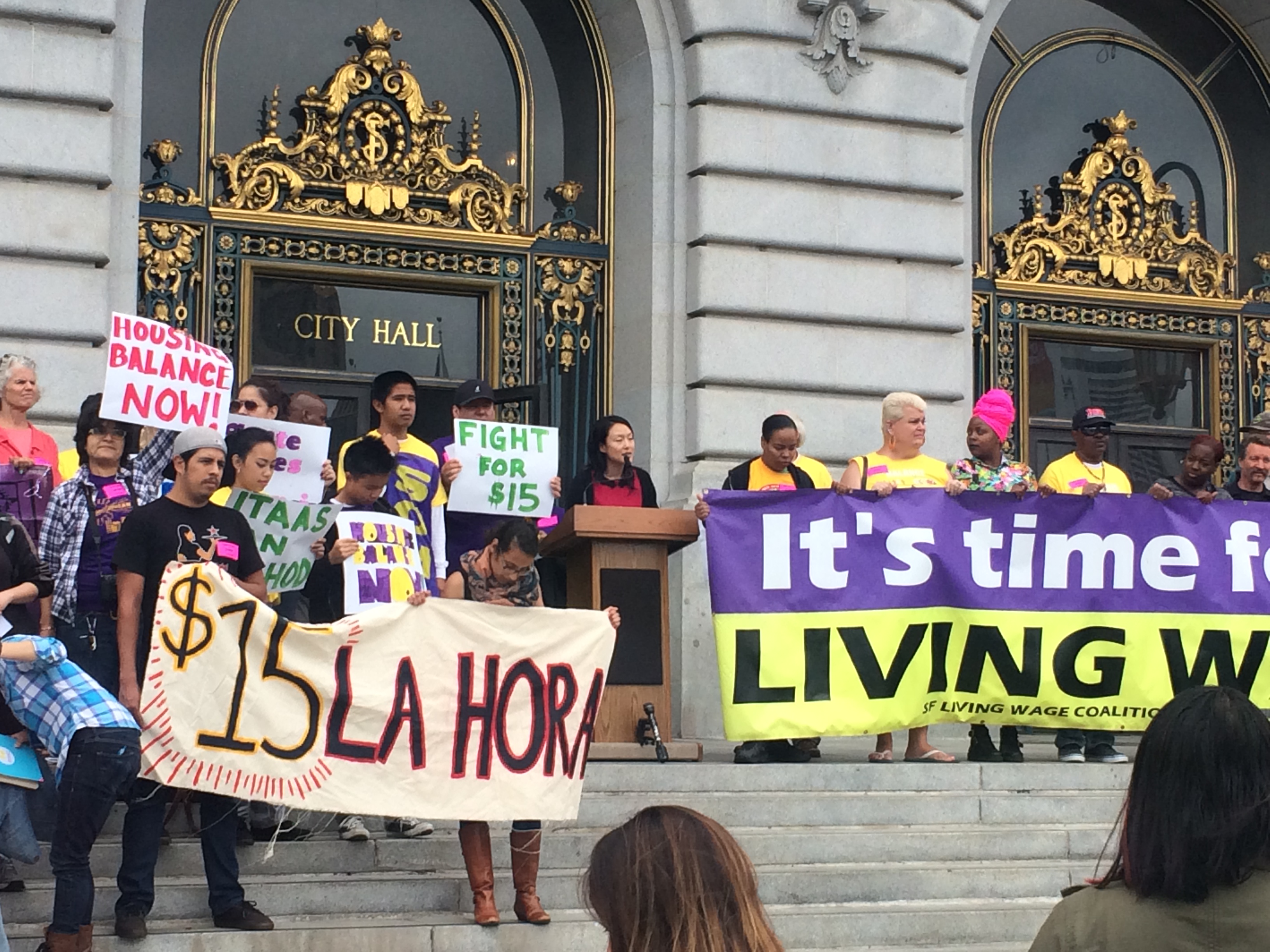
Advocates from the SEIU 1021, South of Market Community Action Network, Alliance of Californians for Community Empowerment, and the Chinese Progressive Association, to name a few, were on hand at the hearing. They were also on hand for a press conference on the steps of City Hall shortly before the hearing. Ed Donaldson from ACCE called out the mayor’s housing measure, saying its only intent was to torpedo Kim’s. 

“I say we should play chicken with the mayor,” Donaldson said at the podium. Metal bands have sung with less volume than the baritone he used while booming, “Let’s see if he has the gall.”

Inside the hearing, Patrick Valentino (who championed luxury development on the waterfront) and Tim Colen of the Housing Action Coalition spoke, defending the mayor’s measure.

“As San Francisco, as a city in affordability, we’re failing. Our rate of failure is accelerating,” he said flatly. He criticized Kim’s plan and asked, “Where’s the money? No one disagrees we need it. The shortcoming I see in the housing balance measure is its premise that if we increase restrictions on market rate housing, it helps subsidize housing.” 

He argued instead to gather more stakeholders together (i.e. deep pocketed developers) to negotiate more private funding, a strategy he said that worked in the past. 

As others came to the podium to argue against developer greed, Colen watched on, shaking his head, seemingly in disagreement. When someone in public comment argued that developers so far have shirked their responsibilities to build affordable housing, he shook his head again and left the hearing room. 

There’s a stark divide in housing philosophy, and supply and demand’s ability to save San Francisco will soon see a trial by voter if Kim’s charter amendment can win six vote at the full Board of Supervisors. 

The mayor’s policies seem to be more of the same, Kim said, and now the city seems to be fighting over the crumbs of developers’ fees. Despite opposition from the mayor, Kim told the Guardian she’s open to new ideas from the mayor. 

But she also said she won’t back down. 

“We’re on a two-fold path right now. If there’s a compromise to get [the city] to 30 percent affordable housing, like new revenue, we’re open to that compromise,” she said. “But we always intended this to go to the ballot.”

San Franciscans could make death penalty ruling stick

24

In the wake of yesterday’s [Wed/16] judicial ruling that California’s death penalty system is unconstitutional — with federal District Judge Cormac Carney calling it arbitrary and so subject to endless delay that it “serves no penological purpose” — San Franciscans could play a key role in converting the ruling into an abolition of capital punishment.

Right now, the ruling applies only to the execution of Ernest Dewayne Jones, who was sentenced to death in 1995 for a rape and murder, and not all 748 inmates now on Death Row in California. But yesterday’s ruling would end the death penalty in California if appealed to and upheld by the SF-based Ninth Circuit Court of Appeals.

The decision about whether to file that appeal and possibly a subsequent appeal to the US Supreme Court falls to Attorney General Kamala Harris, who has maintained her opposition to capital punishment since her days as San Francisco’s district attorney, where she bravely endured lots of political heat for refusing to file capital murder charges in the death of San Francisco Police Officer Isaac Espinoza.  

San Francisco Public Defender Jeff Adachi today issued a public statement praising yesterday’s ruling and calling for Harris not to appeal it: “Today’s ruling, which found California’s death penalty unconstitutional, is a monumental victory for justice. I commend U.S. District Judge Cormac Carney for his courage and wisdom. Not only is the death penalty arbitrarily imposed, as the judge noted, its history is fraught with racial bias and haunted by the hundreds of death row inmates who were later exonerated. I am hopeful that California Attorney General Kamala Harris will choose not to appeal this decision.” 

Harris spokesperson David Beltran told the Guardian that she hasn’t yet made a decision whether to appeal the case: “We are reviewing the ruling.”

Yet former Los Angeles District Attorney Gil Garcetti, who worked with SF-based Death Penalty Focus on the 2012 initiative campaign to repeal the death penalty (losing by less than 4 percentage points), told the Guardian that Harris has a tough choice to make.

“It’s an interesting decision. If the Attorney General doesn’t appeal it, then it applies just to this case, period,” Garcetti told us.

Although appeals in other cases could cite the logic of yesterday’s ruling, it has no precedent value unless affirmed by the Ninth Circuit. And Garcetti called Carney’s ruling “a pretty persuasive decision” that could be easily be affirmed, depending on which judges are assigned to the case. If so, that ruling would end the death penalty in California, just as 17 other states have already done.   

“The more interesting question is whether she would then appeal that ruling [to the US Supreme Court],” Garcetti said.

California voters have affirmed their support for the death penalty three times at the ballot, but those results and public opinion polling show that support for executions has been steadily eroding, in much the same way that generational change has led to overturning bans on same-sex marriage across the country.

Garcetti said he regularly speaks publicly about capital punishment, often to very conservative groups, and he said that the arguments against it have become so strong — including its high cost, racial and class bias, and lack of deterrent effect — that “over 95 percent of [death penalty supporters] change their opinions by the end of my talks.”

As for why the 2012 initiative fell about 250,000 votes short of success, Garcetti said, “We simply ran out of money to get the facts out. Once people hear the facts, it wins them over.”

Carney’s ruling reinforced many of the arguments that opponents have been made against the death penalty, noting that federal guarantees of due process create such long delays that a death sentence has become something “no rational jury or legislature could ever impose: life in prison, with the remote possibility of death.”

Aside from this ruling, California is also currently under a federal moratorium on executing prisoners until it can reform its lethal injection procedures, which a federal judge has said now amounts to cruel and unusual punishment.

“Justice requires that we end this charade once and for all,” Death Penalty Focus Executive Director Matt Cherry said in a prepared statement. “It’s time to replace California’s broken death penalty with life in prison without the possibility of parole. That’s the best way to ensure that convicted killers remain behind bars until they die, without wasting tens of millions of tax dollars every year on needless appeals. That’s justice that works, for everyone.”

SF bankers now exporting tenant-displacing TIC loans

15

Fractional mortgage loans used to convert apartments into owner-occupied tenancies-in-common have fed the eviction and displacement crisis in San Francisco, where the median home price just surpassed $1 million for the first time. Now, some of the same San Francisco banks that pioneered fractional loans here have started offered them in the East Bay and on the Peninsula.

TIC housing is an ownership model for multi-unit buildings, where each unit is independently owned. This option appeals to would-be homeowners because it’s cheaper than a condominium, but less fraught than a traditional loan shared by various owners in a TIC building, which does not allow for independent ownership of each unit.

TICs local have grown in popularity in San Francisco as housing prices continue to skyrocket, since they help homeowners find something affordable, although that benefit usually comes at the cost of evicting all the tenants in the building, often including seniors, those with disabilities, and low-income people in rent-controlled units.

Previously, fractional TIC loans were only accessible in SF. Now, as people seek affordable housing outside of expensive San Francisco, the demand for fractional TIC loans has grown. And San Francisco bankers have stepped up to meet that demand, according to a recent article in the San Francisco Business Times (“High-priced SF housing market exports fractional tenants-in-common loans,” June 28).

Sterling Bank & Trust has become well-known for providing fractional TIC loans (more than $480 million worth so far, according to the Business Times), and is the first company to offer the loans outside of San Francisco. “We’re helping the firefighter and school teacher, or what I like to call the ‘non-tech’ buyer, purchase a home,” Stephen Adams, senior vice president of Sterling Bank & Trust, told the Business Times.

Adams is also president of the San Francisco Small Business Commission, presiding over what critics say is a shift in that commission toward rubber-stamping initiatives from the Mayor’s Office rather than defending small business interests. When we contacted Adams to ask about the evictions and displacement caused by fractional loans, he told he had “no comment to make at this time.”

Tommi Avicolli Mecca, the director of counseling programs at the Housing Rights Committee of San Francisco, said that he doesn’t know how the TIC loans might affect those in the East Bay. But he does know they’re bad news for San Francisco, where there’s now a 10-year moratorium on new condo conversions but few controls on the creation of new TICs.

“They’re scary,” Avicolli Mecca told us. “It’s a disaster for San Francisco. Basically, if you’re buying a tenancy in common, you don’t need to condo convert. It used to be that you wanted a condo conversion so you could have a separate mortgage on what you own. With a fractional loan, you have your own mortgage from the start.”

He added that the loans make it easier for sellers to convert buildings into any size that they can market to home buyers. With the loans, combined with the state Ellis Act allowing owners to remove apartments from the rental market, evicting tenants becomes even more profitable.

The Bank of San Francisco confirmed that it also offers TIC loans in the East Bay. The bank will be making them more attractive with interest-only payments, fractional financing for buildings with more than 12 units, and loans up to $2 million.

Dylan Desai, a spokesman for the Bank of San Francisco, told us that the bankers “do not extend financing to buildings where there has been an eviction” and, to their knowledge, they never have. “We’re sensitive to tenant rights.”

Hopefully the other banks offering these loans will be just as sensitive as they branch out into communities in the region that have already been absorbing an influx of working class former San Franciscans.

#TBT: That time we called for California’s break-up

13

So another scheme — in a long and rich history of such schemes — is attempting to break California into more digestible parts, and gaining national attention. Venture capitalist Tim Draper’s Six Californias is all but on the ballot, attempting to rechristen the Bay Area as Silicon Valley. Good luck with that! (Although we have to say, it might create the first openly weed-driven state economy — Northern California — which would be fun to see.)

In 2009, we, too, put forth a proposal to split California up — building on an idea from conservative Central California, and echoed in Daily Kos. It was a doozy, but a logical one, with some actual Six Californias affinity.

Our May 27 cover story, written by Rebecca Bowe and Tim Redmond, proposed to split Cali up for better management, representation, and economic/social justice, creating the playfully named states of Greenland, Sierrastan, Pinkostan, Coastland, Palm Sprawl, North Mexico, and Disney. (The accompanying cover, designed by Ben Hopfer and shown above, aped the New Yorker’s famous “New Yorkistan” cover.)  

The cover story itself grew from a Politics Blog post Tim Redmond had written in March of 2009, asking “Should California be split up?” — read the post below. As for creating states, we’ll be dreaming of Puerto Rico …

SHOULD CALIFORNIA BE SPLIT UP?

By Tim Redmond

It’s an interesting question. Nothing new, really — folks up in the northern part of the state have been talking about secession since the 1940s.

But these days, the talk has shifted from North-South to Central Valley-Coast.

There’s plenty of discussion going on — the New York Times
reports on a move by farmers in Visalia, who say those of us in the more liberal western regions don’t understand what it’s like in the center of the state:

Frustrated by what they call uninformed urban voters dictating faulty farm policy, Mr. Rogers and the other members of the movement have proposed splitting off 13 counties on the state’s coast, leaving the remaining 45, mostly inland, counties as the “real” California.

The reason, they say, is that people in those coastal counties, which include San Francisco and Los Angeles, simply do not understand what life is like in areas where the sea breezes do not reach.
“They think fish are more important than people, that pigs are treated mean and chickens should run loose,” said Mr. Rogers, who said he hitched a ride in 1940 to Visalia from Oklahoma to escape the Dust Bowl, with his wife and baby son in tow. “City people just don’t know what it takes to get food on their table.”

A former Assembly member is pushing a vertical split, too :

“Citizens of our once Golden State are frustrated and desperately concerned about the imposition of burdensome regulations, taxation, fees, fees and more fees, and bureaucratic intrusion into our daily lives and businesses,” declares downsizeca.org, the movement’s website.

And all of this comes as reformers form both the left and the right are talking about a new Constitutional Convention.

Athough some of the proponents are clearly nutty, the idea isn’t. As the noted political economist Gar Alperovitz wrote two years ago

The United States is almost certainly too big to be a meaningful democracy. What does “participatory democracy” mean in a continent? Sooner or later, a profound, probably regional, decentralization of the federal system may be all but inevitable.

He was talking about California becoming its own nation, but I’d argue that the same problem applies here. The budget crisis, the gridlock in Sacramento … all of it suggests that maybe California itself is too big to govern. There’s also clear evidence of dramatic regional differences. If you take the Central Valley from about Redding on down, and wrap in Orange County, you have a red state within a blue state where most of the residents say they want lower taxes and smaller government. Along the coast from about Sonoma County down to the southern part of Los Angeles County, you have people who generally would like to see taxes pay for public services. If the coast were a state, we could repeal Prop. 13 and build world-class schools. We’d have same-sex marriage and single-payer health insurance. And we’d still be one of the biggest states in America.

Now, I’m not sure the people in the central valley quite realize the problem with their plans, which is illustrated in this wonderful chart that comes from the office of Assemblywoman Noreen Evans of Santa Rosa (PDF).

The chart shows that the people who dislike and distrust government and don’t want to pay taxes are in fact the beneficiaries of the tax dollars that the rest of us pay. In California, tax money from the coast winds up paying for services in the central valley.

But that’s okay — if they don’t want our money any more, maybe we should tell them we’re fine with that. Maybe we should split the state not just in two but into three: Let the northern counties become the state of Jefferson, where pot will be legal and the residents will be so wealthy from taxes and exports of that cash crop that they’ll make oil-richAlaskans seem like paupers. Pot will be legal in the coastal communities, too, and will generate tax revenue.

We’ll have a Democratic governor, and overwhelmingly Democratic legislature, fewer prisons, better schools, cleaner air, no Ellis Act, rent controls on vacant apartments, more money for transit, strict gun control, support for immigrant rights … and no more of these ugly battles over budgets held hostage by right-wing Republicans.

And in the central valley, they can have their low taxes and conservative values, and watch their roads, schools, and public services go to hell. Maybe eventually they’ll figure it out.

Of course, we’d have to figure out the water rights. The folks in Jefferson would have control over much of the water that now goes South, and there would have to be some long-term water contracts between the states, but that shouldn’t be an insurmountable roadblock.

And the solution would create its own problems; The GOP would control the central state, and would move to abolish the Agricultural Labor Relations Act and make life even more miserable for farmworkers. But then, maybe Jefferson would turn off the water and big agribusiness would be SOL anyway.

As part of the break-up, all parties would have to agree to create a special relocation fund to help lonely, sad liberals from Modesto come west and to help lonely, sad Republicans in San Francisco to move east. I wonder which way the net migration would go.

Meanwhile, Evans has introduced my favorite tax bill of the year, AB 1342, and it’s related to this entire discussion. She wants to allow counties to levy their own income taxes and vehicle license fees. “We went through this difficult process of trying to arrive at a budget,” her spokesperson, Anthony Matthews, told me. “For those communities that have a different view of government [than the Republicans], this bill would let them raise their own taxes to fund their priorities.”


Purr-suit of happiness: SF SPCA aims to save more lives with its new adoption center

1

Last year, the SF SPCA assisted with 5,084 cat and dog adoptions. With its new adoption center near Bryant and 16th Streets, which opened June 13, it aims to increase capacity by 20 percent — saving 1,000 more furry lives in the process.

“When our old adoption center opened in 1998, it was the first shelter in the country to house animals in condominium-style rooms instead of cages,” SF SPCA co-president Jason Walthall said in a June press release. The upgraded shelter continues this tradition — and continues to offer dog training classes, volunteer programs for youth, and other community-service activities — but with even more enhancements for the animals. Each glassed-in enclosure features a touch screen pad that provides more information about the pet inside, with an emphasis on personality type (“social butterfly,” “busy bee,” “delicate flower”) over breed — a more efficient way of linking animals with potential new families. 

For dogs, there’s a small indoor park that’s used to make introductions (especially important if the potential new owner already owns a dog — gotta make sure the new pooch gets along with the pack), while the cats, housed in a separate section of the building, get to scamper across SF-themed cat condos. (So far, there’s a Golden Gate Bridge, a Transamerica Pyramid, a cable car, the Sutro Tower, and the SF Giants logo; a Castro Theatre design is in the works.) These improvements make the shelter life more comfortable for the animals — though most dogs only stay two weeks; cats, just slightly longer — but they also help entice visitors.

“We want to make it a fun, happy experience,” says SF SPCA media relations associate Krista Maloney, pointing out that the shelter — which was founded in 1868, has an attached vet hospital (providing free and sliding-scale spay-neuter procedures, among other services), and is a nonprofit funded by donations — competes with pet stores and breeders to place animals in homes. Earlier this year, it joined forces with fellow nonprofit Pets Unlimited, which is located in Pacific Heights, to further its mission: “to save and protect animals, provide care and treatment, advocate for their welfare and enhance the human-animal bond.”

But wait! You’re a San Francisco renter! The words “NO PETS ALLOWED” haunt your nightmares! How can visiting an animal shelter be anything but depressing? SF SPCA’s website has an entire section offering advice for landlords and tenants (one tip: create a “pet resume” to include with your rental application) on the subject of pet-friendly housing. And if the landlord won’t consent to a dog, the SF SPCA just might be able to help out anyway. Coming soon to the new facility: adoptable small mammals, including rabbits, hamsters, and guinea pigs.

Security officers target Apple over contractor’s unfair labor practices

Next time you head to your neighborhood Apple store to get that smooth and harmonious feel that can only comes with the gentle touch of an iPad air, you might be greeted by an unhappy security officer picketing outside. The officer might share some choice words about the working conditions at Apple’s security guard contractor, Security Industry Specialists.

Over the next few weeks, the SEIU United Service Workers West has organized a series of actions with security guards to demand Apple choose a more responsible security contractor.

Currently, Apple, Google, and Ebay all have contracts with SIS, a firm the SEIU claims has unfairly terminated employees and surveiled union meetings. The SIS denies these allegations, devoting an entire page on its website to confronting what it’s termed “SEIU lies and distortion.”

“The contrast between Apple’s boom times and worker’s decrease in wages is incredibly startling,” said Alfredo Fletes, communications specialist for SEIU. “You would think that a company that has benefited so much from what Silicon Valley has to offer would support the jobs for workers – not just in their engineering department, but at all levels.”

Since the launch of the iPod in 2007 to 2012, Apple saw a 600 percent growth in its stock. Meanwhile, from 2008 to 2012, average worker wages in Santa Clara County dropped by 3 percent. On average, Silicon Valley’s security officers make $15 an hour through SIS.

But the actions SEIU has organized aren’t just about wages, nor are they just about Apple. Walter Redding, for instance, was one security officer working for SIS through Google. He’ll be attending some of the actions, because he’s angry. He was fired for taking a phone call from his girlfriend while she was in labor.

“I thought I was doing great,” Redding said. “But I got screwed. I only got two checks since I got fired. It’s been almost a year. My friends got fired for things, too. Everybody gets treated unfairly. I love the products. I’d buy them everyday. But when it comes to working for Google or Apple, I don’t know about that.”

Bryce Miller-Williams, an organizer for SEIU’s Stand for Security campaign, says that the SIS is harsh everywhere, but Apple is where security officers really don’t want to work.

“There’s a very militaristic atmosphere there,” he said. “One gentleman sat down to tie his shoe. Guards are supposed to be standing at all times, and so he was let go because of that.”

Although Apple doesn’t employ the security guards directly, Fletes said the tech company still has the power to select a better security guard contractor. To him, changes at Foxconn, one of Apple’s largest suppliers, offers proof. When labor activists launched an outcry following a series of suicides at Foxconn, Apple stepped in. According to a report from the Fair Labor Association last December, working conditions at Foxconn have since steadily improved.

“I don’t think it’s too much of a stretch to ask Apple to look into workplace issues for security officers in the Bay Area,” Fletes said. “Or, at the very least for them to meet with security officers who, despite working for one of the most valuable companies in the world, are still struggling to survive.”

Apple does at least give the appearance of wanting to do good. The Cupertino company requires its suppliers meet a “code of conduct” and issues a Supplier Responsibility report to document its progress each year. This past December, Apple CEO Tim Cook spoke about his company’s code of conduct in a video message sent in a company-wide email urging employees to behave like good, righteous Apple employees.

“As Dr. Martin Luther King once said, the time is always right to do what’s right,” Cook proclaimed. “At Apple, we do the right thing. Even when it’s not easy. If you see something that doesn’t meet our standards, speak up. Whether it’s a quality issue or a business practice, if it affects Apple’s integrity, we need to know about it.”

Fletes said that when SEIU members protested outside an Apple shareholder meeting last February, Cook said he would look into job quality issues. The allegations of unfair treatment by SIS’ security officers have since continued. Apple did not respond to the Guardian’s requests for comment.

The actions will continue throughout the Bay Area throughout the summer, ending in San Francisco on August 28th.

More funding promised to Central American child refugees, Lee warns of new influx

43

Thousands of Central American children fleeing drug wars and poverty are overwhelming the San Francisco nonprofits who care for them, but new information from the mayor shows this may just be the beginning.

Yesterday, just hours before Supervisor David Campos’ resolution to bolster funding to aid the incoming refugees passed, Mayor Ed Lee warned the Guardian and other journalists that San Francisco is bracing for another influx of even more children in need.

“I met with the federal Health Service System to prepare our city for the possibility of a higher influx [of refugees],” he said. “The numbers seem to be coming in, though they haven’t reached us yet.”

Campos’ measure to focus funding on the needs of Central American child refugees passed by unanimous vote, likely because its sorely needed. Nonprofits in San Francisco like the Central American Resource Center (CARECEN) and other sounded the alarm: there are too many refugees, and not enough caregivers and legal aid to help them. More than 36,000 Central American children (often unaccompanied) entered the US illegally between Oct. 2013 and May this year, according to widely reported federal data. The number of Mexican children entering the US dropped to about 17,000. 

But why are they coming here? Many reasons, but mostly they’re fleeing violence. Honduras, for instance, was the murder capital of the world, with 79 people murdered in every 100,000, according to Reuters. Neighboring El Salvador didn’t do much better, with the second highest murder rate per capita in the world. 

“I am from Honduras and I just turned 16-years-old,” a teenager named Juan said, in a statement from CARECEN, “I came after my father was murdered and I feared for my life that I was next. If I go back I’m not sure that I can go back and live a good life. I want to go to school and live so I can grow up to do something good.”

False rumors in Central America that the US is offering permisos, meaning, permanent status, also spurred an influx of refugees. 

CARECEN’s Washington D.C., Los Angeles and San Francisco locations are advocating for President Barack Obama to declare a state of emergency and aid these refugees. But as the federal government grasps at possible solutions, local government is stepping in to help those reaching the city. 

“There’s a long history on this board on calling out against injustices we’ve seen in different parts of the world,” Campos said at the board yesterday as he introduced his measure, adding “They’re escaping not just political turmoil but violence in their lives.”

“These are children,” he said. 

Lee said one of the biggest challenges in helping these children may be a cultural one.

“I’m trying to wrap my arms around the fact that many of these kids don’t speak Spanish,” Lee told the Guardian yesterday. “They speak Mayan and different languages. This will test our cultural competency.”

Campos is planning a hearing on how best to focus funding to aid the child refugees, but hasn’t yet settled on a date for said hearing. 

On your mark, get set: The Music Video Race is off and running — and expanding

0

Everyone knows that true artists do their best work right before deadline. [Ed note: I may or may not be writing this an hour or so before mine.]

Now in its third year, the Music Video Race is an annual San Francisco tradition that takes this dictum to heart, pairing 16 different musical acts with 16 filmmakers for a challenge that makes that “find a flag in the middle of this big fake nose filled with green goop” thing on Double Dare seem like a cakewalk: Conceive, film, and edit an entire music video in 48 hours.

After accepting applications from both filmmakers and musicians for roughly two months, MVR organizers matched up pairs by random drawing at 7:30pm on Friday, July 11, turning the teams loose around the Bay Area, with a final deadline of 8pm on Sunday, July 13. This year’s bands include SF’s Rin Tin Tiger (which will cap their participation with a headlining spot at the video release party, held at The Independent Sun/20), Oakland’s Bill Baird (fresh from rocking Phono del Sol), Rich Girls, Lemme Adams, and bed. [Another ed note: Yours truly is in the middle of judging said videos, and they’re really freakin’ good.]

“We try to pick a diverse group of bands — we don’t want 20 garage bands or folk acts, etc. There’s so much variety in the Bay, and we really ant to respect that,” says Tim Lillis, an MVR founder, of how they select the participants. “But beyond that, we’re mostly just looking for flexibility, a willingness to roll with the punches, a sense of adventure.”

New this year: We Bay Area-dwellers aren’t so special anymore. The MVR is expanding to Austin and LA, over the weekends of Sept. 5-7 and Nov. 7-9, respectively.

“We’ve had a few really expansive years here, and I think this will help people understand that this isn’t just a San Francisco thing — we’re stoked to help local scenes build themselves,” says Lillis.


Last year’s winning video, from Ash Reiter

The Music Video Race got its start in 2011, when Lillis and a few friends were out having a beer at Lucky 13 before a Mister Heavenly show — featuring Michael Cera on bass. 

“I don’t know if subconsciously the worlds of music and film intertwined because of that, but that’s what happened,” says Lillis, who has a background in video production as well as having played in a few bands in the Bay Area. “I’d done a 48-hour film project before, which is fun, but a lot of times the results of those things are not the best, and I think it usually has to do with audio quality. With music videos, there’s pre-reocrded music, so you’re able to cut the film to the beat; there’s already a rhythm for the editing.”

The sped-up nature of the event isn’t just for fun, Lillis explains. “I’m a pretty firm believer in constraints,” he says. “Even in my work as an illustrator and graphic designer, I know that when you only have so much to work with, you have to just trust your gut and make decisions and go with them. Often your first instinct is valid, and there just isn’t time to waffle on stuff.”

And if he had any doubts about the race being good for the city’s music scene, last year’s event should have sealed the deal: A couple of musicians who met as MVR participants in 2013 — Alex Haager, then of the band Magic Fight, and Sierra Frost, then of Clintongore — fell in love, and are now married, and living in Portland, as co-owners of the Oakland/Portland-based Breakup Records. They’re also in this year’s Music Video Race, competing in their new band Bed

So, you know. Even if you don’t have a musical or filmmaking bone in your body, there just might be something at the finish-line party for ya. As “how we met” stories go, speed-music-video-making sounds way more punk rock than speed-dating. 

MUSIC VIDEO RACE PREMIERE PARTY W/ RIN TIN TIGER, BED.

July 20, 7pm, $14-$16

The Independent

628 Divisadero, SF

www.theindependentsf.com

www.musicvideorace.com

Eviction imminent for San Francisco Community Recycler’s Center

This morning (Wed/16), outside the San Francisco Community Recycler’s Center in the parking lot of the Safeway at Church and Market streets, a group of protesters stood in a cluster, chanting: “Cans not condos!”

As the Guardian previously reported, Safeway is in the process of evicting the recycling center, which continued to operate up until yesterday. The San Francisco Sheriff’s Department, which carries out evictions on Wednesdays, had signaled to the center’s operators that they could be forced out anytime after July 16.

That led supporters and volunteers with the San Francisco Coalition on Homelessness to show up at 5:30am in a bid to beat the sheriff there. They stood on the sidewalk outside the recycling center’s locked gate, waving signs.

“We’ll be holding space as long as we can,” Lisa-Marie Altorre, of the Coalition on Homelessness, told the Guardian a little after 7am. Calls to the Sheriff’s Department were not returned, but Altorre said around 12:15 that supporters had received “official word” that the eviction would be going forward, “likely later in the day.”

[UPDATE: Sheriff’s Department deputies showed up at 7am the next morning to enforce the eviction, and the center is now closed.]

Sup. Scott Wiener told the Guardian in an earlier interview that his District 8 constituents had complained about the recycling center’s presence, saying the facility draws too many unruly patrons, who are often homeless. A new condominium development looms over the recycling center from one direction, while a mixed-use condo development with a Whole Foods on the ground floor lies just across the street.

But recycling center operators argue that the eviction will be harmful to patrons, who need the extra money to get by, and that it will erode the city’s environmental goals. There’s also an issue of impacts on surrounding small businesses, which could be required under state law to accept recycling in-store, a burdensome task for smaller retailers, or to pay fees.

“Eliminating community-based recycling has grave impacts on San Francisco, from public safety to huge environmental fails, including moving us away from goals of being Zero Waste in 2020,” said Ed Dunn of the San Francisco Community Recyclers Center. Dunn was previously affiliated with the Haight Ashbury Neighborhood Council Recycling Center, which was evicted from a parking lot in Golden Gate Park. “It is sad to think any elected leader would support a move like this,” Dunn said, “and a corporation like Safeway would get away with turning their back on their corporate civic responsibility to something as vital as recycling.”