San Francisco

SF Stories: Veronica Christina

3

46TH ANNIVERSARY SPECIAL Living in San Francisco means accepting the constant love/hate battle between beauty and the beast, privilege and poverty, art/music/literature and, “Ew, what the hell did I just step in?” It’s balancing the sweeping bayside views against the looming threat that at any minute we could crumble into the sea. Living here means accepting a certain level of hypocrisy, from ourselves, our government, and each other. It’s understanding that you can’t please everyone all of the time so you’d better figure out how to please yourself.

We’re a city that believes the good things in life should cost money, but heaven forbid we raise property taxes or are asked to pay cover at a club when we think we’re “on the list.” We’re sex-positive, frequently hedonistic, and culinarily spoiled. We float easily between roommate potlucks, Napa Valley wine tastings and pop-up restaurants (where bringing your own 6-pack is not only encouraged but another urban validation of just how in-the-know we actually are).

We dedicate our weekends in drunken tribute to America’s Cup/Folsom Street Fair/Bay to Breakers, then shock our livers back to life on Monday with an all-juice cleanse, delivered right to our shared workspaces. We’ll wax poetic about the exhibits at the MOMA and the DeYoung when secretly the Academy of Sciences is the only museum most of us like.

We vehemently fight for the rights of all our residents to know the joy, solace and comfort of family life, but hate waiting behind the poor lady struggling with her stroller on the bus (eyeroll) and why doesn’t she just get a Baby Bjorn already? We hate drivers while we’re bicycling, hate bicyclists while we’re driving, and collectively despise anyone on a motorcycle.

We’re a city that is constantly forgetting which days street sweeping are on and remain almost adorably hopeful that maaaaybe this time our bumper can hang six inches into the red without being noticed by DPT (it can’t). We’re a city that spends too much precious time getting our cars towed/ ticketed/ broken into.

But then there’s the love. We are a city who falls in love all the time; with ourselves, with our chosen urban families, with that girl on the BART, the view from the bridge, Dolores Park movie nights, hikes in the Presidio, with yoga, politics, new ideas, farmer’s markets, the Giants. We’re a city of, “hey, let’s give it a shot,” a destination for people of alternative mindsets to finally belong.

We love this city with a passion akin to a lover you just can’t leave. San Francisco is in our veins and we keep coming back for more. Sure, we flirt with the notion of trading up to some sexy Oakland loft (free parking!) or a peaceful, tree-canopied Marin cottage (we could get a dog!) but the allure never quite goes away. We may fight like crazy, but no matter how mean we get, she always welcomes us home.

Veronica Christina is the editor of Sex + Design magazine, www.sexanddesign.com


SF Stories: Benjamin Bac Sierra

5

46TH ANNIVERSARY SPECIAL 

Puro San Fran: These words have inspired me to somewhere beyond my city and to someone beyond myself. Puro San Fran, I have howled into our smashed streets, into the lush jungles of Okinawa, death deserts of Saudi Arabia, the overly intellectual classrooms at U.C. Berkeley — into barrios worldwide.

Puro San Fran can be literally translated into Pure San Francisco, but what exactly is so pure about this Golden Gated city is the subject for this musing.

As an adolescent homeboy from our Mission district, I shouted Puro San Fran with anger, as a demand to combat. In different evolutions, though, St. Francis blessed me with different powers that forced me to confront profound paradoxes, within myself and my home.

Puro San Fran is more than a battle-cry; it is a meditation, a mantra that has soothed me and granted me an identity that has fueled my consciousness. I like to pride myself as a Missionero and Cortlandero before gentrification of those gritty hoods, but it is idealistic impurity to tell the tale that the Mission district is all I knew. I liked to claim those territories as if I, we, owned those streets, but those streets were only half my story.

A veteran Muni bus rider by age 11, I would graffiti tag my name and the name of our break dance crew all over every neighborhood — the Haight, Noe Valley, Soma (back when all that existed there were dull warehouses), the Sunset, Excelsior, etc. At 14 years old, we, brown skinned, would blow white angel-dust smoke halos into San Francisco’s spitting seashore at Ocean Beach. During the crack-era 1980s, we would drink and fight at rat-infested Union Square, a home for black-bearded bums who we would share our Mad-Dog 20/20 wine with. Parading our poverty on 30th street after our many 49ers Superbowl victories, we proclaimed the streets as ours, not knowing or understanding that the actual tar and cement would be “rehabilitated” (gentrified) before we would be, so that now almost all of my former San Franeros have vanished outside its borders.

Except for very brief stints in backyard cities, I did not truly explore outside of San Francisco until I was seventeen and joined the Marine Corps. Before then, I had never even heard of other major Bay Area cities called Santa Rosa, Richmond, Berkeley, or Menlo Park. My world, my life was Puro San Fran, but it was that spirit that also charged me forward, so that now I have trumpeted our unique city everywhere I have traveled. With San Fran spirit, I thrust myself into becoming a student, a writer, a professor, a father, a sinner, and a fuller human being.

San Francisco is changing, as it has always been changing, but we are at our roots Native American hippie Missionary 49er Giant locos. Thanks to our counterculture tradition, we believe in peace and diversity as an essence, yet we contradict ourselves by also being hedonistic kings and queens who wear the golden crown of capitalism on the West Coast. What goes on in Vegas may stay in Vegas, but what goes on here in San Fran becomes a permanent tattoo on our souls, and we like to believe we have them, that stuff of souls. We live in the moment trusting it is forever. Go to AT&T Park during the Giants playoffs; you will feel the forever, and you will fall in love with it. Puro San Fran, therefore, is a hopeless romantic nostalgia for something that never really existed but that always is possible. With that purity, that hopeless possibility, that profound paradox, I write and represent us all. Con Safos.

Benjamin Bac Siera is a San Francisco City College English composition and literature professor and author of Barrio Bushido, an ode to Mission District vato locos.

SF Stories: Tiny

3

46TH ANNIVERSARY SPECIAL I have a Vision..(Too!)

of poor people-led revolutions and clan mothers wit solutions including the many colored, many spirited, humble people who still remain in San Francisco even though we are systematically incarcerated, profiled, shot or just hated Used by akkkademic institutions, Nonprofiteering, complex over-funded government collusions — From gang ijunctions to sit-lie laws —

Arresting poor folks of color for no just cause

From Ambassador security guards to Stop ‘ n’ Frisk-

using code words like”cleaning up streets”

so frisko is only for the white ‘ n’ Rich The Afrikan population Out-migration caused by Negro Removal, Redlining, Re-Devil-opment and Lennar displacement La Raza en la mission replaced, displaced by condominiums and Eastern Neighborhood Plans, making room for wheatgrass juice and gourmet coffe stands-

And then let’s go back to the Original removal — !st Peoples of the Ohlone Nation — rarely remembered, considered, spoken about or even named..

Caring for Pachamama, mother Earth in a good way, by the teachings of our ancestors every day

So where does this leave us folx who refuse to be cleaned out, incarcerated, profiled or Wheat-grasserated…

We still here, aqui estamos y no nos vamos —

You can’t Frisk, me, Injunct me or incarcerate me cuz let me be clear.

I am staying in my hood, on my corner

and gonna stay seated in my newly gentrifuked park

.. and to Google buses, condominium, devil-opers and un-conscous new-comers,

we will be a thorn in your side for life and up-end your corporate, money-driven hustle

with our feet, our love, our actions …and our ancestors at our side…

“Where we supposed to go, us po’ folks born here, raised here?” said Vietnam vet, disabled, poverty skola and panhandler reporter at POOR magazine, Papa Bear, arrested three times in one day under Sit-lie. “Going to Hell,” thats my vision (of the city) — when they killed the black community — the soul of this city was gone,” said Tony Robles, PNN co-editor, poet, author and organizer and revolutionary son of San Francisco natives of Manilatown. “I don’t care if I’m the last Mexican in the Mission,” said Sandra Sez, indigenous warrior mama and organizer born and raised in the Mission District.

I was born in the back seat of a car, dealt with houselessness and criminalization since I was 11. Ended up in the Bay Area when I was 14. Can’t say San Francisco is my town. But I have had the blessing of meeting and being in family with some of the most powerful revolutionaries from both sides of this beautiful bay. From the I-Hotel resistance to Mission Anti-displacement Coalition to HOMIES to PODER, from The Bay View Newspaper, Idriss Stelley Foundation to the Coalition on Homelessness. Me and my houseless mama along with other landless revolutionaries launched revolutionary projects, POOR Magazine/Prensa POBRE, PeopleSkool, the Po Poets/Poetas POBRE’s , the welfareQUEENs and Theatre of the POOR, to name a few.

I have also been houseless, incarcerated, evicted, profiled, poverty-pimped, gentriFUKed and welfare deformed in the Bay. I have seen beauty and felt resistance in this place in ways I don’t believe would have been possible anywhere else. And yet now it seems like the struggle is just to remain.

Should one fight to stay in a party that no longer includes most of your friends? Neighborhoods filled with people you don’t know and don’t want to know. Schools stripped of their color and cultures. Corporate streets filled with shiney white buses for people who can’t put their deliecate feet on a public bus. Bike lanes filled with $3,000 bicycles and coffee shops that only sell $4 cups of coffee and $3 vegan donuts.

My humble vision for SF includes reparations for black peoples in the Bay View, giving back stolen vacant land to Original Peoples, makng the more than 30,000 empty units in San Francisco available for poor, houseless, and foreclosed on peoples to live in. For landlords to rent at least one apartment per building to families in poverty at reduced or no rent, for doctors and dentists to see at least three patients per practice for a sliding scale starting at $0 — and for people to not question “where their money is going” when they give 50 cents to a panhandler/street newspaper vendor while never questioning where their tax dollars go to politricksters and CEOs of corporations. For the SFPD to arrest, profile, and harass drunken white people who spill out of Bay to Breakers and Golden Gate Park concerts with the same voracity that they do poor youth of color — cause then maybe it would actually have to stop.

And finally for all racist, classist laws that target us poor folks, like sit-lie, gang injunctions and stop and frisk be repealed for their flagrant and disgusting unconstitutionality so that public space will remain truly public and people might truly be free.

Tiny, aka Lisa Gray-Garcia, is a founder of POOR Magazine.

The return of the ugly laws

0

OPINION In the late 19th and early 20th centuries, municipalities across the country passed what have become known as “ugly laws,” often modeling their ordinances word for word on San Francisco’s. According to The Ugly Laws: Disability in Public, Susan Schweik’s comprehensive study of these laws, they were intended to target those who “exposed disease, maiming, deformity, or mutilation for the purpose of begging.” In city after city a pattern emerged of “enactment, reenactment, crackdown, malaise.” As Schweik writes, “what most aligned” the cities “were not the law’s successes, but its failures, the impossibility of removing the unsightly in the form of persons.”

Fast-forward 150 years and “sit lie,” replaces “ugly,” as the name for a category of laws whose intention is to remove the unsightly from our public spaces. Different in form, but nearly identical in intent and justification, these laws are now sweeping through the country, disfiguring the municipal codes of one city after another. San Francisco is not patient zero of this epidemic. But it now threatens to pass that contagion on directly to Berkeley.

Berkeley’s Measure S would prohibit sitting on any commercial sidewalk or on any object placed on the sidewalk without express permission of the city between 7 am and 10 pm. (Since 1998 Berkeley has had an ordinance prohibiting lying on the sidewalk.)

As with the “ugly laws,” the fact that sit lie-laws have been ineffective, has proven no impediment to their spread. Months before the Berkeley City Council voted to place Measure S on the ballot, an independent analysis of San Francisco’s sit-lie ordinance conducted one year after its implementation concluded that it had “on the whole, been unsuccessful at meeting its multi-faceted intentions to improve merchant corridors, serve as a useful tool for SFPD, connect services to those who violate the law, and positively contribute to public safety for the residents and tourists of San Francisco.” Undeterred by the failures of sit-lie in San Francisco, proponents of Measure S, most prominently business improvement districts representing commercial landlords, promise it will rid the city of what they describe as unsightly “encampments” of nomadic street youth.

The fact that Measure S is targeted at homeless youth is an open secret. Ugly laws are a thing of the past. It is not constitutionally permissible to pass laws that target people for who they are as opposed to what they do. The Supreme Court has declared laws against loitering and vagrancy unconstitutionally void for vagueness. The workaround these constitutional obstacles is to pass laws against specific behaviors associated with people whom we don’t want in our public space. Like laws prohibiting sitting on the sidewalk.

Over a hundred years ago, Anatole France famously praised “the majestic equality of the law that forbids the rich and the poor alike to sleep under bridges, to beg in the streets, and to steal bread.” He would no doubt smile at a law that forbids everybody from sitting on the sidewalk. Measure S is supported by people who hide behind its “majestic equality,” but count on a “majestic inequality,” in its enforcement. They believe, without reservation, that it will always be enforced against others.

I don’t like using disease metaphors in politics. Susan Schweik describes the spread of ugly laws as a “contagion,” and it’s hard to resist a similar metaphor for the spread of sit-lie laws. But what is really at stake here is an ugly tendency in national politics, spread not by an anonymous bug, but by people in positions of power and influence, to shift the blame for our sour economy from those who run the system to those who are run over by it: labor unions, public employees, teachers, immigrants, and now, in Berkeley and too many other cities, people who are homeless. If Berkeley passes Measure S, sit-lie laws could be greenlighted across the nation, for who could object that such laws are unfair and mean spirited if oh-so-radical Berkeley passed one. On the other hand, if we defeat measure S Berkeley has a chance to model how a community can come together to find real solutions to real problems in hard economic times.

Osha Neumann is an attorney with the East Bay Community Law Center, and Chair of Berkeley Standing Up for the Right to Sit Down/No on Measure S. For more on the measure, visit www.noonsberkeley.com.

Davis should drop out

49

EDITORIAL Kay Vasilyeva, a member of the San Francisco Women’s Political Caucus, has come forward with the allegation that District Five candidate Julian Davis grabbed her and put his hand down her pants at a political bar crawl in 2006. That was six years ago, but it’s still important — and more than the incident itself, the response we’ve seen from Davis is highly disturbing. He’s utterly denying that it ever happened, and retained a lawyer to send Vasilyeva a letter threatening her with legal action if she continues to talk.

While we endorsed Davis for supervisor, we take these charges very, very seriously — particularly coming at a time when relations between men and women in the progressive movement are badly strained.

Since the SF Weekly, which broke the story, suggested that we knew something about Davis’s behavior, we need to state, for the record: When we endorsed Davis, we had heard nothing even remotely close to this type of allegation. Yes, we knew that in his 20s he was a bit of an arrogant ass. We knew that at one point, he actually got into a tugging match with another person over the ridiculous question of who got to hold a campaign sign. We’d heard that, in the past, at somewhat debauched parties, he’d made advances toward women who weren’t interested in his affections.

Those could be the acts of an immature man who has since grown up. And since, on a level of policy, knowledge, and positions, he was by far the best and strongest progressive in the race in District 5, we — along with much of the local progressive leadership — thought he was demonstrating enough maturity that he was worthy of our support.

But this new information, and his response to it, is alarming.

We don’t take last-minute allegations about a front-running candidate lightly; people have been known to dump all sorts of charges into heated races. When we learned about Vasilyeva’s allegations on Oct. 13, we did our own research. We spent two hours with Davis and his supporter and advisor, former D5 Supervisor Matt Gonzalez. We realized that allegations without corroboration are just charges, so we tracked down everyone we could find who might know anything about this incident — and, as we discovered, other similar events. And we have to say: Vasilyeva’s account rings true. Davis’s categorical denial does not.

More than that, we were offended that he in effect threatened with a lawsuit a woman who, at some peril to herself, came forward to tell the public information about someone who is running for elected office. What was the point of that, if not to intimidate her? It’s highly unlikely he’s going to sue (and drag this whole mess into court). He says he was just trying to send a message that he has a legal right to respond to defamation, but this is a political campaign; if he didn’t want to deal publicly with what he must have known were these sorts of potential allegations, he shouldn’t have run for office.

This is a bad time for progressives in San Francisco. The Mirkarimi case has brought to the fore some deep and painful rifts; a lot of women feel that (mostly male) progressive leaders have pushed their issues to the side. For the future of the movement and the city, the left has to come together and try to heal. This situation isn’t helping a bit.

Davis needs to face facts: Supervisors John Avalos and David Campos have withdrawn their endorsements. Assembly member Tom Ammiano is almost certain to do the same. With his inability to handle the very credible charge that he not only groped a woman but lied about it, Davis no longer has a viable campaign in the most progressive district in the city, and we can’t continue to support him.

We have said it many times before: People on the left need to be able to put their own ambitions aside sometimes and do what’s right for the cause. Davis can’t win. He’s embarrassing his former allies. He needs to focus on coming to terms with his past and rebuilding his life. And for the good of the progressive movement, he needs to announce that he’s ending his campaign, withdrawing from the race, and urging his supporters to vote for another candidate.

Alerts

0

THURSDAY 18

Culture as a weapon: poetry and storytelling SOUL School of Unity and Liberation, 1904 Franklin Suite 904, Oakl; www.schoolofunityandliberation.org, RSVP at info@schoolofunityandliberation.org. 6:30pm, $5-25. The second in a three-part series exploring how art and culture can be a form of political resistance. At this workshop, learn from poet, writer, artist and organizer Erika Vivianna Céspedes about writing that helps build movements. RSVP is required, and if you can’t get into this one, try their next event in the series, an activist printmaking workshop on Oct. 25.

Fall of the I-Hotel film screening New Nothing Cinema, 16 Sherman, SF; newnothing.wordpress.com. 8pm, free. A screening of a film depicting the historic struggle between residents and supporters of the International Hotel and the landlords that wanted it razed and turned into a parking lot. After massive neighborhood “revitalization,” the I-Hotel was one of the last remnants of the once-lively Manilatown neighborhood. See how residents fought for it at a screening presenting by Shaping San Francisco, New Nothing Cinema, and the CIIS Anthropology and Social Change Department.

FRIDAY 19

Say goodbye to condoms as evidence Jane Warner Plaza, 401 Castro, SF; www.tinyurl.com/condommarch. 6-8pm, free. As we reported this week, SFPD has decided to temporarily end the controversial practice of using possession of condoms as evidence in prostitution cases. For a three to six month trial period, condoms will not be seized or photographed if a cop thinks someone might be a sex worker. A group that was planning to march in opposition to the practice will now march in celebration of the decision, and to urge the city to make the trial period permanent.

Disobeying with great love Powell Street Bart station, Powell and Market, SF; www.tinyurl.com/disobeylove. 6pm, free. A flash mob meditation in the middle of the Disneyland-like shopping district. What better way to relax amongst the chaos?

SATURDAY 20

Op Trapwire Department of Homeland Security, 560 Golden Gate Ave, #36127, SF. WikiLeaks let loose information about Trapwire, the now-notorious company that uses surveillance and tracking to monitor people’s movements and aggregate them into patterns. It does this with a network of security cameras across the country, government and law enforcement uses its information, and the whole thing may be illegal. Some Occupy types have called for a national day of action against surveillance on Oct. 20, and San Francisco is joining in.

Picket Mi Pueblo market Mi Pueblo Mercado1630 High, Oakl; dignityandresistance@gmail.com. 1-4pm, free. Mi Pueblo Market is a successful and beloved grocery store chain. Workers were upset to learn that the company signed up to participate in E-Verify, a voluntary program that tracks the immigration status of all new hires. Managers say that the decision was made after serious pressure from ICE and the Department of Homeland Security. Workers and community supporters will picket the store in protest of the new policy.

SUNDAY 21

Amy Goodman speaks First congregational church of Oakland, 2501 Harrison, Oakl; www.kpfa.org/events. 7pm, $15 in advance. Amy Goodman co founded Democracy Now! The War and Peace Report in 1996. Since then, she has consistently brought progressive, hard hitting reporting to television screens and radios, authored a few books, and established herself as a distinctive voice in journalism. She’s also a kick ass speaker. Come hear her share her wisdom at a benefit for KPFA radio, where she’ll be speaking on “The Silenced Majority: Stories of Uprisings, Occupations, Resistance, and Hope”

MONDAY 22

Tasers forum Hamilton Recreation Center, 1900 Geary, SF; www.tinyurl.com/taserforums. 5pm, free. The SFPD has called a public forum to discuss the possible introduction of tasers into the police arsenal. Come to share your thoughts on the idea. And if you want to hear more, show up a half hour early for a community-led forum. “This summer, ACLU delivered a report of 532 documented Taser related deaths in the US since 2001, but that has not stopped SF Police Chief Greg Suhr from pushing the fourth attempt to spend several million dollars to equip SFPD with these deadly weapons,” say organizers.

Davis needs to drop out

246

EDITORIAL Kay Vasilyeva, a member of the San Francisco Women’s Political Caucus, has come forward with the allegation that District Five candidate Julian Davis grabbed her and put his hand down her pants at a political bar crawl in 2006. That was six years ago, but it’s still important — and more than the incident itself, the response we’ve seen from Davis is highly disturbing. He’s utterly denying that it ever happened, and retained a lawyer to send Vasilyeva a letter threatening her with legal action if she continues to talk.

While we endorsed Davis for supervisor, we take these charges very, very seriously — particularly coming at a time when relations between men and women in the progressive movement are badly strained.

Since the SF Weekly, which broke the story, suggested that we knew something about Davis’s behavior, we need to state, for the record: When we endorsed Davis, we had heard nothing even remotely close to this type of allegation. Yes, we knew that in his 20s he was a bit of an arrogant ass. We knew that at one point, he actually got into a tugging match with another person over the ridiculous question of who got to hold a campaign sign. We’d heard that, in the past, at somewhat debauched parties, he’d made advances toward women who weren’t interested in his affections.

Those could be the acts of an immature man who has since grown up. And since, on a level of policy, knowledge, and positions, he was by far the best and strongest progressive in the race in District 5, we — along with much of the local progressive leadership — thought he was demonstrating enough maturity that he was worthy of our support.

But this new information, and his response to it, is alarming.

We don’t take last-minute allegations about a front-running candidate lightly; people have been known to dump all sorts of charges into heated races. When we learned about Vasilyeva’s allegations on Oct. 13, we did our own research. We spent two hours with Davis and his supporter and advisor, former D5 Supervisor Matt Gonzalez. We realized that allegations without corroboration are just charges, so we tracked down everyone we could find who might know anything about this incident — and, as we discovered, other similar events. And we have to say: Vasilyeva’s account rings true. Davis’s categorical denial does not.

More than that, we were offended that he in effect threatened with a lawsuit a woman who, at some peril to herself, came forward to tell the public information about someone who is running for elected office. What was the point of that, if not to intimidate her? It’s highly unlikely he’s going to sue (and drag this whole mess into court). He says he was just trying to send a message that he has a legal right to respond to defamation, but this is a political campaign; if he didn’t want to deal publicly with what he must have known were these sorts of potential allegations, he shouldn’t have run for office.

This is a bad time for progressives in San Francisco. The Mirkarimi case has brought to the fore some deep and painful rifts; a lot of women feel that (mostly male) progressive leaders have pushed their issues to the side. For the future of the movement and the city, the left has to come together and try to heal. This situation isn’t helping a bit.

Davis needs to face facts: Supervisors John Avalos and David Campos have withdrawn their endorsements. Assembly member Tom Ammiano is almost certain to do the same. With his inability to handle the very credible charge that he not only groped a woman but lied about it, Davis no longer has a viable campaign in the most progressive district in the city, and we can’t continue to support him.

We have said it many times before: People on the left need to be able to put their own ambitions aside sometimes and do what’s right for the cause. Davis can’t win. He’s embarrassing his former allies. He needs to focus on coming to terms with his past and rebuilding his life. And for the good of the progressive movement, he needs to announce that he’s ending his campaign, withdrawing from the race, and urging his supporters to vote for another candidate.

Judges consider whether the feds have ignored medical evidence on marijuana

4

Tomorrow (Tues/16), for the first time in more than 20 years, a court will consider whether the federal government has improperly ignored evidence of marijuana’s medical value in continuing to classify it as a Schedule 1 narcotic, the category of dangerous drugs with no medicinal value.

“This is a very big deal,” said David Goldman, a San Francisco representative of Americans for Safe Access, part of the coalition that brought the lawsuit that will be heard by the US Court of Appeals in Washington DC. “I am personally optimistic given the three judges [that will hear the case] are Clinton appointees.”

The federal government has consistently maintained a hardline on marijuana, through both Republican and Democratic administrations, rejecting various efforts to get it rescheduled in the face of a growing body of research that it has a wide range of medical benefits, from simple alleviation of anxiety to treatment for diseases such as cancer, AIDS, and glaucoma.

In fact, Goldman said federal officials who doubt marijuana’s medical affects should come to “Cannabis in Medicine: A Primer for Health Care Professionals,” a training session for medical professionals that the University of California at San Francisco is hosting Oct. 24-25. It will feature doctors discussing their research on the “endocannabinoid system” and using marijuana to treat cancer and pain, among other sessions.

Tomorrow’s court hearing and subsequent ruling could undermine the Obama Administration’s current crackdown on medical marijuana dispensaries in California and other states that have legalized it for medical use, giving patients the right to bring a medical necessity defense in federal courts and possibly raising medical marijuana as an issue in the presidential campaign.

As we reported in August, local and state officials have been strongly resisting the federal crackdown, which has shuttered a third of San Francisco’s two dozen licensed clubs. More recently, the city of Oakland has intervened on behalf of Harborside Health Center – one of the country’s biggest and highest profile marijuana dispensaries – which was raided by the feds earlier this year. Among other defenses is Oakland’s citing of a court ruling that the federal government can’t turn a blind eye to something for more than five years and then suddenly swoop in, bust people, and seize assets.

California was the first of 17 states that have legalized marijuana for medical use, allowing localities to set up system for regulating its distribution and giving patients the cite that right in court. But on the federal level, the war on drugs has continued unabated, something that this hearing could begin to change.

Free screening: Nobody Walks at Embarcadero Theatres

0

Magnolia Pictures presents Nobody Walks, a drama about relationships, marriage, and families, directed by Ry Russo-Young and co-written by Lena Dunham. The film opens on October 26 at Landmark’s Bridge Theatre in San Francisco, and Landmark’s Shattuck Cinemas in Berkeley.

For a chance to catch a free screening on Thursday, October 25 at 7pm @ Embarcadero Theatres, email SanFranciscoPromo@LandmarkTheatres.com with the words “NOBODY WALKS Guardian contest” in subject line. Passes will be delivered via email while supplies last.

Synopsis: Martine (Olivia Thirlby, Juno), a 23-year-old artist from New York, arrives in Los Angeles to stay in the pool house of a family living in the hip and hilly community of Silver Lake. Peter (John Krasinski, The Office), the father, has agreed to help Martine complete sound design on her art film as a favor to his wife. Martine innocently enters the seemingly idyllic life of this open-minded family with two kids and a relaxed Southern California vibe. Like a bolt of lightning, her arrival sparks a surge of energy that awakens suppressed impulses in everyone and forces them to confront their own fears and desires. Exquisitely orchestrated by director Ry Russo-Young (You Won’t Miss Me) and co-written by Lena Dunham (Tiny Furniture), this potent charting of inner urges and sufferings links characters in an intricate dance of lust, denial, and deception. Despite their issues, each comes across as fundamentally human, urging viewers to appraise the characters’ morality by evaluating their own motives. Sexually charged and rigorously composed, Nobody Walks boasts an impressive cast who deliver incisive performances in this absorbing tale.

“Tough and tender, weaving its web of interrelationships, Nobody Walks acutely outlines the invisible frequencies that pass between people.” – Nick Pinkerton

“One of the year’s best American films.” – Twitchfilm

“Subtle, smart, sexually charged.” – L Magazine

For more info, visit this link and watch the trailer below.

Was Realtor-financed attack ad illegally coordinated with Lee?

33

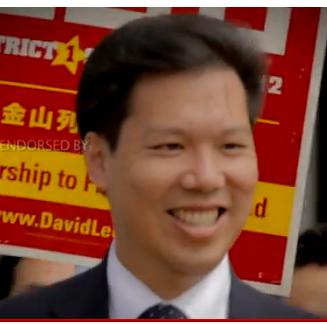
District 1 supervisorial candidate David Lee might have violated election laws prohibiting candidates from coordinating with groups doing independent expenditures after being featured in a pricey attack ad blasting his opponent, incumbent Sup. Eric Mar.

The San Francisco League of Pissed Off Voters yesterday filed a complaint with the Ethics Commission requesting an investigation into illegal coordination between Lee and the Association of Realtors, which produced an ad entitled “Send Mar Back to Mars,” in which Lee appears to have participated in the filming.

“Our concern is that Lee’s campaign has collaborated with the San Francisco Realtors Association in providing footage,” says Fabiana Ochoa, a member of the steering committee for the League.  “That’s really a violation of the law.  It’s a concern this year because we see how national super PACs have an influence on campaigns.”

Lee’s direct fundraising and the allegedly independent expenditures on his behalf this week topped $557,486 – more than any other San Francisco supervisorial campaign in history — prompting the Ethics Commission to again raise the expenditure cap on the public financing in Mar’s race. Lee and his campaign have refused to answer questions about this or other issues. 

“No one has ever seen that kind of spending here in San Francisco.  It’s turned into a challenging and nasty campaign,” Ochoa said.  “It’s a small district but the game has changed.”

Progressive groups — including the League, San Francisco Tenants Union, and Harvey Milk LGBT Democratic Club — are fighting back with a rally scheduled for this Monday at 5pm outside the Realtors Association office at 301 Grove Street. They’re urging participants to bring pots and pans, reminiscent of the group of scowling children who were smeared with dirt and banging pots and pans in the video.   

In an email to the Guardian, the Ethics Commission’s Executive Director John St. Croix said, “The Ethics Commission can not confirm, deny or discuss complaints.” If the Ethics Commission does investigate and finds that Lee knowingly participated in this advertisement, it is unclear what exactly the penalty will be and the District Attorney’s office is not jumping to any conclusions yet. “For now it’s still with the Ethics Commission so we can’t comment on it,” says Stephanie Ong Stillman, press secretary for the D.A.’s office.

In a time when corporations are considered people and wealthy interests have unprecedented political influence in elections, all eyes are on the candidates and how honestly they run their campaigns.  Current San Francisco law prohibits candidates from organizing with independent expenditures like this one.

The ad, which cost $50,000 to make, mocks Mar’s efforts to remove toys from McDonald’s Happy Meals by featuring kids protesting his policies.  The glossy 3 ½ minute commercial is high-quality with Hollywood production value, leaving skeptical viewers wondering if Lee’s cameo was staged and his participation deliberate.   If it was, then Lee also violated laws that ban candidates from accepting campaign contributions exceeding $500.

The Association of Realtors clearly has an interest in David Lee, considering Mar supports tenant rights, and the Tenants Union has make its rally and campaign an effort to “save rent control” and called it a “march on the 1 percent” that is trying to buy the Board of Supervisors and remake San Francisco.

Realtors Association President Jeffery Woo would not discuss the issue when reached by phone.  In an emailed press statement to the Guardian, the Association of Realtors wrote, “ We stand by the facts, and humor, of the video we produced on the election in District 1 and do not plan to remove it from YouTube as it has achieved success in raising important issues in San Francisco.”

The Guardian also reached out to the political media expert who produced the film, Fred Davis, but he did not return our calls. 

Davis, who served as chief media strategist for John McCain’s 2008 presidential campaign, is a Hollywood-based veteran of campaign marketing and has produced some of the most notorious political ads in recent history including the Demon Sheep video for Carly Fiorina’s 2010 GOP senate campaign.  He also created the highly lampooned 2010 ad featuring Delware Senate candidate Christine O’Donnell, who assured viewers that she was “not a witch.” 

Judge for yourself whether Lee participated in the making of this video:


Gascón’s challenge to Mirkarimi belies his own official shortcomings

162

The backlash against Sheriff Ross Mirkarimi’s reinstatement by those who oppose him has often been biting and bitter – an indicator that coming together around real solutions to domestic violence, something most supervisors pledged, could still be difficult – but the most hypocritical reaction came yesterday from District Attorney George Gascón.

“Ross is now reinstated as our Sheriff and I accept that. What I will not accept is any compromise of public safety as a result of his reinstatement. Ross Mirkarimi is on probation in this county for a crime of domestic violence. He is, at a minimum, incapable of adequately performing the functions of his office that relate to crimes of domestic violence,” Gascón said in a public statement, calling for Mirkarimi to “wall himself off” from all domestic violence programs and inmates and hire an independent special administrator to oversee them.

Gascón didn’t explain why he believes Mirkarimi can’t oversee these functions, although that’s been a common refrain among Mirkarimi’s critics, almost an article of faith that to them needs no explanation. I understand the sentiment, but as a practical matter, it still doesn’t make sense to me (I’d welcome comments that could offer insights or explanation). I’ve also posed that and other questions to both Gascón and his spokesperson, Stephanie Ong Stillman, and I’ll include an update when I hear back.

Maybe the issue is a conflict of interest, the belief that Mirkarimi will either be too easy or too hard on domestic violence inmates or programs, which seems to be stretch. But if that’s the case, Gascón should get off his high horse. Gascón was the police chief when then-Mayor Gavin Newsom appointed him as DA, and there were many voices in the community who questioned such an unconventional move, one that raised obvious questions about whether Gascón could be objective about cases of police abuse, evidence tampering, or assorted other cases in which he would be called upon to make tough judgments about the SFPD. There were calls for Gascón to wall himself off from such cases, which he refused to do, even though that was arguably a more serious and direct conflict of interest than Mirkarimi overseeing the jail.

Also, let’s not forget that it was Gascón who started this whole ordeal by deciding to charge Mirkarimi with domestic violence crimes, accept the plea bargain to misdemeanor false imprisonment, and recommend the punishment that the court accepted – which included the highly unusual requirement that Mirkarimi issue a public apology to his neighbor, Ivory Madison, who went to police against the wishes of Mirkarimi’s wife. At the time, Mirkarimi was serving as sheriff and overseeing all the department’s functions – and he wasn’t letting the batterers run free or battering them himself – and Gascón didn’t raise this issue of then or make it a condition of Mirkarimi’s plea, which he certainly could have.

Finally, there was this sanctimonious statement by Gascón: “As the chief law enforcement official in this City and County, I will stand unapologetically with the victims. I will work tirelessly to be sure both victims and witnesses know this city does not tolerate domestic violence.” Yet the record of his office indicates something that falls far short of tireless efforts to combat domestic violence.

As a San Francisco Public Press investigation revealed last month, San Francisco has by far the lowest rate of domestic violation prosecutions of any Bay Area jurisdiction, a terrible record that has gotten even worse since Gascón took over. Whether judged by the number of domestic violence cases filed per capita (29.5 per 10,000 residents, compared with 58.5 in the region) or the number cases it received that it declined to prosecute (it dropped 6,200 of the 8,600 cases that it received from police), Gascón has no business claiming to show zero tolerance for domestic violence. His prosecution of Mirkarimi was more aberration than rule.

We’ve been trying to get a comment out of the DA’s Office on this issue for weeks, and they still haven’t replied (Stillman told me today that “we’re still working on it”). Gascón was also asked about his office’s poor record on domestic violence recently on KQED’s Forum and gave only a deflective non-answer. Perhaps he’d be better off figuring out how his office could so consistently fail the victims of domestic violence rather than worrying so much about the too-few of them that he’s managed to send to jail.

We all understand what an emotional and important issue domestic violence is, and even how unsettling it may be to many to have Mirkarimi as sheriff. But the members of the Domestic Violence Consortium and La Casa de las Madres – those who have led the campaign to oust Mirkarimi – aren’t the only people who care about this issue.

During the public comment portion of Tuesday’s Board of Supervisors meeting, there were many domestic violence victims who expressed more outrage over the failure of these domestic violence groups or the DA’s office to support them than they were about Mirkarimi continuing to be the sheriff. The city just spent $1.3 million trying to remove Mirkarimi and another [[CORRECTED FIGURE: $140,000]] paying his interim replacement, Vicky Hennessy – money that could have been better spent directly responding to domestic violence than this fruitless symbolic stand.

But that’s over now, just like their efforts to remove Mirkarimi, and we all need to move on instead of trying to re-fight this difficult battle over and over again. People can still disagree with what happened and vent and be angry – and from what we’re hearing from City Hall, many of the messages have been quite savage, some even threatening violence. They can even work on a recall campaign or take other political actions.

Yet we all still share a city – a wonderfully diverse city with a wide range of perspectives and opinions – and we’re all forced to accept things about it that we don’t like. Gascón doesn’t get to decide who the sheriff is or how he plays that role any more than Mirkarimi got to tell Gascón how to do his job – despite suffering far more direct impacts.

We each have our roles to play, and we’ll all be better off if we do them well and accept that we live in a rainbow city, not a black-and-white world.

The Helium Safari: The Astonishing Collage Art of Sean Mackaoui

0

Sean Mackaoui likes to cut and paste in his much-loved adopted hometown of Madrid, Spain. His work has adorned newspapers and magazines (El Mundo, The Herald Tribune, Courrier International, The Sunday Times Magazine, El Canto de la Tripulacion, and La Folha de Sao Paulo), dripped off posters (Centro Dramatico Nacional, Spain or Biennale du Cinéma Espagnol de Annecy, France), graced wine labels, adorned book covers, dressed up T-shirts, sold shoes, animated TV spots…. basically anywhere they let him put a collage!

He has exhibited his personal work in galleries around Europe, and occasionally pieces have been known to cross the Atlantic to the shores of the American continent. His proudest recent achievement was to be awarded an Honorary Director’s roll on the board of the San Francisco Collage Centre. For more information, please visit mackaoui.com.

Sean will be in attendance of this one night only event at Grant’s Tomb Gallery in North Beach, with additional montage art by Winston Smith, also in attendance.

Friday, October 19 from  7-11pm @ Grant’s Tomb, 50-A Bannam Alley,  SF | FREE

Das Racist’s Kool A.D. on hip-hop, baseball, and losing his virginity

0

Self-proclaimed, “second best rapper with glasses after E-40” and Bay Area native by way of Brooklyn Victor Vazquez aka KOOL A.D. of rap group Das Racist has had quite the prolific past year in the hip-hop industrial complex. 

He and his group Das Racist — featuring rapper Heems and hypeman Dapwell (Dap for short) — released their debut LP and critic darling Relax. Soon after that he released not one but two positively received mixtapes in the span of three months, The Palm Wine Drinkard and the Bay Area homage 51. Das Racist plays DNA Lounge this Fri/12. 

KOOL A.D. took time off from his 10-city tour with Das Racist, Leif, Safe, and Lakutis to rhapsodize with the Guardian about playing for the A’s, his punk band, and getting free weed.

San Francisco Bay Guardian Are you for the Giants/ 49ers or A’s/Raiders?

KOOL A.D. I don’t really care. But A’s.

SFBG If you played for the A’s what would be your stepping up to the plate song?

KAD [Long laugh] “Le Freak” by Chic.

SFBG Where in the Bay Area did you live when you were growing up?

KAD Potrero Hill, Hunter’s Point, Alameda, West Oakland.

SFBG I heard a rumor that you lost your virginity in the back of a fruit truck in Alameda? Can you confirm or deny this?

KAD I lost my virginity in the cab of the produce truck at Paul’s Produce (now called Dan’s Produce I think) where I used to work.

SFBG What are your favorite spots in the Bay to kick it at? What places do you take Heems and Dap?

KAD As a youngster, I went to punk shows in warehouses and houses, kicked it at Donut Shops, burger spots, and Mexican restaurants, dollar ten Chinese, drank and smoked weed in parks. Not particularly good at “recommending cool shit” to people.

SFBG The Guardian had a recent cover story entitled “Is Oakland Cooler Than San Francisco” What’s your take on that? As a Brooklyn resident do you think Oakland could be SF’s Brooklyn?

KAD I lived in both and love both and it always bugged me that SF fools don’t want to come to the East Bay and East Bay fools don’t want to go to SF. I think a large part is because BART closes too early. Never understood why BART couldn’t get it together to be 24 hours.

SFBG Who are some Bay Area rappers you’ve been into lately?

KAD Favorite people making music in the Bay are Amaze 88, Trackademicks, 1-O.A.K., The Coup, Main Attrakionz, Davinci, Young L, Lil B, Kreayshawn, Beed Weeda, Too Short, E-40, Droop-E, Issue, YG, Cuzzo Fly, Stone Vengeance, Las Malas Pulgas, Under 15 Seconds, Fracas, Fucktard,  Reivers, @AAANTWON, Nacho Picasso, Mike Baker, Safe.

http://www.youtube.com/watch?v=ZUxLlXikwZU

SFBG Finish this phrase: “Rap Game [blank].”

KAD Keith Morris.

SFBG Das Racist frequently asks fans to throw various objects on stage. What’s the most outlandish or weirdest thing any fan has ever thrown on stage?

KAD Hundreds of Soy Joy snack bars at a festival in Washington was pretty weird. Also hellof weed, cigarettes. One time in Oakland I asked for money and got like 30 bucks in small bills.

SFBG If presented with the opportunity to join the Illuminati, would you accept?

KAD Depends on what’s in it for me.

SFBG What are you currently working on?

KAD I got a lot of tracks recorded, want do a mixtape or two, maybe an album. I got a punk band called Party Animal putting out a record in December. Got rap mixtape called Peaceful Solutions with Seattle jazz man Kassa Overall. Co-writing for a project called Cult Days.

SFBG I see you’ve been tweeting a lot about Bud Light Platinum, are you fan? Would you and the crew let them use a DR song in a commercial?

KAD Never drank it. But yeah, it’s hard to turn down large sums of money.

SFBG What’s your take on the current state of the hyphy movement? Some say it’s peaked, do you agree or disagree?

KAD Hyphy is a feeling.


Das Racist With Le1f, Safe, and Lakutis

Fri/12, 10pm, $25

DNA Lounge

375 11 St., SF

www.dnalounge.com


World homeless day protest targets Castro landlord

54

In a protest marking World Homeless Day, the squatter group Homes Not Jails briefly occupied a vacant building on Castro St. tonight. Twenty were arrested.

This is the third year that the group has staged a building occupation to draw attention to buildings that lie vacant while people live on the streets.This year’s demonstration began in Dolores Park, where a group of about 50 held a rally and concert. 

The group then marched up 18th street, chanting “house keys not handcuffs” and “housing is a human right.” 

When the protest arrived at the building, on the 500 block of Castro St., activists opened the building and entered it. From the roof, protesters dropped a banner reading “Gentrification equals assimilation.”

One man who entered the building had seen the march on 18th st. and joined along the way. “I don’t believe there should be this many abandoned houses,” said the man, who identified only as Scott. “I don’t mind being homeless, though,” he added. “I like sleeping under the stars.”

Police lined up across the street and closed Castro between 18th and 19th to traffic. After about 40 minutes, they charged the building. Those on the sidewalk were pushed aside, and those inside the building were arrested. According to SFPD spokesperson Michael Andraychak, there were 20 arrests.

After more than two hours, the police reopened the street.

During that time, Andraychak said, “Several people had run into an annex in the rear. Several had gone downstairs and broke into an adjoining restaurant.” Arrestees were also being searched and processed in the building.

The city’s most recent “Homeless Point-in-Time Count and Survey” finds that there were 6,455 homeless individuals and families living in San Francisco; Homes Not Jails estimates 11,000 homeless individuals. 

In either case, as members of the group often point out, the amount of vacant housing in the city is more than enough to shelter the whole homeless population. The 2011 census finds that San Francisco has 378,261 total housing units, and 9.4 percent, or about 35,000, are vacant.  

Homes Not Jails formed in 1992 to connect these homeless people to these vacant buildings. According to one organizer, the group is “made up of squatters who live in vacant places.”

He said that today’s largely symbolic housing occupation has a purpose. “It’s the experience people have when they come into a vacant, liberated space. There’s no other feeling like that. It’s transformative.”

Last year, the group targeted the Cathedral Hill Hotel , the site of a new hospital project still riled in controversy. They also less conspicuously occupied several other nearby buildings, include the Charlie Hotel. Some of these buildings are still active squats. 

Across the street, a large crowd gathered, watching the action. 

Some neighbors supported the protest. “I think it’s fantastic,” said Jesse Oliver Sanford, who lives two doors down from the building.

Sanford said the building’s long vacancy frustrated him, and the space should instead be used for something beneficial. “You could put a nonprofit soup kitchen there,” said Sanford. “I don’t understand why we’re not providing more services for queer youth. This building is twice the size of LYRIC and just a block away.”

“If the queer history here means anything, we need to have a place with a political base. That means low income and mixed income,” Sanford continued. Instead, he said, low income people are being squeezed out of the neighorhood.  “If you lose your lease, you lose all you have” he said, mentioning that a neighbor of his had recently had his rent increased by $1,000 per month.

The building that protesters occupied, comprised of a ground floor storefront and second floor apartments, has been vacant for more than five years.

The building’s owner, Les Natali, owns several other properties in the Castro. The neighboring Patio Café, the restaurant that protesters allegedly entered, has been vacant for more than ten years. Natali also owns Toad Hall as well as Badlands, where he has come under fire for racist business practices. Natali used to own the Pendulum, “the Castro’s only African American gay bar,” before he closed it, sparking community outrage.

The buiding protesters occupied “used to be the Bakery Café,” remembered a neighbor who didn’t wish to be identified. “It was a great place to hang out and a major employer of young people. It would be great if it was a functioning business or some community benefit, and rent controlled housing on top.”

“This is at least getting a lot close to those real issues,” he said of the protest.

UPDATE: All 20 arrested are being held on charges of burglary, conspiracy and vandalism. Most have bails set at $325,000.

Appetite: What’s new at Anchor? A lot.

0

Inside scoop from Anchor Distilling: A new clear hops spirit, line of Japanese whiskies, rooftop bar, world’s most extensive cocktail book library, and more

Anchor Distilling is a local treasure. Fritz Maytag pioneered craft beer and craft spirits in America long before most were even thinking about it. Tracing back Fritz’ brewing days to the 1960s puts San Francisco squarely on the map as a leader and trendsetter in beer, while in spirits Fritz — alongside Jorg Rupf at St. George, and Hubert Germain-Robin of Germain-Robin — were all pioneering American craft spirits here in Northern California decades before the current renaissance.

Though I was sad to see Fritz retire and sell Anchor in 2010, I’ve been encouraged to witness the care invested by the new owners. Conversing with Anchor President David King is a pleasure. He came from London and Berry Bros. & Rudd (BBR), an iconic name in spirits and wine, now partnered with Anchor Distilling, with a historic shop in London’s posh St. James’s district (which I visited last year in my London explorations). King oversees all imports in their growing portfolio and Anchor’s spirits catalogue, maintaining a humble yet visionary mindset behind the company’s growth.

In keeping with Anchor and Fritz’s legacy, he’s been working to create a spirit different from any before it.

It will be the first Anchor spirit to be releases since Genevieve years back: a hops-based spirit, appropriately named HopHead. Though King and Anchor brewmaster (of 41 years) Mark Carpenter long ago passed the conceptual stages, there’s still the waiting game of TTB approvals, including classification of the spirit. As King explains to me, HopHead is made in Anchor’s alembic still used to craft their whiskies, but it is produced like a gin, though made solely with hops in neutral grain spirit vs. gin botanicals.

Because it defies typical classification, it may even end up being categorized as vodka, which would be a mental hurdle for countless of us cocktail geeks and industry folk who have helped spur on the cocktail renaissance of the past decade plus. But HopHead is not flavored vodka. I’ve tasted numerous hoppy whiskies (a shining example being Charbay’s R5 made from Bear Republic Beer), but this is quite different. As King expressed, the goal is to have the taste of fresh hops without the bitter finish. It’s unexpectedly clean, smooth, vibrantly hoppy but with no lingering bitterness. Granted, IPA lovers and hops fanatics crave the bitter, but I find this a fascinating expression of hops, illuminated from other angles when chilled – unique cocktail creations are waiting to be made from this one. The HopHead label is designed by the same Sausalito houseboat artist who has designed Anchor’s Christmas beer labels for years.

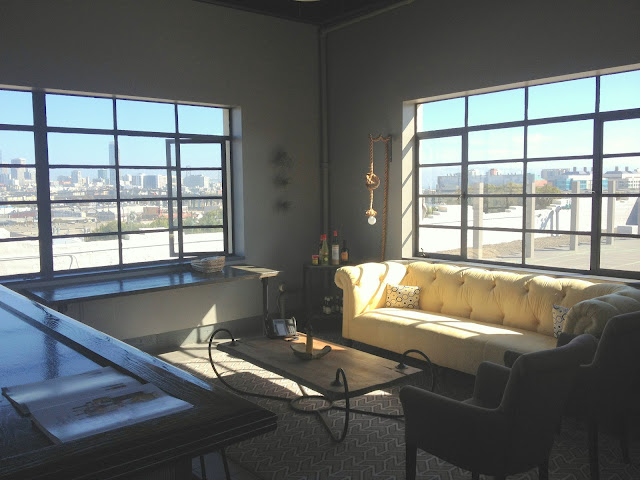
Months back I visited Anchor’s new rooftop bar, a window-heavy respite with chic yellow couch, wood bar, and striking views of downtown San Francisco and the Bay Bridge. They are close to finishing a deck which will function as a beer garden of sorts, surrounded by herbs and hops. They’ve recently acquired bartending legend Brian Rea‘s cocktail library, considered to be the most extensive in the world. King says they plan to have a library room on the top floor of Anchor near the bar where industry folk can peruse vintage books (cozy on the couch with those views) and try them out at the bar with the extensive collection of Anchor spirits and imports. It will be one-of-a-kind as an industry space.

On top of this, Anchor Distilling continues to sell a number of exciting imports in an ever-growing catalogue, like Glenrothes’ brand new release of the first in a line of Extraordinary Casks from the 1960s and ’70’s, and elegant, refined Hine Cognac, the standout being Hine Antique XO poured at this year’s WhiskyFest. Especially exciting is the import of Nikka whiskies from Japan. We have had to stick to Nikka when overseas and in general, there’s not close to enough Japanese whiskies being imported into the US compared to what is available in Japan. King says he’s hoping in to soon have five or six Japanese whiskies from the Nikka portfolio here in the States, including Yoichi and Taketsuru. We sipped the latter while I learned of the compelling story of its namesake, Masataka Taketsuru. He worked in various distilleries in Scotland, married a Scottish woman, Rita, eventually returning to Japan and founding Nikka as a company (initially named Dai Nippon Kaju K.K.)

We ended our chat with a pour of 16 year Hotaling’s single malt whiskey, Anchor’s crowning beauty (and rarity – this release at only 274 bottles), which I have been privileged to taste a few times. With the view of San Francisco before us, it seems our city’s entrepreneurial, visionary spirit continues to inform Anchor’s direction, just as it has with Fritz Maytag since the 1960’s.

Subscribe to Virgina’s twice-monthly newsletter, The Perfect Spot

Another bizarre Realtor video: London Calling

15

I don’t know who the San Francisco Association of Realtors has hired to make its campaign videos, and the Realtor folks aren’t calling me back (imagine that). But it’s some weirdo shit. They’ve got Eric Mar holding meetings in a steam room — and now they’ve got London Breed portrayed as cheddar cheese in a sandwich.

For real.

It’s called “London Calling,” and no, there’s no clash music. It starts off as if it’s heading into Journey, but then becomes it’s own peppy vocal track, with lines like “London Breed, London Breed, She’s the one San Francisco needs” and (my all-time favorite) “London Breed will bring us together, We are slices of bread, she’s the melted cheddar.”

Which voters is that aimed at?


Rich Table

3

virginia@sfbg.com

APPETITE Not since State Bird Provisions and AQ opened towards the end of 2011 have I been as excited about an opening. Evan and Sarah Rich’s new Rich Table is, kinks and all, even in the first month, well-rounded and satisfying. With efficient, informed service, reasonably priced wine list, few but well-crafted cocktails, a comfortable dining room with rustic-urban decor, and most importantly, a number of exquisite dishes, Rich Table is primed for greatness.

The Riches, a husband-and-wife chef duo, both worked at Bouley in New York and Coi here in San Francisco. Evan was also at Quince, Sarah at Michael Mina — and the couple hosted memorable pop-up dinners at Radius last fall. This fine dining pedigree infuses their mid-range menu. At other restaurants, dishes don’t often surprise beyond a menu reading. But here numerous dishes are more fascinating than their descriptions suggest. At AQ, dishes are works of art unfolding in layers of unexpected flavor. At Rich Table, there’s an approachable comfort elevated with refined nuances.

On the light bites side, everyone (and I mean everyone) has been buzzing about paper-thin potato chips ($7) with sardines interwoven through the center, dipped in horseradish cream. I’m a big sardine fan : these are not overrated, worth ordering every time. I brushed past Castelvetrano olives ($5) as common — thankfully a dining companion ordered them on one visit. Brightened by celery leaves and preserved lemon, the olives pop.

On an early visit, popcorn soup ($10) tasted like buttery, pureed popcorn in a bowl. Yuzu kosho (a fermented paste of chili peppers and yuzu rind) perks up the creamy bowl. Outstanding squid dishes ($14) morph with seasonal ingredients. The first incarnation wowed, the plump squid lively with watermelon yet simultaneously savory in black olive vinaigrette, dotted with crispy onions. This sweet-tangy, fresh-grilled dish was such a joy, I couldn’t help but be a little let down by its successor: squid with figs, crisp onions and lardon draped across the top. The breezy luminosity brought by the melon felt a bit weighted down with figs, though still a winning dish. Crushed peas ($14) with California yellowtail and saltine crackers to scoop up is vivaciously fresh, but comes in a slight (i.e. miniscule) serving.

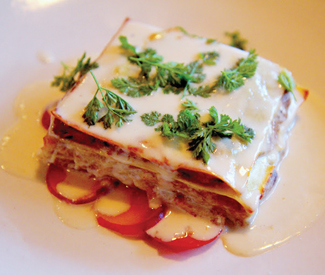
The menu is not easily categorized nor a copycat of anyone, but is packed with pleasures peeking out in unforseen places. Case in point? The pasta. I could come here for pasta alone (one dinner I ordered all four pasta dishes on the ever-changing menu). None shines more than a divine duck lasagna ($19). A smile crosses my face just thinking of delicate, melting sheets of pasta, layered with braised duck, light béchamel, and tart Santa Rosa plums. It’s a glorious pasta dish with no equal in this town… or in any other. Other pasta dishes may not reach these heights but each is worthwhile, even excellent, whether rigatoni bolognese ($18) elevated by bone marrow and crispy kale or beets, or spaghetti ($18) tossed with Jimmy Nardello peppers and clams.

On the entree front, lichen-poached rabbit ($25) is heartwarming as it is gourmet, mingling with cippolini onions, radicchio leaves and broccoli raabe. Pork belly panzanella ($24) is the classic Italian bread salad of tomato, basil, cucumber and toasted bread cubes tossed with fatty pork belly, though I took to a hearty tomato-braised oxtail on toast ($25) even more. While accompanying grilled octopus and collard greens seemed disparate, the meaty toast alone makes it worthwhile, as satisfying as Southern BBQ.

Sarah Rich’s desserts (all $8) maintain the comfort-meets-craft spirit of the restaurant from a bright melange of chilled melon to caramelized olive oil cake in strawberries, a heightened strawberry shortcake. Panna cotta lovers shouldn’t miss Sarah’s silky rendition with changing seasonal accents.

Wines are priced by glass, carafe or bottle, conveniently grouped in three white and three red price categories, with strong options like 2010 Christian Moreau Chardonnay from Burgundy, or a 2011 COS Frappato from Sicily. The cocktail list ($10 each) is short — no more than four or five at a time — and I’ve sampled six different ones. While some fare better than others (the Barn Wood, with Buffalo Trace bourbon and bitters, was a bit too musky-sweet from stone fruits), most offer understated elegance, actually different than other cocktail menus in simple purity.

The star is the lush, green Big Night, which looks like a healthy, green veggie drink, but is subtly smoky Del Maguey Vida mezcal mixed with nasturtium and ginger, topped with an edible flower. It’s clean, strong, memorable. As is Land’s End, the Riches’ answer to a martini, using the incomparable St. George Terroir Gin, dry vermouth and foraged Monterey cypress. On the light, soft side, Let’s Go is a refreshing sipper of Encanto pisco, coconut water and lime.

Sarah, Evan, and the engaged staff serve a warm vibe at their table in Hayes Valley — and an ever unexpected menu that focuses simultaneously on flavorful comfort and elegant simplicity.

RICH TABLE

199 Gough, SF.

(415) 355-9085

www.richtablesf.com

Subscribe to Virgina’s twice-monthly newsletter, The Perfect Spot, www.theperfectspotsf.com

The big show

1

cheryl@sfbg.com

FILM/LIT Any horror fan can tell you that John Carpenter directed and co-wrote 1978’s Halloween. But it would require a slightly more credits-obsessed moviegoer to recognize the name of behind-the-scenes maestro Irwin Yablans.

In addition to being Halloween‘s producer, Yablans was also responsible for cult classics like Tourist Trap (1979), Roller Boogie (1979), and Hell Night (1981). His new autobiography, The Man Who Created Halloween: How a Bit of Desperation and Inspiration Gave Birth to the Movie That Changed Hollywood (self-published, 259 pp., $16.95), traces his path from Brooklyn childhood to Hollywood player. Along the way, he served in the army, met the love of his life, feuded with his brother (fellow film producer Frank Yablans), and — on a flight from London to Los Angeles — had a brilliant brainwave about babysitters being stalked by a killer on the scariest night of the year. I spoke with Yablans, who turned 78 this year, over the phone from Southern California.

San Francisco Bay Guardian What inspired you to write a memoir? 

Irwin Yablans I kind of kept quiet about all this stuff through the years because I was only involved in the first three [Halloween films]. I was really not able to gauge the public’s insatiable appetite for Michael Myers! And I got tired of it after awhile. I wanted to do other things. But I came back into the picture because there was a lot of misinformation and revisionist history floating around, and I thought it was time I talked about it. Then, I decided to write a book about my life.

And Halloween is going out into 1,000 theaters on Halloween this year — that’s amazing! When I came up with the little idea on an airplane 35 years ago, little did I know. [Laughs.] There’s a lesson to be learned from that: never underestimate the possibilities of a good idea. Don’t ever assume that because you thought of it, it might not be good. You have to believe in yourself.

[Pauses.] Before I go any further, I have to make a confession: I am a Giants fan. And I have been since 1947, because I was a Giants fan in New York. I was at the Polo Grounds in 1951 and watched Bobby Thomson hit that home run — in case you don’t know what that is, it’s the most famous moment in baseball history. I still watch the Giants every day. And I’ll tell you, they look pretty good this year!

SFBG Why did you decide to go the self-publishing route?

IY Well, I’d never written a book before. I’d always done a little writing for the movies, but about seven or eight years ago I thought I’d sit down with my computer and peck away. The first word I wrote was “cockroaches.” [Laughs.] I wanted to write for my family — I thought I’d leave behind some musings about my life that might be interesting for my kids and my grandchildren. About 50 or 60 pages in, I showed it to some people I respect and they said, “You ought to think about publishing this.”

When I got close to the end, I submitted it to a couple of publishers. I’d never been part of that world before — [and I realized it] was just like how I got into my independent film company. I found a publisher who wanted to publish it, but I found out that if I went with them, not only would they get a large portion of the receipts, but they don’t put any money up, or do any publicity or advertising.

So I said to myself, “Why do I need them?” [I found] CreateSpace on the internet, and I’ve had the most amazing experience. Independence is sort of in my blood. I like doing things myself, [even] my own public relations. You read in the book why we chose Jamie Lee Curtis [for Halloween] — when I met Jamie, I knew she was a fine actress, but I had this vision of getting a photo of her mother, Janet Leigh, and putting Jamie in a similar pose, and submitting it to AP and UPI. We got worldwide publication of that. And that’s the kind of thing I did all the way through with Halloween. You just have to take every opportunity to publicize the picture. Of course, John Carpenter made a very good movie.

SFBG I have to ask about Roller Boogie. It’s a midnight-movie favorite in San Francisco.

IY No kidding! [Laughs.] You know what’s great about that movie? The music! Earth, Wind, and Fire … it’s just a delightful little movie. Just great fun. I think I had more fun making that movie than any other movie I made, because it was so uplifting and so bright — I was on roller skates with my whole family during the shoot. I love the “Boogie Wonderland” number, and Linda Blair was such a charmer.

I tell you, the ’70s and ’80s were a lot of fun for me. I was so busy, making movies, distributing movies, and running all over the world. It was a great experience. I really loved every moment of it.

www.irwinyablans.com


Mirkarimi case — the aftermath

98

So many things to think about after last night’s Board of Supervisors vote on Ross Mirkarimi. It was a dramatic moment in local politics, a clear rejection of the mayor by four supes, including one of his appointees, a show of political courage by some and weakness by others.

But before I get into that, let me say:

I argued against removing Mirkarimi, for a lot of reasons. One of the most important is the precedent here — the City Charter gives the mayor too much power, the ability to singlehandedly remove an elected official for what the city attorney’s office concluded was pretty much any reason at all. There is no definition of “official misconduct” — and the way this case was presented, it could be interpreted really broadly. That’s dangerous, and the supervisors (or four of them, anyway) knew it.

I’m also a believe in restorative justice, in redemption, in the idea that people can do bad things and turn themselves and their lives around.

Still, it’s important to remember that what Mirkarimi did on New Year’s Eve, 2011, was awful, unacceptable. He was, at the very least, a total asshole and a jerk, treating his wife in a way that was — again, at the very least — psychologically abusive. Some of the comments at the board meeting were way off base; some speakers attacked the domestic violence community and made it sound as if Mirkairmi’s crime was pretty minimal.

I agree with David Chiu that the city’s going to have to come together after this — and the progressives who supported Mirkarimi are going to have to reach out to, and work with, the DV advocates. Because domestic violence is no joke, is no “private matter,” is still a major, serious issue in this city, and the worst possible outcome would be a reversal in San Francisco’s progressive policy on handling these cases.

I wish the audience hadn’t erupted in cheers when the final votes were cast. I heard Mirkarimi on Forum this morning, and when Michael Krasny asked if he was “elated,” he indicated that he was. Wrong answer: Nobody should be happy about what happened here. Mirkarimi’s biggest political and personal flaw has always been his ego, which at times bordered on arrogance, and that has to end, today. The sheriff needs to be humble about what happened to him, recognize that nobody “won” this ugly chapter in city history, and get back to work trying to mend fences with his critics. He’s facing the very real possibility of a recall election, and if he acts like he’s been totally vindicated, it’s going to happen.

This is a chance for Mirkarimi to take the notion of restoration and redemption seriously — by doing what Sup. John Avalos suggested at the hearing. He has to become a changed man. He has to show the world that he really, really gets it. Starting now.

Speaking of change …. the Number One Profile in Courage Award goes to Sup. Christina Olague. Olague was under immense pressure from the mayor, who wanted her vote badly. And because of the rotation of the votes, she had to go early, when it wasn’t clear at all which way this was going to turn out. And she came through, 100 percent solid. She made all the right points, and once she said she was going to vote against the mayor’s charges, the whole thing was over. At that point, there was no way David Campos or John Avalos could or would go the other way, so Mirkarimi had his three votes. I have been critical of Olague, but in this case, I want to give full credit: She did the right thing, when it wasn’t easy. She may have just won the election. (Let me clarify that — she may have kept herself from losing the election.)

Sup. Jane Kim was brilliant in her questioning of the mayor’s representatives and her analysis of the case. She showed real leadership and helped set the stage for what happened by pointing out the flaws in the mayor’s case.

And of course, Campos and Avalos, the undeniable, solid left flank of the board, came through.

It wasn’t easy for any of these four supervisors, and they all deserve immense credit.

Not so Eric mar, who I realize is in a tough race, but … when Olague, who has been accused of being too close to the mayor, had the courage to stand up, Mar, who has nearly universal progressive support, did not.

This is a great opportunity for the city to start talking about restorative justice in a serious way. Let’s get started.


Local censored 2012

0


BEHIND THE MIRKARIMI CASE

In early January, details from the police investigation of then-Sheriff-elect Ross Mirkarimi bruising his wife’s arm during an argument were leaked to the San Francisco Chronicle and other news outlets. The key piece of evidence was a 45-second video that Mirkarimi’s wife, Eliana Lopez, made with her neighbor, Ivory Madison, displaying the bruise and saying she wanted to document the incident in case of a child custody battle. That video convinced many of Mirkarimi’s guilt, and a majority of Ethics Commissioners say they found it to be the main evidence on which Mirkarimi should be removed from office on official misconduct charges (the Board of Supervisors was scheduled to vote on Mirkarimi’s removal on Oct. 9, after Guardian press time).

But that video was only a small part of the overwhelming and expensive case that Mayor Ed Lee brought against Mirkarimi, including the more serious charges of abuse of power, witness dissuasion, and impeding a police investigation, all of which go more directly to a sheriff’s official duties. All of those charges got lots of media coverage and they helped cement the view of many San Franciscans that Mirkarimi engaged in a pattern of inappropriate behavior, rather than making a big momentary mistake. Yet most of the media coverage during the six months of Ethics Commission proceedings ignored the fact that none of the evidence that was being gathered supported those charges. Indeed, all those charges were unanimously rejected by the commission on Aug. 16, a startling rebuke of Lee’s case but one that was not highlighted in many media reports, which focused on the one charge the commission did uphold: the initial arm grab.


THE NEXT DOT-BOMB

In the late 1990s, San Francisco was in a very similar place to where it is now. The first dot-com boom was full bloom, driving the local economy and creating countless young millionaires — but also rapidly gentrifying the city and driving commercial and residential rents through the roof (great for the landlords, bad for everyone else). And then, the bubble popped, instantly erasing billions of dollars in speculative paper wealth and leaving this a changed city. The city’s working and creative classes suffered, but the political backlash gave rise to a decade with a progressive majority on the Board of Supervisors.

The era ended in 2010 when Ed Lee was appointed mayor, and he began ambitious agenda of pumping up a new dot-com bubble using tax breaks, public subsidies, and relentless official boosterism to lure more tech companies to San Francisco. Lee has been successful in his approach, in the process driving up commercial rents and housing prices. By some estimates, about 30 percent of the city’s economy is now driven by technology companies.

Yet there have been few voices in the local media raising questions about this risky, costly, and self-serving economic development strategy. The Bay Citizen did a story about Conway’s self interested advice, the New York Times did a front page story raising these issues, and San Francisco Magazine just last month did a long cover story questioning how much tech is enough. But most local media voices have been silent on the issue, and much of the damage has already been done.


OLD POWERBROKERS RETURN TO CITY HALL

More than a decade ago, then-Mayor Willie Brown and Chinatown power broker Rose Pak worked together to empower big business, corrupt local politics, and clear the path for rampant development — an approach that progressives on the Board of Supervisors repudiated and slowed from 2000-2010. But Brown, Pak, and a new generation of their allies have returned in power in City Hall, and it’s as bad as it ever was.

Many San Franciscans know of their high-profile role appointing Lee to office in early 2011. But their influence and tentacles have extended far beyond what we read in the papers and watch on television, starting in 2010 when their main political operatives David Ho and Enrique Pearce ran Jane Kim’s supervisorial campaign, beating Debra Walker, a veteran of the fights against Brown’s remaking of the city.

Now, this crew has the run of City Hall, meeting regularly with Mayor Lee and twisting the arms of supervisors on key votes. Pearce and Ho persuaded longtime progressive Christina Olague to co-chair the scandal-plagued Run Ed Run campaign last year, she was rewarded this year with Lee appointing her to the Board of Supervisors. Pearce has been her close adviser, and most of her campaign cash has been raised by Brown and Pak. Even progressive Sup. Eric Mar admits that Pak in raising money for him, a troubling sign of things to come.


THE REAL OCCUPY STORY

The Occupy San Francisco camp that was cleared by police last week may have been mostly homeless people. And major news media outlets from the start reported that Occupy was dangerous, filthy, and a civic eyesore.

But last fall, the camps were comprised of a huge variety of people that chose to live part or full time on the streets. Students, people with 9-5 jobs, people with service jobs, and the unemployed were all represented. Wealthy people who lived in the financial districts where camps popped up mixed with working-class people who came from suburbs and small towns. Families came out, welcomed in the “child spaces” set up in many Occupy camps throughout the country. Most camps also boasted libraries, free classes, kitchens, food distribution, and medical tents.

As news media focused on gross-out stories of pee on the streets and graphic descriptions of drunk occupiers, they managed to ignore the complex systems that were built in the camps. Nor did anyone mention that homeless people have the right to protest, too.