Restaurants

Get read!

0


ROCK AND ROLL ALWAYS FORGETS

By Chuck Eddy

Duke University Press

352 pp., paper, $24.95

Chuck Eddy glides through music criticism like a grumpy fanatic. Each article included in Rock and Roll Always Forgets — culled from Eddy’s vast back catalogue of music journalism articles, beginning with the early 1980s — is packed with cultural references, touchstones, facts, witty asides, a dash of snark, and acknowledgments of once-obscure acts. Yet, he approaches each band like he’s the first to have discovered it. He’s a musical anthropologist, but also, archeologist, digging up the remains of musicians past, lest we forget. Take a piece on a Marilyn Manson show, written in 1996. More than simply describing the stage and the crowd (which he does, expertly: “[they] wore too much black makeup, but they didn’t scare me — most seemed to be upper-middle-class Catholic school teens from the burbs…”). He wanders near profundity, dissecting Manson’s overall persona, his ticks, his own cultural references, and those who came before him, namely Alice Cooper, but a great many more. Most importantly, Eddy alludes to why that all matters in the least. (Emily Savage)


TROPIC OF CHAOS

By Christian Parenti

Nation Books

295 pp., hardcover, $25.99

Through historical research and on-the-ground reporting in Kenya, war-torn areas of Afghanistan, and other regions marked by intense conflict, Christian Parenti offers an unusual and compelling analysis of violence through the lens of the environment. Tropic of Chaos: Climate Change and the New Geography of Violence teases out the idea that increasingly unstable weather patterns stemming from climate change have fueled conflict throughout impoverished areas of the Global South. In the savannahs of northwest Kenya, for instance, deadly cattle raids have intensified as intertribal warfare heats up in the face of water scarcity. Recurring droughts and floods in Afghanistan have made it exceedingly difficult for farmers raise traditional crops, making them increasingly reliant drought-resistant poppy — the raw ingredient for heroin — for economic survival. Parenti also turns a sharp eye upon the repression, surveillance, and counterinsurgency that first-world nations have employed to combat growing violence in water-scarce, conflict-ridden regions, and calls for a more enlightened approach. (Rebecca Bowe)


CAFE LIFE SAN FRANCISCO

by Joe Wolff

Interlink Books

224 pp., paperback $20

Small quirks in this guide to the city’s cafes and coffeehouses — the sixth in a series that includes Sydney, New York, and Venice — will let you know its not strictly, strictly for locals. Java Beach is lumped in with more gearhead-oriented Mojo Bicycle Cafe and Ninth Avenue’s Arizmendi Bakery is filed under the catchall “Sunset District and vicinity.” The introduction’s discussion of “San Fran” versus “Frisco” versus “the City” is one that became boring long ago. But those things matter little. In-depth histories of some of your favorite cafes, from Java Beach to Philz’ to Caffé Baonecci are lucid looks at the facts and rewards of small entrepreneurship in the city. And Roger Paperno’s loving photography of velvet crema and foccacia sheets combines with words to create an ode to the city’s third spaces that any caffeine-laptop addict will appreciate in their stocking. (Caitlin Donohue)


LIONS OF THE WEST: HEROES AND VILLAINS OF THE WESTWARD EXPANSION

By Robert Morgan

Algonquin Books

497 pp., hardcover, $29.95

Biography can be the best history; stories of the people who changed the world (for better, and often for worse) are more compelling than turgid texts of dates and places. Lions of the West recounts the development of the American frontier from the end of the Revolutionary War to the Civil War era through the lives of 10 men. Yeah, all men. In fact, Morgan (by choice or by the longtime bias of American historians) makes it appear as if all of the great and evil deeds done as the nation moved Westward Ho were the province of the male of the species. At times, the profiles are a bit over the top (I don’t really care that much about Kit Carson’s personal life.) Overall, though, it’s a detailed, lively, and informative book that minces no words, especially when discussing the theft of much of the southwest from Mexico. San Franciscans will enjoy learning who Stockton, Sloat, Castro, Winfield, and a few other streets were named after. (Tim Redmond)


VHS: ABSURD, ODD, AND RIDICULOUS RELICS FROM THE VIDEOTAPE ERA

By Joe Pickett and Nick Prueher

Running Press

272 pp., paper, $14

Found Footage Festival founders and comedy writers Joe Pickett and Nick Prueher are apparently the Indiana Joneses of VHS, unearthing remarkable video package cover art that would otherwise be relegated to hoarder basements, bonfires, and anywhere else the worst (a.k.a., the best) videotapes go to die. I salute these dudes, even though the captions they tag each page with aren’t always funny or necessary. Truly, the covers (soft-focus and garish, tacky and baffling) speak for themselves, direct dispatches from ye olden days, long before YouTube brought WTF-ness to anyone with an Internet connection. You see, children, back in the 1980s or 90s, home viewers had to seek this shit out: instruction in squirrel-calling, chair-dancing, seduction, hairstyling (“What the Heck Am I Going to Do With My Hair?”), baby-proofing, spotting counterfeit Beanie Babies, etc. Straight-to-video masterpieces (F.A.R.T.: The Movie). Horrible exercise fads (“Bunnetics: The Buttocks Workout”). Well-meaning but also ghoulish-looking self-improvement vids (“Face Aerobics”). Every page is magical. Your mind will be blown. (Cheryl Eddy)


BI-RITE MARKET’S EAT GOOD FOOD

By Sam Mogannam and Dabney Gough

Ten Speed Press

297 pp., hardcover, $32.50

Bi-Rite Market is the ultimate neighborhood grocery. Shockingly small (with ambition to expand), it’s jam-packed with the best in organic produce, meats, cheeses, and artisan food products, much of it local. Now, Bi-Rite founder Mogannam has a new book loaded with recipes for such inviting delectables as white bean puree with prosciutto crespelle and strawberry rhubarb pie. But don’t relegate it to the cookbook category. Hewing to Bi-Rite’s mantra of creating community through food, the authors share extensive tips on shopping seasonally and locally for the healthiest and best-tasting products, no matter where you may live. You’ll learn what to look for at the grocery, storage and usage tips, and more. Well-illustrated sections feature produce (broken down by season), wine, beer, cheese, deli meats, butchery, baked goods, and even farmer profiles. Bonus: stay tuned for Sweet Cream and Sugar Cones, Bi-Rite’s ice cream and frozen treats recipe book from its renowned creamery, out this April. (No word yet on whether it’ll tell us how to beat the ever-present line outside.) (Virginia Miller)


DAMNED

By Chuck Palahniuk

Doubleday

247 pp., hardcover, $25

Welcome to Hell, as seen through the eyes of 13-year-old Madison Spencer, the daughter of a jet-setting yet eco-hyperconscious movie starlet and philanthropist. This is Dante’s Inferno meets The Breakfast Club, a film that overtly informs the plot and its main characters. As in Palahniuk’s breakout novel Fight Club, it’s hard distinguish between reality and perception as Maddy leads readers past the Vomit Pond, across Dandruff Desert, and right into Satan’s black Town Car. As she recalls her final weeks on earth, you’re pretty sure that she didn’t really die from a marijuana overdose. Clearly, things are not what they seem as the novel looses an American teenager’s perspective on modern life in both the underworld and earthly realm, with wry commentary on everything from pop culture and capitalist excess to the defeated religions whose fallen gods roam Hades. The gags alone — like the telemarketing and chatroom porn the damned deliver to Earth, and Hell’s endless loop of The English Patient — make this a tough book to put down, all the way to its slightly unsatisfying conclusion. (Steven T. Jones)


BEST AMERICAN COMICS 2011

edited by Alison Bechdel

Houghton Mifflin Harcourt,

352 pp., paperback $25

Chris Ware’s textbooky flowcharts; Angie Wang’s Technicolor, spiraling pistil-armed super-flower-heroine; Peter and Maria Hoy’s intricately plotted cause-and-effect grid art — the sixth year of this hardcover assemblage of the year in superlative strip art soars as a holiday gift for your fave comic nerd. Visual trickery and innovative page staging aside, many of the graphic narratives in this book hold up on plot alone. An excerpt from Kevin Mutch’s Fantastic Life effectively mines zombie philosophy, dating paranoia, and begging drinks off your service industry friends for comic gold. Many of the best pieces, perhaps indicative of the graphic novel mood these days, explore the darker side of the human psyche. But what graphic novel fan is unfamiliar with complicated? (Caitlin Donohue)


THE TIPSY VEGAN

By John Schlimm

Lifelong Books/Da Capo

164 pp., paper, $17

Every time I think we’re past the stereotype of the sullen, uptight vegan, I get another comment like, “Wait, don’t you only eat vegetables?” Why yes, I do eat plenty of veggies, but I also eat decadent dishes such as The Tipsy Vegan‘s Party Monster Pancakes, loaded with the sweet nectar of amaretto and drenched in syrup. This book is a carnivorous teetotaler’s nightmare, boasting 75 boozy recipes stuffed with everything from “beer to brandy” for the liquor-loving vegan cooks among us. It’s not, as I initially imagined, a book on vegan cocktails — that would be far too easy. Written by John Schlimm (Ultimate Beer Lover’s Cookbook), a member of “one of the oldest brewing families in the United States,” the book includes booze-infused treats for parties, brunch, and supper: fried avocados, slur-baaaaked peaches with Cointreau, “Bruschetta on a Bender” — all of which kind of sound like stoner food to me. An nice touch: glossy food porn shots on every page. (Emily Savage)


PROJECT DOG

By Kira Stackhouse

self-published

352 pp., hardcover, $34.99

Local photographer Kira Stackhouse experienced an inspiration so intense that she ditched her high-profile marketing job to pursue it: she would photograph specimens of the 50 most popular canine breeds officially registered with the American Kennel Club (“purebred dogs”) that had been purchased from professional breeders — and pair them with photos of the exact same kinds of dogs found in local dog rescues and shelters. The purpose was to start a dialogue about the effects of professional breeding and highlight the many kinds of dogs available for adoption (and also to change peoples’ perceptions about rescue dogs). But a major part of the story — and what makes this book so fantastic — is the wonderful doggy photography and sumptuous layout. Dogs are posed, or pose themselves, against iconic Bay Area backdrops, accompanied by often hilarious, always revealing, biographies and profiles. Project Dog became an online sensation: this book cements its reputation. Available at www.projectdog.net. (Marke B.)


LISTEN TO THIS

By Alex Ross

Picador

384 pp., paper, $18

In the expanded paperback edition of his absorbing and erudite collection of essays, Alex Ross of the New Yorker writes what could be called his mantra as critic: “I have always wanted to talk about classical music as if it were popular music, and popular music as if it were classical.” Ross listened exclusively to classical until he was 20, something he admits may sound “freakish.” But whether he’s describing Björk in her recording studio in Iceland, or composer John Luther Adams’ sound and light installation in Alaska, Ross draws from an immeasurable well of knowledge and plunges into his subject with gusto. He can find commonalities between Radiohead’s “Pyramid Song” and Stravinsky’s Firebird Suite, clear away the myths that have clouded both Franz Shubert and Bob Dylan, and thoroughly explain why OK Computer and John Cage’s 4’33” are equally astonishing. Informative, eye opening, Ross is every lover of music thrown harmoniously into one. (James H. Miller)


MY FAMILY TABLE

By John Besh

Andrews McMeel Publishing

272 pp., hardcover, $35

To know anything about New Orleans’ dining scene is to know John Besh. As one of Nola’s great chefs, he has a number of restaurants, including the acclaimed August, elevating local cuisine in forward-thinking ways. His original book My New Orleans is a striking post-Katrina tome to one of the greatest cities in the world and its vibrant culinary history. It’s a gorgeous coffee table volume packed with photos of the region’s people, places, and foods — more than 200 recipes from Mardi Gras specialties to gumbo, many with a contemporary twist. Besh just released, My Family Table, with welcoming, everyday recipes he cooks with his family that are healthy, fresh, simple, and heartwarming. Besh’s star power (Iron Chef champion and James Beard award-winner that he is) never dominates. Like New Orleans, it’s a visually beautiful book, but this time themed by “School Nights,” “Breakfast with my Boys,” and recipes like “Curried Anything” or “Creamy Any Vegetable Soup.” Closing with the key element of cooking, the communal, he writes: “If asked what my last meal would be, I’d reply, ‘Any Sunday supper at home, cooked with love, for people I love.'” (Virginia Miller)


FOUR SEASONS OF YOSEMITE: A PHOTOGRAPHER’S JOURNEY

By Mark Boster

Time Capsule Press

128 pages, hardcover, $34.95

John Muir would have loved this book, the spectacular result of a passionate love affair with Yosemite National Park involving all of the principals in this impressive project. Muir helped glorify and preserve Yosemite with his voice and pen. Robert Redford, who fell in love with Yosemite as an 11-year-old boy recovering from a mild case of polio, wrote an eloquent introduction to the book. Photojournalist, Mark Boster was smitten by the beauty and grandeur of the Yosemite when he first visited the park as a child with his family. He spent a year in the park detailing its seasonal changes in more than 100 magnificent pictures. “I felt the breezes, analyzed the light, listened to the sound of the rivers and falls, and tried to capture the images that moved me,” he writes in his introduction. Catherine Hamm’s delicate haiku add a poetic touch to many scenes. (The two principals who brought this project to life with loving care are Narda Zacchino, a former editor of LA Times and the Chronicle, and Dickson Louie, a former executive at both those papers. Zacchino serves as publisher and editor and Louie as president and CEO of Time Capsule Press, which specializes in creating books by using the archival content of newspapers and magazines.) Available at www.fourseasonsofyosemite.com (Bruce B. Brugmann)


THE PDT COCKTAIL BOOK

By Jim Meehan

Sterling Epicure

368 pp., hardcover, $24.95

Few bars have made as much impact on the New York cocktail (and thus the international) scene than PDT. Known as an early mover in the speakeasy trend, PDT revives classic recipes and invents new ones in the classic spirit. Bartender Jim Meehan put PDT on the map, and he’s since gone on to write about drink and educate bar managers and tenders everywhere. In the PDT Cocktail Book, he shares more than 300 cocktail recipes in a comprehensive collection inspired by classic tomes like The Savoy Cocktail Book. There are recipes from generations of hard-working bartenders, tips on glassware, bar tools, equipment, garnishes, techniques, a listing of seasonal ingredients, even a spirits primer. In keeping with PDT’s connection to neighboring Crif Dogs who serve creative dogs in the bar, there’s a section of hot dog recipes from big-name chefs who are regulars at the bar, including David Chang (Momofuku), Wylie Dufresne (WD-50), and Daniel Humm (Eleven Madison Park). From the comfort of home, cook up a Mason Dog fried in cornmeal and huitlacoche (corn smut/fungus, a Mexican specialty) to go with the Little Bit of Country cocktail, which mixes bourbon, maple, and jalapeño. (Virginia Miller)


EVERYTHING IS ITS OWN REWARD: AN ALL OVER COFFEE COLLECTION

By Paul Madonna

City Lights

240 pp., hardcover, $27.95

Like Ben Katchor’s classic “Julius Knipl, Real Estate Photographer,” local artist Paul Madonna’s “All Over Coffee” — published every Sunday in the Chronicle and on essential Web zine The Rumpus (www.therumpus.net) — draws me into a psychic space that is at once serene and troubled, surreal and hyperreal. The effect comes as much from the drawing style as the dreamlike non-narrative: both are direct descendants of Winsor McKay’s “Little Nemo.” Madonna gets an extra chills-up-the-spine boost from his illustrations of semi-familiar San Francisco architecture and intersections, lucid as etchings of bleached Kodachrome shots. For this second collection of the strip, he broadens his nib to include not only the City by the Bay, but Paris, Rome, Buenos Aires, and Tokyo. Overheard quotes, snatches of philosophical discourse, interior monologue snippets, existential doubts, random observations, and short stories are floated over the images to capture a peculiarly lovely eddies in the zeitgeist.


I DON’T WANT TO KILL YOU

By Dan Wells

Tor

320 pp., paperback, $11.95

Some of this is sick shit. You need a warped sense of humor and a love for random violence to enjoy the tale of a young man who lives with his mom in a mortuary and fights a demon made of black goo who takes over the minds and bodies of humans. But it’s a different type of thriller — complete with its own kinda sweet moments of teenage love and angst — and it’s packed with great detail. (Did you know that undertakers use Vaseline to fill up bullet holes? Cool.) John Wayne Cleaver, perfect name for a demon hunter, is a sociopath who is beastly to his mother and can’t get along with the other kids . Except for a super-hot chick who he thinks must be a demon, otherwise why would she like such a loser geek? The demon is nasty and gouges out eyes, cuts off tongues, sticks bodies on poles … you gotta check it out. (Tim Redmond)


RICE AND CURRY: SRI LANKAN HOME COOKING

S.H. Fernando, Jr.

Hippocrene Books

224 pp., paperback, $19.95

After a tongue-inflaming visit to the East Village’s fantastic Sigiri restaurant in NYC a couple weeks back, my interest in — and lust for — spicy Sri Lankan treats like kiri hodhi (coconut milk gravy), rossam (coriander-tamarind broth), kool (seafood soup), Jaffna goat curry, and ulundu vai (savory donuts) was, er, inflamed. Fortunately for me, author “Skiz” Fernando recently spent a year on the island rediscovering his roots and delving into the varied cuisine (later serving as a guide for that cheeky culinary colonist Anthony Bourdain). The punchy, informative Rice and Curry is the result, and includes nice introductions to Sri Lankan geography and history, as well as tips on what to stock in your cupboard to achieve the certain Sri Lankan “oomph” that sets the cuisine apart from Indian. A particular passage that profiles Leela, Fernando’s aunt’s ancient maid, offers some real insight into the island’s food tradition and customs — and yields a marvelous, corruscating crab curry from her hometown of Chilaw, just in time for Dungeness season. (Marke B.)


HEDY’S FOLLY: THE LIFE AND BREAKTHROUGH INVENTIONS OF HEDY LAMARR

By Richard Rhodes

Doubleday

261 pp., hardcover, $26.95

An author best-known for his 1986 Pulitzer-winning The Making of the Atomic Bomb, Richard Rhodes might seem like an unlikely biographer for movie stunner Hedy Lamarr, who lit up Golden Age films like Cecil B. DeMille’s 1949 epic Samson and Delilah. But her above-average qualities (she was called “the most beautiful woman in the world”) extended beyond the superficial. After escaping her gilded-cage marriage to an Austrian munitions magnate, Lamarr found success — and five more husbands — in Hollywood; between roles, she started inventing “to challenge and amuse herself.” During World War II, she got serious about her hobby. Showbiz circles led her to avant-garde musician George Antheil, renowned for his groundbreaking composition for 1924 short Ballet Mécanique. As Rhodes writes, “[Lamarr] began thinking about how to invent a remote-control torpedo to attack submarines just at the time she met Antheil, who knew quite a lot about how to synchronize player pianos.” Together, the “charming Austrian girl” and “the bad boy of music” worked on that torpedo, as well as “spread-spectrum radio,” an innovation that paved the way for contemporary wireless technology. Unlikely? Yes. Fascinating? Indeed. Never underestimate a beautiful woman — or a skilled writer’s ability to humanize complicated characters and bring drama to a tale loaded with tech-speak. (Cheryl Eddy)


COME, THIEF

By Jane Hirschfield

Knopf

98 pp., hardcover, $25

As it happens, one of Bay Area poet Jane Hirschfield’s passages currently adorns the famous Kahn and Keville auto repair shop’s marquee in the Tenderloin: “What some could not have escaped/ others will find by decision/ each we call fate.” Well, you could never blame her for not thinking big. As a well-known and approachable poet, she sports a blurb from O, The Oprah Magazine on this, her ninth collection, the first in six years since releasing her arresting After. And while her slightly witchy, be-scarved, grandiloquent persona screams marketable poetess, there’s some understated magic in her latest poems. These ones are full of plums and glass and vague Zen spells that give off, in their overall effect, an rueful, anticipatory sigh. Some childlike wonder seeps in: “Another year ends./ This one, I ate Kyoto pickles,” says “Washing Doorknobs,” my favorite from the collection. “But one thing you’ll never hear from a cat/ is Excuse me” goes “A Small-Sized Mystery.” Sometimes you can almost Hirschfield her straining for ambiguity, the poems’ heavy life lessons tearing through her delicate webs of observation. Still, each poem here showcases Hirschfield’s incisive power. (Marke B.)


PLENTY

By Yotam Ottolenghi

Chronicle Books

287 pp., hardcover, $35

Recently I returned to London, eating my way extensively through the city. One of my gustatory highlights was Yotam Ottolenghi’s beloved bakery and restaurant, Ottolenghi (with four locations). Not only were his baked goods otherworldly delights, his straightforward but elegant dishes using pristine ingredients were among the freshest and satisfying of my London travels. Plenty, his new cookbook, is a cleanly designed book with vivid photos of recipes like broccoli gorgonzola pie and mushroom herb polenta. Most impressive? Ottolenghi’s recipes are 100% vegetarian. The meat-free aspect is barely emphasized, and one feels no lack in the diverse range of flavors (with Middle Eastern influences) presented. Since 2006, Ottolenghi has penned the UK Guardian’s vegetarian column — and he’s not even a vegetarian! This speaks to how respected he’s become as a chef in his use of veggies and grains. Plenty shows this talent off, but most importantly delivers approachable, easy-to-replicate recipes to tickle our palates. (Virginia Miller)


HILLBILLY NATIONALISTS, URBAN RACE REBELS, AND BLACK POWER

By Amy Sonnie and James Tracy

Melville House

201 pp., paper, $16.95

Gazing back in time to the era when the Black Panthers were serving up free breakfast to low income youth and coming into the crosshairs of COINTELPRO, few may be aware that an interracial coalition of radical organizers included a contingent of poor white southerners bent on fighting capitalism in solidarity with communities of color. Written by a cofounder of the Center for Media Justice and a longtime San Francisco housing activist, this detailed bit of radical history spotlights the organizing efforts of poor whites, transplanted from rural Appalachia to the low-income Uptown neighborhood of Chicago, to build coalitions of poor people in solidarity with civil rights leaders. Groups like Jobs or Income Now (JOIN), the Young Patriots, and Rising Up Angry launched campaigns against neglectful landlords and cops who brutalized their youth. They represented the white arc of the multiracial Rainbow Coalition, initiated by the Black Panthers in Chicago as “a code word for class struggle.” Bizarre as it may seem, “It became common to see [Panther] Fred Hampton ‘give a typically awe-inspiring speech on revolutionary struggle, while white men wearing berets, sunglasses, and Confederate rebel flags sewn into their jackets helped provide security for him.'”

(Rebecca Bowe)


MR. KILL

By Martin Limon

Soho Press

376 pp., hardcover, $24

Korea in the 1970s. The United States has 50,000 troops in country, mostly near the Demilitarized Zone, and they don’t always behave. In general, the Korean authorities allow the military to police its own — but when a young Korean woman is brutally raped on a train to Seoul, and the assailant appears to be an American, all hell breaks loose. Martin Limon lived in Korea for ten years, and he does a (fairly) good job of presenting a portrait of the Cold War tensions between the two supposed allies. There’s a little bit of American bias — the author is former military himself — and his potrayal of Korean society isn’t as sensitive or oddly loving as John Burdett’s descriptions of Thailand in the Bankok 8 series. Limon’s great storytelling and his lively and compelling protagonists, Sergeants George Sureno and Ernie Bascom, pull readers past those issues. Perfect gift for someone who likes international crime thrillers. (Tim Redmond)


THE RECIPE PROJECT

By One Ring Zero

Black Balloon Publishing

116 pp., hardcover, $24.95

It’s part cookbook, part music journalism, part rock opus, and hell, part coffee table book. The Recipe Project (subhead “A Delectable Extravaganza of Food and Music”) is a concept spearheaded by New York-based gypsy-klezmer act One Ring Zero. The band’s co-founders, Michael Hearst and Joshua Camp, created songs using the recipes of well-known chefs (Mario Batali, Isa Chandra Moskowitz, Chris Cosentino) as the word-for-word lyrics. The meals themselves served as musical influence; each recipe inspired a different sound. While the songs are not likely ones you’d listen to say, on a long lonesome drive, they do have a glint of childlike glee. It’s conceptual. The true genius of this project is its overall cohesiveness. It’s an all-in-one package. Follow the recipe, listen to the song, get some interesting background factoids. The Recipe Project also includes full recipe playlists, articles by rock journalists, and some pretty interesting interviews with chefs. (Emily Savage)


CARY GRANT: DARK ANGEL

By Geoffrey Wansell

Arcade Publishing

192 pp., hardcover, $24.95

Back in print (it was originally released in 1996), this paen to the dapper star of North By Northwest (1959), An Affair to Remember (1957), Notorious (1946), His Girl Friday (1940), and approximately 10 zillion other classic films is somewhere between a biography and a coffee-table book. It’s worth picking up for the lavish black-and-white photos alone, illustrating the span of Cary Grant’s career with film stills, behind-the-scenes shots, and the occasional almost-candid image (did he ever take a bad picture)? The accompanying text is straightforward, but — as its title suggests — doesn’t shy away from Grant’s well-documented countercultural experiments. (“Grant became so enthusiastic about the value of LSD that he extolled its virtues during the shooting of his next picture.”) Nor does it gloss over Grant’s vices (he smoked 30 to 40 cigarettes a day) and sometimes troubled personal life (he was married five times). But the book’s chief focus is Grant’s brilliant career. As Stanley Donen, who directed him three times, remarks to author Geoffrey Wansell, “He’s thought of as a man who achieved a certain elegance and savoir faire. But in truth he was a fantastic actor.” (Cheryl Eddy)


NATURAL HISTORY OF SAN FRANCISCO BAY

By Ariel Rubissow Okamoto and Kathleen M. Wong

University of California Press

352 pp., paperback, $24.95

Drag queens, beat poets, burlesque dancers, hyphy rappers, dot com techies — the human species of the Bay Area have been well-documented, but information on the non-human dwellers of the bay itself has been left to scattered guidebooks, obscure blogs, and academic sources. Authors Rubissow Okamoto and Wong have collected a wealth of biological and environmental information in their book, published this November. The cross-country saga of the striped bass, the hidden beauty of eelgrass, the varied contentions of the California water wars are presented in highly readable, easily digestible sections. The emphasis here is on environmental impact and recent conservation developments — I did not know that it’s officially dangerous to eat more than one pound a month of fish from the bay! — and the history of decades of restoration triumphs and setbacks is related sleekly and straightforwardly. Absorbing all the information in this illuminating primer helped me appreciate the seething loveliness and churning forces that make up the place I call home. (Marke B.)


State of the occupations

0

news@sfbg.com, rebeccab@sfbg.com


STUDENTS TARGET THE 1 PERCENT

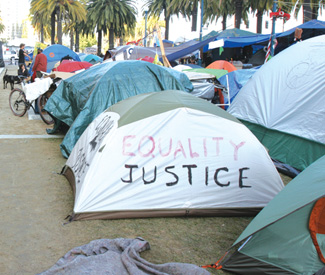
Another Occupy offshoot sprung up at San Francisco State University Dec. 1 when about 150 students attended a march and rally that culminated at Malcolm X Plaza, now the site of the San Francisco’s newest Occupy camp.

Students symbolically blocked off ATMs, wrapped Chase Bank machines in cellophane and plastered nearby Wells Fargo and Bank of America ATMs with “meet the one percent” flyers profiling wealthy University of California Trustee Monica Lozano and California State University Regent Bill Hauck.

The highlight of the action came when SF State President Robert Corrigan arrived on the scene. The group was using the people’s mic to read a letter addressed to Corrigan, penned by the Occupy SF State General Assembly, demanding that he write two letters. One should be directed to the school’s chancellor and CSU Board of Trustees, “urging them to repeal the 9 percent tuition fee increase” that the board passed Nov. 16, and another should go to “the presidents of every other CSU campus asking them to also contact the chancellor and Board of Trustees regarding a repeal of the 9 percent tuition fee increase.”

Corrigan listened, then participated in a frank question-and-answer session with protesters, urging them to contact Sacramento legislators. Yet he refused to write those letters or declare support for Occupy SF State.

Afterwards, the students returned to Malcolm X Plaza and erected about 15 tents, which organizers said would contain “books, food, and homework help” along with providing shelter for sleeping protesters.


OCCUPY LA MISIÓN

In the Mission, where city officials have been encouraging OccupySF to relocate from its current home in the Financial District, a separate new Occupy effort could be underway.

Organizer Enrique Del Valle says he and other organizers have been distributing flyers and talking to people and organizations throughout the neighborhood. “We’re getting it together to have a General Assembly,” he told us.

The effort is unrelated to the OccupySF General Assembly’s Nov. 29 decision to decline the city’s offer to utilize an abandoned lot at 1950 Mission Street, he added. Before the city made that offer, Del Valle, a community volunteer with connections with many Mission groups, says he was already working on forming a neighborhood occupation.

If Occupy SF had set up shop in the space offered by the city, “We would have worked with them,” he explained, “but set up somewhere else.”

Meanwhile, Mayor Ed Lee and OccupySF are still waiting for one another’s next moves. On the evening of Dec. 1, when San Francisco Police officers surrounded the camp in steel barricades, protesters felt another raid was underway. But they resisted and took down some barricades, causing police to suddenly back down and remove the rest.

“They’ve just been mindfucking us,” OccupySF protester Markus Destin told us. “As soon as they spend all that money breaking us down, we’ll just come back in a week and re-encamp.”

Mayoral Press Secretary Christine Falvey said Lee wasn’t aware OccupySF rejected his offer: “We haven’t heard back one way or another from the group. The offer is still out there and the group has all of the information they need from us. We are awaiting a decision. Mayor Lee has made it very clear to the group that he supports their first amendment rights and their right to assemble, but that overnight camping at Justin Herman Plaza is not an option for the long term because of the health and safety problems it creates.”


OCCUPY AGAINST FORECLOSURE

Community members rallied outside a foreclosed Visitacion Valley home Dec. 1 before moving their protest to the offices of the company that purchased the property.

At 11 a.m., dozens gathered in front of the residence where 75-year-old Josephine Tolbert had lived for nearly 40 years. A day earlier, Tolbert had arrived home with three young grandchildren in tow to find her locks changed. Organizers say the evicted resident needs to access the house to retrieve food and medicine.

The crowd — which included neighbors, friends, and members of Alliance of Californians for Community Empowerment (ACCE), Service Employees International Union (SEIU), OccupySF, and Occupy the Hood — demanded that Tolbert be let back in. According to Bayview resident and self-proclaimed “foreclosure fighter” Vivian Richardson, “They would not let her in to get food, diapers, or her diabetes medicine.”

Tolbert had run a daycare business from her home for 20 years. One of her regular clients, a mother with two young children, arrived during the rally. She was surprised to find that Tolbert was locked out of her home and unable to care for her children that day.

“I want to get in my home so I can resume my business,” Tolbert said. “That’s my occupation there, I don’t have any other way of caring for myself.”

The group then headed to the offices of True Compass Loan Services, LLC, the new owners of Tolbert’s home. About 20 supporters gathered at the Ocean Ave office, where ACCE organizer Grace Martinez singled out True Compass owner Ashok Gujral, who owns a $2.75 million home and multiple restaurants, according to a press release from a group calling itself the Foreclosure Fighters.

“The man is worth $10 million, and he has a bunch of limited liability companies,” said Martinez. “Everyone has been shocked at how this man could do this, he knows she is a senior.”

According to Martinez, Gujral personally refused to let Tolbert into her home Nov. 30. He and others from the company “don’t want her in there because they say she’ll refuse to leave,” Martinez added. Calls to Gujral’s office were referred to attorney Jak Marques, who did not return Guardian requests for comment.

A True Compass representative informed protesters “there’s no one here to talk to you,” then swiftly shut the door. But when a few protesters went around through a side entrance and let everyone else in, the group took their protest to the hallway inside.

They remained there for almost an hour, chanting, pounding rhythmically on the walls, and flooding the office on the other side of a locked door with phone calls, demanding Tolbert be allowed to return to her home to retrieve her medicine and belongings.

Five police officers arrived almost immediately as protesters entered company offices. One explained to the protesters that if they didn’t leave, they would face arrest for trespassing. A heated but measured back-and-forth ensued, in which protesters insisted that if Tolbert was his mother, the officer would feel differently. The officer, Lieutenant C. Johnson, responded, “If it was my mother — I don’t know. I have a house for my mother. But I feel for Josephine, and for the millions of other Americans in the same situation.”

Martinez quieted groans from protesters, replying, “You’re part of the 99 percent, and we’re not going to shoot the messenger.”

Organizers conferred and decided to leave the building voluntarily. Sergeant R. Young, who was also at the scene, told the Guardian, “It’s heartbreaking to do this. Their freedom of speech is a constitutional right that we take a sworn oath to protect.”


THE SEEDS OF A NEW AMERICA?

Does the Occupy movement signify a new beginning for America? Is history repeating itself? Is violence inevitable? These were some of the big questions pondered by a handful of prominent Bay Area writers, thinkers, artists, and activists Dec. 1 during a panel discussion organized by Salon.com.

Dan Siegel, who most recently made headlines for resigning as Oakland Mayor Jean Quan’s legal advisor because he disagreed with her decision to order a police raid of the Occupy Oakland encampment, was a panelist. “The perspective of Mayor Quan and other mayors, besides reflecting the 1 percent, reflects a misguided paradigm,” Siegel said. “The nation’s clearly in an economic crisis that this country has not seen since the 1930s. The mayors should be on the side of the 99 percent. They ought not be the lapdogs of Wall Street.”

Renowned author Rebecca Solnit also participated in the panel discussion. Asked if she thought Occupy symbolized a new beginning, she reflected on the past. “Huge mistakes were made on the left,” in past social movements, she said. “It was supposed to be the revolution, but the women were still expected to make the coffee.” She offered that Occupy represented an evolved manifestation that had benefitted from lessons learned over the years.

“It’s a culmination of decades of refining, searching, and building coalitions,” Solnit said. “It’s the beginning in the sense that summer’s the beginning. We’re reaping the fruit of … what’s been imagined.”

It’s also provided a spark for campus-based organizing. “The Occupy movement has given a tremendous amount of wind to the sails of the student movement and had a consciousness-raising aspect,” said Matt Haney, executive director of the University of California Student Association. “Now they are prepared in a new way to join all of those other folks who are also suffering.”

A key question put to panelists was whether Occupy ought to consider running candidates for office. In response, panelist Melanie Cervantes, an artist and activist, got to the heart of the issue. “What is political power? Is it just representation?” she asked.

Cervantes pointed out that autonomous social movements in Latin America have given rise to leftist political leaders, and she spoke of the past successes of mass-based organizations. “There were things that preceded us generationally, and they worked,” she pointed out. “There’s a lot of different ways people are experienced in trying to change things.”

Panelist Peter Coyote, an actor, activist, and founder of a radical underground group called The Diggers, offered an analogy in response to the idea of Occupy running candidates for office. “If you take a healthy goldfish and throw it into polluted water, it’s gonna get sick,” he said.

Solnit framed her answer as an analogy, too. “We live in a really crummy house with roaches and a leaky roof … Occupy is saying, let’s try to build a better house,” she said. “Our demand is for a better world, isn’t that obvious? We’re building a whole new political vocabulary, a whole new sense of possibility.”

As to the question of whether violence is inevitable as the movement continues to unfold, some panelists discussed nonviolence as a protest tactic, while others focused on the violent behavior of law enforcement officers against protesters. “You don’t hear students talk about using violence,” Haney said. “It’s more like how do we deal with violence that’s being used against us?”

Siegel stressed that the protests ought to be disruptive, yet nonviolent. “The question for our society is, who has the power?” he said. “At the end of the day, we live in a nation state, and people control things. And if they continue to control things, we’re screwed.”


WEST COAST PORT BLOCKADE

Occupy Oakland organizers have been engaged in planning yet another shutdown of the Port of Oakland on Dec. 12, which will coincide with attempts to shut down West Coast ports in San Diego, Los Angeles, Portland, Seattle, Longview, Tacoma, and Anchorage. “On December 12, the Occupy movements in different cities will … effectively shutdown the hubs of commerce, in the same fashion that Occupy Oakland shut down the Port of Oakland on November 2nd, the day of our general strike,” according to a Call to Action on WestCoastPortShutdown.org. “The message to you from Occupy Oakland in the face of police raids and continued disruptions of workers lives by the 1 percent is the following: The Occupy movement will strike back and rise again! We will blockade all of the West Coast Ports on December 12th in solidarity with longshoremen, port workers and truckers in their struggle against the 1 percent!” Steven T. Jones contributed to this report.

Art Basel frontlines: Thursday night in Wynwood

0

All I did was program in the coordinates of a wall my friend was painting in the midst of Miami’s mega Art Basel weekend and all of a sudden I’m in mural heaven. Going traffic snail-slow down the Wynwood neighborhood’s Second Avenue (at one time a Puerto Rican enclave, now a place where corner restaurants are popping up with floor-length windows that display spindly humanoid statues clad in multi-colored sweater), all I could see were flood light-illuminated muralists in the finishing stages of turning the street into the most painted lane I’ve ever seen.

The art galaxy has descended upon Miami for the week. It’s a big blender-fuck of small dresses, dyed eyebrows, free drinks (hell yes), and mmhmm, ART. You can read a little bit about the general mayhem in Erick Lyle’s twopart story for the Guardian about 2009’s festival — arts writer Matt Sussman and I will be covering the festival for y’all this year.

Wynwood is serving as ground zero for the street art world, which explains why Art Basel established the “Wynwood Walls” courtyard in 2009 in the neighborhood, though since then side streets and new galleries have added their own murals to the week’s list of must-sees. 

This year, Wynwood Walls has been decked out by names that even the most high brow art lover will recognize: Shepard Fairey, the Brazilian whimsy-worlders Os Gemeos. Retna, the early front-runner for the festival’s 2011 street art darling, has a massive wall here, plastered with his recognizable columns of symbols and big block painting. 

Danilo Gonzalez, a Dominican who moved to Miami two years ago to open his gallery at 2722 Second Avenue, says the weekend is a marked difference from the rest of the year when “it’s really quiet.” Though his gallery featured three modern Dominican artist (including his own thicket of wooden abstract shapes, “Forest”) he says a lot of the art scene here was “too fancy” for his tastes.

Wynwood’s residents get in on the action too — kind of. Though signs of neighborhood art are not forthcoming, many of the neighbors themselves have set up informal valet systems and viewing parties. They’re probably hoping that girl in the Gaga heels is going to trip in front of their lawn. I kind of am too… 


Contemplating Appetite

1

virginia@sfbg.com

APPETITE My adventures in food and drink have been the subject of my SFBG Appetite column for nearly three years online at SFBG.com. As of last month, you now also find me in print every week. Many have asked where I am going with this column — some expecting a formal weekly review, others a mix of subjects and directions. The latter is true. I cannot replace former Guardian food critic Paul Reidinger’s eloquence and decades-long experience as a food writer (and I’m glad to say we will continue to hear from him in various articles). I take this opportunity to explain where I’ve come from and my philosophy in covering the edible world.

First and foremost, I bring to the table passion. From mostly Italian and German stock, I’ve eaten heartily since early childhood in Oklahoma and Missouri, 16 total years of my youth in Southern California and New Jersey (just outside LA and NYC respectively), and travel over five continents. As an incessant reader and writer since girlhood, books first opened me up to the world, though I dreamed of having my own adventures to write about. Moving to San Francisco a decade ago, I was wowed not only by its unique, radiant beauty, but by the consistent quality of food, spending spare dollars eating out constantly. Though SF wasn’t the immediate love affair for me New York was, it is a love that has only increased each year, the home I would happily end up in. This city still takes my breath away.

Patricia Unterman’s original San Francisco Food Lover’s Guide was my food bible in those early days. I connected with her quest for the authentic, no matter the cuisine. I ate my way through neighborhoods, marking up her book (and all my dining guides) until I had been to every single restaurant, market, and bar in its pages. Eventually, requests asking me where to go and what to eat reached a fever pitch, so my husband (and partner in taste and travel) helped create my own humble website, The Perfect Spot, to share my reviews and finds. I’ve been sending out a bi-weekly newsletter for nearly four years based on my writings for the site. I also write for an ever-increasing number of magazines and websites.

“Diet,” “lowfat,” and “hold the cream” are words you’ll never hear me say. My hunger for food as adventure means I make it a goal to have no food prejudices. Many say, “I’ll try anything once,” but my philosophy is to keep trying anything I don’t like until I do. The food may not have been prepared properly; it was perhaps of poor quality; maybe the palate wasn’t quite ready for it — dishes still deserve to be known at their best. I spent years trying to overcome my aversion to uni (sea urchin), for example. Eating chef David Bazigran’s brilliant uni flan at Fifth Floor early this year was a revelation. I realized it was uni’s texture, not its of-the-sea flavor, turning me off. I’ve enjoyed uni ever since, though only when ultra-fresh. From personal experience, I know one can change one’s abhorrence of a food, and in so doing expand one’s horizons another inch, uncovering another of life’s simple delights.

Sometimes fear arises around unfamiliar foods — and the unfamiliar in general. Without variety and a vast range of expression, the world loses it color — and its joy. While sameness can be comforting (and there’s a time for that), it is entirely boring. To go through any part of life bored or complacent is simply lazy. As with music or books, one can discover unknown lands with a few new ingredients, enlivened by the hands of a gifted, caring chef. Whether food cart or fine dining, there’s no reason to settle for mediocrity, not with the unreal produce, vision, and talent surrounding us.

Internationally, I’ve fallen in love with black pudding in Ireland, extreme spice in Thailand, Tyrolean food in the Italian Alps. I’ve explored wine chateaus in Bordeaux, agave fields in Mexico, gin distilleries and cocktail labs in London, whisk(e)y houses in Scotland and Ireland. I’ve frequented restaurants, coffee havens, bars, chocolate shops, farmers markets everywhere. I sample obsessively and comparatively. Rather than one single review, I prefer to cover a mixture of highlights in any given week. I’m opinionated, yes, but don’t care much for snark, flippancy, or jadedness. Though honest assessment is crucial, rather than rip apart the few not doing it well, I’d rather focus on the many having fun with or perfecting their craft.

My “holy trinity” of US cities for food and culture, though, consists of New York, New Orleans, and San Francisco. Travel is one of life’s greatest gifts, yet when I cannot afford to go, I am able to travel in my own city. Authentic foods transport me back to the place in which that food was illuminated — anchovies on the coast of Italy, bastilla in Morocco, Creole cream cheese in New Orleans, or bahn mi in Vietnam. It helps to live in a place as international and cosmopolitan as SF. But even in nondescript towns, I uncover gems. The hunt is a key part of the thrill.

Besides travel, you’ll notice I also write about drink… a lot. Whether coffee, spirits, and cocktails (my first love), wine and beer (the ultimate food accompaniments), my knowledge of drink grows along with the culinary. Even at 21, I wanted a grown-up atmosphere in which to imbibe, detesting noisy, crowded “scenes.” Drink, for me, is similar to food: it’s about quality, artistry, and adventure, not buzz or quick consumption. A memorable meal isn’t complete without the right sip to begin, pair, or end with.

As with food, Northern California was instrumental in furthering my taste for fine drink, though global explorations have shaped my standards of comparison. It started with cocktails years ago as SF (and, of course, NYC) lead the way in reviving classics, and creating experimental, culinary drinks. The artistry and history behind these drinks intrigued me, connecting to my Old World, retro, jazz-loving self.

Delving into cocktails inevitably led to my great love of craft spirits, many of our country’s trailblazers and innovators being based right here. (Thank you, St. George, Charbay, Germain-Robin, Anchor Distilling, et. al.) Our local Wine Country and craft beer pioneers like Fritz Maytag likewise have shaped the world, while local personalities such as Kermit Lynch and Rajat Parr in the wine realm are experts on global glories in drink.

What makes a great meal? Service, setting, and, of course, food are crucial. Ultimately, I see eating as a communal ritual. A thoughtfully-prepared meal surprises and nourishes the body and spirit. We engage (or should — put those cell phones away!) over a meal, reflect on our day, truly taste, actually look at and listen to each other. Expect me to share with you the best tastes and backdrops from these moments.

While I don’t expect our tastes to be the same, I do look forward to embarking on delicious adventures together throughout the food realm. *

BEST NEW OPENINGS OF 2011

In the spirit of ushering in my print column, I recap the year with my list of 2011’s best new openings, realizing we still have a few weeks worth of openings left:

CASUAL

Wise Sons Deli www.wisesonsdeli.com. Although not getting a brick and mortar location until 2012, this pop-up deli (every Tuesday at the Ferry Plaza) was one of the year’s great new delights, filling a gaping vacancy of quality Jewish food with excellent babka, bialy, and corned beef.

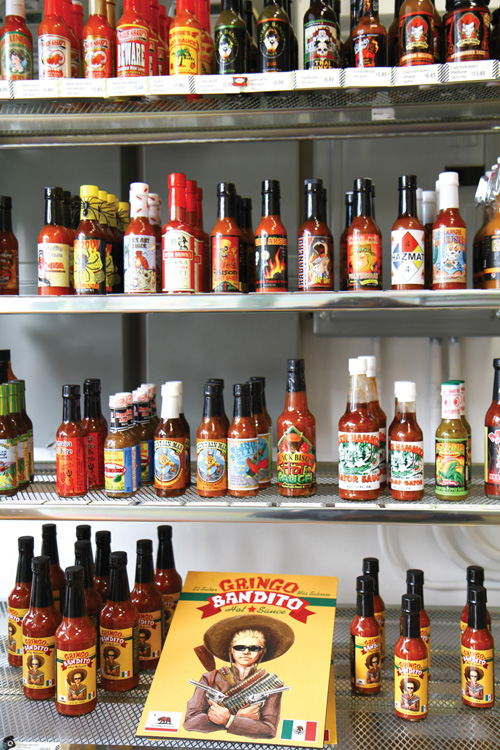
Hot Sauce and Panko 1545 Clement, SF. (415) 387-1908, www.hotsauceandpanko.com. With an impressive array of hot sauces from around the world, addictive chicken wings in a crazy range of sauces (tequila-chipotle-raspberry jam!), this quirky take-out also has a hilarious blog.

Mission Cheese 736 Valencia, SF. www.missioncheese.net. Mission Cheese serves not only lush cheeses and wines, but some of the best grilled cheese sandwiches around in a chic cafe setting.

MID-RANGE

Bar Tartine 561 Valencia, SF. (415) 487-1600, www.bartartine.com. Though not a new opening, I refer to the complete revamp and Eastern European-influenced menu under chef Nick Balla that happened this year. Unusual dishes, Hungarian and beyond, and Balla’s impeccable technique make this menu unlike any other.

Boxing Room 399 Grove, SF. (415) 430-6590, www.boxingroomsf.com. It’s refreshing to get some New Orleans breezes in SF from a Louisiana chef making his own Creole cream cheese and frying up fresh alligator.

Nojo 231 Franklin, SF. (415) 896-4587, www.nojosf.com. We’ve had a glut of izakayas open over the past few years, but this one stands above in warm, hip atmosphere and consistently delightful food.

Park Tavern 1652 Stockton, SF. (415) 989-7300, www.parktavernsf.com. From the owners of Marlowe, this immediately feels like the buzzing destination restaurant of Washington Square Park for satisfying American food with gourmet edge.

Jasper’s Corner Tap 401 Taylor, SF. (415) 775-7979, www.jasperscornertap.com. All things to all people: comfortable meet-up spot with perfect cocktails, craft beers and wines aplenty, and the food is consistently heartwarming.


Maximum Consumption: the Turntable Kitchen interview

0

I’d venture a guess that no one in this town knows the frosting tipped appeal of hand-mixing music and food more than the couple behind Turntable Kitchen. What started one year ago as a simple (yet highly aesthetically pleasing) website mashing up recipes and records, has grown into a celebrated multi-headed creative output machine, with food+music news, event sponsoring, giveaways, and the newly added physical pairings boxes – on top of the drool-inducing/stunning posts.

Last week I caught up with the duo to find out, among other queries, what ingredient you simply must have on hand – and the records every collection should include:

San Francisco Bay Guardian: For people who have never heard of Turntable Kitchen, can you give a brief rundown on how the concept came together?
Matthew Hickey: Turntable Kitchen is a website combining food and music. We do that by pairing recipes Kasey creates in the kitchen with some of my favorite albums. I try to find albums that share the same characteristics as her recipes, pairing them together the way a sommelier would pair wine with food. The idea to start the site was Kasey’s, but we were pairing food and music in our own foggy Inner Sunset apartment long before we launched the site. I’ve always been obsessive about music and Kasey loves to cook. Part of our evening ritual involved her explaining the recipe we were going to make and me then hitting my record collection to find an album to compliment our meal.
SFBG: What is it about food and music that goes so well together?
MH: For us, a good meal is about more than just consuming food. It is about creating an experience that pleases all of your senses. We believe that the soundtrack to that meal is a hugely important element of that experience. In fact, a recent study published in the British Journal of Psychology demonstrated that when people consume wine while listening to music they perceived the wine to share the same characteristics as the music. The result is something that Kasey and I instinctively felt to be true whether drinking wine or enjoying a good meal.
SFBG: How did you come up with the Pairings Box idea?
MH: We liked the idea of sending goodies to our readers in the mail, but we weren’t sure what form that would take. Whatever we did, we wanted it to stay true to the theme of our site. Speaking to the music specific elements: they just made sense for me. I love vinyl records and have an ever-growing record collection. With the ease of digital distribution, though, some of my favorite new music isn’t yet available on vinyl. So the singles we release feature music that I wanted for my collection, but which didn’t already exist on vinyl. I’ve been making mixtapes for my friends for as long as I can remember, so the digital mixtape we include gives me yet another opportunity to share music I love with our supporters.
Kasey Fleisher: I have always thought that a big barrier to cooking for many people is having a pantry. A lot of times, a recipe calls for a lot of expensive and/or hard to find ingredients and when you don’t cook often, it’s hard to think, “why not give this a try?” The concept of giving people three recipes and one to two premium dried ingredients gives them that nudge to experiment (and a reason to invite a few friends over to share the experience.). As for the sustainability of the Pairings Box, we think there’s still room to expand, but no matter what, we want to keep it limited. So far, we’ve sold out of every month’s box.
SFBG: What’s in the November pairings box and when does it go out? Is it sold out yet?
MH: The November Pairings Box had a harvest theme. We featured three new, original recipes; a hand-numbered, limited-edition (250 copies) 7″ vinyl single featuring Evenings (a.k.a. Virginia-based Nathan Broaddus); an exclusive digital mixtape; and our premium ingredient for the month was a French Grey Sea Salt and French Lavender blend.And, yes, we’re all sold out.
SFBG: December pairings box orders can start coming in Nov. 15, correct?
MH: Yes, we’ll start accepting new subscriptions for the December Pairings Box on November 15. We have a sign-up form on the site where you can enter your email and we’ll drop you an email to notify you of when we’re ready to start taking payments.
KF: We’ll have additional boxes available for the holidays.
SFBG: On the site, what have been the most popular pairing(s) so far?
KF: Some of the most (recent) popular pairings have been our Multi-Grain Pumpkin Donuts, paired with St. Vincent and Creamy White Grits with Chanterelle Mushrooms paired with Iron & Wine.
SFBG: What are your own personal favorite pairing(s)?
MH: One of my recent favorite pairings has been Kasey’s Fig, Mint and Honey Galette, paired with Brazilian artist Jorge Ben.
KF: One of my favorite pairings was our Wild Mushroom and Crescenza Pizza, paired with Revolving Birds. Matt loves mushrooms and pizza, and we’re both really into good
cheese…I could totally see myself cozied up on rainy day making this pizza and listening to Revolving Birds…what could be better?
SFBG: What’s the most important ingredient to keep in your cupboard?
KF: That is a tough question! But I’d probably have to say salt.
SFBG: What’s the most important album to keep in your record collection?
MH: That is a tough one. If you are going to listen to it by yourself then you’d want your favorite album – whatever that may be. If you want versatile music that sounds great and
can be played on any occasion, I highly recommend owning a few Motown records. I don’t think I’ve ever met anyone – young or old – who hates The Four Tops, The Jackson 5, The Supremes, Al Green, etc.
SFBG: You both have day jobs, correct? How feasible is it for you to cook together every night?
MH: Yes, we both have day jobs that can be relatively time consuming. Nonetheless, I’d say we normally find time to cook together at least five days a week or more. No matter how tough my day was at work, when I come home and start a record, open a bottle of wine and start cooking in the kitchen with Kasey, I feel great.
KF: I agree…Even though I like my day job, there’s nothing more that I love than making something with my hands after sitting in front of a computer. It’s a nice break until I
have to get back on the computer to work and/or blog/edit pictures, etc.
SFBG: On an off cooking night, what’s your favorite restaurant in the Bay Area?
MH: I have many favorite restaurants, but a few favorites are: Koo, NOPA, and Aziza.
KF: I would add Outerlands, Delfina Pizzeria, Lavash, and Contigo to this list.
SFBG: What are your future goals for Turntable Kitchen?
KF: Our goal is to continue producing great content, expand the food and music experiences that we’re offering offline, and grow our audience organically. In our opinion, food and music are some of the best things in life, and we think we’re making the two more fun and accessible to a broader range of people.
 

On the Cheap Listings

0

Submit items for the listings at listings@sfbg.com. For further information on how to submit items for the listings, see Picks.

WEDNESDAY 9

Food For Thought Dine-Out Various locations, SF. www.missiongraduates.org. 9 a.m. – 11 p.m., prices vary (check website for participating restaurants). Mission Graduates, a nonprofit working to boost the numbers of college-bound Mission youngsters, receives a sizeable chunk of participating diners’ bills tonight at eateries across town. Depending on your budget, today’s the day to either go all-out at Foreign Cinema or reignite your love affair with the humble Papalote burrito.

“Trading Ideas: Emerging Discourses on Asian Contemporary Art” Galley One, Yerba Buena Center for the Arts, 701 Mission, SF. www.ybca.org. 6:30 – 8:30 p.m., $7, free for members. YBCA and the Asian Art Museum team up to explore Asia’s role within the contemporary art picture.

“Unwrapped and Regifted: Stories about the Holidays” 111 Minna gallery, SF. (415) 974-1719, www.111minnagallery.com, free. The story-sharers at LitUp Writers know that it’s not even Thanksgiving, and on shopping center time that means the hour is nigh for Christmas and Chanukah tales. If you think you can take the heat, don your worst holiday sweater to compete for a cash prize.

THURSDAY 10

One and Only: the Untold Story of On the Road book reading Booksmith, 1644 Haight, SF. www.booksmith.com. 7:30 p.m., free. LuAnne Henderson rambled with Jack Kerouac and Neal Cassady for the entire length of that well-known Road. Her daughter, Anne Marie Santos, joins Kerouac expert Gerald Nicosia to discuss the journey’s underside.

Love Cake Reading Modern Times, 2919 24th St., SF. www.mtbs.com. 7 p.m., free. Leah Lakshmi Piepzna-Samarasinha may not be the easiest name to type into Google, but it merits a cramped finger or two. The activist and spoken-word poet reads from recent work addressing how queer people of color combat violence with compassion and sexuality.

Footloose Forays Talk Randall Museum, 199 Museum Way, SF. www.randallmuseum.org. 7:30 – 9 p.m., free. Michael Ellis’s bio photo shows the man in a backwards pink baseball cap, matching shirt, and dangling binoculars. This may aptly sum him up. Join the freewheeling botanist, Burner, world traveler, and radio host for a recounting of his best adventures.

FRIDAY 11

Legends of Hip-Hop book signing Booksmith, 1644 Haight, SF. www.booksmith.com. 6:30 p.m., free. With a lovingly-penned forward by Chuck D of Public Enemy, Justin Bua’s compilation of art honoring hip-hop’s greats breathes new life into the traditional coffee table book.

Celebration of Craftswomen Festival Pavilion, Fort Mason, SF. Also Sat/12 and Sun/13. www.celebrationofcraftswomen.org. 10 a.m. – 5 p.m., $9. The 33rd annual fair and celebration brings SF’s craftiest females and their wares out on display, accompanied by live music and dance. Proceeds benefit the Mission’s eye-poppingly beautiful Women’s Building.

SATURDAY 12

Green Festival Concourse Exhibition Center, 635 8th St., SF. Also Sun/13. www.greenfestivals.org. 10 a.m. – 7 p.m., free (see conditions below). Maybe the 12 pounds of organic garbanzo beans you just bought do have an immediate use, after all. Bring a Rainbow Grocery receipt (for a purchase of more than ten dollars), four cans of food, your bike, your Sierra Club card or a union card and get free admission to the green equivalent of a state fair. Food court, beer garden, yoga classes, business seminars, speakers, and exhibits await.

Paul Madonna book signing Museum Store, SFMOMA, 151 Third St., SF. www.sfmoma.org. 2 p.m., free. If this well-known SF cartoonist has luminously sketched your cupola, gable, or neighborhood pothole you know you have bragging rights. Everything Is Its Own Reward, Madonna’s latest compilation of SF streetscapes, roams from mundane telephone wires to noble turrets, all in pen and ink.

Writers with Drinks The Make Out Room, 3225 22nd St., SF. www.makeoutroom.com. 7:30 – 9:30 p.m., $5 sliding scale. Authors swig and shoot the breeze with their audience at this recurrent event, which benefits the Center for Sex and Culture this month. Befitting of the cause of the evening, tonight’s lineup includes writers responsible for an erotic novella, a transsexual showbiz memoir, and a treatise on dating as a feminist.

SUNDAY 13

“Man as Object” Peep Show Drawing Circle SOMArts Cultural Center, 934 Brannan, SF. www.somarts.org. Noon – 3 p.m., $8 suggested donation. All our welcome to take up their artistic tools and depict a live male model as part of SOMArts’ ongoing exhibit turning traditional gender roles upside down — although we tend to question the innovation of having a man treated like a piece of meat in this town.

MONDAY 14

Mere Future Reading and Signing Pegasus Books, 2349 Shattuck, Berk. www.pegasusbookstore.com. 7:30 p.m., free. To an audience familiar with paying astronomical rents, Sarah Schulman’s dystopian satire of a future New York will strike a chord. Schulman slyly invents a world where apartments go for forty bucks a month and the only possible jobs are in marketing.

TUESDAY 15

Ether Reading and Signing City Lights, 261 Columbus, SF. www.citylights.com. 7 p.m., free. Ben Ehrenreich once reimagined The Odyssey to critical acclaim, and his latest undertaking – the chronicle of an unnamed protagonist wandering through a city’s violent apocalypse – is no less involved of a literary feat.

Anyone but Lee

198

tredmond@sfbg.com

Two weeks ago, the race for mayor of San Francisco seemed in the bag. Mayor Ed Lee was so far ahead in most polls that everyone else looked like an also-ran. A Bay Citizen simulation of ranked-choice voting showed Lee getting enough seconds and thirds to emerge easily as the winner. His approval rating with voters was above 70 percent. The money was pouring in to his campaign and to the coffers of independent expenditure committees promoting him.

But that was before the voter-fraud scandals, OccupySF, Sup. John Avalos appearing on national TV, a controversial veto, Sup. David Chiu getting the endorsement of the San Francisco Chronicle, and an attack on City Attorney Dennis Herrera backfiring.

“It’s changing,” Corey Cook, a political scientist at the University of San Francisco, told us. “I don’t know whether it’s tightening up, but it’s certainly changing.”

One campaign consultant, who asked not to be named, was more blunt: “The Lee campaign is one bad news story away from free-fall.”

That’s not to say Lee is going to lose, or even that he’s anything but the clear front-runner. But over the past week, as Lee has taken a series of hits, supporters of the other candidates — particularly Herrera and Avalos — are starting to wonder: Could somebody else really win?

The answer, of course, is yes — anything can happen in the week before an election. But defeating Mayor Lee will take a confluence of events and strategies that starts with a big progressive turnout — and with voters who don’t like the idea of an incumbent with ties to a corrupt old political machine carefully allocating their three ranked choices.


NO SURPRISE

So far, there’s been no crushing “October surprise” — no single event or revelation that can change the course of the election. And the impact of anything that happens in the next few days will be blunted by the fact that 27,000 absentee ballots have already arrived at the Department of Elections.

By all accounts, Lee’s campaign and the somewhat sketchy independent expenditure groups that are working in parallel, if not in concert, have done an impressive job of identifying and turning out absentee voters. Local consultants from most of the campaigns agree that at least 20 percent of the final turnout will be Chinese voters — and Lee will get at least 75 and as much of 90 percent of that vote.

But as Cook notes, there are still “huge undecideds” for this late in a race. And while Lee was polling above 30 percent a few weeks ago, by most accounts his numbers have been dropping steadily. One recent poll shows him falling 10 points in the past two weeks, leaving him closer to 20 percent than 30 percent.

“If the election were held three weeks from now, he’d lose,” said one consultant who asked not to be identified by name.

What’s happened? A confluence of factors have put the incumbent in a bad light.

The voter-fraud allegations have made headlines and the district attorney is discussing a criminal investigation. Although Lee and his campaign weren’t directly involved — the possibly illegal efforts to steer voters to Lee were run by one of the IEs — the last thing a politician wants to see in the waning days before an election are the words “voter fraud” and “criminal investigation.”

And the allegation — that Lee supporters in Chinatown filled out ballots for absentee voters then collected them for later delivery — play right into Lee’s weakness. While voters generally have good impressions of his work at City Hall, the fact that he’s connected to sleazy operators and tied to the old discredited Brown machine continues to haunt him. And this sort of activity simply re-enforces that perception.

The Leland Yee campaign has taken direct advantage of that perception, releasing a parody of the hagiographic Lee biography written by political consultant Enrique Pearce. “The Real Ed Lee story,” which repeatedly talks of his connections to unethical power brokers, hit the streets this past weekend.

Lee also sided with the San Francisco Chamber of Commerce over a coalition of labor and consumer groups with his veto of legislation by Sup. David Campos that would have prevented employers from draining $50 million per year from health savings accounts set up to comply with city law. Many restaurants even tack a 3-5 percent surcharge onto customers’ bills, making it essentially consumer fraud.

“It’s important for us to take a stance on the issue and say that what the mayor did was wrong,” Campos told us. “It’s a defining issue for us in City Hall.”

Then there’s OccupySF. Nobody knows for sure, but it’s likely that a majority of San Franciscans are at least somewhat sympathetic to the group’s message. And Lee has so far avoided the public relations disaster of Oakland’s crackdown.

But the left is unhappy with Lee’s constant threats to clear out the encampment, and the right is unhappy that he hasn’t sent in the cops already — and even the San Francisco Chronicle has denounced his lack of decisiveness.

Lee put the police on high alert and had them moving around in buses, ready to move in — than at the last minute changed his mind. “What this shows,” said former Supervisor Aaron Peskin, “is that we don’t have a mayor with a firm hand on the tiller.”

Most observers expected that the Chronicle would join the San Francisco Examiner and endorse Lee. But the paper came down on the side of Supervisor David Chiu. Chiu is still running well behind in the polls, and not that many voters follow the Chron’s advice, but the endorsement was a huge boost to his campaign.

“Ed Lee’s had a bad couple of weeks, and some of the others have had a good couple of weeks,” Cooks said.


RANKED CHOICE

Ranked-choice voting puts an interesting twist into all of this. Several consultants and election experts I talked to this week said that Lee would be far more vulnerable in a traditional election. “He would lose a runoff against almost any of the top challengers,” one person said.

But every poll that’s tested the ranked-choice scenario — even recent polls that show Lee faltering — still put him on top after the votes are all tallied and allocated. That’s in part because supporters of candidates who are lower in the pack — Chiu, for example — tend to put Lee as a second or third choice. The Bay Citizen/USF poll showed that when Chiu was eliminated, most of his votes wound up going to Lee.

“Ranked-choice voting clearly favors incumbents,” Cook told me.

And, people walking precincts say, there are still some Herrera and even Avalos voters who put Lee second or third. And the only way Avalos — or anyone other than Lee — can win the election is if progressive and independent voters stick to a clear “anyone but Lee” voting strategy.

Avalos is doing well in recent polls; in fact, one shows him ahead of Herrera in first-place votes. Herrera does better when seconds and thirds are counted. Michela Alioto-Pier gets a fair number of first-place votes, which isn’t surprising since she’s one of only three women in the race, the only woman with citywide name recognition — and the only real credible conservative.

Yee and Chiu are both in the running, and Yee has come out strong attacking Lee and is running hard for progressive votes. He showed up at OccupySF the night a police raid was threatened and has been the leading critic of the alleged voter fraud.

Cook says a scenario where somebody beats Lee is still “an inside straight” — but it’s not at all impossible.

If Lee gets 30 percent of the first-place votes, most observers (including his opponents) agree that he’s going to cruise to victory. But if his first-place total is closer to 20 percent, and one or more of the other candidates are within five points, it’s going to be a lot closer.

Here’s the bottom line: If you don’t want to see a repeat of the late 1990s, when Willie Brown was mayor and City Hall was for sale to the highest bidder, vote for anyone but Lee — and use your three votes strategically. If you like John Avalos, put him first — but give your second-place vote to Herrera, who seems positioned right now to be the other strongest challenger. If you like Herrera, give your second to Avalos. If you like Leland Yee or David Chiu, make sure that Avalos and Herrera are also on your slate.

Fill out all three votes. And get your friends and family to the polls. Because turnout is projected to be low, which helps Lee — and the race may well be decided on the basis of who shows up November 8th.

Lee benefits from vetoing health care reform

25

Downtown groups that pressured Mayor Ed Lee to veto legislation that would have prevented businesses from raiding their employees’ health savings accounts have been funneling big bucks into independent expenditure campaigns formed to keep Lee in the Mayor’s Office.

Meanwhile, the Board of Supervisors today strengthened a weak alternative to the vetoed legislation by Board President David Chiu, which it then continued for two weeks. The amendments by Sup. Malia Cohen were unanimously approved by the board, but her five allies in supporting the vetoed legislation – David Campos, John Avalos, Ross Mirkarimi, Jane Kim, and Eric Mar – preferred that the measure be returned to committee for more analysis, losing on a 6-5 vote.

“We need more time to understand the implications of the amendments. We’re not sure if it actually closes the loophole,” Campos, the vetoed measure’s sponsor, said of provisions in the Health Care Security Ordinance – the city’s landmark measure that required employers to provide some health coverage to employees – that allowed businesses last year to pocket more than $50 million from health savings accounts they created for their employees.

One Cohen amendment specifically addressed one of the more egregious violations – restaurants that charge customers at 3-5 percent surcharge for employee health care and than pocket that money at the end of the year – which Chiu had addressed only by calling for more scrutiny of the tactic by the Office of Labor Standards. She also would require businesses to keep two years worth of contributions in the account, rather than the one year sought by Chiu to address the so-called “January problem” of businesses draining the account at the end of every year and leaving nothing for employees who get sick or injured at the start of the year.

It was perhaps a sign of the heat that Lee took from labor and consumer groups for his veto that he quickly issued a press release today praising the supervisors for addressing the issue. “I applaud President Chiu, Supervisor Cohen, organized labor, small business owners, and the Department of Public Health for finding the solutions to this important public policy that can strengthen our City’s landmark Health Care Security Ordinance. By closing the loophole through these proposed amendments, we can increase access to health care, protect jobs in our small businesses and protect consumers while growing our economy at the same time,” it read.

But Lee appears to have already benefited from heeding the demands of downtown – particularly the San Francisco Chamber of Commerce and Golden Gate Restaurant Association (GGRA) – who made defeating the Campos legislation a top priority, casting it as a new “fee” that would drain $50 million from the local economy.

The San Francisco Alliance for Jobs and Sustainable Growth PAC, created by notorious downtown bagman Jim Sutton, is the best-funded on the four independent expenditure groups that are supporting Lee, taking in $390,000 this fall, including $27,000 from the GGRA and $25,000 from the Chamber’s SF Forward group. Both groups also support the Committee on Jobs, which kicked in $110,000 to the Alliance campaign. GGRA also gave another $10,000 to the pension reform campaign that Lee is pushing, support the Chamber had threatened to withhold if the Campos measure was approved.

GGRA Executive Director Rob Black denied this was pay-to-play politics, noting that the Alliance is also supporting DA George Gascon, Sheriff candidate Chris Cunnie and two ballot measures. “But absolutely, the mayor’s name is on there and the organization voted to endorse him,” Black said.

GGRA voted in August to endorse Lee, Chiu, and Michela Alioto-Pier for mayor. Black said the organization is “generally supportive of Sup. Chiu’s approach to reforming the Health Care Security Ordinance,” and Black specifically said it supports improving requirements that businesses notify employees about the health savings accounts and how to use them.

The GGRA led the original fight against the HCSO in 2006, which was sponsored by then-Sup. Tom Ammiano, who lined up a veto-proof majority on the progressive-dominated board and eventually persuaded then-Mayor Gavin Newsom to support it. The measure created the Healthy San Francisco program and required employers to spend a minimum amount per employee on health care, although federal ERISA law bars cities from prescribing how that money is spent.

GGRA challenged the employer mandate all the way to the U.S. Supreme Court on the grounds that it violated ERISA, losing the case. Many of its members restaurants then opted to use health savings accounts rather than paying into Healthy San Francisco or private health insurance, even though health experts say such accounts are the worst option.

Campos and his allies have maintained that money in these health savings accounts belongs to employees and that businesses that use and raid them gain an unfair competitive advantage at the expense of their employees, customers, and city taxpayers, who are often forced to foot the bill for the uninsured.

Campos and the coalition that supports him has said they may take this issue to voters if the Chiu/Lee legislative fix doesn’t address their concerns.

Under my umbrella

0

culture@sfbg.com

GO THERE Nothing fouls an SF afternoon like a sudden shower. We are not given much to bike fenders, Gore-Tex, or waterproof shoes (current Doc Marten resurgence notwithstanding), so when the skies open you are as like as not to find that your dayplanner has closed. But worry not. Should your loved or soon-to-be-loved-whether-they-know-it-or-not one get cold feet on the rainy day of your date, offer them this fuzzy bunny slipper of a list: our collection of bars and restaurants around the Bay that are perfect for when skies are moist. 


PHO GARDEN

This Clement Street Vietnamese spot does not play. A billboard out front advertises its particular draw: a pho eating challenge employing the use of a bowl large enough to hold a baby, as said billboard helpfully illustrates. A $22 bowl of serviceable beef pho containing two pounds of noodles and two pounds of — at times frighteningly stringy and translucent — meat awaits competitors, who have one hour to scarf it down. You may never want to eat pho again after plunging into its depths but hey, it’s rainy out and you just found a bowl of soup on which you can rest your elbows (and chin when the hour inevitably takes its toll). Winners get the pho for free and take home the mega-bowl. Losers get a “Got Pho Challenge?” T-shirt, so everyone waddles home happy. (Caitlin Donohue)

2109 Clement, SF. (415) 379-8677, www.phogardensf.com


THE LITTLE SHAMROCK

A 118-year-old bar surely has a few ghosts (or at least three sheets to the wind). But nothing could send a chill up your spine while you’re seated in front of the fireplace at this Irish Inner Sunset favorite, enjoying a sprightly game of backgammon and nursing a fortifying draft. The uber-Victorian décor and Great Quake-oriented memorabilia lining the walls might just whisk(ey) you back to 1929, when then-owner Tony Herzo Jr. “always had a big kettle of Spanish beans at the window by the front door,” according to the bar’s lore. We’ll gladly settle for the Shamrock’s belly-warming Bloody Mary meal plan. (Marke B.)

807 Lincoln, SF. (415) 661-0060


TOSCA

When it’s chilly outside, nothing warms your insides like hot chocolate with sweet brandy in a fancy glass. Tosca, with red vinyl booths and exquisite-imposing carved wood bar, will be your beacon in a dreary North Beach storm. The bar keeps the sizzling hot chocolate lined up, awaiting request. And if you need to steady the alcohol running through your delicate system, they bring out these lovely homemade cheesy nibbles and other assorted snacks. The atmosphere is doubly cozy thanks to nostalgic cuts off actual records in the vintage jukebox; the Rat Pack dominates the mix. (Emily Savage)

242 Columbus, SF. (415) 986-9651, www.toscasf.com


THE RIPTIDE

Everybody in the Sunset knows that this bar specializes in providing cozy climes for those who have been carving gnarly waves (or just stuck on a packed L-Taraval car). The local paraphernalia-bedecked brick fireplace makes for a great place to curl up and wait out the rainstorms — and you’re unlikely to be alone when you do so. The Riptide houses a mini-scene in the outer neighborhoods: open mics, live bands, karaoke, all set to a food menu that rotates daily. Shepard’s pie Mondays? DIY grilled cheese Thursdays? It’s just enough to reconcile a person to the caprices of Mother Nature for the day. (Donohue)

3639 Taraval, SF. (415) 681-8433, www.riptidesf.com


JUPITER

From handcrafted beers to delicious specialty pizzas named after planets, moons, and astronomers (try the Odysseus, which tops out with wild mushrooms and Danish fontina cheese), Berkeley’s Jupiter is a great place for a casual date when it’s pouring out. An outdoor seating area with a fireplace and heaters can keep the two of you pleasantly warm. Gothic accents decorate the two-story venue, which is housed in an old livery stable from the 1980s — a European atmosphere in the heart of downtown Berkeley. Every pizza is cooked in a traditional wood-fired brick oven and can be complimented with a cold beer — now that’ll make you feel all warm and fuzzy inside. (Paige A. Ricks)

2181 Shattuck, Berk. (510) THE-TAPS, www.jupiterbeer.com


RITE SPOT CAFE

Melt-prone San Franciscans deal with the rain in a variety of ways: drinking and eating heavy foods are prime among these. Indulge in both at a bar-restaurant inside which you’ll never even notice if the sun comes out. The Rite Spot’s windows are few and far between, but never you mind; live music from the jangling piano, white tablecloths, walls painted a vivacious red, and a menu that harkens back to your (non-Italian) grandparents’ fave Italian joint will keep you begging drinks off the affable, struggling artist staff until long after the rainbow’s gone. (Donohue)

2099 Folsom, SF. (415) 552-6066, www.ritespotcafe.net


PIZZETTA

There’s nothing like a rainy night to inspire the sudden need for cozy interpersonal contact — preferably over a steaming dish of cheese and sauce. Pizzetta 211, a four-table restaurant in the Outer Richmond, offers just that. It’s likely you will share your window ledge-turned-seat with a stranger. It is equally likely that whichever one of you gets your pizza first will forget about the utter lack of elbow space, and possibly about the swampy fog outside. Pizzetta’s standbys alone make it worth a trip — a rosemary and pine nut pie, particularly — and if you manage to hit the tiny, fragrant spot when there’s a farm egg pizza on the menu, endure the wait. (Lucy Schiller)

211 23rd Ave., SF. (415)379-9880, www.pizzetta211.com


Korean wave

0

virginia@sfbg.com

APPETITE Growing up partly on the East Coast (New Jersey) with close Korean friends exposed me to the pleasures of kimchi and burning hot ssamjang (a Korean hot sauce) early in life. In Flushing, Queens, I savored endless incredible Korean restaurants, often filled only with Korean customers. I was first hooked on those crispy, comforting Korean pancakes, pajeon, and my fondness for the cuisine grew from there.

Although more than 30 percent of our city’s population is of Asian descent, our Korean community is not as large as that of LA or NYC, which could be why we’re less the Korean food Mecca those two cities are (despite our abundance of Korean BBQ joints, that is). But there’s been a recent wave of Korean openings I can only hope will signal a robust Korean dining catalog in our future. The more bulgogi and bibimbap in this town, the better. While I usually find less to love at places mixing cuisines, like the Tenderloin’s new Ahn Sushi & Soju serving both Japanese and Korean food, here are three recent openings that show promise… and none are Korean BBQ.


AATO

Aato, a new “Korean fusion” restaurant in the Marina, is an unexpected oasis on busy Lombard Street. Owner Jennie Kim grows herbs in potted plants by a little front patio strewn with white lights. Despite a pricier menu than one typically sees in Korean eateries ($12–$15 for starters, $13.50–$25 for entrees), Aato does things differently, apparent from chandeliers in the surprisingly elegant dining room to the use of locally grown, organic ingredients (though common-as-day in SF, unusual for local Korean spots). Initial highlights include ssam, which literally means “wrapped” in Korean. There are three versions served with rice, kimchi, veggies and rice paper wraps. My gut pushed me straight to eel ssam, but Kim talked me into hangbang (Herbal) bo ssam. I wasn’t sorry. The tender, steamed pork is aromatic and nuanced with herbs. Man-du Korean dumplings are delicately pan-fried, plump with kimchi and shrimp, an exemplary appetizer. Jab-chae is traditional sweet potato noodles stir-fried with beef and seasonal veggies. Weekend brunch intrigues with the likes of eggs with “Korean-style” hash browns,, man-du dumpling soup, and a fritatta with tobiko, salmon, avocado, and cheese.

1449 Lombard, SF. (415) 292-2368


NAN

Japantown’s Nan works for two reasons: it’s a minimalist, airy space, with an extensive menu that tends slightly toward creativity. Skewers of pork belly and BBQ beef abound, alongside rice bowls, bibimbap and rice cakes. Seafood pajeon is not the perfection it is at Manna (see below), but bulgogi beef mixed with wheat noodles utterly satisfies, particularly with Asian beers on tap.

1560 Fillmore, SF. (415) 441-9294


MANNA

Manna offers a clean, friendly dining room in the heart of the Inner Sunset. It serves a number of Korean classics with varying iterations among their 44 dinner menu items. There are diverse versions of bibimbap, short ribs, and stews. Manna also fries up a buttery seafood pajeon (Korean pancake), loaded with leeks, scallions, mini-shrimp, and squid — one of the best I’ve ever had.

845 Irving Street at 10th Ave., SF. (415) 665-5969


OTHER RECOMMENDED (BUT NOT NEW) KOREAN STOPS:

I adore Toyose (3814 Noriega, SF. (415) 731-0232), a humble hangout in a garage with Korean bar style food like spicy chicken wings, washed down with sojus and Korean beers. First Korean Market (4625 Geary, SF. (415) 221-2565) is a tiny Korean market with kimbap, sushi/maki-style rolls. Head to To Hyang (3815 Geary, SF. (415) 668-8186) for raw beef salad — a hefty beef tartare-style beef dish topped with an egg — and other homestyle treats from Mom, whose daughters run the front of the house. Korean tacos are playful and cheap at John’s Snack and Deli (40 Battery, SF. (415) 434-4634) in the Financial District, and the Seoul on Wheels truck (www.seoulonwheels.com) which can be found at Off the Grid (www.offthegridsf.com).

Wonderfully worn HRD Coffee Shop (521 3rd Street, SF. (415) 543-2355) a humble Korean-run sandwich shop in SoMa, serves a hefty spicy pork kimchi burrito. Arang (1506 Fillmore, SF. (415) 775-9095) on Lower Fillmore serves a heartwarming seafood bibimbap with octopus and shrimp. A “fusion” place that really does work, and that is one of the Richmond’s best restaurants overall, is Namu (439 Balboa, SF. (415) 386-8332), offers Korean fried chicken and ever-popular Korean beef short rib “tacos” on nori (seaweed), which is also sold at the Ferry Plaza Farmers Market on Thursdays and Saturdays.

Subscribe to Virgina’s twice monthly newsletter, The Perfect Spot (www.theperfectspotsf.com)


On Guard!

1

news@sfbg.com

ORACLE’S DIRTY SECRET

If wealth trickled down from Oracle’s OpenWorld conference in San Francisco last week, very little of it reached a small group of low-wage laborers hired from out of state to set up for a concert hosted as an event highlight on Treasure Island.

Oracle is a prominent Bay Area tech company helmed by Larry Ellison, the billionaire CEO who worked closely with top city officials to bring the America’s Cup sailing regatta to San Francisco.

The Oct. 5 Oracle OpenWorld concert on Treasure Island featured Sting and Tom Petty as headliners. Registration packages for the weeklong tech conference, which drew some 45,000 attendees to San Francisco, ranged from $1,395 to $2,595.

A member of the carpenters union contacted the San Francisco Office of Labor Standards & Enforcement (OLSE) Sept. 16 to formally complain that a construction crew assembling a large seating structure for the event was being paid less than the city-mandated minimum wage of $9.92 per hour, city documents show.

Josh Pastreich, an OLSE official, went to the worksite to interview crew members. Their names were redacted from public records, but Pastreich described them as monolingual Spanish speakers who travel from city to city building seating arrangements for major events.

“Everyone is being paid $8 an hour (except for the supervisors),” he reported in a city document. “Workers generally started at 6:30 am but there was a little confusion about quitting times.” At least one work day lasted 11 and a half hours, according to a timesheet. The workers were hired by subcontractors brought in by Hartmann Studios, an events management outfit working directly for Oracle.

“We made a phone call, and sent them some emails,” OLSE director Donna Levitt explained. “Nobody said, ‘we intended to pay them the [legal] rate,'” but the subcontractors increased workers’ hourly wages to comply with San Francisco minimum wage ordinance requirements, Levitt said. Since the company adjusted the rate immediately, no fines were issued. There were fewer than 20 workers on the project.

OLSE did not correspond with Oracle directly, but spoke to the subcontractors. One was T & B Equipment, a Virginia-based company. “We were not aware of the minimum wage there, but we fixed it before the payroll was done,” a T & B representative identified only as Mr. Waller told the Guardian. Lewmar, a Florida-based subcontractor, assisted with staffing for the job. Oracle, Hartmann Studios, and Lewmar did not respond to Guardian requests for comment.

Since the enforcement agency intervened, the laborers earned $9.92 per hour instead of $8 — still well below the average Bay Area payscale for similar work. Building bleachers is comparable to raising scaffolding for major construction projects, and the prevailing wage for unionized scaffolding erectors in California is $37.65 per hour, or $62.63 when benefits are factored in.

None of the workers were from San Francisco, which likely spurred the carpenters union complaint — Carpenters Local 22 has faced significant losses in membership since the economic downturn due to high levels of unemployment disproportionately impacting the construction sector. Represenatives from Local 22 did not return calls seeking comment.

Boosters of the America’s Cup have hailed the upcoming sailing event as an engine for local job creation, but Oracle’s use of low-wage, out-of-state laborers at its pricey, high-profile OpenWorld event raises questions. While the tech company is a separate outfit from the America’s Cup organizing team, Ellison holds leadership positions at both.

Ellison was named the world’s sixth wealthiest individual in a Forbes profile in 2010, with a net worth of $28 billion. His total compensation last year was listed as $70,143,075. That’s 3,399 times the amount a person earning $9.92 an hour would make in a year working 40 hours every week — before taxes, of course. (Rebecca Bowe)


LEE’S TELLING VETO

The Board of Supervisors approved legislation to close a gaping loophole in the city’s landmark Health Security Ordinance on Oct. 4, in the process forcing Mayor Ed Lee to promise his first veto and reveal his allegiance to business interests over labor and consumer groups.

Sup. David Campos sponsored legislation that would prevent SF businesses from pocketing money they are required to set aside for employee health care, seizures that totaled about $50 million last year. These health savings accounts are often used by restaurants who charge their customers a 3-5 percent surcharge, ostensibly for employee health care, instead simply keeping most of the money.

Despite aggressive lobbying against the measure by the San Francisco Chamber of Commerce — which went so far as to threaten to withdraw support for Prop. C, the pension reform measure it helped craft with Lee and labor unions — the Board of Supervisors approved the measure on a 6-5 vote on first reading (final approval was expected Oct. 11 after press time).

But then Lee announced that he would veto the measure, claiming it was about “protecting jobs,” a stand that was criticized in an Oct. 5 rally on the steps of City Hall featuring labor unions, consumer advocates, and mayoral candidates John Avalos, Leland Yee, Dennis Herrera, and Phil Ting.

Lee and Board President David Chiu — who voted against the Campos legislation, along with Sups. Sean Elsbernd, Mark Farrell, Carmen Chu, and Scott Wiener — have each offered alternative legislation that lets businesses keep the money but make some minor reforms, such as requiring businesses to notify employees that these funds exist.

Both Lee and Chiu talk about seeking “compromise” and “consensus” on the issue, but Campos and his allies say it’s simply wrong for businesses to take money that belongs to the employees, to gain a competitive advantage over rivals who actually offer health insurance or pay into the city’s Healthy San Francisco program, and to essentially commit fraud against restaurant customers.

“This money belongs to the workers and it’s something that consumers are paying for,” Campos said. “We have a fundamental disagreement.” (Steven T. Jones)


ET TU, DAVID CHIU?

In a press release on Oct. 6, mayoral candidate David Chiu stated his concerns over Mayor Ed Lee’s potentially illegal campaign contributions from employees of the GO Lorrie airport shuttle service. That company benefited from a decision by airport officials in September and then offered to reimburse employees for making $500 contributions to Lee, according to a Bay Citizen report.

“These revelations raise deeply troubling questions that merit a full investigation by state authorities. City Hall cannot be for sale. Pay-to-play politics has no place in San Francisco, and will have no place in a Chiu administration — you can count on that,” he said in the release.

But has Chiu — one of the top fundraisers in the mayoral field — been engaging in a little pay-to-play of his own? That was the question we had after we saw that he had received lots of donations from restaurant owners, whose side he took last week in opposing Sup. David Campos’ legislation to keep them from raiding their employee health care funds.

The Golden Gate Restaurant Association (GGRA) waged unsuccessful legal battles against the Health Care Security Ordinance and lobbied against Campos’ recent reforms of its loophole. And in the latest donation cycle, the GGRA donated the maximum $500 to the Chiu campaign. Other Bay Area food services contributed up to $5,950.

So the question remains, despite Chiu’s posturing against “pay-to play politics”— are these food service companies contributing to Chiu’s campaign because he’s doing their bidding in opposing the Campos measure and sponsoring an alternative that lets them keep most of the money?

When Liane Quan, co-owner of SF’s Lee’s Deli, was asked if the health care legislation was a reason she donated, she said, “Yes, that’s one reason.” She then hesitated to elaborate why. Members of the Quan family associated with Lee’s Deli contributed a total of $1,000 to the campaign.

Maurizio Florese, an Italian-speaking co-owner of Mona Lisa’s Restaurant who contributed $100, didn’t want to talk about his contribution or employee health care. Neither did his wife and co-owner, Filomena Florese, who is also President of Mona Lisa Inc., which manufactures chocolate and pastry products.

In fact, despite leaving messages at seven local restaurants who donated to Chiu, none wanted to talk. But we did finally get ahold of Chiu campaign manager Nicole Derse, who said Chiu has a broad array of supporters and his donations from restaurants had nothing to do with his stance on the Campos legislation.

“There definitely is no correlation at all,” she told us. “Any suggestion to the contrary is ludicrous.” (Christine Deakers)

Lee backs crackdown; Avalos: “I stand with Occupy SF”

136

Mayor Ed Lee has just released a statement on last night’s police raid of the Occupy San Francisco encampment – claiming to basically support the movement but also support the harsh police crackdown and seizure of tents, food, and other personal property – that offers a sharp contrast to the position of his mayoral rival, John Avalos, who is condemning the SFPD’s actions.

Once again, as Lee also did this week in defending businesses that seize money set aside for employee health care costs, our “consensus and civility” mayor is showing that if you try to stand for everything, you end up standing for nothing. Yet Avalos understands that there are times when one side is simply wrong and that supporting the people means being willing to fight for them.

On both issues, Lee mouthed the meaningless “jobs” defense, claiming that he was trying to help working people by letting their employers raid their health care funds, allowing restaurants to fraudulently jack up their bills, or directing the police to seize their tents and food. That’s not just pandering, it’s insulting.

I’ve tried unsuccessfully to get Lee’s office to offer more detailed explanations of his positions, but they’re so far sticking to prepared statements that are riddled with contradictions. So we’re just going to run the full statements by Lee and Avalos and let you decide who makes more sense and best reflects San Francisco values.

Lee wrote:

“I understand and sympathize with the anxiety and frustration felt by so many in our country caused by a lingering recession and joblessness. That’s why I am doing everything I can to create jobs, get people back to work and make our families stronger here in San Francisco. I support the spirit of the Occupy Wall Street movement that calls for peacefully assembling to protest and bring national attention to disparity issues in our country.
“In San Francisco, protesters are acting within their First Amendment right to free speech and freedom to assemble. While allowing for peaceful protests, we also must ensure that our streets and sidewalks remain safe and accessible for everyone. I will continue to work closely with our Police Chief to ensure San Francisco responds appropriately to these demonstrations.  
“San Francisco is a city that embraces free speech and freedom to assemble like no other city.”

Indeed, no other city among the 60 or so that have followed the Occupy Wall Street example of occupying public spaces has sent police and trucks in to raid encampments in the middle of night, so San Francisco is indeed alone in its treatment of the movement that Lee shamelessly claims to support.

And now Avalos:

“Last night I gathered in solidarity with the protesters Occupying San Francisco. Like many people all over the country, I have been watching this protest gather strength and grow as more and more of us, more of the 99 percent, demand accountability from the corporations and people who are responsible for the destruction of our economy and devastation of our families.

“I came to down to observe the protest last night in response to summons from protesters and a notice from the police accusing their encampment of a number of minor infractions, ranging from open flames on a city street or sidewalk to serving food without a permit. I observed and negotiated with police in good faith to keep the peace and allow the encampment to remain, only to hear of a crackdown shortly after I left.

“This is not the San Francisco that I know. This is not the San Francisco I love. This City has served as a sanctuary for free speech and assembly for generations, and we must protect that legacy. With our unemployment rate nearing 10 percent, we have a responsibility to be a sanctuary for the 99 percent.

“Instead, last night we witnessed that 99 percent being detained, arrested, and intimidated with force.

“My vision is of a true sanctuary city – one that protects our right to free speech and assembly, and one that holds real criminals accountable. This should be a city for the rest of us – for the 99 percent. I stand with Occupy SF.”

Lee seeks to lessen political damage from his promised veto

3

Mayor Ed Lee says he will veto legislation that the Board of Supervisors approved yesterday that would have banned San Francisco businesses from keeping money they’re required to set aside for employee health care costs. But he seems to be worried about how that move will be seen by voters, touting his support for a “consensus strategy” that doesn’t yet exist and might not be possible given the fundamentally different way both sides see the issue.

The legislation by Sup. David Campos addresses the $50 million per year that businesses have been taking from their employees’ health savings accounts, which they set up to comply with city law requiring them to cover employee health care costs and which many restaurants subsidize by placing a 3-5 percent surcharge on their customers’ bills.

The San Francisco Chamber of Commerce and opponents of the Campos legislation defend the practice and cast efforts to reserve that money for employee health care as a job-killing loss to the business community, although some have finally come around to calling the practice a “loophole” that should be addressed with minor reforms. Yet labor groups and consumer advocates say businesses have no valid claim to that money, making it difficult to see where this elusive common ground might lie.

Supporters of the legislation – including mayoral candidates Leland Yee, Dennis Herrera, John Avalos, and Phil Ting, as well as Assemblymember Tom Ammiano, who authored the Health Care Security Ordinance as a supervisor – rallied on the steps of the City Hall today, calling for Lee to sign the legislation.

Shortly thereafter, the Mayor’s Office issued a press release with the headline “Mayor Lee Convenes Group to Improve Health Care Access & Protect Job,” announcing a “consensus building effort” that includes business groups and Campos and other supporters of the measure. Campos tells the Guardian that he did get a call from the Mayor’s Office today and he agreed to take part in the effort – just as he did in fruitless negotiations with Chamber officials – but he still has a fundamental disagreement with Lee and other Chamber allies over the issue.

“I talked to the Mayor’s Office about their proposal and I have indicated my concerns,” Campos said. He noted that both Lee’s proposal and another alternative by Board President David Chiu – who was quoted in Lee’s press release saying “I am committed to continuing the collaborative effort to ensure health care access to workers while protecting jobs.” – let businesses profit from money that’s supposed to be dedicated to employee health care

“So far, none of the proposals except for mine ensure that whatever consumers pay goes to health care,” Campos said, expressing confidence that public opinion is on his side. “It’s one of those issues that the more everyday San Franciscans hear what’s happening, the more outraged they are.”

But while Lee and Chiu each use the language of seeking compromise and trying to “close the loophole,” both rely on the basic Chamber paradigm that this money belongs to the businesses and setting it aside for employee health care as city law calls for would hurt “jobs.”

When Lee was asked about the issue by a group of reporters today, he said: “Next week, we’re forging a labor and management entities’ meeting with the Mayor’s Office and supervisors to try to forge changes to the Campos legislation. I cannot sign it the way it is now, because of two reasons. One, it does not focus on the healthcare needs of the employees; and two, it will force the employers to just keep millions of dollars lying around without any use and that will decrease the efforts to create more jobs. So both objectives have to be reflected in the ordinance, and I want to make the changes appropriate for that.”

The first reason seems to ignore the fact that the city is barred by federal ERISA law from telling businesses how to provide health coverage, which is why so many of them opted to create these health savings accounts – which are almost useless for people facing serious medical costs – rather than providing health insurance or paying into the city’s Healthy San Francisco program. And supporters of the legislation simply reject the validity of Lee’s second reason.

“That position is based on a false premise. This money belongs to the workers and it’s something that consumers are paying for,” Campos said. “We have a fundamental disagreement.”

Will Mayor Lee veto legislation that helps workers and protects consumers?

10

After the Board of Supervisors today voted 6-5 to bar San Francisco businesses from pocketing money they and their patrons set aside for employee health care, Mayor Ed Lee faces a tough but telling choice: Whether to heed business community demands that he veto legislation that has wide labor and consumer support.
A veto is widely expected, but complicating that decision is the position that was staked out today by one of his main rivals as a mayoral candidate, Leland Yee, who issued a statement echoing supporters claims that this is an issue of workers’ rights and consumer protection versus corporate greed: “This is a defining issue of who we are as a city. If Ed Lee vetoes this legislation, one of my first acts as Mayor will be to reverse his veto and sign this legislation into law.”
Neither Lee’s mayoral nor campaign spokespersons answered a Guardian email about whether he will veto the measure, which would kill it unless two supervisors who opposed the measure (David Chiu, Sean Elsbernd, Mark Farrell, Carmen Chu, and Scott Wiener) break ranks, which is unlikely given the polarization on this measure. San Francisco Chamber of Commerce officials have made a top priority of killing the measure, even threatening to withdraw support from Prop. C, the pension reform measure that they helped create with Lee.
At issue is the roughly $50 million per year that San Francisco businesses have been taking from health savings accounts they create for employee health care – funds that are often subsidized by 3-5 percent surcharges that many restaurants have chosen to tack onto their customers bills – under legislation that then-Sup. Tom Ammiano created to require employers to provide health care coverage for their employees.
The position of the Chamber – which fought Ammiano’s legislation and supported years of unsuccessful lawsuits challenging it – is that this $50 million “loss” to city businesses would be a “job killer.” Chiu has also accepted that paradigm and introduced legislation that would let businesses use that money, but require them to let employees know they can tap into it and other reforms. But supporters of the legislation say these businesses are deceiving their customers, defying city law, and stealing from their employees.
“People have tried to complicate this issue, but it is a simple issue. It’s about the right of workers to have health care,” Sup. David Campos, the author of the legislation, said at today’s hearing.
Campos said he would limit his comments, given how widely the issue has already been discussed, and he announced a limitation on how long employees could tap the fund after their termination “in the spirit of compromise.” But then opposing supervisors attacked the measure, its timing, and supporters’ refusal to “compromise,” with Elsbernd chiding Campos that his legislation is “not the best way to encourage jobs.”
So Campos went into more detail about why his measure was needed, noting that Chiu’s alternative would cap an employee’s access to health care at just $4,300, far less than the cost of a night’s hospital stay and a small fraction of the cost of a serious ailment. “You’re looking at a situation where very little could be provided for them,” Campos said.
He also said how important it is to ban the fraudulent practice of restaurants charging customers for employee health care costs and then simply keeping the money, a practice that a recent Wall Street Journal investigation discovered was widespread. Campos said 80 percent of the money collected on diners’ bills is pocketed by the restaurants.
“When consumers are paying for this, the expectation is that workers will have basic coverage,” Campos said, noting that his legislation would guarantee that “every cent that that consumer pays is actually spent on health care…This is not just about workers, it’s about consumer protection.”
Even worse, Campos noted that these consumers are actually paying twice for restaurant employees’ health coverage, first on their dinner bills, and then again as taxpayers when those uninsured employees end up in General Hospital with their expenses paid for by the city.
Under the federal ERISA law – which was the basis for the failed lawsuit challenging the city program, brought primarily by the Golden Gate Restaurant Association – the city cannot tell employers how to provide health coverage, and so they have the option of providing health insurance, paying into the city’s Healthy San Francisco plan, or providing the medical savings accounts that this legislation addresses.
Sup. Jane Kim said she supported the legislation largely because of the horror stories she’s heard from employees who not only weren’t told of the existence of these accounts, but who were denied payment for medical procedures even after they learned about them. She also said the city could be vulnerable to another ERISA lawsuit if it took Chiu’s approach of directing how businesses used their funds, citing an earlier discussion of the board’s role in protecting the city from litigation.
On that issue, Kim today introduced an alternative to legislation by Farrell and Elsbernd that would end the city’s program of providing matching funds to publicly financed mayoral and supervisorial candidates once their privately financed competitors break the spending cap. The US Supreme Court recently ruled a similar program in Arizona to be unconstitutional.
The Chamber and other downtown groups – mostly supporters of Mayor Lee, who are close to breaking the spending limits – had signaled their intent to sue the city over the issue. The Farrell/Elsbernd legislation, which needed eight votes to change the voter-approved program, today failed on a 6-5 vote, with Sups. Campos, Kim, John Avalos, Eric Mar, and Ross Mirkarimi opposed.

Progressives battle downtown over economic and political reforms

63

Battles between progressive members of the Board of Supervisors and downtown power brokers such as the San Francisco Chamber of Commerce defined City Hall politics for much of the last decade, until the new politics of “civility” and compromise took hold this year, a dynamic that has favored downtown interests. But now, a pair of important, high-profile issues headed to the full board on Tuesday has revived the old dynamic. And in both cases, wealthy interests are putting enormous pressure on the board.

The first involves a proposal – put forward by Sups. Sean Elsbernd and Mark Farrell, the two most conservative supervisors – to gut the city’s system for publicly financing campaigns because downtown is threatening a lawsuit. They propose to end San Francisco’s program of giving publicly financed candidates more money when a privately funded candidate exceeds the spending cap because the Supreme Court recently struck down similar provisions in Arizona.

This week, after convening in closed session to discuss the threat of litigation by downtown groups, the board voted 7-3 – with Sups. David Campos, Jane Kim, and Eric Mar opposed, and Sup. Ross Mirkarimi absent because he rushed out to large structure fire in his district – for the Elsbernd/Farrell measure, one vote short of the supermajority needed to amend the current city law.

Campaign finance reform advocates such as Steven Hill argue that it’s unfair to modify the city program right in the middle of an election season in which Mayor Ed Lee and the wealthy independent expenditure groups supporting him are poised to spend millions of dollars to defeat a large field of mostly publicly funded mayoral candidates.

Hill and his allies are appealing to Mirkarimi – who told the Chronicle that he is leaning toward supporting the amendment when the measure returns to the board on Tuesday – not to support what they consider an overly broad capitulation to downtown’s threats. They’re also lobbying Sup. John Avalos to switch his vote, while downtown players are putting the screws to supervisors as well.

In an interview with the Guardian, Mirkarimi clarified his stance, noting that he was the sponsor of the original public financing law and his goal is to protect it, even if it needs to be modified to withstand a legal challenge. “I’m looking for alternatives to fortify San Francisco’s program,” he told us, noting that he missed some of this week’s discussion and he’s hoping something can be done to retain provisions that level the financial playing field with wealthy candidates.

Meanwhile, downtown forces are pulling out the stops to kill Sup. David Campos’ legislation that would prevent San Francisco businesses from pocketing money they set aside for their employees’ health care under a city mandate that they provide health coverage – totaling about $50 million last year – legislation that gets its first hearing tomorrow (Friday/30) at 10 am.

Board President David Chiu has put forward competing legislation that is more to the Chamber’s liking, letting businesses (mostly restaurants that are even placing surcharges of customers’ bills, ostensibly to subsidize their legal obligations) keep the money. But Campos and his labor allies believe they have the six votes they need to pass the legislation, thanks largely to moderate Sup. Malia Cohen’s pledge to support the measure.

While even some supporters have quibbled with the timing of this measure, Campos notes the urgency of keeping money intended for workers in their hands. “It’s an outrage and the longer we wait, the worse it gets,” Campos tells us, noting that the practice, “is what many of us consider fraud.”

Unfortunately, even if the board approves the measure this Tuesday, it will still need the signature of Mayor Lee to become law. While he hasn’t formally taken a position, given that his political base is the downtown crowd, he’s expected to veto the measure. But we’ll ask him about it tomorrow when he’s scheduled to meet with the Guardian for an endorsement interview at 2 pm.

Gin, with wings

0

virginia@sfbg.com

APPETITE For those who have been following my Guardian Appetite column, you know I’ve been there since the beginning of 2009, reviewing food and drink, cocktails and wine, restaurants and hole-in-the-walls, both in the Bay Area and on my travels. I am delighted to share a myriad discoveries with you each week here, from my daily meals, tastings and adventures, ranging from whisk(e)y releases to stand-out dishes at new restaurants. Here are four intriguing tastes this week:


HOT SAUCE AND PANKO

One of my favorite openings in recent weeks, and my top wings spot in San Francisco, is Hot Sauce and Panko (1545 Clement St., (415) 387-1908, hotsauceandpanko.wordpress.com). Not only is the hot sauce collection — reaching from the deep South to Japan — about the best around, but its blog reveals the owner’s quirky hilarity. As a chicken wing take-out shop selling a wide range of hot sauces, a good 20-plus are available to sample at any given time, so prepare for some serious heat (and note that they sometimes sell out of wings early in the day).

I walk away with a tub of cooked-to-order wings for $19.99, or plenty for two at $14.99. What makes me giddy is they let me choose as many of their appealing preparations as I want in one order. There’s a regular menu offering classic buffalo, honey mustard, or kuzu salt and pepper wings. Wings and waffles come together as a combo ($5.99) or just add a waffle onto your order for $1.99. The specials menu gets crazy with tequila-chipotle-raspberry jam wings or one-week-aged cognac-habanero-lime-bitters wings(!) These aren’t typical menu offerings. Favorites are creamy Thai peanut sauce wings, KFC (Korean fried chicken wings), and a “Pucker Your Mouth” special of wings in lime, fish sauce, garlic, blue agave, and red pepper flakes. A side of spicy slaw ($1.99) further pushes your heat tolerance.


ST. GEORGE’S TERROIR GIN

St. George Spirits (also Hangar One) consistently wears the crown for renegade inventiveness. Master distiller Lance Winters and distillers Dave Smith and Chris Jordan lead the way in out-of-the-box creativity. Never have I seen the like of their test tube apothecary of experimentation where they’ll try anything, from foie gras and beef jerky, to carrots and Dungeness crab, to see what works as a spirit.

I love all three of their brand new gins, including Botanivore to Dry Rye Gin. If I had to choose a favorite, however, it’s the Terroir. A true Golden State tribute, this gin reflects the glories of Northern California, with hand-harvested juniper berries, Douglas fir (from Mt. Tam), coastal sage, fennel, California bay laurel, cinnamon, cardamom, lemon — to name but a few of the ingredients. Plus, a portion of sales go to support California wilderness, preserving our mighty state’s nature as the gin reflects its diversity. To me, this is the most striking of the three, with a fresh, pine-y essence… a unique expression, unlike any other spirit out there. You can purchase online at www.stgeorgespirits.com. By the way, Bar Agricole (www.baragricole.com) is making beautiful cocktails with St. George Gins, including a Dry Rye Old Fashioned and Botanivore with Riesling and stonefruit bitters.


DRINK OF THE WEEK: POTRERO PINOT AT MICHAEL MINA

It was a privilege recently to have lunch with Franco Luxardo, a sixth-generation member of the Luxardo family of the famed liqueur company. In Northern Italy, Luxardo facilities are surrounded by 20,000 cherry trees from which the company makes its legendary Original Maraschino Liqueur. What particularly stood out over lunch was sweet-yet-dry Cherry Liqueur Sangue Morlacco, made from their Marasca cherries. Full and round, it expresses sour cherry tart while remaining smooth. Michael Mina’s lead bartender Carlo Splendorini crafted exquisite drinks for each of our courses, utilizing Sangue Morlacco. He serves it in a wine glass with VSOP cognac, Old Potrero Rye and his own pinot noir gum syrup, flaming off the alcohol for a whisper of Islay Scotch peat. With the look of deep red wine, it is tart, smoky, lush. Splendorini just added this cocktail to the menu and I helped him name it. Ask for the Potero Pinot. You won’t be sorry.


CAN’T MISS EVENT: SUNDAY SUPPER

On Sunday, October 2 at 6 p.m., CUESA’s Sunday Supper Fundraiser (proceeds go to CUESA’s Ferry Plaza Farmers Market) starts with a pre-Supper reception and guests as noteworthy as Michael Pollan, Alice Waters, and Cowgirl Creamery’s Peggy Smith and Sue Conley. Following is a four-course dinner at communal tables upstairs in the Ferry Building under white lights. The chef line-up is stellar, including Michael Tusk of Quince and Cotogna. Chefs like Frances’ Melissa Perello and 4505 Meats’ Ryan Farr carve sustainably raised whole beasts (beef, boar, lamb, etc.) tableside. $200, tickets and full chef line-up: www.cuesa.org/events/2011/sunday-supper *

Subscribe to Virgina’s twice monthly newsletter, The Perfect Spot, www.theperfectspotsf.com


Defy the business community’s shameless ultimatum

3

On the same day that a Wall Street Journal investigation revealed that many San Francisco restaurants are scamming their customers by tacking an employee health care surcharge onto bills and them simply pocketing the money, the Examiner reports that San Francisco business leaders are threatening to withdraw support for pension reform and other measures if the Labor Council supports legislation that would regulate a similar scam.

So, because labor leaders and progressive Sup. David Campos think that employees should actually get health care benefits from the money that city law requires employers to set aside for that purpose — money that many restaurants are supplementing with surcharges on customers of up to 5 percent — the business community is pitching a fit.

We really shouldn’t be surprised that business leaders are acting in such a hostile manner to the city and their own employees. After all, the SF Chamber of Commerce and Golden Gate Restaurant Association bitterly fought the Healthy San Francisco plan created by Tom Ammiano, appealing it all the way to the Supreme Court and losing every step of way.

Then, rather than being gracious losers, they devised deceptive schemes to: 1) jack up people’s dinner bills and make it appear that the city was requiring such a surcharge; and 2) satisfy the letter of the law by creating difficult-to-access health savings accounts for employees, then pocketing what was left unclaimed at the end of the year, which amounted to $50 million last year.

And now, because labor supporters are trying to now, you know, support workers and their rights, the business community has turned on pension reform? Hilarious! I say, good, call their bluff, and let ‘em stop supporting Prop. C. Then next year, we can come around with a new pension reform plan that’s coupled with tax increases on big business, sharing the burden for reforming long-term city finances in a way that it should have been done in the first place.

C’mon, Labor Council, stay strong and show these greedy corporations what we all think of their attacks on their employees, customers, and the city.    

SF restaurants cheat on health care

18

For years, I’ve wondered about those “health-care surcharges” that pop up on menus at local restaurants. The owners say they have to charge extra to pay for the city’s health-care ordinance, which always struck me as odd: You don’t see “avocado price hike surcharge” or “rent-went-up” surcharge or “PG&E rate hike” surcharge — restaurants, like other businesses, typically roll those factors into their normal prices.

This is political: A lot of restaurants opposed the law, which requires employers to pay for health insurance, and they’re sticking that little sign out there to make San Franciscans think the government is driving up the price of a meal.

Now: I would actually be willing to pay an extra 3 percent or even 5 percent for a nice dinner if I thought that money was going to make sure the cooks and waiters and bus staff could go to the doctor when they get sick. But it turns out, according to the Wall Street Journal, that we’re getting scammed — the surcharges often don’t go for health care at all. The restaurants just pocket the money.

In an investigation of 40 local restaurants — most of them high-end places where dinner for two can cost $100 or more — the Journal found that the vast majority of the money collected for health care never goes to the employees:

One Market, which says its annual revenue exceeds $5 million, is one of at least 40 San Francisco restaurants identified by The Wall Street Journal that tell customers they are charging extra in the name of health-care benefits, but which end up spending less than a third of what they allocate. The data come from forms that restaurants filed with the city, which the Journal obtained under California’s public records law. No restaurant mentioned in this article disputed the data.

Wayfare Tavern, the downtown restaurant owned by celebrity chef Tyler Florence, says on its menu that it adds 3.5% to every bill to cover health-care costs. Last year, it earmarked $63,724 for health care but only spent $6,013, the city data show. Café Flore, which adds 35 cents to every bill in the name of health care, spent nothing on health expenses for its employees last year. Trademark, which has a 3.5% surcharge, also spent nothing on employee health expenses last year, the data show.

Worse, this appears to be an intentional way to skirt the law:

In most cases, the plans are administered by a third party. Some of these companies tout how HRAs are a loophole around the San Francisco Heath Care Ordinance. “If the funds are not needed (And many are not!!!) the employer wins because the unused funds stay with them…not the City,” says a brochure from BeneFlex HR Resources Inc.

BeneFlex ensures restaurants inform workers about the HRA to “make sure it’s handled the way it’s supposed to,” says Mark Schmersahl, the firm’s vice president. Still, he says, “There are going to be times when the employer comes out ahead.”

I recognize that the city puts a lot of demands on small business, and a lot of them are expensive — and again, if a restaurant owner has to raise prices a few percentage points to pay for health insurance, I’ll pay — that’s the price of eating out in San Francisco.

But this isn’t how the health-care law was supposed to work — and it’s the reason Sup. David Campos is trying to change it. Campos has a bill that would stop employers from keeping money that was supposed to go for health care. “It’s also a consumer-protection law,” Campos told me. “People are being defrauded here.”

Hiding the condoms

3

news@sfbg.com

“All Condoms primary location at Customer Service” reads a small sign surrounded by empty shelves that once held condoms, pregnancy tests, and other important sexual health products at the Safeway on Potrero Avenue.

Because of concerns about theft, the condoms now sit among the Nicorette and razors in a row of glass cases near Customer Service, amid the chaos of hurried shoppers headed to and fro. Although Safeway’s recent condom lock-up may have reduced theft, it has also reduced accessibility, and may have deterred customers from buying a product crucial for the prevention of pregnancy and STD’s.

The increased security measures are not contained to the Potrero store, or even San Francisco’s Safeways. “There are a number of products (Oil of Olay for example) that we’ve had to secure under lock and key because of theft,” Susan M. Houghton, Safeway’s Northern California spokesperson tells the Guardian. “It varies by store and city, but yes, condoms were recently added — due to theft.”

Houghton would not go into any further detail about when or why the condoms were locked, but the move has raised concerns by public health advocates.

“We fully understand the position that Safeway is in, but we really would advocate for people having pregnancy tests, condoms — anything that really helps people manage their lives better — to be much more accessible,” Adrienne Verrilli, a spokesperson for Planned Parenthood in San Francisco tells the Guardian. “Accessibility is often key, especially for young people.”

Kyriell Noon, executive director of San Francisco’s STOP AIDS project, says he believes locked cases could deter people from buying condoms, “especially for young people who are shy or could be embarrassed about asking for help…Condoms should be as easy for people to access as any other item available for purchase on the market. When there are barriers between people and condoms, I think many people will shrug and give up. But if they’re easy to access there’s no excuse to not use them.”

STOP AIDS knows the importance of condoms in the prevention of HIV, and distributes free condoms to 90 locations throughout San Francisco.

Safeway representatives and staff members refused to say which Safeways have moved condoms behind glass, but a visit to four San Francisco Safeways found condoms locked in cases at each of them, some even locked behind the Customer Service counter.

At the Safeway at Church and Market streets, we found that there is often a line at Customer Service, which customers must now wait in to purchase condoms. The process of acquiring condoms requires requesting the case be unlocked, making a selection under the watchful eye of an employee, and having the employee remove it from the case and walk it back to Customer Service where it can be purchased. Ten minutes had passed before I was leaving with my $8.99 12-pack of Trojan ENZ.

This challenge could affect teenagers more than adults due to embarrassment, hassle, or the now public process of choosing and purchasing condoms at Safeway. “It puts young people in a very awkward situation,” says Leah LaCroix, president of the San Francisco Youth Commission. LaCroix says she does not believe condoms should be locked up, even if it means a company loses profits.

“I think public safety is more important than that,” she tells the Guardian. LaCroix and the rest of the Youth Commission are currently urging the San Francisco Unified School District, “to reevaluate and come up with a new curriculum for health education,” she said. “I’m sure safe sex will be a component of their new curriculum.”

A 2009 Center for Disease Control survey found that 43.5 percent of high school students did not use a condom during sex, and 85.6 percent did not use birth control pills the last time they had sex, making sex education and birth control availability increasingly vital.

“I’m not sure you can criticize Safeway for protecting their merchandise,” says Beth Brown, manager of San Francisco’s New Generation Health Center. “I think there’s a larger issue of a lack of resources and lack of resourcefulness.”

Brown says she believes the Department of Public Health is responsible for providing these resources. One resource that is available is a service called Family PACT, which provides reproductive health services to low-income residents.

“The state of California pays for young people who need confidential services…and you can get all the birth control you want,” she tells the Guardian. The New Generation Health Center enrolls teenagers and young adults in the service, and gives away free condoms to non-enrolled teenagers as well.

“The state of California is actually a very good place to be if you’re young and sexually active,” says Brown, “because they will pay for it.”

“What’s interesting about that,” Verrilli said of Safeway’s condom lockup, “is that it’s kind of going backwards to where we used to be as opposed to moving forward to where we are.”

Today, with condoms available to purchase for any age, public health clinics in most cities, and sexual education available on the Internet, making birth control readily and publicly accessible seems to be the next logical step. Besides preventing pregnancy, condoms are crucial in preventing the spread of HIV, the virus that causes AIDS.

“I think we should all be in the practice of increasing access to condoms rather than decreasing it,” Noon said. “I don’t know that Safeway’s decision alone would make a huge contribution to the spread of HIV, but they could be setting a precedent that other stores that sell condoms might follow. If it were the case that Walgreen’s and Rite-aid, etcetera, also began to follow this practice, I think we would have a problem.”

SFBG’S CONDOM BUYER’S GUIDE FOR THE YOUNG AND SHY

A wide variety of unlocked condoms are sold at:

Planned Parenthood — 1650 Valencia St. off Mission

Price: 30 cents each, come individually and in strips of 8 or 10.

Plus: offers STD testing and other health services

Walgreens — 200 West Portal at 15th

Price: 12 count $14 and up

Walgreens — 3201 Divisadero at Lombard

Price: 12 count $8.99 and up

Plus: open 24 hours a day

Walgreens — 3400 Cesar Chavez at Mission

Price: 12 count $13.99 and up

Walgreens — 1496 Market at Van Ness

Price: 12 count $15.99 and up

CVS/Pharmacy — 731 Market at 3rd

Price: 12 count $12.99 and up

CVS/Pharmacy — 2025 Van Ness at Jackson

Price: 12 count $12.99 and up

Plus: open until midnight every day

Free condoms are available at:

New Generation Health Center — 625 Potrero at 18th

Plus: offers bags of 20 at a time

STOP AIDS — 2128 15th at Market

Plus: also distributes free condoms to restaurants and stores in the city including:

Marlena’s — 488 Hayes at Octavia

SOMA Health Center — 551 Minna at 6th

Crossroads — 1519 Haight at Ashbury

LBGT Center — 1800 Market at Octavia

Books Inc. — 2275 Market at Noe

(Oona Robertson)

The last supper

2

› paulr@sfbg.com

DINE “I’ve had a good run,” Harry Morant tells a young friend near the end of one of my favorite movies, Breaker Morant. Soon after, he is set before a military firing squad and shot dead. My own circumstances are, I hope, less dire — certainly they’re less cinematic — though I too have had a good run. But all journeys come to an end sooner or later, and so now does this one.

If you’ve read these columns through the years, then you’ve read quite a few columns, and you’ve counted quite a few years passing by. In a better world, you would get a rebate check for all your trouble. Reading is, if not trouble, at least effort; it is a form of work that requires exertion, and it also — unfortunately — reminds too many people of school, with syllabi, assigned texts, pop quizzes, and other such outrages. “Required reading” has always seemed to me to be one of life’s great oxymorons, along with “military intelligence.”

Nonetheless I have always posited the existence of readers, people who would take the time to sit down and concentrate for a few minutes on a piece about a restaurant in a free alt-weekly so that they might discern, and maybe even pleased by, the texture of the piece, the flavors of the language, the sense of a place conveyed, the images and jokes. And I have tried to write for those people, even if (to judge by the occasional appreciative notes I received) they seemed largely to be members of the UC Berkeley faculty.

Readers, as I imagined them, would take pleasure in what they had just read, and they would also have been expanded by it, however slightly. Their effort would have been repaid. As I writer, I have always tried to keep this transaction, the basic transaction of all literary life, in mind.

Never was I an awarder of stars, nor, as I understood things, a recommender. Those tasks fell to others, and in a city stuffed like a fat sausage with people keen to write about food and restaurants, leaving tasks for others struck me as an essential survival skill. The greater good is not served by everyone descending on the same place to write more or less the same thing, as quickly as possible. That is simply hype, and we are dying of hype. I meant to write about places others weren’t writing about. Sometimes I managed this and sometimes I didn’t, but the idea was always in my mind, and when I found myself in the midst of a 10-car pile-up anyway, as happened from time to time, I deducted five points from my account.

For me the model, or ideal, of this gig resembled a travelogue, a running account of places visited, impressions received and relayed. Of course journalism tilts strongly and inevitably to what is new. But I thought it was important to tack against those powerful winds when possible, to go occasionally to places that were not new or were even old, or to places that could be found on roads less travelled. I tried to keep the varieties of cuisines in mind, and of price points. You can spend tons of money and be disappointed, or spend very little and be elated — and it can also be exactly the other way around.

My basic philosophical orientation was that of a cook, setting forth to look for ideas and even a sort of instruction. I’ve been the cook of my little household for more than a quarter-century, and someone in that position naturally is going to be looking for ideas, twists and wrinkles that can politely, or at least discreetly, be taken home and used. Often, when looking at menus, I would find myself wondering: have I made that, or could I, should I try to? And when this or that dish reached the table, I would wonder how it compared to my own version.

One of the big issues with restaurant kitchens is that you never know for sure what they’re putting in your food, but a lot of butter is probably a safe bet. If you believe, as I do, that health is a personal responsibility and that the connection between diet and well-being is as basic as it gets, then there is no substitute for buying and cooking your own food rather than paying somebody else to do it. Restaurant meals should be treats, not staples.

Restaurants are about more than food, of course. They are social fora, gathering places full of talk and clothes and interior design; they are cultural statements, business endeavors, entertainment venues, and labors of love. They are, above all, sensual experiences — great outings for the senses — and describing sensual experience is one of the trickiest and most absorbing operations any writer will ever undertake. The difference between doing it well and doing it badly is often fine and very often involves the presence or absence of cliché. Rote expressions and tired imagery are lethal to sensual description — it seems particularly and bitterly ironic to find the freshness of food being written about in language as stale as month-old bread — and in my small way I have been a committed warrior against these toxins of banality. Down the weeks, months, and years, I have tried to summon language as lively, exact, and unexpected as I could think to make it, so that it might delight the reader and, not coincidentally, stick in the mind.

There is nothing more powerful in language than a phrase, sometimes a single word, that helps you see something you hadn’t seen before, or helps you see something you had seen before, even if it’s just a burrito, in a surprising new way. These glints of words kindle the imagination, and imagination, I would say, is basic to our prospects as a species. This is why good writing, whatever its subject, will always be not just important but central, even when, as now, its value is eclipsed by a rising culture of gadgets and gizmos, of YouTube clips played on smartphones. The heart of human intelligence, of human knowing, is and will remain language, and writing is language’s most potent distillate. What we feed our minds is as important as what we feed our bodies — or at least that is what I believe, since I am a writer and couldn’t possibly believe otherwise.

But enough! I must run.

Appetite: What not to miss during SF Cocktail Week 2011

0

For those of you who attended last year’s San Francisco Cocktail Week, you know it was jam-packed with some downright magical events, celebrating our city’s rich cocktail heritage, bar talent and innovation. Monday begins the fifth annual Cocktail Week, bigger than ever, with numerous national and local brands represented, an extensive schedule of seminars, parties, events, and the first ever Legends Awards honoring key contributors in the field.

I’d recommend Cocktail Week certainly for aficionados (cocktail/spirits geeks), but equally for the curious or those who just plain love classy, transporting events.

To name a few, the enchanting Cocktail Carnival Gala and St. George’s Cocktail Cookout last year were unforgettable for all of us lucky enough to attend. We basked in the glow of camaraderie and unparalleled settings like the historic Old Mint (where this year’s Barbary Coast Bazaar will be held) or along the Bay in Alameda. I’m anticipating more memorable events this year.

MAIN EVENTS  include the first ever Legends Awards Gala, showcasing some of our best talent in a multi-course dinner from chef Jen Biesty (of Top Chef fame), cocktails prepared by some of our best bartenders at stations throughout the room, awards announced, with live music and performance interspersed. The list of 5 award winners (including Lifetime Achievement and Renegade awards), along with the all-star bartender line-up, is here.

This is also the first year for an event like Best of the West, where top talent from cities of the West (LA, Victoria, San Diego, Portland, Seattle, Sacramento, Las Vegas) compete with local bartenders, showing off drink style in each of their cities.

SEMINARS are a new addition this year. The line-up is rich with around 15 seminars. Learn how to stock your own home bar, about the science of taste, or the history of cocktails in San Francisco. Seminars are all held at the Boothby Center for the Beverage Arts (1161 Mission St., Suite 120, San Francisco), the non-profit behind Cocktail Week.

DINING EVENTS are being thrown all week by restaurants and bars, with special cocktail guests and multi-course menus, at bar-star restaurants like Bar Agricole, Heaven’s Dog, and Jasper’s Corner Tap.

AFTERPARTIES include the big shindig at the newly revamped Starlight Room atop the Sir Francis Drake hotel following the Legends Awards Gala (afterparty included in Legends Award ticket price).

Tickets and schedule here www.sfcocktailweek.com. See you there!

— Subscribe to Virgina’s twice monthly newsletter, The Perfect Spot

THE 9TH ANNUAL NORTH BEACH BAR RUN

0
Eight years and running, The North Beach Bar Run has grown to be the largest Pub Crawl in San Francisco! Join the CrawlSF Team and 2000 of your new best friends as we take over North Beach on Saturday, September 17th. Expect $2 Premium Beers, $2 Cocktails and $3 Shots at almost 20 great North Beach Bars and Restaurants from 2PM to 6PM. The Crawl Starts at the Northstar Cafe on the corner of Powell and Green at 2PM. Pub Crawl participants can check in and grab their wristbands and maps between 2PM and 4PM.   Purchase tickets here.
Saturday, September 17 at 2PM @ NorthStar Cafe

Radish

0

paulr@sfbg.com

DINE On a recent midsummer’s eve, I found myself gazing down the Valencia Street corridor and (with a slight squint of the eye) though: this is just like the Strip! This is like Vegas for hipst — but no. No more H-bombs from me. The question does remain, however, whether a neighborhood can be as utterly transformed as this part of the Mission has been and still remain a neighborhood. One sunny bit of proof that the answer might be yes is the recent opening of Radish, one of those small, slightly-off-the-beaten path, homemade-with-style places that have long made this city such an appealing place to eat.

Just as some of the better restaurants in Las Vegas are off the Strip, so Radish is a few but important steps off the parade route. It occupies a classic corner spot, an L of windows (including transom windows that have been carefully cleaned — not something you see every day), at 19th Street and Lexington. It feels rather far from the madding crowd — Lexington is a lovely, leafy lane — but it is central. There are some impressive oil paintings on the walls, something else you don’t see every day.

The radish as a foodstuff has won mixed reviews down the ages. It is a crucifer and is therefore believed by some to have anti-cancer properties. But Pliny the Elder (the Roman writer and admiral who perished at Pompeii 1932 years ago last month) found the little root to be “vulgar” and a cause of “flatulence and eructation.” Oh dear. Luckily, the menu at Radish doesn’t emphasize radishes. In fact I spotted just one, a lone coin lurking in a side salad amid a swarm of halved pear tomatoes. Maybe it was a stray. Otherwise, the food is a cheerful mélange that moves winningly between all-American and new American — new-all American, if one is permitted to put it that way, with a slight Southern twist — n’all? — since the chef, Adam Hornbeck, grew up in Tennesee.

But someone in the kitchen has been to the north, all the way to Canada, judging by the poutine ($8) we found chalked onto the specials board one evening. Poutine is the dubious but wildly exciting friend your mother always wanted you to stay away from. Radish’s version was a huge plate of French fries doused with gravy (almost a béchamel sauce, it seemed to me) and topped with shreds of crisp bacon and plenty of ripe avocado slices.

“There are 10,000 calories on this plate,” came the complaint from across the table. Yes. And that was not too high a price to pay. If I were a budget-cutter, I might have dealt away the avocado, which brought some pretty color but otherwise was too subtle for such a muscle-y mess of a dish.

Mac ‘n’ cheese ($4.50) seemed to be nearly as calorie-dense as the poutine, but because it was served in a much more modest portion, in a small crock, it didn’t send the needle on our calorimeter spinning. A nice alternate home for the poutine’s avocado slices, incidentally, would have been the boldly tangy old world salad ($9), a neatly arranged English garden of sliced heirloom and cherry tomatoes, rounds of summer squash, smears of goat cheese, arugula leaves, and a full-throated balsamic vinaigrette that, like a compelling speaker, brought the constituents together and held them rapt.

Hornbeck’s baby back ribs ($14) are really first in show. We found them to be spicy, smoky, and — most important — juicy. It was as if the meat were oozing liquid smoke. It doesn’t matter how tasty your sauce or marinade is if you dry the ribs out when roasting them, and it is awfully easy to dry them out. To find them beautifully cooked and smartly seasoned, as here, was a real treat. The accompanying potato salad was, like its partner (a lone cob of grilled corn), very much a sidekick, but it had been carefully made with big, irregular chunks of new potato and plenty of paprika for color and kick.

A steak sandwich ($13) was served on focaccia, and the flaps of meat were tucked in with strips of orange bell pepper and melted cheddar cheese. The side salad of arugula and spinach turned out to be the home of the fugitive radish coin; finding it was like the culmination of an Easter egg hunt.

One of the desserts deserves a special mention, the shortbread ($6), festooned with strawberry meringue and whipped cream. The shortbread had some of the sublime crispy-spongy quality of a cinnamon bun, and I wondered if it might be some version of brioche. No, we were told, it was a biscuit, the same kind the kitchen uses for its breakfast dishes. This is frugal and prudent — also brilliant, or, as the h-folk sometimes put it, rad. 

RADISH

Dinner: Tues.-Thurs., 5-10 p.m.; Fri.-Sat., 5-11 p.m.; Sun., 5-9 p.m.

Breakfast: Tues.-Fri., 10 a.m.-2 p.m.; Sat.-Sun., 9 a.m.-2 p.m.

Lunch: Tues.-Sun., 11 a.m.-5 p.m.

3465 19th St., SF

(415) 834-5441

www.radishsf.com

Beer and wine

MC/V

Noisy

Wheelchair accessible