Rent

Tale of two cities

25

Interesting piece in the LA Times a few days ago, Our new mayor, Eric Garcetti, wants to bring raves back to Los Angeles. After the death of a 15 year old that snuck into the Electric Daisy Carnival event at the Coliseum, the raves have gone to Vegas, where they’re pulling in 100K in attendance. The mayor sees dollar signs in those numbers, not to mention OT for city employees that have been hurting the last five years from budget cuts. A sensible idea.

It got me to thinking, as these things do, about a more general policy of bringing lucrative businesses and events to LA. After all, downtown business rents are cheaper than New York or Tokyo and there is far more space here as well. The city’s soon to be highest high rise will be a Korean owned hotel, so LA has already demonstrated a cooperation with Asian interests that cannot be matched. Not by New York or any other American city, even those on the West Coast. Like Seattle, Portland or erm, San Francisco.

If Garcetti and the city council decided to offer up better deals for high-tech than exist 390 miles to the Northwest, there is precious little Mayor Lee could do to match. LA has a lot more money and of greater importance, much more space. 49 square miles cannot compete with 480 square miles. And with the Internet making high tech jobs doable anywhere, why wouldn’t tech start ups decide to opt for LA?

Let’s face it, San Francisco has priced itself right off the grid. For all of Mayor Lee’s tax incentives, the city is incredibly expensive to rent or buy in. It is still possible to find a decent 1 BR in Silver Lake or Eagle Rock or Highland Park for under 1200 a month–where is that in SF, Bayview (if at all)? And no 82K parking spaces or multi million dollar Manhattan sized condos either–for 3 million bucks, you can buy a reasonable property in the West Side’s swankest hoods–what does that get you in Pacific Heights?

LA is a very expensive city to live in by dint of car ownership as necessity and driving distances. It’s also nowhere near as pretty as San Francisco is. But as SF approaches Tokyo-like exclusivity, it would take very little to pry high tech firms south–where it’s always warm, the beaches and ski resorts both near and best of all–the entertainment business and its attendant pleasures and power are nearby. 

Let’s face it, SF has screwed up–their biggest business for eons is tourism and that would never change were the city not so insistant on wrecking same with crack downs on clubs and “1984”-like scare tactics. Los Angeles–with its money and power can offer incentives that Mr. Lee and his cromies could only dream of–and with a forward thinker like Garcetti at the wheel, this may be inevitable.


Guardian forum on Plan Bay Area draws big, engaged crowd

72

San Franciscans who want to help shape how this city grows — rather than just leaving it up to regional planners and market forces — packed a large conference room last night for a community forum presented by the Bay Guardian: “Whose Future? What Does the Regional ‘Plan Bay Area’ Really Mean for San Francisco?”

Moderated and organized by Guardian Editor/Publisher Tim Redmond, and co-sponsored by the Council of Community Housing Organizations (CCHO) and Urban Institute for Development and Economic Alternatives (UrbanIDEA), the session began with a overview of what’s now being planned for the San Francisco of 2040.

Gen Fujoika of the Chinatown Community Development Center said that Plan Bay Area, which is being jointly developed by the Association of Bay Area Governments and Metropolitan Transportation Commission (which will hold a hearing on the plan tomorrow, Fri/14, at 9:30am in Oakland), doesn’t pay for itself yet it will include strong incentives that will shape development in the region.

“It is in some sense a plan and I think we need to critique the hell out of that plan,” he said. “As we think of Plan Bay Area as a vision statement, we need to think about whether it’s our vision.”

As illustrated by the Plan Bay Area maps that the lined the walls of the LGBT Center conference room, the plan’s “priority development areas” that are slated for dense, streamlined development are also the same areas identified as “communities of concern” with vulnerable, low-income populations, making the plan a recipe for mass displacement.

Fujoika quoted a comment that Mayor Ed Lee made on Tuesday when asked by Sup. Eric Mar about the issue: “San Francisco has some of the toughest anti-displacements laws in the country.” While that may be true, Fujoika said that the plummeting numbers of African-Americans in the city and Plan Bay Area’s displacement projections for San Francisco show those laws simply aren’t up the challenge.

“If we have the toughest anti-displacement position in the country, then we are in some trouble,” he said, calculating that the affordable housing needed to prevent extreme gentrification in the city would total $6.8 billion, and that the affordable housing fund created by voters last year is only projected to raise $1.3 billion by 2030.

Fujoika said that he and the other panelists aren’t against growth and development, “but we are for equitable growth,” which would involve more community buy-in for the plan, more money for affordable housing and infrastructure needs, and more of the growth burden being shared by other Bay Area communities.

San Francisco Planning Commission Chair Cindy Wu cited growth projections for Chinatown as a good example of the problem, noting that is already a dense, complete neighborhood that would suffer from the greatly increased traffic that would be funneled through it and other negative impacts of unfettered growth.

“It’s not just growth for growth’s sake, it’s who gets to live there and who gets those jobs,” she said. Wu called for more community organizing around this and other development plans, citing as a good example the coalition-building that forced California Pacific Medical Center to agree to a multi-hospital project with far better community benefits than the deal it originally cut with the Mayor’s Office.

It was a point echoed by Maria Zamudio with Causa Justa, who said Plan Bay Area will worsen pressures that are already displacing the Mission District residents she works with, or forcing them to live in unsafe housing. “They’re going to push our families out of the city and maybe out of the region,” she said.

To combat the power that this plan and profit-minded property owners will exert over how San Francisco grows, San Francisco Labor Council President Mike Casey, head of UNITE-HERE Local 2, said that progressive San Franciscans will need to work cooperatively with organized labor, a relationship that has suffered during these tough economic times.

“Unfortunately, I think we’ve become alienated and marginalized from each other,” Casey said, calling on activists to not let differences over individual projects or issues interfere with solidarity over the larger, longer struggle for equity and justice.

“Not everyone agrees that a strong labor movement is the cornerstone of a more progressive vision,” Casey said, arguing that displacement of working class people from the city has a cascading effect in gentrifying the city. “The demographics of a city shape very much what the politics of protest look like.”

And those politics of protest will be more crucial than ever in resisting the demands that powerful capitalists will make on San Francisco in the coming years, a point that all seven panelists seemed to agree on.

Bob Allen of Urban Habitat said the planning research groups represented on the panel need to find ways to funnel more funding into grassroots organizing, both in San Francisco and regionally. Otherwise, we’ll see the “suburbanization of poverty,” with Plan Bay Area funneling the best jobs and most expensive housing into urban areas and leaving everyone else to fend for themselves in communities that don’t have the tenant protections and other hard-won social justice programs that San Franciscans have struggled for.

“Local control can be a way of saying ‘I don’t want black or brown people to live in my suburban community,” Allen said.

Ironically, Plan Bay Area is ostensibly driven by concerns over climate change and the argument that it’s better to concentrate development along transit corridors, which is why almost all of San Francisco and much of Oakland is proposed for development that would be given waivers from some California Environmental Quality Act scrutiny.

Yet the plan doesn’t fund the transit upgrades that would be needed to serve that growth or create restrictions on automobile use that might encourage more transit use. Instead, Fujoika said low-income people who actually use transit would be the diplaced in favor of wealthier residents who might not.

“Transit has become an amenity rather than a necessity,” Wu said.

The forum, which was attended by more than 130 people, included a lively discussion that involved dozens of audience members who offered their own views, ideas, and strategies for how to move forward. Among them was Brian Basinger of the AIDS Housing Alliance, who said that he is working with a coalition to reform the Ellis Act, which allows landlords to evict tenants from rent-controlled apartments.

“We could move this as early as January,” Basinger said of the reform legislation now being developed with allies in the Legislature, urging attendees to get involved.

After the audience discussion, the meeting closed with Peter Cohen of the CCHO summarizing the high points and getting people to sign up on lists that were circulated to be involved with next steps. And Rachel Brahinsky, a former Guardian staff writer who is now a professor at USF’s Leo T. McCarthy Center for Public Service and the Common Good, urged attendees to fight for San Francisco to remain inclusive and diverse: “San Francisco is the place it is because people have kept fighting.”

Everyone but Mayor Lee sees SF’s worsening “housing affordability crisis”

43

There was a clear theme that ran through yesterday’s Board of Supervisors meeting from beginning to end, something understood equally by renters, homeowners, and politicians from across the political spectrum: San Francisco has a crisis of housing affordability that is forcing people from the city.

And the only person who doesn’t seem to understand or care about that is the person with the most power to deal with the situation, Mayor Ed Lee, who opened the meeting by essentially dismissing both short- and long-term gentrification forces and claiming “our city has some of the toughest anti-displacement laws in the country.”

It was a claim that Lee made twice, first in response to a question by Sup. Eric Mar about Plan Bay Area and the massive displacement of current San Franciscans that it would create by 2040. And it was also how he answered a question by Sup. John Avalos about rents that are now skyrocketing beyond what most San Franciscans can afford.

I followed Mayor Lee back to his office, asking him to explain his claim, and he cited the city’s “elaborate” rent control laws and the Rent Board recently hiring new personnel as he briskly retreated toward his office. But surely he’s aware that displacement is already happening and getting worse, I told him, citing Rent Board figures showing that evictions are now at a 12-year high.

Lee looked at me dubiously and said, “I’ll have to check the figures on that.” I followed up today with Press Secretary Christine Falvey to ask whether Lee did check those figures — which show 1,757 evictions in the last year, up from 1,395 the previous, both numbers representing returns to the mass displacement of the last dot-com boom — and I’ll update this post if/when I hear back.

“It shows he’s out of touch with what’s happening in San Francisco,” Avalos told me in response to the mayor’s remarks.

Lee seemed to bristle at the suggestion that his aggressive economic development policies might have a downside that he’s going to have to deal with at some point. He touts the 44,000 jobs the city has added during his mayoral tenure, even deflecting criticism that he’s too focused on the technology industry by citing estimates that every tech job creates at least four other jobs (seemingly oblivious to the fact that most of these are low-wage service sector jobs, the very people who are being forced from the city).

“I’m just hoping you’re not blaming the 44,000 jobs we helped created,” Lee told Avalos, saying that he understands the concern about the rising cost of living, “but those are 44,000 people drawing a paycheck and taking care of their families.”

Yes, Mr. Mayor, but those paychecks are having an increasingly tough time paying for housing in San Francisco. That concern animated the condo conversion debate that took place later in the meeting, voiced by those focused on the lack of affordable homeownership opportunities and those focused on reducing the city’s rental stock to create those opportunities.

“I don’t think saying ‘it’s good that we have a growing economy’ is enough to address the issue,” Sup. David Campos said during the condo debate, referring to Lee’s earlier remarks.

Speaking near the end that discussion, Campos summarized the concerns expressed by both sides and sought to put the legislation into perspective: while important, the condo deal is a drop in the anti-displacement bucket. “We are only dealing with the issue of affordability in San Francisco on the margins,” he said, later adding, “I don’t think we’re doing enough to deal with the fundamental issue of who gets to live in San Francisco.”

The debate on the condo conversion began with its original author — Sup. Mark Farrell, who represents District 2, the wealthiest and most conservative in the city — explaining his desire to help middle class people who want to own homes remain in the San Francisco.

“This is the most affordable form of home ownership in San Francisco today,” Farrell said of tenancies-in-common, the fiscally and legally precarious middle step between an apartment and condominium. Later, he said, “We need more affordable homeownership opportunities and not less.”

Farrell argued that “this didn’t need to be a zero sum game,” but that’s exactly what the stock of rent-controlled apartments is in San Francisco, where only housing built before 1979 is protected from the market forces that can drive rents up to whatever a landlord demands.

“We have a fixed rent control stock. Every apartment that converts to a a condo is one less unit,” said Board President David Chiu, who worked with Sups. Jane Kim and Norman Yee and tenant group to amend Farrell’s legislation to help both renters and homeowners.  

“These units were once the homes of tenants who were displaced,” Kim said, objecting to the notion that one person’s apartment should be another person’s affordable homeownership opportunity and arguing that the city should be building more condos for first-time homebuyers instead of cannabalizing the homes of the nearly two-thirds of city residents who rent.

Like Chiu and Kim, Yee said that he wanted to help the TIC owners of today without simply clearing out of the backlog and letting the condo lottery continue unabated, which would green-light even more conversion of apartments. “We want to curb the speculation,” Yee said.

That idea that the city should help people who live in the city, without simply feeding the speculative investors who profiteer off of housing in San Francisco, was a strong theme among critics of condo conversion.

A pro-tenant crowd packed the Board Chambers. Although barred by board rules from addressing the condo legislation directly (that occurred at the committee level), one commenter said, “Giving any more power to the real estate market in San Francisco should be considered a crime.”

To help ward off real estate speculators once the annual condo conversion lottery resumes in 2024, the legisation also limited future conversions to buildings of less than four units, instead of the current cap of six units, a change that Farrell resisted.

“This is not an academic exercise anymore,” Farrell said of the condo conversion restrictions that were added to the legislation. “This will negatively impact thousands of TIC owners in the city.”

Farrell’s original co-sponsor, Sup. Scott Wiener, had a more pro-tenant point-of-view, objecting to the changes that Chiu inserted on more narrow grounds. In his comments, he noted how close the two sides were and how they share the same basic goal: preventing displacement of current city residents.  

“The one thing we can all agree with is we have a housing affordability crisis,” Wiener said, praising the city’s rent control and tenant protection laws, but adding, “TIC owners are also part of this city.”

The price of dealing with the rapid growth in the city — whether it comes to infrastructure or housing affordability — was also a point that Wiener made earlier in the meeting as the board approved the term sheet for a massive office and residential development project proposed at Pier 70.

“We are not doing what we need to do to support the public transportation needed for those projects,” Wiener said, also referring to other projects along the waterfront (the Warrior Arena at Pier 30 and the Giants/Anchor Steam project at Pier 46) and in the southeastern part of the city. “We don’t have the transit infrastructure to support our current population, let alone new growth.”

It’s about striking a balance, as Chiu said he did with the condo legislation, and not just a balance between renters and TIC owners. It’s about striking a balance between how to protect the San Francisco of today while planning for the San Francisco of tomorrow.

Yes, that means working with market rate housing developers, and it also means diverting some of their would-be profits into the city’s affordable housing fund and its infrastructure needs. Yes, it means private-sector job creation, but it also means more public sector jobs and providing a safety net for people without jobs or who work as artists or social workers or other professions that are being driven from the city. And it means beefing up our public housing and turning around the exodus of African-Americans, concerns raised at the meeting by Sup. Malia Cohen.

We at the Guardian last year looked at how Oakland has become cooler than San Francisco, largely because of the displacement from here. And now, even many people within the tech community have begun to decry the gentrifiction that is being driven by Mayor Lee’s narrow economic development vision.

“Plan Bay Area is an opportunity to think regionally and strategically about planned growth,” Lee said when addressing Mar’s question, sidestepping the direct answer that Mar sought on a set of specific proposals for mitigating some of the displacement planned for San Francisco and maintaining this city’s diversity.

Yes, we do have an opportunity to think strategically about the city we’re becoming and who gets to live in it, but only if we don’t think “jobs” is the answer to every question.

The Mission ‘douchebags’

88

Okay, you have to read this. When a 1990s tech-startup guy who admits he was part of the last generation of gentrification is now so fed up with the new arrival of high-paid techies that he’s ready to leave, it’s pretty serious.

Chris Tacy makes an excellent point: When you move into the Mission, you need to understand that there are already other people living there, some of whom have been there a long time, and that it isn’t just you’re rich-kids playground:

Be considerate. That little old hispanic lady at the bus stop? Help her onto the bus instead of loudly bitching about how she’s going to make you late to your meeting at The Creamery. Be respectful. This neighborhood was here before you and will be here after you leave. It’s not your trashcan, your toilet or your playground. Understand the history and the culture and the people and act in a manner that isn’t stupidly offensive. Be sensitive. The traditional residents of this neighborhood are not rich and never will be. Flaunting your wealth and your opportunities is a douche move.

A guy I knew in college came from a very wealthy family, and his parents set up a trust fund for him. But he wasn’t going to get a penny until he was 30, and most of it would come to him later in life. His dad’s rationale: People who have a lot of money in theirs 20s become assholes. They don’t have enough life experience to handle the sudden riches. Get a job, live like a normal person, find out what life is like.

That’s how riches used to happen — the great industrial fortunes of the previous American generations tended to come to people who had worked for a while first; there weren’t a lot of 20-something millionaires. I think that’s a big change in the current economy. Some people are just too young to be rich.

I know, I’m an old fart who is not rich and never will be. Sometimes I feel like a curmudgeon. But if you’re lucky enough to be rich in your 20s, show some respect.

Supervisors approve condo legislation with veto-proof majority

64

The San Francisco Board of Supervisors today voted to approve compromise legislation that will allow more than 2,000 tenancy-in-common homeowners to convert to condominiums in exchange for a 10-year moratorium on the city’s current condo conversion lottery that now allows 200 conversions annually.

Approved by a veto-proof 8-3 majority after some last amendments were shot down by the six supervisors who most steadfastly supported the version that Board President David Chiu took the lead on crafting, this was a big victory for tenant groups who strongly opposed the original legislation, which did not include the moratorium and other restrictions.

“It’s great. We’re going to see a significant drop in condo conversions in the future. All of us tenants are very happy,” San Francisco Tenants Union head Ted Gullicksen told us after the hearing, which was packed with tenant supporters.

Sup. Mark Farrell, who sponsored the original legislation, decried how divisive the issue had become, criticized the approved version as deviating from his original intent of helping TIC owners in exchange for a fee that would help fund new affordable housing, and said, “This doesn’t need to be a zero sum game.”

But Chiu and the five supervisors who supported his version – Jane Kim, Norman Yee, David Campos John Avalos, and Eric Mar – noted the finite number of rent-controlled apartments in the city and the need to protect them from being converted into condos.

“How do we balance the needs of tenants who fear being evicted with TIC owners looking for relief?” Chiu said of the balance he aimed to strike, which he continued to tweak with new amendments today, including allowing TICs with all owner-occupied units to move forward if the legislation is challenged in court, an event that would otherwise freeze all condo conversions until the lawsuit is resolved.

Sup. London Breed wanted even greater flexibility in that so-called “poison pill” aspect of the legislation, which tenant groups had insisted on to prevent the bypass from going through even if the moratorium was challenged. Breed proposed allowing condo conversion applications to proceed for a year after a lawsuit was filed, but Chiu said that would let TIC owners convert to condos while challenging other aspects of the legislation, such as the lifetime leases for tenants in converted buildings.

Breed and Sup. Malia Cohen, who privately and rather grimly conferred with one another and sometimes Chiu before the item began a little after 4pm, were clearly the two swing votes on the question of whether the legislation would reach the crucial eight-vote threshold needed to override a possible mayoral veto. Mayor Ed Lee has refused to take a position on the issue, leaving both sides in the dark.

But after the motion to insert Breed’s amendments failed on a 5-6 vote, the board voted 8-3 to approve Chiu’s version of the legislation, with Sups. Farrell, Scott Wiener, and Katy Tang opposed. A subsequent vote on a version of the legislation backed by Farrell and Wiener – which contained a weaker poison pill and more flexible owner-occupancy provisions – then failed on a 4-7 vote, with Breed joining the three dissenting supervisors.

Underscoring this legislation was what some supervisors called a “housing affordability crisis” in San Francisco, an issue that Mayor Lee was asked about at the start of the meeting, which he deflected by claiming “our city has some of the toughest anti-displacement laws in the nation.”

We’ll analyze that discussion and offer more details on the condo conversion debate and the politics behind it tomorrow in the space, so check back then.      

Rival condo conversion measures finally up for board vote

58

Controversial condominium conversion lottery bypass legislation is finally headed for a vote by the full Board of Supervisors this Tuesday. Befitting legislation that has stirred strong emotions and traveled a twisting political path over the last six months, there are new dramas and uncertainties cropping up at the last minute, including the lingering unknown of where Mayor Ed Lee stands.

Originally co-sponsored by Sups. Mark Farrell and Scott Wiener, the legislation was intended to allow 2,000-plus tenancy-in-common owners to buy their way past the city’s lottery that allows 200 conversions to condominiums each year. But tenant groups and their progressive allies strenuously opposed the idea, and it was amended by Sups. David Chiu, Jane Kim, and Norman Yee working with tenants to couple the bypass with a 10-year moratorium on new conversions, thus clearing the backlog without opening the door to speculators taking more rent-controlled apartments off the market.

The Land Use Committee voted June 3 (2-1, with Chiu and Kim voting yes and Wiener opposed) to send the tenant-supported legislation to the full board and keep a Wiener-backed rival measure stuck in committee. But since then, Wiener invoked a board rule allowing four supervisors to pull the stalled legislation out of committee, getting Farrell and Sups. Katy Teng and London Breed to place that rival measure on Tuesday’s agenda as well.

Tenant groups decried the move and have put out the call for supporters to flood City Hall for the 2pm meeting, but Wiener told us that the differences in the two pieces of legislation are minor. One difference deals with whether transfers of ownership interest will affect an applicant’s spot in the queue and the other involves the so-called poison pill inserted by tenant groups, which would freeze the conversion process if anyone challenges the legislation in court, as real estate interests have threatened to do.

Wiener said the tenant-backed legislation’s changes to condo conversion eligibility, such as a 10-year wait period and banning future conversions of buildings with more than five units, that would remain in place after a successful legal challenge is an unfair overreach. But Chiu said tenant groups have already compromised as much as they can and they need this protection: “This is a carefully constructed compromise, and for the first time tenants groups are supporting thousands of condo conversions.”

Breed’s concerns about the poison pill provision — which was why she said she went along with Wiener’s play to bring up the rival measure — go even beyond Wiener’s. While most concerns involved a lawsuit from real estate interests, Breed worries about a pro-tenant litigant who wants to stop all condo conversions.

“If anyone chose to sue, it would help renters by shutting down everything completely. Where is the incentive not to sue?” Breed told us, noting that she still doesn’t have a solution to the problem, but she wanted the leverage of rival measures in order to address the issue. “I’m hoping it’s a win-win for renters and TIC owners,” she said. “Everyone else is not my concern right now.”

But the real estate interests will almost certainly try to preserve an ability for speculators to continue funneling more rent-controlled apartments into the real estate market, and just yesterday, the San Francisco Association of Realtors announced the hiring of an influential new point person on lobbying and housing issues: Mary Jung, a former spokesperson for then-Mayor Gavin Newsom before moving over to represent PG&E, and who was last year elected chair of the Democratic County Central Committee.

That could make a difference when it comes to Mayor Lee, who has resisted efforts by both sides to weigh in on the issue, saying only that he supports both tenants and TIC owners and that he understands the concerns about opening the door to a flood of new conversion requests.

“The one wild card here is no one know where the mayor is,” Wiener told us, noting that neither side is likely to get the eight votes that would be needed to override a veto. “The mayor, if he wanted to, could have significant leverage in crafting a compromise.”
Chiu said that he’s confident that his version of the legislation has the six votes needed to pass, but that it is still unclear what Mayor Lee will support, despite Chiu asking Lee to weigh in publicly in February and privately during a meeting yesterday. As Chiu told us, “We’ll see.”

Cheap date alert: Get paid to go watch ‘Dexter’ at a pop-up drive-in

3

Happy 80th birthday to the drive-in movie theater! We <3 you as much as Danny Zuko. And now that we’re on the subject — and not to be a total commercial or anything — but this promo deal from ZipCar hyping Dexter via drive-in actually looks like fair compensation for becoming part of a network television hype machine if you have a gore-oriented date on your hands. 

The upshot: ZipCar will pay $50 worth of car credit for members to rent an auto, drive to a secret location, eat free snacks (if you’re there early), check out the season premiere of Dexter‘s last go-round, and Liev Schreiber’s new vehicle Ray Donovan, and try not to get bodily fluids all over your rental car. I’m sorry, but come on it’s a drive-in theater — what do they think people do there, watch the screen?

Of course, this isn’t the only chance you have to fog up the windows. WestWind Drive-Ins operates two drive-in theaters in the Bay Area, one in Concord and one in San Jose that has a thriving screening schedule of double features. They’ll run you a reasonable $7.25 per person in your ride, plus $1 for individuals under the age of 11 (free entry for the sub five-year-olds). 

The San Jose Westwind. Photo by Yelp user Keith K.

Anyway, since the rental car company is pretty much paying for the June 26, we recommend reserving the ride with the largest back seat now. 

ZipCar Drive-In

June 26, 8-11pm, free with ZipCar membership

Secret Bay Area location

www.zipcar.com

No security

3

rebeccab@sfbg.com

To qualify for his job as a security officer, Jerry Longoria had to obtain a license, undergo a background check, and take a drug test. He’s required to wear a suit to work. He’s stationed at a downtown San Francisco high rise that houses Deloitte, a multinational consulting, finance, and real-estate firm that reported $31.3 billion in revenues last year. His employer is Universal Protection Services, a nationwide security contractor with a slick online marketing pitch emphasizing that all guards are “electronically supervised around the clock,” and “kept accountable on the job through our 24-hour command center.”

If an intruder showed up at his office building brandishing a firearm, it would be Longoria’s problem; that’s the job. Nevertheless, he says he doesn’t earn enough to cover rent for an apartment in San Francisco. Instead, he stays in a single room occupancy hotel near Sixth and Mission streets, an area known for a high rate of violent crime. Walking home still wearing the suit makes him stand out on the street.

He’s lived in the 150-unit building, which has shared bathrooms and a shared basement-level kitchen, for 11 years. “It’s affordable for me, and it allows me to be closer to work,” he explains. He can’t afford a car, and says a public transit delay could prove disastrous if he relocated outside the city. “If you’re late to your post, you get fired.”

At press time, about 7,000 security officers throughout the Bay Area and Los Angeles were gearing up for a strike that could begin any day. Members of United Service Workers West, affiliated with Service Employees International Union, authorized their bargaining committee to call for the work stoppage because officers have been without a contract since the end of 2012.

The starting wage for a security officer is $14 an hour in the city, which comes to slightly more than $29,000 a year before taxes. In some places that would be sufficient to meet basic needs. In San Francisco, where the median market rate on rental units recently peaked above $3,000 a month, it doesn’t go very far. “With the cost of living here in San Francisco, $14 an hour is simply not enough to make ends meet,” Kevin O’Donnell, a USWW spokesperson, told us.

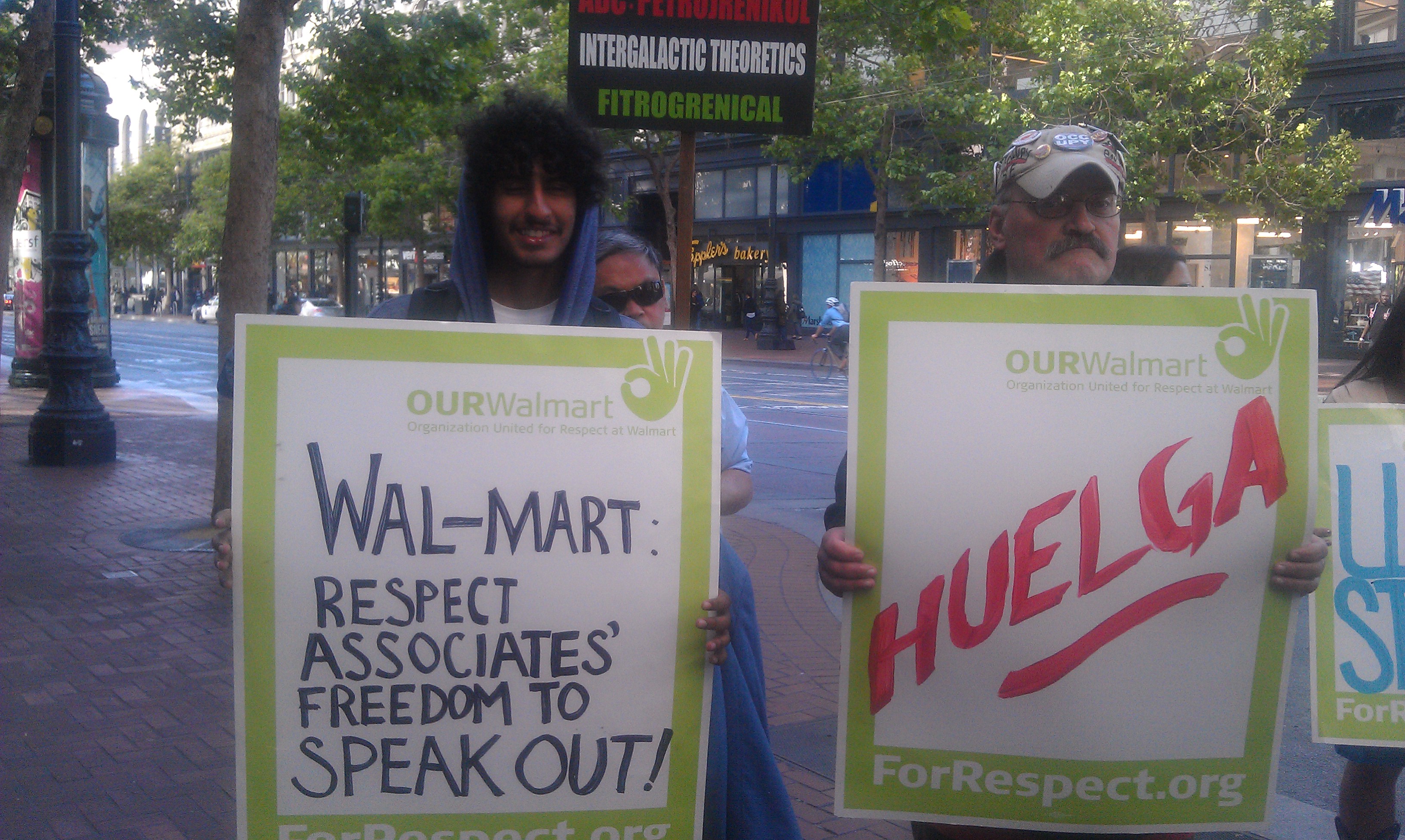
The security officers’ threats to strike coincided with a second worker action in the Bay Area last week. Despite lacking any form of union representation, Walmart associates from stores in Richmond, Fremont, and San Leandro affiliated with the nationwide organization OUR Walmart joined 100 employees from across the country in walking off the job and caravanning to Bentonville, Arkansas to raise awareness about their poverty-level wages and insufficient benefits at Walmart’s annual shareholders’ meeting. But first, they paid a visit to the Four Seasons in downtown San Francisco, which houses the 38th floor penthouse apartment of Yahoo CEO Marissa Mayer, a Walmart director.

Despite seeking full-time working opportunities and staying with the company for years, a handful of associates we interviewed said they can’t earn enough at Walmart to cover basic needs, so they rely on government assistance or help from extended family to make ends meet. Some said they had witnessed their coworkers get fired after participating in OUR Walmart activities.

Walmart associates in the Bay Area are in a considerably more precarious situation than the security officers, earning lower hourly wages. But in the pricey Bay Area, security officers, Walmart employees, and scores of other low-wage private sector workers all share something in common. Despite reporting to work every day and working long hours in many cases, they’re forced into impoverished conditions due to economic circumstances, while a middle-class existence remains far out of reach.

FIGHTING FOR STABILITY

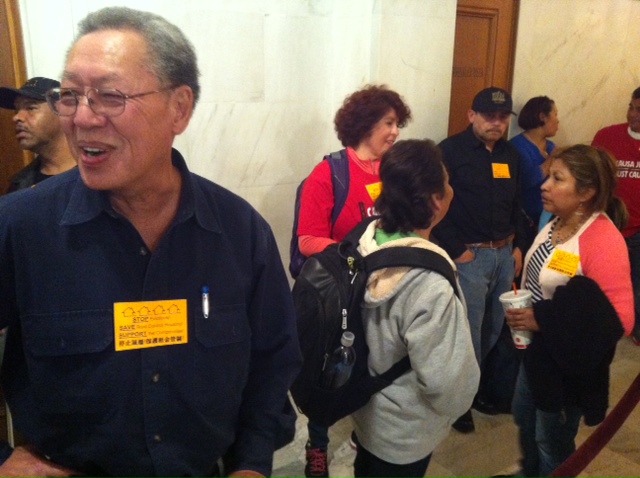
ABM Security and Universal Protection Services are the largest employers in the private security contractor industry; in the Bay Area, the majority of guards are stationed at office buildings in downtown San Francisco. On May 30, Supervisors John Avalos, David Campos, David Chiu, Jane Kim and Scott Wiener all voiced support for the guards at a rally outside City Hall. “Better working conditions for security officers mean more stable, family-supporting jobs, less turnover, and more ability to handle challenges at work,” Avalos said.

Matt Roberts has been working as a security officer for years, and originally moved into his unit in a San Francisco SRO in a financial pinch. “I figured, I’ll get out of this rut eventually. And here I am, seven years later, still paying $1,000 a month for a space that’s really not much bigger than a walk-in closet,” he told us. Roberts was terminated recently, and believes it’s because he spoke up to his site director about workplace issues his fellow guards felt needed to be addressed.

In Roberts’ view, the situation he’s found himself in is reflective of the broader erosion of the middle class, which is particularly acute in an area with a soaring cost of living. He was born and raised in San Francisco’s Crocker Amazon district, with a father who worked as a firefighter and a mother who worked as a clerk typist at the Cow Palace.

“They were able to achieve the American dream,” he said. “They had a house, they paid their mortgage off in 25 years, they were able to send me and all my three siblings to good schools. I realized when I was still in my 20s that I’m probably going to be a renter the rest of my life. The American dream is totally eclipsing my generation.”

Keven Adams, a security officer of 23 years who lives in Oakland, also attended the City Hall rally on May 30. “We’re fighting for wages, health care, and stability in the workplace,” Adams said. “We’re in a city we love so very much, but the community and the middle class is shrinking.” Adams said he was once held at gunpoint for four hours during a work shift. He’d love to live in San Francisco, he said, but can’t afford it.

According to a June 3 media advisory, unions throughout the Bay Area were preparing to demonstrate support for the security officers as they geared up to strike. “The support could come in the form of workers attending rallies, non-violent civil disobedience or perhaps even non-security workers refusing to cross picket lines,” according to USWW, “and walking off their own jobs in solidarity.”

‘STAND UP, LIVE BETTER’

Among the small group of protesters who had assembled on the sidewalk far below Mayer’s San Francisco penthouse on May 29 were associates who had taken the drastic and unusual step of going on strike from Walmart — the nation’s largest private employer. Clad in bright green shirts and waving signs, they chanted, “stand up, live better,” a play on Walmart’s slogan, and also, “What do we want? Respect.”

Dominic Ware, who works part-time at a Walmart in San Leandro, led chants and sounded off on a megaphone about the need for greater respect in the workplace. Ware, who’s been involved with OUR Walmart activities on a national level, said he earns $8.65 an hour and stays with his grandmother, since his paycheck isn’t enough to cover rent. He estimated that roughly half his earnings go directly back to Wal-Mart, where he purchases groceries and other basic items. Asked what motivated him to strike, Ware mentioned his daughter, who turned eight on June 1. “What if she has to work there some day?”

He added that some elderly colleagues were experiencing problems such as being unable to get a shift changed so as to catch a bus home at the end of the night. Another one of his coworkers was let go after it became clear to management that he was participating in OUR Walmart activities, Ware said.

While only a tiny fraction of Walmart’s 1.4 million workers took action to strike, their campaign appears to resonate in high places. A report recently released by the Democratic staff of the U.S. House Committee on Education and the Workforce seized on Walmart’s low wages, emphasizing that so many of its workers are forced to turn to government assistance that it is resulting in a collective drag on taxpayers.

“Rising income inequality and wage stagnation threaten the future of America’s middle class,” the report notes. “While corporate profits break records, the share of national income going to workers’ wages has reached record lows. Walmart plays a leading role in this story. Its business model has long relied upon strictly controlled labor costs: low wages, inconsiderable benefits and aggressive avoidance of collective bargaining with its employees. As the largest private-sector employer in the U.S., Wal-Mart’s business model exerts considerable downward pressure on wages throughout the retail sector and the broader economy.”

Editor’s notes

51

Tredmond@sfbg.com

EDITORS NOTES It’s as if someone has some kind of auto-respond system: Every time I write about housing or rent control, one of the trolls who comments on the Guardian Politics blog complains that landlords are “subsidizing” longterm tenants.

That’s a complaint I’ve heard plenty of times before — rent control is a “subsidy” because property owners have to allow the use of their property for a lower rate than the current market might allow.

And it’s completely wrong.

In fact, it only takes a basic understanding of economics to realize that in many cases, tenants are subsidizing their landlords. That’s how the business works.

You don’t have to read Karl Marx to learn that in a capitalist system, the owner of a business typically pays his or her employees less than the value they bring to the operation; the difference is what’s called “profit.” It’s how American capitalism works.

Same way, when a landlord signs a rental agreement with a tenant, the rent he or she charges is typically enough to: (a) cover that tenant’s portion of the building mortgage; (b) cover expected maintenance costs, and (c) provide the owner with a profit. Not that many landlords go into the business to lose money, or to break even.

I have a friend who bought a multi-unit building in the East Bay a few years ago, and it’s a great deal for him: He lives in one unit, and the tenants in the other units pay enough rent to cover most of the mortgage. So my friend’s housing is practically free. The tenants are subsidizing him.

Now: Add in rent control, and what do you get? The same exact situation. At the time a landlord and a tenant agree on a lease, the payments are adequate to cover the landlord’s costs plus a margin of profit. (Otherwise the landlord would be a fool to sign the lease.) Over time, the rent goes up a little bit every year. The landlord’s mortgage either stays the same, or, these days, goes down after a refinance at the lowest rates in history. The landlord’s next biggest expense — property tax — goes up by less than the allowable rent increase most years. So every year, the tenant pays the landlord more than it costs the landlord to provide the housing. Every year, the vast majority of landlords in San Francisco make a profit.

Yes: a rent-controlled unit prevents someone who bought a building years ago and has longterm tenants from making even more of a profit. It is, and should be seen as, a way of limiting profit on rental property to a reasonable amount, not to what a speculative market could bring. That’s fair; housing is a public right, and should be regulated a little like a public utility. (PG&E gets to make a profit every year, but not an unlimited profit.)

But like workers in a capitalist system whose product of labor subsidizes the profit of the owners, tenants in San Francisco are subsidizing landlords. That’s how the private housing market works.

Keep the focus on real estate

70

OPINION Let’s stop blaming the hipsters. The Google bus, that annoying icon of yuppie invasion and transit privatization, is not the lead driver of gentrification’s reckless stampede reshaping our city (though it does play a role). The upscale restaurants dominating commercial strips may be economically and aesthetically offensive to many, but they are the natural byproducts of gentrification’s much-ignored elephant in the room: the real estate industry.

While headlines, comment threads, and café chatter fixate on the tech industry and yuppies with fistfuls of dollars, it’s the profit-gobbling real estate companies and speculators who are jacking up rents and evicting so many small businesses and renters—and they are surely happy to stay out of the spotlight.

Gentrification is a many-layered beast nurtured by cultural and economic trends, regional and local labor and housing factors, and public policies (or lack thereof). Beneath the surface-level aesthetics, it is about displacement of people who don’t fit the dominant economic growth plan—radical market-driven upheavals of communities often abetted by government policies and inaction.

The stats are familiar but bear repeating as they are so destructive: average apartment rentals exceeding $2,700 a month, requiring someone making $70,000 a year to pay half of his or her salary in rent. Literally thousands of no-fault evictions in the past decade, according to the Rent Board.

Despite rampant displacement of thousands of San Franciscans, there has been little response from City Hall: no hearings, no proactive legislation, not even bully-pulpit style leadership. We must demand more.

Where is the leadership demanding the city do everything in its albeit limited power to halt further displacement of residents and small businesses? The toxic combo of tenant evictions and home foreclosures by the thousands — driven principally by major banks and real estate companies — is destroying lives and communities.

Some of this is beyond City Hall’s jurisdiction: state laws like the Ellis Act and Costa-Hawkins enable no-fault evictions and prevent vitally needed commercial rent control. Still, beyond their valiant opposition to the Wiener-Farrell condo conversion threat, city leaders have been largely silent about this latest wave of gentrification that’s eviscerating communities, driving out small businesses, and squeezing renters to the bone.

What can we do? We won’t defeat gentrification with city hearings or loud protests or online screeds and petitions — but we need all those things, along with serious public education, to shine a bright hot spotlight on the companies and individuals defining who lives and votes here.

We need a new era of citywide awareness, unity, and action to literally save San Francisco — a bold unapologetic vision that puts affordability and diversity at the forefront of what our city is about. We can’t have diversity without affordability; it’s that simple.

Renters are gearing up to fight back. An ‘Eviction Free Summer’ is being planned — an innovative campaign to counter the rash of evictions that are generating both displacement and skyrocketing rent prices. The idea of ‘Eviction Free Summer’ is to put evictions and evictors in the spotlight, to put would-be evictors on notice and capture the attention of city officials who have so far done little to stem their tide.

We must demand accountability and action by City Hall and state legislators to rein in the real estate industry and put the brakes on evictions and other displacement. People’s lives, neighborhoods and communities, and the very fabric and identity of our city are at stake.

To those who cheer “change” as if its victims were not real, or who wearily concede the fight, we must ask: are we really going to allow the profit-hungry market and wealth-seeking executives and speculators decide who lives and votes here? Are we going to let the market destroy what’s left of our city’s economic, cultural, racial and ethnic diversity — the very things that make San Francisco what it is?

Christopher D. Cook is an award-winning journalist and author, and former Bay Guardian city editor. Contact him at www.christopherdcook.com

Editor’s notes

57

tredmond@sfbg.com

EDITORS NOTES I know you’re getting a lot of shit these days, and it’s not entirely fair. You’re not the ones making a killing in overpriced real estate. You came here looking for a job, and the jobs you get pay well enough that landlords and speculators can extract wealth that you ought to be able to save or spend in town, creating more jobs for everyone. I can’t blame you for wanting to live in one of the world’s greatest cities; I came here too, from the East Coast, in 1981, looking for work as a writer but mostly looking to live in San Francisco. So did waves of immigrants before me.

But we all have to remember something: There were people living here when we arrived. It was their city before it was ours. And they had, and have, the right to live here, too.

In fact, the people who have been here for 20 or 30 years, who have worked to build this community, have — in a karmic sense — even more right to be here than you. Trite as it sounds, they were here first.

Americans have a bad record when it comes to moving into established populations. Ask any American Indian. Ask the Mexicans about the treaty of Guadalupe Hidalgo.

The hippies who arrived in San Francisco in the 1960s — attracted, among other things, by really cheap rent in the Haight Asbury — weren’t always terribly polite to, or concerned about, the natives who lived there, and had fun teasing the straights and fouling their parks. But they didn’t force anyone else to leave; there was lots of empty space in San Francisco. The city wasn’t kind to them, either — official San Francisco may celebrate the Summer of Love now, but back then, the cops went after the hippies with gusto.

Gay people who arrived in the 1970s — attracted, among other things, by cheap rent in Eureka Valley — faced harassment, discrimination, and brutality.

You, on the other hand, are officially welcomed — the mayor thinks you’re the city’s future. You face no barriers to renting or buying a home, no police crackdowns. The only people unhappy about your presence are the ones who are getting forced out of town to make room for you.

It’s not your fault that the city lacks eviction protections or effective rent control — but it is your fault if you act as if it doesn’t matter. Building community means more than spending money. It means getting involved.

Many of you are tenants. You may be richer than the people who you displaced, but your landlord will cheat you just the same. The Tenants Union needs support. You can be a part of making it stronger. Some of you will have kids at some point; there are great public schools in San Francisco, and I hope you support them.

Meanwhile, you can help keep longtime residents from being forced out. Jeremy Mykaels, a former web designer disabled by AIDS, has set up a site listing all the properties that have been cleared through the eviction of a senior or disabled person (ellishurtsseniors.com). Check it out. Don’t buy those units. If that means you have to live with lesser housing for a while, you can deal. For generations, the rest of us did.

Yeah, we were here first. Show a little humility and a little respect, and perhaps we’ll all get along fine.


Planning for displacement

70

tredmond@sfbg.com

The intersection of Cesar Chavez and Evans Avenue is a good enough place to start. Face south.

Behind you is Potrero Hill, once a working-class neighborhood (and still home to a public housing project) where homes now sell for way more than a million dollars and rents are out of control. In front, down the hill, is one of the last remaining industrial areas in San Francisco.

Go straight along Evans and you find printing plants, an auto-wrecking yard, and light manufacturing, including a shop that makes flagpoles. Take a right instead on Toland, past the Bonanza restaurant, and you wander through auto-glass repair, lumber yards, plumbing suppliers, warehouses, the city’s produce market — places that the city Planning Department refers to at Production, Distribution, and Repair facilities. Places that still offer blue-collar employment. There aren’t many left anywhere in San Francisco, and it’s amazing that this district has survived.

Cruise around for a while and you’ll see a neighborhood with high home-ownership rates — and high levels of foreclosures. Bayview Hunters Point is home to much of the city’s dwindling African American population, a growing number of Asians, and much higher unemployment rates than the rest of the city.

Now pull up the website of the Association of Bay Area Governments, a well-funded regional planning agency that is working on a state-mandated blueprint for future growth. There’s a map on the site that identifies “priority development area” — in planning lingo, PDAs — places that ABAG, and many believers in so-called smart growth, see as the center of a much-more dense San Francisco, filled with nearly 100,000 more homes and 190,000 new jobs.

Guess what? You’re right in the middle of it.

The southeastern part of the city — along with many of the eastern neighborhoods — is ground zero for massive, radical changes. And it’s not just Bayview Hunters Point; in fact, there’s a great swath of the city, from Chinatown/North Beach to Candlestick Park, where regional planners say there’s space for new apartments and condos, new offices, new communities.

It’s a bold vision, laid out in an airy document called the Plan Bay Area — and it’s about to clash with the facts on the ground. Namely, that there are already people living and working in the path of the new development.

And there’s a high risk that many of them will be displaced; collateral damage in the latest transformation of San Francisco.

CLIMATE CHANGE AND “SMART GROWTH”

The threat of global climate change hasn’t convinced the governor or the state Legislature to raise gas taxes, impose an oil-severance tax, or redirect money from highways to transit. But it’s driven Sacramento to mandate that regional planners find ways to reduce greenhouse gas emissions in California cities.

The bill that lays this out, SB375, mandates that ABAG, and its equivalents in the Los Angeles Basin, the Central Coast, the Central Valley and other areas, set up “Sustainable Communities Strategies” — land-use plans for now through 2040 intended to reduce greenhouse gas emissions by 15 percent.

The main path to that goal: Make sure that most of the 1.1 million people projected to live in the Bay Area by 2040 be housed in already developed areas, near transit and jobs, to avoid the suburban sprawl that leads to long commutes and vast amounts of car exhaust.

The notion of smart growth — also referred to as urban infill — has been around for years, embraced by a certain type of environmentalist, particularly those concerned with protecting open space. But now, it has the force of law.

And while ABAG is not a secret government with black helicopters that can force cities to do its will — land-use planning is still under local jurisdiction in this state — the agency is partnering with the Metropolitan Transportation Commission, which controls hundreds of millions of dollars in state and federal transportation money. And together, they can offer strong incentives for cities to get in line.

Over in Contra Costa and Marin counties, at hearings on the plan, Tea Party types (yes, they appear to exist in Marin) railed against the notion of elite bureaucrats forcing the wealthy enclaves of single-family homes to accept more density (and, gasp, possibly some affordable housing). In San Francisco, it’s the progressives, the transit activists, and the affordable housing people who are starting to get worried. Because there’s been almost zero media attention to the plan, and what it prescribes for San Francisco is alarming — and strangely nonsensical.

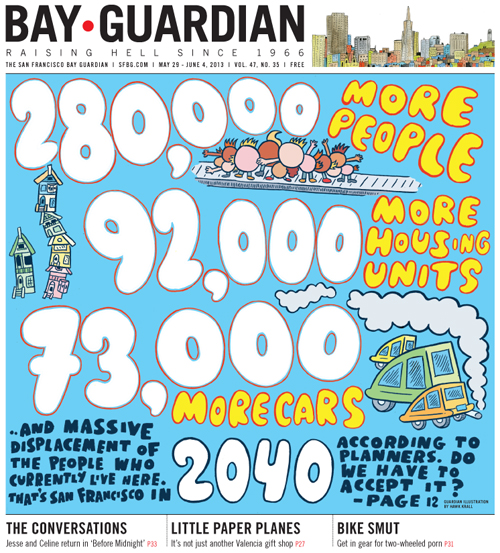
Under the ABAG plan, San Francisco would approve 92,400 more housing units for 280,000 more people. The city would host 190,000 more jobs, many of them in what’s called the “knowledge economy,” which mostly means high tech. Second and third on the list: Health and education, and tourism.

The city currently allows around eight cars for every 10 housing units; as few as five in a few neighborhoods, at least 10 in many others. And there’s nothing in any city or regional plan right now that seeks to change that level of car dependency. In fact, the regional planners think that single-occupancy car travel will be the mode of choice for 48 percent of all trips by 2040 — almost the same as it is today.

And since most of the new housing will be aimed at wealthier people, who are more likely to own cars and avoid catching buses, San Francisco could be looking for ways to fit 73,000 more cars onto streets that are already, in many cases, maxed out. There will be, quite literally, no place to park. And congestion in the region, the planners agree, will get a whole lot worse.

That seems to undermine the main intent of the plan: Transit-oriented development only works if you discourage cars. In a sense, the car-use projections are an admission of failure, undermining the intent of the entire project.

The vast majority of the housing that will be built will be too expensive for much of the existing (and even future) workforce and will do little to relieve the pressure on lower income people. But there is nothing whatsoever in the plan to ensure that there’s money available to build housing that meets the needs of most San Franciscans.

Instead, the planners acknowledge that 36 percent of existing low-income people will be at risk for displacement. That would be a profound change in the demographics of San Francisco.

Of course, adding all those people and jobs will put immense pressure on city services, from Muni to police, fire, and schools — not to mention the sewer system, which already floods and dumps untreated waste into the Bay when there’s heavy rain. Everyone involved acknowledged those costs, which could run into the billions of dollars. There is nothing anywhere in any of the planning documents addressing the question of who will pay for it.

THE NUMBERS GAME

Projecting the future of a region isn’t easy. Job and population growth isn’t a straight line, at best — and when you’re looking at a 25-year window in a boom-and-bust area with everything from earthquakes to sea-level rise factoring in, it’s easy to say that anyone who claims to know what’s going to happen in 2040 is guessing.

But as economist Stephen Levy, who did the regional projections for ABAG, pointed out to us, “You have to be able to plan.” And you can’t plan if you don’t at least think about what you’re planning for.

Levy runs the Center for the Continuing Study of the California Economy, and he’s been watching trends in this state for years. He agrees that some of his science is, by nature, dismal: “Nobody projects deep recessions,” much less natural disasters. But overall, he told me, it’s possible to get a grip on what planners need to prepare for as they write the next chapter of the Bay Area’s future.

And what they have to plan for is a lot more people.

Levy said he started with the federal government’s projections for population growth in the United States, which include births and deaths, immigration, and out-migration, using historic trends to allocate some of that growth to the Bay Area. There’s what appears at first to be circular logic involved: The feds (and most economists) project that job growth nationally will be driven by population — that is, the more people live in the US, the more jobs there will be.

Population growth in a specific region, on the other hand, is driven by jobs — that is, the more jobs you have in the Bay Area, the more people will move here.

“Jobs in the US depend on how many people are in the labor force,” he said. “Jobs in the Bay Area depend on our share of US jobs and population depends on relative job growth.”

Make sense? No matter — over the years it’s generally worked. And once you project the number of people and jobs expected in the Bay Area, you can start looking at how much housing it’s going to take to keep them all under a roof.

Levy projects that the Bay Area’s share of jobs will be higher than most of the rest of the country. “This is the home of the knowledge industry,” he told me. So he’s concluded that population in the Bay Area will grow from 7.1 million to 9.2 million — an additional 2.14 million people. They’ll be chasing some 1.1 million new jobs, and will need 660,000 new housing units.

Levy stopped there, and left it to the planners at ABAG to allocate that growth to individual cities — and that’s where smart growth comes in.

For decades in the Bay Area, particularly in San Francisco, activists have waged wars against developers, trying to slow down the growth of office buildings, and later, luxury housing units. At the same time, environmentalists argued that spreading the growth around creates serious problems, including sprawl and the destruction of farmland and open space.

Smart growth is supposed to be an alternative: the idea is to direct new growth to already-established urban areas, not by bulldozing over communities (as redevelopment agencies once did) but by the use of “infill” — directing development to areas where there’s usable space, or by building up and not out.

ABAG “focused housing and jobs growth around transit areas, particularly within locally identified Priority Development Areas,” the draft environmental impact report on the plan notes.

The draft EIR is more than 1,300 pages long, and it looks at the ABAG plan and several alternatives. One alternative, proposed by business groups, would lead to more development and higher population gains. Another, proposed by community activist groups including Public Advocates, Urban Habitat, and TransForm, is aimed at reducing displacement and creating affordable housing; that one, it turns out, is the “environmentally preferred alternative.” (See sidebar).

But no matter which alternative you look at, two things leap out: There is nothing effective that ABAG has put forward to prevent large-scale displacement of vulnerable communities. And despite directing growth to transit corridors, the DEIR still envisions a disaster of traffic congestion, parking problems, and car-driven environmental wreckage.

THE DISPLACEMENT PROBLEM

ABAG has gone to some lengths to identify what it calls “communities of concern.” Those are areas, like Bayview Hunters Point, Chinatown, and the Mission, where existing low-income residents and small businesses face potential displacement. In San Francisco, those communities are, to a great extent, the same geographic areas that have been identified as PDAs.

And, the DEIR, notes, some degree of displacement is a significant impact that cannot be mitigated. In other words, the gentrification of San Francisco is just part of the plan.

In fact, the study notes, 36 percent of the communities of concern in high-growth areas will face displacement pressure because of the cost of housing. And that’s region wide; the number in San Francisco will almost certainly be much, much higher.

Miriam Chion, ABAG’s planning and research director, told me that displacement “is the core issue in this whole process.” The agency, she said, is working with other stakeholders to try to address the concern that new development will drive out longtime residents. But she also agreed that there are limited tools available to local government.

The DEIR notes that ABAG and the MTC will seek to “bolster the plan’s investment in the Transit Oriented Affordable Housing Fund and will seek to do a study of displacement. It also states: “In addition, this displacement risk could be mitigated in cities such as San Francisco with rent control and other tenant protections in place.”

There isn’t a tenant activist in this town who can read that sentence with a straight face.

The problem, as affordable housing advocate Peter Cohen puts it, is that “the state has mandated all this growth, but has taken away the tools we could use to mitigate it.”

That’s exactly what’s happened in the past few decades. The state Legislature has outlawed the only effective anti-displacement laws local governments can enact — rent controls on vacant apartments, commercial rent control, and eviction protections that prevent landlords from taking rental units off the market to sell as condos. Oh, and the governor has also shut down redevelopment agencies, which were the only reliable source of affordable housing money in many cities.

Chion told me that the ABAG planners were discussing a list of anti-displacement options, and that changes in state legislation could be on that list. Given the power of the real-estate lobby in the state Capitol, ABAG will have to do more than suggest; there’s no way this plan can work without changing state law.

Otherwise, eastern San Francisco is going to be devastated — particularly since the vast majority of all housing that gets built in the city, and that’s likely to get built in the city, is too expensive for almost anyone in the communities of concern.

“This plan doesn’t require affordable housing,” Cindy Wu, vice-chair of the San Francisco Planning Commission, told me. “It’s left to the private market, which doesn’t build affordable housing or middle-class housing.”

In fact, while there’s plenty of discussion in the plan about where money can come from for transit projects, there’s virtually no discussion of the billions and billions that will be needed to produce the level of affordable housing that everyone agrees will be needed.

Does anyone seriously think that developers can cram 90,000 new units — at least 85 percent of them, under current rules, high-cost apartments and condos that are well beyond the range of most current San Franciscans — into eastern neighborhoods without a real-estate boom that will displace thousands of existing residents?

Let’s remember: Building more housing, even a lot more housing, won’t necessarily bring down prices. The report makes clear that the job growth, and population boom that accompanies it, will fuel plenty of demand for all those new units.

Steve Woo, senior planner with the Chinatown Community Development Center, sees the problem. In a letter to ABAG, he notes: “Plan Bay Area and its DEIR has analyzed the displacement of low-income people and explicitly acknowledges that it will occur. This is unacceptable for San Francisco and for Chinatown, where the pressures of displacement have been a constant over the past 20 years.”

Adds the Council of Community Housing Organizations: “It would be irresponsible for the regional agencies to advance a plan that purports to ‘improve’ the region’s communities as population grows while the plan simultaneously presents great risk and uncertainty for many vulnerable communities.”

Jobs are at stake, too — not tech jobs or office jobs, which ABAG projects will expand, but the kind of industrial jobs that currently exist in the priority development areas.

Calvin Welch, who has been watching urban planning and displacement issues in San Francisco for more than 40 years, puts it bluntly: “It is axiomatic that market-rate housing drives out blue-collar jobs,” he said.

Of course, there’s another potential problem: Nobody really knows where jobs will come from in the next 25 years, whether tech will continue to be the driver or whether the city’s headed for a second dot-com bust. San Francisco doesn’t have a good record of building for projected jobs: In the mid-1980s, for example, the entire South of Market area (then home to printing, light manufacturing, and other blue-collar jobs) was rezoned for open-floor office space because city officials projected a huge need for “back-office” functions like customer service.

“Where are all those jobs today?” Welch asked. “They’re in India.”

TOO MANY CARS

For a plan that’s designed to reduce greenhouse gas emissions by moving residential development closer to work areas, Plan Bay Area is awfully pessimistic about transportation.

According to the projections, there will be more cars on the roads in 2040, with more — and much worse — traffic. The DEIR predicts that a full 48 percent of all trips in 2040 will be made by single-occupant vehicles — just slightly down from current rates. The percentage of trips on transit will only be a little bit higher — and there’s no significant increase in projected bicycle trips.

That alone is pretty crazy, since the number of people commuting to work by bike in San Francisco has risen dramatically in the past 10 years, and the city’s official goal is that 20 percent of all vehicle trips will be by bike in the next decade.

Part of the problem is structural. Not everyone in San Francisco 2040 is going to be a high-paid tech worker. In fact, the most stable areas of employment are health services and government — and hospital workers and Muni drivers can’t possibly afford the housing that’s being built. So those people will — the DEIR acknowledges — be displaced from San Francisco and forced to live elsewhere in the region (if that’s even possible). Which means, of course, they’ll be commuting further to work. Meanwhile, if current trends continue, many of the people moving into the city will work in Silicon Valley.

Chion and Levy both told me that the transit mode projections were based on historical trends for car use, and that it’s really hard to get people to give up their cars. Even higher gas prices and abominable traffic delays won’t drive people off the roads, they said.

If that’s the case — if auto culture, which is a top source of global climate change, doesn’t shift at all — it would seem that all this planning is pointless: the seas will rise dramatically, and San Franciscans ought to be buying boats.

“The projections don’t take into account social change,” Jason Henderson, a geography professor at San Francisco State University and a local transportation expert, told me. “And social change does happen.”

Brad Paul, a longtime housing activist who now works for ABAG, said these projections are just a start, and that the plan will be updated every four years. “I think we’re finding that the number of people who want to drive cars will go down,” he said.

Henderson argues that the land-use policy is flawed. He suggests that it would make more sense to increase density in the Bay Area suburbs along the BART lines. “Elegant development in those areas would work better,” he said. You don’t need expensive high-rises: “Four and five stories is the sweet spot,” he explained.

Most of the transportation projects in the plan are already in the pipeline; there’s no suggestion of any major new public transit programs. There is, however, a suggestion that San Francisco adopt a congestion management fee for downtown driving — something that city officials say is the only way to avoid utter gridlock in the future.

SIDELINING CEQA

ABAG and the MTC have a fair amount of leverage to implement their plans. MTC controls hundreds of millions of dollars in transit money; ABAG will be handing out millions in grants to communities that adopt its plan. And under state law, cities that allow development in PDAs near transit corridors can gain an exemption from the California Environmental Quality Act.

CEQA is a powerful tool to slow or halt development, and developers (and some public officials) drool at the prospect of getting a fast-track pass to avoid some of the more cumbersome parts of the environmental review process.

Under SB 375 and Plan Bay Area, CEQA exemptions are available to projects that meet the Sustainable Community Strategy standards and are close to transit corridors. And when you look at the map of those areas, it’s pretty striking: All of San Francisco, pretty much every square inch, qualifies.

That means that almost any project almost anywhere in town can make a case that it doesn’t need to accept full CEQA review.

The most profound missing element in this entire discussion is the cost of all this growth.

You can’t cram 210,000 more residents into San Francisco without new schools, parks, and child-care centers. You can’t protect those residents without more police officers and firefighters. You can’t take care of their water and sewer needs without substantial infrastructure upgrades. And even if there’s state and federal money available for new buses and trains, you can’t operate those systems without paying drivers, mechanics, and support workers.

There’s no question that the new development will bring in more tax money. But the type of infrastructure improvements that will be needed to add 25 percent more residents to the city are really expensive — and every study that’s ever been done in San Francisco shows that the tax benefits of new development don’t cover the costs of public services it requires.

When World War II and the post-war boom in the Bay Area brought huge growth to the region, property taxes and federal and state money were adequate to build things like BART, the freeways, and hundreds of new schools, and to staff the public services that the emerging communities needed. But that all changed in 1978, with the passage of Prop. 13, and two years later, with the election of Ronald Reagan as president.

Now, federal money for cities is down to a trickle. Local government has an almost impossible time raising taxes. And instead of hiking fees for new residential and commercial projects, many communities (including San Francisco) are offering tax breaks to encourage job growth.

Put all that in the mix and you have a recipe for overcrowded buses, inadequate schools, overstressed open space (imagine 10,000 new Mission residents heading for Dolores Park on a nice day), and a very unattractive urban experience.

That flies directly in the face of what Plan Bay Area is supposed to be about. If the goal is to cut down on commutes by bringing new residents into developed urban areas, those cities have to be decent places to live. What would it cost to accommodate this level of new development? Five billion dollars? Ten billion? Nobody knows — because nobody has run those numbers. But they’re going to be big.

Because just as tax dollars have been vanishing, the costs of infrastructure keep going up. It costs a billion dollars a mile to build BART track. It’s costing more than a billion to build a short subway to Chinatown. Just upgrading the sewer system to handle current demands is a $4 billion project.

And if the developers and property owners who stand to make vast sums of money off all of this growth aren’t going to pay, who’s left?

The ABAG planners point out, correctly, that there’s a price for doing nothing. If there’s no regional plan, no proposal for smart growth, the population will still increase, and displacement will still happen — but the greenhouse gas emissions will be even worse, the development more haphazard.

But if the region is going to spend all this money and all this time on a plan to make the Bay Area more sustainable, more livable, and more affordable in 25 years, we might as well push all the limits and get it right.

Instead of looking at displacement as inevitable, and traffic as a price of growth, the planners could tell the state Legislature and the governor that it’s not possible to comply with SB375 — not until somebody identifies the big sums of money, multiples of billions of dollars, needed to build affordable housing; not until there are transit options, taxes, and restrictions on driving.

Because continued car use and massive displacement — the package that’s now facing us — just isn’t an acceptable option.


Sarah Palin = REO Speedwagon

38

One of the more remarkable components of the so-called “Right Wing Entertainment Complex” (Fox/AM Radio/a gazillion reactionary websites) is the agonizing and complete predictability of its content. Barack Obama is the most evil, traitorious, illegal usurper, Muslim, Kenyan Socialist dictator alive and the besieged heroes of American patriotism are outnumbered and will be outgunned when Obama seizes their weapons, Obamacare will kill every member of your family assuming they haven’t committed suicide after it bankrupted them, Benghazi was worse than 9/11, Iraq and the 1962 Mets combined and the IRS only hates the brave and fierce Republican Party. Who are the only ones that can keep you safe against the fifth column of baby-killing Hollywood liberals that will brainwash your son into marrying a barnyard animal.

(Also remarkable is however much you try to lampoon their cray-cray, they’re inevitably more out there than even a parodist can dream of).

Flip on any of these mediums and this is what you get and if I know this in advance, so do their fans and they like it that way. Like a soothing wash of a New Age mixtape in the foyer of a yoga studio.Except that the whoosh of the mixtape is familiar in form and not content.

Nope, the real parallel between the RW Entertainment Complex and its musical equivalent would be the aging classic rock dinosaurs of the 70’s and 80’s and the state fair/shitty casino/low rent rally circuit. Glenn Beck, Bill O’Reilly, the battery of Sunday morning news show dildolatry and especially the Mega MILF of Moosery Sarah Palin are completely and totally identical to the slog it out warriors of faceless corporate FM rock–Foreigner, Journey, Styx, Nightranger and REO Speedwagon.

Think about it–what do Kevin Cronin (REO), Mick Jones (Foreigner, not the Clash’s Mick Jones) and whomever is left in the other bands do for a living? They mount the boards and play their hits–period. And vamoose off to the next hellhole whose main fiscal purpose at this point is alimony, child support and back taxes. 12 tunes, maybe, paycheck and screw. They try not to think about their better days, one imagines, and just do their jobs–which consist now of rote recitation. In that, they are exactly like Palin or Glenn Beck–who hit all the talking points, massage the prejudices of their chosen audience and remind them that only they understand their plight (and then batter them with ads for merchandise and books). Like peas in a pod.  

Except that at one time, these bands were cranking out hit songs and even if you don’t like their hits, writing a hit is hard to do. Regurgitating “the best of Joe McCarthy” only replacing “Communists” with “Muslims” or “libs” is all these verbal midgets need do to cash in. “Hot Blooded” or “Don’t Let Him Go” or “Babe” may sound trite and brittle and overwrought to some, but they had to be concocted, recorded with care and sung in tune. That is a hell of a lot more than these repulsive mountebanks on the right are capable of. 

(And there is, of course, the gent that straddles both worlds with ham-handed, blockheaded glory, the Nuge himself–except he’s third on the bill beneath REO and Styx this summer and is but a mere guest on FOX at best. Sorry, Ted).

Lastly, the rock bands who are on rickety stages this summer outside Lincoln NE or Bakersfield or Dothan Alabama next to livestock and ferris wheels are fucking honest men and women. They travel endless hours for vastly less pay than they used to get. They have seen their expected annuities disappear via digital downloading and YouTube. They look into the smaller crowds and see their reflections in the once fist pumping but now worn looking fans. And they still have enough pride to deliver the goods, because that’s what they do–not chauffered from their expensive mansions to TV and radio studios to spew out the party line that has been focus group and poll tested to perfection. And then home to mansion. I may not like the dino bands but I respect ’em–I have no respect for these reactionary carny barkers at all.


This Ain’t The Summer Of Love

27

Recently, I came across this great series from 1995 on YouTube, “Dancing In The Streets–the History of Rock and Roll”. Ten episodes from the R/B meets Country birth of the music all the way to hip hop. Really well done, excepting some glaring errors (whomever wrote the Ramones segment knew nothing of the band) and omissions (not an Elton John fan, but the guy was a recording artist of enormous success, ditto Rod Stewart and no MC5 or New York Dolls). As it is television and not music, the colorful parts of rock’s history got a lot of play.

One entire segment was devoted to psychedelia. Was great, too–bookended by the Byrds’ “Eight Miles High” and “You Ain’t Goin’ Nowhere”. Naturally, there was a lot of attention devoted to San Fran and its bands and the importance of the City in rock and roll. Which can’t be denied. San Francisco–from the mid 50’s to the mid 60’s–was America’s creative crucible. The Beats of North Beach and the hippies of the Haight are now cultural signifiers and as the program pointed out, they didn’t happen in San Francisco by accident. 

As the Airplane’s Paul Kantner points out, San Fran is a seaport and seaports tend to be where the collision of disparate ideas from around the world makes new ones. What’s not in the piece is the real reason the Beats flourished in SF. In New York, cabaret licenses were hard to obtain in the 50’s, in SF, they weren’t. Therefore, a city with a population 1/10th the size of New York’s could compete with New York. As is also said in the show, all of SF’s old ballrooms were ideal for Kesey’s acid tests and the laissez faire attitude of the City wasn’t entirely due to its open-mindedness, but simply that San Fran had no idea what was coming in 1966 and 1967.

At the end of the show (which featured Jerry Garcia’s last interview and he was good naturedly hilarious in it), I wondered if in this day and age, San Francisco could ever be the giant of the zeitgeist again. Took me less than a half a minute to realize that the answer is a resounding “no”.

Every factor that figures in to a locale becoming a spawning ground for the arts no longer exists in SF. Artists need two things above all else–lots of space and cheap rent. An “artist” that works a 50 hour a week day job to pay the bare bones of rent, food and heat hasn’t got much left by way of time and energy. If the same artist is in a Mission one bedroom (and shared), there’s no elbow room. Nowhere to rehearse one’s craft and nowhere to paint or draw without getting up in someone else’s space.

That’s to say nothing of a “night life scene” where the price of two drinks and a cover could buy lunch five days a week in another city. 

Don’t hand me the idea that the young software and PNS developers are somehow the same as Jack Kerouac, Jerry, Janis and Grace. Yeah–they’re all young (not now, of course). But conflating commerce with art that no one thought would make any money in the first place because “that’s what kids do now” is jive. They’re opposites. Artists and their fans are messy and free and by their nature hard to control, businessmen and politicians are soulmates. Catering to the very wealthy is a slam dunk to the Ed Lee’s and Nancy Pelosi’s of the world because the wealthy contribute to them.

Don’t get me wrong–the 60’s weren’t utopia and the hordes of homeless people that have flocked to SF since have become an almost intractable problem. 

San Francisco is the country’s mosy physically beautiful city. It has a long history of upheaval (culturally and seismically). But in our time, Detroit, Erie or Buffalo are becoming just as likely if not more so to be where the arts boom next. They’re cheap and with the Internet, an artist’s work can go anywhere when he or she don’t have to. Fact is, plain old venality is doing SF in. Pandering to the few at the expense of the many means that the fertile underside of the (actual) creative class gets priced right off the peninsula. All that’s left is the safe and staid that San Fran has thumbed its nose at forever. Sad.


Let’s dance

1

cheryl@sfbg.com

FILM Noah Baumbach isn’t exactly known for romance and bright-eyed optimism. Co-writing 2009’s Fantastic Mr. Fox with director Wes Anderson is maybe the closest to “whimsy” as he’s ever come; his own features (2010’s Greenberg, 2007’s Margot at the Wedding, 2005’s The Squid and the Whale, 1997’s Mr. Jealousy, and 1995’s Kicking and Screaming) tend to veer into grumpier, more intellectual realms. You might say his films are an acquired taste. Actual declaration overheard at this year’s San Francisco International Film Festival: “Am I going to see Frances Ha? Ugh, no. I can’t stand Noah Baumbach.”

Haters beware. Frances Ha — the black-and-white tale of a New York City hipster (Baumbach’s real-life squeeze, Greta Gerwig) blundering her way into adulthood — is probably the least Baumbach-ian Baumbach movie ever. Owing stylistic debts to both vintage Woody Allen and the French New Wave, Frances Ha relies heavily on Gerwig’s adorable-disaster title character to propel its plot, which is little more than a timeline of Frances’ neverending micro-adventures: pursuing her nascent modern-dance career, bouncing from address to address, taking an impromptu trip to Paris, visiting her parents (portrayed by the Sacramento-raised Gerwig’s real-life parents), “breaking up” with her best friend. It’s charming, poignant, it’s quotable (“Don’t treat me like a three-hour brunch friend!”), and even those who claim to be allergic to Baumbach just might find themselves succumbing to it.

Frances Ha marks the second film to feature a dance subplot for Gerwig, after Whit Stillman’s 2011 Damsels in Distress. (She also appeared in Greenberg but is probably best-known for her mumblecore oeuvre: 2008’s Baghead; 2007’s Hannah Takes the Stairs.)

“I love dancing,” she admitted on a SFIFF-timed visit to San Francisco. “I was never a professional, but I danced a lot growing up and I still go to dance class whenever I can. I don’t think there’s enough dancing in movies.”

Like Frances, she studied modern dance in college. “I did this kind of modern dance called release technique. A big component of it is learning how to fall. It’s connected to bouncing back from the ground, or giving into the ground — letting everything flow. It’s a beautiful way to dance, and the dance company that [Frances] wants to be a part of, that’s the kind of dance that they do,” she said. “I also thought it was this incredible metaphor for life: learning how to fall, because you’re going to. At first, as you’re learning how to do it, you get terribly banged up — and then at some point you just are falling and it’s not hurting you anymore.”

Though much of Frances Ha, which was co-scripted by Baumbach and Gerwig, is about its protagonist’s various relationship struggles, there’s another less-expected theme: class warfare (a mild version of it, anyway). Frances scrambles to pay her $1200 rent — previously, she’s seen paying $950 a month to sleep on a couch — while her housemate, who comes from a wealthy family and spends his days noodling on spec scripts, casually mentions the necessity of hiring a maid service. You know, for, “like, 400 bucks a month.”

“We didn’t set out to make a movie about class, specifically,” Gerwig noted. “But I think typically Americans have a lot of trouble talking about class, or even acknowledging that it exists. It operates on a really subtle level. You get out of college and you suddenly realize that some people are paying off loans, and some people aren’t. It can be hard to talk about. I’m very inspired by Mike Leigh’s movies, where it’s always there in the background. I felt like I wanted to have it in the movie, and Noah felt the same way, too.”

Later that day, Baumbach elaborated on the same thought. “Economics were really going to influence a lot of what Frances does, because the movie was structured by finding a home, lack of a home, constant movement,” he said. “Her economic reality had to be a huge component of her story.”

Frances Ha captures twentysomething ennui with the same honesty Baumbach deployed in Kicking and Screaming, though there are some key differences: the Kicking and Screaming guys were mere months post-graduation, while Frances, who is 27, is more removed from college — whether she wants to admit it or not. “It didn’t feel like the exact same territory, but I was aware that it was kind of addressing some of the stuff that I was addressing back then,” Baumbach said. (Not coincidental, one presumes, is the cameo in Frances Ha by Kicking and Screaming star Josh Hamilton.)   

Though he won’t cop to naming his main character after, um, France, Baumbach does admit that the country’s films (he points specifically to works by Truffaut, Rohmer, and Carax) have had a strong influence on him as a director, and on Frances Ha in particular.

“I think [for these filmmakers], the joy of making the movie is somehow evident in the movie itself,” he said. “Sometimes, that can be annoying! But the rush you get from it, you can just feel, like, the pleasure of movies. With Frances Ha, I wanted to push that, and do things like have her run down the street [while David Bowie’s ‘Modern Love’ plays on the soundtrack]. Just go for it, because the movie really could hold it. I think a lot of [the films that inspired me] have that. And because a lot of the music is borrowed from those movies, it feels even more like a clear connection.”

FRANCES HA opens Fri/24 in Bay Area theaters


Urbicide

53

Every point on the map (click here for the detailed, interactive version) is a building where the landlord has used the state’s Ellis Act to evict all the tenants. (The points typically involve multi-unit buildings, so the number of tenants displaced is even worst than it looks). Some tenants have been here for decades, living in rent-controlled apartments, contributing to the community. And when the eviction notice arrives, they have nowhere else to go.

>>TO SEE A PROPERTY-BY-PROPERTY SPREADSHEET TRANSLATING OUR COVER’S EVICTION MAP — THAT INCLUDES LANDLORD NAMES –CLICK HERE

It feels as if all of crazy, radical, artistic, and unconventional San Francisco is under attack, as if a city that once welcomed waves of weirdos and malcontents — who, in turn, gave the city its attractive reputation and flavor — is changing forever. It’s as if there’s no longer any room for the working class — the people who, for example, keep the city’s number one industry (that’s hospitality and tourism, not tech) functioning.

It’s terrifying. Neighborhood after neighborhood is losing affordable rental housing as landlords cash in on soaring prices. And there’s a huge human cost.

In the end, if trends continue, this will soon be a very different city. We all know that change is part of life (and certainly part of hyper-capitalism) but the notion that there’s a value to a city culture that needs low rent housing and cheap commercial space has been all-but abandoned by the administration of Ed Lee, which wants high-paying jobs at all costs.

And it’s hard to imagine how the best of San Francisco — the city whose culture and sense of madness attracted all these creative folks in the first place — will ever survive. Call it Urbicide — because as Rebecca Bowe reports here, it goes way beyond residential evictions.

Can the tech boom solve our housing crisis? No, but it can make it worse

64

 San Francisco Housing Action Coalition and San Francisco Magazine posed an intriguing question at a forum they sponsored last night in the W Hotel: “San Francisco’s Housing Crisis: Can the Tech Boom Help Us?” Unfortunately, it wasn’t a question they ever really addressed at an event of, by, and for developers and their most ardent supporters.

Instead, the event was mostly just pro-development boosterism supporting HAC’s goal of building 100,000 new homes in SF over the next 20 years, and the discussion seems to show that the tech boom will exacerbate the housing crisis without ever addressing it, particularly given the local tax breaks and subsidies Mayor Ed Lee keeps giving the industry.

“San Francisco must radically increase its anemic housing production,” HAC Executive Director Tim Colen said during the introduction.

The pro-development cheerleading was slightly offset by the dose of reality offered by panelist Peter Cohen of the San Francisco Council of Community Housing Organizations, who noted that market rate developers aren’t building for today’s San Franciscans, 61 percent of whom make less than 120 percent of the Area Median Income. 

“We don’t believe the market will ever touch the 120 and lower,” Cohen said, later offering, “How do we build for the kind of San Francisco we have now?”

San Francisco Magazine Editor-in-Chief Jon Steinberg, who moderated the panel, said this event grew out of an important and widely acclaimed story that David Talbot wrote for the magazine last fall, “How Much Tech Can One City Take?” that raised critical questions about the wisdom of the big bet that San Francisco has placed on an industry driven by speculative bubbles.

“We got more responses from readers than anything we published in our history,” Steinberg said of the article, before shamefully expressing second thoughts on publishing it. “I felt the writer had been a little hard on our friends in the tech industry.”

He introduced UC Berkeley Economics Professor Enrico Moretti, whose 2012 book “The New Geography of Jobs” argues for reducing regulations that hinder housing production in cities, by saying that if he’d read it before publishing Talbot’s excellent article, “I think it would have had a little different tenor.”

Yet Moretti’s presentation was an overly simplistic Economics 101 argument that housing prices go up when demand is strong and supply is weak. “It doesn’t take a degree in economics to know those workers will bid up the price of housing,” Moretti said after noting San Francisco added 21,500 job but just 2,548 new housing units last year.

That’s the basic line we hear a lot these days, that only a massive housing construction boom will keep housing prices down and prevent mass displacement. “The only answer is to radically increase the supply,” said SPUR Executive Director Gabriel Metcalf, noting that means tossing out many of the city’s historic preservation and height and density restrictions. “All we have to do is get out of the way and allow housing to increase to make it normal again.”

Metcalf confidently predicted that housing prices and rents would drop if the city pursued that kind of unfettered housing boom, offering to buy Cohen a beer if he was wrong. Yet even Moretti’s research shows that Metcalf would probably lose that bet.

Moretti compared San Francisco to Seattle, which is also experiencing a comparable high-tech job boom that exacerbated a housing supply shortage, which Seattle responded to by following the prescription of HAC and building thousands of new condos in the downtown core.

The result was that rents in Seattle have increased 31 percent less than San Francisco’s, which he called significant, despite the fact that rents are still on the rise there even with a massive influx of new people and condos and all the infrastructure challenges that presents (it’s widely accepted that new development in San Francisco doesn’t pay for the full cost of infrastructure needed to serve it, which is a huge issue in the transportation sector alone).

Nobody had a good answer to Cohen’s point that building tons of market rate housing won’t actually do much to prevent the displacement of a majority of current city residents. As he put it, “What’s missing is who is that housing for, who is it actually serving?”

Metcalf welcomes the wholesale transformation of San Francisco – “It will be a change, a total change, and guess what? That could be great.” – but even he argues for the importance of policies that protect those on the bottom half of the economic scale, from rent control to more government-subsidized affordable housing production.

As Metcalf, one of the biggest market rate development cheerleaders in city, said, “If it were not for rent control, I would have been forced out of the city by now.”

Small Business Awards 2013: La Victoria Bakery

38

When Jaime Maldonado’s dad Gabriel opened the family’s corner bakery in 1951, it was the only Latino-owned business on 24th Street. In the years since, the story of La Victoria and its famous pan dulce has become, more or less, the story of the Mission District.

That’s never been more true than today, when the bakery’s plate glass windows are filled with Mexican classics, but also dulce de leche scones, Mexican chocolate brownies, and prickly pear beignets that reflect the neighborhoods changing palate — in addition to the conchitas, elotittos, and maranitos that made the place a favorite.

Soon, La Victoria will include a full-service restaurant that Jaime tells the Guardian will “skip over the burrito phase and to straight to original La Victoria. It’ll be the food your grandma would cook for special occasions.”

Few businesses have been able to surf the Mission’s changing demographics like La Victoria. The Maldonados found a way to thrive amid racial slurs in the ’50s. The restaurant became a gathering place and haven for Mexicans when the blocks became carved up along the gang lines delineating close-knit immigrant communities, and a training ground for bakers who brought La Victoria’s recipes to panaderias across the neighborhood. In the ’70s, the fern-filled restaurant in the back room was a habitué for SF’s movers-and-shakers — Dianne Feinstein and Cesar Chavez were known to grab tables.

Hippies, Brazilians, and Argentineans were added to La Victoria’s clientele over the years. In 1992, when Jaime took the reins from his aging pop, he was ready to make the business adjustments needed to keep La Victoria relevant. That meant focusing on the joint’s strengths — no more groceries, less reliance on wholesale business.

Maldonado survived the “cherry bomb in an ant farm,” as he refers to the late ’90s dot-com boom, and the business slowdown after 9/11. He made the kitchen available for rent, and has since attracted an impressive list of alumni through his work with Soul Cocina’s Roger Feely: Hapa SF, Sour Flour, Wholesome Bakery, Venga Empanadas. La Victoria started hosting pop-up dinners, and now looks forward to expanding into different kinds of Latin coffee drinks, and a full sit-down menu.

All in keeping with La Victoria’s Mission to connect with the ‘hood’s new techie residents, stay true to the neighborhood’s history, and connect with the “hybrid kids,” as Maldonado dubs his generation of Latinos who grew up in SF’s foodie scene, but can still appreciate a traditional Mission burrito.

“This corner is dying for someone to stand up and say ‘I’m going to show you how,'” he says. “And we’re going to do that — with Latin flair.”

2937 24th St., SF. (415) 642-7120, www.lavictoriabakery.com

Tech workers aren’t all evil

59

Read the full original blog post this op-ed was drawn from here.

OPINION I hear a lot of talk, especially from my own queer community, about how “tech people” are ruining San Francisco. From skyrocketing rent prices and disappearing diversity to economic and cultural ruination, the tech community has become the scapegoat for a lot of the problems we are facing in the city as a whole. As a tech worker, I’m writing this to say: wake up and direct your anger at the real sources of these problems.

First of all, let’s get one thing straight. The vast majority of “tech people” in San Francisco don’t make nearly as much money as you think they do. We are not all making six-figure salaries, we are not personally driving up rent costs, and we are not killing the cultural community here. Simply put, we are trying to further our careers and make the city we call home a nicer place to live.

From day one of living in San Francisco, I’ve put blood sweat and tears into building the cultural community in SF (music, mostly), and I’ll never stop doing that. I first moved here with my husband in 2006 from Indiana. I immediately immersed myself in the music scene here, forming a touring band and quickly becoming a booker and promoter for live shows. It wasn’t until several years into my time here that I snuck my way into the tech industry. Here I am, five years into my tenure at Bay Area music tech startup Thrillcall, hustling every day to help build music communities not only in SF, but across the country.

The tipping point for me, to be honest, was the nonsense of people beating up a Google bus piñata in the Mission, shouting epithets about how they’re the bane of San Francisco. The people that ride those buses are not to blame. They are not heading up that company, they don’t make millions of dollars, and they certainly don’t deserve the hatred being directed at them by many people here in San Francisco.

You know what is ruining San Francisco? Complacency. Apathy. Misguided hate. Inaction. Put some energy into making change, not senseless whining.

If you’re upset about rising rent costs, be angry at the money-hungry landlords that do absolutely nothing to put money back into the city or help build culture. Want SF prices to stop skyrocketing? Let’s organize and drive proposals with our city government. Upset about the recent sanitization of many of the lovely traditions and values of San Francisco? Get mad at Sup. Scott Weiner, who is actually supported by a lot of longtime, non-tech residents. Want more culture, arts, music? Maybe try reaching out to people that can help in the tech world instead of complaining about everything going downhill.

We are not the companies we work for, however large or small. Corporations, for the most part, suck.

We’re not the douche bags you think we are. Let’s put our energy toward doing good, instead of just pointing fingers. We all know that. Demonizing the people that work for them (while contributing to this wonderful city) is baseless, classless, and makes you look like a total dick.

A great deal can be accomplished if people take an active role toward coexisting, rather than shouting “ENEMY!” to anyone who will listen.

Johnny Koch is promotional manager, artist management, and site administrator at Thrillcall.

DPH: Unaffordable housing is bad for your health

To cover rent on a two-bedroom apartment at “fair market value” in SoMa, a San Francisco minimum-wage earner would have to work 7.4 full-time jobs.

That jaw-dropper of a statistic is just one tidbit in a fascinating dataset featured in a recently published interactive map plotting housing affordability in San Francisco neighborhoods. Combining data from Craigslist and PadMapper, the U.S. Census Bureau’s American Community Survey, and the local minimum wage ($10.24 per hour, widely regarded as generous), the map isn’t the handiwork of affordable housing activists. [Note: this reflects the 2012 minimum wage, the rate now stands at $10.55.]

Instead, it was created by the San Francisco Department of Public Health’s Program on Health, Equity and Sustainability. To view the full map and dig around for data on your neighborhood of interest, go here.

The embedded dataset reveals that the median income in SoMa is $91,000 lower than the $158,000 one would need to afford renting a market-rate two-bedroom. This figure, expressed as $-91,000, is known as the “affordability gap,” and the map plots these gaps neighborhood by neighborhood.

It was rolled out as part of a weeklong effort to raise public awareness about the link between affordable housing and public health, explains Cyndy Comerford, manager of planning and fiscal policy at the Environmental Health division of DPH. The reason? “Unmet housing needs in San Francisco can result in significant public health concerns,” Comerford says.

A lack of affordable rental housing can push more tenants into substandard or overcrowded living situations, she adds. Housing units within reach for lower income residents might be squeezed up against a highway, for instance, putting tenants in close proximity to noise, traffic, or air pollution, thus increasing their risks for experiencing heart or respiratory problems. Substandard housing also makes lead or mold exposure more likely, possibly triggering serious health issues over time.

For residents who fork over a significant percentage of their income for rent, other problems can arise. “It leaves little money for other provisions,” such as healthy food or preventative health care, Comerford adds, so low-income tenants have a higher likelihood of malnourishment or preventable disease related to nutrition.

The map is part of a broader DPH initiative known as the Sustainable Communities Index, which provides datasets for more than 100 health indicators. There’s a whole section on housing, which even covers the negative health effects of eviction: “Involuntary displacement contributes to stress, loss of supportive social networks and increased risk for substandard housing conditions and overcrowding,” DPH points out.

More information is yet to come: “Every day this week, we’ll put out a new bit of information around health and housing,” Comerford says.

Taking a broader view, it appears that sweeping cuts to public programs will present a whole new set of challenges for lower-income populations who have a higher risk of housing-related health problems. As a New York Times opinion piece highlighting the public health ramifications of austerity measures notes, “there are warning signs … that health trends are worsening. Prescriptions for antidepressants have soared. Three-quarters of a million people (particularly out-of-work young men) have turned to binge drinking. Over five million Americans lost access to health care in the recession because they lost their jobs.”

Amid all this, as a consequence of the $85 billion “sequester” that began on March 1, “Public housing budgets will be cut by nearly $2 billion this year,” the New York Times piece continues, “even while 1.4 million homes are in foreclosure.”