Protest

World homeless day protest targets Castro landlord

54

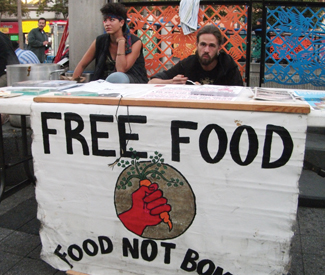
In a protest marking World Homeless Day, the squatter group Homes Not Jails briefly occupied a vacant building on Castro St. tonight. Twenty were arrested.

This is the third year that the group has staged a building occupation to draw attention to buildings that lie vacant while people live on the streets.This year’s demonstration began in Dolores Park, where a group of about 50 held a rally and concert. 

The group then marched up 18th street, chanting “house keys not handcuffs” and “housing is a human right.” 

When the protest arrived at the building, on the 500 block of Castro St., activists opened the building and entered it. From the roof, protesters dropped a banner reading “Gentrification equals assimilation.”

One man who entered the building had seen the march on 18th st. and joined along the way. “I don’t believe there should be this many abandoned houses,” said the man, who identified only as Scott. “I don’t mind being homeless, though,” he added. “I like sleeping under the stars.”

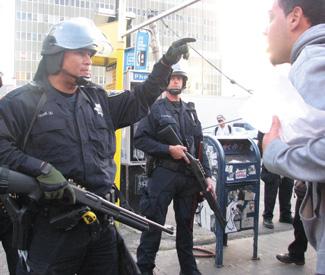
Police lined up across the street and closed Castro between 18th and 19th to traffic. After about 40 minutes, they charged the building. Those on the sidewalk were pushed aside, and those inside the building were arrested. According to SFPD spokesperson Michael Andraychak, there were 20 arrests.

After more than two hours, the police reopened the street.

During that time, Andraychak said, “Several people had run into an annex in the rear. Several had gone downstairs and broke into an adjoining restaurant.” Arrestees were also being searched and processed in the building.

The city’s most recent “Homeless Point-in-Time Count and Survey” finds that there were 6,455 homeless individuals and families living in San Francisco; Homes Not Jails estimates 11,000 homeless individuals. 

In either case, as members of the group often point out, the amount of vacant housing in the city is more than enough to shelter the whole homeless population. The 2011 census finds that San Francisco has 378,261 total housing units, and 9.4 percent, or about 35,000, are vacant.  

Homes Not Jails formed in 1992 to connect these homeless people to these vacant buildings. According to one organizer, the group is “made up of squatters who live in vacant places.”

He said that today’s largely symbolic housing occupation has a purpose. “It’s the experience people have when they come into a vacant, liberated space. There’s no other feeling like that. It’s transformative.”

Last year, the group targeted the Cathedral Hill Hotel , the site of a new hospital project still riled in controversy. They also less conspicuously occupied several other nearby buildings, include the Charlie Hotel. Some of these buildings are still active squats. 

Across the street, a large crowd gathered, watching the action. 

Some neighbors supported the protest. “I think it’s fantastic,” said Jesse Oliver Sanford, who lives two doors down from the building.

Sanford said the building’s long vacancy frustrated him, and the space should instead be used for something beneficial. “You could put a nonprofit soup kitchen there,” said Sanford. “I don’t understand why we’re not providing more services for queer youth. This building is twice the size of LYRIC and just a block away.”

“If the queer history here means anything, we need to have a place with a political base. That means low income and mixed income,” Sanford continued. Instead, he said, low income people are being squeezed out of the neighorhood.  “If you lose your lease, you lose all you have” he said, mentioning that a neighbor of his had recently had his rent increased by $1,000 per month.

The building that protesters occupied, comprised of a ground floor storefront and second floor apartments, has been vacant for more than five years.

The building’s owner, Les Natali, owns several other properties in the Castro. The neighboring Patio Café, the restaurant that protesters allegedly entered, has been vacant for more than ten years. Natali also owns Toad Hall as well as Badlands, where he has come under fire for racist business practices. Natali used to own the Pendulum, “the Castro’s only African American gay bar,” before he closed it, sparking community outrage.

The buiding protesters occupied “used to be the Bakery Café,” remembered a neighbor who didn’t wish to be identified. “It was a great place to hang out and a major employer of young people. It would be great if it was a functioning business or some community benefit, and rent controlled housing on top.”

“This is at least getting a lot close to those real issues,” he said of the protest.

UPDATE: All 20 arrested are being held on charges of burglary, conspiracy and vandalism. Most have bails set at $325,000.

Fukushima controversies that the mainstream media ignores

11

This week, we wrote our annual analysis of the list of censored stories released by Project Censored. We wrote that “in one study that got little attention, scientists Joseph Mangano and Janette Sherman found that in the period following the Fukushima meltdowns, 14,000 more deaths than average were reported in the US, mostly among infants.”

It’s true that the study got little attention in mainstream media, with a few exceptions including coverage in Al Jazeera. It was, however, the subject of scrutiny from multiple sources.

Sherman is a physician and former advisory board member for the Environmental Protection Agency (EPA) Toxic Substances Control Act, and Mangano is an epidemiologist and public health administrator and researcher.

The debate that followed the release of their study got into important issues of the health effects of the Fukushima Daiichi nuclear disaster. Both those defending and attacking the study, and the general principle of the health impacts of nuclear energy, had their say. But all this happened outside mainstream media, and in the wake of Fukushima, mainstream media has largely ignored health implications. That’s why the story was highlighted by Project Censored, which explores stories underreported by the mainstream media, in their book Censored 2013: Dispatched from the Media Revolution.

An article by Sherman and Mangano about their research was first published in June 2011 in Counterpunch, a left-leaning political newsletter. It was criticized then. Counterpunch came back with a response from their “statistical consultant” Pierre Sprey, who found that there was an increase in infant deaths, although not as stark as the increase Sherman and Mangano found. He found that the increase was amplified by including other cities in the Pacific Northwest in the set.

An updated version of the study was published in a peer-reviewed journal, the Journal of International Health Services, in December.

Sherman and Mangano came to their conclusions by comparing deaths in a set of US cities during a 28-week period during which the meltdown occurred on March 11 to the same 28-week period in 2010. They found that in the 14 weeks before March 11, deaths were up 2.34 percent in 2011, but in the period after the Fukushima disaster, they were up by 4.46 percent. They extrapolated this data and determined a “a projected 13,983 excess U.S. deaths”

Again, the study was widely criticized. One source of critique was Michael Moyer, who wrote an article in Scientific American lambasting the study. He said that the authors cherry-picked the data they used. Moyer wrote that “No attempt is made at providing systematic error estimates, or error estimates of any kind. No attempt is made to catalog any biases that may have crept into the analysis, though a cursory look finds biases a-plenty (the authors are anti-nuclear activists unaffiliated with any research institution).”

But aside from the Scientific American article and a few other instances of mainstream coverage, the critical response to Sherman and Mangano’s story was also underreported. The people who took another look at their numbers were writing for alternative press. Websites like nuclearpoweryesplease.org, whose creators are “are convinced that nuclear power is vital to securing energy production in a sustainable way until science can provide us with a truly limitless source of power.” and atomicinsights.com, written by self-described “pro-nuclear advocate” Rod Adams.

The whole incident raises interesting questions about what constitutes mainstream media and alternative media, the value of peer-review and fact-checking, and the way that corporate interests control news stories. Almost every person who weighed in on this story was likely biased in some way, from the researchers who set out to see if there was a correlation between US deaths and the Fukushima meltdown to the pro-nuclear activists who attacked their study.

The nuclear industry has plenty of mouthpieces. The Nuclear Energy Institute, a lobbying group for nuclear companies, releases its own press statements. A blog associated with the NEI, neinuclearnotes.blogspot.com, has been a part of the online debunking frenzy surrounding Sherman and Mangano’s work.

Does being associated with the nuclear industry make critiques incorrect? In this situation, it seems clear that the refutations are credible.

It does make them suspicious, as the nuclear industry’s profits rely on the belief that nuclear energy is perfectly safe.

Mainstream news is supposed to serve as a credible and reliable source of information. But coverage of the effects of the Fukushima Daiichi disaster have been mostly left up to bloggers and activists. And Sherman and Mangano’s flawed study is far from the only outcry. In Canada, concerns were raised about radiation levels in rainwater. A series of investigations into RadNet, the EPA’s radiological detection network, found that the system suffers from maintenance and reliability issues, and may have reported false low levels of radiation in the weeks following Fukushima.

In Japan, a strong protest movement insists that they and their children aren’t safe following the meltdown. The country announced plans to phase out nuclear power by 2040 following Fukushima. Strong anti-nuclear sentiment also exists in Germany, where the government has plans to phase out nuclear energy by 2022.

In the United States, the controversy over nuclear energy rages on. The nuclear industry is a powerful corporate interest, and likely has something to do with the suppression of mainstream coverage of nuclear hazards. At the same time, corporate flaks are just as capable of creating “alternative” media sources that twist stories to reflect a pro-nuclear agenda. Of course, so are anti-nuclear advocates, who may be equally willing to ignore facts to promote their agenda.
As Censored 2013 points out, that debate is largely underreported by the mainstream media. Nuclear power may not have led to 14,000 excess deaths in the US following the Fukushima disaster. But it has certainly led to a confused circus of less than reliable sources, competing to be believed as truth, while traditional credible reporting falls away.

Local censored 2012

0


BEHIND THE MIRKARIMI CASE

In early January, details from the police investigation of then-Sheriff-elect Ross Mirkarimi bruising his wife’s arm during an argument were leaked to the San Francisco Chronicle and other news outlets. The key piece of evidence was a 45-second video that Mirkarimi’s wife, Eliana Lopez, made with her neighbor, Ivory Madison, displaying the bruise and saying she wanted to document the incident in case of a child custody battle. That video convinced many of Mirkarimi’s guilt, and a majority of Ethics Commissioners say they found it to be the main evidence on which Mirkarimi should be removed from office on official misconduct charges (the Board of Supervisors was scheduled to vote on Mirkarimi’s removal on Oct. 9, after Guardian press time).

But that video was only a small part of the overwhelming and expensive case that Mayor Ed Lee brought against Mirkarimi, including the more serious charges of abuse of power, witness dissuasion, and impeding a police investigation, all of which go more directly to a sheriff’s official duties. All of those charges got lots of media coverage and they helped cement the view of many San Franciscans that Mirkarimi engaged in a pattern of inappropriate behavior, rather than making a big momentary mistake. Yet most of the media coverage during the six months of Ethics Commission proceedings ignored the fact that none of the evidence that was being gathered supported those charges. Indeed, all those charges were unanimously rejected by the commission on Aug. 16, a startling rebuke of Lee’s case but one that was not highlighted in many media reports, which focused on the one charge the commission did uphold: the initial arm grab.


THE NEXT DOT-BOMB

In the late 1990s, San Francisco was in a very similar place to where it is now. The first dot-com boom was full bloom, driving the local economy and creating countless young millionaires — but also rapidly gentrifying the city and driving commercial and residential rents through the roof (great for the landlords, bad for everyone else). And then, the bubble popped, instantly erasing billions of dollars in speculative paper wealth and leaving this a changed city. The city’s working and creative classes suffered, but the political backlash gave rise to a decade with a progressive majority on the Board of Supervisors.

The era ended in 2010 when Ed Lee was appointed mayor, and he began ambitious agenda of pumping up a new dot-com bubble using tax breaks, public subsidies, and relentless official boosterism to lure more tech companies to San Francisco. Lee has been successful in his approach, in the process driving up commercial rents and housing prices. By some estimates, about 30 percent of the city’s economy is now driven by technology companies.

Yet there have been few voices in the local media raising questions about this risky, costly, and self-serving economic development strategy. The Bay Citizen did a story about Conway’s self interested advice, the New York Times did a front page story raising these issues, and San Francisco Magazine just last month did a long cover story questioning how much tech is enough. But most local media voices have been silent on the issue, and much of the damage has already been done.


OLD POWERBROKERS RETURN TO CITY HALL

More than a decade ago, then-Mayor Willie Brown and Chinatown power broker Rose Pak worked together to empower big business, corrupt local politics, and clear the path for rampant development — an approach that progressives on the Board of Supervisors repudiated and slowed from 2000-2010. But Brown, Pak, and a new generation of their allies have returned in power in City Hall, and it’s as bad as it ever was.

Many San Franciscans know of their high-profile role appointing Lee to office in early 2011. But their influence and tentacles have extended far beyond what we read in the papers and watch on television, starting in 2010 when their main political operatives David Ho and Enrique Pearce ran Jane Kim’s supervisorial campaign, beating Debra Walker, a veteran of the fights against Brown’s remaking of the city.

Now, this crew has the run of City Hall, meeting regularly with Mayor Lee and twisting the arms of supervisors on key votes. Pearce and Ho persuaded longtime progressive Christina Olague to co-chair the scandal-plagued Run Ed Run campaign last year, she was rewarded this year with Lee appointing her to the Board of Supervisors. Pearce has been her close adviser, and most of her campaign cash has been raised by Brown and Pak. Even progressive Sup. Eric Mar admits that Pak in raising money for him, a troubling sign of things to come.


THE REAL OCCUPY STORY

The Occupy San Francisco camp that was cleared by police last week may have been mostly homeless people. And major news media outlets from the start reported that Occupy was dangerous, filthy, and a civic eyesore.

But last fall, the camps were comprised of a huge variety of people that chose to live part or full time on the streets. Students, people with 9-5 jobs, people with service jobs, and the unemployed were all represented. Wealthy people who lived in the financial districts where camps popped up mixed with working-class people who came from suburbs and small towns. Families came out, welcomed in the “child spaces” set up in many Occupy camps throughout the country. Most camps also boasted libraries, free classes, kitchens, food distribution, and medical tents.

As news media focused on gross-out stories of pee on the streets and graphic descriptions of drunk occupiers, they managed to ignore the complex systems that were built in the camps. Nor did anyone mention that homeless people have the right to protest, too.

Dog eat dog

0

arts@sfbg.com

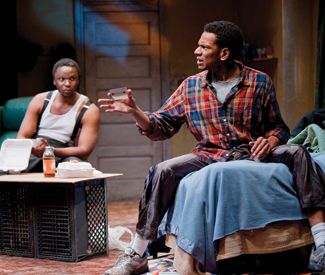
THEATER Audiences arriving at Marin Theatre Company for director Timothy Douglas’ current, beautifully staged revival of Suzan-Lori Parks’ 2001 Pulitzer Prize–winning play, Topdog/Underdog, take in a shabby, dilapidated low-rent studio apartment with its meager and seedy furnishings. But looming overhead the whole time are the red-white-and-blue bunting of some half-forgotten political rally, depending from the flies amid three long strips sheared from the stars and stripes, hung equidistantly across the stage. These thin flags have tightened their belts, and look a bit dingy too, almost sepia-toned, and floating above the impoverished scene below somehow bring to mind that flag behind Ella Watson, the African American cleaning woman in Gordon Parks’ iconic Depression-era photograph, American Gothic, Washington, D.C.

If there’s thus a certain election-year ring to Mikiko Uesugi’s careful scenic design — present before the action even starts — it’s a sonorous and dissonant one, echoing back across a political past with a strange and disorienting nostalgia, a contaminated euphoria. What could be more appropriate?

http://www.youtube.com/watch?v=F0Xll3eZJ8Y

At a time when mainstream political reality seems feverishly bizarre, almost surreal, Parks’ drama endures as a shrewd poetical remix of American history, an elucidating fever dream in a realistic mode: two African American brothers respectively named Lincoln (Bowman Wright) and Booth (Biko Eisen-Martin) by a runaway father who apparently found it funny, share a precarious perch and a tainted patrimony in a poor part of a nameless city — where they act out an overlapping series of fated roles. These mix race, class, sex, family, and money as equal facets of a brutally antisocial system — a racket, in fact, high above (but qualitatively the same as) the Three-card Monte scheme at center of the story.

But in the brothers’ tragic and absurd destinies, half-grasped at best by the protagonists themselves, the play plumbs a deeper understanding too, a historical current churning and moving below everything — and in that understanding opens a sense of possibility.

The apartment is younger brother Booth’s roost, but Linc, as he’s called, is bringing home the bacon (or Chinese food) in exchange for crashing on the La-Z-Boy. Linc has been kicked out by now ex-wife Cookie (an offstage character symbolizing perhaps a kind of standard “fortune” for a married man without economic prospects, something akin to the ambiguous forecast Linc gets with his Chinese takeout: “Your luck will change”). Booth’s offstage love interest is named, with even more symbolic resonance, Grace. Early on, it’s clear she’s pretty much unattainable.

Booth wants knowledge from his brother, more than anything else. Linc was once famous on the streets as a master of the Three-card Monte hustle — which itself has nothing to do with luck — but has given up the cards in the wake of a guilt-ridden incident. Eager brother Booth (played by Eisen-Martin with a nicely coiled energy, dangerous and comically hapless at once) is dying to become a hustler himself, but his efforts to learn the ropes meet with resistance from his jaded, wary older brother (whom Wright imbues with a perfect combination of wistful compassion and alpha-male contempt).

For his part, Linc’s guilty conscience finds a kind of half-bitter contentment in his current job: impersonating his namesake at a carnival sideshow, where he daydreams as sitting duck in white-face Honest Abe drag, before a ready line of customer-assassins. Indeed, Linc’s first appearance onstage comes in the Lincoln get-up, an eerily comic site that already loads the naturalistic performances with dreamy intensity.

If Parks’ drama (which premiered off-Broadway in the summer of 2001) preceded everything from 9/11, the wars on Iraq and Afghanistan, Katrina, the financial crisis, worldwide protest movements against global capitalism and empire, and the advent of the country’s first African American president, MTC’s apt revival shows it more than keeps pace with the times as a gritty and gripping allegory of endemic, convoluted civil wars.

TOPDOG/UNDERDOG

Through Oct. 21, $36-$57

Marin Theatre Company

397 Miller, Mill Valley

www.marintheatre.org


PROJECT CENSORED 2012

6

yael@sfbg.com

People who get their information exclusively from mainstream media sources may be surprised at the lack of enthusiasm on the left for President Barack Obama in this crucial election. But that’s probably because they weren’t exposed to the full online furor sparked by Obama’s continuation of his predecessor’s overreaching approach to national security, such as signing the 2012 National Defense Authorization Act, which allows the indefinite detention of those accused of supporting terrorism, even US citizens.

We’ll never know how this year’s election would be different if the corporate media adequately covered the NDAA’s indefinite detention clause and many other recent attacks on civil liberties. What we can do is spread the word and support independent media sources that do cover these stories. That’s where Project Censored comes in.

Project Censored has been documenting inadequate media coverage of crucial stories since it began in 1967 at Sonoma State University. Each year, the group considers hundreds of news stories submitted by readers, evaluating their merits. Students search Lexis Nexis and other databases to see if the stories were underreported, and if so, the stories are fact-checked by professors and experts in relevant fields.

A panel of academics and journalists chooses the Top 25 stories and rates their significance. The project maintains a vast online database of underreported news stories that it has “validated” and publishes them in an annual book. Censored 2013: Dispatches from the Media Revolution will be released Oct. 30.

For the second year in row, Project Censored has grouped the Top 25 list into topical “clusters.” This year, categories include “Human cost of war and violence” and “Environment and health.” Project Censored director Mickey Huff told us the idea was to show how various undercovered stories fit together into an alternative narrative, not to say that one story was more censored than another.

“The problem when we had just the list was that it did imply a ranking,” Huff said. “It takes away from how there tends to be a pattern to the types of stories they don’t cover or underreport.”

In May, while Project Censored was working on the list, another 2012 list was issued: the Fortune 500 list of the biggest corporations, whose influence peppers the Project Censored list in a variety of ways.

Consider this year’s top Fortune 500 company: ExxonMobil. The oil company pollutes everywhere it goes, yet most stories about its environmental devastation go underreported. Weapons manufacturers Lockheed Martin (58 on the Fortune list), General Dynamics (92), and Raytheon (117) are tied into stories about US prisoners in slavery conditions manufacturing parts for their weapons and the underreported war crimes in Afghanistan and Libya.

These powerful corporations work together more than most people think. In the chapter exploring the “Global 1 percent,” writers Peter Phillips and Kimberly Soeiro explain how a small number of well-connected people control the majority of the world’s wealth. In it, they use Censored story number 6, “Small network of corporations run the global economy,” to describe how a network of transnational corporations are deeply interconnected, with 147 of them controlling 40 percent of the global economy’s total wealth.

For example, Philips and Soeiro write that in one such company, BlackRock Inc., “The eighteen members of the board of directors are connected to a significant part of the world’s core financial assets. Their decisions can change empires, destroy currencies, and impoverish millions.”

Another cluster of stories, “Women and Gender, Race and Ethnicity,” notes a pattern of underreporting stories that affect a range of marginalized groups. This broad category includes only three articles, and none are listed in the top 10. The stories reveal mistreatment of Palestinian women in Israeli prisons, including being denied medical care and shackled during childbirth, and the rape and sexual assault of women soldiers in the US military. The third story in the category concerns an Alabama anti-immigration bill, HB56, that caused immigrants to flee Alabama in such numbers that farmers felt a dire need to “help farms fill the gap and find sufficient labor.” So the Alabama Department of Agriculture and Industries approached the state’s Department of Corrections about making a deal where prisoners would replace the fleeing farm workers.

But with revolutionary unrest around the world, and the rise of a mass movement that connects disparate issues together into a simple, powerful class analysis — the 99 percent versus the 1 percent paradigm popularized by Occupy Wall Street — this year’s Project Censored offers an element of hope.

It’s not easy to succeed at projects that resist corporate dominance, and when it does happen, the corporate media is sometimes reluctant to cover it. Number seven on the Top 25 list is the story of how the United Nations designated 2012 the International Year of the Cooperative, recognizing the rapid growth of co-op businesses, organizations that are part-owned by all members and whose revenue is shared equitably among members. One billion people worldwide now work in co-ops.

The Year of the Cooperative is not the only good-news story discussed by Project Censored this year. In Chapter 4, Yes! Magazine‘s Sarah Van Gelder lists “12 ways the Occupy movement and other major trends have offered a foundation for a transformative future.” They include a renewed sense of “political self-respect” and fervor to organize in the United States, debunking of economic myths such as the “American dream,” and the blossoming of economic alternatives such as community land trusts, time banking, and micro-energy installations.

They also include results achieved from pressure on government, like the delay of the Keystone Pipeline project, widespread efforts to override the US Supreme Court’s Citizens United ruling, the removal of dams in Washington state after decades of campaigning by Native American and environmental activists, and the enactment of single-payer healthcare in Vermont.

As Dr. Nafeez Mosaddeq Ahmed writes in the book’s foreword, “The majority of people now hold views about Western governments and the nature of power that would have made them social pariahs 10 or 20 years ago.”

Citing polls from the corporate media, Ahmed writes: “The majority are now skeptical of the Iraq War; the majority want an end to US military involvement in Afghanistan; the majority resent the banks and financial sector, and blame them for the financial crisis; most people are now aware of environmental issues, more than ever before, and despite denialist confusion promulgated by fossil fuel industries, the majority in the United States and Britain are deeply concerned about global warming; most people are wary of conventional party politics and disillusioned with the mainstream parliamentary system.”

“In other words,” he writes, “there has been a massive popular shift in public opinion toward a progressive critique of the current political economic system.”

And ultimately, it’s the public — not the president and not the corporations—that will determine the future. There may be hope after all. Here’s Project Censored’s Top 10 list for 2013:


1. SIGNS OF AN EMERGING POLICE STATE

President George W. Bush is remembered largely for his role in curbing civil liberties in the name of his “war on terror.” But it’s President Obama who signed the 2012 NDAA, including its clause allowing for indefinite detention without trial for terrorism suspects. Obama promised that “my Administration will interpret them to avoid the constitutional conflict” — leaving us adrift if and when the next administration chooses to interpret them otherwise. Another law of concern is the National Defense Resources Preparedness Executive Order that Obama issued in March 2012. That order authorizes the President, “in the event of a potential threat to the security of the United States, to take actions necessary to ensure the availability of adequate resources and production capability, including services and critical technology, for national defense requirements.” The president is to be advised on this course of action by “the National Security Council and Homeland Security Council, in conjunction with the National Economic Council.” Journalist Chris Hedges, along with co-plaintiffs including Noam Chomsky and Daniel Ellsberg, won a case challenging the NDAA’s indefinite detention clause on Sept. 1, when a federal judge blocked its enforcement, but her ruling was overturned on Oct. 3, so the clause is back.


2. OCEANS IN PERIL

Big banks aren’t the only entities that our country has deemed “too big to fail.” But our oceans won’t be getting a bailout anytime soon, and their collapse could compromise life itself. In a haunting article highlighted by Project Censored, Mother Jones reporter Julia Whitty paints a tenuous seascape — overfished, acidified, warming — and describes how the destruction of the ocean’s complex ecosystems jeopardizes the entire planet, not just the 70 percent that is water. Whitty compares ocean acidification, caused by global warming, to acidification that was one of the causes of the “Great Dying,” a mass extinction 252 million years ago. Life on earth took 30 million years to recover. In a more hopeful story, a study of 14 protected and 18 non-protected ecosystems in the Mediterranean Sea showed dangerous levels of biomass depletion. But it also showed that the marine reserves were well-enforced, with five to 10 times larger fish populations than in unprotected areas. This encourages establishment and maintenance of more reserves.


3. US DEATHS FROM FUKUSHIMA

A plume of toxic fallout floated to the US after Japan’s tragic Fukushima nuclear disaster on March 11, 2011. The US Environmental Protection Agency found radiation levels in air, water, and milk that were hundreds of times higher than normal across the United States. One month later, the EPA announced that radiation levels had declined, and they would cease testing. But after making a Freedom of Information Act request, journalist Lucas Hixson published emails revealing that on March 24, 2011, the task of collecting nuclear data had been handed off from the US Nuclear Regulatory Commission to the Nuclear Energy Institute, a nuclear industry lobbying group. And in one study that got little attention, scientists Joseph Mangano and Janette Sherman found that in the period following the Fukushima meltdowns, 14,000 more deaths than average were reported in the US, mostly among infants. Later, Mangano and Sherman updated the number to 22,000.


4. FBI AGENTS RESPONSIBLE FOR TERRORIST PLOTS

We know that FBI agents go into communities such as mosques, both undercover and in the guise of building relationships, quietly gathering information about individuals. This is part of an approach to finding what the FBI now considers the most likely kind of terrorists, “lone wolves.” Its strategy: “seeking to identify those disgruntled few who might participate in a plot given the means and the opportunity. And then, in case after case, the government provides the plot, the means, and the opportunity,” writes Mother Jones journalist Trevor Aaronson. The publication, along with the Investigative Reporting Program at the University of California-Berkeley, examined the results of this strategy, 508 cases classified as terrorism-related that have come before the US Department of Justice since the 9/11 terrorist attacks of 2001. In 243 of these cases, an informant was involved; in 49 cases, an informant actually led the plot. And “with three exceptions, all of the high-profile domestic terror plots of the last decade were actually FBI stings.”


5. FEDERAL RESERVE LOANED TRILLIONS TO MAJOR BANKS

The Federal Reserve, the US’s quasi-private central bank, was audited for the first time in its history this year. The audit report states, “From late 2007 through mid-2010, Reserve Banks provided more than a trillion dollars… in emergency loans to the financial sector to address strains in credit markets and to avert failures of individual institutions believed to be a threat to the stability of the financial system.” These loans had significantly less interest and fewer conditions than the high-profile TARP bailouts, and were rife with conflicts of internet. Some examples: the CEO of JP Morgan Chase served as a board member of the New York Federal Reserve at the same time that his bank received more than $390 billion in financial assistance from the Fed. William Dudley, who is now the New York Federal Reserve president, was granted a conflict of interest waiver to let him keep investments in AIG and General Electric at the same time the companies were given bailout funds. The audit was restricted to Federal Reserve lending during the financial crisis. On July 25, 2012, a bill to audit the Fed again, with fewer limitations, authored by Rep. Ron Paul, passed the House of Representatives. HR459 expected to die in the Senate, but the movement behind Paul and his calls to hold the Fed accountable, or abolish it altogether, seem to be growing.


6. SMALL NETWORK OF CORPORATIONS RUN THE GLOBAL ECONOMY

Reporting on a study by researchers from the Swiss Federal Institute in Zurich didn’t make the rounds nearly enough, according to Censored 2013. They found that, of 43,060 transnational companies, 147 control 40 percent of total global wealth. The researchers also built a model visually demonstrating how the connections between companies — what it calls the “super entity” — works. Some have criticized the study, saying control of assets doesn’t equate to ownership. True, but as we clearly saw in the 2008 financial collapse, corporations are capable of mismanaging assets in their control to the detriment of their actual owners. And a largely unregulated super entity like this is vulnerable to global collapse.


7. THE INTERNATIONAL YEAR OF COOPERATIVE

Can something really be censored when it’s straight from the United Nations? According to Project Censored evaluators, the corporate media underreported the UN declaring 2012 to be the International Year of the Cooperative, based on the coop business model’s stunning growth. The UN found that, in 2012, one billion people worldwide are coop member-owners, or one in five adults over the age of 15. The largest is Spain’s Mondragon Corporation, with more than 80,000 member-owners. The UN predicts that by 2025, worker-owned coops will be the world’s fastest growing business model. Worker-owned cooperatives provide for equitable distribution of wealth, genuine connection to the workplace, and, just maybe, a brighter future for our planet.


8. NATO WAR CRIMES IN LIBYA

In January 2012, the BBC “revealed” how British Special Forces agents joined and “blended in” with rebels in Libya to help topple dictator Muammar Gadaffi, a story that alternative media sources had reported a year earlier. NATO admits to bombing a pipe factory in the Libyan city of Brega that was key to the water supply system that brought tap water to 70 percent of Libyans, saying that Gadaffi was storing weapons in the factory. In Censored 2013, writer James F. Tracy makes the point that historical relations between the US and Libya were left out of mainstream news coverage of the NATO campaign; “background knowledge and historical context confirming Al-Qaeda and Western involvement in the destabilization of the Gadaffi regime are also essential for making sense of corporate news narratives depicting the Libyan operation as a popular ‘uprising.'”


9. PRISON SLAVERY IN THE US

On its website, the UNICOR manufacturing corporation proudly proclaims that its products are “made in America.” That’s true, but they’re made in places in the US where labor laws don’t apply, with workers often paid just 23 cents an hour to be exposed to toxic materials with no legal recourse. These places are US prisons. Slavery conditions in prisons aren’t exactly news. It’s literally written into the Constitution; the 13th Amendment, which abolished slavery, outlaws  slavery nor involuntary servitude, except as a punishment for crime whereof the party shall have been duly convicted.” But the article highlighted by Project Censored this year reveal the current state of prison slavery industries, and its ties to war. The majority of products manufactured by inmates are contracted to the Department of Defense. Inmates make complex parts for missile systems, battleship anti-aircraft guns, and landmine sweepers, as well as night-vision goggles, body army, and camouflage uniforms. Of course, this is happening in the context of record high imprisonment in the US, where grossly disproportionate numbers of African Americans and Latinos are imprisoned, and can’t vote even after they’re freed. As psychologist Elliot D. Cohen puts it in this year’s book: “This system of slavery, like that which existed in this country before the Civil War, is also racist, as more than 60 percent of US prisoners are people of color.”


10. HR 347 CRIMINALIZES PROTEST

HR 347, sometimes called the “criminalizing protest” or “anti-Occupy” bill, made some headlines. But concerned lawyers and other citizens worry that it could have disastrous effects for the First Amendment right to protest. Officially called the Federal Restricted Grounds Improvement Act, the law makes it a felony to “knowingly” enter a zone restricted under the law, or engage in “disorderly or disruptive” conduct in or near the zones. The restricted zones include anywhere the Secret Service may be — places such as the White House, areas hosting events deemed “National Special Security Events,” or anywhere visited by the president, vice president, and their immediate families; former presidents, vice presidents, and certain family members; certain foreign dignitaries; major presidential and vice presidential candidates (within 120 days of an election); and other individuals as designated by a presidential executive order. These people could be anywhere, and NSSEs have notoriously included the Democratic and Republican National Conventions, Super Bowls, and the Academy Awards. So far, it seems the only time HR 347 has kicked in is with George Clooney’s high-profile arrest outside the Sudanese embassy. Clooney ultimately was not detained without trial — information that would be almost impossible to censor — but what about the rest of us who exist outside of the mainstream media’s spotlight? A book release party will be held at Moe’s Books, 2476 Telegraph, in Berkeley, on Nov. 3. You can listen to Huff’s radio show Friday morning at 8pm on KPFA.

Berkeley Police implement new limits on spying and mutual aid

4

The Berkeley Police Department is undergoing some major policy changes after mounting pressure from the community to enact reforms, with new limits on its participation with other law enforcement agencies.  

“There will be some extra reporting standards required, but procedures have been put in place for us to handle these new requirements,” BPD’s Public Information Officer Jennifer Coats told us, although she did not provide details on how they will be implemented. “This will not affect the high level of service the Berkeley Police Department continues to provide the community.”

Sparked by overzealous police responses to the Occupy movement in neighboring Oakland and UC Berkeley and by the issue of local police agencies working with the FBI to spy on law-abiding citizens, community groups in Berkeley urged city officials to revise policies regarding surveillance, intelligence activities, and police mutual aide.  

Leading the charge was the Coalition for a Safe Berkeley and the ACLU of Northern California.  Both groups attended the Sept. 18th Berkeley City Council meeting where the council voted to modify the city’s policing procedures.

Berkeley police will no longer respond immediately and automatically to mutual aid requests from other police agencies. “The policy change that the council approved said that in a case in which there is not serious or violent crime or destruction of property, that our police will seriously evaluate whether or not to respond,” says Councilmember Jesse Arreguin.  “We won’t automatically respond in cases of civil disobedience or peaceful protest.”

Mutual aid agreements were suspended last year while the city adjusted its policies.

“The Berkeley Police Department has a strong working relationship with other police departments,” writes Coats via email. “We are able to review the need for services on a case by case basis and we look forward to continuing to work closely with other agencies.”

Other revisions include the end of surveillance and intelligence gathering of residents who participate in political activity or express First Amendment rights. Police must also have at least reasonable suspicion in order to submit a Suspicious Activity Report, which will then be reviewed by the City Manager for approval before being made available to other police agencies. 

The council postponed a decision on the issue of immigration jail detainers after the ACLU of Northern California expressed its concerns with the proposed policy. The changes come after a decade of police agencies nationwide upping their law enforcement efforts, particularly in border and coastal states like California where local police often work with federal immigration and customs officers.

“After 9/11, there were a lot of agencies reorganized under the Department of Homeland Security and they all started collaborating in ways they hadn’t before,” says Nadia Kayyali of the Bill of Rights Defense Committee, which consulted with the Coalition for a Safe Berkeley.  “Federal and local collaborations are extending across the country and I have yet to see strong evidence that what they’re doing is making us any safer.”

It was almost one year ago that Occupy Oakland made international headlines as clashes between police and protesters turned violent.  The Oct. 25 melee pit police officers from Oakland, Berkeley, and San Francisco against protesters occupying Frank Ogawa Plaza, resulting in serious injuries to protesters.  The mutual aid deployed from Berkeley left many residents livid after watching their police officers assist in using force against peaceful protesters.  

“If you’re involved in something that hurts the rights and security of protesters in a public place, it raises questions of complicity.  We don’t want our police to be used to halt civil liberties,” says George Lippman of the Berkeley Peace and Justice Commission, which was involved in pushing the reforms. “There should be more oversight given to these types of activities of mutual aid when there are First Amendment activities going on.”

Lippman sees increased law enforcement as a growing trend to militarize local communities nationwide, and he points to the armored tank that Berkeley police almost acquired earlier this year as an example. The City Council blocked that effort and it remains unclear why exactly BPD wanted such a bellicose piece of equipment.  

“Fear is always a great substitute for rational thought in American politics,” says Lippman. “It’s also the benefit of those who profit from warfare to have something to base their weapon sales on.”

San Francisco has also taken steps to limit law enforcement practices. In May, the city implemented legislation that will force police officers collaborating with the FBI to adhere to privacy rights as stated in local and state laws.  Although hailed as a step in the right direction, that legislation was watered down after an earlier version was vetoed by Mayor Ed Lee.

Endorsements 2012: State and national races

25

National races

PRESIDENT

BARACK OBAMA

You couldn’t drive down Valencia Street on the evening of Nov. 4, 2008. You couldn’t get through the intersection of 18th and Castro, either. All over the east side of the city, people celebrating the election of Barack Obama and the end of the Bush era launched improptu parties, dancing and singing in the streets, while the cops stood by, smiling. It was the only presidential election in modern history that create such an upwelling of joy on the American left — and while we were a bit more jaded and cautious about celebrating, it was hard not to feel a sense of hope.

That all started to change about a month after the inauguration, when word got out that the big insurance companies were invited to be at the table, discussing health-care reform — and the progressive consumer advocates were not. From that point on, it was clear that the “change” he promised wasn’t going to be a fundamental shift in how power works in Washington.

Obama didn’t even consider a single-payer option. He hasn’t shut down Guantanamo Bay. He hasn’t cut the Pentagon budget. He hasn’t pulled the US out of the unwinnable mess in Afghanistan. He’s been a huge disappointment on progressive tax and economic issues. It wasn’t until late this summer, when he realized he was facing a major enthusiasm gap, that he even agreed to endorse same-sex marriage.

But it’s easy to trash an incumbent president, particularly one who foolishly thought he could get bipartisan support for reforms and instead wound up with a hostile Republican Congress. The truth is, Obama has accomplished a fair amount, given the obstacles he faced. He got a health-care reform bill, weak and imperfect as it was, passed into law, something Democrats have tried and failed at since the era of FDR. The stimulus, weak and limited as it was, clearly prevented the recession from becoming another great depression. His two Supreme Court appointments have been excellent.

And the guy he’s running against is a disaster on the scale of G.W. Bush.

Mitt Romney can’t even tell the truth about himself. He’s proven to be such a creature of the far-right wing of the Republican Party that it’s an embarrassment. A moderate Republican former governor of Massachusetts could have made a credible run for the White House — but Romney has essentially disavowed everything decent that he did in his last elective office, has said one dumb thing after another, and would be on track to be one of the worse presidents in history.

We get it: Obama let us down. But there’s a real choice here, and it’s an easy one. We’ll happily give a shout out to Jill Stein, the candidate of the Green Party, who is talking the way the Democrats ought to be talking, about a Green New Deal that recognizes that the richest nation in the history of the world can and should be doing radically better on employment, health care, the environment, and economic justice. And since Obama’s going to win California by a sizable majority anyway, a protest vote for Stein probably won’t do any harm.

But the next four years will be a critical time for the nation, and Obama is at least pushing in the direction of reality, sanity and hope. We endorsed him with enthusiasm four year ago; we’re endorsing him with clear-eyed reality in 2012.

UNITED STATES SENATE

DIANNE FEINSTEIN

Ugh. Not a pleasant choice here. Elizabeth Emken is pretty much your standard right-wing-nut Republican out of Danville, a fan of reducing government, cutting regulations, and repealing Obamacare. Feinstein, who’s already served four terms, is a conservative Democrat who loves developers, big business, and the death penalty, is hawkish on defense, and has used her clout locally to push for all the wrong candidates and all the wrong things. She can’t even keep her word: After Willie Brown complained that London Breed was saying mean things about him, Feinstein pulled her endorsement of Breed for District 5 supervisor.

It’s astonishing that, in a year when the state Democratic Party is aligned behind Proposition 34, which would replace the death penalty with life without parole, Feinstein can’t find it in herself to back away from her decades-long support of capital punishment. She’s not much better on medical marijuana. And she famously complained when then-mayor Gavin Newsom pushed same-sex marriage to the forefront, saying America wasn’t ready to give LGBT couples the same rights as straight people.

But as chair of the Senate Intelligence Committee, Feinstein was pretty good about investigating CIA torture and continues to call for the closure of Guantanamo Bay. She’s always been rock solid on abortion rights and at least decent, if not strong, on environmental issues.

It’s important for the Democrats to retain the Senate, and Feinstein might as well be unopposed. She turns 80 next year, so it’s likely this will be her last term.

HOUSE OF REPRESENTATIVES, DISTRICT 8

NANCY PELOSI

The real question on the minds of everyone in local politics is what will happen if the Democrats don’t retake the House and Pelosi has to face two more years in the minority. Will she serve out her term? Will her Democratic colleagues decide they want new leadership? The inside scuttle is that Pelosi has no intention of stepping down, but a long list of local politicians is looking at the once-in-a-lifetime chance to run for a Congressional seat, and it’s going to happen relatively soon; Pelosi is 72.

We’ve never been happy with Rep. Pelosi, who used the money and clout of the old Burton machine to come out of nowhere to beat progressive gay supervisor Harry Britt for the seat in 1986. Her signature local achievement is the bill that created the first privatized national park in the nation’s history (the Presidio), which now is home to a giant office complex built by filmmaker George Lucas with the benefit of a $60 million tax break. She long ago stopped representing San Francisco, making her move toward Congressional leadership by moving firmly to the center.

But as speaker of the House, she was a strong ally for President Obama and helped move the health-care bill forward. It’s critical to the success of the Obama administration that the Democrats retake the house and Pelosi resumes the role of speaker.

HOUSE OF REPRESENTATIVES, DISTRICT 9

BARBARA LEE

Barbara Lee represents Berkeley and Oakland in a way Nancy Pelosi doesn’t represent San Francisco. She’s been a strong, sometimes lonely voice against the wars in Iraq and Afghanistan and a leader in the House Progressive Caucus. While Democrats up to and including the president talk about tax cuts for businesses, Lee has been pushing a fair minimum wage, higher taxes on the wealthy, and an end to subsidies for the oil industry. While Oakland Mayor Jean Quan was struggling with Occupy, and San Francisco Mayor Ed Lee was moving to evict the protesters, Barbara Lee was strongly voicing her support for the movement, standing with the activists, and talking about wealth inequality. We’re proud to endorse her for another term.

HOUSE OF REPRESENTATIVES, DISTRICT 12

JACKIE SPEIER

Speier’s an improvement on her predecessor, Tom Lantos, who was a hawk and terrible on Middle East policy. Speier’s a moderate, as you’d expect in this Peninsula seat, but she’s taken the lead on consumer privacy issues (as she did in the state Legislature) and will get re-elected easily. She’s an effective member of a Bay Area delegation that helps keep the House sane, so we’ll endorse her for another term.

State candidates

ASSEMBLY DISTRICT 13

TOM AMMIANO

Tom Ammiano’s the perfect person to represent San Francisco values in Sacramento. He helped sparked and define this city’s progressive movement back in the 1970s as a gay teacher marching alongside with Harvey Milk. In 1999, his unprecedented write-in mayoral campaign woke progressives up from some bad years and ushered in a decade with a progressive majority on the Board of Supervisors that approved landmark legislation such as the universal healthcare program Ammiano created. In the Assembly, he worked to create a regulatory system for medical marijuana and chairs the powerful Public Safety Committee, where he has stopped the flow of mindless tough-on-crime measures that have overflowed our prisons and overburdened our budgets. This is Ammiano’s final term in the Legislature, but we hope it’s not the end of his role in local politics.

STATE ASSEMBLY, DISTRICT 19

PHIL TING

Phil Ting could be assessor of San Francisco, with a nice salary, for the rest of his life if that’s what he wanted to do. He’s done a good job in an office typically populated with make-no-waves political hacks — he went after the Catholic Church when that large institution tried to avoid paying taxes on property transfers. He’s been outspoken on foreclosures and commissioned, on his own initiative, a study showing that a large percentage of local foreclosures involved at least some degree of fraud or improper paperwork.

But Ting is prepared to take a big cut in pay and accept a term-limited future for the challenge of moving into a higher-profile political position. And he’s the right person to represent this westside district.

Ting’s not a radical leftist, but he is willing to talk about tax reform, particularly about the inequities of Prop. 13. He’s carrying the message to homeowners that they’re shouldering a larger part of the burden while commercial properties pay less. He wants to change some of the loopholes in how Prop. 13 is interpreted to help local government collect more money.

It would be nice to have a progressive-minded tax expert in the Legislature, and we’re glad Ting is the front-runner. He’s facing a serious, well-funded onslaught from Michael Breyer, the son of Supreme Court Justice Breyer, who has no political experience or credentials for office and is running a right-wing campaign emphasizing “old-style San Francisco values.”

Not pretty. Vote for Ting.

SENATE DISTRICT 11

MARK LENO

Mark Leno wasn’t always in the Guardian’s camp, and we don’t always agree with his election season endorsements, but he’s been a rock-solid representative in Sacramento and he has earned our respect and our endorsement.

It isn’t just how he votes, which we consistently agree with. Leno has been willing to take on the tough fights, the ones that need to be fought, and shown the tenacity to come out on top in the Legislature, even if he’s ahead of his time. Leno twice got the Legislature to legalize same-sex marriage, he has repeatedly gotten that body to legalize industrial hemp production, and he’s twice passed legislation that would give San Francisco voters the right to set a local vehicle license fees higher than the state’s and use that money for local programs (which the governor finally signed). He’s also been laying an important foundation for creating a single-payer healthcare system and he played an important role in the CleanPowerSF program that San Francisco will implement next year. Leno will easily be re-elected to another term in the Senate and we look forward to his next move (Leno for mayor, 2015?)


BART BOARD DISTRICT 9


TOM RADULOVICH

San Francisco has been well represented on the BART Board by Radulovich, a smart and forward-thinking urbanist who understands the important role transit plays in the Bay Area. Radulovich has played leadership roles in developing a plan that aims to double the percentage of cyclists using the system, improving the accessibility of many stations to those with limited mobility, pushing through an admittedly imperfect civilian oversight agency for the BART Police, hiring a new head administrator who is more responsive to community concerns, and maintaining the efficiency of an aging system with the highest ridership levels in its history. With a day job serving as executive director of the nonprofit Livable City, Radulovich helped create Sunday Streets and other initiatives that improve our public spaces and make San Francisco a more inviting place to be. And by continuing to provide a guiding vision for a BART system that continues to improve its connections to every corner of the Bay Area, his vision of urbanism is helping to permeate communities throughout the region

BART BOARD, DISTRICT 7

ZACHARY MALLETT

This sprawling district includes part of southeast San Francisco and extends all the way up the I-80 corridor to the Carquinez Bridge. The incumbent, San Franciscan Lynette Sweet, has been a major disappointment. She’s inaccessible, offers few new ideas, and was slow to recognize (much less deal with) the trigger-happy BART Police who until recently had no civilian oversight. Time for a change.

Three candidates are challenging Sweet, all of them from the East Bay (which makes a certain amount of sense — only 17 percent of the district’s population is in San Francisco). Our choice is Zachary Mallett, whose training in urban planning and understanding of the transit system makes up for his lack of political experience.

Mallett’s a graduate of Stanford and UC Berkelely (masters in urban planning with a transportation emphasis) who has taken the time to study what’s working and what isn’t working at BART. Some of his ideas sound a bit off at first — he wants, for example, to raise the cost of subsidized BART rides offered to Muni pass holders — but when you look a the numbers, and who is subsidizing who, it actually makes some sense. He talks intelligently about the roles that the various regional transit systems play and while he’s a bit more moderate than us, particularly on fiscal issues, he’s the best alternative to Sweet.

Critical Mass at 20

20

steve@sfbg.com

I was in Zeitgeist on a Friday summer evening, at a planning meeting for the 20th anniversary of Critical Mass, when I first heard about the idea of kicking off the celebration week with a renegade bicycle ride over the Bay Bridge.

The people who first shook up the city’s commute two decades ago were going to take the idea of seizing space from cars a step further — and fulfill a longtime cyclist fantasy. They were going to take the bridge.

Chris Carlsson, the author/activist who helped found Critical Mass and has evangelized the concept around the world, reminded me of this super-secret ride last Wednesday when I finally got around to starting my reporting for this story. I was surprised that I’d forgotten about it — but yes, I told him, I still wanted to be there.

>>JOIN IN ON THE FESTIVITIES WITH OUR GUIDE TO THIS WEEK’S CRITICAL MASS EVENTS

“This will galvanize our sense of the week,” Carlsson told me, explaining that Critical Mass has always been about “opening up a space for a conversation,” whether it’s about how urban space is used or who gets to make that decision.

“There is a real necessity to have a place for people to start thinking creatively. That’s Critical Mass’s enduring contribution, 20 years ago and today.”

What started in September 1992 with 48 cyclists pedaling together through San Francisco has become an enduring worldwide phenomenon. On the last Friday of every month, without leaders or direction, this group bike ride simply meanders through the streets, riders smiling and waving at motorists often perplexed at the temporary alteration of traffic laws by a crowd too big to stop or ignore. While views of Critical Mass may differ, the conversation about urban cycling that it started has had an undeniable impact on how people see cities and their power to shape them, placing it high on the list of San Francisco’s proudest cultural exports.

Last Friday evening — a week before thousands of people are expected to show up for the 20th anniversary ride Sept. 28 — I rode over to a meeting in the back of the art gallery at 518 Valencia, the welcome center for the week. The first international arrivals were there: four Europeans who flew to Mexico City, where most of them built tall bikes to cycle up to San Francisco for the anniversary ride, arriving last week after a four-month trek.

They were veterans of Critical Mass events all over Europe, which borrowed the concept from the Bay Area, and they were happy to be going back to its core.

Andrea Maccarone is a 31-year-old Italian who lives in Paris when he isn’t bike touring, which he does quite a bit, last year riding to consecutive Critical Mass events in Paris, Toulouse, Rome, and Madrid. “It began here and spread everywhere,” he said. “A lot of my lifestyle — I’ve been a bike messenger and worked in bike kitchens — is based on what started here.”

His French girlfriend, Marie Huijbregts, described a cultural happening that began when she was 8 years old. “It’s a political movement of cyclists to release the streets from the cars,” the 28-year-old told me. “It’s environmental, do-it-yourself, and a great way to meet people.”

She said she wanted to be here “because it’s supposed to be the biggest one and all the world was invited. It’s symbolic and I wanted to be a part of it.”

Carlsson has watched the event he helped popularize spread to hundreds of cities around the world, from the Biciletada in Sao Paulo to the Cyklojizda in Prague. He loves to see young people who have been energized by Critical Mass and the larger renegade cyclist movement that grew up around it — from DIY bicycle kitchens and art bikes to creative political actions that seize public spaces — “who dream of San Francisco with stars in their eyes.”

But he often feels like we’re the “hole in the donut” of this international urban cycling movement, unable to retain the same intention and energy that it had when Carlsson, Jim Swanson, and a group of their bike messenger and anarchist cyclist friends conceived of the idea (originally called Commute Clot) in the Market Street office of a zine called Processed World.

Carlsson still hears the stories from people whose lives were changed by Critical Mass. But it was only in the last year or so, as the 20th anniversary approached, that he started regularly riding Critical Mass again, with a new generation of participants often drawn by confrontational yahooism, riding well-trod routes and rejecting efforts to suggest destinations as counter to its leaderless ethos.

“It’s extremely predictable now and I’m sick of it,” Carlsson admitted to me, a less diplomatic version of what he wrote in the introduction to the newly released book of essays he edited, Shift Happens: Critical Mass at 20, writing that the “euphoria of cooperative, joyful reinhabitation of urban space is hard to sustain after a awhile.”

Yet that powerful central idea is still there, and it remains as relevant as ever in cities dominated by fast-moving cars. People working together to create “an organized coincidence” can still change the rules of the road, opening up all kinds of new possibilities.

“It is an unpredictable space and you never know what’s going to happen,” Carlsson told me. That’s true of the history of Critical Mass around the world — with its storied clashes with cops and motorists, and its glorious convergences and joyful infectiousness — and it was true of our quest to take the Bay Bridge the next day.


TO THE BRIDGE

We weren’t just being daredevils. The idea of fighting for a freeway lane against six lanes of fast-moving cars, drivers distracted by that epic view of San Francisco, was conceived by Carlsson as a political statement protesting current plans to rebuild the Bay Bridge with a bike lane going only from Oakland to Treasure Island, leaving out that final 2.5-mile stretch into The City.

And for years, the Bay Bridge had been out there as a symbol of where bikes couldn’t go — and in dozens of demonstrations, riders have sought to make it up those ramps, particularly during the Bikes Not Bombs rides protesting the US invasion of Iraq, only to be blocked by police.

Carlsson handed out flyers headlined “A Bay Bridge for Everyone,” harking back to the early pre-Internet “xerocracy” that used flyers to promote Critical Mass ideas or suggest routes. A local historian, Carlsson included photos and descriptions of the Bay Bridge with three lanes of cars in each direction on the top deck, back when the lower deck had trains.

Why couldn’t we have one lane back for bikes? Well, it’s actually under consideration — sort of.

The idea of creating a bicycle/pedestrian lane on the western span is the subject of an ongoing $1.6 million study by Caltrans and the Bay Area Toll Authority, which are looking at attaching paths to the sides of the bridge. That would likely require replacing the decks on the bridge with a lighter new surface to compensate for the added weight, all at a cost of up to $1 billion.

Carlsson thinks that’s ridiculous overkill, and probably intended to scuttle the idea (or else put the blame on bicyclists for the cost of resurfacing the bridge). “For five grand, in three hours it could be done,” he said, arguing that all cyclists need is a lane, a protective barrier, perhaps a lowering of the speed limit — oh, and the political will to recognize that we have as much right to this roadway as motorists.

“It is a sad commentary on the nature of our government that the only way the state transit agency will take bicycling seriously as everyday transportation is when pressured by demonstrations and organized public demands,” Carlsson wrote on the flyer. “Why don’t they take the lead in opening space for cycling instead of doing everything to obstruct, deny, and prevent cycling?”

Even getting to Treasure Island for a bike ride isn’t easy for the car-free. Muni only allows two bikes at a time on its 108 bus, so Carlsson borrowed a van to shuttle almost 20 of us out there in multiple trips. Among the crew were the group that rode up from Mexico City, a Peruvian, and many regular local Critical Mass riders, including Bike Cavalry founder Paul Jordan and LisaRuth Elliott, a 10-year Critical Mass rider who helped edit Shift Happens and coordinate volunteers for the anniversary week, along with a couple of its very early adherents: Hugh D’Andrade and Glenn Bachmann.

“Nobody knew what we were doing,” Bachmann said of that first ride. “We didn’t know what was going to happen. But displacing cars left us this intense euphoria.

Elliott said she was drawn to Critical Mass shortly after she got into urban cycling, attracted by the sense of community that had developed around her transportation choice. She was later inspired to visit Paris and Marseille and other cities that adopted Critical Mass rides.

“They have taken charge and are leading their movements to better bicyclable cities. It’s an adaptable idea,” she told me as we prepared to load our bikes on the van bound for Treasure Island.

Once we were out there, we gathered for a picnic on the beach in Cooper Cove, where we got some sobering news from David Wedding Dress, who talked us through the ride and was going to be trailing our crew in his Mercedes as a safety measure.

“Prepare to be in jail until Monday morning,” he told us. There were also the high winds and dangerous gaps to contend with, offering a bleak prognosis.

A veteran radical activist and bicyclist, Dress has ridden the bridge before and been arrested most times, and he didn’t share Carlsson’s view that we were most likely to get away with it. When Carlsson arrived, he tried to shore up our spirits, saying we’d probably be okay if we maintained the element of surprise.

“We have a right to do this and make that point,” Carlsson said.

Elliott, who was already a wobbler going in, decided not to ride, but 16 of us decided to do it anyway, feeling nervous but excited. When a CHP patrol pulled over a car near our spot and it turned into an hour-long arrest and towing ordeal, which we were forced to wait out, we had plenty of time to think about what we were doing.

As D’Andrade told me as we waited to ride up to the bridge entrance, “What feels to me like the early days of Critical Mass is how scary this is.”


THE EARLY DAYS

In the beginning, the Critical Mass activists say their battle for space was a safety issue infused with a political message, delivered with a smile derived from the joyous new discovery that riding with friends made it much easier. San Francisco streets were designed for automobiles, and to a lesser extent public transit, with cycling relegated to the bike messengers and a few renegades seen by most as simply refusing to grow up.

Even the nascent San Francisco Bicycle Coalition of that era — which grew in numbers and power on a similar trajectory as Critical Mass, despite its policy of maintaining a defensible distance from that outlaw event — was initially dominated by the philosophy that urban cyclists should ride quickly with car traffic and didn’t need separate lanes.

“That’s what I like to remind people is how scary bicycling was in San Francisco in the early ’90s,” D’Andrade said.

I first encountered Critical Mass in 2001 when I was the news editor for the Sacramento News & Review, and Berkeley resident Jason Meggs brought the movement into automobile-centric Sacramento. My reporters and I covered those early rides, which were met with a harsh crackdown by police, who often cited every minor traffic violation.

But Meggs was committed to the concept, as he wrote in his Shift Happens! essay entitled, “The Johnny Appleseed of Critical Mass,” a role he has played over the last 19 years. “Critical Mass made me a video activist and filmmaker; it sent me to jail and then to law school, and again to graduate school for healthy cities. It provided us the space to build a vibrant bicycle culture, and to feel free and alive in cities that otherwise felt hostile, caustic, and alien,” he wrote.

Meggs calculates that he’s been arrested more than 20 times and received more than 100 traffic tickets during Critical Mass events, beginning with the Berkeley Critical Mass that he started in March of 1993, in part to protest plans to widen I-80.

“Those early rides were legendary — moment to moment ecstatic joy and street theater,” he remembered. “The combination of bike activists and freeway fighters with anarcho-environmentalists on wheels was a combination that couldn’t be beat. Like a newscaster once said of Critical Mass, back then we were drunk with power.”

Yet in almost city where it’s sprouted, Critical Mass has had to battle through crackdowns by police, which are often met with greater determination by the cycling community. San Francisco fought through a showdown with Mayor Willie Brown in 1997, when his threats to shut Critical Mass down turned out thousands of cyclists for the next ride.

In 2007, the San Francisco Chronicle sensationalized a conflict between a motorist and Critical Mass, beginning a media campaign that led Mayor Gavin Newsom to order a heavy police presence on subsequent rides — a show of force, but one without any apparent plan or directive — again increasing number of cyclists.

Each time, San Francisco city officials were forced to accept the inevitability of Critical Mass, opting to avoid the route of the harsh, sustained, and costly crackdowns employed in New York City, whose police and city officials essentially went to war with Critical Mass in 2004 and have all-but destroyed it. Portland has also had a tumultuous relationship with its Critical Mass, with police there essentially shutting it down.

Yet Carlsson noted in his Shift Happens essay that the bicycle activism that formed along with those rides still prevailed: “Both cities — not coincidentally I think — have implemented extensive and intensive street-level redesigns to accommodate the enormous increase in daily cycling that followed the rapid growth and ultimate repression of their Critical Mass rides.”

San Francisco has seen an even greater explosion in the number of cyclists on the roadways, so many that spontaneous “mini-Masses” of cyclists form up during the daily commutes on Market Street and elsewhere. But despite the near-universal City Hall support for cycling here, and the SFBC’s status as one of the city’s largest grassroots political advocacy organizations, Carlsson said San Francisco’s cyclists still lack the infrastructure and policies needed to safely get around the city.

That’s one reason why the challenge of Critical Mass is still relevant, he said, and one reason why we were determined to ride our bikes into San Francisco on the Bay Bridge.


ANOTHER DAY

The cops left a little before 6pm, so we massed up and headed for the Bay Bridge, pedaling single-file up a long hill. Soon, the long western span of the bridge came into view, stretching to the downtown destination that we all hoped to reach without incident or arrest, as we passed a sign reading “Pedestrians and Bicycles Prohibited.”

As we crested the hill and dropped down toward the freeway entrance, our pathway seemed clear, with the only real variable being coordinating with Dress in the Mercedes trail car, but Carlsson was on the phone with him and we all assumed that we were about to ride our bikes onto the Bay Bridge.

We were in a fairly tight pack, Maccarone smiling atop the tall bike that had traveled so far to this point, as we rounded the swooping right turn to the point where even cars make a dangerously quick entrance onto the bridge from a complete stop, merging into loud and dense traffic moving at freeway speeds.

We stopped, looked back for Dress, and he wasn’t there. A minute crept by, then another, as cars drove cautiously past us to get onto the freeway, their drivers giving us the same quizzical, confused looks that we’d seen on Critical Mass so many times. Another minute passed, then another, as Carlsson lit one of the road flares that we planned to use as a secondary safety measure to the Mercedes.

Then, a CHP patrol car rounded the bend, the officer sternly telling us over his PA system, “Don’t even think you’re getting on this bridge with those bikes.”

So we turned around and began to head back when Dress finally arrived in his Mercedes, presenting a moment of truth. Did we proceed anyway, even though we had been warned and knew the officer had probably radioed in our presence, taking away the element of surprise and increasing our chances of arrest?

There was dissension in ranks and a clear division among those urging opposite courses of action, but Carlsson and others continued to ride away after talking the Dress, who proceeded onto the freeway. Later, Carlsson said he was still game to go at that moment, but tried to be responsive to the collective: “I was not comfortable imposing going on the bridge on everyone.”

D’Andrade advocated for going anyway, but most felt it was too risky at that point, siding with Carlsson’s argument that is wasn’t about getting arrested: “I like to do something and get away.”

And so it was decided that we would choose a strategic retreat, some pledging to take the bridge some other day, hopefully with greater numbers. Besides, we all had a big week ahead of us, starting the next day with the first official event of Critical Mass’s anniversary week: the Art Bike/Freak Bike Ride and BBQ.

We gathered the next afternoon on the waterfront under sunny blue skies, our aborted bike crew increased in size 10-fold, joined by underground DIY bike crews from San Francisco’s own Cyclecide to the Black Label crews from Minneapolis, Oakland, and Los Angeles, infusing the ride with a countercultural edge.

Urban bike culture is now vast and varied — from the eco-warriors and urban thinkers to wage slaves and renegade tinkerers — and they’ve all found a regular home in Critical Mass. “Twenty years on, people are kinda nostalgic about it, even if they don’t ride in it or think it’s a good idea,” an activist name rRez told me during that beautiful Sunday ride, the one we were able to take because we weren’t in jail.

Carlsson told me on the ride that he was at peace with our failed mission of the day before, a sign that being radical isn’t the same thing as being reckless. “That was a good strategic retreat moment. It’s very adult,” he said. “It was a good experience for all of us, and nothing bad happened and nobody is in jail.”

In a way, that’s the essence of Critical Mass. It isn’t pure anarchy, and it’s not about fighting with the cops or the motorists, something Carlsson sees as straying from its original intent. It’s a joyful gathering, an exercise in the power of people who are willing to challenge the status quo and take well-considered risks to create a society of their choosing.

“In a modern capitalist society, the roads are the lifeblood,” Carlsson said, “and if you block them, you’re a threat.”


CELEBRATE 20 YEARS OF CRITICAL MASS


Wednesday 26

East Bay Ride, meet at West Oakland BART station, 11:45am. Ride along the east shore of the bay to the Rosie the Riveter monument in Richmond.

NOIZ Ride, McKinley statue on the Panhandle at Baker Street, noon. Bring food, drink, and layers for a several hour, non-strenuous ride featuring three live bands.

Shift Happens book release party and discussion, Main SF Library, Latino-Hispanic Room, 100 Larkin St, 5:45 p.m. Discuss Critical Mass and this new book with its writers.

Book release concert, Great American Music Hall, 859 O’Farrell, SF, $15, 8pm. Featuring Seaweed Sway, Aaron Glass and Friends, and Kelly McFarling


Thursday 27

Mosquito Abatement Ride, Meeting place TBA near 16th & Valencia, SF, 11am. One-hour rides with a cycling city contractor.

NYC Critical Mass discussion and video, 518 Valencia, SF, 2pm. Hosted by Times Up New York City.

Bike Polo, Jose Coronado Playground, 21st and Shotwell, SF, 7-9pm. Play with locals and visitors, share a beer.

Bikes, Bands, and Brew: CM’s 20th Bday party, CELLspace, 2050 Bryant, 7pm, $10-20. Bike cultural offerings and music by Grass Widow, Apogee Sound Club, The Rabbles, and Future Twin.


Friday 28

20th Anniversary Critical Mass Ride, Justin “Pee Wee” Herman Plaza, Market and Embarcadero, SF, 6pm

Vintage Bicycle Film Festival, Oddball Films, 275 Capp, SF, $10. Saturday 29 International Critical Mass Symposium, California Institute of Integral Studies, 1453 Mission, Rooms 303/304, 5-8pm. Event will include an open mic and CM20 Anniversary Week photo contest at 7pm Sunday 30 Farewell Bike Ride and Party, 1pm departure from 518 Valencia, 2pm at Ocean Beach. Bring food and drink to share with your new friends and listen to bands on Rock the Bike’s pedal-powered stage. For more events and details, visit www.sfcriticalmass.org

Where is Occupy SF now?

28

On the anniversary of Occupy Wall Street, Occupy San Francisco also celebrated its birthday.

Demonstrations throughout the day Sept. 17, focusing on a variety of topics, converged at 5pm at 555 California, Bank of America’s west coast headquarters. A lively march of about 600 became a street festival down the block. There, protesters stopped for a circus of birthday activities. In one corner, people saddled by debt wrote their debt information on pieces of paper, explained their situations to the crowd, and dropped the papers into a trash can for a symbolic burning. One person also burned cash. “Hell no, we won’t pay,” the crowd chanted.

A few feet over, protesters painted the street with a bright yellow sun declaring “democracy not debt.” Volunteers then fed a free meal to the hundreds in attendance and wheeled in a video screen to watch some recaps of the year’s best moments. Around 8pm, the group left as peacefully as they had come.

In the darkness, a few hundred headed east on Market. When they arrived in Justin Herman Plaza– or Bradley Manning Plaza, as Occupy SF has christened it, in honor of the whistle blowing soldier- a few police stood guard around the perimeter. Undeterred, protesters walked in, and shouts of “happy birthday” gave way to “welcome home.”

The birthday party continued with a night of music. Five tents were pitched, sleeping bags were brought out. Police vehicles carrying truckloads of barricades drove by, but police told protesters they would have to leave the park by 6am, the hour the park opens.

30 or 40 spent the night. In the morning police came back. As ukelele and drums continued to play, tents were dutifully broken down. A few went back to sleep.

Video by Eric Louie

Last fall, Occupy SF could basically be found here. The camp was at Justin Herman Plaza. The ever-expanding list of working groups sometimes met somewhere else, but Occupy was at camp. But after a series of police raids, from Oct. 5 to the raid that finally brought the camp down in December, this camp was no more.

Now, Occupy SF is found all over the place.

As longtime Occupy SF activist Vi Huynh said while celebrating the anniversary: “I think it’s good to honor these milestones because, unlike the mainstream media would have us believe, we haven’t gone away. We’re not dying either. They’re writing our obituaries, but we’re very much alive. And we’re doing things every day.”

Here’s an uncomprehensive list of active groups from Occupy in San Francisco.

101 Market. This is the old camp of Occupy, “re-occupied” in February in response to a national call. At least 30 sleep there every night, and the camp is a veritable fortress of furniture and belongings. They’re mere existence is a refusal to humor the concept of private property. General Assembly meetings occur at 101 Market Tuesdays and Thursdays at 7pm.

Action Council. Action Council is a forum meant to connect Occupy with unions, non-profits, and community groups. They played a big role in planning demonstrations like the Jan. 20 shutdown of the financial district and the May Day solidarity demonstrations. Action Council meets weekly, Sundays at 2pm at Unite Here headquarters, 215 Golden Gate Ave.

All Streets Yoga. Since last winter, All Streets Yoga, formerly known as Decolonize Yoga, has been transforming part of the sidewalk at the 16th and Mission BART station into a yoga studio free for all. Volunteer yoga teachers lay out rugs and lead personalized yoga sessions for anyone who chooses to join. They transform space and creating calm in the busy city landscape. Join them Fridays 5-7pm.

Community Not Commodity. Also known as Bay Occupride, this group formed to protest commercialization of the Pride Parade. On the Sept. 17 anniversary they did a march on the Castro banks and a sit-in to protest sit-lie at Harvey Milk Plaza. CNC describes itself as “a collective assembly of queer/trans-focused community groups with established reputations in the Bay Area that have come together to strengthen and unify our diverse communities. We have come together to confront the 1% within our movement. We work for complete liberation of queer and trans people!” They meet Sundays at noon at Muddy Waters Café, 521 Valencia. See more at www.bayoccupride.com.

Direct Action working group. Direct action is a central tenant of Occupy. It means taking action to prevent something bad or create something good without permission or help of those with political power. In a 1912 essay titled Direct Action, Voltairine de Cleyre cited the Boston Tea Party as an example and wrote that “Every person who ever had a plan to do anything, and went and did it, or who laid his plan before others, and won their co-operation to do it with him, without going to external authorities to please do the thing for them, was a direct actionist. All co-operative experiments are essentially direct action.” The direct action working group meets Wednesdays, 6pm, at the Redstone Building at 2940 16th Street.

Environmental Justice working group. The environmental justice working group keeps the pressure on the corporations that exploit the planet. They’ve protested hydraulic fracturing and the nuclear industry. They meet Tuesdays at 4pm at 101 Market.

Food bank of America. Occupy SF set up the first Food Bank of America to feed thousands of hungry protesters and passers-by on Jan. 20. A Market Street Bank of America branch locked its doors when volunteers set up a food table and passed out hot meals. Now, Food Bank of America continues in front of the mega-bank’s 23rd and Mission branch, where volunteers pass out produce, mostly donated from farmers’ markets, along with literature on switching to credit unions. They’re usually there Thursdays 5-6pm.

Ideological Liberation working group. This working group has produced pamphlets explaining Occupy, trading cards of especially greedy bankers, and postcards summarizing issues like the foreclosure crisis and the National Defense Authorization Act. They also created the Occupy SF Declaration. Brainstorm and write with them on Tuesdays, 7:30-9pm, at the decidedly ideologically un-liberated meeting spot of the Starbucks at 27 Drumm.

Occupy Bay Area United. Occupy Bay Area United spent the night outside 555 California on the eve of the Occupy SF anniversary, an occupation complete with tents and signs. They are “committed to non-violent direct action.” They meet on Sundays, 5-7pm, and post meeting locations on their website, www.obau.org.

Occupy Bernal. This neighborhood-based group is largely considered one of the most effective and desperately needed parts of the Occupy movement in San Francisco. Occupy Bernal is in the business of stopping foreclosures and evictions. “Since January no one we worked with has had an auction. People we work with who already had auctions, we’re stopping their evictions. We’ve stopped six of them so far. So we’re almost done with all the evictions, and we can go back to just stopping the auctions. We have 60 people in line to get loan modifications from Wells,” said Occupy Bernal organizer Buck Bagot. On the anniversary, Occupy Bernal hosted a rally highlighting the disproportionate effects of the foreclosure crisis and veterans and elderly and disabled people. “There were about 100 of us at the protest and five people, all over 80, veterans who are all at risk of losing their homes because they don’t have very much income,” said Bagot. Occupy Bernal meets 7-9pm on the second and fourth Thursday of each month at the Bernal Heights Neighborhood Center at 515 Cortland Ave. See www.occupybernal.org for more information.

Occupy Forum. Occupy Forum started up in early June in the Women’s Building, and has since moved to Justin Herman Plaza. The well-attended forums, usually around 70 people, are a time to discuss issues that concern people in Occupy. From the beginning Occupy has been said to have “no focus”– maybe that’s because those involved saw that everything from greedy banks to income inequality to homelessness to discrimination in loans to healthcare to racism to wars were all connected. The forum is a chance to focus in on a different topic every week. Check them out Mondays at 6pm at Justin Herman Plaza, at Market and Embarcadero.

Occupy the Richmond. A philosophical Occupy. If you’ve ever gotten sick of decrying problems in society and yearned to discuss creative solutions, Occupy the Richmond may be your cup of tea. A philosophical Occupy. Saturdays at 4pm, Occupy the Richmond gets together at 11th Ave. in Mountain Lake Park “to talk about what kind of society we want to organize together,” according to Occupy the Richmond participant Alex Zane. “Occupy opens up the possibility for talking about that. Otherwise, people would be stuck behind their screens freaking out about what kind of society we should organize. We should get together and talk with real, living people about how we’re supposed to reorganize our society,” said Zane.

Outreach working group. A group that spreads the word about Occupy and speaks with people and community organizations about working together. They meet Wednesdays at 7pm at One Rincon Center, also known as 121 Spear.

This article has been corrected. Bradley Manning served as a soldier in the Army, not a marine

On the Cheap Listings

0

Submit items for the listings at listings@sfbg.com. For further information on how to submit items for the listings, see Picks.

WEDNESDAY 19

Meet the artist: “Photographs From Lebanon” SF Main Library, 100 Larkin, SF. www.sfpl.org. 6pm, free. Najib Joe Hakim went back to his hometown Beirut to capture the culture that survived after Israel bombed the country. Coffee, candles, fishermen repairing nets — the resulting photo exhibit is a testament to resiliency, check it out today with the artist as your guide.

Elizabeth Rosner reads Grace Paley Pegasus Books, 1885 Solano, Berk. (510) 525-6888, www.pegasusbookstore.com. 7:30pm, free. The award-winning bookstore and Berkeley establishment Pegasus Books is starting up a brand-new reading series showcasing local writers opining on and dissecting the works of other writers. The first writer’s words to be in the spotlight will be activist Grace Paley, whose three feminist short stories will be interpreted by novelist Elizabeth Rosner.

24th Street Listening Project Brava Theater, 2781 24th St., SF. (415) 641-7657, www.brava.org. 5pm-9pm, free. In this project, artists Lynn Marie Kirby and Alexis Petty double as your tour guides as they take you on a vibrant five-block excursion complete with colorful meditation and reverberating echoes and concludes with the creation of a collective pigment poem. After the walk there will be a presentation at the Brava that will include mapping videos, local music, and story-telling.

THURSDAY 20

California history third Thursdays Society of California Pioneers, 300 Fourth St., SF. (415) 957-1849, www.californiapioneers.org. 4-7pm, free. Full of California pride, but uninformed on California history? The Society of California Pioneers will gladly school you on the history of our great state with their “Third Thursday” bargain book sale. Visitors and amateur California historians will also have the chance to check out the current exhibit “Singing the Golden State,” which showcases a collection of late 18th and early 19th century songs that pay homage to our fair state.

“Art Making in the 21st Century: Social and Subversive Practices” Yerba Buena Community Benefit District, UC Berkeley Extension, 95 Third St., (415) 644-0728, www.artsindialogue.org. 7pm, free. Reactionary artists Anthony Discenza, Dawn Weleski, and Ray Beldner will convene to tackle issues surrounding community-based art-making on a panel sponsored by the Yerba Buena Community Benefit District. These artists whose work involves re-appropriating common items of normal will be discussing interactive media, guerrilla interventions, and more.

SATURDAY 22

LOTR roundtable discussion Books Inc., 601 Van Ness, SF. www.booksinc.net. 7pm, free. In honor of the 75th anniversary of The Hobbit, this bookstore hosts an open panel discussion on the books. Guinness for the grown-ups will be provided, plus birthday cake for all ages.

Tour de Fat Lindley Meadow, Golden Gate Park, SF. www.newbelgium.com. 11am-5pm, parade registration 10am, free admission, $5 parade admission. A bike-beer carnival par excellence, featuring live bands, a costumed bike parade, and an elaborate ritual in which a lucky automobilist trades in their car for a fly new cycle.

North Beach Art Walk North Beach neighborhood, SF. www.artwalk.thd.org. Also Sun/23, 11am-6pm, free. The fifth annual NB art walk visits a plethora of cafes, galleries, and studios. Snag a map from Live Worms Gallery (1345 Grant, SF), and discover the northern neighborhood’s founts of creativity.

Roadworks: A Steamroller Printing Festival Rhode Island between 16th and 17th Sts., SF. www.sfcb.org. Noon-5pm, free. San Francisco Center for the Book celebrates the art of printed matter with this street fair, which features a three-ton construction steamroller that will put the finishing touches on 3-foot square linoleum block prints.

Superhero Street Fair Cesar Chavez and Indiana, SF. www.superherosf.com. 2pm-midnight, $10 in costume, $20 otherwise. Flip those undies outside your tights and soar down to Bayview for this open-air weirdo-fest in honor of caped crusaders. Climbing walls, jousts, floating pontoon boats — plenty of trouble to get into, while sound camps like Pink Mammoth, Opel, and Dancetronauts provide beats.

Precita Eyes 35th anniversary gala Meridien Gallery, 535 Powell, SF. www.precitaeyes.org. 5:30pm, VIP cocktail reception; 7pm, gala, $35-100. Is there a single arts organization that has done more to beautify the city of San Francisco? Debatable. Tonight, the transcendent community arts program that sponsors murals by established artists and schoolchildren alike takes a moment to reflect on its achievements. Bay graff cornerstone Estria Miyashiro will be honored for his epic contributions to the culture, and Susan Cervantes gets her due for 45 years of wall painting.

SUNDAY 23

Teacher supplies swap Fontana Room, 1050 North Point, SF. www.educycle.com/party. 3-6pm, free. Maestros, bring your old classroom accoutrements and trade up with your peers. There will be wine, snacks, chances to share back to school war stories.

Yerba Buena family day Yerba Buena Gardens, Mission and Fourth St., SF. www.ybfamilyday.org. 11am-4pm, free. Grab the fam for cost-free entry at the SFMOMA, Children’s Creativity Museum, Contemporary Jewish Museum, and Museum of the African Diaspora. When the troops tire of the museum track, head to the YB Gardens for free performances by Latin jazz great Eddie Palmieri, Red Panda Acrobats, Afro-Puerto Rican group Los Pleneros de la 21, and much more.

MONDAY 24

“20 Years of Critical Mass Art” 518 Valencia, SF. www.sfcriticalmass.org. Opening reception: 6pm, free. The 20th anniversary of SF’s world-famous monthly bike parade-protest kicks off its celebrations with this show of posters, t-shirts, graphics, and more from the last two decades.


In the face of protest, City College moves forward with tough decisions

11

The City College Board of Trustees passed the college’s budget and new mission statement yesterday, as well as a proposal to request a special trustee to work with the board as they face an accreditation process and dire financial situation.

The special trustee will advise the board on decision making. But they also have the power to overrule board decisions, something opponents called an undemocratic process.

About 40 of those opponents stormed the meeting. The activists, from the Save CCSF coalition, surrounded the trustees and, when several walked out of the room, sat down at their meeting table.

“I propose that we convene the People’s Board of Trustees. All in favor, say aye,” CCSF journalism student Alex Schmaus declared with a bang of the board’s gavel.

The “People’s Board of Trustees” then passed a few proposals. They passed a proposal that “students appoint ourselves special trustee and oppose any other kind of special trustee,” and that “we stand in solidarity with the teachers’ strike in Chicago.”

The dissenters left the table voluntarily, but were briefly confronted by campus police when they continued to march, chant and hold banners inside the meeting room.

Afterwards, the Board of Trustees resumed their meeting. Trustees William Walker and Chris Jackson voted against calling the question to vote on the special trustee, citing a lack of sufficient information about the powers of the special trustee, such as details about how and when their vote would supersede board decisions and the process for firing the special trustee.

The proposal to invite a special trustee passed 6-1, with Chris Jackson voting no.

“This is a monumental step for the lack of information we have in this process,” Jackson told the board concerning his vote.

http://www.youtube.com/watch?v=O25Xnjj4RmY&feature=youtu.be

Video by Joe Fitzgerald

Tension and passion at the meeting underlined the community’s commitment to CCSF and dismay at the situation it faces. As SEIU 1021 representative Angela Thomas said during public comment, “None of us are happy. None of us.”

Save CCSF certainly isn’t happy. Many students involved had already been fighting the Student Success Act, which prioritizes those students who get through school in two years rather than those who take longer, as well as those in non-credit classes, ESL classes, and lifelong learners. Now, they fear that the accreditation process will cause City College to make cuts along similar lines.

“We are not a junior college. We are a community college,” said Shanell Williams, Associated Students president at Ocean campus.

Teachers and staff are also hurting. The 2012-2013 budget, passed at last night’s meeting, includes reductions in pay for both groups of college employees. During public comment at the board meeting, American Federation of Teachers 2121 Alisa Messer engaged the protesters in dialogue.

“Difficult decisions are coming down on us. We need to fight against them when appropriate and work with them when appropriate,” said Messer.

“The faculty of this college has voted for the pay cut at 89 percent. We did it because we love this college and we want to turn it around,” she later added.

Thomas also made comments directed at the protesters. “I see the same things you guys see,” she said. But she added that the trustees were forced into difficult decisions, and called protesters’ anger towards the board misplaced.

“I don’t have time for fighting folk that ain’t my enemy,” said Thomas.

At the meeting, the board also approved a revised mission statement. The new mission statement does not mention lifelong learning as a goal of the college, a concern for some of the public present at the meeting.

“I’m a senior who found City College towards the end of my career. We have a lot of seniors who are lifelong learners. And the mission statement just got rid of them,” said Al Yates, Vice President of the Associated Students at the Southeast campus.

One of the disagreement that permeated the meeting was the choice between working together to meet the accreditation requirements or coming together to protest and somehow resist those requirements, which many in Save CCSF say could lead to austerity measures and privatization.

Board members delayed the vote on the issue of requesting a special trustee at their last meeting after a smaller protest. They were provided with a packet of documents with information about the special trustee, but some critical questions remained unanswered.

The special trustee will advise the board on decision making. But they also have the power to overrule board decisions–to “stay and/or rescind board actions where such actions are inconsistent with the developed recovery plan, accreditation standards, and the fiscal health of the district,” according to a letter from Executive Vice Chancellor for Programs Erik Skinner.

What process and criteria define that “inconsistency” remain unclear.

“We can only go on the language that we have in the letter. We don’t have any additional or special knowledge other than what the state chancellor has told us,” said City College spokesperson Larry Kamer.

Those questions may come to the forefront as the board selects and begins to work with a special trustee.

“Now that the vote passed, its important to have an open and transparent process to select the trustee,” said Jackson after the meeting.

Alerts

0

Thursday 13

Coalition on Homelessness 25 years SomArts Cultural Center, 934 Brannan, SF; www.cohsf.org. 5:30pm, $25-75. The Coalition on Homelessness has been working for the rights on the homeless for 25 years, always with a focus on people defining for themselves what their needs are and how to meet them. San Francisco has the Coalition on Homelessness to thank for more than a thousand supportive housing units, an expanded substance abuse treatment system, rental subsidy programs for poor families to access housing, and so much more. Show them some love back at their anniversary celebration., an art auction and benefit for the organization.

Friday 14

Human be-in Kezar Gardens, 780 Frederick, SF; www.humanbein.org. 3pm, free. Beginning Friday and spanning three days leading up the anniversary of Occupy on Sept. 17, this festival in Golden Gate Park celebrates coming together in pubic spaces and the commons. Musical performances are booked all weekend, a film festival will be screened in the evening, and workshops and skill-shares ranging from rainwater harvesting basics to bread baking to living without conventional currency fill the weekend, as well as yoga and meditation. But don’t just come to check out what the organizers and participants offer. As they put it, “you are invited to teach a workshop, facilitate a discussion, share a skill, play music, make art, cook a meal, or simply be.” They did it in 1967 — come create the modern Human Be-in this weekend.

Saturday 15

Odd couples Modern Times. Author Anna Muraco’s has done loads of interviews with “odd couples” — friends who don’t fit the norms of what genders go with which platonic and romantic relationships. “Odd Couples” examines friendships between gay men and straight women, and also between lesbians and straight men, and shows how these “intersectional” friendships serve as a barometer for shifting social norms, particularly regarding gender and sexual orientation,” say event organizers. So come here Muraco speak and examine the relationships and norms in your life.

Monday 17

Fight foreclosure Spear Tower, 1 Market Plaza, SF; www.occupybernal.org. 3pm, free. Occupy Bernal, Occupy Noe, and foreclosure fighters will rally at the offices of Peter Briger, board co-chair at Fortress Investment Group. These anti-foreclosure occupiers have zeroed in on Briger for involvement buying up distressed mortgage bond debt and selling it to turn a profit, a process Briger calls “Financial Services Garbage Collection.” As people resisting foreclosure with these Occupy groups put it, “we’re not garbage!”

Occuanniversary 555 California, SF; www.occupyactionsf.org. 5pm, free. One year ago, “Occupy the Financial District San Francisco” met at this spot, the massive Bank of America San Francisco headquarters and Goldman Sachs offices. The meeting was called in solidarity with Occupy Wall Street, and the first San Francisco occupiers began camping out at 555 that night. Celebrate a year of resisting the 1 Percent and taking back power with a debt burning. Organizers ask that participants bring copies of debt papers to burn symbolically, and pots and pans for a loud casserole march. There will also be music and guerrilla movie screenings.

Community Not Commodity 18th and Castro, SF; www.bayoccupride.com. 2pm, free. Community Not Commodity came together to protest commercialization and corporate greed at Gay Pride this year. Join the group today to celebrate the one-year anniversary of Occupy Wall Street. Protesters will march on the banks, hold a sit-in at Harvey Milk Plaza to protest the sit-lie ordinance that forbids San Franciscans from sitting or lying on sidewalks during the daylight hours, then meet up with other occupy anniversary events at 555 California at 5pm.

Tuesday 18

Connie Rice book reading Prevention Institute, 221 Oak, Oakl; preventioninstitute.org. 4:30-6:30 p.m., free. Civil rights attorney Connie Rice worked to reform the Los Angeles Police Department, filing case after case in an attempt to end police brutality against LA’s communities of color. She’s also Condoleezza Rice’s cousin. She will speak and read from her book, Power Concedes Nothing: One Woman’s Quest for Social Justice in America, from the Courtroom to the Kill Zones.

Obama’s appeal to SF’s divided Left draws mixed reactions

26

President Barack Obama has a divided political base, as local Democrats who showed up at the Laborers Local 261 hall last night to hear his nomination acceptance speech were immediately reminded by leftist protesters. And despite the belief by some true believers that his speech won over its target audience, I have my doubts.

Courage to Resist and its allies from Code Pink, the Occupy movement, and other groups targeted this Democratic County Central Committee watch party (and 24 others around the country) with an appeal that Obama free Bradley Manning, the US soldier accused of turning over classified documents to Wikileaks who has been kept in solitary confinement for almost two years without trial.

“President Obama needs to live up to his promise to protect whistleblowers,” said Jeff Paterson, founder of Courage to Resist and himself a Gulf War resister (and coincidentally the ex-boyfriend of newly elected DCCC member Kat Anderson). For more on that protest, read this.

DCCC member Hene Kelly (and a phalanx of SFPD cops) helped keep the entrance clear – something the good-natured protesters didn’t seem to threaten – and said she understood their perspective: “They’re here because they have a right to ask President Obama to free Bradley Manning, and I agree with them.”

But inside, DCCC Chair Mary Jung wasn’t so happy about this rain on their parade, telling the Guardian that she supported the ideas behind Occupy but said, “I think the message is misdirected at us,” ticking off Democratic Party positions on same sex marriage, immigration reform, and other issues.

When I told her that the protest was actually about Manning, whose fate is pretty clearly in the hands of Obama and his appointees, she offered this hopeful assessment: “I would hope it’s going to work it’s way through the courts as it’s supposed to. There is a process.”

When I tried to get District Attorney George Gascon’s take on whether that process comports with normal legal and civil rights standards, he told us, “I have no opinion. I need to digest the information a little more.” (That was more than Willie Brown offered, with the former mayor, unregistered political lobbyist, and San Francisco Chronicle columnist responding to my questions with, “I’m a columnist. I don’t make comments to other newspapers,” after he gave a speech to the gathered Democrats.)

But it didn’t take Gascon long to digest Obama’s speech, telling us afterward, “I think he hit it out of park. If this doesn’t get the enthusiasm up, nothing will.”

Yet my reaction, and most that I’ve heard since then from people who listened to the speech, wasn’t quite so enthusiastic. Yes, Obama had some good lines, and yes, he fairly effectively countered many of the Republican misrepresentations of his record and ability to quickly turn around the failing economy he inherited. And yes, I think the substance and messaging were more progressive than his centrist acceptance speech of four years ago.

“Times have changed and so have I,” Obama declared at one point.

But this is a party that still shares the same basic paradigm as the Republican Party, this story of American exceptionalism, protected by noble military “heroes” and guided by altruistic virtues, working within an economic system that can just keep growing and expanding the prosperity of US citizens indefinitely – the kind of rhetoric that still drove the crowd to a jingoistic chant of “USA, USA, USA!” at one point.

Yet it was a crowd where not a single person in the local hall applauded or cheered for this line by Obama: “Our country only works when we accept our obligation to each other and future generations.” He’s right, but he’s also been running the country in a way that robs from future generations in many realms (debt, infrastructure, global warming, energy, education, etc.) and doesn’t address our obligation to the protesters out front and the valid perspective that they represent.

“There are many shades of blue in the Democratic Party. We’re all blue,” Jung told me.

Perhaps that true, because I felt a little blue coming away from this event, but maybe not in the sense that Jung intended.

PR problems

0

caitlin@sfbg.com

HERBWISE Though I’ll admit the waves of federally-mandated dispensary closures that have washed over the Bay in recent months make it hard to keep in mind, I can’t shake the feeling that the key to legalization is not burning effigies of US Attorney Melinda Haag and harassing Barack Obama when he comes to town. Though those things can be fun.

These nonsensical days of the government blocking our access to cannabis will only stop when regular old citizens realize that the War on Drugs is not making them any safer.

Which is why I’m talking to Kristina Barnes about her porch rowdies. The mother of two, who is a project manager for an energy conservation company, moved to the Mission a year and a half ago. Along some of her neighbors and an agent from the Mission Miracle Mile Business Improvement District, Barnes wrote a letter in protest of property owner Gus Murad’s plan to put a weed dispensary into part of the Mission Street building that until recently housed his restaurant Medjool.

The letters were sent to the city’s Planning Commission, but also to Haag, causing East Bay Express reporter David Downs to call Barnes and her crew “snitches,” and “clueless, craven, money-hungry carpetbaggers,” whose primary goal was to gentrify the Mission. One of the letters, he reported, even used what I like to call “the g-word,” as a positive term, calling into question the protesters’ basic grasp of SF’s social climate.

Fine, I chortled a little at the snitches part.

But I live really close to Morado Collective’s proposed site. It troubled me that my neighbors thought that “this shop will invite loads more undesirable people to our neighborhood,” as Barnes’ letter put it.

The perception of the pot clubs as a dangerous, disruptive place is sadly, common — Haag has used it as justification for her crusade, even though a UCLA study published in the July issue of the Journal of Studies on Alcohol and Drugs found zero evidence that dispensaries raise crime rates.

I needed to know where the negative image was coming from. So I called Barnes up to find out why she didn’t want high-quality nuggets near her family.

Turns out, Barnes does not support medical marijuana. “There’s a lot of misleading legality about it,” she said. “If I were to guess, 80 percent of the people [who frequent dispensaries] have no reason to be there.” In other neighborhoods, she told me, she’s seen people exit clubs and give joints to friends.

She thinks the Morado Collective will adversely affect her block. “My primary concern is that it’s really selfish,” she told me. “We moved into a neighborhood that has the promise of getting a little cleaner and better.” More saliently, she was concerned that her porch would look like an attractive place to smoke that newly-purchased bud. People use it as a smoke spot already, she said.

Of course, there was no reason to base this conversation on conjecture. Until it was shuttered by the feds earlier this summer, Shambhala Healing Center welcomed patients at 2441 Mission — across the street from the Morado Collective’s future home. (The dispensary is now delivery-only.) Had Barnes’ porch been inundated by Shambhala’s patrons? Had such disruptions diminished in the months since the club closed its doors?

Actually, she was unaware that she’d been living around the corner from a dispensary since she moved to the neighborhood. Granted, Shambhala looked like a yoga studio from the outside. “I can’t believe I didn’t know the other one was there,” Barnes said. It was unclear if this fact was enough to affect her views on disruptive dispensaries, but one hopes it was food for thought.


ALSO, LOGIC PROBLEMS

While researching this column, I also spoke with Philip Lesser of the MMMBID, who told me his neighborhood group was firmly in favor of medical marijuana, likening pot clubs to medical centers. But, he said, the Morado Collective’s spot between fancy restaurants Foreign Cinema and Lolinda “just doesn’t seem like the appropriate place to have a doctor’s office.”

What would be appropriate? “I’m thinking that anything that could better promote the arts and entertainment,” he ventured, adding that Alamo Draft House is set to open a five-screen movie theater in another Murad property across the street.

But — what makes you want to go to the movies more than weed?


Feeding a movement

0

yael@sfbg.com

Keith McHenry was in Tampa, feeding fed-up (and hungry) Republican National Convention protesters, when we spoke by phone. Next he’ll head to Charlotte to do the same for those protesting the Democrats, and then to New York for Occupy Wall Street’s anniversary on Sept. 17.

Everywhere he goes, he’ll feed the masses home-cooked vegetarian meals. But unlike the other protesters, McHenry helped invent the system that gets them fed. He helped to found Food Not Bombs, the organization that salvages food that would otherwise be thrown out, cooks it up, and serves free, tasty meals in public squares throughout the world.

McHenry served the first meal in Boston Common in 1980, then moved to San Francisco a few years later, bringing the movement with him. Now, there are 500 chapters in the United States and hundreds more throughout the world.

“We provided food for 100 days at the Orange Revolution in the Ukraine,” McHenry recalls. “We fed a two-year occupation in Sarajevo. We provided food at Camp Casey,” Cindy Sheehan’s anti-war stakeout at then-President George W. Bush’s ranch.

The FNB approach to hunger is pretty simple: There’s enough food to go around, it’s just not distributed right. So activists find ways to distribute food that would otherwise be thrown out. San Francisco FNB gets donations of extra, unsold food from places like Rainbow Grocery and Other Avenues food co-op.

It was started by anti-nuclear activists, thus the “Not Bombs” part. But there’s more to their analysis than a cry for peace. As the group states, “For over 30 years the movement has worked to end hunger and has supported actions to stop the globalization of the economy, restrictions to the movements of people, end exploitation and the destruction of the earth and its beings.”

A typical Food Not Bombs operation features a table with a vegetarian or vegan meal, maybe some produce, and anti-war and other leftist literature and banners. In 1988, this is what was on the table when the San Francisco Police Department cracked down on Food Not Bombs, arresting dozens for serving food at the entrance to Golden Gate Park at Haight and Stanyan.

“We had our sign such that when you walked in at the corner of Haight you would see the words Food Not Bombs for a block and a half,” McHenry recalls. “What was good about that was you had tourists, and local business people, and local workers, and you had the people in the Golden Gate Park, all coming together to eat at that place. It was really perfect.”

FNB still serves there on Saturdays, but that perfection was disrupted by a high profile series of arrests in 1988, then again a few weeks ago, when Parkwide, the Recreation and Parks Department’s new bike rental program, set up in their old spot.

Food Not Bombs still runs into conflicts with police and courts. Last year, McHenry was one of 24 arrested in Orlando, Florida, spending 19 days in jail after protesting an ordinance making it a crime to feed the homeless in the city’s downtown.

Last week, FNB held its world gathering at Occupy Tampa’s tent city, serving daily breakfast and dinner while planning the future of the movement. Occupy Tampa has only grown in recent weeks as it hosts people in town to protest the RNC. Sharing food and shelter, making art, and protesting politicians doing the bidding of greedy corporations is McHenry’s vision made reality — and one he got to see bloom last fall with the birth of Occupy.

As McHenry tells it, he and others from Food Not Bombs have been part of a decade-long buildup to the “occupy” tactics that erupted into the world in 2011. “I was promoting the idea of occupation ever since a meeting that was held in 2003 after Cancun,” he said. Protests at the World Trade Organization meeting in Cancun were part of a growing trend of disrupting international conventions in which political and business leaders make agreements that further exploitation and neo-liberalism. But McHenry says that more was needed.

“There was a group of us that got together and said these one-off events, like summits, were just becoming more disempowering rather than successful,” he said.

After years of calling for occupations, the notion clicked last fall. “We had seen the Arab Spring, so that made it that much easier to imagine the occupation concept. And the Spanish occupations were just then happening.”

“That’s a common thing,” McHenry said. “People try all these different ways of organizing and then all at the same time, the same thing will start to click. And there’s no real way to say, ‘oh, it started here, it started there, this person started it.'”

When Occupy encampments sprang up, Food Not Bombs was behind many of the kitchens and food sharing efforts — it even had a guide to building a tent city kitchen at foodnotbombs.net/occupy_supplies.

“In the beginning of some of the first occupations like Chicago, DC, Wall Street, we made peanut butter and jelly sandwiches, because we didn’t know if we would get busted,” McHenry said. “We ended up behind the scenes helping provide free meals to the occupations.”

McHenry said he hopes the spirit of occupying grows again. “It’s so important,” he said. “It would be great if we could regroup and retake public space.”


Diamond Dave’s report from Romneyville

27

Activists from San Francisco and around the country are descending on Tampa this week to protest the Republican National Convention. I got a call this morning from Diamond Dave Whitaker, the poet who hung with the beats and the hippies in his 75 years, CCSF student senator and San Francisco legend. He’s has been serving food to protesters at election-season conventions for almost three decades. His first was 1984, the Democratic Convention here in San Francisco before he got hooked and headed to Dallas to protest the Republicans. Along with a few hundred others, Diamond Dave braved the rain, but missed the full effects of Hurricane Isaac on the tent city last night. The RNC starts officially starts today (though many of the day’s events have been called off due tot the hurricane warning.)

“I’m talking in the midst of Romneyville,” he said. “Folks came from far and wide to camp out together, cause a ruckus and be here.”

What’s Romneyville? “It’s a homeless camp, a poor peoples camp,” said Dave. He’s been there a week setting up the Food Not Bombs kitchen, and Romneyville grew up around him. It now has few hundred tents, he said. But most people arrived today, so as the convention gets started, it will probably grow. “Two buses from Zuccotti Square came today,” he said.

Romneyville is put together in part by the Poor Peoples Economic Human Rights Campaign. Dave said Green Party vice presidential nominee Cheri Honkala, a formerly homeless mother herself who works with the Poor Peoples campaign, is a fixture around the camp.

“Our demands are housing for all, food for all, healthcare for all, and living wages for all. We call for an end to foreclosures and homelessness, an end to the war on the poor, both here and abroad. An end to criminalization of poverty. Money for jobs and housing, not for war!” says a statement from the group.

More protesters are staying over at the Occupy Tampa encampment.

A permitted march left this morning, and Diamond Dave says there’s another, unpermitted, planned for 3pm est. Many citizen journalists and livestreamers are documenting the events, one can be found at mobilebroadcastnews.com.

But so far, his work has been handing out free meals with Food Not Bombs.

“We fed the masses this morning for sure,” he said.

March for women’s rights this Sunday

7

As the war on women rages on, Defend Women’s Rights marches will fight back Sunday.

This week started off with Missouri Rep. Todd Akin’s comments that seemed to suggest a belief that women who are raped are less likely to get pregnant. This was just one more drop in the bucket, if the bucket is reasons why men who don’t understand how reproduction works shouldn’t get to legislate policy that affects it. Remember when Michigan Rep. Lisa Brown was barred from participating in a House debate after daring to say the word vagina during an abortion debate? As Brown said at the time, “If I can’t say the word vagina, why are we legislating vaginas?”

People at the Republican National Convention in Tampa next week who find vaginas “lewd,” and yet work tirelessly to strip away reproductive rights, will surely be offended by some of what protesters are bringing to the convention. People with CODE PINK, for example, will be dressed in giant fluffy vagina costumes.

Women’s rights, of course, is broader than just reproductive rights. And a range of issues, including immigrants right, the pay gap, housing and welfare will be addressed at nationwide protests Sunday.

The Aug. 26 day of action is scheduled to coincide with both the RNC and Women’s Equality Day, which celebrated the passage of the 19th Amendment in 1920. Women fought tooth and nail for rights before, since and after that day, and Women Organized to Resist and Defend (WORD), the group behind the day of action, sees itself as part of that tradition.

“We realized that we really needed to have a group that was ready to fight right now for women’s rights,” said Meghann Adams, an organizer with WORD.

For the march’s organizers, the Democratic National Convention happening in Charlotte right after the RNC is just as much reason to march. As they note on their website, “While President Obama is not a right-wing pro-lifer, we cannot count on him or any politician to defend our rights. In fact, in order to reach a budget compromise with Republican Speaker of the House John Boehner in July 2011, President Obama said, “I’ll give you abortion in D.C.”

“If you can’t make it to protest in Tampa and Charlotte, join or organize a protest in your community,” their statement reads. “There is a long, proud tradition of women in the United States mobilizing and fighting to win equality and respect. Let’s continue this legacy this summer!”

The march will leave from 24th and Mission at noon on Sunday, Aug. 26.

Alerts

0

WEDNESDAY 22

Lockout ruling victory march Castlewood Country Club, 707 Country Club Circle, Pleasanton; www.endthelockout.org. 5-6pm, free. Castlewood Country Club workers have been out of work and replaced by low-paid, non-union workers for two years. They haven’t stopped fighting to get their jobs back, and on Aug. 17, the National Labor Relations Board ruled that the lockout is illegal and Castlewood Country Club must reinstate their jobs. Come march for victory for the workers. Also, come march for support on the road ahead, as the country club will likely appeal or delay the process.

FRIDAY 24

Heal the Streets graduation celebration Nile Hall, Preservation Park, 668 13th St., Oakl; www.ellabakercenter.org. 5-7pm, free. "If we truly want to address violence, we must engage youth impacted by it so they can heal, have positive alternatives, and take action." That’s the philosophy of the Ella Baker Center’s Heal the Streets program, where young people spend 10 months in theater workshops and conversation, coming up with practical and creative ideas. Friday, they will be graduating from the program, presenting their theater piece and their findings. Come celebrate with them.

SATURDAY 25

American Indian market and pow wow 56 Julian, SF; www.friendshiphousesf.org. 10am-6pm, free. This eighth annual street festival features a pow wow, dance, hand drum contest and dance contests (both with cash prizes), and vendor booths with arts and crafts and food. In 1953, Congress passed a resolution to seize more than a million acres of American Indian land. This resulted in massive displacement and movement of Native Americans to major cities, including the Bay Area. To provide support and a community center, Friendship House was founded in San Francisco. Now, it still provides several programs, including this annual street festival.

SUNDAY 26

National day of action for women’s rights 24th and Mission, SF; www.defendwomensright.org. 12pm, free. On this day in 1920, the 19th Amendment passed, finally giving women the right to vote. This year, attacks on women spread throughout the country. The day before the Republican and Democratic national conventions, protests will be held in several cities nationwide to show that the people will not tolerate attacks on reproductive rights. Women Organized to Resist and Defend asked dozens of women why they will be marching, and the answers, shown in photos on their website, range from "to shut down sexual assault" to "women’s health is not secondary" to "ICE and homeland security perpetuate violence against women." Will you march?

Shifts in feminism in Japan’s anti-nuke movement Omiiroo Gallery, 400 Franklin, Oakl; nonukesaction.wordpress.com. 6pm, free. After the Fukushima nuclear disaster last year, a movement of Japanese parents who no longer trusted the government’s word that the nuclear industry was safe took root. Parents formed study groups on radiation and used their own Geiger counters at home and at their children’s schools. Mari Matsumoto, a Tokyo writer who was in the middle of it, focuses on feminism and reproductive labor in the context of nuclear radiation. She will be speaking at this event, along with a screening of the film "How nukes got to Japan." The event is a potluck, and seating is available, but organizers recommend you bring a pillow to sit on the floor in case it runs out.

MONDAY 27

Eyewitness from Tahrir Square Audre Lorde Room, The Women’s Building, 3543 18th St., SF; www.occupyforumsf.org. 6pm, free. Gihan Abou Zeid had years of experience working to end violence against women and coordinating with various UN efforts before she became involved in the Egyptian Revolution. She has since helped to found Mayadin Al-Tahrir (Liberation Places), an effort to bring the liberation that was found in Tahrir Square to new places all over Egypt. After the successful ousting of Hosni Mubarak, many women have continued to protest sexual assaults and other violence. Zeid will speak on women’s experiences in the revolution and the ongoing fight for gender justice.

Pussy Riot found guilty, local and global protests today

23

Today, three members of the Russian activist punk band Pussy Riot were sentenced to two years in prison for “hooliganism” stemming from an incident in February, when the trio performed its anti-Putin “Punk Prayer” inside a Russian Orthodox cathedral

Following the verdict, there will be global protests today including one at the Russian Consulate in San Francisco at 3pm and at Justin Herman Plaza at 6:30pm.

http://www.youtube.com/watch?v=ALS92big4TY

It’s a case that has sparked international interest, and become a cause célèbre for musicians and feminists worldwide. Those who have spoken out against the harsh treatment of the trio (who were kept in a cage during the trial, and forced, along with the entire courtroom, to stand for two hours while the judge droned on with the verdict) include Kathleen Hanna – who called the trial a farce – and Yoko Ono, Madonna, Paul McCartney, Pete Townshend, Peaches, and dozens more.

https://www.youtube.com/watch?v=SaJ7GzPvJKw

During that verdict reading, the judge said Pussy Riot “committed an act of hooliganism, a gross violation of public order showing obvious disrespect for society.”

According to Reuters, Moscow’s US embassy said the sentence appeared disproportionate to what the defendants did.

The women, Nadezhda Tolokonnikova, 22, Marina Alyokhina, 24, and Yekaterina Samutsevich, 30 (two of whom are mothers to young children) have said the performance, in which they donned colorful ski masks,was a protest against Vladimir Putin’s ties with the church. The song was less than a minute long, and now the group is set to spend two years in prison for it.

The lyrics of the “Punk Prayer” are below:

St. Maria, Virgin, Drive away Putin
Drive away! Drive away Putin!
(end chorus)

Black robe, golden epaulettes
All parishioners are crawling and bowing
The ghost of freedom is in heaven
Gay pride sent to Siberia in chains

The head of the KGB is their chief saint
Leads protesters to prison under escort
In order not to offend the Holy
Women have to give birth and to love

Holy shit, shit, Lord’s shit!

(Chorus)
St. Maria, Virgin, become a feminist
Become a feminist, Become a feminist
(end chorus)

Church praises the rotten dictators
The cross-bearer procession of black limousines
In school you are going to meet with a teacher-preacher
Go to class – bring him money!

Patriarch Gundyaev believes in Putin
Bitch, you better believed in God
Belt of the Virgin is no substitute for mass-meetings
In protest of our Ever-Virgin Mary!

(Chorus)
St. Maria, Virgin, Drive away Putin
Drive away! Drive away Putin!
(end chorus)

The case, of course, extends far beyond this activist band, questioning bubbling questions of free speech in Putin’s Russia. Thousands are taking a stand, protesting in Barcelona, Berlin, Bonn, Dublin, Hamburg, Kaliningrad, Kiev, London, M
arseille, Melbourne, Moscow, München/Munich, Murmansk, Nantes, New York City, Nice, Odessa, Paris, Perm, Reykjavik, Riga, Samara, Stockholm, St. Petersburg, Tel Aviv, Toronto, Toulouse, Tournai, Belgium, Tver, Västerås, Vilinus, Warszawa, Wien/Vienna  – and San Francisco.

http://www.youtube.com/watch?v=SS1H8IkOm64

Russian Consulate protest
Fri/17, 3pm
2790 Green, SF

Justin Herman Plaza protest
Fri/17, 6:30pm
One Market, SF

Film Listings

0

Film listings are edited by Cheryl Eddy. Reviewers are Kimberly Chun, Max Goldberg, Dennis Harvey, and Lynn Rapoport. For rep house showtimes, see Rep Clock.

OPENING

The Awakening In 1921 England Florence Cathcart (Rebecca Hall) is a best-selling author who specializes in exposing the legions of phony spiritualists exploiting a nation still grieving for its World War I dead. She’s rather rudely summoned to a country boys’ boarding school by gruff instructor Robert (Dominic West), who would be delighted if she could disprove the presence of a ghost there — preferably before it frightens more of his young charges to death. Borrowing tropes from the playbooks of recent Spanish and Japanese horror flicks, Nick Murphy’s period thriller is handsome and atmospheric, but disappointing in a familiar way — the buildup is effective enough, but it all unravels in pat logic and rote "Boo!" scares when the anticlimactic payoff finally arrives. The one interesting fillip is Florence’s elaborate, antiquated, meticulously detailed arsenal of equipment and ruses designed to measure (or debunk) possibly supernatural phenomena. (1:47) Embarcadero, Shattuck. (Harvey)

Beloved There is a touch of Busby Berkeley to the first five or so minutes of Christophe Honoré’s Beloved — a fetishy, mid-’60s-set montage in which a series of enviably dressed Parisian women stride purposefully in and out of a shoe shop, trying on an endless array of covetable pumps. As for the rest, it’s a less delightful tale of two women, a mother and a daughter, and the unfathomable yet oft-repeated choices they make in their affairs of the heart. It helps very little that the mother is played by Ludivine Sagnier and then Catherine Deneuve — whose handsome Czech lover (Rasha Bukvic) is somewhat unkindly but perhaps deservedly transformed by the years into Milos Forman — or that the daughter, as an adult, is played by Deneuve’s real-life daughter, Chiara Mastroianni. And it helps even less that the film is a musical, wherein one character or another occasionally takes the opportunity, during a moment of inexplicable emotional duress, to burst into song and let poorly written pop lyrics muddy the waters even further. The men are sexist cads, or children, or both, and if they’re none of those, they’re gay. The women find these attributes to be charming and irresistible. None of it feels like a romance for the ages, but nonetheless the movie arcs through four interminable decades. When tragedy strikes, it’s almost a relief, until we realize that life goes on and so will the film. (2:15) Lumiere, Shattuck. (Rapoport)

The Expendables 2 Pretty much every aging action hero in the universe (except Steven Seagal) appears in this plot-lite but explosion-heavy sequel. (1:43)

Hara-Kiri: Death of a Samurai See "The Trouble with Demons." (2:08) Four Star.

Love in the City See "Mid-Century Modern." (1:45) SF Film Society Cinema.

The Odd Life of Timothy Green A childless couple (Jennifer Garner, Joel Edgerton) adopt a boy after he mysteriously appears in their garden. (2:05) Presidio.

Painted Skin: The Resurrection See "The Trouble with Demons." (2:11) Metreon.

ParaNorman A boy who can speak to the dead saves his small town from a ghoul invasion in this spooky, 3D stop-motion animated film. (1:32) Balboa, Presidio.

Sparkle A 1960s Motown girl group faces the perils of stardom in this musical drama, featuring Whitney Houston in her last screen appearance. (1:56) Marina.

2 Days in New York Messy, attention-hungry, random, sweet, pathetic, and even adorable — such is the latest dispatch from Julie Delpy, here with her follow-up to 2007’s 2 Days in Paris. It’s also further proof that the rom-com as a genre can yet be saved by women who start with the autobiographical and spin off from there. Now separated from 2 Days in Paris‘s Jake and raising their son, artist Marion is happily cohabiting with boyfriend Mingus (Chris Rock), a radio host and sometime colleague at the Village Voice, and his daughter, while juggling her big, bouncing bundle of neuroses. Exacerbating her issues: a visit by her father Jeannot (Delpy’s real father Albert Delpy), who eschews baths and tries to smuggle an unseemly selection of sausages and cheeses into the country; her provocative sister Rose (Alexia Landeau), who’s given to nipple slips in yoga class and Marion and Mingus’ apartment; and Rose’s boyfriend Manu (Alexandre Nahon), who’s trouble all around. The gang’s in NYC for Marion’s one-woman show, in which she hopes to auction off her soul to the highest, and hopefully most benevolent, bidder. Rock, of course, brings the wisecracks to this charming, shambolic urban chamber comedy, as well as, surprisingly, a dose of gravitas, as Marion’s aggrieved squeeze — he’s uncertain whether these home invaders are intentionally racist, cultural clueless, or simply bonkers but he’s far too polite to blurt out those familiar Rock truths. The key, however, is Delpy — part Woody Allen, if the Woodman were a maturing, ever-metamorphosing French beauty — and part unique creature of her own making, given to questioning her identity, ideas of life and death, and the existence of the soul. 2 Days in New York is just a sliver of life, but buoyed by Delpy’s thoughtful, lightly madcap spirit. You’re drawn in, wanting to see what happens next after the days are done. (1:31) Embarcadero, Shattuck, Smith Rafael. (Chun)

ONGOING

Ai Weiwei: Never Sorry Unstoppable force meets immovable object — and indeed gets stopped — in Alison Klayman’s documentary about China’s most famous contemporary artist. A larger than life figure, Ai Weiwei’s bohemian rebel persona was honed during a long (1981-93) stint in the U.S., where he fit right into Manhattan’s avant-garde and gallery scenes. Returning to China when his father’s health went south, he continued to push the envelope with projects in various media, including architecture — he’s best known today for the 2008 Beijing Olympics’ "Bird’s Nest" stadium design. But despite the official approval implicit in such high-profile gigs, his incessant, obdurate criticism of China’s political repressive politics and censorship — a massive installation exposing the government-suppressed names of children killed by collapsing, poorly-built schools during the 2008 Sichuan earthquake being one prominent example — has tread dangerous ground. This scattershot but nonetheless absorbing portrait stretches its view to encompass the point at which the subject’s luck ran out: when the film was already in post-production, he was arrested, then held for two months without official charge before he was accused of alleged tax evasion. (He is now free, albeit barred from leaving China, and "suspected" of additional crimes including pornography and bigamy.) (1:31) Shattuck, Smith Rafael. (Harvey)

The Amazing Spider-Man A mere five years after Sam Raimi and Tobey Maguire’s Spider-Man 3 — forgettable on its own, sure, but 2002’s Spider-Man and especially 2004’s Spider-Man 2 still hold up — Marvel’s angsty web-slinger returns to the big screen, hoping to make its box-office mark before The Dark Knight Rises opens in a few weeks. Director Marc Webb (2009’s 500 Days of Summer) and likable stars Andrew Garfield (as the skateboard-toting hero) and Emma Stone (as his high-school squeeze) offer a competent reboot, but there’s no shaking the feeling that we’ve seen this movie before, with its familiar origin story and with-great-power themes. A little creativity, and I don’t mean in the special effects department, might’ve gone a long way to make moviegoers forget this Spidey do-over is, essentially, little more than a soulless cash grab. Not helping matters: the villain (Rhys Ifans as the Lizard) is a snooze. (2:18) Metreon, 1000 Van Ness. (Eddy)

Beasts of the Southern Wild Six months after winning the Grand Jury Prize at Sundance (and a Cannes Camera d’Or), Beasts of the Southern Wild proves capable of enduring a second or third viewing with its originality and strangeness fully intact. Magical realism is a primarily literary device that isn’t attempted very often in U.S. cinema, and succeeds very rarely. But this intersection between Faulkner and fairy tale, a fable about — improbably — Hurricane Katrina, is mysterious and unruly and enchanting. Benh Zeitlin’s film is wildly cinematic from the outset, as voiceover narration from six-year-old Hushpuppy (Quvenzhané Wallis) offers simple commentary on her rather fantastical life. She abides in the Bathtub, an imaginary chunk of bayou country south of New Orleans whose residents live closer to nature, amid the detritus of civilization. Seemingly everything is some alchemical combination of scrap heap, flesh, and soil. But not all is well: when "the storm" floods the land, the holdouts are forced at federal gunpoint to evacuate. With its elements of magic, mythological exodus, and evolutionary biology, Beasts goes way out on a conceptual limb; you could argue it achieves many (if not more) of the same goals Terrence Malick’s 2011 The Tree of Life did at a fraction of that film’s cost and length. (1:31) Bridge, California, Embarcadero, Smith Rafael. (Harvey)

Bernie Jack Black plays the titular new assistant funeral director liked by everybody in small-town Carthage, Tex. He works especially hard to ingratiate himself with shrewish local widow Marjorie (Shirley MacLaine), but there are benefits — estranged from her own family, she not only accepts him as a friend (then companion, then servant, then as virtual "property"), but makes him her sole heir. Richard Linklater’s latest is based on a true-crime story, although in execution it’s as much a cheerful social satire as I Love You Philip Morris and The Informant! (both 2009), two other recent fact-based movies about likable felons. Black gets to sing (his character being a musical theater queen, among other things), while Linklater gets to affectionately mock a very different stratum of Lone Star State culture from the one he started out with in 1991’s Slacker. There’s a rich gallery of supporting characters, most played by little-known local actors or actual townspeople, with Matthew McConaughey’s vainglorious county prosecutor one delectable exception. Bernie is its director’s best in some time, not to mention a whole lot of fun. (1:39) Opera Plaza, Smith Rafael. (Harvey)

Bill W. Even longtime AA members are unlikely to know half the organizational history revealed in this straightforward, chronological, fast-moving portrait of its late founder. Bill Wilson was a bright, personable aspiring businessman whose career was nonetheless perpetually upset by addiction to the alcohol that eased his social awkwardness but brought its own worse troubles. During one mid-1930s sanitarium visit, attempting to dry out, he experienced a spiritual awakening. From that moment slowly grew the idea of Alcoholics Anonymous, which he shaped with the help of several other recovering drunks, and saw become a national movement after a 1941 Saturday Evening Post article introduced it to the general public. Wilson had always hoped the "leaderless" organization would soon find its own feet and leave him to build a separate, sober new career. But gaining that distance was difficult; attempts to find other "cures" for his recurrent depression (including LSD therapy) laid him open to internal AA criticism; and he was never comfortable on the pedestal that grateful members insisted he stay on as the organization’s founder. Admittedly, he appointed himself its primary public spokesman, which rendered his own hopes for privacy somewhat self-canceling — though fortunately it also provides this documentary with plenty of extant lecture and interview material. He was a complicated man whose complicated life often butted against the role of savior, despite his endless dedication and generosity toward others in need. That thread of conflict makes for a movie that’s compelling beyond the light it sheds on an institution as impactful on individual lives and society as any other to emerge from 20th-century America. (1:43) Roxie. (Harvey)

The Bourne Legacy Settle down, Matt Damon fans — the original Bourne appears in The Bourne Legacy only in dialogue ("Jason Bourne is in New York!") and photograph form. Stepping in as lead badass is Jeremy Renner, whose twin powers of strength and intelligence come courtesy of an experimental-drug program overseen by sinister government types (including Edward Norton in an utterly generic role) and administered by lab workers doing it "for the science!," according to Dr. Rachel Weisz. Legacy‘s timeline roughly matches up with the last Damon film, The Bourne Ultimatum, which came out five years ago and is referenced here like we’re supposed to be on a first-name basis with its long-forgotten plot twists. Anyway, thanks to ol’ Jason and a few other factors involving Albert Finney and YouTube, the drug program is shut down, and all guinea-pig agents and high-security-clearance doctors are offed. Except guess which two, who manage to flee across the globe to get more WMDs for Renner’s DNA. Essentially one long chase scene, The Bourne Legacy spends way too much of its time either in Norton’s "crisis suite," watching characters bark orders and stare at computer screens, or trying to explain the genetic tinkering that’s made Renner a super-duper-superspy. Remember when Damon killed that guy with a rolled-up magazine in 2004’s The Bourne Supremacy? Absolutely nothing so rad in this imagination-free enterprise. (2:15) Balboa, 1000 Van Ness, Presidio, SF Center, Sundance Kabuki. (Eddy)

Brave Pixar’s latest is a surprisingly familiar fairy tale. Scottish princess Merida (voiced by Kelly Macdonald) would rather ride her horse and shoot arrows than become engaged, but it’s Aladdin-style law that she must marry the eldest son of one of three local clans. (Each boy is so exaggeratedly unappealing that her reluctance seems less tomboy rebellion than common sense.) Her mother (Emma Thompson) is displeased; when they quarrel, Merida decides to change her fate (Little Mermaid-style) by visiting the local spell-caster (a gentle, absent-minded soul that Ursula the Sea Witch would eat for brunch). Naturally, the spell goes awry, but only the youngest of movie viewers will fear that Merida and her mother won’t be able to make things right by the end. Girl power is great, but so are suspense and originality. How, exactly, is Brave different than a zillion other Disney movies about spunky princesses? Well, Merida’s fiery explosion of red curls, so detailed it must have had its own full-time team of animators working on it, is pretty fantastic. (1:33) 1000 Van Ness, SF Center, Shattuck. (Eddy)

The Campaign (1:25) California, 1000 Van Ness, Presidio, SF Center, Vogue.

Celeste and Jesse Forever Married your best friend, realized you love but can’t be in love with each other, and don’t want to let all those great in-jokes wither away? Such is the premise of Celeste and Jesse Forever, the latest in what a recent wave of meaty, girl-centric comedies penned by actresses — here Rashida Jones working with real-life ex Will McCormack; there, Zoe Kazan (Ruby Sparks), Zoe Lister Jones (Lola Versus), and Lena Dunham (Girls) — who have gone the DIY route and whipped up their own juicy roles. There’s no mistaking theirs for your average big-screen rom-com: they dare to wallow harder, skew smarter, and in the case of Celeste, tackle the thorny, tough-to-resolve relationship dilemma that stubbornly refuses to conform to your copy-and-paste story arc. Nor do their female protagonists come off as uniformly likable: in this case, Celeste (Jones) is a bit of an aspiring LA powerbitch. Her Achilles heel is artist Jesse (Andy Samberg), the slacker high school sweetheart she wed and separated from because he doesn’t share her goals (e.g., he doesn’t have a car or a job). Yet the two continue to spend all their waking hours together and share an undeniable rapport, extending from Jesse’s encampment in her backyard apartment to their jokey simulated coitus featuring phallic-shaped lip balm. Throwing a wrench in the works: the fact that they’re still kind of in love with each other, which all their pals, like Jesse’s pot-dealer bud Skillz (McCormack), can clearly see. It’s an shaggy, everyday breakup yarn, writ glamorous by its appealing leads, that we too rarely witness, and barring the at-times nausea-inducing shaky-cam under the direction of Lee Toland Krieger, it’s rendered compelling and at times very funny — there’s no neat and tidy way to say good-bye, and Jones and McCormack do their best to capture but not encapsulate the severance and inevitable healing process. It also helps that the chemistry practically vibrates between the boyish if somewhat one-note Samberg and the soulful Jones, who fully, intelligently rises to the occasion, bringing on the heartbreak. (1:31) Metreon, Shattuck, Sundance Kabuki. (Chun)

Dark Horse You can look at filmmaker Todd Solondz’s work and find it brilliant, savage, and challenging; or show-offy, contrived, and fraudulent. The circles of interpersonal (especially familial) hell he describes are simultaneously brutal, banal, and baroque. But what probably distresses people most is that they’re also funny — raising the issue of whether he trivializes trauma for the sake of cheap shock-value yuks, or if black comedy is just another valid way of facing the unbearable. Dark Horse is disturbing because it’s such a slight, inconsequential, even soft movie by his standards; this time, the sharp edges seem glibly cynical, and the sum ordinary enough to no longer seem unmistakably his. Abe (Jordan Gelber) is an obnoxious jerk of about 35 who still lives with his parents (Mia Farrow, Christopher Walken) and works at dad’s office, likely because no one else would employ him. But Abe doesn’t exactly see himself as a loser. He resents and blames others for being winners, which is different — he sees the inequality as their fault. Dark Horse is less of an ensemble piece than most of Solondz’s films, and in hinging on Abe, it diminishes his usual ambivalence toward flawed humanity. Abe has no redemptive qualities — he’s just an annoyance, one whose mental health issues aren’t clarified enough to induce sympathy. (1:25) Smith Rafael. (Harvey)

The Dark Knight Rises Early reviews that called out The Dark Knight Rises‘ flaws were greeted with the kind of vicious rage that only anonymous internet commentators can dish out. And maybe this is yet another critic-proof movie, albeit not one based on a best-selling YA book series. Of course, it is based on a comic book, though Christopher Nolan’s sophisticated filmmaking and Christian Bale’s tortured lead performance tend to make that easy to forget. In this third and "final" installment in Nolan’s trilogy, Bruce Wayne has gone into seclusion, skulking around his mansion and bemoaning his broken body and shattered reputation. He’s lured back into the Batcave after a series of unfortunate events, during which The Dark Knight Rises takes some jabs at contemporary class warfare (with problematic mixed results), introduces a villain with pecs of steel and an at-times distractingly muffled voice (Tom Hardy), and unveils a potentially dangerous device that produces sustainable energy (paging Tony Stark). Make no mistake: this is an exciting, appropriately moody conclusion to a superior superhero series, with some nice turns by supporting players Gary Oldman and Joseph Gordon-Levitt. But in trying to cram in so many characters and plot threads and themes (so many prisons in this thing, literal and figural), The Dark Knight Rises is ultimately done in by its sprawl. Without a focal point — like Heath Ledger’s menacing, iconic Joker in 2008’s The Dark Knight — the stakes aren’t as high, and the end result feels more like a superior summer blockbuster than one for the ages. (2:44) Metreon, 1000 Van Ness, Sundance Kabuki. (Eddy)

Diary of a Wimpy Kid: Dog Days (1:34) Metreon, 1000 Van Ness.

Easy Money A title like that is bound to disprove itself, and it doesn’t take long to figure out that the only payday the lead characters are going to get in this hit 2010 Swedish thriller (from Jens Lapidus’ novel) is the kind measured in bloody catastrophe. Chilean Jorge (Matias Padin Varela), just escaped from prison, returns to Stockholm seeking one last big drug deal before he splits for good; JW (Joel Kinnaman from AMC series The Killing) is a economics student-slash-cabbie desperate for the serious cash needed to support his double life as a pseudo-swell running with the city’s rich young turks. At first reluctantly thrown together, they become friends working for JW’s taxi boss — or to be more specific, for that boss’ cocaine smuggling side business. Their competitors are a Serbian gang whose veteran enforcer Mrado (Dragomir Mrsic) is put in the awkward position of caring for his eight-year-old daughter (by a drug addicted ex-wife) just as "war" heats up between the two factions. But then everyone here has loved ones they want to protect from an escalating cycle of attacks and reprisals from which none are immune. Duly presented here by Martin Scorsese, Daniel Espinosa’s film has the hurtling pace, engrossing characters and complicated (sometimes confusing) plot mechanics of some good movies by that guy, like Casino (1995) or The Departed (2006). Wildly original it’s not, but this crackling good genre entertainment that make you cautiously look forward to its sequel — which is just about to open in Sweden. (1:59) Opera Plaza. (Harvey)

Farewell, My Queen (Benoît Jacquot, France, 2012) Opening early on the morning of July 14, 1789, Farewell, My Queen depicts four days at the Palace of Versailles on the eve of the French Revolution, as witnessed by a young woman named Sidonie Laborde (Léa Seydoux) who serves as reader to Marie Antoinette (Diane Kruger). Sidonie displays a singular and romantic devotion to the queen, while the latter’s loyalties are split between a heedless amour propre and her grand passion for the Duchess de Polignac (Virginie Ledoyen). These domestic matters and other regal whims loom large in the tiny galaxy of the queen’s retinue, so that while elsewhere in the palace, in shadowy, candle-lit corridors, courtiers and their servants mingle to exchange news, rumor, panicky theories, and evacuation plans, in the queen’s quarters the task of embroidering a dahlia for a projected gown at times overshadows the storming of the Bastille and the much larger catastrophe on the horizon. (1:39) Albany, Opera Plaza. (Rapoport)

Girlfriend Boyfriend The onscreen title of this Taiwanese import is Gf*Bf, but don’t let the text-speak fool you: the bulk of the film is set in the 1980s and 90s, long before smart phones were around to complicate relationships. And the trio at the heart of Girlfriend Boyfriend is complicated enough as it is: sassy Mabel (Gwei Lun-Mei) openly pines for brooding Liam (Joseph Chang), who secretly pines for rebellious Aaron (Rhydian Vaughan), who chases Mabel until she gives in; as things often go in stories like this, nobody gets the happy ending they desire. Set against the backdrop of Taiwan’s student movement, this vibrant drama believably tracks its leads as they mature from impulsive youths to bitter adults who never let go of their deep bond — despite all the misery it causes, and a last-act turn into melodrama that’s hinted at by the film’s frame story featuring an older Liam and a pair of, um, sassy and rebellious twin girls he’s been raising as his own. (1:45) Metreon. (Eddy)

Hope Springs Heading into her 32nd year of matrimony with aggressively oblivious Arnold (Tommy Lee Jones), desperate housewife Kay (Meryl Streep) sets aside her entrenched passivity in a last-ditch effort to put flesh back on the skeleton of a marriage. Stumbling upon the guidance of one Dr. Bernard Feld (Steve Carell) in the self-help section of a bookstore, Kay (barely) convinces Arnold to accompany her to a weeklong session at Feld’s Center for Intensive Couples Counseling, in Hope Springs, Maine. The scenes from a marriage leading up to their departure, as well as the incremental advances and crippling setbacks of their therapeutic sojourn, are poignant and distressing and possibly familiar. Some slow drift, long ago set in motion, though we don’t know by what, has settled them in concrete in their separate routines — and bedrooms. It’s the kind of thing that, if it were happening in real life — say, to you — might make you weep. But somehow, through the magic of cinema and the uncomfortable power of witnessing frankly depicted failures of intimacy, we laugh. This is by no means a wackiness-ensues sort of sexual comedy, though. Director David Frankel (2006’s The Devil Wears Prada and, unfortunately, 2008’s Marley & Me) and Jones and Streep, through the finely detailed particularities of their performances, won’t let it be, while Carell resists playing the therapeutic scenes for more than the gentlest pulses of humor. More often, his empathetic silences and carefully timed queries provide a place for these two unhappy, inarticulate, isolated people to fall and fumble and eventually make contact. (1:40) Four Star, Marina, 1000 Van Ness, Piedmont, SF Center, Shattuck, Sundance Kabuki. (Rapoport)

Ice Age: Continental Drift (1:27) Metreon.

The Imposter A family tragedy, an international thriller, a Southern-fried mystery, and a true story: The Imposter is all of these things. This unique documentary reveals the tale of Frédéric Bourdin, dubbed "the Chameleon" for his epic false-identity habit. His ballsiest accomplishment was also his most heinous con: in 1997, he claimed to be Nicholas Barclay, a San Antonio teen missing since 1994. Amazingly, the impersonation worked for a time, though Bourdin (early 20s, brown-eyed, speaks English with a French accent) hardly resembled Nicholas (who would have been 16, and had blue eyes). Using interviews — with Nicholas’ shell-shocked family, government types who unwittingly aided the charade, and Bourdin himself — and ingenious re-enactments that borrow more from crime dramas than America’s Most Wanted, director Bart Layton weaves a multi-layered chronicle of one man’s unbelievable deception. (1:39) Lumiere, Shattuck. (Eddy)

The Intouchables Cries of "racism" seem a bit out of hand when it comes to this likable albeit far-from-challenging French comedy loosely based on a real-life relationship between a wealthy white quadriplegic and his caretaker of color. The term "cliché" is more accurate. And where were these critics when 1989’s Driving Miss Daisy and 2011’s The Help — movies that seem designed to make nostalgic honkies feel good about those fraught relationships skewed to their advantage—were coming down the pike? (It also might be more interesting to look at how these films about race always hinge on economies in which whites must pay blacks to interact with/educate/enlighten them.) In any case, Omar Sy, portraying Senegalese immigrant Driss, threatens to upset all those pundits’ apple carts with his sheer life force, even when he’s shaking solo on the dance floor to sounds as effortlessly unprovocative, and old-school, as Earth, Wind, and Fire. In fact, everything about The Intouchables is as old school as 1982’s 48 Hrs., spinning off the still laugh-grabbing humor that comes with juxtaposing a hipper, more streetwise black guy with a hapless, moneyed chalky. The wheelchair-bound Philippe (Francois Cluzet) is more vulnerable than most, and he has a hard time getting along with any of his nurses, until he meets Driss, who only wants his signature for his social services papers. It’s not long before the cultured, classical music-loving Philippe’s defenses are broken down by Driss’ flip, somewhat honest take on the follies and pretensions of high culture — a bigger deal in France than in the new world, no doubt. Director-writer Olivier Nakache and Eric Toledano aren’t trying to innovate —they seem more set on crafting an effervescent blockbuster that out-blockbusters Hollywood — and the biggest compliment might be that the stateside remake is already rumored to be in the works. (1:52) Clay. (Chun)

Jiro Dreams of Sushi Celebrity-chef culture has surely reached some kind of zeitgeist, what with the omnipresence of Top Chef and other cooking-themed shows, and the headlines-making power of people like Paula Deen (diabetes) and Mario Batali (sued for ripping off his wait staff). Unconcerned with the trappings of fame — you’ll never see him driving a Guy Fieri-style garish sports car — is Jiro Ono, 85-year-old proprietor of Sukiyabashi Jiro, a tiny, world-renowned sushi restaurant tucked into Tokyo’s Ginza station. Jiro, a highly-disciplined perfectionist who believes in simple, yet flavorful food, has devoted his entire life to the pursuit of "deliciousness" — to the point of sushi invading his dreams, as the title of David Gelb’s reverential documentary suggests. But Jiro Dreams of Sushi goes deeper than food-prep porn (though, indeed, there’s plenty of that); it also examines the existential conflicts faced by Jiro’s two middle-aged sons. Both were strongly encouraged to enter the family business — and in the intervening years, have had to accept the soul-crushing fact that no matter how good their sushi is, it’ll never be seen as exceeding the creations of their legendary father. (1:21) Four Star. (Eddy)

Killer Joe William Friedkin made two enormously popular movies that have defined his career (1971’s The French Connection and 1973’s The Exorcist), but his resumé also contains an array of lesser films that are both hit-and-miss in critical and popular appeal. Most have their defenders. After a couple biggish action movies, it seemed a step down for him to be doing Bug in 2006; though it had its limits as a psychological quasi-horror, you could feel the cracking recognition of like minds between cast, director, and playwright Tracy Letts. Letts and Friedkin are back in Killer Joe, which was a significant off-Broadway success in 1998. In the short, violent, and bracing film version, Friedkin gets the ghoulish jet-black-comedic tone just right, and his actors let themselves get pushed way out on a limb to their great benefit — including Matthew McConaughey, playing the title character, who’s hired by the Smith clan of Texas to bump off a troublesome family member. Needless to say, almost nothing goes as planned, escalating mayhem to new heights of trailer-trash Grand Guignol. Things get fugly to the point where Killer Joe becomes one of those movies whose various abuses are shocking enough to court charges of gratuitous violence and misogyny; unlike the 2010 Killer Inside Me, for instance, it can’t really be justified as a commentary upon those very entertainment staples. (Letts is highly skilled, but those looking for a message here will have to think one up for themselves.) Still, Friedkin and his cast do such good work that Killer Joe‘s grimly humorous satisfaction in its worst possible scenarios seems quite enough. (1:43) Embarcadero, Shattuck. (Harvey)

Klown A spinoff from a long-running Danish TV show, with the same director (Mikkel Nørgaard) and co-writer/stars, this bad-taste comedy might duly prove hard to beat as "the funniest movie of the year" (a claim its advertising already boasts). Socially hapless Frank (Frank Hvam) discovers his live-in girlfriend Mia (Mia Lyhne) is pregnant, but she quite reasonably worries "you don’t have enough potential as a father." To prove otherwise, he basically kidnaps 12-year-old nephew Bo (Marcuz Jess Petersen) and drags him along on a canoe trip with best friend Casper (Casper Christensen). Trouble is, Casper has already proclaimed this trip will be a "Tour de Pussy," in which they — or at least he — will seize any and every opportunity to cheat on their unknowing spouses. Ergo, there’s an almost immediate clash between awkward attempts at quasi-parental bonding and activities most unsuited for juvenile eyes. Accusations of rape and pedophilia, some bad advice involving "pearl necklaces," an upscale one-night-only bordello, reckless child endangerment, encouragement of teenage drinking, the consequences of tactical "man flirting," and much more ensue. Make no mistake, Klown one-ups the Judd Apatow school of raunch (at least for the moment), but it’s good-natured enough to avoid any aura of crass Adam Sandler-type bottom-feeding. It’s also frequently, blissfully, very, very funny. (1:28) Roxie. (Harvey)

Magic Mike Director Steven Soderbergh pays homage to the 1970s with the opening shot of his male stripper opus: the boxy old Warner Bros. logo, which evokes the gritty, sexualized days of Burt Reynolds and Joe Namath posing in pantyhose. Was that really the last time women, en masse, were welcome to ogle to their heart’s content? That might be the case considering the outburst of applause when a nude Channing Tatum rises after a hard night in a threesome in Magic Mike‘s first five minutes. Ever the savvy film historian, Soderbergh toys with the conventions of the era, from the grimy quasi-redneck realism of vintage Reynolds movies to the hidebound framework of the period’s gay porn, almost for his own amusement, though the viewer might be initially confused about exactly what year they’re in. Veteran star stripper Mike (Tatum) is working construction, stripping to the approval of many raucous ladies and their stuffable dollar bills. He decides to take college-dropout blank-slate hottie Adam (Alex Pettyfer) under his wing and ropes him into the strip club, owned by Dallas (Matthew McConaughey, whose formidable abs look waxily preserved) and show him the ropes of stripping and having a good time, much to the disapproval of Adam’s more straight-laced sister Brooke (Cody Horn). Really, though, all Mike wants to do is become a furniture designer. Boasting Foreigner’s "Feels like the First Time" as its theme of sorts and spot-on, hot choreography by Alison Faulk (who’s worked with Madonna and Britney Spears), Magic Mike takes off and can’t help but please the crowd when it turns to the stage. Unfortunately the chemistry-free budding romance between Mike and Brooke sucks the air out of the proceedings every time it comes into view, which is way too often. (1:50) Metreon. (Chun)

Moonrise Kingdom Does Wes Anderson’s new film mark a live-action return to form after 2007’s disappointingly wan Darjeeling Limited? More or less. Does it tick all the Andersonian style and content boxes? Indubitably. In the most obvious deviation Anderson has taken with Moonrise, he gives us his first period piece, a romance set in 1965 on a fictional island off the New England coast. After a chance encounter at a church play, pre-teen Khaki Scout Sam (newcomer Jared Gilman) instantly falls for the raven-suited, sable-haired Suzy Bishop (Kara Hayward, ditto). The two become pen pals, and quickly bond over the shared misery of being misunderstood by both authority figures and fellow kids. The bespectacled Sam is an orphan, ostracized by his foster parents and scout troop (much to the dismay of its straight-arrow leader Edward Norton). Suzy despises her clueless attorney parents, played with gusto by Bill Murray and Frances McDormand in some of the film’s funniest and best scenes. When the two kids run off together, the whole thing begins to resemble a kind of tween version of Godard’s 1965 lovers-on the-lam fantasia Pierrot le Fou. But like most of Anderson’s stuff, it has a gauzy sentimentality more akin to Truffaut than Godard. Imagine if the sequence in 2001’s The Royal Tenenbaums where Margot and Richie run away to the Museum of Natural History had been given the feature treatment: it’s a simple yet inspired idea, and it becomes a charming little tale of the perils of growing up and selling out the fantasy. But it doesn’t feel remotely risky. It’s simply too damn tame. (1:37) Four Star, Metreon, 1000 Van Ness, Piedmont, Shattuck, Sundance Kabuki. (Michelle Devereaux)

Moth Diaries The Moth Diaries, Rachel Klein’s 2002 novel turned into Mary Harron’s film, is the director’s most mainstream-friendly effort, being less edgy and grown-up than American Psycho (2000), I Shot Andy Warhol (1996), or even The Notorious Bettie Page (2005). It’s the start of a new academic year at an upscale girls’ boarding school. Becca (Sarah Bolger from The Tudors) is particularly happy to be reunited with best friend Lucie (Sarah Gadon), as the former is still psychologically fragile in the wake of her well-known poet father’s suicide. But a wedge is driven between them by the arrival of Ernessa (Lily Cole), a tall, English-accented student with a face like a creepy porcelain doll. She "colonizes" Lucie, who at first guiltily hides her infatuation from Becca, then (along with everyone else) accuses her of simple jealousy. But Becca notices things others don’t, or dismiss: how Ernessa never seems to eat, how she can’t abide water, the sickly sweet smell emanating from her room and her odd disappearances into the luxury-hotel-turned-school’s off limits basement. Klein’s book, which had our heroine looking back on this episode from middle age, insisted on ambiguity: we’re never sure whether Ernessa really is a supernatural predator, or if all this is just a hysterical fantasy. Adapted by Harron as scenarist, the movie eliminates that frame and leaves little room for doubt that there be vampires here. The film’s weakness is that it still tries to play it both ways, as troubled coming-of-age portrait and Gothic horror, with the result that the two elements end up seeming equally half-realized. (1:22) SF Film Society Cinema. (Harvey)

Nitro Circus the Movie 3D (1:28) Metreon.

The Queen of Versailles Lauren Greenfield’s obscenely entertaining The Queen of Versailles takes a long, turbulent look at the lifestyles lived by David and Jackie Siegel. He is the 70-something undisputed king of timeshares; she is his 40-something (third) wife, a former beauty queen with the requisite blonde locks and major rack, both probably not entirely Mother Nature-made. He’s so compulsive that he’s never saved, instead plowing every buck back into the business. When the recession hits, that means this billionaire is — in ready-cash as opposed to paper terms — suddenly sorta kinda broke, just as an enormous Las Vegas project is opening and the family’s stupefyingly large new "home" (yep, modeled after Versailles) is mid-construction. Plugs must be pulled, corners cut. Never having had to, the Siegels discover (once most of the servants have been let go) they have no idea how to run a household. Worse, they discover that in adversity they have a very hard time pulling together — in particular, David is revealed as a remote, cold, obsessively all-business person who has no use for getting or giving "emotional support;" not even for being a husband or father, much. What ultimately makes Queen poignantly more than a reality-TV style peek at the garishly wealthy is that Jackie, despite her incredibly vulgar veneer (she’s like a Jennifer Coolidge character, forever squeezed into loud animal prints), is at heart just a nice girl from hicksville who really, really wants to make this family work. (1:40) Lumiere, Smith Rafael. (Harvey)

Ruby Sparks Meta has rarely skewed as appealingly as with this indie rom-com spinning off a writerly version of the Pygmalion and Galatea tale, as penned by the object-of-desire herself: Zoe Kazan. Little Miss Sunshine (2006) directors Jonathan Dayton and Valerie Faris helm this heady fantasy about a crumpled, geeky novelist, Calvin (Paul Dano), who’s suffering from the sophomore slump — he can’t seem to break his rock-solid writers block and pen a follow-up to his hit debut. He’s a victim of his own success, especially when he finally begins to write, about a dream girl, a fun-loving, redheaded artist named Ruby (scriptwriter Kazan), who one day actually materializes. When he types that she speaks nothing but French, out comes a stream of the so-called language of diplomacy. Calvin soon discovers the limits and dangers of creation — say, the hazards of tweaking a manifestation when she doesn’t do what you desire, and the question of what to do when one’s baby Frankenstein grows bored and restless in the narrow circle of her creator’s imagination. Kazan — and Dayton and Faris — go to the absurd, even frightening, limits of the age-old Pygmalion conceit, giving it a feminist charge, while helped along by a cornucopia of colorful cameos by actors like Annette Bening and Antonio Banderas as Calvin’s boho mom and her furniture-building boyfriend. Dano is as adorably befuddled as ever and adds the crucial texture of every-guy reality, though ultimately this is Kazan’s show, whether she’s testing the boundaries of a genuinely codependent relationship or tugging at the puppeteer’s strings. (1:44) Metreon, Piedmont, Shattuck, Sundance Kabuki. (Chun)

Searching for Sugar Man The tale of the lost, and increasingly found, artist known as Rodriguez seems to have it all: the mystery and drama of myth, beginning with the singer-songwriter’s stunning 1970 debut, Cold Fact, a neglected folk rock-psychedelic masterwork. (The record never sold in the states, but somehow became a beloved, canonical LP in South Africa.) The story goes on to parse the cold, hard facts of vanished hopes and unpaid royalties, all too familiar in pop tragedies. In Searching for Sugar Man, Swedish documentarian Malik Bendjelloul lays out the ballad of Rodriguez as a rock’n’roll detective story, with two South African music lovers in hot pursuit of the elusive musician — long-rumored to have died onstage by either self-immolation or gunshot, and whose music spoke to a generation of white activists struggling to overturn apartheid. By the time Rodriguez himself enters the narrative, the film has taken on a fairy-tale trajectory; the end result speaks volumes about the power and longevity of great songwriting. (1:25) Embarcadero. (Chun)

Step Up Revolution The Step Up franchise makes a play for the Occupy brand, setting up its fourth installment’s Miami street crew, the Mob, as the warrior dance champions of the 99 percent — here represented by a vibrant lower-income neighborhood slated for redevelopment. Embodying the one percent is a hotel-chain mogul named Bill Anderson (Peter Gallagher), armed with a wrecking ball and sowing the seeds of a soulless luxury monoculture. Our hero, Mob leader Sean (Ryan Guzman), and heroine, Anderson progeny and aspiring professional dancer Emily (Kathryn McCormick), meet beachside; engage in a sandy, awkward interlude of grinding possibly meant to showcase their dance skills; and proceed to spark a romance and a revolution that feel equally fake (brace yourself for the climactic corporate tie-in). The Mob’s periodic choreographed invasions of the city’s public and private spaces are the movie’s sole source of oxygen. The dialogue, variously mumbled and slurred and possibly read off cue cards, drifts aimlessly from tepid to trite as the protagonists attempt to demonstrate sexual chemistry by breathily trading off phrases like "What we do is dangerous!" and "Enough with performance art — it’s time to make protest art!" Occasionally you may remember that you have 3D glasses on your face and wonder why, but the larger philosophical question (if one may speak of philosophy in relation to the dance-movie genre) concerns the Step Up films’ embrace of postproduction sleights of hand that distance viewers from whatever astonishing feats of physicality are actually being achieved in front of the camera. (1:20) SF Center. (Rapoport)

Ted Ah, boys and their toys — and the imaginary friends that mirror back a forever-after land of perpetual Peter Pans. That’s the crux of the surprisingly smart, hilarious Ted, aimed at an audience comprising a wide range of classes, races, and cultures with its mix of South Park go-there yuks and rom-commie coming-of-age sentiment. Look at Ted as a pop-culture-obsessed nerd tweak on dream critter-spirit animal buddy efforts from Harvey (1950) to Donnie Darko (2001) to TV’s Wilfred. Of course, we all know that the really untamable creature here wobbles around on two legs, laden with big-time baggage about growing up and moving on from childhood loves. Young John doesn’t have many friends but he is fortunate enough to have his Christmas wish come true: his beloved new teddy bear, Ted (voice by director-writer Seth MacFarlane), begins to talk back and comes to life. With that miracle, too, comes Ted’s marginal existence as a D-list celebrity curiosity — still, he’s the loyal "Thunder Buddy" that’s always there for the now-grown John (Mark Wahlberg), ready with a bong and a broheim-y breed of empathy that involves too much TV, an obsession with bad B-movies, and mock fisticuffs, just the thing when storms move in and mundane reality rolls through. With his tendency to spew whatever profanity-laced thought comes into his head and his talents are a ladies’ bear, Ted is the id of a best friend that enables all of John’s most memorable, un-PC, Hangover-style shenanigans. Alas, John’s cool girlfriend Lori (Mila Kunis) threatens that tidy fantasy setup with her perfectly reasonable relationship demands. Juggling scary emotions and material that seems so specific that it can’t help but charm — you’ve got to love a shot-by-shot re-creation of a key Flash Gordon scene — MacFarlane sails over any resistance you, Lori, or your superego might harbor about this scenario with the ease of a man fully in touch with his inner Ted. (1:46) Metreon, 1000 Van Ness. (Chun)

To Rome with Love Woody Allen’s film legacy is not like anybody else’s. At present, however, he suffers from a sense that he’s been too prolific for too long. It’s been nearly two decades since a new Woody Allen was any kind of "event," and the 19 features since Bullets Over Broadway (1994) have been hit and-miss. Still, there’s the hope that Allen is still capable of really surprising us — or that his audience might, as they did by somewhat inexplicably going nuts for 2011’s Midnight in Paris. It was Allen’s most popular film in eons, if not ever, probably helped by the fact that he wasn’t in it. Unfortunately, he’s up there again in the new To Rome With Love, familiar mannerisms not hiding the fact that Woody Allen the Nebbish has become just another Grumpy Old Man. There’s a doddering quality that isn’t intended, and is no longer within his control. But then To Rome With Love is a doddering picture — a postcard-pretty set of pictures with little more than "Have a nice day" scribbled on the back in script terms. Viewers expecting more of the travelogue pleasantness of Midnight in Paris may be forgiving, especially since it looks like a vacation, with Darius Khondji’s photography laying on the golden Italian light and making all the other colors confectionary as well. But if Paris at least had the kernel of a good idea, Rome has only several inexplicably bad ones; it’s a quartet of interwoven stories that have no substance, point, credibility, or even endearing wackiness. The shiny package can only distract so much from the fact that there’s absolutely nothing inside. (1:52) Albany, Opera Plaza, Sundance Kabuki. (Harvey)

Total Recall Already the source material for Paul Verhoeven’s campy, quotable 1990 film (starring the campy, quotable Arnold Schwarzenegger), Philip K. Dick’s short story gets a Hollywood do-over, with meh results. The story, anyway, is a fine nugget of sci-fi paranoia: to escape his unsatisfying life, Quaid (Colin Farrell) visits a company capable of implanting exciting memories into his brain. When he chooses the "secret agent" option, it’s soon revealed he actually does have secret agent-type memories, suppressed via brain-fuckery by sinister government forces (led by Bryan Cranston) keeping him in the dark about his true identity. Shit immediately gets crazy, with high-flying chases and secret codes and fight scenes all over the place. The woman Quaid thinks is his wife (Kate Beckinsale) is actually a slithery killer; the woman he’s been seeing in his dreams (Jessica Biel) turns out to be his comrade in a secret rebel movement. Len Wiseman (writer and sometimes director of the Underworld films) lenses futuristic urban grime with a certain sleek panache, and Farrell is appealing enough to make highly generic hero Quaid someone worth rooting for — until the movie ends, and the entire enterprise (save perhaps the tri-boobed hooker, a holdover from the original) becomes instantly forgettable, no amnesia trickery required. (1:58) California, Metreon, 1000 Van Ness. (Eddy)

Unforgiveable The distinguishing characteristic of André Téchiné’s movies is the speed and force with which life changes people and their relationships with one another, even as the director’s presentation is so matter-of-fact that no single moment betrays the enormity of changes endured. Unforgiveable‘s Francis (the estimable André Dussollier) is the French author of best-selling crime novels who’s decided to recharge his batteries by living in Venice for a year. He’s struck by the brisk attractiveness of Judith (Carole Bouquet), the estate agent he consults to find a rental; 18 months later they’re contentedly married, and hosting two daughters of his by a prior marriage. When the eldest (Mélanie Thierry) disappears, Francis hires a private detective (Adriana Asti), who was once ex-model Judith’s paramour and, like Francis, has a problem child in the recently prison-sprung Jérémie (Mauro Conte). The paternal quest that’s become an obsession oddly fosters a bond between Francis and this mercurial delinquent, even as it erodes the happiness he’s won in autumnal life with Judith. Unforgivable is based on a novel by Philippe Djian, but feels very much of a piece with films whose stories Téchiné originated with or without collaborators. It hurtles forward with a casual intensity that’s uniquely his own, sometimes surprising or even shocking us, but never inflating incidents to the point of melodrama. It isn’t among the director’s most memorable creations, but it’s satisfying to spend two hours with someone who thinks like an adult, and treats the audience as one. (1:52) Opera Plaza. (Harvey)

The Watch Directed by Lonely Island member Akiva Schaffer (famed for Saturday Night Live‘s popular digital shorts, including "Dick in a Box"), The Watch is, appropriately enough, probably the most dick-focused alien-invasion movie of all time. When a security guard is mangled to death at Costco, store manager and uber-suburbanite Evan (Ben Stiller, doing a damn good Steve Carell impersonation) organizes a posse to keep an eye on the neighborhood — despite the fact that the other members (Vince Vaughn as the overprotective dad with the bitchin’ man cave; Jonah Hill as the creepy wannabe cop; and British comedian Richard Ayoade as the sweet pervert) would much rather drink beers and bro down. Much bumbling ensues, along with a thrown-together plot about unfriendly E.T.s. The Watch offers some laughs (yes, dick jokes are occasionally funny) but overall feels like a pretty minor effort considering its big-name cast. (1:38) 1000 Van Ness, SF Center. (Eddy) *


Let it learn

1

culture@sfbg.com

CAREERS AND ED Be not dazzled by the big show across the pond into forgetting your studies! Regardless of how assured and gosh-darn perfect the Olympians may seem, few of us will ever find our dream job by cutting another tenth of a second off our 100-meter dash, or adding another five pounds onto our barbell (egads! Didn’t you people check that Korean weightlifter’s horrific elbow dislocation last week? Low weight, high reps out there, please.) But there are ample ways to improve your lot in life, by attending a class or two or enrolling at one of our fine educational institutions. We’ve compiled some amazing options within your grasp here. Grasp… poor, poor Sa Jae-hyouk.

EXTRACURRICULARS

INTRODUCTION TO ACCORDION

Saturdays at the Accordion Apocalypse repair shop offer a shot in SoMa at learning to tickle the ivories on sweet, sweet squeezebox. For only $20, staff teach accordion-playing hopefuls about the inner workings of the instrument. It’s said you’ll even emerge from your day of instruction knowing how to wheeze an entire song. Lessons happen once a week and hey, how convenient! If you really take to the accordion, fine specimens are available for purchase mere feet from your classroom.

Saturdays, 4pm. $20. Accordion Apocalypse, 255 10th St, SF. www.accordianapocalypse.com

CAMP WAKEUPOBAMA

You don’t have to be a stoner to be upset about the way the federal government has been shutting down our cannabis dispensaries and raiding marijuana trade schools here in the Bay Area. And you don’t have to be a stoner to not know, like, what the hell to do about it. Enter patient advocacy group Americans For Safe Access, who is teaching you how to stand up for medical marijuana with its free Camp WakeUpObama program. Earn online merit badges for calling your elected officials, making protest art projects — even coordinating pot-themed street theater with the help of ASA’s exhaustive website’s educational resources.

www.americansforsafeaccess.org/campwakeupobama

STUDIO SCULPTURE

Maybe you don’t want to go back to college, but you are down to take a college class. It happens, and San Francisco State’s extended learning department gets it. Register for an Open University course for this kind of real class, real life confluence. For example, its Studio Sculpture course. It’s a rare opportunity to get a in-depth studio sculpting experience without all the boring prerequisites. That doesn’t mean you won’t get ample lessons in theoretical background. You didn’t think your trip back to college will be all clay and play, did you?

Tuesdays and Thursdays Aug. 27-Dec. 17, 9:10-11:55am. $960. SFSU Fine Arts Building, 1600 Holloway, SF. www.sfsu.edu

WE BE SUSHI WORKSHOP

Sharpen your hamachi-making skills at this City College of San Francisco two-session course on the best in raw fish prep. We Be Sushi owner Andy Tonozuka opened his first sushi shop in 1987, so he should be able to impart all you need to know, from rolls to sashimi. Best of all: the lessons take place in Tonozuka’s classic Mission District eatery. You can’t get more San Francisco sushi-authentic than that — and we’ll bet you your class fee covers at least a free sample or two.

Sundays, Sept. 26-Oct. 6, 10am-1pm. $65-80. We Be Sushi, 538 Valencia, SF. www.ccsf.edu

SURVIVAL TOOL MAKING

From camp-happy urbanites to professional explorers, Bay Area citizens can take their wilderness savvy to the next level with Adventure Out, one of NorCal’s ultimate resources on all things wild. With the organization’s flintknapping and stone tools course, students will be introduced and trained in stone technology, which sound like an oxymoron, but actually entails exacting processes like spalling, percussion, and pressure flaking. Apocalypse now!

Sep. 29-30, 10am, $250. Adventure Out, Santa Cruz. www.adventureout.com

DEGREE PROGRAMS

DRAMA THERAPY

A concentration within the school’s counseling psychology degree, this is one of the nation’s only master’s in drama therapy. The program is intended for those who’d like to make their living implementing Erik Erikson’s psychological prescription to “play it out.” Courses focus on broadening self-understanding and activating dormant aspects of the human psyche.

California Institute of Integral Studies, 1453 Mission, SF. (415) 575-1600, www.ciis.edu

BROADCAST JOURNALISM

If you can’t beat ’em, join ’em. After all, if our media sources aren’t covering the news to your liking, it may be high time you became a newscaster. This program teaches students the appropriate research, writing, and reporting skills for careers in media forms including radio, television, cable, syndicated, Internet, and satellite news organizations.

Community College of San Francisco, 50 Phelan, SF. (415) 239-3285, www.ccsf.edu

PRODUCT DESIGN AND DEVELOPMENT

For every consumer consuming, there must be an industry creating. San Francisco State keeps this basic fact of capitalism on the books by offering a degree that is as much kooky inventor as it is savvy economist. Process, people, and product provide the basis for this bachelor’s degree in industrial design with a concentration in product design and development. Students will learn product design through researching technology, material, aesthetics, and the nuances of that ever-present invisible hand.

San Francisco State University, 1600 Holloway, SF. (415) 338-1111, www.sfsu.edu

DIETETICS

Body-conscious, food-obsessed Californians can thank their stars that some of the state’s brightest students are equally as nutrition-oriented, and driven to make moves in the world of healthy eating. UC Berkeley’s College of Natural Resource undergraduate degree in dietetics focuses on disease prevention through understanding metabolic regulation, genetics, and the biological and chemical sciences of nutritional studies. Graduates from the program are generally expected to gun for a future in food production, clinical settings, or community and governmental leadership.

UC Berkeley, 318 Sproul Hall No. 5900, Berk. (510) 642-7405, www.berkeley.edu