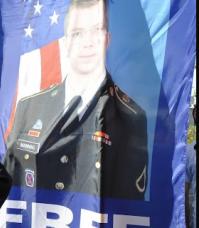
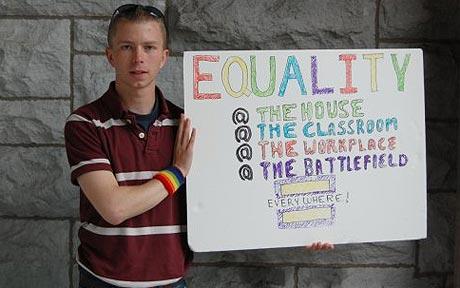
Recently, it was announced that PFC Bradley Manning would be a grand marshal of the 2013 San Francisco Pride Celebration. We felt this decision was a bold and uplifting choice, bestowing a great honor on a young whistleblower being persecuted for following his conscience.
Much to our disappointment, two days later SF Pride board president Lisa Williams issued a separate announcement that the SF Pride board would not be honoring PFC Manning as a grand marshal after all. It appears the SF pride board’s reversal was affected by criticism from a recently formed gay military rights group.
We want the world to know that the SF Pride board’s decision is not reflective of the LGBTQ community as a whole, and that many of us proudly celebrate PFC Manning as a member of our community. Unfortunately, the statements by Williams, and the group which originally advocated against PFC Manning as grand marshal, continue to perpetuate certain factual inaccuracies with regards to the military prosecution against him.
The first inaccuracy would be that PFC Manning did not advocate for gay rights. In fact, while serving in the military, PFC Manning experienced harassment and physical assault because of his perceived sexuality. He responded by marching against Don’t Ask Don’t Tell in the DC pride parade, where he spoke to reporters about his position, in addition to attending a fundraiser with Gavin Newsom and the Stonewall Democrats so he could discuss the issue of homophobia in the military. He told a friend in February of 2009 that his experience living under DADT and experiencing the oppression that entailed helped increase his interest in politics more generally.
LGBTQ activists fought hard for years to win the right to live free from the fear that we could be targeted with violence deemed acceptable to society at large, simply for being who we are. We members of the LGBTQ community would like to stand in solidarity with others around the world who still must live in fear of violence and oppression, simply for being born into a particular group.
Contrary to SF Pride Board president Lisa Williams’s claim, no evidence has been presented that PFC Manning’s actions endangered fellow soldiers or civilians. In fact, the military prosecution has successfully argued in court that it isn’t required to provide such evidence, and former State Department spokesperson P.J. Crowley continues to insist that the “Aiding the enemy” charge is unwarranted.
In a February 28, 2013, court statement, PFC Manning detailed the due diligence he performed prior to releasing materials to ensure this lack of harm, in addition to explaining,
“I believed the detailed analysis of the [Iraq and Afghanistan war log] data over a long period of time by different sectors of society might cause society to reevaluate the need or even the desire to even to engage in counterterrorism and counterinsurgency operations that ignore the complex dynamics of the people living in the affected environment every day.”
The truth is that President Bush and VP Cheney’s aggressive wars in the Middle East endangered far more LGBTQ service members and civilians than any Army whistle-blower. Unlike PFC Manning, however, they have never served prison time, and likely never will.
Millions of people around the world support Bradley for the personal risk he took in sharing realities of complicated U.S. foreign conflicts with the American people. He is the only gay U.S. serviceperson to be nominated three times for the Nobel Peace Prize. In joining the Army, soldiers take an oath to protect the U.S. Constitution, and we believe that by his actions PFC Manning strengthened our democracy, and fulfilled that oath to a greater degree than most enlisted.
We are proud to embrace PFC Bradley Manning as one of our icons, and intend to march for him in pride contingents across the country this year, as we have in years past. We think Bradley Manning sets a high standard for what a U.S. serviceperson, gay or straight, can be.
Lt. Dan Choi, 2009 SF Pride Celebrity Grand Marshal, anti-DADT activist Joey Cain, 2008 SF Pride Community Grand Marshal, former Board Member and President of SF Pride Gary Virginia, 2012 SF Pride Community Grand Marshal John Caldera, Commander, Bob Basker Post 315ED, American Legion, SF Veterans For Peace Peter Tatchell, Peter Tatchell Foundation Glenn Greenwald, award-winning journalist Leslie Feinberg, transgender author and activist Minnie Bruce Pratt, award-winning poet, activist and educator Dossie Easton, Therapist and Author Susie Bright, public speaker, educator, writer Andy Thayer, co-founder, Gay Liberation Network Becca von Behren, Staff Attorney, Swords to Plowshares Veterans Service Organization Stephen Eagle Funk, Artistic Director, Veteran Artists Liz Henry, poet and activist Lori Selke, author and activist Rainey Reitman, Steering Committee, Bradley Manning Support Network Sergei Kostin, Codepink Art Director Kit Yan, Queer & Trans Asian American Poet Lori Hurlebaus, Civilian-Soldier Alliance, SF Chapter; Co-founder, Courage to Resist Evan Greer, radical queer riotfolk musician Pat Humphries, Emma’s Revolution Sandy Opatow, Emma’s Revolution Pamela Means, award-winning OUT musician Malachy Kilbride, Coordinating Committee, National Campaign for Nonviolent Resistance Oliver Shykles, Queer Friends of Bradley Manning Gabriel Conaway, equality activist, Steering Committee of SAME Adele Carpenter, Civilian-Soldier Alliance, SF Chapter
Lots of people angry about the Pride Committee’s decision to fire Bradley Manning as a grand marshal. But the most savage, all-out assault comes from Steven W. Thrasher, a former Village Voice writer who has nothing good to say at all about Pride or the people who run it — or for the more mainstream parts of the LGBT movement:
Listen up, fellow homos—you have been bought, paid-for and sold to the highest bidder. The military industrial complex is so far up the ass of the LGBT movement that it can feel what is being digested in its upper intestines. Talking points and “messaging,” not discussion and debate, are the preferred methods of “communication” in a movement now run and owned by PR-firm trained Professional Homosexuals. Dissent will not be tolerated, and the assimilation of homosexuals into the rest of the militarized American public is complete.
On Manning and Pride:
A regular homosexual can give Dan Savage handjob after handjob for his anti-bully “It Gets Better” campaign if he wants, and he can even scream from the rafters that Savage should be given the Nobel Peace Prize for saying that something must be done to protect the powerless who are bullied by the powerful. But that same homosexual becomes as beholden to the military-industrial complex as the Professional Homosexual when he fails to call out SF Pride as a bully. The powerful group found perhaps the most marginalized, powerless homosexual in the nation, pulled him into the spotlight for a few hours, took a giant shit on him, roughed him up a little, called him names, and then kicked him back into the gutter.
I had to smile when I came to the end of the post, which notes:
Steven W. Thrasher was named Journalist of the Year 2012 by the National Lesbian and Gay Journalists Association for his staff writing for the Village Voice and his freelance contributions to the New York Times and Out magazine. Two weeks after receiving this award, he was laid off by the Voice.
Is he being too harsh? Is he channeling his inner Marc Salomon? Or does the guy have a point here?
At the end of the day you have to be yourself, Aries. Try to figure out if your job, relationships, and lifestyle actually reflect who you are. The energy is high for you to make changes that support your authentic self this week. Be insightful enough to see the need and brave enough to follow through.
TAURUS
April 20-May 20
Being true to yourself does not require for you to shove said truthiness down others’ throats, Taurus. You are moving through some brambly emotional terrain and it may bring out the fighting spirit in you. Resist the urge to defend yourself and you won’t inspire defensiveness in others! Stand up but resist stand offs.
GEMINI
May 21-June 21
The process of growth requires that you outgrow things. You may find yourself resistant to the idea of letting people, attitudes, or your way of life go, even if you have plenty of evidence that they’re not working for you. Don’t worry so much about “shoulds” or “shouldn’ts” — just be genuine.
CANCER
June 22-July 22
Even if everything in your life is technically awesome you won’t feel it if you’re not right with yourself. Watch out for depressive feelings that stem from a deep fear of failure. Decide that you are capable of creating success and willing to try.
LEO
July 23-Aug. 22
If being alone with yourself feels crappy you’ve got a problem, Leo. This week it’s important to slow down and invest energy into your insides. You have some issues that need attention and nothing will force you to deal with them…now. Avoid a whole lotta hurt in the future by getting in touch with what you’re feeling now.
VIRGO
Aug. 23-Sept. 22
If you don’t have your ego in balance you will act in ways that alienate others and end up confusing you this week. Whether your pride is wrapped up in helping others or in taking the biggest piece of the pie, you need to watch it like a hawk, Virgo. Be sympathetic to how your intentions are being received.
LIBRA
Sept. 23-Oct. 22
What do you value, Libra? It’s not as important what you like or idealize as much as what the principals that you choose to live by are. Looking at this stuff now will help you see where you are on or off track. Just because it feels good doesn’t mean that it’s good for you. Make choices you can live with.
SCORPIO
Oct. 23-Nov. 21
You are growing in major ways, Scorpio, and this kind of growth can’t happen without pain. The trick is to know the difference between the pain that comes from expansion and the pain that happens when something’s wrong. Take your time and remember to check in with yourself this week. Kindness helps.
SAGITTARIUS
Nov. 22-Dec. 21
If you fight the powers that be you are likely to kick up stronger opposition than you can handle and not get your needs met. Be patient, Sagittarius! You will figure out the best way to bridge the gap between what you want and what you are obliged to; you just may not figure it out this week.
CAPRICORN
Dec. 22-Jan. 19
When things go right do you celebrate or are you the kind of Capricorn that just sets their sights on a new goal and doesn’t take in your successes? Take a moment this week to feel good about your self. Look at what you have accomplished so far in 2013 and celebrate how far you’ve come. Cultivate happiness, Cappy.
AQUARIUS
Jan. 20-Feb. 18
Your sign loves to think about the future, Aquarius, and that tendency gives you a little something sparkly that the other signs don’t have. It also means that when you trip, you fall hard. Anxiety and fearful projections threaten to undo you this week. Let the unknown reveal itself in it’s own time and try not to expect the worst until then.
PISCES
Feb. 19-March 20
It’s hard to be clear with others when you don’t know what you’re feeling and how to make it right for yourself. This week you are on alert to do what you can to get in touch with yourself. Take some alone time and minimize distractions. You can’t get what you need if you don’t even know what it is, Pisces.
Jessica Lanyadoo has been a Psychic Dreamer for 18 years. Check out her website at www.lovelanyadoo.com to contact her for an astrology or intuitive reading.
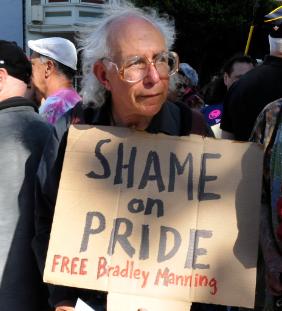
In the wake of the debacle unleashed by San Francisco Pride’s announcement that gay whistleblower Bradley Manning would not be grand marshal for this year’s Pride Parade after all, a large crowd of protesters assembled outside Pride’s Market Street headquarters April 29 for a hastily organized rally condemning the move. They held signs depicting Manning’s image, and chanted, “Grand marshal, not court martial!”
Famed whistleblower Daniel Ellsberg, who helped foment opposition to the Vietnam War by leaking classified government documents known as the Pentagon Papers to the New York Times in 1971, expressed support and admiration for the young US Army soldier. Manning was arrested in May of 2010 on suspicion of having leaked classified government cables and military footage later published by WikiLeaks, and faces a possible life sentence.
“A big mistake was made by the Board of Directors of SF Pride,” Ellsberg said. Referencing director Lisa Williams’ statement that not even a “hint” of support for Manning would be tolerated, Ellsberg said, “I don’t hint at support for Bradley Manning. I couldn’t be louder. I will be marching in that parade, for the first time for me, with a banner honoring Bradley Manning.”
Gay Navy veteran John Caldera, commander of the Bob Basker Post 315 of the American Legion, an LGBT-focused veteran’s organization, announced that his members had voted unanimously to call for Williams’ resignation, saying she had “negated and belittled all of the voices of the community” who had expressed support for Manning. He also condemned Pride for withholding its support for Manning while accepting funding from the likes of Wells Fargo, a banking giant responsible for foreclosures that have affected veterans. “The SF Pride committee has to put people first and corporations second,” he said.
Joey Cain, a former grand marshal who said he nominated Manning, noted that he was not calling for Williams to resign, but hoped she would realize the mistake and reinstate him as grand marshal. “What he did was heroic … Bradley made the world a better place,” Cain said. He shamed Pride for straying so far from the roots of the gay movement. “We believed in radical inclusivity,” practicing tolerance for all “colors, genders and opinions,” he said, with the understanding that “We don’t all agree. We never will. But we’re sure never going to throw any part of the community under the bus.”
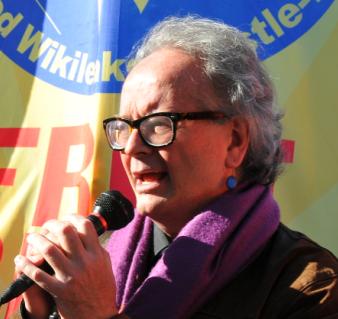
The rally was organized by longtime housing activist Tommi Mecca (pictured, center), comedian Lisa Geduldig and blogger Michael Petrelis.
Some counter-protesters from the Log Cabin Republicans, a gay GOP organization, even made an appearance. “We were praising the Pride Committee for not having selected Manning,” SF Log Cabin Republicans Fred Schein told the Bay Guardian.
Paul Bloom, a longtime activist, handed the Guardian a written statement on his take of the whole dustup, which he viewed as “an opportunity for people to unite in our understanding that there is no antiwar movement without gay people, and no movement for human rights that doesn’t envision an end to war.”
“Why does the SF Gay Pride Parade need corporate sponsorship, anyway?” Bloom wrote. “The parade must be brought back into the struggle as a part of it instead of remaining the grossly commercial spectacle it has become. We need to occupy the parade.”
The whole Bradley Manning-Pride fiasco was such a clusterfuck that we’re starting to wonder whether the people who run the giant parade and festival can count, much less make a decision.
Here, as best as we can tell, is how it went down.
Every year, the Pride board selects a group of people as honorary parade grand marshalls. All the past recipients of that distinction — the “college” of former marshalls — get to pick on person for the list. It’s never a very big issue.
Joey Cain, who served on the Pride board for ten years and is a former grand marshall, made some waves this time around by nominating Bradley Manning. And after the email went out, and the votes were counted (only perhaps 30 or so of the former poobahs bother to vote most years), it appeared that Manning was on top.
But no: According to a written chronology that Cain has prepared, “On Tuesday, April 23, Michael Thurman from Bradley Manning Support Network called me to say that Bradley Manning had been chosen by the collage of former Pride grand marshals to be a Grand Marshal but that he was then contacted two hours later by Joshua Smith and told that the Pride Board of Directors had asked for an audit of the votes and as a result of the audit he had not been elected.”
So Cain started pushing back. “You don’t tell someone they’re a grand marshall and then pull it away,” he told me. “That’s just not right.” His plea to Board Chair Lisa Williams: Just use the power of the board to vote Manning back in.
“At 9:41 on Tuesday night, I got a call back from Lisa. She said they were going to do the right thing, make him a grand marshall, and make it all right,” Cain recalled.
Williams hasn’t responded to our phone calls.
The next day, the Bay Area Reporter released the full list of GMs, and Manning’s name was on the list. “It said he DID win the college vote,” Cain noted.
Cain called the Manning crew. “I told them that Pride would do the right thing, that they wouldn’t back down,” he said. “I’ve been on the board ten years, and we’ve never backed down.”
Ah, but the office was flooded with phone calls and emails, organized by a group of gay soldiers in San Diego, and the pressure got intense. And next thing you know, Williams had issued a blistering press release saying that Manning should never have been named a grand marshall and in effect accusing him of endangering the lives of service members, something even the Pentagon hasn’t actually said.
Manning’s in. Manning’s Out. Manning’s in. Manning’s out. Yes, it’s part of the New Gay World, where the Pentagon is our friend because: gay soliders. But it’s also embarassing.
“I call it Manning-gate,” Cain said. “The cover up is always worse than the crime.”
And the fact that Williams isn’t talking to the press makes it all more confusing.
“The worst part is that I’m part of the anarchist community, and I’ve always been out there arguing in support of Pride,” Cain said. “Then this is like, holy fucking shit, they just proved everything I’ve been trying to disprove all these years.”
“I was one of the 15 former grand marshals on the electoral commission that voted for Bradley Manning,” Barry Saiff, former BiNet president, told me over the phone this morning from Washington, DC, about the Bradley Manning Pride grand marshalship controversy. (As one half of a bi-national queer couple, he lives most of the year in the Phillipines with his boyfriend, who is unable to come to the United States due to discriminatory immigration laws.)
To recap: An ‘electoral college’ of former grand marshals elected the jailed gay (possibly now transgender) whistleblower who provided Wikileaks with a huge dump of raw classified US government info. Someone announced the choice on Friday and the media went nuts. Then the Pride executive director issued this bizarre statement repudiating the decision and rescinding the honor, to the dismay of the electoral college and a huge swath of LGBT locals. A protest at Pride HQ is planned for today, 5pm at 1841 Market, SF.)
“The list of nominees from the other board members was presented to me in March, and the instant I saw Bradley’s name on there I knew it was the right choice. Pride stands for justice, freedom, and an end to discrimination, and I feel Bradley represents all of these things — as well as complete honesty and bravery. What the Pride board did to repudiate that choice, especially in its official statement — to not be able to make the distinction between Manning’s necessary actions and way the government is denigrating our troops with these illegal and unjust wars — is the height of stupidity.
“They [the Pride board] are colluding in the giant ‘Support Our Troops’ hoax that says you must never question the leadership of the military. There is actually no contradiction between supporting our troops as individuals, including our LGBT folks in the armed services, and supporting Bradley Manning and what he did.
“Specifically, if we care about our troops, we should care that they are used by our military for just ends, for missions and goals that actually increase our security, rather than decrease it, and that they are dealt with honestly. And, regardless of how you feel about the rightness or wrongness of Manning’s actions, there is no question that it is both immoral and illegal under international law (the US is a signatory to the Convention Against Torture), that he was tortured by the USA. Bradley Manning is an American hero, and an LGBT hero. We can rightfully be proud of him. He will rightly be remembered long after his duplicitous superiors are forgotten.
“What the Pride Board should have done to respond to the critics of the nomination was to point out that they were failing to make a crucial distinction. That it is simply a point of logic that we can support our troops while being diametrically opposed to the ends to which they are used by our government. This is a crucial point for the LGBT movement to understand and promote. We should not allow ourselves to be divided by people who are committed to denying reality. We can agree to disagree on the military and the wars in Afghanistan and Iraq, but there is no disagreement on this, it is a point of fact.”
What about the charge that Manning’s leaks endangered US troops?
“I say, ‘Bullshit.’ Of course that’s what the government says. Look, Manning did not act alone. He worked with some extremely savvy media people with this — Wikileaks, the New York Times — he didn’t just publish everything himself. Those organizations worked to edit what was put out there and protect peoples’ lives. To dump this all on him and call him a traitor is a mistake.”
How much of all this had to do with Manning’s queerness?
“Well, all things being equal, that’s what qualified him in the first place. But as I said, this fight has resonance with LGBT people in terms of freedom and justice. The fact that he’s gay may play into his situation in terms of military and former persecution.”
Were you ever given guidelines by the Pride board about who was qualified to be elected a grand marshall?
“Not that I know of. I don’t know the bylaws off-hand, but every year, as the ‘electoral college,’ we’ve been able to elect one grand marshall and it’s never been a problem. We voted in March, although there may have been a period before the final decision was tallied. [Radical faerie elder and historian Joey Cain put forth the Manning nomination.] And that was the last I heard of it until Friday. I wasn’t contacted personally by [executive director] Lisa Williams or anybody else saying we had to change anything. It wasn’t until Friday that I found out about any controversy — in the news media, like everybody else. And I was outraged.”
So. Pride did a thing. After years of being no more politically risky than an bowl of strawberry Jell-O, the Pride committee — or some kind of mole within the Pride committee, according to SF Pride board president Lisa L. Williams’ utterly weird statement about the whole thing — announced that Bradley Manning (a.k.a. Breanna Manning), jailed and pallid hero of the Wikileaks generation, soon to face court-martialling, was to be a Pride Grand Marshall.
An honor usually reserved for washed up TV actresses who once said the word “gay” on CBS prime time in the ’80s and craven politicos with dead eyes and hard hair, the Grand Marshallship has before this stirred up about as much controversy outside the community as the color beige. And yet, on Friday afternoon, the world’s head exploded. (The canny queen who leaked the decision sure knew her press cycles — Wikileaks lives!) When your dad in Detroit calls you almost immediately after the news breaks to ask how you’re covering it, you know its grabbing virtual headlines.
The announcement has since been officially rescinded by Pride in the tone-deafest of ways (LOL at the whole statement, really — especially how the Grand Marshalls “serve to represent the highest aspirations of the LGBT community”: so, um, Cloris Leachman, Cyndi Lauper, Sarah Silverman?), causing even more uproar. And suddenly people are discovering or rediscovering that Pride is a bland yet militant corporate entity that long ago strayed from its politically activist roots even while it claims to represent us all. Facebook is aflame with locals up in arms over Pride’s cowardice in the face of its criminal corporate sponsors, including Bank of America and Wells Fargo, and its gross media partners like Clear Channel.
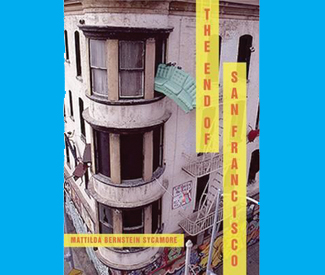
I found it pretty serendipitous that this week the Bay Guardian ran an interview with the founder of Gay Shame, Mattilda Bernstein Sycamore, about her new book The End of San Francisco, which in a personal and emotional way describes the amnesia that keeps gripping SF queer activism when it comes to Pride’s, and the gay community at large’s, utter Borg of assimilationism and sell-outitude. In the late ’90s and early 2000s, Mattilda and her organization were protesting all of Pride’s crap — particularly funny was a parade route “Budweiser Vomitorium” where you could “puke up your sponsorship pride” and a notorious anti-Parade during which a huge brass band of queer freaks marched directly into the oncoming Pride parade’s path, causing chaos. Gay Shame was also getting tons of shit for its important antics from people claiming that Pride was already “too political” hahaha.
“Glenn Greenwald is an extremely eloquent critic of state tyranny, using his training as a lawyer to relentlessly disassemble the hypocritical claims of corporate governmental powerbrokers (even though he still seemed to be supporting Obama when I saw him speak shortly before the “election”). But, at the same time, Greenwald is almost dogmatic in his support for the gay marriage agenda – this seems an unfortunate example of allowing self-interest (he is in a spousal relationship with a Brazilian man) to block self-awareness. In other words, he never makes the obvious connections between his critique of institutional power and the gay establishment’s obsession with accessing that same power through a never-ending obsession with marriage and military inclusion, hate crimes legislation, etc. But, here in this brilliant and scathing piece, he finally seems to be making those connections. Could he become an anti-assimilationist critic, after all?”
I wonder if the same anti-assimilationist energy is striking a lot of queer people over this Manning thing. The fact that these kinds of issues are coming up again at all right now — especially when same-sex marriage is before the Supreme Court and Don’t Ask, Don’t Tell has been rescinded — is extremely interesting. Could an actual protest movement like Gay Shame rise from the embers of assimilation? You bet your sweet Breanna. And check out Monday’s protest outside the SF Pride office, 1841 Market at 5pm. Also this at Pride itself.
I may actually have to go to this year’s parade!
PS Now if we could only get the house-trained “radicals” of the Pride celebration’s Faerie Freedom Village into the street to actually do a thing — that would be something.
A small but enthusiastic crowd marched through the Castro April 20 to bring some attention to the rash of Ellis Act evictions that are forcing seniors and disabled people out of the city. The activists stopped at the home of Jeremy Mykaels, whose plight is symbolic of the state of housing in San Francisco today. Mykaels insists he’s not a public speaker, but his remarks were poignant; we’ve excerpted them here:
I have AIDS and I am being evicted through the use of the Ellis Act. I want to welcome you to my home for the past 18 years, and to my Castro neighborhood where I’ve spent the last four decades, or two-thirds of my life.
I was there at some of the earliest Gay Pride Parades and Castro Street Fairs, listening to speakers like Harvey Milk and seeing entertainers like Sylvester with Two Tons ‘O Fun and Patrick Cowley. I proudly voted for Harvey to become the city’s first openly gay supervisor. I participated in the fight against the Briggs amendment, which would have outlawed gay teachers in California schools. I walked in the candlelight march honoring the lives of Harvey Milk and Mayor Moscone after their assassinations by Supervisor Dan White. And I’ve been here for many other protests and for many other celebrations.
And like most of you, I’ve seen how HIV and AIDS have devastated this community over the years and I have lost most of my closest friends and lovers to this disease. Until 12 years ago I thought I had somehow miraculously escaped it’s clutches, but that was not to be and I have been dealing with that reality as best as I can ever since, with mixed results. And now on top of the great losses this disease has cost our gay community, even more losses are occurring in the form of more and more long-term tenants with HIV/AIDS living in rent-controlled apartments being forced to move out of their homes and/or out of the city after being evicted through the use of the Ellis Act, or who have been scared and bullied by just the threat of an Ellis eviction into accepting low buyout offers to vacate.
I had always thought that I would spend the rest of my life living in this neighborhood and city that I love. Now I know that, like so many others before me who found themselves in similar situations, I will have no choice but to move out.
Tech boom 2.0 has brought out what I call the Vultures of Greed, a de facto alliance of banks, the real estate lobby, and, whether unwittingly or not, city officials like the mayor and several supervisors and the Planning Commission. But the worst Vultures of Greed have been the real estate speculators, many of whom I have listed on my website.
And here I would like to call out my own personal vultures as a prime example of how uncaring real estate speculators can be. The new owners of this property are Cuong Mai, William H. Young and John H. Du, and their business entity is 460Noe Group LLC, based in Union City. These are truly callous individuals who knew from the very beginning that they had a person with AIDS living in the building, and soon after they bought the place they began threatening me with an Ellis eviction if I didn’t accept their low-ball buyout offer and vacate. On September 10th, 2012 they subsequently Ellised the building and served me with eviction papers which means that I will only have until September 10th of this year to legally occupy my apartment. All these men want is the highest profit they can get after they remodel and re-sell this building. They could care less what happens to me when I am forced to move out of the city and no longer have access to all my HIV specialists who have kept me alive for this long. A prospect I’ll admit that, yes, scares me. But these guys, they won’t lose even a seconds sleep over my fate.
Yes, the Vultures of Greed are soaring high with sharpened talons ready to feed upon our city’s seniors and disabled, and on what’s left of our already decimated San Francisco gay community. But we don’t have to allow it. Together with our growing number of allies, we can change minds and we can eventually reclaim this city from the Vultures of Greed.
BTW, we couldn’t reach Mai, Young, or Du, and their lawyer, Saul Ferster, did not return a call seeking comment.
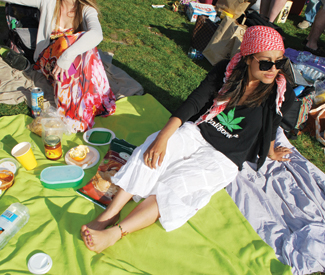
For the really sloppy, you had to go to Hippie Hill. All in all, Dolores Park last Saturday looked pretty much the same as any other gloriously warm Saturday in San Francisco. Course, we love a theme.
“Rasta colors” made their appearance in smatterings, as did green pot leaves on tank tops and hella tie-dye. My favorite trend this year? Blankets covered with trays of cheesy bread and chimichangas.
Betchu though, the Dolo kids didn’t leave the same amount of trash as the multitudes out in Golden Gate Park (to be fair, I wouldn’t spend too much cleaning up either if there had been a guitar-swinging brawl going down.)
You have to appreciate the coordinating stripes on these four. Props to goofy glasses for demonstrating that stoner pride need not entail ill-advised homage to another religious faith
Blogger Broke Ass Stuart probably wasn’t even stoned — he’s just trying to hype his costume closet
Cute couple #1
Best of the Bay-winning entrepreneur Crista Hill of Hey Cookie! had the only un-medicated baked goods on the block
She gives me hope.
At this point things get a little unfocused. Here’s roaming foodie Rocky Yazzie (front) with his friend inna funny hat
“You gotta scream when you take a photo”
Simply majestic.
I got sprung on these ladies’ snacks, then I noticed they looked amazing…
LIT “I met Johanna at a party in New York in 1998 — actually I was talking to her boyfriend first, barrettes in his dyed black hair and painted nails, I was trying to figure out if he was a fag or from Olympia.”
If you were “alternative” in the ’90s, that priceless sentence should ring strikingly true, as will this one: “Obviously we believed in attitude: if someone said something about not wanting to judge people, that was New Age garbage. New Age garbage was almost as bad as a trust fund, it was the same thing as stealing from your friends because you were stealing their rage.”
Mattilda Bernstein Sycamore — outspoken queer anti-assimilation activist, genderblending thriftstore style icon, archetypal Mission District character, huge-hearted den mother, insufferable gadfly — is the posterchild for all that was culturally alternative in San Francisco in that pierced-lip poser decade, while at the same time possessing one of the loudest voices cutting through the bullshit clamor back then and questioning it all.
She’s also a brilliant writer, with two novels and several anti-assimilationist essay anthologies, including last year’s Why Are Faggots So Afraid of Faggots?, under her sparkly little purple belt. Her new memoir The End of San Francisco from City Lights Books is written in such a hypnotically elliptical style (summoning City Lights’ Beat poet legacy) and contains so many spot-on observations and era-damning epigrams that anyone who lived through the period described will cling to its pages while wishing to hurl the book at a wall in embarrassed self-recognition.
Searing, funny, maudlin, elegiac, infuriating, and confessional, The End of San Francisco is a deliberately disordered collection of vignettes dealing mostly with Sycamore’s span living in the city and launching the highly influential Queeruption, Fed Up Queers, and Gay Shame activist movements.
“At some point I realized that the book centered around the myths and realities of San Francisco as a refuge for radical queer visions in community building,” Sycamore told me via email.
“I first moved to San Francisco in 1992, when I was 19, and it’s where I figured out how to challenge the violence of the world around me, how to embrace outsider visions of queer splendor, how to create love and lust and intimacy and accountability on my own terms. I left San Francisco in 2010, and in some ways this book is an attempt to figure out why or how this city has such a hold on me, in spite of the failure of so many of my dreams, over and over and over again.”
Along the way we get drug overdoses, AIDS, lesbian potlucks, heroin chic, crystal meth, ACT UP, the birth of the Internet, the dot-com boom, the dot-com bust, mental breakdowns, outdoor cruising, phony spirituality, Craigslist hookups, hipster gentrification, Polk Street hustling, fag-bashing, shoplifting, house music, the Matrix Program, crappy SoMa live/work lofts, “Care Not Cash,” gallons of bleach and hair dye, and processing, processing, and more processing.
It’s definitely not a nostalgia-fest: Juicy passages about SF club history, ’90s queer life in the Mission, and Gay Shame’s internal dynamics and gloriously kooky pranks (guerrilla Gay Shame Awards ceremonies blocking Castro traffic; a Pride adjacent, corporate-sponsor-tweaking “Budweiser Vomitorium” where you could “barf up your pride”) are accompanied by an Oprah-load of issues including chronic pain, incest, personal betrayals, anorexia, depression. The moving opening chapter describes Sycamore confronting her father in the upscale Washington, DC home she grew up in about her recovered memories of his sexual abuse, as he lay dying.
And Sycamore has surprising words for those who think queer punk, riot grrrl, the bathhouse disco and clone-look revival, or the scene at the SF Eagle were essential to the queer activist movement (Kathleen Hanna of Bikini Kill makes a memorable appearance — Sycamore befriended her without knowing who she was, and later attended the first Le Tigre show.) Her habit of questioning everything can often paint her into corners of abrasive self-absorption, but she continues to raise interesting points about the fetishization of machismo in the FTM, leather, and punk communities, the emptiness of hipster activism, and the capitalist-colluding hypocrisy of “alternative culture.”
As usual though, she saves her heaviest judgments for the mainstream gay morass, its Borg-like drive toward cultural hegemony via marriage, military, and consumerism — even as she acknowledges the necessary symbiosis that binds queer outcasts together. At 1993’s March on Washington, “where suddenly there were a million white gay people in white t-shirts applying for Community Spirit cards”: “Gays in the military was the big issue and what could be more horrifying but here’s the thing: freaks actually found one another — we were so alienated that we went right up and said hi, I like your hair…”
This, then, is the tenderness that drives Bernstein to keep speaking out, despite the personal costs. As we weather another dot-com boom of homogenizing gentrification, The End of San Francisco is a timely reminder of the community that can spring from resistance.
MATTILDA BERNSTEIN SYCAMORE reads Tue/30, 7pm, free at City Lights Bookstore, 261 Columbus, SF. www.citylights.com, and Thursday, May 9, 7:30pm, free at the GLBT History Museum, 4127 18th St., SF. www.glbthistory.org
STREET SEEN[Caitlin Donohue: Although I originally contacted former Stanford University football offensive guard and current Apple employee Ish “Mr. Marina 2013” Simpson for help in writing a style guide to the Marina, he wrote me back a rundown so evocative that I hated to paraphrase his words. And so this week, I’ve given my style column over to him. Check out sfbg.com for my recap of the glorious March night he was crowned king of SF’s preppiest neighborhood, and don’t forget, you can add flair with a belt.]
I buy a lot of clothes, but not many in person. I love to buy, hate to shop, so I buy mainly online. There are some stores and brands I’ve shopped at in the Marina, but since you asked me to explore I was able to find a lot of cool stores that I didn’t know existed. There are more men’s stores in the Marina than I realized.
My fellow Marina gentlemen don’t usually take too many risks when it comes to fashion. The guys I see downtown or in the Castro are usually very fashion-forward. But some of the best-looking guys in the Marina I’ve seen do rock bespoke suits and shirts. Classy. Men’s fashion here steers toward preppy or sailor styles. The women take way more risks, and Marina women are definitely some of the most fashionable in the city.
“If someone says, ‘Hey, I like your shirt,’ you have to say, ‘Yeah, it’s G-Star Raw!’ Whatever.” All store photos by Anna Latino
This place intrigued me because I saw one in Barcelona when I was there in December 2011. I talked to the guy working here and he said the brand is Dutch and it’s way bigger in Europe. Makes sense: the name is just terrible, and they only sell G-Star Raw clothes. That means if someone says, “Hey, I like your shirt,” you have to say, “Yeah, it’s G-Star Raw!” Whatever. They had a nice selection of belts, which I love. Belts are a great way for conservative dressers to express some flair. I loved the colorful chinos (a staple in my wardrobe). I also loved this one cardigan they had.
“Cool threads that you’d wear out to bars on a Thursday night.”
This place on Chestnut has cool shirts and hoodies. Also, some nice scarves. The clothes are advertised as being extremely soft and they aren’t lying! The fabrics are nice and I like the bold, yet muted colors. I’ve had some friends buy their stuff and it has a worn-in, vintage look. This is a good place to grab some cool threads that you’d wear out to bars on a Thursday night.
2209 Chestnut, SF. (415) 346-2400; 498 Hayes, SF. (415) 829-7519, www.marinelayer.com
THE BLUES JEAN BAR
I’ve bought a few pairs of jeans from here and it’s always a great experience. I kind of don’t like how all of the jeans are behind the bar and you have to ask for them, but I also kind of like it too. Many hot girls work there, so you’re not shopping by yourself and you get a great female opinion when you try your jeans on. They give you great recommendations on fit and style, and they will tell you how to care for your jeans and whether or not you should have them tailored.
This shop is one I just discovered that sells both women’s and men’s clothes. They had a great selection of slim-fitting jeans and blazers. They had a cool leather jacket I liked. This is the place to go if you’re looking for a nice outfit for date night with a pretty young lady.
This is for the ladies! I like the style of the women that like shopping here. Every time I walk by there are a lot of good-looking girls in there. The music they have jamming is awesome, the ladies working there are gorgeous, and the clothes are awesome (in this man’s opinion!) I like the material they use for their clothes, very light and breathable; at least it looks like it is. I loved the camo pants, the flowing dresses, and the printed shirts.
This is your go-to spot for gear that is meant to be worn when partying! This brand was born in San Francisco and the guys behind it take pride in representing this great city. They have awesome clothes for Sunday Fundays (tanks!), holidays (special gear for St. Patty’s, Cinco de Mayo, etc.), sporting events (Giants, Warriors, Niners), and for music festivals (break out your JammyPacks). This should be one of the first places to shop at when you’re going to be out in the sun having a great time.
SEX Last week, local blog SFist reported that a gay strip club named Randy Rooster was in escrow to snag the building formerly occupied by Diesel’s distressed-kneecap denim and elite luggage sets on Harvey Milk Plaza.
Randy Rooster denuded its website of all info before we even had a chance to wonder. But what exactly a gay strip club would mean — much less in a neighborhood where you can’t swing a patent leather mini-backpack without hitting a gyrating go-go — remained to be explained. Surely limos full of bachelorette party “woo!” girls would figure it out for us.
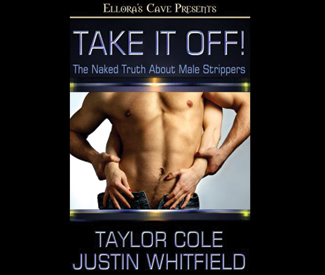
To satisfy our curiosity over the waxed and winking men of the pole, I took the opportunity to chat with Justin Whitfield, who stripped for years at Le Bare (www.lebare.com), a Houston strip club catering to straight ladies. He tells me the club became the country’s premier spot for rich and lonely oil wives during the late 1970s and ’80s.
Whitfield and fellow manmeat Taylor Cole recently published Take It Off!: The Naked Truth About Male Strippers, on the heels of stripper-pride flick Magic Mike. “The movie’s awesome,” Whitfield says. “In my real world, I don’t tell people I was a stripper. Now I can hold my head up.”
The book’s publisher is Ellora’s Cave (www.ellorascave.com), whose catalogue is mainly heavy-breathing romance novels. While I can’t say I recommend Take It Off! as a literary endeavor, I can tell you that the pic of Cole chair-dancing and the “Sexcapades” chapter are looks into world without equal in a Randy Rooster-less San Francisco.
To the South Bay bachelorettes who will surely flock to any future Chippendales-like endeavors in the city, Whitfield counsels enthusiasm: “I cannot stand the women who come in and have made up their mind not to have fun,” he says. “If I’m in a real good mood I can convert these ladies. But sometimes, it’s like I don’t want to be around her because she’s depressing.”
But don’t get too stoked party girls — those jouncing Speedos are not gift bags. “I’ve had my bottoms pulled down,” Whitfield tells me ruefully. “Not fun.”
LAURA ANTONIOU READING
She rose to fame by creating an extensive master-slave society in the pages of her BDSM fantasy series The Marketplace, but Antoniou reads tonight from her latest: The Killer Wore Leather, a kinky mystery novel. The reading kicks off a week of SF engagements for the writer including the Ms. Leather pageant, Bawdy Storytelling on Sun/21 (www.bawdystorytelling.com), and Wicked Grounds on Tue/23 (www.wickedgrounds.com).
Thu/18, 6:30-7:30pm, free. Good Vibrations, 1620 Polk, SF. www.goodvibes.com
INTERNATIONAL MS. LEATHER PAGEANT
Leatherwomen the world over flock to SF for this annual contest crowning the individual who becomes the community’s spokesperson, role model, and mentor. Check out workshops, boots and cigar parties, and of course, Saturday night’s pageant, where 2012 titleholder Sara Vibes makes way for fresh meat.
Thu/18-Sun/21, $35-199. Holiday Inn Golden Gateway, 1500 Van Ness, SF. www.imsl.org
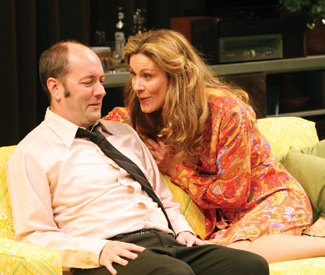
THEATER “Oh, this stupid war. I don’t know who to blame anymore, do you?”
So asks aging American divorcée Mary-Ellen (Marcia Pizzo), in 1975 Southern California, of Vietnamese war refugee Bao (Jomar Tagatac), who has lost his entire family back home. It’s a fraught question that, maybe fittingly, receives no answer. But it’s made all the more complicated and troubling in the Magic Theatre production of Julie Marie Myatt’s 2009 comedy-drama, The Happy Ones.
That’s because Bao and Mary-Ellen’s precarious perches, at the edges of the so-called American Dream, do not get pride of place. The narrative center goes to Walter Wells (a sure Liam Craig), cheerful business owner and middle-class patriarch who suffers an irreparable loss after his adored wife and two children die in a head-on collision with a car — driven by Bao.
Of course, the causes of suffering, and the consequences of violence, are very different when comparing a road accident with a war of genocidal proportions. But in The Happy Ones the emphasis on grief as universal, the overweening urge to see everybody just get along, obscures reality, substituting easy humor and sentimentality for a serious look at either systemic violence or, for that matter, the nature of happiness. No wonder Mary-Ellen doesn’t know who to blame.
Helmed by California Shakespeare Theater’s Jonathan Moscone, the production stresses the play’s emotional comedy about sorrow, forgiveness, shared pain, and the power of friendship, offering able performances and well-shaped scenes that smoothly unfold a palatable nostalgia trip whose sentiments are rooted in a claim to a certain class-based suburban memory.
Erik Flatmo’s set is a shabby period living room in a white Orange County suburb, complete with a blown-up studio portrait-photo of the happy family hanging over the fireplace with its untouched Duraflame logs. Martinis, audible splashing from a backyard pool, Sundays at the Unitarian Church, hickeys, tuna casseroles with crumpled potato chips on top — it’s the Kodachrome image of the American 1970s as advertising agencies would have us remember it.
Myatt has worked the terrain of war, home front trauma, uneasy solidarity, and vague spiritualism before to more profound effect. Her earlier play, Welcome Home, Jenny Sutter (produced locally by TheatreFIRST in 2011) dealt head-on with the Iraq War and the plight of its American veterans with its titular character, a black female soldier deeply traumatized by her experience on the front lines who finds some respite among a community of misfits on the desert-edge outside Los Angeles. It’s a perhaps looser but also more acute investigation that wrestles with class, gender, and race in a more vigorous way. The distance offered by the nostalgic period setting in The Happy Ones, by contrast, seems to have made it too easy to hold all of that at arm’s length.
“Things change,” the grief-stricken Walter propounds to his concerned friend Gary (Gabriel Marin), a hapless and commitment-phobic Unitarian minister now dating Mary-Ellen who seems to have been in love with pal Walter’s wife and life. Yes and no, the play suggests — somewhat unwittingly — as we’re left at the launch of a buddy movie instead of on the brink of the world we’ve in fact inherited.
Bao turns out to be the only one who can help Walter navigate his grief. As Gary and Mary-Ellen make awkward attempts to cheer up their friend, it’s Bao who actually helps — taking the place of Walter’s late wife as the person who cleans, cooks, buys groceries, keeps house. Having tried to kill himself just after the accident, Bao now literally begs to serve Walter, in terms that imply a kind of living erasure that has a very gendered dimension to it in the patriarchal culture of the ’70s.
“I’m invisible! I promise!” shouts Bao. “Please! I have to help you.”
“You can’t repay me for killing my family,” objects Walter. “It doesn’t work like that.” Reparations, of whatever kind, seem to be running in the wrong direction here. Would this relationship remain as conceivable as it supposedly is here if Bao were an Iraqi refugee in 2013? If the playwright means for the lines to appall us, as they should, the production seems indifferent to this subtext.
So Mary-Ellen’s rhetorical question about the responsibility for the war lingers between two relative outsiders who, with a combination of pity and desire, orbit around a central character whose social position is the normative one — with real-world power and privilege that neither Bao nor Mary-Ellen can match, and the one most directly associated by reason of class, gender, and race with the interests promulgating war abroad.
This should be the basis of a painful awakening in the audience, a scathing critique of the solipsism of power. But it ends up seeming more like the re-inscribing of the same order. The racism, imperialism, and sexism shaping the lives of Bao and Mary-Ellen are gently broached at best, trivialized at worst. Walter’s grief and personal transformation remain paramount. And if Bao and Mary-Ellen seem to have gained some hopeful ground by the end too, it is only because each has, desperately but also willingly, hitched his or her future to a white man. *
DANCE “Next door,” you are told in the packed Senegalese restaurant in the heart of the Mission. “Back there,” you hear, as a hand points in a very dark, very empty bar you enter through an unmarked door. What’s “back there”? It’s a large space, perhaps formerly used for storage, lit by blinking Christmas tree lights and two blinding spots. You wonder what a former African dictator would have thought about a celebration of his life being created in such circumstances. But then why would anybody want to pay tribute to a man who was responsible for the death of thousands of his fellow citizens?
The head of state in question is Sékou Touré, nicknamed “Syli” or “the Elephant,” who led Guinea to independence and in 1958 became the country’s first president. On the night I visit its practice space, Duniya Dance and Drum Company is working on piece about Touré, The Madness of the Elephant, which will world-premiere this weekend.
The elephant is still Guinea’s national symbol, says Duniya’s musical director, Guinea-born Alpha Oumar “Bongo” Sidibe, adding with some pride that their national soccer team is also called Syli. (“They are very good — they’ll go to the world championship.”)
But Sidibe also knows all about Touré’s darker side. “He was a Marxist and he did not tolerate dissent,” he explains. “But he also was a good man, a revolutionary and a man with a vision. His madness was both good and bad. He was the first president of my country. He gave hope to the people; he supported and built our culture. I would not be here as a dancer and as a musician if it was not for him.”
The first ensemble that put African dance on the world stage was Guinea’s Les Ballets Africains; it also became the continent’s first national dance company.
But Touré’s major act of “madness” came with independence when, says Sidibe, “he was the first guy in the world who dared to say ‘no’ to Charles de Gaulle,” rejecting Francophone post-colonial attempts to shape and control the country.
It’s with that crucial moment in Guinea’s history that Madness opens. It recalls the speech in which Touré declared Guineans would rather live poor but free than rich and enslaved. The rehearsing crowd leaps, cheers, and embraces each other to the drummers playing the national rhythm created for that historic occasion.
It’s a curious group. Four of the dancers are Africans with professional performance experience, but for the other eight the African rhythms and steps are clearly foreign. Yet they embody them well.
When these dancers auditioned for Duniya’s artistic director, Joti Singh, they thought they were enrolling in Bhangra, a folkloric dance from North East India. “I told them right away that we might also do African dance,” the American-born Sing, who’s of Punjabi descent, explains. As a child Singh learned to perform Bhangra at family celebrations and cultural festival, but she lost interest as she got older.
In college, she discovered West African dance and became passionate about it. She has twice traveled to and studied in Africa, speaks some Sousou — “I can understand much better than I can speak it” — and finds herself very comfortable in both worlds. Evidently, her dancers feel the same way “Everyone is welcome,” smiles Sidibe at a question surrounding possible cultural conflicts.
In another scene, rehearsed between much teasing and laughter, a group of what looked like women in an open-air market is attacked by baton-twirling thugs. They stand up to the men. The incident, explains Sidibe, was based on fact. “Touré created a special police to enforce Marxist economic principles. But one day the women marched to the Presidential Palace singing and chanting their objections. He abolished the force the same day.”
As is wont in much of West African culture, a djeli (a storyteller), accompanied by the balafon (a wooden xylophone) will provide the through line for Madness‘ musical, dramatic, and choreographed sequences. Sighs Singh, “That has been the hardest part of this project — trying to hold all these wonderful artists together in one place.”
FEAST Even for fans of cutting edge culinary creations, there is something undeniably sublime about a simple homecooked meal. We here at the Guardian want you to know that even though your mom’s killer casserole may be miles away, the chance to nosh on quality family recipes is not. Here are five spots in San Francisco where tasty menu offerings have received generations of approval.
CINECCITTA RISTORANTE AND BAR’S BOSCAIOLA PIZZA
Romina Tiberia has been working and cooking at her grandfather’s restaurant in Rome since age six. Today, she’s the owner of Cineccitta Ristorante and Bar Tiberia, serving her family’s authentic Roman recipes in the intimate, cinema-themed North Beach spot.
Everything at Cineccitta is made from scratch, according to Tiberia. “We don’t buy anything from the can,” she told the Guardian. “We are really proud to say that. And not from the jar either!” To give her pizza an authentic Roman taste Tiberia imports her flour, yeast, oil, cheese, and meats from Italy.
For a taste of Tiberia’s family treasure, try the boscaiola pizza. It’s thin, buttery, nearly transparent crust is baked on a pizza stone imported from the motherland.
The boscaiola is topped with mushrooms, fresh tomato sauce, mozzarella, and the eatery’s specialty orange peel sausage. Of this last ingredient, Tiberia tells us, “that’s a very old tradition. It’s very unusual. That was my grandfather’s recipe.”
“I create an environment that feels like home,” says the North Beach restaurateur. “It’s simple food, but it’s good food, and that’s what I like to share with people.”
Henry Nguyen opened the Lower Pacific Heights gem My Father’s Kitchen as a way to keep busy in his retirement. But since the 11-table eatery opened in 2010, it’s become the neighborhood’s go-to spot for traditional Northern Vietnamese comfort food, definitely providing enough work to keep Nguyen on the move.
Nguyen grew up in the city of Haiphong, where his father owned a restaurant. His family’s authentic pho recipe is a consistent favorite among his customers these days, served with a chicken or beef broth and laced with rice noodles and eye of round steak, brisket, and flank.
True to Nguyen’s heritage, My Father’s Kitchen specializes in Northern Vietnamese dishes, which are characterized as being less spicy, without the overpowering flavors found in their Southern counterparts. The tastes of My Father’s Kitchen are balanced, subtle, and soothing. Visitors to one of the many nearby medical facilities take note, Nguyen’s pho is superb if you’re feeling under the weather.
For 50 years, Tia Margarita has been an Inner Richmond favorite, with killer Mexican food. Fans might be surprised to learn that the family who owns the local haunt isn’t of Mexican descent.
Today, original owners Alex and Virginia Hobbs’ granddaughter and current manager of Tia Margarita Jennifer Corwin says today’s menu is nearly identical to the kitchen’s offerings from a half-century ago. The bestselling item from that original lineup is still the chile relleno.
“Personally I think it’s very hard to find a chile relleno made properly,” Corwin tells the Guardian. “Usually they are either flat or really greasy. I pride myself on ours. People love them.”
For the more calorie-conscious, Corwin recommends Jennie’s Special, a salad made of black beans, cheese, shredded lettuce, pounded chicken breast seasoned with asada spices, sliced jalapenos, with a creamy dressing — served on the side, of course.
When we asked Richard Park if anything on his menu was derived from a family recipe his immediate response was, “oh yeah, basically all of it.” Park and his wife Pam Schafer are the owners of Cathead BBQ in the SOMA. Specializing in some good ‘ole Southern cooking, it seems almost impossible that the menu not include strong familial influences.
Giant buttery breads and Coca-Cola soaked meats are Down South traditions but as far as heritage dishes go, Park recommends his dandelion green potato salad — a fresh spin on one of his German family’s favorites. The dish, often made by her mother and grandmother, is traditionally a piping hot mix of mashed potatoes and dandelion greens. To compliment the finger lickin’ barbeque Cathead is known for, Schafer transformed his childhood favorite into a cold potato salad made with Yukon potatoes, creamy buttermilk, green onion and vinegar dressing, and fresh dandelion greens.
Track down this bright red food truck parked somewhere in the city and expect to find an impressive line. What’s everyone waiting for? The truck’s signature dish: a generous serving of garlic-inflected noodles topped with a skewer of your choice (beef, pork, chicken, shrimp, or veggie). The recipe for these chewy noodles belong to the An family, who opened up one of San Francisco’s first Vietnamese restaurants Thanh Long back in 1971.
The technique involved in cooking the fresh and doughy noodles with a pungent garlic kick is a long-kept family secret. William Norling, who helps run the An the Go food truck, says “everyone always says ‘I tried to make it at home but I can’t make it taste same.’ They’re a funky texture.”
Self-billed as the purveyors of the first garlic noodle on the West Coast, the An family restaurant empire hinges on its family recipe. Maybe secrets don’t make friends, but it sure seems like secret recipes make plenty.
The surrealists employed a method of drawing called the exquisite corpse, where an artist would create an image on a section of paper, fold it back to conceal the image, and then pass on the paper for another artist’s contribution. The beautiful monstrosity wasn’t revealed until everyone was finished and the paper unfolded.
Walking down South Congress Street during SXSW 2013 yesterday felt like the musical version of an exquisite corpse. Nearly every block had its own outdoor stage, with an alternative country performance across the street from a hard rock band, indie pop music next to honky-tonk, and street musicians in between. It was sonic mayhem.
While some find it enjoyable to be able to sing along along to a familiar band, there is unequaled pleasure and pride in “discovering” a new one – the more obscure, the better. We left our frustratingly fathomless festival handbook at the hotel, letting fortune be our guide, and made for S. Congress. The street is aptly named because it seems that everything comes together there, and has the gentrified, bohemian feel of Valencia Street, with vintage shops, craft fairs, and a good ice cream parlor.
While musicians are turned away at larger venues downtown, it’s virtually open mike in SoCo. That’s not to imply that the music is worse. On the contrary. It is here that we stumbled upon a standout band called Residual Kid, from Austin, with Max Redman (12-years-old), Ben Redman (14), and Deven Ivy (14). Teen/tween angst doesn’t get better than this.
At the Music by the Slice stage, Telekinesis lead singer Michael Lerner sat front and center, singing over the cymbals of his drumset to hipsters holding pizzas. Young Galaxy, from Canada, also performed, it with a ’80s synth-heavy sound, snappy beats, and open-throated vocals.
Moseying down to the St. Vincent De Paul parking lot, Canadian country music band Corb Lund played to a crowd lounging on overstuffed sofas, reminiscent of an impromptu porch concert. Singing straight country with a storytelling bent, he twanged about speeding on the highway with a foot “heavy with redemption” and a “bible on the dash.”
Down another block, adorable duo, Kelly Willis and Bruce Robison, got folks dancing at the South by San Jose stage with romantic country ballads.
While the music may be eclectic, the food is less so, despite the ubiquity of food trucks. While most restaurants serve any combination of Tex Mex (fried burrito anyone?) and BBQ (Austin’s staple food is shredded pork in a white bun), it is possible to find some fresh greens. At the non-profit, Casa de Luz, we sat down to a hippie-cafeteria style prix fixe lunch, piled high with kale and homemade kraut.
But the siren smell of smoked meats is too alluring, and we couldn’t help but splurge on an artery-clogging, three meat BBQ sandwich from the food truck, La Barbecue. Delicious. There was also an offshoot show behind the BBQ parking lot, called the SX704 Showcase, with hip-hop performances by SL Jones from Atlanta, and Rich Kidd from Toronto.
As we walked over the Congress Avenue Bridge in the evening, the famous bats started to leave their hiding places beneath, swarming in search of their sunset meal. They made thousands of shotgun holes in the sky, and moved in tandem like a starling murmuration, adding just one more sight to the wonderful weirdness this town has to offer.
Navigating the wild landscape of music, parties, and food at SXSW is exhausting, but in the end, we’re rewarded with great memories. And it’s a good thing we took photos too, because our eardrums are shot.
Does the idea of one of SF’s best-known drag fashionistas rendered in massivem inflatable form excite you? You then, are the target audience for this item of news: Juanita More has announced that multimedia artist Desi Santiago will lend his dark, dramatic style to her yearly Pride party in 2013 as its set designer.
“Desi is someone with great vision,” More told me in an email. That vision has produced black dogs that swallowed a South Beach hotel whole, outfits that appear to be made from different garments when viewed from various vantage points, atmospheric runway sets, and extravagant works various couture happenings.
After he visited the Jones 620 rooftop where this year’s June 30th party will be held. It was only the Puerto Rican-via-New Jersey artist’s second trip to San Francisco, and my Instagram feed told me that More had celebrated with him over homemade pernil. I chatted with Santiago about what, exactly he means with this plan for balloon Juanita.
“I’m taking her body apart,” he said. “I’m exploding Juanita’s body. I don’t know how much I should give away at this point. But we’re working on an intereactive experience wehere you get to interact with her body.” One of those ways, he said, will be via a “giant” version of the drag queen — reminiscent of his work he did converting the Lords Hotel into “Black Lords,” an installation that saw the hotel morph into a red-eyed black dog.
“[Juanita] has a heart of gold, and she’s fierce,” he said as towards his motivation for accepting the gig. This isn’t the pair’s first collaboration — More’s played Santiago’s Van Dam party in New York. “I booked her because I loved her but when she spun,” he told me. “She kind of kicked my ass. She really turned it out.” Man can appreciate a good scene-setter.
But who’s to say, really, what the Pride blow-out (tickets available in June) will end up looking like.
“I’m interested in creating completely consuming environments that make you leave the norm,” the artist told me. Santiago’s resume includes work in bondage costume design, metalwork, sculpture, set design. For more on the artist, check out his March 2012 New York Timesprofile.
Severino (Horse Meat Disco, UK), Derek Opperman (Gemini Disco, SF), and Kim Ann Foxman (NYC) have all been announced as DJs for the afternoon party. More was also stoked to tell me about her flyer designer, De La Soul and Snoop Dogg video vet and Bay Area local visual artist Serge Gay Jr.
OPINION When I first came out as a transgender man in the mid 1990s, I quickly realized that I would have to pay out-of-pocket for the health care I needed.
Nearly every insurance plan has outdated exclusions that bar transgender people from receiving medically necessary health care. Everything from cancer screenings to the care related to gender transition is commonly excluded, despite being provided without exclusion to non-transgender health insurance customers.
For working people everywhere, including members of the LGBT community, accessible, affordable, quality healthcare is critical. And for union members like myself, healthcare equity is part of a basic and broader vision for equality for all people.
In recognition of this vision, Pride at Work, the SEIU National Lavender Caucus, National Center for Transgender Equality, the Transgender Law Center, and Basic Rights Oregon have partnered for the very first Transgender Month of Action, aimed at lifting the healthcare inequities that face our community.
I began to gender transition in 1996, starting with hormone therapy, a process that required walking through countless hoops. I will forever be thankful to the Tom Wadell Clinic and Lyon Martin Clinic for making hormone therapy accessible to low-income and uninsured trans people like myself, but I know I was one of the lucky ones. A few years later, when I was insured, I began to feel as if insurance companies were the gatekeepers of my body.
I knew that I needed to get chest surgery and that it wouldn’t be covered by my insurance, so I held a rent party and told my friends and loved ones that I needed help. It took a lot of vulnerability to do that. Like everyone else, transgender people need acute care when they are sick and preventative care to keep us from becoming ill, including services that are traditionally considered to be gender specific — such as Pap smears, prostate exams, and mammograms.
But insurers frequently expand discriminatory exclusions in a way that denies transgender people coverage for basic services. Take the outrageous example of a transgender woman in New Jersey who was denied coverage for a mammogram on the basis that it fell under her plan’s sweeping exclusion for all treatments “related to changing sex.”
Sometimes, trans people are denied care completely. In the late 1990s, I went to a gynecologist, but the doctor refused to treat me. Over the next 10 years, likes so many other trans people, I did not get an exam, too embarrassed and outraged to seek treatment.
In 2001, I worked with the a group of transgender healthcare activists to remove discriminatory exclusions for trans employees. When the Board of Supervisors voted to remove these exclusions, it was a huge and historic victory. Since that decision over a decade ago, San Francisco has proudly provided inclusive health care to city employees — and there’s been no cost increase to the overall plan.
Pride at Work, the organization that brings together LGBT union members and their allies, has a sign in the office that states: An injury to one is an injury to all. That’s the premise that underscores the labor movement’s commitment to LGBT equality, including trans-inclusive healthcare.
And it’s why Pride at Work is organizing local and national efforts to educate LGBT people and labor unions about the importance of ensuring access to basic healthcare for transgender people and providing coverage of medically-necessary transition-related care in health insurance. This first-of-its-kind effort is inspired by the belief that all workers deserve to have all medically-necessary care covered by health insurance, including transgender people whose healthcare needs are not being met.
Gabriel Haaland is co-vice president of Pride at Work.
What’s happening in the socially conscious Bay Area this week? Well, there’s a mass rally Thurs/14 to save City College of San Francisco. There are community organizing meetings, like today’s Transgender Month of Action panel co-sponsored by the Harvey Milk LGBT Democratic Club, San Francisco Pride at Work, and others. There’s a free public talk Wed/13 on Asia’s Unknown Uprisings. There’s a kickoff for a national Homes For All campaign to address foreclosure issues in Oakland, also on Wednesday. Oh, and then there’s the Bay Area Anarchist Book Fair on Sat/16 and Sun/17.
What else is going on? Here’s your opportunity to let us know.
The Guardian has always included Political Alerts listings in our pages and online. Now, we’ve launched a new way to spread the word about progressive goings-on. Subscribe to our brand-spanking new Alerts Twitter page and get up to speed on local community happenings.
For local event organizers, there are now two extraordinarily easy ways to let the Guardian know what you’re up to:
1. Mention @sfbg_alerts when you Tweet about your event.
2. Email your event announcement to alert@sfbg.com.
To be considered for print, events for the following Wednesday or later must be received by Friday morning the week prior. So, if your group plans on surrounding a federal building next Wednesday to protest an oil pipeline, for instance, give us a heads up by Friday morning.
Hear from female innovators in media 111 Minna, SF. Event open to those 21 and older. 6pm drinks, 7pm presentations, free. Facebook: Her Girl Friday. Her Girl Friday, a Brooklyn-based group that produces events with concrete takeaways for women in journalism, hosts four dynamic speakers: Ann Friedman, former executive editor of GOOD magazine; Martina Castro, co-founder of Radio Ambulante, a new podcast which aims to tell the compelling and diverse stories of Latin America in Spanish; Katy Newton, a multimedia journalist, and Mimi Chakarova, a photographer and filmmaker covering global issues examining conflict, corruption and the sex trade. Music by DJ Mirissa Neff.
FRIDAY 8
Forum: Fight coal exports in the west 518 Valencia, SF. Escobar.jack@gmail.com. 6:30-9:30pm, $5-20 sliding scale. Across the Northwest, a coalition of environmentalists and landowners have come together to fight back and stop the development of Big Coal’s vital infrastructure. This forum and fundraiser for the Coal Export Action will include a report-back and panel on Western coal exports, video screenings, snacks and booze. Hosted by Rising Tide North America.
TUESDAY 12
Meeting: Transgender month of action LGBT Center, 1800 Market Street, SF. tinyurl.com/trans312. 7pm, free. Throughout March, organizations including Pride at Work, the SEIU Lavender Caucus, the National Center for Transgender Equality, and the Transgender Law Center will partner in asking unions, labor councils and state federations to pledge to bargain for trans-inclusive health benefits, and to sign a Trans Health Benefits Bargaining pledge form. This event, co-sponsored by the Harvey Milk LGBT Democratic Club, the Trans March, TGSF, and SEIU 1021 Lavender Caucus, will feature a host of speakers and elected representatives who will all come together to discuss trans health benefits.
“Dude, a satchel? That’s the gayest shit I’ve ever seen.” “What?” I asked. “Your purse,” he said, pointing to my camera bag, as his apparent girlfriend giggled and tried to cover his mouth. “That’s so fucking gay. Are you from America?” “Thank you,” I said, as I finished putting in my ear plugs, mostly disinterested but half curious what he made of the two guys making out 10 feet across the dance floor.
Given that the last time I was in this situation, at Mezzanine to see NYC’s disco band the Crystal Ark supported by “San Francisco’s coveted queer DJ collective” Honey Soundsystem, was during Pride weekend, this was an odd encounter. But I’d already expected the crowd to be a little off, given that it was seemingly a late addition to the Noise Pop Festival and had to compete with packed, sold-out events in the vicinity.
Maybe the couple came out for the free Toro y Moi/Washed Out club night/email farm going on over at 1015 Folsom, and got turned off by the massive line. Maybe they were just visiting from out of town, and Mezzanine was close to their hotel. In any case, a short time into the band’s set, I couldn’t see them around, and presumed they left early.
Whatever. The Crystal Ark would be pretty central in a Venn diagram of my musical tastes. Gavin Russom is easily the fifth most significant member of now-defunct LCD Soundsystem, which doesn’t mean much except for obsessives (guilty.) With The Crystal Ark, he combines his synth expertise with Latin percussion and a trio of female singers in a way that recalls both ESG and Fania All-Stars. Plus, an additional utopian/spacey theme that suckers me.
http://www.youtube.com/watch?v=P3X2NAqqUCM
Still, to be honest, the first time I saw the band I was a little disappointed. Mainly because it seemed to take at least a half an hour before it livened up and built into the kind of fluid groove you want from a group like that. Friday, the Crystal Ark seemed much improved. Coming to the stage with the slight awkwardness that comes with being the headlining band with no real opener, Russom proceeded with introductions, saying that they were glad to be back at Mezzanine, noting that “This is a wild city. I’ve only been two blocks, but I’ve seen a lot of wild shit.” (Presumably arriving via Sixth Street rather than Mint Plaza.)
But a few minutes into their new single “Rain,” the band seemed ready to go, with the chorus “C’mon, and show me what’s the best you got,” being an obvious challenge to the small crowd.
This time around the band was also smaller, consisting of Russom, a single percussionist and a group of singers-dancers led by Viva Ruiz. But the performance and connection to the audience was improved.
Throughout the night Ruiz would alternate between English and Spanish, at one point dedicating what I’d failed to realized was a pro-immigration song, “We Came To (Work)” to her father and “We the fucking people.”
Despite the smaller size, the sound was bigger and more synchronized. After finishing with the appropriate “Ascension” and the refrain “the time has come,” it was a little disappointing seeing the club shut down – opposed to last time where the Pride crowd and Honey Soundsystem kept things going – and Russom was packing up his gear. When I complimented him on the show, he attributed it to having released their album and having more time to focus on performing. Now they just have to find the right crowd.
When I heard that super-popular, infuriatingly designed dance music download site Beatport had partnered with Shazam earlier this month, I wanted to write something about how the valuable mystery of the underground might be compromised by anyone being able to hold a phone up to immediately identify and download a track. And then I wanted to contrast some of the fun measures DJs might take to prevent their tracklists (one of the few proprietary things left that can really distinguish a good DJ) from being exposed, with the simple joy of finally stumbling upon a song you’d been looking for for 22 years that instantly projects you into your gloriously wasted youth because yay Internet. The partnership might not be so bad, after all, if it leads to new discoveries and interesting subversions.
Beatport has a lot of crappy mainstream tracks on it, and the back catalogue is incredibly spotty, but it has some great stuff, too, and it’s giant. (I go there once in a while to hear what a sizable audience is listening to and catch up on new releases.) And it does at least nominally reward musicmakers with some money and exposure, an opportunity to sell their handmade bedroom creations. It’s kind of like Etsy for pimply boys. If Beatport-Shazam helps people find and buy some great new tracks, then fine. I also remember how cute the Denver-based Beatport was in the beginning, its candy-raver-like representatives handing me alien-looking free download credit cards at Pride and Love Parade and the Detroit Electronic Music Festival. Awww.
But then I read this super-annoying but awesomely candid Billboard interview with Beatport CEO Matthew Adell about the partnership, and thought, “Hey, if they’re gonna treat underground music as just a big business to be repackaged and monetized, (albeit one they seem to enjoy at least a little), then they can defend the Shazam partnership from angry DJs their own damn selves.”
Because of course, despite its catalogue of music independently made and emblemmatic of underground party vibes, Beatport, like all music distribution, IS a business — a supervaluable one that considers itself in competition with iTunes and has exploded with the emergence of the boringly important pop-EDM phenomenon.
OK then: take all the Guetta and Swedish House Mafia imitators you want, SFX Entertainment — but leave our Silent Servant and Donato Dozzy alone! SFX had already built an empire based on the live rock performance boom of the ’90s and sold it to Clear Channel, which became the basis of Live Nation. Clear Channel was/is pretty damned evil. Will all the colorful characters of underground house and techno find themselves crushed by the wheels of industry? Will there be a rebel gospel house Pearl Jam, a UK dub-bass Prince in our future, fighting against the machine?
I’m merely a mindless consumer of all this music, though, dancing my heart out. Beatport is great, but when I (very rarely) DJ, I frantically run down to the Black Pancake record store in the Lower Haight, or purchase web-only tracks from Juno or Stompy or, gasp, record label sites themselves when Beatport surrenders no search returns.
So I turned to outspoken longtime label and production honcho Chris Lum of Harlum Muziq and legendary Moulton Studios to see what he thought. He replied in the form of a Facebook note — and as usual, he had plenty of thoughtful and passionate things to say about the general matter. I’m printing his response in full below, hoping to start a dialogue going about how the mainstream embrace of dance music, and just a particular type of dance music at that, is changing the industry and, quite possibly, the party.
Chris Lum:
In a 2009 Rolling Stone article, the great writer Matt Taibbi said this about Goldman Sachs. “The first thing you need to know about Goldman Sachs is that it’s everywhere. The world’s most powerful investment bank is a great vampire squid wrapped around the face of humanity, relentlessly jamming its blood funnel into anything that smells like money”.
This quote read round the world was the 1st thing that popped into my mind. You see, a few interesting things in the world of dance music happened to me over the last several days. It starts with me, getting re-acquainted with my roots as pure fan of house by way of sweating on a dance floor for a few blissful hours this past Saturday at Mighty. Who was I dancing to? Just a young lad known as “The Godfather Of House.” You know, the guy with a street named after him in Chicago. The brief moment of disconnecting myself from the man who’s been working in the industry for 20 years and reconnecting with the young man who was turned on by the music was profound. During that evening a conversation with [local DJ] Franky Boissy lead to him sharing a film with me called “Keep On Dancing. The God Father Of Disco.” This documentary is about a man very few of today’s younger set have ever heard of. A man by the name of Mel Cheren.
Mel was the man behind a seminal label called West End, the early investor in a little NYC club called “Paradise Garage” and supporter of a wee popular DJ named Larry Levan. He’s also the guy that worked with Tom Moulton on getting the first 12″ record to the marketplace. Mel’s place in the lineage of todays dance music industry can not be overstated. It is men like Mel Cheren and the David Mancusos of the 1970’s that inspired the likes of Frankie Knuckles. Who in turn laid the foundation for what we call house for the last 30+ years. In fact, it may arguable that Mel and Westend is a vital part of hip hop/rap history. Think of this period as a star going supernova. A brilliant flash of light and energy that travels light years in it’s reach and creates the building blocks for future stars that then give life on their own.
The documentary ought to be required viewing for anyone claiming to be in this industry. (See it here.)
Flash forward to last night when I started to see the links to the news about the purchase of Beatport. Mind you, my views to follow are less about Beatport as a single company and more about what this represents to the industry and more importantly the culture that it defines. As a label owner and artist I have ZERO issue with Beatport. I have a friend who works there and he’s all about music. He’s a lifer actually, everyone I have ever met from Beatport is nice, passionate, smart and deserving of respect. Try and hold off on the “Beatport sucks anyway” comments. They add nothing to the discussion and are not that smart. As a customer, I also spend my money there. Again, the views expressed herein are not about Beatport. They are about the pinnacle of a trend going for about 10-15 years now. What is that trend?
Let’s put Taibbi’s quite next to one from NYTimes music writer Ben Sisario’s report on the Beatport sale:
Matt Taibbi – “The world’s most powerful investment bank is a great vampire squid wrapped around the face of humanity, relentlessly jamming its blood funnel into anything that smells like money”.
Ben Sisario – “SFX Entertainment, the company led by the media executive Robert F. X. Sillerman, has agreed to buy the music download site Beatport, part of the company’s plan to build a $1 billion empire centered on the electronic dance music craze.”
Anything pop out to you there? It does to me. You see, what struck a chord to me in the Mel Cheren movie was contemplating a time where the leaders of a particular part of the industry were actually participants and creators in the culture. They were often the vanguard of creativity, taste, trend and style. They lived in it. They were it. Even in my early halcyon days of the early to mid ’90s, you had the cultural leaders enjoying commercial success from their work. There were few “carpetbaggers.”
Events like Wicked, Stompy, Funky Techno Tribe, Toon Town, etc, were created, run, nurtured and profited by those directly and deeply involved in the community. The same held true in the Mel Cheren era. These people lived and breathed the culture and their economic success was a result of the creative contributions they gave to the people.
What we have hear in this Beatport purchase is the reverse trend of the last decade +. That of pure economic exploitation of a counter-culture, the pasteurization of color, homosexuality, avant garde(ness), danger, edge. You know, all things that will scare average white americans and get in the way of higher ROI’s. Those that seek to buy out these companies do so with the same mentality Bain Capital seeks “opportunities” to “capitalize” on “trends” (aka craze). Much like Taibbi’s vampire squid, they will monopolize areas of the industry of highest return and devour the meat until only the carcass is left to fight over by the vultures in our culture. What we have now are MBAs making creative decisions. Carpetbaggers flying in on private jets to anoint the next big thing with the same techniques used to roll out a new soft drink product. Boardroom meetings and that special detachment to the history and culture of “their market” that only those in the elite class have.
Of course, it very well be that this is a uniquely American story. I’m not on the ground enough as a touring DJ playing in various sized venues and visiting local record stores to gauge the health of the dance music culture abroad. From the outside it appears as though it’s vibrant and flourishing. With opportunities available to a “middle” “class” of innovative, creative, hard working people create something wonderful for their community. We have a few left here in SF and the states as well. But from a long view of 22 years experiencing this culture, it seems the trend has become: Every year we lose a few more of those who have earned a place at the table while replacing them with consolidation, media mergers,buyouts and exploitative practices.
Before you select few chime in with “Stop worry and do your own thing. This does not matter” (I already know who you are). Let me state that I have been having private conversations for almost two years now with people that you would “assume’ are kicking ass. People that are making amazing modern music, running labels with great releases, great new artists. People that are working their asses off. Grinding, hustling, traveling, gigging, etc. All the things that you would tell someone to just “go do.” Even those held up as “doing it” are barely holding onto something worth doing. Like America, there used to exists a solid middle class in this culture. People who could pursue a passion, do it well, hell even do it locally only (hello Larry Levan) and earn enough to not be broke, invest in their craft and provide people joy from the ability to do what they were put on earth to do. Now we don’t. We have the 1% and the 99%. There are still different levels of the 99% but it ain’t the 1%.
And guess what, unless you are connected and have a million + to give to the 1%, your talent will not give you that access.
Most of my concern over this trend has been on the demise of any culture of dance music in America. There are some who will argue the point that mass exposure leads to more opportunities for all or that the business practices of the elite have no bearing on others. I would argue however that same trends we’ve seen with the mom and pop business trying to compete with the Wallmarts is what we are seeing in dance music land. You, see, we love $ in america. It’s our national religion. We love to have as much of it as we can. We love spend it we when we have and save it when we don’t. Because C.R.E.A.M (look it up), the huge media companies get to dictate what the industry does if the industry wants some of their $. This effects everything from booking fee’s for acts, access to artists, access to publishing rights, cost of entry for starting a business, access to promotional streams and local license and permit fees.
Over time it squeezes out the local businesses and leaves only the monolith. You ever travel through the states and pull into these little towns and all there is a Wal-mart, and a chain stores? The people in those towns are always sold a lie. Let us come here and “help” this town with tax revenue and jobs. Then the town gets no tax revenue and shitty low wage soul sucking jobs. It’s the same thing here with Clear Channel buying beatport. With Ultra buying the Salsoul & Westend Catalogs. With livenation dominating the landscape with it’s festivals. With local municipalities giving access and support to the large corporate entities while continuing to squeeze and pressure the small, local business.
Say what you will. I think this one little news item marks the official end the American dance music story. It’s over folks. Anything you thought was left in a real way is merely a hologram of what once was. In the current climate, we will not see the rise of another Mel Cheren, Larry Levan, Ron Hardy, shit, even the next Frankie Knuckles. Todays EDM is sterile, straight, un-offensive, milquetoast, and conformist. No one representing a true revolutionary spirit will be allowed on the big stage. If you doubt me, ask the Dixie Chicks how Clear Channel dealt with them the year after 9/11.
The phenomenal house DJ and experimental musicmaker on mainstream visibility, transgender globalism, Bay Area queer culture, and the “shopping mall diversity” of the current dance music scene.
Techno has always had room for theorists and intellectuals, from Derrick May to the Mille Plateaux label roster, and social activists, like Moodymann and Underground Resistance. Most of that discourse usually takes place musically, however, with concepts emerging from the vinyl itself. The celebrated DJ Sprinkles, a.k.a. Terre Thaemlitz, the American head of Japan-based label Comatonse, tops all that by making intellectually grounded music glimmering with poetic touches and expounding in interviews and writing on such heady, heated topics as essentialism, gender idenitity, surveillance, and authenticity. She leads workshops, goes on speaking engagements, and isn’t afraid to let loose in interviews. (For example — see below — rather than “born this way” platitudes, she considers her queer identity “beat this way.”)
It’s a beautiful thing, especially in the rare context of controversial truth and radical opinion pouring from the mouth and keyboard of an outspoken transgender major player on the stubbornly homogenous global house-techno DJ scene. Of course, it all comes down to the music — we’ll get a treat when Sprinkles (who chose the name because he wanted something that sounded “totally pussy” in opposition to macho DJ culture, to buck the testosteronal scene) performs Sun/24 at Honey Soundsystem — and Sprinkles certainly has the goods. He’s released umpteen pieces in an astoundng breadth of genres under multiple pseudonyms over the past 20 years. Masterpiece deep house album “Midtown 120 Blues” siezed the top of several best of 2009 charts and was, typically, followed by Soulnessless, a 30-hour “mp3 album” of music and video. Because why the hell not?
I got a chance to exchange emails with Sprinkles before her appearance here. It’ll be an interesting return to the Bay Area, where she lived for several years before decamping to Japan. Here’s all she had to say.
http://www.youtube.com/watch?v=UY79cyv8pH8
SFBGIt’s been 13 years since you lived in Oakland, is that correct? Can you tell me why you decided to leave and what it was like to live here then, with regards to the music, political, and queer scene?
DJ SPRINKLES Yes, it’s been a long time. I used to live across the street from a hotel where the Unabomber once stayed. Honestly, I can’t say I miss California. I never really connected with any queer or transgendered communities in SF or Oakland. Whenever I tried, they seemed immersed in West Coast spiritualism and zodiac bullshit, which I found completely alienating. Most of the transgendered people I met there were prone to metaphysics — by which I mean they were ideologically (and economically and medically) invested in defining their transgenderism in relation to a perceived split between their “physical bodies” and their “true inner selves.” I’m an anti-essentialist, non-op, materialist, anti-spiritualist… so that clearly wasn’t a match with my own transgendered identity.
There was also a weird conservatism in SF’s queer scenes that I associated with the fact a lot of people in SF had been raised in conservative Midwestern towns, so they were in SF to “live the life.” I felt there was a lot of unacknowledged parody and role play going on — people trying to overcome a life of repression and closets by wrapping themselves in rainbow flag culture. Yet, when going to buy groceries or such, I still found myself being harassed as a “fag” on the street like in any other town in the US. I felt my four years there was all quite standard. I don’t really think of the Bay Area as a “special place” for being queer and transgendered.
US identity politics have a particularly inextricable link to the concept of the ghetto — not only as a place of economic strife and forced communal ostracization from a “white middle-class mainstream,” but also as a self-invested “safe space” for non-mainstream social movements. This is part of migrant culture. For example, after my grandparents passed through Ellis Island, they immediately moved to a place where people spoke the same language as their homeland, etc. The Castro, New York’s West Village, Little Italy, China Town… these are all migrant-based communities formed by people seeking safety in numbers in the face of not being welcome elsewhere — these two dynamics of “safety” and “alienation” are inseparable to most US identity politics. So these communal zones all display the problems and contradictions of cultural identification that plague mainstream US culture as an “immigrant nation” that is simultaneously “anti-immigrant” – because the “immigrant” is a brutal reminder that there are no “real Americans” beyond Native Americans, which the majority are not. And of course, the fact that recent generations of immigrants are primarily people of color does not jibe with conventional black/white US race discourse, which continues to be largely devoid of other browns, as well as the concept of the person of color as a willing immigrant (as opposed to the descendant of a slave). This history and context is peculiar to the US social landscape, and it creates a lot of weird identity essentialisms and hostilities around gender, sexuality, race, ethnicity, class…
Not to say other countries don’t have their own fucked up ways of causing and dealing with social problems, but moving to Japan and realizing that pretty much the entirety of Western identity politics did not function here was a big life experience. It was like leaving the Earth’s gravitational pull — it didn’t mean gravity no longer existed, but almost everything I had internalized and believed I understood about my relationship to gravity was no longer helpful in understanding the dynamics of dominations at work in this other context. I wasn’t freed of gravity, but lost in weightlessness. I had to learn to feel weight in a completely different way. This is why so many of my projects dealing with my own immigration and cultural issues consistently invoke the rather limited and problematic US language of black/white race relations. It is a critical gesture intended to highlight the limitations of my having been raised amidst that US language and social conditioning, yet now living within a non-US context with few tools to work with.
Because music’s value is so often tied to an essentialist concept of racial authenticity, it becomes difficult and risky to ask an audience to question their relationships to the very value systems through which they likely purchased the album – but that is also why I choose to work with audio. Not because of its possibilities, but its all-too-clear limitations. Since I am unable to believe in the authenticity or purity of identities of any kind, when I invoke “identifiable” sounds (a “queer” sound, a “black” sound, etc.) I am doing so to question the social relationships around their construction, proliferation, and distribution. The moment we become lazy about our use of those “identifiable” sounds — the minute we take it for granted that the essentialist associations they have come to carry are unquestionable and real reflections of material social experiences — everything becomes one-dimensional and shallow. This is why almost all music is one-dimensional and shallow! [Laughs.] For example, if I can beat a dead horse, my problem with Madonna’s “Vogue” is not that it was “inauthentic,” but that its terms of discourse misrepresented its relationship to vogueing by actively erasing the very contexts of Latina and African-American transgendered culture that inspired it (via lyrics about “It makes no difference if you’re black or white, a boy or a girl”… it TOTALLY made a difference, and THAT SOCIAL REALITY is where any real discussion on vogueing BEGINS.). So I’m interested in these other directions of audio discourse that cannot even occur if one is preoccupied with conflated essentializations of identity and sound. There is never a true point of origin for anything. It’s all referential and contextual. In my opinion, there is no point in discussions focussing on identifying the source of a sound or style — that is a hopelessly futile exercise, although it is the dominant exercise! It’s a distraction from the real discussions needing to be held, and those are discussions on relations of domination.
As a DJ in the late ’80s and early ’90s, there were a lot of drag queens asking me to play Madonna’s “Vogue” when it first came out. I refused, but I could understand their requests. We all have very complicit and complex relationships to dominations, and a perverse desire to celebrate our visibility within the dominant mainstream, no matter how unfamiliar or distorted that reflection may be… often because we are conditioned to feel so unhappy with what we see in the mirror to begin with. Mainstream visibility is like getting approval of the Father. It’s a mental and abusive process. It is also totally standard. So I get it… But there is also that which remains unrepresented and invisible to most. That which existed, and may have already been lost, but did so without seeking approval of the Father. And again, this is generally not a freed or liberated space, but a space of intense hatred for the Father. These are difficult things to speak of and represent, because any act of representation has the potential to be a violation of the cultural site it wishes to speak of. So to speak of them requires obfuscating or complicating the usual functions of language – not through vague poetry, but unexpected flashes of clarity coming from unexpected vectors.
http://www.youtube.com/watch?v=R2iKF_11WbY
SFBGYou left during the first Internet boom I believe, and now SF is in the middle of a second one (although a bit different than the first — the first wave seemed to have much more geeks and freaks in it, while this one seems much more regimented and Ivy League, even while many longtime residents are still feeling the results of “global recession”). When was the last time you were back here? And what are some of your recent thoughts on how house music is being affected by economic circumstances?
DJ SPRINKLES I was only back once about 10 years ago, visiting friends for a few days. When I moved away at the end of 2000, internet and web development had already undergone a rigid formalization. Years earlier, a web designer did a bit of everything. By 2000, developers were already split into specific teams focussing on interface, coding, page flow, etc… all processes were specialized, departmentalized, corporatized. I hadn’t heard about the “second internet boom” there, but the way you describe it doesn’t surprise me since it would surely be an extension of that regimentation that took place in the first boom.
And in a way, the same can be said of this “second boom” (third?) around house music. In the same way almost all websites have taken on the same continuity and feel, so has electronic dance music. You buy an album, and all the tracks sound similar — as opposed to the old days when an electronic dance track like Donna Summer’s “I Feel Love” was tacked on to the end of an otherwise standard soul-band album that didn’t sonically match it at all. Today’s music consumer experience is much more streamlined and organized, which affects how people produce an album as well. Younger generations — 20-somethings — grew up amidst this homogenization, so I am fairly sure they do not feel what I am speaking of… although they may recognize it as a historical process.
I try to play with discontinuity and mixing things up, like in my K-S.H.E album, “Routes not Roots,” which had monologues and ambient tracks interspersed between house cuts. But I once made the mistake of reading people’s blog comments, and they really seemed upset about this kind of thing. “Way to ruin the mix,” or “Why the fuck didn’t you put that monologue at the end of the album?” They have no patience for non-homogeneity. The same goes for my Comatonse Recordings website itself — people seem utterly confused and helpless. If one doesn’t do everything completely standard and at the same level, people get disoriented. It’s a kind of cultural compression going on, similar to audio compression, where everything has to be “punched up” to the same intensity or people feel lost. What the fuck is so wrong with being lost? Why would you expect — let alone insist — your interactions with non-mainstream media to be completely mainstream in process?
http://www.youtube.com/watch?v=B8iF7JQiz50
SFBGI’ve been hanging out recently with the new, young generation of ACT-UP activists who are transcending mere ’90s revival and undertaking a lot of energizing political discourse and action. Were you involved in the queer activist movement back then — or now? Would you characterize your musical project as a form of activism, especially in its more intellectual and challenging aspects?
DJ SPRINKLES That’s nice to hear. Although you use the term “action,” I assume the real interesting stuff has little to do with demos and “direct actions,” and more to do with communal education initiatives, etc.? My direct action days were mostly during the late ’80s and early ’90s, while living in New York. Most of those activities were in conjunction with various caucuses in ACT-UP, and WHAM! (Women’s Health Action & Mobilization).
I do consider my audio and other projects “political” — in theme, and also in their attempts to (dis)engage with standard industry practices. But clearly this is something different than direct action “activism” or community outreach, because my main social engagements are with people working for labels, distributors, music festivals, museums, and other culture industries. Maybe “culture jamming” is a better way to put this kind of political activity. Personally, I found myself distanced from direct action groups because the terms of identification they cultivated out of strategic necessity so often folded back into essentialisms that excluded me on a personal level. So I was always advocating for the recognition and acceptance of something other than myself (like the way “born this way” ideologies take over discussions of LGBT rights… I consider myself more “beat this way,” my queer identity being primarily informed by material ostracism and harassment than by some mythological self-actualization and pride). That, combined with the mid-’90s move away from direct action toward CBO’s (Community Based Organizations) — largely because the tactics of direct action had been so thoroughly coopted by mainstream media – was pretty much the end of my serious direct action involvements. Over the years, enunciating this process has become the core political act of my projects and activities. I do not do this to discourage people from forms of direct action, but as a simultaneous form of critical analysis that hopefully contributes in other ways to our various attempts to react to dominations.
SFBGDo you feel that, as the means of production and distribution have been more and more democratized in the past decade, house and techno music-making and DJing have been living up to their potential as a form of resistance to mainstream capitalism and culture, or do you feel they’ve become more homogenized and/or annexed by neoliberal, bourgeois culture?
DJ SPRINKLES I do not believe the means of production and distribution have become more democratized. I take issue with the way people always confuse “commercial accessibility” with “democratization.” The breadth and variation of today’s music production strategies is no more than a shopping mall diversity. We are all working with similar software on similar platforms. Mac, Windows, Unix… Banana Republic, Abercrombie & Fitch, The Gap… Having said that, if these musics had a potential, I believe it was lost back in the ’90s when anti-sampling legislation (mostly focusing on hip-hop) laid the groundwork for today’s electronic music. It basically reinvigorated house with “musicianship,” “authorship,” and all that crap which used to play far less of a role in this genre’s early days. And the younger generation – basically, today’s 20-somethings who grew up after the whole sampling debates — really don’t seem to understand how record label legal departments work.
So they list up all the samples they recognize in a track in the comment fields of music websites, which is putting the producers they wish to support at risk. There is no sense of how we can cultivate — let alone protect — “underground” media and information in this online era. Everything is about “sharing,” when in fact we need to be developing a parallel discourse around meaningful information distribution patterns, including strategically withholding information from the web. The cliché idea of making “everything accessible for everyone” is not only naîve, but negates the social and cultural specificities that give certain forms of media their alternative values, in particular collage and sampling. Anyone who has used a random image taken from a Google image search on their blog page, and then gotten an email from Getty Images’ legal department asking for back royalties, knows what I’m talking about. Treating subcultural musics as though they are meant for “everyone” — whether this is being done by fans, or the labels and online distributors themselves — is the biggest sign of people not understanding the media they are dealing with. And since all of that is SOP these days, it’s pretty much a sign that the sample-based genres of house is dead. Is talking about house’s political potential in 2013 really all that different than the trend of talking about the radical politics of ’60s rock during the ’80s?
http://www.youtube.com/watch?v=v4M3-t9lw7o
SFBGI feel like, with parties like Honey Soundsystem, there is a huge resurgence of interest in an underground queer dance music culture — a kind of new underground opposed to corporate or low-quality dance music (yet still taking place in corporate spaces). Is this phenomenon occurring in Japan as well? Do you feel there are specific possibilities with this, not just in terms of opportunity for queer DJs to travel but of transformation of queer discourse and politically actualizing a new generation?
DJ SPRINKLES Hey, low-quality is where it’s at. It’s what it’s all about. What was Chicago house if not low quality? It’s important to place value within the “low” in order to counter conventional associations between the terms “good,” “high quality” and “upper class.” I’m not talking about celebrating kitsch, or that kind of petit-bourgeois trivialization of the “low.” I’m talking about finding other values in the “low” that cannot find expression within a language developed to express everything in terms of “low vs. high.” This is ultimately about the identification of other values amidst class struggle.
I don’t think house resonates as a queer medium anymore. Those days are over. Today it is primarily a white, heterosexual, European phenomenon. That was the case early on. I mean, how many Americans became aware of house music in the ’80s by buying Chicago house sold back to us on UK compilations? The US has always treated its own history of electronic music like utter shit… The US is such a fucking rock’n’roll shithole. So I think for people to appreciate house music’s queer roots, and to actively invest in those themes today, requires people becoming deliberate and explicit about those interests. But whether that deliberate action would focus on “queer visibility” or not is another issue. It doesn’t have to focus on “visibility” — especially since visibility has become such an oppressive aspect of dominant LGBT movements. Explicitness can also be about closets. Not only the usual closets born of heterosexism, but less considered closets around sexuality and gender that have been formed by the actions of the “born this way” LGBT mainstream. Well, that’s the direction I try to take it… reflecting on, and constructing, queer and transgendered histories that are as skeptical of Pride[TM] as they are angry about violence. And I do believe, globally speaking, queer and transgendered experiences are much more informed by violence than pride. So this should be reflected in how and where we make noise. In my opinion, music that functions in completely standard ways – socially and economically – does not have much potential for reflecting queer or transgendered contexts in politically precise, helpful or meaningful ways. You end up with essentialist, humanist shit like Lady Gaga’s, “Born This Way.” She is not somebody I would consider an ally.
You know, American media is so fixated on the idea that sexuality and gender must either be biologically predetermined, or a personal choice. The “it’s not a choice” argument is a common theme in television shows, etc. Both of these options revolve around a fiction of free will. Like, if it’s not a choice, then the only other possibility must be some supra-social, biological reason that cannot be questioned. Both of these conclusions preserve the status quo brutality of how culture forces gender and sexual binaries upon us. The thought that our absence of choice might be rooted in social tyrannies – not biological predispositions – remains unthinkable. The mainstream has it half right when they say, “it’s not a choice,” but it’s a half-truth that has been twisted into a decoy from the real issues at hand – the inescapability of the hetero/homo and female/male paradigms. We are given no other choices through which to understand our genders and sexualities. Sexuality is far greater than two or three. The same goes for gender — and yes, I’m speaking biologically, human bodies are way more diverse than A or B. To argue that the reason you deserve rights under a humanist democratic system is because of genetics is a retreat into feudalist logic. It’s the same as an aristocrat arguing that their rights and privileges were deserved because of their family blood-line and DNA. “Born this way” is antithetical to any democratic argument for rights rooted in a social capacity for understanding and transformation. It is astounding that the majority of people cannot comprehend that any “born this way” argument is a complete obliteration of their social agency. “I can’t help it, so give me the same rights as you…” Fuck that. We shouldn’t be asking to participate in the rights and privileges of those who have oppressed us. We should be trying to divest those groups of privileges. That is the best way to help ourselves and minimize the violence we enact on others.
Humanist legislative practices are still rooted in feudal ideologies, and I am convinced the long-term repercussions of this is a cultural entrenchment that makes any democratic project (including US-brand democracy, socialism or communism) an impossibility. We can already see how the post-Cold War world is retreating into clan-based, privatized, anti-state organization structures. Capitalism is increasingly liberated of democratic agendas because — surprise! — capitalism works better with slavery. Capitalism is not about the distribution of wealth, and everyone’s equal chance to partake in a petit-bourgois lifestyle. It is about the isolation of wealth. There is no doubt in my mind that today’s moral insistence that all people must work at whatever job society throws them, and the accompanying presumption that all lower-class unemployed people are “lazy” (which is perpetuated by many lower-class peoples themselves), is an argument for slavery: forced labor in return for base subsistence at best. How is that not the reality of poverty under globalized capitalism?
…and that’s why I hate Lady Gaga. [Laughs.]
http://www.youtube.com/watch?v=y-JtoRxqK8s
SFBGYou have some fascinatingly poetic thoughts about the intersection of transgender issues and immigration, the idea of “living as a ghost” in politicized and police-monitored spaces. Do you have any current thoughts on how globalization continues to affect transgender issues?
DJ SPRINKLES I think the fact that the world’s two largest economies around gender transitioning are in Thailand and Iran, yet the aesthetics of those economies follow largely western models of beauty and body, says a lot about how globalization affects transgendered issues. Thailand’s dominant transgendered culture revolves around the “Ladyboy” — a very essentialist transgendered model that is rooted in heterosexism and the cultural/ideological necessity for some men to “unbecome-man” in order for “straight men” to have sex with other men. Western transgendered discourses love to fetishize the “Ladyboy” as some kind of locally celebrated and accepted third-world transgendered native other, but this is patent orientalism. It refuses to envision how the strict regimentation of social codes for those transgendered people can be oppressive, or how the mythical “transgendered native’s special place at the edge of the village, possibly as a shaman” is a form of segregation. People also never address how such cultures are invariably patriarchies, and their models for transgenderism almost exclusively revolve around the MTF paradigm. And far as I know, Thailand has still not lifted their government prohibition on homosexual government employees, which is relatively new legislation passed just a few years back. This is all part of that context of transgendered production.
Meanwhile, Iran is a country where Islamic law prohibits homosexuality by fatwah. Since the ’70s, gender transitioning has been promoted as a way for men who have sex with men to avoid the death penalty, although many transitioned people still face the possibility of being murdered by their families or local communities. The cost of their procedures is partially subsidized by the Iranian government itself. While some Westerners have attempted to portray that as “progressive,” clearly it is the opposite. Many post-op transsexuals find themselves ghettoized, unemployed and cut off from the family structures that play such important roles in Iran’s social structure.
In both Thailand and Iran one can see how the global growth of gender-transitioning economies is connected to heterosexism and homophobia — something current Western gender analyses attempt to separate from gender transitioning through clear ideological divisions between gender and sexuality. While I believe these divisions between gender and sexuality are important and do have social value in the West, it is clear that the West is not the world. And the West has surely not overcome its heterosexism and homophobia, either. I believe it is more than coincidence that the global proliferation of gender transitioning technologies is happening parallel to medical industries’ attempts to divest of their previously blatant attempts to cure homosexuality, due to such methods falling out of cultural favor in the West and elsewhere. I also believe it is more than coincidence that today’s inescapable “born this way” arguments serve and justify today’s medical agendas so well.
For sure, my stance on medical transitioning has always been that I support peoples’ abilities to transform their bodies as they see necessary. Considering how few options for gender identification are offered to us, I can understand how a person can become no longer able to live within one’s body as it has been defined and shaped by social gender constraints. But, for obvious reasons, I am unable to believe those medical systems which propagated today’s gender binary are capable or willing to offer us a way out of our gender crises. Those industries move us further and further away from cultural environments that enable transgendered people to build medically unmediated relationships to our bodies. I just can’t accept that the medical industry’s methods for mediating our suffering are the only way. It really angers me… particularly since so many transgendered people are impoverished and without health care…
Hmm, you’re probably getting an idea as to why I am never invited to perform my more thematic projects in the US — just to DJ some house and go back home to Japan. [Laughs.]
SFBG Speaking of essentialism, ha: Any food or restaurants you miss from living here?
DJ SPRINKLES Mexican food…! It’s shockingly absent in Japan… and when you do find some, you generally wish you hadn’t. But what a weak note upon which to end this interview. [Laughs.]
Not so much the disease itself — although the rate of HIV infections has been rising again in young gay men, according to a report last year by the Centers for Disease Control and Prevention, and African Americans continue to be the hardest hit population in the US. And California, especially the Internet of California, has been gripped by another paroxysm of debate about barebacking porn, one that reached all the way to the ballot box in November with the passage of Measure B in Los Angeles, requiring all porn actors to wear condoms when filming in the city.
However, it’s the vibrant culture that grew up in resistance to the disease in the 1980s and ’90s that’s capturing the attention of a new generation, sparking a revival of interest that goes beyond typical retro-cycle nostalgia. For many young queers and allies frustrated by HIV discrimination, evictions, predatory pharmaceutical companies, sex-work criminalization, and immigration policy failures, it’s a newfound inspiration.
Rowdy AIDS resistance, defined by the loud-mouthed, street-closing, bridge-blocking, cathedral-occupying international AIDS Coalition to Unleash Power activist network, has been thrust back in the cultural spotlight after being overshadowed by more recent, conservative fights for marriage equality and military service rights. Initiated by NYC rabblerouser Larry Kramer in 1987, ACT UP defined queer politics for almost a decade and successfully changed the way government policy and the medical industry approached AIDS. (There would be no life-sustaining HIV drug combination therapy without ACT UP’s in-your-face civil disobedience.)
In San Francisco, the homegrown AIDS Action Pledge organization, started in 1985, laid the foundation for nonviolent yet radically confrontational AIDS activism, before partnering with ACT UP/New York and changing its name to ACT UP/San Francisco, helping to create a coast-to-coast juggernaut of information- and strategy-sharing. In its early ’90s heyday, thousands of virile ACT UPpers (and participants in related groups like Queer Nation, Gran Fury, and Boy With Arms Akimbo) from Kansas City to Copenhagen took to the streets, scaled walls, pilloried politicians, got arrested, and yes, got laid, too — it was a heady, cruisey time.
https://www.youtube.com/watch?v=wwhFS1mUaVY
During the past two years four documentaries about the period have been released to critical acclaim — How to Survive a Plague, nominated for a 2013 Academy Award, which documents the enormous influence ACT UP and its offshoot Treatment Action Group had on the development of life-saving combination drug therapies by major pharmaceutical companies; United in Anger, director Jim Hubbard’s eye-opening ode to the diverse membership, complex infrastructure, and social issue agenda of ACT UP in New York, which draws on the immense ACT UP Oral History Project archives Hubbard started 10 years ago with writer Sarah Schulman; Vito, an HBO documentary about outspoken AIDS activist and Celluloid Closet author Vito Russo; and We Were Hereby director David Weissman (currently being Ellis Act evicted from his Castro apartment), which focuses on San Francisco at the very beginning of the epidemic leading up to ACT UP’s founding, and the development here of innovative treatments.
Kramer’s own polemical, overwhelming 1985 play about the dawn of the disease in New York, The Normal Heart, was revived on Broadway in 2011 (it played here at A.C.T. last year), snagged three top Tony Awards, and is being made into a movie with Mark Ruffalo, Alec Baldwin, and possibly Julia Roberts. The artwork of hyperkinetic grafitti artist Keith Haring, who designed some of the most recognizable anti-AIDS iconography before succumbing to the disease in 1990, was everywhere in 2012, from Google Doodles and iPhone cases to collectible sex toys and a retrospective at the Brooklyn Academy of Music. Dangly pink triangle earrings and “Silence = Death” t-shirts and buttons, emblems of ACT UP, are popping up on hipsters all over.
And, um, Justin Bieber wore an ACT UP T-shirt to the 2012 CMT Country Music Awards?
FANNING THE FLAMES
Last year, a 28-year-old sex worker and activist named Cyd Nova, along with others who had been involved with the Occupy movement, started contacting ACT UP veterans about the upcoming 25th anniversary of ACT UP that March.
“My friend Kentaro and I had developed a common obsession with ACT UP because we saw it as reflection of what is missing in our community,” he told me. Nova had discovered ACT UP when he was 17, as he made an attempt to “understand who I was in the world I was living in.” When he began researching the ACT UP Oral History Project online and watching New Queer Cinema classics like the 1993 HIV-themed musical Zero Patience he “found it all incredible.”
“The emergence of ACT UP represented to us this time when queers stood together when faced with a genocide of indifference, devoting their lives to fighting for the those of their friends, lovers, family and themselves. This stands in contrast to gay and lesbian culture of the 2000s — the focus on marriage and class climbing. For people of color, sex workers, drug users, and transgender people HIV still exists. I wanted to get involved in some deeper way.”
Kentaro updated ACT UP graphics with a new “Act the Fuck Up” design, and there was enough traction about the anniversary idea among curious young people and elders to plan a “NOT OVER: 25 Years of ACT UP” panel at the Women’s Building in March, followed by a march in April through the Castro and Mission protesting the evictions of people living with HIV/AIDS, condoms being used as evidence to prosecute sex workers, and the Catholic Church’s homophobic and sex-phobic policies.
Both the panel and the march were well-attended, and another panel — this time featuring ACT UP veteran Sarah Schulman reading from The Gentrification of the Mind, her impassioned memoir of how queer rebellion to the AIDS crisis vanished into conservatism and consumerism, — overflowed its Luggage Gallery setting. Several of the attendees decided to start holding regular meetings and full-on reactivate the movement, reviving the name ACT UP/San Francisco.
The new ACT UP/SF joining with OccuPride at the 2012 Pride Parade. Photo by Liz Highleyman
These events were followed by more old school-style ACT UP actions: slogan-bearing banner drops at Pink Saturday in the Castro, guerilla street art bombs, a “Cumdumpsters of the GOP” condom toss at Folsom Street Fair. A nexus of affiliation emerged among fellow radical queer groups like OccuPride, Homonomixxx, and active ACT UP chapters in other cities. In December, a small group managed to enter Bay Area-based pharmaceutical giant Gilead’s headquarters to protest the exorbitant pricing — $28,500 per year — of its new, more convenient HIV drug Stribild. An action is planned for February 25 to deliver letters protesting Stribild’s price to Gilead, and another for ACT UP’s 26th anniversary in March.
One of the less-emphasized aspects of ACT UP was its reverence for procedure and attention to order, its organization into multiple affinity groups and action committees: a trick learned from classical anarchism and the Civil Rights Movement. The young ACT UP/SF members I’ve met — there are about 25-30 core members — seem to have absorbed these techniques: they speak calmly and deliberately but candidly, seeking out consensus but unafraid to disagree. Their actions, too, seem deliberately organized and calmly executed.
The delicately butch-featured Nova joined me at Church Street Cafe, along with fellow ACT UP/San Francisco revivalists Mayra Lopez, 24, a poised yet vivacious nonprofit worker with striking red lips, and Alan Guttirez, 23, the kind of soft-voiced, sharply intelligent sex worker who somehow survives Dennis Cooper novels.
“I was 18 and taking a summer sociology class at SF State with this flaming faggot professor,” Guttirez told me. “Usually queer teachers like to talk about themselves a lot, and at some point he mentioned ACT UP. No one knew what he was talking about, that there was this whole radical movement here that had been almost completely buried. I was immediately curious about the possibilities.”
Lopez told me, “I grew up in Sonoma — for half my life, HIV wasn’t even on my radar. You never talked about sex in the Latino community I’m from, nevermind queer issues or HIV. Then, in high school, I watched a documentary about HIV and wanted to do a history of the disease for a project. I picked up a book of posters, included ones from ACT UP, that’s how I found out about it. From there I went to work for a nonprofit — but nonprofits have a problem with being able to address issues about migrant workers and HIV, which is my focus. They have to be so P.C. I feel like ACT UP is a tool to address those issues openly.”
A 2012 ACT UP/SF die-in outside Mission Dolores Basilica, protesting the Catholic Church’s homophobic and sexphobic policies. Photo by Liz Highleyman
Is any of the motivation for the ACT UP renewal a matter of trendy nostalgia? “We’re too busy for nostalgia,” Guttirez says. “We wish the people wearing ACT UP things or looking back at the ’90s would dig deeper into the meanings to know what those things stood for, that we’re still fighting against the same shit. Categorizing people on hookup sites as ‘clean’ or ‘dirty’ according to their HIV status or making fun of poor people is just perpetuating behaviors that were once used against us, and killed us.”
A BROADER AGENDA
One of the original ACT UP’s main goals was access to life-sustaining drugs. What’s the agenda of a new ACT UP? Besides addressing the prohibitively high costs of AIDS meds — something most HIV-positive people with insurance may take for granted, a lack of awareness that drug companies can take advantage of by price gouging or delaying more cost-effective treatments, and leaving uninsured people scrambling and dangerously stressed as public programs are increasingly cut — and the lack of an HIV safety net for many immigrants, the new ACT UP/SF also gives priority to sex worker and housing issues.
ACT UP/SF joined a coalition of local organizations, including Nova’s employer St. James Infirmary, to successfully demand that the San Francisco Police Department ban the use of condoms found on someone suspected of prostitution from being used evidence against them. (On January 14, however, Police Chief Greg Suhr announced that the ban would remain “temporary” for 90 days.)
And ACT UP/SF is also agitating around a provision in the $15 billion, George W. Bush-initiated PEPFAR international AIDS relief program, which forces organizations to pledge to oppose prostitution in order to receive funds. The US Supreme Court has agreed to hear a case against the provision this year.
A more local, immediate concern, however, one that ACT UP/SF places at the top of its list, is the skyrocketing cost of rent in San Francisco and the increasing numbers of evictions and stressful threat of evictions that many people living with HIV/AIDS face today.
“Evictions are killing us, they’re murder,” Lopez said, as Guttirez and Nova voiced their agreement. “People think medication is the number one priority for people with HIV — but it’s not, it’s housing. SROs are being pushed out, affordable housing stock is shrinking, people are being forced to leave. Without stability, it’s very hard to comply with your drug regimen, which is already complicated enough.
“I hear people all the time say, well if you can’t afford it here, then just move. They don’t understand that San Francisco is still one of the few places where queer people feel safe, that there’s a network of services here with proven results that you can’t find anywhere else, especially places many people living with HIV can afford to live. And there are support networks here, too, that aren’t available anywhere else.”
In fact, one of the most valuable things ACT UP/SF may be doing right now is offering a community for people, especially young people, with HIV to connect beyond the isolation of computer screens, to share information, enter into a positive dialogue, and receive support in a sympathetic environment geared toward changing the status quo.
Guttirez sums it up: “We’re for people who realize an angry Facebook post isn’t enough.”
BACK IN THE DAY
Have any old-guard feathers been ruffled by the ACT UP revival?
“The only real resistance we’ve had is to the name ACT UP/San Francisco — our intention is to reclaim the name from the mess that happened in the past,” Cyd told me. He’s referring to perhaps the most acrimonious legacy of local queer history. In 1990, after a phenomenally successful year of protest and media attention, several people left ACT UP/San Francisco to form ACT UP Golden Gate, intending to focus specifically on advocating for drug development and treatment, rather than address broader social issues like economic justice and gay equality.
The split was amenable at first, until things got really weird. Two men, David Pasquarelli and Michael Bellefountaine, moved here from Florida in 1993 and took over Act Up San Francisco. They quickly went from questioning the wisdom of poisoning one’s body with chemicals from the medical industry to flat out denying that HIV was the cause of AIDS, telling HIV-positive followers to forego medications altogether, saying that’s what was really killing them. Many panicked young people were swept into the new ACT UP/SF’s cultlike atmosphere, and to their doom.
“They were whackadoos!” old school ACT UP member Waiyde Palmer exclaimed when I brought up Pasquarelli and Bellefountiane. “They killed hundreds of people — and now they’re dead. Of AIDS. But the bitterness still lingers.”
I met the svelte and sassy Palmer, contributing editor of the Castro Biscuit news website and longtime survivor of AIDS, at Church Street Cafe, along with other ACT UP veterans Dean Ouellette, bushy-bearded gardener and musician, and respected journalist and activist Liz Highleyman. The three formed an uncanny, silver-haired mirror image of their younger counterparts I’d met with earlier.
A lively conversation careened among several milestones of queer radical AIDS activist history. The major early, roof-climbing takeover of pharmaceutical giant Burroughs Wellcome’s Burlingame office in 1987. The packed week of successful demonstrations around the sixth International AIDS Conference in 1990. Protesting a 1989 episode of NBC program “Midnight Caller,” which featured a murderous bisexual HIV-positive character. The 1989 day that Stop AIDS Now or Else blockaded the Golden Gate Bridge, two weeks after members of ACT UP/SF chained themselves to the Pacific Stock Exchange.
Juicy tidbits dropped: owner Marty Blecman of Megatone Records, Sylvester’s label, bankrolled ACT UP until he died in 1991; a fresh-faced Rachel Maddow, member of the AIDS Legal Referral Panel in 1994, stole some other cute dyke’s look. We tried to pin down a timeline of everything, but memories were fuzzy, exact dates had faded.
“I’m pleased to be a part of what’s happening, and I’m glad that it’s so intergenerational,” said Palmer (all three are active in the new ACT UP/SF) “but we need to maintain a momentum, and the motivation is different than when people were dying around you every day. Back then, the movement had members from every walk of life — yuppies, deadheads, people I never would have dreamed of associating with as a punk — united by this life-threatening illness.”
Highleyman agreed. “HIV has been taken over by the medical industry, we’re narcotized. A lot of ACT UP was based on exchanging information on these bewildering scientific things. Now people just ask their doctor what medicine to take. But who’s monitoring the doctors or watching the drug companies?”
“And the economics of the city have changed so much,” she continued. “I wonder if there are the resources anymore to support a protest movement. It’s just so expensive to live here, who has time to organize and follow through? The fact that these kids are taking it on is incredible and rare.”
“Back then we all worked three jobs, too” Palmer said. “But our rent was only $300 dollars — and if you had to leave one job to go to a protest, something else would pop up. I’m not sure if that can happen now.”
TIME PASSAGES
What happened to ACT UP? Leafing through the mesmerizing ACT UP Golden Gate files in the GLBT Historical Society archives in SoMa (especially those of its young star activist, Edward Zold, who succumbed to AIDS in 2009 at 38), a blizzard of drug names zips past: liposomal, foscarnet, fluconzole, sp-pg, TNP470, D4t, clarithromycin, AZT, Deovythymidine, xylocaine.
Every week it seemed, a new hope rose with a new drug name, only to be quashed when that drug failed. As several of the recent AIDS movies posit, the overwhelming amount of death just became too much, people couldn’t handle it anymore. Activists began turning on each other, the movement faded, and activist queer culture sank into despair. Until 1997, that is, when everyone began to realize the new anti-retroviral drug therapies would actually work. They were going to live, and then it was the best Folsom Street Fair ever.
Maybe more importantly, whatever happened to radical queer activism in general? I met with writer K.M. Soehnlein, who’s working on a novel based on his experiences of the ACT UP period — he was there from the very beginning in New York. He’s featured in United in Anger, and Queer Nation, an ACT UP offshoot formed to combat gay-bashing and promote queer visibility through renegade tactics, began in his living room in 1990.
“Occupy was a blip on the everyday gay person’s radar screen — and the police response to it was enormously more brutal and scary than when we protested in the ’90s and police usually worked with us,” he said. “But honestly, most gay people now are happy to see their president onscreen saying the word ‘gay’ before the word ‘marriage’ and that’s good enough for them.”
Soehnlein also has thoughts about why ACT UP may be resonating again. “There’s been talk about AIDS PTSD, and it really was a war. ACT UP felt like the only thing you could do to stay sane. Many people had to shut themselves off from that time in order to move on, and activism may be included in that.
“But 20, 25 years is a long time. It could just be a matter of waking people back up.”
ACT UP/SF meets at 7pm every first, third, and fifth Thursday — including Thu/21 at Alley Cat Books, 3036 24th St., SF. www.facebook.com/ACTUPSF