Politics

Best of the Bay 2013: BEST COMMUNITY CENTERING

0

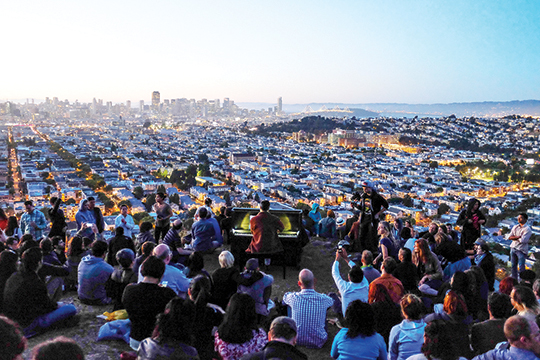
As San Francisco’s Mission District undergoes rapid rent increases and neighborhood demographic change, spaces like the Eric Quezada Center for Culture and Politics become fewer and farther between. We need spaces like this, where artists and activists come together to share stories of their fights for economic and social justice, or deliver stirring performance through music, poetry, art, and dance. Named for beloved Mission dweller and Guatemalan activist Eric Quezada, who lost his battle with cancer in 2011, the space seeks to be a cultural gathering spot that is both affordable and accessible — just blocks from 16th Street BART, and in the middle of a stretch of Valencia more known for spendy restaurants and hipster bars than progressive candidate forums and multicultural celebrations. An apt setting for those seeking to retain their sanity in a shifting SF.

518 Valencia, SF. www.518valencia.org

The Gilded Age of Austerity and the breakdown of civil society

121

Is this the week that civil society in the US finally collapses? It’s starting to feel that way. Most of the federal government is already shut down, and on Thursday, it could start defaulting on its debts, possibly dragging down the global economy. And here in the Bay Area, our transportation system will descend into gridlock if strikes shut down BART tomorrow and AC Transit on Thursday, as their unions are threatening.

It may not be the End of the World as We Know It, but this is a striking confluence of events that should cause us all to take stock of the things we take for granted, from reliable public transit systems to a functional federal government to the ability of politics to resolve our differences.

This era could be called the Gilded Age of Austerity, a duality marked by huge and growing concentrations of wealth for the few, but for the rest of us: increasing economic insecurity, a tattered social safety net, crumbling public infrastructure, and few signs of hope that things will get better.

Democracy is a fragile experiment that needs to be regularly reaffirmed by all sides. The US electoral system was already heavily skewed toward the interests of the wealthy, who sponsor both major political parties, to the point where many consider elections to be a sham. But there was still a political system, a basic framework for running the country even during tough times, and that seems to be breaking down.

For the radical right-wingers responsible for hobbling the federal government, this might appear to be a dream come true: Most of the regulators furloughed, funding for most social services stopped, and only the police state remains largely intact (86 percent of Department of Homeland Security employees are on the job and soldiers are still getting paid).

But these anti-government ideologues have never fully understood or appreciated the myriad things that government does to keep civil society functioning over the long term. Our economy relies on federal spending, our health relies on the CDC spotting coming epidemics and the FDA inspecting our food, justice needs a civil court system, our travels depend on roads, and our future depends on today’s young people getting educated (ie Head Start) and fed (ie Food Stamps), and that’s all come to a grinding halt.  

It’s a similar situation with public employee unions, like those that operate BART trains and AC Transit buses. As we’ve reported, private sector wages and benefits often rise or fall with those negotiated by unions. So when unions can’t win good contracts or maintain funded pensions for workers, we’re all dragged down. The Gilded Age gets better for the bosses as the Age of Austerity gets worse for the workers.

BART’s unions had an understandable expectation that they would share in the agency’s recent budget surpluses, particularly after accepting wage and benefit concessions of $100 million over the last four years to help with projected budget deficits that never materialized.

BART managers argue that the district has offered enough and that the rest of the money is needed for its ambitious expansion plans, but there should have been a solution here somewhere short of ultimatums (strike vs. the district’s “last, best offer”). They shouldn’t have needed Gov. Jerry Brown to order the recently ended 60-day cooling off period — the same stall tactic that AC Transit is now asking for — in a world where the basic social contract behind civil society was still intact. When the center still held, before the new Gilded Age fused with the Age of Austerity, people of goodwill could find common ground.

“People’s very livelihoods hang in the balance adding to the additional frustration felt throughout the Bay Area today when both parties failed yesterday to reach an agreement,” Mayor Ed Lee said yesterday in a prepared statement about the BART strike as he cancelled plans to leave on a trade mission to China sponsored by business elites to help carry out their agenda.

Yes, people’s very livelihoods — and their quality of life, and sometimes, their lives — are at stake in these political struggles, those I mentioned and those happening in San Francisco around gentrification and taxation. Anyone who thinks that modern capitalism is sturdy enough to withstand any shock doesn’t have a very good grasp of either economics or history.

Maybe we’ll pull ourselves back from the brink and learn our lessons. Or maybe we’ve entered the endgame, a place where the desperation of those living in the Age of Austerity finally matches the greed and self-interest of those living in the Gilded Age, where one must defeat the other to survive, like two fighting birds plummeting to the ground in a death spiral.

And if that’s the case, are we ready for the next era? Have we sown our seeds and tended our gardens? It took World War Two to really get us out of the Great Depression, and I’d like to think we’ve evolved since then. But this week, I’m not so sure.  

Pleased to meat you: Fatted Calf Charcuterie

0

If you’ve ever found yourself waiting for the 16 Express on the corner of Fell and Gough, then it’s easy to bet you’ve swiveled around on that red bench to peer through the glass wall of the charcuterie and butcher shop behind, where ruby-colored sausages, pâtés, smoked ham, bacon and meatloaf show off their curves inside a refrigerated display. Unthinkingly, you’ll have walked in.

The Hayes Valley location of the Fatted Calf Charcuterie — the store also has a Napa outpost and a weekly presence at the Ferry Plaza Farmers’ Market — sells a plethora of coveted artisanal delights as well, like hard cheese, house-pickled beets, dried beans, and impeccable pastas. Among the sandwiches, the coffee-bourbon barbeque pulled pork sandwich contains a moist piquancy, while the toasty Croque Monseiur, dripping of Mornay sauce and overlaid with squiggles of cured ham, is worth missing the next bus for. (Grab an extra napkin — these beasts invariably fall apart in your hands and lap.)

You can’t take the entire shop with you, but luckily owners Taylor Boetticher and Toponia Miller just published their first cookbook, In the Charcuterie (Ten Speed Press, 2013), which reads like a whole world of meat — one I’ve become enamored with, after making the Flaky Leaf Lard Biscuits. I caught up with Boetticher before the couple left on a promotional trip, asking him about their journey in charcuterie.

SF Bay Guardian What draws you to charcuterie in particular?

Taylor Boetticher I started making charcuterie when I began working at Cafe Rouge in Berkeley in 1999, and it drew me in almost instantly. I think a large part of what I liked about it was that I was doing this while working behind the meat counter, so I had a really good connection with everyone who was buying the food we were making. It’s different in that sense than working in a restaurant kitchen, you never really interact much with the people you’re cooking for even if you’re in an open kitchen.

When you’re getting feedback about a terrine or a new bacon cure two or three days after you introduce it, it enables you to really get a good sense of what’s working and what isn’t. What continues to draw me to charcuterie is that, at this point, I’m lucky enough to not only work with my wife but with a wildly talented group of individuals whose sole interest is in making the best food we can make… That and the growing interest on the part of the general public make what we do really rewarding. Not much feels better than when a customer comes back in and tells you that you had a part in one of the best dinner parties they’ve ever thrown.

SFBG In the Charcuterie is comprehensive, enlightening, and I’ll admit, a little daunting. Who did you write this book for?

TB Thanks! We wrote this book for anyone who’s a little curious about making the most out of the meat they buy and cook, from enthusiastic novices to seasoned professionals. Our goals with this book are to inspire confidence in people when they set out to make something and give them a comprehensive set of basics which will make every bite count.

SFBG Where in your book do you recommend a new-to-meat home cook should begin? 

TB I’d start with the 5 Spice Baby Back Ribs or the Gingery Braised Duck Legs. Both use relatively common cuts (chicken legs are just as awesome if you don’t have access to duck legs) but with exceptionally flavorful treatments that aren’t very complicated. They’re both good examples of how to take a very straightforward cut and really make it sing.

SFBG The book mentions a trip to Spain, Portugal, France, and Italy. How does travel inspire your work?

TB A huge part of travel for us has always been about seeing what and how other people eat, and the role that food plays in different cultures. It’s one of the few things that everyone does and shares. Travel for us is both relaxing and invigorating, just like it is for most people. Wherever we go, we try and keep open minds and eat what everyone else is eating. It’s good to just go with the flow. A lot of time we’ll try different versions of things we’ve been making already, which is always cool. It doesn’t necessarily mean you have to go back and change it immediately when that happens.

I think one of the most exciting things in food right now is the idea that it’s good to know how something is made in its place of origin but not have to be a slave to authenticity. Like with our pulled pork sandwich — I’ve had a lot of them, all over the country. Some are better than others, but I have zero interest in arguing with anyone about the “right” way to do it. Is it tasty? Do you and your guests like it? Those are more important than any pedigrees, in my opinion.

SFBG What is your favorite aspect or variety of charcuterie to make?

TB Tough choice. Right now it’s our brined and smoked meats — we’ve been playing around with a couple new holiday hams that I’m really enjoying. I’ll just say this — when your big experiment of the week is getting a bourbon/honey/gelée glazed smoked ham nailed down 100 percent, it’s a pretty good job overall.

SFBG What is your personal favorite recipe in the book — or what do you crave for your next meal?

TB Errr, it’s probably the meat loaf. I really love that damn recipe.

SFBG Do you have a personal philosophy on eating animals?

TB My personal philosophy on eating animals is pretty simple: make it count. There’s no such thing as cheap meat, and we have a responsibility to make the most out of anything, especially something with a heartbeat, that’s grown for food. I’d love to completely get away from factory farms in this country and have meat animals be more a part of where they started — on farms as part of a program of crop rotation and land management.

Lots has been written about the politics and money involved that make it hard for farmers to do just that, but anything that grows with fresh air, sunshine, room to move around, and good food and water is going to be healthier. And tastier. This is indisputable.

SFBG What is your number one, most essential advice to home cooks on charcuterie?

TB Start small.

SFBG What’s next for the two of you?

TB We’re doing some travel to promote the book on the East Coast and through Texas, then holiday madness will be upon us. In January, we’re hoping to take a vacation. It’s been a pretty busy year.


FATTED CALF (Hayes Valley location)

Open daily, 10am-8pm

320 Fell, SF

www.fattedcalf.com

No room left in San Francisco for an artist who helped make the Mission what is

74

After four decades living and creating art in the Mission, iconic San Francisco artist and curator Rene Yañez is being threatened with eviction.

Yañez made local history in 1972 when he brought Dia de los Muertos, the Mexican holiday honoring the dead, to San Francisco. The parade through the Mission District every Nov. 2 quickly became a Bay Area tradition, drawing thousands of people each year.

He founded the Galeria de la Raza and brought Latin America’s premier artists and photographers to showcase their work there. When the Museum of Modern Art rejected the work of a little-known Mexican woman, it was Yañez who gave a young Frida Kahlo a space to exhibit her paintings. He taught art classes for youths in the community and offered crucial support to many of the Mission’s mural projects.

In 1998, the San Francisco Foundation awarded Rene the “Special Trustees Award in Cultural Leadership.” Now, the man who has contributed so much to the culture of this city finds himself on the verge of being expelled from it.

Rene’s impending eviction from the house on San Jose Avenue where he has lived for the for 35 years is producing a fierce reaction. Fellow artist and personal friend Guillermo Gómez-Peña recently released an open letter expressing his outrage and rallying for public support of Rene’s cause.

“You are being physically and culturally evicted,” Gómez-Peña writes. “Shame on this city! Shame on the greedy landlords and politicians! Your sadness is ours…A city without Rene Yañez…can’t be called San Francisco.”

Gómez-Peña’s cry to action will be answered tomorrow (Sat/12) at 2pm at the Brava Theater on 24th Street with Our Mission: No Eviction, a march in protest of the Ellis Act, the law used to evict all of the tenants living in the five-unit house on San Jose, including Rene, his partner Cynthia, his former wife Yolanda, and his son Rio. (For more on tomorrow’s event and the city’s eviction trend, see our Politics blog).

On Saturday, Oct. 26, Brava Theater in the Mission will host “Our Mission: No Eviction!” a fundraiser in honor of Rene and Yolanda featuring art and performances.  All proceeds from ticket sales to the event will go to the legal expenses of fighting the eviction, as well as Rene and Cynthia’s medical bills; both the artist and his partner are currently battling cancer.

“They were kind of at peace that this would be their home when they passed away, in the community they’ve put so much into,” Rio told us. “Cynthia could be dying or dead while they are in the process of moving.”

Under the Ellis Act, Rene and Cynthia qualify for a year-long postponement of their eviction because of their illness, a fact which their landlord, Sergio Iantorno of Golden Properties, LLC, neglected to tell Rene when he offered him $21,000 and a years’ free rent if he accepted his eviction immediately.

Consulting his lawyer, Raquel Fox, Yañez was informed about the legal extension and proceeded to successfully apply for it. Even without her advice, though, Yañez would not have accepted Iantorno’s offer. As Rio explained, that amount is nowhere near enough for Rene and Cynthia Yañez to get another place in San Francisco, especially in the neighborhood that they call home.

“They are in their 70s. They aren’t looking for a huge buyout so that they can start a new life,” Rio told us.

When their original landlord died 13 years ago, Yañez and his fellow tenants pooled their money to make a bid for the house. Golden Properties saw their offer, and doubled it. Now, they are banding together again to refuse Iantorno’s money and fight  the eviction.

“I would rather take my chances and fight it,” Yañez told the Guardian. “And also I see it as resistance to what is going on and affecting a lot of people.”

On Oct. 1, the San Francisco Rent Board released its Annual Statistical Report for fiscal year 2012-2013. The report revealed a 36 percent increase in eviction notices since the year before. Evictions from rent-controlled apartments in particular are at an 11-year high.

The Ellis Act was used 81 percent more than last year, providing the basis for almost 10 percent of all evictions. The law was used with greatest frequency by landlords in the Mission District. Meanwhile, city public health officials estimate that someone earning minimum wage would need to work more than eight full-time jobs to be able to afford a two-bedroom apartment downtown.

“It is a disaster,” states Christopher Cook, an organizer with the nonprofit group Eviction Free Summer. “Individuals, families, and increasingly small businesses are being hammered by these twin tsunamis of evictions and dramatic rent increases. Those two factors have been driving people out of the city in ever greater numbers for the past 10 to 15 years.”

Gómez-Peña blames these changes on the mass of high-paid young people produced by the second dot-com boom. They may work in Silicon Valley, but they play in San Francisco, and this new class of wealthy young techies can and will pay any price to live in the city—especially the Mission District.

“I see them everyday, the hordes of iPad and iPhone texting zombies, oblivious to us and our lives, our inspirations and tribulations,” he writes. “I see them in my building and on the street, invading the city with an attitude of unchecked entitlement, taking over every square inch and squeezing out the last drops of otherness.”

It is no easy task to make room for all that wealth when the majority of the city’s residents are renters protected by law against unfair rent increases, landlord mistreatment, and unwarranted evictions. The actual strength of these safeguards may be waning, though, leading Gómez-Peña to warn the public in his letter that, “As renters our hours here are numbered.”

The only way to evict a tenant in San Francisco is by claiming one of 15 “just cause” reasons for removing them. Among those 15, the Ellis Act is something of a landlord’s dream date, skipping all the talking to get straight to the action—eviction. Established in 1985, the California law gives landlords the unconditional right to evict tenants if they are “going out of business.”

In order to implement the Ellis Act, a landlord must evict all of the tenants in his or her building, giving them 120 days notice, and wait five years before they can put the units back on the rental market at an increased price. However, the law does not prevent landlords from renting the units out as short-term lodgings, or converting them to be sold as one massive unit, tenancies in common or condominiums.

“Ellis Act evictions are impossible to fight,” admitted Ted Gullickson, the head of the San Francisco Tenants Union. This makes them an ideal weapon against rent control, which has allowed residents from lower income brackets to hold onto their homes in San Francisco for decades while the values of the real estate grew and grew. Even then, many tenants do not feel secure. Guerra has heard stories about people with rent control living for decades without hot water, working windows, heat, or even a stove. “To have this amazing rent control,” she concludes, “they put up with substandard living.”

When something broke in their building, Yañez and his family often did not even tell the landlord about it. If they did ask him to fix something, and he ignored their request, no complaints were ever made. “Because of rent control, we tried to keep a low profile,” Yañez acknowledges. “We tried not to bother the landlord or make too much of a fuss, because we did not want to find ourselves in this position.”

Rene has been aware of how precarious his situation is for years. Iantorno attempted to evict him multiple times. He watched as neighbors, nonprofit organizations, and local artists accepted their own eviction notices without a fight. When he first opened the Galeria in 1970, Yañez had a list of artists living in the Mission that neared 200 names. Today, it does not even reach 20.

“Since 2000, they’ve started this thing in the Mission,” he states. “They were very quiet about it at first, but now it’s accelerating. Willie Brown started it, this trend of redevelopment, eviction, displacing people without consideration. He opened up this gaping wound in the Mission, and now these developers are throwing salt on it, trying to kill the patient,” he chuckles. “People get really upset when somebody paints over a mural, like, ‘It has history, it has value, it’s been here for years,’ but they don’t have anything to say if the muralist gets evicted.”

Legally, there is not much that Yañez and his family can do in the coming year to stop their eviction. Even an advocate like Cook admits, “You can’t reverse an Ellis Act. All you can do is fight it, try to make it clear that it’s not worth the landlord’s while, that they’re gonna be in for a world of headaches, costs, and public shaming if they do this.”

Yañez has not accepted the eviction, but he is preparing for the worst, searching for a new home for Cynthia and himself. He continues to scour the Mission, in vain. “I love the Mission,” he explains. “I’ve been there 40 years. I adopted it, it adopted me. And it needs cultural preservation,” he says, curling his hands into fists that bang the air. “We saved the community from really greedy people who had absolutely no interest in who we were as a people. They just saw us as savages standing in the way of them making money. That attitude is still here. It’s actually worse than ever—unregulated and devastating. When I see the trucks moving people out, older people who have no idea where they’re going, sometimes they go downtown to the hotels—I just think it’s really heartless,” he finishes, his eyes wide in earnesty.

Guardian of San Francisco culture that he may be, Rene and Cynthia Yañez will be forced to leave the city in search of somewhere more affordable if their eviction occurs. In that event, there is little chance that the elderly man will be able to return to the city to curate SOMArts annual Dia de los Muertos exhibition as he has every year since he began it.

“I’m hoping that I can hang in. It’s a throw of the dice, but I still have some miles left in me,” he says, his eyes drooping wearily.

There is a chance that the exhibition, which opened today (Friday/11), might be Yañez’s last. Every year, he changes the theme. This November, the Dia de los Muertos exhibition is dedicated to all the living battling cancer, and  all the dead for whom that battle is over. Each piece is haunting, and all together it is a stunning collection encompassing a range of ages and races to touch any and every person that sees it. Like a loved one lost to cancer, the exhibit leaves you wanting more, yet so grateful fpr what you have experienced.

His last or not, it is something that Yañez can be very proud of.

Chain store ban and affordable groceries at issue in 555 Fulton debate UPDATED

77

UPDATED San Francisco’s resistance to formula retail stores will be put to the test tomorrow (Thu/3), when the San Francisco Planning Commission will vote on the 555 Fulton St. project.

The project — a five-story, 136-unit residential building with a ground-floor supermarket, complete with up to 275 total parking spaces— has been bobbing in purgatory since 2010, when developers were stalled by the withering economy.

But dried-up finances aren’t what’s now holding up the development of this project in an area governed by the Market and Octavia Better Neighborhood Plan and the Formula Retail Use Ordinance, both of which discourage national chains in favor of locally owned businesses.

Debate is centering on the question of whether the formula retail ban prevents an affordable grocery store from going in at the site, as the developer contends. The politics surrounding the project have gotten heated, with Hayes Valley Neighborhood Association supporting the ban on chain stores; the Mayor’s Office, Chinatown power broker Rose Pak, and Planning Director John Rahaim supporting the developer and project contractor Walter Wong; and Dist. 5 Sup. London Breed caught in the middle.

Last week, her legislative aide Vallie Brown told HVNA that Breed would support their request for a continuance at tomorrow’s meeting while they explore ways to attract an affordable local grocer, but Breed seems torn between what she told the New Yorker recently were desires to make affordable groceries available and prevent the boutiqueing of Hayes Valley, and her support for the formula retail ban.

“Breed said that despite the ban, she’s willing to allow a chain grocery store into the area to make it more affordable for residents,” reporter Lauren Smiley wrote in the article. The Guardian has been unable to reach Breed or Brown this week.

[UPDATE: Breed told the Guardian that her biggest concern is that the grocery store is affordable to the three low-income housing projects located right across the street, and she has yet to be convinced that can happen without breaking the formula retail ban at the site, despite working on the issue with both activists and the developer.

“It’s a challenge, I get that,” Breed told us. “I want the developer to operate with me in good faith and make a serious long-term commitment to me that this will be an affordable grocery store.”

But she doesn’t yet have that full commitment, and she says that she’s planning to honor her commitment to activists and ask that the formula retail waiver be delayed today even if the rest of the project goes through. “Ultimately, I asked them to be a good community partner,” she told us.]

For Hayes Valley, this has been a near decade-long process. In 2004, the Board of Supervisors first outlawed these generic retailers from opening up shop within the Hayes-Gough Neighborhood Commercial Transit (NCT) District when it passed Ordinance No. 62-04, classifying “formula retailers” and limiting their impact within unique neighborhoods. The ordinance keeps local businesses viable, keeping deep-pocketed corporations out.

The 555 Fulton project falls somewhere between the Hayes-Gough NCT and the Residential Transit Oriented District (RTO), and currently, a two-story, 19,620-square-foot office and industrial building with about 70 surface parking spots inhabits the address.

Both the neighborhood residents and the developers have historically felt that the property would make for an excellent grocery store. “What” has never been an issue with the property. “Who” on the other hand, has been the biggest issue.

In order for 555 Fulton to be developed by a “formula retail” outlet — which have been the only types of occupants the current developers believe to be able to pay the exorbitant established rent costs  — the property technically located in the Hayes-Gough NTC needs to be designated as a “Special Use District” (SUD).

An SUD adjusts the land use controls and height restrictions for a specific piece of property, in this case allowing for a “grocery store larger than 15,000 square feet of gross occupied floor area, as well as residential uses meeting a minimum density of one dwelling unit per 600 feet of lot area.” And up until April, the property was an SUD.

Back in 2008, 555 Fulton was granted its SUD by Section 249.35A of the Planning Code Section, which established the “Fulton Street Grocery Store Special Use District.” In 2010, the Planning Commission approved both a Conditional Use Authorization and a Planned Unit Development, allowing the developer of the subject property to build their mixed-use grocery store-residential building. Neither of these exceptions allowed for a “formula retail” outlet at the time, but interest still seemed solid.

Then everything stalled. And stalled. And stalled some more. Things have remained idle for so long that the five-year window given to the Fulton Street Grocery Store SUD expired this past April. Now, the developers are asking for five more years on the same Fulton Street Grocery Store SUD that was allowed to a different development group in 2008.

But it isn’t exactly the same request this time: Now the developers are trying to get an SUD without a provision on “formula retail” outlets, and both sides are expected to turn out big numbers on each side of the question at tomorrow’s hearing, which starts at noon in City Hall Room 400.

Project Censored

17

joe@sfbg.com

This year’s annual Project Censored list of the most underreported news stories includes the widening wealth gap, the trial of Pfc. Bradley Manning for leaking classified documents, and President Obama’s war on whistleblowers — all stories that actually received considerable news coverage.

So how exactly were they “censored” and what does that say of this venerable media watchdog project?

Project Censored isn’t only about stories that were deliberately buried or ignored. It’s about stories the media has covered poorly through a sort of false objectivity that skews the truth. Journalists do cry out against injustice, on occasion, but they don’t always do it well.

That’s why Project Censored was started back in 1976: to highlight stories the mainstream media missed or gave scant attention to. Although the project initially started in our backyard at Sonoma State University, now academics and students from 18 universities and community colleges across the country pore through hundreds of submissions of overlooked and underreported stories annually. A panel of academics and journalists then picks the top 25 stories and curates them into themed clusters. This year’s book, Censored 2014: Fearless Speech in Fearful Times, hits bookstores this week.

What causes the media to stumble? There are as many reasons as there are failures.

Brooke Gladstone, host of the radio program On the Media and writer of the graphic novel cum news media critique, The Influencing Machine, said the story of Manning (who now goes by the first name Chelsea) was the perfect example of the media trying to cover a story right, but getting it mostly wrong.

“The Bradley Manning case is for far too long centered on his personality rather than the nature of his revelations,” Gladstone told us. Manning’s career was sacrificed for sending 700,000 classified documents about the Iraq war to WikiLeaks. But the media coverage focused largely on Manning’s trial and subsequent change in gender identity.

Gladstone said that this is part of the media’s inability to deal with vast quantities of information which, she said, “is not what most of our standard media does all that well.”

The media mangling of Manning is number one on the Project Censored list, but the shallow coverage this story received is not unique. The news media is in a crisis, particularly in the US, and it’s getting worse.


WATCHING THE WATCHDOGS

The Project for Excellence in Journalism, which conducts an annual analysis of trends in news, found that as revenue in journalism declined, newsrooms have shed 30 percent of their staff in the last decade. In 2012, the number of reporters in the US dipped to its lowest level since 1978, with fewer than 40,000 reporters nationally. This creates a sense of desperation in the newsroom, and in the end, it’s the public that loses.

“What won out is something much more palpable to the advertisers,” says Robert McChesney, an author, longtime media reform advocate, professor at University of Illinois, and host of Media Matters from 2000-2012. Blandness beat out fearless truth-telling.

Even worse than kowtowing to advertisers is the false objectivity the media tries to achieve, McChesney told us, neutering its news to stay “neutral” on a topic. This handcuffs journalists into not drawing conclusions, even when they are well-supported by the facts.

In order to report a story, they rely on the words of others to make claims, limiting what they can report.

“You allow people in power to set the range of legitimate debate, and you report on it,” McChesney said.

Project Censored stories reflect that dynamic — many of them require journalists to take a stand or present an illuminating perspective on a set of dry facts. For example, reporting on the increasing gulf between the rich and the poor is easy, but talking about why the rich are getting richer is where journalists begin to worry about their objectivity, Gladstone said.

“I think that there is a desire to stay away from stories that will inspire rhetoric of class warfare,” she said.

Unable to tell the story of a trend and unable to talk about rising inequality for fear of appearing partisan, reporters often fail to connect the dots for their readers.

One of Project Censored stories this year, “Bank Interests Inflate Global Prices by 35 to 40 Percent,” is a good example of the need for a media watchdog. Researchers point to interest payments as the primary way wealth is transferred from Main Street to Wall Street.

It’s how the banks are picking the pockets of the 99 percent. But if no politician is calling out the banks on this practice, if no advocacy group is gaining enough traction, shouldn’t it be the media’s role to protect the public and sound the battle cry?

“So much of media criticism is really political commentary squeezed through a media squeezer,” Gladstone said, “and it comes out media shaped.”


SHAPING THE MEDIA

McChesney says journalism should be a proactive watchdog by independently stating that something needs to be done. He said there’s more watchdog journalism calling out inequity in democracies where there is a more robust and funded media.

And they often have one thing we in US don’t — government subsidies for journalism.

“All the other democracies in the world, there are huge subsidies for public media and journalism,” McChesney said. “They not only rank ahead of us in terms of being democratic, they also rank ahead of us in terms of having a free press. Our press is shrinking.”

No matter what the ultimate economic solution is, the crisis of reporting is largely a crisis of money. McChesney calls it a “whole knife in the heart of journalism.”

For American journalism to revive itself, it has to move beyond its corporate ties. It has to become a truly free press. It’s time to end the myth that corporate journalism is the only way for media to be objective, monolithic, and correct.

The failures of that prescription are clear in Project Censored’s top 10 stories of the year:

1. Manning and the Failure of Corporate Media

Untold stories of Iraqi civilian deaths by American soldiers, US diplomats pushing aircraft sales on foreign royalty, uninvestigated abuse by Iraqi allies, the perils of the rise in private war contractors — this is what Manning exposed. They were stories that challenge the US political elite, and they were only made possible by a sacrifice.

Manning got a 35-year prison sentence for the revelation of state secrets to WikiLeaks, a story told countless times in corporate media. But as Project Censored posits, the failure of our media was not in the lack of coverage of Manning, but in its focus.

Though The New York Times partnered with WikiLeaks to release stories based on the documents, many published in 2010 through 2011, news from the leaks have since slowed to a trickle — a waste of over 700,000 pieces of classified intelligence giving unparalleled ground level views of America’s costly wars.

The media quickly took a scathing indictment of US military policy and spun it into a story about Manning’s politics and patriotism. As Rolling Stone pointed out (“Did the Media Fail Bradley Manning?”), Manning initially took the trove of leaks to The Washington Post and The New York Times, only to be turned away.

Alexa O’Brien, a former Occupy activist, scooped most of the media by actually attending Manning’s trial. She produced tens of thousands of words in transcriptions of the court hearings, one of the only reporters on the beat.

2. Richest Global 1 Percent Hide Billions in Tax Havens

Global corporate fatcats hold $21-32 trillion in offshore havens, money hidden from government taxation that would benefit people around the world, according to findings by James S. Henry, the former chief economist of the global management firm McKinsey & Company.

The International Consortium of Investigative Journalists obtained a leak in April 2013, revealing how widespread the buy-in was to these tax havens. The findings were damning: government officials in Canada, Russia, and other countries have embraced offshore accounts, the world’s top banks (including Deutsche Bank) have worked to maintain them, and the tax havens are used in Ponzi schemes.

Moving money offshore has implications that ripped through the world economy. Part of Greece’s economic collapse was due to these tax havens, ICIJ reporter Gerard Ryle told Gladstone on her radio show. “It’s because people don’t want to pay taxes,” he said. “You avoid taxes by going offshore and playing by different rules.”

US Senator Carl Levin, D-Michigan, introduced legislation to combat the practice, SB1533, The Stop Tax Haven Abuse Act, but so far the bill has had little play in the media.

Researcher James Henry said the hidden wealth was a “huge black hole” in the world economy that has never been measured, which could generate income tax revenues between $190-280 billion a year.

3. Trans-Pacific Partnership

Take 600 corporate advisors, mix in officials from 11 international governments, let it bake for about two years, and out pops international partnerships that threaten to cripple progressive movements worldwide.

The Trans-Pacific Partnership is a trade agreement, but leaked texts show it may allow foreign investors to use “investor-state” tribunals to extract extravagant extra damages for “expected future profits,” according to the Public Citizen’s Global Trade Watch.

The trade watch group investigated the TPP and is the main advocate in opposition of its policies. The AFL-CIO, Sierra Club, and other organizations have also had growing concerns about the level of access granted to corporations in these agreements.

With extra powers granted to foreign firms, the possibility that companies would continue moving offshore could grow. But even with the risks of outsized corporate influence, the US has a strong interest in the TPP in order to maintain trade agreements with Asia.

The balancing act between corporate and public interests is at stake, but until the US releases more documents from negotiations, the American people will remain in the dark.

4. Obama’s War on Whistleblowers

President Obama has invoked the Espionage Act of 1917 more than every other president combined. Seven times, Obama has pursued leakers with the act, against Thomas Drake, Shamai Leibowitz, Bradley Manning, Stephen Kim, Jeffrey Sterling, John Kiriakou and most recently, Edward Snowden. All had ties to the State Department, FBI, CIA, or NSA, and all of them leaked to journalists.

“Neither party is raising hell over this. This is the sort of story that sort of slips through the cracks,” McChesney said. And when the politicians don’t raise a fuss, neither does the media.

Pro Publica covered the issue, constructing timelines and mapping out the various arrests and indictments. But where Project Censored points out the lack of coverage is in Obama’s hypocrisy — only a year before, he signed The Whistleblower Protection Act.

Later on, he said he wouldn’t follow every letter of the law in the bill he had only just signed.

“Certain provisions in the Act threaten to interfere with my constitutional duty to supervise the executive branch,” Obama said. “As my Administration previously informed the Congress, I will interpret those sections consistent with my authority.”

5. Hate Groups and Antigovernment Groups on Rise across US

Hate groups in the US are on the rise, according to a report by the Southern Poverty Law Center. There are 1,007 known hate groups operating across the country, it wrote, including neo-Nazis, Ku Klux Klan, white nationalists, neo-Confederates, racist skinheads, black separatists, border vigilantes, and others.

Since 2000, those groups have grown by over half, and there was a “powerful resurgence” of Patriot groups, the likes of which were involved in the Oklahoma City bombing in 1995. Worst of all, the huge growth in armed militias seems to have conspicuous timing with Obama’s election.

“The number of Patriot groups, including armed militias, has grown 813 percent since Obama was elected — from 149 in 2008 to 1,360 in 2012,” the SPLC reported.

Though traditionally those groups were race motivated, the report noted that now they are gunning for government. There was a smattering of news coverage when the SPLC released its report, but not much since.

6. Billionaires’ Rising Wealth Intensifies Poverty and Inequality

The world’s billionaires added $241 billion to their collective net worth in 2012. That’s an economic recovery, right?

That gain, coupled with the world’s richest peoples’ new total worth of $1.9 trillion (more than the GDP of Canada), wasn’t reported by some kooky socialist group, but by Bloomberg News. But few journalists are asking the important question: Why?

Project Censored points to journalist George Monbiot, who highlights a reduction of taxes and tax enforcement, the privatization of public assets, and the weakening of labor unions.

His conclusions are backed up by the United Nations’ Trade and Development Report from 2012, which noted how the trend hurts everyone: “Recent empirical and analytical work reviewed here mostly shows a negative correlation between inequality and growth.”

7. Merchant of Death and Nuclear Weapons

The report highlighted by Project Censored on the threat of nuclear war is an example not of censorship, strictly, but a desire for media reform.

Project Censored highlighted a study from the The Physicians for Social Responsibility that said 1 billion people could starve in the decade after a nuclear detonation. Corn production in the US would decline by an average of 10 percent for an entire decade and food prices would make food inaccessible to hundreds of millions of the world’s poorest.

This is not journalism in the classic sense, Gladstone said. In traditional journalism, as it’s played out since the early 20th century, news requires an element of something new in order to garner reporting — not a looming threat or danger.

So in this case, what Project Censored identified was the need for a new kind of journalism, what it calls “solutions journalism.”

“Solutions journalism,” Sarah van Gelder wrote in the foreword to Censored 2014, “must investigate not only the individual innovations, but also the larger pattern of change — the emerging ethics, institutions, and ways of life that are coming into existence.”

8. Bank Interests Inflate Global Prices by 35 to 40 Percent

Does 35 percent of everything bought in the United States go to interest? Professor Margrit Kennedy of the University of Hanover thinks so, and she says it’s a major funnel of money from the 99 percent to the rich.

In her 2012 book, Occupy Money, Kennedy wrote that tradespeople, suppliers, wholesalers, and retailers along the chain of production rely on credit. Her figures were initially drawn from the German economy, but Ellen Brown of the Web of Debt and Global Research said she found similar patterns in the US.

This “hidden interest” has sapped the growth of other industries, she said, lining the pockets of the financial sector.

So if interest is stagnating so many industries, why would journalists avoid the topic?

Few economists have echoed her views, and few experts emerged to back up her assertions. Notably, she’s a professor in an architectural school, with no formal credentials in economics.

From her own website, she said she became an “expert” in economics “through her continuous research and scrutiny.”

Without people in power pushing the topic, McChesney said that a mainstream journalist would be seen as going out on a limb.

“The reporters raise an issue the elites are not raising themselves, then you’re ideological, have an axe to grind, sort of a hack,” he said. “It makes journalism worthless on pretty important issues.”

9. Icelanders Vote to Include Commons in Their Constitution

In 2012, Icelandic citizens voted in referendum to change the country’s 1944 constitution. When asked, “In the new constitution, do you want natural resources that are not privately owned to be declared national property?” its citizens voted 81 percent in favor.

Project Censored says this is important for us to know, but in the end, US journalism is notably American-centric. Even the Nieman Watchdog, a foundation for journalism at Harvard University, issued a report in 2011 citing the lack of reporting on a war the US funneled over $4 trillion into over the past decade, not to mention the cost in human lives.

If we don’t pay attention to our own wars, why exactly does Project Censored think we’d pay attention to Iceland?

“The constitutional reforms are a direct response to the nation’s 2008 financial crash,” Project Censored wrote, “when Iceland’s unregulated banks borrowed more than the country’s gross domestic product from international wholesale money markets.”

Solutions-based journalism rears its head again, and the idea is that the US has much to learn from Iceland, but even Gladstone was dubious.

“Iceland is being undercovered, goddamnit! Where is our Iceland news?” she joked with us. Certainly I agree with some of this list, Bradley Manning was covered badly, I was sad the tax haven story didn’t get more coverage. But when has anyone cared about Iceland?”

10. A “Culture of Cruelty” along Mexico–US Border

The plight of Mexican border crossings usually involves three types of stories in US press: deaths in the stretch of desert beyond the border, the horrors of drug cartels, and heroic journeys of border crossings by sympathetic workers. But a report released a year ago by the organization No More Deaths snags the 10th spot for overlooked stories in Project Censored.

The report asserts that people arrested by Border Patrol while crossing were denied water and told to let their sick die. No More Deaths conducted more than 12,000 interviews to form the basis of its study in three Mexican cities: Nacos, Nogales and Agua Prieta. The report cites grossly ineffective oversight from the Department of Homeland Security. This has received some coverage, from Salon showcasing video of Border Patrol agents destroying jugs of water meant for crossers to a recent New York Times piece citing a lack of oversight for Border Patrol’s excessive force.

The ACLU lobbied the United Nations High Commissioner for Human Rights to call international attention to the plight of these border crossers at the hands of US law enforcement.

If ever an issue flew under the radar, this is it.

Alerts: October 2 – 8, 2013

0

THURSDAY 3

Storytelling tools for change The Eric Quezeda Center for Culture and Politics, 518 Valencia, SF. www.518valencia.org. 7-8:30pm, free. Come join Immigrant Nation for a workshop and community event focusing on the power of storytelling within the immigrant community, and the ways in which those stories are shared. There will be an open discussion forum, with refreshments served. Featuring two short films: The Caretaker, a seven minute film on the life of an undocumented immigrant from Fiji providing home support for a 95-year old woman who has lost the ability to speak; and The Mayor, a 10-minute film on Paul Bridges, bilingual mayor of Uvalda, Georgia.


FRIDAY 4

March for Elephants 733 Kearny, SF. www.marchforelephants.org. 11am-2pm, free. There will be a march from Portsmouth Square at 733 Kearny to Union Square to peacefully protest the poaching of elephants and the illegal ivory trade. This will be one of several marches held globally in conjunction with World Animal Day. Participants are asked to arrive at 10am, and can register in advance on the website. Questions should be directed to march4elephants@gmail.com.


SATURDAY 5

San Francisco Veterans Film Festival 2013 Mission Cultural Center for Latino Arts, 2868 Mission St., SF. at eduardo.ramirez@att.net. tinyurl.com/sfvetsfilm. Noon-6pm screenings, 6-9 p.m. fundraiser, donations requested. Join the MCCLA for the 2nd Annual San Francisco Veterans Film Festival and Fundraiser and experience more than just great filmmaking. The SFVFF is a wonderful opportunity to learn about the issues facing our returning vets, especially here in San Francisco. Films and discussion will touch on the “Salute to Women,” women in combat, same sex marriage in the military and the Don’t Ask, Don’t Tell policy.

A Night for the Last Wild Buffalo Ecology Center, 2350 San Pablo, Berk. tinyurl.com/buffalonight. 7-10pm, $5-25 on sliding scale; no one will be denied entry for lack of funds. Come for a night of storytelling, poetry, music and videos in honor of wild buffalo. This event is meant to raise awareness about the relationship between the buffalo and native peoples, threats buffalo face and how people can do their part for this cause. The night’s special guest will be John Trudell, a Santee Sioux poet, actor and activist. Goodshield Aguilar and Mignon Geli, Native American musicians/activists, will perform. This event is one stop of a West Coast tour by the Buffalo Field Campaign.

Immigration detainer limits watered down

1

Sup. John Avalos’ Due Process for All ordinance, legislation barring San Francisco law enforcement agencies from honoring detainer requests issued by U.S. Immigrations and Customs Enforcement (ICE) under the federal Secure Communities (S-Comm) program, faced obstacles at the Sept. 17 Board of Supervisors meeting.

But an amended version returned to the board on Sept. 24, where it was expected to be approved (after Guardian press time for this issue, so check out the SFBG.com Politics blog to see what happened).

The legislation initially had enough support for a veto-proof supermajority, but opposition has surfaced to prevent the legislation from winning approval as written, most notably from Police Chief Greg Suhr and Mayor Ed Lee, who threatened to veto the legislation.

At issue was whether to amend the legislation by including “carve-outs” — exceptions requiring law enforcement to honor ICE requests in cases where offenders are suspected of serious violent crimes, child molestation or human trafficking. Sup. Jane Kim offered amendments giving the Sheriff’s Department discretion in such cases, which she characterized as “thoughtful and limited,” but which were opposed by Avalos and Sup. David Campos.

In San Francisco, ICE detainer requests issued under S-Comm have resulted in at least 784 deportations since 2010. Avalos’ legislation seeks to extend due process to all San Franciscans by making it illegal for local law enforcement to comply with such requests.

–Reed Nelson

Alerts: September 25 – October 2, 2013

0

WEDNESDAY 25

Radical archiving and cataloging as social history 518 Valencia, SF. 518valencia.org. The Shaping San Francisco public talks series continues with a discussion defining a “radical archive,” exploring the role that nontraditional archives play in the interpretation and preservation of peoples’ history, the role of ordinary people in the preservation of these archives and more. Joining the discussion will be Lincoln Cushing of Docs Populi, as well as Claude Marks and Nathaniel Moore, both of the Freedom Archives.


Solar Energy Panel Discussion David Brower Center, 2150 Allston, Berk. https://solarenlightenment.eventbrite.com. 6-9pm, free. Andreas Karelas, the Executive Director of Revolv, and Jackson Koeppel of Soulardarity will lead a panel discussion on the use of solar energy and how it works. They will also attempt to clear up a few common misconceptions about solar power. Doors open at 5:30pm. Those who can’t attend can tune in on Ustream.


THURSDAY 26


Press up! El Rio, 3158 Mission, SF. 6pm, donations $25 and up. tinyurl.com/sfpmccontribute. An independent press is crucial. Join Tim Redmond, former editor-publisher of the Bay Guardian, as he launches the nonprofit San Francisco Progressive Media Center, dedicated to publishing a new online news source and keeping local journalism alive and independent of corporate, non-local interests. Co-hosts include Tom Ammiano, David Campos, Alicia Garza, Giuliana Milanese and Gabriel Haaland.

Syria: Secrets and lies Unitarian Universalist Center, 1187 Franklin, SF. sanfranpda@aol.com. 7-9pm, free. Dr. Steven Zunes, a professor of politics and international studies at the University of San Francisco and Middle Eastern studies program chair, will examine whether the US is about to go to war again on unverifiable or perhaps false pretexts; why the Administration is so committed to this conflict, and how can we understand the actual facts behind the recently documented atrocities in Syria. Sponsored by the Progressive Democrats of American and Unitarian Universalists for Peace, SF.


SATURDAY 28 14th Annual World Veg Festival San Francisco County Fair Building, Lincoln & Ninth, Golden Gate Park, SF. http://worldvegfestival.com. 10am-6:30pm, $10 suggested donation. This festival will feature cooking demonstrations, speakers and live entertainment, including an eco-fashion show. Visitors will have the opportunity to sample and purchase vegetarian cuisine. The event is presented by the SF Vegetarian Society and sponsored by Varnashram, In Defense of Animals and Friends of Animals. An organic vegan dinner will be available each night for $26; sign up online.

SATURDAY 29 Grito De Lares Celebration Mission Cultural Center for Latino Arts, 2868 Mission, SF. tinyurl.com/larescelebration. 4:30-7 p.m., free. Celebrate Grito De Lares, a holiday commemorating the birth of Puerto Rico as a nation, at the MCCLA on Sunday. 145 years ago this past Sept. 23, Puerto Rican revolutionaries entered the town of Lares to proclaim the birth of the Puerto Rican nation. At the bilingual event there will be a commemoration of the revolution, a discussion panel and a poetry reading in addition to Puerto Rican food and music.

Evictions and gentrification fuel widespread concern in the Mission

202

A mix of neighborhood merchants, community activists and a couple City Hall staffers met for a community forum Sept. 23 on Mission gentrification, voicing anger and frustration about rising displacement in the face of soaring rents.

Arranged by organizer Andy Blue, the forum was hosted by Rose Aguilar of Your Call Radio and held at the Eric Quezada Center for Culture and Politics on Valencia Street.

The recent controversy stemming from a bid by high-end retailer Jack Spade to move into a 16th Street storefront catalyzed the discussion, but many addressed the overarching transformation of a neighborhood that has been flooded with high-salaried residents who can afford to pay top dollar.

Gabriel Medina, policy manager of the Mission Economic Development Agency, said he’s troubled by the displacement of Latino-owned businesses. About 80 percent of Latino-owned businesses are passed onto proprietors’ children, he said, representing critical assets in a pricey city like San Francisco. “It’s getting cheaper to be able to start a business than to buy a house,” he pointed out.

Erick Arguello of Calle 24 (formerly the Lower 24th Street Merchants and Neighbors Association) said he’d seen a similar trend along his strip of the Mission, where some Latino-owned businesses have managed to hold strong since they bought their properties years ago.

Nevertheless, Arguello said, the pressure is on. “There’s been an onslaught of realtors and prospectors on 24th Street,” he said. “They ask about the neighbor next door: Do you know when their lease goes to?”

Nor are businesses the only ones impacted. “We’re seeing a lot of evictions of residents along the corridor,” he noted. “The majority of them are Latino families.”

Laura Guzman, executive director of the Mission Neighborhood Resource Center, decried a lack of funding for affordable housing and dedicated units for the homeless and impoverished.

She said many individuals living on the streets in the Mission lack options, leading them to pass the time in the BART plaza. “Support the people in the plaza. They’re human beings,” Guzman said.

Nick Pagoulatos, a legislative aid to Sup. Eric Mar who was previously involved with mid-90s anti-gentrification campaigns in the Mission, said he himself wasn’t sure if he would be able to remain in the city.

“I’m a partner to a woman who was born in the Mission,” he said, acknowledging the deep ties her family has to the neighborhood. “We know that when we lose our housing” – it is likely a question of when, not if, Pagoulatos said – “we’re not going to be able to stay in the Mission. And we’re probably not going to be able to stay in San Francisco.”

Some activist efforts have emerged. A direct action group called Eviction Free San Francisco has staged protests outside the doors of real-estate speculators. At the upcoming Dia de los Muertos 2013 celebration, curator Martina Ayala said at the meeting, “We are building altars to remember the life that we once enjoyed.” La Llorona, a Dia de los Muertos exhibit that will be held at the Mission Cultural Center for Latino Arts, is subtitled “weeping for the life and death of the Mission District.”

A similar transformation happened 10 years ago when the first dot-com boom flooded the Mission with deep-pocketed residents, Pagoulatos noted. Back then, “there was an organized reaction,” he said. “To be honest with you, we fought the good fight, we were at it for a long time and we didn’t win.”

This time around, “Our level of disgust for what’s been going on has been numbed,” he said. But he called for reaching out to engage unlikely allies, and for tapping into collective anger about displacement to bring about change.

“Get pissed, folks,” Pagoulatos said. “Anger is a good thing, especially in the face of injustice.”

Power struggle

51

steve@sfbg.com

Jason Fried could barely believe what was coming out of the squawk box in his office at the San Francisco Local Agency Formation Commission on Sept. 10, as he listened to Mayor Ed Lee describe the CleanPowerSF program Fried had spent years helping to develop.

The program would give San Franciscans the choice of buying their electricity from clean, renewable energy sources rather than Pacific Gas & Electric’s oil, coal, hydro, and nuclear dominated power portfolio, a program that was finally able to become competitive with PG&E on price and still fund the creation of local clean energy projects.

But the program that Lee described — which three of his appointees on the San Francisco Public Utilities Commission have recently decided to block, against the wishes of the Board of Supervisors supermajority that approved it (see “Fizzling energy,” Aug. 21) — sounded nothing like the program that Fried, LAFCo’s senior program officer, knows so well.

As Lee described it, CleanPowerSF is “based on vague promises” and has “questionable environmental benefits,” claiming it has “gotten progressively more expensive” and “creates no local jobs.”

“What the San Francisco Public Utilities Commission did was in the best interests of the city,” Lee said. The city has spent untold hours and dollars over the last decade developing and approving CleanPowerSF.

“It was very frustrating to watch, particularly when you see him just making stuff up,” said Fried. “If he wants to be against CCAs [Community Choice Aggregation, that state-created program the CleanPowerSF is a part of], fine, just say that…But he wasn’t even getting his numbers right.”


LIES, DAMN LIES, AND STATISTICS

Questioned by the Guardian following his monthly mayoral policy discussion at the board, where all five questions from frustrated supervisors were about CleanPowerSF, Lee cast himself as sticking to the facts.

“I know that elements of this are somewhat complicated because you have to actually read a lot of volumes of materials to understand the choice aggregation program,” Lee said, claiming, “I’m taking it exactly from facts that were presented.”

But in reality, Lee was cherry-picking facts that were either out-of-date or presented in a misleading way, while ignoring inconvenient questions like how the city can still achieve its clean energy goals without it, or why his appointees are subverting broadly supported public policy on technical grounds that appear to exceed their authority.

Take Lee’s claim that the CleanPowerSF program approved by the board “was 95 percent renewable on day one,” which he used to support his argument that “when the final project is so vastly different than the original intent, the SFPUC has to intervene.”

Lee is referring to the “three buckets” from which the program will draw its energy, as defined by the California Public Utilities Commission. Bucket 1 is the gold standard: juice coming directly from certified renewable energy sources in California. Bucket 2 is renewable energy that isn’t reliable and must be “firmed and shaped” by other energy sources, such as wind or solar farms supplemented by fossil fuels when there’s little wind or sunshine. And Bucket 3 is Renewable Energy Credits, which support creation of renewable energy facilities or green power purchased from other states.

When the board approved the program in September 2012, the SFPUC called for it to secure 10 percent of the power from Bucket 1, 85 percent from Bucket 2, and 5 percent from Bucket 3, although these were just guidelines and the SFPUC was specifically authorized to change that mix.

Lee and other critics of the program decried the program’s cost of more than 14 cents per kilowatt-hour, while supporters worried the price would cause more customers to opt-out, so the SFPUC decided to allow more RECs, while also substantially increasing the amount of guaranteed green power.

“The difference between buckets two and three is not that big a difference,” Fried said, noting the Bucket 2 can actually include a substantial amount of dirty energy. “It really depends on how you’re firming and shaping.”

So the SFPUC increased the size of Bucket 1 to 25 percent and Bucket 3 to 75 percent, with idea being that RECs are only an interim step toward issuance of revenue-bonds to build renewable energy projects that would eventually fill Bucket 1 to overflowing. All for the not-to-exceed rate of 11.5 cents per kilowatt-hour that the SFPUC is refusing to approve.

“Our entire mix would be 100 percent greenhouse-gas-free, but the mayor is ignoring that because it doesn’t fit his ‘green’ argument,” Fried said, also noting that it would be generated in-state by union workers. “PG&E can’t make that same claim.”

CPUC statistics show PG&E derives less than the state-mandated 20 percent of its energy from clean, renewable sources, and that the percentage of its portfolio that is greenhouse gas-free actually dropped in 2012, to 51 percent from 59 percent in 2011. And despite Lee’s emphasis on local jobs, PG&E’s three largest solar projects built in 2012 are outside California.

By contrast, CPSF contractor Shell Energy North America wrote in an Aug. 12 letter that in addition to setting aside $1.5 million for local buildout after its first year, which “should create local jobs,” it is now negotiating in-state wind and hydroelectric (“operated by union labor”) contracts to meet the program’s demands.

But at this point, supporters of the program are running out of options to get that contract approved.


“CHARTER CRISIS”

CleanPowerSF has broad political support in San Francisco, from Sups. David Campos, John Avalos, and other progressives, to moderates including Sup. Scott Wiener and state Sen. Mark Leno, who authored legislation to protect nascent CCAs from PG&E meddling and has been a steadfast supporter of CleanPowerSF.

“There’s a constitutional crisis, or a [City] Charter crisis, of sorts,” Leno said, referring to the standoff. “The legislative body has been unequivocal in its desire to proceed and it’s not for this commission to interfere with that decision.”

Leno said PG&E and its allies have played strong behind-the-scenes roles in sabotaging this program. “They are definitely exerting their influence,” Leno said, “they have never stopped trying to derail this.” SFPUC Chair Art Torres, who is leading the obstruction, didn’t return a Guardian call for comment.

If there is a silver lining, Leno said it’s that “PG&E has had to present its own version of green energy. But the two can coexist. We want competition.”

So does Fried, LAFCo, and all of the supervisors who sit on that commission, which has long tried to break PG&E’s monopoly.

“It’s close to checkmate, but we’re trying to breathe new life into this,” Sup. John Avalos, who sits on LAFCo, told us. “Part of the politics can be seen in the mayor’s statements, which are full of misinformation.”

Sup. David Campos, also on LAFCo, told us CleanPowerSF is “a good program, and it’s consistent with what the Board of Supervisors approved. I think it’s a mistake for the city not to move on this and it’s a bad thing for consumers.”

The newest member of LAFCo, Sup. London Breed, authored a resolution supporting CPSF that the Board of Supervisors was set to consider on Sept. 17, after Guardian press time. It recites a history of strong support for the program by the Board of Supervisors, starting with a unanimous votes in 2004 and 2007 to launch the CCA and continuing through the supermajority approval of CleanPowerSF and a $20 million appropriation to launch it in September 2012.

It noted that the SFPUC held 18 meetings on the program between September 2012 and August 2013, and that its Rate Fairness Board determined that rates for the Phase 1 are “technically fair.”

The resolution emphasizes an important governance issue at stake: “Irrespective of the particular policy decision, the Board of Supervisors must protect and defend its authority to make policy decisions.”

Yet there’s been a concerted effort to undermine CleanPowerSF this summer, led by appointees and allies of Lee and PG&E.

At the Aug. 6 Commission on the Environment meeting, Commissioner Joshua Arce pushed Department of the Environment head Melanie Nutter to renounce CPSF as no longer a green power program, something she refused to do. Arce fell a vote short of approving a resolution characterizing the program as not meeting “all of the commission’s original goals” and urging the SFPUC “to work with the Department of the Environment to craft a program that is acceptable to the San Francisco Environment Commission.”

Breed said she was disappointed in Lee’s approach, although she takes him at his word when he says he’s open to alternatives.

“The questions were answered, but there wasn’t any closure in terms of what this means for the future,” Breed said. “If not this program, what’s the alternative?”

If the city is going to meet its greenhouse gas reduction goals, which call for reducing 1990’s carbon emissions by 25 percent by 2017 and 40 percent by 2025, it’s going to have to offer some alternative.

“We need to be aggressive about moving in this direction,” Breed said, “and we need to make sure the public has an alternative to PG&E.”


Alerts: September 11-16, 2013

0

ALERTS

Wednesday 11

Vandana Shiva on biotechnology Goldman Theater, David Brower Center, 2150 Allston, Berk. www.kpfa.org. 7:30pm, free. Join world-renowned environmental philosopher and author Vandana Shiva for a forum on the biotechnology industry. Shiva will illuminate the corporate assault on biological and cultural diversity, in conversation with Gopal Dayaneni of Movement Generation: Justice and Ecology Project. She’ll help concerned activists to connect the dots: What is the East Bay “Green Corridor,” who’s behind it, and what are the implications for communities here and around the globe?

Friday 13

Oil and unions in Iraq SEIU 1021 office, 350 Rhode Island, SF. 1021.seiu.org. 6:30pm, free. Listen as Hassan Juma’a Awad, president of the Iraq Federation of Oil Unions, shares his experience in struggling for basic labor rights for Iraqi workers. Iraq’s public sector workers (including the oil sector) lack the legal right to organize or engage in collective bargaining, more than a decade after the end of the dictatorship. Earlier this year, Hassan faced criminal charges in retaliation for worker strikes, and was accused of undermining Iraq’s economy.

Saturday 14

North by Northwest bike ride Velo Rouge Cafe, 798 Arguello, SF. 1:30pm, free. Interested in street design, bikeways, traffic calming, and other kinds of improvements along San Francisco city streets? Join a group of cyclists on this afternoon ride to learn about the history and current projects that shape the streets on which we walk and bike. This ride will feature a series of stops and information about how the 2009 Bike Plan and other ongoing projects are shaping the northwestern parts of San Francisco.


Monday 16

Mexican Independence Day 2940 16th St., SF. Livingwage-sf.org. 7pm, $10–$15. Join the San Francisco Living Wage Coalition for a concert and celebration of Mexican Independence Day. “Songs of Healing for Juarez” will provide an emergency benefit concert for Las Hormigas, an organization that has been working to address violence and poverty in Ciudad Juarez. The concert will feature Diana Gameros, Francisco Herrera and other guests, as well as a live art auction. For more information, call (415) 863-1225.

Jill Stein on movements vs. money Unite Here Local 2, 209 Golden Gate, SF. 6-9pm, free. Jill Stein, the Green Party Presidential Candidate of 2012, will discuss the creation and intent of The Green Shadow Cabinet, an organization that includes nearly 100 prominent community and labor leaders, physicians, cultural workers, veterans and others with the goal of providing an ongoing opposition and alternative voice to dysfunctional Washington, DC politics. Stein will speak on current political dynamics and strategies for creating good jobs, ending student debt, cultivating democracy and breathing new life into the environmental movement. Hosted by OccupyForum.


Alerts

0

ALERTS


Wednesday 11

Vandana Shiva on biotechnology Goldman Theater, David Brower Center, 2150 Allston, Berk. www.kpfa.org. 7:30pm, free. Join world-renowned environmental philosopher and author Vandana Shiva for a forum on the biotechnology industry. Shiva will illuminate the corporate assault on biological and cultural diversity, in conversation with Gopal Dayaneni of Movement Generation: Justice and Ecology Project. She’ll help concerned activists to connect the dots: What is the East Bay “Green Corridor,” who’s behind it, and what are the implications for communities here and around the globe?


Friday 13

Oil and unions in Iraq SEIU 1021 office, 350 Rhode Island, SF. 1021.seiu.org. 6:30pm, free. Listen as Hassan Juma’a Awad, president of the Iraq Federation of Oil Unions, shares his experience in struggling for basic labor rights for Iraqi workers. Iraq’s public sector workers (including the oil sector) lack the legal right to organize or engage in collective bargaining, more than a decade after the end of the dictatorship. Earlier this year, Hassan faced criminal charges in retaliation for worker strikes, and was accused of undermining Iraq’s economy.


Saturday 14

North by Northwest bike ride Velo Rouge Cafe, 798 Arguello, SF. 1:30pm, free. Interested in street design, bikeways, traffic calming, and other kinds of improvements along San Francisco city streets? Join a group of cyclists on this afternoon ride to learn about the history and current projects that shape the streets on which we walk and bike. This ride will feature a series of stops and information about how the 2009 Bike Plan and other ongoing projects are shaping the northwestern parts of San Francisco.


Monday 16

Mexican Independence Day 2940 16th St., SF. Livingwage-sf.org. 7pm, $10–$15. Join the San Francisco Living Wage Coalition for a concert and celebration of Mexican Independence Day. “Songs of Healing for Juarez” will provide an emergency benefit concert for Las Hormigas, an organization that has been working to address violence and poverty in Ciudad Juarez. The concert will feature Diana Gameros, Francisco Herrera and other guests, as well as a live art auction. For more information, call (415) 863-1225.

Jill Stein on movements vs. money Unite Here Local 2, 209 Golden Gate, SF. 6-9pm, free. Jill Stein, the Green Party Presidential Candidate of 2012, will discuss the creation and intent of The Green Shadow Cabinet, an organization that includes nearly 100 prominent community and labor leaders, physicians, cultural workers, veterans and others with the goal of providing an ongoing opposition and alternative voice to dysfunctional Washington, DC politics. Stein will speak on current political dynamics and strategies for creating good jobs, ending student debt, cultivating democracy and breathing new life into the environmental movement. Hosted by OccupyForum.


Street Fight

218

(Editor’s Note: Welcome to our new monthly transportation column by Jason Henderson, an urban geography professor at San Francisco State University and the author of Street Fight: The Politics of Mobility in San Francisco (UMass Press, 2013). Onward!)

San Francisco is in a mobility stalemate that is becoming increasingly inequitable.

In this supposedly “transit-first” city, the political establishment can’t bring itself to just say “no” to vocal minorities of over-entitled motorists. In the process, it is breaking decades-old promises to improve Muni, enhance bicycling, and make the city more walkable — creating dysfunction on the streets of San Francisco.

This dynamic is on vivid display in several planning initiatives now underway, including the SFMTA’s Transit Effectiveness Project (for which public comments on the EIR are due Sept. 17) and the overly complicated efforts to establish Bus Rapid Transit on Van Ness Avenue and Geary Boulevard and cycletracks on Polk Street.

In each case, officials are dancing around the sensitivities of a handful of motorists and merchants — even to the point of ignoring actual data showing that San Franciscans just aren’t as dependent on the automobile as some believe. For example, studies show 85 percent of people arrive to the Polk Street corridor without a car.

Not only does this disconnect leave San Franciscans stuck in traffic, it is making our city less equitable for car-free households (which make up 30 percent of the city), as well as bicyclists and transit passengers who own cars but use them sparingly.

On Van Ness Avenue, buses crawl along at 5.2 miles per hour, on average. Mixing with cars slows buses, causes bunching and irregular reliability for the 16,000 passengers boarding along this two-mile corridor, and the 38,000 who ride the 47 & 49 routes daily.

Half of the households on Van Ness between Market and Lombard are car-free, yet they have poor transit service and are saturated with other people’s car traffic and pollution.

Franklin and Gough are car sewers and Van Ness is not much better, as the city historically prioritized moving cars over all else. Now the city plans to modernize the corridor by creating bus-only lanes in the middle of Van Ness, providing extensive pedestrian improvements and landscaping, and large, visible bus stops that dignify the transit experience.

Buses will be faster and more efficient, carrying 36 percent more people than each mixed traffic lane and cutting operating costs by 30 percent. Giving a lane to buses will also smooth traffic flow for cars and trucks, because buses would no longer be shifting in and out of mixed traffic in the third outside lane, a classic win-win solution.

But for the plan to work, it also comes with a tradeoff of limiting left turns from Van Ness (except at Broadway) and removing 105 parking spaces, causing a small minority of car activists to howl.

Yet these are the sorts of tradeoffs it takes to become a functional city. Will San Francisco prioritize the wishes of a few dozen drivers over tens of thousands of transit riders? That’s the choice, along this and other key corridors.

On the 5-Fulton, it now takes 50 minutes to go from the Transbay Terminal to Ocean Beach, about the same time it takes to get from San Francisco to Pittsburgh/Bay Point on BART. During rush hour, the buses are often jam-packed, so the 20,000 daily passengers on that line receive less than dignified service.

Muni proposes to fix the 5-Fulton with a practical, modest approach to re-allocate street space. By reworking bus stops and removing some curbside parking, the 5-Fulton pilot proposal will improve reliability and make the bus 10 minutes faster, and add 20 to 30 percent more capacity to the route during rush hour.

Improving the 5-Fulton would relieve traffic on the parallel Fell and Oak corridor. Like Van Ness BRT, this is the transit we were promised when the Central Freeway was removed and the city approved massive amounts of new housing in its place.

The 5-Fulton pilot is critical for the 60 percent of households in the Western Addition that are car-free, and the project would remove just 30 parking spaces. Assume that each of those parking spaces turns over four times per day (a generous assumption considering that cars sit for days in some parking spaces), that’s 120 car owners. Compare that to the 20,000 bus passengers on the 5-Fulton, and we start to see the glaring inequities in the effort to preserve street parking.

At two recent public meetings on improving the 5-Fulton, motorists predictably protested the lost parking. Like the “Save Polk” debacle that sank cycletracks on that street, some of the opponents of the 5-Fulton plan tried to block the Fell-Oak bicycle improvements last year and are currently trying to sink safety improvements on Masonic.

The city will likely bend over backward to placate these motorists. Already it has considered introducing angled parking, as was done at the Panhandle on Baker, to ensure no motorist is inconvenienced. But that makes no sense given the goals that the city has set for itself of 30 percent of all trips by transit and 20 percent of all trips by bicycle in the next decade.

The city should consider the tens of thousands of car-free households and hundreds of thousands of transit passengers before caving in to the automobile extremists.

If the city caves to a minority of parking enthusiasts, as it did on Polk Street, there really is no hope for improving Muni for the majority. Ask any parent, rewarding whiners only leads to more whining — and in this case, more gridlock.

Waiting for BRT

18

By Joe Fitzgerald Rodriguez

joe@sfbg.com

You’re on Muni’s underground line, the train stalled just shy of your stop, just stuck there, the light at the end of the tunnel right in front of you. It’s a frustrating feeling, right?

With more than six years worth of delays in three major transit overhauls — the Van Ness, Geary and Geneva Bus Rapid Transit Projects — it’s beginning to feel just like that.

The projects are designed to speed up the most trafficked transit routes in the city by making the buses run like trains. For the Van Ness Bus Rapid Transit, the 47 and 49 would drive in dedicated bus-only lanes shuttling riders north and south, reducing travel time by a third, according to project estimates.

Van Ness BRT was initially announced in 2004 with a planned unveiling of 2012. Eight years later, the new debut is set for 2018. The Geary Project is even worse, with a completion date slated for 2020.

The Van Ness BRT is finally getting its wheels turning this month, with the Environmental Impact Report set to be approved by a number of governmental bodies: the Van Ness BRT Citizen’s Advisory Committee, the Transit Authority board, and the San Francisco Municipal Transportation Authority.

Why the hell has this bus project taken nearly a decade to start its engine? As is customary in politics, fingers are pointed at all sides.

At a citizen’s meeting for the Van Ness BRT on Sept. 4, two angry factions gathered in the Old First Church Fellowship Hall on Van Ness. The SFMTA’s spokesperson for the project, Lulu Feliciano, wrapped up her presentation to the crowd of about 100, and that’s when they pounced.

“Van Ness’ three lanes will be limited to two, but it’s a highway, isn’t it?” asked Carole Holt, owner of Russian Hill Upholstery. “Why do cars have no consideration?” She told the Guardian she worried her customers from Marin would have trouble getting to her store.

Another Polk Street activist, Kelly Gerber, walked right up to Feliciano’s face and gestured with his hand like an angry schoolteacher. “Why has no one ever heard of this?” he bellowed, telling us he opposes the loss of parking spaces.

Ironically, transit planners say car traffic would move faster, partially because of the elimination of all left turns along Van Ness except Broadway.

“They’re just angry and zooming in on every little detail,” Mario Tanez, spokesperson for the SF Transit Riders Union, said of BRT’s opponents.

The mostly younger crowd of transit activists showed up in equal force to counter the Polk Street merchants, hoping to stem the tide of NIMBYism.

“We’re the generation that will actually see these improvements,” Teo Wickland told us. He’s an urban planning student who hopes to see Muni running on time.

Feliciano said the project was complicated by having to coordinate multiple city agencies, all with their own goals.

Instead of digging up the same stretch of concrete a dozen times in a decade, San Francisco tries to include as many agencies as possible when cement is broken in any part of the city, she said. Since the Van Ness project is a two-mile stretch between Lombard and Mission streets, many are involved.

infographic showing different city agencies involved in the reconstruction of Van Ness

Graphic by Brooke Robertson

Peter Gabancho, the project manager for Van Ness BRT, said that the San Francisco Public Utilities Commission will put in new water lines, institute a rainwater catch system, and do sewer work. The Department of Public Works plans to repave, and the SFMTA will replace overhead bus lines and light poles.

When asked how much the city would save by combining work, he couldn’t give an exact dollar amount but said it was in the tens of millions, at least.

He also said that the process requires community meetings at many steps in the process. City officials visited Mexico City to see how they planned and built its BRT in just three years, and Gabancho said it’s because that city didn’t really consult the community.

“We can’t do business like that in San Francisco and I don’t think we want to do that in San Francisco,” he said.

All of that governmental insanity had a member of the Geary BRT’s Citizen Advisory Council calling it quits in a fury — he even wrote about it in his blog.

“What I’ve seen in the past six years has been a severe disappointment during which I have lost trust in America’s regulatory framework to enact effective transit improvements,” Kieran Farr, the CEO and co-founder of VidCaster, wrote. He described the process as fraught with starts and restarts, slips and delays, mostly due to a lack of leadership. And that’s the rub: There is no point person on this project with strong political will, according the SFTRU. “The mayor is not saying this is high priority,” Tanez told us. “He’s at all the Central Subway events, but getting political clout behind this by writing to our supervisors is the only way to do this.” The Van Ness project runs through the districts of Sups. Mark Farrell and David Chiu, who were both unavailable at press time. The SFMTA is slated to approve the Van Ness BRT EIR on Tue/17 at 1pm in City Hall, Room 400.

A bridge so far

46

By Steven T. Jones

steve@sfbg.com

Pedaling onto the Bay Bridge over the weekend, I was suspended between our industrial past and sleek present. But my ride into the future was abruptly stopped just before I reached the island.

All the experts say we should all just be happy with the world’s longest bike and pedestrian pier, and it certainly is a wondrous thing to behold, this spacious and beautiful two-mile path that pasted big grins on the dozens of faces that I rode past on its sunny first Friday in operation.

But just as the duality of riding between the old Bay Bridge and the new invoked myriad metaphors, so too did the fact that my fellow taxpayers and I just spent $6.4 billion on a bridge from Oakland to San Francisco built almost exclusively for the private automobile.

Is this the future we’ve embraced? Are global warming, economic equity, and collective responsibility such distant abstractions that we can fill this beautiful new bridge with people sitting alone in expensive, deadly, polluting, space-hogging machines?

I looked into their work-weary eyes as I rode my bicycle out from Oakland with a few of my friends during rush hour, on a path wide enough to facilitate conversations among a pair of cyclists in each direction and strolling pedestrians, six abreast. It was lovely, like we had finally arrived in the civilized, people-powered present that we Guardianistas have been working toward for decades.

And then it ended, a vivid reminder that we’re not there yet.


SHARING THE ROAD

The past is blocking our progress, literally and metaphorically, at least for now.

The old Bay Bridge stands between the stubbed-off end of the new bike/pedestrian path and its intended touchdown spot on natural Yerba Buena Island, the conjoined twin of the artificial Treasure Island, where developers dream of building high-rise condo towers buffered against the rising sea.

Officials tell the Guardian that the path will likely be completed in early 2015, after the old bridge comes down. Then, we’ll be able to ride our bikes onto the island and cruise our way to the west side, with its beautiful views of our beloved city, San Francisco, shimmering just out of reach.

Next month, the Metropolitan Transportation Commission will release its latest study of how to complete the ride/walk, examining the placement of pathways balanced on either side of the Bay Bridge’s western span, their added weight compensated for with lighter decks for the cars, all at a cost approaching a billion bucks, with a capital B.

“Everything about this is going to be hard,” MTC spokesperson John Goodwin told me when I asked about allowing cyclists and pedestrians onto the Bay Bridge’s western span, citing an array of engineering, financial, and political obstacles.

“It’s a 10-year project even if a local billionaire decides to put up the money,” Goodwin said, noting that there is no public funding identified for the project except for maybe raising automobile tolls again, which would be a tough sell to voters for a bike and pedestrian project. “It’s an uphill climb and I’m not sure it will ever reach its intended goal.”

But completing this journey is really only as difficult as we make it. Just ask local activist/author Chris Carlsson, who says that he and some of his buddies could fix the problem in a day for a few thousand dollars. All we need to do it take the righthand lane, install some barriers, done.

“The bridge is more malleable than people treat it as and we need to have this discussion publicly,” Carlsson, a founder of Critical Mass and author of Nowtopia, told us. “Let’s solve this problem today. The idea that they would open this bridge without completing this path is insulting.”

To Carlsson and others of his radical ilk, this is an equity issue, and the opening of a car-only bridge is symbolic of our societal myopia. To believers in the automotive status quo, the idea of giving up one of five traffic lanes for the final, two-mile-long descent into San Francisco makes their heads explode.

“That’s just wildly unrealistic,” Goodwin said of Carlsson’s idea, even instituted on a temporary basis, noting that the Bay Bridge handles more than 270,000 cars per day, by far the busiest state-run bridge in California.

To many modern minds, automobiles are essential to our personal freedom and economic vitality — bikes are toys, public transit is for the poor, walking is what you do in your neighborhood or on the treadmill at the gym — but San Francisco is a voter-approved “transit-first” city that supposedly gives each of these modes priority over cars.

“The idea that the five lanes of automobile traffic is inviolable is ridiculous,” Carlsson said, calling it a relic from the days before the freeway revolts of the 1950s and ’60s, when San Franciscans rejected the conception of The City as just another stop along the fast and efficient interstate highway system.

In fact, it was that cars-first vision — before it was rejected by a populist revolt — that helped lead officials to remove the passenger trains that operated on the lower decks of this New Deal/WPA bridge for its first 17 years of life, turning the whole Bay Bridge over to cars, trucks, and the occasional bus.

The era of unfettered automobility had begun, and the idea that capitalism/industrialism and the health of our world might someday, somehow come into conflict with one another also seemed wildly unrealistic.


BRIDGING THE GAP

The Bay Bridge was my bridge growing up in the East Bay, our link to the big city that I traversed while safely cocooned in the backseat of my parents’ car, windows up, car filled with what we’d later call secondhand smoke, buffered against the wilds of West Oakland as we launched over the bay.

Today, my perspective has changed and so has my access through the old industrial waterfront, which has been opened up to all by a pair of new paths leading bikers and hikers to the bridge, both short rides from the West Oakland BART station.

One starts on Maritime Street, near the Port of Oakland and the remnants of the old railyard on what the Realtors have started calling Oakland Point; the other starts on Shellmound Street right across from Ikea, best accessed from West Oakland along 40th Street, where crews were in the process of placing tall cones to protect the bike lane as we rode past.

After the trails merge, it proceeds past the yards for the government agencies set up to serve the motoring public: CalTrans and its freeway maintenance facilities, and the California Highway Patrol, which has doubled its local bicycle brigade (which had worked just the Golden Gate Bridge) to police the new path.

“Best job in the world,” a smiling Officer Sean Wilkenfeld told me as he arrived at the end of the Bay Bridge path, where a couple dozen people stood watching the new Bay Bridge and the old, which took on a ghostly feel as we hovered next to its newfound lifelessness.

Personally, I really like the new Bay Bridge, with its elegant modern architecture and unobstructed bay views. But some of the friends and strangers that I chatted up there at the end of the line disagreed, singing the praises of the old, industrial, seismically unsound original.

“The new bridge is beautiful, but in some ways I like the old bridge better because you can see its functionality,” Joel Fajans, a physics professor at UC Berkeley, told me.

Conversation among the cyclists turned to our beautiful new path and its untimely end. “What a dream come true to have a bike path on the Bay Bridge. I already wrote to my representatives about completing the route to San Francisco,” said Kurt Vogler, a 47-year-old environmental consultant from Oakland who rode the bridge with Fajans.

That was the phrase that everyone used, this notion of completion, conveying the sense that we’re somehow stuck between where we were and where we should be, suspended between the old and the new, waiting to catch up.

“I think it’s beautiful. It’s an engineering marvel, a miracle,” Garris Shipon, a engineer from Berkeley, said halfway through his bike ride on the Bay Bridge. “I’m glad they launched with a bike path at all, and I hope they finish it because I’d love to ride all the way across.”


TWO BRIDGES

The San Francisco-Oakland Bay and Golden Gate bridges were built at the same time, started in 1933. But the Bay Bridge — the industrial, utilitarian bridge connecting The City to its biggest, most diverse nearby population centers — was done first. The tall, pretty one — with its Art Deco flourishes and tourist appeal — took longer.

On its opening day, the Golden Gate Bridge was filled with pedestrians, while the Bay Bridge hosted its first traffic jam as it was unveiled, “with every auto owner in the Bay Region, seemingly, trying to crowd his machine onto the great bridge,” the San Francisco Chronicle reported.

It’s been the same story ever since, with cyclists and walkers crowding onto the Golden Gate daily, salty winds howling through their hair, while travelers on the Bay are caged behind steel and glass.

But not anymore. In fact, it’s far more pleasant to ride on the Bay than the Golden Gate, where the bike path is narrow and cluttered. Now, it’s the golden one that seems to belong to another age, with the Bay Bridge designed to be personally experienced.

“It’s really a spectacular excursion,” Renee Rivera, executive director of the East Bay Bicycle Coalition, told me. “I was taken by surprise by what fun it is to be on a bike on that bridge.”

But the stirring sensation of riding or walking the Bay Bridge only accentuates its main shortcoming; at least the noisy, harrowing Golden Gate Bridge goes all the way across.

“We just spent $6 billion on that,” Fajans said, gesturing to the new Bay Bridge, “and you’re saying we can’t spend a little more to complete the bike lane? That’s not fair.”

Goodwin and others say that motorists paid for the new Bay Bridge with their tolls, but Fajans calls bullshit, noting that BART passengers pay more than drivers for a round trip across the bay without buying exclusive access in the future.

In this age of austerity, with government funding for transportation projects drying up and people reluctant to raise their own tolls or taxes, it’s hard to do what’s needed. That’s one reason cycling advocates take what they can get, such as an expensive western span proposal with one of two paths reserved for maintenance vehicles to smooth the automotive flow.

“If we have to sell it to the public to increase tolls, we’ll have to show that it benefits everyone,” Rivera said.

Completing this path, somehow, is a top priority for the cyclists.

“It was a little tough to get people’s attention on the western span for the last couple years, but now is the time,” Leah Shahum, executive director of the San Francisco Bicycle Coalition, told us.

Neither director seems willing to embrace Carlsson’s radical approach of simply seizing a lane.

“Like Chris, we feel strongly about equity on the bridge,” Rivera said. “At the same time, it needs to function smoothly as a bridge and I would be concerned about it bottlenecking at Treasure Island.”

Carlsson rejects the neoliberal approach of begging for scraps as we ride into a future that simply can’t continue to be dominated by automobiles. He says the Bay Pier must not rest there for another decade.

“Both bike coalitions have a resistance to appearing anti-car,” Carlsson says, “so they aren’t willing to say the obvious thing.”

Carlsson talks about the Bay Bridge as part of the free Shaping San Francisco lecture series at 7:30pm, Sept. 11, Eric Quezada Center for Culture and Politics, 518 Valencia, SF.


On the Cheap: September 4 -10, 2013

0

On the Cheap listings are compiled by Guardian staff. Submit items for the listings at listings@sfbg.com. For further information on how to submit items for the listings, see Selector.

WEDNESDAY 4

“The Neuroscience of Magic” SoMa StrEat Food Park, 428 11th St, SF; www.askascientistsf.com. 7pm, free. Buy yourself some tasty food-truck vittles, then settle in for Ask a Scientist’s lecture and demonstration with the brain-expanding duo of neuroscientist Adam Gazzaley and magician Robert Strong.

Mark Brennan Rosenberg Books Inc., 601 Van Ness, SF; www.booksinc.net. 7pm, free. The Single Life blogger shares his new memoir, Eating My Feelings: Tales of Overeating, Underperforming, and Coping with My Crazy Family.

THURSDAY 5

Michael Shea Book Passage, 1 Ferry Bldg, SF; www.bookpassage.com. 6pm, free. The author reads from his apocalyptic, Hollywood-tinged thriller Assault on Sunrise.

FRIDAY 6

“Word/Play” Booksmith, 1644 Haight, SF; www.booksmith.com. 7pm, $10 (includes drinks). Two teams of writers (including Eric Berkowitz and Sarah Griff) do battle in “made-up games of literary ridiculata.”

SATURDAY 7

“Bone Brewfest and Street Fair” Pyramid Alehouse, 901 Gilman, Berk; bonebrewfest2013.eventbrite.com. Noon-4pm, free (beer-tasting tickets, $30). Pyramid Alehouse and 107.7 the Bone team up for this street fair featuring live music (Van Halen tribute band Hot for Teacher and Led Zeppelin tribute band Custard Pie), food trucks, beer tastings, and more.

Crucible Fall Open House Crucible, 1260 7th St, Oakl; www.thecrucible.org. Noon-5pm, free. The industrial-arts space’s seasonal open house is themed “Tools to Table,” so you know what that means: fire meets food! In addition to the obligatory food trucks, look for flame workers crafting chopstick rests and swizzle sticks, “kinetic cocktail machines,” handmade dinnerware sets, an auction for a totally unique “Crucible Picnic Basket,” and more.

Bruce Neuburger Book Passage, 1 Ferry Bldg, SF; www.bookpassage.com. 1pm, free. The author reads from his memoir and labor-movement commentary Lettuce Wars: Ten Years of Work and Struggle in the Fields of California.

“Urban Gardens and Heavy Metal: Keeping Lead off the Menu” Spiral Gardens, 2850 Sacramento, Berk; www.ecologycenter.org. 10am-noon, free. The Ecology Center hosts this lecture and demo on avoiding lead exposure for urban gardeners with Daniel Miller, executive director of Spiral Gardens Community Food Security Project.

SUNDAY 8

Theron Humphrey Booksmith, 1644 Haight, SF; www.booksmith.com. 2pm, free. The author of Maddie On Things: A Super Serious Project About Dogs and Physics presents a talk and slide show with the help of his Internet-famous dog, Maddie — who’ll be “pawtographing” copies of Humphrey’s book.

“KUSF’s Rock ‘N’ Swap Record Fair” McLaren Hall, University of San Francisco, 2130 Fulton, SF; www.kusf.org. 10am-3pm, $3 (USF students get in free; “early bird shopping special,” 6-10am, $10). Calling all collectors: this long-running event features vendors with rare vinyl, CDs, DVDs, posters, books, and more. You need it all!

“Sunday Streets” Western Addition, SF; www.sundaystreetssf.com. 11am-4pm, free. Portions of Fulton, Fillmore, Grove, and other nearby streets close down for this sprawling block party; there’ll be live music, an REI rock climbing wall, a “re-imagine Fulton Street” project, a “History of Wrestling” exhibit, pet activities, and more.

MONDAY 9

Lucy Corin Booksmith, 1644 Haight, SF; www.booksmith.com. 7:30pm, free. The author reads from One Hundred Apocalypses and Other Apocalypses, her latest collection of short stories.

TUESDAY 10

David Bacon Books Inc., 601 Van Ness, SF; www.booksinc.net. 7pm, free. The journalist and photographer discusses The Right to Stay Home, his new book about how economic politics and free trade agreements have affected Mexican immigrants.

Mitchell S. Jackson Book Passage, 1 Ferry Bldg, SF; www.bookpassage.com. 6pm, free. The African American author, who grew up in one of America’s whitest cities (Portland, Ore.), reads from his autobiographical novel, The Residue Years.

Laurie R. King Books Inc., 3515 California, SF; www.booksinc.net. 7pm, free. The New York Times best-selling author reads from her new thriller, The Bones of Paris.

“Poetry Tuesday” Jessie Square, Yerba Buena Gardens, 4th St at Mission, SF; www.ybgfestival.org. 12:30-1:30pm, free. The senior wordsmiths known as the TODCO Poets read works on romance, family, aging, politics, and more. *


Forget the Willie Brown Bay Bridge

73

EDITORIAL As the California Legislature prepares to wrap up before fall recess, a resolution is working its way through the approval process to rename the western span of the Bay Bridge the “Willie L. Brown Jr. Bridge.”

Brown, who formerly served as mayor of San Francisco and speaker of the California Assembly, is known for boasting about his hobnobbing with the rich and famous in his San Francisco Chronicle column, “Willie’s World.” But to longtime progressive San Franciscans who spent decades trying to stem the tide of gentrification, he was the powerful figure that rolled out the welcome mat for high-end developers and corporate interests, whose interests in San Francisco revolved around profit alone.

As mayor, Brown presided over land-use policies that resulted in high-end developments at a time when evictions were rampant, a trend that rings familiar in today’s tech-saturated San Francisco. Once, when pressed on the idea that his approach was making the city increasingly unaffordable, Brown’s famous retort was: “If you don’t make $50,000 a year in San Francisco, then you shouldn’t live here.”

It’s not just Brown’s insensitivity to struggling tenants, deep ties to corporate interests and high-end real-estate developers, or continued behind-the-scenes influence in San Francisco politics that cause us to squirm when we think about the San Francisco-Oakland Bay Bridge bearing this politician’s name. There’s also the key question of whether Bay Area residents actually want to see this happen — and, given Brown’s historic role as a divisive figure, the idea that there is universal support for such an idea is laughable.

A legislative analysis presented to the Assembly Committee on Transportation a few weeks ago noted that lawmakers actually came up with ground rules for big decisions like whether a bridge ought to be named after someone, to “promote fairness.” The rules stipulate that such a proposal “must reflect a community consensus” — and guess what? Even Brown’s editors over at the Chronicle issued a June editorial opposing the idea.

Not only that, but proposals like this are only supposed to come from representatives of the district where the thing being renamed is located — yet this scheme came from Assemblymember Isadore Hall, a Democrat from Compton. But despite clear failure to adhere to these basic rules, only a single committee member voted against naming the bridge after Brown.

Interestingly enough, the bill even includes a request for Caltrans to determine the cost of posting signs commemorating Brown, which would evidently be funded by donations from unspecified private sources.

If the San Francisco-Oakland Bay Bridge is going to be named after anyone, we agree that the honor should be reserved for beloved 19th-century San Francisco eccentric Joshua Abraham Norton, the Scotsman who proclaimed himself Emperor of the United States in 1859 and printed his own currency.

So far, a Change.org petition calling on Gov. Jerry Brown to name it the Emperor Norton Bay Bridge has garnered 1,800 signatures. “He was a champion of racial and religious unity, an advocate for women’s suffrage [and] a defender of the people,” the petition notes. That sounds more like something motorists can be proud of when they drive back and forth across the bay.


Film Listings: August 28 – September 3, 2013

0

Film listings are edited by Cheryl Eddy. Reviewers are Kimberly Chun, Dennis Harvey, Lynn Rapoport, Sam Stander, and Sara Maria Vizcarrondo. For rep house showtimes, see Rep Clock.

OPENING

Closed Circuit British thriller about a pair of lawyers (Eric Bana, Rebecca Hall) drawn into a possible government cover-up while investigating a London explosion. (1:36) Piedmont, Shattuck.

Drinking Buddies Mumblecore grows up in this latest from actor-writer-director Joe Swanberg (currently starring in You’re Next), about brewery co-workers Kate (Olivia Wilde) and Luke (Jake Johnson), BFFs who’d obviously be the perfect couple if they weren’t already hooked up with significant others. At least, they are at the start of Drinking Buddies; the tension between them grows ever-more loaded when the messy, chaotic Kate is dumped by older boyfriend Chris (Ron Livingston) — a pairing we know is bound to fail when we spot him chiding her for neglecting to use a coaster. Luke’s long-term coupling with the slightly younger but way-more-mature Jill (Anna Kendrick) is more complicated; all signs indicate how lucky he is to have her. But the fact that they can only meander around marriage talk indicates that Luke isn’t ready to settle down — and though Jill may not realize it, Luke’s feelings for Kate are a big reason why. Working from a script outline but largely improvising all dialogue, Swanberg’s actors rise to the challenge, conveying the intricate shades of modern relationships. Their characters aren’t always likable, but they’re always believable. Also, fair warning: this movie will make you want to drink many, many beers. (1:30) Roxie. (Eddy)

Getaway Ethan Hawke and Selena Gomez team up in a high-speed, high-stakes race to save Hawke’s kidnapped wife. Jon Voight co-stars as “Mysterious Voice,” so there’s that. (1:29)

The Grandmaster The Grandmaster is dramatic auteur Wong Kar-Wai’s take on the life of kung-fu legend Ip Man — famously Bruce Lee’s teacher, and already the subject of a series of Donnie Yen actioners. This episodic treatment is punctuated by great fights and great tragedies, depicting Ip’s life and the Second Sino-Japanese War in broad strokes of martial arts tradition and personal conviction. Wong’s angsty, hyper stylized visuals lend an unusual focus to the Yuen Woo-Ping-choreographed fight scenes, but a listless lack of narrative momentum prevents the dramatic segments from being truly engaging. Abrupt editing in this shorter American cut suggests some connective tissue may be missing from certain sequences. Tony Leung’s performance is quietly powerful, but also a familiar caricature from other Wong films; this time, instead of a frustrated writer, he is a frustrated martial artist. Ziyi Zhang’s turn as the driven, devastated child of the Northern Chinese Grandmaster provides a worthy counterpoint. Another Wong cliché: the two end up sadly reminiscing in dark bars, far from the rhythm and poetry of their martial pursuits. (1:48) Four Star. (Stander)

Instructions Not Included Mexican superstar Eugenio Derbez stars in this comedy about a ladies’ man who finds redemption when he’s suddenly tasked with being a single parent to his young daughter. (1:55)

One Direction: This is Us Take them home? The girls shrieking at the opening minutes of One Direction: This Is Us are certainly raring to — though by the closing credits, they might feel as let down as a Zayn Malik fanatic who was convinced that he was definitely future husband material. Purporting to show us the real 1D, in 3D, no less, This Is Us instead vacillates like a boy band in search of critical credibility, playing at an “authorized” look behind the scenes while really preferring the safety of choreographed onstage moves by the self-confessed worst dancers in pop. So we get endless shots of Malik, Niall Horan, Liam Payne, Harry Styles, and Louis Tomlinson horsing around, hiding in trash bins, punking the road crew, jetting around the world, and accepting the adulation of innumerable screaming girls outside — interspersed with concert footage of the lads pouring their all into the poised and polished pop that has made them the greatest success story to come out of The X Factor. Too bad the music — including “What Makes You Beautiful” and “Live While We’re Young” — will bore anyone who’s not already a fan, while the 1D members’ well-filtered, featureless, and thoroughly innocuous on-screen personalities do little to dispel those yawns. Director Morgan Spurlock (2004’s Super Size Me) adds just a dollop of his own personality, in the way he fixates on the tearful fan response: he trots out an expert to talk about the chemical reaction coursing through the excitable listener’s system, and uses bits of animation to slightly puff up the boy’s live show. But generally as a co-producer, along with 1D mastermind Simon Cowell, Spurlock goes along with the pop whitewashing, sidestepping the touchy, newsy paths this biopic could have sallied down — for instance, Malik’s thoughts on being the only Muslim member of the biggest boy band in the world — and instead doing his best undermine that also-oh-so-hyped 3D format and make One Direction as tidily one dimensional as possible. (1:32) (Chun)

The Patience Stone “You’re the one that’s wounded, yet I’m the one that’s suffering,” complains the good Afghan wife of Patience Stone in this theatrical yet charged adaptation of Atiq Rahimi’s best-selling novel, directed by the Kabul native himself. As The Patience Stone opens, a beautiful, nameless young woman (Golshifteh Farahani) is fighting to not only keep alive her comatose husband, a onetime Jihadist with a bullet lodged in his neck, but also simply survive on her own with little money and two small daughters and a war going off all around her. In a surprising turn, her once-heedless husband becomes her solace — her silent confidante and her so-called patience stone — as she talks about her fears, secrets, memories, and desires, the latter sparked by a meeting with a young soldier. Despite the mostly stagy treatment of the action, mainly isolated to a single room or house (although the guerilla-shot scenes on Kabul streets are rife with a feeling of real jeopardy), The Patience Stone achieves lift-off, thanks to the power of a once-silenced woman’s story and a heart-rending performance by Farahani, once a star and now banned in her native Iran. (1:42) Opera Plaza, Shattuck. (Chun)

Short Term 12 A favorite at multiple 2013 festivals (particularly SXSW, where it won multiple awards), Short Term 12 proves worthy of the hype, offering a gripping look at twentysomethings (led by Brie Larson, in a moving yet unshowy performance) who work with at-risk teens housed in a foster-care facility, where they’re cared for by a system that doesn’t always act with their best interests in mind. Though she’s a master of conflict resolution and tough love when it comes to her young chargers, Grace (Larson) hasn’t overcome her deeply troubled past, to the frustration of her devoted boyfriend and co-worker (John Gallagher, Jr.). The crazy everyday drama — kids mouthing off, attempting escape, etc. — is manageable enough, but two cases cut deep: Marcus (Keith Stanfield), an aspiring musician who grows increasingly anxious as his 18th birthday, when he’ll age out of foster care, approaches; and 16-year-old Jayden (Kaitlyn Dever), whose sullen attitude masks a dark home life that echoes Grace’s own experiences. Expanding his acclaimed 2008 short of the same name, writer-director Destin Daniel Cretton’s wrenchingly realistic tale achieves levels of emotional honesty not often captured by narrative cinema. He joins Fruitvale Station director Ryan Coogler as one of the year’s most exciting indie discoveries. (1:36) California, Metreon. (Eddy)

Thérèse Both Emma Bovary and Simone de Beauvoir would undoubtedly relate to this increasingly bored and twisted French woman of privilege stuck in the sticks in the ’20s, as rendered by novelist Francois Mauriac and compellingly translated to the screen by the late director Claude Miller. Forbiddingly cerebral and bookish yet also strangely passive and affectless, Thérèse (Audrey Tautou) looks like she has it all from a distance — she’s married to her best friend’s coarse, hunting-obsessed brother (Gilles Lellouche) though envious of her chum’s affair with a handsome and free-thinking Jewish student. Turns out she’s as trapped and close to death as the birds her spouse snares in their forest, and the suffocatingly provincial ways of family she’s married into lead her to undertake a dire course of action. Lellouche adds nuance to his rich lunk, but you can’t tear your eyes from Tautou. Turning her pinched frown right side up and hardening those unblinking button eyes, she plays well against type as a well-heeled, sleepwalking, possibly sociopathic sour grape, effectively conveying the mute unhappiness of a too-well-bred woman born too early and too blinkered to understand that she’s desperate for a new century’s freedoms. (1:50) Opera Plaza, Shattuck. (Chun)

ONGOING

The Act of Killing What does Anwar Congo — a man who has brutally strangled hundreds of people with piano wire — dream about? As Joshua Oppenheimer’s Indonesia-set documentary The Act of Killing discovers, there’s a thin line between a guilty conscience and a haunted psyche, especially for an admitted killer who’s never been held accountable for anything. In fact, Congo has lived as a hero in North Sumatra for decades — along with scores of others who participated in the country’s ruthless anti-communist purge in the mid-1960s. In order to capture this surreal state of affairs, Oppenheimer zeroes in on a few subjects — like the cheerful Congo, fond of flashy clothes, and the theatrical Herman Koto — and a method, spelled out by The Act of Killing‘s title card: “The killers proudly told us stories about what they did. To understand why, we asked them to create scenes in whatever ways they wished.” Because Congo and company are huge movie buffs, they chose to recreate their crimes with silver-screen flourish. There are costumes and gory make-up. There are props: a stuffed tiger, a dummy torso with a detachable head. There are dancing girls. Most importantly, however, there are mental consequences, primarily for Congo, whose emotional fragility escalates as the filming continues — resulting in an unforgettable, at-times mind-blowing viewing experience. (1:55) Smith Rafael. (Eddy)

Ain’t Them Bodies Saints “This was in Texas,” reads the hand-lettered opening of Ain’t Them Bodies Saints. It’s a fittingly homespun beginning to a film that pays painstaking homage to bygone-era cinema. After its Sundance Film Festival premiere, writer-director David Lowery’s first high-profile release earned frequent comparisons to 1970s works by Robert Altman and Terrence Malick. That’s no accident; Saints openly feasts upon the decade’s intimate, sun-burnished neo-Westerns. Though Saints earned praise on the film-fest circuit for its craftsmanship, its big-name cast — Casey Affleck and Rooney Mara as lovers separated by his jail stint; Keith Carradine as a shopkeeper with a dark past; Ben Foster as a cop who pines for Mara’s character — is likely what will pique mainstream interest. But will pre-release hype translate to a Beasts of the Southern Wild-style breakthrough? Saints‘ storytelling keeps to a very deliberate pace, a quality owing to Lowery’s background as a film editor (most notable credit: Upstream Color), and Saints‘ dipped-in-amber, outlaw-chic mise-en-scène — 10-gallon hat tips to cinematographer Bradford Young, production designer Jade Healy, and composer Daniel Hart — is overtly antique-y. But its actors, particularly Affleck and Carradine, ground what could’ve been an overly constructed objet d’cinema in subtle, deep emotions. (1:45) California, Smith Rafael, Sundance Kabuki. (Eddy)

Austenland Jane (Keri Russell) is a Jane Austen fanatic who finds real-life modern romance highly lacking as compared to the fictive Regency Era variety — though having a life-sized cutout of Colin Firth as Mr. Darcy in her bedroom surely didn’t help recent relationships. After yet another breakup, she decides to live her fantasy by flying to England to vacation at the titular theme park-fantasy role play establishment, where guests and staff meticulously act out Austen-like scenarios of well-dressed upper class leisure and chaste courtship. Upon arriving, however, Jane discovers she’s very much a second-class citizen here, not having been able to afford the “platinum premium” package purchased by fellow guests. Thus cast by imperious proprietor Mrs. Wattlesbrook (Jane Seymour) as the unmarriageable “poor relation,” she gets more flirtatious vibes from the actor cast as sexy stable boy (Bret McKenzie) than the one playing a quasi-Darcy (JJ Feild), at least initially. Adapting Shannon Hale’s novel, Jerusha Hess (making her directorial bow after several collaborations with husband Jared Hess, of 2004’s Napoleon Dynamite) has delightfully kitsch set and costume designs and a generally sweet-natured tone somewhat let down by the very broad, uninspired humor. Even wonderful Jennifer Coolidge can’t much elevate the routine writing as a cheerfully vulgar Yank visitor. The rich potential to cleverly satirize all things Austen is missed. Still, the actors are charming and the progress lively enough to make Austenland harmless if flyweight fun. (1:37) Albany, Sundance Kabuki. (Harvey)

Blackfish The 911 call placed from SeaWorld Orlando on February 24, 2010 imparted a uniquely horrific emergency: “A whale has eaten one of the trainers.” That revelation opens Gabriela Cowperthwaite’s Blackfish, a powerful doc that offers a compelling argument against keeping orcas in captivity, much less making them do choreographed tricks in front of tourists at Shamu Stadium. Whale experts, former SeaWorld employees, and civilian eyewitnesses step forward to illuminate an industry that seemingly places a higher value on profits than it does on safety — skewed priorities that made headlines after veteran trainer Dawn Brancheau was killed by Tilikum, a massive bull who’d been involved in two prior deaths. Though SeaWorld refused to speak with Cowperthwaite on camera, they recently released a statement calling Blackfish “shamefully dishonest, deliberately misleading, and scientifically inaccurate” — read the filmmaker’s response to SeaWorld’s criticisms at film blog Indiewire, or better yet, see this important, eye-opening film yourself and draw your own conclusions. (1:30) Opera Plaza. (Eddy)

Blue Jasmine The good news about Blue Jasmine isn’t that it’s set in San Francisco, but that it’s Woody Allen’s best movie in years. Although some familiar characteristics are duly present, it’s not quite like anything he’s done before, and carries its essentially dramatic weight more effectively than he’s managed in at least a couple decades. Not long ago Jasmine (a fearless Cate Blanchett) was the quintessential Manhattan hostess, but that glittering bubble has burst — exactly how revealed in flashbacks that spring surprises up to the script’s end. She crawls to the West Coast to “start over” in the sole place available where she won’t be mortified by the pity of erstwhile society friends. That would be the SF apartment of Ginger (Sally Hawkins), a fellow adoptive sister who was always looked down on by comparison to pretty, clever Jasmine. Theirs is an uneasy alliance — but Ginger’s too big-hearted to say no. It’s somewhat disappointing that Blue Jasmine doesn’t really do much with San Francisco. Really, the film could take place anywhere — although setting it in a non-picture-postcard SF does bolster the film’s unsettled, unpredictable air. Without being an outright villain, Jasmine is one of the least likable characters to carry a major US film since Noah Baumbach’s underrated Margot at the Wedding (2007); the general plot shell, moreover, is strongly redolent of A Streetcar Named Desire. But whatever inspiration Allen took from prior works, Blue Jasmine is still distinctively his own invention. It’s frequently funny in throwaway performance bits, yet disturbing, even devastating in cumulative impact. (1:38) Clay, Metreon, 1000 Van Ness. (Harvey)

The Conjuring Irony can be so overrated. Paying tribute to those dead-serious ’70s-era accounts of demonic possession — like 1973’s The Exorcist, which seemed all the scarier because it were based on supposedly real-life events — the sober Conjuring runs the risk of coming off as just more Catholic propaganda, as so many exorcism-is-the-cure creepers can be. But from the sound of the long-coming development of this project — producer Tony DeRosa-Grund had apparently been wanting to make the movie for more than a dozen years — 2004’s Saw and 2010’s Insidious director James Wan was merely applying the same careful dedication to this story’s unfolding as those that came before him, down to setting it in those groovy VW van-borne ’70s that saw more families torn apart by politics and cultural change than those ever-symbolic demonic forces. This time, the narrative framework is built around the paranormal investigators, clairvoyant Lorraine Warren (Vera Farmiga) and demonologist Ed Warren (Patrick Wilson), rather than the victims: the sprawling Perron family, which includes five daughters all ripe for possession or haunting, it seems. The tale of two families opens with the Warrens hard at work on looking into creepy dolls and violent possessions, as Carolyn (Lili Taylor) and Roger Perron (Ron Livingston) move into a freezing old Victorian farmhouse. A very eerie basement is revealed, and hide-and-seek games become increasingly creepy, as Carolyn finds unexplained bruises on her body, one girl is tugged by the foot in the night, and another takes on a new invisible pal. The slow, scary build is the achievement here, with Wan admirably handling the flow of the scares, which go from no-budg effects and implied presences that rely on the viewer’s imagination, to turns of the screws that will have audiences jumping in their seats. Even better are the performances by The Conjuring‘s dueling mothers, in the trenches of a genre that so often flirts with misogyny: each battling the specter of maternal filicide, Farmiga and Taylor infuse their parts with an empathetic warmth and wrenching intensity, turning this bewitched horror throwback into a kind of women’s story. (1:52) Metreon, 1000 Van Ness. (Chun)

Cutie and the Boxer Ushio “Gyu-Chan” Shinohara was a somewhat notorious artist in Japan’s fertile avant-garde scene of the 1960s. In 1969, he decided he needed a bigger stage, so he moved to New York. An early 1970s TV documentary excerpted here calls him perhaps “the most famous of the poor and struggling artists in the city,” noting that while his often outsized work gets a lot of attention, people seldom actually want to buy it. This is a situation that, we soon learn, hasn’t altered much since. Gyu-Chan was 41 when he met wife Noriko, a 19-year-old art student also from Japan. She was swept up in the “purity” of his art and lifestyle; within six months she was pregnant with their only child, Alex (also a talented visual artist). In hindsight, she flatly tells us “I should have married a guy who made a secure living and took responsibility for what he did.” We first meet the protagonists of Zachary Heinzerling’s doc on Gyu-Chan’s 80th birthday. It’s hardly a conventionally comfortable old age — in a tone so weary it can hardly be classified as nagging, Noriko reminds him that they’re late with the rent on their fairly large yet cluttered Brooklyn apartment-studio. It’s a classic dysfunctional-yet-still maintaining marital dynamic: the easygoing, charming, eternal bad boy herded about as successfully as a cat on a leash by the long-suffering wife. Meanwhile Noriko, who one senses has long resented living under the shadow of this larger-than-life figure, feels she’s finally escaped his influence in her own work. A quiet, almost meditative portrait of messy lives, Cutie and the Boxer doesn’t really answer the question of why these two remained together despite all (her) dissatisfaction. But you get the feeling Noriko, while hardly an emotional open book, loves her burdensome, unruly spouse more than she’d admit. Or at least she’s accepted the “struggle” of life with him as her own goading raison d’être. You know the saying: life is short, art is long. (1:22) Opera Plaza, Shattuck. (Harvey)

Elysium By the year 2154, the one percent will all have left Earth’s polluted surface for Elysium, a luxurious space station where everyone has access to high-tech machines that can heal any wound or illness in a matter of seconds. Among the grimy masses in burned-out Los Angeles, where everyone speaks a mixture of Spanish and English, factory worker Max (Matt Damon) is trying to put his car-thief past behind him — and maybe pursue something with the childhood sweetheart (Alice Braga) he’s recently reconnected with. Meanwhile, up on Elysium, icy Secretary of Defense Delacourt (Jodie Foster, speaking in French and Old Hollywood-accented English) rages against immigration, even planning a government takeover to prevent any more “illegals” from slipping aboard. Naturally, the fates of Max and Delacourt will soon intertwine, with “brain to brain data transfers,” bionic exo-skeletons, futuristic guns, life-or-death needs for Elysium’s medical miracles, and some colorful interference by a sword-wielding creeper of a sleeper agent (Sharlto Copley) along the way. In his first feature since 2009’s apartheid-themed District 9, South African writer-director Neill Blomkamp once again turns to obvious allegory to guide his plot. If Elysium‘s message is a bit heavy-handed, it’s well-intentioned, and doesn’t take away from impressive visuals (mercifully rendered in 2D) or Damon’s committed performance. (2:00) Balboa, Marina, Metreon, 1000 Van Ness, Sundance Kabuki. (Eddy)

Fruitvale Station By now you’ve heard of Fruitvale Station, the debut feature from Oakland-born filmmaker Ryan Coogler. With a cast that includes Academy Award winner Octavia Spencer and rising star Michael B. Jordan (The Wire, Friday Night Lights), the film premiered at the 2013 Sundance Film Festival, winning both the Audience Award and the Grand Jury Prize en route to being scooped up for distribition by the Weinstein Company. A few months later, Coogler, a USC film school grad who just turned 27, won Best First Film at Cannes. Accolades are nice, especially when paired with a massive PR push from a studio known for bringing home little gold men. But particularly in the Bay Area, the true story behind Fruitvale Station eclipses even the most glowing pre-release hype. The film opens with real footage captured by cell phones the night 22-year-old Oscar Grant was shot in the back by BART police, a tragedy that inspired multiple protests and grabbed national headlines. With its grim ending already revealed, Fruitvale Station backtracks to chart Oscar’s final hours, with a deeper flashback or two fleshing out the troubled past he was trying to overcome. Mostly, though, Fruitvale Station is very much a day in the life, with Oscar (Jordan, in a nuanced performance) dropping off his girlfriend at work, picking up supplies for a birthday party, texting friends about New Year’s Eve plans, and deciding not to follow through on a drug sale. Inevitably, much of what transpires is weighted with extra meaning — Oscar’s mother (Spencer) advising him to “just take the train” to San Francisco that night; Oscar’s tender interactions with his young daughter; the death of a friendly stray dog, hit by a car as BART thunders overhead. It’s a powerful, stripped-down portrait that belies Coogler’s rookie-filmmaker status. (1:24) Four Star, Metreon, 1000 Van Ness. (Eddy)

Hannah Arendt New German Cinema’s Margarethe von Trotta (1975’s The Lost Honor of Katharina Blum, 1986’s Rosa Luxemburg) delivers this surprisingly dull biopic about the great German-Jewish political theorist and the heated controversy around her New Yorker article (and subsequent book) about Israel’s 1961 trial of Nazi Adolph Eichmann. Played with dignified, slightly vulnerable countenance by the inimitable Barbara Sukowa, Arendt travels from her teaching job and cozy expat circles in New York to Jerusalem for the trial. There she comes face to face with the “banality of evil” in Eichmann, the petty careerist of the Holocaust, forcing her to “try and reconcile the shocking mediocrity of the man with his staggering deeds.” This led her to further insights into the nature of modern society, and triggered a storm of outrage and vitriol — in particular from the Commentary crowd of future neocons — all of which is clearly of relevance today, and the impetus for von Trotta’s revisiting this famous episode. But the film is too mannered, too slick, too formulaic —burdened by a television-friendly combination of posture and didacticism, and bon mots from famous and about famous figures in intellectual and literary history to avoid being leaden and tedious. A mainstream film, in other words, for a very unconventional personality and dissident intellectual. While not exactly evil, there’s something dispiriting in so much banality. (1:49) Opera Plaza, Smith Rafael. (Robert Avila)

The Heat First things first: I hated Bridesmaids (2011). Even the BFF love fest between Maya Rudolph and Kristen Wiig couldn’t wash away the bad taste of another wolf pack in girl’s clothing. Dragging and dropping women into dude-ly storylines is at best wonky and at worst degrading, but The Heat finds an alternate route. Its women are unlikable; you don’t root for them, and you’re not hoping they become princesses because such horrifying awkwardness can only be redeemed by a prince. In Bridesmaids and Heat director Paul Feig’s universe, friendship saves the day. Sandra Bullock is Murtaugh to Melissa McCarthy’s Riggs, with tidy Bullock angling for a promotion and McCarthy driving a busted hoopty through Boston like she’s in Grand Theft Auto. Circumstances conspire to bring them together on a case, in one of many elements lifted from traditional buddy-cop storylines. But! The jokes are constant, pelting, and whiz by like so much gunfire. In one running gag, a low-rung villain’s worst insult is telling the women they look old — but neither character is bothered by it. It’s refreshing to see embarrassment humor, so beloved by chick flicks, get taken down a peg by female leads who don’t particularly care what anyone thinks of them. (1:57) Castro. (Vizcarrondo)

The Hunt Mads Mikkelsen has the kind of face that is at once strikingly handsome and unconventional enough to get him typecast in villain roles. Like so many great foreign-accented actors, he got his big international break playing a bad guy in a James Bond film — as groin-torturing gambler Le Chiffre in 2006 franchise reviver Casino Royale. Currently, he’s creeping TV viewers out as a young Dr. Lecter on Hannibal. His ability to evoke both sympathy and a suspicion of otherness are particularly well deployed in Thomas Vinterberg’s very Danish The Hunt, which won Mikkelsen the Best Actor prize at Cannes last year. He plays Lucas, a lifelong small-town resident recently divorced from his son’s mother, and who currently works at the local kindergarten. One day one of his charges says something to the principal that suggests Lucas has exposed himself to her. Once the child’s misguided “confession” is made, Lucas’ boss immediately assumes the worst. She announces her assumptions at a parent-teachers meeting even before police can begin their investigation. By the time they have, the viral paranoia and suggestive “questioning” of other potential victims has created a full-on, massive pederasty scandal with no basis in truth whatsoever. The Hunt is a valuable depiction of child-abuse panic, in which there’s a collective jumping to drastic conclusions about one subject where everyone is judged guilty before being proven innocent. Its emotional engine is Lucas’ horror at the speed and extremity with which he’s ostracized by his own community — and its willingness to believe the worst about him on anecdotal evidence. Engrossing, nuanced, and twisty right up to the fade-out, The Hunt deftly questions one of our era’s defining public hysterias. (1:45) Smith Rafael. (Harvey)

In a World… (1:33) Sundance Kabuki.

Jobs With the upcoming Aaron Sorkin adaptation of Walter Isaacson’s biography nipping at its heels, Jobs feels like a quickie — true to Silicon Valley form, someone realized that the first to ship can end up defining the market. But as this independent biopic goes for each easy cliché and facile cinematic device, you can practically hear Steve Jobs himself spinning in the ether somewhere. Ashton Kutcher as Jobs lectures us over and over again about the virtues of quality product, but little seemed to have penetrated director Joshua Michael Stern as he distracts with a schmaltzy score (he should have stuck to Bob Dylan, Joe Walsh, and era-defining AOR), and relies on corny slow-motion to dramatize the passing of a circuit board. The fact that Kutcher might be the best thing here — he clearly throws himself into impersonating the Apple icon, from his intense, upward-glancing glare to his hand gestures — says a bit about the film itself, as it coasts on its self-made man-captain of enterprise narrative arc. Dispensing with much about the man Jobs became outside of Apple, apart from a few nods to his unsavory neglect of friends and offspring, and simply never acknowledging his work at, say, Pixar, Jobs, in the end, comes off as a lengthy infomercial for the Cupertino heavyweight. (2:02) 1000 Van Ness, Presidio, SF Center, Sundance Kabuki. (Chun)

Kick-Ass 2 Even an ass-kicking subversive take on superherodom runs the risk of getting its rump tested, toasted, roasted — and found wanting. Too bad the exhilaratingly smarty-pants, somewhat mean-spirited Kick-Ass (2010), the brighter spot in a year of superhero-questioning flicks (see also: Super), has gotten sucker-punched in all the most predictable ways in its latest incarnation. Dave, aka Kick-Ass (Aaron Taylor-Johnson), and Mindy, otherwise known as Hit-Girl (Chloë Grace Moretz), are only half-heartedly attempting to live normal lives: they’re training on the sly, mostly because Mindy’s new guardian, Detective Marcus Williams (Morris Chestnut), is determined to restore her childhood. Little does he realize that Mindy only comes alive when she pretends she’s battling ninjas at cheerleader tryouts — or is giving her skills a workout by unhanding, literally and gleefully, a robber. Kick-Ass is a little unnerved by her semi-psychotic enthusiasm for crushing bad guys, but he’s crushing, too, on Mindy, until Marcus catches her in the Hit-Girl act and grounds her in real life, where she has to deal with some really nasty characters: the most popular girls in school. So Kick-Ass hooks up with a motley team of would-be heroes inspired by his example, led Colonel Stars and Stripes (an almost unrecognizable Jim Carrey), while old frenemy Chris, aka Red Mist (Christopher Mintz-Plasse) begins to find his real calling — as a supervillain he dubs the Motherfucker — and starts to assemble his own gang of baddies. Unlike the first movie, which passed the whip-smart wisecracks around equally, Mintz-Plasse and enabler-bodyguard Javier (John Leguizamo) get most of the choice lines here. Otherwise, the vigilante action gets pretty grimly routine, in a roof-battling, punch-’em-up kind of way. A romance seems to be budding between our two young superfriends, but let’s skip part three — I’d rather read about it in the funny pages. (1:43) 1000 Van Ness, SF Center. (Chun)

Lee Daniels’ The Butler (1:53) Balboa, Marina, 1000 Van Ness, SF Center, Sundance Kabuki.

Long Distance Revolutionary: A Journey with Mumia Abu-Jamal Or, almost everything you ever wanted to know about the guy who inspired all those “Free Mumia” rallies, though Abu-Jamal’s status as a cause célèbre has become somewhat less urgent since his death sentence — for killing a Philadelphia police officer in 1981 — was commuted to life without parole in 2012. Stephen Vittoria’s doc assembles an array of heavy hitters (Alice Walker, Giancarlo Esposito, Cornel West, Angela Davis, Emory Douglas) to discuss Abu-Jamal’s life, from his childhood in Philly’s housing projects, to his teenage political awakening with the Black Panthers, to his career as a popular radio journalist — aided equally by his passion for reporting and his mellifluous voice. Now, of course, he’s best-known for the influential, eloquent books he’s penned since his 1982 incarceration, and for the worldwide activists who’re either convinced of his innocence or believe he didn’t receive a fair trial (or both). All worthy of further investigation, but Long Distance Revolutionary is overlong, fawning, and relentlessly one-sided — ultimately, a tiresome combination. (2:00) Roxie. (Eddy)

The Mortal Instruments: City of Bones Adapted from the first volume of Cassandra Clare’s bestselling YA urban fantasy series, The Mortal Instruments: City of Bones follows young Clary Fray (Lily Collins) through her mother’s disappearance, the traumatic discovery of her supernatural heritage, and her induction into the violent demon-slaying world of Shadowhunters. This franchise-launching venture is unlikely to win any new converts with its flimsy acting, stilted humor, and clichéd action. It will probably also disappoint diehard fans, since it plays fast and loose with the mythology and plot of the novel, with crucial details and logical progressions left by the wayside for no clear reason. It’s never particularly awful — except for a few plot twists that fall wincingly, hilariously flat — but it’s hard to care about the perfectly coiffed, emotionally clueless protagonists. Fantastic character actors Jared Harris, Lena Headey, and Jonathan Rhys Meyers are all dismally underused, though at least Harris gets to exercise a bit of his vaguely irksome British charm. (2:00) 1000 Van Ness, SF Center, Shattuck. (Stander)

Pacific Rim The fine print insists this film’s title is actually Warner Bros. Pictures and Legendary Pictures Pacific Rim (no apostrophe, guys?), but that fussy studio demand flies in the face of Pacific Rim‘s pursuit of pure, dumb fun. One is tempted to picture director/co-writer Guillermo del Toro plotting out the battle scenes using action figures — Godzillas vs. Transformers is more or less what’s at play here, and play is the operative word. Sure, the end of the world seems certain, thanks to an invading race of giant “Kaiju” who’ve started to adapt to Earth’s decades-long countermeasures (giant robot suits, piloted by duos whose minds are psychically linked), but there’s far too much goofy glee here for any real panic to accumulate. Charlie Hunnam is agreeable as the wounded hunk who’s humankind’s best hope for salvation, partnered with a rookie (Rinko Kikuchi) who’s eager, for her own reasons, to kick monster butt. Unoriginal yet key supporting roles are filled by Idris Elba (solemn, ass-kicking commander); Charlie Day (goofy science type); and Ron Perlman (flashy-dressing, black-market-dealing Kaiju expert). Pacific Rim may not transcend action-movie clichés or break much new ground (drinking game idea: gulp every time there’s an obvious reference or homage, be it to Toho or Bruckheimer), but damn if it doesn’t pair perfectly with popcorn. (2:11) Metreon. (Eddy)

Paranoia (1:46) Metreon, 1000 Van Ness.

Percy Jackson: Sea of Monsters (1:46) 1000 Van Ness, SF Center.

Planes Dane Cook voices a crop duster determined to prove he can do more than he was built for in Planes, the first Disney spin-off from a Pixar property. (Prior to the film’s title we see “From The World of Cars,” an indicator the film is an extension of a known universe — but also not quite from it.) And indeed, Planes resembles one of Pixar’s straight-to-DVD releases as it struggles for liftoff. Dreaming of speed, Dusty Crophopper (Cook) trains for the Wings Around the World race with his fuel-truck friend, Chug (Brad Garrett). A legacy playing Brewster McCloud and Wilbur Wright makes Stacy Keach a pitchy choice for Skipper, Dusty’s reluctant ex-military mentor. Charming cast choices buoy Planes somewhat, but those actors are feathers in a cap that hardly supports them — you watch the film fully aware of its toy potential: the race is a geography game; the planes are hobby sets; the cars will wind up. The story, about overcoming limitations, is in step with high-value parables Pixar proffers, though it feels shallower than usual. Perhaps toys are all Disney wants — although when Ishani (a sultry Priyanka Chopra) regrets an integrity-compromising choice she made in the race, and her pink cockpit lowers its eyes, you can feel Pixar leaning in. (1:32) Metreon, 1000 Van Ness, Presidio. (Vizcarrondo)

Red 2 Are blockbusters entitled to senior moments? Even the best can fail the test — and coast along on past glories on their way to picking up their checks — as Red 2 makes the fatal error of skimping on the grunt work of basic storytelling to simply take up where the first installment on these “retired, extremely dangerous” ex-black ops killers left off. Master hitman Frank (Bruce Willis) and his girlfriend Sarah (Mary-Louise Parker) are semi-contentedly nesting in suburbia when acid-damaged cohort Marvin (John Malkovich) warns them that they’re about to get dragged back into the life. Turns out the cold war isn’t quite as iced out as we all thought, and a portable nuclear device, the brainchild of a physicist (Anthony Hopkins) once in Frank and Marvin’s care, just might be in Moscow. Good-old-days-style high jinks ensue, along with the arrival of old chums like Victoria (Helen Mirren), former flames such as Katja (Catherine Zeta-Jones), and new-gen assassins like Han (Byung-hun Lee). Plus, jet-setting, and the deaths of many, many nameless soldiers, goons, and Iranian embassy staffers (almost all played for laughs, as cued by the comic book-y intertitles). A pity that the thrown-together-ish, throwback story line — somewhat reminiscent of those trashy, starry ’60s clusters, like the original 1960 Ocean’s Eleven — lazily relies on the assumption that we care a jot about the Frank and Sarah romance (the latter now an stereotypically whiny quasi-spouse) and that Frank can essentially talk any killer into joining him out of, er, professional courtesy or basic human decency. Wasting the thoroughbred cast on hand, particularly in the form of Mirren and Hopkins, one wishes the makers had only had the professional courtesy not to phone this effort in. (1:56) Metreon. (Chun)

The Smurfs 2 (1:45) Metreon.

The Spectacular Now The title suggests a dreamy, fireworks-inflected celebration of life lived in the present tense, but in this depiction of a stalled-out high school senior’s last months of school, director James Ponsoldt (2012’s Smashed) opts for a more guarded, uneasy treatment. Charming, likable, underachieving, and bright enough to frustrate the adults in his corner, Sutter (Miles Teller, 2012’s Project X) has long since managed to turn aimlessness into a philosophical practice, having chosen the path of least resistance and alcohol-fueled unaccountability. His mother (Jennifer Jason Leigh), raising him solo since the departure of a father (Kyle Chandler) whose memories have acquired — for Sutter, at least — a blurry halo effect, describes him as full of both love and possible greatness, but he settles for the blessings of social fluidity and being an adept at the acquisition of beer for fellow underage drinkers. When he meets and becomes romantically involved with Aimee (Shailene Woodley), a sweet, unpolished classmate at the far reaches of his school’s social spectrum, it’s unclear whether the impact of their relationship will push him, or her, or both into a new trajectory, and the film tracks their progress with a watchful, solicitous eye. Adapted for the screen by Scott Neustadter and Michael H. Weber (2009’s 500 Days of Summer) from a novel by Tim Tharp, The Spectacular Now gives the quirky pop cuteness of Summer a wide berth, steering straight into the heart of awkward adolescent striving and mishap. (1:35) SF Center, Sundance Kabuki. (Rapoport)

20 Feet From Stardom Singing the praises of those otherwise neglected backup vocalists who put the soul into that Wall of Sound, brought heft to “Young Americans,” and lent real fury to “Gimme Shelter,” 20 Feet From Stardom is doing the rock ‘n’ roll true believer’s good work. Director Morgan Neville follows a handful of mainly female, mostly African American backing vocal legends, charts their skewed career trajectories as they rake in major credits and keep working long after one-hit wonders are forgotten (the Waters family) but fail to make their name known to the public (Merry Clayton), grasp Grammy approval yet somehow fail to follow through (Lisa Fischer), and keep narrowly missing the prize (Judith Hill) as label recording budgets shrivel and the tastes, technology, and the industry shift. Neville gives these industry pros and soulful survivors in a rocked-out, sample-heavy, DIY world their due on many levels, covering the low-coverage minis, Concert for Bangladesh high points, gossipy rumors, and sheer love for the blend that those intertwined voices achieve. One wishes the director had done more than simply touch in the backup successes out there, like Luther Vandross, and dug deeper to break down the reasons Fischer succumbed to the sophomore slump. But one can’t deny the passion in the voices he’s chosen to follow — and the righteous belief the Neville clearly has in his subjects, especially when, like Hill, they are ready to pick themselves up and carry on after being told they’re not “the Voice.” (1:30) Smith Rafael. (Chun)

2 Guns Rob a bank of cartel cash, invade a naval base, and then throw down against government heavies — you gotta expect to find a few bullet-hole-sized gaps in the play-by-play of 2 Guns. The action flick is riddled with fun-sized pleasures — usually centered on the playful banter and effortless chemistry between stars Denzel Washington and Mark Wahlberg — and the clever knot of a narrative throws a twist or two in, before director Baltasar Kormákur (last year’s Wahlberg vehicle Contraband) simply surrenders to the tidal pull of action. After visiting Mexican mafia kingpin Papi (Edward James Olmos) and finding the head of their contact in a bag, Bobby (Washington) and Stig (Wahlberg) decide to hit Papi where he’ll feel it: the small border bank where his men have been making drops to safe deposit boxes. Much like Bobby and Stig’s breakfast-time diner gab fest, which seems to pick up where Vincent and Jules left off in Pulp Fiction (1994), as they trade barbs, truisms, and tells, there’s more going on than simply bank robbery foreplay. Both are involved for different reasons: Bobby is an undercover DEA agent, and Stig is a masquerading navy officer. When the payout is 10 times the expected size, not only do Papi, Bobby’s contact Deb (Paula Patton), and Stig’s superior Quince (James Marsden) come calling, but so does mystery man Earl (Bill Paxton), who seems to be obsessed with following the money. We know, sort of, what’s in it for Bobby — all fully identifiable charm, as befits Washington, who makes it rain charisma with the lightest of touches. But Stig? The others? The lure of a major payday is supposed to sweep away all other loyalties, except a little bromantic bonding between two rogue sharp shooters, saddled, unfortunately, with not the sharpest of story lines. (1:49) Metreon. (Chun)

The Way, Way Back Duncan (Liam James) is 14, and if you remember being that age you remember the awkwardness, the ambivalence, and the confusion that went along with it. Duncan’s mother (Toni Collette) takes him along for an “important summer” with her jerky boyfriend, Trent (Steve Carell) — and despite being the least important guy at the summer cottage, Duncan’s only marginally sympathetic. Most every actor surrounding him plays against type (Rob Corddry is an unfunny, whipped husband; Allison Janney is a drunk, desperate divorcee), and since the cast is a cattle call for anyone with indie cred, you’ll wonder why they’re grouped for such a dull movie. Writer-directors Nat Faxon and Jim Rash previously wrote the Oscar-winning screenplay for 2011’s The Descendants, but The Way, Way Back doesn’t match that film’s caliber of intelligent, dry wit. Cast members take turns resuscitating the movie, but only Sam Rockwell saves the day, at least during the scenes he’s in. Playing another lovable loser, Rockwell’s Owen dropped out of life and into a pattern of house painting and water-park management in the fashion of a conscientious objector. Owen is antithetical to Trent’s crappy example of manhood, and raises his water wing to let Duncan in. The short stint Duncan has working at Water Wizz is a blossoming that leads to a minor romance (with AnnaSophia Robb) and a major confrontation with Trent, some of which is affecting, but none of which will help you remember the movie after credits roll. (1:42) Four Star, Metreon, Presidio. (Vizcarrondo)

We’re the Millers After weekly doses on the flat-screen of Family Guy, Modern Family, and the like, it’s about time movieland’s family comedies got a little shot of subversion — the aim, it seems, of We’re the Millers. Scruffy dealer David (Jason Sudeikis) is shambling along — just a little wistful that he didn’t grow up and climb into the Suburban with the wife, two kids, and the steady 9-to-5 because he’s a bit lonely, much like the latchkey nerd Kenny (Will Poulter) who lives in his apartment building, and neighboring stripper Rose (Jennifer Aniston), who bites his head off at the mailbox. When David tries to be upstanding and help out crust punk runaway Casey (Emma Roberts), who’s getting roughed up for her iPhone, he instead falls prey to the robbers and sinks into a world of deep doo-doo with former college bud, and supplier of bud, Brad (Ed Helms). The only solution: play drug mule and transport a “smidge and a half” of weed across the Mexican-US border. David’s supposed cover: do the smuggling in an RV with a hired crew of randoms: Kenny, Casey, and Rose&sdquo; all posing as an ordinary family unit, the Millers. Yes, it’s that much of a stretch, but the smart-ass script is good for a few chortles, and the cast is game to go there with the incest, blow job, and wife-swapping jokes. Of course, no one ever states the obvious fact, all too apparent for Bay Area denizens, undermining the premise of We’re the Millers: who says dealers and strippers can’t be parents, decent or otherwise? We may not be the Millers, but we all know families aren’t what they used to be, if they ever really managed to hit those Leave It to Beaver standards. Fingers crossed for the cineplex — maybe movies are finally catching on. (1:49) Metreon, 1000 Van Ness, Presidio, Sundance Kabuki. (Chun)

The Wolverine James Mangold’s contribution to the X-Men film franchise sidesteps the dizzy ambition of 2009’s X-Men Origins: Wolverine and 2011’s X-Men: First Class, opting instead for a sleek, mostly smart genre piece. This movie takes its basics from the 1982 Wolverine series by Chris Claremont and Frank Miller, a stark dramatic comic, but can’t avoid the convoluted, bad sci-fi plot devices endemic to the X-Men films. The titular mutant with the healing factor and adamantium-laced skeleton travels to Tokyo, to say farewell to a dying man who he rescued at the bombing of Nagasaki. But the dying man’s sinister oncologist has other plans, sapping Wolverine of his healing powers as he faces off against ruthless yakuza and scads of ninjas. The movie’s finest moments come when Mangold pays attention to context, taking superhero or Western movie clichés and revamping them for the modern Tokyo setting, such as a thrilling duel on top of a speeding bullet train. Another highlight: Rila Fukushima’s refreshing turn as badass bodyguard Yukio. Oh, and stay for the credits. (2:06) Metreon, 1000 Van Ness. (Stander)

The World’s End The final film in Edgar Wright’s “Blood and Ice Cream Trilogy” finally arrives, and the TL:DR version is that while it’s not as good as 2004’s sublime zombie rom-com Shaun of the Dead, it’s better than 2007’s cops vs. serial killers yarn Hot Fuzz. That said, it’s still funnier than anything else in theaters lately. Simon Pegg returns to star and co-write (with Wright); this time, the script’s sinister bugaboo is an invasion of body snatchers — though (as usual) the conflict is really about the perils of refusing to actually become an adult, the even-greater perils of becoming a boring adult, and the importance of male friendships. Pegg plays rumpled fuck-up Gary, determined to reunite with the best friends he’s long since alienated for one more crack at their hometown’s “alcoholic mile,” a pub crawl that ends at the titular beer joint. The easy chemistry between Pegg and the rest of the cast (Nick Frost, Paddy Considine, Martin Freeman, and Eddie Marsan) elevates what’s essentially a predictable “one crazy night” tale, with a killer soundtrack of 1990s tunes, slang you’ll adopt for your own posse (“Let’s Boo-Boo!”), and enough hilarious fight scenes to challenge This is the End to a bro-down of apocalyptic proportions. (1:49) Metreon, 1000 Van Ness, Presidio, Vogue. (Eddy)

You’re Next The hit of the 2011 Toronto Film Festival’s midnight section — and one that’s taken its sweet time getting to theaters — indie horror specialist (2010’s A Horrible Way to Die, 2007’s Pop Skull, 2012’s V/H/S) Adam Wingard’s feature isn’t really much more than a gussied-up slasher. But it’s got vigor, and violence, to spare. An already uncomfortable anniversary reunion for the wealthy Davison clan plus their children’s spouses gets a lot more so when dinner is interrupted by an arrow that sails through a window, right into someone’s flesh. Immediately a full on siege commences, with family members reacting with various degrees of panic, selfishness. and ingenuity, while an unknown number of animal-masked assailants prowl outside (and sometimes inside). Clearly fun for its all-star cast and crew of mumblecore-indie horror staples, yet preferring gallows’ humor to wink-wink camp, it’s a (very) bloody good ride. (1:36) Metreon, 1000 Van Ness. (Harvey) *


 

Anti-cyclist bias must stop

478

EDITORIAL The streets of San Francisco can be dangerous enough for their most vulnerable users — pedestrians and bicyclists — without the aggressive, insensitive, and judgmental attitudes that have recently been expressed toward those who choose to get around this city by bike.

The Guardian’s Politics blog exploded with caustic comments last week after a pair of reports related to the death of bicyclist Amelie Le Moullac. Among the worst of these blame-the-victim attitudes was expressed by SFPD Sgt. Richard Ernst, who showed up Aug. 21 at an event at the site where Le Moullac died to lecture those mourning her death and make a series of unfounded, irrelevant, and thoughtless accusations (for details, see “Shit Happened”).

These attitudes have no place in a civilized debate over how we share the roadways of this city, and they are particularly reprehensible coming from someone in a position of public trust and authority, validating the dangerous view that violence is an acceptable response to bicyclists who don’t obey traffic laws to the letter.

Compounding the anti-cyclist bias of the SFPD and other police agencies — which routinely fail to cite motorists even when their inattention or negligence results in the loss of life — is the revelation that SFPD misrepresented its efforts to seek video surveillance of the collision, which activists easily found from a neighboring business.

We call on the SFPD to fully investigate Le Moullac’s death, two similar cyclist fatalities earlier this year, and the actions of Ernst, who clearly abused his authority and misrepresented the results of an open investigation in order to make political points against a class of road users that he doesn’t like or understand, needlessly creating a safety hazard in the process. Perhaps temporary reassignment to bike patrol would give Ernst a clearer perspective on the entire community that he’s supposed to be protecting and serving.

The city should also do a public outreach campaign to improve the awareness and safety of all road users, particularly targeting commercial truck drivers, who have now fatally run over three bicyclists this year. The weight and poor driver visibility of these vehicles make them particularly dangerous, and they must drive them in a cautious and predictable manner. The city should also have clearer road markings to encourage safe merging at problematic intersections like Folsom and Sixth streets.

We all need to learn to safely share this city’s roadways, which starts with simply slowing down and paying attention. To focus exclusively on the behavior of cyclists is like blaming a rape victim for wearing a short skirt. Those with the most power to kill or maim need to be held accountable when they blow through red lights or drive unpredictably, and that should be a higher priority for the SFPD than to piously lecture those mourning a tragic death.

“Refeeding” is prison authorities’ new word for force-feeding

The practice of force-feeding inmates has a branding problem.

The issue first came to light after a U.S. District Judge last week granted the California Department of Rehabilitation and Corrections, or CDRC, the ability to feed inmates who are hunger striking even if they signed “Do Not Resuscitate” waivers, commonly known as DNR’s. The order called any DNR granted during the beginning of the hunger strike 50 days ago as invalid.

As the negotiations wind on, it’s looking more inevitable that the hunger strike holdouts will soon be near death. But when the prisons start force-feeding inmates, a whole new problem will arise: image.

The CDRC have given all the concessions they’re willing to give, they said, and if an inmate dies while fasting they’d become a martyr. At some point, the prisons may have to feed the inmates via liquid in an IV, or even via tubes.

The tubes are inserted through the nose and directly into their stomachs, and conjure images of alleged terrorists at Guantanamo Bay. 

In a video made by musician Mos Def, aka Yasiin Bey, Bey allowed himself to be force fed to bring attention to Guantanamo’s detainees. Bey is strapped to a chair, and a clear plastic tube is inserted through his nose as he screams, writhes, and begs for it to stop.

“The tube went in and the first part of it is not that bad, but then you get this burning,” he said in the video. “It starts to be like really unbearable, like something is reaching into the back of my brain…. I really couldn’t take it.”

For Mos Def, the feeding was brief. For inmates, the process can take two hours.

To address that issue the California Department of Corrections and Rehabilitation (CDCR) has taken to calling force feeding “refeeding,” which is term that already has a definition: feeding someone who has recently ended a fast. It has medical significance because a whole host of ailments can occur when someone who is ending a fast is fed the wrong foods, or fed too quickly. They can even die. 

But now the CDCR has used the word “refeeding” to mean feeding inmates who have already signed DNRs and are fed to prevent death. The word was in every major news report on the court’s recent decision, from Democracy Now to Al Jazeera.

“Refeeding” is the new force-feeding. 

Joyce Hayhoe, legislative director of California Correctional Health Care Services, wanted to make it clear that no one has been force-fed yet, and that refeeding was not force feeding.

“What I would like to say is we’re not force-feeding anybody,” she told the Guardian. “When doctors do not have a valid DNR, in the absence of any other information, when we have an inmate we cannot communicate with, we’re going to save their lives.”

But the sticking point in her statement is the word “valid,” advocates say. What is a valid DNR? The health care providers allege that some inmates began the hunger strike because of intimidation by senior gang members in the jails. Hayhoe said one inmate hid food so his fellow hunger strikers would not know, and that “implied something” to her.

There were 12,000 inmates who started the hunger strike on July 8, according to counts by the prisons themselves. Of those, it’s entirely conceivable that a few were coerced, said Dr. Ronald Ahnen, a politics professor at Saint Mary’s College focusing on prison reform.

“Is it possible some prisoners were coerced,” due to the sheer number of inmates involved, he said in an interview. But, “if you read the call from the hunger strike forward, and you heard from the reps in Pelican Bay (Prison), they have always stated emphatically and clearly that the hunger strike is voluntary. They have said no one should continue with the hunger strike longer than they were willing or able to do.”

Now the number of inmates in the hunger strike is down to 92, according to the CDRC. Of those, 41 have been on a hunger strike continuously since it began on July 8.

Hayhoe said there are only a handful of strikers with DNRs left, but would not reveal specific numbers. 

Ahnen, who is affiliated with the hunger strikers as a reform advocate but did not speak as their spokesperson, said that though those numbers have dwindled, they’re still significant.

“What amazes me is, 41 people who have been without food for 50 days. I think the major media is missing the importance of that,” he said. “When you think of the Irish hunger strike that we all think of from 1980, that’s 23 individuals who all died. We now have 42, risking their lives to have humane conditions in their confinement. Its very, very historic.”

Lost in the debate over food are the actual reasons for striking. The inmates have five core issues which you can see at their website here, but mostly they revolve around quality of life in Segregated Housing Units, commonly referred to as the SHU. The prisoners say it is solitary confinement, and they can be thrown in there easily by being told they have affiliations with gangs.

“I’ve had prisoners tell me their investigators say they can use any evidence and implicate anyone (as a gang member),” Ahnen said.

And the inmates have little recourse once they’ve been labeled a gang member and thrown in the SHU. Toshio Meronek covered this for Bay Guardian last month (“Hungry for Reform,” 7/3/13), saying it would take nearly 20 years to conduct reviews of the over 10,000 inmates presently held in solitary confinement in California.

In a statement circulated shortly after the CDCR’s on Thursday, State Senator Mark Leno wrote, “I have concerns that this review process is moving too slowly and I would like to see it accelerated.”

The hunger strike is one of the inmate’s last tools to reform that system. Now, in a cell that strips away most all human freedoms, “refeeding” may take away an inmate’s choice to die.

The federal judge’s decision to strip away that right reverberated across the world. The United Nations Special Rapporteur on torture, Juan E. Méndez, issued a statement saying “it is not acceptable to use threats of forced feeding or other types of physical or psychological coercion against individuals who have opted for the extreme recourse of a hunger strike.”

Hayhoe, from the prison’s health services, said there is some wiggle room in having your request to not be resuscitated honored.

“If a person has signed a DNR during the hunger strike, the best thing they can do is start having discussions with his primary care physician and expressing their need,” she said. The inmates have been sustained on Gatorade and vitamins, she said, and are not yet at the point of needing resuscitation.

Ahnen also clarified that the violent method of force-feeding may not be used. Another way to do it, he said, is to feed patients through an IV should they lapse into unconsciousness.

“This is a more likely scenario,” he said, but it is still force-feeding. Hayhoe said she would contact a doctor to see when each method would be used, but did not have the information immediately available.

These inmates are close to dehydration, close to organ failure, and close to death for their principles, Ahnen said, and now their political stand won’t be honored. They’ll be force-fed, no matter what terminology is used to describe it.

“Make no mistake about it, if a prisoner is being fed against their will, this is force feeding,” he said.

And with the flip of a word, the inmates have lost their right to die.

To learn see future actions on the hunger strike, visit http://prisonerhungerstrikesolidarity.wordpress.com/take-action-2/ .

Fizzling energy

129

A plan for a municipal power program that would offer 100 percent green energy to San Francisco customers was stalled on Aug. 13, prompting Sup. John Avalos to explore what legal options might be available to bring the program to fruition without further delay.

Prior to that San Francisco Public Utilities Commission hearing, supporters of CleanPowerSF rallied on the steps of City Hall, urging Mayor Ed Lee and members of the commission to approve a not-to-exceed rate, a technical hurdle that must be cleared before the program can advance. SFPUC staff cannot formalize a contract for purchasing power on the open market until that maximum rate has been formally established, so as long as it goes unapproved, CleanPowerSF lingers in limbo.

“We call on the Mayor’s Office to stop impeding progress with heavy-handed politics,” said Shawn Marshall, executive director of Local Energy Aggregation Network (LEAN) — a group that assists with clean-energy municipal power programs. “And we ask the San Francisco Public Utilities Commission to stay focused on its job of implementing a program that was approved by the San Francisco Board of Supervisors last September. That’s almost a year ago, folks.”

But after more than two hours of public comment in which dozens of advocates voiced support for moving ahead with the program, SFPUC commissioners voted down a motion to approve the rate, leaving CleanPowerSF in limbo with no clear path forward.


COMMISSIONER CONCERNS

Commissioners Francesca Vietor and Anson Moran were the only ones on the commission to favor the rate approval, while Ann Moller Caen, Vince Courtney, and President Art Torres shot it down.

“I feel like today is a historic moment for the SFPUC as well as the city of San Francisco,” Vietor said as she introduced the motion at the beginning of the meeting, “to become a leader in combating climate change.”

Rather than focus on the question of whether or not to establish a top rate of 11.5 cents per kilowatt-hour (a reduced price from an earlier proposal that sparked an outcry from critics because of the sticker shock), Torres and Caen criticized CleanPowerSF before casting “no” votes.

Caen said she’d “always had problems with the opt-out situation,” referring to a system that will automatically enroll utility customers into the program, while Torres criticized the project for changing shape since its inception, saying, “at the end of the day, this is not what San Franciscans had anticipated.”

But after straying well beyond the scope of a discussion about the not-to-exceed rate, commissioners who shot down CleanPowerSF didn’t provide SFPUC staff with any hints on how to allay their concerns. Some might interpret the hearing outcome as a death knell for CleanPowerSF, but Avalos has taken up the cause of pushing for implementation.

Unable to attend the hearing in person, Avalos sent legislative aide Jeremy Pollock to convey his concerns. “We all understand the politics of the situation,” his statement noted. “The Board of Supervisors and every major environmental group in the City support this program. The Mayor, PG&E, and its union oppose it. I know you are feeling a lot of pressure from both sides. But we cannot afford further political gamesmanship to cause additional delays in an attempt to kill this program.”

The effort to implement CleanPowerSF is mired in politics. For Pacific Gas & Electric Co., Northern California’s largest utility, the enterprise represents an encroachment into prime service territory and a threat to the power company’s monopoly.

PG&E has long been highly influential at San Francisco City Hall. It has funded many political campaigns and curried favor with powerful figures (former San Francisco Mayor Willie Brown, known to be a frequent dining companion of the mayor, has been richly rewarded for his consulting services, for instance). Mayor Ed Lee opposes the program, and holds the authority to appoint commissioners to the SFPUC.


CLASH OF CITY BODIES

The City Charter gives the SFPUC the responsibility of establishing fair and sufficient rates for the city’s utility operations. But Avalos charged that “any further delay will essentially show that we are in a constitutional crisis caused by a city department failing to carry out a policy approved by a veto-proof supermajority of the Board of Supervisors.”

The supervisor added that if the rate failed to win approval at the hearing, he would call upon the City Attorney to explore legal options “to resolve this type of stalemate—including the possibility of drafting a Charter Amendment. CleanPowerSF is too important and the threat of climate change is too significant to allow this program to die on the vine. It is time for leadership.”

Pollock said on Aug. 15 that Avalos was still awaiting a response from City Attorney Dennis Herrera’s office.

Meanwhile, activists who’ve attended countless meetings with SFPUC staff to move the program forward expressed frustration in the aftermath of the vote. “Things are in this holding pattern, and the dissenting commissioners did not provide a way forward,” noted Jed Holtzman, an advocate with climate group 350 Bay Area. “They just kind of said, ‘no.'”

The weekend before the hearing, mailers paid for by International Brotherhood of Electrical Workers Local 1245, a union representing PG&E employees, blanketed Noe Valley residences with fliers. Depicting seashells besmirched with oil, the mailers seized on the involvement of Shell Energy North America, an oil giant with a contract pending with the SFPUC to administer power purchases for the first four and a half years of the program.

Shell’s involvement presents something of a challenge for advocates, who have long advocated for a program that would be run entirely by the SFPUC with a centerpiece of renewable power generation facilities that could double as a source of local job creation.

The initial program phase looked quite different: Shell would purchase green power on the open market, making CleanPowerSF significantly more expensive than PG&E. To address that concern and lower rates, SFPUC staff recently allowed the use of Renewable Energy Credits (RECs), more affordable units accounting for green power produced somewhere in California as opposed to electricity coming straight over the power lines.

Despite the drawbacks of a more watered down start to the program and the involvement of a notorious fossil fuel company, progressives and major environmental organizations strongly advocated for moving forward with the Shell contract to give the SFPUC a shot at positioning itself financially to float revenue bonds for build-outs of a local green energy infrastructure.

“The plan is to completely replace this with the build-out,” noted John Rizzo, who sits on the executive committee of the San Francisco Bay Chapter of the Sierra Club.


BUILDING LOCAL PROJECTS

A 134-page report prepared by Local Power Inc. described in careful detail how the city could use wind, solar, geothermal, energy efficiency, and other measures for a viable program. While SFPUC representatives have indicated that some of those recommendations will still be implemented, the agency is no longer working with Local Power.

“Our draft model was 1,500 jobs per year,” Paul Fenn, founder and president of Local Power, wrote in an email to the Guardian. “But earlier runs show as many as twice that many jobs, and we projected the higher end for the final model.” In the end, though, “SFPUC declined to continue with completion of this work, so we are in limbo — apparently an organization without allies,” Fenn added. Asked about this, Kim Malcom, the SFPUC’s director of CleanPowerSF, told the Guardian that Fenn’s analysis was based on the assumption that the agency would issue bonds totaling $1 billion. “We have no confidence that we could issue a billion dollars worth of bonds in the first few years of the program,” she said, noting that the highest the agency expected to go was closer to $200 million. And at this point, it remains to be seen whether CleanPowerSF will move ahead at all. “One of the difficulties we face is that we can’t move forward without a rate,” SFPUC spokesperson Charles Sheehan noted. “In terms of launching and implementing, we can’t do that until we have a rate structure,” and now that the utility board has blocked that from happening, there is no clear path forward. Still, activists who are serious about CleanPowerSF believe it’s key for positioning San Francisco as a leader in the fight against climate change. “CleanPowerSF is a crucial step for achieving California’s 2020 greenhouse gas goals,” Bill Reilly, chairman emeritus of the World Wildlife Fund and a former EPA administrator, wrote in a letter to Lee. “It’s also an essential model &ldots; as cities and communities are compelled to address the problems fueled by climate change.”

Film Listings: August 21 – 27, 2013

0

Film listings are edited by Cheryl Eddy. Reviewers are Kimberly Chun, Dennis Harvey, Lynn Rapoport, and Sara Maria Vizcarrondo. For rep house showtimes, see Rep Clock.

OPENING

Ain’t Them Bodies Saints See “Lone Stars.” (1:45) California, Smith Rafael.

Austenland Jane (Keri Russell) is a Jane Austen fanatic who finds real-life modern romance highly lacking as compared to the fictive Regency Era variety — though having a life-sized cutout of Colin Firth as Mr. Darcy in her bedroom surely didn’t help recent relationships. After yet another breakup, she decides to live her fantasy by flying to England to vacation at the titular theme park-fantasy role play establishment, where guests and staff meticulously act out Austen-like scenarios of well-dressed upper class leisure and chaste courtship. Upon arriving, however, Jane discovers she’s very much a second-class citizen here, not having been able to afford the “platinum premium” package purchased by fellow guests. Thus cast by imperious proprietor Mrs. Wattlesbrook (Jane Seymour) as the unmarriageable “poor relation,” she gets more flirtatious vibes from the actor cast as sexy stable boy (Bret McKenzie) than the one playing a quasi-Darcy (JJ Feild), at least initially. Adapting Shannon Hale’s novel, Jerusha Hess (making her directorial bow after several collaborations with husband Jared Hess, of 2004’s Napoleon Dynamite) has delightfully kitsch set and costume designs and a generally sweet-natured tone somewhat let down by the very broad, uninspired humor. Even wonderful Jennifer Coolidge can’t much elevate the routine writing as a cheerfully vulgar Yank visitor. The rich potential to cleverly satirize all things Austen is missed. Still, the actors are charming and the progress lively enough to make Austenland harmless if flyweight fun. (1:37) Albany, SF Center, Sundance Kabuki. (Harvey)

Cutie and the Boxer See “Scenes from a Marriage.” (1:22) Opera Plaza, Shattuck.

Long Distance Revolutionary: A Journey with Mumia Abu-Jamal Or, almost everything you ever wanted to know about the guy who inspired all those “Free Mumia” rallies, though Abu-Jamal’s status as a cause célèbre has become somewhat less urgent since his death sentence — for killing a Philadelphia police officer in 1981 — was commuted to life without parole in 2012. Stephen Vittoria’s doc assembles an array of heavy hitters (Alice Walker, Giancarlo Esposito, Cornel West, Angela Davis, Emory Douglas) to discuss Abu-Jamal’s life, from his childhood in Philly’s housing projects, to his teenage political awakening with the Black Panthers, to his career as a popular radio journalist — aided equally by his passion for reporting and his mellifluous voice. Now, of course, he’s best-known for the influential, eloquent books he’s penned since his 1982 incarceration, and for the worldwide activists who’re either convinced of his innocence or believe he didn’t receive a fair trial (or both). All worthy of further investigation, but Long Distance Revolutionary is overlong, fawning, and relentlessly one-sided — ultimately, a tiresome combination. (2:00) Roxie. (Eddy)

The Mortal Instruments: City of Bones Lily Collins stars as a teen who discovers her supernatural powers in this adaptation of Cassandra Clare’s YA fantasy novel. (2:00) Shattuck.

The World’s End The final film in Edgar Wright’s “Blood and Ice Cream Trilogy” finally arrives, and the TL:DR version is that while it’s not as good as 2004’s sublime zombie rom-com Shaun of the Dead, it’s better than 2007’s cops vs. serial killers yarn Hot Fuzz. That said, it’s still funnier than anything else in theaters lately. Simon Pegg returns to star and co-write (with Wright); this time, the script’s sinister bugaboo is an invasion of body snatchers — though (as usual) the conflict is really about the perils of refusing to actually become an adult, the even-greater perils of becoming a boring adult, and the importance of male friendships. Pegg plays rumpled fuck-up Gary, determined to reunite with the best friends he’s long since alienated for one more crack at their hometown’s “alcoholic mile,” a pub crawl that ends at the titular beer joint. The easy chemistry between Pegg and the rest of the cast (Nick Frost, Paddy Considine, Martin Freeman, and Eddie Marsan) elevates what’s essentially a predictable “one crazy night” tale, with a killer soundtrack of 1990s tunes, slang you’ll adopt for your own posse (“Let’s Boo-Boo!”), and enough hilarious fight scenes to challenge This is the End to a bro-down of apocalyptic proportions. (1:49) (Eddy)

You’re Next The hit of the 2011 Toronto Film Festival’s midnight section — and one that’s taken its sweet time getting to theaters — indie horror specialist (2010’s A Horrible Way to Die, 2007’s Pop Skull, 2012’s V/H/S) Adam Wingard’s feature isn’t really much more than a gussied-up slasher. But it’s got vigor, and violence, to spare. An already uncomfortable anniversary reunion for the wealthy Davison clan plus their children’s spouses gets a lot more so when dinner is interrupted by an arrow that sails through a window, right into someone’s flesh. Immediately a full on siege commences, with family members reacting with various degrees of panic, selfishness. and ingenuity, while an unknown number of animal-masked assailants prowl outside (and sometimes inside). Clearly fun for its all-star cast and crew of mumblecore-indie horror staples, yet preferring gallows’ humor to wink-wink camp, it’s a (very) bloody good ride. (1:36) (Harvey)

ONGOING

The Act of Killing What does Anwar Congo — a man who has brutally strangled hundreds of people with piano wire — dream about? As Joshua Oppenheimer’s Indonesia-set documentary The Act of Killing discovers, there’s a thin line between a guilty conscience and a haunted psyche, especially for an admitted killer who’s never been held accountable for anything. In fact, Congo has lived as a hero in North Sumatra for decades — along with scores of others who participated in the country’s ruthless anti-communist purge in the mid-1960s. In order to capture this surreal state of affairs, Oppenheimer zeroes in on a few subjects — like the cheerful Congo, fond of flashy clothes, and the theatrical Herman Koto — and a method, spelled out by The Act of Killing‘s title card: “The killers proudly told us stories about what they did. To understand why, we asked them to create scenes in whatever ways they wished.” Because Congo and company are huge movie buffs, they chose to recreate their crimes with silver-screen flourish. There are costumes and gory make-up. There are props: a stuffed tiger, a dummy torso with a detachable head. There are dancing girls. Most importantly, however, there are mental consequences, primarily for Congo, whose emotional fragility escalates as the filming continues — resulting in an unforgettable, at-times mind-blowing viewing experience. (1:55) Smith Rafael. (Eddy)

Adjust Your Tracking: The Untold Story of the VHS Collector Dan M. Kinem and Levi Peretic’s documentary peeks into the tidy lairs of borderline hoarders (all horror and genre fans) who oversee their massive VHS collections with a mixture of pride, good-natured defensiveness, and culty spirit. A few celebrities drop by (Troma’s Lloyd Kaufman admits he prefers DVDs “because of the extras”), but this is mostly regular-dude turf, with a home-video history lesson (“Blockbuster ruined it for everybody”) mixed into the nostalgia. High points include extended discussions of “VHS covers that lie to you,” as in, when box artwork promises wonders that aren’t actually in the film; and of Tales from the Quadead Zone, a (terrible) film so exquisitely rare it sparked an eBay bidding war and inspired at least one tattoo. (1:24) Balboa. (Eddy)

The Artist and the Model The horror of the blank page, the raw sensuality of marble, and the fresh-meat attraction of a new model — just a few of the starting points for this thoughtful narrative about an elderly sculptor finding and shaping his possibly finest and final muse. Bedraggled and homeless beauty Mercè (Aida Folch) washes up in a small French town in the waning days of World War II and is taken in by a kindly woman (Claudia Cardinale), who seems intent on pleasantly pimping her out as a nude model to her artist husband (Jean Rochefort). As his former model, she knows Mercè has the type of body he likes — and that she’s capable of restoring his powers, in more ways than one, if you know what I mean. Yet this film by Fernando Trueba (1992’s Belle Époque) isn’t that kind of movie, with those kinds of models, especially when Mercè turns out to have more on her mind than mere pleasure. Done up in a lustrous, sunlit black and white that recalls 1957’s Wild Strawberries, The Artist and the Model instead offers a steady, respectful, and loving peek into a process, and unique relationship, with just a touch of poetry. (1:41) Opera Plaza. (Chun)

The Attack After an explosion in Tel Aviv kills 17, respected surgeon Amin Jaafari (Ali Suliman of 2005’s Paradise Now) — an Palestinian with Israeli citizenship, who deflects moments like a bleeding man on his operating table gasping, “I want another doctor!” with a certain amount of practiced detachment — is called to ID a body nestled in the morgue of his hospital. It’s his wife, Siham (Reymonde Amsellem, seen in flashbacks) — the apparent suicide bomber. Amin can’t believe it, but Israeli officers sure do, and the doctor is interrogated for hours about his wife’s alleged terrorist leanings and her suspicious behavior in the days leading up to the attack. When Siham’s involvement in the bombing is confirmed, Amin visits family in the West Bank, intent on discovering more about her secret fundamentalism and answering one simple question: “Why?” Emotions and tension run high as he digs into a world that’s been carefully constructed to keep unsympathetic parties from obtaining access. Lebanese-born director Ziad Doueiri, directing from a script he co-wrote from the 2008 novel by Yasmina Khadra (former Algerian army major Mohammed Moulessehoul, who wrote under his wife’s name to evade military censorship), delivers a suspenseful tale that offers new perspective on the Palestine-Israel divide. (1:42) Vogue. (Eddy)

Blue Jasmine The good news about Blue Jasmine isn’t that it’s set in San Francisco, but that it’s Woody Allen’s best movie in years. Although some familiar characteristics are duly present, it’s not quite like anything he’s done before, and carries its essentially dramatic weight more effectively than he’s managed in at least a couple decades. Not long ago Jasmine (a fearless Cate Blanchett) was the quintessential Manhattan hostess, but that glittering bubble has burst — exactly how revealed in flashbacks that spring surprises up to the script’s end. She crawls to the West Coast to “start over” in the sole place available where she won’t be mortified by the pity of erstwhile society friends. That would be the SF apartment of Ginger (Sally Hawkins), a fellow adoptive sister who was always looked down on by comparison to pretty, clever Jasmine. Theirs is an uneasy alliance — but Ginger’s too big-hearted to say no. It’s somewhat disappointing that Blue Jasmine doesn’t really do much with San Francisco. Really, the film could take place anywhere — although setting it in a non-picture-postcard SF does bolster the film’s unsettled, unpredictable air. Without being an outright villain, Jasmine is one of the least likable characters to carry a major US film since Noah Baumbach’s underrated Margot at the Wedding (2007); the general plot shell, moreover, is strongly redolent of A Streetcar Named Desire. But whatever inspiration Allen took from prior works, Blue Jasmine is still distinctively his own invention. It’s frequently funny in throwaway performance bits, yet disturbing, even devastating in cumulative impact. (1:38) Metreon, 1000 Van Ness. (Harvey)

The Conjuring Irony can be so overrated. Paying tribute to those dead-serious ’70s-era accounts of demonic possession — like 1973’s The Exorcist, which seemed all the scarier because it were based on supposedly real-life events — the sober Conjuring runs the risk of coming off as just more Catholic propaganda, as so many exorcism-is-the-cure creepers can be. But from the sound of the long-coming development of this project — producer Tony DeRosa-Grund had apparently been wanting to make the movie for more than a dozen years — 2004’s Saw and 2010’s Insidious director James Wan was merely applying the same careful dedication to this story’s unfolding as those that came before him, down to setting it in those groovy VW van-borne ’70s that saw more families torn apart by politics and cultural change than those ever-symbolic demonic forces. This time, the narrative framework is built around the paranormal investigators, clairvoyant Lorraine Warren (Vera Farmiga) and demonologist Ed Warren (Patrick Wilson), rather than the victims: the sprawling Perron family, which includes five daughters all ripe for possession or haunting, it seems. The tale of two families opens with the Warrens hard at work on looking into creepy dolls and violent possessions, as Carolyn (Lili Taylor) and Roger Perron (Ron Livingston) move into a freezing old Victorian farmhouse. A very eerie basement is revealed, and hide-and-seek games become increasingly creepy, as Carolyn finds unexplained bruises on her body, one girl is tugged by the foot in the night, and another takes on a new invisible pal. The slow, scary build is the achievement here, with Wan admirably handling the flow of the scares, which go from no-budg effects and implied presences that rely on the viewer’s imagination, to turns of the screws that will have audiences jumping in their seats. Even better are the performances by The Conjuring‘s dueling mothers, in the trenches of a genre that so often flirts with misogyny: each battling the specter of maternal filicide, Farmiga and Taylor infuse their parts with an empathetic warmth and wrenching intensity, turning this bewitched horror throwback into a kind of women’s story. (1:52) 1000 Van Ness, SF Center. (Chun)

Despicable Me 2 The laughs come quick and sweet now that Gru (Steve Carell) has abandoned his super-villainy to become a dad and “legitimate businessman” — though he still applies world-class gravitas to everyday events. (His daughter’s overproduced birthday party is a riot of medieval festoonage.) But like all the best reformed baddies, the Feds, or in this case the Anti-Villain League, recruit him to uncover the next international arch-nemesis. Now a spy, he gets a goofy but highly competent partner (Kristen Wiig) and a cupcake shop at the mall to facilitate sniffing out the criminal. This sequel surpasses the original in charm, cleverness, and general lovability, and it’s not just because they upped the number of minion-related gags, or because Wiig joined the cast; she ultimately gets the short end of the stick as the latecomer love-interest (her spy gadgets are also just so-so). However, Carell kills it as Gru 2 — his faux-Russian accent and awkward timing are more lived-in. Maybe the jokes are about more familiar stuff (like the niggling disappointments of family life) but they’re also sharper and more surprising. And though the minions seemed like one-trick ponies in the first film, those gibberish-talking jellybeans outdo themselves in the sequel’s climax. (1:38) SF Center. (Vizcarrondo)

Drug War The sleek, gloomy Drug War is the latest from Hong Kong’s Johnnie To — a director who needs no introduction for fans of his prolific output (2001’s Fulltime Killer, 2005’s Election, 2006’s Exiled, 2009’s Vengeance). Unlike To’s previous crime dramas, Drug War was shot in mainland China, where heavy-handed censors rule. According to the film’s press notes, To decided “nobody will disagree with the idea of arresting drug dealers,” particularly in a country fond of imposing death sentences for drug-related offenses. The tactic appears to have worked, since this thing’s dripping with vicious shootouts — even as it subtly points out China’s surveillance-state abundance of CCTV cameras, and examines how just far criminals will go to avoid those draconian punishments. Timmy Choi (Louis Koo), for one, is terrified of execution. Busted for manufacturing meth after his factory explodes, Timmy runs up against Captain Zhang (Sun Honglei), a no-nonsense drug cop who reluctantly takes on a new informant with the goal of busting a kingpin higher up the cartel’s chain of command. Timmy’s a slippery character whose motivations remain murky right up until the last act; it’s all Zhang can do to keep up, which he does for the most part. In one incredible sequence, the cop pretends to be Chang, a taciturn junkie accompanying Timmy for a meeting with the flashy “Haha,” named for his staccato laugh. With a quick wardrobe change and seconds to spare, Zhang then morphs into Haha to meet with the real Chang. In the process, tiny cameras are deployed, drugs are snorted, and loyalties are stretched razor-thin. It’s a tour de force — yet remarkably unforced — moment for both actor and director. (1:45) Metreon. (Eddy)

Elysium By the year 2154, the one percent will all have left Earth’s polluted surface for Elysium, a luxurious space station where everyone has access to high-tech machines that can heal any wound or illness in a matter of seconds. Among the grimy masses in burned-out Los Angeles, where everyone speaks a mixture of Spanish and English, factory worker Max (Matt Damon) is trying to put his car-thief past behind him — and maybe pursue something with the childhood sweetheart (Alice Braga) he’s recently reconnected with. Meanwhile, up on Elysium, icy Secretary of Defense Delacourt (Jodie Foster, speaking in French and Old Hollywood-accented English) rages against immigration, even planning a government takeover to prevent any more “illegals” from slipping aboard. Naturally, the fates of Max and Delacourt will soon intertwine, with “brain to brain data transfers,” bionic exo-skeletons, futuristic guns, life-or-death needs for Elysium’s medical miracles, and some colorful interference by a sword-wielding creeper of a sleeper agent (Sharlto Copley) along the way. In his first feature since 2009’s apartheid-themed District 9, South African writer-director Neill Blomkamp once again turns to obvious allegory to guide his plot. If Elysium‘s message is a bit heavy-handed, it’s well-intentioned, and doesn’t take away from impressive visuals (mercifully rendered in 2D) or Damon’s committed performance. (2:00) Balboa, Metreon, 1000 Van Ness, Sundance Kabuki. (Eddy)

Europa Report Directed by Ecuador’s Sebastián Cordero (2004’s Crónicas), deep-space tale Europa Report benefits from its interesting international cast, including Michael Nyqvist (Mikael Blomkvist in the Swedish Girl With a Dragon Tattoo series); Romanian Anamaria Marinca (2007’s 4 Months, 3 Weeks and 2 Days); Bay Area-born Daniel Wu, who’s a megastar in Hong Kong; and South African Sharlto Copley, also in concurrent sci-fi release Elysium. Together, they comprise the bulk of a crew crammed into an elegant ship bound for Europa, a moon of Jupiter that may have water — and therefore, life — beneath its icy surface. These journeys never end well, do they? As we’re told by grim-faced Dr. Unger (Embeth Davidtz), what we’re watching has been pieced together from “recently declassified footage” — and yes, that makes Europa Report yet another “found-footage” movie. At this point, it’s a stale way to tell a story, though it’s mostly plausible in this case; time-stamped scenes are cut together from multiple cameras mounted aboard the spacecraft, plus some astronaut helmet-cam shots. From the start, we know the mission is doomed. But even if its conclusion is a little abrupt and dissatisfying, at least Europa Report heaps on the claustrophobic atmosphere while rocketing toward the inevitable. (1:30) Opera Plaza. (Eddy)

Fruitvale Station By now you’ve heard of Fruitvale Station, the debut feature from Oakland-born filmmaker Ryan Coogler. With a cast that includes Academy Award winner Octavia Spencer and rising star Michael B. Jordan (The Wire, Friday Night Lights), the film premiered at the 2013 Sundance Film Festival, winning both the Audience Award and the Grand Jury Prize en route to being scooped up for distribition by the Weinstein Company. A few months later, Coogler, a USC film school grad who just turned 27, won Best First Film at Cannes. Accolades are nice, especially when paired with a massive PR push from a studio known for bringing home little gold men. But particularly in the Bay Area, the true story behind Fruitvale Station eclipses even the most glowing pre-release hype. The film opens with real footage captured by cell phones the night 22-year-old Oscar Grant was shot in the back by BART police, a tragedy that inspired multiple protests and grabbed national headlines. With its grim ending already revealed, Fruitvale Station backtracks to chart Oscar’s final hours, with a deeper flashback or two fleshing out the troubled past he was trying to overcome. Mostly, though, Fruitvale Station is very much a day in the life, with Oscar (Jordan, in a nuanced performance) dropping off his girlfriend at work, picking up supplies for a birthday party, texting friends about New Year’s Eve plans, and deciding not to follow through on a drug sale. Inevitably, much of what transpires is weighted with extra meaning — Oscar’s mother (Spencer) advising him to “just take the train” to San Francisco that night; Oscar’s tender interactions with his young daughter; the death of a friendly stray dog, hit by a car as BART thunders overhead. It’s a powerful, stripped-down portrait that belies Coogler’s rookie-filmmaker status. (1:24) Metreon, 1000 Van Ness, Sundance Kabuki. (Eddy)

Hannah Arendt New German Cinema’s Margarethe von Trotta (1975’s The Lost Honor of Katharina Blum, 1986’s Rosa Luxemburg) delivers this surprisingly dull biopic about the great German-Jewish political theorist and the heated controversy around her New Yorker article (and subsequent book) about Israel’s 1961 trial of Nazi Adolph Eichmann. Played with dignified, slightly vulnerable countenance by the inimitable Barbara Sukowa, Arendt travels from her teaching job and cozy expat circles in New York to Jerusalem for the trial. There she comes face to face with the “banality of evil” in Eichmann, the petty careerist of the Holocaust, forcing her to “try and reconcile the shocking mediocrity of the man with his staggering deeds.” This led her to further insights into the nature of modern society, and triggered a storm of outrage and vitriol — in particular from the Commentary crowd of future neocons — all of which is clearly of relevance today, and the impetus for von Trotta’s revisiting this famous episode. But the film is too mannered, too slick, too formulaic —burdened by a television-friendly combination of posture and didacticism, and bon mots from famous and about famous figures in intellectual and literary history to avoid being leaden and tedious. A mainstream film, in other words, for a very unconventional personality and dissident intellectual. While not exactly evil, there’s something dispiriting in so much banality. (1:49) Smith Rafael. (Robert Avila)

The Heat First things first: I hated Bridesmaids (2011). Even the BFF love fest between Maya Rudolph and Kristen Wiig couldn’t wash away the bad taste of another wolf pack in girl’s clothing. Dragging and dropping women into dude-ly storylines is at best wonky and at worst degrading, but The Heat finds an alternate route. Its women are unlikable; you don’t root for them, and you’re not hoping they become princesses because such horrifying awkwardness can only be redeemed by a prince. In Bridesmaids and Heat director Paul Feig’s universe, friendship saves the day. Sandra Bullock is Murtaugh to Melissa McCarthy’s Riggs, with tidy Bullock angling for a promotion and McCarthy driving a busted hoopty through Boston like she’s in Grand Theft Auto. Circumstances conspire to bring them together on a case, in one of many elements lifted from traditional buddy-cop storylines. But! The jokes are constant, pelting, and whiz by like so much gunfire. In one running gag, a low-rung villain’s worst insult is telling the women they look old — but neither character is bothered by it. It’s refreshing to see embarrassment humor, so beloved by chick flicks, get taken down a peg by female leads who don’t particularly care what anyone thinks of them. (1:57) Castro. (Vizcarrondo)

The Hunt Mads Mikkelsen has the kind of face that is at once strikingly handsome and unconventional enough to get him typecast in villain roles. Like so many great foreign-accented actors, he got his big international break playing a bad guy in a James Bond film — as groin-torturing gambler Le Chiffre in 2006 franchise reviver Casino Royale. Currently, he’s creeping TV viewers out as a young Dr. Lecter on Hannibal. His ability to evoke both sympathy and a suspicion of otherness are particularly well deployed in Thomas Vinterberg’s very Danish The Hunt, which won Mikkelsen the Best Actor prize at Cannes last year. He plays Lucas, a lifelong small-town resident recently divorced from his son’s mother, and who currently works at the local kindergarten. One day one of his charges says something to the principal that suggests Lucas has exposed himself to her. Once the child’s misguided “confession” is made, Lucas’ boss immediately assumes the worst. She announces her assumptions at a parent-teachers meeting even before police can begin their investigation. By the time they have, the viral paranoia and suggestive “questioning” of other potential victims has created a full-on, massive pederasty scandal with no basis in truth whatsoever. The Hunt is a valuable depiction of child-abuse panic, in which there’s a collective jumping to drastic conclusions about one subject where everyone is judged guilty before being proven innocent. Its emotional engine is Lucas’ horror at the speed and extremity with which he’s ostracized by his own community — and its willingness to believe the worst about him on anecdotal evidence. Engrossing, nuanced, and twisty right up to the fade-out, The Hunt deftly questions one of our era’s defining public hysterias. (1:45) Smith Rafael. (Harvey)

In a World… (1:33) Sundance Kabuki.

Jobs With the upcoming Aaron Sorkin adaptation of Walter Isaacson’s biography nipping at its heels, Jobs feels like a quickie — true to Silicon Valley form, someone realized that the first to ship can end up defining the market. But as this independent biopic goes for each easy cliché and facile cinematic device, you can practically hear Steve Jobs himself spinning in the ether somewhere. Ashton Kutcher as Jobs lectures us over and over again about the virtues of quality product, but little seemed to have penetrated director Joshua Michael Stern as he distracts with a schmaltzy score (he should have stuck to Bob Dylan, Joe Walsh, and era-defining AOR), and relies on corny slow-motion to dramatize the passing of a circuit board. The fact that Kutcher might be the best thing here — he clearly throws himself into impersonating the Apple icon, from his intense, upward-glancing glare to his hand gestures — says a bit about the film itself, as it coasts on its self-made man-captain of enterprise narrative arc. Dispensing with much about the man Jobs became outside of Apple, apart from a few nods to his unsavory neglect of friends and offspring, and simply never acknowledging his work at, say, Pixar, Jobs, in the end, comes off as a lengthy infomercial for the Cupertino heavyweight. (2:02) 1000 Van Ness, SF Center, Sundance Kabuki. (Chun)

Kick-Ass 2 Even an ass-kicking subversive take on superherodom runs the risk of getting its rump tested, toasted, roasted — and found wanting. Too bad the exhilaratingly smarty-pants, somewhat mean-spirited Kick-Ass (2010), the brighter spot in a year of superhero-questioning flicks (see also: Super), has gotten sucker-punched in all the most predictable ways in its latest incarnation. Dave, aka Kick-Ass (Aaron Taylor-Johnson), and Mindy, otherwise known as Hit-Girl (Chloë Grace Moretz), are only half-heartedly attempting to live normal lives: they’re training on the sly, mostly because Mindy’s new guardian, Detective Marcus Williams (Morris Chestnut), is determined to restore her childhood. Little does he realize that Mindy only comes alive when she pretends she’s battling ninjas at cheerleader tryouts — or is giving her skills a workout by unhanding, literally and gleefully, a robber. Kick-Ass is a little unnerved by her semi-psychotic enthusiasm for crushing bad guys, but he’s crushing, too, on Mindy, until Marcus catches her in the Hit-Girl act and grounds her in real life, where she has to deal with some really nasty characters: the most popular girls in school. So Kick-Ass hooks up with a motley team of would-be heroes inspired by his example, led Colonel Stars and Stripes (an almost unrecognizable Jim Carrey), while old frenemy Chris, aka Red Mist (Christopher Mintz-Plasse) begins to find his real calling — as a supervillain he dubs the Motherfucker — and starts to assemble his own gang of baddies. Unlike the first movie, which passed the whip-smart wisecracks around equally, Mintz-Plasse and enabler-bodyguard Javier (John Leguizamo) get most of the choice lines here. Otherwise, the vigilante action gets pretty grimly routine, in a roof-battling, punch-’em-up kind of way. A romance seems to be budding between our two young superfriends, but let’s skip part three — I’d rather read about it in the funny pages. (1:43) 1000 Van Ness, SF Center. (Chun)

Lee Daniels’ The Butler (1:53) Balboa, 1000 Van Ness, SF Center, Sundance Kabuki.

Pacific Rim The fine print insists this film’s title is actually Warner Bros. Pictures and Legendary Pictures Pacific Rim (no apostrophe, guys?), but that fussy studio demand flies in the face of Pacific Rim‘s pursuit of pure, dumb fun. One is tempted to picture director/co-writer Guillermo del Toro plotting out the battle scenes using action figures — Godzillas vs. Transformers is more or less what’s at play here, and play is the operative word. Sure, the end of the world seems certain, thanks to an invading race of giant “Kaiju” who’ve started to adapt to Earth’s decades-long countermeasures (giant robot suits, piloted by duos whose minds are psychically linked), but there’s far too much goofy glee here for any real panic to accumulate. Charlie Hunnam is agreeable as the wounded hunk who’s humankind’s best hope for salvation, partnered with a rookie (Rinko Kikuchi) who’s eager, for her own reasons, to kick monster butt. Unoriginal yet key supporting roles are filled by Idris Elba (solemn, ass-kicking commander); Charlie Day (goofy science type); and Ron Perlman (flashy-dressing, black-market-dealing Kaiju expert). Pacific Rim may not transcend action-movie clichés or break much new ground (drinking game idea: gulp every time there’s an obvious reference or homage, be it to Toho or Bruckheimer), but damn if it doesn’t pair perfectly with popcorn. (2:11) Metreon, 1000 Van Ness. (Eddy)

Paranoia (1:46) Metreon, 1000 Van Ness.

Percy Jackson: Sea of Monsters (1:46) 1000 Van Ness, SF Center.

Planes Dane Cook voices a crop duster determined to prove he can do more than he was built for in Planes, the first Disney spin-off from a Pixar property. (Prior to the film’s title we see “From The World of Cars,” an indicator the film is an extension of a known universe — but also not quite from it.) And indeed, Planes resembles one of Pixar’s straight-to-DVD releases as it struggles for liftoff. Dreaming of speed, Dusty Crophopper (Cook) trains for the Wings Around the World race with his fuel-truck friend, Chug (Brad Garrett). A legacy playing Brewster McCloud and Wilbur Wright makes Stacy Keach a pitchy choice for Skipper, Dusty’s reluctant ex-military mentor. Charming cast choices buoy Planes somewhat, but those actors are feathers in a cap that hardly supports them — you watch the film fully aware of its toy potential: the race is a geography game; the planes are hobby sets; the cars will wind up. The story, about overcoming limitations, is in step with high-value parables Pixar proffers, though it feels shallower than usual. Perhaps toys are all Disney wants — although when Ishani (a sultry Priyanka Chopra) regrets an integrity-compromising choice she made in the race, and her pink cockpit lowers its eyes, you can feel Pixar leaning in. (1:32) Metreon, 1000 Van Ness. (Vizcarrondo)

Portrait of Jason Nearly half a century ago, Shirley Clarke’s documentary “portrait” of one rather flaming real-life personality — not just gay, but African American, too — seemed unprecedentedly exotic. The latest in Milestone Films’ “Project Shirley” series of restored Clarke re-releases, Portrait of Jason can’t be experienced that way now. Any surviving exoticism is now related to the subject’s defining a certain pre Stonewall camp persona, and the movie’s reflecting a 1960s cinema vérité style of which its director was a major proponent. The setup couldn’t be simpler: we spend 12 hours in the company of Jason Holliday, née Aaron Payne. Or rather, Clarke and her then-partner, actor Carl Lee, spend those hours — from 9 pm to 9 am — with Jason, while we get a 107-minute distillation. Nattily attired, waving a cigarette around while downing an epic lineup of cocktails, Jason is a natural performer who relishes this filmic showcase as “my moment.” No matter what, he says, he will now “have one beautiful something that is my own.” At first Clarke and Lee simply let him riff, prompting him to speak calculated outrages they’ve probably already heard. (“What do you do for a living, Jason?” “I’m a … I’m a stone whore. And I’m not ashamed of it.”) He’s indeed the life of his own party — increasingly smashed as wee hours encroach in Clarke’s Chelsea Hotel room — but there’s a certain desperation to this act that she and particularly Lee eventually pounce on. “Nervous and guilty and simple as I am,” Jason’s braggadocio camouflages a self-loathing he’s just as willing to expose. When actual tears-of-a-clown are shed, the filmmakers seem cruel. Still, the “portrait” is incomplete — Clarke and Lee don’t press their subject to explicate the past spousal abuse, suicide attempt, and “nuthouse” and jail stays he drops into conversation as casually as he mentions a friendship with Miles Davis. (1:47) Roxie. (Harvey)

Prince Avalanche It has been somewhat hard to connect the dots between David Gordon Green the abstract-narrative indie poet (2000’s George Washington, 2003’s All the Real Girls) and DGG the mainstream Hollywood comedy director (2008’s Pineapple Express, yay; 2011’s Your Highness and The Sitter, nay nay nay). But here he brings those seemingly irreconcilable personas together, and they make very sweet music indeed. Paul Rudd and Emile Hirsch play two men — one a fussy, married grown-up, another a short-attention-spanned manchild — spending the summer in near-total isolation, painting yellow divider lines on recently fire-damaged Texas roads. Their very different personalities clash, and at first the tone seems more conventionally broad than that of the 2011 Icelandic minimalist-comedy (Either Way) this revamp is derived from. But Green has a great deal up his sleeve — gorgeous widescreen imagery, some inspired wordless montages, and a well-earned eventual warmth — that makes the very rare US remake that improves upon its European predecessor. (1:34) Roxie. (Harvey)

Red 2 Are blockbusters entitled to senior moments? Even the best can fail the test — and coast along on past glories on their way to picking up their checks — as Red 2 makes the fatal error of skimping on the grunt work of basic storytelling to simply take up where the first installment on these “retired, extremely dangerous” ex-black ops killers left off. Master hitman Frank (Bruce Willis) and his girlfriend Sarah (Mary-Louise Parker) are semi-contentedly nesting in suburbia when acid-damaged cohort Marvin (John Malkovich) warns them that they’re about to get dragged back into the life. Turns out the cold war isn’t quite as iced out as we all thought, and a portable nuclear device, the brainchild of a physicist (Anthony Hopkins) once in Frank and Marvin’s care, just might be in Moscow. Good-old-days-style high jinks ensue, along with the arrival of old chums like Victoria (Helen Mirren), former flames such as Katja (Catherine Zeta-Jones), and new-gen assassins like Han (Byung-hun Lee). Plus, jet-setting, and the deaths of many, many nameless soldiers, goons, and Iranian embassy staffers (almost all played for laughs, as cued by the comic book-y intertitles). A pity that the thrown-together-ish, throwback story line — somewhat reminiscent of those trashy, starry ’60s clusters, like the original 1960 Ocean’s Eleven — lazily relies on the assumption that we care a jot about the Frank and Sarah romance (the latter now an stereotypically whiny quasi-spouse) and that Frank can essentially talk any killer into joining him out of, er, professional courtesy or basic human decency. Wasting the thoroughbred cast on hand, particularly in the form of Mirren and Hopkins, one wishes the makers had only had the professional courtesy not to phone this effort in. (1:56) Metreon. (Chun)

The Smurfs 2 (1:45) Metreon.

The Spectacular Now The title suggests a dreamy, fireworks-inflected celebration of life lived in the present tense, but in this depiction of a stalled-out high school senior’s last months of school, director James Ponsoldt (2012’s Smashed) opts for a more guarded, uneasy treatment. Charming, likable, underachieving, and bright enough to frustrate the adults in his corner, Sutter (Miles Teller, 2012’s Project X) has long since managed to turn aimlessness into a philosophical practice, having chosen the path of least resistance and alcohol-fueled unaccountability. His mother (Jennifer Jason Leigh), raising him solo since the departure of a father (Kyle Chandler) whose memories have acquired — for Sutter, at least — a blurry halo effect, describes him as full of both love and possible greatness, but he settles for the blessings of social fluidity and being an adept at the acquisition of beer for fellow underage drinkers. When he meets and becomes romantically involved with Aimee (Shailene Woodley), a sweet, unpolished classmate at the far reaches of his school’s social spectrum, it’s unclear whether the impact of their relationship will push him, or her, or both into a new trajectory, and the film tracks their progress with a watchful, solicitous eye. Adapted for the screen by Scott Neustadter and Michael H. Weber (2009’s 500 Days of Summer) from a novel by Tim Tharp, The Spectacular Now gives the quirky pop cuteness of Summer a wide berth, steering straight into the heart of awkward adolescent striving and mishap. (1:35) SF Center, Sundance Kabuki. (Rapoport)

This Is the End It’s a typical day in Los Angeles for Seth Rogen as This Is the End begins. Playing a version of himself, the comedian picks up pal and frequent co-star Jay Baruchel at the airport. Since Jay hates LA, Seth welcomes him with weed and candy, but all good vibes fizzle when Rogen suggests hitting up a party at James Franco’s new mansion. Wait, ugh, Franco? And Jonah Hill will be there? Nooo! Jay ain’t happy, but the revelry — chockablock with every Judd Apatow-blessed star in Hollywood, plus a few random inclusions (Rihanna?) — is great fun for the audience. And likewise for the actors: world, meet Michael Cera, naughty coke fiend. But stranger things are afoot in This Is the End. First, there’s a giant earthquake and a strange blue light that sucks passers-by into the sky. Then a fiery pit yawns in front of Casa Franco, gobbling up just about everyone in the cast who isn’t on the poster. Dudes! Is this the worst party ever — or the apocalypse? The film — co-written and directed by Rogen and longtime collaborator Evan Goldberg — relies heavily on Christian imagery to illustrate the endtimes; the fact that both men and much of their cast is Jewish, and therefore marked as doomed by Bible-thumpers, is part of the joke. But of course, This Is the End has a lot more to it than religious commentary; there’s also copious drug use, masturbation gags, urine-drinking, bromance, insult comedy, and all of the uber-meta in-jokes fans of its stars will appreciate. (1:46) 1000 Van Ness. (Eddy)

20 Feet From Stardom Singing the praises of those otherwise neglected backup vocalists who put the soul into that Wall of Sound, brought heft to “Young Americans,” and lent real fury to “Gimme Shelter,” 20 Feet From Stardom is doing the rock ‘n’ roll true believer’s good work. Director Morgan Neville follows a handful of mainly female, mostly African American backing vocal legends, charts their skewed career trajectories as they rake in major credits and keep working long after one-hit wonders are forgotten (the Waters family) but fail to make their name known to the public (Merry Clayton), grasp Grammy approval yet somehow fail to follow through (Lisa Fischer), and keep narrowly missing the prize (Judith Hill) as label recording budgets shrivel and the tastes, technology, and the industry shift. Neville gives these industry pros and soulful survivors in a rocked-out, sample-heavy, DIY world their due on many levels, covering the low-coverage minis, Concert for Bangladesh high points, gossipy rumors, and sheer love for the blend that those intertwined voices achieve. One wishes the director had done more than simply touch in the backup successes out there, like Luther Vandross, and dug deeper to break down the reasons Fischer succumbed to the sophomore slump. But one can’t deny the passion in the voices he’s chosen to follow — and the righteous belief the Neville clearly has in his subjects, especially when, like Hill, they are ready to pick themselves up and carry on after being told they’re not “the Voice.” (1:30) Smith Rafael. (Chun)

2 Guns Rob a bank of cartel cash, invade a naval base, and then throw down against government heavies — you gotta expect to find a few bullet-hole-sized gaps in the play-by-play of 2 Guns. The action flick is riddled with fun-sized pleasures — usually centered on the playful banter and effortless chemistry between stars Denzel Washington and Mark Wahlberg — and the clever knot of a narrative throws a twist or two in, before director Baltasar Kormákur (last year’s Wahlberg vehicle Contraband) simply surrenders to the tidal pull of action. After visiting Mexican mafia kingpin Papi (Edward James Olmos) and finding the head of their contact in a bag, Bobby (Washington) and Stig (Wahlberg) decide to hit Papi where he’ll feel it: the small border bank where his men have been making drops to safe deposit boxes. Much like Bobby and Stig’s breakfast-time diner gab fest, which seems to pick up where Vincent and Jules left off in Pulp Fiction (1994), as they trade barbs, truisms, and tells, there’s more going on than simply bank robbery foreplay. Both are involved for different reasons: Bobby is an undercover DEA agent, and Stig is a masquerading navy officer. When the payout is 10 times the expected size, not only do Papi, Bobby’s contact Deb (Paula Patton), and Stig’s superior Quince (James Marsden) come calling, but so does mystery man Earl (Bill Paxton), who seems to be obsessed with following the money. We know, sort of, what’s in it for Bobby — all fully identifiable charm, as befits Washington, who makes it rain charisma with the lightest of touches. But Stig? The others? The lure of a major payday is supposed to sweep away all other loyalties, except a little bromantic bonding between two rogue sharp shooters, saddled, unfortunately, with not the sharpest of story lines. (1:49) Metreon. (Chun)

The Way, Way Back Duncan (Liam James) is 14, and if you remember being that age you remember the awkwardness, the ambivalence, and the confusion that went along with it. Duncan’s mother (Toni Collette) takes him along for an “important summer” with her jerky boyfriend, Trent (Steve Carell) — and despite being the least important guy at the summer cottage, Duncan’s only marginally sympathetic. Most every actor surrounding him plays against type (Rob Corddry is an unfunny, whipped husband; Allison Janney is a drunk, desperate divorcee), and since the cast is a cattle call for anyone with indie cred, you’ll wonder why they’re grouped for such a dull movie. Writer-directors Nat Faxon and Jim Rash previously wrote the Oscar-winning screenplay for 2011’s The Descendants, but The Way, Way Back doesn’t match that film’s caliber of intelligent, dry wit. Cast members take turns resuscitating the movie, but only Sam Rockwell saves the day, at least during the scenes he’s in. Playing another lovable loser, Rockwell’s Owen dropped out of life and into a pattern of house painting and water-park management in the fashion of a conscientious objector. Owen is antithetical to Trent’s crappy example of manhood, and raises his water wing to let Duncan in. The short stint Duncan has working at Water Wizz is a blossoming that leads to a minor romance (with AnnaSophia Robb) and a major confrontation with Trent, some of which is affecting, but none of which will help you remember the movie after credits roll. (1:42) Metreon, Sundance Kabuki. (Vizcarrondo)

We’re the Millers After weekly doses on the flat-screen of Family Guy, Modern Family, and the like, it’s about time movieland’s family comedies got a little shot of subversion — the aim, it seems, of We’re the Millers. Scruffy dealer David (Jason Sudeikis) is shambling along — just a little wistful that he didn’t grow up and climb into the Suburban with the wife, two kids, and the steady 9-to-5 because he’s a bit lonely, much like the latchkey nerd Kenny (Will Poulter) who lives in his apartment building, and neighboring stripper Rose (Jennifer Aniston), who bites his head off at the mailbox. When David tries to be upstanding and help out crust punk runaway Casey (Emma Roberts), who’s getting roughed up for her iPhone, he instead falls prey to the robbers and sinks into a world of deep doo-doo with former college bud, and supplier of bud, Brad (Ed Helms). The only solution: play drug mule and transport a “smidge and a half” of weed across the Mexican-US border. David’s supposed cover: do the smuggling in an RV with a hired crew of randoms: Kenny, Casey, and Rose&sdquo; all posing as an ordinary family unit, the Millers. Yes, it’s that much of a stretch, but the smart-ass script is good for a few chortles, and the cast is game to go there with the incest, blow job, and wife-swapping jokes. Of course, no one ever states the obvious fact, all too apparent for Bay Area denizens, undermining the premise of We’re the Millers: who says dealers and strippers can’t be parents, decent or otherwise? We may not be the Millers, but we all know families aren’t what they used to be, if they ever really managed to hit those Leave It to Beaver standards. Fingers crossed for the cineplex — maybe movies are finally catching on. (1:49) Metreon, 1000 Van Ness, Sundance Kabuki. (Chun)

The Wolverine James Mangold’s contribution to the X-Men film franchise sidesteps the dizzy ambition of 2009’s X-Men Origins: Wolverine and 2011’s X-Men: First Class, opting instead for a sleek, mostly smart genre piece. This movie takes its basics from the 1982 Wolverine series by Chris Claremont and Frank Miller, a stark dramatic comic, but can’t avoid the convoluted, bad sci-fi plot devices endemic to the X-Men films. The titular mutant with the healing factor and adamantium-laced skeleton travels to Tokyo, to say farewell to a dying man who he rescued at the bombing of Nagasaki. But the dying man’s sinister oncologist has other plans, sapping Wolverine of his healing powers as he faces off against ruthless yakuza and scads of ninjas. The movie’s finest moments come when Mangold pays attention to context, taking superhero or Western movie clichés and revamping them for the modern Tokyo setting, such as a thrilling duel on top of a speeding bullet train. Another highlight: Rila Fukushima’s refreshing turn as badass bodyguard Yukio. Oh, and stay for the credits. (2:06) Metreon, 1000 Van Ness, Sundance Kabuki. (Sam Stander) *