Poetry

Three for the road

1

arts@sfbg.com

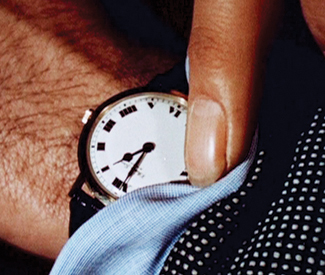
VISUAL ART Traveling juggernaut Christian Marclay: The Clock touches down at the San Francisco Museum of Modern Art this week for the latest stop along its endless summer tour of major world museums.

Marclay’s sprawling, oh-shit-inducing video work collages 24 hours worth of clips taken from both obscure and popular films, during each minute of which the correct time is shown on screen. Nominally, the artwork is about the representation of time in film, but it also manages to address some pretty heady concerns, including both the legacy of sweeping Victorian Age attempts to organize every last thing, and also the postmodern, now-seamless interchangeability of simulacrum with reality, making The Clock possibly the perfectly appropriate artwork for the era of Big Data. For the art wonk set, it caps conceptual investigations about indexes and taxonomies that stretch back at least as far as the 1970s, serving as the new-media, zero-degree equivalent of Ad Reinhardt’s all-black paintings. But more than that, it’s something unnervingly similar to Jorge Luis Borges’ fictional map of the world that is the same size as the world, an eerie herald of the age of Orwellian mindfuck as art.

You’re going to see it. Of course you are; it’s the most talked-about work of art since Damien Hirst dropped a preserved shark into a vitrine. But that said, you’re very unlikely to see all of it, unless you do so in May during one of SFMOMA’s scheduled 24-hour viewings.

And if you should give the entire viewing a go, you’ll be participating in what I suspect is the subversive heart of the The Clock, one that makes the entire concept of real time a kind of flimsy absurdism. Actually sitting in the museum in front of a single piece of work for a full day becomes a kind of performance, observing not just the comings and goings on screen, but also in the theater, engaging and disengaging in real life in equal, contesting proportion.

Marclay’s exhibition completes a crescendo at the museum, peaking just before the building closes for expansion, and the exhibits hit the road for various area temporary sites over the next couple years. Together with the current shows dedicated to photographer Garry Winogrand and architect Lebbeus Woods, The Clock is the third in SFMOMA’s trilogy on prolonged, meticulous fascination executed with utmost competence.

And about that Garry Winogrand retrospective, which in its way is even more overwhelming than the Marclay show: the thing you can’t escape while hopping, transfixed, from image to image, is that not only have half of these 300 photographs — many of them stunning — never been shown before, but that it was assembled from a massive archive including some 250,000 images that have never been seen, promising that Winogrand’s posthumous career will stretch on for quite a while.

And good thing, too, since these photographs, while rooted in the mid-late 20th century, are timelessly contemporary. We immediately recognize in them the same mix of unease, willful optimism, and absurdity that mark the post-9/11 world, realizing that disjointedness to be both a continuous thread and defining characteristic of American social fabric.

On the continuum of photographers, Winogrand is somewhere between Weegee’s operatic flair and Walker Evans’ incisive and empathic eye. There are definitely theatrical liberties taken with composition, but at heart Winogrand is a humanist. His particular knack inverts spectacles and intimacies, and his off-kilter shots deliver their actors amid a slippery, complicated search for the American dream.

His famous quote, that “there is nothing as mysterious as a fact clearly described,” speaks to both the allure and the central lie of his (and indeed all) photography. Although he began his career as a photojournalist, his main contribution was visual poetry over raw documentation. The tone of Winogrand’s later work, during which he focused on taking rather than developing or reviewing his photographs, is shot through with distress and disillusionment, as if the world imploded and dissolved completely somewhere around 1977. That late work, long ignored and incompletely catalogued, is featured here, and feels increasingly familiar and prescient.

On the second floor of the museum, the Lebbeus Woods retrospective offers a tonal break from the intense scrutiny of human interaction exhibited by the Marclay and Winogrand shows, but is no less sweeping or meticulous. Woods was a visionary architect of the possible, and although only one of his large scale projects was ever constructed, his psychologically-charged, intellectually-overloaded vision continues to reverberate throughout architecture and design worlds.

The show of 175 works, including models, drawings, and prints, is framed roughly by the Woods quote, “Maybe I can show what could happen if we lived by a different set of rules.” In the Woods universe, those rules bend physics and gravity for the sake of a complete reimagining of human-built structures. Part sci-fi, part utopian thought-experiment, the carefully and expertly drafted renderings of Woods’ theoretical architectural systems are as dizzyingly hypnotic as they are confounding to normal, run-of-the mill concepts of what a building is or should be.


CHRISTIAN MARCLAY: THE CLOCK

April 6-June 2

GARRY WINOGRAND

LEBBEUS WOODS, ARCHITECT

Through June 2

San Francisco Museum of Modern Art

151 Third St, SF www.sfmoma.org

Mathematical certainty

0

arts@sfbg.com

DANCE ODC/Dance started its 42nd season with a party-happy gala and two contrasting but complementary works: Brenda Way’s new Lifesaving Maneuvers and KT Nelson’s redressed and finessed 2012 Transit: Next Stop. Two days later, the season’s major premiere, Triangulating Euclid, co-choreographed by Way, Nelson, and Kate Weare, opened an intriguing perspective on what gifted women can do when they put their heads and hearts together. Of course, women working together is not exactly a fresh idea at ODC — it’s at the core of what this troupe set out to do four decades ago.

Though the dark Lifesaving has its moments of humor, Way’s look at wild excesses and paralyzing paranoia, both as social and personal phenomena, is a tough watch. The piece develops in front of Alexander Nichols’ semi-transparent curtain that closes off some ominous, hinted-at life beyond our vision.

While the sheer clarity and force of its choreographic vision pulls you in, Way’s unsparing look on coping strategies is chilling. Chaotic explosions could distill into social dance sequences where a partner, nonetheless, could be dropped like a rock. Yayoi Kambara looked caught in a tornado from which there seemed to be no exit, while Anne Zivolich darted around like a hunted rabbit.

Way grounds the choreography in an intense, often frantic energy that implodes mid-air. She balances discontinuity with unity processions, starting with battlefield imagery of dancers carrying off fallen comrades, women being pushed into the wings like brooms and vacuously waving men and women that might have stepped out of a Pina Bausch piece.

Still, Way doesn’t want us to feel too gloomy. You can’t help but smile when dancers choke and need Heimlich maneuvers as "Mad About the Boy" plays. In a silent movie melodrama, Natasha Adorlee Johnson throws herself at Corey Brady’s suave villain; he coolly assesses his victim and flips her off.

The piece ends with Justin Andrews cradling a desperately flailing Vanessa Thiessen. He tries to comfort her; she can’t respond. Curtain.

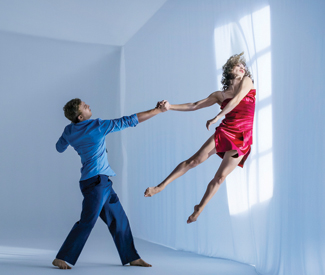
Whatever the process that the three collaborators engaged in for Triangulating, it worked. At first the piece looks like an illustration of basic plane geometry, but it quickly blossoms into an exuberant celebration of the way dancers inscribe themselves into space. From the moment a dancer’s leg smudges the carefully drawn line on the floor, you realize that poetry supersedes science.

The half-hour piece sails through its accumulations and dissolutions of staggered and overlapping encounters with surety and an increasing sense of freedom. The piece grows and finishes with Yayoi Kambara as the single dancer who draws the others onto the stage. Line formations give way to duets — still at the core of how and why we dance. Wonderfully, the cantilevered lifts, upside-down holds, and kicking feet feel thoroughly at home in Schubert’s music. The partnering between Corey Brady and Maggie Stack, contentious and passionate in the way he throws and whips her around, stands out.

Finally, Anne Zivolich sniffs, tiptoes, and encircles an indifferent Jeremy Smith; she breaks into one of her by-now-legendary whiplashing explosions when he takes off with someone else. One by one her colleagues march in and try to stomp her to the ground. The scene was both hilarious and spoke to truth: surely there is more to this dancer than being a female hurricane —something she appears as in just about every choreography that ODC produces.

The simple costumes (by Way and Lisa Claybaugh) of black shorts and bras for the women, and then supplemented by diaphanous white blouses, couldn’t be better. The score’s trajectory from synthesizer to Schubert to grand-style minimalism did its job as well.

Nelson’s Transit: Next Stop has acquired a spectacular set of animations which contextualize her urban dwellers’ attempts to manage their relationships. Yet Barry Steele’s design is so big that it draws undue attention to itself. It works best during a night scene in which life becomes a dream. But I am not sure whether adding a filmic sense of passing and changing habitats brings that much to this funny-yet-tender perspective on what it means to be a contemporary city dweller. *

ODC/DANCE DOWNTOWN 2013

Wed/20-Thu/21, 7:30pm; Fri/22-Sat/23, 8pm; Sun/24, 4pm, $20-$75

Yerba Buena Center for the Arts Theater

700 Howard, SF

www.odcdance.org

On the Om Front: Guys Wanted in the Yoga Room

4

I teach a weekly employee yoga class at a hospital where my students are all women. Every week, a young man peers curiously into the classroom. I asked him once if he’d like to join us, and he said, “Yes, but what would my friends say? Yoga is for girls.”

This odd societal notion that yoga is an emasculating, status-reducing activity is bad enough. But to make matters worse, people like William J. Broad, the so-called New York Times science writer, have publically espoused that yoga is actually harmful to men. Why? Because, he says, men have a tendency to push themselves too hard, and their bigger muscles are more injury prone.

Wait … what?

Here’s the truth: The majority of the yoga poses that we do in the studio today were developed by men, not women. In fact, women had to fight for the right to take part in this practice in the first place. And I could spend days discussing the fallacies of Broad’s arguments (which are based on poor science and don’t at all credit men with the ability to take care of themselves), but we all have better things to do. The point is: When did yoga get deemed wussifying or, worse, a threat to one’s health?

I don’t live in a man’s body, but I do teach yoga to a lot of strong, masculine, and intelligent men, and I can tell you from what I see that yoga is every bit as beneficial to men as it is to women. It does not seem to have negatively affected anyone’s testosterone levels, nor do my male students get injured any more than my female students — if they practice intelligently. (If one practices unintelligently, regardless of gender, one will get injured.) In fact, despite the obvious anatomical disparities, I see very little difference between the male and female practitioners I know in terms of commitment to practice, injury rate, and advancement. The largest challenge for men is the message in Western society that yoga was not made for them.

As a response to the dearth of dudes in yoga class, an interesting movement to promote male-only yoga classes has come about. The national Broga program is one example of this trend, though it hasn’t yet caught on locally. While I love that this movement is encouraging more men into the classroom, the segregation aspect feels weird to me. This is yoga, not football. I’d prefer to see all of us — men, women, and trans folk — practicing in the same room, side by side. Together.

As a society, both men and women have suffered from countless years of gender segregation. The yoga room can be a place for us to be in community together. Sure, we have different bodies, but we’re all there for the same reason: to improve ourselves and develop a deeper sense of inner intelligence. I understand that there’s a comfort in being around people who look like you, and avoiding environments where the other gender dominates. But if women had let that fear deter us, we wouldn’t have gained the right to attend college, vote, or have our own bank accounts. Besides, yoga is actually about moving out of your comfort zone, and confronting the fears and insecurities that imprison you. What better place to push your boundaries?

I’m a fan of anything that gets more guys, straight or gay, into the yoga room — even boys-only yoga. But the beautiful thing about bringing the genders together in general, and particularly in the yoga room, is that we balance one another energetically. We can learn from, support, and better understand one another. I think the time is ripe now for us to come together in mindful community — in fact, I think our evolution as a species depends on it.

And a little secret for those men who’ve yet to take a yoga class because they think the women don’t want them there: We do.

Karen Macklin is a writer and yoga teacher in San Francisco — her On the Om Front column appears biweekly here on sfbg.com.

___________________________________________________

Yoga and Spirituality Listings

By Joanne Greenstein

Restorative Yoga with Live Singing Bowls with Kevin Hibbit and Sam Jackson
Combining crystal bowl music, healing touch, poetry, and restorative yoga, this workshop will help attendees to slow down, relax and look within.
Sat/9, 6:30-9:30pm, $35, Mindful Body, 2876 California, SF

Naked Men’s Yoga
Check out these weekly classes for men that are aimed at offering community and more freedom for expression and movement. Clothing is not optional. Days and times and locations vary.

Therapeutics Workshop with John Friend
After a long hiatus from the yoga world, the founder of Anusara yoga is back in town. In this workshop, he will focus on common issues and injuries in the body, and how to overcome them using therapeutic postures based on principles of alignment.
Sat/9, 6:30-8:30pm, $50, Urban Flow Yoga, 1543 Mission, SF

Yoga Grad School
Laughing Lotus is offering several weekend workshops between now and the end of June on topics ranging from teaching yoga to at-risk youth to hands-on assisting. The workshops are appropriate for dedicated practitioners looking to deepen their practice as well as for those interested in earning credit toward advanced teacher certification. Price varies based on number of workshops taken.
Next up:
Lotus Fly: Advanced Asana and Sequencing with Sheri Celentano
March 16-17, 1-6pm, $199
Laughing Lotus, 3271 16th Street, SF

Healing the Heart – A Daylong Immersion in Bhakti Yoga with Jai Uttal, Nubia Teixeira, and Swami Ramananda
Immerse yourself in a day of devotional exploration. This daylong workshop integrates meditation, ceremony, breathing exercises, devotional dance, and chanting.
March 16, 10am-5pm, $100 ($90 by Mon/11); includes a vegetarian lunch
Integral Yoga Institute, 770 Dolores, SF

Yoga and Dance with Wendy Faith
Link two forms of movement in one in this workshop combining yoga and dance. Dance forms visited include Afro-Brazilian, salsa, tribal bellydance, Bhangra, West African and hip-hop.
March 17, 1-3:30pm, $35
Aha Yoga, 1892 Union, SF

I’m your fan

0

arts@sfbg.com

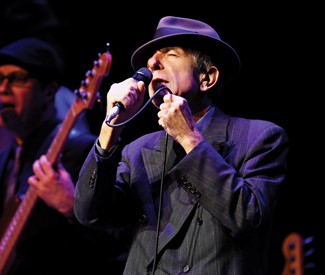
MUSIC Like most love affairs, there was little indication on our first encounter that it would turn into a lifelong infatuation. I was 17, methodically singing my way through a book of folk tunes, one of which was his first real hit, “Suzanne”. Though I admired it for its lyrical content, it weighed heavy on my range, and I soon moved on to other songs.

When I stumbled across him again, years later, it was as if we had never met. He was older, rougher, seemingly more jaded. His brutal ode “The Future” was dominating the indie-radio airwaves, hot on the heels of its appearance in Oliver Stone’s bombastic Natural Born Killers. When my then-roomie confessed a fondness for his music, it turned that single song on the radio into a sort of clarion call — the key, perhaps, to winning my flatmate’s frustratingly platonic heart. From that time, Leonard Cohen became a constant presence in my life, hovering at the periphery of countless triumphs, challenges, and betrayals, a companionship of almost 20 years that has spanned the globe, and almost every kind of circumstance.

There’s no one song or phase of Cohen’s music that seems to universally predicate the shift from uninitiated or fair-weather fan to true believer. For some it is the Cohen of the 1960s, whose laborious finger-picking and reedy, untrained voice lent equal gravitas to meticulously-plotted stories of resistance fighters and blowjobs, transcendence and squalor. For others it’s the synth-infused litanies to the naked body and the painful futility of the excess of the ’80s, or the flintier, world-weary renegade poised for flight of the early ’90s. Even the most contemporary of Cohen’s “masks,” the “lazy bastard in a suit,” currently rides a wave of almost unprecedented popularity, particularly in the US where he has mostly languished on the fringes of recognition until the last few years.

Underpinned by the spare minimalism of poetry written by a man for whom silence has played a pivotal role as much as language has (including a five-year long retreat at the Mt. Baldy Zen Center), his 2012 album Old Ideas brims over with themes that have appeared in almost every Cohen album over the last 40 years — bittersweet entanglement, elevation of the spirit, the struggles of the flesh — and marks a decided turning point in Cohen’s life, both personal and professional. An old Zen master of the music business arguably at the height of his powers: depression vanquished and horizons expanding exponentially.

Local author, rock journalist, and Leonard Cohen biographer (I’m Your Man, Ecco, 2012), Sylvie Simmons had her first encounter with Cohen in her adolescence as well, but for her the attraction was more immediate.

“The day I hit puberty was the day I heard my first Leonard Cohen record,” she confides over the phone when I call to get her side of her most famous subject. And though “it was outside my usual taste,” she found herself listening to his songs again and again, even today. Now deeply immersed in her own exhaustive world book tour, she’s even found a new thing to be impressed by: Cohen’s unflinching dedication to the road. “He’s got the kind of schedule that would kill an 18-year-old,” she says with a laugh. “He’s definitely a better man than I!”

Seeing Leonard Cohen perform at the Montreal Jazz Festival in ’08, after years of worshiping from afar, will always remain one of my most luminous memories. The prodigal son gone good, working the hometown crowd for an epic three-and-a-half hours, holding his hat over his heart as we applauded each song until our hands were sore, bowing his head humbly again and again, prophet as fellow supplicant. By a twist of good fortune, I managed to see him twice more on that tour — in Oakland and in Paris — and each time, though the controlled orchestration of the event revealed itself more and more, so did the sense of sheer joy emanating from both the stage and the audience, an orgy of admiration, and, a real rarity in the business, of gratitude.

Simmons has an explanation for this gracious humility as well. “He just loves life on the road,” Simmons explains. “He told me it was wonderful…’for a man my age to have a feeling of full employment’.” I rather suspect that this weekend’s events will be just as wonderful for us as they will be for him. Thank you, Leonard Cohen, for being our man.

“THE NIGHT BEFORE LEONARD” WITH SYLVIE SIMMONS

Fri/1, 6pm, free

Marsh Berkeley Cabaret

2120 Allston Way, Berk.

(415) 641-0235

www.themarsh.org

LEONARD COHEN

Sat/2 and Sun/2, 8pm, $71.50–$253

Paramount Theatre

2025 Broadway, Oakl.

(510) 465-6400

www.paramounttheatre.com

Nite Trax: DJ Sprinkles lays it out

32

The phenomenal house DJ and experimental musicmaker on mainstream visibility, transgender globalism, Bay Area queer culture, and the “shopping mall diversity” of the current dance music scene.

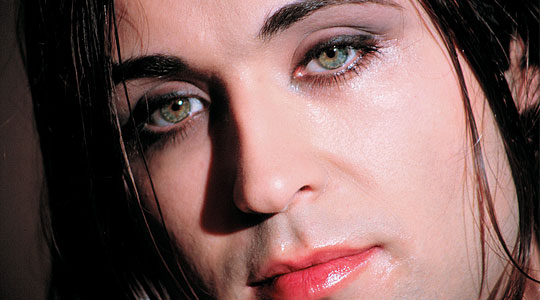
Techno has always had room for theorists and intellectuals, from Derrick May to the Mille Plateaux label roster, and social activists, like Moodymann and Underground Resistance. Most of that discourse usually takes place musically, however, with concepts emerging from the vinyl itself. The celebrated DJ Sprinkles, a.k.a. Terre Thaemlitz, the American head of Japan-based label Comatonse, tops all that by making intellectually grounded music glimmering with poetic touches and expounding in interviews and writing on such heady, heated topics as essentialism, gender idenitity, surveillance, and authenticity. She leads workshops, goes on speaking engagements, and isn’t afraid to let loose in interviews. (For example — see below — rather than “born this way” platitudes, she considers her queer identity “beat this way.”) 

It’s a beautiful thing, especially in the rare context of controversial truth and radical opinion pouring from the mouth and keyboard of an outspoken transgender major player on the stubbornly homogenous global house-techno DJ scene. Of course, it all comes down to the music — we’ll get a treat when Sprinkles (who chose the name because he wanted something that sounded “totally pussy” in opposition to macho DJ culture, to buck the testosteronal scene) performs Sun/24 at Honey Soundsystem — and Sprinkles certainly has the goods. He’s released umpteen pieces in an astoundng breadth of genres under multiple pseudonyms over the past 20 years. Masterpiece deep house album “Midtown 120 Blues” siezed the top of several best of 2009 charts and was, typically, followed by Soulnessless, a 30-hour “mp3 album” of music and video. Because why the hell not?

I got a chance to exchange emails with Sprinkles before her appearance here. It’ll be an interesting return to the Bay Area, where she lived for several years before decamping to Japan. Here’s all she had to say.    

http://www.youtube.com/watch?v=UY79cyv8pH8

SFBG It’s been 13 years since you lived in Oakland, is that correct? Can you tell me why you decided to leave and what it was like to live here then, with regards to the music, political, and queer scene?

DJ SPRINKLES Yes, it’s been a long time. I used to live across the street from a hotel where the Unabomber once stayed. Honestly, I can’t say I miss California. I never really connected with any queer or transgendered communities in SF or Oakland. Whenever I tried, they seemed immersed in West Coast spiritualism and zodiac bullshit, which I found completely alienating. Most of the transgendered people I met there were prone to metaphysics — by which I mean they were ideologically (and economically and medically) invested in defining their transgenderism in relation to a perceived split between their “physical bodies” and their “true inner selves.” I’m an anti-essentialist, non-op, materialist, anti-spiritualist… so that clearly wasn’t a match with my own transgendered identity.

There was also a weird conservatism in SF’s queer scenes that I associated with the fact a lot of people in SF had been raised in conservative Midwestern towns, so they were in SF to “live the life.” I felt there was a lot of unacknowledged parody and role play going on — people trying to overcome a life of repression and closets by wrapping themselves in rainbow flag culture. Yet, when going to buy groceries or such, I still found myself being harassed as a “fag” on the street like in any other town in the US. I felt my four years there was all quite standard. I don’t really think of the Bay Area as a “special place” for being queer and transgendered.

US identity politics have a particularly inextricable link to the concept of the ghetto — not only as a place of economic strife and forced communal ostracization from a “white middle-class mainstream,” but also as a self-invested “safe space” for non-mainstream social movements. This is part of migrant culture. For example, after my grandparents passed through Ellis Island, they immediately moved to a place where people spoke the same language as their homeland, etc. The Castro, New York’s West Village, Little Italy, China Town… these are all migrant-based communities formed by people seeking safety in numbers in the face of not being welcome elsewhere — these two dynamics of “safety” and “alienation” are inseparable to most US identity politics. So these communal zones all display the problems and contradictions of cultural identification that plague mainstream US culture as an “immigrant nation” that is simultaneously “anti-immigrant” – because the “immigrant” is a brutal reminder that there are no “real Americans” beyond Native Americans, which the majority are not. And of course, the fact that recent generations of immigrants are primarily people of color does not jibe with conventional black/white US race discourse, which continues to be largely devoid of other browns, as well as the concept of the person of color as a willing immigrant (as opposed to the descendant of a slave). This history and context is peculiar to the US social landscape, and it creates a lot of weird identity essentialisms and hostilities around gender, sexuality, race, ethnicity, class…

Not to say other countries don’t have their own fucked up ways of causing and dealing with social problems, but moving to Japan and realizing that pretty much the entirety of Western identity politics did not function here was a big life experience. It was like leaving the Earth’s gravitational pull — it didn’t mean gravity no longer existed, but almost everything I had internalized and believed I understood about my relationship to gravity was no longer helpful in understanding the dynamics of dominations at work in this other context. I wasn’t freed of gravity, but lost in weightlessness. I had to learn to feel weight in a completely different way. This is why so many of my projects dealing with my own immigration and cultural issues consistently invoke the rather limited and problematic US language of black/white race relations. It is a critical gesture intended to highlight the limitations of my having been raised amidst that US language and social conditioning, yet now living within a non-US context with few tools to work with.

Because music’s value is so often tied to an essentialist concept of racial authenticity, it becomes difficult and risky to ask an audience to question their relationships to the very value systems through which they likely purchased the album – but that is also why I choose to work with audio. Not because of its possibilities, but its all-too-clear limitations. Since I am unable to believe in the authenticity or purity of identities of any kind, when I invoke “identifiable” sounds (a “queer” sound, a “black” sound, etc.) I am doing so to question the social relationships around their construction, proliferation, and distribution. The moment we become lazy about our use of those “identifiable” sounds — the minute we take it for granted that the essentialist associations they have come to carry are unquestionable and real reflections of material social experiences — everything becomes one-dimensional and shallow. This is why almost all music is one-dimensional and shallow! [Laughs.] For example, if I can beat a dead horse, my problem with Madonna’s “Vogue” is not that it was “inauthentic,” but that its terms of discourse misrepresented its relationship to vogueing by actively erasing the very contexts of Latina and African-American transgendered culture that inspired it (via lyrics about “It makes no difference if you’re black or white, a boy or a girl”… it TOTALLY made a difference, and THAT SOCIAL REALITY is where any real discussion on vogueing BEGINS.). So I’m interested in these other directions of audio discourse that cannot even occur if one is preoccupied with conflated essentializations of identity and sound. There is never a true point of origin for anything. It’s all referential and contextual. In my opinion, there is no point in discussions focussing on identifying the source of a sound or style — that is a hopelessly futile exercise, although it is the dominant exercise! It’s a distraction from the real discussions needing to be held, and those are discussions on relations of domination.

As a DJ in the late ’80s and early ’90s, there were a lot of drag queens asking me to play Madonna’s “Vogue” when it first came out. I refused, but I could understand their requests. We all have very complicit and complex relationships to dominations, and a perverse desire to celebrate our visibility within the dominant mainstream, no matter how unfamiliar or distorted that reflection may be… often because we are conditioned to feel so unhappy with what we see in the mirror to begin with. Mainstream visibility is like getting approval of the Father. It’s a mental and abusive process. It is also totally standard. So I get it… But there is also that which remains unrepresented and invisible to most. That which existed, and may have already been lost, but did so without seeking approval of the Father. And again, this is generally not a freed or liberated space, but a space of intense hatred for the Father. These are difficult things to speak of and represent, because any act of representation has the potential to be a violation of the cultural site it wishes to speak of. So to speak of them requires obfuscating or complicating the usual functions of language – not through vague poetry, but unexpected flashes of clarity coming from unexpected vectors.

http://www.youtube.com/watch?v=R2iKF_11WbY

SFBG You left during the first Internet boom I believe, and now SF is in the middle of a second one (although a bit different than the first —  the first wave seemed to have much more geeks and freaks in it, while this one seems much more regimented and Ivy League, even while many longtime residents are still feeling the results of “global recession”). When was the last time you were back here? And what are some of your recent thoughts on how house music is being affected by economic circumstances?

DJ SPRINKLES I was only back once about 10 years ago, visiting friends for a few days. When I moved away at the end of 2000, internet and web development had already undergone a rigid formalization. Years earlier, a web designer did a bit of everything. By 2000, developers were already split into specific teams focussing on interface, coding, page flow, etc… all processes were specialized, departmentalized, corporatized. I hadn’t heard about the “second internet boom” there, but the way you describe it doesn’t surprise me since it would surely be an extension of that regimentation that took place in the first boom.

And in a way, the same can be said of this “second boom” (third?) around house music. In the same way almost all websites have taken on the same continuity and feel, so has electronic dance music. You buy an album, and all the tracks sound similar — as opposed to the old days when an electronic dance track like Donna Summer’s “I Feel Love” was tacked on to the end of an otherwise standard soul-band album that didn’t sonically match it at all. Today’s music consumer experience is much more streamlined and organized, which affects how people produce an album as well. Younger generations — 20-somethings — grew up amidst this homogenization, so I am fairly sure they do not feel what I am speaking of… although they may recognize it as a historical process.

I try to play with discontinuity and mixing things up, like in my K-S.H.E album, “Routes not Roots,” which had monologues and ambient tracks interspersed between house cuts. But I once made the mistake of reading people’s blog comments, and they really seemed upset about this kind of thing. “Way to ruin the mix,” or “Why the fuck didn’t you put that monologue at the end of the album?” They have no patience for non-homogeneity. The same goes for my Comatonse Recordings website itself — people seem utterly confused and helpless. If one doesn’t do everything completely standard and at the same level, people get disoriented. It’s a kind of cultural compression going on, similar to audio compression, where everything has to be “punched up” to the same intensity or people feel lost. What the fuck is so wrong with being lost? Why would you expect — let alone insist — your interactions with non-mainstream media to be completely mainstream in process?

http://www.youtube.com/watch?v=B8iF7JQiz50

SFBG I’ve been hanging out recently with the new, young generation of ACT-UP activists who are transcending mere ’90s revival and undertaking a lot of energizing political discourse and action. Were you involved in the queer activist movement back then — or now? Would you characterize your musical project as a form of activism, especially in its more intellectual and challenging aspects?

DJ SPRINKLES That’s nice to hear. Although you use the term “action,” I assume the real interesting stuff has little to do with demos and “direct actions,” and more to do with communal education initiatives, etc.? My direct action days were mostly during the late ’80s and early ’90s, while living in New York. Most of those activities were in conjunction with various caucuses in ACT-UP, and WHAM! (Women’s Health Action & Mobilization).

I do consider my audio and other projects “political” — in theme, and also in their attempts to (dis)engage with standard industry practices. But clearly this is something different than direct action “activism” or community outreach, because my main social engagements are with people working for labels, distributors, music festivals, museums, and other culture industries. Maybe “culture jamming” is a better way to put this kind of political activity. Personally, I found myself distanced from direct action groups because the terms of identification they cultivated out of strategic necessity so often folded back into essentialisms that excluded me on a personal level. So I was always advocating for the recognition and acceptance of something other than myself (like the way “born this way” ideologies take over discussions of LGBT rights… I consider myself more “beat this way,” my queer identity being primarily informed by material ostracism and harassment than by some mythological self-actualization and pride). That, combined with the mid-’90s move away from direct action toward CBO’s (Community Based Organizations) — largely because the tactics of direct action had been so thoroughly coopted by mainstream media – was pretty much the end of my serious direct action involvements. Over the years, enunciating this process has become the core political act of my projects and activities. I do not do this to discourage people from forms of direct action, but as a simultaneous form of critical analysis that hopefully contributes in other ways to our various attempts to react to dominations.

SFBG Do you feel that, as the means of production and distribution have been more and more democratized in the past decade, house and techno music-making and DJing have been living up to their potential as a form of resistance to mainstream capitalism and culture, or do you feel they’ve become more homogenized and/or annexed by neoliberal, bourgeois culture?

DJ SPRINKLES I do not believe the means of production and distribution have become more democratized. I take issue with the way people always confuse “commercial accessibility” with “democratization.” The breadth and variation of today’s music production strategies is no more than a shopping mall diversity. We are all working with similar software on similar platforms. Mac, Windows, Unix… Banana Republic, Abercrombie & Fitch, The Gap… Having said that, if these musics had a potential, I believe it was lost back in the ’90s when anti-sampling legislation (mostly focusing on hip-hop) laid the groundwork for today’s electronic music. It basically reinvigorated house with “musicianship,” “authorship,” and all that crap which used to play far less of a role in this genre’s early days. And the younger generation – basically, today’s 20-somethings who grew up after the whole sampling debates — really don’t seem to understand how record label legal departments work.

So they list up all the samples they recognize in a track in the comment fields of music websites, which is putting the producers they wish to support at risk. There is no sense of how we can cultivate — let alone protect — “underground” media and information in this online era. Everything is about “sharing,” when in fact we need to be developing a parallel discourse around meaningful information distribution patterns, including strategically withholding information from the web. The cliché idea of making “everything accessible for everyone” is not only naîve, but negates the social and cultural specificities that give certain forms of media their alternative values, in particular collage and sampling. Anyone who has used a random image taken from a Google image search on their blog page, and then gotten an email from Getty Images’ legal department asking for back royalties, knows what I’m talking about. Treating subcultural musics as though they are meant for “everyone” — whether this is being done by fans, or the labels and online distributors themselves — is the biggest sign of people not understanding the media they are dealing with. And since all of that is SOP these days, it’s pretty much a sign that the sample-based genres of house is dead. Is talking about house’s political potential in 2013 really all that different than the trend of talking about the radical politics of ’60s rock during the ’80s?

http://www.youtube.com/watch?v=v4M3-t9lw7o

SFBG I feel like, with parties like Honey Soundsystem, there is a huge resurgence of interest in an underground queer dance music culture — a kind of new underground opposed to corporate or low-quality dance music (yet still taking place in corporate spaces). Is this phenomenon occurring in Japan as well? Do you feel there are specific possibilities with this, not just in terms of opportunity for queer DJs to travel but of transformation of queer discourse and politically actualizing a new generation?

DJ SPRINKLES Hey, low-quality is where it’s at. It’s what it’s all about. What was Chicago house if not low quality? It’s important to place value within the “low” in order to counter conventional associations between the terms “good,” “high quality” and “upper class.” I’m not talking about celebrating kitsch, or that kind of petit-bourgeois trivialization of the “low.” I’m talking about finding other values in the “low” that cannot find expression within a language developed to express everything in terms of “low vs. high.” This is ultimately about the identification of other values amidst class struggle.

I don’t think house resonates as a queer medium anymore. Those days are over. Today it is primarily a white, heterosexual, European phenomenon. That was the case early on. I mean, how many Americans became aware of house music in the ’80s by buying Chicago house sold back to us on UK compilations? The US has always treated its own history of electronic music like utter shit… The US is such a fucking rock’n’roll shithole. So I think for people to appreciate house music’s queer roots, and to actively invest in those themes today, requires people becoming deliberate and explicit about those interests. But whether that deliberate action would focus on “queer visibility” or not is another issue. It doesn’t have to focus on “visibility” — especially since visibility has become such an oppressive aspect of dominant LGBT movements. Explicitness can also be about closets. Not only the usual closets born of heterosexism, but less considered closets around sexuality and gender that have been formed by the actions of the “born this way” LGBT mainstream. Well, that’s the direction I try to take it… reflecting on, and constructing, queer and transgendered histories that are as skeptical of Pride[TM] as they are angry about violence. And I do believe, globally speaking, queer and transgendered experiences are much more informed by violence than pride. So this should be reflected in how and where we make noise. In my opinion, music that functions in completely standard ways – socially and economically – does not have much potential for reflecting queer or transgendered contexts in politically precise, helpful or meaningful ways. You end up with essentialist, humanist shit like Lady Gaga’s, “Born This Way.” She is not somebody I would consider an ally.

You know, American media is so fixated on the idea that sexuality and gender must either be biologically predetermined, or a personal choice. The “it’s not a choice” argument is a common theme in television shows, etc. Both of these options revolve around a fiction of free will. Like, if it’s not a choice, then the only other possibility must be some supra-social, biological reason that cannot be questioned. Both of these conclusions preserve the status quo brutality of how culture forces gender and sexual binaries upon us. The thought that our absence of choice might be rooted in social tyrannies – not biological predispositions – remains unthinkable. The mainstream has it half right when they say, “it’s not a choice,” but it’s a half-truth that has been twisted into a decoy from the real issues at hand – the inescapability of the hetero/homo and female/male paradigms. We are given no other choices through which to understand our genders and sexualities. Sexuality is far greater than two or three. The same goes for gender — and yes, I’m speaking biologically, human bodies are way more diverse than A or B. To argue that the reason you deserve rights under a humanist democratic system is because of genetics is a retreat into feudalist logic. It’s the same as an aristocrat arguing that their rights and privileges were deserved because of their family blood-line and DNA. “Born this way” is antithetical to any democratic argument for rights rooted in a social capacity for understanding and transformation. It is astounding that the majority of people cannot comprehend that any “born this way” argument is a complete obliteration of their social agency. “I can’t help it, so give me the same rights as you…” Fuck that. We shouldn’t be asking to participate in the rights and privileges of those who have oppressed us. We should be trying to divest those groups of privileges. That is the best way to help ourselves and minimize the violence we enact on others.

Humanist legislative practices are still rooted in feudal ideologies, and I am convinced the long-term repercussions of this is a cultural entrenchment that makes any democratic project (including US-brand democracy, socialism or communism) an impossibility. We can already see how the post-Cold War world is retreating into clan-based, privatized, anti-state organization structures. Capitalism is increasingly liberated of democratic agendas because — surprise! — capitalism works better with slavery. Capitalism is not about the distribution of wealth, and everyone’s equal chance to partake in a petit-bourgois lifestyle. It is about the isolation of wealth. There is no doubt in my mind that today’s moral insistence that all people must work at whatever job society throws them, and the accompanying presumption that all lower-class unemployed people are “lazy” (which is perpetuated by many lower-class peoples themselves), is an argument for slavery: forced labor in return for base subsistence at best. How is that not the reality of poverty under globalized capitalism?

…and that’s why I hate Lady Gaga. [Laughs.]

http://www.youtube.com/watch?v=y-JtoRxqK8s

SFBG You have some fascinatingly poetic thoughts about the intersection of transgender issues and immigration, the idea of “living as a ghost” in politicized and police-monitored spaces. Do you have any current thoughts on how globalization continues to affect transgender issues?

DJ SPRINKLES I think the fact that the world’s two largest economies around gender transitioning are in Thailand and Iran, yet the aesthetics of those economies follow largely western models of beauty and body, says a lot about how globalization affects transgendered issues. Thailand’s dominant transgendered culture revolves around the “Ladyboy” — a very essentialist transgendered model that is rooted in heterosexism and the cultural/ideological necessity for some men to “unbecome-man” in order for “straight men” to have sex with other men. Western transgendered discourses love to fetishize the “Ladyboy” as some kind of locally celebrated and accepted third-world transgendered native other, but this is patent orientalism. It refuses to envision how the strict regimentation of social codes for those transgendered people can be oppressive, or how the mythical “transgendered native’s special place at the edge of the village, possibly as a shaman” is a form of segregation. People also never address how such cultures are invariably patriarchies, and their models for transgenderism almost exclusively revolve around the MTF paradigm. And far as I know, Thailand has still not lifted their government prohibition on homosexual government employees, which is relatively new legislation passed just a few years back. This is all part of that context of transgendered production.

Meanwhile, Iran is a country where Islamic law prohibits homosexuality by fatwah. Since the ’70s, gender transitioning has been promoted as a way for men who have sex with men to avoid the death penalty, although many transitioned people still face the possibility of being murdered by their families or local communities. The cost of their procedures is partially subsidized by the Iranian government itself. While some Westerners have attempted to portray that as “progressive,” clearly it is the opposite. Many post-op transsexuals find themselves ghettoized, unemployed and cut off from the family structures that play such important roles in Iran’s social structure.

In both Thailand and Iran one can see how the global growth of gender-transitioning economies is connected to heterosexism and homophobia — something current Western gender analyses attempt to separate from gender transitioning through clear ideological divisions between gender and sexuality. While I believe these divisions between gender and sexuality are important and do have social value in the West, it is clear that the West is not the world. And the West has surely not overcome its heterosexism and homophobia, either. I believe it is more than coincidence that the global proliferation of gender transitioning technologies is happening parallel to medical industries’ attempts to divest of their previously blatant attempts to cure homosexuality, due to such methods falling out of cultural favor in the West and elsewhere. I also believe it is more than coincidence that today’s inescapable “born this way” arguments serve and justify today’s medical agendas so well.

For sure, my stance on medical transitioning has always been that I support peoples’ abilities to transform their bodies as they see necessary. Considering how few options for gender identification are offered to us, I can understand how a person can become no longer able to live within one’s body as it has been defined and shaped by social gender constraints. But, for obvious reasons, I am unable to believe those medical systems which propagated today’s gender binary are capable or willing to offer us a way out of our gender crises. Those industries move us further and further away from cultural environments that enable transgendered people to build medically unmediated relationships to our bodies. I just can’t accept that the medical industry’s methods for mediating our suffering are the only way. It really angers me… particularly since so many transgendered people are impoverished and without health care…

Hmm, you’re probably getting an idea as to why I am never invited to perform my more thematic projects in the US — just to DJ some house and go back home to Japan. [Laughs.]

SFBG Speaking of essentialism, ha: Any food or restaurants you miss from living here?

DJ SPRINKLES Mexican food…! It’s shockingly absent in Japan… and when you do find some, you generally wish you hadn’t. But what a weak note upon which to end this interview. [Laughs.]

On the Cheap Listings

0

On the Cheap listings compiled by Cortney Clift. Submit items for the listings at listings@sfbg.com. For further information on how to submit items for listings, see Picks.

WEDNESDAY 30

“Red Bull Curates: The Canvas Cooler Project” Public Works, 161 Erie, SF. 9pm, free. The Canvas Cooler Project pairs selected artists with local bar, lounge, and restaurant owners. Artists are then given 24 hours to transform a blank, canvas wrapped Red Bull Cooler into a work of art representative of their venue. The end results will be on display tonight where guests and selected judges vote on each piece — the winners get a trip to Miami for Art Basel week 2013.

THURSDAY 31

“Voices of Japan: Tanka after the Tsunami” SFSU Cesar Chavez Student Center, 1650 Holloway, SF. . Through Feb. 14. Opening reception: 5-8pm, free. Since the traumatic tsunami hit Japan in March of 2011, the country’s newspapers have been publishing tanka poems written by a wide range of Japanese citizens affected by the natural disaster. This exhibit takes a look at what these victims had to say, showing 29 selected poems from the papers. Photo collages, calligraphy, and video will also be on display alongside the translated words. Tonight’s reception will include a live calligraphy and story-telling performance.

FRIDAY 1

“A Hella Space” MOCO gallery, 371 17th St., Oakl. . Through Feb. 21. Opening reception: 6-10pm, free. Long time friends and artists Sam Turner, Meighan Moore, and Noelle Dexter share their artistic interpretation of life in Oakland through digital prints, watercolor, and pen and ink drawings. Tonight’s reception will also include a musical act by Noelle Dexter.

“Peace, Pies & Prophets: I’d Like to Buy and Enemy” First Presbyterian Church, 2619 Broadway, Oakl. 7pm, $12 donation accepted. There will be pie. And comedy. Need we say more? This Positive Peace Warrior and Christian Peacemaker Team fundraiser will include a homemade pie auction and a performance addressing issues of peace and justice in a comedic light.

SATURDAY 2

Fourth Annual German Family Karneval 1581 LeRoy, Berk. . 3-7pm, free. Bring the little ones out to help support the German School of Silicon Valley’s growing Berkeley campus. Enjoy a performance by a Brazilian-style marching band, snack on German food and drink, and let the kiddos take part in the various children’s activities offered.

Chantey Sing at Hyde Street Pier” San Francisco Maritime National Historical Park, 499 Jefferson, SF. (415) 561-7171. 8pm-midnight, free. RSVP by phone, required. Pick out your best blue-and-white striped shirt and channel your inner Popeye for this sailor sing along. Park rangers will lead you in sea chanteys under the stars and aboard a historic ship at San Francisco Maritime National Historical Park. Bring your own mug and soothe your vocal chords with free cider.

“Mud & Blood: A Swamp Noir Fairy Tale” The Lost Church, 65 Capp, SF. . 8pm, $10. Singer-songwriter Wesley Morgan introduces you to a new sort of story time. Through a mixture of story and song, Morgan and his guitar tell a Gothic, fantastical tale of a boy found in the mud, still attached to his mother in the aftermath of a tragic flood. Years later, the boy sets out on an adventure where he meets intoxicating temptresses, precious songbirds, and more.

Tomboy Tailors store opening Crocker Galleria, 50 Post, first floor, SF. . 2-6pm, free. Eventbrite RSVP requested. Tomboy Tailors, a fine clothier specializing in made-to-measure, custom suits for the butch among us, is opening up shop this afternoon in its new retail space. Check out the new store with champagne in one hand and hor d’oeuvres in the other. Maybe even get fitted for a suit while live jazz plays in the background?

SUNDAY 3

“Janet Jackson Flash Mob ‘Together Again'” Dance Mission Theatre, 3316 24th St., SF. . Noon-2pm, $3. On May 18th Bay Area Flash Mob will gather in various locations around San Francisco to perform “Together Again” in honor of Janet Jackson’s birthday. But before you can be part of the flash mob fun you’ve got to master the moves. Get some knowledge of the dance beforehand with free online tutorial videos and then join your mob mates this afternoon to learn part four of eight to the dance.

Fourth Annual Super Bowl Heavy Metal Chili Cookoff Bottom of the Hill, 1233 17th St., SF. . 1-6:30pm. Doors open at 1pm, game at 3:30pm, free. Spice up your Super Bowl Sunday with some home-style cooking. To give this cook-off an extra kick, all participants must also give their dish a heavy metal name. Prizes will be given away at halftime for best chili, best chili (popular vote), and best heavy metal name. Chili entrants must RSVP in advance. Everyone else is free to bring other food to share.

MONDAY 4

“Quiet Lighting’s Tour Through Town”826 Valencia, SF. . 6:30pm, $5 donation accepted. Quiet Lightning kicks off their citywide tour alongside Valencia Street literary staple, 826 Valencia for its first show of the year. Snack on some goodies from Bi-Rite Market, OneBar, and Cheddar and Chutney, sit back, relax and enjoy an evening of poetry and fiction readings by some of the city’s best young authors. This specific Quiet Lighting event will showcase pieces by written by six to 18-year-olds.


Poet laureate inauguration, Feb. 27

21

San Francisco’s new poet laureate, who also happens to be a Guardian columnist, gets officially inaugurated Jan. 27 — and while I have no idea what he’s going to say, I expect it will be lively. Murguia’s a political poet and has a lot to say about what’s happening and what’s happened to the Mission and the Latino community. He’s also, of course, an awesome writer, so expect a lyrical presentation. 1 pm to 3 pm, Koret Auditorium, SF public library.

On the Cheap Listings

0

On the Cheap listings by Cortney Clift. Submit items for the listings at listings@sfbg.com. For further information on how to submit items for the listings, see Picks.

WEDNESDAY 23

“From Vision to Icon: Building the Golden Gate Bridge” Sports Basement, 1590 Bryant, SF. www.sfwalksandtalks.com. 7pm, free. Local writer, producer, and narrator Peter Moylan presents the story of the Golden Gate Bridge, exploring all the triumphs and challenges encountered throughout its creation The lecture will be told with over 120 historic photos in the live documentary style SF Walks and Talks is known for.

THURSDAY 24

“Pixilated Drift” Johansson Projects, 2300 Telegraph, Oakl. www.johanssonprojects.net. Through March 16. Noon-6pm, free. The show will feature Andrew Benson’s hypnotic pixel prints, David O’ Brien’s explosive and abstract video stills, and Tamara Albaitis’ sound sculptures, sure to be as entrancing and mysterious to look at as they are to listen to.

FRIDAY 25

“Full Wolf Moon” Cotton Mill Studios, 1091 Calcot, Oakl. www.f3oakland.com. 6-10pm, free. F3 at the Cotton Mill will be showing off resident and guest artists’ new work in the collective’s eighth event. The evening will be a bit of a cultural smorgasbord with various galleries and studios open throughout the building, live music, dance, and spoken word in the “Wolf Den,” a design bazaar, and food trucks. Free shuttle transportation will be provided to the Cotton Mill Studios from the Fruitvale BART station from 6-10:30pm.

Fundraiser for KPOO Radio Mercury Café, 201 Page, SF. 7-10pm, free. For over 40 years local nonprofit radio station has been discussing issues facing underserved communities such as GLBT folks, low-income families and young people as well as playing music largely absent in mainstream media. But KPOO has recently lost a significant source of funding due to budget cuts. Head over to Mercury Café for a night of food, drinks, and music to help keep the station on the air. 10 percent of all sales will go to KPOO.

“Deviant Type Press Benefit Show” Temescal Arts Center, 511 Eighth St., Oakl. 7pm, $10 donation suggested. Hosted by Jezebel Delilah X, this evening will consist of readings by Mia McKenzie, fat activist Virgie Tovar, Sister Spit-Valencia queer author Michelle Tea, and Manish Vaidya. After the readings Bay Area band Gaymous rocks.

SATURDAY 26

“All You Can Dance” Alonzo King LINES Dance Center, 26 Seventh St., fifth floor, SF. www.linesballet.org. 1-5pm, $5. Whether you’ve been itching to brush up on your ballet skills or wanting to test your talent in Zimbabwean dance, the $5 entry fee allows you try out any and all classes on today’s schedule. Offering everything from Bollywood dance to Pilates to Argentinean tango, you’re free to dance ’til you drop.

Roe Vs. Wade 40th anniversary celebration Justin Herman Plaza, SF. www.oursilverribbon.org. 10am-noon, free. Reproductive rights pioneer Pat Maginnis, president of the San Francisco Board of Supervisors David Chiu, and other speakers will be addressing women’s issues today in remembrance of the legendary court case that gave us our reproductive rights. It may not technically be a carnival, but there will be face-paining, airbrush tattoos, balloon artists, a bubble artist, and a performance by One Billion Rising, a radical gang of flash mobbers.

SUNDAY 27

“San Francisco Poet Laureate Alejandro Murguía’s Inaugural Address” San Francisco Main Library, Koret Auditorium, 100 Larkin, SF. www.sfpl.org. 1-3pm, free. Murguía will give his inaugural address as the city’s sixth poet laureate and speak about the connection Latino history and San Francisco history have to one another as well as how poetry has affected the local Latino community. A reception will follow his wise words, so you’ll have ample time to chew them over.

“Drunken Spelling Bee” Café Royal, 800 Post, SF. www.caferoyale-sf.com. 6pm, free. Hosted by Jimi Moran, this event is exactly what it sounds like. Maybe you dominated in your sixth grade spelling bee, but how are your skills after a few beers? No iPhone spell checks allowed.

“Oakland Youth Orchestra ‘Russian Romance’ Winter Concert” Holy Names University, 3500 Mountain, Oakl. www.oyo.org. 3pm, free. Get classy Sunday afternoon at what is sure to be something far better than an average high-school music recital. The 75 musicians who make up the Oakland Youth Orchestra range from ages 12 to 22 but possess musical skills far beyond their years. The concert will include festive pieces by Dimitri Shostakovich, Pyotr Ilyich Tchaikovsky, and Sergei Rachmaninov.

MONDAY 28

Berkeley Arts & Letters presents Adam Mansbach’s Rage is Back The Marsh Berkeley, 2120 Allston, Berk. www.berkeleyarts.org. 7:30pm, $5/students, $12/advance. The author of the No. 1 New York Times bestseller Go the F**k to Sleep is back to tell the story of a clever kid, the father who left him, and the greatest graffiti stunt New York City has ever seen in his new book titled Rage is Back. Today Mansbach will read and discuss his new release. The Marsh Cabaret Bar will be open before, during, and after the program.

TUESDAY 29

Recology art exhibit and panel discussion Reception at 503 Tunnel, SF. 5-7pm, free. Panel discussion at 401 Tunnel, SF. 7pm, free. Exhibition also on display Fri/25, 5-9pm; Sat/26, 1-3pm. www.recologysf.com. Recology’s artist in residence program will exhibit work created by Michael Damm, Julia Goodman, and Jeff Hantman over the past four months, made from scavenged materials found at the dump. After the exhibit, head a few doors down to catch the artists talking about their experience working to create art in trashland.

Estamos atentos: Photos and lessons from Friday’s anti-violence march in the Mission

36

It’s hard to say if the march of neighbors from the 16th Street BART station, to Valencia Street, to 24th Street, and back down Mission Street will stop attacks like the January 6th assault on 23rd and Guerrero Streets that inspired last Friday’s anti-violence demonstration and walk. But for a community that feels nervous about walking one’s own sidewalks at times due to an ongoing spate of sexual assaults, that wasn’t really the point. 

“No violence, no police! From the bathroom, to the streets!” went the crowd’s chant, led by an ambulatory drum circle past the 1,000 new restaurant seats on Valencia and the tourists snapping photos of the massive, swaying protest puppets above our heads. Making the violence visible? Check. A disempowering situation turned into a show of strength? Check.

Bilingual handmade signs, bodies made out of roses on the sidewalk at the 16th Street BART plaza, musical instruments, famous writers — that was how the Mission spoke its mind at the march. Information was passed around about the International Women’s Day protest in UN Plaza, and a bright orange “Manifesto for Safe Streets” called for the right to be on the street safely at any hour (head to Mission Mission to read the full manifesto.)

Events were kicked off by a rally at the BART station, where announcements about Impact Bay Area self-defense courses and safe cab services shared time with a poetry reading, a first-person testimonial from a local sexual assault survivor, and remarks by writer Rebecca Solnit, who recently moved to the neighborhood after living in Western Addition for decades. Solnit is working on a new book which examines the various permutations of violence against women today — the recent attack in India, football players and rape in Stuebenville, the Republican Party. 

Impact Bay Area passed out a flier with the following tips on how to stay safe in the streets. (Though we think these “10 Ways to Prevent Rape” would be way more effective):

Be alert: Using awareness and intuition are two of the best ways to keep yourself safe. Pay attention to where you are, and what is happening when you are out in public. Texting, looking at a smart phone, or even talking on the phone divides your attention and may prevent you from noticing important information. If your intuition tells you something is wrong, listen to it and take steps to get to a safe place (even if you can’t articulate why you feel like something is wrong.)

Use strong, confident body language: If someone sets off your internal alarms or gives you a bad feeling, don’t look away and don’t be afraid to make eye contact. Often we have the instinct to avoid eye contact for fear of provoking someone. A person with no bad intentions will not harm you because you look at him. On the other hand, someone who is looking for a victim will read you body language and by facing that person you send the message that you will not be an easy target. 

Use your voice: Your voice is one of your strongest self defense weapons. Not only did the neighbors hear her and open a window, scaring the man off, but yelling is a good way to start harnessing your adrenaline by breakign the common “freeze response.” If you don’t know what to say, you can just yell “NO!” as loud as you can. 

Fight back: Every situation is different and you must use your best judgement about whether to fight back. But don’t assume that you can’t fight if you don’t think of yourself as particularily strong. Adrenaline dramatically increases strength and speed. The element of surprise is also very important. Most assailants don’t expect their victims to fight back. The moment you start fighting back, you force that person to reassess their plan, and if they were looking for an easy victim you have shown that that’s not going to be you. 


Write it out

1

culture@sfbg.com

CAREERS AND ED If your New Year’s resolutions include finally finishing that post-apocalyptic S&M fantasy novel, or maybe just starting the memoir about your childhood as the illegitimate offspring of a ’70s soap opera star, you’re in the right place — and time. Here in the Bay Area, you can’t throw a copy of Robert McKee’s literary how-to “Story” without hitting a writing teacher — and January is when most writing classes ramp up. The trick is choosing the right one.

Best to begin with these 3 steps:

DECIDE EXACTLY WHAT KIND OF CLASS YOU WANT

Are you looking for a lot of lecture on writing craft, or would you rather spend more time workshopping your writing? Do you want to be assigned reading homework, or would you prefer writing exercises? All this information should be in the class description, and if it isn’t, email the teacher and ask. You’re allowed, you’re a grown-up now.

ASSESS YOUR MOTIVATION LEVEL

About mid-February it’ll be a cold, rainy night and that TiVoed episode of Downton Abbey and some takeout Indian food will seem more appealing than the experimental fiction course you signed up for. Decide now if you’re better committing to an afternoon class or a weekend workshop. Or if you should sign up with a friend so you’ll have somebody to shame you going.

VET THE INSTRUCTOR

Reading the teacher’s bio is as important as reading the course description. If you’re taking a class in novel-writing, you might want to know if your instructor has actually published (and not self-published) a novel — and if it was in the last couple of decades. This is useful information to have when you’re asking about real-world topics, such as getting an agent or dealing with publishers.

Of course, being published doesn’t necessarily make someone a good teacher. Writing is a profession that attracts people who like to lock themselves up in rooms with imaginary characters. Always check out the Yelp reviews for any place you’re thinking of taking a class. You’ll find plenty of individual teacher comments, pro and con.

*******

While there are other options, here is my personal list of the best places to take writing classes in the Bay Area:

THE WRITING SALON

Started in 1999 by a former newspaper editor, the Writing Salon (www.writingsalons.com)now has two locations, one in Potrero Hill and another in Berkeley. The Writing Salon offers intimate classes, four times a year in all genres (fiction, poetry, playwriting, even erotica) that are real crowd-pleasers. The Writing Salon won the SFBG Best of the Bay Readers’ Poll in Adult Education in 2011 and 2012.

THE SAN FRANCISCO WRITERS’ GROTTO

The Grotto began offering classes in 2008, and has seen their program grow to more than 15 classes per week. Begun in 1994 by Po Bronson, Ethan Canin, and Ethan Watters, the San Francisco Writers’ Grotto (www.sfgrotto.org) is a collective of working writers who share office space South of Market, where classes are held. Grotto classes are taught by Grotto members, as well as visiting colleagues, such as their agents, editors, and author friends. Grotto classes have perhaps the most stringent criteria for their teachers. No instructor can teach a Grotto class in a genre he or she is not published in. The Grotto has recently partnered with Litquake to sponsor the Bay Area’s first juried writers conference, Lit Camp, to be held this April.

BOOK PASSAGE

Easily the best independent bookstore in the country, Book Passage (www.bookpassage.com) in Corte Madera is also an excellent place to take a writing class. Often authors on their way through town on book tour will teach here. Book Passage is justifiably famous for its three big conferences — Children’s Writers and Illustrators, Mystery Writers, and Travel Writers and Photographers — which take place in the spring and summer. Elaine Petrocelli, the brains behind Book Passage, packs these conferences with agents and editors, and then sends them out to mingle with the students. More than one local writer has had his or her career made at a Book Passage conference.

GOING ALL IN — GRADUATE SCHOOL

If attending these writing classes has you thinking about taking your skill set to the next level, you don’t have to leave town. San Francisco State has one of the best, and for California residents, one of the least expensive Creative Writing graduate programs. It’s not easy to get into, but the upside is that once you’re in, reading your fellow students’ work is a pleasure. SF State (creativewriting.sfsu.edu) offers an MA and an MFA program, and you can go part time.

Another good, although pricier, choice is California College of the Arts, which offers a two-year MFA program at its SF campus (www.cca.edu/academics/graduate/writing).

Learned

1

ONGOING

Rockin’ Kids Singalong

Licensed clinical social worker and former punk rock singer-guitarist Stephanie Pepitone leads this musical play group for kids of all ages. Stephanie “leads families in about an hour’s worth of singing, dancing, music-making, and fun/chaos” with original tunes and familiar favorites.

Fridays, 10:30-11:30am, $10 per family. La Pena Cultural Center, 3105 Shattuck, Berk. www.lapena.org

JAN 12

Haitian Folkloric Dance

Live drumming accompanies instructor Portsha Jefferson’s class for all levels, which promises that “you will experience the meditative Yanvalou, the fiery rhythms of Petwo, the playful and celebratory dances of Banda and Rara. Expect a high energy class in celebration of a rich, spiritual tradition. Bring a long, flowy skirt if you have one.”

1:30-3pm, $13. Dance Mission Theater, 3316 24th St., SF. www.dancemission.com

JAN 16

Feeding Your Soul: Mindful Cooking and Eating in the New Year

Let the onslaught of New Year’s resolution-keeping commence. Kick off the year with an intro to mindful eating, and get away from psychologically compulsive, physically harming habits when it comes to nourishing yourself. Life coach Carley Hauck and chef Greg Lutes (known for his uni crème brulee!) team up deliver a lecture and cooking demo — aimed at helping you recognize wasteful food behaviors and reinvigorate your love for creating and enjoying healthful dishes.

$25 18 Reasons members, $35 others. 18 Reasons, 3674 18th St., SF. www.18reasons.org

JAN 17

Understanding Chinese Medicine

A six-week course at the American College of Traditional Chinese Medicine that will introduce you to the basic life force concept of Qi, and then broaden your knowledge into acupuncture, Chinese herbs, tongue and pulse diagnostics, yin and yang, five elements, and the Chinese concept of internal organs.

Thursdays, 6pm-8pm, $120. Pioneer Square and Shuji Goto Library, 555 De Haro, SF. www.actcm.edu

JAN 19

New Year, New Poems: Celebrate Your Muse!

“In our day together we’ll read and talk about an array of accessible, provocative poems by fine writers including current poet laureates Kathleen Flenniken, Juan Felipe Herrera, and Natasha Trethewey, and we’ll do some whimsical, illuminating writing exercises to bypass our inner critics and experiment with themes and tones, phrases and rhythms. We’ll listen closely and encouragingly to each other’s voices. By the end of the day we’ll have shaped a handful of budding poems and sharpened our vision for future writing projects,” says Writing Salon teacher Kathleen McClung.

10am-4pm, $95 Writing Salon members, $110 others. Writing Salon, 720 York, SF. www.writingsalons.com

JAN 19

Kongolese Contemporary Dance

Extremely charismatic instructor Byb Chanel Bibene revisits his Congolese roots, in which contemporary and traditional movements intertwined to produce a unique, exhilarating style. No experience in dance is necessary for this warm, fun, and inviting workshop.

10am-noon, $12-15 sliding scale. Also Jan. 20. Counterpulse, 1310 Mission, SF. www.counterpulse.org


JAN 25


Exploring San Francisco District Six

Sometimes education begins with looking more closely at your community. Supervisor Jane Kim leads a tour of her district — including South of Market, Mid-Market and Tenderloin neighborhoods — highlighting some of the recent successes and challenges affecting its residents’ quality of life.

3:30pm, $10. See www.spur.org/events for more info.

JAN 27

Bagel Making Workshop

Hole yes! You’ll never need complain about the state of West Coast bagelry again when the good folks of Sour Flour workshops lead you through the basics. You’ll begin by mixing flour, starter, salt, and water and then learning to develop the glutens through various techniques. Finally you’ll find out about boiling and baking techniques. Bring a plate to roll your creation home.

12:30-2:30pm, $80. La Victoria Bakery, 2937 24th St., SF. www.sourflour.org/workshops

FEB 2

Introduction to Coptic Bookbinding

The Coptic style of bookbinding allows a book to be laid open flat, making it ideal for sketchbooks and journals. Offered at Techshop, the epicenter of hands-on DIY yumminess, this seminar allows you to take home your own handmade journal! (To blog about?)

10am-4pm, $95 TechShop members, $110 others. TechShop, 926 Howard, SF. www.techshop.ws

FEB 5

Basic Mysteries

Revered Beat poet, former New College professor, and Guardian GOLDIE Lifetime Achievement Award-winner David Meltzer takes us on a uniquely persona tour of poetry and poetics, exploring “the roots of poetry, the invention and mythology of writing systems, divination, Kabbalah, and the page.” The four-week course (Tuesdays through February) will cover a lot of transcendent ground.

7:00-9:30pm, $200. Mythos, 930 Dwight Way #10, Berk. Contact julmind@mtashland.net for more info.

FEB 8

Career Toolbox with Suzanne Vega

The acclaimed neo-folk singer introduces us to her concept of the “career toolbox,” which “contains a unique mix of creative, strategic and marketing skills that helped her in the early stages of her career.” Honest self-reflection and an understanding of necessary skills to survive a competitive marketplace are key. Plus, hello, Suzanne Vega.

11am-2pm, $52 CIIS members, $65 others. California Institute of Integral Studies, 1453 Mission, SF. www.ciis.edu

FEB 19

Wild Oakland: Nature Photography Basics at Lake Merritt

Amid its passel of no-cost classes, including weekly courses on Eskrima, the Filipino combat system and herbal medicine, the East Bay Free Skool offers great one-off tutorials. Nature group Wild Oakland hosts a few of these that entail happy tromps about Lake Merritt. Today’s is a wildlife photography class taught by Damon Tighe, whose freelance shots appear in Bay Nature and other publications.

Noon, free. Meet in front of Rotary Nature Center, 600 Bellevue, Oakl. eastbayfreeskool.wikia.com

MARCH 17

Introduction to Neon

Surely there are few among us who could not use a custom-made neon sign. Perhaps you would like it to be clear that you are open for business. Maybe your roommate could use a permanent reminder that please Buddha Christ our savior we don’t leave our coffee mugs on the dining room table (ahem.) At any rate, this is one of this West Oakland metal mecca’s entry-level courses — check its online course schedule for more offerings in blacksmithing, welding, jewelry, glass, and more.

Sundays through 10am-6pm, $400. The Crucible, 1260 Seventh St., Oakl. www.thecrucible.org


Fin-spiration

0

arts@sfbg.com

DANCE After a decade of dancing and choreographing in the Bay Area, Cid Pearlman departed for Los Angeles, spent a year in Estonia, and now lives in Santa Cruz.

At last May’s San Francisco International Arts Festival, she re-introduced herself with This is what we do in winter, choreographed in 2010 for both her own dancers and performers from Tallinn, Estonia’s capital. In that piece, dance as social activity beautifully co-existed with the art as rigorous practice. This is what made you wonder what else this choreographer might have percolating.

It turns out to be the premiere of the intriguingly named Your Body is Not a Shark, a collaboration between Pearlman, composer Joan Jeanrenaud, and poet Denise Leto. Maya Barsacq, music director of chamber orchestra Cadenza, instigated the project. The women came together with a common interest in exploring constraints — physical and otherwise — as a generative force in art making. “In dance,” Pearlman says, “the young athletic body is the norm. I want to explore physical differences because I am interested in complicated stories that show people at different stages in their lives.” Shark’s seven dancers range from 18 to 64.

As a no-longer-young dancer, the 49-year-old Pearlman knows about the fragility and vulnerability of the human body. But, as she pointed out in a New Year’s Day conversation from Santa Cruz, “there are different kinds of virtuosity. There is hugely physical, deeply embodied dancing in your 20s and 30s which relies on strength and sharpness technique. Older dancers bring maturity to their work. If they can’t jump so high, don’t ask them to. You ask a performer to do what they are good at.”

“Limitations can hit you any time,” she adds. “It’s part of the human condition.” Her collaborators know whereof she speaks. Poet Leto, who wrote the text for this production, likes to present her works orally. A few years ago, she developed dystonia, a neurological disorder that has affected her vocal chords. “Sometimes she can get the words out, sometimes she can’t,” Pearlman says. But like the dancer who finds new ways to use her body, Leto has developed new strategies for presenting her poetry. Among them is the presence of a co-reader, “so if her voice gives out, the other person picks up.” Jeanrenaud was a cellist with the Kronos Quartet who had to alter her musical career in 1999, when she was diagnosed with multiple sclerosis. She too adapted to the changed circumstances by becoming a solo performer and composer with wide-ranging works in many media.

Each of these three artists has faced the restrictions on their expressiveness by expanding their reach. (And as Pearlman points out, sharks die if they stop moving.) At the core of Shark are Leto’s poems, each written within the constraints of separate, highly formal parameters: a sestina, an oulipo, and a tanka. She then turned the verses over to Jeanrenaud, who generated a sound collage and an instrumental score to be performed by herself, percussionist William Winant, and members of the Cadenza chamber players. Leto too will be on stage.

Shark’s most demanding task by going farther afield may well have been Pearlman’s. Having immersed herself in the verses’ technical demands — some of them sound like algorithms — she shaped her choreography along the same rules. Leto seems to be happy with how her partners have worked with the poems. “Taken off the page — by the movement of bodies and the movement of sound — they have become something altogether different,” she says in the introduction to the texts’ printed version.

But what about the rest of us? With its intricately interweaving of formal questions and demands, will Shark be readable to an audience? “It’s not a problem,” Pearlman laughs. “They don’t have to know how it works. It’s an experiment. It’s meant to be a puzzle.” *

“YOUR BODY IS NOT A SHARK”

Fri/11-Sat/12, 8pm; Sun/13, 3pm, $18-$24

ODC Theater

3153 17th St, SF

www.odctheater.org


Gentle mosh

0

TOFU AND WHISKEY Vetiver and Howlin Rain have both been haunting around the Bay for the better part of a decade. Sonically split, playing tender Americana folk and 1970s-tinged psychedelic rock, respectively, the bands share a common thread of superior musicanship and drive — each releasing a landmark album in the past year or so (Howlin Rain’s The Russian Wilds and Vetiver’s The Errant Charm). The other link? Mutual admiration.

The two bands will play a series of three concerts together this weekend (Fri/28, Sat/ 29, Mon/31, 9pm, $20–$35, Cafe Du Nord, 2170 Market, SF. www.cafedunord.com). In anticipation of those, we did a sort of round-robin of interviews. I asked the musicians — Vetiver band leader and chief songwriter Andy Cabic and Howlin Rain’s Ethan Miller — a few general questions, then they took their conversation adrift, discussing literary influences, favorite Bay Area bands, and “the softest mosh pit in history.” Here are some hearty pieces of the conversation. There’ll be more up on SFBG.com/Noise.

SFBG What compelled you to create music in San Francisco, initially? What keeps you here?

AC I was playing music before I moved here and just gradually found folks to play with here in SF. Bands like Thinking Fellers Union and Caroliner were an initial inspiration. I’ve been here a while and have an apartment with reasonable rent, so that along with the weather, food, community and landscape of the city keeps me here.

EM Initially I moved up from that haunted little paradise that is Santa Cruz to be with my band at the time, Comets On Fire. The rest of the guys had all started migrating to the city and I was finishing up school there, I knew I needed to be with the band and San Francisco had a real buzz of excitement and electricity in the air for us at that time, we were moving toward a dark magic both in the atmosphere of San Francisco and the creative work that was ahead of us.

I actually live in Oakland. I love it here. I stay for my bands, the culture, access to the art museums, the food, the music, the airports, the architecture, the weather, the outlying and incorporated nature, the people, my friends, the work opportunities — I could go on and on, I really don’t have any incentive to leave. After 10 years of living in the metropolitan Bay Area I think my romance with these cities and all they have to offer is stronger than ever and my engagement with their mythologies is increasing daily.

AC [Ethan,]I know you are a voracious reader, and someone who is a fan of epic and oftentimes challenging works of fiction, like Valis, Gravity’s Rainbow, and War and Peace. What is the attraction to committing to a lengthy or monumental work, and how does this impact your songwriting?

EM I started to get into some pretty dark head places when we were making the last record The Russian Wilds. As it dragged into year three, I realized I really needed some highly focused activities outside of music in my life to dismantle stress/anger/exasperation/despair etc. I began jogging religiously to beat these emotions out of my body on the pavement and I took on some heavy books to beat them out of my mind. Moby Dick and War and Peace were the two big ones that began to clear the mental air for me.

Even though we’d finished the album and life moved on to a different kind of pace and substance, I loved the challenge and grandiosity of those works and continued on with the epics. I read Gravity’s Rainbow this year while on the road near the end of our tour cycle and loved it. It is a work that has taunted, haunted, and eluded me for years and now I can say it’s one of my all time favorites; it just took some relatively hard work and time to begin to engage properly with it. It is a true and singular masterpiece but it plays by a different set of rules than most of us are used to dealing with in literature.

AC Can you talk a little bit about your relationship with Tim Green and his role in the recording process of ‘The Russian Wilds’?

EM Tim worked for months and months, perhaps dedicated half his year to The Russian Wilds. I can’t say enough about his focus and enthusiasm for the making of that album. Tim and I have been working together on records for 13 years now and we have a pretty telepathic level of communication at this point. I always learn from him, a true professional and an incredible mix of artist and scientist and a great friend. The songs that you hear on that album were chosen and shaped by Rick in their basic forms but the sounds and the “album” that you hear is Tim Green. That’s his blood, sweat, and tears along with ours.

EM Stylistically, perhaps the thing Vetiver is most famous for is your “hushed”/”understated” delivery. Your singing, phrasing, and various levels of serene projection really are the mechanism that delivers Vetiver’s artistic manifesto. When you first began to sing, was what we now know as your style already there by intention or default? Was there a conscious decision to build that style?

AC I think I’ve always sung in a soft way. I had a band in college where I tried yelling and shouting and in that context it worked alright, but never quite clicked for me. I was usually hoarse by the end of those songs. I have a predilection for jangly, poppy sounds and melodic singing, and having never been trained or really taught how to sing correctly, I don’t sing with a very strong voice.

Getting an acoustic guitar and learning to fingerpick allowed me to bring the volume of the performance in line with my voice, and helped me develop a songwriting style that felt easier and more natural.

EM I’m keen to know what kind of literary influences move your musical mind…favorite books or authors that you go back to for musical inspiration year after year? Do you often cross-pollinate influences for songwriting inspiration? Cinema, poetry, visual art?

AC I worked for some years as a buyer for a used bookstore (Aardvark Books on Church at Market…the best!), and though it was one of my favorite jobs, it kind of ruined my ability to stick to one book at a time, hence my reading taste is a bit divided. I read a lot of non-fiction, history, and biographies.

As far as fiction goes, I’m a fan of authors who imbue their writing with their own personal voice. Charles Portis, Robert Walser, Eric Ambler, Paul (and Jane) Bowles, Donald Barthelme and Gertrude Stein are a few of my favorite authors. I’m inspired by economy of language and simplicity, when a lot is communicated with just a few well-chosen words. Conviction of conception is important to me. Bold ideas executed with modesty. The artwork and lived life of Wallace Berman and Marcel Duchamp is a big inspiration for me as well.

EM When we were backstage at a show a while back you told me about a mosh pit that broke out at a Vetiver gig last year. You or someone in the conversation described it as one of the softest mosh pits in history…

AC This was earlier this year, at Pitzer College, during their Kohoutek Festival. It was a blow-out for the students at the end of their term, and we were asked to play last, which is unusual as Vetiver’s sound isn’t exactly of a climactic nature, let’s say. Kids were definitely tripping balls and the prior electronic pop acts had raised the bar to where everyone was ready to go.

A significant portion of the people up front were mesmerized by the dancer twirling her LED hula hoop. That kind of thing. And basically when we began, some folks started pushing around and trying to make it more than it probably was. Some loose student with large pupils got on stage and strained inanities into the microphone between songs, and we were told after a few tunes that the police had arrived and asked to turn ourselves down. We’re probably the only band that has no problem turning down.

EM There are great rolling layers of ambience beneath the more attention grabbing pop and rock elements of ‘The Errant Charm.’ It’s almost as if another dimension has slipped into the world we know and casts a dream state on the listener. A subtle overthrow of pop consciousness. What is that ambient world? Is it of a Machiavellian nature? And why or how is it there flowing effortlessly and breeze-like in and out of a more familiar pop world?

AC This ambient world is a reflective space for me. The Errant Charm may have more of this as the album began with myself and Thom Monahan building layers of keyboards and effects as a substrate for the tunes. I love catchy melodies as well as slow moving ambiences and tried to create opportunities for both to coexist.

AC What’s your favorite underrated Bay Area band of all time and why?

EM Man, this is a tough one between Icky Boyfriends and Monoshock. Probably Icky Boyfriends. Their reunion gig at the Hemlock this year was really something else. I’ve been super into the Public Nuisance record that just got reissued, but they are a lost group from Sacramento and that may be a little too far out from the Bay. Still worth checking out!


Chick it out

0

arts@sfbg.com

YEAR IN FILM Cluck as you may, it was only a matter of time before the chicks started rewriting those chick flicks. Tina Fey, Kristen Wiig, and their peers represent the girls — how politically incorrect — in all their messy, sexy, oozy, frizzy-haired, fallible, flabby, and unflappable glory. And this year saw a major meeting in the ladies room, films out real soon, that poked fun at women’s work, relationships, identities, and insecurities.

The pedestal that history’s most notorious auteur-patriarch was so quick to place his icy blondes upon, rhapsodized in the nostalgia-laced Hitchcock, was toppled in feminist Pygmalion revamp Ruby Sparks, penned by lead actress Zoe Kazan. Meanwhile, Rashida Jones took a revisionist tact and rethought the second-wave myth of the woman who can have it all by writing and playing the lovable power bitch who nevertheless kicks her slacker soul mate to the curb in Celeste and Jesse Forever.

>>Read more from our Year in Film issue here.

In a more clearly chick-flicky vein, writer-star Lauren Miller amped up the sexual side of the rom-com with For a Good Time, Call…, whereas Julie Delpy reveled in an old-world/new-urban interracial culture clash while writing, directing, and starring in 2 Days in New York. Zoe Lister Jones got the second-banana gal-pal’s revenge by writing herself all the best lines in the unsettlingly girlie Lola Versus, a movie that seemed designed to test the patience of men, critics (especially male ones) by wallowing in one girl’s mournful sexual shenanigans.

Why take on the notoriously powerless role of screenwriter? “A pretty dreary lot of hacks,” Raymond Chandler once put it. “On billboards, in newspaper advertisements, [the writer’s] name will be smaller than that of the most insignificant bit-player who achieves what is known as billing.” It’s a critical step in deconstructing the tropes, disassembling the lines, and unpacking the baggage so many so-called women’s films have been supplying for years. No wonder female actor-writers so often seem to be in a race for the bottom with the guys, writing themselves roles that make themselves look more morally ambiguous, sexually conflicted, taste-testingly lurid, and simply screwed-up. Born in Flames (1983), these movies aren’t.

Instead, dub them the natural byproduct of a DIY video-making movement or simply a pendulum swing away from 2011, when it seemed like all the blockbuster roles for women lay in servant’s quarters of The Help and females were protagonists of only 11 percent of all films, in contrast to 2002’s 16 percent (according to a report by the Center for the Study of Women in Television and Film at San Diego State University).

Chalk it up to the afterglow of Wiig’s Bridesmaids (2011), spinning off the comedy that won over audiences with its flurry of frenemy backstabbing, scatological humor, and extremely close attention to women’s bizarro rites of passage. Or attribute it to the seismic activity set off by Lena Dunham, who satirized the YouTube generation in 2010’s Tiny Furniture, a comedy she herself shot on a Canon 5D digital camera. Dunham’s HBO hit, Girls, only added fuel to a blogosphere backlash that seemed less about Dunham (her looks, her privileged background) and more about hipster-culture smugness, an entire generation’s perceived sense of entitlement, and good ol’ jealousy.

That kind of outcry is a risk that women are increasingly willing to take, as they wrote themselves onto the big screen and told their own stories. They spun tales about their perhaps petty, perhaps big-deal concerns, and went there — to the not so deep, but sort of dirty little secrets in the Hidden World of Girls, to crib the title of that Fey-hosted NPR series.

And however you felt about her genre-defining rom-coms, there was a certain sad poetry to the fact that writer-director Nora Ephron quietly passed away amid this year’s girlquake. She spent less time in front of the camera than many of these actress-writers do, but you know the woman who directed and co-wrote 1992’s This Is My Life — the film that inspired Dunham to make movies — would have been eager to pass the baton.


KIMBERLY CHUN’S TOP 10 SHOTS IN THE DARK OF 2012


Attenberg (Athina Rachel Tsangari, Greece, 2010)

Crazy Horse (Frederick Wiseman, USA/France, 2011)

The Deep Blue Sea (Terence Davies, UK, 2011)

Django Unchained (Quentin Tarantino, US)

Elena (Andrey Zvyagintsev, Russia)

Gerhard Richter Painting (Corinna Belz, Germany, 2011)

Gimme the Loot (Adam Leon, US)

I Wish (Hirokazu Kore-eda, Japan, 2011) Marina Abramovich: The Artist Is Present (Matthew Akers, Jeff Dupre, US) Searching for Sugar Man (Malik Bendjelloul, Sweden/UK)

Last-minute gifts

0

culture@sfbg.com

SHOPPING Dearest Christian and Christian-adjacent reader: it’s too late for the Internet. Unless you want to shell out Santa-sized bucks for overnight delivery, you’re gonna have to fill those loved-ones’ stocking IRL, with a good ol’ fashioned brick-and-mortar dash through the metaphorical snow.

We mean you’re going to have to go shopping, duh. And your flight leaves on Saturday, or their flight lands on Friday, or you’re actually on your way to a holiday house party tonight! You can do better than a gift card. Yet even though you seem surrounded by retail options every moment of your life, when you’re forced to suddenly think about what to get tea party maven Aunt Tilly or your nine-year-old second cousin who you think is named Erica (Caitlin? Amy? Danica?) or your drunk sort-of-friends, the mind blanks and the plan nogs.

So some of the options below may seem obvious any other time of year, but here they are to help kickstart your Christmas consumer creativity motors. get ready to fill your sack with goodies! (Don’t forget to bring your own sack.)


GREEN APPLE BOOKS AND MUSIC

Calendars, calendars, calendars! No gift crisis cannot be solved by a glossy 2013 calendar featuring soft-focus lighthouses of Nova Scotia, baby baboons smearing ice cream in their hair, or various memes of yesteryear, repackaged helpfully for the Web-tardy. Oh, by the way, Green Apple is the largest bookstore in California, so there are books — and extremely helpful staff recommendations! — for everyone on your listicle.

506 Clement, SF. (415) 387-2272, www.greenapplebooks.com


HEARTFELT

Heartfelt is the very definition of a last-minute gift emporium, a place filled with low-cost creative items for all ages. Italian cookware, spandex log pillows, a hanging mobile you can customize with your own art … it’s an affordable world of creativity at your fingertips in Bernal Heights! Joke gifts (really creative ones), retro gifts, classic gifts, cool stuff you won’t see anywhere else .. you can cover almost everyone on your list in one heartfelt stop.

436 Cortland, SF. (415) 648-1380, www.heartfeltsf.com


22ND ANNUAL TELEGRAPH AVENUE HOLIDAY STREET FAIR

OK, more than 200 artists are showing off their goods all weekend in Berkeley — pottery, jewelry, t-shirts, hats, wall art, candles, leatherwork — surely you can find something for your dad while enjoying all the colorful characters, groovy tunes, and interesting eats that Berkeley can bring? It’s a bargain bonanza.

Dec 22-24, 11am-6pm, free. Between Dwight Way and Bancroft Way, Berk. www.telegraphfair.com


THE CANDY STORE

There are handmade smores. There are marshmallows made of vanilla and Maker’s Mark. Adorable candy-filled Christmas tree ornaments? Yes ma’am. A cornucopia of season-perfect foil-wrapped chocolates; pre-wrapped “round of four” gift packs featuring four kinds of house made candy; large jars of gianduja, chocolate-hazelnut spread that puts Nutella to shame? What were we talking about again?

1507 Vallejo, SF. (415) 921-8000, www.thecandystoresf.com


RARE DEVICE

Put a bird on them! Everyone needs a little twee under the tree, and this store — recently relocated to Divisadero in the place of our former butcher store — has lovely trinkets for all, in that naïve-sophisticate hipster style so popular with the kids these days. Everyone’s koo-koo for Rare’s impeccable jewelry collection and neato home decor and kitchenware collections — there are actually coffee mugs with birds on them, yasss. Unique kaleidoscopic printed blocks by Lisa Congdon will brighten anyone’s season, while festive Leah Duncan pillows add punch to every couch.

600 Divisadero, SF. (415) 863-3969, www.raredevice.net


POT AND PANTRY

What says love more than an exquisite aluminum egg timer, or cheer more than a fanciful cutting board shaped like a chicken? You’ll be ladling out the love (ladles available) and satisfying every cook and non-cook’s desire for kitchen accessories at this supercute Mission cupboard of culinary delights. This year, stick a whisk in their stocking and whip up some fun! (Sorry.) Or simply gift a unique recipe zine from P+P’s neat library. Great for everyone? Sparq stones — soapstone cubes you can use in hot or cold drinks to maintain temperature — and kicky colored salt cellars.

593 Guerrero, SF. (415) 206-1134, www.potandpantry.com


SUCCULENCE

The venerable and much-loved Four Star Video rental shop in Bernal Heights found that its business model had run its course, so it morphed into Succulence, a yummy boutique plant store that features (of course) succulents but also a wide range of gardening supplies and cute classes for kids of all ages. Creative and artsy plants and planters, terrariums, hanging plants — plenty here for anyone who likes to fill their home with greenery. Plus: Really cool hand-carved ballpoint pens, which, in the $50 range, are cheap for one-of-a-kind writing instruments.

402 Cortland, SF. (415) 282-2212, www.thesucculence.com


GREEN ARCADE

We’ll take any gift you’d like to gift us from this liberal bastion of bookery on Market Street. A wonderfully curated selection of tomes focuses on history and social and environmental issues, with a generous sprinkling of poetry, theory, and California-centric items. (While researching for this article, we were compelled by joy to snag a set of dish towels with old-time maps of the Golden State printed on them.) You’ll find great stuff for out-of-towners, armchair prophets, and new San Francisco arrivals here, or anyone who loves this kooky-beautiful land of ours.

1680 Market, SF. (415) 431-6800. www.thegreenarcade.com


UPPER PLAYGROUND

We have teenage boys in our life! Possibly you do in yours. They like to dress cool. Upper Playground has so many uniquely SF cool and boyish t-shirts, hats, hoodies, and related items that shopping for our cool teenage friends was so easy we began to suspect the whole enterprise. Is this reality? (There are also tasty items for women and walls as well.)

220 Fillmore, SF. (415) 861-1960, www.upperplayground.com


CHOCOLATE COVERED

This Noe Valley treasure is billed as “San Francisco’s Original Chocolate Boutique” — but we call it Dr Coacoa-nassus’ Chocolatarium of Head-Explosion and Wonderment. There is every kind of fantasy chocolate bar combination to be found within its charming bounds — maple-coconut chocolate, blueberry chocolate, gingerbread chocolate, luscious vegan chocolate truffles, tiny bon bons with the face of Mrs. Claus sculpted upon them! People, they had Obama chocolates here during the election. The walls are lined with mystery cabinets labeled with street signs indicating the theme of the candy within, making for an adventurous shopping experience as well.

4069 24th St., SF. (415) 641-8123, www.chocolatecoveredsf.com


ALL OF JAPANTOWN CENTER

Seriously, there is so much of interest here you can’t go wrong. Insanely detailed, completely untranslatable magazines devoted to singular cats and manga insanity at Kinokuniya Books; novelty fruit and animal eraser sets at Mai Do Fine Stationery so full of squee you want to eat them; scary-good replica samurai swords at Katachi; exquisitely wrapped boxes of chocolate strawberry mochi at Nippon Ya … spend a couple hours wandering this mall and you’ll come out with some really unique presents. Plus you’ll be full of delicious sushi and hot tea.

www.sfjapantown.com