Planning

Replacing the Concourse

4

news@sfbg.com

In one of the few remaining San Francisco neighborhoods untouched by gentrification, there is a proposal to demolish the Concourse Exhibition Center and replace the quintessential Showplace Square building with a market-rate residential project, which the developer says will be rental apartments.

This is the first major project in the new Eastern Neighborhoods Plan that will change the light industrial neighborhood where brick and mortar meet interior design, raising questions about whether the development would be sustainable, transit-oriented, and family-friendly.

Home to annual events like the Green Festival and the KPFA Craft Fair, the Concourse is where mom and pop vendors share their wares in an affordable venue — one of the few remaining in the city.

“Since ’96,” recounted Alan Van De Kamp, director of sales for the Green Festival, “they’ve been trying to sell it, to tear it down. You never know from year to year … You imagine at some point, somebody’s gonna say it’s time.”

Though nothing has been approved, the current proposal by developer and Concourse owner Bay West Development, first introduced in 2000, has come the farthest yet. The project will be considered for approval by the Planning Commission once the environmental review process is complete, which could take up to six months. Public comments on the project will be accepted until August 8.

The proposed project contains two sites, one at 801 Brannan Street and one at 1 Henry Adams Street, which would result in a total development of up to 674 residential units, 43,037 square feet of retail space, and 673 parking spaces. Under the city’s inclusionary housing laws, 221 of those units would be affordable (71 to be built on site and 150 dedicated to the city for development). Of the total parking spaces, 166 spaces would replace existing parking spots at the site.

Bay West, developer of the San Francisco Design Center, has owned the Concourse building for 30 years and wants to demolish and rebuild as part of the Eastern Neighborhoods Rezoning and Area Plans, the blueprint for development in a part of the city dominated by working class residents.

That controversial plan was in development for years, during which there was a moratorium on approval of large projects, and it was finally adopted in 2008. It was created to redevelop The Mission, Showplace Square/Potrero Hill, East SoMa, and the Central Waterfront — 7 percent of the city’s 47 square miles — over 20 years.

“It’s our feeling that the building itself is beyond its use as an exhibit hall and we’re replacing it with housing units,” said Sean Murphy, a partner at Bay West.

The Planning Commission heard the draft Environmental Impact Report for the proposal on July 28. At the hearing, the commissioners expressed interest in seeing the progression of the development, but not all were convinced.

“There is a certain amount of vagueness,” said Commissioner Kathrin Moore. “This EIR is ultimately tempered by the strong policy issues that underlie building in the Eastern Neighborhoods and at this moment I don’t quite see that.”

The proposal has left some questions unanswered, such as, where will the small vendors go to sell their wares? Bay West has suggested exhibition halls like the Cow Palace or Moscone Center, but Green Festival organizers say that isn’t realistic for everyone. “We would lose some of our vendors if we went to Moscone,” said Van De Kamp. “There’s some people that can’t come. A lot of the green economy is about mom and pops. They can’t afford it.”

Sue Hestor, a land-use attorney who opposes the development, asked vendors who use the Concourse how important leaving the center would be. “For a lot of people,” she said, “it meant the difference for them being viable or not.”

It would be a major challenge to move, said Robbie Kowal, the co-director of Sea of Dreams, a huge party and concert that will hold its seventh annual celebration this New Years Eve at the Concourse. “There’s the Cow Palace, and the Design Center, but it’s not that big, not a place where you can put a proper concert on one side and a multitude of different kinds of spaces [on the other]. The Sea of Dreams’ success is attributable to the proper use of the Concourse.”

With 125,000 square feet of space that can be split into its west and east halls and a mezzanine, the Concourse building has catered to annual festivals and events for more than 20 years, holding as many as 6,800 people at once.

“There’s room for so many different communities in there. We love our home,” said Kowal. “It’s a really unique and wonderful space.”

The redwood frame of the Concourse, accented by glass fronts that allow for natural lighting, used to be a furniture mart and then a fashion and jewelry mart before it was an event center. The project proposal’s architect, David Baker and Partners, has already designed many of the new buildings in Showplace Square.

Bay West isn’t worried about where the Concourse shows will go. “Most of our shows use less than 20,000 square feet,” said Murphy. “The larger shows would go to the 100,000 square foot San Mateo County Event Center.”

Tony Kelly of the Potrero Boosters Neighborhood Association says the intention of the plan is to reduce the light industrial area by zoning more of it for residential uses, protecting only about half of it and converting the remainder.

“This is an area where we don’t have enough parks, or transit. The project would double the population, and we don’t have enough new infrastructure to handle it,” he said. “It’s essentially a ticking time bomb that the city’s going to have to get a handle on at some point, or these residents are going to be miserable.”

Though the project would create at least an acre of publicly accessible open space, some residents wonder if it’s enough, and the concern about insufficient transit remains.

“It seems to me that once again there is too much parking near a freeway entrance, inadequate transit that is not likely to improve significantly once the Transit Effectiveness Project [a city plan for improving Muni service] is implemented,” said activist Sue Vaughan, who rides her bike at least part way during her commute from the Richmond District to REI at 840 Brannan Street for work.

“This is exactly the kind of place that attracts (commuters),” said Hestor. “There’s too much parking. There’s crappy transit. It totally undermines any idea of sustainable development.”

But at the commission hearing, Commissioner Hisashi Sugaya didn’t think Hestor’s argument had merit. “Parking is not an environmental impact as far as the city is concerned,” he said.

Vaughan says that Muni managers have been absent from several development meetings in the Eastern Neighborhoods area. “No one from Muni was represented on this panel discussion about the Sustainable Communities Strategy,” she said, referring to a July 6 meeting convened by the Planning Department to discuss the importance of building housing next to accessible transit.

The Concourse is scarcely accessible by bus lines 10 and 19, but with a growing population in Showplace Square, it wouldn’t be enough, says Vaughan. “We’re moving forward with all these projects with lots of parking near freeway entrances, which makes it seems like SF is becoming a bedroom community for Silicon Valley. You have an impact on Muni when that happens. With more cars, there’s more congestion for buses.”

Bay West argues that the apartments it plans to build at the Concourse site would be “workforce housing” with less than 1:1 parking (actual parking would work out to .79:1 at the 801 Brannan site and .64:1 at the One Henry Adams site). More than 40 percent of the units would be larger two-bedroom units intended for families.

Yet Kelly says that that by offering the apartments at market rates, none are appropriate for new families. “For all the talk about keeping families here, then how come we’re not building family housing?”

It’s a max-out project, says San Francisco architect Dick Millet, of the Potrero Boosters Neighborhood Association. “In the end, under their breath, they’re all going to say, I wouldn’t live there myself.”
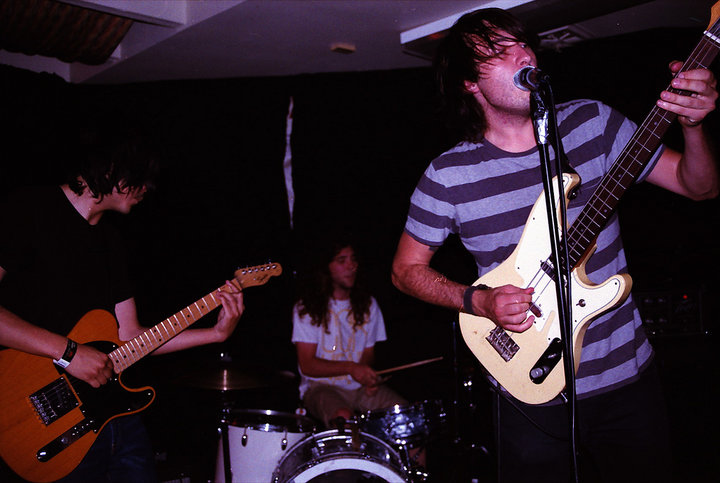

Moonhearts beam a hazy summer light on Total Trash Fest 3

0

In the Wed/3 Guardian you can read the tale of Total Trash Fest 3, and what exactly it takes to be a trash band. Here I present another example of the Total Trash type: Moonhearts.

The band includes vocalist-bassist Mikal Cronin, who also has a solo album out — he’ll play two Trash Fest sets Sunday, August 28 (one with Moonhearts in the afternoon, and later that night by himself). On top of that, he occasionally tours with his friend, local garage rock wizard Ty Segall, who is in Traditional Fools, also set to play Total Trash. It’s a freaky web those trash types weave.

“We’ve played with a lot of those bands [in the fest] before,” Cronin says, adding with a laugh, “I guess we’re pretty trashy, but we try to keep it under control.”

But Moonhearts represents a newer side of trash, veering slightly away from the punk and more toward a dreamy California surf sound. (Don’t worry, the band definitely keeps up the noisy garage ethos of the genre.) It’s a modern, more distorted version of those psychedelic Nuggets box sets, which introduced a generation (whether it admits it or not) to bands like the Seeds and Strawberry Alarm Clock.

Some Moonhearts tracks, such as “I Said” off its eponymous 2010 album on Tic Tac Totally, evoke those bands more directly, while other songs veer toward a more straightforward Dick Dale and the Del-Tones style with the classic, wave-like reverb.

The trio grew up in Laguna Beach, Calif., discovering surfing first, and rock ‘n’ roll second. All three attended Laguna Beach High School and it was there that Cronin first met Segall. The pair started a band, a first for them both, which Cronin describes as a “Laguna Beach party band.”

After high school Cronin went away to college in Portland, Ore., but returned to the coastal Orange Country town in 2006 and started up Moonhearts. “Growing up, we were all obsessed with surf records, so [our music] seemed appropriate. We’ve never talked directly about it, but it seems to permeate everything we do.”

The band was originally called Charlie and the Moonhearts, after drummer Charlie Mootheart, the youngest member of the group, but it has since dropped the “Charlie.” In name only, though — Mootheart, who now lives in San Francisco, continues to play with Cronin and Moonhearts guitarist Roland Cosio, though they both live in Southern California. That’s about to change: Cronin and Cosio are planning to move to the Bay Area as soon as possible.

Moonhearts
With Pangea, King Lollipop, and Si Si Si
Aug. 28, 2 p.m., $7
Hemlock Tavern
1131 Polk, S.F.

Mikal Cronin
With Mouthbreathers, Cosmonauts
Aug. 28, 9 p.m., $7
Hemlock Tavern
1131 Polk, S.F.
www.hemlocktavern.com
Facebook: Total Trash Fest 3

Civil Grand Jury: Parkmerced tenant protections ‘just talk’

The Board of Supervisor’s Government Audit & Oversight Committee heard from members of the San Francisco Civil Grand Jury this morning about a report it issued on the Parkmerced redevelopment.

“When you read this report, nowhere in this report does it say, ‘do not develop,'” said Michael Golrick, a juror with the civil grand jury. Yet he noted that the primary concern highlighted in the document was a perceived lack of tenant protections for residents living in rent-controlled units.

The assurances in the development agreement — that tenants will be moved into new units after their  existing units are demolished, with the same rent-control protections they had before — can’t be guaranteed due to unresolved legal questions, he said. “It is aspirational and inconclusive. Tenants will live under a cloud of uncertainty, possibly for years.” He added, “Until a court decides, it’s all just talk.”

Jennifer Matz of the Office of Economic and Workforce Development and John Rahaim, director of the San Francisco Planning Commission, both noted that the Civil Grand Jury report was hitting on a legal issue, so the city’s formal responses will be prepared in concert with City Attorney Dennis Herrera’s office.

Matz also noted that the draft of the Development Agreement which the Civil Grand Jury had based its assessment on had changed since the Civil Grand Jury report was issued, with new provisions to shore up tenant protections. She also charged that the report “fails to understand certain aspects of the Development Agreement.”

Meanwhile, residents organized under the Parkmerced Action Coalition are still hoping they may have a chance to reverse the Board’s decision to approve the Parkmerced overhaul by placing a referendum on the Nov. 8 ballot to ask voters whether the zoning for the project should be approved. The group of tenants, organized under the “Committee to Stop Mass Demolition of Housing,” submitted 18,487 signatures on July 8. The Department of Elections is still verifying them and so far, the referendum has not yet qualified for the ballot.

Taking out the trash

1

sarah@sfbg.com

A controversial city waste disposal contract appeared primed for final approval by the Board of Supervisors on July 26 (after Guardian press time) — despite being challenged by a lawsuit and initiative campaign — after two progressive supervisors rescinded their initial vote in a July 20 committee hearing and supported awarding the contract to Recology.

City staff had recommended awarding the 10-year, $112-million landfill disposal and facilitation agreement to Recology (formerly NorCal Waste Systems, Inc.), which has grown from a locally based company to the 10th largest waste management firm in the US, with $652 million in annual revenue, according to Waste Age magazine.

If the full board follows the unanimous recommendation of its Budget & Finance Committee, the vote will authorize Recology to transport and dispose up to 5 million tons of the city’s solid waste at the company’s Ostrom Road landfill in Wheatland, Yuba County. The contract will take effect when San Francisco’s disposal agreement at Waste Management Inc.’s Altamont landfill in Livermore expires — estimated to occur in 2015.

The deal will cement Recology’s control, at least for a 10-year period, over all aspects of the city’s solid waste stream, at a cost of about $225 million per year, even as the company faces significant challenges, many related to the city’s 1932 refuse collection and disposal ordinance.

That law, approved during the Great Depression to prevent conflict between competing garbage haulers, has resulted in Recology’s exercising complete control over trash collection and transportation in San Francisco, without having to bid on those contracts or pay the city franchise fees.

During the negotiations over the city’s next landfill contract — the only aspect of San Francisco’s waste stream put out to bid — this 79-year-old law was invoked to explain why Recology has the sole authority to transport trash and compostables to Wheatland, which is 130 miles from San Francisco.

The move also comes as Yuba County is contemplating significantly increasing dumping fees at the landfill — from $4.40 per ton to $20 or $30 per ton — a hike that could erase the $100 million that the Department of the Environment (DoE) claims the Recology deal would save over a competing bid by Waste Management Inc. WM is the largest waste firm in the U.S., according to Waste Age, with about $12.5 billion in annual revenues.

On July 18, WM filed a lawsuit in San Francisco Superior Court to prevent the city from approving the agreements with Recology on the grounds that they violate the city’s competitive bid laws.

“The Department of the Environment inappropriately and unlawfully expanded the scope of its 2009 ‘request for proposal for landfill disposal capacity’ and, therefore, violated the city’s competitive procurement laws,” WM alleges in the suit.

WM has long held that DoE inappropriately issued a tentative contract award for both the transportation and disposal of solid waste to Recology without soliciting any other transportation bids. But DoE, which gleans $7 million annually (to operate recycling, green building, and environmental justice programs and long-term planning for waste disposal) from rates that Recology’s customers pay, ruled last year that WM’s objections are “without merit.”

Now WM is asking the court to require DoE to scrap its award to Recology and issue a new request for proposals to comply with competitive bidding requirements.

“There is ample time for the department to issue a new RFP,” WM stated July 18, noting that there is plenty of room at its Altamont landfill to accommodate the city’s waste after the contract expires.

That same week, a coalition led by retired Judge Quentin Kopp, community activist Tony Kelly, and Waste Solutions CEO David Gavrich announced that it had submitted enough signatures to qualify an initiative on the June 2012 ballot requiring competitive bidding and franchise fees from any company that seeks to win any aspect of the city’s solid waste business.

Kelly says his group was unable to collect enough signatures in time for the November election because Recology hired the city’s two biggest signature-gathering firms to circulate what he calls a “phony petition” in support of Recology’s performance in San Francisco. And signature gatherers say they were harassed by Recology boosters while trying to petition citywide.

“But I believe the question of whether candidates support competitive bidding will continue to be a defining issue this fall,” Kelly said.

The board’s decision on the landfill agreements has already been delayed several months, following a February 2011 Budget and Legislative Analyst report recommending that the board consider submitting a proposition to the voters to repeal the 1932 refuse ordinance so that future collection and transportation services be put to bid. The report also recommended that future residential and commercial refuse collection rates be subject to board approval.

But with two progressive supervisors running in citywide elections this fall, and with Recology exerting massive pressure on elected officials, the Kelly coalition could not find four supervisors to place such a charter amendment on the November ballot, forcing them to launch their own initiative.

And at the July 20 meeting of the board’s Budget and Finance Committee, Sup. Ross Mirkarimi, who is running for sheriff, and Sup. Jane Kim rescinded their initial decision to send the agreements to the full Board without recommendation. Instead, after the committee had moved on to other business, they joined Chair Carmen Chu, one of the most conservative supervisors, in forwarding the Recology agreements to the full board with unanimous support.

Mirkarimi interrupted the committee’s next discussion to rescind the landfill vote. “I think there was some misunderstanding a little bit in wrapping up the landfill agreements with Recology, ” Mirkarimi said. He said that he asked for the vote to be rescinded, “so we can accurately reflect some of the sentiments being articulated here. I think we just learned some things on the fly.”

In many respects, the switch by Kim and Mirkarimi made sense: prior to their initial vote, they made positive statements about the proposed agreements, but also stated an interest in exploring the appropriateness of the city’s 1932 law.

“Overall, I think this was a good contract,” Kim said. But she noted that, thanks to the 1932 ordinance, the city doesn’t get franchise fees. And she claimed that it only gets half of what other Bay Area cities get from their waste contractors. “So, I’m really interested in continuing that conversation, but I think it’s a separate conversation,” she said.

Mirkarimi said it was his concerns that led the committee to “put a pause” on the Recology agreements until it could “undertake more homework.” He also noted that his office “held a number of meetings” and he tried to “leverage this opportunity to reanimate activity at the Port.”

“I was hoping that we might be able to arrive at something much more deliverable,” Mirkarimi said, presumably referring to the fact that these efforts resulted in DoE unveiling an amendment to include two “possible changes” to operations and facilities at the Port of San Francisco in the agreements.

These changes involve utilizing other modes of transportation, including barges, as alternatives to the rail-haul plan proposed in the agreement. They also call for developing new facilities at the Port for handling waste, recyclables, organics, and other refuse. The cost of such alternatives would be passed onto the rate payers.

“I think that, cost-effectively, we may be able to insert the Port into this equation, but it’s not ready for prime-time yet,” Mirkarimi said. He concluded by saying that Recology has been innovative in reducing the city’s waste stream.

“This should be a front-burner conversation,” Mirkarimi said, noting that former Mayor Gavin Newsom focused on making San Francisco “the greenest city” in the United States. He added that San Francisco claims to have a 77 percent diversion rate, the highest in the U.S., and said, “That comes at a cost, it doesn’t come for free.”

After the meeting, DoE deputy director David Assmann said that the City Attorney’s Office is reviewing WM’s filing. “But it’s too soon to comment,” Assmann said.

He also claimed that, thanks to the 1932 ordinance, “there was no practical way” for another company to transport San Francisco’s waste to its designated landfill, “other than building a second transfer station outside the city.”

But Kelly continued to express concerns that the agreements are not competitive, and that the city lacks a contract and ensuing franchise fees. “They are running this as if it’s still the 1950s,” he said.

Kelly claimed that Recology Vice President John Legnitto, who is the 2011 chair of the SF Chamber of Commerce’s Board of Directors, recently told him that Recology has been in negotiations with City Hall around a $4 million franchise fee, but that the money would now be spent opposing Kelly’s competitive bidding initiative.

Frustrations rise with skyrocketing prices for scalped Burning Man tickets

58

In the wake of yesterday’s announcement that Burning Man tickets have sold out for the first time, scalpers have been offering tickets online for several times their face values – some for as much as $5,000 each – frustrating burners and raising difficult questions about what the laws of supply and demand are doing to a community that eschews “commodification” as one of its core principles.

Members of Black Rock City LLC have been worried about this problem since back in January when tickets first started selling briskly. When I asked BRC board members Larry Harvey and Marian Goodell about the possibility of its selling out early, they each asked me not to publicize that possibility because they were worried about scalpers making runs on tickets.

A few months ago, they announced that tickets wouldn’t be available at the gate, and they began to put out word through registered theme camps and occasional notices in the Jack Rabbit Speaks newsletter that selling out was a possibility and that those planning to attend should buy their tickets now.

“I feel bad if anyone was caught unaware, but they should have known,” Goodell told me yesterday.

But if the high prices being asked for Burning Man tickets on sites like eBay and StubHub are any indication, it seems that those looking to profit off the event were just waiting for the announcement that tickets had sold out. High ticket prices are also likely to add incentive to the regular ticket scams that occur, resulting in the likelihood of people getting stuck outside the gate at this far-flung locale.

BRC spokesperson Will Chase addressed that possibility in a post on the Burning Blog yesterday: “For those considering venturing out to Black Rock City without a ticket to ‘try your luck’ purchasing one at or near the entrance to Burning Man, we ask that you do NOT do so, for your own safety and the well-being of the surrounding communities. The Black Rock Desert is an extremely remote, inhospitable environment with limited resources, minimal facilities, and few camping opportunities in the vicinity.”

Longtime burner Chicken John Rinaldi, who has turned into a staunch critic of the way BRC is governed in recent years, said burners who don’t have much money will be tempted to sell their tickets if they really start going for thousands of dollars and he said BRC should have consulted the larger community about the issue.

“They don’t have a plan. They knew it was going to sell out and they didn’t have a plan,” said Rinaldi, who has also been critical of BRC’s plans for converting to a nonprofit with little input from the community about process or potential new governance models. “It was another missed opportunity for Larry to engage with his community…This is going to be a fucking disaster.”

As for what steps BRC is taking to discourage price gouging by scalpers, whether they are beefing up security to better fight off gate-crashers, and responses to criticisms rippling through online discussions among burners about “gentrification” of the event and related concerns, we’re still waiting for responses from BRC members who we expect to interview over the coming days.

So check back for updates on this blog and in next week’s special Guardian issue on Burning Man, which celebrates its silver anniversary this year.

Waste Management sues SF over garbage contract

2

The already intense fight between Recology (formerly NorCal Waste) and Waste Management over SF’s next landfill contract just got more intense: today Waste Management of Alameda County announced that it is filing a lawsuit in San Francisco Superior Court to prevent the final award of a new long-term solid waste transportation agreement and landfill disposal contract to Recology on the grounds that awarding the contract would violate SF’s “competitive bidding ordinances.”

Now, Recology boosters will likely seek to frame this legal challenge as sour grapes over the city’s $11 million-a-year landfill contract. But WMAC’s suit represents a fundamental challenge to how SF’s $225-million-a-year solid waste stream is controlled: the suit requests a judicial declaration regarding the scope of the city’s 1932 Refuse Collection and Disposal Ordinance as it pertains to the transportation of residual wastes to a designated landfill outside city limits.


“The Department of the Environment [DoE] inappropriately and unlawfully expanded the scope of its 2009 ‘Request for Proposal for Landfill Disposal Capacity’ and, therefore, violated the City’s competitive procurement laws,” WMAC alleges.

WMAC has long held that DoE inappropriately issued a tentative contract award for both the transportation and disposal of solid waste to Recology on September 10, 2009, without soliciting any other transportation bids and in violation of longstanding City ordinances. Thanks to the 1932 ordinance, Recology has ended up with a monopoly over collecting and transporting waste through the streets of San Francisco. But that ordinance clearly does not apply to waste transported outside city limits, so folks have been asking if it would be greener to barge the city’s waste to nearby landfills. And they have been questioning whether ratepayers would benefit from lower rates if all of San Francisco’s garbage services, and not just the landfill contract, were put out to competitive bid.


Meanwhile, DoE, which sees $7 million of its own annual operating expenses for recycling, green building, and environmental justice programs and long-term planning for waste disposal incorporated into the garbage rates that Recology’s residential and business customers pay, ruled last year that WMAC’s objections were “without merit.”

So, now WMAC is taking its concerns to the Superior Court, asking that the court require DoE to scrap its tentative contract award to Recology for both waste disposal and waste transportation, and issue a new request for proposal to comply with existing competitive bidding requirements.

“WMAC is resolute in its commitment to providing the City and County of San Francisco with superior disposal services and responding to a Request for Proposal that is fairly administered,” WMAC’s Area President Barry Skolnick stated in a July 18 letter to the SF Board of Supervisors.

The move comes two days before the Board’s Budget and Finance subcommittee was scheduled to vote on approving a 10-year landfill disposal and facilitation agreement with Recology.

 The Board scheduled the vote last week, after it became clear that an initiative to require competitive bidding and franchise fees from waste management companies that seek to collect garbage in San Francisco, would not qualify in time for the November ballot. (Proponents of that initiative say they have enough signatures to qualify it for the June 2012 ballot. And they believe the question of whether candidates support competitive bidding on the city’s lucrative municipal solid waste collection, recycling, and disposal business continue to be a defining issue during the 2011 election.)


The landfill disposal and facilitation vote had already been delayed several months this year, following a Budget and Legislative analyst report that threw a curveball at the DoE’s plan by recommending that the Board consider submitting a proposition to the voters to a) repeal the city’s existing 1932 refuse ordinance such that future collection and transportation services be put to bid, and b) that future residential and commercial refuse collection rates be subject to Board approval. But so far, no supervisors have placed such a charter amendment on the November election.


The landfill disposal contract that the Budget and Finance sub-committee was to consider July 20 authorizes 5 million tons of solid waste disposal, or ten years, at Recology’s Ostrom Road landfill in Yuba County. It is worth in excess of $120 million, if the maximum of 5 million tons is reached, with all associated fees and costs to be passed onto, and  paid for by, refuse rate payers, not city funds. It allows for the Hays Road landfill in Vacaville to be used as a “back-up landfill.” And would allow Recology to pass on up to $10 million in rail hauler penalties, should the Ostrom Road landfill rail spur not be completed on time.


The facilitation agreement that the Board was also set to consider July 20, which governs how San Francisco’s waste is transported to its designated landfill, includes an additional rail transportation fee of $563 per rail container in future residential rate application increases that the Director of the Department of Public Works approves. (Unless there is an appeal, in which case it goes to the Rate Board, which is composed of the City Administrator (the post Ed Lee held before he was named mayor, and to which he wants to return,) the SF Public Utilities Commission director, and the Controller. And. in the event the cit

CCSF paid Recology $6.2 million to dispose of solid waste from city-owned facilities in FY 2010-11, and those costs are expected to increase by three percent to $6.4 million, according to the language of the ordinance that the Board’s budget and finance committee was set to consider this week.

As of press time, the Guardian was unable to reach anyone at City Hall to see if the city is seeking injunctive relief from WMAC’s filing, which provides a summary of San Francisco’s existing ordinances, a chronology of the events leading up to the DoE’s tentative award of the transportation and disposal contract to Recology and the subsequent bid protest filed by WMAC. {We’ll be sure to provide an update as the city’s response to the suit becomes available.)

“WMAC has exhausted all available and/or required administrative remedies,” WMAC states, noting that its filing also documents conflicting positions by DoE regarding the scope of the city’s Refuse Collection and Disposal Ordinance that San Francisco voters approved almost 80 years ago.

According to WMAC, DoE’s May 8 2008 Request for Qualifications stated that “the 1932 Refuse Collection and Disposal Ordinance …. does not address consolidating materials, processing for material recovery or transporting them to other facilities.”

According to WMAC, DoE re-stated this position in its Feb. 9, 2009 Request for Proposals.

“Yet in response to WMAC’s bid protest on (date) the Department stated there was no need to competitively bid transportation services outside the City limits since Recology was the only entity permitted under the 1932 ordinance to transport wastes from the in-city transfer station to an out-of-city landfill. “

As a result, WMAC is requesting the Court to rule on the scope of the 1932 Ordinance.

WMAC also notes that the Board of Supervisors designated the Altamont Landfill as the disposal site for all refuse collected within the City from November 1, 1998 through October 31, 2053, or until the City deposits 15 million tons. And that the 15 million ton has yet to be reached.

“There is ample time for the Department to issue a new RFP,” WMAC claims.

Repulsed by Recology’s tactics, Kopp strikes name from Adachi initiative

36

Who knew that a bunch of garbage could get a taxpayer watchdog like former supe/state senator/judge Quentin Kopp threatening not to endorse Public Defender Jeff Adachi’s pension reform initiative? But that’s what happened according to Kopp, who adds that he was “personally insulted’ by a signature gatherer outside the West Portal post office last week, after he struck his name from a petition he had signed in support of Public Defender Jeff Adachi’s pension reform measure.

Adachi, who has reportedly been paying up to $5 per signature, also came under fire this week from opponents of his measure, who are threatening legal action after an undercover video showed four signature gatherers for Adachi’s measure soliciting signatures while making misleading statements about the proposal.

But this misbehavior had not been made public when Kopp encountered a signature gatherer last Friday, who asked if he would sign the Adachi petition. “I wrote my name and has just started to print it, when he said, how do you feel about Recology?” recalled Kopp, who is backing a ballot initiative that would require competitive bidding and hundreds of millions of dollars in franchise fees from firms who seek to win San Francisco’s garbage collection and recycling contract.

As such, Kopp’s initiative threatens to up-end the terms of an 80-year old charter amendment that resulted in Recology (formerly Norcal Waste Systems) gaining a contractless monopoly on San Francisco’s $226 million-a-year garbage and recycling stream. 

When Kopp asked the signature gatherer, who identified himself as Tim McArdle, why he was asking about Recology, McArdle said he had another petition on hand, which referred to the allegedly satisfactory service that Recology is providing.

At which point, Kopp began to strike his name from Adachi’s $5-a pop petition. McArdle allegedly interrupted, saying, “No, that’s not the same petition as Recology’s.” And when Kopp kept scratching out his name, McArdle allegedly began swearing at him, even allegedly employing the time-honored F-word. “A woman walked by and was shocked,” Kopp said.(So far the Guardian has been unable to locate McArdle, but when we do, we’ll be sure to update this post.)


When McArdle grabbed back his clipboard, Kopp said he was able to see that on its backside was what Kopp describes as ‘Recology’s phony petition.”

So, why is Kopp so repulsed by Recology? According to Kopp. Recology recently signed up the city’s top signature-gathering firms to work on their petition thereby preventing Kopp and his associates from hiring these firms to collect signatures for his competitive bidding initiative. “And they are doing so from our rates, the money we pay, its legalized misappropriation of our money,” Kopp claimed

So far, it seems as if Recology’s strategy is paying off, at least in the short term. This week, sponsors of the competitive bidding initiative announced that they will turn in their signatures by December 11 to qualify their measure for the June 2012 ballot—and not their original target of November 2011.

Their decision followed less than three weeks of signature-gathering, a tight squeeze that occured, in part, because the City Attorney’s Office  took the full 15 days allowed by law to review the language of the Kopp initiative, which was first submitted June 3.

Even so, and despite an extensive Recology-financed media campaign that included push polls and network and cable TV ads against competitive bidding,  proponents and volunteers with Kopp’s campaign managed to gather the 7,168 signatures they needed to qualify his initiative by the city’s July 11 deadline for submitting petitions for the November election. But some signatures could prove invalid, hence the decision to delay the competitive bidding initiative until June.

And the Guardian learned today that the Board’s Budget and Finance Committee has scheduled a July 20 hearing on whether to award Recology the city’s $11 million-a-year landfill disposal contract, with the full Board set to vote on the issue on July 26 and August 2. In other words, the Board is rushing to make a decision on the landfill, which would further consolidate Recology’s monopoly on the city’s waste stream, before the Board’s summer recess.

The Guardian has also learned that the Budget and Finance Committee will hear a resolution July 20 concerning Recology’s existing agreement with the city over garbage. Rumors are swirling that this hearing will allow Sup. Ross Mirkarimi, who sits on the committee, is running for sheriff and has allegedly been meeting with Mayor Ed Lee and Recology president and CEO Mike Sangiacomo behind closed doors, to insert a clause to allow for the payment of a $4 million franchise fee. But insiders assure the Guardian that Mirkarimi has no such plans, although Mirkarimi himself could not be reached.


Either way, as Kopp points out, the alleged proposed $4 million fee would only amount to 2 percent of Recology’s annual revenue from San Francisco ratepayers. ‘That’s almost an insult,” Kopp said, noting that Oakland, whose population is 340,000, (42 percent of San Francisco’s daytime population) gets a franchise fee of $30 million.

Now, in a recent report to the Board’s LAFCO committee, Recology claimed it provides $18 million annually in “free services” to the city. But the report did not include an independent analysis of Recology’s estimates, and therefore these claims raised the hackles of Kopp, Kelly and other competitive bidding proponents.

Kopp predicts a $4 million franchise fee would allow city leaders who oppose his measure to claim that one of the two objectives of his proposed initiative have been addressed.

In an interview with the Guardian earlier this year, Mayor Ed Lee said he felt that Recology “has justified its privilege to be the permit holder in San Francisco because of the things that it has been willing to do with us.”

Kopp said Lee repeated this position in June, and that Board President David Chiu recently said that he is opposed to monopolies in concept, but felt that any effort to allow competitive bidding on garbage services would tear the city apart.

“Chiu spoke in such draconian terms I thought I was in Iraq or Afghanistan,” Kopp said.

But these latest developments have strengthened Kopp and Kelly’s resolve to push ahead with their effort to give local residents a chance to decide whether competitive bidding would be better for San Francisco rate payers. As they point out, such a vote doesn’t mean Recology would be ousted from the city because they stand an excellent chance of winning any competitive bid. But it could mean that Recology is ousted from its current cost-plus arrangement with the city that allows them to make an estimated 10-20 percent profit.

And whatever happens, the upcoming battle threatens to shed light on Recology’s business model, which is based on vertical expansion into other counties and states, and the knowledge that, unlike the competitive bids it submits everywhere else in California, it has a guaranteed annual revenue of $225 million in San Francisco. In its 1996 filings with the Securities Exchange Commission, NorCal Waste and its 45 subsidiaries (now known as Recology) reported that San Francisco accounts for 50 percent of its annual revenue. And while those public filings are 15 years old, it’s clear Recology continues to rely on San Francisco for a large and guaranteed chunk of its income.

Or as one insider put it, “When you have a cost-plus contract, you can start buying things—like the Pier 96 development, and the recycling facility. And you can move profits to a different part of the company. You’re not competitively bidding the composting. And you can shift your profits out of San Francisco. And with a cost-plus contract, you put everything in the rates. For instance, the city says it wants composting. Ok, here’s the cost, here’s the bill. But you take the profit from the composting and invest it in San Jose, or San Bernardino, and use it to advance your other objectives, like buying two large landfills in Nevada and financing political campaigns.”

Meanwhile, Kopp says he plans to take Adachi to task for hiring the same signature gathering firm that is trying to undermine his petition.


“And I’m not planning to sign his petition now, and I might not endorse it,” Kopp said.


Black and white and red all over

0

Mikhail Kalatozov’s career had a large hole in the middle, one that remains incompletely explained. Why were the two periods of his greatest work separated by roughly three decades? Why did he make almost nothing between? The answer definitely involved Stalin and his fickle cultural watchdogs, even if the full reason for such a long lull (or fall from favor) might never be known.

At least he was spared a permanent gulag vacation, which would have deprived us of a late 1950s reflowering that resulted in three world classics still being discovered in the West — particularly since 1964’s astonishing I Am Cuba got rereleased under Francis Ford Coppola and Martin Scorsese’s auspices 16 years ago. If you’ve seen that or another Kalatozov film, it’s distressing to think he spent any time unwillingly idle, since every feature still accessible today is some kind of masterpiece.

The San Francisco Silent Film Festival’s 16th annual edition offers the last feature he made before that mysterious long withdrawal from the director’s chair. Nail in the Boot (1931) lasts just 53 minutes, but packs in more photographic and editorial ideas than a dozen features twice its length. It’s a dazzling application of sheer stylistic invention to propagandic material. Yet rather than please the apparatchiks upstairs, it ticked them off enough to derail Kalatozov’s career for a good spell.

Born in Tbilisi, Georgia, he began working as an actor, editor, and cinematographer in that (reluctant) Soviet republic’s 1920s film industry, eventually graduating to directing documentaries celebrating the USSR’s industrial, agricultural, and cultural advancement. Little is known about a first narrative feature, 1930’s Little Blind Girl. But the same year’s semi-staged Salt for Svanetia won acclaim for its strikingly poetical imagery of life in a remote Caucasus Mountains village.

That success presumably greased the way for the larger endeavor of Nail in the Boot, which mixes up the epic and the intimate, beautiful shots of lovingly lit machinery and glowing worker faces intercut with striking battle vistas and the proverbial cast of thousands. The story can be reduced to the title’s troublesome metal inch: when enemy forces strand armored train “Guardian of the Revolution” between blown-up track sections, a lone comrade (Aleqsandre Jaliashevili) is dispatched on foot to notify HQ. Running over hill and dale, he’s severely hampered when the poorly made boot from his own factory falls apart, driving a binding nail into his foot. As a result, his trapped compatriots are gassed to death before reinforcements arrive.

At a huge subsequent Party trial, our fallen hero is excoriated as a traitor for stopping to soak his painful, bleeding foot. “You shot them! The undelivered dispatch was like a bullet!” “He spared his feet and destroyed the armored train!” angry comrades shout, calling for his head. But this nameless prole finally defends himself, indicting his footwear’s shoddy workmanship as at least equal in fault. Nail in the Boot was intended as a parable (based in turn on a Russian folk tale) urging Soviets to always perform superlatively for the good of all, whatever their job. A final intertitle accuses lazy bones present: “Among you spectators: are there many like the bootmakers?”

That message seems simple and unimpeachable enough, not to mention spectacularly presented. Yet Nail had the ill fortune to arrive just as USSR arts ideology was changing. The experimentation encouraged in the 1920s was now judged indulgent “formalism” unsuitable for the masses, while a new school of nail-on-the-head “Social Realism” took shape as the sole officially state-sanctioned artistic guideline. Kalatozov’s film was denounced as confusing and unrealistic on petty grounds, as well being guilty of “formalistic aestheticism.” The film was banned, for a long time considered lost, and beyond a couple features at the start of World War II, Kalatozov was kept offscreen — albeit kicked upstairs to various film administrative posts.

He did well enough in those capacities to become the Soviet film industry’s emissary to Hollywood for an extended late 1940s stay. Hobnobbing with stars, he greatly admired the major studios’ streamlined production methods and technical advances — but like a good comrade, returned home to condemn Tinsel Town as the apex of capitalist decadence. (Hell yeah!) Then, finally, he was considered rehabilitated enough to trust behind a camera once again.

The results, after a few more conventional features no longer in circulation, were stupendous: 1957’s The Cranes Are Flying introduced a new Kalatozov, energetic and inventive as ever, director of photography Sergei Urusevsky’s wildly mobile camera replacing rhythmic Eisensteinian montage as his primary instrument. Taken as a cinematic emblem of Khrushchev-era Cold War thawing, it was an international triumph, even if its tragic wartime romance now seems less conceptually unique than two extraordinary (if far less popular) next ventures.

The Unsent Letter (1960) is one of the movies’ great man vs. nature depictions, as Soviet geologists searching for diamond deposits in remotest Siberia fall prey to that land’s geographic and climatic extremes. I Am Cuba, a Soviet-Cuban collaboration depicting the Cuban revolution on a humongous scale, was derided as being “too Russian” by the Cubanos, “too formalist” (or whatever the current ideological phrase was) by Moscow. Forgotten for decades, it’s been much written about lately — suffice to say Roger Ebert thought it contained the single “most astonishing [shot] I have ever seen,” amid 141 minutes full of such wonders.

After less idiosyncratic but impressive 1970 Soviet-European superproduction The Red Tent (1970) — an arctic adventure with international stars like Sean Connery and Claudia Cardinale, shot in locations as frigid as 40 below zero — Kalatozov died at age 70, planning another impossibly ambitious epic. In a perfect world, he’d actually finish it, his cryogenically frozen brain retrieved from some secret polar lab. Imagine what he could do with a Steadicam and 3-D; James Cameron might find himself merely a wee prince of the world by comparison.

SAN FRANCISCO SILENT FILM FESTIVAL

Thurs/14–Sun/17, free–$20

Castro Theatre

429 Castro, SF

(415) 621-6120

www.silentfilm.org

SFBG Radio: Secession planning

0

Today we talk about whether it’s crazy for the southern part of the state to secede — and assorded other topics including the nation’s debt limit. Check it out after the jump. 


Heavyshit by endorsements2010

Obama 2012 raises $86 million in small donations

3

The Obama 2012 campaign files its first financial report with the Federal Election Commission on Friday July 15. In an email to Obama supporters, the campaign noted that, “the Washington chatter around the report we’re releasing has focused on one number: the sum total we’ve raised.”

That number, as it turns out,  is more than $86 million, with 98 percent of the contributions coming in at $250 or less, with the average donation being $69, according to the Obama campaign.

”But other numbers that the pundits often ignore — like how many field offices we and the DNC have open, how many one-on-one conversations we’ve had with potential supporters, and how many people have already decided to own a piece of this campaign — tell the real story of our campaign,” Jim Messina, campaign manager for Obama for America, observed in an emailed statement.

According to a video the Obama campaign released today, they’ve had 31, 000 face-to-face conversations and 290,000 phone conversations with supporters. And they have already held 650 grassroots planning meetings and signed up 1,500 full-time volunteers.

”All those numbers are in the video, and they’re the ones you should be proud of today. Watch it now,” the Obama campaign suggests.

The campaign concludes by noting that, “our opponents won’t have hundreds of thousands of people giving whatever they can afford — so they’ll be relying heavily on money from two sources to fund an unprecedented barrage.”

These two sources, the campaign claims, are “Washington lobbyists and special interests whose explicit aim is to influence the federal government in any way they can,” and, “outside groups that don’t have to disclose a word about what they’ve raised or who they’ve raised it from, like one of Karl Rove’s political organizations. His groups have set an astounding $120 million fundraising goal in their campaign to tear down President Obama.”

The specter of Rove (aka the “boy genius” or “Turd Blossom” depending on your point of view) rising from the ashes like Harry Potter’s nemesis Voldemort isn’t exactly comforting (unless you believe that American politics are on a parallel track to the outcome of the Harry Potter 7: Part 2 movie, which opens this Friday.)

As the Obama campaign notes, “The threat to our success from these determined groups — acting solely in their own interest, not the public interest — is real, and it’s growing. And it’s going to take serious commitment and vigilance from all of us to withstand their attacks while still building the grassroots campaign we’ll need to win.”

Now I know plenty of people who are pissed off at Obama, because, yes we did kill Osama, and yes we didn’t withdraw all the troops from Afghanistan, etc. etc. But it feels as if the moment is already here in which regular folks need to remind themselves what life under a Republican administration with Rove’s hands on the wheel  was truly like. Unless, of course, you truly believe that life under Obama is just as bad. In which case, let’s hear about the realistic alternatives…

Parks Inc.

6

steve@sfbg.com

Should the city be trying to make money off of its parks, recreation centers, and other facilities operated by the Recreation and Park Department? That’s the question at the center of several big controversies in recent years, as well as a fall ballot measure and an effort to elevate revenue generation into an official long-term strategy for the department.

So far, the revenue-generating initiatives by RPD General Manager Phil Ginsburg and former Mayor Gavin Newsom have been done on an ad hoc basis — such as permitting vendors in Dolores Park, charging visitors to Strybing Arboretum, and leasing out recreation centers — but an update of the Recreation and Open Space Element (ROSE) of the General Plan seeks to make it official city policy.

The last of six objectives in the plan, which will be heard by the Planning Commission Aug. 4, is “secure long-term resources and management for open space acquisition, operations, and maintenance,” a goal that includes three policies: develop long-term funding mechanisms (mostly through new fees and taxes); partner with other public agencies and nonprofits to manage resources; and, most controversially, “pursue public-private partnerships to generate new operating revenues for open spaces.”

The plan likens that last policy to the city’s deal with Clear Channel to maintain Muni bus stops with funding from advertising revenue, saying that “similar strategies could apply to parks.” It cites the Portland Parks Foundation as a model for letting Nike and Columbia Sportswear maintain facilities and mark them with their corporate logos, and said businesses such as bike rental shops, cafes, and coffee kiosks can “serve to activate an open space,” a phrase it uses repeatedly.

“The city should seek out new opportunities, including corporate sponsorships where appropriate, and where such sponsorship is in keeping with the mission of the open space itself,” the document says.

Yet that approach is anathema to how many San Franciscans see their parks and open spaces — as vital public assets that should be maintained with general tax revenue rather than being dependent on volunteers and wealthy donors, subject to entry fees, or leased to private organizations.

That basic philosophical divide over how the city’s parks and recreational facilities are managed has animated a series of conflicts in recent years that have soured many people on the RPD. They include the mass firing of rec directors and leasing out of rec centers, the scandal-tinged process of selecting a new Stow Lake Boathouse vendor, new vending contracts for Dolores Park, the eviction of the Haight Ashbury Neighborhood Center recycling facility, plans to develop western Golden Gate Park and other spots, the conversion by the private City Fields Foundation of many soccer fields to artificial turf, and the imposition of entry fees at the arboretum.

Activists involved in those seemingly unrelated battles united into a group called Take Back Our Parks, recognizing that “it’s all the same problem: the monetization of the park system,” says member John Rizzo, a Sierra Club activist and elected City College trustee. “It’s this Republican idea that the parks should pay for themselves.”

And now, with the help of the four most progressive members of the Board of Supervisors, the group is putting the issue before voters and trying to stop what it calls the auctioning off of the city’s most valuable public assets to the highest bidders.

The Parks for the Public initiative — which was written by the group and placed on the ballot by Sups. John Avalos, David Campos, Eric Mar, and Ross Mirkarimi — is intended to “ensure equal public access to parks and recreation facilities and prevent privatization of our public parks and facilities,” as the measure states. It would prevent the department from entering into any new leases or creating new entry fees for parks and other facilities.

Even its promoters call it a small first step that doesn’t get into controversies such as permitting more vending in the parks, including placing a taco truck in Dolores Park and the aborted attempt to allow a Blue Bottle Coffee concession there. But it does address the central strategy Newsom and his former chief of staff, Ginsburg, have been using to address the dwindling RPD budget, which was slashed by 7 percent last year.

“What a lot of us think the Recreation and Parks Department is actually doing is relinquishing the maintenance of park facilities to private entities,” says Denis Mosgofian, who founded the group following his battles with RPD over the closures and leases rec centers. “They’re actually dismantling much of what the public has created.”

He notes that San Francisco voters have approved $371 million in bonds over the last 20 years to improve parks and recreation centers, only to have their operations defunded and control of many of them simply turned over to private organizations that often limit the public’s ability to use them.

By Mosgofian’s calculation, at least 14 of the city’s 47 clubhouses and recreation centers have been leased out and another 11 have been made available for leases, often for $90 per hour, which is more than most community groups can afford. And he says 166 recreation directors and support staffers have been laid off in the last two years, offset by the hiring of at least nine property management positions to handle the leases.

Often, he said, the leases don’t even make fiscal sense, with some facilities being leased for less money than the city is spending to service the debt used to refurbish them. Other lease arrangements raised economic justice concerns, such as when RPD evicted a 38-year-old City College preschool program from the Laurel Hill Clubhouse to lease it to Language in Action, a company that does language immersion programs for preschoolers.

“Without telling anyone, they arranged to have a private, high-end preschool go in,” Rizzo said, noting that its annual tuition of around $12,000 is too expensive for most city residents and that the program even fenced off part of the playground for its private use, all for a monthly lease of less than $1,500. “They don’t talk to the neighbors who are affected or the users of the park … We’re paying for it and then we don’t have access to it.”

They also refused to answer our questions. Neither Ginsburg nor Recreation and Park Commission President Mark Buell responded to Guardian messages. Department spokesperson Connie Chan responded by e-mail and asked us to submit a list of questions, which department officials still hadn’t answered at Guardian press time. But it does appear that the approach has at least the tacit backing of Mayor Ed Lee.

“In order to increase its financial sustainability in the face of ongoing General Fund reductions, the Recreation and Parks Department continues to focus on maximizing its earned revenue. Its efforts include capitalizing on the value of the department’s property and concessions by entering into new leases and developing new park amenities, pursuing philanthropy, and searching for sponsorships and development opportunities,” reads Mayor Lee’s proposed budget for RPD, which includes a chart entitled “Department Generated Revenue” that shows it steadily increasing from about $35 million in 2005-06 to about $45 million in 2011-12.

And that policy approach would get a big boost if it gets written into the city’s General Plan, which could happen later this year.

Land use attorney Sue Hestor has been fighting projects that have disproportionately favored the wealthy for decades, often using the city’s General Plan, a state-mandated document that lays out official city goals and policies. She also is concerned that the ROSE is quietly being developed to “run interference for Rec-Park to do anything they want to.”

“By getting policies into the General Plan that are a rationalization of privatization, it backs up what Rec-Park is doing,” Hestor said, noting how much influence Ginsburg and his allies have clearly exerted over the Planning Department document. “It’s effectively a Rec-Park plan.”

Sue Exeline, the lead planner on ROSE, said the process was launched in November 2007 by an Open Space Task Force created by Newsom, and that the Planning Department, Neighborhood Parks Council, and speakers at community meetings have all influenced its development. Yet she conceded that RPD was “a big part of the process.”

When we asked about the revenue-generating policies, where they came from, and why they were presented in such laudatory fashion without noting the controversy that underlies them, Exeline said simply: “It will continue to be vetted.” And when we continued to push for answers, she tried to say the conversation was off-the-record, referred us to RPD or Planning Director John Rahaim, and hung up the phone.

The rationale for bringing in private sources of revenue: it’s the only way to maintain RPD resources during these tight budget times. A July 5 San Francisco Examiner editorial that praised these “revenue-generating business partnerships” and lambasted the ballot measure and its proponents was titled “Purists want Rec and Park to pull cash off trees.”

But critics say the department could be putting more energy into a tax measure, impact fees, or other general revenue sources rather than simply turning toward privatization options.

“We need to see revenue, but we also need to stop the knee-jerk acceptance of every corporate hand that offers anything,” Mosgofian said. “Our political leadership believes you need to genuflect before wealth.”

And they say that their supporters cover the entire ideological spectrum.

“We’re getting wide support, everywhere from conservative neighborhoods to progressive neighborhoods. It’s not a left-right issue, it’s about fairness and equity,” Rizzo said.

In sponsoring the Parks for the People initiative and unsuccessfully trying to end the arboretum fees (it failed on a 5-6 vote at the Board of Supervisors, with President David Chiu the swing vote), John Avalos is the one major mayoral candidate that is raising concerns about the RPD schemes.

“Our parks are our public commons. They are public assets that should be paid for with tax dollars,” Avalos told us. He called the idea of allowing advertising and corporate sponsorships into the parks, “a real breach from what the public expects from parks and open space.”

When asked whether, if he’s elected mayor, he would continue the policies and let Ginsburg continue to run RPD, Avalos said, “Probably not. I think we need to make a lot of changes in the department. They should be given better support in the General Fund so we don’t have to make these kinds of choices.”

ROSE will be the subject of informational hearings before the Planning Commission on Aug. 4 and Sept. 15, with an adoption hearing scheduled for Oct. 13. Each hearing begins at noon in Room 400, City Hall, 1 Dr. Carlton B. Goodlett Dr., San Francisco.


One month to read a 1,600-page DEIR on the America’s Cup: Ready, set, go!

Members of the public will have a chance to offer feedback on the massive draft environmental impact report (DEIR) for the America’s Cup at the Planning Commision on August 11 — one month from the date of the DEIR release, July 11. Anyone interested in weighing in on far-reaching plans for the Northern Waterfront during the world-famous sailing matches in 2012, 2013, and beyond ought to download the report now and start diving in. To absorb the whole thing, you’d have to read 53 pages a day.

Representatives from the Port of San Francisco, the Office of Economic and Workforce Development, and America’s Cup Race Management gathered in San Francisco City Hall July 11 for a briefing on the landmark document. Race organizers are aiming to wrap up the environmental review process by the end of the year.

Iain Murray, CEO of America’s Cup Race Management, spoke about the history of the regatta, the sailing events planned around the globe from now until the 2013 match, and the challenges even the world’s most skilled sailors will encounter while learning to pilot the specialized America’s Cup vessels.

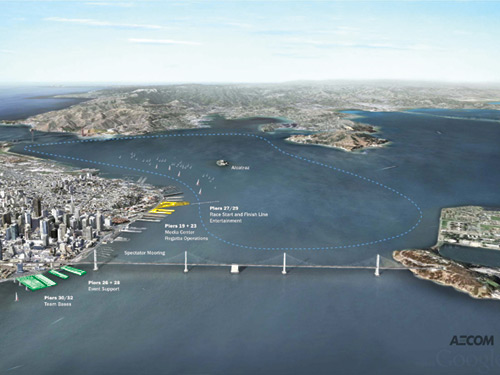
Brad Benson of the Port of San Francisco explained that Pier 27 would serve as a primary public viewing area during the event and a focal point for city activities during the match, complete with spectator vessels. He also noted that preparations for the race would involve dredging and sub-structure improvements at Piers 30-32, which would house cranes for lifting the giant boats in and out of the water.

Yet none of the speakers spoke directly about the findings of the DEIR.

“What we’d like to do is let the document speak for itself,” said Michael Martin, America’s Cup Project Director, after a reporter asked him to provide a summary. Martin also noted that a number of locations were being studied as areas where members of the public could congregate during the races, including Crissy Field, Aquatic Park, and Fort Mason. Alcatraz would likely be used for private events, he added.

The DEIR is a hefty document which we’ve barely begun to peek at. It encompasses plans not only for the America’s Cup, but a two-story, 91,000-square foot cruise terminal at Pier 27 that would serve ships carrying as many as 4,000 passengers. (The green shoreside power hookup there, as we reported last week, will be temporarily disabled, negatively impacting air quality.)

If the proposal is approved as written, the core and shell of the cruise terminal would be built to house the America’s Cup operations as part of the America’s Cup Village at Piers 27-29. After the 2013 events, the rest of the facility would be completed.

Meanwhile, a coalition of environmental organizations that have been involved in the planning process released a statement expressing “guarded optimism” about the DEIR. Made up of representatives from San Francisco Baykeeper, San Francisco Tomorrow, and the Turtle Island Restoration Network, the groups signalled that they would be keeping a close eye on issues such as traffic congestion, the impacts of crowding near sensitive habitats in the Presidio and other viewing areas, carbon-reduction plans, and impacts to Bay water quality and marine life.

“Our organizations are committed to a green and carbon negative event and this is just the first step in ensuring that we get that,” said Teri Shore, Program Director of Turtle Island Restoration Network. “We need to have a thorough understanding of the impacts of the event, how they will be mitigated, and who will pay.” 

CPMC to City: Drop Dead

21

The astonishing cluelessness of the folks at California Pacific Medical Center continues.

In our last episode, CPMC’s chief, Dr. Warren Browner, announced to the City Planning Commission that the hospital had no interest in following the normal rules that apply to every developer planning a massive $2.5 billion project. Developers have to pay fees for transit and affordable housing. Nonprofits like CPMC are supposed to spend money on charity care. Nobody — not even the more moderate members of what is by no means an anti-development commission — was ready to accept Browner’s line.

And now the hospital chain has officially told San Francisco to go fuck itself. 

Sorry, Doc — this isn’t going to work.

IF Ed Lee has any integrity at all (and I hope and believe that he does) he’ll stick to his original position and demand a reasonable community benefits agreement that includes housing money, transit money, increased charity care and a commitment to keep St. Luke’s Hospital open in the Mission for the forseeable future. And he’ll tell the white coats and suits at CPMC that if they don’t want to do that, then San Francisco isn’t interested in their project.

CPMC can’t exactly pull up stakes and move: The Sutter affiliate makes its money by serving San Francisco residents (and working with San Francisco doctors who send insurance money into the hospital system). Go ahead, Dr. Browner — try to build in Brisbane. You’ll lose all your San Francisco patients — and all that Brown and Toland insurance money.

The activists at every level have made it pretty clear that they’re willing to work with CPMC and accept a gigantic project on the edge of the Tenderloin, on a street that already has terrible traffic and transit problems — but not without a solid, acceptable community benefits agreement. So the hospital crew is going to have to learn to work with San Francisco. 


Ghost Fleet wanderers

5

Scott Haefner, Stephen Freskos, and Jon Haeber aren’t the types to stand out in a crowd. Haefner is a web developer, Freskos supervises projects for an engineering firm, and Haeber has a desk job at a company that helps businesses hit high on Google — three straight-laced Bay Area professionals who blend readily into the corporate world.

But everyone’s got their thing — a way to break out of bounds, or scratch the itch of some incessant curiosity.

For these three friends in their late-20s to mid-30s, their thing entails prowling around in rundown deserted places by the light of the full moon, at times taking great pains to avert detection by security patrols. “We go into places that most people don’t go,” Haefner says. They’ve been traipsing into the unknown and documenting their discoveries together for years, motivated as much by art as adrenaline.

This past May, after weighing the consequences, they publicized one of their boldest excursions yet: Sneaking aboard the Mothball Fleet in Suisun Bay to spend entire weekends roaming the bowels of the mildewed vintage ships, while dodging the beams of patrol-boat searchlights.

Unlike many nocturnal wanderers magnetically drawn to abandoned spaces — squatters, taggers, or scrappers, for instance — they don’t break in, vandalize, or steal. Instead, they adopt the same sense of reverence in decaying, chemical-laden industrial places that conscientious hikers assume on backwoods trails. They shoot night photos with professional quality gear, occasionally using flashlights to achieve a technique called light painting.

Haefner, Freskos and Haeber consider themselves advanced practitioners in the art of urban exploration (a.k.a. urbex or UE), an underground activity that’s grown trendier as it draws in adventuresome novices. Now that they’ve publicized their caper aboard the Mothball Fleet, however, they’ve also come under the watchful eye of the feds.


EXPIRATION DATE

At first they thought it was a pipe dream. Doubting their ability to access the Mothball Fleet was saying a lot, considering they’d once snuck onto the Vandenberg Air Force Base and wandered amid abandoned missile silos, absorbing the gravity of the military history those Cold War artifacts represented. Another time they’d managed a nighttime excursion to Neverland Ranch, the famed private amusement park of the late Michael Jackson.

But the ghost ships moored at Suisun Bay seemed out of their league. The rows of hulking, government-owned vessels were locked up and berthed offshore, surrounded by a security headquarters and a shoreline barricade plastered with “No Trespassing” signs. Patrol boats equipped with searchlights circled the docks 24 hours a day, and the prospect of climbing aboard without being spotted seemed crazy.

But then they got word that the last of the aging ships would soon be towed away and destroyed. For Haeber, the history nut of the bunch, this changed everything. “It was about the urgency of making sure these ships were documented,” he explained. “Getting them in the current state that they’re in is so important.”

Alternatively known as the Mothball Fleet and the Ghost Fleet, the ships are part of the National Defense Reserve Fleet, a collection of cargo ships, tankers, and military auxiliaries overseen by the U.S. Maritime Administration (MARAD). Created in 1946 to be ready for deployment in case a national emergency arose, the fleet consisted of 2,277 ships at its height in 1950, strategically stationed at eight anchorages nationwide. For most of the vessels, the call to service never came, and they declined into obsolescence. By April, the entire fleet had dwindled to just 178 ships, at dock in Suisun Bay; Fort Eustis, Va.; and Beaumont, Texas.

The ships that have been moored at Suisun Bay for decades have long since deteriorated, and now they’re being hauled off to the scrap yard bit by bit, though the spot will continue to serve as an anchorage for newer additions to the National Defense Reserve Fleet.

Some were constructed in the World War II era, while others date back to the 1960s and 1970s. While many are tankers or merchant vessels, there are also warships, relics of history deployed in World War II, the Korean War, the Vietnam War, and Operation Desert Storm.

Many of the roughly 70 dilapidated ships have become ecological hazards, leaching toxins and heavy metals into the tidal estuary, which flows into San Francisco Bay. The monumental task of removing and dismantling them began late last year, providing badly needed blue-collar jobs on Mare Island, in the economically depressed city of Vallejo.

By 2017, the last of the ghost ships will have met with torch cutters. At least one will be salvaged: the USS Iowa (BB-61) — a 1938 lead battleship that shuttled President Franklin D. Roosevelt to and from the Tehran Conference during World War II — will be donated and turned into a museum.

Aside from being scrapped, outmoded ships meet with a variety of fates. Some are donated for educational use while others are deliberately sunk to create artificial reefs. Still others are used for target practice in the Navy’s sink-at-sea live-fire training exercises program (SINKEX).

“We saw that these things were going to be gone,” Haefner said. “So we planned it out.”

Haeber examined satellite imagery on Google Earth. Freskos, who’d spent time at sea, studied the tidal patterns. The three scoured the Internet for online photos of the Ghost Fleet. They conducted a scouting mission with binoculars in hand, and gained a sense of when they could take advantage of windows of opportunity between the 30-minute patrol boat rounds.

Long before they even discovered a navigable slough that snaked through a marsh into Suisun Bay or spotted the Craigslist post advertising an inflatable raft for sale, Freskos went up to shoreline gate where the “No Trespassing” signs were posted. He peered through at the tantalizing rows of mothballed ships, and hollered as loud as he could. Nobody responded.


DECAYED TIME CAPSULES

After the months of planning left them confident that it was indeed possible to access the Mothball Fleet, the trio of photographers set out for their first visit, with about 700 pounds of gear in tow. They split the cost of a 12-foot inflatable Fish Hunter raft with a Minn Kota trolling motor. They carried the raft and their gear through a muddy expanse to a marshy spot where the low-profile craft could be set into a narrow slough, safely out of view.

“We always went on or exited at nighttime,” Haefner said. “We would go on nights near the full moon so we could take pictures. It makes it look even more ghostly.”

Their first target was Row F, a line of ships docked in a straight shot from where the slough filtered into the bay. They maneuvered down the narrow channel in their raft, dodging submerged obstacles along the way. Keeping tabs on the whereabouts of the security boat, they started rowing once they reached the open water, and managed to bridge the 800-foot distance to the first ship.

“Our plans were kept secret to all except our loved ones,” Haeber wrote in an online account of that first excursion. “Nobody, other than my girlfriend, knew exactly where I was that weekend. For all intents and purposes, I was on a fishing trip with some friends.”

“Keep Off” signs announcing an invisible 500-foot barrier that was not to be breached were affixed to the hull of every ship. The intruders maneuvered their raft between two Coast Guard cutters, Planetree and Iris, and tied up.

“It can be kind of a challenge getting on,” Haefner explained. “We’re risking ourselves, obviously, but we also brought a bunch of expensive camera gear.” He was the first one to climb aboard the Iris, reaching high to grab onto a bumper that he could then pull himself up on to gain access to the ship. While Freskos kept watch, Haeber handed the gear up to Haefner bit by bit. Once all three were aboard with their backpacks and camera equipment, they hauled up the raft and deflated it.

The Iris was commissioned in 1944. In 1970, it responded to the scene of an oil-rig fire in Galveston, Texas. In 1987, it assisted with cleanup operations in Prince William Sound after the Exxon-Valdez spill. It was decommissioned in 1995, so their entrance likely marked the first time anyone other than MARAD employees had been aboard in 16 years.

A handy feature of ghost ship exploration is that once aboard a ship, it’s possible to access any ship along the entire row, thanks to gangplanks connecting the vessels. So while many of the mothballed vessels were completely secured, there was always the chance that the next one down would have an unlocked entranceway. Part of the ethos of urban exploration is to avoid breaking anything, so they only accessed the interiors of unsecured ships. “They are fairly vigilant about keeping doors locked up tight,” Haefner said. “But there are just so many doors.”

Haeber found a single open door on the SS Exxon Gettysburg, a mammoth oil tanker constructed in 1957, and entered the ship alone, enthralled. The interior, he later wrote, smelled like a mix of mold, benzene, and soggy newspaper. He turned on his flashlight and began tiptoeing through the corridors and peering into the cabins. “They were like time capsules, untouched since the 1970s,” Haeber said.

“Some of the ships were 15 stories deep, like a maze,” Freskos said. “We’d get lost inside.” The trio split from Row F before sunrise and managed to get back to the slough without any mishaps, but they returned on a handful of other occasions with sleeping bags and enough food and water to last a weekend. On those subsequent journeys, they’d seek out places to sleep, often crashing in the once-luxurious captain’s quarters. They slept by day, so that entire nights could be devoted to wandering in awe of the decayed, post-apocalyptic industrial environs, shooting hundreds of photographs.

They visited rooms where crews once hung out playing board games, still littered with cigarettes. They photographed molded interiors, dark cavernous stairwells, engine parts, navigational equipment, and abandoned cabins with peeling wallpaper. “We found personal letters, cards, things people left,” Haefner said. “We were always looking for signs of life.” They wandered through mess halls, engine rooms, bathrooms, galleys, even chilling places with operating chairs and overhead spotlights. They climbed around on the decks in the open night air, wandering through derricks and cranes.

The old ships would make eerie creaking noises when the tide rushed in, and there was always that mild sensation that one experiences on a boat, of things not staying still. “It was like a cacophony of sound when the current was coming in,” Freskos recalled. Hawks, osprey, and owls nested aboard some of them, so the creaking noises were sometimes accompanied by screeching birds of prey.

“The place is steeped in history,” Freskos said. “I’d always think of what this room was used for, or what went on here, when people were experiencing the suffering, craziness, and nervousness of war.”


HIGHLIGHTS AND HAIR-RAISERS

A highlight of their journeys aboard the Mothball Fleet was stumbling across the sleek black Sea Shadow, a stealth ship, which was ensconced within a barge on Row G. Shrouded in secrecy, the angular vessel was developed by Lockheed for the U.S. Navy to test how low of a radar profile could be achieved, and it served as inspiration for a stealth ship featured in a James Bond film. According to the MARAD website, “Sea Shadow was constructed and tested under a high degree of secrecy; until the Navy made its existence public in 1993, all tests were conducted at night.” The ship entered the Suisun Bay Reserve Fleet in September 2006.

They also found their way aboard the USS Iowa, which bears the distinction of being the only U.S. Navy warship ever outfitted with a bathtub, so FDR could have a soak while crossing the Atlantic. While they didn’t manage to go inside, an eerie photograph of three enormous guns on deck conveys the magnitude of the battleship.

One of Haeber’s most cherished discoveries was a three-story-tall mural he photographed inside the SS President Lincoln, an American President Lines ship constructed in San Francisco in 1961. An early version of a containerized cargo vessel, the Lincoln doubled as a cruise ship catering to a small number of elite passengers, and remnants of the elegant interior décor remained. The ship has since been hauled to the scrap yard.

It wasn’t always smooth sailing for the three urban explorers. Once they narrowly dodged a work crew aboard a ship — “but we saw or heard them before they saw us,” Haefner said. Another time, while paddling back to the slough, they discovered their raft was punctured and had to manually pump air into it as they traveled. Then, at the tail end of their final journey to the Ghost Fleet, they found themselves fully illuminated by the dreaded patrol-boat searchlight for a full 10 seconds. They froze, convinced they’d been caught. But nothing happened, so they powered up and rowed like hell to get back ashore, and never returned.

Of course, posting interior photographs of the Mothball Fleet all over the Internet and delivering a public slideshow about their sneak-aboard escapades has attracted the attention of the federal government. “The Department of Homeland Security has been looking into it,” said Haefner, who can tell by monitoring web traffic on his blog. “I know that they know.” He also noticed hits from the U.S. State Department and the U.S. Department of Justice, but so far, none have come knocking.

In response to a Guardian request for comment about the Mothball Fleet photographers, Kim Riddle, a spokesperson for MARAD, e-mailed an official statement. “We were aware of the intrusion,” she wrote. “We are concerned about the safety of individuals onboard our ships. This is a dangerous industrial site, and we take significant precautions for our own workers when they are onboard the fleet to make sure that areas are safe for them to enter. While trespassing on federal property, these photographers put themselves in a very dangerous position and could have been severely injured or killed from a fall or by entering an enclosed space that doesn’t have enough oxygen. Since learning of this incident, we took additional security steps, reviewed our procedures, and reinforced training with our employees to stop these kinds of intrusions.”

Freskos touched on the safety issue in an online discussion about the project. “There were many long discussions about oxygen-deprived spaces such as anchor chain lockers and ballast tanks,” he wrote. “There were contingency plans made for injuries. We carried a medical kit, we wore [life jackets], and took many other precautions.” He also responded to those who questioned the wisdom of publicizing their late-night excursions to the Mothball Fleet. “I think I speak for the three of us when I say that we are well aware of the consequences,” Freskos wrote. “But it’s a passion of ours, and it’s worth it.”

The photographers’ work can be viewed here, here, and here.


Is LEED really green?

news@sfbg.com


The archangel of sustainable development has arrived, promising much needed city housing that will add to the “social fabric of the waterfront community” with its glamorous green rooftops and unheard-of bay views. This is going to be the greenest building of them all, or so we’ve been told, but the truth is a bit more complicated.


A condominium development 25-plus years in the making, 8 Washington would transform the site of the Golden Gateway Tennis and Swim Club near Pier 39. The developer plans to renovate the recreation center with a larger fitness facility, provide two new waterfront parks with public access, and supply 30,000 feet of ground-floor retail stores and restaurants beneath its 165 new luxury apartments.


Sounds nice, doesn’t it? The problem with this $345 million project is that it’s being touted, with its “green building” LEED certification, as the most sustainable structure it can possibly be.


But there’s nothing sustainable about building high-end condos in San Francisco, a city with too many high-end condos and not enough affordable housing. And LEED (Leadership in Energy and Environmental Design), the most popular sustainable development certification system in the country, is a lie — at least as your friendly neighborhood building developer is marketing it.


LEED, the baby of the U.S. Green Building Council (USGBC) is a great marketing tool for developers in San Francisco, the city with the single most LEED certified buildings in the United States. San Francisco was just named the “greenest” city in North America at the 2011 Aspen Ideas Festival, largely due to its extensive representation of green buildings — which normally means structures built with recycled materials, near a transportation hub, featuring some solar panels or other renewable energy sources.


“LEED is certainly a positive thing,” Planning Commission President Christina Olague told us. “There’s this whole push toward green sustainability.”


The project’s “platinum” LEED status is all a San Francisco developer could hope for to attract the green — and more important, the city’s approval.


“LEED certification is part and parcel to the vision for the project,” said PJ Johnston of PJ Johnston Communications, speaking for the developer. “The city, neighborhood, and waterfront deserve healthy, sustainable structures, living spaces, public spaces, and amenities. That’s exactly what 8 Washington will bring.”


LEED has become the final word in green building — if your building is LEED certified, you’re golden. But all this green they’ve been feeding us is really a misleading, incomplete rating system.


The first thing to consider is that sustainable development, even if it uses recycled materials and 10 percent sun-powered electricity, is still development. Any time a structure is torn down, “the energy and materials in that [original structure] are going to get sent to landfills somewhere. You gotta calculate all that,” said sustainable development activist Brad Paul, a former SF deputy mayor, who believes in considering the entire “life cycle of a building” in determining its sustainability.


Even the Environmental Protection Agency sometimes discounts essential considerations of sustainable building. When it sought a new SF office space in 2009, its intention was to find a home that was “a model of sustainable development,” the SF Biz Times reported. But its first choice was to build new development, at the site at 350 Bush Street — with its environmental costs of demolition, throwing out old materials, and starting from scratch.


Last month, the EPA decided to remain at 75-95 Hawthorne Street instead of moving to a new building, but not because it was the sustainable choice. No deal was reached for 350 Bush, and as Regional Public Affairs Officer Traci Madison said, “There was no other option to choose from.”


Although it’s a measure of a structure’s material sustainability, LEED does not consider a building’s life cycle, or even its use. Consider 8 Washington. The developer has boasted that it’s the most expensive housing project in San Francisco history, with a hefty price tag of $3 million to $10 million per apartment.


“Who can afford these luxury condos, and what do they use them for?” Paul asks. “These guys who work for hedge funds on Wall Street,” who use the condo as a second or third home and commute on their private jets to get there.


Johnston said 8 Washington will be marketed to a “mix of buyers, including young professionals, empty-nesters looking to move back to San Francisco, and families … The project has many two- and three-bedroom units, encouraging family living,” he said. But it’s unlikely that those who can afford a condo of this luxury will make it their only home.


“[Board President] David Chiu says he’s worried about SF becoming a bedroom community for Silicon Valley,” said Paul. “I’m more worried about this being a bedroom community for New York, Boston, L.A.”


Instead of providing the affordable housing that San Francisco so needs, projects like 8 Washington attract the wealthy, who aren’t using public transportation. Instead, Paul said, they burn tons of fossil fuels using their new condos as weekend getaways.


LEED FOR THE RICH


LEED certifies buildings as “sustainable developments” based on the following categories: sustainable sites, water efficiency, energy and atmosphere, materials and resources, indoor environmental quality, and innovation in design and regional priority.


Earning points in each category brings a building closer to LEED certification, which requires at least 40 points. Above “silver” and “gold” status, a “platinum” LEED certification requires 80 points. But how builders get the points is what matters. For example, a developer might skimp on the insulation to install extra solar panels and get more points for a less efficient building.


Does LEED consider a building’s actual use? “The short answer is no,” said Jennifer Easton, a communications associate at the USGBC who added, “We want [LEED] to be used by every type of project.” But despite its billing, LEED tells an incomplete story.


“It’s just green drapery,” said SF attorney Sue Hestor, a slow growth advocate. “They’ve really had a PR machine. They keep touting all this greenness.”


LEED certification has value, Paul said, but it doesn’t turn multimillion dollar condos green. “There is absolutely no need for high-end luxury housing in the city right now,” he said.


Building luxury condos in place of affordable housing encourages the “Manhattanization” phenomenon, attracting wealthy out-of-towners to expend fuel on their private jets to get to their new crash pads.


“They aren’t gonna be living there all year,” Olague said of residents of luxury housing. “We hear a lot of, ‘We need more housing.’ If you keep building housing for the top 2 percent, how does it lessen the demand on your average workforce?”


But not everyone sees luxury condo-building as counterproductive. “Building that project actually allows for more affordable housing,” said Gabriel Metcalf, executive director of SPUR (San Francisco Planning + Urban Research Association). “It’ll provide housing for some people, and that can only be helpful to the housing market. If you don’t build new condos, then people just compete for the crumbs, and that means people who are rich push the rest of us out.”


In other words, if you give the rich housing, then they won’t take over your flat in the Mission — if they ever really wanted it in the first place. “I don’t think we can impose some kind of hipster elitism that they’re not our kind of people so they’re not allowed in,” Metcalf said of the wealthy out-of-towners.


LEED agrees. “We don’t want [LEED] to be for one specific group of people,” Easton said. “We have LEED-certified homeless shelters, but having a LEED certified luxury condo building is an advantage. We can’t control if someone is flying across the country in a jumbo jet every day — but we can control their energy efficiency in a building.”


WHO RIDES BUSES?


For the typical working class San Franciscan, living modestly is a must and public transportation is essential. So there’s an inherent environmental advantage to attracting residents who don’t rely on polluting planes and cars.


“There’s a definite need for workforce housing, middle class housing in San Francisco,” Paul says. “I guarantee you none of those people get there by private jet. The less income people have, the more likely they’re going to be to use public transit.”


But 8 Washington and luxury developments like it don’t foster public transit. The more wealthy people who move in, the more low-income residents get displaced — to the East Bay or other areas with more affordable housing. It’s another strike against sustainability when these workers opt to drive back into the city for work instead paying for BART, says Paul, particularly when they drive older, less-efficient cars.


“LEED was a way to spell an environmentally friendly product, but you have to figure in the extra driving,” said Paul.


But 8 Washington gets LEED points for building on a site close to public transit in an attempt to discourage individual car pollution. But will wealthy condo owner actually take the infrequent F-line with all the tourists instead of parking their $150,000 car in the underground parking garage right below their feet?


“When you’re talking about sustainable practices and reducing greenhouse gas emissions and how it relates to land use planning, it makes you wonder if that’s supposed to [solely] relate to housing people near transit corridors,” said Olague. “It seems to me you have to look at equity.”


The garage at 8 Washington, to be built below sea level under the condos, will house 415-plus parking spaces. The developer says that 250 of the spaces will be offered as public parking for the busy Ferry Building down the street, but the 165 additional spaces guarantee one parking space for each residential unit.


“Given the larger size of the residential units and the fact that the majority of the units are two to three bedrooms, we believe that one parking space per dwelling is appropriate,” said Johnston. Appropriate, maybe, but not environmentally friendly.


PROMISES AND REALITY


Wealthy people and affordable housing aside, LEED doesn’t actually measure the energy used in a building, says New York City-based architectural associate Henry Gifford. He filed a $100 million class action lawsuit against LEED last October for gaining a monopoly on the sustainable development market by making false claims about buildings’ energy savings.


“They say that the building is required to be energy efficient. But the building doesn’t have to be energy efficient — it just has to earn points, to promise it’s going to be energy efficient,” Gifford said.


It’s up to the developer what computer software is used to predict a building’s energy efficiency, and Gifford says that computer diagrams can easily be manipulated and do not consider inconsistent factors, like weather.


“California is the promise land,” said Gifford. “All you’re required to do is provide a promise. The sad thing is that it removes all the integrity from the process — it encourages lying.”


Furthermore, once the building is built and has achieved LEED certification, the building’s actual energy use in its life cycle isn’t considered. The only way you can truly know if a building is energy efficient is by looking at the utility bills, says Gifford. But once it’s LEED-certified, who cares?


There is a voluntary program called Building Performance Partnership (BPP) that tracks a building’s energy and water use over time. “The idea is we want LEED to be a system where it enacts change in the actual building,” said Easton. But the problem is the building has already gained LEED certification before the first utility bill is even mailed.


“We publish baseball scores. With everything in life, people get scored,” said Gifford, who operates with transparency in developing energy efficient buildings in New York, hosting open houses after buildings are built with printouts of their recent utility bill history.


LEED was never intended to have the final say on sustainable building, to be a seal of green approval, according to a New York Times op-ed by Alec Appelbaum last year (“Don’t LEED us astray,” 5/19/10). “Rather it was to be a set of guidelines for architects, engineers, and others who want to make buildings less wasteful. However, developers quickly realized that its ratings — certified, silver, gold, or platinum — were great marketing tools, allowing them to charge a premium on rents.”


Therein lies the issue. Yes, 8 Washington will “allow for more ‘eyes on the street’ at all hours of the day” and provide two or three-bedroom units for families who can afford them, as it promises. But a sustainable structure is far different than the promise of a sustainable life cycle of a building. And a promise is just that. *


UPDATE: Jennifer Easton at LEED wrote to inform us that, although the 8 Washington website clearly states that the project will include LEED certified buidlings, “We would like to clarify that 8 Washington is not a LEED-certified project, nor a LEED-registered project.”


PLANNING COMMISSION HEARINGS


July 7: Community Vision for San Francisco’s Northeast Waterfront


July 14: City demographics and sustainability; the need for low-income housing; presentation of “jet fuel burn rate” argument.


July 21: 8 Washington’s EIR approval hearing


All hearings to be held at 12 p.m. in the Commission Chambers, Room 400, City Hall, 1 Dr. Carlton B. Goodlett Place.


JET FUEL BURN RATE FOR LUXURY CONDOS


Let’s assume that just five of the 165 condo buyers at 8 Washington (3 percent) are Wall Street hedge fund traders or venture capitalists using them as second or third homes. Let’s also assume they’ll use them 1.5 times a month and commute to SF aboard their business jet, a reasonable assumption for Wall Street execs making tens of millions in salary and bonuses. Why would they fly by private jet rather than take Southwest or Amtrak? Because they can. This must be factored into any environmental analysis of a project that explicitly markets to this demographic and include the following:


Mid to large size business jets used to fly cross country (Hawker 800XP, Gulfstream G2/ G3, Bombardier Global Express) on average burn 400 gallons of jet fuel/hour, take 6 hours to fly New York to SFO and 5 hours for return trip. Therefore, a single round trip burns:


11 hours X 400 gallons per hour = 4,400 gallons of jet fuel per trip. A typical family car uses 1,200 gallons of gas per year, so one flight from NYC to 8 Washington equals almost four years of driving a family car.


1.5 trips/mo. = 6,600 gallons X 12 months = 79,200 gallons of jet fuel/year or the equivalent of driving a family car for 66 YEARS each month.


Using our example of five residents, the numbers over one year and 20 years are:


5 X 79,200 gallons/per year = 396,000 GALLONS OF JET FUEL A YEAR or equal to driving a family car 330 years, A THIRD OF A MILLENNIUM, each year.


396,000 gal. X 20 yrs. = 7,920,000 gallons of jet fuel, equivalent of driving family car 6,600 years, OVER 6 MILLENNIUM, in 20 years.


Given this reality, the 8 Washington environmental impact report must analyze such questions as:


How many solar panels are needed compensate for burning 396,000 gallons of jet fuel/year? How many low flow toilets would make up for burning 396,000 gallons of jet fuel/year? Etc.

The way forward

0

sarah@sfbg.com

Two days before President Obama announced his plan to begin withdrawing 33,000 troops from Afghanistan over the next 15 months, Peace Action West’s political director Rebecca Griffin delivered a box containing thousands of toy soldiers to Sen. Dianne Feinstein’s office in downtown San Francisco.

Tied to each soldier were handwritten messages that gave reasons for demanding a large and swift withdrawal. Many of the petitions came from folks whose loved ones are in the military or are veterans of Afghanistan and Iraq.

Unlike most Democratic Party leaders, Feinstein has not demanded a significant draw-down of combat troops, despite polls showing that Americans increasingly support leaving Afghanistan, particularly after the killing of Osama bin Laden. There’s good reason for the public’s growing restlessness. This 10-year war has already surpassed Vietnam as the longest conflict in U.S. history.

According to the online database icasualities.org, 1,637 U.S. soldiers have died in Afghanistan and 4,463 soldiers have died in Iraq. Another 11,722 service members have been wounded in Afghanistan, and 32,100 in Iraq, primarily by improvised explosive devices. And that’s not counting the thousands who are suffering from depression, posttraumatic stress disorder, and other ailments.

Griffin said her goal was to draw attention to the political organizing in support of ending the war. But even as she made her delivery, Feinstein was on MSNBC maintaining that draw-down decisions should be left to the military generals.

In the wake of President Obama’s June 22 announcement, which went way farther than the generals wanted, many of Feinstein’s colleagues such as Sen. Barbara Boxer and Rep. Nancy Pelosi, the house minority leader, expressed disappointment that the pace of withdrawal isn’t quicker.

“I am glad this war is ending, but it’s ending at far too slow a pace,” Boxer said.

“We will continue to press for a better outcome,” Pelosi stated.

Rep. John Garamendi (D-Concord), who visited the troops over Memorial Day weekend, told us that a different strategy is needed. “Our troops are incredible, dedicated, and skilled. But every minute of every day, they are in a very dangerous situation, and many of them are dying. There is no recognition that we are caught in the middle of a five-way civil war.”

And Rep. Barbara Lee (D-Oakland) vowed to offer defense appropriations amendments to cut all funding for combat operations. “History shows there is no military solution in Afghanistan,” she said. “We’ve got to engage with the Taliban and engage with those in the region to find some stability.”

But where does Obama’s plan leave the peace movement as the election nears?

Griffin said activists should take credit for getting Obama to withdraw 33,000 troops rather than the smaller number his generals wanted. She sees his plan as a sign that activists need to keep pushing for more, including a concrete timeline for when he will bring all the troops home.

Under Obama’s plan, 68,000 troops will still be on the ground in September 2012, and 2014 is identified as the deadline for completing the transition to Afghan control and ending the U.S.’s combat mission.

“This means there’ll be a significant military presence in Afghanistan for at least another three-and-a-half years,” Griffin said. “By the end of Obama’s first term, the war will be 11 years old and there will be nearly double the American troops on the ground as there were when [George W.] Bush left office.”

Progressive activist and author Norman Solomon, who is running in the 2012 race to replace Rep. Lynn Woolsey (D-Marin County), noted that a recent New York Times’ headline read “Obama Opts for Faster Afghan Pullout.”

“But faster than what?” Solomon said, noting that “10,000 troops are only 10 percent of our force. This is a pattern we saw in Iraq, where the withdrawal was too slow and the numbers remaining doubled when you factored in all the private contractors.”

Solomon said that when Nixon pulled 500,000 troops from Vietnam in the late 1960s, the conflict actually increased in terms of the tonnage of weaponry used. “And the U.S. is now engaged in wars in Libya, Yemen, and a Pakistan air war.”

But longtime antiwar activist and former Democratic state legislator Tom Hayden saw a number of clues in Obama’s speech for how to push for a faster, bigger, more significant draw-down.

“Obama said 33,000 troops will be withdrawn by next summer, followed by a steady pace of withdrawal. So that gets you to 50,000 troops by the election, and all combat troops out by 2014,” Hayden told us. “If he could be pushed by the peace movement, that would break the back of the warmongers’ planning.”

In his speech, Obama noted that the U.S. will host a summit with our NATO allies and partners to shape the next phase of this transition next May in Chicago, where Obama’s former chief of staff is mayor.

“Get ready, Rahm Emanuel, for big demonstrations,” warned Hayden, who was a member of the Chicago Seven group tried for inciting riots during the 1968 Democratic National Convention. “But do you imagine Obama would do that if he were going to escalate the war? No — he’s wrapping a ribbon of unity to transfer control to Afghanistan on a timetable.”

He also noted that Obama’s allies aren’t exactly pushing him to stay. “They may not have an exit strategy, but they are heading for the exits,” Hayden said. “So if you organize demonstrations with international support, that gives you an organizational opportunity in multiple governments to press Obama to leave.”

Hayden predicts that Obama is moving toward a diplomatic settlement, led by Secretary of State Hillary Clinton, that is pro withdrawal and pro women.

“But Obama’s got a genuine problem of his own making. He escalated the damn war,” Hayden said. “He doesn’t want the military to be attacking his plan. But if he wants to be in the center, he’s going to offend the generals.

Hayden noted that in his speech Obama said, “America, it is time to focus on nation building here at home.” It was a statement that sounded in line with a recent U.S. Conference of Mayors resolution calling on Congress “to bring these war dollars home to meet vital human needs, promote job creation, rebuild our infrastructure, aid municipal and state governments.”

But Richard Becker, western regional coordinator of the antiwar ANSWER Coalition, described Obama’s draw-down as “a minimal pledge.”

“Given the growing discontent with the war, it’s hard to see how you can claim that this is a step forward,” he told us.

Becker said it has been difficult to mobilize the antiwar movement under a Democratic administration. He also stressed the importance of people coming out in San Francisco for a “protest, march, and die-in” on Oct. 7, the 10th anniversary of the war, and for a major action in Washington. D.C., on Oct. 6. “What’s going to get the U.S. out is a combination of what’s going on in Afghanistan — and what kind of antiwar movement we have here.”

Smooth sailing for developers

3

rebeccab@sfbg.com

It’s a mad dash at San Francisco City Hall to put all the pieces together in preparation for the America’s Cup, the prestigious regatta that will culminate in the summer of 2013 along the city’s northern waterfront. But once that spectacle is over, the biggest impact of the event will be a massive, lasting, and quite lucrative transformation of the city’s waterfront by a few powerful players, a deal that has been modified significantly since it was approved by the Board of Supervisors.

As negotiations on the fine terms of the development agreements continue to unfold, the future landscape of a huge section of the San Francisco waterfront is in play. If the America’s Cup Event Authority (ACEA) — the race management team controlled by billionaire Oracle CEO Larry Ellison — aims high in its investments into port-owned infrastructure, it has the potential to lock-in leases and long-term development rights for up to nine piers for 66 years, with properties ranging from as far south as Pier 80 at Islais Creek to as far north as Pier 29, home of the popular dinner theater Teatro ZinZanni.

The possibility of securing long-term leases and development rights to Piers 19, 23, and 29 — provided race organizers sink more money into infrastructure improvements — was added to the deal in the last two weeks of 2010, just before San Francisco won its bid to host the world-famous sailing match. The possibility of obtaining rights to portions of two additional piers, 27 and 80, were also added at the last minute. Race organizers and city officials negotiated the final modifications after the Board of Supervisors signed off on the Host City Agreement on Dec. 14, 2010.

Not all board members knew that three additional city-owned piers were being added as possible extensions of the land deal, and those properties weren’t mentioned in any of the earlier documents that went through a public review process in the months leading up to the approval of the agreement. Yet Board President David Chiu was evidently appraised of how the last-minute negotiations were unfolding and he quietly offered his support.

On Dec. 22, 2010, Chiu sent a letter to Russell Coutts, CEO of Oracle Racing, the team that won the 33rd America’s Cup and is an integral player in laying plans for the 34th. “I understand that Mayor Newsom and the city’s team have been working directly with you since the board’s approval of the Host City Agreement to make the necessary adjustments and clarifications to the agreement to ensure it meets your needs. I am aware of these changes and support them,” Chiu wrote in a letter that was not shared with his fellow supervisors.

Quoting from a section of the agreement that explains that ACEA is ensured long-term development opportunities in exchange for funding improvements and upgrades, Chiu’s letter went on, “This section specifically applies to … Piers 30-32 and Seawall Lot 330, as well as Piers 26 and 28, and if mutually agreeable could apply to Piers 19, 23, and 29. To obtain the community’s support and agreement for future development rights to piers on the northern waterfront, you will need to invest in a strong partnership with the community … I am prepared to help facilitate that relationship.”

Former Board President and Democratic County Central Committee Chair Aaron Peskin, who has closely followed the America’s Cup land deal and has for decades been actively involved in land-use issues along the northern waterfront, interpreted Chiu’s letter to Coutts as a backroom deal.

“There is no question that the president of the board, without the authorization of the majority of the Board of Supervisors, went behind closed doors, out of view of the public, and committed to [long-term development] for three piers,” Peskin said, highlighting the fact that no other supervisors were copied on Chiu’s letter. “That he has done this unilaterally, without the consent of a board’s vote at a board meeting, is not good governance. If there’s one body that’s supposed to do all of its work for the public, it’s the Board of Supervisors.”

Chiu defended the letter by emphasizing the part that asked for a partnership with the community. “This was all within the broader framework of the Host City Agreement that we signed in the middle of December,” he told the Guardian when presented with the letter during an interview and asked to comment. “They had questions about, well, can we develop on these other piers? And what I said was, ‘Well, as I think the language here specifically says if mutually agreed upon … you could possibly do this.’ And we specifically said you’ll need to invest in a strong partnership with the community.”

He added that specific development plans would still have to be approved by the Board of Supervisors. Proposals for each parcel will be made in separate Disposition and Development Agreements, subject to board approval.

On hearing Chiu’s response, Peskin was still critical of the lack of transparency in this deal: “My position is, if it walks like a duck and quacks like a duck, it’s a duck.”

Meanwhile, an analysis prepared by Budget Analyst Harvey Rose in mid-March suggests that the final amendments did reflect new commitments for the city that go well beyond what was discussed publicly. “No city approval of the Event Authority’s selection of Pier 29 for a long-term lease is required in the agreement, as modified by the Mayor’s Office and other city officials,” the Budget Analyst’s report notes. “This entire provision … was not included in the agreement of Dec. 14, 2010 as previously approved by the Board of Supervisors.”

Brad Benson, special projects manager at the Port of San Francisco, explained the Pier 29 provision slightly differently. “The city would have to be acting in its reasonable discretion to say no,” he said, emphasizing that ACEA would have to invest well above the $55 million threshold to obtain rights to Pier 29.

At a time when a new era of civility is being hailed at City Hall, two elements of the city family are essentially agreeing to disagree on the broader question of whether the 11th-hour modifications to the deal resulted in a greater hit to city coffers than supervisors approved. While Rose stated in public hearings that the modifications would deal a greater blow to city revenues, City Attorney Dennis Herrera, a mayoral candidate, has stood with the Office of Economic and Workforce Development in his assessment that the changes did not significantly exceed the scope of what was approved by the board. Fred Brousseau of the Budget & Legislative Analyst chalked it up to “a difference in opinion,” reflecting “the auditor’s standard for materiality versus the city attorney’s.”

Legalese aside, it’s clear that the race organizers stand to gain some highly desirable waterfront property in exchange for investing in the piers and bringing an event to the city that is expected to generate substantial economic activity. If ACEA invests a minimum threshold of $55 million for infrastructure improvements, it can likely secure long-term development rights for Piers 30-32, a 13-acre waterfront parking lot where Red’s Java House is located, plus win the title to Seawall Lot 330, a two-acre triangular parcel along the Embarcadero that has been discussed as the site of a future luxury condo tower that has already cleared city approval for that use.

A high-rise next door to Seawall Lot 330, called the Watermark, currently has condos going for $1.2 million apiece on average, according to a calculation of online listings. Under the America’s Cup deal approved by the board, the port would have received 1 percent of each condo sale plus 15 percent of transfers or subleases made by ACEA. “Such required payments … have been entirely removed from the agreement as modified by the Mayor’s Office and other city officials,” the budget analyst’s report points out.

Waterfront real estate in San Francisco, always expensive, has recently soared to even higher values. According to a June 22 article in the San Francisco Business Times, Farallon Capital Management recently put up for sale a 3.36-acre parcel in Mission Bay zoned for life science and tech office space — and it’s expected to fetch around $90 million. This past April, BRE Properties shelled out $41.4 million for two Mission Bay residential development sites entitled for 360 residential units, and last year, Salesforce.com acquired a 14-acre Mission Bay property for $278 million, or $140 per buildable square foot.

By comparison, the $55 million that ACEA must invest to be granted a two-acre waterfront parcel on the Embarcadero, plus long-term rights to lease and develop an additional 13 acres across the street, sounds like a good deal. “We’re using an appraisal approach. It’s not going to ridiculously undervalue the property,” Benson said. Under changes made to the deal after the board signed off, base rent for Piers 30-32 will be $4 per square foot of building area. Rent for all other possible piers will be $6 per square foot of building area.

The ability to transfer city-owned Seawall Lot 330 outright to the ACEA is predicated on the approval by the State Lands Commission to strip that property of constraints placing it, like all coastal properties, in the public trust. Lt. Gov. Gavin Newsom, who pushed the deal as mayor, is one of the three members of that commission.

Under a provision in the agreement, the ACEA’s $55 million investment will be applied toward rent credits on city-owned parcels — and depending on how much the company puts in, that credit balance can increase by 11 percent every year. Benson described this as a typical arrangement, saying, “It’s not out of the line with other rent-credit deals the port has done.”

Two former mayoral advisors from OEWD, Kyri McClellan and Alexandra Lonne, have since gone to work for the America’s Cup Organizing Committee (ACOC), a nonprofit entity working in tandem with the city and the ACEA to secure financial commitments for hosting the race. Newsom has also been named ambassador at large for the America’s Cup effort.

Meanwhile, an OEWD budget proposal includes $819,000 in staffing costs for four management-level positions relating to America’s Cup planning. A refund is expected in the form of $12 million that the ACOC has committed to fundraise by the end of 2011, with an ultimate target of $32 million by 2013. So far, ACOC has only raised $2 million, but plans to seek higher donations once it gains tax-exempt status. “I think the $2 million is a really good start,” said Mike Martin, who transferred in February from the San Francisco Public Utilities Commission to OEWD to direct the America’s Cup effort. “They’re building a foundation for an effective pitch.”

For now, city departments are scrambling toward completing the environmental review process for the infrastructure improvements, expected to be complete sometime in November. “It’s incredibly compressed,” Martin said. “There’s a lot to be done in a very short time.”

Peskin, for his part, seemed be keeping a watchful eye on the unfolding America’s Cup plans. “What we, the citizens of San Francisco, have to watch out for is that we’re not being taken advantage of,” he said. “We’ve got to be vigilant that we don’t get taken to the cleaners.”

Board rebuffs Farrell’s shrinking of affordable housing project

12

The efforts by Sup. Mark Farrell and a group of his constituents from wealthy District 2 to downsize or derail an affordable housing project for young people at risk of homelessness was rebuffed yesterday by the Board of Supervisors, which voted 9-2 to deny an appeal of Planning Commission’s 5-1 approval of the Booker T. Washington Community Service Center project.

As the Guardian has reported, neighborhood opponents to the project convinced Farrell to change his position and propose that it be reduced from five stories to four without first consulting with project proponents. Farrell’s co-sponsor for the legislation, Sup. Ross Mirkarimi, opted to continue carrying the original legislation, creating a standoff at the board.

Farrell has said Mirkarimi and the other supervisors should defer to him and his constituents in District 2, a point he reiterated at the hearing. “We need to be really careful about introducing projects in other people’s districts,” he said. Mirkarimi has countered that the project is close to his District 5, it addresses a citywide problem of a lack of housing options for young people aging out of the foster care system, and it has long had the support of Farrell’s predecessor, Michela Alioto-Pier.

Everyone who spoke claimed to basically support the project, and Farrell argued that reducing it by one story shouldn’t make a difference, particularly given that shrinking the project would prevent neighbors from suing to stop it. “This is one of the most bizarre projects I’ve worked on since taking office,” Farrell said, later arguing the board should heed the concerns of neighbors: “That’s what we’re here to do as district supervisors, listen to our constituents.”

But most of his colleagues said the project addressed an important need and that city needs even more housing than this project supplies, making it difficult for them to simply defer to Farrell. His motion to reduce the project size was rejected on a 4-7 vote, with Farrell joined in dissent by Sups. Sean Elsbernd, Carmen Chu, and Scott Wiener. The appeal of the overall project was then denied 9-2, with only Chu standing with Farrell.

Some families don’t flee San Francisco

19

I hate to admit, I take this a little bit personally, all this stuff about how families are fleeing San Francisco and how it might be better to live in Omaha or Louisville. Cuz I have a family and we aren’t leaving. And neither are my friends and neighbors. There are plenty of us who think that San Francisco is a great place to raise kids.


Some of the stories in the recent Chron article are laughably unrepresentative:


For Kearsley Higgins, raising a baby in San Francisco was idyllic. She and her husband owned a small two-bedroom house in the Castro, she found plenty of activities for her daughter, Maya, and made friends through an 11-member mothers’ group.


Now as the mother of an almost 4-year-old, with a baby boy due in September, Higgins has left. A year ago, she and her husband, a digital artist, bought a four-bedroom home with a large backyard in San Rafael. Maya easily got into a popular preschool and will be enrolled in a good public elementary school when the time comes.


Nice: One-income family buys a four-bedroom home in Marin. I’m afraid that’s not the market most of us are in.


The statistics are real:


New census figures show that despite an intense focus by city and public school officials to curb family flight, San Francisco last year had 5,278 fewer kids than it did in 2000.


The city actually has 3,000 more children under 5 than it did 10 years ago, but has lost more than 8,000 kids older than 5.


But the reasons have a lot more to do with the cost of housing than with anything else. The lack of affordable housing for families — and frankly, none of the new market-rate condos the city is allowing offer much of anything to people with kids — drives people to the cheaper suburbs. And in this economy, it’s not as if they just quit their jobs. No: They commute, long distances — and when you have kids, it’s hard to rely on marginal public transportation. What happens if you’re at work in SF and your kid gets really sick at school in Brentwood? Are you going to spend all afternoon trying to get there on BART and buses? No — you’re hopping in the car, by yourself, and driving 80 miles an hour to the school site.


Which means that building dense, expensive, small condos in San Francisco is the opposite of sustainable planning or green building. Sustainable planning means preserving existing affordable family housing and building housing for the San Francisco workforce. San Francisco is doing none of that. Density isn’t smart growth if the housing doesn’t work for people who work in the city. It’s dumb growth.


End of rant.


What I started off to say was that some of us are very happy living in the city. I’m more than happy with our public schools (McKinley and Aptos so far). I really like the idea that my son can get home from school by himself, on Muni — and can go to his martial arts class on Muni, and can walk to music lessons and bike to the park, and when he’s 16 we won’t even have to talk about a car. I love the fact that my kids are growing up with people who are very different from them — and that ethnicity, socioeconomic status, religion, sexual orientation and all the other things that were such a big deal when we were growing up are utterly irrelevant in their circles. They have friends who come from two-dad families, two-mom families, single-parent families, single grandparent families, rich families, poor families, black familes, Asian families, Latino families, families where the parents speak no English … it’s all a big Whatever. It’s San Francisco.


The city is full of cool, fun stuff to do. It’s full of fascinating people and neighborhoods. My kids experience stuff every day that the suburban folks with their big back yards won’t see in a lifetime. It’s not all positive — we see homeless people on the streets, and we give them money and talk about why people are homeless. But it’s real and it’s life and I’m not taking my family and running away.


So there.      


Alerts

0

ALERTS

 By Jackie Andrews


THURSDAY, JUNE 23


Radical Women meeting

Attend this round-up of radical women and LGBTQ organizers who work hard to improve their communities to fight against racism, sexism, homophobia, and labor exploitation. Tonight there will be a light summer supper followed by a discussion and brainstorming session inspired by the “It Gets Better” campaign — a national group that provides hope for queer youth around the country. Collaborate with like-minded people who want to make change happen at home and help hammer out a plan to translate the mission of the “It Gets Better” campaign to our local queer community’s needs.

6:15 p.m., $7.50

New Valencia Hall

625 Larkin, SF

(415) 864-1278

www.radicalwomen.org


Medicare for all

Many progressives around the country are less than enthusiastic with the current administration’s reform on health care, which they see as a sellout to corporate interests. The San Francisco chapter of the Progressive Democrats of America presents this public forum on the topic, where Don Bechler, a tireless organizer for single-payer healthcare since 1994, and clinical psychologist Stephen Berman will discuss just how close we are to having a truly universal healthcare.

7 p.m., free

Unitarian Universalist Center

Martin Luther King Room

1187 Franklin, SF

(415) 776-4580

www.pdaamerica.org


SATURDAY, JUNE 25


People’s Movement assembly

Attend this community forum and planning session for next year’s East Bay Social Forum — inspired by the U.S. Social Forum in Detroit last June where more than 20,000 diverse people came together to build strong progressive movements for housing, health, justice, education, immigration, ecology, and peace.

9:30 a.m.–4:30 p.m., free

Lutheran Church of the Cross

1744 University, Berk.

(510) 848-1424

www.eastbaysocialforum.org


TUESDAY, JUNE 28


Clean Air Act

Find out how the Clean Air Act, signed into law by President Nixon in 1970, is the U.S.’s most important and successful law for controlling air pollution and why it is our best hope in curbing climate change. If used effectively, it could significantly reduce greenhouse gases to a level deemed safe by climatologists. Learn how the Clean Air Act works, what kinds of threats it faces from Congress, and how it can be used to protect the planet and our future.

7–10 p.m., free

Unitarian Universalists’ Hall

1744 University, Berk.

(510) 841-4824

www.bfuu.org 


Mail items for Alerts to the Guardian Building, 135 Mississippi St., SF, CA 94107; fax to (415) 437-3658; or e-mail alert@sfbg.com. Please include a contact telephone number. Items must be received at least one week prior to the publication date.

Two bike photo projects show love for the movement

0

We’re in a moment of bike love. Bikes are hot: in SF the weather’s hot, the Bicycle Music Festival‘s coming up, an extended network of bike paths is on their way – and around the world, there’s a lot of energy surrounding the rise of two-wheeled transport. It’s an important time for bicycles, so let look at how it’s being documented. 

One way: Matthew Finkle and Brittain Sullivan are the authors of a book called – yes – I Love My Bike (Chronicle Books, $16.95, 160 pages) that recently landed in our Guardian mailbox. Finkle and Sullivan, the book’s intro tells me, met on a bike ride on a summer night in Boston and subsquently pedaled across the country with each other, snapping flicks of their bikey buddies along the way.

Theirs is a photo book of bikes and their riders, smattered with terse little quotes from all the pretty things (“when I get pissed off I build gold bikes!” the handlebar-mustachioed, booze-toting Erik Noren of Minneapolis’ Peacock Groove Cycles enigmatically proclaims). America’s lookin’ real good on our bikes, according to I Love My Bike — everyone’s got a bicycle fit to induce heavy breathing among the so-inclined.

I have to admit, I started getting a little hot and bothered over some of the (bike!) specimens – there’s a yellow banana seat cruiser on page 109 for which I die, and I know that according to the bike snob gods I’m not supposed to like those five spoked plastic fixie rims anymore, but Daniel Mueller of Boston’s pink and powder blue creation… I don’t care, want.  

I Love My Bike: Wall to wall wheel walls 

When I shut I Love My Bike, I did so with the impression that the US is a solid mass of trendy, creative (mainly) young people — on bikes. I like those kinds of people – some might say that I am one myself. The book, presented as an aspirational showcase of hipster and high performance bike fashion, works just fine. 

But Finkle and Sullivan need to holler at whoever’s writing their back cover blurb. “Throughout their travels they met cyclists of all kinds…,” it rather hyperbolically shouts. Or maybe they met cyclists of all kinds, but they didn’t publish any photos of them – I’m didn’t see any families in there, and certainly no one with a junker bike that isn’t a hard-to-find, check-my-steez brand of junker. This is a book of bikers that are just a few freeways from having a big ass social ride to a BBQ of local, organic edibles in a park somewhere.

I think that people who bike are more complex than that — in a good way. For a different take on a bike photography project, head south. And east. Really far in both of those directions. 

There you will find South Africa’s Bicycle Portraits, a photo series that was started by Nic Grobler and Stan Engelbrecht to highlight the brave, self-propelled souls on roads where cars aren’t always the friendliest neighbors for meat puppets (to borrow a favorite term from David Byrne’s Bicycle Diaries). You’re not getting the idea that everyone depicted in Bicycle Portraits is a brother from a different mother — but you are getting the feeling that the biking movement is moving away from the “ain’t it cool?” model of awareness-building to the “ain’t it necessary?” school of thought. 

You can’t scroll through Grobler and Engelbrecht’s website without realizing that biking in South Africa may well be a lifestyle, but it’s not a single lifestyle — people aren’t just riding bikes because it’s fun, hip, or social, but because it’s the mode of transportation that makes the most sense for them. Bicycle Portraits purposefully paints a country of bikers as a diverse, important group of citizenry.

Rich people, poor people, old people, kiddos. Ashton May’s black township cruiser, Loza Philani’s well-ridden Raleigh (“my bike is like oxygen to me – it keeps me alive,” he says), and Brandon Searle’s high tech Durban Cannondale. The two also collected in-depth interviews with each subject to help explain how bikes figured in each of the lives they documented.

After two successful Kickstarter campaigns, the Bicycle Portraits team is now accepting pre-orders for what is sure to be a phenomenal book. (Swoop.)

In a land such as our own when bike riding all too often is stereotyped as the domain of flippant and sullen (does that work?) trendoids who refuse to “mature” into taking crowded public transportation and gas-guzzling automobiles, projects like Bicycle Portraits seem incredibly important. If we have proof in front of our eyes that bikes are helping people lead lives that help the planet, city governments are way more likely to invest in bike systems, parents are more likely to encourage their wee ones to take to two wheels, and people who don’t fit the hipster stereotype are more likely to pedal off into the sunset. Fashion is fun, but fashion alone can’t influence urban planning. 

We do the movement a disservice if we paint ourselves as the sole face of biking in today’s cities – but of course, the diehard dandies among us are always going to Love our bikes. Damn Carolyn Ngo of San Diego, where’d you get that metallic blue handlebar tape?


Tribes author burrows into the Big Apple

0

Thanks to the help of burners from at least five different tribes that I’ve covered or camped with at Burning Man, my New York City book tour was a successful adventure in art and community, from the Figment festival on scenic Governors Island to exotic eating and drinking in the East Village and Queens to a great underground party at an old Catholic school in Brooklyn to getting canonized by Rev. Billy and his 25-person choir into the Church of Earthalujah along with SF-based performance artist Guillermo Gómez-Peña.

The June 7-13 trip was in support of The Tribes of Burning Man: How an Experimental City in the Desert is Shaping the New American Counterculture, my book chronicling how an event born in San Francisco has spawned a vast, well-developed culture and ethos that is affecting life in cities around the world, even seemingly impervious megalopolises like the Big Apple.

I arrived on the red eye Wednesday morning just as a heat wave was peaking in New York, showing up mid-morning at the Upper East Side apartment of Jax, a recent transplant from SF who I worked with on last year’s Temple of Flux project. Her air conditioner hadn’t arrived yet, so I sweated through a needed nap before surrendering myself to exploring the city.

That night was my Tribes launch party in a great spot called Casa Mezcal on Orchard Street on the Lower East Side. Fellow Shadyvil campmate Wylie Stecklow had not only arranged the venue, which is owned by one of his law clients, but he moved the weekly Big Apple Burners happy hour and the final planning meeting for Figment (an event he co-founded four years ago) to the venue, giving me a built-in audience of interested burners who seemed to really appreciate my reading and discussion.

Also joining the party were two NYC figures who appear in my book: Not That Dave, Burning Man’s NYC regional contact and a Figment director, and Billy Talen, the former San Francisco performance artist who transformed himself into NYC’s Reverend Billy, pastor of the Church of Stop Shopping, which evolved into the Church of Life After Shopping before becoming the Church of Earthalujah to reflect a mission that expanded from economic justice and anti-consumerism to environmentalism and a holistic way of looking at the perils of our economic system.

As I’ve been doing at some of my Bay Area book events, I read chapters that introduced them and then let them speak, and they each had lively, weird, heart-warming things to say. Several other New Yorkers who I know through Burning Man showed up at the event to join the discussion, wish me well, and buy books. The most surprising guest was Mike Farrah, former Mayor Gavin Newsom’s old right-hand man who did more to facilitate the temporary placement of burner artworks in SF than anyone in City Hall. He now lives in NYC and showed up late, so after talking SF politics and BRC art over beers, we wandered past some of the oldest tenement buildings in the city together as we headed toward the subway.

The city was sweltering the next day (although Jax’s air conditioner had blessedly arrived), so I spent over three hours in the Metropolitan Museum of Art, which makes SF’s museums seem like mere gallery spaces. I walked through Central Park between the reservoir and the Great Lawn, which was being set up for that evening’s Black Eyed Peas concert, all the way to the Upper East Side and my reading at the Columbia University Bookstore (which nobody showed up for, a combination of school being out, the heat, and a freak thunderstorm that was just rolling in as my event began – my first flop after more than a dozen bookstore events).

But New York is a city for nightowls, as I was just beginning to appreciate, particularly after I made my way down to the East Village that night to meet a Garage Mahal campmate who I’ve known for years simply as Manhattan. He’s been living in his apartment for 15 years and the city for 25, developing a detailed knowledge of the best places to eat, drink, and otherwise indulge.

Manhattan won’t go to the Upper East Side, preferring to remain in “civilization,” as he calls the East Village, which earned its storied reputation as the center of the nightlife universe. We ate Japanese curry at Curry Ya, drank hard-to-find German Kolsch beer at Wechsler’s Currywurst, danced with saucy Armenian women on Avenue C, drank cold sake underground at Decibel, indulged in the most decadent fried pork sandwiches at Porchetta, mingled with beautiful young people in the Penny Farthing, and then drank cocktails on his stoop until dawn, the streets never going to sleep in this lively neighborhood.

On Friday in the early afternoon, I met Wylie at The Cube, a public art piece near the 8th Street subway stop, and we hopped a train down to the southern tip of Manhattan to catch the free ferry to Governors Island for the opening day of Figment, an art festival started there by burners in 2007 that has since expanded to Detroit, Boston, and Jackson.

Mayor Michael Bloomberg and other city officials have embraced and facilitated the popular three-day event, which now includes art projects such as a treehouse built of old doors, massive steel sculptures, and an elaborate miniature golf course that will remain on the island through the summer. Most of the projects featured the interactivity that is the hallmark of burner art, such as a sound project in an enclosed courtyard in which passerby had to figure out how they were controlling the sounds they heard.

Wylie and I pedaled on borrowed rental bikes to cover all the projects on a large island that is a decommissioned military base with gorgeous views of the Manhattan and New Jersey skylines. Out on the Picnic Point lawn, with the Statue of Liberty looking on from the bay, the venerable NYC-based Burning Man sound camp Disorient hosted a rocking set of DJs under a massive wooden sculpture that they built for Figment and the playa this year.

Unfortunately, Figment is permitted only as a daytime event that ends at 6 pm, because the energy of the 100-plus organizers and volunteers could have driven this party well into the wee hours. Instead, they all gathered after the event at the 340-year-old White Horse Tavern to discuss the day, celebrate, and share endless ideas for new art projects and ways of measuring and directing all the creative energy that flows through their event and city.

After partying until dawn again, Manhattan and I climbed into his car (yes, a car, in Manhattan, the better to cover more ground, he says) Saturday mid-afternoon, picked up a friend near Wall Street, and crossed the Brooklyn Bridge headed toward Astoria, Queens. There, we drank pitchers of rich Czech beer at the 100-year-old Bohemian Hall and Beer Garden, run by the nonprofit Bohemian Citizens’ Benevolent Society, a fraternal order open only to those with Czech blood. With an outdoor capacity of almost 1,000 people, this place was like my beloved Zeitgeist on steroids.

On the way back to the East Village that night, Manhattan did a sudden U-turn and parked in a bus zone in front of a crowded outdoor eatery called Tavern Kyclades, muttering something about needing octopus and telling us he’d just be a minute. The wait for tables at this amazing Greek seafood spot was 90 minutes, but after less than 10 he was back with a to-go container with three long octopus legs, grilled, tender, and just insanely good.

That night, the plan was to hit an underground party in Brooklyn, thrown in a former Catholic school by Rubulad, a venerable party crew. It was after 1 am when we finally left Manhattan’s apartment for the party, catching the subway at Union Square and arriving to find the party in full swing, with more than a dozen rooms with different offerings: DJ dance parties, avante garde films, a piano bar, live music from a trio that had the beautiful crowd dancing hard and smiling. As the party wound down, I headed to Queens with a new friend and we watched a new day dawn on the Empire State building standing tall in the distance.

Sunday might be a day of rest for some, but not for me, not with the kind of roll I was on. So I caught the last ferry to Governors Island at 3 pm and spent the afternoon at Figment with some other burner friends, Shanthi and Patty, who came back to the East Village with me afterward for my third and final Tribes event: being canonized by Reverend Billy during the Church of Earthalujah’s regular Sunday evening performance at Theatre 80 on St. Marks Place.

I’ve been covering Billy and his crew for years, from their performances in San Francisco’s Castro Theater and other local venues to their film “What Would Jesus Buy?” to their work at Burning Man, including their touching sendoff of burner work crews to the Gulf Coast in 2005 to do cleanup and rebuilding work after Hurricane Katrina, an effort that became Burners Without Borders.

As I write in my book, Billy and his choir of several dozen were transformed by Burning Man, and they have returned that embrace of a culture that magnifies and perpetuates their values. And after being called from the audience and walking toward the stage during a rousing rendition of the “When the Saints Go Marching In,” I was warmly embraced by the entire 25-member chorus – actually, it was probably closer to a group grope – and I became Saint Scribe.

And after that, it’s all a bit of a blur, and a vibrant, decadent, Big Apple blur. Thanks, everyone, for a truly memorable trip.