Planning

Ford says goodbye at Golden Wheel Awards

2

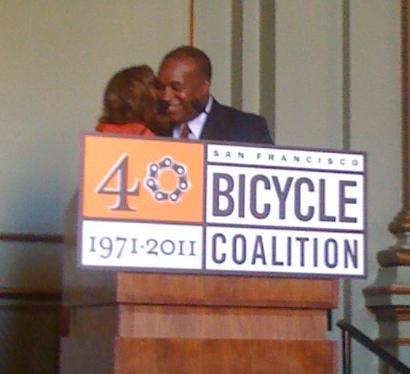
Just hours after being asked to leave the San Francisco Municipal Transportation Agency, director Nat Ford was at the San Francisco Bicycle Coalition’s annual Golden Wheels Awards accepting an award for the MTA’s Livable Streets Team. But that potentially awkward moment was eased by the universal political support for making the streets of San Francisco safer and more inviting for pedestrians and bicyclists.

Coming from car-centric Atlanta in 2006, Ford admitted he was an unlikely champion of turning San Francisco into one of the country’s best cities for biking. But he said the SFBC was “very persistent and worked with us.” While the bike injunction hurt progress, Ford said the support of SFBC and city officials allowed the agency to beef up the program from just a couple of staffers to “a dozen of the best bike planning and engineering folks in this country.”

“It was great working with all of you to get the MTA where it is today in terms of biking,” Ford told the capacity crowd in the War Memorial Building’s second floor event space, where the balcony overlooked City Hall and a sea of hundreds of bikes parked on the sidewalk out front.

Mayor Ed Lee spoke next, pledging to continue the progress and telling the crowd, “I want to give my very special thanks to Nat Ford for his five years of very dedicated service.”

Both Ford and MTA members told the Guardian that the split was a “mutual decision.” Ford told us, “Now’s a good time to go,” and that he’s still figuring out his next move. MTA board chair Tom Nolan told us, “It’s something we arrived at together. It’s good for his family and him.”

Indeed, it seems very good for Ford. The board approved a $385,000 severance package to go with its request that he resign before his contract expires, a payout that is drawing some criticism. “I am deeply disappointed that MTA would approve a nearly $400,000 golden parachute for an outgoing city executive. At a time when our budget is cutting critical social services for our kids and the most vulnerable in our city, we can ill-afford to be paying excessive payouts to administrators who are no longer working for the public. I have fought these exorbitant sweetheart deals at UC and CSU, and as mayor I will reform these practices,” Sen. Leland Yee, a candidate for mayor, said in a prepared statement.

Nolan says it’s time to restore the agency. “I’ve talked about wanting to restart what we do,” he told us. While Ford’s reported job hunting was one reason for the split, Nolan also alluded to mismanagement of the agency and the mistrust of its administration by Transport Workers Union Local 250A and other employees.

“We clearly have a problem when the drivers turn down a contract two-to-one,” Nolan said of the union’s rejection of its latest contract, which has since been approved by an outside arbitrator. “We can do a lot better.”

But the Ford saga was just a sideshow during an evening devoted to celebrating the improvements to the city’s bicycle network and selling the SFBC’s vision of what’s next, which it calls “Connecting the City.” The plan calls for three, green, separated bikeways (like those now on a stretch of Market Street) bisecting the city by 2015 (with the first Bay To Beach route done by next year) and a fully connected network of 100 miles of bikeways by 2020.

“Safe, comfortable, crosstown bikeways for everyone,” was how MTA Commissioner Cheryl Brinkman put it in slick video that the SFBC premiered at the event to promote the plan.

SFBC Director Leah Shahum told the crowd the idea is to connect and promote the city’s various neighborhoods and encourage “regular San Franciscans” to take more frequent trips by bike. “Seven in 10 of us, that’s how many people are already riding a bike,” she said, citing a survey of how many city residents own or have access to bikes. “We’re developing a vision where people are connected by safe, family-friendly bikeways.”

Shahum praised how engaged Mayor Lee has been with the plan and the need to improve the city’s cycling infrastructure. “Let me tell you how impressed I am with the level of involvement from Room 200,” she said.

Lee pledged to make cycling safer on dangerous sections of Oak and Fell streets that connect the Panhandle with the Lower Haight – sections Shahum took Lee on during Bike to Work Day this year – and to complete a new green bike lane on JFK Drive this year.

“We can get a lot of the goals of the Bicycle Coalition done together. We need your help in November,” Lee told the crowd, calling for them to support a street improvement bond measure on the fall ballot. He said the bicycling community has made the streets more fun and inviting, telling the crowd that at this weekend’s Conference of Mayors, he is “going to brag about our bike lanes and our way of living.”

Hot sexy events: June 15-21

0

And we’re back! After a brief jaunt around the world, I’ve returned to hunker sexily down amidst a mountain of press releases for SF’s sluttiest happenings (yes, they make press releases). Seems like y’all have been busy since I’ve been gone – this week alone there’s a big-ass conference for nerdy – is there any other kind? – pervs and a class with Madison Young on making your own adult videos. 

Idea: go to Young’s Good Vibes class tonight, complete your star turn post-learnin’, and learn how to market and code the darn thing (or meet someone who can) this weekend! Then give link to all the new friends you meet at Pride. Planning ahead: it pays!

“DIY Porn”

Because it’s not just about figuring out how to many books to prop the Flip atop. No no, recording your sexy precious moments requires a lot more skills – starting off with the skill of knowing what dirty tricks you’d most like to capture for posterity. Femina Potens’ head mistress Madison Young (it’s safe to say) is a master at figuring these kinds of things out, so entrust to her your future on the silver – or laptop – screen. She’ll be touching on scripts, casting, and financing, so dream big.

Wed/15 6-8 p.m., $20-26 

1620 Polk, SF

(415) 345-0500

www.goodvibes.com


Ecosexual Queer Porn Night

Ecosexuality, the sensual relationship with the world around us. Not surprisingly, Nature (that sexy beast) plays a big roles in many pornos. Beaches, vineyards, parks – all this and more you will see for your own dirty little eyes if you attend a mini-fest incongruously located in the Tall Tree Tambo center, which last I checked was a spa and woo-woo health club-skillshare type arrangement in the back of Lower Haight’s favorite hippie hangout, Pkok. Enjoy! (Psst, if things get really natural, ask to take the party to the sauna out back in the garden). 

Thurs/16 8-11 p.m., $10

Tall Tree Tambo Wellness Center

776 Haight, SF (behind Pkok)

www.feminapotens.org


Ynot Summit 

Formerly the Cybernet Expo, this three day conference for the online sex industry promises to hook you up… with networking opportunities, at least. Attend speed mix-and-mingle sessions with your point-and-click-to-perversion peers, learn about legal issues surrounding online porn and escort services, and of course, the Saturday night show. Last year the nerds hit up the Kink.com palace, but this year they won’t even have to truck out the Mission: Kimo’s is hosting a show by the Asian Diva Girls and Smash Up Derby, which is curiously dubbed “one of San Francisco’s favorite bands” by conference organizers. Well hell, if they say so! 

Thurs/23-Sat/25 

Holiday Inn Golden Gateway

1500 Van Ness, SF

www.ynotsummit.com


Kinky Salon: SanFranSexual

Be entertained by Chadd Behavior of SF Boylesque and the triumphant return to Mission Control by X-rated storytelling doyenne Dixie De La Tour – or just fool around with everyone in the building. This week’s Kinky Salon swinger’s party is themed SanFranSexual for a reason, you’re allowed to do whatever the hell you want, in style. 

Sat/18 10 p.m.-late, $25-30 members only

Mission Control 

www.missioncontrolsf.org


Bawdy Storytelling: Tales of Non-Monogamy

Bawdy’s back – could this be the most popular monthly storytelling series in the Bay, pervy or not? – in its East Bay incarnation. Dixie’s overseeing a night of swingtastic synopses, from fundamentalist Christians at key clubs (I’d love to hear the scripture on that), and other godly pursuits.  

Tues/21 8 p.m., $10

The Uptown 

1928 Telegraph, Oakl.

www.bawdystorytelling.com


Daly: SFBG profiled the wrong guy

88

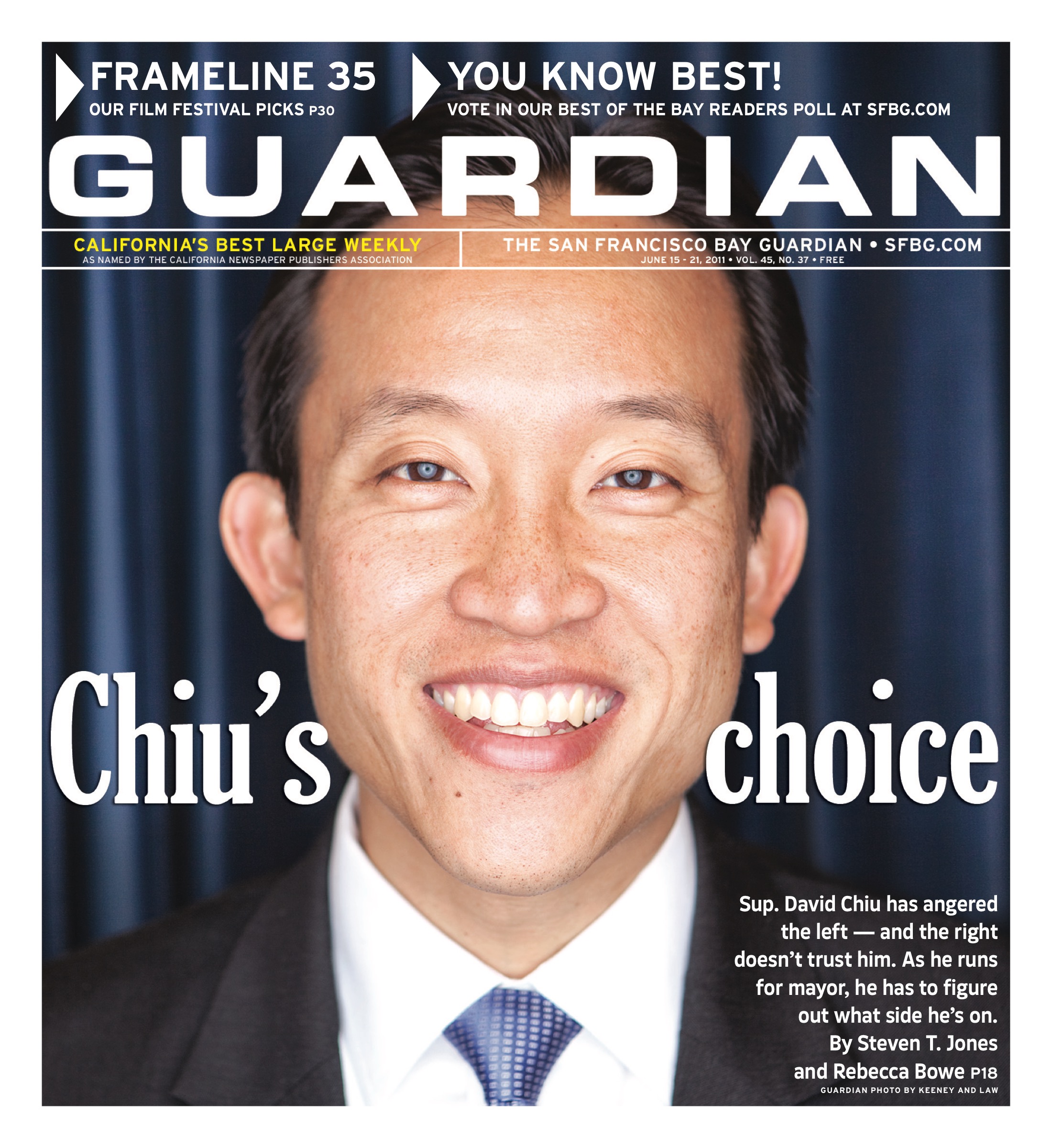
When I interviewed Chris Daly for this week’s cover story on David Chiu and the political realignment at City Hall, Daly said we were putting the wrong guy on the cover.

“If the story is about political realignment, it’s about David Ho,” Daly told me of the political consultant who once worked on his and other progressive campaigns, but who helped engineer a split in the progressive movement with the help of consultant Enrique Pearce and District 3 Sup. Jane Kim, whose campaign they worked on together last year, beating early progressive favorite Debra Walker.

Daly said the political realignment that has taken place at City Hall has more to do with Kim and Ho – in collusion with former Mayor Willie Brown, Chinatown Chamber head Rose Pak, and Tenderloin power broker Randy Shaw – than it does with Chiu, who Daly considers simply a pawn in someone else’s game. Ho is seeking to be Pak’s successor as Chinatown political boss, and he and Pearce have been out there doing the ground work Pak’s effort to convince Lee to remain mayor.

“Any realignment that exists is about David Ho and I think it has more to do with the District 6 race than the District 3 race,” Daly said. “As far as David Chiu and realignment, they are separate things.”

While Ho and Pearce have traditionally worked on progressive campaigns – particularly in high-profile contests like this year’s mayor’s race, where John Avalos is the clear progressive favorite – they are now some of the strongest behind-the-scenes backers of the campaign to convince Ed Lee to run. Neither Ho nor Pearce returned our calls for comment.

“That’s the whole realignment,” Daly said, explaining that it was the peeling of entities like Chinatown Community Development Corporation and the Tenderloin Housing Clinic away from the progressive coalition of the last decade that has cast progressive supervisors into the wilderness and empowered Chiu and Kim, who in turn brought Lee to power.

“It’s not a seismic realignment, it’s a minor realignment, it just happens to be who’s in power,” Daly said. “It was a minor political shift that caused a big change at City Hall.”

Power has now consolidated around Mayor Lee, as well as those who convinced Chiu to put him there, including the powerful players who helped elect Kim. “These people, as far I can tell, have disowned Chiu,” Daly said. “He did what they wanted but he failed the loyalty test in the process.”

Chiu has so quickly fallen from favor that even Planning Commission President Christina Olague, who spoke at Chiu’s campaign launch event on the steps of City Hall just two months ago, is now one of the co-chairs of a committee pushing Lee to run, along with others connected to CCDC and the Pak/Brown power center.

Kim has also notably withheld her mayoral endorsement. She tells us that she’s waiting until after budget season, but the real reason is likely to wait and see whether Lee gets into the race. Daly said this new political power center has been playing the long game, starting with supporting Chiu back in 2008.

“Peskin kind of brought him up, and then I – tactically or a strategic blunder – I made the mistake of not bringing someone up,” Daly said, insisting that he’s always questioned Chiu’s political loyalties. “I had doubts from the beginning. Ultimately, it was Jane Kim and David Ho who tag teamed me and got me on board.”

Daly said Chui’s last-minute move to cross his progressive colleagues and back Lee for mayor “irreparably harmed him with progressives,” while doing little to win over a new political base. “He miscalculated the damage it would do to him,” Daly said.

Chiu’s dependability was also called into question when he was openly considering a deal with Gavin Newsom to be named district attorney, which would have allowed Newsom to appoint his replacement in D3, a move that he didn’t check with Pak.

“He gave control of his political base to someone else,” Avalos told us, offering that if Chiu was going to be so narrowly ambitious then he should have taken Newsom’s offer to become district attorney.

Even those around Chiu have emphasized his independence from Pak, who has desperately been looking for someone she could count on to back and prevent Leland Yee from winning the mayor’s office. And if Lee doesn’t run, sources say she’s likely to back another political veteran such as Dennis Herrera or Michela Alioto-Pier.

But given how deftly Ho and his allies have grabbed power at City Hall, I’d say they have a pretty good chance of convincing Lee to run, despite the mayor’s resistance. And if Lee runs, Daly, USF Professor Corey Cook, and others we interviewed say he would probably win.

Treasure Island: 11 ayes, no sight

6

On June 7, the San Francisco Board of Supervisors voted 11-0 to reject an appeal of the Treasure Island environmental impact report. The appeal was brought by Arc Ecology and our colleagues the Sierra Club, Golden Gate Audubon Society, Wild Equity, former Sup. Aaron Peskin, and Yerba Buena Island resident Ken Masters.

The board will tell you that the Department of City Planning and the Mayor’s Office of Economic and Workforce Development found the appeal lacking in merit.

In the appeal, we claimed the EIR lacked the specificity to qualify as a project EIR, which means that after it passes, the city will have substantially limited the ability of any future Board of Supervisors to address the project’s actual environmental impacts. But these impacts cannot and will not be known until actual development proposals, none of which presently exist, are made.

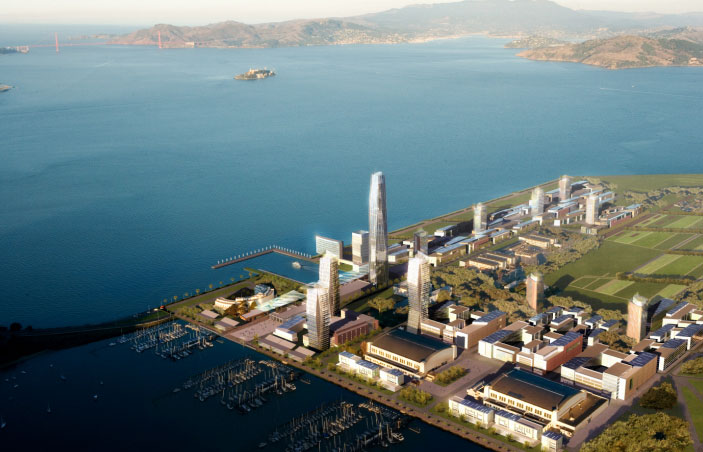
Sup. Jane Kim and city planning staffers argued that the EIR had almost too much specificity. For example, without showing a single confirming diagram, project sponsors claimed they could cut as many as 100 stories off the proposed skyscrapers — yet keep the same number of condos without increasing the bulk, height, or number of buildings in the overall project. How? Through the Harry Potter-like magic of “flex buildings and zones.”

The board will tell you that this project presents a vision of a new community unrivaled in the Bay Area and nation — a new Athens. But the supervisors don’t seem to realize that it’s a development with a population larger than Emeryville, about the size of Albany. Indeed, the separate dedicated buildings of affordable homes truly make Treasure Island like Athens of old, with poorer people segregated from the rich.

They don’t see that this is a self-reflecting vision blithely unconcerned about the impacts it will have on the greater Bay Area region, and that it’s a bloated project that will vastly exceed the region’s capacity to support it. It’s a project whose impacts will enslave legions of people to longer commutes as more cars flood the bridge, pushing traffic like rising sea levels into the upper reaches of East Bay freeways. Nor are project proponents particularly concerned about the impacts of air pollution blowing from the bridge and the region’s freeways into Berkeley, Emeryville, and Oakland.

Finally, neither the supervisors, nor the city planners, nor the Office of Economic and Workforce Development seem to be aware that San Francisco currently has 30,000 vacant housing units. It will cost a projected $577,000 to build each Treasure Island unit. But more units could be built on San Francisco’s mainland with almost no impact, simply by allowing rental units in the basements of some of our stock of 130,000 single-family homes.

That kind of housing isn’t as luxurious as a 45-story view of the bay from Treasure Island perhaps — but at a cost of $100,000 to $200,000 per unit, more than half of those in-law apartments could be rented at or below market rate. Infill housing of that sort would also mean greater stability for established home owners, more jobs and business opportunities, and more riders for Muni.

Still, the appellants weren’t trying to halt any project at Treasure Island. The appeal was about was fixing the deficiencies in the EIR and right-sizing the project so it can move forward with its benefits intact.

In the Tarot, the Five of Cups depicts an individual so besotted by that possibilities floating before his eyes that he stands mesmerized, believing they are at hand — of course, in reality he’s fooling himself. In the case of Treasure Island, the supervisors and city officials are intoxicated by the visions floating in the bay — and are thus blinded to the better options of making this city and region more sustainable and affordable.

CPMC’s stunning arrogance

0

The San Francisco City Planning Commission hearing June 9 on California Pacific Medical Center’s expansion plans was remarkable — both in the comments that the commissioners had and in the mind-boggling arrogance of the giant hospital chain.

CPMC wants to build a massive new hospital and medical office building on Van Ness Avenue and rebuild St. Luke’s Hospital in the Mission. The plans aren’t even close to complying with city planning codes — the Sutter Health affiliate will need city approval to exceed height limits on Van Ness (by more than 100 feet); a modification of the housing construction requirement for new offices; permission to demolish existing housing units; permission to take over a part of San Jose Avenue — and a lot more. In other words, CPMC is asking a lot from the city.

And since this nonprofit controls four major hospitals in the city, its future development decisions need to be considered in the context of San Francisco’s overall health care needs.

It’s entirely reasonable that the city ask CPMC for a development agreement that provides benefits to city residents. Mayor Ed Lee has made it clear that the approval of this project will depend on whether CPMC can address affordable housing, healthcare access for low-income people, a secure future for St. Luke’s, workforce development, and transportation impacts. Lee’s proposals are more than reasonable: he’s asking that CPMC pay the standard fee for affordable housing required of any major commercial developer; increase its level of charity care (now an abysmal 0.99 percent) to the average of other regional hospitals (2.3 percent); increase its Medical acceptance rate; and maintain St. Luke’s as an acute care facility with an emergency room. Union nurses are asking that Sutter deal with them in good faith.

But Dr. Warren Browner, CEO of CPMC, showed little interest in working with the city. The demands are way too high, he told the commissioners, insisting that it was unreasonable to ask the hospital to contribute that much to affordable housing. He acted as if CMPC was somehow entitled to move forward — at its own proposed schedule — and that all of these city demands were nonsense.

That’s not going to work.

A clear majority of the commissioners got the point. As Ron Miguel pointed out, Sutter is a nonprofit — and its tax-exempt status mandates a certain level of social responsibility. Every big commercial developer has to pay for housing and transit impacts. Gwyneth Borden and Bill Sugaya noted that hospital officials knew full well what the planning rules were when they bought the Van Ness site.

This is a $2.5 billion project. Community benefits need to be a significant part of the final plan. If anything, Lee’s proposals are too limited (Sutter should agree to protect St. Luke’s for 50 years, not 20). The planning commissioners should stick to their positions — this project is out of control, and if Browner wants to see it built, he needs to come back with a new set of numbers, and a new attitude.

Editorial: CPMC’s stunning arrogance

3

The San Francisco City Planning Commission hearing June 9 on California Pacific Medical Center’s expansion plans was remarkable — both in the comments that the commissioners had and in the mind-boggling arrogance of the giant hospital chain.

CPMC wants to build a massive new hospital and medical office building on Van Ness Avenue and rebuild St. Luke’s Hospital in the Mission. The plans aren’t even close to complying with city planning codes — the Sutter Health affiliate will need city approval to exceed height limits on Van Ness (by more than 100 feet); a modification of the housing construction requirement for new offices; permission to demolish existing housing units; permission to take over a part of San Jose Avenue — and a lot more. In other words, CPMC is asking a lot from the city.

And since this nonprofit controls four major hospitals in the city, its future development decisions need to be considered in the context of San Francisco’s overall health care needs.

It’s entirely reasonable that the city ask CPMC for a development agreement that provides benefits to city residents. Mayor Ed Lee has made it clear that the approval of this project will depend on whether CPMC can address affordable housing, healthcare access for low-income people, a secure future for St. Luke’s, workforce development, and transportation impacts. Lee’s proposals are more than reasonable: he’s asking that CPMC pay the standard fee for affordable housing required of any major commercial developer; increase its level of charity care (now an abysmal 0.99 percent) to the average of other regional hospitals (2.3 percent); increase its Medical acceptance rate; and maintain St. Luke’s as an acute care facility with an emergency room. Union nurses are asking that Sutter deal with them in good faith.

But Dr. Warren Browner, CEO of CPMC, showed little interest in working with the city. The demands are way too high, he told the commissioners, insisting that it was unreasonable to ask the hospital to contribute that much to affordable housing. He acted as if CMPC was somehow entitled to move forward — at its own proposed schedule — and that all of these city demands were nonsense.

That’s not going to work.

A clear majority of the commissioners got the point. As Ron Miguel pointed out, Sutter is a nonprofit — and its tax-exempt status mandates a certain level of social responsibility. Every big commercial developer has to pay for housing and transit impacts. Gwyneth Borden and Bill Sugaya noted that hospital officials knew full well what the planning rules were when they bought the Van Ness site.

This is a $2.5 billion project. Community benefits need to be a significant part of the final plan. If anything, Lee’s proposals are too limited (Sutter should agree to protect St. Luke’s for 50 years, not 20). The planning commissioners should stick to their positions — this project is out of control, and if Browner wants to see it built, he needs to come back with a new set of numbers, and a new attitude.


Chauncey Bailey project: Bey found guilty

0

I’m not going to say that Jusef Bey IV would have walked if the Chauncey Bailey project hadn’t come together to investigate the murder. But it’s certainly possible. There’s no question that the Okland cops were ignoring key evidence. And his conviction on first degree murder charges for planning the assassination is a tribute to what can happen when journalists who normally compete with each other get together for this sort of project. We were proud to be involved in the Chauncey Bailey Project, and I think thoue outcome speaks for itself.

Chase bank appeal could impact neighborhoods

5

An appeal hearing June 8 on a JP Morgan Chase branch on Divisadero and Fell could affect the future of small neighborhood retail in San Francisco.


The Planning Department gave Chase a permit to build a branch in a space protected by formula retail law. According to the department, the bank provides “financial services” — which are not specifically mentioned in the Planning Code section limiting formula retail.


Neighborhood activists are fighting the proposed bank, which would occupy three retail spaces on a stretch of Divisadero already home to numerous chains — and just six blocks away from another Chase branch.


Divisadero’s heavy traffic makes it a prime advertising street, and could explain why Chase is looking to build another branch so close to its existing one.


Community activists say the bank is clearly a formula retail establishment — which would mean it doesn’t comply with the Planning Code for the neighborhood. Since the space is more than 4,000 square feet, that would mandate a conditional use permit and a public hearing.


Quintin Mecke, a neighborhood resident who will be speaking at the Board of Appeals hearing, said  evening, the Planning Department privately measured the space but did not include areas normally listed when measuring square footage. The department did not return a request for comment.


The exemption of Chase from the formula retail law could affect more than just the Western Addition neighborhood.
“There’s clearly issues with the planning departments interpretation of this law,” says Mecke, “we’ve just happened to find a very specific, and what we call egregious, version of it.”


Mecke said he believes that if banks are exempted from this law, so could many other chain establishments — including adult entertainment and auto body shops — that don’t happen to be mentioned in the code, and small San Francisco neighborhoods could radically change.


Former Sup. Aaron Peskin, who was on the board when the formula retail law passed, told us that “it was written very broadly and what the planning department is asserting is that financial services are not part of that broad category.
 
“Had the board of supervisors intended to exclude financial services, that would have been specifically written into the law,” he said. “Instead the board passed a very broad category and financial services falls in that category. It was intended to be construed and defined broadly and should apply to financial services as much as it does to a restaurant or shoe store.”

Behind the all-smiles budget

2

news@sfbg.com

When Mayor Ed Lee released his 2011-12 budget proposal June 1, all was sweetness and light at City Hall.

The mayor delivered the document in person, to the supervisors, in the board chambers. Sup. Carmen Chu, chair of the Budget Committee, was standing to the mayor’s right. Board President David Chiu was to his left. There was none of the imperious attitude we’d come to expect in the Gavin Newsom era — and little of the typical hostility from the board.

As Sup. David Campos, who was elected in November 2008, remarked afterward: “It’s the first time since I’ve been elected that the mayor has taken the time to come to chambers. It’s reflective of how this has been a lot more of an inclusionary process.”

Lee went even further. “This is a pretty happy time,” he said. “There are no layoffs, and instead of closing libraries we’ll be opening them.” That earned him an ovation from assembled city leaders, including mayoral candidates City Attorney Dennis Herrera and Assessor-Recorder Phil Ting along with District Attorney George Gascón. “I think this budget represents a lot of hope.”

It’s true that this year’s cuts won’t be as bad as the cuts over the past five years. It’s also true that the pain is spread a bit more — the police and fire departments, which Newsom, always the ambitious politician, wouldn’t touch, are taking their share of cuts.

But before everybody stands up and holds hands and sings “Kumbaya,” there’s some important perspective that’s missing here.

Over the past half-decade, San Francisco has cut roughly $1 billion out of General Fund spending. The Department of Public Health has eliminated three- quarters of the acute mental health beds. Six homeless resource centers have closed. The waiting list for a homeless family seeking shelter is between six and nine months. Muni service has been reduced and fares have been raised. Recreation centers have been closed. Library hours have been reduced.

In other words, services for the poor and middle class have been slashed below acceptable levels, year after year — and Mayor Lee’s budget doesn’t even begin to restore any of those cuts.

“We’re not ready yet to restore old cuts,” Lee told the Guardian in a June 2 interview. “It was enough for us to accomplish a pretty steady course and keep as much. Particularly with the critical nonprofits that provide services to seniors and youth and homeless shelters, we kept them as close as we could to what last year’s funding was.”

But the current level of funding is woefully inadequate. As Debbi Lerman, administrator of the Human Services Network, noted, the people who work in the nonprofits Lee was talking about haven’t had a pay raise in four years — even though the cost of living continues to rise. “Our costs have gone up with cost of inflation,” she noted.

She said the cuts over the past few years have deeply eroded services for children, homeless people, substance abuse programs, and others. “There have been significant cuts to every area of health and human services.”

And in a city with 14 billionaires and thousands more very wealthy people, Lee’s budget is distinctly lacking in significant new ways to find revenue.


THE GOOD NEWS

Just about everyone agrees that the budget process this year has been far better than anything anyone experienced under Newsom. “He [Mayor Lee] listened to everybody,” Lerman said. “That doesn’t mean they fixed everything. Mayor Lee fixed as much as he could.”

At his press conference announcing the release of the budget, Lee thanked Police Chief Greg Suhr for having already made significant cuts through management restructuring and for considering an additional proposed cut of $20 million.

“We want to thank you for that great sacrifice,” Lee said, addressing Suhr, who sat in front row of public benches, dressed in uniform. Lee next acknowledged that adequate funding for social services also helps public safety. “Without those services, officers on the street would have a harder job,” he said.

Lee also praised the departments of Public Health and Human Services for helping to identify $39 million in federal dollars and $16 million in state dollars, to help keep services open and the city safer.

Lee noted that San Francisco no longer has a one-year budget process and has just released its first five-year financial plan as part of its decision to go in five-year planning cycles.

“To address this, I’ve asked for shared sacrifice, ” Lee continued, adding that he recently released his long-awaited pension reform charter amendment, emphasizing that it was built through a consensus and collaborative-based approach.

Lee also said he would consider asking voters to approve what he called “a recovery sales tax” in November if Gov. Jerry Brown is unable to extend the state’s sales tax. That would bring in $60 million — but it is only on the table as a way to backfill further state budget cuts.

Lee observed that San Francisco is growing, the economy is looking brighter, and unemployment is down from more than 10 percent last January to 8.5 percent today. He plugged the America’s Cup, the city’s local hire legislation, the Department of Public Works’ apprenticeship programs, and tourism, both in terms of earmarking funding in the budget for these programs and their potential to boost city revenues.

He said his budget proposed $308 million in infrastructure investments that include enhanced disability access, rebuilding jails, and energy efficiency, and is proposing a $248 million General Obligation bond for the November ballot to reduce the street repair backlog.

“We will get these streets repaired,” he promised.

“This submission of a budget is not an end at all, it’s the beginning of the process,” he continued, going on to recognize Chu for her work getting the process rolling and thanking Budget Analyst Harvey Rose in advance. “I do know his cooperation is critical.”

And he concluded by thanking each of the supervisors. “I will continue enjoying working with you — we need to keep the city family tight and together.”

The sentiment was welcomed by supervisors. “As he said, this is the beginning of the process, and it’s an important and symbolic step” Campos said. “The budget shows that a lot of good programs have been saved. But there is still work to do.

“There are still gaps in the safety network,” he added, singling out cuts to violence-prevention programs. “It’s my hope they will be restored.”


THE BAD NEWS

But even if the cuts for this year are restored, the city budget is nowhere near where it ought to be. “We still had to make cuts,” Lee acknowledged.

“We did consider very seriously a whole host of revenue ideas that we had,” he said. “They were not off the agenda at all.” At the same time, he noted that state law requires a two-thirds vote for new taxes (although that threshold drops to 50 percent in presidential election years). “We decided that it’s not that they were bad ideas, but that we wouldn’t be able to sell them at this time.”

Lee praised some of the revenue ideas that have been suggested in the past year, including the alcoholic beverage fee proposal by Sup. John Avalos, which Lee called “a pretty good idea.” He said that “a year or two from now” an additional sales tax and a parcel tax (for the police or for schools and open space) might be on the agenda.

The city now has a multiyear budget process and projections are supposed to go beyond a single year. But what’s missing — and what nobody is talking about — is a long-term plan to restore critical city services to a sustainable level. That means talking — now — about tax proposals for 2012 and beyond and including those revenue streams in long-term budget planning.

Because the city parks, the public health system, the libraries, the schools, affordable housing programs, and the social safety net are in terrible condition today, the result of year after year of all-cuts budgets. And while the supervisors and the mayor wrangle over the final details, and advocates try to win back a few dollars here and a few dollars there, it’s important to recognize that this budget does nothing to fix the damage.

“We’re about $10 million short of what we need right now to keep service providers at current levels,” noted Jennifer Freidenbach, who runs the Coalition on Homelessness. “But we also need to restore the health and human services system that was slaughtered under Gavin Newsom.”

Treasure Island: So “special”

2

Actually, there are a bunch of problems. The Chron says the developers want to make the place “special,” a community of its own:


Developers hope the project, which goes before the Board of Supervisors for approval today, will feel like an urban village in the middle of a bustling metropolitan area. They hope urban farms, plentiful public transit and shared community spaces will give residents of the island a sense of community not found in other developments. …


For Treasure Island to be successful, developers and city planning experts agree that the residents of the island must feel like part of a special, distinct neighborhood where people want to spend time, and not just another community of commuters to San Francisco.


But the numbers don’t add up.

The plans call for 19,000 people living on the island — and there won’t be anywhere near enough employment opportunities for even a fraction of that number. So most of the residents are going to work somewhere else. Which means that twice a day they’ll have to travel — to and from San Francisco or to and from the East Bay — and there’s just no easy way to get that many people off that island to those locations.

Ther Bay Bridge is already beyond capacity during the periods when most of these people are going to be commuting. Yes, you can add a bunch of Muni buses to carry a lot of people, but that’s going to cost a lot of money. So would increasing ferry service to the level that this project would require. And if the past 50 years of San Francisco development is any guide (and it ought to be), the developers won’t pay enough for the transportation and the city won’t have the money to do it right so it won’t happen.

And even if the project meets the developers’ dreams in 30 years, it’s going to be a long, messy slog along the way. 

How, for example, will people who live on the island get their kids to school? Given San Francisco’s school-choice system, and the fact that there won’t be elementary, middle and high schools on the island anyway, and the school district can’t pay for the bus routes it has now, much less for new buses going to Treasure Island, you’re going to have hundreds of parents going to schools all over the city — and there will be only one way to get there: In cars.

(I’m all for no-car travel, but let’s be serious: Who’s got the time to take a kindergartener on the ferry downtown and on one or maybe two bus connections to a school — then turn around and take another bus to work? It isn’t going to happen. And nobody’s sending elementary school kids on Muni to school alone.)

If the supermarket isn’t built before most people move in, then you’ve got the grocery problem: It’s hard to do a week’s shopping on Muni and then a ferry. And what happens when you forget the milk (or run out of beer on the weekend?) No way to walk to the store, so you get in the car.

To make it even worse, 80 percent of the people who live there will be rich (since that’s who can afford market-rate housing). They’ll all have cars (and the developer kindly is providing parking spaces for all of them).

I just don’t see how it’s going to work. 

Treasure Island goes to the Board

37

There’s three reasons I’ll always remember the Chronicle’s Phil Bronstein: he used to be married to Sharon Stone, he got bitten by a Komodo Dragon at the L.A. zoo, and he had the audacity to write a column in the Chronicle that was titled “Treasure Island eco-dream is bad choice for funds.”
Now it’s true that Bronstein was a 1986 Pulitzer Prize finalist for his work in the Philippines. But that was 25 years ago, and I didn’t read what he wrote, so I can’t comment on the quality of his work  then. But now I live in the East Bay and drive past Treasure Island most days of the week—and I have been waiting for someone at the Chronicle to finally voice something other than their usual preppy praise for this increasingly large development in the middle of the Bay.
 
And Bronstein certainly did have plenty to say about Treasure Island. And it wasn’t the usual upbeat pap about “bold and robust visions” that the Chron usually serves up when it concerns anything that involves Lennar and public-private development. Instead,  Bronstein began by describing T.I.  as a “onetime secretive Navy base filled with deer, political patronage and who knows what buried in the ground.”

Now, part of Bronstein’s fire may have been a result of him writing his column in April, a few weeks after a massive earthquake and tsunami hit Japan, triggering a nuclear meltdown. Or two or three.

Bronstein’s infamous rant even mentioned some of the radiologically impacted things at Treasure Island that, as he put it, “leached into the soil from weaponry or other deadly items: radium and PCBs 100,000 times the acceptable levels.”
And then he compared Lennar and billionaire Ron Burkle to “contemporary development pirates.” Believe me, that was a surprise to read in the Chronicle.

“This year, they’re scheduled to break ground on a huge multibillion-dollar public-private ecotopia mini-city built upon toxic waste and landfill,” Bronstein wrote. “This glorious contradiction might become a triumph of super-green living and high-end dreams. But it also represents something else: bad choices about how to spend public money in ever tighter times.”

Bronstein noted that the Board has a brief panic in April when they considered whether a Japan-style disaster could wipe out the T.I. plan, but that Rich Hills of the Mayor’s Office said the “disaster potential has already been addressed.”
“Unless we have what Hills called ‘a freak disaster,’” Bronstein added with a cutting bite that his Komodo dragon would have been proud of, including Bronstein’s inclusion of the fact that Treasure Island is on the California Emergency Management Agency’s tsunami inundation map, and that while we are coughing up $105 million to developers who want to profit from high-density living on T. I, all of us are neglecting aging infrastructure that we already have.

“While T.I. developers are busy putting some kind of shower cap-like cover over the land so trees and foundations don’t touch toxic ground that can’t and won’t be cleaned up, our children stand a pretty good chance of being flattened like pancakes in existing structures while they’re learning math and history during the next, inevitable big quake,” Bronstein concluded.
Meanwhile, those of us who drive the seismically-compromised Bay Bridge each day can’t help wondering how folks who decide to move to the development that’s being planned for Treasure Island will ever get off the island—unless they have a pirate ship.

That’s because every morning, we get to see a long line of drivers waiting—without much success—for drivers on the Bay Bridge to slow down and let them into the traffic.

Those of us who sometimes commute by ferry also know how tricky it is try and catch the last ferry, which leaves the San Francisco Ferry Building at 8:25 p.m. That’s way earlier than most commission meetings end. And earlier than most nightlife begins.

And then there’s the question of what happens when you get back to Treasure Island–and realize you forgot to buy milk, collect the dog, or pick up the kids from day care.

Now, maybe the city and the developers believe they have thoroughly considered and answered all these questions. But have they done any outreach to East Bay commuters, whose journey will likely be further impacted by the T.I. plan? If so, I certainly haven’t heard about it. And what about the folks in Berkeley who likely won’t be able to see San Francisco once a bunch of high-rises pop up in the Bay? Have they been consulted?

This Tuesday (June 7) at 5 p.m., the Board will hear an appeal of the city’s Treasure Island environmental impact report and consider a huge batch of related documents. (And I’m willing to bet that most current supervisors don’t know too much about this plan, and probably have only flipped through the thousands of pages of documentation related to it)

The appeal was filed by the Sierra Club, Golden Gate Audubon Society, and Arc Ecology, who last year filed an appeal around the city’s EIR for Lennar’s massive Hunters Point Shipyard/Candlestick Project. Only this time, this trio is being joined by a group of Treasure Island residents—and former Board President Aaron Peskin.

Which reminds me: Three weeks after Bronstein wrote his amazing Treasure Island hit, piece, his fellow columnists at the Chronicle, Phillip Matier and Andy Ross, were back, sounding much more like the Chronicle’s attack dogs usually do, when it comes to anyone who dares to find the city and Lennar’s massive plans less than perfect: “Peskin, who as a supervisor was notorious for his middle-of-night phone rants to department heads, called the proposed high-rise plan that just squeaked by the Planning Commission a ‘laughingstock mistake,’” M& R crowed.

But in the end, they quoted the very thought that Peskin wants M&R to print and Chronicle readers to consider about the city’s current Treasure Island plan:

“It will horrify San Francisco and the Bay Area for decades to come,” Peskin said.

Now, as the folks joining Peskin in opposing the city’s current plan note, they aren’t trying to stop the development of Treasure Island. They are simply fighting the latest plan.

“The developer and the city already have an approved EIR and project plan for a 6,000 unit smaller scale, more transit friendly project that was passed in 2006,” Arc Ecology states in a flier that it plans to distribute at the June 7 hearing. “Environmentalists and many of the appellants supported that plan. Don’t be fooled by the rhetoric. It was the earlier plan that won all the awards for sustainability.”

And as Arc points out, the city’s latest EIR and the plan currently before the Board is an entirely different animal from the city’s 2006 plan.

“It’s 25 percent bigger than the 2006 plan, tipping the scales on its impacts,” Arc states. “It increases the housing by 25 percent to 8,000 units, decreases transit service and affordable housing and competes with hotels and businesses that already exist downtown.”

“What can you do? Tell the Board to go back to the 2006 plan,” Arc advises.

The flier also lists a bunch of bullet points that outline some of the coalition’s objections.

“It’s unsustainable,” the flier states, claiming that under the new plan, there will be, “too many cars, too much traffic, too much air pollution.”

Under the new plan, there is also a seven percent reduction on the affordable housing set aside and a 17 percent reduction in overall affordable housing units, Arc notes. That’s another way of saying, “There is not enough affordable housing.”

And Arc claims the island will remain contaminated (see Bronstein’s rant about radionuclides and PCBs at the beginning of this post) even after the Navy completes its toxic and radiological cleanup. That the 40-story high-rise towers will obstruct views of San Francisco from the East Bay, and vice versa. And that the project financing plan will drive the city further into debt for at least another 15 years.

Arc’s flier concludes by asserting that the whole plan is undemocratic.
“Once approved, there will be no further environmental review of project plans—ever!” Arc claims. “Once approved the project will be implemented by an unelected nonprofit corporation. There has been no outreach or involvement of East Bay residents despite traffic and view impacts. The plan repays $55 million in additional developer costs to purchase this island with hundreds of millions of dollars of impacts on Bay Area residents.”

Now, I’m sure officials for the City and the developer will have plenty of counter arguments–and possibly busloads of low-income T.I. residents/unemployed SF workers, who will be shipped into the Board’s Chambers to argue that they need the Board to approve this plan so they can have new homes and jobs. Because that’s what happened last year, when Arc and the Sierra Club and Golden Gate Audubon expressed their concerns about plans to carve up the Candlestick State Park Recreation Area and build a bridge over the Yosemite Slough. And suddenly found themselves cast as the big bad villains, when it came to the city and Lennar’s wish to ram through the Candlestick/Shipyard plan.

But regardless of whether you believe in the project, oppose it, or don’t know much about it, make sure you show up at 5pm in Room 250 at City Hall on June 7, if you want to hear what actually goes down. Especially if you work in San Francisco, and live in the East Bay, because much of the Treasure Island traffic will directly impact the East Bay. 

Or as Arc puts it, “This new project is 25 percent larger than the prior one and like the difference between a 75 degree day and a 100 degree day – this increase in size makes all the difference. The new project will overdrive bridge capacity, create too much traffic, not enough transit, reduced levels of affordable housing, and vests enormous public power in an unaccountable, unelected development authority.  Please tell the Board they don’t have to go back to the drawing board – just to the 2006 plan and recirculate the EIR.”
 

Don’t undo ballot measures

0

EDITORIAL The California initiative process is broken. The state’s too big, and it costs too much to gather signatures and mount a media campaign for or against a ballot measure.

But in San Francisco, the initiative process has traditionally been, and for the most part continues to be, a check on corrupt or ineffective political leaders and a chance for progressive reforms that can’t make it through City Hall. That’s why Sup. Scott Wiener’s proposal to allow the supervisors to amend (or, in theory, abolish) laws passed by the voters is a bad idea.

Since 1968, the San Francisco voters have approved 96 ordinances; that’s an average of about two a year. Obviously the pace has picked up since the 1970s. In 2008, there were eight measures approved; in 2010 there were four. The length and complexity of the ballot makes it appear that the supervisors aren’t doing their work, Wiener says. He notes that when he was campaigning, one of the most common complaints was that the voters were being asked to decide too many things that should have been handled at City Hall.

Some of that is the result of an unwieldy City Charter. Benefits for police and firefighters, for example, are specified in the charter, and any change needs voter approval. Wiener’s measure, aimed only at initiatives and not charter amendments, wouldn’t change that situation.

But some of it relates to the political alignments in San Francisco. For much of the past decade, the supervisors and the mayor were at odds over major issues. The mayor couldn’t get his (bad) proposals, like a ban on sitting on the sidewalks, through the board, and the progressives couldn’t get their proposals past a mayoral veto. So both sides went directly to the voters.

That’s a lot better than the paralysis we’re seeing in Sacramento. At least the issues are getting decided.

And over the years, some of the most important legislation in San Francisco — growth controls, tenant protections, protections for children’s programs, the city’s landmark open-government law — has come through ballot initiatives. The only way public power advocates have been able to get the issue on the agenda has been through ballot initiatives.

Those were issues that generations of supervisors and mayors wouldn’t take on — the developers and landlords and secrecy lobbyists and Pacific Gas and Electric Co. had too much power at City Hall. And those protections for the public, the environment, and the most vulnerable residents only survive today because they’re set in law and can’t easily be changed.

If Wiener’s measure has been in effect a decade ago, for example, Proposition M — the 1986 law that set neighborhood planning priorities and limits on office development, would have been summarily scrapped by Mayor Willie Brown and a pro-developer board. Key rent-control laws would have been repealed or amended to death. The ban on buildings that cast shadows on parks would be gone. Killing the Sunshine Ordinance would have been Brown’s first act.

Today’s district-elected board is far more accountable to the voters — but there’s hardly a reliable progressive majority. And the point of ballot initiatives is that you can’t predict who will control City Hall next year, or in 10 years.

We don’t think the initiative process in San Francisco is out of control. Sure, big money wins the day too often — but on balance, it’s a check that the Board of Supervisors should leave alone.

Not in our neighborhood

6

news@sfbg.com

San Francisco faces an enormous shortage of affordable housing for young people at risk of homelessness, but a pair of projects intended to address the issue are under fire from neighborhood activists in supervisorial District 2, home to the city’s wealthiest residents.

The proposed conversion of the defunct Edward II Hotel and the major overhaul at the Booker T. Washington Community Service Center (BTWCSC) could create a combined 74 units of affordable housing for vulnerable youth, complete with services and support systems to help young people coming from foster or homeless families.

“We are building houses for young people who are getting their start in life,” said Julian Davis, president of the board of BTWCSC. “There was a great need for foster youth housing that has been studied ad nauseam … Our center wanted to contribute.”

But both projects have run into strong neighborhood opposition that appears to have turned D2 Sup. Mark Farrell against the projects as proposed, despite initial support for the BTWCSC project by both Farrell and his predecessor, Michela Alioto-Pier. Farrell’s approach has frustrated project opponents and caused the representative of a neighboring district, Sup. Ross Mirkarimi, to sponsor the project.

“The project emanated from Michela Alioto-Pier and she supported the original project, which is why I joined her in support and it initially appeared that Sup. Farrell was joining that support,” Mirkarimi told us, noting that he is continuing to champion the project because it borders his district and because “the Booker T center has a long reach and serves clients from throughout city.”

After hearing from constituents concerned about parking, the size of the five-story building that is proposed, and other issues, Farrell dropped his sponsorship of the project and submitted alternative legislation that cut the building to four stories, presenting it to project proponents without their input as a take-it-or-leave-it proposal.

“The thing I find most puzzling about this is the lack of communication with me personally,” BTWCSC Executive Director Pat Scott said of Farrell, noting how helpful Alioto-Pier and Farrell’s staff had been before opponents convinced him to drop his support for the project. “I was a little taken aback, quite frankly. I would just assume that he’d talk to me.

But Farrell said he was simply trying to heed neighborhood concerns and craft a compromise that would get neighbors to drop their lawsuit threats and appeal of the Planning Commission’s 6-1 vote to approve the project. “I can’t control what happened in the past, I’m only here to make sure everyone is happy now,” Farrell told us. “I absolutely support the project, I think the community center is great … We’re arguing over a story.”

Yet Scott noted that project proponents already had compromised on a project that was initially proposed for eight stories, and she said that even at five stories, it isn’t coming anywhere near what the city actually needs. So while Farrell casts it as a fight over one story, Scott said, “10 units is a big thing in a city that has nothing for these kids.”

That need was outlined in a 2007 report by the Mayor’s Transitional Youth Task Force. The group of city officials and nonprofit providers, convened by then-Mayor Gavin Newsom, studied issues affecting at-risk youth between the ages 16 and 24 and one of the major needs identified was housing.

A follow-up study found that 4,500 to 6,800 young people are “homeless or marginally housed each year.” The citywide affordable housing stock for this population sat at meager 314 units at the time.

“We are not doing a good enough job as a city and as a state [to help at-risk youth],” Davis said. “Once they leave the foster care system, there is very little support for them.”

The report called for 400 new affordable housing units for this population to be completed or under construction by 2012. Edward II and BTWCSC are located in the Marina and the Western Addition, respectively, in proximity to affluent neighborhoods in a district with a dearth of affordable housing.

“With supportive housing [going] into neighborhoods that never had affordable housing, there is a certain unknown and it makes people uncomfortable,” said Gail Gilman, Executive Director of Community Housing Partnership, which owns and manages the Edward II project.

Patricia Vaughey, a resident of the Marina-Cow Hollow area since 1976, is perhaps the most vocal critic of the project. She has used the neighborhood associations and every other city forum she can find as platforms to lambaste the plans. “It just kills my soul to see this project,” she told us, voicing a variety of concerns about how the project would be managed. “I am so worried about the kids … We are asking for the best program in the country and we are not getting it.”

Yet Gilman said that considerable energy and many resources have been invested in designing Edward II and that she trusts Larkin Street Youth Service, a respected nonprofit agency, to do the programming. “We chose to partner with Larkin Street because they are the experts in this area,” she said.

Vaughey characterized the stretch of Lombard Street between Divisadero and Van Ness streets, where Edward II will be located, as marred by crime and prostitution and unsuitable for this project. “We have a little Tenderloin down here,” she said.

Gilman disputed that characterization and said the building was chosen after an extensive search and that it met the criteria of having the right sized building in a safe neighborhood with good access to public transit and open space.

But many residents have expressed concern over the pending change to zoning for the building. And if the BTWCSC project couldn’t win Farrell’s support, the Edward II project faces an even more uphill battle because Farrell told us, “There’s an even stronger level of neighborhood concern over that project…. It’s going to be a tough hill to climb.”

The contentious issue under review by the Planning Department is an application to expand the density limit from 16 units to 24.

John Miller, president of the Marina Community Association, said that “from a neighborhood dynamic perspective,” a change to density is problematic. He said changing the density for one building is a slippery slope that could hurt the entire neighborhood. “Higher density is inconsistent with the neighborhood. It could work beautifully at lower density.”

Miller said potential renters in the vicinity would be concerned with “loitering that could occur when people are coming and going … With so many people there is no sense of community”

Yet as with BTWCSC, proponents say simply slashing the project to a smaller size would kill it because then it wouldn’t pencil out financially. Making an issue of density is therefore obstruction of the project because compromise cannot be reached on the issue.

Farrell, a venture capitalist, said he ran the numbers on BTWCSC and believes it would still be a viable project at four stories if the Mayor’s Office of Housing is able to offer some unspecified assistance, as he said the officials there have pledged to him they would. “I know we need more affordable housing,” Farrell said, rejecting suggestions that D2 residents tend to oppose all affordable housing projects. “I don’t think that should be a part of this conversation.”

Farrell criticized the outreach done by Edward II proponents, telling us, “I don’t think it was done in a tactful way.” But Miller said a recent meeting with Gilman and others was positive. “It was an effort on their part to respond to the neighborhood concerns as best they can,” Miller said.

“We are confident we can partner with the community in a proactive way to address the concerns that are addressable,” Gilman said. “If we diligently work with the community, we can have positive project.”

Edward II is on track to come before the Planning Commission in mid-July, while the appeal of the BTWCSC project is scheduled to be heard by the Board of Supervisors Land Use Committee on June 6 at 1 p.m. Neither Mirkarimi nor Farrell offered predictions, but both said the issue of whether the project should be four or five stories will likely be a key part of the discussion.

“Coming through the process has made me super supportive of all plans for transition age housing. I was already a supporter but this made me a fervent supporter,” Scott said. “The amount of opposition by people who don’t care what happens to our children — it makes you want to fight.”

Editorial: Don’t undo ballot measures

3


The California initiative process is broken. The state’s too big, and it costs too much to gather signatures and mount a media campaign for or against a ballot measure.

But in San Francisco, the initiative process has traditionally been, and for the most part continues to be, a check on corrupt or ineffective political leaders and a chance for progressive reforms that can’t make it through City Hall. That’s why Sup. Scott Wiener’s proposal to allow the supervisors to amend (or, in theory, abolish) laws passed by the voters is a bad idea.

Since 1968, the San Francisco voters have approved 96 ordinances; that’s an average of about two a year. Obviously the pace has picked up since the 1970s. In 2008, there were eight measures approved; in 2010 there were four. The length and complexity of the ballot makes it appear that the supervisors aren’t doing their work, Wiener says. He notes that when he was campaigning, one of the most common complaints was that the voters were being asked to decide too many things that should have been handled at City Hall.

Some of that is the result of an unwieldy City Charter. Benefits for police and firefighters, for example, are specified in the charter, and any change needs voter approval. Wiener’s measure, aimed only at initiatives and not charter amendments, wouldn’t change that situation.

But some of it relates to the political alignments in San Francisco. For much of the past decade, the supervisors and the mayor were at odds over major issues. The mayor couldn’t get his (bad) proposals, like a ban on sitting on the sidewalks, through the board, and the progressives couldn’t get their proposals past a mayoral veto. So both sides went directly to the voters.

That’s a lot better than the paralysis we’re seeing in Sacramento. At least the issues are getting decided.

And over the years, some of the most important legislation in San Francisco — growth controls, tenant protections, protections for children’s programs, the city’s landmark open-government law — has come through ballot initiatives. The only way public power advocates have been able to get the issue on the agenda has been through ballot initiatives.

Those were issues that generations of supervisors and mayors wouldn’t take on — the developers and landlords and secrecy lobbyists and Pacific Gas and Electric Co. had too much power at City Hall. And those protections for the public, the environment, and the most vulnerable residents only survive today because they’re set in law and can’t easily be changed.

If Wiener’s measure has been in effect a decade ago, for example, Proposition M — the 1986 law that set neighborhood planning priorities and limits on office development, would have been summarily scrapped by Mayor Willie Brown and a pro-developer board. Key rent-control laws would have been repealed or amended to death. The ban on buildings that cast shadows on parks would be gone. Killing the Sunshine Ordinance would have been Brown’s first act.

Today’s district-elected board is far more accountable to the voters — but there’s hardly a reliable progressive majority. And the point of ballot initiatives is that you can’t predict who will control City Hall next year, or in 10 years.

We don’t think the initiative process in San Francisco is out of control. Sure, big money wins the day too often — but on balance, it’s a check that the Board of Supervisors should leave alone.


Activists speak out at Chevron’s shareholder meeting

2

Police and security guards were out in full force in San Ramon yesterday, (Wed/25) where activists and shareholders of Chevron’s valuable stock converged at the company’s annual shareholders meeting at its headquarters.

Inside, the meeting, Chevron Board Chairman John Watson touted the oil corporation’s “community engagement” and market growth. Outside, around 140 activists from all over the world held signs to the speedy traffic on Bollinger Canyon Way, beseeching the general public to understand the costs of Chevron’s high profits. Some even made it inside.

“Our people have been dying,” said Tom Evans of the Sugpiat People of the Alutitiq Tribe in the native village of Nanwalek, Alaska, choking back tears during the 45-minute Q&A session with Watson.

“You are all a bunch of liars and thieves,” said Rev. Kenneth Davis, a Richmond resident who was arrested last year at Chevron’s shareholders meeting in Houston, Texas. He claimed he could see Chevron’s refinery from a window in his home. “People are dying, you steal from all over the world and process it in Richmond,” he said.

“When will Chevron embody in its operations environmental and social justice?” Elias Isaac of Open Society Initiative for Southern Africa asked the chairman.

After giving one of his canned responses of “we are a force for good everywhere we operate,” Watson conceded, “Perhaps it’s not enough, and we could always do more.”

Chevron just came out of a record-breaking year with $20 billion in profits, making it the largest corporation in California and the 11th in the world, with expectations of more growth in the years to come. It has nine new exploration projects it hopes to start in the next decade that will make Poland, Romania, Western Australia, China and other countries a part of the at-risk catalog of nations where Chevron chooses to do business.

It has claimed over 14 million acres of land for “exploration activities.” It’s also planning the world’s largest carbon sequestration project in Australia on a nature reserve and turtle habitat. If all this information isn’t scary enough, Chevron also makes huge messes and ducks out of cleaning them up.

Recently, the corporation appealed a guilty verdict from an Ecuadorian court for $8.6 billion in damages because of massive environmental degradation. The 18-year lawsuit stems from the destruction and mismanagement of the diseased Amazonian land that Chevron acquired when it bought Texaco in 2001. Ecuadorian Servio Curipoma lost his mother due to Chevron’s toxic sludge and was present at the meeting with other indigenous community members pleading with Watson and Chevron’s shareholders to change its policies in Ecuador.

“Take it up with your government,” Watson said to the speakers. “Petroecuador has not been a good partner,” he added, passing the blame onto Ecuador’s state-owned oil company. Chevron execs decided that was a good time to roll a video about the lawsuit and smeared the plaintiff’s lawyer, Steven Donziger, showing outtakes of the documentary “Crude,” emails and other private meetings, displaying Donziger to be haughty about the case. As the film rolled, most of the stockholders applauded Chevron’s PR efforts.

Seven items on the meeting’s agenda pertained to stockholders’ proposals on various subjects, including hiring a third party director with environmental expertise, creating a human rights committee, and disclosing the guidelines for Chevron’s country selection. None of the stockholders proposals passed, including one on the controversial process of “fracking,” which extracts natural gas from rock, that obtained 41 percent of the preliminary votes.

Once the meeting ended, the activists in attendance were met with a hero’s welcome out on the streets. Gitz Crazyboy of the First Nation Dene/Pikini in Alberta, Canada told the crowd he didn’t buy Chevron’s excuses that they were just following government mandates.

“If that were true we wouldn’t be here right now,” he said.

Antonia Juhasz of Global Exchange and the co-editor of the recently released The True Cost of Chevron: An Alternative Annual Report, said that although Chevron wasn’t as responsive as they hoped it was a victory nonetheless for the protesters.

“What was spit back at us was spin,” she said to the crowd. “We didn’t hear a truly substantive response to the damning human rights abuses that Chevron has caused.”

On the chopping block in Oakland

162

news@sfbg.com

What exactly is on the chopping block in Oakland these days? If one proposal goes through, it could be a live animal’s neck.

Oakland recently called for public input to clarify the urban agriculture language in its planning code. There are questions about the legality of activities such as growing and selling veggies from your urban farm, which could serve our community with nutritious, local, sustainable food. The current code is unclear on the legality of many of these things, so clarifying it to allow people to grow healthy, sustainable food is a positive step forward for the city’s fight against food insecurity.

One small catch.

Among other things in a 73-page report titled “Transforming the Oakland Food System” is a proposal to deregulate raising and slaughtering animals. No distinction is made between urban plant farming and urban animal farming — but the difference between the two is as blatant as the sound each respective product makes when you chop its head off.

Deregulating urban animal farming would create problems that multiply as the population of animals being farmed increases. Consider the most popular animal kept among the new wave of backyard egg farmers: the laying hen.

A backyard chicken spends its first days in a factory farm hatchery, where it is packed up with other chickens and shipped to the buyer in a box with no food or water. About half the chicks are male, and thus worthless to a backyard chicken hobbyist. Many end up at Oakland Animal Services, where they are euthanized.

New chicken hobbyists are often surprised that veterinary bills for a single chicken can average $300 a year if ailments are treated properly rather than ignored. These “free” eggs now are very expensive. Chicken food and poop attracts rodents, which causes complaints to the Health Department. After two years, the hen is “spent” and no longer gives eggs. And what to do with Chicken Little when she stops laying?

Picture a warm Saturday afternoon in mid-May. You are sitting on a lawn chair unwinding from a long week at work. Then you are jolted out of your chair — your lemonade spilling down the front of your shirt.

It’s the sound of a hen on the other side of the fence suffering a botched hatchet job. “Squaaaawwwkkk!” Welcome to Oakland — the slaughterhouse with glass walls.

According to according to a 2006 Oakland Food System Assessment by the Mayor’s Office of Sustainability, approximately 9,000 acres are needed to feed 30 percent of Oakland’s population using vegetable-based farming. But once you include urban meat with your veggie garden, the land needed to feed that same 30 percent of Oakland residents explodes to 19,000 acres. So if all our potential land can only provide 30 percent of our food, do we really need to create more meat, eggs and dairy?

Chickens, goats and rabbits make great companions. But for growing sustainable, local and organic food, let’s tell Oakland loud and clear: think about chard instead. 

Ian Elwood is an animal rescuer and volunteers with Harvest Home Animal Sanctuary, the Central Valley Chapter of House Rabbit Society and is a former volunteer at Oakland Animal Services. He also works a day job as web producer at International Rivers.


Chevron’s critics gather before annual shareholder meeting

2

Chevron destroys everything, except profits. And by everything, we mean everything. The Amazon rainforest and its indigenous communities? Check. The Boreal Forest in northern Canada and its indigenous communities? Check. The Niger Delta? Check. Indonesia, Texas, and Iraq? Check, check and check. And even San Francisco’s own neighbor, Richmond, the home of one of Chevron’s largest oil refineries in the world? A big, whopping check.

Not that oil companies taking the lives, resources, and spaces of millions of people is something to take lightly. In fact, the opposition to Chevron is strong and growing, with many people across a network of international communities planning to stand up at Chevron’s shareholder meeting tomorrow (Wed/25) in San Ramon to give faces and names to the enormous destruction the company caused, which coincides with the release of the 3rd annual report on the company’s many misdeeds, The True Cost of Chevron.

At a press conference this morning (Tues/24) at a Chevron station in San Francisco, activists and representatives from places adversely affected by Chevron’s drilling, dumping, land grabbing, and environmental degradation told stories about losing mothers to cancer, women having miscarriages due to contaminated water, clear-cutting forests used by their ancestors for hunting and farming, and losing one’s sense of home.

“I have personally witnessed this devastation,” Servio Curipoma of the Amazon Defense Coalition in Ecuador said of Chevron’s operations within his country. “And I will fight to the bitter end and never give up,” he said after showing a photo of his mother who died of cancer. After an 18-year lawsuit by the people in Educator against the oil corporation, Chevron was found guilty of massive environmental crimes. But Chevron has yet to take note of its transgressions, and aggressively pursues communities at risk of complete disintegration.

Elias Isaac with the Open Society Initiative for Southern Africa spoke about entire fishing communities in Angola going days without catches as they rely on the waters that Chevron polluted through its operations in the country. “The pollution is effecting livelihoods,” said Isaac. “And it’s getting worse.”

Communities for a Better Environment also understands the nefarious ways in which Chevron puts its stock above its virtue. For example, the company doesn’t pay taxes to extract oil from California. “They had the audacity to ask for an exemption from the law,” said Jessica Tovar of the Oakland based advocacy group. Recently Chevron’s Richmond refinery was denied the possibility to process dirtier, heavier crude oil only after opponents went to court to stop the proposal.

The bitter truth, said Antonia Juhasz of Global Exchange and the co-editor of alternative report, is that no matter where Chevron decides to set up shop, the stories are the same: corporate side-stepping of responsibilities to the community, polluted water, love ones lost, environmental disaster that cannot be undone.

Just like the exploitation Chevron is responsible for through its operations across the globe, its profits are also ever increasing. Last year the company made $20 billion in profits, bolstering its standing as the 11th largest corporation in the world, and the largest in California.

In order to make a dent in its exploitative practices, members of different organizations will be voicing their opposition in Chevron’s shareholders meeting tomorrow, some through legal proxies of current shareholders.

There is a resolution activists hope will be discussed that will appoint a third party with expertise who will oversee operations to further prevent environmental disasters, said Mitchell Anderson, the Corporate Campaigns Director of Amazon Watch, which is based in San Francisco.

“We came to tell them that we disagree with their ads. It’s not a rosy image. It’s a lie,” said Juhasz. “Chevron knows how to do better but chooses to do worse.”


Stop the AT&T boxes!

15

By the League of Pissed Off Voters


More than 60 people showed up on the steps of City Hall May 21 to demand that AT&T engage in the same old basic planning process that even small-scale businesses have to go through.  (Read: even little people without expensive corporate lobbyists.)


Neighborhood organizations, disabled and senior representatives and environmentalists all pushed the supervisors to make the sensible vote at tomorrow’s full board meeting: support a full Environmental Impact Review of the consequences of 726 giant metal lockboxes cluttering up our public sidewalks.  As Julian Davis, a longtime community activist put it: “Why would you plunk down 726 giant Buicks all over the city when you have a perfectly good underground high speed rail?”


True that.  San Francisco currently has miles of fiber optic cable pulsing beneath our city streets, and even that is already becoming outdated.  So now AT&T’s brilliant idea is to litter our sidewalks with what amounts to giant crusty supercomputers? And what happens when they’re obsolete?  Basically, taxpayers just got stuck with a bunch of metal junk on our sidewalks, while AT&T expanded its profit margins.


Why do small cafes have to pay hundreds of dollars in permit fees to put two piddly tables outside their shops, while AT&T gets a blanket “categorical exemption” for almost no money to nail down ugly boxes that will block the sidewalk and attract graffiti?  (Hmm, we can probably think of some choice graffiti actually…)


The last time we heard from the folks at AT&T, they were helping the NSA wiretap our private calls from a secret room in their headquarters, so excuse us if we’re a little hesitant about giving the company a free pass to put creepy lock boxes in front of our homes. 


According to the Department of Public Works at the last public hearing on this issue, DPW staffers are relying on AT&T’s “expert analysis” to guide them on whether or not AT&T should receive a categorical exemption – in other words, DPW is relying on AT&T to do its job, and the community just got cut out of the process.  An independent EIR is necessary to address these blatant conflicts of interest. 


Speaking of conflicted interests: The latest scuttlebutt inside City Hall has some progressive supervisors desperately looking to cut a deal to save face in the midst of election season.  And what would that deal look like?  Cutting the number of boxes and giving neighborhoods an opportunity to decide whether they want 4’x4’x7′ lock boxs on their blocks. 


So, basically, if your block doesn’t have a home owner association advocating on your behalf, guess what you’re going to be walking around everyday?  As Juan Monsanto of San Francisco Beautiful pointed out, most of these boxes will be installed in less affluent communities without strong representation at City Hall.   AT&T’s sweetheart deal gives the supervisors cover to punt their responsibility to administer public space safely and equitably. 


So, to recap: we are now officially a city that will arrest human beings for sitting or lying in the middle of the sidewalk, but the board is working overtime to try and figure out how to exempt AT&T from city oversight process so it can stick giant immovable metal boxes in our right of way?


Oh, it’s okay because they’re going in the Bayview. Or in a neighborhood that already has a bunch of blight, so what’s a little more?  Lame.  Call your supervisor today and tell him or her to get a backbone.  It’s tough being the swing vote, you know?  Help ’em out, let ’em know you’re watching – and voting.


The San Francisco League of Pissed-Off Voters is the local chapter of the League of Young Voters, a national organization that engages young people in the political process, organizes around progressive issues and takes it beyond just “get out the vote.” 


Hooked in

0

culture@sfbg.com

There is no water cooler. There are no memos. In most cases, sex workers aren’t walking into an office on Monday mornings — or even late Saturday nights — to punch in and gab with coworkers about the last shift. Sex work is a umbrella term pertaining to a multitude of professions, including but not limited to prostitution, porn, burlesque, modeling, and stripping. Most sex workers are independent contractors, freelancers, and individuals running their own businesses.

So in a way, the seventh San Francisco Sex Worker Film and Arts Festival (May 20-29) serves as the city’s whore company party, run with the intention of unifying a community in an ironically isolating line of work. Because whatever your profession, talking to a coworker about the daily grind is always extra-satisfying.

All but a select number of events during the festival are open to the public — we’re not talking about an exclusive trade show here. Organizers have packed nine days with musicals, cabarets, workshops, and parties, so whether you’re in the business, out of the business, curious, or supportive, this sex fest will do the trick.

The decision to base the festival around this kind of openness was intentional. Once the workday is done, where does a sex worker go to compare notes, swap secrets, laugh, or cry? The stigma around sex work can make talking to friends and family who don’t pole dance or film masturbation for pay awkward.

Chloe Camilla, a member of the festival’s planning committee, is still relatively new to the sex industry. She’s been doing a mix of porn and modeling for the past few years and remembers how intimidated she felt in the beginning.

“It’s strange — you’re shooting your first anal scene and you just want to ask somebody, ‘Uh, what do I do? Who do I talk to? Where’s the handbook?'” She and her friends have been talking about putting together a training manual with chapters on things like how to file your taxes, develop a marketing campaign, and learn screen tricks. “There should be a ‘Welcome to porn, here’s what to expect when you show up on set’ book.”

Camilla will be teaching “The Art of Webcamming”, a workshop she put together in response to peer requests. Webcams are a great introduction to the sex industry: cheap, easy, and gatekeeper-free — the Internet is an equal opportunity employer.

“Everyone can find their own market and niche. There’s room for all bodies and genders out there,” Camilla says, hoping her class will get people online and making money fast.

Festival founder Carol Leigh, a.k.a. longtime pro-sex activist, sex worker, and performance artist Scarlot Harlot, started the festival in 1999 to help foster supportive peer relationships while simultaneously urging hookers to use their collective voice to speak out on their own behalf and fight marginalization.

“I’m basically Grandma Scarlot Harlot now,” she smiles, her crimson lips matching the shiny paint on her fingernails. After years of marching up and down capitol steps, Leigh realized the creative potential of the people rallying around her.

It’s what she calls the “whore’s eye view:”

“As a group that’s oppressed with a stigma, there’s a kind of wisdom that grows from that stigmatization. Because we’re not accepted, we might not necessarily buy into mainstream values. Therefore, we do and see things differently,” Leigh says. Through art or film, sex workers can find their voice — even if they can’t be open about their profession because of child custody laws or a conservative day gig.

Now 60, with more than 30 years of advocating for sex workers’ rights behind her, Leigh says the festival’s relevance has expanded to respond to the community’s current needs. The back-to-back workshops at SomArts Cultural Center on May 27 most accurately reflects this year’s current list of hot topics: self-care and eco-sex, building bonds between male sex workers, and love advice for partners and pals of sex workers.

Although parts of the city’s sex worker community are tight-knit, festival organizer Erica Fabulous admits that closeness can depend on where you work and whom you work with. Getting politically active sex workers to attend is a snap, but festival organizers hope to reach past clubs and into the streets, pulling in workers from every corner of the industry.

“Sex work is raced and classed just like anything else — that’s why I’m so proud of the diversity of viewpoints that will be represented during the festival,” says Laure McElroy, the festival’s film curator.

Nearly 40 sex-worker-themed flicks will play at this year’s festival during a one-day marathon. Stories from Canada, Holland, Germany, Cambodia, and the U.S. will lay bare the work and lives of strippers, whores, masseuses, peep show gals, erotic performance artists, survival street workers, and escorts.

The diverse viewpoints echo another of the festival’s underlying missions: “These films are a glimpse of what’s happening out there — the people who are out there,” McElroy says. “I want people to walk away from this festival knowing that there isn’t just one way to think or talk about sex work.” 


Rolling recreation

4

caitlin@sfbg.com

SUMMER GUIDE “We definitely try to de-emphasize Iron Man trips,” says Justin Eichenlaub, author of Post-Car Adventuring, the eminently usable guide to low carbon camping, hiking, and cruising trips around the Bay Area, Although Eichenlaub and coauthor Kelly Gregory want to include all fitness levels in the fun, make no mistake — they’re hardcore.

The two met through a Craigslist posting for a multi-day group bike trip to Monterey and now publish guidebooks and a blog under the name Post-Car Press. They’re virtual encyclopedias of info: locations of wide highway berms, how to avoid Devil’s Slide on Highway 101 (incidentally, by a route bikers have dubbed Planet of the Apes Road), and the absolute best for-bikers-by-bikers maps money can buy (Krebs cycle maps, available at www.krebscycleproducts.com).

But they’re adamant that it doesn’t take quads of steel to master the roads — even ones to far-flung campsites — sans car with the help of trains, county buses, and the occasional ferry. Indeed, even if you’re not the biking type, auto-less camping is still within your grasp. Shoulder your backpack and head out to Marin’s Samuel P. Taylor State Park via the Golden Gate Transit express bus to San Rafael, then the Marin Stagecoach No. 68. The stagecoach drops you a quarter-mile from campsites tucked into a redwood grove — where walk and bike-in camping doesn’t require reservation and costs only $3 per person per night.

A few tips for the road, courtesy of Eichenlaub. “Have a bike that you’re comfy on — it doesn’t have to be a road bike, or even have a rack, because you can stow your gear in a backpack. Realize you’re allowed to go really slow and the bike will always feel lighter than you expect.” Always familiarize yourself with your route before you leave, and — duh — bring a flat tire kit, pump, and bike lights. “Even if you’re planning a day ride, it can sometimes turn into a dusk ride.”

Here’s a partial guide to three of the pair’s fave summer adventures. Make sure to look up detailed directions before you roll out to recreate. Transit time and bike mileage numbers are for round trips.


MERCEY HOT SPRINGS

Public transit time: eight hours

Total bike mileage: 68 miles

“This is really a slice of California that Bay Area people don’t go to,” says Eichenlaub of Fresno County’s desert lands, which house a natural spa center that’s been around since 1912. Take BART to the MacArthur Station and bike about 1.2 miles to the Emeryville Amtrak Station. Load your steed onto a train bound for Merced — trains in California never charge fees for stowing bikes — then hop the Route 10 Merced County Transit bus (schedules at www.mercedthebus.com) to Dos Palos. Get off near the Reynolds and Christian streets intersection and begin the 33-mile ride through dry, wildflower-studded lands.

“There are few, if any, trees — only sweeping sandy plains dotted with desert brush,” according to Gregory. After an especially beautiful 12 miles on Little Panoche Road, two lanes of thoroughfare where cars rarely pass — you’ll reach Mercey Hot Springs, where you’ll find cabins (starting at $120/night) and campsites ($30 per person/night) for your well-deserved slumber.

“It feels as though you are far, far away from the city,” Gregory says. The center hosts regular yoga seminars and has a disc golf course that guests can use for free. But if you’re trying to make this a quick jaunt, day use of the pool, sauna, and baths costs only $20.

Side trip: Eichenlaub swears on the Panoche Inn, a “cowboy saloon” 10 miles down the road from Mercey. Hey, what’s better on a detox trip than getting wasted with the cowpokes? Of course, the place does have a website (www.panocheinn.com), so it can’t be too back roads.


PALAMERES ROAD VINEYARD DAYTRIP

Public transit time: 77 minutes

Total bike mileage: 27 miles

Take BART to the West Dublin-Pleasanton Station and then break out your bike for the ride down beautiful, shaded back roads to Sunol, a tiny town whose most famous inhabitant is probably Bosco, a golden retriever who was elected honorary mayor from 1981 until his death in 1994 (and was featured in a Chinese newspaper as an example of Western democracy’s failings).

From there, it’s a gentle hill climb up to a pair of vineyards: Westover and Chouinard. Just, ahem, don’t be expecting a Napa scene. “The first time we went out there, one of the vintners was blowing his own leaves, wearing a muscle shirt,” says Eichenlaub. Vino, sans pretension? Well worth the trip.

Drink your fill from the pleasant tasting rooms and — here’s the beauty of this ride — roll tipsily down the sloping route to the Castro Valley Station, and home.

Side trip: If you’re in the mood to make this an overnight adventure, Eichenlaub recommends taking on the extra 30 miles to the enormous Lake Del Valle, where there’s kickass family campsites tucked into a bend in the shoreline, kayak rentals, and lots of sun.


LOMA-PRIETA SIERRA CLUB HIKER’S HUT

Transit time: two hours Total bike journey: 50 miles

Snuggled into the Santa Cruz Mountains is an A-frame cabin with a kitchen, wood stove, and a tranquil view of the ocean you just can’t find within city limits. It’s operated by the Sierra Club, but non-club members (up to 14 at a time) can crash within its logs at prices starting at $20 per night. Be sure you make a reservation before you go at www.lomaprieta.sierraclub.org.

To become a woodland creature, take Caltrain to the Menlo Park Station and begin riding out Sand Hill Road, toward the mountains. After about seven miles, turn onto beautiful Old La Honda Road (“car-lite and redwood-lined,” says Eichenlaub) a three-mile climb to the ridge line. After summiting the hill, he recommends a pit stop at Apple Jack’s in La Honda, where Ken Kesey used to kick it — “a very quirky, very local, and surprisingly friendly bar.”

From there, continue west on Highway 84 until you get to Pescadero Road and then the entrance of Sam MacDonald County Park. After a few loops and a little climbing, make a left onto the Old Towne fire road (across from a park station parking lot) and navigate 1.2 miles of beautiful trail out to the hiker’s hut and outdoor playtime galore. Return the same way after your stay or use your Krebs map to explore West Alpine Road for fresh scenery on the loop back. 

For more info on Post-Car Adventuring and carfree trips to Big Sur, Tassajara Hot Springs, flat routes in Marin County, and even Yosemite, go to postcarpress.tumblr.com.


Campos urges Lee to implement entire due process law

12

Text by Sarah Phelan. Photographs by Luke Thomas


After the Guardian broke the news that Mayor Ed Lee was planning to only partially implement Sup. David Campos’ due process legislation, we headed to City Hall to witness Lee announce his partial shift during question time. And afterwards, Lee told reporters that he spent the months since he was appointed reviewing the policy and talking with leaders in the city’s juvenile justice departments.


“I looked at the difference between youth with family here and youth who did not,” Lee said, noting that his decision to let youth that have family here to have their day in court is in keeping with his policy of focusing on family reunification and getting families more involved.


Lee stressed that youth with family here will still need to be enrolled in school and not be repeat offenders in order to have their day in court.


“It will be decided upon on a case by case basis,” he said.


Lee said he has had conversations with the federal government and US Immigration and Customs Enforcement (ICE) about the policy shift. “We have discussed this,” Lee said. “And we did get a very strong feeling that the federal government is a bit confused.”


Asked how far he is willing to go to defend this latest policy shift, Lee said, “I’ll take that up as it comes. President Obama is struggling with immigration right now.”


Reminded that his predecessor Mayor Gavin Newsom refused to implement any aspect of Campos’ due process legislation, even though a super-majority of the Board passed the ordinance in 2009, Lee said, “I don’t compare myself with the former mayor.”


Asked what percentage of immigrant youth that end up getting booked are “unaccompanied,” Lee said he did not have those statistics. “Check with Siffermann,” he said, referring to the head of the city’s Juvenile Probation Department.”


Lee’s announcement was met with mixed reviews among immigrant advocates.


Civil rights groups applauded Lee’s decision to immediately begin implementation of Campos’ legislation, which was passed in November 2009, restores due process for immigrant youth in the city’s juvenile justice system and ensures that innocent youth are not torn from their families for deportation.  But they also expressed disappointment that Lee will only be implementing the policy for youth who have immediate family here, and not for unaccompanied youth.  And they all urge him to fully implement what they described as Campos’ “duly-enacting, common-sense law so that all innocent youth receive protections.”


They noted that implementation of Campos’ broadly-supported law, which has been endorsed by over 70 organizations, had been stalled until today due to former Mayor Newsom’s refusal to enact the law. 


Under Newsom’s direction, Juvenile Probation reported over 160 youth to ICE at the point of arrest, prior to the youth receiving due process, based only on a juvenile probation officer’s “reasonable suspicion” that a youth is undocumented. 


Civil rights advocates note that Newsom’s problematic policy was responsible for tearing innocent youth from their families and spreading fear among immigrant residents around coming forward to cooperate with police, either as witnesses or victims of crime.  


And they observe that the policy that Juvenile Probation Department has been enforcing since the summer of 2008, and which involved reporting youth for life-altering deportation at arrest, went well above and beyond any obligations under federal law. 


They noted that, as a cadre of legal scholars, including University of San Francisco Law Professor Bill Ong Hing, have repeatedly made clear, there is no requirement imposed on city officials under federal law to ask about immigration status or to report individuals suspected of being undocumented.”


Ana Perez, executive director of Central American Resource Center, agreed.“While we appreciate Mayor Lee taking action to finally begin implementation, we are concerned that he is only implementing the policy for accompanied youth and not for youth who may be unaccompanied because they are trafficked to this country, are orphans, or are escaping persecution.”


“I’m certain it’s not for all youth,” Pérez continued. “So, it’s a small win. But what about the kids who are victims of human trafficking? The fact is we spent so much time developing a policy that was approved by a majority of the Board. So, this is bitter sweet.”


Asked what became of the criminal grand jury investigation that then US Attorney Joe Russoniello initiated in 2008, when Mayor Gavin Newsom was running for governor, and news first broke that the city was accompanying youth who weren’t here with family back to their home country, Pérez suppressed a snort. “It seems that was a bunch of empty threats to try and get the city to move to a more conservative position,” she said. “It’s been a whole new day with Obama.”


Angela Chan, staff attorney at the Asian Law Caucus said that Juvenile Probation’s prior policy of reporting innocent youth exacerbated the impact of a broken federal immigration system on local immigrant families. “We appreciate that Mayor Lee has taken this long awaited step forward because he values family unity and due process for youth,” Chan said. “However, we ask that the Mayor not exclude unaccompanied youth from receiving due process protections.”


Patricia Lee, managing attorney in the Juvenile Unit at the Public Defender’s Office also supported the demand for complete implementation of Campos’ legislation. “If you want the immigrant community to feel safe enough to cooperate with police and probation, then those agencies should not be viewed as representatives of immigration,” she said. “My clients and their families are scared of probation, they are scared of police. Selective implementation of the due process policy for only accompanied youth and not to unaccompanied youth does not solve this problem.” 


And Charles Washington, the Muni bus driver and longtime San Francisco resident, whose wife and 14 year old son were almost separated from him as a result of the prior Juvenile Probation policy, expressed concern that the policy would only be implemented for some youth. “I’m glad to see Mayor Lee is doing the right thing by implementing the due process policy,” he said. “However, he should not leave any youth, especially those who are most vulnerable, behind.”


Sup. Campos applauded the Mayor for implementing the policy while expressing disappointment that it is only partial implementation. As Campos’ stated during the Board meeting, but after Lee had already left, “This body enacted that law and that law needs to be respected.  It is not up to the executive branch to second guess the legislative branch.” 


Sup. Eric Mar added that he supports full implementation for all youth.


 And Sup. Jane Kim, who asked the Mayor during the Board’s Question Time about his plans for implementation, stated, “My hope is that he will commit to full implementation of this policy.”


But in the end, the burden fell on Campos to explain why partial due process is unjust. “This is a good first step, but it doesn’t go far enough,” Campos explained. “As I understand it, the decision Mayor Lee has taken is, that if you are a minor, and are accused of a felony, you will be given due process if you have family here. But if you are charged with a felony, but don’t have family here, then you will not be given due process. Let me begin by thanking Mayor Lee for at least taking one step in the right direction. That said, we still will not have full compliance with a law that was duly enacted by this body. Full compliance means giving every child that interacts with the juvenile justice system due process. So, {Mayor Lee’s first step] is simply not sufficient.”


Campos noted that when mayors are sworn in, they agree to uphold laws that the Board enacts. “So, the law needs to be respected,” Campos said. “It’s not up to the executive branch to second guess the legislative body. That second guessing can only be done by the courts. Therefore, we, once again, ask the mayor of San Francisco to comply with full implementation.”


Noting that a bedrock of the U.S.’ justice system is the principle that we are innocent until proven guilty, Campos said that if the mayor does not fully implement the law, as approved by the Board, “There’s a very real possibility that children that we are reporting [to ICE for possible deportation] are not guilty of what they have been accused of. So, once again, I ask the mayor to reconsider his opinion.”


Campos also noted that there are already procedures in place, within the existing juvenile justice system, to ensure that “we do not have individuals released who should not be.”


After the meeting, Campos noted that the format for the Board’s question time with the mayor currently leaves something to be desired: an opportunity for the Board to reply.


“It would be better if it would allow for some exchange, though obviously, we don’t want it to be a ‘gotcha’ game. But at this moment, it’s too rigid.”


 Asked who drafted the current Question Time format, Campos replied, “Board President David Chiu.”

Preserving preservation

0

EDITORIAL San Francisco has a terrible record preserving its past. In the past 50 years, so many parts of the city’s history have been demolished, bulldozed, flattened, or destroyed in the name of development. The number of landmarks that are gone vastly exceeds the number of buildings or landscape features saved by historic preservation laws.

So when Sup. Scott Wiener called a hearing May 2 to discuss possible changes in the city’s historic preservation policies, it got a lot of neighborhood activists nervous. And for good reason. In a city where developers always seem to call the shots, where blocking a bad project is a difficult and expensive process, anything that removes a weapon from the quivers of the neighborhoods is potentially dangerous.

And coming in the wake of a 6-5 February vote at the board to appoint an unqualified, pro-development candidate to the Historic Preservation Commission, there’s a disturbing trend here. And the supervisors should be careful not to dismantle the protections that the 2008 ballot measure, Proposition J, put in place to protect the city’s history.

Wiener assures us he’s not out to gut preservation — he supported Prop. J and doesn’t think that the preservation movement has gone too far. “I just want to make sure that we are taking into account other policy priorities,” he said.

Wiener pointed to a few potential situations where historic preservation could get in the way of improvements to transportation and streetscapes. The street lights along Van Ness Avenue might have to be removed to make a bus rapid transit lane work — and some people might consider them historic structures. Pedestrian safety improvements along Dolores Street might require minor changes in the tree-lined median, which is not a landmark but potentially could be. He’s looking at changes in the City Planning Code provisions dealing with historic preservation — and potentially, with the way the Planning Department applies the California Environmental Quality Act.

There are always times when preservation conflicts with progress, and there will always be dubious uses of preservation law. But overall, in the course of many, many years, the pendulum has swung far in the other direction: historic preservation has been trumped again and again by the greed and political power of developers and the construction industry. And even well-meaning attempts to adjust city law will almost certainly become loopholes for more destruction.

Almost everything good in this city, from the cable cars to the Presidio, has been threatened with extinction at some point. Battling to save the city’s treasures is a full-time occupation.

There are ways to balance preservation against valid public policies like the need for affordable housing (almost never blocked by preservationists) and street improvements (one anti-bicycle character delayed new bike lanes for years, but not on the grounds of historic preservation). But there has to be a clear line: no changes or loopholes aimed at helping private, for-profit developers. Nothing that limits the ability of neighborhood groups to stop the destruction of city history.

The problem in San Francisco is not too much historic preservation, it’s that we allow too much to get lost. That’s why Wiener needs to tread lightly on this ground — and his colleagues have to make sure he doesn’t go too far.