Planning

Editorial: Preserving preservation in San Francisco

0

 San Francisco has a terrible record preserving its past. In the past 50 years, so many parts of the city’s history have been demolished, bulldozed, flattened, or destroyed in the name of development. The number of landmarks that are gone vastly exceeds the number of buildings or landscape features saved by historic preservation laws.

So when Sup. Scott Wiener called a hearing May 2 to discuss possible changes in the city’s historic preservation policies, it got a lot of neighborhood activists nervous. And for good reason. In a city where developers always seem to call the shots, where blocking a bad project is a difficult and expensive process, anything that removes a weapon from the quivers of the neighborhoods is potentially dangerous.

And coming in the wake of a 6-5 February vote at the board to appoint an unqualified, pro-development candidate to the Historic Preservation Commission, there’s a disturbing trend here. And the supervisors should be careful not to dismantle the protections that the 2008 ballot measure, Proposition J, put in place to protect the city’s history.

Wiener assures us he’s not out to gut preservation he supported Prop. J and doesn’t think that the preservation movement has gone too far. “I just want to make sure that we are taking into account other policy priorities,” he said.

Wiener pointed to a few potential situations where historic preservation could get in the way of improvements to transportation and streetscapes. The street lights along Van Ness Avenue might have to be removed to make a bus rapid transit lane work and some people might consider them historic structures. Pedestrian safety improvements along Dolores Street might require minor changes in the tree-lined median, which is not a landmark but potentially could be. He’s looking at changes in the City Planning Code provisions dealing with historic preservation and potentially, with the way the Planning Department applies the California Environmental Quality Act.

There are always times when preservation conflicts with progress, and there will always be dubious uses of preservation law. But overall, in the course of many, many years, the pendulum has swung far in the other direction: historic preservation has been trumped again and again by the greed and political power of developers and the construction industry. And even well-meaning attempts to adjust city law will almost certainly become loopholes for more destruction.

Almost everything good in this city, from the cable cars to the Presidio, has been threatened with extinction at some point. Battling to save the city’s treasures is a full-time occupation.

There are ways to balance preservation against valid public policies like the need for affordable housing (almost never blocked by preservationists) and street improvements (one anti-bicycle character delayed new bike lanes for years, but not on the grounds of historic preservation). But there has to be a clear line: no changes or loopholes aimed at helping private, for-profit developers. Nothing that limits the ability of neighborhood groups to stop the destruction of city history.

The problem in San Francisco is not too much historic preservation, it’s that we allow too much to get lost. That’s why Wiener needs to tread lightly on this ground and his colleagues have to make sure he doesn’t go too far. 

Tourk’s clients sully Herrera’s mayoral campaign

22

Does anyone really believe that lobbyist and campaign consultant Alex Tourk isn’t talking to City Attorney Dennis Herrera, whose mayoral campaign Tourk is running, about the biggest clients and issues that Tourk is representing? Honestly, do they believe the public is that stupid?


Apparently so, because that’s the story they were feeding to the Chronicle and its readers today, denying that the two men had ever talked about the Stow Lake Boathouse vendor contract or California Pacific Medical Center and its controversial plan to build a new hospital and housing project on Cathedral Hill.


I mean, c’mon, Tourk even filed documents with the Ethics Commission stating that they had talked about those issues and clients, only to now deny it after realizing that it’s actually illegal to lobby one of your campaign clients. Luckily, Herrera had the good judgment to refer the matter to the Oakland City Attorney’s Office to investigate, considering that this city’s hopelessly corrupt and ineffectual Ethics Commission has abdicated its watchdog responsibilities in favor of repeatedly rubber-stamping every ethics waiver that comes before it, making a mockery of itself and contributing mightily to culture of political corruption that has been on the rise in San Francisco.


This is a problem that runs far deeper that just the Recreation and Parks Department steering the Oretega family vendor to Tourk, who then used his insider connection to get them the contract, which is unseemly enough. No, that’s just the tip of the iceberg with a consultant who has deep connections to monied interests and who has been hired by a mayoral candidate who actually hopes to gain some progressive support.


Consider Tourk’s client list. CPMC is perhaps the most controversial project facing city approval this year, one in which a powerful corporation is making big demands that are being strenuously opposed by a wide swath of working class San Franciscans. Whether Herrera would support this project as mayor and what modifications he would make are important litmus tests to determine what kind of mayor he would be. Yet his campaign consultant is simultaneously advocating for CPMC.


How would Herrera be on police issues, ranging from officer accountability to pension reform to whether to retain new Police Chief Greg Suhr? And can we really have faith that whatever stands Herrera takes weren’t influenced by the fact that the San Francisco Police Officers Association is another Tourk client?


Other Tourk clients include Civil Sidewalks, which advocated for the sit-lie ordinance that police are now struggling with how to legally implement; CH2MHill, the Lennar subcontractor who exposed Hunters Point residents to carcinogenic construction dust; Medjool Restaurant, whose politically connected owner has pushed projects that clash with local planning codes; Prado Group, which has a number of development proposals in SF; Target Corp., which is doing a controversial remodel of the Metreon; and many others.


Is Tourk touting his inside access to man who may be the next mayor? Will Herrera’s campaign benefit from that cross-pollination? I’ve left messages with Tourk and Herrera to ask these questions and others, and I’ll update this post when the call back, but what do you think they’re going to say? And, based on their credibility-stretching comments to the Chron today, will anyone believe them?


UPDATE: Herrera called back, but he wouldn’t discuss these issues on-the-record, instead just giving me a quote similar to the one he gave the Chron: “I was surprised to read that Alex Tourk listed me on his lobbying disclosure forms because he never lobbied me on any of those clients and issues.”

The case against consolidation

0

sarah@sfbg.com

With officials predicting that San Francisco will spend $500 million annually on health care costs for city employees and retirees, the Board of Supervisors Government Audit and Oversight Committee held an April 28 hearing to analyze why hospitals costs are higher in Northern California than Southern California, and why costs have escalated in the last decade.

A panel of experts outlined a list of cost drivers and identified hospital consolidation as the major culprit — a finding that fueled concerns that costs will skyrocket once Sutter Health, which operates the California Pacific Medical Center that took over St Luke’s in 2005, builds a 555-bed hospital on Cathedral Hill. The board will consider approving the project as soon as this summer.

Ellen Shaffer, codirector of the Center for Policy Analysis, said that the city’s recently approved Health Care Services Master Plan (“Critical Care,” 11/23/10) provides San Francisco with leverage to collect and analyze data and make informed health choices.

Shaffer noted that since 1960, when there were 26 hospitals in San Francisco, facilities consolidated so frequently that by 1990, only 12 hospitals remained. And by 1998, the three largest hospital networks controlled 43 percent of hospital beds — compared to 18 percent just four years earlier.

“Today in San Francisco, the most expensive of the northern counties hospitals get $7,349 per patient per day on average,” she said. “In Los Angeles County, the figure is $4,389.”

David Hopkins, a senior advisor at the Pacific Business Group on Health, said that Sutter Health, which reported a 30 percent increase in net income in 2010, already controls 44 percent of hospital beds in San Francisco. Catholic Healthcare West controls 28 percent, and UCSF controls 26 percent. “Insurance companies say Sutter’s size and dominant position give it an upper hand in contract negotiations,” Hopkins observed.

Healthcare planning and policy consultant Lucy Johns said technology is another key cost driver. “It’s a medical arms race,” Johns said. “Every hospital wants the latest everything.”

Jane Sandoval, a registered nurse at St Luke’s, said that what residents and workers need is access to affordable healthcare, not luxury care at overpriced rates.

“We’d rather have enough staff and the ability to care for all patients than work in a facility that’s likened to a five-star hotel,” Sandoval said. She noted that State Insurance Commissioner Dave Jones filed suit April 13 to intervene on behalf of the plaintiff in a whistleblower suit against Sutter Health, which has been accused of fraudulently charging insurers millions of dollars for anesthesia services that either weren’t provided or were billed higher than typical rates.

Anne McLeod, senior vice president of health policy for the California Hospital Association, an industry trade group, claimed that Northern California’s higher hospital prices are primarily due to higher labor and living costs in the Bay Area. “Wages are a huge component of hospital costs, and they represent the fastest growing component of costs,” she said.

But Glenn Melnick, a professor of health care finance at the University of Southern California, said that even if a hospital was airlifted from Los Angeles to San Francisco, its costs would still be 38 percent higher after adjusting for local differences. “When hospitals consolidate into large systems that dominate a specific region, that hospital system has the power to demand contracts from health plans that include high reimbursement rates for their services and limit the ability of health plans to offer low-cost products and share the data consumers need to compare costs across providers,” Melnick said

Sup. David Campos, who called for the hospital costs hearing, observed that the cost of creating jobs includes health care benefits. “So to the extent that things like hospital consolidation are increasing costs, the hospitals themselves are implicated,” he said.

But CPMC media relations manager Kevin McCormack noted that CPMC/Sutter has invested more than $7 billion since 2000 on technology, facility construction, and improvements to address medical needs and state seismic safety requirements.

“Sutter Health appreciates its role in ensuring that health care is affordable. And we realize that holding the line on prices without compromising quality will require additional cost reductions,” McCormack said. “To this end, doctors and nurses and support staff throughout our Sutter Health network are working aggressively to substantially reduce expenses.”

He denied that Sutter had engaged in inappropriate anesthesia billing practices. “The lawsuit paints a false and inaccurate picture,” McCormack said.

He also said that plenty of competition remains in Northern California. “The decision by the California Public Employees Retirement System in 2004 to shift a significant number of members away from Sutter-affiliated hospitals to other providers demonstrates there’s plenty of healthy competition,” McCormack said.

But Campos said the hearing clarified that, while there are different factors why costs are going up, one of the most important is hospital consolidation. “We need to ensure that we understand that, even in face of higher labor and cost of living costs, hospital costs in Northern California are still 30 percent higher than Southern California,” Campos said.

Noting that CalPERS excluded Sutter from its network, Campos added: “We need to follow suit in terms of saying that we’re only going to do business with hospitals that are responsive to our concerns and follow best practices.”


Historic preservation debate raises a slew of questions

The Board of Supervisors Land Use Committee spent several hours yesterday hearing from city officials and members of the public on the hot-button issue of historic preservation. The informational hearing was called by Sup. Scott Wiener, who framed it as a discussion about “the impact of historic preservation policies on other major public policy goals and the need to adopt legislation to ensure that the policies are achieved” — a statement that raised alarm bells among historic preservationists and sent members of that community out in droves to defend preservationist efforts and to urge Wiener not to weaken any of the city’s existing policies.

Wiener raised concerns about the time and expense associated with environmental impact reviews (EIR) that could be triggered if a property falls within an historic district, saying, “there’s a sense that the cost is rather high, and the time it takes is rather high,” and added, “a lot of times we order an EIR, and that’s the end of the project.” He also raised questions about whether historic preservation efforts placed too many constraints on upgrading transit-oriented neighborhoods, parks, and libraries.

While Wiener had opened the debate in order to highlight problems associated with historic preservation policies, preservationists packed the room to defend their efforts. “I am dismayed that the importance of historic preservation is being challenged,” June Osterberg noted during public comment. She charged that San Francisco had gone from being “a paradise for residents to a developers’ paradise, to my despair. Please do not diminish the importance of what’s left in San Francisco.”

Arthur Levy noted, “If you go back to 1967 [when policies were first created] you will see that preservation has not thwarted or trumped development” in the decades since. “There’s nothing the matter systematically,” he added.

Wiener seemed surprised by some of the strong reactions. “They thought I was going to start knocking down the Golden Gate Bridge and the painted ladies,” he told the Guardian. He insisted that while he supported historic preservation, he wanted to have a conversation about balancing it with other policy goals, since “it’s an issue that has a lot of pent-up demand.”

The Historic Preservation Commission (HPC), created in 2008 with voter approval of Proposition J, has drawn criticism from members of the development community who’ve suggested that the panel would “shrink wrap” the city, stifling new building projects at a time when unemployment is particularly high in the construction sector. Yet Mike Buhler, executive director of San Francisco Architectural Heritage, noted that the city’s Historic Preservation Commission had given the green light to all but one project proposal that came before the it, suggesting that fears of the HPC freezing out potential development were unfounded.

Asked after the hearing how he reacted to those sending the message that everything was fine, Wiener noted, “In some respects, things are not fine,” citing the lengthy historic review process and lack of clarity on certain requirements.

Meanwhile, Sup. Malia Cohen took a different tack in her line of questioning on this issue. She wanted to know if teams of surveyors who conduct neighborhood assessments for designating historic districts reflected the ethnic diversity of the city, and whether historic context statements generated by those surveys took into account the myriad cultural and ethnic histories in a given neighborhood.

Planning officials assured Cohen that the surveyors were ethnically diverse, and community outreach was done in multiple languages. But one man who spoke during public comment charged that the planning department was “tone deaf” when it came to responding to concerns raised by the African American community, and that efforts to designate certain properties as historic, such as Sam Jordan’s Bar on Third Street in the Bayveiw, had “hit roadblocks.”

Speaking to the Guardian after the hearing, Cohen said she’d been hoping to highlight the omission of certain cultural perspectives when it came to decision-making about which properties are deemed historic. Cohen spoke about the contributions of Filipino, Chinese, Japanese, and African-American communities to the city’s historic landscape.

“And the Native Americans — they’re never included in the conversation,” she said, referencing a Shellmound on Bayview Hill leftover from an era when the Ohlone resided on the San Francisco peninsula. She said she was concerned that cultural contributions may not be reflected in the neighborhood surveys, or in which buildings are ultimately designated. “It’s systemic,” she noted.

And the next chief is…yes, Suhr!

3

Mayor Ed Lee appointed a deeply emotional Captain Greg Suhr as Chief of the San Francisco Police Department during a swearing-in ceremony where the majority of folks were either elected officials, running for election, running each other’s electoral campaigns—or wearing SFPD uniforms.

And in the end it seemed that the choice may have been influenced by pressure from the powerful San Francisco Police Officers Association, judging from the comment Lee jokingly directed at SFPOA leader Gary Delagnes, saying, “Gary, it’s time to get quiet and go to work.”

Lee told a standing-room only crowd that when he returned from Hong Kong to San Francisco four months ago finding a new police chief was his top priority. And that initially it was suggested (Lee did not say by whom) that he leave the SFPD situation alone and allow an elected mayor to appoint the next Chief.

‘While I am an interim mayor, this is not an interim decision,” Lee told the crowd, signaling that while he may be out of office in January, Suhr may be here to stay as the city’s top cop.

“Today, I’ve chosen the best candidate,” Lee continued, thanking Acting Chief Jeff Godown for his work leading the SFPD since former Mayor Gavin Newsom made the shocking decision to appoint former Chief George Gascón as District Attorney.

But while Newsom’s move may have upset the apple cart in the D.A.’s race, it sure seems to be working out well for Suhr.

Describing Suhr as “a police and people’s Chief: and “a reformer from the inside out,” Lee ran through a long list of the new Chief’s contributions to the SFPD. These included Suhr’s 30 years of service, his climb through the ranks to become Captain of the Mission station, his gig as Captain of the San Francisco Public Utilities Commission in a Homeland Security capacity, and, since 2009, as Captain of the Bayview station.

Suhr began by saying he was “speechless.” Donning glasses to read a speech that he had prepared the night before, Suhr choked up when he talked of being “fourth-generation, born and raised in San Francisco.” Recovering his composure, Suhr smoothly changed gears, as he joked how his appointment therefore makes him “a local hire,”—an insider reference to Sup. John Avalos’ recently approved local hire legislation that Mayor Lee is helping enact citywide.

Suhr recalled how he started out as a rookie on the midnight shift in the Tenderloin in 1981. He thanked his family, his friends and his girlfriend Wendy. And then he asked for a moment of silence “ to honor the memory of all the brave officers who have given their lives in the line of duty.”

Lee reclaimed the podium long enough to jokingly ask Suhr  “to investigate the whereabouts of my birth certificate” as his first assignment as the new chief.

Then it was Board President David Chiu’s turn. Chiu described Suhr as someone, ”who knows our streets, walked the walk, and knows the beats, someone who we all feel confident will be able to bring the SFPD the reform that former Chief Godown, Chief Gascón and Chief Heather Fong initiated. “

San Francisco Superior Court Judge Katherine Feinstein, who is the daughter of Sen. Dianne Feinstein and the presiding judge of the Superior Court, recalled how she has known Suhr since the mid 1980s. “I have watched him as each of our careers have moved forward,” Feinstein said, noting how there were some “steps forward and some steps backward” and how, “there were those who thought this day would never come.” (Feinstein’s words were the only reference to some of the less sunny moments in Suhr’s long and distinguished career. These included his 2003 indictment as part of Fajitagate, an incident that involved off-duty officers, a bag of take-out food, a beer bottle and injuries sustained by two local residents. Suhr was cleared of wrongdoing the next year, but was reassigned by then Chief Heather Fong to the PUC position after an incident in 2005, in which a police officer was seriously injured at an anarchist protest, and videographer Josh Wolf was held in federal prison for 226 days after he refused to release unedited footage of the protest.)

Next up was D.A Gascón and his rooster-like shock of silver hair. Gascón noted that when he first came to San Francisco, in the summer of 2009, he had no allegiances to, and no prior knowledge of, people inside the SFPD.

“I looked at Greg Suhr and one of the things that impressed me is how he worked with and related to people,” Gascón said, explaining why he appointed Suhr as Bayview Captain “Not only has he exceeded all expectations he did an incredible job,” he said.

 Police Commission President Thomas Mazzucco said that in the 100 days since the Commission announced it was looking for a new chief, it became clear that Suhr has the support of SFPD’s rank-and-file.

Mazzuco noted that he met Suhr in high school. “I knew he could hold a ball,” Mazzuco added, noting that he subsequently became Suhr’s football coach, even though he is younger than Suhr. “What the Police Commission has brought to us is not only a native son but also a cop’s cop. It’s an honor to have him as his chief.”

And after the swearing-in, the sentiment among officers in blue appeared to be strongly in Suhr’s favor. Lt. Ken Lee of Central Station recalled how he and Suhr went through the police academy together about 30 years ago.

“We went to different assignments but we’ve maintained a friendship,” Lee said. “The moment I met him I liked him. He was a very stand-up person, and as a native San Franciscan like myself, you could tell he had strong ties to the city. He’s a hard worker, he’s very dedicated to what he does.”

Lt. Mario Delgadillo, also of Central Station, said Suhr hasn’t lost his connection to the street. “That also means a lot, when you have a boss who’s walking with you,” Delgadillo said.

Suhr takes over the SFPD as it’s grappling with the fallout from a recent spate of scandals, including videos that Public Defender Jeff Adachi released that appear to show police misconduct at residential hotels and that forced DA Gascón to hand over his investigation of this alleged police misconduct to the FBI. Asked during a media roundtable what his appointment means for Acting Chief Godown, Suhr said Godown has returned to being Assistant Chief of Operations, which was the post he held before Gascón, who recruited Godown from LAPD, was appointed DA.

In response to a question about his top priorities as police chief, Suhr noted, “When I sit down with the mayor this afternoon, the mayor’s going to tell me what his priorities are. My first priority will be blocking the door open on the 5th floor so that if you wanna come see me you can, like it used to be. Then I have to meet with the command staff and captains and get their take on where they think we are, where they think we’re moving forward best, and match that up against how I’ve seen from a position of Bayview, how that matches up. And then see if I can’t meet with different community groups, the different police employee groups and the command staff.”

He didn’t mince words when it came to indicating that SFPD officers are going to be asked to give back during upcoming budget negotiations
“I’m sure that there’s going to have to be adjustments and I look forward to working with a collaborative effort with the mayor and the board and the unions and the rank and file,” Suhr said. “When the economy’s been good we’ve benefited by it, and now that the economy has … gone the other way, to some extent I think that the officers are willing to give back to do whatever needs to be done to keep the city safe.”

So, how does Suhr think he differs from former Chief Gascón? 

”He has a gorgeous head of hair,” Suhr joked. “To put it in a sports analogy, he’s a quarterback shortstop guy, and I’m more of a catcher, lineman, linebacker kind of guy. But I admire him, I think he moved a lot of issues forward for the police department, and I look forward to continuing those initiatives and giving a few of them a shot in the arm that I think were beginning to wane a bit.”

Suhr also talked about how he has always wanted to become a police officer (a comment that suggests he’s not planning to use the Chief’s post as a stepping stone to the District Attorney’s Office).

”When I went into the police department. on Silver Avenue which is now Willie Brown Academy — that was the police academy back in 1991 when I came in — man, we looked at just the regular uniformed police officers with just stars in our eyes, because they were just the sharpest, classiest folks that we were aspiring to be,” Suhr said.

And he indicated that as Chief, he won’t tolerate dishonesty in the face of ongoing investigations into alleged police misconduct. ”The character of a police officer must be above reproach,” Suhr said. “And I think that the investigation will show what it ends up showing, but I don’t think that there’s a police officer in San Francisco that would want to have a dishonest cop and I’d be at the top of that list. So I want all my officers to be of character that is above reproach.

Asked if he welcome clarification around the duties of SFPD officers assigned to the FBI’s Joint Terrorism Taskforce, Suhr said he believed an examination of the wording of the FBI’s most recent memorandum of understanding (MOU) with the department was already under way.

“I believe that the MOU is being revisited,” Suhr said. “I have not been a part of that, but again I think we have a real good policy with regard to our intelligence gathering and that does supercede any ask of any other agency. The officers are bound by policies and procedures. And that policy was well thought out with tremendous community and group input years and years ago, from situations that have not since repeated themselves. I think a lot of people back then couldn’t believe they happened in the first place, but I think measures were well thought out and put in place to make sure we don’t have a problem again.”

And at the end of the day, Suhr expressed the hope that his tenure as Chief would endure long after the interim mayor is replaced by an elected mayor.

”I’m a native San Franciscan, and this is a dream come true,” he said. “It’s my first day. However this story ends, with a little bit of luck (raps on the wood tabletop) it’s not going to end today.”

FEAST: 7 brunch cocktails

0

culture@sfbg.com

It’s noon on a Saturday — for you, we envision two possible scenarios. One: you’re covered in glitter, you smell like a wet poodle, and you’re on your way to brunch. Two: you’re well-rested after last night’s sobering yoga, feeling fly, and on your way to brunch. Hey booze breath, forget the three Advil, coffee, and a Xanax — you know there’s no better way to kick a hangover (or forge the path toward one) than to cocktail your way through the early afternoon. And Miss Fresh-As-A-Daisy? Have a drink already. Always helpful, never hurtful, here is our list of the tastiest brunch libations of the moment.


GINGER LEMON DROP AT CAFÉ FLORE

There is a stretch of Market Street that catches us unawares: one minute you’re surrounded by city, the next you’re in front of a magical garden filled with people downing bloody marys and eating eggs benedict. Ah, Café Flore, your lush patio makes us feel guilty for not drinking at breakfast. But we resolve not to live our life in shame. The ginger lemon drop, a Café Flore original, is the perfect way to kick off a day of leisure. Ginger liqueur and fresh lemon juice will have you feeling like you’re drinking pure, unadulterated sunshine, while the Ketel One vodka buzz reminds you that you’re actually just drunk.

2298 Market, SF. (415) 621-8579, www.cafeflore.com


MOJITO AT THE RAMP

You’re already on a mission to brunch, why not indulge in a meal amid the ocean breezes? Salty winds plus brunch treats and cocktails equals living large at The Ramp, which sits all the way at the end of Dogpatch’s Mariposa Street, perched on the pier of a boatyard. Grab a table inside the funky dining room or outside on the water and make sure to order one of the fresh mint mojitos. Two sips in, and you’ll be feeling like a brunch pirate. Day drunk ahoy!

855 Terry Francois, SF. (415) 621-2378, www.ramprestaurant.com


SPICED ALEXANDER AT AXIS CAFÉ AND GALLERY

The standard Alexander cocktail is made with gin, chocolate liqueur, and cream, a mature take on chocolate milk. The spiced Alexander at Axis Café, a lowkey but upscale café and art gallery at the base of Potrero Hill, is served hot and spiked with soju — great by itself or with one of the cafe’s whole wheat pancake and poached cranberry plates. A lesser-known brunch beverage, yes, but it pairs way better with waffles than a tequila shot. Like an old-fashioned hot cocoa, Axis’ is sweet, creamy, and warm — perfect for the seats by the joint’s roaring fireplace.

1201 Eighth St., SF. (415) 437-2947, www.axis-cafe.com


FOG CUTTER AT BAR AGRICOLE

This sleek SoMa restaurant is known in some circles as the Chez Panisse of cocktails, so it’s no wonder that its brunch offerings include libations worth writing home about, once you’ve sobered up. One standout is the fog cutter, a complex citrus drink made with pisco, rum, gin, sherry, citrus juice, and orgeat (almond syrup) served on the rocks and with a taste that’s similar to a mai tai. Planning on catching up with your correspondence later that day? We suggest you stick to one, for clarity’s sake.

355 11th St., SF. (415) 355-9400, www.baragricole.com


BLOODY MARY AT HOME

While it’s true that you can build your own bloody mary in the comfort of your own home, doing it at Market and Church Street’s comfiest brunch spot is much more exciting. Home puts the world at your fingertips: pickled veggies, olives, and over 15 kinds of hot sauce. This, friends, is the art of taking bloody mary by the horns.

2100 Market, SF. (415) 503-0333, www.home-sf.com


MICHELADA AT COCK-A-DOODLE CAFÉ

This downtown Oakland breakfast spot has the brunch drink for when you’re looking to kick off your free day with some heat. As all those who have ventured south of the border will recall, the michelada is a bloody mary gone Mexican, the dreaded red beers (lager and tomato juice) of your college days gone festive. Crisp Corona, lime, and Cock-A-Doodle’s house bloody mary mix await you, served in a huge salt-and-chile-rimmed glass that’s ready to baila contigo.

719 Washington, Oakl. (510) 465-5400 www.cockadoodlecafe.com


IRISH COFFEE AT THE BUENA VISTA

The Buena Vista’s Irish coffee story is frequently repeated by a certain faction of Bay Area folks. It is said, usually after the storyteller has downed a few, that this Fisherman’s Wharf bar was the first to perfect the drink on this side of the Atlantic. The Buena Vista’s Irish coffee is a proprietary mix of Irish whiskey, hot joe, and frothy cream — and although a friend of ours once wisely told us never to mix our uppers with our downers, to her we say: welcome to brunch drinks.

2765 Hyde, SF. (415) 474-5044 www.thebuenavista.com


Dark slice of life

0

arts@sfbg.com

SAN FRANCISCO INTERNATIONAL FILM FESTIVAL Despite the incredible current spread of festivals and formats by which art films can be exposed internationally, it’s still possible for masterful directors with considerable resumes to remain largely ignored outside their own country. Certainly that’s been the case with Agustí Villaronga, a fascinating Spanish director whose new film, Black Bread, is the latest in a career of superbly crafted films almost-commercial enough to gain U.S. release. Yet seldom quite enough.

Villaronga’s cinema is gorgeously cinematic, often historical, high in strikingly managed melodramatic content, sexually (often homoerotically) charged, frequently tinged by the fantastical, very interested in children’s perceptions of adult corruption. He’s a middleman between Luis Buñuel and Guillermo del Toro — less abstract than Buñuel, but evidently less accessible than del Toro, even if the ambitious Black Bread possibly got green-lit because in many respects it resembles del Toro’s international success Pan’s Labyrinth (2006).

Black Bread isn’t its director’s best work, though as usual it sports his aesthetic assurance, flair for alarming set pieces, and potency in juggling disparate tonal-thematic elements. It’s another very dark story — he’s never made a frivolous one — addressing sex, politics, and violent suppression toward both that manages to be expansive rather than claustrophobic, or simply depressing. It is, like many of his films, a great movie … nearly.

He started out, however, with a feature that was absolutely great, and could hardly have been more upsetting: 1987’s In a Glass Cage, about Klaus (Günter Meisner), a Nazi doctor who conducted World War II “experiments” on children. Years later, he is discovered hiding out by one of his surviving victims. Angelo (David Sust) is now an Angel of Death himself, committed to punishing his erstwhile tormentor by perversely reenacting his worst crimes — with the sickly doc, now helpless prisoner of a primitive “iron lung,” as captive witness.

Angelo invades Klaus’ home with alacrity, appointing himself sole attendant “nurse,” dispatching anyone who gets between him and his goal. This goal is a sadistic tables-turning that the pale, handsome-yet-ghoulish teenager wreaks upon his host family, to the extreme peril of its members and any unwilling “guests.”

Hitchcockian in their perfect storyboarded discipline, yet without his gloating chortle, the unforgettable set piece highlights of In a Glass Cage are excruciatingly tense, prolonged death-knells for characters Angelo chooses to eliminate. Yet there’s a terrible poignancy to the cruel proceedings.

After horrifying San Francisco International Lesbian and Gay Film Festival audiences 25 years ago — there is a certain thread of malevolently closeted homoeroticism — this cult object remained long absent from North American access until a 2003 DVD release. It remains an astonishing peak in sick but brilliantly accomplished cinema.

Villaronga should have shot to the fore of international auteurs with that extraordinary debut. But instead he’s enjoyed just sporadic exposure and (I’d assume) a lot of frustration, given just four features realized in the near quarter-century since. Most are barely known here, if at all — 1989’s atmospheric if slightly overcooked fantasy Moonchild, 1997’s quasi-horror 99.9, or 2000’s The Sea, a sometimes shattering drama about three children who share a traumatic secret, then meet again as young adult patients at a sanitarium. All of them were arresting, however, and none were seen in the U.S. beyond a handful of festivals and (at best) extremely limited VHS or DVD exposure. (In a Glass Cage is showing at the Yerba Buena Center for the Arts Screening Room in May.)

Black Bread is, incredibly, Villaronga’s first theatrical feature in a decade. (He’s made the rare short, documentary, and TV project in the meantime, and is currently planning a miniseries about Eva Peron’s visit to Spain.) Based on a novel by Emili Teixidor, Black Bread is a complex narrative and stylistic hybrid blending history, homophilia-phobia, humanism, and horror, even more accessibly than before. It’s a festival crowd-pleaser that pretty much swept Spain’s Goya Awards in February, albeit sadly still no shoo-in for theatrical release hereabouts.

Largely about how childish emotions betray adult hypocrisies — a la To Kill a Mockingbird — the 1944-set Black Bread operates on several levels, all thorny but vivid. Their core is the bewildered perspective of almond-eyed Andreu (Francesc Colomer), an 11-year-old peasant child who witnesses a gruesome crime at the beginning, only to find his father (Roger Casamajor) accused by a corrupt Fascist mayor eager to scapegoat a former Republican rebel. Dad must flee, and Andreu is sent by mom (Nora Navas) to live with his grandmother and aunts until the heat dies down.

Cramming an epic agenda into 108 minutes, Black Bread encompasses roiling coming-of-age emotions, folkloric streaks, a few shocking revelations (including pederasty), and hints of fabulism in a nearby asylum-slash-death camp whose inmates include an angelic young man without (or possibly with) wings. It’s a terrifically orchestrated film, even if it feels somewhat overstuffed with ripe elements, almost over-accomplished in terms of slick showcase sequences — including a grotesque fever-dream of fag-bashing sadism — whose variably florid, stirring parts are less effective as a whole.

Still, those parts are often very stirring indeed, with excellent performances by the juvenile and adult actors. It’s a movie most viewers will find unusually rich in complication and artistry. Why Villaronga hasn’t had a half-dozen more opportunities to impress us over his skinny quarter-century output is anyone’s guess. But it’s surely everyone’s loss.


BLACK BREAD

Fri/29, 3 p.m.; Mon/2, 6 p.m.;

May 4, 9:15 p.m., $13

Sundance Kabuki

1881 Post, SF

www.sffs.org

Approve affordable housing — for youth

1

OPINION Booker T. Washington, born as a slave, risked his life to learn to read and write and went on to found Tuskegee University. At his core, he believed that economic independence and access to education were the keys to equality. He put it best when he said: “There are two ways of exerting one’s strength: one is pushing down, the other is pulling up.”

Since 1919, the Booker T. Washington Community Service Center has worked to lift up San Franciscans of every background, with a particular focus on the African American community. To continue that vision, the center is embarking on a capital project that will provide 50 units of affordable housing to youth and families, along with new athletic and educational space.

The most critical part of the project is providing housing for transitional-age youth. Many of these young people age out of foster care with no family support, few job skills, and no chance to rent a market-rate apartment in this expensive city. The project represents a real commitment to these youth, who are overwhelmingly people of color. With affordable housing funding under threat at the federal and state levels, it’s essential that shovel-ready projects get the green light from City Hall.

That is why we were thrilled when Sups. Ross Mirkarimi, Eric Mar, and Mark Farrell introduced the necessary legislation to allow this project to move forward. Joining hundreds of community leaders, countless families, and prominent African Americans, these supervisors lent their support for a project that continues the ongoing fight for economic justice.

It’s also why we are concerned that a few neighbors are using their influence to push down on the hopes of San Francisco’s youth. Some neighbors have asked that we add additional parking, even though the site is just a few blocks from Geary Boulevard and most low-income youth don’t have cars. Others have suggested that we cut nine units to make the building shorter, even though San Francisco’s housing needs are so acute. As is often the case in San Francisco, those who support progressive values need to speak up to ensure that we can overcome this campaign of misinformation and fear.

On April 28, the Planning Commission will consider whether to certify the environmental impact report for this project, and whether to approve it. We are hopeful that progressive voices speak out so we can provide hope and a future to youth in our community. As Booker T. often said: “Success is to be measured not so much by the position one has reached in life as by the obstacles one has overcome.” 

Julian Davis is president of the board and Patricia Scott is executive director of the Booker T. Washington Community Service Center, located at 800 Presidio Ave. The Planning Commission hearing is Thursday, April 28 at City Hall, Room 400.


Last stand against Lennar

2

news@sfbg.com

Hunters Point, the last major swath of usable land in San Francisco, appears at first glance to be a developer’s dream — a prime piece of real estate with sweeping views of the bay, ample space, and a city government eager to capitalize on its potential.

But community groups have filed lawsuits challenging the project’s many uncertainties, such as the fate of the toxic stew beneath the former U.S. Navy base in the heart of the project area, and both sides are now awaiting a court ruling on whether more studies are needed.

As an EPA-designated Superfund site, the 500-acre plot is home to an abundance of buried chemical contaminants, radioactive waste, and other unknown toxins, and the Navy has been slow to clean it up. Concerned that development plans have been premature in the face of this lingering mess, opponents filed lawsuits against developer Lennar Corp. and the city last year.

The project, approved July 2010 by the Board of Supervisors, includes plans for a new stadium for the 49ers, 10,500 housing units, parks, and commercial retail space. It has received praise from city and state government agencies as an economic and cultural boon to the community. But activist groups say the cleanup should happen before development occurs.

The Sierra Club settled its lawsuit over the project after the developer made some design changes (see “Uncertain developments,” Jan. 18), so the lawsuit filed by People Organized to Win Employment Rights (POWER) and Greenaction is the last piece of litigation holding up the project. At the core of the legal challenge is whether the environmental impact report (EIR) properly analyzed the health impacts from toxic contamination at the site. After an April 18 hearing on the case, both sides are awaiting a ruling on whether the claims have merit and should be the subject of further study.

Activists claim the EIR violates California Environmental Quality Act protocols because it contains too much uncertainty, including the unknown fate of a large parcel of land slated for a stadium that is contingent on whether the 49ers decide to stay in San Francisco. POWER wants more details about the possible threats to human health before the 20-year project gets the final green light. But since the Navy is responsible for the cleanup, Lennar and the city have repeatedly countered that a full analysis is not their responsibility.

“The main issue that Greenaction and POWER have been concerned about throughout lawsuit is that it’s very unclear from the EIR what exactly is going to happen and what level of contamination will be left,” said attorney George Torgun with EarthJustice, which is representing the community groups. “What are the impacts of building on a federal Superfund site? There is a real lack of knowledge in the EIR.”

April 18 was the second of two recent hearings held on the case. On March 24, Judge Ernest H. Goldsmith listened to a full day of testimony before a packed courtroom. Subsequent settlement discussions weren’t successful, so both sides returned to court to seek a ruling that is expected sometime in the next two months.

Lennar attorneys offered to relinquish the possibility of a pre-cleanup early transfer of the property, which has been a major concern for POWER. Under this proposal, no development on any of the six parcels slated for transfer from the Navy could proceed until the federally mandated cleanup process was finished and certified. However, POWER does not believe this offer reduces the scope of the issues because final approval would still ultimately award control of the land to the developer based on what they believe is a flawed EIR.

“Severing any discussion of early transfer from this EIR would only serve to worsen the defects that petitioners have identified and would be contrary to the requirements of CEQA,” Torgun wrote in the April 13 letter to the court.

POWER’s counterproposal would allow large portions of the project to go through — rebuilding the Alice Griffith housing project and development on Candlestick Point — but Lennar considers it economically unfeasible. These portions of the project are not located on the shipyard but are included in overall plan.

“We want to see the project move forward with Alice Griffith and Candlestick Point,” said POWER organizer Jaron Browne. “They’ve rebuilt housing projects at Cesar Chavez and other areas in the city — why can they only rebuild this one if they can redevelop the shipyard? It’s a political game that Lennar has tied the rebuilding of it to this mammoth 770-acre development.”

Lennar representatives wouldn’t comment for this story. Community members have clashed with the megadeveloper over health issues in recent years. In 2008, Lennar was fined more than $500,000 by the Bay Area Air Quality Management District for allowing dust containing asbestos to settle on the surrounding neighborhoods. Then, in March, community organizations released a report showing e-mails from 2006 to 2009 between the EPA, the San Francisco Department of Public Health, and Lennar revealing a possible cover-up of the asbestos exposure.

“They underestimated our understanding of what is happening here,” Browne said. “The whole heart of this issue is that this is a Superfund site. Even if you remove the possibility of early transfer, they are still planning on doing work while remediation is still years to go on other parcels.”

Longtime Bayview resident and Greenaction member Marie Harrison said that not only is the EIR too fraught with uncertainty, it’s incomplete. “There are over 600 blank pages in that document,” she said. “How can you approve an EIR that is supposed to tell you what is there, what the effects will be, and what the project will be? We kept asking the supervisors: How do you convince the community that they are doing something that is good and safe when the history shows otherwise?

During both court hearings, it was evident no clear definition of the project exists since it contains many variables to account for unknowns. Attorneys for Lennar and the city argue that the EIR effectively addresses each potential use and demonstrates a full knowledge of possible contaminants.

Wilma Subra, an environmental scientist for New Orleans-based Environmental Health Advocates, has worked with POWER and Greenaction to understand the breadth of contamination and the typical process of cleanup of a Superfund site. She pointed out that the Navy’s cleanup plan is completely separate from the EIR submitted for the project.

“Those two documents don’t agree with what development will be,” Subra said. “Usually you wait much longer in the process to really know that the land is safe. In a normal Superfund process, you would first do an implementation of the remediation process, find out if it worked, then — years down the line — you would start thinking about development.”

If the EIR is deemed inadequate, Lennar and the city will be required to further analyze the contaminants, outline cleanup strategies, and resubmit a new EIR. If the judge rules the EIR satisfies CEQA, the project can move forward.

“CEQA is one of the few really democratic processes,” Browne said. “If you just have this one moment in 2011 when people are able to comment and weigh in, and then have 20 years where they are building within that, it’s not really fair.”

Reject the Treasure Island plan

18

EDITORIAL After a long, long hearing April 21, as the San Francisco Planning Commission prepared to vote on an ambitious development plan for Treasure Island, Commissioner Gwyneth Borden acknowledged that the plan wasn’t perfect. But, she said, on balance it ought to be approved: “Twenty five percent affordable housing is better than zero percent.”

That’s not necessarily true.

Treasure Island is an usual piece of real estate, 403 acres of artificial land created in 1937 by dumping sand and dirt on a shallow part of the bay. It’s less than two miles from downtown San Francisco — but there’s no rail service, no BART station. The only way off the island is by boat — or by driving onto a Bay Bridge that’s already jammed way beyond capacity every morning and afternoon.

The soil is unstable, prone to liquefying in an earthquake — and if sea levels rise as high as some predictions suggest, the whole place could be underwater in a few decades.

A strange hybrid agency called the Treasure Island Development Authority, created by former Mayor Willie Brown, cut a deal with Lennar Urban (the same outfit that has the redevelopment deal for Bayview Hunters Point) and several partners to construct a neighborhood of some 19,000 people on the island. Among the features: a 450-foot condominium tower and 6,000 units of high-end housing. The developers brag that a fleet of new ferries will offer a 13-minute ride to the city and that some streets will be designed for pedestrians and bicycles.

But the fact remains that the developers want to add 19,000 new residents — almost all of whom will work off the island somewhere — to a place that has no credible transportation system. City studies show that even with an extensive (and costly) ferry service, at least half the new residents would drive cars to work (and, presumably, to shop, and go to movies, and eat and drink), joining the mob of vehicles heading east or west on the bridge. That’s almost 10,000 new cars each day trying to jam onto a roadway that can’t handle the existing traffic. The backups would stretch well onto San Francisco surface streets and as far back as Berkeley.

A rail line on the Bay Bridge would solve part of the problem. So would bike lanes. Neither option is even remotely possible in the foreseeable future. Free, or heavily subsidized ferries could, indeed, be a positive alternative — but who is going to pay for that service? Nonsubsidized ferries would be far more expensive than current Muni or BART service, a particular burden on the residents of the below-market housing.) And does anybody really think there’s going to be enough ferry capacity to carry 10,000 people a day to downtown SF, the East Bay, and the Peninsula?

The bottom line: this isn’t a good deal for San Francisco. The affordable housing level is too low. The transportation problems are nightmarish. The last thing Treasure Island needs is a 450-foot tower.

There’s no rush to approve this — and no immediate downside to waiting for a better deal. The supervisors should tell Lennar to come back with a project that has fewer residents, better transit options, and more affordable housing. Because zero is looking a lot better than what’s on the table.

PS: The 4-3 Planning Commission vote demonstrated exactly why it’s important to have key commission appointments split between the mayor and the Board of Supervisors. The mayoral appointees all rolled over — but at least the board-appointed members made strong points, forced real debate, and gave the supervisors plenty of ammunition to demand a better deal.

Editorial: Reject the Treasure Island plan

1

After a long, long hearing April 21, as the San Francisco Planning Commission prepared to vote on an ambitious development plan for Treasure Island, Commissioner Gwyneth Borden acknowledged that the plan wasn’t perfect. But, she said, on balance it ought to be approved: “Twenty five percent affordable housing is better than zero percent.”

That’s not necessarily true.

Treasure Island is an usual piece of real estate, 403 acres of artificial land created in 1937 by dumping sand and dirt on a shallow part of the bay. It’s less than two miles from downtown San Francisco — but there’s no rail service, no BART station. The only way off the island is by boat — or by driving onto a Bay Bridge that’s already jammed way beyond capacity every morning and afternoon.

The soil is unstable, prone to liquefying in an earthquake — and if sea levels rise as high as some predictions suggest, the whole place could be underwater in a few decades.

A strange hybrid agency called the Treasure Island Development Authority, created by former Mayor Willie Brown, cut a deal with Lennar Urban (the same outfit that has the redevelopment deal for Bayview Hunters Point) and several partners to construct a neighborhood of some 19,000 people on the island. Among the features: a 450-foot condominium tower and 6,000 units of high-end housing. The developers brag that a fleet of new ferries will offer a 13-minute ride to the city and that some streets will be designed for pedestrians and bicycles.

But the fact remains that the developers want to add 19,000 new residents — almost all of whom will work off the island somewhere — to a place that has no credible transportation system. City studies show that even with an extensive (and costly) ferry service, at least half the new residents would drive cars to work (and, presumably, to shop, and go to movies, and eat and drink), joining the mob of vehicles heading east or west on the bridge. That’s almost 10,000 new cars each day trying to jam onto a roadway that can’t handle the existing traffic. The backups would stretch well onto San Francisco surface streets and as far back as Berkeley.

A rail line on the Bay Bridge would solve part of the problem. So would bike lanes. Neither option is even remotely possible in the foreseeable future. Free, or heavily subsidized ferries could, indeed, be a positive alternative — but who is going to pay for that service? Nonsubsidized ferries would be far more expensive than current Muni or BART service, a particular burden on the residents of the below-market housing.) And does anybody really think there’s going to be enough ferry capacity to carry 10,000 people a day to downtown SF, the East Bay, and the Peninsula?

The bottom line: this isn’t a good deal for San Francisco. The affordable housing level is too low. The transportation problems are nightmarish. The last thing Treasure Island needs is a 450-foot tower.

There’s no rush to approve this — and no immediate downside to waiting for a better deal. The supervisors should tell Lennar to come back with a project that has fewer residents, better transit options, and more affordable housing. Because zero is looking a lot better than what’s on the table.

PS: The 4-3 Planning Commission vote demonstrated exactly why it’s important to have key commission appointments split between the mayor and the Board of Supervisors. The mayoral appointees all rolled over — but at least the board-appointed members made strong points, forced real debate, and gave the supervisors plenty of ammunition to demand a better deal. *


Deadlock over Ma’s trash bill

0

A State Assembly committee deadlocked Monday over Assemblymember Fiona Ma’s AB 1178, which opponents say would make it easier for Recology to send San Francisco trash by train to Yuba County.

The bill seeks to ban local governments from restricting or limiting importation of garbage from outside the area, apart from enacting special fees.
“I don’t believe this is a special-interest bill,” Ma reportedly said before the vote. “I have 11 different counties in front of me that export waste to other areas.”

Assemblyman Jared Huffman, D-San Rafael, who voted against the bill, indicated that he was open to changing his vote, even as he said he didn’t like the idea of not allowing local governments to ban garbage from elsewhere.
“I’m a ‘no’ vote who’s open to becoming a ‘yes’ vote if the language is better,” Huffman said.

Yuba County Supervisor Roger Abe said Ma’s bill fails to protect current processes surrounding the use and oversight of landfills.
“AB 1178 makes me unsure whether planning notions will stand up in future with court actions,” Abe said.

Richard Paskowitz, who leads YUGAG (Yuba Group Against Gargage) went further. “It defines environmental injustice,” Paskowitz said, as he argued that Ma’s bill would makes it easier for wealthier areas to send trash to poorer areas.

Endangered Eagle may still have hope

4

news@sfbg.com

An important community institution never truly dies. It remains in the hearts and minds of everyone it has touched — a fact that that patrons who have lived and loved (sometimes literally) in the Eagle Tavern understand. But that doesn’t mean they’re ready to loosen their talons and let go.

With the help of San Francisco’s supervisors, some seriously committed community energy — and maybe even a Dallas cowboy who likes his leather — they may not have to.

For the past week, patrons of one of San Francisco’s oldest and boldest gay leather bars have been rallying to save their stomping ground from uncertain fate. It started when they found that rumors swirling since early in the year were true: the Eagle was slated to close at the end of April and faced a May 1 eviction.

Since then, defenders of the 12th Street space have scraped together emergency meetings and impromptu marches, a surprise leather night at the Skylark Bar (owned by a believed-to-be buyer), and a demonstration on the steps of City Hall. Letters were sent to the Board of Supervisors, petitions signed, and pink tent campouts planned as vigils.

Through it all, the message carrying most clearly was that the Eagle Tavern is far more than a swingin’ hot spot. “It’s our history and it’s our culture,” said organizer Kyle DeVries at a rally on the steps of City Hall last Tuesday. “And we’re proud of what we’ve given to this city.”

That “what” includes more than $1 million raised through the years at popular Sunday beer busts supporting everything from breast cancer research to AIDS awareness. But it also includes providing a safe haven and sense of belonging for San Francisco’s queer community for more than three decades.

And now, patrons have learned they will eek out another month. Thanks to the huge outpouring of support from Eagle denizens, and political pressure from three San Francisco supervisors, the end-of-April plan to fly the coop has been delayed at least until the end of May, Eagle manager Ron Hennis said.

But since the issue first exploded April 11, efforts to save the sacred space haven’t slowed down. At press time, supporters were planning an April 19 “Tuesday roost” at the Eagle in hopes of pumping energy and cash back into the tavern on a night known to be quiet.

Sup. Scott Wiener, along with Sups. David Campos and Jane Kim, sent a letter to the San Francisco Police Department that reviews liquor license sales in connection with the California Department of Alcohol Beverage Control. The letter reviewed the Eagle’s importance in SF’s queer community and stated that its authors are “adamantly opposed to any sale that would result in the Eagle’s destruction.”

The supervisors urged the SFPD to “closely scrutinize, consistent with applicable legal standards, any requested liquor license transfer relating to the Eagle to ensure that any such transfer will not harm the LGBT community by putting an end to the Eagle.”

So far, these efforts have been promising for Eagle patrons. In a phone interview, Wiener told us that Skylark owner Steve Englebrecht has pulled out of negotiations to buy the place. But the situation remains complex.

Eagle manager Ron Hennis explained that current owners John Gardiner and Joe Banks decided to sell the Eagle a year ago to focus on their other SoMa leather bar, Hole in the Wall Saloon, which has been plagued with high-cost property battles of its own.

Gardiner and Banks didn’t respond to our e-mails. But Hennis said they intended to sell the business — which includes the Eagle name, equipment, and liquor license — to people they felt would maintain the existing spirit of the bar: Hennis, Eagle entertainment coordinator Doug Hilsinger, and Lila Thirkield, owner of the Lexington Club.

Hennis and Hilsinger told us a contract was signed and the deal had progressed through an initial set of inspections and into escrow when the property’s owner, John Nikitopoulos, refused to negotiate a new lease with the prospective owners.

Despite successful conversations up to that point, Gardiner and Banks “turned off and didn’t say why,” Hennis said.

Further complicating the matter, Gardiner and Banks’ lease ran out and Nikitopoulos hasn’t renewed it. He’s been renting the property month-to-month and is reportedly raising the monthly price tag, which has remained the same for the past 10 years.

Hennis said the owners were still paying rent when they were threatened with eviction — which would mean a death sentence for the Eagle unless they could sell the business to a party Nikitopoulos would be willing to negotiate a lease with.

In the midst of the stalemate, Nikitopoulos offered to buy the business (and most important, the liquor license) from Gardiner and Banks, who refused saying they’d already agreed to sell to Hennis and his partners. Nikitopoulos then approached Hennis, suggesting Hennis purchase the business as planned and then sell him the liquor license. When Hennis also turned down the landlord’s offer — without the liquor license, Hennis wouldn’t actually own the bar — he disappeared from the conversations.

At the April 12 demonstration, mayoral candidate Bevan Dufty called for the stakeholders involved to recognize that in a city that “values history — indeed, is defined by history,” the lease on the Eagle is “more than just a business transaction.

“The owner of this building needs to come to the table and talk about this,” he urged.

But Nikitopoulos, a resident of Santa Rosa who inherited the property from his father, hasn’t responded to Hennis, reporters, or even to calls from Sup. Wiener. He was, however, reportedly in communication with Englebrecht when the Skylark owner swept in to purchase the space and liquor license — but not the name or the leather culture.

Though Englebrecht withdrew, supporters worry Nikitopoulos could potentially negotiate a lease with a different tenant — leaving the bar a casualty of SoMa’s continued gentrification.

Longtime Eagle patron Mike Talley, who has lived in SoMa for more than two decades, fears the Eagle would fit perfectly into a familiar story of luxury lofts, astronomical rent increases, and — inevitably — mass evictions. He explained that what the Chronicle’s late columnist Herb Caen called the Miracle Mile — a strip of SoMa gay and leather bars that once numbered in the dozens — now consists of just a few properties “hanging in there.”

Mark Kliem, a.k.a Sister Zsa Zsa Glamour of the Sisters of Perpetual Indulgence, echoed Talley’s concern, saying, “The rest of the entire world is family-friendly. Why can’t we have this one little half-mile area to call queer space?”

It’s worth noting that the Eagle is by no means exclusively gay. It is famous for its Thursday-night rock shows where, according to an Eagle DJ, “a melting pot of hipsters, stoners, and rockers mixed with the leather crowd.”

“Everyone was cool,” he said. “Everyone was welcome.”

Still, the bar has become an icon of San Francisco’s queer community.

Kim, who represents the district, presented the Eagle with a letter of commendation recognizing its 30 outstanding years as a “venue, cultural institution, safe haven, and home for the LGBT community” at the April 12 meeting.

“You can’t threaten something as important as this institution,” Campos added.

Wiener, Kim, and California Sen. Mark Leno also praised the Eagle at Sunday’s regularly scheduled beer bust. Leno lauded the efforts of local drag queen/community organizer Anna Conda, and referred to the week’s events as “Stonewall West.”

If anything, the week of demonstrations has drawn San Francisco’s queer community closer. And there is hope that the crowd can stay together in the spot they claimed for themselves. One white-horse possibility is Mark Frazier, owner of a Dallas bar also named the Eagle — and also home to a leather crowd.

Seth Munter of Herth Realty in San Francisco said Frazier has been eyeing the SF Eagle for more than a year, and that he is “interested and able to participate in continuing the Eagle as it has been, either with partners or on his own.”

Reached by phone in Dallas, Frazier told us he’s dreamt of the business since before his own Eagle took flight in 1995. “I think the San Francisco Eagle has a lot of history and a core base of support,” he said. “Any time you go into a business with so much support, it’s going to be successful.”

Frazier stressed that like the SF original, his Eagle has raised substantial sums for charity. Though he acknowledged that the bottom line of all businesses is to make money, “the successful ones continue to give back to the community — and not only monetarily.”

So far, Frazier said he has “exchanged e-mails with the powers that be” and that he is confident the Eagle’s troubles stem from a “communication gap” he could help fix.

Hennis expressed hope about the possibility of working with Frazier in addition to pursuing other options like historical preservation.

Demonstrators have penned more than 100 hand-written letters to the Historic Preservation Commission urging it to assign the Eagle landmark status. Commissioner Alan Martinez said such a process could cost thousands of dollars and would not “grant the right to dictate businesses or tenants.”

Still, he announced publicly that giving the building historic status is not “about turning the city into a museum — it’s about our history.”

Though landmark status protects the physical property, it would also provide legitimacy, an instantaneous way to tell the building’s story and bind the community together. And no matter what happens with the sale of the Eagle, that’s one possibility that flies.


 

New development planned for site of demolished historic cottage

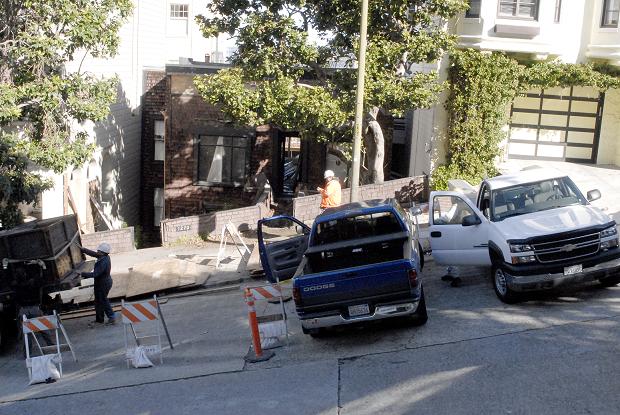
About two years ago, the Guardian reported on the demolition of one of San Francisco’s oldest buildings — the Little House, a cottage on Russian Hill that stood for 148 years at 1268 Lombard Street.

The demolition drew the ire of the Russian Hill Neighbors Association and local historic preservationists, because the historic property came down in the blink of an eye after the owners were granted an emergency demolition permit from the Department of Building Inspection. At the time, surrounding neighbors raised concerns that the Little House had been purposefully neglected in order to get it to a demolish-able condition, so that the lot could be cleared for development without undergoing the standard environmental review process.


Co-owners of the lot (pictured in the box) where the Little House once stood now want to construct a 4-unit building.

The agenda for today’s Board of Supervisors meeting includes a public hearing on a conditional use permit for a new building at 1268 Lombard, deemed to be an infill project because it’ll be constructed on what’s now an empty lot. Co-owners James Nunenbacher and Michael Cassidy are requesting city approval to construct a four-unit, 40-foot high residential project there.

Expect fireworks, as residents such as F. Joseph Butler, an architect with the Little House Committee, haven’t forgotten the loss of the cottage, which was one of the only structures on Russian Hill that emerged unscathed after the 1906 earthquake and ensuing fires.

“I think that the project sponsors … should not be rewarded for tearing down one of our most historic properties,” a woman from the preservation community noted at a Feb. 17 Planning Commission meeting about the conditional use permit.

At today’s meeting, supervisors could vote either to approve or disapprove the conditional-use permit.

***UPDATE*** No fireworks after all, the item was continued.

Art walk used to protest Chase Bank

8

This week’s Thursday evening Divisadero Art Walk is going to combine local culture with a clear political message. Local activists have dubbed the night the “No Chase Block Party” to protest a banking giant’s unwelcome entry in their neighborhood. Many in the neighborhood pride themselves on staving off the corporate chains, but now J.P. Morgan Chase is set to open a new branch at the intersection of Divisadero and Oak streets. Previously, the retail location held three locally owned shops including a specialty cheese vendor.

“We are intentionally choosing to have the action as part of the Divisadero Art Walk to both celebrate and participate in the creative community that exists and is blossoming here,” said Ilyse Magy, a local resident helping with the outreach. “The Block Party will be just that, a block party, a chance for neighbors to meet neighbors and have actual conversations about what they want their neighborhood to look like.”

Magy and others will present an art project in which resident that walk by can brainstorm and write down ideas for the neighborhood. Additionally, information about local credit unions will be available, she said.

As for corporate chains, two other Chase branches lie within a 10-block radius, and a Bank of America is around the corner, indicating there is no shortage of banking options in the area. The location, however, is excellent for displaying an advertising logo considering the immense traffic on that stretch of Divisadero.

The community action is happening in conjunction with formal appeals to the San Francisco Planning Commission. City law requires chain businesses that move into certain neighborhoods to undergo a conditional use permit hearing. But the Planning Department has interpreted the law to exempt banks, thus preventing a hearing that would empower community voices and local concerns.

It’s not so easy building green

34

OPINION The Parkmerced project developers like to talk about how environmentally sound their plans are, but a harder look suggests otherwise.

At a March 29 hearing on the project, Green Pary member Eric Brooks presented graphic evidence of the environmental impacts of the destruction of the garden units and the landscape, and the proposed increase in parking on- site. As a transit-first city, it seems ludicrous to spend so much on below-grade parking. And regrading and replanting the entire site will allow toxins in the soil to become airborne.

Then there’s the question of whether the site is really “blighted,” as the developer claims — and whether so much housing needs to be torn down in the first place. Sup. Eric Mar questioned the issue of the deterioration of the existing units; he said he’d visited the site and noted that many units appear to be in fine shape.

I agree that the western side of town needs more density — but dumping that density disproportionately on one community seems to be a biased approach. Parkmerced is a renter community. Other areas dominated by homeowners seem to be off the table.

San Francisco should take a broader look at west-side zoning. That would include looking seriously at corridors with light-rail lines — Ocean Avenue, West Portal Avenue, Taraval Street, Geary Boulevard, Judah Street, and others — where some one-story buildings are far more deteriorated than the buildings at Parkmerced.

City officials should look at alternatives that allow other sites to be upzoned or allow owners to build on side sites. This would lessen the effects on one community by sharing the growing pains of a city limited on three sides by water.

We all want the projects, work, housing, jobs, and an expanded tax base for the city. But many of us question whether the current plan for Parkmerced does justice environmentally and sustainably when it ignores infill and preservation-based alternatives that could create more jobs and a better long-term green solution.

I have submitted a proposal to the Planning Commission that shows how to improve transit linkages, how infill housing can be done, and how the 11 towers at Parkmerced can be redesigned (the initial concept was to design new, pencil-thin replacement towers and structurally-reinforced new buildings). I suggest that more infill housing can be built by removing parking garages throughout the site — which would lessen displacement and allow a significant density increase.

Assurances by the developer should not placate the city or the supervisors. If the supervisors lean toward approval, they need to be reminded of the transit, sustainability, and open-space concerns of the project to ensure that the design is changed either through revisions of portions or the whole to make more clear the concerns that the project has been greenwashed to promote the developer’s interests.

Aaron Goodman is an architect and Bay Area native.

Seeking a watchdog’s watchdog

1

rebeccab@sfbg.com

When cash pumps through the guts of city politics, the Ethics Commission is charged with keeping track of it all to help members of the public follow the money. But what happens when the public loses faith in the ethics of the Ethics Commission?

In the run-up to a hotly contested mayoral race, in a city marked by rough-and-tumble politics influenced by moneyed power brokers, the function of this local-government watchdog agency is especially critical — and to hear some critics tell it, the Ethics Commission needs reform if it is to perform as an effective safeguard against corruption.

So it was hardly surprising that an April 5 discussion at the San Francisco Board of Supervisors meeting about whom to appoint to the Ethics Commission featured a low-level tug-of-war with some potentially high-level implications.

Sup. Eric Mar proposed that the board consider Allen Grossman for the seat. An octogenarian government watchdog unaffiliated with any political party, Grossman has gone so far as to file a successful lawsuit against the Ethics Commission for not following its own public-disclosure rules. As a potential appointee, he was widely viewed as reform-minded, following in the footsteps of others who have been purged from the body in recent years.

“Open government and good government work together, hand in hand,” Grossman told members of the board’s Rules Committee several weeks prior, interlacing his fingers for emphasis.

Grossman won the backing of Sups. John Avalos and Ross Mirkarimi. But Board President David Chiu spoke against the idea, throwing his support instead behind Dorothy Liu, an attorney and professional colleague of his through the Asian American Bar Association. The Rules Committee, chaired by Sup. Jane Kim and filled out by Sups. Sean Elsbernd and Mark Farrell, also turned down Grossman in favor of Liu.

“She’s extremely hard-working and does her homework,” Chiu later told the Guardian. He also saw it as a plus that Liu was not a political insider: “I think we need an individual on the Ethics Commission who will be impartial,” he said, adding that he’d prefer “someone who has not been involved in the rough-and-tumble of San Francisco politics.” Sup. Carmen Chu echoed Chiu’s comments during the meeting, saying she thought Liu would be an ideal candidate because she did not seem to have an agenda.

Mirkarimi and Avalos, on the other hand, said they were looking for a candidate who did possess a vision for strengthening the role of the agency as a watchdog. “I think our Ethics Commission and the department, as it stands, needs all the help it can get,” Mirkarimi said during the meeting. “I think having people who are well-seasoned with an understanding in the law of ethics and sunshine is something we should be looking for. Mr. Grossman has exhibited that well over the years in trying to do everything he possibly can to advance the cause in a nonpartisan way of making sure that we have a very strong Ethics Commission.”

Mar’s motion to consider Grossman was shot down on an 8-3 vote with Mirkarimi, Mar, and Avalos dissenting; Liu then won the commission appointment on a 10-1 vote, with Avalos dissenting.

Until recently, the Board of Supervisors seat on the Ethics Commission was held by Eileen Hansen, a progressive who had called for political reform under Mayor Willie Brown’s administration prior to being named to the post. When she was being considered for the commission, Hansen recalled, then-Sup. Michela Alioto-Pier raised an objection. “[She] thought the perfect person would be somebody who … would come essentially as a clean slate,” Hansen remembered. “Because I had been involved in organizing campaigns and had run for office, that was deemed too political.”

Yet Hansen viewed her familiarity with the system as an asset that helped her serve as an effective watchdog against corruption. During her six-year tenure, Hansen often cast lone dissenting votes against decisions she believed were weakening ethical standards. She told the Guardian she’d tried floating remedies for situations she viewed as inappropriate, only to have them summarily ignored, a role similar to that of former Ethics Commission member and staffer Joe Lynn.

In one case, Hansen recalled, she became concerned about a planning commissioner who also directed a nonprofit. To raise money, her organization held fundraisers that were ostensibly attended and funded by the very same developers and lobbyists who appeared before her at the Planning Commission. Yet Hansen said she was unable to persuade the other commissioners or staff to call for an investigation.

A more recent Ethics Commission vote underscores the same tension. On March 14, the commission voted unanimously to waive a pair of ethics regulations to allow a mayoral staff member to become executive director of the America’s Cup Organizing Committee (ACOC). Composed of highly influential business figures including at least two billionaire investors, ACOC is tasked with securing corporate donations for the America’s Cup to offset city costs of hosting the race.

Kyri McClellan, project manager with the Mayor’s Office of Economic and Workforce Development, helped craft a memorandum of understanding with ACOC regarding its fundraising obligations to the city. In her new job, without skipping a beat, she’ll interface with the city on behalf of ACOC. The rules that were waived for her benefit are meant to prevent city officials from holding undue influence over their former coworkers after leaving public service, and to prevent city staffers from accepting money from city contractors right after departing from city employment.

“If I had been there, there would have been at least one vote against that waiver,” said Hansen, whose term on the commission ended before this vote. “We have this law in place for a reason. By continuing to provide waivers … we create a situation where the public will not trust the Ethics Commission as a watchdog.”

Hansen said she was scouting for a new commissioner who would carry on with her work. “I was looking for and trying to recruit a visionary — someone who could really be a reformer,” she said. “We’re almost in a position now where we need a watchdog over the watchdog.” She said she saw Grossman as the right fit.

Other observers, such as CitiReport blogger Larry Bush — an investigative reporter who called for the creation of the Ethics Commission in San Francisco in the early 1990s — questioned whether Liu was the best choice after hearing her statements at the March 17 Rules Committee hearing. Liu did not come out strongly in favor of televising Ethics Commission meetings, which has long been a sticking point for open-government advocates.

“I absolutely support televising the Ethics Commission, I think it’s really important,” Kim noted when we asked her about this. She added that she would have supported Oliver Luby — a former Ethics Commission staff member and whistleblower who was ultimately ousted from the job — if he’d applied.

Kim noted that an initial concern she’d had in seeking an ethics commissioner was whether the person would vote to allow Mayor Lee to resume his job as city administrator after serving out his term as interim mayor, a key decision that the commission was scheduled to consider April 11.

Once she was advised that it would be inappropriate to ask which way they would vote when conducting candidate interviews, Kim said she withheld her question — and still didn’t know Liu’s or Grossman’s position at the time she spoke with the Guardian. “I think it’s very appropriate for him to get his job back,” Kim noted. “That vote is very important to me.”

That vote drew closer scrutiny, however, after Ethics Commission staff recommended that the exemption that would be built into the law for Lee’s benefit should be expanded to include appointed members of the Board of Supervisors. “This new proposal would convert a targeted, narrow exemption to deal with a special case into the ‘Politician Job Protection Act’ and could open the door to all kinds of unintended consequences,” charged Jon Golinger of San Franciscans for Clean Government.

Meanwhile, Luby seemed disheartened by the board’s selection of Liu for the Ethics Commission. He was looking to Grossman to fill Hansen’s shoes as the commission’s reformer — a role previously held by Lynn, Luby’s good friend and mentor who died last year.

He lamented, “This will mark the first time in over 10 years to have an Ethics Commission without someone who has past experience advocating for good government.” 


The online-learning challenge

7

culture@sfbg.com

CAREERS AND ED Mixing, mashing, chatting, tweeting: This is how the University of California envisions the future of learning for what it calls a new breed of students. Also on the syllabus? Podcasting, vodcasting, blogging, and Skype.

Last week, UC was awarded a $750,000 Next Generation Learning Challenges grant, moving it one step closer to a curriculum composed of words that barely existed a decade ago. But some fear — with good reason — that online education will become a low-cost, high-return alternative to traditional instruction. And the students will be the losers.

UC’s Online Instruction Pilot Program grew out of recommendations to explore online learning discussed by the UC Commission on the Future over the past two years. This spring, a subcommittee of faculty and administrators selected 29 courses to be developed over the next two years.

The pilot program is a long-term initiative to evaluate and ultimately increase the role of online education as a regular part of the UC curriculum — a chance to respond, according to the program’s website, to a “transformation” in the way students learn.

The commission promotes online learning as a boon without trade-offs, a way of answering questions of accessibility, efficiency, and, ultimately, costs — and is not shy about outlining the relationship between the three. Chartered to help wiggle UC out of a “vise of rising costs and drastically reduced resources,” the commission is proposing sweeping changes to California’s public university system.


ALL BUT THE KEG PARTY

UC envisions a greater number of students served and increased diversity, “from Kentucky to Kuala Lampur,” according to Law School Dean Chris Edley, cochair of the commission’s Education and Curriculum Working Group.

Edley, one of the most enthusiastic proponents of digital learning, initially referred to online education as an 11th UC campus, promising it would offer an equivalent college experience — minus only the “keg party.”

Critics were quick to condemn the plan as overblown excitement. Concerned undergraduates and skeptical faculty raised questions about the quality of online learning. Angry graduate student instructors (understandably) balked at Edley’s grandiose vision of a cybercampus where “squadrons of GSIs” will serve on the “frontline of online contact” with undergraduates.

Political science professor Wendy Brown is one of the leading critics. “Personal engagement with students is crucial,” she told us in a phone interview. “Real teachers don’t just teach subject matter. You have to know students and where their experience and level of engagement is. I don’t want them just to come out with content — I want them to come out as thinkers … have a new way to analyze the world.”

Brown said she believes that acclimating to the intellectual culture of a university — especially important in the first year — can’t be achieved online. Yet first-year courses are exactly where administrators are looking to channel online efforts.

Administrators hope to relieve pressure on overcrowded gateway math and science courses, as well as freshman reading and composition. As many as 40 percent of first-year students test out of their first semester of reading and composition, indicating that the students remaining are those most in need of attention. Even so, a generous smattering of general chemistry, intro calculus, and reading and composition classes like Humanities 1A are among the pilot courses moving forward.

Craig Evans, professor of mathematics and chair of the course committee for calculus, echoes Brown’s concerns. “I don’t think it’s impossible to make this work, but I think it would be very, very difficult,” he said. “Part of what we do as teachers is applied psychology, things like checking in with students and keeping up morale, in addition to teaching classical mathematics. It’s hard to see how to convey that in an online course.”

Robert Anderson, faculty representative to the Board of Regents and professor of economics and mathematics, agreed that there is “something important about being on campus for four years, rubbing shoulders with students and faculty.”

And when short-term goals — taking pressure off overcrowded introductory courses — are met, what comes next?

The academic senate approved the pilot program on the condition that the necessary funding — as much as $7 million — come from outside sources. With the exception of the $750,000 NGLF grant, that money hasn’t materialized. The university has borrowed money from internal sources; half of that will be directed toward infrastructure development, according to Anderson.

With money-saving rhetoric underlining every stage of the program’s development and millions to be invested in online infrastructure, how will UC officials avoid the temptation to simply use online learning as a revenue source — regardless of what academic benefits pilot program researchers find?


CASH COWS

The answer is: they won’t.

In a post on the Berkeley Blog last summer, Edley attempted to allay fears that an online program would eliminate campus learning by assuring that future online pupils would be “new, tuition-paying, UC-eligible students we otherwise wouldn’t have the room or resources to serve. And any net revenue would be plowed back into supporting the on-campus program.” In this model, off-campus students would be cash cows milked for the additional revenue they could produce.

Though the committee has delayed visions of an entirely online degree since then, crucial questions regarding a long-term trajectory remain: Would online students pay the same price? Would they be accepted exclusively for online matriculation? Would their degrees be identical?

Nobody knows, but already the pilot program is relying on projected revenue from off-campus students to help recoup some of the borrowed $7 million, according to Anderson.

Keith Williams, Edley’s cochair on the commission’s education and curriculum working group, confirmed that UC is planning to offer newly developed classes on a per-credit basis to students enrolled at UC and others.

According to Williams, these new courses will offer full course credit — and the full price tag. Pricing was made consistent with brick-and-mortar courses, Williams explained, to avoid causing UC students to make a tough decision: either pay full price for an on campus course or save money by taking a less desirable online course.

And yes, conveniently, offering the courses at full price does generate revenue to be reinvested. (Williams balked at the phrase “skimmed off the top.”)

Now that the pilot program is underway, administrators are treading more lightly around its money-making intentions. But for a reminder of the project’s origins, one need only look at the commission’s recommendation to up enrollment quotas for nonresident students — a recommendation slated to be met next year.

The commission’s final report explicitly calculates the amount of money ($12,000) that can be generated for each Californian replaced with a nonresident student, stating “each 1 percent increase in nonresident students would generate almost $1 million” — a dubious maneuver at a time when the university claims it must expand online education to meet the shortages of space for its own residents.

The culture betrayed by this vision of UC education is clear — one in which educational models are constructed according to business practices.

Despite the pilot program’s rhetoric of innovation and breakthrough, it’s not the first to fuse Internet with education. Brown is quick to note that despite her criticism of the pilot program “[she] is not a Luddite.” She described to us how the faculty is increasingly making use of online educational aids.

Many professors choose to broadcast their lectures online, allowing students — and anyone else for that matter — to virtually peek in on a lecture, either live or with a delay of hours or days.

Currently, more than 40 UC Berkeley lecture halls are fitted for video and/or audio recording. Thousands of transmissions, from biology to history, have been uploaded to iTunes and YouTube (see sidebar).

Although webcasts are highly popular with students — and students are undoubtedly the main priority for the program — people are tuning in from all continents, according to Benjamin Hubbard, who runs the webcast program.

For Hubbard, webcasts “[broaden] the window of access to all the scholarly activity on campus. We are fortunate in that we are public university, so first and foremost we have a mission of community service and making this content freely and publicly available matches this mission.”


THE PUBLIC OPTION

Recognizing the enormous challenges of decreased accessibility and increasing cost, a growing consortium of educators and researchers are building momentum and developing a vision for a truly public online educational program.

Lisa Petrides, president and founder of the Institute for the Study of Knowledge Management in Education, calls herself a “public education fanatic.” She told us that the instead of using online teaching as a money-maker, schools can adopt a principled, egalitarian approach.

Petrides is a signatory of the Capetown Declaration, a manifesto for the open education movement. The declaration calls for collaboration that cuts across institutional lines; for the use and promotion of free educational resources; and for policy support for open education.

“You start to have this pedagogical collaborative community that can use resources in this way, changing how we teach and how we learn,” she said. To take analogy for computer software, Petrides says her movement is akin to the open source movement.

Now there’s an innovative approach to online education — with its eyes on the future, not its pocket.


How to move 200,000 people around America’s Cup

3

I’ve been wondering how the city plans to move the thousands of spectators expected to show up for a series of regattas in 2012 and 2013, leading up to and including the 34th America’s Cup Final.

And today I had a chance to start perusing the city’s draft People Plan which aims to move up to 200,000 residents and visitors daily to the city’s waterfront and is promising to be “the most transit, bicycle and pedestrian-friendly major sporting event in history.”

(Note to compulsive printers of online government documents: thanks to some nifty maps in this document, your printer may experience replication difficulties. For instance, I had to print everything but the maps on pages 13 and 14 of the document.)

Anyways, my preliminary review revealed that there is a special section in the draft dedicated to the “special transportation needs” of America’s Cup “participants” and that these participants include teams, event staff and, ta da!, accredited media.

“Special transportation needs for the ‘participant” group include but are not limited to staff access to race-related areas and other constricted waterfront areas,” states the plan. “These activities may require unique and frequent vehicle access to various sites.”

[Note to self: Remember to check out what is required to qualify as “accredited media” for a seat in one of the vehicles frequently accessing the area.]

Just kidding, and now, back to the needs of regular people who want to see the event.

“Part of the appeal that brought the Events to San Francisco Bay was the opportunity to create a new kind of viewing experience for the highest level of competitive sailing, with races held in close proximity to urban areas and accessible shoreline instead of open seas,” states the plan’s “Strategic Adaptability” section.

“The novelty of this concept creates excitement but it also creates uncertainty, in that there are few instructive examples of how spectators will choose to attend an America’s Cup Final-level sailing event in the middle of a weekend day, or how a large event in San Francisco Bay during a weekday will affect the ability of Bay Area residents to commute to work or their other daytime destinations,” the section notes.

{This sounds like the city is trying to figure out how many of us will choose to be anywhere but San Francisco on the weekends in question, how many of us who work in San Francisco are planning to play hookey to attend week day events, and how many will show up even if the Bay is swathed in fog.]

Un its draft plan,  the city promises  “to seed the strategies set forth in the People Plan with a measure of adaptability to allow for the strategic deployment of a finite amount of transportation resources across the spectrum of transportation demands associated with the Events in accordance with the expected demands of each day.”

Beyond that, the document is divided into three main parts. One itemizes likely destinations, the next describes transportation strategies to serve these key destinations, and the final section describes “additional considerations and strategies.”

To learn a) which race facilities, waterfront locations, and race viewing locations will be accessible to the public, b) which bus, rail, cable car, bike, automobile and ferry routes will be modified, and c) which parking and special locations will be added, be sure to check out the plan. And then eave your comments at the city’s feedback site here.

For, as the city’s website warns, “The early draft of the People Plan is the product of analysis by city and SFMTA staff, with early input from stakeholder groups. The draft People Plan announced today will also undergo significant and further revisions, following input from members of the public, advocates, city and agency staff, the environmental community and other stakeholders in the coming months. Final approval and consideration will occur following the completion of environmental review.”

In other words, review the documents now and speak your piece soon, otherwise your ideas won’t have any chance of making it into the final plan.

Or at Mayor Ed Lee put it in a press release, “We are moving rapidly to meet our commitments to host a spectacular 34th America’s Cup in 2013 and set a new standard for sustainable event-planning. The America’s Cup is a unique opportunity to leverage our region’s transportation resources and our enthusiasm to deliver the most transit, bicycle and pedestrian-friendly international major sporting event in history for residents and visitors alike.”

And here’s hoping that we will all be “moving rapidly” when the regatta finally rolls into town…

Editor’s Notes

7

Tredmond@sfbg.com

The San Francisco City Planning Department is revising its housing plan, and there’s a lot of indignation on the west side of town. See, the Housing Element of the city’s General Plan calls for a little bit of increased density in some of the neighborhoods that have fought density for years.

The unwritten law of San Francisco housing politics is that you don’t even talk about density west of 19th Avenue, and it’s pretty hard to talk about it anywhere beyond the western borders of Districts 3, 5, 8 and 11. So all the new housing gets pushed into the eastern neighborhoods — and all the rational planning people agree that the other side of town should absorb at least some of it. Density doesn’t always mean big, tall buildings, by the way — legalizing in-law units would create more housing, and more density, in single-family-home areas. But you run into the problem of everyone wanting a car — and turning garages into apartments means more cars fighting for that almighty parking space. Housing cars in this town sometimes seems more important than housing people.

So we’re going to hear some squawking — and a lot of it’s going to be misplaced. Because the real issue in the Housing Element isn’t density — it’s affordability.

The city acknowledges, in its own documents, that based on local needs, more than 60 percent of the new housing in the city has to be available at below-market-rate prices. The planners also admit they have no idea how to make that happen:

“The city will not likely see the development 31,000 new units, particularly its affordability goals of creating over 12,000 units affordable to low and very low income levels projected by the [city’s needs assessment] … [But] realizing the city’s housing targets requires tremendous public and private financing, [which] given the state and local economy and private finance conditions, is not likely to be available during the period of this Housing Element.”

Translation: we can’t afford to do what everyone agrees we have to do.

San Francisco city planning has been driven for decades by the needs of the private sector. It’s made good money for the developers (building housing in SF is still highly lucrative). But as public policy, the model has failed.

Until we set clear policies saying that the needs of local residents come first — and that high-end housing isn’t meeting those needs — we’re going to keep living with a serious disconnect.

The Parkmerced investors

8

rebeccab@sfbg.com

Parkmerced is one of the largest rental properties west of the Mississippi, and with more than 1,500 rent-controlled units, it’s an important piece of the city’s affordable-housing stock. Among the residents who live in the neighborhood-scale apartment complex are seniors, young families, and working-class San Franciscans, some of whom have called it home for decades.

A plan for an extraordinary overhaul of the property envisions tearing down the existing low-rise apartments and nearly tripling the number of units with a construction project that could take up to 30 years. On March 29, after Guardian press time, the Board of Supervisors was scheduled to vote on whether to uphold the plan’s environmental impact report (EIR), a key milestone of the approval process.

The Planning Commission voted 4-3 to certify the EIR, and if the board followed suit by rejecting four different appeals filed against it, Parkmerced would be on track to clear final approval sometime in May.

San Francisco Tomorrow was among the groups that filed appeals against the Parkmerced plan. “They want to destroy a neighborhood without sufficient justification or mitigation,” said Jennifer Clary, the group’s president, citing concerns about traffic congestion, loss of an historic landscape, and the destruction of rent-controlled housing.

Julian Lagos, a resident of 18 years, filed an appeal on behalf of the Coalition to Save Parkmerced. “It’s a very blue-collar community, and they want to replace it with wall-to-wall luxury high-rise condos,” said Lagos, who lives in a unit that would be targeted for demolition under the development plan. “I call it ground zero,” he said. “And I tell my neighbors, ‘You’re living at ground zero.’ “

Mayoral development advisor Michael Yarne noted that most points highlighted in the EIR appeals had already been addressed, except one charging that there hadn’t been adequate consideration over whether a Pacific Gas & Electric Co. gas pipeline running underground near Parkmerced could be jeopardized by construction activity. “The answer to that is, that’s a really good question for PG&E,” Yarne said. But he asserted that it wasn’t a project EIR issue.

Elected officials’ reactions to the overall plan were mixed. Lagos noted that campaign filings showed that Sups. Carmen Chu and Sean Elsbernd had accepted donations from people related to the project, and he predicted that Board of Supervisors President David Chiu would be a swing vote on the issue. Chiu spent several hours touring Parkmerced the Friday before the vote. He did not return Guardian calls seeking comment.

A development agreement between the city and the developer, Parkmerced Investors LLC, promises that existing tenants will keep their rent control at the same monthly rates — even after the apartments they now reside in are razed to make way for new residential towers.

Such a plan typically wouldn’t fly under state law because the Costa-Hawkins Act prohibits a city from imposing rent control on newly constructed housing. Yet city officials, with input from the City Attorney’s Office, say they’ve constructed this deal so that it falls within one of the exceptions written into the state law, offering a legal defense in the event of a court challenge and a guarantee against affordable housing loss.

“The development agreement is like a constitution for land use,” said Yarne. “You can’t get rid of it.” If the project changed hands or the developer went bankrupt, the new owner would be bound by the same terms, Yarne said.

However, Mitchell Omerberg of the Affordable Housing Alliance cautioned that he didn’t believe there was any guarantee that rent-control housing qualified as an exception under Costa-Hawkins. “Like parking a semitruck in a motorcycle space, it’s a poor fit and a risky bet — even before you consider the antipathy to rent control of the California courts,” Omerberg wrote in an argument against the plan.

Tenants advocacy groups have pointed to recent court decisions negating affordable-housing agreements in development projects, saying the legal precedent makes the Parkmerced pact vulnerable to a court challenge. In response, Yarne said those cases had strengthened the city’s legal strategy for formulating the agreement to guard against such a challenge. “This agreement is actually greatly improved because of those cases,” he said.

Nevertheless, there’s a clear financial incentive for the developer to strip away the rent-control unit replacement and other valuable community benefits it is required to deliver under the terms of its agreement with the city. An independent analysis of the project’s financial plan found that if Parkmerced Investors LLC adheres to all the terms of the agreement as planned, its financial rate of return would be less than ideal.

Drafted by consultant CB Richard Ellis (CBRE) to provide an objective financial picture for the city, the report found that the developer’s estimated 17.8 percent rate of return was “slightly below the threshold required to attract the necessary private investment” because investors aim for at least 20 percent in this market. “This means that, based on current and reasonably foreseeable short-term market conditions, the project may not be economically feasible,” the report noted. It added a disclaimer saying that cash flow from rent payments could offset that risk.

That lower rate of return isn’t a cause for concern, Yarne said, but rather a sign of the city’s negotiating prowess, since “we’ve gotten as much as we can in terms of public benefits. That 17.8 percent rate of return shows that we’re probably at the max.”

At the same time, the financial analysis showed that the developer’s prospects improved under hypothetical “tested scenarios” where the expensive community benefits promised in the development agreement weren’t a factor. As part of the analysis, CBRE looked at how the numbers would change if the developer decided to build new market-rate units instead of replacing all the existing rent-controlled units, and found it would fetch a 19 percent rate of return. In a scenario where it stripped out additional costs such as a community garden and new transit line, the rate of return would jump to an eye-catching 23 percent.

But those scenarios are just a hypothetical way to arrive at conclusions about a project’s value, said consultant Mary Smitheran, who drafted the report. “The development agreement specifies that those items need to be provided,” she said.

City officials have given the impression that they’re nailing down a set of requirements that the developer, or any future property owner, cannot get out of. But the people behind this project are some savvy Wall Street investors who are no strangers to controversy.

Fortress Investment Group, a New York City-based hedge fund and private equity firm with directors hailing from Lehman Brothers and Goldman Sachs, gained a controlling interest in Parkmerced last year after Stellar Management couldn’t make the payment on its $550 million debt.

Stellar jointly purchased the property in 2005 with financial partner Rockpoint Group, setting up Parkmerced Investors LLC as the official ownership company. Stellar still manages the property, but Fortress has seized financial control. A recent report on the Commercial Real Estate Direct website noted that its $550 million debt had been modified recently with a five-year extension to 2016.

Fortress made headlines in 2009 after it stopped providing funds to Millennium Development Corp. for the Olympic Village project in Vancouver, British Columbia leaving the city on the hook for hundreds of millions to finish the job in time for the winter games. Meanwhile, Fortress CEO Daniel Mudd recently got formal notification from the U.S. Securities & Exchange Commission (SEC) that he could potentially face civil action relating to his former job as CEO of Fannie Mae, the government-backed mortgage giant, for allegedly providing misleading information about subprime loans.

Stellar, a New York City company run by real-estate tycoon Larry Gluck, was profiled in a 2009 Mother Jones article about Riverton Homes, a 1,230-unit Manhattan rental housing project built in a similar style to Parkmerced, which Stellar purchased in 2005. Although Stellar assured residents that their affordable rental payments would remain unaffected, hidden from view was its business plan estimating that half the tenants would be paying almost triple the rental rates by 2011. Since rents couldn’t ultimately be raised high enough to cover the debt payments, the complex went into foreclosure — but Stellar was shielded against loss because, on paper, Riverton was owned by a separate LLC.

Linh Le, a 36-year resident of Parkmerced and former Chevron employee, wrote to the Board of Supervisors in advance of the March 29 hearing to warn of the financial troubles the investors had experienced before.

“This project reflects a pipe dream that was hatched during an era of reckless spending, fake prosperity, and seemingly limitless money that has since crashed and nearly destroyed America,” he wrote. “The business model that Parkmerced based this plan on has failed and nearly ruined their enterprise. That era is over and the world has changed.”

When kitties attack

0

sarah@sfbg.com

PETS Our cat Spartacus has a reputation for being a bit of a badass. But we never thought he’d end up under house arrest with a rap sheet from the police.

It’s true that he still has the tightly muscled body of a tomcat who came in from the cold a couple of winters ago and stayed after we gave him food and a safe place to sleep. But he’s settled down a lot since we got him fixed. He’ll still bounce other cats from our yard and growls if you tip him out of his favorite chair. But he doesn’t bite people. Or so I thought, until I scooped him out of the path of an unleashed dog one February night and he sunk his teeth into my wrist so fast I didn’t even realize I’d been bitten.

But my wrist began to feel like it had been stung, and soon I noticed a swelling the size of a marble with four tiny tooth marks adorning my wrist. Since it happened at midnight, and since my tetanus shots and Spartacus’ rabies vaccinations were up to date, I simply washed and disinfected the wound, planning to see my doctor the following morning.

“They’re like snake bites,” veterinarian Marie-Anne Wooley told me when I sought solace for Spartacus’ sins. “A cat’s teeth are long and sharp and when they pull out, the holes seal over, trapping the bacteria. Dogs mash things around so their bites are more open, making them easier to clean.”

The doc immediately put me on antibiotics and said to come back if my wrist — already stiff and swollen — got worse. When a rash began spreading up my arm the following night, I headed for the emergency room, where they gave me an intravenous infusion of antibiotics.

“You have an infection of the skin called cellulitis,” the ER doctor said, drawing ink lines on my skin to show how the infection had spread to my elbow and fingers.

She ordered me keep my arm elevated above my heart to prevent the infection from reaching my heart. And before I left the hospital, a police officer took an animal bite report. Animal Control told me to keep Spartacus inside for 10 days.

Even though I spent the next day bedridden, the bite tingled, hurt, and itched every time I lowered my hand. It took three visits to the ER, four days off from work, and two weeks of heavy-duty antibiotics before I was fully healed.

Judy Kivowitz, a nurse at Noe Valley Pediatrics, has seen squirrel, rat, snake, chipmunk, spider, even possible bat bites in the course of her work, and says treating animal bites varies widely.

“It depends on the animal — whether they are a pet and have had their rabies shots.” If you have been bitten by someone’s pet, you should wash, disinfect, apply Neosporin to the area, and inquire about the animal’s vaccine status. Kivowitz notes that even if the animal is known, it should be quarantined for 10 days after biting someone.

Maybe we could all learn from Kivowitz’s three basic steps in animal interaction, which she teaches in an animal-handling class she holds for toddlers. “Ask permission from the animal’s mom and dad to touch it. Do one-finger petting. And don’t look an animal in the eye — even if you know them.”

Or perhaps more to the point, you can do what my doctor told me to do if it happens again with Spartacus. “Next time, try dousing the cat and dog with water instead of putting your arm in the way.” Duh.