Planning

Dick Meister: It’s do or die for the United Auto Workers

3

By Dick Meister

Dick Meister, former labor editor of the SF Chronicle and KQED-TV Newsroom, has covered labor and politics for more than a half-century. Contact him through his website, www.dickmeister.com, which includes more than 350 of his columns.

Historians invariably cite the sit-down strikes at the country’s auto plants in the 1930s as a key to the spread of unionization throughout the automobile industry and throughout American industry generally.

The strikes helped establish the United Auto Workers Union – the UAW – as one of the country’s most economically and politically powerful, progressive and influential organizations, and its president, Walter Reuther, as one of the country’s important leaders.

But that was then, when the American automobile industry was virtually unchallenged by foreign automakers. Now U.S. automakers face heavy competition from Asian and German firms, especially from the firms that have opened plants in the United States. The steady growth of the non-union plants has been accompanied by a steady weakening of the UAW. The union’s membership, once in the millions, has declined to 350,000.

There are 14 foreign-owned assembly plants and several dozen parts factories now operating in the American South and Midwest – “transplants,” as the UAW calls the foreign-owned facilities. The transplants have become a major part of the U.S. auto industry, accounting for the industry’s only growth in the past 30 years. They employ about 50,000 workers, and as Jane Slaughter of Labor Notes reports, the workers produced more than 40 percent of all vehicles made in the United States last year.

If the UAW is to regain its power and influence and standing as a cornerstone of the labor movement, it will have to organize the transplants, whose owners are generally as hostile to unions as their American predecessors were in the thirties.

Organizing the transplants could very well be as tough – or tougher – as organizing U.S. plants was eight decades ago. In the thirties, many auto workers were already organized and able to act as a strong unified body to demand union contracts – and get them. But today, the UAW is faced with having to first convince workers to join the union and then make a unified demand for contracts from their staunchly anti-union employers, most of them based in the heavily anti-union South.

As a recent report from Reuters News Service noted, workers in the transplants “have rebuffed the union repeatedly,” in large part because of heavy employer pressures on them, including not-so-veiled threats of moving their plants elsewhere.

The UAW is initially seeking union rights for workers at the facilities owned and operated by the German companies Volkswagen and Daimler. The union sees the German companies as relatively easier targets than the Japanese and South Korean manufacturers who also operate U.S. plants.

Reuters found that the UAW’s failure to organize workers at the foreign-owned facilities has put the union in a financial bind. It has forced the UAW to sell some of its assets and shift money from its fund for financing strikes in order to pay for its operations. That includes trying to organize workers in the foreign-owned plants at the same time that the decline in the union’s membership has greatly lessened its dues income.

Despite its financial problems, the union is planning a worldwide $60 million campaign aimed at pressuring the transplants into agreeing to elections in which their workers could freely vote for or against unionization. The UAW is hoping to get strong support for elections from other unions and its Democratic political allies.

The UAW will also need broad public support, and that may not be easy to get, given the widespread popular opinion that the automobile industry’s problems stem at least in part from the relatively high pay and benefits the union has won from auto makers. The union is trying to overcome that by promising that contracts resulting from the voting would commit the UAW to sharing responsibility with employers for “quality, innovation, flexibility and value.” But if the union concedes what workers perceive as too much, it may lose many potential new members.

The situation facing the United Auto Workers, long one of America’s most important institutions, is indeed drastic – so drastic, says UAW President Bob King, that if the union fails to effectively organize the foreign-owned plants, the union will have no future.

 King insists he is not exaggerating. “I have said that repeatedly,” he declared, “and I believe it.”

Dick Meister, former labor editor of the SF Chronicle and KQED-TV Newsroom, has covered labor and politics for more than a half-century. Contact him through his website, www.dickmeister.com, which includes more than 350 of his columns.

Democracy in distress, but it’s the best of the alternatives

0


By Dominique Moisi

Dominique Moisi is the author of The Geopolitics of Emotion.

PARIS – Is democratic time too slow to respond to crises, and too short to plan for the long term?

At a time of deepening economic and social crisis in many of the world’s rich democracies, that question is highly relevant. In Italy, for example, Prime Minister Mario Monti has the necessary and legitimate ambition to carry out comprehensive reform. He is both competent and honest, but faces a quasi-structural impediment: whereas leaders once had three years to convince voters of their policies’ benefits, they now have three hours to convince global financial markets to back their approach.

Caught between Italian legislators who, deep down, do not understand that change and markets in quest of near-immediate certainties, can Monti transcend his natural prudence and act with sufficient clarity and decisiveness?

In the United States, too, the political system is becoming increasingly dysfunctional. The political philosopher Francis Fukuyama goes so far as to say that “vetocracy” could triumph over democracy, regardless of who wins the 2012 presidential election. The separation of powers, a principle established by the US founders under the influence of philosophers such as Montesquieu, is leading today to near-paralysis.

Democracies suffer not only from their slow reaction time at moments of crisis, but also from the difficulty that they face in projecting themselves into the future and planning for the long term. On both sides of the Atlantic, political leaders know what they must do for their countries, but don’t know how to get re-elected if they actually do it. They seem to be structurally condemned to short-termism.

But it is not because democracies have a “time problem” that their era seems to some to be over. China is rightly proud to be able to project itself into the twenty-second century. But China owes that quality of long-term thinking much more to its culture than to the nature of its political system. Chinese think long term because they are Chinese, not because they are not democrats.

China’s leaders can, of course, react to events without much regard for Chinese public opinion. After all, the great majority of Chinese do not dream of democracy, even if something like a civil society is emerging, generating new interests and demands that can no longer be totally controlled or manipulated, as in the past.

But that is precisely the weakness of non-democratic regimes in a global age dominated by transparency: Who dreams of becoming a Chinese citizen, or even a citizen of Singapore? In the aftermath of North Korea’s hereditary succession, strategic thinkers rightly emphasize China’s key role in shaping the peninsula’s future. But, despite the scenes of hysteria that followed the death of the “Great Leader” Kim Jong-il, most North Koreans probably dream of joining democratic South Korea (even if many South Koreans fear that prospect).

The majority of Chinese may not want to be governed like Westerners, but it would be wrong to assume that their only ambition is to spend like Westerners. The more successful they are, the more individualistic they will become and the more they will expect the respect and consideration of those who govern them.

By contrast, if China’s economic growth slows, which is likely in the coming years, protest against corruption – a source of fragility for any regime – will escalate. Indeed, it is important to bear in mind that, ahead of the upcoming Chinese leadership transition, new occupants for only the top two posts have been chosen, and that through a process of gradual anointment by roughly a hundred people at most.

The current crisis in the advanced countries, which may very well lead to a global recession (if it is not already doing so), not only reveals the many maladies of democratic regimes, but also acts as their incubator and accelerator. And yet the crisis may turn out to have an even greater impact on non-democratic systems that seem to be more efficient, but are in reality much more fragile. We see this in mounting unrest in both Russia and China.

Contrary to what one might think, democracy is more resilient than the alternatives in the long run. This will remain true as long as democrats remain convinced of it. Non-democratic models cannot truly challenge democracy. Only the misbehavior of democrats can do that.

Dominique Moisi is the author of The Geopolitics of Emotion.

Copyright: Project Syndicate, 2012.
www.project-syndicate.o

Should city commissioners live in San Francisco?

14

Overriding the Rules Committee recommendation and dissing Sup. Scott Wiener – who has taken a lead role on protecting nightlife from critical cops and NIMBY neighbors – the Board of Supervisors yesterday voted to appoint Glas Kat Supper Club owner Steven Lee to the Entertainment Commission, even though he doesn’t live in the city and needed a special residency waiver. UPDATE (1/12, 3 PM): Sup. Sean Elsbernd informs us that the City Attorney’s Office has ruled residency waivers can’t be used with Charter Commissions such as Entertainment, thus invalidating this appointment. 

Why would supervisors do so when Castro club owner Tim Eicher, Wiener’s pick and the Rules Committee’s choice, was well-qualified, anxious to serve, and actually lives in the city? Maybe it has something to do with the fact that sources say Chinatown political fixer Rose Pak and Pak protege David Ho are close to Lee and have been lobbying on his behalf. Or that Wiener said Lee supporters have been making the argument that there are already too many gay men on the commission.

“Nightlife issues are important tot he LGBT community,” Wiener said, noting that he was disappointed that Lee supporters have made that argument, particularly because he noted the LGBT people are underrepresented on many city commissions, particularly the powerful Planning and Airport commissions, where there are none.

Whatever the case, it made for a tense discussion at the board yesterday, followed by a vote that didn’t break along normal ideological lines. The motion by Sup. Eric Mar to substitute Lee for Eicher was approved on a 6-5 vote, with Sups. David Campos, Carmen Chu, Sean Elsbernd, Mark Farrell, and Wiener opposed.

Lee supporters noted that he has lived and worked in San Francisco for decades even though he has recently moved down the peninsula to help care for an aging father and disabled brother. For three generations, Lee’s family has been opening and operating businesses in San Francisco, including nightclubs.

“I felt his experience was somewhat superior,” Sup. John Avalos said of his reason for backing Lee.

But those who voted against Lee said it’s a troubling precedent to choose an out-of-towner over a city resident. “To grant a residency waiver for someone when we have a qualified San Francisco candidate is something we just don’t do,” Farrell said.

Sup. Jane Kim cited examples of other appointees that had such waivers, but Elsbernd angrily retorted that those were for seats that no city residents had applied for. And if Sup. Malia Cohen gets her way, there will be even more non-residents being appointed to city commissions. She said that she intends to recommend African Americans who have left the city to serve on various commissions, and she told her colleagues that she expects their future support for that effort.

After the hearing, both Lee and Ho downplayed Pak’s role in the move, telling the Guardian that Lee had key supporters in many of the supervisorial districts. “I’ve been doing this on my own,” Lee said. “I never asked Rose to help me.”

As for his priorities on the Entertainment Commission, Lee said, “Obviously, our main goal is public safety, but also working with the neighbors.”

Guardian editorial: Mixed report on Mayor Lee

21

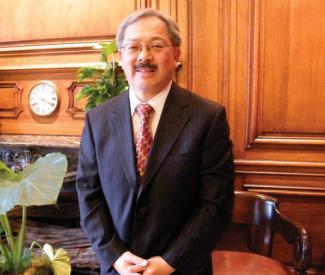
EDITORIAL Mayor Ed Lee’s first big decision — the appointment of a District 5 supervisor — demonstrated something very positive:

The mayor knows that he can’t do what his predecessor did and ignore and dismiss the progressive community.

His inauguration speech demonstrated something else: That he has no intention of being a mayor who takes on and defies the interests of downtown.

Part of the reason Gavin Newsom was a failure as mayor is that he was constantly at war with the left. He ran the city as if his was the only way, as if there were no good ideas coming out of anywhere except his office — and as if anyone who disgreed with or voted against him was his enemy.

That didn’t work, and it doesn’t seem to be Lee’s style. He was under pressure to appoint a supervisor who would go along with him on key votes, but he also knew that a moderate or a lackey would deeply offend the voters in D5, who supported John Avalos for mayor and remain among the most progressive voters in the city. The choice of Christina Olague shows a willingless to accept that progressives play a significant role in San Francisco politics. (It also shows that he is better than any mayor in recent memory at keeping a secret — nobody outside of his inner circle had any idea who his choice was until he announced it Jan 9.)

Olague was, overall, an excellent planning commissioner, and has the potential to be an excellent supervisor. But she will need to make clear from the start that she is representing the district, not the person who gave her the job. Because on some of the key issues that will come before the board this spring, her constituents are well to the left of the mayor. If she can’t vote against his wishes, she’ll have trouble in November.

Olague also needs to be sure that some of the issues her predecessor, Sheriff Ross Mirkarimi, championed (public power and community policing, for example) don’t fall by the wayside. Her expertise in land use issues should be helpful as the board wrangles with waterfront development, affordable housing and the giant California Pacific Medical Center hospital project.

Lee’s inaugural speech was mostly a typical political speech for a new mayor, but it contained a nugget that’s worthy of note. He proclaimed that San Francisco should be a “city of the 100 percent,” a takeoff on the Occupy movement’s 99 percent slogan. And while that’s mostly rhetoric, it’s also a sign that the former housing activist is not going to be a mayor who wants to make a legacy of challenging the economic and political powers of San Francisco.

Working together is fine — but there are a small number of very wealthy and powerful people who have interests that are utterly opposed to the interests of the rest of us. Economic injustice is every bit as real in this city as it is elsewhere in the country — and that’s something the mayor didn’t even mention or acknowledge. Pacific Gas and Electric Co., the big real-estate developers, the landlords out at ParkMerced, the Chamber of Commerce,  and the Board of Realtors … they don’t want to work together. They want their way.

So it’s a mixed report for Mayor Lee — and over the next few months, he’s going to have to realize that everyone in the city can’t and shouldn’t work together, that there are battles where politicians have to take sides, and that all of us will be watching very closely to see where he draws the line.

BREAKING: Lee appointing Olague to D5 seat

20

Sources say Mayor Ed Lee will appoint Christina Olague, the Planning Commission president and longtime progressive, to the District 5 seat on the Board of Supervisors that was vacated by Sheriff Ross Mirkarimi. Formal announcement set for 10 am. More after the ceremony.

UPDATE 11:30 AM: Lee announced his decision and administered the oath of office to Olague this morning at City Hall before a large crowd of mostly progressive political activists who said they were pleasantly surprised to see one of their own get the nod, taking it as a positive gesture from a moderate mayor who has pledged to work with all sides.

In their remarks, both Lee and Olague talked about the need to get past political labels and stressed her detailed knowledge of planning and land use issues, which they hope will help with Lee’s main focus on job creation.

“This is not about counting votes, it’s about what’s best for San Francisco and her district,” Lee said. Olague echoed the sentiment: “I think this is an incredible time for our city and a time when we are coming together and moving past old political pigeonholes.”

She pledged to get right to work on pressing issues facing the city and with winning the “respect and trust” of voters in District 5, one of the city’s most progressive.

We’ll have more analysis and reaction to this appointment and Lee’s inaugural address yesterday in this week’s Guardian.

Ed Lee and District 5

12

It’s all gossip at this point because if anybody other than Ed Lee knows who Ed Lee is going to appoint to the District 5 seat, that person isn’t talking. It’s no surprise the Chuck Nevius, who really loves Mayor Ed, thinks it’s just fine and dandy that he’s taking his sweet time to name a replacement for Ross Mirkarimi, but a some people who live in the district aren’t so happy.

Here’s the thing: The new supervisor will hav to be appointed and take office pretty soon, since Mirkarimi is officially sworn in as sheriff Jan. 8, and so is effectively already off the Board of Supervisors. Either Lee makes his choice by Jan. 10, the next board meeting, or the supes will meet one member short — and the district will have no representation.

Not the end of the world, of course, but: No matter when Lee pulls the string now, the new person will have to hire a staff, make connections across the district, get up to speed on the issues and move into a difficult and complicated job without any transition time at all. No time for preparation, no time to meet with Mirkarimi or his staff to figure out what’s going on — nothing.

If Lee had made his choice a few weeks ago, that person could have been doing what Mirkarimi has been doing in the sheriff’s office — meeting with the outgoing office holder, going to briefings, assembling a team etc.

So Lee’s indecision isn’t just bad for the district; it’s bad for the person he appoints.

Oh, and by the way: Nevius has part of his analysis a little wrong. He claims that

The Guardian, the progressive playbook, has already made its pitch, twice writing that Planning Commission President Christina Olague would be acceptable.

Actually, we haven’t endorsed or promoted anyone for the job (and that’s probably just as well, since anyone I suggest will never get the mayor’s support). We did run an opinion piece by Gabriel Haaland saying that Olague would be acceptable to him. All we’ve done is described the profile we’d like to see:

It’s critical that the mayor appoint a District 5 supervisor who is a credible progressive, someone who supports higher taxes on the rich and better city services for the needy and is independent of Lee’s more dubious political allies.

Either way, it’s time for Lee to make a decision.

Police foot patrols help with crime drop in SF

6

The Mayor’s Office and San Francisco Police Department this morning sent out a press release announcing a decrease in violent crime in 2011, citing a number of factors for the drop but failing to mention an important and once-controversial one: increased police foot patrols.

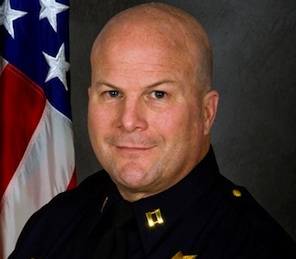
But Police Chief Greg Suhr told us that foot patrols are a big part of the community policing techniques – and “community policing” was indeed mentioned in the release – responsible for the drop.

“They’re big. When we talk about increasing community involvement, that definitely includes foot patrols,” Suhr told the Guardian, explaining his policy of having a visible police presence in high-crime corridors like mid-Market, 3rd and Palou streets, and parts of the Mission District. “People should always see a cop on foot or on a bike in some places.”

For a long time, the SFPD resisted getting cops out of their cars and onto the streets – even in the first couple years of then-Mayor Gavin Newsom’s tenure, when the city had almost twice the 50 murders it experienced each of the last two years — until it became a pitched political battle in the city.

Sup. Ross Mirkarimi and other progressives on the Board of Supervisors and the Police Commission locked horns with Newsom and then-Police Chief Heather Fong over the issue in 2010. After Newsom vetoed legislation to require foot patrols, Mirkarimi and Sup. David Campos co-authored a ballot measure requiring them, Measure M, which was narrowly defeated after SFPD began to implement them on its own.

“I believe that any analysis will eventually show – and they should really do this study – that community policing and foot patrols have a lot to do with this drop,” Campos, a former Police Commissioner, told us. “Community policing and foot patrols are the most pro-active way to reduce crime in any given neighborhood.”

Suhr agrees, something that Campos recognizes and praises the new chief for, saying he’s much better than his predecessors on the issue. “Chief Suhr has been very supportive of community policing,” Campos said. “He’s been very good about working with us to make it happen.”

Suhr said that the department needs to have enough personnel in the stations to take calls, do investigations, and otherwise process information. “Everyone else should be on the street trying to get in front of this stuff,” he told us.

He does still defend the department’s opposition to Prop. M, noting that it would have micromanaged SFPD in a way that he didn’t think was appropriate. But he’s also a true believer in foot beats and other community policing techniques, and he said things are better today than “years ago, when there wasn’t as much open communication as there is now.”

As for the Mayor’s Office and its failure to give credit directly to foot patrols, Press Secretary Christine Falvey told us, “Foot Patrols, the Ambassador Program and other efforts are all critical pieces of Community Policing, which is referenced as part of the success we have seen in getting the crime rate down in San Francisco.”

Her office’s press release follows:

MAYOR LEE & CHIEF SUHR ANNOUNCE SAN FRANCISCO’S CONTINUED HISTORIC CRIME RATE DROP
Year End Statistics Show Continued Historic Lows for Homicides & Violent Crime Rates Overall Since 1960s

San Francisco, CA— Today Mayor Edwin M. Lee and Police Chief Greg Suhr released the year end crime statistics showing continued historic low crime trends for the City. Mayor Lee and Chief Suhr announced that 2011 violent crime rates in San Francisco are down 6 percent from last year.

“Violent crime in San Francisco remains at historic lows because of stronger community partnerships, targeted approaches to violent crime and aggressive crime prevention strategies,” said Mayor Lee. “Despite some tough economic times, Chief Suhr and the San Francisco Police Department are working to make our City the safest big city in the United States through the best use of 21st century technology, strategic deployment of police resources, the use of innovative crime fighting strategies and successful partnerships with our diverse communities and neighborhoods.”

Homicides were at their second lowest annual rate of any year in San Francisco since the 1960s again in 2011.

In 2011, total violent crime in San Francisco was down six percent from 2010 and shows a reduction of 18 percent compared to 2008:
·        Homicide showed no statistical change; there were 50 homicides in both 2011 and 2010;
·        Aggravated Assault is down nine percent in 2011 from 2010;
·        Robbery is down two percent in 2011 from 2010;
·        Rape is down 12 percent in 2011 from 2010; and
·        Burglary is down five percent in 2011 from 2010.

In 2011, total property crime in San Francisco was up three percent from 2010.

The SFPD continues to pursue innovative crime reduction strategies including a “task force style” response to all crimes of violence. Increased community policing efforts, improved approach in assisting those suffering from mental illness and those with limited English proficiency, town hall community meetings and the decentralization of traffic officers and Beach/Park Patrols for safer streets and neighborhoods are also critical to the reduction of crime in San Francisco. In addition, the formation of the new Special Victims Unit allows our City’s most vulnerable populations the compassion and consideration they deserve.

“The year end crime statistics are an indication to the people of San Francisco of how well the men and women of the San Francisco Police Department are serving this City,” said Chief Suhr. “Our goal is for San Francisco to be the safest big city in America, and the men and women of the SFPD in partnership with our communities are committed to this end. We will achieve this goal by reducing crime and the perception of crime through the use of innovative crime fighting strategies, accessing the best technology available, predictive policing, strategic planning, and working collaboratively with all those concerned. There is nothing we cannot achieve when we all work together for the common good.”

An open letter to Ed Lee

76

OPINION Dear Mr. Mayor,

During the next week you will be appointing the a supervisor for District 5, an area of the city that has been historically considered the most progressive part of one of the most progressive cities in the country. It will be a signature decision for you in the next year, and will reveal the tone of your administration. Will you be a consensus mayor — or will you carry on your predecessor’s fight with progressives?

You have many qualified choices, but there is probably only one on your list that a majority of progressives would consider a clear progressive choice: Christina Olague, president of the Planning Commission. There are some who have hesitations about her, but ironically those hesitations are based on her relationship to you and her support for your candidacy for mayor. I have to admit, as a supporter of progressive Supervisor John Avalos for mayor, I shared some disappointment that she didn’t support John.

I’m sure there’s intense pressure on you to choose a more moderate choice, and I’m sure there are from your perspective some valid points to that argument. That said, District 5 deserves progressive representation.

I am a Haight resident, and I ran for Supervisor in District 5 in 2004. Supervisor Ross Mirkarimi came in first, I came in second, and Lisa Feldstein came in third. Both Lisa and I have spoken repeatedly about whether we would run next year, and we have even discussed running as a slate. Most political analysts think one of us would have a decent shot at winning — but I think both of us would support Christina, assuming that her votes continue to reflect her commitment to the progressive values of the district.

Christina not only supported you, she also supported Mirkarimi in 2004, and Matt Gonzalez when he ran for supervisor in 2000. She was appointed to the Planning Commission by Gonzalez and has been reappointed repeatedly by progressive supervisors to that commission. While her votes have not been perfect, by and large, her record is excellent; she has never succumbed to pressure, has listened well to all sides, and has ultimately done what she thought was right.

For example, she stood up for tenants’ rights when the landlord from Park Merced came to the Planning Commission to ask that 1,500 apartments be demolished, all of which were subject to the city’s rent control ordinance. She recognized the flaws in the landlord’s argument that a side agreement (negotiated without the local tenant groups involved) would prevent rent hikes and evictions. Olague was on the right side of history on the Park Merced deal, and has a long record of building tenant and senior tenant power. That’s the kind of leadership we need for District 5, an area comprised of primarily renters. I believe Olague will be a supervisor tenants can trust.

I can’t guarantee that all progressives will stand down if Olague gets the seat. The ego game is what it is. You have learned that from politics, I’m sure. But I think most progressive institutions and progressive activists will see her appointment as a victory and will support her candidacy for Supervisor next fall, as they should if she shows that her votes reflect the trends and values of District 5.

With Christina Olague, you have a win-win. You appoint a supervisor who reflects the progressive values of the district and who is also electable in November. 

Gabriel Haaland is an elected member of the San Francisco Democratic County Central Committee and an LGBT labor and tenant activist.

City Hall’s 2012 agenda

16

EDITORIAL There’s so much on the to-do list for San Francisco in 2012 that it’s hard to know where to start. This is a city in serious trouble, with unstable finances, a severe housing crisis, increased poverty and extreme wealth, a shrinking middle class, crumbling and unreliable infrastructure, a transportation system that’s a mess, no coherent energy policy — and a history of political stalemate from mayors who have refused to work with progressives on the Board of Supervisors.

Now that Ed Lee has won a four-year term, he and the supervisors need to start taking on some of the major issues — and if the mayor wants to be successful, he needs to realize that he can’t be another Gavin Newsom, someone who is an obstacle to real reform.

Here are just a few of the things the mayor and the board should put on the agenda for 2012:

• Fill Sup. Ross Mirkarimi’s seat with an economic progressive. This will be one of the first and most telling moves of the new Lee administration — and it’s critical that the mayor appoint a District 5 supervisor who is a credible progressive, someone who supports higher taxes on the rich and better city services for the needy and is independent of Lee’s more dubious political allies.

• Make the local tax code more fair — and bring in some new revenue. Everybody’s talking about changing the payroll tax, which makes sense: Only a small fraction of city businesses even pay the tax (which is not a “job killer” but is far too limited). Sup. David Chiu had a good proposal last year that he abandoned; it called for a gross receipts tax combined with a commercial rent tax — a way to get big landlords and companies (like law firms) that pay no business tax at all to contribute their fair share. That’s a good starting point — but in the end, the city needs more money, and the new system should be set up to bring in at least $100 million more a year.

• Create a linkage between affordable and market-rate housing. This has to be one of the key priorities for the next year: San Francisco’s housing stock is way out of balance, and it’s getting worse. The city’s own General Plan mandates that 60 percent of all new housing should be available at below-market-rate prices; the best San Francisco ever gets from the developers of condos for the rich is 20 percent. The supervisors need to enact legislation tying the construction of new market-rate housing to an acceptable minimum level of affordable housing to keep the city from becoming a place where only the very rich can live.

• Demand a good community-benefits agreement from CPMC. The California Pacific Medical Center has a massive new hospital project planned for Van Ness Avenue — and so far, CPMC officials are refusing to provide the housing, transportation and public health mitigations that the city is asking for. This will be a key test of the new Lee administration — the mayor has to demonstrate that he’s willing to play hardball, and refuse to allow the project to move forward unless hospital officials reach agreement with community activists on an acceptable benefits agreement.

• Make CleanEnergySF work. A recent study by the website Energy Self-Reliant States shows that by 2017 — in just five years — the cost of solar energy in San Francisco will drop below the cost of Pacific Gas and Electric Company’s fossil-fuel and nuclear mix. So the city’s new electricity program, CleanEnergySF, needs to be planning now to build out both a large-scale solar infrastructure system and small-scale distributed generation facilities on residential and commercial roofs and set the agenda of offering clean, cheaper energy to everyone in the city. The money from the city’s generation can be used to purchase distribution facilities to phase out PG&E altogether.

• Don’t let Oracle Corp. take over even more of the waterfront. The America’s Cup continues to move forward — but at every step of the way, multibillionaire Oracle CEO Larry Ellison is trying to squeeze the city for more. Mayor Lee has to make it clear: We’ve given one of the richest people in the world vast amounts of valuable real estate already. He doesn’t need a giant TV screen in the Bay or more land swaps or more city benefits. Enough is enough.

There’s plenty more, but even completing part of this list would put the city on the right road forward. Happy new year.

Battling big box

1

news@sfbg.com   

In neighborhood commercial districts, national chains and other formula retail stores such as PETCO, Target, Subway, Walmart, and Starbucks are hot button issues for residents who don’t want to see San Francisco turn into a strip mall or have local money pulled from the community.

Sup. Eric Mar and other city officials want to make sure local small businesses aren’t being unnecessarily hurt by competition from national chains, which is why he called a hearing on Dec. 5 to discuss big box retailers and their impacts on San Francisco’s small businesses, neighborhoods, workers, and economy.

“There is no vehicle to see the impacts of big business on the city,” Mar told us, saying he is contemplating legislation to do just that.

Mar was part of city efforts to keep formula pet stores from locating in the Richmond area, working with a coalition of pet food small businesses concerned about PETCO and Pet Food Express trying to move into the area. But it isn’t just pet stores.

“There is a perception that Walmart might make a move into the city since we already have stores like Fresh n’ Easy,” Mar’s Legislative Aide Nick Pagoulatos told us.

The city doesn’t have a comprehensive analysis on how these companies impact San Francisco. Mar says he wants to “have a clear scale of their influence and see what we need to do to protect small business in San Francisco.”

History of wariness

In 2004, the Board of Supervisors adopted the first Formula Retail Use Control legislation, an ordinance that “prohibited Formula Retail in one district; required Conditional Use Authorization in another; and established notification requirements in all neighborhood commercial districts.”

The Planning Code changed again after a voter ballot initiative in 2007, Proposition G, required any formula retail use in neighborhood commercial districts to obtain a conditional use permit, which gave neighboring businesses a chance to weigh in during a public hearing.

Mar said the intent wasn’t to bar big box retail from entering the city, but to simply give neighborhoods a voice. But now, he said the city needs to take a more comprehensive look at what’s coming and how they will impact the city.

Small Business Commissioner Kathleen Dooley echoed the concern, which extends even beyond city limits. “I’ve heard through the rumor mill that Lowe’s in South San Francisco is going to close and

Walmart is looking to take that space since they know they’d never get into the city,” she told us. “It’s bad enough that Target is opening stores [in San Francisco]. They are the quintessential big box because they sell everything.”

Target is in the process of opening a massive store inside the Metreon in SoMa, and another store at Geary and Masonic. Mar isn’t diametrically opposed to the big box industry, but he thinks those companies should be appropriately situated.

“I’ve seen that people in Richmond are positive toward big box like Target coming into the district, but some are nervous that it will take down business,” he told us. “There are some property spaces that are supposed to be for big box, like the property at Geary and Masonic where the old Sears and Toys”R”Us used to be.”

But it’s not easy to figure out what other big box stores have their sights set on the city. The Planning Department’s list of projects in the pipeline aren’t always filed under the name of the business, making it difficult to stay vigilant.

For example, while application #3710017 at 350 Mission Street describes the project as a “95,000 sq. ft. building of office, retail and accessory uses,” it isn’t clear what businesses are actually setting up shop. And these days, some big box stores are coming in smaller boxes.

Prototype stores such as Unleashed by PETCO are specifically designed to squeeze into smaller property spaces so they can get into neighbor corridors that are typically reserved for small businesses.

More help needed

During the Dec. 5 hearing before the Land Use and Economic Development Committee, Sup. Scott Wiener echoed Mar concerns, commenting that he wants to see how the Planning Commission could “improve the Conditional Use process since we see a pushback of strong neighborhood activity.”

Dooley recalled an issue from 2009 when the Small Business Commission formally asked the Planning Commission not to authorize a PETCO in the Richmond because “the surrounding area was already well served by pet stores.” The board ultimately stopped PETCO, but Pet Food Express did locate a store nearby, which Dooley said has already taken a toll on the locally owned pet food suppliers.

“Big box stores carry a huge number of products that impact other stores,” she said. “Big box is a category killer in the neighborhood…the Planning Commission needs new criteria for formula retail because there are several different types.”

Some superstores require parking lots, taking up additional land, and increasing traffic in certain neighborhoods. Yet one trait that most chain stores have in common is that they extract more money from San Francisco than locally owned businesses, whose revenues tend to circulate locally.

“With every dollar spent at local stores, 65 cents will go back into the community, while only a quarter will be returned from a big box.” Rick Karp, owner of the 50-year-old Cole Hardware, said at the hearing, citing various studies on the issue.

Small business owners are asking for economic impact reports to be included in project applications from chain stores to see just how they measure up to their locally owned counterparts.

When Lowe’s entered his district, Karp says he lost 18 percent of his business and was forced to eliminate six full-time jobs. He appealed to city officials to “keep big box out of San Francisco because it impacts the efficacy of neighborhood shopping.”

Once chain stores puts the locals out of business, the consumer is stuck with set prices and reduced variety. But critics say it isn’t just consumers and small business owners who suffer, but workers as well. They singled out Walmart as notorious for union-busting and poor labor standards.

“We can use our land use ordinances and powers to set a basic minimum labor standard. Big box must abide by that and also include health care if implemented in local government [legislation],” Mar said.

But Steven Pitts, a labor policy specialist at UC Berkeley, told us there is a connection between low prices and low wages.

“People who work at Walmart are poorer than those who shop there,” he told us. “Therefore, if prices were raised to increase wages for employees, the burden wouldn’t be on people of lower income.”
Opposing Walmart

To illustrate how Walmart would adversely affect San Francisco’s workforce, the hearing included two employees of Walmart, Barbara Collins and Ronald Phillips from Placerville, who helped create Organization United for Respect at Walmart (OURWalmart) to push for better benefits and labor standards.

“We want to hold Walmart accountable,” said Collins, whose last annual income from Walmart was $15,000 annually, a salary she realized couldn’t support her four children. “Walmart says they pay living wages. No, they don’t.”

Phillips said that Walmart has “a tendency to fire people for any reason and then does not have to pay for the benefits… I was one of these people, but I was rehired.”

For the past three months, Phillips says she has worked at least six days and 40 hours per week, but that she still qualified for welfare assistance.

Also at the hearing, SF Locally Owned Merchants Alliance unveiled a study showing that formula retail costs nearly as many jobs as it creates. A domino effect occurs when stores close because fewer customers circulate to other nearby stores.

But the group noted that consumer habits are probably even more important than city regulations. The SFLOMA study found that if 10 percent of San Franciscans shifted their spending to locally owned small businesses, consumers would create 1,300 jobs and $190 million in the city.

And that would be good for everyone: owners, consumers, and workers. Steven Cornell, owner of Brownie’s Hardware, said that small business pays good wages, typically above the minimum wage, as well as sick leave, health coverage, and other benefits. As he told the hearing, “Local businesses have been doing this for 20 to 30 years since we are already invested in the community.”

Guardian editorial: City Hall’s 2012 agenda

20

EDITORIAL There’s so much on the to-do list for San Francisco in 2012 that it’s hard to know where to start. This is a city in serious trouble, with unstable finances, a severe housing crisis, increased poverty and extreme wealth, a shrinking middle class, crumbling and unreliable infrastructure, a transportation system that’s a mess, no coherent energy policy — and a history of political stalemate from mayors who have refused to work with progressives on the Board of Supervisors.

Now that Ed Lee has won a four-year term, he and the supervisors need to start taking on some of the major issues — and if the mayor wants to be successful, he needs to realize that he can’t be another Gavin Newsom, or Willie Brown, mayors who were an obstacle  to real reform.

Here are just a few of the things the mayor and the board should put on the agenda for 2012:

+Fill Sup. Ross Mirkarimi’s seat with an economic progressive. This will be one of the first and most telling moves of the new Lee administration — and it’s critical that the mayor appoint a District 5 supervisor who is a credible progressive, someone who supports higher taxes on the rich and better city services for the needy and is independent of Lee’s more dubious political allies.

+Make the local tax code more fair — and bring in some new revenue. Everybody’s talking about changing the payroll tax, which makes sense: Only a small fraction of city businesses even pay the tax (which is not a “job killer” but is far too limited). Sup. David Chiu had a good proposal last year that he abandoned; it called for a gross receipts tax combined with a commercial rent tax — a way to get big landlords and companies (like law firms) that pay no business tax at all to contribute their fair share. That’s a good starting point — but in the end, the city needs more money, and the new system should be set up to bring in at least $100 million more a year.

+Create a linkage between affordable and market-rate housing. This has to be one of the key priorities for the next year: San Francisco’s housing stock is way out of balance, and it getting worse. The city’s own General Plan mandates that 60 percent of all new housing should be available at below-market-rate prices; the best San Francisco ever gets from the developers of condos for the rich is 20 percent. The supervisors need to enact legislation tying the construction of new market-rate housing to an acceptable minimum level of affordable housing to keep the city from becoming a place where only the very rich can live.

+Demand a good community-benefits agreement from CPMC. The California Pacific Medical Center has a massive new hospital project planned for Van Ness Avenue — and so far, CPMC officials are refusing to provide the housing, transportation and public health mitigations that the city is asking for. This will be a key test of the new Lee administration — the mayor has to demonstrate that he’s willing to play hardball, and refuse to allow the project to move forward unless hospital officials reach agreement with community activists on an acceptable benefits agreement.

+Make CleanEnergySF work. A recent study by the website Energy Self-Reliant States shows that by 2017 — in just five years — the cost of solar energy in San Francisco will drop below the cost of Pacific Gas and Electric Company’s fossil-fuel and nuclear mix. So the city’s new electricity program, CleanEnergySF, needs to be planning now to build out both a large-scale solar infrastructure system and small-scale distributed generation facilities on residential and commercial roofs and set the agenda of offering clean, cheaper energy to everyone in the city. The money from the city’s generation can be used to purchase distribution facilities to phase out PG&E altogether.

+Don’t let Oracle Corp. take over even more of the waterfront. The America’s Cup continues to move forward — but at every step of the way, multibillionaire Oracle CEO Larry Ellison is trying to squeeze the city for more. Mayor Lee has to make it clear: We’ve given one of the richest people in the world vast amounts of valuable real estate already. He doesn’t need a giant TV screen in the Bay or more land swaps or more city benefits. Enough is enough.

There’s plenty more, but even completing part of this list would put the city on the right road forward. Happy new year.


PG&E could be gone in five years

181

There’s a new map of solar-power cost projections that estimates that San Franciscans could replace PG&E power with local distributed solar as early as 2017. Sfist reported on the map today — and it adds to the clear evidence that San Francisco needs to devote resources to building its own clean-energy infrastructure. Because if the city starts planning to build solar arrays today, and starts designing a plan to help local residents and businesses put solar on their roofs, the day when the cost of that energy will be lower than the cost of PG&E’s fossil-fuel and nuclear power is rapidly approaching.


All backed up

0

news@sfbg.com

In February 2004, San Francisco saw an usually strong winter storm. More than an inch and a half of rain fell within 30 minutes, too much to handle for the wastewater system, which in parts of the city is more than 100 years old. In the Mission and Bayview, some homes were flooded with rainwater and raw sewage.

Before adjourning for the year, the Board of Supervisors on Dec. 13 approved payments settling a lawsuit filed in January 2005 by some of the residents affected by the storm. The main plaintiffs in the case were Jane Martin and David Baker, whose home in the Mission district were flooded.

More than 40 individuals and businesses joined the lawsuit as plaintiffs, with San Francisco and its San Francisco Public Utilities Commission (PUC) as the sole defendant in the case. The plaintiffs sued for dangerous conditions of public property, failure to maintain public property, negligence, nuisance, and the trespass of water and sewage onto the plaintiff’s properties.

The settlement totaled $624,930 in compensation for property damage, including $50,000 for Martin and Baker, and many of the other plaintiffs getting around $25,000 each.

“Simply put, the city wasn’t doing proactive maintenance,” Baker told us.

Representatives of the SFPUC are trying to change that. There are currently several projects in the works to address issues with the city’s sewers, including flooding. These include Model Block improvement programs, such as green streetscaping meant to soak up rainfall, and a Sewer System Improvement Program that is in its early stages.

According to SFPUC spokesperson Jean Walsh, the SSIP is meant to tackle a number of issues with the sewer system, including flooding. She listed “seismic reliability issues” and a projected increase in major storms due to climate change as pressing reasons for the plan.

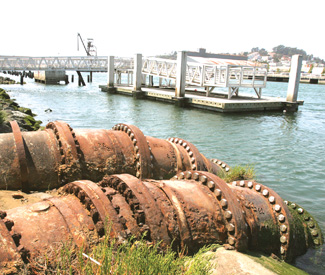
Besides the ancient pipes, the city’s network of storage transport boxes is routinely overloaded. These boxes are underground containers that catch water and hold it until it can be processed through the system and through to water treatment plants. Walsh says that they “surround the city like a moat… When those boxes fill up and all our capacity is full, the system overflows.”

This can cause flooding, especially in low-lying areas of the city and natural creek beds. Precita Creek, which once flowed freely along what is now Cesar Chavez Street, has been a site of overflows and flooding since it was first incorporated into the city’s sewer system in 1878. Nearby Islais Creek has also been diverted into sewers in the flooding-prone area.

The SSIP will have a particular focus on green technology. “One way that we’re going to address the flooding issue is by using low-impact design,” Walsh said. “We’re looking at permeable paving, bio-retention swales, and rainwater harvesting as ways to reuse the rainwater.”

Walsh says that the Model Block program has been a pilot for the SSIP. In May, the city and the Environmental Protective Agency unveiled a new green “streetscape,” part of the Model Block program, on the 1700 block of Newcomb Avenue. Areas of the sidewalk were replaced with permeable pavement, trees and gardens, meant to improve beauty and calm traffic as well as soak up rainwater so that it does not flow directly into the sewer system. In 2010, a similar project was completed on Leland Avenue between Bayshore Boulevard and Cora Street.

Neighborhoods in San Francisco’s southeast, particularly the Mission and Bayview, have been disproportionately affected by problems with the sewer system. Olin Webb, a lifelong Bayview resident and member of the group Bayview Hunters Point Community Advocates, says that sewer improvements are long overdue.

“Whenever it storms, there’s an overflow here,” Webb said. “Every time it rains, you can smell the raw sewage.”

Bayview community organizations have been campaigning for improvement to the sewer system for decades. Webb said some progress has been made in the past few years, including the installation of a pathway at Yosemite Slough Park, part of an effort to restore the wetlands in the area and turn it into a pleasant community space.

Webb was ambivalent about recent improvements. Bayview Hunters Point, like most of San Francisco, has lost much of its African American population during a recent surge in out-migration. According to a 2010 census, San Francisco’s black population has declined by 22.6 percent in the last decade.

“This took too long,” Webb said of the sewer improvement. “I’ve been here 60-something years, my mother worked on this before me. It’s like a joke to me that now everything’s getting fixed up and most of the people can’t enjoy it.”

Residents may still have a to wait for SSIP projects to begin construction. The program will likely span 15-20 years, and is currently in its early stages. “The project is still in design and planning stages,” Walsh said. “It needs to be validated and budgeted. We know it’s going to cost multiple billions of dollars”

Yet Walsh is optimistic that the project will make real change in a sewer system that’s been inadequate for decades. “It’s going to be an impactful project,” she said. “People are going to notice it happening.”

The redistricting furor

55

I opposed the measure that created California’s new Redistricting Commission. As we noted in our endorsements at the time:

The commission is hardly a fair body — it has the same number of Republicans as Democrats in a state where there are far more Democrats than Republicans. And most states still draw lines the old-fashioned way, so Prop. 20 could give the GOP an advantage in a Democratic state. States like Texas and Florida, notorious for pro-Republican gerrymandering, aren’t planning to change how they do their districts.

But Prop. 20 passed anyway, and control of the critically important task of drawing lines for state Legislature and Congressional districts fell to an unbalanced group of people with no political experience. They commission held hearings up and down the state, took reams of testimony — and wound up with a map that will probably add six or seven Democratic seats to the Congressional delegation.

That’s not a big surprise: Democratic Party registration is stable in a very blue state, and Republican registration is declining. Any fair redistricting would likely lead to more Democratic seats. And it’s clear that the likes of Phil Burton were not involved: In Los Angeles, two powerful veteran members of the House, Brad Sherman and Howard Berman, wound up in the same district. No matter what happens, the Democratic Party will lose one of its heaviest hitters.

But ProPublica, the national (and generally very solid) investigative reporting group, took on the process and concluded that the Democratic Party managed to wire the deal:

As part of a national look at redistricting, ProPublica reconstructed the Democrats’ stealth success in California, drawing on internal memos, emails, interviews with participants and map analysis. What emerges is a portrait of skilled political professionals armed with modern mapping software and detailed voter information who managed to replicate the results of the smoked-filled rooms of old.

(Memo to the folks at PP: There haven’t been “smoked filled rooms” in this state in quite a while. By the time the 1990 census was done, most of the state (including most public facilities) had strict limits on indoor smoking, and in 2000, nobody smoked in any rooms controlled by any governmental agency. But we get the point.)

The story has set off a furor. Robert Cruikshank, one of my favorite political bloggers, did a fairly brutal takedown on the report:

Of course, the core assumption that California Republicans deserved any new seats is challenged by their collapse in the November 2010 elections. While Republicans across the country were having a banner night, California Republicans lost every single statewide election (including losing the governor’s race by 13 points despite outspending the Democrats nearly 10 to 1). They also failed to pick up a single seat in either the legislature or Congress, losing one Assembly seat. California voters made explicitly clear in November 2010 that they do not like Republicans. That doesn’t appear to have actually influenced the commission’s deliberations, but it does mean the claim that Republicans had any reasonable expectation of gains is ridiculous.

Then Jerry Roberts and Phil Trounstine, two poltical reporters with at least 50 years of experience between them, did their own examination at CalBuzz, and asked PP’s Jeff Larson to explain himself. The result is scathing:

  Plainly put, their piece is the worst kind of ersatz “investigative” reporting: lots of heavy breathing and over-reaching conclusions drawn from selectively using, twisting or ignoring facts, relying on innuendo and suggestion, and mischaracterizing crucial elements of the story to inferentially allege an impropriety where none exists. Wink, wink, nudge, nudge, say no more. Moreover, ProPublica never even called the commission for a comment on its much-ballyhooed “findings.”

In failing the smell test, this clunker promises plenty, but simply doesn’t deliver the goods.

Wow. Harsh.

But the Roberts/Trounstine takedown holds up pretty well. The point they make is that everyone — the GOP, the Dems, city and state officials, groups like the Mexican American Legal Defense and Education Fund and more — tried to influence the process. In Northern California, the Dems were apparently a little better at it (and managed to create at least one fake front group to promote the interests of Rep. Jerry McNerney); in the southland, the big Democratic operation of Howard Berman and his brother, Michael, which, as CalBuzz points out, have played a key role in past redistricing efforts (those “smoke-filled rooms”), got totally fucked and Howard may lose his seat after 28 years.

I will say that PP dug up some new info and exposed how the Dems managed to create “communities of interest,” some of them bogus, to try to influence the final lines. But I’ve been watching this stuff for a long time, and I can tell you: Reapportionment is political. Always has been, always will be. There are better lines and worse lines, there are scandalous cases of gerrymandering and political payback and there are (relatively) honest attempts to create districts that are fairly compact and also comply with federal law and don’t dilute minority representation. But there’s no such thing as “clean” reapportionment — and if the Dems and Republicans weren’t trying their best to influence the outcome, they’d be guilty of partisan misconduct.

The CalBuz conclu:

The plain fact is that while Democratic registration has been essentially flat in recent years, Republican registration has fallen into the toilet, and the GOP now represents less than one-third of state voters.

This means that Democrats represent an increasing proportion of the electorate; add to that the fact that decline-to-state independents, the fastest growing bloc of registered voters, also tend to vote Democratic, as we’ve shown previously.

This makes Johnson’s claim that Republicans are entitled to at least their current number of seats, which is the money quote of the Pierce-Larson opus, not only laughable but also intellectually dishonest. Sort of like the whole piece.


Lots of buzz and politicking around D5 appointment

65

There is eager speculation – and lots of public and private pressure being applied to Mayor Ed Lee – over the question of who he will appoint to fill the District 5 seat on the Board of Supervisors that is being vacated by Sheriff-elect Ross Mirkarimi.

Anti-progressive entities from the San Francisco Chamber of Commerce to the San Francisco Chronicle are urging Lee to appoint a fellow moderate to the solidly progressive seat, despite the outrage that would trigger on the left and the difficulty that appointee would likely have keeping the seat after the November election.

Chron columnist CW Nevius today published a weird little puff piece plugging London Breed – a moderate who wants the D5 seat, a fact he strangely didn’t mention – and her leadership of the African American Art & Cultural Center. Chron columnist Leah Garchik also pumped up Breed as a D5 appointee last week. Nevius’ column in particular seemed to be a thinly veiled attempt to influence the decision, despite the regular insistence by Nevius and others at the Chron that they never have a political agenda or try to influence City Hall. Yeah, right – at least we at the Guardian are honest about our advocacy for more progressive city leadership.

Breed is being strongly pushed by Willie Brown, the former mayor and current Chron columnist, as well as most of the city’s African American ministers, such as Revs. Amos Brown and Arnold Townsend, who showed up at last week’s Board of Supervisors meeting and followed Lee back to his office after his appearance before the board.

Sources connected to the ministers told us that Lee hadn’t returned their phone calls in recent weeks and they were angry about the snub, so they showed up to let him know and mau-mau him into appointing Breed. Indeed, Brown did get a private meeting with Lee after his followers wedged their way into the office.

Reporters had asked Lee about the D5 appointment just moments before and he said that he was in no hurry to make a decision. “I want to pay my respects to many groups in District 5,” Lee said.

While many names have been floated as D5 contenders, there are a few that rise to the top. Malcolm Yeung, public policy director of the Chinatown Community Development Center, is being pushed by Rose Pak, the Chinatown power broker who worked with Brown to get Lee into Room 200.

But given Lee will probably avoid simply choosing between the Brown and Pak choices – unless they can privately coalesce around someone, which is certainly a possibility – most City Hall speculation these days falls on Christina Olague. The Planning Commission president comes from the progressive camp but she also served as a co-chair of Progress for All, creators of the Run, Ed, Run campaign that persuaded Lee to run for a full term.

Speaking to the Guardian in October, Olague denied that her early endorsement of Lee had anything to do with the D5 seat, which she said she wasn’t seeking but would take if offered. “If we get progressives to support him early on, maybe we’ll have a seat at the table,” was how she explained her support for Lee.

On Friday, Olague showed up for Mirkarimi’s art opening and holiday party in his City Hall office, and she chatted with other possible contenders for the D5 seat, including Quintin Mecke, Julian Davis, Gabriel Haaland, Jason Henderson, and Michael O’Connor. Asked by the Guardian if she had any insights into how the appointment was going, she said all she knows is what she’s read online and in the newspapers.

And so we wait.

Lack of charity

8

news@sfbg.com

Activists and city officials are challenging California Pacific Medical Center — which a new study shows provides far less charity care than other San Francisco hospitals — to do more for all city residents if it wants approval for the massive new high-end hospital and housing project it is seeking to build on Cathedral Hill.

That $2.2 billion project, which the city will consider sometime next year, would also rebuild or modify four other CPMC hospitals in town, including St. Luke’s Hospital, which serves low-income Mission District residents, but which will see its number of beds cuts from 130 now down to 80.

Community groups opposed to the CPMC project as it now stands — including the Good Neighborhood Coalition, Jobs with Justice, and Coalition for Health Planning-San Francisco — commissioned the UC Hastings College of Law to study how CPMC’s charity care compares with other nonprofit hospitals in the city.

The result, “Profits & Patients: the Financial Strength and Charitable Contributions of San Francisco Hospitals,” was released Dec. 8 and was scheduled to be the subject of a public hearing at the Board of Supervisors on Dec. 13 after Guardian press time. Activists planned to use the hearing to highlight some of the report’s most damning conclusions about CPMC and its nonprofit parent company, Sacramento-based Sutter Health.

“Mainly due to Sutter Health’s plan to alter its current hospital structure within San Francisco, the provision of community health benefits by San Francisco hospitals is now a major issue before the Planning Commission and Board of Supervisors,” the report reads.

The report compares CPMC’s hospitals with St. Francis Memorial Hospital, St. Mary’s Medical Center (both are Catholic Healthcare West facilities), and Chinese Hospital, as well as noting how the city-run General Hospital provides by far the most charity care in town. The report finds CPMC is only spending about 1 percent of its revenues on charity care while the city sets a minimum standard of 3 percent.

Even before that project, CPMC/Sutter is the dominant health provider in town, and by far the most profitable. Between 2006-2010, the report says the company made $743.9 million in profits from its San Francisco operations, compared to St. Mary’s $22.6 million in profits and the $14.8 million loss by St. Francis.

“Our analysis shows that CPMC has the financial capacity to provide more of a share of services for uninsured and underinsured San Franciscans than it presently does, and that it is crucial for CPMC to do so in order to meet the city’s health care needs,” said Jeff Ugai, a Hastings student who worked on the study.

In 2010 CPMC’s three oldest campuses — Pacific, Davies, and California — provided charity care at a patients per bed rate less than half that of St. Francis, even though CPMC is triple St. Francis’s size and has much greater financial stability.

“St. Francis meets a huge amount of charity care patients. CPMC clearly can and should meet healthcare needs,” said Emily Lee, a member of the Chinese Progressive Association who spoke at a press conference announcing the report. “From the position of the coalitions, we want to see a project, and we want to see a good project.”

But CPMC, which has been resisting calls by Mayor Ed Lee and other city officials to commit to more charity care as a condition for its project, isn’t even accepting the report’s damning conclusions that it is extracting huge profits from San Francisco and giving little back.

“It depends on how you calculate it,” said CPMC spokesperson Kevin McCormack. “As a dollar amount, we give more in charity care than any other hospital except for General Hospital.”

That’s not surprising given that CPMC makes more money in San Francisco than any other hospital, enough that it has become a cash cow for the entire chain.

“CPMC-St. Luke’s is not only the most profitable hospital in San Francisco, but it is also the most profitable hospital in the Sutter Health statewide network. Out of twenty-one hospital groups within the Sutter Health network, CPMC/St.Luke’s brought in nearly one quarter of Sutter Health’s average net income over the last five years,” the report reads.

But McCormack says Sutter reinvests its profits back into the system.

“It goes back into the system itself,” he said. “It goes back into the hospital, into salaries, building new facilities, repairing old ones.” Yet the activists are unconvinced. Even before this report on charity care, they were critical of a CPMC project that includes housing on Van Ness with low rates of affordability, and which they say doesn’t rebuild St. Luke’s large enough to meet the community’s needs. It is also agreeing to operate St. Luke’s for only 20 years. “I like to call it a stay of execution,” said Jane Sandoval, who’s been a nurse at St. Luke’s for 26 years. “When CPMC took over with their master plan, it was an enigma to me how they concluded what the community needed. I know what the community needs, and I wonder who they asked.”

Guardian editorial: And now we recommend a national Occupy Day

9

EDITORIAL In less than three months, the Occupy movement has changed the national political debate — and possibly the course of U.S. history. A small group of protesters, derided in the mainstream media, grew to a massive outpouring of anger at economic inequality. It’s no coincidence that politicans at all levels have begun to respond. At least five different measures aimed at raising taxes on the rich are in the works in California. In Kansas Dec. 6, President Obama made one of the most progressive speeches of his career, talking directly about the need for economic justice.

While even some supposed allies say the encampments weren’t effective, the truth is that the out-front, in-your-face tactic of holding nonstop protests in the financial heart of places like Manhattan and San Francisco got attention. The visibility of the Occupy camps forced everyone to pay attention. The U.S. economy is in a crisis; less disruptive tactics wouldn’t have worked. But now most of the emcampments are gone, broken up by police forces and scattered from the central areas of major cities. It’s crucial that this growing and powerful national movement not fall apart after the almost inevitable crackdown on one style of protest. Occupy needs to look forward and plan its next steps.

Some of that is already happening, with Occupy activists targeting home foreclosures and marching on West Coast ports. But it’s worth considering another tactic, too: Occupy ought to begin planning now for a massive spring mobilization in Washington and a series of nationwide actions that could bring millions more people into the movement.

Part of the strategy of the Occupy camps was to maintain a presence, day after day — and that made perfect sense when the movement was starting. But single-day events, if organized on a massive scale as part of a larger campaign, can have a profound and lasting impact.

The original Earth Day — April 22, 1970 — involved 20 million people across the United States. There were events in hundreds of cities and thousands of high school and college campuses. It brought together old-school, sometime stodgy conservation groups with radical young environmentalists, the United Auto Workers with people concerned about pollution from car exhaust. It was, by any reasonable account, the birth of the modern American environmental movement.

The other great thing about Earth Day — and the reason it makes a great model for the Occupy movement — is that it was largely a grassroots event. Although there was a national office, most of the work was done spontaneously, in local communities, with no top-down direction.

And everyone — from Washington D.C. to the state capitols and city halls — paid attention.

Mass marches and mobilizations helped end the Vietnam War, spark the Civil Rights Movement and fight the anti-labor politics of the Reagan Administration. None of those events took place in isolation, any more than a national Occupy Day would take place in isolation. The nation’s ready for major economic change — and organizing a national event alone could help make stronger connnections among the broad constituency that is the 99 percent.


Rearview mirror

0

emilysavage@sfbg.com

Year in Music “Out of all the records I’ve recorded, that was the worst experience,” says prolific Dinosaur Jr. bassist and Sebadoh guitarist Lou Barlow. He’s speaking of Bug, the classic, feedback opening alternative rock album Dinosaur Jr. released on SST in 1988.

Why then, did the band tour the East Coast during the spring of 2011, playing the album start to finish, and why does it continue to play it now — appearing at the Fillmore this week? “All the negative associations I had with it are gone. What I hear now is a really great batch of songs that J [Mascis] wrote.” He goes on to describe the early days of Dinosaur Jr., “when we formed it was my first textured, creatively ambitious band — and that was at the age of 17 — so it’s a real part of my DNA now. Musically, it’s a very familiar spot to be at.”

There, in a history-rich bed with a familiar texture, is the spot where aging rock fans crave to be. According to Simon Reynold’s exhaustive and polarizing 2011 tome Retromania, it’s also the space in which we all now inhabit, new listeners and old. His introductory words are harsh, if provoking. “The 2000s [was] the decade of rampant recycling: bygone genres revived and renovated, vintage sonic material, reprocessed and recombined. Too often with new young bands, beneath their taut skin and rosy cheeks, you could detect the sagging grey flesh of old ideas.” Brutal.

In some sections, Reynolds is dead on, and his methodology applies equally to the year in rock that was 2011 (though the book was written in the summer of 2010). We couldn’t possibly look back at these twelve months without including the grander trail of rock’n’roll, and how it was again repackaged throughout the year.

Given the retro-crazed times we live in, to judge the year, we must also fall deeper down the nostalgia inkwell, in part due to the onslaught of monster reunion tours, complete album trips, rereleased records, anniversary celebrations, and retro reverential new rock/garage/punk acts of 2011. One point Reynolds makes, is that the span of time elapsed between creative endeavor and nostalgia for said endeavor is rapidly fading.

Just recently the Weakerthans — which formed in 1997 — spent four power-pop nights at the Independent, playing one whole album from its catalogue each night. Earlier this year, Archers of Loaf launched a reunion tour (13 years after its demise) and the reissue of four of its studio albums on Merge. There were also reunion shows and tours from the Cars, Kyuss, Pulp, Cibo Matto, Masters of the Hemisphere, Death From Above 1979 (big up to Treasure Island Music Festival), and strangely, J. Geils Band, the Monkees, and System of a Down.

There were rereleased Smashing Pumpkins albums, a Throbbing Gristle greatest hits, and a Hot Snakes one-off (at press time) at All Tomorrow’s Parties’ Nightmare Before Xmas in Minehead, England — a fest also headlined by Archers of Loaf.

There was Nirvana’s Nevermind 20 year anniversary celebration, and Metallica’s 30 years strong, though the output for these celebrations was obviously disparate given the nature of the acts. Nirvana’s label released a series of singles and special edition anniversary batches. Metallica took perhaps the most surprising turn a no-frills metal act could — it paired with Lou Reed and released a confusing collaboration, Lulu, though the real anniversary celebration was yet to come — a four-night, devil-horned, juicy guest-starred tête-à-tête for hardcore fans at the Fillmore.

There were also the bands that just felt retro, or at least, stood with one foot in rock’s not-so-distant past. But the good ones were more reverent than carbon vintage copy, acts like Dum Dum Girls and Cults, played on romantic ideals of ’60s garage and slipped in some doo-wop and girl group-esque vocals, but neither directly mimics a particular era. In its debut follow-up, Only In Dreams (Sub Pop), Dum Dum Girls also referenced a distinct ’90s Mazzy Star vibe. Meanwhile, Canadian chanteuse Austra looped back to the ’80s with prominent synth and operatic love songs, and the Beets happily alluded to its own ’60s garage-meets-Ramones influences on fourth album Let The Poison Out (Hardly Art), like something out of a Nuggets boxset; a modern, bilingual Seeds.

Locally, longtime Ty Segall band member Mikal Cronin finally made the move to San Francisco in 2011. Raised on surf and garage rock down south, he brought with him a distinctive nostalgic sound; his solo self-titled record — released this year on Trouble in Mind — was one of the most intriguing of the year. Like many now living and playing in SF, he’s drawn to vintage rock’n’roll and garage, but his style stands out above the pack.

This year he released a multifarious record of crusted garage-punk and swirling psych-pop, glamorized with the hazy, sand-swept beach days pictured in vintage Polaroids. Opening track “Is It Alright” could be plucked from a psychedelic Beach Boys LP, laid thicker with grime. And Cronin, when pressed, reveals a long history of influences — along with current bands such as Thee Oh Sees and Strange Boys — mentioning longtime favorites “Emitt Rhodes, Del Shannon, the Beatles, the Beach Boys,” adding “I’ve been trying to relisten to the classics” And yes, the remaining Beach Boys were said to be planning yet another reunion for next year, a thrill for likely a few young fans (though the same can not be said for Brian Wilson’s 2011 Disney covers album).

Here’s another spot where Reynolds and I tend to split: I’m an unabashed rearview mirror fan. And while I agree that the “re-s” in our sonic world are sometimes overwhelmingly dull, the opportunity to see live bands that broke up before I was cognizant has just too strong a pull on my psyche. Even Reynolds seems to consent to that last bit, stating in Retromania, “The exceptions to my ‘no reunions’ policy are a few bands that I loved as a youth but never managed to see live.” So wouldn’t that be the case for someone in every audience? The giant pink headphones-wearing toddler I saw at the Iggy Pop show undoubtedly missed the punk singer’s first 40 odd years of shows. Now, will somebody please reunite Operation Ivy, Minor Threat, and Neutral Milk Hotel for complete album tours, or is that too sacrilegious for your precious memories? It’d just be for my own comfort, obviously. *


EMILY SAVAGE’S TOP 10 SHOWS OF 2011

Feb. 26: No Age, Grass Widow, and Rank/Xerox at Rickshaw Stop

April 27: Steve Ignorant plays Crass songs at Slim’s

June 1: Gayngs at Independent

July 13: King Khan & Gris-Gris, Shannon & the Clams, King Lollipop/1-2-3-4 Go! Records Showcase at Oakland Metro Opera House

Sept. 22: Hightower, Black Cobra, and Walken at Yerba Buena Center for the Arts

Oct. 6: CSS at Fillmore

Oct. 13: Gardens & Villa at Bottom of the Hill

Nov. 5: Wild Flag at Great American Music Hall

Dec. 4: Iggy Pop at Warfield

Dec. 10: Tycho at Independent

Occupy’s next steps

6

EDITORIAL In less than three months, the Occupy movement has changed the national political debate — and possibly the course of U.S. history. A small group of protesters, derided in the mainstream media, grew to a massive outpouring of anger at economic inequality — and it’s no coincidence that politicians at all levels have begun to respond. At least five different measures aimed at raising taxes on the rich are in the works in California. In Kansas Dec. 6, President Obama made one of the most progressive speeches of his career, talking directly about the need for economic justice.

While even some supposed allies say the encampments weren’t effective, the truth is that the out-front, in-your-face tactic of holding nonstop protests in the financial heart of places like Manhattan and San Francisco got attention. The visibility of the Occupy camps forced everyone to pay attention. The U.S. economy is in a crisis; less disruptive tactics wouldn’t have worked. But now most of the encampments are gone, broken up by police forces and scattered from the central areas of major cities. It’s crucial that this growing and powerful national movement not fall apart after the almost inevitable crackdown on one style of protest. Occupy needs to look forward and plan its next steps.

Some of that is already happening, with Occupy activists targeting home foreclosures and marching on West Coast ports. But it’s worth considering another tactic, too: Occupy ought to begin planning now for a massive spring mobilization in Washington and a series of nationwide actions that could bring millions more people into the movement.

Part of the strategy of the Occupy camps was to maintain a presence, day after day — and that made perfect sense when the movement was starting. But single-day events, if organized on a massive scale as part of a larger campaign, can have a profound and lasting impact.

The original Earth Day — April 22, 1970 — involved 20 million people across the United States. There were events in hundreds of cities and thousands of high school and college campuses. It brought together old-school, sometime stodgy conservation groups with radical young environmentalists, the United Auto Workers with people concerned about pollution from car exhaust. It was, by any reasonable account, the birth of the modern American environmental movement.

The other great thing about Earth Day — and the reason it makes a great model for the Occupy movement — is that it was largely a grassroots event. Although there was a national office, most of the work was done spontaneously, in local communities, with no top-down direction.

And everyone — from Washington D.C. to the state capitols and city halls — paid attention.

Mass marches and mobilizations helped end the Vietnam War, spark the Civil Rights Movement and fight the anti-labor politics of the Reagan Administration. None of those events took place in isolation, any more than a national Occupy Day would take place in isolation. The nation’s ready for major economic change — and organizing a national event alone could help make stronger connections among the broad constituency that is the 99 percent.

Editor’s notes

68

tredmond@sfbg.com

Twenty years ago, if you mapped income distribution in San Francisco on a standard graph, you’d see what the economist call a bell curve: At one end were a small number of very poor families, at the other a small number of very rich, and in between the bulk of the city was somewhere roughly close to what you could call middle class.

Take the 2012 census data and make that graph today and you get the opposite — it’s becoming a U-shape, with more people in poverty and more gross wealth and not as much in the center.

You could see that on stark display at City Hall Dec 12.

At 10 a.m., the City Operations and Neighborhood Services Committee heard several hours of testimony on the alarming rise in the number of homeless families. In the end, the Mayor’s Office agreed to find $3 million to help out.

At 1 p.m., the Land Use and Economic Development Committee heard testimony on a plan to build more housing — on the waterfront, for the top one quarter of the top one percent of the richest people in America, people who will need more than $3 million just for the downpayment on their new digs.

The plan calls for 145 of what Port of San Francisco officials call “high end” or “luxury” condominiums, along with 400 underground parking spaces. “It’s going to be tight on three levels,” a Port official testified. “Most of it will be valet parking.” The developer wants to raise the height limit along the waterfront for the first time in half a century.

The Port, which controls some of the land, will get a cut of all the condo sales, maybe as much as $500,000 a year; that money will go to rebuild old piers and fund a long list of Port projects — including the America’s Cup. (Ted Gullicksen of the San Francisco Tenants Union was sitting next to me at the hearing, and he shook his head at that bit of news. “Condos for rich people to pay for boats for rich people,” he said.)

A long list of people, including former City Planning Director Alan Jacobs and former City Attorney Louise Renne — spoke against the project. Jacobs and Renne both explained that this was single-site spot zoning that would change the half-century consensus that the city should “decrease height toward the waterfront so the people can see and enjoy the meeting of land and water,” as Jacobs put it.

Jacobs gave the committee members his one “absolute truth” about city planning: “If a developer accepts and knows that a rule can’t be broken, then it will be economical to build within it. If he or she think it can be changed, then suddenly it will not be economical. It’s called greed.”

In other words, Simon Snellgrove, the developer of 8 Washington, could make money with a lower-scale project that conforms to existing height limits. But he can make more money if the city gives him a big honkin favor.

But it’s not all about height limits for me. It’s not even about the fact that the project will chop up a tennis and swimming club that serves about 2,000 more-or-less middle-class people in an effort to make life nicer for about 145 very rich people.

It’s about what kind of housing we’re building in San Francisco. “Every study that we’ve seen shows that we’ve vastly overbuilt housing for the wealthy,” Gullicksen testified.

And we’re not just talking the ordinary wealthy here. The most compelling testimony came from Frederick Allardyce, a real-estate broker from Sotheby’s who said he had been involved in the sale of about 70 percent of all luxury condos sold from Washington St. to the waterfront. He gave us a glimpse of who would be living — sort of — at 8 Washington.

The cheapest condos would require an income of $469,000, a downpayment of $625,000, and another $493,000 of liquid reserves. Monthly payment: $13,699. The higher-end units would require an annual income of $1.029 million and a downpayment of $6.5 million.

“That’s not the one percent,” he said. “It’s the top one quarter of the top one percent.”

And, Allardyce explained, most of the people who buy that level of property are so rich that they don’t actually live there. It’s a second or third or fourth home, a place to stay a few weeks out of the year. And since the project involves chopping up a tennis and swim club used by some 2,000 people (who are nowhere near that rich), “you’re eliminating the use of that land by the general public” in favor of a tiny elite.

The developer says that the city will get money to build 33 below-market-rate units. That’s nice; by that standard, 80 percent of the new housing goes to the richest people in the world, and 20 percent for everyone else. That percentage ought to be reversed — and until it is (or at least, until we have a plan to build enough affordable housing for the people who really need a place to live in San Francisco) I can’t imagine why we’d want to be doing favors to feed the greed of developers.

What we’re doing in this city is making life harder for low-income people who are increasingly living on the streets and doing big favors for the spectacularly wealthy. There’s no sanity in our housing policy — except to turn San Francisco even more into a city of the rich.

Occupy shuts down morning shift at Port of Oakland

Usually, when significant events related to the Occupy movement occur in the pre-dawn hours, it means an encampment has been raided. But this morning, Occupy protesters were the ones carrying out a strategic plan before the sun came up.

A main objective of today’s Port of Oakland shutdown — the second in two months initiated by Occupy Oakland — was to strike back against the police raids that dismantled their camps.

Protesters led by Occupy Oakland effectively shut down the morning shift at the Port of Oakland today, Dec. 12, as part of a Coordinated West Coast Port Blockade that Occupy groups from San Diego to Anchorage have been planning since Nov. 18, when Occupy Oakland’s General Assembly unanimously approved the call to action.

Several hundred activists met up at the West Oakland BART station at 5:30 a.m. and proceeded to march down Seventh Street to the sprawling shipping hub, where they formed picket lines outside terminal entrances to prevent workers from entering the gates for the 7 a.m. shift. Shortly after they began picketing, truckers waiting to load or unload cargo began turning around to exit port property.

There were several busloads of protesters in addition to those who traveled to the port on foot, as well as a bicycle contingent. While most protesters filed through the streets in an uncharacteristically quiet march that seemed muted due to a lack of sleep, a few displayed gusto with a sound system, shiny homemade flags, and flashy outfits. Some showed up toting a life-sized cut-out of Lt. John Pike, the University of California Davis officer who became notorious for dispersing teargas into student protesters’ eyes, with the face cut out so people could pose for photos.

Police arrived on the scene clad in riot gear, but did not attempt to prevent protesters from circling up around the gate entrances and forming picket lines. They stood in formations in front of the gates weilding batons and teargas launchers, though protesters had no intention of entering the gates and only sought to block them. Alameda County Sheriff buses circled the area as well.

Around 7 a.m., when the morning shift would have typically started, two ILWU dockworkers (who declined to give their names) stood near the Hanjin Shipping gate at berths 55 and 56, surveying the picket line. Past the gate, a cargo vessel which had likely come from Japan was berthed and waiting to unload.

“Ain’t nobody going to cross it,” one of the men offered. The other gestured toward protesters and said, “These are Americans wanting American jobs.” Asked how he felt about the picket, he responded, “We don’t support it, because it’s not in our contract — but I do see some issues, like we’re hurting, too.” The ILWU members said longshoremen turned away because of the picket line wouldn’t be paid for the day, because they’re only registered as having reported to work if they’re physically on the terminal. They also noted that there was a relatively light workload at Oakland terminals on this particular day.

The official objectives of the port blockade, aside from showing resistance against crackdowns on Occupy encampments, were to demonstrate Occupy’s solidarity with longshore workers and port truckers. The International Longshore & Warehouse Union (ILWU) Local 21, based in Longview, Wash., has been locked in a legal dispute with Export Grain Terminal (EGT) stemming from what workers characterize as union-busting practices.

Port truckers, particularly in Los Angeles, have been unable to unionize due to their employment classification as independent contractors, and protesters sought to highlight their struggle as well. Picketers held signs declaring solidarity with the ILWU and truckers against the one percent — global shipping companies owned in part by agribusiness giant Bunge, Ltd. and Goldman Sachs, respectively, who profit from their labor.

Speaking into a megaphone, organizer Barucha Peller announced that occupiers in southern Washington had shut down the Port of Longview, according to a text message from ILWU Local 21. Union members wanted to thank the movement for the show of support.

By around 10 a.m., an independent arbitrator had ruled that the picket posed a health and safety risk to longshore workers, so the dockworkers were sent home, effectively halting port activity for the first part of the day. “I’m really impressed that so many people got up at five o’clock in the morning,” Anthony Lavierge, a steward with ILWU, said into the megaphone. “It’s officially shut down. The longhshore labor is officially going home.” However, protesters planned to return to the port later on to prevent the start of an evening shift.

Following the announcement that workers had gone home for the day, protesters marched back to West Oakland BART station. A second march to the port is planned for 4 p.m., leaving from 14th and Broadway streets in downtown Oakland following a 3 p.m. rally. A third march to the port is scheduled to leave the West Oakland BART station at 5 p.m.

Should Occupy pull back and reinvent itself?

14

Maybe it’s time for the Occupy movement to simply take a bow, step off the national stage for now, and start planning its next big production. Because at this point, Occupy has been a smashing success – winning over its audiences and key critics, influencing the national debate – but it’s in danger of losing that luster if its lingers too long in its current form.

Consider the events of this week. When OccupySF’s long-standing encampment was finally removed by police and city workers, the general public barely noticed or reacted. Unlike during previous police raids, hundreds of supporters didn’t pour in to defend the camp and social media sites didn’t light up with messages of indignation and solidarity.

Why? Well it’s not because people don’t support the movement. Polls have consistently shown most people back Occupy, and even higher percentages support its basic message that the 99 percent are being screwed over by the 1 percent. Top political leaders at every level – Mayor Ed Lee, Gov. Jerry Brown, and President Barack Obama – made statements and speeches this week that echo the themes and ideas that Occupy has injected into the national dialogue.

But the tactic of occupation was only going to get us so far. It was a great way to start a conversation and demonstrate a broad discontent with this country’s inequities and plutocratic excess. Finally, the people have started to challenge those who are exploiting them, and it’s been particularly exciting to see young people fighting to reclaim their stolen futures.

That energy hasn’t dissipated, and it’s interesting to see it morphing into other campaigns, such as the recent takeovers of vacant foreclosed homes, the human rights march planned for tomorrow, and West Coast port shutdown scheduled for Monday. But I predict the crowds blockading the Port of Oakland will be a fraction of the size of the tens of thousands who took to the streets during the Oakland General Strike on Nov. 2.

Then, people were reacting to police violently crushing Occupy Oakland’s peaceful political assembly on Oct. 25, a galvanizing event, much like the raid on Occupy Wall Street and the abusive police tactics against occupiers on the UC Berkeley and UC Davis campuses. Each example showcased the police state’s willingness to use a heavy hand against peaceful protesters, demonstrating for a global audience what an important struggle this is and what we’re up against.

Yet it was hard to summon up much indignation over this week’s raid on OccupySF, even as protesters complained about being given just five minutes to get out and having their belonging seized and destroyed. Mayor Lee had been threatening the raid for weeks and had offered the group a free new home in the Mission – an offer they probably should have taken, one that would have allowed the group to declare victory and have a base of operations throughout the winter.

But unlike my cranky, “you kids get off my lawn” colleagues in the mainstream press, who have consistently derided the movement and valued anti-camping laws over the core constitutional right to peaceably assemble to petition for a redress of grievances, I think Occupy has been extremely important and effective. My desire is to see it evolve and continue.

Mayor Lee and other city officials have praised the goals and worldview of Occupy at every turn, even as they oppose the tactic of camping. As Police Chief Greg Suhr raided OccupySF, he told reporters that “part of the 99 percent removed part of the 99 percent to give the other part of 99 percent some relief,” tipping his hat to Occupy’s basic paradigm. Gov. Brown echoed Occupy’s economic inequity language in his call for higher taxes on the rich this week.

“I’m here in Kansas to reaffirm my deep conviction that we’re greater together than we are on our own. I believe that this country succeeds when everyone gets a fair shot, when everyone does their fair share, when everyone plays by the same rules. These aren’t Democratic values or Republican values. These aren’t 1 percent values or 99 percent values. They’re American values. And we have to reclaim them,” Obama said in his big speech this week, embracing the Occupy paradigm even as he tried to transcend it. But go back and read the whole speech and you’ll see that it would have fit right in during any Occupy General Assembly, with its regular calls to tax the rich, something this movement has given him the political cover to more forcefully advocate.

So the conversation has now begun, thanks largely to this movement. But, as most supporters of Occupy already know, our elected officials won’t simply enact the reforms we need on their own. They will need to be pushed and prodded relentlessly by a restive public, so the supporters of Occupy still have a lot of work to do.

How will they do that and what will it look like? I don’t know, but after watching these smart, creative, courageous, and committed young people and their supporters change the political dynamics of this country over the last three months, I’m anxious to see what they come up with and I stand read to chronicle and support the next phase, whatever it’s called and whenever it begins.