Planning

What’s wrong with the America’s Cup deal? A lot

21

Let’s start out with a premise that even Larry Ellison’s minions have come to accept: The race is happening here. Too late now to move it to another city. Worst-case scenario, according to Stephen Barclay, the point person for the world’s sixth-richest man: “If we don’t meet those dates, the teams will be forced to relocate to other places around the bay.”

That’s right — the teams will relocate to other places around the bay. The host city will still, for all practical purposes, be San Francisco; the races will happen off SF’s waterfront (where the Coast Guard is willing to allow them and the conditions are right) and the rich tourists will stay here, not in Burlingame or Fremont.

If Ellison decides the city’s not giving him enough, he won’t put up $55 million to fix up some of the waterfront piers. The city may decide that a development deal of some sort with him makes economic sense. But it’s a real-estate deal at this point, not a deal for the race. At least, that’s what the Ellison team seems to be confirming.

And I fear that the real-estate deal that the Board of Supervisors Finance Committee sent forward yesterday, 2-1, is a bad deal for the city.

The terms are really complicated, and it makes my head hurt just trying to figure it all out — and still, the supes are expected to vote on the 120-plus-page document Feb. 28. Here’s what we do know, though:

The supervisors originally came to a deal with the America’s Cup Event Authority back in December. The concept was — and is — pretty straightforward, the same sort of deal the city has done (or, certainly, the Redevelopment Agency has done) many times in the past. In exchange for putting cash into renovating several piers, Ellison’s group would get long-term leases and development rights on the property. The idea: The city can’t afford to fix the piers. Ellison’s organization can. And once the property is renovated, the developer can make back that initial investment, and a profit, by building commercial space, condos and whatever else the Port decides to allow.

In a perfect world, San Francisco (and the state and the feds) would tax the hell out of people like Ellison, and there’d be public money to rebuild the waterfront as public open space, recreational facilities and the like. And wouldn’t that be utterly cool? Wouldn’t this city have the most awesome waterfront in the world?

But no: The only way the piers are going to anything but a place to park cars until they fall into the bay is if some private developer gets the rights to build something that I won’t like.

Supervisors Jane Kim and Mark Farrell, who don’t agree on a lot of things, both agreed with my basic analysis of the politics here: We shouldn’t let the excitement over the prospect of a boat race get in the way of analyzing this for what it is: A financing tool for the Port to get its infrastructure fixed up. Without a private investor, “they just don’t have the capacity to do that,” Kim told me.

So let’s just stipulate for a moment that this is the best, maybe the only way the city can restore the Port. Then it comes down to the real issue: Has the Mayor’s Office negotiated a good enough deal? Is San Francisco getting enough out of this? Or is everyone so hyper-buzzed about fancy carbon-fiber boats in the water (and I admit, they’re pretty cool) and free-spending tourists in the hotels and restaurants that we’re letting Mr. Ellison — who didn’t get so stinky rich by being a weak negotiator — walk away with most of the cookies?

Remember: Ellison’s not doing the city any favors. He’s only fixing up the piers that he will effectively own (as least for most of the rest of this century).

Back in December, the rough outlines looked like this: A corporation set up by Oracle, called the America’s Cup Event Authority, would put $55 million into repairing and renovating piers, then would get  66-year leases and development rights on piers 30-32, 26 and 28, as well as seawall lot 330, across the Embarcadero, which Ellison’s team wants to turn into more condos for rich people. If that’s not enough to pay for Ellison’s investment, Ellison’s heirs or successors get half the rent for the piers for another 15 years. That’s 81 years.

The original deal mandated that the city would collect a 1 percent fee on the re-sale of the new condos. It also had a requirement that Ellison share with the city any profits he made by flipping the long-term leases.

That’s a big deal, because almost nobody in the city actually holds onto development entitlements anymore. A developer wins the right to build an office building — and next week, he or she sells that right to somebody else. It’s almost certain that at some point, Ellison — whose sole goal here is going to be making a profit off city land — will decide that the best way to make money is to cash out. He’ll keep his 66-year leases for a few years, maybe lobby his way to approvals for office, condos, time-shares (gasp! yeah, they’ll do that if it’s legal) restaurants or whatever — then sell the remaining time on the leases, plus the development rights, to somebody else. And because he’s Larry Ellison, he’ll wind up making a nice tidy profit.

That used to be what happened with Port property (see: Pier 39) but lately, the Port’s gotten a bit wiser and has, in some cases, insisted that part of the profit from flipping a lease goes back to the city. In the original discussions, Ellison was going to have to pay the Port 15 percent of any net gains he made from the almost inevitable sale of the valuable leases.

But that’s gone now. After the board approved Newsom’s deal, the former mayor — who was always terrible at negotiation with the rich and powerful and always gave away the store — went back and monkeyed around with it. He and Sup. David Chiu insisted that the changes were just technical, not substantive enough to require a new board vote — but the current deal has no 15 percent cut for the Port, and the 1 percent levy on condo sales only applies after the second owner sells — which will be years down the road.

Then there’s the part where the city has to reimburse Ellison if the cost of renovating the piers exceeds what’s expected (oh, and we have to pay him 11 percent interest, which is about ten times what I get on my bank account; how about you?) There’s no cap on what the city might have to pay. And Ellison gets to develop a new marina.

And while Pier 29 is no longer a part of the deal, the city has to give Ellison $12 million — or rights to a pier to be named later. (Maybe Ellison figures that in a few years the people who opposed Pier 29 development will be out of office and he can convince the new mayor and supervisors to give Pier 29 back. It’s not legally excluded.)

Kim told me she’s going to insist that the final deal include a local-hire provision, which the rest of the board would be crazy not to support (and which Ellison, despite his company’s problems with local labor laws in the past, would be crazy not to accept).

But overall, Kim — who with Sup. Carmen Chu was part of the 2-1 majority sending the package to the full board — told me she thought the city got a good deal. “It took me a while,” she said. “But [Port Director] Monique Moyer convinced me that this was good for them.”

Sup. John Avalos, the dissenting vote on the Finance Committee, isn’t convinced. He’s got a long list of concerns, starting with the fact that he thinks the projected attendance and economic benefits are a bit delusional. “The figures seem farfetched,” he told me. “I’m seeing a lot of pumped up numbers. And those numbers drive whether this is a good deal for the city or not.”

He’d like to see the 1 percent rule apply to the second condo sale, not the third. He’d like to see the Port get 15 percent of the profits from any sale. And he’d like a cap on the reimbursements the city has to give to Ellison.

But here’s the problem: When the development agreement comes before the board, sitting as a Committee of the Whole Feb. 28, it will be hard to put any of that back in the agreement. This is a contract, and while the board can pass a resolution asking for more, in the end, it’s a matter of voting it up or down.

Vote yes and it’s done — more or less as is — although Kim says there will be another chance to make changes down the road, since the board and the Planning Commission will have to sign off on whatever type of development Ellison wants to do. The problem with that scenario? Ellison’s lawyers will wave this development agreement around like a Giants victory towel and proclaim that it binds the city and limits any ability to demand any more changes later. That’s how these people operate.)

Vote no and the ball goes back to Larry’s Court: His group can sit down with the Mayor’s Office and make some changes, or they can walk away (and build their boat sheds in …. where? Oakland? Foster City? Who’s got waterfront that can handle this?)

When the Finance Committee send the package to the full board, Avalos said, “we pretty much lost our ability to influence the agreement. Now we have to decide if we want to call [Ellison’s] bluff.”

PS: One of the lingering issues is whether the America’s Cup Organizing Committee can raise the $30 million-odd that is needed to make the numbers pencil out. If I were a rich person and Mark Buell, the ACOC point person, called me for money, here’s what I’d say:

How much is Larry Ellison contributing?

See, Ellison’s improvements on the waterfront aren’t charity. He’s looking to make a buck off everything he does. In past eras, the great robber baron capitalists would donate civic monuments — libraries and museums and stuff — and by any traditional standard of great wealth, Ellison ought to be writing a personal check for that $30 million. Or at least for some of it.

But so far, he hasn’t given a penny. The sixth richest man in the world isn’t actually donating anything to San Francisco. Yeah, he’s gracing us with his lordly presence, but cash? Nada.

Good luck with that one, Mark.

PPS: This whole concept that the city needs to fix the “crumbling” piers ought to be examined. First of all, nobody’s ever said that Pier 29 was in anything but fine shape. But beyond that, the Bay Conservation and Development Commission considers piers to be bay fill, and in the long term, wants San Francisco to get rid of some of them. “Maybe it’s a good thing if some of the piers fall into the bay,” former Sup. Aaron Peskin told me. “Then we’ll have more leeway with BCDC when we want to fix up some of the others.”

Research assistance by Royce Kurmelovs

After Pressure from Occupy Bernal, Wells Fargo execs fly across country to meet with Bernal Heights man

50

People facing eviction and foreclosure often report hardly being given the time of day by banks and lenders. But yesterday, three top Wells Fargo executives flew to San Francisco to meet with Alberto Del Rio, a Bernal Heights resident facing foreclosure.

Del Rio’s parents purchased their home in 1973. The home was refinanced multiple times, he says “for a better life” for his family. The most recent refinance, in 2007, was a result of lenders convincing Del Rio’s mother that refinancing would be an easy to pay for some of her retirement. 

“It sounded really great because my mother had no monies for retirement. The loan officers told her pull out some cash and reinvest it so she could have a better retirement. They told her, ‘after two years, you’ll be able to refinance out of this,’” said Del Rio.

The loan she got was a pick-a-pay loan, one of the most notoriously predatory loans that banks offered in the years leading up to the 2008 crash.

After continued requests from Bernal resident Alberto Del Rio and support from that neighborhood’s foreclosure-focused branch of the Occupy movement, Del Rio was finally given the time of day- by top executives in the Wells Fargo home preservation department.

The executives, including Sharon Zuniga and Shawn Woods, who flew in from Wells Fargo’s headquarters in Texas, met with Del Rio Feb. 22 at the San Francisco offices of Consumer Credit Counseling Services for about an hour and a half.

Del Rio says they gave him three options: to move out of his home and convert it into rental units, allow a short sale on the house and accept $3,000 to move, or let foreclosure proceedings continue as planned.

“They flew a guy here all the way from Houston to try to bully him into giving up,” said Buck Bagot, an organizer with Occupy Bernal.

But the fact that they took the time to do that was a result of continued pressure from Del Rio and his supporters.

“It was a good thing,” said Del Rio.

“But it also felt like they were trying to pressure us into doing something they wanted us to do rather than what we wanted to do.”

Del Rio says he’s grateful to Occupy Bernal for supporting him thus far. And when the Wells Fargo executives pled with him to give up his home, he refused.

“I’ve made up my mind. I told them, if I’m going to lose the house I’m going to lose the house to a fight, to what I want.”

His perseverance worked to a degree; the bankers agreed to give Del Rio 90 days to “increase his income,” and then, potentially, work towards loan modification. Del Rio, an independent contractor, thinks its possible.

Meanwhile, Occupy Bernal will continue to struggle others who, often, are ignored by banks when they express their need for loan modification.

“Looking at everybody that I’ve been meeting that’s going through foreclosure and eviction, every single person is either a person of a minority group, a senior citizen, disabled, or someone else that would be easily influenced when approached with a better life, a better financial life. It can be seen in all their faces,” Del Rio told me.

Occupy Bernal has help postpone and prevent dozens of evictions, including that of Monica Kenney yesterday morning. They are planning a forum tonight on foreclosures to be held at the Bernal Heights Neighborhood Center.

Campaign cash roundup and questions about our sleeping watchdog

3

Oliver Luby – the last true public-spirited employee at the Ethics Commission (a campaign lapdog when it should be a watchdog) before being forced out in 2010 – has written an insightful and comprehensive analysis of spending by candidates and outside groups during last year’s election. It’s published by CitiReport.

Among his findings are that the largely unregulated spending by supposedly independent third-party groups totaled $3.6 million, with $1.4 million of that going to support Mayor Ed Lee, and much of it coming so late in the race that voters weren’t able to factor its sources into their decisions.

Those outside groups spent almost as much to elect Lee as the campaign itself raised, which was almost $1.6 million. When those two figures are combined, and one subtracts the $419,891 in independent expenditure (IE) spending in opposition to Lee, the appointed mayor and his supporters spent $33.87 for each first place vote he received, or about 2.5-times that of second-place finisher John Avalos, whose $757,327 in “supportive financing” works out to $13.25 per vote.

Luby has long called for Ethics to get tougher on violators of campaign finance law, playing whistleblower at several key points in his career, starting in 2004 when he and then-staffer Kevin DeLiban exposed notorious campaign attorney Jim Sutton’s alleged scheme to illegally launder unregulated funds being collected for then-Mayor Gavin Newsom’s inauguration into paying off some of his $550,000 campaign debt.

In his latest piece, Luby again calls out his old bosses at Ethics for ignoring local laws against maxing out donations to many candidates in order to buy influence at City Hall. Donors are limited to an “overall contribution limit” that equals the maximum individual donation of $500 times the number of offices open, which was three in this election. It allows the city recoup from the campaigns money collected in excess of that, which Luby said totals $29,111 in this election.

“The SF Ethics Commission does not enforce this law. Supervisor Scott Wiener wants to help them get rid of it,” Luby wrote. Ethics Commission Executive Director John St. Croix was out of the office and hasn’t returned a Guardian call for comment.

Among those whose excessive contributions would be diverted to city coffers are Planning Commissioner Michael Antonini (perhaps the city’s most powerful Republican), PR powerhouse Sam Singer, medical marijuana activist Kevin Reed, political fundraiser Wade Randlett, city staffer-turned-developer Michael Cohen, moderate Democrat Mary Jung, and Coalition for Responsible Growth (a pro-development group) President Rodrigo Santo. Not surprisingly, they all contributed to Lee, whose campaign would be on the hook for the most in givebacks, $7,725, followed by David Chiu’s mayoral campaign at $4,700.

Finally, for all their talk about fiscal responsibility, Lee and his supporters couldn’t seem to live within their means in this election. Lee’s campaign finished about $275,000 in debt, while two of the pro-Lee IEs also finished in the red: SF Neighbor Alliance ($11,338) and Progress for All ($35,890), the ethically challenged creators of the “Run Ed Run” campaign that purported to talk Lee out of his pledge not to run for a full term in the office he’d been appointed to.

These are just some of the findings in Luby’s voluminous reporting, so check it.

Who gets to live here?

38

yael@sfbg.com

Housing policy — which determines who will be able to live in San Francisco — has been a hot topic at City Hall these days.

At a Board of Supervisors Land Use and Economic Development Committee meeting on Feb. 13, representatives from the Mayors Office of Housing (MOH) reported on the state of middle-income housing in San Francisco, at the request of Sup. Scott Wiener. “Middle class” people make up 28 percent of the city’s population, a 10 percent decrease in the past two decades, and to reverse that decline would cost about $4.3 billion in housing subsidies, or more than half the city’s annual budget.

Wiener, who insists that “middle income and low income housing are not mutually exclusive,” said he’s raising the issue because the needs of the shrinking middle class are not being addressed. But during the public comment period, a long procession of low-income residents say city housing policies have kept them on the brink of homelessness. The takeaway message was: don’t embark on new housing efforts until you can enforce the ones that are already in place.

Also underscoring the desperate state of many San Francisco residents, Assessor-Recorder Phil Ting released a report Feb. 16 that contains shocking statistics about invalid foreclosures and illegal evictions in San Francisco. Ting found that 99 percent of all foreclosure proceedings in San Francisco in the past four years have contained paperwork irregularities, and in 84 percent of cases, banks or lenders have committed fraud or broke other laws.

With the loss of the redevelopment agencies, Mayor Ed Lee’s proposal for a housing trust fund, renewed calls for more condo conversions, and a new focus on middle income housing incentives, the conversation on housing in San Francisco is heating up.


MOVING TOWARDS RENTAL

San Francisco’s housing market is 64 percent rentals and 36 percent ownership, according to MOH. So despite the focus of politicians and developers on homeownership, housing policy in San Francisco mostly involves renters, many of whom face myriad threats.

Rents can be so steep that market-rate rental housing is becoming increasingly accessible only for parts of the middle class and the highest income brackets in the city. People in San Francisco tend to pay a huge chunk of their income towards rent.

The federal Housing and Urban Development Agency considers it reasonable for a households to pay 30 percent of their income towards rent; but for the city’s very low income households, rent is typically nearly 60 percent of income. For middle income households, the average percent paid toward rent has increased since 1990, but remains below 30 percent.

Those people fall mainly into the middle-income bracket, those earning 80-120 percent of Area Median Income (AMI.) Planning Director John Rahaim said that for the very low-income population (0-50 percent AMI) all rental housing is “virtually off-limits.”

So, for the middle class, renting a place in San Francisco is tough. For the low and very-low income, it’s next to impossible. And that reality threatens the city’s diversity.

“The highest rent burden still falls on lower income residents, many of whom pay 70 percent of their income as rent,” Sup. Eric Mar, who also sits on the Land Use Committee, said at the hearing. “In my district, people have whole families living in their living room or extra bedroom.”

But things may be looking up for renters. MOH’ Brian Cheu said developers believe that the market trends are heading towards construction of new rental housing after being almost exclusively owner-occupied units for many years. Cheu said there are 725 rental units in the pipeline for the next five to ten years, more than twice the new housing units meant for ownership slated for that time period.

Most of this will be market rate housing, and thus still unaffordable for a good deal of the population. But for those making around 100 percent of AMI — the middle class that Wiener hopes to serve — there are more rental units on the way.

“Any increase in supply of rental housing would help,” said San Francisco Tenants Rights head Ted Gullickson, “because there’s been virtually no new rental housing built in San Francisco is last 20 years.”

Even as Wiener promised to continue to prioritize the needs low-income residents, the foreclosure crisis was barely acknowledged at the Feb. 13 hearing. Many low-income residents say they are not sure they can trust the city’s claim that “this is not a matter of us vs. them.”

At public comment, many community members spoke of the housing troubles that they were already facing. Yue Hua Yu, who spoke at the Feb. 13 hearing, lives with her family of four in a single residency occupancy hotel room (SRO), units intended for single occupants.

“We would support a policy that protects the city’s affordable housing stock,” said a statement from Wing Hoo Leumg, president of the Chinatown Community Tenants Association.

Renting may be the realistic choice for most San Franciscans, but homeownership remains an important goal and achievement for many families, and the main obsession of many politicians.

Part of the middle class exodus is unmistakably due to better homeownership rates in Oakland, Daly City, Marin, and other surrounding areas. But there are neighborhoods with higher rates of homeownership than others, including Bayview-Hunters Point.

BHP has long been a prime spot for low-income homeowners, but it’s slated for extensive new housing construction in the coming decades that could compromise its affordability. It is also an area hit hard by the foreclosure crisis: there have been 2,000 foreclosures in Bayview in the past four years, according to Ed Donaldson, housing counseling director at the San Francisco Housing Development Corporation.

Rising prices and the foreclosure crisis have played a large part in the large-scale African American out-migration that has devastated San Francisco communities in recent decades.


APARTMENTS OR CONDOS?

One of the biggest points of controversy in the homeownership debate has been the issue of condo conversion, which was brought up again this past week at the Feb. 14 Board of Supervisors meeting, when Sup. Mark Farrell asked Lee if he would support legislation to let 2400 tenancy-in-common (TIC) owners bypass legal limits and fastrack towards condo conversion.

Farrell framed this as “a vehicle to allow residents of our city to realize their goal of homeownership.”

On Jan. 16, the city held its annual condo conversion lottery, in which 200 lucky TIC owners win the chance to convert their units into condos, thereby legally becoming homeowners. TICs and condo conversion have long been fraught with controversy in San Francisco, where there is never enough housing for everyone who wants it.

Condo conversion proponents say that turning a TIC — usually a building that used to be rental housing that has been purchased by a group of people that own it in common — into condos is a cheap way to become a homeowner in a city as expensive as San Francisco.

But tenants rights advocates have long opposed this process on the basis that it depletes the city of its rental housing stock. “When you have more condo conversions, you have more evictions, and it’s harmful to low-income residents” Gullicksen said.

This controversy, and the struggle to maintain a balance between opportunities for homeownership and reasonable rents has raged in San Francisco for years. In 1982, the Board of Supervisors passed a limit of 200 condo conversions per year as a compromise. There are no regulations, however, on converting rental housing to TICs.

“This has come up almost every single year for years and years about this time,” said Peter Cohen, organizer with the Council of Community Housing Organizations.

This year, however, proponents are not simply reiterating a request to bypass the condo conversion lottery. Plan C, a coalition of San Francisco moderates, is pushing for adding a fee to condo conversion, ranging from $10,000 to $25,000, which would go towards an affordable housing fund.

Mayor Lee said that he is open to considering a change in condo conversion policy, “providing it balances our need for revenue for affordable housing, the value that responsible homeownership brings to the city, and the rights of tenants who could be affected by a change in policy.”


WHOSE TRUST FUND?

This comes at a time when the city is facing a loss of millions per year for affordable housing with the dissolution of the redevelopment agency (see “Transfer of power, Jan. 31).

That dissolution led to Mayor Lee’s plan for an affordable housing trust fund, to be voted on as a ballot measure this November. The kick-off for that plan also began recently, with a press conference and big-tent meeting to discuss what it might look like.

On the day after the Land Use Committee meeting, where he started the conversation on “middle class” housing, Wiener posed a question to Lee at a Board of Supervisors meeting, asking how the mayor plans to “ensure that the housing trust fund that comes out of the process you have convened will meaningfully address the need for moderate/middle income housing.”

Some are concerned that too much of the trust fund could be allocated outside low-income demographics. “There’s a limited size pie of resources,” Cohen said. “Just in a matter of the last months, we lost the redevelopment agency. The city is madly scrambling to try to replace that through housing trust fund, and working to get us back to somewhere close to where we were…Is that pie, that has dramatically shrunk, going to be stretched further for another income band?”

That question will be important when the proposal goes to vote in November. According to Donaldson, many low-income homeowners will not vote for the measure unless it addresses their needs. The specifics of the measure calling for the trust fund are still being worked out. But, it will likely be funded by an increase of the transfer tax paid when homes change ownership.

Yet that proposal was the subject of an unusual political broadside from the San Francisco Association of Realtors, which last week sent out election-style mailers attacking the idea. “Brace yourself for an unexpected visit from the city’s tax collector,” the mailer warns, showing the hand of government bursting through the wall of a home, urging people to contact Lee’s office.

The measure may also see opposition from low-income communities, especially if, as Wiener has urged in the past week, it allocates a chunk of funds towards middle-income housing.

“It’s hard to find people who will support it. They’re saying, ‘what’s in it for me? Why would I vote for a transfer tax that I’m going to have to pay to help finance the building of affordable housing or middle-income housing. Why support programs that will support middle income people, who make more money than existing homewoners?” explained Donaldson. To agree on a way forward for housing in San Francisco, policymakers will need to reconcile a range of interests. In the worst-case scenario, the profit interests of realtors and developers will overtake the interests of San Francisco families struggling to continue to live in the city they love. But housing advocates are willing to work together to come to a solution. “Let’s put everything on the table, and let’s figure it out. In the spirit of cooperation, and with the understanding that each respective constituent group is not going to get everything that they want, but let’s put all the cards of the table,” said Donaldson.

Gooooooold! Are you ready for the Oscars?

1

It’s Academy Awards season, and whether you’re planning to hit a viewing party at the Roxie, the Balboa, the Christopher B. Smith Rafael Film Center, or your Meryl Streep-obsessed BFF’s apartment, it’s best to show up prepared. Especially when there’s a pool going.

Best Picture (and Best Director)
Black-and-white silent charmer The Artist has emerged as the clear front-runner, with copious wins at the Golden Globes, the BAFTAs, the Director’s Guild of America, and the Producer’s Guild of America, plus a Golden Collar Award for the film’s charismatic canine co-star. I honestly can’t think of another movie that could step up at this point; dwindling threats The Help and The Descendants will have to find glory in other categories. Look for The Artist‘s Michel Hazanavicius to pick up Best Director, too, unless Martin Scorsese scores an upset for Hugo. (He won’t.)

Best Actor
Tinker Tailor Soldier Spy‘s Gary Oldman is my pick, but I also wanted L.A. Confidential to beat Titanic in 1998. Wasn’t gonna happen then, won’t happen now. It’s a suave-off between The Artist‘s Jean Dujardin, who’s been raking in kudos for his performance since Cannes 2011, and The Descendants‘ George Clooney, a previous winner in the Supporting Actor category (for 2006’s Syriana). Clooney is also nominated for his adapted screenplay for The Ides of March, which he directed. Close call, but look for The Artist tsunami to carry Dujardin to the podium. Consolation for Clooney: he’ll be nominated again. And again. And again.

Best Actress
I was ready to declare this category the Battle of the Padded Butts and Power Wigs: Meryl Streep’s Margaret Thatcher (in The Iron Lady) versus Michelle Williams (in My Week With Marilyn). These performances are eerily similar in some ways, with respected thespians (Streep a multiple prior winner, Williams a multiple prior nominee) portraying complex women who come fully-furnished with extremely well-defined public images. But The Help‘s Viola Davis, also a prior nominee, just picked up the Screen Actors Guild trophy; could she be the choice vote for Academy members who are tired of “acting” that feels more like an imitation?

Best Supporting Actor
Christopher Plummer, who is only two years younger than the Oscars, has been making films since the 1950s and is also a beloved star of stage and the small screen. He was first nominated, in this same category, for 2009’s The Last Station, after which he reportedly said, “It’s about time! I mean, I’m 80 years old, for God’s sake. Have mercy.” His performance as Ewan McGregor’s dying, newly-out father in Mike Mills’ twee yet pleasant Beginners breaks no new acting ground, but the Academy loves to reward a legend. Do you really think Jonah Hill has a chance? Captain Von Trapp for the win.

Best Supporting Actress
This one’s the Battle of the Poop Gags. “Eat my shit” versus “It’s coming out of me like lava!” The Help‘s Octavia Spencer already has a Golden Globe, a BAFTA, and SAG awards decorating her mantle, so she’s nearly a lock. However, newly Emmy’d (for her sitcom, Mike & Molly) Bridesmaids scene-stealer Melissa McCarthy can’t be totally counted out. The dolphin speech alone should keep her in the race.

http://www.youtube.com/watch?v=eCZkmwSzv4k

Best Adapted Screenplay/Best Original Screenplay
The Writers Guild of America awards are Sun/19, so this category may shape up even more after this weekend. For adapted, I think you can guess what I’m rooting for (Tinker Tailor Soldier Spy, which just won at the BAFTAs), but The Descendants, adapted by director Alexander Payne, Nat Faxon, and Jim Rash from the novel by Kaui Hart Hemmings, also has a decent shot. Steven “Schindler’s List” Zaillan and Aaron “The Social Network” could sneak in with Moneyball, though let’s be honest: a kind word to describe that movie is “tedious.” Apologies to A’s fans.

Original screenplay will probably go to Hazanavicius for The Artist, but if the idea of a silent movie winning “best screenplay” rubs you wrong, there’s always Woody Allen’s Midnight in Paris (not that great, except for the Hemingway scenes) and my top pick: Annie Mumolo and Kristen Wiig’s Bridesmaids. A win for Bridesmaids would (sorta) make up for the fact that Diablo Cody was robbed of a nomination for Young Adult.

But who knows, really. Rooney Mara could pull off an Adrien Brody-style upset win. Eddie Murphy (remember when he was gonna host, for like five minutes last fall?) could show up and kick Billy Crystal off the stage. Maybe this will be the year something exciting actually happens! Gotta tune in to find out. And to see the gowns. It’s all about the gowns, anyway, right?

The 84th Academy Awards air Sunday, February 26 starting at 4 p.m. (for red-carpet fiends) on ABC.

Before Burning Man’s big announcement, some final bits and bytes…

27

[UPDATE: Goodell posted details on the new system, which distributes remaining tickets through theme camps. We’ll have interviews and analysis tomorrow.]  Burning Man participants are anxiously awaiting tomorrow’s (Wed/15, release expected at 6:30 pm) announcement by Black Rock City LLC about how it will solve this year’s ticket fiasco that left most veteran burners – those who work through theme camps and art collectives to create the event’s infrastructure, entertainment, and artistic offerings – without tickets.

As I reported last week, sources say all or most of the remaining 10,000 tickets will likely be distributed through these theme camps and collectives, and representatives from many of the major ones have been invited to a meeting at Burning Man’s mid-Market headquarters tomorrow to discuss the new system.

Sources say the LLC is also trying to implement a system of having those who were awarded tickets on Feb. 1 register those tickets to specific individuals before they are mailed out in June and to create a regulated aftermarket ticket exchange in order to prevent scalpers from charging more than face value. The LLC has resisted creating such a system, which many burners have suggested since the event sold out for the first time last year and scalpers gouged buyers.

LLC board member Marian Goodell still has not returned my repeated calls for comment, so we can’t say exactly what the new system will look like, or how the LLC will decide which of the hundreds of theme camps that have registered over the years get tickets. Or how the registration system will work, or to sort out many of the other tricky details associated with this mess.

Hopefully, much of that will become clear tomorrow, and I’m sure there will still be many issues to explore then. But for now, I’d like to do a bit of a notebook dump to air a few of the interesting bits from the voluminous input that has been coming my way since I started writing (and being interviewed by the Sacramento Bee and New York Times) about the snafu a few weeks ago:


CHICKEN THE SCALPER

The LLC has been urging burners to freeze out ticket scalpers and refuse to pay more than face value for a ticket, urging the community to stick together. “You’re really hurting your community if you’re treating this like a commodity,” Goodell told me in late January, a message that I helped to convey.

As hundreds of burners commented on my stories and others, I was a bit surprised by the silence of longtime burner Chicken John Rinaldi, who has been a regular vocal critic of the LLC’s leadership since I first started reporting on Burning Man for the Guardian in late 2004 and who then became a major character in my book.

Chicken had predicted the new ticket lottery system would fail and be gamed by scalpers, so when I finally talked to him late last week, I asked about his relative recent silence. “I really don’t think I belong in this conversation because I’m the scalper,” he told me. “I got dozens of tickets and I’m planning to make tens of thousands of dollars.”

Chicken said he used confederates and multiple credit cards to game the system, just like the scalpers. And to justify his mercenary approach, he cited last year’s announcement by event founder Larry Harvey that he and the other five LLC board members are in the process of cashing out their ownership interest over the trademarks and logos for significant sums of money before turning control of the event over to a new nonprofit.

“They want capitalism. Larry wants to make millions of dollars off of this, so I’m going to make some money, too,” Chicken said. “I deserve that money.”

Now, I don’t know whether Chicken is telling the truth or just making a provocative point, but he does say that he’s only taking this tack because the LLC has commodified Burning Man and failed to heed community input and guard against scalpers. “If I ran Burning Man, I wouldn’t let people make tens of thousands of dollars off my members,” he said. “Our community needs some leadership.”


SERVING THE DISABLED

Many theme camp members have publicly said that their camps won’t be able to attend this year because so few of their campmates got tickets, making it impossible to pull off large scale projects, thus diminishing Black Rock City. But there was one story I found particularly poignant, and one that the LLC might be forced to help.

For the last six years, the Black Rock Department of Mobility (formerly known as Hotwheelz) has been providing shuttle services and electric wheelchairs to those with disabilities, helping them to get around a city where private cars aren’t allowed to drive during the week and where dusty, uneven terrain can to be problematic for the disabled.

But this year, camp founder Wayne Merchant told me, the Southern California-based camp scored just three tickets for its 27 active members. Already, he said they lined up almost 10 golf carts to do shuttles, nine electric wheelchairs for people to use, a few art cars with lifts, and at least 10 clients with disabilities have signed up for their services.

“I have the best core team that we’ve ever had on this camp,” he said, “but this is totally putting us out of business.”

He also raised the specter that without the voluntary services that this camp provides, the event itself might be out-of-compliance with the Americans with Disabilities Act (ADA), possibly exposing the LLC to legal liability: “It will basically dump all the ADA compliance on Burning Man.”

“Depending on what happens tomorrow,” said Merchant, who plans to the attend the meeting at BM HQ, “I could be totally be done with Burning Man.”


WAITING ON THE FEDS

Many burners have suggested the LLC deal with this year’s ticket demand issues by simply increasing the city’s population, but organizers have said that’s not really within their power. Not only are there transportation and other logistical constraints, but determining the population cap is at the sole discretion of the Bureau of Land Management, which manages the Black Rock Desert.

More precisely, it is at the sole discretion of Rolando Mendez, the BLM field manager for the region, who I interviewed last week, along with assistant field manager Cory Roegner. And one of the things I learned that I found most interesting is that the population cap won’t even be set until this June, after all the tickets have been distributed.

“Black Rock City LLC is free to sell as many tickets as they’re inclined to,” Mendez said. “That’s a calculated business decision on their part, but I would expect Black Rock City LLC to live by the population cap that I set.”

Right now, both the LLC and BLM are awaiting completion of an Environmental Assessment (EA) report on the LLC’s request for a five-year permit that seeks a population cap that would gradually increase from 58,000 to 70,000. A draft report is expected next month, after which there will be a public comment period, with the final report expected in June.

“I have not determined how to allocate that population cap over time,” Mendez said, expressing concerns over limited highway access to the site and other factors. “Too sudden of a change at too great a level could overwhelm the system.”

Both Mendez and Goodell say the two entities have a good working relationship. “We work together at problem solving and brainstorming,” Mendez said. “But right now, I’m depending on the EA.”

While he did indicate that Burning Man will probably be allowed to maintain at least its current size, as the LLC is relying on, even that isn’t guaranteed. It all depends on what the report says. So what happens if the LLC sells too many tickets now? Mendez said that’s not his call: “I don’t know the business strategy Black Rock City LLC is using or what their contingency plans are.”


CHANGING NUMBERS

When Goodell and Harvey called me on Jan. 27 to let me know that requests for tickets had far exceeded supply and to enlist my help in spreading the word that people should remain calm, rely on those in the community who had most of the extra tickets, and avoid buying from scalpers, I asked how many ticket requests there were.

They refused to tell me. I’ve been a journalist for 20 years, so I’m used to corporations denying me financial information that I’ve sought. And it wasn’t even a surprise from this LLC, which claims financial transparency but which has refused to disclose lots of information that I’ve sought over the years.

But as it became clear that their initial beliefs about how many tickets would be available within the community proved overly optimistic, and as pressure grew from both the Burning Man community and other journalism organizations, the LLC went into damage control mode and started to be a little more forthcoming.

So, how many ticket requests did they actually have? Well, it depends on who you believe. Goodell told the New York Times and other outlets that it was about 80,000 requests. But longtime event spokesperson Andie Grace – in a post that was widely lauded for a frankness and contrition that had been lacking in earlier communications from the LLC – wrote “we had nearly three times the number of tickets requested than we had available tickets.”

So, was 80,000 or 120,000? That’s a pretty big difference, particularly given that all the official posts so far have claimed that scalpers gaming the new system wasn’t as big a factor as is widely believed, although few have offered convincing evidence for that self-serving belief (after all, if it was scalpers gaming the system, than its creators made a mistake).

Personally, I’ve long believed that the LLC should be more transparent. As I discuss in my book, the LLC reveals general expenditure data (sometimes belatedly), but no information on revenues or current balances. The most recent report, for 2010, shows total expenses of $17.5 million, which includes a payroll of $7.3 million and fees to BLM and other agencies of more than $1.5 million.

Harvey has said that everything will be opened up once control is turned over to the nonprofit Burning Man Project in two to five years, but Chicken and others have complained that the board members will already have made off their their payouts by then and that those have contributed their sweat equity for decades have a right to know how much that is.

Maybe a bit more consistency in numbers and transparency now would help quell some of this restive community’s concerns, but clearly we’re not the ones making those kinds of decisions.

Meet the new supervisor

10

Christina Olague, the newest member of the Board of Supervisors, faces a difficult balancing act. She was appointed by Mayor Ed Lee, whom she supported as co-chair of the controversial “Run Ed Run” campaign, to fill the vacancy in District 5, an ultra-progressive district whose voters rejected Lee in favor of John Avalos by a 2-1 margin.

So now Olague faces the challenge of keeping her district happy while staying on good terms with the Mayor’s Office, all while running in her first campaign for elected office against what could be a large field of challengers scrutinizing her every vote and statement.

Olague has strong progressive activist credentials, from working with the Mission Anti-Displacement Coalition to protect low-income renters during the last dot-com boom to her more recent community organizing for the Senior Action Network. She co-chaired the 2003 campaign that established the city’s minimum wage and has been actively involved in such progressive organizations as the Milk Club, Transit Riders Union, and the short-lived San Francisco People’s Organization.

“One of the reasons many of us are so supportive of Christina is she is grounded in the issues of low-income San Franciscans,” said Gabriel Haaland, who works with SEIU Local 1021 and accompanied Olague to a recent interview at the Guardian office.

She also served two terms on the Planning Commission — appointed by Board of Supervisors then-President Matt Gonzalez in 2004 and reappointed by then-President Aaron Peskin in 2008 — where she was known for doing her homework on complicated land use issues and usually landing on the progressive side of divided votes.

“Coming from the Planning Commission, she can do a lot of good,” said Tom Radulovich, executive director of Livable City and a supporter who has worked with Olague for 15 years. “We lost a lot of collective memory on land use issues,” he said, citing the expertise of Chris Daly and Aaron Peskin. “We do need that on the board. There is so much at stake in land use.”

Olague disappointed many progressives by co-chairing Progress for All, which was created by Chinatown power broker Rose Pak to push the deceptive “Run Ed Run” campaign that was widely criticized for its secrecy and other ethical violations. At the time, Olague told us she appreciated how Lee was willing to consider community input and she thought it was important for progressives to support him to maintain that open door policy.

In announcing his appointment of Olague, Lee said, “This is not about counting votes, it’s about what’s best for San Francisco and her district.” Olague also sounded that post-partisan theme, telling the crowd at her swearing-in, “I think this is an incredible time for our city and a time when we are coming together and moving past old political pigeonholes.”

With some big projects coming to the board and the working class being rapidly driven out of the city, progressives are hoping Olague will be a committed ally. There’s some concern, though, about her connections to Progress For All campaign’s secretive political consultant, Enrique Pearce.

Pearce has become a bit of a pariah in progressive circles for his shady campaign tactics on behalf of powerful players. In 2010, his Left Coast Communications got caught running an independent expenditure campaign partly funded by Willie Brown out of Pearce’s office, even though Sup. Jane Kim was both its beneficiary and his client — and that level of coordination is illegal. Last year, Pearce was hired by Pak to create the “Run Ed Run” campaign and write the hagiographic book, The Ed Lee Story, which also seemed to have some connections with Lee’s campaign. The Ethics Commission hasn’t fined Pearce for either incident, and he didn’t return a Guardian call for comment.

Olague told us not to worry. “He’s a friend…and I think it’s an exaggerated concern,” she said, confirming but minimizing his role so far. Yet she hired one of Pearce’s former employees, Jen Low, as one of her board aide. Olague’s other aides are Chris Durazo from South of Market Community Action Network (SOMCAN) and Dominica Henderson, formerly of the SF Housing Authority.

Debra Walker, a progressive activist who served on the Building Inspection Commission and has worked with Olague for decades, said she’s a reliable ally: “She’s from the progressive community and I have no equivocation about that.”

Olague makes no apologies for her alliances, saying that she is both independent and progressive and that she should be judged by her actions as a supervisor. “People will have to decide who I am based on how I vote,” she said, later adding, “I support the mayor and I’m not going to apologize for that.”


OLAGUE’S PRIORITIES

Olague was born in Merced in 1961 to a Mexican immigrant father who fixed farming equipment and a stay-at-home mother. She went to high school in Fresno and moved to the Bay Area in 1982. She attended San Francisco State University but had to drop out to help support her family, working at various stock brokerage firms in the Financial District. She later got a degree in liberal studies from California Institute of Integral Studies.

In 1992, Olague’s mother was in serious car accident that left her a quadriplegic, so Olague spent the next seven years caring for her. After her mother died, Olague left the financial services industry and became a community organizer for the Mission Anti-Displacement Coalition, battling the forces of gentrification and then-Mayor Brown and becoming an active player in the ascendant progressive movement.

But Olague never abided progressive orthodoxy. She backed Mark Leno over the more progressive Harry Britt in their 2002 Assembly race and backed Leno again in 2007 when he ran for state Senate against Carole Migden. She also voted for the Home Depot project on Bayshore Boulevard despite a progressive campaign against the project.

Olague worked with then-Sup. Chris Daly to win more community benefits and other concessions from developers of the Trinity Plaza and Rincon Tower projects, but now she is critical of Daly’s confrontational tactics. “Daly’s style isn’t what I agree with anymore,” Olague said, criticizing the deals that were cut on those projects to approve them with larger than required community benefits packages. “I think we romanticized what we got.”

So how does Olague plan to approach big development proposals, and is she willing to practice the brinksmanship that many progressives believe is necessary to win concessions? While she says her approach will be more conciliatory than Daly’s, she says the answer is still yes. “You push back, you make demands, and if you don’t think it’s going to benefit the city holistically, you just fucking say no,” Olague said.

Walker said Olague has proven she can stand up to pressure. “I think she’ll do as well as she did on the Planning Commission. She served as president and there is an enormous amount of pressure that is applied behind the scenes,” Walker said. “She’s already stood up to mayoral pressure on some issues.”

Yet even some of Olague’s strongest supporters say her dual — and perhaps dueling — loyalties to the Mayor’s Office and her progressive district are likely to be tested this year.

“It’ll be challenging for her to navigate,” Radulovich said. “The Mayor’s Office is going to say I want you to do X and Y, and it won’t always be progressive stuff, so it’ll be interesting to see how that plays out.”

But he said Olague’s land use expertise and progressive background will likely count for more than any bitter pills that she’s asked to swallow. “Sometimes, as a policy maker, you have to push the envelope and say we can get more,” he said. “It helps if you’re willing to say no to things and set boundaries.”

When we asked Olague to lay out her philosophy on dealing with land-use issues, she said that her approach will vary: “I have a very gray approach, project by project and neighborhood by neighborhood.”

Only a couple weeks into her new role, Olague said that she’s still getting a lay of the land: “I’m in information gathering mode, meeting with neighborhood groups to try to figure out what their issues are.”

But Olague said she understands that part of her job is making decisions that will disappoint some groups. For example, after Mayor Lee pledged to install bike lanes on Fell and Oak streets to connect the Panhandle to The Wiggle and lessen the danger to bicyclists, he recently stalled the project after motorists opposed the idea.

“I’m a transit-first person, for sure. I don’t even drive,” Olague said of her approach to that issue, which she has now begun to work on. “We’ll try to craft a solution, but then at some point you have to fall on one side or the other.”


THE “JOBS” FOCUS

One issue on which Olague’s core loyalities are likely to be tested is on the so-called “jobs” issue, which both Lee and Olague call their top priority. “Jobs and economic revitalization are very important,” she told us.

Progressives have begun to push back on Lee for valuing private sector job creation over all other priorities, such as workers’ rights, environmental safeguards, and public services. That came to a head on Jan. 26 at the Rules Committee hearing on Lee’s proposed charter amendment to delay legislation that might cost private sector jobs and require extra hearings before the Small Business Commission. Progressives and labor leaders slammed the proposal as unfair, divisive, unnecessary, and reminiscent of right-wing political tactics.

But when we interviewed Olague the next day, she was reluctant to criticize the measure on the record, even though it seemed so dead-on-arrival at the Board of Supervisors that Mayor Lee voluntarily withdrew it the next week.

Olague told us job creation is important, but she said it can’t squeeze out other priorities, such as protecting affordable rental housing.

“We always have to look at how the community will benefit from things. So if we want to incentivize for businesses, how do we also make it work for neighborhoods and for people so that we don’t end up with where we were in the Mission District in the ’90s?” she said.

Olague also said that she didn’t share Lee’s focus on jobs in the technology sector. “There’s a lot of talk of technology, and that’s fine and I’m not against that, and we can see how it works in the city. But at the same time, I’m concerned about folks who aren’t interested necessarily in working in technology. We need other types of jobs, so I think we shouldn’t let go of the small scale manufacturing idea.”

The sex worker struggle

3

yael@sfbg.com

Google has come under fire in the past year for everything from privacy policies to censorship. But in December, some Bay Area residents were protesting the tech giant for a very different reason. The group that marched in front of the company’s San Francisco office was angry over the company’s donation to organizations fighting human trafficking.

The flyers declared, “Google: Please fund non-judgmental services for sex workers, NOT the morality crusaders that dehumanize us!”

Google had donated a whopping $11.5 million to organizations that “fight slavery” last December, including the anti-sex trafficking groups International Justice Mission, Polaris Project, and Not For Sale.

But the activists said that these are religious organizations that ignored the rights of consensual sex workers.

According to a press release from Sex Worker Activists, Allies, and You (SWAAY), “As frontline sex-worker support services struggle for funding to serve their communities, it is offensive to watch Google shower money upon a wealthy faith-based group like the International Justice Mission, which took in nearly $22 million in 2009 alone.”

“I appreciate what they’re trying to do, but I wish that they had done more research,” Kitty Stryker, a local performer, sex worker and activist, of Google’s choice to fund the organizations.

In a society where the term “sex worker” — coined to describe those who consensually engage in commercial sex and consider it legitimate labor — is still new to most people, this sex workers rights struggle can be an uphill battle. But it rages on, and San Francisco remains one of its most important front lines.


FREE SEX FOR HIRE

The heart of the struggle is, and or years has been, fighting the prohibition of prostitution, and the ultimate goal of the sex workers movement is the repeal of the laws that criminalize sex for hire. Decriminalization would be a vital safety measure for escorts, people working on the street, phone-sex operators, exotic dancers, porn actors, and other occupations that fall under the umbrella category of sex work.

Sex workers held worldwide conferences in the 1980s, meeting in Amsterdam and Brussels. Sex work was legalized and decriminalized in several countries around the world, including New Zealand, the Netherlands and Germany. The Sex Workers Outreach Project (SWOP) became one of the most important organizations fighting for the cause, with chapters around the world.

Here in San Francisco, the city remains a hub for sex-workers rights advocates, who raise awareness about issues ranging from STD prevention to consent in BDSM contexts. The Saint James Infirmary supports and treats sex workers when they need medical assistance, and the Center for Sex and Culture is a resource and community center that embraces all San Franciscan’s with their minds in the gutter, sex industry workers included.

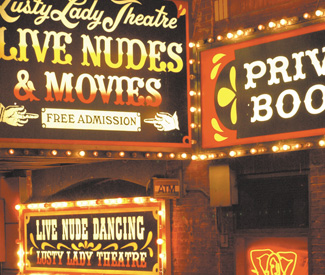
San Francisco’s sex workers rights history includes two unions. Workers at the North Beach strip club the Lusty Lady formed the Exotic Dancers Union in 1997. The union became part of the Service Employees International Union, and the Lusty Lady remains the only collectively run, sex-worker-owned strip club in the United States.

Maxine Doogan founded the Erotic Service Providers Union (ESPU) in 2004 as an umbrella organization for sex workers in various industries. The ESPU has been active in opposing regulations of the massage industry and sponsoring Proposition K, a 2008 ballot measure that would have decriminalized sex work in San Francisco.

I spoke to a handful of Bay Area sex-workers rights activists to get a sense of the major issues and priorities for the next year.

NO VISAS

Activists are currently planning for the July, 2012 International AIDS Conference in Washington, D.C.

Many international sex workers rights advocates have been denied visas to get to the conference. The U.S. typically bars convicted felons — but there’s a special exception for people guilty of misdemeanor prostitution charges.

“SWOP has an idea of getting in touch with some of the people denied entrance and asking them what they were going to present on and to try and present their papers in their place, to make sure these organizers voices are heard,” said SWOP-Bay Area spokesperson Shannon Williams.

But that’s not where the government’s weird exclusion of sex workers from its efforts to fight AIDS ends.

The Presidents Emergency Plan for AIDS Relief (PEPFAR) fund allocates $48 billion to organizations around the world engaged in AIDS treatment and prevention. But thanks to the religious right, the law, approved in 2003, includes a stipulation that all recipient groups must make a pledge decrying prostitution. It’s known as the “anti-prostitution loyalty oath.”

A court ruling July 6, 2011 declared the oath a violation of the free-speech rights of organizations in the United States, but the U.S. still blocks PEPFAR funding for international organizations based on the “loyalty oath.”

“Sex worker activists are going to converge in D.C. for the AIDS conference and talk about the loyalty oath. The US is exporting its ideology through this funding requirement” said Carol Leigh, a longtime activist who curates the annual San Francisco Sex Worker Film and Art Festival.


EMPHASIZING CONSENT

Sex workers rights activists continue to be engaged in their complex, decades-long struggle with anti-sex trafficking organizations.

People who want safer working conditions say that decriminalization would make it easier for police to distinguish between coerced and consensual prostitution and encourage those with knowledge of crimes perpetuated against sex workers to come forward without risking prosecution for their own illegal work.

But many anti-trafficking advocates dismiss the distinction between forced and consensual prostitution in their efforts. According to a document called “Ten reasons for not legalizing prostitution,” on the website of the Coalition Against Trafficking in Women, “There is no doubt that a small number of women say they choose to be in prostitution, especially in public contexts orchestrated by the sex industry… In this situation, it is harm to the person, not the consent of the person that is the governing standard (emphasis theirs).”

It’s this refusal to acknowledge the importance of consent that really pisses off advocates —and has a powerful effect on the policy that governs them.

The federal definition of sex trafficking includes consensual prostitution, and defines coerced prostitution as “severe sex trafficking.” “Law enforcement agencies can use anti-trafficking funds to arrest sex workers in prostitution, on the grounds that the feds define all prostitution as trafficking, even though the government distinguishes between trafficking and severe trafficking,” said one sex workers rights activist.

According to Leigh, anti-trafficking organizations are not all bad; she named the Global Alliance Against Traffic in Women as an organization that “has been allied with sex workers rights movement and takes rights-based approach.”

But organizations that conflate consensual and coerced commercial sex are often big-time recipients of public and private funding.

Doogan is wary of any attempt to further regulate or criminalize sex work. She says that often, laws meant to deter prostitution trap people who may want to change occupations.  “Women have to continue working in the industry because no one else will take them for work when they have those convictions on their record,” said Doogan.

That may be the case with Lola, an occasional Erotic Service Providers Union volunteer who was arrested on prostitution-related charges outside California earlier this year. She moved to the Bay Area and is looking for a job, but after a promising interview last week, she’s nervous that a background check will reveal her arrest.

“I’m waiting to hear whether that’s going to be an issue or not. They could tell my landlord, and then I could lose my house too…all I’m trying to do is get a job,” Lola told the Guardian.


THE WORK GOES ON

For most sex-workers rights activists, the long-term goal remains decriminalization. For now education, creative projects, and protest in service of that goal continue.

Members of SWOP-Bay Area have a program called Whorespeak that does outreach at colleges, and “we’ve also been speaking in classes for therapists about how to work with current and former sex workers and not pathologize them,” said Williams.

According to Stryker, one of the most exciting projects happening now is Karma Pervs. The website, run by local queer porn star Jiz Lee, sells unique sex-positive porn and donates the proceeds to organizations like the Saint James Infirmary.

Then, of course, there’s the International Day to End Violence Against Sex Workers, when sex workers and allies gather to commemorate sex workers who have been assaulted and killed.

Sex workers often can’t go to police to report crimes for fear of being locked up themselves, society retains a huge stigma surrounding sex work, and there is an insidious cultural myth that “you can’t rape a prostitute.” These all add up to put sex workers at high risk for assault and murder; serial killers, such as the Green River Killer in Seattle and a murdered in Long Island-area this past summer, are disproportionately likely to target prostitutes.

That’s why, for Williams, “Our long-term goal is to decriminalize prostitution. But the real goal is to end violence against sex workers.”

Twisted misters

1

cheryl@sfbg.com

FILM This year’s San Francisco Independent Film Festival kicks off with a film that knows exactly what time it is: 4:44 Last Day on Earth.

Abel Ferrara’s latest imagines what the end of the world might be like for a volatile Lower East Side couple — he’s an ex-junkie (Ferrara favorite Willem Dafoe), she’s a young painter (Shanyn Leigh, Ferrara’s real-life companion). The film’s title refers to the predicted instant that an environmental catastrophe will completely dissolve the ozone layer, but 4:44 is mostly set indoors, specifically within the headspace of Dafoe’s character. It’s a gritty film that veers between self-indulgence and stuff that honestly seems pretty practical (sure, there’s a lot of Skyping, but if the world were ending, wouldn’t you?); as far as inward-looking disaster movies go, anyone planning an apocalypse film festival could double-bill 4:44 nicely with 2011’s Melancholia.

IndieFest is not an apocalypse film festival, per se. You could choose to have a jolly old time; there’s a power ballad sing-along, and even a flick called I Like You. But the selections for sick puppies are truly, truly outstanding this year. Personally, I recommend going as dark as you can possibly stand.

Start your journey with Michael R. Roskam’s Bullhead, a Belgian import that just scored a Best Foreign Language Film Oscar nomination. The five-second description of this film, which is about a cattle farmer who injects both his livestock and his own body with illegal hormones, doesn’t do it justice. Who knew there was such a thing, for instance, as a “hormone mafia underworld”? While some of Bullhead‘s nuances, which occasionally pivot on culture-clash moments specific to its Belgium setting, will inevitably be lost on American viewers, the most important parts of the movie come through loud and clear, and you won’t soon forget them.

http://www.youtube.com/watch?v=5fvLVNlMvus

Also memorable is Snowtown, another standout Australian crime film on the heels of Animal Kingdom (2010). While Snowtown — whose vérité shooting style recalls Andrea Arnold’s films about desperate living amid Britain’s council estates — isn’t quite as exportable as Animal Kingdom, it is just as uncomfortably tense, and features a teenage protagonist struggling to survive amid close-to-home evil. It’s based on the real-life case of Australia’s worst serial killer, and follows the gruesome facts quite closely. The film has a lot of characters that come and go without much explanation or introduction, which starts to seem deliberate after awhile. Fortunately, the core cast is magnetic. Remember 2005’s Wolf Creek? Snowtown is just as intense.

Still have a lust for blood? Of course you do. British director Ben Wheatley made a splash with 2009 gangster drama Down Terrace; he’s back with much buzz surrounding Kill List, with a review in the IndieFest catalog citing it as “the number one horror film of the year.” I’d hate to hand out that accolade so early in 2012, but this hired-killer-down-the-rabbit-hole tale is indeed worth considering.

Of course, there’s more to horror than guts and torture; if you need a reminder as to why, check out the festival’s pair of home-is-where-the-creepy-is films from Austria, Beside My Brother and Still Life. Beside My Brother‘s set-up — an emotionally disturbed father pretends his twin sons are the same person, and forces them to live as such, a practice they maintain into adulthood — is more promising than its payoff. Remember how in Dead Ringers (1988), the doppelganger bros were gynecologists? Here, they’re painters, and pretty bland ones at that. Far more harrowing is Still Life, about the irrevocable damage wrought by a father’s single, horrible revelation. First-time feature director Sebastian Meise manages to distill the complete crumbling of a seemingly normal-ish family into a slender, wrenching 77 minutes.

Speaking of harrowing, there’s nothing scarier in all of IndieFest than the early scenes of documentary Last Days Here, made by Don Argott and Demian Fenton (directors of 2009’s excellent The Art of the Steal). The film alights upon Bobby Liebling, dubbed the “godfather of doom” for his forty-plus year stint fronting legendary band Pentagram, as a fiftysomething crack addict living in his parents’ basement. Last Days Here is both heartfelt and gloves-off; it’s also blessed with having one of the most unbelievable comeback stories at its core (not a spoiler if you keep abreast of Bay Area concerts; Pentagram’s played here several times in recent years). It, like many of the films discussed here, has a distributor and will be coming around after IndieFest, but I implore you not to sleep on this one — even if you don’t love heavy metal, but especially if you do.

Less successful but no less intriguing is Atlanta oddity Snow On Tha Bluff, which is somewhere between an old-school ethnographic film — like, Robert Flaherty old — and self-aware product of the YouTube generation. The opening and closing scenes are obviously staged, as a drug dealer named Curtis Snow steals a video camera and decides he’ll make an autobiographical movie from the footage he collects. What’s between those bookends is what appears to be an authentic record of life in Snow’s crime-infested neighborhood, complete with drive-by shootings, home invasions, run-ins with the police, copious drug use, etc. Why any of the involved would allow their faces to be shown on camera while, say, firing a non-street legal weapon into a rival’s home is the film’s biggest mystery; its biggest accomplishment is obscuring the obvious lines of demarcation between what’s real and what’s not.

To end your IndieFest experience on a slightly uplifted note, you will have to die — or at least be cool with hanging out with the ghosts in Finisterrae, the first feature from Catalan artist Sergio Caballaro.

Expressing themselves via droll, post-production “dialogue” (in Russian, subtitled in English), the newly-deceased, sheet-wearing duo decides they would like to live again. A-journeying they go, following the wind and encountering an array of strange characters, including enough taxidermied animals to make Chuck Testa‘s head spin. Finisterrae starts slow but builds to glorious, gorgeously filmed and supremely weird heights. Hippies beware.

SAN FRANCISCO INDEPENDENT FILM FESTIVAL

Feb. 9-23, most films $11

Roxie Theater

3117 16th St., SF

www.sfindie.com


Film Listings

0

Film listings are edited by Cheryl Eddy. Reviewers are Kimberly Chun, Max Goldberg, Dennis Harvey, Lynn Rapoport, and Matt Sussman. For rep house showtimes, see Rep Clock. For complete listings, including more Ongoing films, see www.sfbg.com.

INDIEFEST

The 14th San Francisco Independent Film Festival runs Feb 9-23 at the Roxie Theater, 3117 16th St, SF. For tickets (most films $11) and schedule info, visit www.sfindie.com. For commentary, see “Twisted Misters.”

OPENING

*Elite Squad: The Enemy Within A huge hit in its native Brazil, this drama from director José Padilha (2002’s Bus 174) uses insane amounts of bullets to spin a twisted tale of police and government corruption. It’s a sequel of sorts to 2007’s The Elite Squad, though having missed that film isn’t a barrier to enjoying part two. Special ops cop Roberto Nascimento (Wagner Moura) returns; he’s higher up the bureaucratic food chain, but finds himself locked in a constant battle with bad guys both criminal and co-worker. (“I created the monster that would eat me up,” he realizes after an elaborate scheme to eliminate drug dealers and dirty cops goes horribly awry.) Meanwhile, his wife is now his ex-wife, and she’s remarried a lefty politician (Irandhir Santos) who’s particularly interested in exposing the same villains making Nascimento’s life hell, while also making Nascimento’s life hell himself. Fans of The Wire and particularly City of God — Enemy co-writer Bráulio Mantovani was an Oscar nominee for that 2002 film — will have particular interest in Enemy, though it never quite achieves those works’ memorable heights. One possible reason: too much Nascimento voice-over. How do you say “show me, don’t tell me” in Portuguese? (1:55) Four Star. (Eddy)

*I Am Bruce Lee Not to be confused with Bruce Lee: A Warrior’s Journey (2000), this Spike TV co-production is nonetheless a similarly praise-filled portrait of the groundbreaking, charismatic action star. Warrior’s Journey‘s main coup was revealing long-thought-lost footage from 1978’s The Game of Death, one of only five feature films starring Lee (two of which were posthumous, including 1973 smash Enter the Dragon). I Am Bruce Lee tilts more toward exploring Lee’s lasting legacy — an extended debate over whether or not he invented what we now call “mixed martial arts” definitely plays to the doc’s Spike TV interests — but also contains the expected biography, with an emphasis on Lee’s unique approaches to martial arts and philosophy, as well as input from suspects usual (Lee’s widow and daughter, top Lee student Dan Inosanto, etc.), understandable (boxer Manny Pacquiao, martial arts champ Cung Lee), and fanboy (Mickey Rourke, Ed O’Neill). Screening in a very limited run, I Am Bruce Lee is a flashy, entertaining primer for beginning students of Lee (lesson one: he was basically the coolest guy who ever lived); longtime fans may not learn anything new, but will no doubt find much to enjoy anyway. (1:34) Four Star, Metreon. (Eddy)

Journey 2: The Mysterious Island Dwayne Johnson and Vanessa Hudgens play a father-daughter team of explorers in this sequel to 2008’s Journey to the Center of the Earth. (1:34)

Once Upon a Time in Anatolia Turkish director Nuri Bilge Ceylan’s deconstructed Turkish police procedural offers little action but plenty of atmosphere. The search for a corpse by a group of men — a prosecutor, a commissar, a doctor, and their two main suspects— through the desolate, wind-scoured hills of rural Anatolia, is in fact something of a Hitchcockian MacGuffin. Ceylan’s real investigation is philosophical, zeroing in on the way in which each of these men constructs his own truth out of the re-telling and mis-telling of past events. And the drudgery of this protracted investigation, much of it depicted in real-time, provides plenty of opportunities for all of the players to tell their stories or to simply ruminate, often bitterly, about their own lives. There is palpable loneliness that courses through all the chatter, formally mirrored by Ceylan’s penchant long-takes of isolated figures swallowed by the countryside or the darkness of night. But despite the endless landscape that surrounds them, there is no exit for these small men. (2:37) SF Film Society Cinema. (Sussman)

Safe House Denzel Washington is a rogue CIA agent who goes on the run with a rookie (Ryan Reynolds) when mercenaries attack. (2:00) Presidio.

Star Wars: Episode 1: The Phantom Menace 3D Spoiler alert: no matter how rad the special effects look in 3D, this movie will still contain Jar Jar Binks. (2:16)

This Means War Another flick about battlin’ CIA agents — this time, though, it’s Chris Pine and Tom Hardy fighting over Reese Witherspoon. (2:00)

“2011 Oscar-Nominated Short Films, Live Action and Animated” See the shorts tipped to compete for Oscar gold in two separate programs, divided into live-action and animated films. Lumiere, Opera Plaza, Shattuck, Smith Rafael.

The Vow Sorry Rachel McAdams and Channing Tatum, but 1987’s Overboard is the best amnesia-themed romance of all time. (1:44) Marina.

W.E. Madonna’s having a big week, no? (1:59) Bridge.

ONGOING

Big Miracle Three gray whales trapped beneath the Beaufort Sea ice near the tiny town of Barrow, Alaska become an international cause célèbre through the uneasily combined efforts of an Anchorage reporter (John Krasinski), a Greenpeace activist (Drew Barrymore), a group of chainsaw-toting Inupiaq fishermen, a Greenpeace-hating oilman (Ted Danson), a Reagan-administration aide (Vinessa Shaw), a U.S. Army colonel (Dermot Mulroney), a pair of Minnesotan entrepreneurs (James LeGros and Rob Riggle) with a homemade deicing machine, and the crew of a Soviet icebreaking ship. The magical pixie dust of Hollywood has been sprinkled liberally over events that did indeed take place in 1988, but the media frenzy that blossoms out of one little local newscast is entirely believable. Everyone loves a good whale story, and this one is a tearjerker — though the kind that parents can bring their kids to without worrying overly much about subsequent weeks of deep-sea-set nightmares and having to explain terms like “critically endangered Western North Pacific gray whale” if they don’t want to. The film makes clear that the weak-on-the-environment Reagan administration and Danson’s oilman stand to gain some powerfully good PR from this feat, with potentially devastating ecological results down the line, and Barrymore’s character gets to recite a quick litany of impending oceanic catastrophes. But this kind of talk is characterized as less useful than a nice, quick, visceral pull on the heartstrings, and while offering us the pleasurable sight of whales breaching in open water, the film avoids panning out too much farther, which may be why the miracle looks so big. (2:03) 1000 Van Ness. (Rapoport)

*Chronicle A misfit (Dane DeHaan) with an abusive father and an ever-present video camera, his affable cousin (Matt Garretty), and a popular jock (Michael B. Jordan) discover a strange, glowing object in the woods; before long, the boys realize they are newly telekinetic. At first, it’s all a lark, pulling pranks and — in the movie’s most exhilarating scene — learning to fly, but the fun ends when the one with the anger problem (guess which) starts abusing the ol’ with-great-power-comes-great-responsibilities creed. Chronicle is a pleasant surprise in a time when it’s better not to expect much from films aimed at teens; it grounds the superhero story in a (mostly) believable high-school setting, gently intellectualizes the boys’ dilemma (“hubris” is discussed), and also understands how satisfying it is to see superpowers used in the service of pure silliness — like, say, pretending you just happen to be really, really, really, good at magic tricks. First-time feature director Josh Trank and screenwriter Max “son of John” Landis also find creative ways, some more successful than others, to work with the film’s “self-shot” structure. The technique (curse you, Blair Witch) is long past feeling innovative, but Chronicle amply justifies its use in telling its story. (1:23) 1000 Van Ness. (Eddy)

*Come Back, Africa Opposition to apartheid didn’t really pick up steam as a popular cause in the U.S. until the early 1980s. Which makes it all the more remarkable that New York City-based documentarian Lionel Rogosin made Come Back, Africa (1959) about a quarter-century earlier — though less surprisingly, the film itself was barely seen here at the time. Now finally playing American theaters outside his home town in a restored print, it’s a time capsule whose background is as intriguing as the history it captures onscreen. The horrors of World War II and some subsequent global travel had stirred a profound awareness of social injustices in Rogosin, who began planning a feature about South Africa while still working at his father’s textile business. He had very little filmmaking experience, however, so he took $30,000 of his earnings and as “practice” made On the Bowery (1956), a semi staged portrait of Manhattan’s skid row area that won considerable praise, if also some shocked and appalled responses from Eisenhower-era keepers of America’s wholesome, prosperous self-image. Armed with the confidence bestowed by that successful effort and several international awards, Bogosin traveled to South Africa — not for the first time, but now with the earnest intent of making his expose. In the mid- to late ’50s, however, that was hardly a simple task. The film, which mixes a loose, acted narrative with completely nonfiction elements, follows the luckless wanderings of an agreeable protagonist played by a first-time actor — Zacharia Mgabi, a 30-ish bearded worker “discovered” on a bus queue. His character, Zachariah, is caught in one catch-22 of apartheid life: he can’t get a job without the appropriate permits, and can’t get the permits without a job. And so on. All show and almost no “tell,” Come Back, Africa wasn’t shown in South Africa until the late 1980s; it nonetheless proved a great influence on development of the whole continent’s indigenous cinematic voices. (1:24) Roxie. (Harvey)

*Coriolanus For his film directing debut, Ralph Fiennes has chosen some pretty strong material: a military drama that is among Shakespeare’s least popular works, not that adapting the Bard to the screen has ever been easy. (Look how many times Kenneth Branagh, an even more fabled Shakespearean Brit on stage than Ralph, has managed to fumble that task.) The titular war hero, raised to glory in battle and little else, is undone by political backstabbers and his own contempt for the “common people” when appointed to a governmental role requiring some diplomatic finesse. This turn of events puts him right back in the role he was born for: that of ruthless, furious avenger, no matter that now he aims to conquer the Rome he’d hitherto pledged to defend. The setting of a modern city in crisis (threadbare protesting masses vs. oppressive police state) works just fine, Elizabethan language and all, as does Fiennes’ choice of a gritty contemporary action feel (using cinematographer Barry Ackroyd of 2006’s United 93 and 2008’s The Hurt Locker). He’s got a strong supporting cast — particularly Vanessa Redgrave as Coriolanus’ hawkish mother Volumnia — and an excellent lead in one Ralph Fiennes, who here becomes so warped by bloodthirst he seems to mutate into Lord Voldemort before our eyes, without need of any prosthetics. His crazy eyes under a razored bald pate are a special effect quite alarmingly inhuman enough. (2:03) Embarcadero. (Harvey)

*Haywire Female empowerment gets its kung-fu-grip thighs around the beet-red throat of all the old action-heroes. Despite a deflated second half — and director Steven Soderbergh’s determinedly cool-headed yet ultimately exciting-quelling approach to Bourne-free action scenes — Haywire is fully capable of seizing and demanding everyone’s attention, particularly that of the feminists in the darkened theater who have given up looking for an action star that might best Angelina Jolie’s Lara Croft. Former pro mixed martial arts fighter Gina Carano, who plays it as studiedly intense and charismatic as crossover grapplers Lee, Norris, and Seagal before her, is that woman, with convincingly formidable neck and shoulder muscles to distract from her curves. Her Mallory Kane is one of the few women in Haywire‘s pared-down, stylized mise-en-scene — the lone female in a world of men out to get her, starting with the opening diner scene of a watchful Mallory confronted by a man (Channing Tatum) playing at being her boyfriend, fed up with her shit, and preparing to pack her into the car — a scenario that doubtless many rebel girls can relate to until it explodes into an ultraviolent, floor-thrashing fight scene. Turns out Mallory is an ex-Marine and Blackwater-style mercenary, ready to get out of the firm and out of a relationship with her boss, Kenneth (Ewan McGregor), when she learns, the bruising way, that she’s been set up. The diner scene sets the tone for rest of Haywire, an otherwise straightforward (albeit flashback-loaded) feminist whodunit of sorts, limned with subtextual currents of sexualized violence and unfolding over a series of encounters with men who could be suitors — or killers. (1:45) California, 1000 Van Ness. (Chun)

*Pariah A teenage girl stands stock-still in a dark nightclub, gazing with desire and fear at the half-naked female dancers on the stage. Later, riding home on the bus, she slowly removes the layers of butch that held her together in the club, stripping down to some version of the person her parents need to see when she walks in the door. Nearly wordlessly, the opening scenes of Dee Rees’s Pariah poignantly depict the embattled internal life of Alike (Adepero Oduye), a 17-year-old African American girl living in Brooklyn with her family and struggling both to be seen as she is and to determine what that might look like. The battles are being waged externally, too, between Alike’s adoring father (Charles Parnell), living in willful ignorance, and angry, rigid mother (Kim Wayans), desperately enforcing a feminine dress code and steering Alike away from openly butch friend Laura (Pernell Walker). Rees’ script beautifully conveys a household of landmines and chasms, which widen as husband and wife and daughter struggle and fail to communicate, asking the wrong questions, fearfully skirting the truth about Alike’s sexuality and her parents’ crumbling marriage. And the world outside proves full of romantic pitfalls and the tensions of longtime friendship and peer pressure. The poems in which the talented Alike takes solace and makes her way toward a more truthful existence are beautiful, but at a certain point the lyricism overtakes the film, forcing an ending that is tidy but less than satisfying. (1:26) Lumiere, SF Center. (Rapoport)

The Woman in Black Daniel Radcliffe (a.k.a. Harry Potter) plays a grieving young widower in an old-fashioned ghost story, set in the era of spirit hands and other visitations from beyond the veil. But while Victorian séances were generally aimed at the dearly departed, the titular visitant (Liz White), who haunts the isolated estate of Eel Marsh House and its environs, is a vindictive, mean-spirited creature, avenging the long-ago loss of her child by wreaking havoc and heartbreak among the families of the nearby village, among them a local landowner (Ciarán Hinds) and his wife (Janet McTeer). Radcliffe’s character, a lawyer named Arthur Kipps, has been tasked with settling the affairs of the mansion’s recently deceased owner, an assignment that requires sifting through mounds of dusty, crumpled ephemera in one of the creakiest, squeakiest buildings ever constructed. Set at the end of a narrow spit of land that disappears into the surrounding wetlands when the tide is high, Eel Marsh House is a charming place to be marooned after dark. But no amount of horrified screams from the audience will keep Kipps from his duties, though it’s hard to make much headway amid the unrelenting creepiness. Nearly every moment brings a fresh inexplicable thumping noise from an upper floor; a new room full of dead-eyed dolls that Kipps has no business wandering into; another freakishly screaming face next to his as he gazes out the window. The house is a richly textured set piece; the horror is of the sort that makes you jump and then laugh, both at the filmmakers, for springing the same tricks on you over and over, and at yourself, for falling prey to them every time. (1:36) 1000 Van Ness, Shattuck. (Rapoport)

Brews you can use

0

caitlin@sfbg.com

BEER Even if your hankering for a beer paunch pales in comparison, say, to your desire to fit into your Valentine’s Day party dress, you have a responsibility to indulge during SF Beer Week. It’s not just a gustatory pleasure — consider yourself stumping for a burgeoning local industry. From Feb. 10-19, the fest will stage everything from urban beer hikes to beer-and-chocolate pairing events, beer-and-cheese couplings to a showcase of the finest in local bitter ales. Recently, the Guardian had the pleasure of a one-on-one (via email) with David McLean, the mastermind behind the superlative suds at Magnolia Brewery. He is also a member of the SF Brewer’s Guild, the organizing entity behind Beer Week. McLean shared with us his can’t-miss picks for hobnobbing and hops during this year’s festival. And yes, they include an stout made with Hog Island oysters.

SFBG: How has the beer scene changed over the past year in the Bay Area? Has there been a profound expansion? 

DM: Here and everywhere. We started in 2011 with about 1,700 breweries in the country. We are creeping up on 2,000 a year later and there are something like 800 or so known to be in planning. It’s safe to say craft beer is exploding right now. In the Bay Area, some notable highlights are Southern Pacific, Elevation 66, Dying Vines, Pacific Brewing Laboratories, and Heretic Brewing. There are plenty more on the way in 2012.

SFBG: Anyone new on the scene whose brews you’re excited to sample? 

DM: After many delays (all par for the course) it is super-exciting to have Southern Pacific Brewing Company open just in time for Beer Week. As the first new brewery built in San Francisco in many years — close to 10 — that one leads the pack in terms of excitement level. Another SF company just getting off the ground is Pacific Brewing Laboratories, which is starting to get its Squid Ink IPA and a couple of other beers into bars and restaurants. Almanac’s latest seasonal release, Winter Wit, should be hitting the streets just in time for Beer Week too, and it’s worth hunting down.

SFBG: A food-beer pairing event you think is a can’t-miss?

DM: Some pairings are just so perfect as to be timeless. They’re less about being creative and more about flavors that need no help fitting together. A personal favorite is oysters and beer, particularly oysters and certain kinds of stout, especially dry stouts. We go a step further at Magnolia with an oyster stout we make using Hog Island Sweetwater oysters in the beer. The effect is subtle, and maybe it is gilding the lily, but a few freshly-shucked Sweetwaters and a glass of that beer, Oysterhead Stout, is about as good as it gets. We’ll be spending all day on Valentine’s Day shucking a variety of oysters and serving them with that stout and some other good oyster-pairing beers until the oysters run out. If I were free on Mon/13, you might find me at the “Butcher and the Beer at the Beast and the Hare” — it’s a dinner with [4505 Meats butcher] Ryan Farr and Almanac Beer.

SFBG: Your tip for making it through Beer Week — how do you survive such a strenuous schedule?

DM: The well-timed vacation waiting on the other side of Beer Week helps maintain my sanity during Beer Week. With multiple events to work everyday, it’s a definitely a marathon and not a sprint. But it is also one of the premier celebrations of craft beer in the country and the sense of enthusiasm, camaraderie, and support from the beer community is more than enough to help us all get through the week. It’s energizing, actually. But don’t forget to hydrate.

SF BEER WEEK OPENING CELEBRATION

Fri/10 6-10 p.m., $65

Concourse Exhibition Center

635 Eighth St., SF

www.sfbeerweek.org


Ellison wins, SF loses

6

EDITORIAL San Francisco’s not going to lose the America’s Cup. Oracle CEO and yachting billionaire Larry Ellison is too excited about the prospect of bringing the sport (and his company’s logo on the sail of his boat) to a mass audience for the first time in history that he’s not about to abandon San Francisco Bay. The process is too far along; that much is a done deal.

But the development agreements for the city’s waterfront is not a done deal at all — in fact, the proposal could wind up giving Ellison effective control over five piers and a valuable waterfront lot that he could develop for condos. And the city won’t get anywhere near enough out of the deal.

The development agreement is really just a sideshow in the cup planning; nobody’s disagreeing that Ellison’s America’s Cup Event Authority will need space to stage the race, and that will require the renovation of some waterfront property. And nobody disputes that the event will bring tourism and revenue to the city, which will offset some of the cost of allowing Ellison rights to the waterfront.

The rest of it is purely a real estate deal: Ellison’s offering to put millions of dollars into renovating crumbling and underused piers, and in exchange the Port of San Francisco — which lacks the money to rebuild the waterfront and has no credible plans for a good part of its property — could give Ellison long-term low-cost leases and development rights on Piers 26, 28, 30-32 and possibly 29, as well as Seawall Lot 330 at Embarcadero and Bryant.

The city’s never been terribly good at cutting tough deals with real-estate developers, and the history of San Francisco is littered with examples of the taxpayers losing out to the speculators and builders. And in the furor of excitement over the America’s Cup, this development agreement could become the latest sellout.

The original projections for the economic impact of the event are looking more and more questionable; it’s entirely possible that San Francisco will wind up with far less than the $1.4 billion in spending and the thousands of jobs that cup promoters have promised. It’s still going to be a big deal, and the city (particularly the hospitality industry) will do well — but it’s not the answer to all of San Francisco’s problems. By the end of 2013, the event will be over — and Ellison will have essentially taken title to a huge amount of public land, for as long as 60 years into the future. And he won’t be paying the city the normal development fees, the normal impact fees, or even reasonable annual rent to the Port.

The supervisors need to put aside the hype around a sailing regatta and look at this for what it is: A real-estate development agreement with one of the world’s richest people. And right now, it’s not a good deal for the city.

Alerts

0

yael@sfbg.com

THURSDAY 9

Occupy Oakland Forum on Police Actions

Oakland’s Citizen Police Review Board had been planning a forum on the Oakland Police and Occupy Oakland for months — until they announced at the last minute that it was canceled. In response, the Occupy Oakland Forum Committee is hosting essentially the same forum, and inviting the same speakers, including Jim Chanin, civil rights lawyer from the Oakland Riders case, and Police Chief Howard Jordan. They hope to give the community a chance to respond to the recent controversy surrounding treatment of Occupy Oakland by police.

6:15 p.m., free

Grand Lake Theater

3200 Grand, Oakl.

oakland@occupyreport.org


Reelect David Campos

District 9 Sup. David Campos and his re-election campaign are throwing their first fundraiser event in the Mission. It will include drinks, appetizers, and a chance to talk with the man himself.

6 p.m., free

Blue Macaw

2565 Mission, SF

(415) 920-0577


FRIDAY 10

Kenneth Harding benefit

A star-studded night of music to benefit the Kenneth Harding Jr. Foundation. Support the foundation created after Harding, an unarmed black 19-year-old, was killed by SFPD officers in an incident spurred by an unpaid $2 train fare. The night’s line-up includes Fly Benzo, BVHP neighborhood resistance leader, emcee and City College student, who faces four years in prison on multiple counts including “videotaping the police” for his responses to the shooting.

9 p.m., $12

330 Ritch, SF

www.330ritch.com/calendar


SUNDAY 12

Move to Amend

David Cobb, spokesperson for the Move to Amend campaign, will speak about corporate personhood. Move to Amend is an effort to amend the constitution to abolish corporate personhood, which saw a large turnout on its national day of action on Jan. 20. Cobb is also a former Green Party presidential candidate.

7 p.m., $5-10

Berkeley Fellowship of Unitarian Universalist’s Hall

1924 Cedar, Berk.

(510) 841-4824

www.movetoamend.org


Harlem is Nowhere

Hear author Sharifa Rhodes-Pitts and organizer Alicia Garza talk about the history and meaning of Harlem as a center for black politics and culture, the effects of gentrification, and the geography of building power for people of color. This event is part of an ongoing “authors in conversation” series at the Museum of the African Diaspora. Rhodes-Pitts is the author of Harlem is Nowhere: A Journey to the Mecca of Black America, and Garza is the co-executive director of People Organized to Win Employment Rights (POWER) in San Francsico.

2 p.m., free

Museum of the African Diaspora

685 Mission, SF

www.moadsf.org/visit/calendar.html

Guardian editorial: Ellison wins, San Francisco loses!

3

EDITORIAL San Francisco’s not going to lose the America’s Cup. Oracle CEO and yachting billionaire Larry Ellison is too excited about the prospect of bringing the sport (and his company’s logo on the sail of his boat) to a mass audience for the first time in history that he’s not about to abandon San Francisco Bay. The process is too far along; that much is a done deal.

But the development agreements for the city’s waterfront is not a done deal at all — in fact, the proposal could wind up giving Ellison effective control over five piers and a valuable waterfront lot that he could develop for condos. And the city won’t get anywhere near enough out of the deal.

The development agreement is really just a sideshow in the cup planning; nobody’s arguing that Ellison’s America’s Cup Event Authority will need space to stage the race, and that will require the renovation of some waterfront property. And nobody disputes that the event will bring tourism and revenue to the city, which will offset some of the cost of allowing Ellison rights to the waterfront.

The rest of it is purely a real estate deal: Ellison’s offering to put millions of dollars in to renovating crumbling and underused piers, and in exchange the Port of San Francisco — which lacks the money to rebuild the waterfront and has no credible plans for a good part of its property — will give Ellison long-term low-cost leases and development rights on Piers 26, 28, 30-32 and possibly 29, as well as Seawall Lot 330 at Embarcadero and Bryant.

The city’s never been terribly good at cutting tough deals with real-estate developers, and the history of San Francisco is littered with examples of the taxpayers losing out to the speculators and builders. And in the furor of excitement over the America’s Cup, this development agreement could become the latest sellout.

The original projections for the economic impact of the event are looking more and more questionable; it’s entirely possible that San Francisco will wind up with far less than the $1.4 billion in spending and the thousands of jobs that cup promoters have promised. It’s still going to be a big deal, and the city (particularly the hospitality industry) will do well — but it’s not the answer to all of San Francisco’s problems. By the end of 2013, the event will be over — and Ellison will have essentially taken title to a huge amount of public land, for as long as 60 years into the future. And he won’t be paying the city the normal development fees, the normal impact fees, or even reasonable annual rent to the Port.

The supervisors need to put aside the hype around a sailing regatta and look at this for what it is: A real-estate development agreement with one of the world’s richest people. And right now, it’s a lousy deal for the city.


On the township

0

FILM Opposition to apartheid didn’t really pick up steam as a popular cause in the U.S. until the early 1980s. Which makes it all the more remarkable that New York City-based documentarian Lionel Rogosin made Come Back, Africa about a quarter-century earlier — though less surprisingly, the film itself was barely seen here at the time. Now finally playing American theaters outside his home town in a restored print, it’s a time capsule whose background is as intriguing as the history it captures onscreen.

The horrors of World War II and some subsequent global travel had stirred a profound awareness of social injustices in Rogosin, who began planning a feature about South Africa while still working at his father’s textile business. He had very little filmmaking experience, however, so he took $30,000 of his earnings and as “practice” made On the Bowery (1956), a semi staged portrait of Manhattan’s skid row area that won considerable praise, if also some shocked and appalled responses from Eisenhower-era keepers of America’s wholesome, prosperous self-image. (It was, as 1959’s Come Back, Africa would also be, much more widely appreciated in Europe.)

Armed with the confidence bestowed by that successful effort and several international awards, Bogosin traveled to South Africa — not for the first time, but now with the earnest intent of making his expose. In the mid- to late ’50s, however, that was hardly a simple task. He and wife Elinor Hart had to do everything clandestinely, from making contacts in the activist underground to recruiting actors and crew. (The latter eventually had to be brought in mostly from Europe and Israel.) To get permits he fed the government authorities a series of lines: first he pretended to be making an airline travelogue to encourage tourism; then a music documentary to show local blacks “were basically a happy people;” then another doc, about the Boer War. Amazingly, despite the myriad likelihoods of being informed on, he shot the entire film without being shut down or deported. It remained, however, a stressful and dangerous endeavor for all concerned.

Like On the Bowery, Come Back, Africa qualified as a documentary by the looser standards of the time (Rogosin preferred the term “poetic realism”), but mixed a loose, acted narrative with completely nonfiction elements. Like the prior film, it also followed the luckless wanderings of an agreeable protagonist played by a first-time actor actually found on the street — here Zacharia Mgabi, a 30-ish bearded worker “discovered” on a bus queue.

His character, Zachariah, is caught in one catch-22 of apartheid life: he can’t get a job without the appropriate permits, and can’t get the permits without a job. First he tries finding employment in the misery of a mining encampment, then travels to Johannesburg — where it’s illegal for him to be without further permits — where he’s bounced from one position to another. Working as “house boy” to a middle-class white couple, he’s fired when the racist, shrewish wife (a memorable performance by Myrtle Berman) catches him sneaking a drink from her own secret booze stash. An auto-shop stint is lost due to a friend’s incessant goofing off, while service as porter in a hotel is terminated when a hysterical white lady guest cries “Rape!” simply because he surprises her in a hallway.

Meanwhile Zachariah’s wife arrives from their native KwaZulu, and they tentatively set up house in a Sophiatown shack. (Come Back, Africa is of particular interest for its scenes there — within a few years the government had forcibly emptied this poor black township, having made its population mix of races illegal, and the area was razed to become an unrecognizable whites only suburb.) But even this small foothold on stability is doomed. Just as alcoholism dragged On the Bowery‘s hero back into a downward spiral at the end (both on- and offscreen), so Zachariah and his family are helpless to save themselves from the violence, police harassment, and self-destruction apartheid breeds and maintains itself with.

All show and almost no “tell,” Come Back, Africa pauses around the two-thirds point to let several men pass around a bottle, discussing the nature of and solutions to their oppression. They’re happily interrupted by the incongruity of a young woman in an elegant cocktail dress — no less than a then-unknown Miriam Makeba, who sings a couple of songs in her inimitable voice. When the film was finished, Rogosin bribed officials to get her out of the country, bankrolling his contracted “discovery’s” launch at the Venice Festival, and in the U.S. and England. But to his great disappointment, she was quickly taken under Harry Belafonte’s wing, dismissing her first benefactor as “not very nice” and “an amateur.” Thus a legend was born, with Rogosin pretty much cut out of the resume.

Come Back, Africa, too, would disappoint its maker in some respects. With a furious South African government swiftly condemning this portrait as “distorted,” his original plans for a trilogy became impossible. The film won a number of prizes — although unlike On the Bowery, it was pointedly not nominated for a Best Documentary Oscar — and would eventually be widely seen on European television. But it has still never been broadcast in the U.S., and despite Rogosin’s efforts — he went so far as to open NYC’s still-extant Bleeker Street Cinemas in 1960 to show it and other important new works — it collided with a thud against the overwhelming indifference of middle-class white audiences. They were barely starting to confront such thorny racial issues in their own backyard, much less in far-flung nations. Not shown in South Africa until the late 1980s, Come Back nonetheless proved a great influence on development of the whole continent’s indigenous cinematic voices.

A liberal shit-kicker to the end, Rogosin made other documentaries, was integral to the New American Cinema movement (alongside Jonas Mekas, Robert Downey Sr., Shirley Clark, and other experimental luminaries), founded distribution company Impact Films, and moved to England for a spell before dying in Los Angeles at the century’s turn. It’s a pity he didn’t live to see his two first features restored and rediscovered — though interviews late in life suggest he never let limited exposure dampen his activist zeal one whit.

COME BACK, AFRICA opens Fri/3 at the Roxie.

Transfer of power

4

yael@sfbg.com

Feb. 1 marks the first day that San Francisco and other California cities no longer have redevelopment as a tool for building affordable housing or dealing with urban blight, but questions remain about how the power and functions of the San Francisco Redevelopment Agency (SFRA) will now be used.

On Dec. 29, the California Supreme Court upheld the validity of Assembly Bill 26, which dissolved all redevelopment agencies throughout the state and redirected the property tax revenue they accumulated to prevent deep cuts to public schools.

Redevelopment agencies, established in California in 1948, were charged with revitalizing “blighted” areas of cities. There were 400 such agencies throughout California, funded by incremental increases in property taxes within a redevelopment zone. Agencies could borrow against that revenue source to subsidize development projects.

AB 26 mandated that all cities dissolve their redevelopment agencies by Feb. 1 and transfer assets to successor agencies meant to “expeditiously wind down the affairs of the dissolved redevelopment agencies,” according the bill’s text.

A resolution passed by the Board of Supervisors on Jan. 24 authorized the transfer of SFRA affordable housing assets to the Mayor’s Office of Housing (MOH) and its non-housing assets to the city’s Department of Administrative Services. It also created a board to oversee the implementation of the SFRA’s ongoing projects.

Now, San Francisco is faced with the task of continuing to fund affordable housing projects and other development without the SFRA, and the board’s resolution laid out some of the terms for how the city will do that, although much remains to be determined.

Mayor Ed Lee appointed all members of the oversight board, which includes Planning Director John Rahaim; MOH Director Olson Lee; Nadia Sesay, director of the Mayor’s Office of Public Finance; and Bob Muscat, director of International Federation of Professional and Technical Engineers, Local 21.

In recent weeks, some groups have raised concerns that these appointees are not representative of the communities impacted by the ongoing redevelopment projects that they will be entrusted with overseeing, and that too much power is concentrated in the Mayor’s Office.

“One of our biggest concerns is that the oversight body could be made much more accountable and democratic,” said Jeron Browne of People Organized to Win Employment Rights (POWER)-Bayview. Much of Bayview-Hunters Point is no longer under the authority of the Planning Commission or any regular zoning laws since it was declared a redevelopment project site in 2000.

Sup. Malia Cohen, who represents the area, added an amendment to the board’s resolution that would impose term limits on oversight board positions. “I understand that there are a number of concerns that have been raised about the composition of the board. However, given the short time frame and the technical nature of the board and its obligations, I’m very comfortable with these appointees that they will be able to make decisions necessary to make the projects move forward. Additionally, with the inclusion of staggering terms we will be able to ensure that there is ample opportunity to include representation from affected communities,” Cohen said at the meeting.

The board also passed an amendment to “clarify that the land use controls granted by the oversight board are consistent with previous land use authority granted by the Board of Supervisors and the redevelopment commission,” as a response to concerns that the oversight board will have too much power over land use in project areas.

Tiffany Bohee, interim director of the SFRA, said that the court’s ruling was the “least desirable possible outcome.” Bohee said the SFRA has spent recent weeks analyzing all enforceable obligations outlined by the ruling to make sure that the transition complies with the law and is as fair as possible to SFRA employees.

The positions that these 101 workers filled at the SFRA will no longer exist as of Feb. 1, and layoffs are underway. However, most will remain employed throughout a transition period that ends March 31, and Bohee said that many will find work in city agencies that will be charged with continuing the work of the SFRA, such as MOH and the Planning Department.

MOH was historically responsible for allocating federal housing grants to city agencies. In past decades, federal budget cuts have severely limited the grants to build affordable housing. Now, although MOH has some power over city housing policy and allocation of funds to build housing, many of those responsibilities had been transferred to the Planning Department — or, until recently, the Redevelopment Agency.

The Planning Department is governed by the Planning Commission with four mayor-appointed members and three members appointed by the Board of Supervisors. The Planning Department implements planning standards and signs off on structural changes to the city, ranging from homeowner requests to alter houses to developer requests to build high-rises.

In many ways, the Redevelopment Agency was redundant, shadowing work done by the Planning Department. When an area was designated an SFRA project area, the planning code and zoning restrictions no longer applied, and developers working in partnership with the city had the power to define new land-use regulations.

Many critics of the SFRA said that private developers were able to use this lack of regulation to take advantage of the significant amount of money reserved for the agency. Deepening this concern was the fact that the Redevelopment Commission, which oversaw the SFRA, was composed entirely of mayoral appointees, which some felt were less accountable to the public interest than the Planning Commission.

Some feel that the oversight board, composed entirely of mayoral appointees, will repeat the same lack of accountability to neighborhoods.

“The city is setting up a planning commission for the 1 percent. And the Planning Commission that we have is the for the 99 percent,” said Tom Radulovich, executive director of Livable City, which works on land use issues. He said that with the dissolution of the SFRA, the city has an opportunity to facilitate the construction of affordable housing in a more democratic fashion. His organization expressed concerns to the Board of Supervisors, cautioning that the Oversight Board should not have undue power over land-use in development project areas and that the new structure in city government for facilitating development projects should be created with the input of communities. The Board of Supervisors made clear Jan. 24 that the Oversight Board and its appointees are a temporary measure to comply with AB26 by the Feb. 1 deadline. As Sup. Christina Olague said, “I just want to assure the public that this isn’t the end-all, be-all of this discussion, that it will be ongoing, and we welcome any of your concerns at any time.”

The parking war

29

EDITORIAL When you talk about changing parking rules in San Francisco, you’re setting off the political equivalent of shooting war. Nobody wants more parking tickets, nobody wants more expensive parking meters, nobody wants to pay for parking that’s been free for years — and the Municipal Transportation Agency has, by most accounts, done a pretty poor job of selling its new parking management program.

That’s too bad, because the MTA proposals aren’t all bad. In fact, the agency is doing exactly the right thing by looking at a long-term citywide plan for altering the way people pay for and use on-street parking. If the bureaucrats at a city department that isn’t used to San Francisco’s often slow community-oriented planning process can shift their outreach efforts into a different gear, there’s no reason they can’t come up with a plan that most neighborhood residents and small businesses will support.

The MTA’s SFPark program uses high-tech meters that accept credit cards and change prices at different points of the day to maximize turnover on the streets. That’s actually good for local businesses — the less time people spend circling the block looking for a parking space, the more likely they are to stop and shop. Limiting the number of cars cruising for a space improves traffic flow. And parking for an hour or two at a meter is still much cheaper than parking in a garage.

But when the MTA announced that it was expanding SFPark into the Northeast Mission, Dogpatch, Potrero Hill and Mission Bay, the neighborhoods rebelled. Some of that was just anger over the prospect of meters being installed on streets that don’t have them. Some of it comes from the changing land use in areas that are increasingly both residential and commercial. Some of it comes from the intense development pressure in those areas.

But a lot of it was a legitimate response to a perception that the MTA was trying to ram the changes through without making a serious effort to work with the community. It’s not surprising — the MTA has been somewhat isolated from the politics of land use and planning in the city. So the staff isn’t used to the fact that San Francisco is a process-oriented place where a wide range of constituent groups want input before anything happens where they live or work.

The neighborhoods need to understand reality, too: The era of free parking in San Francisco is coming to an end. That’s a good thing — the city as a matter of policy should discourage the use of cars, and charging drivers for parking (and using that money to improve Muni) is an obvious solution. And the proposals aren’t that onerous: Paying 25 cents an hour for all-day parking where you work is hardly a terrible financing burden. (And let’s face it — the neighborhood parking stickers are way, way too cheap.)

But much of the southeast is badly served by transit and there are vehicle-intensive production, distribution and repair uses, and MTA needs to understand that. The agency has wisely delayed the program — and after its shown it can work with the neighborhoods, this sort of bold initiative will be possible.

Guardian editorial: The parking war

3

EDITORIAL When you talk about changing parking rules in San Francisco, you’re setting off the political equivalent of shooting war. Nobody wants more parking tickets, nobody wants more expensive parking meters, nobody wants to pay for parking that’s been free for years — and the Municipal Transportation Agency has, by most accounts, done a pretty poor job of selling its new parking management program.

That’s too bad, because the MTA proposals aren’t all bad. In fact, the agency is doing exactly the right thing by looking at a long-term citywide plan for altering the way people pay for and use on-street parking. If the bureaucrats at a city department that isn’t used to San Francisco’s often slow community-oriented planning process can shift their outreach efforts into a different gear, there’s no reason they can’t come up with a plan that most neighborhood residents and small businesses will support.

The MTA’s SFPark program uses high-tech meters that accept credit cards and change prices at different points of the day to maximize turnover on the streets. That’s actually good for local businesses — the less time people spend circling the block looking for a parking space, the more likely they are to stop and shop. Limiting the number of cars cruising for a space improves traffic flow. And parking for an hour or two at a meter is still much cheaper than parking in a garage.

But when the MTA announced that it was expanding SFPark into the Northeast Mission, Dogpatch, Potrero Hill and Mission Bay, the neighborhoods rebelled. Some of that was just anger over the prospect of meters being installed on streets that don’t have them. Some of it comes from the changing land use in areas that are increasingly both residential and commercial. Some of it comes from the intense development pressure in those areas.

But a lot of it was a legitimate response to a perception that the MTA was trying to ram the changes through without making a serious effort to work with the community. It’s not surprising — the MTA has been somewhat isolated from the politics of land use and planning in the city. So the staff isn’t used to the fact that San Francisco is a process-oriented place where a wide range of constituent groups want input before anything happens where they live or work.

The neighborhoods also  need to understand reality: The era of free parking in San Francisco is coming to an end. That’s a good thing — the city as a matter of policy should discourage the use of cars, and charging drivers for parking (and using that money to improve Muni) is an obvious solution. And the proposals aren’t that onerous: Paying 25 cents an hour for all-day parking where you work is hardly a terrible financing burden. (And let’s face it — the neighborhood parking stickers are way, way too cheap.)

But much of the southeast is badly served by transit and there are vehicle-intensive production, distribution and repair uses, and MTA needs to understand that. The agency has wisely delayed the program — and after its shown it can work with the neighborhoods, this sort of bold initiative will be possible.


An expert’s pour: What and where to drink during SF Beer Week

0

Now that Drynuary has basically curled up into a ball and died (take that, seasonal sobriety!), it’s time to turn our gaze to SF Beer Week. 10 days of heavyweight gourmet beer drinking lie ahead of us, Bay Area. Even if your hankering for a beer paunch pales in comparison, say, to your desire to fit into your Valentine’s Day party dress, you have a responsibility to indulge.

For Beer Week is not just a gustatory pleasure — it supports what has burgeoned in SF into a thriving biz. Breweries sized from nano to Anchor are filling a six pack near you. Feb. 10-19 will conjure everything from urban beer hikes to beer-and-chocolate pairing events, beer-and-cheese couplings to the finest in bitter ales. Quite recently, we had the pleasure to one-on-one (via email) with David McLean, the mastermind behind all the brews at Magnolia Brewery. This isn’t his first time talking with the Guardian about the miracles of local boozing, but this time we’ve captured his can’t-miss picks for hobnobbing and hops that will take place Feb. 10-19 (and yes, they include an stout made with Hog Island oysters).

San Francisco Bay Guardian: In general, what are your top picks for Beer Week this year? 

David McLean: There are still so many incoming events in the queue to be posted to the schedule that I’m not sure we’ve even been exposed to half of what 2012’s SF Beer Week has to offer. But what I think we are starting to see is a more developed, organic process of brewers and other food-beverage professionals coming together in all kinds of great collaborations. This being the fourth year, my sense is that everyone’s creativity is much better developed following a few years of trying things out, seeing what works, seeing what other people are doing, and so forth. I’m not sure events like the SpeakeasySchmaltzNinkasiHomebrew Chef [tasting dinner with circus performers at the Elk Lodge] or the Trumer and Bols dinner at Comstock Saloon could have happened in year one, for example. And, the big opening celebration (Feb. 10) got a lot bigger this year, having moved to a new venue for us — the Concourse Exhibition Center. [Plus, we’ve] partnered with Noise Pop for the music and Off the Grid and other great vendors for the food. 

SFBG: Anyone new on the scene whose brews you’re excited to sample?

DM: After many delays (all par for the course) it is super-exciting to have Southern Pacific Brewing Company open just in time for SF Beer Week. As the first new brewery built in San Francisco in many years (close to 10), that one leads the pack in terms of excitement level. But the big story in craft beer this year is growth and newcomers to the industry — there are a number of other new beers and brewing companies in the Bay Area that are all worth trying. Another SF company just getting off the ground is Pacific Brewing Laboratories, which is starting to get its Squid Ink IPA and a couple of other beers into bars and restaurants. Almanac’s latest seasonal release, Winter Wit, should be hitting the streets just in time for Beer Week too, and it’s worth hunting down.

SFBG: A new release from a well-established local brewery you’re excited about?

DM: There are a handful of interesting collaborations among established breweries timed for Beer Week releases, but the one I am most excited about is the SF Strong Ale event that all members of the SF Brewers Guild collaborated on (and which was brewed at Speakeasy). It will debut at the opening celebration and then will be available in a very limited draft release around San Francisco (including at all Guild brewpubs).

SFBG: A food-beer pairing event you think is a can’t-miss?

DM: The creativity now happening in the world of beer dinners is something to behold. To me, the range of pairing dinners throughout Beer Week is one of its most impressive strengths. But some pairings are just so perfect as to be timeless — they’re less about being creative and more about flavors that need no help fitting together. A personal favorite is oysters and beer, particularly oysters and certain kinds of stout (especially dry stouts). We go a step further at Magnolia with an oyster stout we make using Hog Island Sweetwater oysters in the beer. The effect is subtle, and maybe it is gilding the lily, but a few freshly-shucked Sweetwaters and a glass of that beer (Oysterhead Stout) is about as good as it gets. We’ll be spending all day on Valentines Day shucking a variety of oysters and serving them with that stout and some other good oyster-pairing beers until the oysters run out. But, if I was free on February 13, you might find me at the Butcher and the Beer at the Beast and the Hare – it’s a dinner with Ryan Farr and Almanac Beer.

SFBG: Your tip for making it through Beer Week — how DO you do it?

DM: The well-timed vacation waiting on the other side of Beer Week helps maintain my sanity during Beer Week. I think many of us are already buried in Beer Week-related planning and work and the week hasn’t even started yet. With multiple events to work everyday, some near, some far, it’s a definitely a marathon and not a sprint. But it is also one of the premier celebrations of craft beer in the country and the sense of enthusiasm, camaraderie, and support from the beer community is more than enough to help us all get through the week. It’s energizing, actually. But don’t forget to hydrate.

SFBG: Has there been an increase in Bay Area craft breweries over the past year? What are the new ones?

DM: Here and everywhere. We started in 2011 with about 1,700 breweries in the country. We are creeping up on 2,000 a year later and there are something like 800 or so known to be in planning. It’s safe to say craft beer is exploding right now, and consumers have never had more quality choices for their beer drinking. In the Bay Area, some notable highlights are Southern Pacific, Elevation 66, Dying Vines, Pacific Brewing Laboratories, and Heretic Brewing. But, there are plenty more on the way in 2012.

For a full list of SF Beer Week events, head over to www.sfbeerweek.org


How should San Franciscans vote?

36

The Board of Supervisors Rules Committee will consider competing proposals for changing how elections are conducted in San Francisco tomorrow (Thu/26) at 2 p.m., taking public testimony and voting on which ideas should go before voters in June.

Sups. Sean Elsbernd and Mark Farrell propose to end the ranked-choice voting (RCV) system and go back to runoff elections, while Sups. David Campos and John Avalos propose modifying RCV to allow more than three candidates to be ranked and changing the public campaign financing system to make qualifying more difficult and thus thin the electoral herd a bit. They would also consolidate odd-year elections for citywide offices into a single year, a proposal that Sup. Scott Wiener is also offering as a stand-alone measure.

“We believe our current election system fundamentally works. However, we heard concerns from voters during our last election that it was difficult to discern the different ideas and ideologies of the numerous candidates in the race. We are introducing an ordinance today that is designed to address this concern,” Avalos said in a public statement on Jan. 10 when their measure was introduced.

That package came in reaction to the proposal to repeal the RCV system that voters approved in 2002, a campaign that has been strongly promoted for years by political moderates, downtown groups such as the San Francisco Chamber of Commerce, and the San Francisco Chronicle and other mainstream media outlets.

During a forum at the San Francisco Planning and Urban Research Association last week, Elsbernd debated Steven Hill – the author and activist who created the city’s RCV system – on the issue. Much of it came down to differences over how to gauge the will of voters and allow them to make good decisions.

Hill’s argues that runoff elections – which have traditionally been held in December, although the current proposal could create either June/November or September/November elections – tend to have very low turnout of voters (who tend to be more white, rich, and conservative than in general elections). And they are usually dominated by nasty, corporate-funded independent expenditures campaigns designed to sully the more progressive candidate.

“Let’s face it, December was just a terrible time of year for an election,” Hill said, adding that September would be just as bad, June is too early, and both options would also likely have low turnouts.

Hill said that while RCV may have flaws, so does every electoral system, but that RCV is an accurate gauge of voter preference. He displayed charts and statistics showed that the winning candidate in every election since RCV started has won a majority of the continuing ballots, which are those that remain after a voter’s first three choices have been eliminated.

But Elsbernd seized on that idea to say, “Continuing ballots, that’s what this issue is all about.” He made the distinction between continuing ballots and total ballots cast, saying the latter is what’s important and that few winners under RCV receive a majority of total ballots cast.

“Our elected officials should be elected by a majority of the votes cast,” Elsbernd said.

He said that runoff elections offer voters a clear distinction between different candidates and their ideologies, and he even dangled a proposition that might have appealed to progressives in the last mayor’s race: “Wouldn’t we have loved our month of Ed Lee debating John Avalos about the future of San Francisco?”

Elsbernd cited crowded field free-for-all races like the District 10 race of 2010, in which Malia Cohen came from behind to win using RCV, saying they muddy up the contests. “The benefit of the runoff is you get that true one on one,” Elsbernd said, calling for “real discussion, real debates, about what San Franciscans want.”

Yet Hill said the crowded fields of candidates in some recent races wasn’t caused by RCV, a system that promotes real democracy by giving voters more than one choice of candidates rather than being stuck with the lesser of two evils. And rather than showing the problems with RCV, Hill said Cohen’s election (an African-American woman elected to serve a largely African-American district) and that of Mayor Jean Quan in Oakland (who came from behind to beat Don Perata, who many perceived as a corrupt party boss) show how RCV can help elevate minority and outsider candidates.

All those arguments – and many, many more – will likely be made during what’s expected to be a long afternoon of public testimony.

Occupy is back — with horns and glitter

8

yael@sfbg.com

On Jan. 20, hundreds of activists converged on the Financial District in a day that showed a reinvigorated and energized Occupy movement.

The day of action was deemed “Occupy Wall Street West.” Despite pouring rain, the numbers swelled to 1,200 by early evening.

Critics have said that the Occupy movement is disorganized and lacks a clear message. Some have decried its supposed lack of unity. Others have even declared it dead.

But the broad coalition of community organizations that came together to send a message focused on the abuses of housing rights by corporations and the 1 percent sent a clear message:

The movement is very much alive.


A FULL SCHEDULE

Protesters packed the day with an impressive line-up of marches, pickets, flash mobs, blockades, and everything in between.

The action began at 6:30 a.m., when dozens chained and locked themselves together, blocking every entrance to Wells Fargo’s West Coast headquarters at 420 Montgomery Street. The bank didn’t open for business that morning.

Another group of protesters did the same thing at the Bank of America Building around the corner. A dozen blockaded one of the bank’s entrances from 8:30 a.m. to 6 p.m., preventing its opening. A group organized by Act Now to Stop War and End Racism (ANSWER) closed down the Bank of America branch at Powell and Market for several hours.

The Bank of America branch at Market and Main was also closed when activists turned it into “the Food Bank of America.” Several chained themselves for the door, while others set up a table serving donated food to hundreds of people.

Meanwhile, activists with the SF Housing Rights Coalition and Tenants Union occupied the offices of Fortress Investments, a hedge fund that has overseen the destruction of thousands of rent controlled apartments at Parkmerced. Direct actions also took place at the offices of Bechtel, Goldman Sachs, and Citicorp.

Hundreds picketed the Grand Hyatt at Union Square in solidarity with UNITE HERE Local 2 hotel workers.

A group of about 600 left from Justin Herman Plaza at noon and marched to offices of Fannie Mae, Wells Fargo, and the Immigration and Customs Enforcement Agency (ICE) in a protest meant to draw attention to housing and immigrant-rights issues.

“It’s not just a corporate problem. The government has been complicit in these abuses as well,” said Diana Masaca, one of the protest’s organizers.

More than 100 activists from People Organized to Win Employment Rights (POWER) and the Progressive Workers Alliance “occupied Muni,” riding Muni buses on Market Street with signs and chants demanding free transit for youth in San Francisco.

Another 200 participated in an “Occupy the Courts” action at the Ninth Circuit Court of Appeals, in protest of the Citizens United Supreme Court decision and corporate personhood.


GLITTER AND BRASS

Exhausted, soaked protesters managed to keep a festive spirit throughout the day, with colorful costumes, loud music, and glitter — lots of glitter.

The Horizontal Alliance of Very Organized Queers (HAVOQ) and Pride at Work brought the sparkly stuff, along with streamers and brightly colored umbrellas, to several different actions. Many painted protest slogans onto their umbrellas, proclaiming such sentiments as “I’ll show you trickle down” and “Not gay as in happy, queer as in fuck capitalism.”

According to protester Beja Alisheva, “HAVOQ is about bringing fabulosity to the movement with glitter, queerness, and pride. All day we’ve been showing solidarity between a lot of different types of oppression.”

There was also the Occupy Oakland party bus — a decked-out former AC transit bus — and carnival, a roving party that shut down intersections and bank entrances in its path while providing passengers a temporary respite from rain.

The Brass Liberation Orchestra, a radical marching band that has been energizing Bay Area protests for a decade, showed up in full force with trumpets, drums, trombones, and a weathered sousaphone.

The Interfaith Allies of Occupy also used horns to declare their message. About 30 participated in a mobile service, sounding traditional rams’ horns and declaring the need to “lift up human need and bring down corporate greed.”

Said Rabbi David J. Cooper of Kehela Community Synagogue in Oakland: “Leviticus 19 says, do not stand idly by in the face of your neighbor’s suffering. Well, we’re all neighbors here. Ninety-nine percent of us are suffering in some way, economically or spiritually. And maybe that number is 100 percent.”


FOCUS ON HOUSING

A coalition called Occupy SF Housing called for and organized the day of action, but the messages ranged from environmental to anti-war to immigrant rights.

Many groups did focus in on housing-related issues — and a takeover of a vacant hotel building stressed the urgency and need to house homeless San Francisco residents.

Housing protests included an anti wage-theft occupation led by the Filipino Community Center and the National Alliance for Filipino Concerns at the offices of CitiApartments, an action at the offices of Fortress Investments to demand a halt to predatory equity, and an “Occupy the Auction” demonstration in which protesters with Occupy Bernal stopped the day’s housing auction (at which foreclosed homes are sold) at City Hall.

“A lot of the displacement in this city is happening because of banks and because of things that are out of peoples’ control,” said Amitai Heller, a counselor with the San Francisco Tenants Union. “People will live in a rent controlled apartment for 20 years thinking that they have their retirement planned. A lot of the critiques of the movement are, if you couldn’t afford it you should move. But these people moved here knowing they could afford it because of our rent controls.”


LIBERATE THE COMMONS

Most of the early protests drew a few hundred people. But when the 5 p.m. convergence time rolled around, many people got off work and joined the march. A rally at Justin Herman Plaza brought about 600; by the time the march joined up with others at Bank of America on Montgomery and California, the numbers had doubled.

The evening’s demonstration, deemed “liberate the commons,” was also more radical than other tactics throughout the day; organizers hoped to break into and hold a vacant building, the 600-unit former Cathedral Hill Hotel at 1101 Van Ness.

When protesters arrived at the site, police were waiting for them. Wearing riot gear and reinforced by barricades, the cops successfully blocked the Geary entrance to the former hotel.

The darkness, rain, and uncertainty created a chaotic environment as protesters decided how to proceed. Some attempted to remove barricades; others chanted anti-police slogans.

Soon, cries of “Medic! We need a medic!” pierced the air. A dozen or so protesters had been pepper sprayed.

Police Information Officer Carlos Manfredi later claimed that the pepper spray was in response to “rocks, bottles and bricks” thrown by protesters. He also claimed that one officer was struck in the chest by a brick, and another “may have broken his hand.”

But I witnessed the entire incident, and I can say that no rocks, bottles or bricks were thrown at police.

When protesters opted to march down Van Ness, apparently towards City hall, several broke windows at a Bentley dealership at 999 Van Ness.

The march then turned around and headed back up Franklin, ending at the former hotel’s back entrance. There, it became clear that some protesters had successfully entered the building; they unfurled a banner from the roof reading “liberate the commons.”

Soon, many other protesters streamed into the building. They held it, with no police interference, for several hours.

Around 9:30, police entered the building and arrested three protesters for trespassing. About 15 others remained in the building, but left voluntarily by midnight.

This building has been a target of protest campaigns in San Francisco since it was purchased by California Pacific Medical Center, which closed the hotel in 2009. There are plans underway for a hospital to open at the site in 2015.

The project has been met with opposition from unions such as SEIU United Healthcare Workers West and UNITE HERE Local 2. The California Nurses Association (CNA) has also come out against the hospital proposal. In fact, it was the target of a CNA protest earlier in the day Jan. 20, when protesters created a “human billboard” reading “CPMC for the 1 percent.”

At a Jan.18 press conference, CNA member Pilar Schiavo said that at the former Cathedral Hill Hotel site, “A huge hospital is being planned with is being likened by Sutter to a five-star hotel. At the same time, Sutter is gutting St. Lukes Hospital, which is essential to providing healthcare for residents in the Mission, the Excelsior and Bayview- Hunter’s Point.”

Homes Not Jails, a group that finds housing for the homeless, often without regard to property rights, was crucial to planning the “Liberate the Commons’ protest. The group insists that the 30,000 vacant housing units in San Francisco should be used to shelter the city’s homeless, which they estimate at 10,000.


RAINY REBIRTH

Wet and cold conditions were not what Occupy SF Housing Coalition organizers had in mind they spent weeks planning Occupy Wall Street West, which was billed as the reemergence of the Occupy Movement in San Francisco for 2012.

Yet for many, the day was still a success.

“The rain’s a downer. But I think it speaks to the power of the movement, the fact that all these people are still out getting soaked,” said Heller on Jan. 20.

Perhaps hundreds of “fair-whether activists” did forgo the day’s events to stay out of the cold. If that’s the case, then occupy protesters with big plans for the spring should be pleased.

At this rate, it seems that Occupy will survive the winter- and emerge with renewed energy in 2012.


This article has been to corrected. We originally reported that a demonstration at the offices of Citi Apartments was led by the Chinese Progressive Association (CPA). In fact, it was led by the Filipino Community Center and the National Alliance for Filipino Concerns, and supported by a number of organizations including the Progressive Workers Alliance, of which CPA is a member organization. We regret the error.

Protesters “occupy” vacant building

38

After a long day of protest that began at 6 a.m., 1200 joined a march affiliatiated with Occupy SF  last night. The march aimed to “liberate the commons”; organizers said they succeeded when they were able to enter a vacant building, the former Cathedral Hill Hotel at 1101 Van Ness.

The march left from Justin Herman Plaza just after 5 p.m. and arrived at the former hotel around 7 p.m. after rallying at several sites along the way.

There, protesters were greeted by a police line and barricades protecting the buildings.

SFPD Officer Carlos Manfredi reports that protesters tried to remove barricades with the hooks of their umbrellas, and then threw “rocks, bottle and bricks” at police. Police responded by pepper spraying a dozen protesters.

Many eyewitness reports confirm manipulation of barricades, but deny that anything was thrown at police, instead attributing the pepper spray usage to anti-police slogans chanted by the crowd.

After the confrontation, the march turned down Van Ness. Some protesters broke windows at a Bentley dealership at 999 Van Ness.

The march soon turned back around, and protesters regrouped near the building’s back entrance on Franklin between Geary and Post.

There, the crowd looked up to see figures on the roof unfurl a banner reading “Liberate the Commons.” The back door was then opened from the inside by activists, largely from Homes Not Jails, who had broken into the building.

Soon after, demonstrators began streaming into the building.

Police arrived around 8 p.m. and redirected traffic, blocking Geary between Van Ness and Franklin, while a mass of several hundred protesters continued to block Franklin street between Post and Geary.

At 8:30, Manfredi said that police had no plans to rush into the “occupied” building.

“RIght now officer safety is our number one priority so we’re not going to go in there and rush into this event. Obviously Van Ness and Geary is a very busy street…We’re monitoring the situation, we’re talking with the owner, and we’re going to come up with a game plan…We’re going to see if we can open up some line of communication and speak to them, and see if we can come to some form of resolution,” Said Manfredi.

Manfredi also discussed the difficulties police find in communicating with Occupy SF protesters, noting that “a lot of times with these protesters, there’s not one single person responsible for leading the pack. So it’s very difficult, when you talk to one person they may not agree with the other ten. So that’s where the problem comes in.”

This “leaderless” quality, as well as privileging immediate human needs like shelter and food over some aspects of capitalism such as property rights, has been a running theme in the Occupy movement. Homeless advocacy was a large part of the Occupy SF focus in past months, as the encampment at Justin Herman Plaza created a community of homeless and housed activists.

Homes Not Jails, an organization that has been working with Occupy SF, was crucial in planning the “liberate the commons” protest. The group insists that the 30,000 vacant housing units in San Francisco should be used to shelter the city’s homeless, which they estimate at 10,000. San Francisco’s Human Services Agency reports the number of homeless at 6,455.

The cold rain pouring down throughout the night’s events increased the urgency many felt to find shelter for homeless colleagues. Said one demonstrator, “if we can prevent just one homeless person from dying of exposure in the rain tonight, the building takeover was worth it.”

The former Cathedral Hill Hotel, which has been vacant since it closed in 2009, is now owned by Sutter Health and California Pacific Medical Center, with plans to open a hospital at the site in 2015.

The project has been a target of several protests campaigns, including opposition from SEIU-United Healthcare Workers West, UNITE HERE Local 2, and the California Nurses Association (CNA). They also say the hospital will not cater to patients with medicare and medicaid.

At a press conferenece Jan. 18, CNA member Pilar Schiavo announced a protest at the site for the afternoon of Jan. 20.

Said Schiavo, “A huge hospital is being planned which is being likened by Sutter to a five-star hotel. At the same time, Sutter is gutting St. Lukes Hospital, which is essential to providing health care for residents in the Mission, the Excelsior and Bayview-Hunter’s Point. We know that the five-star hospital’s not aimed at serving the 99 percent, and we must hold Sutter accountable to all communities, not just those fortunate enough to have private insurance.”

Police cleared the street of protesters and entered the building around 9:30. Those who wished to were allowed to leave; several did, while about 15 remained. Protesters discussed plans to continue the building occupation through the night.

But most protesters providing support from the outsid had left by midnight, and those inside decided to leave voluntarily, according to organizer Craig Rouskey.

This post has been updated.

Occupy Nation

15

news@sfbg.com

The Occupy movement that spread across the country last fall has already changed the national discussion: It’s brought attention to the serious, systemic problem of gross inequities of wealth and power and the mass hardships that have resulted from that imbalance.

Occupy put a new paradigm in the political debate — the 1 percent is exploiting the 99 percent — and it’s tapping the energy and imagination of a new generation of activists.

When Adbusters magazine first proposed the idea of occupying Wall Street last summer, kicking off on Sept. 17, it called for a focus on how money was corrupting the political system. “Democracy not Corporatocracy,” the magazine declared — but that focus quickly broadened to encompass related issues ranging from foreclosures and the housing crisis to self-dealing financiers and industrialists who take ever more profits but provide fewer jobs to the ways that poor and disenfranchised people suffer disproportionately in this economic system.

It was a primal scream, sounded most strongly by young people who decided it was time to fight for their future. The participants have used the prompt to create a movement that drew from all walks of life: recent college graduates and the homeless, labor leaders and anarchists, communities of colors and old hippies, returning soldiers and business people. They’re voicing a wide variety of concerns and issues, but they share a common interest in empowering the average person, challenging the status quo, and demanding economic justice.

We chronicled and actively supported the Occupy movement from its early days through its repeated expulsions from public plazas by police, particularly in San Francisco, Oakland, and Berkeley. We supported the right of the protesters to remain — even as we understood they couldn’t and shouldn’t simply stay forever. Occupy needed to evolve if it was to hold the public’s interest. The movement would ultimately morph into something else.

That time has come. This spring, Occupy is poised to return as a mass movement — and there’s no shortage of energy or ideas about what comes next. Countless activists have proposed occupying foreclosed homes, shutting down ports and blocking business in bank lobbies. Those all have merit. But if the movement is going to challenge the hegemony of the 1 percent, it will involve moving onto a larger stage and coming together around bold ideas — like a national convention in Washington, D.C. to write new rules for the nation’s political and economic systems.

Imagine thousands of Occupy activists spending the spring drafting Constitutional amendments — for example, to end corporate personhood and repeal the Citizens United decision that gave corporations unlimited ability to influence elections — and a broader platform for deep and lasting change in the United States.

Imagine a broad-based discussion — in meetings and on the web — to develop a platform for economic justice, a set of ideas that could range from self-sustaining community economics to profound changes in the way America is governed.

Imagine thousands of activists crossing the country in caravans, occupying public space in cities along the way, and winding up with a convention in Washington, D.C.

Imagine organizing a week of activities — not just political meetings but parties and cultural events — to make Occupy the center of the nation’s attention and an inspiring example for an international audience.

Imagine ending with a massive mobilization that brings hundreds of thousands of people to the nation’s capitol — and into the movement.

Occupy activists are already having discussions about some of these concepts (see sidebar). Thousands of activists are already converging on D.C. right now for the Occupy Congress, one of many projects that the movement can build on.


DEFINING MOMENTS

Mass social movements of the 20th Century often had defining moments — the S.F. General Strike of 1934; the Bonus Army’s occupation of Washington D.C.; the Freedom Rides, bus boycotts and Rev. Martin Luther King Jr.’s March on Washington; Earth Day 1970; the Vietnam War teach-ins and moratoriums. None of those movements were politically monolithic; all of them had internal conflicts over tactics and strategies.

But they came together in ways that made a political statement, created long-term organizing efforts, and led to significant reforms. Occupy can do the same — and more. At a time of historic inequities in wealth and power, when the rich and the right wing are stealing the future of generations of Americans, the potential for real change is enormous.

If something’s going to happen this spring and summer, the planning should get under way now.

A convention could begin in late June, in Washington D.C. — with the goal of ratifying on the Fourth of July a platform document that presents the movement’s positions, principles, and demands. Occupy groups from around the country would endorse the idea in their General Assemblies, according to procedures that they have already established and refined through the fall, and make it their own.

This winter and spring, activists would develop and hone the various proposals that would be considered at the convention and the procedures for adopting them. They could develop regional working groups or use online tools to broadly crowd-source solutions, like the people of Iceland did last year when they wrote a new constitution for that country. They would build support for ideas to meet the convention’s high-bar for its platform, probably the 90 percent threshold that many Occupy groups have adopted for taking action.

Whatever form that document takes, the exercise would unite the movement around a specific, achievable goal and give it something that it has lacked so far: an agenda and set of demands on the existing system — and a set of alternative approaches to politics.

While it might contain a multitude of issues and solutions to the complicated problems we face, it would represent the simple premise our nation was founded on: the people’s right to create a government of their choosing.

There’s already an Occupy group planning a convention in Philadelphia that weekend, and there’s a lot of symbolic value to the day. After all, on another July 4th long ago, a group of people met in Philly to draft a document called the Declaration of Independence that said, among other things, that “governments … deriv[e] their just powers from the consent of the governed … [and] whenever any Form of Government becomes destructive of these ends, it is the Right of the People to alter or to abolish it, and to institute new Government, laying its foundation on such principles and organizing its powers in such form, as to them shall seem most likely to effect their Safety and Happiness.”


ON THE ROAD

If the date is right and the organizing effort is effective, there’s no reason that Occupy couldn’t get close to a million people into the nation’s capital for an economic justice march and rally.

That, combined with teach-ins, events and days of action across the country, could kick off a new stage of a movement that has the greatest potential in a generation or more to change the direction of American politics.

Creating a platform for constitutional and political reform is perhaps even more important than the final product. In other words, the journey is even more important than the destination — and when we say journey, we mean that literally.

Occupy groups from around the country could travel together in zig-zagging paths to the Capitol, stopping and rallying in — indeed, Occupying! — every major city in the country along the way.

It could begin a week or more before the conference, along the coasts and the northern and southern borders: San Francisco and Savannah, Los Angeles and New York City, Seattle and Miami, Chicago and El Paso, Billings and New Orleans — Portland, Oregon and Portland, Maine.

At each stop, participants would gather in that city’s central plaza or another significant area with their tents and supplies, stage a rally and general assembly, and peacefully occupy for a night. Then they would break camp in the morning, travel to the next city, and do it all over again.

Along the way, the movement would attract international media attention and new participants. The caravans could also begin the work of writing the convention platform, dividing the many tasks up into regional working groups that could work on solutions and new structures in the encampments or on the road.

At each stop, the caravan would assert the right to assemble for the night at the place of its choosing, without seeking permits or submitting to any higher authorities. And at the end of that journey, the various caravans could converge on the National Mall in Washington D.C., set up a massive tent city with infrastructure needed to maintain it for a week or so, and assert the right to stay there until the job was done.

The final document would probably need to be hammered out in a convention hall with delegates from each of the participating cities, and those delegates could confer with their constituencies according to whatever procedures they prescribe. This and many of the details — from how to respond to police crackdowns to consulting of experts to the specific scope and procedures of this democratic exercise — would need to be developed over the spring.

But the Occupy movement has already started this conversation and developed the mechanisms for self-governance. It may be messy and contentious and probably even seem doomed at times, but that’s always the case with grassroots organizations that lack top-down structures.

Proposals will range from the eminently reasonable (asking Congress to end corporate personhood) to the seemingly crazy (rewriting the entire U.S. Constitution). But an Occupy platform will have value no matter what it says. We’re not fond of quoting Milton Friedman, the late right-wing economist, but he had a remarkable statement about the value of bold ideas:

“It is worth discussing radical changes, not in the expectation that they will be adopted promptly, but for two other reasons. One is to construct an ideal goal, so that incremental changes can be judged by whether they move the institutional structure toward or away from that ideal. The other reason is very different. It is so that if a crisis requiring or facilitating radical change does arrive, alternatives will be available that have been carefully developed and fully explored.”

After the delegates in the convention hall have approved the document, they could present it to the larger encampment — and use it as the basis for a massive rally on the final day. Then the occupiers can go back home — where the real work will begin.

Because Occupy will wind up spawning dozens, hundreds of local and national organizations — small and large, working on urban issues and state issues and national and international issues.


WASHINGTON’S BEEN OCCUPIED BEFORE

The history of social movements in this country offers some important lessons for Occupy.

The notion of direct action — of in-your-face demonstrations designed to force injustice onto the national stage, sometimes involving occupying public space — has long been a part of protest politics in this country. In fact, in the depth of the Great Depression, more than 40,000 former soldiers occupied a marsh on the edge of Washington D.C., created a self-sustaining campground, and demanded that bonus money promised at the end of World War I be paid out immediately.

The so-called Bonus Army attracted tremendous national attention before General Douglas Macarthur, assisted by Major George Patton and Major Dwight Eisenhower, used active-duty troops to roust the occupiers.

The Freedom Rides of the early 1960s showed the spirit of independence and democratic direct action. Raymond Arsenault, a professor at the University of South Florida, brilliantly outlines the story of the early civil rights actions in a 2007 Oxford University Press book (Freedom Rides: 1961 and the Struggle for Racial Justice) that became a national phenomenon when Oprah Winfrey devoted a show and a substantial online exhibition to it.

Arsenault notes that the rides were not popular with what was then the mainstream of the civil rights movement — no less a leader than Thurgood Marshall thought the idea of a mixed group of black and white people riding buses together through the deep south was dangerous and could lead to a political backlash. The riders were denounced as “agitators” and initially were isolated.

The first freedom ride, in May, 1961, left Washington D.C. but never reached its destination of New Orleans; the bus was surrounded by angry mobs in Birmingham, Alabama, and the drivers refused to continue.

But soon other rides rose up spontaneously, and in the end there were more than 60, with 430 riders. Writes Arsenault:

“Deliberately provoking a crisis of authority, the Riders challenged Federal officials to enforce the law and uphold the constitutional right to travel without being subjected to degrading and humiliating racial restrictions … None of the obstacles placed in their path—not widespread censure, not political and financial pressure, not arrest and imprisonment, not even the threat of death—seemed to weaken their commitment to nonviolent struggle. On the contrary, the hardships and suffering imposed upon them appeared to stiffen their resolve.”

The Occupy movement has already shown similar resolve — and the police batons, tear gas, pepper spray, and rubber bullets have only given the movement more energy and determination.

David S. Meyer, a professor at U.C. Irvine and an expert on the history of political movements, notes that the civil rights movement went in different directions after the freedom rides and the March on Washington. Some wanted to continue direct action; some wanted to continue the fight in the court system and push Congress to adopt civil rights laws; some thought the best tactic was to work to elect African Americans to local, state and federal office.

Actually, all of those things were necessary — and Occupy will need to work on a multitude of levels, too, and with a diversity of tactics.

Single-day events have had an impact, too. Earth Day, 1970, was probably the largest single demonstration of the era — in part because it was so decentralized. A national organization designed events in some cities — but hundreds of other environmentalists took the opportunity to do their own actions, some involving disrupting the operations of polluters. The outcome wasn’t a national platform but the birth of dozens of new organizations, some of which are still around today.

There’s an unavoidable dilemma here for this wonderfully anarchic movement: The larger it gets, the more it develops the ability to demand and win reforms, the more it will need structure and organization. And the more that happens, the further Occupy will move from its original leaderless experiment in true grassroots democracy.

But these are the problems a movement wants to have — dealing with growth and expanding influence is a lot more pleasant than realizing (as a lot of traditional progressive political groups have) that you aren’t getting anywhere.

All of the discussions around the next step for Occupy are taking place in the context of a presidential election that will also likely change the makeup of Congress. That’s an opportunity — and a challenge. As Meyer notes, “social movements often dissipate in election years, when money and energy goes into electoral campaigns.” At the same time, Occupy has already influenced the national debate — and that can continue through the election season, even if (as is likely) neither of the major party candidates is talking seriously about economic justice.

That’s why a formal platform could be so useful — candidates from President Obama to members or Congress can be presented with the proposals, and judged on their response.

Some of the Occupy groups are talking about creating a third political party — a daunting task, but certainly worth discussion.

But the important thing is to let this genie out of the bottle, to move Occupy into the next level of politics, to use a convention, rally, and national event to reassert the power of the people to control our political and economic institutions — and to change or abolish them as we see fit.

OCCUPY AMERICA IS ALREADY UNDERWAY

All across the country, Occupy organizers are developing and implementing creative ways to connect and come together, many of which we drew from for our proposal. We hope all of these people will build on each other’s ideas, work together, and harness their power.

From invading the halls of Congress to “occutripping” road trips to ballot initiatives, here is a list of groups already working on ways to Occupy America:


OCCUPY CONGRESS

Occupy Congress is an effort to bring people from around the country — and, in many cases, from around the world — to Washington DC on Jan. 17. The idea is to “bring the message of Occupy to the doorstep of the capital.” The day’s planned events include a “multi-occupation general assembly,” as well as teach-ins, idea sharing, open mics, and a protest in front of the Capitol building.

A huge network of transportation sharing was formed around Occupy Congress, with a busy Ridebuzz ridesharing online bulletin board, and several Occupy camps organizing buses all around the country, as well as in Montreal and Quebec.

There are still two Occupy tent cities in DC, the Occupy DC encampment at McPherson Square and an occupation called Freedom Plaza, just blocks from the White House. Both will be accepting hundreds of new occupiers for the event, although a poster on the Occupy Congress website warns that “the McPherson Square Park Service will be enforcing a 500 person limit.”

www.occupyyourcongress.info


OCCUPY BUS

The Occupy Bus service was set up for Occupy Congress, but organizers say if the idea works out, it can grow and repeat for other national Occupy calls to action. They have set up buses leaving from 60 cities in 28 U.S. states as well as Canada’s Quebec province. The buses are free to those who can’t afford to pay, and for those who pay, all profits will be donated to Occupy DC camps.

If all goes to plan, buses will be packed with passengers, their gear, and bigger donations for the event, as the “undercarriages of a bus are voluminous.” What gear do they expect each occupier to bring? “One large bag, one small bag, and a tent.”

congress.occupybus.com


DENVER OCCUTRIP

Many occupations have put together car and busloads of people to road trip to other occupations, hoping to learn, teach, network, and connect the movement across geographic barriers. One example is the Denver Occutrip, in which a handful of protesters toured West Coast occupations. The tenacious Occupy Denver recently made headlines when, rather than allow police to easily dismantle their encampment, a couple of occupiers set the camp on fire. It sent delegates to Occupations in Las Vegas, Los Angeles, Long Beach, Oakland, San Francisco, Berkeley, and Sacramento.

Sean Valdez, one of the participants, said the trip was important to “get the full story. What I’d been told by the media was that Occupy Oakland was pretty much dead, but we got there and saw there are still tons of dedicated, organized people working on it. It was important to see it with our own eyes, and gave a lot of hope for Occupy.”

Like lots of road-tripping Occupiers, they made it to Oakland for the Dec. 12 West Coast Port Shutdown action there. In fact, “occutrippers” from all around the country have flocked to Bay Area occupations in general, and especially the uniquely radical Occupy Oakland.

www.occupydenver.org/denver-occutrip-road-trip/


OCCUPY THE CONSTITUTION

An Occupy Wall Street offshoot — Constitution Working Group, Occupy the Constitution — argues that many of the Occupy movements concerns stem from violations of the constitution. They hope to address this with several petitions on issues such as corporate bailouts, war powers, public education, and the Federal Reserve bank. The group hopes to get signatures from 3-5 percent of the United States population before the list of petitions is “formally served to the appropriate elected officials.”

www.givemeliberty.org/occupy


THE 99% DECLARATION

This is a super-patriotic take on the Occupy movement, described on its website as an “effort run solely by the energy of volunteers who care about our great country and want to bring it back to its GLORY.” The group’s detailed plan includes holding nationwide elections on the weekend of March 30 to choose two delegates from “each of the 435 congressional districts plus Washington, D.C. and the U.S. Territories.”

These delegates would write up lists of grievances with the help of their Occupy constituents, then convene on July 4, 2012 in Philadelphia for a National General Assembly. They plan to present a unified list of grievances to Congress, the President, and the Supreme Court. If the grievances are not addressed, they would “reconvene to organize a new grassroots campaign for political candidates who publicly pledge to redress the grievances. These candidates will seek election for all open Congressional seats in the mid-term election of 2014 and in the elections of 2016 and 2018.”

www.the-99-declaration.org/


MOVE TO AMEND/OCCUPY THE COURTS

Move to Amend is a coalition focusing on one of the Occupy movement’s main concerns: corporate personhood. The group hopes to overturn the Citizens United vs. Federal Elections Commission ruling and “amend our Constitution to firmly establish that money is not speech, and that human beings, not corporations, are persons entitled to constitutional rights.”

The group has drafted a petition, signed so far by more than 150,000 people, and established chapters across the country. Its next big step is a national day of action called Occupy the Courts on Jan. 20. On the anniversary of the Citizens United ruling, the group plans to “Occupy the US Supreme Court” and hold solidarity occupations in federal courts around the country.

www.movetoamend.org/


THE OCCUPY CARAVAN

The Occupy Caravan idea originated at Occupy Wall Street, but the group has been coordinating with occupations across the country. If all goes according to plan, a caravan of RVs, cars, and buses will leave Los Angeles in April and take a trip through the South to 16 different Occupations before ending up in Washington DC.

Buddy, one of the organizers, tells us that the group already has “a commitment right now of 10 to 11 RVs, scores of vehicles, and a bio-diesel green machine bus. This caravan will visit cities, encircle city halls, and visit the local Occupy groups to assert their presence, and move on to the next, not stopping for long in each destination.”

This caravan is all about the journey, calling itself a “civil rights vacation with friends and family” and planning to gather “more RVs, more cars, more supporters…and more LOVE” along the way.

occupycaravan.webs.com

OCCUPY WALL STREET WEST

The Occupy movement in San Francisco has been relatively quiet for the past few weeks, but it’s planning to reemerge with a bang on Jan. 20, with an all-day, multi-event rally and march that aims to shut down the Financial District.

The protest is an effort to bring attention to banks’ complicity in the housing crisis plaguing the United States, and how that process manifests itself here in San Francisco.

At least 20 events are planned, centered in the Financial District. The plans range from teach-ins at banks to “occupy the Civic Center playground” for kids to a planned building takeover where hundreds are expected to risk arrest. A list of planned events can be found at www.occupywallstwest.org/wordpress/?page_id=74.

The day is presented by the Occupy SF Housing Coalition, which includes 10 housing rights and homeless advocacy groups. Dozens of other organizations will be involved in demonstrations throughout the day. “We’re asking the banks to start doing the right thing,” said Gene Doherty, a media spokesperson for the Occupy SF Housing Coalition. “No more foreclosures and evictions for profits. On the 20th, we will bring this message to the headquarters of those banks.”




“Toto, I don’t think we’re in Kansas anymore”: Good Vibrations’ company leaders on getting big

0

What will be the San Francisco-in-the-aughtteens equivalent of the creation of Good Vibrations in the Mission District in 1977? Let’s hope some fresh new sexuality invention is fomenting that will be rocking our beds in three decades with the robustness that Good Vibes has shown. From that initial single location, the well-lit place for women to shop for vibrators has expanded to encompass not only six brick-and-mortar shops (five in the Bay Area, one in Massachusetts) — but also a robust online business that has taken the original founders’ dreams of teaching America how to have safer, better sex and made it a reality. In 2007, the one-time worker-owned co-op turned corporation was sold to GVA-TWN, a Cleveland, Ohio sex toy company. 

But the engineers behind the Good Vibes brand say it hasn’t stopped growing. Last week, on the occasion of the brand’s new branch opening (on Lakeshore Avenue in Oakland Jan. 28, details below) the Guardian conducted email interviews with the company’s chief operating officer Jackie Strano and staff sexologist Carol Queen. The woman waxed pleasurably — dammit, now everything is sounding dirty — on the company’s possible digital education programs of the future, Carol Queen shared her views on a future with a Good Vibes location in every American city, plus we reveal what the hell a SESA is, and how it can help improve your orgasms.


San Francisco Bay Guardian: Good Vibrations’ store locations have been growing in leaps and bounds recently. Have online sales been burgeoning at an equal rate?

Jackie Strano, chief operating officer: We are up in double-digit percentages and are grateful for our loyal and fabulous customers. It’s a good place to be after some hard and lean years. We have been committed to keeping expenses down and making the company healthy again. We are still here 35 years later and have learned some hard lessons along the way. We’re grateful for everyone who visits goodvibes.com and who writes and yelps about us. We have always relied on grass roots word of mouth and are proud that our stellar reputation is still intact.

Carol Queen, staff sexologist: We also have always known how significant it is to people to have access to a live experience in one of our brick-and-mortar stores. This is the context within which the Good Vibrations difference was developed, and it really does matter to people when they can see and touch the products, leaf through the books, and talk to a Sex Educator Sales Associate (SESA).


SFBG: What is the company’s vision of success? How big does it want to get? Are there going to be Good Vibes in Kansas someday?

CQ: If we were in Kansas, would Dorothy have to stop saying “Toto, I don’t think we’re in Kansas anymore?” Actually, there has been a faction since co-op days that wanted Good Vibrations to be everywhere — we devoted an entire annual planning meeting to this in about 1997! And we have certainly discussed the possibility of expanding into other regions. Success in that context would mean that people in a much wider range of the US would know about and have access to a Good Vibes store and that we would be able to influence other cities with our values about sex education and culture, as we have in the Bay Area.

JS: Success is paying all your bills, making payroll, opening new stores, introducing new products, being the go-to source for reliable and accurate information on sexual health, and pushing out campaigns like our Ecorotic rating system. But success is also being agents for social change for 35 years and success to me is hearing from someone or meeting someone who says we helped change their life for the better. The original company vision was to have a store in every city so people would have access to a safe and welcoming space to learn more about sex and sexual health. This was before the Internet exploded and companies like Amazon ever existed. We have similar goals still, but overall success is staying solvent and profitable while we reach the masses and keep changing people’s lives for the better.


SFBG: Are there plans to expand the educational opportunities the company’s known for?

JS: Absolutely. We have been active in this arena over the last year, especially where we have sponsored college tours of certified sex educators and we are currently pursuing digital channels for our education department to be featured. We are the only company in our sector that employs two Ph.D.s on staff and we continue to train our staff with the program originated by us. We also partner with many bloggers, authors, and educators at large.

CQ: Wherever we expand, there will be educational programming; we will develop it hand-in-hand with the new area’s existing resources, and take advantage of the fact that many sex educators today travel widely to teach and offer workshops. Charlie Glickman, my colleague in the education department of GV, already does SESA trainings (our in-house staff sex-ed trainings) via webconferencing, so who knows, there may also be more virtual opportunities for education that we can develop.


SFBG: Do you still consider it a San Francisco company?

JS: Yes of course. We are proud of our roots here. Mind you we have been part of the greater Bay Area, including Berkeley and Oakland for decades but our headquarters are here. Our website serves the world and we have stores in Berkeley, Oakland, and Brookline, Massachusetts. We have partnered with many national organizations throughout the years but we are always involved in local communities of all genders, races, and classes here in the Bay Area, including San Francisco where we have four stores.

CQ: At our core, absolutely. We could only have been founded and grown in San Francisco.


SFBG: How has the way Good Vibes markets itself changed over the years?

JS: It’s interesting to look at old catalogs and marketing collateral because the message and logo hasn’t changed much at all, but the collateral and graphics change as we morphed from proprietary illustrations to branded photos and other campaigns depending upon what event we were sponsoring or what season we were calling out. As I said before, we have always relied on grassroots word-of-mouth and customer loyalty, and I think that social media helps translate that perfectly in this day and age. We have always marketed ourselves as the clean, well-lit, women-focused vibrator store where people feel safe and welcomed. We will never change our mantra that “pleasure is your birthright.” We may have an event called “Mommy’s Playdate,” as some of us get older and have kids (ha ha), and our newer stores have a more boutique imprint and overall feel — but we still just want to have fun and hope that people get that when they think of us. We are extremely pleased that things have gotten more mainstream around sexuality, and that sexual health and education are more accepted in the daily dialogue, but we are spoiled by being in some coastal cities and progressive areas. There is still a lot of work to do for everyone to feel safe and welcomed and we are tireless in our efforts to change the world and not just our own backyard.

CQ: We’re very much the same AND different when it comes to marketing. For the first 15 years or so of GV’s existence we did little beyond guerilla marketing — our fully-developed education program began as a way to get new people to enter the store. Then as now, our number one source of new customers is word-of-mouth, though we now have social networking to help boost that — [it’s not just] people bringing their Kansas cousin in to buy a Hitachi Magic Wand! That said, my own role at Good Vibrations developed to try to leverage editorial opportunities. We were the first company to offer a Ph.D. sexologist as a press commentator or expert, and by the end of the 1990s we were judiciously buying advertising in national publications, not just local ones. The other very-much-noticed change was when we began using photos, not just drawn graphics, in our ads and catalogs.


SFBG: Are there any product areas that the company would like to expand into? What about trans-oriented gear?

CQ: Well, we do have some trans-related products, especially for transmen — in fact, our wholesale division distributes packers (along with lots of vibrators and other toys) to other stores around the world. This has been the biggest in-house change lately, in fact — that we are taking charge of this part of the product line and marketing it to other companies, not just selling these items exclusively. I believe our next ideas for product development will involve the wealth of informational content we’ve developed over the years.

JS: Yes we are very keen on product development and bringing new offerings to market especially that are non-toxic and good for you. We carry a lot of products that are transgender-oriented and actually have a transgendered shopping guide on our web site. We were the first ones to do so, others have copied us now but we were the first. We also have a sex and gender policy we are very proud of that is built into the company handbook and culture. 


Good Vibrations’ Lakeshore store opening

Jan. 28 6-9 p.m., free

Good Vibrations

3219 Lakeshore, Oakl.

(510) 788-2389

www.goodvibes.com