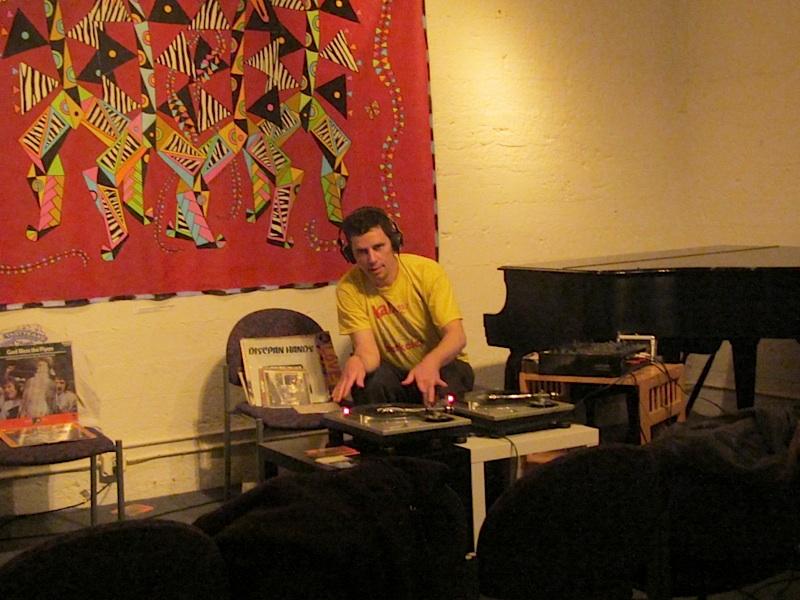
Performance

Alerts: December 11 – 17, 2013

0

WEDNESDAY 11

No End In Sight: Artist talk and performance SOMArts Cultural Center, 934 Brannan, SF. www.somarts.org/noend. 7-9pm, free. Justin Hoover, curator of SOMArts exhibition All Good Things… will join featured artists in conversation on time-based art, hitting on themes like community engagement, the life cycle of a sculpture, and upcycling in contemporary art. The evening will include a reveal of Kristin Cammermeyer’s evolving sculptural installation, shown for the first time in full 360-degree fashion, and a performance by Jeremiah Barber, who will create a levitation that floats in the eyes of the audience, something like a gorgeously articulated sunspot.


League of Pissed Off Voters holiday party The Hot Spot, 1414 Market, SF.

tinyurl.com/pissedparty 6:30pm-8:30pm, free. Come have a few drinks with the League Gather round for a toast to 2013, a chat about what fun 2014 may bring, and a celebration of the league’s tenth anniversary!


THURSDAY 12


Ohlone short films New Nothing Cinema, 16 Sherman, SF. 8pm, free. This screening, part of the Incite/Insight Film Series, will feature a collection of short films on the return of Ohlone people to their ancestral lands — the peninsula where San Francisco now sits. You’ll hear the Ohlone’s own voices—in a sunrise healing ceremony at Yosemite Slough, and in asking San Francisco city supervisors for recognition at City Hall—as well as those evoked by the land and history. The story of the Ohlone will be brought right up to the present with a series of short films documenting the latest visits of the Costanoan Rumsen Carmel Ohlone as part of their 4-cycle effort of inclusion, and truth and reconciliation.

Eric Quezada PRESENTE! Mission Neighborhood Centers, Inc., 362 Capp, SF. 6-9pm, $5–$20 donation. center@politicaleducation.org. Friends of Eric Quezada and the Center for Political Education invite you to a community celebration of this beloved community activist’s life, on the occasion of his 48th birthday and the 15th anniversary of The Center for Political Education. Celebrate his contributions to SF-based struggles for social and economic justice, which continue to resonate. Featuring speakers, music and a left memorabilia auction, with light refreshments provided by Sun Rise Restaurant. All proceeds will benefit the Center for Political Education.

SUNDAY 15

A life in struggle: celebrating Elizabeth “Betita” Martinez Galeria de la Raza, SF 2pm, free. A celebration of the life and political activism of Elizabeth “Betita” Sutherland Martínez. On the occasion of Betita’s 88th birthday, Social Justice Journal is releasing a special issue featuring some of Betita’s unpublished works and more. The Dec. 15 celebration and fundraiser will feature readings by some of the contributors to the issue, alongside music, slideshows, and refreshments. Seating will be limited. RSVP at galeriadelaraza.org.

The Performant: Home is where the art is

1

Valencia Street art space struggles to retain its physical and spiritual existence
 
Sometimes you stumble across places that just feel like home the instant you step across the threshold. Maybe not the kind of home where you lounge around in sweatpants binging on Dynamo Donuts and Netflix, but a home that offers comfort for the spirit, where creativity and intention reign. Curiosity shop, design showcase, and artist enclave, Viracocha at 998 Valencia Street has been one such home for many, from the poets who helped build its pallet-wood walls, to the neighborhood literati who donated to and borrowed from Ourshelves, the private lending library that until very recently occupied the back of the building, to the acoustic musicians and spoken-word artists who gathered in the basement to perform and to connect, to the visual artists whose work was treated as décor first and merchandise almost as an afterthought.

One part art installation, one part community outlet, and one part ostensible retail venture, the four year-old Viracocha feels far older, thanks perhaps in part to its proximity to the venerable Artists’ Television Access, or a lingering resonance from santería supply store Botanica Yoruba, which occupied the same space for many years. Stepping inside always feels like stepping through a cool, jazz-infused looking-glass into a parallel world where life is art and art is life, and all that other stuff doesn’t matter quite as much as you thought it did. Plus, typewriters.
 
But it’s a brave new Valencia Street, and in matters of merchantry (some of that “other stuff” we wish didn’t matter) it’s an increasingly challenging atmosphere in which to be experimenting with idiosyncratic business models. And as many creatives-turned-commercialists have discovered, sinking all of your energies into commerce can sap those same energies from creation, and balancing the two can be a constant struggle. So it wasn’t exactly a surprise when Viracocha announced that it was raising funds in order to reorganize in the new year, a reorganization that includes proprietor Jonathan Siegel passing the baton to an as-yet unnamed group of successors, and applications for permits to legalize the heretofore “secret” performance venue below the floorboards of the retail space. Not a surprise, but still a sad shock. We like our quirky empires to remain unchanged and unperturbed by the pressures of the outside world, even when clinging onto the “old ways” can mean driving them out of existence. It’s an often unspoken conundrum, but retaining loyalty is a delicate balance too.
 
It began as much an experiment as anything else. The idea of a space that put the art before the consumption of it had come to Siegel years before while he lived in New York working as an actor and in the construction industry. After moving to San Francisco in 2005 he became a known denominator on the poetry scene, including as the organizer for the Poetry Mission reading series at Dalva, and as a member of the erstwhile Collaborative Arts Insurgency. And when he signed a lease on the space in 2009, it was to members of the latter that he turned for assistance in building the space up from scratch, a modern-day barnraising where a vision of community was constructed along with each new wall. A community Siegel refers to as “an orphanage for the lost creative spirit inside all of us,” where practitioners of many mediums might find a place to commune, and where patrons of same might come to discover new artists and new-to-them treasures in a non-pressured, almost anti-commercial environment.
 
While the future of Viracocha is still uncertain and dependent in large part on what repairs and modifications are deemed necessary by the city (ADA-compliant elevator and restroom for starters, an expense Siegel claims is manageable) and what kind of entertainment venue permits the space is able to secure in the new year. But from Siegel’s POV, he’s leaving Viracocha’s future in capable hands (“the (people) coming onboard don’t want to see the energy of the space shift into something radically different”). As for his own future, he alludes to completion of not one but four books in the works, and a reconnection with his own creativity.

“It’s time for me to let go of many things in my world and rebuild from within,” he muses via email, a sentiment which seems to apply also to Viracocha, and its current state of rebirth, and pretty apropos both for a space named for the Incan god of creation, and for the modern-day visionary who named it.

 (Full disclosure: the author’s collaborative literary bike map is currently for sale at Viracocha.)

UPDATE: Union organizer shouts down protesters as they block private Google shuttle

228

Protesters blocked a private Google shuttle on Valencia street today, decrying private shuttle’s use of public bus stops without paying fees or fines.

The group of 20 or so neon-yellow vested protesters called themselves the “San Francisco Displacement and Neighborhood Impact Agency.” The company doesn’t pay San Francisco a dime to use the Muni stops — fines that private auto drivers pay regularly.

UPDATE 3:58pm: Just how does a story go from breaking, to verification, to “holy shit it’s all over the internet now?” Here’s our interview with Fake Google Employee Max Alper, and our recount of how it all went down: http://www.sfbg.com/politics/2013/12/09/whyd-you-do-it-we-ask-fake-google-employee-max-bell-alper

UPDATE 12:32pm: Various tips have streamed in that this shout-out was staged. Protest organizer Leslie Dreyer talked to us on the phone and verified that this person’s identity was Max Bell Alper, a union organizer from Oakland. This person was not a Google employee, and Dreyer was not able to verify if Alper was there in the morning with the group of 20-30 protesters. The Guardian is attempting to contact Alper for comment. Dreyer said she, as an organizer, was unaware that the “performance” had been planned. We are following this as it develops.

UPDATE 1:06pm: Within an hour of our original post, the Guardian learned that Max Bell Alper, a union organizer with Unite Here Local 2850 was the man shouting down Google bus protesters earlier this morning. We asked Alper what motivated him to impersonate a Google employee.

This is political theater to demonstrate what is happening to the city. It’s about more than just the bus. These are enormous corporations that are investing in this community. These companies, like Google, should be proud of where they’re from and invest in their communities,” he said.

When asked if he intentiionally intended to deceive media, he replied “People are talking all over the country about what’s happening in San Francisco (referring to evictions and displacement). That’s the debate we need to have here. The more we talk about it, the more we think about it, the more we’re going to see the tech companies need to contribute.”

 Alper said that he did not intend to engage in theater before going to the protest, but when there made the decision, “spontaneously,” to stage the argument. When he maintained his story that this was political theater, we again asked why he did not verify his name at the protest itself — and only after the story blew up in national and local media.

This was improv political theater,” he said.

Original post follows:

The SFMTA has a pilot plan in the works to regulate private use of public bus stops.

Though the private shuttles were the crux of the day’s protest, the heart of the fight is over gentrification. As the tech revolution in SF leads to rising rents and longtime San Franciscans are being displaced.

In the video, a union organizer who hopped off the bus shouts down Erin McElroy, staging an argument with a protester who also heads the eviction mapping project. “How long have you lived in this city?” McElroy asked him. He shouted back “Why don’t you go to a city that can afford it? This is a city for the right people who can afford it. You can’t afford it? You can leave. I’m sorry, get a better job.”

“What kind of fucking city is this?” he shouted, and then walked off. He mentioned repeatedly that he couldn’t get to work because the bus was blocked, and did exit the bus (indicated he was a Google employee), but the Guardian (nor a nearby Al Jazeera reporter) could not verify his job title or name. If anyone has any tips as to the identity of this man, please contact us at news@sfbg.com. 

(UPDATE 12:12 PM — The Guardian amended the headline to reflect our story more accurately, that though this man exited the bus and claimed he was late for work, we have not yet verified his employment at Google)

We’ll have more on this story later in the day, for now, check out footage from the protest.)

Rep Clock: December 4 – 10, 2013

0

Schedules are for Wed/4-Tue/10 except where noted. Director and year are given when available. Double and triple features marked with a •. All times pm unless otherwise specified.

ALBANY 1115 Solano, Albany; www.landmarktheatres.com. $7. “Family Series:” The Muppet Movie (Frawley, 1979), Sat-Sun, 10:30am.

“ANOTHER HOLE IN THE HEAD FILM FESTIVAL” Balboa Theater, 3630 Balboa, SF; New People Cinema, 1746 Post, SF; www.sfindie.com. $12. Now in its 10th year, the festival highlights indie horror, sci-fi, and fantasy films, through Dec 19.

ATA GALLERY 992 Valencia, SF; www.atasite.org. $4-10. “OpenScreening,” Thu, 8. For more info, contact programming@atasite.org. “Other Cinema,” animated works by Martha Coburn, Jeremy Rouke, Janie Geiser, and others, Sat, 8:30.

BALBOA THEATRE 3630 Balboa, SF; cinemasf.com/balboa. $10. Art Gods: An Oral History of the Tower Records Art Department (Taylor, 2013), Fri-Sat, 10. “Popcorn Palace:” The Polar Express (Zemeckis, 2005), Sat, 10am. Matinee for kids.

BERKELEY FELLOWSHIP OF UNITARIAN UNIVERSALISTS’ HALL 1924 Cedar, Berk; www.bfuu.org. $5-10. “Screening the Green:” The Story of Stuff (Fox, 2007), and The Story of Solutions (2013), Thu, 7.

BINDLESTIFF STUDIO 185 Sixth St, SF; www.facinesf.com. $10-20. “FACINE bente: Filipino American Cine Festival,” 33 feature length films and short works from the Philippines and the Filipino Diaspora, Dec 9-14. Proceeds benefit Typhoon Haiyan relief operations in the Philippines.

CASTRO 429 Castro, SF; (415) 621-6120, www.castrotheatre.com. $8.50-12. The Sound of Music (Wise, 1965), Wed-Thu and Sat-Sun, 7 (also Sat-Sun, 1pm). Presented sing-along style; tickets ($10-15) at www.ticketweb.com. “Good Vibrations Quickies: Erotic Short Film Competition,” Fri, 7 (pre-party); 8 (screening). These events, $10; visit www.brownpapertickets.com for advance tickets. I Am Divine (Schawarz, 2013), Mon, 7, 9. Gravity (Cuarón, 2013), Dec 10-11, 7, 9:15 (also Dec 11, 2:30, 4:45).

CHRISTOPHER B. SMITH RAFAEL FILM CENTER 1118 Fourth St, San Rafael; (415) 454-1222, www.cafilm.org. $6.50-$10.75. The Armstrong Lie (Gibney, 2013), call for dates and times. Blue is the Warmest Color (Kechiche, 2013), call for dates and times. The Great Beauty (Sorrentino, 2013), call for dates and times. Richard II, Royal Shakespeare Company production starring David Tennant, Thu, 7; Sun, 1. Walking the Camino: Six Ways to Santiago (Smith, 2013), Dec 6-12, call for times. Sweet Dreams (Fruchtman and Fruchtman, 2012), Sun, 7. Filmmakers Lisa and Rob Fruchtman in person; this event, $12.

CLAY 2261 Fillmore, SF; www.landmarktheatres.com. $10. “Midnight Movies:” Labyrinth (Henson, 1986), Fri-Sat, midnight.

DAVIES SYMPHONY HALL 201 Van Ness, SF; www.sfsymphony.org. $25-80. “A Symphonic Night at the Movies:” Singin’ in the Rain (Donen and Kelly, 1952), Fri-Sat, 7:30.

MECHANICS’ INSTITUTE 57 Post, SF; milibrary.org/events. $10. “CinemaLit Film Series: Dark Star: The Films of Barbara Stanwyck:” Remember the Night (Leisen, 1940), Fri, 6.

NEW PARKWAY 474 24th St, Oakl; www.thenewparkway.com. “Courtney Trouble’s Queer Porn Movie Party,” Thu, 7. This event, $10. “First Friday Shorts,” films by and about Bay Area Girls Rock Camp, Fri, 6. This event, free.

PACIFIC FILM ARCHIVE 2575 Bancroft, Berk; (510) 642-5249, bampfa.berkeley.edu. $5.50-9.50. “The Resolution Starts Now: 4K Restorations from Sony Pictures:” “Grover Crisp: The Resolution Starts Now,” followed by Bonjour Tristesse (Preminger, 1958), Thu, 7; Alamo Bay (Malle, 1985), Sat, 6:30; Taxi Driver (Scorsese, 1976), Sat, 9; The Arch (Tang, 1969), Sun, 3; Picnic (Logan, 1956), Sun, 5:15. “Love Is Colder Than Death: The Cinema of Rainer Werner Fassbinder:” Why Does Herr R. Run Amok? (Fengler and Fassbinder, 1969), Fri, 7; Despair (1977), Fri, 8:50.

ROXIE 3117 and 3125 16th St, SF; (415) 863-1087, www.roxie.com. $6.50-11. Is the Man Who Is Tall Happy? (Gondry, 2013), Wed, 7:15, 9:15; Thu, 9:15. A Journey to Planet Sanity (Freeman, 2012), Wed, 7. This event, $12. Muscle Shoals (Camalier, 2013), Wed-Thu, 9. “Frameline Encore:” Seventh-Gay Adventists (Akers and Eyer, 2012), Thu, 7. This event, free. •Amal’s Garden (Shihab, 2012), and My Father Looks Like Abdel Nasser (Kassem, 2012), Thu, 7. At Berkeley (Wiseman, 2013), Dec 6-12, 6:45 (also Sat-Sun, 2). The Punk Singer (Anderson, 2013), Dec 6-12, 7, 8:45.

SOCIAL STUDY 1795 Geary, SF; www.socialstudysf.com. Free. Impresa! (Woldu, 2013), Tue, 6:30.

TEMESCAL ART CENTER 511 48th St, Oakl; www.shapeshifterscinema.com. Free. Intertidal, performance-based work by media artist Alex MacKenzie, inspired by the tidal zones and marine life of Western Canada, Sun, 8.

YERBA BUENA CENTER FOR THE ARTS 701 Mission, SF; www.ybca.org. $8-10. “X: The History of a Film Rating:” Bad Timing: A Sensual Obsession (Roeg, 1980), Thu, 7:30. “Films by Fassbinder:” Querelle (1982), Sun, 2. *


Theater Listings: December 4 – 10, 2013

0

Stage listings are compiled by Guardian staff. Performance times may change; call venues to confirm. Reviewers are Robert Avila, Rita Felciano, and Nicole Gluckstern. Submit items for the listings at listings@sfbg.com.

THEATER

OPENING

Avenue Q New Conservatory Theatre Center, 25 Van Ness, SF; www.nctcsf.org. $25-45. Previews Fri/6-Sat/7 and Dec 13, 8pm; Sun/8, 2pm. Opens Dec 14, 8pm. Runs Wed-Sat, 8pm; Sun, 2pm. Through Jan 12. New Conservatory Theatre Center performs the Tony-winning comedy.

A Christmas Carol Geary Theater, 415 Geary, SF; www.act-sf.org. $20-95. Opens Fri/6, 7pm. Runs Wed-Sat, 7pm (no evening shows Dec 24, 26, or 28; also Sat/7, Dec 11, 14, 21, 23, 2pm; Dec 24 and 26-28, 1pm; Dec 27 evening show at 5:30pm); Sun, 5:30pm (also Sun/8, Dec 15, and 22, 1pm). Through Dec 28. American Conservatory Theater mounts its annual production of the Dickens classic, with James Carpenter as Scrooge and Ken Ruta as Jacob Marley’s ghost.

Cinderella Buriel Clay Theater, African American Art and Culture Complex, 762 Fulton, SF; www.african-americanskaes.org. $12.50-50. Opens Sat/7, 3pm. Runs Sat, 8pm (also Dec 21, 3pm); Sun, 3pm. Through Dec 22. African-American Shakespeare Company presents this fairy-tale production for the holidays.

The Golden Girls: The XMAS Episodes Victoria Theatre, 2961 16th, SF; www.trannyshack.com. $30. Opens Thu/5, 8pm. Runs Thu-Sat, 8pm; Sun, 7pm. Through Dec 22. Inspired by the classic sitcom, Miami’s feisty seniors (portrayed by Heklina, Cookie Dough, Matthew Martin, and Pollo Del Mar) return to spread holiday cheer and cheesecake.

BAY AREA

Edward Gant’s Amazing Feats of Loneliness Ashby Stage, 1901 Ashby, Berk; www.shotgunplayers.org. $20-35. Previews Thu/5 and Dec 11-12, 7pm; Fri/6-Sat/7, 8pm; Sun/8, 5pm. Opens Dec 13, 8pm. Runs Wed-Thu, 7pm; Fri-Sat, 8pm; Sun, 5pm. Through Jan 11. Shotgun Players performs Anthony Neilson’s comic romp set in “a sensual Edwardian world of top hats, fantastical puppets, and flash powder.”

Little Women Lucie Stern Theatre, 1305 Middlefield, Palo Alto; www.theatreworks.org. $19-79. Previews Wed/4-Fri/6, 8pm. Opens Sat/7, 2 and 8pm. Runs Tue-Wed and Dec 30, 7:30pm (no shows Dec 24-25; Dec 31, show at 2pm only; no show Jan 1); Thu-Sat, 8pm (also Sat and Dec 26 and Jan 4, 2pm); Sun, 2 and 7pm. Through Jan 4. TheatreWorks performs the musical adaptation of the Louisa May Alcott tale.

Mame Hillbarn Theatre, 1285 East Hillsdale, Foster City; www.hillbarntheatre.org. $19-40. Previews Thu/5, 8pm. Opens Fri/6, 8pm. Runs Thu-Sat, 8pm (also Dec 14 and 21, 2pm); Sun, 2pm. Through Dec 22. Hillbarn Theatre performs Jerry Herman’s classic musical.

ONGOING

Amaluna Big Top at AT&T Park, Third Street at Terry A. Francois Blvd, SF; www.cirquedusoliel.com. $50-175. Check website for schedule, including special holiday showtimes. Through Jan 12. Cirque de Soleil is back in town, this time bringing its Tempest-inspired Amaluna to the big top set up outside AT&T Park. Touted for being a celebration of “women [sic] power,” it seems initially odd that the design elements are so focused on the male peacock feather — all greens and blues and graceful, with curving “fronds” rising up from the stage. Jungle sounds chirp in the background as a bevy of Amazonian women in bejeweled headdresses and a mischievous lizard-man circulate the room until the show starts with the lovely abstraction of a floating red cloud of translucent fabric dancing in a single beam of light. The flimsy plotline is forgettable, a coming-of-age and courtship tale between the island’s young princess, Miranda (Iuliia Mykhailova) and a shipwrecked young Romeo (Evgeny Kurkin), though the parallel courtship between the two comic figures of Jeeves (Nathalie Claude) and Deeda (Shereen Hickman) provides a bit of levity and a novel use for footballs. The most realized character is probably Cali (Victor Kee), the half-lizard, whose prehensile tail and neon body paint give him an otherworldly allure, but it’s the aerialist goddesses and fierce embodiments of the storm that are most memorable from an acrobatic point-of-view, and Lara Jacobs’ unique balancing act from a meditative one. (Gluckstern)

Arlington Magic Theatre, Fort Mason Center, 2 Marina, Bldg D, Third Flr, SF; www.magictheatre.org. $20-60. Wed/4-Sat/7, 8pm (also Wed/4, 2:30pm); Sun/8, 2:30pm. Magic Theatre performs Victor Lodato and Polly Pen’s world-premiere musical.

The Barbary Coast Revue Stud Bar, 399 Ninth St, SF; eventbrite.com/org/4730361353. $10-40. Wed, 9pm. Through Dec 18. Blake Wiers’ new “live history musical experience” features Mark Twain as a tour guide through San Francisco’s wild past.

The Book of Mormon Orpheum Theatre, 1192 Market, SF; www.shnsf.com. $60-120. Wed-Sat, 8pm (also Sat, 2pm); Sun, 1 and 6:30pm. Through Jan 19. When approaching the oeuvre of South Park creators Matt Stone and Trey Parker, it’s best to check your political correctness at the door. That’s certainly no less true of their 2011 Broadway musical The Book of Mormon, co-penned with Robert Lopez (of Avenue Q fame), despite the clean-scrubbed appearance of their fumbling albeit well-intentioned missionary protagonists. Sent to Uganda for two years, top mission pupil Elder Price (Nic Rouleau) and his clumsy but affable partner Elder Cunningham (A.J. Holmes) are faced with a village oppressed by a scenery-chewing warlord, a demoralized coterie of fellow missionaries who have yet to have a successful conversion, and their own fraught, odd-couple dynamic. Rouleau’s Price is an appropriate blend of smarm, charm, and secret self-doubt while Holmes excels in his portrayal of a perennial-loser-turned-prophet (his power ballad-esque solo in “Man Up” is one of the show’s best). Of their hosts, the wry Mafala (James Vincent Meredith) and his sweet but strong-willed daughter Nabulungi (Syesha Mercado) get the most stage time, but it’s the crude and caustic General (David Aron Damane) who grabs the most attention. The gleefully profane “Hasa Diga Eebowai,” a Forbidden Zone-style “Spooky Mormon Hell Dream”, and the deliriously blasphemous “Joseph Smith, American Moses,” round out the entertaining, and strangely informative, score. Though it’s (very) unlikely to convert you to the Church of Latter-Day Saints, there’s a good chance you’ll want to convert to the church of Parker and Stone, if you haven’t already. (Gluckstern)

BoomerAging: From LSD to OMG Marsh San Francisco, 1062 Valencia, SF; www.themarsh.org. $15-50. Tue, 8pm. Extended through Dec 17. Will Durst’s hit solo show looks at baby boomers grappling with life in the 21st century.

Foodies! The Musical Shelton Theater, 533 Sutter, SF; www.foodiesthemusical.com. $32-34. Fri-Sat, 8pm. Open-ended. AWAT Productions presents Morris Bobrow’s musical comedy revue all about food.

The Gershwins’ Porgy and Bess Golden Gate Theatre, One Taylor, SF; www.shnsf.com. $60-210. Wed/4-Sat/7, 8pm (also Sat/7, 2pm); Sun/8, 2pm. The Tony-winning Broadway revival launches its national tour in San Francisco.

Hedwig and the Angry Inch Boxcar Theatre, 505 Natoma, SF; www.boxcartheatre.org. $27-43. Thu-Sat, 8pm. Open-ended. John Cameron Mitchell’s cult musical comes to life with director Nick A. Olivero’s ever-rotating cast.

Ideation Tides Theater, 533 Sutter, SF; www.sfplayhouse.org. $10-20. Fri/6-Sat/7, 8pm (also Sat/7, 3pm). Next up in the San Francisco Playhouse “Sandbox Series” is this dark comedy from Aaron Loeb.

The Jewelry Box: A Genuine Christmas Story The Marsh San Francisco, 1062 Valencia, SF; www.themarsh.org. $15-40. Fri, 8pm; Sat, 5pm. Through Dec 28. Brian Copeland performs the world premiere of his new, holiday-themed work, an Oakland-set autobiographical tale that’s a prequel to his popular Not a Genuine Black Man.

My Beautiful Launderette New Conservatory Theatre Center, 25 Van Ness, SF; www.nctcsf.org. $25-45. Wed-Sat, 8pm; Sun, 2pm. Through Dec 22. New Conservatory Theatre Center performs Andy Gram and Roger Parsley’s adaptation of Hanif Kureishi’s award-winning screenplay.

The Oy of Sex Marsh San Francisco, 1062 Valencia, SF; www.themarsh.org. $20-100. Thu-Fri, 8pm; Sat, 8:30pm. Through Jan 18. Comedian Alicia Dattner performs her solo show, based on her stories from her own life and love addiction.

Peter/Wendy Gough Street Playhouse, 1620 Gough, SF; www.custommade.org. $15-33. Thu-Sat, 8pm; Sun, 7pm. Through Dec 15. J.M. Barrie’s familiar and much-revisited children’s story, about a boy who refuses to grow up, has always had its darker aspects, including the violent streak in its hero, forever-child Peter (Sam Bertken). Unfortunately, any underlying social or psychological complexity in the story — originally published in 1902 in The Little White Bird — is of no consequence in adapter-director Jeremy Bloom’s relentlessly cheerful and quickly monotonous retelling. The production, which narrates and acts out the story in somewhat condensed form, says it’s designed for adults of all ages and children over 12, but it seems pitched to an audience much younger still. Custom Made Theater’s lackluster staging does little to make the time go faster. There’s a mischievous energy in Bertken’s Peter and a bright intelligence in Anya Kazimierski’s Tinker Bell that together produce the play’s only emotional heat, but it’s fleeting. As Wendy, Elissa Beth Stebbins is generally solid but too mild to elicit much sympathy for her unrequited affections for Peter. Clad exclusively in striped jammies, the uneven ensemble (which also includes Terry Bamberger, Jessica Rudholm, Kim Saunders, and Jeunee Simon in multiple roles) rarely encourages focus on the finer points of character and plot, which anyway come with a soporific dose of trifling detail amid generally awkward physical choreography. Indeed, any “happy thoughts” one walks in with would risk vanishing entirely, were it not that the cast harvests them immediately and writes them down for future reference on the stage floor. (Avila)

Snoopy!!! Eureka Theatre, 215 Jackson, SF; www.42ndstmoon.org. $25-75. Wed-Thu, 7pm; Fri, 8pm; Sat, 6pm (family/student matinee Sat/7, 1pm); Sun, 3pm. Through Dec 15. 42nd Street Moon performs the sequel to You’re a Good Man, Charlie Brown.

Urge For Going Z Below, 470 Florida, SF; www.goldenthread.org. $10-45. Thu/5-Sat/7, 8pm; Sun/8, 3pm. Jamila (Camila Betancourt Ascencio) is a bright student desperate to pass her college entrance examination — an unexceptional proposition in many places, but Jamila is a Palestinian raised in a Lebanese refugee camp. For her, even the right to take such an exam is in no way guaranteed and must be fought for. That Jamila’s struggles don’t end at the front door of her crowded home provides the basis for the drama in Mona Mansour’s 2011 play, Urge for Going, now receiving an uneven but sometimes moving West Coast premiere from Golden Thread (which last year produced The Letter, a short play co-written by Mansour, as part of its ReOrient Festival). Amid the makeshift walls, mismatched furniture, and exposed wiring of Kate Boyd’s evocative scenic design, Jamila lives with her austere father (Terry Lamb), a onetime literature scholar with a passion for Wordsworth; her supportive mother (Tara Blau); her father’s effusive loose-canon of a brother (Julian Lopez-Morillas); her mother’s brother (Munaf Alsafi); and her own big-hearted but haunted older brother (Wiley Naman Strasser), a once brilliant math student who suffered brain damage at the hands of a Lebanese soldier. But front and center is her father, whose barely cloaked disappointment and despair turn to recalcitrance and outright antagonism in the face of Jamila’s too-pointed desire to flee this hobbled world of exile for a wider world of possibilities. Directed by Evren Odcikin, the play’s sentimental naturalism (broken through at times by didactic direct address to the audience by the entire cast) makes what follows both too predictable and somewhat artificial. At the same time, Mansour carefully and revealingly couches her story in the political and existential limbo of multiple generations of Palestinian refugees in Lebanon, deprived for over half a century of basic rights amid cramped poverty and deprivation. (Avila)

BAY AREA

A Bright New Boise Aurora Theatre, 2081 Addison, Berk; www.auroratheatre.org. $32-50. Wed/4-Sat/7, 8pm; Sun/8, 2 and 7pm. Faith can be a touchy subject among true believers and skeptics alike, and as long as the topic of religion is avoided (as it often is) you might not even know that your bus driver is Buddhist, or your checkout clerk born again. In Samuel D. Hunter’s A Bright New Boise, now playing at Berkeley’s Aurora Theatre, the line blurs between public face and private faith, as mysterious stranger Will (Robert Parsons) rolls into Boise and takes up employment at the Hobby Lobby, ostensibly to reconnect to his long-lost, given-up-for-adoption son, Alex (Daniel Petzhold). But when Will is revealed to be a former member of a disgraced Evangelical sect from “up North,” his sudden reappearance in Alex’ life appears to be motivated not by a long-standing remorse, but by a recent unmooring. Under Tom Ross’ direction, the other characters — a foul-mouthed store manager (Gwen Loeb), a painfully shy stock clerk (Megan Trout), and a confrontational sales associate (Patrick Russell) — appear similarly unmoored, careening into each other like jittery, neurotic pinballs, with about as much consideration. Only Parsons’ Will appears calm and deliberate in his actions, until he startlingly demonstrates otherwise. It’s an abrupt end to both the play and Will’s charade of normalcy, and neither Hunter nor Ross seem to know how to build up to his eventual fall naturally, ultimately allowing him to be defined only by his fanaticism rather than his humanity. (Gluckstern)

Can You Dig It? Back Down East 14th — the 60s and Beyond Marsh Berkeley, 2120 Allston, Berk; www.themarsh.org. $15-50. Sat, 8:30pm; Sun, 7pm. Extended through Dec 15. Don Reed’s new show offers more stories from his colorful upbringing in East Oakland in the 1960s and ’70s. More hilarious and heartfelt depictions of his exceptional parents, independent siblings, and his mostly African American but ethnically mixed working-class community — punctuated with period pop, Motown, and funk classics, to which Reed shimmies and spins with effortless grace. And of course there’s more too of the expert physical comedy and charm that made long-running hits of Reed’s last two solo shows, East 14th and The Kipling Hotel (both launched, like this newest, at the Marsh). Can You Dig It? reaches, for the most part, into the “early” early years, Reed’s grammar-school days, before the events depicted in East 14th or Kipling Hotel came to pass. But in nearly two hours of material, not all of it of equal value or impact, there’s inevitably some overlap and indeed some recycling. Reed, who also directs the show, may start whittling it down as the run continues. But, as is, there are at least 20 unnecessary minutes diluting the overall impact of the piece, which is thin on plot already — much more a series of often very enjoyable vignettes and some painful but largely unexplored observations, wrapped up at the end in a sentimental moral that, while sincere, feels rushed and inadequate. (Avila)

Harvey Barn Theatre, 30 Sir Francis Drake, Ross; www.rossvalleyplayers.com. $10-22. Thu, 7:30pm; Fri-Sat, 8pm; Sun, 2pm. Through Dec 15. Ross Valley Players perform the Pulitzer-winning play by Mary Chase.

A Little Princess Julia Morgan Theater, 2640 College, Berk; www.berkeleyplayhouse.org. $17-60. Thu/5-Fri/6, 7pm; Sat/7, 1 and 6pm; Sun/8, noon and 5pm. Berkeley Playhouse opens its sixth season with Brian Crawley and Andrew Lippa’s musical adaptation of the Frances Hodgson Burnett story.

110 in the Shade Douglas Morrison Theatre, 22311 N. Third St, Hayward; www.dmtonline.org. $10-29. Thu/5-Sat/7, 8pm (also Sat/7, 2pm); Sun/8, 2pm. Douglas Morrison Theatre performs N. Richard Nash’s romantic musical, adapted from his classic play The Rainmaker.

The Pianist of Willesden Lane Berkeley Repertory Theatre, Thrust Theatre, 2015 Addison, Berk; www.berkeleyrep.org. $29-89. Tue and Thu-Sat, 8pm (also Thu/5 and Sat, 2pm; no shows Dec 24 or 31); Wed and Sun, 7pm (also Sun, 2pm; matinees only Dec 15, 22, and Jan 5; no show Dec 25). Extended through Jan 5. Mona Golabek stars in this solo performance inspired by her mother, a Jewish pianist whose dreams and life were threatened by the Nazi regime.

Troilus and Cressida La Val’s Subterranean, 1834 Euclid, Berk; www.impacttheatre.com. $10-25. Thu-Sat, 8pm; Sun, 7pm. Through Dec 15. One of Shakespeare’s more difficult and under-produced plays, Troilus and Cressida does wax in popularity during protracted times of war, so it’s about the right time for Impact Theatre to tackle it. Set during the seventh year of the Trojan War, the players are all either soldiers or spoils of war, and both morale and morals are at a low ebb. So-called heroes hide in their tents, the fair Helen (Julie Kuwabara) is a callow bawd, and everyone just wants the war to be over. Troilus (Eric Kerr), a Trojan, and Cressida (Sarah Coykendall), a Greek, meet-cute thanks to the machinations of the flamboyant Pandarus (Shawn J. West), only to be quickly separated by circumstances beyond their control, and thrust abruptly to the sidelines of their own tragedy, their eventual betrayal of each other lost within the greater treacheries of the battlefield. It’s a problematic script, not least of all because the only truly moral character is the very innocent, very mad Cassandra (Akemi Okamura), whose prophecies are written off as mere ravings, subtly mirrored by the nihilistic fool, Thersites (Miyaka Cochrane), who delivers his frontline ravings as prophecies. Director Melissa Hillman makes some bold choices, however, including casting Lauren Spencer as the level-headed Ulysses, and father-son team Jon Nagel and Jonah McClellan as Aeneas and Antenor, turning the walk-on role of a pawn into a tragic symbol of war’s all too-human cost. (Gluckstern)

PERFORMANCE/DANCE

“Broadway Bingo” Feinstein’s at the Nikko, Hotel Nikko, 222 Mason, SF; www.feinsteinssf.com. Wed, 7-9pm. Ongoing. Free. Countess Katya Smirnoff-Skyy and Joe Wicht host this Broadway-flavored night of games and performance.

“Buddy Club Children’s Shows” Randall Museum Theater, 199 Museum Wy, SF; www.thebuddyclub.com. Sun, 11am-noon. $8. “The Bubble Lady!” performs.

“Comedy Bottle with Kurtis Matthews” Purple Onion at Kells, 530 Jackson, SF; www.purpleonionatkells.com. Fri/6-Sat/7, 7pm. $15. Stand-up comedy.

“Comedy Returns to El Rio!” 3158 Mission, SF; www.brownpapertickets.com. Mon/9, 8pm. $7-20. Stand-up with Marga Gomez, Sammy Obeid, Bob McIntyre, Kevin Young, and Lisa Geduldig.

CounterPULSE 1310 Mission, SF; www.counterpulse.org. Wed/4, 8pm: Risa Jaroslow’s NYC and the Bay: Dancers and Dances from Then and There and Here and Now, free. Fri/6-Sat/7, 8pm: Keith Hennessy, Hana Lee Erdman, and Jassem Hindi’s ALMOST, Enemy in the Figure, and These children singing in stones, $15-20. Dec 12-15, 8pm: Mica Sigourney, John Foster Cartwright, and Maryam Rostami’s Nicole Kidman is Fucking Gorgeous, $20.

“Dolores: The Temporary Life of a 220-Year-Old Bionic Woman” Stage Werx Theater, 446 Valencia, SF; www.stagewerx.org. Dec 10-11, 7:30pm. $15-20. On a bare floor, physical theater maker Carolina Duncan, as her Colombian grandmother, pops opens her cranium like a steamer trunk and retrieves the scrapbook of a boundless life. Here memory and imagination exist in equal measures, as Duncan traces key moments and fleeting images from an arc of days defined by family, romance, and at least one titanic battle between an Amazonian dinosaur and a new secret-agent boyfriend. Combining mime, scattered dialogue, physical comedy, and a live soundscape, this loving and whimsical homage comes gracefully delivered and almost always vividly expressed. All the while, Duncan (a graduate of SF’s Clown Conservatory and James Donlon and Leonard Pitt’s Flying Actor Studio) exudes an infectious enthusiasm for her subject, who proves as alive in a passing but concrete image of first childhood steps as she does in her final outing, a prolonged spacewalk into the familiar and unknown. Note: review from an earlier run of this show. (Avila)

“Encuentro de Canto Popular” Brava Theater Center, 2781 24th St, SF; accionlatina.org/Encuentro2013. Sat/7, 7pm. $19. Music festival dedicated to the nuevo canción movement; this year’s theme, “Pasado y Futuro,” pays tribute to artists who have passed away, as well as artists on the rise.

“Fiesta Navidena” Peña Pachamama, 1630 Powell, SF; www.carolinalugo.com. Sat/7, Dec 15, 21-22, and 27-28, 6:15pm. $15-21. Carolina Lugo and Carolé Acuña’s Ballet Flamenco performs a holiday show.

“Get Your Life Unity Mini Ball” Dance Mission Theater, 3316 24th St, SF; www.dancemission.com. Sat/7, 7pm. $10. Dancing, vogueing, and other aspects of ballroom culture take the stage.

“Glide Annual Holiday Festival: Celebrate50” War Memorial Opera House, 301 Van Ness, SF; www.glide.org. Wed/4, 7pm. $65-250. Maya Angelou, Judith Hill, Tom Johnston, and other luminaries lead this evening honoring Janice Mirikitani and Rev. Cecil Williams’ 50 years at Tenderloin community beacon Glide.

“Hand to Mouth Comedy” Dark Room, 2263 Mission, SF; www.handtomouthcomedy.com. Fri/6, 10pm. $8. Comedians Kellan Erksine, Kelly Anneken, Jules Posner, and others join host Trevor Hill in presenting all-new material on one specific topic: “fantasy.”

“Hysterical Historical San Francisco, Holiday Edition” Shelton Theater, 533 Sutter, SF; www.sheltontheater.org. Sun, 7pm. Through Dec 29. $30-40. Comic Kurt Weitzman performs.

“I Eat People Like YOU For Breakfast!” Marsh, 1062 Valencia, SF; www.themarsh.org. Wed/4, 7:30pm. $10-15. Comedian Steven Alan Green performs his solo show inspired by Jerry Lewis.

“The Jewish Nutcracker” Theater at Children’s Creativity Museum, 221 Fourth St, SF; www.jewishnutcracker.com. Fri/6-Sun/8, 2pm (also Fri/6-Sat/7, 6:30pm). $18-32. The Hanukkah story is interpreted via authentic cultural dance from Spain, India, China, Russia, and more.

“Mark Foehringer’s Nutcracker Sweets” Southside Theater, Fort Mason Center, Marina at Laguna, SF; www.brownpapertickets.com. Sat/7-Sun/8, Dec 14-15, Dec 20-24, 11am and 2pm (also Dec 14-15 and Dec 21-22, 4pm). $18-28. Contemporary ballet company Mark Foehringer Dance Project SF performs its fifth annual production of this Nutcracker-inspired work aimed at families with young children.

“The Metrics of Intimacy” Garage, 715 Bryant, SF; www.brownpapertickets.com. Wed/4-Thu/5, 8pm. $10-20. Contemporary dance performers Hope Mohr and Christian Burns collaborate with visual designer David Szlasa.

“Mine” Joe Goode Annex, 401 Alabama, SF; www.rawdance.org. Fri/6-Sun/8 and Dec 11-15, 8pm. $21-25. RAWdance performs a world premiere by company founders Ryan T. Smith and Wendy Rein.

“Okeanos Intimate” Aquarium of the Bay, Pier 39, SF; www.capacitor.org. Sat, 8pm. $20-30 (free aquarium ticket with show ticket). Extended through Dec 28. Choreographer Jodi Lomask and her company, Capacitor, revive 2012’s Okeanos — a cirque-dance piece exploring the wonder and fragility of our innate connection to the world’s oceans — in a special “intimate” version designed for the mid-size theater at Pier 39’s Aquarium of the Bay. The show, developed in collaboration with scientists and engineers, comes preceded by a short talk by a guest expert — for a recent Saturday performance it was a down-to-earth and truly fascinating local ecological history lesson by the Bay Institute’s Marc Holmes. In addition to its Cirque du Soleil-like blend of quasi-representational modern dance and circus acrobatics — powered by a synth-heavy blend of atmospheric pop music — Okeanos makes use of some stunning underwater photography and an intermittent narrative that includes testimonials from the likes of marine biologist and filmmaker Dr. Tierney Thys. The performers, including contortionists, also interact with some original physical properties hanging from the flies — a swirling vortex and a spherical shell — as they wrap and warp their bodies in a kind of metamorphic homage to the capacity and resiliency of evolution, the varied ingenuity of all life forms. If the movement vocabulary can seem limited at times, and too derivative, the show also feels a little cramped on the Aquarium Theater stage, whose proscenium arrangement does the piece few favors aesthetically. Nevertheless, the family-oriented Okeanos Intimate spurs a conversation with the ocean that is nothing if not urgent. (Avila)

“One Man Band Extravaganza” Great Star Theater, 636 Jackson, SF; www.jordanbwilson.com. Sat/7, 8pm. $5. One-man bands, including Jordan B. Wilson, One Man Banjo, Shovelman, Slow Poisoner, and Cello Joe, perform.

“La Posarela” Brava Theater Center, 2781 24th St, SF; www.sfcmc.org. Sun/8, 1 and 5pm. $7. Community Music Center presents a Mexican Christmas musical tailored to the Mission.

“Point Break Live!” DNA Lounge, 373 11th St, SF; www.dnalounge.com. Fri/6 and Jan 3, Feb 7, March 7, and April 4, 7:30 and 11pm. $25-50. Dude, Point Break Live! is like dropping into a monster wave, or holding up a bank, like, just a pure adrenaline rush, man. Ahem. Sorry, but I really can’t help but channel Keanu Reeves and his Johnny Utah character when thinking about the awesomely bad 1991 movie Point Break or its equally yummily cheesy stage adaptation. And if you do an even better Keanu impression than me — the trick is in the vacant stare and stoner drawl — then you can play his starring role amid a cast of solid actors, reading from cue cards from a hilarious production assistant in order to more closely approximate Keanu’s acting ability. This play is just so much fun, even better now at DNA Lounge than it was a couple years ago at CELLspace. But definitely buy the poncho pack and wear it, because the blood, spit, and surf spray really do make this a fully immersive experience. (Steven T. Jones)

“A Renaissance Christmas” St. Gregory of Nyssa Episcopal, 500 De Haro, SF; www.baychoralguild.org. Sat/7, 8pm. $5-25. Bay Choral Guild performs “familiar and unusual” Advent, Christmas, and Epiphany music.

“San Francisco Magic Parlor” Chancellor Hotel Union Square, 433 Powell, SF; www.sfmagicparlor.com. Thu-Sat, 8pm. Ongoing. $40. Magic vignettes with conjurer and storyteller Walt Anthony.

“she’s near she’s now she’s nowhere” Margaret Jenkins’ Dance Lab, 301 Eighth St, Studio 200, SF; www.funschdance.org. Thu/5, 7pm. Free. Also Fri/6, 8pm and Sat/7, 2pm, free, Studio LP, ODC Theater, 3153 17th St, SF; and Sun/8, 3pm, Feintech Studio, ODC Dance Commons, 351 Shotwell, SF. Christy Funsch’s trio/quintet “reveals the impact of a mover on spaces by playing with her presence and absence from them.”

“Shine! Our Brightest Holiday Show Ever!” War Memorial Opera House, 301 Van Ness, SF; www.sfgmc.org. Fri/6, 8pm. $25-75. The San Francisco Gay Men’s Chorus performs season favorites and “outrageous surprises.”

“Soul+Mates” Z Space, 450 Florida, SF; www.zspace.org. Wed/4-Sat/7, 8pm (also Sat/7, 2pm). $22-25. Printz Dance Project presents the world premiere of an immersive dance performance, photography exhibit, and short film exploring the concept of soul mates.

“The Velveteen Rabbit” Yerba Buena Center for the Arts, Lam Research Theater, 700 Howard, SF; www.odcdance.org. Thu/5-Fri/6 and Dec 12-13, 11am; Sat/7 and Dec 15, 1 and 4pm; Sun/8 and Dec 15, 2pm. $20-75. ODC/Dance performs its popular holiday show, directed with fresh perspective this year by ODC founder Brenda Way.

“Zambomba Gitana!” Brava Theater Center, 2781 24th St, SF; www.bayareaflamenco.org. Fri/6, 8pm. $25-65. Also Sat/7, 8pm, $25-45, La Peña Cultural Center, 3105 Shattuck, Berk; and Sun/8, 6pm, $25-45, Kuumbwa Jazz Center, 320 Cedar, Santa Cruz. Traditional flamenco holiday celebration, with artists from Jerez de la Frontera, Spain.

BAY AREA

“Buddy Club Children’s Shows” JCC of the East Bay Theater, 1414 Walnut, Berk; www.thebuddyclub.com. Sun/8, 11am-noon. $8. Comedy improv with Kenn Adams Adventure Theater. Also Sun/8, 11am-12:30pm, $8, Kanbar Center for the Performing Arts Theater, 200 North San Pedro, San Rafael; www.thebuddyclub.com. The Juggling Genius, Daniel DaVinci, performs.

“Following the Wrong God Home” Osher Studio in the Arts Passage of Berkeley Central, 2055 Center, Berk; www.brownpapertickets.com. Sat/7 and Dec 16, 8pm; Sun/8, 5pm. $15-25. Company 212 presents a physical theater piece choreographed and directed by MaryBeth Cavanaugh that imagines six Shakespeare characters on alternate journeys beyond the plays they appear in.

“Noel, Noel” First Congregational Church, 2345 Channing, Berk; www.cityboxoffice.com. Fri/6, 8pm. $18-65. The San Francisco Girls Chorus performs “Carol of the Bells” and other holiday favorites.

“Oakland Interfaith Gospel Choir 28th Annual Holiday Concert” Paramount Theatre, 2025 Broadway, Oakl; www.oigc.com. Sat/7, 7:30pm. $12-42. The choir performs its popular annual concert, led by director Terrance Kelly and featuring guests Tuck and Patti, and Imani Ya Watume Liturgical Dance Company.

“Once Upon a Christmas” Lesher Center for the Arts, Hoffman Theatre, 1601 Civic, Walnut Creek; www.leshercenter.org. Fri/6-Sat/7, 7:30pm (Sat/7, 2pm). $20-25. Lareen Fender’s Ballet Joyeux performs.

“The Shout: Life’s True Stories” Grand Lake Coffee House, 440 Grand, Oakl; www.theshoutstorytelling.com. Mon/9, 7:30pm. $5-20. Live storytelling event featuring 10-minute true tales.

“XXmas: The Christmas Ballet, 2013 Edition” Mountain View Center for the Performing Arts, 500 Castro, Mtn View; www.smuinballet.org. Dec 11-14, 8pm (also Dec 14, 2pm); Dec 15, 2pm, $49-65. Also Dec 18-28, $24-64, Yerba Buena Center for the Arts, Lam Research Theater, 700 Howard, SF. Smuin Ballet’s annual holiday show boasts festive ballet, tap, and swing-dance numbers. *


 

Film Listings: December 4 – 10, 2013

0

Film listings are edited by Cheryl Eddy. Reviewers are Kimberly Chun, Dennis Harvey, Lynn Rapoport, Sam Stander, and Sara Maria Vizcarrondo. For rep house showtimes, see Rep Clock.

OPENING

Art Gods: An Oral History of the Tower Records Art Department Bay Area filmmaker Strephon Taylor (2012’s The Complete Bob Wilkins Creature Features) turns his lens on Tower Records circa its 1980s heyday, when the hard-partying bros of the store’s in-house art department crafted displays for the hottest new album releases. Taylor, himself a veteran of the crew, gathers its founding members to reminisce, including original store artist Steve Pollutro, who made eye-catching magic using everyday supplies (posters, foam board, X-Acto knives, spray paint, etc.) and spawned an art style that invaded record stores worldwide. An odd length at just over an hour, Art Gods could have been trimmed of some of its superfluous anecdotes (a story about Pollutro’s failed attempts to enter the UK to help Tower set up its London branch drags on forever) and presented as a more fine-tuned shorter doc — or made more substantial by widening its interview pool beyond nostalgic former artists. (1:12) Balboa. (Eddy)

At Berkeley See “School Gaze.” (4:04) Roxie.

Bettie Page Reveals All Mark Mori’s affectionate Bettie Page Reveals All is narrated in the form of a rambling, chuckle-punctuated interview with the late pin-up icon herself. (We never actually see her except in archival film and images.) Even die-hards who already know the story behind the legend — a rough childhood, several unsuccessful marriages, mental-health issues — will likely learn some new tidbits. (A friend recalls watching 2005’s unauthorized biopic The Notorious Bettie Page with its subject, who hollered her opinion — “Lies! Lies!” — throughout.) Associates like Hugh Hefner and Dita Von Teese drop by to praise Page’s talents and legacy, but there’s no greater proof of lasting glamour than Page’s famous photographs, which she clearly loved posing for, and never regretted, even after embracing Christianity later in life. (1:41) Shattuck. (Eddy)

Out of the Furnace Christian Bale, Casey Affleck, and Woody Harrelson star in this crime drama from Crazy Heart (2009) director Scott Cooper. (1:56) Shattuck.

The Punk Singer See “Riot Acts.” (1:56) Roxie.

Sweet Dreams When the all-female drum troupe at the center of Sweet Dreams performs — and we hear some of the players’ stories about their battles to emerge from the enormity of the Rwandan genocide — we fully understand why Oscar-winning editor Lisa Fruchtman and her brother, documentary director Rob Fruchtman, gravitated toward this story. Ingoma Nshya is rooted in a tradition that was once reserved for men, and is composed of the orphans, widows, wives, and offspring of both the victims and perpetrators of the genocide. Music seems to be one of the sole sources of creative expression and healing for them, until founder and theater director Kiki Katese convinces the hipster owners of Brooklyn’s Blue Marble Ice Cream to start a collective with the women to open the country’s first ice cream shop. The Fruchtmans touch on the horrors of the past but devote most of the drama to the quietly emotional as well as physically tangible issues of opening the store and actually going about making its soft-serve treats. With that focus, Sweet Dreams sometimes seems to overlook the obvious — the ever-lingering specter of violence and trauma, the unanswered questions of justice, and the women’s daily struggle to coexist — and those with a journalistic, or even musically ethnographic, mindset, will be frustrated by some of the absences, like the lack of information about the performances and music itself. That’s not to say Sweet Dreams‘ story isn’t worth telling — or relishing. (1:23) Shattuck, Smith Rafael. (Chun)

Walking the Camino: Six Ways to Santiago This documentary follows six modern-day pilgrims as they embark on a journey across Spain. (1:24) Balboa.

ONGOING

About Time Richard Curtis, the man behind 2003’s Love Actually, must be enjoying his days in England, rolling in large piles of money. Coinciding with the 10-year anniversary of that twee cinematic love fest comes Curtis’ latest ode to joy, About Time. The film begins in Cornwall at an idyllic stone beach house, as Tim (Domhnall Gleeson) describes his family members (Bill Nighy is dad; Richard Cordery is the crazy uncle) and their pleasures (tea on the beach, ping pong). Despite beachside bliss, Tim is lovelorn and ready to begin a career as a barrister (which feels as out of the blue as the coming first act break). Oh! And as it happens, the men in Tim’s family can travel back in time. There are no clear rules, though births and deaths are like no-trespass signs on the imaginary timeline. When he meets Mary (Rachel McAdams), he falls in love, but if he paves over his own evening by bouncing back and spending that night elsewhere, he loses the path he’s worn into the map and has to fix it. Again and again. Despite potential repetition, About Time moves smoothly, sweetly, slowly along, giving its audience time enough to feel for the characters, and then feel for the characters again, and then keep crying just because the ball’s already in motion. It’s the most nest-like catharsis any British film ever built. (2:03) SF Center. (Vizcarrondo)

All Is Lost As other reviewers have pointed out, All Is Lost‘s nearly dialogue-free script (OK, there is one really, really well-placed “Fuuuuuck!”) is about as far from J.C. Chandor’s Oscar-nominated script for 2011’s Margin Call as possible. Props to the filmmaker, then, for crafting as much pulse-pounding magic out of austerity as he did with that multi-character gabfest. Here, Robert Redford plays “Our Man,” a solo sailor whose race to survive begins along with the film, as his boat collides with a hunk of Indian Ocean detritus. Before long, he’s completely adrift, yet determined to outwit the forces of nature that seem intent on bringing him down. The 77-year-old Redford turns in a surprisingly physical performance that’s sure to be remembered as a late-career highlight. (1:46) Opera Plaza, SF Center. (Eddy)

The Armstrong Lie “This is a story about power, not doping,” a talking head points out in Alex Gibney’s latest doc, The Armstrong Lie. Gibney, an Oscar winner for 2007’s Taxi to the Dark Side, set out to make something more along the lines of The Armstrong Return, shadowing Lance Armstrong as he prepped for his 2009 Tour de France comeback. He envisioned crafting a “feel-good movie,” especially when Armstrong notched an impressive third-place finish — a feat intended to silence those performance-enhancing drug rumors once and for all. In the end, it only amplified the skepticism that loomed over his accomplishments. And as the evidence against Armstrong mounted, Gibney scrapped his original concept and went in a decidedly darker direction. Armstrong’s critics, interviewed for Lie, admit they spotted the acclaimed documentarian among Armstrong’s Tour de France entourage and feared he was “buying into the bullshit.” Among these voices are Armstrong’s former US Postal Service teammate, Frankie Andreu, and his wife, Betsy, who’d been excoriated by their former good friend and his supporters for speaking out against him. A feel-good movie, this is not. And ultimately, Gibney’s film probes deeper than Armstrong’s flaws; it’s careful to point out that drug use is widespread among professional cyclists, who are surrounded by an insular, high-stakes culture that encourages it. The sports world lives and dies by the next world record or superhuman achievement. Is it any wonder that elite athletes seek out that extra competitive edge? And that Armstrong, in fully-inflated ego mode, would believe he had the power to rearrange reality to keep his victories intact? (2:03) Smith Rafael. (Eddy)

The Best Man Holiday (2:00) Metreon.

Black Nativity You have to hand it to director-writer Kasi Lemmons (2001’s The Caveman’s Valentine) for even attempting an adaptation of Langston Hughes’ Black Nativity. The idea of recasting the original play’s straightforward hybrid of the nativity tale, gospel, and African folk traditions in contemporary Harlem as a spiffed-up urban street opera feels inspired, especially when the otherwise-familiar narrative is supercharged with emotion, thanks to Oakland-native music producer and co-composer Raphael Saadiq. The songs and their delivery make those moments when the cast members burst into song seem like the most natural thing in the world. The child rhapsodized about here is — wink, nudge — Langston (Jacob Latimore), who’s getting evicted along with his single mom, Naima (Jennifer Hudson). In an act of self-disgust, or grudging respect, she sends her feisty tween to stay with his estranged grandparents in NYC. Reverend Cornell (Forest Whitaker) and Aretha Cobbs (Angela Bassett) turn out to be proud pillars of their community, with deep connections to the Civil Rights movement, which Langston discovers when the stern Rev shows the boy his most prized possession: an engraved pocket watch given to him by Martin Luther King Jr. Alas, if Lemmons simply stuck to her present-day rework — and refrained from the self-consciously stagy Christmas dream sequences, which actually seem to hew closer to the original Black Nativity, break the momentum, and cue this operetta’s complete break with reality — this version would have fared much better than it does. Still, Black Nativity isn’t without its moments. Whitaker, playing against type and tasked with the heaviest acting effort, and particularly Bassett, who channels a fiery spirit via her upstanding matron to provide much-needed warmth, are mesmerizing, and though Mary J. Blige and Nas are unfortunately given little to do, Hudson pulls her weight, if not with acting, then with her sheer skill at conveying heartbreak amid the melismas. (1:33) Metreon, 1000 Van Ness. (Chun)

The Book Thief One of those novels that seems to have been categorized as “young adult” more for reasons of marketing than anything else, Markus Zusak’s international best seller gets an effective screen adaptation from director Brian Percival and scenarist Michael Petroni. Liesl (Sophie Nelisse) is an illiterate orphan — for all practical purposes, that is, given the likely fate of her left-leaning parents in a just-pre-World War II Nazi Germany — deposited by authorities on the doorstep of the middle-aged, childless Hubermanns in 1938. Rosa (Emily Watson) is a ceaseless nag and worrywart, even if her bark is worse than her bite; kindly housepainter Hans (Geoffrey Rush), who’s lost work by refusing to join “the Party,” makes a game of teacher Liesl how to read. Her subsequent fascination with books attracts the notice of the local Burgermeister’s wife (Barbara Auer), who under the nose of her stern husband lets the girl peruse tomes from her manse’s extensive library. But that secret is trivial compared to the Hubermanns’ hiding of Max Vandenburg (Ben Schnetzer), son of Jewish comrade who’d saved Hans’ life in the prior world war. When war breaks out anew, this harboring of a fugitive becomes even more dangerous, something Liesl can’t share even with her best friend Rudy (Nico Liersch). While some of the book’s subplots and secondary characters are sacrificed for the sake of expediency, the filmmakers have crafted a potent, intelligent drama whose judicious understatement extends to the subtlest (and first non-Spielberg) score John Williams has written in years. Rush, Watson, and newcomer Schnetzer are particularly good in the well-chosen cast. (2:11) Metreon, 1000 Van Ness, Sundance Kabuki. (Harvey)

Blue is the Warmest Color The stars (Adèle Exarchopoulos and Léa Seydoux) say the director was brutal. The director says he wishes the film had never been released (but he might make a sequel). The graphic novelist is uncomfortable with the explicit 10-minute sex scene. And most of the state of Idaho will have to wait to see the film on Netflix. The noise of recrimination, the lesser murmur of backpedaling, and a difficult-to-argue NC-17 rating could make it harder, as French director Abdellatif Kechiche has predicted, to find a calm, neutral zone in which to watch Blue is the Warmest Color, his Palme d’Or–winning adaptation (with co-writer Ghalya Lacroix) of Julie Maroh’s 2010 graphic novel Le Blue Est une Couleur Chaude. But once you’ve committed to the three-hour runtime, it’s not too difficult to tune out all the extra noise and focus on a film that trains its mesmerized gaze on a young woman’s transforming experience of first love. (2:59) Clay, Smith Rafael. (Rapoport)

Blue Jasmine The good news about Blue Jasmine isn’t that it’s set in San Francisco, but that it’s Woody Allen’s best movie in years. Although some familiar characteristics are duly present, it’s not quite like anything he’s done before, and carries its essentially dramatic weight more effectively than he’s managed in at least a couple decades. Not long ago Jasmine (a fearless Cate Blanchett) was the quintessential Manhattan hostess, but that glittering bubble has burst — exactly how revealed in flashbacks that spring surprises up to the script’s end. She crawls to the West Coast to “start over” in the sole place available where she won’t be mortified by the pity of erstwhile society friends. That would be the SF apartment of Ginger (Sally Hawkins), a fellow adoptive sister who was always looked down on by comparison to pretty, clever Jasmine. Theirs is an uneasy alliance — but Ginger’s too big-hearted to say no. It’s somewhat disappointing that Blue Jasmine doesn’t really do much with San Francisco. Really, the film could take place anywhere — although setting it in a non-picture-postcard SF does bolster the film’s unsettled, unpredictable air. Without being an outright villain, Jasmine is one of the least likable characters to carry a major US film since Noah Baumbach’s underrated Margot at the Wedding (2007); the general plot shell, moreover, is strongly redolent of A Streetcar Named Desire. But whatever inspiration Allen took from prior works, Blue Jasmine is still distinctively his own invention. It’s frequently funny in throwaway performance bits, yet disturbing, even devastating in cumulative impact. (1:38) Opera Plaza. (Harvey)

Captain Phillips In 2009, Captain Richard Phillips was taken hostage by Somali pirates who’d hijacked the Kenya-bound Maersk Alabama. His subsequent rescue by Navy SEALs came after a standoff that ended in the death of three pirates; a fourth, Abduwali Abdukhadir Muse, surrendered and is serving a hefty term in federal prison. A year later, Phillips penned a book about his ordeal, and Hollywood pounced. Tom Hanks is perfectly cast as Phillips, an everyman who runs a tight ship but displays an admirable ability to improvise under pressure — and, once rescued, finally allows that pressure to diffuse in a scene of memorably raw catharsis. Newcomer Barkhad Abdi, cast from an open call among Minneapolis’ large Somali community, plays Muse; his character development goes deep enough to emphasize that piracy is one of few grim career options for Somali youths. But the real star here is probably director Paul Greengrass, who adds this suspenseful high-seas tale to his slate of intelligent, doc-inspired thrillers (2006’s United 93, 2007’s The Bourne Ultimatum). Suffice to say fans of the reigning king of fast-paced, handheld-camera action will not be disappointed. (2:14) SF Center, Sundance Kabuki. (Eddy)

Cloudy With a Chance of Meatballs 2 (1:35) SF Center.

Dallas Buyers Club Dallas Buyers Club is the first all-US feature from Jean-Marc Vallée. He first made a splash in 2005 with C.R.A.Z.Y., which seemed an archetype of the flashy, coming-of-age themed debut feature. Vallée has evolved beyond flashiness, or maybe since C.R.A.Z.Y. he just hasn’t had a subject that seemed to call for it. Which is not to say Dallas is entirely sober — its characters partake from the gamut of altering substances, over-the-counter and otherwise. But this is a movie about AIDS, so the purely recreational good times must eventually crash to an end. Which they do pretty quickly. We first meet Ron Woodroof (Matthew McConaughey) in 1986, a Texas good ol’ boy endlessly chasing skirts and partying nonstop. Not feeling quite right, he visits a doctor, who informs him that he is HIV-positive. His response is “I ain’t no faggot, motherfucker” — and increased partying that he barely survives. Afterward, he pulls himself together enough to research his options, and bribes a hospital attendant into raiding its trial supply of AZT for him. But Ron also discovers the hard way what many first-generation AIDS patients did — that AZT is itself toxic. He ends up in a Mexican clinic run by a disgraced American physician (Griffin Dunne) who recommends a regime consisting mostly of vitamins and herbal treatments. Ron realizes a commercial opportunity, and finds a business partner in willowy cross-dresser Rayon (Jared Leto). When the authorities keep cracking down on their trade, savvy Ron takes a cue from gay activists in Manhattan and creates a law evading “buyers club” in which members pay monthly dues rather than paying directly for pharmaceutical goods. It’s a tale that the scenarists (Craig Borten and Melisa Wallack) and director steep in deep Texan atmospherics, and while it takes itself seriously when and where it ought, Dallas Buyers Club is a movie whose frequent, entertaining jauntiness is based in that most American value: get-rich-quick entrepreneurship. (1:58) Embarcadero, 1000 Van Ness, Sundance Kabuki. (Harvey)

Delivery Man Twenty years ago David Wozniak (Vince Vaughn) “put love in a cup” 600-plus times to finance a family trip to Italy. His mother was sick, his father couldn’t afford it, and with time running out, David embarked on a harebrained scheme to make (a lot of) “it” happen. The sperm bank that paid him $23K for his “seed” overused it, and 18 years later he has 533 kids, 143 of which are on a hunt to find their biological father, “Starbuck.” (This also the name of the 2011 Canadian comedy on which Delivery Man is based.) With a premise this quirky you’ll have a hard time finding something to hate, even if this is technically a film about runaway jizz. This heartwarming Thanksgiving release isn’t really appropriate for youngsters (unless you’re been trying to find a entrée to explain sperm banks) but the way Delivery Man deals with the seemingly limitless generosity contained in each of us is both touching and inspiring. Maybe David’s contribution to “Starbuck’s Kids” doesn’t obligate him to reveal his identity, but he’s desperately attached, and goes embarrassingly far outside his comfort zone to interact. The kids’ emotional stake in this is murky, but the way their search for identity finds a voice in tune with the current tech-confident yet socially-confused younger generation could make Delivery Man relevant to more generations than X or Y. (1:45) 1000 Van Ness, SF Center. (Vizcarrondo)

Ender’s Game Those entering Ender’s Game in search of homophobic threads or politically unsavory themes will likely be frustrated. After all, Orson Scott Card — once a board member of the National Organization for Marriage, and here serving as a producer intent on preserving the 1985 novel that netted him acclaim — has revisited what was initially a short story multiple times over the years, tweaking it to reflect a new political climate, to ready it for new expedient uses. Who knows — the times are a-changin’ fast enough, with the outcry of LGBT activists and the growing acceptance of gay military members, to hope that a gay character might enter the mix someday. Of course, sexuality of all sorts is kept firmly in check in the Ender‘s world. Earth has been invaded by an insect-like species called the Formics, and the planet unifies to serve up its best and brightest (and, it’s implied, most ruthless) young minds, sharpened on first-person-shooters and tactical games, to the cause of defeating the alien “other.” Andrew “Ender” Wiggin (Asa Butterfield) is the knowing hybrid of his sociopath brother Peter (Jimmy Pinchak) and compassionate sister Valentine (Abigail Breslin) — of the trinity, he’s “the One,” as Han Solo, I mean, Harrison Ford, cadet talent-spotter and trainer Colonel Graff, puts it. Ender impresses the leather off the hardened old war horse, though the Colonel’s psychologically more equipped cohort Major Anderson (Viola Davis) suspects there’s more going on within their chosen leader. Director-screenwriter Gavin Hood demonstrates his allegiance to Card’s vision, valorizing the discipline and teamwork instilled by military school with the grim purpose and dead serious pleasure one might take in studying a well-oiled machine, while Ender is sharpened and employed as a stunningly effective tool in a war he never truly conceived of. This game has a bit more in common with the recent Wii-meets-Rock ‘Em Sock ‘Em Godzillas of Pacific Rim than the winking, acidic satire of Starship Troopers (1997), echoing a drone-driven War on Terror that has a way of detaching even the most evolved fighter from the consequences of his or her actions. The question is how to undo, or rewrite, the damage done. (1:54) 1000 Van Ness, SF Center. (Chun)

Free Birds (1:31) Metreon.

Frozen (1:48) Metreon, 1000 Van Ness, Vogue.

Gravity “Life in space is impossible,” begins Gravity, the latest from Alfonso Cuarón (2006’s Children of Men). Egghead Dr. Ryan Stone (Sandra Bullock) is well aware of her precarious situation after a mangled satellite slams into her ship, then proceeds to demolition-derby everything (including the International Space Station) in its path. It’s not long before she’s utterly, terrifyingly alone, and forced to unearth near-superhuman reserves of physical and mental strength to survive. Bullock’s performance would be enough to recommend Gravity, but there’s more to praise, like the film’s tense pacing, spare-yet-layered script (Cuarón co-wrote with his son, Jonás), and spectacular 3D photography — not to mention George Clooney’s warm supporting turn as a career astronaut who loves country music almost as much as he loves telling stories about his misadventures. (1:31) Metreon. (Eddy)

The Great Beauty The latest from Paolo Sorrentino (2008’s Il Divo) arrives as a high-profile contender for the Best Foreign Language Film Oscar, already annointed a masterpiece in some quarters, and duly announcing itself as such in nearly every grandiose, aesthetically engorged moment. Yes, it seems to say, you are in the presence of this auteur’s masterpiece. But it’s somebody else’s, too. The problem isn’t just that Fellini got there first, but that there’s room for doubt whether Sorrentino’s homage actually builds on or simply imitates its model. La Dolce Vita (1960) and 8 1/2 (1963) are themselves swaying, jerry-built monuments, exhileratingly messy and debatably profound. But nothing quite like them had been seen before, and they did define a time of cultural upheaval — when traditional ways of life were being plowed under by a loud, moneyed, heedless modernity that for a while chose Rome as its global capital. Sorrentino announces his intention to out-Fellini Fellini in an opening sequence so strenuously flamboyant it’s like a never-ending pirouette performed by a prima dancer with a hernia. There’s statuary, a women’s choral ensemble, an on-screen audience applauding the director’s baffled muse Toni Servillo, standing in for Marcello Mastroianni — all this and more in manic tracking shots and frantic intercutting, as if sheer speed alone could supply contemporary relevancy. Eventually The Great Beauty calms down a bit, but still its reason for being remains vague behind the heavy curtain of “style.” (2:22) Opera Plaza, Smith Rafael. (Harvey)

Homefront It’s not clear if Jason Statham’s undercover DEA agent is retired, but after a major meth bust he loses his scraggly mop of hair and put-on accent to enter seclusion in a town “not far from Appalachia.” He’s taught his daughter well, but when she defends herself against a school bully, the family incurs the wrath of the local tweaker-tiger mom (Kate Bosworth). Tiger Mom’s brother is the local meth lord, Gator (James Franco). He’s in cahoots with the Sheriff (Clancy Brown) and aspires to the heights of the biker badass Agent Statham put away, so he causes trouble for Statham’s family. Winona Ryder, looking more like Cher’s kid than she did in 1990’s Mermaids, is the “meth-whore” who starts a bustling lab with her business-savvy BF, and while she’s hardly out-performing any of the cast, she’s definitely the film’s best character. This mess of wonky editing and absurd send-ups totally delivers on gags and explosions, and when Franco sees his future he looks at it like a CEO applying at Starbucks. His face says “What the hell happened?” but his mouth yells, regrettably, “Are you retarded?” (1:40) 1000 Van Ness, SF Center. (Vizcarrondo)

The Hunger Games: Catching Fire Before succumbing to the hot and heavy action inside the arena (intensely directed by Francis Lawrence) The Hunger Games: Catching Fire force-feeds you a world of heinous concept fashions that’d make Lady Gaga laugh. But that’s ok, because the second film about one girl’s epic struggle to change the world of Panem may be even more exciting than the first. Suzanne Collins’ YA novel The Hunger Games was an over-literal metaphor for junior high social survival and the glory of Catching Fire is that it depicts what comes after you reach the cool kids’ table. Katniss (Jennifer Lawrence) inspired so much hope among the 12 districts she now faces pressures from President Snow (a portentous Donald Sutherland) and the fanatical press of Capital City (Stanley Tucci with big teeth and Toby Jones with big hair). After she’s forced to fake a romance with Peeta (Josh Hutcherson), the two watch with horror as they’re faced with a new Hunger Game: for returning victors, many of whom are too old to run. Amanda Plummer and Jeffrey Wright are fun as brainy wackjobs and Jena Malone is hilariously Amazonian as a serial axe grinder still screaming like an eighth grader. Inside the arena, alliances and rivalries shift but the winner’s circle could survive to see another revolution; to save this city, they may have to burn it down. (2:26) Balboa, Metreon, 1000 Van Ness, Sundance Kabuki. (Vizcarrondo)

Is the Man Who is Tall Happy? “I’m a leetle nervous,” French-accented Michel Gondry admits as he begins interviewing linguist and activist Noam Chomsky. Their chats make up this doc, aptly dubbed “an animated conversation” as it’s brought to life by the director’s whimsical animated drawings. The rambling convo (sometimes a lively back-and-forth, sometimes just Chomsky’s gravely voice pondering a topic at length) winds from autobiographical material — Chomsky’s earliest memory (a stubborn-baby moment in which he absolutely refused to eat oatmeal); his childhood ambitions of being a taxidermist (“Don’t ask me why! I guess I liked the word?”) — to more philosophical and intellectual topics. Is the Man Who is Tall Happy? might seem an offbeat choice for Gondry, but does he ever make any other kind of choice? This is, after all, the filmmaker who has maintained an edgy reputation throughout his varied career, from highlights (Björk’s “Human Behavior” video; 2005’s Eternal Sunshine of the Spotless Mind) to head-scratchers (2011 Seth Rogen superhero comedy The Green Hornet). (1:28) Roxie. (Eddy)

Jackass Presents: Bad Grandpa (1:32) Metreon.

Last Vegas This buddy film may look like a Bucket List-Hangover hybrid, but it’s got a lot more Spring Breakers in it than you expect — who beats Vegas for most bikinis per capita? Four old friends reunite for a wedding in Vegas, where they drink, gamble, and are confused for legendary men. Morgan Freeman sneaks out of his son’s house to go. Kevin Kline’s wife gave him a hall pass to regain his lost sense of fun. Kline and Freeman trick Robert De Niro into going — he’s got a grudge against Michael Douglas, so why celebrate that jerk’s nuptials to a 30-year-old? The conflicts are mostly safe and insubstantial, but the in-joke here is that all of these acting legends are confused for legends by their accidentally obtained VIP host (Romany Malco). These guys have earned their stature, so what gives? When De Niro flings fists you shudder inside remembering Jake LaMotta. Kline’s velvety comic delivery is just as swaggery as it was during his 80s era collaborations with Lawrence Kasdan. Douglas is “not as charming as he thinks he is,” yet again, and voice-of-God Freeman faces a conflict specific to paternal protective urges. Yes, Last Vegas jokes about the ravages of age and prescribes tenacity for all that ails us, but I want a cast this great celebrated at least as obviously as The Expendables films. Confuse these guys for better? Show me who. (1:44) Metreon. (Vizcarrondo)

Nebraska Alexander Payne may be unique at this point in that he’s in a position of being able to make nothing but small, human, and humorous films with major-studio money on his own terms. It’s hazardous to make too much of a movie like Nebraska, because it is small — despite the wide Great Plains landscapes shot in a wide screen format — and shouldn’t be entered into with overinflated or otherwise wrong-headed expectations. Still, a certain gratitude is called for. Nebraska marks the first time Payne and his writing partner Jim Taylor weren’t involved in the script, and the first one since their 1996 Citizen Ruth that isn’t based on someone else’s novel. (Hitherto little-known Bob Nelson’s original screenplay apparently first came to Payne’s notice a decade ago, but getting put off in favor of other projects.) It could easily have been a novel, though, as the things it does very well (internal thought, sense of place, character nuance) and the things it doesn’t much bother with (plot, action, dialogue) are more in line with literary fiction than commercial cinema. Elderly Woody T. Grant (Bruce Dern) keeps being found grimly trudging through snow and whatnot on the outskirts of Billings, Mont., bound for Lincoln, Neb. Brain fuzzed by age and booze, he’s convinced he’s won a million dollars and needs to collect it him there, though eventually it’s clear that something bigger than reality — or senility, even — is compelling him to make this trek. Long-suffering younger son David (Will Forte) agrees to drive him in order to simply put the matter to rest. This fool’s mission acquires a whole extended family-full of other fools when father and son detour to the former’s podunk farming hometown. Nebraska has no moments so funny or dramatic they’d look outstanding in excerpt; low-key as they were, 2009’s Sideways and 2011’s The Descendants had bigger set pieces and narrative stakes. But like those movies, this one just ambles along until you realize you’re completely hooked, all positive emotional responses on full alert. (1:55) Embarcadero. (Harvey)

Oldboy In 2003, South Korean director Park Chan-wook released a modern masterpiece of harsh, misanthropic revenge cinema with Oldboy, a twisty and visually stylish adaptation of a Japanese manga. Ten years later, Spike Lee and screenwriter Mark Protosevich have delivered a recombinatory remake of the Korean film. It’s neither satisfying nor particularly infuriating — it plays with the elements of Park’s intensely memorable movie, alluding to scenes and images without always exactly reproducing them, and it makes a valiant effort to restore suspense to a story whose gut-wrenching twist has been slightly softened by a decade. But it’s much less visually engaging, replacing Park’s sinister playfulness with a blander, more direct action palette. Josh Brolin’s Joe Doucett is brooding and brutal, but not as sickly compelling as Choi Min-sik’s wild-eyed Oh Dae-su; Elizabeth Olsen is emotionally powerful as his helper and lover; and Sharlto Copley offers a bizarre, rather gross caricature as the scheming antagonist. (2:00) 1000 Van Ness, SF Center, Sundance Kabuki. (Stander)

Philomena Judi Dench gives this twist on a real-life scandal heart, soul, and a nuanced, everyday heft. Her ideal, ironic foil is Steve Coogan, playing an upper-crusty irreverent snob of an investigative journalist. Judging by her tidy exterior, Dench’s title character is a perfectly ordinary Irish working-class senior, but she’s haunted by the past, which comes tumbling out one day to her daughter: As an unwed teenager, she gave birth to a son at a convent. She was forced to work there, unpaid; as supposed penance, the baby was essentially sold to a rich American couple against her consent. Her yarn reaches disgraced reporter Martin Sixsmith (Coogan), who initially turns his nose up at the tale’s piddling “human interest” angle, but slowly gets drawn in by the unexpected twists and turns of the story — and likely the possibility of taking down some evil nuns — as well as seemingly naive Philomena herself, with her delight in trash culture, frank talk about sex, and simple desire to see her son and know that he thought, once in a while, of her. It turns out Philomena’s own sad narrative has as many improbable turnarounds as one of the cheesy romance novels she favors, and though this unexpected twosome’s quest for the truth is strenuously reworked to conform to the contours of buddy movie-road trip arc that we’re all too familiar with, director Stephen Frears’ warm, light-handed take on the gentle class struggles going on between the writer and his subject about who’s in control of the story makes up for Philomena‘s determined quest for mass appeal. (1:35) Embarcadero, 1000 Van Ness, Sundance Kabuki. (Chun)

Thor: The Dark World Since any tentacle of Marvel’s Avengers universe now comes equipped with its own money-printing factory, it’s likely we’ll keep seeing sequels and spin-offs for approximately the next 100 years. With its by-the-numbers plot and “Yeah, seen that before” 3D effects, Thor: The Dark World is forced to rely heavily on the charisma of its leads — Chris Hemsworth as the titular hammer-swinger; Tom Hiddleston as his brooding brother Loki — to hold audience interest. Fortunately, these two (along with Anthony Hopkins, Natalie Portman, Idris Elba, and the rest of the supporting cast, most of whom return from the first film) appear to be having a blast under the direction of Alan Taylor, a TV veteran whose credits include multiple Game of Thrones eps. Not that any Avengers flick carries much heft, but especially here, jokey asides far outweigh any moments of actual drama (the plot, about an alien race led by Christopher Eccleston in “dark elf” drag intent on capturing an ancient weapon with the power to destroy all the realms, etc. etc., matters very little). Fanboys and -girls, this one’s for you … and only you. (2:00) Metreon. (Eddy)

12 Years a Slave Pop culture’s engagement with slavery has always been uneasy. Landmark 1977 miniseries Roots set ratings records, but the prestigious production capped off a decade that had seen some more questionable endeavors, including 1975 exploitation flick Mandingo — often cited by Quentin Tarantino as one of his favorite films; it was a clear influence on his 2012 revenge fantasy Django Unchained, which approached its subject matter in a manner that paid homage to the Westerns it riffed on: with guns blazing. By contrast, Steve McQueen’s 12 Years a Slave is nuanced and steeped in realism. Though it does contain scenes of violence (deliberately captured in long takes by regular McQueen collaborator Sean Bobbitt, whose cinematography is one of the film’s many stylistic achievements), the film emphasizes the horrors of “the peculiar institution” by repeatedly showing how accepted and ingrained it was. Slave is based on the true story of Solomon Northup, an African American man who was sold into slavery in 1841 and survived to pen a wrenching account of his experiences. He’s portrayed here by the powerful Chiwetel Ejiofor. Other standout performances come courtesy of McQueen favorite Michael Fassbender (as Epps, a plantation owner who exacerbates what’s clearly an unwell mind with copious amounts of booze) and newcomer Lupita Nyong’o, as a slave who attracts Epps’ cruel attentions. (2:14) Embarcadero, 1000 Van Ness, Sundance Kabuki. (Eddy) *


Development must protect the arts

139

By Stephanie Weisman

OPINION Recently, the Bay Guardian ran an article critical of The Marsh theater’s position on the condo development proposed for 1050 Valencia St. (see “Street Fight: Driving us crazy,” 11/12). It incorrectly claimed that we oppose the project. Thank you, Guardian, for now giving us the opportunity to set the record straight.

The Marsh does not oppose a proposal to develop condominiums and commercial space next door to us at 1050 Valencia St. Rather, we are trying to get conditions attached to the project’s building permit — for both during and after construction — that reflect that this developer chose to build up against a world-renowned, community-based theater. We believe it is reasonable to expect the developer to be a good neighbor.

For almost 25 years, The Marsh has developed solo performances, presenting nearly 700 performances annually with 400 in our Mission location alone. We also offer solo performance workshops and year-round after-school classes and camps for youth where no child — toddler through teen — is turned away because of lack of money. We foster risk-taking and diverse artists from novices to those with worldwide acclaim, giving voice to the vital stories of our times.

The construction plans for 1050 Valencia directly affect our theater space and our ability to continue to host live performance. As currently designed, the plans for both construction and occupancy could mean noise that would drown out unamplified solo performance. The project will also reduce theater lighting and ventilation.

We’ve seen the history of new affluent residents in fancy SoMa live/work lofts who didn’t like living next to the loud music and milling crowds they chose to move near. These wealthy newcomers could afford to hire lawyers and fight expensive legal battles, and they successfully closed down entertainment venues that had defined SoMa for decades. We seek conditions to prevent this from happening to us.

We are requesting the large open deck adjacent to our building be moved behind a sound barrier. We are concerned that when residents have a party or open their windows with music blaring, the sound will disrupt our performances. This endangers our existence. We are also asking for conditions prohibiting the commercial space next to us from having live entertainment that would impact our performances.

Without specific legally enforceable conditions attached to the permits, we have no recourse if the developer or subsequent property owners lack good faith. To date, based on developer Mark Rutherford’s treatment of us, we have no reason to believe in his good faith. San Francisco’s development history shows that only legally enforceable conditions really protect the public interest over the “lifetime” of a building’s construction and use.

The Marsh is a metaphor for the current displacement of people and culture in the Mission District. Miraculously, we were able to purchase our building in 1996, a market low, with the support of our artists, patrons, board, and forward-looking foundation and nonprofit and commercial loan entities. Otherwise, The Marsh would not exist today. We would never have been able to afford today’s market-rate rent.

We are now a safe house for artists to develop their work at our space, for the children who take our affordable classes, and the audiences who attend our critically-acclaimed shows. But we are not indestructible. If protective conditions are not written into the building permit, and we end up with disrupted programs and performances, we will not survive artistically or financially.

Will The Marsh go the way of our neighbors? Will we be developed into a bunch of two-bedroom condos selling for $1.75-2.25 million, like the ones at 19th and Valencia? With maybe two below-market rate units set aside, as planned for 1050 Valencia, where “below market” could mean $1 million. But where will the artists go? Where will young aspiring performers go? The audiences?

Please join us and stand up for The Marsh at the Board of Appeals Hearing, City Hall, Dec. 11, 5pm.

Stephanie Weisman is the founder and artistic director of The Marsh


This Week’s Picks: November 27 – December 3, 2013

0

WEDNESDAY 11/27


Snoopy!!!

Charlie Brown and friends come to life in 42nd Street Moon’s holiday show, Snoopy!!!, based on the classic Peanuts comic strip by Charles M. Schulz. Sing along with “Chuck,” Peppermint Patty, Lucy, Linus, and Sally, Woodstock, and — primarily — Snoopy, the focus of this sequel to the evergreen You’re a Good Man, Charlie Brown. From the songwriters who brought you the Marx Brothers musical Minnie’s Boys come sweet little numbers like “Where Did That Little Dog Go?” (hint: check the roof of his dog house). (Kirstie Haruta)

Through Dec. 15, $25-$75

Previews tonight, 7pm and Fri/29, 2 and 8pm

Opens Sat/30, 6pm; runs Wed-Thu, 7pm; Fri, 8pm; Sat, 6pm (family/student matinee Dec 7, 1pm); Sun, 3pm

Eureka Theatre

215 Jackson, SF

www.42ndstmoon.org


4 All Tour with Nadastrom, Salva, and Sinden

Where’s that bag of Thanksgiving-related metaphors? Food? Let me try again. Still food? Every. Fucking. Year. Well, don’t get confused whether this show constitutes a three (one of the acts is a duo) or four-course meal. It’s a pre-holiday smorgasbord of &ldots; ugh, I can’t do this. Listen, you know these guys: SF’s Frite Nite labelhead Salva, UK cross-pollinating producer Sinden, and DC’s “progenitors of moombahton” Nadastrom, all who have seemingly begun collaborating after transplanting to the LA beat scene, releasing an “All Posse Cut” in preparation for this tour. Go eat it up with your ear holes. (Ryan Prendiville)

9pm-3am, $15

Public Works

161 Erie, SF

www.publicsf.com

THURSDAY 11/28


Life Time Turkey Day 5K

Yes, yes, you’ve long designated this day as “Slothfest 2013,” and are planning to stuff yourself with stuffing — and everything else on the table, for that matter. But take a moment (probably about 30 of them, if you’re an average jogger) to rev up your metabolism and help less-fortunate locals by participating in the Life Time Turkey Day 5K, a point-to-point fun run that starts in SOMA and winds down Embarcadero and up Howard, eventually ending at City Hall. Proceeds benefit the SF and Marin food banks, and participants are asked to bring nonperishable items to donate at the starting line. (Cheryl Eddy)

8am, $20-$49

Starts at Terry Francois at Third St (behind AT&T park), SF

www.turkeyday-5k.com

FRIDAY 11/29


The Velveteen Rabbit

I propose we rename Black Friday “Bunny Friday” in honor of ODC/Dance, which for the last 26 years, on the day after Thanksgiving, has welcomed audiences both young and not so young to The Velveteen Rabbit — the company’s delightful, non-sentimental show about love and affection, growing up, and growing old. The 90-minute piece still works because of its quality ingredients. KT Nelson’s smart and clean choreography is demanding but keeps a child’s perspective in mind. Benjamin Britten’s recorded score could have been composed for Velveteen, while Geoff Hoyle’s masterful narration, in fact, was. And if you ever loved Brian Wildsmith’s color-saturated children’s book illustrations, you’ll adore his designs for the stage. (Rita Felciano)

Fri/29-Sun/1 and Dec 8 and 15, 2pm; Dec 5-6 and 12-13, 11am; Dec 7 and 15, 1 and 4pm, $20-$75

Yerba Buena Center for the Arts

Lam Research Theater

700 Howard, SF

odcdance.org/velveteenrabbit


Sing-along Sound of Music

At age five I saw The Sound of Music (1965) for the first time, pressing pause during intermission to go to sleep and dream of Maria’s wedding, while Nazis searched for the Von Trapp family over my bowl of Cheerios the next morning. By age seven I had added the word “confidence” to my vocabulary list. That same year I learned all the words to the soundtrack — which my family owned on vinyl — yodeling in harmony with my sisters. In college I visited the Trapp Family Lodge in Stowe, Vt. Six months ago I went on a Sound of Music bicycle tour in Salzburg, Austria. Do I even have to add that this week you’ll find do-re-mi at the Castro Theatre, in costume, for the annual Sound of Music sing-along? (Kaylen Baker)

Nov 28-Dec 8, 7pm (also Sat-Sun, 1pm; no evening show Sun/1; no shows Mon/2-Tue/3 or Dec 6), $10-$15

Castro Theatre

429 Castro, SF

www.castrotheatre.com


Pretty Lights

Among an increasingly fragmented (and crowded) landscape of popular electronic music, the sound of Colorado’s Pretty Lights has stood out by being assuredly familiar, tied into the fabric of Southern hip-hop, R&B, and blues. So it would make some sense that among his peers Derek Vincent Smith would risk the potentially retrogressive move of bringing a live band into what has now become an arena-sized EDM light show. But for Smith — whose recent A Color Map of the Sun was pressed on vinyl — analog isn’t so much the future but the present. (Prendiville)

Tonight with Tycho, the Grouch and Eligh, Odesza

Sat/30 with Tipper, Ana Sia, Paul Basic

7pm, $45-$70

Bill Graham Civic Auditorium

99 Grove, SF

www.apeconcerts.com

SATURDAY 11/30


Red Fang

Portland, Ore., quartet Red Fang made its name on riff-heavy bangers, clever videos, and constant touring. On Whales and Leeches, the band’s second album for Relapse Records, the hard-charging fuzz is back, and there’s a video featuring “beer zombies” already in the works. Thanks to that hectic touring schedule, though, Red Fang had only two months to write the record, which resulted in a welcome embrace of some of its more idiosyncratic sonic tendencies, glimpsed only briefly in the past. This approach also extends to song titles — listen for hard-charging single “Blood Like Cream” when the band returns to SF, site of some of its earliest successes. (Ben Richardson)

With Shrine, Indian Handicrafts

8:30pm, $18

Slim’s

333 11th St, SF

www.slimspresents.com


Seth Troxler

For the last few years this clown prince of Detroit has reigned like a king. Well, at least concerning Resident Advisor’s annual poll, going from no. 3 to no. 2 to no. 1, consecutively. Depending on what you think of RA’s readership (and popularity contests), this could roughly translate to “Best DJ in the World.” Either way, in the same amount of time Troxler’s releases have reduced to a trickle, likely a result of co-managing a label (Visionquest), starting a restaurant, and, uh yeah, keeping up a busy touring schedule. So catch the charismatically irreverent DJ firsthand, or hold your comments until the next poll comes out. (Ryan Prendiville)

With Felix Dickinson, Galen, Solar, Anthony Mansfield, Rich Korach, Jason Kendig, Dax Lee, Josh Vincent

9pm, $18

Public Works

161 Erie, SF

www.publicsf.com

SUNDAY 12/1


Family Hanukkah Celebration

There’s one more thing to be grateful about this Thanksgiving: Hanukkah’s already begun! This year the Jewish Community Center of San Francisco is throwing a party, with wine and deliciously hot, oil-fried nosh catered by La Mediterranee. Get Bubbie bopping on the dance floor to live music performed by Octopretzel, the five-member kid-friendly genre-hopping Jewish group, and clap your hands to Isaac Zones on the guitar. All are welcome, even the goyim out there, and all are encouraged to bring your hanukkiyah lit with candles to add to the light of the grand menorah, as well as an old favorite book as a donation to JCCSF’s fundraiser for Project Homeless Connect. (Baker)

4pm, $20

Jewish Community Center of San Francisco

Fisher Family Hall

3200 California, SF

www.jccsf.org

MONDAY 12/2


Iconic Hair Movie Night presents Edward Scissorhands

That old shampoo can’t be doing much to flatten your do, especially in this humid weather. Why not play it up then, and roll on down to Morphic Salon for this month’s Iconic Hair Movie Night, where you can curl up for a showing of Tim Burton’s Edward Scissorhands (1990). Starring then-couple Johnny Depp and Winona Ryder, this dark and tender cinematic tale of star-crossed and finger-bladed romance in an unjustly square world might be just the thing to inspire dripping dreads, a bit of ginger fringe, or a frizzy beehive bonnet. The only damage done will be to your heart, which this film will pierce, through the deadly combination of compassion and extremely pointy scissors. (Kaylen Baker)

7pm, free (RSVP requested to info@morphicbeauty.com)

Morphic Salon

660 Market, Suite 210, SF

www.houseofmorphic.com

TUESDAY 12/3


Dodie Bellamy reads Cunt Norton

Patriarchal voices of classic literature getting you down? San Francisco author Dodie Bellamy felt the same way, so she did something about it. In the same vein as her book Cunt-Ups, Bellamy has taken the 1975 Norton Anthology of Poetry and “cunted” it in her own new collection of poetry, Cunt Norton, published by Les Figues. In 33 unabashedly erotic love poems, Bellamy reimagines the history of English poetry, transforming the words of Chaucer, Shakespeare, Emerson, and other celebrated writers into works that throb with fresh vitality. (Haruta)

7pm, free

City Lights Books

261 Columbus, SF

www.citylights.com


The News: Fresh Queer Performance

Head over to the SOMArts Cultural Center the first Tuesday of every month to celebrate new, experimental, and in-progress works culled from the considerable talent lurking among the Bay Area’s queer artists. This month, it’s a showcase of contemporary dance and movement art curated by performer Jesse Hewit: the inimitable Mica Sigourney; drag duo Bellows; “anti-dance” maker Abby Crain; Detour Dance duo Kat Cole and Eric Garcia; Kathleen Hermesdorf, director of La Alternativa/Alternative Conservatory; dancer and explorer of social issues Phoebe Osborne; SALTA members Mara Poliak and Maryanna Lachman; body/age/sex-positive dance troupe Sexitude; and community-building women’s dance group Viv. (Haruta) 7:30pm, $5 SOMArts Cultural Center 934 Brannan, SF www.somarts.org

Film Listings: November 27 – December 3, 2013

0

Tough snowman Marshmallow is among the cast of characters in Disney’s new animated musical, Frozen, out Wed/27.

PHOTO COURTESY OF DISNEY

Film listings are edited by Cheryl Eddy. Reviewers are Kimberly Chun, Dennis Harvey, Lynn Rapoport, Sam Stander, and Sara Maria Vizcarrondo. For rep house showtimes, see Rep Clock.

OPENING

Black Nativity You have to hand it to director-writer Kasi Lemmons (2001’s The Caveman’s Valentine) for even attempting an adaptation of Langston Hughes’ Black Nativity. The idea of recasting the original play’s straightforward hybrid of the nativity tale, gospel, and African folk traditions in contemporary Harlem as a spiffed-up urban street opera feels inspired, especially when the otherwise-familiar narrative is supercharged with emotion, thanks to Oakland-native music producer and co-composer Raphael Saadiq. The songs and their delivery make those moments when the cast members burst into song seem like the most natural thing in the world. The child rhapsodized about here is — wink, nudge — Langston (Jacob Latimore), who’s getting evicted along with his single mom, Naima (Jennifer Hudson). In an act of self-disgust, or grudging respect, she sends her feisty tween to stay with his estranged grandparents in NYC. Reverend Cornell (Forest Whitaker) and Aretha Cobbs (Angela Bassett) turn out to be proud pillars of their community, with deep connections to the Civil Rights movement, which Langston discovers when the stern Rev shows the boy his most prized possession: an engraved pocket watch given to him by Martin Luther King Jr. Alas, if Lemmons simply stuck to her present-day rework — and refrained from the self-consciously stagy Christmas dream sequences, which actually seem to hew closer to the original Black Nativity, break the momentum, and cue this operetta’s complete break with reality — this version would have fared much better than it does. Still, Black Nativity isn’t without its moments. Whitaker, playing against type and tasked with the heaviest acting effort, and particularly Bassett, who channels a fiery spirit via her upstanding matron to provide much-needed warmth, are mesmerizing, and though Mary J. Blige and Nas are unfortunately given little to do, Hudson pulls her weight, if not with acting, then with her sheer skill at conveying heartbreak amid the melismas. (1:33) (Chun)

Frozen The voices of Kristen Bell, Idina Menzel, and Jonathan Groff star in Disney’s animated musical inspired by Hans Christian Andersen’s The Snow Queen. (1:48) Cerrito, Four Star, Presidio, Shattuck, Vogue.

The Great Beauty See “La Ho-Hum Vita.” (2:22) Opera Plaza, Shattuck, Smith Rafael.

Homefront It’s not clear if Jason Statham’s undercover DEA agent is retired, but after a major meth bust he loses his scraggly mop of hair and put-on accent to enter seclusion in a town “not far from Appalachia.” He’s taught his daughter well, but when she defends herself against a school bully, the family incurs the wrath of the local tweaker-tiger mom (Kate Bosworth). Tiger Mom’s brother is the local meth lord, Gator (James Franco). He’s in cahoots with the Sheriff (Clancy Brown) and aspires to the heights of the biker badass Agent Statham put away, so he causes trouble for Statham’s family. Winona Ryder, looking more like Cher’s kid than she did in 1990’s Mermaids, is the “meth-whore” who starts a bustling lab with her business-savvy BF, and while she’s hardly out-performing any of the cast, she’s definitely the film’s best character. This mess of wonky editing and absurd send-ups totally delivers on gags and explosions, and when Franco sees his future he looks at it like a CEO applying at Starbucks. His face says “What the hell happened?” but his mouth yells, regrettably, “Are you retarded?” (1:40) (Vizcarrondo)

Is the Man Who is Tall Happy? “I’m a leetle nervous,” French-accented Michel Gondry admits as he begins interviewing linguist and activist Noam Chomsky. Their chats make up this doc, aptly dubbed “an animated conversation” as it’s brought to life by the director’s whimsical animated drawings. The rambling convo (sometimes a lively back-and-forth, sometimes just Chomsky’s gravely voice pondering a topic at length) winds from autobiographical material — Chomsky’s earliest memory (a stubborn-baby moment in which he absolutely refused to eat oatmeal); his childhood ambitions of being a taxidermist (“Don’t ask me why! I guess I liked the word?”) — to more philosophical and intellectual topics. Is the Man Who is Tall Happy? might seem an offbeat choice for Gondry, but does he ever make any other kind of choice? This is, after all, the filmmaker who has maintained an edgy reputation throughout his varied career, from highlights (Björk’s “Human Behavior” video; 2005’s Eternal Sunshine of the Spotless Mind) to head-scratchers (2011 Seth Rogen superhero comedy The Green Hornet). (1:28) Roxie.

Oldboy In 2003, South Korean director Park Chan-wook released a modern masterpiece of harsh, misanthropic revenge cinema with Oldboy, a twisty and visually stylish adaptation of a Japanese manga. Ten years later, Spike Lee and screenwriter Mark Protosevich have delivered a recombinatory remake of the Korean film. It’s neither satisfying nor particularly infuriating — it plays with the elements of Park’s intensely memorable movie, alluding to scenes and images without always exactly reproducing them, and it makes a valiant effort to restore suspense to a story whose gut-wrenching twist has been slightly softened by a decade. But it’s much less visually engaging, replacing Park’s sinister playfulness with a blander, more direct action palette. Josh Brolin’s Joe Doucett is brooding and brutal, but not as sickly compelling as Choi Min-sik’s wild-eyed Oh Dae-su; Elizabeth Olsen is emotionally powerful as his helper and lover; and Sharlto Copley offers a bizarre, rather gross caricature as the scheming antagonist. (2:00) (Stander)

Philomena Stephen Frears directs Steve Coogan (who co-wrote the script) and Judi Dench in this drama about a journalist who helps an elderly woman find the son she was forced to give up for adoption 50 years earlier. (1:35) Albany, Embarcadero.

ONGOING

About Time Richard Curtis, the man behind 2003’s Love Actually, must be enjoying his days in England, rolling in large piles of money. Coinciding with the 10-year anniversary of that twee cinematic love fest comes Curtis’ latest ode to joy, About Time. The film begins in Cornwall at an idyllic stone beach house, as Tim (Domhnall Gleeson) describes his family members (Bill Nighy is dad; Richard Cordery is the crazy uncle) and their pleasures (tea on the beach, ping pong). Despite beachside bliss, Tim is lovelorn and ready to begin a career as a barrister (which feels as out of the blue as the coming first act break). Oh! And as it happens, the men in Tim’s family can travel back in time. There are no clear rules, though births and deaths are like no-trespass signs on the imaginary timeline. When he meets Mary (Rachel McAdams), he falls in love, but if he paves over his own evening by bouncing back and spending that night elsewhere, he loses the path he’s worn into the map and has to fix it. Again and again. Despite potential repetition, About Time moves smoothly, sweetly, slowly along, giving its audience time enough to feel for the characters, and then feel for the characters again, and then keep crying just because the ball’s already in motion. It’s the most nest-like catharsis any British film ever built. (2:03) Marina, 1000 Van Ness, Shattuck. (Vizcarrondo)

All Is Lost As other reviewers have pointed out, All Is Lost‘s nearly dialogue-free script (OK, there is one really, really well-placed “Fuuuuuck!”) is about as far from J.C. Chandor’s Oscar-nominated script for 2011’s Margin Call as possible. Props to the filmmaker, then, for crafting as much pulse-pounding magic out of austerity as he did with that multi-character gabfest. Here, Robert Redford plays “Our Man,” a solo sailor whose race to survive begins along with the film, as his boat collides with a hunk of Indian Ocean detritus. Before long, he’s completely adrift, yet determined to outwit the forces of nature that seem intent on bringing him down. The 77-year-old Redford turns in a surprisingly physical performance that’s sure to be remembered as a late-career highlight. (1:46) Elmwood, Opera Plaza, SF Center. (Eddy)

The Armstrong Lie “This is a story about power, not doping,” a talking head points out in Alex Gibney’s latest doc, The Armstrong Lie. Gibney, an Oscar winner for 2007’s Taxi to the Dark Side, set out to make something more along the lines of The Armstrong Return, shadowing Lance Armstrong as he prepped for his 2009 Tour de France comeback. He envisioned crafting a “feel-good movie,” especially when Armstrong notched an impressive third-place finish — a feat intended to silence those performance-enhancing drug rumors once and for all. In the end, it only amplified the skepticism that loomed over his accomplishments. And as the evidence against Armstrong mounted, Gibney scrapped his original concept and went in a decidedly darker direction. Armstrong’s critics, interviewed for Lie, admit they spotted the acclaimed documentarian among Armstrong’s Tour de France entourage and feared he was “buying into the bullshit.” Among these voices are Armstrong’s former US Postal Service teammate, Frankie Andreu, and his wife, Betsy, who’d been excoriated by their former good friend and his supporters for speaking out against him. A feel-good movie, this is not. And ultimately, Gibney’s film probes deeper than Armstrong’s flaws; it’s careful to point out that drug use is widespread among professional cyclists, who are surrounded by an insular, high-stakes culture that encourages it. The sports world lives and dies by the next world record or superhuman achievement. Is it any wonder that elite athletes seek out that extra competitive edge? And that Armstrong, in fully-inflated ego mode, would believe he had the power to rearrange reality to keep his victories intact? (2:03) Smith Rafael. (Eddy)

The Best Man Holiday (2:00) Metreon, 1000 Van Ness.

The Book Thief One of those novels that seems to have been categorized as “young adult” more for reasons of marketing than anything else, Markus Zusak’s international best seller gets an effective screen adaptation from director Brian Percival and scenarist Michael Petroni. Liesl (Sophie Nelisse) is an illiterate orphan — for all practical purposes, that is, given the likely fate of her left-leaning parents in a just-pre-World War II Nazi Germany — deposited by authorities on the doorstep of the middle-aged, childless Hubermanns in 1938. Rosa (Emily Watson) is a ceaseless nag and worrywart, even if her bark is worse than her bite; kindly housepainter Hans (Geoffrey Rush), who’s lost work by refusing to join “the Party,” makes a game of teacher Liesl how to read. Her subsequent fascination with books attracts the notice of the local Burgermeister’s wife (Barbara Auer), who under the nose of her stern husband lets the girl peruse tomes from her manse’s extensive library. But that secret is trivial compared to the Hubermanns’ hiding of Max Vandenburg (Ben Schnetzer), son of Jewish comrade who’d saved Hans’ life in the prior world war. When war breaks out anew, this harboring of a fugitive becomes even more dangerous, something Liesl can’t share even with her best friend Rudy (Nico Liersch). While some of the book’s subplots and secondary characters are sacrificed for the sake of expediency, the filmmakers have crafted a potent, intelligent drama whose judicious understatement extends to the subtlest (and first non-Spielberg) score John Williams has written in years. Rush, Watson, and newcomer Schnetzer are particularly good in the well-chosen cast. (2:11) Metreon, Shattuck, Sundance Kabuki. (Harvey)

Blue is the Warmest Color The stars (Adèle Exarchopoulos and Léa Seydoux) say the director was brutal. The director says he wishes the film had never been released (but he might make a sequel). The graphic novelist is uncomfortable with the explicit 10-minute sex scene. And most of the state of Idaho will have to wait to see the film on Netflix. The noise of recrimination, the lesser murmur of backpedaling, and a difficult-to-argue NC-17 rating could make it harder, as French director Abdellatif Kechiche has predicted, to find a calm, neutral zone in which to watch Blue is the Warmest Color, his Palme d’Or–winning adaptation (with co-writer Ghalya Lacroix) of Julie Maroh’s 2010 graphic novel Le Blue Est une Couleur Chaude. But once you’ve committed to the three-hour runtime, it’s not too difficult to tune out all the extra noise and focus on a film that trains its mesmerized gaze on a young woman’s transforming experience of first love. (2:59) Clay, Shattuck, Smith Rafael. (Rapoport)

Blue Jasmine The good news about Blue Jasmine isn’t that it’s set in San Francisco, but that it’s Woody Allen’s best movie in years. Although some familiar characteristics are duly present, it’s not quite like anything he’s done before, and carries its essentially dramatic weight more effectively than he’s managed in at least a couple decades. Not long ago Jasmine (a fearless Cate Blanchett) was the quintessential Manhattan hostess, but that glittering bubble has burst — exactly how revealed in flashbacks that spring surprises up to the script’s end. She crawls to the West Coast to “start over” in the sole place available where she won’t be mortified by the pity of erstwhile society friends. That would be the SF apartment of Ginger (Sally Hawkins), a fellow adoptive sister who was always looked down on by comparison to pretty, clever Jasmine. Theirs is an uneasy alliance — but Ginger’s too big-hearted to say no. It’s somewhat disappointing that Blue Jasmine doesn’t really do much with San Francisco. Really, the film could take place anywhere — although setting it in a non-picture-postcard SF does bolster the film’s unsettled, unpredictable air. Without being an outright villain, Jasmine is one of the least likable characters to carry a major US film since Noah Baumbach’s underrated Margot at the Wedding (2007); the general plot shell, moreover, is strongly redolent of A Streetcar Named Desire. But whatever inspiration Allen took from prior works, Blue Jasmine is still distinctively his own invention. It’s frequently funny in throwaway performance bits, yet disturbing, even devastating in cumulative impact. (1:38) Opera Plaza, Vogue. (Harvey)

Captain Phillips In 2009, Captain Richard Phillips was taken hostage by Somali pirates who’d hijacked the Kenya-bound Maersk Alabama. His subsequent rescue by Navy SEALs came after a standoff that ended in the death of three pirates; a fourth, Abduwali Abdukhadir Muse, surrendered and is serving a hefty term in federal prison. A year later, Phillips penned a book about his ordeal, and Hollywood pounced. Tom Hanks is perfectly cast as Phillips, an everyman who runs a tight ship but displays an admirable ability to improvise under pressure — and, once rescued, finally allows that pressure to diffuse in a scene of memorably raw catharsis. Newcomer Barkhad Abdi, cast from an open call among Minneapolis’ large Somali community, plays Muse; his character development goes deep enough to emphasize that piracy is one of few grim career options for Somali youths. But the real star here is probably director Paul Greengrass, who adds this suspenseful high-seas tale to his slate of intelligent, doc-inspired thrillers (2006’s United 93, 2007’s The Bourne Ultimatum). Suffice to say fans of the reigning king of fast-paced, handheld-camera action will not be disappointed. (2:14) Elmwood, 1000 Van Ness, SF Center, Sundance Kabuki. (Eddy)

Cloudy With a Chance of Meatballs 2 (1:35) SF Center.

The Counselor The reviews are in, and it’s clear Ridley Scott has made the most polarizing film of the season. Most of The Counselor‘s detractors blame Cormac McCarthy’s screenplay, the acclaimed author’s first that isn’t drawn from a prexisting novel. To date, the best film made from a McCarthy tale is 2007’s No Country for Old Men, and The Counselor trawls in similar border-noir genre trappings in its tale of a sleek, greedy lawyer (Michael Fassbender) who gets in way over his head after a drug deal (entered into with slippery compadres played by Brad Pitt and Javier Bardem) goes wrong. Yes, there are some problems here, with very few unexpected twists in a downbeat story that’s laden with overlong monologues, most of them delivered by random characters that appear, talk, and are never seen again. But some of those speeches are doozies — and haters are overlooking The Counselor‘s sleazy pleasures (many of which are supplied by Cameron Diaz’s fierce, feline femme fatale) and attention to grimy detail. One suspects cult appreciation awaits. (1:57) Metreon. (Eddy)

Dallas Buyers Club Dallas Buyers Club is the first all-US feature from Jean-Marc Vallée. He first made a splash in 2005 with C.R.A.Z.Y., which seemed an archetype of the flashy, coming-of-age themed debut feature. Vallée has evolved beyond flashiness, or maybe since C.R.A.Z.Y. he just hasn’t had a subject that seemed to call for it. Which is not to say Dallas is entirely sober — its characters partake from the gamut of altering substances, over-the-counter and otherwise. But this is a movie about AIDS, so the purely recreational good times must eventually crash to an end. Which they do pretty quickly. We first meet Ron Woodroof (Matthew McConaughey) in 1986, a Texas good ol’ boy endlessly chasing skirts and partying nonstop. Not feeling quite right, he visits a doctor, who informs him that he is HIV-positive. His response is “I ain’t no faggot, motherfucker” — and increased partying that he barely survives. Afterward, he pulls himself together enough to research his options, and bribes a hospital attendant into raiding its trial supply of AZT for him. But Ron also discovers the hard way what many first-generation AIDS patients did — that AZT is itself toxic. He ends up in a Mexican clinic run by a disgraced American physician (Griffin Dunne) who recommends a regime consisting mostly of vitamins and herbal treatments. Ron realizes a commercial opportunity, and finds a business partner in willowy cross-dresser Rayon (Jared Leto). When the authorities keep cracking down on their trade, savvy Ron takes a cue from gay activists in Manhattan and creates a law evading “buyers club” in which members pay monthly dues rather than paying directly for pharmaceutical goods. It’s a tale that the scenarists (Craig Borten and Melisa Wallack) and director steep in deep Texan atmospherics, and while it takes itself seriously when and where it ought, Dallas Buyers Club is a movie whose frequent, entertaining jauntiness is based in that most American value: get-rich-quick entrepreneurship. (1:58) California, Embarcadero, 1000 Van Ness, Piedmont, Sundance Kabuki. (Harvey)

Delivery Man Twenty years ago David Wozniak (Vince Vaughn) “put love in a cup” 600-plus times to finance a family trip to Italy. His mother was sick, his father couldn’t afford it, and with time running out, David embarked on a harebrained scheme to make (a lot of) “it” happen. The sperm bank that paid him $23K for his “seed” overused it, and 18 years later he has 533 kids, 143 of which are on a hunt to find their biological father, “Starbuck.” (This also the name of the 2011 Canadian comedy on which Delivery Man is based.) With a premise this quirky you’ll have a hard time finding something to hate, even if this is technically a film about runaway jizz. This heartwarming Thanksgiving release isn’t really appropriate for youngsters (unless you’re been trying to find a entrée to explain sperm banks) but the way Delivery Man deals with the seemingly limitless generosity contained in each of us is both touching and inspiring. Maybe David’s contribution to “Starbuck’s Kids” doesn’t obligate him to reveal his identity, but he’s desperately attached, and goes embarrassingly far outside his comfort zone to interact. The kids’ emotional stake in this is murky, but the way their search for identity finds a voice in tune with the current tech-confident yet socially-confused younger generation could make Delivery Man relevant to more generations than X or Y. (1:45) Elmwood, Four Star, 1000 Van Ness, Presidio, SF Center. (Vizcarrondo)

Ender’s Game Those entering Ender’s Game in search of homophobic threads or politically unsavory themes will likely be frustrated. After all, Orson Scott Card — once a board member of the National Organization for Marriage, and here serving as a producer intent on preserving the 1985 novel that netted him acclaim — has revisited what was initially a short story multiple times over the years, tweaking it to reflect a new political climate, to ready it for new expedient uses. Who knows — the times are a-changin’ fast enough, with the outcry of LGBT activists and the growing acceptance of gay military members, to hope that a gay character might enter the mix someday. Of course, sexuality of all sorts is kept firmly in check in the Ender‘s world. Earth has been invaded by an insect-like species called the Formics, and the planet unifies to serve up its best and brightest (and, it’s implied, most ruthless) young minds, sharpened on first-person-shooters and tactical games, to the cause of defeating the alien “other.” Andrew “Ender” Wiggin (Asa Butterfield) is the knowing hybrid of his sociopath brother Peter (Jimmy Pinchak) and compassionate sister Valentine (Abigail Breslin) — of the trinity, he’s “the One,” as Han Solo, I mean, Harrison Ford, cadet talent-spotter and trainer Colonel Graff, puts it. Ender impresses the leather off the hardened old war horse, though the Colonel’s psychologically more equipped cohort Major Anderson (Viola Davis) suspects there’s more going on within their chosen leader. Director-screenwriter Gavin Hood demonstrates his allegiance to Card’s vision, valorizing the discipline and teamwork instilled by military school with the grim purpose and dead serious pleasure one might take in studying a well-oiled machine, while Ender is sharpened and employed as a stunningly effective tool in a war he never truly conceived of. This game has a bit more in common with the recent Wii-meets-Rock ‘Em Sock ‘Em Godzillas of Pacific Rim than the winking, acidic satire of Starship Troopers (1997), echoing a drone-driven War on Terror that has a way of detaching even the most evolved fighter from the consequences of his or her actions. The question is how to undo, or rewrite, the damage done. (1:54) 1000 Van Ness, SF Center. (Chun)

Free Birds (1:31) Metreon.

Gravity “Life in space is impossible,” begins Gravity, the latest from Alfonso Cuarón (2006’s Children of Men). Egghead Dr. Ryan Stone (Sandra Bullock) is well aware of her precarious situation after a mangled satellite slams into her ship, then proceeds to demolition-derby everything (including the International Space Station) in its path. It’s not long before she’s utterly, terrifyingly alone, and forced to unearth near-superhuman reserves of physical and mental strength to survive. Bullock’s performance would be enough to recommend Gravity, but there’s more to praise, like the film’s tense pacing, spare-yet-layered script (Cuarón co-wrote with his son, Jonás), and spectacular 3D photography — not to mention George Clooney’s warm supporting turn as a career astronaut who loves country music almost as much as he loves telling stories about his misadventures. (1:31) Metreon, 1000 Van Ness, Sundance Kabuki. (Eddy)

The Hunger Games: Catching Fire Before succumbing to the hot and heavy action inside the arena (intensely directed by Francis Lawrence) The Hunger Games: Catching Fire force-feeds you a world of heinous concept fashions that’d make Lady Gaga laugh. But that’s ok, because the second film about one girl’s epic struggle to change the world of Panem may be even more exciting than the first. Suzanne Collins’ YA novel The Hunger Games was an over-literal metaphor for junior high social survival and the glory of Catching Fire is that it depicts what comes after you reach the cool kids’ table. Katniss (Jennifer Lawrence) inspired so much hope among the 12 districts she now faces pressures from President Snow (a portentous Donald Sutherland) and the fanatical press of Capital City (Stanley Tucci with big teeth and Toby Jones with big hair). After she’s forced to fake a romance with Peeta (Josh Hutcherson), the two watch with horror as they’re faced with a new Hunger Game: for returning victors, many of whom are too old to run. Amanda Plummer and Jeffrey Wright are fun as brainy wackjobs and Jena Malone is hilariously Amazonian as a serial axe grinder still screaming like an eighth grader. Inside the arena, alliances and rivalries shift but the winner’s circle could survive to see another revolution; to save this city, they may have to burn it down. (2:26) Balboa, California, Cerrito, Marina, Metreon, 1000 Van Ness, Presidio, Shattuck, Sundance Kabuki. (Vizcarrondo)

Jackass Presents: Bad Grandpa (1:32) Metreon.

Kill Your Darlings Relieved to escape his Jersey home, dominated by the miseries of an oft-institutionalized mother (Jennifer Jason Leigh) and long-suffering father (David Cross), Allen Ginsberg (Daniel Radcliffe) enters Columbia University in 1944 as a freshman already interested in the new and avant-garde. He’s thus immediately enchanted by bad-boy fellow student Lucien Carr (Dane DeHaan), a veteran of numerous prestigious schools and well on the road to getting kicked out of this one. Charismatic and reckless, Carr has a circle of fellow eccentrics buzzing around him, including dyspeptic William S. Burroughs (Ben Foster) and merchant marine wild child Jack Kerouac (Jack Huston). Variably included in or ostracized from this training ground for future Beat luminaries is the older David Kammerer (Michael C. Hall), a disgraced former academic who’d known Carr since the latter was 14, and followed him around with pathetic, enamored devotion. It’s this last figure’s apparent murder by Carr that provides the bookending crux of John Krokidas’ impressive first feature, a tragedy whose motivations and means remain disputed. Partly blessed by being about a (comparatively) lesser-known chapter in an overexposed, much-mythologized history, Kill Your Darlings is easily one of the best dramatizations yet of Beat lore, with excellent performances all around. (Yes, Harry Potter actually does pass quite well as a somewhat cuter junior Ginsberg.) It’s sad if somewhat inevitable that the most intriguing figure here — Hall’s hapless, lovelorn stalker-slash-victim — is the one that remains least knowable to both the film and to the ages. (1:40) SF Center. (Harvey)

Last Vegas This buddy film may look like a Bucket List-Hangover hybrid, but it’s got a lot more Spring Breakers in it than you expect — who beats Vegas for most bikinis per capita? Four old friends reunite for a wedding in Vegas, where they drink, gamble, and are confused for legendary men. Morgan Freeman sneaks out of his son’s house to go. Kevin Kline’s wife gave him a hall pass to regain his lost sense of fun. Kline and Freeman trick Robert De Niro into going — he’s got a grudge against Michael Douglas, so why celebrate that jerk’s nuptials to a 30-year-old? The conflicts are mostly safe and insubstantial, but the in-joke here is that all of these acting legends are confused for legends by their accidentally obtained VIP host (Romany Malco). These guys have earned their stature, so what gives? When De Niro flings fists you shudder inside remembering Jake LaMotta. Kline’s velvety comic delivery is just as swaggery as it was during his 80s era collaborations with Lawrence Kasdan. Douglas is “not as charming as he thinks he is,” yet again, and voice-of-God Freeman faces a conflict specific to paternal protective urges. Yes, Last Vegas jokes about the ravages of age and prescribes tenacity for all that ails us, but I want a cast this great celebrated at least as obviously as The Expendables films. Confuse these guys for better? Show me who. (1:44) Elmwood, Marina, Metreon, 1000 Van Ness. (Vizcarrondo)

Nebraska Alexander Payne may be unique at this point in that he’s in a position of being able to make nothing but small, human, and humorous films with major-studio money on his own terms. It’s hazardous to make too much of a movie like Nebraska, because it is small — despite the wide Great Plains landscapes shot in a wide screen format — and shouldn’t be entered into with overinflated or otherwise wrong-headed expectations. Still, a certain gratitude is called for. Nebraska marks the first time Payne and his writing partner Jim Taylor weren’t involved in the script, and the first one since their 1996 Citizen Ruth that isn’t based on someone else’s novel. (Hitherto little-known Bob Nelson’s original screenplay apparently first came to Payne’s notice a decade ago, but getting put off in favor of other projects.) It could easily have been a novel, though, as the things it does very well (internal thought, sense of place, character nuance) and the things it doesn’t much bother with (plot, action, dialogue) are more in line with literary fiction than commercial cinema. Elderly Woody T. Grant (Bruce Dern) keeps being found grimly trudging through snow and whatnot on the outskirts of Billings, Mont., bound for Lincoln, Neb. Brain fuzzed by age and booze, he’s convinced he’s won a million dollars and needs to collect it him there, though eventually it’s clear that something bigger than reality — or senility, even — is compelling him to make this trek. Long-suffering younger son David (Will Forte) agrees to drive him in order to simply put the matter to rest. This fool’s mission acquires a whole extended family-full of other fools when father and son detour to the former’s podunk farming hometown. Nebraska has no moments so funny or dramatic they’d look outstanding in excerpt; low-key as they were, 2009’s Sideways and 2011’s The Descendants had bigger set pieces and narrative stakes. But like those movies, this one just ambles along until you realize you’re completely hooked, all positive emotional responses on full alert. (1:55) Albany, Embarcadero, Piedmont. (Harvey)

Running From Crazy Can one ever escape one’s toxic genetic legacy, especially when one’s makeup, and even one’s genius, is so entangled with mental illness, the shadow of substance abuse, and a kind of burden of history? Actor, author, healthy-living proponent, and now suicide prevention activist Mariel Hemingway seems cut out to try, as, eh, earnestly as she can, to offer up hope. Part of that involves opening the door to documentarian Barbara Kopple, in this look at the 20th century’s most infamous literary suicide, Mariel’s grandfather Ernest Hemingway, and just one of his familial threads, one full of lives cut deliberately short. For Running From Crazy, Kopple generally keeps the focus on Mariel, who displays all the disarming groundedness and humility of the youngest care-taking, “good” child. Her father, Ernest’s eldest son, Jack, regularly indulged in “wine time” with his ailing wife and, according to Mariel, had a pitch-black side of his own. But we don’t look to closely at him as the filmmaker favors the present, preferring to watch Mariel mountain climb and bicker with her stuntman boyfriend, meet up with her eldest sister Muffet, and ‘fess up about the depression that runs through the Hemingway line to her own daughters. Little is made of Mariel’s own artistic contributions in acting, though Kopple’s work is aided immeasurably by the footage Mariel’s rival middle sister Margaux shot for a documentary she planned to do on Ernest. Once the highest paid model in the world, Margaux leaves the viewer with a vivid impression of her brash, raw, eccentric, and endearingly goofy spirit — she’s courageous in her own way as she sips vino with her parents and older sister and tears up during a Spanish bull fight. Are these just first world problems for scions who never hesitated to trade on their name? Kopple is more interested in the humans behind the gloss of fame, spectacle and sensation — the women left in the wake of a literary patriarch’s monumental brand of masculinity and misogyny. And you feel like you get that here, plainly and honestly, in a way that even Papa might appreciate. (1:40) Smith Rafael. (Chun)

Thor: The Dark World Since any tentacle of Marvel’s Avengers universe now comes equipped with its own money-printing factory, it’s likely we’ll keep seeing sequels and spin-offs for approximately the next 100 years. With its by-the-numbers plot and “Yeah, seen that before” 3D effects, Thor: The Dark World is forced to rely heavily on the charisma of its leads — Chris Hemsworth as the titular hammer-swinger; Tom Hiddleston as his brooding brother Loki — to hold audience interest. Fortunately, these two (along with Anthony Hopkins, Natalie Portman, Idris Elba, and the rest of the supporting cast, most of whom return from the first film) appear to be having a blast under the direction of Alan Taylor, a TV veteran whose credits include multiple Game of Thrones eps. Not that any Avengers flick carries much heft, but especially here, jokey asides far outweigh any moments of actual drama (the plot, about an alien race led by Christopher Eccleston in “dark elf” drag intent on capturing an ancient weapon with the power to destroy all the realms, etc. etc., matters very little). Fanboys and -girls, this one’s for you … and only you. (2:00) Balboa, Metreon, 1000 Van Ness, Sundance Kabuki. (Eddy)

12 Years a Slave Pop culture’s engagement with slavery has always been uneasy. Landmark 1977 miniseries Roots set ratings records, but the prestigious production capped off a decade that had seen some more questionable endeavors, including 1975 exploitation flick Mandingo — often cited by Quentin Tarantino as one of his favorite films; it was a clear influence on his 2012 revenge fantasy Django Unchained, which approached its subject matter in a manner that paid homage to the Westerns it riffed on: with guns blazing. By contrast, Steve McQueen’s 12 Years a Slave is nuanced and steeped in realism. Though it does contain scenes of violence (deliberately captured in long takes by regular McQueen collaborator Sean Bobbitt, whose cinematography is one of the film’s many stylistic achievements), the film emphasizes the horrors of “the peculiar institution” by repeatedly showing how accepted and ingrained it was. Slave is based on the true story of Solomon Northup, an African American man who was sold into slavery in 1841 and survived to pen a wrenching account of his experiences. He’s portrayed here by the powerful Chiwetel Ejiofor. Other standout performances come courtesy of McQueen favorite Michael Fassbender (as Epps, a plantation owner who exacerbates what’s clearly an unwell mind with copious amounts of booze) and newcomer Lupita Nyong’o, as a slave who attracts Epps’ cruel attentions. (2:14) California, Embarcadero, 1000 Van Ness, Piedmont, Presidio, Sundance Kabuki. (Eddy) *


City College Trustee resigns, protesting state takeover

28

Democracy is a thing of the past at City College of San Francisco, and now one member of its elected board has had enough. City College Trustee Chris Jackson announced today that he is resigning from the college board to protest the state takeover of the school, and he explains his reasoning in an op-ed in this week’s Guardian.

“I came to City College to do good work,” Jackson told the Guardian. “At this point it’s impossible to do that work I set out to do. That’s why I’m leaving.”

Jackson was first elected to City College’s board in 2008, but in 2013 he was a trustee in name only. The day City College was told it would lose its accreditation was also the day it lost its Board of Trustees. Those democratically elected by San Francisco voters to lead City College were pushed aside by California Community College Chancellor Brice Harris.

It was a state takeover, and the board was rendered powerless.

The seven-member board holds no more meetings, drafts no more legislation, casts no more votes. The public cannot hold elected officials accountable when things go wrong — because the man in charge is no longer someone San Francisco elected.

Robert Agrella is the “super” trustee, appointed by the state chancellor to make unilateral decisions regarding City College’s future, something they say is necessary to save the school. Agrella holds no public comment sessions, and told the Guardian previously that personal emails to him would suffice. Agrella hardly ever answers his phone, we’ve found.

Paul Feist, a spokesperson for the California community college state chancellor’s office, said that the takeover was necessary to make the hard decisions needed to save City College quickly.

Tremendous progress has been made since July, with key positions having been filled, collective bargains agreements reached and fiscal controls implemented,” Feist told the Guardian. 

To Jackson, it’s a mockery of democracy.

“If my resignation can bring a light to this public policy issue, I hope it does,” he said.

In the last month a vote by the California Community College Board of Governors made Agrella’s stay indefinite. Legally, he won’t leave until the state tells him he has to.

There is not a formal timeline for returning governance of CCSF to local trustees, but it is hoped that this happens soon after the college demonstrates it has addressed the deficiencies identified by [its accreditors],” Feist said. “The state has no interest in running City College indefinitely under a special trustee arrangement.” 

To those who wonder what this all means, and to understand Jackson’s grievance, one look only as far as two of Agrella’s latest unilateral decisions.

A performing arts center long planned to be built by City College was canned by the super trustee, citing funding concerns.

“Clearly, the college is in no position to make this commitment at this time,” Agrella told the San Francisco Chronicle when he cancelled the project. It was $6 million shy of its estimated $95 million cost.

The school’s only performance venue is the Diego Rivera Theater. It is the lone theater serving a school of 85,000 students (and sometimes more) but it seats only hundreds, and is dilapidated and crumbling.

That was the first of Agrella’s motions to overturn decisions by the Board of Trustees, but his next decision was directly challenged by Trustee Chris Jackson.

Just last month the super trustee overturned a decision by the board to drop Wells Fargo as its bank. Last year, the board voted to find a more ethical bank to do business with, instead of one that foreclosed San Francisco homes and held questionable ties to the student loan industry.

An investigation by the San Francisco Examiner found that after Wells Fargo exerted pressure on Agrella and promised the school at least $500,000 in grants, the super trustee repealed the decision to shop for a new bank.

The unilateral decisions of Agrella make Jackson furious, but it’s not as if he didn’t see it coming.

In a September 2012 meeting, the Board of Trustees faced a decision: Does it ask the state for a special trustee? It was quickly communicated to the trustees that if they didn’t ask for one, one would be imposed anyway.

It was a false choice. A public relations move designed to make the board look like they sought help when newspapers and TV stations asked them about the super trustee. In the end, no matter what decision they made the state would take control of the school.

“This special trustee, while not ideal, I don’t personally like, I think it’s appropriate for right now. But we need to understand how long they’ll be there, and what position need to be in for them to leave,” Jackson said.

“I hope this board doesn’t just cede power to the special trustee,” he said.

That was a year ago. Now five months without the board, City College has lost the vision a local politician can bring.

“I’ve certainly called him the conscience of the board,” Alisa Messer, the faculty union president at the college, said of Jackson.

“Chris made himself accessible to those who felt besieged. He’s for the underdog, regardless of being black or brown,” former student trustee William Walker told us.

“I’m just really sad to see Chris go,” said the current student trustee, Shanell Williams, who first met Jackson while on San Francisco’s youth commission.

All of them mentioned Jackson’s work to secure childcare for the two City College campuses in the Bayview. When City College’s accreditors tasked them with scaling down its mission of who to serve, Jackson championed the college’s GED program and won. He also worked closely with the group Students Making a Change, which endeavors to close the achievement gap for students of color at City College.

Jackson’s departure leaves a seat open on the board which Mayor Ed Lee can make an appointment to fill. But the legality of an appointment while the board is effectively out of power is an open question. The Guardian contacted the mayor’s office to find an answer, but did not hear back from them before press time.

“I think the thing San Franciscans ought to be asking is: Do we even have a board, and when are we going to?” Messer said.

As for Jackson, he’s looking forward to concentrating on his family and his career. He currently works at a nonprofit which helps people in Africa and India find new jobs in tech.

“I’ll have more time to spend with my daughter,” he said.  “I’ll have more time to focus on my own professional career, and am looking to go to law school.”

The 30 year old Jackson said he wants to be an attorney to help young men like D’Paris Williams, who was stopped for a traffic citation at Valencia Gardens in a case of alleged racial profiling. Jackson, who lives in the Bayview, wants to defend the people in his community.

“I want to be a part of that,” he said.

Update: Commenters and sources that called the Guardian rightly asked what Chris Jackson’s Ethics Commission fines had to do with his stepping down. Jackson was late filing his campaign reports and was fined about $3,000 by the commission. When the Guardian spoke to them a few months ago about this, they told us it was a routine matter and that Jackson was complying with their requests for payment. Jackson had already reached a payment agreement well before his resignation, which does not affect the fine, he said. 

La ho-hum vita

1

arts@sfbg.com

FILM Paolo Sorrentino has only been directing features for 12 years, so perhaps it’s premature to expect a masterpiece from him — although he probably doesn’t think so. Amid generally tepid post-millennium Italian cinema, he’s been consistently ambitious and bold, from 2001’s One Man Up onward. That facility has won a lot of acclaim (most notably for 2008’s Il Divo), but also attracted a certain amount of skepticism: Is he more style than substance? What does he have to say?

The Great Beauty, aka La Grande Bellezza, arrives as a high-profile contender for the Best Foreign Language Film Oscar, already anointed a masterpiece in some quarters, and duly announcing itself as such in nearly every grandiose, aesthetically engorged moment. Yes, it seems to say, you are in the presence of this auteur’s masterpiece. But it’s somebody else’s, too. The problem isn’t just that Fellini got there first, but that there’s room for doubt whether Sorrentino’s homage actually builds on or simply imitates its model.

La Dolce Vita (1960) and 8 1/2 (1963) are themselves swaying, jerry-built monuments, exhilaratingly messy and debatably profound rather than “perfect” works of art. But nothing quite like them had been seen before, and they did define a time of cultural upheaval — when traditional ways of life were being plowed under by a loud, moneyed, heedless modernity that for a while chose Rome as its global capital. The mood there was giddy and alienating, magnetizing celebrities (especially as the Italian film industry found itself hosting myriad international productions), virtually creating “paparazzi” — a term introduced in 1960 by Fellini to describe the ambushing photographers buzzing like flies around movie stars and pop idols.

The films were so striking and influential that even (or most of all) Fellini himself couldn’t escape them. For the most part his later works were increasingly pale imitations, risking self-parody even as other artists waxed “Fellini-esque” on their own terms.

Sorrentino announces his intention to out-Fellini Fellini in an opening sequence so strenuously flamboyant it’s like a never-ending pirouette performed by a prima dancer with a hernia. There’s statuary, a women’s choral ensemble, an on-screen audience applauding the director’s baffled muse Toni Servillo, standing in for Marcello Mastroianni — all this and more in manic tracking shots and frantic intercutting, as if sheer speed alone could supply contemporary relevancy. Eventually The Great Beauty calms down a bit, but still its reason for being remains vague behind the heavy curtain of “style.”

Servillo’s dapper Jep Gambardella is turning 65, a never-married playboy who once wrote a well-regarded novel, then ever since has done nothing but interview other famous people and stay at the center of the Eternal City’s uppermost social whirl. Somehow he’s remained rich and famous himself, bearing the bored-with-it-all air that precludes discussion of what (if anything) he ever did to become either. He’s still invited everywhere, still occasionally beds the requisite younger women attracted by power. But it’s all getting old — not that Jep seems like someone to whom it was ever new, or who’d be able to find fulfillment elsewhere now that he’s drunk his fill of privileged excess.

As if to externalize the emptiness he feels, Beauty‘s Rome is all exquisitely framed but (aside from several lavish-party set pieces) underpopulated elegant rooms and grand exteriors. Has he simply forgotten the city’s teeming everyday life, or has Sorrentino? The supporting cast of available (albeit troubled) women, backbiting colleagues, and miscellaneous grotesques are right out of the Fellini handbook of “fabulous” faces. Yet when Jep (let alone the director) was coming of age, the “dolce vita” had already ended, degenerating into the political chaos of the 1970s, the tacky coke binges of the ’80s, then the crass, tawdry conspicuous consumption of Berlusconi and company — a decadence no longer divine but merely depressing. So why does this hangdog-faced protagonist’s world seem so little changed from the ones Mastroianni inhabited half a century ago?

Even the “shocking” novelties Jep is unimpressed by feel old-hat: a child artist whose violent tantrums create Pollock-like action paintings; a Marina Abramovic-type performance artist who solemnly bangs her head against a pillar for suitably worshipful patrons. We grok his superiority to such nonsense, but just what does he have to offer that’s any better? In a notably cruel sequence, Jep demolishes the pride of a prolific, idealistic female writer, calling her a fraud in both private life (she’s married to a closeted homosexual) and artistic endeavors (she’s acclaimed only by fellow Communist Party sympathizers). His smug satisfaction in doing so seems to be shared by the film itself. Yet when the film finally gets around to offering up what Jep can grasp as a core redemptive truth, it’s ye olden mother/whore equation: a sequence cutting between a 104-year-old Mother Teresa-like “modern saint” crawling up a staircase to a Madonna painting, and a flashback to the moment when his first love exposed her boobs to Young Jep. Seriously, 142 minutes of pretentious bravado leads to that?

Servillo is a chameleon, far more than Mastroianni was, but the latter had a soulfulness both contemporary actor and film sorely lack. (Admittedly, some of the latter’s layers may be inaccessible for foreign viewers, just as the equally over-amped but more focused Il Divo required familiarity with the never-ending scandalousness of Italy’s political circus to be fully grasped.) As for Sorrentino, he’s such a natural filmmaker on the surface that at times even the most skeptical will be seduced into The Great Beauty‘s sweeping gestures. But for all their panache, it’s reasonable to worry the movie’s “statement” may be no more than (to quote Jep’s favorite all-purpose dismissal) “Blah, blah, blah.” *


THE GREAT BEAUTY opens Fri/29 in Bay Area theaters.

Meat is murder

1

arts@sfbg.com

TOFU AND WHISKEY Of course Morrissey would name his long-awaited memoir Autobiography (Putnam Adult, 464 pp., $30). The legendarily morose British pop singer and former Smiths leader has always seemed a bit larger than life.

The book already came out in the UK (and France) in October and was a huge sensation, topping best-seller lists, but US audiences have been forced to wait for the precious tome, twiddling their thumbs for its arrival, much like the infrequent uncancelled Morrissey live performance. The hardcover finally arrives stateside Dec. 3.

That said, the book on the life of the “Meat is Murder” singer-activist is worth the twiddling, if only for morbid curiosity. It’s lengthy, uncanny, and packed with daggering insults toward other musicians (Johnny Marr), ex-presidents and royals (George W., Sarah Ferguson), and himself, along with drawn-out sections on his favorite poets, court cases, and desire to die. It covers his life from birth to present day.

People go crazy over Morrissey — there’s even a Mozipedia book, published in 2010, so clearly the desire to hear it all in his own voice is there. I’ll claim to be a Morrissey novice, comparatively. At least, I’ve never worn a bedazzled jean jacket to a fever-pitched Moz convention, so some revelations in the book were still eye-opening, though needing to be extracted from verbose prose.

The long-time vegetarian, proudly outspoken against the meat industry, writes instead mostly about his suicidal depressive past and his dreary youth — and he finally speaks to those rumors of his sexuality. Yup, he loved a man named Jake Owen Walters. Though he later released this statement about those sections of the book: “Unfortunately, I am not homosexual. In technical fact, I am humansexual. I am attracted to humans. But, of course … not many.”

So Steven Patrick Morrissey, as he was known at birth, recounts a dark and uncomfortable childhood in Manchester, much of which was spun into early Smiths songs. But if we’re comparing horrific childhoods, another recent memoir might outweigh every aspect of Morrissey’s sad complaints: that of D.H. Peligro, whose own bio, Dreadnaught: King of Afropunk (Rare Bird Books, 280 pp., $13) came out in October.

Peligro — the complex, wild-man drummer of SF’s Dead Kennedys, as well as (briefly) Red Hot Chili Peppers, and guitarist in his own band, Peligro — grew up “dirt poor” in St. Louis, Mo., where he was born in 1959. (He literally eats dirt as a punishment in one section.) Like Moz, he now eats a veg-heavy diet. “All that food we had growing up in the ghetto was poison, drained of any nutritional value. Being forced to eat that food was one of the reasons that later in life, even when I was strung out on heroin, I remained a fanatic vegan,” he writes.

While the book opens with an extremely upsetting and grotesque strung-out hospital stay in a room with “puke green walls,” one of many incidents for the drug-addicted musician, it quickly falls backward in time to his beginnings as a “Satan’s Child,” the name by which he was known as around town. He never met his father, was mercilessly beat by his oft-drunk stepfather, and lived in a hotbed of violence and racial segregation in his early years.

And yet, despite all this, growing up in St. Louis also greatly influenced Peligro’s interest in music, and fostered a space in which to learn rhythm and blues. His beloved Uncle Sam Carr, who introduced him to musical instruments, was the son of blues guitarist Robert Nighthawk (who supposedly was the first to play slide guitar). Peligro recalls playing Carr some Dead Kennedys music years later and Carr “really listening” and nodding his head along to the noisy, Jello Biafra-led punk band.

Written in a poetic and reflective yet conversational style, Peligro’s tale stands out above most fast-living memoirs. The stories are vivid and disturbing, and the experiences run the gamut from the epicenters of Southern blues, to the influential early SF punk scene, to the costumed LA rock ‘n’ roll lifestyle. And yet, Dreadnaught still follows much of the standard course for the musician’s book tale: grew up poor, found shining beacon influencer, rose above, partied too hard, came down, and reflected.

And while there have been countless rocker memoirs in the past, only a small handful are worth your time — and there’s no time like now: It’s Thanksgiving week, and you’re likely itching for some quiet downtime, away from TVs filled with screeching sportscasters and your aunt asking you (if you’re in line with Moz and Peligro’s dietary habits) one more time: “Just how do you get protein?”

The top of any list should be Patti Smith‘s 2010 Just Kids. It’s eloquent and nonetheless gritty, with sinuous stories tumbling from her recollections and minute details beautifully recounted. The end made me ugly-cry crocodile tears while on Muni.

Like Smith, some musicians take the more introspective approach to their writing, revealing inner strength through the written word. For more of that nature, see Ronnie Spector‘s 1990 memoir, Be My Baby: How I Survived Mascara, Miniskirts, and Madness; or Bob Dylan‘s 2004 Bob Dylan: Chronicles, Volume One.

And then there’s Pamela Des Barres‘ groupie classic I’m With the Band. Oh, the torrid, gushy love tales within that book, of Ms. Pamela’s exploits with famous rock ‘n’ rollers from the 1960s right on up through the decades. Many years ago, over breakfast at a diner in Haight-Ashbury, Des Barres told me: “As far as wanting to meet the guys, I just couldn’t sit in my room and get all horny over Mick Jagger … it was just inside me to see where all that amazing stuff was coming from, that music.” If you’re in the mood for more scandalous tales of sex, drugs, and rock ‘n’ roll, these memoirs come highly recommended as well: Slash‘s Slash or Keith RichardsLife.

If you’re looking for an ironic, jokey, or food-based story, there’s Ian SvenoniusSupernatural Strategies for Making a Rock ‘N’ Roll Group, which I reviewed in an earlier column — noting that the book holds séances with dead rock stars to glean important information for the reader — and Cookin’ with Coolio: 5 Star Meals at a 1 Star Price, which includes a section called “How Coolio Became the King of Kitchen Pimps.” (Hint: his mom.)

Or there’s this year’s insta-classic “cookbook” — which really came as a download with the B.O.A.T.S 2 #Metime albumCooking With Two Chainz. It includes cooking tips like, “Put on your Versace apron.”


LIFE STINKS

Here’s all I know about Life Stinks: The band has a great name, was described as “brutal and mysterious” after SXSW last year; and makes throwback snotty punk songs. It also just released a self-titled debut LP on S.S. records. Listen to “Cemeteries” off said album for more reasons to see the live show. That’s all you need to know. This album release gig is the Friday after Thanksgiving; you’ll be stuffed, sick of family, and most definitely ready to shake along. Plus, one of the openers is messy and awesome high-pitched SF band Quaaludes — they sound like ’77 punk on helium meets ’92 riot grrrl, which is perfect. With Dancer. Fri/29, 9:30pm, $5. Hemlock Tavern, 1131 Polk, SF; www.hemlocktavern.com.


BREAD & ROSES BENEFIT

I was discussing the upcoming Kathleen Hanna doc The Punk Singer with a musician pal, and we got on the topic of the very real healing power of music. While Hanna is certainly not playing this event (sorry), that power translates broadly. Bread & Roses is a Northern California-based organization that knows this well, producing hundreds of free shows a year at hospitals, nursing homes, shelters, and treatment centers. This benefit is full-circle, benefiting the org so it can put on more shows, and offering up live local talent for you: sparkly piano rocker Marco Benevento (of Tea Leaf Green), acoustic folk singer-songwriter Megan Slankard, along with her band, the Novelists, and (((folkYEAH!))) Presents DJ Britt Govea. Sun/1, 8pm, $20–<\d>$50, Chapel, 777 Valencia, SF. www.breadandroses.org. *

From the ground up

0

arts@sfbg.com

DANCE Conceptual French choreographer Jérôme Bel thrives on conversation. Sometimes, he participates directly, as he did in Pichet Klunchun and Myself, in which he and Thai dancer Klunchun talked on stage. Performed at Yerba Buena Center for the Arts in 2009, the piece enchanted me with its daring theatricality and enraged me with its faux naïveté. Pichet was both sturdy like a rock and evanescent like a passing thought.

Bel has made it his task to ask questions and shake up concepts around performance. It’s the lingua franca in today’s academia, but Bel is an artist. After stripping away the hoopla around art making, what are we left with? What do we as an audience expect? What is a performer, both from our and his or her perspective? Is there room for virtuosity, or is that something to hide behind? Marcel Duchamp asked similar questions in the visual art realm 100 years ago; choreographer Pina Bausch engaged with them for most of her career.

Two performances during Stanford University’s current Festival Jérôme Bel opened a perspective on the way Bel deals with his dissecting knife — with utter skill, and yet also with a smile and an easy mind. Bel may not like creating steps for his performers because he wants to see the moving body stripped down to its laconic essence. Yet he is one hell of a choreographer.

As a backbone and a trajectory for his The Show Must Go On (presented at Stanford’s Memorial Auditorium Nov. 13), Bel — actually, his assistants — chose 20 non-dancers, plus a few professionals to spice up the mix. They gave them a series of Bel-chosen popular music selections on which to develop movement material; the songs often skirted that tenuous line between sentiment and sentimental.

The dancers carried themselves anonymously, looking as they would if you were to encounter them on the street. But at the musical cue, they jumped into action with individualized physical responses. Yet the parameters were as tightly set as anything you might want to see on a ballet stage. These performers may have appeared untrained, but they had 55 hours of rehearsal to look as ordinary as they did.

Much of Show’s appeal arose from its simple, even simpleminded sense of humor of acting out song lyrics — normally, an absolute taboo in dance. For “Let the Sunshine In,” the stage lights came up; for “La Vie en Rose,” the audience was bathed in rose hues; during “Private Dancer,” the DJ jumped into the limelight. You could feel the audience gradually relax into the setup. (I fully expected some to join in on “Macarena.“) But they needed more time. When the volume of “The Sound of Silence” repeatedly dropped off, the audience’s humming filled in the gap; they had entered the performance. Toward the end, each dancer expressed a piece of individually chosen music, heard over a headset. In the back, a group belted out “We Are the World,” while downstage, French-born Muriel Maffre croaked out a hoarse “Born in the USA” and Jesselito Bie moaned “Oops … I Did It Again.” Perhaps most surprising was that for all its easy viewing and entertainment values, The Show Must Go On rode on an undercurrent of wistfulness and melancholy.

On Nov. 18, the festival moved to the beautifully appointed Bing Concert Hall. It was not a good decision. Sitting toward the front center, I had to strain to hear former Merce Cunningham dancer Cédric Andrieux’s contemplation on both the man and the dancer called Cédric Andrieux. After the performance, I spoke with other audience members and learned that they’d also had difficulty following the dancer. Cédric Andrieux is an intimate show; it belonged into a more supportive environment.

Performances exist in time, and Andrieux (with Bel?) controlled every last second of his: the way he made eye contact with us and paced his narration; the time he took to change clothes or reenact a painful modeling gig. His life, loves, and professional stories became part of him, whether he danced excerpts from Cunningham or contrasting ones by Trisha Brown. He complained about the tediousness of a Cunningham class, yet he looked gorgeous in the exercise. His regret about “not ever getting it right” — which eventually he admitted to having figured out — was contradicted by what he showed. Awkwardness and difficulties are as part of art as they are of life. I think most artists know that; Andrieux showed it. *

PICHET KLUNCHUN AND MYSELF (A FILM)

Mon/2, 7:30pm, $10-20

Bing Concert Hall

Stanford University, Palo Alto

live.standford.edu

THE THINGS I HAVE DONE WITH DANCE: A CONVERSATION WITH JÉRÔME BEL

Tue/3, 11am, free

Pigott Theatre, Memorial Hall

Stanford University, Palo Alto

events.stanford.edu


On the Cheap: November 20 – 26, 2013

0

Listings are compiled by Guardian staff. Submit items for the listings at listings@sfbg.com. For further information on how to submit items for the listings, see Selector.

WEDNESDAY 20

“The Diversity of Habitable Zones and Their Planets” Randall Museum, 199 Museum Wy, SF; www.randallmuseum.org. 7:30pm, free. San Francisco State astrophysicist Dr. Stephen R. Kane discusses, among other things, advancements in knowledge about “planets in highly eccentric orbits” and “super-Earths.” Geared for adults but all ages are welcome.

“Lyrics and Dirges” Pegasus Books Downtown, 2349 Shattuck, Berk; (510) 649-1320. 7:30pm, free. Reading with a mix of prominent, emerging, and beginning writers, including Charles Kruger, Monica Wesolowska, Airial Clark, and others.

Michael McClure City Lights, 261 Columbus, SF; www.citylights.com. 7pm, free. The legendary Beat author reads from his recently reissued Ghost Tantras.

THURSDAY 21

Bay Street Tree Lighting Bay Street Emeryville, 5616 Bay, Emeryville; www.baystreetemeryville.com. 6-8pm, free. The shopping center ushers in the winter-holiday season with the lighting of its 34-foot tree, plus a light and sound show, photos with Santa, hot chocolate, and more.

Holiday Craft Fair Simple Family Health, One Rio Vista, Oakl; www.simplefamilyhealth.com. 6-9pm, free. Nine different craft artists — fleece hats, cute polka-dot items, fascinators and headbands, and more! — share their wares.

Paul Koudounaris Bone Room Presents, 1573 Solano, Berk; www.boneroompresents.com. 7pm, free. The author discusses and signs copies of his macabre, beautifully-photographed books The Empire of Death and Heavenly Bodies: Cult Treasures and Spectacular Saints from the Catacombs.

Karen Luk Cartoon Art Museum, 655 Mission, SF; thirdthursdaysf.wordpress.com. 5-8pm, free. The author and illustrator discusses her new release, Steampunk ABCs, at an appropriately steampunk-y event (hint: costumes encouraged!)

“Survival Not Extinction: A Fundraiser for Tribal Rights” Dr. Teeth and the Electric Mayhem, 2323 Mission, SF; (415) 503-1254. 6pm, free. A gallery, short film, raffle, photo booth, and other activities highlight this happy-hour fundraiser for Survival International, an international rights organization working to assist the Awá tribe of Brazil. The bar will donate 10 percent of its proceeds from the evening, so show up thirsty.

FRIDAY 22

“Pancakes and Booze Art Show” Minna Gallery, 111 Minna, SF; www.pancakesandbooze.com. 8pm, $5. Through Sat/23. Over 75 underground and emerging artists display their works — plus a performance by Xpander Xperience, a photo booth, body painting, and an all-you-can-eat pancake bar.

“Rude, Glued, and Screwed” Red Door Studios, 50-A Bannam Place, SF; www.collagemuseumsf.com. 7-10pm, free. Opening exhibition celebrating the launch of the Collage Museum of San Francisco, curated by Winston Smith.

SATURDAY 23

“Art and Ideas Day Festival” Yerba Buena Center for the Arts, 701 Mission, SF; www.ybca.org. Noon-9pm, free. In conjunction with its current “Dissident Futures” exhibit, YBCA hosts a festival aiming to inspire explorations of “possible futures,” with workshops, lectures, performances, interactive media and more presented by robotic experts, food activist, designers, environmentalists, and other experts.

“Magic Makers: The Bay Area’s Queer Art and Craft Fair” Temescal Arts Center, 511 48th Ave, Oakl; themagicmakers.wordpress.com. 1-8pm, free. A marketplace and showplace for Bay Area queer artists. Hey, the gift-giving season is approaching — and what better presents than jewelry, prints, body-care products, candles, and other items created by local makers?

“Operation: Fork 4!” Stork Club, 2330 Telegraph, Oakl; (510) 444-6174. 6pm-midnight, five cans of food or $10. Cobra 1st Legion hosts this costume party-dance party-food drive (with help from the Bay Area Ghostbusters). The Alameda County Community Food Bank benefits from donations, and Disastroid, Victoria and the Vaudevillians, MHA, and Maritime Wilderness provide the tunes. Costumes are encouraged.

“Ukranian Holodomer: Genocidal Famine of 1932-33 (80th Anniversary)” Koret Auditorium, San Francisco Main Library, 100 Larkin, SF; (650) 281-6927. 2pm, free. Speakers, including survivors and witness accounts; music; and a documentary screening highlight this historical commemoration of the Ukraine’s tragic famine.

SUNDAY 24

“Patchwork Indie Art and Craft Festival” Jack London Market Building, 55 Harrison, Oakl; www.jacklondonsquare.com. 11am-5pm. Over 140 local artists gather to sell handmade goods, including art, housewares, paper crafts, and clothing. Plus: food trucks, free DIY craft stations, a DIY gift-wrap booth, and more.

“Thangs Taken: Rethinking Thanksgiving” La Peña Cultural Center, 3105 Shattuck, Berk; www.lapena.org. 7pm, $10-25 sliding scale. Artists and activists come together to explore Thanksgiving’s complex history through music, dance, spoken word, and other avenues. Produced by the Free Land Project and curated and hosted by Ariel Luckey. *


All in: author and activist Julia Serano talks ‘Excluded’

7

When we talk about feminist and queer exclusion, we aren’t just dealing with gendered pay gaps and marriage rights. In her new book Excluded: Making Feminist and Queer Movements More Inclusive, Oakland-based author and activist Julia Serano delves into the types of exclusion that she and many others have faced within the very spaces that are supposed to make us feel safe and supported.

Often in “LGBT” activism, it feels like the “B” and the “T” are just for show. Serano, a bisexual femme-tomboy transsexual woman, challenges preconceived notions and debunks myths about gender and sexual identities that our own queer and feminist movements often don’t appear to deem worthy of fighting for. Utilizing her experience as an activist, and often sharing personal accounts of exclusion from queer and women’s spaces, she encourages us to reevaluate some of the mantras of our activism.

“People tend to like memes and sound-bites because they make things sound simple and straightforward,” explained Serano. “This is certainly true within certain queer and feminist settings, where people often say things like ‘bisexuals reinforce the gender binary,’ or ‘all gender is performance,’ or ‘gender is just a construct.’ Sometimes people accept these memes without ever investigating them or fully thinking them through. So I tried to more thoroughly consider these ideas in the book — to point out how they are flawed or over-simplified.”

Excluded is a great read for both the most enthusiastic advocates for queer and feminist causes and anyone making their first foray into this type of activism. Often, material discussing issues of gender, sex, and sexuality are dense and full of jargon that makes it inaccessible to wider audiences.

“When I first became involved in feminism and queer activism, people often suggested that I read Judith Butler, Michel Foucault, and other academic writers on these subjects,” said Serano. “To be honest, I found such books to be impenetrable at first, mostly because they were constantly referencing other theorists and concepts that I was not aware of at the time. Nowadays, I can read their works with no problem. But there was a steep learning curve for me to be able to fully understand what they were trying to communicate.”

That’s not to say that she has anything against academics – after all, she is one herself. But because gender, sexuality, sexism, and marginalization affect everyone, she writes on these topics in a way that is accessible, rather than for a strictly academic audience. As a women and gender studies minor myself, I found this refreshing. Given a dense text, I might only come away with a few of these sound-bites Serano speaks of. And when you’ve spent semesters reading about these concepts and writing papers on them, beginning to unlearn them can be startling.

“If one more person tells me that ‘all gender is performance,’ I think I am going to strangle them,” Serano writes at the beginning of “Performance Piece” on page 105. If you only have a minute to flip through Excluded, spend it reading this piece, which was originally written for Fresh Meat, and became a catalyst for writing this book.

I first heard “Performance Piece” late last year when Serano did a reading at the Women’s Building, and the last words of it echoed through my head long after I left that night: “…my gender is a work of non-fiction.” It’s a reminder that when we dismiss gender as “just” anything – just performance, just socially constructed, just biological – we are oversimplifying a something complex and dismissing the person in favor of a concept. In order to truly advocate for queer rights, we must think more critically about even those ideas that queer movements treat as gospel.

“At the end of Excluded, I discuss working to foster intentionally intersectional movements that work to challenge sexism and marginalization more generally rather than favoring the issues faced by people of particular identities, bodies, genders, or sexualities,” said Serano. “Admittedly, this takes us out of our comfort zone and forces us to listen as well as speak, and to acknowledge other people’s differences and needs in addition to our own. But it has the advantage of creating broader and more powerful coalitions.”

This Week’s Picks: November 20 – 26, 2013

0

Gossip! Guns! Girl power!

THURSDAY 11/21


Shipwreck: The Hunger Games Edition

Erotic fanfiction writing gets competitive at Booksmith’s monthly literary event, Shipwreck! Six writers are given a popular literary work to destroy in whichever filthy ways their hearts desire, and the audience votes for its favorite. This month’s sacrificial prose is none other than Suzanne Collins’ post-apocalyptic, YA novel The Hunger Games. Pregame for that midnight screening of Catching Fire with hilarious, smutty fiction and an open bar. All works will be read by Shakespearean Thespian in Residence, Sir Steven Westdahl, to ensure that voting is done fairly. The winning writer gets to pick the next ship to wreck and will defend his or her title. Will Katniss find time to choose between Peeta and Gale while she’s, you know, fighting a war? Will Peeta and Gale choose each other? Anything is possible! (Kirstie Haruta)

7pm, $10

Booksmith

1644 Haight, SF

(415) 863-8688

www.booksmith.com

THURSDAY 11/21


BiteLife

Thursdays provide a portal to unpredictable adventures for those who wander into the weekly NightLife series at Cal Academy. This week’s 21+ event, BiteLife, allows attendees to snack and sip while learning what the hell is happening while they snack and sip (internally). Get a backbone and learn about your guts from Gladstone Institute’s associate investigator Dr. Katie Pollard. Guests will also be able view their own microbes with Academy researcher James Angus Chandler and dance their butts off to music by ’80s-spinning soul-funk DJs, Sweater Funk, in the same night. Local, bite-sized, sustainable food from Earl’s Organic Produce, Whole Foods, and 4505 Meats will be available for the gourmands in the crowd. (Hillary Smith)

6pm, $12

California Academy of the Sciences

55 Music Concourse Dr., SF

(415) 379-8000

calacademy.org/events/nightlife

THURSDAY 11/21


“Behind the Scenes: Randy Thom on Sound Design”

Music is the ultimate mood-setter, not only in our iPod, laptop, and stereo-spotted lives, but in the lives we escape to on the big screen. Academy Award-winning sound designer Randy Thom, who’s worked on films ranging from Cast Away (2000) and The Incredibles (2004), discusses his use of sonic design to cut through the endless possibilities of noise, in order to set the stage, manipulate a mood, and craft a unique, cinematic story. He’ll take examples from Wild at Heart (1990) starring Nicolas Cage, where an overtly sensual sound design, along with Angelo Badalamenti’s entrancing score, transform the realism of a Southern fugitive romance into a lyric, tender escape. Stick around after the discussion to enjoy the film! (Kaylen Baker)

7pm, $9.50

Pacific Film Archive Theater

2575 Bancroft Way, Berk.

(510) 642-1412

bampfa.berkeley.edu

THURSDAY 11/21


Marijuana Deathsquads

Indie “super group” GAYNGS, dedicated to delivering a tongue-through-cheek tribute to ’80s easy-listening R&B and white-suited soul, represented “The Gaudy Side of Town.” This other project from Poliça’s Ryan Olson must reside in the darker part of, well, Minneapolis. Its latest LP, Oh My Sexy Lord, sounds like something that crawled out screaming from the same sort of despairing (yet somehow cozy) pit Crystal Castles call home. A cavern crowded by an excessive amount of drums and haphazard wires supporting any number of laptops, controllers, and a Nintendo. (Plus a couch for guests like Justin Vernon or Har Mar Superstar to crash.) (Ryan Prendiville)

With Poliça

8pm, $25

Fillmore

1850 Geary, SF

(415) 346-6000

www.thefillmore.com

FRIDAY 11/22


“Let Us Compare Chronologies”

Even if you are not doing aerial work — for which Joe Goode Annex’s two-story ceilings are ideally suited — the studio’s spaciousness makes it a welcome option compared to other local performance venues, which can too often hem the dancers in. Now with risers in place, even the sightlines have improved. Katharine Hawthorne, a fiercely intelligent thinker, debuted as choreographer at the Annex last February. She is now returning in a double bill with dancer-choreographer James Graham, still best known locally as a Gaga teacher. Calling their joint endeavor “Let Us Compare Chronologies,” since both works examine the concept of time, Graham’s quartet Guilty Survivor takes a look at what the 1980s represented in a gay man’s life; Hawthorne’s Timepiece delves into the connection of time to order and disorder. (Rita Felciano)

Through Sat/23, 8pm, $15–$30

Joe Goode Annex

401 Alabama St., SF

eventbrite.com/event/9028407209

FRIDAY 11/22


“3-Minute Reads”

Though “the Writer” almost always calls to mind a solitary figure — J. D. Salinger wrapped in a blanket by his Cornish hearth, Jane Austen bent and scribbling over a desk — most writers agree that having a community of peers creates unparalleled motivation and feedback. The Grotto creates such a space, while offering classes to new writers on topics like the short story and the memoir. Come cheer on more than 50 of these fledglings as they each read fresh, cheeky three-minute snippets from a variety of works-in-progress. (Baker)

6pm, free

Book Passage

1 Ferry Building, SF

(415) 835-1020

www.bookpassage.com

FRIDAY 11/22


“All Good Things Must Come to An End”

We hear it for every lost keepsake, graduation, and heartbreak. Usually, the words fall short of comforting and land somewhere closer to stale. But SOMArts is breathing new life into the phrase with “All Good Things…,” an ephemeral art exhibition featuring such pieces as a caramelized sugar installation, a sand mandala, and a massive camera obscura throughout the gallery that choreographs the sun’s changing light. The opening reception will glorify transience with edible art, chess with melting pieces, and a performance piece in which the audience shatters dishes. The expression “once in a lifetime” has never been truer; the only record of the exhibit will be audience impressions dictated to cassette recorders. (Janina Glasov)

Through Dec. 21

6-9pm, free

SOMArts Cultural Center

934 Brannan, SF

(415) 863-1414

somarts.org/allgoodthings

SATURDAY 11/23


9 to 5

Pour yourself a cup of ambition and head to the Castro for Peaches Christ’s first tribute to 9 to 5, the 1980 comedy about three office mates (Dolly Parton, Lily Tomlin, and Jane Fonda) battling their sexist pig of a boss (Dabney Coleman). The movie has it all (gossip! guns! girl power!), so the stage show that accompanies the screening, Work!, should be one to remember, especially with Pandora Boxx (of RuPaul’s Drag Race), Heklina, and Peaches filling the leads — three among few performers with hair bigger than Parton’s. (Cheryl Eddy)

8pm, $25-55

Castro Theatre

429 Castro, SF

www.castrotheatre.com

SATURDAY 11/23


Magic Makers Queer Art & Crafts Fair

Love arts and crafts? Tired of running up against heteronormativity and cultural appropriation in art spaces and craft fairs? Then join Magic Makers for a stunning array of arts and crafts in a safe, queer-friendly space. From the zines of womyn, trans*, genderqueer, API collective Moonroot, to the herbal remedies of Shooting Star Botanicals, to the dazzling accessories of burlesque beauty the Lady Miss Vagina Jenkins, Magic Makers will feature some of the Bay’s craftiest queer artists. This fair is all about storytellers, healers, and dreamers, so come on out and support these friendly, socially aware creators, and get inspired to create something of your own. (Haruta)

1pm, free

Temescal Art Center

511 48th St, Oakl.

www.themagicmakers.wordpress.com

SATURDAY 11/23


The Entrance Band

If the sometimes sing-song lyrics of this recent Mazzy Star opener feel superfluous (the latest maudlin goth single “Spider” off new album Face the Sun or earlier jam “Still Be There” being notable exceptions) it’s to the credit of the instrumentals. Singer Guy Blakeslee’s guitar, hung upside-down and strung in a manner that perhaps only he understands, singularly emits distinctive, appropriately captivating sounds. When given space to just play, as is the case on the latter half of “Fine Flow,” Blakeslee exhibits exactly that, speeding off towards psych horizons and looping back on himself effortlessly. With drummer Derek James and bassist Paz Lenchantin fitting so comfortably in that groove with him, words often can’t help but break the spell. (Prendiville)

With Raw Geronimo

9pm, $12-15

Chapel

777 Valencia, SF

(415) 551-5157

www.thechapelsf.com

MONDAY 11/25


PAWS

In its purest form, pop music is the sound of growing up. It doesn’t require a theory for what matters; if it feels significant, it must be. On Cokefloat!, the debut from Glasgow’s PAWS, the lessons come quickly but at cost. Opening with “Catherine 1956,” Philip Taylor regards the loss of his mother and her lasting words, “Toughen up because/Life goes on/You can’t live your life in fear.” If the ferocious fun trio fearlessly cribs its riffs from decades old alternative rock — Dinosaur Jr., the Breeders, Violent Femmes — at least it does that old guard justice. I’d like to say it sounds dated, but I must not have outgrown this yet. Does anyone? (Prendiville)

With Surf Club, Tiaras

8pm, $10

Cafe Du Nord

2170 Market, SF

(415) 861-5016

www.cafedunord.com

TUESDAY 11/26


The Moth: “Temptation”

Temptation is otherwise known (at least according to the dictionary) as “the action of tempting or fact of being tempted, especially to evil; enticement, allurement, attraction.” While the desire to do and obtain things is universally shared, this definition can’t begin to explain why humans find evil so attractive, nor why our vices come to us in such personal, wrapped-and-beribboned shapes and sizes. Audience members at this round of the Moth StorySLAM should come with a their own tale of temptation in mind, because names will be pulled from a bag throughout the night, giving 10 people the chance to tell wicked, funny, failed, or won stories of allure for five minutes onstage. Each storyteller gets a score, and the winner gets a chance to perform in the GrandSLAM. (Baker)

6pm, $8

Public Works

161 Erie, SF

(415) 779-6757

moth.org/events


Film Listings: November 20 – 26, 2013

0

Film listings are edited by Cheryl Eddy. Reviewers are Kimberly Chun, Dennis Harvey, Lynn Rapoport, Sam Stander, and Sara Maria Vizcarrondo. For rep house showtimes, see Rep Clock.

OPENING

Broken Circle Breakdown This Belgian movie by director Felix Van Groeningen arrives bearing major awards (from the Berlin and Tribeca festivals) and promising to nab plenty more of them. Why, you ask? I haven’t the faintest idea. Didier (Johan Heldenbergh) is leader of a bluegrass group; Elise (Veerle Baetens) is a tattoo artist until she meets him, they get together, and it’s discovered that when she opens her mouth Alison Krauss falls out. They have a child, Maybelle (Nell Cattrysse), who develops cancer at age six or so, and whose prospects are grim. So far, so ordinary — Once (2007) meets Lorenzo’s Oil (1992), a tearjerker in which people sing high lonesome American roots music (in English, too) well enough, but not so well that you ever stop wondering “Why are these Belgians doing this?” The expected tragedy hits halfway through, and that’s when the movie really gets into trouble. Its protagonists fall apart, understandably, but in irksome ways — mostly picking on each other — with particularly annoying sequences occurring in both past and present tense. It’s hard to tell which one is worse, the arch flashback wedding scene, her deciding to rename herself “Alabama,” his endless onstage outburst about Yahweh, the climactic psychedelic flashback crisis montage, or the wholly gratuitous final … well, never mind. This was originally a stage play, and in the usual way that seeing musicians act and actors play instruments live is exciting, it probably worked well in that medium. But on film it seems like a contrived pileup of ill-matched ideas and plot devices. Don’t take my word for it, though: From Seattle to Osaka, apparently there’s been nary a dry eye in the house. So knock yourself out. (1:50) Opera Plaza, Shattuck. (Harvey)

Delivery Man Twenty years ago David Wozniak (Vince Vaughn) “put love in a cup” 600-plus times to finance a family trip to Italy. His mother was sick, his father couldn’t afford it, and with time running out, David embarked on a harebrained scheme to make (a lot of) “it” happen. The sperm bank that paid him $23K for his “seed” overused it, and 18 years later he has 533 kids, 143 of which are on a hunt to find their biological father, “Starbuck.” (This also the name of the 2011 Canadian comedy on which The Delivery Man is based.) With a premise this quirky you’ll have a hard time finding something to hate, even if this is technically a film about runaway jizz. This heartwarming Thanksgiving release isn’t really appropriate for youngsters (unless you’re been trying to find a entrée to explain sperm banks) but the way Delivery Man deals with the seemingly limitless generosity contained in each of us is both touching and inspiring. Maybe David’s contribution to “Starbuck’s Kids” doesn’t obligate him to reveal his identity, but he’s desperately attached, and goes embarrassingly far outside his comfort zone to interact. The kids’ emotional stake in this is murky, but the way their search for identity finds a voice in tune with the current tech-confident yet socially-confused younger generation could make Delivery Man relevant to more generations than X or Y. (1:45) Four Star, Presidio. (Vizcarrondo)

The Hunger Games: Catching Fire Jennifer “Your BFF Who Happens to Have An Oscar” Lawrence returns as fierce fighter Katniss in this blockbuster-to-be. (2:26) Balboa, California, Marina, Presidio, Shattuck.

Nebraska See “Born to Lose.” (1:55) Embarcadero.

Persistence of Vision The Holy Grail of cartoon features is The Thief and the Cobbler, which can never really be “found” — after nearly 30 years of work the unfinished film was taken from its creators’ hands and released in crudely patched together form. (You can find online Garrett Gilchrist’s Recobbled Cut, a fan edit utilizing storyboards and other materials that give a much better idea of its potential than these bastardized versions.) Would it have been the greatest full-length animation ever, as mastermind Richard Williams intended? Maybe: The sequences he did manage to finish are extraordinary, with dazzling background designs and amazing sight gags. But this Arabian Nights-inspired comedy adventure was perhaps always doomed by his ambition, perfectionism, and inability to find a grounding narrative spine. The film was ultimately torpedoed by financing woes (a completion bond company seized it when Williams failed to deliver a finished film by deadline), but all the money in the world might simply have allowed its writer-director to never stop tinkering with it. A Canadian who moved to London in the mid 1950s, he started his own animation studio there, achieving considerable success via shorts, TV specials, umpteen commercials, movie credits sequences (notably for the Pink Panther films), and as the Oscar-winning animation director on 1988’s Who Framed Roger Rabbit. All the while (as of 1964) he was working on Thief, driving his talented staff to exhaustion, but also exhilarating them with its tortuously frame by-frame-produced quality. It all dragged on so long that several collaborators and voice actors (including Vincent Price) died en route; so many animators passed through that when Disney’s Aladdin came out in 1992, the current team was horrified yet not entirely surprised to see that it had clearly ripped off several design concepts from their own still-unfinished film. Kevin Schreck’s documentary about this fascinating saga is missing (archival interviews aside) one voice — Williams’ own, since understandably the outcome was so embittering he now refuses to discuss it. Schreck will be present (via Skype) to answer questions after this first Northern California screening at Rafael Film Center. (1:23) Smith Rafael. (Harvey)

ONGOING

About Time Richard Curtis, the man behind 2003’s Love Actually, must be enjoying his days in England, rolling in large piles of money. Coinciding with the 10-year anniversary of that twee cinematic love fest comes Curtis’ latest ode to joy, About Time. The film begins in Cornwall at an idyllic stone beach house, as Tim (Domhnall Gleeson) describes his family members (Bill Nighy is dad; Richard Cordery is the crazy uncle) and their pleasures (rituals (tea on the beach, ping pong). Despite beachside bliss, Tim is lovelorn and ready to begin a career as a barrister (which feels as out of the blue as the coming first act break). Oh! And as it happens, the men in Tim’s family can travel back in time. There are no clear rules, though births and deaths are like no-trespass signs on the imaginary timeline. When he meets Mary (Rachel McAdams), he falls in love, but if he paves over his own evening by bouncing back and spending that night elsewhere, he loses the path he’s worn into the map and has to fix it. Again and again. Despite potential repetition, About Time moves smoothly, sweetly, slowly along, giving its audience time enough to feel for the characters, and then feel for the characters again, and then keep crying just because the ball’s already in motion. It’s the most nest-like catharsis any British film ever built. (2:03) Four Star, 1000 Van Ness, SF Center, Shattuck, Sundance Kabuki. (Vizcarrondo)

All Is Lost As other reviewers have pointed out, All Is Lost‘s nearly dialogue-free script (OK, there is one really, really well-placed “Fuuuuuck!”) is about as far from J.C. Chandor’s Oscar-nominated script for 2011’s Margin Call as possible. Props to the filmmaker, then, for crafting as much pulse-pounding magic out of austerity as he did with that multi-character gabfest. Here, Robert Redford plays “Our Man,” a solo sailor whose race to survive begins along with the film, as his boat collides with a hunk of Indian Ocean detritus. Before long, he’s completely adrift, yet determined to outwit the forces of nature that seem intent on bringing him down. The 77-year-old Redford turns in a surprisingly physical performance that’s sure to be remembered as a late-career highlight. (1:46) Albany, Opera Plaza, SF Center. (Eddy)

American Promise This remarkable look at race, education, parenting, and coming-of-age in contemporary America is the result of 13 years spent following African American youths Seun and Idris (the latter the son of filmmakers Joe Brewster and Michèle Stephenson). At the beginning, the Brooklyn pals are both starting at the exclusive Dalton School, where most of their classmates are rich white kids. This translates into culture-clash experiences both comical (a 13-year-old Idris estimates he’s been to 20 bar mitzvahs) and distressing, as both boys struggle socially and academically for reasons that seem to have a lot to do with their minority status at the school. Culled from hundreds of hours of footage — a mix of interviews and cinéma vérité — Brewster and Stephenson’s film captures honest moments both mundane and monumental, sometimes simultaneously, as when Seun’s mother, driving the kids to school, discusses her battle with cancer as his younger siblings trill a Journey song in the back seat. (And even this seemingly light-hearted aside takes on heft later in the film.) Extra props to Brewster and Stephenson, who clearly made a conscious choice not to edit out any of their own foibles — for the most part, they’re caring, involved parents, but be warned: strident homework nagging is a recurrent theme. (2:20) Roxie. (Eddy)

The Armstrong Lie “This is a story about power, not doping,” a talking head points out in Alex Gibney’s latest doc, The Armstrong Lie. Gibney, an Oscar winner for 2007’s Taxi to the Dark Side, set out to make something more along the lines of The Armstrong Return, shadowing Lance Armstrong as he prepped for his 2009 Tour de France comeback. He envisioned crafting a “feel-good movie,” especially when Armstrong notched an impressive third-place finish — a feat intended to silence those performance-enhancing drug rumors once and for all. In the end, it only amplified the skepticism that loomed over his accomplishments. And as the evidence against Armstrong mounted, Gibney scrapped his original concept and went in a decidedly darker direction. Armstrong’s critics, interviewed for Lie, admit they spotted the acclaimed documentarian among Armstrong’s Tour de France entourage and feared he was “buying into the bullshit.” Among these voices are Armstrong’s former US Postal Service teammate, Frankie Andreu, and his wife, Betsy, who’d been excoriated by their former good friend and his supporters for speaking out against him. A feel-good movie, this is not. And ultimately, Gibney’s film probes deeper than Armstrong’s flaws; it’s careful to point out that drug use is widespread among professional cyclists, who are surrounded by an insular, high-stakes culture that encourages it. The sports world lives and dies by the next world record or superhuman achievement. Is it any wonder that elite athletes seek out that extra competitive edge? And that Armstrong, in fully-inflated ego mode, would believe he had the power to rearrange reality to keep his victories intact? (2:03) Opera Plaza, Smith Rafael. (Eddy)

The Best Man Holiday (2:00) Metreon, 1000 Van Ness.

The Book Thief One of those novels that seems to have been categorized as “young adult” more for reasons of marketing than anything else, Markus Zusak’s international best seller gets an effective screen adaptation from director Brian Percival and scenarist Michael Petroni. Liesl (Sophie Nelisse) is an illiterate orphan — for all practical purposes, that is, given the likely fate of her left-leaning parents in a just-pre-World War II Nazi Germany — deposited by authorities on the doorstep of the middle-aged, childless Hubermanns in 1938. Rosa (Emily Watson) is a ceaseless nag and worrywart, even if her bark is worse than her bite; kindly housepainter Hans (Geoffrey Rush), who’s lost work by refusing to join “the Party,” makes a game of teacher Liesl how to read. Her subsequent fascination with books attracts the notice of the local Burgermeister’s wife (Barbara Auer), who under the nose of her stern husband lets the girl peruse tomes from her manse’s extensive library. But that secret is trivial compared to the Hubermanns’ hiding of Max Vandenburg (Ben Schnetzer), son of Jewish comrade who’d saved Hans’ life in the prior world war. When war breaks out anew, this harboring of a fugitive becomes even more dangerous, something Liesl can’t share even with her best friend Rudy (Nico Liersch). While some of the book’s subplots and secondary characters are sacrificed for the sake of expediency, the filmmakers have crafted a potent, intelligent drama whose judicious understatement extends to the subtlest (and first non-Spielberg) score John Williams has written in years. Rush, Watson, and newcomer Schnetzer are particularly good in the well-chosen cast. (2:11) Metreon, Shattuck, Sundance Kabuki. (Harvey)

Blue is the Warmest Color The stars (Adèle Exarchopoulos and Léa Seydoux) say the director was brutal. The director says he wishes the film had never been released (but he might make a sequel). The graphic novelist is uncomfortable with the explicit 10-minute sex scene. And most of the state of Idaho will have to wait to see the film on Netflix. The noise of recrimination, the lesser murmur of backpedaling, and a difficult-to-argue NC-17 rating could make it harder, as French director Abdellatif Kechiche has predicted, to find a calm, neutral zone in which to watch Blue is the Warmest Color, his Palme d’Or–winning adaptation (with co-writer Ghalya Lacroix) of Julie Maroh’s 2010 graphic novel Le Blue Est une Couleur Chaude. But once you’ve committed to the three-hour runtime, it’s not too difficult to tune out all the extra noise and focus on a film that trains its mesmerized gaze on a young woman’s transforming experience of first love. (2:59) Clay, Shattuck, Smith Rafael, Sundance Kabuki. (Rapoport)

Blue Jasmine The good news about Blue Jasmine isn’t that it’s set in San Francisco, but that it’s Woody Allen’s best movie in years. Although some familiar characteristics are duly present, it’s not quite like anything he’s done before, and carries its essentially dramatic weight more effectively than he’s managed in at least a couple decades. Not long ago Jasmine (a fearless Cate Blanchett) was the quintessential Manhattan hostess, but that glittering bubble has burst — exactly how revealed in flashbacks that spring surprises up to the script’s end. She crawls to the West Coast to “start over” in the sole place available where she won’t be mortified by the pity of erstwhile society friends. That would be the SF apartment of Ginger (Sally Hawkins), a fellow adoptive sister who was always looked down on by comparison to pretty, clever Jasmine. Theirs is an uneasy alliance — but Ginger’s too big-hearted to say no. It’s somewhat disappointing that Blue Jasmine doesn’t really do much with San Francisco. Really, the film could take place anywhere — although setting it in a non-picture-postcard SF does bolster the film’s unsettled, unpredictable air. Without being an outright villain, Jasmine is one of the least likable characters to carry a major US film since Noah Baumbach’s underrated Margot at the Wedding (2007); the general plot shell, moreover, is strongly redolent of A Streetcar Named Desire. But whatever inspiration Allen took from prior works, Blue Jasmine is still distinctively his own invention. It’s frequently funny in throwaway performance bits, yet disturbing, even devastating in cumulative impact. (1:38) Opera Plaza, Shattuck, Vogue. (Harvey)

Captain Phillips In 2009, Captain Richard Phillips was taken hostage by Somali pirates who’d hijacked the Kenya-bound Maersk Alabama. His subsequent rescue by Navy SEALs came after a standoff that ended in the death of three pirates; a fourth, Abduwali Abdukhadir Muse, surrendered and is serving a hefty term in federal prison. A year later, Phillips penned a book about his ordeal, and Hollywood pounced. Tom Hanks is perfectly cast as Phillips, an everyman who runs a tight ship but displays an admirable ability to improvise under pressure — and, once rescued, finally allows that pressure to diffuse in a scene of memorably raw catharsis. Newcomer Barkhad Abdi, cast from an open call among Minneapolis’ large Somali community, plays Muse; his character development goes deep enough to emphasize that piracy is one of few grim career options for Somali youths. But the real star here is probably director Paul Greengrass, who adds this suspenseful high-seas tale to his slate of intelligent, doc-inspired thrillers (2006’s United 93, 2007’s The Bourne Ultimatum). Suffice to say fans of the reigning king of fast-paced, handheld-camera action will not be disappointed. (2:14) 1000 Van Ness, Piedmont, SF Center, Sundance Kabuki. (Eddy)

Carrie Is the world ready for a candy-covered Carrie? It’s a sad state of affairs when the best thing about a movie, particularly a wholly superfluous remake like this, is its creepy poster. That’s the closest thing this Carrie has to offer next to that retina-scorching, iconic 1976 image of blood-saturated Sissy Spacek that continues to lend inspiration to baby Billiths everywhere. Nonetheless, like a shy violet cowering in the gym showers, this Carrie comes loaded with potential, with Boys Don’t Cry (1999) director Kimberly Peirce at the helm, the casting of Julianne Moore and Chloe Grace Moretz in the critical mother-daughter roles, and the unfortunately topical bullying theme. Peirce makes a half-hearted attempt to update the, um, franchise when the tormented Carrie (a miscast Moretz) is virally videoed by spoiled rival Chris (Portia Doubleday), but the filmmaker’s heart — and guts — aren’t in this pointless exercise. We speed through the buildup — which unconvincingly sets up Carrie’s torments at home, instigated by obviously mentally ill, Christian fundamentalist mom Margaret (Moore), and at school, where the PE teacher (Judy Greer) pep-talks Carrie and Sue Snell (Gabriella White) is mysteriously hellbent on paying penance for her bullying misdeeds — to the far-from-scary denouement. Let’s say mean-spirited reflexive revenge-taking is no real substitute for true horror and shock. Supposedly drawn to Carrie for its female-empowerment message, Peirce nevertheless isn’t cut out to wade into horror’s crimson waters — especially when one compares this weak rendition with Brian De Palma’s double-screen brio and high-camp Freudian passion play. (1:32) Metreon. (Chun)

Cloudy With a Chance of Meatballs 2 (1:35) Metreon.

The Counselor The reviews are in, and it’s clear Ridley Scott has made the most polarizing film of the season. Most of The Counselor‘s detractors blame Cormac McCarthy’s screenplay, the acclaimed author’s first that isn’t drawn from a prexisting novel. To date, the best film made from a McCarthy tale is 2007’s No Country for Old Men, and The Counselor trawls in similar border-noir genre trappings in its tale of a sleek, greedy lawyer (Michael Fassbender) who gets in way over his head after a drug deal (entered into with slippery compadres played by Brad Pitt and Javier Bardem) goes wrong. Yes, there are some problems here, with very few unexpected twists in a downbeat story that’s laden with overlong monologues, most of them delivered by random characters that appear, talk, and are never seen again. But some of those speeches are doozies — and haters are overlooking The Counselor‘s sleazy pleasures (many of which are supplied by Cameron Diaz’s fierce, feline femme fatale) and attention to grimy detail. One suspects cult appreciation awaits. (1:57) Metreon, Roxie. (Eddy)

Dallas Buyers Club Dallas Buyers Club is the first all-US feature from Jean-Marc Vallée. He first made a splash in 2005 with C.R.A.Z.Y., which seemed an archetype of the flashy, coming-of-age themed debut feature. Vallée has evolved beyond flashiness, or maybe since C.R.A.Z.Y. he just hasn’t had a subject that seemed to call for it. Which is not to say Dallas is entirely sober — its characters partake from the gamut of altering substances, over-the-counter and otherwise. But this is a movie about AIDS, so the purely recreational good times must eventually crash to an end. Which they do pretty quickly. We first meet Ron Woodroof (Matthew McConaughey) in 1986, a Texas good ol’ boy endlessly chasing skirts and partying nonstop. Not feeling quite right, he visits a doctor, who informs him that he is HIV-positive. His response is “I ain’t no faggot, motherfucker” — and increased partying that he barely survives. Afterward, he pulls himself together enough to research his options, and bribes a hospital attendant into raiding its trial supply of AZT for him. But Ron also discovers the hard way what many first-generation AIDS patients did — that AZT is itself toxic. He ends up in a Mexican clinic run by a disgraced American physician (Griffin Dunne) who recommends a regime consisting mostly of vitamins and herbal treatments. Ron realizes a commercial opportunity, and finds a business partner in willowy cross-dresser Rayon (Jared Leto). When the authorities keep cracking down on their trade, savvy Ron takes a cue from gay activists in Manhattan and creates a law evading “buyers club” in which members pay monthly dues rather than paying directly for pharmaceutical goods. It’s a tale that the scenarists (Craig Borten and Melisa Wallack) and director steep in deep Texan atmospherics, and while it takes itself seriously when and where it ought, Dallas Buyers Club is a movie whose frequent, entertaining jauntiness is based in that most American value: get-rich-quick entrepreneurship. (1:58) California, Embarcadero, Piedmont, Sundance Kabuki. (Harvey)

Ender’s Game Those entering Ender’s Game in search of homophobic threads or politically unsavory themes will likely be frustrated. After all, Orson Scott Card — once a board member of the National Organization for Marriage, and here serving as a producer intent on preserving the 1985 novel that netted him acclaim — has revisited what was initially a short story multiple times over the years, tweaking it to reflect a new political climate, to ready it for new expedient uses. Who knows — the times are a-changin’ fast enough, with the outcry of LGBT activists and the growing acceptance of gay military members, to hope that a gay character might enter the mix someday. Of course, sexuality of all sorts is kept firmly in check in the Ender‘s world. Earth has been invaded by an insect-like species called the Formics, and the planet unifies to serve up its best and brightest (and, it’s implied, most ruthless) young minds, sharpened on first-person-shooters and tactical games, to the cause of defeating the alien “other.” Andrew “Ender” Wiggin (Asa Butterfield) is the knowing hybrid of his sociopath brother Peter (Jimmy Pinchak) and compassionate sister Valentine (Abigail Breslin) — of the trinity, he’s “the One,” as Han Solo, I mean, Harrison Ford, cadet talent-spotter and trainer Colonel Graff, puts it. Ender impresses the leather off the hardened old war horse, though the Colonel’s psychologically more equipped cohort Major Anderson (Viola Davis) suspects there’s more going on within their chosen leader. Director-screenwriter Gavin Hood demonstrates his allegiance to Card’s vision, valorizing the discipline and teamwork instilled by military school with the grim purpose and dead serious pleasure one might take in studying a well-oiled machine, while Ender is sharpened and employed as a stunningly effective tool in a war he never truly conceived of. This game has a bit more in common with the recent Wii-meets-Rock ‘Em Sock ‘Em Godzillas of Pacific Rim than the winking, acidic satire of Starship Troopers (1997), echoing a drone-driven War on Terror that has a way of detaching even the most evolved fighter from the consequences of his or her actions. The question is how to undo, or rewrite, the damage done. (1:54) 1000 Van Ness, SF Center. (Chun)

Free Birds (1:31) Metreon, 1000 Van Ness.

Gravity “Life in space is impossible,” begins Gravity, the latest from Alfonso Cuarón (2006’s Children of Men). Egghead Dr. Ryan Stone (Sandra Bullock) is well aware of her precarious situation after a mangled satellite slams into her ship, then proceeds to demolition-derby everything (including the International Space Station) in its path. It’s not long before she’s utterly, terrifyingly alone, and forced to unearth near-superhuman reserves of physical and mental strength to survive. Bullock’s performance would be enough to recommend Gravity, but there’s more to praise, like the film’s tense pacing, spare-yet-layered script (Cuarón co-wrote with his son, Jonás), and spectacular 3D photography — not to mention George Clooney’s warm supporting turn as a career astronaut who loves country music almost as much as he loves telling stories about his misadventures. (1:31) Metreon, 1000 Van Ness, Sundance Kabuki. (Eddy)

Jackass Presents: Bad Grandpa (1:32) Four Star, Metreon, 1000 Van Ness.

Kill Your Darlings Relieved to escape his Jersey home, dominated by the miseries of an oft-institutionalized mother (Jennifer Jason Leigh) and long-suffering father (David Cross), Allen Ginsberg (Daniel Radcliffe) enters Columbia University in 1944 as a freshman already interested in the new and avant-garde. He’s thus immediately enchanted by bad-boy fellow student Lucien Carr (Dane DeHaan), a veteran of numerous prestigious schools and well on the road to getting kicked out of this one. Charismatic and reckless, Carr has a circle of fellow eccentrics buzzing around him, including dyspeptic William S. Burroughs (Ben Foster) and merchant marine wild child Jack Kerouac (Jack Huston). Variably included in or ostracized from this training ground for future Beat luminaries is the older David Kammerer (Michael C. Hall), a disgraced former academic who’d known Carr since the latter was 14, and followed him around with pathetic, enamored devotion. It’s this last figure’s apparent murder by Carr that provides the bookending crux of John Krokidas’ impressive first feature, a tragedy whose motivations and means remain disputed. Partly blessed by being about a (comparatively) lesser-known chapter in an overexposed, much-mythologized history, Kill Your Darlings is easily one of the best dramatizations yet of Beat lore, with excellent performances all around. (Yes, Harry Potter actually does pass quite well as a somewhat cuter junior Ginsberg.) It’s sad if somewhat inevitable that the most intriguing figure here — Hall’s hapless, lovelorn stalker-slash-victim — is the one that remains least knowable to both the film and to the ages. (1:40) SF Center. (Harvey)

Last Vegas This buddy film may look like a Bucket List-Hangover hybrid, but it’s got a lot more Spring Breakers in it than you expect — who beats Vegas for most bikinis per capita? Four old friends reunite for a wedding in Vegas, where they drink, gamble, and are confused for legendary men. Morgan Freeman sneaks out of his son’s house to go. Kevin Kline’s wife gave him a hall pass to regain his lost sense of fun. Kline and Freeman trick Robert De Niro into going — he’s got a grudge against Michael Douglas, so why celebrate that jerk’s nuptials to a 30-year-old? The conflicts are mostly safe and insubstantial, but the in-joke here is that all of these acting legends are confused for legends by their accidentally obtained VIP host (Romany Malco). These guys have earned their stature, so what gives? When De Niro flings fists you shudder inside remembering Jake LaMotta. Kline’s velvety comic delivery is just as swaggery as it was during his 80s era collaborations with Lawrence Kasdan. Douglas is “not as charming as he thinks he is,” yet again, and voice-of-God Freeman faces a conflict specific to paternal protective urges. Yes, Last Vegas jokes about the ravages of age and prescribes tenacity for all that ails us, but I want a cast this great celebrated at least as obviously as The Expendables films. Confuse these guys for better? Show me who. (1:44) Metreon, 1000 Van Ness, Presidio. (Vizcarrondo)

Running From Crazy Can one ever escape one’s toxic genetic legacy, especially when one’s makeup, and even one’s genius, is so entangled with mental illness, the shadow of substance abuse, and a kind of burden of history? Actor, author, healthy-living proponent, and now suicide prevention activist Mariel Hemingway seems cut out to try, as, eh, earnestly as she can, to offer up hope. Part of that involves opening the door to documentarian Barbara Kopple, in this look at the 20th century’s most infamous literary suicide, Mariel’s grandfather Ernest Hemingway, and just one of his familial threads, one full of lives cut deliberately short. For Running From Crazy, Kopple generally keeps the focus on Mariel, who displays all the disarming groundedness and humility of the youngest care-taking, “good” child. Her father, Ernest’s eldest son, Jack, regularly indulged in “wine time” with his ailing wife and, according to Mariel, had a pitch-black side of his own. But we don’t look to closely at him as the filmmaker favors the present, preferring to watch Mariel mountain climb and bicker with her stuntman boyfriend, meet up with her eldest sister Muffet, and ‘fess up about the depression that runs through the Hemingway line to her own daughters. Little is made of Mariel’s own artistic contributions in acting, though Kopple’s work is aided immeasurably by the footage Mariel’s rival middle sister Margaux shot for a documentary she planned to do on Ernest. Once the highest paid model in the world, Margaux leaves the viewer with a vivid impression of her brash, raw, eccentric, and endearingly goofy spirit — she’s courageous in her own way as she sips vino with her parents and older sister and tears up during a Spanish bull fight. Are these just first world problems for scions who never hesitated to trade on their name? Kopple is more interested in the humans behind the gloss of fame, spectacle and sensation — the women left in the wake of a literary patriarch’s monumental brand of masculinity and misogyny. And you feel like you get that here, plainly and honestly, in a way that even Papa might appreciate. (1:40) Smith Rafael. (Chun)

Thor: The Dark World Since any tentacle of Marvel’s Avengers universe now comes equipped with its own money-printing factory, it’s likely we’ll keep seeing sequels and spin-offs for approximately the next 100 years. With its by-the-numbers plot and “Yeah, seen that before” 3D effects, Thor: The Dark World is forced to rely heavily on the charisma of its leads — Chris Hemsworth as the titular hammer-swinger; Tom Hiddleston as his brooding brother Loki — to hold audience interest. Fortunately, these two (along with Anthony Hopkins, Natalie Portman, Idris Elba, and the rest of the supporting cast, most of whom return from the first film) appear to be having a blast under the direction of Alan Taylor, a TV veteran whose credits include multiple Game of Thrones eps. Not that any Avengers flick carries much heft, but especially here, jokey asides far outweigh any moments of actual drama (the plot, about an alien race led by Christopher Eccleston in “dark elf” drag intent on capturing an ancient weapon with the power to destroy all the realms, etc. etc., matters very little). Fanboys and -girls, this one’s for you … and only you. (2:00) Balboa, Metreon, 1000 Van Ness, Sundance Kabuki. (Eddy)

12 Years a Slave Pop culture’s engagement with slavery has always been uneasy. Landmark 1977 miniseries Roots set ratings records, but the prestigious production capped off a decade that had seen some more questionable endeavors, including 1975 exploitation flick Mandingo — often cited by Quentin Tarantino as one of his favorite films; it was a clear influence on his 2012 revenge fantasy Django Unchained, which approached its subject matter in a manner that paid homage to the Westerns it riffed on: with guns blazing. By contrast, Steve McQueen’s 12 Years a Slave is nuanced and steeped in realism. Though it does contain scenes of violence (deliberately captured in long takes by regular McQueen collaborator Sean Bobbitt, whose cinematography is one of the film’s many stylistic achievements), the film emphasizes the horrors of “the peculiar institution” by repeatedly showing how accepted and ingrained it was. Slave is based on the true story of Solomon Northup, an African American man who was sold into slavery in 1841 and survived to pen a wrenching account of his experiences. He’s portrayed here by the powerful Chiwetel Ejiofor. Other standout performances come courtesy of McQueen favorite Michael Fassbender (as Epps, a plantation owner who exacerbates what’s clearly an unwell mind with copious amounts of booze) and newcomer Lupita Nyong’o, as a slave who attracts Epps’ cruel attentions. (2:14) California, Embarcadero, 1000 Van Ness, Piedmont, Presidio, Sundance Kabuki. (Eddy) *


The Performant: Louder, faster, more!

4

When a friend of a friend held his 33 1/3rd birthday party, he filled the rooms of his apartment with turntables and stacks of LPs for his guests to play themselves. It was basically the best party ever, and a good argument for propagating the tradition of celebrating that particular milestone. And of course what better milestone to celebrate if you’re in the music business, like long-time independent label Alternative Tentacles? Particularly in a business climate unkind to independent anything, to be able to celebrate three-plus decades of sticking it to the establishment at all is some cause for jubilee.

Of course there are pitfalls to growing older, which I only discovered when I got to the Alternative Tentacles blowout anniversary show at Slims at the perfectly respectable club-going hour of 11pm, to discover that I had missed most of the show. Well, I never! Not only had a missed out the rare opportunity to see one of my personal musical heroes, Mojo Nixon, tear it up in his indomitable, breakneck way, but I didn’t really get a chance to soak in the atmosphere building up to the main event: headliners Jello Biafra and the Guantanamo School of Medicine.

Fortunately even if my flow was off, the band’s was not, and the fast and furious set punctuated by politicized bon-mots and observations was classic JB. Jello Biafra, of course, is the founder and overlord of Alternative Tentacles, former frontman of the Dead Kennedys, spoken-word raconteur extraordinaire, and occasional political candidate, and while he was sporting the unlikely trimmed beard and mustache combo of “The Most Interesting Man in the World,” his voice was still the strident, yodel of days of yore, and his stage persona full of ham.

Humor and politics have always been the hallmarks of Jello’s work, which songs like “Burgers of Wrath,” “Pets Eat Their Master,” and “Kill the Poor,” perfectly encapsulate, and except for an awkward stagedive that didn’t quite go anywhere, Biafra’s stage performance was as energetic as ever, thankfully proving that aging doesn’t have to be about being graceful, and a punk show that ends at midnight can still rock.

Meanwhile on the other side of the city, an unexpected Alternative Tentacles connection represented at the Emerald Tablet, where Philadelphian Joseph Gervasi held a screening of his Philly punk-scene archive project, Loud! Fast! Philly!, and his co-host/co-organizer turned out to be Jesse “Luscious” Townley, formerly of the Philly scene, and general manager of Alternative Tentacles, who DJ’d an eclectic set before the show.

Originally compiled in the earlier part of the year, Loud! Fast! Philly! was originally shown at the Cinedelphia Film Festival as an “interactive” audio-visual presentation combining old home movie-style footage of various Philly punk bands with live commentary from members in attendance. But in compiling the project, Gervasi realized it was the stories behind the videos he really wanted people to have access to. Thus began the second arm of the project: an audio archive of interviews with a variety of old school Philly punks, which lives in perpetuity online.

Truthfully the archive is probably the most fascinating part of the project. The video clips, while offering a fascinating peek at a particular time and place (and substandard quality of recording devices), don’t offer nearly the same breadth and depth of history as do the interviews. That said, rare footage of bands like More Fiends, Flag of Democracy, Dead Milkmen, and R.A.M.B.O. were unique and frankly humorous enough to transcend their shaky amateur quality and insider appeal, and provided a weirdly cohesive portrait of an ever-morphing scene, from the 80s to the present.