Parking

Baby-carrot steps

San Francisco is known for its discerning foodies and exotic culinary offerings, but not every neighborhood has access to nutritious, let alone gourmet, fare. Yet several programs have sprouted up recently to boost businesses that want to improve environmental practices or benefit their surrounding communities.

Carrotmob, an international organization that runs campaigns in San Francisco, encourages local consumers to make purchases at targeted businesses in order to help the establishments meet sustainability goals. “We refer to it as ‘sustainability,’ but that encompasses a broad range of issues,” explains Nisha Gulati, an organizer with the group. “A Carrotmob can range from anything from helping to reduce climate change, to carrying fair trade products.”

There is one day left for socially conscious diners to support Carrotmob’s campaign to benefit the Old Skool Café, a Bayview restaurant that employs at-risk youth. The 1940’s-style supper club, which held its grand opening last fall, is a nonprofit “designed to provide solid alternatives to a life of crime and poverty by providing jobs and a community of support,” according to the website. For every $25 dinner voucher purchased online via the “mob,” 15 percent will be dedicated to a college scholarship fund for its crew of young servers and cooks.

This past weekend, Carrotmob held a kickoff for its second San Francisco campaign to help Valencia artisan cheese vendor Mission Cheese apply for and maintain bike parking, and to install water-saving devices.

Gulati says Carrotmobbers have spent more than $1 million at 250 campaigns around the world since 2008, helping businesses achieve socially just or climate-friendly improvements. While the endeavor deserves points for creativity, we can’t help but bristle at Carrotmob’s tagline: “In a boycott, everyone loses. In a Carrotmob, everyone wins.” (Hello? Ever heard of the Anti-Apartheid Movement? The Coalition of Immokalee Workers’ boycott against Taco Bell? Those boycotts produced some winners, we think.)

Meanwhile, there’s a push underway to bring healthier food to the city’s Southeast sector. While Fresh & Easy Markets in the Bayview and other locations may or may not shut their doors (stay tuned), the Southeast Food Access Coalition (SEFA) has started partnering with Third Street corner stores to improve residents’ access to healthy food options. The coalition is a collaborative of residents, community based organizations and city agencies focused on public health and food access.

The phrase “food desert” is typically used to describe low-income areas where stretches of pavement are dotted with liquor stores peddling unhealthy products. While corner stores in upscale neighborhoods may have vats of fresh chilled salads for sale under curved glass cases, stores in food desert areas typically carry little more than high-sodium chips, sugary soft drinks and alcohol.  A SEFA survey found that 60 percent of Bayview residents do their grocery shopping outside the area, and 33 percent reported that there were produce items they wanted but couldn’t buy in the area. 

Lee’s Market and Ford’s Grocery are two corner stores participating in the program, which aims to transform businesses’ food product offerings to promote overall health in a neighborhood disproportionately impacted by diabetes and other kinds of disease. In exchange for stocking fresh foods, the stores receive access to retail technical assistance, promotion efforts by SEFA and other government incentives. Similar efforts are underway in the Tenderloin.

In late January, District 10 Sup. Malia Cohen joined representatives from SEFA and other community organizations for a store “reopening” to raise awareness about the healthier product offerings. “Within one week of stocking fresh produce, Lee’s Market sold out of its inventory,” Cohen’s aide Andrea Bruss told the Guardian via email, “demonstrating that there is a demand from these communities for fresh foods.”

Sunday parking, free — for some

84

If you drive your car Sunday morning to a restaurant for breakfast, or if you go to a Yoga class, or if you’re going to work or shopping, you have to plug the meters now, or you’ll get a pricey ticket. Almost 1,800 people got caught up in the new crackdown on Sunday parking.

Which is fine with me; I think people who drive should pay to park, and as long as you can stay a couple of hours, most of the meters in the city are a bargain.

But for some people, there are no Sunday meters, and no tickets. Those are the ones who don’t bother with the meters and just park in the middle of the street while they’re going to church.

I’ve been complaining about this for a long time, and nothing seems to change:

If you go to see the (secular) Mime Troupe in Dolores Park and you stick your car in the middle of the street, you get a ticket. If you drink at a (secular) bar or eat at a (secular) restaurant and you leave your car in the Valencia Street median, you get cited. You can’t double park while you run in for a (secular) cup of coffee at Muddy Waters.

And now everyone engaging in secular activities has to pay to park, and the people who go to church get to park in the middle of the street, illegally, free of charge, and with full impunity.

I called Paul Rose, the MTA spokesperson, and asked if this harsh crackdown on Sunday meters would also include a crackdown on people who park illegally in the middle of Valencia Street, but he hasn’t gotten back to me. I’ll let you know if he does.

Developer hypes art; screws artists

It’s late afternoon in Building 101 of the Hunters Point Shipyard artists’ colony, and Richard Bolingbroke has his forehead in his hands. The studio complex, which began as a squat in the 1970s, has been an artists’ sanctuary for decades, drawing flocks of curious visitors and housing internationally acclaimed residents. Bolingbroke has been there 17 years. “It’s like a sacred space,” he says.

But now, he and 15 other artists have been snagged in a minor wrinkle of the massive Hunters Point Shipyard redevelopment project—and they’re being told they’ll have to vacate. 

Lennar, the project developer, is using the artists’ presence as a selling point to market homes in the new neighborhood. Billboards touting art line the entrance to the site, where construction is expected to begin soon.

Lennar is obligated to relocate Eclectic Cookery, a commercial kitchen housed in a different shipyard building that’s slated for demolition. Under a scheme that caught many by surprise, the developer intends to demolish artist studios in one wing of Building 101 to make way for the kitchen.

Representatives of Lennar, the project developer, said at a Jan. 23 meeting that displacing 16 of the 150 artists now situated in Building 101 is the only workable solution.

Iconic poet and painter Lawrence Ferlinghetti has a studio there. He won’t be impacted, but he emailed fellow artists expressing disapproval. “As a 32-year resident in Building 101, I am shocked by the way the city and Lennar are evidently willing to break their promise that 101 will be maintained solely as artists’ studios,” he wrote. “Allowing any commercial business to move into 101 opens the flood-gates to further evictions of artists. I hope this is not really the city’s long-range plan!”

The artists have been promised temporary spaces with subsidized rent, and eventual accommodations in newly constructed studios. But their rents are expected to increase in the long term. Beyond their tenancies, the move would trigger a permanent loss of affordable, highly sought-after studio space in Building 101.

Some have had studios in the World-War-II era complex for more than two decades, allowing them to continue practicing their craft in ever-pricier San Francisco.

“If I don’t leave this space, my rent won’t change,” said Travis Somerville, who was preparing for a show at the Crocker Art Museum when the Guardian stopped by his studio. Somerville has been there since 1989, and he’s dedicated himself to making art full-time. Lennar’s proposed arrangement “would not only force me off the shipyard,” he said. “It would force me out of San Francisco.”

At the Jan. 23 meeting, Lennar joined representatives of the San Francisco Redevelopment Agency in hashing out the unpopular plan.

Company representative Jack Robertson broke it down in economic terms. “We’re a profit-motivated company here,” he said. “The city negotiated, very shrewdly, to require us to spend a whole lot of money up front for a whole bunch of community benefits. … We’re not getting anything out of that at all. And we’re not trying to. What we’re trying to do is make it work.”

Stacey Carter, an artist whose work is on display in Sup. Malia Cohen’s City Hall office, alerted Cohen to the issue, since her district includes the shipyard.

“The artists have been at the table, in the discussions, for a very long time. They’re an asset to the community,” Cohen told the Guardian. “We have been in touch with them, and my staff is very aware of their concerns.”

The multi-billion dollar redevelopment project will transform the landscape with 20,000 new homes, parking, and shopping amenities. It’s being financed in part with a $1.7 billion loan from a Chinese bank. Plans to accommodate the artists and the kitchen have been in the works for years, but Lennar realized only recently that its original plan for relocating Eclectic Cookery was unrealistic.

Scott Madison, who runs the commercial kitchen, is a longtime ally of the artists. He serves small businesses that can’t afford their own industrial kitchens, such as a client who cranks out 1,200 empanadas a day.

“We really want to stay on the shipyard,” Madison told the Guardian. “It has been known for a good many years now that Eclectic Cookery would likely need to be relocated. But it seems to be the nature of Lennar’s process that they don’t consider something until it’s right in front of their face.”

When Lennar first approached him about Building 101, Madison said, “We told them that this was not our first choice, because we definitely did not want to [cause] anybody to lose their studio.”

Lennar has indicated that any other option would either be too costly, or would disrupt the construction schedule. Delays translate to lower profitability.

Bolingbroke views the whole snafu as a culture clash between businesspeople and artists, and links it to a broader problem facing San Francisco. “It’s a bit like a tree,” he said. “Artists are like the roots. You can’t see them — but if you cut the roots off, the tree will wither and die.”

Spies on the corner

23

rebecca@sfbg.com

In the Netherlands city of Eindhoven, the streetlights lining a central commercial strip will glow red if a storm is coming. It’s a subtle cue that harkens back to an old phrase about a red sky warning mariners that bad weather is on the way. The automated color change is possible because satellite weather data flows over a network to tiny processors installed inside the lampposts, which are linked by an integrated wireless system.

Lighting hues reflecting atmospheric changes are only the beginning of myriad functions these so-called “smart streetlights” can perform. Each light has something akin to a smartphone embedded inside of it, and the interconnected network of lights can be controlled by a central command center.

Since they have built-in flexibility for multiple adaptations, the systems can be programmed to serve a wide variety of purposes. Aside from merely illuminating public space, possible uses could include street surveillance with tiny cameras, monitoring pedestrian or vehicle traffic, or issuing emergency broadcasts via internal speaker systems.

The smart streetlights aren’t just streetlights — they’re data collection devices that have the potential to track anything from pedestrian movements to vehicle license plate numbers. And, through a curious process distinctly lacking in transparency, these spylights are on their way to San Francisco.

BIG PLANS

On Minna between Fourth and Sixth streets in downtown San Francisco, the San Francisco Public Utilities Commission has installed a pilot project to test 14 streetlights that are connected by a wireless control system. The city agency plans to gauge how well this system can remotely read city-owned electric meters, wirelessly transmit data from tiny traffic cameras owned by the Municipal Transportation Agency, and transmit data from traffic signals.

The pilot grew out of San Francisco’s participation in an international program called the Living Labs Global Award, an annual contest that pairs technology vendors with officials representing 22 cities from around the world. At a May 2012 LLGA awards summit in Rio de Janeiro, far outside the scope of the city’s normal bidding processes, a Swiss company called Paradox Engineering won the right to start testing the high-tech lights in San Francisco. Within six months, Paradox Engineering and the SFPUC had the Minna streetlights test up and running.

Meanwhile, the city has issued a separate Request for Proposals for a similar pilot, which will test out “adaptive lighting” that can be dimmed or brightened in response to sensors that register pedestrian activity or traffic volume. The city is negotiating contracts with five firms that will test out this technology in three different locations, according to Mary Tienken, Project Manager for LED Streetlight Conversion Project for the SFPUC.

Under the program, five vendors will be chosen to demonstrate their wireless streetlights on 18 city-owned lights at three test sites: Washington Street between Lyon and Maple streets; Irving Street between 9th and 19th avenues; and Pine Street between Front and Stockton streets.

LED streetlights are energy-efficient and could yield big savings — but the lights do far more than shine. The RFP indicates that “future needs for the secure wireless transmission of data throughout the city” could include traffic monitoring, street surveillance, gunshot monitoring and street parking monitoring devices.

So far, the implications of using this technology for such wide-ranging objectives have barely been explored. “San Francisco thought they were upgrading their 18,000 lamps with LEDs and a wireless control system, when they realized that they were in fact laying the groundwork for the future intelligent public space,” LLGA cofounder Sascha Haselmeyer stated in an interview with Open Source Cities. “Eindhoven is pioneering this with … completely new, intelligent lighting concepts that adapt to the citizen not just as a utility, but a cultural and ambient experience. So many questions remain,” he added, and offered a key starting point: “Who owns all that data?”

LUMINARIES IN LIGHTING

Phillips Lighting, which was involved in installing the Eindhoven smart streetlights system, played a role in launching the San Francisco pilot. Paradox Engineering recently opened a local office. Oracle, a Silicon Valley tech giant, is also involved — even though it’s not a lighting company.

“Oracle, of course, manages data,” Haselmeyer explained to the Guardian when reached by phone in his Barcelona office. “They were the first to say, ‘We need to understand how data collected from lampposts will be controlled in the city.'”

According to a press release issued by Paradox Engineering, “Oracle will help managing and analyzing data coming from this ground-breaking system.” Oracle is also a corporate sponsor of the LLGA program. It has been tangentially involved in the pilot project “because of a longstanding relationship we had with the city of San Francisco,” Oracle spokesperson Scott Frendt told us.

Paradox was selected as the winner for San Francisco’s “sustainability challenge” through LLGA, which is now housed under CityMart.com, “a technology start-up offering a professional networking and market exchange platform,” according to the company website.

In May of 2012, the SFPUC sent one of its top-ranking officials, Assistant General Manager Barbara Hale, to Rio for the LLGA awards summit. There, technology vendors of all stripes showcased their products and mingled with local officials from Barcelona, Cape Town, Glasgow, Fukuoka and other international cities. San Francisco was the only US city in attendance. San Francisco will even host the next summit this coming May at Fort Mason.

In Rio, Paradox was lauded as the winning vendor for San Francisco’s LLGA streetlights “challenge.” It didn’t take long for the company to hit the ground running. “Soon after the Rio Summit on Service Innovation in Cities, where we were announced winners for San Francisco, we started discussing with the SFPUC the objectives and features of the pilot project,” Paradox announced on the LLGA website. “Working closely with the SFPUC, we also had the opportunity to build solid partnerships with notable industry players such as Philips Lighting and Oracle.”

WINNERS’ CIRCLE

On Nov. 15, Paradox hosted an invite-only “networking gala” titled “Smart Cities: The Making Of.” The event brought together representatives from Oracle, the SFPUC, Phillips, LLGA, and the Mayor’s Office of Civic Innovation, “to learn about the challenges of urban sustainability in the Internet of Things era,” according to an event announcement.

“The project we’re piloting with the SFPUC is highly innovative since it puts into practice the new paradigm of the ‘Internet of Things,’ where any object can be associated with an IP address and integrated into a wider network to transmit and receive relevant information,” Gianni Minetti, president and CEO at Paradox, stated in a press release.

The event was also meant to celebrate Paradox’s expansion into the North American urban lighting space, a feat that was greatly helped along by the LLGA endeavor. But how did a Swiss company manage to hook up with a San Francisco city agency in the first place — and win a deal without ever going through the normal procurement process?

San Francisco’s involvement in LLGA began with Chris Vein, who served as the city’s Chief Technology Officer under former Mayor Gavin Newsom. (Vein has since ascended to the federal government to serve as Deputy U.S. Chief Technology Officer for Government Innovation for President Barack Obama.)

To find the right fit for San Francisco’s wireless LED streetlights “challenge” under the LLGA program, a judging panel was convened to score more than 50 applicant submissions received through the program framework. Judges were selected “based upon knowledge and contacts of people in the SFPUC Power Enterprise,” Tienken explained. The scoring system, Haselmeyer said, measures sustainability under a rubric developed by the United Nations.

Jurists for San Francisco’s streetlight program were handpicked from the SFPUC, the San Francisco Department of Technology, Phillips, and several other organizations. An international jurist is designated by LLGA for each city’s panel of jurists, Haselmeyer said, “so as to avoid any kind of local stitch-up.”

He stressed that “the city is explicitly not committing to any procurement.” Instead, vendors agree to test out their technology in exchange for cities’ dedication of public space and other resources. Tienken, who manages the city’s LED Streetlight Conversion Project, noted that “Paradox Engineering is not supposed to make a profit” under the LLGA program guidelines. “We’ll pay them a $15,000 stipend,” she said, the same amount that will be awarded to the firms that are now in negotiation for pilot projects of their own.

“San Francisco is using this to learn about the solution,” Haselmeyer added. “This company will not have any advantage,” when it comes time to tap a vendor for the agency’s long-term goal of upgrading 18,500 of its existing streetlights with energy-saving LED lamps and installing a $2 million control system.

At the same time, the program clearly creates an inside track — and past LLGA participants have landed lucrative city contracts. Socrata, a Seattle-based company, was selected as a LLGA winner in 2011 and invited to run a pilot project before being tapped to power data.SFgov.org, the “next-generation, cloud-based San Francisco Open Data site” unveiled by Mayor Ed Lee’s office in March of 2012.

The mayor’s press release, which claimed that the system “underscores the Mayor’s commitment to providing state of the art access to information,” made no mention of LLGA.

PRIVACY AND PUBLIC SPACE

Throughout this process of attending an international summit in Rio, studying applications from more than 50 vendors, selecting Paradox as a winner, and later issuing an RFP, a very basic question has apparently gone unaddressed. Is a system of lighting fixtures that persistently collects data and beams it across invisible networks something San Franciscans really want to be installed in public space?

And, if these systems are ultimately used for street surveillance or traffic monitoring and constantly collecting data, who will have access to that information, and what will it be used for? Haselmeyer acknowledged that the implementation of such a system should move forward with transparency and a sensitivity to privacy implications.

“Many cities are deploying sensors that detect the Bluetooth signal of your mobile phone. So, they can basically track movements through the city,” Haselmeyer explained. “Like anything with technology, there’s a huge amount of opportunity and also a number of questions. … You have movement sensors, traffic sensors, or the color [of a light] might change” based on a behavior or condition. “There’s an issue about who can opt in, or opt out, of what.”

Tienken and Sheehan downplayed the RFP’s reference to “street surveillance” as a potential use of the wireless LED systems, and stressed that the pilot projects are only being used to study a narrow list of features. “The PUC’s interest is in creating an infrastructure that can be used by multiple agencies or entities … having a single system rather than have each department install its own system,” Tienken said. The SFPUC is getting the word out about the next batch of pilots by reaching out to police precinct captains and asking them to announce it in their newsletters, since “streetlighting is a public safety issue,” as Tienken put it.

Haselmeyer acknowledged that public input in such a program is important: “It’s very important to do these pilot projects, because it allows those community voices to be heard. In the end, the city has to say, look — is it really worth all of this, or do we just want to turn our lights on and off?”

LIGHTS, BUT NO SUNSHINE

One company that is particularly interested in San Francisco pilot is IntelliStreets, a Michigan firm that specializes in smart streetlights. IntelliStreets CEO Ron Harwood told the Guardian that his company was a contender for the pilot through LLGA; he even traveled to Rio and delivered a panel talk on urban lighting systems alongside Hale and a representative from Oracle.

A quick Google search for IntelliStreets shows that the company has attracted the attention of activists who are worried that these lighting products represent a kind of spy tool, and a spooky public monitoring system that would strip citizens of their right to privacy and bolster law enforcement activities.

“It’s not a listening device,” Harwood told the Guardian, when asked about speakers that would let operators communicate with pedestrians, and vice-versa. “So you can forget about the Fourth Amendment” issues.

Harwood seemed less concerned about the activists who’ve decried his product as a modern day manifestation of Big Brother, and more worried about why his company was not chosen to provide wireless LED streetlights in San Francisco. After being passed over in the LLGA process, Harwood said IntelliStreets responded to the RFP issued in the weeks following the Rio summit. Once again, Harwood’s firm didn’t make the cut.

Since his company provides very similar services to those described in the RFP, Harwood said he was “confused” by the outcome of the selection process. IntelliStreets’ Chief Administration Officer Michael Tardif was more direct. “Clearly we think this was an inside deal,” Tardif told the Guardian. Tienken, for her part, declined to discuss why San Francisco had rejected IntelliStreets’ application.

And when a public records request was submitted to the agency last August for details on San Francisco’s participation in LLGA, the response was opaque at best. “After a duly diligent search we find that there are no documents responsive to your request,” an SFPUC public records coordinator responded via email. “The San Francisco Public Utilities Commission is not a participant, nor is involved with Living Labs Global Award. Please know that we take our obligations under the Sunshine Ordinance very seriously.” That was just an honest mistake, Sheehan tells the Guardian now by way of explanation. In the public records division, “Clearly, nobody had any familiarity with LLGA.”

Welcome to San Francisco’s ‘Internet of Things’

In this week’s issue of the Guardian, we spotlight a pair of pilot projects that introduce a new technology to San Francisco.

Using converted streetlights that can do a lot more than just illuminate city blocks, the San Francisco Public Utilities Commission (SFPUC) ultimately hopes to link a variety of city operations and infrastructure into a centralized, digitally integrated network. Proponents have pronounced the initiative to be an exciting venture into an “Internet of Things” paradigm, in which services are organized around real-time data sharing.

With the pilot projects that are described in greater depth in this week’s issue, the SFPUC is testing clusters of energy-efficient LED streetlights that are linked via a wireless network. These “smart” streetlights will initially be used to remotely read city-owned electric meters, and to transmit data from previously installed Municipal Transportation Agency-owned traffic cameras.

The pilots will test how well the “smart” streetlights can manage tasks such as electric vehicle charging monitoring, MTA traffic signal data transmission, “adaptive lighting” that can respond to conditions, and other functions.

But according to a request for proposals (RFP) issued last June by the SFPUC to seek applications for one of these pilots, the list of uses could grow. “Future needs for the secure wireless transmission of data throughout the city,” the RFP states, may include “gunshot monitoring,” “street surveillance,” or “public information broadcasts.”

Marketing pitches from the companies that develop these systems and ancillary services provide an idea of the broader visions that are being presented to city governments. Here’s a promotional video by IntelliStreets, a firm that applied to test out its product with the SFPUC pilot program, showcasing internal cameras and speakers that a city could opt to add in as part of the package. The SFPUC rejected IntelliStreets’ application.

Phillips, a lighting company that is working with Paradox Engineering on a pilot that’s currently up and running in San Francisco, has some bright ideas for municipal use of “intelligent outdoor lighting systems.” And even Oracle has a plan for cash-strapped city governments that could use its tailored data-management platform in combination with “intelligent” infrastructure, according to the marketing brochure.

The use of “intelligent” digital systems for urban infrastructure still remains largely in the realm of big ideas. And so far, the city’s process of introducing this whole concept to the public has barely gotten underway. The SFPUC has initiated some outreach efforts  – via newsletters issued by local police captains  – in neighborhoods where dimmable “adaptive lighting” would be tested in the forthcoming pilot program.

Depending on whether the SFPUC decides to pursue a broader implementation of the integrated streetlights based on the results of the pilots, the potential exists for these digitally connected systems to be used for monitoring everything from street parking, to traffic flows, to activity on the street. This means a great deal of information could be gathered from public space in real time – and that raises a host of questions.

“Technology can be used for good and for ill,” points out American Civil Liberties Union (ACLU) Staff Attorney Linda Lye. It’s important to ask questions from the outset, she added, to avoid a scenario where “you have a government deploying new technology for one purpose, and using it for other purposes.”

War of the waterfront

40

tredmond@sfbg.com

There’s a blocky, unattractive building near the corner of Howard and Steuart streets, right off the Embarcadero, that’s used for the unappealing activity of parking cars. Nobody’s paid much attention to it for years, although weekend shoppers at the Ferry Building Farmers Market appreciate the fact that they can park their cars for just $6 on Saturday and Sunday mornings.

But now a developer has big plans for the 75 Howard Street site — and it’s about to become a critical front in a huge battle over the future of San Francisco’s waterfront.

Paramount Partners, a New York-based real-estate firm that also owns One Market Plaza, wants to tear down the eight-story garage and replace it with a 350-foot highrise tower that will hold 186 high-end condominiums. The new building would have ground-floor retail and restaurant space and a public plaza.

It would also exceed the current height limit in the area by 150 feet and could be the second luxury housing project along the Embarcadero that defies the city’s longtime policy of strictly limiting the height of buildings on the waterfront.

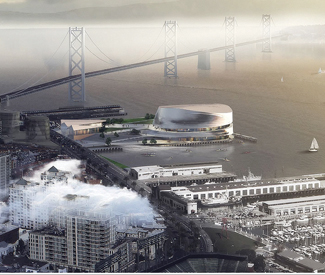
It comes at a time when the Golden State Warriors are seeking permission to build a sports arena on Piers 30 and 32, just a few hundred feet from 75 Howard.

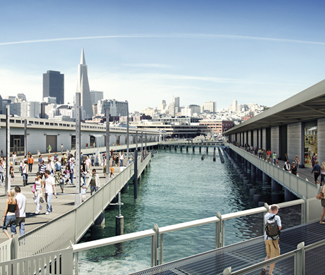
Between the proposed 8 Washington condo project, the arena, and 75 Howard, the skyline and use of the central waterfront could change dramatically in the next few years. Add to that a $100 million makeover for Pier 70, the new Exploratorium building on Pier 15, and a new cruise ship terminal at Pier 27 — and that’s more development along the Bay than San Francisco has seen in decades.

And much of it is happening without a coherent overall plan.

There’s no city planning document that calls for radically upzoning the waterfront for luxury housing. There’s nothing that talks about large-scale sports facilities. These projects are driven by developers, not city planners — and when you put them all together, the cumulative impacts could be profound, and in some cases, alarming.

“There hasn’t been a comprehensive vision for the future of the waterfront,” Sup. David Chiu told me. “”I think we need to take a step back and look at what we really want to do.”

Or as Tom Radulovich, director of the advocacy group Livable City, put it, “We need to stop planning the waterfront one project at a time.”


Some of the first big development wars in San Francisco history involved tall buildings on the waterfront. After the Fontana Towers were built in 1965, walling off the end of the Van Ness corridor in a nasty replica of a Miami Beach hotel complex, residents of the northern part of the city began to rebel. A plan to put a 550-foot US Steel headquarters building on the waterfront galvanized the first anti-highrise campaigns, with dressmaker Alvin Duskin buying newspaper ads that warned, “Don’t let them bury your skyline under a wall of tombstones.”

Ultimately, the highrise revolt forced the city to downzone the waterfront area, where most buildings can’t exceed 60 or 80 feet. But repeatedly, developers have eyed this valuable turf and tried to get around the rules.

“It’s a generational battle,” former Sup. Aaron Peskin noted. “Every time the developers think another generation of San Franciscans has forgotten the past, they try to raise the height limit along the Embarcadero.”

The 8 Washington project was the latest attempt. Developer Simon Snellgrove wants to build 134 of the most expensive condominiums in San Francisco history on a slice of land owned in part by the Port of San Francisco, not far from the Ferry Building. The tallest of the structures would rise 136 feet, far above the 84-foot zoning limit for the site. Opponents argued that the city has no pressing need for ultra-luxury housing and that the proposal would create a “wall on the waterfront.”

Although the supervisors approved it on a 8-3 vote, foes gathered enough signatures to force a referendum, so the development can’t go forward until the voters have a chance to weigh in this coming November.

Meanwhile, the Paramount Group has filed plans for a much taller project at 75 Howard. It’s on the edge of downtown, but also along the Embarcadero south of Market, where many of the buildings are only a few stories high.

The project already faces opposition. “The serious concerns I had with 8 Washington are very similar with 75 Howard,” Chiu said. But the issues are much larger now that the Warriors have proposed an arena just across the street and a few blocks south.

“Because of the increase in traffic and other issues around the arena, I think 75 Howard has a higher bar to jump,” Sup. Jane Kim, who represents South of Market, told me.

Kim said she’s not opposed to the Warriors’ proposal and is still open to considering the highrise condos. But she, too, is concerned that all of this development is taking place without a coherent plan.

“It’s a good question to be asking,” she said. “We want some development along the waterfront, but the question is how much.”

Alex Clemens, who runs Barbary Coast Consulting, is representing the developer at 75 Howard. He argues that the current parking garage is neither environmentally appropriate nor the best use of space downtown.

“Paramount Group purchased the garage as part of a larger portfolio in 2007,” he told me by email. “Like any other downtown garage, it is very profitable — but Paramount believes an eight-story cube of parking facing the Embarcadero is not the best use of this incredible location.”

He added: “We believe removing eight above-ground layers of parked cars from the site, reducing traffic congestion, enlivening street life, and improving the pedestrian corridor are all benefits to the community that fit well with the city’s overall goals. (Of course, these are in addition to the myriad fees and tax revenues associated with the project.)”

But that, of course, assumes that the city wants, and needs, more luxury condominiums (see sidebar).


Among the biggest problems of this rush of waterfront development is the lack of public transit. The 75 Howard project is fairly close to the Embarcadero BART station, but when you take into account the Exploratorium, the arena, and Pier 70 — where a popular renovation project is slated to create new office, retail, and restaurant space — the potential for transit overload is serious.

The waterfront at this point is served primary by Muni’s F line — which, Radulovich points out, “is crowded, expensive, low-capacity, and not [Americans with Disabilities Act]-compliant.”

The T line brings in passengers from the southeast but, Radulovich said, “if you think we can serve all this new development with the existing transit, it’s not going to happen.”

Then there are the cars. The Embarcadero is practically a highway, and all the auto traffic makes it unsafe for bicycles. The Warriors arena will have to involve some parking (if nothing else, it will need a few hundred spaces for players, staff, and executives — and it’s highly unlikely people who buy million-dollar luxury boxes are going to take transit to the arena, so there will have to be parking for them, too. That’s hundreds of spaces and new cars — assuming not a single fan drives.

The 75 Howard project will eliminate parking spaces, but not vehicle traffic — there will still be close to 200 parking spaces.

And all of this is happening at the foot of the Bay Bridge, the constantly clogged artery to the East Bay. “Oh, and there’s a new community of 20,000 people planned right in the center of the bridge, on Treasure Island,” Peskin pointed out.

Is it possible to handle all of the people coming and going to the waterfront (particularly on days where there’s also a Giants game a few hundred yards south) entirely with mass transit? Maybe — “that’s the kind of problem we’d like to have to solve,” Radulovich said. Of course, the developers would have to kick in major resources to fund transit — “and,” he said, “we don’t even know what the bill would be, and we don’t have the political will to stick it to the developers.”

But a transit-only option for the waterfront is not going to happen — at the very least, thousands of Warriors fans are going to drive.

The overall problem here is that nobody has asked the hard questions: What do we want to do with San Francisco’s waterfront? The Port, which owns much of the land, is in a terrible bind — the City Charter defines the Port as an enterprise department, which has to pay for itself with revenue from its operations, which made sense when it was a working seaport.

But now the only assets are real estate — and developing that land, for good or for ill, seems the only way to address hundreds of millions of dollars in deferred maintenance and operating costs on the waterfront’s crumbling piers. And the City Planning Department, which oversees the land on the other side of the Embarcadero, is utterly driven by the desires of developers, who routinely get exemptions from the existing zoning. “There is no rule of law in the planning environment we live in,” Radulovich said. So the result is a series of projects, each considered on its own, that together threaten to turn this priceless civic asset into a wall of concrete.

Sunday metering begins in SF but few notice

15

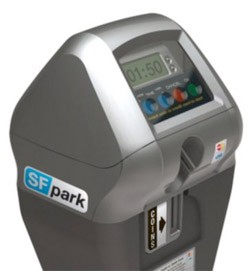
Yesterday, after years of heated conflicts over the issue, San Francisco officially began charging motorists to use metered parking spaces between noon and 6pm on Sundays – and nobody seemed to notice.

For the first few weeks, parking control officers with the San Francisco Municipal Transportation Agency are going to be issuing warnings rather than expensive parking tickets. But as Streetsblog SF reported today, even that didn’t seem to be happen. Its street survey in the Haight and Mission districts found that most parkers didn’t pay, and they received no warnings that they were supposed to.

SFMTA spokespersons that didn’t respond to Streetsblog inquiries also haven’t responded to questions from the Guardian about what happened and how many warnings were issued (UPDATED BELOW).

Sunday metering is intended to create more parking turnover in busy commercial corridors and bolster the SFMTA’s budget, capturing more money for Muni. But for now, it seems that everyone involved is still trying to shake off their holiday hangovers and get up to speed.

UPDATE 5:45: SFMTA spokesperson Paul Rose just returned our call to say parking control officers were indeed busy issuing warnings yesterday. “We issued about 4,000 warnings yesterday. That’s part of getting the word out,” he said. As far as Streetsblog’s observations, he said it could have been a fluke of timing or the fact that meters don’t indicate when someone pre-pays or pays by cell phone. “In the Haight, specifically, we issued about 600 warnings, and about 1,000 in the Mission,” he said. In addition to the direct warnings, the SFMTA has been publicizing the Sunday metering on billboards and Muni posters, through merchant groups, in the media, and on the meters themselves. 

Enforcement with actual tickets begins on Jan. 27.

New Year’s Day special: How to watch the Nebraska bowl game!

1

I emailed my relatively reliable Nebraska source to get an inside line on the big Nebraska vs. Georgia Capital One bowl game on New Year’s Day Tuesday morning in Orlando, Florida.

“It will be tough,”  reported my grandson Nicholas Perez, a freshman in mechanical engineering at the University of Nebraska in Lincoln.

He’s right. Nebraska ought to be in the Rose Bowl, replaying Stanford and the game they lost to Stanford  in the Rose Bowl in 1941–and a game Nebraska fans never forgot.

But Nebraska got slaughtered by Wisconsin, 70-31, in its last game, the Big Ten championship game, and so had to take a consolation bowl game prize.

And the Huskers are playing a tough Georgia team, with an 11-2 record, and a 81/2 point odds advantage.

Game time is 10 a.m Tuesday  on ABC (Channel 7) in San Francisco.

Meanwhile, for those hardcore Husker fans who like to congregate and cheer in a bar,  Final Final will be showing the game on its premiere screen at l0 a.m. Tuesday.

Final Final is a Nebrask stronghold owned amd operated by a loyal Nebraskan,  Arnie Prien of Lyons, Nebraska.  The game comes with inexpensive beer and free popcorn and the Husker faithful.  Final Final is situated at 2900 Baker St., San Francisco, 415-931-7800. Street parking is always a problem in this neighborhood, so try the nearby Presidio.

There is no place like Nebraska. Especially in San Francisco and Orlando.  Go Big Red!


More recycling fallout

84

The unintended consequences of closing the Haight Ashbury’s only recycling center are about to ripple through small businesses in the neighborhood. As the recycling center’s final days loom, merchants are gearing up to face new fees — as much as $100 a day.

But they may get a reprieve sooner than they think.

State law requires stores that sell beverages in cans and bottles to take them back for recycling — unless there’s a functioning recycling center within a half-mile radius.

With the Haight-Ashbury Neighborhood Council recycling center gone, Whole Foods supermarket, the largest purveyor of beverages on Haight Street, will be faced with a decision — provide bottle and can buy-back services, or pay a $100 a day fee instead. If Whole Foods decides to pay the fee and not provide recycling in the area, small businesses in the Haight will be forced to make the same choice — only they won’t be able to afford the $36,500 a year fee.

San Francisco’s Department of the Environment doesn’t enforce those fees, but does provide oversight on recycling in San Francisco. Guillermo Rodriguez, spokesperson for the department, said that his office is in the planning stages of creating a mobile recycling center, which could roll out in early 2013.

“Certainly it’s not in our interest to have those businesses pack up and move out,” Rodriguez said. The mobile recycling center gives the neighborhood a new option.

If a recycling center serves the Haight neighborhood, the small businesses in the area could avoid paying the steep fees, and from having to go through the trouble of seeking exemption.

“Its similar to food trucks,” Rodriguez said. “After they finish for the day, they leave. But they’d set up at a usual time in a usual spot.”

San Francisco Supervisor Christina Olague, whose district includes the Haight Ashbury, said she was working on a way for HANC to turn into a mobile recycling center. Though she said that those talks had since stalled, Rodriguez said that if HANC wanted to be a partner in the new mobile center, the Department of the Environment would be open to it.

Why does the state of California expect small businesses to provide a can and bottle buy-back program on site, or face fees in the first place?

Rodriguez explained that the laws weren’t necessarily made with San Francisco in mind.

“When the rules were drafted, San Francisco was the exception, as we are for a lot of things,” Rodriguez told us. “The law was written for the suburbs, where small businesses generally have parking lots where recycling can easily be handled.”

The San Francisco Recreation and Parks department has long pushed for the Haight recycling center’s ouster. Sarah Ballard, spokesperson for the department, said the recycling fees and regulations that will hit local businesses aren’t Rec-Park’s problem.

“HANC has been on a month to month lease for over a decade,” she said. “The Parks Department have never sought to stop them from seeking non-park property to continue to run their business.”

Basically, HANC can operate wherever it wants to — just not in Golden Gate Park. And there aren’t a whole lot of other low-cost open spaces where the center can set up shop.

Small businesses we’ve talked to say they don’t have the space, staff, or ability to handle buying back recyclables. Fred Kazzouh, owner of “Fred’s New Lite Supermarket” on Haight and Masonic streets, doubted he’d get a reprieve from the fee.

“I mean if we all apply for an exemption, there’ll be half a mile radius without a recycling center,” Kazzouh said. “I saw recycling centers on Safeway on Webster (street) and I don’t see why Whole Foods can’t do it.”

Kazzouh’s store has been in the Haight neighborhood since 1995. The Haight has long been known as a place that draws alternative people, he said. And that’s the way he likes it.

“I don’t like to be in the clean neighborhood with the white picket fence and suits and ties,” Kazzouh said. “That’s not a real life. Its a very fake life.”

Even some of the ritzier stores along Haight St. aren’t bothered by the homeless population there. Firras Zawaideh, owner of Liquid Experience on Haight, sells high end (expensive) alcohol that few homeless people can afford.

He said he thinks only the transplants and new folks to San Francisco are bothered by them.

“I’m a native San Franciscan, from the Sunset [district],” Zawaideh said. “We’re the ones who don’t hate the homeless. Its all the transplants from New York and the midwest who complain about it.”

Zawaideh already handles bottle and can buy-back through his store, though he said that no one has ever taken advantage of it. But with HANC closing, he dreads the idea of people bringing cans and bottles en masse to his store.

“Say on a busy Friday night someone comes in with a cart full of recyclables,” he said. “Then what? I have to help them out too?”

The mobile recycling center would exempt Zawaideh of that responsibility. But if neighbors of HANC complained about the homeless population, would the same customers cause a problem for the mobile center as well?

Rodriguez said he wouldn’t speculate on if the homeless population that now uses the Haight recycling center would follow the food trucks around as well.

“I think we’ll have to take it as it comes,” Rodriguez said. Though he wanted this to be clear: “Not everyone that participates, frankly, is a homeless person.”

Fred Kazzouh was dubious that the homeless population would go away with HANC’s closure. “If HANC goes away, the homeless won’t go with them,” Kazzouh said. “The homeless will just have less people fighting for them.”

Synthesis 2012 Festival marks Mayan date with a creative contribution

23

The Synthesis 2012 Festival near Chichen Itza, Mexico got off to a rocky start, but by the time the Mayan Long Count calendar ended on Dec. 21, it had transformed into an inspiring example of working through adversity to build community and connect with another culture.
According to a variety of volunteers and performers associated with the festival, Executive Producer Michael DiMartino over-promised and under-delivered just about everything: hotel rooms, shuttles to and from Cancun and other cities, food for volunteers, and local permission for a stage at Pyramid Kukulkan and the camping area where thousands of festival-goers stayed. On top of that, the bus carrying the sound system and other supplies got turned around by authorities at the border, causing the crew to scramble locally for sound and building equipment and supplies.
“Not everything came together the way we planned, because it’s Mexico, but everyone came together and created community,” Debra Giusti, the Harmony Festival founder who helped DiMartino with Synthesis (and who calmly and creatively resolved many of its problems, say several sources) told me on Dec. 23, the festival’s final day. “There was so much love and unity and can-do spirit.”
At one point before the festival officially began on Dec. 20, federal police and local officials shut down work on the Ascendance stage, blocked access to the adjacent camping area, and gathered everyone there into a group, dressing down DiMartino and taking him away in a police car to resolve their differences.
The crew of mostly Northern California residents that showed up more than a week before the festival began to build the Ascendance Stage that would host the DJs and other musicians worked through their frustrations with event organizers to forge strong connections with the mayor and other locals, throw a great party, and leave a lasting gift for the Mayan people.
“We fed everyone, spent almost $16,000, dealt with the authorities, made friends with all the locals, and stayed with our intention to build this temple for the galactic alignment,” Ken Currington, aka Shombala — one of the project leaders working beside Tulku, the main guy — told me. He said he felt proud and humbled by the experience.
The impressive and ornate pyramid-style temple was built with locally sourced wood, bamboo, and steel in the parking lot of a Mayan stone-carving business in Xcalacoop — just over 9km from the main festival hub in Piste Pueblo, past the Pyramid Kukulkan in Chichen Itza — after the locals embraced their offer to leave it as a permanent display structure for the Mayan artwork.
“One local Mayan who came by was in tears and he said this was the one of the best offerings to the Mayan people,” Currington said.
The visitors helped prepare and participate in a locally produced festival marking the end of the Mayan calendar on Dec. 21, a gesture of goodwill that helped overcome initial missteps. Some local Mayan elders also took part in a Synthesis ceremony at the pyramid in Chichen Itza at sunrise that day.
At the all-night dance party that began on Dec. 22, which featured a long list of Bay Area DJs and other performers, local families came to see the spectacle, which also  included live creation of paintings, mandalas, and other artworks and aerial yoga swings. All the locals I talked to seemed to enjoy and appreciate the event, except for one stern-faced police officer who simply said, “No se (I don’t know),” when I asked what he thought.
“This was amazing because it drew people from all over who felt called to be here,” Giusti said. “They went into the jungle and made art.”
One area where DiMartino (who hasn’t yet responded to my questions about problems with the festival) did seem to deliver was in booking and delivering keynote speakers, who spoke from the stage at the Hacienda restaurant and hotel complex in Piste Pueblo, where meals were also provided to VIPs and those who bought the most expensive tickets.
Keynote speaker Don Miguel Ruiz, a Toltec author and thinker, told the Synthesis 2012 Festival crowd that changing the world starts with an internal change, a change in consciousness. “If we can change our own story, if we can find that peace and that joy,” he said, then we can project that out into the world. “The change we want to see in the entire society starts with us. We can’t give what we don’t have.”
At this point, it’s our collective responsibility to seize the moment and help bring about the transformation that the world is waiting for. “We can be part of the solution for humanity or we can be a part of the problem,” he said.
Manifesting the solutions begins by tapping our creative energies. “Whatever we create first begins in our imagination,” Ruiz said. “Then we make it real.”
“In my imagination, humanity has already changed. We are going in the right direction. We can make it happen. Day one is today,” Ruiz said on Dec. 22, drawing a raucous reaction from the large crowd. “Everything we did in life is completely irrelevant. Right now is the moment.”
Another keynote speaker, Caroline Casey of KPFA’s “The Visionary Activist” show, also talked about the importance of healing the world by transforming ourselves, and an ancient Hawaiian concept called ho’oponopono, a practice of reconciliation and forgiveness.
As she said, “To love disharmony back into harmony makes the harmony so much more.”

Left-right punch knocks out increased development fees for Muni

148

A new and unusual coalition of nonprofit, religious, and corporate interests today killed a legislative effort to get more money for Muni through the Transit Impact Development Fee, which was going through its process of being reauthorized every five years and came to the Board of Supervisors today.

The San Francisco Municipal Transportation Agency was hoping to get millions of dollars more per year from the fee to help cover the increasing costs of Muni service, so the city last year commissioned a study establishing a nexus between new development projects and their impact on the public transit system as a way to set the fees developers would pay.

Using that study, Sup. Scott Wiener sponsored legislation that increased the cost per square foot of development for some business types – mostly notably hospitals, big retail and entertainment complexes, and Cultural/Institution/Education facilities – and ended the categorical exemption for nonprofit organizations.

Those who could be impacted by the increased fees banded together into an organization calling itself NOTT (Non-profits Opposed to the Transit Tax), a group that included the city’s major health care providers, religious institutions, and influential nonprofits such as Council of Community Housing Organizations and Chinatown Community Development Center.

“We are gravely concerned that elements of the forthcoming Transportation Sustainability Program (TSP), especially elimination of the non-profit fee exemption, have been selectively imbedded in the TIDF update legislation. Elimination of the non-profit exemption has not been considered through a thorough and transparent process and is not good public policy,” SF Chamber of Commerce President Steve Falk wrote in Nov. 27 letter to supervisors on behalf of the organization.

In the face of opposition from both downtown and progressive groups, and hoping to get SFMTA more money for its next budget cycle, Wiener appealed for support to sustainable transportation activists, who had mixed feelings on the legislation for reasons ranging from its exemption of parking garages and development in Mission Bay to its inclusion of organizations serving low-income communities.

So Sup. Sean Elsbernd – who spoke on behalf of Catholic schools and churches – was able to amend the legislation back to the status quo on a 9-2 vote, with only Wiener and Sup. Carmen Chu opposed (Sup. Christina Olague, who co-sponsored the measure with Wiener, even failed to support it in the end).

While that ends this effort for now, it is really only the first round of efforts that are just getting underway to find more funding for Muni, which is underfunded and at capacity on many lines, and implement the TSP when it is unveiled next year.

Likes the name

0

caitlin@sfbg.com

STREET SEEN “People were like, we wanna wear some clothing from you guys,” San Franpsycho owner Christian Routzen tells me from the behind the counter of his DIY brand’s newish (it’s seven months old) location on newly-trendy Divisadero Street. “But we didn’t make clothing.”

I guess sometimes the brand just comes first, and then the product. Or rather, the movie comes first. Routzen made a 2001 Ocean Beach surf film with cohort Andy Olive called, yes, San Franpsycho. Apparently the flick, along with its 2005 follow-up San Franpsycho: Wet and Wreckless, captured the imagination of certain sector of San Francisco. They wanted T-shirts, so Routzen and Olive located some silkscreening gear and a mail truck and became a presence at Indie Marts, bars, and street fairs, silkscreening clothing with their bon mot. I’ve seen them do it, they get slammed.

“We had people taking off their shirts. Men, women, and children,” concludes Routzen. People resonated with the name, he says.

A couple of bangin’ blonde girls interrupt our conversation to buy wristbands for the surf fashion show the brand is hosting at Public Works that night. Later, I see a shot on Instagram involving a runway, a lot of thigh-high American Apparel tube socks, and bikinis. That same weekend, San Franpsycho was hosting a surf tournament and a poker competition.

The girls recede into the distance, banded. And then a guy interrupts us asking about customizing an aqua sweatshirt, as if to complete the San Franpsycho milieu I’ve found myself in the middle of.

But I kind of want Routzen to spell it out. “Can I ask you a less tangible question? Why’d they want to wear clothes from a bunch of guys that don’t make clothes? It’s all the name, really?”

Routzen shrugs, and hands me a DVD copy of Wet and Wreckless ($20, buy a copy at the store.) I watch it with my roommate the next night. It is a Jackass-paced piece of San Francisco bro-moblia, featuring gentlemen named Simo, Doobie, and Brownie, guys bouncing their penises while frying hot dogs in the kitchen, claymation sex, girls making out, an Ocean Beach parking lot shooting, a broken surfboard montage, and an incoherent interview with Andy Dick. Also: barrel rolls.

Most of the SFP dudes are pretty hot, they surf gnarly OB waves, and they straight-boy don’t give a fuck. Ding ding ding! Well yeah, obvs everybody wants San Franpsycho to rub off on them.

Which is a totally unfair analysis, because Olive and Routzen have (in addition to being attractive) created a real cute, real-real, repurposed wood retail galaxy. The Golden Gate Bridge-San Franpsycho logo can now be found on man-tanks, lady tanks, dog sweatshirts, boy shorts, hoodies, aprons, duffel bags, water bottles. The machines they’re printed on are clearly visible in the shop’s workspace.

The boys also sell a host of products made by buddies who live in the immediate neighborhood. The ginger-Afroed Olive holds up an expanse of black Cordura nylon, excitedly gesturing at a bank on the wall of the classic roll-top, leather-strapped Motley Goods backpacks (also available on Etsy) that it will be made into. That brand’s based out of their friend’s apartment, Olive says. “Literally, two blocks away.” The shop also stocks Sea Pony Couture (sea-pony-couture.myshopify.com), a line of delicate gold-chained, be-charmed jewelry by San Franciscan Fatima Fleming.

505 Divisadero, SF. (415) 829-7874, www.sanfranpsycho.com

Far, far away from the San Franpsycho clubhouse sits a Noe Valley clothing store that has absolutely zero hot men in it, but managed to pull me in on the strength of its color palette alone (I am, at my heart, a primary shades kind of person. This is Atlantis and I’m like, nautical.)

Said shop was Mill, and it’s MILF territory — at least, such were the women audibly rhapsodizing over the shop’s stock while I was there, and who were subsequently drawn in by the incredibly informative employees for a conversation about respective kids’ ages, the pleasures of teaching one’s youngster how to give mommy a foot massage, etc.

I was back in the dressing room trying on my Japanese striped/solid BlueBlue boatneck dress, silk drawstring pants with daisy motif by Janezic (a line designed by Michele Janezic, Mill’s store manager whose drapey tank tops are a touch more club-ready and sexy than the rest of Mill’s offerings), and high-waisted, below-the-knee, A-line Levi’s denim skirt.

“I just can’t believe this! It’s amazing,” went the raptures. I should mention that Mill is the brand-new female wear offshoot of beloved Castro store Unionmade. Unionmade was recently dinged by Gawker because its clothes are not, sadly, union-made. Nonetheless, its collection has garnered an enthusiastic following among those who swoon for spendy, high quality denim and other rugged forms of fashion. These followers included females, leading to the birth of Mill, which carries some unisex items in addition to female items from the same brands as Unionmade.

“The philosophy of Mill is to offer classic, quality, and timeless products,” Janezic told me in an email after my visit (I didn’t cop any of the items I tried on, but that was more a question of insufficient funds than personal proclivity because I wanted them all very badly. Even the Barbour “Morris” waxed utility jacket that seemed like a must-have for the drippy SF winter was $379, so I guess I must not-have it sob.)

But I’ll tell you this: if Mill ever needs someone to watch the store at night, say curl up on a pile of goldenrod Levi’s wool trenches lined with poncho material next to its stacks of design mags, wake up in the morning and go out brand representing in some Imogene + Willie jeans (this is cute — manufactured in Tennessee by a twangy couple who started in a gas station basement and still get their fabric from one the country’s last and oldest denim factories) and Gitman Bros. gingham button-ups…

… well, at least now they know my name.

3751 24th St., SF. (415) 401-8920, www.millmercantile.com

Run over by a reindeer

0

culture@sfbg.com

EVENTS

Union Square ice-skating rink Union Square, SF. www.unionsquareicerink.com. Through Jan. 16, 10 a.m.-11:30 p.m. except for when closed for private parties, $10 for 90-minute session. Sweetheart, the rink is open, grab my hand and try not to twist an ankle as we glide in circles around downtown’s living room.

Westin St. Francis sugar castle Westin St. Francis, Landmark Lobby, 335 Powell, SF. www.westinstfrancis.com. Through Jan. 24, on view 24 hours/day. Don’t lick it. For although this ever-growing sweet behemoth which each holiday season occupies the lobby of downtown’s classic luxury digs with its 1,300 pounds, 20 towers, 30 rooms, and sugar replicas of 2012’s movers and shakers has a hold on our heart, its original dimensions were sugar-spun back in 2005. Incredibly made, undeniably festive, but altogether inappropriate for dietary purposes.

Jack London Square holiday tree lighting Jack London Square, Oakl. www.jacklondonsquare.com. Nov. 30, 4:30-7pm, free. Performances by Disney-approved pop stars! Reindeer petting zoo! Miss California 2012 and a kids dress-up station with costumes from the Oakland Ballet! You’ll be hard-pressed not to find some holiday cheer at this annual lighting of Jack London’s fir tree for the masses.

Oakland-Alameda Estuary Lighted Yacht Parade Visible from Jack London Square, Oakl. www.lightedyachtparade.com. Dec. 1, 5:30pm, free. Let those cheeks get rosy, it’s boat-watching time. This yearly tradition sees the yacht owners of the East Bay putting their aquatic rides on display, stringing bulbs galore across decks and sails.

Festival of lights Union between Van Ness and Steiner, Fillmore between Union and Lombard, SF. www.sresproductions.com. Dec. 1, 3-7pm, free. Wiggle your nose at Santa at this explosion of twinkly tinsel and Cow Hollow reindeer — today Union Street puts on the holiday glitz and lays out the welcome mat. Cudworth Mansion (2040 Union) will be hosting a cupcake-decorating session from 3:30-5:30pm, at which Old St. Nick himself will make an appearance out front.

Golden Gate Park holiday tree lighting McLaren Lodge, 501 Stanyan, SF. www.sfrecpark.org. Dec. 6, 5pm, free. A tradition started by Golden Gate Park grandfather and San Francisco’s first park superintendent John McLaren in 1929, the lighting of the tree returns to Fell Street for the 83rd year in a row. Accompanying fanfare includes live performances, carnival rides, and a visit from Saint Nick.

Great Dickens Christmas Fair Cow Palace, 2600 Geneva, SF. www.dickensfair.com. Fri/23 and Sat.-Sun. Sat/24-Dec. 23, 10am-7pm, $21-25. For an ace weekend drunk this holiday season, toodle over to the Cow Palace. Once ensconced in the warm period embrace of the Dickens Fair, you will have the run of five bars (absinthe!), a multitude of meat pie shoppes, hilarious accents, near-constant stage shows, and the company of “famous Victorians,” including Charles Dickens and Her Majesty, the queen herself.

Family holiday crafts day Randall Museum, 199 Museum Way, SF. (415) 554-9600, www.randallmuseum.org. Dec. 1, 10am-3pm, free admission, activities fees vary. Bring the kiddos to the always-free-admission Randall Museum so they can spend the morning making holiday decorations and gifts. Cap off the morning with a performance by Asian American performance troupe Eth-Noh-Tec and its fusion of ancient and contemporary movement.

Community Hanukkah candle lighting Jewish Community Center, 3200 California, SF. (415) 292-1200, www.jccsf.org. Dec. 8-14, 4:30pm, free. Join up with your neighbors for the Jewish Community Center’s daily lighting of the menorah in the building’s atrium. Attend the Shabbat celebration on Dec. 14 for a family storytelling session, grape juice, hallah, and Hanukkah gelt.

Bill Graham Menorah Day Union Square, SF. www.chabadsf.org. Dec. 9, festivities start at 3pm, menorah lighting at 5pm, free. Each day from December 8-15, a candle will be ceremoniously lit on the Bill Graham mahogany menorah, a gift from the famous San Francisco promoter to his city. But on the 9th, Bill Graham Menorah Day festivities will occupy Union Square, a beautiful beginning to the Festival of Lights in the city.

Public library winter celebration Bernal Heights Library, 500 Cortland, SF. www.sfpl.org. Dec. 12, 6:30-8:30pm, free. The library’s got all kinds of free holiday programming this year, from cupcake-decorating and card-making to a magic show with a winter wonderland theme. Today’s no exception: join the Bernal Heights community for a kid-friendly celebration featuring the Bernal Jazz Quintet, refreshments, and children’s movies.

Frosting the Conservatory Conservatory of Flowers, 100 John F. Kennedy, SF. (415) 831-2090, www.conservatoryofflowers.org. Dec. 15, 11am-3pm, $10. Make your own ginger-greenhouse at this event amid the hothouse blooms of the Conservatory of Flowers. This events gets our thumbs-up for guaranteed toastiness, because being warm and cozy is a pre-req for Christmas cheer.

Jewish Christmas with Broke Ass Stuart The Make-Out Room, 3225 22nd St., SF. www.makeoutroom.com. Dec. 25, 5-11pm, $10. Strip dreidel set to the tune of streaming Woody Allen, Larry David, and Sascha Baron Cohen footage sounds like our kind of Christmas. Such was the vision of DJ Matt Haze and host Broke Ass Stuart, who designed this kitschy extravaganza for all of you (Chosen and Left Behind alike) who can’t stomach staying in on a perfectly good day off. Did we mention there will be a Chinese food buffet?

Kwanzaa celebration Bay Area Discovery Museum, 557 McReynolds, Sausalito. www.baykidsmuseum.org. Dec. 26, 9am-5pm, free. A traditional Kwanzaa altar will greet you upon arriving at the kids museum’s celebration of African-American culture, featuring two performance (at 11am and 1pm) by African Roots of Jazz.

PERFORMANCE

The Christmas Ballet Various times and Bay Area locations. www.smuinballet.org. Nov. 23 — Dec. 23, $25-65. Back by popular demand, the Smuin Ballet Company returns with this annual production, split this year into two acts: “Classical Christmas” and “Cool Christmas.” Both promise eye-opening, energetic entertainment set to eclectic tunes from Elvis to klezmer.

A Christmas Carol American Conservatory Theatre, 415 Geary, SF. (415) 749-2228, www.act-sf.org. Nov. 30-Dec. 24, various times, $20–$160. Stressful election year and rumors of apocalypse tightened those purse strings? Exorcise your inner Scrooge at this classic stage production of Charles Dickens’ terrifying ode to generosity and kindness towards diminutive children.

The Golden Girls: The Christmas Episodes Victoria Theatre, 2961 16th St., SF. www.victoriatheatre.org. Dec. 6-30, Thu.-Sat. 8pm, Sun. 7pm, $30. Our cover girl Cookie Dough co-stars as Sophia Petrillo in this now-traditional SF holiday stage production of the classic sitcom that employs more shoulder pads, even, than the original TV show. You’ll never know a catty elderly network television star until you’ve seen her re-enacted by a drag queen. Buy tickets pronto, the shows usually sell out.

California Revels Oakland Scottish Rite Center, 1547 Lakeside, Oakl. (510) 452-8800, www.californiarevels.org. Dec. 7-9, 13-15. Fridays 8pm, Saturdays and Sundays 1 and 5pm, $20-55. Feast and family are cornerstones of this annual interactive period piece performance celebrating the winter solstice. Hoist your mead and turkey leg and sway to the music, friends, good times will be upon ye here.

The Nutcracker Palace of Fine Arts, 3301 Lyon, SF. www.cityballetschool.org. Dec. 8, 2pm & 7pm; Dec. 9, 2pm, $20. Yes, everyone does The Nutcracker. At this point, it’s like the Rocky Horror Picture Show of ballet. (Would that ballet patrons donned Rat King costumes to attend!) Embrace the tradition, and check out the City Ballet School’s production of a classic.

Charles Phoenix Retro Holiday Show Empress of China Ballroom, 838 Grant, SF. www.charlesphoenix.com. Dec. 12, 8pm, $25. The creator of the Cherpumple, a pie-stuffed cake concoction that rises to the dizzying heights of kitsch, humorist Charles Phoenix celebrates the retro in every occasion. Tonight, he regales the crowd with tales of his favorite SF landmarks, road trips, and yes, feats of food fantasy.

Holiday youth mariachi concert Mission Cultural Center for Latino Arts, 2868 Mission, SF. www.missionculturalcenter.org. Dec. 14, 7:30-9pm, $15. Three mariachi troupes made of young people join forces for this exciting holiday program. The hat-dropping, guitar plucking action will be highlighted by Zenon Barron’s Mexican youth folk dance class.

The Snowman Davies Symphony Hall, 201 Van Ness, SF. (415) 864-6000, www.sfsymphony.org. Dec. 22, 11am, $13.50-57. Even the smallest budding season ticket holder will find this film-symphony presentation of Joe Nesbø’s classic children’s book a welcome boost to their holiday cheer. The animated version of this story of a youg’n’ whose bud is a Frosty-like chap will soar when paired with the world-class musicians of the SF Symphony.

Kung Pao Kosher Comedy New Asia Restaurant, 772 Pacific, SF. www.koshercomedy.com. Dec. 22-25, various times, $44-64. There’s nothing like having dinner on Christmas to up your alterna (or simply, not pan-Christian) cred. Add stand up comedy and you have a winning formula, which is obvious from the longevity of Lisa Gedulig’s annual show. This year features yucks from Judy Gold, Mike Capozzola, and Adrianne Tolsch.

Clairdee’s Christmas Yoshi’s San Francisco, 1330 Fillmore, SF. (415) 655-5600, www.yoshis.com. Dec. 24, 8pm, $20. Everything could use a little soul in lives and the holidays are no exception. Come hear the sounds of soul-jazz vocalist Clairdee, and soak in her ensemble’s rhythmic takes on Christmas standards.

“Holiday Memories” double feature A rare 16mm showing of Dylan Thomas’ A Child’s Christmas in Wales will be accompanied by a screening of The Sweater, a tale of a young hockey player’s passion for the sport, and the dangers that come of wearing the wrong jumper. Dec. 22, 2pm, Exploratorium, 3601 Lyon, SF. (415) 563-7337, www.exploratorium.edu

PEACE ON EARTH

Darkness and Light: A Hanukkah Meditation Retreat Jewish Community Center, 3200 California, SF. (415) 292-1200, www.jccsf.org. Dec. 9, 10am-5pm, $50-60. No prior experience is needed for this day-long workshop on finding the light within during the Hanukkah season. Sitting and walking meditation will be covered — the perfect primer for a month that can try the patience of even the most festive reveler.

Winter solstice ceremony San Francisco Zen Center, 300 Page, SF. (415) 863-3136, www.sfzc.org. Dec. 21, 6:15pm, free. Recharge on the longest night of the year in the peaceful confines of the SF Zen Center. The crowd here promises to be made of meditation newbies, Zen Center students, and all those in-between. It will also be your best bet to avoid jingles and tinsel, if that’s what your body is craving at this point.

Reclaiming’s Sing Up The Sun ritual Inspiration Point parking lot, Tilden Park, Berk. www.reclaiming.org. Dec. 21, 6:30am, free. Wake up before the sun does to greet it on this, the day of the year when it spends the least time out of its bed. A pagan celebration, you’re welcome to bring musical instruments and a warm Thermos of liquid to the community gathering.

GIFTS

Celebration of Craftswomen Herbst Pavilion, Fort Mason Center, SF. (650) 615-6838, www.celebrationofcraftswomen.org. Nov. 24-25, Dec. 1-2, 10am-5pm, $9 or $12 two-day pass. The first edition of this alternative holiday fair took place 34 years ago at the now-defunct Old Wives’ Tales Bookstore on Valencia Street with 22 female makers-of-things. Today, the event fills the Herbst Pavilion, features 150 juried artists and a mini-film festival. It’s still the best place for feminist shopping, some things don’t change.

Holiday Design Bazaar Intersection for the Arts, 925 Mission, No. 109, SF. www.artsedmatters.org. Nov. 30, 5-8pm; Dec. 1, noon-6pm, free. An arts fair with 25 local creators, plus live music and refreshments that may well make a difference in our kids’ art education. The event is a benefit for Arts Ed Matters, a group that is looking to build community support for art in schools.

Creativity Explored holiday art sale Creativity Explored, 3245 16th St., SF. www.creativityexplored.org. Dec. 1-2, noon-5pm, free. Shop at this studio for developmentally-disabled artists and half of your bill will go straight into their pocket — standard practice for Creativity Explored, which has been the real-deal spot for outsider art in San Francisco since 1983.

Paxton Gate holiday party Dec. 1, 3-6pm at Paxton Gate’s Curiosities for Kids, 766 Valencia; 8-10pm at Paxton Gate, 824 Valencia, SF. (415) 824-1872, www.paxtongate.com. One of the city’s most beloved families of taxidermy/kid’s toys/nursery shops, Paxton Gate is turning two decades of age this weekend. What better time to shop there? And what better to get your face painted “Victorian-style” (?!), check out stilt walkers and an accordionist-ballerina duo, and eat snacks during the day at its kids location — then walk two doors down later that night for more circus freakery, door prizes and a Hendrick’s gin open bar at 826 Valencia’s pirate shop?

Palestinian Craft Fair Middle East Children’s Alliance office, 1101 Eighth St., Berk. www.mecaforpeace.org. Dec. 1-2, 10am-5pm, free. Sip Arabic coffee while you paw through painted ceramics from Gaza, children’s book, scarves, West Bank olive oil, and more at this chance to support a nonprofit benefiting craftspeople living in Palestine — a particularly salient cause in this year of war and turmoil.

Bazaar Bizarre Concourse Exhibition Center, East Hall, 620 Seventh St., SF. www.bazaarbizarre.org. Dec. 1-2, 11am-6pm, free. This traveling indie craft fair stocks all the twee and yippee you need to get your gift recipients in your pocket. New in 2012: a mini-version of Forage SF’s Underground market, for all your small biz-sourced holiday edible needs.

Muir Beach Quilters Holiday Arts Fair Muir Beach Community Center, 19 Seascape, Muir Beach. www.muirbeach.com/quiltersfair. Dec. 1, 10am-5pm, Dec. 2 10am-4pm, free. Make a blustery beach journey that has time to spare for handicraft browsing. This annual gift fair stocks locally-made knickknacks by local groups (Muir Beach Garden Club included), and has more than retail opportunities. Hands-on crafts bars will stoke the creative fire of kids and big person shoppers alike.

La Cocina Gift Bazaar Crocker Galleria, 50 Post, SF. www.giftbazaarsf.com. Dec. 7, 1-7pm, free. You’re not going to have problems finding foodie-friendly presents at this fair — but getting them safely to their intended destination sans bite marks might be a problem. La Cocina business incubator program graduates Clairesquares, Onigilly, Love & Hummus Co., Chiefo’s Kitchen, and more will all have their wares for sale.

East Bay Alternative Book and Zine Fest Berkeley City College, 2050 Center, Berk. Dec. 8, 10am-5pm, donations suggested. www.eastbayalternativebookandzinefest.com. For the indie comic nerds on your list, you’ll want to check out this expo of all things zine. Talks by New Yorker illustrator Erik Drooker and Go the Fuck to Sleep author Adam Mansbach spice up the fair’s schedule and there’s rumor of a dance party to take place at day’s end.

KPFA Crafts Fair Concourse Exhibition Center, 635 Eighth St., SF. www.kpfa.org/craftsfair. Dec. 8-9, 10am-6pm, $10. Our public radio station hosts 220 artists and their wares for this no-brainer shopping weekend. Pick up unique wrapables from leather fashion to gourmet snacks to lotions and creams to pamper your loved ones.

Mercado de Cambio/The Po’ Sto’ market and knowledge exchange 2940 16th St., SF. www.poormagazine.org. Dec. 15, 3-7pm, donations suggested. We can pretty much guarantee you that there is no other gift fair that will have better hip-hop music. The Mercado de Cambio organized by POOR Magazine aims to counterbalance the corporatization of our holiday season. Go here for aforementioned live beats, indigenous crafts, Occupy gear, and POOR-published literature.

Renegade Craft Fair holiday market Concourse Exhibition Center, 635 Eighth St., SF. www.renegadecraft.com. Dec. 15-16, 11am-6pm, free. A DIY gift wrap station is one of the attractions at this one stop for cute gift shopping, which makes one of its two yearly appearances in the Bay Area for the holiday season. The Oakland Museum of California will truck out its mobile “we/customize” exhibit, and of course, there will be crafters: over 250 will have booths hawking clothes, accessories, home stuff, kid stuff — most handmade, and most awesome.


Aggressive Warriors

0

steve@sfbg.com

No standard defensive strategy is likely to stop the Golden State Warriors, Mayor Ed Lee, and their huge team of partners and employees from dominating the game of approving construction of a new basketball and concert arena on San Francisco’s central waterfront. That became clear on Nov. 14, as the political operation overcame fire, darkness, and neighborhood-based opposition for the first big score.

The Board of Supervisors Budget and Finance Committee was set to consider declaring the project, which the Warriors want to build on Piers 30-32 by the 2017 basketball season, to be “fiscally feasible,” recommending it move forward with more detailed environmental studies and a term sheet nailing down myriad administrative details.

Before the 11am hearing, the project team held a packed press conference to announce that the Warriors had volunteered to abide by the city’s local-hire standards for public works projects, hiring San Francisco residents or military veterans for at least 25 percent of total construction jobs and 50 percent of apprenticeships. A beaming Lee praised the deal as an “unprecedented” indicator of the Warriors’ willingness to partner with the city.

The event overflowed with union members in hard hats and orange “Build It Now!” T-shirts, as well as a full range of local political pros, from former mayoral and current project spokespersons PJ Johnston and Nathan Ballard to former aides to progressive supervisors, David Owen and David Loyola. Among the agreement’s four signatories were Joshua Arce, the Brightline Defense Project head who last year crusaded for Sup. John Avalos’s local hire ordinance, and building trades chief Michael Theriault.

Strikingly missing at the press conference was Sup. Jane Kim, in whose District 6 the project would be built — over the objections of many residents who are raising concerns about the loss of waterfront views, huge crowds attending what is projected to be more than 200 events per year, high interest rates paid by city taxpayers, the project’s accelerated approval schedule, and other concerns.

Kim is one of the three members of the Budget Committee, which held its meeting despite an electrical fire in the basement of City Hall that knocked out power to the building. Portable photography lighting was brought in to supplement the emergency backup lights, making it bright enough so the televised show could go on but giving a strangely surreal feel to the proceedings and reinforcing the urgency project supporters feel to move this forward without delay.

Kim raised the concerns of her constituents, winning support for amending the resolution to ensure the Citizens Advisory Committee — whose chair was given two minutes to convey how its members feel steamrolled by the accelerated process, asking it be delayed by a month or two — will be given chances to weigh in and pushing the EIR scoping meetings back a few weeks to January.

In the end, Kim and the committee voted to move the project forward. A few days later, on Nov. 19, the process repeated itself with another flashy press conference in the Mayor’s Office — with another important union endorsing the project — followed by the Land Use Committee responding favorably to the project.

The full Board of Supervisors was scheduled to approve the project’s fiscal feasibility the next day, after Guardian press time, but there was little chance that the full board would take any other action than giving the Warriors, Lee, and their huge roster of teammates what they want.

This despite unusual financing and some very real concerns about waterfront development.


JOBS, MONEY, AND SUPPORT

Mayor Lee — who has placed a high priority on this project since announcing his deal with the team in May — emphasized its job creation and contribution to the local economy during the Nov. 19 press conference.

“I remind people, this is a private investment of hundreds of millions of dollars,” Lee said of a project pegged to cost around $1 billion. “It means a lot of jobs, and that is so important to all of us.”

The project is expected to directly create 4,300 jobs: 2,600 construction jobs and 1,700 permanent jobs, including those at the 17,000-seat sports and entertainment arena and the 250-room hotel and 100,000 square feet of retail and restaurants that would be built as part of the project.

“We’ve been spending a lot of these last many months describing what it is we want to build,” Warriors President Rick Welts said at the press conference before casting the project in grander terms. “That’s not really what we’re building. What we’re really building are memories.”

But city residents and workers are looking for more tangible benefits than just the highs of watching big games or concerts. The building trades were already expected to strongly support the project, which only got stronger with last week’s local-hire deal. Labor’s support for the project was broadened on Nov. 19 with the announcement that the Warriors agreed to card-check neutrality for the hotel, making it easier for its employees to join UNITE-HERE Local 2.

“Thank you for being a partner and we’re looking forward to working with you in the future,” Local 2 head Mike Casey, who notably also serves as president of the San Francisco Labor Council, said to Welts at the event before the two signed a formal agreement.

In addition to allowing the hotel workers to easily organize, the Warriors agreed to card-check neutrality for vendors at the arena with at least 15 employees and those outside the arena with more than 45 employees, as well as giving those who now work Warriors’ games at Oracle Arena first dibs on jobs at the new arena.

“I think that speaks a lot about what the project is. It’s not just a San Francisco project, but a Bay Area project,” Casey said. He also said, “I want to thank the mayor for bringing people together and laying all this out.”

While Lee and the Warriors do seem to have this deal pretty well wired, this is still a San Francisco project, a complex one on the politically and environmentally sensitive waterfront that city taxpayers are helping to pay for and one for which the residents there will bear the brunt of its impacts.


PAYING FOR IT

Lee, Office of Economic and Workforce Development head Jennifer Matz, and other key project supporters have repeatedly claimed this project is funded completely with private money, noting how rare that is for urban sports stadiums these days.

But in reality, city taxpayers are spending up to $120 million for the Warriors to rebuild the unstable piers on which the arena will be built, plus an interest rate of 13 percent, an arrangement that has drawn criticism from a key source.

Rudy Nothenberg, who served as city administrator and other level fiscal advisory roles to six SF mayors and currently serves as president of the city’s Bond Oversight Committee, wrote a Nov. 12 letter to the Board of Supervisors urging it to reject the deal.

“Quite simply, I would have been ashamed of such a recommendation,” Nothenberg wrote of the high interest rate. “In today’s markets it is incomprehensible to have such a stunning recommendation brought to your honorable Board in such haste.”

Johnston and Matz each disputed Nothenberg’s characterization, citing a report by the project consultants, the Berkeley-based Economic and Planning Systems Inc. (EPS), that 13 percent is a “reasonable and appropriate market based return.”

Matz told us the rate was based on the risky nature of rebuilding the piers, for which the Warriors are responsible for any cost overruns. And she compared the project to the massive redevelopment projects now underway on Treasure Island and Hunters Point, from which the city is guaranteeing powerful developer Lennar returns on investment of 18.5 percent and 20 percent respectively.

Johnston, who was press secretary to former Mayor Willie Brown and worked with Nothenberg on building AT&T Park and other projects, told us “I have great respect for Rudy.” But then he went on to criticize him for taking a self-interested stand to defend the views from the condo he owns nearby: “They don’t want anything built in their neighborhood. They would rather leave it a dilapidated parking lot.”

But Nothenberg told us his stand is consistent with the work he did throughout his public service career in trying to keep the waterfront open and accessible to the public, rather than blocking those views with a 14-story stadium and hotel complex.

“I have a self-interest as a San Franciscan, and after 20 years of doing the right thing, I don’t want to see this rushed through in an arrogant way that would have been unthinkable even a year ago,” Nothenberg told us. “I spent 20 years of my life trying to deal with waterfront issues.”

He is being joined in his opposition by other neighborhood residents, land use experts such as attorney Sue Hestor, some opponents of the 8 Washington project concerned with the creeping rollback of waterfront development standards, and members of the Citizens Advisory Committee who have felt steamrolled by the rapid process so far and unable to thoroughly discuss the project or the neighborhood’s concerns.

“We would like to slow this process down,” committee Chair Katy Liddell told supervisors on Nov. 14. “Things are going so quickly.”


DETAILS OF THE DEAL

The $120 million plus interest that the city will owe the Warriors would be offset by the $30 million the team would pay for Seawall Lot 330 (the property across from the piers where the hotel would be built), a one-time payment of $53.8 million (mostly in development impact fees), annual rent of nearly $2 million on its 66-year lease of Piers 30-32, and annual tax and mitigation payments to the city of between $9.8 million and $19 million.

Kim raised concerns at the Budget Committee hearing about the more than 200 events a year that the arena will host, but she was told by Matz that’s necessary to make the project pencil out for the Warriors.

Many of the project’s financial and administrative details are still being worked out as part of a term sheet going to the Board of Supervisors for approval, probably in April. Other details will be studied in the project Environmental Impact Report, which is expected to come back to the board in the fall.

The Department of Public Works, Police Department, and — perhaps most critically given its impact on Muni and roadways — Municipal Transportation Agency have yet to estimate their costs.

“We do have a lot of concerns in the neighborhood about this project,” Kim told the Land Use Committee, singling out impacts to the transportation system as perhaps the most important, followed by quality-of-life issues associated with huge crowds of sports fans.

Kim noted that the area already has a problematic transportation infrastructure, with some of the highest rates of motorist-pedestrian collisions in the city and a public transit system that reaches capacity at peak times, and said that many residents worry this project will make things worse. The EIR will deal with the transportation details. But Kim praised how about half the space on the piers, about seven acres, will be maintained as public open space: “I think the open space aspect is incredible and it could actually increase access to the waterfront.” In the end, Kim urged project proponents to heed the input of the CAC and other concerned parties because, “This could be a very valuable project, or it could also be a disaster.”

Millbrae BART development conflict raises ethical questions about Fang

11

BART Director James Fang is coming under fire for his close relationship with a developer who is trying to build a hotel project on BART property next to its Millbrae station, a project that Fang promoted with a misleading presentation to the Millbrae City Council in September. But Fang says the attacks on him are coming from a powerful rival developer and that he’s only trying to get something moving on the long dormant site.

Underlying the conflict are questions about how BART develops the properties it owns around the Bay Area, questions that have increasingly high stakes around the Millbrae station. Critics say the station was badly designed and hasn’t lived up to hopes that it would promote economic development in the area, but that could change if it becomes a California high-speed rail station and the southernmost direct connection into the BART system.

On one side of the conflict is Fang, a longtime director who also owns Asian Week newspaper, and his friend and political supporter Lawrence Lui, who is proposing to build a hotel and office building at the site through his company, Justin Development Corp. The BART Board of Directors voted 6-2 in closed session in May 2011 to enter into an exclusive negotiating agreement with him.

But city officials in Millbrae have refused to share their hotel tax revenue with BART, a key aspect of making the project pencil out as a long-term revenue source for the district (BART’s policy is to lease property rather than sell in order to bolster annual operating revenues and retain control of properties that increase in value). “It turned out the economics of the project didn’t work, they wanted a kickback, for lack of a better word, in the [Transient Occupancy Tax charged to hotels] for the city of Millbrae,” said Adam Alberti with Singer Associates, which is representing the Republic Urban project.

So the BART board earlier this year voted to re-open negotiations Republic Urban Properties, which Lui had beat out in the previous vote, requesting best and final offers from the two rival developers by Sept. 28. They are still being evaluated. Once a project is selected, that developer and BART would essentially become partners in going through the city’s project approval process.

But Fang left out the competing proposal when he appeared with Lui and BART Property Manager Jeff Ordway before the Millbrae City Council on Sept. 25, trying to build support for Lui’s hotel project. “Mr. Fang stated that he is looking for official direction from the City in joining with BART to build a hotel,” according to official minutes from the meeting.

Two days later, BART General Manager Grace Crunican sent the City Council a letter clarifying the status of the property and the two competing bids. “I regret that this information was not made clear during the City Council meeting and I apologize for any confusion that this omission may have caused,” she wrote.  

The Republican Urban proposal calls for 140,000 square feet of office space, 350 housing units (probably rental), and 17,300 square feet of restaurants and retail. It would replace the 851 BART parking spaces now on site with 623 spaces, but it would also include 420 parking spaces for the offices and 410 for the residents. Lui’s project calls for a 200-room hotel, 180,000 square feet of office space, 40,000 square feet of retail, and 200 “corporate service apartments.”

Since negotiations were reopened, Republic has gone on the offensive to overcome that it says is improper and unfair interference by Fang: hiring high-powered PR firm Singer Associates, attorney Scott Emblidge, and a design team with connections to other BART directors.

“I did not expect the venom that Republic Urban has launched against me,” Fang said. “It might be high-speed rail, maybe that’s why Urban is pulling out all the stops….That would be a large part of it. Maybe Urban thinks this is something they’ve got to do.”

Fang admits his friendship with Lui and to having received $3,500 in campaign contributions from him, but he denies doing anything improper or of having a conflict-of-interest in the case, a position BART lawyers have supported, ruling that Fang doesn’t have a direct interest that would keep him from voting on the project.

“You have a piece of property at BART that has just been sitting there for 10 years, doing nothing,” Fang said. “My bottom line is whatever is the best deal for the district, I’m going to go for…If it turns out Urban Republic has the best deal, I’ll vote for it.”

In a letter to the BART, Emblidge said the Republic Urban project is clearly better: “Republic simply wants to play on a level playing field. It has presented BART with the objectively superior proposal. It asks that all further Board decisions about the Property be made in public and without the participation of Director Fang in order to ensure the competing proposals are truly evaluated on their merits. To do otherwise would be to do a disservice to BART, its riders and the general public and community of Millbrae.”

Alberti cast the decision as one of improper political influence pushing a bad project over a rival project that he called a “true transit-oriented development project.” But Tom Radulovich, a BART director who also heads the urban design nonprofit Livable City, doesn’t quite agree with that assessment.

“None of the projects seem very transit-oriented. They’re all very automobile dependent,” Radulovich said. “We should be more focused on what kind of development we want for the site and find the right developer.”

He called on BART to work more closely with Millbrae and other cities earlier in the process, and to pursue projects that are in the best interests of both entities and are smart planning for the region, particularly given the coming high-speed rail improvements.

As Radulovich said, “We’re talking about a very important hub in the regional transit system, and for that reason it’s important to get it right.”


Breaking news: How to watch today’s Nebraska vs. Minnesota game

1

And so the former Jean Dibble and I, graduates of the University of Nebraska at Lincoln, will soon be heading for the Final Final sports bar in San Francisco to watch today’s Nebraska football  game against Minnesota at Lincoln, starting at 12:30 p.m.

As attentive readers of the almost famous Bruce blog know, Jean and I were perplexed a few games back to find that we couldn’t watch the Idaho State game on national television and we were desperately trying to figure out how to watch the game. The answer, courtesy of Richard Boyce, an addicted Nebraska (and Iowa)  football fan, was to go to the Final Final bar, at 2990 Baker St., near the Presidio.

The bar has been owned for 35 years by Arnie Prien, a Nebraska native from Lyons and a 1984 NU graduate who loyally runs all Nebraska games on his big screen. He has 11 other screens for other games and will put up customers’ choices.   Just ask. Final Final got its nifty name from the days when it was the final stop for the soldiers at the Presidio coming back to the barracks from a night on the town. The local Nebraska ex-pats and fans gather every Saturday at the bar to watch the games and enjoy the free pop corn, inexpensive beer, and unique NU  camaraderie.

Our daughter Katrina Perez of Santa Barbara turned us on to a website called Huskerbud.com that provides, as the site proclaims, “just the important stuff about the Nebraska Cornhuskers.” The idea for Huskerbud, according to the site, “came about when I was visiting friends in Los Angeles and couldn’t easily find information on how to watch or listen to a game. Huskerbud is the simple solution to this small but nerve-racking problem. Enjoy!” In the tradition of Nebraska modesty, the writer and creator of the site did not provide a byline, or hometown, or NU connection, or otherwise identify him or herself.

Full disclosure: Katrina’s son, Nicholas, is a freshman in mechanical engineering at Nebraska. And so our entire family is now fully addicted to watching all the games.

I checked on Huskerbud this morning and it showed that Nebraska is 8-2 for the year and is ranked 16 in the nation on the Associated Press poll and 14 on the BCS poll. It also gave provded a list of radio stations carrying the game (mostly in Nebraska) and how to listen and watch the game on Sirius and on a computer. It also provided information on the last four Husker seasons.  A handy resource known mainly by the Nebraska faithful.

Parking tip for Final Final. Parking on the street is difficult so try parking in the Presidio and walking a few blocks to the bar. Popcorn tip: As a popcorn addict, I can attest that the popcorn is excellent and freshly popped throughout the afternoon in an old-fashioned pop corn popper in a corner of the bar. Nice Nebraska touch.

There is no place like Nebraska. Especially in San Francisco. Go Big Red.  B3


Final Final

2990 Baker St.

San Francisco 94123

 415-931-7800 

P,.S. The Nebraska alumni site lists three other “watch sites” in the Bay Area.  Jack’s Brewing Company in Fremont.  Legends and Heroes in Concord.  And Knuckles Sports Bar in Monterey,

Watch the Huskers on these four Bay Area Watch sites: http://bayareahuskers.org/


Critics urge caution on fast-moving Warriors arena deal

28

UPDATED The proposal to let the Golden State Warriors build a new sports arena complex at Piers 30-32 is moving forward quickly, with the Board of Supervisors Budget and Finance Committee considering approving its fiscal feasibility tomorrow (Wed/14), the Land Use Committee hearing its design and transportation aspects on Monday, and the full board scheduled to move it forward on Tuesday, two days before Thanksgiving. After that, it will undergo an environmental study and work on myriad fiscal and administrative details, coming back to the board for final approval, probably in the fall, with the goal of opening by the 2017 basketball season.

[UPDATE 11/14: The Finance Committee today voted 3-0 to approve findings of fiscal feasibility for the project after Sup. Jane Kim made amendments delaying the EIR scoping session until January and ensuring the Citizens Advisory Committee will be given more time to review the project and its term sheet. City officials and the Warriors also signed a deal this morning requiring that at least 25 percent of its construction jobs and half of its apprenticeship positions go to local residents or military veterans. We’ll have more details and analysis of what happened in the coming days.]

Critics of the project say it is being rammed through too quickly, with too little public notice or attention to blocking off views of the bay, and on terms that are too costly to city taxpayers. To some, Lee’s quest for a “legacy project” is reminiscent of the groupthink boosterism that characterized the initial America’s Cup proposal, before it was revealed to really be a lucrative waterfront real estate scheme that was great for developers but costly to the public, and later abandoned.

And just like last time, when the Guardian, then-Sup. Chris Daly, Budget Analyst Harvey Rose, and others forced a major scaling back of the developers’ ambitions, there are some prominent voices of caution now being raised about the Warriors arena deal and its potential to fleece city taxpayers, including concerns raised by someone with decades of experience shepherding some of San Francisco’s biggest public works projects.

Rudy Nothenberg, who served as city administrator and other level fiscal advisory roles to six SF mayors and currently serves as president of the city’s Bond Oversight Committee, yesterday wrote a letter to the Board of Supervisors urging it to reject the deal.

Among other things, he criticized the 13 percent interest that city taxpayers would pay on the $120 million in pier restoration work that the Warriors will do. “Quite simply, I would have been ashamed of such a recommendation,” Nothenberg wrote. “In today’s markets it is incomprehensible to have such a stunning recommendation brought to your honorable Board in such haste.”

Project spokesperson PJ Johnston and its main advocate City Hall, Office of Economic and Workforce Development head Jennifer Matz, each disputed Nothenberg’s characterization, citing a report by the project consultants, the Berkeley-based Economic and Planning Systems Inc. (EPS), that 13 percent is a “reasonable and appropriate market based return.”

Matz told us the rate was based on the risky nature of rebuilding the piers, for which the Warriors are responsible for any cost overruns. And she compared the project to the massive redevelopment projects now underway on Treasure Island and Hunters Point, from which the city is guaranteeing powerful developer Lennar returns on investment of 18.5 percent and 20 percent respectively.

Johnston, who was press secretary to former Mayor Willie Brown and worked with Nothenberg on building AT&T Park and other projects, told us “ I have great respect for Rudy.” But then he went on to criticize him for taking a self-interested stand to defend the views from the condo he owns nearby: “They don’t want anything built in their neighborhood. They would rather leave it a dilapidated parking lot.”

But Nothenberg told us his stand is consistent with the work he did throughout his public service career in trying to keep the waterfront open and accessible to the public, rather than blocking those views with a 14-story stadium and surrounding commercial and hotel complex.

“I have a self-interest as a San Franciscan, and after 20 years of doing the right thing, I don’t want to see this rushed through in an arrogant way that would have been unthinkable even a year ago,” Nothenberg told us. “I spent 20 years of my life trying to deal with waterfront issues.”

Among those also sounding the alarm about how quickly this project is moving is land use attorney Sue Hestor and former Mayor Art Agnos, who told us the supervisors should heed the input of Nothenberg and make sure this is a good deal for the city.

Agnos said, “Rudy Nothenberg stands apart from every other department head and CAO in the modern history of San Francisco for his financial and managerial expertise in bringing major projects with complex finances to completion that worked for our City. That is why the past six mayors…whether conservative or liberal…trusted him to advise them and administer the biggest projects in this city from Moscone Convention Center to the new main library to the Giants baseball park and Mission Bay. “

Legislative Analyst Harvey Rose released his initial analysis of the project on Friday. The $120 million plus interest that the city is paying to the Warriors would be partially offset by the $30 million the team would pay for Seawall Lot 330, a one-time payment of $53.8 million (mostly in development impact fees), annual rent of nearly $2 million on its 66-year lease of Piers 30-32, and annual tax and mitigation payments to the city of between $9.8 million and $19 million.

But the report also notes that many city departments and agencies – including the Department of Public Works, Municipal Transportation Agency, and the Police Department – have yet to estimate their costs. Both Johnston and Matz emphasized Rose’s conclusion that the project is “fiscally feasible” – the determination that supervisors will have to agree with to move the project forward – but the report also noted “the finding of ‘fiscal feasibility’ means only that the project merits further evaluation of environmental review.”

The full text of Nothenberg’s letter follows:

Dear Supervisors:

My experience as a high level financial advisor and city administrator for Mayors Moscone, Feinstein, Agnos, Jordan, Brown, and Newsom, and current President of the City’s Bond Oversight Committee cause me to write in the hope that you will reject the outrageous 13% interest rate that the developers of the waterfront arena are proposing to charge the City for their cost of replacing Piers 30/32. 

In my years as General Manager of Public Utilities, the Municipal Railway System, Water and Hetch Hetchy, and later as the Chief Administrative Officer for the City and County of San Francisco, I took probably more that a billion dollars worth of various debt instruments to the Board. 

Never…even in the worst days of highest modern era interest rates of the 1970’s hovering at 20% …never did I ever bring a 13% City borrowing to the Mayor and the Board of Supervisors for approval.  Quite simply, I would have been ashamed of such a recommendation.

In today’s markets it is incomprehensible to have such a stunning recommendation brought to your honorable Board in such haste. 

Even more remarkable is the fact that just weeks ago, Allentown, Pennsylvania has just procured a 4.78 % interest rate for $224.4 million of taxable bonds to help build with private contributions a hockey arena for 8500 seats. 

Yet, you are being told the best our city can do is 13% for $120 million.

No Board of Supervisors I ever appeared before would tolerate such dramatic discrepancy.

It is with this in mind, I would most respectfully urge you to send this proposed deal back to the developers, instructing the City’s negotiators not to bring it back without a far more favorable interest rate for City tax payers not to exceed a maximum of 7.5%.

And that would still be almost twice what the City would need to pay for City issued debt and more than amply compensate the developers for any risk premium that they allege that they are taking. 

Any such instruction from you to the City negotiators should also make it clear that they are not to make any new concessions to the developers in exchange for achieving a still high, but eminently more reasonable interest rate.

Thank you for your attention.

Rudy Nothenberg

Chief Administrative Officer (Ret.)

Documentation:

1.     The Warriors Arena negotiates 13% interest on $120 million from San Francisco when the City of Allentown in Pennsylvania just issued $224.4 million of taxable bonds for an arena at an average interest rate of 4.78%. 

13% for SF versus 4.78%  for Allentown

 http://www.allentownpa.gov/Home/AllentownCityNews/tabid/142/xmmid/636/xmid/2000/xmview/2/Default.aspx

City of Allentown – PA – Official Site

www.allentownpa.gov

The official website for the City of Allentown, PA. Learn about all the exciting events going on in the city of Allentown, from music, arts, theater, and sports. Allentown is the largest city in the 

2.     Allentown hockey arena bonds cost $4.2 million to issue 

www.lehighvalleylive.com/allentown/…/allentown_hockey_ar

Oct 10, 2012 – About $224.4 million in municipal bonds were sold last week to help finance arena construction. City officials say the issuance costs are about 


Scoop: There is no place like Nebraska!

1

And so my grandson, Nicholas Perez, a mechanical engineering freshman at the Umiversity of Nebraska at Lincoln, sent me an email pumping the importance of the Nebraska vs. Penn State game today (Saturday) at Lincoln.  Nebraska, he reported, was now being touted as a potential Rose Bowl candidate and needed to beat Penn State.

This was indeed big news, back where the Cornhusker football team rules the state. I emailed him back and pointed out that the last time Nebraska went to the Rose Bowl was in 1941.

In fact, I noted that that the 1941 game was still big news when the former Jean Dibble and I were students at the university in the 1950s.  It wasn’t until later that we learned  that Nebraska actually lost the game to Stanford and its famous quarterback, Frankie Albert.

The game will be broadcast nationally at l2:30 p.m. Saturday on ABC television  (7).  And it will be shown on the big screen at Final Final, the nifty neighborhood  sports bar near the Presidio in San Francisco.

The bar has been owned for 35 years by Arnie Prien,  a native Nebraskan from Lyons, Nebraska, and a graduate from the university.  He loyally shows the Nebraska games every Saturday. The game attracts a host of NU faithful who come for the Husker camaraderie and the free popcorn, inexpensive beer and friendly  ambience.  Final Final got its name from the days when it was known as the final destination where the soldiers at the Presidio could get  their final  drink after a night on the town. Parking Tip: on street parking is difficult in this area, so park in the Presidio and walk to the bar.

There is no place like Nebraska, as the song says. Even in San Francisco. Go Big Red! B3

P,.S. The Nebraska alumni site lists three other “watch sites” in the Bay Area.  Jack’s Brewing Company in Fremont.  Legends and Heroes in Concord.  And Knuckles Sports Bar in Monterey,

Watch the Huskers on these four Bay Area Watch sites: http://bayareahuskers.org/


Lots going on

0

le.chicken.farmer@gmail.com

CHEAP EATS Oh the horror!

Oh the hilarity!

Oh the black bean and chicken chili, spaghetti and meatballs!

No, it wouldn’t look good, journalismically, for me to review Hedgehog’s second li’l movie myself, being after all her ever-loving domestie. Not to mention my three (3) credits, for catering, co-production, and co-score. So, for once I have decided to do the right thing: ask my dad to review it for me.

CHEAP FILM

by Peaches Leone

Having lived 78 years and weathered numerous careers (gas station attendant, softball pitcher, ditch digger, guard rail painter, mail sorter, school teacher, cartoonist, imaginary basketball star, stay-at-home dad, composer, composter, memoirist, country music performer, poet, etc.) I thought I’d try my hand at film reviewing.

Since I’m new at this, I’ll start with a critique of a nine-minute film, “The Chain,” written and directed by Hedgehog (of “Treme” fame), starring the wonderful character actor Earl Butter, the Maze, and Long Tall Philip, with music by Bikkets and Chicken Farmer, Bullet LaVolta, and Daniel Voigt. It begins with Bob (Butter), sitting before his TV waiting for the big game to begin. Soon his friend Jeff, played perfectly by the Maze, arrives with a stash of beer and his cell phone.

I won’t give away the final eight minutes (no spoiler alert here), but it’s scary and surprising. And the music is probably very good.

Cheap Eats continued

Speaking of big games, I of course couldn’t keep my nose out of the World Serious brouhaha. First I hurried home from Lost Weekend for socks and my winter coat, then I went back out into the mayhem, looking as clueless as possible, and asking as many revelers as would meet my eye, “Excuse me, do you know who won?” And other such dada doozies — none of which achieved their desired effect.

Worse, at the bonfire at Mission and 22nd, I must have brushed up against some fresh graffiti, because my favorite white winter coat woke up ruined.

Oh well. Destruction is how we say “yay.” No?

As usual, when the bottles started to fly, I headed home and tried to sleep, beep beep.


CHEAP SPORTS

by Hedgehog

The Giants won the World Series! I’m sure you already noticed that since you were in San Francisco at the time and buses were on fire outside your house and shit. Me? I was (and still am) in Los Angeles.

My beloved Chicken Farmer needs a new pair of shoes — and now, it turns out, a new winter coat, to boot. Since she’s on strike, that means it’s time for me to look for a real job which, in my line of work, means going to Los Angeles.

Or Skywalker — but I’ve yet to learn their secret handshake so… Traffic wasn’t bad, thanks for asking. I listened to the first four innings in the car on the way in to town. And by the time things really got heated up (the 8th), I had put in enough face time with Kristy Kreme, my Valley bestie, and my hosts (Groovy and Julie of the Julies), that it seemed appropriate to turn on their huge plasma TV and ignore them for a while.

They have 3D! It makes everyone look like colorforms when the programming isn’t 3D though, so I watched Sergio Romo strike out Miguel Cabrera in only two dimensions, like most of the rest of yous.

Here is LA’s reaction to SF’s win: Kristy said “Fuck yeah.” Julie declared she was in awe. Groovy grilled steaks.

If you work at Skywalker/Disney, please rescue me from this warm, sunshiney place with wide lanes and ample parking. I’m homesick and you’re my only hope.

Cheap Eats continued

Here! Here! No matter how you spell it, it’s better than there there.

New favorite restaurant? …

Don’t have one, deal with it.

THE CHAIN

www.vimeo.com/52043639


Wedge issues

0

caitlin@sfbg.com

FEAST 2012 It is a trip ill-suited for vegans and anyone with a phobia of fossil fuel. But no one said that the Sonoma Marin Cheese Trail was an endeavor for everyone. Certainly not the faint of belly — even our truncated voyage of five cheesemakers and 61 miles in a day is a lot, lactophilia notwithstanding.

To navigate the trail, we cut off a slice off the map of 27 cheeseries put together by kindly Marin and Sonoma curdmakers. (Check out www.cheesetrail.org for a SMCT map of your own.) Cheese trailing is the perfect excuse to traverse the backroads up north of the Bay Area. And with many producers within forty five minutes of the Golden Gate Bridge, it wasn’t long until we were filling our bellies with goat, sheep, cow, even water buffalo-made wheels.

Cheaply, too! Most producers on the map do tastings, and buying directly from the farm means you cut out the middle man price (Monterey) jack.

Tips before you begin: split samples with your co-pilots. Yes, that generous slice of pesto jack will look sensible when the day is young, but by the road’s end you won’t be able to countenance another slab — devastating.

Truck along a cooler for the ride. We will never forget the 80-degree day that saw us refusing Marin French Cheese Company’s two pounds of brie for $5 deal, for fear of curdle-skunk wafting from our Zipcar’s trunk.

And please: multiple cheeseheads told us that trail pioneers have the tendency to be free food hounds. Settle children, and ask nicely to be fed if samples aren’t forthcoming.

You may well arrive on a foggy morning at this easy-to-miss, munch-sized tasting room in the rolling hills of Marin County. All the better — Nicasio Valley Cheese Company (5300 Nicasio Valley Road, Nicasio. (415) 662-6200, www.nicasiocheese.com) earns rave reviews for its the spreadable, fresh Foggy Morning cheese. It is blessed with versatility (suggested serving methodologies include balsamic-dressed salads, sandwiches, even a baking pan full of pasta shells) and tang. The Swiss family’s cheeses are made from the organic milk of its organic Holsteins, whose herd it has been cultivating for 30 years.

The side yard at Marin French Cheese Company (7500 Red Hill Road, Petaluma. (707) 762-6001, www.marinfrenchcheese.com) is archetypal picnic territory. In the middle of yellowed fields of Marin farmland, its patch of green oasis has a lake, a lush lawn dotted with wooden tables, squawking Canadian geese.

Luckily, inside MFCC’s charming country store you have all the makings of a ur-nosh. Of course, there’s cheese — triple cream bries made on premise (although tours were paused for renovations when we visited, we could still peep hairnetted workers stacking and packing wheels through glass windows at the back of the store.) There are pre-made sandwiches, breads, and a wall of preserves from pineapple to jalapeño and back again. It is here we first learned of the magic of quark, or fresh, soft cheese made from curds that this shop stocks in flavors like strawberry

After sampling a pungent schloss cheese (made on-site since 1901), we were intrigued by the air-pocketed breakfast cheese, one of the first quesos to make its way to the City By the Bay. Marin French’s small wine cellar provides another glimpse into history, its glass case filled with sexy cheesemaker photos from the company’s 147-years.

Drive to Spring Hill Cheese (711 Western, Petaluma. (707) 762-9038, www.springhillcheese.com) and you will see lots of cows. This is a given on the cheese trail — between every sentence in this article there should be one that says “and then we saw cows,” for accuracy’s sake. The road also stocks a glimpse of downtown Petaluma, one of the Main Street-type towns that dot Sonoma County, and is blessed with big, tall trees lining quiet residential streets.

Spring Hill caters to wholesome tastes — in addition to a block of its veggie or pesto jack cheeses or a bag of the spicy Mike’s Firehouse curd, you can grab a slice of Spring Hill-topped pizza, or an icecream cone. We went for a vanilla blend studded with pink Mother’s animal cookies, which we’ve had as a fixin’ before, but mixed in the icecream itself? Revolutionary! And cheap. Our kid’s cup and a bottle of water ran a cool $2.50.

We sat outside the creamery contemplating Spring Hill’s grim-looking mascot cow suspended over its factory across the street, before making a quick stop at Alphabet Shop Thrift Store (217 Western, Petaluma) on our way out of town.

Don’t get to used to Americana simplicity on the trail, because after Petaluma — we go past more cows and a little bit of prefab homeland and — arrive in the town of Sonoma, upper class wine country hub anchored by historic barracks and Spanish mission on a graceful, green center square. Sonoma’s also home to a bakery that caters exclusively to dogs (www.threedog.com).

Here, Vella Cheese (315 Second St. East, Sonoma. (707) 938-3232, www.vellacheese.com) sits in a stone building, tucked away on a block that also hosts familial Sonoma houses and a dashing pair of Clydesdale horses. The edifice was built in 1904 to house a brewery that was unable to withstand Prohibition, for all its sturdy design. Gaetano “Tom” Vella moved in circa 1931. Today, Vella Cheese will sample you a flight of progressively-aged jack cheeses, proof that Gaetano’s cheesemaking spirit still infuses the place.

We flipped for Vella’s mezzo secco jack, pocketing a triangle while visions of red wine in the Sonoma heat traipsed through our dairy-crazed minds. Special kudos to the wink-cute design of the California Daisy cheddar for having the most adorable cheese packaging, ever.

Vella no longer offers tours of the cheesemaking floor, but cheery store staff will instruct you to spy on factory workers through the screen door off the parking lot.

We walked through Sonoma’s shady plaza park to our last stop on the cheese trail: Epicurean Connection (122 West Napa, Sonoma. (707) 935-7960, www.sheanadavis.com). Proprietor Sheana Davis has created a general store worthy of her gourmand town, with cheesemaking classes on second Saturdays and Saturday morning bacon waffle breakfasts. Though the walls are lined with (mostly) locally-made foodstuffs like Rancho Gordo beans, you’ll gravitate towards the refrigerator cases full of cheese and microbrews.

Davis herself makes a soft Delice de la Vallee spread made of goat’s milk and triple cream cow milk. She also coordinated a stellar beer-cheese pairing dinner we attended at this year’s SF Beer Week, so it came as no surprise that the suds offerings at her shop were superb.

What is also superlative is the lunchy dine-in menu at EC. To beat the heat, we made a perfect meal of a watermelon tomato gazpacho (served in a cute lil’ jar) and a tomato-greens salad with a burrata cheese that made us crazy. In a good way.

Bonus points for the doorside stack of Culture magazines (“the word on cheese”) we were able to browse as we ate, contemplating the end of the day’s trail — and the ample dinner options that lay in every direction from Epicurean Connection’s front door.

UP Festival will locate urban engineering ideas within the best of the SF arts scene

0

Technology-driven “tactical urbanism” will be on display Sat/20 at the Urban Prototyping (UP) Festival. Presented by the Gray Area Foundation for the Arts, the Intersection for the Arts, Rebar, and global design firm IDEO, the UP Festival will feature over 20 projects whose creators hope will be at the forefront of urban innovation. The various projects will be showcased on the streets and in parking lots in a three-block zone centered on the corner of 5th Street and Mission, and soundtracked by a rather stellar lineup of local theater, live music, and DJs. The festival promises to be an explosion of DIY tech meets DIY civic engagement meets SF art scene.

Each digitized urban mashup venture presented will essentially be a miniature replica of the desired development. The projects will include public urinals, reimagined urban gardens, and glowing crosswalks. In addition, one particular display that caught our eye entitled “Faces,” is a facial recognition plan that takes pictures of passing pedestrians and projects them on a nearby wall. Scary? Cool?

Hip-hop collective Felonius performs with theater group Campo Santo this weekend

Expect to see an array of some the best entertainment in the Bay, too. Hot Pocket, the Latin-funk ensemble comprised of Bayonics members will perform, along with Jazz Mafia and a host of other live music groups. Festival goers will get the privilege of a performance by Intersection for the Art’s resident theater company Campo Santo who collaborate on a piece with hip-hop collective Felonius. The GAFTA stage will host DJs from Haceteria’s Tristes Tropiques to Honey Sound System’s DJ P-Play, latter doing a set with visuals by Gabriel Dunne. Kicking off the festivities will be a live graffiti battle, for which artists like Ricardo “Apex” Richey and Jan Wayne Swayze will spray up works of art as you watch (don’t get too close unless you dig aerosol-head.)

UP Festival Expo

Sat/20, free

Mint and Hallidie Plazas

5th St. between Mission and Market, SF

sf.urbanprototyping.org