Parking

SF Stories: Alejandro Murguia

0


46TH ANNIVERSARY SPECIAL I saw Jack Micheline reciting Skinny Dynamite

on the corner of 16th & Valencia

and he was angry

and the next day he was dead on the last BART train to Concord

and maybe that’s why he was angry

I met Harold Norse shuffling around in a beaten world

his pockets stuffed with poems only hipsters read

It’s a cesspool out here he sighed

before retreating to his room in the Albion Hotel

where angels honeycomb the walls with dreams

and the rent is paid with angry poems

I heard Oscar Zeta Acosta’s brown buffalo footsteps

pounding the Valencia Corridor

and he was shouting poetry at the sick junkies

nodding with their wasted whores

in the lobby of the Hotel Royan “The Mission’s finest”

and even the furniture was angry

I joined the waiters at the bus stop

the waitresses the norteños trios the flowers sellers

the blind guitarist wailing boleros at a purple sky

the shirtless vagrant vagabond ranting at a parking meter

the spray paint visionary setting fire to the word

and I knew this was the last call

We were tired of living from the scraps of others

We were tired of dying for our own chunk of nothing

And I saw this barrio as a freight train

a crazy Mexican bus careening out of control

a mutiny aboard a battleship 

and every porthole filled with anger

And we were going to stay angry

And we were not leaving

Not ever leaving

El corazón del corazón de La Misión

El Camino Real ends here


SF Stories: Veronica Christina

3

46TH ANNIVERSARY SPECIAL Living in San Francisco means accepting the constant love/hate battle between beauty and the beast, privilege and poverty, art/music/literature and, “Ew, what the hell did I just step in?” It’s balancing the sweeping bayside views against the looming threat that at any minute we could crumble into the sea. Living here means accepting a certain level of hypocrisy, from ourselves, our government, and each other. It’s understanding that you can’t please everyone all of the time so you’d better figure out how to please yourself.

We’re a city that believes the good things in life should cost money, but heaven forbid we raise property taxes or are asked to pay cover at a club when we think we’re “on the list.” We’re sex-positive, frequently hedonistic, and culinarily spoiled. We float easily between roommate potlucks, Napa Valley wine tastings and pop-up restaurants (where bringing your own 6-pack is not only encouraged but another urban validation of just how in-the-know we actually are).

We dedicate our weekends in drunken tribute to America’s Cup/Folsom Street Fair/Bay to Breakers, then shock our livers back to life on Monday with an all-juice cleanse, delivered right to our shared workspaces. We’ll wax poetic about the exhibits at the MOMA and the DeYoung when secretly the Academy of Sciences is the only museum most of us like.

We vehemently fight for the rights of all our residents to know the joy, solace and comfort of family life, but hate waiting behind the poor lady struggling with her stroller on the bus (eyeroll) and why doesn’t she just get a Baby Bjorn already? We hate drivers while we’re bicycling, hate bicyclists while we’re driving, and collectively despise anyone on a motorcycle.

We’re a city that is constantly forgetting which days street sweeping are on and remain almost adorably hopeful that maaaaybe this time our bumper can hang six inches into the red without being noticed by DPT (it can’t). We’re a city that spends too much precious time getting our cars towed/ ticketed/ broken into.

But then there’s the love. We are a city who falls in love all the time; with ourselves, with our chosen urban families, with that girl on the BART, the view from the bridge, Dolores Park movie nights, hikes in the Presidio, with yoga, politics, new ideas, farmer’s markets, the Giants. We’re a city of, “hey, let’s give it a shot,” a destination for people of alternative mindsets to finally belong.

We love this city with a passion akin to a lover you just can’t leave. San Francisco is in our veins and we keep coming back for more. Sure, we flirt with the notion of trading up to some sexy Oakland loft (free parking!) or a peaceful, tree-canopied Marin cottage (we could get a dog!) but the allure never quite goes away. We may fight like crazy, but no matter how mean we get, she always welcomes us home.

Veronica Christina is the editor of Sex + Design magazine, www.sexanddesign.com


Alerts

0

THURSDAY 18

Culture as a weapon: poetry and storytelling SOUL School of Unity and Liberation, 1904 Franklin Suite 904, Oakl; www.schoolofunityandliberation.org, RSVP at info@schoolofunityandliberation.org. 6:30pm, $5-25. The second in a three-part series exploring how art and culture can be a form of political resistance. At this workshop, learn from poet, writer, artist and organizer Erika Vivianna Céspedes about writing that helps build movements. RSVP is required, and if you can’t get into this one, try their next event in the series, an activist printmaking workshop on Oct. 25.

Fall of the I-Hotel film screening New Nothing Cinema, 16 Sherman, SF; newnothing.wordpress.com. 8pm, free. A screening of a film depicting the historic struggle between residents and supporters of the International Hotel and the landlords that wanted it razed and turned into a parking lot. After massive neighborhood “revitalization,” the I-Hotel was one of the last remnants of the once-lively Manilatown neighborhood. See how residents fought for it at a screening presenting by Shaping San Francisco, New Nothing Cinema, and the CIIS Anthropology and Social Change Department.

FRIDAY 19

Say goodbye to condoms as evidence Jane Warner Plaza, 401 Castro, SF; www.tinyurl.com/condommarch. 6-8pm, free. As we reported this week, SFPD has decided to temporarily end the controversial practice of using possession of condoms as evidence in prostitution cases. For a three to six month trial period, condoms will not be seized or photographed if a cop thinks someone might be a sex worker. A group that was planning to march in opposition to the practice will now march in celebration of the decision, and to urge the city to make the trial period permanent.

Disobeying with great love Powell Street Bart station, Powell and Market, SF; www.tinyurl.com/disobeylove. 6pm, free. A flash mob meditation in the middle of the Disneyland-like shopping district. What better way to relax amongst the chaos?

SATURDAY 20

Op Trapwire Department of Homeland Security, 560 Golden Gate Ave, #36127, SF. WikiLeaks let loose information about Trapwire, the now-notorious company that uses surveillance and tracking to monitor people’s movements and aggregate them into patterns. It does this with a network of security cameras across the country, government and law enforcement uses its information, and the whole thing may be illegal. Some Occupy types have called for a national day of action against surveillance on Oct. 20, and San Francisco is joining in.

Picket Mi Pueblo market Mi Pueblo Mercado1630 High, Oakl; dignityandresistance@gmail.com. 1-4pm, free. Mi Pueblo Market is a successful and beloved grocery store chain. Workers were upset to learn that the company signed up to participate in E-Verify, a voluntary program that tracks the immigration status of all new hires. Managers say that the decision was made after serious pressure from ICE and the Department of Homeland Security. Workers and community supporters will picket the store in protest of the new policy.

SUNDAY 21

Amy Goodman speaks First congregational church of Oakland, 2501 Harrison, Oakl; www.kpfa.org/events. 7pm, $15 in advance. Amy Goodman co founded Democracy Now! The War and Peace Report in 1996. Since then, she has consistently brought progressive, hard hitting reporting to television screens and radios, authored a few books, and established herself as a distinctive voice in journalism. She’s also a kick ass speaker. Come hear her share her wisdom at a benefit for KPFA radio, where she’ll be speaking on “The Silenced Majority: Stories of Uprisings, Occupations, Resistance, and Hope”

MONDAY 22

Tasers forum Hamilton Recreation Center, 1900 Geary, SF; www.tinyurl.com/taserforums. 5pm, free. The SFPD has called a public forum to discuss the possible introduction of tasers into the police arsenal. Come to share your thoughts on the idea. And if you want to hear more, show up a half hour early for a community-led forum. “This summer, ACLU delivered a report of 532 documented Taser related deaths in the US since 2001, but that has not stopped SF Police Chief Greg Suhr from pushing the fourth attempt to spend several million dollars to equip SFPD with these deadly weapons,” say organizers.

‘Fire’ insight: talking with David Wojnarowicz biographer Cynthia Carr

9

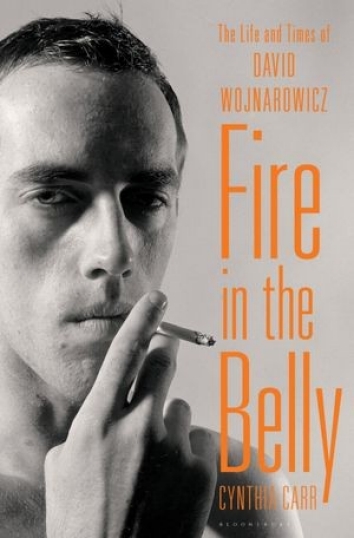
The following interview took place with Cynthia Carr, author of Fire in the Belly: The Life and Times of David Wojnarowicz (Bloomsbury USA, 624 pp., $35), on an early fall afternoon at the old Odessa Restaurant on Avenue A in the Lower East Side, New York City — one of the few places left where you can still pretend you’re in the LES of Wojnarowicz’s day. Carr will be at the San Francisco Art Institute Wed/3 to discuss her book. Read Erick Lyle’s review of the book here.

San Francisco Bay Guardian Your book is the first real biography of David Wojnarowicz. Up until now, the best book on him I thought was that Semiotext(e) book, David Wojnarowicz: A Definitive History of Five or Six Years on the Lower East Side. Your book has a lot of that same feel, the layers and layers of neighborhood detail. But, of course, your book has the advantage of having all of David’s thoughts and perspective on the same events because you have his journals and his correspondence. How were you able to access all of that material?

Cynthia Carr All of his papers are at Fales Library at NYU — all of his journals and the letters he kept. And I did get letters from quite a few other people, like his boyfriend in Paris, Jean-Pierre. At the beginning of the relationship, David wrote to JP at least every other day and later at least once a week.

When I went to Paris I took a scanner with me and back home I printed them out. The stack was like four inches thick! It was filled with information about what he was doing or working on every day. While the journals from those times are mostly about him going to the piers for sex, which he didn’t tell his boyfriend too much about! [Laughs.] The letters, though, are all about where he was living or where he was working, or … really, most of the time, he was looking for work… I was very fortunate to get that.

SFBG How long have you been working on this?

CC Five years. I started in ’07.

SFBG One of the things I think is really great about the book is how you break down the reporter objectivity and place yourself into the narrative. And I think it works because it’s really a story in a way that only you could tell, because it has the rich detail that could only come from an observer who was really here in this place the whole time. What led you to take this on? What was your inspiration to tell the story of David or of the neighborhood through him?

CC Well, David’s last boyfriend, Tom Rauffenbart, actually mentioned to me that he would really like there to be a book about David and that he thought I should be the person to write it. I had written another book and when that came out in 2006, I wasn’t at the [Village] Voice anymore. I was freelancing, which is rough, as you know. And Tom had mentioned this to me, and I thought maybe I should give it a try, writing a book about David.

I wasn’t sure of all the details of David’s life, but I thought it seemed like a compelling life story. Over the years, too, people had questioned “the mythology,” — I mean, people didn’t believe his childhood stories, so I thought maybe there was a mystery there I could figure out. It was a period of time when I had lived in the same neighborhood as David and this would give me a chance to write about the East Village arts scene, the AIDS crisis, and the culture wars of the 80s all in one book, because he was a central player in all of those things.

SFBG In the end of the book, David approaches you and starts to tell you things about his life before he dies. Do you feel like in some way he knew you were a reporter and he was choosing you to do this book?

CC That might be a little too mystical to get credence, but he did open up to me and reach out. He started calling me to come over a lot. He also chose Amy Scholder who will be on stage with me in San Francisco. She was an editor at City Lights and he got to know her and chose her to edit his journals.

SFBG Those last couple years of his life — even though we know how it ends, that part of the book is so full of suspense Because it was amazing to see someone be so driven to do everything they wanted to die before they died and to actually almost do it all! It was really amazing to see how much art he was able to make across so many different media in such a short time.

CC David had tremendous inner strength and very solid will power that got him through all of this stuff. For the last year or really eight or nine months of his life he actually wasn’t really able to work, but he always talked about it. He always wanted to. I describe him as workaholic who had trouble holding a job. He worked constantly.

There was a trip he went on with Tom and their friend, Anita, near the end of his life that I describe in the book. One day, they find David just lying contentedly in a hammock and Tom says, “Look! He’s not working!” Because David was always working. Like, if he was walking with you on the beach, he’d also the whole time be picking up twigs or shells or driftwood that he thought he could use in a piece. It was like that.

SFBG So obviously you were already pretty far along with this when the latest controversy with David’s art happened at the “Hide/Seek” show at the Smithsonian. What were you thinking when that happened?

CC In a way, I liked that it happened because it drew attention to David and a lot of people didn’t know who he was, so I thought it would be helpful for the book. But in another way, it was shocking that he would get back into the news in this absurd way, which was for about 11 seconds of a film that he didn’t even finish that was completely misinterpreted by everybody. I mean, even the art world people who defended David by saying that the film was about AIDS didn’t have it right.

SFBG It was such a weird déjà vu … I first encountered Wojnarowicz as a teen during the era of that culture war controversy. There was his work, the Piss Christ, Karen Finley, Mapplethorpe, of course. That’s when I first heard about a lot of cool art! But I couldn’t believe it was happening all over again. Like, “Are we still HERE?” Not really, I guess, but they are. It’s really incredible.

CC It shows that David still has the power to be a lightning rod.

SFBG Why do you think that is?

CC David was very blunt in both his imagery and his feelings about things. He didn’t pull any punches. He used powerful symbols that are hard to explain as sound bites, so it’s easy for the Right to pick them up and take them out of context.

SFBG Personally, I’ve always felt like David’s writing is more timeless than his art. Some of the art is so linked to the time and place of the AIDS/culture war era that it sometimes seems dated to me, whereas the writing is this beautiful, timeless narrative of the outlaw in America, the outsider. But it was interesting that those artworks from that time and place are still so triggering, so perhaps they are timeless after all.

CC There are certain themes of his that really live on. His work is in major museums, of course.

SFBG You’re doing this panel tomorrow at the Brooklyn Book Festival. What is it? “The Creative City”?

CC Yeah, I think it’s about the 70s and 80s in NYC…

SFBG Here’s the notice: “The Creative City: The 70’s, 80’s, AND BEYOND”! [Laughs] Beyond? That must be like a blank, white space on the map…

CC Right! [Laughs]

SFBG In the past couple years there has been so much nostalgia for the NYC of the 70s and 80s in books and films. It’s coming from all sides. What do you think accounts for all of the interest in this lost time and place?

CC Well, the city has changed so much and the culture has changed so much. I think people look back to the freedom of that era when there was so much more uncolonized space, even in Manhattan, and it was cheaper to live here so people could just come here and try things. There was room to experiment. You didn’t have to make a lot of money immediately. You could just, say, go to a vacant lot between Avenue B and C and put on a performance with a cast of 30 or 40 people and no one would bother you. I saw many things like that then but there’s no way that could happen today. It’s starting to feel like everything has a stricture on it.

Not everybody looks back with longing for those days, of course. And when I look back with longing, I try to remember how dangerous it was then, because it really was very dangerous here. There was more crime, more rats, more garbage…

SFBG The price of freedom!

CC [Laughs] Right! But it starts to look like this golden age of Bohemia because there’s nothing like it now. Everyone’s so spread out. Williamsburg is completely gentrified. There are artists living all over the city from Red Hook, Brooklyn, all the way up to the Bronx. Also, people are starting out in MFA programs and artists are going to graduate school, so it’s a different way of coming up in the art world. David was so uneducated. I was thinking tomorrow on the panel I would read something about the piers. Not just the sex piers but the two art piers where David sometimes painted and took photos. There you had people making this art in this abandoned space with a total freedom and also working with the knowledge that it was not going to last, that it would be destroyed. David loved that part of it.

SFBG That’s one of the most poignant things about the book. David really identified with this idea that the Empire was falling, that the civilization was in ruins. Like the painting he titled, Some Day All of This Will Be Picturesque Ruins. But then it turned out that it was really just his own civilization or community that would soon crumble and disappear. And now a generation later, the inhabitants of this new Lower East Side are walking around on top of this lost civilization that has disappeared without a trace and is buried just under their feet. Could anyone at that time have imagined that the neighborhood would turn into what we have here today?

CC Oh, I think not. It was clear from as early as 1990 that the neighborhood was undergoing changes. The galleries had to leave because the rents were going up. I lived between Avenue A and B and I heard about someone buying an apartment for $250,000 on my block! I couldn’t believe it. But now you have luxury hotels up in the LES and every old parking lot has a high-priced condo on it. But when you’re younger, I guess, you don’t really think about what things will turn into.

SFBG Do you still live in the neighborhood?

CC Yes, I do. I can’t afford to move! I have a rent-stabilized apartment and have been there since the 70s. When I moved in there was only one bodega between Houston and 14th street on Avenue A – that and the Pyramid Club. Before that I lived between Avenues C and D, and people wouldn’t come over to visit me.

SFBG Where do you think your book fits into this flow of books full of nostalgia for that era, then? To me it’s almost a corrective to the nostalgia, since it’s not romantic at all. It shows the struggle and loss that happened from there to here.

CC I don’t know that those other books really went into what happened in the AIDS crisis. The AIDS epidemic is a shadow that was behind the East Village arts scene the entire time right from the beginning and no one knew it. I found news stories about people coming down with Kaposi’s Syndrome as early as the late 1970s. It was starting to spread then and no one knew it. And the people that died from AIDS were the biggest risk takers, the people who were most creative… the people who had the biggest impact on the arts scene. Losing all those people changed the world for the worse.

SFBG So, the building where David lived his last few years and where he died was his late best friend, Peter Hujar’s loft. Am I right that Hujar’s loft is now that multi- screen movie theater on Second Avenue at 12th?

CC Yeah.

SFBG Have you been to see movies there?

CC Oh yeah! It’s really weird! I haven’t seen a movie there in a few years, but I do think about, about David dying right upstairs. I’ve been told that the loft is now an office space. The first time I went to the theater part of the building was for Charles Ludlum’s memorial service. It was still being converted then from an old Yiddish theater into the cinema multiplex. It’s been a couple years, and I can’t remember what I saw there last, but, sure, I’ve gone to see films there.

SFBG Where was David’s room in the building? It’s such a strange layout for a theater.

CC Well, he was up on the Third floor. There are windows shaped like Old West tombstones that face 12th street and that was where his kitchen table was, where he sat and worked. Recently, I was thinking that out of all of us who were there taking care of David in those last months, none of us took a picture of the place. I wish now I could remember what all the piles of stuff were, because David was just such a pack rat. There were piles not just of art projects and supplies, but piles of paper, The NY Post — he liked using the tabloids in his collage pieces…

SFBG That Nan Goldin photo in the book is so great. What is he sitting with here? Like are those giant sperm?

CC Yeah, they are sperm — homemade props from his In the Shadow Of Forward Motion performance. And there is his baby elephant skeleton. And some movie posters he must have brought back from Mexico…

SFBG Well, let’s talk about David and San Francisco. For such a noted queer artist and activist, he seems to have surprisingly limited connection with San Francisco. But he did make it to the city a couple of notable times, right?

CC One of his early goals in life was to go to City Lights Books and he actually took a bus all the way across the USA just to go there.

SFBG Well, he’s not the only one. That’s so great!

CC And when he took this early hitchhiking and rail-riding trip in 1976, he went to SF and stayed there at the YMCA in the Tenderloin for awhile. He liked San Francisco.

SFBG Did he also appear at the SF Arts Institute?

CC I believe he performed In the Shadow Of Forward Motion there. But he also did a reading for Close To The Knives in SF at the bookstore, A Different Light. That was the only reading he did for that book tour. His first idea was to drive across the country and do readings here and there, but he just wasn’t feeling well enough. So he decided he would only do one reading and it would be in San Francisco. That same day, he joined in a march about AIDS awareness in SF.

SFBG What do you think is next for you?

CC It might be time for me to move my work out of the East Village. My first book was a collection of my Village Voice articles and now there’s this book, so maybe I’ve told all of my story here. I got so exhausted with this. I really worked every single day except Christmas Day, working around the clock, and I got really depleted. So I’m recovering from all of that work.

SFBG Well, that work really paid off! This book is very special. Is there anything you want to add to this?

CC Well, one thing I’ve noticed is that reviewers tend not to talk about the love stories in the book. The importance of Peter Hujar and Jean Pierre to David. And Tom Rauffenbart. And maybe it’s natural that people focus on the art and the AIDS crisis. But the love stories are to me really important.

SFBG I got that from the book. His life was so improvised. He never reached a place of safety or security where he had the luxury of saying, “OK, here’s what I’m going to do next.” It was like he was reacting all of the time to whatever came up. He had difficulty trusting in the future or in relationships with other people. I think all of that is common with people who have abuse histories and I think you got that across.

CC Yes, he always reacted to stuff. Like he found an obscene drawing on the street where someone had scrawled “Fuck you, faggot fucker!”. So he used it in a painting and based a whole work around the drawing and called it Fuck You Faggot Fucker! He was always responding. The things that troubled him became the subject of his work. That is what inspired him.

David Wojnarowicz: Cynthia Carr and Amy Scholder in Conversation
Wed/3, 7:30pm, free
Lecture Hall
San Francisco Art Institute
800 Chestnut, SF
www.sfai.edu/event/CynthiaCarr

Separated bikeways on Oak and Fell finally up for approval

17

After three years of delays and broken promises, the fate of a dangerous but vital bike route in San Francisco will be decided on Oct. 16. Oak and Fell streets, one of the few major east-west byways in the city, carries tens of thousands of cars each day, according to the San Francisco Municipal Transportation Agency. Right now, there is no bike lane on Oak, and the stripes on Fell are only two feet wide with no buffer, putting cyclists inches from heavy traffic.
But all that could change. If the transit agency gives it the green light, the perilous Oak-Fell corridor between Scott and Baker will gain needed concrete barriers and wider bike lanes, according to SFMTA spokesperson Paul Rose and bike advocates.
“This has been a long push,” said Leah Shahum, president of the San Francisco Bicycle Coalition, a vocal advocate of the project.
If passed, separated bikeways, crosswalk enhancements, traffic signal timing changes, and parking mitigation measures would be installed by the end of 2012, Rose said, and construction of bulbouts and a concrete bikeway barrier would be put in by the summer of 2013.
The project has met repeated delays, despite Mayor Ed Lee’s promise that it would be done by the end of 2011.
A section of the major bike route “The Wiggle,” its the only game in town if you’re a cyclist who wants to cross the city from east to west. But not everyone favors the fix.
Blogger and anti-bike activist Rob Anderson, who sued San Francisco for not performing proper studies on bike lane projects in 2005, calls it a slap in the face to people who must drive to work.
“It shows no sympathy or understanding for working people in the neighborhood,” Anderson said. He bemoaned the loss of parking as particularly harmful to residents in the area, which would lose 35 parking spaces, according to SFMTA data. “It’s all about making cyclists comfortable.”
Shahum agrees with Anderson on that point, arguing that’s the best way to encourage more people to get on a bike. “Poll after poll, survey after survey say that the biggest deterrent to biking is safety,” Shahum said. Its not just about the accidents, it’s also about people perceptions.
If the bike lanes were more safe, more cyclists would ride them, Shahum said. This would pave the way towards San Francisco’s goal of increasing bike ridership to 20 percent of trips made in San Francisco by the year 2020, which is enshrined in legislation passed by the Board of Supervisors two years ago. Currently, about 3.5 percent of bike commutes in the city are by bicycle, a 71 percent increase from 2005, according to the city’s “2012 State of Cycling Report.”
One San Francisco politician says that the city wasn’t pedaling fast enough on the redesign. District 5 candidate Christina Olague sent a letter to the SFMTA two weeks ago urging the transit agency to pick up the pace and break ground by year’s end. That may have been a factor in SFBC’s subsequent decision to give Olague it’s top endorsement, with Julian Davis gets its number two spot.
Shahum said the SFBC plans to turn out its members on Oct. 16 to ensure passage of a project it has sought for years: “We can breathe when it’s over.”

SFBC keeps its distance from Critical Mass anniversary ride

27

Today’s 20th anniversary Critical Mass ride has received overwhelming media coverage in the last few days, including a surprisingly laudatory editorial in yesterday’s Examiner, so people are expecting the ride to be huge. But the talk of last night’s CM20 birthday celebration at CELLspace was about Quintin Mecke’s widely circulated letter blasting the San Francisco Bicycle Coalition for refusing to even put the event on its calendar or in its newsletter.

By contrast, even the San Francisco Planning & Urban Research Association (SPUR) – founded and funded by downtown players with little love for Critical Mass – listed today’s “special anniversary ride” and related events throughout the week in its calendar and on its newsletter, recognizing this “monthly bicycling event that began in San Francisco and inspired similar events throughout the world.”

As I wrote in this week’s cover story, SFBC and Critical Mass grew up together on a similar, symbiotic trajectory, effectively working an outside/insider strategy (think MLK/Malcolm X) that has won cyclists a recognized spot on the roadways. But SFBC always warily kept its distance from Critical Mass, worried about offending politicians, the mainstream media, or the driving public.

That’s an understandable strategy, given the persistent resentment many feel toward Critical Mass. But when considered in combination with SFBC’s increasingly corporate culture and sponsorships and its controversial recent decision to allegedly overrule its member vote in its District 5 supervisorial endorsements, SFBC is in danger of losing the allegiance of much of the cycling community (which remains a minority of road users, and thereby political outsiders almost by definition).

David Snyder — SFBC’s executive director through its biggest growth period, SPUR’s former transportation policy director, and currently the executive director of the California Bicycle Coalition — is reluctant to wade into the current controversy, but he does acknowledge the important role Critical Mass played in winning political acceptance for cyclists in San Francisco. 

“In the mid-’90s, when the San Francisco Bicycle Coalition was a couple thousand members, the brouhaha around Critical Mass [particularly the crackdown in ’97] increased our membership by 50 percent at one point,” Snyder told us. “At that time, we benefitted hugely form the attention Critical Mass paid to safe streets for bicycles. And I don’t think we need Critical Mass to do that anymore…The Bicycle Coalition’s goal these days isn’t to develop an awareness of unsafe streets, it’s to develop a bold agenda to fix them.”

I spoke with Mecke, who finished second in the 2007 mayor’s race, at last night’s event, and he was frustrated by his follow-up conversations with SFBC leaders, who seem to have taken a very defensive posture instead of welcoming this interesting conversation. I called SFBC Executive Director Leah Shahum to discuss these issues, and I’m waiting to hear back from her and I’ll update this post when I do.

But in the meantime, to feed the discussion, here’s the full text of Mecke’s letter, followed by another letter to SFBC on the endorsement issue:

Dear Bike Coalition:

Sadly, I can’t say I was surprised when I read this week’s SFBC Newsletter and found absolutely zero mention of the 20th Anniversary of Critical Mass.  According to your own newsletter, apparently the only thing happening in the San Francisco bike world that is worthy of your 12,000 members knowing about on Friday, Sept. 28 is SFBC’s Valet Bike Parking at the DeYoung Museum.  Seriously?

This is the San Francisco Bike Coalition and you couldn’t even bring yourselves to stick a small mention of Critical Mass in your newsletter or on your website (or god forbid you actually celebrate/acknowledge CM and show some pride), a cycling event created here in San Francisco which has spread across the globe to multiple continents since its inception & inspired thousands of cyclists to take to the street?  It’s truly amazing that Critical Mass was on the cover of the Guardian this week and even SF Funcheap listed the event but SFBC wouldn’t even put a mention at the bottom in the “Upcoming Events” section, hidden away amongst all the SFBC sponsored events? Not even a listing of the critical mass website or the community events going on all week long?  Your website lists the celebration of the 15th anniversary of TransForm but not Critical Mass?

Wow.  I’m truly speechless.  How embarrassing but more to the point, how sad. Are you afraid of offending Chuck Nevius or Mayor Lee? I don’t know how, why or what SFBC has become as an organization at this point but it’s disappointing as a long time cyclist to see the city’s only (?) organized bike advocacy organization which continually touts how many members you have to not even show the smallest amount of solidarity to your fellow cyclists and to the city’s own cycling history.  That being the case, history will march on without you.

Contrary to our “biking” Supervisor David Chiu’s comments in today’s Chronicle (I always enjoy politicians running from anything deemed controversial), it’s actually SFBC that is simply one tiny part of a much larger movement made up of a variety of cyclists from all walks of life whose decision twenty years ago to ride freely in the street once a month for just a few short hours has laid the groundwork for cycling reforms, political action and transformative experiences across the country and the world.

What a shame that instead of celebrating all parts of the cycling community, SFBC has decided to distance itself from the historic roots of its own community in the name of moderation, families on bikes and political expediency.

Enjoy Bike Valet night at the DeYoung Museum, it sounds like an awesome event.

thanks,
Quintin


Dear Leah:

My name is Gus Feldman. I am an avid bicyclist, a Bike Coalition member, and the President of the District 8 Democrats.

I’m in receipt of a letter from you, dated September 12, 2012, requesting that I renew my SFBC membership. I am writing to inform you that I will only renew my membership if the SFBC Board of Directors publicly releases the results of the SFBC member vote for the District 5 supervisor race.

While it is clear that the membership vote is one of several factors used by the SFBC Board of Directors to determine endorsements, the refusal of the Board to grant SFBC members the ability to see the results of their votes demonstrates an unacceptable degree of secrecy. By withholding this information, the Board is publicly stripping SFBC members of all agency in the endorsement process.

If in fact the popular suspicion is true – that Julian Davis won the most votes from SFBC members, but the Board decided to grant Christina Olague the top endorsement in the interests of expediting the construction of separated bike lanes on Oak & Fell streets – we would greatly appreciate the Board publicly declaring and explaining the decision. Such a decision is certainly logical, as the Oak/Fell bikes lanes are a key priority for many SFBC members. The fact that the Board has elected to conceal the vote results, as opposed to explaining to SFBC members why and how Olague received the number one endorsement, is highly insulting as it insinuates that the Board does not have faith in SFBC members’ capacity to understand the rationale by which the Board arrived at their determinations. 

Please understand that if the Board elects to depart from the current practice of concealing the vote results, and transitions to one of transparency, I will promptly renew my membership.

Respectfully,
Gus Feldman

In FiDi, a Turkish gem

3

virginia@sfbg.com

APPETITE With the Guardian’s recent move to the Financial District, I’ve frequented downtown haunts, returning to old favorites, discovering new gems. Humble, tiny spaces like La Fusion (475 Pine, SF. www.lafusion-sf.com) delight with Peruvian-influenced Nuevo Latino dishes, including rotisserie chicken and warm bread salad, vivid ceviches, cinnamon-clove inflected sangria, and fried empanadas dipped in huacatay sauce and piquillo pepper aioli. However, the biggest standout of new FiDi dining spots has been an upscale Turkish restaurant, Machka.

Walking up to Machka, directly across from the Transamerica Building behind a line of motorcycle and Vespa parking, you feel as if you’ve stumbled upon a chic cafe in Rome. In fact, Machka is Turkish, with a brick-walled dining room with massive chandelier, whose lighting casting an appealing glow on fellow diners, while a flat screen plays classic Turkish films, like Kirik Plak (1959), visible through a glass wall from inside the restaurant.

Machka was just opened in July by lawyer Farshad Owji and his wife Sibel. The chef is Reynol Martinez, who served those delightful duck confit tacos and some of SF’s best fish tacos at Potrero Hill hidden gem, Papito. (He also cooked at Globe, Aperto, and Epic Roasthouse.) Service is one of Machka’s strong suits, including the professionally engaging warmth of Jessica — who was a server at Nopa — or Gulhan, who recently moved here from Turkey, his gracious hospitality setting a familial tone. P.S. he’s also an inspiring reader of Turkish coffee grounds.

Starting with the SF standard — locally sourced, mostly organic ingredients — one journeys to Turkey in rare form. Although there have long been hole-in-the-wall treasures like A La Turca in the Tenderloin or the Mission’s mid-range Tuba, the Turkish list has been short. Machka fills a gap, faring well with both traditional and creative Turkish. In the meze-starter realm, pistachio-crusted goat cheese ($11) is easy to lap up. Spread the subtle, soft cheese, crunchy with pistachios, over toasts, sweet and savory with caramelized onions, golden raisins and wildflower honey. There’s only a handful of lamb tartare dishes in town (Gitane’s being one of the best), and Machka’s version ($13) is brightly gratifying, tossed in mint, grainy mustard and argan oil, with haricot verts.

Tender, grilled octopus ($13) is mixed with chickpeas and celery, doused in lemon and olive oil — it’s a delicate smattering of celery leaves that adds a garden-fresh aspect to my favorite invertebrate. Blue cheese and chorizo-stuffed dates ($9) are a crowd-pleaser, particularly wrapped in pastirma (Armenian cured beef) in a sherry wine-mustard vinaigrette. The only missteps seemed to be a bowl of fava beans ($10) which sounded like the ideal veggie dish, mixed with English peas, snap peas, cilantro, mint, sumac in lemon and a smoked paprika vinaigrette, but was surprisingly bland. A traditional fattoush salad ($11) was likewise humdrum, a mere couple tomatoes, cucumbers and pita crisps unable to bring the greens to life.

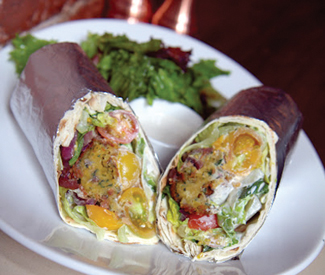
On the entree side, I crave the durum (flatbread) wrap ($12) to-go when I don’t have time sit down and savor the restaurant’s soothing setting. I love the falafel wrap (also available as a $9 starter), laced with cacik (light, seasoned yogurt), pickled cucumber, lettuce, grilled red onions, bell peppers, cherry tomatoes, and tahini sauce. The elements weave together into the ideal wrap: fresh, textured, filling — also available with chicken, lamb or beef. Speaking of lamb, Machka does it right: as a burger ($15), curry-marinated in a kebab over rice pilaf (one skewer $13, two $26), or in my top choice, a marinated ground beef and lamb sausage, the adana kebab.

Chef Martinez displays vision in entrees like a seared branzino ($25). The flaky fish is interspersed with roasted fennel and cherry tomatoes, which taste like another glorious fruit altogether — sweet, sour, fantastic — roasted in a balsamic pomegranate reduction. It’s an elegant entree that takes an unexpected turn with the tomatoes.

The wine list ($9 for a five ounce glass, $14 for eight ounce) includes interesting Turkish wines, like an acidic, zippy 2010 Kavaklidere Cankaya Emir from Ankara, and from the same producer, a balanced, fruity red: 2011 Kavaklidere Yakut Okuzgozu. Another wine that worked well with starters was a tropical fruit-laden 2011 Pinot Gris from New Zealand, The Ned.

You couldn’t do better than a dessert of kunefe (or kanafeh, an Arab cheese crusted in shredded pastry, often phyllo dough — Jannah in the Western Addition also makes a beauty of a version). Soft, white cheese oozes from crisp, shredded phyllo soaked in honey and rosewater syrup, a finish sweet and satisfying as the overall experience in this latest Turkish respite.

Matchka 584 Washington, SF. 415-391-8228 www.machkasf.com

Subscribe to Virgina’s twice-monthly newsletter, The Perfect Spot, www.theperfectspotsf.com

Roll with it

0

le.chicken.farmer@gmail.com

CHEAP EATS They said it would smell like a hamster cage. And it did, but we persevered. Our instructions were to go all the way to the back of the restaurant — past the cash register and past the kitchen, where there was another, much pleasanter room that did not smell like a hamster cage. And it didn’t.

It was a whole, secret, new favorite restaurant back there. With couches, plants, and wooden chairs with heart cutouts in the back. The floor was concreted river stones; small, pretty, shiny ones that I thoroughly enjoyed both walking on and looking at.

Hedgehog said it felt like a former Home and Garden Center, which was probably a pretty good guess. We sat at the table closest to the bookshelves, and she picked something out to read while we waited for our vermicelli.

My Milk Toof, by someone with a good sense of humor and a lot of time on her hands. She poses and photographs two kinda cute “baby teeth” named Ickle and Lardee into a comic strip. Now, I’m not a book reviewer, but Hedgehog was still reading their little tiny adventures, often out loud, even after our vermicelli bowls were served. So . . .


CHEAP SPORTS


By Hedgehog

Since I was going to be watching Chicken Farmer third-string quarterbacking Sunday morning and be at Candlestick for the 49ers home opener Sunday afternoon, I really wanted to write about baseball.

Unfortunately, none of the baseball players I tweeted questions to got back to me. Which is a shame, because I really did want to know Brandon McCarthy’s favorite restaurant and Omar Vizquel’s views on same-sex marriage.

Even though I wasn’t going to say anything about football, I will say this: Chicken Farmer’s team was short a player and had no subs the entire game and they still won by one point! Of course, I didn’t know what the score was until we were walking back to the car, but even when I thought they had lost, I could tell it was a real good game.

Also: there are more assholes per square foot attending professional football games than there are at professional baseball games. Even at the $2 A’s games. But watching football live is enjoyable (excepting for all the other people doing it, too) and it was only partially humiliating to walk around the parking lot for three hours beforehand, stumping for donations for the Children’s Book Project with a Dr. Seuss hat on.

Moving on to more important matters: I am pleased to report that the Mission Playground reopened last weekend, all but the pool (which they say will be ready in December — perfect timing, since it’s an outdoor jobbie). I am not pleased to report that the food trucks promised to be in attendance in the adverts were gone by 2pm, when Earl Butter and I finally made our collective way over there. In addition to the kiddie areas, there is an artificial turf soccer field, two tennis courts, and a basketball court. So now you know where to find us.

There, or the Mission Rec Center, which has free racquetball and ping pong, and where there is a women’s boxing class I wish I could take being taught by an Olympic lady boxer. Boxerette? Boxer ladyperson.

Cheap Eats, cont.

Pugilista, I believe, is the word she was looking for.

Our vermicelli bowls, lemongrass chicken for her and grilled pork for me, were top-notch ‘uns, with plenty of crisp lettuce, carrots, red onion, basil, cilantro, and peanuts drenched in a red-peppery fish sauce dressing. Oh, and one sliver of not-hot jalapeno.

Oh, and the meat was delicious. Juicy and just perfect.

Mysteriously, we had also ordered an order of spring rolls. Maybe because we were too hungry when we first came in. But the thing is, the spring rolls are essentially the contents of the vermicelli bowls, only wrapped in rice paper. Equally excellent, but redundant.

They also have banh mi and noodle soups. Awesome food, nice people, and a really cool place, once you get past the hamster cage.

KIM’S CAFE AND SANDWICHES

Mon. 9am-7pm; Tue.-Wed. 10am-7pm; Thu.-Sat. 9am-8pm; Sun. 9am-6pm

1309 Solano, Albany

(510) 525-7899

MC,V

No alcohol


The real McGee

0

caitlin@sfbg.com

STREET ART Gone are the days when Barry McGee, or Twist, or Ray Fong, or whatever alias he happened to be painting under at the time, stalked the San Francisco streets throwing up 3-D screws, Clarion Alley stunners, and his much-admired tags. Nowadays, he exhibits in big-deal gallery shows, like his mid-career retrospective that opened to much fanfare at the Berkeley Art Museum and Pacific Film Archive on August 24.

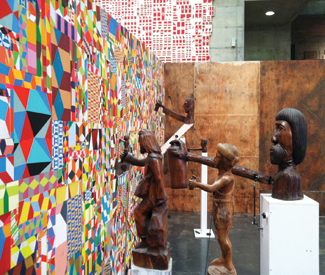
BAM/PFA devoted a space the size of a downtown parking garage to McGee’s works, which have ballooned in size as the years go on. Walls literally bulge with clusters of photos and drawings, a homage to the multifarious chorus of the street. A four-pack of dummies from his show at Pittsburgh’s 55th Carnegie International perch on each other shoulders, the uppermost’s arm mechanically waving a spray can. Look, an upended white van! Curator Lawrence Rinder had “no idea” how McGee and his henchmen managed to fit the vehicle into the gallery, as Rinder told a passel of press types at a media preview.

Recently-completed behemoth wall of his patched acid tests in Brooklyn notwithstanding, McGee is the poster child for decades-old genre of “street artist” — those who may have gotten started on the street, but now focus their creative oeuvre on recreating street art-style works indoors.

You’ll never miss the graffiti cultural reference at the retrospective — outside BAM/PFA, tags covered one wall of the museum (“SNITCH” the faker said, tricking me for a moment into thinking that someone had beef with McGee, which would be heresy in these parts) and its glass front doors.

This juxtaposition may be the main thing that keeps McGee’s art interesting. Small tropes impregnate the Berkeley retrospective: on one red wall McGee’s buffed his own work, then overlaid it with blank speech bubbles. Creation, censure, empty creation — it’s the weird feedback loop of his gallery-street life encapsulated.

“I appreciates his early stuff more than the esoteric stuff he’s doing today,” says muralist Sirron Norris when I call him at his Valencia Street studio to talk about McGee’s influence. “That stuff just goes right over my head.”

Norris moved to SF in 1997. Initially a commercial artist, “I was just blown away by the fact that there were cartoons in museums and galleries, and that was because of Barry,” he said. “I thought, I can do that.” McGee and his partner Margaret Kilgallen were instrumental in Norris’ decision to paint his now-signature blue bears and Victorion anti-gentrification Transformer on walls in the Mission and Western Addition. (Catch his most recent, whimsical mega-wall, info in this week’s rundown of our favorite Bay Area murals)

“He was doing something different.” Susan Cervantes co-founded Precita Eyes Mural Arts in 1977, and since then has been at the nexus of community mural-making in San Francisco and the Mission. The kind of murals that Precita Eyes sponsors tend to more neighborhood, family-based than McGee’s works, which even then smacked of high art potential (or were they high art already? A graduate of the SF Art Institute, the “street artist cum gallery artist” cliché was never apt in describing McGee.) Cervantes has known him since before he got into street art, and once he started on her neighborhood’s walls, she says his influence on other artists was undeniable.

“He showed us another way of seeing the world around us,” she tells me in a phone interview. “There’s things that have more content in them than just doing your name, or doing different styles of lettering.”

Looking around at the murals in the Bay today, the possibilities McGee exposed us to are evident. But I wonder sometimes who is becoming inspired by his gallery works, or those of other “street artists” who have found a way to support themselves in the art world. Are there baby taggers out there who are having their minds blown by this street-gallery mashup, who see possibilities for the once-and-sometimes-subversive art, not just increased the potential commercial viability?

Well anyway, I sure hope so.

BARRY MCGEE

Through Dec. 9, $9.50 museum admission

Berkeley Art Museum and Pacific Film Archive

2626 Bancroft Way, Berk.

bampfa.berkeley.edu


Pagoda madness

18

culture@sfbg.com

LIT Either I’m terrible at parking or Philip P. Choy was exactly the right person to author his recently-released San Francisco Chinatown: A Guide to Its History and Architecture (City Lights Publishers, 184pp, $15.95). We find a spot for my car in a well-hidden lot, tucked into an alleyway behind the Chinese Historical Society of America. It’s the first sign of the day that Choy’s knowledge of the area goes beyond tea shops and Peking duck.

“Chinatown…” Choy pauses as we stand outside a sidewalk stall whose owner angrily mutters at us (we’re blocking pedestrian traffic by hovering over his dried sea cucumber display.) “Chinatown is real. There are people here living, relying on Chinatown.”

Choy’s newest publication is not just a faithful retelling of the enclave’s social and architectural history. The book goes out of its way to dispel the stereotypes and fanciful constructions of the neighborhood that the outside world maintains. Choy was born in Chinatown, and as a co-professor of the first collegiate level class in Chinese American history at San Francisco State, he’s well-qualified to tell its story.

With apologies to our embattled shopkeeper, we continue to examine the cukes, first brought to the neighborhood via 1800s trade routes between China and the US. We move past other stalls while Choy points out the historical importance of their wares.

He shows me sandalwood, traditionally burned in Chinese temples, and ginseng root, which had been harvested by Native Americans but became a staple Chinese delicacy.

Choy tells me that the Chinese — who were not-so-charmingly called “mongols” around about 1840 — have suffered alongside Native Americans and other people of color throughout our country’s history, enduring ghettoized living situations and sub-par educational offerings.

As Choy and I wander Grant in search of the infamous pagodas that were built after the 1906 earthquake, we take a small detour up the hill to peek at Gordon J. Lau Elementary School. In the late 1800s a Chinatown father sued the city when his daughter was barred from attending other schools. Though the Supreme Court ruled in his favor, the school district opened the originally-named Chinese Primary School rather than integrate. 

We pass quickly by an East West bank, which was once the home of the first San Francisco paper, the Star. Around the corner stands a cheap retail center, originally the Mandarin Theater, a cultural and artistic mecca for neighborhood residents. Its once-lavish stage now serves as a platform for garish home decorations, its grand balconies now providing seating only to building debris.

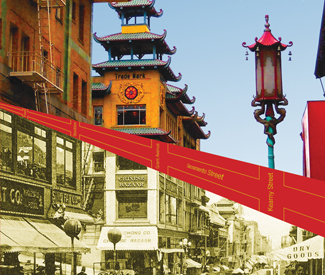
Our whirlwind tour ends at the pagoda building Sing Fat, nestled at the corner of Grant Avenue and California Street. It was erected by the San Francisco Chinese Chamber of Commerce and prominent merchants in a post- 1906 earthquake attempt to repackage the once-funky Chinatown as an ornate, prosperous “oriental city.”

But Sing Fat’s pagodas are actually what Choy (an architect himself) calls a “Disneyland approach” to Chinese architecture: unstudied, inauthentic. The only legitimately Chinese quality of the structure is its green, yellow, and red color motif.

“Does any truly, authentically Chinese institution or edifice exist in Chinatown?” I ask, sidestepping tourists to keep up with Choy, who navigates Stockton Street with shocking deftness.

Choy reaches a hand out to avoid my death-by-delivery-truck and laughs. “Doesn’t exist.”

That’s because Chinatown is first and foremost a Chinese American town. And for all its perceived exoticism, the neighborhood has been around since almost the beginning of San Francisco.

Such is the beauty of Choy’s book. It retells a neighborhood’s story that’s too often render mythic by rumors money-hungry tour guides and ignorant outsiders. San Francisco Chinatown illuminates the untold history of the enclave, urging readers to consider its quiet alleyways and SROs housing six people just above the busy streets. The book wants you to consider the political, historical, and cultural implications of Chinatown’s very existence.

Says Choy of the generations who lived in this neighborhood, “they were pioneers of the city. They did more than just open laundries.”

PHILIP CHOY: SAN FRANCISCO CHINATOWN

Oct. 7, 1pm, free

California Historical Society

378 Mission, SF

www.litquake.org


Oct. 27, 11am, free

San Francisco Public Library

100 Larkin, SF

(415) 437-4844

www.sfpl.org

Homeless camp raided

41

California Highway Patrol police, San Francisco police, Cal Trans workers, Department of Public Works, and workers from the mayor’s Homeless Outreach Team descended today on an encampment on Fourth and King.

Yesterday, 40-50 people lived on the sidewalk and under the freeway overpass next to the Caltrain tracks. The encampment had tents, mobile units, and other makeshift housing. One group of residents had a large tent with a well-maintained garden in the front yard.

Another, a woman who several residents said suffered from mental illness, had built a home out of metal that looked like parts of carts, wood, sheets and mattresses. After about four hours this morning, most other residents were moved out of the camp, but she remained, moving and packing suitcases. After Homeless Outreach Team members, police, workers, and humanitarian volunteers approached her, she took a single suitcase and walked to the sidewalk, then sat and watched as her other suitcases, mattresses, and the structures that constituted her house were thrown into a garbage truck.

The eviction began around 8am. Some residents said they were told they could take with them only what they could carry or, if they had something wheeled like a shopping or bike cart, what they could push. Others said they hadn’t been told one way or another what they could take, just that they had to get out.
 
The items in the dump trucks, said CHP Officer Sarah Wrathall, is “the stuff they said they don’t want.” Wrathall said people were given the chance to keep whatever they wanted to, and that items they wanted to keep but could not carry would be stored and tagged for retrieval later.

Jamie Crisco, a resident of the camp who was moving out, said that this was an unusual eviction. “There isn’t usually this dog and pony show,” said Crisco. A large amount of media was present at the eviction.

“Usually they will tell people to get out, and people will start packing. And in the process the workers will come and start taking stuff and throwing it away,” said Crisco, a veteran who had been living in a small trailer for a year.

“I don’t understand that,” added Crisco. “You’re creating a criminal element when you do that. You’re putting people in a position where they have to steal to acquire what just got taken from them.”

According to John Gallagher, an organizer with the Coalition on Homelessness who did outreach at the encampment before it was evicted, trash was pushed safely to the side and the camp was clean and peaceful before this morning’s “clean up.”

“We’re respectful, we’re quiet. Honestly, we keep this area cleaner than they ever could dream to,” agreed one person who was staying in the camp.

Wrathall described a very different situation, saying that the area under the overpass had amassed trash, waste and rats.

She said that the eviction was based on complaints from neighbors and other residents.

“People have a right to complain if they can’t walk down the sidewalk to get to Caltrain,” said Wrathall. She said that some people feared the dogs that lived in the camp.

She said illegal lodging and trespassing was reason enough to evict the camp’s residents. “It doesn’t have to be any other kind of crime.”

No citations were issued this morning.

Camp resident Margaret Stallings said that the camp was very peaceful and neighbors walked on the sidewalk and parked their cars in the adjacent parking lots without issues.

“This is a dead end street,” she said. The area under the freeway is out of the way of most city life and, according to Stallings, “Some people have been underneath there for eight years.”

In an outreach report written based on Gallagher’s observations, he stated that “This camp is so peaceful that I saw more that four people on their way to work walk unafraid right down the middle of camp.”

Patrice Perkins, who had been living in the camp for two and a half months, said that the encampment’s location was relatively tucked away. He expressed frustration that many of the residents will be pushed out towards other parts of SoMa and downtown.

“We found a place where you’re not in public. We’re not bothering anybody here,” he said. He pointed out the no parking signs along the street.

“See, no parking. It’s not being used.”

His neighbor in the camp, James Belcher, said that the eviction was causing him to miss two classes at Laney College. “I missed Civil War History this morning, and I’ll miss math at 10:30,” he said. Belcher said he has been studying for a few solid semesters and earning good  grades while looking for work, but struggling, based in part on issues associated with being a disabled veteran.

“It’s difficult for me to study in this little tent and stay in school,” he said.

One resident, who said she provided first aid at the camp, shared disinfectant wipes with a DPW worker when he expressed a need for them.

One of the city’s stated concerns with the camp was the presence of children, and in Gallagher’s outreach statement he said at least two children lived in the camp. None were present this morning, and Wrathall said that in her previous visits to the camp, she hadn’t seen any.

“I’ve never seen kids here, but if I did, I would take them to CPS [Child Protective Services]. Of if they’re older, 16 or 17, I would connect them to services like Huckleberry House. I would never walk away from someone who is 18 or under in the encampment. Its not safe,” she said.
 
“Homelessness is not a crime. People are afraid for the public to see their children because they will be taken away from them. And for what, the crime of being poor?” said Gallagher.

The Homeless Outreach Team secured rooms for several of the people who were evicted, including Stallings and Crisco.

“They’re housing me. I’ve been waiting on the VA list for housing for four and a half years,” said Crisco. “I’m a combat vet. I used to be a business owner. But life does things to you. Ends up putting you in places you didn’t plan on being.”

Crisco said he was happy to accept the room, but frustrated in general with the way the homeless are pushed around.

“I’m only human. I can only take so much pushing and prodding,” he said. “Sometimes, someone’s going to snap. And they’ll say, it’s the drugs. They never say, maybe it’s us. Maybe its what we’re doing to them.”

Is it Saturday yet? 5 (vegetarian-abled) Street Food Festival snacks we can’t wait for

0

The Bay’s press has been salivating ever since July 26, when La Cocina‘s Street Food Festival hosted a passel of media types at Fort Mason Center with tables upon tables of the snacks that we’ll all get to freak out over at the festival on Sat/18. Read on for some of our favorite snacks that we’re having a hard time holding off on until Saturday.

Bonus! If mornings aren’t your deal, you’ve got options this year. On Fri/17, you can jet down to the Alemany Farmer’s Market for the fest’s Night Market. 25 vendors will be selling sub-$10 treats, including American Masala Farm’s Suvir Saran serving up Indian food, Ryar Farr from 4505 Meats, and Tijuana’s Javier Plasencia of Mision 19. Plus, craft beer and cocktails.

>>CLICK HERE FOR THE COMPLETE STREET FOOD FESTIVAL MAP

Go early on Saturday. Lines for vendors, which range from La Cocina participants who have hardly sold commercially before to some of SF’s hautest eateries, tend to be pretty long by lunch time, and this is one fest that does not award the fashionably late. You’ll also be able to pick up a paper copy in the Guardian on newsstands today. Here’s some treats you’ll wanna queue up for as soon as you fall out of bed, veggie-friendly all. We dare you to do all five — tweet their photos to @sfbg if you do and we’ll figure out some kind of reward for gluttonous you. 

1. El Buen Comer esquites

Something about corn, cheese, and mayo soup sounds vaguely unsettling, but take it from an avowed mayonaise h8r, these are cups of pleasure and you want at least one. La Cocina graduate Isabel Caudillo makes them, bringing this Mexico City recipe straight to SF bellies. Perfect if Saturday gets chilly (please no.)

2. Chiefo’s Kitchen moi-moi

Chiefo Chukwudebe makes these West African firm cakes made of pureed black eyed peas, topped with tomatoes, onions, peppers, and carmelized onions. The deliciously chewy version that was being sampled at Fort Mason was topped with flakes of corned beef, but vegetarian versions were available. 

3. Hella Vegan Eats pad thai egg rolls

The plucky Tiffany and Sylvee Esquivel of this rad catering outfit didn’t give their Street Food Fest offering quite as catchy a moniker as some of their repetoire (“vegans are better lovers” lasagna comes to mind), but no matter — this Asian-inspired nuggets are the kind of stoner snack you normally only dream of. Noodles inside egg rolls? *Eyes roll back into head, Homer Simpson-scruff sprouts instantly* Much props to these ladies for the hundreds of free vegan cookies they baked for the Dyke March this year, by the way. 

4. Clairesquares‘ deep-fried caramel pop

One quibble about these devilish, gooey, troublesome-in-a-good-way dessert snacks — is that spear in the center really necessary? After all, the first time you crunch into one the thing is going to require two hands so that it doesn’t fall off the wooden skewer onto the — NOOOOOOOOO! — ground. That’s not what you want, so this is your official reminder to pay attention to sugar bomb of satiation. Clairesquares is the brainchild of Ireland’s Claire Keene, who re-interprets traditional recipes into decadent desserts that have popped up all over town in the last few years. 

5. Sweets Collection artisan Jello shots

I went on the record last year over how much I love these things. Nothing combines a love of pastels and a love of getting drunk more than Rosa Rodriguez’s mouthfuls of booze and condensed milk flower. They are magic, and you can find them at the Street Food Festival bars, waiting for you cheefully when you’re done eating the fest’s more nutritious options. 


Street Food Festival Night Market

Fri/17 6-9pm, $25 entry

Alemany Farmer’s Market (free shuttle leaves from 25th St. and Mission, SF)

100 Alemany, SF


Street Food Festival

Sat/18 11am-7pm, free entry

Mission District (Folsom from 20th to 26th St., 21st and 25th Sts. from Treat to Shotwell, Cesar Chavez Elementary School parking lot, Parque de los Ninos Unidos and Jose Coronada Playgrounds), SF

www.sfstreetfoodfest.com

The parking fee’s too low

18

EDITORIAL The San Francisco Municipal Transportation Agency is reviewing its policy on neighborhood parking, which is a positive step: The current system has been in place for more than 30 years and has become an unwieldy mess. But the agency needs to do more than just aggregate districts and set uniform rules; it needs to adjust the concept of preferential parking, meters, and prices to reflect the reality that San Francisco can’t afford (and shouldn’t promote) free parking.

Since 1976, the city has issued permits allowing residents of certain neighborhoods to park for as long as 72 hours on streets that otherwise offer only two-hour parking. The idea was to keep out-of-town commuters from parking near, say, a BART line and leaving their cars all day. The zones also protect neighborhood privileges near busy shopping districts and employment centers.

The zones are designated only when a majority of property owners request it. The fees for the permits are set at $104 a year.

The Examiner reported Aug. 13 that the system is in line for “a major overhaul.” And the first thing the MTA needs to do is look at the price.

Renting a garage in most city neighborhoods runs close to $300 a month. Paid parking in even outlying areas can be as much as $10 a day. A Muni fast pass costs $74 a month.

But the neighborhood parking permits in effect give a piece of the city’s streets — public property — to some residents for $8.60 a month, or about 28 cents a day. At a time when Muni can’t afford to keep its buses rolling, that’s ridiculous.

Easy, cheap on-street parking encourages more residents to buy cars, which is in direct contrast to official city policy. It’s true that the permits also allow people to leave their cars behind and take transit to work — but the cost is so low that the rest of the city’s residents, particularly the lower-income people who pay for Muni rides, are subsidizing car owners.

If the MTA could double the annual fee, it would bring in an additional $6.5 million a year, which could be dedicated to improving Muni. And at $208 a year, the permits would still be an phenomenal bargain. Car owners have been saving money for years (at great cost to the state) from the Schwarzenegger-era reduction in the Vehicle License Fee; paying some of that money back to the city wouldn’t exactly be a brutal hardship.

It’s not easy — the state mandates that local fees be set at the cost of administering the program. But if nothing else, the MTA ought to ask Sacramento for an exemption — and look for creative ways to link subsidized parking to supporting Muni. (Maybe the parking zones get all-day meters that residents can pay for in advance. Maybe create a parking benefit district. There are so many ways around this.)

The MTA screwed up badly the last time it tried to change neighborhood parking rules (in that case, meters), and any new rules will require extensive community outreach. But everyone needs to understand that free on-street parking in a crowded city with far too many cars is not some god-given right. The neighborhood parking program has a lot of benefits and we agree that it helps discourage car commuters from clogging residential streets. But the people who benefit from it ought to pay a fair fee.


Local parking permits — and fees

70

So the city’s going to take a look at the neighborhood parking program. Good. Here’s my first question: Why do the car owners get away so cheap?

It costs $64 a month to buy a Muni Fast Pass. It costs at least $300 a month to rent a garage. But if you’re in the neighborhood parking program, you get essentially a guaranteed parking space on a city street — public property — for $104 a YEAR, or about 28 cents a day.

That’s crazy.

I’m not for eliminating the neighborhood parking stickers; the program keeps out-of-town commuters from driving into SF and using residential areas as free parking lots. But let’s make the car owners — who, by the way, are still reaping the Schwarzenegger VLF windfall — pay their fair share. 

Double the fee and you get another $6.5 million. And the parking permits would still be the bargain of the decade.

And then maybe we can get God out of the parking system.


Live Shots: Aerosmith and Cheap Trick at the Oracle Arena

7

Photographer Allen David was front and center for Aerosmith and Cheap Trick’s joint concert at the Oracle Arena. Check out his photos and read his thoughts on all the good time rock’n’roll — and action in the pit — in the story below.

Last week I was asked to shoot some photos of Aerosmith and Cheap Trick at the Oracle Arena. I was quite excited at the prospect of hanging out back stage with some of the great rock stars of my youth. When I was 13, I had the privilege of experiencing Cheap Trick in their prime at Six Flags Magic Mountain. And I remember as a kid watching Aerosmith’s cameo in one of my favorite films; Sgt. Peppers Lonely Hearts Club Band (1978). They played rock’n’roll villains, who nearly destroyed the the Bee Gees and Peter Frampton, with their rendition of Come Together.

After shooting some photos elsewhere, I jumped in my VW Bus and hit the pedal to the metal. I was running a little late, and worried that I wouldn’t get into the show. Thankfully, I arrived just in time, and was escorted backstage, where I exchanged glances with Robin Zander.

Next, I was put directly in front of the stage, in The Pit. Which was a great place to view the action, as the rock stars were perfuming their jests within arms reach. Without earplugs, I snapped away, as Rick Nielsen, Tom Petersson, and Robin Zander rocked out right in front of me. Sadly Bun E. Carlos escaped my camera, by hiding behind his drum kit. It was amazing to watch these guys live, 30 years after my last experience with them. They still played the same music, and rocked equally as hard. I would have loved to talk with them about what it’s like to spend so many years reliving their classic tunes.

After the first three songs I had to leave the pit, to give the front row peeps a better view. So for the rest of the Cheap Trick show, I ventured around the tunnels of the Oracle ’till I found the snack booth, and made it into the audience.

Just before Aerosmith came on stage, I was allowed back into The Pit to click photos for their first three songs.  Steve Tyler and Joe Perry are super great for shooting photos. They dress, and move like true rock stars, making my job as a photographer super easy. Steven Tyler’s presence on the edge of the stage seemed to mesmerize every person that he came close to.

He had complete control of the audience. I got to click away as they played three of their classics: “Draw the Line,” “Love in an Elevator,” and “Same Old Song and Dance.” I couldn’t help but nod my head like a parrot, as the rock’n’roll rhythms moved though my body. Sadly after three songs, I was ushered out of The Pit, to give the audience a better view of what they paid to witness. I walked out of the back door, and found my VW Bus still there at the edge of the parking lot, and drove home, while reminiscing about the good old days of rock’n’roll.

Is the War on Fun over, or do we still need to fight for our right to party?

6

On Monday, the Entertainment Commission brings together a slew of City folk and party people at its fourth annual Nightlife Industry Summit. The three-hour affair includes speeches from Police Chief Greg Suhr, Sup. Scott Weiner, and perhaps Mayor Ed Lee, as well as a panel of speakers, and break-out sessions where club owners, security officers, and outdoor event planners can respectively brainstorm, said commission director Jocelyn Kane.

Past summits have resulted in legislation and policy changes, Kane said, pointing to loitering laws and Sup. David Chiu’s parking lot security legislation last year. This year, Kane thinks there aren’t any pressing problems to address or big controversies that have roiled the commission in past years.

“There’s very little violence and our security staff is much more professionalized than they’ve ever been,” she said. “For me, it’s a year when we can raise the bar in terms of programming inside venues and diversifying the patron experience.”

Club owners and event producers will have some free time to swap tips when the structured portion of the day ends. Kane thinks all neighborhoods should attempt to mimic the Mission, where the wide variety of venues allows a partyer to buy a “big fat martini at Blondies, roll down and eat a burritto, and catch some music at the Elbo Room” as opposed to those who spend the evening on Broadway, where “everyone’s offering the same thing.”

Though Kane couldn’t identify any negative issues on the Summit’s agenda, Opel event producer Syd Gris has plenty of grievances he plans to address on Monday. Gris, who will be speaking on the panel for the first time, said what the Guardian coined as the “War on Fun” in 2006 wages on in 2012.

Gris plans to bring up June’s Opulent Temple Massive on Treasure Island, which was designed to be for visitor aged 18 and over, but the San Francisco Police Department captain that oversaw the event insisted it only allow in those of drinking age, “despite ample precedence of events in the city being 18 and over.”

“For them to deny us the ability to do something that happens all the time in the city just because one captain didn’t like it was unfair and had a huge economic impact,” Gris said. “It’s a great example of what’s wrong with how certain things work in the city. Arbitrary decisions that are inconsistent, unfair, and have a deleterious impact on an event producer can be made by small groups of people.”

His was not a stand alone experience, but part of a broader, Gris said. The mellow Fillmore Jazz Festival had to have beer gardens for the first time this year, Power to the Peaceful was cancelled last September, as was LovEvolution this year after the SFPD places onerous restrictions on it.

“I am certainly glad that the conversation is happening with people that need to be hearing about it,” Gris said of the Summit. “Will a real change come out of it? I’m not optimistic but I certainly hope so.”

The event — held in the Main Library’s Koret Auditorium — is free and open to the public, so come fight for your right to party 1-4pm. 

Best of the Bay 2012: BEST ART PARKING

0

On an otherwise nondescript block in SOMA, there is a door painted come-hither red. Don’t be shy, grab that knob! Inside you’ll find God knows what: dance, theater, performance art — it’s something different almost every night. And as bonus, if you come away confused or disgusted from this churning artists’ incubator, you’re only out a few bucks. The Garage has been around since Joe Landini opened shop in a storefront around the corner from his current location. Landini’s mission was to create a safe house for artists, a place to try anything. It has made the venue, with its programming, residencies, and workshop performances, appealing to local art-makers and adventurous audiences alike.

715 Bryant, SF. (415) 518-1517, www.975howard.com

Best of the Bay 2012: BEST CLAWS FOR CELEBRATION

0

BEST CLAWS FOR CELEBRATION

It is ridiculous that we are about to register a wee bit of complaint regarding the Bay’s incredible surplus of native seafood — we could happily live on Tomales Bay oysters, Dungeness crab, and all those other tasty species one finds stewing in our hot pots of cioppino. And yet … we do miss a nice fresh lobster to go with our bubbly on special occasions, or some genuine surf to pair with our turf when we’re feeling old-school romantic-fancy. That’s when we head to our secret Maine-line to East Coast crustacean bliss, New England Lobster Company in South San Francisco, which offers not just succulent, flown-in pinchers both live and frozen, but steamers, scallops, mussels, clams, and many other treasures of the briny deep. And hey, what do you know, you can score some good ol’ Dungeness here, too. Don’t miss the super-delish lobster rolls from the lunchtime food truck in the parking lot, either. (Motto: “We’re on a roll!” LOL.) Time to get cracking.

170 Mitchell Ave., (650) 873-9000, www.newenglandlobster.net

Our Weekly Picks: July 25-31

0

WEDNESDAY 25

Spoek Mathambo

Former electro-rapper and afrobeat practitioner Nthato Mokgata merges his disparate talents as Spoek Mathambo, churning out a deliciously MIDIfied brand of hip-hop that switches stylistic identities as boldly as it does casually; his sophomore full-length, Father Creeper, veers impulsively into dancehall, indie-pop, and FlyLo beat-music territory, throwing genre tags cheekily to the wind. The brittle electronic textures of Mokgata’s studio output don’t intuitively lend themselves to a live translation, so it should be interesting to see his live approach. (Taylor Kaplan)

With Duckwrth, Armani Cooper

9pm, $13

Brick and Mortar Music Hall

1710 Mission, SF

(415) 800-8782

www.brickandmortarmusic.com


Karl Evangelista Plays the Music of Ornette Coleman

Four bands, one bandleader, all paying tribute to Ornette Coleman: one of jazz’s most uncompromising and transcendent figures. From jazz quartet Moon Inhabitants, to vocal ensemble Broken Shadows, to Mills-originated genre-bending duo Grex, stalwart Oakland improv-jazz specialist Karl Evangelista has a handful of lineups in tow, for what should be a vibrant tribute to Coleman’s diverse and enterprising body of work. Seeking an introduction to the Bay Area’s thriving, ever-revolving experimental jazz scene? Let Evangelista and his rotating cast of conspirators lure you down the rabbit hole. (Kaplan)

8pm, $10

Swarm Gallery

560 Second St., Oakl.

(510) 839-2787

www.swarmgallery.com


Harry and the Potters

Spoil alert: Dumbledore may be dead but Harry and the Potters could raise a racket loud enough to rouse him. With their signature grade of punk rock and high-energy stage act, the wizard rock … well, wizards, have their brooms pointed at San Francisco as they head to Slim’s for a show with the Potter Puppet Pals. The band celebrated its 10th anniversary in June, proving that the power of Potter is not only lasting but can be used for good — the duo helped found the Harry Potter Alliance, a nonprofit organization that encourages civic engagement among youths using the J.K. Rowling series. So although Muni isn’t quite the Hogwarts Express, the not-one-bit-magical ride could be worth it to check out these bespectacled and bewitching brothers. (Julia B. Chan)

With Potter Puppet Pals

7:30pm, $15

Slim’s

333 11th St., SF

(415) 255-0333

www.slimspresents.com


Project: Lohan

Now that Paris Hilton is AWOL and Kim Kardashian is boring, there’s a clear winner in the battle for paparazzi supremacy: Lindsay Lohan, once the nation’s great hope for Jodie Foster-style child-star-made-good status. That was before rehab, jail, “exhaustion” hospitalizations, “Firecrotch-gate,” all those smashed-up luxury cars, I Know Who Killed Me (2007), and so much more. And since LiLo is so … unpredictable, D’Arcy Drollinger, creator-performer of hot-mess exposé Project: Lohan, updates his show’s script according to the starlet’s latest shenanigans; every word is taken from pre-existing material, including interviews, court documents, tabloids, and other sources of Lohan news and gossip. The girl can’t help it! (Cheryl Eddy)

Through Aug. 19

Previews tonight, 8pm; opens Fri/27, 8pm; runs Thu-Sat, 8pm; Sun, 7pm, $25

Costume Shop

1117 Market, SF

www.projectlohan.com


The Wizard of Oz: Movie Night with the San Francisco Symphony

More than 70 years after it was made, The Wizard of Oz remains one of the most beloved films of all time, dazzling each new generation of viewers with its fantastical story, eye-popping special effects, and magical music. Iconic songs such as “Over The Rainbow” have of course become rightful classics, but the lush score written by composer Harold Arlen was also a significant part of the movie’s enchanting spell. Fans will want to follow the yellow brick road to these special screenings of Oz, which will be accompanied by the San Francisco Symphony performing the score live — and guests are encouraged to dress in costume, so tap your heels together three times and think to yourself, “There’s No Place Like Home!” (Sean McCourt)

7:30pm, $12.50–$70

Davies Symphony Hall

201 Van Ness, SF

(415) 864-6000

www.sfsymphony.org


Hamilton Loomis

Don’t mess with Texas. Galveston, Texas native and multi-instrumentalist Hamilton Loomis got his start early, performing in his family’s doo-wop group when he was a teenager. When he was 16, he went backstage at a Bo Diddley concert to get an autograph. Before the night was over he was onstage playing guitar alongside the blues legend. The rest, as they say, is history. With mentoring from Mr. Diddley and a generous amount of natural talent, Loomis has been working hard to redefine blues and to bring youth and energy to the fast-fading genre. Now he’s bringing his infectious blues-funk-soul hybrid to the West Coast for a DVD release party. (Haley Zaremba)

8 and 10pm, $15

Biscuits and Blues

401 Mason, SF

(415) 292-2583

www.biscuitsandblues.com


FRIDAY 27

“This Must Be the Place: Post-Punk Tribes 1978-1982”

Finally, some good news: three days of post-punk movies at the Roxie! Spanning the magical years 1978-1982, the series boasts contemporaneous films documenting the scene as it happened. The most famous among them is Edo Bertoglio’s Downtown 81, a snapshot of 1981 New York City with cool kids Jean-Michel Basquiat and Debbie Harry. But there’s more, much of it in the “live performance caught on tape” vein: from 1982, Rough Cut and Ready Dubbed (Super 8 from the UK), and The Slog Movie (for all you OC kids); and of local interest, “I Can See It And I’m Part of It: San Francisco Punk Portraits 1978-82,” a shorts program revealing high times at the Mabuhay Gardens and a slideshow of work by late SF legend Bruce Conner. Plus, lots more! Join the rejects, get yourself killed. (Eddy)

Through Sun/29, $6.50–$10

Roxie Theater

3117 16th St., SF

(415) 863-1087

www.roxie.com


Wye Oak

Baltimore rockers Andy Stack and Jenn Wasner make up indie rock duo Wye Oak, a band with a folk foundation but contrasting distortion and dream pop leanings. Recently commissioned to write and record a song for the Adult Swim Singles Program — a series of summertime freebie downloads — Wye Oak came up with “Spiral,” a swirling, poppy and decidedly darker track than previous tunes. Vocalist Wasner has described the single as a “gamechanger” while on tour with Dirty Projectors this summer. Sounds like the pair may be heading down a hazy and more electronic-tinged path — their live show should offer some insight into what’s in store for future records. (Chan)

With Dirty Projectors

8pm, $25

Fox Theater

1807 Telegraph, Oakl.

(510) 302-2250

www.thefoxoakland.com


SATURDAY 28

Berkeley Kite Festival

The 27th Annual Berkeley Kite Festival is this weekend — what better way to relax than with something flying overhead and a terrific view of the Bay Area? The free event will host the West Coast Kite Championships, which will feature kites as big as houses, kite fights, and free kite making for kids. The sky will be filled with Giant Creature Kites from New Zealand, along with those by the Japanese Sode Cho Kite Team, a Japanese-Style “Rokkaku” Kite Battle for the Skies, and more. And for those nervous about their kites sailing off into the great big blue, there will be kite flying lessons. (Shauna C. Keddy)

10am-5pm, free (parking $10) Cesar E. Chavez Park at Berkeley Marina, Berk (510) 235-KITE

www.highlinekites.com


Bonobo (DJ set)

British DJ and producer Bonobo creates sprawling, downtempo, trip-hop soundscapes that alternately call for introspection or dirty dancing, depending on the song and the listener’s mood. The versatility of the DJ’s sound is a testament to his skillful manipulation of samples and beats to evoke passionate responses from listeners. Bonobo is often praised for his energetic and innovative live sets, where he borrows from jazz, soul, drum n’ bass, trance, and just about everything else. Regardless of whatever fragmented genres he’s spinning, he’s likely to keep you sweating on the dancefloor. (Zaremba)

With Righteous Thrash

9pm, $17

Mezzanine

444 Jessie, SF

(415) 625-8880

www.mezzaninesf.com


SUNDAY 29

SF Ballet at Stern Grove

Is it the same thing every year? Yep, it is. But the San Francisco Ballet at Stern Grove is pure magic whether seen under a burning sun or wind-blown fog. This year’s program seems particularly suited for an outdoor picnic with friends. Helgi Tomasson’s “7 for Eight” is one of his most intricately musical creations. Ezio Bosso’s café-music score inspired Christopher Wheeldon’s “Within the Golden Hour.” The misnamed “Solo,” by Hans van Manen, gives show-off opportunity for three of SFB’s hunks. And if you squeeze your eyes, you just might believe that the kilt-clad lads and lassies in Balanchine’s “Scotch Symphony” are streaming in from the Highlands. (Rita Felciano)

2pm, free

Stern Grove

19th Avenue and Sloat Bvd., SF

(415) 252-6252

www.sterngrove.org


Watsky

San Francisco native and spoken word poet extraordinaire George Watsky is making a stop on his national rapping tour in San Francisco for a homecoming concert. You may have seen him on Youtube as “pale kid raps fast” (20 million views and counting). If you’re not familiar with Watsky, here’s what to expect from a Watsky show; a five-piece live band, original songs from all of Watsky’s projects, incredible spoken word, and if you’re lucky, an illustrious stage dive/crowd surf from the man himself. This time Watsky’s show is also featuring the amazing Knocksteady emcee, Dumbfoundead, as well as the musical stylings of the Breezy LoveJoy Band. Watsky puts on a show that attracts fans of all ages; from the rebel-rousing teenager to the lyrically awed English teacher. (Sean Hurd)

With Dumbfoundead, the Breezy Lovejoy Band

9pm, $16

Slim’s

333 11th St., SF

www.slimspresents.com


The Psychic Paramount

Spiritualized minus the spacecraft? Tortoise as a bar band? Post-rock without all the drama? The Psychic Paramount is a record collector geek’s dream band, reflecting countless sub-genres as it hammers away at a relentlessly Krautrockian insistence on mechanical groove. Despite the thrash, there’s a delicate, glimmering overtone to the proceedings, a Kevin Shields-y vulnerability, that brings a crucial human element to the rigid dynamics. Rarely is extreme repetition this rich and inviting. (Kaplan)

With Phil Manley Life Coach, Barn Owl

8pm, $12

Brick and Mortar Music Hall

1710 Mission, SF

(415) 800-8782

www.brickandmortarmusic.com

 The Guardian listings deadline is two weeks prior to our Wednesday publication date. To submit an item for consideration, please include the title of the event, a brief description of the event, date and time, venue name, street address (listing cross streets only isn’t sufficient), city, telephone number readers can call for more information, telephone number for media, and admission costs. Send information to Listings, the Guardian, 71 Stevenson St., Second Floor, SF, CA 94105; fax to (415) 487-2506; or e-mail (paste press release into e-mail body — no text attachments, please) to listings@sfbg.com. Digital photos may be submitted in jpeg format; the image must be at least 240 dpi and four inches by six inches in size. We regret we cannot accept listings over the phone.

Live Shots: Phono Del Sol

2

Hosting an all-day outdoor festival in the middle of a chilly SF summer was a crapshoot, but the Bay Bridged bet well. The sun sizzled so strongly over Phono Del Sol attendees and bands last Saturday that one musician had to call out into the crowd for coverage.

La Sera’s Katy Goodman (also of Vivian Girls) had to take a pause from her creamy crooning – likely at that moment singing of a break-up – to borrow a baseball hat from one of a few dude lounging in the grass just out front of the Potereo del Sol Park stage.

To stage right a handful of skaters glided through the skatepark, mostly rolling just above lip of the half-pipe then back down again. To stage left, a sea of women in sundresses and men in flimsy T-shirts stood behind the fence drinking $5 cups of beer, or munching Kung-Fu Tacos or Kasa Indian Eatery rice plates from the bank of food trucks.

It was a prime, summery, music-punctuated Saturday in San Francisco for the second annual Phono Del Sol, with a good turnout of fans parking themselves along the shade-covered hills first, then slowly filling in the direct-sun center bowl.
 
Host Broke-Ass Stuart popped up between each act with a Pauly Shore joke or witty aside, and DJs Andy Cabic, Kevin Meenan, and Zach Rogue, kept the music pumping while the acts set up. The break-down times were quick, leaving precious minutes to rush to beer and food. And Vitamin Water offered free, sticky-sweet beverages to those in need of non-alcoholic liquid between acts.

After Sacramento’s Sea of Bees left the stage, Stuart described its sound as “make-out music” and implored the then-sparse crowd of fans to kiss their partners, a rare awkward moment.

La Sera’s Goodman next arrived on the concrete stage, wearing one of those seasonal sundresses, and opening with dreamy, girl group-esque ditty “Break My Heart.” She asked for that aforementioned cap a few songs in and swayed steadily throughout the set, occasionally mentioning the “chill” vibe at the intimate fest.

Gardens & Villa came out pan-flute first, kicking off the set with “Thorn Castle” off last year’s self-titled LP, an insta-indie pop classic. As the director of the band’s video for “Spacetime” noted during the Phono Del Sol appearance, Gardens & Villa (that’s “vee-ya”) sounds precisely the same live as it does on the record – a notable achievement as the album was a joint project with legendary producer Richard Swift.

A cluster of sun-chasers later gathered to dance by the stage in a sinewy fashion during minimalist psych act Unknown Mortal Orchestra’s riff-heavy performance. You could get lost in those dance moves as the guitar crawled on.

The closing performance, by SF’s own the Fresh & Onlys, was the perfectly appropriate finale for such a pleasurable afternoon. Peppered with tracks off the upcoming Long Slow Dance, the swirling, hooky garage band’s set was both familiar and enticingly…fresh.

In a cap and camo jacket, swarthy singer-guitarist Tim Cohen seemed in relaxed spirits, repeatedly asking those in the crowd to hold up their kids (they obliged). He later addressed the general grass-sprawled audience, “you guys look like little kids at an assembly.” Pause. “That’s what happens you take acid.”

Only complaint? The entire bottle of sticky-sweet Vitamin Water I spilled on my weather-appropriate sundress. That and the sunburn.